WO2014129452A1 - 移動通信システム、ユーザ端末及び基地局 - Google Patents
移動通信システム、ユーザ端末及び基地局 Download PDFInfo
- Publication number
- WO2014129452A1 WO2014129452A1 PCT/JP2014/053742 JP2014053742W WO2014129452A1 WO 2014129452 A1 WO2014129452 A1 WO 2014129452A1 JP 2014053742 W JP2014053742 W JP 2014053742W WO 2014129452 A1 WO2014129452 A1 WO 2014129452A1
- Authority
- WO
- WIPO (PCT)
- Prior art keywords
- communication
- user terminal
- network
- terminal
- mobile communication
- Prior art date
- Legal status (The legal status is an assumption and is not a legal conclusion. Google has not performed a legal analysis and makes no representation as to the accuracy of the status listed.)
- Ceased
Links
Images



Classifications
-
- H—ELECTRICITY
- H04—ELECTRIC COMMUNICATION TECHNIQUE
- H04W—WIRELESS COMMUNICATION NETWORKS
- H04W76/00—Connection management
- H04W76/20—Manipulation of established connections
- H04W76/27—Transitions between radio resource control [RRC] states
-
- H—ELECTRICITY
- H04—ELECTRIC COMMUNICATION TECHNIQUE
- H04W—WIRELESS COMMUNICATION NETWORKS
- H04W48/00—Access restriction; Network selection; Access point selection
- H04W48/08—Access restriction or access information delivery, e.g. discovery data delivery
- H04W48/10—Access restriction or access information delivery, e.g. discovery data delivery using broadcasted information
-
- H—ELECTRICITY
- H04—ELECTRIC COMMUNICATION TECHNIQUE
- H04W—WIRELESS COMMUNICATION NETWORKS
- H04W48/00—Access restriction; Network selection; Access point selection
- H04W48/08—Access restriction or access information delivery, e.g. discovery data delivery
- H04W48/12—Access restriction or access information delivery, e.g. discovery data delivery using downlink control channel
-
- H—ELECTRICITY
- H04—ELECTRIC COMMUNICATION TECHNIQUE
- H04W—WIRELESS COMMUNICATION NETWORKS
- H04W52/00—Power management, e.g. Transmission Power Control [TPC] or power classes
- H04W52/04—Transmission power control [TPC]
-
- H—ELECTRICITY
- H04—ELECTRIC COMMUNICATION TECHNIQUE
- H04W—WIRELESS COMMUNICATION NETWORKS
- H04W52/00—Power management, e.g. Transmission Power Control [TPC] or power classes
- H04W52/04—Transmission power control [TPC]
- H04W52/38—TPC being performed in particular situations
-
- H—ELECTRICITY
- H04—ELECTRIC COMMUNICATION TECHNIQUE
- H04W—WIRELESS COMMUNICATION NETWORKS
- H04W52/00—Power management, e.g. Transmission Power Control [TPC] or power classes
- H04W52/04—Transmission power control [TPC]
- H04W52/38—TPC being performed in particular situations
- H04W52/383—TPC being performed in particular situations power control in peer-to-peer links
-
- H—ELECTRICITY
- H04—ELECTRIC COMMUNICATION TECHNIQUE
- H04W—WIRELESS COMMUNICATION NETWORKS
- H04W72/00—Local resource management
- H04W72/04—Wireless resource allocation
-
- H—ELECTRICITY
- H04—ELECTRIC COMMUNICATION TECHNIQUE
- H04W—WIRELESS COMMUNICATION NETWORKS
- H04W72/00—Local resource management
- H04W72/50—Allocation or scheduling criteria for wireless resources
- H04W72/51—Allocation or scheduling criteria for wireless resources based on terminal or device properties
-
- H—ELECTRICITY
- H04—ELECTRIC COMMUNICATION TECHNIQUE
- H04W—WIRELESS COMMUNICATION NETWORKS
- H04W76/00—Connection management
- H04W76/10—Connection setup
-
- H—ELECTRICITY
- H04—ELECTRIC COMMUNICATION TECHNIQUE
- H04W—WIRELESS COMMUNICATION NETWORKS
- H04W76/00—Connection management
- H04W76/10—Connection setup
- H04W76/14—Direct-mode setup
-
- H—ELECTRICITY
- H04—ELECTRIC COMMUNICATION TECHNIQUE
- H04W—WIRELESS COMMUNICATION NETWORKS
- H04W8/00—Network data management
- H04W8/005—Discovery of network devices, e.g. terminals
-
- H—ELECTRICITY
- H04—ELECTRIC COMMUNICATION TECHNIQUE
- H04W—WIRELESS COMMUNICATION NETWORKS
- H04W92/00—Interfaces specially adapted for wireless communication networks
- H04W92/16—Interfaces between hierarchically similar devices
- H04W92/18—Interfaces between hierarchically similar devices between terminal devices
-
- H—ELECTRICITY
- H04—ELECTRIC COMMUNICATION TECHNIQUE
- H04W—WIRELESS COMMUNICATION NETWORKS
- H04W52/00—Power management, e.g. Transmission Power Control [TPC] or power classes
- H04W52/04—Transmission power control [TPC]
- H04W52/30—Transmission power control [TPC] using constraints in the total amount of available transmission power
- H04W52/36—Transmission power control [TPC] using constraints in the total amount of available transmission power with a discrete range or set of values, e.g. step size, ramping or offsets
- H04W52/367—Power values between minimum and maximum limits, e.g. dynamic range
-
- H—ELECTRICITY
- H04—ELECTRIC COMMUNICATION TECHNIQUE
- H04W—WIRELESS COMMUNICATION NETWORKS
- H04W72/00—Local resource management
- H04W72/20—Control channels or signalling for resource management
- H04W72/23—Control channels or signalling for resource management in the downlink direction of a wireless link, i.e. towards a terminal
-
- H—ELECTRICITY
- H04—ELECTRIC COMMUNICATION TECHNIQUE
- H04W—WIRELESS COMMUNICATION NETWORKS
- H04W88/00—Devices specially adapted for wireless communication networks, e.g. terminals, base stations or access point devices
- H04W88/02—Terminal devices
- H04W88/06—Terminal devices adapted for operation in multiple networks or having at least two operational modes, e.g. multi-mode terminals
-
- H—ELECTRICITY
- H04—ELECTRIC COMMUNICATION TECHNIQUE
- H04W—WIRELESS COMMUNICATION NETWORKS
- H04W88/00—Devices specially adapted for wireless communication networks, e.g. terminals, base stations or access point devices
- H04W88/08—Access point devices
- H04W88/10—Access point devices adapted for operation in multiple networks, e.g. multi-mode access points
Definitions
- the present invention relates to a mobile communication system, a user terminal, and a base station that support D2D communication.
- D2D communication a plurality of adjacent user terminals perform direct communication without going through a network. That is, the data path of D2D communication does not go through the network.
- the data path of normal communication (cellular communication) of the mobile communication system passes through the network.
- D2D communication control is assumed to be performed by the network. Therefore, it is considered that the user terminal performs D2D communication in a state where the connection with the network is established (connection state).
- connection state connection state
- the present invention provides a mobile communication system, a user terminal, and a base station that can suppress an increase in network load and signaling accompanying control of D2D communication.
- the mobile communication system supports cellular communication in which a data path passes through a network and D2D communication in which a data path does not pass through the network and is direct inter-terminal communication.
- the mobile communication system includes a base station that is included in the network and transmits broadcast information, and a user terminal that performs the D2D communication after receiving the broadcast information from the base station.
- the broadcast information is information that enables the D2D communication even in a specific state in which the user terminal has not established a connection with the network.
- the user terminal performs the D2D communication in the specific state based on the broadcast information.
- FIG. 1 is a configuration diagram of an LTE system.
- FIG. 2 is a block diagram of the UE.
- FIG. 3 is a block diagram of the eNB.
- FIG. 4 is a protocol stack diagram of a radio interface in the LTE system.
- FIG. 5 is a configuration diagram of a radio frame used in the LTE system.
- FIG. 6 is a diagram for explaining the operating environment according to the first embodiment.
- FIG. 7 is a diagram for explaining the D2D radio resource according to the first embodiment.
- FIG. 8 is a diagram for explaining a specific example 1 of the interference avoidance operation pattern 2.
- FIG. 9 is a diagram for explaining a specific example 2 of the interference avoidance operation pattern 2.
- FIG. 10 is a diagram illustrating a specific example of hopping pattern candidates.
- the mobile communication system supports cellular communication in which a data path passes through a network and D2D communication that is direct inter-terminal communication in which a data path does not pass through the network.
- the mobile communication system includes a base station that is included in the network and transmits broadcast information, and a user terminal that performs the D2D communication after receiving the broadcast information from the base station.
- the broadcast information is information that enables the D2D communication even in a specific state in which the user terminal has not established a connection with the network.
- the user terminal performs the D2D communication in the specific state based on the broadcast information.
- the specific state is an idle state indicating a state where the user terminal has not established the connection within the coverage of the network.
- the specific state is a state in which the user terminal exists outside the coverage of the network.
- the base station is a base station that manages a termination cell included in the termination region of the coverage.
- the broadcast information includes resource information indicating radio resources permitted to be used in the terminal discovery process for starting the D2D communication or the D2D communication.
- the broadcast information includes power information indicating the maximum transmission power allowed in the terminal discovery process for starting the D2D communication or the D2D communication.
- the base station does not use the radio resource permitted to be used in the D2D communication or the terminal discovery process for the cellular communication.
- the user terminal when the connection is established before performing the D2D communication, the user terminal performs the D2D communication after disconnecting the connection based on the broadcast information.
- the said user terminal which is performing the said D2D communication establishes the said connection according to having detected the interference to the said D2D communication from the other user terminal, or the said connection
- information indicating the interference avoidance request is transmitted to the network.
- the user terminal performing the D2D communication determines to stop the D2D communication in response to detection of interference from the other user terminal to the D2D communication, and the D2D communication is performed.
- Information indicating that communication is to be stopped is transmitted to the communication destination terminal of the user terminal.
- the user terminal that performs the D2D communication is a D2D terminal to which the user terminal belongs in response to detection of interference from the other user terminal to the D2D communication.
- Inter-terminal negotiation is performed for different radio resources to be used between the group and the D2D terminal group to which the other user terminal belongs.
- the said user terminal which is performing the said D2D communication is the radio
- wireless resource changes the other information which shows changing to the said other radio
- the change information is The fact that it has been received is notified to the serving cell of the other user terminal.
- the user terminal performs the D2D communication using a frequency hopping method.
- the broadcast information includes information indicating a hopping pattern that is allowed to be used in the D2D communication.
- the user terminal provides mobile communication that supports cellular communication in which the data path passes through the network and D2D communication that is direct inter-terminal communication in which the data path does not pass through the network. Used in the system.
- the user terminal includes a receiving unit that receives broadcast information from a base station included in the network, and a control unit that performs the D2D communication after the receiving unit receives the broadcast information.
- the broadcast information is information that enables the D2D communication even in a specific state in which the user terminal has not established a connection with the network.
- the control unit performs the D2D communication in the specific state based on the broadcast information.
- the base station provides mobile communication that supports cellular communication in which the data path passes through the network and D2D communication that is direct inter-terminal communication in which the data path does not pass through the network. In the system, it is included in the network.
- the base station includes a transmission unit that transmits broadcast information that enables the D2D communication even in a specific state in which a user terminal has not established a connection with the network.
- FIG. 1 is a configuration diagram of an LTE system according to the first embodiment.
- the LTE system includes a plurality of UEs (User Equipment) 100, an E-UTRAN (Evolved-UMTS Terrestrial Radio Access Network) 10, and an EPC (Evolved Packet Core) 20.
- the E-UTRAN 10 corresponds to a radio access network
- the EPC 20 corresponds to a core network.
- the E-UTRAN 10 and the EPC 20 constitute an LTE system network.
- the UE 100 is a mobile communication device, and performs wireless communication with a connection destination cell (serving cell).
- UE100 is corresponded to a user terminal.
- the E-UTRAN 10 includes a plurality of eNBs 200 (evolved Node-B).
- the eNB 200 corresponds to a base station.
- the eNB 200 manages one or a plurality of cells, and performs radio communication with the UE 100 that has established a connection with the own cell.
- “cell” is used as a term indicating a minimum unit of a radio communication area, and is also used as a term indicating a function of performing radio communication with the UE 100.
- the eNB 200 has, for example, a radio resource management (RRM) function, a user data routing function, and a measurement control function for mobility control and scheduling.
- RRM radio resource management
- the EPC 20 includes a plurality of MME (Mobility Management Entity) / S-GW (Serving-Gateway) 300.
- MME Mobility Management Entity
- S-GW Serving-Gateway
- the MME is a network node that performs various types of mobility control for the UE 100, and corresponds to a control station.
- the S-GW is a network node that performs transfer control of user data, and corresponds to an exchange.
- the EPC 20 configured by the MME / S-GW 300 accommodates the eNB 200.
- the eNB 200 is connected to each other via the X2 interface.
- the eNB 200 is connected to the MME / S-GW 300 via the S1 interface.
- FIG. 2 is a block diagram of the UE 100.
- the UE 100 includes an antenna 101, a radio transceiver 110, a user interface 120, a GNSS (Global Navigation Satellite System) receiver 130, a battery 140, a memory 150, and a processor 160.
- the memory 150 and the processor 160 constitute a control unit.
- the UE 100 may not have the GNSS receiver 130.
- the memory 150 may be integrated with the processor 160, and this set (that is, a chip set) may be used as the processor 160 '.
- the antenna 101 and the wireless transceiver 110 are used for transmitting and receiving wireless signals.
- the antenna 101 includes a plurality of antenna elements.
- the radio transceiver 110 converts the baseband signal output from the processor 160 into a radio signal and transmits it from the antenna 101. Further, the radio transceiver 110 converts a radio signal received by the antenna 101 into a baseband signal and outputs the baseband signal to the processor 160.
- the user interface 120 is an interface with a user who owns the UE 100, and includes, for example, a display, a microphone, a speaker, and various buttons.
- the user interface 120 receives an operation from the user and outputs a signal indicating the content of the operation to the processor 160.
- the GNSS receiver 130 receives a GNSS signal and outputs the received signal to the processor 160 in order to obtain location information indicating the geographical location of the UE 100.
- the battery 140 stores power to be supplied to each block of the UE 100.
- the memory 150 stores a program executed by the processor 160 and information used for processing by the processor 160.
- the processor 160 includes a baseband processor that modulates / demodulates and encodes / decodes a baseband signal, and a CPU (Central Processing Unit) that executes programs stored in the memory 150 and performs various processes. .
- the processor 160 may further include a codec that performs encoding / decoding of an audio / video signal.
- the processor 160 executes various processes and various communication protocols described later.
- FIG. 3 is a block diagram of the eNB 200.
- the eNB 200 includes an antenna 201, a radio transceiver 210, a network interface 220, a memory 230, and a processor 240.
- the memory 230 and the processor 240 constitute a control unit.
- the antenna 201 and the wireless transceiver 210 are used for transmitting and receiving wireless signals.
- the antenna 201 includes a plurality of antenna elements.
- the wireless transceiver 210 converts the baseband signal output from the processor 240 into a wireless signal and transmits it from the antenna 201.
- the radio transceiver 210 converts a radio signal received by the antenna 201 into a baseband signal and outputs the baseband signal to the processor 240.
- the network interface 220 is connected to the neighboring eNB 200 via the X2 interface and is connected to the MME / S-GW 300 via the S1 interface.
- the network interface 220 is used for communication performed on the X2 interface and communication performed on the S1 interface.
- the memory 230 stores a program executed by the processor 240 and information used for processing by the processor 240.
- the processor 240 includes a baseband processor that performs modulation / demodulation and encoding / decoding of a baseband signal, and a CPU that executes a program stored in the memory 230 and performs various processes.
- the processor 240 executes various processes and various communication protocols described later.
- FIG. 4 is a protocol stack diagram of a radio interface in the LTE system. As shown in FIG. 4, the radio interface protocol is divided into layers 1 to 3 of the OSI reference model, and layer 1 is a physical (PHY) layer. Layer 2 includes a MAC (Media Access Control) layer, an RLC (Radio Link Control) layer, and a PDCP (Packet Data Convergence Protocol) layer. Layer 3 includes an RRC (Radio Resource Control) layer.
- PHY Physical
- Layer 2 includes a MAC (Media Access Control) layer, an RLC (Radio Link Control) layer, and a PDCP (Packet Data Convergence Protocol) layer.
- Layer 3 includes an RRC (Radio Resource Control) layer.
- RRC Radio Resource Control
- the physical layer performs encoding / decoding, modulation / demodulation, antenna mapping / demapping, and resource mapping / demapping. Data is transmitted between the physical layer of the UE 100 and the physical layer of the eNB 200 via a physical channel.
- the MAC layer performs data priority control, retransmission processing by hybrid ARQ (HARQ), and the like. Data is transmitted via the transport channel between the MAC layer of the UE 100 and the MAC layer of the eNB 200.
- the MAC layer of the eNB 200 includes a scheduler that determines uplink / downlink transport formats (transport block size, modulation / coding scheme (MCS)) and allocated resource blocks.
- MCS modulation / coding scheme
- the RLC layer transmits data to the RLC layer on the receiving side using the functions of the MAC layer and the physical layer. Data is transmitted between the RLC layer of the UE 100 and the RLC layer of the eNB 200 via a logical channel.
- the PDCP layer performs header compression / decompression and encryption / decryption.
- the RRC layer is defined only in the control plane. Control messages (RRC messages) for various settings are transmitted between the RRC layer of the UE 100 and the RRC layer of the eNB 200.
- the RRC layer controls the logical channel, the transport channel, and the physical channel according to establishment, re-establishment, and release of the radio bearer.
- RRC connected state When there is an RRC connection between the RRC of the UE 100 and the RRC of the eNB 200, the UE 100 is in a connected state (RRC connected state). Otherwise, the UE 100 is in an idle state (RRC idle state).
- the NAS (Non-Access Stratum) layer located above the RRC layer performs session management and mobility management.
- FIG. 5 is a configuration diagram of a radio frame used in the LTE system.
- OFDMA Orthogonal Frequency Division Multiplexing Access
- SC-FDMA Single Carrier Frequency Multiple Access
- the radio frame is composed of 10 subframes arranged in the time direction, and each subframe is composed of two slots arranged in the time direction.
- the length of each subframe is 1 ms, and the length of each slot is 0.5 ms.
- Each subframe includes a plurality of resource blocks (RB) in the frequency direction and includes a plurality of symbols in the time direction.
- the resource block includes a plurality of subcarriers in the frequency direction.
- a frequency resource can be specified by a resource block
- a time resource can be specified by a subframe (or slot).
- the section of the first few symbols of each subframe is a control region used mainly as a physical downlink control channel (PDCCH) for transmitting a control signal.
- the remaining section of each subframe is an area that can be used as a physical downlink shared channel (PDSCH) mainly for transmitting user data.
- PDSCH physical downlink shared channel
- both ends in the frequency direction in each subframe are control regions mainly used as a physical uplink control channel (PUCCH) for transmitting a control signal.
- the central portion in the frequency direction in each subframe is an area that can be used as a physical uplink shared channel (PUSCH) mainly for transmitting user data.
- PUSCH physical uplink shared channel
- the LTE system supports D2D communication that is direct UE-to-UE communication.
- D2D communication will be described in comparison with normal communication (cellular communication) of the LTE system.
- the data path passes through the core network EPC 20.
- a data path is a communication path for user data (user plane).
- D2D communication a data path set between UEs does not pass through the EPC 20. Therefore, the traffic load of the EPC 20 can be reduced.
- the UE 100 discovers another UE 100 existing in the vicinity by the nearby UE discovery (Discovery) process, and starts D2D communication.
- D2D communication is performed, for example, in a frequency band (so-called license band) allocated to the LTE system.
- D2D communication there are a direct communication mode and a locally routed mode.
- the direct communication mode the data path does not pass through the eNB 200.
- a UE group (D2D UE group) composed of a plurality of UEs 100 close to each other directly performs radio communication with low transmission power in a cell of the eNB 200. Therefore, advantages such as a reduction in power consumption of the UE 100 and a reduction in interference with adjacent cells can be obtained.
- the local relay mode the data path passes through the eNB 200 but does not pass through the EPC 20.
- the local relay mode can reduce the traffic load of the EPC 20, but has less merit than the direct communication mode. Therefore, in the first embodiment, the direct communication mode is mainly assumed.
- FIG. 6 is a diagram for explaining the operating environment according to the first embodiment.
- UE 100-1D, UE 100-2D, and UE 100-C are present in the cell of eNB 200.
- the UEs 100-1D and 100-2D perform D2D communication in the cell of the eNB 200.
- the UE 100-C performs cellular communication in the cell of the eNB 200.
- an operation for the UEs 100-1D and 100-2D to perform D2D communication will be described.
- UE 100-1D and UE 100-2D are simply referred to as “UE 100-D” unless otherwise distinguished.
- the eNB 200 reserves radio resources that are allowed to be used in D2D communication (hereinafter referred to as “D2D radio resources”).
- the D2D radio resource is specified by a time resource and / or a frequency resource.
- the time resource is, for example, a subframe.
- the frequency resource is, for example, a resource block and / or a frequency band (band).
- the D2D radio resource is a dedicated radio resource that is not shared with the cellular radio resource for cellular communication.
- FIG. 7 is a diagram for explaining the D2D radio resource according to the first embodiment. As shown in FIG. 7, among the radio resources for three subframes, the center several resource blocks in the center subframe are secured as D2D radio resources. That is, the eNB 200 does not use D2D radio resources for cellular communication.
- the eNB 200 transmits broadcast information (hereinafter referred to as D2D broadcast information) that enables D2D communication even in a specific state in which the UE 100-D has not established an RRC connection with the network.
- the specific state is an idle state indicating a state in which the UE 100-D has not established an RRC connection within the coverage of the network.
- the eNB 200 may periodically transmit the D2D broadcast information or may transmit the D2D broadcast information with a predetermined trigger.
- the D2D broadcast information may be included in a system information block (SIB) or a master information block (MIB). SIB and MIB are information that can be received by UE 100 in an idle state.
- SIB and MIB are information that can be received by UE 100 in an idle state.
- the D2D broadcast information includes resource information indicating D2D radio resources and power information indicating the maximum transmission power allowed in D2D communication.
- the D2D broadcast information may include information related to signals transmitted and received in the Discovery process (de
- the UE 100-D in the connected state or the idle state in the eNB 200 cell receives the D2D broadcast information from the eNB 200, and acquires the resource information and power information included in the D2D broadcast information.
- the UE 100-D may receive the D2D broadcast information before the Discovery process, and may receive the D2D broadcast information after the Discovery process.
- the UE 100-D in the idle state starts D2D communication based on the D2D broadcast information.
- the UE 100-D performs the D2D communication in the idle state after disconnecting the RRC connection by an instruction from the eNB 200 or voluntarily.
- the UE 100-D determines a radio resource to be used for D2D communication from the D2D radio resources indicated by the resource information, and performs D2D communication using the determined radio resource. Further, the UE 100-D determines the transmission power used for the D2D communication within the range of the maximum transmission power indicated by the power information, and performs the D2D communication using the determined transmission power.
- the UE 100-D when the UE 100-D performs D2D communication in the idle state, it is possible to suppress an increase in network load and signaling associated with control of D2D communication.
- the UE 100-D may receive interference from the UE 100-X (cellular UE or D2D UE belonging to another D2D UE group) that is not its communication destination.
- UE 100-X cellular UE or D2D UE belonging to another D2D UE group
- operation patterns 1 to 3 for avoiding interference during D2D communication will be described.
- Interference avoidance operation pattern 1 The UE 100-D performing D2D communication detects interference (interference power) from the UE 100-X that is not its communication destination to the D2D communication. When detecting the interference, the UE 100-D transmits information indicating an interference avoidance request to the eNB 200 after establishing the RRC connection or in the process of establishing the RRC connection. That is, the UE 100-D shifts to the connected state and requests the eNB 200 for interference avoidance processing. When the UE 100-D establishes the RRC connection only for requesting the interference avoidance process, the UE 100-D may notify the eNB 200 to that effect in the process of establishing the RRC connection.
- interference interference power
- the eNB 200 makes a radio resource used by another UE 100-X different from a radio resource used by the UE 100-D.
- the eNB 200 decreases the transmission power of the other UE 100-X.
- the UE 100-D performing D2D communication detects interference (interference power) from the UE 100-X that is not its communication destination to the D2D communication.
- the UE 100-D performs negotiation between UEs to avoid the interference while maintaining the idle state. For example, the UE 100-D negotiates with the UE 100-X so that radio resources to be used are different between the D2D UE group to which the UE 100-D belongs and the D2D UE group to which the UE 100-X belongs.
- the UE 100-D performing D2D communication using the radio resource included in the D2D radio resource causes interference (interference) from the UE 100-X that is not its communication destination to the D2D communication. Power).
- the UE 100-D changes the radio resource used for the D2D communication to another radio resource (hereinafter, “radio resource B”) included in the D2D radio resource. Then, the UE 100-D broadcasts the change information indicating the change to the radio resource B using the radio resource B.
- the UE 100-Y using the radio resource B receives the change information
- the UE 100-Y notifies the own serving cell (eNB 200) that the change information has been received.
- the UE 100-Y broadcasts in-use information indicating that the radio resource B is being used using the radio resource B.
- the UE 100-D Upon receiving the busy information from the UE 100-Y, the UE 100-D performs one of the following processes.
- UE100-D cancels the change to radio resource B and uses radio resource A if the interference from UE 100-X is reduced.
- UE100-D performs the process of interference avoidance operation pattern 1 or 2 if the interference from UE100-X is not reduced.
- the UE 100-D when the UE 100-D does not receive the busy information from the UE 100-Y, the UE 100-D notifies its own communication destination UE that the radio resource B is changed. Then, the UE 100-D and the communication destination UE perform D2D communication using the radio resource B.
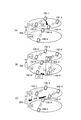
- FIG. 8 is a diagram for explaining a specific example 1 of the interference avoidance operation pattern 2.
- cell A is a cell belonging to frequency band A included in the D2D radio resource
- cell B is a cell belonging to frequency band B included in the D2D radio resource.
- UE 100-1 and UE 100-2 constitute a D2D UE group
- UE 100-3 and UE 100-4 constitute another D2D UE group.
- interference between D2D communications occurs.
- the UE 100-4 detects interference from the UE 100-1.
- the UE 100-4 when the UE 100-4 detects interference, the UE 100-4 changes the frequency band (cell) for performing D2D communication from the frequency band A (cell A) to the frequency band B (cell B). And UE100-4 broadcasts the change information which shows changing to the frequency band B (cell B) in the frequency band B (cell B).
- the UE 100-4 notifies the UE 100-3 that it is changed to the frequency band B (cell B) because it does not receive the busy information.
- UEs 100-3 and 100-4 perform D2D communication in frequency band B (cell B).
- FIG. 9 is a diagram for explaining a specific example 2 of the interference avoidance operation pattern 2. Here, differences from the first specific example will be described.
- UE 100-4 detects interference from UE 100-1 in frequency band A (cell A).
- the UEs 100-5 and 100-6 perform D2D communication in the frequency band B (cell B).
- the UE 100-4 broadcasts the change information indicating the change to the frequency band B (cell B) in the frequency band B (cell B).
- the UE 100-6 receives the change information from the UE 100-4, and broadcasts (or notifies) in-use information indicating that the frequency band B (cell B) is being used in the frequency band B (cell B). .
- the UE 100-4 receives the busy information from the UE 100-6.
- the UE 100-4 that has received the in-use information performs the process of the interference avoidance operation pattern 1 or 2 because the interference from the UE 100-1 has not been reduced.
- the specific state is a state where the UE 100-D exists outside the coverage of the network (hereinafter, “out-of-service state”).
- the coverage is not limited to the coverage of the LTE network, but may be the coverage of all networks operated by the same carrier.
- the term “out of coverage” includes not only a region where radio waves from the network do not reach but also a region where radio waves from the network are very weak. An area outside the coverage is referred to as an “out-of-service area”.
- the eNB 200 that transmits the D2D broadcast information manages the termination cell included in the termination region of the coverage.
- a terminal cell is a cell in which at least a part of its periphery is an out-of-service area. That is, the eNB 200 transmits D2D broadcast information in the terminal cell.
- the ePC 200 may be notified from the EPC 20 of information about whether or not the own cell is a terminal cell.
- the eNB 200 transmits D2D broadcast information that enables D2D communication even when the UE 100-D is out of service.
- the D2D broadcast information includes information (terminal cell information) indicating that D2D communication is allowed in the out-of-service area in addition to resource information indicating D2D radio resources and power information indicating the maximum transmission power allowed in D2D communication. .
- the UE 100-D in the connected state or the idle state in the eNB 200 cell receives the D2D broadcast information from the eNB 200. Then, the UE 100-D that has shifted to the out-of-service state performs D2D communication after performing the Discovery processing based on the D2D broadcast information.
- the UE 100-D when the UE 100-D performs D2D communication in the out-of-service state, it is possible to effectively utilize D2D communication and enable communication in the out-of-service state.
- interference avoidance operations other than the operation that requests the eNB 200 to avoid interference that is, the interference avoidance operation pattern 1
- the interference avoidance operation pattern 1 the interference avoidance operation pattern 1
- the UE 100-D may replace with the interference avoidance operation
- the UE 100-D determines to stop the D2D communication in response to detection of interference from the UE 100-X to the D2D communication, and transmits information indicating the stop of the D2D communication to the communication destination UE. To do.
- D2D communication may be performed using a frequency hopping method in order to reduce the influence of interference.
- the D2D broadcast information includes information on hopping patterns (hopping pattern candidates) that are allowed to be used in D2D communication.
- the UE 100-D may hold a hopping pattern candidate in advance.
- FIG. 10 is a diagram illustrating a specific example of hopping pattern candidates.
- the horizontal axis is a time axis and shows 10 subframes for one radio frame.
- the vertical axis is the frequency axis and indicates the bandwidth for six resource blocks.
- UE 100-D selects a hopping pattern to be used for D2D communication from hopping pattern candidates, and notifies the communication destination UE of the selected hopping pattern.
- the UE 100-D performs D2D communication using the selected hopping pattern.
- the UE 100-D may determine the right to use the hopping pattern by negotiation between UEs.
- the UE 100-D reselects another hopping pattern from the hopping pattern candidates and notifies the communication destination UE of the selected hopping pattern.
- the UE 100-D performs D2D communication using the reselected hopping pattern.
- the hopping pattern may be calculated from a UE-specific ID, a cell ID where the UE is located, a temporary ID (C-RNTI) assigned to the UE from the cell, and the like.
- D2D broadcast information may also contain the information regarding the signal (Discovery signal) transmitted / received in a Discovery process.
- the Discovery signal is a signal for discovering a neighboring UE or a signal for discovering from a neighboring UE.
- the information related to the Discovery signal includes resource information indicating a radio resource (Discovery radio resource) that is allowed to be used in the Discovery process, and power information indicating a maximum transmission power (Discovery maximum transmission power) that is allowed in the Discovery process. .
- the UE 100-D determines a radio resource to be used for transmitting the Discovery signal from the Discovery radio resources indicated by the resource information, and transmits the Discovery signal using the determined radio resource. Further, the UE 100-D determines the transmission power of the Discovery signal within the range of the Discovery maximum transmission power indicated by the power information, and transmits the Discovery signal using the determined transmission power.
- parameters (radio resources, maximum transmission power, etc.) necessary for D2D communication are statically determined, and UE 100-D holds the information (parameters). It may be. In this case, the UE 100-D can perform D2D communication using the held parameters without D2D broadcast information (and termination cell information).
- the present invention is not limited to the LTE system, and the present invention may be applied to a system other than the LTE system.
- the present invention it is possible to provide a mobile communication system, a user terminal, and a base station that can suppress an increase in network load and signaling accompanying control of D2D communication.
Landscapes
- Engineering & Computer Science (AREA)
- Computer Networks & Wireless Communication (AREA)
- Signal Processing (AREA)
- Computer Security & Cryptography (AREA)
- Databases & Information Systems (AREA)
- Mobile Radio Communication Systems (AREA)
Priority Applications (11)
| Application Number | Priority Date | Filing Date | Title |
|---|---|---|---|
| EP18199277.7A EP3445133B1 (de) | 2013-02-19 | 2014-02-18 | Mobilkommunikationssystem, benutzerendgerät und basisstation |
| US14/769,007 US20160007336A1 (en) | 2013-02-19 | 2014-02-18 | Mobile communication system, user terminal, and base station |
| JP2015501455A JP5844937B2 (ja) | 2013-02-19 | 2014-02-18 | 移動通信システム、ユーザ端末、基地局、プロセッサ及び基地局の制御方法 |
| EP14754854.9A EP2961242B1 (de) | 2013-02-19 | 2014-02-18 | Mobilkommunikationssystem, benutzerendgerät und basisstation |
| EP20156294.9A EP3668268B1 (de) | 2013-02-19 | 2014-02-18 | Mobilkommunikationssystem, benutzerendgerät und basisstation |
| US15/167,525 US9769864B2 (en) | 2013-02-19 | 2016-05-27 | Mobile communication system, user terminal, and base station |
| US15/673,949 US9913312B2 (en) | 2013-02-19 | 2017-08-10 | Mobile communication system, user terminal, and base station |
| US15/886,403 US10129923B2 (en) | 2013-02-19 | 2018-02-01 | Mobile communication system, user terminal, and base station |
| US16/183,084 US10602566B2 (en) | 2013-02-19 | 2018-11-07 | Mobile communication system, user terminal, and base station |
| US16/813,480 US11178721B2 (en) | 2013-02-19 | 2020-03-09 | Mobile communication system, user terminal, and base station |
| US17/506,534 US12004252B2 (en) | 2013-02-19 | 2021-10-20 | Mobile communication system, user terminal, and base station |
Applications Claiming Priority (2)
| Application Number | Priority Date | Filing Date | Title |
|---|---|---|---|
| US201361766548P | 2013-02-19 | 2013-02-19 | |
| US61/766,548 | 2013-02-19 |
Related Child Applications (2)
| Application Number | Title | Priority Date | Filing Date |
|---|---|---|---|
| US14/769,007 A-371-Of-International US20160007336A1 (en) | 2013-02-19 | 2014-02-18 | Mobile communication system, user terminal, and base station |
| US15/167,525 Continuation US9769864B2 (en) | 2013-02-19 | 2016-05-27 | Mobile communication system, user terminal, and base station |
Publications (1)
| Publication Number | Publication Date |
|---|---|
| WO2014129452A1 true WO2014129452A1 (ja) | 2014-08-28 |
Family
ID=51391242
Family Applications (1)
| Application Number | Title | Priority Date | Filing Date |
|---|---|---|---|
| PCT/JP2014/053742 Ceased WO2014129452A1 (ja) | 2013-02-19 | 2014-02-18 | 移動通信システム、ユーザ端末及び基地局 |
Country Status (4)
| Country | Link |
|---|---|
| US (7) | US20160007336A1 (de) |
| EP (3) | EP2961242B1 (de) |
| JP (3) | JP5844937B2 (de) |
| WO (1) | WO2014129452A1 (de) |
Cited By (3)
| Publication number | Priority date | Publication date | Assignee | Title |
|---|---|---|---|---|
| WO2017119132A1 (ja) * | 2016-01-08 | 2017-07-13 | 富士通株式会社 | 無線通信装置、無線通信システムおよび処理方法 |
| JP2019536378A (ja) * | 2016-11-29 | 2019-12-12 | ホアウェイ・テクノロジーズ・カンパニー・リミテッド | 周波数ホッピング通信方法およびデバイス |
| US11653280B2 (en) | 2016-01-08 | 2023-05-16 | Fujitsu Limited | Device-to-device and device to network wireless communication apparatus, wireless communication system, and processing method |
Families Citing this family (21)
| Publication number | Priority date | Publication date | Assignee | Title |
|---|---|---|---|---|
| WO2014017504A1 (ja) * | 2012-07-27 | 2014-01-30 | 京セラ株式会社 | 移動通信システム、移動通信システムで用いる移動通信方法 |
| JP5844937B2 (ja) * | 2013-02-19 | 2016-01-20 | 京セラ株式会社 | 移動通信システム、ユーザ端末、基地局、プロセッサ及び基地局の制御方法 |
| CN105103607B (zh) * | 2013-04-08 | 2018-12-18 | Lg电子株式会社 | 在无线通信系统中处理基于接近的服务的方法和设备 |
| EP2984894B1 (de) * | 2013-04-10 | 2019-02-27 | Telefonaktiebolaget LM Ericsson (publ) | Verfahren und drahtlose vorrichtung zur ressourcenverwaltung für eine d2d kommunikation |
| CN105393470B (zh) * | 2013-08-08 | 2018-11-02 | 英特尔Ip公司 | 用于多输入多输出系统中的电子下倾角调节的方法、装置和系统 |
| US10117224B2 (en) * | 2013-09-20 | 2018-10-30 | Qualcomm Incorporated | MAC subheader for D2D broadcast communication for public safety |
| US10531472B2 (en) * | 2013-10-31 | 2020-01-07 | Sony Corporation | Communications system, communications device and method of communicating |
| EP3039930B1 (de) * | 2013-10-31 | 2018-10-17 | Sony Corporation | Kommunikationssystem, kommunikationsvorrichtung, infrastrukturausrüstung und verfahren zur kommunikation |
| GB201402308D0 (en) * | 2014-02-11 | 2014-03-26 | Nec Corp | Communication system |
| TWI612837B (zh) * | 2014-03-11 | 2018-01-21 | 財團法人資訊工業策進會 | 直接通訊系統及其通訊資源排程方法 |
| WO2015142093A1 (ko) * | 2014-03-19 | 2015-09-24 | 엘지전자 주식회사 | 무선 통신 시스템에서 단말에 의해 수행되는 d2d(device-to-device) 신호 전송 방법 및 상기 방법을 이용하는 단말 |
| CN106416388B (zh) * | 2014-08-07 | 2020-01-03 | 太阳专利信托公司 | 服务小区中设备至设备通信中的功率控制方法与用户设备 |
| KR102183333B1 (ko) * | 2014-08-08 | 2020-11-26 | 주식회사 아이티엘 | 단말간 통신을 지원하는 무선 통신 시스템에서 버퍼상태보고 전송 방법 및 장치 |
| US10033578B2 (en) | 2014-10-27 | 2018-07-24 | Qualcomm Incorporated | Leveraging synchronization coordination of a mesh network for low-power devices |
| CN107431902B (zh) * | 2015-02-06 | 2021-02-19 | 三星电子株式会社 | 在支持设备到设备方案的通信系统中发送和接收信号的方法和装置 |
| US10728727B2 (en) * | 2016-03-04 | 2020-07-28 | Lenovo Enterprise Solutions (Singapore) Pte. Ltd. | Systems and methods for reducing interference in wireless communication among computing devices |
| CN112205043A (zh) * | 2018-05-30 | 2021-01-08 | 株式会社Ntt都科摩 | 通信装置 |
| WO2020067818A1 (ko) * | 2018-09-27 | 2020-04-02 | 엘지전자 주식회사 | 무선 통신 시스템에서 무선 통신 시스템에서 아이들 모드의 pur 상에서 ul 데이터를 송수신하기 위한 방법 및 그 장치 |
| WO2020144947A1 (ja) * | 2019-01-10 | 2020-07-16 | ソニー株式会社 | 通信装置、通信方法、及び通信プログラム |
| CN114079935B (zh) * | 2020-08-12 | 2024-11-26 | 维沃移动通信有限公司 | 业务冲突的处理方法、装置及终端 |
| CN116192637B (zh) * | 2021-11-29 | 2025-10-14 | 上海华为技术有限公司 | 一种设备节能方法和网络设备 |
Citations (2)
| Publication number | Priority date | Publication date | Assignee | Title |
|---|---|---|---|---|
| WO2011059820A1 (en) * | 2009-10-29 | 2011-05-19 | Qualcomm Incorporated | Access point scheduled peer-to-peer communication |
| WO2012127440A1 (en) * | 2011-03-23 | 2012-09-27 | Renesas Mobile Corporation | Method and apparatus for facilitating machine-type communication |
Family Cites Families (28)
| Publication number | Priority date | Publication date | Assignee | Title |
|---|---|---|---|---|
| CN1735224A (zh) * | 2004-08-10 | 2006-02-15 | 皇家飞利浦电子股份有限公司 | 用于限制p2p通信干扰的方法和装置 |
| US8737920B2 (en) * | 2004-11-10 | 2014-05-27 | Interdigital Technology Corporation | Method and apparatus for managing wireless communication network radio resources |
| KR101498968B1 (ko) * | 2007-07-05 | 2015-03-12 | 삼성전자주식회사 | 통신시스템에서 피어 투 피어 통신을 위한 자원 결정 방법및 장치 |
| US20090122753A1 (en) * | 2007-10-01 | 2009-05-14 | Hughes Timothy J | Dynamic data link segmentation and reassembly |
| US8068454B2 (en) * | 2007-11-07 | 2011-11-29 | Motorola Solutions, Inc. | System for enabling mobile coverage extension and peer-to-peer communications in an ad hoc network and method of operation therefor |
| JP4948431B2 (ja) * | 2008-01-18 | 2012-06-06 | パナソニック株式会社 | 無線通信端末及び無線通信方法 |
| US9320067B2 (en) * | 2008-11-24 | 2016-04-19 | Qualcomm Incorporated | Configuration of user equipment for peer-to-peer communication |
| US8213951B2 (en) * | 2008-12-23 | 2012-07-03 | At & T Mobility Ii Llc | Using mobile communication devices to facilitate coordinating use of resources |
| US8493887B2 (en) * | 2008-12-30 | 2013-07-23 | Qualcomm Incorporated | Centralized control of peer discovery pilot transmission |
| CN102282901B (zh) * | 2009-01-16 | 2015-06-17 | 诺基亚公司 | 在蜂窝网络中实现装置到装置通信 |
| US8666403B2 (en) * | 2009-10-23 | 2014-03-04 | Nokia Solutions And Networks Oy | Systems, methods, and apparatuses for facilitating device-to-device connection establishment |
| US9066325B2 (en) * | 2010-05-28 | 2015-06-23 | Nokia Solutions And Networks Oy | Methods and apparatus for controlling quality of service parameters in a radio network |
| WO2012016378A1 (en) * | 2010-08-04 | 2012-02-09 | Nokia Corporation | A resolution method and apparatus for simultaneous transmission and receiving contention in a device-to-device cellular reuse system |
| KR101608567B1 (ko) * | 2010-11-01 | 2016-04-01 | 인터디지탈 패튼 홀딩스, 인크 | 동적 스펙트럼 관리 |
| US9072110B2 (en) * | 2010-11-08 | 2015-06-30 | Mediatek Inc. | Method for UE pattern indication and measurement for interference coordination |
| US20120250601A1 (en) * | 2011-03-28 | 2012-10-04 | Hyung-Nam Choi | Communication terminal, method for exchanging data, communication device and method for establishing a communication connection |
| JP5771452B2 (ja) | 2011-06-17 | 2015-09-02 | 株式会社日立国際電気 | 無線装置 |
| US9854044B2 (en) * | 2011-09-30 | 2017-12-26 | Telefonaktiebolaget Lm Ericsson (Publ) | Method and arrangement for handling device-to-device communication in a wireless communications network |
| GB2497741A (en) * | 2011-12-19 | 2013-06-26 | Renesas Mobile Corp | A verification system for use in requesting access to a D2D communication service |
| GB2497745B (en) * | 2011-12-19 | 2014-11-05 | Broadcom Corp | Improvements to wireless communication systems and methods |
| WO2013109100A1 (ko) * | 2012-01-18 | 2013-07-25 | 엘지전자 주식회사 | 장치 대 장치 통신 방법 및 이를 수행하기 위한 장치 |
| WO2013191609A1 (en) * | 2012-06-19 | 2013-12-27 | Telefonaktiebolaget Lm Ericsson | Method and arrangement for d2d discovery |
| US9154267B2 (en) * | 2012-07-02 | 2015-10-06 | Intel Corporation | Sounding reference signal (SRS) mechanism for intracell device-to-device (D2D) communication |
| CN103686676A (zh) * | 2012-08-31 | 2014-03-26 | 中兴通讯股份有限公司 | 设备到设备通信系统的通信方法、装置及系统 |
| CN104782196A (zh) * | 2012-09-28 | 2015-07-15 | 诺基亚通信公司 | 用于正处于空闲模式移动性管理中的设备到设备d2d通信用户设备的位置注册 |
| US9143291B2 (en) * | 2012-12-27 | 2015-09-22 | Google Technology Holdings LLC | Method and apparatus for device-to-device communication |
| US9185697B2 (en) * | 2012-12-27 | 2015-11-10 | Google Technology Holdings LLC | Method and apparatus for device-to-device communication |
| JP5844937B2 (ja) * | 2013-02-19 | 2016-01-20 | 京セラ株式会社 | 移動通信システム、ユーザ端末、基地局、プロセッサ及び基地局の制御方法 |
-
2014
- 2014-02-18 JP JP2015501455A patent/JP5844937B2/ja active Active
- 2014-02-18 WO PCT/JP2014/053742 patent/WO2014129452A1/ja not_active Ceased
- 2014-02-18 EP EP14754854.9A patent/EP2961242B1/de active Active
- 2014-02-18 EP EP18199277.7A patent/EP3445133B1/de active Active
- 2014-02-18 US US14/769,007 patent/US20160007336A1/en not_active Abandoned
- 2014-02-18 EP EP20156294.9A patent/EP3668268B1/de active Active
-
2015
- 2015-11-19 JP JP2015226150A patent/JP6158899B2/ja active Active
-
2016
- 2016-05-27 US US15/167,525 patent/US9769864B2/en active Active
-
2017
- 2017-06-08 JP JP2017113521A patent/JP6253833B2/ja active Active
- 2017-08-10 US US15/673,949 patent/US9913312B2/en active Active
-
2018
- 2018-02-01 US US15/886,403 patent/US10129923B2/en active Active
- 2018-11-07 US US16/183,084 patent/US10602566B2/en active Active
-
2020
- 2020-03-09 US US16/813,480 patent/US11178721B2/en active Active
-
2021
- 2021-10-20 US US17/506,534 patent/US12004252B2/en active Active
Patent Citations (2)
| Publication number | Priority date | Publication date | Assignee | Title |
|---|---|---|---|---|
| WO2011059820A1 (en) * | 2009-10-29 | 2011-05-19 | Qualcomm Incorporated | Access point scheduled peer-to-peer communication |
| WO2012127440A1 (en) * | 2011-03-23 | 2012-09-27 | Renesas Mobile Corporation | Method and apparatus for facilitating machine-type communication |
Non-Patent Citations (2)
| Title |
|---|
| "TR 22.803 V2.0.0", 3GPP TECHNICAL REPORT, November 2012 (2012-11-01) |
| See also references of EP2961242A4 |
Cited By (7)
| Publication number | Priority date | Publication date | Assignee | Title |
|---|---|---|---|---|
| WO2017119132A1 (ja) * | 2016-01-08 | 2017-07-13 | 富士通株式会社 | 無線通信装置、無線通信システムおよび処理方法 |
| JPWO2017119132A1 (ja) * | 2016-01-08 | 2018-10-11 | 富士通株式会社 | 無線通信装置、無線通信システムおよび処理方法 |
| US11653280B2 (en) | 2016-01-08 | 2023-05-16 | Fujitsu Limited | Device-to-device and device to network wireless communication apparatus, wireless communication system, and processing method |
| US11968731B2 (en) | 2016-01-08 | 2024-04-23 | Fujitsu Limited | Wireless communication apparatus, wireless communication system, and processing method |
| US12543233B2 (en) | 2016-01-08 | 2026-02-03 | 1Finity Inc. | Wireless communication apparatus, wireless communication system, and processing method |
| JP2019536378A (ja) * | 2016-11-29 | 2019-12-12 | ホアウェイ・テクノロジーズ・カンパニー・リミテッド | 周波数ホッピング通信方法およびデバイス |
| US10873364B2 (en) | 2016-11-29 | 2020-12-22 | Huawei Technologies Co., Ltd. | Frequency hopping communication method and device |
Also Published As
| Publication number | Publication date |
|---|---|
| US12004252B2 (en) | 2024-06-04 |
| US11178721B2 (en) | 2021-11-16 |
| EP2961242A4 (de) | 2016-10-12 |
| JP6158899B2 (ja) | 2017-07-05 |
| EP2961242A1 (de) | 2015-12-30 |
| US9769864B2 (en) | 2017-09-19 |
| US10602566B2 (en) | 2020-03-24 |
| US20180160468A1 (en) | 2018-06-07 |
| JP2017184278A (ja) | 2017-10-05 |
| JPWO2014129452A1 (ja) | 2017-02-02 |
| EP3445133B1 (de) | 2020-04-01 |
| US9913312B2 (en) | 2018-03-06 |
| US20220046743A1 (en) | 2022-02-10 |
| US20160007336A1 (en) | 2016-01-07 |
| EP2961242B1 (de) | 2018-11-21 |
| US20190075612A1 (en) | 2019-03-07 |
| EP3668268B1 (de) | 2021-06-02 |
| US20200214074A1 (en) | 2020-07-02 |
| EP3445133A1 (de) | 2019-02-20 |
| JP2016054525A (ja) | 2016-04-14 |
| JP5844937B2 (ja) | 2016-01-20 |
| US20160278155A1 (en) | 2016-09-22 |
| EP3668268A1 (de) | 2020-06-17 |
| JP6253833B2 (ja) | 2017-12-27 |
| US10129923B2 (en) | 2018-11-13 |
| US20170367135A1 (en) | 2017-12-21 |
Similar Documents
| Publication | Publication Date | Title |
|---|---|---|
| JP6253833B2 (ja) | ユーザ端末、プロセッサ、及び方法 | |
| JP6475885B2 (ja) | 無線基地局、ユーザ端末及びプロセッサ | |
| JP6328132B2 (ja) | 移動通信システム及びユーザ端末 | |
| JP6687452B2 (ja) | 移動通信システム、ユーザ端末、プロセッサ、記憶媒体及びプログラム | |
| JP6140180B2 (ja) | 移動通信システム、ユーザ端末、基地局、プロセッサ及び通信制御方法 | |
| WO2014157398A1 (ja) | 通信制御方法及びプロセッサ | |
| WO2014069221A1 (ja) | 移動通信システム、ユーザ端末、基地局、プロセッサ及び通信制御方法 | |
| WO2015046268A1 (ja) | ユーザ端末、基地局、及びサーバ装置 | |
| JP6302129B1 (ja) | 基地局及びプロセッサ | |
| JP6140270B2 (ja) | 移動通信システム、基地局、及びユーザ端末 |
Legal Events
| Date | Code | Title | Description |
|---|---|---|---|
| 121 | Ep: the epo has been informed by wipo that ep was designated in this application |
Ref document number: 14754854 Country of ref document: EP Kind code of ref document: A1 |
|
| ENP | Entry into the national phase |
Ref document number: 2015501455 Country of ref document: JP Kind code of ref document: A |
|
| NENP | Non-entry into the national phase |
Ref country code: DE |
|
| WWE | Wipo information: entry into national phase |
Ref document number: 14769007 Country of ref document: US Ref document number: 2014754854 Country of ref document: EP |