WO2014129634A1 - 排ガス浄化用触媒およびそれを用いた排ガス浄化方法 - Google Patents
排ガス浄化用触媒およびそれを用いた排ガス浄化方法 Download PDFInfo
- Publication number
- WO2014129634A1 WO2014129634A1 PCT/JP2014/054387 JP2014054387W WO2014129634A1 WO 2014129634 A1 WO2014129634 A1 WO 2014129634A1 JP 2014054387 W JP2014054387 W JP 2014054387W WO 2014129634 A1 WO2014129634 A1 WO 2014129634A1
- Authority
- WO
- WIPO (PCT)
- Prior art keywords
- exhaust gas
- mass
- substrate
- catalyst
- oxide
- Prior art date
- Legal status (The legal status is an assumption and is not a legal conclusion. Google has not performed a legal analysis and makes no representation as to the accuracy of the status listed.)
- Ceased
Links
Images


Classifications
-
- B—PERFORMING OPERATIONS; TRANSPORTING
- B01—PHYSICAL OR CHEMICAL PROCESSES OR APPARATUS IN GENERAL
- B01J—CHEMICAL OR PHYSICAL PROCESSES, e.g. CATALYSIS OR COLLOID CHEMISTRY; THEIR RELEVANT APPARATUS
- B01J29/00—Catalysts comprising molecular sieves
- B01J29/04—Catalysts comprising molecular sieves having base-exchange properties, e.g. crystalline zeolites
- B01J29/06—Crystalline aluminosilicate zeolites; Isomorphous compounds thereof
- B01J29/70—Crystalline aluminosilicate zeolites; Isomorphous compounds thereof of types characterised by their specific structure not provided for in groups B01J29/08 - B01J29/65
- B01J29/72—Crystalline aluminosilicate zeolites; Isomorphous compounds thereof of types characterised by their specific structure not provided for in groups B01J29/08 - B01J29/65 containing iron group metals, noble metals or copper
- B01J29/74—Noble metals
- B01J29/7415—Zeolite Beta
-
- B—PERFORMING OPERATIONS; TRANSPORTING
- B01—PHYSICAL OR CHEMICAL PROCESSES OR APPARATUS IN GENERAL
- B01D—SEPARATION
- B01D53/00—Separation of gases or vapours; Recovering vapours of volatile solvents from gases; Chemical or biological purification of waste gases, e.g. engine exhaust gases, smoke, fumes, flue gases, aerosols
- B01D53/34—Chemical or biological purification of waste gases
- B01D53/92—Chemical or biological purification of waste gases of engine exhaust gases
- B01D53/94—Chemical or biological purification of waste gases of engine exhaust gases by catalytic processes
- B01D53/944—Simultaneously removing carbon monoxide, hydrocarbons or carbon making use of oxidation catalysts
-
- B—PERFORMING OPERATIONS; TRANSPORTING
- B01—PHYSICAL OR CHEMICAL PROCESSES OR APPARATUS IN GENERAL
- B01J—CHEMICAL OR PHYSICAL PROCESSES, e.g. CATALYSIS OR COLLOID CHEMISTRY; THEIR RELEVANT APPARATUS
- B01J29/00—Catalysts comprising molecular sieves
- B01J29/04—Catalysts comprising molecular sieves having base-exchange properties, e.g. crystalline zeolites
- B01J29/06—Crystalline aluminosilicate zeolites; Isomorphous compounds thereof
- B01J29/70—Crystalline aluminosilicate zeolites; Isomorphous compounds thereof of types characterised by their specific structure not provided for in groups B01J29/08 - B01J29/65
- B01J29/7007—Zeolite Beta
-
- B—PERFORMING OPERATIONS; TRANSPORTING
- B01—PHYSICAL OR CHEMICAL PROCESSES OR APPARATUS IN GENERAL
- B01J—CHEMICAL OR PHYSICAL PROCESSES, e.g. CATALYSIS OR COLLOID CHEMISTRY; THEIR RELEVANT APPARATUS
- B01J35/00—Catalysts, in general, characterised by their form or physical properties
- B01J35/19—Catalysts containing parts with different compositions
-
- B—PERFORMING OPERATIONS; TRANSPORTING
- B01—PHYSICAL OR CHEMICAL PROCESSES OR APPARATUS IN GENERAL
- B01J—CHEMICAL OR PHYSICAL PROCESSES, e.g. CATALYSIS OR COLLOID CHEMISTRY; THEIR RELEVANT APPARATUS
- B01J37/00—Processes, in general, for preparing catalysts; Processes, in general, for activation of catalysts
- B01J37/02—Impregnation, coating or precipitation
- B01J37/024—Multiple impregnation or coating
- B01J37/0244—Coatings comprising several layers
-
- B—PERFORMING OPERATIONS; TRANSPORTING
- B01—PHYSICAL OR CHEMICAL PROCESSES OR APPARATUS IN GENERAL
- B01J—CHEMICAL OR PHYSICAL PROCESSES, e.g. CATALYSIS OR COLLOID CHEMISTRY; THEIR RELEVANT APPARATUS
- B01J37/00—Processes, in general, for preparing catalysts; Processes, in general, for activation of catalysts
- B01J37/02—Impregnation, coating or precipitation
- B01J37/024—Multiple impregnation or coating
- B01J37/0246—Coatings comprising a zeolite
-
- B—PERFORMING OPERATIONS; TRANSPORTING
- B01—PHYSICAL OR CHEMICAL PROCESSES OR APPARATUS IN GENERAL
- B01D—SEPARATION
- B01D2255/00—Catalysts
- B01D2255/10—Noble metals or compounds thereof
- B01D2255/102—Platinum group metals
- B01D2255/1021—Platinum
-
- B—PERFORMING OPERATIONS; TRANSPORTING
- B01—PHYSICAL OR CHEMICAL PROCESSES OR APPARATUS IN GENERAL
- B01D—SEPARATION
- B01D2255/00—Catalysts
- B01D2255/10—Noble metals or compounds thereof
- B01D2255/102—Platinum group metals
- B01D2255/1023—Palladium
-
- B—PERFORMING OPERATIONS; TRANSPORTING
- B01—PHYSICAL OR CHEMICAL PROCESSES OR APPARATUS IN GENERAL
- B01D—SEPARATION
- B01D2255/00—Catalysts
- B01D2255/20—Metals or compounds thereof
- B01D2255/206—Rare earth metals
- B01D2255/2063—Lanthanum
-
- B—PERFORMING OPERATIONS; TRANSPORTING
- B01—PHYSICAL OR CHEMICAL PROCESSES OR APPARATUS IN GENERAL
- B01D—SEPARATION
- B01D2255/00—Catalysts
- B01D2255/20—Metals or compounds thereof
- B01D2255/206—Rare earth metals
- B01D2255/2065—Cerium
-
- B—PERFORMING OPERATIONS; TRANSPORTING
- B01—PHYSICAL OR CHEMICAL PROCESSES OR APPARATUS IN GENERAL
- B01D—SEPARATION
- B01D2255/00—Catalysts
- B01D2255/20—Metals or compounds thereof
- B01D2255/206—Rare earth metals
- B01D2255/2066—Praseodymium
-
- B—PERFORMING OPERATIONS; TRANSPORTING
- B01—PHYSICAL OR CHEMICAL PROCESSES OR APPARATUS IN GENERAL
- B01D—SEPARATION
- B01D2255/00—Catalysts
- B01D2255/20—Metals or compounds thereof
- B01D2255/207—Transition metals
- B01D2255/20707—Titanium
-
- B—PERFORMING OPERATIONS; TRANSPORTING
- B01—PHYSICAL OR CHEMICAL PROCESSES OR APPARATUS IN GENERAL
- B01D—SEPARATION
- B01D2255/00—Catalysts
- B01D2255/20—Metals or compounds thereof
- B01D2255/207—Transition metals
- B01D2255/20715—Zirconium
-
- B—PERFORMING OPERATIONS; TRANSPORTING
- B01—PHYSICAL OR CHEMICAL PROCESSES OR APPARATUS IN GENERAL
- B01D—SEPARATION
- B01D2255/00—Catalysts
- B01D2255/20—Metals or compounds thereof
- B01D2255/209—Other metals
- B01D2255/2092—Aluminium
-
- B—PERFORMING OPERATIONS; TRANSPORTING
- B01—PHYSICAL OR CHEMICAL PROCESSES OR APPARATUS IN GENERAL
- B01D—SEPARATION
- B01D2255/00—Catalysts
- B01D2255/30—Silica
-
- B—PERFORMING OPERATIONS; TRANSPORTING
- B01—PHYSICAL OR CHEMICAL PROCESSES OR APPARATUS IN GENERAL
- B01D—SEPARATION
- B01D2255/00—Catalysts
- B01D2255/50—Zeolites
- B01D2255/502—Beta zeolites
-
- B—PERFORMING OPERATIONS; TRANSPORTING
- B01—PHYSICAL OR CHEMICAL PROCESSES OR APPARATUS IN GENERAL
- B01D—SEPARATION
- B01D2255/00—Catalysts
- B01D2255/90—Physical characteristics of catalysts
- B01D2255/92—Dimensions
- B01D2255/9207—Specific surface
-
- B—PERFORMING OPERATIONS; TRANSPORTING
- B01—PHYSICAL OR CHEMICAL PROCESSES OR APPARATUS IN GENERAL
- B01D—SEPARATION
- B01D2257/00—Components to be removed
- B01D2257/50—Carbon oxides
- B01D2257/502—Carbon monoxide
-
- B—PERFORMING OPERATIONS; TRANSPORTING
- B01—PHYSICAL OR CHEMICAL PROCESSES OR APPARATUS IN GENERAL
- B01D—SEPARATION
- B01D2258/00—Sources of waste gases
- B01D2258/01—Engine exhaust gases
- B01D2258/012—Diesel engines and lean burn gasoline engines
-
- B—PERFORMING OPERATIONS; TRANSPORTING
- B01—PHYSICAL OR CHEMICAL PROCESSES OR APPARATUS IN GENERAL
- B01D—SEPARATION
- B01D53/00—Separation of gases or vapours; Recovering vapours of volatile solvents from gases; Chemical or biological purification of waste gases, e.g. engine exhaust gases, smoke, fumes, flue gases, aerosols
- B01D53/34—Chemical or biological purification of waste gases
- B01D53/92—Chemical or biological purification of waste gases of engine exhaust gases
- B01D53/94—Chemical or biological purification of waste gases of engine exhaust gases by catalytic processes
-
- B—PERFORMING OPERATIONS; TRANSPORTING
- B01—PHYSICAL OR CHEMICAL PROCESSES OR APPARATUS IN GENERAL
- B01J—CHEMICAL OR PHYSICAL PROCESSES, e.g. CATALYSIS OR COLLOID CHEMISTRY; THEIR RELEVANT APPARATUS
- B01J23/00—Catalysts comprising metals or metal oxides or hydroxides, not provided for in group B01J21/00
- B01J23/38—Catalysts comprising metals or metal oxides or hydroxides, not provided for in group B01J21/00 of noble metals
- B01J23/40—Catalysts comprising metals or metal oxides or hydroxides, not provided for in group B01J21/00 of noble metals of the platinum group metals
- B01J23/44—Palladium
-
- B—PERFORMING OPERATIONS; TRANSPORTING
- B01—PHYSICAL OR CHEMICAL PROCESSES OR APPARATUS IN GENERAL
- B01J—CHEMICAL OR PHYSICAL PROCESSES, e.g. CATALYSIS OR COLLOID CHEMISTRY; THEIR RELEVANT APPARATUS
- B01J23/00—Catalysts comprising metals or metal oxides or hydroxides, not provided for in group B01J21/00
- B01J23/38—Catalysts comprising metals or metal oxides or hydroxides, not provided for in group B01J21/00 of noble metals
- B01J23/54—Catalysts comprising metals or metal oxides or hydroxides, not provided for in group B01J21/00 of noble metals combined with metals, oxides or hydroxides provided for in groups B01J23/02 - B01J23/36
- B01J23/56—Platinum group metals
- B01J23/63—Platinum group metals with rare earths or actinides
-
- B—PERFORMING OPERATIONS; TRANSPORTING
- B01—PHYSICAL OR CHEMICAL PROCESSES OR APPARATUS IN GENERAL
- B01J—CHEMICAL OR PHYSICAL PROCESSES, e.g. CATALYSIS OR COLLOID CHEMISTRY; THEIR RELEVANT APPARATUS
- B01J29/00—Catalysts comprising molecular sieves
- B01J29/04—Catalysts comprising molecular sieves having base-exchange properties, e.g. crystalline zeolites
- B01J29/06—Crystalline aluminosilicate zeolites; Isomorphous compounds thereof
- B01J29/70—Crystalline aluminosilicate zeolites; Isomorphous compounds thereof of types characterised by their specific structure not provided for in groups B01J29/08 - B01J29/65
- B01J29/72—Crystalline aluminosilicate zeolites; Isomorphous compounds thereof of types characterised by their specific structure not provided for in groups B01J29/08 - B01J29/65 containing iron group metals, noble metals or copper
- B01J29/74—Noble metals
-
- F—MECHANICAL ENGINEERING; LIGHTING; HEATING; WEAPONS; BLASTING
- F01—MACHINES OR ENGINES IN GENERAL; ENGINE PLANTS IN GENERAL; STEAM ENGINES
- F01N—GAS-FLOW SILENCERS OR EXHAUST APPARATUS FOR MACHINES OR ENGINES IN GENERAL; GAS-FLOW SILENCERS OR EXHAUST APPARATUS FOR INTERNAL-COMBUSTION ENGINES
- F01N2610/00—Adding substances to exhaust gases
- F01N2610/05—Adding substances to exhaust gases the substance being carbon monoxide
-
- F—MECHANICAL ENGINEERING; LIGHTING; HEATING; WEAPONS; BLASTING
- F01—MACHINES OR ENGINES IN GENERAL; ENGINE PLANTS IN GENERAL; STEAM ENGINES
- F01N—GAS-FLOW SILENCERS OR EXHAUST APPARATUS FOR MACHINES OR ENGINES IN GENERAL; GAS-FLOW SILENCERS OR EXHAUST APPARATUS FOR INTERNAL-COMBUSTION ENGINES
- F01N2900/00—Details of electrical control or of the monitoring of the exhaust gas treating apparatus
- F01N2900/06—Parameters used for exhaust control or diagnosing
- F01N2900/16—Parameters used for exhaust control or diagnosing said parameters being related to the exhaust apparatus, e.g. particulate filter or catalyst
- F01N2900/1621—Catalyst conversion efficiency
-
- F—MECHANICAL ENGINEERING; LIGHTING; HEATING; WEAPONS; BLASTING
- F01—MACHINES OR ENGINES IN GENERAL; ENGINE PLANTS IN GENERAL; STEAM ENGINES
- F01N—GAS-FLOW SILENCERS OR EXHAUST APPARATUS FOR MACHINES OR ENGINES IN GENERAL; GAS-FLOW SILENCERS OR EXHAUST APPARATUS FOR INTERNAL-COMBUSTION ENGINES
- F01N3/00—Exhaust or silencing apparatus having means for purifying, rendering innocuous, or otherwise treating exhaust
- F01N3/08—Exhaust or silencing apparatus having means for purifying, rendering innocuous, or otherwise treating exhaust for rendering innocuous
- F01N3/10—Exhaust or silencing apparatus having means for purifying, rendering innocuous, or otherwise treating exhaust for rendering innocuous by thermal or catalytic conversion of noxious components of exhaust
-
- F—MECHANICAL ENGINEERING; LIGHTING; HEATING; WEAPONS; BLASTING
- F01—MACHINES OR ENGINES IN GENERAL; ENGINE PLANTS IN GENERAL; STEAM ENGINES
- F01N—GAS-FLOW SILENCERS OR EXHAUST APPARATUS FOR MACHINES OR ENGINES IN GENERAL; GAS-FLOW SILENCERS OR EXHAUST APPARATUS FOR INTERNAL-COMBUSTION ENGINES
- F01N3/00—Exhaust or silencing apparatus having means for purifying, rendering innocuous, or otherwise treating exhaust
- F01N3/08—Exhaust or silencing apparatus having means for purifying, rendering innocuous, or otherwise treating exhaust for rendering innocuous
- F01N3/10—Exhaust or silencing apparatus having means for purifying, rendering innocuous, or otherwise treating exhaust for rendering innocuous by thermal or catalytic conversion of noxious components of exhaust
- F01N3/24—Exhaust or silencing apparatus having means for purifying, rendering innocuous, or otherwise treating exhaust for rendering innocuous by thermal or catalytic conversion of noxious components of exhaust characterised by constructional aspects of converting apparatus
- F01N3/28—Construction of catalytic reactors
Definitions
- the present invention relates to an exhaust gas purification catalyst and an exhaust gas purification method using the catalyst.
- the present invention relates to a catalyst for purifying exhaust gas discharged from a gasoline engine or a diesel engine and an exhaust gas purification method using the catalyst.
- Patent Document 1 a technique for improving the CO treatment efficiency at low temperatures has been proposed.
- Patent Document 2 a technique capable of effectively treating CO even at a low exhaust gas temperature by a noble metal and a composite oxide of aluminum and zirconium or a composite oxide of aluminum, zirconium and titanium has been proposed.
- the noble metal palladium having a nano-order particle diameter is preferable, and it is disclosed that the smaller the particle palladium, the more the CO is purified at a lower temperature.
- An object of the present invention is to propose an exhaust gas purification catalyst capable of effectively performing exhaust gas treatment, particularly CO purification even at a low exhaust gas temperature, and an exhaust gas purification method using the same.
- Another object of the present invention is to provide an exhaust gas purification catalyst capable of maintaining and exhibiting high CO activity even when exposed to high temperature exhaust gas for a long time, and an exhaust gas purification method using the same.
- a noble metal an oxide containing at least two elements selected from the group consisting of aluminum, zirconium and titanium as the substrate A; a substrate B, silicon, cerium, praseodymium And an oxide containing at least one element selected from the group consisting of lanthanum, and an exhaust gas-purifying catalyst, Formula (X) below:
- the substrate ratio is 0.01 to 8% by mass; (b) when the substrate B is cerium, 0.01 to 2% by mass; c) To provide an exhaust gas purifying catalyst that is 0.01 or more and less than 2% by mass when the substrate B is praseodymium, and (d) 0.01 to 10% by mass when the substrate B is lanthanum. Solved by. Moreover, it solves by providing the exhaust gas purification method using the exhaust gas purification catalyst as described in (1).
- an exhaust gas purification catalyst capable of effectively performing exhaust gas treatment, particularly CO purification even at a low exhaust gas temperature, and an exhaust gas purification method using the same.
- X to Y indicating a range means “X or more and Y or less”, “weight” and “mass”, “weight%” and “mass%”, “part by weight” and “weight part”. “Part by mass” is treated as a synonym. Unless otherwise specified, measurement of operation and physical properties is performed under conditions of room temperature (20 to 25 ° C.) / Relative humidity 40 to 50%.
- a first aspect of the present invention is the following (1): a noble metal; an oxide containing at least two elements selected from the group consisting of aluminum, zirconium and titanium as the substrate A; silicon, cerium as the substrate B And an oxide containing at least one element selected from the group consisting of praseodymium and lanthanum, and an exhaust gas-purifying catalyst comprising the following formula (X):
- the substrate ratio is 0.01 to 8% by mass; (b) when the substrate B is cerium, 0.01 to 2% by mass; c) A catalyst for exhaust gas purification, which is 0.01 or more and less than 2% by mass when the substrate B is praseodymium, and (d) 0.01 to 10% by mass when the substrate B is lanthanum.
- exhaust gas purifying catalyst is also simply referred to as “catalyst”.
- oxide in “the oxide containing at least two elements selected from the group consisting of aluminum, zirconium and titanium as the substrate A” does not include the oxide of the substrate B.
- the substrate B contains at least one element selected from the group consisting of silicon, cerium, praseodymium, and lanthanum in a specific amount, whereby the heat of the exhaust gas, Sintering caused by the movement of PGM (Precious Group of Metals, precious metal), which is promoted by heat generated by local high temperature on the catalyst surface by oxidizing HC, etc. is suppressed, and also to the PGM active point
- PGM Precious Group of Metals, precious metal
- the noble metal is at least one selected from the group consisting of gold, silver, platinum, palladium, rhodium, iridium, ruthenium and osmium.
- the amount of the noble metal is 0.5 to 20 parts by mass.
- the noble metals used in the catalyst according to the invention are gold (Au), silver (Ag), platinum (Pt), palladium (Pd), rhodium (Rh), iridium (Ir), ruthenium (Ru) and osmium (Os).
- Au gold
- silver Ag
- platinum Pt
- palladium Pd
- rhodium Rh
- iridium Ir
- ruthenium ruthenium
- Osmium osmium
- One or more selected from the group consisting of These may be used alone or in combination of two or more, preferably platinum, palladium, rhodium or iridium, more preferably platinum, palladium or rhodium.
- platinum and palladium are preferable from the viewpoint of improving HC and CO oxidation performance.
- the mass ratio of platinum to palladium is preferably 50: 1 to 1: 1, more preferably 40: 1 to 1: 1, and more preferably 30: 1 to 1.1: 1, more preferably 20: 1 to 1.3: 1, and most preferably 5: 1 to 1.5: 1.
- the range of the mass ratio of platinum and palladium becomes preferable, it has an effect of improving CO purification efficiency.
- the amount of the precious metal used is preferably 0.01 to 20 g, more preferably 0.05 to 10 g, and most preferably 0.3 to 10 g per liter of the carrier. In addition, when using in combination of 2 or more types, it is preferable that a total amount is the said range.
- the amount of the noble metal per 100 parts by mass of the total amount of the substrate A and the substrate B (as oxide) is 0.01 to 100 parts by mass, preferably 0.1 to 50 parts by mass, more preferably 0.5. -20 parts by mass, more preferably 0.8-3 parts by mass. If the amount is less than 0.01 mass, the catalyst performance may be lowered. On the other hand, if the amount exceeds 100 parts by mass, the high temperature resistance tends to be lowered.
- noble metal source any raw material that is usually used may be used, and noble metal black, water-soluble noble metal salt, noble metal complex, noble metal colloid, and the like can be used, and these can be used depending on the method of preparing the catalyst. it can.
- noble metal raw materials include: in the case of platinum, halides such as platinum bromide and platinum chloride; inorganic salts of platinum such as hexahydroxo salt and tetranitro salt; carboxylates such as acetate And hydroxides, tetraammineplatinum, hexaammineplatinum halides; inorganic salts; carboxylates; and hydroxides, alkoxides, dinitrodiammineplatins, oxides, and the like.
- halides such as platinum bromide and platinum chloride
- inorganic salts of platinum such as hexahydroxo salt and tetranitro salt
- carboxylates such as acetate And hydroxides, tetraammineplatinum, hexaammineplatinum halides
- inorganic salts carboxylates
- hydroxides alkoxides, dinitrodiammineplatins, oxides, and the like.
- Preferred examples include nitrates, carboxylates, hydroxides and hexahydroxo salts of dinitrodiammine platinum, tetraammine platinum and hexaammine platinum, and dinitrodiammine platinum, tetraammine platinum and hexaammine platinum nitrates, carboxylates, water Oxides, hexahydroxo salts and the like are particularly suitable.
- halides such as palladium chloride; inorganic salts such as nitrates and sulfates of palladium; carboxylates such as acetates; and halides of hydroxides, tetraammine palladium and hexaammine palladium; inorganic salts; Carboxylates; and hydroxides, alkoxides, dinitrodiammine palladium, oxides and the like.
- nitrates dinitrodiammine palladium, tetraammine palladium, hexaammine palladium nitrates; carboxylates; and hydroxides, nitrates (palladium nitrate), tetraammine palladium and hexaammine palladium nitrates; carboxylates; It is a thing.
- rhodium In the case of rhodium, rhodium; halides such as rhodium chloride; inorganic salts such as nitrates, sulfates, hexaammine salts and hexacyanoates of rhodium; carboxylates such as acetates; and hydroxides, alkoxides And oxides.
- Nitrate and hexaammine salt are preferable, and nitrate (rhodium nitrate) is preferable.
- the substrate A is at least two elements selected from the group consisting of aluminum, zirconium and titanium.
- the substrate A is composed of only one type, there is a problem that the heat resistance is lowered.
- the substrate A is at least two kinds of elements, and the substrate A is used in the form of an oxide in the exhaust gas catalyst of the present invention.
- the oxide of the substrate A may be any combination of aluminum, zirconium and titanium oxides, but if the catalyst of the present invention contains a combination of aluminum oxide and zirconium oxide, it is possible to improve heat resistance. Therefore, it is preferable.
- the ratio of the substrate A may be any ratio as long as it acts as a catalyst.
- the total mass of the substrate A (as oxide) is 100% by mass, the oxide of zirconium However, 0.1 to 20% by mass is preferable from the viewpoint of improving heat resistance.
- the titanium oxide as the substrate A is preferably included from the viewpoint of improving heat resistance.
- the titanium oxide is preferably 0.1 to 20% by mass from the viewpoint of improving heat resistance.
- the ratio of the substrate A may be any ratio as long as it functions as a catalyst.
- the total mass of the substrate A (as oxide) is 100% by mass
- Al 2 O 3 is 60 to 96% by mass
- ZrO 2 is 4 to 20% by mass
- TiO 2 is 0 to 20%. It is preferable that it is mass%.
- Al 2 O 3 is 70 to 97% by mass
- ZrO 2 is 2.5 to 20% by mass
- TiO 2 is 1.5 to 10% by mass.
- Al 2 O 3 is 75 to 95% by mass
- ZrO 2 is 3 to 20% by mass
- TiO 2 is 2 to 5% by mass.
- the oxide of zirconium (mass%) / the oxide of titanium ( % By mass) is preferably 1.2 to 3.0, more preferably 1.4 to 2.6, and still more preferably 1.6 to 2.3 from the viewpoint of improving heat resistance. It is.
- an aluminum (Al) source in addition to alumina such as ⁇ alumina, ⁇ alumina, and ⁇ alumina, aluminum sulfate (sulfate), aluminum nitrate (nitrate), and aluminum hydrochloride (hydrochloride) that become alumina by firing. ), Aluminum acetate (acetate) and the like, preferably aluminum nitrate. These may be in the form of hydrates.
- An aluminum source having a hydroxyl group such as boehmite can also be used.
- Zirconium (Zr) sources include oxides such as zirconia and zirconia sol, as well as zirconyl sulfate (sulfate), zirconyl nitrate (nitrate), zirconyl hydrochloride (hydrochloride), and zirconyl acetate (acetic acid). Salt), zirconyl carbonate (carbonate), zirconyl chloride (chloride), zirconyl hydroxide (hydroxide) can be used. These are preferably used in the form of an aqueous solution.
- titania As a titanium (Ti) source, titania, titania sol oxide, titanium sulfate (sulfate), titanium chloride (chloride), and titanium alkoxide, which become oxides by firing, can be used.
- the substrate B is at least one element selected from the group consisting of silicon, cerium, praseodymium and lanthanum, and these can also be used in combination.
- the substrate B is used in the form of an oxide.
- the substrate ratio when the substrate B is silicon is preferably 0.07 to 6% by mass, more preferably 0.08 to 5% by mass, and still more preferably, from the viewpoint of improving CO low-temperature purification performance. 1 to 5%.
- silicon oxide or a salt thereof orthosilicic acid or a salt thereof, metasilicic acid or a salt thereof, silica sol, or the like can be used.
- a salt sodium, potassium, etc. are suitable.
- the substrate ratio is 0.01 to 2% by mass. If it is out of this range, the CO ignitability decreases.
- the substrate ratio when the substrate B is cerium is preferably 0.3 to 1.7% by mass and more preferably 0.5 to 1.5% by mass from the viewpoint of improving CO low-temperature purification performance. preferable.
- cerium oxide cerium oxide, cerium nitrate, cerium sulfate, cerium carbonate, or the like can be used. These may be in the form of hydrates.
- the substrate ratio is 0.01 or more and less than 2 masses. If it is out of this range, the CO ignitability decreases.
- the substrate ratio when the substrate B is praseodymium is preferably 0.2 to 1.7% by mass, more preferably 0.7 to 1.3, from the viewpoint of improving the CO low-temperature purification performance.
- praseodymium oxide As the praseodymium source, praseodymium oxide, praseodymium nitrate, praseodymium sulfate, praseodymium carbonate and the like can be used. These may be in the form of hydrates.
- the substrate ratio when the substrate B is lanthanum is preferably 0.5 to 9% by mass, more preferably 3 to 6% by mass, from the viewpoint of improving CO low-temperature purification performance.
- lanthanum oxide lanthanum oxide, lanthanum nitrate, lanthanum sulfate, lanthanum carbonate and the like can be used. These may be in the form of hydrates.
- the oxide of the substrate A and the oxide of the substrate B may be a mixture (mixed oxide) or a composite oxide. However, from the viewpoint of improving CO low-temperature purification performance and maintaining durability, a mixture (mixed oxide) is preferable.
- the specific surface area of the substrate A and the substrate B (the total specific surface area of the substrate A and the substrate B) is not particularly limited as long as it is normally used for a catalyst for exhaust gas treatment, but is independently 100 preferably from ⁇ 250m 2 / g, more preferably from 150 ⁇ 250m 2 / g, more preferably from 160 ⁇ 250m 2 / g, and most preferably 180 ⁇ 250m 2 / g. In the case of less than 100 m 2 / g, there tends fear becomes less durability at high temperature, exceeding 250m 2 / g, CO purification rate is easily fear lowered.
- the specific surface area means a value measured by the BET (Brunauer-Emmett-Teller) method using N 2 gas.
- the method for preparing the substrate A (oxide) and the substrate B (oxide) is not particularly limited as long as the effects of the present invention are exhibited.
- the temperature during drying is preferably 50 to 250 ° C., more preferably 80 to 200 ° C. from the viewpoint of convenience of use.
- the firing temperature is preferably 200 to 1100 ° C., more preferably 300 to 1000 ° C., from the viewpoint of convenience of use.
- a method in which an aluminum source, a zirconium source, and a silicon source are dissolved in water, mixed, adjusted in pH, coprecipitated as a hydroxide, dried and fired (coprecipitation method); aluminum Source, zirconium source or silicon source as a solid source, and the other as an aqueous solution, followed by drying and firing (impregnation method); method for mixing and drying and firing each solid source (mixing method) Can be used.
- Calcination may be performed in one step or in multiple steps.
- the firing method and conditions when firing is performed in multiple stages are not particularly limited. For example, when firing is performed in three stages, firing is performed at a temperature of 80 ° C. to 150 ° C. for 30 minutes to 10 hours, Further, it is preferable to perform baking at a temperature of 250 ° C. to 550 ° C. for 30 minutes to 8 hours, and further to a temperature of 600 ° C. to 750 ° C. (Example: 700 ° C.) for 30 minutes to 7 hours.
- By firing in multiple stages in this way moisture can be gradually removed at low temperatures, and there is an effect of assisting fine particle crystal formation at high temperatures.
- zeolite can be used as a component capable of adsorbing hydrocarbons (HC) and nitrogen oxides (NOx) in exhaust gas.
- zeolite any of natural products and synthetic products can be used.
- a type, X type, Y type, L type, ⁇ type, ZSM type, ferrierite type, Linde A mold, a faujasite type or the like can be used.
- zeolite is distinguished from the substrate A and the substrate B.
- the catalyst in order to improve the specific surface area and heat resistance of the catalyst, it is possible to include a refractory inorganic oxide that is usually used as an exhaust gas catalyst.
- a refractory inorganic oxide that is usually used as an exhaust gas catalyst.
- the substrate A and the substrate B are used as distinguished from each other. Alkali metals and alkaline earth metals can also be added for NOx adsorption.
- refractory inorganic oxide as distinguished from the substrate A and the substrate B include, for example, metal oxides having a high specific surface area that are generally used for exhaust gas purification catalysts.
- the content of other additive components is not particularly limited, but is preferably 1 to 150 g, more preferably 5 to 100 g, and still more preferably 40 to 60 g per liter of the carrier ( Claim 10). If 1 g is less, the effect of adding other additive components may be reduced, while if it exceeds 150 g, the effect according to the addition may be reduced.
- the catalyst according to the present invention is basically composed of a noble metal, an oxide of substrate A and an oxide of substrate B.
- the exhaust gas purifying catalyst of the present invention is preferably such that the noble metal, the oxide of the substrate A and the oxide of the substrate B are supported on a carrier.
- a carrier used as a carrier in this field can be used without limitation, but a three-dimensional structure is preferably used from the viewpoint of catalyst strength.
- a heat-resistant carrier such as a honeycomb carrier having through holes with a triangle, a quadrangle, or a hexagon
- the three-dimensional structure is preferably an integrally formed type (integrated weir body), for example, a monolith carrier, a metal honeycomb carrier, a plugged honeycomb carrier having a filter function such as a diesel particulate filter, or a punching metal is preferred.
- a pellet carrier can be used.
- spherical and corrugated carriers can be used, and these materials can be made of ceramic or metal, and cordierite, mullite, SiC or the like can be used as the ceramic.
- the monolithic carrier what is usually referred to as a ceramic honeycomb carrier may be used, and cordierite, mullite, ⁇ -alumina, silicon carbide, silicon nitride and the like are particularly preferable. Particularly preferred are cordierite carriers.
- an integrated structure using an oxidation-resistant heat-resistant metal including stainless steel, Fe—Cr—Al alloy, or the like is used.
- These monolithic carriers are manufactured by an extrusion molding method or a method of winding and hardening a sheet-like element.
- the shape of the through hole may be any of a hexagon (honeycomb), a quadrangle, a triangle, or a corrugation (corrugation).
- 100 to 1200 cells per square inch of the carrier cross section can be used satisfactorily, preferably 200 to 900 cells, more preferably 200 to 600 cells, still more preferably 250 to 500 cells.
- the method for supporting the catalyst of the present invention on the three-dimensional structure is not particularly limited. For example, it is possible to use a method of firing after performing a wash coat or the like.
- a preferred example of a method for producing the catalyst of the present invention is shown; (1) A method in which an aqueous solution of noble metal and substrate A and substrate B are mixed and wet-pulverized to obtain a slurry, and then contacted with a three-dimensional structure to remove excess slurry, followed by drying and firing.
- Method, (5) The powder obtained by mixing the substrate A, the substrate B and the noble metal, drying, and firing is wet-pulverized to obtain a slurry, which is then contacted with the three-dimensional structure to remove excess slurry, and then dried and fired. There are methods, etc., but these methods can be appropriately changed and used.
- a catalyst in which the catalyst component is coated on the cordierite carrier may be obtained by performing multi-stage firing.
- the environment may be changed as appropriate.
- the first firing step may be any atmosphere as long as it can be fired, and may be in an atmosphere with less oxygen or in the air, but from the viewpoint of handleability, air, etc.
- firing is preferably performed at a temperature of 250 to 550 ° C. for 30 minutes to 8 hours.
- firing is preferably performed in a mixed gas of hydrogen and nitrogen at a temperature of 250 to 550 ° C. for 30 minutes to 8 hours from the viewpoint of promoting the metallization of the noble metal.
- a second aspect of the present invention is an exhaust gas purification method using the first exhaust gas purification catalyst of the present invention.
- the exhaust gas targeted by the catalyst according to the present invention can be used as long as it contains CO, and is preferably exhaust gas discharged from a gasoline engine or a diesel engine.
- the CO concentration in the exhaust gas is not particularly limited, but is preferably 10 to 50,000 volume ppm, more preferably 50 to 15,000 volume ppm, still more preferably 50 to 5,000 volume ppm. .
- the treatment can be performed. In such a case, the treatment can be performed more efficiently by using a catalyst to which the additive component is added.
- HC concentration in the exhaust gas is not particularly limited, but is preferably 1 to 50,000 volume ppm, more preferably 10 to 10,000 volume ppm, and still more preferably 50 to 1000 volume ppm.
- the NO concentration in the exhaust gas is not particularly limited, but is preferably 1 to 10000 volume ppm, more preferably 10 to 5000 volume ppm, and still more preferably 20 to 1000 volume ppm.
- the particulate component (PM) When the particulate component (PM) is contained in the exhaust gas, it is preferable to use a three-dimensional structure having a filter function.
- the space velocity is preferably 1,000 to 500,000 hr ⁇ 1 , more preferably 5,000 to 150,000 hr ⁇ 1 , and the gas linear velocity is preferably 0.1 to 8.5 m / sec, more preferably 0.2. It is preferable to contact at a rate of ⁇ 4.2 m / sec.
- an oxidation catalyst can be used in the case of exhaust gas with a lot of HC, and a three-way catalyst can be used in combination when the exhaust gas is rich and lean.
- Example 1 Aluminum nitrate nonahydrate (Al (NO 3) 3 ⁇ 9H 2 O) 6917.0g, deionized water 4.5 L (liter, hereinafter represented as "L".) To complete dissolution, further nitric acid 260.8 g of a zirconyl aqueous solution (concentration 20% by mass in terms of ZrO 2 ) was added and stirred well to prepare a mixed aqueous solution. This mixed aqueous solution was dropped into 10 L of an aqueous solution at a temperature of 25 ° C. adjusted to pH 10 with 106.0 g of sodium metasilicate and ammonia. During the dropping, the pH was adjusted so that the pH of the solution was in the range of 7 to 10.
- alumina-zirconia-silica (alumina 90% by mass). And 5% by mass of zirconia and 5% by mass of silica; specific surface area: 200 m 2 / g).
- the calculation is performed in the same manner.
- alumina-zirconia-silica was added to 1396.45 g of a mixed aqueous solution obtained by diluting an aqueous solution of dinitrodiammine platinum corresponding to 33.7 g of platinum and a palladium nitrate solution corresponding to 16.85 g of palladium with deionized water. Then, the alumina-zirconia-silica is dried at 120 ° C. for 8 hours to obtain a powder, and the powder is further calcined at 500 ° C. for 1 hour to carry the noble metal-supported alumina-zirconia-silica. (Noble metal-supported alumina-zirconia-silica) was obtained.
- This noble metal-supported alumina-zirconia-silica, 578.8 g of beta zeolite (silica / alumina ratio (molar ratio) 35, average particle size 0.6 ⁇ m), and 2000 ml (milliliter) of deionized water are mixed and wet-ground. To make a slurry.
- This slurry was wash-coated on a cordierite carrier (number of cells: 600 cells per square inch of cross-sectional area) having a diameter of 103 mm, a length of 130 mm, and 1 L, dried at 150 ° C. for 5 minutes, and then at 500 ° C. It was fired in air for 1 hour, and further treated at 500 ° C. for 3 hours under a stream of 5% hydrogen and 95% nitrogen, to 148.2 g per liter of support (1.8 g of platinum, 0.9 g of palladium, alumina-zirconia- A catalyst a in which a catalyst component of 105.5 g of silica and 40 g of beta zeolite was coated on a cordierite support was obtained.
- a cordierite carrier number of cells: 600 cells per square inch of cross-sectional area
- the catalyst that the amount of SiO 2 was prepared in addition to the catalyst a were examined SiO 2 effect (see Figure 1).
- the amount of SiO 2 in Example 1 was changed to 1% by mass, 10% by mass, and 20% by mass, and a catalyst was obtained in the same manner as in Example 1.
- the increase / decrease in SiO 2 was compensated by the increase / decrease in Al 2 O 3 .
- the vertical axis represents the CO conversion and the horizontal axis represents the% amount of SiO 2 .
- Example 2 Aluminum nitrate nonahydrate (Al (NO 3) 3 ⁇ 9H 2 O) was completely dissolved in deionized water 4.5L of 6917.0g, (concentration of 20 mass% in terms of ZrO 2) addition of zirconyl nitrate solution 269. 5 g and a sulfuric acid solution of titanium sulfate (concentration 30% by mass in terms of TiO 2 ) 89.9 g were added and stirred well to prepare a mixed aqueous solution. This mixed aqueous solution was dropped into 10 L of an aqueous solution at a temperature of 25 ° C. adjusted to pH 10 with 109.1 g of sodium metasilicate and ammonia.
- alumina-zirconia-titania-silica (alumina 87 5% by mass, 5% by mass of zirconia, 2.5% by mass of titania, 5% by mass of silica; specific surface area: 180 m 2 / g).
- the titanium oxide is preferably 1.5 to 10% by mass.
- Is 2.5 / (87.5 + 5 + 2.5) ⁇ 100 2.6% by mass, which is found to be within a preferable range.
- the calculation is performed in the same manner.
- the alumina-zirconia-titania-silica 2025 was added to 1475.45 g of a mixed aqueous solution obtained by diluting an aqueous solution of dinitrodiammine platinum corresponding to 22.7 g of platinum and a palladium nitrate solution corresponding to 11.33 g of palladium with deionized water. After impregnating .8 g, the alumina-zirconia-titania-silica was dried at 120 ° C. for 8 hours to obtain a powder, and the powder was further calcined at 500 ° C. for 1 hour, whereby noble metal supported alumina was supported.
- -Zirconia-titania-silica (noble metal-supported alumina-zirconia-titania-silica) was obtained.
- This slurry was wash-coated on a cordierite carrier (number of cells: 600 cells per square inch of cross-sectional area) having a diameter of 103 mm, a length of 130 mm, and 1 L, dried at 150 ° C.
- Catalyst b coated with a catalyst component of 105.5 g of silica and 40 g of beta zeolite was obtained.
- a catalyst in which the amount of TiO 2 was changed was prepared, and the dependency of the amount of TiO 2 added to the substrate A was examined (see FIG. 2).
- the TiO 2 was changed to 0 mass% as a comparative example, to obtain a catalyst in the same manner as in Example 2.
- the increase / decrease in TiO 2 was compensated by the increase / decrease in Al 2 O 3 .
- the vertical axis represents the CO conversion and the horizontal axis represents the% amount of TiO 2 .
- Example 3 Aluminum nitrate nonahydrate (Al (NO 3) 3 ⁇ 9H 2 O) was completely dissolved in deionized water 4.5L of 6917.0g, (concentration of 20 mass% in terms of ZrO 2) addition of zirconyl nitrate solution 259. 0 g, 85.9 g of a sulfuric acid solution of titanium sulfate (concentration 30% by mass in terms of TiO 2 ) and 25.9 g of cerium nitrate hexahydrate were added and stirred well to prepare a mixed aqueous solution. This mixed aqueous solution was dropped into 10 L of an aqueous solution having a temperature of 25 ° C. adjusted to pH 10 with ammonia.
- alumina-zirconia-titania-ceria alumina 91 5% by mass, 5% by mass of zirconia, 2.5% by mass of titania, 1% by mass of ceria; specific surface area: 151 m 2 / g).
- 1482.1 g of an aqueous solution of dinitrodiammine platinum corresponding to 24.5 g of platinum and a palladium nitrate solution corresponding to 12.3 g of palladium diluted with deionized water were added to 1482.1 g of the above-mentioned alumina-zirconia-titania-ceria 2071.
- the alumina-zirconia-titania-ceria was dried at 120 ° C. for 8 hours to obtain a powder, and the powder was fired at 500 ° C. for 1 hour.
- -Titania-ceria (noble metal-supported alumina-zirconia-titania-ceria) was obtained.
- This noble metal-supported alumina-zirconia-titania-ceria, 591.6 g of beta zeolite (silica / alumina ratio (molar ratio) 35, average particle diameter 0.6 ⁇ m), and 2000 mL of deionized water are mixed and wet-ground. This made a slurry.
- This slurry was wash-coated on a 0.0303 L cordierite carrier (number of cells: 400 cells per square inch of cross-sectional area) cut into a cylindrical shape having a diameter of 24 mm and a length of 67 mm, and dried at 150 ° C. for 5 minutes. After that, air firing was performed at 500 ° C. for 1 hour, and further treated at 500 ° C.
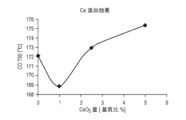
- a catalyst in which the amount of CeO 2 was changed was prepared, and the CeO 2 effect was examined (FIG. 3).
- the amount of CeO 2 in Example 3 was changed to 2.5% by mass and 5% by mass, and as a comparative example, CeO 2 was changed to 0% by mass, and a catalyst was obtained in the same manner as in Example 3.
- the increase / decrease in CeO 2 was compensated by the increase / decrease in Al 2 O 3 .
- the vertical axis indicates the temperature at which the CO conversion rate reaches 50% (COT 50 ° C.), and the horizontal axis indicates the amount of CeO 2 .
- Example 4 In Example 3, alumina-zirconia-titania-praseodia (91.5% by mass of alumina) was used in the same manner as in Example 3 except that 26.2 g of praseodymium nitrate hexahydrate was used instead of cerium nitrate hexahydrate.
- the catalyst d was obtained in the same manner as in Example 3, except that 5% by mass of zirconia, 2.5% by mass of titania and 1% by mass of praseodya; specific surface area: 152 m 2 / g) were obtained.
- a catalyst in which the amount of Pr 6 O 11 was changed in addition to the catalyst d was prepared, and the Pr 6 O 11 effect was examined (Table 1).
- the amount of Pr 6 O 11 in Example 4 was changed to 2% by mass and 0% by mass, and a catalyst was obtained in the same manner as in Example 4.
- the increase / decrease in Pr 6 O 11 was compensated by the increase / decrease in Al 2 O 3 .
- Table 1 shows the temperature at which the CO conversion becomes 50% and the amount of Pr 6 O 11 . The lower the temperature, the better the CO ignitability (low temperature combustibility).
- Example 5 In Example 3, 141.5 g of lanthanum nitrate hexahydrate was used in place of the substrate B cerium nitrate hexahydrate, and the amounts of the aqueous solution of zirconyl nitrate and the sulfuric acid solution of titanium sulfate were changed to produce alumina-zirconia- Titania-Lantana (87.5% by mass of alumina, 5% by mass of zirconia, 2.5% by mass of titania and 5% by mass of Lantana; specific surface area: 154 m 2 / g) was prepared to obtain a catalyst.
- alumina-zirconia- Titania-Lantana 87.5% by mass of alumina, 5% by mass of zirconia, 2.5% by mass of titania and 5% by mass of Lantana; specific surface area: 154 m 2 / g
- Example 3 alumina-zirconia-titania-ceria was changed to alumina-zirconia-titania-lantana (alumina 87.5% by mass, zirconia 5% by mass, titania 2.5% by mass and lantana 5% by mass). Except for the above, catalyst e was obtained in the same manner.
- a catalyst in which the amount of La 2 O 3 was changed in addition to the catalyst e was prepared, and the La 2 O 3 effect was examined (Table 1).
- the amount of La 2 O 3 in Example 5 was changed to 0 mass%, 1 mass%, and 10 mass%, and a catalyst was obtained in the same manner as in Example 5. Note that the decrease in La 2 O 3 was compensated by the increase in Al 2 O 3 .
- Table 1 shows the temperature at which the CO conversion becomes 50% and the amount of La 2 O 3 . The lower the temperature, the better the CO ignitability (low temperature combustibility).
- Example 6 Aluminum nitrate nonahydrate (Al (NO 3) 3 ⁇ 9H 2 O) was completely dissolved in deionized water 4.5L of 6917.0g, (concentration of 20 mass% in terms of ZrO 2) addition of zirconyl nitrate solution 266. 7 g and 26.6 g of cerium nitrate hexahydrate were added and stirred well to prepare a mixed aqueous solution.
- This mixed aqueous solution was dropped into 10 L of an aqueous solution having a temperature of 25 ° C. adjusted to pH 10 with 139.2 g of sodium metasilicate and ammonia. During the dropping, the pH was adjusted so that the pH of the solution was in the range of 7 to 10.
- the resulting precipitate was collected by filtration, washed well with deionized water, dried at 120 ° C. for 8 hours, calcined at 400 ° C. for 5 hours, and 700 ° C. for 5 hours to obtain alumina-zirconia-silica-ceria (alumina 89 Mass%, zirconia 5 mass%, silica 5 mass% and ceria 1 mass%; specific surface area: 230 m 2 / g).
- the amount of CeO 2 was changed to 0% by mass in Example 6, and a catalyst was obtained in the same manner as in Example 6. Note that the decrease in CeO 2 was compensated by the increase in Al 2 O 3 .
- Example 6 when two or more kinds of substrates B are used, it is assumed that “when the substrate B is silicon” and “when the substrate B is cerium”. That is, since silica is 5% by mass and ceria is 1% by mass, “(a) 0.01 to 8% by mass when substrate B is silicon” of the present invention, “(b) substrate B When cerium is cerium, it is 0.01 to 2% by mass ”.
- aqueous solution of dinitrodiammine platinum corresponding to 24.5 g of platinum and a solution of palladium nitrate corresponding to 12.3 g of palladium diluted with deionized water 1482.1 g were mixed with alumina-zirconia-silica-ceria 2071.
- the alumina-zirconia-silica-ceria was dried at 120 ° C. for 8 hours to obtain a powder, and the powder was calcined at 500 ° C. for 1 hour to obtain a precious metal-supported alumina- Zirconia-silica-ceria (noble metal-supported alumina-zirconia-silica-ceria) was obtained.
- This noble metal-supported alumina-zirconia-silica-ceria, beta zeolite (silica / alumina ratio (molar ratio) 35, average particle diameter 0.6 ⁇ m) 607.2 g and deionized water 2000 mL are mixed and wet-ground.
- Comparative Example 1 Comparative catalyst h was obtained in the same manner as in Example 1 except that no silicon source was used in Example 1. Results of catalyst h is, SiO 2 of FIG. 1 with varying amounts of SiO 2 is shown in 0 mass%.
- Example 2 For each of the obtained catalysts, in Example 2, it was exposed to engine exhaust gas at 800 ° C. for 20 hours, and in the other examples and comparative examples, after being exposed to engine exhaust gas at 700 ° C. for 50 hours, a CO ignition test was performed. Did.
- the vertical axis represents the temperature at which the exhaust gas temperature was increased from 100 ° C. at a rate of 20 ° C./minute and the temperature when the CO conversion reached 50% was measured at the exhaust gas concentration shown below.
- a graph was obtained with the substrate ratio of each substrate B as the horizontal axis. The graph shows the CO ignitability imparted by the substrate B.
- the conditions for using the model gas are as follows: CO concentration is 1000 ppm by volume, NO concentration is 80 ppm by volume, HC concentration is 350 ppm by volume (concentration converted to carbon number 1), CO 2 concentration is 6%, The oxygen concentration was 12%, H 2 O was 6%, the rest was nitrogen, and the space velocity was set to 40,000 hr ⁇ 1 .
- the conditions for using the engine were compared in terms of the CO purification characteristics of the catalyst using the overall CO purification rate in the variable travel mode in which the exhaust gas temperature increased and increased.
- the CO concentration is 100 to 1400 volume ppm
- NOx is 50 to 1100 volume ppm
- HC is 100 to 650 volume ppm (concentration converted to carbon number 1)
- the space velocity is 30,000 to 100,000 hr ⁇ 1 .
- the present invention can be used in exhaust gas purification catalysts and purification methods, and is particularly suitable for exhaust gas treatment containing CO.
Landscapes
- Chemical & Material Sciences (AREA)
- Engineering & Computer Science (AREA)
- Chemical Kinetics & Catalysis (AREA)
- Materials Engineering (AREA)
- Organic Chemistry (AREA)
- Crystallography & Structural Chemistry (AREA)
- Biomedical Technology (AREA)
- Health & Medical Sciences (AREA)
- Combustion & Propulsion (AREA)
- Environmental & Geological Engineering (AREA)
- Analytical Chemistry (AREA)
- General Chemical & Material Sciences (AREA)
- Oil, Petroleum & Natural Gas (AREA)
- Exhaust Gas Treatment By Means Of Catalyst (AREA)
- Catalysts (AREA)
- Exhaust Gas After Treatment (AREA)
Abstract
Description
下記数式(X):


(貴金属)
本発明による触媒において使用される貴金属は、金(Au)、銀(Ag)、白金(Pt)、パラジウム(Pd)、ロジウム(Rh)、イリジウム(Ir)、ルテニウム(Ru)およびオスミウム(Os)からなる群より選択される1種以上が好ましい。これらは単独または2種以上を組み合わせて使用されてもよく、好ましくは白金、パラジウム、ロジウムまたはイリジウムであり、さらに好ましくは白金、パラジウムまたはロジウムである。
基質Aは、アルミニウム、ジルコニウムおよびチタニウムよりなる群から選ばれた少なくとも2種の元素である。基質Aが1種類のみからなると、耐熱性が低下するという問題がある。
基質Bは、ケイ素、セリウム、プラセオジムおよびランタンよりなる群から選ばれた少なくとも1種の元素であり、これらは併用することもできる。本発明の排ガス用触媒では、基質Bは酸化物の形態で用いられる。

本発明においては、排ガス浄化用触媒の触媒成分として、アルミニウム、ジルコニウムおよびチタニウムよりなる群から選ばれた少なくとも2種の元素(基質A)、を含む酸化物と、ケイ素、セリウム、プラセオジムおよびランタンよりなる群から選ばれた少なくとも1種の元素(基質B)、を含む酸化物を含む。なお、基質Aの酸化物および基質Bの酸化物は、混合物(混合酸化物)または複合酸化物であってもよい。ただし、CO低温浄化性能向上及び耐久性の維持の観点から、混合物(混合酸化物)であることが好ましい。
(1)各酸化物同士を所定量十分に混合する方法(混合法)、(2)各酸化物の前駆体となる化合物の水溶液同士を混合した後にpH調整し、水酸化物として共沈し乾燥・焼成する方法(共沈法)、(3) (1)または(2)の酸化物に、他の化合物前駆体を溶解した水溶液を混合し、乾燥・焼成する方法(含浸法)などの方法が好適である。
本発明においては、本発明の触媒の効果を低下させないものであれば、他の添加成分を添加することもできる。例えば、排ガス中の炭化水素(HC)、窒素酸化物(NOx)を吸着できる成分として、ゼオライトを用いることができる。
本発明にかかる触媒は、基本的に、貴金属、基質Aの酸化物および基質B(の酸化物)により構成される。しかし、本発明の排ガス浄化用触媒は、好ましくは、前記貴金属、前記基質Aの酸化物および前記基質Bの酸化物が、担体に担持されてなる。
(1)貴金属の水溶液と基質Aおよび基質Bとを混合し湿式粉砕してスラリーを得た後、三次元構造体と接触させ余剰のスラリーを除き、乾燥、焼成する方法、
(2)基質Aと基質Bとを湿式粉砕しスラリーとした後、三次元構造体と接触させ余剰のスラリーを除き、乾燥、焼成し、さらに貴金属の水溶液と接触させ余剰の溶液を除き、乾燥し焼成する方法、
(3)基質Aと貴金属の溶液と混合し乾燥、焼成して得られる粉体と基質Bと湿式粉砕しスラリーを得た後、三次元構造体と接触させ余剰のスラリーを除き乾燥、焼成する方法、
(4)基質Bと貴金属の溶液と混合し乾燥、焼成して得られる粉体と基質Aと湿式粉砕しスラリーを得た後、三次元構造体と接触させ余剰のスラリーを除き乾燥、焼成する方法、
(5)基質Aと基質Bと貴金属の溶液と混合し乾燥、焼成して得られる粉体を湿式粉砕しスラリーを得た後、三次元構造体と接触させ余剰のスラリーを除き乾燥、焼成する方法などがあるが、これらの方法適宜変更使用することができる。
本発明の第2は、本発明の第1の排ガス浄化用触媒を用いた、排ガス浄化方法である。
硝酸アルミニウム9水和物(Al(NO3)3・9H2O)6917.0gを、脱イオン水4.5L(リットル、以下、「L」と表示する。)に完全に溶解させ、さらに硝酸ジルコニル水溶液(ZrO2換算で濃度20質量%)260.8gを加えてよく撹拌し、混合水溶液を作製した。この混合水溶液を、メタケイ酸ナトリウム106.0gとアンモニアでpH10に調整した温度25℃の水溶液10L中に滴下した。滴下中、溶液のpHが7から10の範囲になるようにpHを調整した。生じた沈殿をろ取して脱イオン水でよく洗った後、120℃で8時間乾燥させ、400℃で5時間、700℃で5時間焼成して、アルミナ-ジルコニア-シリカ(アルミナ90質量%、ジルコニア5質量%およびシリカ5質量%;比表面積:200m2/g)を得た。
硝酸アルミニウム9水和物(Al(NO3)3・9H2O)6917.0gを脱イオン水4.5Lに完全に溶解させ、さらに硝酸ジルコニル水溶液(ZrO2換算で濃度20質量%)269.5gと、硫酸チタンの硫酸溶液(TiO2換算で濃度30質量%)89.9gとを加えてよく撹拌し、混合水溶液を作製した。この混合水溶液を、メタケイ酸ナトリウム109.1gとアンモニアでpH10に調整した温度25℃の水溶液10L中に滴下した。滴下中、溶液のpHが7から10の範囲になるようにpHを調整した。生じた沈殿をろ取して脱イオン水でよく洗った後、120℃で8時間乾燥させ、400℃で5時間、700℃で5時間焼成して、アルミナ-ジルコニア-チタニア-シリカ(アルミナ87.5質量%、ジルコニア5質量%、チタニア2.5質量%、シリカ5質量%;比表面積:180m2/g)を得た。
硝酸アルミニウム9水和物(Al(NO3)3・9H2O)6917.0gを脱イオン水4.5Lに完全に溶解させ、さらに硝酸ジルコニル水溶液(ZrO2換算で濃度20質量%)259.0gと、硫酸チタンの硫酸溶液(TiO2換算で濃度30質量%)85.9gと、硝酸セリウム六水和物25.9gとを加えてよく撹拌し、混合水溶液を作製した。この混合水溶液を、アンモニアでpH10に調整した温度25℃の水溶液10L中に滴下した。滴下中、溶液のpHが7から10の範囲になるようにpHを調整した。生じた沈殿をろ取して脱イオン水でよく洗った後、120℃で8時間乾燥させ、400℃で5時間、700℃で5時間焼成して、アルミナ-ジルコニア-チタニア-セリア(アルミナ91.5質量%、ジルコニア5質量%、チタニア2.5質量%、セリア1質量%;比表面積:151m2/g)を得た。
実施例3において、硝酸セリウム六水和物に変えて、硝酸プラセオジウム六水和物26.2gを用いた以外は実施例3と同様にしてアルミナ-ジルコニア-チタニア-プラセオジア(アルミナ91.5質量%、ジルコニア5質量%、チタニア2.5質量%およびプラセオジア1質量%;比表面積:152m2/g)を得た以外は実施例3と同様にして触媒dを得た。
実施例3において、基質Bの硝酸セリウム六水和物に変えて、硝酸ランタン六水和物141.5gを用い、硝酸ジルコニル水溶液および硫酸チタンの硫酸溶液の量を変更して、アルミナ-ジルコニア-チタニア-ランタナ(アルミナ87.5質量%、ジルコニア5質量%、チタニア2.5質量%およびランタナ5質量%;比表面積:154m2/g)を調整し、触媒を得た。
硝酸アルミニウム9水和物(Al(NO3)3・9H2O)6917.0gを脱イオン水4.5Lに完全に溶解させ、さらに硝酸ジルコニル水溶液(ZrO2換算で濃度20質量%)266.7gと、硝酸セリウム六水和物26.6gとを加えてよく撹拌し、混合水溶液を作製した。この混合水溶液を、メタケイ酸ナトリウム139.2gとアンモニアでpH10に調整した温度25℃の水溶液10L中に滴下した。滴下中、溶液のpHが7から10の範囲になるようにpHを調整した。生じた沈殿をろ取して脱イオン水でよく洗った後、120℃で8時間乾燥させ、400℃で5時間、700℃で5時間焼成して、アルミナ-ジルコニア-シリカ-セリア(アルミナ89質量%、ジルコニア5質量%、シリカ5質量%およびセリア1質量%;比表面積:230m2/g)を得た。また、触媒として、実施例6において、CeO2の量を0質量%に変更し、実施例6と同様に、触媒を得た。なお、CeO2の減量分は、Al2O3の増量により補った。
実施例1においてケイ素源を用いない以外は実施例1と同様にして比較触媒hを得た。触媒hの結果は、SiO2の量を変えた図1のSiO2量が0質量%に示した。
得られた、それぞれの触媒について、実施例2については、800℃のエンジン排ガスに20時間、それ以外の実施例、比較例については700℃のエンジン排ガスに50時間曝した後、COの着火試験をした。

Claims (6)
- 貴金属と;
基質Aとして、アルミニウム、ジルコニウムおよびチタニウムよりなる群より選ばれた少なくとも2種の元素、を含む酸化物と;
基質Bとして、ケイ素、セリウム、プラセオジムおよびランタンよりなる群から選ばれた少なくとも1種の元素、を含む酸化物と;
を含む、排ガス浄化用触媒であって、
下記数式(X):

(a)基質Bがケイ素であるとき、0.01~8質量%であり、
(b)基質Bがセリウムであるとき、0.01~2質量%であり、
(c)基質Bがプラセオジムであるとき、0.01以上2質量未満であり、
(d)基質Bがランタンであるとき、0.01~10質量%である、
排ガス浄化用触媒。 - 前記基質Aとしての前記アルミニウムの酸化物と、
前記基質Aとしての前記ジルコニウムの酸化物と、
を含む、請求項1に記載の排ガス浄化用触媒。 - 前記基質Aの酸化物換算の質量の合計を100質量%としたとき、前記ジルコニウムの酸化物が、0.1~20質量%である、請求項2に記載の排ガス浄化用触媒。
- 前記基質Aとしての前記チタニウムの酸化物をさらに含む、請求項2または3に記載の排ガス浄化用触媒。
- 前記基質Aの酸化物換算の質量の合計を100質量%としたとき、前記チタニウムの酸化物が、0.1~20質量%である、請求項4に記載の排ガス浄化用触媒。
- 請求項1~5のいずれか1項に記載の排ガス浄化用触媒を用いた、排ガス浄化方法。
Priority Applications (6)
| Application Number | Priority Date | Filing Date | Title |
|---|---|---|---|
| JP2015501538A JP5938515B2 (ja) | 2013-02-25 | 2014-02-24 | 排ガス浄化用触媒およびそれを用いた排ガス浄化方法 |
| CN201480010473.8A CN105008046B (zh) | 2013-02-25 | 2014-02-24 | 废气净化用催化剂以及使用该废气净化用催化剂的废气净化方法 |
| US14/770,043 US9421528B2 (en) | 2013-02-25 | 2014-02-24 | Exhaust gas purifying catalyst and exhaust gas purification method using same |
| BR112015020301-9A BR112015020301B1 (pt) | 2013-02-25 | 2014-02-24 | catalisador para a purificação de gases de escape e método de purificação de gases de escape usando o mesmo |
| RU2015135774A RU2621679C2 (ru) | 2013-02-25 | 2014-02-24 | Катализатор для очистки выхлопного газа и способ очистки выхлопного газа с применением указанного катализатора |
| EP14753691.6A EP2959969A4 (en) | 2013-02-25 | 2014-02-24 | Exhaust gas purifying catalyst and exhaust gas purification method using same |
Applications Claiming Priority (2)
| Application Number | Priority Date | Filing Date | Title |
|---|---|---|---|
| JP2013-034837 | 2013-02-25 | ||
| JP2013034837 | 2013-02-25 |
Publications (1)
| Publication Number | Publication Date |
|---|---|
| WO2014129634A1 true WO2014129634A1 (ja) | 2014-08-28 |
Family
ID=51391410
Family Applications (1)
| Application Number | Title | Priority Date | Filing Date |
|---|---|---|---|
| PCT/JP2014/054387 Ceased WO2014129634A1 (ja) | 2013-02-25 | 2014-02-24 | 排ガス浄化用触媒およびそれを用いた排ガス浄化方法 |
Country Status (7)
| Country | Link |
|---|---|
| US (1) | US9421528B2 (ja) |
| EP (1) | EP2959969A4 (ja) |
| JP (1) | JP5938515B2 (ja) |
| CN (1) | CN105008046B (ja) |
| BR (1) | BR112015020301B1 (ja) |
| RU (1) | RU2621679C2 (ja) |
| WO (1) | WO2014129634A1 (ja) |
Cited By (3)
| Publication number | Priority date | Publication date | Assignee | Title |
|---|---|---|---|---|
| EP3072588A1 (en) * | 2015-03-23 | 2016-09-28 | Kabushiki Kaisha Toyota Chuo Kenkyusho | Catalyst for purification of exhaust gas, nox storage-reduction catalyst, and method for purifying exhaust gas |
| JP2016179466A (ja) * | 2015-03-23 | 2016-10-13 | 株式会社豊田中央研究所 | 排ガス浄化用触媒、NOx吸蔵還元型触媒、及び排ガス浄化方法 |
| JP2017030990A (ja) * | 2015-07-29 | 2017-02-09 | トヨタ自動車株式会社 | 酸化物固溶体−酸化物混合材料 |
Families Citing this family (5)
| Publication number | Priority date | Publication date | Assignee | Title |
|---|---|---|---|---|
| US11286831B2 (en) * | 2016-05-03 | 2022-03-29 | Khalifa University of Science and Technology | Catalytic converter substrates comprising triply periodic minimal surfaces |
| JP6972744B2 (ja) | 2017-08-01 | 2021-11-24 | トヨタ自動車株式会社 | 運転支援装置 |
| CN108295649B (zh) * | 2018-01-11 | 2020-12-11 | 湖南美源环保科技有限公司 | 一种有机废气净化方法 |
| JP7035753B2 (ja) | 2018-04-16 | 2022-03-15 | トヨタ自動車株式会社 | 運転支援装置 |
| EP4074473A1 (en) | 2021-02-10 | 2022-10-19 | Canon Kabushiki Kaisha | System, manufacturing method, controlling method, program, and recording medium |
Citations (9)
| Publication number | Priority date | Publication date | Assignee | Title |
|---|---|---|---|---|
| JP2000197819A (ja) * | 1998-10-28 | 2000-07-18 | Matsushita Electric Ind Co Ltd | 排ガス浄化材及びその製造方法 |
| JP2007275878A (ja) * | 2006-03-16 | 2007-10-25 | Ict:Kk | 排ガス浄化用触媒、その製造方法、およびかかる触媒を用いた排ガスの浄化方法 |
| WO2010103870A1 (ja) * | 2009-03-09 | 2010-09-16 | 第一稀元素化学工業株式会社 | 排気ガス浄化触媒、それを用いた排気ガス浄化装置、及び排気ガス浄化方法 |
| JP2011083765A (ja) * | 2009-06-30 | 2011-04-28 | Toyota Central R&D Labs Inc | 自動車排ガス浄化用触媒及びその製造方法 |
| JP2012071235A (ja) * | 2010-09-28 | 2012-04-12 | Toyota Motor Corp | 排ガス浄化用触媒 |
| JP2012515087A (ja) * | 2009-01-16 | 2012-07-05 | ビー・エイ・エス・エフ、コーポレーション | 積層ディーゼル酸化触媒複合材料 |
| WO2012121085A1 (ja) | 2011-03-04 | 2012-09-13 | 株式会社アイシーティー | 排ガス浄化用触媒、その製造方法およびそれを用いた排ガス浄化方法 |
| WO2012137930A1 (ja) | 2011-04-08 | 2012-10-11 | トヨタ自動車株式会社 | 排ガス浄化用酸化触媒 |
| JP2013034837A (ja) | 2011-08-04 | 2013-02-21 | Hokwang Industries Co Ltd | 多方向送風ハンドドライヤー |
Family Cites Families (43)
| Publication number | Priority date | Publication date | Assignee | Title |
|---|---|---|---|---|
| JPS56124442A (en) * | 1980-03-06 | 1981-09-30 | Toyota Central Res & Dev Lab Inc | Catalyst for cleaning of exhaust gas |
| US4727052A (en) * | 1986-06-27 | 1988-02-23 | Engelhard Corporation | Catalyst compositions and methods of making the same |
| JP4067120B2 (ja) * | 1996-02-21 | 2008-03-26 | エイエスイーシー・マニュファクチュアリング | 排気転化触媒のための高度に分散した実質的に均一な混合した金属―酸化物複合担体 |
| US6230009B1 (en) * | 1996-12-27 | 2001-05-08 | At&T Wireless Services, Inc. | Method and apparatus for alerting a station in one network of a requested communication from a second network |
| DE19714707A1 (de) * | 1997-04-09 | 1998-10-15 | Degussa | Sauerstoff speicherndes Material mit hoher Temperaturstabilität sowie Verfahren zu seiner Herstellung |
| JP3741303B2 (ja) * | 1997-12-08 | 2006-02-01 | トヨタ自動車株式会社 | 排ガス浄化用触媒 |
| DE10024994A1 (de) * | 1999-05-24 | 2001-01-04 | Daihatsu Motor Co Ltd | Katalytischer Umwandler zum Reinigen von Abgasen |
| JP2002177781A (ja) * | 2000-12-12 | 2002-06-25 | Ict:Kk | 排ガス浄化用触媒 |
| JP3845274B2 (ja) * | 2001-06-26 | 2006-11-15 | ダイハツ工業株式会社 | 排ガス浄化用触媒 |
| CN1171673C (zh) * | 2002-02-07 | 2004-10-20 | 中国石油化工股份有限公司 | 一种汽车尾气净化催化剂的制备方法 |
| AU2003281203A1 (en) * | 2002-07-09 | 2004-01-23 | Cataler Corporation | Catalyst for clarifying exhaust gas |
| US7384888B2 (en) * | 2003-09-15 | 2008-06-10 | Toyota Jidosha Kabushiki Kaisha | Cerium-zirconium composite metal oxide |
| JP3812567B2 (ja) * | 2003-12-01 | 2006-08-23 | マツダ株式会社 | 排気ガス浄化用触媒材料、及びその製造方法 |
| JP4199691B2 (ja) * | 2004-03-25 | 2008-12-17 | 田中貴金属工業株式会社 | 触媒 |
| JP4794834B2 (ja) * | 2004-07-22 | 2011-10-19 | 株式会社豊田中央研究所 | 排ガス浄化用触媒 |
| EP1632288B1 (en) * | 2004-09-03 | 2012-06-20 | Mazda Motor Corporation | Exhaust gas purification catalyst and oxygen storage component for the same |
| JP4654746B2 (ja) * | 2005-04-14 | 2011-03-23 | マツダ株式会社 | 排気ガス浄化触媒装置 |
| DK1991354T3 (da) * | 2006-02-17 | 2020-03-16 | Rhodia Recherches Et Tech | Sammensætning på basis af zirconium-, cerium-, yttrium- og lanthanoxid og et yderligere sjældent jordartsmetals oxid, fremgangsmåde til fremstilling heraf og katalytisk anvendelse heraf |
| KR101051418B1 (ko) * | 2006-03-16 | 2011-07-22 | 인터내쇼날 카탈리스트 테크놀로지, 인코포레이티드 | 배기가스 정화용 촉매, 그 제조방법 및 이러한 촉매를이용한 배기가스의 정화방법 |
| RU2395341C1 (ru) * | 2006-03-28 | 2010-07-27 | Тойота Дзидося Кабусики Кайся | Катализатор для очистки выхлопных газов, способ регенерации такого катализатора, а также устройство и способ очистки выхлопных газов при использовании данного катализатора |
| JP5147687B2 (ja) * | 2006-04-03 | 2013-02-20 | 日産自動車株式会社 | 排ガス浄化触媒及びその製造方法 |
| US7943104B2 (en) * | 2006-04-13 | 2011-05-17 | Umicore Ag & Co. Kg | CE-ZR based solid solutions and methods for making and using the same |
| EP2024084B1 (fr) * | 2006-05-15 | 2019-07-10 | Rhodia Opérations | Composition a base d'oxydes de zirconium, de cerium, de lanthane et d'yttrium, de gadolinium ou de samarium, a surface specifique et reductibilite elevees, et utilisation comme catalyseur |
| JP4826337B2 (ja) * | 2006-05-23 | 2011-11-30 | マツダ株式会社 | 排気ガス浄化用触媒及び排気ガス浄化方法 |
| JP5270075B2 (ja) * | 2006-07-04 | 2013-08-21 | 株式会社キャタラー | 排ガス浄化用触媒 |
| JP4265626B2 (ja) * | 2006-07-12 | 2009-05-20 | トヨタ自動車株式会社 | 触媒担体粒子及びその製造方法、並びに排ガス浄化触媒 |
| FR2907444B1 (fr) * | 2006-10-20 | 2008-12-19 | Rhodia Recherches & Tech | Composition a acidite elevee a base d'oxydes de zirconium,de silicium et d'au moins un autre element choisi parmi le titane,l'aluminium,le tungstene,le molybdene,le cerium,le fer et le manganese |
| JP5100085B2 (ja) * | 2006-10-31 | 2012-12-19 | 株式会社キャタラー | 排ガス浄化用触媒 |
| JP5661989B2 (ja) * | 2007-04-20 | 2015-01-28 | 日産自動車株式会社 | 高耐熱性触媒及びその製造方法 |
| JP5526502B2 (ja) * | 2008-07-16 | 2014-06-18 | 日産自動車株式会社 | 排気ガス浄化用触媒及びその製造方法 |
| JP2010029814A (ja) * | 2008-07-30 | 2010-02-12 | Mazda Motor Corp | 排気ガス浄化用触媒 |
| JP5422087B2 (ja) * | 2008-08-08 | 2014-02-19 | 本田技研工業株式会社 | 低貴金属担持三元触媒 |
| CN105935590A (zh) * | 2008-08-27 | 2016-09-14 | 优美科催化剂日本有限公司 | 废气净化用催化剂以及使用此催化剂的废气净化方法 |
| US8852519B2 (en) * | 2009-07-09 | 2014-10-07 | Toyota Jidosha Kabushiki Kaisha | Exhaust gas purifying catalyst and production process thereof |
| US8833064B2 (en) * | 2009-11-06 | 2014-09-16 | Basf Corporation | Small engine layered catalyst article and method of making |
| JP5903205B2 (ja) * | 2010-01-04 | 2016-04-13 | 株式会社キャタラー | 排ガス浄化用触媒 |
| CN102441404B (zh) * | 2010-10-12 | 2013-06-19 | 中国石油化工股份有限公司 | 抗硫催化燃烧催化剂及其制备方法 |
| JP5594161B2 (ja) * | 2011-01-26 | 2014-09-24 | マツダ株式会社 | 排気ガス浄化用触媒装置 |
| BR112013024344B1 (pt) * | 2011-03-24 | 2021-09-21 | Umicore Shokubai Japan Co., Ltd. | Catalisador de oxidação para purificação de gás de escape, método para sua produção e método para purificação de gás de escape usando-se o mesmo catalisador |
| WO2012132678A1 (ja) * | 2011-03-31 | 2012-10-04 | エヌ・イー ケムキャット株式会社 | アンモニア酸化触媒、およびそれを用いた排気ガス浄化装置並びに排気ガス浄化方法 |
| US8545780B1 (en) * | 2012-07-27 | 2013-10-01 | Basf Corporation | Catalyst materials |
| GB201220912D0 (en) * | 2012-11-21 | 2013-01-02 | Johnson Matthey Plc | Oxidation catalyst for treating the exhaust gas of a compression ignition engine |
| US9616386B2 (en) * | 2015-03-23 | 2017-04-11 | Kabushiki Kaisha Toyota Chuo Kenkyusho | Catalyst for purification of exhaust gas, NOx storage-reduction catalyst, and method for purifying exhaust gas |
-
2014
- 2014-02-24 BR BR112015020301-9A patent/BR112015020301B1/pt active IP Right Grant
- 2014-02-24 JP JP2015501538A patent/JP5938515B2/ja active Active
- 2014-02-24 WO PCT/JP2014/054387 patent/WO2014129634A1/ja not_active Ceased
- 2014-02-24 EP EP14753691.6A patent/EP2959969A4/en not_active Ceased
- 2014-02-24 RU RU2015135774A patent/RU2621679C2/ru active
- 2014-02-24 CN CN201480010473.8A patent/CN105008046B/zh active Active
- 2014-02-24 US US14/770,043 patent/US9421528B2/en active Active
Patent Citations (9)
| Publication number | Priority date | Publication date | Assignee | Title |
|---|---|---|---|---|
| JP2000197819A (ja) * | 1998-10-28 | 2000-07-18 | Matsushita Electric Ind Co Ltd | 排ガス浄化材及びその製造方法 |
| JP2007275878A (ja) * | 2006-03-16 | 2007-10-25 | Ict:Kk | 排ガス浄化用触媒、その製造方法、およびかかる触媒を用いた排ガスの浄化方法 |
| JP2012515087A (ja) * | 2009-01-16 | 2012-07-05 | ビー・エイ・エス・エフ、コーポレーション | 積層ディーゼル酸化触媒複合材料 |
| WO2010103870A1 (ja) * | 2009-03-09 | 2010-09-16 | 第一稀元素化学工業株式会社 | 排気ガス浄化触媒、それを用いた排気ガス浄化装置、及び排気ガス浄化方法 |
| JP2011083765A (ja) * | 2009-06-30 | 2011-04-28 | Toyota Central R&D Labs Inc | 自動車排ガス浄化用触媒及びその製造方法 |
| JP2012071235A (ja) * | 2010-09-28 | 2012-04-12 | Toyota Motor Corp | 排ガス浄化用触媒 |
| WO2012121085A1 (ja) | 2011-03-04 | 2012-09-13 | 株式会社アイシーティー | 排ガス浄化用触媒、その製造方法およびそれを用いた排ガス浄化方法 |
| WO2012137930A1 (ja) | 2011-04-08 | 2012-10-11 | トヨタ自動車株式会社 | 排ガス浄化用酸化触媒 |
| JP2013034837A (ja) | 2011-08-04 | 2013-02-21 | Hokwang Industries Co Ltd | 多方向送風ハンドドライヤー |
Non-Patent Citations (1)
| Title |
|---|
| See also references of EP2959969A4 |
Cited By (5)
| Publication number | Priority date | Publication date | Assignee | Title |
|---|---|---|---|---|
| EP3072588A1 (en) * | 2015-03-23 | 2016-09-28 | Kabushiki Kaisha Toyota Chuo Kenkyusho | Catalyst for purification of exhaust gas, nox storage-reduction catalyst, and method for purifying exhaust gas |
| CN105983406A (zh) * | 2015-03-23 | 2016-10-05 | 株式会社丰田中央研究所 | 废气净化用催化剂、NOx存储-还原催化剂和净化废气的方法 |
| JP2016179466A (ja) * | 2015-03-23 | 2016-10-13 | 株式会社豊田中央研究所 | 排ガス浄化用触媒、NOx吸蔵還元型触媒、及び排ガス浄化方法 |
| US9616386B2 (en) | 2015-03-23 | 2017-04-11 | Kabushiki Kaisha Toyota Chuo Kenkyusho | Catalyst for purification of exhaust gas, NOx storage-reduction catalyst, and method for purifying exhaust gas |
| JP2017030990A (ja) * | 2015-07-29 | 2017-02-09 | トヨタ自動車株式会社 | 酸化物固溶体−酸化物混合材料 |
Also Published As
| Publication number | Publication date |
|---|---|
| JPWO2014129634A1 (ja) | 2017-02-02 |
| BR112015020301B1 (pt) | 2020-12-08 |
| RU2621679C2 (ru) | 2017-06-07 |
| EP2959969A1 (en) | 2015-12-30 |
| CN105008046B (zh) | 2017-09-01 |
| US20160001275A1 (en) | 2016-01-07 |
| BR112015020301A2 (pt) | 2017-07-18 |
| EP2959969A4 (en) | 2017-01-18 |
| JP5938515B2 (ja) | 2016-06-22 |
| CN105008046A (zh) | 2015-10-28 |
| US9421528B2 (en) | 2016-08-23 |
| RU2015135774A (ru) | 2017-03-30 |
Similar Documents
| Publication | Publication Date | Title |
|---|---|---|
| JP5938515B2 (ja) | 排ガス浄化用触媒およびそれを用いた排ガス浄化方法 | |
| JP6703537B2 (ja) | 排気システム用の一酸化二窒素除去触媒 | |
| JP7114219B2 (ja) | No酸化用触媒材料 | |
| JP6910353B2 (ja) | 白金族金属と卑金属酸化物とを組み合わせたディーゼル酸化触媒 | |
| CN113260454A (zh) | 层状三元转化(twc)催化剂和制造所述催化剂的方法 | |
| JP4956130B2 (ja) | 排ガス浄化用触媒 | |
| JP5876436B2 (ja) | 排ガス浄化触媒及び排ガス浄化方法 | |
| JP2003033669A (ja) | 排気ガス浄化用触媒及びその製造方法 | |
| JP6889252B2 (ja) | 排気ガス浄化用触媒およびそれを用いた排気ガス浄化方法 | |
| US11141713B2 (en) | Exhaust gas purification catalyst and exhaust gas purification method using the same | |
| JP2022553892A (ja) | ディーゼル酸化触媒 | |
| JP5537622B2 (ja) | 排ガス浄化用触媒およびこれを用いた排ガス浄化方法 | |
| JP2011136257A (ja) | 排ガス浄化用触媒担体およびそれを用いた排ガス浄化用触媒 | |
| JP5806157B2 (ja) | 排気ガス浄化用触媒組成物 | |
| JP2006205002A (ja) | 排ガス浄化用触媒 | |
| US11143072B2 (en) | Exhaust gas purification catalyst and exhaust gas purification method using the same | |
| JP2006231281A (ja) | 排ガスの処理用触媒、その製造方法、及び排ガスの処理方法 | |
| JP3488999B2 (ja) | 排気ガス浄化用触媒組成物およびその製造方法、並びに排気ガス浄化用触媒 | |
| JP4380880B2 (ja) | 排ガス浄化用触媒 | |
| JP2016043310A (ja) | 窒素酸化物吸蔵材及び排ガス浄化用触媒 | |
| JP4805031B2 (ja) | 排ガス浄化触媒、その製造方法及び使用方法 | |
| JP2002336655A (ja) | 排ガス浄化方法 | |
| JPH09323040A (ja) | 排気ガス浄化用触媒及びその製造方法 | |
| JPH1085604A (ja) | 排気ガス浄化用触媒 | |
| KR20240064639A (ko) | 부분적으로 코팅된 촉매층을 갖는 미립자 필터 |
Legal Events
| Date | Code | Title | Description |
|---|---|---|---|
| 121 | Ep: the epo has been informed by wipo that ep was designated in this application |
Ref document number: 14753691 Country of ref document: EP Kind code of ref document: A1 |
|
| ENP | Entry into the national phase |
Ref document number: 2015501538 Country of ref document: JP Kind code of ref document: A |
|
| WWE | Wipo information: entry into national phase |
Ref document number: 14770043 Country of ref document: US Ref document number: 2014753691 Country of ref document: EP |
|
| NENP | Non-entry into the national phase |
Ref country code: DE |
|
| REG | Reference to national code |
Ref country code: BR Ref legal event code: B01A Ref document number: 112015020301 Country of ref document: BR |
|
| ENP | Entry into the national phase |
Ref document number: 2015135774 Country of ref document: RU Kind code of ref document: A |
|
| ENP | Entry into the national phase |
Ref document number: 112015020301 Country of ref document: BR Kind code of ref document: A2 Effective date: 20150824 |