WO2014129663A1 - タイヤトレッド用ゴム組成物及びこれを用いる空気入りタイヤ - Google Patents
タイヤトレッド用ゴム組成物及びこれを用いる空気入りタイヤ Download PDFInfo
- Publication number
- WO2014129663A1 WO2014129663A1 PCT/JP2014/054587 JP2014054587W WO2014129663A1 WO 2014129663 A1 WO2014129663 A1 WO 2014129663A1 JP 2014054587 W JP2014054587 W JP 2014054587W WO 2014129663 A1 WO2014129663 A1 WO 2014129663A1
- Authority
- WO
- WIPO (PCT)
- Prior art keywords
- group
- silica
- formula
- silane coupling
- coupling agent
- Prior art date
- Legal status (The legal status is an assumption and is not a legal conclusion. Google has not performed a legal analysis and makes no representation as to the accuracy of the status listed.)
- Ceased
Links
Images
Classifications
-
- C—CHEMISTRY; METALLURGY
- C08—ORGANIC MACROMOLECULAR COMPOUNDS; THEIR PREPARATION OR CHEMICAL WORKING-UP; COMPOSITIONS BASED THEREON
- C08F—MACROMOLECULAR COMPOUNDS OBTAINED BY REACTIONS ONLY INVOLVING CARBON-TO-CARBON UNSATURATED BONDS
- C08F236/00—Copolymers of compounds having one or more unsaturated aliphatic radicals, at least one having two or more carbon-to-carbon double bonds
- C08F236/02—Copolymers of compounds having one or more unsaturated aliphatic radicals, at least one having two or more carbon-to-carbon double bonds the radical having only two carbon-to-carbon double bonds
- C08F236/04—Copolymers of compounds having one or more unsaturated aliphatic radicals, at least one having two or more carbon-to-carbon double bonds the radical having only two carbon-to-carbon double bonds conjugated
- C08F236/10—Copolymers of compounds having one or more unsaturated aliphatic radicals, at least one having two or more carbon-to-carbon double bonds the radical having only two carbon-to-carbon double bonds conjugated with vinyl-aromatic monomers
-
- B—PERFORMING OPERATIONS; TRANSPORTING
- B60—VEHICLES IN GENERAL
- B60C—VEHICLE TYRES; TYRE INFLATION; TYRE CHANGING; CONNECTING VALVES TO INFLATABLE ELASTIC BODIES IN GENERAL; DEVICES OR ARRANGEMENTS RELATED TO TYRES
- B60C1/00—Tyres characterised by the chemical composition or the physical arrangement or mixture of the composition
- B60C1/0016—Compositions of the tread
-
- C—CHEMISTRY; METALLURGY
- C08—ORGANIC MACROMOLECULAR COMPOUNDS; THEIR PREPARATION OR CHEMICAL WORKING-UP; COMPOSITIONS BASED THEREON
- C08F—MACROMOLECULAR COMPOUNDS OBTAINED BY REACTIONS ONLY INVOLVING CARBON-TO-CARBON UNSATURATED BONDS
- C08F136/00—Homopolymers of compounds having one or more unsaturated aliphatic radicals, at least one having two or more carbon-to-carbon double bonds
- C08F136/02—Homopolymers of compounds having one or more unsaturated aliphatic radicals, at least one having two or more carbon-to-carbon double bonds the radical having only two carbon-to-carbon double bonds
- C08F136/04—Homopolymers of compounds having one or more unsaturated aliphatic radicals, at least one having two or more carbon-to-carbon double bonds the radical having only two carbon-to-carbon double bonds conjugated
- C08F136/06—Butadiene
-
- C—CHEMISTRY; METALLURGY
- C08—ORGANIC MACROMOLECULAR COMPOUNDS; THEIR PREPARATION OR CHEMICAL WORKING-UP; COMPOSITIONS BASED THEREON
- C08K—Use of inorganic or non-macromolecular organic substances as compounding ingredients
- C08K3/00—Use of inorganic substances as compounding ingredients
- C08K3/34—Silicon-containing compounds
- C08K3/36—Silica
-
- C—CHEMISTRY; METALLURGY
- C08—ORGANIC MACROMOLECULAR COMPOUNDS; THEIR PREPARATION OR CHEMICAL WORKING-UP; COMPOSITIONS BASED THEREON
- C08K—Use of inorganic or non-macromolecular organic substances as compounding ingredients
- C08K5/00—Use of organic ingredients
- C08K5/54—Silicon-containing compounds
- C08K5/548—Silicon-containing compounds containing sulfur
-
- C—CHEMISTRY; METALLURGY
- C08—ORGANIC MACROMOLECULAR COMPOUNDS; THEIR PREPARATION OR CHEMICAL WORKING-UP; COMPOSITIONS BASED THEREON
- C08L—COMPOSITIONS OF MACROMOLECULAR COMPOUNDS
- C08L21/00—Compositions of unspecified rubbers
-
- C—CHEMISTRY; METALLURGY
- C08—ORGANIC MACROMOLECULAR COMPOUNDS; THEIR PREPARATION OR CHEMICAL WORKING-UP; COMPOSITIONS BASED THEREON
- C08L—COMPOSITIONS OF MACROMOLECULAR COMPOUNDS
- C08L83/00—Compositions of macromolecular compounds obtained by reactions forming in the main chain of the macromolecule a linkage containing silicon with or without sulfur, nitrogen, oxygen or carbon only; Compositions of derivatives of such polymers
- C08L83/04—Polysiloxanes
-
- C—CHEMISTRY; METALLURGY
- C08—ORGANIC MACROMOLECULAR COMPOUNDS; THEIR PREPARATION OR CHEMICAL WORKING-UP; COMPOSITIONS BASED THEREON
- C08L—COMPOSITIONS OF MACROMOLECULAR COMPOUNDS
- C08L83/00—Compositions of macromolecular compounds obtained by reactions forming in the main chain of the macromolecule a linkage containing silicon with or without sulfur, nitrogen, oxygen or carbon only; Compositions of derivatives of such polymers
- C08L83/04—Polysiloxanes
- C08L83/08—Polysiloxanes containing silicon bound to organic groups containing atoms other than carbon, hydrogen and oxygen
-
- C—CHEMISTRY; METALLURGY
- C08—ORGANIC MACROMOLECULAR COMPOUNDS; THEIR PREPARATION OR CHEMICAL WORKING-UP; COMPOSITIONS BASED THEREON
- C08L—COMPOSITIONS OF MACROMOLECULAR COMPOUNDS
- C08L9/00—Compositions of homopolymers or copolymers of conjugated diene hydrocarbons
-
- C—CHEMISTRY; METALLURGY
- C08—ORGANIC MACROMOLECULAR COMPOUNDS; THEIR PREPARATION OR CHEMICAL WORKING-UP; COMPOSITIONS BASED THEREON
- C08L—COMPOSITIONS OF MACROMOLECULAR COMPOUNDS
- C08L9/00—Compositions of homopolymers or copolymers of conjugated diene hydrocarbons
- C08L9/06—Copolymers with styrene
-
- C—CHEMISTRY; METALLURGY
- C08—ORGANIC MACROMOLECULAR COMPOUNDS; THEIR PREPARATION OR CHEMICAL WORKING-UP; COMPOSITIONS BASED THEREON
- C08G—MACROMOLECULAR COMPOUNDS OBTAINED OTHERWISE THAN BY REACTIONS ONLY INVOLVING UNSATURATED CARBON-TO-CARBON BONDS
- C08G77/00—Macromolecular compounds obtained by reactions forming a linkage containing silicon with or without sulfur, nitrogen, oxygen or carbon in the main chain of the macromolecule
- C08G77/04—Polysiloxanes
- C08G77/22—Polysiloxanes containing silicon bound to organic groups containing atoms other than carbon, hydrogen and oxygen
- C08G77/28—Polysiloxanes containing silicon bound to organic groups containing atoms other than carbon, hydrogen and oxygen sulfur-containing groups
-
- C—CHEMISTRY; METALLURGY
- C08—ORGANIC MACROMOLECULAR COMPOUNDS; THEIR PREPARATION OR CHEMICAL WORKING-UP; COMPOSITIONS BASED THEREON
- C08K—Use of inorganic or non-macromolecular organic substances as compounding ingredients
- C08K2201/00—Specific properties of additives
- C08K2201/002—Physical properties
- C08K2201/006—Additives being defined by their surface area
Definitions
- the present invention relates to a rubber composition for a tire tread and a pneumatic tire using the same.
- Patent Document 1 a rubber composition containing specific silica
- the rubber composition for a tire tread is required to have less cross-linking (rubber burn) in the storage stage and the stage before the vulcanization process. That is, excellent workability (for example, the viscosity of the rubber composition is appropriate, the scorch resistance and the extrudability are excellent, and the same applies hereinafter) is required.
- an object of the present invention is to provide a rubber composition for a tire tread which is excellent in wet performance and low rolling resistance when formed into a tire and excellent in workability.
- the present inventor Contains a diene rubber, silica and a sulfur-containing silane coupling agent,
- the silica has a nitrogen adsorption specific surface area (N 2 SA) of 194 to 240 m 2 / g, the silica has a CTAB specific surface area (CTAB) of 180 to 215 m 2 / g, and the silica content is 60 to 200 parts by mass with respect to 100 parts by mass of the rubber
- the sulfur-containing silane coupling agent is a polysiloxane represented by the following formula (1), and the content of the sulfur-containing silane coupling agent is 1 to 20% by mass with respect to the content of the silica.
- the present inventors have found that the rubber composition for tire treads becomes a rubber composition for tire treads having excellent wet performance and low rolling resistance and excellent workability, and completed the present invention.
- [Formula (1) is an average composition formula.
- A represents a divalent organic group containing a sulfide group
- B represents a monovalent hydrocarbon group having 5 to 10 carbon atoms
- C represents a hydrolyzable group
- D represents an organic group containing a mercapto group
- R 1 represents a monovalent hydrocarbon group having 1 to 4 carbon atoms
- a to e are 0 ⁇ a ⁇ 1
- the following relational expressions are satisfied: 0 ⁇ b ⁇ 1, 0 ⁇ c ⁇ 3, 0 ⁇ d ⁇ 1, 0 ⁇ e ⁇ 2, and 0 ⁇ 2a + b + c + d + e ⁇ 4.
- one of a and b is not 0. ]
- this invention provides the following rubber composition for tires, and a pneumatic tire using the same.
- 1. Contains a diene rubber, silica and a sulfur-containing silane coupling agent,
- the silica has a nitrogen adsorption specific surface area (N 2 SA) of 194 to 240 m 2 / g, the silica has a CTAB specific surface area (CTAB) of 180 to 215 m 2 / g, and the silica content is 60 to 200 parts by mass with respect to 100 parts by mass of the rubber
- the sulfur-containing silane coupling agent is a polysiloxane represented by the following formula (1), and the content of the sulfur-containing silane coupling agent is 1 to 20% by mass with respect to the content of the silica.
- A represents a divalent organic group containing a sulfide group
- B represents a monovalent hydrocarbon group having 5 to 10 carbon atoms
- C represents a hydrolyzable group
- D represents an organic group containing a mercapto group
- R 1 represents a monovalent hydrocarbon group having 1 to 4 carbon atoms
- a to e are 0 ⁇ a ⁇ 1
- the following relational expressions are satisfied: 0 ⁇ b ⁇ 1, 0 ⁇ c ⁇ 3, 0 ⁇ d ⁇ 1, 0 ⁇ e ⁇ 2, and 0 ⁇ 2a + b + c + d + e ⁇ 4.
- the DBP absorption amount of the silica is 190 ml / 100 g or more, and the ratio of the nitrogen adsorption specific surface area to the CTAB specific surface area (nitrogen adsorption specific surface area / CTAB specific surface area) is 0.9 to 1.4.
- the terpene resin further contains an terpene resin, the amount of the terpene resin is 1 to 30 parts by mass with respect to 100 parts by mass of the diene rubber, and the terpene resin has an softening point of 60 to 150 ° C. 3.
- a rubber composition for a tire tread which is excellent in wet performance and low rolling resistance when formed into a tire and excellent in workability, and a pneumatic tire using the same for a tire tread. be able to.
- the rubber composition for a tire tread of the present invention is Contains a diene rubber, silica and a sulfur-containing silane coupling agent,
- the silica has a nitrogen adsorption specific surface area (N 2 SA) of 194 to 240 m 2 / g, the silica has a CTAB specific surface area (CTAB) of 180 to 215 m 2 / g, and the silica content is 60 to 200 parts by mass with respect to 100 parts by mass of the rubber
- the sulfur-containing silane coupling agent is a polysiloxane represented by the following formula (1), and the content of the sulfur-containing silane coupling agent is 1 to 20% by mass with respect to the content of the silica.
- a tire tread rubber composition (A) a (B) b (C) c (D) d (R 1 ) e SiO (4-2a-bcde) / 2 (1)
- A represents a divalent organic group containing a sulfide group
- B represents a monovalent hydrocarbon group having 5 to 10 carbon atoms
- C represents a hydrolyzable group
- D represents an organic group containing a mercapto group
- R 1 represents a monovalent hydrocarbon group having 1 to 4 carbon atoms
- a to e are 0 ⁇ a ⁇ 1
- the following relational expressions are satisfied: 0 ⁇ b ⁇ 1, 0 ⁇ c ⁇ 3, 0 ⁇ d ⁇ 1, 0 ⁇ e ⁇ 2, and 0 ⁇ 2a + b + c + d + e ⁇ 4.
- the rubber composition for a tire tread of the present invention may be referred to as “the composition of the present invention”.
- the polysiloxane represented by the formula (1) may be referred to as “polysiloxane represented by the average composition formula of the formula (1)”.
- the composition of the present invention uses a polysiloxane represented by the average composition formula of formula (1) as a sulfur-containing silane coupling agent for a rubber composition containing a diene rubber and specific silica. Excellent wet performance, low rolling resistance and processability.
- the polysiloxane represented by the average composition formula of formula (1) can contain a large amount of silica in the rubber composition and sufficiently disperse a large amount of silica in the rubber composition. be able to.
- the present inventor considers that the rubber composition for tires of the present invention achieves the above effects as follows.
- the skeleton of the sulfur-containing silane coupling agent [polysiloxane represented by the average composition formula of formula (1)] contained in the tire rubber composition of the present invention is a siloxane structure.
- the sulfur-containing silane coupling agent has a monovalent hydrocarbon group having 5 to 10 carbon atoms represented by B, it is considered that B can function as an effective protective group for the mercapto group. Therefore, it is considered that the periphery of the mercapto group of the sulfur-containing silane coupling agent is more bulky than the conventional mercaptosilane due to the presence of B when B is contained due to the siloxane structure of the skeleton.
- the mercapto group of the sulfur-containing silane coupling agent is protected, and the Mooney scorch time of the tire rubber composition of the present invention is long and process stability is ensured.
- a bulky structure possessed by the sulfur-containing silane coupling agent does not inhibit the acceleration of the vulcanization rate during vulcanization.
- the mercapto group possessed by the sulfur-containing silane coupling agent can interact and / or react with the diene rubber by heating during vulcanization. Therefore, the composition of the present invention can achieve both processing stability and a high vulcanization speed during vulcanization.
- the sulfur-containing silane coupling agent has a hydrolyzable group represented by C and a siloxane structure, it is considered that the affinity and reactivity with silica are superior to conventional mercaptosilane. Furthermore, when the molecular weight of the sulfur-containing silane coupling agent is in an appropriate range, it is expected that the affinity and reactivity with silica are more excellent. By these things, it is thought that the rubber composition for tires of the present invention achieves excellent wet performance and wear resistance. Moreover, since specific silica is used in the present invention, it is considered that affinity and reactivity with the sulfur-containing silane coupling agent are very high.
- composition of the present invention is excellent in wet performance, wear resistance, and workability, and is excellent in the balance thereof.
- the said mechanism is a presumption of this inventor, and even if it is mechanisms other than the above, it is in the range of this invention.
- the diene rubber contained in the composition of the present invention is not particularly limited.
- SBR styrene butadiene copolymer rubber
- natural rubber NR
- isoprene rubber IR
- butadiene rubber BR
- chloroprene rubber CR
- acrylonitrile butadiene copolymer rubber NBR
- ethylene-propylene-diene copolymer examples thereof include polymer rubber (EPDM), styrene-isoprene copolymer rubber, isoprene-butadiene copolymer rubber, nitrile rubber, and hydrogenated nitrile rubber.
- the diene rubbers can be used alone or in combination of two or more.
- the diene rubber is preferably SBR and / or BR because a tire excellent in wet performance and low rolling resistance can be produced and the wear resistance is good.
- SBR is not particularly limited.
- the terminal of SBR may be modified with a hydroxy group, a polyorganosiloxane group, a carbonyl group, an amino group, or the like.
- the weight average molecular weight of SBR is preferably 500,000 to 2,000,000, and more preferably 700,000 to 1,500,000 from the viewpoint that both grip performance and processability can be achieved.
- the weight average molecular weight of SBR is determined by polystyrene conversion by gel permeation chromatography (GPC) using toluene as a solvent.
- SBR contains 30 to 50% by weight of aromatic vinyl (hereinafter referred to as “styrene content”) for the purpose of producing a tire with even better wet performance and low rolling resistance, and contains vinyl bonds of conjugated dienes.
- the amount is preferably 20 to 70% by mass.
- the content (ratio) of SBR is preferably 50% by mass or more, more preferably 60% by mass or more of the diene rubber, because a tire excellent in wet performance and low rolling resistance can be produced. Is more preferable.
- BR is not particularly limited. For example, a conventionally well-known thing is mentioned.
- the silica contained in the composition of the present invention has a nitrogen adsorption specific surface area (N 2 SA) of 194 to 240 m 2 / g and a CTAB specific surface area (CTAB) of 180 to 215 m 2 / g.
- N 2 SA of silica is preferably from 194 to 235 m 2 / g, more preferably from 197 to 230 m 2 / g, from the viewpoint of excellent wet performance and excellent wear resistance.
- the N 2 SA of silica is less than 194 m 2 / g, the wet performance is poor, the reinforcement to the rubber composition is insufficient, and the wear resistance and steering stability are insufficient.
- N 2 SA of silica exceeds 240 m 2 / g, the dispersibility with respect to the diene rubber decreases, and the rolling resistance increases.
- N 2 SA of silica is obtained in accordance with JIS K6217-2.
- the CTAB adsorption specific surface area (CTAB) of silica is preferably from 185 to 215 m 2 / g, more preferably from 185 to 210 m 2 / g, from the viewpoints of superior wet performance and excellent wear resistance.
- CTAB of silica is less than 180 m 2 / g, the wet performance is poor, the reinforcing property to the rubber composition is insufficient, and the wear resistance and steering stability are insufficient.
- CTAB of silica exceeds 215 m 2 / g, the dispersibility with respect to the diene rubber decreases and the rolling resistance increases.
- CTAB of silica is measured according to the CTAB adsorption method described in JIS K6217-3: 2001.
- the DBP (dibutyl phthalate) absorption amount of silica is preferably 190 ml / 100 g or more, and preferably 200 to 250 ml / 100 g from the viewpoints of excellent wet performance, low rolling resistance, processability, and excellent strength. More preferred.
- the DBP absorption amount of silica is less than 190 ml / 100 g, processing performance and rubber strength are deteriorated.
- the DBP absorption amount of silica is determined in accordance with JIS K6217-4 oil absorption amount A method.
- the ratio of N 2 SA of silica to CTAB of silica is 0.9 to 0.9 from the viewpoint of excellent wet performance, low rolling resistance and workability, and excellent balance between reinforcement and dispersibility. 1.4 is preferable, and 0.9 to 1.2 is more preferable.
- silica contained in the composition of the present invention examples include fumed silica, calcined silica, precipitated silica, pulverized silica, fused silica, colloidal silica, and surface-treated silica.
- Silica can be used alone or in combination of two or more.
- the silica content is 60 to 200 parts by mass with respect to 100 parts by mass of the diene rubber, and is superior in wet performance, low rolling resistance, and workability, and is improved in wear resistance and strength. 60 to 150 parts by mass, more preferably 65 to 145 parts by mass, and still more preferably 70 to 140 parts by mass. When the silica content is less than 60 parts by mass with respect to 100 parts by mass of the diene rubber, the wet performance is poor.
- the sulfur-containing silane coupling agent contained in the composition of the present invention will be described below.
- the sulfur-containing silane coupling agent contained in the composition of the present invention is a polysiloxane represented by the following formula (1).
- [Formula (1) is an average composition formula.
- A represents a divalent organic group containing a sulfide group
- B represents a monovalent hydrocarbon group having 5 to 10 carbon atoms
- C represents a hydrolyzable group
- D represents an organic group containing a mercapto group
- R 1 represents a monovalent hydrocarbon group having 1 to 4 carbon atoms
- a to e are 0 ⁇ a ⁇ 1
- the following relational expressions are satisfied: 0 ⁇ b ⁇ 1, 0 ⁇ c ⁇ 3, 0 ⁇ d ⁇ 1, 0 ⁇ e ⁇ 2, and 0 ⁇ 2a + b + c + d + e ⁇ 4.
- one of a and b is not 0.
- the sulfur-containing silane coupling agent has excellent affinity and / or reactivity with silica by containing C. Since the sulfur-containing silane coupling agent has D, it can interact and / or react with the diene rubber, and is excellent in wet performance and wear resistance.
- the sulfur-containing silane coupling agent has A, it is excellent in wet performance and workability (particularly maintaining and extending the Mooney scorch time) and is excellent in wear resistance.
- the sulfur-containing silane coupling agent has B, the mercapto group is protected to increase the Mooney scorch time, and at the same time, it is excellent in workability due to excellent affinity with rubber.
- the sulfur-containing silane coupling agent contained in the composition of the present invention has a siloxane skeleton as its skeleton.
- A represents a divalent organic group containing a sulfide group (hereinafter also referred to as a sulfide group-containing organic group).
- the organic group can be, for example, a hydrocarbon group that may have a hetero atom such as an oxygen atom, a nitrogen atom, or a sulfur atom.
- it is preferable that it is group represented by following formula (2).
- n represents an integer of 1 to 10, and preferably an integer of 2 to 4.
- x represents an integer of 1 to 6, preferably an integer of 2 to 4.
- * indicates a bonding position.
- Specific examples of the group represented by the formula (2) include, for example, * —CH 2 —S 2 —CH 2 — * , * —C 2 H 4 —S 2 —C 2 H 4 — * , * — C 3 H 6 —S 2 —C 3 H 6 — * , * —C 4 H 8 —S 2 —C 4 H 8 — * , * —CH 2 —S 4 —CH 2 — * , * —C 2 H 4 -S 4 -C 2 H 4 - *, * -C 3 H 6 -S 4 -C 3 H 6 - *, * -C 4 H 8 -S 4 -C 4 H 8 - * , and the like.
- B represents a monovalent hydrocarbon group having 5 to 10 carbon atoms, and specific examples thereof include a hexyl group, an octyl group, and a decyl group.
- B is preferably a monovalent hydrocarbon group having 8 to 10 carbon atoms because it protects the mercapto group, has a long Mooney scorch time and is excellent in workability, and is excellent in wet characteristics and low rolling resistance.
- C represents a hydrolyzable group, and specific examples thereof include an alkoxy group, a phenoxy group, a carboxyl group, an alkenyloxy group, and the like. Especially, it is preferable that it is group represented by following formula (3).
- * -OR 2 (3) In the above formula (3), R 2 is an alkyl group having 1 to 20 carbon atoms, an aryl group having 6 to 10 carbon atoms, an aralkyl group having 6 to 10 carbon atoms (arylalkyl group), or an alkenyl group having 2 to 10 carbon atoms. Among them, an alkyl group having 1 to 5 carbon atoms is preferable.
- alkyl group having 1 to 20 carbon atoms include, for example, methyl group, ethyl group, propyl group, butyl group, hexyl group, octyl group, decyl group, octadecyl group and the like.
- aryl group having 6 to 10 carbon atoms include a phenyl group and a tolyl group.
- aralkyl group having 6 to 10 carbon atoms include a benzyl group and a phenylethyl group.
- alkenyl group having 2 to 10 carbon atoms include a vinyl group, a propenyl group, and a pentenyl group.
- * indicates a bonding position.
- D represents the organic group containing a mercapto group. Especially, it is preferable that it is group represented by following formula (4).
- m represents an integer of 1 to 10, and preferably an integer of 1 to 5.
- * indicates a bonding position.
- Specific examples of the group represented by the above formula (4) include * —CH 2 SH, * —C 2 H 4 SH, * —C 3 H 6 SH, * —C 4 H 8 SH, * —C 5.
- R 1 represents a monovalent hydrocarbon group having 1 to 4 carbon atoms.
- a to e are relational expressions of 0 ⁇ a ⁇ 1, 0 ⁇ b ⁇ 1, 0 ⁇ c ⁇ 3, 0 ⁇ d ⁇ 1, 0 ⁇ e ⁇ 2, 0 ⁇ 2a + b + c + d + e ⁇ 4.
- a and b is not 0.
- a is larger than 0 (0 ⁇ a) because the processability is more excellent. That is, the case of having a sulfide group-containing organic group is mentioned as one of preferred embodiments. Especially, it is preferable that 0 ⁇ a ⁇ 0.50 because the workability is further excellent and the wet performance and the low rolling resistance are also excellent.
- a is preferably 0 because the wet performance and the low rolling resistance are more excellent. That is, the case where it does not have a sulfide group-containing organic group is mentioned as one of preferred embodiments.
- b is preferably larger than 0, and 0.10 ⁇ b ⁇ 0.89, because it is superior in wet characteristics, low rolling resistance and workability. More preferred.
- c is preferably 1.2 ⁇ c ⁇ 2.0 because the wet property, the low rolling resistance and the workability are more excellent, and the dispersibility of silica is more excellent.
- d is preferably 0.1 ⁇ d ⁇ 0.8 because wet characteristics, low rolling resistance, and workability are more excellent.
- A is the formula (2). It is preferable that C is a group represented by the above formula (3), D is a polysiloxane which is a group represented by the above formula (4), and B is a carbon number. More preferably, it is a monovalent hydrocarbon group of 8 to 10.
- the weight average molecular weight of the polysiloxane represented by the average composition formula of the formula (1) is preferably 500 to 2300, and more preferably 600 to 1500 from the viewpoint of excellent wet performance, low rolling resistance, and workability. Is more preferable.
- the molecular weight of polysiloxane is a weight average molecular weight determined in terms of polystyrene by gel permeation chromatography (GPC) using toluene as a solvent.
- Mercapto equivalent of polysiloxane represented by the average composition formula of formula (1) by acetic acid / potassium iodide / potassium iodate addition-sodium thiosulfate solution titration is 550 to 1900 g from the viewpoint of excellent vulcanization reactivity. / Mol is preferable, and 600 to 1800 g / mol is more preferable.
- the method for producing polysiloxane is not particularly limited.
- it can be produced by hydrolytic condensation of an organosilicon compound containing at least a silane coupling agent having a mercapto group as a raw material.
- an organosilicon compound represented by the following formula (5) may be used.
- it is preferable to use at least an organosilicon compound represented by the formula (6) (for example, p 5 to 10) and an organosilicon compound represented by the formula (7) for the reason of better wet performance.
- R 51 represents an alkyl group having 1 to 20 carbon atoms, an aryl group having 6 to 10 carbon atoms or an alkenyl group having 2 to 10 carbon atoms, and in particular, an alkyl group having 1 to 5 carbon atoms. It is preferable that Specific examples of the alkyl group having 1 to 20 carbon atoms include, for example, methyl group, ethyl group, propyl group, butyl group, hexyl group, octyl group, decyl group, octadecyl group and the like.
- R 52 represents an alkyl group having 1 to 10 carbon atoms or an aryl group having 6 to 10 carbon atoms.
- alkyl group having 1 to 10 carbon atoms include a methyl group, an ethyl group, a propyl group, a butyl group, a hexyl group, an octyl group, and a decyl group.
- aryl group having 6 to 10 carbon atoms are the same as those for R 51 described above.
- the definition and preferred aspects of n are the same as n in the above formula (2).
- the definition and preferred embodiment of x are the same as x in the above formula (2).
- y represents an integer of 1 to 3.
- organosilicon compound represented by the above formula (5) include, for example, bis (trimethoxysilylpropyl) tetrasulfide, bis (triethoxysilylpropyl) tetrasulfide, bis (trimethoxysilylpropyl) disulfide, bis (Triethoxysilylpropyl) disulfide and the like.
- R 61 are the same as those of R 51 described above.
- R 62 are the same as those of R 52 described above.
- the definition of z is the same as the above y.
- p represents an integer of 1 to 10. p is preferably an integer of 5 to 10 from the viewpoint of excellent wet performance, low rolling resistance and processability, and excellent affinity with diene rubber.
- organosilicon compound represented by the formula (6) an organosilicon compound in which p is an integer of 1 to 4 and / or an organosilicon compound in which p is an integer of 5 to 10 can be used.
- organosilicon compound represented by the above formula (6) includes, for example, pentyltrimethoxysilane, pentylmethyldimethoxysilane, pentyltriethoxysilane, pentylmethyldiethoxysilane, Hexyltrimethoxysilane, hexylmethyldimethoxysilane, hexyltriethoxysilane, hexylmethyldiethoxysilane, octyltrimethoxysilane, octylmethyldimethoxysilane, octyltriethoxysilane, octylmethyldiethoxysilane, decyltrimethoxysilane, decylmethyldimethoxy Examples include silane, decyltriethoxysilane, decylmethyldiethoxysilane, and the like.
- organosilicon compound represented by the above formula (6) (p is an integer of 1 to 4) include, for example, methyltrimethoxysilane, dimethyldimethoxysilane, methyltriethoxysilane, methylethyldiethoxysilane, propyl Examples include trimethoxysilane, propylmethyldimethoxysilane, propylmethyldiethoxysilane, and the like.
- R 71 are the same as R 51 described above.
- the definition, specific examples and preferred embodiments of R 72 are the same as those of R 52 described above.
- the definition and preferred embodiment of m are the same as m in the above formula (4).
- the definition of w is the same as y.
- organosilicon compound represented by the above formula (7) include, for example, ⁇ -mercaptomethyltrimethoxysilane, ⁇ -mercaptomethylmethyldimethoxysilane, ⁇ -mercaptomethyltriethoxysilane, ⁇ -mercaptomethylmethyldi Examples include ethoxysilane, ⁇ -mercaptopropyltrimethoxysilane, ⁇ -mercaptopropylmethyldimethoxysilane, ⁇ -mercaptopropyltriethoxysilane, and ⁇ -mercaptopropylmethyldiethoxysilane.
- a silane coupling agent having a mercapto group for example, an organosilicon compound represented by the formula (7)
- a silane coupling agent other than a ring agent for example, an organosilicon compound represented by formula (6)
- Mixing ratio (molar ratio) with the silane coupling agent silane coupling agent having a mercapto group / silane coupling agent other than a silane coupling agent having a sulfide group or a mercapto group
- the silane coupling agent silane coupling agent having a mercapto group / silane coupling agent other than a silane coupling agent having a sulfide group or a mercapto group
- an organosilicon compound used when producing polysiloxane for example, a silane coupling agent having a mercapto group [for example, an organosilicon compound represented by the formula (7)] and a silane coupling agent having a sulfide group [
- the coupling agent / silane coupling agent having a sulfide group) is 2.0 / 8.0 to 8.9 / 1.1 from the viewpoint of superior wet performance, low rolling resistance, and workability.
- the ratio is preferably 2.5 / 7.5 to 8.0 / 2.0.
- an organosilicon compound used when producing polysiloxane for example, a silane coupling agent having a mercapto group [for example, an organosilicon compound represented by the formula (7)], a silane coupling agent having a sulfide group [ For example, an organosilicon compound represented by formula (5)] and a silane coupling agent other than a silane coupling agent having a sulfide group or mercapto group [for example, an organosilicon compound represented by formula (6)] are used in combination.
- the amount of the silane coupling agent having a mercapto group is preferably 10.0 to 73.0% in the total amount (mol) of the three silane coupling agents listed above.
- the amount of the silane coupling agent having a sulfide group is preferably 5.0 to 67.0% of the three total amounts listed above.
- the amount of the silane coupling agent other than the silane coupling agent having a sulfide group or a mercapto group is preferably 16.0 to 85.0% of the three total amounts mentioned above.
- a solvent may be used as necessary.
- the solvent is not particularly limited, but specifically, aliphatic hydrocarbon solvents such as pentane, hexane, heptane, decane, ether solvents such as diethyl ether, tetrahydrofuran, 1,4-dioxane, formamide, dimethylformamide, N Amide solvents such as methylpyrrolidone, aromatic hydrocarbon solvents such as benzene, toluene and xylene, alcohol solvents such as methanol, ethanol and propanol.
- examples of the catalyst that can be used in producing the polysiloxane represented by the formula (1) include acidic catalysts such as hydrochloric acid and acetic acid; Lewis acid catalysts such as ammonium fluoride; sodium hydroxide, Alkali metal salts such as potassium hydroxide, sodium carbonate, sodium acetate, potassium acetate, sodium hydrogen carbonate, potassium carbonate, potassium hydrogen carbonate, calcium carbonate, sodium methoxide, sodium ethoxide; alkaline earth metal salts; triethylamine, tributylamine Amine compounds such as pyridine, 4-dimethylaminopyridine, and the like.
- the catalyst is preferably not an organometallic compound containing Sn, Ti or Al as a metal.
- the metal is introduced into the polysiloxane skeleton, and the specific polysiloxane (the skeleton has no metal other than a silicon atom (for example, Sn, Ti, Al)). It may not be obtained.
- an organometallic compound containing Sn, Ti, or Al is not used as a catalyst, a metal derived from the catalyst is not introduced into the molecule in the polysiloxane (for example, a metal is introduced into the polysiloxane skeleton).
- the rubber composition for a tire tread of the present invention is excellent in storage stability without being cured or gelled by moisture in the air even in a normal atmosphere or a high humidity environment.
- the amount of the catalyst is 0.01 to 10 parts by mass with respect to 100 parts by mass of the organosilicon compound used as a raw material from the viewpoint of excellent wet performance, low rolling resistance, processability, and excellent storage stability.
- the amount is preferably 0.05 to 1 part by mass.
- the sulfur-containing silane coupling agents can be used alone or in combination of two or more.
- the content of the sulfur-containing silane coupling agent is 1 to 20% by mass of the content of the silica, and the wet performance, low rolling resistance, and processability are more excellent. For this reason, it is preferably 2 to 20% by mass, more preferably 3 to 18% by mass, still more preferably 4 to 16% by mass, and particularly preferably 5 to 14% by mass.
- the content of the sulfur-containing silane coupling agent exceeds 20% by mass of the silica content, the processability is poor.
- the composition of the present invention preferably further contains a terpene resin because the balance between wet performance and low rolling resistance is more excellent.
- the terpene resin is preferably an aromatic modified terpene resin.
- the terpene resin and the aromatic modified terpene resin are not particularly limited. For example, a conventionally well-known thing is mentioned.
- the softening point of the terpene resin (especially aromatic-modified terpene resin) is preferably 60 to 150 ° C., more preferably 70 to 130 ° C., from the viewpoint of excellent wet performance, low rolling resistance and processability. More preferred.
- the terpene resins can be used alone or in combination of two or more.
- the amount of the terpene resin is preferably 1 to 30 parts by mass, and preferably 3 to 20 parts by mass with respect to 100 parts by mass of the diene rubber component, from the viewpoint of excellent wet performance and low rolling resistance. More preferred.
- an additive can be further contained as necessary within a range not impairing the effect and purpose.
- a silane coupling agent other than polysiloxane represented by the average composition formula of the formula (1) contained in the rubber composition for a tire tread of the present invention a filler other than silica (for example, Carbon black, clay, mica, talc, calcium carbonate, aluminum hydroxide, aluminum oxide, titanium oxide), zinc oxide, stearic acid, anti-aging agent, processing aid, aroma oil, process oil, liquid polymer, thermosetting resin
- various additives commonly used in rubber compositions for tire treads such as vulcanizing agents and vulcanization accelerators.
- the carbon black is not particularly limited.
- Carbon blacks can be used alone or in combination of two or more.
- the production method of the composition of the present invention is not particularly limited, and specific examples thereof include, for example, kneading the above-described components using a known method and apparatus (for example, a Banbury mixer, a kneader, a roll, etc.). The method etc. are mentioned.
- the composition of the present invention can be vulcanized or crosslinked under conventionally known vulcanization or crosslinking conditions.
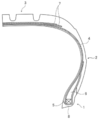
- FIG. 1 is a partial cross-sectional schematic view of a tire representing an example of an embodiment of the pneumatic tire of the present invention.
- reference numeral 1 represents a bead portion
- reference numeral 2 represents a sidewall portion
- reference numeral 3 represents a tire tread.
- a carcass layer 4 in which fiber cords are embedded is mounted between the pair of left and right bead portions 1, and the end of the carcass layer 4 extends from the inside of the tire to the outside around the bead core 5 and the bead filler 6. Wrapped and rolled up.
- a belt layer 7 is disposed over the circumference of the tire on the outside of the carcass layer 4.
- the rim cushion 8 is arrange
- the pneumatic tire of the present invention is not particularly limited except that the tire tread rubber composition of the present invention is used for a tire tread of a pneumatic tire, and can be produced, for example, according to a conventionally known method.
- inert gas such as nitrogen, argon, helium other than the air which adjusted normal or oxygen partial pressure, can be used.
- the mercapto equivalent of the obtained polysiloxane was measured by acetic acid / potassium iodide / potassium iodate addition-sodium thiosulfate solution titration method. The amount was confirmed. From the above, the obtained polysiloxane is represented by the following average composition formula. (—C 3 H 6 —S 4 —C 3 H 6 —) 0.071 (—C 8 H 17 ) 0.571 (—OC 2 H 5 ) 1.50 (—C 3 H 6 SH) 0.286 SiO 0.75 The obtained polysiloxane is designated as polysiloxane 1.
- ⁇ Method for producing polysiloxane 2> In a 2 L separable flask equipped with a stirrer, reflux condenser, dropping funnel and thermometer, ⁇ -mercaptopropyltriethoxysilane (KBE-803, Shin-Etsu Chemical Co., Ltd.) 190.8 g (0.8 mol), octyltriethoxysilane ( After placing 442.4 g (1.6 mol) of KBE-3083) made by Shin-Etsu Chemical Co., Ltd. and 162.0 g of ethanol, a mixed solution of 32.4 g (1.8 mol) of 0.5N hydrochloric acid and 75.6 g of ethanol was added at room temperature. It was dripped.
- KBE-803 Shin-Etsu Chemical Co., Ltd.
- the mercapto equivalent of the polysiloxane measured by acetic acid / potassium iodide / potassium iodate addition-sodium thiosulfate solution titration method was 650 g / mol, and it was confirmed that the mercapto group content was as set. It was. From the above, the obtained polysiloxane is represented by the following average composition formula. (-C 8 H 17 ) 0.667 (-OC 2 H 5 ) 1.50 (-C 3 H 6 SH) 0.333 SiO 0.75 The obtained polysiloxane is designated as polysiloxane 2.
- the mercapto equivalent of the polysiloxane measured by the titration method of acetic acid / potassium iodide / potassium iodate-sodium thiosulfate solution was 710 g / mol, and it was confirmed that the mercapto group content was as set. It was. From the above, the obtained polysiloxane is represented by the following average composition formula. (—C 3 H 6 —S 4 —C 3 H 6 —) 0.071 (—C 8 H 17 ) 0.571 (—OC 2 H 5 ) 1.334 (—C 3 H 6 SH) 0.286 SiO 0.833
- the obtained polysiloxane is designated as polysiloxane 3.
- Comparative polysiloxane 1 3-Mercaptopropyltrimethoxysilane (0.1 mol) was hydrolyzed with water and concentrated aqueous hydrochloric acid, and then ethoxymethyl polysiloxane (100 g) was added and condensed to obtain polysiloxane.
- the obtained polysiloxane is referred to as comparative polysiloxane 1.
- the comparative polysiloxane 1 has a structure in which the methoxy group of 3-mercaptopropyltrimethoxysilane and the ethoxy group of ethoxymethyl polysiloxane are condensed. That is, the monovalent hydrocarbon group of the comparative polysiloxane 1 is only a methyl group.
- the comparative polysiloxane 1 does not have a divalent organic group containing a sulfide group.
- Comparative polysiloxane 2 Bis (3- (triethoxysilyl) propyl) tetrasulfide (0.1 mol) is hydrolyzed with water and concentrated aqueous hydrochloric acid, and then ethoxymethylpolysiloxane (100 g) is added and condensed to obtain polysiloxane. It was. The obtained polysiloxane is referred to as comparative polysiloxane 2.
- the comparative polysiloxane 2 has a structure in which the ethoxy group of bis (3- (triethoxysilyl) propyl) tetrasulfide and the ethoxy group of ethoxymethyl polysiloxane are condensed. That is, the monovalent hydrocarbon group of the comparative polysiloxane 2 is only a methyl group.
- the comparative polysiloxane 2 does not have an organic group containing a mercapto group.
- Tan ⁇ (0 ° C.) was measured. The results were expressed as an index with tan ⁇ (0 ° C.) of the standard example as 100. The larger the index, the larger the tan ⁇ (0 ° C.), and the better the wet performance when made into a tire.
- ⁇ Tan ⁇ (60 ° C.)> Index of low rolling resistance
- the rubber composition for tire tread (unvulcanized) produced as described above was press-vulcanized at 160 ° C. for 20 minutes in a mold (15 cm ⁇ 15 cm ⁇ 0.2 cm) to prepare a vulcanized rubber sheet.
- the results were expressed as an index with tan ⁇ (60 ° C.) of the standard example as 100. The smaller the index, the smaller the tan ⁇ (60 ° C.), and the lower the rolling resistance when the tire is made.
- the tire tread rubber composition (unvulcanized) produced as described above uses an L-shaped rotor according to JIS K6300-1: 2001, preheating time 1 minute, rotor rotation time 4 minutes, test temperature 100 Mooney viscosity was measured under the condition of ° C. The result was expressed as an index with the value of the standard example as 100.
- ⁇ Mooney scorch> index for scorch resistance
- the scorch time was measured under the condition of a test temperature of 125 ° C. using an L-shaped rotor according to JIS K6300-1: 2001. The result was expressed as an index with the scorch time of the standard example as 100. The larger the index, the longer the scorch time and the better the scorch resistance (workability).
- Stearic acid Beads stearic acid (manufactured by NOF Corporation)
- Zinc oxide 3 kinds of zinc white (made by Shodo Chemical Industry Co., Ltd.)
- Anti-aging agent N-phenyl-N ′-(1,3-dimethylbutyl) -p-phenylenediamine (Santflex 6PPD, manufactured by Flexis)
- Terpene resin YS resin TO125 (manufactured by Yasuhara Chemical Co., Ltd.) (aromatic modified terpene resin, softening point: 125 ° C.)
- Process oil Extract No.
- Vulcanization accelerator 1 N-cyclohexyl-2-benzothiazolylsulfenamide (Noxeller CZ-G, manufactured by Ouchi Shinsei Chemical Industry Co., Ltd.)
- Vulcanization accelerator 2 1,3-diphenylguanidine (Soccinol DG, manufactured by Sumitomo Chemical Co., Ltd.)
- Sulfur Fine sulfur with Jinhua stamp oil (manufactured by Tsurumi Chemical Co., Ltd.)
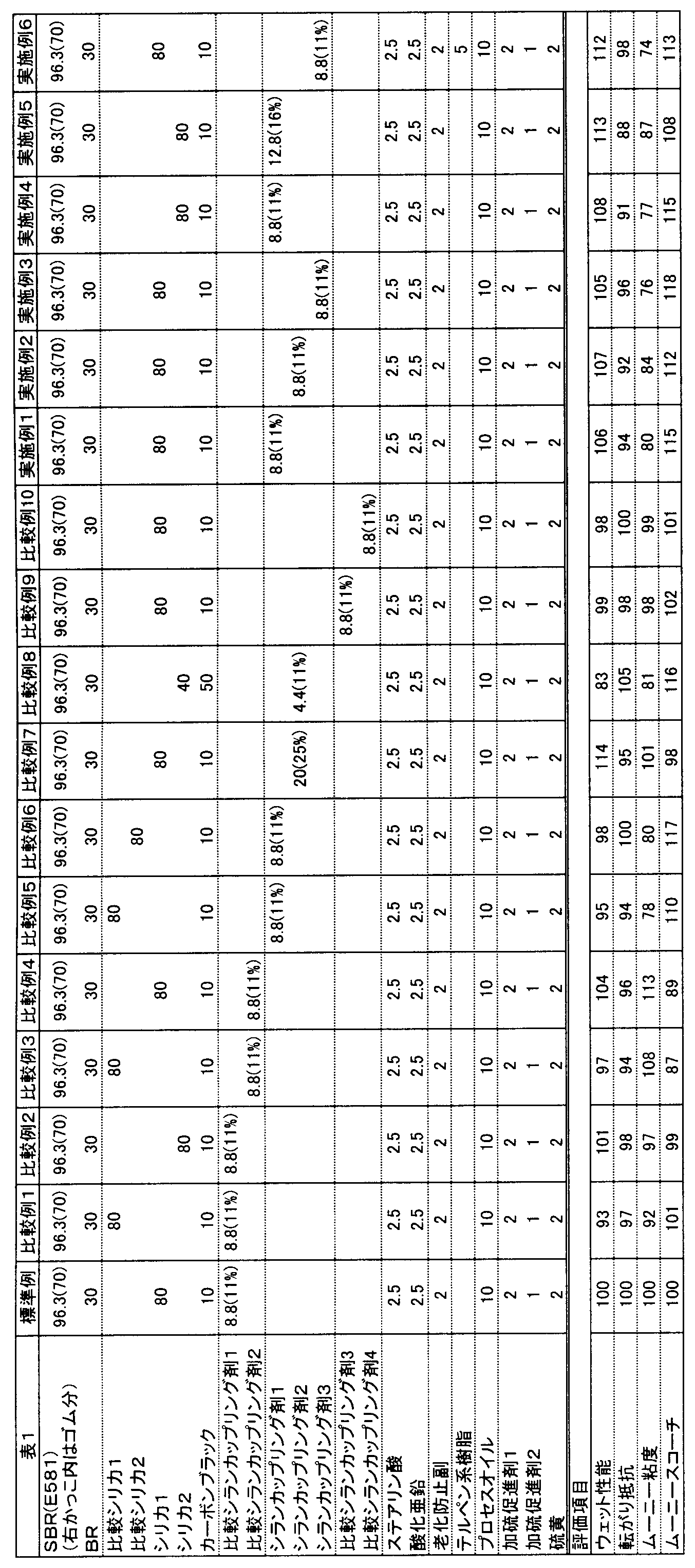
- a silane coupling agent containing sulfur a comparative silane coupling agent 2 other than polysiloxane represented by the average composition formula of formula (1) is contained, and N 2 SA) is Comparative example 3 containing comparative silica 1 having a CTAB of less than 194 m 2 / g and a CTAB of less than 180 m 2 / g was inferior in wet performance and workability to the standard example.
- the comparative example 4 containing the comparative silane coupling agent 2 had slightly better wet performance than the comparative example 3, the processability was inferior to the standard example.
- Comparative example 1 containing comparative silane coupling agent 1 other than polysiloxane represented by the average composition formula of formula (1) as a silane coupling agent containing sulfur, and containing comparative silica 1, Wet performance was inferior.
- Comparative Example 2 containing Comparative Silane Coupling Agent 1 has better wet performance than Comparative Example 1, it has inferior scorch resistance than the standard example.
- Comparative Examples 5 and 6 containing Comparative Silica 1 or Comparative Silica 2 were inferior in wet performance to the standard examples.
- Comparative Example 7 in which the content of the sulfur-containing silane coupling agent exceeds 20% by mass with respect to the content of silica was inferior in workability to the standard example.
- Comparative Example 8 in which the content of silica is less than 60 parts by mass with respect to 100 parts by mass of the diene rubber, wet performance and low rolling resistance were inferior to the standard example. Comparative Examples 9 and 10 containing the comparative silane coupling agent 3 or 4 were inferior in wet performance to the standard examples. In contrast, Examples 1 to 6 are all excellent in wet performance, low rolling resistance, and workability. As described above, the standard example, the comparative examples 2 and 4 using the conventional sulfur-containing silane coupling agent and the silica having a small particle diameter are more wet than the comparative examples 1 and 3, and the low rolling resistance and workability. Can be improved to some extent.
- Example 6 containing an aromatic modified terpene resin further has better wet performance than Example 3 and can suppress an increase in viscosity.
Landscapes
- Chemical & Material Sciences (AREA)
- Health & Medical Sciences (AREA)
- Chemical Kinetics & Catalysis (AREA)
- Medicinal Chemistry (AREA)
- Polymers & Plastics (AREA)
- Organic Chemistry (AREA)
- Engineering & Computer Science (AREA)
- Mechanical Engineering (AREA)
- Compositions Of Macromolecular Compounds (AREA)
- Tires In General (AREA)
Abstract
Description
しかし、シリカはゴム成分との親和性が低く、また、シリカ同士の凝集性が高いため、ゴム成分に単にシリカを配合してもシリカが分散せず、転がり抵抗を低減する効果やウェット性能を向上する効果が十分に得られないという問題があった。
そこで、本発明は、上記実情を鑑みて、タイヤにしたときにウェット性能および低転がり抵抗性に優れ、かつ、加工性に優れたタイヤトレッド用ゴム組成物を提供することを目的とする。
ジエン系ゴム、シリカ及び硫黄含有シランカップリング剤を含有し、
前記シリカの窒素吸着比表面積(N2SA)が194~240m2/gであり、前記シリカのCTAB比表面積(CTAB)が180~215m2/gであり、前記シリカの含有量が、前記ジエン系ゴム100質量部に対して60~200質量部であり、
前記硫黄含有シランカップリング剤が下記式(1)で表されるポリシロキサンであり、前記硫黄含有シランカップリング剤の含有量が、前記シリカの含有量に対して1~ 20質量%である、タイヤトレッド用ゴム組成物が、ウェット性能および低転がり抵抗性に優れ、かつ、加工性に優れた、タイヤトレッド用ゴム組成物となることを見出し、本発明を完成させた。
(A)a(B)b(C)c(D)d(R1)eSiO(4-2a-b-c-d-e)/2 (1)
[式(1)は平均組成式であり、式(1)中、Aはスルフィド基を含有する2価の有機基を表し、Bは炭素数5~10の1価の炭化水素基を表し、Cは加水分解性基を表し、Dはメルカプト基を含有する有機基を表し、R1は炭素数1~4の1価の炭化水素基を表し、a~eは、0≦a<1、0≦b<1、0<c<3、0<d<1、0≦e<2、0<2a+b+c+d+e<4の関係式を満たす。ただしa、bのいずれか一方は0ではない。]
1. ジエン系ゴム、シリカ及び硫黄含有シランカップリング剤を含有し、
前記シリカの窒素吸着比表面積(N2SA)が194~240m2/gであり、前記シリカのCTAB比表面積(CTAB)が180~215m2/gであり、前記シリカの含有量が、前記ジエン系ゴム100質量部に対して60~200質量部であり、
前記硫黄含有シランカップリング剤が下記式(1)で表されるポリシロキサンであり、前記硫黄含有シランカップリング剤の含有量が、前記シリカの含有量に対して1~ 20質量%である、タイヤトレッド用ゴム組成物。
(A)a(B)b(C)c(D)d(R1)eSiO(4-2a-b-c-d-e)/2 (1)
[式(1)は平均組成式であり、式(1)中、Aはスルフィド基を含有する2価の有機基を表し、Bは炭素数5~10の1価の炭化水素基を表し、Cは加水分解性基を表し、Dはメルカプト基を含有する有機基を表し、R1は炭素数1~4の1価の炭化水素基を表し、a~eは、0≦a<1、0≦b<1、0<c<3、0<d<1、0≦e<2、0<2a+b+c+d+e<4の関係式を満たす。ただしa、bのいずれか一方は0ではない。]
2. 前記シリカのDBP吸収量が190ml/100g以上であり、前記窒素吸着比表面積と前記CTAB比表面積の比(窒素吸着比表面積/CTAB比表面積)が0.9~1.4である、上記1に記載のタイヤトレッド用ゴム組成物。
3. さらにテルペン系樹脂を含有し、前記テルペン系樹脂の量が前記ジエン系ゴム100質量部に対して1~30質量部であり、前記テルペン系樹脂は軟化点が60~150℃の芳香族変性テルペン樹脂である、上記1又は2に記載のタイヤトレッド用ゴム組成物。
4. 前記式(1)中、bが0より大きい、上記1~3のいずれか1項に記載のタイヤトレッド用ゴム組成物。
5. 上記1~4のいずれか1項に記載のタイヤトレッド用ゴム組成物をタイヤトレッドに用いた空気入りタイヤ。
本発明のタイヤトレッド用ゴム組成物は、
ジエン系ゴム、シリカ及び硫黄含有シランカップリング剤を含有し、
前記シリカの窒素吸着比表面積(N2SA)が194~240m2/gであり、前記シリカのCTAB比表面積(CTAB)が180~215m2/gであり、前記シリカの含有量が、前記ジエン系ゴム100質量部に対して60~200質量部であり、
前記硫黄含有シランカップリング剤が下記式(1)で表されるポリシロキサンであり、前記硫黄含有シランカップリング剤の含有量が、前記シリカの含有量に対して1~ 20質量%である、タイヤトレッド用ゴム組成物である。
(A)a(B)b(C)c(D)d(R1)eSiO(4-2a-b-c-d-e)/2 (1)
[式(1)は平均組成式であり、式(1)中、Aはスルフィド基を含有する2価の有機基を表し、Bは炭素数5~10の1価の炭化水素基を表し、Cは加水分解性基を表し、Dはメルカプト基を含有する有機基を表し、R1は炭素数1~4の1価の炭化水素基を表し、a~eは、0≦a<1、0≦b<1、0<c<3、0<d<1、0≦e<2、0<2a+b+c+d+e<4の関係式を満たす。ただしa、bのいずれか一方は0ではない。]
以下本発明のタイヤトレッド用ゴム組成物を「本発明の組成物」ということがある。また、式(1)で表されるポリシロキサンを「式(1)の平均組成式で表されるポリシロキサン」ということがある。
本発明において、式(1)の平均組成式で表されるポリシロキサンは、シリカをゴム組成物中に多量に配合させることができ、かつ、多量のシリカをゴム組成物中に十分に分散させることができる。
本発明のタイヤ用ゴム組成物が上記のような効果を達成することについて本願発明者は以下のように考える。
本発明のタイヤ用ゴム組成物に含まれる硫黄含有シランカップリング剤[式(1)の平均組成式で表されるポリシロキサン]は、その骨格がシロキサン構造である。また、当該硫黄含有シランカップリング剤がBで表される炭素数5~10の1価の炭化水素基を有する場合、当該Bがメルカプト基に対する有効な保護基として機能できると考えられる。よって、骨格のシロキサン構造によって、Bを有する場合にはさらに当該Bの存在によって、硫黄含有シランカップリング剤が有するメルカプト基の周辺は従来のメルカプトシランよりさらに嵩高いと考えられる。
このような嵩高い(バルキーな)構造によって、硫黄含有シランカップリング剤が有するメルカプト基は保護され、本発明のタイヤ用ゴム組成物のムーニースコーチ時間が長く加工安定性が確保される。
しかし、本発明において、硫黄含有シランカップリング剤が有するこのような嵩高い構造は、加硫時における加硫速度の促進を阻害しないということができる。加硫時の加熱等によって、硫黄含有シランカップリング剤が有するメルカプト基は、ジエン系ゴムと相互作用及び/又は反応することができるようになると考えられる。よって、本発明の組成物は、加工安定性と加硫時の加硫速度が速いこととを両立させることができる。
また、当該硫黄含有シランカップリング剤は、Cで表される加水分解性基、シロキサン構造を有するので、従来のメルカプトシランよりシリカとの親和性、反応性が優れると考えられる。さらに当該硫黄含有シランカップリング剤の分子量が適切な範囲である場合、シリカとの親和性、反応性がより優れることが予想される。これらのことによって、本発明のタイヤ用ゴム組成物は優れたウェット性能、耐摩耗性を達成すると考えられる。
また、本発明においては特定のシリカを使用していることから、当該硫黄含有シランカップリング剤との親和性、反応性は非常に高いと考えられる。
このような理由から、本発明の組成物は、ウェット性能、耐摩耗性、加工性に優れ、これらのバランスに優れると考えられる。
なお上記メカニズムは本願発明者の推定であり、上記以外のメカニズムであっても本願発明の範囲内である。
ジエン系ゴムはそれぞれ単独でまたは2種以上を組み合わせて使用することができる。
なかでもジエン系ゴムは、ウェット性能および低転がり抵抗性により優れたタイヤを作製することができ、耐摩耗性が良好となる理由から、SBR及び/又はBRであるのが好ましい。
SBRの重量平均分子量は、グリップ性能と加工性を両立可能であるという観点から、50万~200万であるのが好ましく、70万~150万であるのがより好ましい。本発明において、SBRの重量平均分子量は、トルエンを溶媒とするゲル・パーミエーション・クロマトグラフィー(GPC)によりポリスチレン換算によって求められる。
SBRは、ウェット性能および低転がり抵抗性に更に優れたタイヤを作製することができる理由から、芳香族ビニル(以下、「スチレン量」という。)を30~50質量%含み、共役ジエンのビニル結合量を20~70質量%含むことが好ましい。
SBRの含有量(割合)は、ウェット性能および低転がり抵抗性により優れたタイヤを作製することができる理由から、ジエン系ゴムの50質量%以上であるのが好ましく、60質量%以上であるのがより好ましい。
BRは特に制限されない。例えば従来公知のものが挙げられる。
シリカのN2SAは、ウェット性能により優れ、耐摩耗性に優れるという観点から、194~235m2/gであるのが好ましく、197~230m2/gであるのがより好ましい。
シリカのN2SAが194m2/g未満である場合、ウェット性能が悪く、ゴム組成物に対する補強性が不十分となり耐摩耗性及び操縦安定性が不足する。またシリカのN2SAが240m2/gを超えると、ジエン系ゴムに対する分散性が低下し転がり抵抗が大きくなる。
本発明において、シリカのN2SAはJIS K6217-2に準拠して求められたものである。
シリカのCTABが180m2/g未満である場合、ウェット性能が悪く、ゴム組成物に対する補強性が不十分となり耐摩耗性及び操縦安定性が不足する。またシリカのCTABが215m2/gを超えると、ジエン系ゴムに対する分散性が低下し転がり抵抗が大きくなる。
本発明において、シリカのCTABは、JIS K6217-3:2001に記載されたCTAB吸着法に従って測定されたものである。
シリカのDBP吸収量が190ml/100g未満であると、加工性能とゴム強度が悪化することになる。
本発明において、シリカのDBP吸収量は、JIS K6217-4吸油量A法に準拠して求めるものとする。
シリカの含有量がジエン系ゴム100質量部に対して60質量部未満である場合、ウェット性能が悪い。
(A)a(B)b(C)c(D)d(R1)eSiO(4-2a-b-c-d-e)/2 (1)
[式(1)は平均組成式であり、式(1)中、Aはスルフィド基を含有する2価の有機基を表し、Bは炭素数5~10の1価の炭化水素基を表し、Cは加水分解性基を表し、Dはメルカプト基を含有する有機基を表し、R1は炭素数1~4の1価の炭化水素基を表し、a~eは、0≦a<1、0≦b<1、0<c<3、0<d<1、0≦e<2、0<2a+b+c+d+e<4の関係式を満たす。ただしa、bのいずれか一方は0ではない。]
本発明において、硫黄含有シランカップリング剤はCを有することによって、シリカとの親和性及び/又は反応性に優れる。
硫黄含有シランカップリング剤はDを有することによって、ジエン系ゴムと相互作用及び/又は反応することができ、ウェット性能、耐摩耗性に優れる。
硫黄含有シランカップリング剤がAを有する場合、ウェット性能、加工性(特にムーニースコーチ時間の維持・長期化)により優れ、耐摩耗性に優れる。
硫黄含有シランカップリング剤がBを有する場合、メルカプト基を保護しムーニースコーチ時間が長くなると同時に、ゴムとの親和性に優れることで加工性により優れる。
なかでも、下記式(2)で表される基であることが好ましい。
*-(CH2)n-Sx-(CH2)n-* (2)
上記式(2)中、nは1~10の整数を表し、なかでも、2~4の整数であることが好ましい。
上記式(2)中、xは1~6の整数を表し、なかでも、2~4の整数であることが好ましい。
上記式(2)中、*は、結合位置を示す。
上記式(2)で表される基の具体例としては、例えば、*-CH2-S2-CH2-*、*-C2H4-S2-C2H4-*、*-C3H6-S2-C3H6-*、*-C4H8-S2-C4H8-*、*-CH2-S4-CH2-*、*-C2H4-S4-C2H4-*、*-C3H6-S4-C3H6-*、*-C4H8-S4-C4H8-*などが挙げられる。
*-OR2 (3)
上記式(3)中、R2は炭素数1~20のアルキル基、炭素数6~10のアリール基、炭素数6~10のアラルキル基(アリールアルキル基)または炭素数2~10のアルケニル基を表し、なかでも、炭素数1~5のアルキル基であることが好ましい。上記炭素数1~20のアルキル基の具体例としては、例えば、メチル基、エチル基、プロピル基、ブチル基、ヘキシル基、オクチル基、デシル基、オクタデシル基などが挙げられる。上記炭素数6~10のアリール基の具体例としては、例えば、フェニル基、トリル基などが挙げられる。上記炭素数6~10のアラルキル基の具体例としては、例えば、ベンジル基、フェニルエチル基などが挙げられる。上記炭素数2~10のアルケニル基の具体例としては、例えば、ビニル基、プロぺニル基、ペンテニル基などが挙げられる。
上記式(3)中、*は、結合位置を示す。
*-(CH2)m-SH (4)
上記式(4)中、mは1~10の整数を表し、なかでも、1~5の整数であることが好ましい。
上記式(4)中、*は、結合位置を示す。
上記式(4)で表される基の具体例としては、*-CH2SH、*-C2H4SH、*-C3H6SH、*-C4H8SH、*-C5H10SH、*-C6H12SH、*-C7H14SH、*-C8H16SH、*-C9H18SH、*-C10H20SHが挙げられる。
また、式(1)の平均組成式で表されるポリシロキサンは、ウェット性能、低転がり抵抗性がより優れる理由から、aが0であることが好ましい。すなわち、スルフィド基含有有機基を有さない場合が好ましい態様の1つとして挙げられる。
上記式(1)中、cは、ウェット特性、低転がり抵抗性および加工性がより優れ、シリカの分散性がより優れるというる理由から、1.2≦c≦2.0であることが好ましい。
上記式(1)中、dは、ウェット特性、低転がり抵抗性および加工性がより優れるというる理由から、0.1≦d≦0.8であることが好ましい。
なかでも、耐スコーチ性がより優れる理由から、少なくとも式(6)で表される有機ケイ素化合物(例えばp=5~10)、式(7)、式(5)で表される有機ケイ素化合物を使用するのが好ましい。
また、ウェット性能がより優れる理由から、少なくとも式(6)で表される有機ケイ素化合物(例えばp=5~10)と、式(7)で表される有機ケイ素化合物を使用するのが好ましい。

上記式(5)中、R52は炭素数1~10のアルキル基または炭素数6~10のアリール基を表す。上記炭素数1~10のアルキル基の具体例としては、例えば、メチル基、エチル基、プロピル基、ブチル基、ヘキシル基、オクチル基、デシル基などが挙げられる。上記炭素数6~10のアリール基の具体例は上記R51と同じである。
上記式(5)中、nの定義および好適な態様は、上記式(2)中のnと同じである。
上記式(5)中、xの定義および好適な態様は、上記式(2)中のxと同じである。
上記式(5)中、yは1~3の整数を表す。
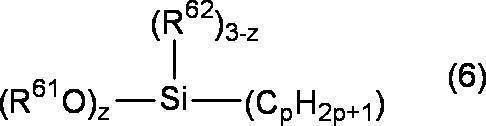
上記式(6)中、R62の定義、具体例および好適な態様は、上記R52と同じである。
上記式(6)中、zの定義は、上記yと同じである。
上記式(6)中、pは1~10の整数を表す。pはウェット性能、低転がり抵抗性、加工性により優れ、ジエン系ゴムとの親和性に優れるという観点から、5~10の整数であるのが好ましい。
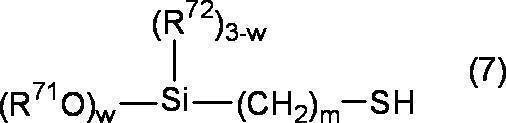
上記式(7)中、R72の定義、具体例および好適な態様は、上記R52と同じである。
上記式(7)中、mの定義および好適な態様は、上記式(4)のmと同じである。
上記式(7)中、wの定義は、上記yと同じである。
本発明において、式(1)で表されるポリシロキサンを製造する際に使用することができる触媒としては例えば、塩酸、酢酸などの酸性触媒;アンモニウムフルオリドなどのルイス酸触媒;水酸化ナトリウム、水酸化カリウム、炭酸ナトリウム、酢酸ナトリウム、酢酸カリウム、炭酸水素ナトリウム、炭酸カリウム、炭酸水素カリウム、炭酸カルシウム、ナトリウムメトキシド、ナトリウムエトキシドなどのアルカリ金属塩;アルカリ土類金属塩;トリエチルアミン、トリブチルアミン、ピリジン、4-ジメチルアミノピリジンなどのアミン化合物などが挙げられる。
上記触媒は、金属としてSn、TiまたはAlを含有する有機金属化合物でないことが好ましい。このような有機金属化合物を使用した場合、ポリシロキサン骨格に当該金属が導入されて、上記特定ポリシロキサン(骨格には、ケイ素原子以外の金属(例えば、Sn、Ti、Al)は存在しない)が得られないことがある。
触媒としてSn、TiまたはAlを含有する有機金属化合物を使用しない場合、ポリシロキサンには触媒由来の金属が分子内に導入される(例えば、ポリシロキサン骨格に金属が導入される。)ことはなく、本発明のタイヤトレッド用ゴム組成物を通常雰囲気又は高湿環境下においても空気中の湿気で硬化やゲル化が生じることはなく、保存安定性に優れる。
触媒の量は、ウェット性能、低転がり抵抗性、加工性により優れ、保存安定性に優れるという観点から、原料として使用される有機ケイ素化合物100質量部に対して、0.01~10質量部であるのが好ましく、0.05~1質量部であるのがより好ましい。
硫黄含有シランカップリング剤はそれぞれ単独でまたは2種以上を組み合わせて使用することができる。
硫黄含有シランカップリング剤の含有量が、シリカの含有量の20質量%を超える場合、加工性が悪い。
テルペン系樹脂は芳香族変性テルペン樹脂であるのが好ましい。テルペン系樹脂、芳香族変性テルペン樹脂は特に制限されない。例えば従来公知のものが挙げられる。
テルペン系樹脂(特に芳香族変性テルペン樹脂)の軟化点は、ウェット性能、低転がり抵抗性、加工性により優れるという観点から、60~150℃であるのが好ましく、70~130℃であるのがより好ましい。
テルペン系樹脂はそれぞれ単独でまたは2種以上を組み合わせて使用することができる。
テルペン系樹脂の量は、ウェット性能、低転がり抵抗性により優れるという観点から、ジエン系ゴム成分100質量部に対して1~30質量部であるのが好ましく、3~20質量部であるのがより好ましい。
また、本発明の組成物は、従来公知の加硫または架橋条件で加硫または架橋することができる。
本発明の空気入りタイヤは、本発明のタイヤトレッド用ゴム組成物をタイヤトレッドに用いた空気入りタイヤである。
以下添付の図面を用いて本発明の空気入りタイヤを説明する。なお本発明の空気入りタイヤは添付の図面に限定されない。
図1は、本発明の空気入りタイヤの実施態様の一例を表すタイヤの部分断面概略図である。
また、左右一対のビード部1間においては、繊維コードが埋設されたカーカス層4が装架されており、このカーカス層4の端部はビードコア5およびビードフィラー6の廻りにタイヤ内側から外側に折り返されて巻き上げられている。
また、タイヤトレッド3においては、カーカス層4の外側に、ベルト層7がタイヤ1周に亘って配置されている。
また、ビード部1においては、リムに接する部分にリムクッション8が配置されている。
撹拌機、還流冷却器、滴下ロート及び温度計を備えた2Lセパラブルフラスコにビス(トリエトキシシリルプロピル)テトラスルフィド(信越化学工業製 KBE-846)107.8g(0.2mol)、γ―メルカプトプロピルトリエトキシシラン(信越化学工業製 KBE-803)190.8g(0.8mol)、オクチルトリエトキシシラン(信越化学工業製 KBE-3083)442.4g(1.6mol)、エタノール190.0gを納めた後、室温にて0.5N塩酸37.8g(2.1mol)とエタノール75.6gの混合溶液を滴下した。その後、80℃にて2時間攪拌した。その後、濾過、5%KOH/EtOH溶液17.0gを滴下し80℃で2時間攪拌した。その後、減圧濃縮、濾過することで褐色透明液体のポリシロキサン480.1gを得た。GPCにより測定した結果、得られたポリシロキサンの平均分子量は840であり、平均重合度は4.0(設定重合度4.0)であった。また、酢酸/ヨウ化カリウム/ヨウ素酸カリウム添加-チオ硫酸ナトリウム溶液滴定法により、得られたポリシロキサンのメルカプト当量を測定した結果、当該メルカプト当量は730g/molであり、設定通りのメルカプト基含有量であることが確認された。以上より、得られたポリシロキサンは下記平均組成式で示される。
(-C3H6-S4-C3H6-)0.071(-C8H17)0.571(-OC2H5)1.50(-C3H6SH)0.286SiO0.75
得られたポリシロキサンをポリシロキサン1とする。
撹拌機、還流冷却器、滴下ロート及び温度計を備えた2Lセパラブルフラスコにγ―メルカプトプロピルトリエトキシシラン(信越化学工業製 KBE-803)190.8g(0.8mol)、オクチルトリエトキシシラン(信越化学工業製 KBE-3083)442.4g(1.6mol)、エタノール162.0gを納めた後、室温にて0.5N塩酸32.4g(1.8mol)とエタノール75.6gの混合溶液を滴下した。その後、80℃にて2時間攪拌した。その後、濾過、5%KOH/EtOH溶液14.6gを滴下し80℃で2時間攪拌した。その後、減圧濃縮、濾過することで無色透明液体のポリシロキサン412.3gを得た。GPCにより測定した結果、得られたポリシロキサンの平均分子量は850であり、平均重合度は4.0(設定重合度4.0)であった。また、酢酸/ヨウ化カリウム/ヨウ素酸カリウム添加-チオ硫酸ナトリウム溶液滴定法によって測定された、上記ポリシロキサンのメルカプト当量は650g/molであり、設定通りのメルカプト基含有量であることが確認された。以上より、得られたポリシロキサンは下記平均組成式で示される。
(-C8H17)0.667(-OC2H5)1.50(-C3H6SH)0.333SiO0.75
得られたポリシロキサンをポリシロキサン2とする。
撹拌機、還流冷却器、滴下ロート及び温度計を備えた2Lセパラブルフラスコにビス(トリエトキシシリルプロピル)テトラスルフィド(信越化学工業製 KBE-846)107.8g(0.2mol)、γ―メルカプトプロピルトリエトキシシラン(信越化学工業製 KBE-803)190.8g(0.8mol)、オクチルトリエトキシシラン(信越化学工業製 KBE-3083)442.4g(1.6mol)、エタノール190.0gを納めた後、室温にて0.5N塩酸42.0g(2.33mol)とエタノール75.6gの混合溶液を滴下した。その後、80℃にて2時間攪拌した。その後、濾過、5%KOH/EtOH溶液18.9gを滴下し80℃で2時間攪拌した。その後、減圧濃縮、濾過することで褐色透明液体のポリシロキサン560.9gを得た。GPCにより測定した結果、得られたポリシロキサンの平均分子量は1220であり、平均重合度は6.0(設定重合度6.0)であった。また、酢酸/ヨウ化カリウム/ヨウ素酸カリウム添加-チオ硫酸ナトリウム溶液滴定法によって測定された、上記ポリシロキサンのメルカプト当量は710g/molであり、設定通りのメルカプト基含有量であることが確認された。以上より、得られたポリシロキサンは下記平均組成式で示される。
(-C3H6-S4-C3H6-)0.071(-C8H17)0.571(-OC2H5)1.334(-C3H6SH)0.286SiO0.833
得られたポリシロキサンをポリシロキサン3とする。
3-メルカプトプロピルトリメトキシシラン(0.1mol)を水および濃塩酸水溶液で加水分解し、その後、エトキシメチルポリシロキサン(100g)を添加し、縮合することでポリシロキサンを得た。得られたポリシロキサンを比較ポリシロキサン1とする。
上記比較ポリシロキサン1は、3-メルカプトプロピルトリメトキシシランのメトキシ基とエトキシメチルポリシロキサンのエトキシ基とが縮合した構造を有する。すなわち、上記比較ポリシロキサン1が有する1価の炭化水素基はメチル基のみである。また、上記比較ポリシロキサン1はスルフィド基を含有する2価の有機基を有さない。
ビス(3-(トリエトキシシリル)プロピル)テトラスルフィド(0.1mol)を水および濃塩酸水溶液で加水分解し、その後、エトキシメチルポリシロキサン(100g)を添加し、縮合することでポリシロキサンを得た。得られたポリシロキサンを比較ポリシロキサン2とする。
上記比較ポリシロキサン2は、ビス(3-(トリエトキシシリル)プロピル)テトラスルフィドのエトキシ基とエトキシメチルポリシロキサンのエトキシ基とが縮合した構造を有する。すなわち、上記比較ポリシロキサン2が有する1価の炭化水素基はメチル基のみである。また、上記比較ポリシロキサン2はメルカプト基を含有する有機基を有さない。
下記表に示す成分を同表に示す割合(質量部)で配合した。
具体的には、まず、下記表に示す成分のうち硫黄および加硫促進剤を除く成分を、1.7リットルの密閉式バンバリーミキサーを用いて10分間混合してから放出し、室温まで冷却してマスターバッチを得た。さらに、上記バンバリーミキサーを用いて、得られたマスターバッチに硫黄および加硫促進剤を混合し、タイヤトレッド用ゴム組成物を得た。
表中、比較シランカップリング剤1-2、シランカップリング剤1-3の欄のかっこ内の数値は、シリカの量に対する各成分の質量%を示す。
<tanδ(0℃)>(ウェット性能の指標)
上記のとおり製造したタイヤトレッド用ゴム組成物(未加硫)を金型(15cm×15cm×0.2cm)中で、160℃で20分間プレス加硫して加硫ゴムシートを作製した。
作製した加硫ゴムシートについて、JIS K6394:2007に準じて、粘弾性スペクトロメーター(岩本製作所社製)を用いて、伸張変形歪率10%±2%、振動数20Hz、温度0℃の条件で、tanδ(0℃)を測定した。
結果は標準例のtanδ(0℃)を100とする指数で表した。指数が大きいほどtanδ(0℃)が大きく、タイヤにしたときにウェット性能に優れる。
上記のとおり製造したタイヤトレッド用ゴム組成物(未加硫)を金型(15cm×15cm×0.2cm)中で、160℃で20分間プレス加硫して加硫ゴムシートを作製した。
作製した加硫ゴムシートについて、JIS K6394:2007に準じて、粘弾性スペクトロメーター(岩本製作所社製)を用いて、伸張変形歪率10%±2%、振動数20Hz、温度60℃の条件で、tanδ(60℃)を測定した。
結果は標準例のtanδ(60℃)を100とする指数で表した。指数が小さいほどtanδ(60℃)が小さく、タイヤにしたときに低転がり抵抗性に優れる。
上記のとおり製造したタイヤトレッド用ゴム組成物(未加硫)について、JIS K6300-1:2001に準じて、L形ロータを使用し、予熱時間1分、ロータの回転時間4分、試験温度100℃の条件で、ムーニー粘度を測定した。
結果は標準例の値を100とする指数で表した。
上記のとおり製造したタイヤトレッド用ゴム組成物(未加硫)について、JIS K6300-1:2001に準じて、L形ロータを使用し、試験温度125℃の条件で、スコーチタイムを測定した。
結果は標準例のスコーチタイムを100とする指数で表した。指数が大きいほどスコーチタイムが長く、耐スコーチ性(加工性)が優れることを示す。
・SBR:スチレン-ブタジエンゴム、E581〔ゴム分100質量部に対する油展量:37.5質量部(96.3質量部中のゴム分は70質量部)、重量平均分子量:1,200,000、スチレン量:37質量%、ビニル結合量:43%、旭化成社製〕
・BR:ブタジエンゴム、Nippol BR 1220(日本ゼオン社製)
・比較シリカ1:Rhodia社製Zeosil 1165MP、窒素吸着比表面積が160m2/g、CTAB比表面積が159m2/g、DBP吸収量が200ml/100gであり、N2SA/CTABが1.0であるシリカ
・比較シリカ2:東ソーシリカ社製ニプシルAQ、窒素吸着比表面積が211m2/g、CTAB比表面積が160m2/g、DBP吸収量が193ml/100gであり、N2SA/CTABが1.3であるシリカ
・シリカ1:Rhodia社製Premium 200MP、窒素吸着比表面積が207m2/g、CTAB比表面積が198m2/g、DBP吸収量が206ml/100gであり、N2SA/CTABが1.0であるシリカ
・シリカ2:エボニックデグッサ社製Ultrasil9000GR、窒素吸着比表面積が213m2/g、CTAB比表面積が193m2/g、DBP吸収量が220ml/100g、N2SA/CTABが1.1であるシリカ
・カーボンブラック:ショウブラックN339(CTAB吸着比表面積=90m2/g、キャボットジャパン社製)
・比較シランカップリング剤1:Si363(エボニックデグッサ社製)
・比較シランカップリング剤2:3-メルカプトプロピルトリメトキシシラン(KBM-803、信越化学工業社製)
・シランカップリング剤1:上記のとおり製造したポリシロキサン1
・シランカップリング剤2:上記のとおり製造したポリシロキサン2
・シランカップリング剤3:上記のとおり製造したポリシロキサン3
・比較シランカップリング剤3:上述のとおり合成された比較ポリシロキサン1
・比較シランカップリング剤4:上述のとおり合成された比較ポリシロキサン2
・酸化亜鉛:亜鉛華3種(正同化学工業社製)
・老化防止剤:N-フェニル-N′-(1,3-ジメチルブチル)-p-フェニレンジアミン(サントフレックス6PPD、フレキシス社製)
・テルペン系樹脂:YSレジンTO125(ヤスハラケミカル株式会社製)(芳香族変性テルペン樹脂、軟化点:125℃)
・プロセスオイル:エキストラクト4号S(昭和シェル石油社製)
・加硫促進剤1:N-シクロヘキシル-2-ベンゾチアゾリルスルフェンアミド(ノクセラーCZ-G、大内新興化学工業社製)
・加硫促進剤2:1,3-ジフェニルグアニジン(ソクシノールD-G、住友化学工業社製)
・硫黄:金華印油入微粉硫黄(鶴見化学工業社製)
硫黄を含有するシランカップリング剤として式(1)の平均組成式で表されるポリシロキサン以外の比較シランカップリング剤1を含有し、比較シリカ1を含有する比較例1は、標準例より、ウェット性能が劣った。比較シランカップリング剤1を含有する比較例2は、比較例1よりウェット性能が優れるものの、標準例より耐スコーチ性が劣った。
比較シリカ1又は比較シリカ2を含有する比較例5、6は標準例よりウェット性能が劣った。
硫黄含有シランカップリング剤の含有量がシリカの含有量に対して20質量%を超える比較例7は、標準例より加工性が劣った。
シリカの含有量がジエン系ゴム100質量部に対して60質量部未満である比較例8は、標準例よりウェット性能、低転がり抵抗性が劣った。
比較シランカップリング剤3又は4を含有する比較例9、10は、標準例よりウェット性能が劣った。
これに対して、実施例1~6はウェット性能、低転がり抵抗性、加工性が全て優れる。
上述のとおり、従来の硫黄含有シランカップリング剤と小粒径のシリカとを併用する、標準例、比較例2、4は、比較例1、3より、ウェット性能、低転がり抵抗性、加工性をある程度優れたものとすることができる。しかし、硫黄含有シランカップリング剤として式(1)の平均組成式で表されるポリシロキサンと所定の範囲のN2SA及びCTABを有するシリカとを併用する場合、従来の硫黄含有シランカップリング剤と当該シリカとの併用より、ウェット性能、低転がり抵抗性、加工性の効果がさらに大きく発揮される。よって、硫黄含有シランカップリング剤として式(1)の平均組成式で表されるポリシロキサンと所定の範囲のN2SA及びCTABを有するシリカとの組合わせは、ウェット性能、低転がり抵抗性、加工性の優れた効果に非常に大きく貢献し、タイヤ性能と加工性を高次にバランスさせることができると考えられる。
また、さらに芳香族変性テルペン樹脂を含有する実施例6は、実施例3よりもさらに、ウェット性能が優れ、粘度上昇を抑制することができる。
2 サイドウォール部
3 タイヤトレッド
4 カーカス層
5 ビードコア
6 ビードフィラー
7 ベルト層
8 リムクッション
Claims (5)
- ジエン系ゴム、シリカ及び硫黄含有シランカップリング剤を含有し、
前記シリカの窒素吸着比表面積が194~240m2/gであり、前記シリカのCTAB比表面積が180~215m2/gであり、前記シリカの含有量が、前記ジエン系ゴム100質量部に対して60~200質量部であり、
前記硫黄含有シランカップリング剤が下記式(1)で表されるポリシロキサンであり、前記硫黄含有シランカップリング剤の含有量が、前記シリカの含有量に対して1~20質量%である、タイヤトレッド用ゴム組成物。
(A)a(B)b(C)c(D)d(R1)eSiO(4-2a-b-c-d-e)/2 (1)
[式(1)は平均組成式であり、式(1)中、Aはスルフィド基を含有する2価の有機基を表し、Bは炭素数5~10の1価の炭化水素基を表し、Cは加水分解性基を表し、Dはメルカプト基を含有する有機基を表し、R1は炭素数1~4の1価の炭化水素基を表し、a~eは、0≦a<1、0≦b<1、0<c<3、0<d<1、0≦e<2、0<2a+b+c+d+e<4の関係式を満たす。ただしa、bのいずれか一方は0ではない。] - 前記シリカのDBP吸収量が190ml/100g以上であり、前記窒素吸着比表面積と前記CTAB比表面積の比(窒素吸着比表面積/CTAB比表面積)が0.9~1.4である、請求項1に記載のタイヤトレッド用ゴム組成物。
- さらにテルペン系樹脂を含有し、前記テルペン系樹脂の量が前記ジエン系ゴム100質量部に対して1~30質量部であり、前記テルペン系樹脂は軟化点が60~150℃の芳香族変性テルペン樹脂である、請求項1又は2に記載のタイヤトレッド用ゴム組成物。
- 前記式(1)中、bが0より大きい、請求項1~3のいずれか1項に記載のタイヤトレッド用ゴム組成物。
- 請求項1~4のいずれか1項に記載のタイヤトレッド用ゴム組成物をタイヤトレッドに用いた空気入りタイヤ。
Priority Applications (5)
| Application Number | Priority Date | Filing Date | Title |
|---|---|---|---|
| EP14753616.3A EP2960286B1 (en) | 2013-02-25 | 2014-02-25 | Rubber composition for tire tread, and pneumatic tire using same |
| KR1020157022440A KR101625027B1 (ko) | 2013-02-25 | 2014-02-25 | 타이어 트레드용 고무 조성물 및 이것을 이용하는 공기입 타이어 |
| JP2015501545A JP5846332B2 (ja) | 2013-02-25 | 2014-02-25 | タイヤトレッド用ゴム組成物及びこれを用いる空気入りタイヤ |
| US14/770,453 US9550850B2 (en) | 2013-02-25 | 2014-02-25 | Rubber composition for tire tread, and pneumatic tire using same |
| CN201480006736.8A CN105246963B (zh) | 2013-02-25 | 2014-02-25 | 轮胎胎面用橡胶组合物及使用其的充气轮胎 |
Applications Claiming Priority (2)
| Application Number | Priority Date | Filing Date | Title |
|---|---|---|---|
| JP2013-035018 | 2013-02-25 | ||
| JP2013035018 | 2013-02-25 |
Publications (1)
| Publication Number | Publication Date |
|---|---|
| WO2014129663A1 true WO2014129663A1 (ja) | 2014-08-28 |
Family
ID=51391439
Family Applications (1)
| Application Number | Title | Priority Date | Filing Date |
|---|---|---|---|
| PCT/JP2014/054587 Ceased WO2014129663A1 (ja) | 2013-02-25 | 2014-02-25 | タイヤトレッド用ゴム組成物及びこれを用いる空気入りタイヤ |
Country Status (6)
| Country | Link |
|---|---|
| US (1) | US9550850B2 (ja) |
| EP (1) | EP2960286B1 (ja) |
| JP (1) | JP5846332B2 (ja) |
| KR (1) | KR101625027B1 (ja) |
| CN (1) | CN105246963B (ja) |
| WO (1) | WO2014129663A1 (ja) |
Cited By (10)
| Publication number | Priority date | Publication date | Assignee | Title |
|---|---|---|---|---|
| JP2014185339A (ja) * | 2013-02-25 | 2014-10-02 | Yokohama Rubber Co Ltd:The | スタッドレスタイヤ用ゴム組成物およびスタッドレスタイヤ |
| JP2016108377A (ja) * | 2014-12-03 | 2016-06-20 | 横浜ゴム株式会社 | ゴム組成物およびそれを用いた空気入りタイヤ |
| JP2017082088A (ja) * | 2015-10-28 | 2017-05-18 | 横浜ゴム株式会社 | タイヤ用ゴム組成物 |
| JP2017082087A (ja) * | 2015-10-28 | 2017-05-18 | 横浜ゴム株式会社 | タイヤ用ゴム組成物 |
| WO2018002996A1 (ja) * | 2016-06-27 | 2018-01-04 | 横浜ゴム株式会社 | タイヤ用ゴム組成物 |
| JP2019112599A (ja) * | 2017-12-26 | 2019-07-11 | 住友ゴム工業株式会社 | タイヤ用ゴム組成物及び空気入りタイヤ |
| JP2019112598A (ja) * | 2017-12-26 | 2019-07-11 | 住友ゴム工業株式会社 | タイヤ用ゴム組成物及び空気入りタイヤ |
| JP2019196418A (ja) * | 2018-05-07 | 2019-11-14 | 横浜ゴム株式会社 | タイヤ用ゴム組成物の製造方法 |
| JP2020026442A (ja) * | 2018-08-09 | 2020-02-20 | 横浜ゴム株式会社 | ゴム組成物及びスタッドレスタイヤ |
| JP2021516226A (ja) * | 2018-03-19 | 2021-07-01 | エービーシーアール ラボラトリオス,エセ.エレ. | 有機官能性シロキサン、その製造方法、ならびに、充填材および表面の処理のためのその使用 |
Families Citing this family (25)
| Publication number | Priority date | Publication date | Assignee | Title |
|---|---|---|---|---|
| JP5376027B2 (ja) * | 2012-03-08 | 2013-12-25 | 横浜ゴム株式会社 | タイヤ用ゴム組成物 |
| KR101625032B1 (ko) * | 2013-02-25 | 2016-05-27 | 요코하마 고무 가부시키가이샤 | 타이어용 고무 조성물 및 이것을 이용하는 공기입 타이어 |
| CN106795335B (zh) * | 2014-09-08 | 2019-12-27 | 住友橡胶工业株式会社 | 充气轮胎 |
| WO2016039007A1 (ja) | 2014-09-08 | 2016-03-17 | 住友ゴム工業株式会社 | 空気入りタイヤ |
| KR102678129B1 (ko) | 2015-12-31 | 2024-06-24 | 크라톤 케미칼, 엘엘씨 | 수지 신전된 고무 조성물 및 이것으로 제조된 타이어 고무 조성물 |
| JP6481634B2 (ja) * | 2016-02-12 | 2019-03-13 | 横浜ゴム株式会社 | タイヤ用ゴム組成物および空気入りタイヤ |
| JP6716942B2 (ja) | 2016-02-18 | 2020-07-01 | 住友ゴム工業株式会社 | 空気入りタイヤ及び空気入りタイヤの製造方法 |
| JP6789061B2 (ja) * | 2016-10-20 | 2020-11-25 | 住友ゴム工業株式会社 | タイヤ用ゴム組成物及び空気入りタイヤ |
| JP6972534B2 (ja) | 2016-10-31 | 2021-11-24 | 住友ゴム工業株式会社 | 混練機投入用ポリマー |
| JP6862787B2 (ja) | 2016-11-22 | 2021-04-21 | 住友ゴム工業株式会社 | 空気入りタイヤ |
| CN110036061B (zh) * | 2016-12-09 | 2022-10-14 | 横滨橡胶株式会社 | 轮胎用橡胶组合物的制造方法 |
| JP6926947B2 (ja) * | 2017-10-27 | 2021-08-25 | 住友ゴム工業株式会社 | ゴルフクラブ用グリップおよびゴルフクラブ |
| WO2019193888A1 (ja) * | 2018-04-02 | 2019-10-10 | 住友ゴム工業株式会社 | タイヤ用ゴム組成物および空気入りタイヤ |
| WO2019213226A1 (en) | 2018-05-04 | 2019-11-07 | Bridgestone Americas Tire Operations, Llc | Tire tread rubber composition |
| WO2019213233A1 (en) | 2018-05-04 | 2019-11-07 | Bridgestone Americas Tire Operations, Llc | Tire tread rubber composition |
| JP2021523260A (ja) | 2018-05-04 | 2021-09-02 | ブリヂストン アメリカズ タイヤ オペレーションズ、 エルエルシー | タイヤトレッドゴム組成物 |
| US12103334B2 (en) | 2018-05-04 | 2024-10-01 | Bridgestone Americas Tire Operations, Llc | Tire tread rubber composition |
| JP7095416B2 (ja) * | 2018-06-06 | 2022-07-05 | 住友ゴム工業株式会社 | トレッド用ゴム組成物及び空気入りタイヤ |
| WO2020243304A1 (en) | 2019-05-29 | 2020-12-03 | Bridgestone Americas Tire Operations, Llc | Tire tread rubber composition and related methods |
| WO2020243311A1 (en) | 2019-05-29 | 2020-12-03 | Bridgestone Americas Tire Operations, Llc | Tire tread rubber composition and related methods |
| WO2020243308A1 (en) | 2019-05-29 | 2020-12-03 | Bridgestone Americas Tire Operations, Llc | Tire tread rubber composition and related methods |
| US11440877B2 (en) | 2019-11-01 | 2022-09-13 | The Goodyear Tire & Rubber Company | Silane disulfide vegetable oils, method of making and use in rubber compositions and tires |
| US11440878B2 (en) | 2019-11-01 | 2022-09-13 | The Goodyear Tire & Rubber Company | Functional disulfide vegetable oils, method of making and use in rubber compositions and tires |
| US11987690B2 (en) | 2021-01-28 | 2024-05-21 | The Goodyear Tire & Rubber Company | Fatty acid-modified vegetable oils in rubber compositions and tires |
| US11667775B2 (en) | 2021-01-28 | 2023-06-06 | The Goodyear Tire & Rubber Company | Resin-modified vegetable oils in rubber compositions and tires |
Citations (11)
| Publication number | Priority date | Publication date | Assignee | Title |
|---|---|---|---|---|
| JP2000038395A (ja) * | 1998-06-10 | 2000-02-08 | Degussa Huels Ag | オリゴマ―のオルガノシランポリスルファン、その製造方法、それを含有するゴム混合物、その製造方法及びゴム混合物から得られた成形体 |
| JP2001192454A (ja) * | 2000-01-14 | 2001-07-17 | Shin Etsu Chem Co Ltd | オルガノポリシロキサン、ゴム用配合剤及びそれを用いたゴム組成物並びにタイヤ |
| JP2003113243A (ja) * | 2001-07-06 | 2003-04-18 | Degussa Ag | オリゴマーオルガノシラン、その製法、その使用、それを含有するゴム混合物、およびその混合物を含有する成形体 |
| JP2004511598A (ja) * | 2000-10-13 | 2004-04-15 | 株式会社ブリヂストン | 有機シランのテトラスルフィドであるシリカ連成剤と共に高い混合温度でコンパウンド化したシリカ補強ゴム |
| JP2008537740A (ja) * | 2005-03-24 | 2008-09-25 | 株式会社ブリヂストン | 揮発性有機化合物(voc)の放出が少ないシリカ補強ゴムの配合 |
| JP2012097257A (ja) * | 2010-10-07 | 2012-05-24 | Shin-Etsu Chemical Co Ltd | 耐擦傷性シリコーンコーティング組成物並びに被覆物品及びその製造方法 |
| JP2012121936A (ja) | 2010-12-06 | 2012-06-28 | Yokohama Rubber Co Ltd:The | タイヤトレッド用ゴム組成物 |
| WO2013031488A1 (ja) * | 2011-08-26 | 2013-03-07 | 横浜ゴム株式会社 | タイヤトレッド用ゴム組成物 |
| WO2014002750A1 (ja) * | 2012-06-27 | 2014-01-03 | 横浜ゴム株式会社 | タイヤトレッド用ゴム組成物および空気入りタイヤ |
| JP2014028797A (ja) * | 2012-06-27 | 2014-02-13 | Shin Etsu Chem Co Ltd | オルガノポリシロキサン及びその製造方法 |
| WO2014034673A1 (ja) * | 2012-08-30 | 2014-03-06 | 横浜ゴム株式会社 | タイヤトレッド用ゴム組成物 |
Family Cites Families (15)
| Publication number | Priority date | Publication date | Assignee | Title |
|---|---|---|---|---|
| JP4036519B2 (ja) | 1997-01-29 | 2008-01-23 | 横浜ゴム株式会社 | 加工性を改良したタイヤトレッド用ゴム組成物 |
| CA2296010A1 (fr) * | 1997-07-11 | 1999-01-21 | Compagnie Generale Des Etablissements Michelin - Michelin & Cie | Composition de caoutchouc dienique renforcee d'une charge blanche, comportant a titre d'agent de couplage (charge blanche/elastomere) un polyorganosiloxane multifonctionnalise |
| DE19905820A1 (de) * | 1998-10-27 | 2000-05-04 | Degussa | Schwefelfunktionelle Polyorganosilane |
| MXPA02012423A (es) | 2000-06-16 | 2003-06-06 | Michelin Rech Tech | Composicion de caucho para neumaticos que comprende un poliorganosiloxano multifuncional como agente de acoplamiento. |
| JP2002201278A (ja) * | 2000-11-02 | 2002-07-19 | Yokohama Rubber Co Ltd:The | ゴム反応性ポリシロキサン及びそれを含むゴム組成物 |
| WO2004056918A1 (fr) * | 2002-12-19 | 2004-07-08 | Societe De Technologie Michelin | Composition de caoutchouc pour pneumatique comportant un oligomere polyorganosiloxane a titre d’agent de couplage |
| FR2886308B1 (fr) | 2005-05-26 | 2007-07-20 | Rhodia Chimie Sa | Utilisation d'un compose organosilicique fonctionnalise porteur d'au moins une fonction azo activee, comme agent de couplage(charge blanche-elastomere)dans les compositions de caoutchouc comprenant une charge inorganique |
| JP4947190B2 (ja) * | 2010-05-28 | 2012-06-06 | 横浜ゴム株式会社 | タイヤトレッド用ゴム組成物およびそれを用いた空気入りタイヤ |
| JP4915467B2 (ja) | 2010-06-04 | 2012-04-11 | 横浜ゴム株式会社 | タイヤ用ゴム組成物 |
| JP4952863B2 (ja) * | 2010-06-18 | 2012-06-13 | 横浜ゴム株式会社 | タイヤ用ゴム組成物およびそれを用いた空気入りタイヤ |
| WO2012073973A1 (ja) | 2010-12-02 | 2012-06-07 | 横浜ゴム株式会社 | 情報取得装置を備えたタイヤ |
| JP5776356B2 (ja) | 2011-06-16 | 2015-09-09 | 横浜ゴム株式会社 | タイヤトレッド用ゴム組成物 |
| CN105073873B (zh) * | 2013-02-25 | 2017-06-09 | 横滨橡胶株式会社 | 轮胎胎面用橡胶组合物及充气轮胎 |
| JP5907308B2 (ja) * | 2013-02-25 | 2016-04-26 | 横浜ゴム株式会社 | タイヤトレッド用ゴム組成物及びこれを用いる空気入りタイヤ |
| KR101625032B1 (ko) * | 2013-02-25 | 2016-05-27 | 요코하마 고무 가부시키가이샤 | 타이어용 고무 조성물 및 이것을 이용하는 공기입 타이어 |
-
2014
- 2014-02-25 US US14/770,453 patent/US9550850B2/en active Active
- 2014-02-25 JP JP2015501545A patent/JP5846332B2/ja active Active
- 2014-02-25 WO PCT/JP2014/054587 patent/WO2014129663A1/ja not_active Ceased
- 2014-02-25 CN CN201480006736.8A patent/CN105246963B/zh active Active
- 2014-02-25 EP EP14753616.3A patent/EP2960286B1/en active Active
- 2014-02-25 KR KR1020157022440A patent/KR101625027B1/ko not_active Expired - Fee Related
Patent Citations (11)
| Publication number | Priority date | Publication date | Assignee | Title |
|---|---|---|---|---|
| JP2000038395A (ja) * | 1998-06-10 | 2000-02-08 | Degussa Huels Ag | オリゴマ―のオルガノシランポリスルファン、その製造方法、それを含有するゴム混合物、その製造方法及びゴム混合物から得られた成形体 |
| JP2001192454A (ja) * | 2000-01-14 | 2001-07-17 | Shin Etsu Chem Co Ltd | オルガノポリシロキサン、ゴム用配合剤及びそれを用いたゴム組成物並びにタイヤ |
| JP2004511598A (ja) * | 2000-10-13 | 2004-04-15 | 株式会社ブリヂストン | 有機シランのテトラスルフィドであるシリカ連成剤と共に高い混合温度でコンパウンド化したシリカ補強ゴム |
| JP2003113243A (ja) * | 2001-07-06 | 2003-04-18 | Degussa Ag | オリゴマーオルガノシラン、その製法、その使用、それを含有するゴム混合物、およびその混合物を含有する成形体 |
| JP2008537740A (ja) * | 2005-03-24 | 2008-09-25 | 株式会社ブリヂストン | 揮発性有機化合物(voc)の放出が少ないシリカ補強ゴムの配合 |
| JP2012097257A (ja) * | 2010-10-07 | 2012-05-24 | Shin-Etsu Chemical Co Ltd | 耐擦傷性シリコーンコーティング組成物並びに被覆物品及びその製造方法 |
| JP2012121936A (ja) | 2010-12-06 | 2012-06-28 | Yokohama Rubber Co Ltd:The | タイヤトレッド用ゴム組成物 |
| WO2013031488A1 (ja) * | 2011-08-26 | 2013-03-07 | 横浜ゴム株式会社 | タイヤトレッド用ゴム組成物 |
| WO2014002750A1 (ja) * | 2012-06-27 | 2014-01-03 | 横浜ゴム株式会社 | タイヤトレッド用ゴム組成物および空気入りタイヤ |
| JP2014028797A (ja) * | 2012-06-27 | 2014-02-13 | Shin Etsu Chem Co Ltd | オルガノポリシロキサン及びその製造方法 |
| WO2014034673A1 (ja) * | 2012-08-30 | 2014-03-06 | 横浜ゴム株式会社 | タイヤトレッド用ゴム組成物 |
Non-Patent Citations (2)
| Title |
|---|
| CHENCHY J.LIN ET AL.: "Reduction of volatile organic compound emission. II. Use of alkoxy-modified silsesquioxane for compounding silica-filled rubbers", JOURNAL OF APPLIED POLYMER SCIENCE, vol. 115, no. 2, 2010, pages 655 - 664, XP055273693 * |
| See also references of EP2960286A4 |
Cited By (13)
| Publication number | Priority date | Publication date | Assignee | Title |
|---|---|---|---|---|
| JP2014185339A (ja) * | 2013-02-25 | 2014-10-02 | Yokohama Rubber Co Ltd:The | スタッドレスタイヤ用ゴム組成物およびスタッドレスタイヤ |
| JP2016108377A (ja) * | 2014-12-03 | 2016-06-20 | 横浜ゴム株式会社 | ゴム組成物およびそれを用いた空気入りタイヤ |
| JP2017082088A (ja) * | 2015-10-28 | 2017-05-18 | 横浜ゴム株式会社 | タイヤ用ゴム組成物 |
| JP2017082087A (ja) * | 2015-10-28 | 2017-05-18 | 横浜ゴム株式会社 | タイヤ用ゴム組成物 |
| WO2018002996A1 (ja) * | 2016-06-27 | 2018-01-04 | 横浜ゴム株式会社 | タイヤ用ゴム組成物 |
| JP2019112598A (ja) * | 2017-12-26 | 2019-07-11 | 住友ゴム工業株式会社 | タイヤ用ゴム組成物及び空気入りタイヤ |
| JP2019112599A (ja) * | 2017-12-26 | 2019-07-11 | 住友ゴム工業株式会社 | タイヤ用ゴム組成物及び空気入りタイヤ |
| JP7035520B2 (ja) | 2017-12-26 | 2022-03-15 | 住友ゴム工業株式会社 | タイヤ用ゴム組成物及び空気入りタイヤ |
| JP2021516226A (ja) * | 2018-03-19 | 2021-07-01 | エービーシーアール ラボラトリオス,エセ.エレ. | 有機官能性シロキサン、その製造方法、ならびに、充填材および表面の処理のためのその使用 |
| JP7169687B2 (ja) | 2018-03-19 | 2022-11-11 | エービーシーアール ラボラトリオス,エセ.エレ. | 有機官能性シロキサン、その製造方法、ならびに、充填材および表面の処理のためのその使用 |
| JP2019196418A (ja) * | 2018-05-07 | 2019-11-14 | 横浜ゴム株式会社 | タイヤ用ゴム組成物の製造方法 |
| JP2020026442A (ja) * | 2018-08-09 | 2020-02-20 | 横浜ゴム株式会社 | ゴム組成物及びスタッドレスタイヤ |
| JP7192299B2 (ja) | 2018-08-09 | 2022-12-20 | 横浜ゴム株式会社 | ゴム組成物及びスタッドレスタイヤ |
Also Published As
| Publication number | Publication date |
|---|---|
| CN105246963A (zh) | 2016-01-13 |
| EP2960286A1 (en) | 2015-12-30 |
| EP2960286B1 (en) | 2019-10-30 |
| JP5846332B2 (ja) | 2016-01-20 |
| US20160009843A1 (en) | 2016-01-14 |
| KR20150110670A (ko) | 2015-10-02 |
| CN105246963B (zh) | 2017-11-21 |
| US9550850B2 (en) | 2017-01-24 |
| KR101625027B1 (ko) | 2016-05-27 |
| JPWO2014129663A1 (ja) | 2017-02-02 |
| EP2960286A4 (en) | 2016-09-07 |
Similar Documents
| Publication | Publication Date | Title |
|---|---|---|
| JP5846332B2 (ja) | タイヤトレッド用ゴム組成物及びこれを用いる空気入りタイヤ | |
| JP5907308B2 (ja) | タイヤトレッド用ゴム組成物及びこれを用いる空気入りタイヤ | |
| JP5846331B2 (ja) | タイヤ用ゴム組成物及びこれを用いる空気入りタイヤ | |
| JP5574063B2 (ja) | タイヤトレッド用ゴム組成物および空気入りタイヤ | |
| JP6481253B2 (ja) | タイヤ用ゴム組成物及びこれを用いる空気入りタイヤ | |
| JP5907309B2 (ja) | 重荷重タイヤ用ゴム組成物および空気入りタイヤ | |
| CN104736624A (zh) | 轮胎胎面用橡胶组合物 | |
| JP6972839B2 (ja) | タイヤ用ゴム組成物及び空気入りタイヤ | |
| JP2014185338A (ja) | タイヤリムクッション用ゴム組成物およびそれを用いた空気入りタイヤ |
Legal Events
| Date | Code | Title | Description |
|---|---|---|---|
| ENP | Entry into the national phase |
Ref document number: 2015501545 Country of ref document: JP Kind code of ref document: A |
|
| 121 | Ep: the epo has been informed by wipo that ep was designated in this application |
Ref document number: 14753616 Country of ref document: EP Kind code of ref document: A1 |
|
| ENP | Entry into the national phase |
Ref document number: 20157022440 Country of ref document: KR Kind code of ref document: A |
|
| NENP | Non-entry into the national phase |
Ref country code: DE |
|
| WWE | Wipo information: entry into national phase |
Ref document number: 14770453 Country of ref document: US Ref document number: 2014753616 Country of ref document: EP |