WO2014133203A1 - Procédé pour préparer une composition d'encre contenant un fluide supercritique sous-nanométrique en émulsion/suspension de particules de polymère encapsulées multi-parois hybrides organiques/inorganiques de poids moléculaire élevé - Google Patents
Procédé pour préparer une composition d'encre contenant un fluide supercritique sous-nanométrique en émulsion/suspension de particules de polymère encapsulées multi-parois hybrides organiques/inorganiques de poids moléculaire élevé Download PDFInfo
- Publication number
- WO2014133203A1 WO2014133203A1 PCT/KR2013/001622 KR2013001622W WO2014133203A1 WO 2014133203 A1 WO2014133203 A1 WO 2014133203A1 KR 2013001622 W KR2013001622 W KR 2013001622W WO 2014133203 A1 WO2014133203 A1 WO 2014133203A1
- Authority
- WO
- WIPO (PCT)
- Prior art keywords
- inorganic hybrid
- organic
- molecular weight
- ink composition
- high molecular
- Prior art date
- Legal status (The legal status is an assumption and is not a legal conclusion. Google has not performed a legal analysis and makes no representation as to the accuracy of the status listed.)
- Ceased
Links
- 0 CNC(C(*C(*1)=C1C(CN*)N)=*)N Chemical compound CNC(C(*C(*1)=C1C(CN*)N)=*)N 0.000 description 1
Images
Classifications
-
- C—CHEMISTRY; METALLURGY
- C09—DYES; PAINTS; POLISHES; NATURAL RESINS; ADHESIVES; COMPOSITIONS NOT OTHERWISE PROVIDED FOR; APPLICATIONS OF MATERIALS NOT OTHERWISE PROVIDED FOR
- C09D—COATING COMPOSITIONS, e.g. PAINTS, VARNISHES OR LACQUERS; FILLING PASTES; CHEMICAL PAINT OR INK REMOVERS; INKS; CORRECTING FLUIDS; WOODSTAINS; PASTES OR SOLIDS FOR COLOURING OR PRINTING; USE OF MATERIALS THEREFOR
- C09D11/00—Inks
- C09D11/50—Sympathetic, colour changing or similar inks
-
- C—CHEMISTRY; METALLURGY
- C09—DYES; PAINTS; POLISHES; NATURAL RESINS; ADHESIVES; COMPOSITIONS NOT OTHERWISE PROVIDED FOR; APPLICATIONS OF MATERIALS NOT OTHERWISE PROVIDED FOR
- C09D—COATING COMPOSITIONS, e.g. PAINTS, VARNISHES OR LACQUERS; FILLING PASTES; CHEMICAL PAINT OR INK REMOVERS; INKS; CORRECTING FLUIDS; WOODSTAINS; PASTES OR SOLIDS FOR COLOURING OR PRINTING; USE OF MATERIALS THEREFOR
- C09D11/00—Inks
- C09D11/02—Printing inks
- C09D11/023—Emulsion inks
-
- C—CHEMISTRY; METALLURGY
- C09—DYES; PAINTS; POLISHES; NATURAL RESINS; ADHESIVES; COMPOSITIONS NOT OTHERWISE PROVIDED FOR; APPLICATIONS OF MATERIALS NOT OTHERWISE PROVIDED FOR
- C09D—COATING COMPOSITIONS, e.g. PAINTS, VARNISHES OR LACQUERS; FILLING PASTES; CHEMICAL PAINT OR INK REMOVERS; INKS; CORRECTING FLUIDS; WOODSTAINS; PASTES OR SOLIDS FOR COLOURING OR PRINTING; USE OF MATERIALS THEREFOR
- C09D11/00—Inks
- C09D11/30—Inkjet printing inks
- C09D11/32—Inkjet printing inks characterised by colouring agents
- C09D11/322—Pigment inks
-
- Y—GENERAL TAGGING OF NEW TECHNOLOGICAL DEVELOPMENTS; GENERAL TAGGING OF CROSS-SECTIONAL TECHNOLOGIES SPANNING OVER SEVERAL SECTIONS OF THE IPC; TECHNICAL SUBJECTS COVERED BY FORMER USPC CROSS-REFERENCE ART COLLECTIONS [XRACs] AND DIGESTS
- Y02—TECHNOLOGIES OR APPLICATIONS FOR MITIGATION OR ADAPTATION AGAINST CLIMATE CHANGE
- Y02P—CLIMATE CHANGE MITIGATION TECHNOLOGIES IN THE PRODUCTION OR PROCESSING OF GOODS
- Y02P20/00—Technologies relating to chemical industry
- Y02P20/50—Improvements relating to the production of bulk chemicals
- Y02P20/54—Improvements relating to the production of bulk chemicals using solvents, e.g. supercritical solvents or ionic liquids
Definitions
- the present invention provides synthetic pigments, dyes, pigmented dyes, dye-pigmented copolymer pigments, natural pigments, food colorings, phosphors, luminescent materials, organic materials, and the like, which are required for water-based and vegetable oil-based non-aqueous ink compositions for digital printing.
- Supercritical sub-nanoemulsion / suspension fluids (high molecular weight organic-inorganic hybrids) of high molecular weight organic-inorganic hybrid multilayer wall polymer particles with self-assembly, structure, and dispersibility that can be used in inkjet inks containing inorganic and organic-inorganic hybrid materials It relates to a method for producing a supercritical fluid of polymer particles, and more particularly, to an ink composition and a manufacturing method which is environmentally friendly and can be used with various coating methods.
- ink adhesion Through treatment (acid, alkali, solvent, plasma, corona, UV cleaning), the emphasis is on improving functional elements such as ink adhesion and color expression by relieving interfacial tension with ink.
- these ink compositions can be solved by adding various kinds of surfactants to compensate for this problem because the characteristics change depending on the solvent (Vehicle) used, but in this case, the chemical oxygen demand (when treating wastewater) COD), biochemical oxygen demand (BOD) levels increase and cause water pollution by eutrophication.
- This problem can be minimized by using starch in water-based or vegetable oil-based inks, but it is difficult to solve the underlying problem.
- Hewlett Packard proposes the solution of non-aqueous based latex ink composition and photocurable ink in US Pat. Not universal enough to do this, but only for materials with special treatment.
- Canon's Japanese Patent Publications JP2007193253 and JP2006055781 introduce a water-based emulsifying ink that is thermodynamically stable but has low chemical stability and has difficulty in refractility.
- European Patent Publication No. EP1914279A2 US Publication Patents US2007213438 and Japanese Patent Application Laid-Open No.
- JP2007092071 have been attempting various methods such as photocuring by ultraviolet light or petroleum oil-based ink, but have not been a fundamental solution. Due to this demand, Sogras of the United States proposes a solution to US Patent Publication No. US2010073408, International Patent Publication No. WO2005019943 and the like, the problem still exists. Recently, the contents of the thermosetting transfer method have been filed. However, the principle of expressing color by using a solvent or special chemicals (polyvinyl foam, polybutyral) for pretreatment of the surface of the medium (printed object) for the fabric is explained. It uses a method of expressing fixation power or color power by pretreatment by applying a solvent or a special substance to have affinity for the medium.
- a solvent or special chemicals polyvinyl foam, polybutyral
- the ink vehicle which has the affinity between the fiber and the color which is the contents of the recently filed patent, is designed and manufactured more safely than the polymer and the ink vehicle which has the affinity.
- Ultra-high molecular weight organic-inorganic hybrid multi-walled polymer particles in the form of three-dimensional switching micelles with sub-nano sizes that can be used as printing inkjet inks (self-assembly, self-structuring, self-dispersibility) and can be suspended and emulsified
- An object of the present invention is to synthesize a method for preparing an ink for a conventional classic analog and modern digital print, and a transfer, sublimation, and direct print method for transferring and fixing the ink and post-print processing methods such as light curing and thermal curing.
- an ink containing a supercritical sub-nanoemulsion / suspension fluid of a high molecular weight organic-inorganic hybrid multilayer wall encapsulated polymer particle is a letdown step of diluting a master composition with a diluting solvent. ; Preparing an ink composition by adjusting surface tension and viscosity according to the amount of the additive added; And filtering the prepared ink composition with a membrane filter. And the ink prepared in this way can be used in the printing process.
- the high molecular weight organic-inorganic hybrid polymer supercritical fluid of the present invention is oil in water (O / W), water in oil (W / O), oil in water in oil (O / W / O), water in oil in water
- the method for producing an ink composition according to the present invention enables the production of ink compositions of various manners by minimizing the use of chemicals added to the preparation of the ink.
- the prepared ink composition is an environmentally friendly material that does not generate and discharge harmful chemicals during manufacturing, and can be applied to various coating methods, and at the same time, in addition to thermosetting, which is presently curable, UV, infrared, It has the advantage that it can be cured by the light curing method such as visible light, radiation, microwave, radio wave, pH, temperature, moisture.
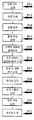
- FIG. 1 schematically illustrates an ink manufacturing process using a high molecular weight organic-inorganic hybrid polymer supercritical fluid.
- the method comprises the steps of selecting a polymeric material as a method of preparing a print ink composition comprising a supercritical sub-nanoemulsion / suspension fluid of high molecular weight organic-inorganic hybrid multilayer wall encapsulated polymer particles; Purifying the selected material; Polymerizing the purified material into a high molecular weight organic-inorganic hybrid polymer supercritical fluid; Controlling physical properties of the polymerized high molecular weight organic-inorganic hybrid polymer supercritical fluid; Mixing a high molecular weight organic-inorganic hybrid polymer supercritical fluid having controlled physical properties with at least one material selected from phosphors, light emitting materials, organic materials, inorganic materials, and organic-inorganic hybrid materials; Dispersing the mixed high molecular weight organic-inorganic hybrid polymer supercritical fluid with at least one material selected from phosphors, light emitting materials, organic materials, inorganic materials, and organic-inorganic hybrid materials at room temperature and atmospheric pressure;
- a printed ink composition comprising 250 g of letdown sublimation transfer dye liquid, Diethylene glycol 50g, Glycerin: 80g, 620g of ultrapure water, the surface tension of 35 dyne / cm; Viscosity 2.8 cPs; And 30m output from output equipment such as Yepson's Stylus Pro 9400, Hewlett Packard Designer jet z2100, and Canon's Canon IPF 700 manufactured at pH 8.7.
- a method comprising selecting a material to make a high molecular weight organic-inorganic hybrid polymer supercritical fluid for use with various inks; Purifying the selected material; Polymerizing the purified material into a high molecular weight organic-inorganic hybrid polymer supercritical fluid; Adjusting the physical properties of the polymerized high molecular weight organic-inorganic hybrid polymer supercritical fluid; Selectively mixing a high molecular weight organic-inorganic hybrid polymer supercritical fluid having controlled physical properties with fluorescent materials, organic materials, inorganic materials, organic-inorganic hybrid materials, and the like; Dispersing the mixed high molecular weight organic-inorganic hybrid polymer supercritical fluid homogeneously at room temperature and atmospheric pressure with fluorescent materials, organic materials, inorganic materials, organic-inorganic hybrid materials, and the like; Putting the dispersed material in a milling machine with 0.03 mm to 0.3 mm zirconium / silica / hafnium alloy beads
- the step of polymerizing the molecular weight organic-inorganic hybrid polymer supercritical fluid of the present invention may include a polymer dispersed surfactant in distilled water or vegetable oil.
- oil in water O / W
- water in oil W / O
- oil in water in oil O / W / O
- water in oil in water W / Monomers such as styrene, acrylate, methacrylate, to polymerize and prepare supercritical sub-nanoemulsion / suspension fluids of high molecular weight organic-inorganic hybrid multilayer wall encapsulated polymer particles with a multi-phase 30 to 80% by weight of distilled water or vegetable oil, selected from the group consisting of unsaturated polyesters, silanes, amides, amines, acrylic acid, methacrylic acid, urea, etc.
- PEO / PPO polyethylene oxide-block-polypropylene oxide
- Base including natural oils such as soybean oil, sesame oil, perilla oil, linseed oil and rosin oil
- the polymerization preparation with the multi-phase in the form of oil in water consists of styrene, acrylate, methacrylate, unsaturated polyester, silane, amide, amine, acrylic acid, methacrylic acid, urea and the like.
- 2 blocking consisting of polyethylene oxide-block-polypropylene oxide (PEO / PPO) having 10-20% by weight of the monomer selected from the group and having less than 1% by weight with 30-80% by weight of distilled water as the discontinuous solvent.
- PEO / PPO polyethylene oxide-block-polypropylene oxide
- reactive anionic surfactants such as sodium lauryl sulfate, sodium bis (2-ethylhexyl) (di, mono) sulfonoxysinate, betaine, and glycerin and diol as emulsifiers.
- reactive anionic surfactants such as sodium lauryl sulfate, sodium bis (2-ethylhexyl) (di, mono) sulfonoxysinate, betaine, and glycerin and diol as emulsifiers.
- peroxides such as AIBN, benzoyl peroxide (BPO) Acetophenones, benzyl, benzoin, phenone chemistry such as initiators and representative photoinitiators 2,4,6-trimethylbenzoyldiphen
- the multi-phase polymerization preparation in the form of water phosphorus oil is a group consisting of styrene, acrylate, methacrylate, unsaturated polyester, silane, amide, amine, acrylic acid, methacrylic acid, urea and the like.
- the monomer selected from is a two-blocking or three-blocking reaction consisting of 30-80% by weight vegetable oil and polyethylene oxide-block-polypropylene oxide (PEO / PPO) having less than 1% by weight as 10-20% by weight continuous solvent.
- a polymeric surfactant reactive anionic surfactants such as sodium lauryl sulfate, sodium bis (2-ethylhexyl) (di, mono) sulfonicresinate, and betaine, and glycerin and diol as emulsifiers
- reactive anionic surfactants such as sodium lauryl sulfate, sodium bis (2-ethylhexyl) (di, mono) sulfonicresinate, and betaine
- glycerin and diol as emulsifiers
- peroxide initiators such as AIBN, benzoyl peroxide (BPO) and representative light Benzyl, benzoin, phenone chemicals, para-toluenesulfonate chemistry such as initiator 2,4,6-trimethylbenzoyldiphenylphosphine oxide, etc.
- N-tetrabutyl-N as a photoinitiator having less than 1% by weight of water, phosphate chemicals, triflate chemicals, hydrate chemicals, thioxanthene chemicals or alkyloxyamine-based initiators for rapid nitric oxide radical polymerization (NMP) -(2-methyl-1-phenylpropyl) -O- (1-phenylethyl) hydroxyamine, 2,2,5-triethyl-4-phenyl-3-azahexane-3-nitroxide, 2, 2,6,6, -tetramethyl-1-piperidinyloxy, N-tetrabutyl-O- (1-chloromethylphenylethyl) -N- (2-methyl-1-phenylethyl) hydroxyamine, 4- Methacryloxy-2,2,6,6-tetramethylpiperidine-1-oxyl and alcohols having a weight percentage of less than 1 as cosolvent.
- NMP nitric oxide radical polymerization
- a polymerized water in the form of a polymerized water phosphorus oil to have a multi-phase and the reversible phase is water phosphorus oil, oil phosphorus water or oil phosphorus water phosphorus oil 30 to 80% by weight of vegetable oil as a continuous and discontinuous solvent in a monomer selected from the group consisting of styrene, acrylate, methacrylate, unsaturated polyester, silane, amide, amine, acrylic acid, methacrylic acid, urea, and the like.
- 2-blocking or 3-blocking reactive polymer surfactant consisting of polyethylene oxide-block-polypropylene oxide (PEO / PPO) having less than 1% by weight, sodium lauryl sulfate, sodium bis (2-ethylhexyl) (di, mono) sulfonic acid Reactive anionic surfactants such as cinates, betaines, and the like and glycerin, diols as emulsifiers having less than 1 to 10% by weight Mixtures thereof selected from the group consisting of and less than 1 aqueous radical polymerization initiators (2,2-azobis (2-methylpropion) dihydrodichloride: V-50), 2,2-azobis (2methylpropion) Acid: V-501), amino persulfate (APS), potassium persulfate (KPS) and the like 2- (dodecylthiocarbonothiolthio) -2-methylpropionic acid, 2-cyano-2-propyl dode Reversible addition-fragmentation chain
- Methylpropionitrirene benzyl, benzoin, phenone chemicals such as peroxide initiators such as AIBN, benzoyl peroxide (BPO) and 2,4,6-trimethylbenzoyldiphenylphosphine oxide, which are typical photoinitiators, Photo-initiators having less than 1% by weight of para-toluenesulfonate chemicals, phosphate chemicals, triflate chemicals, hydrate chemicals, thioxanthene chemicals or alkyloxyamine-based initiators for rapid nitric oxide radical polymerization (NMP) N-tetrabutyl-N- (2-methyl-1-phenylpropyl) -O- (1-phenyl ) Hydroxyamine, 2,2,5-triethyl-4-phenyl-3-azahexane-3-nitroxide, 2,2,6,6, -tetramethyl-1-piperidinyloxy, N- Tetrabutyl-O- (1-chloromethylpheny
- ingredients include fats and oils consisting of linoleic acid, alpha-linoleic acid and oleic acid.
- 1,2-propanediol having a branched structure such as ethylene glycol, 1,3-propanediol, 1,4-butanediol, 1,5-pentanediol, 1,8-octanediol, 6-hexanediol, etc.
- polyvinyl alcohol a polyvinyl alcohol precursor having a hydroxysis value of 80 to 100%, or polyethylene oxide, propylene oxide, glycerol (ethoxy, pro) foxsil
- Water-soluble polysaccharides that are cellulose, polyamide-grape-acrylic acid, polyacrylic acid, and the like, (methyl, ethyl, propyl) cellulose, carboxymethyl cellulose-calcium (CMC-Ca), carboxymethyl cellulose-sodium ( CMC-Na), polysaccharides such as cellulose such as dextrin and cyclodextrin, natural chemicals such as pectin, gum arabic, guar gum, maygum and sodium alginate, chitin, glucosamine and hyaluronic acid which are precursors of chitosan and chitosan , Polylactic acid, polyglutamic acid,
- a special inorganic compound, an organic monomer or oligomer, a prepolymer, or a polymer may be used as a stabilizer.
- Inorganic compounds added to the polymerization process include transition metal ion compounds such as lithium, sodium, potassium, boric acid, iodine, silver, gold, strontium, aluminum, copper, magnesium, tungsten, zinc, titanium, silica, toluene sulfonate compounds, Organic monomers, such as a maleate compound, are also included.
- the oligomers are polyethylene glycol (meth) acrylate, polypropylene glycol (meth) acrylate, (di, tri) ethylene glycol (meth, phenyl) acrylates, and prepolymers are unsaturated polyesters and polyurethanes, and in the case of polymers, polystyrene Sulphonic acid, polystyrene maleic acid, polydimethylsiloxane hydroternate are used. Cinnamic acid and polycinnamic acid, which are used as photosensitive polymer polymerization chains, are also included.
- Antioxidant (degradation) inhibitors are natural tocopherol compounds. Included.
- Surface tension modifiers include hydrated hydrocarbon fluorine, hydrated porous silica, and hydrated porous alumina.
- vinyl butyral and vinyl foam were used to impart gloss and transparency in the processing elements of the polymer.
- the mixing weight of the polymerization terminators, antioxidants, stabilizers, photosensitive polymer polymerization chains, pH regulators, surface tension modifiers and gloss transparency modifiers, which are additional additives of the polymer, is from 0.1 to 100 ppb.
- the finished polymer surface tension is 10 to 40 dyne / cm 2; Viscosity is 300-1500 cPs; And pH 7-11.
- FIG. 1 schematically illustrates an ink manufacturing process using a high molecular weight organic-inorganic hybrid polymer supercritical fluid according to the present invention.
- the manufacturing process of the ink composition comprises a material selection step (P11); Purification step (P12); Polymerization step (P13); Physical property adjustment step (P14); Mixing with an optional material (P15); Homogenizing dispersion step at room temperature and atmospheric pressure (P16); Milling rearrangement dispersing step (P17); Let down step P18; Ink formula step P19; Ink filtration step P20; And it may include a printing step (P21).
- Emulsification of high molecular weight organic / inorganic hybrid polymer supercritical fluids and chemical dynamic equilibrium with dynamic polymers of suspended polymers were designed in the present invention to design high molecular weight organic / inorganic hybrid polymer supercritical fluids based on the following molecular structures.
- a pressure sensitive adhesive element such as Molecular Formula-1 was first constructed for the ability of the adhesive in emulsifying and suspending polymers of organic / inorganic hybrid polymer supercritical fluids.
- Molecular formula-2 was mainly used as an acrylate in the functional group of R1 and composed of a branched adhesive. Items that can be used as monomers are as follows.
- Molecular formula-3 consisted mainly of high temperature curing adhesive material. Polyacrylates and polyacrylic acids of the oligomers used in the functional group of R1 were mainly used. Silsesquioxanes: silica and clay ((Clay) (Bentonite, Kaolin, Kaolinite, Montmorillonite) such as POSS and Tetraethyl orthosilicate) were used in the polymerization. Items that can be used as monomers are as follows.
- prepolymers used in the functional groups of R1 and R2 were mainly used as polyunsaturated esters, and silver, gold, platinum, and palladium metal catalysts were used for polymerization. Items that can be used as monomers are as follows.
- Pigment phosphor (fluorescent) body C.I. Pigment Blue 15; C.I. Pigment Blue 15: 1; C.I. Pigment Blue 15: 2; C.I. Pigment Blue 15: 3; C.I. Pigment Blue 15: 4
- Pigment phosphor (fluorescent) body C.I. Pigment Red 48; C.I. Pigment Red 48: 1; C.I. Pigment Red 48: 2; C.I. Pigment Red 122; C.I. Pigment Violet19
- Dye phosphor fluorescent: C.I. acid Red 84; C.I. acid Red 87; C.I. Reactive Red 23
- Natural phosphors Carmine A; Carmine b
- Pigment phosphor (fluorescent) body C.I. Pigment Green 7, C.I. Pigment Green 36, Cu-Phtalocyanine,
- Pigment C.I. Pigment Black 7, direct dye: poly azo; Poly Phenol, Natural Dyes: Sepia color, Polypyrrole, Graphene, Fullerene, Graphite, Tanono Nanotubes
- C.I. Pigment White 6 Rutile type titanium dioxide, C.I.Pigment White 7 (Anatase type titanium dioxide, C.I.Pigment White 31)
- the pre-oliomer In the case of the pre-oliomer, it was passed through a Sea sand column (diameter: 15 mm, length: 300 mm) and refrigerated with a molecular sieve used only as a cotton column (diameter: 15 mm, length: 300 mm).
- the polymers were filtered using an inlined polypropylene membrane filter (GE Cap polycap HD) and stored at room temperature in a shielded manner with molecular sieves.
- GE Cap polycap HD inlined polypropylene membrane filter
- monomers such as styrene (2.5% by weight), acrylonitrile (0.5% by weight) and methylmethacrylate ( 1% by weight), tetraethyl orthosilicate (TEOS) (100ppb), hydroxyethyl methacrylate (8% by weight), acrylic acid (4% by weight) monomers, etc.
- styrene (2.5% by weight), acrylonitrile (0.5% by weight), methyl methacrylate (1% by weight) as monomers for polymerizing and preparing a fluid having a multi-phase in the form of W / O ), Polydimethylsiloxane (PDMS) (100ppb), hydroxyethyl methacrylate (8% by weight), methacrylic acid (4% by weight) monomers, etc. are mixed in advance and prepared in advance While maintaining high purity nitrogen and high-purity argon degassing, soybean oil was added to the reactor with 80% by weight of total polymerization in a continuous and discontinuous solvent.
- BASF Fluoro L-10R5 (PEO / PPO) Reactive Polymer Surfactant (0.65 % By weight) and phosodium bis (2-ethylhexyl) (di, mono) sulfonic lysinate (0.35% by weight) glycerol (10% by weight) Inject%).
- the temperature of the reactor was raised to 65 ° C. for 30 minutes, and when the reactor temperature was stabilized at 65 ° C.
- the polymerization is terminated completely using a combination of SFS: TBHP or HPO: ascorbic acid as the polymerization terminator.
- the combination ratio of SFS: TBHP, HPO: ascorbic acid is 1: 1, and is further added to the polymerization liquid at 0.05 to 0.1% by weight relative to the total polymerization ratio of the polymerization mixture to terminate the polymerization reaction.
- the particles of the fluid of the final reaction polymerization liquid have a uniform size of 1 to 2 nm on average, the dispersion index is in the form of dispersed three-dimensional particles of 1.00 to 1.01, the average weight molecular weight by GPC measurement is 150,000 and the molecular weight range is 120,000 to Has 200,000.
- the third important step procedure of the final physical influences. Since the polymerization solution polymerized in the polymerization step is strongly acidic with a final pH of 1.0 to 5.0, the pH is adjusted to determine the properties of the static viscosity and the dynamic viscoelastic complexity.
- compounds such as sodium phosphate or potassium phosphate alone in ultrapure water alone are removed in ultrapure water in order to remove elements of hydrogen bonding or self-aggregation between ultrafine micronized high molecular weight organic / inorganic hybrid polymer supercritical fluid particles. It can be used by dissolving or mixing two kinds and dissolving 0.1 ⁇ 1N in ultrapure water.
- the mixing step of the optional material is the same as the method of preparing the dispersion stock solution of the registered, applied, and published application patents in addition to the present application.
- Sublimable Transfer Dye (C. I. disperse blue 359): 250 g
- Dye-pigment copolymerized pigment (New Colorant: C. I. Driect blue 192, C. I. disperse blue 72, C. I. Pigment blue 15: 3): 250 g
- the five mixtures were mixed at high mixing at 26,000 rpm with 99.99% of argon degassing from Air Products.
- the milling rearrangement dispersing step of the optional material is the same as the method for preparing the dispersion master stock solution of the registered, filed, published patent application in addition to the present application.
- Zirconium-silica carbide-hafnium beads (0.03 to 0.1 mm) are placed in a milling machine and rotated at a speed of 2000 to 16000 RPM to uniformly disperse the pigment and polymer (milling time 90 min / 1Kg).
- a dispersion master stock solution having a monodisperse distribution is prepared.
- the bead is preferably added to about 60 to 90% of the total volume of the chamber of the mill.
- the average particle size of each finished master stock solution is 0.7 ⁇ 1nm in uniform size and the dispersion index is in the form of very short dispersed 3D ellipsoidal particles ranging from 1.00 to 1.03.
- the average weight molecular weight by GPC measurement is 180,000 and the molecular weight range is 150,000. To 230,000.
- Dye-pigmented pigment liquid 300 g
- Aqueous solution containing 1% by weight of polyethylene oxide 400 g
- Aqueous solution containing 1% by weight of polyethylene oxide 400 g
- Aqueous solution containing 1% by weight of polyethylene oxide 400 g
- the manufactured ink composition of the present invention removes impurities generated or mixed in the manufacturing process by the filtration process and filters particles having a size or more than a predetermined level.
- the filtration process is performed by ultrafiltration (less than 3), fine filtration (less than 500), selective ultra-precision filtration (less than 100) using Millipore or Graphene Eltrix, and by a vacuum (1 ATM) vacuum pump. It is filtered.
- the ink composition has an overall uniform and stable particle size.
- Preparation Example 13 is surface tension 35 dyne / cm 2 ; Viscosity 2.8 cPs; And pH 8.7. 30m output from Epson's Stylus Pro 9400, Hewlett Packard Designer jet z2100, and Canon's Canon IPF 700.
- Preparation Example 14 is surface tension 32 dyne / cm 2 ; Viscosity 2.5 cPs; And pH 8.3. 30m output from Epson's Stylus Pro 9400, Hewlett Packard Designer jet z2100, and Canon's Canon IPF 700.
- Preparation Example 15 is surface tension 30 dyne / cm 2 ; Viscosity 2.4 cPs; And pH 8.8. 30m output from Epson's Stylus Pro 9400, Hewlett Packard's Designer jet z2100, and Canon's Canon IPF 700.
- Preparation Example 17 is surface tension 28 dyne / cm 2 ; Viscosity 2.4 cPs; And pH 7.8. 10m output from Epson's Stylus Pro 9400, Hewlett Packard's Designer jet z2100, and Canon's Canon IPF 700.
- Preparation Example 18 is surface tension 26 dyne / cm; Viscosity 2.73 cPs; And pH 8.8. 10m output from Epson's Stylus Pro 9400, Hewlett Packard's Designer jet z2100, and Canon's Canon IPF 700.
- Preparation Example 19 is surface tension 27 dyne / cm 2 ; Viscosity 2.73 cPs; And pH 8.8. Epson's SureLab D3000 and Hewlett Packard's Indigo digitalpress 3550 printing machine output 1000 A4s with no margins.
- the prepared reactive dye inks were tested on output devices such as Stylus Pro 7900 from Epson, Hewlett Packard Designer jet z3200, and Canon IPF 8000 from Canon. Some nozzles were dropped during the test, and the color reproduction (based on CIE Lab 1976) or durability was much lower than that of Examples 1, 7, and 8 in the washing process after the curing process.
- the prepared transfer inks were subjected to output tests on Epson's Stylus Pro 7900, Hewlett Packard Designer jet z3200, and Canon's Canon IPF 8000. During the test, some nozzles were not removed, and no harmful substances were released during the curing process, but a small amount of methane gas produced increased yellowing of the printed matter and air pollution in the indoor space. Later, in the washing process, the color reproduction was similar to that of Example 1, 7, 8, but fell far below the standard in the durability test.
- the prepared dispersion solution was put into a bead mill and milled for about 8 hours to prepare a pigment dispersion stock solution having an average particle size of about 50 nm.
- An ink composition was prepared by introducing the following reactive chemicals into the obtained pigment dispersion stock solution.
- the prepared transfer inks were subjected to output tests on Epson's Stylus Pro 7900, Hewlett Packard Designer jet z3200, and Canon's Canon IPF 8000. There were no nozzles left during the test, and no harmful substances were released during the curing process, but the generation of small amounts of methane increased the yellowing of the printed matter and the air pollution in the interior space. Later, in the washing process, the color reproduction and friction resistance of Example 2 were much lower than the standard.
- the prepared petroleum dilution UV curable inks were tested on output devices such as Stylus Pro 7900 from Epson, Hewlett Packard Designer jet z3200, and Canon IPF 8000 from Canon. During the test, some nozzles were not removed, and no harmful substances were released during the curing process, but a small amount of methane and carbon dioxide gas generated increased air pollution in the indoor space. In the washing process, the washing resistance and the light resistance test were very good compared with Example 3, but the color reproduction and the friction resistance were not good.
- the petroleum-based dilution electronic inkjet printing electronic ink was tested on output equipment such as Stylus Pro 7900 manufactured by Epson, Hewlett Packard Designer jet z3200, and Canon IPF 8000 manufactured by Canon. During the test process, it was printed on general polyethylene terephthalate and polypropylene film, and there were some nozzles missing, ink bleeding occurred, and the EVA non-woven fabric of the ink support part of the ink head was dissolved. Increased inkjet head damage due to internal acid generation. After the same curing process as in Example 5, the rate of change of resistance to moisture in the quality test process was also severe.
- Alfa Aesaer's electronic ink compositions for petroleum dilution electronic inkjet printing were compared.
- the petroleum-based dilution electronic inkjet printing electronic ink was tested on output equipment such as Stylus Pro 7900 manufactured by Epson, Hewlett Packard Designer jet z3200, and Canon IPF 8000 manufactured by Canon.
- the nozzle was printed on the general polyethylene terephthalate and polypropylene film, and there were some nozzles. Ink bleeding occurred, and the EVA nonwoven fabric of the ink support part of the ink head was dissolved by styrene.
- Example 4 Not Silver Emission After the same curing process, the rate of change of surface resistance to oxidation of silver was high during the quality test.
- ITO isoprophly alcohol in 30% by weight solution 40 parts by weight
- the petroleum-based dilution electronic inkjet printing electronic ink was tested on output equipment such as Stylus Pro 7900 manufactured by Epson, Hewlett Packard Designer jet z3200, and Canon IPF 8000 manufactured by Canon. In the course of the test, it was printed on the general polyethylene terephthalate and polypropylene film, and there were no nozzles, and ink bleeding occurred, and the ink hazardous substances in the ink head were not discharged, but the same as in Examples 4, 5, and 6 After the hardening process, the rate of change of 3D resistance to bending and torsion was high during the quality test.
- the manufacturing method of the print ink composition of this invention is industrially available.
Landscapes
- Chemical & Material Sciences (AREA)
- Life Sciences & Earth Sciences (AREA)
- Engineering & Computer Science (AREA)
- Materials Engineering (AREA)
- Wood Science & Technology (AREA)
- Organic Chemistry (AREA)
- Inks, Pencil-Leads, Or Crayons (AREA)
Abstract
L'invention concerne un procédé pour préparer un fluide supercritique de polymère hybride organique/inorganique de poids moléculaire élevé qui présente un auto-assemblage/une auto-organisation/une auto-dispersibilité et qui peut être utilisé pour une encre d'impression par jets d'encre contenant un corps de coloration, un corps phosphorescent, un corps fluorescent, une matière organique, une matière inorganique et une matière hybride organique/inorganique qui sont nécessaires dans une composition d'encre aqueuse ou non aqueuse à base d'huile végétale pour impression numérique. L'invention concerne, plus spécifiquement, une composition d'encre et un procédé de préparation de ladite composition d'encre, cette dernière ne contenant pas ou n'induisant pas de matière chimique nocive pour le corps humain ou pour l'environnement, et étant utilisée avec des procédés de revêtement variés. A l'exception des problèmes de préparation de l'encre, et compte tenu que le fer et le phosphate, qui sont des matériaux magnétiques influençant la stabilité d'une tête d'impression, sont essentiellement utilisés en tant que tensioactif, le procédé précité permet de palier et de résoudre les problèmes. Le procédé pour préparer un vecteur d'encre au moyen d'un fluide supercritique de particules de polymère tridimensionnelles hybrides organiques/inorganiques de poids moléculaire élevé du type micelles de commutation, qui peut être utilisé en tant qu'encre pour impression à jets d'encre contenant un corps de coloration, un corps phosphorescent, un corps fluorescent, une matière organique, une matière inorganique et une matière hybride organique/inorganique à base d'une combinaison d'émulsion sous-micrométrique et de suspension sous-nanométrique établie en fonction de solvants aqueux et de solvants à base d'huile végétale qui peuvent être présents dans des papiers ou utilisés dans le milieu universitaire ; et qui présente un auto-assemblage/une auto-organisation/une auto-dispersibilité, et une taille sous-nanométrique de façon à permettre la formation d'une suspension ou d'une émulsification. L'invention également concerne un procédé de préparation au moyen de matériaux très divers et d'instruments de revêtement variés dans un processus de préparation plus sûr et plus commode.
Priority Applications (2)
| Application Number | Priority Date | Filing Date | Title |
|---|---|---|---|
| KR1020157023236A KR20150141937A (ko) | 2013-02-28 | 2013-02-28 | 고분자량 유-무기 하이브리드 다층벽 캡슐화 폴리머 입자의 초임계 서브 나노 유화/현탁 유체를 포함하는 잉크의 조성물의 제조방법 |
| PCT/KR2013/001622 WO2014133203A1 (fr) | 2013-02-28 | 2013-02-28 | Procédé pour préparer une composition d'encre contenant un fluide supercritique sous-nanométrique en émulsion/suspension de particules de polymère encapsulées multi-parois hybrides organiques/inorganiques de poids moléculaire élevé |
Applications Claiming Priority (1)
| Application Number | Priority Date | Filing Date | Title |
|---|---|---|---|
| PCT/KR2013/001622 WO2014133203A1 (fr) | 2013-02-28 | 2013-02-28 | Procédé pour préparer une composition d'encre contenant un fluide supercritique sous-nanométrique en émulsion/suspension de particules de polymère encapsulées multi-parois hybrides organiques/inorganiques de poids moléculaire élevé |
Publications (1)
| Publication Number | Publication Date |
|---|---|
| WO2014133203A1 true WO2014133203A1 (fr) | 2014-09-04 |
Family
ID=51428455
Family Applications (1)
| Application Number | Title | Priority Date | Filing Date |
|---|---|---|---|
| PCT/KR2013/001622 Ceased WO2014133203A1 (fr) | 2013-02-28 | 2013-02-28 | Procédé pour préparer une composition d'encre contenant un fluide supercritique sous-nanométrique en émulsion/suspension de particules de polymère encapsulées multi-parois hybrides organiques/inorganiques de poids moléculaire élevé |
Country Status (2)
| Country | Link |
|---|---|
| KR (1) | KR20150141937A (fr) |
| WO (1) | WO2014133203A1 (fr) |
Cited By (3)
| Publication number | Priority date | Publication date | Assignee | Title |
|---|---|---|---|---|
| CN114011105A (zh) * | 2021-10-19 | 2022-02-08 | 杭州福斯特电子材料有限公司 | 一种封装油墨组合物的提纯方法 |
| CN118006162A (zh) * | 2024-03-13 | 2024-05-10 | 衣金光学科技南通有限公司 | 一种红外光穿透油墨及其制备方法和应用 |
| CN119350699A (zh) * | 2024-10-24 | 2025-01-24 | 上海交通大学 | 一种生物基水性聚氨酯气凝胶的制备方法与应用 |
Citations (4)
| Publication number | Priority date | Publication date | Assignee | Title |
|---|---|---|---|---|
| WO2012036330A1 (fr) * | 2010-09-17 | 2012-03-22 | 주식회사 씨드 | Procédé de préparation de plaste copolymérisé de pigment respectueux de l'environnement et d'une composition d'encre possédant une macromolécule de poids moléculaire élevé, et système d'impression numérique sur textile les utilisant |
| KR20120038645A (ko) * | 2010-10-14 | 2012-04-24 | 주식회사 씨드 | 수성 또는 식물성 오일 기반 저에너지 광경화 잉크젯 잉크의 제조방법 |
| KR20120043393A (ko) * | 2010-10-26 | 2012-05-04 | 주식회사 씨드 | 3차원 잉크젯 프린트 시스템 이용이 가능한 전기 또는 전자 재료용 광 경화 잉크젯 잉크 조성물의 제조방법 |
| KR20130019055A (ko) * | 2011-08-16 | 2013-02-26 | 주식회사 씨드 | 극초고분자량 고분자 막을 사용한 전지나 커패시터용 광 경화 잉크젯 잉크의 제조 방법 |
-
2013
- 2013-02-28 WO PCT/KR2013/001622 patent/WO2014133203A1/fr not_active Ceased
- 2013-02-28 KR KR1020157023236A patent/KR20150141937A/ko not_active Ceased
Patent Citations (4)
| Publication number | Priority date | Publication date | Assignee | Title |
|---|---|---|---|---|
| WO2012036330A1 (fr) * | 2010-09-17 | 2012-03-22 | 주식회사 씨드 | Procédé de préparation de plaste copolymérisé de pigment respectueux de l'environnement et d'une composition d'encre possédant une macromolécule de poids moléculaire élevé, et système d'impression numérique sur textile les utilisant |
| KR20120038645A (ko) * | 2010-10-14 | 2012-04-24 | 주식회사 씨드 | 수성 또는 식물성 오일 기반 저에너지 광경화 잉크젯 잉크의 제조방법 |
| KR20120043393A (ko) * | 2010-10-26 | 2012-05-04 | 주식회사 씨드 | 3차원 잉크젯 프린트 시스템 이용이 가능한 전기 또는 전자 재료용 광 경화 잉크젯 잉크 조성물의 제조방법 |
| KR20130019055A (ko) * | 2011-08-16 | 2013-02-26 | 주식회사 씨드 | 극초고분자량 고분자 막을 사용한 전지나 커패시터용 광 경화 잉크젯 잉크의 제조 방법 |
Cited By (3)
| Publication number | Priority date | Publication date | Assignee | Title |
|---|---|---|---|---|
| CN114011105A (zh) * | 2021-10-19 | 2022-02-08 | 杭州福斯特电子材料有限公司 | 一种封装油墨组合物的提纯方法 |
| CN118006162A (zh) * | 2024-03-13 | 2024-05-10 | 衣金光学科技南通有限公司 | 一种红外光穿透油墨及其制备方法和应用 |
| CN119350699A (zh) * | 2024-10-24 | 2025-01-24 | 上海交通大学 | 一种生物基水性聚氨酯气凝胶的制备方法与应用 |
Also Published As
| Publication number | Publication date |
|---|---|
| KR20150141937A (ko) | 2015-12-21 |
Similar Documents
| Publication | Publication Date | Title |
|---|---|---|
| CN101522827A (zh) | 制备可固化颜料喷墨油墨套装的方法 | |
| CN105278247B (zh) | 固化性树脂组合物及其用途 | |
| CN101522828A (zh) | 非水性有色喷墨油墨 | |
| KR20140100891A (ko) | 무용매 방사선 경화 신축성 잉크 조성물 | |
| WO2014088159A1 (fr) | Composé colorant triarylméthane de poids moléculaire élevé, composition de résine bleue comprenant celui-ci destinée à un filtre coloré, et filtre coloré utilisant celle-ci | |
| WO2017111472A1 (fr) | Composition d'encre colorée présentant une excellente adhésivité aux matériaux en acier, procédé de fabrication d'une plaque imprimée en acier l'utilisant, et plaque imprimée en acier fabriquée selon ledit procédé | |
| WO2018159975A1 (fr) | Composé de résine polymère et composition de résine photosensible pour masque noir comprenant celui-ci | |
| KR20100014529A (ko) | 투명한 착색제 및 착색제 조성물, 및 이의 용도 | |
| WO2014133203A1 (fr) | Procédé pour préparer une composition d'encre contenant un fluide supercritique sous-nanométrique en émulsion/suspension de particules de polymère encapsulées multi-parois hybrides organiques/inorganiques de poids moléculaire élevé | |
| WO2017048077A1 (fr) | Film de protection de polariseur, plaque polarisante le comprenant et dispositif d'affichage à cristaux liquides comportant la plaque polarisante | |
| CN111574659A (zh) | 一种含多元结构的分散剂及含其的色浆、uv喷墨 | |
| JP2023527828A (ja) | プリント回路基板のためのインクジェットインク | |
| EP2000513A9 (fr) | Composition de dispersion de pigment non aqueuse | |
| EP3303488A1 (fr) | Encre d'impression | |
| CN101522829A (zh) | 非水性含颜料的喷墨油墨 | |
| WO2013055015A1 (fr) | Composition adhésive, film adhésif, procédé de production de ladite composition et élément d'affichage utilisant ladite composition | |
| CN101307201A (zh) | 卷筒印刷用油墨组合物 | |
| WO2015004489A1 (fr) | Encre d'impression | |
| WO2018110808A1 (fr) | Composition de résine durcissable jaune, filtre de couleur fabriqué en l'utilisant et dispositif d'affichage d'image | |
| TW202017901A (zh) | 化合物、硫醇產生劑、組合物、硬化物及硬化物之製造方法 | |
| WO2016003179A1 (fr) | Élément optique comprenant une couche à faible indice de réfraction | |
| JP2022067314A (ja) | 処理液、処理液とインクのセット、画像形成方法、及び画像形成装置 | |
| WO2019093797A2 (fr) | Composition de résine durcissable colorante, filtre coloré, et dispositif d'affichage | |
| WO2023191535A1 (fr) | Substrat à motifs, revêtu d'un film de cnt, utilisant une réaction click et procédé de fabrication associé | |
| KR20060132494A (ko) | 칼라필터 제조용 잉크 |
Legal Events
| Date | Code | Title | Description |
|---|---|---|---|
| ENP | Entry into the national phase |
Ref document number: 20157023236 Country of ref document: KR Kind code of ref document: A |
|
| NENP | Non-entry into the national phase |
Ref country code: DE |
|
| 121 | Ep: the epo has been informed by wipo that ep was designated in this application |
Ref document number: 13876583 Country of ref document: EP Kind code of ref document: A1 |
|
| 122 | Ep: pct application non-entry in european phase |
Ref document number: 13876583 Country of ref document: EP Kind code of ref document: A1 |