WO2014141404A1 - Dispositif de traitement d'image, procédé de traitement d'image, et programme de traitement d'image - Google Patents
Dispositif de traitement d'image, procédé de traitement d'image, et programme de traitement d'image Download PDFInfo
- Publication number
- WO2014141404A1 WO2014141404A1 PCT/JP2013/057001 JP2013057001W WO2014141404A1 WO 2014141404 A1 WO2014141404 A1 WO 2014141404A1 JP 2013057001 W JP2013057001 W JP 2013057001W WO 2014141404 A1 WO2014141404 A1 WO 2014141404A1
- Authority
- WO
- WIPO (PCT)
- Prior art keywords
- complexity
- image processing
- calculation unit
- region
- processing apparatus
- Prior art date
- Legal status (The legal status is an assumption and is not a legal conclusion. Google has not performed a legal analysis and makes no representation as to the accuracy of the status listed.)
- Ceased
Links
Images




Classifications
-
- G—PHYSICS
- G06—COMPUTING OR CALCULATING; COUNTING
- G06T—IMAGE DATA PROCESSING OR GENERATION, IN GENERAL
- G06T7/00—Image analysis
- G06T7/40—Analysis of texture
- G06T7/41—Analysis of texture based on statistical description of texture
- G06T7/44—Analysis of texture based on statistical description of texture using image operators, e.g. filters, edge density metrics or local histograms
-
- G—PHYSICS
- G06—COMPUTING OR CALCULATING; COUNTING
- G06V—IMAGE OR VIDEO RECOGNITION OR UNDERSTANDING
- G06V10/00—Arrangements for image or video recognition or understanding
- G06V10/20—Image preprocessing
- G06V10/26—Segmentation of patterns in the image field; Cutting or merging of image elements to establish the pattern region, e.g. clustering-based techniques; Detection of occlusion
-
- G—PHYSICS
- G06—COMPUTING OR CALCULATING; COUNTING
- G06V—IMAGE OR VIDEO RECOGNITION OR UNDERSTANDING
- G06V10/00—Arrangements for image or video recognition or understanding
- G06V10/20—Image preprocessing
- G06V10/28—Quantising the image, e.g. histogram thresholding for discrimination between background and foreground patterns
Definitions
- One aspect of the present invention relates to an image processing apparatus, an image processing method, and an image processing program.
- the image processing apparatus described in Patent Document 1 below calculates an edge component index value indicating the amount of edge components included in each subdivision area for each subdivision area, and compares the edge component index value with a threshold value. Then, the presence / absence of the detection object is determined for each subdivision area.
- the threshold value used for edge detection is fixedly set based on empirical rules and the like, so it may be difficult to specify the character area with high accuracy depending on the drawing mode of the character area. For example, there may be a case where a character area having a low contrast with the background area such as a translucent character cannot be accurately detected. In order to eliminate this inconvenience, it is conceivable to uniformly lower the edge detection threshold value. However, depending on the image, unnecessary edges other than the edge of the character area to be detected are also detected. Therefore, it is desired to more reliably detect a character area to be detected according to an image.
- An image processing apparatus detects a character area in a target area, a calculation unit that calculates a degree of complexity indicating the degree of positional dispersion of edges in the target area from which the character area is to be extracted. And a setting unit that sets the edge threshold to be lowered according to the low complexity.
- An image processing method is an image processing method executed by an image processing apparatus, and has a complexity indicating a degree of positional dispersion of edges in a target region from which a character region is to be extracted.
- An image processing program detects a character region in a target region, a calculation unit that calculates a degree of complexity indicating the degree of positional dispersion of edges in the target region from which the character region is to be extracted. And a setting unit that sets the edge threshold value to be lowered according to the low complexity.
- a computer-readable recording medium includes a calculation unit that calculates a degree of complexity indicating a degree of positional dispersion of edges in a target region from which a character region is to be extracted, and a character region in the target region.
- An image processing program for causing a computer to execute a setting unit that sets an edge threshold value for detecting an image to be low according to low complexity is stored.
- the complexity indicating the degree of positional dispersion of the edges is calculated, and the edge threshold is set low according to the low complexity.
- the edge threshold is dynamically set by paying attention to the complexity, it becomes possible to detect the edge according to the property of the target area, and as a result, the character area can be detected more reliably. Is possible.
- the calculation unit divides the original image into a plurality of patches, calculates a texture intensity indicating a variation degree of the change amount of the pixel value in the patch for each patch, and determines the texture of each patch. Based on the intensity, the complexity of the target area composed of one or more patches may be calculated.
- the target area may be the entire original image
- the calculation unit may calculate the complexity of the target area based on the texture intensity of each patch.
- the calculation unit groups a plurality of patches whose texture intensity is within a predetermined range and is continuously arranged, sets each group as a target region, and sets each target region. May be calculated.
- the calculation unit generates a plurality of divided regions including a plurality of patches by equally dividing the original image into the target regions, and sets each target based on the complexity of each patch. You may calculate the complexity of a division area.
- the calculation unit divides the number of patches whose texture intensity is equal to or greater than a predetermined value in the target region by the total number of patches in the target region, thereby calculating the complexity of the target region. You may get
- the calculation unit divides the average value of the texture strength in the patches having the texture strength equal to or higher than the predetermined value in the target region by the predetermined maximum texture strength value.
- the complexity of the target area may be obtained.
- the target area may be a patch
- the calculation unit may calculate the complexity of each target area based on the corresponding texture intensity
- the calculation unit may obtain the complexity of the target region by dividing the texture strength in the target region by a predetermined maximum value of the texture strength.
- the image processing apparatus 10 is a computer system that detects edges that are outlines of characters superimposed on an image.
- “character” in this specification is a concept including a mark or a picture of an arbitrary shape.
- Images with characters superimposed on photos can be seen in various situations. For example, in a virtual shopping street that handles many types of products, images in which characters are superimposed on product photos are often used as product images. When drawing a character in an image, a character with low contrast, such as a translucent character or a character with a color close to a background color, is often used from the viewpoint of design or the like. In the present specification, an image on which characters are drawn is also referred to as a “text image”.
- edge threshold value a threshold value for specifying an edge in processing for specifying the edge of a character from an image with characters, such as the Canny method.
- edge threshold value a threshold value for specifying an edge in processing for specifying the edge of a character from an image with characters
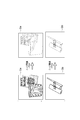
- the image Ga is an image in which two character strings of the same density “WXYZ” and “bucket” are superimposed on a picture of a bucket placed on the lawn.
- the image Gb is an image in which the character string “ABCD” is superimposed on the photograph of the communication module.
- the transparency of the character string is higher in “ABCD” than “WXYZ” and “bucket”, and therefore “WXYZ” and “bucket” are darker than “ABCD”.
- edge threshold THa “WXYZ” and “bucket” in the image Ga can be clearly identified as shown in FIG.
- edge threshold THa when the edge threshold THa is applied to the processing of the image Gb, the transparency of the character string “ABCD” is high, so that the edge of the character string may not be extracted as shown in FIG.
- edge threshold THb a value THb lower than THa as shown in FIG.
- the edge threshold THb is applied to the processing of the image Ga, not only two character strings but also grass and bucket edges are extracted and intersect or overlap the edges of those character strings. Therefore, the characters “WXYZ” and “bucket” cannot be extracted well.
- the image processing apparatus 10 dynamically determines an edge threshold value for each image.
- a high threshold THa ′ is set for the image Ga
- a lower threshold THb ′ (that is, THa ′> THb ′) is set for the image Gb.
- Character edges can be extracted well for both of the two images Ga and Gb.
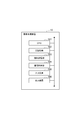
- FIG. 4 shows a hardware configuration of the image processing apparatus 10.
- the image processing apparatus 10 includes a CPU 101 that executes an operating system, application programs, and the like, a main storage unit 102 that includes a ROM and a RAM, an auxiliary storage unit 103 that includes a hard disk, a flash memory, and the like, and a network card or
- the communication control unit 104 includes a wireless communication module, an input device 105 such as a keyboard and a mouse, and an output device 106 such as a display.
- Each functional component of the image processing apparatus 10 to be described later reads predetermined software on the CPU 101 or the main storage unit 102, and controls the communication control unit 104, the input device 105, the output device 106, and the like under the control of the CPU 101. This is realized by operating and reading and writing data in the main storage unit 102 or the auxiliary storage unit 103. Data and a database necessary for processing are stored in the main storage unit 102 or the auxiliary storage unit 103.
- each of the image processing apparatuses 10 may be configured by one computer or a plurality of computers.
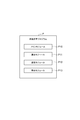
- the image processing apparatus 10 includes a calculation unit 11, a setting unit 12, and a detection unit 13 as functional components.
- the calculation unit 11 is a functional element that calculates the complexity in the target region (target region) from which a character region (text region) is to be extracted.
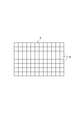
- the calculation unit 11 receives one original image data A, and divides the original image data A into a plurality of patches B as shown in FIG.
- the size of one patch is 7 pixels ⁇ 7 pixels, but the size of the patch is not limited to this, and may be arbitrarily set.
- the calculation unit 11 obtains a texture strength indicating a variation degree (dispersion) of the change amount of the pixel value for each of the plurality of patches.
- a texture strength indicating a variation degree (dispersion) of the change amount of the pixel value for each of the plurality of patches.
- an image region for example, a lawn region in the image Ga
- colors (edges) are scattered in position.
- the amount of change in pixel value is the gradient between two adjacent pixels, and can be obtained for each of the horizontal and vertical directions of the patch.
- the calculation unit 11 obtains a gradient matrix G by the following equation (1) for a patch w i composed of a plurality of pixels.
- [p x (k), p y (k)] T indicates a gradient in the pixel (x k , y k ), and T indicates a transposed matrix.
- the calculation unit 11 obtains a gradient covariance matrix C by the following equation (2).
- T indicates a transposed matrix.
- C G T G ... (2 )
- the main information about the patch w i can be derived from the gradient matrix G and the gradient covariance matrix C.
- the calculation unit 11 calculates the local dominant direction in the patch and the energy in that direction.
- the eigendecomposition method executed by the calculation unit 11 is expressed by the following equations (3) and (4).
- the gradient matrix G is expressed by the following formula (3).
- U and V are orthonormal matrices, respectively.
- v 1 is a column vector indicating the dominant direction.
- v 2 is a column vector orthogonal to the column vector v 1 , and can be said to indicate the direction of the edge.
- s 1 indicates energy in the dominant direction
- s 2 indicates energy in the edge direction.
- the gradient covariance matrix C is expressed by the following formula (4).
- FIG. 7 An example of the eigendecomposition method is shown in FIG.
- s 1 indicates the energy in the dominant direction
- s 2 indicates the energy in the edge direction.
- the edge direction is defined along the direction in which the stripe pattern extends (see the arrow in the image).
- the calculation unit 11 obtains a trace (trace) that is a sum of eigenvalues of the gradient covariance matrix C as the texture intensity ⁇ of the patch.
- trace a trace that is a sum of eigenvalues of the gradient covariance matrix C as the texture intensity ⁇ of the patch.
- tr () is an operator indicating a trace.
- ⁇ tr (C) (5)
- FIG. 8 shows an example of three patches Bx, By, Bz expressed in gray scale and the texture intensity ⁇ of each patch. If the pixel values are almost uniform as in the patch Bz, the texture strength is quite low. If all the pixel values in the patch are the same value, the texture strength is zero. On the other hand, when the color is linearly darker (or lighter) like the patch By, the texture strength is high. If the pixel values are different (like the patch Bx) (when the edge positions are scattered), the texture strength is further increased. Thus, the texture intensity indicates the degree to which the edges are scattered in the patch.
- the calculation unit 11 obtains the texture strength of each patch by executing the processing including the calculations of the above formulas (1) to (5) for each patch.
- the calculation unit 11 obtains the complexity in the target area where the character area is to be detected using one edge threshold value.
- the calculation method of the range and complexity of the target region is not limited, and various methods as follows can be considered.
- Nc is the number of patches whose texture intensity ⁇ is greater than or equal to the working threshold ⁇ th among the plurality of patches obtained from the original image.
- ⁇ max is the maximum value of the texture strength and is set in advance. Equation (6) is obtained by dividing the average value of the texture strength in the patches whose texture strength is equal to or greater than a predetermined value in the target region by dividing the average value of the texture strength by a predetermined maximum value of the texture strength. Show that you get.
- the texture intensity is calculated for each small batch of 7 ⁇ 7 pixels, and then the complexity of the entire image is calculated.
- the processing for calculating the texture strength to the entire image it is also conceivable to apply the processing for calculating the texture strength to the entire image to calculate the texture strength of the entire image.
- the texture intensity is calculated by dividing each patch, and then the complexity of the entire image is calculated using the texture intensity, whereby the complexity of the entire image can be calculated with high accuracy.
- the calculation unit 11 may set a plurality of target areas by dividing the original image, and obtain the complexity R for each target area.
- the method for dividing the original image is not limited.
- the calculation unit 11 may equally divide the original image into a predetermined number (e.g., 8 division or 16 division). And the calculation part 11 calculates
- the calculation unit 11 dynamically divides the original image by grouping a plurality of patches in which the texture strength is within a predetermined range and is continuously arranged based on the position and texture strength of each patch. May be. And the calculation part 11 calculates
- the calculation unit 11 may set the complexity R for each patch. In this case, the calculation unit 11 obtains the complexity R from the preset maximum texture strength value ⁇ max and the patch texture strength ⁇ by the following equation (7).
- R ⁇ / ⁇ max (7)
- the calculation unit 11 obtains the complexity R based on the texture strength ⁇ . By this calculation, the degree of positional dispersion of edges in the target region can be obtained. Since the complexity R increases as the texture strength ⁇ increases, it can be said that the texture strength ⁇ is a kind of complexity.
- the calculation unit 11 when the complexity R is calculated for each of one or a plurality of target regions, the calculation unit 11 generates information about the target region and outputs the information to the setting unit 12.
- Each record of the target area information is data in which an identifier for uniquely specifying the target area, the position or range of the target area, and the complexity R set for the target area are associated with each other.
- the setting unit 12 is a functional element that sets an edge threshold value used for detecting a character area from the target area.
- the setting unit 12 holds an edge threshold reference value (reference threshold) TH org in advance.
- the setting unit 12 multiplies the reference value TH org by the complexity R of the target area to obtain a final edge threshold TH used in the target area. Then, the setting unit 12 sets the edge threshold TH as part of the information on the target area.
- the edge threshold value of the target region increases linearly according to the complexity.
- the relational expression between the edge threshold and the complexity is not limited.
- the setting unit 12 may obtain a final edge threshold from the complexity using a calculation method other than simple multiplication. For example, the setting unit 12 may increase the edge threshold non-linearly according to the complexity.
- the setting unit 12 sets an edge threshold TH for each target area, and adds the edge threshold TH to each target area information.
- the setting unit 12 outputs the target area information to which the edge threshold is added to the detection unit 13.
- the detection unit 13 is a functional element that detects the edge of the character area from the target area using the set edge threshold.
- the detection unit 13 can detect an edge using the Canny method. Since the canny method uses two threshold values, the detection unit 13 uses the set edge threshold value as the first threshold value, and uses another value set based on the edge threshold value as the second threshold value. For example, the detection unit 13 uses a value obtained by doubling the edge threshold as the second threshold. Thereby, as shown in FIG. 3, edge detection suitable for the entire original image or each divided region is realized.
- the detection method of the character region is not limited to the Canny method, and the detection unit 13 may detect the character region using an arbitrary method.
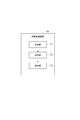
- the calculation unit 11 divides the original image into a plurality of patches (step S11), and calculates the texture intensity of each patch (step S12, calculation step). Subsequently, the calculation unit 11 calculates the complexity of one or a plurality of target regions based on the texture strength (step S13, calculation step). Subsequently, the setting unit 12 sets the edge threshold value of the target region using the complexity (step S14, setting step). Then, the detection unit 13 detects the edge of the character area using the edge threshold (step S15).
- the image processing program P includes a main module P10, a calculation module P11, a setting module P12, and a detection module P13.
- the main module P10 is a part that comprehensively controls the functions of image processing.
- the functions realized by executing the calculation module P11, the setting module P12, and the detection module P13 are the same as the functions of the calculation unit 11, the setting unit 12, and the detection unit 13, respectively.
- the image processing program P may be provided after being fixedly recorded on a tangible recording medium such as a CD-ROM, DVD-ROM, or semiconductor memory. Further, the image processing program P may be provided via a communication network as a data signal superimposed on a carrier wave.
- the complexity indicating the degree of positional dispersion of the edges is calculated in the target region, and the edge threshold is set low according to the low complexity.
- the edge threshold value is dynamically set by paying attention to the complexity, the edge can be detected according to the property (for example, the strength of the texture) of the target region, and as a result, the character region Can be detected more reliably.
- characters having a low contrast with the background area may be inserted into the image.
- characters having a relatively high contrast were inserted into an image with high complexity
- characters having a relatively low contrast were inserted into an image with low complexity.
- the complexity refers to the degree to which the edges are scattered with respect to the image area.
- An image with a high degree of complexity is, for example, a lawn area or a patch Bx in the image Ga.
- the edge detection threshold value is set appropriately according to the contrast between the inserted character area and the background area. Can be set to
- edge detection suitable for the property of the region can be executed in each divided region.
- the calculation unit 11 uses the eigendecomposition method, but the method used for calculating the texture strength is not limited.
- the calculation unit 11 may obtain the texture intensity using other methods such as principal component analysis and frequency analysis.
Landscapes
- Engineering & Computer Science (AREA)
- Physics & Mathematics (AREA)
- General Physics & Mathematics (AREA)
- Theoretical Computer Science (AREA)
- Multimedia (AREA)
- Probability & Statistics with Applications (AREA)
- Computer Vision & Pattern Recognition (AREA)
- Image Analysis (AREA)
Abstract
Priority Applications (3)
| Application Number | Priority Date | Filing Date | Title |
|---|---|---|---|
| PCT/JP2013/057001 WO2014141404A1 (fr) | 2013-03-13 | 2013-03-13 | Dispositif de traitement d'image, procédé de traitement d'image, et programme de traitement d'image |
| JP2013528419A JP5442912B1 (ja) | 2013-03-13 | 2013-03-13 | 画像処理装置、画像処理方法、および画像処理プログラム |
| US14/766,168 US9779513B2 (en) | 2013-03-13 | 2013-03-13 | Image processing device, image processing method, and image processing program |
Applications Claiming Priority (1)
| Application Number | Priority Date | Filing Date | Title |
|---|---|---|---|
| PCT/JP2013/057001 WO2014141404A1 (fr) | 2013-03-13 | 2013-03-13 | Dispositif de traitement d'image, procédé de traitement d'image, et programme de traitement d'image |
Publications (1)
| Publication Number | Publication Date |
|---|---|
| WO2014141404A1 true WO2014141404A1 (fr) | 2014-09-18 |
Family
ID=50614366
Family Applications (1)
| Application Number | Title | Priority Date | Filing Date |
|---|---|---|---|
| PCT/JP2013/057001 Ceased WO2014141404A1 (fr) | 2013-03-13 | 2013-03-13 | Dispositif de traitement d'image, procédé de traitement d'image, et programme de traitement d'image |
Country Status (3)
| Country | Link |
|---|---|
| US (1) | US9779513B2 (fr) |
| JP (1) | JP5442912B1 (fr) |
| WO (1) | WO2014141404A1 (fr) |
Families Citing this family (5)
| Publication number | Priority date | Publication date | Assignee | Title |
|---|---|---|---|---|
| JP2017021695A (ja) * | 2015-07-14 | 2017-01-26 | 株式会社東芝 | 情報処理装置および情報処理方法 |
| JP6971894B2 (ja) * | 2018-03-09 | 2021-11-24 | 株式会社東芝 | 画像処理装置 |
| JP7363767B2 (ja) * | 2018-03-29 | 2023-10-18 | ソニーグループ株式会社 | 画像処理装置と画像処理方法およびプログラム |
| US11680814B2 (en) * | 2020-06-30 | 2023-06-20 | Snap Inc. | Augmented reality-based translations associated with travel |
| CN112991374B (zh) * | 2021-03-31 | 2024-05-24 | 芯算一体(深圳)科技有限公司 | 基于Canny算法的边缘增强方法、装置、设备及存储介质 |
Citations (7)
| Publication number | Priority date | Publication date | Assignee | Title |
|---|---|---|---|---|
| JP2001268383A (ja) * | 2000-03-23 | 2001-09-28 | Ricoh Co Ltd | 画像処理,読取,形成およびカラー複写、の各装置 |
| JP2004235743A (ja) * | 2003-01-28 | 2004-08-19 | Ricoh Co Ltd | 画像処理装置および画像処理方法およびプログラムおよび記録媒体 |
| JP2007193750A (ja) * | 2006-01-23 | 2007-08-02 | Konica Minolta Business Technologies Inc | 画像処理装置、文字判定プログラム、および文字判定方法 |
| JP2008065815A (ja) * | 2006-08-08 | 2008-03-21 | Juki Corp | 画像処理装置 |
| JP2009032178A (ja) * | 2007-07-30 | 2009-02-12 | Seiko Epson Corp | ぬりえ製造装置、ぬりえ製造方法及びそのプログラム |
| JP2010231686A (ja) * | 2009-03-30 | 2010-10-14 | Fujitsu Ltd | 画像からの文書領域抽出装置、方法、及びプログラム |
| JP2013030090A (ja) * | 2011-07-29 | 2013-02-07 | Brother Ind Ltd | 画像処理装置、画像処理プラグラム |
Family Cites Families (5)
| Publication number | Priority date | Publication date | Assignee | Title |
|---|---|---|---|---|
| JP3576810B2 (ja) * | 1998-05-28 | 2004-10-13 | シャープ株式会社 | 画像処理装置 |
| US6965695B2 (en) | 2000-03-23 | 2005-11-15 | Ricoh Company, Ltd. | Method and system for processing character edge area data |
| JP4634894B2 (ja) | 2005-09-05 | 2011-02-16 | パイオニア株式会社 | テロップ検出装置及び方法並びにレコーダ |
| JP5781743B2 (ja) | 2010-06-28 | 2015-09-24 | ソニー株式会社 | 画像処理装置、画像処理方法及び画像処理プログラム |
| HK1202964A1 (en) * | 2011-11-29 | 2015-10-09 | Thomson Licensing | Texture masking for video quality measurement |
-
2013
- 2013-03-13 WO PCT/JP2013/057001 patent/WO2014141404A1/fr not_active Ceased
- 2013-03-13 JP JP2013528419A patent/JP5442912B1/ja active Active
- 2013-03-13 US US14/766,168 patent/US9779513B2/en active Active
Patent Citations (7)
| Publication number | Priority date | Publication date | Assignee | Title |
|---|---|---|---|---|
| JP2001268383A (ja) * | 2000-03-23 | 2001-09-28 | Ricoh Co Ltd | 画像処理,読取,形成およびカラー複写、の各装置 |
| JP2004235743A (ja) * | 2003-01-28 | 2004-08-19 | Ricoh Co Ltd | 画像処理装置および画像処理方法およびプログラムおよび記録媒体 |
| JP2007193750A (ja) * | 2006-01-23 | 2007-08-02 | Konica Minolta Business Technologies Inc | 画像処理装置、文字判定プログラム、および文字判定方法 |
| JP2008065815A (ja) * | 2006-08-08 | 2008-03-21 | Juki Corp | 画像処理装置 |
| JP2009032178A (ja) * | 2007-07-30 | 2009-02-12 | Seiko Epson Corp | ぬりえ製造装置、ぬりえ製造方法及びそのプログラム |
| JP2010231686A (ja) * | 2009-03-30 | 2010-10-14 | Fujitsu Ltd | 画像からの文書領域抽出装置、方法、及びプログラム |
| JP2013030090A (ja) * | 2011-07-29 | 2013-02-07 | Brother Ind Ltd | 画像処理装置、画像処理プラグラム |
Also Published As
| Publication number | Publication date |
|---|---|
| JPWO2014141404A1 (ja) | 2017-02-16 |
| US9779513B2 (en) | 2017-10-03 |
| JP5442912B1 (ja) | 2014-03-19 |
| US20150371404A1 (en) | 2015-12-24 |
Similar Documents
| Publication | Publication Date | Title |
|---|---|---|
| Badiger et al. | Leaf and skin disease detection using image processing | |
| US10373014B2 (en) | Object detection method and image search system | |
| CN109348731B (zh) | 一种图像匹配的方法及装置 | |
| JP5442912B1 (ja) | 画像処理装置、画像処理方法、および画像処理プログラム | |
| JP5580502B1 (ja) | 画像処理システム、画像処理方法、および画像処理プログラム | |
| EP2977932B1 (fr) | Appareil de traitement d' images, procédé de traitement d' images et programme de traitement d' images | |
| US20130163863A1 (en) | Image processing apparatus, image processing method, and recording medium | |
| CN104408711A (zh) | 一种基于多尺度区域融合的显著区域检测方法 | |
| KR20170024303A (ko) | 얼굴의 특징점 검출 시스템 및 방법 | |
| WO2017129115A1 (fr) | Correspondance de sujets basée sur l'orientation dans des images | |
| JP2018206252A (ja) | 画像処理システム、評価モデル構築方法、画像処理方法及びプログラム | |
| KR102268174B1 (ko) | 가버 함수를 이용한 패턴 인식 시스템 및 방법 | |
| JP5656768B2 (ja) | 画像特徴量抽出装置およびそのプログラム | |
| Essa et al. | Volumetric directional pattern for spatial feature extraction in hyperspectral imagery | |
| KR101756352B1 (ko) | 확장성 국부 이진 패턴을 이용한 이미지 내 얼굴의 연령 추정 방법 | |
| US9756220B2 (en) | Image data generating apparatus, printer, image data generating method, and non-transitory computer readable medium for extracting one or more pixels corresponding to a metallic-color region | |
| KR101592087B1 (ko) | 배경 영상의 위치를 이용한 관심맵 생성 방법 및 이를 기록한 기록 매체 | |
| US9679219B2 (en) | Image feature classification | |
| JP6546385B2 (ja) | 画像処理装置及びその制御方法、プログラム | |
| KR101407070B1 (ko) | 영상기반 사람 검출을 위한 특징 추출 방법 및 장치 | |
| JPWO2014141412A1 (ja) | 画像処理装置、画像処理方法、および画像処理プログラム | |
| CN109829361B (zh) | 图像的处理方法及应用该方法的机器人、装置 | |
| JP7415202B2 (ja) | 判定方法、判定プログラム、および情報処理装置 | |
| Chanklan et al. | Fingerprint recognition with edge detection and dimensionality reduction techniques | |
| JP2016081472A (ja) | 画像処理装置、画像処理方法及びプログラム |
Legal Events
| Date | Code | Title | Description |
|---|---|---|---|
| ENP | Entry into the national phase |
Ref document number: 2013528419 Country of ref document: JP Kind code of ref document: A |
|
| 121 | Ep: the epo has been informed by wipo that ep was designated in this application |
Ref document number: 13878189 Country of ref document: EP Kind code of ref document: A1 |
|
| WWE | Wipo information: entry into national phase |
Ref document number: 14766168 Country of ref document: US |
|
| NENP | Non-entry into the national phase |
Ref country code: DE |
|
| 122 | Ep: pct application non-entry in european phase |
Ref document number: 13878189 Country of ref document: EP Kind code of ref document: A1 |