WO2014142565A1 - Procédé et dispositif pour configurer une liaison dans un système de réseau local (lan) sans fil - Google Patents
Procédé et dispositif pour configurer une liaison dans un système de réseau local (lan) sans fil Download PDFInfo
- Publication number
- WO2014142565A1 WO2014142565A1 PCT/KR2014/002092 KR2014002092W WO2014142565A1 WO 2014142565 A1 WO2014142565 A1 WO 2014142565A1 KR 2014002092 W KR2014002092 W KR 2014002092W WO 2014142565 A1 WO2014142565 A1 WO 2014142565A1
- Authority
- WO
- WIPO (PCT)
- Prior art keywords
- wireless
- request message
- probe request
- present
- probe
- Prior art date
- Legal status (The legal status is an assumption and is not a legal conclusion. Google has not performed a legal analysis and makes no representation as to the accuracy of the status listed.)
- Ceased
Links
Images
Classifications
-
- H—ELECTRICITY
- H04—ELECTRIC COMMUNICATION TECHNIQUE
- H04W—WIRELESS COMMUNICATION NETWORKS
- H04W48/00—Access restriction; Network selection; Access point selection
- H04W48/08—Access restriction or access information delivery, e.g. discovery data delivery
- H04W48/14—Access restriction or access information delivery, e.g. discovery data delivery using user query or user detection
Definitions
- Various embodiments of the present disclosure generally relate to link establishment, and more particularly, to a method and apparatus for fast initial link establishment in a WLAN system.
- WLAN Wireless LAN
- mobile terminals such as smart phones, smart pads, laptop computers, portable multimedia players, and embedded devices
- mobile terminals such as smart phones, smart pads, laptop computers, portable multimedia players, and embedded devices
- WLAN technology is based on wireless communication technology that enables mobile terminals such as smart phones, smart pads, laptop computers, portable multimedia players, and embedded devices to be connected to the Internet wirelessly at home, enterprise, or specific service area. to be.
- An object of the present invention is to provide a method for quickly performing a wireless connection in consideration of the performance of a backhaul network to which a wireless access device is connected.
- a method for establishing a wireless link comprising: generating a probe request message including a radio service requirement, transmitting the probe request message, and And receiving a probe response message in response to the probe request message from a wireless access device that satisfies a wireless service requirement.
- the wireless service requirement may include at least one of a transmission power level, a transmission delay time, a manufacturer's requirement, and an internet access speed.
- a method for establishing a wireless link including: receiving a probe request message from a mobile terminal, and obtaining a wireless service requirement from the probe request message; And transmitting a probe response message in response to the probe request message when a service supported by the radio access device satisfies the radio service requirement.
- the method for establishing a radio link may not transmit a probe response message that is a response to the probe request message when a service supported by the radio access device does not satisfy the radio service requirement.
- the wireless service requirement may include at least one of a transmission power level, a transmission delay time, a manufacturer's requirement, and an internet access speed.
- the mobile terminal may obtain information of the wireless access device in advance, thereby reducing link setting time.
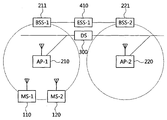
- FIG. 1 briefly illustrates a configuration of an example of a WLAN system to which an embodiment of the present invention may be applied.
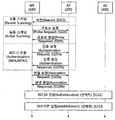
- FIG. 2 schematically illustrates a step in which a MS establishes a link with an AP according to an embodiment of the present invention.
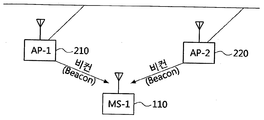
- FIG. 3 illustrates a passive scanning step of an MS related to an embodiment of the present invention.
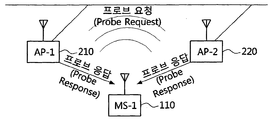
- FIG 4 illustrates an active scanning step of an MS according to an embodiment of the present invention.
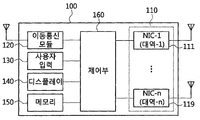
- FIG. 5 is a block diagram schematically illustrating a mobile station (MS) according to an embodiment of the present invention.
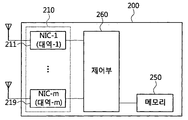
- FIG. 6 is a block diagram schematically illustrating an access point (AP) according to an embodiment of the present invention.
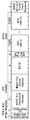
- FIG. 7 illustrates a packet structure of a beacon message transmitted by an AP of the present invention.
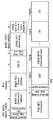
- FIG. 8 shows a packet structure of a probe request message transmitted by an MS of the present invention.
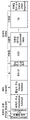
- FIG. 9 illustrates a packet structure of a probe response message transmitted by an AP of the present invention.
- Standardization of MAC (Medium Access Control) and PHY (Physical) layer among the standards of the WLAN technology is progressing through the Institute of Electrical and Electronics Engineers (IEEE) 802.11 working group.
- FIG. 1 briefly illustrates a configuration of an example of a WLAN system to which an embodiment of the present invention may be applied.
- a WLAN system includes one or more BSSs 211 and 221.
- the BSSs 211 and 221 are a set of devices that can communicate with each other, and are mainly managed by one AP (Access Point, 210).
- MS Mobile Station
- MS 110, 120
- MS is responsible for providing a wireless Internet service to the user by accessing the AP (210, 220) in accordance with the IEEE 802.11 WLAN standard.
- the BSSs 211 and 221 may be classified into an Infrastructure BSS and an Independent BSS.
- FIG. 1 shows an Infrastructure BSS.
- the BSS-1 211 is managed and operated by the AP-1 210, and one or more MSs (MS-1 110, MS-2 120) are wirelessly connected through the AP-1 210.
- the AP-1 210 is connected to the AP-2 220 through a distribution system (DS) 300.
- BSSs 211 and 221 connected through a single DS 300 are gathered to form an extended Extended Service Set (ESS) 410.
- ESS Extended Service Set
- FIG. 2 schematically illustrates a step in which a MS establishes a link with an AP according to an embodiment of the present invention.
- the scanning step is a step in which the MS 100 obtains access information of a BSS operated by the AP 200.
- a passive scanning technique S101
- S103 a passive scanning technique for acquiring information using only Beacon messages periodically transmitted by the AP
- S105 a probe response from the AP
- S101 passive scanning technique for acquiring information using only Beacon messages periodically transmitted by the AP
- S103 a probe request to the AP
- S105 There is an active scanning technique for obtaining access information.
- the MS 100 Upon successful reception of the wireless access information in the scanning step, the MS 100 transmits an authentication request (S107a) and receives an authentication response (S107b) to perform an authentication procedure. After performing a successful authentication procedure in the IEEE802.11 layer, it is possible to perform the association step (S109a, S109b), and additionally perform 802.1X-based authentication (S111) and IP address acquisition (S113) through DHCP.
- FIG. 3 illustrates a passive scanning step of an MS related to an embodiment of the present invention.
- the MS-1 110 receives a beacon message periodically transmitted from the AP-1 210 and the AP-2 220 located nearby to receive wireless access information of each AP. Acquire.
- FIG 4 illustrates an active scanning step of an MS according to an embodiment of the present invention.
- the MS-1 110 transmits a Probe Request message to acquire information of APs located in the vicinity and transmits a Probe Response message corresponding to the AP-1 210 and AP-, respectively. Received from the 2 (220) to obtain the radio access information of each AP.
- FIG. 5 is a block diagram schematically illustrating a mobile station (MS) 100 according to an embodiment of the present invention.
- the MS 100 includes one or more network interface cards (NICs) 111 to 119 for performing a WLAN access through an AP.
- the NICs 111 to 119 are modules for performing a WLAN connection and may be internal or external to the MS.
- the NICs 111 to 119 perform wireless communication with the AP according to the WLAN standard supported by the NICs 111 through 119.
- the NICs 111 to 119 may operate only one NIC at the same time or operate multiple NICs 111 to 119 at the same time according to the performance and system requirements of the MS 100.
- a plurality of NICs 111 to 119 are separated from each other, and the MAC / PHY layers of the respective NICs operate independently of each other.
- the plurality of NICs 111 to 119 may be implemented as functional entities that are physically distinguished from each other, or may be integrated into one physical entity.
- the mobile communication module 120 enables the MS 100 to transmit and receive a radio signal with an external device in a mobile communication network.
- the user input 130 allows a command for controlling the MS 100 to be input by a user.
- the display 140 may display a result and a state according to the operation of the MS 100 and may display information provided from the AP.
- the memory 150 stores an access program for controlling access to the AP and various data according thereto.
- the controller 160 controls the individual NICs 111 through 119 so that the MS 100 attempts to connect to the appropriate band using the access information received from the AP and user and system requirements. .
- FIG. 6 is a block diagram schematically illustrating an access point (AP) 200 according to an embodiment of the present invention.
- the AP 200 includes one or more network interface cards (NICs) 211 ⁇ 219 for operating a BSS in one or more bands.
- the NICs 211 ⁇ 219 are modules for performing a WLAN service and may be internal or external to the AP 200.
- the NICs 211 ⁇ 219 perform wireless communication with the MS according to a standard supported by each of the WLANs.
- the NICs 211-219 may operate only one NIC (one of 211-219) at the same time or operate multiple NICs 211-219 at the same time according to the performance and system requirements of the AP 200. .
- the AP 200 of the block diagram shows a plurality of NICs 211 to 219 separated from each other, and each NIC operates independently of each other in the MAC / PHY layer.
- the plurality of NICs 211 to 219 may be implemented as functional entities that are physically distinguished from each other, or may be integrated into one physical entity.
- the memory 250 stores a connection program for managing the connection of the MS and various data thereof.
- the controller 260 controls the individual NICs 211 to 219 to access the MS with the appropriate band by using the access information of the plurality of bands and the requirements of the user and the system.
- the mobile terminal described with reference to FIG. 5 and the wireless access device described with reference to FIG. 6 may perform the following operations.
- a mobile terminal wishing to access a radio access device may generate a probe request message including a radio service requirement.
- the wireless service requirement may include at least one of a transmission power level, a transmission delay time, a manufacturer's requirement, an internet connection speed, and the like.
- the mobile terminal can send a probe request message containing the radio service requirements.
- the wireless access device may receive a probe request message sent by the mobile terminal and obtain a wireless service requirement included in the probe request message.
- the wireless access device may determine whether a service supported by the wireless access device satisfies the wireless service requirement, and determine whether to transmit a probe response message, which is a response to the probe request message, based on the result.
- the radio access device may probe response which is a response to the probe request message when the service supported by the wireless device satisfies all wireless service requirements. You can send a message.
- the radio access device does not transmit a probe response message that is a response to the probe request message if the service it supports does not satisfy at least one of the radio service requirements.
- the wireless access device may request that the service supported by the wireless access device is greater than or equal to the preset number of requirements of the wireless service. If is satisfied, the probe response message, which is a response to the probe request message, may be transmitted. On the other hand, the wireless access device does not transmit a probe response message, which is a response to the probe request message, if a service supported by the wireless access device does not satisfy a requirement of a preset number of wireless service requirements.
- the mobile terminal may receive a probe response message that is a response to a probe request message from a wireless access device that satisfies a wireless service requirement. Thereafter, the mobile terminal can access the wireless access device by sequentially performing an authentication process and an association process with the wireless access device.
- FIG. 7 illustrates a packet structure of a beacon message transmitted by an AP of the present invention.
- FIG. 8 shows a packet structure of a probe request message transmitted by an MS of the present invention.
- FIG. 9 illustrates a packet structure of a probe response message transmitted by an AP of the present invention.
Landscapes
- Engineering & Computer Science (AREA)
- Computer Security & Cryptography (AREA)
- Computer Networks & Wireless Communication (AREA)
- Signal Processing (AREA)
- Mobile Radio Communication Systems (AREA)
Abstract
L'invention concerne un procédé et un dispositif pour configurer une liaison dans un système de réseau local (LAN) sans fil. Le procédé de configuration de liaison sans fil comprend les étapes consistant : à générer un message de demande de sonde comprenant des exigences de service sans fil ; à transmettre le message de demande de sonde ; et à recevoir un message de réponse de sonde, qui est une réponse au message de demande de sonde, en provenance d'un dispositif d'accès sans fil satisfaisant les exigences de service sans fil. Par conséquent, un temps de configuration d'une liaison entre des dispositifs LAN sans fil peut être réduit.
Priority Applications (1)
| Application Number | Priority Date | Filing Date | Title |
|---|---|---|---|
| US14/776,531 US20160029300A1 (en) | 2013-03-15 | 2013-03-15 | Method and device for configuring link in wireless lan system |
Applications Claiming Priority (4)
| Application Number | Priority Date | Filing Date | Title |
|---|---|---|---|
| KR10-2013-0028310 | 2013-03-15 | ||
| KR20130028310 | 2013-03-15 | ||
| KR1020130048963A KR20140113241A (ko) | 2013-03-15 | 2013-04-30 | 유선 네트워크의 성능을 고려한 신속한 이동 단말기의 무선 링크 설정을 위한 방법 |
| KR10-2013-0048963 | 2013-04-30 |
Publications (1)
| Publication Number | Publication Date |
|---|---|
| WO2014142565A1 true WO2014142565A1 (fr) | 2014-09-18 |
Family
ID=51537109
Family Applications (1)
| Application Number | Title | Priority Date | Filing Date |
|---|---|---|---|
| PCT/KR2014/002092 Ceased WO2014142565A1 (fr) | 2013-03-15 | 2014-03-13 | Procédé et dispositif pour configurer une liaison dans un système de réseau local (lan) sans fil |
Country Status (1)
| Country | Link |
|---|---|
| WO (1) | WO2014142565A1 (fr) |
Citations (3)
| Publication number | Priority date | Publication date | Assignee | Title |
|---|---|---|---|---|
| US20080298333A1 (en) * | 2007-06-01 | 2008-12-04 | Lg Electronics Inc. | Scanning procedure in wireless lan, station supporting the same, and frame format therefor |
| US20110161697A1 (en) * | 2009-12-24 | 2011-06-30 | Qi Emily H | Method and system for discoverability of power saving p2p devices |
| US20110280233A1 (en) * | 2010-05-14 | 2011-11-17 | Samsung Electronics Co. Ltd. | Wi-fi service method and system for wi-fi devices |
-
2014
- 2014-03-13 WO PCT/KR2014/002092 patent/WO2014142565A1/fr not_active Ceased
Patent Citations (3)
| Publication number | Priority date | Publication date | Assignee | Title |
|---|---|---|---|---|
| US20080298333A1 (en) * | 2007-06-01 | 2008-12-04 | Lg Electronics Inc. | Scanning procedure in wireless lan, station supporting the same, and frame format therefor |
| US20110161697A1 (en) * | 2009-12-24 | 2011-06-30 | Qi Emily H | Method and system for discoverability of power saving p2p devices |
| US20110280233A1 (en) * | 2010-05-14 | 2011-11-17 | Samsung Electronics Co. Ltd. | Wi-fi service method and system for wi-fi devices |
Similar Documents
| Publication | Publication Date | Title |
|---|---|---|
| CN1659899B (zh) | 虚拟交换器 | |
| WO2023003323A1 (fr) | Coordination de cartes de liaisons restreintes nstr | |
| KR20100103639A (ko) | 다중 무선 네트워크에 동시 액세스하기 위한 장치 및 방법 | |
| WO2014014281A1 (fr) | Procédé de balayage actif dans un système lan sans fil | |
| WO2023014052A1 (fr) | Procédé et dispositif de génération et de transmission d'informations de coordination entre ue dans une communication en liaison latérale | |
| US9706477B2 (en) | Method and device for configuring multi-band based link in wireless LAN system | |
| WO2013022176A1 (fr) | Procédé et appareil de planification de réseau personnel sans fil | |
| WO2013002469A1 (fr) | Procédé de recherche de canal dans un réseau du corps médical | |
| WO2012134232A2 (fr) | Procédé de commutation de canal dans un réseau personnel sans fil et appareil pour sa mise en œuvre | |
| WO2016137198A1 (fr) | Procédé d'association pour une transmission de données dans un système de communication sans fil et dispositif l'utilisant | |
| WO2013035968A1 (fr) | Unité d'émission/réception sans fil pour fournir des services ou activités dans un réseau local sans fil | |
| WO2014142565A1 (fr) | Procédé et dispositif pour configurer une liaison dans un système de réseau local (lan) sans fil | |
| WO2014142569A1 (fr) | Procédé et dispositif permettant de configurer une liaison multibande dans un système de réseau local sans fil | |
| WO2022045840A1 (fr) | Procédé de connexion pour un nœud de communication sans connexion dans un lan sans fil | |
| WO2014142567A1 (fr) | Procédé et dispositif de configuration de liaison dans un système lan sans fil | |
| WO2014142614A1 (fr) | Procédé et dispositif de configuration de liaison dans un système lan sans fil | |
| JP2003333054A (ja) | 無線ローカルエリアネットワークシステム | |
| WO2012165759A2 (fr) | Procédé et dispositif permettant d'ordonnancer un réseau personnel sans fil | |
| WO2013183881A1 (fr) | Procédé de balayage de point d'accès | |
| WO2014003471A1 (fr) | Procédé de balayage à la recherche de points d'accès dans un système lan sans fil | |
| WO2012141496A2 (fr) | Procédé d'initialisation de canal dans réseau corporel médical | |
| WO2014142568A1 (fr) | Procédé et dispositif de configuration de liaison dans un système lan sans fil | |
| TW201933920A (zh) | 網路通訊裝置、無線基地台以及無線中繼器 | |
| WO2022169252A1 (fr) | Procédé de communication basé sur une réception discontinue (drx) de liaison latérale (sl) dans une communication de liaison latérale pour prendre en charge un mode d'attribution de ressources 1 | |
| WO2022108394A1 (fr) | Procédé et dispositif de radiorecherche dans une communication en liaison latérale |
Legal Events
| Date | Code | Title | Description |
|---|---|---|---|
| 121 | Ep: the epo has been informed by wipo that ep was designated in this application |
Ref document number: 14764177 Country of ref document: EP Kind code of ref document: A1 |
|
| WWE | Wipo information: entry into national phase |
Ref document number: 14776531 Country of ref document: US |
|
| NENP | Non-entry into the national phase |
Ref country code: DE |
|
| 122 | Ep: pct application non-entry in european phase |
Ref document number: 14764177 Country of ref document: EP Kind code of ref document: A1 |