WO2014148328A1 - 高周波鉄損特性に優れる無方向性電磁鋼板 - Google Patents
高周波鉄損特性に優れる無方向性電磁鋼板 Download PDFInfo
- Publication number
- WO2014148328A1 WO2014148328A1 PCT/JP2014/056430 JP2014056430W WO2014148328A1 WO 2014148328 A1 WO2014148328 A1 WO 2014148328A1 JP 2014056430 W JP2014056430 W JP 2014056430W WO 2014148328 A1 WO2014148328 A1 WO 2014148328A1
- Authority
- WO
- WIPO (PCT)
- Prior art keywords
- mass
- iron loss
- steel sheet
- less
- oriented electrical
- Prior art date
- Legal status (The legal status is an assumption and is not a legal conclusion. Google has not performed a legal analysis and makes no representation as to the accuracy of the status listed.)
- Ceased
Links
Images


Classifications
-
- C—CHEMISTRY; METALLURGY
- C22—METALLURGY; FERROUS OR NON-FERROUS ALLOYS; TREATMENT OF ALLOYS OR NON-FERROUS METALS
- C22C—ALLOYS
- C22C38/00—Ferrous alloys, e.g. steel alloys
- C22C38/60—Ferrous alloys, e.g. steel alloys containing lead, selenium, tellurium, or antimony, or more than 0.04% by weight of sulfur
-
- C—CHEMISTRY; METALLURGY
- C22—METALLURGY; FERROUS OR NON-FERROUS ALLOYS; TREATMENT OF ALLOYS OR NON-FERROUS METALS
- C22C—ALLOYS
- C22C38/00—Ferrous alloys, e.g. steel alloys
- C22C38/06—Ferrous alloys, e.g. steel alloys containing aluminium
-
- C—CHEMISTRY; METALLURGY
- C22—METALLURGY; FERROUS OR NON-FERROUS ALLOYS; TREATMENT OF ALLOYS OR NON-FERROUS METALS
- C22C—ALLOYS
- C22C38/00—Ferrous alloys, e.g. steel alloys
-
- C—CHEMISTRY; METALLURGY
- C22—METALLURGY; FERROUS OR NON-FERROUS ALLOYS; TREATMENT OF ALLOYS OR NON-FERROUS METALS
- C22C—ALLOYS
- C22C38/00—Ferrous alloys, e.g. steel alloys
- C22C38/001—Ferrous alloys, e.g. steel alloys containing N
-
- C—CHEMISTRY; METALLURGY
- C22—METALLURGY; FERROUS OR NON-FERROUS ALLOYS; TREATMENT OF ALLOYS OR NON-FERROUS METALS
- C22C—ALLOYS
- C22C38/00—Ferrous alloys, e.g. steel alloys
- C22C38/002—Ferrous alloys, e.g. steel alloys containing In, Mg, or other elements not provided for in one single group C22C38/001 - C22C38/60
-
- C—CHEMISTRY; METALLURGY
- C22—METALLURGY; FERROUS OR NON-FERROUS ALLOYS; TREATMENT OF ALLOYS OR NON-FERROUS METALS
- C22C—ALLOYS
- C22C38/00—Ferrous alloys, e.g. steel alloys
- C22C38/004—Very low carbon steels, i.e. having a carbon content of less than 0,01%
-
- C—CHEMISTRY; METALLURGY
- C22—METALLURGY; FERROUS OR NON-FERROUS ALLOYS; TREATMENT OF ALLOYS OR NON-FERROUS METALS
- C22C—ALLOYS
- C22C38/00—Ferrous alloys, e.g. steel alloys
- C22C38/008—Ferrous alloys, e.g. steel alloys containing tin
-
- C—CHEMISTRY; METALLURGY
- C22—METALLURGY; FERROUS OR NON-FERROUS ALLOYS; TREATMENT OF ALLOYS OR NON-FERROUS METALS
- C22C—ALLOYS
- C22C38/00—Ferrous alloys, e.g. steel alloys
- C22C38/02—Ferrous alloys, e.g. steel alloys containing silicon
-
- C—CHEMISTRY; METALLURGY
- C22—METALLURGY; FERROUS OR NON-FERROUS ALLOYS; TREATMENT OF ALLOYS OR NON-FERROUS METALS
- C22C—ALLOYS
- C22C38/00—Ferrous alloys, e.g. steel alloys
- C22C38/04—Ferrous alloys, e.g. steel alloys containing manganese
-
- C—CHEMISTRY; METALLURGY
- C22—METALLURGY; FERROUS OR NON-FERROUS ALLOYS; TREATMENT OF ALLOYS OR NON-FERROUS METALS
- C22C—ALLOYS
- C22C38/00—Ferrous alloys, e.g. steel alloys
- C22C38/12—Ferrous alloys, e.g. steel alloys containing tungsten, tantalum, molybdenum, vanadium, or niobium
-
- C—CHEMISTRY; METALLURGY
- C22—METALLURGY; FERROUS OR NON-FERROUS ALLOYS; TREATMENT OF ALLOYS OR NON-FERROUS METALS
- C22C—ALLOYS
- C22C38/00—Ferrous alloys, e.g. steel alloys
- C22C38/14—Ferrous alloys, e.g. steel alloys containing titanium or zirconium
-
- H—ELECTRICITY
- H01—ELECTRIC ELEMENTS
- H01F—MAGNETS; INDUCTANCES; TRANSFORMERS; SELECTION OF MATERIALS FOR THEIR MAGNETIC PROPERTIES
- H01F1/00—Magnets or magnetic bodies characterised by the magnetic materials therefor; Selection of materials for their magnetic properties
- H01F1/01—Magnets or magnetic bodies characterised by the magnetic materials therefor; Selection of materials for their magnetic properties of inorganic materials
- H01F1/03—Magnets or magnetic bodies characterised by the magnetic materials therefor; Selection of materials for their magnetic properties of inorganic materials characterised by their coercivity
- H01F1/12—Magnets or magnetic bodies characterised by the magnetic materials therefor; Selection of materials for their magnetic properties of inorganic materials characterised by their coercivity of soft-magnetic materials
- H01F1/14—Magnets or magnetic bodies characterised by the magnetic materials therefor; Selection of materials for their magnetic properties of inorganic materials characterised by their coercivity of soft-magnetic materials metals or alloys
- H01F1/16—Magnets or magnetic bodies characterised by the magnetic materials therefor; Selection of materials for their magnetic properties of inorganic materials characterised by their coercivity of soft-magnetic materials metals or alloys in the form of sheets
-
- C—CHEMISTRY; METALLURGY
- C21—METALLURGY OF IRON
- C21D—MODIFYING THE PHYSICAL STRUCTURE OF FERROUS METALS; GENERAL DEVICES FOR HEAT TREATMENT OF FERROUS OR NON-FERROUS METALS OR ALLOYS; MAKING METAL MALLEABLE, e.g. BY DECARBURISATION OR TEMPERING
- C21D8/00—Modifying the physical properties of ferrous metals or ferrous alloys by deformation combined with, or followed by, heat treatment
- C21D8/12—Modifying the physical properties of ferrous metals or ferrous alloys by deformation combined with, or followed by, heat treatment during manufacturing of articles with special electromagnetic properties
- C21D8/1216—Modifying the physical properties of ferrous metals or ferrous alloys by deformation combined with, or followed by, heat treatment during manufacturing of articles with special electromagnetic properties characterised by the working steps
- C21D8/1222—Hot rolling
-
- C—CHEMISTRY; METALLURGY
- C21—METALLURGY OF IRON
- C21D—MODIFYING THE PHYSICAL STRUCTURE OF FERROUS METALS; GENERAL DEVICES FOR HEAT TREATMENT OF FERROUS OR NON-FERROUS METALS OR ALLOYS; MAKING METAL MALLEABLE, e.g. BY DECARBURISATION OR TEMPERING
- C21D8/00—Modifying the physical properties of ferrous metals or ferrous alloys by deformation combined with, or followed by, heat treatment
- C21D8/12—Modifying the physical properties of ferrous metals or ferrous alloys by deformation combined with, or followed by, heat treatment during manufacturing of articles with special electromagnetic properties
- C21D8/1216—Modifying the physical properties of ferrous metals or ferrous alloys by deformation combined with, or followed by, heat treatment during manufacturing of articles with special electromagnetic properties characterised by the working steps
- C21D8/1233—Cold rolling
-
- C—CHEMISTRY; METALLURGY
- C21—METALLURGY OF IRON
- C21D—MODIFYING THE PHYSICAL STRUCTURE OF FERROUS METALS; GENERAL DEVICES FOR HEAT TREATMENT OF FERROUS OR NON-FERROUS METALS OR ALLOYS; MAKING METAL MALLEABLE, e.g. BY DECARBURISATION OR TEMPERING
- C21D8/00—Modifying the physical properties of ferrous metals or ferrous alloys by deformation combined with, or followed by, heat treatment
- C21D8/12—Modifying the physical properties of ferrous metals or ferrous alloys by deformation combined with, or followed by, heat treatment during manufacturing of articles with special electromagnetic properties
- C21D8/1244—Modifying the physical properties of ferrous metals or ferrous alloys by deformation combined with, or followed by, heat treatment during manufacturing of articles with special electromagnetic properties characterised by the heat treatment
- C21D8/1255—Modifying the physical properties of ferrous metals or ferrous alloys by deformation combined with, or followed by, heat treatment during manufacturing of articles with special electromagnetic properties characterised by the heat treatment with diffusion of elements, e.g. decarburising, nitriding
-
- C—CHEMISTRY; METALLURGY
- C21—METALLURGY OF IRON
- C21D—MODIFYING THE PHYSICAL STRUCTURE OF FERROUS METALS; GENERAL DEVICES FOR HEAT TREATMENT OF FERROUS OR NON-FERROUS METALS OR ALLOYS; MAKING METAL MALLEABLE, e.g. BY DECARBURISATION OR TEMPERING
- C21D8/00—Modifying the physical properties of ferrous metals or ferrous alloys by deformation combined with, or followed by, heat treatment
- C21D8/12—Modifying the physical properties of ferrous metals or ferrous alloys by deformation combined with, or followed by, heat treatment during manufacturing of articles with special electromagnetic properties
- C21D8/1244—Modifying the physical properties of ferrous metals or ferrous alloys by deformation combined with, or followed by, heat treatment during manufacturing of articles with special electromagnetic properties characterised by the heat treatment
- C21D8/1261—Modifying the physical properties of ferrous metals or ferrous alloys by deformation combined with, or followed by, heat treatment during manufacturing of articles with special electromagnetic properties characterised by the heat treatment following hot rolling
-
- C—CHEMISTRY; METALLURGY
- C21—METALLURGY OF IRON
- C21D—MODIFYING THE PHYSICAL STRUCTURE OF FERROUS METALS; GENERAL DEVICES FOR HEAT TREATMENT OF FERROUS OR NON-FERROUS METALS OR ALLOYS; MAKING METAL MALLEABLE, e.g. BY DECARBURISATION OR TEMPERING
- C21D8/00—Modifying the physical properties of ferrous metals or ferrous alloys by deformation combined with, or followed by, heat treatment
- C21D8/12—Modifying the physical properties of ferrous metals or ferrous alloys by deformation combined with, or followed by, heat treatment during manufacturing of articles with special electromagnetic properties
- C21D8/1244—Modifying the physical properties of ferrous metals or ferrous alloys by deformation combined with, or followed by, heat treatment during manufacturing of articles with special electromagnetic properties characterised by the heat treatment
- C21D8/1272—Final recrystallisation annealing
-
- H—ELECTRICITY
- H01—ELECTRIC ELEMENTS
- H01F—MAGNETS; INDUCTANCES; TRANSFORMERS; SELECTION OF MATERIALS FOR THEIR MAGNETIC PROPERTIES
- H01F1/00—Magnets or magnetic bodies characterised by the magnetic materials therefor; Selection of materials for their magnetic properties
- H01F1/01—Magnets or magnetic bodies characterised by the magnetic materials therefor; Selection of materials for their magnetic properties of inorganic materials
- H01F1/03—Magnets or magnetic bodies characterised by the magnetic materials therefor; Selection of materials for their magnetic properties of inorganic materials characterised by their coercivity
- H01F1/12—Magnets or magnetic bodies characterised by the magnetic materials therefor; Selection of materials for their magnetic properties of inorganic materials characterised by their coercivity of soft-magnetic materials
- H01F1/14—Magnets or magnetic bodies characterised by the magnetic materials therefor; Selection of materials for their magnetic properties of inorganic materials characterised by their coercivity of soft-magnetic materials metals or alloys
- H01F1/147—Alloys characterised by their composition
- H01F1/14766—Fe-Si based alloys
- H01F1/14791—Fe-Si-Al based alloys, e.g. Sendust
Definitions
- the present invention relates to a non-oriented electrical steel sheet having excellent high-frequency iron loss characteristics.
- Motors for hybrid vehicles and electric vehicles are driven in the high frequency range of 400 to 2 kHz from the viewpoint of miniaturization and high efficiency.
- the non-oriented electrical steel sheet used for the core material of such a high-frequency motor is desired to have low iron loss at high frequencies.
- the method of reducing the plate thickness not only makes handling difficult due to a decrease in the rigidity of the material, but also increases the number of stamping steps and the number of loading steps, resulting in a decrease in productivity.
- the method for increasing the specific resistance does not have the disadvantages as described above, it can be said that it is desirable as a high-frequency iron loss reduction method.
- Si is an element having a large solid solution strengthening ability
- Mn has a smaller solid solution strengthening ability than Si, it is possible to reduce high-frequency iron loss while suppressing a decrease in manufacturability.
- Patent Document 1 discloses Si: 0.5 to 2.5 mass%, Mn: 1.0 to 3.5 mass%, Al: 1.0 to 3.
- a non-oriented electrical steel sheet containing 0 mass% is disclosed.
- Patent Document 2 discloses a non-oriented electrical steel sheet containing Si: 3.0 mass% or less, Mn: 1.0-4.0 mass%, Al: 1.0-3.0 mass%. .
- the present invention has been made in view of the above-mentioned problems of the prior art, and its purpose is to provide a non-oriented electrical steel sheet having stable and excellent high-frequency iron loss characteristics even when it contains a large amount of Mn. It is to provide.
- the inventors have made extensive studies focusing on the impurity components contained in the steel sheet in order to solve the above problems.
- the high-frequency iron loss characteristics of the high Mn-added steel are caused by the presence of Bi contained as impurities. Therefore, by suppressing the Bi content, the high-frequency iron loss can be reduced even at a high Mn content.
- the inventors have found that it can be stably reduced, and have developed the present invention.
- C 0.005 mass% or less
- Si 1.5-4 mass%
- Mn 1.0-5 mass%
- P 0.1 mass% or less
- S 0.005 mass% or less
- This is a non-oriented electrical steel sheet containing Al: 3 mass% or less, N: 0.005 mass% or less, Bi: 0.0030 mass% or less, and the balance being composed of Fe and inevitable impurities.
- the non-oriented electrical steel sheet of the present invention further includes one or two kinds selected from Ca: 0.0005 to 0.005 mass% and Mg: 0.0002 to 0.005 mass% in addition to the above component composition. It is characterized by containing.
- non-oriented electrical steel sheet of the present invention may be one or two selected from Sb: 0.0005 to 0.05 mass% and Sn: 0.0005 to 0.05 mass% in addition to the above component composition. It contains seeds.
- non-oriented electrical steel sheet of the present invention is characterized by further containing Mo: 0.0005 to 0.0030 mass% in addition to the above component composition.
- the non-oriented electrical steel sheet of the present invention is characterized in that the Ti content is 0.002 mass% or less.
- the ⁇ marks in FIG. 1 show the experimental results as the relationship between the Mn addition amount and the iron loss W 10/400 . From this result, when Mn is less than 1 mass%, the iron loss decreases as the amount of added Mn increases. However, when 1 mass% or more, the iron loss decreases gradually, and when it exceeds 4 mass%, the iron loss increases conversely. all right. In order to investigate this cause, when a steel sheet containing 2 mass% of Mn was observed with TEM, granular Bi was observed at the grain boundaries.
- C 0.0014 mass%
- Si 3.33 mass%
- Al 1.2 mass%
- P 0.014 mass%
- S 0.0006 mass%
- N steel containing 0.0020 mass%
- Bi based on high-purity steel with 0.0010 mass% or less
- Mn being added in various ways within the range of 0.1 to 5.2 mass%
- Bi is generally an impurity mixed in from scrap, and not only the amount mixed but also the variation gradually increases with the recent increase in scrap usage ratio.
- Such an increase in Bi content is not a big problem in a magnetic steel sheet having a low Mn content, but in a steel having a high Mn content, the grain growth property is reduced due to the Mn solution drag, so that the trace amount is small. It is considered that it is greatly influenced by Bi.
- FIG. 2 shows the results of the experiment as the relationship between the Bi content and the iron loss W 10/400 . From this figure, it can be seen that the iron loss is greatly reduced when the Bi content is 0.0030 mass% or less (30 massppm or less). This is presumably because grain growth was improved by reducing Bi. From this result, it was found that the Bi content must be reduced to 0.0030 mass% or less in order to suppress the adverse effect of Bi on grain growth.
- the present invention is based on the above novel findings.
- C 0.005 mass% or less
- C is an element that forms carbide with Mn. If the amount exceeds 0.005 mass%, the amount of the Mn carbide increases to inhibit grain growth, so the upper limit is set to 0.005 mass%. And Preferably it is 0.002 mass% or less.
- Si 1.5-4 mass% Since Si is an element effective in increasing the specific resistance of steel and reducing iron loss, it is added in an amount of 1.5 mass% or more. On the other hand, if the addition exceeds 4 mass%, the magnetic flux density decreases, so the upper limit is set to 4 mass%. Preferably, the lower limit of Si is 2.0 mass%, and the upper limit is 3.0 mass%.
- Mn 1.0-5 mass%
- Mn is an important component in the present invention, which is effective in increasing the specific resistance of steel and reducing iron loss without greatly impairing workability, and is added in an amount of 1.0 mass% or more. In order to further obtain the iron loss reduction effect, addition of 1.6 mass% or more is preferable. On the other hand, if added over 5 mass%, the magnetic flux density is lowered, so the upper limit is made 5 mass%. Preferably, the lower limit of Mn is 2 mass% and the upper limit is 3 mass%.
- P 0.1 mass% or less
- P is an element having a large solid solution strengthening ability, and if it exceeds 0.1 mass%, the steel sheet becomes too hard and the productivity is reduced, so that it is limited to 0.1 mass% or less. .
- it is 0.05 mass% or less.
- S 0.005 mass% or less S is an unavoidable impurity, and if contained in excess of 0.005 mass%, grain growth is inhibited by precipitation of MnS and iron loss increases, so the upper limit is 0.005 mass%. To do. Preferably it is 0.001 mass% or less.
- Al 3 mass% or less
- Al is an element effective in increasing the specific resistance of steel and reducing iron loss.
- the upper limit is 3 mass%.
- the Al content is less than 0.1 mass%, fine AlN precipitates to inhibit grain growth and increase iron loss, so the lower limit is preferably set to 0.1 mass%.
- N 0.005 mass% or less N is an unavoidable impurity that penetrates into the steel from the atmosphere. When the content is large, grain growth is inhibited by precipitation of AlN and iron loss increases.
- the upper limit is limited to 0.005 mass%. Preferably it is 0.003 mass% or less.
- Bi 0.0030 mass% or less Bi is an important element to be controlled that adversely affects high-frequency iron loss characteristics in the present invention. As can be seen from FIG. 2 described above, the Bi content is 0.0030 mass%. When it exceeds, iron loss will increase rapidly. Therefore, Bi is limited to 0.0030 mass% or less. Preferably it is 0.0010 mass% or less.
- the non-oriented electrical steel sheet of the present invention preferably further contains any one or two of Ca and Mg in addition to the above component composition.
- Ca: 0.0005 to 0.005 mass% Ca is an element that is effective in suppressing the harmful effects of Bi and reducing iron loss by forming sulfides and complexing with Bi to be coarsened. In order to obtain such an effect, 0.0005 mass% or more is preferably added. However, if added over 0.005 mass%, the amount of precipitated CaS becomes too large, and conversely, iron loss increases, so the upper limit is preferably set to 0.005 mass%. More preferably, the lower limit of Ca is 0.001 mass%, and the upper limit is 0.004 mass%.
- Mg 0.0002 to 0.005 mass%
- Mg is an element that is effective in suppressing the harmful effects of Bi and reducing iron loss by forming oxides and complexing and coarsening with Bi. In order to obtain such an effect, it is preferable to add 0.0002 mass% or more. However, it is difficult to add over 0.005 mass%, and the cost is unnecessarily increased, so the upper limit is preferably made 0.005%. More preferably, the lower limit of Mg is 0.001 mass%, and the upper limit is 0.004 mass%.
- the non-oriented electrical steel sheet of the present invention preferably further contains the following components.
- Sb 0.0005 to 0.05 mass%
- Sn 0.0005 to 0.05 mass% Since Sb and Sn have the effect of improving the texture and increasing the magnetic flux density, they can be added individually or in combination in an amount of 0.0005 mass% or more. More preferably, it is 0.01 mass% or more.
- the upper limit is preferably set to 0.05 mass%. More preferably, the lower limit of Sb and Sn is 0.01% by mass, and the upper limit is 0.04% by mass.
- Mo 0.0005 to 0.0030 mass% Mo has the effect of coarsening the formed carbide and reducing iron loss, so 0.0005 mass% or more is preferably added. However, addition of 0.0030 mass% or more increases the amount of carbides and increases the iron loss. Therefore, the upper limit is preferably set to 0.0030 mass%. More preferably, the lower limit of Mo is 0.0010 mass% and the upper limit is 0.0020 mass%.
- Ti 0.002 mass% or less
- Ti is an element that forms carbonitride, and when the content is large, the amount of carbonitride precipitated becomes too large to inhibit grain growth and increase iron loss. Therefore, in the present invention, Ti is preferably limited to 0.002 mass% or less. More preferably, it is 0.001 mass% or less.
- the balance other than the above components is Fe and inevitable impurities. However, as long as the effects of the present invention are not impaired, the inclusion of other elements is not rejected.
- the manufacturing method of the non-oriented electrical steel sheet of this invention is demonstrated. If the manufacturing method of the non-oriented electrical steel sheet of the present invention is manufactured within the range of the present invention described above, the other conditions are not particularly limited, and the same as the normal non-oriented electrical steel sheet. Can be produced under the following conditions. For example, in a converter or degassing apparatus, etc., a steel having a composition suitable for the present invention is melted and made into a steel material (slab) by continuous casting or ingot-bundling rolling, followed by hot rolling. If necessary, it can be manufactured by a method of annealing by hot-rolled sheet, finishing to a predetermined plate thickness by one or more cold rolling or two or more cold rolling sandwiching intermediate annealing.
- a steel sheet satisfying the component composition of the present invention is excellent in high-frequency iron loss characteristics despite its high Mn content.
Landscapes
- Chemical & Material Sciences (AREA)
- Engineering & Computer Science (AREA)
- Metallurgy (AREA)
- Organic Chemistry (AREA)
- Materials Engineering (AREA)
- Mechanical Engineering (AREA)
- Power Engineering (AREA)
- Dispersion Chemistry (AREA)
- Physics & Mathematics (AREA)
- Soft Magnetic Materials (AREA)
- Electromagnetism (AREA)
- Manufacturing & Machinery (AREA)
- Thermal Sciences (AREA)
- Crystallography & Structural Chemistry (AREA)
- Manufacturing Of Steel Electrode Plates (AREA)
Abstract
Description
C:0.0016mass%、Si:3.35mass%、P:0.013mass%、S:0.0004mass%、Al:1.4mass%およびN:0.0018mass%を含有する鋼をベースとし、これにMnを0.1~5.2mass%の範囲で種々に変化させて添加した鋼を実験室にて溶解し、鋼塊とし、熱間圧延し、100vol%N2雰囲気下で1000℃×30secの熱延板焼鈍を施した後、冷間圧延して板厚0.30mmの冷延板とし、20vol%H2-80vol%N2雰囲気中で1000℃×30secの仕上焼鈍を施した。
C:0.005mass%以下
Cは、Mnと炭化物を形成する元素であり、0.005mass%を超えると、上記Mn系炭化物の量が増加し粒成長を阻害するため、上限を0.005mass%とする。好ましくは0.002mass%以下である。
Siは、鋼の固有抵抗を高め、鉄損を低減するのに有効な元素であるため、1.5mass%以上添加する。一方、4mass%を超えて添加すると、磁束密度が低下するため上限は4mass%とする。好ましくは、Siの下限は2.0mass%、上限は3.0mass%である。
Mnは、加工性を大きく害することなく、鋼の固有抵抗を高め、鉄損を低減するのに有効な、本発明においては重要な成分であり、1.0mass%以上を添加する。鉄損低減効果をより得るためには、1.6mass%以上の添加が好ましい。一方、5mass%を超えて添加すると、磁束密度を低下させるので、上限は5mass%とする。好ましくは、Mnの下限は2mass%、上限は3mass%である。
Pは、固溶強化能が大きい元素であり、0.1mass%を超えて含有すると、鋼板が硬質化し過ぎて製造性が低下するため0.1mass%以下に制限する。好ましくは0.05mass%以下である。
Sは、不可避的不純物であり、0.005mass%を超えて含有すると、MnSの析出により粒成長が阻害され、鉄損が増大するため、上限は0.005mass%とする。好ましくは0.001mass%以下である。
Alは、Siと同様、鋼の固有抵抗を高め、鉄損を低減するのに有効な元素であるが、3mass%を超えて添加すると、磁束密度が低下するため、上限は3mass%とする。好ましくは2mass%以下である。ただし、Alの含有量が0.1mass%未満になると、微細なAlNが析出して粒成長が阻害され、鉄損が増加するため、下限は0.1mass%とするのが好ましい。
Nは、大気中から鋼中に侵入してくる不可避的不純物であり、含有量が多い場合には、AlNの析出により粒成長が阻害されて鉄損が増加するため、上限を0.005mass%に制限する。好ましくは0.003mass%以下である。
Biは、本発明においては高周波鉄損特性に悪影響を及ぼす重要な管理すべき元素であり、先述した図2からわかるように、Biの含有量が0.0030mass%を超えると、急激に鉄損が増大するようになる。よって、Biは0.0030mass%以下に制限する。好ましくは0.0010mass%以下である。
Ca:0.0005~0.005mass%
Caは、硫化物を形成し、Biと複合析出して粗大化することによって、Biの弊害を抑制し、鉄損を低減するのに有効な元素である。斯かる効果を得るためには0.0005mass%以上添加するのが好ましい。しかし、0.005mass%を超えて添加すると、CaSの析出量が多くなり過ぎ、逆に鉄損が増加するようになるので、上限は0.005mass%とするのが好ましい。より好ましくは、Caの下限は0.001mass%、上限は0.004mass%である。
Mgは、酸化物を形成し、Biと複合析出して粗大化することによって、Biの弊害を抑制し、鉄損を低減するのに有効な元素である。斯かる効果を得るためには0.0002mass%以上添加するのが好ましい。しかし、0.005mass%を超えて添加することは困難であり、いたずらにコストアップを招くだけであるため、上限は0.005%とするのが好ましい。より好ましくは、Mgの下限は0.001mass%、上限は0.004mass%である。
Sb:0.0005~0.05mass%、Sn:0.0005~0.05mass%
SbおよびSnは、集合組織を改善し、磁束密度を向上する効果があるため、単独または複合してそれぞれ0.0005mass%以上添加することができる。より好ましくは0.01mass%以上である。しかし、0.05mass%を超える添加は、鋼板の脆化を招くので、上限は0.05mass%とするのが好ましい。より好ましくは、SbおよびSnの下限はそれぞれ0.01mass%、上限はそれぞれ0.04mass%である。
Moは、形成される炭化物を粗大化し、鉄損を低減する効果があるため、0.0005mass%以上添加するのが好ましい。しかし、0.0030mass%以上の添加は、炭化物の量が多くなり過ぎ、却って、鉄損が増加するようになるので、上限は0.0030mass%とするのが好ましい。より好ましくは、Moの下限は0.0010mass%、上限は0.0020mass%である。
Tiは、炭窒化物を形成する元素であり、含有量が多いと、炭窒化物の析出量が多くなり過ぎて粒成長を阻害し、鉄損を増大させる。よって、本発明においては、Tiは0.002mass%以下に制限するのが好ましい。より好ましくは0.001mass%以下である。
本発明の無方向性電磁鋼板の製造方法は、鋼板の成分組成を上記した本発明の範囲内として製造すれば、それ以外の条件については特に制限はなく、通常の無方向性電磁鋼板と同様の条件で製造することができる。例えば、転炉や脱ガス処理装置等で、本発明に適合する成分組成の鋼を溶製し、連続鋳造や造塊-分塊圧延等で鋼素材(スラブ)とした後、熱間圧延し、必要に応じて熱延板焼鈍し、1回の冷間圧延、もしくは中間焼鈍をはさんだ2回以上の冷間圧延により所定の板厚とし、仕上焼鈍する方法で製造することができる。
斯くして得た冷延焼鈍板から、幅30mm×長さ280mmのエプスタイン試験片を圧延方向および圧延直角方向から切り出し、JIS C2550に準拠して、鉄損W10/400および磁束密度B50を測定し、その結果を表1中に併記した。

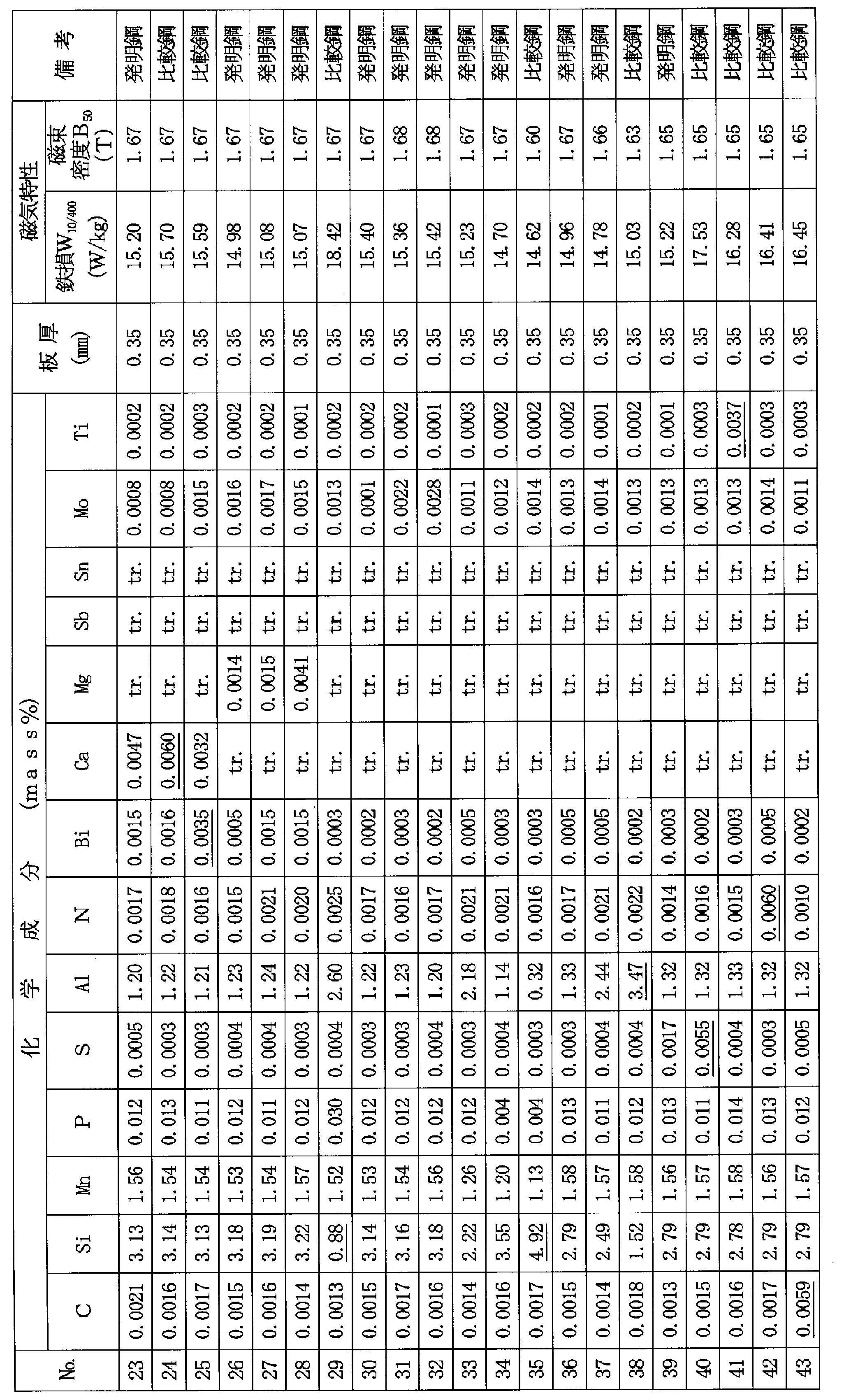
Claims (5)
- C:0.005mass%以下、Si:1.5~4mass%、Mn:1.0~5mass%、P:0.1mass%以下、S:0.005mass%以下、Al:3mass%以下、N:0.005mass%以下、Bi:0.0030mass%以下を含有し、残部がFeおよび不可避的不純物の成分組成からなる無方向性電磁鋼板。
- 上記成分組成に加えてさらに、Ca:0.0005~0.005mass%およびMg:0.0002~0.005mass%のうちから選ばれる1種または2種を含有することを特徴とする請求項1に記載の無方向性電磁鋼板。
- 上記成分組成に加えてさらに、Sb:0.0005~0.05mass%およびSn:0.0005~0.05mass%のうちから選ばれる1種または2種を含有することを特徴とする請求項1または2に記載の無方向性電磁鋼板。
- 上記成分組成に加えてさらに、Mo:0.0005~0.0030mass%を含有することを特徴とする請求項1~3のいずれか1項に記載の無方向性電磁鋼板。
- Tiの含有量が0.002mass%以下であることを特徴とする請求項1~4のいずれか1項に記載の無方向性電磁鋼板。
Priority Applications (5)
| Application Number | Priority Date | Filing Date | Title |
|---|---|---|---|
| RU2015145284A RU2650469C2 (ru) | 2013-03-22 | 2014-03-12 | Лист из нетекстурированной электротехнической стали с отличными потерями в железе на высокой частоте |
| US14/767,735 US20160076125A1 (en) | 2013-03-22 | 2014-03-12 | Non-oriented electrical steel sheet having an excellent high-frequency iron loss property |
| CN201480016783.0A CN105074032B (zh) | 2013-03-22 | 2014-03-12 | 高频铁损特性优异的无方向性电磁钢板 |
| EP14767789.2A EP2977480B1 (en) | 2013-03-22 | 2014-03-12 | Non-oriented electrical steel sheet with excellent high frequency iron loss characteristics |
| KR1020157023252A KR101700694B1 (ko) | 2013-03-22 | 2014-03-12 | 고주파 철손 특성이 우수한 무방향성 전자 강판 |
Applications Claiming Priority (2)
| Application Number | Priority Date | Filing Date | Title |
|---|---|---|---|
| JP2013060537A JP2014185365A (ja) | 2013-03-22 | 2013-03-22 | 高周波鉄損特性に優れる無方向性電磁鋼板 |
| JP2013-060537 | 2013-03-22 |
Publications (1)
| Publication Number | Publication Date |
|---|---|
| WO2014148328A1 true WO2014148328A1 (ja) | 2014-09-25 |
Family
ID=51580015
Family Applications (1)
| Application Number | Title | Priority Date | Filing Date |
|---|---|---|---|
| PCT/JP2014/056430 Ceased WO2014148328A1 (ja) | 2013-03-22 | 2014-03-12 | 高周波鉄損特性に優れる無方向性電磁鋼板 |
Country Status (8)
| Country | Link |
|---|---|
| US (1) | US20160076125A1 (ja) |
| EP (1) | EP2977480B1 (ja) |
| JP (1) | JP2014185365A (ja) |
| KR (1) | KR101700694B1 (ja) |
| CN (1) | CN105074032B (ja) |
| RU (1) | RU2650469C2 (ja) |
| TW (1) | TWI551694B (ja) |
| WO (1) | WO2014148328A1 (ja) |
Cited By (1)
| Publication number | Priority date | Publication date | Assignee | Title |
|---|---|---|---|---|
| JP2023507592A (ja) * | 2019-12-19 | 2023-02-24 | ポスコホールディングス インコーポレーティッド | 無方向性電磁鋼板およびその製造方法 |
Families Citing this family (7)
| Publication number | Priority date | Publication date | Assignee | Title |
|---|---|---|---|---|
| JP6738047B2 (ja) * | 2017-05-31 | 2020-08-12 | Jfeスチール株式会社 | 無方向性電磁鋼板とその製造方法 |
| JP7172100B2 (ja) * | 2018-04-02 | 2022-11-16 | 日本製鉄株式会社 | 無方向性電磁鋼板 |
| KR102105530B1 (ko) * | 2018-09-27 | 2020-04-28 | 주식회사 포스코 | 무방향성 전기강판 및 그 제조방법 |
| JP7328491B2 (ja) * | 2018-11-09 | 2023-08-17 | 日本製鉄株式会社 | 無方向性電磁鋼板 |
| KR102175065B1 (ko) * | 2018-11-30 | 2020-11-05 | 주식회사 포스코 | 무방향성 전기강판 및 그 제조방법 |
| KR102176351B1 (ko) * | 2018-11-30 | 2020-11-09 | 주식회사 포스코 | 무방향성 전기강판 및 그 제조방법 |
| KR102325008B1 (ko) * | 2019-12-20 | 2021-11-10 | 주식회사 포스코 | 무방향성 전기강판 및 그 제조방법 |
Citations (8)
| Publication number | Priority date | Publication date | Assignee | Title |
|---|---|---|---|---|
| JP2002030397A (ja) | 2000-07-13 | 2002-01-31 | Sumitomo Metal Ind Ltd | 無方向性電磁鋼板とその製造方法 |
| JP2002047542A (ja) | 2000-07-28 | 2002-02-15 | Sumitomo Metal Ind Ltd | 無方向性電磁鋼板およびその製造方法 |
| JP2003055746A (ja) * | 2001-08-09 | 2003-02-26 | Sumitomo Metal Ind Ltd | 無方向性電磁鋼板およびその製造方法 |
| JP2008156737A (ja) * | 2006-12-26 | 2008-07-10 | Jfe Steel Kk | 無方向性電磁鋼板およびその製造方法 |
| JP2008231504A (ja) * | 2007-03-20 | 2008-10-02 | Jfe Steel Kk | 無方向性電磁鋼板 |
| WO2010140509A1 (ja) * | 2009-06-03 | 2010-12-09 | 新日本製鐵株式会社 | 無方向性電磁鋼板及びその製造方法 |
| WO2011155183A1 (ja) * | 2010-06-09 | 2011-12-15 | Jfeスチール株式会社 | 無方向性電磁鋼板の製造方法および連続焼鈍設備 |
| CN102634742A (zh) * | 2012-04-01 | 2012-08-15 | 首钢总公司 | 一种无Al的取向电工钢及其制备方法 |
Family Cites Families (10)
| Publication number | Priority date | Publication date | Assignee | Title |
|---|---|---|---|---|
| JP2540946B2 (ja) * | 1989-06-30 | 1996-10-09 | 日本鋼管株式会社 | 磁気特性に優れた無方向性電磁鋼板およびその製造方法 |
| JPH06108149A (ja) * | 1992-09-29 | 1994-04-19 | Nippon Steel Corp | 需要家焼鈍後の鉄損が極めて優れた無方向性珪素鋼板の製造方法 |
| DE602004031219D1 (de) * | 2003-05-06 | 2011-03-10 | Nippon Steel Corp | As bezüglich eisenverlusten hervorragend ist, und herstellungsverfahren dafür |
| JP4414727B2 (ja) * | 2003-10-31 | 2010-02-10 | 新日本製鐵株式会社 | 磁気特性、耐変形性の優れた電磁鋼板とその製造方法 |
| RU2362829C2 (ru) * | 2004-11-04 | 2009-07-27 | Ниппон Стил Корпорейшн | Нетекстурированный электротехнический стальной лист, улучшенный по потерям в сердечнике |
| JP4280224B2 (ja) * | 2004-11-04 | 2009-06-17 | 新日本製鐵株式会社 | 鉄損に優れた無方向性電磁鋼板 |
| RU2398894C1 (ru) * | 2006-06-16 | 2010-09-10 | Ниппон Стил Корпорейшн | Лист высокопрочной электротехнической стали и способ его производства |
| WO2009072394A1 (ja) * | 2007-12-03 | 2009-06-11 | Nippon Steel Corporation | 高周波鉄損の低い無方向性電磁鋼板及びその製造方法 |
| KR101353463B1 (ko) * | 2011-12-28 | 2014-01-21 | 주식회사 포스코 | 무방향성 전기강판 및 그 제조방법 |
| KR101353462B1 (ko) * | 2011-12-28 | 2014-01-24 | 주식회사 포스코 | 무방향성 전기강판 및 제조 방법 |
-
2013
- 2013-03-22 JP JP2013060537A patent/JP2014185365A/ja active Pending
-
2014
- 2014-03-12 KR KR1020157023252A patent/KR101700694B1/ko active Active
- 2014-03-12 WO PCT/JP2014/056430 patent/WO2014148328A1/ja not_active Ceased
- 2014-03-12 EP EP14767789.2A patent/EP2977480B1/en active Active
- 2014-03-12 US US14/767,735 patent/US20160076125A1/en not_active Abandoned
- 2014-03-12 CN CN201480016783.0A patent/CN105074032B/zh active Active
- 2014-03-12 RU RU2015145284A patent/RU2650469C2/ru active
- 2014-03-18 TW TW103110021A patent/TWI551694B/zh active
Patent Citations (8)
| Publication number | Priority date | Publication date | Assignee | Title |
|---|---|---|---|---|
| JP2002030397A (ja) | 2000-07-13 | 2002-01-31 | Sumitomo Metal Ind Ltd | 無方向性電磁鋼板とその製造方法 |
| JP2002047542A (ja) | 2000-07-28 | 2002-02-15 | Sumitomo Metal Ind Ltd | 無方向性電磁鋼板およびその製造方法 |
| JP2003055746A (ja) * | 2001-08-09 | 2003-02-26 | Sumitomo Metal Ind Ltd | 無方向性電磁鋼板およびその製造方法 |
| JP2008156737A (ja) * | 2006-12-26 | 2008-07-10 | Jfe Steel Kk | 無方向性電磁鋼板およびその製造方法 |
| JP2008231504A (ja) * | 2007-03-20 | 2008-10-02 | Jfe Steel Kk | 無方向性電磁鋼板 |
| WO2010140509A1 (ja) * | 2009-06-03 | 2010-12-09 | 新日本製鐵株式会社 | 無方向性電磁鋼板及びその製造方法 |
| WO2011155183A1 (ja) * | 2010-06-09 | 2011-12-15 | Jfeスチール株式会社 | 無方向性電磁鋼板の製造方法および連続焼鈍設備 |
| CN102634742A (zh) * | 2012-04-01 | 2012-08-15 | 首钢总公司 | 一种无Al的取向电工钢及其制备方法 |
Non-Patent Citations (1)
| Title |
|---|
| See also references of EP2977480A4 |
Cited By (2)
| Publication number | Priority date | Publication date | Assignee | Title |
|---|---|---|---|---|
| JP2023507592A (ja) * | 2019-12-19 | 2023-02-24 | ポスコホールディングス インコーポレーティッド | 無方向性電磁鋼板およびその製造方法 |
| JP7465354B2 (ja) | 2019-12-19 | 2024-04-10 | ポスコホールディングス インコーポレーティッド | 無方向性電磁鋼板およびその製造方法 |
Also Published As
| Publication number | Publication date |
|---|---|
| EP2977480A1 (en) | 2016-01-27 |
| RU2650469C2 (ru) | 2018-04-13 |
| KR101700694B1 (ko) | 2017-01-31 |
| EP2977480A4 (en) | 2016-04-13 |
| TW201443248A (zh) | 2014-11-16 |
| JP2014185365A (ja) | 2014-10-02 |
| CN105074032A (zh) | 2015-11-18 |
| TWI551694B (zh) | 2016-10-01 |
| KR20150109485A (ko) | 2015-10-01 |
| US20160076125A1 (en) | 2016-03-17 |
| CN105074032B (zh) | 2018-01-12 |
| RU2015145284A (ru) | 2017-04-25 |
| EP2977480B1 (en) | 2017-07-05 |
Similar Documents
| Publication | Publication Date | Title |
|---|---|---|
| JP5854182B2 (ja) | 無方向性電磁鋼板の製造方法 | |
| TWI504762B (zh) | Non - directional electromagnetic steel plate | |
| JP5417689B2 (ja) | 無方向性電磁鋼板 | |
| CN105074032B (zh) | 高频铁损特性优异的无方向性电磁钢板 | |
| JP6057082B2 (ja) | 磁気特性に優れる無方向性電磁鋼板 | |
| CN103270179A (zh) | 无方向性电磁钢板的制造方法 | |
| WO2013137092A1 (ja) | 無方向性電磁鋼板の製造方法 | |
| CN105189800B (zh) | 高频铁损特性优异的无方向性电磁钢板 | |
| CN105829566A (zh) | 磁特性优异的无取向性电磁钢板 | |
| CN106536778A (zh) | 磁特性优异的无方向性电磁钢板 | |
| JP5200376B2 (ja) | 無方向性電磁鋼板およびその製造方法 | |
| JP7445656B2 (ja) | 無方向性電磁鋼板およびその製造方法 | |
| JP5826284B2 (ja) | 磁気特性に優れた線材、鋼線及びこれらの製造方法 | |
| JP2011256426A (ja) | 圧延方向の磁気特性に優れた無方向性電磁鋼板の製造方法 |
Legal Events
| Date | Code | Title | Description |
|---|---|---|---|
| WWE | Wipo information: entry into national phase |
Ref document number: 201480016783.0 Country of ref document: CN |
|
| 121 | Ep: the epo has been informed by wipo that ep was designated in this application |
Ref document number: 14767789 Country of ref document: EP Kind code of ref document: A1 |
|
| WWE | Wipo information: entry into national phase |
Ref document number: 14767735 Country of ref document: US |
|
| ENP | Entry into the national phase |
Ref document number: 20157023252 Country of ref document: KR Kind code of ref document: A |
|
| REEP | Request for entry into the european phase |
Ref document number: 2014767789 Country of ref document: EP |
|
| WWE | Wipo information: entry into national phase |
Ref document number: 2014767789 Country of ref document: EP |
|
| NENP | Non-entry into the national phase |
Ref country code: DE |
|
| ENP | Entry into the national phase |
Ref document number: 2015145284 Country of ref document: RU Kind code of ref document: A |