WO2014148564A1 - Système de pesage quantitatif et procédé de pesage quantitatif - Google Patents
Système de pesage quantitatif et procédé de pesage quantitatif Download PDFInfo
- Publication number
- WO2014148564A1 WO2014148564A1 PCT/JP2014/057576 JP2014057576W WO2014148564A1 WO 2014148564 A1 WO2014148564 A1 WO 2014148564A1 JP 2014057576 W JP2014057576 W JP 2014057576W WO 2014148564 A1 WO2014148564 A1 WO 2014148564A1
- Authority
- WO
- WIPO (PCT)
- Prior art keywords
- reward
- articles
- transition
- weight
- stations
- Prior art date
- Legal status (The legal status is an assumption and is not a legal conclusion. Google has not performed a legal analysis and makes no representation as to the accuracy of the status listed.)
- Ceased
Links
Images






Classifications
-
- B—PERFORMING OPERATIONS; TRANSPORTING
- B07—SEPARATING SOLIDS FROM SOLIDS; SORTING
- B07C—POSTAL SORTING; SORTING INDIVIDUAL ARTICLES, OR BULK MATERIAL FIT TO BE SORTED PIECE-MEAL, e.g. BY PICKING
- B07C5/00—Sorting according to a characteristic or feature of the articles or material being sorted, e.g. by control effected by devices which detect or measure such characteristic or feature; Sorting by manually actuated devices, e.g. switches
- B07C5/16—Sorting according to weight
- B07C5/18—Sorting according to weight using a single stationary weighing mechanism
-
- G—PHYSICS
- G01—MEASURING; TESTING
- G01G—WEIGHING
- G01G13/00—Weighing apparatus with automatic feed or discharge for weighing-out batches of material
Definitions
- the present invention relates to a quantitative weighing system and a quantitative weighing method.
- Quantitative weighing system and quantitative weighing that distributes multiple items to each station so that the total weight of the items in each of the multiple stations falls within the target range for articles with varying weight (for example, meat)
- the method is known.
- the total weight of articles in each station is kept within the target range and approaches the lower limit value of the target range (condition 1), and the operation of the system is stably continued. (Condition 2) is required to be satisfied.
- the simplest method for satisfying the above condition 1 is to randomly distribute the articles to each station until the sum of the weights of the articles at each station is just before reaching the lower limit of the target range. It is to wait for an article having a weight to satisfy the above condition 1 to appear.
- articles may not be allocated to any station. 2 cannot be satisfied.
- the simplest method for satisfying the above condition 2 is to distribute the articles to each station in a stance that the total weight of the articles at each station only needs to be within the target range.
- the method ignores bringing the total weight of articles at each station close to the lower limit value of the target range, the above condition 1 cannot be satisfied.
- Patent Document 1 describes that the target weight is established when the total weight of the articles at each station after the articles are supplied is considered. A method for supplying an article to a station with the highest probability of doing is described.
- the method described in Patent Document 1 described above is a method that focuses only on the target weight and is not a method that considers the entire target range.
- the method described in Patent Document 1 has room for improvement.
- the present invention provides a quantitative weighing system and a quantitative weighing method capable of achieving the total weight of articles in each station within a target range and stably continuing the operation of the system. Objective.
- a quantitative weighing system includes a weighing unit that measures the weight of sequentially supplied articles, a distribution unit that distributes the sequentially supplied articles to each of a plurality of stations, and an article measured by the weighing unit. And a control unit that controls the distribution unit so that the sum of the weights of the articles in each of the plurality of stations falls within the target range based on the weight of the plurality of stations, and the control unit includes the weight of the articles in each of the plurality of stations. If the sum of the items is regarded as a state, the distribution operation of the item for each of the multiple stations is regarded as an action, and the change in state due to the execution of the action is regarded as a transition, the article has the weight necessary for each transition.
- Graph structure that grasps the state as a node and the transition as an edge while updating the transition difficulty indicating the difficulty of being supplied
- the lower the transition difficulty level for each edge the higher the first reward is given, and the total weight of the articles for the transition destination nodes connected to each edge is within the target range.
- the edge having the maximum Q value is selected from the edges corresponding to the distribution operation of the article for each of the plurality of stations, and the distribution unit is controlled to execute the distribution operation corresponding to the edge.
- the present inventors can return to the state transition model a state in which the total weight of articles at each station changes due to the sorting operation of the articles with respect to each station.
- the above-mentioned quantitative weighing system was completed.
- a sorting operation corresponding to an edge having a low transition difficulty level is easily performed. Thereby, the operation of the system can be continued stably.
- the second reward it is easy to execute a sorting operation corresponding to an edge connected to a node whose total weight of articles is within the target range. Thereby, the sum total of the weight of the articles
- control unit when the control unit distributes the article to any one of the plurality of stations, the control unit may transition from the edge corresponding to the distribution operation of the article to each of the plurality of stations even after the distribution operation. Select the station with the maximum Q value set for each of the plurality of edges further connected to a certain node, and control the distribution unit to execute the distribution operation corresponding to the station. May be. According to this, the operation of the system can be continued more stably.
- the second reward may be higher as it gets closer to the lower limit of the target range.
- the sum of the weights of the articles at each station can be kept within the target range and approach the lower limit value of the target range.
- the second reward may be higher as it is closer to the target weight. In this case, the sum of the weights of the articles at each station can be kept within the target range and approach the target weight.
- the second reward may be higher than the first reward.
- the frequency at which the sorting operation corresponding to the edge connected to the node whose sum of the weights of the articles is close to the lower limit value of the target range within the target range becomes higher. Therefore, the sum of the weights of articles at each station can be reliably stored within the target range.
- control unit may configure the graph structure with edges whose transition difficulty is lower than a predetermined value. According to this, the calculation amount by the control unit can be suppressed while ensuring stable continuation of the operation of the system.
- a quantitative weighing method includes a weighing process for measuring the weight of sequentially supplied articles, and a sum of the weights of articles at each of a plurality of stations based on the weight of the articles measured in the weighing process.
- the distribution operation of an article to each of a plurality of stations is regarded as an action, and a change in state due to the execution of the action is regarded as a transition, it is difficult to supply an article having a weight necessary for each transition.
- the state is regarded as a node and the transition is regarded as an edge while updating the transition difficulty shown.
- the lower the difficulty of transition for this the higher the first reward will be given, and the total weight of articles for the transition destination nodes connected to each of the edges will be the lower limit of the target range within the target range.
- the Q value set for each of the edges is updated as the expected value of the first reward and the second reward so that the closer the higher the second reward is, the goods are distributed to any one of the plurality of stations.
- the edge having the maximum Q value is selected from the edges corresponding to the distribution operation of the article for each of the plurality of stations, and the distribution operation corresponding to the edge is executed.
- the total weight of articles at each station is set within the target range and approaches the lower limit value of the target range, and the operation of the system is stably continued. Can be achieved.
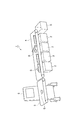
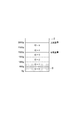
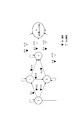
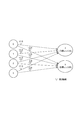
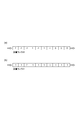
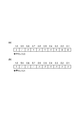
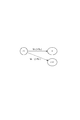
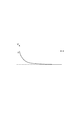
- FIG. 1 is a configuration diagram of a quantitative weighing system according to an embodiment of the present invention. It is a figure which shows the relationship between a station and a state. It is a figure which shows the relationship between a station and a state. It is a figure which shows the graph structure expressing a state transition model. It is a figure which shows the graph structure where the 1st reward and the 2nd reward were provided. It is a figure which shows the graph structure to which the 2nd reward was provided. It is a figure which shows an example of the FIFO queue which stores the residence cycle number for every weight rank. It is a figure which shows the buffer which copied the example of FIG. It is a figure which shows the buffer which correct
- the quantitative weighing system 1 targets an article S (for example, meat) having a variation in weight so that the sum of the weights of the articles S in each of the plurality of stations 2 falls within a target range.
- the system distributes a plurality of articles S to each station 2.
- the quantitative weighing system 1 includes a weighing unit 3 that measures the weight of the articles S that are sequentially supplied, a distribution unit 4 that distributes the articles S that are sequentially supplied to each station 2, and the articles S that are measured by the weighing unit 3.
- a control unit 5 that controls the distribution unit 4 so that the total sum of the weights of the articles S in each station 2 falls within the target range based on the weight.
- the station 2 is a container that can store a plurality of articles S. The article S that has not been distributed to any of the stations 2 for some reason is accommodated in a container 6 arranged on the downstream side of the distribution unit 4.
- the preconditions are set as follows. (1) The lower limit value and the upper limit value of the target range are common to all stations. (2) An algorithm that considers only quantitative weighing (no number constraints, etc.).
- Target range The lower limit value of the target range is called the target weight, and the upper limit value of the target range is called the upper limit weight.
- Operation rate The ratio n / N of “the total number n of articles derived from each station as a result of completion of quantitative measurement” with respect to “the total number N of articles weighed by the measuring unit” is referred to as an operation rate.
- this quantitative weighing algorithm realizes quantitative weighing that satisfies the above condition 1 and condition 2 at the same time by operating by itself to maximize the reward to be obtained.
- a method for giving a reward and a method for maximizing the reward during an actual operation of the quantitative weighing using the quantitative weighing system 1 will be described.
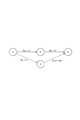
- FIG. 4 shows an example when the case shown in FIGS. 2 and 3 is expressed by a graph structure.
- each state is treated as a node, the node is represented by a circle, and an ID is described inside the circle.
- each directed edge one extending from the own node to the own node and one extending from the own node to another node having an ID larger than the own node are described.
- the node moves to another node along the directed edge, and if there is no directed edge, the corresponding state transition does not exist as well.
- the above condition 1 required for the quantitative weighing system 1 (that is, keeping the total sum of the weights of the articles S in each station 2 within the target range and approaching the lower limit value of the target range) is that the target weight error is small and the target weight is greater than or equal to the target weight. It is satisfied by giving a high second reward when transitioning to a state.
- the condition 2 required for the quantitative weighing system 1 (that is, stably continuing the operation of the system) captures the abstract condition of “continuing the stable operation of the system” from another viewpoint. It is necessary to replace it with specific conditions.
- “stable operation of the system” means “the amount of the article S staying in the quantitative weighing system 1 is kept lower than a predetermined level”. It can be said.
- the amount of the article S introduced into the quantitative weighing system 1 cannot be controlled. Therefore, by increasing the amount of the article S derived from the quantitative weighing system 1, the quantitative weighing system 1 The amount of the article S staying inside is controlled, and the operation of the system is stably continued.
- each station 2 can “shorten the cycle from derivation to the next derivation” by “continuously supplying the articles S to the station 2 having the smallest internal weight as much as possible”. In order to “continuously supply the articles S to the station 2 having the smallest station internal weight as much as possible”, it is necessary to “perform transition to another state in a short cycle” in each station 2. . Therefore, the above condition 2 is satisfied by giving the higher first reward as the cycle of transition to another state becomes shorter.
- the specific reward value is set to a value of ⁇ 1 to 1 in consideration of ease of handling on a computer.
- the second reward obtained when the weight reaches the target weight and less than the upper limit weight is a value between 0 and 1.
- a second reward of +1.0 is obtained when a node within the target range is reached.
- the time required to pass through a directed edge (the number of staying cycles required to transition from one node to another) is treated as a cost. Therefore, in the present quantitative weighing algorithm, the first reward obtained when passing through the directed edge is set to a value of ⁇ 1 to 0.
- the longer it takes to move to a distant node a node whose state changes greatly
- the longer it takes to pass the directed edge and the obtained first reward is set lower. ing.
- FIG. 6 shows an extract of directed edges extending to all nodes and nodes within the target range from the graph structure shown in FIG.
- a second reward obtained when the node is reached is determined.
- the reward should be set higher for a directed edge extending to a node that preferably transitions.
- FIG. 7 shows an example in which the number of staying cycles shown in Table 2 is stored in the queue at the ninth cycle. However, it is assumed that the number of queues in each weight rank is ten.
- the arrow shown in FIG. 7 indicates that, for each cycle, new data for the number of staying cycles is inserted from the left side of the queue. At the same time, all the data in the queue is shifted by one to the right, It shows how it is pushed to the right of the queue and erased.
- the number of staying cycles is stored in the queue as described above.
- This procedure applies time-series filtering to the data in the queue to extract features for each weight rank, assigns features for each weight rank to each directed edge on the graph structure, And a process for normalizing the feature quantity for each weight rank. Details of each process will be described below.
- the queue shown in FIG. 7 is copied to a buffer.
- the reason for copying the queue to the buffer is to prevent the data in the queue from being changed by the data operation and the above-described queue update processing from being disabled.
- the number on each square in the queue is a time series weight for each square. As the new data is stored, the weight increases.
- the data shown in FIG. 8 is averaged by multiplying the newer data in time series by a larger weight.
- a weighted average is calculated for data other than ⁇ 1 among the data shown in FIG. 8 for the averaging process.
- the equation (1) is obtained.
- the value of the result is 1.1, and it can be seen that it is appropriate even when compared with the data of the weight rank 20 shown in FIG.
- Equation (3) is obtained and the time series influence is taken into consideration. Therefore, when -1 is stored in the latest cell in the queue, assuming that an article S of that weight rank is generated, the queue developed on the buffer is operated as described above, and the weighted average is calculated. Take.
- the feature amount R m corresponding to the number of staying cycles for making a transition from a certain state m to an unspecified state is different from the feature amount V k . This is because a transition from state m to state l may be possible while waiting for a transition from state m to state n. For this reason, the general R m ⁇ V k. Since the feature amount R m is the substantial number of staying cycles necessary for transition from the state m, the feature amount R m is used as a final normalization target in this quantitative measurement algorithm. The following describes the method of calculating the feature quantity R m. Incidentally, since processing the feature quantity Vk to obtain the feature quantity R m, it will be referred to as a feature quantity R m synthesis feature amount.
- FIG. 10 shows a graph structure capable of transition from the state m to the state n.
- the feature quantity on the directed edge is the feature quantity V k
- FIG. 11 shows a graph structure capable of transition from state m to state n and state n + 1.
- the feature values on each directed edge are the feature value V k and the feature value V k + 1
- the relationship with the composite feature value R m is R m ⁇ V k and R m ⁇ V k + 1 as described above. Become. From this, it can be easily understood that the feature amount R m decreases as the directed edge extending from the node in the state m increases.
- Equation (4) is derived from the similarity to the basic formula of the combined resistance in the parallel circuit.
- Such synthetic feature quantity R m determined by the, allocated to all directed edges extending from the node.
- feature amounts to a synthetic feature quantity R m.
- V is a value after normalization and A is a constant.
- A is a constant.
- the quantitative weighing system 1 operates to obtain as much reward as possible before reaching the target range from when the station's internal weight is 0, thereby stabilizing the operation of the system while keeping the quantitative weighing error small. Can be continued continuously.
- the reward maximization is performed by sequentially removing a directed edge having a feature amount equal to or greater than a threshold, Q-learning theory considering the reward of several hands, and determining a supply destination station using a Q value. Is implemented. Details of these will be described below.
- the feature amount is an index indicating the difficulty of transition from one state to another state.
- a directed edge having a feature amount larger than a predetermined value may hinder stable continuation of the operation of the quantitative weighing system 1.
- R i, j is a feature amount when transitioning from state i to state j.
- a directed edge having a feature value greater than or equal to a predetermined value is previously deleted from the graph structure.
- the graph structure shown in FIG. 14 it can be seen that there is no directed edge extending from the node in the state c. Therefore, since the transition to the state c itself leads to the failure of the operation of the quantitative weighing system 1, the directed edge extending to the node of the state c must be removed at the same time as shown in FIG.
- this quantitative metric algorithm after erasing a directional edge having a feature value equal to or greater than a predetermined value among directional edges extending from a node in the state c, there is no directional edge extending from the state c. If not, all directed edges extending to the node in state c are also erased.
- This quantitative measurement algorithm can be executed throughout the entire graph structure by executing the above-described procedure for eliminating the directed edge from a state close to the target range. Further, the smaller the predetermined value, which is the threshold value of the feature amount used as a reference when erasing the directed edge, is, the more directed edges are erased. However, a problem at that time is that there is no continuous path composed of directed edges before the station internal weight reaches zero and reaches the target range. Therefore, it is necessary to make the predetermined value as small as possible, and at the same time, pay attention so that there is a path from the state where the station internal weight is 0 to the arrival of the target range.
- each station 2 has a possibility of transition from the current state i to the state j, and the state j after the transition is less than the target range.
- the maximum Q s among the Q values on the directed edge extending from the node in the state j after the transition is obtained, and the station 2 having the maximum Q s is determined as the final supply destination.
- the Q values on the directed edges extending from the node in the state j after the transition are 0.1, 0.6, and 0.2, respectively, and the maximum Q value among them is 0. .6 becomes Qs.
- a case where the state j after transition is within the target range will be described as a second pattern.
- the Q value for the second reward obtained when the state j is reached is defined as Qs.
- the station 2 with the maximum Q s is the final supply destination, and there are a plurality of stations 2 with the maximum Q s , among the stations 2, the articles (articles S) in the past
- the station 2 with the smallest number of the marks or the station 2 with the smallest number of discharges of the weighing object (article S) when the target weight is reached is selected.
- the Q value is updated by Expression (6).
- Q (s, a) is the expected value of reward obtained by taking action a in state s
- R (s, a) is obtained by taking action a in state s.
- Max ⁇ Q (s ′, a ′) is the maximum Q value when the action a ′ is taken in the state s ′.
- ⁇ is a learning rate
- ⁇ is a discount rate.
- the Q learning theory itself is a well-known theory.
- ⁇ Initialization method> In an initial state such as immediately after power-on, the Q values at all edges are undetermined.
- a method for determining the Q value by learning the Q value using a plurality of samples in advance before production operation, or before production operation A method is used in which the Q value is determined by learning the Q value using the weight data generated inside the computer based on the weight distribution of the weighing object (article S) that is known in advance.
- each directed edge is given.
- Q value is updated.
- the weight of the article S is measured (weighing step), and when the article S is distributed to any one of the plurality of stations 2, the article S for each station 2 is measured.
- a directional edge with the maximum Q value is selected from the directional edges corresponding to the allocating operation, and the allocating operation corresponding to the directional edge is executed (allocation step).
- the quantitative weighing system 1 in order to obtain a high first reward, a sorting operation corresponding to a directed edge having a low transition difficulty level is easily performed. Thereby, the operation of the system can be continued stably. Furthermore, in order to obtain the second reward, the sorting operation corresponding to the directed edge connected to the node whose total sum of the weights of the articles S is within the target range is easily performed. Thereby, the sum total of the weight of the articles
- a transition destination node connected to each directed edge so that a higher first reward is given as the transition difficulty level for each directed edge is lower.
- Each of the expected values of the first reward and the second reward is such that a higher second reward is given as the total sum of the weights of the articles S is closer to the lower limit value of the target range (the target weight described above) within the target range.
- the Q value set for the direction edge is updated. Therefore, in the quantitative weighing system 1, in order to obtain a high second reward, the distribution operation corresponding to the directed edge connected to the node in which the total sum of the weights of the articles S is close to the lower limit value of the target range within the target range. It becomes easy to be executed. Thereby, the sum total of the weight of the articles
- the quantitative weighing system 1 when the article S is distributed to any one of the plurality of stations 2, once from the directed edge corresponding to the distribution operation of the article S to each station 2 after the distribution operation.
- the station 2 with the maximum Q value (Q s described above) set for each of a plurality of directed edges further connected to a node that may transition is selected and corresponds to the station 2
- the sorting operation is performed. Thereby, the operation of the system can be continued more stably.
- the second reward that is, the reward that increases as the total sum of the weights of the articles S for the transition destination nodes connected to each directed edge becomes closer to the lower limit value of the target range within the target range.
- the first reward that is, a reward that increases as the degree of transition difficulty for each directed edge decreases.
- the directed edge having the transition difficulty (the above-described feature amount) equal to or greater than a predetermined value is previously deleted from the graph structure, and the transition difficulty is lower than the predetermined value.
- the graph structure is constituted by the edges. Thereby, the calculation amount by the control part 5 can be suppressed, ensuring the stable continuation of operation
- the quantitative weighing error was suppressed to 0.49%, and the operation rate was maintained at 100%. Also from this, according to the above-mentioned quantitative weighing algorithm, the total weight of articles in each station is within the target range, approaching the lower limit value of the target range, and the system operation is stably continued. can do.
- the first reward is a reward that increases as the transition difficulty level for each directed edge decreases.
- the first reward may increase continuously as the transition difficulty level decreases, or in stages. It may be made higher.
- the second reward is a reward that increases as the total weight of articles for the transition destination nodes connected to each directed edge becomes closer to the lower limit value of the target range within the target range. As it approaches the lower limit value, it may be continuously increased or may be increased stepwise.
- the current state node The station to which the articles are supplied may be selected so that the Q value on the directed edge extending from the station becomes the maximum.
- the second reward may be higher as the target weight is closer to the target weight when a target weight other than the lower limit value of the target range is set within the target range. In this case, the sum of the weights of the articles at each station can be kept within the target range and approach the target weight.
Landscapes
- Physics & Mathematics (AREA)
- General Physics & Mathematics (AREA)
- Sorting Of Articles (AREA)
- Weight Measurement For Supplying Or Discharging Of Specified Amounts Of Material (AREA)
Abstract
L'invention porte sur un système de pesage quantitatif (1), dans lequel système, quand la somme totale des poids d'articles (S) dans chacune de stations (2) est considérée comme étant un état, une opération d'affectation des articles (S) à chacune des stations (2) est considérée comme une action, et le changement de l'état par l'exécution de l'action est considéré comme étant une transition, un niveau de difficulté de transition indiquant la difficulté de délivrance de l'article (S) ayant un poids requis pour chaque transition est mis à jour. Dans une structure graphique représentant un modèle de transition d'état, une valeur Q établie pour chacun parmi des bords est mise à jour de telle sorte qu'une première récompense plus élevée est donnée quand le niveau de difficulté de transition concernant chacun des bords devient plus bas, et une seconde récompense est donnée si la somme totale des poids des articles (S) concernant un nœud qui est une destination de transition et qui est relié à chacun des bords se trouve à l'intérieur d'une plage cible.
Priority Applications (1)
| Application Number | Priority Date | Filing Date | Title |
|---|---|---|---|
| JP2015506833A JPWO2014148564A1 (ja) | 2013-03-19 | 2014-03-19 | 定量計量システム及び定量計量方法 |
Applications Claiming Priority (2)
| Application Number | Priority Date | Filing Date | Title |
|---|---|---|---|
| JP2013056033 | 2013-03-19 | ||
| JP2013-056033 | 2013-03-19 |
Publications (1)
| Publication Number | Publication Date |
|---|---|
| WO2014148564A1 true WO2014148564A1 (fr) | 2014-09-25 |
Family
ID=51580237
Family Applications (1)
| Application Number | Title | Priority Date | Filing Date |
|---|---|---|---|
| PCT/JP2014/057576 Ceased WO2014148564A1 (fr) | 2013-03-19 | 2014-03-19 | Système de pesage quantitatif et procédé de pesage quantitatif |
Country Status (2)
| Country | Link |
|---|---|
| JP (1) | JPWO2014148564A1 (fr) |
| WO (1) | WO2014148564A1 (fr) |
Cited By (2)
| Publication number | Priority date | Publication date | Assignee | Title |
|---|---|---|---|---|
| JP2017191567A (ja) * | 2016-04-15 | 2017-10-19 | ファナック株式会社 | 生産計画を実施する生産システム |
| CN111581599A (zh) * | 2020-04-29 | 2020-08-25 | 四川虹美智能科技有限公司 | 重量值输出方法和数字称重变送器 |
Citations (3)
| Publication number | Priority date | Publication date | Assignee | Title |
|---|---|---|---|---|
| JPH0229970B2 (fr) * | 1985-07-20 | 1990-07-03 | ||
| JP2002525763A (ja) * | 1998-09-23 | 2002-08-13 | シーメンス アクチエンゲゼルシヤフト | アクションに基づいて2つの状態の間の状態遷移が行われる、状態を有するシステムに対するアクションのシーケンスをもとめるための方法及び装置 |
| JP4118132B2 (ja) * | 2002-12-03 | 2008-07-16 | 株式会社クボタ | 計量仕分け設備 |
-
2014
- 2014-03-19 WO PCT/JP2014/057576 patent/WO2014148564A1/fr not_active Ceased
- 2014-03-19 JP JP2015506833A patent/JPWO2014148564A1/ja active Pending
Patent Citations (3)
| Publication number | Priority date | Publication date | Assignee | Title |
|---|---|---|---|---|
| JPH0229970B2 (fr) * | 1985-07-20 | 1990-07-03 | ||
| JP2002525763A (ja) * | 1998-09-23 | 2002-08-13 | シーメンス アクチエンゲゼルシヤフト | アクションに基づいて2つの状態の間の状態遷移が行われる、状態を有するシステムに対するアクションのシーケンスをもとめるための方法及び装置 |
| JP4118132B2 (ja) * | 2002-12-03 | 2008-07-16 | 株式会社クボタ | 計量仕分け設備 |
Cited By (3)
| Publication number | Priority date | Publication date | Assignee | Title |
|---|---|---|---|---|
| JP2017191567A (ja) * | 2016-04-15 | 2017-10-19 | ファナック株式会社 | 生産計画を実施する生産システム |
| CN111581599A (zh) * | 2020-04-29 | 2020-08-25 | 四川虹美智能科技有限公司 | 重量值输出方法和数字称重变送器 |
| CN111581599B (zh) * | 2020-04-29 | 2023-10-03 | 四川虹美智能科技有限公司 | 重量值输出方法和数字称重变送器 |
Also Published As
| Publication number | Publication date |
|---|---|
| JPWO2014148564A1 (ja) | 2017-02-16 |
Similar Documents
| Publication | Publication Date | Title |
|---|---|---|
| Liu et al. | Calibrated fairness in bandits | |
| US11568300B2 (en) | Apparatus and method for managing machine learning with plurality of learning algorithms and plurality of training dataset sizes | |
| Naderi et al. | Hybrid flexible flowshop problems: Models and solution methods | |
| US11170321B2 (en) | Learning method, prediction method, learning device, predicting device, and storage medium | |
| US11513851B2 (en) | Job scheduler, job schedule control method, and storage medium | |
| Ahn et al. | Large-scale distributed Bayesian matrix factorization using stochastic gradient MCMC | |
| JP6902487B2 (ja) | 機械学習システム | |
| Li et al. | Hybrid optimization algorithm based on chaos, cloud and particle swarm optimization algorithm | |
| US11288580B2 (en) | Optimal solution search method, optimal solution search program, and optimal solution search apparatus | |
| Stern et al. | Collaborative expert portfolio management | |
| JP2020525872A (ja) | インフルエンザ予測モデルの生成方法、装置及びコンピュータ可読記憶媒体 | |
| JP7073171B2 (ja) | 学習装置、学習方法及びプログラム | |
| US9582758B2 (en) | Data classification method, storage medium, and classification device | |
| Sayed et al. | DiSH simulator: Capturing dynamics of cellular signaling with heterogeneous knowledge | |
| JP2018142199A (ja) | 学習システムおよび学習方法 | |
| Breve et al. | Particle competition and cooperation for semi-supervised learning with label noise | |
| CN107798332B (zh) | 一种用户行为预测方法及装置 | |
| JP6201556B2 (ja) | 予測モデル学習装置、予測モデル学習方法およびコンピュータプログラム | |
| CN114547917A (zh) | 仿真预测方法、装置、设备及存储介质 | |
| JP2005004658A (ja) | 変化点検出装置,変化点検出方法および変化点検出用プログラム | |
| US20170323217A1 (en) | Calculating posterior probability of classes | |
| WO2014148564A1 (fr) | Système de pesage quantitatif et procédé de pesage quantitatif | |
| Yuan et al. | Accelerated training via incrementally growing neural networks using variance transfer and learning rate adaptation | |
| Zhu et al. | An online updating method for time-varying preference learning | |
| CN113408674A (zh) | 模型训练方法及装置、图像识别方法及装置 |
Legal Events
| Date | Code | Title | Description |
|---|---|---|---|
| ENP | Entry into the national phase |
Ref document number: 2015506833 Country of ref document: JP Kind code of ref document: A |
|
| 121 | Ep: the epo has been informed by wipo that ep was designated in this application |
Ref document number: 14769824 Country of ref document: EP Kind code of ref document: A1 |
|
| NENP | Non-entry into the national phase |
Ref country code: DE |
|
| 122 | Ep: pct application non-entry in european phase |
Ref document number: 14769824 Country of ref document: EP Kind code of ref document: A1 |