WO2014154636A1 - Verwendung von organischen oxyimiden als flammschutzmittel für kunststoffe sowie flammgeschützte kunststoffzusammensetzung und hieraus hergestellte formteile - Google Patents
Verwendung von organischen oxyimiden als flammschutzmittel für kunststoffe sowie flammgeschützte kunststoffzusammensetzung und hieraus hergestellte formteile Download PDFInfo
- Publication number
- WO2014154636A1 WO2014154636A1 PCT/EP2014/055847 EP2014055847W WO2014154636A1 WO 2014154636 A1 WO2014154636 A1 WO 2014154636A1 EP 2014055847 W EP2014055847 W EP 2014055847W WO 2014154636 A1 WO2014154636 A1 WO 2014154636A1
- Authority
- WO
- WIPO (PCT)
- Prior art keywords
- styrene
- melamine
- radical
- bis
- butyl
- Prior art date
- Legal status (The legal status is an assumption and is not a legal conclusion. Google has not performed a legal analysis and makes no representation as to the accuracy of the status listed.)
- Ceased
Links
- 0 CCc1ccc(C(*)(*)Cc2ccc(C(*)(*)Cc3ccc(C)cc3)cc2)cc1 Chemical compound CCc1ccc(C(*)(*)Cc2ccc(C(*)(*)Cc3ccc(C)cc3)cc2)cc1 0.000 description 4
- BLTUEOHQRYFIMZ-UHFFFAOYSA-N COCC(CC1)CCC1OC1CC(COC)CCC1 Chemical compound COCC(CC1)CCC1OC1CC(COC)CCC1 BLTUEOHQRYFIMZ-UHFFFAOYSA-N 0.000 description 1
- GQFMONNXUILAPM-UHFFFAOYSA-N Oc1ccc(C(c(cc2)ccc2O)(P2(Oc3ccccc3-c3c2cccc3)=O)P2(Oc(cccc3)c3-c3c2cccc3)=O)cc1 Chemical compound Oc1ccc(C(c(cc2)ccc2O)(P2(Oc3ccccc3-c3c2cccc3)=O)P2(Oc(cccc3)c3-c3c2cccc3)=O)cc1 GQFMONNXUILAPM-UHFFFAOYSA-N 0.000 description 1
Classifications
-
- C—CHEMISTRY; METALLURGY
- C07—ORGANIC CHEMISTRY
- C07D—HETEROCYCLIC COMPOUNDS
- C07D487/00—Heterocyclic compounds containing nitrogen atoms as the only ring hetero atoms in the condensed system, not provided for by groups C07D451/00 - C07D477/00
- C07D487/02—Heterocyclic compounds containing nitrogen atoms as the only ring hetero atoms in the condensed system, not provided for by groups C07D451/00 - C07D477/00 in which the condensed system contains two hetero rings
- C07D487/04—Ortho-condensed systems
-
- C—CHEMISTRY; METALLURGY
- C08—ORGANIC MACROMOLECULAR COMPOUNDS; THEIR PREPARATION OR CHEMICAL WORKING-UP; COMPOSITIONS BASED THEREON
- C08K—Use of inorganic or non-macromolecular organic substances as compounding ingredients
- C08K5/00—Use of organic ingredients
- C08K5/0008—Organic ingredients according to more than one of the "one dot" groups of C08K5/01 - C08K5/59
- C08K5/0066—Flame-proofing or flame-retarding additives
-
- C—CHEMISTRY; METALLURGY
- C07—ORGANIC CHEMISTRY
- C07D—HETEROCYCLIC COMPOUNDS
- C07D207/00—Heterocyclic compounds containing five-membered rings not condensed with other rings, with one nitrogen atom as the only ring hetero atom
- C07D207/46—Heterocyclic compounds containing five-membered rings not condensed with other rings, with one nitrogen atom as the only ring hetero atom with hetero atoms directly attached to the ring nitrogen atom
-
- C—CHEMISTRY; METALLURGY
- C07—ORGANIC CHEMISTRY
- C07D—HETEROCYCLIC COMPOUNDS
- C07D209/00—Heterocyclic compounds containing five-membered rings, condensed with other rings, with one nitrogen atom as the only ring hetero atom
- C07D209/02—Heterocyclic compounds containing five-membered rings, condensed with other rings, with one nitrogen atom as the only ring hetero atom condensed with one carbocyclic ring
- C07D209/44—Iso-indoles; Hydrogenated iso-indoles
- C07D209/48—Iso-indoles; Hydrogenated iso-indoles with oxygen atoms in positions 1 and 3, e.g. phthalimide
-
- C—CHEMISTRY; METALLURGY
- C07—ORGANIC CHEMISTRY
- C07D—HETEROCYCLIC COMPOUNDS
- C07D221/00—Heterocyclic compounds containing six-membered rings having one nitrogen atom as the only ring hetero atom, not provided for by groups C07D211/00 - C07D219/00
- C07D221/02—Heterocyclic compounds containing six-membered rings having one nitrogen atom as the only ring hetero atom, not provided for by groups C07D211/00 - C07D219/00 condensed with carbocyclic rings or ring systems
- C07D221/04—Ortho- or peri-condensed ring systems
- C07D221/06—Ring systems of three rings
- C07D221/14—Aza-phenalenes, e.g. 1,8-naphthalimide
-
- C—CHEMISTRY; METALLURGY
- C08—ORGANIC MACROMOLECULAR COMPOUNDS; THEIR PREPARATION OR CHEMICAL WORKING-UP; COMPOSITIONS BASED THEREON
- C08K—Use of inorganic or non-macromolecular organic substances as compounding ingredients
- C08K5/00—Use of organic ingredients
- C08K5/16—Nitrogen-containing compounds
- C08K5/32—Compounds containing nitrogen bound to oxygen
-
- C—CHEMISTRY; METALLURGY
- C08—ORGANIC MACROMOLECULAR COMPOUNDS; THEIR PREPARATION OR CHEMICAL WORKING-UP; COMPOSITIONS BASED THEREON
- C08K—Use of inorganic or non-macromolecular organic substances as compounding ingredients
- C08K5/00—Use of organic ingredients
- C08K5/16—Nitrogen-containing compounds
- C08K5/34—Heterocyclic compounds having nitrogen in the ring
- C08K5/3412—Heterocyclic compounds having nitrogen in the ring having one nitrogen atom in the ring
- C08K5/3415—Five-membered rings
- C08K5/3417—Five-membered rings condensed with carbocyclic rings
-
- C—CHEMISTRY; METALLURGY
- C09—DYES; PAINTS; POLISHES; NATURAL RESINS; ADHESIVES; COMPOSITIONS NOT OTHERWISE PROVIDED FOR; APPLICATIONS OF MATERIALS NOT OTHERWISE PROVIDED FOR
- C09D—COATING COMPOSITIONS, e.g. PAINTS, VARNISHES OR LACQUERS; FILLING PASTES; CHEMICAL PAINT OR INK REMOVERS; INKS; CORRECTING FLUIDS; WOODSTAINS; PASTES OR SOLIDS FOR COLOURING OR PRINTING; USE OF MATERIALS THEREFOR
- C09D123/00—Coating compositions based on homopolymers or copolymers of unsaturated aliphatic hydrocarbons having only one carbon-to-carbon double bond; Coating compositions based on derivatives of such polymers
- C09D123/02—Coating compositions based on homopolymers or copolymers of unsaturated aliphatic hydrocarbons having only one carbon-to-carbon double bond; Coating compositions based on derivatives of such polymers not modified by chemical after-treatment
- C09D123/10—Homopolymers or copolymers of propene
- C09D123/12—Polypropene
-
- C—CHEMISTRY; METALLURGY
- C09—DYES; PAINTS; POLISHES; NATURAL RESINS; ADHESIVES; COMPOSITIONS NOT OTHERWISE PROVIDED FOR; APPLICATIONS OF MATERIALS NOT OTHERWISE PROVIDED FOR
- C09K—MATERIALS FOR MISCELLANEOUS APPLICATIONS, NOT PROVIDED FOR ELSEWHERE
- C09K21/00—Fireproofing materials
- C09K21/06—Organic materials
- C09K21/10—Organic materials containing nitrogen
-
- C—CHEMISTRY; METALLURGY
- C08—ORGANIC MACROMOLECULAR COMPOUNDS; THEIR PREPARATION OR CHEMICAL WORKING-UP; COMPOSITIONS BASED THEREON
- C08K—Use of inorganic or non-macromolecular organic substances as compounding ingredients
- C08K5/00—Use of organic ingredients
- C08K5/49—Phosphorus-containing compounds
- C08K5/51—Phosphorus bound to oxygen
- C08K5/53—Phosphorus bound to oxygen bound to oxygen and to carbon only
- C08K5/5313—Phosphinic compounds, e.g. R2=P(:O)OR'
Definitions
- the present invention relates to the use of organic compound
- Oxyimides as flame retardants for plastics there is also provided a flame retardant plastic composition which includes an oxyimide flame retardant.
- a flame retardant plastic composition which includes an oxyimide flame retardant.
- moldings prepared from a flame-retardant polymer composition according to the invention are given.
- plastics such as As plastics based on polyolefins, polystyrene, polyamides, polyurethanes or polyesters, are flammable and relatively easily flammable. In order to reduce or eliminate the risk of fire of plastics in certain applications, it is therefore imperative to reduce the flammability and to use flame-retardant or flame-retardant plastic compositions. This will be done in usually flame retardants added to the plastic with the aim to prevent the ignition for a certain time or to significantly delay the spread of fire.
- Traditional flame retardants are based on chlorine- and bromine-containing compounds (usually in combination with antimony trioxide), on phosphorus-containing, on nitrogen-containing compounds and / or on inorganic hydroxides. Recently, for environmental and / or toxicological reasons, halogen-free flame retardant solutions are preferred. For the production of flame-retardant plastics, there are a variety of
- Flame retardants which are usually used substrate-specific for a particular polymer and a specific application according to the underlying standards. Flame-retardant plastics are used, for example, in electrical and electronic applications, in the transport / automotive sector and in construction.
- a very effective nitrogen-based flame retardant class developed in recent years, preferably for polyolefins, is based on alkoxyamines (WO 99/00450, WO 2008101845, WO 2011086114). Cleavage of the alkoxyamines gives rise to free radicals in the event of a fire, which intervene in the degradation process of the polymer and thus bring about the flameproofing effect (C.R. Wilen, R. Pfaendner, J. Appl.
- Alkoxyamines can also be used advantageously in synergistic combinations with other flame retardants (WO 02/074847, WO 03/016388, WO 2010026230, WO 2009080554, WO 2011003773, WO 2011117266). Furthermore, it was found that hydroxylamine
- Stabilizers can bring about a synergistic improvement of the effect of bromine-containing, phosphorus-containing and inorganic flame retardants (WO 02/074847).
- the flame retardants known from the prior art mentioned above do not all meet today's requirements. Thus, for example, they must still be used in a relatively high concentration with respect to the plastic composition to be protected, which may, for example, lead to a deterioration in the mechanical properties of the plastic.
- Other criteria include the thermal Stability, discoloration, formation of toxic gases in case of fire, easy accessibility on an industrial scale, among others.
- the object of the present invention was to provide novel flame retardants and synergistic flame retardant components which are effective at low concentrations and comparatively easily accessible.
- This object is related to the use of organic oxyimides as flame retardants for plastics according to the features of claim 1, with respect to a flame-retardant plastic composition with the features of claim 12, with respect to a method for producing this plastic composition having the features of claim 15 and a molded part of a paint or a coating which can be produced from a flameproofed polymer composition, having the features of patent claim 16.
- the respective dependent claims represent advantageous developments.
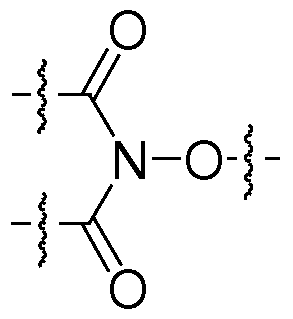
- the formula I is understood to mean that the imaged structural element is contained in the organic oxyimide.
- the oxyimides used according to the invention are not to be equated with isocyanurates or compounds derived therefrom or classes of compounds.
- the oxyimide used according to the invention is halogen-free, ie the corresponding compound contains no halogen atoms. It has been shown that the organic oxyimides used according to the invention have good activity, as described above, in order to render plastics flame-retardant.
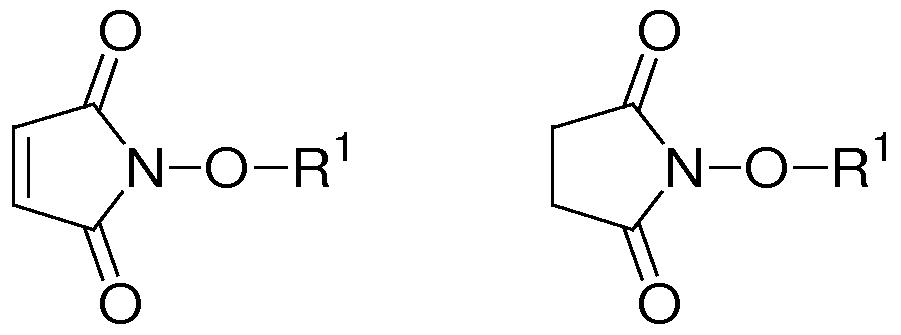
- oxyimides containing at least one structural element of the following formula II
- R 1 is hydrogen or an optionally substituted alkyl, cycloalkyl, aryl, heteroaryl or acyl radical, used as a flame retardant.
- bridged oxyimides containing at least one structural element of the following formula III
- R 2 is an optionally substituted alkylene, cycloalkylene, arylene, heteroarylene or bridging acyl radical can be used.
- R is selected from radicals of the group consisting of
- n 1 to 18, -CH (CH 3 ) -, -C (CH 3 ) 2 -, -O-, -S-, -SO 2 -, -NHCO-, - CO - and the groups shown below
- m is 0 or 1 to 18.
- radicals R can be given by the following structural elements:
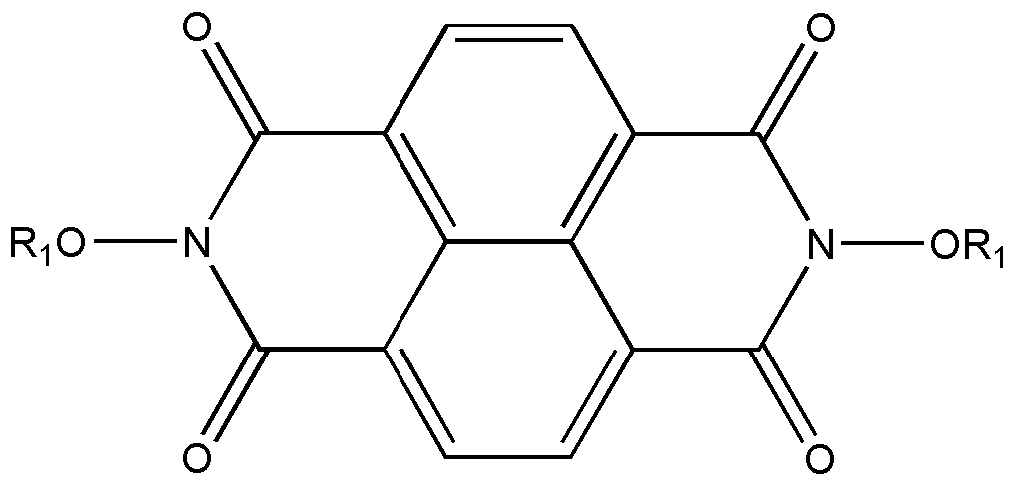
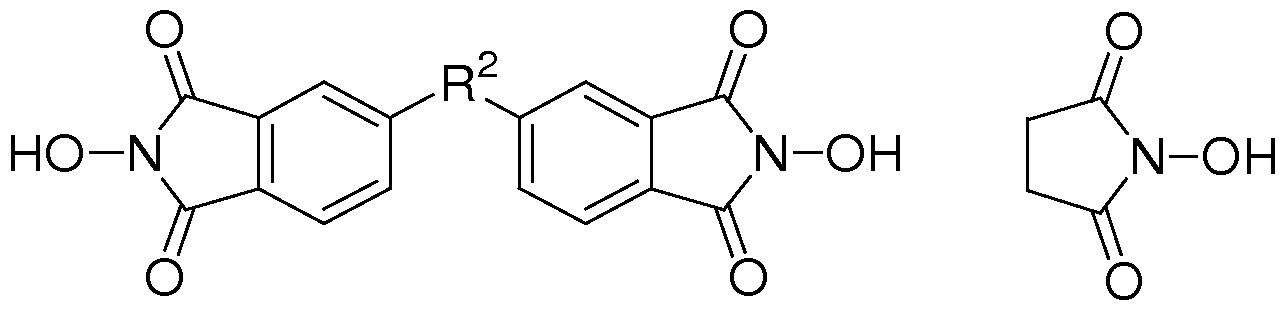
- the organic oxyimide has one of the following structural formula:
- R 1 and R 2 have the abovementioned meaning.
- a particularly preferred radical R 1 is hydrogen or an acyl radical.
- R 2 has the meaning given above.
- Hydroxylamines with, for example, an acid chloride or by transesterification from the corresponding acid esters with e.g. Volatile alcohols such. the methyl esters.
- these hydroxylamine derivatives can also be in the form of linear
- Oligomers or polymers e.g. bifunctional
- the syntheses of these polymers is described, for example, in H. Imajo et al. J. Pol. Be: Pol. Chem. 18, 2189-2196 (1980) or in H. Imajo et al. J. Pol. See: Pol. Chem. 19, 1855-1861 (1981).
- these polymers can also be synthesized in the form of branched or crosslinked structures by partially or completely replacing a difunctional component with a tri-, tetra- or higher-functionalized compound, e.g. a trifunctional acid component or a trifunctional hydroxylamine.
- copolymers can be synthesized according to the invention by, for example, a difunctional Hydroxylimid partially by a diol compound such as ethylene glycol, butanediol-1-4, 1,6-hexanediol, hydroquinone, 4,4 'dihydroxybiphenyl is replaced. Accordingly, for example copolyesters or copolyurethanes are accessible. Moreover, by partially replacing the difunctional hydroxylimides with difunctional compounds of structures other than diols, such as diamines, copolymers of mixed structures such as polyesteramides are available.
- the inventively used th organic oxyimides are preferably used for the following plastics, particularly preferably in thermoplastic, elastomeric or thermosetting plastics, especially thermoplastic polymers:
- Polymers of olefins or diolefins e.g. Polyethylene (LDPE, LLDPE, VLDPE, ULDPE, MDPE, HDPE, UHMWPE),
- Metallocene PE polypropylene, polyisobutylene, poly-4-methyl-pentene-1, polybutadiene, polyisoprene, polycyclooctene, polyalkylene-carbon monoxide copolymers, as well as copolymers in the form of random or block structures such as e.g. Polypropylene-polyethylene (EP), EPM or EPDM, ethylene-vinyl acetate (EVA), ethylene-acrylic esters, e.g. Ethylene-butyl acrylate, ethylene-acrylic acid and its salts (ionomers), as well as terpolymers such as e.g. Ethylene acrylic acid glycidyl acrylate, graft polymers such as e.g. Polypropylene-g-maleic anhydride, polypropylene-g-acrylic acid, polyethylene-g-acrylic acid,
- Polystyrene polymethylstyrene, polyvinylnaphthalene, styrene-butadiene (SB), styrene-butadiene-styrene (SBS), styrene-ethylene-butylene-styrene (SEBS), styrene-ethylene-propylene-styrene, styrene-isoprene, styrene-isoprene-styrene (SIS ), Styrene-butadiene-acrylonitrile (ABS), styrene-acrylonitrile-acrylate (ASA), styrene-ethylene, styrene-maleic anhydride polymers including corresponding graft copolymers such as Styrene on butadiene,
- halogen-containing polymers such as e.g. Polyvinyl chloride (PVC), polychloroprene and polyvinylidene chloride (PVDC), copolymers of vinyl chloride and vinylidene chloride or vinyl chloride and vinyl acetate, chlorinated polyethylene, polyvinylidene fluoride,
- Polymers of unsaturated esters such as e.g. Polyacrylates and polymethacrylates such as polymethyl methacrylate (PMMA),
- Polyacetals e.g. Polyoxymethylene POM
- copolymers e.g. butanal
- Polymers of cyclic ethers e.g. Polyethylene glycol, polypropylene glycol, polyethylene oxide, polypropylene oxide,
- Polyurethanes hydroxy-terminated polyethers or polyesters and aromatic or aliphatic isocyanates, in particular linear polyurethanes, polyureas,
- Polyamides such as e.g. Polyamide-6, 6.6, 6.10, 4.6, 4.10, 6.12, 12.12, polyamide 11, polyamide 12, and (partially) aromatic polyamides, e.g. Polyphthalamides, e.g. prepared from terephthalic acid and / or isophthalic acid and aliphatic diamines or from aliphatic dicarboxylic acids such as e.g. Adipic acid or
- Sebacic acid and aromatic diamines e.g. 1,4- or 1,3-diaminobenzene,
- Polyimides polyamide-imides, polyetherimides, polyesterimides, poly (ether) ketones, polysulfones, polyethersulfones, and
- Polyarylsulfones polyphenylene sulfide, polybenzimidazoles, polyhydantoins,
- Polyesters of aliphatic or aromatic dicarboxylic acids and diols or of hydroxy carboxylic acids such as e.g.
- PET Polyethylene terephthalate
- PBT polybutylene terephthalate
- PBT polypropylene terephthalate
- polyethylene naphthylate poly-1,4-dimethylolcyclohexane terephthalate
- polyhydroxybenzoate polyhydroxynaphthalate
- polylactic acid polyethylene terephthalate (PET)
- PET polybutylene terephthalate
- PBT polypropylene terephthalate
- polyethylene naphthylate poly-1,4-dimethylolcyclohexane terephthalate
- polyhydroxybenzoate polyhydroxynaphthalate
- polylactic acid polylactic acid
- Polycarbonates polyestercarbonates, as well as blends such as e.g.
- PC / ABS PC / PBT
- PC / PET / PBT PC / PET / PBT
- Cellulose derivatives such as e.g. Cellulose nitrate, cellulose acetate, cellulose propionate, cellulose butyrate
- non-thermoplastic or thermosetting plastics p non-thermoplastic or thermosetting plastics p
- mixtures, combinations or blends of two or more of the aforementioned polymers are non-thermoplastic or thermosetting plastics p
- polymers specified under a) to o) are copolymers, these may be present in the form of random, block or tapered structures.
- polymers specified under a) to o) are stereoregular polymers, these may be present in the form of isotactic, stereotactic, but also atactic forms.
- the polymers specified under a) to o) can have both amorphous and (partly) crystalline morphologies.
- the polyolefins mentioned under a) may also be crosslinked, e.g. crosslinked polyethylene, which is referred to as X-PE.
- the polyolefins mentioned under a) can have any stereostructures, i.
- the organic oxyimides used according to the invention are used for polyolefins, in particular for the polyolefins mentioned under a).
- the present flame retardants can be used in the following clever, non-thermoplastic plastics: q) epoxy resins consisting of di- or polyfunctional epoxy compounds in combination with e.g. aminic, anhydride or catalytically active hardeners,
- phenolic resins e.g. Phenol-formaldehyde resins, urea-formaldehyde resins, melamine-formaldehyde resins,
- the flame retardants of the invention are used in polyolefins, preferably polypropylene and / or polyethylene and their copolymers and blends.
- the oxyimide used according to the invention can be used in combination with at least one further flame retardant, resulting in synergistic effects.
- the at least one further flame retardant is preferably selected from the group consisting of a) inorganic flame retardants such as Al (OH) 3 , Mg (OH) 2 , AIO (OH), MgC0 3 , phyllosilicates such as montmorillonite, not or organically modified, Double salts, such as Mg-Al silicates,
- POSS Polyhedral Oligomeric Silsesquioxane compounds, huntite, hydromagnesite or halloysite, and Sb 2 0 3 , Sb 2 0 5 , MoO 3 , zinc stannate, zinc hydroxystannate,
- nitrogen-containing flame retardants e.g. Melamine, melanin, melamine, melamine derivatives, melamine condensation products or melamine salts, benzoguanamine, polyisocyanurates, alantoin, phosphacenes, in particular melamine cyanurate, melamine phosphate, dimelamine phosphate, melamine pyrophosphate, melamine polyphosphate, melamine-metal phosphates, such as e.g. Melamine aluminum phosphate, melamine zinc phosphate,
- nitrogen-containing flame retardants e.g. Melamine, melanin, melamine, melamine derivatives, melamine condensation products or melamine salts, benzoguanamine, polyisocyanurates, alantoin, phosphacenes, in particular melamine cyanurate, melamine phosphate, dimelamine phosphate, melamine pyrophosphate, melamine polyphosphate, melamine-metal phosphate
- Phosphorhaitigen flame retardants such. red phosphorus, phosphates, e.g. Resorcinol diphosphate, bisphenol A diphosphate and their oligomers, triphenyl phosphate,
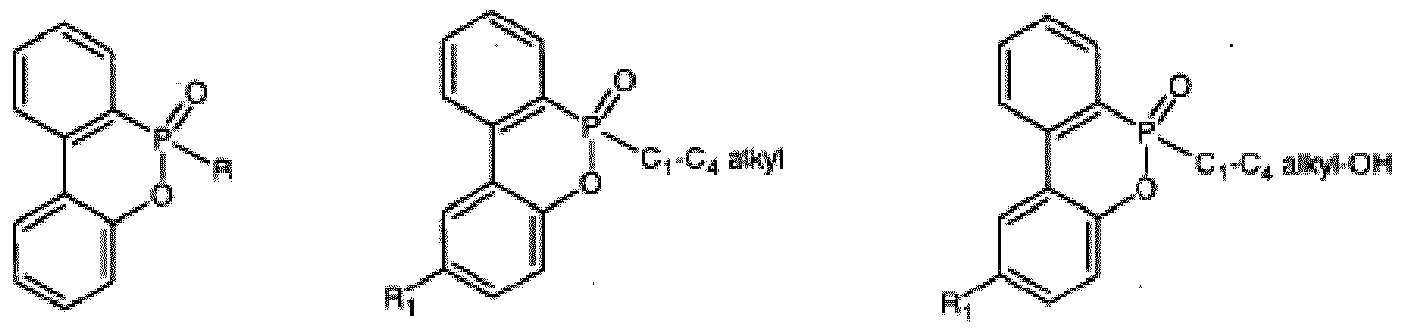
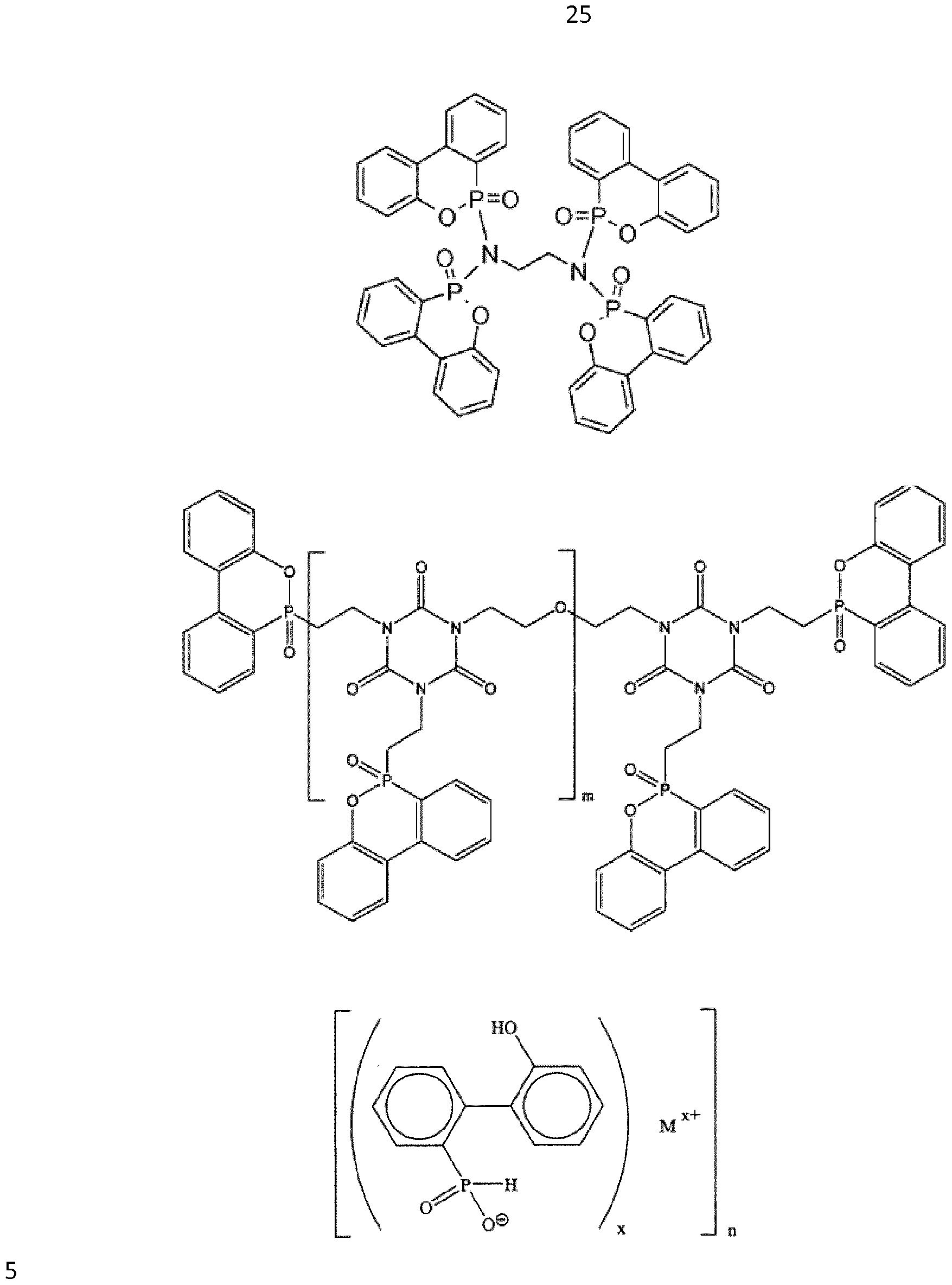
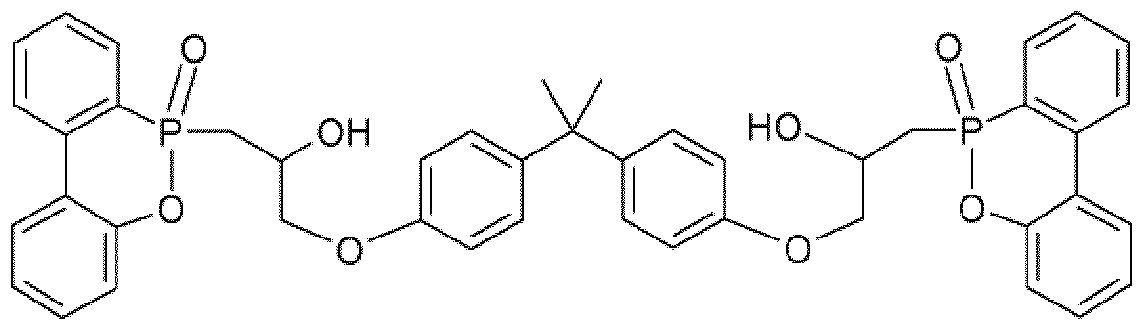
- Ethylenediamine diphosphate such as salts of hypophosphorous acid and its derivatives such as diethyl aluminum phosphinate or aluminum phosphinate, aluminum phosphite, aluminum phosphonate, phosphonate esters, oligomeric and polymeric derivatives of methane phosphonic acid, 9,10-dihydro-9-oxa-10-phosphorylphenanthrene-10-oxide (DOPO) and their substituted compounds,
- phosphinates such as salts of hypophosphorous acid and its derivatives such as diethyl aluminum phosphinate or aluminum phosphinate, aluminum phosphite, aluminum phosphonate, phosphonate esters, oligomeric and polymeric derivatives of methane phosphonic acid, 9,10-dihydro-9-oxa-10-phosphorylphenanthrene-10-oxide (DOPO) and their substituted compounds,
- DOPO 9,10-dihydro-9-oxa-10-phosphorylphenanthrene-10
- Chlorine and bromine based halogenated flame retardants e.g. polybrominated diphenyloxides, e.g.
- Decabromodiphenyloxide tris (3-bromo-2,2-bis (bromomethyl) propyl phosphate, tris (tribromoneopentyl) phosphate, tetrabromophthalic acid, 1,2-bis (tribromophenoxy) ethane,
- Borates such as e.g. Zinc borate or calcium borate,
- Anti-drip agents e.g. polytetrafluoroethylene
- silicon-containing compounds such as e.g. Polyphenylsiloxane.
- halogen-containing flame retardants mentioned under b) are often commercial products which are e.g. from the companies Albemarle, Chemtura / Great Lakes or ICL are commercially available.
- Free-radical formers in the context of the present invention are compounds which can generate radicals by thermal and light-induced cleavage.
- Suitable free-radical formers for the applications present here are those which have sufficient thermal stability for the plastics or coating processing processes, ie none at the time of processing or form only very small amounts of free radicals and spontaneously generate radicals only at higher temperatures, as they occur only in case of fire.
- the respective processing processes and temperatures for coatings and plastic processing processes are known to the person skilled in the art. Plastics processing processes and associated temperatures can also be found in the specialist literature such as H. Domininghaus, P. Eisner, P. Eyerer. T. Hirth, Kunststoffe, 8th edition, Springer 2012.
- the radical generator is particularly preferably selected from the group consisting of a) N-alkoxyamines according to the structural formula shown below
- R 3 is hydrogen or an optionally substituted alkyl, cycloalkyl, aryl, heteroaryl or acyl radical, in particular a C 1 to C 4 alkyl radical,
- R 4 is an alkoxy, aryloxy, cycloalkoxy, aralkoxy or
- Z is hydrogen or an optionally substituted alkyl, cycloalkyl, aryl, heteroaryl or acyl radical, where the two radicals Z can also form a closed ring, which may optionally be substituted by ester, ether, amine, amide, carboxy or urethane groups,
- R is an alkyl, cycloalkyl or aryl radical
- R 6 is identical or different at each occurrence and denotes a linear or branched alkyl radical
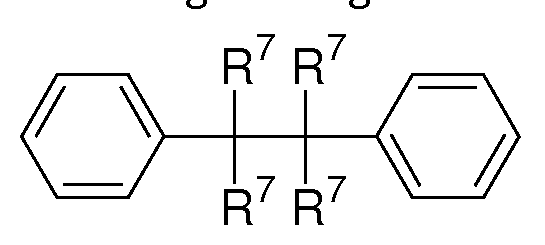
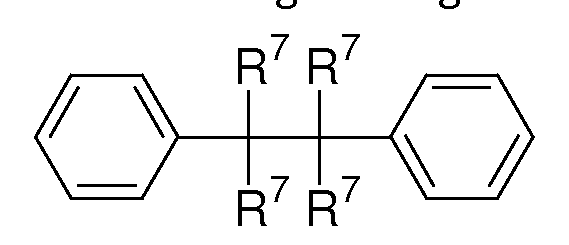
- R 7 is the same or different at each occurrence and is hydrogen or a linear or branched alkyl radical
- R 8 is the same or different at each occurrence and is an alkyl, alkoxy, aryloxy, cycloalkyloxy, aralkoxy or acyloxy radical,
- R 7 has the abovementioned meaning, preferably methyl
- R 7 has the meaning indicated above, preferably methyl, and 2 ⁇ n ⁇ 100.
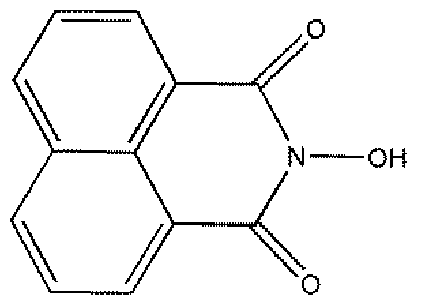
- Typical examples of the aforementioned N-alkoxyamines of the stated structure are: 1-cyclohexyloxy-2,2,6,6-tetramethyl-4-octadecylaminopiperidine; Bis (1-octyloxy-2,2,6,6-tetramethylpiperidin-4-yl) sebacate; 2,4-bis [(1-cyclohexyloxy-2,2,6,6-tetramethylpiperidin-4-yl) butylamino] -6- (2-hydroxyethylamino-S-triazine; bis (1-cyclohexyloxy-2,2,6 , 6-tetramethylpiperidin-4-yl) adipate;
- the at least one further flame retardant may in particular also be a phosphorus-containing flame retardant.
- Preferred phosphorus-containing flame retardants are phosphinates of the following structures:
- R 1 and R 2 are identical or different and are selected from linear or branched C 1 -C 6 -alkyl and / or aryl;
- R 1 is alkyl
- R 2 is alkyl and M is Al or Zn.
- a particularly preferred example of a phosphinate according to the invention are the commercially available products Exolit OP (RTM) from Clariant SE.
- phosphorus-containing flame retardants are metal salts of hypophosphorous acid having a structure according to the formula
- Met is a metal selected from Groups I, II, III and IV of the Periodic Table of the Elements, and n is a number from 1 to 4 corresponding to the charge of the corresponding metal ion Met.
- Met n + is, for example, Na + , Ca 2+ , Mg 2+ , Zn 2+ , Ti 4+ or Al 3+ , with Ca 2+ , Zn 2+ and Al 3+ being particularly preferred.
- phosphorus-containing flame retardants are phosphonates or phosphonic diaryl esters of a structure according to the following formula:
- Corresponding structures may also be present in the form of phosphonate oligomers, polymers and co-polymers.
- Linear or branched phosphonate oligomers and polymers are known in the art.
- branched phosphonate oligomers and polymers reference is made to US Pat. Nos. 2,716,101, 3,326,852, 4,328,174, 4,331,614, US Pat.
- Phophonates are available, for example, under the tradename Nofia (RTM) from FRX Polymers.
- phosphorus-containing flame retardants are compounds based on oxaphosphorine oxide and derivatives thereof having, for example, the following structures:
- synergistic phosphorus-containing flame retardants are cyclic phosphonates of a structure according to one of the following formulas:
- a 1 and A 2 independently represent a substituted or unsubstituted, straight or branched alkyl group of 1 to 4 carbon atoms, substituted or unsubstituted benzyl, substituted or unsubstituted phenyl, substituted or unsubstituted naphthyl, and wherein A 3 and A 4 are independently each is methyl or ethyl and A 5 is a straight or branched alkyl group of 1 to 4 carbon atoms or a phenyl or benzyl group, each of which may have up to 3 methyl groups.
- Cyclic phosphonates are commercially available, for example, from Thor GmbH under the trade name Aflammit (RTM) or can be prepared according to EP 2450401.
- the at least one further flame retardant may in particular also be a nitrogen-containing flame retardant.
- Preferred nitrogen-containing flame retardants are melamine polyphosphate, melamine cyanurate, melamine-metal phosphates, poly- [2,4- (piperazin-1,4-yl) -6- (morpholin-4-yl) -l, 3,5-triazine] and ammonium polyphosphate. These compounds are commercial products and available under the tradenames Melapur (RTM) from BASF SE, Budit (RTM) from Budenheim Chemical Factory, Exolit (RTM) from Clariant, Safire (RTM) from Floridienne or MCA PPM Triazines from MCA Technologies GmbH.
- oxyimide used according to the invention with at least one further flame retardant
- oxyimide: flame retardant preferably from 5:95 to 50:50, particularly preferably from 10:90 to 30:70 are used.
- organic oxyimides based on the plastics, to 0.01 to 30 wt .-%, preferably to 0.1 to 20 wt .-%, particularly preferably to 1 to 10 wt .-% are used.
- the present invention relates to a flame-retardant plastic composition containing or consisting of 50 to 98 parts by weight preferably 70 to 95 parts by weight of at least one plastic, in particular at least one thermoplastic polymer,
- organic oxyimide is halogen-free, c) 1 to 25 parts by wt. preferably 2.5 to 15 parts by wt. of at least one further flame retardant.
- the flame-retardant plastic composition may additionally
- At least one additive from the class of phenolic antioxidants, phosphites, acid scavengers, hindered amines, dispersants and combinations thereof.
- additives selected from the group consisting of UV absorbers, light stabilizers, stabilizers, hydroxylamines, benzofuranones, metal deactivators, filler deactivators, nucleating agents, impact modifiers, plasticizers, lubricants, rheology modifiers, processing aids, pigments, dyes, optical brighteners , antimicrobial agents, antistatic agents, slip agents, antiblocking agents, coupling agents, dispersants, compatibilizers, oxygen scavengers, acid scavengers, marking agents or antifogging agents.
- additives selected from the group consisting of UV absorbers, light stabilizers, stabilizers, hydroxylamines, benzofuranones, metal deactivators, filler deactivators, nucleating agents, impact modifiers, plasticizers, lubricants, rheology modifiers, processing aids, pigments, dyes, optical brighteners , antimicrobial agents, antistatic agents, slip agents, antiblocking agents, coupling agents, dispers
- compositions contain particular acid scavengers, for example based on salts of long-chain acids such as calcium stearate, magnesium stearate, zinc stearate, calcium lactate or of hydrotalcites and / or stabilizers from the group of phenolic antioxidants and phosphites / phosphonites and / or light stabilizers from the group of hindered amines (HALS) and / or dispersants.
- acid scavengers for example based on salts of long-chain acids such as calcium stearate, magnesium stearate, zinc stearate, calcium lactate or of hydrotalcites and / or stabilizers from the group of phenolic antioxidants and phosphites / phosphonites and / or light stabilizers from the group of hindered amines (HALS) and / or dispersants.
- HALS hindered amines
- Suitable light stabilizers for example compounds on the basis of 2- (2 'hydroxyphenyl) benzotriazoles are, 2-hydroxybenzophenones, esters of benzoic acids, acrylates, oxamides, and 2- (2-hydroxyphenyl) -l, 3,5-triazines.
- Suitable 2- (2 'hydroxyphenyl) benzotriazoles are for example 2- (2'-hydroxy-5'-methylphenyl) benzotriazole, 2- (3', 5'-di-butyl-2'-hydroxyphenyl ieri-) benzotriazole, 2- (5'-tert-butyl-2'-hydroxyphenyl) benzotriazole, 2- (2'-hydroxy-5 '- (1,1,3,3-tetramethylbutyl) phenyl) benzotriazole, 2- (3'',5'-di-tert-butyl-2'-hydroxyphenyl) -5-chlorobenzotriazole, 2- (3'-tert-butyl-2'-hydroxy-5'-methylphenyl-5-chlorobenzotriazole, 2- (3 'sec-butyl-5'-tert-butyl-2'-hydroxyphenyl) benzotriazole, 2- (2'-hydroxy-4'-octyloxyphenyl) benzotriazole, 2- (3'
- Suitable acrylates are, for example, ethyl ⁇ -cyano- ⁇ , ⁇ -diphenyl acrylate, isooctyl ⁇ -cyano- ⁇ , ⁇ -diphenyl acrylate, methyl ⁇ -carbomethoxycinnamate, methyl ⁇ -cyano- ⁇ -methyl-p-methoxycinnamate, Butyl- ⁇ -cyano- ⁇ -methyl-p-methoxycinnamate, methyl- ⁇ -carbomethoxy-p-methoxycinnamate and N- ( ⁇ -carbomethoxy- ⁇ -cyanovinyl) -2-methylindoline.
- esters of benzoic acids are, for example, tert-butylphenyl salicylate, phenyl salicylate, octylphenyl salicylate,
- Dibenzoylresorcinol bis (4-ieri-butylbenzoyl) resorcinol, benzoylresorcinol, 2,4-di-ii-butylphenyl-3,5-di-ieri-butyl-4-hydroxybenzoate, hexadecyl-3,5-di-ieri-butyl 4-hydroxybenzoate, octadecyl-3,5-di-tert-butyl-4-hydroxybenzoate, 2-methyl-4,6-di-irei-butylphenyl-3,5-di-ieri-butyl-4-hydroxybenzoate.
- Suitable oxamides are, for example, 4,4'-dioctyloxyoxanilide, 2,2'-diethoxyoxanilide, 2,2'-dioctyloxy-5,5'-di-tert-butoxanilide, 2,2'-didodecyloxy-
- Suitable 2- (2-hydroxyphenyl) -1, 3,5-triazines are, for example, 2,4,6-tris (2-hydroxy-4-octyloxyphenyl) -1, 3,5-triazine, 2- (2-hydroxy) 4-octyloxyphenyl) -4,6-bis (2,4-dimethylphenyl) -1, 3,5-triazine, 2- (2,4-dihydroxyphenyl) -4,6-bis (2,4-dimethylphenyl) -1 , 3,5-triazine, 2,4-bis (2-hydroxy-4-propyloxyphenyl) -6- (2,4-dimethylphenyl) -1, 3,5-triazine, 2- (2-hydroxy-4-octyloxyphenyl ) -4,6-bis (4-methylphenyl-l, 3,5-triazine, 2- (2-hydroxy-4-dodecyloxyphenyl) -4,6-bis (2,4-dimethylphenyl) -
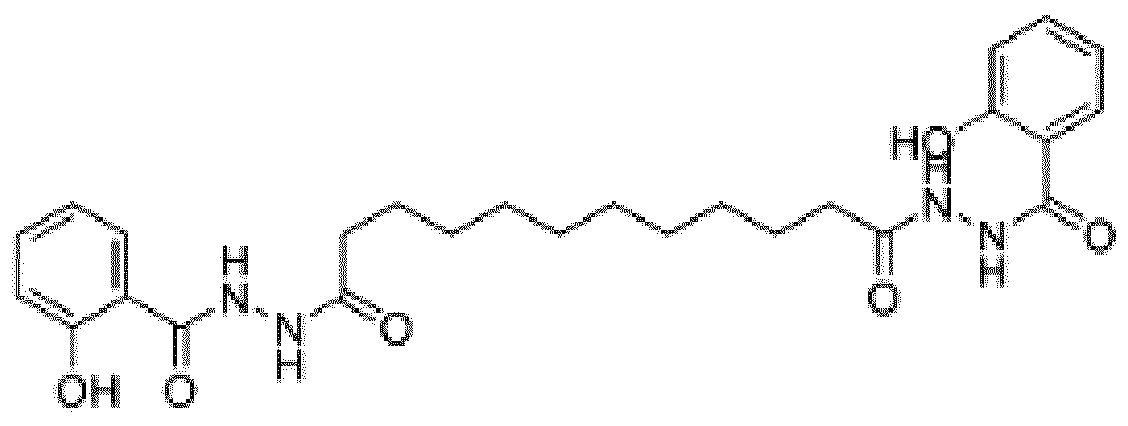
- Suitable metal deactivators are, for example, ⁇ , ⁇ '-diphenyloxamide, N-salicylal-N'-salicyloylhydrazine, N, N'-bis (salicyloyl) hydrazine, N, N'-bis (3,5-di-tert-butyl-4-) hydroxyphenylpropionyl) hydrazine, 3-salicyloylamino-1, 2,4-triazole, bis (benzylidene) oxalyldihydrazide, oxanilide, isophthaloyl dihydrazide,
- metal deactivators are the following structures:
- Suitable phenolic antioxidants are, for example:
- Alkylated monophenols e.g. 2,6-di-tert-butyl-4-methylphenol, 2-tert-butyl-4,6-dimethylphenol, 2,6-di-tert-butyl-4-ethylphenol, 2,6-di- tert -butyl-4-n-butylphenol, 2,6-di-tert-butyl-4-isobutylphenol, 2,6-dicyclopentyl-4-methylphenol, 2- (a-methylcyclohexyl) -4,6-dimethylphenol, 2, 6-dioctadecyl-4-methylphenol, 2,4,6-tricyclohexylphenol, 2,6-di-ieri-butyl-4-methoxymethylphenol, linear or branched nonylphenols, such as 2,6-Dinonyl-4-methylphenol, 2,4-dimethyl-6- (1-methylundec-1-yl) phenol, 2,4-dimethyl-6- (1-methyl
- Alkylthiomethylphenols e.g. 2,4-dioctylthiomethyl-6-te / t-butylphenol, 2,4-dioctylthiomethyl-6-methylphenol, 2,4-dioctylthiomethyl-6-ethylphenol, 2,6-didodecylthiomethyl-4-nonylphenol;
- Hydroquinones and alkylated hydroquinones e.g. 2,6-di-tertiary-butyl-4-methoxy-phenol, 2,5-di-tert-butyl-hydroquinone, 2,5-di-alpha-amyl-hydroquinone, 2,6-diphenyl-4-octadecyloxyphenol, 2,6- Di-ieri-butylhydroquinone, 2,5-di-uteri-butyl-4-hydroxyanisole, 3,5-di-ieri-butyl-4-hydroxyanisole, 3,5-di-ieri-butyl-4-hydroxyphenylstearate, bis ( 3,5-di-ieri-butyl-4-hydroxyphenyl) adipate;
- Tocopherols e.g. ⁇ -, ⁇ -, ⁇ -, ⁇ -tocopherol and mixtures of these (vitamin E);
- Hydroxylated thiodiphenyl ethers e.g. 2,2'-thiobis (6-ieri-butyl-4-methylphenol), 2,2'-thiobis (4-octylphenol), 4,4'-thiobis (6-ieri-butyl-3-methylphenol), 4, 4'-Thiobis (6-ieri-butyl-2-methylphenol), 4,4'-thiobis (3,6-di-5ec-amylphenol), 4,4'-bis (2,6-dimethyl-4-hydroxyphenyl )disulfide;
- Alkylidene bisphenols such as 2,2'-methylenebis (6-ieri-butyl-4-methylphenol), 2,2'-methylenebis (6-ieri-butyl-4-ethylphenol), 2,2'-methylenebis [4-methyl] 6- ( ⁇ -methylcyclohexyl) phenol], 2,2'-methylenebis (4-methyl-6-cyclohexylphenol), 2,2'-methylenebis (6-nonyl-4-methylphenol), 2,2'-methylenebis (4 , 6-di-ethyl-butylphenol), 2,2'-ethylidenebis (4,6-di-ieri-butylphenol), 2,2'-ethylidenebis (6- tert-butyl-4-isobutylphenol), 2,2'-methylenebis [6- (a-methylbenzyl) -4-nonylphenol], 2,2'-methylenebis [6- (a, a-dimethylbenzyl) -4-nonylphenol]
- N and S benzyl compounds e.g. 3,5,3 ', 5'-tetra-ieri-butyl-4,4'-dihydroxydibenzyl ether, octadecyl-4-hydroxy-3,5-dimethylbenzylmercaptoacetate, tridecyl-4-hydroxy-3,5-di-ieri-butylbenzylmercaptoacetate , Tris (3,5-di-ieri-butyl-4-hydroxybenzyl) amine, bis (4-yl-butyl-3-hydroxy-2,6-dimethylbenzyl) dithioterephthalate, bis (3,5-di-tert-butyl) butyl-4-hydroxybenzyl) sulfide, isooctyl-3,5-di-ieri-butyl-4-hydroxybenzylmercaptoacetate;
- Hydroxybenzylated malonates e.g. Dioctadecyl 2,2-bis (3,5-di-i-butyl-2-hydroxybenzyl) malonate, dioctadecyl-2- (3-yl-butyl-4-hydroxy-5-methylbenzyl) malonate, didodecylmercaptoethyl-2,2 bis (3,5-di-ieri-butyl-4-hydroxybenzyl) malonate, bis [4- (l, l, 3,3-tetramethylbutyl) phenyl] -2,2-bis (3,5-di-C butyl-4-hydroxybenzyl) malonate;
- Aromatic hydroxybenzyl compounds such as e.g. 1, 3,5-tris (3,5-di-tert-butyl-4-hydroxybenzyl) -2,4,6-trimethylbenzene, 1,4-bis (3,5-di-tert-butyl) 4-hydroxybenzyl) -2,3,5,6-tetramethylbenzene, 2,4,6-tris (3,5-di-i-butyl-4-hydroxybenzyl) phenol;
- Triazine compounds such as 2,4-bis (octylmercapto) -6- (3,5-di-tert-butyl-4-hydroxyanilino) -1,3,5-triazine, 2-octylmercapto-4,6-bis (3,5-di-te / t-butyl-4- hydroxyanilino) -l, 3,5-triazine, 2-octylmercapto-4,6-bis (3,5-di-tert-butyl-4-hydroxyphenoxy) -l, 3,5-triazine, 2,4, 6-tris (3,5-di-tert-butyl-4-hydroxyphenoxy) -1,2,3-triazine, 1,3,5-tris (3,5-di-tert-butyl-4-hydroxybenzyl ) isocyanurate, 1,3,5-tris (4-yl-butyl-3-hydroxy-2,6-dimethylbenzyl) isocyanurate, 2,
- Benzyl phosphonates e.g. Dimethyl 2,5-di-tert-butyl-4-hydroxybenzylphosphonate, diethyl 3,5-di-i-di-4-hydroxybenzylphosphonate, dioctadecyl-3,5-di-i-butyl-4-hydroxybenzylphosphonate, Dioctadecyl-5-ieri-butyl-4-hydroxy-3-methylbenzylphosphonate, the calcium salt of the monoethyl ester of 3,5-di-tertiarybutyl-4-hydroxybenzylphosphonic acid;
- Acylaminophenols e.g. 4-hydroxylauranilide, 4-hydroxystearanilide, octyl-N- (3,5-di-i-butyl-4-hydroxyphenyl) carbamate;
- Esters of ⁇ - (3,5-di-ieri-butyl-4-hydroxyphenyl) propionic acid with mono- or polyhydric alcohols e.g. Methanol, ethanol, n-octanol, i-octanol,
- Trimethylolpropane 4-hydroxymethyl-1-phospha-2,6,7-trioxabicyclo [2.2.2] octane.
- Esters of ⁇ - (5-yl-butyl-4-hydroxy-3-methylphenyl) propionic acid with mono- or polyhydric alcohols e.g. Methanol, ethanol, n-octanol, i-octanol, octadecanol, 1,6-hexanediol, 1,9-nonanediol, ethylene glycol, 1,2-propanediol,
- Trimethylolpropane 4-hydroxymethyl-1-phospha-2,6,7-trioxabicyclo [2.2.2] octane, 3,9-bis [2- ⁇ 3- (3-tert-butyl-4-hydroxy-5-) methylphenyl) propionyloxy ⁇ -1, 1-dimethylethyl] -2,4,8,10-tetraoxaspiro [5.5] undecane;
- Esters of ⁇ - (3,5-dicyclohexyl-4-hydroxyphenyl) propionic acid with mono- or polyhydric alcohols e.g. Methanol, ethanol, octanol, octadecanol, 1,6-
- Esters of 3,5-di-ieri-butyl-4-hydroxyphenyl) acetic acid with monohydric or polyhydric alcohols e.g. Methanol, ethanol, octanol, octadecanol, 1,6-hexanediol, 1,9-nonanediol, ethylene glycol, 1,2-propanediol, neopentyl glycol, thiodiethylene glycol, diethylene glycol, triethylene glycol, pentaerythritol,
- vitamin C Ascorbic acid (vitamin C).
- Particularly preferred phenolic antioxidants are:
- Octadecyl 3- (3,5-di-ieri-butyl-4-hydroxyphenyl) propionate, pentaerythritol tetrakis [3- (3,5-di-i-butyl-4-hydroxyphenyl) propionate, tris (3,5-) di-tert-butyl-4-hydroxyphenyl) isocyanurate, 1,3,5-trimethyl-2,4,6-tris (3,5-di-i-butyl-4-hydroxyphenyl) isocyanurate, l, 3, 5-trimethyl-2,4,6-tris (3,5-di-ieri-butyl-4-hydroxybenzyl) benzene, triethylene glycol bis [3- (3-yl-butyl-4-hydroxy-5- methylphenyl) propionate, N, N'-hexane-l, 6-diyl-bis [3- (3,5-di-ieri-butyl-4-hydroxyphenyl) propionic acid amide.
- Suitable phosphites / phosphonites are, for example:
- Triphenyl phosphite diphenyl alkyl phosphites, phenyl dialkyl phosphites,
- Tri (nonylphenyl) phosphite Tri (nonylphenyl) phosphite, trilauryl phosphites, trioctadecyl phosphite,
- Diisodecyloxypentaerythritol diphosphite bis (2,4-di-ieri-butyl-6-methylphenyl) pentaerythritol diphosphite, bis (2,4,6-tris (ieri-butylphenyl) pentaerythritol diphosphite, tristearylsorbitol triphosphite, tetrakis (2,4-di-ieri-butylphenyl) 4,4'-biphenylenediphosphonite, 6-isoctyloxy-2A8,10-tetra-ieri-butyl-12H-dibenzo [d, g] -l, 3,2-dioxaphosphocine, bis (2,4-di-ieri-butyl -6-methylphenyl) methyl phosphite, bis (2,4-di-ieri-butyl-6-methylphenyl) ethyl phosphite, 6-fluoro
- Particularly preferred phosphites / phosphonites are:
- Suitable stabilizers are amine antioxidants.
- Suitable aminic antioxidants are, for example:
- aminic antioxidants are hydroxylamines or N-oxides (nitrones), e.g. ⁇ , ⁇ -dialkylhydroxylamine, N, N-dibenzylhydroxylamine, ⁇ , ⁇ -dilaurylhydroxylamine, N, N-distearylhydroxylamine, N-benzyl-a-phenylnitrone, N-octadecyl-a-hexadecylnitrone, and Genox EP (Chemtura) according to the formula:
- Suitable stabilizers are thiosynergists.
- Thiosynergists are, for example, distearyl thiodipropionate,
- Suitable stabilizers are copper salts, e.g. Copper (I) iodide, copper (I) bromide or copper complexes such as e.g. Triphenylphosphine-copper (I) complexes.
- copper salts e.g. Copper (I) iodide, copper (I) bromide or copper complexes such as e.g. Triphenylphosphine-copper (I) complexes.
- Suitable hindered amines are, for example, 1,1-bis (2,2,6,6-tetramethyl-4-piperidyl) succinate, bis (l, 2,2,6,6-pentamethyl-4-piperidyl) sebazate, bis (l octyloxy-2,2,6,6-tetramethyl-4-piperidyl) sebacate, bis (l, 2,2,6,6-pentamethyl) 4-piperidyl) -n-butyl-3,5-di-tert-butyl-4-hydroxybenzylmalonate, the condensation product of 1- (2-hydroxyethyl) -2,2,6,6-tetramethyl-4-hydroxypiperidine and succinic acid, linear or cyclic condensation products of N, N'-bis (2,2,6,6-tetramethyl-4-piperidyl) hexamethylenediamine and 4-yl-octylamino-2,6-di-chloro-1, 3,5-triazine , Tris (2
- Polyacrylates e.g. Long chain side chain copolymers, polyacrylate block copolymers, alkylamides: e.g. N, N'-l, 2-ethanediyl-bisoctadecanamide sorbitan ester, e.g. Monostearyl sorbitan esters, titanates and zirconates, reactive copolymers having functional groups, e.g. Polypropylene-co-acrylic acid, polypropylene-co-maleic anhydride, polyethylene-co-glycidyl methacrylate, polystyrene-old-maleic anhydride-polysiloxanes: e.g.
- Dimethylsilanediol-ethylene oxide copolymer, polyphenylsiloxane copolymer, amphiphilic copolymers e.g. Polyethylene block polyethylene oxide, dendrimers, e.g. hydroxyl-group-containing dendrimers.
- Suitable nucleating agents are, for example, talc, alkali or alkaline earth salts of mono- and polyfunctional carboxylic acids such as e.g. Benzoic acid, succinic acid, adipic acid, e.g. Sodium benzoate, zinc glycerolate, aluminum hydroxy-bis (4-te / t-butyl) benzoate, benzylidene sorbitols, e.g. 1.3: 2.4
- Suitable fillers and reinforcing agents are for example synthetic or natural materials such as calcium carbonate, silicates, glass fibers, glass beads (solid or hollow), talc, mica, kaolin, barium sulfate, metal oxides and metal hydroxides, carbon black, graphite, carbon nanotubes, graphene, wood flour or fibers of natural products such as cellulose or synthetic fibers.
- Other suitable fillers are hydrotalcites or zeolites or sheet silicates such as montmorillonite, bentonite, beidelite, mica, hectorite, saponite, vermiculite, ledikite, magadite, lllite, kaolinite, wollastonite, attapulgite.
- Suitable pigments may be inorganic or organic in nature.
- Suitable inorganic pigments are, for example, titanium dioxide, zinc oxide,
- Zinc sulphide iron oxide, ultramarine, carbon black.
- Suitable organic pigments are, for example, anthraquinones, anthanthrones, benzimidazolones, quinacridones, diketopyrrolopyrroles, dioxazines, indanthrones, isoindolinones, azo compounds, perylenes, phthalocyanines or pyranthrones.
- Other suitable pigments are metal-based effect pigments or pearlescent pigments
- Optical brighteners are, for example, bisbenzoxazoles, phenylcoumarins or bis (styryl) biphenyls and in particular optical brighteners of the formulas:
- Suitable filler deactivators are, for example, epoxides such as e.g. Bisphenol A diglycidyl ether, polysiloxanes, polyacrylates in particular
- Block copolymers such as polymethacrylic polyalkylene oxide.
- Suitable antistatic agents are, for example, ethoxylated alkylamines, fatty acid esters, alkylsulfonates and polymers such as e.g. Polyether amides.
- the present invention relates to a molding composition, a molding, a paint or a coating produced from a previously described flame-retardant plastic composition, in particular in the form of injection molded parts, films or films, coatings or paints, foams,
- compositions of the present invention may be used for marine applications (pontoons, planks, boats), automotive applications (bumpers, batteries, cowlings, fuel tanks, cables, conduits, etc.), aircraft parts, railway parts, bicycle and motorcycle parts, space applications such as satellite parts, housing parts for Electrical appliances such as computers, telephones, printers, audio and video systems, plugs, printed circuits, switches, lamp covers, refrigerators, coffee machines, vacuum cleaners, power generation rotor blades, fans, roofing membranes, construction films, pipes such as sewage pipes and gas pipes Fittings, drainage systems, profiles such as window profiles or conduits, wood composites, furniture, flooring, cladding panels, artificial turf, stadium seats, carpets, nets, ropes, furniture parts, mats, garden chairs, crates, containers and barrels.
- the invention also relates to a method for producing a previously described plastic composition according to the invention, in which the at least one organic oxyimide before, after or simultaneously with the at least one further flame retardant in the at least one plastic, preferably the at least one thermoplastic polymer is incorporated.
- Single-screw extruders, twin-screw extruders, planetary roller extruders, ring extruders, co-kneaders which are preferably equipped with a vacuum degassing.
- the processing can be done under air or under
- Various flame retardants and additives can be added separately or as a mixture, in the form of liquids, powders, granules or compacted products or likewise in the form of masterbatches or concentrates containing, for example, SO 80% of the compositions according to the invention.
- the invention likewise relates to a flameproofing composition consisting of an organic oxyimide containing at least one structural element of the formula I depicted below,
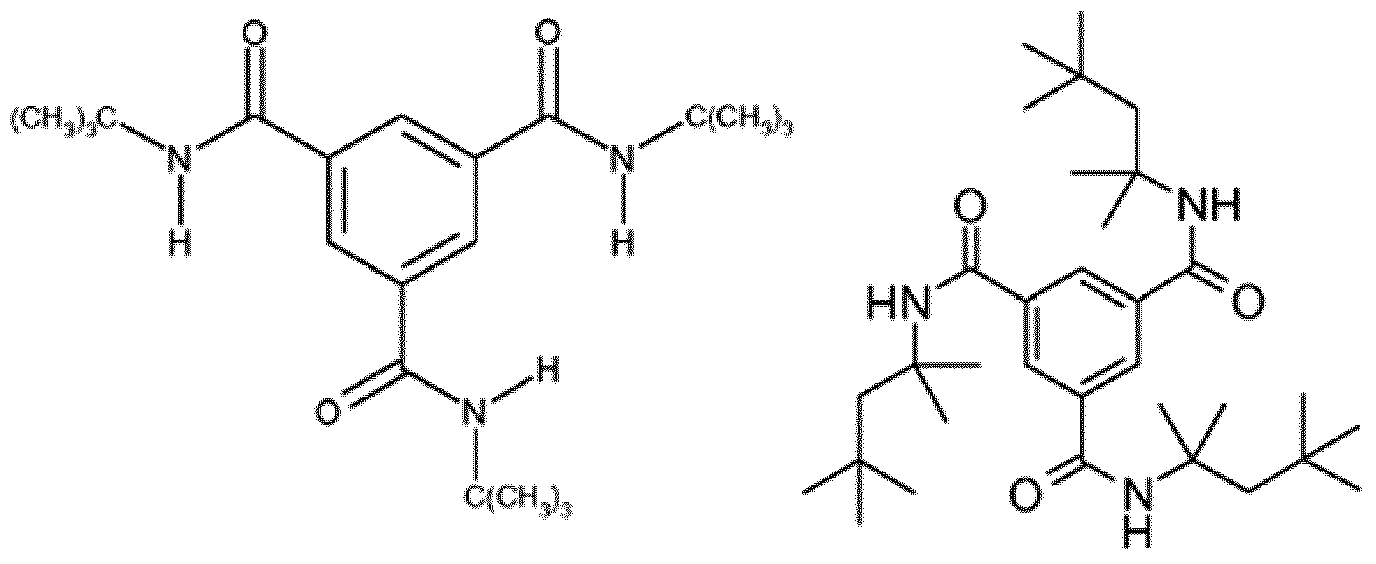
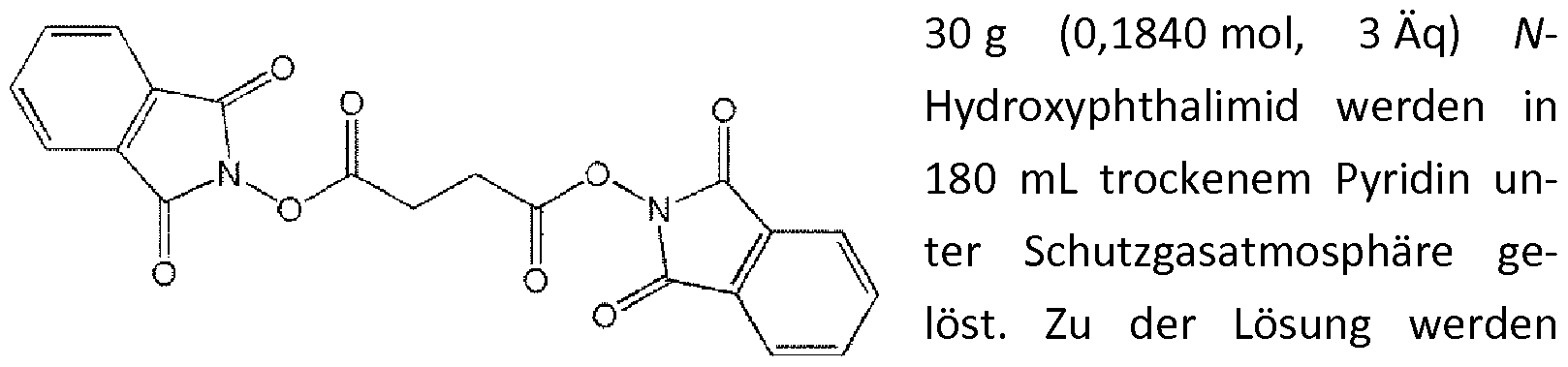
- Trimesyl trichloride in 19 mL of distilled acetone was added dropwise. After completion of the addition The mixture is stirred for 1 h at 5 ° C, then the reaction mixture is stirred for 12 h at room temperature. The precipitated, white solid is filtered off and washed with 5% hydrochloric acid and with water. There will be 3.9 g (78%) of a white Product received.
- the residence time of the mixture in bypass operation is 60 s.
- the desired mixture of polymer and additives (see Table 1 below) is first mixed manually in a beaker and fed in small portions to the micro-extruder. If the volume of the device is filled with melt, the material remains in the device for a further 60 s (dwell time) and is then drained off.
- the resulting plastic strands are granulated (Pell-Tec SD 50 pure).
- Test specimens for the fire test are produced from the granules at a temperature of 220 ° C and a pressure of 2 t using a hydraulic 10t press (Werner & Pfleiderer). For this purpose, the granules are filled into the mold and these transferred into the already preheated press. At a pressure of 0.5 t, the granules are first melted for 60 seconds. After the melting time, the pressure is increased to 2 1 and held constant for a further 3 min. While maintaining the contact pressure, the mold is cooled to 60 ° C and then removed the specimens.
- the specimens have the following dimensions according to the standard: 125 x 12.5 x 1.5 mm.
- Table 1 Compositions in polypropylene and results of the fire test
- Table 2 Compositions in polypropylene and results of the fire test
- Alkoxyamine Flamestab NOR 116 from BASF SE
- Example 36 Analogously to Examples 1-35 according to the invention, a thermoplastic polyurethane (Elastollan 1185A from BASF SE) was processed with 8% diethylaluminum phosphinate and 4% of compound 3 at 190 ° C. and compressed at 200 ° C. to test specimens. The classification V-2 with a total burning time (4 specimens) of 1.3 seconds is obtained.
- a thermoplastic polyurethane (Elastollan 1185A from BASF SE) was processed with 8% diethylaluminum phosphinate and 4% of compound 3 at 190 ° C. and compressed at 200 ° C. to test specimens.
- the classification V-2 with a total burning time (4 specimens) of 1.3 seconds is obtained.
- Phosphate phosphoric acid
- P, P '- [l, l'-biphenyl] -4,4'-diyl ⁇ , ⁇ , ⁇ ', ⁇ '-tetraphenyl ester ADK rod FP 800 from Adeka
Landscapes
- Chemical & Material Sciences (AREA)
- Organic Chemistry (AREA)
- Chemical Kinetics & Catalysis (AREA)
- Medicinal Chemistry (AREA)
- Polymers & Plastics (AREA)
- Health & Medical Sciences (AREA)
- Materials Engineering (AREA)
- Engineering & Computer Science (AREA)
- Life Sciences & Earth Sciences (AREA)
- Wood Science & Technology (AREA)
- Compositions Of Macromolecular Compounds (AREA)
- Fireproofing Substances (AREA)
- Paints Or Removers (AREA)
- Indole Compounds (AREA)
Abstract
Description





















Claims




Priority Applications (7)
| Application Number | Priority Date | Filing Date | Title |
|---|---|---|---|
| KR1020157027558A KR101907429B1 (ko) | 2013-03-25 | 2014-03-24 | 플라스틱 및 난연성 플라스틱 조성물용 난연제로서 유기 옥시 이미드의 용도 및 이로부터 생성된 성형물 |
| EP14713798.8A EP2978804B1 (de) | 2013-03-25 | 2014-03-24 | Verwendung von organischen oxyimiden als flammschutzmittel für kunststoffe sowie flammgeschützte kunststoffzusammensetzung und hieraus hergestellte formteile |
| KR1020187016819A KR102006739B1 (ko) | 2013-03-25 | 2014-03-24 | 플라스틱 및 난연성 플라스틱 조성물용 난연제로서 유기 옥시 이미드의 용도 및 이로부터 생성된 성형물 |
| US14/779,849 US10913743B2 (en) | 2013-03-25 | 2014-03-24 | Use of organic oxyimides as flame retardant for plastic materials and also flame-retardant plastic material composition and moulded parts produced therefrom |
| CN201480017757.XA CN105102522B (zh) | 2013-03-25 | 2014-03-24 | 有机氧代酰亚胺作为用于塑料的阻燃剂的用途和阻燃塑料组合物及由其制造的模塑件 |
| JP2016503685A JP6247378B2 (ja) | 2013-03-25 | 2014-03-24 | プラスチック材料用難燃剤としての有機オキシイミドの使用、難燃性プラスチック材料組成物、およびそれから製造された成形品 |
| ES14713798T ES2703951T3 (es) | 2013-03-25 | 2014-03-24 | Uso de oximidas orgánicas como materiales ignífugos para plásticos, composición plástica ignífuga y piezas moldeadas fabricadas a partir de la misma |
Applications Claiming Priority (2)
| Application Number | Priority Date | Filing Date | Title |
|---|---|---|---|
| DE102013005307.2 | 2013-03-25 | ||
| DE102013005307.2A DE102013005307A1 (de) | 2013-03-25 | 2013-03-25 | Verwendung von organischen Oxyimiden als Flammschutzmittel für Kunststoffe sowie flammgeschützte Kunststoffzusammensetzung und hieraus hergestelltem Formteil |
Publications (1)
| Publication Number | Publication Date |
|---|---|
| WO2014154636A1 true WO2014154636A1 (de) | 2014-10-02 |
Family
ID=50391157
Family Applications (1)
| Application Number | Title | Priority Date | Filing Date |
|---|---|---|---|
| PCT/EP2014/055847 Ceased WO2014154636A1 (de) | 2013-03-25 | 2014-03-24 | Verwendung von organischen oxyimiden als flammschutzmittel für kunststoffe sowie flammgeschützte kunststoffzusammensetzung und hieraus hergestellte formteile |
Country Status (9)
| Country | Link |
|---|---|
| US (1) | US10913743B2 (de) |
| EP (1) | EP2978804B1 (de) |
| JP (1) | JP6247378B2 (de) |
| KR (2) | KR101907429B1 (de) |
| CN (1) | CN105102522B (de) |
| DE (1) | DE102013005307A1 (de) |
| ES (1) | ES2703951T3 (de) |
| TR (1) | TR201819798T4 (de) |
| WO (1) | WO2014154636A1 (de) |
Cited By (10)
| Publication number | Priority date | Publication date | Assignee | Title |
|---|---|---|---|---|
| WO2015180888A1 (de) * | 2014-05-28 | 2015-12-03 | Fraunhofer-Gesellschaft zur Förderung der angewandten Forschung e.V. | Verwendung von oxyimid-enthaltenden copolymeren oder polymeren als flammschutzmittel, stabilisatoren, rheologiemodifikatoren für kunststoffe, initiatoren für polymerisations- und pfropfprozesse, vernetzungs- oder kopplungsmittel sowie solche copolymere oder polymere enthaltende kunststoffformmassen |
| WO2015189034A1 (de) | 2014-06-12 | 2015-12-17 | Fraunhofer-Gesellschaft zur Förderung der angewandten Forschung e.V. | Verwendung von hydroxybenzotriazol-derivaten und/oder hydroxy-indazol-derivaten als flammschutzmittel für kunststoffe sowie flammgeschützte kunststoffformmasse |
| CN105176182A (zh) * | 2015-09-06 | 2015-12-23 | 王璐 | 一种印刷油墨用抗菌阻燃添加剂 |
| WO2016042038A1 (de) | 2014-09-18 | 2016-03-24 | Fraunhofer-Gesellschaft zur Förderung der angewandten Forschung e.V. | Verwendung von organischen oxyimiden als radikalgeneratoren in kunststoffen, verfahren zur erzeugung von radikalen in kunststoffen sowie verwendung des verfahrens |
| WO2016042043A1 (de) * | 2014-09-18 | 2016-03-24 | Fraunhofer-Gesellschaft zur Förderung der angewandten Forschung e.V. | Verwendung von organischen oxyimidsalzen als flammschutzmittel, flammengeschützte kunststoffzusammensetzung, verfahren zu ihrer herstellung sowie formteil, lack oder beschichtung |
| WO2018137883A2 (de) | 2017-01-24 | 2018-08-02 | Thor Gmbh | Wirkverbesserte flammschutzzusammensetzungen enthaltend ein phosphonsäurederivat |
| WO2019020699A1 (de) | 2017-07-25 | 2019-01-31 | Fraunhofer-Gesellschaft zur Förderung der angewandten Forschung e.V. | Halogenfreie sulfonsäureester und/oder sulfinsäureester als flammschutzmittel, flammschutzmittelsynergisten und radikalgeneratoren in kunststoffen |
| US10214631B2 (en) | 2012-11-19 | 2019-02-26 | Fraunhofer-Gesellschaft zur Förderung der angewandten Forschung e.V. | Polymer composition with improved long-term stability, moulded parts produced herefrom and also purposes of use |
| DE102018201018A1 (de) | 2018-01-23 | 2019-07-25 | Fraunhofer-Gesellschaft zur Förderung der angewandten Forschung e.V. | Verwendung von Terephthaloyl-bis-N,N'-naphthalimidestern als Nukleierungsmittel für thermoplastische Formmassen, Verfahren zur Kristallisation von thermoplastischen Kunststoffen sowie kristalline thermoplastische Kunststoffzusammensetzungen |
| WO2020207042A1 (zh) * | 2019-04-09 | 2020-10-15 | 南京林业大学 | 一种木质素膨胀型阻燃剂及其制备方法 |
Families Citing this family (39)
| Publication number | Priority date | Publication date | Assignee | Title |
|---|---|---|---|---|
| DE102012222991A1 (de) * | 2012-12-12 | 2014-06-12 | Henkel Ag & Co. Kgaa | Verfahren zur Degradierung von (Co)polymeren |
| DE102013005307A1 (de) | 2013-03-25 | 2014-09-25 | Fraunhofer-Gesellschaft zur Förderung der angewandten Forschung e.V. | Verwendung von organischen Oxyimiden als Flammschutzmittel für Kunststoffe sowie flammgeschützte Kunststoffzusammensetzung und hieraus hergestelltem Formteil |
| EP3218436B1 (de) * | 2014-11-13 | 2022-10-05 | SABIC Global Technologies B.V. | Polyesterzusammensetzung und daraus hergestellter artikel |
| DE102015211632A1 (de) | 2015-06-23 | 2016-12-29 | Fraunhofer-Gesellschaft zur Förderung der angewandten Forschung e.V. | Polymerzusammensetzung mit verzögertem Kristallisationsverhalten, das Kristallisationsverhalten beeinflussende Additivzusammensetzung, Verfahren zur Herabsetzung des Kristallisationspunktes sowie Verwendung einer Additivzusammensetzung |
| CN105348709A (zh) * | 2015-11-30 | 2016-02-24 | 芜湖成德龙过滤设备有限公司 | 膜材材料组合物和膜材的制备方法 |
| DE102016221346A1 (de) | 2016-10-28 | 2018-05-03 | Fraunhofer-Gesellschaft zur Förderung der angewandten Forschung e.V. | Verfahren zur Herstellung eines Polymerisates durch Nitroxyl-kontrollierte Polymerisation sowie Polymerisat |
| CN106589214B (zh) * | 2016-12-24 | 2019-01-18 | 衢州普信新材料有限公司 | 一种阻燃型聚甲基丙烯酸甲酯的制备方法 |
| CN106589200B (zh) * | 2016-12-24 | 2018-10-02 | 上海普信高分子材料有限公司 | 一种阻燃型聚苯乙烯的制备方法 |
| CN106987081B (zh) * | 2017-03-17 | 2019-10-25 | 浙江森川家具有限公司 | 一种轻质无卤阻燃型abs塑料椅用复合材料及其制备方法 |
| JP7170632B2 (ja) * | 2017-05-25 | 2022-11-14 | 株式会社Adeka | 難燃剤組成物及びそれを含有する難燃性樹脂組成物 |
| JP7158384B2 (ja) | 2017-07-24 | 2022-10-21 | 株式会社Adeka | 組成物及び難燃性樹脂組成物 |
| DE102017217312A1 (de) | 2017-09-28 | 2019-03-28 | Fraunhofer-Gesellschaft zur Förderung der angewandten Forschung e.V. | Verfahren zur Stabilisierung von halogenfreien thermoplastischen Kunststoff-Rezyklaten sowie stabilisierte Kunststoffzusammensetzungen und hieraus hergestellte Formmassen und Formteile |
| FR3071965B1 (fr) * | 2017-10-02 | 2019-10-25 | Arkema France | Coffre a batterie |
| DE102017220555A1 (de) | 2017-11-17 | 2019-05-23 | Fraunhofer-Gesellschaft zur Förderung der angewandten Forschung e.V. | Verbindungen mit stabilisierender Wirkung, Verfahren zu deren Herstellung, Zusammensetzung enthaltend diese stabilisierenden Verbindungen, Verfahren zur Stabilisierung einer organischen Komponente sowie Verwendung von stabilisierenden Verbindungen |
| CN108084228B (zh) * | 2017-12-18 | 2019-12-03 | 寿光卫东化工有限公司 | 一种含有氮、磷和溴三种阻燃元素的化合物、制备方法及应用 |
| WO2020005040A1 (ko) * | 2018-06-29 | 2020-01-02 | 롯데첨단소재(주) | 열가소성 수지 조성물 및 이를 이용한 성형품 |
| KR102360000B1 (ko) * | 2018-06-29 | 2022-02-09 | 롯데첨단소재(주) | 열가소성 수지 조성물 및 이를 이용한 성형품 |
| US10941295B2 (en) | 2018-10-13 | 2021-03-09 | International Business Machines Corporation | Molecular glasses as rheological modifiers in high-performance polymers |
| DE102018218120A1 (de) | 2018-10-23 | 2020-04-23 | Fraunhofer-Gesellschaft zur Förderung der angewandten Forschung e.V. | Verfahren zur Stabilisierung von thermoplastischer Kunststoffneuware sowie stabilisierte Kunststoffzusammensetzungen, hieraus hergestellte Formmassen und Formteile, Stabilisator-Zusammensetzungen sowie Verwendungen hiervon |
| CN109679335B (zh) * | 2018-11-23 | 2021-07-20 | 中广核俊尔新材料有限公司 | 一种低表面析出的红磷阻燃增强尼龙材料及其制备方法 |
| DE102019200596A1 (de) | 2019-01-17 | 2020-07-23 | Fraunhofer-Gesellschaft zur Förderung der angewandten Forschung e.V. | Verwendung einer additivzusammensetzung zum kontrollierten beschleunigten abbau von kondensationspolymeren |
| DE102019204160A1 (de) | 2019-03-26 | 2020-10-01 | Fraunhofer-Gesellschaft zur Förderung der angewandten Forschung e.V. | Verfahren zur Stabilisierung von thermoplastischen Kunststoff-Rezyklaten sowie stabilisierte Kunststoffzusammensetzungen und hieraus hergestellte Formmassen und Formteile |
| DE102019210040A1 (de) | 2019-07-08 | 2021-01-14 | Fraunhofer-Gesellschaft zur Förderung der angewandten Forschung e.V. | Verwendung von phenolisch substituierten Zuckerderivaten als Stabilisatoren, Kunststoffzusammensetzung, Verfahren zur Stabilisierung von Kunststoffen sowie phenolisch substituierte Zuckerderivate |
| DE102019213606B4 (de) | 2019-09-06 | 2022-04-21 | Fraunhofer-Gesellschaft zur Förderung der angewandten Forschung e.V. | Oligomer oder polymer, zusammensetzung sowie verwendung des oligomers oder polymers |
| CN110760184A (zh) * | 2019-09-27 | 2020-02-07 | 金旸(厦门)新材料科技有限公司 | 一种改善涂料附着效果的聚酰胺材料及其制备方法和应用 |
| WO2021151493A1 (en) | 2020-01-30 | 2021-08-05 | Nordtreat Finland Oy | Flame retardant chemical compositions |
| CN112409567B (zh) * | 2020-11-11 | 2022-05-10 | 长春工业大学 | 一种基于dopo的p-n型阻燃剂的制备方法 |
| CN113036216B (zh) * | 2021-03-10 | 2023-04-25 | 西北工业大学 | 复合阻燃剂改性的peo基固态聚合物电解质及制备方法 |
| KR102387738B1 (ko) * | 2021-09-08 | 2022-04-18 | 이경진 | 면발의 굵기가 상이한 롤러형 제면기 |
| KR102387746B1 (ko) * | 2021-09-08 | 2022-04-18 | 이경진 | 면발의 굵기가 상이한 실린더형 제면기 |
| CN115211300B (zh) * | 2022-02-16 | 2024-04-12 | 江苏永顺新材料科技有限公司 | 一种强耐候性的植草格及其制备方法 |
| CN114805926B (zh) * | 2022-05-31 | 2023-05-05 | 北京工商大学 | 一种含有阻燃协效剂的甲基八溴醚重结晶制备方法及其阻燃发泡聚苯乙烯材料 |
| US20240166857A1 (en) * | 2022-11-17 | 2024-05-23 | Carlisle Construction Materials, LLC | Halogen-free rubber compositions and membranes |
| US11944858B1 (en) | 2023-05-04 | 2024-04-02 | E-Firex | Fire suppression composition and method of encapsulation, thermal runaway prevention |
| CN119019742A (zh) * | 2023-05-18 | 2024-11-26 | 波音公司 | 含植物纤维搁板的制造方法及由其制造的搁板 |
| CN116987345B (zh) * | 2023-09-27 | 2023-12-01 | 南方珠江科技有限公司 | 一种耐热绝缘架空电缆及其制备方法 |
| WO2026033164A1 (en) | 2024-08-06 | 2026-02-12 | Idipsum Oy | Compounds, polymers, compositions and uses thereof, methods for preparing the compounds, the polymers, and molding compounds, and molding compounds obtainable by the methods |
| CN119081175B (zh) * | 2024-08-08 | 2025-04-25 | 江苏金大包装材料科技有限公司 | 一种轻质柔软标签薄膜的制备工艺 |
| CN120082199A (zh) * | 2025-03-25 | 2025-06-03 | 金发科技股份有限公司 | 一种聚酰胺复合材料及其制备方法和应用 |
Citations (2)
| Publication number | Priority date | Publication date | Assignee | Title |
|---|---|---|---|---|
| US3915930A (en) * | 1972-10-20 | 1975-10-28 | Cities Service Co | Flame-retardant composition |
| US20090286060A1 (en) * | 2005-09-07 | 2009-11-19 | Massimiliano Sala | Degradable polymer article |
Family Cites Families (86)
| Publication number | Priority date | Publication date | Assignee | Title |
|---|---|---|---|---|
| DE268249C (de) | ||||
| CA819181A (en) | 1969-07-29 | J. Heilman William | Process for a maleic anhydride-aliphatic olefin copolymer | |
| US2716101A (en) | 1952-09-10 | 1955-08-23 | Eastman Kodak Co | Polymeric organo-phosphonates containing phosphato groups |
| US2682522A (en) | 1952-09-10 | 1954-06-29 | Eastman Kodak Co | Process for preparing polymeric organo-phosphonates |
| US2891915A (en) | 1954-07-02 | 1959-06-23 | Du Pont | Organophosphorus polymers |
| JPS4120234B1 (de) * | 1964-02-19 | 1966-11-25 | ||
| US3326852A (en) | 1964-08-10 | 1967-06-20 | Owens Illinois Inc | Resinous polymeric phosphonates |
| DE1274578B (de) | 1965-01-21 | 1968-08-08 | Bayer Ag | Verfahren zur Herstellung von Cycloalkylaminverbindungen |
| US3578641A (en) | 1968-04-01 | 1971-05-11 | Monsanto Co | Resinous esters of polymeric n-hydroxyimides |
| US3488329A (en) | 1968-04-01 | 1970-01-06 | Monsanto Co | N-hydroxy nitrogenous copolymers |
| JPS5615656B2 (de) | 1974-04-27 | 1981-04-11 | ||
| US3919363A (en) | 1974-04-30 | 1975-11-11 | Nissan Chemical Ind Ltd | Process for preparing poly(sulfonyl-phenylene)phenylphosphonate |
| US4218332A (en) | 1977-09-16 | 1980-08-19 | The United States Of America As Represented By The Secretary Of Agriculture | Tetrasulfide extreme pressure lubricant additives |
| JPS54149751A (en) * | 1978-05-17 | 1979-11-24 | Teruo Ikoma | Heat resistant sysnthetic resin |
| DE2925207A1 (de) | 1979-06-22 | 1981-01-29 | Bayer Ag | Thermoplastische, verzweigte, aromatische polyphosphonate, ihre verwendung und ein verfahren zu ihrer herstellung |
| DE2925206A1 (de) | 1979-06-22 | 1981-01-29 | Bayer Ag | Aromatische polyesterphosphonate, verfahren zu ihrer herstellung und ihre verwendung zur herstellung thermoplastischer formkoerper |
| DE2944093A1 (de) | 1979-10-31 | 1981-05-14 | Bayer Ag, 5090 Leverkusen | Verfahren zur herstellung von thermoplastischen aromatischen polyphosphonaten verbesserter thermischer alterungsbestaendigkeit und deren verwendung |
| DE3337857A1 (de) * | 1983-10-18 | 1985-04-25 | Bayer Ag, 5090 Leverkusen | Neue flammschutzmittel, ihre herstellung und ihre verwendung zur flammfestausruestung von polycarbonaten |
| US4868246A (en) | 1987-08-12 | 1989-09-19 | Pennwalt Corporation | Polymer bound UV stabilizers |
| DE3933548A1 (de) | 1989-10-07 | 1991-04-11 | Bayer Ag | Hochverzweigte polyphosphonate |
| DE4113157A1 (de) | 1990-09-06 | 1992-03-12 | Bayer Ag | Hochverzweigte polyphosphonate auf melamin-basis |
| US5616153A (en) | 1995-10-03 | 1997-04-01 | Ethyl Corporation | Copolymer dispersants via vinyl terminated propene polymers |
| DE69705317T2 (de) | 1996-10-31 | 2001-12-06 | Ciba Speciality Chemicals Holding Inc., Basel | Funktionalisierte polymere |
| JPH10213912A (ja) | 1997-01-30 | 1998-08-11 | Sharp Corp | 電子写真感光体 |
| KR100540156B1 (ko) | 1997-06-30 | 2005-12-29 | 시바 스폐셜티 케미칼스 홀딩 인코포레이티드 | 방염제 조성물 |
| DE19810745C2 (de) | 1998-03-12 | 2000-05-04 | Bayer Ag | Flüssige Katalysatorformulierung aus Tetraphenylphosphoniumphenolat und Phenol und deren Verwendung |
| DE60007914T2 (de) | 1999-05-13 | 2004-12-23 | Union Carbide Chemicals & Plastics Technology Corp., Danbury | Halbleitfähiger Kabelschirm |
| US6288210B1 (en) | 1999-11-12 | 2001-09-11 | Virginia Tech. Intellectual Properties, Inc. | High refractive index thermoplastic polyphosphonates |
| DE10022946A1 (de) | 2000-05-11 | 2001-11-15 | Mitsubishi Polyester Film Gmbh | Weisse, zumindest einseitig matte, biaxial orientierte, UV-stabilisierte und schwer entflammbare Polyesterfolie mit Cycloolefincopolymer (COC), Verfahren zu ihrer Herstellung und ihre Verwendung |
| EP1379584B1 (de) | 2001-03-20 | 2005-08-24 | Ciba Specialty Chemicals Holding Inc. | Flammhemmende zusammensetzungen |
| DE60232452D1 (de) | 2001-08-15 | 2009-07-09 | Ciba Holding Inc | Flammwidrige zusammensetzungen |
| CN100546992C (zh) | 2001-10-04 | 2009-10-07 | 旭瑞达有限公司 | 羟基封端的低聚膦酸酯 |
| DE10206982B4 (de) | 2002-02-20 | 2004-03-25 | Forschungszentrum Karlsruhe Gmbh | Verfahren zur Herstellung von 6-Alkoxy-(6H)-dibenz(c,e)(1,2)-oxaphosphorinen |
| US6861499B2 (en) | 2003-02-24 | 2005-03-01 | Triton Systems, Inc. | Branched polyphosphonates that exhibit an advantageous combination of properties, and methods related thereto |
| DE102004010455A1 (de) | 2004-03-01 | 2005-09-22 | Basf Ag | Thermoplastische Polyurethane enthaltend Kohlenstoffnanoröhren |
| US7291669B2 (en) | 2004-03-16 | 2007-11-06 | Ciba Specialty Chemicals Corporation | Stabilized polyolefin compositions |
| US7910665B2 (en) | 2004-05-19 | 2011-03-22 | Icl-Ip America Inc. | Composition of epoxy resin and epoxy-reactive polyphosphonate |
| DE102004026799B4 (de) * | 2004-06-02 | 2006-05-18 | Clariant Gmbh | Pressgranulierte Flammschutzmittelzusammensetzung, Verfahren zu deren Herstellung und deren Verwendung |
| KR101247963B1 (ko) | 2004-08-31 | 2013-04-02 | 슈프레스타 엘엘씨 | 디아릴 알킬포스포네이트 및 그 올리고머/폴리머유도체들의 제조방법 |
| DE102005005862A1 (de) | 2005-02-09 | 2006-08-17 | Schill + Seilacher "Struktol" Ag | Aminoderivate von Dibenz[c,e][1,2]-oxaphosphorin-6-oxiden, Verfahren zu ihrer Herstellung und Verwendung |
| DE102005005879A1 (de) | 2005-02-09 | 2006-08-17 | Schill + Seilacher "Struktol" Ag | Stickstoffhaltige verbrückte Derivate von 6H-Dibenz[c,e][1,2]-oxaphosphorin-6-oxiden, Verfahren zu ihrer Herstellung sowie ihre Verwendung |
| JP2006299091A (ja) * | 2005-04-20 | 2006-11-02 | Sony Corp | 樹脂組成物、及びこれより作製された成形物 |
| JP4724843B2 (ja) | 2005-07-08 | 2011-07-13 | 東ソー株式会社 | マレイミド系重合体 |
| JP4918759B2 (ja) | 2005-07-08 | 2012-04-18 | 東ソー株式会社 | 光学フィルム |
| JP4674701B2 (ja) | 2005-12-14 | 2011-04-20 | 信越化学工業株式会社 | ノンハロゲン難燃樹脂組成物 |
| WO2008101845A1 (en) | 2007-02-21 | 2008-08-28 | Basf Se | Symmetric azo compounds in flame retardant compositions |
| DE102007040927A1 (de) | 2007-08-30 | 2009-03-05 | Bayer Materialscience Ag | Verfahren zur Herstellung schlagzähmodifizierter gefüllter Polycarbonat-Zusammensetzungen |
| JP5251392B2 (ja) * | 2007-10-01 | 2013-07-31 | 日立化成株式会社 | 封止用エポキシ樹脂成形材料及び電子部品装置 |
| JP5221937B2 (ja) | 2007-11-16 | 2013-06-26 | 株式会社オートネットワーク技術研究所 | 酸無水物導入高分子および高分子組成物ならびに被覆電線およびワイヤーハーネス |
| AU2008340442B2 (en) | 2007-12-21 | 2013-09-26 | Basf Se | Flame retardant compositions comprising sterically hindered amines |
| JP2009242969A (ja) * | 2008-03-31 | 2009-10-22 | Nicca Chemical Co Ltd | ポリエステル系繊維用難燃加工剤、それを用いた難燃性ポリエステル系繊維、及びその製造方法 |
| US8263800B2 (en) | 2008-07-01 | 2012-09-11 | E. I. Du Pont De Nemours And Company | Partially fluorinated sulfonated surfactants |
| US8349925B2 (en) | 2008-09-05 | 2013-01-08 | Thor Gmbh | Flame-retardant composition comprising a phosphonic acid derivative |
| TWI598357B (zh) | 2009-05-19 | 2017-09-11 | 亞比馬利股份有限公司 | Dopo衍生物阻燃劑 |
| WO2011000019A1 (de) | 2009-07-03 | 2011-01-06 | Krems Chemie Chemical Services Ag | Neue derivate von 9,10-dihydro-9-oxa-10-phosphaphenanthren-10-on |
| EP2451869A1 (de) | 2009-07-06 | 2012-05-16 | Basf Se | Flammenhemmende phenylphosphonatzusammensetzungen |
| KR101173048B1 (ko) | 2009-07-30 | 2012-08-13 | 제일모직주식회사 | 전도성 폴리아미드 복합체 조성물 및 이를 이용하여 제조된 연료 수송 튜브 |
| CN102031101B (zh) | 2009-09-25 | 2013-11-06 | 中国石油化工股份有限公司 | 一种耐温抗盐聚合物增稠剂及其制备方法 |
| WO2011067197A2 (en) * | 2009-12-02 | 2011-06-09 | Basf Se | Use of protected n-hydroxyimide derivates and transition metal as oxygen scavenger system in transparent polyolefin films |
| CN102115530B (zh) | 2009-12-30 | 2013-06-12 | 上海杰事杰新材料(集团)股份有限公司 | 一种聚酯-醚弹性体/碳纳米管复合材料的制备方法 |
| CN102712668A (zh) | 2010-01-15 | 2012-10-03 | 巴斯夫欧洲公司 | 经磷取代的烷氧胺化合物 |
| KR20120135428A (ko) | 2010-03-25 | 2012-12-13 | 바스프 에스이 | 포스핀산 염 및 니트록실 유도체의 난연성 조성물 |
| JP5238748B2 (ja) | 2010-04-19 | 2013-07-17 | シャープ株式会社 | 非水系二次電池およびその難燃剤 |
| CA2797127C (en) * | 2010-05-06 | 2017-09-05 | Graham Packaging Company, L.P. | Oxygen scavenging additives for plastic containers |
| CN102250400B (zh) | 2010-05-20 | 2012-10-17 | 北京化工大学 | 一种高ptc强度和稳定性的聚合物基复合材料及其制备方法 |
| US9228131B2 (en) | 2010-06-08 | 2016-01-05 | Union Carbide Chemicals & Plastics Technology Llc | Halogenated flame retardant systems for use in presence of silane grafting process |
| CN102342869A (zh) | 2010-07-30 | 2012-02-08 | 谢志军 | 一种ptc自控温暖手器及制造方法 |
| CN102344598A (zh) | 2010-07-30 | 2012-02-08 | 谢志军 | 一种聚合物碳纳米管碳黑复合自控温ptc电发热材料 |
| EP2426163A1 (de) | 2010-09-07 | 2012-03-07 | Bayer MaterialScience AG | Verfahren zur Herstellung von Polymer-CNT-Kompositen |
| MX2013003999A (es) | 2010-10-20 | 2013-05-20 | Basf Se | Estabilizadores de luz oligomericos con una funcionalizacion especifica. |
| WO2012089998A2 (en) | 2010-12-29 | 2012-07-05 | University Of Bradford | Methods to improve the electrical conductivity for moulded plastic parts |
| CN102115558B (zh) | 2010-12-29 | 2013-01-23 | 四川大学 | 高导电聚合物碳纳米管复合材料及其微型加工方法 |
| CN102585429B (zh) | 2011-01-11 | 2015-02-25 | 合肥杰事杰新材料股份有限公司 | 一种树脂材料、制备方法及其应用 |
| JP5636338B2 (ja) * | 2011-06-28 | 2014-12-03 | シャープ株式会社 | 非水系二次電池及びその難燃剤 |
| EP2557085B1 (de) | 2011-08-08 | 2014-10-22 | EMPA Eidgenössische Materialprüfungs- und Forschungsanstalt | Neuartige Phosphoramidate - Synthese und flammhemmende Anwendungen |
| CN102382453A (zh) | 2011-09-28 | 2012-03-21 | 深圳市科聚新材料有限公司 | 一种抗静电尼龙材料及其制备方法 |
| KR20140097335A (ko) | 2011-11-11 | 2014-08-06 | 바스프 에스이 | 난연제로서의 p-n-화합물 |
| EP2780412A1 (de) | 2011-11-15 | 2014-09-24 | Basf Se | P-piperazin-verbindungen als flammschutzmittel |
| DE102012022482A1 (de) | 2012-11-19 | 2014-05-22 | Fraunhofer-Gesellschaft zur Förderung der angewandten Forschung e.V. | Polymerzusammensetzung mit verbesserter Langzeitstabilität, hieraus hergestellte Formteile sowie Verwendungszwecke |
| DE102013005307A1 (de) | 2013-03-25 | 2014-09-25 | Fraunhofer-Gesellschaft zur Förderung der angewandten Forschung e.V. | Verwendung von organischen Oxyimiden als Flammschutzmittel für Kunststoffe sowie flammgeschützte Kunststoffzusammensetzung und hieraus hergestelltem Formteil |
| DE102014210214A1 (de) | 2014-05-28 | 2015-12-03 | Fraunhofer-Gesellschaft zur Förderung der angewandten Forschung e.V. | Verwendung von Oxyimid-enthaltenden Copolymeren oder Polymeren als Flammschutzmittel, Stabilisatoren, Rheologiemodifikatoren für Kunststoffe, Initiatoren für Polymerisations- und Pfropfprozesse, Vernetzungs- oder Kopplungsmittel sowie solche Copolymere oder Polymere enthaltende Kunststoffformmassen |
| DE102014211276A1 (de) | 2014-06-12 | 2015-12-17 | Fraunhofer-Gesellschaft zur Förderung der angewandten Forschung e.V. | Verwendung von Hydroxybenzotriazol-Derivaten und/oder Hydroxy-Indazol-Derivaten als Flammschutzmittel für Kunststoffe sowie flammgeschützte Kunststoffformmasse |
| DE102014218810B3 (de) | 2014-09-18 | 2016-01-28 | Fraunhofer-Gesellschaft zur Förderung der angewandten Forschung e.V. | Verwendung von organischen Oxyimidsalzen als Flammschutzmittel, flammengeschützte Kunststoffzusammensetzung, Verfahren zur ihrer Herstellung sowie Formteil, Lack oder Beschichtung |
| DE102014218811A1 (de) | 2014-09-18 | 2016-03-24 | Fraunhofer-Gesellschaft zur Förderung der angewandten Forschung e.V. | Verwendung von phosphorhaltigen organischen Oxyimiden als Flammschutzmittel, Radikalgeneratoren und/oder als Stabilisatoren für Kunststoffe, flammgeschützte Kunststoffzusammensetzung, Verfahren zu deren Herstellung sowie Formteile, Lacke und Beschichtungen |
| DE102014225488A1 (de) | 2014-12-10 | 2016-06-16 | Fraunhofer-Gesellschaft zur Förderung der angewandten Forschung e.V. | Polymerzusammensetzung mit verzögertem Kristallisationsverhalten, das Kristallisationsverhalten beeinflussende Additivzusammensetzung, Verfahren zur Herabsetzung des Kristallisationspunktes sowie Verwendung einer Additivzusammensetzung |
| DE102015211632A1 (de) | 2015-06-23 | 2016-12-29 | Fraunhofer-Gesellschaft zur Förderung der angewandten Forschung e.V. | Polymerzusammensetzung mit verzögertem Kristallisationsverhalten, das Kristallisationsverhalten beeinflussende Additivzusammensetzung, Verfahren zur Herabsetzung des Kristallisationspunktes sowie Verwendung einer Additivzusammensetzung |
-
2013
- 2013-03-25 DE DE102013005307.2A patent/DE102013005307A1/de not_active Withdrawn
-
2014
- 2014-03-24 US US14/779,849 patent/US10913743B2/en active Active
- 2014-03-24 ES ES14713798T patent/ES2703951T3/es active Active
- 2014-03-24 KR KR1020157027558A patent/KR101907429B1/ko active Active
- 2014-03-24 EP EP14713798.8A patent/EP2978804B1/de active Active
- 2014-03-24 TR TR2018/19798T patent/TR201819798T4/tr unknown
- 2014-03-24 JP JP2016503685A patent/JP6247378B2/ja active Active
- 2014-03-24 WO PCT/EP2014/055847 patent/WO2014154636A1/de not_active Ceased
- 2014-03-24 CN CN201480017757.XA patent/CN105102522B/zh active Active
- 2014-03-24 KR KR1020187016819A patent/KR102006739B1/ko active Active
Patent Citations (2)
| Publication number | Priority date | Publication date | Assignee | Title |
|---|---|---|---|---|
| US3915930A (en) * | 1972-10-20 | 1975-10-28 | Cities Service Co | Flame-retardant composition |
| US20090286060A1 (en) * | 2005-09-07 | 2009-11-19 | Massimiliano Sala | Degradable polymer article |
Non-Patent Citations (1)
| Title |
|---|
| SYDNEY M. SPATZ ET AL: "Some N-Substituted Tetrabromophthalimide Fire-Retardant Additives", INDUSTRIAL & ENGINEERING CHEMISTRY PRODUCT RESEARCH AND DEVELOPMENT, vol. 8, no. 4, 1 December 1969 (1969-12-01), pages 397 - 398, XP055121506, ISSN: 0196-4321, DOI: 10.1021/i360032a010 * |
Cited By (17)
| Publication number | Priority date | Publication date | Assignee | Title |
|---|---|---|---|---|
| US10214631B2 (en) | 2012-11-19 | 2019-02-26 | Fraunhofer-Gesellschaft zur Förderung der angewandten Forschung e.V. | Polymer composition with improved long-term stability, moulded parts produced herefrom and also purposes of use |
| US10370537B2 (en) | 2014-05-28 | 2019-08-06 | Fraunhofer-Gesellschaft zur Förderung der angewandten Forschung e.V. | Use of oxyimide-comprising copolymers or polymers as flame retardants, stabilisers, rheology modifiers for plastic materials, initiators for polymerisation- and grafting processes, crosslinking- or coupling agents and also plastic moulding compounds comprising such copolymers or polymers |
| WO2015180888A1 (de) * | 2014-05-28 | 2015-12-03 | Fraunhofer-Gesellschaft zur Förderung der angewandten Forschung e.V. | Verwendung von oxyimid-enthaltenden copolymeren oder polymeren als flammschutzmittel, stabilisatoren, rheologiemodifikatoren für kunststoffe, initiatoren für polymerisations- und pfropfprozesse, vernetzungs- oder kopplungsmittel sowie solche copolymere oder polymere enthaltende kunststoffformmassen |
| WO2015189034A1 (de) | 2014-06-12 | 2015-12-17 | Fraunhofer-Gesellschaft zur Förderung der angewandten Forschung e.V. | Verwendung von hydroxybenzotriazol-derivaten und/oder hydroxy-indazol-derivaten als flammschutzmittel für kunststoffe sowie flammgeschützte kunststoffformmasse |
| US10323136B2 (en) | 2014-06-12 | 2019-06-18 | Fraunhofer-Gesellschaft zur Förderung der angewandten Forschung e.V. | Use of hydroxybenzotriazole derivatives and/or hydroxy indazole derivatives as flame retardants for plastics and flameproof plastic moulded bodies |
| WO2016042043A1 (de) * | 2014-09-18 | 2016-03-24 | Fraunhofer-Gesellschaft zur Förderung der angewandten Forschung e.V. | Verwendung von organischen oxyimidsalzen als flammschutzmittel, flammengeschützte kunststoffzusammensetzung, verfahren zu ihrer herstellung sowie formteil, lack oder beschichtung |
| WO2016042038A1 (de) | 2014-09-18 | 2016-03-24 | Fraunhofer-Gesellschaft zur Förderung der angewandten Forschung e.V. | Verwendung von organischen oxyimiden als radikalgeneratoren in kunststoffen, verfahren zur erzeugung von radikalen in kunststoffen sowie verwendung des verfahrens |
| US10364340B2 (en) | 2014-09-18 | 2019-07-30 | Fraunhofer-Gesellschaft zur Förderung der angewandten Forschung e.V. | Use of organic oxyimides as radical generators in plastics, method for generating radicals in plastics and use of said method |
| US10450442B2 (en) | 2014-09-18 | 2019-10-22 | Fraunhofer-Gesellschaft zur Förderung der angewandten Forschung e.V. | Use of organic oxyimide salts as flame retardants, flame-retardant plastic compositions, method for the production thereof and moulded part, paint or coating |
| US10544284B2 (en) | 2014-09-18 | 2020-01-28 | Fraunhofer-Gesellschaft zur Förderung der angewandten Forschung e.V. | Use of phosphorous-containing organic oxyimides as flame retardants and/or as stabilizers for plastics, flame-retardant and/or stabilized plastic compositions, method for the production thereof, moulded part, paint and coatings |
| CN105176182A (zh) * | 2015-09-06 | 2015-12-23 | 王璐 | 一种印刷油墨用抗菌阻燃添加剂 |
| WO2018137883A2 (de) | 2017-01-24 | 2018-08-02 | Thor Gmbh | Wirkverbesserte flammschutzzusammensetzungen enthaltend ein phosphonsäurederivat |
| WO2019020699A1 (de) | 2017-07-25 | 2019-01-31 | Fraunhofer-Gesellschaft zur Förderung der angewandten Forschung e.V. | Halogenfreie sulfonsäureester und/oder sulfinsäureester als flammschutzmittel, flammschutzmittelsynergisten und radikalgeneratoren in kunststoffen |
| EP3702401A1 (de) | 2017-07-25 | 2020-09-02 | FRAUNHOFER-GESELLSCHAFT zur Förderung der angewandten Forschung e.V. | Halogenfreie sulfonsäureester und/oder sulfinsäureester als radikalgeneratoren in kunststoffen |
| US11760865B2 (en) | 2017-07-25 | 2023-09-19 | Fraunhofer-Gesellschaft zur Förderung der angewandten Forschung e.V. | Halogen-free sulphonic acid ester and/or sulphinic acid ester as flame retardant, flame retardant synergists and radical generators in plastics |
| DE102018201018A1 (de) | 2018-01-23 | 2019-07-25 | Fraunhofer-Gesellschaft zur Förderung der angewandten Forschung e.V. | Verwendung von Terephthaloyl-bis-N,N'-naphthalimidestern als Nukleierungsmittel für thermoplastische Formmassen, Verfahren zur Kristallisation von thermoplastischen Kunststoffen sowie kristalline thermoplastische Kunststoffzusammensetzungen |
| WO2020207042A1 (zh) * | 2019-04-09 | 2020-10-15 | 南京林业大学 | 一种木质素膨胀型阻燃剂及其制备方法 |
Also Published As
| Publication number | Publication date |
|---|---|
| ES2703951T3 (es) | 2019-03-13 |
| CN105102522A (zh) | 2015-11-25 |
| TR201819798T4 (tr) | 2019-01-21 |
| KR101907429B1 (ko) | 2018-12-05 |
| DE102013005307A1 (de) | 2014-09-25 |
| US20160052927A1 (en) | 2016-02-25 |
| KR20180072832A (ko) | 2018-06-29 |
| EP2978804A1 (de) | 2016-02-03 |
| KR102006739B1 (ko) | 2019-08-02 |
| US10913743B2 (en) | 2021-02-09 |
| JP6247378B2 (ja) | 2017-12-13 |
| CN105102522B (zh) | 2018-08-17 |
| JP2016519182A (ja) | 2016-06-30 |
| EP2978804B1 (de) | 2018-11-07 |
| KR20150138228A (ko) | 2015-12-09 |
Similar Documents
| Publication | Publication Date | Title |
|---|---|---|
| EP2978804B1 (de) | Verwendung von organischen oxyimiden als flammschutzmittel für kunststoffe sowie flammgeschützte kunststoffzusammensetzung und hieraus hergestellte formteile | |
| EP3194486B1 (de) | Verwendung von organischen oxyimidsalzen als flammschutzmittel, flammengeschützte kunststoffzusammensetzung, verfahren zu ihrer herstellung sowie formteil, lack oder beschichtung | |
| EP3155041B1 (de) | Verwendung von hydroxybenzotriazol-derivaten und/oder hydroxy-indazol-derivaten als flammschutzmittel für kunststoffe sowie flammgeschützte kunststoffformmasse | |
| EP3194482B1 (de) | Verwendung von phosphorhaltigen organischen oxyimiden als flammschutzmittel für kunststoffe, flammgeschützte kunststoffzusammensetzung, verfahren zu deren herstellung sowie formteile, lacke und beschichtungen | |
| EP3658616B1 (de) | Halogenfreie sulfonsäureester und/oder sulfinsäureester als flammschutzmittel, flammschutzmittelsynergisten und radikalgeneratoren in kunststoffen | |
| EP3149059B1 (de) | Verwendung von oxyimid-enthaltenden copolymeren oder polymeren als flammschutzmittel, stabilisatoren, rheologiemodifikatoren für kunststoffe, initiatoren für polymerisations- und pfropfprozesse, vernetzungs- oder kopplungsmittel sowie solche copolymere oder polymere enthaltende kunststoffformmassen | |
| DE102021205168A1 (de) | Verwendung mindestens einer Schwefel enthaltenden Aminosäure zur Stabilisierung von thermoplastischen Kunststoff-Recyclaten, stabilisiertes thermo-plastisches Kunststoffrecyclat, Stabilisatorzusammensetzung, Masterbatch sowie Formmasse bzw. Formteil | |
| WO2021005075A1 (de) | Verwendung von phenolisch substituierten zuckerderivaten als stabilisatoren, kunststoffzusammensetzung, verfahren zur stabilisierung von kunststoffen sowie phenolisch substituierte zuckerderivate | |
| WO2023083884A1 (de) | Stabilisatoren auf basis von syringasäure, vanillinsäure, isovanillinsäure oder 5-hydroxyveratrumsäure, kunststoffzusammensetzung, verfahren zur stabilisierung einer kunststoffzusammensetzung sowie stabilisatorzusammensetzung |
Legal Events
| Date | Code | Title | Description |
|---|---|---|---|
| WWE | Wipo information: entry into national phase |
Ref document number: 201480017757.X Country of ref document: CN |
|
| 121 | Ep: the epo has been informed by wipo that ep was designated in this application |
Ref document number: 14713798 Country of ref document: EP Kind code of ref document: A1 |
|
| WWE | Wipo information: entry into national phase |
Ref document number: 2014713798 Country of ref document: EP |
|
| ENP | Entry into the national phase |
Ref document number: 2016503685 Country of ref document: JP Kind code of ref document: A |
|
| WWE | Wipo information: entry into national phase |
Ref document number: 14779849 Country of ref document: US |
|
| NENP | Non-entry into the national phase |
Ref country code: DE |
|
| ENP | Entry into the national phase |
Ref document number: 20157027558 Country of ref document: KR Kind code of ref document: A |