WO2014155708A1 - Matériau d'électrode positive pour batteries rechargeables au lithium ion, électrode positive pour batteries rechargeables au lithium ion, et batterie rechargeable au lithium ion - Google Patents
Matériau d'électrode positive pour batteries rechargeables au lithium ion, électrode positive pour batteries rechargeables au lithium ion, et batterie rechargeable au lithium ion Download PDFInfo
- Publication number
- WO2014155708A1 WO2014155708A1 PCT/JP2013/059632 JP2013059632W WO2014155708A1 WO 2014155708 A1 WO2014155708 A1 WO 2014155708A1 JP 2013059632 W JP2013059632 W JP 2013059632W WO 2014155708 A1 WO2014155708 A1 WO 2014155708A1
- Authority
- WO
- WIPO (PCT)
- Prior art keywords
- ion secondary
- lithium ion
- positive electrode
- secondary battery
- electrode material
- Prior art date
- Legal status (The legal status is an assumption and is not a legal conclusion. Google has not performed a legal analysis and makes no representation as to the accuracy of the status listed.)
- Ceased
Links
Images


Classifications
-
- H—ELECTRICITY
- H01—ELECTRIC ELEMENTS
- H01M—PROCESSES OR MEANS, e.g. BATTERIES, FOR THE DIRECT CONVERSION OF CHEMICAL ENERGY INTO ELECTRICAL ENERGY
- H01M4/00—Electrodes
- H01M4/02—Electrodes composed of, or comprising, active material
- H01M4/13—Electrodes for accumulators with non-aqueous electrolyte, e.g. for lithium-accumulators; Processes of manufacture thereof
- H01M4/131—Electrodes based on mixed oxides or hydroxides, or on mixtures of oxides or hydroxides, e.g. LiCoOx
-
- H—ELECTRICITY
- H01—ELECTRIC ELEMENTS
- H01M—PROCESSES OR MEANS, e.g. BATTERIES, FOR THE DIRECT CONVERSION OF CHEMICAL ENERGY INTO ELECTRICAL ENERGY
- H01M10/00—Secondary cells; Manufacture thereof
- H01M10/05—Accumulators with non-aqueous electrolyte
- H01M10/052—Li-accumulators
-
- H—ELECTRICITY
- H01—ELECTRIC ELEMENTS
- H01M—PROCESSES OR MEANS, e.g. BATTERIES, FOR THE DIRECT CONVERSION OF CHEMICAL ENERGY INTO ELECTRICAL ENERGY
- H01M4/00—Electrodes
- H01M4/02—Electrodes composed of, or comprising, active material
- H01M4/36—Selection of substances as active materials, active masses, active liquids
- H01M4/48—Selection of substances as active materials, active masses, active liquids of inorganic oxides or hydroxides
- H01M4/50—Selection of substances as active materials, active masses, active liquids of inorganic oxides or hydroxides of manganese
- H01M4/505—Selection of substances as active materials, active masses, active liquids of inorganic oxides or hydroxides of manganese of mixed oxides or hydroxides containing manganese for inserting or intercalating light metals, e.g. LiMn2O4 or LiMn2OxFy
-
- H—ELECTRICITY
- H01—ELECTRIC ELEMENTS
- H01M—PROCESSES OR MEANS, e.g. BATTERIES, FOR THE DIRECT CONVERSION OF CHEMICAL ENERGY INTO ELECTRICAL ENERGY
- H01M4/00—Electrodes
- H01M4/02—Electrodes composed of, or comprising, active material
- H01M4/36—Selection of substances as active materials, active masses, active liquids
- H01M4/48—Selection of substances as active materials, active masses, active liquids of inorganic oxides or hydroxides
- H01M4/52—Selection of substances as active materials, active masses, active liquids of inorganic oxides or hydroxides of nickel, cobalt or iron
- H01M4/525—Selection of substances as active materials, active masses, active liquids of inorganic oxides or hydroxides of nickel, cobalt or iron of mixed oxides or hydroxides containing iron, cobalt or nickel for inserting or intercalating light metals, e.g. LiNiO2, LiCoO2 or LiCoOxFy
-
- Y—GENERAL TAGGING OF NEW TECHNOLOGICAL DEVELOPMENTS; GENERAL TAGGING OF CROSS-SECTIONAL TECHNOLOGIES SPANNING OVER SEVERAL SECTIONS OF THE IPC; TECHNICAL SUBJECTS COVERED BY FORMER USPC CROSS-REFERENCE ART COLLECTIONS [XRACs] AND DIGESTS
- Y02—TECHNOLOGIES OR APPLICATIONS FOR MITIGATION OR ADAPTATION AGAINST CLIMATE CHANGE
- Y02E—REDUCTION OF GREENHOUSE GAS [GHG] EMISSIONS, RELATED TO ENERGY GENERATION, TRANSMISSION OR DISTRIBUTION
- Y02E60/00—Enabling technologies; Technologies with a potential or indirect contribution to GHG emissions mitigation
- Y02E60/10—Energy storage using batteries
Definitions
- the present invention relates to a positive electrode material for a lithium ion secondary battery, a positive electrode for a lithium ion secondary battery using the positive electrode material for the lithium ion secondary battery, and a lithium ion secondary battery using the positive electrode for the lithium ion secondary battery.
- a positive electrode material for a lithium ion secondary battery a positive electrode for a lithium ion secondary battery using the positive electrode material for the lithium ion secondary battery
- a lithium ion secondary battery using the positive electrode for the lithium ion secondary battery using the positive electrode for the lithium ion secondary battery.
- a lithium ion secondary battery used in an electric vehicle is required to have a high capacity.
- Patent Document 1 discloses lithium using a positive electrode material in which a lithium-containing transition metal oxide having a hexagonal layered rock salt crystal structure belonging to space group R-3m and a lithium manganese oxide having a spinel structure are mixed. An ion secondary battery is described.
- the positive electrode material for a lithium ion secondary battery disclosed in Patent Document 1 has a problem of high capacity but large irreversible capacity.
- a positive electrode material having a large irreversible capacity is used for a battery, an amount of a negative electrode having a capacity corresponding to the initial large charge capacity is required. Therefore, a battery having a large irreversible capacity has a problem that the volume and weight per unit capacity increase as the amount of the negative electrode increases.
- an object of the present invention is to provide a positive electrode material for a lithium ion secondary battery having high capacity and low irreversible capacity.
- the positive electrode material for a lithium ion secondary battery of the present invention has a composition formula: xLiNi a Mn 1-a O 2 —yLi 4 O 2 — (1-xy) MnO 2 [Wherein x, y, and a are the following relationships: ⁇ 0.5x + 0.41 ⁇ y ⁇ 0.5x + 0.49, -0.1x + 0.13 ⁇ y ⁇ -0.1x + 0.21, 0.2 ⁇ a ⁇ 0.6 It is a parameter that satisfies
- a positive electrode material for a lithium ion secondary battery having a high capacity and a small irreversible capacity can be provided.
- FIG. 1 is a ternary phase diagram showing a composition range of a positive electrode material for a lithium ion secondary battery according to an example of the present invention.
- FIG. 2 is a cross-sectional view schematically showing the structure of the lithium ion secondary battery.
- FIG. 3 is a list showing the compositions of Examples and Comparative Examples.
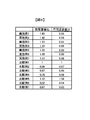
- FIG. 4 is a list showing values of the discharge capacity ratio and the irreversible capacity ratio obtained for the examples and comparative examples.
- ⁇ Positive electrode material for lithium ion secondary battery> When adopting lithium ion secondary batteries in electric vehicles, it is necessary to improve the energy density per unit volume and unit weight of the battery, and to increase the distance that can be traveled by one charge in a limited volume and weight. Is done. In order to realize such characteristics, the positive electrode material for a lithium ion secondary battery is required to have a high capacity and a small irreversible capacity.
- Irreversible capacity is the difference between the initial charge capacity and discharge capacity.
- the battery needs a negative electrode that matches the charge capacity of the positive electrode.However, in a battery with a large irreversible capacity, the discharge capacity that can actually be used is smaller than the charge capacity. Will increase in volume and weight. Therefore, by reducing the irreversible capacity, the volume and weight of the battery per unit capacity can be reduced. By reducing the volume and weight of the battery per unit capacity, the energy density per unit volume and per unit weight can be improved.
- the positive electrode material for a lithium ion secondary battery according to the present invention has a composition formula: xLiNi a Mn 1-a O 2 —yLi 4 O 2 — (1-xy) MnO 2 [Wherein x, y, and a are the following relationships: ⁇ 0.5x + 0.41 ⁇ y ⁇ 0.5x + 0.49, -0.1x + 0.13 ⁇ y ⁇ -0.1x + 0.21, 0.2 ⁇ a ⁇ 0.6 It is a parameter that satisfies
- the positive electrode material of the present invention is represented by a combination of LiNi a Mn 1-a O 2 , Li 4 O 2, and MnO 2 for convenience, but each does not form a different phase and is integrated. It is a compound having a composition.
- FIG. 1 is a ternary phase diagram of LiNi a Mn 1-a O 2 , Li 4 O 2 , and MnO 2 with respect to the composition range of the above composition formula.
- the range shown by diagonal lines represents the composition range according to the above composition formula.
- x is a parameter indicating the ratio of LiNi a Mn 1-a O 2 .
- x is 0.5 or less, the discharge capacity at a high potential decreases. This is considered to be because LiNi a Mn 1-a O 2 as a component that reacts at a high potential decreases.
- x is 0.9 or more, a high capacity cannot be obtained. This is because the amount of LiNi a Mn 1-a O 2 increases and most of the positive electrode material for lithium ion secondary batteries becomes a layered component, so that the reaction involving oxygen in the positive electrode for lithium ion secondary batteries is less likely to occur. This is probably because of this.
- y represents the ratio of Li 4 O 2 .
- y needs to satisfy the relationship of ⁇ 0.5x + 0.41 ⁇ y ⁇ 0.5x + 0.49 and ⁇ 0.1x + 0.13 ⁇ y ⁇ 0.1x + 0.21.
- a represents the ratio of Ni in LiNi a Mn 1-a O 2 .
- a 0.2 or less, the capacity decreases. This is presumably because a sufficient capacity cannot be obtained because the proportion of Ni involved in the reaction is relatively small.
- a 0.6 or more, the irreversible capacity increases. This is presumably because the proportion of Mn required for oxygen participation in the discharge reaction is relatively small.
- x, y, and a in the above composition formula have the following relationship: ⁇ 0.5x + 0.41 ⁇ y ⁇ 0.5x + 0.49, -0.1x + 0.13 ⁇ y ⁇ -0.1x + 0.21, 0.3 ⁇ a ⁇ 0.5 It is preferable to satisfy.
- X, y, and a are each of these conditions, that is, ⁇ 0.5x + 0.41 ⁇ y ⁇ 0.5x + 0.49, -0.1x + 0.13 ⁇ y ⁇ -0.1x + 0.21, 0.3 ⁇ a ⁇ 0.5 And satisfy 0.6 ⁇ x ⁇ 0.8 It is more preferable to satisfy the requirements in terms of high capacity and reduced irreversible capacity.
- the positive electrode material for a lithium ion secondary battery of the present invention basically contains three kinds of elements of Li, Ni, and Mn as transition metals, and does not contain expensive Co. Therefore, the positive electrode material for a lithium ion secondary battery of the present invention has an advantage of low cost. In addition, the positive electrode material for a lithium ion secondary battery of the present invention may contain an additive or the like as long as it does not affect the present invention.
- the positive electrode material for a lithium ion secondary battery according to the present invention can be produced by a method generally used in the technical field to which the present invention belongs. For example, it can be produced by mixing and firing a compound containing Li, Ni, and Mn at an appropriate ratio. By changing the mixing ratio of the above compounds, the ratio of LiNi a Mn 1-a O 2 , Li 4 O 2 and MnO 2 can be adjusted as appropriate.
- Examples of the compound containing Li include lithium acetate, lithium nitrate, lithium carbonate, lithium hydroxide, and lithium oxide.
- Examples of the compound containing Ni include nickel acetate, nickel nitrate, nickel carbonate, nickel sulfate, and nickel hydroxide.
- Examples of the compound containing Mn include manganese acetate, manganese nitrate, manganese carbonate, manganese sulfate, manganese oxide, and the like.
- the structure and composition of the positive electrode material for a lithium ion secondary battery can be analyzed by, for example, X-ray diffraction (XRD) or inductively coupled plasma method (ICP).
- XRD X-ray diffraction
- ICP inductively coupled plasma method
- the positive electrode for a lithium ion secondary battery according to the present invention is produced using the above positive electrode material for a lithium ion secondary battery. Thereby, a positive electrode for a lithium ion secondary battery having a high capacity and a small irreversible capacity can be realized.
- the lithium ion secondary battery which concerns on this invention is produced using said positive electrode for lithium ion secondary batteries. Accordingly, a lithium ion secondary battery having a high capacity, a small irreversible capacity, and a reduced volume and weight per unit capacity can be obtained.
- the lithium ion secondary battery according to the present invention can be preferably used for electric vehicles and plug-in hybrid vehicles. It can also be used for power storage systems, power tools, toys, medical equipment, and the like.
- a lithium ion secondary battery includes a positive electrode including a positive electrode material, a negative electrode including a negative electrode material, a separator, an electrolytic solution, an electrolyte, and the like.
- the negative electrode material is not particularly limited as long as it is a substance that can occlude and release lithium ions.
- Substances generally used in lithium ion secondary batteries can be used as the negative electrode material.
- graphite, a lithium alloy, etc. can be illustrated.
- separator those commonly used in lithium ion secondary batteries can be used.
- examples thereof include microporous films and nonwoven fabrics made from polyolefins such as polypropylene, polyethylene, and a copolymer of propylene and ethylene.
- electrolytic solution and the electrolyte those generally used in lithium ion secondary batteries can be used.
- diethyl carbonate, dimethyl carbonate, ethylene carbonate, propylene carbonate, vinylene carbonate, methyl acetate, ethyl methyl carbonate, methyl propyl carbonate, dimethoxyethane and the like can be exemplified as the electrolytic solution.
- LiClO 4 LiPF 6 , LiBF 4 , LiAsF 6 , LiSbF 6 , LiCF 3 SO 3 , LiC 4 F 9 SO 3 , LiCF 3 CO 2 , Li 2 C 2 F 4 (SO 3 ) 2 , LiN (CF 3 SO 2 ) 2 , LiC (CF 3 SO 2 ) 3 and the like can be exemplified.
- the lithium ion secondary battery 10 includes an electrode group having a positive electrode 1 in which a positive electrode material is applied on both sides of a current collector, a negative electrode 2 in which a negative electrode material is applied on both sides of the current collector, and a separator 3.
- the positive electrode 1 and the negative electrode 2 are wound through a separator 3 to form a wound electrode group. This wound body is inserted into the battery can 4.
- the negative electrode 2 is electrically connected to the battery can 4 via the negative electrode lead piece 6.
- a sealing lid 7 is attached to the battery can 4 via a packing 8.
- the positive electrode 1 is electrically connected to the sealing lid 7 through the positive electrode lead piece 5.
- the wound body is insulated from the battery can 4 and the sealing lid 7 by the insulating plate 9.
- the electrode group may not be the wound body shown in FIG. 2, but may be a laminated body in which the positive electrode 1 and the negative electrode 2 are laminated via the separator 3.
- the composition was adjusted by variously changing the mixing ratio of lithium carbonate, nickel carbonate, and manganese carbonate, and the composition formula xLiNi a Mn 1-a O 2 —yLi 4 O 2 — (1-xy) MnO 2
- the represented positive electrode material was obtained.
- Fig. 3 shows the composition of the prepared positive electrode material as a list.
- a positive electrode slurry, a conductive agent, and a binder were mixed uniformly to prepare a positive electrode slurry.
- a positive electrode slurry was applied onto an aluminum current collector foil having a thickness of 20 ⁇ m, dried at 120 ° C., and compression-molded so as to have an electrode density of 2.2 g / cm 3 with a press device to obtain an electrode plate. Thereafter, the electrode plate was punched into a disk shape having a diameter of 15 mm to produce a positive electrode.
- the negative electrode was produced using metallic lithium.
- a solution obtained by dissolving LiPF 6 at a concentration of 1.0 mol / L in a mixed solvent of ethylene carbonate and dimethyl carbonate having a volume ratio of 1: 2 was used.
- the positive electrode material for a lithium ion secondary battery has a composition formula: In xLiNi a Mn 1-a O 2 —yLi 4 O 2 — (1-xy) MnO 2 , x, y, and a have the following relationship: ⁇ 0.5x + 0.41 ⁇ y ⁇ 0.5x + 0.49, -0.1x + 0.13 ⁇ y ⁇ -0.1x + 0.21, According to the positive electrode material for lithium ion secondary satisfying 0.2 ⁇ a ⁇ 0.6, it can be seen that a lithium ion secondary battery having a high capacity and a small irreversible capacity can be realized.
- the positive electrode material for a lithium ion secondary battery has a composition formula: In xLiNi a Mn 1-a O 2 —yLi 4 O 2 — (1-xy) MnO 2 , x, y, and a have the following relationship: ⁇ 0.5x + 0.41 ⁇ y ⁇ 0.5x + 0.49, -0.1x + 0.13 ⁇ y ⁇ -0.1x + 0.21, 0.3 ⁇ a ⁇ 0.5, 0.6 ⁇ x ⁇ 0.8 According to the positive electrode material for lithium ion secondary that satisfies the above, it can be seen that a lithium ion secondary battery having a high capacity and a small irreversible capacity can be realized.
- Comparative Example 2 has a small discharge capacity ratio. This is presumably because there are few components of LiNi a Mn 1-a O 2 that contribute to the discharge reaction in the high potential region.
- Comparative Example 6 has a small discharge capacity. This is presumably because the proportion of Ni contributing to the discharge reaction at a high potential is small.
- Comparative Example 7 has a small discharge capacity. This is presumably because the involvement of oxygen in the discharge reaction was inhibited due to the small amount of Mn.
- a positive electrode material for a lithium ion secondary battery having a high capacity and a small irreversible capacity can be provided at low cost.
- a lithium ion secondary battery with reduced volume and weight per unit capacity can be provided at low cost.
Landscapes
- Chemical & Material Sciences (AREA)
- Chemical Kinetics & Catalysis (AREA)
- Electrochemistry (AREA)
- General Chemical & Material Sciences (AREA)
- Inorganic Chemistry (AREA)
- Engineering & Computer Science (AREA)
- Manufacturing & Machinery (AREA)
- Materials Engineering (AREA)
- Battery Electrode And Active Subsutance (AREA)
Abstract
Cette invention concerne un matériau d'électrode positive pour batteries rechargeables au lithium ion, représenté par la formule suivante : xLiNiaMn1-aO2-yLi4O2-(1-y-z)MnO2 [dans ladite formule, x, y, et a sont des paramètres qui satisfont aux relations suivantes : -0,5x + 0,41 < y < -0,5x + 0,49, -0,1x + 0,13 < y < -0,1x + 0,21, et 0,2 < a < 0,6].
Priority Applications (2)
| Application Number | Priority Date | Filing Date | Title |
|---|---|---|---|
| PCT/JP2013/059632 WO2014155708A1 (fr) | 2013-03-29 | 2013-03-29 | Matériau d'électrode positive pour batteries rechargeables au lithium ion, électrode positive pour batteries rechargeables au lithium ion, et batterie rechargeable au lithium ion |
| TW103102951A TW201503471A (zh) | 2013-03-29 | 2014-01-27 | 鋰離子蓄電池用正極材料,鋰離子蓄電池用正極以及鋰離子蓄電池 |
Applications Claiming Priority (1)
| Application Number | Priority Date | Filing Date | Title |
|---|---|---|---|
| PCT/JP2013/059632 WO2014155708A1 (fr) | 2013-03-29 | 2013-03-29 | Matériau d'électrode positive pour batteries rechargeables au lithium ion, électrode positive pour batteries rechargeables au lithium ion, et batterie rechargeable au lithium ion |
Publications (1)
| Publication Number | Publication Date |
|---|---|
| WO2014155708A1 true WO2014155708A1 (fr) | 2014-10-02 |
Family
ID=51622756
Family Applications (1)
| Application Number | Title | Priority Date | Filing Date |
|---|---|---|---|
| PCT/JP2013/059632 Ceased WO2014155708A1 (fr) | 2013-03-29 | 2013-03-29 | Matériau d'électrode positive pour batteries rechargeables au lithium ion, électrode positive pour batteries rechargeables au lithium ion, et batterie rechargeable au lithium ion |
Country Status (2)
| Country | Link |
|---|---|
| TW (1) | TW201503471A (fr) |
| WO (1) | WO2014155708A1 (fr) |
Citations (7)
| Publication number | Priority date | Publication date | Assignee | Title |
|---|---|---|---|---|
| JP2008511960A (ja) * | 2004-09-03 | 2008-04-17 | ユーシカゴ・アーゴン・リミテッド・ライアビリティ・カンパニー | リチウム電池用のマンガン酸化物複合電極 |
| JP2008270137A (ja) * | 2007-03-23 | 2008-11-06 | Toyota Motor Corp | 合材層およびその製造方法ならびに固体電池およびその製造方法 |
| JP2011028999A (ja) * | 2009-07-24 | 2011-02-10 | Nissan Motor Co Ltd | リチウムイオン電池用正極材料およびこれを用いたリチウムイオン電池 |
| JP2011029000A (ja) * | 2009-07-24 | 2011-02-10 | Nissan Motor Co Ltd | リチウムイオン電池用正極材料の製造方法 |
| JP2012209245A (ja) * | 2011-03-16 | 2012-10-25 | Sanyo Electric Co Ltd | 非水電解質二次電池 |
| JP2012230897A (ja) * | 2011-04-13 | 2012-11-22 | Mitsubishi Chemicals Corp | フルオロスルホン酸リチウム、非水系電解液、及び非水系電解液二次電池 |
| JP2013004234A (ja) * | 2011-06-14 | 2013-01-07 | Murata Mfg Co Ltd | 非水電解質二次電池の製造方法 |
-
2013
- 2013-03-29 WO PCT/JP2013/059632 patent/WO2014155708A1/fr not_active Ceased
-
2014
- 2014-01-27 TW TW103102951A patent/TW201503471A/zh unknown
Patent Citations (7)
| Publication number | Priority date | Publication date | Assignee | Title |
|---|---|---|---|---|
| JP2008511960A (ja) * | 2004-09-03 | 2008-04-17 | ユーシカゴ・アーゴン・リミテッド・ライアビリティ・カンパニー | リチウム電池用のマンガン酸化物複合電極 |
| JP2008270137A (ja) * | 2007-03-23 | 2008-11-06 | Toyota Motor Corp | 合材層およびその製造方法ならびに固体電池およびその製造方法 |
| JP2011028999A (ja) * | 2009-07-24 | 2011-02-10 | Nissan Motor Co Ltd | リチウムイオン電池用正極材料およびこれを用いたリチウムイオン電池 |
| JP2011029000A (ja) * | 2009-07-24 | 2011-02-10 | Nissan Motor Co Ltd | リチウムイオン電池用正極材料の製造方法 |
| JP2012209245A (ja) * | 2011-03-16 | 2012-10-25 | Sanyo Electric Co Ltd | 非水電解質二次電池 |
| JP2012230897A (ja) * | 2011-04-13 | 2012-11-22 | Mitsubishi Chemicals Corp | フルオロスルホン酸リチウム、非水系電解液、及び非水系電解液二次電池 |
| JP2013004234A (ja) * | 2011-06-14 | 2013-01-07 | Murata Mfg Co Ltd | 非水電解質二次電池の製造方法 |
Also Published As
| Publication number | Publication date |
|---|---|
| TW201503471A (zh) | 2015-01-16 |
Similar Documents
| Publication | Publication Date | Title |
|---|---|---|
| CN106450272B (zh) | 锂离子二次电池用正极活性物质、锂离子二次电池用正极材料及锂离子二次电池 | |
| CN104221192B (zh) | 锂离子二次电池用活性物质和锂离子二次电池 | |
| JP4910243B2 (ja) | 非水電解質二次電池 | |
| JP2015213038A (ja) | 非水電解質二次電池用正極材料および非水電解質二次電池 | |
| WO2016136212A1 (fr) | Accumulateur à électrolyte non aqueux | |
| CN108352564A (zh) | 非水电解质二次电池 | |
| CN102122714A (zh) | 正极活性物质及具备包含该物质的正极的非水系二次电池 | |
| JP2009016234A (ja) | 非水電池および非水電池の製造方法 | |
| WO2015102091A1 (fr) | Électrode et batterie à électrolyte non aqueux | |
| CN108352562A (zh) | 非水电解质二次电池 | |
| JP2018055808A (ja) | リチウムイオン二次電池および該リチウムイオン二次電池用の正極活物質 | |
| CN106558725B (zh) | 锂离子二次电池 | |
| WO2015059778A1 (fr) | Matériau actif d'électrode positive pour batteries secondaires au lithium-ion et batterie secondaire au lithium-ion | |
| WO2015045254A1 (fr) | Oxyde mixte de lithium-titane | |
| JP6400364B2 (ja) | 非水系二次電池用正極活物質及びその製造方法 | |
| US10446843B2 (en) | Positive electrode active material particle powder for non-aqueous electrolyte secondary battery, method for manufacturing same, and non-aqueous electrolyte secondary battery | |
| WO2016046868A1 (fr) | Matériau actif positif pour batterie rechargeable au lithium-ion, matériau d'électrode positive, et batterie rechargeable au lithium-ion | |
| JP5877898B2 (ja) | リチウムイオン二次電池用正極活物質 | |
| WO2015019729A1 (fr) | Matériau d'électrode positive pour des batteries secondaires au lithium-ion | |
| WO2015132844A1 (fr) | Matériau d'électrode positive pour piles rechargeables au lithium ion et pile rechargeable au lithium ion | |
| WO2015004705A1 (fr) | Matériau actif d'électrode positive pour des batteries secondaires au lithium-ion | |
| KR20140116448A (ko) | 정극 활물질 | |
| WO2014155708A1 (fr) | Matériau d'électrode positive pour batteries rechargeables au lithium ion, électrode positive pour batteries rechargeables au lithium ion, et batterie rechargeable au lithium ion | |
| WO2014162531A1 (fr) | Matériau d'électrode positive destiné à une batterie secondaire lithium-ion | |
| WO2015059779A1 (fr) | Matériau d'électrode positive pour des batteries rechargeables lithium-ion et batterie rechargeable lithium-ion |
Legal Events
| Date | Code | Title | Description |
|---|---|---|---|
| 121 | Ep: the epo has been informed by wipo that ep was designated in this application |
Ref document number: 13879986 Country of ref document: EP Kind code of ref document: A1 |
|
| NENP | Non-entry into the national phase |
Ref country code: DE |
|
| 122 | Ep: pct application non-entry in european phase |
Ref document number: 13879986 Country of ref document: EP Kind code of ref document: A1 |
|
| NENP | Non-entry into the national phase |
Ref country code: JP |