WO2014156952A1 - フィルム - Google Patents
フィルム Download PDFInfo
- Publication number
- WO2014156952A1 WO2014156952A1 PCT/JP2014/057754 JP2014057754W WO2014156952A1 WO 2014156952 A1 WO2014156952 A1 WO 2014156952A1 JP 2014057754 W JP2014057754 W JP 2014057754W WO 2014156952 A1 WO2014156952 A1 WO 2014156952A1
- Authority
- WO
- WIPO (PCT)
- Prior art keywords
- film
- resin
- polylactic acid
- mass
- less
- Prior art date
- Legal status (The legal status is an assumption and is not a legal conclusion. Google has not performed a legal analysis and makes no representation as to the accuracy of the status listed.)
- Ceased
Links
Classifications
-
- C—CHEMISTRY; METALLURGY
- C08—ORGANIC MACROMOLECULAR COMPOUNDS; THEIR PREPARATION OR CHEMICAL WORKING-UP; COMPOSITIONS BASED THEREON
- C08J—WORKING-UP; GENERAL PROCESSES OF COMPOUNDING; AFTER-TREATMENT NOT COVERED BY SUBCLASSES C08B, C08C, C08F, C08G or C08H
- C08J5/00—Manufacture of articles or shaped materials containing macromolecular substances
- C08J5/18—Manufacture of films or sheets
-
- C—CHEMISTRY; METALLURGY
- C08—ORGANIC MACROMOLECULAR COMPOUNDS; THEIR PREPARATION OR CHEMICAL WORKING-UP; COMPOSITIONS BASED THEREON
- C08J—WORKING-UP; GENERAL PROCESSES OF COMPOUNDING; AFTER-TREATMENT NOT COVERED BY SUBCLASSES C08B, C08C, C08F, C08G or C08H
- C08J3/00—Processes of treating or compounding macromolecular substances
- C08J3/18—Plasticising macromolecular compounds
-
- C—CHEMISTRY; METALLURGY
- C08—ORGANIC MACROMOLECULAR COMPOUNDS; THEIR PREPARATION OR CHEMICAL WORKING-UP; COMPOSITIONS BASED THEREON
- C08J—WORKING-UP; GENERAL PROCESSES OF COMPOUNDING; AFTER-TREATMENT NOT COVERED BY SUBCLASSES C08B, C08C, C08F, C08G or C08H
- C08J2300/00—Characterised by the use of unspecified polymers
- C08J2300/16—Biodegradable polymers
-
- C—CHEMISTRY; METALLURGY
- C08—ORGANIC MACROMOLECULAR COMPOUNDS; THEIR PREPARATION OR CHEMICAL WORKING-UP; COMPOSITIONS BASED THEREON
- C08J—WORKING-UP; GENERAL PROCESSES OF COMPOUNDING; AFTER-TREATMENT NOT COVERED BY SUBCLASSES C08B, C08C, C08F, C08G or C08H
- C08J2367/00—Characterised by the use of polyesters obtained by reactions forming a carboxylic ester link in the main chain; Derivatives of such polymers
- C08J2367/02—Polyesters derived from dicarboxylic acids and dihydroxy compounds
-
- C—CHEMISTRY; METALLURGY
- C08—ORGANIC MACROMOLECULAR COMPOUNDS; THEIR PREPARATION OR CHEMICAL WORKING-UP; COMPOSITIONS BASED THEREON
- C08J—WORKING-UP; GENERAL PROCESSES OF COMPOUNDING; AFTER-TREATMENT NOT COVERED BY SUBCLASSES C08B, C08C, C08F, C08G or C08H
- C08J2367/00—Characterised by the use of polyesters obtained by reactions forming a carboxylic ester link in the main chain; Derivatives of such polymers
- C08J2367/04—Polyesters derived from hydroxy carboxylic acids, e.g. lactones
-
- C—CHEMISTRY; METALLURGY
- C08—ORGANIC MACROMOLECULAR COMPOUNDS; THEIR PREPARATION OR CHEMICAL WORKING-UP; COMPOSITIONS BASED THEREON
- C08J—WORKING-UP; GENERAL PROCESSES OF COMPOUNDING; AFTER-TREATMENT NOT COVERED BY SUBCLASSES C08B, C08C, C08F, C08G or C08H
- C08J2467/00—Characterised by the use of polyesters obtained by reactions forming a carboxylic ester link in the main chain; Derivatives of such polymers
- C08J2467/02—Polyesters derived from dicarboxylic acids and dihydroxy compounds
-
- C—CHEMISTRY; METALLURGY
- C08—ORGANIC MACROMOLECULAR COMPOUNDS; THEIR PREPARATION OR CHEMICAL WORKING-UP; COMPOSITIONS BASED THEREON
- C08J—WORKING-UP; GENERAL PROCESSES OF COMPOUNDING; AFTER-TREATMENT NOT COVERED BY SUBCLASSES C08B, C08C, C08F, C08G or C08H
- C08J2471/00—Characterised by the use of polyethers obtained by reactions forming an ether link in the main chain; Derivatives of such polymers
- C08J2471/02—Polyalkylene oxides
Definitions
- the present invention relates to a film excellent in water resistance and decomposability, and relates to a film mainly composed of a biodegradable resin.
- Patent Document 1 discloses a porous sheet obtained by stretching a sheet containing a polylactic acid resin, a filler, and a general polyester plasticizer at least 1 axis.
- Patent Document 2 discloses a porous film obtained by stretching a sheet containing a polylactic acid resin, a thermoplastic resin other than a polylactic acid resin, and a filler.
- biodegradable films excellent in water resistance have been studied so far, but in addition to these, the invention of a film having excellent decomposability has not yet been achieved.
- the present invention is intended to provide a film having excellent water resistance and excellent decomposability.
- the present invention contains a thermoplastic resin (A), 1 to 70% by mass of the filler (B) is contained in 100% by mass of all components of the film, Porosity is 80% or less, The tear strength in either direction is 200 mN or less, Contains a film or a thermoplastic resin (A) having a tensile strength in any direction of less than 15 MPa, and contains 1 to 40% by mass of the hydrophilic resin (A2) in 100% by mass of all components of the film.
- the film has a porosity of 80% or less, a tear strength in any direction of 200 mN or less, and a tensile strength in any direction of less than 15 MPa.
- a film excellent in water resistance and decomposability is provided.
- the film of the present invention can be preferably used for applications that mainly require water resistance and decomposability.
- agricultural materials such as multi-films, forestry materials such as fumigation sheets, sanitary materials such as paper diapers, napkins and liners, various packaging materials such as plastic bags, garbage bags, foods, industrial products, For example, it can be preferably used.
- the present invention as a result of intensive studies on the above-mentioned problem, that is, a film excellent in water resistance and decomposability, has a composition comprising a thermoplastic resin, particularly a biodegradable resin and a filler, and further, the porosity of the film It was the first successful solution to this problem by keeping the tear strength and tensile strength within a certain range. That is, the first aspect of the present invention (hereinafter referred to as the film 1 of the present invention) contains the thermoplastic resin (A), and 1 to 70% of the filler (B) is contained in 100% by mass of all components of the film.
- a film having a mass%, a porosity of 80% or less, a tear strength in any direction of 200 mN or less, and a tensile strength in any direction of less than 15 MPa contains the thermoplastic resin (A), and 1 to 1% of the hydrophilic resin (A2) is contained in 100% by mass of all the components of the film.
- the film contains 40% by mass, has a porosity of 80% or less, has a tear strength in any direction of 200 mN or less, and has a tensile strength in any direction of less than 15 MPa.
- Decomposition of the film 1 and the film 2 of the present invention proceeds through the following steps 1) and 2). That is, in a garbage bag once collected (after use for a desired application), 1) the film collapses and the shape becomes fine. Thereby, a volume can be made small. Further, when the thermoplastic resin (A) constituting the film of the present invention contains the biodegradable resin (A1), 2) it is finally converted into water and carbon dioxide by the metabolism of microorganisms in compost or soil. Disassembled.
- the factor determining the degradability is mainly due to the molecular structure of the biodegradable resin.
- the film in the step 1) It was found that the tear strength and the tensile strength in either direction are important factors, and by setting such characteristics within a specific range, excellent decomposability could be obtained.
- the decomposability as used in the field of this invention is mentioned later for details, However, It means that after using a film for a desired use, it decomposes
- the film 1 of the present invention contains the thermoplastic resin (A), contains 1 to 70% by mass of the filler (B) in 100% by mass of all components of the film, and has a porosity of 80% or less.
- the tear strength in any direction is 200 mN or less, and the tensile strength in any direction is less than 15 MPa, which will be described in detail below.
- thermoplastic resin (A) The thermoplastic resin (A) contained in the film 1 of the present invention is not particularly limited, but preferred examples include (i) aromatic polyesters such as polyethylene terephthalate, polyethylene-2,6-naphthalate, polypropylene terephthalate, and polybutylene terephthalate.
- thermoplastic resin (A) contained in the film 1 of the present invention preferably contains a biodegradable resin (A1).
- the biodegradable resin (A1) is not particularly limited as long as it is a biodegradable resin.
- “having biodegradability” means that the biodegradable resin (A1) in the film is JIS K6950: 2000 (ISO14851), JIS K6951: 2000 (ISO14852), or JIS K6953-1: 2011. (ISO14855), JIS K6953-2: 2010 (ISO14855), JIS K6955: 2006 (ISO17556) means that the biodegradability is 60% or more within one year.
- biodegradable resin (A1) in the film 1 of the present invention aliphatic polyesters, aliphatic aromatic polyesters, polysaccharides, polymers containing starch, polyvinyl alcohol, and the like can be used.
- aliphatic polyester examples include polylactic acid resin (a1, details will be described later), polyglycolic acid, poly (3-hydroxybutyrate), poly (3-hydroxybutyrate-3hydroxyhexanoate) , Poly (3-hydroxybutyrate-3hydroxyvalerate), polycaprolactone, polybutylene succinate, poly (butylene succinate adipate) and the like.
- aliphatic aromatic polyester examples include poly (ethylene succinate / terephthalate), poly (butylene succinate / terephthalate), poly (butylene adipate / terephthalate), and the like.
- polysaccharide examples include cellulose resins such as cellulose acetate and glucosamine resins such as chitosan.
- polymer containing starch examples include thermoplastic starch and Novamont's biodegradable resin “Mater-Bi (registered trademark)”.
- the biodegradable resin (A1) is preferably a polylactic acid resin (a1) from the viewpoint of biomass properties, cost, processability, and the like.
- the polylactic acid resin (a1) will be specifically described.
- the polylactic acid-based resin (a1) is a polymer having an L-lactic acid unit and / or a D-lactic acid unit as main constituent components.
- the main component means that the mass ratio of the lactic acid unit is the maximum in 100% by mass of the polymer.
- the mass ratio of the lactic acid unit is preferably 70% by mass to 100% by mass of the lactic acid unit in 100% by mass of the polymer.
- poly-L-lactic acid referred to in the film 1 of the present invention means that the content of L-lactic acid units is more than 50 mol% and not more than 100 mol% in 100 mol% of all lactic acid units in the polylactic acid polymer.
- poly-D-lactic acid as used in the present invention refers to those having a D-lactic acid unit content of more than 50 mol% and not more than 100 mol% in 100 mol% of all lactic acid units in the polylactic acid polymer.
- Poly L-lactic acid changes in the crystallinity of the resin itself depending on the content ratio of the D-lactic acid unit. That is, if the content ratio of D-lactic acid units in poly-L-lactic acid increases, the crystallinity of poly-L-lactic acid decreases and approaches amorphous, and conversely the content ratio of D-lactic acid units in poly-L-lactic acid. As the amount decreases, the crystallinity of poly-L-lactic acid increases. Similarly, the crystallinity of the resin itself of poly D-lactic acid varies depending on the content ratio of L-lactic acid units.
- the content ratio of the L-lactic acid unit in the poly L-lactic acid used in the film 1 of the present invention or the content ratio of the D-lactic acid unit in the poly D-lactic acid used in the present invention depends on the mechanical strength of the composition. From the standpoint of maintenance, it is preferably 80 to 100 mol%, more preferably 85 to 100 mol%, in 100 mol% of all lactic acid units.
- the polylactic acid resin (a1) used as the biodegradable resin (A1) is preferably a mixture of a crystalline polylactic acid resin (a11) and an amorphous polylactic acid resin (a12).
- the crystalline polylactic acid resin (a11) referred to in the film 1 of the present invention means that the polylactic acid resin is allowed to stand for 24 hours under heating at 100 ° C., and then from 25 ° C. to 250 ° C. at a temperature rising rate of 20 ° C./min.
- DSC differential scanning calorimeter
- the amorphous polylactic acid resin (a12) referred to in the film 1 of the present invention refers to a polylactic acid resin that does not show a clear melting point when measured in the same manner.
- the polylactic acid resin (a1) used in the film 1 of the present invention may copolymerize other monomer units other than lactic acid.
- Other monomers include ethylene glycol, propylene glycol, butanediol, heptanediol, hexanediol, octanediol, nonanediol, decanediol, 1,4-cyclohexanedimethanol, neopentyl glycol, glycerin, pentaerythritol, bisphenol A, glycol compounds such as polyethylene glycol, polypropylene glycol and polytetramethylene glycol, oxalic acid, adipic acid, sebacic acid, azelaic acid, dodecanedioic acid, malonic acid, glutaric acid, cyclohexanedicarboxylic acid, terephthalic acid, isophthalic acid, phthalate Acid, naphthal
- polylactic acid resin (a1) those not corresponding to the thermoplastic resin (a2) described later are defined as polylactic acid resin (a1).
- the copolymerization amount of the other monomer units is preferably 0 to 30 mol%, and preferably 0 to 10 mol%, based on 100 mol% of the whole monomer units in the polymer of the polylactic acid resin (a1). It is more preferable that In addition, it is preferable to select the component which has biodegradability among the above-mentioned monomer units according to a use.
- polylactic acid resin (a1) used in the film 1 of the present invention poly D-lactic acid is used when the main component is poly L-lactic acid, and poly L-lactic acid is used when the main component is poly D-lactic acid. It is also preferable to mix a small amount of lactic acid. This is because the stereocomplex crystal formed thereby has a higher melting point than a normal polylactic acid crystal ( ⁇ crystal), so that the heat resistance of the film is improved.
- a main component here means the component exceeding 50 mass% when the sum total of the polylactic acid-type resin (a1) in a film is 100 mass%.
- the mass average molecular weight of the polylactic acid resin (a1) used in the film 1 of the present invention is preferably 50,000 to 240,000 in order to satisfy practical mechanical properties, water resistance, and decomposability, It is more preferably 60,000 to 200,000, and further preferably 70,000 to 160,000.
- the mass average molecular weight as used herein refers to a molecular weight calculated by a polymethyl methacrylate conversion method after measurement with a chloroform solvent by gel permeation chromatography (GPC).
- a known polymerization method can be used, and examples thereof include a direct polymerization method from lactic acid and a ring-opening polymerization method via lactide.
- the content of the biodegradable resin (A1) in 100% by mass of all components of the film 1 of the present invention is not particularly limited, but is preferably 15 to 60% by mass, and preferably 20 to 55% by mass. More preferably, it is 25 to 50% by mass.
- the polylactic acid resin (a1) used as the biodegradable resin (A1) is a mixture of a crystalline polylactic acid resin (a11) and an amorphous polylactic acid resin (a12). Is preferred. It is because it can combine the advantage of each polylactic acid-type resin (a1) crystalline and amorphous by setting it as a mixture.
- crystalline polylactic acid resin (a11) as the polylactic acid resin (a1) which is the biodegradable resin (A1), because the heat resistance and blocking resistance of the film are improved.
- crystalline polylactic acid-type resin (a11) forms a eutectic with the polylactic acid segment which a block copolymer plasticizer has, and a block copolymer plasticizer It has a great effect on improving the bleed-out resistance.
- the amorphous polylactic acid resin (a12) is contained as the polylactic acid resin (a1) which is the biodegradable resin (A1), the flexibility of the film and the bleed resistance of the plasticizer when using the plasticizer are used. This is preferable because the out-out property is improved. This is because the amorphous polylactic acid resin (a12) has an amorphous part in which the plasticizer can be dispersed.
- the crystalline polylactic acid-based resin (a11) used for the film 1 of the present invention contains the L-lactic acid unit content in poly-L-lactic acid or poly-D-lactic acid from the viewpoint of improving heat resistance and blocking resistance.
- the content ratio of the D-lactic acid unit is preferably 96 to 100 mol%, more preferably 98 to 100 mol% in 100 mol% of all lactic acid units.
- the total of the polylactic acid resin (a1) in the film 1 of the present invention is 100% by mass (the total of the crystalline polylactic acid resin (a11) and the amorphous polylactic acid resin (a12) is 100% by mass.
- the mass ratio of the crystalline polylactic acid resin (a11) is preferably 5 to 60 mass%, more preferably 10 to 50 mass%, and more preferably 20 to 40 mass%. Further preferred.
- thermoplastic resin (a2) other than polylactic acid resin (a1) When the thermoplastic resin (A) contains a polylactic acid-based resin, the film 1 of the present invention contains a thermoplastic resin (a2) other than the polylactic acid-based resin (a1) to improve moisture permeability and degradability. Is preferable.
- a thermoplastic resin (a2) other than the polylactic acid resin (a1) is used as the thermoplastic resin (a2).
- the thermoplastic resin (a2) the resin exemplified as the biodegradable resin (A1) (other than the polylactic acid resin) can be used, and polyacetal, polyethylene, polypropylene, polyamide, poly (meth) acrylate, polyphenylene sulfide.
- Polyether ether ketone polyester, polyurethane, polyisoprene, polysulfone, polyphenylene oxide, polyimide, polyetherimide, epoxy-modified polyolefin, acid-modified polyolefin, olefin-acrylic copolymer, epoxy-modified olefin-acrylic copolymer, polyester elastomer Polyamide elastomer, polyolefin elastomer, resin plasticizer (a21), etc. can be used.
- the resin plasticizer (a21) suitable as the thermoplastic resin (a2) other than the polylactic acid resin (a1) include polyester plasticizers such as polypropylene glycol sebacate and polyalkylene ether plasticizers. Ether ester plasticizers, acrylate plasticizers, and the like can be used.
- the resin-based plasticizer (a21) preferably has biodegradability.
- the resin-based plasticizer (a21) is, for example, a normal temperature (20 ° C.) such as polyethylene glycol having a number average molecular weight of 1,000 or more.
- fusing point of resin-type plasticizer (a21) is 150 degrees C or less at the point which matches melt processing temperature with polylactic acid-type resin (a1) which is biodegradable resin (A1).
- the resin plasticizer (a21) used as the thermoplastic resin (a2) other than the polylactic acid resin (a1) is a block copolymer having a polyether segment and a polylactic acid segment, and More preferably, it is at least one resin selected from the group consisting of block copolymers having a polyester-based segment and a polylactic acid-based segment.
- the plasticizing component in the thermoplastic resin (a2) is a polyether segment or a polyester segment.
- the polyester-based segment means a segment made of polyester other than polylactic acid.
- block copolymer a block copolymer having a polyether segment and a polylactic acid segment and a block copolymer having a polyester segment and a polylactic acid segment are collectively referred to as “block copolymer”).
- the “plasticizer” will be described below.
- the mass proportion of the polylactic acid-based segment contained in the block copolymer plasticizer is 50% by mass or less in 100% by mass of the entire block copolymer plasticizer, so that desired flexibility can be imparted with a smaller amount of addition. Therefore, it is preferably 5% by mass or more from the viewpoint of suppressing bleed out.
- the number average molecular weight of the polylactic acid segment in one molecule of the block copolymer plasticizer is preferably 1,200 to 10,000. When the polylactic acid-based segment of the block copolymer plasticizer is 1,200 or more, it is sufficient between the block copolymer plasticizer and the polylactic acid-based resin (a1) that is the biodegradable resin (A1).
- the block copolymer plasticizer has an effect of anchoring the polylactic acid resin (a1), which is the biodegradable resin (A1), and exerts a great effect on the bleedout suppression of the block copolymer plasticizer. As a result, the blocking resistance of the film is also excellent.
- this block copolymer plasticizer greatly contributes to the improvement of moisture permeability, which will be described later, as compared with a plasticizer that is liquid at normal temperature and a plasticizer that does not form a eutectic even if it is solid at normal temperature. This is because the eutectic formed improves the hole formation efficiency by stretching described later.
- the number average molecular weight of the polylactic acid-based segment in the block copolymer plasticizer is more preferably 1,500 to 6,000, and further preferably 2,000 to 5,000.
- the polylactic acid segment contained in the block copolymer plasticizer may contain 95 to 100% by mass of L-lactic acid or 95 to 100% by mass of D-lactic acid in 100% by mass of the segment. In particular, it is preferable because bleeding out is suppressed.
- the mass ratio of the polylactic acid segment is 5% by mass to 45% by mass, and the mass ratio of the polyether segment or the polyester segment is 55% by mass to 95%. It is preferable that it is mass%.
- the plasticizing component of the block copolymer plasticizer is polyethylene glycol, which has high modification efficiency due to its high affinity with the polylactic acid resin, and the desired flexibility can be achieved by adding a small amount of plasticizer. It is preferable because it can impart the properties.
- the block copolymer plasticizer has a polyester-based segment, polyglycolic acid, poly (3-hydroxybutyrate), poly (3-hydroxybutyrate-3hydroxyhexanoate), poly (3-hydroxybutyrate) Polyesters composed of aliphatic diols such as ethylene glycol, propanediol, and butanediol, and aliphatic dicarboxylic acids such as succinic acid, sebacic acid, and adipic acid. It is suitably used as a segment.
- the number average molecular weight of the polyether segment or the polyester segment in one molecule of the block copolymer plasticizer is preferably 7,000 to 20,000.
- the composition constituting the film has sufficient moisture permeability and water resistance, and when the composition containing the biodegradable resin (A1) is used, the melt viscosity is set to an appropriate level.
- the film forming processability such as the inflation film forming method can be stabilized.
- the block copolymer of each segment of the polyether-based segment and / or polyester-based segment and the polylactic acid-based segment there is no particular limitation on the order structure in the block copolymer of each segment of the polyether-based segment and / or polyester-based segment and the polylactic acid-based segment, but from the viewpoint of more effectively suppressing bleed out, the block It is preferred that there is a polylactic acid-based segment at at least one end of the copolymer plasticizer molecule. Most preferably, the polylactic acid-based segment is at both ends of the block copolymer plasticizer molecule.
- PEG polyethylene glycol having a hydroxyl terminal at both ends as a polyether segment
- the number average molecular weight of PEG having hydroxyl ends at both ends (hereinafter, the number average molecular weight of PEG is referred to as MPEG ) is usually calculated from the hydroxyl value determined by a neutralization method or the like in the case of a commercially available product.
- MPEG number average molecular weight of PEG having hydroxyl ends at both ends
- lactide w L parts by mass are added to w E parts by mass of PEG having hydroxyl groups at both ends
- lactide is subjected to ring-opening addition polymerization at both hydroxyl groups of PEG and sufficiently reacted, so that PLA is substantially obtained.
- a block copolymer of the -PEG-PLA type can be obtained (where PLA stands for polylactic acid).
- the number average molecular weight of one polylactic acid segment of this block copolymer plasticizer can be determined as (1/2) ⁇ (w L / w E ) ⁇ M PEG .
- the mass percentage of the total block copolymer plasticizer of the polylactic acid segment component can be substantially determined as 100 ⁇ w L / (w L + w E)%.
- the mass ratio of the plasticizer component excluding the polylactic acid segment component to the entire block copolymer plasticizer can be determined to be substantially 100 ⁇ w E / (w L + w E )%.
- separating a block copolymer plasticizer from a film and evaluating the number average molecular weight of each segment in a block copolymer plasticizer it can carry out as follows.
- the film is uniformly dissolved in an appropriate good solvent such as chloroform and then dropped into an appropriate poor solvent such as water or a water / methanol mixed solution.
- the block copolymer plasticizer is obtained by removing the precipitate by filtration and evaporating the solvent of the filtrate.
- the block copolymer plasticizer thus separated is measured for number average molecular weight (hereinafter referred to as M) using gel permeation chromatography (GPC).
- M number average molecular weight
- a polylactic acid segment, a polyether-based segment and / or a polyester-based segment are identified by 1 H-NMR measurement.
- the molecular weight of one polylactic acid segment contained in the block copolymer is M ⁇ ⁇ 1 / (number of polylactic acid segments in one molecule) ⁇ ⁇ (I PLA ⁇ 72) / [(I PE ⁇ UM PE / N PE ) + (I PLA ⁇ 72)].
- I PLA is the signal integrated intensity in 1 H-NMR measurement derived from hydrogen of the methine group of the PLA main chain
- I PE is 1 H-NMR derived from the polyether segment and / or the polyester segment. Indicates the signal integration intensity in the measurement.
- UM PE is the molecular weight of the monomer unit of the polyether segment and / or polyester segment
- N PE is the 1 H-NMR measurement corresponding to I PE of the polyether segment and / or polyester segment.
- the number average molecular weight of the polyether segment and / or the polyester segment can be calculated by M ⁇ (number average molecular weight of polylactic acid segment) ⁇ (number of polylactic acid segments in one molecule).
- the content of the thermoplastic resin (a2) other than the polylactic acid resin (a1) in 100% by mass of the total component of the film 1 of the present invention is 10 to 55% by mass from the viewpoint of moisture permeability, water resistance, and decomposability. It is preferably 15 to 50% by mass, more preferably 20 to 45% by mass.
- the content of the polylactic acid resin (a1) in 100% by mass of all components of the film 1 of the present invention is preferably 15 to 60% by mass, more preferably 20 to 55% by mass, More preferably, it is 25 to 50% by mass.
- the resin to be combined as the thermoplastic resin (a2) other than the polylactic acid resin (a1) is not particularly limited, and a resin group other than the polylactic acid resin (a1) can be combined. it can.
- a combination of various resin plasticizers (a21) and a thermoplastic resin (a22) other than the resin plasticizer is preferable.
- the resin plasticizer (a21) is selected from the group consisting of a block copolymer having a polyether segment and a polylactic acid segment and a block copolymer having a polyester segment and a polylactic acid segment.
- thermoplastic resin (a22) other than the resin plasticizer A combination of at least one resin selected from the group consisting of an aliphatic polyester resin and an aliphatic aromatic polyester resin as the thermoplastic resin (a22) other than the resin plasticizer is particularly preferable.
- the aliphatic polyester resin in the thermoplastic resin (a22) other than the resin plasticizer does not include the polylactic acid resin (a1).
- aliphatic polyester resin used is a polybutylene succinate resin
- the aliphatic aromatic polyester resin is poly (butylene adipate terephthalate).
- polybutylene succinate resin is most preferable.
- thermoplastic resin (a2) contained in the film 1 of the present invention includes a combination of various resin-based plasticizers (a21) and a thermoplastic resin (a22) other than the resin-based plasticizer
- the film 1 of the present invention contains 1 to 70% by mass of the filler (B) in 100% by mass of all the components of the film.
- the filler (B) is less than 1% by mass, the film is inferior in degradability, and when the filler (B) exceeds 70% by mass, the film is inferior in water resistance.
- Filler (B) refers to a substance added as a base material for improving various properties, or an inert substance added for the purpose of increasing the amount, increasing the volume, or reducing the cost of the product.
- a filler (B) an inorganic filler and / or an organic filler can be used.
- inorganic fillers include various carbonates such as calcium carbonate, magnesium carbonate and barium carbonate, various sulfates such as magnesium sulfate, barium sulfate and calcium sulfate, zinc oxide, silicon oxide (silica), zirconium oxide and magnesium oxide. , Calcium oxide, titanium oxide, magnesium oxide, iron oxide, alumina and other oxides, hydroxides such as aluminum hydroxide, silicate minerals, hydroxyapatite, mica, talc, kaolin, clay, montmorillonite, zeolite, etc. These various composite oxides, various phosphates such as lithium phosphate, calcium phosphate and magnesium phosphate, and various salts such as lithium chloride and lithium fluoride can be used.
- carbonates such as calcium carbonate, magnesium carbonate and barium carbonate
- various sulfates such as magnesium sulfate, barium sulfate and calcium sulfate
- zinc oxide silicon oxide (silica), zirconium oxide and magnesium oxide.
- organic fillers examples include oxalates such as calcium oxalate, terephthalates such as calcium, barium, zinc, manganese and magnesium, vinyl monomers such as divinylbenzene, styrene, acrylic acid and methacrylic acid alone or Copolymer fine particles, polytetrafluoroethylene, benzoguanamine resin, thermosetting epoxy resin, unsaturated polyester resin, thermosetting urea resin, thermosetting phenol resin, organic fine particles including wood powder, pulp powder, etc.
- oxalates such as calcium oxalate
- terephthalates such as calcium, barium, zinc, manganese and magnesium
- vinyl monomers such as divinylbenzene, styrene, acrylic acid and methacrylic acid alone or Copolymer fine particles
- polytetrafluoroethylene benzoguanamine resin
- thermosetting epoxy resin unsaturated polyester resin
- thermosetting urea resin thermosetting phenol resin
- organic fine particles including wood powder, pulp powder, etc.
- Plant fiber, silk, wool, angora, cashmere, camel and other animal fibers, polyester Ether fibers, nylon fibers, etc. can be used synthetic fibers such as acrylic fibers.
- fillers (B) calcium carbonate, barium carbonate, barium sulfate, calcium sulfate, silicon oxide (from the viewpoint of improving the moisture permeability of the film, maintaining mechanical properties such as strength and elongation, and reducing the cost) Silica), titanium oxide, mica, talc, kaolin, clay and montmorillonite are preferred.
- the average particle diameter of the inorganic filler and the organic filler is not particularly limited, but is preferably 0.01 to 10 ⁇ m.
- the average particle size of the filler (B) is more preferably 0.1 to 8 ⁇ m, further preferably 0.5 to 5 ⁇ m, and most preferably 1 to 3 ⁇ m.
- the average particle diameter is a 50% cumulative distribution average particle diameter measured by a laser diffraction scattering method.
- the filler (B) used in the film 1 of the present invention may be a hydroxyl group, amino group, amide group, carboxyl group, glycidyl group, acid anhydride group, carbodiimide group, oxazoline group, phosphate ester group, etc.
- Surface treatment can be performed with a compound having at least one functional group selected from:
- the content of the filler (B) is preferably 10 to 65% by mass, more preferably 20 to 60% by mass, and more preferably 30 to 50% by mass in 100% by mass of all the components of the film 1. More preferably.
- the film 1 of the present invention has a porosity of 80% or less. If the porosity exceeds 80%, the water resistance of the film may be insufficient. From this viewpoint, the porosity is preferably 70% or less, more preferably 60% or less, and further preferably 50% or less. Further, it is preferable that the porosity is 1% or more because moisture permeability can be imparted to the film. From the same viewpoint, the porosity is more preferably 10% or more, further preferably 15% or more, particularly preferably 25% or more. 30% or more is most preferable.
- the method for adjusting the porosity to the above range is to produce a film with the content of the filler (B) as described above, and particularly in the production method described later, with the draw ratio being particularly preferred.
- thermoplastic resins (a2) other than polylactic acid-type resin (a1) a porosity can be adjusted more efficiently by combining with a preferable kind and content ratio.
- Tear strength It is important for the film 1 of the present invention that the tear strength in either direction is 200 mN or less. If the tear strength in all directions exceeds 200 mN, the decomposability may be insufficient.
- the tear strength in either direction is preferably 100 mN or less, more preferably 50 mN or less, and even more preferably 20 mN or less.
- the lower limit of the tear strength in either direction is not particularly limited, but is practically 0.5 mN or more.
- the method for setting the tear strength in any direction to 200 mN or less is not particularly limited, but for example, a film can be produced with the draw ratio being particularly preferred in the production method described below.
- the film 2 of the present invention contains a thermoplastic resin (A), contains 1 to 40% by mass of the hydrophilic resin (A2) in 100% by mass of all components of the film, and has a tear strength in either direction. , 200 mN or less, and the tensile strength in any direction is less than 15 MPa.
- thermoplastic resin (A) in film 2 contains a thermoplastic resin (A).
- thermoplastic resin (A) in the film 2 are the same as those used in the film 1 of the present invention.
- thermoplastic resin (A) preferably contains a biodegradable resin (A1).
- biodegradable resin (A1) in the film 2 are the same as those used in the film 1 of the present invention.
- biodegradable resin (A1) is a polylactic acid-type resin (a1) from viewpoints, such as biomass property, cost, and workability.
- examples of the polylactic acid resin (a1) used for the film 2 of the present invention include the same polylactic acid resin (a1) as that used for the film 1 of the present invention.
- the crystalline polylactic acid resin (a11) and the amorphous polylactic acid resin (a12) used in the film 2 of the present invention are the same as those used for the film 1 of the present invention.
- the polylactic acid resin (a1) used as the biodegradable resin (A1) is a crystalline polylactic acid resin (a11) or an amorphous polylactic acid resin (a12).
- a mixture is preferable, and when the total amount of the polylactic acid resin (a1) in the film 2 of the present invention is 100% by mass (a crystalline polylactic acid resin (a11) and an amorphous polylactic acid resin (a12). ) Is 100% by mass), the mass ratio of the crystalline polylactic acid resin (a11) is preferably 5 to 60% by mass, more preferably 10 to 50% by mass, More preferably, it is 40 mass%.
- the film 2 of the present invention contains 1 to 40% by mass of the hydrophilic resin (A2) in 100% by mass of all components of the film.
- the hydrophilic resin (A2) referred to here is a polymer compound that dissolves or swells in water, and includes polyethylene glycol, polyvinyl pyrrolidone, polyacrylamide, polyvinyl butyral, polyether ester amide, poly (N-methylol acrylamide).
- Modified cellulose such as hydroxyethylcellulose, methylcellulose, hydroxypropylcellulose, carboxymethylcellulose, polyvinyl alcohol (PVA), water-soluble polyester resin, water-soluble polyvinyl acetal, poly-N-vinylacetamide, polyacrylamide, polyacryloylmorpholine, polyhydroxyacrylic Examples include acrylate, polyacrylic acid, gelatin, casein, and water-soluble derivatives and copolymers thereof.
- hydrophilic resin (A2) is what is contained in a thermoplastic resin (A), and it is mentioned by thermoplastic resins (a2) other than the polylactic acid-type resin (a1) of the film 1 of this invention.
- hydrophilic resin (A2) examples include those listed as the thermoplastic resin (a2) other than the polylactic acid resin (a1) of the film 1 of the present invention, those that dissolve or swell in water are more preferable.
- the resin-based plasticizer (a21) of the film 1 of the present invention it can be plasticized while maintaining the biodegradability of the entire film, and can be given degradability to water. This is more preferable.
- thermoplastic resin (A) is a polylactic acid resin (a1)
- the hydrophilic resin is the block copolymer plasticizer listed in the film 1 of the present invention, which suppresses bleeding out.
- it is particularly preferable in that it can be given degradability into water.
- the content of the hydrophilic resin (A2) in the film 2 of the present invention is less than 1% by mass, the amount of the hydrophilic resin (A2) in the film is too small and the decomposability in water decreases. Moreover, when it exceeds 40 mass%, the quantity of hydrophilic resin will increase too much, and a drawability will fall or a decomposability will fall. Preferably, it is 5 to 35% by mass, more preferably 10 to 30% by mass, and still more preferably 15 to 30% by mass.
- thermoplastic resin (a2) other than polylactic acid resin (a1) When the thermoplastic resin (A) is a polylactic acid resin, the film 2 of the present invention contains a thermoplastic resin (a2) other than the polylactic acid resin (a2) from the viewpoint of improving moisture permeability and degradability. Is preferred.
- thermoplastic resin (a2) those mentioned in the film 1 of the present invention are preferably used. Moreover, you may serve as hydrophilic resin (A2).
- the film 2 of the present invention preferably contains 1 to 70% by mass of the filler (B) in 100% by mass of all components of the film from the viewpoint of improving moisture permeability and decomposability.
- a filler (B) what was mentioned for the film 1 of this invention can be used conveniently.
- the content of the filler (B) is preferably 10 to 65% by mass, more preferably 20 to 60% by mass, and 30 to 50% by mass in 100% by mass of all components of the film. More preferably it is.
- Tear strength of film 2 It is important for the film 2 of the present invention that the tear strength in either direction is 200 mN or less. If the tear strength in all directions exceeds 200 mN, the decomposability may be insufficient.
- the tear strength in either direction is preferably 100 mN or less, more preferably 50 mN or less, and even more preferably 20 mN or less.
- the lower limit of the tear strength in either direction is not particularly limited, but is practically 0.5 mN or more.
- the method for setting the tear strength in any direction to 200 mN or less is not particularly limited, but for example, a film can be produced with the draw ratio being particularly preferred in the production method described below.
- the film 2 of the present invention has a porosity of 80% or less. If the porosity exceeds 80%, the water resistance of the film may be insufficient. From this viewpoint, 70% or less is preferable, 60% or less is more preferable, and 50% or less is more preferable. Further, it is preferable that the porosity is 1% or more because moisture permeability can be imparted to the film. From the same viewpoint, the porosity is more preferably 4% or more, further preferably 15% or more, and particularly preferably 25% or more. 30% or more is most preferable.
- a method for setting the porosity in the above range is to manufacture a film with the filler (B) as described above, particularly in a preferable range of the draw ratio in the manufacturing method described later.
- thermoplastic resins (a2) other than polylactic acid-type resin (a1) a porosity can be adjusted more efficiently by combining with a preferable kind and content ratio.
- the tensile strength in either direction is less than 15 MPa. If the tensile strength in all directions is 15 MPa or more, the decomposability may be insufficient.
- the tensile strength in either direction is preferably less than 10 MPa, more preferably less than 7 MPa, and even more preferably less than 5 MPa.
- the lower limit of the tensile strength in any direction is not particularly limited, but is practically 0.5 MPa or more.
- the method for setting the tensile strength in any direction to less than 15 MPa is not particularly limited.
- the content of the filler (B) is set to the preferred range described above, or falls within the manufacturing method described later.
- the film is produced by setting the stretching ratio in the direction to 2 times or less and the stretching ratio in the direction orthogonal to the corresponding direction to 2 times or more.
- the film 1 and the film 2 of the present invention preferably have a tensile strength in the direction orthogonal to the direction in which the tensile strength is less than 15 MPa is 15 MPa or more.
- the tensile strength in the direction orthogonal to the direction where the tensile strength is less than 15 MPa is more preferably 25 MPa or more, and still more preferably 40 MPa or more.
- the upper limit of the tensile strength in the direction orthogonal to the direction in which the tensile strength is less than 15 MPa is 15 MPa or more, although it is not particularly limited, but is preferably 250 MPa or less.
- the method for setting the tensile strength in the direction orthogonal to the direction where the tensile strength is less than 15 MPa to 15 MPa or more is not particularly limited.
- the draw ratio in the corresponding direction is 2 times or more. Is to produce a film.
- Films 1 and 2 of the present invention preferably have a molecular orientation degree MOR-c of 2 to 8.
- MOR-c molecular orientation degree
- the molecular orientation degree MOR-c is more preferably 2.3 to 6, and further preferably 2.7 to 4. A method for measuring the degree of molecular orientation MOR-c in the present invention will be described later.
- a method for setting the degree of molecular orientation MOR-c to 2 to 8 is not particularly limited.
- the ratio of the draw ratio in the longitudinal direction to the width direction is 2 to 10 or 1/10. To obtain a film of ⁇ 1/2.
- Films 1 and 2 of the present invention preferably have a film thickness of 5 to 200 ⁇ m.
- the film thickness is more preferably 7 to 150 ⁇ m, further preferably 10 to 100 ⁇ m, and still more preferably 12 to 50 ⁇ m.
- Film 1 and film 2 of the present invention preferably contain 0.1 to 5% by mass of an organic lubricant in 100% by mass of the entire film from the viewpoint of preventing blocking of compound pellets and film.
- organic lubricant examples include fatty acid amides such as stearamide and ethylene bis stearamide.
- the film 1 and the film 2 of the present invention may contain additives other than those described above as long as the effects of the present invention are not impaired.
- additives known plasticizers, antioxidants, UV stabilizers, anti-coloring agents, matting agents, antibacterial agents, deodorants, flame retardants, weathering agents, antistatic agents, antioxidants, ion exchange agents, adhesives
- a property-imparting agent, an antifoaming agent, a color pigment, a dye, a crystal nucleating agent, a polymer chain extender, a polymer terminal blocking agent and the like can be contained.
- the composition (raw material) used for producing the film 1 and the film 2 of the present invention that is, the thermoplastic resin (A), the biodegradable resin (A1), the thermoplastic resin (a2), the filler (B),
- the thermoplastic resin (A) the thermoplastic resin (A)
- the biodegradable resin (A1) the thermoplastic resin (a2)
- the filler (B) the filler
- a melt-kneading method for producing a composition by melt-kneading each component which is a practical production method that does not require steps such as dissolution of raw materials and solvent removal.
- the melt kneading method is not particularly limited, and a commonly used known mixer such as a kneader, roll mill, Banbury mixer, single-screw or twin-screw extruder can be used. Among these, from the viewpoint of productivity, it is preferable to use a single screw or twin screw extruder.
- the temperature during the melt-kneading is preferably in the range of 150 to 240 ° C.
- the thermoplastic resin (A), particularly the biodegradable resin (A1) From the viewpoint of preventing deterioration of the film, the temperature is more preferably 160 ° C. to 210 ° C., and further preferably 190 ° C. to 210 ° C.
- the film 1 and the film 2 of the present invention can be obtained by a known film production method such as a known inflation method, a tubular method, or a T-die cast method using, for example, the composition obtained by the above-described method. .
- the pellet is kept at 60 to 100 ° C.
- the moisture content of the composition is preferably 500 ppm (mass basis) or less by drying for 6 hours or more. Furthermore, it is preferable to reduce the content of moisture and low molecular weight substances in the composition by drying under reduced pressure under a high reduced pressure of 10 Torr or less.
- the water content of the composition By reducing the water content of the composition to 500 ppm (mass basis) or less and the content of water and low molecular weight materials, hydrolysis of the resin during melt-kneading can be prevented, thereby preventing a decrease in molecular weight. This is also preferable because the melt viscosity can be adjusted to an appropriate level and the film forming process can be stabilized. From the same point of view, when pelletizing or melt-extrusion / film formation, a twin-screw extruder with a vent hole is used and melt extrusion is performed while removing volatiles such as moisture and low molecular weight substances. It is preferable.
- the following method is used.
- the composition prepared by the method as described above was melt-extruded by a twin-screw extruder with a vent hole, discharged from a slit-shaped die having a lip interval of 0.5 to 3 mm, and set to a surface temperature of 0 to 40 ° C.
- a non-oriented cast film is obtained on a metal cooling casting drum by electrostatic application using a wire-like electrode having a diameter of 0.5 mm to make it adhere.
- the temperature of the non-oriented film obtained in this way is raised to a temperature at which longitudinal stretching is performed by conveying the film on a heating roll.
- An auxiliary heating means such as an infrared heater may be used in combination for raising the temperature.
- a preferable range of the stretching temperature is 50 to 100 ° C, more preferably 55 to 95 ° C, and further preferably 60 to 90 ° C.
- the non-oriented film heated in this way is stretched in one stage, or two or more stages in the longitudinal direction of the film using a difference in peripheral speed between heating rolls.
- the total draw ratio is preferably 3 to 10 times, more preferably depending on the resin constituting the film.
- an aliphatic aromatic polyester resin is included, 5.1 to 10 times, more preferably 6 to 9 times It is. Particularly preferably, it is 7 to 8 times. Further, when the aliphatic polyester is included, it is more preferably 3.5 to 8 times, and further preferably 4 to 7 times. Particularly preferred is 5 to 6 times.
- the both ends of the film may be held by clips and guided to a tenter, and stretched in the width direction.
- a preferable range of the stretching temperature is 50 to 90 ° C, more preferably 55 to 85 ° C, and further preferably 60 to 80 ° C.
- a draw ratio will not be specifically limited if it is a range which does not impair the effect of this invention.
- the preferable heat treatment temperature varies depending on the resin constituting the film.
- the heat treatment temperature is 90 to 150 ° C., more preferably 100 to 140 ° C., and still more preferably 110 to 130 ° C. .
- the temperature is 50 to 130 ° C, more preferably 60 to 120 ° C, and more preferably 70 to 110 ° C.
- the heat treatment temperature is preferably increased.
- the heat treatment time is preferably 0.2 to 30 seconds, but is not particularly limited.
- the relaxation rate is preferably 1 to 10%, more preferably 3 to 7%, and further preferably 3 to 5%, from the viewpoint of reducing the heat shrinkage rate in the width direction.
- the film is cooled and wound up to obtain the target film.
- the film 1 and the film 2 of the present invention have a porosity of 80% or less
- the film 1 and the film 2 are preferably stretched at the above-described preferable temperature and magnification when manufactured by the T-die casting method. Stretching may be longitudinal or lateral uniaxial stretching, or longitudinal and lateral biaxial stretching. Moreover, you may perform re-longitudinal stretching and / or re-lateral stretching as needed.
- the film of the present invention is a film excellent in water resistance and decomposability, and requires water resistance and degradability.
- Agricultural materials such as multi-film, forestry materials such as fumigation sheets, disposable diapers, napkins and liners It can be used for various packaging materials such as sanitary materials such as plastic bags, garbage bags, foods, and industrial products.
- Porosity (%) The film was cut into a size of 30 mm ⁇ 40 mm and used as a sample. Using an electronic hydrometer (SD-120L manufactured by Mirage Trading Co., Ltd.), the specific gravity was measured in an atmosphere having a room temperature of 23 ° C. and a relative humidity of 65%. The measurement was performed three times, and the average value was defined as the specific gravity ⁇ of the film.
- the measured film was hot-pressed at 220 ° C. and 5 MPa, and then rapidly cooled with water at 25 ° C. to prepare a sheet in which the pores were completely erased.
- the specific gravity of this sheet was measured in the same manner as described above, and the average value was defined as the specific gravity d. From the specific gravity ⁇ of the film and the specific gravity d, the porosity was calculated by the following formula.
- test piece having a width of 40 mm and a length of 150 mm, a 75 mm incision is made in the center of the strip, the speed is 200 mm / min, and in accordance with JIS K 7128-1: 1998 (trouser tear method). For each width direction, the measurement was performed 5 times, and the average value was taken as the tear strength.
- Tensile strength was measured using TENSILON UCT-100 manufactured by Orientec Co., Ltd. in an atmosphere at room temperature of 23 ° C. and relative humidity of 65%.
- a sample was cut into a strip shape having a length of 150 mm in the measurement direction and a width of 10 mm, and the length was measured according to the method defined in JIS K-7127: 1999 at an initial tensile chuck distance of 50 mm and a tensile speed of 200 mm / min. Ten measurements were made for each of the length direction and the width direction, and the average value was taken as the tensile strength.
- Moisture permeability With a constant temperature and humidity device set at 25 ° C. and 90% RH, moisture permeability (g / (m 2 ⁇ day)) was measured according to the method defined in JIS Z0208: 1976. Using the value of moisture permeability, the evaluation was made according to the following criteria. A: 1500 g / (m 2 ⁇ day) or more B: 1000 g / (m 2 ⁇ day) or more and less than 1500 g / (m 2 ⁇ day) C: 300 g / (m 2 ⁇ day) or more 1000 g / (m 2 ⁇ day) Less than D: Less than 300 g / (m 2 ⁇ day).
- biodegradability 99% (40 days, ISO 14855)
- said mass mean molecular weight measured by Japan Warters Co., Ltd. product Warters2690, polymethylmethacrylate as a standard, column temperature of 40 degreeC, and the chloroform solvent.
- the above melting point is determined by heating the polylactic acid resin (a1) in a hot air oven at 100 ° C. for 24 hours, and then using a differential scanning calorimeter RDC220 manufactured by Seiko Instruments Inc. and setting a 5 mg sample on an aluminum tray. And the peak temperature of the crystal melting peak when the temperature was raised from 25 ° C. to 250 ° C. at a temperature rising rate of 20 ° C./min.
- Biodegradation 80% (300 days, ISO 14855) [Plasticizer (P)] Tributyl acetyl citrate, manufactured by Pfizer, trade name “Citroflex A-4”) [Filler (B)] (B1) Calcium carbonate (Ajinomoto Fine Techno Co., Ltd., trade name “Top Flow H200”, average particle size 1.7 ⁇ m) (B2) Calcium carbonate (manufactured by Maruo Calcium Co., Ltd., trade name “Caltex R”, average particle size 2.8 ⁇ m)
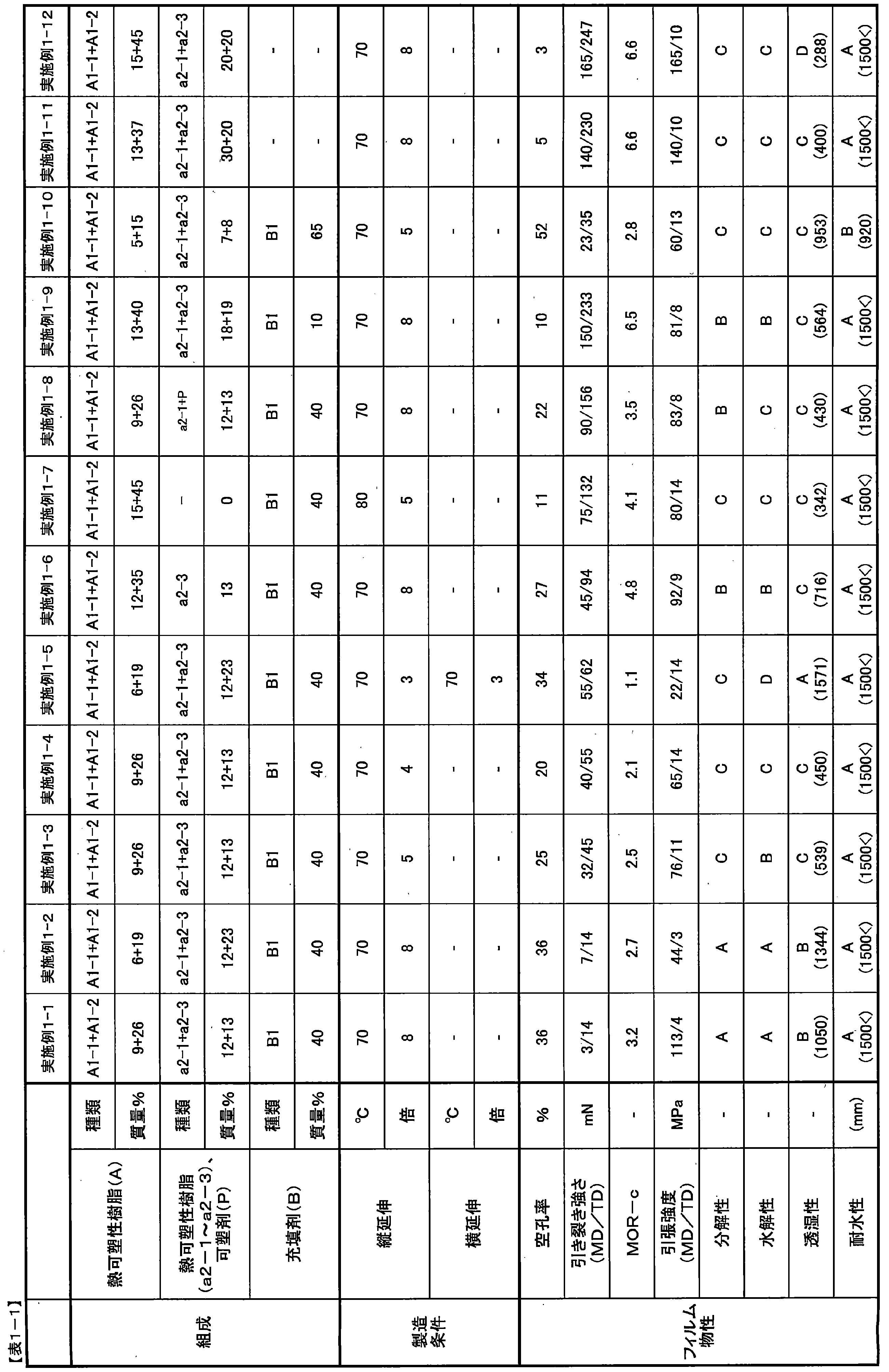
- Example 1-1 9% by mass of thermoplastic resin (A1-1), 26% by mass of thermoplastic resin (A1-2), 12% by mass of thermoplastic resin (a2-1) other than polylactic acid, and thermoplastic resin other than polylactic acid ( a2-3)
- a mixture of 13% by mass and filler (B1) 40% by mass was subjected to a twin-screw extruder with a cylinder diameter of 190 ° C. and a screw diameter of 44 mm with
- the pellets of this composition were dried under reduced pressure at a temperature of 60 ° C. for 12 hours using a rotary drum type vacuum dryer.
- the pellets of this composition were supplied to a single-screw extruder having a cylinder temperature of 190 ° C., extruded into a film at a T die die temperature of 190 ° C., and cast on a drum cooled to 20 ° C. to produce a non-oriented film.
- This non-oriented film was stretched 6 times in a longitudinal direction at a temperature of 70 ° C. by a roll type stretching machine. After this uniaxially oriented film was once cooled on a cooling roll, both ends were held by clips and guided into a tenter, and after heat treatment at a constant length and a temperature of 110 ° C. for 10 seconds, a film having a thickness of 20 ⁇ m was obtained.
- Table 1 shows the physical properties of the obtained film.
- Examples 1-2 to 1-4, 1-6 to 1-12, 2-1 to 2-9, Comparative Examples 1-2 and 2-2 A film having a thickness of 20 ⁇ m was obtained in the same manner as in Example 1-1 except that the composition of the film and the production conditions were changed as shown in Tables 1 and 2. The physical properties of the obtained film are shown in Tables 1 and 2.
- thermoplastic resin (A1-1), 19% by mass of thermoplastic resin (A1-2), 12% by mass of thermoplastic resin (a2-1) other than polylactic acid resin, and thermoplasticity other than polylactic acid resin A mixture of 23% by mass of resin (a2-3) and 40% by mass of filler (B1) was supplied to a twin screw extruder with a reduced pressure vent with a cylinder diameter of 190 ° C. and a screw diameter of 44 mm, and melt kneaded while degassing the reduced pressure vent part. And then homogenized and pelletized to obtain a composition.
- the pellets of this composition were dried under reduced pressure at a temperature of 60 ° C. for 12 hours using a rotary drum type vacuum dryer.
- the pellets of this composition were supplied to a single-screw extruder having a cylinder temperature of 190 ° C., extruded into a film at a T die die temperature of 190 ° C., and cast on a drum cooled to 20 ° C. to produce a non-oriented film.
- This non-oriented film was stretched 3 times in a longitudinal direction at a temperature of 70 ° C. by a roll type stretching machine. After this uniaxially oriented film was once cooled on a cooling roll, both ends were held with clips and guided into a tenter, and stretched three times at a temperature of 70 ° C. in the width direction. Subsequently, after a heat treatment at a temperature of 110 ° C. for 10 seconds under a constant length, a relaxation treatment of 5% in the width direction was performed to obtain a film having a thickness of 20 ⁇ m. Table 1 shows the physical properties of the obtained film.
- thermoplastic resin (a2-3) After a mixture of 13% by mass and filler (B1) 40% by mass was supplied to a twin screw extruder with a cylinder diameter of 190 ° C. and a screw diameter of 44 mm with a vacuum vent, the vacuum vent was melted and kneaded while degassing and homogenized. The composition was obtained by pelletization.
- the pellets of this composition were dried under reduced pressure at a temperature of 60 ° C. for 12 hours using a rotary drum type vacuum dryer.
- Pellets of this composition were supplied to a single screw extruder having a cylinder temperature of 190 ° C., extruded into a film shape at a T die die temperature of 190 ° C., and cast on a drum cooled to 20 ° C. to form a 20 ⁇ m thick non-oriented film. Produced.
- the physical properties of the obtained film are shown in Table 2.
- MD indicates the longitudinal direction of the film
- TD indicates the width direction of the film
- the film of the present invention is a film excellent in water resistance and decomposability, and requires water resistance and degradability.
- Agricultural materials such as multi-film, forestry materials such as fumigation sheets, disposable diapers, napkins and liners It can be used for various packaging materials such as sanitary materials such as plastic bags, garbage bags, foods, and industrial products.
Landscapes
- Chemical & Material Sciences (AREA)
- Engineering & Computer Science (AREA)
- Manufacturing & Machinery (AREA)
- Health & Medical Sciences (AREA)
- Chemical Kinetics & Catalysis (AREA)
- Medicinal Chemistry (AREA)
- Polymers & Plastics (AREA)
- Organic Chemistry (AREA)
- Materials Engineering (AREA)
- Manufacture Of Porous Articles, And Recovery And Treatment Of Waste Products (AREA)
- Biological Depolymerization Polymers (AREA)
- Compositions Of Macromolecular Compounds (AREA)
Abstract
Description
フィルムの全成分100質量%中に、充填剤(B)を1~70質量%含み、
空孔率が80%以下であり、
いずれかの方向の引き裂き強さが、200mN以下であり、
いずれかの方向の引張強度が15MPa未満である、フィルム、または、熱可塑性樹脂(A)を含有し、フィルムの全成分100質量%中に、親水性樹脂(A2)を1~40質量%含み、空孔率が80%以下であり、いずれかの方向の引き裂き強さが、200mN以下であり、いずれかの方向の引張強度が15MPa未満である、フィルム、である。
本発明のフィルム1は、熱可塑性樹脂(A)を含有し、フィルムの全成分100質量%中に、充填剤(B)を1~70質量%含み、空孔率が80%以下であり、いずれかの方向の引き裂き強さが、200mN以下であり、いずれかの方向の引張強度が15MPa未満である、フィルム、であり、以下詳細を説明する。
本発明のフィルム1に含まれる熱可塑性樹脂(A)は、特に限定されないが、好ましい例として、(i)ポリエチレンテレフタレート、ポリエチレン-2,6-ナフタレート、ポリプロピレンテレフタレート、ポリブチレンテレフタレートなどの芳香族ポリエステル系樹脂、(ii)脂肪族ポリエステル樹脂、脂肪族芳香族ポリエステル、多糖類、デンプンを含むポリマーなどの生分解性樹脂(詳細は後述する)、(iii)ポリ(メタ)アクリレートなどアクリル系樹脂、(iv)ポリエチレン、ポリプロピレン、ポリメチルペンテン、ポリイソプレン、エポキシ変性ポリオレフィン、酸変性ポリオレフィン、脂環式ポリオレフィン樹脂などのポリオレフィン系樹脂、(v)ポリアミド系樹脂、ポリカーボネート、ポリスチレン、ポリエーテル、ポリエステルアミド、ポリエーテルエステル、ポリ塩化ビニル、ポリビニルアルコール、ポリアセタール、ポリフェニレンサルファイド、ポリエーテルエーテルケトン、ポリウレタン、ポリスルホン、ポリフェニレンオキサイド、ポリイミド、ポリエーテルイミド、ポリエステルエラストマー、ポリアミドエラストマー、ポリオレフィンエラストマーなどのその他の樹脂、およびこれらを成分とする共重合体、またはこれらの混合物などが挙げられる。
本発明のフィルム1に含まれる熱可塑性樹脂(A)は、生分解性樹脂(A1)を含むことが好ましい。生分解性樹脂(A1)は、生分解性を有する樹脂であれば特に限定されない。
ポリ乳酸系樹脂(a1)とは、L-乳酸ユニットおよび/またはD-乳酸ユニットを主たる構成成分とする重合体である。ここで主たる構成成分とは、重合体100質量%中において乳酸ユニットの質量割合が最大であることを意味する。乳酸ユニットの質量割合は、好ましくは重合体100質量%中において、乳酸ユニットが70質量%~100質量%である。
上記の他の単量体ユニットの共重合量は、ポリ乳酸系樹脂(a1)の重合体中の単量体ユニット全体100mol%に対し、0~30mol%であることが好ましく、0~10mol%であることがより好ましい。なお、上記した単量体ユニットの中でも、用途に応じて生分解性を有する成分を選択することが好ましい。
本発明のフィルム1において、生分解性樹脂(A1)として用いるポリ乳酸系樹脂(a1)は、結晶性ポリ乳酸系樹脂(a11)と非晶性ポリ乳酸系樹脂(a12)の混合物であることが好ましい。混合物とすることにより、結晶性、非晶性、それぞれのポリ乳酸系樹脂(a1)の利点を兼ね備えることができるからである。
本発明のフィルム1は、熱可塑性樹脂(A)がポリ乳酸系樹脂を含む場合、ポリ乳酸系樹脂(a1)以外の熱可塑性樹脂(a2)を含むことが透湿性、分解性を向上させることができるので好ましい。なお、熱可塑性樹脂Aのうちポリ乳酸系樹脂(a1)以外のものを熱可塑性樹脂(a2)とする。該熱可塑性樹脂(a2)としては、生分解性樹脂(A1)として例示した(ポリ乳酸系樹脂以外の)樹脂が使用できるほか、ポリアセタール、ポリエチレン、ポリプロピレン、ポリアミド、ポリ(メタ)アクリレート、ポリフェニレンサルファイド、ポリエーテルエーテルケトン、ポリエステル、ポリウレタン、ポリイソプレン、ポリスルホン、ポリフェニレンオキサイド、ポリイミド、ポリエーテルイミド、エポキシ変性ポリオレフィン、酸変性ポリオレフィン、オレフィン-アクリル共重合ポリマー、エポキシ変性オレフィン-アクリル共重合ポリマー、ポリエステルエラストマー、ポリアミドエラストマー、ポリオレフィンエラストマー、樹脂系の可塑剤(a21)などが使用できる。
本発明のフィルム1において、これらのポリ乳酸系樹脂(a1)以外の熱可塑性樹脂(a2)として組み合わせる樹脂には特に制限はなく、ポリ乳酸系樹脂(a1)以外の樹脂群をそれぞれ組み合わせることができる。その中でも、透湿性向上の観点から、各種樹脂系の可塑剤(a21)と、樹脂系の可塑剤以外の熱可塑性樹脂(a22)との組み合わせが好ましい。さらには、樹脂系の可塑剤(a21)として、ポリエーテル系セグメントとポリ乳酸系セグメントとを有するブロック共重合体及びポリエステル系セグメントとポリ乳酸系セグメントとを有するブロック共重合体からなる群より選ばれる少なくとも1つの樹脂と、樹脂系の可塑剤以外の熱可塑性樹脂(a22)として、脂肪族ポリエステル系樹脂及び脂肪族芳香族ポリエステル系樹脂からなる群より選ばれる少なくとも1つの樹脂との組み合わせが特に好ましい。なお、樹脂系の可塑剤以外の熱可塑性樹脂(a22)における脂肪族ポリエステル系樹脂には、ポリ乳酸系樹脂(a1)は含まないものとする。
本発明のフィルム1は、フィルムの全成分100質量%中に、充填剤(B)を1~70質量%含むことが重要である。充填剤(B)が1質量%未満の場合、分解性に劣るフィルムとなり、また、充填剤(B)が70質量%を超える場合、耐水性に劣るフィルムとなる。
本発明のフィルム1は、空孔率が80%以下であることが重要である。空孔率が80%を超えると、フィルムの耐水性が不足する場合がある。かかる観点から、空孔率は70%以下が好ましく、60%以下がより好ましく、50%以下がさらに好ましい。また、空孔率が1%以上であると、フィルムに透湿性を付与できることから好ましく、同観点より空孔率は10%以上がより好ましく、15%以上がさらに好ましく、25%以上が特に好ましく、30%以上が最も好ましい。
本発明のフィルム1は、いずれかの方向の引き裂き強さが、200mN以下であることが重要である。全ての方向の引き裂き強さが200mNを超えると、分解性が不足することがある。いずれかの方向の引き裂き強さは、好ましくは100mN以下であり、より好ましくは50mN以下であり、さらに好ましくは20mN以下である。いずれかの方向の引き裂き強さの下限は特に限定されないが、実用上、0.5mN以上である。
本発明のフィルム2は、熱可塑性樹脂(A)を含有し、フィルムの全成分100質量%中に、親水性樹脂(A2)を1~40質量%含み、いずれかの方向の引き裂き強さが、200mN以下であり、いずれかの方向の引張強度が15MPa未満である、フィルム、である。
本発明のフィルム2は、熱可塑性樹脂(A)を含有する。フィルム2における熱可塑性樹脂(A)は本発明のフィルム1に用いられるものと同じものが挙げられる。
本発明のフィルム2は、熱可塑性樹脂(A)が生分解性樹脂(A1)を含むことが好ましい。フィルム2における生分解性樹脂(A1)は、本発明のフィルム1に用いられるものと同じものが挙げられる。
本発明のフィルム2には、親水性樹脂(A2)をフィルムの全成分100質量%中に、1~40質量%含む。ここで言う親水性樹脂(A2)とは、水に溶解または膨潤する高分子化合物のことであり、ポリエチレングリコール、ポリビニルピロリドン、ポリアクリルアミド、ポリビニルブチラール、ポリエーテルエステルアミド、ポリ(N-メチロールアクリルアミド)、ヒドロキシエチルセルロース、メチルセルロース、ヒドロキシプロピルセルロース、カルボキシメチルセルロースなどの変性セルロース、ポリビニルアルコール(PVA)、水溶性ポリエステル樹脂、水溶性ポリビニルアセタール、ポリ-N-ビニルアセトアミド、ポリアクリルアミド、ポリアクリロイルモルホリン、ポリヒドロキシアクリルアクリレート、ポリアクリル酸、ゼラチン、カゼイン、及びこれらの水溶性誘導体や、共重合体が挙げられる。また、親水性樹脂(A2)は、熱可塑性樹脂(A)に含まれるものであることが好ましく、本発明のフィルム1のポリ乳酸系樹脂(a1)以外の熱可塑性樹脂(a2)に挙げられたもののうち水に溶解または膨潤するものも親水性樹脂(A2)として好適に用いることができる。本発明のフィルム2において、親水性樹脂(A2)を含ませることによって、フィルムの機械特性を保ったまま、特に水中での分解性を付与することが可能となる。親水性樹脂(A2)として、本発明のフィルム1のポリ乳酸系樹脂(a1)以外の熱可塑性樹脂(a2)に挙げられたもののうち水に溶解または膨潤するものがより好ましい。更には、本発明のフィルム1の樹脂系の可塑剤(a21)に挙げられたものを用いると、フィルム全体の生分解性を維持しつつ、可塑化でき、かつ水への分解性を付与できるという点でより好ましい。特に、熱可塑性樹脂(A)がポリ乳酸系樹脂(a1)である場合は、親水性樹脂が本発明のフィルム1に挙げられたブロック共重合体可塑剤であるのが、ブリードアウトを抑制しつつ、水への分解性が付与できるという点で特に好ましい。
本発明のフィルム2は、透湿性、分解性を向上させる観点から、熱可塑性樹脂(A)がポリ乳酸系樹脂の場合、ポリ乳酸系樹脂以外(a1)の熱可塑性樹脂(a2)を含むことが好ましい。熱可塑性樹脂(a2)は本発明のフィルム1で挙げられたものが好適に用いられる。また親水性樹脂(A2)と兼ねてもよい。
本発明のフィルム2は、フィルムの全成分100質量%中に、充填剤(B)を1~70質量%含むことが、透湿性、分解性を向上させるという点で好ましい。充填剤(B)の例としては、本発明のフィルム1に挙げられたものを好適に用いることができる。
本発明のフィルム2は、いずれかの方向の引き裂き強さが、200mN以下であることが重要である。全ての方向の引き裂き強さが200mNを超えると、分解性が不足することがある。いずれかの方向の引き裂き強さは、好ましくは100mN以下であり、より好ましくは50mN以下であり、さらに好ましくは20mN以下である。いずれかの方向の引き裂き強さの下限は特に限定されないが、実用上、0.5mN以上である。
本発明のフィルム2は、空孔率が80%以下であることが重要である。空孔率が80%を超えると、フィルムの耐水性が不足する場合がある。かかる観点から、70%以下が好ましく、60%以下がより好ましく、50%以下がさらに好ましい。また、空孔率が1%以上であると、フィルムに透湿性を付与できることから好ましく、同観点より空孔率は4%以上がより好ましく、15%以上がさらに好ましく、25%以上が特に好ましく、30%以上が最も好ましい。空孔率を前記範囲とするための方法としては、充填剤(B)を前述した含有量として、後述する製造方法の中で特に延伸倍率を好ましい範囲としてフィルムを製造することである。また、前述したように、ポリ乳酸系樹脂(a1)以外の熱可塑性樹脂(a2)に関し、好ましい種類、含有比率で組み合わせることで、より効率的に空孔率を調整することができる。
本発明のフィルム1およびフィルム2は、いずれかの方向の引張強度が15MPa未満であることが重要である。全ての方向の引張強度が15MPa以上であると分解性が不足することがある。いずれかの方向の引張強度は、好ましくは10MPa未満であり、より好ましくは7MPa未満であり、さらに好ましくは5MPa未満である。いずれかの方向の引張強度の下限は特に限定されないが、実用上、0.5MPa以上である。
(分子配向度MOR-c)
本発明のフィルム1およびフィルム2は、分子配向度MOR-cが2~8であることが好ましい。MOR-cを2以上とすることでフィルムの透湿性、分解性が良好となり、MOR-cを8以下とすることでフィルムの耐水性が良好となる。分子配向度MOR-cは、より好ましくは2.3~6であり、さらに好ましくは、2.7~4である。なお、本発明でいう分子配向度MOR-cの測定方法については後述する。
本発明のフィルム1およびフィルム2は、フィルム厚みが5~200μmであることが好ましい。フィルム厚みを5μm以上とすることで、フィルムとした際のコシが強くなり、取り扱い性に優れ、また、ロール巻姿や巻出し性が良好となる。フィルム厚みを200μm以下とすることで柔軟性に優れるものとなり、前述した特定の空孔率を有する場合には透湿性にも優れたものとなる。また、特にインフレーション製膜法においては、自重によりバブルが不安定化しないという利点がある。フィルム厚みは、7~150μmがより好ましく、10~100μmがさらに好ましく、12~50μmがさらにより好ましい。
本発明のフィルム1およびフィルム2は、コンパウンドペレットやフィルムのブロッキング防止の観点から、フィルム全体100質量%中に有機滑剤を0.1~5質量%含むことが好ましい。
本発明のフィルム1およびフィルム2には、本発明の効果を損なわない範囲で前述した以外の添加剤を含有してもよい。例えば、公知の可塑剤、酸化防止剤、紫外線安定化剤、着色防止剤、艶消し剤、抗菌剤、消臭剤、難燃剤、耐候剤、帯電防止剤、抗酸化剤、イオン交換剤、粘着性付与剤、消泡剤、着色顔料、染料、結晶核剤、ポリマー鎖延長剤、ポリマー末端封鎖剤などが含有できる。
次に、本発明のフィルム1およびフィルム2を製造する方法について具体的に説明するがこれに限定されるものではない。
実施例中に示す測定や評価は次に示すような条件で行った。
フィルムを30mm×40mmの大きさに切取り試料とした。電子比重計(ミラージュ貿易(株)製SD-120L)を用いて、室温23℃、相対湿度65%の雰囲気にて比重の測定を行った。測定を3回行い、平均値をそのフィルムの比重ρとした。
(2)引き裂き強さ
室温23℃、相対湿度65%の雰囲気にて、引き裂き強さを測定した。
オリエンテック社製TENSILON UCT-100を用いて、室温23℃、相対湿度65%の雰囲気にて、引張強度を測定した。
サンプルサイズを10cm×10cmとし、フィルム幅方向中央において、サンプルを切り出した。KSシステムズ(株)製(現王子計測機器(株))の分子配向計MOA-2001を用いて、MOR-cを求めた。なお、測定サンプルの中心部分9点の厚みを測定し、その平均値を厚み(μm)として、分子配向計に入力してMOR-cを求めた。
(3)で測定した長さ方向、及び、幅方向の引張強度の、小さい方の値を用いて、以下の基準にて評価した。本発明においては、A~Cの評価を満たす場合、分解性を有する、と判断した。
A:5MPa未満
B:5MPa以上10MPa未満
C:10MPa以上15MPa未満
D:15MPa以上。
2000mlのビーカーに水800ml入れ、5cm×5cmに切った試験片を4枚入れて、マグネチックスターラーで23℃、750rpmの回転速度で48hr攪拌後のフィルムをビーカーから取り出し、分解した試験片の枚数を観察した。
その試験片の数を用いて、以下の基準にて評価を行った。
A:12枚以上
B:8枚以上12枚未満
C:5枚以上7枚以下
D:4枚のままで分解していない。
25℃、90%RHに設定した恒温恒湿装置にて、JIS Z0208:1976に規定された方法に従って透湿度(g/(m2・day))を測定した、
その透湿度の値を用いて、以下の基準にて評価した。
A:1500g/(m2・day)以上
B:1000g/(m2・day)以上1500g/(m2・day)未満
C:300g/(m2・day)以上1000g/(m2・day)未満
D:300g/(m2・day)未満。
JIS L1092:2009、A法(低水圧法)に規定された方法に準拠し、フィルムとクランプの間に、パッキンで挟んだ金網を置いた状態で、耐水圧(mm)を測定した。なお、測定値の上限は1500mmであったため、1500mmを超える場合は「1500<」と表記した。
A:1000mm以上
B:750mm以上1000mm未満
C:400mm以上750mm未満
D:400mm未満
[熱可塑性樹脂(A)]
(A1-1)
生分解性樹脂(A1)であるポリ乳酸系樹脂(a1)、質量平均分子量=200,000、D体含有量=1.4mol%、融点=166℃の結晶性ポリ乳酸系樹脂(a11)であり、生分解度=99%(40日、ISO14855)
(A1-2)
生分解性樹脂(A1)であるポリ乳酸系樹脂(a1)、質量平均分子量=200,000、D体含有量=12.0mol%、融点=無しの非晶性ポリ乳酸系樹脂(a12)であり、生分解度=99%(40日、ISO14855)
なお、上記の質量平均分子量は 日本Warters(株)製、Warters2690を用い、ポリメチルメタクリレートを標準とし、カラム温度40℃、クロロホルム溶媒を用いて測定した。
(a2-1)
ポリブチレンアジペート・テレフタレート樹脂(BASF社製、商品名“エコフレックス”FBX7011)、生分解度=90%(80日、ISO14855)の樹脂系の可塑剤以外の熱可塑性樹脂(a22)である。
ポリブチレンサクシネート系樹脂(三菱化学社製、商品名“GSPla”(登録商標)AZ91T)、生分解度=85%(40日、ISO14855)の樹脂系の可塑剤以外の熱可塑性樹脂(a22)である。
数平均分子量8,000のポリエチレングリコール62質量部とL-ラクチド38質量部とオクチル酸スズ0.05質量部を混合し、撹拌装置付きの反応容器中で、窒素雰囲気下160℃で3時間重合することで、数平均分子量8,000のポリエチレングリコールの両末端に数平均分子量2,500のポリ乳酸セグメントを有するブロック共重合体可塑剤(樹脂系の可塑剤(a21)であり親水性樹脂(A2)である)を得た。生分解度=80%(300日、ISO14855)
[可塑剤(P)]
アセチルクエン酸トリブチル、ファイザー社製、商品名“シトロフレックスA-4”)
[充填剤(B)]
(B1)
炭酸カルシウム(味の素ファインテクノ社製、商品名“トップフローH200”、平均粒子径1.7μm)
(B2)
炭酸カルシウム(丸尾カルシウム社製、商品名“カルテックスR”、平均粒子径2.8μm)
(実施例1-1)
熱可塑性樹脂(A1-1)9質量%、熱可塑性樹脂(A1-2)26質量%、ポリ乳酸系以外の熱可塑性樹脂(a2-1)12質量%、ポリ乳酸系以外の熱可塑性樹脂(a2-3)13質量%、充填剤(B1)40質量%の混合物をシリンダー温度190℃のスクリュー径44mmの減圧ベント付き2軸押出機に供し、減圧ベント部を脱気しながら溶融混練し、均質化した後にペレット化して組成物を得た。
フィルムの組成と製造条件を表1、2のように変更した以外は、実施例1-1と同様にして厚さ20μmのフィルムを得た。得られたフィルムの物性を表1、2に示した。
熱可塑性樹脂(A1-1)6質量%、熱可塑性樹脂(A1-2)19質量%、ポリ乳酸系樹脂以外の熱可塑性樹脂(a2-1)12質量%、ポリ乳酸系樹脂以外の熱可塑性樹脂(a2-3)23質量%、充填剤(B1)40質量%の混合物をシリンダー温度190℃のスクリュー径44mmの減圧ベント付き2軸押出機に供し、減圧ベント部を脱気しながら溶融混練し、均質化した後にペレット化して組成物を得た。
熱可塑性樹脂(A1-1)9質量%、熱可塑性樹脂(A1-2)26質量%、ポリ乳酸系樹脂以外の熱可塑性樹脂(a2-1)12質量%、熱可塑性樹脂(a2-3)13質量%、充填剤(B1)40質量%の混合物をシリンダー温度190℃のスクリュー径44mmの減圧ベント付き2軸押出機に供し、減圧ベント部を脱気しながら溶融混練し、均質化した後にペレット化して組成物を得た。
フィルムの組成と製造条件を表2のように変更した以外は、実施例1-5と同様にして厚さ20μmのフィルムを得た。得られたフィルムの物性を表2に示した。
フィルムの組成を表2のように変更した以外は、実施例1-1と同様にして製造を試みたが、延伸が不可能であった。


Claims (11)
- 熱可塑性樹脂(A)を含有し、
フィルムの全成分100質量%中に、充填剤(B)を1~70質量%含み、
空孔率が80%以下であり、
いずれかの方向の引き裂き強さが、200mN以下であり、
いずれかの方向の引張強度が15MPa未満である、フィルム。 - 前記熱可塑性樹脂(A)が生分解性樹脂(A1)を含有する、請求項1に記載のフィルム。
- 前述の引張強度が15MPa未満である方向に直交する方向の引張強度が、15MPa以上である、請求項1または2に記載のフィルム。
- 分子配向度MOR-cが2~8である、請求項1~3のいずれかに記載のフィルム。
- 前記生分解性樹脂(A1)がポリ乳酸系樹脂(a1)を含有する、請求項2~4のいずれかに記載のフィルム。
- 前記熱可塑性樹脂(A)が、ポリ乳酸系樹脂(a1)以外の熱可塑性樹脂(a2)を含有する、請求項5に記載のフィルム。
- 前記熱可塑性樹脂(a2)が、ポリエーテル系セグメントとポリ乳酸系セグメントとを有するブロック共重合体及びポリエステル系セグメントとポリ乳酸系セグメントとを有するブロック共重合体からなる群より選ばれる少なくとも1つの樹脂と、脂肪族ポリエステル系樹脂及び脂肪族芳香族ポリエステル系樹脂からなる群より選ばれる少なくとも1つの樹脂との組み合わせからなる、請求項6に記載のフィルム。
- 熱可塑性樹脂(A)を含有し、
フィルムの全成分100質量%中に、親水性樹脂(A2)を1~40質量%含み、
空孔率が80%以下であり、
いずれかの方向の引き裂き強さが、200mN以下であり、
いずれかの方向の引張強度が15MPa未満である、フィルム。 - 熱可塑性樹脂(A)が生分解性樹脂(A1)を含有する、請求項8に記載のフィルム。
- 前述の引張強度が15MPa未満である方向に直交する方向の引張強度が、15MPa以上である、請求項8または9に記載のフィルム。
- 生分解性樹脂(A1)がポリ乳酸系樹脂(a1)である、請求項9または10に記載のフィルム。
Priority Applications (4)
| Application Number | Priority Date | Filing Date | Title |
|---|---|---|---|
| JP2014513849A JP6287832B2 (ja) | 2013-03-26 | 2014-03-20 | フィルム |
| EP14774933.7A EP2980141A4 (en) | 2013-03-26 | 2014-03-20 | MOVIE |
| CN201480017215.2A CN105073858A (zh) | 2013-03-26 | 2014-03-20 | 膜 |
| US14/779,214 US20160046774A1 (en) | 2013-03-26 | 2014-03-20 | Film |
Applications Claiming Priority (2)
| Application Number | Priority Date | Filing Date | Title |
|---|---|---|---|
| JP2013-063409 | 2013-03-26 | ||
| JP2013063409 | 2013-03-26 |
Publications (1)
| Publication Number | Publication Date |
|---|---|
| WO2014156952A1 true WO2014156952A1 (ja) | 2014-10-02 |
Family
ID=51623931
Family Applications (1)
| Application Number | Title | Priority Date | Filing Date |
|---|---|---|---|
| PCT/JP2014/057754 Ceased WO2014156952A1 (ja) | 2013-03-26 | 2014-03-20 | フィルム |
Country Status (6)
| Country | Link |
|---|---|
| US (1) | US20160046774A1 (ja) |
| EP (1) | EP2980141A4 (ja) |
| JP (1) | JP6287832B2 (ja) |
| CN (1) | CN105073858A (ja) |
| TW (1) | TW201441284A (ja) |
| WO (1) | WO2014156952A1 (ja) |
Cited By (2)
| Publication number | Priority date | Publication date | Assignee | Title |
|---|---|---|---|---|
| JP2016053126A (ja) * | 2014-09-04 | 2016-04-14 | 富士ゼロックス株式会社 | 樹脂組成物および樹脂成形体 |
| WO2016182707A1 (en) | 2015-05-13 | 2016-11-17 | Frito-Lay North America, Inc. | Composition and method for making a flexible packaging film |
Families Citing this family (4)
| Publication number | Priority date | Publication date | Assignee | Title |
|---|---|---|---|---|
| WO2017169662A1 (ja) * | 2016-03-31 | 2017-10-05 | 東レ株式会社 | フィルムおよびそれを用いた電気絶縁シート、粘着テープ、回転機 |
| CN108684401A (zh) * | 2018-04-24 | 2018-10-23 | 华贝纳(杭州)毛纺染整有限公司 | 可降解农用地膜及其制备方法 |
| CN113825620A (zh) * | 2019-05-13 | 2021-12-21 | 三菱瓦斯化学株式会社 | 脂肪族聚酯共聚物 |
| CN115403909B (zh) * | 2022-10-17 | 2023-11-03 | 安徽双津实业有限公司 | 一种生物降解薄膜及制备方法 |
Citations (8)
| Publication number | Priority date | Publication date | Assignee | Title |
|---|---|---|---|---|
| JPH05209073A (ja) * | 1992-01-30 | 1993-08-20 | Tokuyama Soda Co Ltd | 多孔性フィルム |
| JPH0827296A (ja) * | 1994-07-14 | 1996-01-30 | Mitsui Toatsu Chem Inc | 多孔性フィルムおよびその製造方法 |
| JPH09291165A (ja) * | 1996-02-29 | 1997-11-11 | Mitsubishi Chem Corp | 生分解性多孔質フィルム |
| JP2004168895A (ja) * | 2002-11-20 | 2004-06-17 | Unitika Ltd | 生分解性が向上した生分解性樹脂組成物及び成形体 |
| JP2006104460A (ja) * | 2004-09-10 | 2006-04-20 | Yupo Corp | 印刷用紙 |
| JP2007112867A (ja) | 2005-10-19 | 2007-05-10 | Kao Corp | 多孔性シート |
| JP2011219555A (ja) * | 2010-04-06 | 2011-11-04 | Unitika Ltd | 生分解性合成紙およびその製造方法 |
| WO2012023465A1 (ja) | 2010-08-18 | 2012-02-23 | 東レ株式会社 | 多孔性フィルム |
Family Cites Families (1)
| Publication number | Priority date | Publication date | Assignee | Title |
|---|---|---|---|---|
| US9067384B2 (en) * | 2009-06-10 | 2015-06-30 | Ppg Industries Ohio, Inc. | Microporous material having degradation properties and articles prepared therefrom |
-
2014
- 2014-03-20 JP JP2014513849A patent/JP6287832B2/ja not_active Expired - Fee Related
- 2014-03-20 EP EP14774933.7A patent/EP2980141A4/en not_active Withdrawn
- 2014-03-20 WO PCT/JP2014/057754 patent/WO2014156952A1/ja not_active Ceased
- 2014-03-20 CN CN201480017215.2A patent/CN105073858A/zh active Pending
- 2014-03-20 US US14/779,214 patent/US20160046774A1/en not_active Abandoned
- 2014-03-24 TW TW103110805A patent/TW201441284A/zh unknown
Patent Citations (8)
| Publication number | Priority date | Publication date | Assignee | Title |
|---|---|---|---|---|
| JPH05209073A (ja) * | 1992-01-30 | 1993-08-20 | Tokuyama Soda Co Ltd | 多孔性フィルム |
| JPH0827296A (ja) * | 1994-07-14 | 1996-01-30 | Mitsui Toatsu Chem Inc | 多孔性フィルムおよびその製造方法 |
| JPH09291165A (ja) * | 1996-02-29 | 1997-11-11 | Mitsubishi Chem Corp | 生分解性多孔質フィルム |
| JP2004168895A (ja) * | 2002-11-20 | 2004-06-17 | Unitika Ltd | 生分解性が向上した生分解性樹脂組成物及び成形体 |
| JP2006104460A (ja) * | 2004-09-10 | 2006-04-20 | Yupo Corp | 印刷用紙 |
| JP2007112867A (ja) | 2005-10-19 | 2007-05-10 | Kao Corp | 多孔性シート |
| JP2011219555A (ja) * | 2010-04-06 | 2011-11-04 | Unitika Ltd | 生分解性合成紙およびその製造方法 |
| WO2012023465A1 (ja) | 2010-08-18 | 2012-02-23 | 東レ株式会社 | 多孔性フィルム |
Non-Patent Citations (1)
| Title |
|---|
| See also references of EP2980141A4 * |
Cited By (3)
| Publication number | Priority date | Publication date | Assignee | Title |
|---|---|---|---|---|
| JP2016053126A (ja) * | 2014-09-04 | 2016-04-14 | 富士ゼロックス株式会社 | 樹脂組成物および樹脂成形体 |
| WO2016182707A1 (en) | 2015-05-13 | 2016-11-17 | Frito-Lay North America, Inc. | Composition and method for making a flexible packaging film |
| EP3294537A4 (en) * | 2015-05-13 | 2019-01-09 | Frito-Lay North America, Inc. | COMPOSITION AND METHOD FOR MANUFACTURING SOFT PACKAGING FILM |
Also Published As
| Publication number | Publication date |
|---|---|
| EP2980141A4 (en) | 2016-11-02 |
| EP2980141A1 (en) | 2016-02-03 |
| JPWO2014156952A1 (ja) | 2017-02-16 |
| TW201441284A (zh) | 2014-11-01 |
| CN105073858A (zh) | 2015-11-18 |
| US20160046774A1 (en) | 2016-02-18 |
| JP6287832B2 (ja) | 2018-03-07 |
Similar Documents
| Publication | Publication Date | Title |
|---|---|---|
| JP5799809B2 (ja) | 多孔性フィルム | |
| JP5751250B2 (ja) | ポリ乳酸系フィルム | |
| JP5867406B2 (ja) | 生分解性フィルム | |
| JP6287832B2 (ja) | フィルム | |
| WO2011162046A1 (ja) | ポリ乳酸系フィルム | |
| JPWO2016158736A1 (ja) | 生分解性白色フィルムおよびその製造方法 | |
| JP2012057004A (ja) | 多孔性フィルム | |
| JP2015224253A (ja) | ポリ乳酸樹脂を含むフィルム | |
| JP2015083661A (ja) | 多孔フィルム及びその製造方法 | |
| JP2016043650A (ja) | ポリ乳酸系樹脂を含むフィルム | |
| JP2014173074A (ja) | 生分解性フィルム | |
| JP6260377B2 (ja) | 生分解性フィルム | |
| JP2015021105A (ja) | 多孔性フィルム | |
| JP5957908B2 (ja) | 生分解性フィルム | |
| JP2016056304A (ja) | フィルム | |
| JP6492720B2 (ja) | 延伸フィルムの製造方法 | |
| JP2016008269A (ja) | ポリ乳酸系樹脂フィルム | |
| JP2016097576A (ja) | 積層フィルム | |
| JP2015038193A (ja) | 多孔性フィルム | |
| JP2015137302A (ja) | 多孔性フィルムおよびその製造方法 |
Legal Events
| Date | Code | Title | Description |
|---|---|---|---|
| WWE | Wipo information: entry into national phase |
Ref document number: 201480017215.2 Country of ref document: CN |
|
| ENP | Entry into the national phase |
Ref document number: 2014513849 Country of ref document: JP Kind code of ref document: A |
|
| 121 | Ep: the epo has been informed by wipo that ep was designated in this application |
Ref document number: 14774933 Country of ref document: EP Kind code of ref document: A1 |
|
| WWE | Wipo information: entry into national phase |
Ref document number: 14779214 Country of ref document: US |
|
| NENP | Non-entry into the national phase |
Ref country code: DE |
|
| REEP | Request for entry into the european phase |
Ref document number: 2014774933 Country of ref document: EP |
|
| WWE | Wipo information: entry into national phase |
Ref document number: 2014774933 Country of ref document: EP |