WO2014157146A1 - Tôle d'acier inoxydable austénitique et procédé permettant de fabriquer un matériau en acier de haute résistance qui utilise cette dernière - Google Patents
Tôle d'acier inoxydable austénitique et procédé permettant de fabriquer un matériau en acier de haute résistance qui utilise cette dernière Download PDFInfo
- Publication number
- WO2014157146A1 WO2014157146A1 PCT/JP2014/058196 JP2014058196W WO2014157146A1 WO 2014157146 A1 WO2014157146 A1 WO 2014157146A1 JP 2014058196 W JP2014058196 W JP 2014058196W WO 2014157146 A1 WO2014157146 A1 WO 2014157146A1
- Authority
- WO
- WIPO (PCT)
- Prior art keywords
- stainless steel
- less
- cold
- phase
- aging
- Prior art date
- Legal status (The legal status is an assumption and is not a legal conclusion. Google has not performed a legal analysis and makes no representation as to the accuracy of the status listed.)
- Ceased
Links
Images


Classifications
-
- C—CHEMISTRY; METALLURGY
- C21—METALLURGY OF IRON
- C21D—MODIFYING THE PHYSICAL STRUCTURE OF FERROUS METALS; GENERAL DEVICES FOR HEAT TREATMENT OF FERROUS OR NON-FERROUS METALS OR ALLOYS; MAKING METAL MALLEABLE, e.g. BY DECARBURISATION OR TEMPERING
- C21D9/00—Heat treatment, e.g. annealing, hardening, quenching or tempering, adapted for particular articles; Furnaces therefor
- C21D9/46—Heat treatment, e.g. annealing, hardening, quenching or tempering, adapted for particular articles; Furnaces therefor for sheet metals
-
- C—CHEMISTRY; METALLURGY
- C21—METALLURGY OF IRON
- C21D—MODIFYING THE PHYSICAL STRUCTURE OF FERROUS METALS; GENERAL DEVICES FOR HEAT TREATMENT OF FERROUS OR NON-FERROUS METALS OR ALLOYS; MAKING METAL MALLEABLE, e.g. BY DECARBURISATION OR TEMPERING
- C21D6/00—Heat treatment of ferrous alloys
- C21D6/004—Heat treatment of ferrous alloys containing Cr and Ni
-
- C—CHEMISTRY; METALLURGY
- C21—METALLURGY OF IRON
- C21D—MODIFYING THE PHYSICAL STRUCTURE OF FERROUS METALS; GENERAL DEVICES FOR HEAT TREATMENT OF FERROUS OR NON-FERROUS METALS OR ALLOYS; MAKING METAL MALLEABLE, e.g. BY DECARBURISATION OR TEMPERING
- C21D8/00—Modifying the physical properties of ferrous metals or ferrous alloys by deformation combined with, or followed by, heat treatment
- C21D8/02—Modifying the physical properties of ferrous metals or ferrous alloys by deformation combined with, or followed by, heat treatment during manufacturing of plates or strips
- C21D8/0247—Modifying the physical properties of ferrous metals or ferrous alloys by deformation combined with, or followed by, heat treatment during manufacturing of plates or strips characterised by the heat treatment
-
- C—CHEMISTRY; METALLURGY
- C22—METALLURGY; FERROUS OR NON-FERROUS ALLOYS; TREATMENT OF ALLOYS OR NON-FERROUS METALS
- C22C—ALLOYS
- C22C38/00—Ferrous alloys, e.g. steel alloys
-
- C—CHEMISTRY; METALLURGY
- C22—METALLURGY; FERROUS OR NON-FERROUS ALLOYS; TREATMENT OF ALLOYS OR NON-FERROUS METALS
- C22C—ALLOYS
- C22C38/00—Ferrous alloys, e.g. steel alloys
- C22C38/001—Ferrous alloys, e.g. steel alloys containing N
-
- C—CHEMISTRY; METALLURGY
- C22—METALLURGY; FERROUS OR NON-FERROUS ALLOYS; TREATMENT OF ALLOYS OR NON-FERROUS METALS
- C22C—ALLOYS
- C22C38/00—Ferrous alloys, e.g. steel alloys
- C22C38/04—Ferrous alloys, e.g. steel alloys containing manganese
-
- C—CHEMISTRY; METALLURGY
- C22—METALLURGY; FERROUS OR NON-FERROUS ALLOYS; TREATMENT OF ALLOYS OR NON-FERROUS METALS
- C22C—ALLOYS
- C22C38/00—Ferrous alloys, e.g. steel alloys
- C22C38/18—Ferrous alloys, e.g. steel alloys containing chromium
- C22C38/34—Ferrous alloys, e.g. steel alloys containing chromium with more than 1.5% by weight of silicon
-
- C—CHEMISTRY; METALLURGY
- C22—METALLURGY; FERROUS OR NON-FERROUS ALLOYS; TREATMENT OF ALLOYS OR NON-FERROUS METALS
- C22C—ALLOYS
- C22C38/00—Ferrous alloys, e.g. steel alloys
- C22C38/18—Ferrous alloys, e.g. steel alloys containing chromium
- C22C38/40—Ferrous alloys, e.g. steel alloys containing chromium with nickel
- C22C38/42—Ferrous alloys, e.g. steel alloys containing chromium with nickel with copper
-
- C—CHEMISTRY; METALLURGY
- C22—METALLURGY; FERROUS OR NON-FERROUS ALLOYS; TREATMENT OF ALLOYS OR NON-FERROUS METALS
- C22C—ALLOYS
- C22C38/00—Ferrous alloys, e.g. steel alloys
- C22C38/18—Ferrous alloys, e.g. steel alloys containing chromium
- C22C38/40—Ferrous alloys, e.g. steel alloys containing chromium with nickel
- C22C38/58—Ferrous alloys, e.g. steel alloys containing chromium with nickel with more than 1.5% by weight of manganese
-
- C—CHEMISTRY; METALLURGY
- C21—METALLURGY OF IRON
- C21D—MODIFYING THE PHYSICAL STRUCTURE OF FERROUS METALS; GENERAL DEVICES FOR HEAT TREATMENT OF FERROUS OR NON-FERROUS METALS OR ALLOYS; MAKING METAL MALLEABLE, e.g. BY DECARBURISATION OR TEMPERING
- C21D2211/00—Microstructure comprising significant phases
- C21D2211/008—Martensite
-
- C—CHEMISTRY; METALLURGY
- C21—METALLURGY OF IRON
- C21D—MODIFYING THE PHYSICAL STRUCTURE OF FERROUS METALS; GENERAL DEVICES FOR HEAT TREATMENT OF FERROUS OR NON-FERROUS METALS OR ALLOYS; MAKING METAL MALLEABLE, e.g. BY DECARBURISATION OR TEMPERING
- C21D8/00—Modifying the physical properties of ferrous metals or ferrous alloys by deformation combined with, or followed by, heat treatment
- C21D8/02—Modifying the physical properties of ferrous metals or ferrous alloys by deformation combined with, or followed by, heat treatment during manufacturing of plates or strips
- C21D8/0221—Modifying the physical properties of ferrous metals or ferrous alloys by deformation combined with, or followed by, heat treatment during manufacturing of plates or strips characterised by the working steps
- C21D8/0236—Cold rolling
Definitions
- the present invention has high elastic limit stress and excellent toughness suitable for various springs, flapper valves, springs, metal gaskets, band saws, blade plates, CVT belt materials, stainless steel wires, etc. that require high elastic limit stress.
- the present invention relates to a method for producing a high-strength stainless steel material and a stainless steel plate used for the steel material.
- 18Ni maraging steel is known as a high-strength metallic material having a tensile strength of 2000 to 2400 N / mm 2 grade.
- 18Ni-9Co-5Mo-0.7Ti maraging steel has a tensile strength of 2000 N / mm 2
- 18Ni-12.5Co-4.2Mo-16Ti maraging steel has a tensile strength of 2400 N / mm 2. It has been.
- Maraging steel also has relatively good toughness. However, the material cost is very high because it contains a large amount of expensive elements such as Ni, Co, and Mo.
- Precipitation hardening type stainless steel contains an element with high precipitation hardening ability and is hardened by an aging treatment.
- typical steel types include SUS630 containing Cu and SUS631 containing Al.
- SUS630 is a martensite single phase after solution treatment, which is cured by aging treatment, but the tensile strength is about 1400 N / mm 2 .
- SUS631 has a metastable austenite phase after solution treatment, and is cured by a technique in which it is partially aged by cold working or the like and then aged to precipitate the intermetallic compound Ni 3 Al. It is.
- the tensile strength can be increased to about 1800 N / mm 2 by actively generating a martensite phase, it is difficult to obtain a strength level of 2000 N / mm 2 or more.
- Patent Documents 1 and 2 disclose a method of performing an aging treatment after moderately cold-working a metastable austenitic stainless steel compound-added with Cu and Si, whereby a tensile strength of 2000 N is disclosed. / Mm Grade 2 high-strength stainless steel is obtained.
- Patent Document 3 discloses a method in which the content of C and N is set to a specified value or more, and a work-induced martensite phase is generated by cold rolling to obtain a martensite + austenite structure of 80 to 95% by volume before aging. It is disclosed.
- JP 61-296356 A Japanese Patent Laid-Open No. 4-202463 JP 2001-107192 A
- An object of the present invention is to produce and provide a high-strength metallic material having both high tensile strength and elastic limit stress using metastable austenitic stainless steel as a raw material.
- the above purpose is, in mass%, C: 0.10% or less, Si: 0.75% or more and 3.0% or less, Mn: 4.0% or less, Ni: 4.0% or more and 8.0% or less, Cr: 12.0% or more and 18.0% or less, N: 0.15% or less, Cu: 0.5% or more and 3.5% or less, the balance being substantially Fe,
- the total content is 0.10% by mass or more, and the austenite stability index Md (N) represented by the following formula (1) is 30.0 or more.
- ( ⁇ m ) is a stainless steel plate having d ⁇ 1/2 ( ⁇ m ⁇ 1/2 ) of 0.40 or more, and after the cold working with an equivalent strain of 0.50 or more is applied to the steel plate.
- Md (N) 580-520C-2Si-16Mn-16Cr-23Ni-26Cu-300N (1)
- the value of the content of the element represented by mass% is substituted for the element symbol in the formula (1).
- the austenite average crystal grain size d is an average of equivalent circle diameters of individual austenite crystal grains observed in a cross section perpendicular to the plate thickness direction (that is, a plane obtained by polishing the plate surface, hereinafter referred to as “ND plane”). .
- the steel plate according to the present invention specifies a steel plate before being processed, that is, a processing steel plate.
- the processing referred to here is cold processing such as cold rolling, wire drawing and bending.
- an aging treatment is performed to obtain a highly elastic steel material.
- the aging treatment can be performed not only in a continuous line but also in batch processing after processing into various parts.
- Equivalent strain indicates how much strain applied in a multiaxial stress state corresponds to the amount of strain in a uniaxial stress state.
- the equivalent strain ⁇ e is generally expressed by the following equation (3).
- ⁇ e [(2/3) ⁇ ( ⁇ 1 2 + ⁇ 2 2 + ⁇ 3 2 )] 1/2
- the equivalent strain in the case of rolling can be expressed by the following equation (4).
- ⁇ e (2/3 1/2 ) ⁇ ln (h 0 / h 1 ) (4)
- h 0 is the plate thickness (mm) before rolling
- h 1 is the plate thickness (mm) after rolling.
- the amount of martensite after application of cold working with an equivalent strain of 0.50 or more is 50.0 vol% or more means that the material has undergone cold working with an equivalent strain of 0.50 or more. This means that the average martensite amount is 50% by volume or more.
- “characteristic that the amount of martensite after giving a cold working with an equivalent strain of 0.50 or more is 50.0% by volume or more” “after giving a cold working with an equivalent strain of 0.59 or more” It can also be defined as a requirement that it has the property that the amount of martensite becomes 50.0% by volume or more.
- the equivalent strain 0.59 corresponds to the equivalent strain when cold rolling with a rolling rate of 40% is performed.
- the amount of martensite (% by volume) can be determined by magnetic measurement. Specifically, the following method is followed. [Measurement of martensite content] A test piece taken from a material to be measured is set on a vibrating sample magnetometer (VSM), and a magnetic moment M (A ⁇ m 2 ) is obtained. The saturation magnetization I (A ⁇ m 2 / kg) of the sample is obtained from the value of the actual measurement M and the mass W (kg) of the sample by the following equation (5).
- I S M / W (5)
- I S (A ⁇ m 2 / kg) determined by the following equation (6) which is a regression equation of the component composition is adopted as the theoretical saturation magnetization value of the martensite phase in the stainless steel having the above composition range.
- I S 214.5-3.12 (Cr + 0.5Ni) -12C-1.9Mn-6N-3P-7S-2.6Si-2.3Cu (6)
- the value of the content of the element expressed in mass% is substituted for the element symbol in the formula (6).
- the above-mentioned stainless steel sheet is subjected to cold rolling at a rolling rate of 40% or more (for example, 40 to 80%), and then an aging temperature of 300 ° C. to 600 ° C.
- fill the following (2) Formula is disclosed. 13000 ⁇ T (logt + 20) ⁇ 16500 (2)
- T is an aging temperature (K) expressed in absolute temperature
- t is an aging time (h).
- the ratio of the elastic limit stress ⁇ 0.01 (N / mm 2 ) to the 0.2% proof stress ⁇ 0.2 (N / mm 2 ) when the aging conditions are followed. Is 0.60 or more, and characteristics suitable for the spring material can be obtained.
- the elastic limit stress ⁇ 0.01 is a stress when a permanent strain of 0.01% is generated, and can be obtained by an offset method from a stress-strain curve measured by a tensile test.
- a stainless steel material excellent in toughness having both high tensile strength and elastic limit stress is provided.
- This steel material is suitable for various spring materials.
- the average austenite grain size is d ( ⁇ m)
- the value of d ⁇ 1/2 that is, the reciprocal of the square root of d
- crystal grain size d ⁇ 1/2 the value of the austenite crystal grains rotate in a specific direction by processing deformation to form a texture, but the strain to the austenite phase is reduced. It was found that the uniform increase increases the amount of martensite transformation, decreases the texture, and averages the hardness of the martensite phase and the retained austenite phase due to the effect of dispersion of the texture due to grain refinement. .
- the elastic limit stress is improved, and the ratio of the elastic limit stress ⁇ 0.01 (N / mm 2 ) to the 0.2% proof stress ⁇ 0.2 (N / mm 2 ) (hereinafter referred to as “ ⁇ 0. It is possible to obtain a highly elastic material having a “ 01 / ⁇ 0.2 ratio” of 0.60 or more. Those having a ⁇ 0.01 / ⁇ 0.2 ratio of 0.75 or more are more suitable targets, and can be adjusted to 0.80 or more.
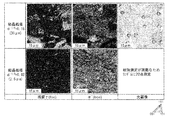
- Example of IPF map of ND surface by electron backscatter diffraction (EBSD) for materials cold-rolled with d 2.6 ⁇ m) annealed at a rolling rate of 50% and a rolling temperature of 70 ° C.
- EBSD electron backscatter diffraction
- HV Vickers hardness
- Such hardness measurement was performed for various cold rolling rates (tempered rolling rates). The result is shown in FIG.
- the material temperature during cold rolling is about 70 ° C.
- the higher the cold rolling ratio (temper rolling ratio) the more the ⁇ ′ phase and the residual ⁇ phase.
- the hardness increases, and the residual ⁇ phase is softer by about 200 HV than the ⁇ ′ phase at any rolling rate, and the difference in hardness between the ⁇ ′ phase and the residual ⁇ phase is large. Further, the hardness variation of the ⁇ ′ phase is particularly large.
- Table 1 exemplifies the hardness measurement results of the material as it is at 70 ° C. and 50% cold rolling (temper rolling) and the material that has been aged at 425 ° C.
- the amount of increase in hardness ⁇ HV expressed by the ratio (HV) ⁇ hardness before aging treatment (HV) was 57.
- the hardness of the residual ⁇ phase after aging treatment was 453 ⁇ 15 HV, and ⁇ HV was ⁇ 14.
- the increase in hardness and variability in the aging treatment is large in the ⁇ ′ phase, and the hardness increase in the aging phase is small in the residual ⁇ phase, so the difference in hardness between the ⁇ ′ phase and the residual ⁇ phase is further expanded by the aging treatment.
- the high age-hardening ability of ⁇ HV was 103, and the variation in hardness was similar to that before aging.
- C is an austenite-forming element and is extremely effective in suppressing the formation of ⁇ ferrite generated at high temperatures and strengthening the work-induced martensite phase. It is more effective to ensure a C content of 0.01% or more. If the C content is excessive, curing due to cold working becomes remarkable, which leads to deterioration of molding processability.
- the C content is limited to 0.10% or less.
- Si has the action of densifying the work-induced martensite phase, increasing ductility and toughness, and increasing the strength increasing effect by aging treatment after cold working.
- the Si content needs to be 0.75% or more, and more preferably more than 1.0.
- the Si content is limited to 3.0% or less.
- Mn functions as a deoxidizer, but is an important element in controlling the stability of the austenite phase.
- the content is set in consideration of the balance with other elements. If the Mn content is excessive, it may cause problems such as environmental protection in the steelmaking process, a decrease in productivity due to surface properties, and a deterioration in workability due to the formation of inclusions such as MnS. As a result of various studies, the Mn content is limited to 4.0% or less. The adjustment is preferably in the range of 0.1 to 4.0%, and may be controlled in the range of 0.1 to 1.5%.
- Ni is an essential element for obtaining an austenite phase at high temperatures and normal temperatures.
- the Ni content is low, a large amount of ⁇ ferrite phase may be generated at high temperature, and a martensite phase is likely to be generated in the cooling process to room temperature, so it is difficult to stably obtain the above structure after annealing. Become.
- the Ni content should be in the range of 4.0 to 8.0%. You may manage in the range of 5.0 to 7.5%.
- Cr is an essential element for forming a passive film that ensures the corrosion resistance of stainless steel. Considering the application of the steel of the present invention, a Cr content of 12.0% or more is necessary, and it is more preferably 13.0% or more. However, since Cr is also a ferrite forming element, if it is contained in a large amount, a ⁇ ferrite phase is likely to be generated at a high temperature. If a large amount of austenite forming elements (C, N, Ni, Mn, Cu, etc.) are added to counteract this action, the austenite phase at room temperature becomes excessively stable, and the induction of martensite phase in cold working is not possible. It tends to be enough. In that case, the desired high strength cannot be obtained after the aging treatment.
- the Cr content is limited to 18.0% or less. It can also be managed in the range of 14.5 to 17.0%.
- N is not only an austenite-forming element but also an extremely effective element for hardening the austenite phase and the martensite phase. It is more effective to secure an N content of 0.01% or more. A large amount of N causes blowholes during casting. N content is limited to 0.15% or less.
- Cu exhibits a remarkable hardening action by interaction with Si during the aging treatment.
- Cu content ensures 0.5% or more. Since excessive Cu content causes cracking in hot working, the Cu content is limited to 3.5% or less, and more preferably 3.0% or less.
- the remaining elements other than C, Si, Mn, Ni, Cr, N, and Cu are substantially Fe, for example, remaining Fe and unavoidable impurities.
- Other steel component elements may be contained within a range not impairing the effects of the present invention.
- C and N show the same curing action, and the total content of C and N needs to be 0.10% or more in order to fully exhibit the curing action.
- This Md (N) value is an index of austenite stability. According to the study by the inventors, in the steel in which the content of each component element is in the above range, if Md (N) is less than 30.0, sufficient high strength is obtained after cold rolling or aging treatment. Therefore, it may be necessary to perform strong processing of 70% or more at room temperature. Such strong processing causes a decrease in toughness. Therefore, in the present invention, the content of each component is balanced so that Md (N) is 30.0 or more, and the martensite phase is sufficiently induced without excessive cold working. Md (N) is more preferably adjusted in the range of 30 to 100, and may be controlled in the range of 35 to 85.
- the steel having the above defined component composition is converted into a cold-rolled steel sheet through a normal hot rolling process and a cold rolling process, and the steel sheet of the present invention can be obtained by annealing the steel sheet.
- This annealing is final annealing performed before the aging treatment, and may be referred to as “finish annealing” hereinafter.
- the steel adjusted to the above-described range exhibits an austenite single-phase structure or austenite + martensite multiphase structure having a cooled martensite phase of 30% by volume or less after the finish annealing.
- it is important that the finish annealing is performed under the condition that the crystal grain size d ⁇ 1/2 is 0.40 or more.
- the annealing temperature is preferably set in the range of 700 ° C. or higher and 1000 ° C. or lower, and more preferably set in the range of 750 ° C. or higher and 920 ° C. or lower.
- the annealing condition is adopted in which the crystal grain size d ⁇ 1/2 is 0.40 or more.
- the annealing conditions can be obtained in advance by preliminary experiments according to the production line.
- the crystal grain size d ⁇ 1/2 is more preferably 0.45 or more, and further preferably 0.50 or more.
- the martensite phase is induced by cold working with an equivalent strain of 0.50 or more, and the martensite amount is set to 50.0% by volume or more. It is more effective to perform cold working with an equivalent strain of 0.59 or more, and in the case of cold working by cold rolling (temper rolling), a cold rolling rate of 40% or more is more effective. Is. However, when excessive cold working is performed, it becomes a factor which reduces toughness. As a result of various studies, it is preferable to perform processing within a range of an equivalent strain of 1.39 or less. In the case of cold rolling (temper rolling), the rolling rate is preferably 70% or less, and may be controlled within a range of 50% or less.
- the annealed material of austenitic stainless steel with a refined crystal grain size has a martensite + residual austenite multiphase structure when cold-worked to produce a martensitic phase. Nevertheless, the hardness distribution in the material is made uniform.
- the hardness change ⁇ HV before and after the aging treatment is remarkably increased, and a highly elastic product with extremely high strength can be obtained.
- the strength level is such that the 0.2% proof stress is 2000 N / mm 2 or more and the ⁇ 0.01 / ⁇ 0.2 ratio is 0.6 or more.
- the ⁇ 0.01 / ⁇ 0.2 ratio can be adjusted to 0.75 or more, or further to 0.80 or more.
- the aging treatment conditions are preferably an aging temperature of 300 ° C. to 600 ° C. and a condition satisfying the following expression (2). 13000 ⁇ T (logt + 20) ⁇ 16500 (2) However, T is an aging temperature (K) expressed in absolute temperature, and t is an aging time (h).
- the structure of the ND surface was observed, and the average crystal grain size d of the austenite crystal grains was determined as an equivalent circle diameter by image processing.
- the average crystal grain size d and crystal grain size d ⁇ 1/2 are shown in Table 3.
- ⁇ ′ the amount of martensite
- the aging-treated material was subjected to a tensile test at a strain rate of 1.67 ⁇ 10 ⁇ 3 (s ⁇ 1 ) using a JIS No.
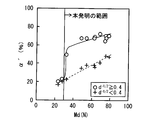
- FIG. 3 shows the relationship between Md (N) and the amount of martensite ( ⁇ ′) after cold working (temper rolling) in the case where the above experiment was performed using the steel of Table 2.
- An example of a graph arranged by the diameter d ⁇ 1/2 is illustrated.
- Cold-working a finish annealed material using steel whose composition is adjusted so that Md (N) is 30.0 or more and whose structure is adjusted so that the crystal grain size d ⁇ 1/2 is 0.40 or more. It can be seen that when used as a material for (temper rolling), the induction of martensite phase by cold working (temper rolling) occurs remarkably.
- FIG. 4 illustrates a graph in which the relationship between Md (N) and ⁇ HV in the case of performing the above experiment using the steel of Table 2 is arranged by the crystal grain size d ⁇ 1/2 of the finish annealing material.
- Cold-working a finish annealed material using steel whose composition is adjusted so that Md (N) is 30.0 or more and whose structure is adjusted so that the crystal grain size d ⁇ 1/2 is 0.40 or more. It can be seen that when used as a material for (temper rolling), the increase in hardness due to the aging treatment occurs remarkably.
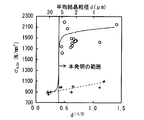
- FIG. 5 shows the relationship between the crystal grain size d ⁇ 1/2 of the finish annealed material and the elastic limit stress ⁇ 0.01 after aging treatment when the above experiment is performed using the steel of Table 2.
- Md (N) An example of a graph organized by ⁇ The plot is for Md (N) ⁇ 30.0, and the + plot is for Md (N) ⁇ 30.0.
- Cold-working a finish annealed material using steel whose composition is adjusted so that Md (N) is 30.0 or more and whose structure is adjusted so that the crystal grain size d ⁇ 1/2 is 0.40 or more. It can be seen that the elastic limit stress ⁇ 0.01 after the aging treatment is remarkably improved when used as a material for (temper rolling).
Landscapes
- Chemical & Material Sciences (AREA)
- Engineering & Computer Science (AREA)
- Materials Engineering (AREA)
- Mechanical Engineering (AREA)
- Metallurgy (AREA)
- Organic Chemistry (AREA)
- Physics & Mathematics (AREA)
- Thermal Sciences (AREA)
- Crystallography & Structural Chemistry (AREA)
- Heat Treatment Of Sheet Steel (AREA)
Abstract
La présente invention se rapporte à un matériau en acier inoxydable de haute résistance qui comprend une composition de composants qui contient, en masse, une quantité de carbone (C) inférieure ou égale à 0,10 %, une quantité de silicium supérieure à 1,0 % mais inférieure à 3,0 %, une quantité de manganèse (Mn) inférieure ou égale à 4,0 %, une quantité de nickel (Ni) comprise entre 4,0 et 8,0 %, une quantité de chrome (Cr) comprise entre 12,0 et 18,0 %, une quantité d'azote (N) inférieure ou égale à 0,15 %, et une quantité de cuivre (Cu) comprise entre 0,5 et 3,5 %, le reste étant surtout composé de fer (Fe), la quantité totale de carbone (C) et d'azote (N) contenue faisant au moins 0,10 % en masse et l'indice de stabilité de l'austénite (Md(N)) représenté par la formule Md(N) = 580 - 520C - 2Si - 16Mn - 16Cr - 23Ni - 26Cu - 300N (I) faisant au moins 30,0. Le matériau en acier inoxydable de haute résistance présente une résistance à la traction élevée et une limite élastique élevée par réalisation d'un traitement de vieillissement après le laminage à froid d'un matériau recuit pour lequel d-1/2(μm-1/2) fait au moins 0,40, où d (en μm) représente le diamètre moyen des grains cristallins de l'austénite.
Priority Applications (1)
| Application Number | Priority Date | Filing Date | Title |
|---|---|---|---|
| JP2014513855A JPWO2014157146A1 (ja) | 2013-03-26 | 2014-03-25 | オーステナイト系ステンレス鋼板およびそれを用いた高強度鋼材の製造方法 |
Applications Claiming Priority (2)
| Application Number | Priority Date | Filing Date | Title |
|---|---|---|---|
| JP2013063486 | 2013-03-26 | ||
| JP2013-063486 | 2013-03-26 |
Publications (1)
| Publication Number | Publication Date |
|---|---|
| WO2014157146A1 true WO2014157146A1 (fr) | 2014-10-02 |
Family
ID=51624117
Family Applications (1)
| Application Number | Title | Priority Date | Filing Date |
|---|---|---|---|
| PCT/JP2014/058196 Ceased WO2014157146A1 (fr) | 2013-03-26 | 2014-03-25 | Tôle d'acier inoxydable austénitique et procédé permettant de fabriquer un matériau en acier de haute résistance qui utilise cette dernière |
Country Status (2)
| Country | Link |
|---|---|
| JP (1) | JPWO2014157146A1 (fr) |
| WO (1) | WO2014157146A1 (fr) |
Cited By (7)
| Publication number | Priority date | Publication date | Assignee | Title |
|---|---|---|---|---|
| JP2018003139A (ja) * | 2016-07-08 | 2018-01-11 | 日新製鋼株式会社 | ステンレス鋼 |
| JP2018003099A (ja) * | 2016-07-01 | 2018-01-11 | 日新製鋼株式会社 | ステンレス鋼板およびその製造方法 |
| CN108690939A (zh) * | 2017-04-10 | 2018-10-23 | 宝钢不锈钢有限公司 | 一种高成形含氮奥氏体不锈钢及其制造方法 |
| EP3882367A4 (fr) * | 2018-12-18 | 2022-03-09 | Posco | Acier inoxydable à haute résistance mécanique |
| WO2023113206A1 (fr) * | 2021-12-16 | 2023-06-22 | 주식회사 포스코 | Acier inoxydable austénitique et son procédé de fabrication |
| EP4477775A4 (fr) * | 2022-02-10 | 2025-12-31 | Nippon Steel Stainless Steel Corp | Acier inoxydable austénitique et procédé de production d'acier inoxydable austénitique |
| EP4477776A4 (fr) * | 2022-02-10 | 2025-12-31 | Nippon Steel Stainless Steel Corp | Acier inoxydable austénitique et procédé de production d'acier inoxydable austénitique |
Citations (4)
| Publication number | Priority date | Publication date | Assignee | Title |
|---|---|---|---|---|
| JPH05279802A (ja) * | 1991-03-11 | 1993-10-26 | Nisshin Steel Co Ltd | ばね特性および加工部の疲労特性に優れたばね用ステンレス鋼およびその製造方法 |
| JPH07316662A (ja) * | 1994-05-25 | 1995-12-05 | Nisshin Steel Co Ltd | 高強度高靱性ステンレス鋼帯の製造方法 |
| JP2003193202A (ja) * | 2001-12-25 | 2003-07-09 | Nisshin Steel Co Ltd | 高弾性準安定オーステナイト系ステンレス鋼板およびその製造法 |
| JP2009299171A (ja) * | 2008-06-17 | 2009-12-24 | Nippon Steel & Sumikin Stainless Steel Corp | 微細粒組織を有するプレス成形用オーステナイト系ステンレス鋼板およびその製造方法 |
-
2014
- 2014-03-25 WO PCT/JP2014/058196 patent/WO2014157146A1/fr not_active Ceased
- 2014-03-25 JP JP2014513855A patent/JPWO2014157146A1/ja active Pending
Patent Citations (4)
| Publication number | Priority date | Publication date | Assignee | Title |
|---|---|---|---|---|
| JPH05279802A (ja) * | 1991-03-11 | 1993-10-26 | Nisshin Steel Co Ltd | ばね特性および加工部の疲労特性に優れたばね用ステンレス鋼およびその製造方法 |
| JPH07316662A (ja) * | 1994-05-25 | 1995-12-05 | Nisshin Steel Co Ltd | 高強度高靱性ステンレス鋼帯の製造方法 |
| JP2003193202A (ja) * | 2001-12-25 | 2003-07-09 | Nisshin Steel Co Ltd | 高弾性準安定オーステナイト系ステンレス鋼板およびその製造法 |
| JP2009299171A (ja) * | 2008-06-17 | 2009-12-24 | Nippon Steel & Sumikin Stainless Steel Corp | 微細粒組織を有するプレス成形用オーステナイト系ステンレス鋼板およびその製造方法 |
Cited By (8)
| Publication number | Priority date | Publication date | Assignee | Title |
|---|---|---|---|---|
| JP2018003099A (ja) * | 2016-07-01 | 2018-01-11 | 日新製鋼株式会社 | ステンレス鋼板およびその製造方法 |
| JP2018003139A (ja) * | 2016-07-08 | 2018-01-11 | 日新製鋼株式会社 | ステンレス鋼 |
| CN108690939A (zh) * | 2017-04-10 | 2018-10-23 | 宝钢不锈钢有限公司 | 一种高成形含氮奥氏体不锈钢及其制造方法 |
| EP3882367A4 (fr) * | 2018-12-18 | 2022-03-09 | Posco | Acier inoxydable à haute résistance mécanique |
| US11952649B2 (en) | 2018-12-18 | 2024-04-09 | Posco Co., Ltd | High-strength stainless steel |
| WO2023113206A1 (fr) * | 2021-12-16 | 2023-06-22 | 주식회사 포스코 | Acier inoxydable austénitique et son procédé de fabrication |
| EP4477775A4 (fr) * | 2022-02-10 | 2025-12-31 | Nippon Steel Stainless Steel Corp | Acier inoxydable austénitique et procédé de production d'acier inoxydable austénitique |
| EP4477776A4 (fr) * | 2022-02-10 | 2025-12-31 | Nippon Steel Stainless Steel Corp | Acier inoxydable austénitique et procédé de production d'acier inoxydable austénitique |
Also Published As
| Publication number | Publication date |
|---|---|
| JPWO2014157146A1 (ja) | 2017-02-16 |
Similar Documents
| Publication | Publication Date | Title |
|---|---|---|
| CN105026594B (zh) | 奥氏体系不锈钢板及使用其的高弹性极限非磁性钢材的制造方法 | |
| JP6302722B2 (ja) | ばね疲労特性に優れた高強度複相ステンレス鋼線材、及びその製造方法、ならびにばね疲労特性に優れた高強度複相ステンレス鋼線 | |
| EP3438313A1 (fr) | Tôle d'acier inoxydable ferritique contenant du niobium et son procédé de fabrication | |
| WO2014157146A1 (fr) | Tôle d'acier inoxydable austénitique et procédé permettant de fabriquer un matériau en acier de haute résistance qui utilise cette dernière | |
| WO2013146876A1 (fr) | Câble en acier inoxydable à résistance élevée ayant une excellente résistance à la déformation thermique, ressort à résistance élevée et leur procédé de fabrication | |
| CN116075600A (zh) | 奥氏体不锈钢及其制造方法 | |
| JP5347600B2 (ja) | オーステナイト系ステンレス鋼およびオーステナイト系ステンレス鋼板の製造方法 | |
| JP6229180B1 (ja) | 準安定オーステナイト系ステンレス鋼帯または鋼板並びにその製造方法 | |
| CN102712963A (zh) | 高碳热轧钢板的制造方法 | |
| WO2017043660A1 (fr) | Tôle d'acier et produit émaillé | |
| CN110088323B (zh) | 包含双相不锈钢的制品及其用途 | |
| JP6798907B2 (ja) | 低磁性オーステナイト系ステンレス鋼および冷延鋼板 | |
| CN110062814A (zh) | 具有优异的强度和延展性的低合金钢板 | |
| JP6093063B1 (ja) | 加工性に優れた高強度ステンレス鋼材とその製造方法 | |
| WO2019097691A1 (fr) | Tôle d'acier inoxydable austénitique et procédé de production de ladite tôle | |
| JP5100144B2 (ja) | バネ用鋼板およびそれを用いたバネ材並びにそれらの製造法 | |
| CN111492081A (zh) | 具有改善的强度和表面导电性的非磁性奥氏体不锈钢 | |
| JP4606113B2 (ja) | 比例限界応力の高いオーステナイト系ステンレス鋼材および製造法 | |
| US20240336989A1 (en) | Austenitic stainless steel and method for manufacturing same | |
| JP6308849B2 (ja) | 高弾性限非磁性オーステナイト系ステンレス鋼板およびその製造方法 | |
| JP3939568B2 (ja) | 加工性に優れた非磁性ステンレス鋼 | |
| JP5073966B2 (ja) | 時効硬化型フェライト系ステンレス鋼板およびそれを用いた時効処理鋼材 | |
| KR20200066925A (ko) | 고엔트로피 합금 및 그 제조방법 | |
| JPH1180906A (ja) | 降伏応力を高めた高強度ステンレス鋼帯およびその製造方法 | |
| JP4841308B2 (ja) | 高強度非磁性ステンレス鋼板及びその製造方法 |
Legal Events
| Date | Code | Title | Description |
|---|---|---|---|
| ENP | Entry into the national phase |
Ref document number: 2014513855 Country of ref document: JP Kind code of ref document: A |
|
| 121 | Ep: the epo has been informed by wipo that ep was designated in this application |
Ref document number: 14774277 Country of ref document: EP Kind code of ref document: A1 |
|
| NENP | Non-entry into the national phase |
Ref country code: DE |
|
| 122 | Ep: pct application non-entry in european phase |
Ref document number: 14774277 Country of ref document: EP Kind code of ref document: A1 |