WO2014157150A1 - ベンジリデンアセタールリンカーを有する親水性ポリマー誘導体 - Google Patents
ベンジリデンアセタールリンカーを有する親水性ポリマー誘導体 Download PDFInfo
- Publication number
- WO2014157150A1 WO2014157150A1 PCT/JP2014/058201 JP2014058201W WO2014157150A1 WO 2014157150 A1 WO2014157150 A1 WO 2014157150A1 JP 2014058201 W JP2014058201 W JP 2014058201W WO 2014157150 A1 WO2014157150 A1 WO 2014157150A1
- Authority
- WO
- WIPO (PCT)
- Prior art keywords
- group
- formula
- polyethylene glycol
- represented
- hydrophilic polymer
- Prior art date
- Legal status (The legal status is an assumption and is not a legal conclusion. Google has not performed a legal analysis and makes no representation as to the accuracy of the status listed.)
- Ceased
Links
- 0 CO*(N(C(CC1)=O)C1=O)=O Chemical compound CO*(N(C(CC1)=O)C1=O)=O 0.000 description 1
Images

Classifications
-
- C—CHEMISTRY; METALLURGY
- C08—ORGANIC MACROMOLECULAR COMPOUNDS; THEIR PREPARATION OR CHEMICAL WORKING-UP; COMPOSITIONS BASED THEREON
- C08G—MACROMOLECULAR COMPOUNDS OBTAINED OTHERWISE THAN BY REACTIONS ONLY INVOLVING UNSATURATED CARBON-TO-CARBON BONDS
- C08G65/00—Macromolecular compounds obtained by reactions forming an ether link in the main chain of the macromolecule
- C08G65/34—Macromolecular compounds obtained by reactions forming an ether link in the main chain of the macromolecule from hydroxy compounds or their metallic derivatives
- C08G65/48—Polymers modified by chemical after-treatment
-
- C—CHEMISTRY; METALLURGY
- C08—ORGANIC MACROMOLECULAR COMPOUNDS; THEIR PREPARATION OR CHEMICAL WORKING-UP; COMPOSITIONS BASED THEREON
- C08G—MACROMOLECULAR COMPOUNDS OBTAINED OTHERWISE THAN BY REACTIONS ONLY INVOLVING UNSATURATED CARBON-TO-CARBON BONDS
- C08G65/00—Macromolecular compounds obtained by reactions forming an ether link in the main chain of the macromolecule
- C08G65/02—Macromolecular compounds obtained by reactions forming an ether link in the main chain of the macromolecule from cyclic ethers by opening of the heterocyclic ring
- C08G65/26—Macromolecular compounds obtained by reactions forming an ether link in the main chain of the macromolecule from cyclic ethers by opening of the heterocyclic ring from cyclic ethers and other compounds
- C08G65/2603—Macromolecular compounds obtained by reactions forming an ether link in the main chain of the macromolecule from cyclic ethers by opening of the heterocyclic ring from cyclic ethers and other compounds the other compounds containing oxygen
- C08G65/2606—Macromolecular compounds obtained by reactions forming an ether link in the main chain of the macromolecule from cyclic ethers by opening of the heterocyclic ring from cyclic ethers and other compounds the other compounds containing oxygen containing hydroxyl groups
- C08G65/2609—Macromolecular compounds obtained by reactions forming an ether link in the main chain of the macromolecule from cyclic ethers by opening of the heterocyclic ring from cyclic ethers and other compounds the other compounds containing oxygen containing hydroxyl groups containing aliphatic hydroxyl groups
-
- C—CHEMISTRY; METALLURGY
- C08—ORGANIC MACROMOLECULAR COMPOUNDS; THEIR PREPARATION OR CHEMICAL WORKING-UP; COMPOSITIONS BASED THEREON
- C08G—MACROMOLECULAR COMPOUNDS OBTAINED OTHERWISE THAN BY REACTIONS ONLY INVOLVING UNSATURATED CARBON-TO-CARBON BONDS
- C08G65/00—Macromolecular compounds obtained by reactions forming an ether link in the main chain of the macromolecule
- C08G65/02—Macromolecular compounds obtained by reactions forming an ether link in the main chain of the macromolecule from cyclic ethers by opening of the heterocyclic ring
- C08G65/32—Polymers modified by chemical after-treatment
- C08G65/329—Polymers modified by chemical after-treatment with organic compounds
- C08G65/331—Polymers modified by chemical after-treatment with organic compounds containing oxygen
-
- C—CHEMISTRY; METALLURGY
- C08—ORGANIC MACROMOLECULAR COMPOUNDS; THEIR PREPARATION OR CHEMICAL WORKING-UP; COMPOSITIONS BASED THEREON
- C08G—MACROMOLECULAR COMPOUNDS OBTAINED OTHERWISE THAN BY REACTIONS ONLY INVOLVING UNSATURATED CARBON-TO-CARBON BONDS
- C08G65/00—Macromolecular compounds obtained by reactions forming an ether link in the main chain of the macromolecule
- C08G65/02—Macromolecular compounds obtained by reactions forming an ether link in the main chain of the macromolecule from cyclic ethers by opening of the heterocyclic ring
- C08G65/32—Polymers modified by chemical after-treatment
- C08G65/329—Polymers modified by chemical after-treatment with organic compounds
- C08G65/331—Polymers modified by chemical after-treatment with organic compounds containing oxygen
- C08G65/332—Polymers modified by chemical after-treatment with organic compounds containing oxygen containing carboxyl groups, or halides, or esters thereof
-
- C—CHEMISTRY; METALLURGY
- C08—ORGANIC MACROMOLECULAR COMPOUNDS; THEIR PREPARATION OR CHEMICAL WORKING-UP; COMPOSITIONS BASED THEREON
- C08G—MACROMOLECULAR COMPOUNDS OBTAINED OTHERWISE THAN BY REACTIONS ONLY INVOLVING UNSATURATED CARBON-TO-CARBON BONDS
- C08G65/00—Macromolecular compounds obtained by reactions forming an ether link in the main chain of the macromolecule
- C08G65/02—Macromolecular compounds obtained by reactions forming an ether link in the main chain of the macromolecule from cyclic ethers by opening of the heterocyclic ring
- C08G65/32—Polymers modified by chemical after-treatment
- C08G65/329—Polymers modified by chemical after-treatment with organic compounds
- C08G65/333—Polymers modified by chemical after-treatment with organic compounds containing nitrogen
-
- C—CHEMISTRY; METALLURGY
- C08—ORGANIC MACROMOLECULAR COMPOUNDS; THEIR PREPARATION OR CHEMICAL WORKING-UP; COMPOSITIONS BASED THEREON
- C08G—MACROMOLECULAR COMPOUNDS OBTAINED OTHERWISE THAN BY REACTIONS ONLY INVOLVING UNSATURATED CARBON-TO-CARBON BONDS
- C08G65/00—Macromolecular compounds obtained by reactions forming an ether link in the main chain of the macromolecule
- C08G65/02—Macromolecular compounds obtained by reactions forming an ether link in the main chain of the macromolecule from cyclic ethers by opening of the heterocyclic ring
- C08G65/32—Polymers modified by chemical after-treatment
- C08G65/329—Polymers modified by chemical after-treatment with organic compounds
- C08G65/333—Polymers modified by chemical after-treatment with organic compounds containing nitrogen
- C08G65/33348—Polymers modified by chemical after-treatment with organic compounds containing nitrogen containing isocyanate group
-
- C—CHEMISTRY; METALLURGY
- C08—ORGANIC MACROMOLECULAR COMPOUNDS; THEIR PREPARATION OR CHEMICAL WORKING-UP; COMPOSITIONS BASED THEREON
- C08G—MACROMOLECULAR COMPOUNDS OBTAINED OTHERWISE THAN BY REACTIONS ONLY INVOLVING UNSATURATED CARBON-TO-CARBON BONDS
- C08G65/00—Macromolecular compounds obtained by reactions forming an ether link in the main chain of the macromolecule
- C08G65/02—Macromolecular compounds obtained by reactions forming an ether link in the main chain of the macromolecule from cyclic ethers by opening of the heterocyclic ring
- C08G65/32—Polymers modified by chemical after-treatment
- C08G65/329—Polymers modified by chemical after-treatment with organic compounds
- C08G65/334—Polymers modified by chemical after-treatment with organic compounds containing sulfur
- C08G65/3342—Polymers modified by chemical after-treatment with organic compounds containing sulfur having sulfur bound to carbon and hydrogen
Definitions
- the present invention has an acetal linker capable of acid hydrolysis and is used for chemical modification of bioactive molecules such as bioactive proteins, peptides, antibodies, nucleic acids and low molecular weight drugs, and drug carriers such as liposomes and polymer micelles.
- bioactive molecules such as bioactive proteins, peptides, antibodies, nucleic acids and low molecular weight drugs, and drug carriers such as liposomes and polymer micelles.
- the present invention relates to a hydrophilic polymer derivative.
- Patent Document 1 discloses a branched polyethylene glycol derivative in which two polyethylene glycols, which are low antigenic hydrophilic polymers, are bonded via an acetal group derived from various aldehydes or ketones, and a synthesis method thereof.
- hydrolyzable evaluation data is not described.
- the synthesis method described here is a method in which an excess amount of polyethylene glycol is reacted with various aldehydes or ketones to obtain a polyethylene glycol derivative having an acetal linker, and a large amount of unreacted polyethylene glycol remains after the reaction. To do.
- activated impurities are also produced as a by-product at the ends of unreacted polyethylene glycol.
- activated polyethylene glycol containing such impurities is used for drug modification, the result is a drug modified with polyethylene glycol that does not contain an acetal linker, which greatly affects the pharmacokinetics and physical properties of the drug. . Therefore, it is necessary to remove the polyethylene glycol impurities before the reaction with the drug.
- the separation and removal of the polymer impurities can be a great adverse effect in terms of technology and cost.
- Non-Patent Document 1 a polyethylene glycol derivative in which various functional groups are bonded via an ethylidene acetal linker is synthesized by reacting vinyl ethers having various functional groups with polyethylene glycol.
- this document does not show hydrolyzable evaluation data.
- Non-Patent Document 1 uses an excessive amount of low molecular weight vinyl ethers relative to polyethylene glycol, so that a large amount of unreacted polyethylene glycol does not remain.
- the acetal group introduced by the synthesis method includes an ethylidene acetal structure, the types of acetal groups that can be introduced are limited.
- a benzylidene acetal group is introduced, it inevitably becomes a ketal structure, and the ketal structure is sensitive to acids, so in this synthesis method, two polyethylene glycols are bonded via a ketal group by a ketal exchange reaction. Many dimer impurities are by-produced. For this reason, the synthesis method described in Non-Patent Document 1 is difficult to apply to the synthesis of a polyethylene glycol derivative having a benzylidene acetal linker.
- Non-Patent Document 2 a low molecular model drug is synthesized by synthesizing a unit having an acetal group formed by utilizing a hydroxyl group of a low molecular model drug and condensing it with an activated polyethylene glycol derivative synthesized separately.
- the difference in the structure around the acetal group shows that it affects the hydrolysis rate, that is, the elimination rate of the polyethylene glycol chain, the correlation with the structure around the acetal group has not been clarified, It cannot be said that the hydrolyzability can be controlled.
- it is a method of forming an acetal group using a hydroxyl group of a low molecular weight model drug, it is difficult to use it for chemical modifications other than low molecular weight drugs such as proteins and drug carriers.
- hydrophilic polymer derivatives in which an acetal linker is introduced into the structure for the purpose of detaching the hydrophilic polymer chain in an acidic environment in a living body, but the acetal linker can be used at any pH.
- a hydrophilic polymer derivative whose hydrolysis rate, that is, the desorption rate of the hydrophilic polymer chain is precisely controlled.
- the unevenness of pH in each part in the living body is very small.
- the area around the tumor tissue is an acidic environment as compared with the normal tissue pH 7.4, but the pH is slightly acidic at about 6.0.
- the endosome is also weakly acidic with a pH of 5.5 to 6.0, and the endosome is gradually acidified to approach the pH of lysosome 4.5 to 5.0, but eventually becomes fused with the lysosome.
- endosome escape at around pH 5.5 is required.
- hydrophilic polymer chains are removed by utilizing slight pH differences in each part of the living body such as around the tumor tissue or inside the endosome, and site-selective intracellular uptake of drugs and endosome escape.
- it is necessary to precisely control the hydrolysis rate of the acetal linker at the pH of a weakly acidic environment in the living body.
- An object of the present invention is to provide a hydrophilic polymer derivative having an acetal linker capable of accurately controlling the hydrolysis rate at a pH of a weakly acidic environment in a living body.
- the present inventor has developed a hydrophilic polymer derivative having a benzylidene acetal linker capable of accurately controlling the hydrolysis rate at a pH of a weakly acidic environment in a living body.
- the most remarkable feature of the present invention is that a chemically reactive functional group and a hydrophilic polymer are bonded via a benzylidene acetal linker having a substituent.
- a chemically reactive functional group and a hydrophilic polymer are bonded via a benzylidene acetal linker having a substituent.
- the hydrophilic polymer derivative of the present invention can be synthesized by a coupling reaction between a linker unit into which a benzylidene acetal group having a substituent is introduced and a hydrophilic polymer precursor. Therefore, it is not necessary to use an excessive amount of hydrophilic polymer for the formation of acetal groups as in Patent Document 1, and it is not necessary to remove unreacted hydrophilic polymer impurities, making production on an industrial scale easy. It is. Moreover, there is no restriction
- R 1 is a hydrogen atom or a hydrocarbon group
- R 2 , R 3 , R 4 , R 5 and R 6 are each independently a hydrogen atom or a substituent, and at least one of R 3 , R 4 , R 5 is an electron-withdrawing substituent, Or at least one of R 2 and R 6 is a substituent
- X 1 is a chemically reactive functional group
- P is a hydrophilic polymer
- w is an integer from 1 to 8
- Z 1 and Z 2 are independently selected divalent spacers.
- At least one of R 2 and R 6 is a substituent, and the sum ( ⁇ ) of substituent constants ( ⁇ ) in R 2 , R 3 , R 4 , R 5 and R 6 is ⁇ 1.12 ⁇ ⁇ ⁇ 1.
- X 1 is an active ester group, active carbonate group, aldehyde group, isocyanate group, isothiocyanate group, epoxy group, maleimide group, vinyl sulfone group, acrylic group, sulfonyloxy group, carboxy group, thiol group, dithiopyridyl group , An ⁇ -haloacetyl group, an alkynyl group, an allyl group, a vinyl group, an amino group, an oxyamino group, a hydrazide group, and an azide group, the hydrophilic polymer derivative of any one of [1] to [3] .
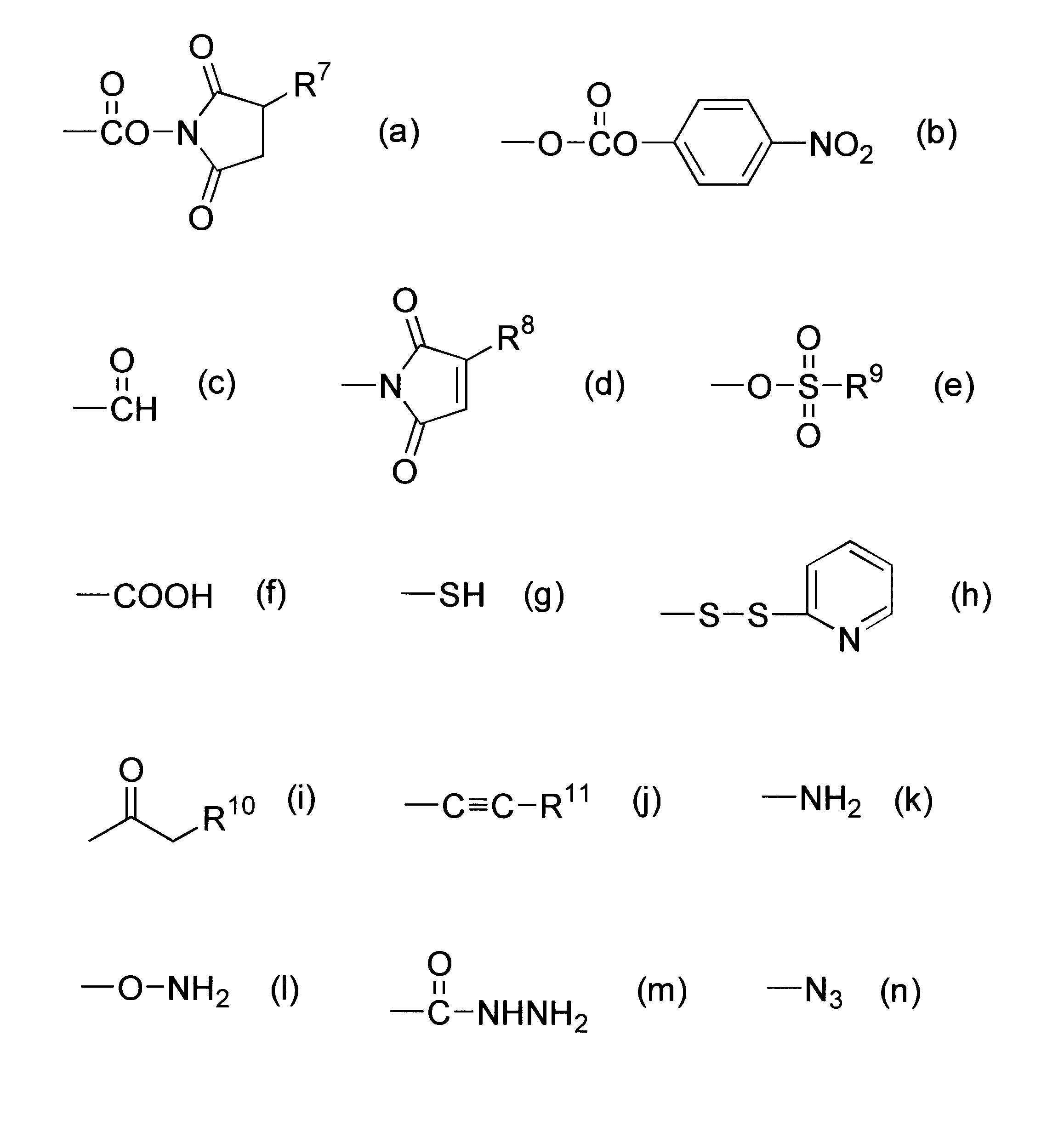
- X 1 is the formula (a), formula (b), formula (c), formula (d), formula (e), formula (f), formula (g), formula (h), formula (i ), The formula (j), the formula (k), the formula (l), the formula (m) and the hydrophilic polymer derivative of any one of [4] selected from the group consisting of the formula (n).
- R 7 is a hydrogen atom or a sulfo group
- R 8 and R 11 are independently a hydrogen atom or a hydrocarbon group having 1 to 5 carbon atoms
- R 9 is a hydrocarbon group having 1 to 10 carbon atoms which may contain a halogen atom
- R 10 is a halogen atom selected from a chlorine atom, a bromine atom and an iodine atom.
- Z 1 and Z 2 are each independently a saturated hydrocarbon group which may have a bond selected from an ether bond, an ester bond, a carbonate bond, a urethane bond, an amide bond and a secondary amino group.
- Y is a hydrocarbon group having 1 to 24 carbon atoms; n is an integer of 3 to 2000.
- X 2 is a chemically reactive functional group different from X 1 ; Z 3 is a divalent spacer; and n is an integer from 3 to 2000.
- Y is a hydrocarbon group having 1 to 24 carbon atoms; n is an integer from 3 to 1000; and v is 0 or 2.
- X 2 is a chemically reactive functional group different from X 1 ;
- Z 3 is a divalent spacer;
- n is an integer from 3 to 1000; and
- v is 0 or 2.
- X 2 is a chemically reactive functional group different from X 1 ;
- Z 3 is a divalent spacer;
- n is an integer from 3 to 1000; and
- v is 0 or 2.
- X 2 is active ester group, active carbonate group, aldehyde group, isocyanate group, isothiocyanate group, epoxy group, maleimide group, vinyl sulfone group, acrylic group, sulfonyloxy group, carboxy group, thiol group, dithiopyridyl group , ⁇ -haloacetyl group, alkynyl group, allyl group, vinyl group, amino group, oxyamino group, hydrazide group, and azide group, any one of [9], [12] or [13] Polyethylene glycol derivative.
- X 2 is the formula (a), formula (b), formula (c), formula (d), formula (e), formula (f), formula (g), formula (h), formula ( any one of [9], [12] or [13] selected from the group consisting of i), formula (j), formula (k), formula (l), formula (m) and formula (n) Polyethylene glycol derivative.
- R 7 is a hydrogen atom or a sulfo group
- R 8 and R 11 are independently a hydrogen atom or a hydrocarbon group having 1 to 5 carbon atoms
- R 9 is a hydrocarbon group having 1 to 10 carbon atoms which may contain a halogen atom
- R 10 is a halogen atom selected from a chlorine atom, a bromine atom and an iodine atom.
- Z 3 is a saturated hydrocarbon group which may have a bond selected from an ether bond, an ester bond, a carbonate bond, a urethane bond, an amide bond and a secondary amino group, [9], [12] Or the polyethylene glycol derivative according to any one of [13].
- P is polyethylene glycol having 2 to 8 terminals, all terminals of polyethylene glycol constituting P are bonded to Z 2 , and w is equal to the number of terminals of the polyethylene glycol.
- the polyethylene glycol derivative according to any one of [1] to [6].
- n is an integer of 3 to 2000.
- P is represented by the formula (r)
- w is 2
- P is represented by the formula (s)
- w is 2.
- Is 3 when P is represented by the formula (t), w is 4, and when P is represented by the formula (u), w is 4, and P is represented by the formula (v). (If it is represented, w is 8.)
- the hydrophilic polymer derivative having a benzylidene acetal linker according to the present invention can adjust the hydrolyzation rate of the benzylidene acetal linker in accordance with the pH of a weakly acidic environment in the living body, and these drugs to which the hydrophilic polymer derivative is bound.
- hydrophilic polymer derivative for chemical modification of a drug or the like, hydrophilic properties such as water solubility, increased bioavailability, and prolonged circulation time without hindering the expression of the original function of the drug or the like. Only the advantage by modification of the conductive polymer can be imparted.
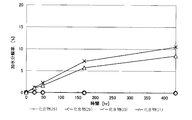
- FIG. 4 shows the results of hydrolysis tests at 37 ° C. in a MES heavy water buffer solution with a pD of 5.5 using the compounds of formula (26), formula (29), formula (30) and formula (31) described in Examples.
- FIG. 6 shows the results of hydrolysis tests at 37 ° C. in a HEPES heavy water buffer solution with a pD of 7.4 using the compounds of formula (26), formula (29), formula (30) and formula (31) described in Examples.
- acetal as used herein means both an acetal structure derived from aldehydes and an acetal structure derived from ketones, ie, a ketal structure.
- R 1 in the formula (1) of the present invention is a hydrogen atom or a hydrocarbon group, and the hydrocarbon group preferably has 10 or less carbon atoms, and specific hydrocarbon groups include methyl, ethyl, propyl, and isopropyl. Group, t-butyl group, phenyl group and benzyl group.
- a preferred embodiment of R 1 is a hydrogen atom or a methyl group, more preferably a hydrogen atom.
- the benzene ring in formula (1) of the present invention may have a plurality of substituents, and affects the hydrolysis rate of the acetal linker by appropriately selecting the type and position of the substituents on the benzene ring.
- the electron density around the acetal group and the degree of steric hindrance can be adjusted. Thereby, a desired hydrolysis rate can be imparted to the acetal linker.
- the substituent on the benzene ring in the formula (1) is described using the “substituent constant ( ⁇ )”, and this indicates the influence of the substituent on the reaction rate or equilibrium of the benzene derivative. It means the substituent constant in the quantified Hammett rule.
- the Hammett rule applies only to para-substituted and meta-substituted benzene derivatives and cannot be applied to ortho-substituted benzene derivatives that are affected by steric hindrance. Therefore, in the case of an ortho-substituted benzene derivative, it means a substituent constant in Taft's formula that extends the Hammett rule.
- the Hammett rule is represented by the following formula (7).
- k is a rate constant or equilibrium constant in an arbitrary reaction of para-substituted and meta-substituted benzene derivatives
- k 0 is a case where the benzene derivative does not have the above substituent, that is, the substituent is a hydrogen atom.
- the rate constant or equilibrium constant, ⁇ is the reaction constant, and ⁇ is the substituent constant.
- the reaction constant ( ⁇ ) in the above formula (7) is a constant determined by the reaction conditions such as reaction type, temperature, and solvent, and can be calculated from the slope of the Hammett plot.
- the substituent constant ( ⁇ ) in the above formula (7) is a constant determined only by the type and position of the substituent regardless of the type of reaction, and when there is no substituent, that is, the substituent is a hydrogen atom. In this case, it is “0”.
- the term “electron withdrawing” means when ⁇ is a positive value
- the term “electron donating” means when ⁇ is a negative value.
- k is a rate constant or equilibrium constant in an arbitrary reaction of para-substituted and meta-substituted benzene derivatives
- k 0 is a case where the benzene derivative does not have the above substituent, that is, the substituent is a hydrogen atom.
- the rate constant or equilibrium constant of the case, ⁇ * is the reaction constant, ⁇ * is the substituent constant, and Es is the positional constant of the substituent.
- reaction constant ( ⁇ ) of para-substituted and meta-substituted benzene derivatives and the reaction constant ( ⁇ * ) of ortho-substituted benzene derivatives are approximately equal, ⁇ and ⁇ * are defined herein to be the same.
- the ortho-position substituent constant ( ⁇ * ) is similar to the para-position substituent constant, as described in, for example, “Charton, M. Can. J. Chem. 1960, 38 2493-2499”. Therefore, the substituent constant at the ortho position in the present specification applies the substituent constant at the corresponding para position.
- Substituent constants ( ⁇ ) at the para and meta positions are described in ⁇ Hansch, C .; Leo, A .; Taft, R. W. Chem. Rev. 1991, 91, 165-195 ''.
- Substituents with unknown constant ( ⁇ ) can be measured and determined by the method described in “Hammett, L. P. Chem. Rev. 1935, 17 (1), 125-136”.
- the positional constant (Es) is described in “Unger, S. H .; Hansch, C. Prog. Phys. Org. Chem. 1976, 12, 91-118”. However, Es used in the present specification defines a hydrogen atom as “0”.
- the preferred hydrolysis rate of the hydrophilic polymer derivative having a benzylidene acetal linker of the present invention is such that the hydrolysis half-life (t 1/2 ) in a buffer solution at pH 5.5 and 37 ° C. is in the range of 1 hour to 6 months. More preferably, it is in the range of 1 hour to 1 month, and still more preferably in the range of 1 hour to 24 hours.
- the sum of the preferred substituent constants of the present invention Define the range of ( ⁇ ).
- ⁇ 3.0 represents the reaction constant ( ⁇ )
- 0.23 represents the sum of substituent constants ( ⁇ )
- ⁇ 1.16 represents the sum of positional constants ( ⁇ Es).
- t 1/2 of the hydrophilic polymer derivative is 1 hour ⁇ if 0.16 ⁇ ⁇ ⁇ 0.62 t 1/2 ⁇ 24 hours.
- the substituent that can be used in the present invention includes an acetalization reaction of a benzylidene acetal linker, a coupling reaction of a benzylidene acetal linker and a polyethylene glycol precursor, and a terminal functional group conversion of the hydrophilic polymer derivative in the process of synthesizing the hydrophilic polymer derivative. It is an electron-withdrawing or electron-donating substituent that does not inhibit the reaction and further the bond-forming reaction between the hydrophilic polymer derivative and a drug or the like.
- the electron-withdrawing substituent includes an acyl group having 2 to 5 carbon atoms, an alkoxycarbonyl group having 2 to 5 carbon atoms, a carbamoyl group having 2 to 5 carbon atoms, an acyloxy group having 2 to 5 carbon atoms, and 2 to 5 carbon atoms.
- the electron-donating substituent is an alkyl group having 1 to 4 carbon atoms, and preferred examples include a methyl group, an ethyl group, a propyl group, an isopropyl group, and a t-butyl group.
- Substituents that are electron-withdrawing at the meta position and electron-donating at the para position are preferably an alkoxy group having 1 to 4 carbon atoms, an aryl group having 6 to 10 carbon atoms, and an aryloxy group having 6 to 10 carbon atoms. Examples include phenyl, methoxy, ethoxy, propoxy, isopropoxy, t-butoxy and phenoxy groups.
- the positional constants (Es ), T 1/2 in buffer at pH 5.5, 37 ° C. is 1 hour ⁇ t 1/2 ⁇ 24 hours, 1 hour ⁇ t 1/2 ⁇ 1 month, and 1 hour ⁇ t 1/2 Calculating the range of ⁇ for ⁇ 6 months, it is ⁇ 1.12 ⁇ ⁇ ⁇ 0.45 for 1 hour ⁇ t 1/2 ⁇ 24 hours, and ⁇ 1.12 for 1 hour ⁇ t 1/2 ⁇ 1 month When ⁇ ⁇ ⁇ 0.94 and 1 hour ⁇ t 1/2 ⁇ 6 months, ⁇ 1.12 ⁇ ⁇ ⁇ 1.20.
- R 2 and R 6 in Formula (1) are hydrogen atoms, ⁇ is a positive value, so at least one of R 3 to R 5 is an electron-withdrawing substituent, and R 3 to R 5 Of these, other than the above, an electron-donating substituent may be used.
- one of R 3 to R 5 in formula (1) is a trifluoromethyl group, a cyano group, A substituent selected from the group consisting of an acetyl group, a methoxycarbonyl group and a nitro group, more preferably a trifluoromethyl group or a cyano group.
- one of R 3 to R 5 in formula (1) is a substituent selected from the group consisting of a trifluoromethyl group, a cyano group, an acetyl group, a methoxycarbonyl group, and a nitro group.
- R 3 to R 5 other than the above is a group consisting of methyl, ethyl, propyl, isopropyl, butyl, t-butyl, phenyl, methoxy, ethoxy and acetamide groups Is a substituent selected from More preferably, one of R 3 to R 5 is a trifluoromethyl group, a cyano group or a nitro group, and one of R 3 to R 5 other than the above is a methyl group, an ethyl group, a propyl group or a methoxy group It is a group.
- two of R 3 to R 5 in the formula (1) are substituents independently selected from the group consisting of a fluorine atom, a chlorine atom, a bromine atom and an iodine atom, More preferably, it is a substituent independently selected from the group consisting of a chlorine atom, a bromine atom and an iodine atom.
- R 2 and R 6 in the formula (1) when at least one of R 2 and R 6 in the formula (1) is a substituent other than a hydrogen atom, for example, preferably satisfies ⁇ 1.12 ⁇ ⁇ ⁇ 0.45 when 1 hour ⁇ t 1/2 ⁇ 24 hours Embodiments are shown below.
- one of R 2 and R 6 in the formula (1) is a fluorine atom or a methoxy group and the other is a hydrogen atom
- one of R 3 to R 5 is a trifluoromethyl group, a cyano group
- R 3 to R 5 is methyl group, ethyl group, propyl group, isopropyl group, butyl group, t-butyl
- R 2 and R 6 in formula (1) are independently a fluorine atom or a methoxy group
- one of R 3 to R 5 is a trifluoromethyl group, an acetyl group, a methoxycarbonyl group, a phenyl group, a fluorine A substituent selected from the group consisting of an atom, a chlorine atom, a bromine atom and an iodine atom, more preferably a trifluoromethyl group, a phenyl group or a fluorine atom.
- R 3 to R 5 is an acetyl group, a methoxycarbonyl group, fluorine It is a substituent selected from the group consisting of an atom, a chlorine atom, a bromine atom and an iodine atom, more preferably a fluorine atom, a chlorine atom, a bromine atom or an iodine atom.
- R 3 to R 5 are hydrogen atoms or R 3 to R 5 One of them is a phenyl group or an acetamide group, and more preferably a hydrogen atom.
- R 3 to R 5 is a fluorine atom or a chlorine atom , Bromine atom or iodine atom, more preferably chlorine atom, bromine atom or iodine atom.
- R 3 to R 5 are substituents selected from the group consisting of methyl, ethyl, propyl, isopropyl, butyl, t-butyl, methoxy, ethoxy and acetamide groups More preferably, two of R 3 to R 5 are substituents selected from the group consisting of a methyl group, an ethyl group, a t-butyl group, a methoxy group, and an acetamide group.
- R 2 and R 6 in formula (1) are independently a substituent selected from the group consisting of a methyl group, an ethyl group, a propyl group, an isopropyl group, a butyl group, a chlorine atom, a bromine atom and an iodine atom
- R 3 to R 5 are substituents selected from the group consisting of methyl, ethyl, propyl, isopropyl, butyl, t-butyl, methoxy, ethoxy and acetamide groups More preferably, two of R 3 to R 5 are substituents selected from the group consisting of a methyl group, an ethyl group, a t-butyl group, a methoxy group, and an acetamide group.
- the types and positions of the appropriate substituents for imparting the desired hydrolyzability to the hydrophilic polymer derivative having a benzylidene acetal linker of the present invention are represented by the formula (7), the formula (8) and the formula (9 ) Can be set rationally by performing the above calculation.
- X 1 in the formula (1) of the present invention is present in biologically active proteins, peptides, antibodies, nucleic acids and low-molecular-weight drugs that are subject to chemical modification, and drug carriers such as liposomes and polymer micelles. Any functional group that reacts with a functional group to form a covalent bond is not particularly limited.
- Preferred examples of X 1 include active ester group, active carbonate group, aldehyde group, isocyanate group, isothiocyanate group, epoxy group, maleimide group, vinyl sulfone group, acrylic group, sulfonyloxy group, carboxy group, thiol group, A dithiopyridyl group, an ⁇ -haloacetyl group, an alkynyl group, an allyl group, a vinyl group, an amino group, an oxyamino group, a hydrazide group and an azide group.
- the functional group capable of reacting with an amino group of a biofunctional molecule to form a covalent bond includes an active ester group, an active carbonate group, an aldehyde group, an isocyanate group, an isothiocyanate group, an epoxy group.
- a maleimide group, a vinylsulfone group, an acrylic group, a sulfonyloxy group, or a carboxy group, and a functional group that can react with a thiol group of a biofunctional molecule to form a covalent bond includes an active ester group, an active carbonate group Group, aldehyde group, isocyanate group, isothiocyanate group, epoxy group, maleimide group, vinyl sulfone group, acrylic group, sulfonyloxy group, carboxy group, thiol group, dithiopyridyl group, ⁇ -haloacetyl group, alkynyl group, allyl group or A vinyl group, an aldehyde group or a
- the functional group capable of reacting with a xy group to form a covalent bond is a thiol group, amino group, oxyamino group or hydrazide group, and reacts with an alkynyl group of a biofunctional
- active ester represents an activated carboxy group represented by the formula: —C ( ⁇ O) —L
- L represents a leaving group.
- the leaving group represented by L include succinimidyloxy, phthalimidyloxy, 4-nitrophenoxy, 1-imidazolyl, pentafluorophenoxy, benzotriazol-1-yloxy and 7-aza. And benzotriazol-1-yloxy group.
- Activated carbonate refers to an activated carbonate group represented by the formula: —O—C ( ⁇ O) —L, and L represents a leaving group as described above.
- X 1 is a group represented by group (I), group (II), group (III), group (IV) and group (V).
- Group (I) Functional groups capable of reacting with an amino group of a biofunctional molecule to form a covalent bond The following (a), (b), (c), (d), (e) and (e) f)
- Group (II) functional groups capable of reacting with thiol groups of biofunctional molecules to form covalent bonds (a), (b), (c), (d), (e), (e f), (g), (h), (i) and (j)
- Group (III) Functional groups capable of reacting with aldehyde groups or carboxy groups of biofunctional molecules to form covalent bonds (g), (k), (l) and (m) below
- Group (IV) Functional groups capable of reacting with alkynyl groups of biofunctional molecules to form covalent bonds (g), (k), (l), (m) and (n) below
- R 7 is a hydrogen atom or a sulfo group, and specific examples of the sulfo group include sodium sulfonate and potassium sulfonate, with a hydrogen atom being preferred.
- R 8 and R 11 are a hydrogen atom or a hydrocarbon group having 1 to 5 carbon atoms. Specific hydrocarbon groups include methyl, ethyl, propyl, isopropyl, butyl, t-butyl and pentyl. Groups and the like.
- R 9 is a hydrocarbon group having 1 to 10 carbon atoms which may contain a halogen atom, and specific hydrocarbon groups include methyl, ethyl, propyl, isopropyl, butyl, t-butyl, pentyl Group, isopentyl group, hexyl group, benzyl group, 4-methylphenyl group, trifluoromethyl group, 2,2,2-trifluoroethyl group, 4- (trifluoromethoxy) phenyl group, vinyl group, chloroethyl group, bromoethyl Group, iodoethyl group, and the like, and a methyl group, vinyl group, 4-methylphenyl group, or 2,2,2-trifluoroethyl group is preferable.
- R 10 is a halogen atom selected from a chlorine atom, a bromine atom and an iodine atom.
- Z 1 in the formula (1) of the present invention is a divalent spacer between the functional group X 1 and the benzylidene acetal linker
- Z 2 is a divalent spacer between the benzylidene acetal linker and the hydrophilic polymer chain.
- These are composed of covalent bonds, and are not particularly limited as long as they are more stable against acid hydrolysis than benzylidene acetal linkers, but are preferably alkylene groups alone or ether bonds, ester bonds, carbonate bonds, urethane bonds, amide bonds.
- the alkylene group preferably has 1 to 24 carbon atoms.
- preferred examples of the alkylene group include structures such as (z1).
- Preferable examples of the alkylene group having an ether bond include structures such as (z2) or (z3).
- Preferable examples of the alkylene group having an ester bond include a structure such as (z4).
- a preferred example of the alkylene group having a carbonate bond is a structure such as (z5).
- Preferable examples of the alkylene group having a urethane bond include structures such as (z6).
- a preferred example of the alkylene group having an amide bond is a structure such as (z7).
- Preferable examples of the alkylene group having a secondary amino group include a structure such as (z8).
- p and q are independently integers from 1 to 12.
- p and q are preferably large, and when it is desired to bind in a hydrophilic environment, p and q are preferably small.
- P in the formula (1) of the present invention is a hydrophilic polymer, and specific examples include polyalkylene glycol, polyoxazoline, polycarbonate, polyurethane, polyvinyl alcohol, polyacrylate, polymethacrylate, polyacrylamide, polyvinylpyrrolidone, poly Examples thereof include lactic acid, polyglycolic acid, polyamino acid, and copolymers derived from the above-mentioned polymers, preferably polyalkylene glycol, and more preferably polyethylene glycol.
- polyethylene glycol refers to both polyethylene glycol having a molecular weight distribution obtained by polymerization of ethylene oxide and monodisperse polyethylene glycol obtained by coupling single molecular weight oligoethylene glycols in a coupling reaction. means.
- P in the formula (1) is a linear polyethylene glycol.
- P in formula (1) is represented by formula (2).
- n is the number of repeating units per polyethylene glycol chain, and in polyethylene glycol having a molecular weight distribution, it is calculated by performing various theoretical calculations based on the number average molecular weight (Mn) of the compound. It is defined as that.
- Y is a hydrocarbon group having 1 to 24 carbon atoms, and specific examples thereof include methyl group, ethyl group, propyl group, isopropyl group, butyl group, t-butyl group, pentyl group, isopentyl group, hexyl.
- heptyl group 2-ethylhexyl group, octyl group, nonyl group, decyl group, undecyl group, dodecyl group, tridecyl group, tetradecyl group, pentadecyl group, hexadecyl group, heptadecyl group, octadecyl group, nonadecyl group, eicosyl group, heneicosyl Group, docosyl group, toycosyl group, tetracosyl group, phenyl group, benzyl group, cresyl group, butylphenyl group, dodecylphenyl group and trityl group, etc., preferably a hydrocarbon group having 1 to 10 carbon atoms, more preferably A methyl group or an ethyl group, more preferably a methyl group.
- P in formula (1) is represented by formula (3).
- X 2 is a functional group capable of chemically reacting with X 1 and Z 3 is a divalent spacer between the functional group X 2 and the polyethylene glycol chain. Since the polyethylene glycol derivative has two different reactive functional groups, X 1 and X 2 , for example, by binding a drug to X 1 and binding a targeting molecule to X 2 , A polyethylene glycol-drug conjugate having a property can be provided.
- Preferred examples of X 2 include active ester group, active carbonate group, aldehyde group, isocyanate group, isothiocyanate group, epoxy group, maleimide group, vinyl sulfone group, acrylic group, sulfonyloxy group, carboxy group, thiol group, A dithiopyridyl group, an ⁇ -haloacetyl group, an alkynyl group, an allyl group, a vinyl group, an amino group, an oxyamino group, a hydrazide group and an azide group.
- the functional group capable of reacting with an amino group of a biofunctional molecule to form a covalent bond includes an active ester group, an active carbonate group, an aldehyde group, an isocyanate group, an isothiocyanate group, an epoxy group.
- a maleimide group, a vinylsulfone group, an acrylic group, a sulfonyloxy group, or a carboxy group, and a functional group that can react with a thiol group of a biofunctional molecule to form a covalent bond includes an active ester group, an active carbonate group Group, aldehyde group, isocyanate group, isothiocyanate group, epoxy group, maleimide group, vinyl sulfone group, acrylic group, sulfonyloxy group, carboxy group, thiol group, dithiopyridyl group, ⁇ -haloacetyl group, alkynyl group, allyl group or A vinyl group, an aldehyde group or a
- the functional group capable of reacting with a xy group to form a covalent bond is a thiol group, amino group, oxyamino group or hydrazide group, and reacts with an alkynyl group of a biofunctional
- X 2 is a group represented by group (I), group (II), group (III), group (IV) and group (V).
- Group (I) Functional groups capable of reacting with an amino group of a biofunctional molecule to form a covalent bond The following (a), (b), (c), (d), (e) and (e) f)
- Group (II) functional groups capable of reacting with thiol groups of biofunctional molecules to form covalent bonds (a), (b), (c), (d), (e), (e f), (g), (h), (i) and (j)
- Group (III) Functional groups capable of reacting with aldehyde groups or carboxy groups of biofunctional molecules to form covalent bonds (g), (k), (l) and (m) below
- Group (IV) Functional groups capable of reacting with alkynyl groups of biofunctional molecules to form covalent bonds (g), (k), (l), (m) and (n) below
- R 7 is a hydrogen atom or a sulfo group, and specific examples of the sulfo group include sodium sulfonate and potassium sulfonate, with a hydrogen atom being preferred.
- R 8 and R 11 are a hydrogen atom or a hydrocarbon group having 1 to 5 carbon atoms. Specific hydrocarbon groups include methyl, ethyl, propyl, isopropyl, butyl, t-butyl and pentyl. Groups and the like.
- R 9 is a hydrocarbon group having 1 to 10 carbon atoms which may contain a halogen atom, and specific hydrocarbon groups include methyl, ethyl, propyl, isopropyl, butyl, t-butyl, pentyl Group, isopentyl group, hexyl group, benzyl group, 4-methylphenyl group, trifluoromethyl group, 2,2,2-trifluoroethyl group, 4- (trifluoromethoxy) phenyl group, vinyl group, chloroethyl group, bromoethyl Group, iodoethyl group, and the like, and a methyl group, vinyl group, 4-methylphenyl group, or 2,2,2-trifluoroethyl group is preferable.
- R 10 is a halogen atom selected from a chlorine atom, a bromine atom and an iodine atom.
- X 2 is required to be different from the X 1, as preferred combinations of X 1 and X 2, when X 1 is active ester or active carbonate group, X 2 is a maleimide group, a vinylsulfone group, alpha -A group selected from a haloacetyl group, an alkynyl group and an azide group, and when X 1 is an aldehyde group, X 2 is a group selected from a maleimide group, a vinylsulfone group, an alkynyl group and an azide group; When 1 is a maleimide group, a vinyl sulfone group or an ⁇ -haloacetyl group, X 2 is a group selected from an active ester group, an active carbonate group, an alkynyl group, and an azide group, and X 1 is an alkynyl group or an azide group.
- X 2 is a group selected from a maleimide group, a vinyl sulfone group, an ⁇ -haloacetyl group, an active ester group, an active carbonate group, an amino group and an oxyamino group
- X 1 is an amino group or an oxyamino group, it is an alkynyl group, an azide group, a thiol group or a carboxy group
- X 2 is an amino group, an oxyamino group or an azide group. It is a group selected from a group and a carboxy group.
- X 1 is an active ester group or an active carbonate group
- X 2 is a group selected from a maleimide group, an ⁇ -haloacetyl group, an alkynyl group and an azide group
- X 1 is an aldehyde group
- X 2 is a group selected from a maleimide group, an ⁇ -haloacetyl group, an alkynyl group and an azide group
- X 1 is a maleimide group or an ⁇ -haloacetyl group
- X 2 is an active ester group, an active carbonate group, An alkynyl group or an azide group
- X 1 is an alkynyl group or an azide group
- X 2 is a maleimide group, an ⁇ -haloacetyl group, an active ester group, an active carbonate group, an amino group, and an oxyamino group a group selected from, when X 1 is an amino group or an an amino group or an
- Z 3 is composed of a covalent bond and is not particularly limited as long as it is more stable to acid hydrolysis than a benzylidene acetal linker, but is preferably an alkylene group alone or an ether bond, an ester bond, a carbonate bond, a urethane bond, an amide.
- the alkylene group preferably has 1 to 24 carbon atoms.
- preferred examples of the alkylene group include structures such as (z1).
- Preferable examples of the alkylene group having an ether bond include structures such as (z2) or (z3).
- Preferable examples of the alkylene group having an ester bond include a structure such as (z4).
- a preferred example of the alkylene group having a carbonate bond is a structure such as (z5).
- Preferable examples of the alkylene group having a urethane bond include structures such as (z6).
- a preferred example of the alkylene group having an amide bond is a structure such as (z7).
- Preferable examples of the alkylene group having a secondary amino group include a structure such as (z8).
- p and q are independently integers from 1 to 12.
- p and q are preferably larger, and when desired to be bound in a hydrophilic environment, p and q are preferably smaller.
- P in the formula (1) is branched polyethylene glycol.
- P in formula (1) is represented by formula (4).
- Y is the hydrocarbon group having 1 to 24 carbon atoms, and v is 0 or 2.
- v When v is 0, it has 2 polyethylene glycol chains, and when v is 2, it has 4 polyethylene glycol chains.
- introduction of bonding points with polyethylene glycol more than necessary will destroy the active sites of the bio-related substances and reduce their functions. There are attempts to increase it.
- the viscosity increases as the molecular weight increases, it becomes difficult to handle in an aqueous solution preparation such as an injection preparation.
- the polyethylene glycol derivative has a branched structure, it has a lower viscosity than a linear polyethylene glycol derivative having the same molecular weight, and is useful in applications such as aqueous solution preparations.
- P in formula (1) is represented by formula (5).
- X 2 is the functional group capable of chemical reaction different from X 1
- Z 3 is the divalent spacer
- v is 0 or 2.
- the polyethylene glycol derivative has 1 X 1 and 2 or 4 X 2 , for example, if a drug is bound to X 1 and a targeting molecule is bound to X 2 , high targeting performance Can be obtained.
- P in formula (1) is represented by formula (6).
- X 2 is the functional group capable of chemical reaction different from X 1
- Z 3 is the divalent spacer
- v is 0 or 2.
- the antibody-drug complex (ADC) -related field it is preferable to bind a plurality of drugs to the antibody in order to increase the drug delivery efficiency.
- ADC antibody-drug complex
- the polyethylene glycol derivative has two or four X 1 and one X 2 , for example, if an anti-cancer drug is bound to X 1 and an antibody is bound to X 2 by ADC targeting cancer.
- the transport efficiency of the anticancer agent can be improved without increasing the binding point with the antibody.
- P in the formula (1) is polyethylene glycol having 2 to 8 terminals, and all terminals of polyethylene glycol constituting P are each bonded to Z 2 and w Is equal to the number of ends of polyethylene glycol.
- P in formula (1) is selected from the group consisting of formula (r), formula (s), formula (t), formula (u) and formula (v).
- formula (r) When P is represented by formula (r), w is 2, when P is represented by formula (s), w is 3, and when P is represented by formula (t). In the case where w is 4, w is 4 when P is represented by the formula (u), and w is 8 when P is represented by the formula (v).
- n in the formulas (2) and (3) of the present invention is 3 to 2000, more preferably 20 to 1500, still more preferably 40 to 1000, and most preferably 60 to 500. is there.
- n is preferably 3 to 1000, preferably 10 to 800, more preferably 20 to 500, and most preferably 30. ⁇ 300.
- the hydrophilic polymer derivative having a benzylidene acetal linker of the present invention can be synthesized by a coupling reaction between a linker unit having a substituted benzylidene acetal group and a hydrophilic polymer precursor. Coupling caused by the coupling reaction, which is determined by a combination of functional groups to be used in the reaction, ether bond contained in the divalent spacer Z 2, ester bond, carbonate bond, a urethane bond, an amide bond Or it is a secondary amino group.
- the synthesized hydrophilic polymer derivative chemically converts the terminal functional group of the benzylidene acetal linker as necessary.
- a typical example of a coupling reaction between a benzylidene acetal linker unit and a hydrophilic polymer precursor and further chemical conversion of the terminal functional group includes the following steps.
- polyethylene glycol which is a typical hydrophilic polymer, will be described as an example.
- Ar is a benzene ring having a substituent
- R 1 is a hydrogen atom or a hydrocarbon group.
- 3-aminopropanol derivative in which amino group is protected with phthalimide group, which is a typical protecting group, and carbonyl compound of formula (13) are toluene, benzene, xylene, acetonitrile, ethyl acetate, diethyl ether, t-butyl methyl ether, tetrahydrofuran , Chloroform, dichloromethane, dimethyl sulfoxide, dimethylformamide, dimethylacetamide or the like in the presence of an acid catalyst in the presence of an acid catalyst to obtain a compound of the following formula (14) having a benzylidene acetal group.
- the obtained compound may be purified by extraction, recrystallization, adsorbent treatment or column chromatography.
- the corresponding acetal derivative of a lower alcohol can also be used.
- the lower alcohol is preferably an alcohol having 1 to 5 carbon atoms, more preferably methanol or ethanol.
- the acid catalyst may be either an organic acid or an inorganic acid, and is not particularly limited, but specific examples include p-toluenesulfonic acid, p-toluenesulfonic acid pyridinium, methanesulfonic acid, 10-camphorsulfonic acid, chloride Hydrogen, iodine, ammonium chloride, oxalic acid and boron trifluoride diethyl ether complex.
- the “protecting group” is a component that prevents or blocks the reaction of a specific reactive functional group in the molecule under a certain reaction condition.
- the protecting group will vary depending on the type of reactive functional group being protected, the conditions used, and the presence of other functional groups or protecting groups in the molecule. Specific examples of protecting groups can be found in many common books, such as ⁇ Wuts, P. G. M .; Greene, eT. W. Protective Groups in Organic Synthesis, 4th ed.;. Wiley -Interscience: “New York, 2007”.
- the protecting group in the compound of the formula (14) other protecting groups can be used as long as they are stable under the acidic conditions of the acetalization reaction and can be deprotected by a method other than catalytic reduction in which the benzylidene acetal group decomposes.
- the reactive functional group is an amino group
- examples thereof include an acyl protecting group and a carbamate protecting group, and specifically include a trifluoroacetyl group, a 9-fluorenylmethyloxycarbonyl group, and 2- (trimethylsilyl) ethyl.
- An oxycarbonyl group etc. are mentioned.
- the reactive functional group is a hydroxy group
- examples thereof include a silyl protecting group and an acyl protecting group.
- t-butyldiphenylsilyl group a t-butyldimethylsilyl group, a triisopropylsilyl group, An acetyl group, a pivaloyl group, etc. are mentioned.
- a compound of formula (15) is obtained in which only one of the amino groups is protected with a trifluoroacetyl group.
- a compound similar to formula (15) in which only one of the amino groups is protected with a phthalimide group can be obtained.
- the obtained compound may be purified by the aforementioned purification means.
- the protecting group in the compound of the formula (15) is a method other than acidic conditions under which the benzylidene acetal group is decomposed and catalytic reduction, and conditions under which the bond generated by the coupling reaction between the benzylidene acetal linker unit and the hydrophilic polymer precursor is decomposed.
- Other protecting groups can be used as long as they can be deprotected with.
- the reactive functional group is an amino group
- examples thereof include an acyl protecting group and a carbamate protecting group, and specifically include a phthalimide group, a 9-fluorenylmethyloxycarbonyl group, and 2- (trimethylsilyl) ethyloxycarbonyl. Group and the like.
- the reactive functional group is a hydroxy group
- examples thereof include a silyl protecting group and an acyl protecting group.
- a t-butyldiphenylsilyl group, a t-butyldimethylsilyl group, a triisopropylsilyl group, An acetyl group, a pivaloyl group, etc. are mentioned.
- Typical deprotection conditions for the protecting groups are described in the above-mentioned literature, and a method suitable for each protecting group can be selected.
- the initiator is preferably an alcohol having a hydrocarbon group having 1 to 24 carbon atoms, and specifically includes methanol, ethanol, propanol, isopropanol, butanol, t-butanol, phenol and benzyl alcohol.
- An aprotic solvent such as toluene, benzene, xylene, acetonitrile, ethyl acetate, diethyl ether, t-butyl methyl ether, tetrahydrofuran, chloroform, dichloromethane, dimethyl sulfoxide, dimethylformamide or dimethylacetamide; N, N'-Disc in the absence of solvent in the presence of an organic base such as triethylamine, N-methylmorpholine, pyridine or 4-dimethylaminopyridine, or an inorganic base such as sodium carbonate, sodium bicarbonate, sodium acetate or potassium carbonate.
- an organic base such as triethylamine, N-methylmorpholine, pyridine or 4-dimethylaminopyridine
- an inorganic base such as sodium carbonate, sodium bicarbonate, sodium acetate or potassium carbonate.
- a polyethylene glycol precursor of formula (17) is obtained.
- the organic base and inorganic base may not be used.
- the ratio of the organic base and inorganic base used is not particularly limited, but is preferably equimolar or more with respect to the hydroxyl group of the polyethylene glycol of the formula (16).
- An organic base may be used as a solvent.
- the obtained compound may be purified by a purification means such as extraction, recrystallization, adsorbent treatment, reprecipitation, column chromatography or supercritical extraction.
- a bond generated by a coupling reaction between the polyethylene glycol precursor and the benzylidene acetal linker unit is an ether bond, an ester bond, or a divalent spacer Z 2 represented by the formula (1).
- the benzylidene acetal linker unit of formula (15) and the polyethylene glycol precursor of formula (17) are converted into toluene, benzene, xylene, acetonitrile, ethyl acetate, diethyl ether, Organic bases such as triethylamine, N-methylmorpholine, pyridine or 4-dimethylaminopyridine in aprotic solvents such as t-butyl methyl ether, tetrahydrofuran, chloroform, dichloromethane, dimethyl sulfoxide, dimethylformamide or dimethylacetamide, or without solvent Or a compound of formula (18) by a coupling reaction in the presence of an inorganic base such as sodium carbonate, sodium hydrogen carbonate, sodium acetate or potassium carbonate.
- an inorganic base such as sodium carbonate, sodium hydrogen carbonate, sodium acetate
- the organic base and inorganic base may not be used.
- the ratio of the organic base and inorganic base used is not particularly limited, but is preferably equimolar or more with respect to the reactive functional group of the polyethylene glycol precursor of the formula (17).
- An organic base may be used as a solvent.
- the obtained compound may be purified by the aforementioned purification means.
- the reaction conditions for the coupling reaction are determined by the combination of the reactive functional group of the benzylidene acetal linker unit and the reactive functional group of the polyethylene glycol precursor, and conventionally known methods can be used. It is necessary to appropriately select conditions that do not decompose the bonds contained in the benzylidene acetal group of 1) and the divalent spacers Z 2 and Z 1 .
- the compound of formula (18) is mixed with water, methanol or ethanol in a protic solvent, or in an aprotic solvent containing these, sodium carbonate, sodium hydroxide
- a base such as potassium carbonate, potassium hydroxide, lithium hydroxide or ammonia
- the compound of formula (19) in which the trifluoroacetyl group is removed and converted to an amino group is obtained.
- the obtained compound may be purified by the aforementioned purification means.
- the compound of formula (19) is converted into an aprotic solvent such as toluene, benzene, xylene, acetonitrile, ethyl acetate, diethyl ether, t-butyl methyl ether, tetrahydrofuran, chloroform, dichloromethane, dimethyl sulfoxide, dimethylformamide or dimethylacetamide, Alternatively, in the absence of solvent, 3-maleimidopropionic acid in the presence of an organic base such as triethylamine, N-methylmorpholine, pyridine or 4-dimethylaminopyridine, or an inorganic base such as sodium carbonate, sodium bicarbonate, sodium acetate or potassium carbonate By reacting with N-succinimidyl, a compound of formula (20) having a maleimide group introduced at the terminal is obtained.
- an organic base such as triethylamine, N-methylmorpholine, pyridine or 4-dimethylaminopyridine
- the organic base and inorganic base may not be used.
- the ratio of the organic base and inorganic base used is not particularly limited, but is preferably equimolar or more with respect to the reactive functional group of the compound of formula (19).
- An organic base may be used as a solvent.
- the obtained compound may be purified by the aforementioned purification means.
- JNM-ECP400 or JNM-ECA600 manufactured by JEOL Datum was used. Use a ⁇ 5mm tube for measurement. If the deuterated solvent is CDCl 3 , CD 3 CN or CD 3 OD, use tetramethylsilane (TMS) as the internal standard substance, and if it is D 2 O, use HDO as the standard. It was.
- TMS tetramethylsilane
- Mn represents the number average molecular weight
- Mw represents the weight average molecular weight
- Mn the molecular weight distribution was calculated as Mw / Mn.
- MES 2-morpholinoethanesulfonic acid
- pD 7.4 HEPES 2- [4- (Hydroxyethyl) -1-piperazinyl] ethanesulfonic acid)
- heavy water buffer used in the hydrolysis test are 0.1M each.
- MES heavy water solution and 0.1M HEPES heavy water solution were added 0.1M sodium hydroxide heavy water solution, ⁇ Glasoe, P. K .; Long, F. A. J. Phys. Chem. 1960, 64, 188-190 It was prepared based on the following relational expression described in
- the hydrolysis rate was evaluated by 1 H-NMR, and in the case of the compounds of formula (26), formula (29) and formula (30), the integral value of hydrogen of the acetal group is I 1 , an aldehyde group generated by hydrolysis
- the integral value of hydrogen was calculated from the following formula using I 2 as the integral value.
- the integral value of the benzene ring bonded to the acetal group is I 3
- the integral value of the benzene ring of acetophenone generated by hydrolysis is I 4 , which is calculated by the following formula: .
- Example 1 2-Bromobenzaldehyde dimethyl acetal (2.31 g, 10.0 mmol), N- (3-hydroxypropyl) phthalimide in a 300 mL four-necked flask equipped with a thermometer, nitrogen blowing tube, stirrer, Dean-stark tube and condenser tube (8.21 g, 40.0 mmol) and toluene (120 g) were charged, and water was removed azeotropically with toluene.
- Example 2 A 100 mL three-necked flask equipped with a thermometer, nitrogen blowing tube and stirrer was charged with the compound of formula (21) (1.00 g, 1.73 mmol), ethanol (36 mL) and hydrazine monohydrate (0.84 mL). The reaction was performed at 60 ° C. for 6 hours. After cooling to room temperature and filtration, the filtrate was diluted with dichloromethane (108 mL). After washing with 10% brine (80 mL), the organic layer was dried over anhydrous sodium sulfate. After filtration, the solvent was distilled off under reduced pressure to obtain a compound of formula (22).
- Example 3 A 100 mL three-necked flask equipped with a thermometer, nitrogen blowing tube and stirrer was charged with the compound of formula (22) (0.30 g, 0.95 mmol) and dehydrated methanol (18 mL), and ethyl trifluoroacetate (0.13 g, 0.95 mmol) was dissolved in dehydrated methanol (18 mL), and the solution was stirred dropwise. After completion of dropping, the reaction was carried out at 25 ° C. for 2 hours. The solvent was distilled off under reduced pressure, and the residue was diluted with t-butyl methyl ether (18 mL).
- Example 4 A 300 mL four-necked flask equipped with a thermometer, nitrogen blowing tube and stirrer was charged with dehydrated methanol (12.8 g, 0.400 mol), dehydrated toluene (150 g) and metal sodium 0.3 g (13 mmol), and nitrogen was blown into the flask. The mixture was stirred at room temperature until the sodium metal was dissolved. This solution was charged into a 5 L autoclave, the inside of the system was purged with nitrogen, and then heated to 100 ° C. Ethylene oxide (1,987 g, 45 mol) was added at 100 to 130 ° C. and a pressure of 1 MPa or less, and the reaction was continued for another 2 hours.
- Example 5 A 100 mL three-necked flask equipped with a thermometer, nitrogen blowing tube, stirrer, Dean-stark tube and condenser tube was charged with the compound of formula (24) (10.0 g, 2.00 mmol) and toluene (40 g), and water was added. Removed azeotropically with toluene. After cooling to 40 ° C., pyridine (0.71 g, 9.00 mmol) and N, N′-disuccinimidyl carbonate (1.54 g, 6.00 mmol) were charged and reacted at 80 ° C. for 7 hours.
- Example 6 A 100 mL three-necked flask equipped with a thermometer, a nitrogen blowing tube and a stirrer was charged with the compound of formula (25) (1.0 g, 0.20 mmol) and 36 g of dehydrated dichloromethane. wt%) was stirred while a solution of (206 mg, 0.30 mmol) and N, N-diisopropylethylamine (38 mg, 0.30 mmol) in dehydrated dichloromethane (4 g) was added dropwise. After completion of dropping, the reaction was carried out at 25 ° C. for 3 hours.
- Example 7 A 50 mL three-necked flask equipped with a thermometer, nitrogen blowing tube and stirrer was charged with the compound of formula (26) (0.50 g, 0.10 mmol) and 1M aqueous potassium carbonate solution (15 g) at 25 ° C. Time reaction was performed. After extraction with dichloromethane (15 g) and evaporation of the solvent under reduced pressure, the residue was dissolved in ethyl acetate (25 g) and dried over anhydrous sodium sulfate. After filtration, hexane (25 g) was added for crystallization. After filtration, it was dried under reduced pressure to obtain the compound of formula (27).
- Example 8 A 50 mL three-necked flask equipped with a thermometer, a nitrogen blowing tube and a stirrer was charged with the compound of formula (27) (0.20 g, 0.040 mmol) and acetonitrile (10 g), and N-succinimidyl 3-maleimidopropionate ( 32 mg, 0.048 mmol) was added and the reaction was carried out at 25 ° C. for 3 hours. After filtration, the solvent was distilled off under reduced pressure. The residue was dissolved in ethyl acetate (25 g), and hexane (25 g) was added for crystallization. After filtration, it was dried under reduced pressure to obtain the compound of formula (28).
- the compound of formula (33) was obtained by removing the t-butyl group with hydrochloric acid from the compound of formula (32) synthesized by the method described in Japanese Patent Application Laid-Open No. 2010-248504.
- Example 15 The compound of formula (35) was reacted with the compound of formula (23) in the same manner as in Example 6 to obtain the compound of formula (36).
- 1 H-NMR (CDCl 3 , internal standard TMS); ⁇ (ppm): 1.60-1.93 (8H, m, —CH 2 CH 2 CH 2 CH 2 N 3 , —CH 2 CH 2 CH 2 O—), 2.18 (2H, t, -CH 2 CH 2 CH 2 CH 2 N 3 ), 3.26-3.37 (4H, m, -OCONHCH 2 CH 2 CH 2 O-, -CH 2 CH 2 CH 2 CH 2 N 3 ), 3.40 -3.85 (458H, m,-(OCH 2 CH 2 ) n -OCH 2- , -CH 2 CONHCH 2- , CF 3 CONHCH 2 CH 2 CH 2 O-, -CH 2 CH 2 CH 2 O-), 4.20 (2H, t, -OCH 2 CH 2 OCONH-), 5.11 (1H, brs,
- Example 16 The compound of formula (36) was obtained by removing the trifluoroacetyl group in the same manner as in Example 7 and then reacting with iodoacetic anhydride.
- 1 H-NMR (CDCl 3 , internal standard TMS); ⁇ (ppm): 1.60-1.93 (8H, m, —CH 2 CH 2 CH 2 CH 2 N 3 , —CH 2 CH 2 CH 2 O—), 2.18 (2H, t, -CH 2 CH 2 CH 2 CH 2 N 3 ), 3.26-3.37 (6H, m, -OCONHCH 2 CH 2 CH 2 O-, -CH 2 CH 2 CH 2 CH 2 N 3 , ICH 2 CONHCH 2- ), 3.40-3.85 (458H, m,-(OCH 2 CH 2 ) n -OCH 2- , -CH 2 CH 2 CONHCH 2- , -CH 2 CH 2 CH 2 O-, ICH 2 CONHCH 2- ), 4.20 (2H, t, -OCH 2
- Example 18 The compound of formula (39) was reacted with the compound of formula (23) in the same manner as in Example 6 to obtain the compound of formula (40).
- 1 H-NMR (CDCl 3 , internal standard TMS); ⁇ (ppm): 1.78-1.93 (4H, m, -CH 2 CH 2 CH 2 O-), 3.26-3.37 (2H, m, -OCONHCH 2 CH 2 CH 2 O-), 3.38 (6H, s, CH 3 O-), 3.40-4.00 (909H, m, CF 3 CONHCH 2 CH 2 CH 2 O-, -CH 2 CH 2 CH 2 O-,-(OCH 2 CH 2 ) n -OCH 2 -,-(OCH 2 CH 2 ) n -OCH ⁇ ), 4.08 (1H, dd, -CH 2 OCONH-), 4.19 (1H, dd, -CH 2 OCONH-), 5.05 (1H, brs, -OCONH-), 5.67 (1H, s,
- the compound of formula (42) is reacted with acetic anhydride in the presence of triethylamine and 4-dimethylaminopyridine to the compound of formula (41) synthesized by the method described in Japanese Patent Application Laid-Open No. 2004-197077. Got.
- Example 20 For the compound of formula (42), after removing the benzyl group by the method described in Japanese Patent Application Laid-Open No. 2004-197077, N, N′-disuccinimidyl carbonate is reacted in the same manner as in Example 5. To obtain a compound of the formula (43).
- Example 21 The compound of formula (43) was reacted with the compound of formula (23) in the same manner as in Example 6 to obtain the compound of formula (44).
- 1 H-NMR (CDCl 3 , internal standard TMS); ⁇ (ppm): 1.78-1.93 (4H, m, -CH 2 CH 2 CH 2 O-), 2.08 (6H, s, CH 3 CO-), 3.26 -3.37 (2H, m, -OCONHCH 2 CH 2 CH 2 O-), 3.38 (6H, s, CH 3 O-), 3.40-4.00 (907H, m, CF 3 CONHCH 2 CH 2 CH 2 O-,- CH 2 CH 2 CH 2 O-,-(OCH 2 CH 2 ) n -OCH 2 -,-(OCH 2 CH 2 ) n -OCH ⁇ ), 4.08 (1H, dd, -CH 2 OCONH-), 4.19 ( 1H, dd, -CH 2 OCONH-) , 4.22 (4H, t
- Example 22 The compound of formula (44) is reacted with N-succinimidyl 3-maleimidopropionate in the same manner as in Example 8 after removing the acetyl group and the trifluoroacetamide group using an aqueous sodium hydroxide solution. Thus, a compound of the formula (45) was obtained.
- Example 23 The compound of formula (45) was reacted with N, N′-disuccinimidyl carbonate in the same manner as in Example 14 to obtain the compound of formula (46).
- 1 H-NMR (CDCl 3 , internal standard TMS); ⁇ (ppm): 1.78-1.83 (4H, m, -CONHCH 2 CH 2 CH 2 O-), 2.44 (2H, t, -CH 2 CH 2 -maleimide ), 2.84 (4H, s, succinimide), 3.27-3.37 (4H, m, -CONHCH 2 CH 2 CH 2 O-), 3.40-4.00 (905H, m,-(OCH 2 CH 2 ) n -OCH 2- ,-(OCH 2 CH 2 ) n -OCH ⁇ , -CH 2 CH 2 CH 2 O-, -CH 2 CH 2 -maleimide), 4.08 (1H, dd, -CH 2 OCONH-), 4.19 (1H, dd , -
- Example 25 The compound of formula (48) was reacted with the compound of formula (23) in the same manner as in Example 6 to obtain the compound of formula (49).
- 1 H-NMR (CDCl 3 , internal standard TMS); ⁇ (ppm): 1.78-1.93 (16H, m, -CH 2 CH 2 CH 2 O-), 3.26-3.37 (8H, m, -OCONHCH 2 CH 2 CH 2 O-), 3.47-3.85 (1806H, m, CF 3 CONHCH 2 CH 2 CH 2 O-, -CH 2 CH 2 CH 2 O-,-(OCH 2 CH 2 ) n -OCH 2- ), 4.20 (8H, t, -OCH 2 CH 2 OCONH-), 5.11 (4H, brs, -OCONH-), 5.67 (4H, s,> CH-), 7.21-7.59 (16H, m, arom.H), 7.31 (4H, brs, CF 3 CONH-) GPC analysis; Number average molecular weight
- Example 26 The compound of formula (26), formula (29), formula (30) and formula (31) (20 mg) was added to a pD 5.5 MES heavy water buffer (1 mL) and a pD 7.4 HEPES heavy water buffer (1 mL), respectively. And was allowed to stand in a constant temperature bath at 37 ° C.
- FIG. 1 shows the measurement results of hydrolysis rate at pD 5.5 and FIG. 2 at pD 7.4.
- the hydrolysis rate half-life (t 1/2 ) of the compounds of formula (26), formula (29), formula (30) and formula (31) at pD 5.5 and 37 ° C. is 24 hours, respectively. 2.2 months, 18 days and 36 hours. Further, at pD 7.4 and 37 ° C., the compounds of the formula (26) and the formula (31) showed about 10% hydrolysis in 18 days, but the compounds of the formula (29) and the formula (30) No hydrolysis was observed even after the day.
Landscapes
- Chemical & Material Sciences (AREA)
- Health & Medical Sciences (AREA)
- Chemical Kinetics & Catalysis (AREA)
- Medicinal Chemistry (AREA)
- Polymers & Plastics (AREA)
- Organic Chemistry (AREA)
- General Chemical & Material Sciences (AREA)
- Polyethers (AREA)
- Medicinal Preparation (AREA)
- Pharmaceuticals Containing Other Organic And Inorganic Compounds (AREA)
Abstract
生体内の弱酸性環境のpHにおける加水分解速度を的確に制御可能なベンジリデンアセタールリンカーを有する親水性ポリマー誘導体を提供する。 下記式(1)で示されるベンジリデンアセタールリンカーを有する親水性ポリマー誘導体。(1)(式中、R1は水素原子または炭化水素基である。R2、R3、R4、R5およびR6はそれぞれ独立して水素原子または置換基であり、R3、R4、R5の少なくとも1つは電子吸引性の置換基であるか、またはR2とR6との少なくとも一方が置換基である。X1は化学反応可能な官能基である。Pは親水性ポリマーである。wは1~8の整数である。Z1およびZ2は独立して選択された2価のスペーサーである。)
Description
本発明は、酸加水分解可能なアセタールリンカーを有し、生理活性タンパク質、ペプチド、抗体、核酸および低分子薬物などの生体機能性分子、並びにリポソームやポリマーミセルなどの薬物キャリアの化学修飾に用いられる親水性ポリマー誘導体に関する。
ドラッグデリバリーシステムにおいて、抗原性の低い親水性ポリマーによる生体機能性分子や薬物キャリアの化学修飾は、これら薬物等の水溶解性およびバイオアベイラビリティーを増大させ、血中循環時間を延長させる有効な手法である。その一方で、親水性ポリマーが結合した薬物等がターゲットとする組織や部位に輸送された後、当該親水性ポリマーによる水和層の形成が細胞膜との相互作用を低下させ、細胞への取り込みやエンドソーム脱出といった体内・細胞内動態を阻害することが知られている。このような問題に対して、親水性ポリマー鎖を好適なタイミングで薬物等から脱離させることによって克服しようとするアプローチが行なわれている。その戦略の多くは還元的環境、特異的酵素の有無といった、生体内の各部分における環境変化を親水性ポリマー鎖脱離の引き金として利用するものであり、その中の1つがpHの変化を利用する手法である。
生体内の腫瘍組織周辺は正常組織と比較して酸性環境であることが知られており、また、薬物等がエンドサイトーシス経路により細胞内へ導入された後のエンドソーム内部のpHも次第に低下する。そこで、これらの酸性環境下において親水性ポリマーを選択的に脱離させることを目的として、構造中に酸加水分解性のアセタールリンカーを導入した親水性ポリマー誘導体の合成例が多数報告されている。しかし、アセタールリンカーの加水分解性を制御できている例は無く、また、アセタールリンカーの導入方法に課題があるものも少なくない。
例えば、特許文献1では種々のアルデヒドまたはケトンから誘導されたアセタール基を介して、低抗原性の親水性ポリマーであるポリエチレングリコールが2本結合した分岐型ポリエチレングリコール誘導体、およびその合成法が開示されているが、加水分解性の評価データは記載されていない。また、ここに記載の合成法は、種々のアルデヒドまたはケトンに対して過剰量のポリエチレングリコールを反応させてアセタールリンカーを有するポリエチレングリコール誘導体を得るものであり、反応後に未反応のポリエチレングリコールが多く残留する。この混合物を原料としてポリマー末端の活性化を行った場合、未反応のポリエチレングリコールの末端も活性化された不純物が副生してしまうことになる。このような不純物を含む活性化ポリエチレングリコールを薬物の修飾に用いると、結果としてアセタールリンカーを含まないポリエチレングリコールが修飾された薬物が生成し、薬物の体内動態や物理的性質などに大きな影響を与える。したがって、ポリエチレングリコール不純物を薬物との反応前に除去する必要があるが、工業的スケールで生産する場合、ポリマー不純物の分離除去は技術面およびコスト面で大きな弊害となる可能性がある。
アセタール化合物を得る別の方法としては、アルコール類とビニルエーテル類を酸性条件下で反応させる方法がある。例えば非特許文献1では、種々の官能基を有するビニルエーテル類とポリエチレングリコールを反応させることで、種々の官能基がエチリデンアセタールリンカーを介して結合したポリエチレングリコール誘導体を合成している。ただし、本文献においても加水分解性の評価データについては示されていない。
非特許文献1に記載の合成法は、低分子化合物であるビニルエーテル類をポリエチレングリコールに対して過剰量使用するため、未反応のポリエチレングリコールが多く残留することはない。しかしながら、当該合成法で導入されるアセタール基はエチリデンアセタール構造を含むため、導入可能なアセタール基の種類が限定される。ベンジリデンアセタール基を導入する場合には必然的にケタール構造となり、ケタール構造は酸に対して敏感であることから、当該合成法ではケタール交換反応により2本のポリエチレングリコールがケタール基を介して結合した二量体不純物が多く副生することとなる。このことから、非特許文献1に記載の合成法は、ベンジリデンアセタールリンカーを有するポリエチレングリコール誘導体の合成には適用が難しい。
一方、非特許文献2では、低分子モデル薬物の水酸基を利用して形成させたアセタール基を有するユニットを合成し、これを別途合成した活性化ポリエチレングリコール誘導体と縮合させることで、低分子モデル薬物が脂肪族またはベンジリデンアセタールリンカーを介して結合した数種類のポリエチレングリコール誘導体を合成している。ここでは、アセタール基周辺の構造の違いが加水分解速度、即ちポリエチレングリコール鎖の脱離速度に影響を与えることを示しているものの、アセタール基周辺の構造との相関が明らかにされておらず、加水分解性を制御できているとは言えない。また、低分子モデル薬物の水酸基を利用してアセタール基を形成させる方法であるため、タンパク質や薬物キャリアなど低分子薬物以外の化学修飾に用いることは難しい。
このように、生体内の酸性環境下で親水性ポリマー鎖を脱離させることを目的として、構造中にアセタールリンカーを導入した親水性ポリマー誘導体の例は多数あるものの、任意のpHにおいてアセタールリンカーの加水分解速度、即ち親水性ポリマー鎖の脱離速度が的確に制御された親水性ポリマー誘導体に関しては、今までその例は無い。
第57回高分子学会年次大会,高分子学会予稿集, 57, 1897(2008年5月)
Bioconjugate Chem. 2004, 15, 1254-1263
生体内の各部分におけるpHの偏りは非常に小さく、例えば腫瘍組織周辺は正常組織のpH 7.4と比較して酸性環境であるものの、pHはおよそ6.0の弱酸性である。また、エンドソーム内部もpHは5.5~6.0の弱酸性であり、エンドソーム内部は次第に酸性化してリソソームのpH 4.5~5.0に近づくが、最終的にリソソームと融合するため、エンドソーム内に取り込まれた薬物等がリソソーム酵素による分解を回避するためには、pH 5.5付近でのエンドソーム脱出が求められる。このように、腫瘍組織周辺またはエンドソーム内部などの生体内の各部分における僅かなpHの差を利用して親水性ポリマー鎖を脱離させ、薬物等の部位選択的な細胞内取り込みやエンドソーム脱出といった体内・細胞内動態を調節しようとする場合、生体内の弱酸性環境のpHにおけるアセタールリンカーの加水分解速度を的確に制御する必要がある。
本発明の課題は、生体内の弱酸性環境のpHにおける加水分解速度を的確に制御可能なアセタールリンカーを有する親水性ポリマー誘導体を提供することである。
本発明者は、上記の課題を解決すべく鋭意研究を重ねた結果、生体内の弱酸性環境のpHにおける加水分解速度を的確に制御可能なベンジリデンアセタールリンカーを有する親水性ポリマー誘導体を開発した。
本発明の最も顕著な特徴は、化学反応可能な官能基と親水性ポリマーが、置換基を有するベンジリデンアセタールリンカーを介して結合していることにある。ベンジリデンアセタールリンカーのベンゼン環上における置換基の種類および位置を適切に選択することで、アセタールリンカーの加水分解速度に影響を与えるアセタール基周辺の電子密度および立体障害の度合いを調節できる。この特長により、アセタールリンカーに所望の加水分解速度を付与することができ、当該親水性ポリマー誘導体を結合させた薬物等から、任意の速度で親水性ポリマー鎖を脱離させることが可能となる。
本発明の親水性ポリマー誘導体は、置換基を有するベンジリデンアセタール基が導入されたリンカーユニットと親水性ポリマー前駆体をカップリング反応させることにより合成できる。したがって、特許文献1のようにアセタール基形成のために過剰量の親水性ポリマーを使用する必要が無く、未反応の親水性ポリマー不純物の除去を必要としないため、工業的スケールでの生産が容易である。また、導入できるアセタール基の種類に制限は無く、非特許文献1の合成法で導入できないベンジリデンアセタール基も導入可能である。更に、非特許文献2と異なり、本発明の親水性ポリマー誘導体はアセタールリンカーの末端に種々の官能基を導入できるため、様々な生体機能性分子および薬物キャリアと共有結合を形成させることが可能である。
即ち、本発明は以下のものである。
[1] 式(1)で示される、ベンジリデンアセタールリンカーを有する親水性ポリマー誘導体。
[1] 式(1)で示される、ベンジリデンアセタールリンカーを有する親水性ポリマー誘導体。

(式中、R1は水素原子または炭化水素基であり;
R2、R3、R4、R5およびR6はそれぞれ独立して水素原子または置換基であり、R3、R4、R5の少なくとも1つは電子吸引性の置換基であるか、またはR2とR6との少なくとも一方が置換基であり;
X1は化学反応可能な官能基であり;
Pは親水性ポリマーであり;
wは1~8の整数であり;および
Z1およびZ2は独立して選択された2価のスペーサーである。)
R2、R3、R4、R5およびR6はそれぞれ独立して水素原子または置換基であり、R3、R4、R5の少なくとも1つは電子吸引性の置換基であるか、またはR2とR6との少なくとも一方が置換基であり;
X1は化学反応可能な官能基であり;
Pは親水性ポリマーであり;
wは1~8の整数であり;および
Z1およびZ2は独立して選択された2価のスペーサーである。)
[2] R2およびR6は水素原子であり、R3、R4およびR5における置換基定数(σ)の合計(Σσ)が0.16≦Σσ≦1.37である、[1]の親水性ポリマー誘導体。
[3] R2とR6との少なくとも一方が置換基であり、R2、R3、R4、R5およびR6における置換基定数(σ)の合計(Σσ)が-1.12≦Σσ≦1.20である、[1]の親水性ポリマー誘導体。
[4] X1が活性エステル基、活性カーボネート基、アルデヒド基、イソシアネート基、イソチオシアネート基、エポキシ基、マレイミド基、ビニルスルホン基、アクリル基、スルホニルオキシ基、カルボキシ基、チオール基、ジチオピリジル基、α-ハロアセチル基、アルキニル基、アリル基、ビニル基、アミノ基、オキシアミノ基、ヒドラジド基およびアジド基よりなる群から選択される、[1]~[3]のいずれかの親水性ポリマー誘導体。
[5] X1が、式(a)、式(b)、式(c)、式(d)、式(e)、式(f)、式(g)、式(h)、式(i)、式(j)、式(k)、式(l)、式(m)および式(n)からなる群から選択される、[1]~[4]のいずれかの親水性ポリマー誘導体。
(式中、R7は水素原子またはスルホ基であり;
R8およびR11は独立して水素原子または炭素数1~5の炭化水素基であり;
R9はハロゲン原子を含んでいてもよい炭素数1~10の炭化水素基であり;および
R10は塩素原子、臭素原子およびヨウ素原子から選択されるハロゲン原子である。)
R8およびR11は独立して水素原子または炭素数1~5の炭化水素基であり;
R9はハロゲン原子を含んでいてもよい炭素数1~10の炭化水素基であり;および
R10は塩素原子、臭素原子およびヨウ素原子から選択されるハロゲン原子である。)
[6] Z1およびZ2が独立してエーテル結合、エステル結合、カーボネート結合、ウレタン結合、アミド結合および2級アミノ基から選ばれる結合を有していてもよい飽和炭化水素基である、[1]~[5]のいずれかの親水性ポリマー誘導体。
[7] Pが末端に炭化水素基または化学反応可能な官能基を有する直鎖型のポリエチレングリコールである、[1]~[6]のいずれかのポリエチレングリコール誘導体。
[8] wが1であり、Pが式(2)で示されることを特徴とする、[7]のポリエチレングリコール誘導体。

(式中、Yは炭素数1~24の炭化水素基であり;
nは3~2000の整数である。)
nは3~2000の整数である。)
[9] wが1であり、Pが式(3)で示されることを特徴とする、[7]のポリエチレングリコール誘導体。

(式中、X2はX1と異なる化学反応可能な官能基であり;
Z3は2価のスペーサーであり;および
nは3~2000の整数である。)
Z3は2価のスペーサーであり;および
nは3~2000の整数である。)
[10] Pが末端に炭化水素基またはX1と異なる化学反応可能な官能基を有する分岐型のポリエチレングリコールである、[1]~[6]のいずれかのポリエチレングリコール誘導体。
[11] wが1であり、Pが式(4)で示されることを特徴とする、[10]のポリエチレングリコール誘導体。

(式中、Yは炭素数1~24の炭化水素基であり;
nは3~1000の整数であり;および
vは0または2である。)
nは3~1000の整数であり;および
vは0または2である。)
[12] wが1であり、Pが式(5)で示されることを特徴とする、[10]のポリエチレングリコール誘導体。

(式中、X2はX1と異なる化学反応可能な官能基であり;
Z3は2価のスペーサーであり;
nは3~1000の整数であり;および
vは0または2である。)
Z3は2価のスペーサーであり;
nは3~1000の整数であり;および
vは0または2である。)
[13] wがv+2であり、Pが式(6)で示されることを特徴とする、[10]のポリエチレングリコール誘導体。

(式中、X2はX1と異なる化学反応可能な官能基であり;
Z3は2価のスペーサーであり;
nは3~1000の整数であり;および
vは0または2である。)
Z3は2価のスペーサーであり;
nは3~1000の整数であり;および
vは0または2である。)
[14] X2が活性エステル基、活性カーボネート基、アルデヒド基、イソシアネート基、イソチオシアネート基、エポキシ基、マレイミド基、ビニルスルホン基、アクリル基、スルホニルオキシ基、カルボキシ基、チオール基、ジチオピリジル基、α-ハロアセチル基、アルキニル基、アリル基、ビニル基、アミノ基、オキシアミノ基、ヒドラジド基およびアジド基よりなる群から選択される、[9]、[12]または[13]のいずれかのポリエチレングリコール誘導体。
[15] X2が、、式(a)、式(b)、式(c)、式(d)、式(e)、式(f)、式(g)、式(h)、式(i)、式(j)、式(k)、式(l)、式(m)および式(n)からなる群から選択される、[9]、[12]または[13]のいずれかのポリエチレングリコール誘導体。

(式中、R7は水素原子またはスルホ基であり;
R8およびR11は独立して水素原子または炭素数1~5の炭化水素基であり;
R9はハロゲン原子を含んでいてもよい炭素数1~10の炭化水素基であり;および
R10は塩素原子、臭素原子およびヨウ素原子から選択されるハロゲン原子である。)
R8およびR11は独立して水素原子または炭素数1~5の炭化水素基であり;
R9はハロゲン原子を含んでいてもよい炭素数1~10の炭化水素基であり;および
R10は塩素原子、臭素原子およびヨウ素原子から選択されるハロゲン原子である。)
[16] Z3がエーテル結合、エステル結合、カーボネート結合、ウレタン結合、アミド結合および2級アミノ基から選ばれる結合を有していてもよい飽和炭化水素基である、[9]、[12]または[13]のいずれかのポリエチレングリコール誘導体。
[17] Pが末端数2~8のポリエチレングリコールであり、Pを構成するポリエチレングリコールの全ての末端がそれぞれZ2に対して結合しており、wが前記ポリエチレングリコールの末端数に等しい、[1]~[6]のいずれかのポリエチレングリコール誘導体。
[18] Pが、式(r)、式(s)、式(t)、式(u)および式(v)からなる群から選択される、[17]のポリエチレングリコール誘導体。

(式中、nは3~2000の整数である。ここで、Pが式(r)で表される場合にはwが2であり、Pが式(s)で表される場合にはwが3であり、Pが式(t)で表される場合にはwが4であり、Pが式(u)で表される場合にはwが4であり、Pが式(v)で表される場合にはwが8である。)
本発明によるベンジリデンアセタールリンカーを有する親水性ポリマー誘導体は、生体内の弱酸性環境のpHに合わせてベンジリデンアセタールリンカーの加水分解性速度を調節でき、当該親水性ポリマー誘導体を結合させたこれらの薬物等から、ターゲット部分のpHにおいて選択的に親水性ポリマー鎖を脱離させることが可能である。したがって、当該親水性ポリマー誘導体を結合させた生体機能性分子や薬物キャリアがターゲットとする組織や部位に輸送された後、親水性ポリマー鎖が脱離することで、従来親水性ポリマー修飾の欠点であった親水性ポリマーの水和層形成に起因する細胞内取り込みやエンドソーム脱出の阻害といった問題を根本的に排除することができる。即ち、当該親水性ポリマー誘導体を薬物等の化学修飾に使用することで、薬物等の本来の機能の発現を妨げることなく、水溶解性、バイオアベイラビリティーの増大および血中循環時間の延長といった親水性ポリマー修飾による利点のみを付与することができる。
以下、本発明を詳細に説明する。
本明細書で使用する用語「アセタール」とは、アルデヒド類から誘導されるアセタール構造およびケトン類から誘導されるアセタール構造、即ちケタール構造の両方を意味する。
本明細書で使用する用語「アセタール」とは、アルデヒド類から誘導されるアセタール構造およびケトン類から誘導されるアセタール構造、即ちケタール構造の両方を意味する。
本発明の式(1)におけるR1は水素原子または炭化水素基であり、炭化水素基の炭素数は10以下が好ましく、具体的な炭化水素基としてはメチル基、エチル基、プロピル基、イソプロピル基、t-ブチル基、フェニル基およびベンジル基などが挙げられる。R1の好ましい実施形態としては水素原子またはメチル基であり、更に好ましくは水素原子である。
本発明の式(1)におけるベンゼン環は複数の置換基を有していてよく、ベンゼン環上における置換基の種類および位置を適切に選択することで、アセタールリンカーの加水分解速度に影響を与えるアセタール基周辺の電子密度および立体障害の度合いを調節できる。これにより、アセタールリンカーに所望の加水分解速度を付与することができる。
本明細書において、式(1)におけるベンゼン環上の置換基は「置換基定数(σ)」を用いて説明しているが、これはベンゼン誘導体の反応速度または平衡に及ぼす置換基の影響を定量化したHammett則における置換基定数を意味する。しかし、公知のようにHammett則はパラ置換およびメタ置換ベンゼン誘導体のみに適用され、立体障害の影響を受けるオルト置換ベンゼン誘導体には適用できない。そこで、オルト置換ベンゼン誘導体の場合には、上記Hammett則を拡張したTaftの式における置換基定数を意味する。
上記パラ置換およびメタ置換ベンゼン誘導体において、Hammett則は下記式(7)で表わされる。
上記パラ置換およびメタ置換ベンゼン誘導体において、Hammett則は下記式(7)で表わされる。

(式中、kはパラ置換およびメタ置換ベンゼン誘導体の任意の反応における速度定数または平衡定数であり、k0は上記ベンゼン誘導体が上記置換基を有さない場合、即ち置換基が水素原子である場合の速度定数または平衡定数であり、ρは反応定数であり、σは置換基定数である。)
上記式(7)における反応定数(ρ)は、反応の種類、温度、および溶媒等の反応条件によって定まる定数であり、これはHammettプロットの傾きから算出できる。本発明のベンジリデンアセタールリンカーを有する親水性ポリマー誘導体の酸加水分解反応においては、実施例に記載の式(26)、式(29) および式(30)および式(31)の化合物について実施した加水分解試験の結果から、「ρ=-3.0」と算出される。
上記式(7)における置換基定数(σ)は、反応の種類に関係なく、置換基の種類と位置によってのみ定まる定数であり、置換基を有さない場合、即ち置換基が水素原子である場合は「0」である。本明細書で使用する用語「電子吸引性」とはσが正の値である場合を意味し、用語「電子供与性」とはσが負の値である場合を意味する。
前述のように、Hammett則はパラ置換およびメタ置換ベンゼン誘導体のみに適用され、立体障害の影響を受けるオルト置換ベンゼン誘導体の場合には適用できない。そこで、そのような立体障害の影響を位置の因子、即ち置換基の位置定数(Es)として導入し、オルト置換ベンゼン誘導体の場合にも適用できるように、Hammett則を拡張したのがTaftの式である。Taftの式は下記式(8)で表わされる。

(式中、kはパラ置換およびメタ置換ベンゼン誘導体の任意の反応における速度定数または平衡定数であり、k0は上記ベンゼン誘導体が上記置換基を有さない場合、即ち置換基が水素原子である場合の速度定数または平衡定数であり、ρ*は反応定数であり、σ*は置換基定数であり、Esは置換基の位置定数である。)
公知のように、パラ置換およびメタ置換ベンゼン誘導体の反応定数(ρ)とオルト置換ベンゼン誘導体の反応定数(ρ*)はほぼ等しいことから、本明細書ではρとρ*は同じものと定義する。また、オルト位の置換基定数(σ*)は、例えば「Charton, M. Can. J. Chem. 1960, 38 2493-2499」で述べられているように、パラ位の置換基定数に類似していることから、本明細書におけるオルト位の置換基定数は、相当するパラ位の置換基定数を適用する。
パラ位およびメタ位における置換基定数(σ)は「Hansch, C.; Leo, A.; Taft, R. W. Chem. Rev. 1991, 91, 165-195」に記載されており、置換基定数(σ)が未知の置換基については「Hammett, L. P. Chem. Rev. 1935, 17(1), 125-136」に記載の方法で測定し求めることができる。また、位置定数(Es)は「Unger, S. H.; Hansch, C. Prog. Phys. Org. Chem. 1976, 12, 91-118」に記載されている。ただし、本明細書で使用するEsは、水素原子を「0」と定義したものである。
式(1)において、ベンゼン環上に複数の置換基を有する場合、それらの置換基定数(σ)および位置定数(Es)には加成性が成り立つと定義し、σの合計を「Σσ」、Esの合計を「ΣEs」とそれぞれ表わす。
本発明のベンジリデンアセタールリンカーを有する親水性ポリマー誘導体の好適な加水分解速度は、pH 5.5、37℃の緩衝液中における加水分解半減期(t1/2)が1時間~6ヶ月の範囲であり、より好ましくは1時間~1ヶ月の範囲であり、更に好ましくは1時間~24時間の範囲である。本明細書では、上記加水分解条件でt1/2が24時間である、実施例に記載の式(26)の化合物から導出される数値を用いて、本発明の好適な置換基定数の合計(Σσ)の範囲を規定する。Taftの式(8)を用いて、式(26)の化合物についてのlog(k/k0)を算出すると、下記式(9)が得られる。

(式中、-3.0は反応定数(ρ)、0.23は置換基定数の合計(Σσ)、-1.16は位置定数の合計(ΣEs)を表わす。)
上記式(9)および式(7)を用いて、式(1)のR2およびR6が水素原子である場合にt1/2が24時間である置換基定数の合計(Σσ)を算出すると、下記式(10)が得られる。

また、式(1)のR2およびR6が水素原子である場合にt1/2が1時間であるときの速度定数をk’としてlog(k’/k0)を算出すると、下記式(11)が得られる。

式を変形して

上記式(9)を代入すると

ここで、上記式(11)および式(7)を用いて置換基定数の合計(Σσ)を算出すると、下記式(12)が得られる。

式(10)および式(12)より、式(1)のR2およびR6が水素原子である場合、0.16≦Σσ≦0.62であれば当該親水性ポリマー誘導体のt1/2は1時間≦t1/2≦24時間である。同様に1時間≦t1/2≦1ヶ月および1時間≦t1/2≦6ヶ月におけるΣσの範囲をそれぞれ算出すると、1時間≦t1/2≦1ヶ月のときは0.16≦Σσ≦1.11であり、1時間≦t1/2≦6ヶ月のときは0.16≦Σσ≦1.37である。
本発明で使用可能な置換基は、当該親水性ポリマー誘導体の合成過程におけるベンジリデンアセタールリンカーのアセタール化反応、ベンジリデンアセタールリンカーとポリエチレングリコール前駆体のカップリング反応および当該親水性ポリマー誘導体の末端官能基変換反応、更には当該親水性ポリマー誘導体と薬物等との結合形成反応を阻害しない、電子吸引性または電子供与性の置換基である。
電子吸引性の置換基は、炭素数2~5のアシル基、炭素数2~5のアルコキシカルボニル基、炭素数2~5のカルバモイル基、炭素数2~5のアシルオキシ基、炭素数2~5のアシルアミノ基、炭素数2~5のアルコキシカルボニルアミノ基、フッ素原子、塩素原子、臭素原子、ヨウ素原子、炭素数1~4のアルキルスルファニル基、炭素数1~4のアルキルスルホニル基、炭素数6~10のアリールスルホニル基、ニトロ基、トリフルオロメチル基およびシアノ基であり、好ましい例としてはトリフルオロメチル基、シアノ基、アセチル基、メトキシカルボニル基、メチルカルバモイル基、アセトキシ基、アセトアミド基、メトキシアルボニルアミノ基、フッ素原子、塩素原子、臭素原子、ヨウ素原子、メチルスルファニル基、フェニルスルホニル基およびニトロ基が挙げられる。電子供与性の置換基は、炭素数1~4のアルキル基であり、好ましい例としてはメチル基、エチル基、プロピル基、イソプロピル基およびt-ブチル基が挙げられる。メタ位では電子吸引性、パラ位では電子供与性である置換基は、炭素数1~4のアルコキシ基、炭素数6~10のアリール基および炭素数6~10のアリールオキシ基であり、好ましい例としてはフェニル基、メトキシ基、エトキシ基、プロポキシ基、イソプロポキシ基、t-ブトキシ基およびフェノキシ基などが挙げられる。
式(1)のR2とR6との少なくとも一方が水素原子以外の置換基である場合については、上記置換基で立体障害の影響が最も大きいフェニル基および最も小さいフッ素原子の位置定数(Es)を用いて、pH 5.5、37℃の緩衝液中におけるt1/2が1時間≦t1/2≦24時間、1時間≦t1/2≦1ヶ月、および1時間≦t1/2≦6ヶ月であるΣσの範囲をそれぞれ算出すると、1時間≦t1/2≦24時間のときは-1.12≦Σσ≦0.45であり、1時間≦t1/2≦1ヶ月のときは-1.12≦Σσ≦0.94であり、1時間≦t1/2≦6ヶ月のときは-1.12≦Σσ≦1.20である。
式(1)のR2およびR6が水素原子である場合、Σσは正の値であることからR3~R5の少なくとも1つは電子吸引性の置換基であり、R3~R5のうち上記以外は電子供与性の置換基であってもよい。例えば1時間≦t1/2≦24時間のときに0.16≦Σσ≦0.62を満たす好ましい実施形態においては、式(1)のR3~R5のうち1つはトリフルオロメチル基、シアノ基、アセチル基、メトキシカルボニル基およびニトロ基よりなる群から選択される置換基であり、より好ましくはトリフルオロメチル基またはシアノ基である。別の好ましい実施形態においては、式(1)のR3~R5のうち1つはトリフルオロメチル基、シアノ基、アセチル基、メトキシカルボニル基およびニトロ基よりなる群から選択される置換基であり、かつR3~R5のうち上記以外の1つはメチル基、エチル基、プロピル基、イソプロピル基、ブチル基、t-ブチル基、フェニル基、メトキシ基、エトキシ基およびアセトアミド基よりなる群から選択される置換基である。より好ましくはR3~R5のうち1つはトリフルオロメチル基、シアノ基またはニトロ基であり、かつR3~R5のうち上記以外の1つはメチル基、エチル基、プロピル基またはメトキシ基である。もう一つの好ましい実施形態においては、式(1)のR3~R5のうち2つはフッ素原子、塩素原子、臭素原子およびヨウ素原子よりなる群から独立して選択される置換基であり、より好ましくは塩素原子、臭素原子およびヨウ素原子よりなる群から独立して選択される置換基である。
また、式(1)のR2とR6との少なくとも一方が水素原子以外の置換基である場合、例えば1時間≦t1/2≦24時間のときに-1.12≦Σσ≦0.45を満たす好ましい実施形態を以下に示す。式(1)のR2およびR6のうち一方がフッ素原子またはメトキシ基であり、もう一方が水素原子であるときは、R3~R5のうち1つはトリフルオロメチル基、シアノ基、アセチル基、メトキシカルボニル基およびニトロ基よりなる群から選択される置換基であり、より好ましくはトリフルオロメチル基またはシアノ基である。式(1)のR2とR6との少なくとも一方がシアノ基であるときは、R3~R5のうち1つはメチル基、エチル基、プロピル基、イソプロピル基、ブチル基、t-ブチル基、フェニル基、メトキシ基、エトキシ基およびアセトアミド基よりなる群から選択される置換基であり、より好ましくはメチル基、エチル基またはメトキシ基である。式(1)のR2およびR6が独立してフッ素原子またはメトキシ基であるときは、R3~R5のうち1つはトリフルオロメチル基、アセチル基、メトキシカルボニル基、フェニル基、フッ素原子、塩素原子、臭素原子およびヨウ素原子よりなる群から選択される置換基であり、より好ましくはトリフルオロメチル基、フェニル基またはフッ素原子である。式(1)のR2およびR6のうち一方がメチル基またはエチル基であり、もう一方が水素原子であるときは、R3~R5のうち1つはアセチル基、メトキシカルボニル基、フッ素原子、塩素原子、臭素原子およびヨウ素原子よりなる群から選択される置換基であり、より好ましくはフッ素原子、塩素原子、臭素原子またはヨウ素原子である。式(1)のR2およびR6のうち一方が塩素原子、臭素原子またはヨウ素原子であり、もう一方が水素原子であるときは、R3~R5は水素原子、もしくはR3~R5のうち1つはフェニル基またはアセトアミド基であり、より好ましくは水素原子である。式(1)のR2およびR6のうち一方がプロピル基、イソプロピル基またはブチル基であり、もう一方が水素原子であるときは、R3~R5のうち1つはフッ素原子、塩素原子、臭素原子またはヨウ素原子であり、より好ましくは塩素原子、臭素原子またはヨウ素原子である。式(1)のR2およびR6のうち一方がt-ブチル基、フェニル基、トリフルオロメチル基およびニトロ基よりなる群から選択される置換基であり、もう一方が水素原子であるときは、R3~R5のうち2つはメチル基、エチル基、プロピル基、イソプロピル基、ブチル基、t-ブチル基、メトキシ基、エトキシ基およびアセトアミド基よりなる群から選択される置換基であり、より好ましくはR3~R5のうち2つはメチル基、エチル基、t-ブチル基、メトキシ基およびアセトアミド基よりなる群から選択される置換基である。式(1)のR2およびR6が独立してメチル基、エチル基、プロピル基、イソプロピル基、ブチル基、塩素原子、臭素原子およびヨウ素原子よりなる群から選択される置換基であるときは、R3~R5のうち2つはメチル基、エチル基、プロピル基、イソプロピル基、ブチル基、t-ブチル基、メトキシ基、エトキシ基およびアセトアミド基よりなる群から選択される置換基であり、より好ましくはR3~R5のうち2つはメチル基、エチル基、t-ブチル基、メトキシ基およびアセトアミド基よりなる群から選択される置換基である。
このように、本発明のベンジリデンアセタールリンカーを有する親水性ポリマー誘導体に所望の加水分解性を付与するための適切な置換基の種類および位置は、式(7)、式(8)および式(9)を用いて上述の計算を行なうことで合理的に設定可能である。
本発明の式(1)におけるX1は、化学修飾の対象となる生理活性タンパク質、ペプチド、抗体、核酸および低分子薬物などの生体機能性分子、並びにリポソームやポリマーミセルなどの薬物キャリアに存在する官能基と反応して共有結合を形成する官能基であれば特に制限されない。例えば、「Harris, J. M. Poly(Ethylene Glycol) Chemistry; Plenum Press: New York, 1992」、「Hermanson, G. T. Bioconjugate Techniques, 2nd ed.; Academic Press: San Diego, CA, 2008」および「PEGylated Protein Drugs: Basic Science and Clinical Applications; Veronese, F. M., Ed.; Birkhauser: Basel, Switzerland, 2009」などに記載されている官能基が挙げられる。
X1の好ましい例を挙げれば、活性エステル基、活性カーボネート基、アルデヒド基、イソシアネート基、イソチオシアネート基、エポキシ基、マレイミド基、ビニルスルホン基、アクリル基、スルホニルオキシ基、カルボキシ基、チオール基、ジチオピリジル基、α-ハロアセチル基、アルキニル基、アリル基、ビニル基、アミノ基、オキシアミノ基、ヒドラジド基およびアジド基である。更に具体的には、生体機能性分子のアミノ基と反応して共有結合を形成することが可能な官能基は、活性エステル基、活性カーボネート基、アルデヒド基、イソシアネート基、イソチオシアネート基、エポキシ基、マレイミド基、ビニルスルホン基、アクリル基、スルホニルオキシ基またはカルボキシ基であり、生体機能性分子のチオール基と反応して共有結合を形成することが可能な官能基は、活性エステル基、活性カーボネート基、アルデヒド基、イソシアネート基、イソチオシアネート基、エポキシ基、マレイミド基、ビニルスルホン基、アクリル基、スルホニルオキシ基、カルボキシ基、チオール基、ジチオピリジル基、α-ハロアセチル基、アルキニル基、アリル基またはビニル基であり、生体機能性分子のアルデヒド基またはカルボキシ基と反応して共有結合を形成することが可能な官能基は、チオール基、アミノ基、オキシアミノ基またはヒドラジド基であり、生体機能性分子のアルキニル基と反応して共有結合を形成することが可能な官能基は、チオール基またはアジド基であり、生体機能性分子のアジド基と反応して共有結合を形成することが可能な官能基はアルキニル基である。
ここで「活性エステル」とは、式:-C(=O)-Lで表わされる活性化されたカルボキシ基を示し、Lは脱離基を示す。Lで表わされる脱離基としては、スクシンイミジルオキシ基、フタルイミジルオキシ基、4-ニトロフェノキシ基、1-イミダゾリル基、ペンタフルオロフェノキシ基、ベンゾトリアゾール-1-イルオキシ基および7-アザベンゾトリアゾール-1-イルオキシ基などが挙げられる。「活性カーボネート」とは、式:-O-C(=O)-Lで表わされる活性化されたカーボネート基を示し、Lは上記と同様の脱離基を示す。
本発明の好適な実施形態において、X1は群(I)、群(II)、群(III)、群(IV)および群(V)で示される基である。
群(I):生体機能性分子のアミノ基と反応して共有結合を形成することが可能な官能基
下記の(a)、(b)、(c)、(d)、(e)および(f)
群(II):生体機能性分子のチオール基と反応して共有結合を形成することが可能な官能基
下記の(a)、(b)、(c)、(d)、(e)、(f)、(g)、(h)、(i)および(j)
群(III):生体機能性分子のアルデヒド基またはカルボキシ基と反応して共有結合を形成することが可能な官能基
下記の(g)、(k)、(l)および(m)
群(IV):生体機能性分子のアルキニル基と反応して共有結合を形成することが可能な官能基
下記の(g)、(k)、(l)、(m)および(n)
群(V):生体機能性分子のアジド基と反応して共有結合を形成することが可能な官能基
下記の(j)
群(I):生体機能性分子のアミノ基と反応して共有結合を形成することが可能な官能基
下記の(a)、(b)、(c)、(d)、(e)および(f)
群(II):生体機能性分子のチオール基と反応して共有結合を形成することが可能な官能基
下記の(a)、(b)、(c)、(d)、(e)、(f)、(g)、(h)、(i)および(j)
群(III):生体機能性分子のアルデヒド基またはカルボキシ基と反応して共有結合を形成することが可能な官能基
下記の(g)、(k)、(l)および(m)
群(IV):生体機能性分子のアルキニル基と反応して共有結合を形成することが可能な官能基
下記の(g)、(k)、(l)、(m)および(n)
群(V):生体機能性分子のアジド基と反応して共有結合を形成することが可能な官能基
下記の(j)
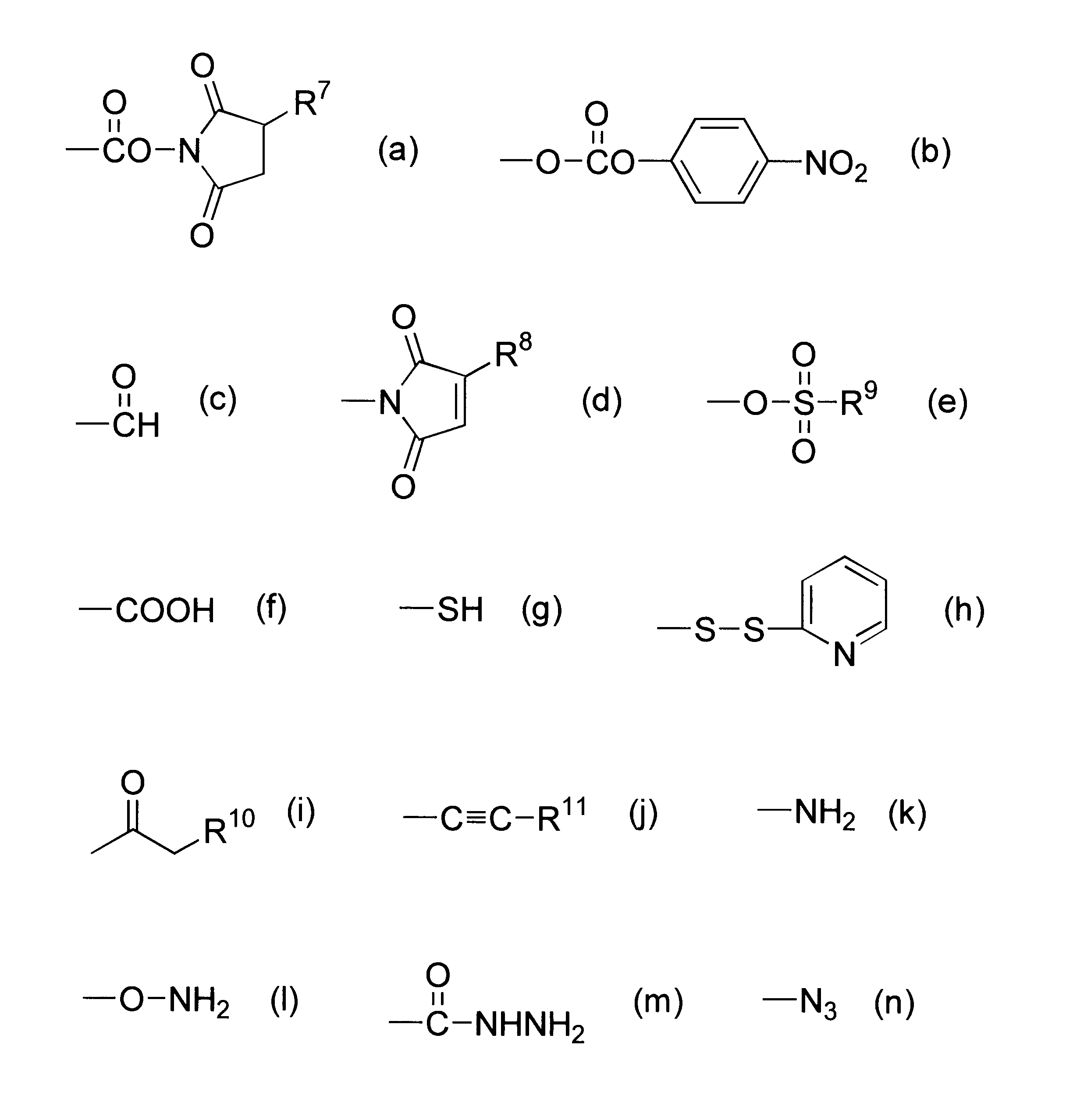
式中、R7は水素原子またはスルホ基であり、スルホ基として具体的にはスルホン酸ナトリウムおよびスルホン酸カリウムが挙げられるが、好ましくは水素原子である。R8、R11は水素原子または炭素数1~5の炭化水素基であり、具体的な炭化水素基としてはメチル基、エチル基、プロピル基、イソプロピル基、ブチル基、t-ブチル基およびペンチル基などが挙げられる。R9はハロゲン原子を含んでもよい炭素数1~10の炭化水素基であり、具体的な炭化水素基としてはメチル基、エチル基、プロピル基、イソプロピル基、ブチル基、t-ブチル基、ペンチル基、イソペンチル基、ヘキシル基、ベンジル基、4-メチルフェニル基、トリフルオロメチル基、2,2,2-トリフルオロエチル基、4-(トリフルオロメトキシ)フェニル基、ビニル基、クロロエチル基、ブロモエチル基およびヨードエチル基などが挙げられるが、好ましくはメチル基、ビニル基、4-メチルフェニル基または2,2,2-トリフルオロエチル基である。R10は塩素原子、臭素原子およびヨウ素原子から選択されるハロゲン原子である。
本発明の式(1)におけるZ1は官能基X1とベンジリデンアセタールリンカー間の2価のスペーサーであり、Z2はベンジリデンアセタールリンカーと親水性ポリマー鎖間の2価のスペーサーである。これらは共有結合で構成され、ベンジリデンアセタールリンカーよりも酸加水分解に対して安定であれば特に制限は無いが、好ましくはアルキレン基単独、またはエーテル結合、エステル結合、カーボネート結合、ウレタン結合、アミド結合および2級アミノ基から選ばれる結合をアルキレン鎖中もしくは末端に有するアルキレン基である。アルキレン基の炭素数は、好ましくは1~24である。説明のためであって、制限するものではないが、アルキレン基の好ましい例としては、(z1)のような構造が挙げられる。エーテル結合を有するアルキレン基の好ましい例としては、(z2)または(z3)のような構造が挙げられる。エステル結合を有するアルキレン基の好ましい例としては、(z4)のような構造が挙げられる。カーボネート結合を有するアルキレン基の好ましい例としては、(z5)のような構造が挙げられる。ウレタン結合を有するアルキレン基の好ましい例としては、(z6)のような構造が挙げられる。アミド結合を有するアルキレン基の好ましい例としては、(z7)のような構造が挙げられる。2級アミノ基を有するアルキレン基の好ましい例としては、(z8)のような構造が挙げられる。好ましい実施形態において、pおよびqは独立して1~12の整数である。例えば、官能基X1をタンパク質内部のような疎水性環境で結合させたい場合は、pおよびqは大きい方が好ましく、親水性環境で結合させたい場合は、pおよびqは小さい方が好ましい。
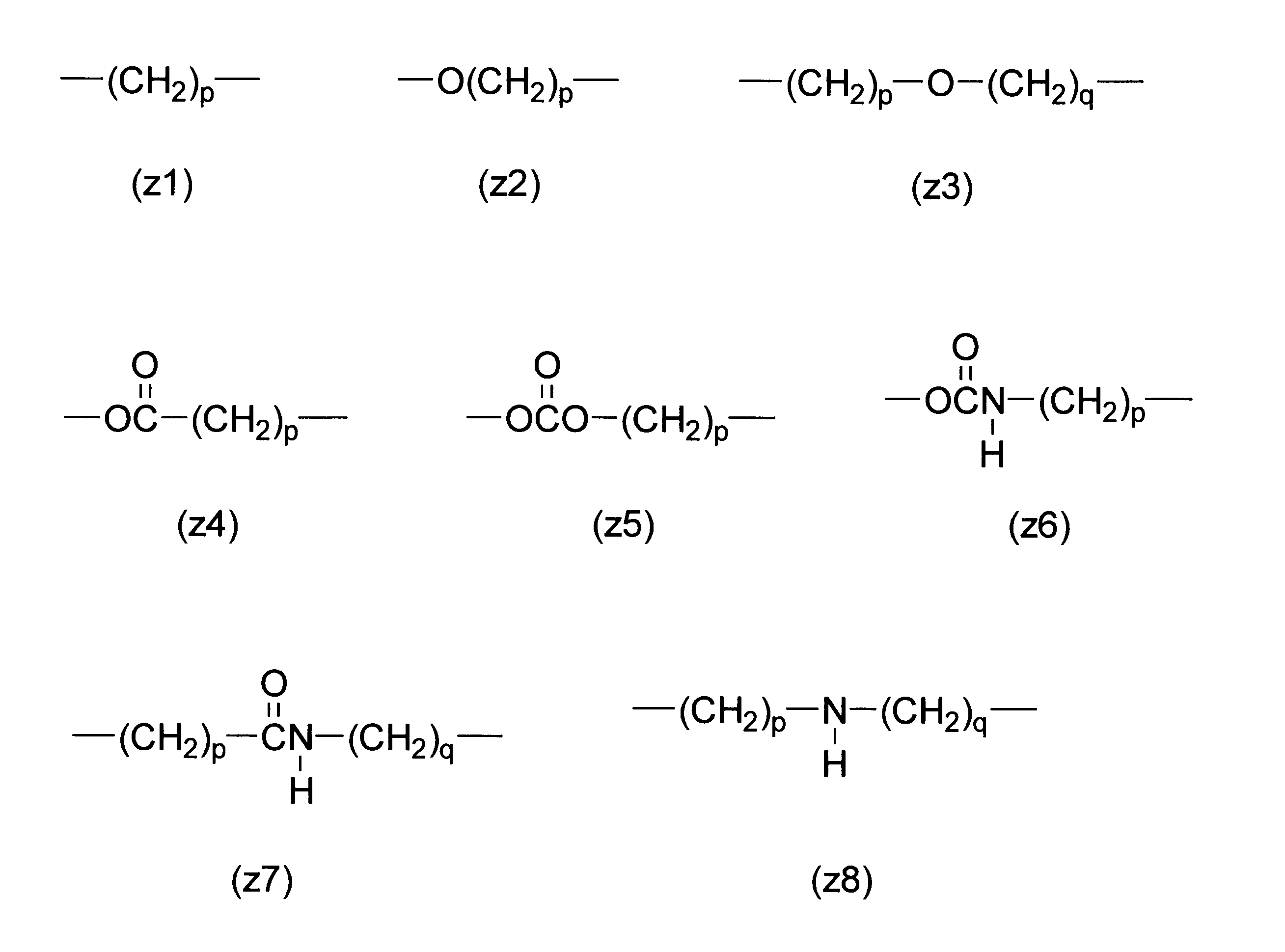
本発明の式(1)におけるPは親水性ポリマーであり、具体的な例としては、ポリアルキレングリコール、ポリオキサゾリン、ポリカーボネート、ポリウレタン、ポリビニルアルコール、ポリアクリレート、ポリメタクリレート、ポリアクリルアミド、ポリビニルピロリドン、ポリ乳酸、ポリグリコール酸、ポリアミノ酸、並びに上記ポリマーに由来するコポリマーなどが挙げられ、好ましくはポリアルキレングリコールであり、さらに好ましくはポリエチレングリコールである。
本明細書で使用する用語「ポリエチレングリコール」は、エチレンオキシドの重合で得られる分子量分布を有するポリエチレングリコール、並びに単一分子量のオリゴエチレングリコール類をカップリング反応で結合した単分散のポリエチレングリコールの両方を意味する。
本発明の一態様では、式(1)におけるPは直鎖型のポリエチレングリコールである。
この態様の好ましい実施形態では、式(1)のPは式(2)で示される。

式中、nはポリエチレングリコール鎖1本あたりの繰り返しユニット数であり、分子量分布を有するポリエチレングリコールにおいては、化合物の数平均分子量(Mn)に基づいて、各種理論的な計算をすることにより算出することと定義する。
式中、Yは炭素数1~24の炭化水素基であり、具体的な例としてはメチル基、エチル基、プロピル基、イソプロピル基、ブチル基、t-ブチル基、ペンチル基、イソペンチル基、ヘキシル基、ヘプチル基、2-エチルヘキシル基、オクチル基、ノニル基、デシル基、ウンデシル基、ドデシル基、トリデシル基、テトラデシル基、ペンタデシル基、ヘキサデシル基、ヘプタデシル基、オクタデシル基、ノナデシル基、エイコシル基、ヘンエイコシル基、ドコシル基、トイコシル基、テトラコシル基、フェニル基、ベンジル基、クレジル基、ブチルフェニル基、ドデシルフェニル基およびトリチル基などが挙げられ、好ましくは炭素数1~10の炭化水素基、より好ましくはメチル基またはエチル基であり、更に好ましくはメチル基である。
この態様のもう1つの好ましい実施形態では、式(1)のPは式(3)で示される。

式中、X2はX1と異なる化学反応可能な官能基であり、Z3は官能基X2とポリエチレングリコール鎖間の2価のスペーサーである。当該ポリエチレングリコール誘導体は、X1とX2の2つの異なる反応性官能基を有しているため、例えばX1に薬物を結合させ、X2に標的指向性分子を結合させることで、標的指向性を有するポリエチレングリコール-薬物結合体を提供することができる。
X2の好ましい例を挙げれば、活性エステル基、活性カーボネート基、アルデヒド基、イソシアネート基、イソチオシアネート基、エポキシ基、マレイミド基、ビニルスルホン基、アクリル基、スルホニルオキシ基、カルボキシ基、チオール基、ジチオピリジル基、α-ハロアセチル基、アルキニル基、アリル基、ビニル基、アミノ基、オキシアミノ基、ヒドラジド基およびアジド基である。更に具体的には、生体機能性分子のアミノ基と反応して共有結合を形成することが可能な官能基は、活性エステル基、活性カーボネート基、アルデヒド基、イソシアネート基、イソチオシアネート基、エポキシ基、マレイミド基、ビニルスルホン基、アクリル基、スルホニルオキシ基またはカルボキシ基であり、生体機能性分子のチオール基と反応して共有結合を形成することが可能な官能基は、活性エステル基、活性カーボネート基、アルデヒド基、イソシアネート基、イソチオシアネート基、エポキシ基、マレイミド基、ビニルスルホン基、アクリル基、スルホニルオキシ基、カルボキシ基、チオール基、ジチオピリジル基、α-ハロアセチル基、アルキニル基、アリル基またはビニル基であり、生体機能性分子のアルデヒド基またはカルボキシ基と反応して共有結合を形成することが可能な官能基は、チオール基、アミノ基、オキシアミノ基またはヒドラジド基であり、生体機能性分子のアルキニル基と反応して共有結合を形成することが可能な官能基は、チオール基またはアジド基であり、生体機能性分子のアジド基と反応して共有結合を形成することが可能な官能基はアルキニル基である。
本発明の好適な実施形態において、X2は群(I)、群(II)、群(III)、群(IV)および群(V)で示される基である。
群(I):生体機能性分子のアミノ基と反応して共有結合を形成することが可能な官能基
下記の(a)、(b)、(c)、(d)、(e)および(f)
群(II):生体機能性分子のチオール基と反応して共有結合を形成することが可能な官能基
下記の(a)、(b)、(c)、(d)、(e)、(f)、(g)、(h)、(i)および(j)
群(III):生体機能性分子のアルデヒド基またはカルボキシ基と反応して共有結合を形成することが可能な官能基
下記の(g)、(k)、(l)および(m)
群(IV):生体機能性分子のアルキニル基と反応して共有結合を形成することが可能な官能基
下記の(g)、(k)、(l)、(m)および(n)
群(V):生体機能性分子のアジド基と反応して共有結合を形成することが可能な官能基
下記の(j)
群(I):生体機能性分子のアミノ基と反応して共有結合を形成することが可能な官能基
下記の(a)、(b)、(c)、(d)、(e)および(f)
群(II):生体機能性分子のチオール基と反応して共有結合を形成することが可能な官能基
下記の(a)、(b)、(c)、(d)、(e)、(f)、(g)、(h)、(i)および(j)
群(III):生体機能性分子のアルデヒド基またはカルボキシ基と反応して共有結合を形成することが可能な官能基
下記の(g)、(k)、(l)および(m)
群(IV):生体機能性分子のアルキニル基と反応して共有結合を形成することが可能な官能基
下記の(g)、(k)、(l)、(m)および(n)
群(V):生体機能性分子のアジド基と反応して共有結合を形成することが可能な官能基
下記の(j)

式中、R7は水素原子またはスルホ基であり、スルホ基として具体的にはスルホン酸ナトリウムおよびスルホン酸カリウムが挙げられるが、好ましくは水素原子である。R8、R11は水素原子または炭素数1~5の炭化水素基であり、具体的な炭化水素基としてはメチル基、エチル基、プロピル基、イソプロピル基、ブチル基、t-ブチル基およびペンチル基などが挙げられる。R9はハロゲン原子を含んでもよい炭素数1~10の炭化水素基であり、具体的な炭化水素基としてはメチル基、エチル基、プロピル基、イソプロピル基、ブチル基、t-ブチル基、ペンチル基、イソペンチル基、ヘキシル基、ベンジル基、4-メチルフェニル基、トリフルオロメチル基、2,2,2-トリフルオロエチル基、4-(トリフルオロメトキシ)フェニル基、ビニル基、クロロエチル基、ブロモエチル基およびヨードエチル基などが挙げられるが、好ましくはメチル基、ビニル基、4-メチルフェニル基または2,2,2-トリフルオロエチル基である。R10は塩素原子、臭素原子およびヨウ素原子から選択されるハロゲン原子である。
X2はX1と異なっていることが必要であり、X1と X2の好ましい組み合わせとして、X1が活性エステル基または活性カーボネート基のときは、X2はマレイミド基、ビニルスルホン基、α-ハロアセチル基、アルキニル基およびアジド基から選択される基であり、X1がアルデヒド基のときは、X2はマレイミド基、ビニルスルホン基、アルキニル基およびアジド基から選択される基であり、X1がマレイミド基、ビニルスルホン基またはα-ハロアセチル基のときは、X2は活性エステル基、活性カーボネート基、アルキニル基、アジド基から選択される基であり、X1がアルキニル基またはアジド基のときは、X2はマレイミド基、ビニルスルホン基、α-ハロアセチル基、活性エステル基、活性カーボネート基、アミノ基およびオキシアミノ基から選択される基であり、X1がアミノ基またはオキシアミノ基のときは、アルキニル基、アジド基、チオール基またはカルボキシ基であり、X1がチオール基のときは、X2はアミノ基、オキシアミノ基、アジド基およびカルボキシ基から選択される基である。より好ましくは、X1が活性エステル基または活性カーボネート基のときは、X2はマレイミド基、α-ハロアセチル基、アルキニル基およびアジド基から選択される基であり、X1がアルデヒド基のときは、X2はマレイミド基、α-ハロアセチル基、アルキニル基およびアジド基から選択される基であり、X1がマレイミド基またはα-ハロアセチル基のときは、X2は活性エステル基、活性カーボネート基、アルキニル基、アジド基から選択される基であり、X1がアルキニル基またはアジド基のときは、X2はマレイミド基、α-ハロアセチル基、活性エステル基、活性カーボネート基、アミノ基およびオキシアミノ基から選択される基であり、X1がアミノ基またはオキシアミノ基のときは、アルキニル基、アジド基またはチオール基であり、X1がチオール基のときは、X2はアミノ基、オキシアミノ基およびアジド基から選択される基である。
Z3は共有結合で構成され、ベンジリデンアセタールリンカーよりも酸加水分解に対して安定であれば特に制限は無いが、好ましくはアルキレン基単独、またはエーテル結合、エステル結合、カーボネート結合、ウレタン結合、アミド結合および2級アミノ基から選ばれる結合をアルキレン鎖中もしくは末端に有するアルキレン基である。アルキレン基の炭素数は、好ましくは1~24である。説明のためであって、制限するものではないが、アルキレン基の好ましい例としては、(z1)のような構造が挙げられる。エーテル結合を有するアルキレン基の好ましい例としては、(z2)または(z3)のような構造が挙げられる。エステル結合を有するアルキレン基の好ましい例としては、(z4)のような構造が挙げられる。カーボネート結合を有するアルキレン基の好ましい例としては、(z5)のような構造が挙げられる。ウレタン結合を有するアルキレン基の好ましい例としては、(z6)のような構造が挙げられる。アミド結合を有するアルキレン基の好ましい例としては、(z7)のような構造が挙げられる。2級アミノ基を有するアルキレン基の好ましい例としては、(z8)のような構造が挙げられる。好ましい実施形態において、pおよびqは独立して1~12の整数である。例えば、官能基X2をタンパク質内部のような疎水性環境で結合させたい場合は、pおよびqは大きい方が好ましく、親水性環境で結合させたい場合は、pおよびqは小さい方が好ましい。

本発明の別の一態様では、式(1)におけるPは分岐型のポリエチレングリコールである。
この態様の好ましい実施形態では、式(1)のPは式(4) で示される。

中、Yは炭素数1~24の前記炭化水素基であり、vは0または2である。
vが0の場合は2本のポリエチレングリコール鎖を有し、vが2の場合は4本のポリエチレングリコール鎖を有する。一般にポリエチレングリコールによる生体関連物質の化学修飾では、必要以上にポリエチレングリコールとの結合点を導入すると生体関連物質の活性点を潰し、その機能を低下させるため、ポリエチレングリコールの分子量を大きくして効果を高める試みが行われている。しかし、分子量の増大にともなって粘度も増大するため、例えば注射製剤のような水溶液製剤での取り扱いが困難となる。当該ポリエチレングリコール誘導体は分岐型構造であるため、同一分子量の直鎖型のポリエチレングリコール誘導体と比較して粘度が低く、水溶液製剤などの用途で有用である。
この態様の別の好ましい実施形態では、式(1)のPは式(5) で示される。
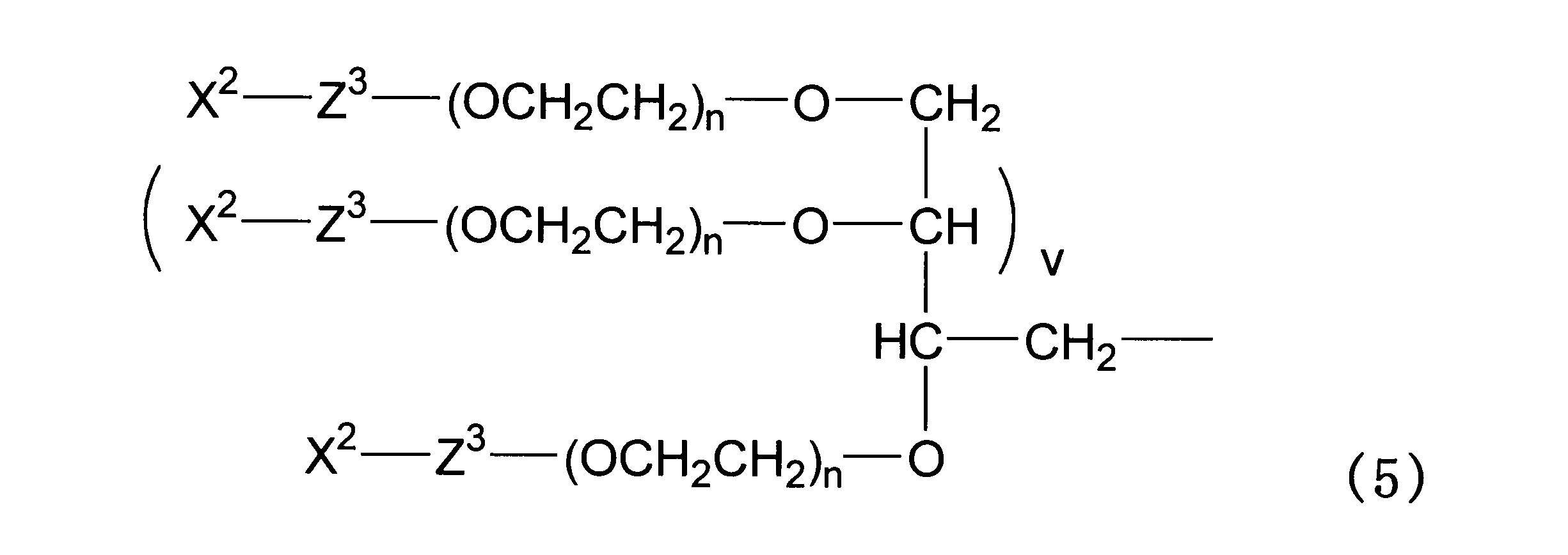
式中、X2はX1と異なる化学反応可能な前記官能基であり、Z3は前記2価のスペーサーであり、vは0または2である。
当該ポリエチレングリコール誘導体は、1つのX1と2つまたは4つのX2を有しており、例えばX1に薬物を結合させ、X2に標的指向性分子を結合させれば、高い標的指向性能を得ることができる。
この態様のもう一つの好ましい実施形態では、式(1)のPは式(6) で示される。

式中、X2はX1と異なる化学反応可能な前記官能基であり、Z3は前記2価のスペーサーであり、vは0または2である。
抗体-薬物複合体(ADC)関連分野においては、薬物の運搬効率を上げるために抗体に対して複数の薬物を結合させることが好ましいが、抗体に複数の結合点を導入すると抗原との親和性の低下が問題となる。当該ポリエチレングリコール誘導体は2つまたは4つのX1と1つのX2を有しており、例えばガンを標的としたADCでX1に抗ガン剤を結合させ、X2に抗体を結合させれば、抗体との結合点を増加させずに、抗ガン剤の運搬効率を向上させることができる。
本発明のもう一つの態様では、式(1)におけるPは末端数2~8のポリエチレングリコールであり、Pを構成するポリエチレングリコールの全ての末端がそれぞれZ2に対して結合しており、wがポリエチレングリコールの末端数に等しい。
この態様の好ましい実施形態では、式(1)のPは、式(r)、式(s)、式(t)、式(u)および式(v)からなる群から選択される。Pが式(r)で表される場合にはwが2であり、Pが式(s)で表される場合にはwが3であり、Pが式(t)で表される場合にはwが4であり、Pが式(u)で表される場合にはwが4であり、Pが式(v)で表される場合にはwが8である。
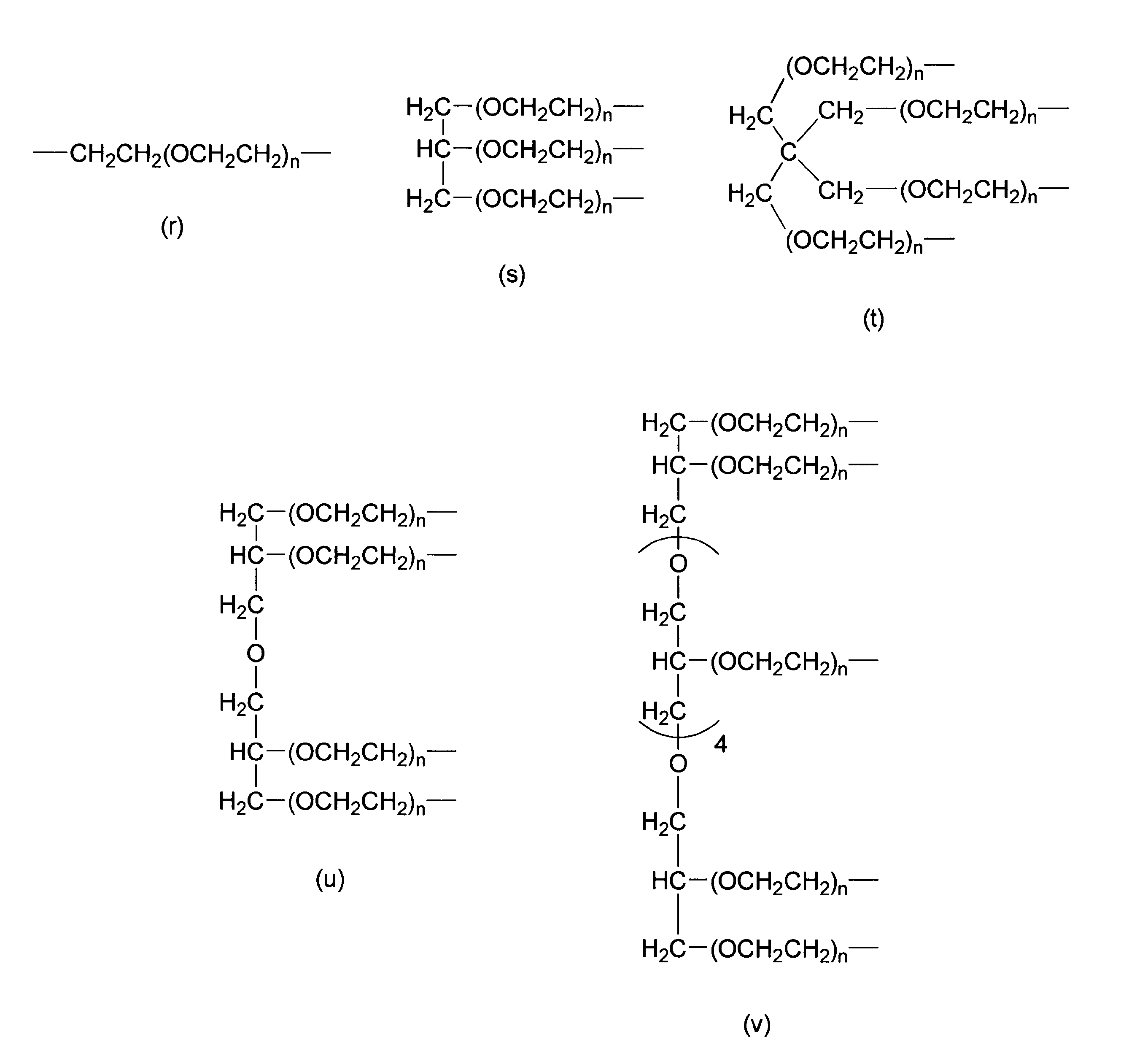
本発明の式(2)および式(3)におけるnの好適な範囲は3~2000であり、より好ましくは20~1500であり、更に好ましくは40~1000であり、最も好ましくは60~500である。また、式(4)、式(5)および式(6)におけるnの好適な範囲は3~1000であり、好ましくは10~800であり、更に好ましくは20~500であり、最も好ましくは30~300である。
本発明のベンジリデンアセタールリンカーを有する親水性ポリマー誘導体は、置換基を有するベンジリデンアセタール基が導入されたリンカーユニットと親水性ポリマー前駆体をカップリング反応させることにより合成できる。このカップリング反応によって生じる結合は、反応に使用される官能基の組み合わせによって決定されるものであり、前記2価のスペーサーZ2に含まれるエーテル結合、エステル結合、カーボネート結合、ウレタン結合、アミド結合または2級アミノ基である。合成した当該親水性ポリマー誘導体は、必要に応じてベンジリデンアセタールリンカーの末端官能基を化学変換する。この官能基変換に用いられる反応は、従来公知の方法を用いることができるが、式(1)のベンジリデンアセタール基、前記2価のスペーサーZ2およびZ1に含まれる結合を分解しない条件を適切に選択しなければならない。
ベンジリデンアセタールリンカーユニットと親水性ポリマー前駆体をカップリング反応させ、さらに末端官能基を化学変換する典型的な例としては、以下のような工程が挙げられる。ここでは代表的な親水性ポリマーであるポリエチレングリコールを例として説明する。
(A) ベンジリデンアセタールリンカーユニットの合成

(式中、Arは置換基を有するベンゼン環であり、R1は水素原子または炭化水素基である。)
アミノ基を代表的な保護基であるフタルイミド基で保護した3-アミノプロパノール誘導体と式(13)のカルボニル化合物をトルエン、ベンゼン、キシレン、アセトニトリル、酢酸エチル、ジエチルエーテル、t-ブチルメチルエーテル、テトラヒドロフラン、クロロホルム、ジクロロメタン、ジメチルスルホキシド、ジメチルホルムアミドまたはジメチルアセトアミドなどの非プロトン性溶媒、もしくは無溶媒中、酸触媒存在下、反応させることでベンジリデンアセタール基を有する下記式(14)の化合物を得る。得られた化合物は、抽出、再結晶、吸着剤処理またはカラムクロマトグラフィーなどで精製してもよい。カルボニル化合物の代わりに、対応する低級アルコールのアセタール誘導体を使用することもできる。低級アルコールは好ましくは炭素数1~5のアルコールであり、更に好ましくはメタノールまたはエタノールである。酸触媒は有機酸または無機酸のいずれでもよく、特に制限は無いが、具体的な例を挙げればp-トルエンスルホン酸、p-トルエンスルホン酸ピリジニウム、メタンスルホン酸、10-カンファースルホン酸、塩化水素、ヨウ素、塩化アンモニウム、シュウ酸および三フッ化ホウ素ジエチルエーテル錯体などである。

ここで「保護基」とは、ある反応条件下で分子中の特定の反応性官能基の反応を防止または阻止する成分である。保護基は、保護される反応性官能基の種類、使用される条件および分子中の他の官能基もしくは保護基の存在により変化する。保護基の具体的な例は多くの一般的な成書に見出すことができるが、例えば「Wuts, P. G. M.; Greene, T. W. Protective Groups in Organic Synthesis, 4th ed.; Wiley-Interscience: New York, 2007」に記載されている。
式(14)の化合物における保護基は、アセタール化反応の酸性条件で安定、かつベンジリデンアセタール基が分解する接触還元以外の方法で脱保護可能であれば、他の保護基も用いることができる。反応性官能基がアミノ基のときは、例えばアシル系保護基およびカーバメート系保護基が挙げられ、具体的にはトリフルオロアセチル基、9-フルオレニルメチルオキシカルボニル基および2-(トリメチルシリル)エチルオキシカルボニル基などが挙げられる。また、反応性官能基がヒドロキシ基のときは、例えばシリル系保護基およびアシル系保護基が挙げられ、具体的にはt-ブチルジフェニルシリル基、t-ブチルジメチルシリル基、トリイソプロピルシリル基、アセチル基およびピバロイル基などが挙げられる。
次に、式(14)の化合物を脱保護試薬であるヒドラジン一水和物で処理して2つのフタルイミド基を脱保護した後、保護試薬であるトリフルオロ酢酸エチルを1モル当量反応させて、アミノ基の一方のみがトリフルオロアセチル基で保護された式(15)の化合物を得る。もしくは、式(14)の化合物に対して脱保護試薬の使用量を調節することで、アミノ基の一方のみがフタルイミド基で保護された式(15)と同類の化合物を得ることもできる。得られた化合物は、前述の精製手段にて精製してもよい。
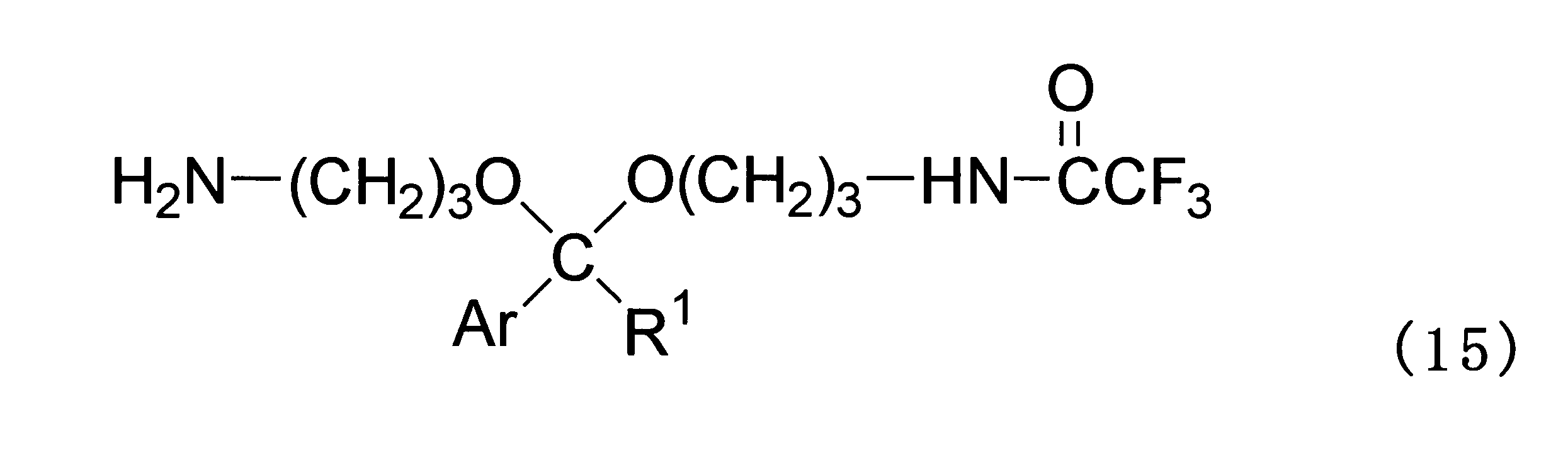
式(15)の化合物における保護基は、ベンジリデンアセタール基が分解する酸性条件および接触還元、並びに当該ベンジリデンアセタールリンカーユニットと親水性ポリマー前駆体とのカップリング反応により生じる結合を分解する条件以外の方法で脱保護可能であれば、他の保護基も用いることができる。反応性官能基がアミノ基のときは、例えばアシル系保護基およびカーバメート系保護基が挙げられ、具体的にはフタルイミド基、9-フルオレニルメチルオキシカルボニル基および2-(トリメチルシリル)エチルオキシカルボニル基などが挙げられる。また、反応性官能基がヒドロキシ基のときは、例えばシリル系保護基およびアシル系保護基が挙げられ、具体的にはt-ブチルジフェニルシリル基、t-ブチルジメチルシリル基、トリイソプロピルシリル基、アセチル基およびピバロイル基などが挙げられる。保護基の代表的な脱保護条件は前述の文献に記載されており、それぞれの保護基に適した方法を選択することができる。
(B) ポリエチレングリコール前駆体の合成
開始剤であるメタノールをトルエン中もしくは無溶媒で、金属ナトリウム、金属カリウム、水素化ナトリウムまたは水素化カリウムなどのアルカリ条件下、エチレンオキシドをメタノールに対して3~2000モル当量重合させ、式(16)のポリエチレングリコールを得る。開始剤としては炭素数1~24の炭化水素基を有するアルコールが好ましく、具体的にはメタノール、エタノール、プロパノール、イソプロパノール、ブタノール、t-ブタノール、フェノールおよびベンジルアルコールなどが挙げられる。
開始剤であるメタノールをトルエン中もしくは無溶媒で、金属ナトリウム、金属カリウム、水素化ナトリウムまたは水素化カリウムなどのアルカリ条件下、エチレンオキシドをメタノールに対して3~2000モル当量重合させ、式(16)のポリエチレングリコールを得る。開始剤としては炭素数1~24の炭化水素基を有するアルコールが好ましく、具体的にはメタノール、エタノール、プロパノール、イソプロパノール、ブタノール、t-ブタノール、フェノールおよびベンジルアルコールなどが挙げられる。

式(16)のポリエチレングリコールをトルエン、ベンゼン、キシレン、アセトニトリル、酢酸エチル、ジエチルエーテル、t-ブチルメチルエーテル、テトラヒドロフラン、クロロホルム、ジクロロメタン、ジメチルスルホキシド、ジメチルホルムアミドまたはジメチルアセトアミドなどの非プロトン性溶媒、もしくは無溶媒中、トリエチルアミン、N-メチルモルホリン、ピリジンまたは4-ジメチルアミノピリジンなどの有機塩基、もしくは炭酸ナトリウム、炭酸水素ナトリウム、酢酸ナトリウムまたは炭酸カリウムなどの無機塩基の存在下、N,N’-ジスクシンイミジルカーボネートと反応させることで、式(17)のポリエチレングリコール前駆体を得る。上記有機塩基、無機塩基は用いなくとも良い。有機塩基、無機塩基の使用割合は、特に制限はないが、式(16)のポリエチレングリコールの水酸基に対して等モル以上が好ましい。また、有機塩基を溶媒として用いてもよい。得られた化合物は、抽出、再結晶、吸着剤処理、再沈殿、カラムクロマトグラフィーまたは超臨界抽出等の精製手段にて精製してもよい。

式(17)のポリエチレングリコール前駆体における反応性官能基は他の反応性官能基も用いることができる。反応性官能基の好ましい例としては、当該ポリエチレングリコール前駆体と前記ベンジリデンアセタールリンカーユニットのカップリング反応によって生じる結合が、式(1)の2価のスペーサーZ2に含まれるエーテル結合、エステル結合、カーボネート結合、ウレタン結合、アミド結合または2級アミノ基となる官能基であり、具体的には活性エステル、活性カーボネート、アルデヒド基、スルホニルオキシ基およびアミノ基などが挙げられる。
(C) ベンジリデンアセタールリンカーユニットとポリエチレングリコール前駆体のカップリング反応
式(15)のベンジリデンアセタールリンカーユニットと式(17)のポリエチレングリコール前駆体をトルエン、ベンゼン、キシレン、アセトニトリル、酢酸エチル、ジエチルエーテル、t-ブチルメチルエーテル、テトラヒドロフラン、クロロホルム、ジクロロメタン、ジメチルスルホキシド、ジメチルホルムアミドまたはジメチルアセトアミドなどの非プロトン性溶媒、もしくは無溶媒中、トリエチルアミン、N-メチルモルホリン、ピリジンまたは4-ジメチルアミノピリジンなどの有機塩基、もしくは炭酸ナトリウム、炭酸水素ナトリウム、酢酸ナトリウムまたは炭酸カリウムなどの無機塩基の存在下、カップリング反応させることで、式(18)の化合物を得る。上記有機塩基、無機塩基は用いなくとも良い。有機塩基、無機塩基の使用割合は、特に制限はないが、式(17)のポリエチレングリコール前駆体の反応性官能基に対して等モル以上が好ましい。また、有機塩基を溶媒として用いてもよい。得られた化合物は、前述の精製手段にて精製してもよい。
式(15)のベンジリデンアセタールリンカーユニットと式(17)のポリエチレングリコール前駆体をトルエン、ベンゼン、キシレン、アセトニトリル、酢酸エチル、ジエチルエーテル、t-ブチルメチルエーテル、テトラヒドロフラン、クロロホルム、ジクロロメタン、ジメチルスルホキシド、ジメチルホルムアミドまたはジメチルアセトアミドなどの非プロトン性溶媒、もしくは無溶媒中、トリエチルアミン、N-メチルモルホリン、ピリジンまたは4-ジメチルアミノピリジンなどの有機塩基、もしくは炭酸ナトリウム、炭酸水素ナトリウム、酢酸ナトリウムまたは炭酸カリウムなどの無機塩基の存在下、カップリング反応させることで、式(18)の化合物を得る。上記有機塩基、無機塩基は用いなくとも良い。有機塩基、無機塩基の使用割合は、特に制限はないが、式(17)のポリエチレングリコール前駆体の反応性官能基に対して等モル以上が好ましい。また、有機塩基を溶媒として用いてもよい。得られた化合物は、前述の精製手段にて精製してもよい。

カップリング反応の反応条件は、ベンジリデンアセタールリンカーユニットの反応性官能基およびポリエチレングリコール前駆体の反応性官能基の組み合わせによって決定されるものであり、従来公知の方法を用いることができるが、式(1)のベンジリデンアセタール基、前記2価のスペーサーZ2およびZ1に含まれる結合を分解しない条件を適切に選択する必要がある。
(D) ベンジリデンアセタールリンカーを有するポリエチレングリコール誘導体の末端官能基変換
式(18)の化合物を水、メタノールまたはエタノールなどのプロトン性溶媒、もしくはこれらを含む非プロトン性溶媒中、炭酸ナトリウム、水酸化ナトリウム、炭酸カリウム、水酸化カリウム、水酸化リチウムまたはアンモニアなどの塩基で処理することで、トリフルオロアセチル基が除去されてアミノ基に変換された式(19)の化合物を得る。得られた化合物は、前述の精製手段にて精製してもよい。
式(18)の化合物を水、メタノールまたはエタノールなどのプロトン性溶媒、もしくはこれらを含む非プロトン性溶媒中、炭酸ナトリウム、水酸化ナトリウム、炭酸カリウム、水酸化カリウム、水酸化リチウムまたはアンモニアなどの塩基で処理することで、トリフルオロアセチル基が除去されてアミノ基に変換された式(19)の化合物を得る。得られた化合物は、前述の精製手段にて精製してもよい。

更に、式(19)の化合物をトルエン、ベンゼン、キシレン、アセトニトリル、酢酸エチル、ジエチルエーテル、t-ブチルメチルエーテル、テトラヒドロフラン、クロロホルム、ジクロロメタン、ジメチルスルホキシド、ジメチルホルムアミドまたはジメチルアセトアミドなどの非プロトン性溶媒、もしくは無溶媒中、トリエチルアミン、N-メチルモルホリン、ピリジンまたは4-ジメチルアミノピリジンなどの有機塩基、もしくは炭酸ナトリウム、炭酸水素ナトリウム、酢酸ナトリウムまたは炭酸カリウムなどの無機塩基の存在下、3-マレイミドプロピオン酸 N-スクシンイミジルと反応させることで、末端にマレイミド基が導入された式(20)の化合物を得る。上記有機塩基、無機塩基は用いなくとも良い。有機塩基、無機塩基の使用割合は、特に制限はないが、式(19)の化合物の反応性官能基に対して等モル以上が好ましい。また、有機塩基を溶媒として用いてもよい。得られた化合物は、前述の精製手段にて精製してもよい。

以下に実施例を挙げて本発明を更に具体的に説明するが、本発明はこれに限定されるものではない。
1H-NMR分析では日本電子データム(株)製JNM-ECP400またはJNM-ECA600を使用した。測定にはφ5mmチューブを用い、重水素化溶媒がCDCl3、CD3CNまたはCD3ODの場合は、内部標準物質としてテトラメチルシラン(TMS)を使用し、D2Oの場合はHDOを基準とした。
ゲル浸透クロマトグラフィー(GPC)分析では、GPCシステムとしてSHODEX GPC SYSTEM-11、検出器である示唆屈折計としてSHODEX RIX8、GPCカラムとしてSHODEX KF801L、KF803L、KF804L(φ8mm×300mm)を3本直列に繋ぎ、カラムオーブンの温度を40℃とした。溶離液としてはテトラヒドロフランを用い、流速は1ml/分とし、試料の濃度は0.1wt%とし、注入容量は0.1mLとして測定を行った。検量線は関東化学(株)製のエチレングリコール、ジエチレングリコール、トリエチレングリコール、並びにPolymer Laboratory製の分子量600~70000のポリエチレングリコールまたはポリエチレンオキシドのGPC用Polymer Standardsを用いて作成したものを用いた。データの解析はBORWIN GPC計算プログラムを使用した。Mnは数平均分子量、Mwは重量平均分子量を表わし、分子量分布はMw/Mnとしてその計算値を示した。
加水分解試験で使用するpD 5.5のMES(2-morpholinoethanesulfonic acid)重水緩衝液とpD 7.4のHEPES(2-[4-(Hydroxyethyl)-1-piperazinyl]ethanesulfonic acid])重水緩衝液は、それぞれ0.1MのMES重水溶液と0.1MのHEPES重水溶液に0.1Mの水酸化ナトリウム重水溶液を加え、「Glasoe, P. K.; Long, F. A. J. Phys. Chem. 1960, 64, 188-190」に記載されている以下の関係式に基づいて調製した。
pD=pHメーターの測定値+0.40
加水分解率は1H-NMRで評価し、式(26)、式(29)および式(30)の化合物の場合は、アセタール基の水素の積分値をI1、加水分解で生成するアルデヒド基の水素の積分値をI2として、次の計算式により算出した。
加水分解率(%)=[I2/(I1+I2)]×100
また、式(31)の化合物の場合は、アセタール基に結合したベンゼン環の積分値をI3、加水分解で生成するアセトフェノンのベンゼン環の積分値をI4として、次の計算式により算出した。
加水分解率(%)=[I4/(I3+I4)]×100
(実施例1)
温度計、窒素吹き込み管、攪拌機、Dean-stark管および冷却管を装備した300 mLの四つ口フラスコに2-ブロモベンズアルデヒドジメチルアセタール(2.31 g, 10.0 mmol)、N-(3-ヒドロキシプロピル)フタルイミド(8.21 g, 40.0 mmol)およびトルエン(120 g)を仕込み、水をトルエンで共沸除去した。室温へ冷却後、p-トルエンスルホン酸ピリジニウム (0.25 g, 1.0 mmol)を加え、副生するメタノールをトルエンで共沸除去しながら3時間反応を行った。トリエチルアミン(10 mL)でクエンチ後、酢酸エチル(100 mL)とヘキサン(100 mL)の混合溶液で希釈した。飽和炭酸水素ナトリウム水溶液(100 mL)、飽和食塩水(100 mL)の順に洗浄した後、有機層を無水硫酸ナトリウムで乾燥した。濾過後、溶媒を減圧留去し、残渣を再結晶にて精製して式(21)の化合物を得た。
1H-NMR(CDCl3, 内部標準TMS); δ(ppm): 1.92-2.01(4H, m, -CH2CH2CH2O-), 3.53-3.67(4H, m, -CH2CH2CH2O-), 3.75-3.81(4H, m, -CH2CH2CH2O-), 5.64(1H, s, >CH-), 7.08-7.49(4H, m, arom. H), 7.64-7.81(8H, m, arom. H)
温度計、窒素吹き込み管、攪拌機、Dean-stark管および冷却管を装備した300 mLの四つ口フラスコに2-ブロモベンズアルデヒドジメチルアセタール(2.31 g, 10.0 mmol)、N-(3-ヒドロキシプロピル)フタルイミド(8.21 g, 40.0 mmol)およびトルエン(120 g)を仕込み、水をトルエンで共沸除去した。室温へ冷却後、p-トルエンスルホン酸ピリジニウム (0.25 g, 1.0 mmol)を加え、副生するメタノールをトルエンで共沸除去しながら3時間反応を行った。トリエチルアミン(10 mL)でクエンチ後、酢酸エチル(100 mL)とヘキサン(100 mL)の混合溶液で希釈した。飽和炭酸水素ナトリウム水溶液(100 mL)、飽和食塩水(100 mL)の順に洗浄した後、有機層を無水硫酸ナトリウムで乾燥した。濾過後、溶媒を減圧留去し、残渣を再結晶にて精製して式(21)の化合物を得た。
1H-NMR(CDCl3, 内部標準TMS); δ(ppm): 1.92-2.01(4H, m, -CH2CH2CH2O-), 3.53-3.67(4H, m, -CH2CH2CH2O-), 3.75-3.81(4H, m, -CH2CH2CH2O-), 5.64(1H, s, >CH-), 7.08-7.49(4H, m, arom. H), 7.64-7.81(8H, m, arom. H)

(実施例2)
温度計、窒素吹き込み管および攪拌機を装備した100 mLの三つ口フラスコに式(21)の化合物(1.00 g, 1.73 mmol)、エタノール(36 mL)およびヒドラジン1水和物(0.84 mL)を仕込み、60℃で6時間反応を行った。室温に冷却して濾過後、濾液をジクロロメタン(108 mL)で希釈した。10%食塩水(80 mL)で洗浄後、有機層を無水硫酸ナトリウムで乾燥した。濾過後、溶媒を減圧留去して式(22)の化合物を得た。
1H-NMR(CD3OD, 内部標準TMS); δ(ppm): 1.73-1.78(4H, m, -CH2CH2CH2O-), 2.74(4H, t, -CH2CH2CH2O-), 3.57-3.70(4H, m, -CH2CH2CH2O-), 5.67(1H, s, >CH-), 7.23-7.61(4H, m, arom. H)
温度計、窒素吹き込み管および攪拌機を装備した100 mLの三つ口フラスコに式(21)の化合物(1.00 g, 1.73 mmol)、エタノール(36 mL)およびヒドラジン1水和物(0.84 mL)を仕込み、60℃で6時間反応を行った。室温に冷却して濾過後、濾液をジクロロメタン(108 mL)で希釈した。10%食塩水(80 mL)で洗浄後、有機層を無水硫酸ナトリウムで乾燥した。濾過後、溶媒を減圧留去して式(22)の化合物を得た。
1H-NMR(CD3OD, 内部標準TMS); δ(ppm): 1.73-1.78(4H, m, -CH2CH2CH2O-), 2.74(4H, t, -CH2CH2CH2O-), 3.57-3.70(4H, m, -CH2CH2CH2O-), 5.67(1H, s, >CH-), 7.23-7.61(4H, m, arom. H)

(実施例3)
温度計、窒素吹き込み管および攪拌機を装備した100 mLの三つ口フラスコに式(22)の化合物(0.30 g, 0.95 mmol)と脱水メタノール(18 mL)を仕込み、トリフルオロ酢酸エチル(0.13 g, 0.95 mmol)を脱水メタノール(18 mL)に溶解した溶液を滴下しながら撹拌した。滴下終了後、25℃にて2時間反応を行った。溶媒を減圧留去し、残渣をt-ブチルメチルエーテル(18 mL)で希釈した。イオン交換水(18 mL)で洗浄後、有機層を無水硫酸ナトリウムで乾燥した。濾過後、溶媒を減圧留去し、両末端のアミノ基がトリフルオロアセチル基で保護された化合物(40 wt%含有)との混合物として式(23)の化合物を得た。
1H-NMR(CD3OD, 内部標準TMS); δ(ppm): 1.73-1.78(2H, m, NH2CH2CH2CH2O-), 1.83-1.88(2H, m, CF3CONHCH2CH2CH2O-), 2.74(2H, t, NH2CH2CH2CH2O-), 3.40(2H, t, CF3CONHCH2CH2CH2O-), 3.54-3.70(4H, m, -CH2CH2CH2O-), 5.68(1H, s, >CH-), 7.23-7.63(4H, m, arom. H)
温度計、窒素吹き込み管および攪拌機を装備した100 mLの三つ口フラスコに式(22)の化合物(0.30 g, 0.95 mmol)と脱水メタノール(18 mL)を仕込み、トリフルオロ酢酸エチル(0.13 g, 0.95 mmol)を脱水メタノール(18 mL)に溶解した溶液を滴下しながら撹拌した。滴下終了後、25℃にて2時間反応を行った。溶媒を減圧留去し、残渣をt-ブチルメチルエーテル(18 mL)で希釈した。イオン交換水(18 mL)で洗浄後、有機層を無水硫酸ナトリウムで乾燥した。濾過後、溶媒を減圧留去し、両末端のアミノ基がトリフルオロアセチル基で保護された化合物(40 wt%含有)との混合物として式(23)の化合物を得た。
1H-NMR(CD3OD, 内部標準TMS); δ(ppm): 1.73-1.78(2H, m, NH2CH2CH2CH2O-), 1.83-1.88(2H, m, CF3CONHCH2CH2CH2O-), 2.74(2H, t, NH2CH2CH2CH2O-), 3.40(2H, t, CF3CONHCH2CH2CH2O-), 3.54-3.70(4H, m, -CH2CH2CH2O-), 5.68(1H, s, >CH-), 7.23-7.63(4H, m, arom. H)

(実施例4)
温度計、窒素吹き込み管および攪拌機を装備した300 mLの四つ口フラスコに脱水メタノール(12.8 g, 0.400 mol)、脱水トルエン(150 g)および金属ナトリウム0.3 g(13 mmol)を仕込み、窒素を吹き込みながら金属ナトリウムが溶解するまで室温で攪拌した。この溶液を5 Lオートクレーブへ仕込み、系内を窒素置換後、100℃に昇温した。100~130℃、1 MPa以下の圧力でエチレンオキシド(1,987 g, 45 mol)を加えた後、更に2時間反応を続けた。減圧にて未反応のエチレンオキシドガスを除去後、60℃に冷却し、85%リン酸水溶液でpH 7.5に調整して式(24)の化合物を得た。
1H-NMR(CDCl3, 内部標準TMS); δ(ppm): 2.68(1H, t, OH), 3.38(3H, s, CH3O-), 3.49-3.85(450H, m, -(OCH2CH2)n-)
GPC分析; 数平均分子量(Mn): 5119, 重量平均分子量(Mw): 5226, 多分散度(Mw/Mn): 1.021
温度計、窒素吹き込み管および攪拌機を装備した300 mLの四つ口フラスコに脱水メタノール(12.8 g, 0.400 mol)、脱水トルエン(150 g)および金属ナトリウム0.3 g(13 mmol)を仕込み、窒素を吹き込みながら金属ナトリウムが溶解するまで室温で攪拌した。この溶液を5 Lオートクレーブへ仕込み、系内を窒素置換後、100℃に昇温した。100~130℃、1 MPa以下の圧力でエチレンオキシド(1,987 g, 45 mol)を加えた後、更に2時間反応を続けた。減圧にて未反応のエチレンオキシドガスを除去後、60℃に冷却し、85%リン酸水溶液でpH 7.5に調整して式(24)の化合物を得た。
1H-NMR(CDCl3, 内部標準TMS); δ(ppm): 2.68(1H, t, OH), 3.38(3H, s, CH3O-), 3.49-3.85(450H, m, -(OCH2CH2)n-)
GPC分析; 数平均分子量(Mn): 5119, 重量平均分子量(Mw): 5226, 多分散度(Mw/Mn): 1.021

(実施例5)
温度計、窒素吹き込み管、攪拌機、Dean-stark管および冷却管を装備した100 mLの三つ口フラスコに式(24)の化合物(10.0 g, 2.00 mmol)とトルエン(40g)を仕込み、水をトルエンで共沸除去した。40℃へ冷却後、ピリジン(0.71 g, 9.00 mmol)、N,N’-ジスクシンイミジルカーボネート(1.54 g, 6.00 mmol)を仕込み、80℃にて7時間反応を行った。濾過後、酢酸エチル(45 g)で希釈し、ヘキサン(16 g)を添加して晶析を行った。濾過後、結晶を酢酸エチル(76 g)に溶解させ、ヘキサン(24 g)を添加して再度晶析を行った。濾過後、減圧下で乾燥して式(25)の化合物を得た。
1H-NMR(CDCl3, 内部標準TMS); δ(ppm): 2.84(4H, s, succinimide), 3.38(3H, s, CH3O-), 3.48-3.85(448H, m, -(OCH2CH2)n-OCH2-), 4.44-4.48(2H, m, -CH2O-COO-succinimide)
GPC分析; 数平均分子量(Mn): 5129, 重量平均分子量(Mw): 5247, 多分散度(Mw/Mn): 1.023
温度計、窒素吹き込み管、攪拌機、Dean-stark管および冷却管を装備した100 mLの三つ口フラスコに式(24)の化合物(10.0 g, 2.00 mmol)とトルエン(40g)を仕込み、水をトルエンで共沸除去した。40℃へ冷却後、ピリジン(0.71 g, 9.00 mmol)、N,N’-ジスクシンイミジルカーボネート(1.54 g, 6.00 mmol)を仕込み、80℃にて7時間反応を行った。濾過後、酢酸エチル(45 g)で希釈し、ヘキサン(16 g)を添加して晶析を行った。濾過後、結晶を酢酸エチル(76 g)に溶解させ、ヘキサン(24 g)を添加して再度晶析を行った。濾過後、減圧下で乾燥して式(25)の化合物を得た。
1H-NMR(CDCl3, 内部標準TMS); δ(ppm): 2.84(4H, s, succinimide), 3.38(3H, s, CH3O-), 3.48-3.85(448H, m, -(OCH2CH2)n-OCH2-), 4.44-4.48(2H, m, -CH2O-COO-succinimide)
GPC分析; 数平均分子量(Mn): 5129, 重量平均分子量(Mw): 5247, 多分散度(Mw/Mn): 1.023

(実施例6)
温度計、窒素吹き込み管および攪拌機を装備した100 mLの三つ口フラスコに式(25)の化合物 (1.0 g, 0.20 mmol)と脱水ジクロロメタン36 gを仕込み、式(23)の化合物(純分60 wt%)を(206 mg, 0.30 mmol)とN,N-ジイソプロピルエチルアミン(38 mg, 0.30 mmol)の脱水ジクロロメタン(4 g)溶液を滴下しながら撹拌した。滴下終了後、25℃にて3時間反応を行った。溶媒を減圧留去し、残渣を酢酸エチル(25 g)に溶解した後、ヘキサン(25 g)を添加して晶析を行った。濾過後、減圧下で乾燥して式(26)の化合物を得た。
1H-NMR(CDCl3, 内部標準TMS); δ(ppm): 1.78-1.93(4H, m, -CH2CH2CH2O-), 3.26-3.37(2H, m, -OCONHCH2CH2CH2O-), 3.38(3H, s, CH3O-), 3.47-3.81(454H, m, CF3CONHCH2CH2CH2O-, -CH2CH2CH2O-, -(OCH2CH2)n-OCH2-), 4.20(2H, t, -OCH2CH2OCONH-), 5.11(1H, brs, -OCONH-), 5.67(1H, s, >CH-), 7.21-7.59(4H, m, arom. H), 7.31(1H, brs, CF3CONH-)
GPC分析; 数平均分子量(Mn): 5424, 重量平均分子量(Mw): 5549, 多分散度(Mw/Mn): 1.023
温度計、窒素吹き込み管および攪拌機を装備した100 mLの三つ口フラスコに式(25)の化合物 (1.0 g, 0.20 mmol)と脱水ジクロロメタン36 gを仕込み、式(23)の化合物(純分60 wt%)を(206 mg, 0.30 mmol)とN,N-ジイソプロピルエチルアミン(38 mg, 0.30 mmol)の脱水ジクロロメタン(4 g)溶液を滴下しながら撹拌した。滴下終了後、25℃にて3時間反応を行った。溶媒を減圧留去し、残渣を酢酸エチル(25 g)に溶解した後、ヘキサン(25 g)を添加して晶析を行った。濾過後、減圧下で乾燥して式(26)の化合物を得た。
1H-NMR(CDCl3, 内部標準TMS); δ(ppm): 1.78-1.93(4H, m, -CH2CH2CH2O-), 3.26-3.37(2H, m, -OCONHCH2CH2CH2O-), 3.38(3H, s, CH3O-), 3.47-3.81(454H, m, CF3CONHCH2CH2CH2O-, -CH2CH2CH2O-, -(OCH2CH2)n-OCH2-), 4.20(2H, t, -OCH2CH2OCONH-), 5.11(1H, brs, -OCONH-), 5.67(1H, s, >CH-), 7.21-7.59(4H, m, arom. H), 7.31(1H, brs, CF3CONH-)
GPC分析; 数平均分子量(Mn): 5424, 重量平均分子量(Mw): 5549, 多分散度(Mw/Mn): 1.023

(実施例7)
温度計、窒素吹き込み管および攪拌機を装備した50 mLの三つ口フラスコに式(26)の化合物 (0.50 g, 0.10 mmol)と1Mの炭酸カリウム水溶液(15 g)を仕込み、25℃にて3時間反応を行った。ジクロロメタン(15 g)で抽出し、溶媒を減圧留去後、残渣を酢酸エチル(25 g)に溶解して無水硫酸ナトリウムで乾燥した。濾過後、ヘキサン(25 g)を添加して晶析を行った。濾過後、減圧下で乾燥して式(27)の化合物を得た。
1H-NMR(CD3CN, 内部標準TMS); δ(ppm): 1.62-1.68(2H, m, NH2CH2CH2CH2O-), 1.71-1.77(2H, m, -OCONHCH2CH2CH2O-), 2.67-2.71(2H, m, NH2CH2CH2CH2O-), 3.15-3.20(2H, m, -OCONHCH2CH2CH2O-), 3.29(3H, s, CH3O-), 3.41-3.69(452H, m, -CH2CH2CH2O-, -(OCH2CH2)n-OCH2-), 4.08(2H, t, -OCH2CH2OCONH-), 5.62(1H, s, >CH-), 5.73(1H, brs, -OCONH-), 7.24-7.63(4H, m, arom. H)
GPC分析; 数平均分子量(Mn): 5408, 重量平均分子量(Mw): 5532, 多分散度(Mw/Mn): 1.023
温度計、窒素吹き込み管および攪拌機を装備した50 mLの三つ口フラスコに式(26)の化合物 (0.50 g, 0.10 mmol)と1Mの炭酸カリウム水溶液(15 g)を仕込み、25℃にて3時間反応を行った。ジクロロメタン(15 g)で抽出し、溶媒を減圧留去後、残渣を酢酸エチル(25 g)に溶解して無水硫酸ナトリウムで乾燥した。濾過後、ヘキサン(25 g)を添加して晶析を行った。濾過後、減圧下で乾燥して式(27)の化合物を得た。
1H-NMR(CD3CN, 内部標準TMS); δ(ppm): 1.62-1.68(2H, m, NH2CH2CH2CH2O-), 1.71-1.77(2H, m, -OCONHCH2CH2CH2O-), 2.67-2.71(2H, m, NH2CH2CH2CH2O-), 3.15-3.20(2H, m, -OCONHCH2CH2CH2O-), 3.29(3H, s, CH3O-), 3.41-3.69(452H, m, -CH2CH2CH2O-, -(OCH2CH2)n-OCH2-), 4.08(2H, t, -OCH2CH2OCONH-), 5.62(1H, s, >CH-), 5.73(1H, brs, -OCONH-), 7.24-7.63(4H, m, arom. H)
GPC分析; 数平均分子量(Mn): 5408, 重量平均分子量(Mw): 5532, 多分散度(Mw/Mn): 1.023

(実施例8)
温度計、窒素吹き込み管および攪拌機を装備した50 mLの三つ口フラスコへ式(27)の化合物(0.20 g, 0.040 mmol)とアセトニトリル(10 g)を仕込み、3-マレイミドプロピオン酸 N-スクシンイミジル(32 mg, 0.048 mmol)を加えて25℃にて3時間反応を行った。濾過後、溶媒を減圧留去した。残渣を酢酸エチル(25 g)に溶解した後、ヘキサン(25 g)を添加して晶析を行った。濾過後、減圧下で乾燥して式(28)の化合物を得た。
1H-NMR(CDCl3, 内部標準TMS); δ(ppm): 1.78-1.83(4H, m, -CONHCH2CH2CH2O-), 2.44(2H, t, -CH2CH2-maleimide), 3.27-3.37(4H, m, -CONHCH2CH2CH2O-), 3.38(3H, s, CH3O-), 3.47-3.83(454H, m, -CH2CH2CH2O-, -(OCH2CH2)n-OCH2-, -CH2CH2-maleimide), 4.20(2H, t, -OCH2CH2OCONH-), 5.18(1H, brs, -OCONH-), 5.65(1H, s, >CH-), 6.15(1H, brs, -NHCO-), 6.70(2H, s, maleimide), 7.20-7.60(4H, m, arom. H)
GPC分析; 数平均分子量(Mn): 5561, 重量平均分子量(Mw): 5694, 多分散度(Mw/Mn): 1.024
温度計、窒素吹き込み管および攪拌機を装備した50 mLの三つ口フラスコへ式(27)の化合物(0.20 g, 0.040 mmol)とアセトニトリル(10 g)を仕込み、3-マレイミドプロピオン酸 N-スクシンイミジル(32 mg, 0.048 mmol)を加えて25℃にて3時間反応を行った。濾過後、溶媒を減圧留去した。残渣を酢酸エチル(25 g)に溶解した後、ヘキサン(25 g)を添加して晶析を行った。濾過後、減圧下で乾燥して式(28)の化合物を得た。
1H-NMR(CDCl3, 内部標準TMS); δ(ppm): 1.78-1.83(4H, m, -CONHCH2CH2CH2O-), 2.44(2H, t, -CH2CH2-maleimide), 3.27-3.37(4H, m, -CONHCH2CH2CH2O-), 3.38(3H, s, CH3O-), 3.47-3.83(454H, m, -CH2CH2CH2O-, -(OCH2CH2)n-OCH2-, -CH2CH2-maleimide), 4.20(2H, t, -OCH2CH2OCONH-), 5.18(1H, brs, -OCONH-), 5.65(1H, s, >CH-), 6.15(1H, brs, -NHCO-), 6.70(2H, s, maleimide), 7.20-7.60(4H, m, arom. H)
GPC分析; 数平均分子量(Mn): 5561, 重量平均分子量(Mw): 5694, 多分散度(Mw/Mn): 1.024

(実施例9)
2-ニトロベンズアルデヒド ジメチルアセタールを用いて、実施例1~6と同様の方法にて式(29)の化合物を得た。
1H-NMR(CDCl3, 内部標準TMS); δ(ppm): 1.83-1.91(4H, m, -CH2CH2CH2O-), 3.26-3.36(2H, m, -OCONHCH2CH2CH2O-), 3.38(3H, s, CH3O-), 3.47-3.85(454H, m, CF3CONHCH2CH2CH2O-, -CH2CH2CH2O-, -(OCH2CH2)n-OCH2-), 4.21(2H, t, -OCH2CH2OCONH-), 5.10(1H, brs, -OCONH-), 6.00(1H, s, >CH-), 7.50-7.86(4H, m, arom. H), 7.27(1H, brs, CF3CONH-)
GPC分析; 数平均分子量(Mn): 5391, 重量平均分子量(Mw): 5510, 多分散度(Mw/Mn): 1.022
2-ニトロベンズアルデヒド ジメチルアセタールを用いて、実施例1~6と同様の方法にて式(29)の化合物を得た。
1H-NMR(CDCl3, 内部標準TMS); δ(ppm): 1.83-1.91(4H, m, -CH2CH2CH2O-), 3.26-3.36(2H, m, -OCONHCH2CH2CH2O-), 3.38(3H, s, CH3O-), 3.47-3.85(454H, m, CF3CONHCH2CH2CH2O-, -CH2CH2CH2O-, -(OCH2CH2)n-OCH2-), 4.21(2H, t, -OCH2CH2OCONH-), 5.10(1H, brs, -OCONH-), 6.00(1H, s, >CH-), 7.50-7.86(4H, m, arom. H), 7.27(1H, brs, CF3CONH-)
GPC分析; 数平均分子量(Mn): 5391, 重量平均分子量(Mw): 5510, 多分散度(Mw/Mn): 1.022

(実施例10)
4-ニトロベンズアルデヒド ジメチルアセタールを用いて、実施例1~6と同様の方法にて式(30)の化合物を得た。
1H-NMR(CDCl3, 内部標準TMS); δ(ppm): 1.80-1.93(4H, m, -CH2CH2CH2O-), 3.31-3.34(2H, m, -OCONHCH2CH2CH2O-), 3.38(3H, s, CH3O-), 3.47-3.81(454H, m, CF3CONHCH2CH2CH2O-, -CH2CH2CH2O-, -(OCH2CH2)n-OCH2-), 4.20(2H, t, -OCH2CH2OCONH-), 5.09(1H, brs, -OCONH-), 5.56(1H, s, >CH-), 7.27(1H, brs, CF3CONH-), 7.62(2H, d, arom. H), 8.24(2H, d, arom. H)
GPC分析; 数平均分子量(Mn): 5375, 重量平均分子量(Mw): 5488, 多分散度(Mw/Mn): 1.021
4-ニトロベンズアルデヒド ジメチルアセタールを用いて、実施例1~6と同様の方法にて式(30)の化合物を得た。
1H-NMR(CDCl3, 内部標準TMS); δ(ppm): 1.80-1.93(4H, m, -CH2CH2CH2O-), 3.31-3.34(2H, m, -OCONHCH2CH2CH2O-), 3.38(3H, s, CH3O-), 3.47-3.81(454H, m, CF3CONHCH2CH2CH2O-, -CH2CH2CH2O-, -(OCH2CH2)n-OCH2-), 4.20(2H, t, -OCH2CH2OCONH-), 5.09(1H, brs, -OCONH-), 5.56(1H, s, >CH-), 7.27(1H, brs, CF3CONH-), 7.62(2H, d, arom. H), 8.24(2H, d, arom. H)
GPC分析; 数平均分子量(Mn): 5375, 重量平均分子量(Mw): 5488, 多分散度(Mw/Mn): 1.021

(実施例11)
2’-ニトロアセトフェノン ジメチルアセタールを用いて、実施例1~6と同様の方法にて式(31)の化合物を得た。
1H-NMR(CDCl3, 内部標準TMS); δ(ppm): 1.74-1.88(7H, m, CH3-, -CH2CH2CH2O-), 3.21-3.33(2H, m, -OCONHCH2CH2CH2O-), 3.38(3H, s, CH3O-), 3.41-3.81(454H, m, CF3CONHCH2CH2CH2O-, -CH2CH2CH2O-, -(OCH2CH2)n-OCH2-), 4.21(2H, t, -OCH2CH2OCONH-), 5.06(1H, brs, -OCONH-), 7.27(1H, brs, CF3CONH-), 7.42-7.55(4H, m, arom. H)
GPC分析; 数平均分子量(Mn): 5402, 重量平均分子量(Mw): 5521, 多分散度(Mw/Mn): 1.022
2’-ニトロアセトフェノン ジメチルアセタールを用いて、実施例1~6と同様の方法にて式(31)の化合物を得た。
1H-NMR(CDCl3, 内部標準TMS); δ(ppm): 1.74-1.88(7H, m, CH3-, -CH2CH2CH2O-), 3.21-3.33(2H, m, -OCONHCH2CH2CH2O-), 3.38(3H, s, CH3O-), 3.41-3.81(454H, m, CF3CONHCH2CH2CH2O-, -CH2CH2CH2O-, -(OCH2CH2)n-OCH2-), 4.21(2H, t, -OCH2CH2OCONH-), 5.06(1H, brs, -OCONH-), 7.27(1H, brs, CF3CONH-), 7.42-7.55(4H, m, arom. H)
GPC分析; 数平均分子量(Mn): 5402, 重量平均分子量(Mw): 5521, 多分散度(Mw/Mn): 1.022
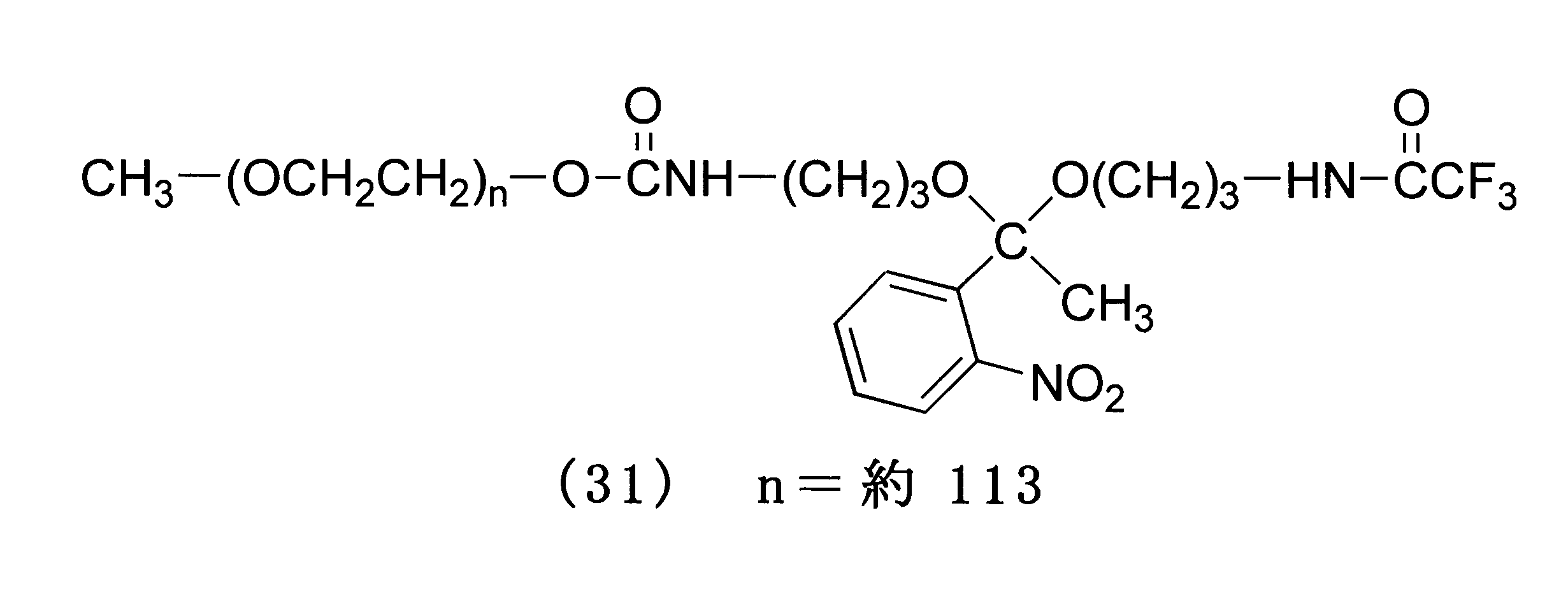
(実施例12)
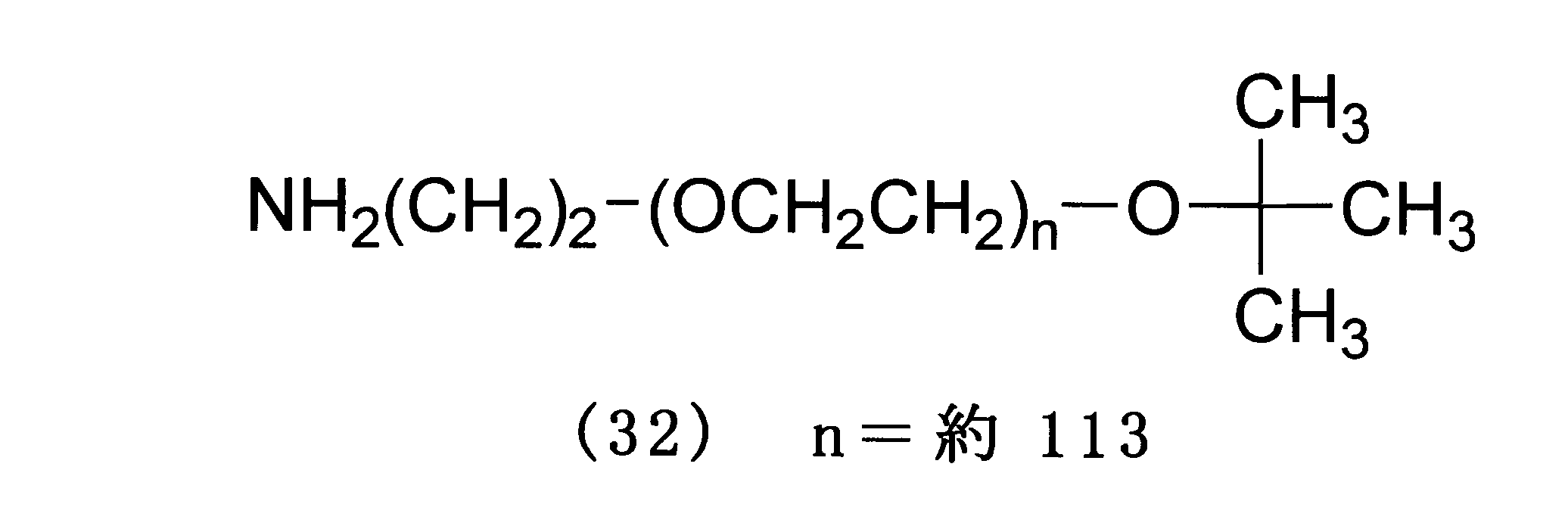
日本国特開2010-248504号公報に記載の方法で合成した式(32)の化合物に対して、塩酸を用いてt-ブチル基を除去することで、式(33)の化合物を得た。
1H-NMR(D2O, 内部標準TMS); δ(ppm): 3.14(2H, t, NH2CH2-), 3.40-4.00(452H, m, -(OCH2CH2)n-OCH2-)
1H-NMR(D2O, 内部標準TMS); δ(ppm): 3.14(2H, t, NH2CH2-), 3.40-4.00(452H, m, -(OCH2CH2)n-OCH2-)

(実施例13)
式(33)の化合物を5-アジドペンタン酸無水物と反応させることで、式(34)の化合物を得た。
1H-NMR(CDCl3, 内部標準TMS); δ(ppm): 1.60-1.74(4H, m, -CH2CH2CH2CH2N3), 2.18(2H, t, -CH2CH2CH2CH2N3), 3.29(2H, t, -CH2CH2CH2CH2N3), 3.40-3.85(454H, m, -(OCH2CH2)n-OCH2-, -CONHCH2-), 6.30(1H, brs, -CONH-)
式(33)の化合物を5-アジドペンタン酸無水物と反応させることで、式(34)の化合物を得た。
1H-NMR(CDCl3, 内部標準TMS); δ(ppm): 1.60-1.74(4H, m, -CH2CH2CH2CH2N3), 2.18(2H, t, -CH2CH2CH2CH2N3), 3.29(2H, t, -CH2CH2CH2CH2N3), 3.40-3.85(454H, m, -(OCH2CH2)n-OCH2-, -CONHCH2-), 6.30(1H, brs, -CONH-)

(実施例14)
式(34)の化合物をトリエチルアミン存在下、ジクロロメタン中、N,N’-ジスクシンイミジルカーボネートと反応させることで、式(35)の化合物を得た。
1H-NMR(CDCl3, 内部標準TMS); δ(ppm): 1.60-1.74(4H, m, -CH2CH2CH2CH2N3), 2.18(2H, t, -CH2CH2CH2CH2N3), 2.84(4H, s, succinimide), 3.29(2H, t, -CH2CH2CH2CH2N3), 3.40-3.85(452H, m, -(OCH2CH2)n-OCH2-, -CONHCH2-), 4.44-4.48(2H, m, -CH2O-COO-succinimide), 6.30(1H, brs, -CH2CONH-)
式(34)の化合物をトリエチルアミン存在下、ジクロロメタン中、N,N’-ジスクシンイミジルカーボネートと反応させることで、式(35)の化合物を得た。
1H-NMR(CDCl3, 内部標準TMS); δ(ppm): 1.60-1.74(4H, m, -CH2CH2CH2CH2N3), 2.18(2H, t, -CH2CH2CH2CH2N3), 2.84(4H, s, succinimide), 3.29(2H, t, -CH2CH2CH2CH2N3), 3.40-3.85(452H, m, -(OCH2CH2)n-OCH2-, -CONHCH2-), 4.44-4.48(2H, m, -CH2O-COO-succinimide), 6.30(1H, brs, -CH2CONH-)

(実施例15)
式(35)の化合物を実施例6と同様の方法にて式(23)の化合物と反応させて、式(36)の化合物を得た。
1H-NMR(CDCl3, 内部標準TMS); δ(ppm): 1.60-1.93(8H, m, -CH2CH2CH2CH2N3, -CH2CH2CH2O-), 2.18(2H, t, -CH2CH2CH2CH2N3), 3.26-3.37(4H, m, -OCONHCH2CH2CH2O-, -CH2CH2CH2CH2N3), 3.40-3.85(458H, m, -(OCH2CH2)n-OCH2-, -CH2CONHCH2-, CF3CONHCH2CH2CH2O-, -CH2CH2CH2O-), 4.20(2H, t, -OCH2CH2OCONH-), 5.11(1H, brs, -OCONH-), 5.67(1H, s, >CH-), 6.30(1H, brs, -CH2CONH-), 7.21-7.59(4H, m, arom. H), 7.31(1H, brs, CF3CONH-)
式(35)の化合物を実施例6と同様の方法にて式(23)の化合物と反応させて、式(36)の化合物を得た。
1H-NMR(CDCl3, 内部標準TMS); δ(ppm): 1.60-1.93(8H, m, -CH2CH2CH2CH2N3, -CH2CH2CH2O-), 2.18(2H, t, -CH2CH2CH2CH2N3), 3.26-3.37(4H, m, -OCONHCH2CH2CH2O-, -CH2CH2CH2CH2N3), 3.40-3.85(458H, m, -(OCH2CH2)n-OCH2-, -CH2CONHCH2-, CF3CONHCH2CH2CH2O-, -CH2CH2CH2O-), 4.20(2H, t, -OCH2CH2OCONH-), 5.11(1H, brs, -OCONH-), 5.67(1H, s, >CH-), 6.30(1H, brs, -CH2CONH-), 7.21-7.59(4H, m, arom. H), 7.31(1H, brs, CF3CONH-)

(実施例16)
式(36)の化合物に対して、実施例7と同様の方法にてトリフルオロアセチル基を除去した後、ヨード酢酸無水物を反応させることで、式(37)の化合物を得た。
1H-NMR(CDCl3, 内部標準TMS); δ(ppm): 1.60-1.93(8H, m, -CH2CH2CH2CH2N3, -CH2CH2CH2O-), 2.18(2H, t, -CH2CH2CH2CH2N3), 3.26-3.37(6H, m, -OCONHCH2CH2CH2O-, -CH2CH2CH2CH2N3, ICH2CONHCH2-), 3.40-3.85(458H, m, -(OCH2CH2)n-OCH2-, -CH2CH2CONHCH2-, -CH2CH2CH2O-, ICH2CONHCH2-), 4.20(2H, t, -OCH2CH2OCONH-), 5.11(1H, brs, -OCONH-), 5.67(1H, s, >CH-), 6.30(1H, brs, -CH2CH2CONH-), 6.96(1H, brs, ICH2CONHCH2-), 7.21-7.59(4H, m, arom. H)
GPC分析; 数平均分子量(Mn): 5764, 重量平均分子量(Mw): 5890, 多分散度(Mw/Mn): 1.024
式(36)の化合物に対して、実施例7と同様の方法にてトリフルオロアセチル基を除去した後、ヨード酢酸無水物を反応させることで、式(37)の化合物を得た。
1H-NMR(CDCl3, 内部標準TMS); δ(ppm): 1.60-1.93(8H, m, -CH2CH2CH2CH2N3, -CH2CH2CH2O-), 2.18(2H, t, -CH2CH2CH2CH2N3), 3.26-3.37(6H, m, -OCONHCH2CH2CH2O-, -CH2CH2CH2CH2N3, ICH2CONHCH2-), 3.40-3.85(458H, m, -(OCH2CH2)n-OCH2-, -CH2CH2CONHCH2-, -CH2CH2CH2O-, ICH2CONHCH2-), 4.20(2H, t, -OCH2CH2OCONH-), 5.11(1H, brs, -OCONH-), 5.67(1H, s, >CH-), 6.30(1H, brs, -CH2CH2CONH-), 6.96(1H, brs, ICH2CONHCH2-), 7.21-7.59(4H, m, arom. H)
GPC分析; 数平均分子量(Mn): 5764, 重量平均分子量(Mw): 5890, 多分散度(Mw/Mn): 1.024

(実施例17)

日本国特開2004-197077号公報に記載の方法で合成した式(38)の化合物に対して、実施例5と同様の方法にてN,N’-ジスクシンイミジルカーボネートを反応させることで、式(39)の化合物を得た。
1H-NMR(CDCl3, 内部標準TMS); δ(ppm): 2.84(4H, s, succinimide), 3.38(6H, s, CH3O-), 3.40-4.00(903H, m, -(OCH2CH2)n-OCH2-, -(OCH2CH2)n-OCH<), 4.39(1H, dd, -CH2O-COO-succinimide), 4.49(1H, dd, -CH2O-COO-succinimide)
1H-NMR(CDCl3, 内部標準TMS); δ(ppm): 2.84(4H, s, succinimide), 3.38(6H, s, CH3O-), 3.40-4.00(903H, m, -(OCH2CH2)n-OCH2-, -(OCH2CH2)n-OCH<), 4.39(1H, dd, -CH2O-COO-succinimide), 4.49(1H, dd, -CH2O-COO-succinimide)

(実施例18)
式(39)の化合物を実施例6と同様の方法にて式(23)の化合物と反応させて、式(40)の化合物を得た。
1H-NMR(CDCl3, 内部標準TMS); δ(ppm): 1.78-1.93(4H, m, -CH2CH2CH2O-), 3.26-3.37(2H, m, -OCONHCH2CH2CH2O-), 3.38(6H, s, CH3O-), 3.40-4.00(909H, m, CF3CONHCH2CH2CH2O-, -CH2CH2CH2O-, -(OCH2CH2)n-OCH2-, -(OCH2CH2)n-OCH<), 4.08(1H, dd, -CH2OCONH-), 4.19(1H, dd, -CH2OCONH-), 5.05(1H, brs, -OCONH-), 5.67(1H, s, >CH-), 7.21-7.59(4H, m, arom. H), 7.31(1H, brs, CF3CONH-)
GPC分析; 数平均分子量(Mn): 9697, 重量平均分子量(Mw): 9920, 多分散度(Mw/Mn): 1.023
式(39)の化合物を実施例6と同様の方法にて式(23)の化合物と反応させて、式(40)の化合物を得た。
1H-NMR(CDCl3, 内部標準TMS); δ(ppm): 1.78-1.93(4H, m, -CH2CH2CH2O-), 3.26-3.37(2H, m, -OCONHCH2CH2CH2O-), 3.38(6H, s, CH3O-), 3.40-4.00(909H, m, CF3CONHCH2CH2CH2O-, -CH2CH2CH2O-, -(OCH2CH2)n-OCH2-, -(OCH2CH2)n-OCH<), 4.08(1H, dd, -CH2OCONH-), 4.19(1H, dd, -CH2OCONH-), 5.05(1H, brs, -OCONH-), 5.67(1H, s, >CH-), 7.21-7.59(4H, m, arom. H), 7.31(1H, brs, CF3CONH-)
GPC分析; 数平均分子量(Mn): 9697, 重量平均分子量(Mw): 9920, 多分散度(Mw/Mn): 1.023

(実施例19)
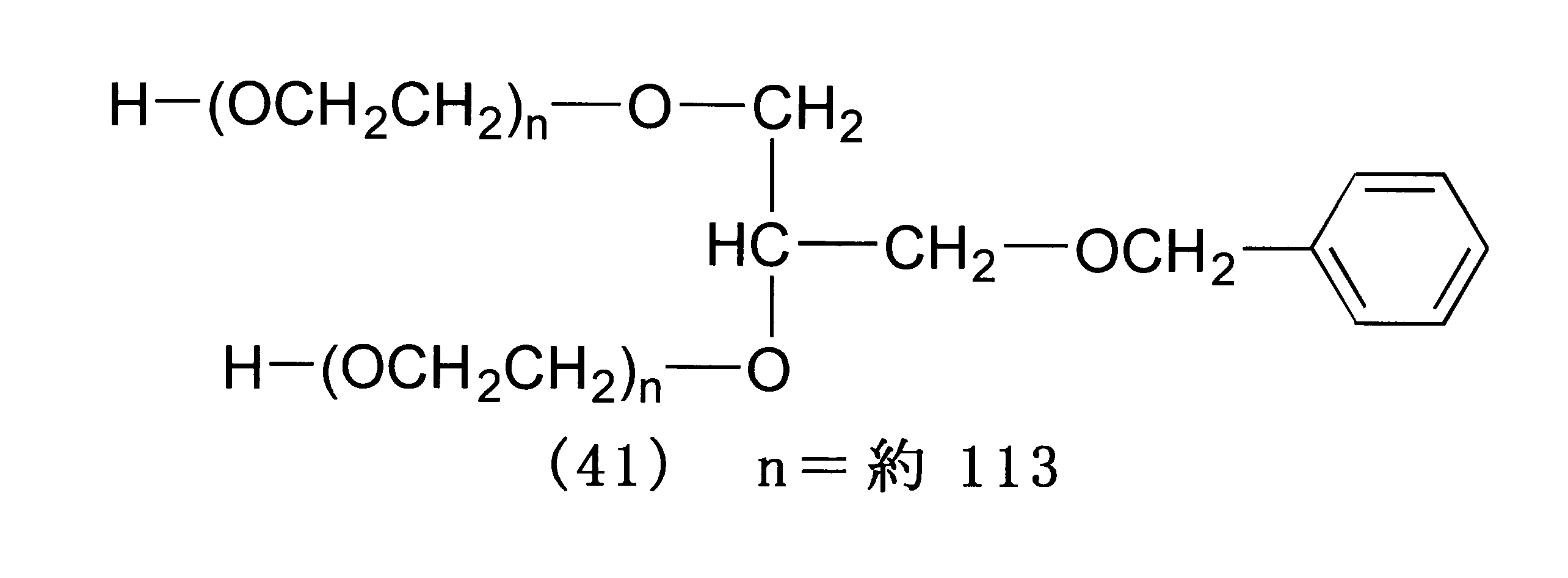
日本国特開2004-197077号公報に記載の方法で合成した式(41)の化合物に対して、トリエチルアミンおよび4-ジメチルアミノピリジン存在下、無水酢酸を反応させることで、式(42)の化合物を得た。
1H-NMR(CDCl3, 内部標準TMS); δ(ppm): 2.08(6H, s, CH3CO-), 3.40-4.00(905H, m, -(OCH2CH2)n-OCH2-, -(OCH2CH2)n-OCH<, -CH2OCH2Ph), 4.22(4H, t, CH3COOCH2-), 4.54(2H, s, -CH2OCH2Ph), 7.27-7.38(5H, m, -CH2OCH2Ph)
1H-NMR(CDCl3, 内部標準TMS); δ(ppm): 2.08(6H, s, CH3CO-), 3.40-4.00(905H, m, -(OCH2CH2)n-OCH2-, -(OCH2CH2)n-OCH<, -CH2OCH2Ph), 4.22(4H, t, CH3COOCH2-), 4.54(2H, s, -CH2OCH2Ph), 7.27-7.38(5H, m, -CH2OCH2Ph)

(実施例20)
式(42)の化合物に対して、特開2004-197077号公報に記載の方法でベンジル基を除去した後、実施例5と同様の方法にてN,N’-ジスクシンイミジルカーボネートを反応させることで、式(43)の化合物を得た。
1H-NMR(CDCl3, 内部標準TMS); δ(ppm): 2.08(6H, s, CH3CO-), 2.84(4H, s, succinimide), 3.40-4.00(901H, m, -(OCH2CH2)n-OCH2-, -(OCH2CH2)n-OCH<), 4.22(4H, t, CH3COOCH2-), 4.39(1H, dd, -CH2O-COO-succinimide), 4.49(1H, dd, -CH2O-COO-succinimide)
式(42)の化合物に対して、特開2004-197077号公報に記載の方法でベンジル基を除去した後、実施例5と同様の方法にてN,N’-ジスクシンイミジルカーボネートを反応させることで、式(43)の化合物を得た。
1H-NMR(CDCl3, 内部標準TMS); δ(ppm): 2.08(6H, s, CH3CO-), 2.84(4H, s, succinimide), 3.40-4.00(901H, m, -(OCH2CH2)n-OCH2-, -(OCH2CH2)n-OCH<), 4.22(4H, t, CH3COOCH2-), 4.39(1H, dd, -CH2O-COO-succinimide), 4.49(1H, dd, -CH2O-COO-succinimide)
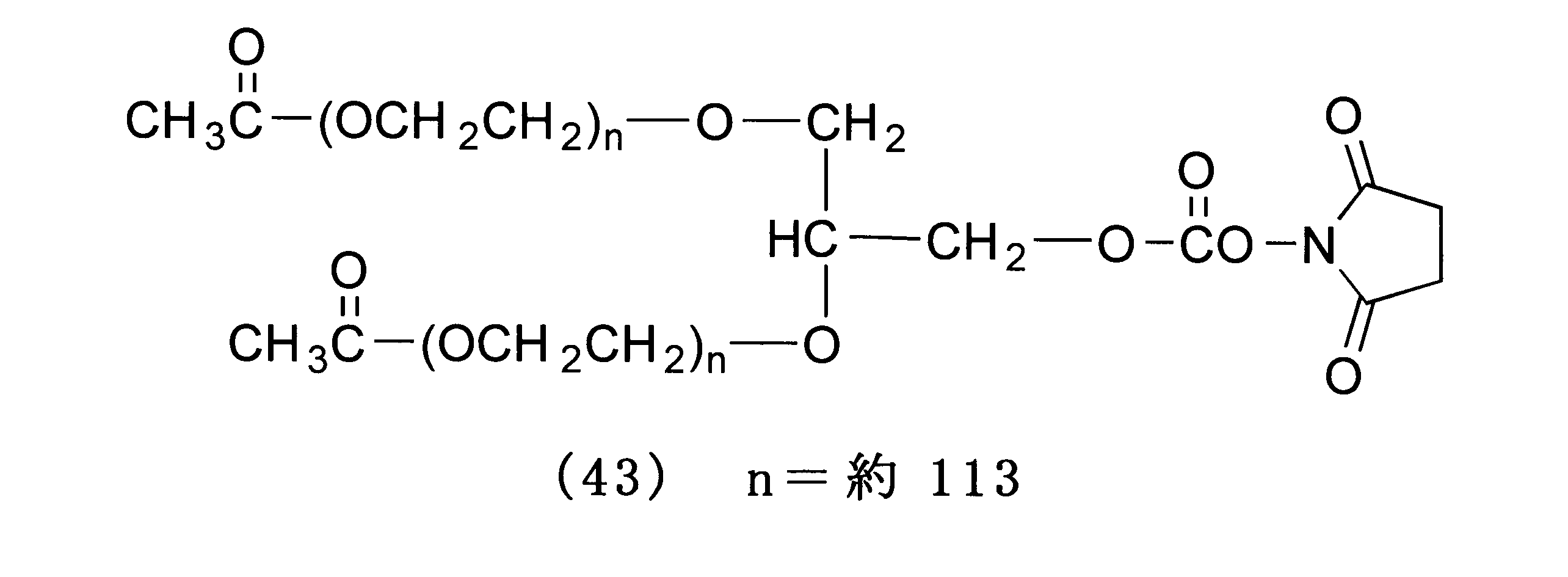
(実施例21)
式(43)の化合物を実施例6と同様の方法にて式(23)の化合物と反応させて、式(44)の化合物を得た。
1H-NMR(CDCl3, 内部標準TMS); δ(ppm): 1.78-1.93(4H, m, -CH2CH2CH2O-), 2.08(6H, s, CH3CO-), 3.26-3.37(2H, m, -OCONHCH2CH2CH2O-), 3.38(6H, s, CH3O-), 3.40-4.00(907H, m, CF3CONHCH2CH2CH2O-, -CH2CH2CH2O-, -(OCH2CH2)n-OCH2-, -(OCH2CH2)n-OCH<), 4.08(1H, dd, -CH2OCONH-), 4.19(1H, dd, -CH2OCONH-), 4.22(4H, t, CH3COOCH2-), 5.05(1H, brs, -OCONH-), 5.67(1H, s, >CH-), 7.21-7.59(4H, m, arom. H), 7.31(1H, brs, CF3CONH-)
式(43)の化合物を実施例6と同様の方法にて式(23)の化合物と反応させて、式(44)の化合物を得た。
1H-NMR(CDCl3, 内部標準TMS); δ(ppm): 1.78-1.93(4H, m, -CH2CH2CH2O-), 2.08(6H, s, CH3CO-), 3.26-3.37(2H, m, -OCONHCH2CH2CH2O-), 3.38(6H, s, CH3O-), 3.40-4.00(907H, m, CF3CONHCH2CH2CH2O-, -CH2CH2CH2O-, -(OCH2CH2)n-OCH2-, -(OCH2CH2)n-OCH<), 4.08(1H, dd, -CH2OCONH-), 4.19(1H, dd, -CH2OCONH-), 4.22(4H, t, CH3COOCH2-), 5.05(1H, brs, -OCONH-), 5.67(1H, s, >CH-), 7.21-7.59(4H, m, arom. H), 7.31(1H, brs, CF3CONH-)

(実施例22)
式(44)の化合物に対して、水酸化ナトリウム水溶液を用いてアセチル基とトリフルオロアセトアミド基を除去した後、実施例8と同様の方法にて3-マレイミドプロピオン酸 N-スクシンイミジルと反応させることで、式(45)の化合物を得た。
1H-NMR(CDCl3, 内部標準TMS); δ(ppm): 1.78-1.83(4H, m, -CONHCH2CH2CH2O-), 2.44(2H, t, -CH2CH2-maleimide), 3.27-3.37(4H, m, -CONHCH2CH2CH2O-), 3.40-4.00(909H, m, -(OCH2CH2)n-OCH2-, -(OCH2CH2)n-OCH<, -CH2CH2CH2O-, -CH2CH2-maleimide), 4.08(1H, dd, -CH2OCONH-), 4.19(1H, dd, -CH2OCONH-), 5.12(1H, brs, -OCONH-), 5.65(1H, s, >CH-), 6.15(1H, brs, -NHCO-), 6.70(2H, s, maleimide), 7.20-7.60(4H, m, arom. H)
式(44)の化合物に対して、水酸化ナトリウム水溶液を用いてアセチル基とトリフルオロアセトアミド基を除去した後、実施例8と同様の方法にて3-マレイミドプロピオン酸 N-スクシンイミジルと反応させることで、式(45)の化合物を得た。
1H-NMR(CDCl3, 内部標準TMS); δ(ppm): 1.78-1.83(4H, m, -CONHCH2CH2CH2O-), 2.44(2H, t, -CH2CH2-maleimide), 3.27-3.37(4H, m, -CONHCH2CH2CH2O-), 3.40-4.00(909H, m, -(OCH2CH2)n-OCH2-, -(OCH2CH2)n-OCH<, -CH2CH2CH2O-, -CH2CH2-maleimide), 4.08(1H, dd, -CH2OCONH-), 4.19(1H, dd, -CH2OCONH-), 5.12(1H, brs, -OCONH-), 5.65(1H, s, >CH-), 6.15(1H, brs, -NHCO-), 6.70(2H, s, maleimide), 7.20-7.60(4H, m, arom. H)

(実施例23)
式(45)の化合物を実施例14と同様の方法にてN,N’-ジスクシンイミジルカーボネートと反応させて、式(46)の化合物を得た。
1H-NMR(CDCl3, 内部標準TMS); δ(ppm): 1.78-1.83(4H, m, -CONHCH2CH2CH2O-), 2.44(2H, t, -CH2CH2-maleimide), 2.84(4H, s, succinimide), 3.27-3.37(4H, m, -CONHCH2CH2CH2O-), 3.40-4.00(905H, m, -(OCH2CH2)n-OCH2-, -(OCH2CH2)n-OCH<, -CH2CH2CH2O-, -CH2CH2-maleimide), 4.08(1H, dd, -CH2OCONH-), 4.19(1H, dd, -CH2OCONH-), 4.44-4.48(4H, m, -CH2O-COO-succinimide), 5.12(1H, brs, -OCONH-), 5.65(1H, s, >CH-), 6.15(1H, brs, -NHCO-), 6.70(2H, s, maleimide), 7.20-7.60(4H, m, arom. H)
GPC分析; 数平均分子量(Mn): 10069, 重量平均分子量(Mw): 10321, 多分散度(Mw/Mn): 1.025
式(45)の化合物を実施例14と同様の方法にてN,N’-ジスクシンイミジルカーボネートと反応させて、式(46)の化合物を得た。
1H-NMR(CDCl3, 内部標準TMS); δ(ppm): 1.78-1.83(4H, m, -CONHCH2CH2CH2O-), 2.44(2H, t, -CH2CH2-maleimide), 2.84(4H, s, succinimide), 3.27-3.37(4H, m, -CONHCH2CH2CH2O-), 3.40-4.00(905H, m, -(OCH2CH2)n-OCH2-, -(OCH2CH2)n-OCH<, -CH2CH2CH2O-, -CH2CH2-maleimide), 4.08(1H, dd, -CH2OCONH-), 4.19(1H, dd, -CH2OCONH-), 4.44-4.48(4H, m, -CH2O-COO-succinimide), 5.12(1H, brs, -OCONH-), 5.65(1H, s, >CH-), 6.15(1H, brs, -NHCO-), 6.70(2H, s, maleimide), 7.20-7.60(4H, m, arom. H)
GPC分析; 数平均分子量(Mn): 10069, 重量平均分子量(Mw): 10321, 多分散度(Mw/Mn): 1.025

(実施例24)

ペンタエリスリトールにエチレンオキシドを重合させて合成した式(47)の化合物に対して、実施例5と同様の方法にてN,N’-ジスクシンイミジルカーボネートを反応させることで、式(48)の化合物を得た。
1H-NMR(CDCl3, 内部標準TMS); δ(ppm): 2.84(16H, s, succinimide), 3.47-3.85(1800H, m, -(OCH2CH2)n-OCH2-), 4.39(4H, dd, -CH2O-COO-succinimide), 4.49(4H, dd, -CH2O-COO-succinimide)
1H-NMR(CDCl3, 内部標準TMS); δ(ppm): 2.84(16H, s, succinimide), 3.47-3.85(1800H, m, -(OCH2CH2)n-OCH2-), 4.39(4H, dd, -CH2O-COO-succinimide), 4.49(4H, dd, -CH2O-COO-succinimide)

(実施例25)
式(48)の化合物を実施例6と同様の方法にて式(23)の化合物と反応させて、式(49)の化合物を得た。
1H-NMR(CDCl3, 内部標準TMS); δ(ppm): 1.78-1.93(16H, m, -CH2CH2CH2O-), 3.26-3.37(8H, m, -OCONHCH2CH2CH2O-), 3.47-3.85(1806H, m, CF3CONHCH2CH2CH2O-, -CH2CH2CH2O-, -(OCH2CH2)n-OCH2-), 4.20(8H, t, -OCH2CH2OCONH-), 5.11(4H, brs, -OCONH-), 5.67(4H, s, >CH-), 7.21-7.59(16H, m, arom. H), 7.31(4H, brs, CF3CONH-)
GPC分析; 数平均分子量(Mn): 19393, 重量平均分子量(Mw): 19897, 多分散度(Mw/Mn): 1.026
式(48)の化合物を実施例6と同様の方法にて式(23)の化合物と反応させて、式(49)の化合物を得た。
1H-NMR(CDCl3, 内部標準TMS); δ(ppm): 1.78-1.93(16H, m, -CH2CH2CH2O-), 3.26-3.37(8H, m, -OCONHCH2CH2CH2O-), 3.47-3.85(1806H, m, CF3CONHCH2CH2CH2O-, -CH2CH2CH2O-, -(OCH2CH2)n-OCH2-), 4.20(8H, t, -OCH2CH2OCONH-), 5.11(4H, brs, -OCONH-), 5.67(4H, s, >CH-), 7.21-7.59(16H, m, arom. H), 7.31(4H, brs, CF3CONH-)
GPC分析; 数平均分子量(Mn): 19393, 重量平均分子量(Mw): 19897, 多分散度(Mw/Mn): 1.026

(実施例26)
式(26)、式(29)、式(30)および式(31)の化合物(20 mg)をそれぞれpD 5.5のMES重水緩衝液(1 mL)とpD 7.4のHEPES重水緩衝液(1 mL)に溶解し、37℃の恒温槽で静置した。図1はpD 5.5、図2はpD 7.4における加水分解率の測定結果である。
式(26)、式(29)、式(30)および式(31)の化合物(20 mg)をそれぞれpD 5.5のMES重水緩衝液(1 mL)とpD 7.4のHEPES重水緩衝液(1 mL)に溶解し、37℃の恒温槽で静置した。図1はpD 5.5、図2はpD 7.4における加水分解率の測定結果である。
図1に示すように、式(26)、式(29)、式(30)および式(31)の化合物のpD 5.5、37℃における加水分解率半減期(t1/2)はそれぞれ24時間、2.2ヶ月、18日および36時間であった。また、pD 7.4、37℃においては、式(26)および式(31)の化合物は18日で10%程度の加水分解が見られたが、式(29)および式(30)の化合物は18日後でも加水分解は見られなかった。
本発明を特定の態様を参照して詳細に説明したが、本発明の精神と範囲を離れることなく様々な変更および修正が可能であることは、当業者にとって明らかである。
なお、本出願は、2013年3月25日付で出願された日本国特許出願(特願2013-61428)に基づいており、その全体が引用により援用される。また、ここに引用されるすべての参照は全体として取り込まれる。
なお、本出願は、2013年3月25日付で出願された日本国特許出願(特願2013-61428)に基づいており、その全体が引用により援用される。また、ここに引用されるすべての参照は全体として取り込まれる。
Claims (18)
- 式(1)で示される、ベンジリデンアセタールリンカーを有する親水性ポリマー誘導体。
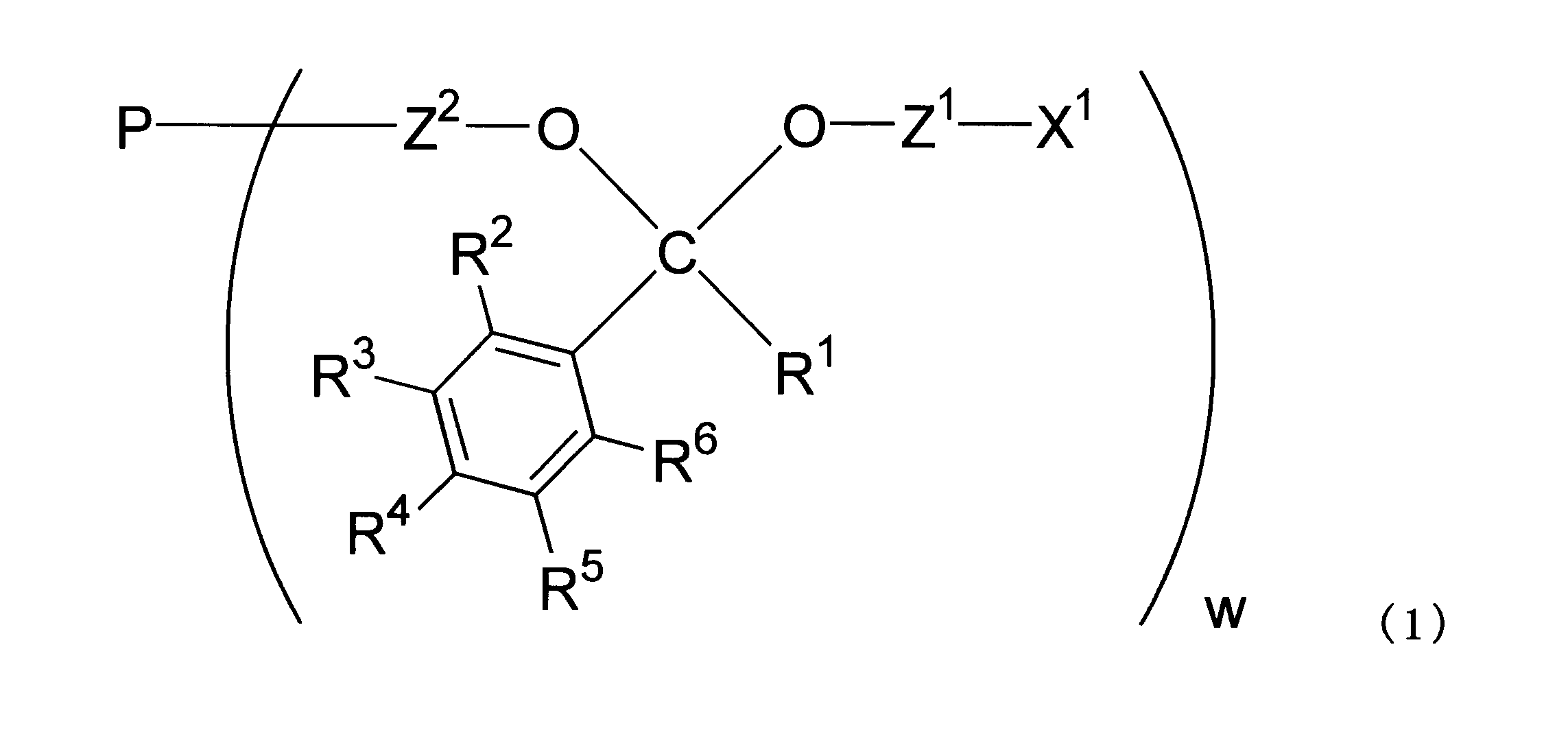
R2、R3、R4、R5およびR6はそれぞれ独立して水素原子または置換基であり、R3、R4、R5の少なくとも1つは電子吸引性の置換基であるか、またはR2とR6との少なくとも一方が置換基であり;
X1は化学反応可能な官能基であり;
Pは親水性ポリマーであり;
wは1~8の整数であり;および
Z1およびZ2は独立して選択された2価のスペーサーである。) - R2およびR6は水素原子であり、R3、R4およびR5における置換基定数(σ)の合計(Σσ)が0.16≦Σσ≦1.37である、請求項1に記載の親水性ポリマー誘導体。
- R2とR6との少なくとも一方が置換基であり、R2、R3、R4、R5およびR6における置換基定数(σ)の合計(Σσ)が-1.12≦Σσ≦1.20である、請求項1に記載の親水性ポリマー誘導体。
- X1が活性エステル基、活性カーボネート基、アルデヒド基、イソシアネート基、イソチオシアネート基、エポキシ基、マレイミド基、ビニルスルホン基、アクリル基、スルホニルオキシ基、カルボキシ基、チオール基、ジチオピリジル基、α-ハロアセチル基、アルキニル基、アリル基、ビニル基、アミノ基、オキシアミノ基、ヒドラジド基およびアジド基よりなる群から選択される、請求項1~3のいずれか一つの請求項に記載の親水性ポリマー誘導体。
- X1が、式(a)、式(b)、式(c)、式(d)、式(e)、式(f)、式(g)、式(h)、式(i)、式(j)、式(k)、式(l)、式(m)および式(n)からなる群から選択される、請求項1~4のいずれか一つの請求項に記載の親水性ポリマー誘導体。

R8およびR11は独立して水素原子または炭素数1~5の炭化水素基であり;
R9はハロゲン原子を含んでいてもよい炭素数1~10の炭化水素基であり;および
R10は塩素原子、臭素原子およびヨウ素原子から選択されるハロゲン原子である。) - Z1およびZ2が独立してエーテル結合、エステル結合、カーボネート結合、ウレタン結合、アミド結合および2級アミノ基から選ばれる結合を有していてもよい飽和炭化水素基である、請求項1~5のいずれか一つの請求項に記載の親水性ポリマー誘導体。
- Pが末端に炭化水素基または化学反応可能な官能基を有する直鎖型のポリエチレングリコールである、請求項1~6のいずれか一つの請求項に記載のポリエチレングリコール誘導体。
- wが1であり、Pが式(2)で示されることを特徴とする、請求項7に記載のポリエチレングリコール誘導体。

nは3~2000の整数である。) - wが1であり、Pが式(3)で示されることを特徴とする、請求項7に記載のポリエチレングリコール誘導体。

Z3は2価のスペーサーであり;および
nは3~2000の整数である。) - Pが末端に炭化水素基またはX1と異なる化学反応可能な官能基を有する分岐型のポリエチレングリコールである、請求項1~6のいずれか一つの請求項に記載のポリエチレングリコール誘導体。
- wが1であり、Pが式(4)で示されることを特徴とする、請求項10に記載のポリエチレングリコール誘導体。

nは3~1000の整数であり;および
vは0または2である。) - wが1であり、Pが式(5)で示されることを特徴とする、請求項10に記載のポリエチレングリコール誘導体。
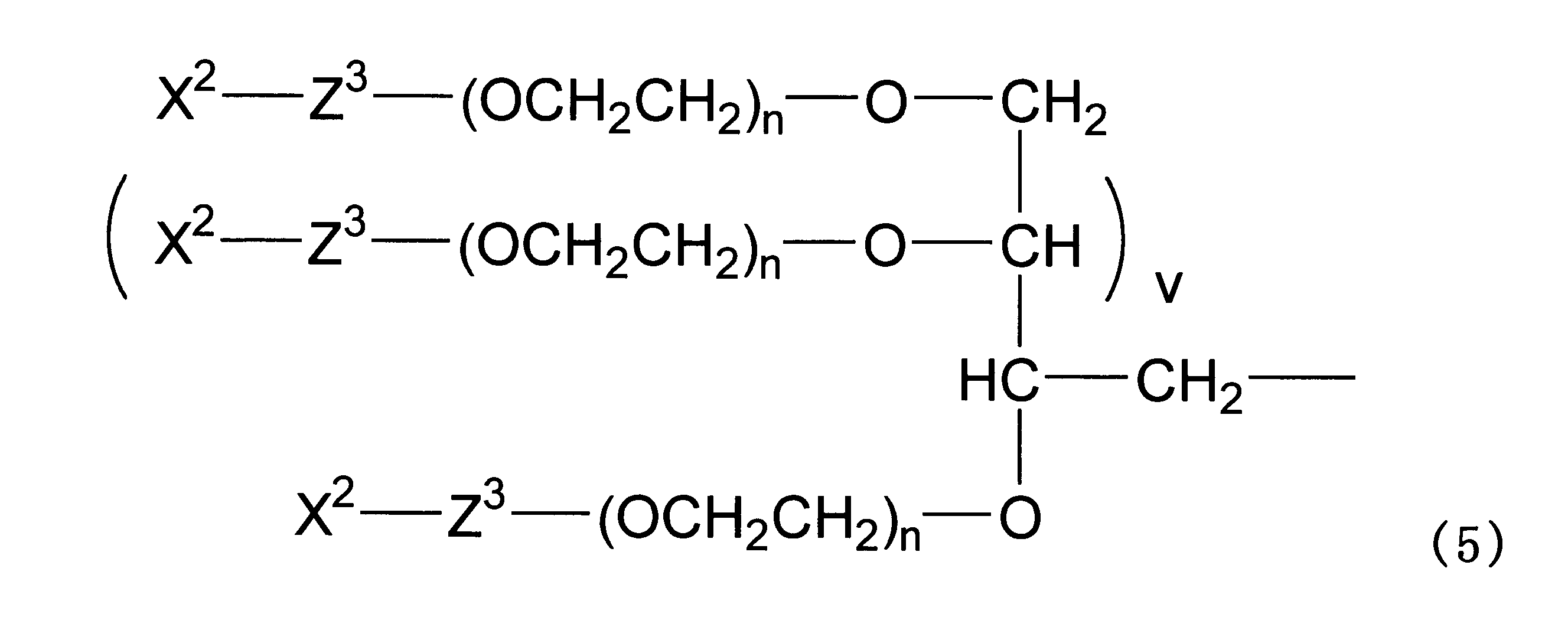
Z3は2価のスペーサーであり;
nは3~1000の整数であり;および
vは0または2である。) - wがv+2であり、Pが式(6)で示されることを特徴とする、請求項10に記載のポリエチレングリコール誘導体。

Z3は2価のスペーサーであり;
nは3~1000の整数であり;および
vは0または2である。) - X2が活性エステル基、活性カーボネート基、アルデヒド基、イソシアネート基、イソチオシアネート基、エポキシ基、マレイミド基、ビニルスルホン基、アクリル基、スルホニルオキシ基、カルボキシ基、チオール基、ジチオピリジル基、α-ハロアセチル基、アルキニル基、アリル基、ビニル基、アミノ基、オキシアミノ基、ヒドラジド基およびアジド基よりなる群から選択される、請求項9、12または13に記載のポリエチレングリコール誘導体。
- X2が、式(a)、式(b)、式(c)、式(d)、式(e)、式(f)、式(g)、式(h)、式(i)、式(j)、式(k)、式(l)、式(m)および式(n)からなる群から選択される、請求項9、12または13に記載のポリエチレングリコール誘導体。

R8およびR11は独立して水素原子または炭素数1~5の炭化水素基であり;
R9はハロゲン原子を含んでいてもよい炭素数1~10の炭化水素基であり;および
R10は塩素原子、臭素原子およびヨウ素原子から選択されるハロゲン原子である。) - Z3がエーテル結合、エステル結合、カーボネート結合、ウレタン結合、アミド結合および2級アミノ基から選ばれる結合を有していてもよい飽和炭化水素基である、請求項9、12または13に記載のポリエチレングリコール誘導体。
- Pが末端数2~8のポリエチレングリコールであり、Pを構成するポリエチレングリコールの全ての末端がそれぞれZ2に対して結合しており、wが前記ポリエチレングリコールの末端数に等しい、請求項1~6のいずれか一つの請求項に記載のポリエチレングリコール誘導体。
- Pが、式(r)、式(s)、式(t)、式(u)および式(v)からなる群から選択される、請求項17に記載のポリエチレングリコール誘導体。
Priority Applications (4)
| Application Number | Priority Date | Filing Date | Title |
|---|---|---|---|
| US14/779,676 US10023693B2 (en) | 2013-03-25 | 2014-03-25 | Hydrophilic polymer derivative having benzylidene acetal linker |
| CN201480018426.8A CN105121506B (zh) | 2013-03-25 | 2014-03-25 | 具有苯亚甲基缩醛连接基团的亲水性聚合物衍生物 |
| EP14773177.2A EP2980116B1 (en) | 2013-03-25 | 2014-03-25 | Hydrophilic polymer derivative having benzylidene acetal linker |
| US16/010,972 US10633489B2 (en) | 2013-03-25 | 2018-06-18 | Hydrophilic polymer derivative having benzylidene acetal linker |
Applications Claiming Priority (2)
| Application Number | Priority Date | Filing Date | Title |
|---|---|---|---|
| JP2013-061428 | 2013-03-25 | ||
| JP2013061428 | 2013-03-25 |
Related Child Applications (2)
| Application Number | Title | Priority Date | Filing Date |
|---|---|---|---|
| US14/779,676 A-371-Of-International US10023693B2 (en) | 2013-03-25 | 2014-03-25 | Hydrophilic polymer derivative having benzylidene acetal linker |
| US16/010,972 Division US10633489B2 (en) | 2013-03-25 | 2018-06-18 | Hydrophilic polymer derivative having benzylidene acetal linker |
Publications (1)
| Publication Number | Publication Date |
|---|---|
| WO2014157150A1 true WO2014157150A1 (ja) | 2014-10-02 |
Family
ID=51624121
Family Applications (1)
| Application Number | Title | Priority Date | Filing Date |
|---|---|---|---|
| PCT/JP2014/058201 Ceased WO2014157150A1 (ja) | 2013-03-25 | 2014-03-25 | ベンジリデンアセタールリンカーを有する親水性ポリマー誘導体 |
Country Status (5)
| Country | Link |
|---|---|
| US (2) | US10023693B2 (ja) |
| EP (1) | EP2980116B1 (ja) |
| JP (1) | JP6508506B2 (ja) |
| CN (1) | CN105121506B (ja) |
| WO (1) | WO2014157150A1 (ja) |
Cited By (3)
| Publication number | Priority date | Publication date | Assignee | Title |
|---|---|---|---|---|
| WO2016063959A1 (ja) * | 2014-10-24 | 2016-04-28 | 日油株式会社 | 環状ベンジリデンアセタールリンカーを有する抗体―薬物複合体 |
| WO2016159071A1 (ja) * | 2015-03-31 | 2016-10-06 | 日油株式会社 | 環状ベンジリデンアセタールリンカーを有する生分解性ポリエチレングリコール誘導体 |
| WO2017057612A1 (ja) * | 2015-09-30 | 2017-04-06 | 日油株式会社 | 環状ベンジリデンアセタールリンカーを介して親水性ポリマーが結合した脂質誘導体 |
Families Citing this family (4)
| Publication number | Priority date | Publication date | Assignee | Title |
|---|---|---|---|---|
| JP6508506B2 (ja) * | 2013-03-25 | 2019-05-08 | 日油株式会社 | ベンジリデンアセタールリンカーを有する親水性ポリマー誘導体 |
| JP6925579B2 (ja) * | 2016-03-31 | 2021-08-25 | 日油株式会社 | 環状ベンジリデンアセタール構造を有する生分解性ヒドロゲル |
| WO2018180914A1 (ja) * | 2017-03-30 | 2018-10-04 | 日油株式会社 | 自壊性アセタールリンカーを有する親水性ポリマー誘導体及びそれを用いた複合体 |
| WO2019131515A1 (ja) * | 2017-12-27 | 2019-07-04 | 三洋化成工業株式会社 | 医薬品原薬用原料又は医薬品用添加物及びこれらを用いた医薬品原薬又は医薬品 |
Citations (6)
| Publication number | Priority date | Publication date | Assignee | Title |
|---|---|---|---|---|
| WO1996032434A1 (en) * | 1995-04-14 | 1996-10-17 | Kazunori Kataoka | Polyethylene oxides having saccharide residue at one end and different functional group at another end, and process for producing the same |
| JP2004197077A (ja) | 2002-11-20 | 2004-07-15 | Nof Corp | 修飾された生体関連物質、その製造方法および中間体 |
| WO2005108463A2 (en) | 2004-05-03 | 2005-11-17 | Nektar Therapeutics Al, Corporation | Branched polyethylen glycol derivates comprising an acetal or ketal branching point |
| JP2008540558A (ja) * | 2005-05-10 | 2008-11-20 | エモリー・ユニバーシティ | ミセルおよび粒子を用いた、活性物質の送達のための新規の戦略 |
| JP2010248504A (ja) | 2009-03-27 | 2010-11-04 | Nof Corp | ポリオキシアルキレン誘導体の製造方法 |
| JP2012533660A (ja) * | 2009-07-23 | 2012-12-27 | エッセンス・べスローテン・フエンノートシャップ | ポリマー、好ましくは(アルキル)アクリロイルポリカーボネートを作る方法、得られるポリマーおよび(アルキル)アクリロイルポリカーボネート、ならびにこれを含むバイオデバイス |
Family Cites Families (6)
| Publication number | Priority date | Publication date | Assignee | Title |
|---|---|---|---|---|
| US3585242A (en) * | 1967-10-17 | 1971-06-15 | Bayer Ag | Aromatic monoalkoxyaldehyde acetals |
| US4632891A (en) * | 1984-10-04 | 1986-12-30 | Ciba-Geigy Corporation | Process for the production of images |
| JPS61158974A (ja) | 1985-01-07 | 1986-07-18 | Tooa Eiyoo Kk | (s)−o−ベンジルグリシド−ルの製造法 |
| US8252846B2 (en) | 2005-05-10 | 2012-08-28 | Emory University | Strategies for delivery of active agents using micelles and particles |
| US8137700B2 (en) * | 2006-05-05 | 2012-03-20 | U.S. Department Of Energy | Main chain acid-degradable polymers for the delivery of bioactive materials |
| JP6508506B2 (ja) * | 2013-03-25 | 2019-05-08 | 日油株式会社 | ベンジリデンアセタールリンカーを有する親水性ポリマー誘導体 |
-
2014
- 2014-03-25 JP JP2014061070A patent/JP6508506B2/ja active Active
- 2014-03-25 US US14/779,676 patent/US10023693B2/en active Active
- 2014-03-25 WO PCT/JP2014/058201 patent/WO2014157150A1/ja not_active Ceased
- 2014-03-25 CN CN201480018426.8A patent/CN105121506B/zh active Active
- 2014-03-25 EP EP14773177.2A patent/EP2980116B1/en active Active
-
2018
- 2018-06-18 US US16/010,972 patent/US10633489B2/en active Active
Patent Citations (6)
| Publication number | Priority date | Publication date | Assignee | Title |
|---|---|---|---|---|
| WO1996032434A1 (en) * | 1995-04-14 | 1996-10-17 | Kazunori Kataoka | Polyethylene oxides having saccharide residue at one end and different functional group at another end, and process for producing the same |
| JP2004197077A (ja) | 2002-11-20 | 2004-07-15 | Nof Corp | 修飾された生体関連物質、その製造方法および中間体 |
| WO2005108463A2 (en) | 2004-05-03 | 2005-11-17 | Nektar Therapeutics Al, Corporation | Branched polyethylen glycol derivates comprising an acetal or ketal branching point |
| JP2008540558A (ja) * | 2005-05-10 | 2008-11-20 | エモリー・ユニバーシティ | ミセルおよび粒子を用いた、活性物質の送達のための新規の戦略 |
| JP2010248504A (ja) | 2009-03-27 | 2010-11-04 | Nof Corp | ポリオキシアルキレン誘導体の製造方法 |
| JP2012533660A (ja) * | 2009-07-23 | 2012-12-27 | エッセンス・べスローテン・フエンノートシャップ | ポリマー、好ましくは(アルキル)アクリロイルポリカーボネートを作る方法、得られるポリマーおよび(アルキル)アクリロイルポリカーボネート、ならびにこれを含むバイオデバイス |
Non-Patent Citations (14)
| Title |
|---|
| "Acetals as pH-Sensitive Linkages for Drug Delivery", BIOCONJUGATE CHEM, vol. 15, no. 6, 2004, pages 1254 - 1263, XP001214719 * |
| "Poly(isoglycerol methacrylate)-b-poly(d or 1-lactide) Copolymers: A Novel Hydrophilic Methacrylate as Building Block for Supramolecular Aggregates", MACROMOLECULES, vol. 43, 2010, pages 3314 - 3324, XP055280616 * |
| 57TH ANNUAL MEETING OF THE SOCIETY OF POLYMER SCIENCE, JAPAN, PREPRINTS OF THE SOCIETY OF POLYMER SCIENCE, vol. 57, May 2008 (2008-05-01), pages 1897 |
| BIOCONJUGATE CHEM, vol. 15, 2004, pages 1254 - 1263 |
| CHARTON, M, CAN. J. CHEM., vol. 38, 1960, pages 2493 - 2499 |
| GLASOE, P. K.; LONG, F. A., J. PHYS. CHEM., vol. 64, 1960, pages 188 - 190 |
| HAMMETT, L.P., CHEM. REV., vol. 17, no. 1, 1935, pages 125 - 136 |
| HANSCH, C.; LEO, A.; TAFT, R.W., CHEM. REV., vol. 91, 1991, pages 165 - 195 |
| HARRIS, J. M: "Poly(Ethylene Glycol) Chemistry", 1992, PLENUM PRESS |
| HERMANSON, G. T.: "Bioconjugate Techniques, 2nd ed.", 2008, ACADEMIC PRESS |
| See also references of EP2980116A4 |
| UNGER, S.H.; HANSCH, C., PROG. PHYS. ORG. CHEM., vol. 12, 1976, pages 91 - 118 |
| VERONESE, F. M.: "PEGylated Protein Drugs: Basic Science and Clinical Applications; Veronese", 2009, BIRKHAUSER |
| WUTS, P. G. M.; GREENE, T. W.: "Protective Groups in Organic Synthesis, 4th ed.", 2007, WILEY-INTERSCIENCE |
Cited By (8)
| Publication number | Priority date | Publication date | Assignee | Title |
|---|---|---|---|---|
| WO2016063959A1 (ja) * | 2014-10-24 | 2016-04-28 | 日油株式会社 | 環状ベンジリデンアセタールリンカーを有する抗体―薬物複合体 |
| EP3210623A4 (en) * | 2014-10-24 | 2018-07-04 | NOF Corporation | Antibody-drug complex having cyclic benzylidene acetal linker |
| US10377837B2 (en) | 2014-10-24 | 2019-08-13 | Nof Corporation | Antibody-drug conjugate having cyclic benzylidene acetal linker |
| US10808050B2 (en) | 2014-10-24 | 2020-10-20 | Nof Corporation | Antibody-drug conjugate having cyclic benzylidene acetal linker |
| WO2016159071A1 (ja) * | 2015-03-31 | 2016-10-06 | 日油株式会社 | 環状ベンジリデンアセタールリンカーを有する生分解性ポリエチレングリコール誘導体 |
| US11529423B2 (en) | 2015-03-31 | 2022-12-20 | Nof Corporation | Biodegradable polyethylene glycol derivative having cyclic benzylidene acetal linker |
| WO2017057612A1 (ja) * | 2015-09-30 | 2017-04-06 | 日油株式会社 | 環状ベンジリデンアセタールリンカーを介して親水性ポリマーが結合した脂質誘導体 |
| US10626217B2 (en) | 2015-09-30 | 2020-04-21 | Nof Corporation | Lipid derivative in which hydrophilic polymer is bound through cyclic benzylidene acetal linker |
Also Published As
| Publication number | Publication date |
|---|---|
| CN105121506B (zh) | 2017-03-08 |
| US10023693B2 (en) | 2018-07-17 |
| EP2980116A1 (en) | 2016-02-03 |
| JP6508506B2 (ja) | 2019-05-08 |
| EP2980116A4 (en) | 2016-10-26 |
| JP2014208794A (ja) | 2014-11-06 |
| CN105121506A (zh) | 2015-12-02 |
| US20160046763A1 (en) | 2016-02-18 |
| US20180298143A1 (en) | 2018-10-18 |
| US10633489B2 (en) | 2020-04-28 |
| EP2980116B1 (en) | 2017-07-26 |
Similar Documents
| Publication | Publication Date | Title |
|---|---|---|
| US10633489B2 (en) | Hydrophilic polymer derivative having benzylidene acetal linker | |
| US11530295B2 (en) | Hydrophilic polymer derivative having cyclic benzylidene acetal linker | |
| US11529423B2 (en) | Biodegradable polyethylene glycol derivative having cyclic benzylidene acetal linker | |
| US9029568B2 (en) | Branched hetero polyfunctional polyoxyalkylene compound and intermediate thereof | |
| JP6850417B2 (ja) | 環状ベンジリデンアセタールリンカーを介して親水性ポリマーが結合した脂質誘導体 | |
| CA3252159A1 (en) | Acetal-type releaseable polyoxyethylene derivative, its production process and acetal-type releaseable polyoxyethylene conjugate | |
| US11041052B2 (en) | Biodegradable hydrogel having cyclic benzylidene acetal structure | |
| JP7101939B2 (ja) | ジスルフィドリンカーを有する分解性ポリエチレングリコール誘導体 | |
| WO2025084230A1 (ja) | アミノ基を含むアセタール型リリーサブルポリオキシエチレン誘導体、その製造方法およびアミノ基を含むアセタール型リリーサブルポリオキシエチレン結合体 |
Legal Events
| Date | Code | Title | Description |
|---|---|---|---|
| 121 | Ep: the epo has been informed by wipo that ep was designated in this application |
Ref document number: 14773177 Country of ref document: EP Kind code of ref document: A1 |
|
| WWE | Wipo information: entry into national phase |
Ref document number: 14779676 Country of ref document: US |
|
| NENP | Non-entry into the national phase |
Ref country code: DE |
|
| REEP | Request for entry into the european phase |
Ref document number: 2014773177 Country of ref document: EP |
|
| WWE | Wipo information: entry into national phase |
Ref document number: 2014773177 Country of ref document: EP |