WO2014157150A1 - Dérivé polymère hydrophile possédant un coupleur benzylidène acétal - Google Patents
Dérivé polymère hydrophile possédant un coupleur benzylidène acétal Download PDFInfo
- Publication number
- WO2014157150A1 WO2014157150A1 PCT/JP2014/058201 JP2014058201W WO2014157150A1 WO 2014157150 A1 WO2014157150 A1 WO 2014157150A1 JP 2014058201 W JP2014058201 W JP 2014058201W WO 2014157150 A1 WO2014157150 A1 WO 2014157150A1
- Authority
- WO
- WIPO (PCT)
- Prior art keywords
- group
- formula
- polyethylene glycol
- represented
- hydrophilic polymer
- Prior art date
- Legal status (The legal status is an assumption and is not a legal conclusion. Google has not performed a legal analysis and makes no representation as to the accuracy of the status listed.)
- Ceased
Links
- 0 CO*(N(C(CC1)=O)C1=O)=O Chemical compound CO*(N(C(CC1)=O)C1=O)=O 0.000 description 1
Images

Classifications
-
- C—CHEMISTRY; METALLURGY
- C08—ORGANIC MACROMOLECULAR COMPOUNDS; THEIR PREPARATION OR CHEMICAL WORKING-UP; COMPOSITIONS BASED THEREON
- C08G—MACROMOLECULAR COMPOUNDS OBTAINED OTHERWISE THAN BY REACTIONS ONLY INVOLVING UNSATURATED CARBON-TO-CARBON BONDS
- C08G65/00—Macromolecular compounds obtained by reactions forming an ether link in the main chain of the macromolecule
- C08G65/34—Macromolecular compounds obtained by reactions forming an ether link in the main chain of the macromolecule from hydroxy compounds or their metallic derivatives
- C08G65/48—Polymers modified by chemical after-treatment
-
- C—CHEMISTRY; METALLURGY
- C08—ORGANIC MACROMOLECULAR COMPOUNDS; THEIR PREPARATION OR CHEMICAL WORKING-UP; COMPOSITIONS BASED THEREON
- C08G—MACROMOLECULAR COMPOUNDS OBTAINED OTHERWISE THAN BY REACTIONS ONLY INVOLVING UNSATURATED CARBON-TO-CARBON BONDS
- C08G65/00—Macromolecular compounds obtained by reactions forming an ether link in the main chain of the macromolecule
- C08G65/02—Macromolecular compounds obtained by reactions forming an ether link in the main chain of the macromolecule from cyclic ethers by opening of the heterocyclic ring
- C08G65/26—Macromolecular compounds obtained by reactions forming an ether link in the main chain of the macromolecule from cyclic ethers by opening of the heterocyclic ring from cyclic ethers and other compounds
- C08G65/2603—Macromolecular compounds obtained by reactions forming an ether link in the main chain of the macromolecule from cyclic ethers by opening of the heterocyclic ring from cyclic ethers and other compounds the other compounds containing oxygen
- C08G65/2606—Macromolecular compounds obtained by reactions forming an ether link in the main chain of the macromolecule from cyclic ethers by opening of the heterocyclic ring from cyclic ethers and other compounds the other compounds containing oxygen containing hydroxyl groups
- C08G65/2609—Macromolecular compounds obtained by reactions forming an ether link in the main chain of the macromolecule from cyclic ethers by opening of the heterocyclic ring from cyclic ethers and other compounds the other compounds containing oxygen containing hydroxyl groups containing aliphatic hydroxyl groups
-
- C—CHEMISTRY; METALLURGY
- C08—ORGANIC MACROMOLECULAR COMPOUNDS; THEIR PREPARATION OR CHEMICAL WORKING-UP; COMPOSITIONS BASED THEREON
- C08G—MACROMOLECULAR COMPOUNDS OBTAINED OTHERWISE THAN BY REACTIONS ONLY INVOLVING UNSATURATED CARBON-TO-CARBON BONDS
- C08G65/00—Macromolecular compounds obtained by reactions forming an ether link in the main chain of the macromolecule
- C08G65/02—Macromolecular compounds obtained by reactions forming an ether link in the main chain of the macromolecule from cyclic ethers by opening of the heterocyclic ring
- C08G65/32—Polymers modified by chemical after-treatment
- C08G65/329—Polymers modified by chemical after-treatment with organic compounds
- C08G65/331—Polymers modified by chemical after-treatment with organic compounds containing oxygen
-
- C—CHEMISTRY; METALLURGY
- C08—ORGANIC MACROMOLECULAR COMPOUNDS; THEIR PREPARATION OR CHEMICAL WORKING-UP; COMPOSITIONS BASED THEREON
- C08G—MACROMOLECULAR COMPOUNDS OBTAINED OTHERWISE THAN BY REACTIONS ONLY INVOLVING UNSATURATED CARBON-TO-CARBON BONDS
- C08G65/00—Macromolecular compounds obtained by reactions forming an ether link in the main chain of the macromolecule
- C08G65/02—Macromolecular compounds obtained by reactions forming an ether link in the main chain of the macromolecule from cyclic ethers by opening of the heterocyclic ring
- C08G65/32—Polymers modified by chemical after-treatment
- C08G65/329—Polymers modified by chemical after-treatment with organic compounds
- C08G65/331—Polymers modified by chemical after-treatment with organic compounds containing oxygen
- C08G65/332—Polymers modified by chemical after-treatment with organic compounds containing oxygen containing carboxyl groups, or halides, or esters thereof
-
- C—CHEMISTRY; METALLURGY
- C08—ORGANIC MACROMOLECULAR COMPOUNDS; THEIR PREPARATION OR CHEMICAL WORKING-UP; COMPOSITIONS BASED THEREON
- C08G—MACROMOLECULAR COMPOUNDS OBTAINED OTHERWISE THAN BY REACTIONS ONLY INVOLVING UNSATURATED CARBON-TO-CARBON BONDS
- C08G65/00—Macromolecular compounds obtained by reactions forming an ether link in the main chain of the macromolecule
- C08G65/02—Macromolecular compounds obtained by reactions forming an ether link in the main chain of the macromolecule from cyclic ethers by opening of the heterocyclic ring
- C08G65/32—Polymers modified by chemical after-treatment
- C08G65/329—Polymers modified by chemical after-treatment with organic compounds
- C08G65/333—Polymers modified by chemical after-treatment with organic compounds containing nitrogen
-
- C—CHEMISTRY; METALLURGY
- C08—ORGANIC MACROMOLECULAR COMPOUNDS; THEIR PREPARATION OR CHEMICAL WORKING-UP; COMPOSITIONS BASED THEREON
- C08G—MACROMOLECULAR COMPOUNDS OBTAINED OTHERWISE THAN BY REACTIONS ONLY INVOLVING UNSATURATED CARBON-TO-CARBON BONDS
- C08G65/00—Macromolecular compounds obtained by reactions forming an ether link in the main chain of the macromolecule
- C08G65/02—Macromolecular compounds obtained by reactions forming an ether link in the main chain of the macromolecule from cyclic ethers by opening of the heterocyclic ring
- C08G65/32—Polymers modified by chemical after-treatment
- C08G65/329—Polymers modified by chemical after-treatment with organic compounds
- C08G65/333—Polymers modified by chemical after-treatment with organic compounds containing nitrogen
- C08G65/33348—Polymers modified by chemical after-treatment with organic compounds containing nitrogen containing isocyanate group
-
- C—CHEMISTRY; METALLURGY
- C08—ORGANIC MACROMOLECULAR COMPOUNDS; THEIR PREPARATION OR CHEMICAL WORKING-UP; COMPOSITIONS BASED THEREON
- C08G—MACROMOLECULAR COMPOUNDS OBTAINED OTHERWISE THAN BY REACTIONS ONLY INVOLVING UNSATURATED CARBON-TO-CARBON BONDS
- C08G65/00—Macromolecular compounds obtained by reactions forming an ether link in the main chain of the macromolecule
- C08G65/02—Macromolecular compounds obtained by reactions forming an ether link in the main chain of the macromolecule from cyclic ethers by opening of the heterocyclic ring
- C08G65/32—Polymers modified by chemical after-treatment
- C08G65/329—Polymers modified by chemical after-treatment with organic compounds
- C08G65/334—Polymers modified by chemical after-treatment with organic compounds containing sulfur
- C08G65/3342—Polymers modified by chemical after-treatment with organic compounds containing sulfur having sulfur bound to carbon and hydrogen
Definitions
- the present invention has an acetal linker capable of acid hydrolysis and is used for chemical modification of bioactive molecules such as bioactive proteins, peptides, antibodies, nucleic acids and low molecular weight drugs, and drug carriers such as liposomes and polymer micelles.
- bioactive molecules such as bioactive proteins, peptides, antibodies, nucleic acids and low molecular weight drugs, and drug carriers such as liposomes and polymer micelles.
- the present invention relates to a hydrophilic polymer derivative.
- Patent Document 1 discloses a branched polyethylene glycol derivative in which two polyethylene glycols, which are low antigenic hydrophilic polymers, are bonded via an acetal group derived from various aldehydes or ketones, and a synthesis method thereof.
- hydrolyzable evaluation data is not described.
- the synthesis method described here is a method in which an excess amount of polyethylene glycol is reacted with various aldehydes or ketones to obtain a polyethylene glycol derivative having an acetal linker, and a large amount of unreacted polyethylene glycol remains after the reaction. To do.
- activated impurities are also produced as a by-product at the ends of unreacted polyethylene glycol.
- activated polyethylene glycol containing such impurities is used for drug modification, the result is a drug modified with polyethylene glycol that does not contain an acetal linker, which greatly affects the pharmacokinetics and physical properties of the drug. . Therefore, it is necessary to remove the polyethylene glycol impurities before the reaction with the drug.
- the separation and removal of the polymer impurities can be a great adverse effect in terms of technology and cost.
- Non-Patent Document 1 a polyethylene glycol derivative in which various functional groups are bonded via an ethylidene acetal linker is synthesized by reacting vinyl ethers having various functional groups with polyethylene glycol.
- this document does not show hydrolyzable evaluation data.
- Non-Patent Document 1 uses an excessive amount of low molecular weight vinyl ethers relative to polyethylene glycol, so that a large amount of unreacted polyethylene glycol does not remain.
- the acetal group introduced by the synthesis method includes an ethylidene acetal structure, the types of acetal groups that can be introduced are limited.
- a benzylidene acetal group is introduced, it inevitably becomes a ketal structure, and the ketal structure is sensitive to acids, so in this synthesis method, two polyethylene glycols are bonded via a ketal group by a ketal exchange reaction. Many dimer impurities are by-produced. For this reason, the synthesis method described in Non-Patent Document 1 is difficult to apply to the synthesis of a polyethylene glycol derivative having a benzylidene acetal linker.
- Non-Patent Document 2 a low molecular model drug is synthesized by synthesizing a unit having an acetal group formed by utilizing a hydroxyl group of a low molecular model drug and condensing it with an activated polyethylene glycol derivative synthesized separately.
- the difference in the structure around the acetal group shows that it affects the hydrolysis rate, that is, the elimination rate of the polyethylene glycol chain, the correlation with the structure around the acetal group has not been clarified, It cannot be said that the hydrolyzability can be controlled.
- it is a method of forming an acetal group using a hydroxyl group of a low molecular weight model drug, it is difficult to use it for chemical modifications other than low molecular weight drugs such as proteins and drug carriers.
- hydrophilic polymer derivatives in which an acetal linker is introduced into the structure for the purpose of detaching the hydrophilic polymer chain in an acidic environment in a living body, but the acetal linker can be used at any pH.
- a hydrophilic polymer derivative whose hydrolysis rate, that is, the desorption rate of the hydrophilic polymer chain is precisely controlled.
- the unevenness of pH in each part in the living body is very small.
- the area around the tumor tissue is an acidic environment as compared with the normal tissue pH 7.4, but the pH is slightly acidic at about 6.0.
- the endosome is also weakly acidic with a pH of 5.5 to 6.0, and the endosome is gradually acidified to approach the pH of lysosome 4.5 to 5.0, but eventually becomes fused with the lysosome.
- endosome escape at around pH 5.5 is required.
- hydrophilic polymer chains are removed by utilizing slight pH differences in each part of the living body such as around the tumor tissue or inside the endosome, and site-selective intracellular uptake of drugs and endosome escape.
- it is necessary to precisely control the hydrolysis rate of the acetal linker at the pH of a weakly acidic environment in the living body.
- An object of the present invention is to provide a hydrophilic polymer derivative having an acetal linker capable of accurately controlling the hydrolysis rate at a pH of a weakly acidic environment in a living body.
- the present inventor has developed a hydrophilic polymer derivative having a benzylidene acetal linker capable of accurately controlling the hydrolysis rate at a pH of a weakly acidic environment in a living body.
- the most remarkable feature of the present invention is that a chemically reactive functional group and a hydrophilic polymer are bonded via a benzylidene acetal linker having a substituent.
- a chemically reactive functional group and a hydrophilic polymer are bonded via a benzylidene acetal linker having a substituent.
- the hydrophilic polymer derivative of the present invention can be synthesized by a coupling reaction between a linker unit into which a benzylidene acetal group having a substituent is introduced and a hydrophilic polymer precursor. Therefore, it is not necessary to use an excessive amount of hydrophilic polymer for the formation of acetal groups as in Patent Document 1, and it is not necessary to remove unreacted hydrophilic polymer impurities, making production on an industrial scale easy. It is. Moreover, there is no restriction
- R 1 is a hydrogen atom or a hydrocarbon group
- R 2 , R 3 , R 4 , R 5 and R 6 are each independently a hydrogen atom or a substituent, and at least one of R 3 , R 4 , R 5 is an electron-withdrawing substituent, Or at least one of R 2 and R 6 is a substituent
- X 1 is a chemically reactive functional group
- P is a hydrophilic polymer
- w is an integer from 1 to 8
- Z 1 and Z 2 are independently selected divalent spacers.
- At least one of R 2 and R 6 is a substituent, and the sum ( ⁇ ) of substituent constants ( ⁇ ) in R 2 , R 3 , R 4 , R 5 and R 6 is ⁇ 1.12 ⁇ ⁇ ⁇ 1.
- X 1 is an active ester group, active carbonate group, aldehyde group, isocyanate group, isothiocyanate group, epoxy group, maleimide group, vinyl sulfone group, acrylic group, sulfonyloxy group, carboxy group, thiol group, dithiopyridyl group , An ⁇ -haloacetyl group, an alkynyl group, an allyl group, a vinyl group, an amino group, an oxyamino group, a hydrazide group, and an azide group, the hydrophilic polymer derivative of any one of [1] to [3] .
- X 1 is the formula (a), formula (b), formula (c), formula (d), formula (e), formula (f), formula (g), formula (h), formula (i ), The formula (j), the formula (k), the formula (l), the formula (m) and the hydrophilic polymer derivative of any one of [4] selected from the group consisting of the formula (n).
- R 7 is a hydrogen atom or a sulfo group
- R 8 and R 11 are independently a hydrogen atom or a hydrocarbon group having 1 to 5 carbon atoms
- R 9 is a hydrocarbon group having 1 to 10 carbon atoms which may contain a halogen atom
- R 10 is a halogen atom selected from a chlorine atom, a bromine atom and an iodine atom.
- Z 1 and Z 2 are each independently a saturated hydrocarbon group which may have a bond selected from an ether bond, an ester bond, a carbonate bond, a urethane bond, an amide bond and a secondary amino group.
- Y is a hydrocarbon group having 1 to 24 carbon atoms; n is an integer of 3 to 2000.
- X 2 is a chemically reactive functional group different from X 1 ; Z 3 is a divalent spacer; and n is an integer from 3 to 2000.
- Y is a hydrocarbon group having 1 to 24 carbon atoms; n is an integer from 3 to 1000; and v is 0 or 2.
- X 2 is a chemically reactive functional group different from X 1 ;
- Z 3 is a divalent spacer;
- n is an integer from 3 to 1000; and
- v is 0 or 2.
- X 2 is a chemically reactive functional group different from X 1 ;
- Z 3 is a divalent spacer;
- n is an integer from 3 to 1000; and
- v is 0 or 2.
- X 2 is active ester group, active carbonate group, aldehyde group, isocyanate group, isothiocyanate group, epoxy group, maleimide group, vinyl sulfone group, acrylic group, sulfonyloxy group, carboxy group, thiol group, dithiopyridyl group , ⁇ -haloacetyl group, alkynyl group, allyl group, vinyl group, amino group, oxyamino group, hydrazide group, and azide group, any one of [9], [12] or [13] Polyethylene glycol derivative.
- X 2 is the formula (a), formula (b), formula (c), formula (d), formula (e), formula (f), formula (g), formula (h), formula ( any one of [9], [12] or [13] selected from the group consisting of i), formula (j), formula (k), formula (l), formula (m) and formula (n) Polyethylene glycol derivative.
- R 7 is a hydrogen atom or a sulfo group
- R 8 and R 11 are independently a hydrogen atom or a hydrocarbon group having 1 to 5 carbon atoms
- R 9 is a hydrocarbon group having 1 to 10 carbon atoms which may contain a halogen atom
- R 10 is a halogen atom selected from a chlorine atom, a bromine atom and an iodine atom.
- Z 3 is a saturated hydrocarbon group which may have a bond selected from an ether bond, an ester bond, a carbonate bond, a urethane bond, an amide bond and a secondary amino group, [9], [12] Or the polyethylene glycol derivative according to any one of [13].
- P is polyethylene glycol having 2 to 8 terminals, all terminals of polyethylene glycol constituting P are bonded to Z 2 , and w is equal to the number of terminals of the polyethylene glycol.
- the polyethylene glycol derivative according to any one of [1] to [6].
- n is an integer of 3 to 2000.
- P is represented by the formula (r)
- w is 2
- P is represented by the formula (s)
- w is 2.
- Is 3 when P is represented by the formula (t), w is 4, and when P is represented by the formula (u), w is 4, and P is represented by the formula (v). (If it is represented, w is 8.)
- the hydrophilic polymer derivative having a benzylidene acetal linker according to the present invention can adjust the hydrolyzation rate of the benzylidene acetal linker in accordance with the pH of a weakly acidic environment in the living body, and these drugs to which the hydrophilic polymer derivative is bound.
- hydrophilic polymer derivative for chemical modification of a drug or the like, hydrophilic properties such as water solubility, increased bioavailability, and prolonged circulation time without hindering the expression of the original function of the drug or the like. Only the advantage by modification of the conductive polymer can be imparted.
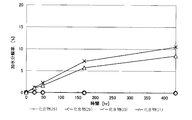
- FIG. 4 shows the results of hydrolysis tests at 37 ° C. in a MES heavy water buffer solution with a pD of 5.5 using the compounds of formula (26), formula (29), formula (30) and formula (31) described in Examples.
- FIG. 6 shows the results of hydrolysis tests at 37 ° C. in a HEPES heavy water buffer solution with a pD of 7.4 using the compounds of formula (26), formula (29), formula (30) and formula (31) described in Examples.
- acetal as used herein means both an acetal structure derived from aldehydes and an acetal structure derived from ketones, ie, a ketal structure.
- R 1 in the formula (1) of the present invention is a hydrogen atom or a hydrocarbon group, and the hydrocarbon group preferably has 10 or less carbon atoms, and specific hydrocarbon groups include methyl, ethyl, propyl, and isopropyl. Group, t-butyl group, phenyl group and benzyl group.
- a preferred embodiment of R 1 is a hydrogen atom or a methyl group, more preferably a hydrogen atom.
- the benzene ring in formula (1) of the present invention may have a plurality of substituents, and affects the hydrolysis rate of the acetal linker by appropriately selecting the type and position of the substituents on the benzene ring.
- the electron density around the acetal group and the degree of steric hindrance can be adjusted. Thereby, a desired hydrolysis rate can be imparted to the acetal linker.
- the substituent on the benzene ring in the formula (1) is described using the “substituent constant ( ⁇ )”, and this indicates the influence of the substituent on the reaction rate or equilibrium of the benzene derivative. It means the substituent constant in the quantified Hammett rule.
- the Hammett rule applies only to para-substituted and meta-substituted benzene derivatives and cannot be applied to ortho-substituted benzene derivatives that are affected by steric hindrance. Therefore, in the case of an ortho-substituted benzene derivative, it means a substituent constant in Taft's formula that extends the Hammett rule.
- the Hammett rule is represented by the following formula (7).
- k is a rate constant or equilibrium constant in an arbitrary reaction of para-substituted and meta-substituted benzene derivatives
- k 0 is a case where the benzene derivative does not have the above substituent, that is, the substituent is a hydrogen atom.
- the rate constant or equilibrium constant, ⁇ is the reaction constant, and ⁇ is the substituent constant.
- the reaction constant ( ⁇ ) in the above formula (7) is a constant determined by the reaction conditions such as reaction type, temperature, and solvent, and can be calculated from the slope of the Hammett plot.
- the substituent constant ( ⁇ ) in the above formula (7) is a constant determined only by the type and position of the substituent regardless of the type of reaction, and when there is no substituent, that is, the substituent is a hydrogen atom. In this case, it is “0”.
- the term “electron withdrawing” means when ⁇ is a positive value
- the term “electron donating” means when ⁇ is a negative value.
- k is a rate constant or equilibrium constant in an arbitrary reaction of para-substituted and meta-substituted benzene derivatives
- k 0 is a case where the benzene derivative does not have the above substituent, that is, the substituent is a hydrogen atom.
- the rate constant or equilibrium constant of the case, ⁇ * is the reaction constant, ⁇ * is the substituent constant, and Es is the positional constant of the substituent.
- reaction constant ( ⁇ ) of para-substituted and meta-substituted benzene derivatives and the reaction constant ( ⁇ * ) of ortho-substituted benzene derivatives are approximately equal, ⁇ and ⁇ * are defined herein to be the same.
- the ortho-position substituent constant ( ⁇ * ) is similar to the para-position substituent constant, as described in, for example, “Charton, M. Can. J. Chem. 1960, 38 2493-2499”. Therefore, the substituent constant at the ortho position in the present specification applies the substituent constant at the corresponding para position.
- Substituent constants ( ⁇ ) at the para and meta positions are described in ⁇ Hansch, C .; Leo, A .; Taft, R. W. Chem. Rev. 1991, 91, 165-195 ''.
- Substituents with unknown constant ( ⁇ ) can be measured and determined by the method described in “Hammett, L. P. Chem. Rev. 1935, 17 (1), 125-136”.
- the positional constant (Es) is described in “Unger, S. H .; Hansch, C. Prog. Phys. Org. Chem. 1976, 12, 91-118”. However, Es used in the present specification defines a hydrogen atom as “0”.
- the preferred hydrolysis rate of the hydrophilic polymer derivative having a benzylidene acetal linker of the present invention is such that the hydrolysis half-life (t 1/2 ) in a buffer solution at pH 5.5 and 37 ° C. is in the range of 1 hour to 6 months. More preferably, it is in the range of 1 hour to 1 month, and still more preferably in the range of 1 hour to 24 hours.
- the sum of the preferred substituent constants of the present invention Define the range of ( ⁇ ).
- ⁇ 3.0 represents the reaction constant ( ⁇ )
- 0.23 represents the sum of substituent constants ( ⁇ )
- ⁇ 1.16 represents the sum of positional constants ( ⁇ Es).
- t 1/2 of the hydrophilic polymer derivative is 1 hour ⁇ if 0.16 ⁇ ⁇ ⁇ 0.62 t 1/2 ⁇ 24 hours.
- the substituent that can be used in the present invention includes an acetalization reaction of a benzylidene acetal linker, a coupling reaction of a benzylidene acetal linker and a polyethylene glycol precursor, and a terminal functional group conversion of the hydrophilic polymer derivative in the process of synthesizing the hydrophilic polymer derivative. It is an electron-withdrawing or electron-donating substituent that does not inhibit the reaction and further the bond-forming reaction between the hydrophilic polymer derivative and a drug or the like.
- the electron-withdrawing substituent includes an acyl group having 2 to 5 carbon atoms, an alkoxycarbonyl group having 2 to 5 carbon atoms, a carbamoyl group having 2 to 5 carbon atoms, an acyloxy group having 2 to 5 carbon atoms, and 2 to 5 carbon atoms.
- the electron-donating substituent is an alkyl group having 1 to 4 carbon atoms, and preferred examples include a methyl group, an ethyl group, a propyl group, an isopropyl group, and a t-butyl group.
- Substituents that are electron-withdrawing at the meta position and electron-donating at the para position are preferably an alkoxy group having 1 to 4 carbon atoms, an aryl group having 6 to 10 carbon atoms, and an aryloxy group having 6 to 10 carbon atoms. Examples include phenyl, methoxy, ethoxy, propoxy, isopropoxy, t-butoxy and phenoxy groups.
- the positional constants (Es ), T 1/2 in buffer at pH 5.5, 37 ° C. is 1 hour ⁇ t 1/2 ⁇ 24 hours, 1 hour ⁇ t 1/2 ⁇ 1 month, and 1 hour ⁇ t 1/2 Calculating the range of ⁇ for ⁇ 6 months, it is ⁇ 1.12 ⁇ ⁇ ⁇ 0.45 for 1 hour ⁇ t 1/2 ⁇ 24 hours, and ⁇ 1.12 for 1 hour ⁇ t 1/2 ⁇ 1 month When ⁇ ⁇ ⁇ 0.94 and 1 hour ⁇ t 1/2 ⁇ 6 months, ⁇ 1.12 ⁇ ⁇ ⁇ 1.20.
- R 2 and R 6 in Formula (1) are hydrogen atoms, ⁇ is a positive value, so at least one of R 3 to R 5 is an electron-withdrawing substituent, and R 3 to R 5 Of these, other than the above, an electron-donating substituent may be used.
- one of R 3 to R 5 in formula (1) is a trifluoromethyl group, a cyano group, A substituent selected from the group consisting of an acetyl group, a methoxycarbonyl group and a nitro group, more preferably a trifluoromethyl group or a cyano group.
- one of R 3 to R 5 in formula (1) is a substituent selected from the group consisting of a trifluoromethyl group, a cyano group, an acetyl group, a methoxycarbonyl group, and a nitro group.
- R 3 to R 5 other than the above is a group consisting of methyl, ethyl, propyl, isopropyl, butyl, t-butyl, phenyl, methoxy, ethoxy and acetamide groups Is a substituent selected from More preferably, one of R 3 to R 5 is a trifluoromethyl group, a cyano group or a nitro group, and one of R 3 to R 5 other than the above is a methyl group, an ethyl group, a propyl group or a methoxy group It is a group.
- two of R 3 to R 5 in the formula (1) are substituents independently selected from the group consisting of a fluorine atom, a chlorine atom, a bromine atom and an iodine atom, More preferably, it is a substituent independently selected from the group consisting of a chlorine atom, a bromine atom and an iodine atom.
- R 2 and R 6 in the formula (1) when at least one of R 2 and R 6 in the formula (1) is a substituent other than a hydrogen atom, for example, preferably satisfies ⁇ 1.12 ⁇ ⁇ ⁇ 0.45 when 1 hour ⁇ t 1/2 ⁇ 24 hours Embodiments are shown below.
- one of R 2 and R 6 in the formula (1) is a fluorine atom or a methoxy group and the other is a hydrogen atom
- one of R 3 to R 5 is a trifluoromethyl group, a cyano group
- R 3 to R 5 is methyl group, ethyl group, propyl group, isopropyl group, butyl group, t-butyl
- R 2 and R 6 in formula (1) are independently a fluorine atom or a methoxy group
- one of R 3 to R 5 is a trifluoromethyl group, an acetyl group, a methoxycarbonyl group, a phenyl group, a fluorine A substituent selected from the group consisting of an atom, a chlorine atom, a bromine atom and an iodine atom, more preferably a trifluoromethyl group, a phenyl group or a fluorine atom.
- R 3 to R 5 is an acetyl group, a methoxycarbonyl group, fluorine It is a substituent selected from the group consisting of an atom, a chlorine atom, a bromine atom and an iodine atom, more preferably a fluorine atom, a chlorine atom, a bromine atom or an iodine atom.
- R 3 to R 5 are hydrogen atoms or R 3 to R 5 One of them is a phenyl group or an acetamide group, and more preferably a hydrogen atom.
- R 3 to R 5 is a fluorine atom or a chlorine atom , Bromine atom or iodine atom, more preferably chlorine atom, bromine atom or iodine atom.
- R 3 to R 5 are substituents selected from the group consisting of methyl, ethyl, propyl, isopropyl, butyl, t-butyl, methoxy, ethoxy and acetamide groups More preferably, two of R 3 to R 5 are substituents selected from the group consisting of a methyl group, an ethyl group, a t-butyl group, a methoxy group, and an acetamide group.
- R 2 and R 6 in formula (1) are independently a substituent selected from the group consisting of a methyl group, an ethyl group, a propyl group, an isopropyl group, a butyl group, a chlorine atom, a bromine atom and an iodine atom
- R 3 to R 5 are substituents selected from the group consisting of methyl, ethyl, propyl, isopropyl, butyl, t-butyl, methoxy, ethoxy and acetamide groups More preferably, two of R 3 to R 5 are substituents selected from the group consisting of a methyl group, an ethyl group, a t-butyl group, a methoxy group, and an acetamide group.
- the types and positions of the appropriate substituents for imparting the desired hydrolyzability to the hydrophilic polymer derivative having a benzylidene acetal linker of the present invention are represented by the formula (7), the formula (8) and the formula (9 ) Can be set rationally by performing the above calculation.
- X 1 in the formula (1) of the present invention is present in biologically active proteins, peptides, antibodies, nucleic acids and low-molecular-weight drugs that are subject to chemical modification, and drug carriers such as liposomes and polymer micelles. Any functional group that reacts with a functional group to form a covalent bond is not particularly limited.
- Preferred examples of X 1 include active ester group, active carbonate group, aldehyde group, isocyanate group, isothiocyanate group, epoxy group, maleimide group, vinyl sulfone group, acrylic group, sulfonyloxy group, carboxy group, thiol group, A dithiopyridyl group, an ⁇ -haloacetyl group, an alkynyl group, an allyl group, a vinyl group, an amino group, an oxyamino group, a hydrazide group and an azide group.
- the functional group capable of reacting with an amino group of a biofunctional molecule to form a covalent bond includes an active ester group, an active carbonate group, an aldehyde group, an isocyanate group, an isothiocyanate group, an epoxy group.
- a maleimide group, a vinylsulfone group, an acrylic group, a sulfonyloxy group, or a carboxy group, and a functional group that can react with a thiol group of a biofunctional molecule to form a covalent bond includes an active ester group, an active carbonate group Group, aldehyde group, isocyanate group, isothiocyanate group, epoxy group, maleimide group, vinyl sulfone group, acrylic group, sulfonyloxy group, carboxy group, thiol group, dithiopyridyl group, ⁇ -haloacetyl group, alkynyl group, allyl group or A vinyl group, an aldehyde group or a
- the functional group capable of reacting with a xy group to form a covalent bond is a thiol group, amino group, oxyamino group or hydrazide group, and reacts with an alkynyl group of a biofunctional
- active ester represents an activated carboxy group represented by the formula: —C ( ⁇ O) —L
- L represents a leaving group.
- the leaving group represented by L include succinimidyloxy, phthalimidyloxy, 4-nitrophenoxy, 1-imidazolyl, pentafluorophenoxy, benzotriazol-1-yloxy and 7-aza. And benzotriazol-1-yloxy group.
- Activated carbonate refers to an activated carbonate group represented by the formula: —O—C ( ⁇ O) —L, and L represents a leaving group as described above.
- X 1 is a group represented by group (I), group (II), group (III), group (IV) and group (V).
- Group (I) Functional groups capable of reacting with an amino group of a biofunctional molecule to form a covalent bond The following (a), (b), (c), (d), (e) and (e) f)
- Group (II) functional groups capable of reacting with thiol groups of biofunctional molecules to form covalent bonds (a), (b), (c), (d), (e), (e f), (g), (h), (i) and (j)
- Group (III) Functional groups capable of reacting with aldehyde groups or carboxy groups of biofunctional molecules to form covalent bonds (g), (k), (l) and (m) below
- Group (IV) Functional groups capable of reacting with alkynyl groups of biofunctional molecules to form covalent bonds (g), (k), (l), (m) and (n) below
- R 7 is a hydrogen atom or a sulfo group, and specific examples of the sulfo group include sodium sulfonate and potassium sulfonate, with a hydrogen atom being preferred.
- R 8 and R 11 are a hydrogen atom or a hydrocarbon group having 1 to 5 carbon atoms. Specific hydrocarbon groups include methyl, ethyl, propyl, isopropyl, butyl, t-butyl and pentyl. Groups and the like.
- R 9 is a hydrocarbon group having 1 to 10 carbon atoms which may contain a halogen atom, and specific hydrocarbon groups include methyl, ethyl, propyl, isopropyl, butyl, t-butyl, pentyl Group, isopentyl group, hexyl group, benzyl group, 4-methylphenyl group, trifluoromethyl group, 2,2,2-trifluoroethyl group, 4- (trifluoromethoxy) phenyl group, vinyl group, chloroethyl group, bromoethyl Group, iodoethyl group, and the like, and a methyl group, vinyl group, 4-methylphenyl group, or 2,2,2-trifluoroethyl group is preferable.
- R 10 is a halogen atom selected from a chlorine atom, a bromine atom and an iodine atom.
- Z 1 in the formula (1) of the present invention is a divalent spacer between the functional group X 1 and the benzylidene acetal linker
- Z 2 is a divalent spacer between the benzylidene acetal linker and the hydrophilic polymer chain.
- These are composed of covalent bonds, and are not particularly limited as long as they are more stable against acid hydrolysis than benzylidene acetal linkers, but are preferably alkylene groups alone or ether bonds, ester bonds, carbonate bonds, urethane bonds, amide bonds.
- the alkylene group preferably has 1 to 24 carbon atoms.
- preferred examples of the alkylene group include structures such as (z1).
- Preferable examples of the alkylene group having an ether bond include structures such as (z2) or (z3).
- Preferable examples of the alkylene group having an ester bond include a structure such as (z4).
- a preferred example of the alkylene group having a carbonate bond is a structure such as (z5).
- Preferable examples of the alkylene group having a urethane bond include structures such as (z6).
- a preferred example of the alkylene group having an amide bond is a structure such as (z7).
- Preferable examples of the alkylene group having a secondary amino group include a structure such as (z8).
- p and q are independently integers from 1 to 12.
- p and q are preferably large, and when it is desired to bind in a hydrophilic environment, p and q are preferably small.
- P in the formula (1) of the present invention is a hydrophilic polymer, and specific examples include polyalkylene glycol, polyoxazoline, polycarbonate, polyurethane, polyvinyl alcohol, polyacrylate, polymethacrylate, polyacrylamide, polyvinylpyrrolidone, poly Examples thereof include lactic acid, polyglycolic acid, polyamino acid, and copolymers derived from the above-mentioned polymers, preferably polyalkylene glycol, and more preferably polyethylene glycol.
- polyethylene glycol refers to both polyethylene glycol having a molecular weight distribution obtained by polymerization of ethylene oxide and monodisperse polyethylene glycol obtained by coupling single molecular weight oligoethylene glycols in a coupling reaction. means.
- P in the formula (1) is a linear polyethylene glycol.
- P in formula (1) is represented by formula (2).
- n is the number of repeating units per polyethylene glycol chain, and in polyethylene glycol having a molecular weight distribution, it is calculated by performing various theoretical calculations based on the number average molecular weight (Mn) of the compound. It is defined as that.
- Y is a hydrocarbon group having 1 to 24 carbon atoms, and specific examples thereof include methyl group, ethyl group, propyl group, isopropyl group, butyl group, t-butyl group, pentyl group, isopentyl group, hexyl.
- heptyl group 2-ethylhexyl group, octyl group, nonyl group, decyl group, undecyl group, dodecyl group, tridecyl group, tetradecyl group, pentadecyl group, hexadecyl group, heptadecyl group, octadecyl group, nonadecyl group, eicosyl group, heneicosyl Group, docosyl group, toycosyl group, tetracosyl group, phenyl group, benzyl group, cresyl group, butylphenyl group, dodecylphenyl group and trityl group, etc., preferably a hydrocarbon group having 1 to 10 carbon atoms, more preferably A methyl group or an ethyl group, more preferably a methyl group.
- P in formula (1) is represented by formula (3).
- X 2 is a functional group capable of chemically reacting with X 1 and Z 3 is a divalent spacer between the functional group X 2 and the polyethylene glycol chain. Since the polyethylene glycol derivative has two different reactive functional groups, X 1 and X 2 , for example, by binding a drug to X 1 and binding a targeting molecule to X 2 , A polyethylene glycol-drug conjugate having a property can be provided.
- Preferred examples of X 2 include active ester group, active carbonate group, aldehyde group, isocyanate group, isothiocyanate group, epoxy group, maleimide group, vinyl sulfone group, acrylic group, sulfonyloxy group, carboxy group, thiol group, A dithiopyridyl group, an ⁇ -haloacetyl group, an alkynyl group, an allyl group, a vinyl group, an amino group, an oxyamino group, a hydrazide group and an azide group.
- the functional group capable of reacting with an amino group of a biofunctional molecule to form a covalent bond includes an active ester group, an active carbonate group, an aldehyde group, an isocyanate group, an isothiocyanate group, an epoxy group.
- a maleimide group, a vinylsulfone group, an acrylic group, a sulfonyloxy group, or a carboxy group, and a functional group that can react with a thiol group of a biofunctional molecule to form a covalent bond includes an active ester group, an active carbonate group Group, aldehyde group, isocyanate group, isothiocyanate group, epoxy group, maleimide group, vinyl sulfone group, acrylic group, sulfonyloxy group, carboxy group, thiol group, dithiopyridyl group, ⁇ -haloacetyl group, alkynyl group, allyl group or A vinyl group, an aldehyde group or a
- the functional group capable of reacting with a xy group to form a covalent bond is a thiol group, amino group, oxyamino group or hydrazide group, and reacts with an alkynyl group of a biofunctional
- X 2 is a group represented by group (I), group (II), group (III), group (IV) and group (V).
- Group (I) Functional groups capable of reacting with an amino group of a biofunctional molecule to form a covalent bond The following (a), (b), (c), (d), (e) and (e) f)
- Group (II) functional groups capable of reacting with thiol groups of biofunctional molecules to form covalent bonds (a), (b), (c), (d), (e), (e f), (g), (h), (i) and (j)
- Group (III) Functional groups capable of reacting with aldehyde groups or carboxy groups of biofunctional molecules to form covalent bonds (g), (k), (l) and (m) below
- Group (IV) Functional groups capable of reacting with alkynyl groups of biofunctional molecules to form covalent bonds (g), (k), (l), (m) and (n) below
- R 7 is a hydrogen atom or a sulfo group, and specific examples of the sulfo group include sodium sulfonate and potassium sulfonate, with a hydrogen atom being preferred.
- R 8 and R 11 are a hydrogen atom or a hydrocarbon group having 1 to 5 carbon atoms. Specific hydrocarbon groups include methyl, ethyl, propyl, isopropyl, butyl, t-butyl and pentyl. Groups and the like.
- R 9 is a hydrocarbon group having 1 to 10 carbon atoms which may contain a halogen atom, and specific hydrocarbon groups include methyl, ethyl, propyl, isopropyl, butyl, t-butyl, pentyl Group, isopentyl group, hexyl group, benzyl group, 4-methylphenyl group, trifluoromethyl group, 2,2,2-trifluoroethyl group, 4- (trifluoromethoxy) phenyl group, vinyl group, chloroethyl group, bromoethyl Group, iodoethyl group, and the like, and a methyl group, vinyl group, 4-methylphenyl group, or 2,2,2-trifluoroethyl group is preferable.
- R 10 is a halogen atom selected from a chlorine atom, a bromine atom and an iodine atom.
- X 2 is required to be different from the X 1, as preferred combinations of X 1 and X 2, when X 1 is active ester or active carbonate group, X 2 is a maleimide group, a vinylsulfone group, alpha -A group selected from a haloacetyl group, an alkynyl group and an azide group, and when X 1 is an aldehyde group, X 2 is a group selected from a maleimide group, a vinylsulfone group, an alkynyl group and an azide group; When 1 is a maleimide group, a vinyl sulfone group or an ⁇ -haloacetyl group, X 2 is a group selected from an active ester group, an active carbonate group, an alkynyl group, and an azide group, and X 1 is an alkynyl group or an azide group.
- X 2 is a group selected from a maleimide group, a vinyl sulfone group, an ⁇ -haloacetyl group, an active ester group, an active carbonate group, an amino group and an oxyamino group
- X 1 is an amino group or an oxyamino group, it is an alkynyl group, an azide group, a thiol group or a carboxy group
- X 2 is an amino group, an oxyamino group or an azide group. It is a group selected from a group and a carboxy group.
- X 1 is an active ester group or an active carbonate group
- X 2 is a group selected from a maleimide group, an ⁇ -haloacetyl group, an alkynyl group and an azide group
- X 1 is an aldehyde group
- X 2 is a group selected from a maleimide group, an ⁇ -haloacetyl group, an alkynyl group and an azide group
- X 1 is a maleimide group or an ⁇ -haloacetyl group
- X 2 is an active ester group, an active carbonate group, An alkynyl group or an azide group
- X 1 is an alkynyl group or an azide group
- X 2 is a maleimide group, an ⁇ -haloacetyl group, an active ester group, an active carbonate group, an amino group, and an oxyamino group a group selected from, when X 1 is an amino group or an an amino group or an
- Z 3 is composed of a covalent bond and is not particularly limited as long as it is more stable to acid hydrolysis than a benzylidene acetal linker, but is preferably an alkylene group alone or an ether bond, an ester bond, a carbonate bond, a urethane bond, an amide.
- the alkylene group preferably has 1 to 24 carbon atoms.
- preferred examples of the alkylene group include structures such as (z1).
- Preferable examples of the alkylene group having an ether bond include structures such as (z2) or (z3).
- Preferable examples of the alkylene group having an ester bond include a structure such as (z4).
- a preferred example of the alkylene group having a carbonate bond is a structure such as (z5).
- Preferable examples of the alkylene group having a urethane bond include structures such as (z6).
- a preferred example of the alkylene group having an amide bond is a structure such as (z7).
- Preferable examples of the alkylene group having a secondary amino group include a structure such as (z8).
- p and q are independently integers from 1 to 12.
- p and q are preferably larger, and when desired to be bound in a hydrophilic environment, p and q are preferably smaller.
- P in the formula (1) is branched polyethylene glycol.
- P in formula (1) is represented by formula (4).
- Y is the hydrocarbon group having 1 to 24 carbon atoms, and v is 0 or 2.
- v When v is 0, it has 2 polyethylene glycol chains, and when v is 2, it has 4 polyethylene glycol chains.
- introduction of bonding points with polyethylene glycol more than necessary will destroy the active sites of the bio-related substances and reduce their functions. There are attempts to increase it.
- the viscosity increases as the molecular weight increases, it becomes difficult to handle in an aqueous solution preparation such as an injection preparation.
- the polyethylene glycol derivative has a branched structure, it has a lower viscosity than a linear polyethylene glycol derivative having the same molecular weight, and is useful in applications such as aqueous solution preparations.
- P in formula (1) is represented by formula (5).
- X 2 is the functional group capable of chemical reaction different from X 1
- Z 3 is the divalent spacer
- v is 0 or 2.
- the polyethylene glycol derivative has 1 X 1 and 2 or 4 X 2 , for example, if a drug is bound to X 1 and a targeting molecule is bound to X 2 , high targeting performance Can be obtained.
- P in formula (1) is represented by formula (6).
- X 2 is the functional group capable of chemical reaction different from X 1
- Z 3 is the divalent spacer
- v is 0 or 2.
- the antibody-drug complex (ADC) -related field it is preferable to bind a plurality of drugs to the antibody in order to increase the drug delivery efficiency.
- ADC antibody-drug complex
- the polyethylene glycol derivative has two or four X 1 and one X 2 , for example, if an anti-cancer drug is bound to X 1 and an antibody is bound to X 2 by ADC targeting cancer.
- the transport efficiency of the anticancer agent can be improved without increasing the binding point with the antibody.
- P in the formula (1) is polyethylene glycol having 2 to 8 terminals, and all terminals of polyethylene glycol constituting P are each bonded to Z 2 and w Is equal to the number of ends of polyethylene glycol.
- P in formula (1) is selected from the group consisting of formula (r), formula (s), formula (t), formula (u) and formula (v).
- formula (r) When P is represented by formula (r), w is 2, when P is represented by formula (s), w is 3, and when P is represented by formula (t). In the case where w is 4, w is 4 when P is represented by the formula (u), and w is 8 when P is represented by the formula (v).
- n in the formulas (2) and (3) of the present invention is 3 to 2000, more preferably 20 to 1500, still more preferably 40 to 1000, and most preferably 60 to 500. is there.
- n is preferably 3 to 1000, preferably 10 to 800, more preferably 20 to 500, and most preferably 30. ⁇ 300.
- the hydrophilic polymer derivative having a benzylidene acetal linker of the present invention can be synthesized by a coupling reaction between a linker unit having a substituted benzylidene acetal group and a hydrophilic polymer precursor. Coupling caused by the coupling reaction, which is determined by a combination of functional groups to be used in the reaction, ether bond contained in the divalent spacer Z 2, ester bond, carbonate bond, a urethane bond, an amide bond Or it is a secondary amino group.
- the synthesized hydrophilic polymer derivative chemically converts the terminal functional group of the benzylidene acetal linker as necessary.
- a typical example of a coupling reaction between a benzylidene acetal linker unit and a hydrophilic polymer precursor and further chemical conversion of the terminal functional group includes the following steps.
- polyethylene glycol which is a typical hydrophilic polymer, will be described as an example.
- Ar is a benzene ring having a substituent
- R 1 is a hydrogen atom or a hydrocarbon group.
- 3-aminopropanol derivative in which amino group is protected with phthalimide group, which is a typical protecting group, and carbonyl compound of formula (13) are toluene, benzene, xylene, acetonitrile, ethyl acetate, diethyl ether, t-butyl methyl ether, tetrahydrofuran , Chloroform, dichloromethane, dimethyl sulfoxide, dimethylformamide, dimethylacetamide or the like in the presence of an acid catalyst in the presence of an acid catalyst to obtain a compound of the following formula (14) having a benzylidene acetal group.
- the obtained compound may be purified by extraction, recrystallization, adsorbent treatment or column chromatography.
- the corresponding acetal derivative of a lower alcohol can also be used.
- the lower alcohol is preferably an alcohol having 1 to 5 carbon atoms, more preferably methanol or ethanol.
- the acid catalyst may be either an organic acid or an inorganic acid, and is not particularly limited, but specific examples include p-toluenesulfonic acid, p-toluenesulfonic acid pyridinium, methanesulfonic acid, 10-camphorsulfonic acid, chloride Hydrogen, iodine, ammonium chloride, oxalic acid and boron trifluoride diethyl ether complex.
- the “protecting group” is a component that prevents or blocks the reaction of a specific reactive functional group in the molecule under a certain reaction condition.
- the protecting group will vary depending on the type of reactive functional group being protected, the conditions used, and the presence of other functional groups or protecting groups in the molecule. Specific examples of protecting groups can be found in many common books, such as ⁇ Wuts, P. G. M .; Greene, eT. W. Protective Groups in Organic Synthesis, 4th ed.;. Wiley -Interscience: “New York, 2007”.
- the protecting group in the compound of the formula (14) other protecting groups can be used as long as they are stable under the acidic conditions of the acetalization reaction and can be deprotected by a method other than catalytic reduction in which the benzylidene acetal group decomposes.
- the reactive functional group is an amino group
- examples thereof include an acyl protecting group and a carbamate protecting group, and specifically include a trifluoroacetyl group, a 9-fluorenylmethyloxycarbonyl group, and 2- (trimethylsilyl) ethyl.
- An oxycarbonyl group etc. are mentioned.
- the reactive functional group is a hydroxy group
- examples thereof include a silyl protecting group and an acyl protecting group.
- t-butyldiphenylsilyl group a t-butyldimethylsilyl group, a triisopropylsilyl group, An acetyl group, a pivaloyl group, etc. are mentioned.
- a compound of formula (15) is obtained in which only one of the amino groups is protected with a trifluoroacetyl group.
- a compound similar to formula (15) in which only one of the amino groups is protected with a phthalimide group can be obtained.
- the obtained compound may be purified by the aforementioned purification means.
- the protecting group in the compound of the formula (15) is a method other than acidic conditions under which the benzylidene acetal group is decomposed and catalytic reduction, and conditions under which the bond generated by the coupling reaction between the benzylidene acetal linker unit and the hydrophilic polymer precursor is decomposed.
- Other protecting groups can be used as long as they can be deprotected with.
- the reactive functional group is an amino group
- examples thereof include an acyl protecting group and a carbamate protecting group, and specifically include a phthalimide group, a 9-fluorenylmethyloxycarbonyl group, and 2- (trimethylsilyl) ethyloxycarbonyl. Group and the like.
- the reactive functional group is a hydroxy group
- examples thereof include a silyl protecting group and an acyl protecting group.
- a t-butyldiphenylsilyl group, a t-butyldimethylsilyl group, a triisopropylsilyl group, An acetyl group, a pivaloyl group, etc. are mentioned.
- Typical deprotection conditions for the protecting groups are described in the above-mentioned literature, and a method suitable for each protecting group can be selected.
- the initiator is preferably an alcohol having a hydrocarbon group having 1 to 24 carbon atoms, and specifically includes methanol, ethanol, propanol, isopropanol, butanol, t-butanol, phenol and benzyl alcohol.
- An aprotic solvent such as toluene, benzene, xylene, acetonitrile, ethyl acetate, diethyl ether, t-butyl methyl ether, tetrahydrofuran, chloroform, dichloromethane, dimethyl sulfoxide, dimethylformamide or dimethylacetamide; N, N'-Disc in the absence of solvent in the presence of an organic base such as triethylamine, N-methylmorpholine, pyridine or 4-dimethylaminopyridine, or an inorganic base such as sodium carbonate, sodium bicarbonate, sodium acetate or potassium carbonate.
- an organic base such as triethylamine, N-methylmorpholine, pyridine or 4-dimethylaminopyridine
- an inorganic base such as sodium carbonate, sodium bicarbonate, sodium acetate or potassium carbonate.
- a polyethylene glycol precursor of formula (17) is obtained.
- the organic base and inorganic base may not be used.
- the ratio of the organic base and inorganic base used is not particularly limited, but is preferably equimolar or more with respect to the hydroxyl group of the polyethylene glycol of the formula (16).
- An organic base may be used as a solvent.
- the obtained compound may be purified by a purification means such as extraction, recrystallization, adsorbent treatment, reprecipitation, column chromatography or supercritical extraction.
- a bond generated by a coupling reaction between the polyethylene glycol precursor and the benzylidene acetal linker unit is an ether bond, an ester bond, or a divalent spacer Z 2 represented by the formula (1).
- the benzylidene acetal linker unit of formula (15) and the polyethylene glycol precursor of formula (17) are converted into toluene, benzene, xylene, acetonitrile, ethyl acetate, diethyl ether, Organic bases such as triethylamine, N-methylmorpholine, pyridine or 4-dimethylaminopyridine in aprotic solvents such as t-butyl methyl ether, tetrahydrofuran, chloroform, dichloromethane, dimethyl sulfoxide, dimethylformamide or dimethylacetamide, or without solvent Or a compound of formula (18) by a coupling reaction in the presence of an inorganic base such as sodium carbonate, sodium hydrogen carbonate, sodium acetate or potassium carbonate.
- an inorganic base such as sodium carbonate, sodium hydrogen carbonate, sodium acetate
- the organic base and inorganic base may not be used.
- the ratio of the organic base and inorganic base used is not particularly limited, but is preferably equimolar or more with respect to the reactive functional group of the polyethylene glycol precursor of the formula (17).
- An organic base may be used as a solvent.
- the obtained compound may be purified by the aforementioned purification means.
- the reaction conditions for the coupling reaction are determined by the combination of the reactive functional group of the benzylidene acetal linker unit and the reactive functional group of the polyethylene glycol precursor, and conventionally known methods can be used. It is necessary to appropriately select conditions that do not decompose the bonds contained in the benzylidene acetal group of 1) and the divalent spacers Z 2 and Z 1 .
- the compound of formula (18) is mixed with water, methanol or ethanol in a protic solvent, or in an aprotic solvent containing these, sodium carbonate, sodium hydroxide
- a base such as potassium carbonate, potassium hydroxide, lithium hydroxide or ammonia
- the compound of formula (19) in which the trifluoroacetyl group is removed and converted to an amino group is obtained.
- the obtained compound may be purified by the aforementioned purification means.
- the compound of formula (19) is converted into an aprotic solvent such as toluene, benzene, xylene, acetonitrile, ethyl acetate, diethyl ether, t-butyl methyl ether, tetrahydrofuran, chloroform, dichloromethane, dimethyl sulfoxide, dimethylformamide or dimethylacetamide, Alternatively, in the absence of solvent, 3-maleimidopropionic acid in the presence of an organic base such as triethylamine, N-methylmorpholine, pyridine or 4-dimethylaminopyridine, or an inorganic base such as sodium carbonate, sodium bicarbonate, sodium acetate or potassium carbonate By reacting with N-succinimidyl, a compound of formula (20) having a maleimide group introduced at the terminal is obtained.
- an organic base such as triethylamine, N-methylmorpholine, pyridine or 4-dimethylaminopyridine
- the organic base and inorganic base may not be used.
- the ratio of the organic base and inorganic base used is not particularly limited, but is preferably equimolar or more with respect to the reactive functional group of the compound of formula (19).
- An organic base may be used as a solvent.
- the obtained compound may be purified by the aforementioned purification means.
- JNM-ECP400 or JNM-ECA600 manufactured by JEOL Datum was used. Use a ⁇ 5mm tube for measurement. If the deuterated solvent is CDCl 3 , CD 3 CN or CD 3 OD, use tetramethylsilane (TMS) as the internal standard substance, and if it is D 2 O, use HDO as the standard. It was.
- TMS tetramethylsilane
- Mn represents the number average molecular weight
- Mw represents the weight average molecular weight
- Mn the molecular weight distribution was calculated as Mw / Mn.
- MES 2-morpholinoethanesulfonic acid
- pD 7.4 HEPES 2- [4- (Hydroxyethyl) -1-piperazinyl] ethanesulfonic acid)
- heavy water buffer used in the hydrolysis test are 0.1M each.
- MES heavy water solution and 0.1M HEPES heavy water solution were added 0.1M sodium hydroxide heavy water solution, ⁇ Glasoe, P. K .; Long, F. A. J. Phys. Chem. 1960, 64, 188-190 It was prepared based on the following relational expression described in
- the hydrolysis rate was evaluated by 1 H-NMR, and in the case of the compounds of formula (26), formula (29) and formula (30), the integral value of hydrogen of the acetal group is I 1 , an aldehyde group generated by hydrolysis
- the integral value of hydrogen was calculated from the following formula using I 2 as the integral value.
- the integral value of the benzene ring bonded to the acetal group is I 3
- the integral value of the benzene ring of acetophenone generated by hydrolysis is I 4 , which is calculated by the following formula: .
- Example 1 2-Bromobenzaldehyde dimethyl acetal (2.31 g, 10.0 mmol), N- (3-hydroxypropyl) phthalimide in a 300 mL four-necked flask equipped with a thermometer, nitrogen blowing tube, stirrer, Dean-stark tube and condenser tube (8.21 g, 40.0 mmol) and toluene (120 g) were charged, and water was removed azeotropically with toluene.
- Example 2 A 100 mL three-necked flask equipped with a thermometer, nitrogen blowing tube and stirrer was charged with the compound of formula (21) (1.00 g, 1.73 mmol), ethanol (36 mL) and hydrazine monohydrate (0.84 mL). The reaction was performed at 60 ° C. for 6 hours. After cooling to room temperature and filtration, the filtrate was diluted with dichloromethane (108 mL). After washing with 10% brine (80 mL), the organic layer was dried over anhydrous sodium sulfate. After filtration, the solvent was distilled off under reduced pressure to obtain a compound of formula (22).
- Example 3 A 100 mL three-necked flask equipped with a thermometer, nitrogen blowing tube and stirrer was charged with the compound of formula (22) (0.30 g, 0.95 mmol) and dehydrated methanol (18 mL), and ethyl trifluoroacetate (0.13 g, 0.95 mmol) was dissolved in dehydrated methanol (18 mL), and the solution was stirred dropwise. After completion of dropping, the reaction was carried out at 25 ° C. for 2 hours. The solvent was distilled off under reduced pressure, and the residue was diluted with t-butyl methyl ether (18 mL).
- Example 4 A 300 mL four-necked flask equipped with a thermometer, nitrogen blowing tube and stirrer was charged with dehydrated methanol (12.8 g, 0.400 mol), dehydrated toluene (150 g) and metal sodium 0.3 g (13 mmol), and nitrogen was blown into the flask. The mixture was stirred at room temperature until the sodium metal was dissolved. This solution was charged into a 5 L autoclave, the inside of the system was purged with nitrogen, and then heated to 100 ° C. Ethylene oxide (1,987 g, 45 mol) was added at 100 to 130 ° C. and a pressure of 1 MPa or less, and the reaction was continued for another 2 hours.
- Example 5 A 100 mL three-necked flask equipped with a thermometer, nitrogen blowing tube, stirrer, Dean-stark tube and condenser tube was charged with the compound of formula (24) (10.0 g, 2.00 mmol) and toluene (40 g), and water was added. Removed azeotropically with toluene. After cooling to 40 ° C., pyridine (0.71 g, 9.00 mmol) and N, N′-disuccinimidyl carbonate (1.54 g, 6.00 mmol) were charged and reacted at 80 ° C. for 7 hours.
- Example 6 A 100 mL three-necked flask equipped with a thermometer, a nitrogen blowing tube and a stirrer was charged with the compound of formula (25) (1.0 g, 0.20 mmol) and 36 g of dehydrated dichloromethane. wt%) was stirred while a solution of (206 mg, 0.30 mmol) and N, N-diisopropylethylamine (38 mg, 0.30 mmol) in dehydrated dichloromethane (4 g) was added dropwise. After completion of dropping, the reaction was carried out at 25 ° C. for 3 hours.
- Example 7 A 50 mL three-necked flask equipped with a thermometer, nitrogen blowing tube and stirrer was charged with the compound of formula (26) (0.50 g, 0.10 mmol) and 1M aqueous potassium carbonate solution (15 g) at 25 ° C. Time reaction was performed. After extraction with dichloromethane (15 g) and evaporation of the solvent under reduced pressure, the residue was dissolved in ethyl acetate (25 g) and dried over anhydrous sodium sulfate. After filtration, hexane (25 g) was added for crystallization. After filtration, it was dried under reduced pressure to obtain the compound of formula (27).
- Example 8 A 50 mL three-necked flask equipped with a thermometer, a nitrogen blowing tube and a stirrer was charged with the compound of formula (27) (0.20 g, 0.040 mmol) and acetonitrile (10 g), and N-succinimidyl 3-maleimidopropionate ( 32 mg, 0.048 mmol) was added and the reaction was carried out at 25 ° C. for 3 hours. After filtration, the solvent was distilled off under reduced pressure. The residue was dissolved in ethyl acetate (25 g), and hexane (25 g) was added for crystallization. After filtration, it was dried under reduced pressure to obtain the compound of formula (28).
- the compound of formula (33) was obtained by removing the t-butyl group with hydrochloric acid from the compound of formula (32) synthesized by the method described in Japanese Patent Application Laid-Open No. 2010-248504.
- Example 15 The compound of formula (35) was reacted with the compound of formula (23) in the same manner as in Example 6 to obtain the compound of formula (36).
- 1 H-NMR (CDCl 3 , internal standard TMS); ⁇ (ppm): 1.60-1.93 (8H, m, —CH 2 CH 2 CH 2 CH 2 N 3 , —CH 2 CH 2 CH 2 O—), 2.18 (2H, t, -CH 2 CH 2 CH 2 CH 2 N 3 ), 3.26-3.37 (4H, m, -OCONHCH 2 CH 2 CH 2 O-, -CH 2 CH 2 CH 2 CH 2 N 3 ), 3.40 -3.85 (458H, m,-(OCH 2 CH 2 ) n -OCH 2- , -CH 2 CONHCH 2- , CF 3 CONHCH 2 CH 2 CH 2 O-, -CH 2 CH 2 CH 2 O-), 4.20 (2H, t, -OCH 2 CH 2 OCONH-), 5.11 (1H, brs,
- Example 16 The compound of formula (36) was obtained by removing the trifluoroacetyl group in the same manner as in Example 7 and then reacting with iodoacetic anhydride.
- 1 H-NMR (CDCl 3 , internal standard TMS); ⁇ (ppm): 1.60-1.93 (8H, m, —CH 2 CH 2 CH 2 CH 2 N 3 , —CH 2 CH 2 CH 2 O—), 2.18 (2H, t, -CH 2 CH 2 CH 2 CH 2 N 3 ), 3.26-3.37 (6H, m, -OCONHCH 2 CH 2 CH 2 O-, -CH 2 CH 2 CH 2 CH 2 N 3 , ICH 2 CONHCH 2- ), 3.40-3.85 (458H, m,-(OCH 2 CH 2 ) n -OCH 2- , -CH 2 CH 2 CONHCH 2- , -CH 2 CH 2 CH 2 O-, ICH 2 CONHCH 2- ), 4.20 (2H, t, -OCH 2
- Example 18 The compound of formula (39) was reacted with the compound of formula (23) in the same manner as in Example 6 to obtain the compound of formula (40).
- 1 H-NMR (CDCl 3 , internal standard TMS); ⁇ (ppm): 1.78-1.93 (4H, m, -CH 2 CH 2 CH 2 O-), 3.26-3.37 (2H, m, -OCONHCH 2 CH 2 CH 2 O-), 3.38 (6H, s, CH 3 O-), 3.40-4.00 (909H, m, CF 3 CONHCH 2 CH 2 CH 2 O-, -CH 2 CH 2 CH 2 O-,-(OCH 2 CH 2 ) n -OCH 2 -,-(OCH 2 CH 2 ) n -OCH ⁇ ), 4.08 (1H, dd, -CH 2 OCONH-), 4.19 (1H, dd, -CH 2 OCONH-), 5.05 (1H, brs, -OCONH-), 5.67 (1H, s,
- the compound of formula (42) is reacted with acetic anhydride in the presence of triethylamine and 4-dimethylaminopyridine to the compound of formula (41) synthesized by the method described in Japanese Patent Application Laid-Open No. 2004-197077. Got.
- Example 20 For the compound of formula (42), after removing the benzyl group by the method described in Japanese Patent Application Laid-Open No. 2004-197077, N, N′-disuccinimidyl carbonate is reacted in the same manner as in Example 5. To obtain a compound of the formula (43).
- Example 21 The compound of formula (43) was reacted with the compound of formula (23) in the same manner as in Example 6 to obtain the compound of formula (44).
- 1 H-NMR (CDCl 3 , internal standard TMS); ⁇ (ppm): 1.78-1.93 (4H, m, -CH 2 CH 2 CH 2 O-), 2.08 (6H, s, CH 3 CO-), 3.26 -3.37 (2H, m, -OCONHCH 2 CH 2 CH 2 O-), 3.38 (6H, s, CH 3 O-), 3.40-4.00 (907H, m, CF 3 CONHCH 2 CH 2 CH 2 O-,- CH 2 CH 2 CH 2 O-,-(OCH 2 CH 2 ) n -OCH 2 -,-(OCH 2 CH 2 ) n -OCH ⁇ ), 4.08 (1H, dd, -CH 2 OCONH-), 4.19 ( 1H, dd, -CH 2 OCONH-) , 4.22 (4H, t
- Example 22 The compound of formula (44) is reacted with N-succinimidyl 3-maleimidopropionate in the same manner as in Example 8 after removing the acetyl group and the trifluoroacetamide group using an aqueous sodium hydroxide solution. Thus, a compound of the formula (45) was obtained.
- Example 23 The compound of formula (45) was reacted with N, N′-disuccinimidyl carbonate in the same manner as in Example 14 to obtain the compound of formula (46).
- 1 H-NMR (CDCl 3 , internal standard TMS); ⁇ (ppm): 1.78-1.83 (4H, m, -CONHCH 2 CH 2 CH 2 O-), 2.44 (2H, t, -CH 2 CH 2 -maleimide ), 2.84 (4H, s, succinimide), 3.27-3.37 (4H, m, -CONHCH 2 CH 2 CH 2 O-), 3.40-4.00 (905H, m,-(OCH 2 CH 2 ) n -OCH 2- ,-(OCH 2 CH 2 ) n -OCH ⁇ , -CH 2 CH 2 CH 2 O-, -CH 2 CH 2 -maleimide), 4.08 (1H, dd, -CH 2 OCONH-), 4.19 (1H, dd , -
- Example 25 The compound of formula (48) was reacted with the compound of formula (23) in the same manner as in Example 6 to obtain the compound of formula (49).
- 1 H-NMR (CDCl 3 , internal standard TMS); ⁇ (ppm): 1.78-1.93 (16H, m, -CH 2 CH 2 CH 2 O-), 3.26-3.37 (8H, m, -OCONHCH 2 CH 2 CH 2 O-), 3.47-3.85 (1806H, m, CF 3 CONHCH 2 CH 2 CH 2 O-, -CH 2 CH 2 CH 2 O-,-(OCH 2 CH 2 ) n -OCH 2- ), 4.20 (8H, t, -OCH 2 CH 2 OCONH-), 5.11 (4H, brs, -OCONH-), 5.67 (4H, s,> CH-), 7.21-7.59 (16H, m, arom.H), 7.31 (4H, brs, CF 3 CONH-) GPC analysis; Number average molecular weight
- Example 26 The compound of formula (26), formula (29), formula (30) and formula (31) (20 mg) was added to a pD 5.5 MES heavy water buffer (1 mL) and a pD 7.4 HEPES heavy water buffer (1 mL), respectively. And was allowed to stand in a constant temperature bath at 37 ° C.
- FIG. 1 shows the measurement results of hydrolysis rate at pD 5.5 and FIG. 2 at pD 7.4.
- the hydrolysis rate half-life (t 1/2 ) of the compounds of formula (26), formula (29), formula (30) and formula (31) at pD 5.5 and 37 ° C. is 24 hours, respectively. 2.2 months, 18 days and 36 hours. Further, at pD 7.4 and 37 ° C., the compounds of the formula (26) and the formula (31) showed about 10% hydrolysis in 18 days, but the compounds of the formula (29) and the formula (30) No hydrolysis was observed even after the day.
Landscapes
- Chemical & Material Sciences (AREA)
- Health & Medical Sciences (AREA)
- Chemical Kinetics & Catalysis (AREA)
- Medicinal Chemistry (AREA)
- Polymers & Plastics (AREA)
- Organic Chemistry (AREA)
- General Chemical & Material Sciences (AREA)
- Polyethers (AREA)
- Medicinal Preparation (AREA)
- Pharmaceuticals Containing Other Organic And Inorganic Compounds (AREA)
Abstract
L'invention concerne un dérivé polymère hydrophile possédant un coupleur benzylidène acétal, dont le taux d'hydrolyse à une valeur de pH d'un environnement faiblement acide dans un corps vivant peut être contrôlé avec précision. Un dérivé polymère hydrophile possédant un coupleur benzylidène acétal, représenté par la formule (1) (dans laquelle R1 représente un atome d'hydrogène ou un groupe hydrocarboné ; R2, R3, R4, R5 et R6 représentent indépendamment un atome d'hydrogène ou un substituant, dans laquelle au moins l'un de R3, R4 et R5 représente un substituant électro-attracteur ou R2 et/ou R6 représente un substituant ; X1 représente un groupe fonctionnel chimiquement réactif ; P représente un polymère hydrophile ; w représente un entier de 1 à 8 ; et Z1 et Z2 représentent indépendamment un espaceur bivalent choisi).
Priority Applications (4)
| Application Number | Priority Date | Filing Date | Title |
|---|---|---|---|
| US14/779,676 US10023693B2 (en) | 2013-03-25 | 2014-03-25 | Hydrophilic polymer derivative having benzylidene acetal linker |
| CN201480018426.8A CN105121506B (zh) | 2013-03-25 | 2014-03-25 | 具有苯亚甲基缩醛连接基团的亲水性聚合物衍生物 |
| EP14773177.2A EP2980116B1 (fr) | 2013-03-25 | 2014-03-25 | Dérivé polymère hydrophile possédant un coupleur benzylidène acétal |
| US16/010,972 US10633489B2 (en) | 2013-03-25 | 2018-06-18 | Hydrophilic polymer derivative having benzylidene acetal linker |
Applications Claiming Priority (2)
| Application Number | Priority Date | Filing Date | Title |
|---|---|---|---|
| JP2013-061428 | 2013-03-25 | ||
| JP2013061428 | 2013-03-25 |
Related Child Applications (2)
| Application Number | Title | Priority Date | Filing Date |
|---|---|---|---|
| US14/779,676 A-371-Of-International US10023693B2 (en) | 2013-03-25 | 2014-03-25 | Hydrophilic polymer derivative having benzylidene acetal linker |
| US16/010,972 Division US10633489B2 (en) | 2013-03-25 | 2018-06-18 | Hydrophilic polymer derivative having benzylidene acetal linker |
Publications (1)
| Publication Number | Publication Date |
|---|---|
| WO2014157150A1 true WO2014157150A1 (fr) | 2014-10-02 |
Family
ID=51624121
Family Applications (1)
| Application Number | Title | Priority Date | Filing Date |
|---|---|---|---|
| PCT/JP2014/058201 Ceased WO2014157150A1 (fr) | 2013-03-25 | 2014-03-25 | Dérivé polymère hydrophile possédant un coupleur benzylidène acétal |
Country Status (5)
| Country | Link |
|---|---|
| US (2) | US10023693B2 (fr) |
| EP (1) | EP2980116B1 (fr) |
| JP (1) | JP6508506B2 (fr) |
| CN (1) | CN105121506B (fr) |
| WO (1) | WO2014157150A1 (fr) |
Cited By (3)
| Publication number | Priority date | Publication date | Assignee | Title |
|---|---|---|---|---|
| WO2016063959A1 (fr) * | 2014-10-24 | 2016-04-28 | 日油株式会社 | Complexe anticorps-médicament comprenant un lieur de type benzylidène acétal cyclique |
| WO2016159071A1 (fr) * | 2015-03-31 | 2016-10-06 | 日油株式会社 | Dérivé de polyéthylène glycol biodégradable ayant un lieur benzylidène acétal cyclique |
| WO2017057612A1 (fr) * | 2015-09-30 | 2017-04-06 | 日油株式会社 | Dérivé de lipide dans lequel des polymères hydrophiles sont liés par l'intermédiaire de lieurs de benzylidène-acétal cyclique |
Families Citing this family (4)
| Publication number | Priority date | Publication date | Assignee | Title |
|---|---|---|---|---|
| JP6508506B2 (ja) * | 2013-03-25 | 2019-05-08 | 日油株式会社 | ベンジリデンアセタールリンカーを有する親水性ポリマー誘導体 |
| JP6925579B2 (ja) * | 2016-03-31 | 2021-08-25 | 日油株式会社 | 環状ベンジリデンアセタール構造を有する生分解性ヒドロゲル |
| WO2018180914A1 (fr) * | 2017-03-30 | 2018-10-04 | 日油株式会社 | Dérivé de polymère hydrophile comportant un coupleur acétal auto-immolable et composite l'utilisant |
| WO2019131515A1 (fr) * | 2017-12-27 | 2019-07-04 | 三洋化成工業株式会社 | Matériau de départ pour médicament en vrac ou additifs pour médicament, et médicament en vrac ou médicament le contenant |
Citations (6)
| Publication number | Priority date | Publication date | Assignee | Title |
|---|---|---|---|---|
| WO1996032434A1 (fr) * | 1995-04-14 | 1996-10-17 | Kazunori Kataoka | Oxydes de polyethylene ayant un groupe saccharide a une extremite et un groupe fonctionnel different a l'autre extremite, et procede pour produire lesdits oxydes de polyethylene |
| JP2004197077A (ja) | 2002-11-20 | 2004-07-15 | Nof Corp | 修飾された生体関連物質、その製造方法および中間体 |
| WO2005108463A2 (fr) | 2004-05-03 | 2005-11-17 | Nektar Therapeutics Al, Corporation | Dérivés de polymères comprenant un point de ramification de type acétal ou cétal |
| JP2008540558A (ja) * | 2005-05-10 | 2008-11-20 | エモリー・ユニバーシティ | ミセルおよび粒子を用いた、活性物質の送達のための新規の戦略 |
| JP2010248504A (ja) | 2009-03-27 | 2010-11-04 | Nof Corp | ポリオキシアルキレン誘導体の製造方法 |
| JP2012533660A (ja) * | 2009-07-23 | 2012-12-27 | エッセンス・べスローテン・フエンノートシャップ | ポリマー、好ましくは(アルキル)アクリロイルポリカーボネートを作る方法、得られるポリマーおよび(アルキル)アクリロイルポリカーボネート、ならびにこれを含むバイオデバイス |
Family Cites Families (6)
| Publication number | Priority date | Publication date | Assignee | Title |
|---|---|---|---|---|
| US3585242A (en) * | 1967-10-17 | 1971-06-15 | Bayer Ag | Aromatic monoalkoxyaldehyde acetals |
| US4632891A (en) * | 1984-10-04 | 1986-12-30 | Ciba-Geigy Corporation | Process for the production of images |
| JPS61158974A (ja) | 1985-01-07 | 1986-07-18 | Tooa Eiyoo Kk | (s)−o−ベンジルグリシド−ルの製造法 |
| US8252846B2 (en) | 2005-05-10 | 2012-08-28 | Emory University | Strategies for delivery of active agents using micelles and particles |
| US8137700B2 (en) * | 2006-05-05 | 2012-03-20 | U.S. Department Of Energy | Main chain acid-degradable polymers for the delivery of bioactive materials |
| JP6508506B2 (ja) * | 2013-03-25 | 2019-05-08 | 日油株式会社 | ベンジリデンアセタールリンカーを有する親水性ポリマー誘導体 |
-
2014
- 2014-03-25 JP JP2014061070A patent/JP6508506B2/ja active Active
- 2014-03-25 US US14/779,676 patent/US10023693B2/en active Active
- 2014-03-25 WO PCT/JP2014/058201 patent/WO2014157150A1/fr not_active Ceased
- 2014-03-25 CN CN201480018426.8A patent/CN105121506B/zh active Active
- 2014-03-25 EP EP14773177.2A patent/EP2980116B1/fr active Active
-
2018
- 2018-06-18 US US16/010,972 patent/US10633489B2/en active Active
Patent Citations (6)
| Publication number | Priority date | Publication date | Assignee | Title |
|---|---|---|---|---|
| WO1996032434A1 (fr) * | 1995-04-14 | 1996-10-17 | Kazunori Kataoka | Oxydes de polyethylene ayant un groupe saccharide a une extremite et un groupe fonctionnel different a l'autre extremite, et procede pour produire lesdits oxydes de polyethylene |
| JP2004197077A (ja) | 2002-11-20 | 2004-07-15 | Nof Corp | 修飾された生体関連物質、その製造方法および中間体 |
| WO2005108463A2 (fr) | 2004-05-03 | 2005-11-17 | Nektar Therapeutics Al, Corporation | Dérivés de polymères comprenant un point de ramification de type acétal ou cétal |
| JP2008540558A (ja) * | 2005-05-10 | 2008-11-20 | エモリー・ユニバーシティ | ミセルおよび粒子を用いた、活性物質の送達のための新規の戦略 |
| JP2010248504A (ja) | 2009-03-27 | 2010-11-04 | Nof Corp | ポリオキシアルキレン誘導体の製造方法 |
| JP2012533660A (ja) * | 2009-07-23 | 2012-12-27 | エッセンス・べスローテン・フエンノートシャップ | ポリマー、好ましくは(アルキル)アクリロイルポリカーボネートを作る方法、得られるポリマーおよび(アルキル)アクリロイルポリカーボネート、ならびにこれを含むバイオデバイス |
Non-Patent Citations (14)
| Title |
|---|
| "Acetals as pH-Sensitive Linkages for Drug Delivery", BIOCONJUGATE CHEM, vol. 15, no. 6, 2004, pages 1254 - 1263, XP001214719 * |
| "Poly(isoglycerol methacrylate)-b-poly(d or 1-lactide) Copolymers: A Novel Hydrophilic Methacrylate as Building Block for Supramolecular Aggregates", MACROMOLECULES, vol. 43, 2010, pages 3314 - 3324, XP055280616 * |
| 57TH ANNUAL MEETING OF THE SOCIETY OF POLYMER SCIENCE, JAPAN, PREPRINTS OF THE SOCIETY OF POLYMER SCIENCE, vol. 57, May 2008 (2008-05-01), pages 1897 |
| BIOCONJUGATE CHEM, vol. 15, 2004, pages 1254 - 1263 |
| CHARTON, M, CAN. J. CHEM., vol. 38, 1960, pages 2493 - 2499 |
| GLASOE, P. K.; LONG, F. A., J. PHYS. CHEM., vol. 64, 1960, pages 188 - 190 |
| HAMMETT, L.P., CHEM. REV., vol. 17, no. 1, 1935, pages 125 - 136 |
| HANSCH, C.; LEO, A.; TAFT, R.W., CHEM. REV., vol. 91, 1991, pages 165 - 195 |
| HARRIS, J. M: "Poly(Ethylene Glycol) Chemistry", 1992, PLENUM PRESS |
| HERMANSON, G. T.: "Bioconjugate Techniques, 2nd ed.", 2008, ACADEMIC PRESS |
| See also references of EP2980116A4 |
| UNGER, S.H.; HANSCH, C., PROG. PHYS. ORG. CHEM., vol. 12, 1976, pages 91 - 118 |
| VERONESE, F. M.: "PEGylated Protein Drugs: Basic Science and Clinical Applications; Veronese", 2009, BIRKHAUSER |
| WUTS, P. G. M.; GREENE, T. W.: "Protective Groups in Organic Synthesis, 4th ed.", 2007, WILEY-INTERSCIENCE |
Cited By (8)
| Publication number | Priority date | Publication date | Assignee | Title |
|---|---|---|---|---|
| WO2016063959A1 (fr) * | 2014-10-24 | 2016-04-28 | 日油株式会社 | Complexe anticorps-médicament comprenant un lieur de type benzylidène acétal cyclique |
| EP3210623A4 (fr) * | 2014-10-24 | 2018-07-04 | NOF Corporation | Complexe anticorps-médicament comprenant un lieur de type benzylidène acétal cyclique |
| US10377837B2 (en) | 2014-10-24 | 2019-08-13 | Nof Corporation | Antibody-drug conjugate having cyclic benzylidene acetal linker |
| US10808050B2 (en) | 2014-10-24 | 2020-10-20 | Nof Corporation | Antibody-drug conjugate having cyclic benzylidene acetal linker |
| WO2016159071A1 (fr) * | 2015-03-31 | 2016-10-06 | 日油株式会社 | Dérivé de polyéthylène glycol biodégradable ayant un lieur benzylidène acétal cyclique |
| US11529423B2 (en) | 2015-03-31 | 2022-12-20 | Nof Corporation | Biodegradable polyethylene glycol derivative having cyclic benzylidene acetal linker |
| WO2017057612A1 (fr) * | 2015-09-30 | 2017-04-06 | 日油株式会社 | Dérivé de lipide dans lequel des polymères hydrophiles sont liés par l'intermédiaire de lieurs de benzylidène-acétal cyclique |
| US10626217B2 (en) | 2015-09-30 | 2020-04-21 | Nof Corporation | Lipid derivative in which hydrophilic polymer is bound through cyclic benzylidene acetal linker |
Also Published As
| Publication number | Publication date |
|---|---|
| CN105121506B (zh) | 2017-03-08 |
| US10023693B2 (en) | 2018-07-17 |
| EP2980116A1 (fr) | 2016-02-03 |
| JP6508506B2 (ja) | 2019-05-08 |
| EP2980116A4 (fr) | 2016-10-26 |
| JP2014208794A (ja) | 2014-11-06 |
| CN105121506A (zh) | 2015-12-02 |
| US20160046763A1 (en) | 2016-02-18 |
| US20180298143A1 (en) | 2018-10-18 |
| US10633489B2 (en) | 2020-04-28 |
| EP2980116B1 (fr) | 2017-07-26 |
Similar Documents
| Publication | Publication Date | Title |
|---|---|---|
| US10633489B2 (en) | Hydrophilic polymer derivative having benzylidene acetal linker | |
| US11530295B2 (en) | Hydrophilic polymer derivative having cyclic benzylidene acetal linker | |
| US11529423B2 (en) | Biodegradable polyethylene glycol derivative having cyclic benzylidene acetal linker | |
| US9029568B2 (en) | Branched hetero polyfunctional polyoxyalkylene compound and intermediate thereof | |
| JP6850417B2 (ja) | 環状ベンジリデンアセタールリンカーを介して親水性ポリマーが結合した脂質誘導体 | |
| CA3252159A1 (fr) | Dérivé de polyoxyéthylène libérable de type acétal, son procédé de production et conjugué de polyoxyéthylène libérable de type acétal | |
| US11041052B2 (en) | Biodegradable hydrogel having cyclic benzylidene acetal structure | |
| JP7101939B2 (ja) | ジスルフィドリンカーを有する分解性ポリエチレングリコール誘導体 | |
| WO2025084230A1 (fr) | Dérivé de polyoxyéthylène libérable de type acétal contenant un groupe amino, son procédé de production, et conjugué de polyoxyéthylène libérable de type acétal contenant un groupe amino |
Legal Events
| Date | Code | Title | Description |
|---|---|---|---|
| 121 | Ep: the epo has been informed by wipo that ep was designated in this application |
Ref document number: 14773177 Country of ref document: EP Kind code of ref document: A1 |
|
| WWE | Wipo information: entry into national phase |
Ref document number: 14779676 Country of ref document: US |
|
| NENP | Non-entry into the national phase |
Ref country code: DE |
|
| REEP | Request for entry into the european phase |
Ref document number: 2014773177 Country of ref document: EP |
|
| WWE | Wipo information: entry into national phase |
Ref document number: 2014773177 Country of ref document: EP |