WO2014157256A1 - Procédé pour éliminer les impuretés dans une solution de composé de haut poids moléculaire - Google Patents
Procédé pour éliminer les impuretés dans une solution de composé de haut poids moléculaire Download PDFInfo
- Publication number
- WO2014157256A1 WO2014157256A1 PCT/JP2014/058372 JP2014058372W WO2014157256A1 WO 2014157256 A1 WO2014157256 A1 WO 2014157256A1 JP 2014058372 W JP2014058372 W JP 2014058372W WO 2014157256 A1 WO2014157256 A1 WO 2014157256A1
- Authority
- WO
- WIPO (PCT)
- Prior art keywords
- membrane
- filtration
- polymer compound
- pressure
- molecular weight
- Prior art date
- Legal status (The legal status is an assumption and is not a legal conclusion. Google has not performed a legal analysis and makes no representation as to the accuracy of the status listed.)
- Ceased
Links
Images
Classifications
-
- B—PERFORMING OPERATIONS; TRANSPORTING
- B01—PHYSICAL OR CHEMICAL PROCESSES OR APPARATUS IN GENERAL
- B01D—SEPARATION
- B01D61/00—Processes of separation using semi-permeable membranes, e.g. dialysis, osmosis or ultrafiltration; Apparatus, accessories or auxiliary operations specially adapted therefor
- B01D61/02—Reverse osmosis; Hyperfiltration ; Nanofiltration
- B01D61/025—Reverse osmosis; Hyperfiltration
-
- B—PERFORMING OPERATIONS; TRANSPORTING
- B01—PHYSICAL OR CHEMICAL PROCESSES OR APPARATUS IN GENERAL
- B01D—SEPARATION
- B01D2315/00—Details relating to the membrane module operation
- B01D2315/10—Cross-flow filtration
-
- B—PERFORMING OPERATIONS; TRANSPORTING
- B01—PHYSICAL OR CHEMICAL PROCESSES OR APPARATUS IN GENERAL
- B01D—SEPARATION
- B01D2317/00—Membrane module arrangements within a plant or an apparatus
- B01D2317/02—Elements in series
- B01D2317/025—Permeate series
Definitions
- the present invention relates to a method for removing low molecular impurities from a solution containing a polymer compound by membrane filtration. More specifically, the present invention relates to a method of removing low-molecular impurities in a solution containing a polymer compound by cross-flow membrane filtration in which a plurality of membrane filtration modules are arranged in series.
- Patent Document 2 describes that a back pressure valve is provided in each membrane module to adjust the filtration pressure of each filtration module to a specific level. Thereby, the load concerning each membrane module can be made constant, and the amount of filtration is stabilized over a long period of time.
- the present invention is a method for removing low molecular impurities from a polymer compound-containing solution by cross-flow membrane filtration in which a plurality of membrane filtration modules are arranged in series, and the outflow of the polymer compound into the filtrate It is an object to provide a method capable of realizing a high filtration rate while effectively suppressing.
- the present inventors have found that when the molecular weight or molecular weight distribution of the polymer compound and the fractional molecular weight of the filtration membrane have a specific relationship, the polymer compound flows into the filtrate. It was found that the filtration rate can be effectively suppressed and the filtration rate is not easily lowered. Based on this knowledge, we have repeatedly studied, using cross-flow membrane filtration in which a plurality of membrane modules are arranged in series, and further adjusting the filtration pressure of each membrane module at a high filtration rate. It has been found that the outflow of the polymer compound into the liquid can be effectively suppressed. The present invention has been studied and completed based on these findings.
- (A) The polymer compound in the solution has a single peak molecular weight distribution
- (B) The molecular weight cutoff MWCO of the filtration membrane, the number average molecular weight Mn and the weight average molecular weight Mw of the polymer compound satisfy the following (I), Mw ⁇ (Mw / Mn) ⁇ 3 ⁇ MWCO ⁇ Mw ⁇ (Mw / Mn) ⁇ 1
- I The variation coefficient of the filtration pressure between the membrane modules during membrane filtration is set to 10% or less.
- ⁇ 2> The method according to ⁇ 1>, wherein Mw / Mn of the polymer compound in the solution is 2 to 6.
- ⁇ 3> The method according to ⁇ 1> or ⁇ 2>, wherein MWCO is 15000 or less.
- ⁇ 4> The method according to any one of ⁇ 1> to ⁇ 3>, wherein the filtration membrane is a ceramic membrane.
- ⁇ 5> The method according to any one of ⁇ 1> to ⁇ 4>, wherein the cross-flow membrane filtration is diafiltration.
- removal of low-molecular impurities in a polymer compound-containing solution performed using a cross-flow membrane filtration treatment is performed at a sufficiently high filtration rate and into the polymer compound filtrate. Can be carried out while effectively suppressing the outflow.
- the method of the present invention is a method for removing low-molecular impurities in a polymer compound-containing solution by a cross-flow membrane filtration process in which two or more membrane modules are arranged in series.
- low-molecular impurities are permeated through a filtration membrane (hereinafter also simply referred to as “membrane”) and removed into the filtrate, while the polymer compound is not filtered and is removed from the solution. Remain in.
- “low molecular impurities” are compounds present in a polymer compound-containing solution to be subjected to membrane filtration, and have a smaller molecular weight (molecular weight distribution) than the polymer compound to be purified or concentrated. A compound.
- low-molecular impurities for example, when unreacted monomers, oligomers, polymerization reaction solvents and initiators that may be present in the reaction solution after the polymerization reaction, or when polymer compounds are subjected to chemical reactions such as modification reactions And unreacted reagents and reaction solvents that may be present in the reaction solution.
- Low molecular impurities usually have a molecular weight of 1000 or less.
- “removal of low molecular impurities in the polymer compound-containing solution” means that the solvent of the polymer compound-containing solution is changed to a new solvent (the same as or different from the solvent of the raw material liquid) together with the removal of low-molecular impurities. It may be used for the meaning including the case of substitution.
- the polymer compound in the polymer compound-containing solution to be subjected to membrane filtration has a single peak molecular weight distribution.
- or the weight average molecular weight (Mw) of the said high molecular compound and the fractionation molecular weight (MWCO) of a filtration membrane satisfy
- the variation coefficient of the filtration pressure between the membrane modules arranged in series is adjusted to be a specific value or less, and the variation in the filtration pressure between the membrane modules is reduced. It is suppressed. Thereby, the load applied to each membrane module can be made uniform, the outflow of the polymer compound into the filtrate can be effectively suppressed, and more stable filtration can be realized over a long period of time.
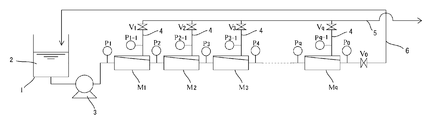
- FIG. 1 A schematic diagram illustrating a cross-flow membrane filtration suitable for applying the method of the present invention is shown in FIG.
- the method of the present invention will be described more specifically with reference to FIG.
- q is an integer of 2 or more, preferably an integer of 2 to 15, more preferably an integer of 3 to 12, More preferably, an integer of 4 to 10.
- membrane modules (M 1 to M q ) are arranged in series.
- the membrane modules M 1 to M q are preferably membrane modules having the same performance. That is, it is preferable to use the membrane modules M 1 to M q manufactured with substantially the same membrane area, membrane material, and filtration performance.
- a polymer compound solution 2 (hereinafter also referred to as “raw material liquid”) stored in the storage tank 1 and subjected to a filtration treatment is transferred to the membrane modules M 1 , M 2 , M 3 ,. Sent sequentially. While passing through each membrane module, at least part of the low-molecular impurities contained in the raw material liquid permeates through the membrane and is removed into the filtrate. The filtrate that permeates the membrane while passing through each membrane module flows out to the filtrate take-out pipe 4 and is collected in the filtrate collecting pipe 5 and removed.
- the pump 3 is not particularly limited as long as a desired flow rate or pressure can be generated in the raw material liquid, and a pump usually used for a cross-flow membrane filtration process can be employed.
- the raw material liquid that has passed through the membrane module M q located on the most downstream side is returned to the storage tank 1, and is sent again to the membrane modules M 1 to M q as necessary for membrane filtration. This operation is repeated until the low-molecular impurities in the raw material liquid are reduced to a desired concentration, whereby the polymer compound can be purified or concentrated in the raw material liquid.
- the membrane filtration in the method of the present invention may be diafiltration in which the raw material liquid is circulated while adding a solvent to the storage tank 1. Diafiltration is a constant volume filtration operation that performs filtration while keeping the volume or mass of the raw material liquid constant. In diafiltration, the solvent is added at a rate equivalent to the flow rate of the filtrate. For example, the solvent is continuously added to the storage tank 1 shown in FIG. 1 by a pump (not shown) capable of constant-speed liquid feeding.
- V 0 installed downstream of the membrane module M q is a pressure regulating valve (valve) for the raw material liquid.
- a pressure regulating valve for the raw material liquid.
- the pressure of the raw material liquid adjusted by the pressure control valve V 0 can be measured by, for example, a pressure gauge P 0 .
- P 1, P 2, P 3, ⁇ P q are each membrane module M 1, M 2, M 3 , a pressure gauge installed at the entrance of ⁇ ⁇ ⁇ M q (storage tank) It is.
- Pressure gauge P 1, P 2, P 3 by ⁇ ⁇ ⁇ P q, pressure of each membrane module inlet definitive material liquid is measured.
- P 1-1 , P 2-1 , P 3-1 ,... P q-1 permeate the membrane in membrane modules M 1 , M 2 , M 3 ,. It is a pressure gauge that measures the pressure of the filtrate.
- the pressure gauges P 1-1 , P 2-1 , P 3-1 ,... P q-1 are respectively connected to the membrane modules M 1 , M 2 , M 3 ,. It is installed at a connection portion with each connected filtrate outlet pipe 4.
- V 1, V 2, V 3, ⁇ V q are each membrane module 1 M, M 2, M 3, a valve for adjusting the pressure of the transmitted filtrate membrane in ⁇ ⁇ ⁇ M q (Valve).
- V 1 , V 2 , V 3 ,... V q the filtration pressure of each membrane module can be adjusted.
- the raw material liquid to be fed receives resistance when passing through the pipe 6 and the membrane modules M 1 to M q and causes pressure loss. Due to this pressure loss, the pressure measurement values decrease in the order of pressure gauges P 1 , P 2 , P 3 ,... P q , P 0 . That is, filtration conditions differ in each membrane module.
- the filtration pressure of the membrane module M 1 is a value obtained by subtracting the value of the pressure gauge P 1-1 from the value of the pressure gauge P 1.
- the filtration pressure of the membrane module M 2 is the value of the pressure gauge P 2 .
- the filtration pressure of the membrane module M q is is a value obtained by subtracting the value of the pressure gauge P q-1 from the value of the pressure gauge P q. Applying pressure corresponding to the difference between each pressure indicated by each pressure gauge P 1 , P 2 , P 3 ,... P q and the pressure indicated by P 0 to the filtrate in the corresponding filtrate take-out pipe 4.
- variation in filtration pressure of each membrane module can be suppressed.
- the pressure of the filtrate is adjusted by pressure valves V 1 , V 2 , V 3 ,... V q .
- the CV value is preferably 7% or less, more preferably 5% or less, further preferably 4% or less, and further preferably 3% or less.
- the variation coefficient of the filtration pressure between the membrane modules is usually 1% or more.
- the polymer compound is dissolved in the raw material liquid.
- the polymer compound in the raw material liquid exhibits a single peak molecular weight distribution.
- the polymer compound preferably has a weight average molecular weight (Mw) of 10,000 to 200,000, more preferably 10,000 to 100,000, and still more preferably 10,000 to 50,000.
- Mw / Mn of the polymer compound used in the present invention is preferably 2 to 6, more preferably 2 to 5, and further preferably 2 to 4.
- polymer compound to be purified or concentrated contained in the raw material liquid there is no particular limitation on the type of polymer compound to be purified or concentrated contained in the raw material liquid.
- the term “compound” when the term “compound” is added at the end, or when a compound is indicated by a specific name or chemical formula, unless otherwise specified, in addition to the compound itself, its salt, its complex, This ion is used to mean including a form in which a specific substituent is introduced into the above compound.
- the polyvinyl alcohol compound examples include PVA-203 (manufactured by Kuraray, Mw: 21000) and derivatives thereof, and PVA-205 (manufactured by Kuraray, Mw: 35000) and derivatives thereof.
- polyvinylpyrrolidone compound examples include polyvinylpyrrolidone K15 (manufactured by Tokyo Chemical Industry Co., Ltd., Mw: 10,000) and derivatives thereof, and polyvinylpyrrolidone K30 (manufactured by Tokyo Chemical Industry Co., Ltd., Mw: 40000) and derivatives thereof. .
- the solvent of the raw material liquid is not particularly limited as long as the polymer compound to be purified or concentrated can be dissolved.
- the polymer compound has high hydrophilicity, water or water and a water-soluble organic solvent are mixed.
- a mixed solvent water and a mixed solvent of water and a water-soluble organic solvent are combined and hereinafter referred to as “aqueous solvent” can be used.
- the hydrophobicity is high, an organic solvent having a low polarity can be used.
- the polymer compound is preferably a water-soluble polymer compound. In this case, an aqueous solvent is preferably used as the solvent.
- the “water-soluble polymer compound” is a polymer compound having a solubility in water at 25 ° C. of 0.1% by mass or more.
- the water-soluble polymer compound preferably has a solubility in water at 25 ° C. of 0.5% by mass or more.
- the “water-soluble organic solvent” is an organic solvent having a solubility in water at 25 ° C. of 10% by mass or more.
- the water-soluble organic solvent is preferably an organic solvent that can be uniformly mixed with water at an arbitrary ratio. Also, the solvent added in the case of diafiltration is appropriately selected according to the physical properties and use of the polymer compound.
- Examples of the solvent in the raw material liquid or the solvent added during diafiltration include water, hydrocarbon compounds such as n-hexane and n-heptane, ester compounds such as methyl acetate, ethyl acetate and butyl acetate, methanol, Lower alcohols such as ethanol, n-propanol, isopropanol, n-butanol, isobutanol, tert-butanol, aliphatic ketones such as acetone, methyl ethyl ketone, methyl isobutyl ketone, diacetone alcohol, cyclopentanone, cyclohexanone, ethylene glycol, diethylene glycol , Triethylene glycol, glycerin, propylene glycol, ethylene glycol monomethyl or monoethyl ether, propylene glycol methyl ether, dipropylene glycol methyl ether, tri Ether compounds such as propylene glycol methyl ether,
- the membrane module of the present invention is preferably a monolith type or a spiral type from the viewpoint of pressure resistance.
- membrane there is no restriction
- the material of the ceramic film include alumina, titania, silica, zirconia and the like.
- a ceramic film made of silicon carbide or silicon nitride can also be used. Alternatively, a film made of a plurality of materials may be used.
- a wide range of membrane area can be adopted for the membrane module. Taking a ceramic film as an example, it is usually about 0.2 to 0.5 m 2 per piece, and it is possible to set up to about 100 pieces per module.
- the molecular weight cut-off is defined as the minimum molecular weight at which the rejection is 90% or more. MWCO is generally evaluated using polyethylene glycol as a reference substance. The measuring method is described in, for example, JP-A-2009-226268.
- the molecular weight cutoff of the separation membrane used in the present invention is a manufacturer's nominal value evaluated using polyethylene glycol as a reference material.
- the molecular weight cut-off (MWCO) of the filtration membrane and the polymer compounds Mn and Mw satisfy the following formula (I).
- the MWCO is preferably 15000 or less, more preferably 3000 to 10,000, and still more preferably 3000 to 5000.
- the temperature at which the method of the present invention is carried out is not particularly limited and can be appropriately selected according to the physical properties of the polymer compound, the solvent, etc., but is usually carried out at a temperature of 10 to 90 ° C.
- the filtration pressure for carrying out the method of the present invention is not particularly limited as long as it is below the maximum working pressure of the membrane module to be used, but it is preferably carried out within the range of 0.1 to 1.0 MPa, 0.3 to More preferably, the pressure is 0.7 MPa.
- the flow rate at the time of carrying out the method of the present invention is not particularly limited, but it is preferable to carry out the membrane surface linear velocity in each membrane module within the range of 0.5 to 4 m / s.
- Outflow rate 100 ⁇ [total mass of polymer compound flowing out into filtrate] / [total mass of polymer compound contained in raw material liquid]
- Total mass of polymer compound flowing out into filtrate The total amount of filtrate that flowed out when diafiltration was performed up to a washing magnification of 3.0 was pooled. 1.0 g of that was collected in a 5 mL small aluminum cup and dried with a blow dryer at 100 ° C. for 1 hour. Then, it dried on 60 degreeC and the conditions of 400 Pa or less using the vacuum dryer. The mass of the remaining solid content was defined as the mass of the polymer compound, and the mass of the polymer compound in the total filtrate was calculated.
- ⁇ Mn, Mw, Mw / Mn> Mn and Mw of the polymer compound were measured as follows.
- the average molecular weights of PVA-203 used in the following Examples and Comparative Examples were Mw: 21000 and Mn: 8800, and Mw / Mn of PVA-203 was 2.39.
- the average molecular weight of 2-acetoacetoxyethyl methacrylate (AAEM) -methyl methacrylate (MMA) copolymer used in the following examples and comparative examples is Mw: 145000, Mn: 31000, and Mw / Mn is 4. 68. Both the PVA-203 and AAEM-MMA copolymers have a single peak molecular weight distribution.
- the measurement result was a molecular weight in terms of polystyrene.
- the cross-flow membrane filtration process shown in FIG. 1 was performed.
- the membrane filtration treatment was diafiltration (Comparative Examples 1 to 4, Examples 1 to 5). Details will be described below.
- Example 1 Instead of ceramic film INSIDE CeRAM FineUF (fraction molecular weight 1000, membrane area 0.35 m 2 ) manufactured by TAMI, ceramic film Cefilt NF (fraction molecular weight 3000, membrane area 0.35 m 2 ) manufactured by NGK Filtech was used. Except for the above, diafiltration was performed in the same manner as in Comparative Example 1. The results are shown in Table 1.
- Example 2 Instead of using TAMI's ceramic membrane INSIDE CeRAM FineUF (fractionated molecular weight 1000, membrane area 0.35 m 2 ), TAMI ceramic membrane INSIDE CeRAM FineUF (fractionated molecular weight 5000, membrane area 0.35 m 2 ) was used. The diafiltration was performed in the same manner as in Comparative Example 1. The results are shown in Table 1.
- Example 3 Instead of using TAMI's ceramic membrane INSIDE CeRAM FineUF (fractionated molecular weight 1000, membrane area 0.35 m 2 ), TAMI ceramic membrane INSIDE CeRAM FineUF (fractionated molecular weight 8000, membrane area 0.35 m 2 ) was used. Were subjected to diafiltration in the same manner as in Comparative Example 1. The results are shown in Table 1.
- Example 4 In Example 1, diafiltration was performed in the same manner as in Example 1 except that the five membrane modules arranged in series were replaced with ten. The results are shown in Table 1.
- Example 3 In Example 1, diafiltration was performed in the same manner as in Example 1 except that the pressure control valves V 1 to V 5 were not adjusted (pressure adjustment of the filtrate). The filtration pressure at the start of filtration was 0.62 MPa for the first stage (M 1 ), 0.50 MPa for the third stage (M 3 ), and 0.42 MPa for the fifth stage (M 5 ). It was. The results are shown in Table 1.
- 40 kg of a raw material solution consisting of 10% by mass of AAEM-MMA copolymer, 75% by mass of toluene and 15% by mass of tetrahydrofuran is prepared, put in a storage tank, and sent at 25 ° C. and a film surface linear velocity of 1.05 m / s. Circulation was performed using the liquid pump 3, and diafiltration was performed up to a washing magnification of 3.0.
- Toluene was used as a solvent to be added during diafiltration.
- the pressure control valve V 0 is adjusted so that the pressure gauge P 0 becomes 0.3 ⁇ 0.02 MPa at the start of diafiltration and every 60 minutes thereafter, and simultaneously the pressure control valves V 1 to V 2 are adjusted.
- the filtration pressure of each membrane module during diafiltration was set to 0.3 ⁇ 0.02 MPa.
- the average value of the filtration pressure at the time of each pressure adjustment described above (the filtration pressure immediately before the pressure adjustment every 60 minutes except at the start of diafiltration) was calculated. This average value was used as the filtration pressure for each membrane module in diafiltration, and the variation coefficient (CV) of the filtration pressure between each membrane module was calculated from the filtration pressure for each membrane module.
- CV variation coefficient
- Comparative Example 1 is an example in which the MWCO of the filtration membrane is made smaller than specified in the present invention. Comparative Example 1 resulted in inferior filtration rate, and the time required to complete filtration was as long as 16 hours (Comparative Example 1).
- diafiltration is performed up to a washing magnification of 3.0 times, but in the practical application stage, in order to purify the polymer compound to a higher degree, washing is performed. It is assumed that the magnification is further increased. When the cleaning magnification is increased, the difference in required time until the end of the membrane filtration treatment becomes more remarkable between Examples 1 to 3 and Comparative Example 1.
- Comparative Example 2 is an example in which the MWCO of the filtration membrane is made larger than specified in the present invention. In Comparative Example 2, the filtration rate was increased, but the outflow rate of the polymer compound into the filtrate was high. Comparative Example 3 is an example in which the filtration pressure of each membrane module was not adjusted. Also in this case, the outflow rate of the polymer compound into the filtrate increased. Moreover, unlike Comparative Example 2, the filtration rate was not improved.
- Example 1 has increased the MWCO of the filtration membrane by 3 times compared to Comparative Example 1, the outflow rate was suppressed to be lower than that of Comparative Example 1, and the unexpected result was that the filtration rate was improved. became.
- the reason for this is not clear, but it is presumed that the clogging of molecules into the pores of the membrane has an influence as one factor. That is, in the case of Comparative Example 1 with a MWCO of 1000, since the pores of the membrane are small, not only the number of molecules that permeate the pores during filtration but also the number of molecules that are trapped in the pores is small. It is considered that membrane clogging due to clogging of molecules in the pores is unlikely to occur.
- Example 1 where the MWCO is 3000, the molecules are more likely to be caught in the pores of the membrane compared to Comparative Example 1 where the MWCO is 1000, which blocks part of the pores and reduces the loss rate of the polymer compound. Probably caused. Furthermore, it is estimated that the pores are coarse and hardly affect the permeation of the low-molecular solvent. From the results of Example 1 and Comparative Example 1, it can be seen that by setting the MWCO to be equal to or higher than the lower limit defined in the present invention, both a low loss rate and a high filtration rate can be achieved at a higher level.
- Example 2 Although the molecular weight cut-off of the filtration membrane was increased by a factor of 5 compared to Comparative Example 1, the outflow rate was only slightly increased from Comparative Example 1 to 1.8% by mass, Conversely, the filtration rate was greatly improved, and the time required to complete the filtration was shortened to 14.6 hours.
- Example 3 is an example in which the MWCO of the membrane is slightly smaller than the upper limit defined in the present invention. In Example 3, the MWCO is 8 times larger than that in Comparative Example 1. However, also in Example 3, the loss rate was suppressed to a low level of 2.8% by mass, and on the contrary, the filtration rate was remarkably improved as compared with Comparative Example 1, and the time required to complete the filtration was 13.1 hours. Shortened to.
- Example 3 the MWCO of the filtration membrane is only about 1.5 times higher than the Example 2 in which the MWCO of the filtration membrane is 3000 smaller than that of Example 3.
- Comparative Example 2 which was larger by 2000, the loss rate rapidly increased and increased to about 2.8 times that in Example 3. The reason for this is not clear, but if the MWCO of the filtration membrane is made larger than specified in the present invention, the polymer compound can easily permeate the pores of the membrane, and the pores are less likely to be clogged with the polymer. This is thought to be due to the fact that it was difficult for the decrease in the amount to occur.
- Example 5 and Comparative Example 4 are examples using an AAEM-MMA copolymer as a polymer compound. From the results of Example 5, the MWCO of the membrane is within the range specified by the present invention, and the variation coefficient of the filtration pressure between the modules is within the specification of the present invention, while maintaining a sufficient filtration rate. It can be seen that the loss rate can be effectively suppressed.
Landscapes
- Chemical & Material Sciences (AREA)
- Engineering & Computer Science (AREA)
- Water Supply & Treatment (AREA)
- Nanotechnology (AREA)
- Chemical Kinetics & Catalysis (AREA)
- Separation Using Semi-Permeable Membranes (AREA)
- Processes Of Treating Macromolecular Substances (AREA)
- Addition Polymer Or Copolymer, Post-Treatments, Or Chemical Modifications (AREA)
Abstract
L'invention concerne un procédé pour éliminer les impuretés d'une solution contenant un composé de haut poids moléculaire par une filtration sur membrane de type flux tangentielle, dans lequel deux membranes ou plus sont agencées en série, le procédé respectant les conditions suivantes (A) à (C). (A) : Un composé de haut poids moléculaire dans la solution a une distribution de poids moléculaires à un seul pic ; (B) : Le poids moléculaire de seuil (MWCO) d'une membrane de filtration et le poids moléculaire moyen en nombre (Mn) et le poids moléculaire moyen en poids (Mp) du composé de haut poids moléculaire satisfont l'expression (I) ((I) : Mp × (Mp/Mn)-3 < MWCO < Mp × (Mp/Mn)-1) ; et (C) : Le coefficient de variation de la pression de filtration entre les modules membranaires pendant la filtration est inférieur ou égal à 10 %.
Priority Applications (1)
| Application Number | Priority Date | Filing Date | Title |
|---|---|---|---|
| CN201480006524.XA CN104968419B (zh) | 2013-03-25 | 2014-03-25 | 高分子化合物溶液中的杂质去除方法 |
Applications Claiming Priority (4)
| Application Number | Priority Date | Filing Date | Title |
|---|---|---|---|
| JP2013-063046 | 2013-03-25 | ||
| JP2013063046 | 2013-03-25 | ||
| JP2014050229A JP5960183B2 (ja) | 2013-03-25 | 2014-03-13 | 高分子化合物溶液中の不純物除去方法 |
| JP2014-050229 | 2014-03-13 |
Publications (1)
| Publication Number | Publication Date |
|---|---|
| WO2014157256A1 true WO2014157256A1 (fr) | 2014-10-02 |
Family
ID=51624222
Family Applications (1)
| Application Number | Title | Priority Date | Filing Date |
|---|---|---|---|
| PCT/JP2014/058372 Ceased WO2014157256A1 (fr) | 2013-03-25 | 2014-03-25 | Procédé pour éliminer les impuretés dans une solution de composé de haut poids moléculaire |
Country Status (3)
| Country | Link |
|---|---|
| JP (1) | JP5960183B2 (fr) |
| CN (1) | CN104968419B (fr) |
| WO (1) | WO2014157256A1 (fr) |
Families Citing this family (1)
| Publication number | Priority date | Publication date | Assignee | Title |
|---|---|---|---|---|
| JP7228651B1 (ja) | 2021-09-14 | 2023-02-24 | 木村化工機株式会社 | 溶剤回収システム |
Citations (4)
| Publication number | Priority date | Publication date | Assignee | Title |
|---|---|---|---|---|
| JPS543893A (en) * | 1977-06-11 | 1979-01-12 | Ebara Infilco Co Ltd | Purification of polymeric material-containing liquid |
| JPS59179110A (ja) * | 1983-03-30 | 1984-10-11 | Nitto Electric Ind Co Ltd | 濾過モジュールの運転方法 |
| JPH0366705A (ja) * | 1989-08-04 | 1991-03-22 | Kao Corp | 重合体の精製方法 |
| JP2002201266A (ja) * | 1999-12-21 | 2002-07-19 | Sumitomo Chem Co Ltd | 水溶性熱硬化樹脂および該樹脂を有効成分とする湿潤紙力増強剤 |
Family Cites Families (2)
| Publication number | Priority date | Publication date | Assignee | Title |
|---|---|---|---|---|
| US5348569A (en) * | 1993-06-30 | 1994-09-20 | Praxair Technology, Inc. | Modified poly(phenylene oxide) based membranes for enhanced fluid separation |
| DE4406952A1 (de) * | 1994-03-03 | 1995-09-07 | Bayer Ag | Verfahren zur Aufkonzentration von Lackoverspray |
-
2014
- 2014-03-13 JP JP2014050229A patent/JP5960183B2/ja active Active
- 2014-03-25 WO PCT/JP2014/058372 patent/WO2014157256A1/fr not_active Ceased
- 2014-03-25 CN CN201480006524.XA patent/CN104968419B/zh active Active
Patent Citations (4)
| Publication number | Priority date | Publication date | Assignee | Title |
|---|---|---|---|---|
| JPS543893A (en) * | 1977-06-11 | 1979-01-12 | Ebara Infilco Co Ltd | Purification of polymeric material-containing liquid |
| JPS59179110A (ja) * | 1983-03-30 | 1984-10-11 | Nitto Electric Ind Co Ltd | 濾過モジュールの運転方法 |
| JPH0366705A (ja) * | 1989-08-04 | 1991-03-22 | Kao Corp | 重合体の精製方法 |
| JP2002201266A (ja) * | 1999-12-21 | 2002-07-19 | Sumitomo Chem Co Ltd | 水溶性熱硬化樹脂および該樹脂を有効成分とする湿潤紙力増強剤 |
Also Published As
| Publication number | Publication date |
|---|---|
| JP2014208775A (ja) | 2014-11-06 |
| CN104968419A (zh) | 2015-10-07 |
| JP5960183B2 (ja) | 2016-08-02 |
| CN104968419B (zh) | 2017-03-08 |
Similar Documents
| Publication | Publication Date | Title |
|---|---|---|
| US9174174B2 (en) | Separation membrane and method for producing the same | |
| CN102164657B (zh) | 多孔中空纤维膜在用于制造澄清化的生物药物培养液中的用途 | |
| AU2012294783B2 (en) | Polymer blend membranes | |
| CN103338846B (zh) | 水处理用分离膜及其制造方法 | |
| KR102006324B1 (ko) | 압출기를 이용한 연속공정으로 친수화된 중공사막을 제조하는 방법 | |
| US9868834B2 (en) | Polymer blend for membranes | |
| US8181795B2 (en) | Polymer membrane for water treatment | |
| US20160001237A1 (en) | Asymmetrically porous membranes made of cross-linked thermoplastic silicone elastomer | |
| CN104870081A (zh) | 聚合物组合物和多孔膜 | |
| JPWO2018150690A1 (ja) | 水処理方法および水処理システム | |
| EP3246085A1 (fr) | Membrane poreuse de fibres creuses | |
| JP5960183B2 (ja) | 高分子化合物溶液中の不純物除去方法 | |
| JP2019130522A (ja) | 中空糸膜、中空糸膜の製造方法、および中空糸膜を用いたビール、ワインまたは日本酒の製造方法 | |
| KR20170093808A (ko) | 적층 반투막 | |
| JP6303837B2 (ja) | 逆浸透膜の耐汚染化処理方法 | |
| JP6998708B2 (ja) | ファウリング抑制能付与剤 | |
| JP6667217B2 (ja) | ファウリング抑制剤、水処理用多孔質濾過膜、およびその製造方法 | |
| CN105611993A (zh) | 用于制造氟聚合物膜的方法 | |
| EP1932582A1 (fr) | Membrane poreuse de fibre creuse de résine de fluorure de vinylidène et procédé de fabrication idoine | |
| JP6390326B2 (ja) | 水処理用多孔質濾過膜の製造方法 | |
| KR101894077B1 (ko) | 분리 성능이 우수한 폴리술폰계 고분자 중공사막의 제조방법 | |
| JP2688564B2 (ja) | 酢酸セルロース中空糸分離膜 | |
| KR102328470B1 (ko) | 클로로트리플루오로에틸렌와 비닐 염화물에 기초한 공중합체와 3량체 및 그의 용도 | |
| EP3263209A1 (fr) | Membranes comprenant des couches de particules polymères | |
| JP2013244424A (ja) | 高分子水処理膜の製造方法 |
Legal Events
| Date | Code | Title | Description |
|---|---|---|---|
| 121 | Ep: the epo has been informed by wipo that ep was designated in this application |
Ref document number: 14773800 Country of ref document: EP Kind code of ref document: A1 |
|
| NENP | Non-entry into the national phase |
Ref country code: DE |
|
| 122 | Ep: pct application non-entry in european phase |
Ref document number: 14773800 Country of ref document: EP Kind code of ref document: A1 |