WO2014162902A1 - Stent de corrosion galvanique - Google Patents
Stent de corrosion galvanique Download PDFInfo
- Publication number
- WO2014162902A1 WO2014162902A1 PCT/JP2014/057905 JP2014057905W WO2014162902A1 WO 2014162902 A1 WO2014162902 A1 WO 2014162902A1 JP 2014057905 W JP2014057905 W JP 2014057905W WO 2014162902 A1 WO2014162902 A1 WO 2014162902A1
- Authority
- WO
- WIPO (PCT)
- Prior art keywords
- stent
- metal material
- galvanic corrosion
- metal
- galvanic
- Prior art date
- Legal status (The legal status is an assumption and is not a legal conclusion. Google has not performed a legal analysis and makes no representation as to the accuracy of the status listed.)
- Ceased
Links
Images



Classifications
-
- A—HUMAN NECESSITIES
- A61—MEDICAL OR VETERINARY SCIENCE; HYGIENE
- A61F—FILTERS IMPLANTABLE INTO BLOOD VESSELS; PROSTHESES; DEVICES PROVIDING PATENCY TO, OR PREVENTING COLLAPSING OF, TUBULAR STRUCTURES OF THE BODY, e.g. STENTS; ORTHOPAEDIC, NURSING OR CONTRACEPTIVE DEVICES; FOMENTATION; TREATMENT OR PROTECTION OF EYES OR EARS; BANDAGES, DRESSINGS OR ABSORBENT PADS; FIRST-AID KITS
- A61F2/00—Filters implantable into blood vessels; Prostheses, i.e. artificial substitutes or replacements for parts of the body; Appliances for connecting them with the body; Devices providing patency to, or preventing collapsing of, tubular structures of the body, e.g. stents
- A61F2/82—Devices providing patency to, or preventing collapsing of, tubular structures of the body, e.g. stents
- A61F2/86—Stents in a form characterised by the wire-like elements; Stents in the form characterised by a net-like or mesh-like structure
- A61F2/90—Stents in a form characterised by the wire-like elements; Stents in the form characterised by a net-like or mesh-like structure characterised by a net-like or mesh-like structure
- A61F2/91—Stents in a form characterised by the wire-like elements; Stents in the form characterised by a net-like or mesh-like structure characterised by a net-like or mesh-like structure made from perforated sheets or tubes, e.g. perforated by laser cuts or etched holes
- A61F2/915—Stents in a form characterised by the wire-like elements; Stents in the form characterised by a net-like or mesh-like structure characterised by a net-like or mesh-like structure made from perforated sheets or tubes, e.g. perforated by laser cuts or etched holes with bands having a meander structure, adjacent bands being connected to each other
-
- A—HUMAN NECESSITIES
- A61—MEDICAL OR VETERINARY SCIENCE; HYGIENE
- A61L—METHODS OR APPARATUS FOR STERILISING MATERIALS OR OBJECTS IN GENERAL; DISINFECTION, STERILISATION OR DEODORISATION OF AIR; CHEMICAL ASPECTS OF BANDAGES, DRESSINGS, ABSORBENT PADS OR SURGICAL ARTICLES; MATERIALS FOR BANDAGES, DRESSINGS, ABSORBENT PADS OR SURGICAL ARTICLES
- A61L31/00—Materials for other surgical articles, e.g. stents, stent-grafts, shunts, surgical drapes, guide wires, materials for adhesion prevention, occluding devices, surgical gloves, tissue fixation devices
- A61L31/02—Inorganic materials
- A61L31/022—Metals or alloys
-
- A—HUMAN NECESSITIES
- A61—MEDICAL OR VETERINARY SCIENCE; HYGIENE
- A61L—METHODS OR APPARATUS FOR STERILISING MATERIALS OR OBJECTS IN GENERAL; DISINFECTION, STERILISATION OR DEODORISATION OF AIR; CHEMICAL ASPECTS OF BANDAGES, DRESSINGS, ABSORBENT PADS OR SURGICAL ARTICLES; MATERIALS FOR BANDAGES, DRESSINGS, ABSORBENT PADS OR SURGICAL ARTICLES
- A61L31/00—Materials for other surgical articles, e.g. stents, stent-grafts, shunts, surgical drapes, guide wires, materials for adhesion prevention, occluding devices, surgical gloves, tissue fixation devices
- A61L31/12—Composite materials, i.e. containing one material dispersed in a matrix of the same or different material
- A61L31/121—Composite materials, i.e. containing one material dispersed in a matrix of the same or different material having an inorganic matrix
- A61L31/124—Composite materials, i.e. containing one material dispersed in a matrix of the same or different material having an inorganic matrix of other specific inorganic materials not covered by A61L31/122 or A61L31/123
-
- A—HUMAN NECESSITIES
- A61—MEDICAL OR VETERINARY SCIENCE; HYGIENE
- A61L—METHODS OR APPARATUS FOR STERILISING MATERIALS OR OBJECTS IN GENERAL; DISINFECTION, STERILISATION OR DEODORISATION OF AIR; CHEMICAL ASPECTS OF BANDAGES, DRESSINGS, ABSORBENT PADS OR SURGICAL ARTICLES; MATERIALS FOR BANDAGES, DRESSINGS, ABSORBENT PADS OR SURGICAL ARTICLES
- A61L31/00—Materials for other surgical articles, e.g. stents, stent-grafts, shunts, surgical drapes, guide wires, materials for adhesion prevention, occluding devices, surgical gloves, tissue fixation devices
- A61L31/14—Materials characterised by their function or physical properties, e.g. injectable or lubricating compositions, shape-memory materials, surface modified materials
- A61L31/148—Materials at least partially resorbable by the body
-
- A—HUMAN NECESSITIES
- A61—MEDICAL OR VETERINARY SCIENCE; HYGIENE
- A61F—FILTERS IMPLANTABLE INTO BLOOD VESSELS; PROSTHESES; DEVICES PROVIDING PATENCY TO, OR PREVENTING COLLAPSING OF, TUBULAR STRUCTURES OF THE BODY, e.g. STENTS; ORTHOPAEDIC, NURSING OR CONTRACEPTIVE DEVICES; FOMENTATION; TREATMENT OR PROTECTION OF EYES OR EARS; BANDAGES, DRESSINGS OR ABSORBENT PADS; FIRST-AID KITS
- A61F2/00—Filters implantable into blood vessels; Prostheses, i.e. artificial substitutes or replacements for parts of the body; Appliances for connecting them with the body; Devices providing patency to, or preventing collapsing of, tubular structures of the body, e.g. stents
- A61F2/82—Devices providing patency to, or preventing collapsing of, tubular structures of the body, e.g. stents
- A61F2/86—Stents in a form characterised by the wire-like elements; Stents in the form characterised by a net-like or mesh-like structure
- A61F2/90—Stents in a form characterised by the wire-like elements; Stents in the form characterised by a net-like or mesh-like structure characterised by a net-like or mesh-like structure
- A61F2/91—Stents in a form characterised by the wire-like elements; Stents in the form characterised by a net-like or mesh-like structure characterised by a net-like or mesh-like structure made from perforated sheets or tubes, e.g. perforated by laser cuts or etched holes
- A61F2/915—Stents in a form characterised by the wire-like elements; Stents in the form characterised by a net-like or mesh-like structure characterised by a net-like or mesh-like structure made from perforated sheets or tubes, e.g. perforated by laser cuts or etched holes with bands having a meander structure, adjacent bands being connected to each other
- A61F2002/91533—Stents in a form characterised by the wire-like elements; Stents in the form characterised by a net-like or mesh-like structure characterised by a net-like or mesh-like structure made from perforated sheets or tubes, e.g. perforated by laser cuts or etched holes with bands having a meander structure, adjacent bands being connected to each other characterised by the phase between adjacent bands
- A61F2002/91541—Adjacent bands are arranged out of phase
-
- A—HUMAN NECESSITIES
- A61—MEDICAL OR VETERINARY SCIENCE; HYGIENE
- A61F—FILTERS IMPLANTABLE INTO BLOOD VESSELS; PROSTHESES; DEVICES PROVIDING PATENCY TO, OR PREVENTING COLLAPSING OF, TUBULAR STRUCTURES OF THE BODY, e.g. STENTS; ORTHOPAEDIC, NURSING OR CONTRACEPTIVE DEVICES; FOMENTATION; TREATMENT OR PROTECTION OF EYES OR EARS; BANDAGES, DRESSINGS OR ABSORBENT PADS; FIRST-AID KITS
- A61F2/00—Filters implantable into blood vessels; Prostheses, i.e. artificial substitutes or replacements for parts of the body; Appliances for connecting them with the body; Devices providing patency to, or preventing collapsing of, tubular structures of the body, e.g. stents
- A61F2/82—Devices providing patency to, or preventing collapsing of, tubular structures of the body, e.g. stents
- A61F2/86—Stents in a form characterised by the wire-like elements; Stents in the form characterised by a net-like or mesh-like structure
- A61F2/90—Stents in a form characterised by the wire-like elements; Stents in the form characterised by a net-like or mesh-like structure characterised by a net-like or mesh-like structure
- A61F2/91—Stents in a form characterised by the wire-like elements; Stents in the form characterised by a net-like or mesh-like structure characterised by a net-like or mesh-like structure made from perforated sheets or tubes, e.g. perforated by laser cuts or etched holes
- A61F2/915—Stents in a form characterised by the wire-like elements; Stents in the form characterised by a net-like or mesh-like structure characterised by a net-like or mesh-like structure made from perforated sheets or tubes, e.g. perforated by laser cuts or etched holes with bands having a meander structure, adjacent bands being connected to each other
- A61F2002/9155—Adjacent bands being connected to each other
- A61F2002/91558—Adjacent bands being connected to each other connected peak to peak
-
- A—HUMAN NECESSITIES
- A61—MEDICAL OR VETERINARY SCIENCE; HYGIENE
- A61F—FILTERS IMPLANTABLE INTO BLOOD VESSELS; PROSTHESES; DEVICES PROVIDING PATENCY TO, OR PREVENTING COLLAPSING OF, TUBULAR STRUCTURES OF THE BODY, e.g. STENTS; ORTHOPAEDIC, NURSING OR CONTRACEPTIVE DEVICES; FOMENTATION; TREATMENT OR PROTECTION OF EYES OR EARS; BANDAGES, DRESSINGS OR ABSORBENT PADS; FIRST-AID KITS
- A61F2/00—Filters implantable into blood vessels; Prostheses, i.e. artificial substitutes or replacements for parts of the body; Appliances for connecting them with the body; Devices providing patency to, or preventing collapsing of, tubular structures of the body, e.g. stents
- A61F2/82—Devices providing patency to, or preventing collapsing of, tubular structures of the body, e.g. stents
- A61F2/86—Stents in a form characterised by the wire-like elements; Stents in the form characterised by a net-like or mesh-like structure
- A61F2/90—Stents in a form characterised by the wire-like elements; Stents in the form characterised by a net-like or mesh-like structure characterised by a net-like or mesh-like structure
- A61F2/91—Stents in a form characterised by the wire-like elements; Stents in the form characterised by a net-like or mesh-like structure characterised by a net-like or mesh-like structure made from perforated sheets or tubes, e.g. perforated by laser cuts or etched holes
- A61F2/915—Stents in a form characterised by the wire-like elements; Stents in the form characterised by a net-like or mesh-like structure characterised by a net-like or mesh-like structure made from perforated sheets or tubes, e.g. perforated by laser cuts or etched holes with bands having a meander structure, adjacent bands being connected to each other
- A61F2002/9155—Adjacent bands being connected to each other
- A61F2002/91566—Adjacent bands being connected to each other connected trough to trough
-
- A—HUMAN NECESSITIES
- A61—MEDICAL OR VETERINARY SCIENCE; HYGIENE
- A61F—FILTERS IMPLANTABLE INTO BLOOD VESSELS; PROSTHESES; DEVICES PROVIDING PATENCY TO, OR PREVENTING COLLAPSING OF, TUBULAR STRUCTURES OF THE BODY, e.g. STENTS; ORTHOPAEDIC, NURSING OR CONTRACEPTIVE DEVICES; FOMENTATION; TREATMENT OR PROTECTION OF EYES OR EARS; BANDAGES, DRESSINGS OR ABSORBENT PADS; FIRST-AID KITS
- A61F2210/00—Particular material properties of prostheses classified in groups A61F2/00 - A61F2/26 or A61F2/82 or A61F9/00 or A61F11/00 or subgroups thereof
- A61F2210/0004—Particular material properties of prostheses classified in groups A61F2/00 - A61F2/26 or A61F2/82 or A61F9/00 or A61F11/00 or subgroups thereof bioabsorbable
-
- A—HUMAN NECESSITIES
- A61—MEDICAL OR VETERINARY SCIENCE; HYGIENE
- A61F—FILTERS IMPLANTABLE INTO BLOOD VESSELS; PROSTHESES; DEVICES PROVIDING PATENCY TO, OR PREVENTING COLLAPSING OF, TUBULAR STRUCTURES OF THE BODY, e.g. STENTS; ORTHOPAEDIC, NURSING OR CONTRACEPTIVE DEVICES; FOMENTATION; TREATMENT OR PROTECTION OF EYES OR EARS; BANDAGES, DRESSINGS OR ABSORBENT PADS; FIRST-AID KITS
- A61F2250/00—Special features of prostheses classified in groups A61F2/00 - A61F2/26 or A61F2/82 or A61F9/00 or A61F11/00 or subgroups thereof
- A61F2250/0014—Special features of prostheses classified in groups A61F2/00 - A61F2/26 or A61F2/82 or A61F9/00 or A61F11/00 or subgroups thereof having different values of a given property or geometrical feature, e.g. mechanical property or material property, at different locations within the same prosthesis
- A61F2250/0043—Special features of prostheses classified in groups A61F2/00 - A61F2/26 or A61F2/82 or A61F9/00 or A61F11/00 or subgroups thereof having different values of a given property or geometrical feature, e.g. mechanical property or material property, at different locations within the same prosthesis differing in electric properties, e.g. in electrical conductivity, in galvanic properties
Definitions
- ischemic heart disease such as angina pectoris and myocardial infarction is less likely to occur in patients due to percutaneous transluminal coronary angioplasty (PTCA) for stenosis of coronary arteries.
- PTCA percutaneous transluminal coronary angioplasty
- Hematologic diseases and the like are treated by percutaneous transluminal angioplasty (PTA) or the like for the stenosis of these arteries.
- PTA percutaneous transluminal angioplasty
- Each of these treatment methods is a technique for securing and resuming blood flow by dilating a blood vessel that has been narrowed or occluded by using a catheter equipped with a balloon folded at the tip.
- a treatment for securing the patency of the blood vessel by placing a metal stent is performed.
- Stents are generally cut out from a single metal pipe, or meshed or coiled of metal wire, but all have a tubular structure that can be reduced in diameter and are in a reduced diameter state.
- the catheter is inserted into the blood vessel by the catheter, and the diameter is expanded and placed so as to mechanically support the blood vessel lumen in the stenosis.
- a radiopaque metallic material is provided as a marker at the end of the stent so that the position of the stent can be confirmed well under fluoroscopy.
- the stent After the vasodilation, the stent needs a radial force that prevents remodeling of the blood vessel for a certain period, but after that, the radial force is no longer necessary. Rather, the rigid properties may even cause extra stress on the blood vessels at this time. Therefore, it is desirable to gradually disassemble a stent that has finished its role in the medium to long term.
- a biodegradable polymer as shown in Patent Document 1 has a lower strength than a metal, so the thickness of the stent has to be increased, and since there is not much elongation, it cannot be overexpanded.
- Mg has similar problems to some extent with biodegradable polymers.
- the present invention has been made in view of such circumstances, and an object of the present invention is to provide a stent that can be thinned and can be overexpanded and decomposes in vivo.
- the said subject is a galvanic corrosion stent which consists of a sintered compact of the base material formed from the 1st metal material, and the 2nd metal material disperse
- the solution is to provide a galvanic erosion stent in which the metal material is a noble metal than the first metal material and is degraded by galvanic erosion after placement in vivo.
- a stent that can be thinned and can be overexpanded and decomposes in vivo.
- X to Y indicating a range means “X or more and Y or less”, “weight” and “mass”, “weight%” and “mass%”, “part by weight” and “weight part”. “Part by mass” is treated as a synonym. Unless otherwise specified, operations and physical properties are measured under conditions of room temperature (20 to 25 ° C.) / Relative humidity 40 to 50%.
- the present invention is a galvanic corrosion stent comprising a sintered body of a base material formed from a first metal material and a second metal material dispersed in the base material, wherein the second metal material Is a galvanic corrosion stent which is a noble metal than the first metal material and is decomposed by galvanic corrosion after being placed in the living body.
- the “galvanic corrosion stent” is also simply referred to as “stent”.
- the stent requires a radial force that prevents remodeling of the blood vessel for a certain period after the vasodilation, but after that, the radial force is no longer necessary. Rather, the rigid properties may even cause extra stress on the blood vessels at this time. Therefore, it is desirable to gradually disassemble a stent that has finished its role in the medium to long term. In the present invention, this decomposition is performed using galvanic corrosion.
- each metal has its own potential.
- galvanic a potential difference between a base metal (a metal with a high ionization tendency) and a noble metal (a metal with a low ionization tendency).
- Potential occurs to form a battery (local battery, galvanic battery), current flows (local current), and corrosion occurs.
- galvanic corrosion sometimes called foreign metal contact corrosion or local current corrosion.
- the galvanic erosion is used to gradually disassemble the stent that has finished its role in the medium to long term, thereby releasing extra stress on the blood vessel due to its rigid characteristics.
- the specific period of “medium to long term” in this specification is preferably about 1 to several months, for example, assuming 1 to 6 months, 2 to 5 months, or about 3 to 4 months. ing. Although it may be decomposed over a longer period, it may not be preferable if it is only 1 year or 2 years or more because excessive stress on the blood vessel continues more than necessary. Needless to say, the above period is general and may not always be the above depending on the severity and age of the patient.
- the stent of the present invention includes a first metal material and a second metal material in order to generate this galvanic potential. And when a difference in natural immersion potential exists between the first metal material and the second metal material, local current is generated, galvanic corrosion occurs, and decomposition occurs in the living body. The greater the potential difference, the greater the local current that flows and the more corrosion is promoted.
- a difference in natural immersion potential is preferable in which the stent that has finished its role in the medium to long term is gradually decomposed, for example, the first metal material and
- the difference in natural immersion potential of the second metal material is more than 200 mV and preferably 1000 mV or less, more preferably about 210 to 800 mV, further preferably about 210 to 500 mV, and about 210 to 300 mV. And more preferably about 210 to 250 mV. If it is 200 mV or less, current may hardly flow and galvanic corrosion may not easily occur. If it exceeds 1000 mV, the corrosion proceeds too quickly, and decomposition may proceed at a time when radial force is required.
- the “natural immersion potential” is measured by the method described in JIS T0302: 2000, and specifically, is a value (mV) measured by the following method. That is, first, the sample (first metal material and second metal material) is cut into appropriate sizes. In order to remove the influence at the time of cutting, the sample is polished under running water using water-resistant abrasive paper. At this time, the abrasive paper starts from the coarse one (No. 150) and finally uses up to No. 600. After polishing, the sample is ultrasonically cleaned in distilled water for 5 minutes. After cleaning, connect the conductor to the sample.
- mV measured by the following method. That is, first, the sample (first metal material and second metal material) is cut into appropriate sizes. In order to remove the influence at the time of cutting, the sample is polished under running water using water-resistant abrasive paper. At this time, the abrasive paper starts from the coarse one (No. 150) and finally uses up to No. 600. After polishing, the sample is ultrasonically cleaned
- connection method of a sample and a conducting wire is appropriately selected from soldering, dotite, clip, screwing, and the like depending on the shape of the sample.
- it coat covers with a sealing compound including a connection part with conducting wire so that a sample may expose only 1 square cm.
- PBS solution composition: 8.0 g / L NaCl, 0.2 g / L KCl, 1.15 g / L Na 2 HPO 4 , 0.2 g / L KH 2 PO 4 , pH 7.2 to 7.6
- the electrolysis cell is placed in a thermostatic bath, and the temperature of the PBS solution is maintained at 37 ° C.
- a high purity nitrogen gas is bubbled through the PBS solution for 30 minutes or longer. Thereafter, the sample prepared above is immersed in a PBS solution.
- the potential generated in the sample is measured with an electrometer (trade name: HE-104, manufactured by Hokuto Denko Co., Ltd.).
- HE-104 manufactured by Hokuto Denko Co., Ltd.
- a measurement is performed in the state immersed at 37 degreeC for 1 hour, and let the value after 1 hour be a natural immersion potential (mV).
- biodegradable stents as described above, and biodegradable polymers such as polylactic acid, using corrosive metal such Mg.
- biodegradable polymers have lower strength than metals, it is necessary to increase the thickness of the stent, and because there is not much elongation, it cannot be overexpanded.
- Mg has similar problems to some extent with biodegradable polymers.
- the galvanic corrosion stent of the present invention does not biodegrade as a first metal material as a base material even if it has no biodegradation action (or hardly has biodegradation action over a long period of time).
- the second metal material that is noble since the second metal material that is noble is used together, the radial force required to select a high-strength / high-ductility material as the first metal material and place it in the constriction. It can also be decomposed while having. Therefore, the range of material selection is greatly improved, and as a result, a thin and overexpandable stent can be provided.
- the thickness of the galvanic corrosion stent of the present invention can be made thinner than that of a conventional general biodegradable stent, for example, about 5 to 300 ⁇ m, or about 20 to 200 ⁇ m, It can be about 50-100 ⁇ m. Moreover, if it is this thickness, it can be said that it does not obstruct blood flow and is suitable.
- the galvanic erosion stent of the present invention is similar to a conventionally used stent in that a balloon-expandable stent (balloon-expandable stent) or a self-expandable stent (self-expandable stent). Any of expandable stents may be used.
- the shape of the galvanic erosion stent of the present invention is not particularly limited, but it is necessary to have sufficient strength to be stably placed in a biological lumen such as a blood vessel.
- the present invention since the present invention has the above-described specific configuration, it has higher strength than a stent made of a biodegradable polymer conventionally known as a biodegradable stent, and is made of Mg. Compared with a stent, the strength is also high, and it can be stably placed in a living body lumen such as a blood vessel.
- Specific examples of the stent include those in which fibers are knitted into a cylindrical shape and those in which an opening is provided in a pipe (tubular body).
- the stent main body (base material) 2 has a substantially rhombic element A having a notch inside as a basic unit.
- a plurality of substantially rhombic elements A form an annular unit B by arranging and combining substantially rhombus shapes continuously in the minor axis direction.
- the annular unit B is connected to an adjacent annular unit via a linear connecting member C (also included in the concept of “base material” in this specification).
- the plurality of annular units B are continuously arranged in the axial direction in a partially coupled state.
- the stent body (base material) 2 forms a cylindrical body having both ends opened and extending between the ends in the longitudinal direction.
- the side surface of the cylindrical body has a substantially diamond-shaped notch, and the notch is deformed so that the cylindrical body can be expanded or contracted in the radial direction.
- the stent body (base material) 2 (including the connecting member C) is formed from the first metal material, and the second metal material is dispersed in the sintered body.
- the second metal material is not shown in FIG. 1).
- FIG. 2 is a partially enlarged view of a portion 3 surrounded by a dotted line in the galvanic corrosion stent shown in FIG.
- the second metal material 4 is dispersed in the shape of a sea island on the surface and inside of the stent body (base material) 2 in the galvanic erosion stent shown in FIG.
- the entire stent is dispersed by being dispersed in the shape of a sea island so that the second metal material 4 exists not only on the surface of the stent body (base material) 2 (including the connecting member C) but also inside.
- the second metal material has a higher specific gravity than the first metal material and has a high radiopacity, it is dispersed in a sea-island shape in this manner, so that the position of the stent is excellent under X-ray fluoroscopy.
- a radiopaque metallic material may be specially installed as a marker at the end of the stent so that the position of the stent can be confirmed well under fluoroscopy.
- the shape of the entire stent cannot be grasped.
- an overlap method in which a plurality of stents are placed while overlapping the end in the length direction.
- it may be difficult to perform a two-stent method in which a stent is placed in both the main and side branches of a blood vessel while the stents are in contact with each other.
- restenosis occurs and the stent is transported to a hospital other than the hospital where the stent is placed, it is difficult to accurately grasp the shape of the entire stent, and there is a possibility that accurate treatment cannot be performed.
- stents made of biodegradable polymers and Mg stents also have the drawback of poor radiopacity.
- a metal having a higher specific gravity than the first metal material and a high radiopacity for the second metal material in addition to the action for galvanic corrosion, It can also have an effect as a marker for better grasping the position of the stent, and has an effect that the visibility of the stent is excellent without providing a separate marker.
- the shape of the entire stent can be easily confirmed by dispersing the second metal material 4 in a sea-island shape, it can be safely placed in the living body lumen.
- the second metal material 4 is dispersed in a sea-island shape so as to exist not only on the surface of the stent body (base material) 2 (including the connecting member C) but also on the inside of the stent body volume. Since the specific gravity can be increased, it is superior in terms of visibility under X-ray fluoroscopy, compared to a mode in which the second metal material is scattered only on the surface. However, in this invention, it does not prevent providing a separate marker in a stent main body (base material) further.
- the shape of the first metal material and the second metal material as raw materials in the production of the stent is not particularly limited, but it is preferable that it can be handled as a powder from the viewpoint of the production of the stent.
- Fiber shape, rod shape, substantially spherical shape, flat shape, irregular shape, and the like are preferable.
- spherical shape and substantially spherical shape are preferable.
- the shapes of the first metal material and the second metal material after the stent is manufactured are not particularly limited, and can be changed by appropriately adjusting the sintering conditions and the like.
- the melting point of the first metal material and the second metal material as the raw material is preferably about 500 to 3,000 ° C., more preferably from the viewpoint of ease of manufacturing the stent.
- the second metal material is preferably about 500 to 3,000 ° C., more preferably about 800 to 2,000 ° C., from the viewpoint of ease of manufacturing the stent.
- the powder diameter of the first metal material is determined from the viewpoint of stent production and the viewpoint that the second metal material is uniformly and finely dispersed in the first metal material and causes reliable decomposition by galvanic corrosion.
- the thickness is preferably 0.01 to 200 ⁇ m, more preferably 0.1 to 50 ⁇ m.
- the powder diameter of the second metal material is determined from the viewpoint of producing the stent, and from the viewpoint of causing the second metal material to be uniformly and finely dispersed in the first metal material and causing reliable galvanic corrosion decomposition.
- the thickness is preferably 0.01 to 200 ⁇ m, more preferably 0.1 to 50 ⁇ m.
- the ratio of the powder diameter of the first metal material / the powder diameter of the second metal material is not particularly limited, but the second metal material is uniformly and finely dispersed in the first metal material. In view of the above, it is preferable that the powder diameter of the first metal material is larger, specifically, more than 1 and 50 or less, more preferably 1 to 10, and further preferably 1 to 5.
- the “powder diameter” means the maximum distance among any two points on the particle outline, and the value of the “average powder diameter” Using a value calculated as an average value of particle diameters of particles observed in several to several tens of fields using an observation means such as a scanning electron microscope (SEM) or a transmission electron microscope (TEM). To do.
- SEM scanning electron microscope
- TEM transmission electron microscope
- the existing ratio of the total stent volume of the second metal material is not particularly limited, but from the viewpoint of efficiently achieving the effects of the present invention and from the viewpoint of expandability as a stent, 1% of the total stent volume is obtained. It is dispersed in the form of sea islands at a rate of ⁇ 80%, more preferably in the form of sea islands at a rate of 30-70%.
- the mass ratio between the first metal material and the second metal material at the time of weighing is not particularly limited, but the viewpoint of efficiently exhibiting the effects of the present invention, and the expandability as a stent. From the viewpoint, it is preferably about 15:85 to 85:15, more preferably about 25:75 to 75:25, still more preferably about 55:45 to 75:25, and still more preferably 65:35 to It is about 70:30.
- the first metallic material serves as a stent substrate.
- the stent body 2 and the connecting member C are made of a first metal material.
- the first metal material the same metal as that used as a stent in the medical field can be used.
- stainless steel, cobalt alloy, and nickel-titanium alloy are preferable.
- stainless steel stainless steel that can be used in a normal medical field can be used in the same manner, and examples thereof include SS304, SS316L, SS420J2, and SS630.
- SS316L composition: carbon 0.035% by weight or less, phosphorus 0.04% by weight or less, sulfur 0.03% by weight or less, manganese 2.00% by weight or less, Preferred is silicon (0.75% by weight or less), chromium (16.00 to 18.00% by weight), nickel (12.00 to 15.00% by weight), molybdenum (2.00 to 3.00% by weight, balance iron).
- cobalt-based alloy cobalt-based alloys that can be used in the normal medical field can be used in the same manner.
- cobalt-chromium alloy Co-Cr alloy
- cobalt-chromium alloy such as L605, cobalt-nickel-chromium alloy, MP35N, etc.
- Wt% iron up to 3.00 wt%, manganese 1.00-2.00 wt%, carbon 0.05-0.15 wt%, silicon up to 0.40 wt%, phosphorus up to 0.040 wt%, sulfur 0.030 wt% maximum, cobalt remaining), MP35N (composition: carbon max 0.025 wt%, phosphorus max 0.015 wt%, sulfur max 0.010 wt%, manganese max 0.15 wt%, silicon max 0 15% by weight, chromium 19.00-21.00% by weight, nickel 33.00-37.00% by weight, molybdenum 9.00-10.50% by weight, titanium up to 1.00% by weight, boron (Up to 0.01 wt%, iron up to 1.00 wt%, balance cobalt) is preferable.
- L605 is highly preferable because it has high strength and high ductility, and can be easily thinned and overexpanded.
- the nickel-titanium alloy a nickel-titanium alloy that can be used in the medical field can be used in the same manner.
- the nickel-titanium alloy contains about 50 wt% to about 60 wt% nickel and the balance is titanium.
- examples thereof include a nickel-titanium alloy and a nickel-titanium-copper alloy obtained by adding copper to a nickel-titanium alloy.
- nickel-titanium alloy Nitinol
- nickel-titanium alloy Nitinol
- 1st metal material powder which consists of 1st metal material
- this invention may purchase the commercially available thing, and may produce it self. Even in the case of self-manufacturing, it is only necessary to refer to known knowledge or to combine them.
- a molten metal or alloy is made to flow out of a small hole at the bottom of the crucible to form a trickle, and high-speed air, nitrogen, argon
- An atomizing method that sprays water or the like to scatter and rapidly solidify the molten metal may be used.
- the second metal material is a noble metal than the first metal material, and is dispersed in a base material formed from the first metal material. Similar to the first metal material, the second metal material can be the same metal as that usually used as a stent in the medical field. Specifically, gold, platinum, silver, palladium, and the like are mainly used. It is preferably one of alloys as components. In the present specification, “main component” means a component having the largest mass% of all components.
- the second metal material is dispersed in the first metal material, and the specific gravity of the second metal material listed above is significantly higher than that of the first metal material. Since it can be realized and can be seen well under X-ray fluoroscopy, it can be safely placed in a living body lumen.
- the preferred specific gravity of the second metal material is preferably 10 or more, more preferably 12 or more, from the viewpoint of visibility under X-ray fluoroscopy in a normal medical field.
- limiting in particular as an upper limit For example, it is 23 or less or 22 or less.
- the alloy is usually in a uniform state, so that the stent made of the alloy may be corroded by body fluids.
- the second metal material is “dispersed” in the first metal material.
- the alloy is viewed microscopically, there is a partial difference in composition, and even if galvanic corrosion occurs microscopically at the portion where each phase contacts, this is also the first metal of the present invention.
- the “dispersion” referred to here preferably has an average distance between powders of the second metal material of 0.05 to 50 ⁇ m.
- Such a binder may be diluted with a known diluent, and alcohol or the like is suitable as the diluent.
- the content of the binder is not particularly limited, but is preferably about 3 to 25% by weight, more preferably about 5 to 20% by weight, based on the total weight of the first metal material and the second metal material. It is.
- the size of the stent body described above is not particularly limited, and may be appropriately selected according to the application location.
- the outer diameter of the stent before expansion is preferably about 0.3 to 5 mm, more preferably about 0.4 to 4.5 mm, and particularly preferably about 0.5 to 1.6 mm.
- the length of the stent is not particularly limited and can be appropriately selected depending on the disease to be treated.
- the length of the stent is preferably about 5 to 100 mm, more preferably about 6 to 50 mm.
- the length of the stent is preferably about 1.5 to 4 mm, and more preferably about 2 to 3 mm.
- a first metal material, a second metal material, and a binder as needed are prepared.
- the second metal material is a noble metal than the first metal material.
- the first metal material and the second metal material may be independently a single metal or an alloy.
- an alloy powder may be prepared as the first metal material, and a single metal powder may be prepared as the second metal material, or a single metal powder constituting the alloy may be prepared. It may also be mixed with other single metal powders.
- the mass ratio at this time may also be appropriately set with reference to the mass ratio between the first metal material and the second metal material described above.
- ⁇ ⁇ Mix the prepared materials well so that they are uniform.
- a mixing method it is preferable to carry out by a powder mixer or the like.
- the uniformly mixed mixture is placed in a stent mold and warm pressed.
- the conditions at this time are pressure: about 5 to 40 MPa, preferably about 10 to 30 MPa, temperature: about 150 to 400 ° C., preferably about 200 to 300 ° C., and time: about 1 to 5 minutes.
- sintering is performed at about 700 to 900 ° C. in an inert gas atmosphere such as Ar gas or under vacuum for about 0.5 to 3 hours, preferably about 1 to 2 hours.
- hot isostatic rolling hot isostatic pressing
- HIP Hot Isostatic Press
- the conditions at this time are: pressure: about 50 to 300 MPa, temperature: about 700 to 1300 ° C., preferably about 800 to 1200 ° C., time: about 0.5 to 3 hours, preferably about 1 to 2 hours. .
- the density is preferably 95% by volume or more of the theoretical density, more preferably 96% by volume or more, and still more preferably 98% by volume or more by this HIP.
- the sintered body (rod) of the present invention is produced.
- Warm pressing, sintering and HIP may be performed once or repeatedly if necessary.
- the conditions such as sintering described here are not limited to the above range, and a sintered body can be produced by appropriately changing the melting point and diffusion rate of the metal material. When it is performed at a certain low temperature, it may be performed for a longer time or at a higher pressure. In addition, if it is performed at a high temperature, the time may be shortened. Such conditions can be appropriately set by those skilled in the art.
- a material having a high melting point is selected as the second metal material, and a temperature condition that is higher than the melting point temperature of the first metal material and lower than the melting point of the second metal material is set in sintering or HIP. Then, the second metal material is not melted and can be sintered while maintaining the shape at the time of charging as it is, or both the first metal material and the second metal material are not melted. If the temperature conditions are set, a sintered body (rod) in which the surface of the metal material is solid-phase bonded by sintering while maintaining the shape of the first metal material and the second metal material as they are as they are. It can also be produced. The rod thus produced is cut out at the center to form a pipe. This can be cut into a stent pattern by laser processing, and further subjected to chemical polishing and electrolytic polishing to produce a stent.
- SS316L which is a metal constituting a commercially available stent (Nobori (registered trademark), manufactured by Terumo Corporation), L605 (Co—Cr alloy) which is a metal which constitutes a commercially available stent (Kaname (trademark), manufactured by Terumo Corporation)
- the natural immersion potential (mV) was measured for gold and gold.
- Table 1 The results are shown in Table 1 below. In this case, SS316L and L605 correspond to the first metal material, and gold corresponds to the second metal material. The results are shown in Table 1.
- L605 Co—Cr alloy
- Kaname trademark
- Terumo Corporation a metal constituting a commercially available stent
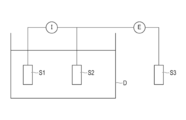
- Coating with an agent was performed, and this was used as a counter electrode (electrode S1).
- electrode S1 a counter electrode
- the following evaluations were made within 24 hours after coating.
- an Ag / AgCl electrode (silver / silver chloride electrode) S3 is used as a reference electrode (standard electrode), and an electrometer (“E" in FIG. 3) is provided between the reference electrode S3 and the electrodes S1 and S2.
- E electrometer
- PBS solution composition: 8.0 g / L NaCl, 0.2 g / L KCl, 1.15 g / L Na 2 HPO 4 , 0.2 g / L KH 2 PO 4 , pH 7.2 to 7.6
- the cell D was placed in a thermostatic bath (not shown), and the temperature of the PBS solution was maintained at 37 ° C. High purity nitrogen gas was bubbled into the PBS solution for 30 minutes or more. Thereafter, the electrodes S1 and S2 prepared above were immersed in a PBS solution. The current flowing between the counter electrode (electrode S1) and the sample electrode (electrode S2) was measured with a non-resistance ammeter (“I” in FIG. 3). The measurement temperature at this time was adjusted to 37 ° C.
- Example 1 Each powder of pure Co, pure Cr, pure W, pure Ni, pure Mn, etc. is weighed, and L605 powder is produced by an atomizing method. Moreover, pure Au powder is prepared. The prepared L605 powder and pure Au both powders are classified, and the L605 powder uses a product that has passed through a 50 ⁇ m sieve, and the Au powder uses a product that has passed through a 10 ⁇ m sieve.
- HIP Hot Isostatic Press
- the rod produced in this way is cut out into a pipe shape by cutting the center. This is cut into a stent pattern by laser processing, and further subjected to chemical polishing and electrolytic polishing to produce a stent.
- the outer diameter is about 1 mm
- the length is about 20 mm
- the thickness is about 50 to 70 ⁇ m.
Landscapes
- Health & Medical Sciences (AREA)
- Chemical & Material Sciences (AREA)
- Veterinary Medicine (AREA)
- Vascular Medicine (AREA)
- Heart & Thoracic Surgery (AREA)
- Life Sciences & Earth Sciences (AREA)
- Animal Behavior & Ethology (AREA)
- General Health & Medical Sciences (AREA)
- Public Health (AREA)
- Engineering & Computer Science (AREA)
- Epidemiology (AREA)
- Surgery (AREA)
- Inorganic Chemistry (AREA)
- Biomedical Technology (AREA)
- Composite Materials (AREA)
- Materials Engineering (AREA)
- Physics & Mathematics (AREA)
- Optics & Photonics (AREA)
- Cardiology (AREA)
- Oral & Maxillofacial Surgery (AREA)
- Transplantation (AREA)
- Media Introduction/Drainage Providing Device (AREA)
Abstract
L'objet de la présente invention est de fournir un stent qui peut être rendu moins épais, est susceptible d'hyper expansion et se décompose dans le corps. La solution selon l'invention concerne ce stent de corrosion galvanique comprenant un frittage qui consiste en un substrat formé à partir d'un premier matériau métallique et d'un second matériau métallique dispersé dans le substrat. Le second matériau métallique est un métal qui est plus noble que le premier matériau métallique. Le stent de corrosion galvanique se décompose sous l'action de la corrosion galvanique après avoir été placé dans le corps.
Applications Claiming Priority (2)
| Application Number | Priority Date | Filing Date | Title |
|---|---|---|---|
| JP2013079323A JP2016105749A (ja) | 2013-04-05 | 2013-04-05 | ガルバニック腐食ステント |
| JP2013-079323 | 2013-04-05 |
Publications (1)
| Publication Number | Publication Date |
|---|---|
| WO2014162902A1 true WO2014162902A1 (fr) | 2014-10-09 |
Family
ID=51658201
Family Applications (1)
| Application Number | Title | Priority Date | Filing Date |
|---|---|---|---|
| PCT/JP2014/057905 Ceased WO2014162902A1 (fr) | 2013-04-05 | 2014-03-20 | Stent de corrosion galvanique |
Country Status (2)
| Country | Link |
|---|---|
| JP (1) | JP2016105749A (fr) |
| WO (1) | WO2014162902A1 (fr) |
Cited By (4)
| Publication number | Priority date | Publication date | Assignee | Title |
|---|---|---|---|---|
| WO2018089697A1 (fr) * | 2016-11-10 | 2018-05-17 | Medtronic Vascular Inc. | Stents formés à partir de métaux dissemblables pour réguler la croissance tissulaire |
| US10500382B2 (en) | 2016-11-10 | 2019-12-10 | Medtronic Vascular, Inc. | Drug-filled stents with filaments for increased lumen surface area and method of manufacture thereof |
| US10779972B2 (en) | 2016-11-10 | 2020-09-22 | Medtronic Vascular, Inc. | Drug-filled stents to prevent vessel micro-injuries and methods of manufacture thereof |
| JP2023553698A (ja) * | 2020-12-17 | 2023-12-25 | フラウンホーファー-ゲゼルシャフト ツゥア フェアデルング デア アンゲヴァンドテン フォァシュング エー.ファウ. | 血管疾患と血管手術の介入治療に使用するステント |
Citations (4)
| Publication number | Priority date | Publication date | Assignee | Title |
|---|---|---|---|---|
| JP2003527931A (ja) * | 2000-03-24 | 2003-09-24 | アドバンスド、カーディオバスキュラー、システムズ、インコーポレーテッド | 放射線不透過性の管腔内ステント |
| JP2005515831A (ja) * | 2002-01-31 | 2005-06-02 | ラディ・メディカル・システムズ・アクチェボラーグ | ステント |
| JP2009537286A (ja) * | 2006-05-19 | 2009-10-29 | メドトロニック ヴァスキュラー インコーポレイテッド | ステントグラフトを固定するための電解腐食方法および装置 |
| JP2009538183A (ja) * | 2006-05-22 | 2009-11-05 | アボット カーディオヴァスキュラー システムズ インコーポレイテッド | 分解可能な医療デバイス |
-
2013
- 2013-04-05 JP JP2013079323A patent/JP2016105749A/ja active Pending
-
2014
- 2014-03-20 WO PCT/JP2014/057905 patent/WO2014162902A1/fr not_active Ceased
Patent Citations (4)
| Publication number | Priority date | Publication date | Assignee | Title |
|---|---|---|---|---|
| JP2003527931A (ja) * | 2000-03-24 | 2003-09-24 | アドバンスド、カーディオバスキュラー、システムズ、インコーポレーテッド | 放射線不透過性の管腔内ステント |
| JP2005515831A (ja) * | 2002-01-31 | 2005-06-02 | ラディ・メディカル・システムズ・アクチェボラーグ | ステント |
| JP2009537286A (ja) * | 2006-05-19 | 2009-10-29 | メドトロニック ヴァスキュラー インコーポレイテッド | ステントグラフトを固定するための電解腐食方法および装置 |
| JP2009538183A (ja) * | 2006-05-22 | 2009-11-05 | アボット カーディオヴァスキュラー システムズ インコーポレイテッド | 分解可能な医療デバイス |
Cited By (6)
| Publication number | Priority date | Publication date | Assignee | Title |
|---|---|---|---|---|
| WO2018089697A1 (fr) * | 2016-11-10 | 2018-05-17 | Medtronic Vascular Inc. | Stents formés à partir de métaux dissemblables pour réguler la croissance tissulaire |
| CN109922762A (zh) * | 2016-11-10 | 2019-06-21 | 美敦力瓦斯科尔勒公司 | 用于控制组织生长的由异种金属形成的支架 |
| US10500382B2 (en) | 2016-11-10 | 2019-12-10 | Medtronic Vascular, Inc. | Drug-filled stents with filaments for increased lumen surface area and method of manufacture thereof |
| US10617540B2 (en) | 2016-11-10 | 2020-04-14 | Medtronic Vascular, Inc. | Stents formed from dissimilar metals for tissue growth control |
| US10779972B2 (en) | 2016-11-10 | 2020-09-22 | Medtronic Vascular, Inc. | Drug-filled stents to prevent vessel micro-injuries and methods of manufacture thereof |
| JP2023553698A (ja) * | 2020-12-17 | 2023-12-25 | フラウンホーファー-ゲゼルシャフト ツゥア フェアデルング デア アンゲヴァンドテン フォァシュング エー.ファウ. | 血管疾患と血管手術の介入治療に使用するステント |
Also Published As
| Publication number | Publication date |
|---|---|
| JP2016105749A (ja) | 2016-06-16 |
Similar Documents
| Publication | Publication Date | Title |
|---|---|---|
| US7641983B2 (en) | Medical devices including composites | |
| US9402936B2 (en) | Medical devices having alloy compositions | |
| US9279186B2 (en) | Metal member manufacturing method and metal member | |
| US20080097577A1 (en) | Medical device hydrogen surface treatment by electrochemical reduction | |
| US20100191318A1 (en) | Medical devices | |
| EP2039378A3 (fr) | Alliages de nitinol radiopaque pour dispositifs médicaux | |
| JP2018016888A (ja) | ステント用の放射線不透過性強化コバルト合金 | |
| WO2014162902A1 (fr) | Stent de corrosion galvanique | |
| US20060224231A1 (en) | Endoprostheses | |
| JP6167367B2 (ja) | ステント用の放射線不透過性強化ニッケル合金 | |
| US20160015540A1 (en) | Stent | |
| Woodward | Final Analysis: Palladium in Temporary and Permanently Implantable Medical Devices | |
| US10736995B2 (en) | Bioresorbable medical devices and method of manufacturing the same | |
| US20070073374A1 (en) | Endoprostheses including nickel-titanium alloys | |
| WO2016152908A1 (fr) | Implant médical comprenant un alliage à base de zinc, et procédé pour le produire | |
| WO2016152909A1 (fr) | Implant médical comprenant un alliage à base de zinc | |
| JP6122837B2 (ja) | ステント | |
| EP2844311B1 (fr) | Dispositifs médicaux biorésorbables et leur procédé de fabrication | |
| WO2014162903A1 (fr) | Stent a corrosion galvanique | |
| Gorejová et al. | Ori nak, A.; Ori naková, R. Corrosion Behavior of Zn, Fe and Fe-Zn Powder Materials Prepared via Uniaxial Compression. Materials 2021, 14, 4983 | |
| JP2022049329A (ja) | 医療用複合材料 | |
| Major et al. | Development of coronary stents using advanced results of materials science and technology |
Legal Events
| Date | Code | Title | Description |
|---|---|---|---|
| 121 | Ep: the epo has been informed by wipo that ep was designated in this application |
Ref document number: 14778262 Country of ref document: EP Kind code of ref document: A1 |
|
| NENP | Non-entry into the national phase |
Ref country code: DE |
|
| 122 | Ep: pct application non-entry in european phase |
Ref document number: 14778262 Country of ref document: EP Kind code of ref document: A1 |
|
| NENP | Non-entry into the national phase |
Ref country code: JP |