WO2014167056A1 - Fluides de fracturation a base de polymeres associatifs et de tensioactifs labiles - Google Patents
Fluides de fracturation a base de polymeres associatifs et de tensioactifs labiles Download PDFInfo
- Publication number
- WO2014167056A1 WO2014167056A1 PCT/EP2014/057275 EP2014057275W WO2014167056A1 WO 2014167056 A1 WO2014167056 A1 WO 2014167056A1 EP 2014057275 W EP2014057275 W EP 2014057275W WO 2014167056 A1 WO2014167056 A1 WO 2014167056A1
- Authority
- WO
- WIPO (PCT)
- Prior art keywords
- fracturing fluid
- surfactant
- radical polymerization
- polymers
- labile
- Prior art date
- Legal status (The legal status is an assumption and is not a legal conclusion. Google has not performed a legal analysis and makes no representation as to the accuracy of the status listed.)
- Ceased
Links
Classifications
-
- C—CHEMISTRY; METALLURGY
- C09—DYES; PAINTS; POLISHES; NATURAL RESINS; ADHESIVES; COMPOSITIONS NOT OTHERWISE PROVIDED FOR; APPLICATIONS OF MATERIALS NOT OTHERWISE PROVIDED FOR
- C09K—MATERIALS FOR MISCELLANEOUS APPLICATIONS, NOT PROVIDED FOR ELSEWHERE
- C09K8/00—Compositions for drilling of boreholes or wells; Compositions for treating boreholes or wells, e.g. for completion or for remedial operations
- C09K8/60—Compositions for stimulating production by acting on the underground formation
- C09K8/602—Compositions for stimulating production by acting on the underground formation containing surfactants
-
- C—CHEMISTRY; METALLURGY
- C09—DYES; PAINTS; POLISHES; NATURAL RESINS; ADHESIVES; COMPOSITIONS NOT OTHERWISE PROVIDED FOR; APPLICATIONS OF MATERIALS NOT OTHERWISE PROVIDED FOR
- C09K—MATERIALS FOR MISCELLANEOUS APPLICATIONS, NOT PROVIDED FOR ELSEWHERE
- C09K8/00—Compositions for drilling of boreholes or wells; Compositions for treating boreholes or wells, e.g. for completion or for remedial operations
- C09K8/60—Compositions for stimulating production by acting on the underground formation
- C09K8/62—Compositions for forming crevices or fractures
- C09K8/66—Compositions based on water or polar solvents
- C09K8/68—Compositions based on water or polar solvents containing organic compounds
-
- C—CHEMISTRY; METALLURGY
- C09—DYES; PAINTS; POLISHES; NATURAL RESINS; ADHESIVES; COMPOSITIONS NOT OTHERWISE PROVIDED FOR; APPLICATIONS OF MATERIALS NOT OTHERWISE PROVIDED FOR
- C09K—MATERIALS FOR MISCELLANEOUS APPLICATIONS, NOT PROVIDED FOR ELSEWHERE
- C09K8/00—Compositions for drilling of boreholes or wells; Compositions for treating boreholes or wells, e.g. for completion or for remedial operations
- C09K8/60—Compositions for stimulating production by acting on the underground formation
- C09K8/84—Compositions based on water or polar solvents
- C09K8/86—Compositions based on water or polar solvents containing organic compounds
- C09K8/88—Compositions based on water or polar solvents containing organic compounds macromolecular compounds
-
- C—CHEMISTRY; METALLURGY
- C09—DYES; PAINTS; POLISHES; NATURAL RESINS; ADHESIVES; COMPOSITIONS NOT OTHERWISE PROVIDED FOR; APPLICATIONS OF MATERIALS NOT OTHERWISE PROVIDED FOR
- C09K—MATERIALS FOR MISCELLANEOUS APPLICATIONS, NOT PROVIDED FOR ELSEWHERE
- C09K8/00—Compositions for drilling of boreholes or wells; Compositions for treating boreholes or wells, e.g. for completion or for remedial operations
- C09K8/60—Compositions for stimulating production by acting on the underground formation
- C09K8/84—Compositions based on water or polar solvents
- C09K8/86—Compositions based on water or polar solvents containing organic compounds
- C09K8/88—Compositions based on water or polar solvents containing organic compounds macromolecular compounds
- C09K8/882—Compositions based on water or polar solvents containing organic compounds macromolecular compounds obtained by reactions only involving carbon-to-carbon unsaturated bonds
-
- C—CHEMISTRY; METALLURGY
- C09—DYES; PAINTS; POLISHES; NATURAL RESINS; ADHESIVES; COMPOSITIONS NOT OTHERWISE PROVIDED FOR; APPLICATIONS OF MATERIALS NOT OTHERWISE PROVIDED FOR
- C09K—MATERIALS FOR MISCELLANEOUS APPLICATIONS, NOT PROVIDED FOR ELSEWHERE
- C09K8/00—Compositions for drilling of boreholes or wells; Compositions for treating boreholes or wells, e.g. for completion or for remedial operations
- C09K8/60—Compositions for stimulating production by acting on the underground formation
- C09K8/84—Compositions based on water or polar solvents
- C09K8/86—Compositions based on water or polar solvents containing organic compounds
- C09K8/88—Compositions based on water or polar solvents containing organic compounds macromolecular compounds
- C09K8/90—Compositions based on water or polar solvents containing organic compounds macromolecular compounds of natural origin, e.g. polysaccharides, cellulose
-
- E—FIXED CONSTRUCTIONS
- E21—EARTH OR ROCK DRILLING; MINING
- E21B—EARTH OR ROCK DRILLING; OBTAINING OIL, GAS, WATER, SOLUBLE OR MELTABLE MATERIALS OR A SLURRY OF MINERALS FROM WELLS
- E21B43/00—Methods or apparatus for obtaining oil, gas, water, soluble or meltable materials or a slurry of minerals from wells
- E21B43/16—Enhanced recovery methods for obtaining hydrocarbons
-
- E—FIXED CONSTRUCTIONS
- E21—EARTH OR ROCK DRILLING; MINING
- E21B—EARTH OR ROCK DRILLING; OBTAINING OIL, GAS, WATER, SOLUBLE OR MELTABLE MATERIALS OR A SLURRY OF MINERALS FROM WELLS
- E21B43/00—Methods or apparatus for obtaining oil, gas, water, soluble or meltable materials or a slurry of minerals from wells
- E21B43/25—Methods for stimulating production
- E21B43/26—Methods for stimulating production by forming crevices or fractures
-
- E—FIXED CONSTRUCTIONS
- E21—EARTH OR ROCK DRILLING; MINING
- E21B—EARTH OR ROCK DRILLING; OBTAINING OIL, GAS, WATER, SOLUBLE OR MELTABLE MATERIALS OR A SLURRY OF MINERALS FROM WELLS
- E21B43/00—Methods or apparatus for obtaining oil, gas, water, soluble or meltable materials or a slurry of minerals from wells
- E21B43/25—Methods for stimulating production
- E21B43/26—Methods for stimulating production by forming crevices or fractures
- E21B43/267—Methods for stimulating production by forming crevices or fractures reinforcing fractures by propping
Definitions
- the present invention relates to the field of fracturing techniques employed in the context of petroleum extraction.
- Hydraulic fracturing is a technique commonly used in the recovery of oil and gas in hydrocarbon reservoirs, which aims to create fractures within the reservoir to increase the exchange interfaces between the extraction fluids and hydrocarbons contained in the tank.
- Fracturing generally involves high-pressure injection of aqueous fracturing fluids comprising polymers imparting to the fluid a high viscosity.
- aqueous fracturing fluids comprising polymers imparting to the fluid a high viscosity.
- the injection of these fluids into hydrocarbon reservoirs generally implies the implementation of considerable pressures which, on the one hand, involve energy expenditure. in terms of pumping and on the other hand can degrade polymers under the effect of shearing.
- a fracturing fluid is injected from the surface into a hydrocarbon reservoir over distances of the order of a few thousand meters.
- An object of the present invention is to provide fracturing fluids based on viscous polymers which have an efficiency similar to known fluids, but which are more easily injectable, allowing among others to reduce the energy required for their injection, and for in which the degradation phenomena of the viscosifying polymers under shear are preferably reduced or even zero.
- fracturing fluid which comprises, in an aqueous medium:
- the subject of the present invention is a fracturing fluid comprising, in an aqueous medium:
- a labile surfactant in an amount sufficient to reduce or inhibit the effect of increasing the viscosity induced by said associative polymers.
- the invention relates to the use of the aforementioned fluids as a fracturing fluid.
- the invention particularly relates to a hydrocarbon recovery process in a hydrocarbon reservoir, comprising a step or a fracturing fluid of the aforementioned type is injected into a hydrocarbon reservoir where the temperature conditions and / or pH are able to lyse all or part of the labile surfactant.
- sociative polymer is meant, in the sense of the present description, a polymer capable of increasing the viscosity of an aqueous medium by associations involving hydrophobic-hydrophobic interactions between the polymers.
- Such polymers are also sometimes referred to as “hydrophobically associative water-soluble polymers” (PHAs) or “amphiphilic polymers”. They are generally polymers having a backbone of hydrophilic nature and including, along the chains and / or all or part of the ends thereof, small amounts (typically of the order of 0.001% to 10% by mole, and usually a few mol% or less) of functions of hydrophobic nature.
- labile surfactant (or “cleavable surfactant” in English) here denotes a surfactant that is capable of lysing, typically by cleaving into two distinct molecules, under conditions of pH and temperature where at least some of the associative polymers with which it is associated in the composition are not degraded.
- the cleavable surfactant used according to the invention are tensiaoctives which degrade after injection, under conditions in which the associative polymers are not degraded.
- Labile surfactants of this type are well known in the literature. For more details, refer to "Cleavable surfactants" Alireza Tehran-Bagha, Krister Holm.
- a labile surfactant confers on the fracturing fluid according to the invention the advantages of known fracturing fluids by overcoming their disadvantages. Indeed, due to the presence of this labile surfactant, the fracturing fluid has, when it is injected, a reduced viscosity which facilitates its injection, and the viscosity is restored in the area where it is desired to perform the fracturing.
- the lowering of the viscosity obtained by the presence of the labile surfactant makes it possible to substantially reduce the phenomena of pressure drop and, in the case where polymers which are sensitive to degradation are used, a decrease in the degradation of the polymers under shear.
- the nature of the associative polymers present in the fracturing fluids of the present invention is very flexible.
- the fracturing fluids of the invention may advantageously comprise, as associative polymers, amphiphilic polymers of relatively low molecular weight (for example less than 1,000,000 g / mol or even 500,000 g / mol). g / mol, for example less than 100,000 g / mol) which make it possible to induce high viscosities after lysis of the labile surfactant, and this from relatively low concentrations, and which are also less sensitive to degradation under shear than polymers of larger size.
- amphiphilic polymers of relatively low molecular weight for example less than 1,000,000 g / mol or even 500,000 g / mol.
- g / mol for example less than 100,000 g / mol
- the labile surfactant present in the compositions of the invention makes it possible to improve the hydration of the polymers in an aqueous medium, which makes it possible to use in the compositions the invention any type of associative polymer, including those deemed least hydratable.
- the invention thus opens the way for the use of many amphiphilic polymers in fracturing liquids.
- the fracturing method described here is extremely flexible.
- concentrations of the two compounds it is within the skill of the person skilled in the art to adjust the concentrations of the two compounds to obtain the desired viscosity evolution profile.
- the associative polymers and the surfactants interact according to a known mechanism, described in particular in "Interactions between hydrophobically modified polymers and surfactants" B. Magny, I. Iliopoulos, R. Audebert, L. Piculell, B. Lindman Progress in Colloid & Polymer Science Volume 89, 1992, pp. 18- 121.
- the interactions between associative polymers and surfactants vary in a manner known per se as a function of the surfactant content. When a very small amount of surfactants is added, this small amount of surfactant densifies the number of hydrophobic bonds, which increases the viscosity.
- the viscosity With a low surfactant content, the viscosity thus increases to a maximum as surfactant is added. Beyond the limiting surfactant content for which this maximum is observed, the trend is reversed and the addition of surfactant is instead decreasing more and more the interactions between the polymers and therefore the viscosity. For any pair of surfactant and polymer, there is a minimum concentration of surfactant beyond which there is obtained a systematic decrease in viscosity, this minimum concentration being very easy to determine.
- the surfactant and the polymer and their respective concentrations are chosen so that a low viscosity is maintained from the surface to the zone where it is desired to carry out the fracturing and the viscosity rise due to lysis of the surfactant preferably occurs just before penetration into the fracturing zone.
- the associative polymers used in the context of the present invention generally induce the rheological properties of the fracturing fluid which make it suitable for ensuring effective control of the fracturing.
- the particular rheology of the fracturing fluids of the invention are in addition generally very well adapted to effectively convey suspension proppants.
- These proppants also called “proppant” in English
- the associative polymers used in the fracturing fluids of the invention have the advantage of being able to be used in the presence of salts (the presence of salts generally improves their associative nature), which allows the use water immediately available in the environment close to the extraction zone without having to worry about its purity or its salt content.
- the associative polymers of the invention constitute in this an interesting alternative to the polymers usually used in fracturing of the polysaccharide type (such as guars crosslinked with borate or zirconate, for which the quality of the water used is decisive).
- the invention lends itself well to the formulation of fracturing fluids based on seawater or production water and more generally any water that may contain salts (including high levels that may up to 25% by weight and / or with significant hardness up to levels of Mg 2+ and Ca 2+ of the order of 5000 ppm): according to a particular mode, the fracturing fluid of the The invention comprises seawater or production water as an aqueous medium.
- the polymers used according to the invention can vary to a large extent.
- they may be associative polymers based on a hydrophilic backbone carrying hydrophobic groups of the type obtained by the synthesis routes of the HASE (direct synthetic route) or HEUR (post addition of hydrophobic groups on a hydrophilic chain). Examples of synthesis of this type are described in particular in Prog. Color Coat Dyes. Vol 4, pp. 71-77 (201 1). It is also possible to use associative polymers resulting from processes known
- aqueous dispersing medium typically water or a water / alcohol mixture
- hydrophilic monomers in the solubilized or dispersed state in said medium
- the hydrophobic monomers present within micelles of surfactants employed in micellar polymerization may be monomers which, in themselves, have the property of forming micelles without the need to add additional surfactants (so-called “auto-monomers”). -micellizable “in the following description).
- the surfactant employed can be the self-micellizable hydrophobic monomer itself, employed without any other surfactant, although the presence of such an additional surfactant is not excluded.
- hydrophobic monomers within surfactant micelles this concept also encompasses (i) hydrophobic monomers present in surfactant micelles other than these monomers (ii) ) monomers comprising at least one part or a hydrophobic block and forming by themselves the micelles in an aqueous medium.
- the two modes (i) and (ii) above are compatible and can coexist (hydrophobic monomers in micelles formed by another self-micellizable monomer for example, or else micelles comprising a combination of surfactants and self-micellizable monomers) .
- micellar solution In micellar polymerization, the hydrophobic monomers contained in the micelles are called "micellar solution".
- the micellar solution to which reference is made is a micro-heterogeneous system which is generally isotropic, optically transparent and thermodynamically stable.
- the associative polymers used according to the present invention are polymers obtained according to a process of which comprises a step (E) micellar radical polymerization in which is placed in contact, within an aqueous medium (M ):
- hydrophilic monomers solubilized or dispersed in said aqueous medium (M); hydrophobic monomers in the form of a micellar solution, namely containing, in the dispersed state within the medium (M), micelles comprising these hydrophobic monomers (this dispersed state can in particular be obtained by means of at least one surfactant); at least one radical polymerization initiator, this initiator being typically water-soluble or water-dispersible; and
- At least one radical polymerization control agent at least one radical polymerization control agent.
- the aqueous medium (M) used in step (E) is a medium comprising water, preferably at least 50% by weight, or even at least 80%, for example at least 90%, or even at least 95%.
- This aqueous medium may optionally comprise other solvents than water, for example a water-miscible alcohol.
- the medium (M) may be, for example, a hydroalcoholic mixture.
- the medium (M) may comprise other solvents, preferably at a concentration where said solvent is miscible with water, which may in particular make it possible to reduce the amount of stabilizing surfactants employed.
- the medium (M) may comprise pentanol, or any other additive for modulating the aggregation number of the surfactants.
- the medium (M) is a continuous phase of water and consisting of one or more solvents and / or additives that are miscible with each other and in water at the concentrations in which they are used.
- radiation polymerization control agent is meant, in the sense of the present description, a compound capable of extending the life of the growing polymer chains in a polymerization reaction and to confer on the polymerization a living or controlled character .
- This control agent is typically a reversible transfer agent as implemented in the controlled radical polymerizations designated under the terminology RAFT or MADIX, which typically implement a method of transfer reversible addition-fragmentation, such as those described for example in WO96 / 30421, WO 98/01478, WO 99/35178, WO 98/58974, WO 00/75207, WO 01/42312, WO 99/35177, WO 99/31144, FR2794464 or WO 02/26836.
- a suitable xanthate is Rhodixan A1 available from Solvay.
- other types of control agent may be considered (eg of the type used in CRP or ATRP).
- control agent employed in step (E) may be a polymer chain resulting from a controlled radical polymerization and carrying a group capable of controlling a radical polymerization (so-called "living" polymer chain ", Of a type well known in itself).
- This polymer capable of acting both as a control agent for the polymerization and as a monomer in step (E), is also referred to as "prepolymer" in the following description.
- the control agent used in step (E) may advantageously be a prepolymer carrying a thiocarbonylthio-S group.
- step (E °) prior to step (E) schematically allows to hydrophilize a large number of control agents carrying thiocarbonylthio functions (for example xanthate, which are rather hydrophobic by nature), by converting soluble or dispersible pre-polymers into the medium (M) of step (E).
- a pre-polymer synthesized in step (E °) has a short polymer chain, for example comprising a sequence of less than 50, or less than 25 monomer units, for example between 2 and 15.
- step (E) make it possible to combine the advantages of both controlled radical polymerization and micellar polymerization.
- the inventors have in particular now demonstrated that the presence of micelles in the polymerization medium does not affect the action of the control agents, which make it possible to carry out a controlled polymerization of the monomers present in the aqueous medium.
- a controlled radical polymerization carried out in a homogeneous medium which makes it possible to predict and control very easily the average molecular weight of the polymer synthesized (this mass is even higher than the initial concentration of control agent in the medium is low, this concentration dictates the number of growing polymer chains).
- the presence of the control agent does not impair the interesting effect observed in polymerization, namely the precise control of the size of the hydrophobic blocks.
- step (E) of the process of the invention also makes it possible, in a totally surprising manner, to access to polymers of both high and controlled size, which is particularly surprising in view of the maximum sizes that are known today by employing controlled radical polymerization methods or micellar radical polymerization in 1 absence of screening officers.
- step (E) it proves possible to control the number-average molecular weight of the polymers, which makes it possible, inter alia, to produce polymers of small masses.
- the associative polymer present in the fracturing fluid of the invention is synthesized according to the above-mentioned step (E) and has a mass of between 50 000 and 10 000 000, preferably between 750 000 and 5,000,000 g / mol, especially between 1,000,000 and 4,000,000 g / mol.
- such polymers may be employed in concentration lower than their critical recovery concentration. Because of their small sizes, such polymers can diffuse at the interfaces and participate in modifying the properties of these interfaces or surfaces.
- the associative polymer of the fracturing fluids according to the invention is typically present in an amount of from 0.1% to 3%, preferably from 0.2% to 1.5%, preferably from 0.3% to 0.3% by weight. % and 1%, by mass relative to the total mass of the fracturing fluid.
- the labile surfactants employed in the context of the invention are surfactants which have groups having an affinity for the hydrophobic groups present on the associative polymers and, on the other hand, hydrophilic chains.
- these are water-soluble surfactants.
- cleavable function is advantageously an ester function.
- the labile surfactants present in the fracturing fluids of the invention are nonionic surfactants. It may also be surfactants having the structure of nonionic surfactants, but optionally carrying functionalized group, optionally charged, end chain.
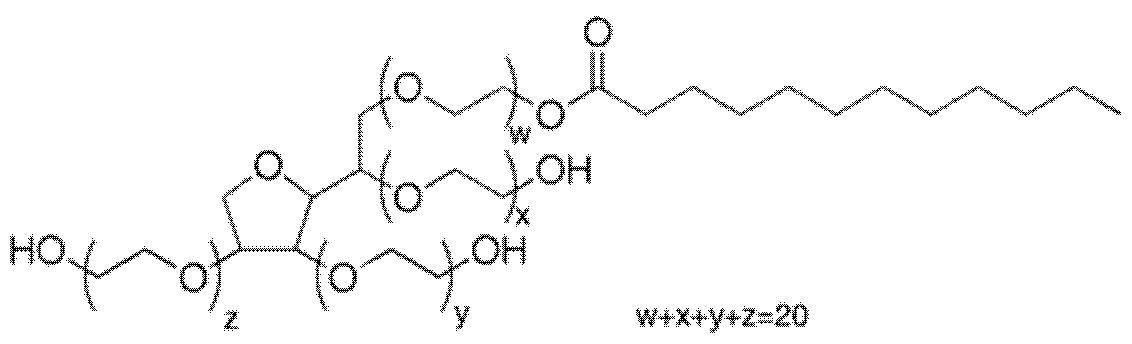
- these labile surfactants comprise ethoxylated fatty acid esters, typically having the formula R-COO- (CH 2 -CH 2 -O-) nH, where R is a linear or branched, preferably linear, hydrocarbon chain. , typically an alkyl having from 4 to 22 carbon atoms, for example from 5 to 18.
- a surfactant which is well adapted to the invention is, for example, Alkamuls PSML20 (also called polysorbate 20), of the following formula:
- the fracturing fluid may comprise regulating agents or pH control, including buffers, bases or acids.
- regulating agents or pH control including buffers, bases or acids.
- it will preferably be placed in a pH range close to neutral (between 6 and 8, more preferably between 6.5 and 7.5 if it is desired that the viscosity increases slowly.
- acidic conditions for example less than 4 or even 3
- basic greater than 9, or even 10.
- the injected composition may further comprise one or more amphiphilic compounds called "breaker", capable of lowering the viscosity in the fractured zones, after the fracturing has been performed.
- breaker amphiphilic compounds
- breakers are typically non-labile surfactants introduced into the formulation in an encapsulated form.
- surfactants in the form of granules which are coated with a protective film of wax, typically by fluidized bed coating.
- the fracturing fluid contains encapsulated-type breaker-type surfactants, these are generally ineffective until the end of the fracturing operation (they are simply carried by the fracturing fluid, and their encapsulation makes them initially chemically inert).
- the capsules are found in the fractures, where they are subjected to the pressure of the fracture which tends to close, and they are found "crushed", especially when proppants are present. This induces release of the surfactants, which then become suitable for interacting with the associative polymers to reduce the viscosity.
- breakers thus makes it possible to release the fractures of the gelled composition that it contains following the fracturing (thus, the increase in the viscosity (formation of a gel) takes place only occasionally during the fracturing, namely between the lysis of the labile surfactant and the release of the non-labile surfactant, which makes it possible to further minimize the pumping energy
- Another advantage is that this makes it possible to reduce the time before putting the well into production.
- micellar solution In a 500 ml flask, 29.3 g of a 30% SDS solution, 89.03 g of distilled water, 1.66 g of lauryl methacrylamide (monomer) were introduced at room temperature (20 ° C.). AML). The mixture was stirred with a magnetic bar for 6 hours, until a clear micellar solution was obtained.
- micellar solution thus prepared, 7.53 g of water and 40.7 g of acrylamide (50% aqueous solution) were introduced at room temperature (20 ° C.). mass), 32 g AMPS (51% by weight aqueous solution), 0.454 g of Rhodixan A1 (ethanol solution at 1.0% by weight) and 6.00 g of ammonium persulfate (aqueous solution at 0.67% by weight). ).
- the mixture was degassed by bubbling nitrogen for 20 minutes.
- the polymerization reaction was then allowed to proceed with stirring for 16 hours at room temperature (20 ° C).
- the polymer prepared above was dissolved in 0.5% by weight of polymer in an aqueous solution of NaCl at 15% by weight in the presence of surfactant Alkamuls PSML20 at different concentrations.
- Example 1 The polymer of Example 1 was dissolved in 0.5% wt in 15% NaCl in the presence of 0.5% Alkamuls PSML20. Soda is added to obtain a concentration of 83mmol / L. The viscosity of the solution thus obtained is 10cP at 25 ° C (at 1 s -1 ).
- the solution was placed in an oven at 80 ° C. for 16 hours. At the end of this treatment, the viscosity of the solution was measured equal to 4200cP at 1 s -1 (against 3600cP for a solution of polymer without surfactant obtained after hydration by heating for 4 hours at 80 ° C).
Landscapes
- Life Sciences & Earth Sciences (AREA)
- Engineering & Computer Science (AREA)
- Chemical & Material Sciences (AREA)
- General Life Sciences & Earth Sciences (AREA)
- Mining & Mineral Resources (AREA)
- Geology (AREA)
- Materials Engineering (AREA)
- Organic Chemistry (AREA)
- Fluid Mechanics (AREA)
- Environmental & Geological Engineering (AREA)
- Physics & Mathematics (AREA)
- Geochemistry & Mineralogy (AREA)
- Chemical Kinetics & Catalysis (AREA)
- Addition Polymer Or Copolymer, Post-Treatments, Or Chemical Modifications (AREA)
- Polymerisation Methods In General (AREA)
Abstract
Description
Claims
Priority Applications (6)
| Application Number | Priority Date | Filing Date | Title |
|---|---|---|---|
| CA2907962A CA2907962C (fr) | 2013-04-11 | 2014-04-10 | Fluides de fracturation a base de polymeres associatifs et de tensioactifs labiles |
| US14/783,727 US10323175B2 (en) | 2013-04-11 | 2014-04-10 | Fracturing fluids based on associative polymers and on labile surfactants |
| AU2014253058A AU2014253058B2 (en) | 2013-04-11 | 2014-04-10 | Fracturing fluids based on associative polymers and on labile surfactants |
| CN201480021955.3A CN105143392B (zh) | 2013-04-11 | 2014-04-10 | 基于缔合聚合物并且基于不稳定表面活性剂的压裂液 |
| EP14716815.7A EP2984149B1 (fr) | 2013-04-11 | 2014-04-10 | Fluides de fracturation a base de polymeres associatifs et de tensioactifs labiles |
| RU2015148196A RU2673832C2 (ru) | 2013-04-11 | 2014-04-10 | Жидкости для гидроразрыва на основе ассоциативных полимеров и лабильных поверхностно-активных средств |
Applications Claiming Priority (2)
| Application Number | Priority Date | Filing Date | Title |
|---|---|---|---|
| FR1300864A FR3004458A1 (fr) | 2013-04-11 | 2013-04-11 | Fluides de fracturation a base de polymeres associatifs et de tensioactifs labiles |
| FR13/00864 | 2013-04-11 |
Publications (1)
| Publication Number | Publication Date |
|---|---|
| WO2014167056A1 true WO2014167056A1 (fr) | 2014-10-16 |
Family
ID=48613717
Family Applications (1)
| Application Number | Title | Priority Date | Filing Date |
|---|---|---|---|
| PCT/EP2014/057275 Ceased WO2014167056A1 (fr) | 2013-04-11 | 2014-04-10 | Fluides de fracturation a base de polymeres associatifs et de tensioactifs labiles |
Country Status (8)
| Country | Link |
|---|---|
| US (1) | US10323175B2 (fr) |
| EP (1) | EP2984149B1 (fr) |
| CN (1) | CN105143392B (fr) |
| AU (1) | AU2014253058B2 (fr) |
| CA (1) | CA2907962C (fr) |
| FR (1) | FR3004458A1 (fr) |
| RU (1) | RU2673832C2 (fr) |
| WO (1) | WO2014167056A1 (fr) |
Cited By (10)
| Publication number | Priority date | Publication date | Assignee | Title |
|---|---|---|---|---|
| WO2016193442A1 (fr) * | 2015-06-03 | 2016-12-08 | Rhodia Operations | Agents de suspension obtenus par polymérisation micellaire |
| WO2016193334A1 (fr) * | 2015-06-03 | 2016-12-08 | Rhodia Operations | Polymeres amphiphiles pour le controle du filtrat |
| US10012064B2 (en) | 2015-04-09 | 2018-07-03 | Highlands Natural Resources, Plc | Gas diverter for well and reservoir stimulation |
| US10053616B2 (en) | 2015-04-09 | 2018-08-21 | Saudi Arabian Oil Company | Encapsulated nanocompositions for increasing hydrocarbon recovery |
| US10125307B2 (en) | 2016-01-13 | 2018-11-13 | Saudi Arabian Oil Company | Stabilization of petroleum surfactants for enhancing oil recovery |
| WO2019121298A1 (fr) * | 2017-12-19 | 2019-06-27 | Rhodia Operations | Formulations aqueuses de tensioactifs et polymeres associatifs pour la recuperation assistee du petrole |
| US10344204B2 (en) | 2015-04-09 | 2019-07-09 | Diversion Technologies, LLC | Gas diverter for well and reservoir stimulation |
| US20200407480A1 (en) * | 2015-10-30 | 2020-12-31 | Rhodia Operations | Amphiphilic block polymers soluble in strongly saline medium |
| US10982520B2 (en) | 2016-04-27 | 2021-04-20 | Highland Natural Resources, PLC | Gas diverter for well and reservoir stimulation |
| US11485901B2 (en) * | 2016-11-29 | 2022-11-01 | Rhodia Operations | Polymeric systems for particle dispersion |
Families Citing this family (8)
| Publication number | Priority date | Publication date | Assignee | Title |
|---|---|---|---|---|
| FR3063292B1 (fr) * | 2017-02-24 | 2020-01-31 | S.P.C.M. Sa | Suspension polyphasique de polymere et son utilisation |
| US11203923B2 (en) | 2017-04-21 | 2021-12-21 | Halliburton Energy Services, Inc. | Associative polymer fluid with clay nanoparticles for proppant suspension |
| WO2019126255A1 (fr) * | 2017-12-20 | 2019-06-27 | Rhodia Operations | Systèmes polymères pour dispersion de particules |
| FR3079833B1 (fr) * | 2018-04-10 | 2020-10-09 | Rhodia Operations | Composition aqueuse gelifiee pour l'extraction petroliere |
| US20200199443A1 (en) * | 2018-12-19 | 2020-06-25 | Rhodia Operations | Polymeric systems for particle dispersion |
| WO2022170041A1 (fr) * | 2021-02-04 | 2022-08-11 | Aramco Services Company | Mise au point d'un additif réducteur de frottement à base d'un copolymère séquencé ramifié de masse moléculaire très élevée (uhmw) présentant une stabilité mécanique et chimique améliorée |
| US11840662B2 (en) | 2021-02-04 | 2023-12-12 | Saudi Arabian Oil Company | Development of ultra-high molecular weight (UHMW) branched block copolymer shale inhibitor for water based drilling fluid |
| US12043787B2 (en) | 2021-02-04 | 2024-07-23 | Saudi Arabian Oil Company | Ultra-high molecular weight (UHMW) branched block copolymer viscosifier for water based drilling fluids |
Citations (3)
| Publication number | Priority date | Publication date | Assignee | Title |
|---|---|---|---|---|
| GB2383355A (en) * | 2001-12-22 | 2003-06-25 | Schlumberger Holdings | An aqueous viscoelastic fluid containing hydrophobically modified polymer and viscoelastic surfactant |
| US20050065038A1 (en) * | 2003-09-24 | 2005-03-24 | Weaver Jimmie D. | Methods and compositions for treating subterranean formations |
| US20120135895A1 (en) * | 2010-11-30 | 2012-05-31 | Halliburton Energy Services, Inc. | Compositions and Methods Relating to the Stabilization of Hydrophobically Modified Hydrophilic Polymer Treatment Fluids Under Alkaline Conditions |
Family Cites Families (32)
| Publication number | Priority date | Publication date | Assignee | Title |
|---|---|---|---|---|
| US4432881A (en) | 1981-02-06 | 1984-02-21 | The Dow Chemical Company | Water-dispersible hydrophobic thickening agent |
| US4814096A (en) | 1981-02-06 | 1989-03-21 | The Dow Chemical Company | Enhanced oil recovery process using a hydrophobic associative composition containing a hydrophilic/hydrophobic polymer |
| US4529523A (en) | 1982-06-08 | 1985-07-16 | Hercules Incorporated | Hydrophobically modified polymers |
| WO1987001758A1 (fr) * | 1985-09-16 | 1987-03-26 | The Dow Chemical Company | Procede et compositions de fracturation hydraulique |
| US4921902A (en) | 1984-02-02 | 1990-05-01 | The Dow Chemical Company | Hydrophobie associative composition containing a polymer of a water-soluble monomer and an amphiphilic monomer |
| US4638865A (en) | 1985-05-30 | 1987-01-27 | The Standard Oil Company | Bioresistant water-soluble alkyl substituted acrylamide polymers and enhanced oil recovery method employing same |
| US4780517A (en) | 1985-08-15 | 1988-10-25 | Chevron Research Company | Surfactant-containing water thickening polymer |
| US4702319A (en) | 1986-12-29 | 1987-10-27 | Exxon Research And Engineering Company | Enhanced oil recovery with hydrophobically associating polymers containing sulfonate functionality |
| US4709759A (en) | 1986-12-29 | 1987-12-01 | Exxon Research And Engineering Company | Enhanced oil recovery with hydrophobically associating polymers containing N-vinyl-pyrrolidone functionality |
| US4861499A (en) | 1987-10-13 | 1989-08-29 | American Cyanamid Company | Water-dispersible hydrophobic thickening agent |
| US4852652A (en) | 1988-05-24 | 1989-08-01 | Chevron Research Company | Chemical flooding with improved injectivity |
| US5763548A (en) | 1995-03-31 | 1998-06-09 | Carnegie-Mellon University | (Co)polymers and a novel polymerization process based on atom (or group) transfer radical polymerization |
| TW331569B (en) * | 1995-12-29 | 1998-05-11 | Mitsui Petroleum Chemicals Ind | Unsaturated copolymer based on olefin and production and use |
| EP0910587B1 (fr) | 1996-07-10 | 2001-12-12 | E.I. Du Pont De Nemours And Company | Polymerisation presentant des caracteristiques vivantes |
| FR2764892B1 (fr) | 1997-06-23 | 2000-03-03 | Rhodia Chimie Sa | Procede de synthese de polymeres a blocs |
| ES2277678T3 (es) | 1997-12-18 | 2007-07-16 | E.I. Du Pont De Nemours And Company | Proceso de polimerizacion con caracteristicas vivientes y polimeros obtenidos mediante este proceso. |
| US6812291B1 (en) | 1997-12-31 | 2004-11-02 | Rhodia Chimie | Method for block polymer synthesis by controlled radical polymerization from dithiocarbamate compounds |
| FR2773161B1 (fr) | 1997-12-31 | 2000-01-21 | Rhodia Chimie Sa | Procede de synthese de polymeres a blocs |
| SE512220C2 (sv) * | 1998-06-30 | 2000-02-14 | Akzo Nobel Nv | Vattenhaltigt koncentrat av en associativ förtjockande polymer samt användning av en nonjonisk tensid för reduktion av koncentratets viskositet |
| FR2794464B1 (fr) | 1999-06-04 | 2005-03-04 | Rhodia Chimie Sa | Procede de synthese de polymeres a blocs par polymerisation radicalaire controlee a l'aide de thioether-thiones |
| FR2794463B1 (fr) | 1999-06-04 | 2005-02-25 | Rhodia Chimie Sa | Procede de synthese de polymeres par polymerisation radicalaire controlee a l'aide de xanthates halogenes |
| FR2802208B1 (fr) | 1999-12-09 | 2003-02-14 | Rhodia Chimie Sa | Procede de synthese de polymeres par polymerisation radicalaire controlee a l'aide de xanthates |
| US6569969B2 (en) | 2000-09-28 | 2003-05-27 | Symyx Technologies, Inc. | Control agents for living-type free radical polymerization, methods of polymerizing and polymers with same |
| US7531591B2 (en) * | 2004-12-09 | 2009-05-12 | Hercules Incorporated | Aqueous dispersion of poly(acetal-polyether) and its use in protective coatings |
| ATE554152T1 (de) * | 2004-12-21 | 2012-05-15 | Rhodia Chimie Sa | Zusammensetzung, die ein gel bilden kann, umfassend ein copolymer, und verwendbare copolymere |
| EA019366B1 (ru) * | 2006-11-13 | 2014-03-31 | Басф Се | Применение блок-сополимеров на основе виниллактамов и винилацетата в качестве ингибиторов кристаллизации, препарат агрохимических компонентов, включающий поливиниллактам-поливинилацетатный блок-сополимер, способ борьбы с нежелательным нападением насекомых или клещей и/или борьбы с фитопатогенными грибами и способ борьбы с нежелательным ростом растений |
| US7789160B2 (en) * | 2007-10-31 | 2010-09-07 | Rhodia Inc. | Addition of nonionic surfactants to water soluble block copolymers to increase the stability of the copolymer in aqueous solutions containing salt and/or surfactants |
| EP2459673A1 (fr) * | 2009-07-30 | 2012-06-06 | Basf Se | Procédé de fracturation de formations souterraines |
| AU2012238764A1 (en) * | 2011-04-08 | 2013-09-12 | Basf Canada Inc. | Process for producing mineral oil from underground formations |
| CN102304201B (zh) * | 2011-05-27 | 2013-09-04 | 中国海洋石油总公司 | 一种疏水缔合型交联聚合物线团及其制备方法 |
| AU2012304562B2 (en) * | 2011-09-07 | 2016-06-09 | Dow Global Technologies Llc | Wellbore servicing fluid having hydrophobically modified polymers |
| FR3004457A1 (fr) | 2013-04-11 | 2014-10-17 | Rhodia Operations | Fluides d'extraction a base de polymeres associatifs et de tensioactifs labiles |
-
2013
- 2013-04-11 FR FR1300864A patent/FR3004458A1/fr active Pending
-
2014
- 2014-04-10 WO PCT/EP2014/057275 patent/WO2014167056A1/fr not_active Ceased
- 2014-04-10 CA CA2907962A patent/CA2907962C/fr active Active
- 2014-04-10 AU AU2014253058A patent/AU2014253058B2/en active Active
- 2014-04-10 RU RU2015148196A patent/RU2673832C2/ru active
- 2014-04-10 EP EP14716815.7A patent/EP2984149B1/fr active Active
- 2014-04-10 US US14/783,727 patent/US10323175B2/en active Active
- 2014-04-10 CN CN201480021955.3A patent/CN105143392B/zh active Active
Patent Citations (3)
| Publication number | Priority date | Publication date | Assignee | Title |
|---|---|---|---|---|
| GB2383355A (en) * | 2001-12-22 | 2003-06-25 | Schlumberger Holdings | An aqueous viscoelastic fluid containing hydrophobically modified polymer and viscoelastic surfactant |
| US20050065038A1 (en) * | 2003-09-24 | 2005-03-24 | Weaver Jimmie D. | Methods and compositions for treating subterranean formations |
| US20120135895A1 (en) * | 2010-11-30 | 2012-05-31 | Halliburton Energy Services, Inc. | Compositions and Methods Relating to the Stabilization of Hydrophobically Modified Hydrophilic Polymer Treatment Fluids Under Alkaline Conditions |
Non-Patent Citations (1)
| Title |
|---|
| LACIK I ET AL: "Compositional heterogeneity effects in hydrophobically associating water-soluble polymers prepared by micellar copolymerization", POLYMER, ELSEVIER SCIENCE PUBLISHERS B.V, GB, vol. 36, no. 16, 1 August 1995 (1995-08-01), pages 3197 - 3211, XP004025660, ISSN: 0032-3861, DOI: 10.1016/0032-3861(95)97884-I * |
Cited By (22)
| Publication number | Priority date | Publication date | Assignee | Title |
|---|---|---|---|---|
| US10550311B2 (en) | 2015-04-09 | 2020-02-04 | Saudi Arabian Oil Company | Encapsulated nanocompositions for increasing hydrocarbon recovery |
| US10385257B2 (en) | 2015-04-09 | 2019-08-20 | Highands Natural Resources, PLC | Gas diverter for well and reservoir stimulation |
| US10550310B2 (en) | 2015-04-09 | 2020-02-04 | Saudi Arabian Oil Company | Encapsulated nanocompositions for increasing hydrocarbon recovery |
| US10344204B2 (en) | 2015-04-09 | 2019-07-09 | Diversion Technologies, LLC | Gas diverter for well and reservoir stimulation |
| US10385258B2 (en) | 2015-04-09 | 2019-08-20 | Highlands Natural Resources, Plc | Gas diverter for well and reservoir stimulation |
| US10053616B2 (en) | 2015-04-09 | 2018-08-21 | Saudi Arabian Oil Company | Encapsulated nanocompositions for increasing hydrocarbon recovery |
| US10012064B2 (en) | 2015-04-09 | 2018-07-03 | Highlands Natural Resources, Plc | Gas diverter for well and reservoir stimulation |
| WO2016193442A1 (fr) * | 2015-06-03 | 2016-12-08 | Rhodia Operations | Agents de suspension obtenus par polymérisation micellaire |
| FR3037074A1 (fr) * | 2015-06-03 | 2016-12-09 | Rhodia Operations | Agents de suspension obtenus par polymerisation micellaire |
| CN107667158A (zh) * | 2015-06-03 | 2018-02-06 | 罗地亚经营管理公司 | 通过胶束聚合获得的悬浮剂 |
| WO2016193334A1 (fr) * | 2015-06-03 | 2016-12-08 | Rhodia Operations | Polymeres amphiphiles pour le controle du filtrat |
| FR3037073A1 (fr) * | 2015-06-03 | 2016-12-09 | Rhodia Operations | Polymeres amphiphiles pour le controle du filtrat |
| CN107690466A (zh) * | 2015-06-03 | 2018-02-13 | 罗地亚经营管理公司 | 用于滤液控制的两亲性聚合物 |
| US11198809B2 (en) | 2015-06-03 | 2021-12-14 | Rhodia Operations | Amphiphilic polymers for filtrate control |
| US20200407480A1 (en) * | 2015-10-30 | 2020-12-31 | Rhodia Operations | Amphiphilic block polymers soluble in strongly saline medium |
| US11753493B2 (en) * | 2015-10-30 | 2023-09-12 | Energy Solutions (US) LLC | Amphiphilic block polymers soluble in strongly saline medium |
| US10538693B2 (en) | 2016-01-13 | 2020-01-21 | Saudi Arabian Oil Company | Stabilization of petroleum surfactants for enhancing oil recovery |
| US10125307B2 (en) | 2016-01-13 | 2018-11-13 | Saudi Arabian Oil Company | Stabilization of petroleum surfactants for enhancing oil recovery |
| US10982520B2 (en) | 2016-04-27 | 2021-04-20 | Highland Natural Resources, PLC | Gas diverter for well and reservoir stimulation |
| US11485901B2 (en) * | 2016-11-29 | 2022-11-01 | Rhodia Operations | Polymeric systems for particle dispersion |
| WO2019121298A1 (fr) * | 2017-12-19 | 2019-06-27 | Rhodia Operations | Formulations aqueuses de tensioactifs et polymeres associatifs pour la recuperation assistee du petrole |
| US11421147B2 (en) | 2017-12-19 | 2022-08-23 | Rhodia Operations | Aqueous formulations of surfactants and associative polymers for the assisted recovery of petroleum |
Also Published As
| Publication number | Publication date |
|---|---|
| CA2907962A1 (fr) | 2014-10-16 |
| CA2907962C (fr) | 2022-10-25 |
| RU2015148196A (ru) | 2017-05-16 |
| EP2984149A1 (fr) | 2016-02-17 |
| FR3004458A1 (fr) | 2014-10-17 |
| AU2014253058B2 (en) | 2018-04-12 |
| AU2014253058A1 (en) | 2015-10-22 |
| CN105143392A (zh) | 2015-12-09 |
| CN105143392B (zh) | 2021-05-07 |
| US10323175B2 (en) | 2019-06-18 |
| EP2984149B1 (fr) | 2025-06-25 |
| US20160298023A1 (en) | 2016-10-13 |
| RU2673832C2 (ru) | 2018-11-30 |
Similar Documents
| Publication | Publication Date | Title |
|---|---|---|
| EP2984149B1 (fr) | Fluides de fracturation a base de polymeres associatifs et de tensioactifs labiles | |
| EP2834320B1 (fr) | Nouvelle composition aqueuse de fluide de fracturation et procede de fracturation mettant en oeuvre le fluide | |
| EP3280778B1 (fr) | Procédé de déviation d'une formation souterraine | |
| CA2562996A1 (fr) | Nouveaux polymeres amphoteres associatifs de haut poids moleculaire et leurs applications | |
| EP3770231A1 (fr) | Polymeres sequences pour le controle du filtrat | |
| EP3774958B1 (fr) | Composition aqueuse gélifiée pour l'extraction pétrolière | |
| WO2020178294A1 (fr) | Suspension de polymeres associatifs pour le traitement de formations souterraines | |
| EP2984147B1 (fr) | Fluides d'extraction a base de polymeres associatifs et de tensioactifs labiles | |
| EP3877483B1 (fr) | Procede de recuperation assistee de petrole par injection d'une composition aqueuse polymerique | |
| EP3728512B1 (fr) | Formulations aqueuses de tensioactifs et polymeres associatifs pour la recuperation assistee du petrole | |
| EP3280750B1 (fr) | Polymères séquencés pour le contrôle du filtrat | |
| FR3162751A1 (fr) | Emulsion inverse pour la fracturation hydraulique | |
| EP4514866B1 (fr) | Polymere et son utilisation comme reducteur de viscosite d'hydrocarbures |
Legal Events
| Date | Code | Title | Description |
|---|---|---|---|
| WWE | Wipo information: entry into national phase |
Ref document number: 201480021955.3 Country of ref document: CN |
|
| 121 | Ep: the epo has been informed by wipo that ep was designated in this application |
Ref document number: 14716815 Country of ref document: EP Kind code of ref document: A1 |
|
| ENP | Entry into the national phase |
Ref document number: 2907962 Country of ref document: CA |
|
| WWE | Wipo information: entry into national phase |
Ref document number: 2014716815 Country of ref document: EP |
|
| WWE | Wipo information: entry into national phase |
Ref document number: 14783727 Country of ref document: US |
|
| NENP | Non-entry into the national phase |
Ref country code: DE |
|
| ENP | Entry into the national phase |
Ref document number: 2014253058 Country of ref document: AU Date of ref document: 20140410 Kind code of ref document: A |
|
| ENP | Entry into the national phase |
Ref document number: 2015148196 Country of ref document: RU Kind code of ref document: A |
|
| WWG | Wipo information: grant in national office |
Ref document number: 2014716815 Country of ref document: EP |