WO2014168059A1 - 多層構造体 - Google Patents
多層構造体 Download PDFInfo
- Publication number
- WO2014168059A1 WO2014168059A1 PCT/JP2014/059768 JP2014059768W WO2014168059A1 WO 2014168059 A1 WO2014168059 A1 WO 2014168059A1 JP 2014059768 W JP2014059768 W JP 2014059768W WO 2014168059 A1 WO2014168059 A1 WO 2014168059A1
- Authority
- WO
- WIPO (PCT)
- Prior art keywords
- layer
- multilayer structure
- polyether polyamide
- polyether
- polyamide
- Prior art date
- Legal status (The legal status is an assumption and is not a legal conclusion. Google has not performed a legal analysis and makes no representation as to the accuracy of the status listed.)
- Ceased
Links
Classifications
-
- B—PERFORMING OPERATIONS; TRANSPORTING
- B32—LAYERED PRODUCTS
- B32B—LAYERED PRODUCTS, i.e. PRODUCTS BUILT-UP OF STRATA OF FLAT OR NON-FLAT, e.g. CELLULAR OR HONEYCOMB, FORM
- B32B27/00—Layered products comprising a layer of synthetic resin
- B32B27/06—Layered products comprising a layer of synthetic resin as the main or only constituent of a layer, which is next to another layer of the same or of a different material
- B32B27/08—Layered products comprising a layer of synthetic resin as the main or only constituent of a layer, which is next to another layer of the same or of a different material of synthetic resin
-
- B—PERFORMING OPERATIONS; TRANSPORTING
- B32—LAYERED PRODUCTS
- B32B—LAYERED PRODUCTS, i.e. PRODUCTS BUILT-UP OF STRATA OF FLAT OR NON-FLAT, e.g. CELLULAR OR HONEYCOMB, FORM
- B32B1/00—Layered products having a non-planar shape
- B32B1/08—Tubular products
-
- B—PERFORMING OPERATIONS; TRANSPORTING
- B32—LAYERED PRODUCTS
- B32B—LAYERED PRODUCTS, i.e. PRODUCTS BUILT-UP OF STRATA OF FLAT OR NON-FLAT, e.g. CELLULAR OR HONEYCOMB, FORM
- B32B27/00—Layered products comprising a layer of synthetic resin
- B32B27/32—Layered products comprising a layer of synthetic resin comprising polyolefins
-
- B—PERFORMING OPERATIONS; TRANSPORTING
- B32—LAYERED PRODUCTS
- B32B—LAYERED PRODUCTS, i.e. PRODUCTS BUILT-UP OF STRATA OF FLAT OR NON-FLAT, e.g. CELLULAR OR HONEYCOMB, FORM
- B32B27/00—Layered products comprising a layer of synthetic resin
- B32B27/34—Layered products comprising a layer of synthetic resin comprising polyamides
-
- C—CHEMISTRY; METALLURGY
- C08—ORGANIC MACROMOLECULAR COMPOUNDS; THEIR PREPARATION OR CHEMICAL WORKING-UP; COMPOSITIONS BASED THEREON
- C08G—MACROMOLECULAR COMPOUNDS OBTAINED OTHERWISE THAN BY REACTIONS ONLY INVOLVING UNSATURATED CARBON-TO-CARBON BONDS
- C08G69/00—Macromolecular compounds obtained by reactions forming a carboxylic amide link in the main chain of the macromolecule
- C08G69/02—Polyamides derived from amino-carboxylic acids or from polyamines and polycarboxylic acids
- C08G69/26—Polyamides derived from amino-carboxylic acids or from polyamines and polycarboxylic acids derived from polyamines and polycarboxylic acids
- C08G69/265—Polyamides derived from amino-carboxylic acids or from polyamines and polycarboxylic acids derived from polyamines and polycarboxylic acids from at least two different diamines or at least two different dicarboxylic acids
-
- C—CHEMISTRY; METALLURGY
- C08—ORGANIC MACROMOLECULAR COMPOUNDS; THEIR PREPARATION OR CHEMICAL WORKING-UP; COMPOSITIONS BASED THEREON
- C08G—MACROMOLECULAR COMPOUNDS OBTAINED OTHERWISE THAN BY REACTIONS ONLY INVOLVING UNSATURATED CARBON-TO-CARBON BONDS
- C08G69/00—Macromolecular compounds obtained by reactions forming a carboxylic amide link in the main chain of the macromolecule
- C08G69/40—Polyamides containing oxygen in the form of ether groups
-
- C—CHEMISTRY; METALLURGY
- C08—ORGANIC MACROMOLECULAR COMPOUNDS; THEIR PREPARATION OR CHEMICAL WORKING-UP; COMPOSITIONS BASED THEREON
- C08L—COMPOSITIONS OF MACROMOLECULAR COMPOUNDS
- C08L77/00—Compositions of polyamides obtained by reactions forming a carboxylic amide link in the main chain; Compositions of derivatives of such polymers
- C08L77/06—Polyamides derived from polyamines and polycarboxylic acids
-
- B—PERFORMING OPERATIONS; TRANSPORTING
- B32—LAYERED PRODUCTS
- B32B—LAYERED PRODUCTS, i.e. PRODUCTS BUILT-UP OF STRATA OF FLAT OR NON-FLAT, e.g. CELLULAR OR HONEYCOMB, FORM
- B32B2250/00—Layers arrangement
- B32B2250/24—All layers being polymeric
-
- B—PERFORMING OPERATIONS; TRANSPORTING
- B32—LAYERED PRODUCTS
- B32B—LAYERED PRODUCTS, i.e. PRODUCTS BUILT-UP OF STRATA OF FLAT OR NON-FLAT, e.g. CELLULAR OR HONEYCOMB, FORM
- B32B2307/00—Properties of the layers or laminate
- B32B2307/70—Other properties
- B32B2307/724—Permeability to gases, adsorption
- B32B2307/7242—Non-permeable
- B32B2307/7244—Oxygen barrier
-
- B—PERFORMING OPERATIONS; TRANSPORTING
- B32—LAYERED PRODUCTS
- B32B—LAYERED PRODUCTS, i.e. PRODUCTS BUILT-UP OF STRATA OF FLAT OR NON-FLAT, e.g. CELLULAR OR HONEYCOMB, FORM
- B32B2307/00—Properties of the layers or laminate
- B32B2307/70—Other properties
- B32B2307/726—Permeability to liquids, absorption
- B32B2307/7265—Non-permeable
-
- B—PERFORMING OPERATIONS; TRANSPORTING
- B32—LAYERED PRODUCTS
- B32B—LAYERED PRODUCTS, i.e. PRODUCTS BUILT-UP OF STRATA OF FLAT OR NON-FLAT, e.g. CELLULAR OR HONEYCOMB, FORM
- B32B2597/00—Tubular articles, e.g. hoses, pipes
Definitions
- the present invention relates to a multilayer structure excellent in pinhole resistance, oxygen barrier properties and interlayer adhesion strength, and a multilayer structure excellent in flexibility and fuel barrier properties.
- a resin having an oxygen barrier property is used as a food packaging material in order to suppress deterioration such as alteration, rot, and oxidation of food due to oxygen.
- polymetaxylylene adipamide (MXD6) is known as a resin having excellent oxygen barrier properties, and is used as a packaging material for a wide variety of foods.
- MXD6 is inferior in flexibility and has poor pinhole resistance, various studies have been conducted to make food packaging materials exhibiting high gas barrier properties while improving deterioration of pinhole resistance.
- Patent Document 1 proposes a laminated film in which a polyamide layer containing a specific fatty acid bisamide and a modified polyolefin in a specific ratio is laminated on both sides of the MXD6 layer.
- the polyamide layer nylon 6 is used in the example of Patent Document 1, and the layer structure of nylon 6 / adhesive / MXD6 / adhesive / nylon 6 has a thickness of 45/5/50/5.
- a laminated film obtained by stretching an unstretched sheet of / 45 ⁇ m to a thickness of 15 ⁇ m with a biaxial stretching machine is disclosed.
- tubular molded bodies such as polyolefin hoses, tubes and pipes are known.
- a tubular molded body made of polyolefin is used in a wide range of applications because of its high chemical resistance. For example, it is used as a water pipe for supplying tap water to each house. When supplying tap water to each house, water pipes are buried in the ground from the water main to each house.
- polyolefins polyethylene tubular moldings are lightweight and excellent in flexibility, and are suitable for transporting to the site where they are wound around a core and buried in water pipes. Is widely used.
- JP 2007-136874 A Japanese Patent No. 42306060
- An object of the present invention is to provide a multilayer structure having a polyamide layer having oxygen barrier properties such as MXD6 and having excellent pinhole resistance, oxygen barrier properties and interlayer adhesion strength. Furthermore, this invention makes it a subject to provide the multilayer structure excellent in the softness
- the present inventors have found that the above problems can be solved by using at least one layer of the multilayer structure as a specific polyether polyamide layer in a multilayer structure such as a sheet or a film, and have reached the present invention. Furthermore, the present inventors have found that the above-mentioned problems can be solved by forming a multilayer structure having a polyolefin layer and a specific polyether polyamide layer in a multilayer structure such as a cylindrical molded body, and reached the present invention. . That is, the present invention relates to the following multilayer structure.
- the polyamide layer (A) includes a structural unit derived from xylylenediamine (a-1) as a diamine structural unit, and an ⁇ , ⁇ -linear aliphatic dicarboxylic acid having 4 to 20 carbon atoms as a dicarboxylic acid structural unit ( a polyamide (a) containing a structural unit derived from a-2),
- the polyether polyamide layer (B) includes structural units derived from a polyetherdiamine compound (b-1) and xylylenediamine (b-2) whose diamine structural units are represented by the following general formula (1):
- x + z represents 1 to 60
- y represents 1 to 50
- —OR 1 — is independently —OCH 2 CH 2 CH 2 —, —OCH (CH 3 ) CH 2 — or —OCH 2 CH ( CH 3 ) —
- —OR 2 — represents —OCH 2 CH 2 CH 2 CH 2 — or —OCH 2 CH 2 —.
- ⁇ 2> The multilayer structure according to ⁇ 1>, wherein the multilayer structure is a sheet or a film.
- ⁇ 4> The multilayer structure according to ⁇ 3>, wherein the multilayer structure is a cylindrical molded body.
- the present invention can provide a multilayer structure excellent in pinhole resistance, oxygen barrier property and interlayer adhesion strength by providing at least one layer of the multilayer structure having a specific polyether polyamide layer, and further providing food. It is possible to provide a sheet and a film having the above characteristics, which are suitable as a packaging material. Furthermore, the present invention can provide a multilayer structure excellent in flexibility and fuel barrier properties while having the excellent flexibility of a polyolefin cylindrical molded body, and further has the above characteristics of the multilayer structure. Water plumbing can be provided.
- the multilayer structure of the present invention has at least a polyamide layer (A) and a polyether polyamide layer (B) as constituent layers.
- first multilayer structure the multilayer structure having such a layer structure
- second multilayer structure the multilayer structure having such a layer configuration
- the term “main component” is intended to allow other components to be included within a range that does not impede the effects of the multilayer structure of the present invention. It is a component that occupies a range of about 80% by mass or more, preferably 90% by mass or more and 100% by mass or less of the total components. However, “main component” does not specify the above content.
- the first multilayer structure of the present invention has a polyamide layer (A) as a constituent layer.
- the polyamide layer (A) is a layer containing polyamide (a) as a main component, and the polyamide (a) contains a structural unit in which the diamine structural unit is derived from xylylenediamine (a-1), and is a dicarboxylic acid structural unit. Includes a structural unit derived from an ⁇ , ⁇ -linear aliphatic dicarboxylic acid (a-2) having 4 to 20 carbon atoms.
- the first multilayer structure of the present invention can impart excellent oxygen barrier properties to the first multilayer structure.
- the content of the structural unit derived from xylylenediamine (a-1) in the diamine structural unit is preferably 70 to 100 mol%, more preferably 80 to 100 mol%, still more preferably 90 to 100 mol%. is there.
- xylylenediamine (a-1) metaxylylenediamine, paraxylylenediamine or a mixture thereof is preferable, metaxylylenediamine or a mixture of metaxylylenediamine and paraxylylenediamine is more preferable, Xylylenediamine is more preferred.
- the resulting polyamide has improved oxygen barrier properties and excellent crystallinity, melt moldability, moldability, and toughness.
- the ratio of paraxylylenediamine to the total amount of metaxylylenediamine and paraxylylenediamine is: The content is preferably 90 mol% or less, more preferably 1 to 80 mol% or less, still more preferably 1 to 70 mol% or less, still more preferably 5 to 70 mol%.
- the diamine structural unit constituting the polyamide (a) includes a structural unit derived from xylylenediamine (a-1) as described above, but other diamine compounds as long as the effects of the present invention are not impaired.
- the structural unit derived from may be included.
- Examples of diamine compounds that can constitute diamine structural units other than xylylenediamine (a-1) include tetramethylenediamine, pentamethylenediamine, 2-methylpentanediamine, hexamethylenediamine, heptamethylenediamine, octamethylenediamine, and nonamethylene.
- Aliphatic diamines such as diamine, decamethylenediamine, dodecamethylenediamine, 2,2,4-trimethyl-hexamethylenediamine, 2,4,4-trimethylhexamethylenediamine; 1,3-bis (aminomethyl) cyclohexane, 1 , 4-bis (aminomethyl) cyclohexane, 1,3-diaminocyclohexane, 1,4-diaminocyclohexane, bis (4-aminocyclohexyl) methane, 2,2-bis (4-aminocyclohexyl) propane, bis (amino Illustrate alicyclic diamines such as methyl) decalin and bis (aminomethyl) tricyclodecane; diamines having aromatic rings such as bis (4-aminophenyl) ether, paraphenylenediamine and bis (aminomethyl) naphthalene However, it is not limited to these. These diamine compounds may be used alone,
- the content of the structural unit derived from the ⁇ , ⁇ -linear aliphatic dicarboxylic acid (a-2) having 4 to 20 carbon atoms in the dicarboxylic acid structural unit is preferably 70 to 100 mol%, more preferably 80. To 100 mol%, more preferably 90 to 100 mol%.
- Examples of the ⁇ , ⁇ -linear aliphatic dicarboxylic acid (a-2) having 4 to 20 carbon atoms include succinic acid, glutaric acid, adipic acid, pimelic acid, suberic acid, azelaic acid, sebacic acid, and 1,10-decane.
- Examples include dicarboxylic acid, 1,11-undecanedicarboxylic acid, 1,12-dodecanedicarboxylic acid and the like.
- at least one selected from adipic acid and sebacic acid is preferable from the viewpoint of crystallinity and high elasticity, and adipic acid is more preferable from the viewpoint of gas barrier properties in addition to crystallinity and high elasticity.
- dicarboxylic acids may be used alone or in combination of two or more.
- the dicarboxylic acid structural unit constituting the polyamide (a) includes a structural unit derived from an ⁇ , ⁇ -linear aliphatic dicarboxylic acid (a-2) having 4 to 20 carbon atoms as described above. As long as the effect is not impaired, other structural units derived from dicarboxylic acids may be included.
- dicarboxylic acids other than ⁇ , ⁇ -linear aliphatic dicarboxylic acid (a-2) having 4 to 20 carbon atoms include aliphatic dicarboxylic acids such as oxalic acid and malonic acid; terephthalic acid, isophthalic acid, 2 An aromatic dicarboxylic acid such as 1,6-naphthalenedicarboxylic acid can be exemplified, but is not limited thereto. These dicarboxylic acids may be used alone or in combination of two or more, or may be used in combination with an ⁇ , ⁇ -linear aliphatic dicarboxylic acid having 4 to 20 carbon atoms.
- Molar ratio of ⁇ , ⁇ -linear aliphatic dicarboxylic acid (a-2) having 4 to 20 carbon atoms and isophthalic acid ( ⁇ , ⁇ -linear aliphatic dicarboxylic acid (a-2) having 4 to 20 carbon atoms) / Isophthalic acid) is preferably 50/50 to 99/1, more preferably 70/30 to 95/5.
- the melting point of the polyamide (a) is preferably in the range of 170 to 270 ° C., more preferably in the range of 175 to 270 ° C., still more preferably in the range of 180 to 270 ° C., further preferably from the viewpoints of heat resistance and melt moldability. It is in the range of 180 to 260 ° C.
- the melting point is measured using a differential scanning calorimeter.
- the relative viscosity of the polyamide (a) is preferably in the range of 1.7 to 4.0, more preferably in the range of 1.9 to 3.8 from the viewpoints of moldability and melt mixing with other resins. .
- polymetaxylylene adipamide MXD6
- polymetaxylylene adipamide isophthalamide MXD6I
- the like are preferably used as the polyamide (a).
- MXD6 as the above polyamide (a)
- the first and second multilayer structures of the present invention have a polyether polyamide layer (B) as a constituent layer.
- the polyether polyamide layer (B) is a layer containing the polyether polyamide (b) as a main component.
- the polyether polyamide (b) includes a structural unit derived from a polyetherdiamine compound (b-1) and a xylylenediamine (b-2) whose diamine structural unit is represented by the following general formula (1):
- the polyether polyamide includes a structural unit derived from an ⁇ , ⁇ -linear aliphatic dicarboxylic acid (b-3) having 4 to 20 carbon atoms.
- the first multilayer structure of the present invention can impart flexibility to the first multilayer structure, has excellent pinhole resistance, and the polyether polyamide layer (B). Since it itself exhibits oxygen barrier properties, it can be made a first multilayer structure exhibiting further superior oxygen barrier properties by being laminated together with the polyamide layer (A). In addition, since the polyether polyamide layer (B) has adhesiveness, the first multilayer structure is excellent in interlayer adhesion strength without having an adhesive layer. Furthermore, the 2nd multilayer structure of this invention can express the outstanding fuel barrier property, without impairing the softness
- x + z represents 1 to 60
- y represents 1 to 50
- —OR 1 — is independently —OCH 2 CH 2 CH 2 —, —OCH (CH 3 ) CH 2 — or —OCH 2 CH (CH 3 ) —
- —OR 2 — represents —OCH 2 CH 2 CH 2 CH 2 — or —OCH 2 CH 2 —.
- the diamine structural unit constituting the polyether polyamide (b) includes a structural unit derived from the polyetherdiamine compound (b-1) represented by the general formula (1) and the xylylenediamine (b-2).
- the total content of the structural units derived from the polyetherdiamine compound (b-1) and xylylenediamine (b-2) in the diamine structural unit is preferably 50 to 100 mol%, more preferably 70 to 100.
- the diamine structural unit constituting the polyether polyamide (b) includes a structural unit derived from the polyether diamine compound (b-1) represented by the general formula (1).
- (x + z) is 1 to 60, preferably 2 to 40, more preferably 2 to 30, still more preferably 2 to 20, and still more preferably 2 to 15.
- y is 1 to 50, preferably 1 to 40, more preferably 1 to 30, and still more preferably 1 to 20.
- —OR 1 — independently represents —OCH 2 CH 2 CH 2 —, —OCH (CH 3 ) CH 2 — or —OCH 2 CH (CH 3 ) —, 2 — represents —OCH 2 CH 2 CH 2 CH 2 — or —OCH 2 CH 2 —.
- the number average molecular weight of the polyetherdiamine compound (b-1) is preferably 176 to 7000, more preferably 176 to 5700, still more preferably 200 to 5000, still more preferably 200 to 4000, and still more preferably 300. -3500, more preferably 400-2500, even more preferably 400-2000, and even more preferably 500-1800. If the number average molecular weight of the polyether diamine compound is within the above range, a polymer exhibiting functions such as flexibility and rubber elasticity can be obtained in the first and second multilayer structures. Thus, it is possible to obtain a polymer capable of suppressing the generation of pinholes during bending.
- the polyetherdiamine compound (b-1) represented by the general formula (1) is excellent in gas barrier properties, pinhole resistance and interlayer adhesion strength in the first multilayer structure, From the viewpoint that the second multilayer structure does not impair the flexibility of the polyolefin layer and has excellent fuel barrier properties, it is specifically represented by the following general formula (1-1) or (1-2). It is a polyether diamine compound.
- x1 + z1 represents 1 to 60
- y1 represents 1 to 50
- —OR 1 — represents —OCH 2 CH 2 CH 2 —, —OCH (CH 3 ) CH 2 — or —OCH 2 CH (CH 3 ) —
- x2 + z2 represents 1 to 60
- y2 represents 1 to 50
- —OR 1 — represents —OCH 2 CH 2 CH 2 —, —OCH (CH 3 ) CH 2 — or —OCH 2 CH (CH 3 ) — is represented.
- the value of (x1 + z1) is 1 to 60, preferably 2 to 40, more preferably 2 to 30, still more preferably 2 to 20, and still more preferably 2 to 15. .
- the numerical value of y1 is 1 to 50, preferably 1 to 40, more preferably 1 to 30, and still more preferably 1 to 20.
- the value of (x2 + z2) is 1 to 60, preferably 2 to 40, more preferably 2 to 30, still more preferably 2 to 20, and still more preferably 2 to 15. .
- the numerical value of y2 is 1 to 50, preferably 1 to 40, more preferably 1 to 30, and still more preferably 1 to 20.
- the number average molecular weight of the polyetherdiamine compound represented by the general formula (1-1) is preferably 204 to 7000, more preferably 250 to 5000, still more preferably 300 to 3500, still more preferably 400 to 2500, More preferably, it is 500-1800.
- the number average molecular weight of the polyetherdiamine compound represented by the general formula (1-2) is preferably 176 to 5700, more preferably 200 to 4000, still more preferably 300 to 3000, and still more preferably 400 to 2000, More preferably, it is 500-1800.
- the diamine structural unit constituting the polyether polyamide (b) includes a structural unit derived from xylylenediamine (b-2).
- xylylenediamine (b-2) metaxylylenediamine, paraxylylenediamine or a mixture thereof is preferable, metaxylylenediamine or a mixture of metaxylylenediamine and paraxylylenediamine is more preferable.
- metaxylylenediamine is more preferable, and in the second multilayer structure, a mixture of metaxylylenediamine and paraxylylenediamine is more preferable.
- xylylenediamine (b-2) When xylylenediamine (b-2) is derived from metaxylylenediamine, the resulting polyether polyamide has excellent flexibility, crystallinity, melt moldability, moldability, and toughness.
- xylylenediamine (b-2) When xylylenediamine (b-2) is derived from a mixture of metaxylylenediamine and paraxylylenediamine, the resulting polyether polyamide has flexibility, crystallinity, melt moldability, moldability, and toughness. Excellent, high heat resistance and high elastic modulus.
- the ratio of paraxylylenediamine to the total amount of metaxylylenediamine and paraxylylenediamine is preferably It is 90 mol% or less, more preferably 80 mol% or less, still more preferably 70 mol% or less, and still more preferably 5 to 70 mol%. It is. If the ratio of paraxylylenediamine is within the above range, the melting point of the obtained polyether polyamide is preferable because it is not close to the decomposition temperature of the polyether polyamide.
- the proportion of the structural unit derived from the polyetherdiamine compound (b-1) in the diamine structural unit of the polyether polyamide (b) in the first multilayer structure is preferably 1 to 50 mol%, more preferably 1 to 30 mol%, more preferably 1 to 25 mol%, still more preferably 1 to 8 mol%. If the proportion of the structural unit derived from the polyetherdiamine compound (b-1) in the diamine structural unit of the polyether polyamide (b) in the first multilayer structure is within the above range, the resulting first multilayer structure The body is excellent in flexibility, gas barrier properties, pinhole resistance, and interlayer adhesion strength.
- the proportion of the structural unit derived from the polyetherdiamine compound (b-1) in the diamine structural unit of the polyether polyamide (b) in the second multilayer structure is preferably 1 to 50 mol%, more preferably It is 3 to 30 mol%, more preferably 5 to 25 mol%. If the proportion of the structural unit derived from the polyetherdiamine compound (b-1) in the diamine structural unit of the polyether polyamide (b) in the second multilayer structure is within the above range, the resulting polyether polyamide resin is , Excellent flexibility and fuel barrier properties.
- the diamine structural unit constituting the polyether polyamide (b) is derived from the polyether diamine compound (b-1) and xylylenediamine (b-2) represented by the general formula (1) as described above. Although a structural unit is included, the structural unit derived from other diamine compounds may be included as long as the effects of the present invention are not impaired.
- diamine compounds that can constitute diamine structural units other than the polyetherdiamine compound (b-1) and xylylenediamine (b-2) include tetramethylenediamine, pentamethylenediamine, 2-methylpentanediamine, hexamethylenediamine, Aliphatic diamines such as heptamethylenediamine, octamethylenediamine, nonamethylenediamine, decamethylenediamine, dodecamethylenediamine, 2,2,4-trimethyl-hexamethylenediamine, 2,4,4-trimethylhexamethylenediamine; 3-bis (aminomethyl) cyclohexane, 1,4-bis (aminomethyl) cyclohexane, 1,3-diaminocyclohexane, 1,4-diaminocyclohexane, bis (4-aminocyclohexyl) methane, 2,2-bis (4 -A Nocyclohexyl) propane, bis (aminomethyl)
- the dicarboxylic acid structural unit constituting the polyether polyamide (b) includes a structural unit derived from an ⁇ , ⁇ -linear aliphatic dicarboxylic acid (b-3) having 4 to 20 carbon atoms.
- the content of the structural unit derived from the ⁇ , ⁇ -linear aliphatic dicarboxylic acid (b-3) having 4 to 20 carbon atoms is preferably 50 to 100 mol%, more preferably 70 to 100 mol%.
- Examples of the ⁇ , ⁇ -linear aliphatic dicarboxylic acid (b-3) having 4 to 20 carbon atoms include succinic acid, glutaric acid, adipic acid, pimelic acid, suberic acid, azelaic acid, sebacic acid, 1,10-decane Examples include dicarboxylic acid, 1,11-undecanedicarboxylic acid, 1,12-dodecanedicarboxylic acid and the like. Among these, at least one selected from adipic acid and sebacic acid is preferable from the viewpoints of crystallinity and high elasticity.
- adipic acid is more preferable from the viewpoint of gas barrier properties in addition to crystallinity and high elasticity, and in the second multilayer structure, flexibility in addition to crystallinity and high elasticity. From the viewpoint, sebacic acid is more preferable.
- dicarboxylic acids may be used alone or in combination of two or more.
- the dicarboxylic acid structural unit constituting the polyether polyamide (b) includes a structural unit derived from an ⁇ , ⁇ -linear aliphatic dicarboxylic acid (b-3) having 4 to 20 carbon atoms. As long as the effects of the present invention are not impaired, structural units derived from other dicarboxylic acids may be included.
- dicarboxylic acid that can constitute the dicarboxylic acid structural unit other than the ⁇ , ⁇ -linear aliphatic dicarboxylic acid (b-3) having 4 to 20 carbon atoms
- dicarboxylic acids such as oxalic acid and malonic acid
- terephthalic acid examples thereof include aromatic dicarboxylic acids such as isophthalic acid and 2,6-naphthalenedicarboxylic acid, but are not limited thereto.
- the molar ratio of ⁇ , ⁇ -linear aliphatic dicarboxylic acid (b-3) having 4 to 20 carbon atoms and isophthalic acid ( ⁇ , ⁇ -linear aliphatic dicarboxylic acid (b-3) having 4 to 20 carbon atoms) / Isophthalic acid) is preferably 50/50 to 99/1, more preferably 70/30 to 95/5.
- Polyether polyamide (b) is a highly crystalline polyamide block formed from xylylenediamine (b-2) and ⁇ , ⁇ -linear aliphatic dicarboxylic acid (b-3) having 4 to 20 carbon atoms.
- a hard segment and a polyether block derived from the polyether diamine compound (b-1) as a soft segment it is excellent in melt moldability and moldability.
- the obtained polyether polyamide is excellent in toughness, flexibility, crystallinity, heat resistance, gas barrier properties, pinhole resistance, interlayer adhesion strength, and the like.
- the relative viscosity of the polyether polyamide (b) is preferably in the range of 1.1 to 3.0, more preferably in the range of 1.1 to 2.9, from the viewpoints of moldability and melt mixing with other resins. More preferably, it is in the range of 1.1 to 2.8.
- the melting point of the polyether polyamide (b) is preferably in the range of 170 to 270 ° C., more preferably in the range of 175 to 270 ° C., still more preferably in the range of 180 to 270 ° C., and still more preferably in the range of 180 to The range is 260 ° C.
- the melting point is measured using a differential scanning calorimeter.
- the tensile elongation at break (measurement temperature 23 ° C., humidity 50% RH) of the polyether polyamide (b) is preferably 100% or more, more preferably 200% or more, and still more preferably 250% or more. More preferably, it is 300% or more.
- the tensile modulus (measuring temperature 23 ° C., humidity 50% RH) of the polyether polyamide (b) is preferably 100 MPa or more, more preferably 200 MPa or more, still more preferably 300 MPa or more, from the viewpoint of flexibility and mechanical strength. Preferably it is 400 MPa or more, More preferably, it is 500 MPa or more. Measurement of tensile modulus and tensile elongation at break is performed according to JIS K7161.
- the number average molecular weight (Mn) of the polyether polyamide (b) is preferably 1000 to 50000, more preferably 3000 to 30000, still more preferably 5000 to 25000, and still more preferably 7000 to 22000.
- the number average molecular weight (Mn) of polyether polyamide (b) means the value measured by the method as described in an Example.
- the production of the polyether polyamide (b) is not particularly limited, and can be carried out by any method and under any polymerization conditions.
- a diamine component a diamine such as a polyetherdiamine compound (b-1) and xylylenediamine (b-2)
- a dicarboxylic acid component an ⁇ , ⁇ -linear aliphatic dicarboxylic acid having 4 to 20 carbon atoms
- a salt comprising a dicarboxylic acid such as -3 is heated in a pressurized state in the presence of water and polymerized in a molten state while removing added water and condensed water.
- a diamine component (a diamine such as a polyetherdiamine compound (b-1) and xylylenediamine (b-2)) is a dicarboxylic acid component in a molten state (an ⁇ , ⁇ -linear aliphatic dicarboxylic acid having 4 to 20 carbon atoms).
- the polyether polyamide (b) can also be produced by a method in which it is directly added to a dicarboxylic acid such as an acid (b-3) and polycondensed under normal pressure.
- the diamine component in order to keep the reaction system in a uniform liquid state, the diamine component is continuously added to the dicarboxylic acid component, and the reaction system is heated up so that the reaction temperature does not fall below the melting point of the generated oligoamide and polyamide.
- the polyether diamine compound (b-1) may be previously charged in the reaction tank together with the dicarboxylic acid component. By precharging the polyether diamine compound (b-1) into the reaction vessel in advance, thermal deterioration of the polyether diamine compound (b-1) can be suppressed.
- a diamine component other than the polyether diamine compound (b-1) is continuously added to the dicarboxylic acid component, and during this time, an oligoamide and a polyamide that generate a reaction temperature.
- the polycondensation proceeds while the temperature of the reaction system is raised so that it does not fall below the melting point.
- Diamine component (diamine such as polyether diamine compound (b-1) and xylylenediamine (b-2)) and dicarboxylic acid component ( ⁇ , ⁇ -linear aliphatic dicarboxylic acid having 4 to 20 carbon atoms (b- 3) and the like (diamine component / dicarboxylic acid component) are preferably in the range of 0.9 to 1.1, more preferably in the range of 0.93 to 1.07, and still more preferably 0. The range is from .95 to 1.05, more preferably from 0.97 to 1.02. If the molar ratio is within the above range, high molecular weight tends to proceed.
- the polymerization temperature is preferably 150 to 300 ° C, more preferably 160 to 280 ° C, still more preferably 170 to 270 ° C.
- the polymerization temperature is within the above temperature range, the polymerization reaction proceeds rapidly.
- the thermal decomposition of monomers, oligomers in the middle of polymerization, polymers, and the like hardly occurs, the resulting polyether polyamide has good properties.
- the polymerization time is usually 1 to 5 hours after the diamine component starts dropping. By setting the polymerization time within the above range, the molecular weight of the polyether polyamide (b) can be sufficiently increased, and coloring of the obtained polyether polyamide can be suppressed.
- the polyether polyamide (b) is preferably produced by a melt polycondensation (melt polymerization) method by adding a phosphorus atom-containing compound.
- a melt polycondensation method a method in which a diamine component is dropped into a dicarboxylic acid component melted at normal pressure and polymerized in a molten state while removing condensed water is preferable.
- a phosphorus atom-containing compound can be added as long as the characteristics are not inhibited.
- Phosphorus atom-containing compounds that can be added include dimethylphosphinic acid, phenylmethylphosphinic acid, hypophosphorous acid, sodium hypophosphite, potassium hypophosphite, lithium hypophosphite, calcium hypophosphite, ethyl hypophosphite , Phenylphosphonous acid, sodium phenylphosphonite, potassium phenylphosphonite, lithium phenylphosphonite, ethyl phenylphosphonite, phenylphosphonic acid, ethylphosphonic acid, sodium phenylphosphonate, potassium phenylphosphonate, phenylphosphone Lithium phosphate, diethyl phenylphosphonate, sodium ethylphosphonate, potassium ethylphosphonate, phosphorous acid, sodium
- metal hypophosphite metal salts such as sodium hypophosphite, potassium hypophosphite, lithium hypophosphite and the like are particularly preferable because they are highly effective in promoting amidation reaction and excellent in anti-coloring effect.
- sodium hypophosphite is preferred.
- the phosphorus atom-containing compounds that can be used in the present invention are not limited to these compounds.
- the addition amount of the phosphorus atom-containing compound added to the polycondensation system is preferably 1 to 1000 ppm, more preferably in terms of phosphorus atom concentration in the polyether polyamide (b), from the viewpoint of good appearance and moldability. 5 to 1000 ppm, more preferably 10 to 1000 ppm.
- an alkali metal compound in combination with the phosphorus atom-containing compound.
- a sufficient amount of the phosphorus atom-containing compound needs to be present, but in some cases it may lead to gelation of the polymer, so that the amidation reaction rate is adjusted.
- an alkali metal compound As the alkali metal compound, an alkali metal hydroxide or an alkali metal acetate is preferable.
- alkali metal compound examples include lithium hydroxide, sodium hydroxide, potassium hydroxide, rubidium hydroxide, cesium hydroxide, lithium acetate, sodium acetate, potassium acetate, rubidium acetate, cesium acetate, and the like. However, it can be used without being limited to these compounds.
- the value obtained by dividing the number of moles of the compound by the number of moles of the phosphorus atom-containing compound is preferably 0.5 to 1, more preferably 0.8. It is 55 to 0.95, more preferably 0.6 to 0.9.
- the polyether polyamide (b) obtained by melt polycondensation is once taken out from the polycondensation system, pelletized, and then dried before use. Further, the polyether polyamide (b) may be subjected to solid phase polymerization in order to increase the degree of polymerization of the polyether polyamide (b).
- a heating device used in drying or solid-phase polymerization a continuous heating drying device, a tumble dryer, a conical dryer, a rotary drum type heating device called a rotary dryer, etc., and a rotary blade inside a nauta mixer
- a conical heating apparatus provided with can be used suitably, a well-known method and a well-known apparatus can be used without being limited to these.
- the second multilayer structure of the present invention has at least a polyolefin layer (C) as a constituent layer.
- the polyolefin layer (C) is a layer containing a polyolefin resin as a main component.
- a polyolefin resin for example, polyethylene, polypropylene or the like can be used, and it may be a homopolymer or a copolymer.
- polyethylene is preferable from the viewpoint of flexibility, weather resistance, and chlorine resistance.
- the polyethylene low density polyethylene (LDPE), linear low density polyethylene (LLDPE), very low density polyethylene (VLDPE), medium density polyethylene (MDPE), high density polyethylene (HDPE), and the like can be used.
- the copolymer a copolymer of ethylene or propylene and a monomer that can be copolymerized with these can be used.
- a monomer that can be copolymerized with ethylene or propylene For example, ⁇ -olefin, styrenes, dienes, cyclic compounds, oxygen atom-containing compounds and the like can be mentioned.
- the ⁇ -olefin include 1-butene, 3-methyl-1-butene, 3-methyl-1-pentene, 4-methyl-1-pentene, 1-pentene, 1-hexene, 1-heptene and 1-octene.
- examples of the styrenes include styrene, 4-methylstyrene, 4-dimethylaminostyrene and the like.
- examples of the dienes include 1,4-butadiene, 1,5-hexadiene, 1,4-hexadiene, 1,7-octadiene, and the like.
- Examples of the cyclic compound include norbornene and cyclopentene.
- oxygen atom-containing compound include hexenol, hexenoic acid, and methyl octenoate.
- These monomers that can be copolymerized may be used alone or in combination of two or more. Further, it may be a copolymer of ethylene and propylene.
- the copolymer may be any of alternating copolymerization, random copolymerization, and block copolymerization.
- the polyolefin resin may contain a small amount of a modified polyolefin resin modified with a carboxyl group-containing monomer such as acrylic acid, maleic acid, methacrylic acid, maleic anhydride, fumaric acid, and itaconic acid.
- the modification is usually performed by copolymerization or graft modification.
- the first multilayer structure of the present invention may be abbreviated as a polyamide layer (A) (hereinafter sometimes abbreviated as (A) layer) and a polyether polyamide layer (B) (hereinafter abbreviated as (B) layer).
- A polyamide layer
- B polyether polyamide layer
- Each) can have one layer or two or more layers. Specifically, the following layer configurations are mentioned, and a layer configuration in which coextrusion is performed with a multilayer die using an extruder is preferable.
- the (B) layer is laminated on both sides of the (A) layer from the viewpoint of pinhole resistance and oxygen barrier properties. It is preferable to have at least a layer structure in the order of B) layer, (A) layer, and (B) layer.
- the total thickness of the first multilayer structure of the present invention may be appropriately specified according to the use, but when applied to a film of food packaging material, from the viewpoint of pinhole resistance, oxygen barrier properties and interlayer adhesion strength,
- the thickness is preferably 3 to 500 ⁇ m, more preferably 3 to 300 ⁇ m, still more preferably 5 to 100 ⁇ m.
- the thickness of the layer (A) is preferably 1 to 200 ⁇ m, more preferably 1 to 100 ⁇ m, and more preferably 3 to 50 ⁇ m. Further preferred. If the thickness of the (A) layer is 1 ⁇ m or more, sufficient oxygen barrier properties can be exhibited, and if it is 200 ⁇ m or less, a film having an excellent balance between oxygen barrier properties and pinhole resistance can be obtained. .
- the thickness of the layer (B) is preferably 1 to 499 ⁇ m, more preferably 1 to 300 ⁇ m, and more preferably 2 to 100 ⁇ m. Further preferred. If the thickness of the (B) layer is 1 ⁇ m or more, sufficient oxygen barrier properties and pinhole resistance can be exhibited, and if it is 499 ⁇ m or less, the film formability is excellent.
- the ratio of the thickness of the (B) layer to the thickness of the (A) layer is preferably from 0.01 to 100, more preferably from 0.1 to 30, and further preferably from 1 to 10. preferable. If the thickness of the (B) layer relative to the thickness of the (A) layer is 0.01 or more, it can be a film having an excellent balance between oxygen barrier properties and pinhole resistance and having excellent interlayer adhesion strength, If it is 100 or less, it is excellent also in the moldability at the time of setting it as a film.
- the method for forming the first multilayer structure is not particularly limited, and can be manufactured using a known technique.
- each resin constituting each layer is melt-kneaded for each resin, and each molten resin is laminated and extruded from a die that can be formed into a multilayer structure to obtain an unstretched multilayer structure.
- a first multilayer structure can be produced by simultaneously or biaxially stretching the unstretched multilayer structure so as to obtain a molded body having a desired size.
- the first multilayer structure of the present invention is extrusion-molded so as to give the necessary characteristics without impairing the effects of the present invention.
- Possible resin layers can be provided.
- the resin layer include those formed from thermoplastic resins such as polyolefin resin, maleic anhydride-modified polyolefin resin, fluororesin, polyimide resin, polyamide resin, polyester resin, polystyrene resin, and vinyl chloride resin. .
- additives include fillers, stabilizers, colorants, UV absorbers, light stabilizers, antioxidants, antistatic agents, flame retardants, crystallization accelerators, fibrous reinforcing agents, plasticizers, lubricants, heat resistance Examples include, but are not limited to, agents. Moreover, what is necessary is just to use the content of an additive in the range of the normal content according to the kind. In the first multilayer structure, in the case of laminating as (B) layer / (A) layer / (B) layer, the additive added to each layer of (B) layer, (A) layer, (B) layer The type and amount may be different.
- the first multilayer structure of the present invention has the above-mentioned polyamide layer (A) and polyether polyamide layer (B), and has excellent pinhole resistance, oxygen barrier properties and interlayer adhesion strength. Therefore, the multilayer structure is suitable as a sheet and film used as food packaging materials such as pouches, squeezed containers, casings, and pillow packaging.
- the second multilayer structure of the present invention may have one or two or more layers of the polyolefin layer (C) (hereinafter sometimes abbreviated as (C) layer) and the polyether polyamide layer (B). it can.
- C polyolefin layer
- B polyether polyamide layer
- the following layer configurations are mentioned, and a layer configuration in which coextrusion is performed with a multilayer die using an extruder is preferable.
- Two-type two-layer configuration specifically, (C) layer / (B) layer, (B) layer / (C) layer, and the like.
- the second multilayer structure is a cylindrical molded body, for example, the notation X / Y / Z is laminated in the order of X, Y, Z from the inside unless otherwise specified. Indicates.
- the second multilayer structure has a plurality of (C) layers, the plurality of (C) layers may be the same or different, and the same applies to the (B) layer.
- the 2nd multilayered structure of this invention is a cylindrical molded object from the characteristic.
- the cylindrical molded body for example, a cylindrical shape such as a pipe, a hose, or a tube, and the inside is hollow, and liquid or gas can be moved from one to the other in the hollow portion.
- the second multilayer structure is a cylindrical molded body, from the viewpoint of fuel barrier properties, weather resistance, chlorine resistance, etc., from the hollow portion of the cylindrical molded body, that is, from the inside, the (C) layer and the (B) layer It is preferable to have at least a layer structure in this order.
- the layer structure may be selected according to the use of the cylindrical molded body, but from the viewpoint of the balance between flexibility and fuel barrier property and economy, two types of (C) layer / (B) layer from the inside.
- a two-layer structure and a two-layer three-layer structure of (C) layer / (B) layer / (C) layer are more preferable.
- the thickness of the polyether polyamide layer (B) is preferably 10 ⁇ m or more, more preferably 30 ⁇ m or more, and further preferably 50 ⁇ m or more. When the thickness of the polyether polyamide layer (B) is 10 ⁇ m or more, the effect of fuel barrier properties is suitably exhibited.
- the ratio of the thickness of the polyether polyamide layer (B) to the thickness of the cylindrical molded body is preferably 0.005 to 0.5, more preferably 0.008 to 0.2, More preferably, the ratio is 0.01 to 0.1.
- the thickness of the polyether polyamide layer (B) with respect to the thickness of the cylindrical molded body is 0.005 or more, sufficient fuel barrier properties can be exhibited, and if it is 0.5 or less, flexibility and fuel barrier properties are exhibited. And a good moldability when making a cylindrical molded body.
- each resin constituting each layer may be melt-kneaded and supplied to a multilayer tube extruder having a die capable of forming each molten resin into a multilayer structure, and molded according to a conventional method.
- the polyether polyamide (b) melted from a crosshead die or the like is coated, and the polyether polyamide layer (B) is provided, and from the inside (C ) Layer / (B) layer, and this multilayer structure may be coated with a polyolefin (C) layer, and the multilayer structure of (C) layer / (B) layer / (C) layer from the inside. It is also good.
- the extrusion temperature is equal to or higher than the melting point of the polyolefin resin that is the main component. It is preferable to set the temperature within a range of 150 ° C. or higher than the melting point of the polyolefin resin, 20 ° C. higher than the melting point of the main component polyolefin resin, and 120 ° C. or lower than the melting point of the main component polyolefin resin. It is more preferable to set.
- the extrusion temperature By setting the extrusion temperature to be equal to or higher than the melting point of the polyolefin resin, solidification of the polyolefin resin can be suppressed, and by setting the extrusion temperature to 150 ° C. or lower than the melting point of the polyolefin resin, thermal degradation of the polyolefin resin can be suppressed. .
- the extrusion temperature is changed to the polyether polyamide, which is the main component. It is preferable to set it in a range not lower than the melting point of (b) and not more than 80 ° C. higher than the melting point of the polyether polyamide (b) as the main component, and 10 ° C. higher than the melting point of the polyether polyamide (b) as the main component. It is more preferable that the temperature is set to a temperature not higher than 60 ° C. higher than the melting point of the polyether polyamide (b) as the main component.
- the extrusion temperature By setting the extrusion temperature to be equal to or higher than the melting point of the polyether polyamide (b), solidification of the polyether polyamide (b) can be suppressed, and the temperature is set within a range of 80 ° C. or higher than the melting point of the polyether polyamide (b). By doing so, thermal degradation of the polyether polyamide (b) can be suppressed.
- the temperature of the resin flow path after lamination is equal to or higher than the melting point of the polyether polyamide (b) and is the main component. It is preferable to set the temperature within a range of 80 ° C. or higher than the melting point of a certain polyether polyamide (b), and a temperature that is 10 ° C. or more higher than the melting point of the polyether polyamide (b) as the main component and the polyether as the main component. It is more preferable to set the temperature within a range of 60 ° C. or higher than the melting point of the polyamide (b).
- the solidification of the polyether polyamide (b) can be suppressed, which is 80 ° C. higher than the melting point of the polyether polyamide (b).
- the thermal degradation of the polyether polyamide (b) can be suppressed.
- the multilayer structure of the present invention can be extruded to give the necessary characteristics without impairing the effects of the present invention.
- a simple resin layer can be provided.
- the resin layer include those formed from a thermoplastic resin such as maleic anhydride-modified polyolefin resin, fluororesin, polyimide resin, polyamide resin, polyester resin, polystyrene resin, and vinyl chloride resin.
- additives include fillers, stabilizers, colorants, UV absorbers, light stabilizers, antioxidants, antistatic agents, flame retardants, crystallization accelerators, fibrous reinforcements, plasticizers, lubricants, heat resistance Examples include, but are not limited to, agents. Moreover, what is necessary is just to use the content of an additive in the range of the normal content according to the kind.
- the kind and amount of additives in the inner (C) layer, the intermediate (B) layer, and the outer (C) layer May be different.
- the combination of the colorants of the inner (C) layer and the outer (C) layer can be changed to facilitate discrimination from other resin tubes.
- the second multilayer structure of the present invention has the polyolefin layer (C) and the polyether polyamide layer (B) described above, and is a lightweight and excellent flexibility made of polyolefin. It has excellent properties. For this reason, the second multilayer structure is convenient for piping work that is bent and bent as desired even when wound around a winding core and transported, and penetrates fuel such as kerosene. As a water supply pipe that does not require a covering material for preventing water, it is particularly suitable as a water supply water supply pipe.
- Oxygen barrier properties oxygen permeation amount
- OX-TRAN registered trademark
- 2/21 manufactured by MOCON
- the oxygen permeation amount (unit: cc) of the stretched film having a total thickness of 25 ⁇ m was prepared at 23 ° C. and 60% RH. / M 2 ⁇ atm ⁇ day) was measured.
- the layer (B) is cut with 100 mm in a grid pattern with a spacing of 2 mm with a cutter, and cellophane tape (registered trademark, manufactured by Nichiban Co., Ltd.) is applied to the cut portion. Affixing was performed within 0.5 minutes at an angle close to 60 degrees within 0.5 to 1.0 seconds, and the peeling state of the layer (B) was confirmed. When even one of the 100 eyes peeled off, it was evaluated that there was peeling.
- Production Example 4 Production of Polyether Polyamide b4
- a reaction vessel having a volume of about 3 L equipped with a stirrer, a nitrogen gas inlet, and a condensed water outlet
- 584.6 g of adipic acid and sodium hypophosphite monohydrate were added.
- 683 g and 0.476 g of sodium acetate were charged, and the inside of the container was sufficiently replaced with nitrogen, and then the components added at 170 ° C. were melted while supplying nitrogen gas at 20 ml / min.
- Production Example 5 Production of Polyether Polyamide b5
- a reaction vessel having a volume of about 3 L equipped with a stirrer, a nitrogen gas inlet, and a condensed water outlet
- 768.55 g of sebacic acid, sodium hypophosphite monohydrate 6644 g and sodium acetate 0.4628 g were charged, and the inside of the container was sufficiently purged with nitrogen, and then the components added at 170 ° C. were melted while supplying nitrogen gas at 20 ml / min.
- MXDA metaxylylenediamine
- PXDA paraxylylenediamine
- Production Example 6 Production of Polyether Polyamide b6
- a reaction vessel having a volume of about 3 L equipped with a stirrer, a nitrogen gas inlet, and a condensed water outlet
- 687.65 g of sebacic acid, sodium hypophosphite monohydrate 6612 g and 0.4605 g of sodium acetate were charged and the inside of the container was sufficiently purged with nitrogen, and then the components added at 170 ° C. were melted while supplying nitrogen gas at 20 ml / min into the container.
- Metaxylylenediamine (MXDA) (Mitsubishi Gas Chemical Co., Ltd.) 335.12 g and paraxylylenediamine (PXDA) (Mitsubishi Gas Chemical Co., Ltd.) were gradually heated up to 260 ° C in the container.
- Production Example 8 Production of Polyether Polyamide b8
- a reaction vessel having a volume of about 3 L equipped with a stirrer, a nitrogen gas inlet, and a condensed water outlet
- 657.68 g of adipic acid, sodium hypophosphite monohydrate 6626 g and 0.4578 g of sodium acetate were charged, and the inside of the container was sufficiently purged with nitrogen, and then the components added at 170 ° C. were melted while supplying nitrogen gas at 20 ml / min.
- Relative viscosity 1.51
- [COOH] 48.53 ⁇ eq / g
- [NH 2 ] 88.72 ⁇ eq / g
- Mn 14572
- Tg 59.5 ° C.
- Tch 98.0 ° C.
- Tm 249. 9 ° C.
- MXDA metaxylylenediamine
- PXDA paraxylylenediamine
- Examples 1 to 4 (Production of first multilayer structure) Polymetaxylylene adipamide (trade name: “MX Nylon S6007”, relative viscosity 2.7, melting point 237 ° C., manufactured by Mitsubishi Gas Chemical Co., Inc.) forming the polyamide layer (A), and the polyether polyamide layer (B) A multilayer film comprising two extruders and a feed block for laminating (B) layer / (A) layer / (B) layer in this order, using the polyether polyamides b1 to b4 that form the film as shown in Table 1.
- Polymetaxylylene adipamide trade name: “MX Nylon S6007”, relative viscosity 2.7, melting point 237 ° C., manufactured by Mitsubishi Gas Chemical Co., Inc.
- an unstretched multilayer film having a thickness of 90/45/90 ⁇ m and a total thickness of 225 ⁇ m was formed.
- the unstretched multilayer film is stretched 3 times in length and 3 times in a batch type simultaneous biaxial stretching machine, heat-set at 210 ° C., and each layer has a thickness of 10/5/10 ⁇ m and a total thickness of 25 ⁇ m.
- a stretched multilayer film was obtained.
- the obtained multilayer film was evaluated as described above, and the results are shown in Table 1.
- Example 1 In Example 1, the same procedure was followed except that nylon 6 (manufactured by Ube Industries, trade name: “UBE nylon 1024B”) was used as the (B) layer instead of the polyether polyamide layer (B). A film was obtained. The obtained multilayer film was evaluated as described above, and the results are shown in Table 1.
- nylon 6 manufactured by Ube Industries, trade name: “UBE nylon 1024B”
- Table 2 shows the polyethylene that forms the polyolefin layer (C) (manufactured by Nippon Polyethylene Co., Ltd., trade name Novatec LL UF240, melting point 123 ° C.) and the polyether polyamide b5 to b8 that form the polyether polyamide layer (B).
- a cylindrical molded body was molded at a temperature shown in Table 2 by using a multilayer tube extruder having two extruders and a flow path for forming a multilayer structure of two types and three layers. This cylindrical molded body has a thickness of 5 mm and has a layer configuration of (C) layer / (B) layer / (C) layer from the inside.
- the cylindrical molded body has an outer diameter of 30 mm and an inner diameter of 20 mm. ) The thickness of the layer was 0.2 mm, and the inner and outer (C) layers were formed to have an equal thickness. The obtained cylindrical molded body was evaluated as described above, and the results are shown in Table 2.
- Polyethylene forming the polyolefin layer (C) (manufactured by Nippon Polyethylene Co., Ltd., trade name Novatec LL UF240, melting point 123 ° C.), and the polyether polyamide b9 forming an intermediate layer provided instead of the polyether polyamide layer (B), Polyamide b10 (described as (B) layer in Table 2) is used as shown in Table 2, and is a multilayer tube extrusion molding comprising two extruders and a flow path for forming a multilayer structure of two types and three layers. A cylindrical molded body was molded at the extrusion temperature shown in Table 2 using a machine.
- This cylindrical molded body has a thickness of 5 mm and has a layer configuration of (C) layer / (B) layer / (C) layer from the inside.
- the cylindrical molded body has an outer diameter of 30 mm and an inner diameter of 20 mm.
- the thickness of the B) layer was 0.2 mm, and the inner and outer (C) layers were formed to have an equal thickness.
- the obtained cylindrical molded body was evaluated as described above, and the results are shown in Table 2.
- the first multilayer structure of the present invention has properties excellent in pinhole resistance, oxygen barrier properties and interlayer adhesion strength, sheets used as food packaging materials such as pouches, squeezed containers, casings, and pillow packaging, Suitable as a film.
- the second multilayer structure of the present invention is a multilayer structure excellent in flexibility and fuel barrier properties without impairing excellent flexibility made of polyolefin. Therefore, since penetration of fuel such as kerosene can be prevented, it is suitable as a water pipe buried in the ground, particularly as a water supply pipe.
Landscapes
- Chemical & Material Sciences (AREA)
- Health & Medical Sciences (AREA)
- Chemical Kinetics & Catalysis (AREA)
- Medicinal Chemistry (AREA)
- Polymers & Plastics (AREA)
- Organic Chemistry (AREA)
- Engineering & Computer Science (AREA)
- Mechanical Engineering (AREA)
- Polyamides (AREA)
- Laminated Bodies (AREA)
Abstract
Description
一方で、MXD6は柔軟性に劣り耐ピンホール性が悪いため、耐ピンホール性の悪化を改善しつつ、高いガスバリア性を示す食品包装材料とするために様々な検討が行われている。例えば、特許文献1では、特定の脂肪酸系ビスアミドと変性ポリオレフィンとを特定の割合で含有するポリアミド層を、MXD6層の両面に積層させた積層フィルムが提案されている。また上記ポリアミド層として、特許文献1の実施例ではナイロン6が用いられており、ナイロン6/接着剤/MXD6/接着剤/ナイロン6の層構成で、各層の厚みが45/5/50/5/45μmの未延伸シートを2軸延伸機で厚さ15μmに延伸した積層フィルムが開示されている。
各家屋に水道水を供給する際、水道本管から各家屋までの地中に水道配管が埋設されている。ポリオレフィン製の中でもポリエチレン製の筒状成形体は、軽量で柔軟性に優れ、巻き芯に巻き付けて水道配管を埋める現場に運ぶのに好適である等の理由から、水道配管には通常、ポリエチレン管が用いられ、広く普及している。
上記問題を解決するために、例えば特許文献2では、樹脂層と金属層が積層された金属ラミネートフィルムを水道配管用保護カバーとし、地中に埋設される水道配管を上記水道配管用保護カバーで被覆する手法が提案されている。
さらに、本発明は、ポリオレフィン製の優れた柔軟性を有しつつ、水道配管に適用できる柔軟性及び燃料バリア性に優れた多層構造体を提供することを課題とする。
さらに、本発明者らは、筒状成型体等の多層構造体において、ポリオレフィン層と特定のポリエーテルポリアミド層とを有する多層構造とすることにより、上記課題を解決できることを見出し本発明に到達した。
すなわち、本発明は、以下の多層構造体に関する。
上記ポリアミド層(A)が、ジアミン構成単位がキシリレンジアミン(a-1)に由来する構成単位を含み、ジカルボン酸構成単位が炭素数4~20のα,ω-直鎖脂肪族ジカルボン酸(a-2)に由来する構成単位を含むポリアミド(a)を含有し、
上記ポリエーテルポリアミド層(B)が、ジアミン構成単位が下記一般式(1)で表されるポリエーテルジアミン化合物(b-1)及びキシリレンジアミン(b-2)に由来する構成単位を含み、ジカルボン酸構成単位が炭素数4~20のα,ω-直鎖脂肪族ジカルボン酸(b-3)に由来する構成単位を含むポリエーテルポリアミド(b)を含有する多層構造体。

<5> 多層構造体が水道配管である上記<3>又は<4>の多層構造体。
さらに、本発明は、ポリオレフィン製筒状成形体の優れた柔軟性を有しつつ、柔軟性及び燃料バリア性に優れた多層構造体を提供することができ、更に多層構造体の上記特性を有する水道配管を提供することができる。
また、本発明の多層構造体は、少なくともポリオレフィン層(C)及びポリエーテルポリアミド層(B)を構成層として有するものである。以下、このような層構成を有する多層構造体を「第2の多層構造体」と称する。
以下に本発明の第1及び第2の多層構造体の具体的態様の例について説明する。
なお、本明細書において、「主成分とする」とは、本発明の多層構造体の効果を妨げない範囲で、他の成分を含むことを許容する趣旨であり、具体的には、各層を構成する成分全体の約80質量%以上、好ましくは90質量%以上100質量%以下の範囲を占める成分である。ただし、「主成分とする」とは、上記含有量に特定するものではない。
本発明の第1の多層構造体は、ポリアミド層(A)を構成層として有する。
ポリアミド層(A)は、ポリアミド(a)を主成分として含む層であり、ポリアミド(a)は、ジアミン構成単位がキシリレンジアミン(a-1)に由来する構成単位を含み、ジカルボン酸構成単位が炭素数4~20のα,ω-直鎖脂肪族ジカルボン酸(a-2)に由来する構成単位を含む。
本発明の第1の多層構造体は上記ポリアミド層(A)を含むことで、優れた酸素バリア性を第1の多層構造体に付与することができる。
ジアミン構成単位中における、キシリレンジアミン(a-1)に由来する構成単位の含有量は、好ましくは70~100モル%、より好ましくは80~100モル%、更に好ましくは90~100モル%である。
キシリレンジアミン(a-1)としては、メタキシリレンジアミン、パラキシリレンジアミン又はこれらの混合物が好ましく、メタキシリレンジアミン、又はメタキシリレンジアミンとパラキシリレンジアミンとの混合物がより好ましく、メタキシリレンジアミンが更に好ましい。
また、キシリレンジアミン(a-1)として、メタキシリレンジアミンとパラキシリレンジアミンとの混合物を用いる場合には、メタキシリレンジアミン及びパラキシリレンジアミンの総量に対するパラキシリレンジアミンの割合は、好ましくは90モル%以下であり、より好ましくは1~80モル%以下、更に好ましくは1~70モル%以下、より更に好ましくは5~70モル%である。
キシリレンジアミン(a-1)以外のジアミン構成単位を構成しうるジアミン化合物としては、テトラメチレンジアミン、ペンタメチレンジアミン、2-メチルペンタンジアミン、ヘキサメチレンジアミン、ヘプタメチレンジアミン、オクタメチレンジアミン、ノナメチレンジアミン、デカメチレンジアミン、ドデカメチレンジアミン、2,2,4-トリメチル-ヘキサメチレンジアミン、2,4,4-トリメチルヘキサメチレンジアミン等の脂肪族ジアミン;1,3-ビス(アミノメチル)シクロヘキサン、1,4-ビス(アミノメチル)シクロヘキサン、1,3-ジアミノシクロヘキサン、1,4-ジアミノシクロヘキサン、ビス(4-アミノシクロヘキシル)メタン、2,2-ビス(4-アミノシクロヘキシル)プロパン、ビス(アミノメチル)デカリン、ビス(アミノメチル)トリシクロデカン等の脂環族ジアミン;ビス(4-アミノフェニル)エーテル、パラフェニレンジアミン、ビス(アミノメチル)ナフタレン等の芳香環を有するジアミン等を例示することができるが、これらに限定されるものではない。これらのジアミン化合物は、単独で使用してもよいし、2種類以上を併用してもよく、またキシリレンジアミンと併用してもよい。
ジカルボン酸構成単位中における、炭素数4~20のα,ω-直鎖脂肪族ジカルボン酸(a-2)に由来する構成単位の含有量は、好ましくは70~100モル%、より好ましくは80~100モル%、更に好ましくは90~100モル%である。
炭素数4~20のα,ω-直鎖脂肪族ジカルボン酸(a-2)としては、コハク酸、グルタル酸、アジピン酸、ピメリン酸、スベリン酸、アゼライン酸、セバシン酸、1,10-デカンジカルボン酸、1,11-ウンデカンジカルボン酸、1,12-ドデカンジカルボン酸等を例示できる。これらの中でも結晶性、高弾性の観点から、アジピン酸及びセバシン酸から選ばれる少なくとも1種が好ましく、結晶性、高弾性に加えてガスバリア性の観点からはアジピン酸がより好ましい。これらのジカルボン酸は、単独で使用してもよいし、2種類以上を併用してもよい。
炭素数4~20のα,ω-直鎖脂肪族ジカルボン酸(a-2)以外に用いることができるジカルボン酸として、シュウ酸、マロン酸等の脂肪族ジカルボン酸;テレフタル酸、イソフタル酸、2,6-ナフタレンジカルボン酸等の芳香族ジカルボン酸等を例示できるが、これらに限定されるものではない。これらのジカルボン酸は、単独で使用してもよいし、2種類以上を併用してもよく、また炭素数4~20のα,ω-直鎖脂肪族ジカルボン酸と併用してもよい。
また、炭素数4~20のα,ω-直鎖脂肪族ジカルボン酸(a-2)とイソフタル酸との混合物を使用する場合、ポリアミド樹脂(A)の耐熱性及び成形加工性を向上させることができる。炭素数4~20のα,ω-直鎖脂肪族ジカルボン酸(a-2)とイソフタル酸とのモル比(炭素数4~20のα,ω-直鎖脂肪族ジカルボン酸(a-2)/イソフタル酸)は、50/50~99/1が好ましく、70/30~95/5がより好ましい。
ポリアミド(a)の融点は、耐熱性及び溶融成形性の観点から、好ましくは170~270℃の範囲、より好ましくは175~270℃の範囲、更に好ましくは180~270℃の範囲、更に好ましくは180~260℃の範囲である。融点は、示差走査熱量計を用いて測定される。
ポリアミド(a)の相対粘度は、成形性及び他の樹脂との溶融混合性の観点から、好ましくは1.7~4.0の範囲、より好ましくは1.9~3.8の範囲である。相対粘度は、試料0.2gを96質量%硫酸20mLに溶解し、キャノンフェンスケ型粘度計にて25℃で測定した落下時間(t)と、同様に測定した96質量%硫酸そのものの落下時間(t0)の比であり、次式で示される。
相対粘度=t/t0
上記ポリアミド(a)のなかでも、キシリレンジアミン(a-1)がメタキシリレンジアミンであり、α,ω-直鎖脂肪族ジカルボン酸(a-2)がアジピン酸であるMXD6が特に好適である。MXD6を上記ポリアミド(a)として用いることで、本発明の第1の多層構造体に、より優れたガスバリア性を付与することでき、加えて強度、弾性率、成形加工性等を向上させることができる。
本発明の第1及び第2の多層構造体は、ポリエーテルポリアミド層(B)を構成層として有する。
ポリエーテルポリアミド層(B)は、ポリエーテルポリアミド(b)を主成分として含む層である。ポリエーテルポリアミド(b)は、ジアミン構成単位が下記一般式(1)で表されるポリエーテルジアミン化合物(b-1)及びキシリレンジアミン(b-2)に由来する構成単位を含み、ジカルボン酸構成単位が炭素数4~20のα,ω-直鎖脂肪族ジカルボン酸(b-3)に由来する構成単位を含む、ポリエーテルポリアミドである。
本発明の第1の多層構造体は上記ポリエーテルポリアミド層(B)を含むことで、第1多層構造体に柔軟性を付与でき、耐ピンホール性に優れ、またポリエーテルポリアミド層(B)自体が酸素バリア性を示すことから、ポリアミド層(A)とともに積層することにより、更に優れた酸素バリア性を示す第1の多層構造体とすることができる。また、ポリエーテルポリアミド層(B)は接着性を有することから、接着剤層を有さなくとも第1の多層構造体は層間密着強度に優れるものとなる。さらに、本発明の第2の多層構造体は上記ポリエーテルポリアミド層(B)を含むことで、ポリオレフィン層の柔軟性を損なわず、優れた燃料バリア性を発現することができる。

ポリエーテルポリアミド(b)を構成するジアミン構成単位は、上記一般式(1)で表されるポリエーテルジアミン化合物(b-1)及びキシリレンジアミン(b-2)に由来する構成単位を含む。
上記ジアミン構成単位中における、ポリエーテルジアミン化合物(b-1)及びキシリレンジアミン(b-2)に由来する構成単位の合計含有量は、好ましくは50~100モル%、より好ましくは70~100モル%、更に好ましくは80~100モル%、より更に好ましくは90~100モル%である。
ポリエーテルポリアミド(b)を構成するジアミン構成単位は、上記一般式(1)で表されるポリエーテルジアミン化合物(b-1)に由来する構成単位を含む。上記一般式(1)における(x+z)は1~60であり、好ましくは2~40、より好ましくは2~30、更に好ましくは2~20、より更に好ましくは2~15である。また、yは1~50であり、好ましくは1~40、より好ましくは1~30、更に好ましくは1~20である。x、y、zの値が上記範囲より大きい場合、溶融重合の反応途中に生成するキシリレンジアミンとジカルボン酸とからなるオリゴマーやポリマーとの相溶性が低くなり、重合反応が進行しづらくなる。
また、上記一般式(1)における-OR1-は各々独立に-OCH2CH2CH2-、-OCH(CH3)CH2-又は-OCH2CH(CH3)-を表し、-OR2-は-OCH2CH2CH2CH2-又は-OCH2CH2-を表す。
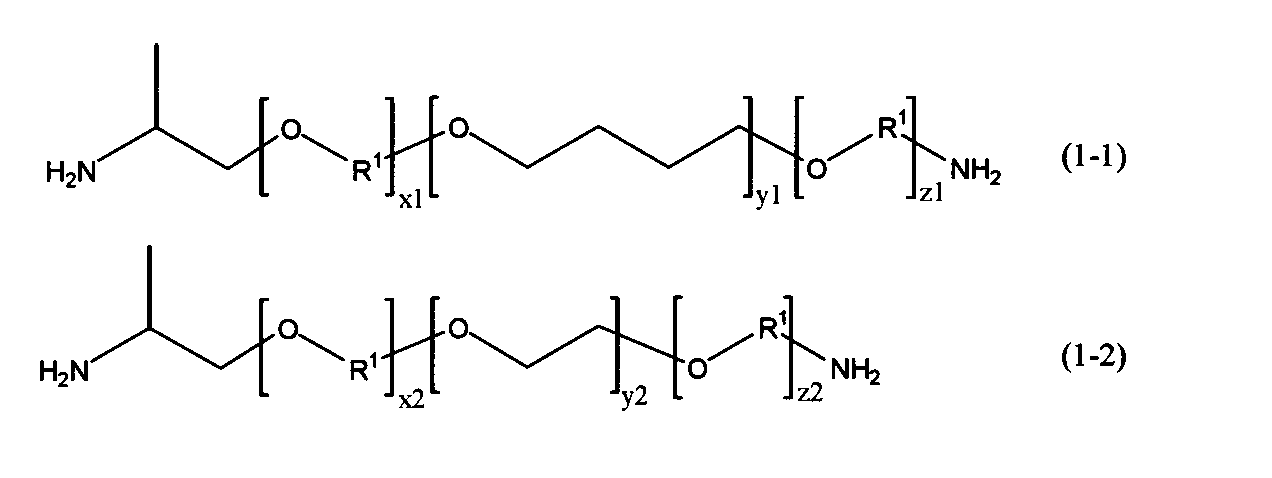
一般式(1-2)中、x2+z2は1~60、y2は1~50を表し、-OR1-は-OCH2CH2CH2-、-OCH(CH3)CH2-又は-OCH2CH(CH3)-を表す。
上記一般式(1-2)における(x2+z2)の数値は1~60であり、好ましくは2~40、より好ましくは2~30、更に好ましくは2~20、より更に好ましくは2~15である。また、y2の数値は1~50であり、好ましくは1~40、より好ましくは1~30、更に好ましくは1~20である。
なお、これらのポリエーテルジアミン化合物(b-1)は、単独で又は2種以上を組み合わせて用いてもよい。
上記一般式(1-2)で表されるポリエーテルジアミン化合物の数平均分子量は、好ましくは176~5700、より好ましくは200~4000、更に好ましくは300~3000、より更に好ましくは400~2000、より更に好ましくは500~1800である。
ポリエーテルポリアミド(b)を構成するジアミン構成単位は、キシリレンジアミン(b-2)に由来する構成単位を含む。キシリレンジアミン(b-2)としては、メタキシリレンジアミン、パラキシリレンジアミン又はこれらの混合物が好ましく、メタキシリレンジアミン、又はメタキシリレンジアミンとパラキシリレンジアミンとの混合物がより好ましく、第1の多層構造体においてはメタキシリレンジアミンが更に好ましく、また、第2の多層構造体においてはメタキシリレンジアミンとパラキシリレンジアミンとの混合物が更に好ましい。
キシリレンジアミン(b-2)がメタキシリレンジアミンに由来する場合、得られるポリエーテルポリアミドは、柔軟性、結晶性、溶融成形性、成形加工性、及び靭性に優れたものとなる。
キシリレンジアミン(b-2)が、メタキシリレンジアミンとパラキシリレンジアミンとの混合物に由来する場合、得られるポリエーテルポリアミドは柔軟性、結晶性、溶融成形性、成形加工性、及び靭性に優れ、更に高耐熱性、及び高弾性率を示す。
また、第2の多層構造体におけるポリエーテルポリアミド(b)のジアミン構成単位中におけるポリエーテルジアミン化合物(b-1)に由来する構成単位の割合は、好ましくは1~50モル%、より好ましくは3~30モル%、更に好ましくは5~25モル%である。第2の多層構造体におけるポリエーテルポリアミド(b)のジアミン構成単位中におけるポリエーテルジアミン化合物(b-1)に由来する構成単位の割合が上記範囲内であれば、得られるポリエーテルポリアミド樹脂は、柔軟性、燃料バリア性に優れたものとなる。
ポリエーテルポリアミド(b)を構成するジアミン構成単位は、上述したように、前記一般式(1)で表されるポリエーテルジアミン化合物(b-1)及びキシリレンジアミン(b-2)に由来する構成単位を含むが、本発明の効果を損なわない範囲であれば、その他のジアミン化合物に由来する構成単位を含んでもよい。
ポリエーテルジアミン化合物(b-1)及びキシリレンジアミン(b-2)以外のジアミン構成単位を構成しうるジアミン化合物としては、テトラメチレンジアミン、ペンタメチレンジアミン、2-メチルペンタンジアミン、ヘキサメチレンジアミン、ヘプタメチレンジアミン、オクタメチレンジアミン、ノナメチレンジアミン、デカメチレンジアミン、ドデカメチレンジアミン、2,2,4-トリメチル-ヘキサメチレンジアミン、2,4,4-トリメチルヘキサメチレンジアミン等の脂肪族ジアミン;1,3-ビス(アミノメチル)シクロヘキサン、1,4-ビス(アミノメチル)シクロヘキサン、1,3-ジアミノシクロヘキサン、1,4-ジアミノシクロヘキサン、ビス(4-アミノシクロヘキシル)メタン、2,2-ビス(4-アミノシクロヘキシル)プロパン、ビス(アミノメチル)デカリン、ビス(アミノメチル)トリシクロデカン等の脂環族ジアミン;ビス(4-アミノフェニル)エーテル、パラフェニレンジアミン、ビス(アミノメチル)ナフタレン等の芳香環を有するジアミン類等を例示することができるが、これらに限定されるものではない。
ポリエーテルポリアミド(b)を構成するジカルボン酸構成単位は、炭素数4~20のα,ω-直鎖脂肪族ジカルボン酸(b-3)に由来する構成単位を含む。
上記ジカルボン酸構成単位中における、炭素数4~20のα,ω-直鎖脂肪族ジカルボン酸(b-3)に由来する構成単位の含有量は、好ましくは50~100モル%、より好ましくは70~100モル%である。
炭素数4~20のα,ω-直鎖脂肪族ジカルボン酸(b-3)としては、コハク酸、グルタル酸、アジピン酸、ピメリン酸、スベリン酸、アゼライン酸、セバシン酸、1,10-デカンジカルボン酸、1,11-ウンデカンジカルボン酸、1,12-ドデカンジカルボン酸等を例示できる。これらの中でも結晶性、高弾性の観点から、アジピン酸及びセバシン酸から選ばれる少なくとも1種が好ましい。また、第1の多層構造体においては、結晶性、高弾性に加えてガスバリア性の観点からアジピン酸がより好ましく、第2の多層構造体においては、結晶性、高弾性に加えて柔軟性の観点からセバシン酸がより好ましい。これらのジカルボン酸は、単独で使用してもよいし、2種類以上を併用してもよい。
ポリエーテルポリアミド(b)を構成するジカルボン酸構成単位は、上述したように、炭素数4~20のα,ω-直鎖脂肪族ジカルボン酸(b-3)に由来する構成単位を含むが、本発明の効果を損なわない範囲であれば、その他のジカルボン酸に由来する構成単位を含んでもよい。
炭素数4~20のα,ω-直鎖脂肪族ジカルボン酸(b-3)以外のジカルボン酸構成単位を構成しうるジカルボン酸としては、シュウ酸、マロン酸等の脂肪族ジカルボン酸;テレフタル酸、イソフタル酸、2,6-ナフタレンジカルボン酸等の芳香族ジカルボン酸類等を例示できるが、これらに限定されるものではない。
ジカルボン酸成分として、炭素数4~20のα,ω-直鎖脂肪族ジカルボン酸(b-3)とイソフタル酸との混合物を使用する場合、ポリエーテルポリアミド(b)の耐熱性及び成形加工性を向上させることができる。炭素数4~20のα,ω-直鎖脂肪族ジカルボン酸(b-3)とイソフタル酸とのモル比(炭素数4~20のα,ω-直鎖脂肪族ジカルボン酸(b-3)/イソフタル酸)は、50/50~99/1が好ましく、70/30~95/5がより好ましい。
ポリエーテルポリアミド(b)は、キシリレンジアミン(b-2)と炭素数4~20のα,ω-直鎖脂肪族ジカルボン酸(b-3)とから形成される高結晶性のポリアミドブロックをハードセグメントとし、ポリエーテルジアミン化合物(b-1)由来のポリエーテルブロックをソフトセグメントとすることで、溶融成形性及び成形加工性に優れる。更に得られたポリエーテルポリアミドは強靭性、柔軟性、結晶性、耐熱性、ガスバリア性、耐ピンホール性、及び層間密着強度等に優れる。
相対粘度=t/t0
ポリエーテルポリアミド(b)の引張弾性率(測定温度23℃、湿度50%RH)は、柔軟性及び機械強度の観点から、好ましくは100MPa以上、より好ましくは200MPa以上、更に好ましくは300MPa以上、更に好ましくは400MPa以上、更に好ましくは500MPa以上である。
引張弾性率及び引張破断伸び率の測定は、JIS K7161に準じて行われる。
なお、ポリエーテルポリアミド(b)の数平均分子量(Mn)は、実施例に記載の方法で測定された値を意味する。
ポリエーテルポリアミド(b)の製造は、特に限定されるものではなく、任意の方法で、任意の重合条件により行うことができる。例えば、ジアミン成分(ポリエーテルジアミン化合物(b-1)及びキシリレンジアミン(b-2)等のジアミン)とジカルボン酸成分(炭素数4~20のα,ω-直鎖脂肪族ジカルボン酸(b-3)等のジカルボン酸)とからなる塩を水の存在下に加圧状態で昇温し、加えた水及び縮合水を除きながら溶融状態で重合させる方法によりポリエーテルポリアミド(b)を製造することができる。また、ジアミン成分(ポリエーテルジアミン化合物(b-1)及びキシリレンジアミン(b-2)等のジアミン)を溶融状態のジカルボン酸成分(炭素数4~20のα,ω-直鎖脂肪族ジカルボン酸(b-3)等のジカルボン酸)に直接加えて、常圧下で重縮合する方法によってもポリエーテルポリアミド(b)を製造することができる。この場合、反応系を均一な液状態で保つために、ジアミン成分をジカルボン酸成分に連続的に加え、その間、反応温度が生成するオリゴアミド及びポリアミドの融点よりも下回らないように反応系を昇温しつつ、重縮合が進められる。
この際、ジアミン成分のうち、ポリエーテルジアミン化合物(b-1)については、ジカルボン酸成分とともに予め反応槽内に仕込んでおいてもよい。ポリエーテルジアミン化合物(b-1)を予め反応槽内に仕込んでおくことで、ポリエーテルジアミン化合物(b-1)の熱劣化を抑制することができる。その場合もまた、反応系を均一な液状態で保つために、ポリエーテルジアミン化合物(b-1)以外のジアミン成分をジカルボン酸成分に連続的に加え、その間、反応温度が生成するオリゴアミド及びポリアミドの融点よりも下回らないように反応系を昇温しつつ、重縮合が進められる。
重縮合系内に添加するリン原子含有化合物の添加量は、良好な外観及び成形加工性の観点から、ポリエーテルポリアミド(b)中のリン原子濃度換算で、好ましくは1~1000ppm、より好ましくは5~1000ppm、更に好ましくは10~1000ppmである。
本発明の第2の多層構造体は、少なくともポリオレフィン層(C)を構成層として有する。
ポリオレフィン層(C)は、ポリオレフィン樹脂を主成分として含む層である。ポリオレフィン樹脂としては、例えば、ポリエチレン、ポリプロピレン等を用いることができ、単独重合体であっても共重合体であってもよい。ポリオレフィン樹脂の中でも柔軟性、耐候性、耐塩素性を有する点からポリエチレンが好ましい。
ポリエチレンは、低密度ポリエチレン(LDPE)、直鎖状低密度ポリエチレン(LLDPE)、超低密度ポリエチレン(VLDPE)、中密度ポリエチレン(MDPE)、高密度ポリエチレン(HDPE)等を用いることができる。
上記α-オレフィンとしては、1-ブテン、3-メチル-1-ブテン、3-メチル-1-ペンテン、4-メチル-1-ペンテン、1-ペンテン、1-ヘキセン、1-ヘプテン、1-オクテン、1-デセン、1-テトラデセン、1-ヘキサデセン、1-オクタデセン、1-エイコセン等が挙げられる。上記スチレン類としては、スチレン、4-メチルスチレン、4-ジメチルアミノスチレン等が挙げられる。上記ジエン類としては、1,4-ブタジエン、1,5-ヘキサジエン、1,4-ヘキサジエン、1,7-オクタジエン等が挙げられる。上記環状化合物としては、ノルボルネン、シクロペンテン等が挙げられる。酸素原子含有化合物としては、ヘキセノール、ヘキセン酸、オクテン酸メチル等が挙げられる。これら共重合することができる単量体は、単独で使用してもよいし、2種類以上を併用してもよい。また、エチレンとプロピレンとの共重合体であってもよい。
共重合体は、交互共重合、ランダム共重合、ブロック共重合のいずれであってもよい。
(第1の多層構造体)
本発明の第1の多層構造体は、ポリアミド層(A)(以下、(A)層と略記することがある)及びポリエーテルポリアミド層(B)(以下、(B)層と略記することがある)を、それぞれ1層又は2層以上有することができる。具体的には、以下に示すような層構成が挙げられ、押出機を用いて多層ダイにより共押出する層構成であることが好ましい。
(1)2種2層構成;具体的には、(A)層/(B)層、(B)層/(A)層など。
(2)2種3層構成;具体的には、(A)層/(B)層/(A)層、(B)層/(A)層/(B)層など。
(3)2種4層構成;具体的には、(A)層/(B)層/(A)層/(B)層、(B)層/(A)層/(B)層/(A)層など。
なお、本明細書において、例えばX/Y/Zの表記は、ことわりのない限り空気に曝される側からX、Y、Zの順に積層していることを示す。また、多層構造体が(A)層を複数層有する場合、複数の(A)層は同一でも異なっていてもよく、(B)層についても同様である。
上記樹脂層としては、例えば、ポリオレフィン樹脂、無水マレイン酸変性ポリオレフィン樹脂、フッ素樹脂、ポリイミド樹脂、ポリアミド樹脂、ポリエステル樹脂、ポリスチレン樹脂、及び塩化ビニル樹脂等の熱可塑性樹脂から形成されるものが挙げられる。
添加剤としては、フィラー、安定剤、着色剤、紫外線吸収剤、光安定化剤、酸化防止剤、帯電防止剤、難燃剤、結晶化促進剤、繊維状強化剤、可塑剤、潤滑剤、耐熱剤等が挙げられるが、これらに限定されるものではない。また、添加剤の含有量は、その種類に応じた通常の含有量の範囲で用いればよい。
第1の多層構造体において、(B)層/(A)層/(B)層として積層する場合、(B)層、(A)層、(B)層の各層に添加される添加剤の種類、量が異なっても良い。
本発明の第2の多層構造体は、ポリオレフィン層(C)(以下、(C)層と略記することがある)及びポリエーテルポリアミド層(B)を、それぞれ1層又は2層以上有することができる。具体的には、以下に示すような層構成が挙げられ、押出機を用いて多層ダイにより共押出する層構成であることが好ましい。
(1)2種2層構成;具体的には、(C)層/(B)層、(B)層/(C)層など。
(2)2種3層構成;具体的には、(C)層/(B)層/(C)層、(B)層/(C)層/(B)層など。
(3)2種4層構成;具体的には、(C)層/(B)層/(C)層/(B)層、(B)層/(C)層/(B)層/(C)層など。
なお、本明細書において、第2の多層構造体が筒状成形体である場合、例えばX/Y/Zの表記は、ことわりのない限り内側からX、Y、Zの順に積層していることを示す。また、第2の多層構造体が(C)層を複数層有する場合、複数の(C)層は同一でも異なっていてもよく、(B)層についても同様である。
第2の多層構造体が筒状成形体である場合、燃料バリア性、耐候性、耐塩素性等の点から、筒状成形体の空洞部分すなわち内側から、(C)層及び(B)層の順の層構成を少なくとも有することが好ましい。
層構成は筒状成形体の用途に応じ好ましい態様を選択すればよいが、柔軟性と燃料バリア性とのバランス及び経済性の観点から、内側から(C)層/(B)層の2種2層構成及び(C)層/(B)層/(C)層の2種3層構成がより好ましい。
ポリエーテルポリアミド層(B)の厚みは、10μm以上であることが好ましく、30μm以上であることがより好ましく、50μm以上であることが更に好ましい。ポリエーテルポリアミド層(B)の厚みが10μm以上であれば、燃料バリア性の効果が好適に発揮される。
また、筒状成形体の厚みに対するポリエーテルポリアミド層(B)の厚みの割合は、0.005~0.5であることが好ましく、0.008~0.2であることがより好ましく、0.01~0.1であることが更に好ましい。筒状成形体の厚みに対するポリエーテルポリアミド層(B)の厚みが0.005以上であれば、十分な燃料バリア性を発揮することができ、0.5以下であれば柔軟性と燃料バリア性とのバランスに優れ、筒状成形体とする際の成形性にも優れる。
上記樹脂層としては、例えば、無水マレイン酸変性ポリオレフィン樹脂、フッ素樹脂、ポリイミド樹脂、ポリアミド樹脂、ポリエステル樹脂、ポリスチレン樹脂、及び塩化ビニル樹脂等の熱可塑性樹脂から形成されるものが挙げられる。
添加剤としては、フィラー、安定剤、着色剤、紫外線吸収剤、光安定化剤、酸化防止剤、帯電防止剤、難燃剤、結晶化促進剤、繊維状強化材、可塑剤、潤滑剤、耐熱剤等が挙げられるが、これらに限定されるものではない。また、添加剤の含有量は、その種類に応じた通常の含有量の範囲で用いればよい。
また内側から(C)層/(B)層/(C)層として積層する場合、内側の(C)層、中間の(B)層、外側の(C)層とで添加剤の種類、量が異なっても良い。例えば内側の(C)層と外側の(C)層の着色剤の組み合わせを変え、他の樹脂チューブとの判別を容易にすることもできる。
JIS K7126に準拠し、OX-TRAN(登録商標)2/21(MOCON社製)を用い、23℃、60%RHの条件で、作製した総厚み25μmの延伸フィルムの酸素透過量(単位:cc/m2・atm・day)を測定した。
作製した総厚み25μmの延伸フィルムを210mm角に切削し、ゲルボフレックス(理学工業株式会社製)を用いて、ゲルボフレックスの軸方向を測定方向とし、23℃、60%RHでの環境下で、1000回屈曲時におけるピンホールの数を測定した。ピンホールの測定は、ピンホールテスター(微弱電流放電法)を用いて行った。
JIS K5600-5-6(ISO2409)に準拠し、(B)層にカッターで2mm間隔の碁盤の目状に100目の切り込みを入れ、セロハンテープ(登録商標、ニチバン株式会社製)を切り込み部分に貼り付け、5分以内に60度に近い角度で0.5~1.0秒で確実に引き離し、(B)層の剥離状況を確認した。
上記100目のうち1目でも剥がれた場合、剥離有りと評価した。
実施例及び比較例で得られた筒状成形体を直径600mmの巻き芯に巻き付けて、23℃にて24時間放置した。その後の筒状成形体を巻き芯から外し、皺寄りが生じているかを目視にて評価した。
実施例及び比較例で得られた筒状成形体を直径600mmの巻き芯に巻き付けて、灯油で満たした容器内にその半周が灯油に浸漬するように固定し、23℃にて1週間放置した。その後、灯油に浸漬させたままの状態で、筒状成形体内に水道水を入れ、更に24時間放置した後、水道水を抜き出し、抜き出した水道水について灯油の臭気を評価した。
(1)相対粘度(ηr)
試料0.2gを精秤し、96%硫酸20mlに20~30℃で撹拌溶解し、完全に溶解させ、溶液を調製した。その後、速やかにキャノンフェンスケ型粘度計に当該溶液5mlを取り、25℃の恒温槽中で10分間放置後、落下時間(t)を測定した。また、96質量%硫酸そのものの落下時間(t0)も同様に測定した。t及びt0から次式により相対粘度を算出した。
相対粘度=t/t0
まず試料を、フェノールとエタノールとの混合溶媒(フェノール/エタノール=4/1(体積比))、及びベンジルアルコール溶媒にそれぞれ溶解させ、カルボキシル末端基濃度とアミノ末端基濃度を塩酸及び水酸化ナトリウム水溶液の中和滴定により求めた。数平均分子量は、アミノ末端基濃度及びカルボキシル末端基濃度の定量値から次式により求めた。
数平均分子量=2×1,000,000/([NH2]+[COOH])
[NH2]:アミノ末端基濃度(μeq/g)
[COOH]:カルボキシル末端基濃度(μeq/g)
示差走査熱量の測定はJIS K7121、K7122に準じて行った。示差走査熱量計(株式会社島津製作所製、商品名:「DSC-60」)を用い、各試料をDSC測定パンに仕込み、窒素雰囲気下にて昇温速度10℃/分で300℃まで昇温し、急冷する前処理を行った後に測定を行った。測定条件は、昇温速度10℃/分で、300℃で5分保持した後、降温速度-5℃/分で100℃まで測定を行い、ガラス転移温度Tg、結晶化温度Tch及び融点Tmを求めた。
実施例におけるポリエーテルポリアミド層(B)を形成するポリエーテルアミドとして、以下の製造例で製造したものを使用した。
(製造例1)ポリエーテルポリアミドb1の製造
攪拌機、窒素ガス導入口、及び縮合水排出口を備えた容積約3Lの反応容器にアジピン酸650.37g、次亜リン酸ナトリウム一水和物0.6125g及び酢酸ナトリウム0.4266gを仕込み、容器内を十分窒素置換した後、容器内に窒素ガスを20ml/分で供給しながら170℃で添加した成分を溶融させた。容器内を260℃まで徐々に昇温しながら、容器内にメタキシリレンジアミン(MXDA)(三菱ガス化学株式会社製)588.04g、及びポリエーテルジアミン(米国HUNTSMAN社製、Jeffamine(登録商標)ED-900、米国HUNTSMAN社のカタログによれば、前記一般式(1-2)における-OR1-が-OCH(CH3)CH2-又は-OCH2CH(CH3)-であり、x2+z2の概数が6.0、y2の概数が12.5であり、概略分子量は900である)115.46gの混合液を滴下し約2時間重合を行い、ポリエーテルポリアミドを得た。相対粘度=1.62、[COOH]=49.02μeq/g、[NH2]=95.5μeq/g、Mn=13840、Tg=68.1℃、Tch=121.6℃、Tm=234.1℃。
攪拌機、窒素ガス導入口、及び縮合水排出口を備えた容積約3Lの反応容器にアジピン酸584.60g、次亜リン酸ナトリウム一水和物0.5933g及び酢酸ナトリウム0.4133gを仕込み、容器内を十分窒素置換した後、容器内に窒素ガスを20ml/分で供給しながら170℃で添加した成分を溶融させた。容器内を260℃まで徐々に昇温しながら、容器内にメタキシリレンジアミン(MXDA)(三菱ガス化学株式会社製)516.52g、及びポリエーテルジアミン(米国HUNTSMAN社製、Jeffamine(登録商標)XTJ-542、米国HUNTSMAN社のカタログによれば、前記一般式(1-1)における-OR1-が-OCH(CH3)CH2-又は-OCH2CH(CH3)-であり、x1+z1の概数が6.0、y1の概数が9.0であり、概略分子量は1000である)199.60gの混合液を滴下し約2時間重合を行い、ポリエーテルポリアミドを得た。相対粘度=1.53、[COOH]=39.78μeq/g、[NH2]=106.93μeq/g、Mn=13632、Tg=76.0℃、Tch=114.7℃、Tm=234.3℃。
攪拌機、窒素ガス導入口、及び縮合水排出口を備えた容積約3Lの反応容器にアジピン酸613.83g、次亜リン酸ナトリウム一水和物0.6242g及び酢酸ナトリウム0.4348gを仕込み、容器内を十分窒素置換した後、容器内に窒素ガスを20ml/分で供給しながら170℃で添加した成分を溶融させた。容器内を260℃まで徐々に昇温しながら、容器内にメタキシリレンジアミン(MXDA)(三菱ガス化学株式会社製)380.41gとパラキシリレンジアミン(PXDA)(三菱ガス化学株式会社製)163.03g(モル比(MXDA/PXDA=70/30))、及びポリエーテルジアミン(米国HUNTSMAN社製、Jeffamine(登録商標)XTJ-542、詳細は上記と同様)210.00gの混合液を滴下し約2時間重合を行い、ポリエーテルポリアミドを得た。相対粘度=1.53、[COOH]=79.95μeq/g、[NH2]=100.38μeq/g、Mn=11091、Tg=80.5℃、Tch=113.4℃、Tm=252.6℃。
攪拌機、窒素ガス導入口、及び縮合水排出口を備えた容積約3Lの反応容器にアジピン酸584.6g、次亜リン酸ナトリウム一水和物0.683g及び酢酸ナトリウム0.476gを仕込み、容器内を十分窒素置換した後、容器内に窒素ガスを20ml/分で供給しながら170℃で添加した成分を溶融させた。容器内を260℃まで徐々に昇温しながら、容器内にメタキシリレンジアミン(MXDA)(三菱ガス化学株式会社製)490.3g、及びポリエーテルジアミン(米国HUNTSMAN社製、Jeffamine(登録商標)XTJ-542、詳細は上記と同様)400.00gの混合液を滴下し約2時間重合を行い、ポリエーテルポリアミドを得た。相対粘度=1.38、[COOH]=110.17μeq/g、[NH2]=59.57μeq/g、Mn=11783、Tg=71.7℃、Tch=108.3℃、Tm=232.8℃。
攪拌機、窒素ガス導入口、及び縮合水排出口を備えた容積約3Lの反応容器にセバシン酸768.55g、次亜リン酸ナトリウム一水和物0.6644g及び酢酸ナトリウム0.4628gを仕込み、容器内を十分窒素置換した後、容器内に窒素ガスを20ml/分で供給しながら170℃で添加した成分を溶融させた。容器内を260℃まで徐々に昇温しながら、容器内にメタキシリレンジアミン(MXDA)(三菱ガス化学株式会社製)344.18gとパラキシリレンジアミン(PXDA)(三菱ガス化学株式会社製)147.50g(モル比(MXDA:PXDA=70:30))、及びポリエーテルジアミン(米国HUNTSMAN社製、Jeffamine(登録商標)ED-900、米国HUNTSMAN社のカタログによれば、前記一般式(1-2)における-OR1-が-OCH(CH3)CH2-又は-OCH2CH(CH3)-であり、x2+z2の概数が6.0、y2の概数が12.5であり、概略分子量は900である)171.00gの混合液を滴下し約2時間重合を行い、ポリエーテルポリアミドb5を得た。相対粘度=1.48、[COOH]=66.91μeq/g、[NH2]=82.80μeq/g、Mn=13360、Tg=27.6℃、Tch=72.8℃、Tm=207.6℃。
攪拌機、窒素ガス導入口、及び縮合水排出口を備えた容積約3Lの反応容器にセバシン酸687.65g、次亜リン酸ナトリウム一水和物0.6612g及び酢酸ナトリウム0.4605gを仕込み、容器内を十分窒素置換した後、容器内に窒素ガスを20ml/分で供給しながら170℃で添加した成分を溶融させた。容器内を260℃まで徐々に昇温しながら、容器内にメタキシリレンジアミン(MXDA)(三菱ガス化学株式会社製)291.74gとパラキシリレンジアミン(PXDA)(三菱ガス化学株式会社製)125.03g(モル比(MXDA:PXDA=70:30))、及びポリエーテルジアミン(米国HUNTSMAN社製、Jeffamine(登録商標)ED-900、詳細は上記と同様)306.00gの混合液を滴下し約2時間重合を行い、ポリエーテルポリアミドb6を得た。相対粘度=1.36、[COOH]=66.35μeq/g、[NH2]=74.13μeq/g、Mn=14237、Tg=16.9℃、Tch=52.9℃、Tm=201.9℃。
撹拌機、窒素ガス導入口、及び縮合水排出口を備えた容積約3Lの反応容器にセバシン酸748.33g、次亜リン酸ナトリウム一水和物0.6565g及び酢酸ナトリウム0.4572gを仕込み、容器内を十分窒素置換した後、容器内に窒素ガスを20ml/分で供給しながら170℃で添加した成分を溶融させた。容器内を260℃まで徐々に昇温しながら、容器内にメタキシリレンジアミン(MXDA)(三菱ガス化学株式会社製)335.12gとパラキシリレンジアミン(PXDA)(三菱ガス化学株式会社製)143.62g(モル比(MXDA:PXDA=70:30))、及びポリエーテルジアミン(米国HUNTSMAN社製、Jeffamine(登録商標)XTJ-542、米国HUNTSMAN社のカタログによれば、前記一般式(1-1)における-OR1-が-OCH(CH3)CH2-又は-OCH2CH(CH3)-であり、x1+z1の概数が6.0、y1の概数が9.0であり、概略分子量は1000である)185.00gの混合液を滴下し約2時間重合を行い、ポリエーテルポリアミドb7を得た。相対粘度=1.45、[COOH]=55.19μeq/g、[NH2]=70.61μeq/g、Mn=15898、Tg=50.3℃、Tch=83.0℃、Tm=208.1℃。
攪拌機、窒素ガス導入口、及び縮合水排出口を備えた容積約3Lの反応容器にアジピン酸657.68g、次亜リン酸ナトリウム一水和物0.6626g及び酢酸ナトリウム0.4578gを仕込み、容器内を十分窒素置換した後、容器内に窒素ガスを20ml/分で供給しながら170℃で添加した成分を溶融させた。容器内を260℃まで徐々に昇温しながら、容器内にメタキシリレンジアミン(MXDA)(三菱ガス化学株式会社製)407.58gとパラキシリレンジアミン(PXDA)(三菱ガス化学株式会社製)174.68g(モル比(MXDA:PXDA=70:30))、及びポリエーテルジアミン(米国HUNTSMAN社製、Jeffamine(登録商標)ED-900、詳細は上記と同様)202.50gの混合液を滴下し約2時間重合を行い、ポリエーテルポリアミドb4を得た。相対粘度=1.51、[COOH]=48.53μeq/g、[NH2]=88.72μeq/g、Mn=14572、Tg=59.5℃、Tch=98.0℃、Tm=249.9℃。
(比較製造例1)ポリエーテルポリアミドb9の製造
攪拌機、窒素ガス導入口、及び縮合水排出口を備えた容積約3Lの反応容器に12-アミノラウリン酸(東京化成工業株式会社製)753.66g、アジピン酸56.84g、次亜リン酸ナトリウム一水和物0.5798g及び酢酸ナトリウム0.4038gを仕込み、容器内を十分窒素置換した後、容器内に窒素ガスを20ml/分で供給しながら170℃で添加した成分を溶融させた。容器内を240℃まで徐々に昇温しながら、容器内にポリエーテルジアミン(米国HUNTSMAN社製、Jeffamine(登録商標)XTJ-542、詳細は上記と同様)388.89gを滴下し約2時間重合を行い、ポリエーテルポリアミドb9を得た。相対粘度=1.25、[COOH]=87.27μeq/g、[NH2]=73.12μeq/g、Mn=12470、Tm=165.0℃。
攪拌機、窒素ガス導入口、及び縮合水排出口を備えた容積約3Lの反応容器にセバシン酸829.2g、次亜リン酸ナトリウム一水和物0.6365g及び酢酸ナトリウム0.4434gを仕込み、容器内を十分窒素置換した後、容器内に窒素ガスを20ml/分で供給しながら170℃で添加した成分を溶融させた。容器内を260℃まで徐々に昇温しながら、容器内にメタキシリレンジアミン(MXDA)(三菱ガス化学株式会社製)390.89gとパラキシリレンジアミン(PXDA)(三菱ガス化学株式会社製)167.53g(モル比(MXDA:PXDA=70:30))の混合液を滴下し約2時間重合を行い、ポリアミドを得た。相対粘度=2.20、[COOH]=81.8μeq/g、[NH2]=26.9μeq/g、Mn=18400、Tg=65.9℃、Tch=100.1℃、Tm=213.8℃。
(第1の多層構造体の製造)
ポリアミド層(A)を形成するポリメタキシリレンアジパミド(三菱ガス化学株式会社製、商品名:「MXナイロン S6007」、相対粘度2.7、融点237℃)、及びポリエーテルポリアミド層(B)を形成する前記ポリエーテルポリアミドb1~b4を表1に示すとおり用い、2台の押出機と、(B)層/(A)層/(B)層の順に積層するフィードブロックを備えた多層フィルム押出成形機にて、各層の厚みが90/45/90μmで総厚み225μmの未延伸多層フィルムを成形した。
上記未延伸多層フィルムをバッチ式の同時二軸延伸機にて縦3倍、横3倍に延伸し、210℃で熱固定処理を行い、各層の厚みが10/5/10μmで総厚み25μmの延伸多層フィルムを得た。
得られた多層フィルムについて、前述の評価を行い、結果を表1に示した。
実施例1において、(B)層として、ポリエーテルポリアミド層(B)の替わりにナイロン6(宇部興産株式会社製、商品名:「UBEナイロン 1024B」)を用いた以外は、同様に行い延伸多層フィルムを得た。
得られた多層フィルムについて、前述の評価を行い、結果を表1に示した。

また、比較例1の酸素バリア性から、ナイロン6との多層構造体の場合、MXD6層は一定以上の厚みが必要となることがわかるが、実施例1~4の多層フィルムであれば比較例1と同じMXD6層の厚みで、より高い酸素バリア性を示すことがわかる。さらに、比較例1の多層フィルムは接着剤層がないため層間剥離が生じたが、実施例1~4の多層フィルムは接着剤層がなくとも層間剥離が生じず、層間密着強度に優れることがわかる。
(第2の多層構造体の製造)
ポリオレフィン層(C)を形成するポリエチレン(日本ポリエチレン株式会社製、商品名ノバテックLL UF240、融点123℃)、及びポリエーテルポリアミド層(B)を形成する前記ポリエーテルポリアミドb5~b8を表2に示すとおり用い、2台の押出機と、2種3層の多層構造体を形成する流路とを備えた多層チューブ押出成形機にて、表2に示す温度で筒状成形体を成形した。
この筒状成形体は、厚み5mmで、内側から(C)層/(B)層/(C)層の層構成であり、筒状成形体の外径は30mm、内径は20mmで、(B)層の厚みは0.2mm、内側及び外側の(C)層の厚みが均等になるように成形した。
得られた筒状成形体について、前述の評価を行い、結果を表2に示した。
ポリエチレン(日本ポリエチレン株式会社製、商品名ノバテックLL UF240、融点123℃)を用い、1台の押出機からなる単層チューブ押出成形機にて、表2に示す温度で筒状成形体を成形した。
この筒状成形体は、厚み5mmで、外径は30mm、内径は20mmとなるように成形した。得られた筒状成形体について、前述の評価を行い、結果を表2に示した。
ポリオレフィン層(C)を形成するポリエチレン(日本ポリエチレン株式会社製、商品名ノバテックLL UF240、融点123℃)、及びポリエーテルポリアミド層(B)の替わりに設ける中間層を形成する前記ポリエーテルポリアミドb9、ポリアミドb10(表2中、(B)層として記載)を表2に示すとおり用い、2台の押出機と、2種3層の多層構造体を形成する流路とを備えた多層チューブ押出成形機にて、表2に示す押出温度で筒状成形体を成形した。
この筒状成形体は、厚み5mmで、内側から(C)層/(B)層/(C)層の層構成であり、筒状成形体の外系径は30mm、内径は20mmで、(B)層の厚みは0.2mm、内側及び外側の(C)層の厚みが均等になるように成形した。
得られた筒状成形体について、前述の評価を行い、結果を表2に示した。
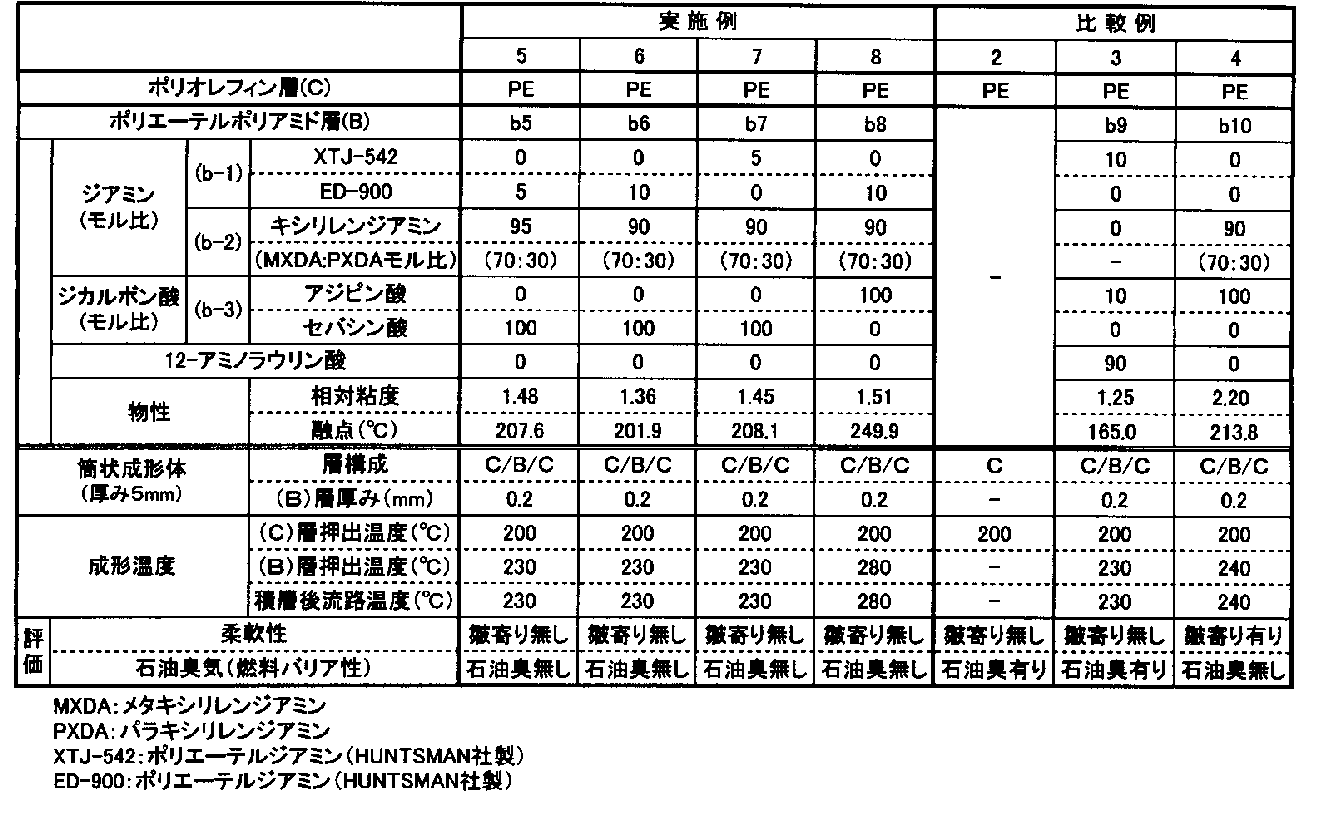
一方、実施例5~8では、皺寄りが無く、水道水に石油臭がしないことから、筒状成形体がポリエーテルポリアミド層(B)を有することで、柔軟性と燃料バリア性の両方に優れることがわかる。
また、比較例3及び4から、ポリエーテルポリアミド層(B)の替わりに、ポリエーテルジアミン化合物(b-1)及びキシリレンジアミン(b-2)のいずれかを用いないで製造したポリエーテルポリアミド又はポリアミドからなる層を有していても、柔軟性と燃料バリア性の両方に優れる筒状成形体が得られないことがわかる。
本発明の第2の多層構造体は、ポリオレフィン製の優れた柔軟性を損なわず、柔軟性及び燃料バリア性に優れた多層構造体である。そのため、灯油等の燃料の浸透を防ぐことができるため地中に埋設される水道配管、特に供水用の水道配管として好適である。
Claims (16)
- ポリアミド層(A)及びポリエーテルポリアミド層(B)を有する多層構造体であって、
上記ポリアミド層(A)が、ジアミン構成単位がキシリレンジアミン(a-1)に由来する構成単位を含み、ジカルボン酸構成単位が炭素数4~20のα,ω-直鎖脂肪族ジカルボン酸(a-2)に由来する構成単位を含むポリアミド(a)を含有し、
上記ポリエーテルポリアミド層(B)が、ジアミン構成単位が下記一般式(1)で表されるポリエーテルジアミン化合物(b-1)及びキシリレンジアミン(b-2)に由来する構成単位を含み、ジカルボン酸構成単位が炭素数4~20のα,ω-直鎖脂肪族ジカルボン酸(b-3)に由来する構成単位を含むポリエーテルポリアミド(b)を含有する多層構造体。

- キシリレンジアミン(b-2)が、メタキシリレンジアミン、パラキシリレンジアミン又はこれらの混合物である、請求項1に記載の多層構造体。
- α,ω-直鎖脂肪族ジカルボン酸(b-3)が、アジピン酸、セバシン酸及びこれらの混合物から選ばれる少なくとも1種である、請求項1又は2に記載の多層構造体。
- ポリアミド(a)が、ポリメタキシリレンアジパミドである、請求項1~3のいずれかに記載の多層構造体。
- ポリアミド層(A)及びポリエーテルポリアミド層(B)を、それぞれ1層又は2層以上有する、請求項1~4のいずれかに記載の多層構造体。
- ポリエーテルポリアミド層(B)、ポリアミド層(A)、ポリエーテルポリアミド層(B)の順の層構成を少なくとも有する、請求項1~5のいずれかに記載の多層構造体。
- ポリアミド層(A)の厚みが1~200μmである、請求項1~6のいずれかに記載の多層構造体。
- 多層構造体がシート又はフィルムである、請求項1~7のいずれかに記載の多層構造体。
- ポリオレフィン層(C)及びポリエーテルポリアミド層(B)を有する多層構造体であって、上記ポリエーテルポリアミド層(B)が、ジアミン構成単位が下記一般式(1)で表されるポリエーテルジアミン化合物(b-1)及びキシリレンジアミン(b-2)に由来する構成単位を含み、ジカルボン酸構成単位が炭素数4~20のα,ω-直鎖脂肪族ジカルボン酸(b-3)に由来する構成単位を含むポリエーテルポリアミド(b)を含有する多層構造体。
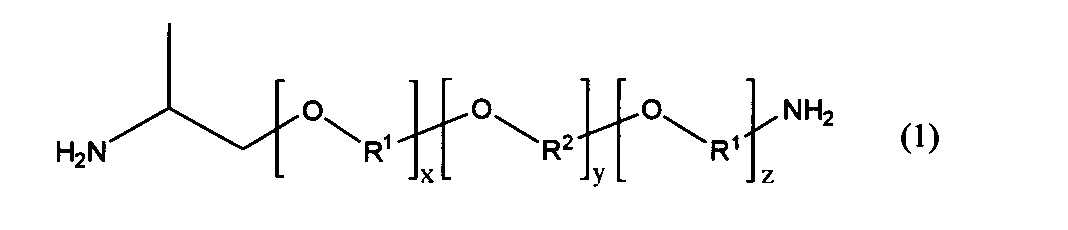
- キシリレンジアミン(b-2)が、メタキシリレンジアミン、パラキシリレンジアミン又はこれらの混合物である、請求項9に記載の多層構造体。
- α,ω-直鎖脂肪族ジカルボン酸(b-3)が、アジピン酸、セバシン酸及びこれらの混合物から選ばれる少なくとも1種である、請求項9又は10に記載の多層構造体。
- ポリオレフィン層(C)及びポリエーテルポリアミド層(B)を、それぞれ1層又は2層以上有する、請求項9~11のいずれかに記載の多層構造体。
- 多層構造体が筒状成形体である、請求項9~12のいずれかに記載の多層構造体。
- 内側から、ポリオレフィン層(C)及びポリエーテルポリアミド層(B)の順の層構成を少なくとも有する、請求項13に記載の多層構造体。
- 筒状成形体の厚みに対するポリエーテルポリアミド層(B)の厚みの割合が0.005~0.5である、請求項13又は14に記載の多層構造体。
- 多層構造体が水道配管である請求項13~15のいずれかに記載の多層構造体。
Priority Applications (4)
| Application Number | Priority Date | Filing Date | Title |
|---|---|---|---|
| EP14782960.0A EP2985148A4 (en) | 2013-04-09 | 2014-04-02 | MULTILAYER STRUCTURE |
| US14/782,718 US20160089862A1 (en) | 2013-04-09 | 2014-04-02 | Multilayered structure |
| CN201480020499.0A CN105102227A (zh) | 2013-04-09 | 2014-04-02 | 多层结构体 |
| KR1020157028057A KR20150140671A (ko) | 2013-04-09 | 2014-04-02 | 다층구조체 |
Applications Claiming Priority (4)
| Application Number | Priority Date | Filing Date | Title |
|---|---|---|---|
| JP2013081482A JP6136490B2 (ja) | 2013-04-09 | 2013-04-09 | 多層構造体 |
| JP2013-081476 | 2013-04-09 | ||
| JP2013-081482 | 2013-04-09 | ||
| JP2013081476A JP6136489B2 (ja) | 2013-04-09 | 2013-04-09 | 多層構造体 |
Publications (1)
| Publication Number | Publication Date |
|---|---|
| WO2014168059A1 true WO2014168059A1 (ja) | 2014-10-16 |
Family
ID=51689469
Family Applications (1)
| Application Number | Title | Priority Date | Filing Date |
|---|---|---|---|
| PCT/JP2014/059768 Ceased WO2014168059A1 (ja) | 2013-04-09 | 2014-04-02 | 多層構造体 |
Country Status (6)
| Country | Link |
|---|---|
| US (1) | US20160089862A1 (ja) |
| EP (1) | EP2985148A4 (ja) |
| KR (1) | KR20150140671A (ja) |
| CN (1) | CN105102227A (ja) |
| TW (1) | TW201444683A (ja) |
| WO (1) | WO2014168059A1 (ja) |
Cited By (1)
| Publication number | Priority date | Publication date | Assignee | Title |
|---|---|---|---|---|
| WO2023013253A1 (ja) * | 2021-08-02 | 2023-02-09 | 三菱瓦斯化学株式会社 | 多層フィルムおよび多層フィルムの製造方法 |
Families Citing this family (3)
| Publication number | Priority date | Publication date | Assignee | Title |
|---|---|---|---|---|
| AU2015258191B2 (en) | 2014-11-19 | 2020-02-27 | Flexopack S.A. | Oven skin packaging process |
| CA2959423C (en) * | 2016-03-10 | 2026-05-19 | Flexopack S.A. | Liner film |
| EP3501822A1 (en) | 2017-12-22 | 2019-06-26 | Flexopack S.A. | Fibc liner film |
Citations (7)
| Publication number | Priority date | Publication date | Assignee | Title |
|---|---|---|---|---|
| JPS49110744A (ja) * | 1973-02-22 | 1974-10-22 | ||
| JP2005315406A (ja) * | 2004-03-31 | 2005-11-10 | Bridgestone Corp | 冷媒輸送用ホース |
| JP2007136874A (ja) | 2005-11-18 | 2007-06-07 | Unitika Ltd | 2軸延伸積層ポリアミドフィルム |
| WO2007145324A1 (ja) * | 2006-06-16 | 2007-12-21 | Ube Industries, Ltd. | ポリエーテルポリアミドエラストマー |
| JP4230060B2 (ja) | 1999-07-09 | 2009-02-25 | 株式会社イノアックコーポレーション | 水道配管用保護カバー |
| JP2012061851A (ja) * | 2010-08-20 | 2012-03-29 | Ube Industries Ltd | ポリアミド系フィルム |
| WO2012111636A1 (ja) * | 2011-02-14 | 2012-08-23 | 三菱瓦斯化学株式会社 | ポリエーテルポリアミドエラストマー |
Family Cites Families (5)
| Publication number | Priority date | Publication date | Assignee | Title |
|---|---|---|---|---|
| JPH04230060A (ja) | 1990-12-27 | 1992-08-19 | Fujitsu Ltd | 冷却構造 |
| WO2004113071A1 (ja) * | 2003-06-18 | 2004-12-29 | Gunze Limited | ポリアミド系多層フィルム |
| FR2861014A1 (fr) * | 2003-10-20 | 2005-04-22 | Atofina | Structures multicouches polyamide/polyurethande pour articles decores |
| JP2006008815A (ja) * | 2004-06-25 | 2006-01-12 | Techno Polymer Co Ltd | 熱可塑性樹脂組成物および成形品 |
| DE102004036179A1 (de) * | 2004-07-26 | 2006-03-23 | Degussa Ag | Kühlmittelleitung |
-
2014
- 2014-04-02 EP EP14782960.0A patent/EP2985148A4/en not_active Withdrawn
- 2014-04-02 CN CN201480020499.0A patent/CN105102227A/zh active Pending
- 2014-04-02 US US14/782,718 patent/US20160089862A1/en not_active Abandoned
- 2014-04-02 WO PCT/JP2014/059768 patent/WO2014168059A1/ja not_active Ceased
- 2014-04-02 KR KR1020157028057A patent/KR20150140671A/ko not_active Withdrawn
- 2014-04-08 TW TW103112905A patent/TW201444683A/zh unknown
Patent Citations (7)
| Publication number | Priority date | Publication date | Assignee | Title |
|---|---|---|---|---|
| JPS49110744A (ja) * | 1973-02-22 | 1974-10-22 | ||
| JP4230060B2 (ja) | 1999-07-09 | 2009-02-25 | 株式会社イノアックコーポレーション | 水道配管用保護カバー |
| JP2005315406A (ja) * | 2004-03-31 | 2005-11-10 | Bridgestone Corp | 冷媒輸送用ホース |
| JP2007136874A (ja) | 2005-11-18 | 2007-06-07 | Unitika Ltd | 2軸延伸積層ポリアミドフィルム |
| WO2007145324A1 (ja) * | 2006-06-16 | 2007-12-21 | Ube Industries, Ltd. | ポリエーテルポリアミドエラストマー |
| JP2012061851A (ja) * | 2010-08-20 | 2012-03-29 | Ube Industries Ltd | ポリアミド系フィルム |
| WO2012111636A1 (ja) * | 2011-02-14 | 2012-08-23 | 三菱瓦斯化学株式会社 | ポリエーテルポリアミドエラストマー |
Non-Patent Citations (1)
| Title |
|---|
| See also references of EP2985148A4 |
Cited By (2)
| Publication number | Priority date | Publication date | Assignee | Title |
|---|---|---|---|---|
| WO2023013253A1 (ja) * | 2021-08-02 | 2023-02-09 | 三菱瓦斯化学株式会社 | 多層フィルムおよび多層フィルムの製造方法 |
| JP2023021700A (ja) * | 2021-08-02 | 2023-02-14 | 三菱瓦斯化学株式会社 | 多層フィルムおよび多層フィルムの製造方法 |
Also Published As
| Publication number | Publication date |
|---|---|
| EP2985148A4 (en) | 2016-11-30 |
| US20160089862A1 (en) | 2016-03-31 |
| KR20150140671A (ko) | 2015-12-16 |
| EP2985148A1 (en) | 2016-02-17 |
| CN105102227A (zh) | 2015-11-25 |
| TW201444683A (zh) | 2014-12-01 |
Similar Documents
| Publication | Publication Date | Title |
|---|---|---|
| JP6819609B2 (ja) | 多層構造体 | |
| KR102392294B1 (ko) | 이열성 알루미늄증착 이축연신필름 | |
| TWI658930B (zh) | 多層構造體 | |
| JP6769305B2 (ja) | 熱可塑性樹脂組成物及びそれを含む成形体 | |
| TWI640429B (zh) | 多層構造體 | |
| EP3238937B1 (en) | Multilayer hollow molded body | |
| KR20150140671A (ko) | 다층구조체 | |
| CN117425568A (zh) | 燃料用中空结构体 | |
| WO2014168011A1 (ja) | 空気入りタイヤ用インナーライナー | |
| JP2017159927A (ja) | ラミネートチューブ | |
| JP6136489B2 (ja) | 多層構造体 | |
| JP6136490B2 (ja) | 多層構造体 | |
| JP2018035315A (ja) | 工業用ポリアミドフィルムの保存方法 | |
| JP2014201723A (ja) | 筒状成形体 | |
| CN117440889A (zh) | 燃料用中空结构体 |
Legal Events
| Date | Code | Title | Description |
|---|---|---|---|
| WWE | Wipo information: entry into national phase |
Ref document number: 201480020499.0 Country of ref document: CN |
|
| 121 | Ep: the epo has been informed by wipo that ep was designated in this application |
Ref document number: 14782960 Country of ref document: EP Kind code of ref document: A1 |
|
| REEP | Request for entry into the european phase |
Ref document number: 2014782960 Country of ref document: EP |
|
| WWE | Wipo information: entry into national phase |
Ref document number: 2014782960 Country of ref document: EP |
|
| WWE | Wipo information: entry into national phase |
Ref document number: 14782718 Country of ref document: US |
|
| ENP | Entry into the national phase |
Ref document number: 20157028057 Country of ref document: KR Kind code of ref document: A |
|
| NENP | Non-entry into the national phase |
Ref country code: DE |