WO2014171368A1 - 極低温靭性に優れた厚鋼板 - Google Patents
極低温靭性に優れた厚鋼板 Download PDFInfo
- Publication number
- WO2014171368A1 WO2014171368A1 PCT/JP2014/060200 JP2014060200W WO2014171368A1 WO 2014171368 A1 WO2014171368 A1 WO 2014171368A1 JP 2014060200 W JP2014060200 W JP 2014060200W WO 2014171368 A1 WO2014171368 A1 WO 2014171368A1
- Authority
- WO
- WIPO (PCT)
- Prior art keywords
- less
- amount
- inclusions
- steel
- toughness
- Prior art date
- Legal status (The legal status is an assumption and is not a legal conclusion. Google has not performed a legal analysis and makes no representation as to the accuracy of the status listed.)
- Ceased
Links
Classifications
-
- C—CHEMISTRY; METALLURGY
- C22—METALLURGY; FERROUS OR NON-FERROUS ALLOYS; TREATMENT OF ALLOYS OR NON-FERROUS METALS
- C22C—ALLOYS
- C22C38/00—Ferrous alloys, e.g. steel alloys
-
- C—CHEMISTRY; METALLURGY
- C21—METALLURGY OF IRON
- C21D—MODIFYING THE PHYSICAL STRUCTURE OF FERROUS METALS; GENERAL DEVICES FOR HEAT TREATMENT OF FERROUS OR NON-FERROUS METALS OR ALLOYS; MAKING METAL MALLEABLE, e.g. BY DECARBURISATION OR TEMPERING
- C21D9/00—Heat treatment, e.g. annealing, hardening, quenching or tempering, adapted for particular articles; Furnaces therefor
- C21D9/46—Heat treatment, e.g. annealing, hardening, quenching or tempering, adapted for particular articles; Furnaces therefor for sheet metals
-
- C—CHEMISTRY; METALLURGY
- C22—METALLURGY; FERROUS OR NON-FERROUS ALLOYS; TREATMENT OF ALLOYS OR NON-FERROUS METALS
- C22C—ALLOYS
- C22C38/00—Ferrous alloys, e.g. steel alloys
- C22C38/001—Ferrous alloys, e.g. steel alloys containing N
-
- C—CHEMISTRY; METALLURGY
- C22—METALLURGY; FERROUS OR NON-FERROUS ALLOYS; TREATMENT OF ALLOYS OR NON-FERROUS METALS
- C22C—ALLOYS
- C22C38/00—Ferrous alloys, e.g. steel alloys
- C22C38/002—Ferrous alloys, e.g. steel alloys containing In, Mg, or other elements not provided for in one single group C22C38/001 - C22C38/60
-
- C—CHEMISTRY; METALLURGY
- C22—METALLURGY; FERROUS OR NON-FERROUS ALLOYS; TREATMENT OF ALLOYS OR NON-FERROUS METALS
- C22C—ALLOYS
- C22C38/00—Ferrous alloys, e.g. steel alloys
- C22C38/005—Ferrous alloys, e.g. steel alloys containing rare earths, i.e. Sc, Y, Lanthanides
-
- C—CHEMISTRY; METALLURGY
- C22—METALLURGY; FERROUS OR NON-FERROUS ALLOYS; TREATMENT OF ALLOYS OR NON-FERROUS METALS
- C22C—ALLOYS
- C22C38/00—Ferrous alloys, e.g. steel alloys
- C22C38/02—Ferrous alloys, e.g. steel alloys containing silicon
-
- C—CHEMISTRY; METALLURGY
- C22—METALLURGY; FERROUS OR NON-FERROUS ALLOYS; TREATMENT OF ALLOYS OR NON-FERROUS METALS
- C22C—ALLOYS
- C22C38/00—Ferrous alloys, e.g. steel alloys
- C22C38/04—Ferrous alloys, e.g. steel alloys containing manganese
-
- C—CHEMISTRY; METALLURGY
- C22—METALLURGY; FERROUS OR NON-FERROUS ALLOYS; TREATMENT OF ALLOYS OR NON-FERROUS METALS
- C22C—ALLOYS
- C22C38/00—Ferrous alloys, e.g. steel alloys
- C22C38/06—Ferrous alloys, e.g. steel alloys containing aluminium
-
- C—CHEMISTRY; METALLURGY
- C22—METALLURGY; FERROUS OR NON-FERROUS ALLOYS; TREATMENT OF ALLOYS OR NON-FERROUS METALS
- C22C—ALLOYS
- C22C38/00—Ferrous alloys, e.g. steel alloys
- C22C38/08—Ferrous alloys, e.g. steel alloys containing nickel
-
- C—CHEMISTRY; METALLURGY
- C22—METALLURGY; FERROUS OR NON-FERROUS ALLOYS; TREATMENT OF ALLOYS OR NON-FERROUS METALS
- C22C—ALLOYS
- C22C38/00—Ferrous alloys, e.g. steel alloys
- C22C38/12—Ferrous alloys, e.g. steel alloys containing tungsten, tantalum, molybdenum, vanadium, or niobium
-
- C—CHEMISTRY; METALLURGY
- C22—METALLURGY; FERROUS OR NON-FERROUS ALLOYS; TREATMENT OF ALLOYS OR NON-FERROUS METALS
- C22C—ALLOYS
- C22C38/00—Ferrous alloys, e.g. steel alloys
- C22C38/14—Ferrous alloys, e.g. steel alloys containing titanium or zirconium
-
- C—CHEMISTRY; METALLURGY
- C22—METALLURGY; FERROUS OR NON-FERROUS ALLOYS; TREATMENT OF ALLOYS OR NON-FERROUS METALS
- C22C—ALLOYS
- C22C38/00—Ferrous alloys, e.g. steel alloys
- C22C38/16—Ferrous alloys, e.g. steel alloys containing copper
-
- C—CHEMISTRY; METALLURGY
- C22—METALLURGY; FERROUS OR NON-FERROUS ALLOYS; TREATMENT OF ALLOYS OR NON-FERROUS METALS
- C22C—ALLOYS
- C22C38/00—Ferrous alloys, e.g. steel alloys
- C22C38/18—Ferrous alloys, e.g. steel alloys containing chromium
-
- C—CHEMISTRY; METALLURGY
- C22—METALLURGY; FERROUS OR NON-FERROUS ALLOYS; TREATMENT OF ALLOYS OR NON-FERROUS METALS
- C22C—ALLOYS
- C22C38/00—Ferrous alloys, e.g. steel alloys
- C22C38/18—Ferrous alloys, e.g. steel alloys containing chromium
- C22C38/40—Ferrous alloys, e.g. steel alloys containing chromium with nickel
- C22C38/42—Ferrous alloys, e.g. steel alloys containing chromium with nickel with copper
-
- C—CHEMISTRY; METALLURGY
- C22—METALLURGY; FERROUS OR NON-FERROUS ALLOYS; TREATMENT OF ALLOYS OR NON-FERROUS METALS
- C22C—ALLOYS
- C22C38/00—Ferrous alloys, e.g. steel alloys
- C22C38/18—Ferrous alloys, e.g. steel alloys containing chromium
- C22C38/40—Ferrous alloys, e.g. steel alloys containing chromium with nickel
- C22C38/44—Ferrous alloys, e.g. steel alloys containing chromium with nickel with molybdenum or tungsten
-
- C—CHEMISTRY; METALLURGY
- C22—METALLURGY; FERROUS OR NON-FERROUS ALLOYS; TREATMENT OF ALLOYS OR NON-FERROUS METALS
- C22C—ALLOYS
- C22C38/00—Ferrous alloys, e.g. steel alloys
- C22C38/18—Ferrous alloys, e.g. steel alloys containing chromium
- C22C38/40—Ferrous alloys, e.g. steel alloys containing chromium with nickel
- C22C38/46—Ferrous alloys, e.g. steel alloys containing chromium with nickel with vanadium
-
- C—CHEMISTRY; METALLURGY
- C22—METALLURGY; FERROUS OR NON-FERROUS ALLOYS; TREATMENT OF ALLOYS OR NON-FERROUS METALS
- C22C—ALLOYS
- C22C38/00—Ferrous alloys, e.g. steel alloys
- C22C38/18—Ferrous alloys, e.g. steel alloys containing chromium
- C22C38/40—Ferrous alloys, e.g. steel alloys containing chromium with nickel
- C22C38/48—Ferrous alloys, e.g. steel alloys containing chromium with nickel with niobium or tantalum
-
- C—CHEMISTRY; METALLURGY
- C22—METALLURGY; FERROUS OR NON-FERROUS ALLOYS; TREATMENT OF ALLOYS OR NON-FERROUS METALS
- C22C—ALLOYS
- C22C38/00—Ferrous alloys, e.g. steel alloys
- C22C38/18—Ferrous alloys, e.g. steel alloys containing chromium
- C22C38/40—Ferrous alloys, e.g. steel alloys containing chromium with nickel
- C22C38/50—Ferrous alloys, e.g. steel alloys containing chromium with nickel with titanium or zirconium
-
- C—CHEMISTRY; METALLURGY
- C22—METALLURGY; FERROUS OR NON-FERROUS ALLOYS; TREATMENT OF ALLOYS OR NON-FERROUS METALS
- C22C—ALLOYS
- C22C38/00—Ferrous alloys, e.g. steel alloys
- C22C38/18—Ferrous alloys, e.g. steel alloys containing chromium
- C22C38/40—Ferrous alloys, e.g. steel alloys containing chromium with nickel
- C22C38/54—Ferrous alloys, e.g. steel alloys containing chromium with nickel with boron
-
- C—CHEMISTRY; METALLURGY
- C22—METALLURGY; FERROUS OR NON-FERROUS ALLOYS; TREATMENT OF ALLOYS OR NON-FERROUS METALS
- C22C—ALLOYS
- C22C38/00—Ferrous alloys, e.g. steel alloys
- C22C38/18—Ferrous alloys, e.g. steel alloys containing chromium
- C22C38/40—Ferrous alloys, e.g. steel alloys containing chromium with nickel
- C22C38/58—Ferrous alloys, e.g. steel alloys containing chromium with nickel with more than 1.5% by weight of manganese
-
- C—CHEMISTRY; METALLURGY
- C21—METALLURGY OF IRON
- C21D—MODIFYING THE PHYSICAL STRUCTURE OF FERROUS METALS; GENERAL DEVICES FOR HEAT TREATMENT OF FERROUS OR NON-FERROUS METALS OR ALLOYS; MAKING METAL MALLEABLE, e.g. BY DECARBURISATION OR TEMPERING
- C21D2211/00—Microstructure comprising significant phases
- C21D2211/001—Austenite
-
- C—CHEMISTRY; METALLURGY
- C21—METALLURGY OF IRON
- C21D—MODIFYING THE PHYSICAL STRUCTURE OF FERROUS METALS; GENERAL DEVICES FOR HEAT TREATMENT OF FERROUS OR NON-FERROUS METALS OR ALLOYS; MAKING METAL MALLEABLE, e.g. BY DECARBURISATION OR TEMPERING
- C21D2211/00—Microstructure comprising significant phases
- C21D2211/004—Dispersions; Precipitations
Definitions
- the present invention relates to a thick steel plate excellent in cryogenic toughness. Specifically, even when the Ni content is reduced to about 5.0 to 7.5%, the toughness at an extremely low temperature of ⁇ 196 ° C. or lower [in particular, This relates to a thick steel plate having good toughness in the plate width direction (C direction).
- C direction plate width direction
- LNG liquefied natural gas
- the present invention is not intended to be limited, and is applied to all thick steel plates used for applications exposed to extremely low temperatures of ⁇ 196 ° C. or less.
- LNG tank steel plates used in LNG storage tanks are required to have high strength and high toughness that can withstand extremely low temperatures of -196 ° C. So far, thick steel plates containing about 9% Ni (9% Ni steel) have been used as the thick steel plates used in the above applications, but since the cost of Ni has increased in recent years, it is less than 9% However, even with a low Ni content, the development of a thick steel plate excellent in cryogenic toughness is being promoted.
- Non-Patent Document 1 describes the effect of heat treatment in the coexistence region of ⁇ - ⁇ 2 phase on the low temperature toughness of 6% Ni steel. Specifically, by adding a heat treatment (L treatment) in the ⁇ - ⁇ two phase coexistence region (between Ac1 and Ac3) before tempering treatment, it is equivalent to or better than 9% Ni steel subjected to normal quenching and tempering treatment. , Capable of imparting cryogenic toughness at ⁇ 196 ° C .; this heat treatment also improves the toughness of specimens in the C direction (sheet width direction); these effects can be applied to large amounts of fine and cryogenic impact loads. In contrast, it is described that it is due to the presence of stable retained austenite.
- cryogenic toughness in the rolling direction (L direction) is excellent
- cryogenic toughness in the sheet width direction (C direction) tends to be inferior to that in the L direction.
- Patent Document 1 discloses that steel containing 4.0 to 10% Ni and whose austenite grain size is controlled within a predetermined range is hot-rolled and then heated between A c1 and A c3.
- a cooling treatment (corresponding to the L treatment described in Non-Patent Document 1 above) is repeated once or twice or more and then tempered at a temperature not higher than the Ac1 transformation point.
- Patent Document 2 discloses a heat treatment (L treatment ⁇ tempering) similar to that of Patent Document 1 described above for steel containing 4.0 to 10% of Ni and the size of AlN before hot rolling being 1 ⁇ m or less. The method of performing the processing) is described.
- Non-Patent Document 2 describes the development of 6% Ni steel for LNG tanks combining the above-mentioned L treatment (two-phase quenching treatment) and TMCP. According to this document, although it is described that the toughness in the rolling direction (L direction) shows a high value, the toughness value in the sheet width direction (C direction) is not described.
- Patent Document 3 includes 0.3 to 10% Ni and a predetermined amount of Mg, and Mg-containing oxide particles having a predetermined particle diameter are appropriately dispersed. Tough high tensile steel is described. Patent Document 3 discloses that the grain size of the heated austenite is refined by controlling the Mg-containing oxide, and the toughness of the base material and the weld heat affected zone (HAZ) is improved; The order of addition of O (oxygen) and Mg and other deoxidizing elements is important. After adding Mg, Ti, and Al simultaneously to molten steel with a dissolved oxygen content of 0.001 to 0.02%, casting In the addition of Mg, Ti, or Al, it is described that Al is added lastly and then cast into a steel piece.
- HZ weld heat affected zone
- Japanese Unexamined Patent Publication No. 49-13581 Japanese Laid-Open Patent Publication No. 51-13308 Japanese Unexamined Patent Publication No. 2001-123245
- cryogenic toughness As described above, until now, a technology excellent in cryogenic toughness at ⁇ 196 ° C. has been proposed for Ni steel having a Ni content of about 5.0 to 7.5%, but the cryogenic temperature in the C direction has been proposed. Toughness has not been fully studied. In particular, there is a strong demand for further improvement in cryogenic toughness under high strength (in particular, tensile strength TS> 690 MPa, yield strength YS> 590 MPa) (high improvement in cryogenic toughness in the C direction) with high base metal strength. ing.
- high strength in particular, tensile strength TS> 690 MPa, yield strength YS> 590 MPa
- the brittle fracture surface ratio indicates the ratio of brittle fracture that occurs when a load is applied in the Charpy impact test. At the site where brittle fracture occurs, the energy absorbed by the steel material until the fracture is significantly reduced, and the fracture proceeds easily. Therefore, in the cryogenic toughness improvement technology, the general-purpose Charpy impact value (vE In addition to the improvement of -196 ), the brittle fracture surface ratio should be 10% or less, which is an extremely important requirement.
- vE general-purpose Charpy impact value
- the brittle fracture surface ratio should be 10% or less, which is an extremely important requirement.
- a technique that satisfies the above requirement for the brittle fracture surface ratio in a high-strength thick steel plate having a high base metal strength as described above has not yet been proposed.
- the present invention has been made in view of the above circumstances, and its purpose is to achieve cryogenic toughness at ⁇ 196 ° C. (particularly in the C direction) in Ni steel having a Ni content of about 5.0 to 7.5%.
- An object of the present invention is to provide a high-strength thick steel plate that is excellent in low-temperature toughness and can realize a brittle fracture surface ratio ⁇ 10%.
- the thick steel plate having excellent cryogenic toughness according to the present invention that can solve the above problems is mass%, C: 0.02 to 0.10%, Si: 0.40% or less (excluding 0%) Mn: 0.50 to 2.0%, P: 0.007% or less (not including 0%), S: 0.007% or less (not including 0%), Al: 0.005 to 0. Thick steel plate containing 050%, Ni: 5.0 to 7.5%, N: 0.010% or less (excluding 0%), the balance being iron and inevitable impurities, present in steel
- the content of Mn inclusions having a maximum diameter exceeding 0.1 ⁇ m is 0.001 to 0.07% by mass, and the fraction of residual austenite phase existing at ⁇ 196 ° C. is 2.0 to 12%. It has a gist where it is 0.0% by volume.
- the steel sheet further contains Cu: 1.0% or less (excluding 0%).
- the steel sheet is further selected from the group consisting of Cr: 1.20% or less (not including 0%) and Mo: 1.0% or less (not including 0%). Contains at least one.
- the steel sheet further comprises Ti: 0.025% or less (excluding 0%), Nb: 0.100% or less (not including 0%), and V: 0.50%. It contains at least one selected from the group consisting of the following (excluding 0%).
- the steel sheet further contains B: 0.0050% or less (excluding 0%).
- the steel sheet further includes Ca: 0.0030% or less (excluding 0%), REM: 0.0050% or less (excluding 0%), and Zr: 0.005%. It contains at least one selected from the group consisting of the following (excluding 0%).
- the fraction of residual austenite phase present at -196 ° C. is V (volume%), and the content of Mn inclusions having a maximum diameter of more than 0.1 ⁇ m is W (mass%).
- the C value represented by V / W is 150 or more.
- Ni steel having a Ni content of about 5.0 to 7.5% even if the base metal strength is high (specifically, tensile strength TS> 690 MPa, yield strength YS> 590 MPa), Excellent low temperature toughness at 196 ° C. or lower (particularly C direction Cryogenic toughness), brittle fracture surface ratio at ⁇ 196 ° C. ⁇ 10% (preferably, brittle fracture surface ratio at ⁇ 233 ° C. ⁇ 50% ) was able to be provided.
- the characteristic part of the thick steel plate according to the present invention exists in (Ni) -196 ° C. in order to further improve the cryogenic toughness in the C direction in Ni steel having a Ni content of about 5.0 to 7.5%. While controlling the fraction of retained austenite phase (residual ⁇ phase) to 2.0 to 12.0% by volume, (a) Mn-based inclusions having a maximum diameter of more than 0.1 ⁇ m (hereinafter referred to as the following) The content of (sometimes simply referred to as Mn inclusions) is controlled to 0.001 to 0.07 mass%.
- solute S that degrades toughness can be fixed, and the amount can be kept within a range that does not have an adverse effect, resulting in extremely excellent cryogenic toughness. Turned out to be.
- the inventors of the present invention have made extensive studies in order to provide a thick steel plate excellent in cryogenic toughness of ⁇ 196 ° C. or lower in Ni steel having a Ni content of 7.5% or lower.
- the brittle fracture surface ratio at ⁇ 196 ° C. in the C direction ⁇ 10%
- the tensile strength TS> 690 MPa
- the yield strength YS> 590 MPa satisfying all the characteristics that are excellent in cryogenic toughness. From the viewpoint of providing a thick steel plate, first, the method taught in the literature described in the prior art was examined.
- cryogenic toughness in the L direction is improved by the above method, the cryogenic toughness in the C direction is not sufficient, and the above target level (C direction) described in the present invention is not sufficient. It was found that the brittle fracture surface ratio at ⁇ 196 ° C. in FIG.
- excellent in cryogenic toughness means ⁇ 196 ° C. when the brittle fracture surface ratio in the Charpy impact absorption test in the C direction (plate width direction) is measured by the method described in the column of Examples described later. The brittle fracture surface ratio at ⁇ 10% is satisfied. In the examples to be described later, the brittle fracture surface ratio in the L direction (rolling direction) is not measured. However, if the brittle fracture surface ratio in the C direction is 10% or less, the brittle fracture surface in the L direction. The rate is based on an empirical rule that the rate is necessarily 10% or less.
- thick steel plate means a steel plate having a thickness of about 6 to 50 mm.
- a high-strength thick steel plate satisfying the tensile strength TS> 690 MPa and the yield strength YS> 590 MPa is targeted.
- the thick steel plate of the present invention is, in mass%, C: 0.02 to 0.10%, Si: 0.40% or less (not including 0%), Mn: 0.50 to 2.0. %, P: 0.007% or less (not including 0%), S: 0.007% or less (not including 0%), Al: 0.005 to 0.050%, Ni: 5.0 to 7 0.5%, N: 0.010% or less (excluding 0%), the balance being a thick steel plate with iron and inevitable impurities, the residual austenite phase existing at -196 ° C. being 2.0 to It is 12.0% by volume and the content of Mn inclusions having a maximum diameter exceeding 0.1 ⁇ m is 0.001 to 0.07% by mass.
- C 0.02 to 0.10%
- C is an element essential for securing strength and retained austenite.
- the lower limit of the C amount is set to 0.02% or more.
- the minimum with the preferable amount of C is 0.03% or more, More preferably, it is 0.04% or more.
- the upper limit is made 0.10%.
- the upper limit with preferable C amount is 0.08% or less, More preferably, it is 0.06% or less.
- Si 0.40% or less (excluding 0%) Si is an element useful as a deoxidizer. However, if added in excess, the formation of a hard island-like martensite phase is promoted and the cryogenic toughness decreases, so the upper limit is made 0.40% or less.
- the upper limit with the preferable amount of Si is 0.35% or less, More preferably, it is 0.20% or less.
- Mn 0.50 to 2.0%
- Mn is an austenite ( ⁇ ) stabilizing element and is an element contributing to an increase in the amount of residual ⁇ .
- the lower limit of the amount of Mn is set to 0.50%.
- the minimum with the preferable amount of Mn is 0.6% or more, More preferably, it is 0.7% or more.
- the upper limit is made 2.0% or less.
- the upper limit with the preferable amount of Mn is 1.5% or less, More preferably, it is 1.3% or less.
- P 0.007% or less (excluding 0%)
- P is an impurity element causing grain boundary fracture, and its upper limit is made 0.007% or less in order to secure the desired cryogenic toughness.
- the upper limit with preferable P amount is 0.005% or less. The smaller the amount of P, the better. However, it is difficult to make the amount of P 0% industrially.
- S 0.007% or less (excluding 0%) S, like P, is an impurity element causing grain boundary fracture, and its upper limit is made 0.007% or less in order to ensure the desired cryogenic toughness.
- the brittle fracture surface ratio increases and the desired cryogenic toughness (the brittle fracture surface ratio at ⁇ 196 ° C. ⁇ 10%) cannot be realized.
- the upper limit with the preferable amount of S is 0.005% or less. The smaller the amount of S, the better. However, it is difficult to make the amount of S 0% industrially.
- Al 0.005 to 0.050%
- Al is a deoxidizing element. If the Al content is insufficient, the oxygen concentration in the steel increases, the amount of coarse Al inclusions increases, and adversely affects the desired control of the amount of Mn inclusions (details will be described later).
- the lower limit is made 0.005% or more.
- the minimum with the preferable amount of Al is 0.010% or more, More preferably, it is 0.015% or more. However, if excessively added, the aggregation and coalescence of Al inclusions are promoted, which also adversely affects the desired control of the amount of Mn inclusions, so the upper limit is made 0.050% or less.
- the upper limit with preferable Al amount is 0.045% or less, More preferably, it is 0.04% or less.
- Ni 5.0 to 7.5%
- Ni is an essential element for securing retained austenite (residual ⁇ ) useful for improving cryogenic toughness.
- the lower limit of the Ni amount is set to 5.0% or more.
- the minimum with preferable Ni amount is 5.2% or more, More preferably, it is 5.4% or more.
- the upper limit is made 7.5% or less.
- the upper limit with preferable Ni amount is 7.0% or less, More preferably, it is 6.5% or less, More preferably, it is 6.0% or less.
- N 0.010% or less (excluding 0%) N lowers the cryogenic toughness by strain aging, so the upper limit is made 0.010% or less.
- the upper limit with preferable N amount is 0.006% or less, More preferably, it is 0.004% or less.
- the thick steel plate of the present invention contains the above components as basic components, the balance: iron and unavoidable impurities.
- Cu 1.0% or less (excluding 0%)
- Cu is a ⁇ -stabilizing element and is an element that contributes to an increase in the amount of residual ⁇ .
- the upper limit is preferably made 1.0% or less.
- a more preferable upper limit of the amount of Cu is 0.8% or less, and even more preferably 0.7% or less.
- Cr at least one selected from the group consisting of 1.20% or less (not including 0%) and Mo: 1.0% or less (not including 0%) Cr and Mo are both strength-enhancing elements. is there. These elements may be added alone or in combination of two kinds. In order to effectively exhibit the above action, it is preferable that the Cr content is 0.05% or more and the Mo content is 0.01% or more. However, if added excessively, the strength is significantly increased and the desired cryogenic toughness cannot be ensured, so the preferable upper limit of Cr content is 1.20% or less (more preferably 1.1% or less, even more preferably). 0.9% or less, still more preferably 0.5% or less), and the preferable upper limit of the Mo amount is 1.0% or less (more preferably 0.8% or less, still more preferably 0.6% or less). To do.
- Ti 0.025% or less (not including 0%), Nb: 0.100% or less (not including 0%), and V: 0.50% or less (not including 0%)
- At least one of Ti, Nb, and V is an element that precipitates as carbonitride and increases strength. These elements may be added alone or in combination of two or more. In order to effectively exhibit the above action, it is preferable that the Ti amount is 0.005% or more, the Nb amount is 0.005% or more, and the V amount is 0.005% or more. However, if excessively added, the strength is significantly increased and the desired cryogenic toughness cannot be secured.
- the preferable upper limit of Ti content is 0.025% or less (more preferably 0.018% or less, More preferably 0.015% or less), a preferable upper limit of the Nb amount is 0.100% or less (more preferably 0.05% or less, still more preferably 0.02% or less), and a preferable upper limit of the V amount. 0.50% or less (more preferably 0.3% or less, still more preferably 0.2% or less).
- B 0.0050% or less (excluding 0%)
- B is an element that contributes to improving strength by improving hardenability.
- the B content is preferably 0.0005% or more.
- the preferable upper limit of the B amount is 0.0050% or less (more preferably 0.0030% or less, even more preferably). Is 0.0020% or less).
- At least one selected from the group consisting of Ca, REM, and Zr is a strong deoxidizing element, and the addition reduces the oxygen concentration in the steel compared with the case of adding only Si and Al, and is coarse. Inclusions are reduced. These elements may be added alone or in combination of two or more.
- the Ca amount is 0.0005% or more, the REM amount (when the REM described below is contained alone, it is a single content, and when two or more are contained.
- the total amount thereof hereinafter, the same applies to the REM amount
- the Zr amount is preferably 0.0005% or more
- the preferable upper limit of the Ca amount is 0.0030% or less (more preferably 0.0025% or less)
- the REM amount is preferable.
- the upper limit is made 0.0050% or less (more preferably 0.0040% or less)
- the preferred upper limit of the amount of Zr is made 0.005% or less (more preferably 0.0040% or less).
- REM rare earth element
- Sc scandium
- Y yttrium
- a lanthanoid element 15 elements from La with atomic number 57 to Lu with atomic number 71 in the periodic table. These elements can be used alone or in combination of two or more.
- Preferred rare earth elements are Ce and La.
- the addition form of REM is not particularly limited, and may be added in the form of a misch metal mainly containing Ce and La (for example, Ce: about 70%, La: about 20-30%), or Ce, La alone may be added.
- the thick steel plate of the present invention has a residual ⁇ phase existing at ⁇ 196 ° C. of 2.0 to 12.0% by volume (preferably 4.0 to 12.0% by volume).
- the fraction of the residual ⁇ phase in the entire structure existing at ⁇ 196 ° C. is set to 2.0% by volume or more.
- the residual ⁇ is relatively soft compared to the matrix phase, and if the amount of residual ⁇ becomes excessive, YS cannot secure a predetermined value, so the upper limit is set to 12.0% by volume.
- the preferred lower limit is 4.0% by volume or more, the more preferred lower limit is 6.0% by volume or more, the preferred upper limit is 11.5% by volume or less, and the more preferred upper limit is 11.0% by volume. % Or less.
- the structure other than the residual ⁇ is not limited at all. Any material that normally exists in thick steel plates may be used. Examples of the structure other than the residual ⁇ include carbides such as bainite, martensite, and cementite.
- the thick steel plate of the present invention satisfies the content of Mn inclusions having a maximum diameter of more than 0.1 ⁇ m existing in the steel of 0.001 to 0.07 mass%.
- the thick steel plate of the present invention has the greatest feature in that the content of the Mn inclusion is controlled within a predetermined range.
- Mn-based inclusions contain MnS, but the content of Mn-based inclusions is less than 0.001% by mass, and solid solution S that deteriorates toughness is not fixed as Mn-based inclusions but is solidified in steel. It has also been found that when the amount of dissolved S increases, the desired brittle fracture surface ratio cannot be ensured (see No. 40 in Table 2B of Examples described later).
- the preferable content of the Mn-based inclusion is 0.007% by mass or more and 0.065% by mass or less, more preferably 0.015% by mass or more and 0.06% by mass or less.
- the composition of the “Mn inclusion” is not particularly limited as long as it contains Mn.
- the type of inclusions in the “Mn inclusions” is not particularly limited.
- single particles such as Mn oxide, Mn sulfide, Mn nitride, Mn oxynitride, etc.
- examples include composites in which two or more kinds of particulates are combined, or composite particles in which these single particles are combined with other elements.
- the composite include composite inclusions of Al-based oxides and Mn-based sulfides.
- Mn sulfides such as MnS are particularly preferably used from the viewpoint of more effectively exerting the effect of fixing the solid solution S by Mn-based inclusions.
- Patent Document 3 Similar technology is disclosed in Patent Document 3 described above, but the direction of inclusion control is greatly different from the present invention. That is, in the above-mentioned Patent Document 3, focusing on Mg in particular, by dispersing a large number of Mg-containing oxide particles having a size of 2 ⁇ m or less, coarsening of austenite grains at high temperature is suppressed and toughness is improved. On the other hand, in the present invention, attention is paid to Mn useful for fixing solid solution S that deteriorates toughness, and solid solution S that reduces toughness is fixed and reduced. The composition of the product and the inclusion control are different.
- the volume fraction of the residual austenite phase existing at ⁇ 196 ° C can be controlled to 150 or more.
- the C value is more preferably 300 or more, and still more preferably 1000 or more.
- the upper limit of the C value is not particularly limited from the viewpoint of improving the characteristics, but the upper limit of the C value is controlled to 12000 or less in view of the ranges of V and W.
- the melting stage and the heating temperature before rolling are as follows: It is effective to control.
- the amount of free oxygen [O] before addition of Al is 100 ppm or less, and the cooling time at 1500 to 1450 ° C. during casting (the value at the t / 2 position of the slab thickness t) is 300 seconds or less. It is effective to control. It is also effective to control the heating temperature before rolling to 1060 ° C. or less.
- Mn-based inclusions are composed of other inclusions having a melting point higher than that of Mn-based inclusions (mainly Al-based inclusions, etc. , Called high-melting inclusions), and formed on the surface of the high-melting inclusions. Therefore, it is necessary to control the surface area (size ⁇ number) of the high melting point inclusion.
- the surface area of the high-melting point inclusion is reduced, the Mn-based inclusion formed on the surface of the high-melting point inclusion becomes the growth rate limiting, and the amount of Mn-based inclusion having a maximum diameter of more than 0.1 ⁇ m in the steel is 0.07. It exceeds the mass%.
- the Mn inclusions formed at the time of casting may contain MnS.
- a part of the Mn inclusions may dissolve and solid solution S, which is a cause of toughness reduction, may be generated.
- the heating temperature before rolling is controlled to 1060 ° C. or lower, dissolution of Mn-based inclusions in the heating stage before rolling is suppressed, and coarsening of the old ⁇ grain size of the matrix is suppressed. Become so.
- reprecipitation sites for partially dissolved Mn-based inclusions are secured, and reprecipitation of Mn-based inclusions is promoted.
- the heating temperature before rolling exceeds 1060 ° C., the above effect is not exhibited effectively, and the amount of Mn-based inclusions exceeding 0.1 ⁇ m is less than 0.001% by mass (see No. 40 in Table 2B described later). .
- the amount of free oxygen before adding Al (the amount of dissolved oxygen, sometimes abbreviated as [O]) is controlled to 100 ppm or less.
- the amount of [O] exceeds 100 ppm, the size of inclusions generated when Al is added increases, and as a result, Mn-based inclusions cannot be properly controlled, and the desired cryogenic toughness cannot be realized.
- the lower limit of the [O] amount is not particularly limited from the viewpoint of refining coarse inclusions.
- a method of controlling the amount of [O] as described above for example, a method of deoxidizing by adding deoxidation elements of Mn and Si into molten steel can be mentioned.
- a deoxidizing material such as Ti, Ca, REM, or Zr
- the amount of [O] can be controlled also by adding these.
- the temperature range at the time of casting is generally 1650 ° C. or less. However, in the present invention, it is important to control the cooling time (t2) particularly in the temperature range of 1500 to 1450 ° C. to 300 seconds or less. It has been found that the Mn-based inclusions targeted in the present invention can be appropriately refined to ensure an appropriate amount. When t2 exceeds 300 seconds, secondary inclusions are generated in a complex manner with the above-mentioned Al-based inclusions as nuclei, and a large amount of large Mn-based inclusions are generated, resulting in the desired cryogenic toughness. Is not exhibited (see No. 39 of Table 2B described later).
- t2 is preferably as short as possible, preferably 290 seconds or less, and more preferably 280 seconds or less.
- the lower limit of t2 is not particularly limited from the above viewpoint, but in consideration of actual operation and the like, the lower limit of t2 is preferably about 100 seconds or more.
- the focus was on the temperature range of 1500 to 1450 ° C. in the temperature range at the time of casting, because the solidification at the time of casting proceeds and the concentration of components in the molten steel proceeds. In this temperature range, the growth of inclusions is promoted.
- the temperature range of 1500 to 1450 ° C. means the temperature of the central part (t / 2) of the slab thickness t.
- the slab thickness is about 150 to 250 mm, and the surface temperature tends to be about 200 to 1000 ° C. lower than the temperature at the center. Since the surface temperature has a large variation in temperature difference, the surface temperature is the temperature at the central portion (near the thickness t ⁇ 1/2) where the variation is small.
- the temperature at the center of the slab thickness can be measured by inserting a thermocouple into the mold.
- the cooling time (t2) in the temperature range of 1500 to 1450 ° C. to 300 seconds or less it is only necessary to control the cooling time (t2) in the temperature range of 1500 to 1450 ° C. to 300 seconds or less, and the means is not limited.
- the temperature range may be cooled at an average cooling rate of about 0.17 ° C./second or less so that the cooling time in the temperature range is 300 seconds or less, or You may cool with a different cooling rate so that the cooling time of a range may be 300 seconds or less.
- the cooling method for the temperature range during casting other than the above temperature range is not limited at all, and a normal method (air cooling or water cooling) can be adopted.
- the heating temperature before hot rolling is controlled to 1080 ° C. or lower.
- the content of Mn inclusions can be controlled within an appropriate range.
- the heating temperature before hot rolling exceeded 1080 ° C., the content of Mn inclusions decreased, and the desired cryogenic toughness was not obtained (see No. 40 in Table 2B described later).
- the heating temperature is preferably 1070 ° C. or lower, more preferably 1060 ° C. or lower.
- the lower limit of the heating temperature is preferably 900 ° C. or higher, more preferably 950 ° C. or higher, considering that the rolling temperature is lowered and the rolling load is increased due to the lowering of the heating temperature and the productivity is lowered.
- the heating time in the above heating temperature range is preferably approximately 0.5 to 5 hours.
- the heating time is less than 0.5 hours, there is a problem that the center of the slab is not heated.
- productivity decreases. Considering these, it is more preferably 0.75 hours or more and 4 hours or less.
- the hot rolling step is not particularly limited, and a commonly used method can be adopted so that a predetermined plate thickness can be obtained, and (finish rolling) temperature, reduction amount, etc. may be adjusted.
- heating is performed to a two-phase region of A c1 to A c3 [ferrite ( ⁇ ) ⁇ ] temperature (TL).
- TL ferrite ( ⁇ ) ⁇ ] temperature
- alloy elements such as Ni are concentrated in the produced ⁇ phase, and a metastable residual ⁇ phase existing metastable at room temperature is obtained.
- a preferable heating temperature is approximately 660 to 710 ° C.
- the heating time (holding time, tL) at the above two-phase region temperature is preferably about 10 to 50 minutes. If it is less than 10 minutes, the alloy element concentration to the ⁇ phase does not proceed sufficiently, whereas if it exceeds 50 minutes, the ⁇ phase is annealed and the strength decreases.
- the upper limit of the preferred heating time is 30 minutes.
- the heating time is set to 15 minutes or more, the volume fraction of the residual ⁇ phase at ⁇ 196 ° C. is secured to 4.0% by volume or more, and thereby the brittle fracture surface ratio at ⁇ 233 ° C. Is 50% or less, and good toughness is ensured even at a further extremely low temperature.
- a more preferable lower limit in the case where such an effect is to be exhibited effectively is 5.0% by volume or more.
- the upper limit of a preferable heating time is the same as the above (30 minutes or less).
- the lower limit of the tempering temperature T3 is not particularly limited from the above viewpoint, but it is preferable that the lower limit of the tempering temperature T3 is approximately 400 ° C. or higher in consideration of sufficiently accelerating the diffusion of elements in steel and lowering the dislocation density.
- Preferred tempering conditions are a tempering temperature T3: 570 to 620 ° C., and a tempering time t3: 15 minutes to 45 minutes (more preferably 35 minutes or less, more preferably 25 minutes or less).
- the cooling method is not particularly limited, and may be either air cooling or water cooling.
- the Ac1 point and the Ac3 point are calculated based on the following formulas ("Lecture / Modern Metallurgy Materials 4 Steel Materials", Japan Institute of Metals).
- a c1 point 723-10.7 ⁇ [Mn] ⁇ 16.9 ⁇ [Ni] + 29.1 ⁇ [Si] + 16.9 ⁇ [Cr] + 290 ⁇ [As] + 6.38 ⁇ [W]
- a c3 point 910 ⁇ 203 ⁇ [C] 1/2 ⁇ 15.2 ⁇ [Ni] + 44.7 ⁇ [Si] + 104 ⁇ [V] + 31.5 ⁇ [Mo] + 13.1 ⁇ [W]
- [] means the concentration (mass%) of the alloying element in the steel material.
- As and W are not included as components in the steel, and in the above formula, [As] and [W] are both calculated as 0%.
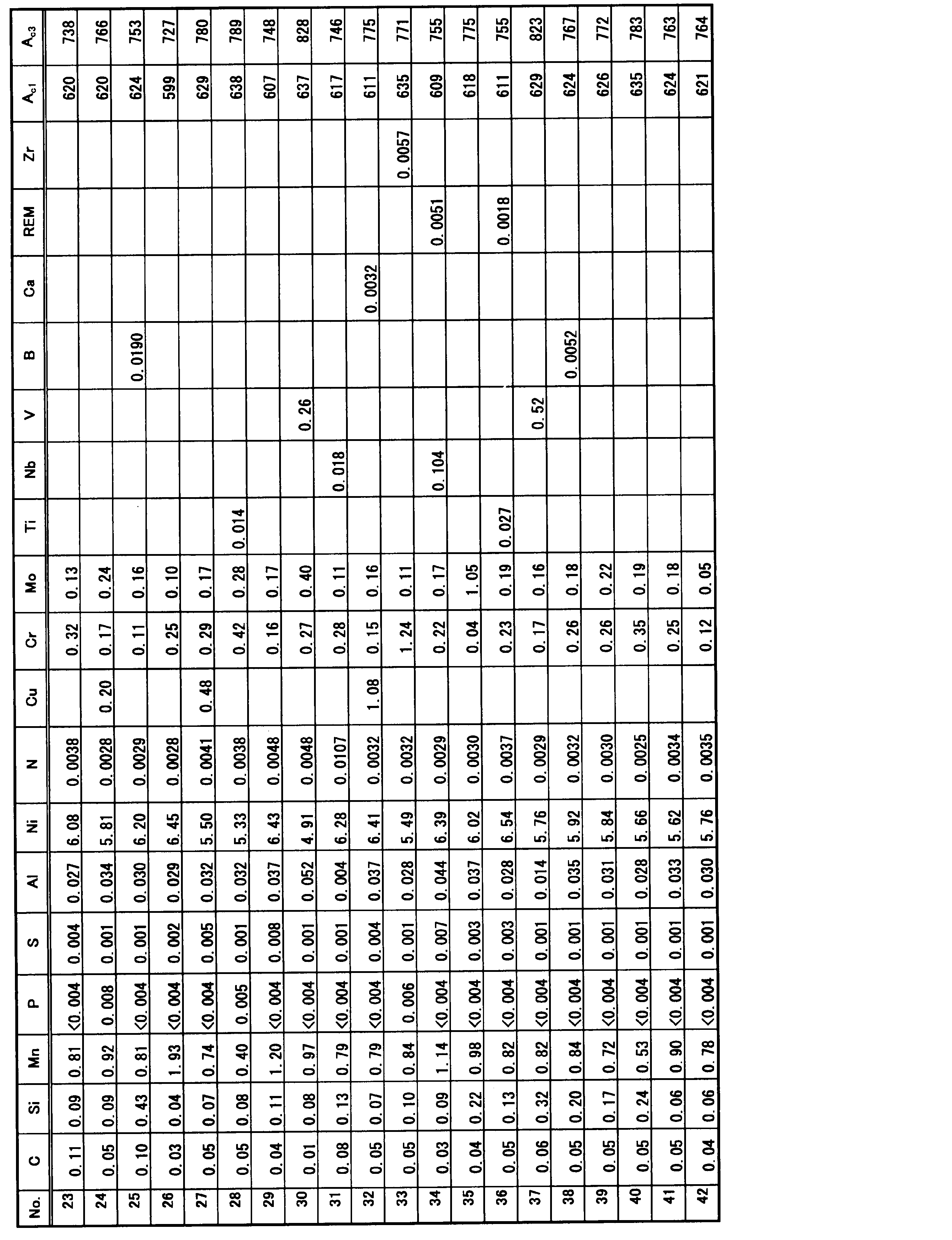
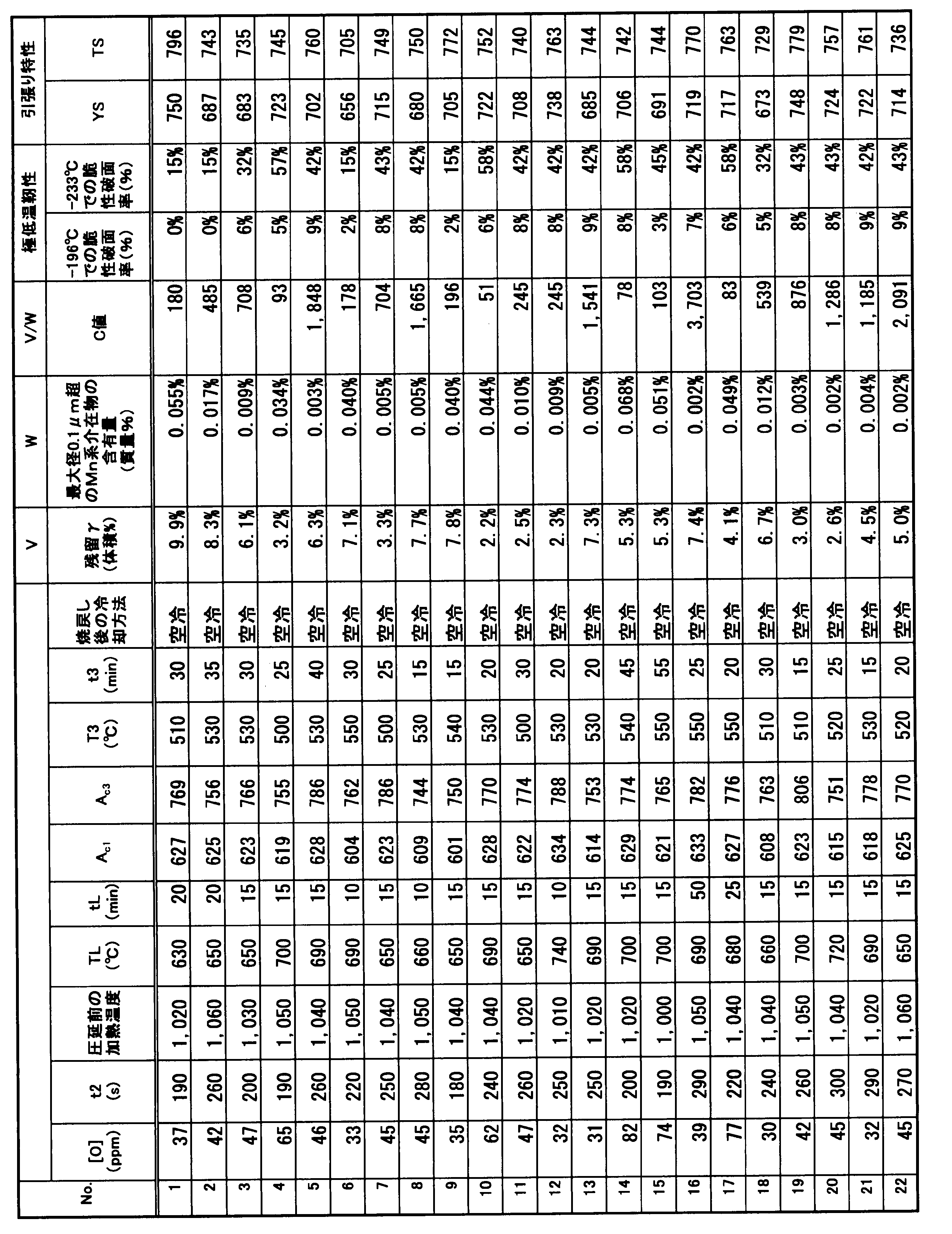
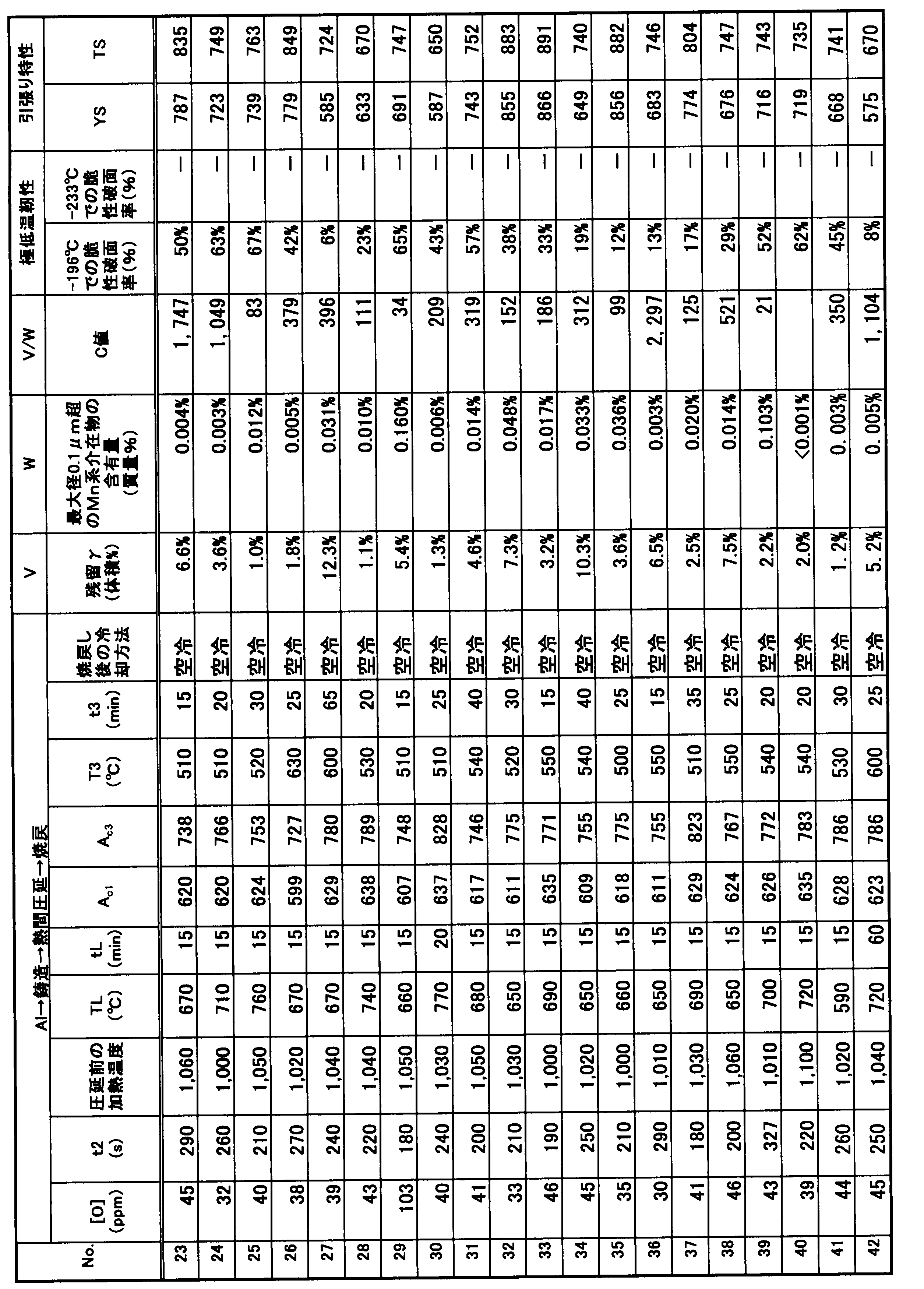
- Example 1 Using a vacuum melting furnace (150 kgVIF), after melting and casting a test steel having the component composition shown in Table 1 (remainder: iron and inevitable impurities, unit is mass%) under the melting conditions shown in Table 2 A steel ingot of 150 mm ⁇ 150 mm ⁇ 600 mm was produced by hot forging. In this example, misch metal containing about 50% Ce and about 25% La was used as REM.
- the order of addition of the deoxidizing elements is Si, Mn (simultaneous addition) ⁇ Al when no selective component is included; on the other hand, when the selective component of Ti, REM, Zr, Ca is included, Si, Mn (Simultaneous addition) ⁇ Al ⁇ Ti ⁇ REM, Zr, Ca (simultaneous addition).
- [O] is the amount of dissolved oxygen (ppm) before the addition of Al
- t2 is the cooling time (seconds) at 1500 to 1450 ° C. during casting. Cooling at 1500 to 1450 ° C. was controlled by air cooling or water cooling so that the cooling time was reached.
- the content of Mn inclusions having a maximum diameter of more than 0.1 ⁇ m (described as “W” in Table 2), residual ⁇ present at ⁇ 196 ° C. Volume fraction of phases (indicated as “V” in Table 2), tensile properties (tensile strength TS, yield strength YS), cryogenic toughness (brittle fracture surface ratio in C direction at ⁇ 196 ° C. or ⁇ 233 ° C.) evaluated.
- the content of Mn inclusions with a maximum diameter exceeding 0.1 ⁇ m is the number of cross sections immediately below the fracture surface of the remaining material after the Charpy test from the t / 4 position (t: thickness) of the steel sheet.
- a sample of (about 10 mm ⁇ 10 mm ⁇ 5 mm) was taken and determined by measuring the Mn concentration (insol.Mn amount) of the compound type that forms the compound by the electrolytic extraction method (iodine-methanol method).
- the sample was immersed in an AA-based electrolytic solution (acetylacetone-tetramethylammonium chloride-methanol solution), and constant current electrolysis was performed under a condition of 20 mA / cm 2 or less.
- the sample was transferred into a beaker containing a 14% iodine methanol solution (140 g of iodine dissolved in dehydrated methanol to make 1 L) and stirred with a magnetic costar, so that the extract on the surface of the sample Sonic separation was performed.
- the obtained ultrasonic stripping solution and the electrolytic solution after electrolysis described above were suction filtered and collected using a filtration filter.
- a membrane filter made of polycarbonate was used as the filtration filter.
- the residue (precipitate) remaining on the filtration filter was transferred together with the filtration filter into a platinum crucible, and heated with a gas burner to be incinerated.
- a flux mixed sodium carbonate and sodium tetraborate
- an acid hydroochloric acid
- water were added to the melt and dissolved, and then transferred to a volumetric flask, and a constant volume (50 mL) added with water was used as an analysis solution, and the amount of Mn in the analysis solution was determined.
- Measurement was performed using an ICP emission spectrometer.
- the Mn content (g) of the compound type detected by the ICP method measured in this way is defined as (1).
- the compound type Mn amount (1) measured by the ICP method as described above and the difference (2) in the weight (g) of the sample before and after the electrolysis are calculated according to the following formula.
- the content of the compound type Mn contained was calculated.
- Content of compound type Mn contained in sample (%) Mn amount of compound type by ICP method (1) / Weight difference between samples before and after electrolysis (2) ⁇ 100
- the peaks of the lattice planes (110), (200), (211), and (220) of the ferrite phase and the lattices of (111), (200), (220), and (311) of the residual ⁇ phase For the peak of the surface, based on the integrated intensity ratio of each peak, calculate the volume fraction of (111), (200), (220), (311) of the residual ⁇ phase, and obtain the average value of these, Was defined as “volume fraction of residual ⁇ ”.
- No. in Table 2B Since Nos. 23 to 42 do not satisfy at least one of the components in steel or the preferable production conditions defined in the present invention, they are comparative examples not satisfying the requirements of the present invention, and the desired characteristics were not obtained.
- No. No. 28 is No. in Table 1B with a small amount of Mn. This is an example in which the amount of residual ⁇ is insufficient because 28 is used. As a result, the brittle fracture surface ratio also increased and the desired cryogenic toughness could not be realized.
- No. No. 29 is No. in Table 1B with a large amount of S. 29 is an example. Therefore, even though the heating temperature before hot rolling is controlled within the preferred range of the present invention (1060 ° C. or less), the amount of Mn inclusions increases, the brittle fracture surface ratio increases, and the desired cryogenic temperature. The toughness could not be realized.
- No. No. 30 in Table 1B has a small amount of C, a small amount of Al, and a small amount of Ni. This is an example in which the amount of residual ⁇ is insufficient because 30 is used. As a result, the brittle fracture surface ratio also increased and the desired cryogenic toughness could not be realized. Furthermore, TS and YS also decreased.
- No. No. 31 in Table 1B has a small amount of Al and a large amount of N. Since 31 was used, the brittle fracture surface ratio increased and the desired cryogenic toughness could not be realized.
- the steel plate of the present invention is useful, for example, for LNG storage tanks and transport ships.
Landscapes
- Chemical & Material Sciences (AREA)
- Engineering & Computer Science (AREA)
- Materials Engineering (AREA)
- Mechanical Engineering (AREA)
- Metallurgy (AREA)
- Organic Chemistry (AREA)
- Physics & Mathematics (AREA)
- Thermal Sciences (AREA)
- Crystallography & Structural Chemistry (AREA)
- Heat Treatment Of Steel (AREA)
Abstract
Description
Cは、強度および残留オーステナイトの確保に必須の元素である。このような作用を有効に発揮させるため、C量の下限を0.02%以上とする。C量の好ましい下限は0.03%以上であり、更に好ましくは0.04%以上である。但し、過剰に添加すると、強度の過大な上昇により極低温靭性が低下するため、その上限を0.10%とする。C量の好ましい上限は0.08%以下であり、更に好ましくは0.06%以下である。
Siは、脱酸材として有用な元素である。但し、過剰に添加すると、硬質の島状マルテンサイト相の生成が促進され、極低温靭性が低下するため、その上限を0.40%以下とする。Si量の好ましい上限は0.35%以下であり、より好ましくは0.20%以下である。
Mnはオーステナイト(γ)安定化元素であり、残留γ量の増加に寄与する元素である。このような作用を有効に発揮させるため、Mn量の下限を0.50%とする。Mn量の好ましい下限は0.6%以上であり、より好ましくは0.7%以上である。但し、過剰に添加すると、焼戻し脆化をもたらし、所望の極低温靭性を確保できなくなるため、その上限を2.0%以下とする。Mn量の好ましい上限は1.5%以下であり、より好ましくは1.3%以下である。
Pは、粒界破壊の原因となる不純物元素であり、所望とする極低温靭性確保のため、その上限を0.007%以下とする。P量の好ましい上限は0.005%以下である。P量は少なければ少ない程良いが、工業的にP量を0%とすることは困難である。
Sも、上記Pと同様、粒界破壊の原因となる不純物元素であり、所望とする極低温靭性確保のため、その上限を0.007%以下とする。後記する実施例に示すように、S量が多くなると、脆性破面率は増加し、所望とする極低温靱性(-196℃での脆性破面率≦10%)を実現できない。また、S量が多すぎると、所望とするMn系介在物の量が多くなり、やはり、極低温靱性が低下する。S量の好ましい上限は0.005%以下である。S量は少なければ少ない程良いが、工業的にS量を0%とすることは困難である。
Alは脱酸元素である。Alの含有量が不足すると、鋼中の酸素濃度が上昇し、粗大なAl系介在物の量が増加し、所望とするMn系介在物量の制御に悪影響を及ぼす(詳細は後述する。)ため、その下限を0.005%以上とする。Al量の好ましい下限は0.010%以上であり、更に好ましくは0.015%以上である。但し、過剰に添加すると、Al系介在物の凝集や合体が促進され、やはり、所望とするMn系介在物量の制御に悪影響を及ぼすため、その上限を0.050%以下とする。Al量の好ましい上限は0.045%以下であり、更に好ましくは0.04%以下である。
Niは、極低温靱性の向上に有用な残留オーステナイト(残留γ)を確保するのに必須の元素である。このような作用を有効に発揮させるため、Ni量の下限を5.0%以上とする。Ni量の好ましい下限は5.2%以上であり、更に好ましくは5.4%以上である。但し、過剰に添加すると、原料のコスト高を招くため、その上限を7.5%以下とする。Ni量の好ましい上限は7.0%以下であり、更に好ましくは6.5%以下であり、更により好ましくは6.0%以下である。
Nは、歪時効により極低温靭性を低下させるため、その上限を0.010%以下とする。N量の好ましい上限は0.006%以下であり、更に好ましくは0.004%以下である。
Cuは、γ安定化元素であり、残留γ量の増加に寄与する元素である。このような作用を有効に発揮させるためには、Cuを0.05%以上含有することが好ましい。但し、過剰に添加すると、強度の著しい増加を招き、所望とする極低温靭性効果が得られないため、その上限を1.0%以下とすることが好ましい。Cu量の更に好ましい上限は0.8%以下であり、更により好ましくは0.7%以下である。
CrおよびMoは、いずれも強度向上元素である。これらの元素は単独で添加しても良いし、二種類を併用しても良い。上記作用を有効に発揮させるためには、Cr量を0.05%以上、Mo量を0.01%以上とすることが好ましい。但し、過剰に添加すると、強度の著しい増加を招き、所望とする極低温靭性を確保できなくなるため、Cr量の好ましい上限を1.20%以下(更に好ましくは1.1%以下、更により好ましくは0.9%以下、更に一層好ましくは0.5%以下)、Mo量の好ましい上限を1.0%以下(更に好ましくは0.8%以下、更により好ましくは0.6%以下)とする。
Ti、Nb、およびVは、いずれも炭窒化物として析出し、強度を上昇させる元素である。これらの元素は単独で添加しても良いし、二種以上を併用しても良い。上記作用を有効に発揮させるためには、Ti量を0.005%以上、Nb量を0.005%以上、V量を0.005%以上とすることが好ましい。但し、過剰に添加すると、強度の著しい増加を招き、所望とする極低温靭性を確保できなくなるため、Ti量の好ましい上限を0.025%以下(更に好ましくは0.018%以下であり、更により好ましくは0.015%以下)、Nb量の好ましい上限を0.100%以下(更に好ましくは0.05%以下であり、更により好ましくは0.02%以下)、V量の好ましい上限を0.50%以下(更に好ましくは0.3%以下であり、更により好ましくは0.2%以下)とする。
Bは、焼入れ性向上により強度向上に寄与する元素である。上記作用を有効に発揮させるためには、B量を0.0005%以上とすることが好ましい。但し、過剰に添加すると、強度の著しい増加をもたらし、所望とする極低温靭性を確保できなくなるため、B量の好ましい上限を0.0050%以下(更に好ましくは0.0030%以下、更により好ましくは0.0020%以下)とする。
Ca、REM、およびZrは、いずれも強脱酸元素であり、添加により、Si、Al添加のみの場合と比較して、鋼中の酸素濃度が低下し、粗大介在物が減少する。これらの元素は単独で添加しても良いし、二種以上を併用しても良い。上記作用を有効に発揮させるためには、Ca量を0.0005%以上、REM量(以下に記載のREMを、単独で含有するときは単独の含有量であり、二種以上を含有するときは、それらの合計量である。以下、REM量について同じ。)を0.0005%以上、Zr量を0.0005%以上とすることが好ましい。但し、過剰に添加すると、却って粗大な介在物化が増加し、極低温靭性が低下するため、Ca量の好ましい上限を0.0030%以下(更に好ましくは0.0025%以下)、REM量の好ましい上限を0.0050%以下(更に好ましくは0.0040%以下)、Zr量の好ましい上限を0.005%以下(更に好ましくは0.0040%以下)とする。
本発明では、Al系介在物は凝集・合体により粗大化し、脆性破壊の起点となる粗大な介在物を形成し易いとの観点に基づき、このような粗大なAl系介在物を生成させないように、Alの添加方法に特別に留意している。
。
Ac1点=723-10.7×[Mn]-16.9×[Ni]+29.1×[Si]+16.9×[Cr]+290×[As]+6.38×[W]
Ac3点=910-203×[C]1/2-15.2×[Ni]+44.7×[Si]+104×[V]+31.5×[Mo]+13.1×[W]
上記式中、[ ]は、鋼材中の合金元素の濃度(質量%)を意味する。なお、本発明には、AsおよびWは鋼中成分として含まれないため、上記式において、[As]および[W]はいずれも、0%として計算する。
真空溶解炉(150kgVIF)を用い、表2に示す溶製条件で、表1に示す成分組成(残部:鉄および不可避的不純物、単位は質量%)の供試鋼を溶製し、鋳造した後、熱間鍛造により、150mm×150mm×600mmの鋼塊を作製した。本実施例では、REMとしてCeを約50%、Laを約25%含むミッシュメタルを用いた。また、脱酸元素の添加順序は、選択成分を含まないときは、Si、Mn(同時添加)→Alであり;一方、Ti、REM、Zr、Caの選択成分を含むときは、Si、Mn(同時添加)→Al→Ti→REM、Zr、Ca(同時添加)である。また、表2中、[O]は、Al添加前の溶存酸素量(ppm)、t2は鋳造時の1500~1450℃の冷却時間(秒)である。1500~1450℃の冷却は、空冷または水冷にて、上記冷却時間となるように制御した。
鋼板中に存在する、最大径0.1μm超のMn系介在物の含有量は、上記鋼板のt/4位置(t:板厚)から、シャルピー試験後の残材の破面直下断面数mm(10mm×10mm×5mm程度)の試料を採取し、電解抽出法(ヨウ素-メタノール法)によって化合物を形成する化合物型のMn濃度(insol.Mn量)を測定することにより求めた。
試料中に含まれる化合物型Mnの含有率(%)
=ICP法による化合物型のMn量(1)/電解前後の試料の重量差(2)×100
各鋼板のt/4位置より、10mm×10mm×55mmの試験片を採取し、液体窒素温度(-196℃)にて5分間保持した後、リガク社製の二次元微小部X線回折装置(RINT-RAPIDII)にてX線回折測定を行なった。次いで、フェライト相の(110),(200),(211),(220)の各格子面のピーク、および残留γ相の(111),(200),(220),(311)の各格子面のピークについて、各ピークの積分強度比に基づき、残留γ相の(111)、(200)、(220)、(311)の体積分率をそれぞれ算出し、これらの平均値を求め、これを「残留γの体積分率」とした。
各鋼板のt/4位置から、C方向に平行にJIS Z2241の4号試験片を採取し、ZIS Z2241に記載の方法で引張り試験を行い、引張り強度TS、および降伏強度YSを測定した。本実施例では、TS>690MPa、YS>590MPaのものを、母材強度に優れると評価した。
(4-1)-196℃での脆性破面率の測定
各鋼板のt/4位置(t:板厚)且つW/4位置(W:板幅)、およびt/4位置且つおよびW/2位置から、C方向に平行にシャルピー衝撃試験片(JIS Z 2242のVノッチ試験片)を3本採取し、JIS Z2242に記載の方法で、-196℃での脆性破面率(%)を測定し、それぞれの平均値を算出した。そして、このようにして算出された二つの平均値のうち、特性に劣る(すなわち、脆性破面率が大きい)方の平均値を採用し、この値が10%以下のものを、本実施例では、極低温靭性に優れると評価した。
(4-2)-233℃での脆性破面率の測定
更に一部のデータ(いずれも本発明例)について、-233℃での脆性破面率を評価した。
「高圧ガス」、第24巻181頁、「オーステナイト系ステンレス鋳鋼の極低温衝撃試験」

本出願は、2013年4月17日出願の日本特許出願(特願2013-086852)に基づくものであり、その内容はここに参照として取り込まれる。
Claims (3)
- 質量%で、
C :0.02~0.10%、
Si:0.40%以下(0%を含まない)、
Mn:0.50~2.0%、
P :0.007%以下(0%を含まない)、
S :0.007%以下(0%を含まない)、
Al:0.005~0.050%、
Ni:5.0~7.5%、
N :0.010%以下(0%を含まない)
を含有し、残部が鉄および不可避不純物である厚鋼板であって、
鋼中に存在する、最大径が0.1μm超のMn系介在物の含有量が0.001~0.07質量%であり、且つ、
-196℃において存在する残留オーステナイト相の分率が2.0~12.0体積%であることを特徴とする極低温靭性に優れた厚鋼板。 - 更に、(a)~(e)の少なくとも1種を含有する請求項1に記載の厚鋼板。
(a)Cu:1.0%以下(0%を含まない)
(b)Cr:1.20%以下(0%を含まない)、およびMo:1.0%以下(0%を含まない)よりなる群から選択される少なくとも一種
(c)Ti:0.025%以下(0%を含まない)、Nb:0.100%以下(0%を含まない)、およびV:0.50%以下(0%を含まない)よりなる群から選択される少なくとも一種
(d)B:0.0050%以下(0%を含まない)
(e)Ca:0.0030%以下(0%を含まない)、REM:0.0050%以下(0%を含まない)、およびZr:0.005%以下(0%を含まない)よりなる群から選択される少なくとも一種 - -196℃において存在する残留オーステナイト相の分率をV(体積%)、最大径が0.1μm超のMn系介在物の含有量をW(質量%)としたとき、V/Wで表されるC値が150以上である請求項1または2記載の厚鋼板。
Priority Applications (3)
| Application Number | Priority Date | Filing Date | Title |
|---|---|---|---|
| EP14785212.3A EP2987885A4 (en) | 2013-04-17 | 2014-04-08 | THICK STEEL PLATE WITH EXCELLENT RESISTANCE AT VERY LOW TEMPERATURE |
| CN201480020442.0A CN105102661B (zh) | 2013-04-17 | 2014-04-08 | 极低温韧性优异的厚钢板 |
| KR1020157029195A KR101726122B1 (ko) | 2013-04-17 | 2014-04-08 | 극저온 인성이 우수한 후강판 |
Applications Claiming Priority (2)
| Application Number | Priority Date | Filing Date | Title |
|---|---|---|---|
| JP2013-086852 | 2013-04-17 | ||
| JP2013086852A JP6055363B2 (ja) | 2013-04-17 | 2013-04-17 | 極低温靭性に優れた高強度厚鋼板 |
Publications (1)
| Publication Number | Publication Date |
|---|---|
| WO2014171368A1 true WO2014171368A1 (ja) | 2014-10-23 |
Family
ID=51731312
Family Applications (1)
| Application Number | Title | Priority Date | Filing Date |
|---|---|---|---|
| PCT/JP2014/060200 Ceased WO2014171368A1 (ja) | 2013-04-17 | 2014-04-08 | 極低温靭性に優れた厚鋼板 |
Country Status (5)
| Country | Link |
|---|---|
| EP (1) | EP2987885A4 (ja) |
| JP (1) | JP6055363B2 (ja) |
| KR (1) | KR101726122B1 (ja) |
| CN (1) | CN105102661B (ja) |
| WO (1) | WO2014171368A1 (ja) |
Cited By (1)
| Publication number | Priority date | Publication date | Assignee | Title |
|---|---|---|---|---|
| CN113564474A (zh) * | 2021-07-26 | 2021-10-29 | 莱芜钢铁集团银山型钢有限公司 | 一种屈服强度≥550MPa低屈强比大型石油储罐用钢板及其生产方法 |
Families Citing this family (17)
| Publication number | Priority date | Publication date | Assignee | Title |
|---|---|---|---|---|
| JP6196929B2 (ja) * | 2014-04-08 | 2017-09-13 | 株式会社神戸製鋼所 | 極低温でのhaz靱性に優れた厚鋼板 |
| JP6206423B2 (ja) * | 2015-01-22 | 2017-10-04 | Jfeスチール株式会社 | 低温靭性に優れた高強度ステンレス厚鋼板およびその製造方法 |
| JP2017115239A (ja) | 2015-12-18 | 2017-06-29 | 株式会社神戸製鋼所 | 極低温靭性に優れた厚鋼板 |
| CN105543694B (zh) * | 2015-12-29 | 2017-12-29 | 东北大学 | 一种液化天然气储罐用7Ni钢板的制备方法 |
| JP6760056B2 (ja) * | 2016-12-28 | 2020-09-23 | 日本製鉄株式会社 | 液体水素用Ni鋼 |
| JP6760055B2 (ja) * | 2016-12-28 | 2020-09-23 | 日本製鉄株式会社 | 液体水素用Ni鋼 |
| CN109554608B (zh) * | 2017-09-25 | 2022-03-15 | 宝钢德盛不锈钢有限公司 | 一种超低温性能优良的奥氏体不锈钢及其制造方法 |
| CN111247263B (zh) | 2017-10-26 | 2021-12-28 | 日本制铁株式会社 | 低温用含镍钢 |
| WO2019082324A1 (ja) | 2017-10-26 | 2019-05-02 | 新日鐵住金株式会社 | 低温用ニッケル含有鋼 |
| CN111247262B (zh) | 2017-10-26 | 2021-12-21 | 日本制铁株式会社 | 低温用含镍钢 |
| JP6852807B2 (ja) * | 2017-10-26 | 2021-03-31 | 日本製鉄株式会社 | 低温用ニッケル含有鋼 |
| JP6933096B2 (ja) * | 2017-11-10 | 2021-09-08 | 日本製鉄株式会社 | 高圧水素用ニッケル鋼材 |
| RU2686758C1 (ru) * | 2018-04-02 | 2019-04-30 | Публичное акционерное общество "Северсталь" (ПАО "Северсталь") | Конструкционная криогенная сталь и способ ее получения |
| KR102427046B1 (ko) * | 2020-12-10 | 2022-07-28 | 주식회사 포스코 | 극저온 인성이 우수한 압력용기용 강판 및 이의 제조방법 |
| CN112779472B (zh) * | 2020-12-28 | 2022-01-07 | 东北大学 | 一种低温韧性优异的1GPa级海洋工程用钢板及其制备方法 |
| CN116377343B (zh) * | 2022-12-14 | 2024-06-18 | 鞍钢股份有限公司 | 一种极地海洋环境服役的海工钢板及其制造方法 |
| JP7782483B2 (ja) * | 2023-01-30 | 2025-12-09 | Jfeスチール株式会社 | 鋼板およびその製造方法 |
Citations (10)
| Publication number | Priority date | Publication date | Assignee | Title |
|---|---|---|---|---|
| JPS49135813A (ja) | 1973-05-04 | 1974-12-27 | ||
| JPS5113308A (ja) | 1974-07-24 | 1976-02-02 | Nippon Steel Corp | Teionyokyojinkooyobisono netsushorihoho |
| JPH01228643A (ja) * | 1988-03-09 | 1989-09-12 | Nippon Steel Corp | 鋼中にMnSを均一かつ微細に分散析出させる方法 |
| JP2001123245A (ja) | 1999-10-21 | 2001-05-08 | Nippon Steel Corp | 溶接部靱性に優れた高靱性高張力鋼とその製造方法 |
| JP2011241419A (ja) * | 2010-05-17 | 2011-12-01 | Sumitomo Metal Ind Ltd | 低温用厚鋼板およびその製造方法 |
| WO2012005330A1 (ja) * | 2010-07-09 | 2012-01-12 | 新日本製鐵株式会社 | Ni添加鋼板およびその製造方法 |
| WO2012043074A1 (ja) * | 2010-09-28 | 2012-04-05 | 株式会社神戸製鋼所 | 肌焼鋼およびその製造方法 |
| JP2013213273A (ja) * | 2012-03-09 | 2013-10-17 | Kobe Steel Ltd | 極低温靭性に優れた厚鋼板 |
| JP2013234381A (ja) * | 2012-04-13 | 2013-11-21 | Kobe Steel Ltd | 極低温靱性に優れた厚鋼板 |
| WO2014030618A1 (ja) * | 2012-08-23 | 2014-02-27 | 株式会社神戸製鋼所 | 極低温靱性に優れた厚鋼板 |
Family Cites Families (2)
| Publication number | Priority date | Publication date | Assignee | Title |
|---|---|---|---|---|
| JPS61127815A (ja) * | 1984-11-26 | 1986-06-16 | Nippon Steel Corp | 高アレスト性含Ni鋼の製造法 |
| JP5741260B2 (ja) * | 2011-07-06 | 2015-07-01 | 新日鐵住金株式会社 | 歪付与後のctod特性に優れた極低温用鋼材およびその製造方法 |
-
2013
- 2013-04-17 JP JP2013086852A patent/JP6055363B2/ja not_active Expired - Fee Related
-
2014
- 2014-04-08 EP EP14785212.3A patent/EP2987885A4/en not_active Withdrawn
- 2014-04-08 KR KR1020157029195A patent/KR101726122B1/ko not_active Expired - Fee Related
- 2014-04-08 CN CN201480020442.0A patent/CN105102661B/zh not_active Expired - Fee Related
- 2014-04-08 WO PCT/JP2014/060200 patent/WO2014171368A1/ja not_active Ceased
Patent Citations (10)
| Publication number | Priority date | Publication date | Assignee | Title |
|---|---|---|---|---|
| JPS49135813A (ja) | 1973-05-04 | 1974-12-27 | ||
| JPS5113308A (ja) | 1974-07-24 | 1976-02-02 | Nippon Steel Corp | Teionyokyojinkooyobisono netsushorihoho |
| JPH01228643A (ja) * | 1988-03-09 | 1989-09-12 | Nippon Steel Corp | 鋼中にMnSを均一かつ微細に分散析出させる方法 |
| JP2001123245A (ja) | 1999-10-21 | 2001-05-08 | Nippon Steel Corp | 溶接部靱性に優れた高靱性高張力鋼とその製造方法 |
| JP2011241419A (ja) * | 2010-05-17 | 2011-12-01 | Sumitomo Metal Ind Ltd | 低温用厚鋼板およびその製造方法 |
| WO2012005330A1 (ja) * | 2010-07-09 | 2012-01-12 | 新日本製鐵株式会社 | Ni添加鋼板およびその製造方法 |
| WO2012043074A1 (ja) * | 2010-09-28 | 2012-04-05 | 株式会社神戸製鋼所 | 肌焼鋼およびその製造方法 |
| JP2013213273A (ja) * | 2012-03-09 | 2013-10-17 | Kobe Steel Ltd | 極低温靭性に優れた厚鋼板 |
| JP2013234381A (ja) * | 2012-04-13 | 2013-11-21 | Kobe Steel Ltd | 極低温靱性に優れた厚鋼板 |
| WO2014030618A1 (ja) * | 2012-08-23 | 2014-02-27 | 株式会社神戸製鋼所 | 極低温靱性に優れた厚鋼板 |
Non-Patent Citations (5)
| Title |
|---|
| "Cryogenic Impact Test of Cast Austenitic Stainless Steel", JOURNAL OF THE HIGH PRESSURE GAS SAFETY INSTITUTE OF JAPAN, vol. 24, pages 181 |
| .: "Koza Gendai no Kinzoku-gaku, Zairyo-hen 4, Tekko Zairyo", THE JAPAN INSTITUTE OF METALS AND MATERIALS |
| FURUYAETAL: "Development of 6% Ni Steel for LNG Storage Tanks", CAMP-ISIJ, vol. 23, 2010, pages 1322 |
| See also references of EP2987885A4 * |
| YANO ET AL.: "Effect of Heat Treatment in the Ferrite-Austenite Region on Notch Toughness of 6% Nickel Steel", TETSU-TO-HAGANE, vol. 59, no. 6, 1973, pages 752 - 763 |
Cited By (1)
| Publication number | Priority date | Publication date | Assignee | Title |
|---|---|---|---|---|
| CN113564474A (zh) * | 2021-07-26 | 2021-10-29 | 莱芜钢铁集团银山型钢有限公司 | 一种屈服强度≥550MPa低屈强比大型石油储罐用钢板及其生产方法 |
Also Published As
| Publication number | Publication date |
|---|---|
| JP2014210948A (ja) | 2014-11-13 |
| EP2987885A4 (en) | 2016-09-28 |
| JP6055363B2 (ja) | 2016-12-27 |
| KR101726122B1 (ko) | 2017-04-11 |
| CN105102661A (zh) | 2015-11-25 |
| EP2987885A1 (en) | 2016-02-24 |
| CN105102661B (zh) | 2017-11-14 |
| KR20150126702A (ko) | 2015-11-12 |
Similar Documents
| Publication | Publication Date | Title |
|---|---|---|
| JP6055363B2 (ja) | 極低温靭性に優れた高強度厚鋼板 | |
| JP5833991B2 (ja) | 極低温靱性に優れた厚鋼板 | |
| JP6018453B2 (ja) | 極低温靭性に優れた高強度厚鋼板 | |
| KR101442400B1 (ko) | 극저온 인성이 우수한 후강판 | |
| JP4529872B2 (ja) | 高Mn鋼材及びその製造方法 | |
| JPWO2007034576A1 (ja) | 低温用鋼材およびその製造方法 | |
| JP6018454B2 (ja) | 極低温靭性に優れた高強度厚鋼板 | |
| KR101596998B1 (ko) | 극저온 인성이 우수한 후강판 | |
| CN111433381B (zh) | 高Mn钢及其制造方法 | |
| JP2017115239A (ja) | 極低温靭性に優れた厚鋼板 | |
| JP6852805B2 (ja) | 低温用ニッケル含有鋼 | |
| KR20200086737A (ko) | 열연 강판 및 그의 제조 방법 | |
| EP3378962B1 (en) | High heat input welded steel material | |
| JP2016183387A (ja) | 低温用厚鋼板及びその製造方法 | |
| JP6852806B2 (ja) | 低温用ニッケル含有鋼 | |
| JP5973902B2 (ja) | 極低温靭性に優れた厚鋼板 | |
| CN111788325B (zh) | 高Mn钢及其制造方法 | |
| KR101930181B1 (ko) | 대입열 용접용 강재 | |
| JP5973907B2 (ja) | 極低温靱性に優れた厚鋼板 | |
| KR20220131996A (ko) | 강재 및 그의 제조 방법, 그리고 탱크 | |
| WO2019168172A1 (ja) | 高Mn鋼およびその製造方法 | |
| JP6816467B2 (ja) | 低温用ニッケル含有厚鋼板及びその製造方法 | |
| JP5695458B2 (ja) | 靱性および歪時効特性に優れた厚鋼板 | |
| JPWO2020044421A1 (ja) | 鋼板およびその製造方法 |
Legal Events
| Date | Code | Title | Description |
|---|---|---|---|
| WWE | Wipo information: entry into national phase |
Ref document number: 201480020442.0 Country of ref document: CN |
|
| 121 | Ep: the epo has been informed by wipo that ep was designated in this application |
Ref document number: 14785212 Country of ref document: EP Kind code of ref document: A1 |
|
| WWE | Wipo information: entry into national phase |
Ref document number: 2014785212 Country of ref document: EP |
|
| ENP | Entry into the national phase |
Ref document number: 20157029195 Country of ref document: KR Kind code of ref document: A |
|
| NENP | Non-entry into the national phase |
Ref country code: DE |