WO2014174621A1 - Support d'enregistrement, appareil de jeu et procédé de progression dans un jeu - Google Patents
Support d'enregistrement, appareil de jeu et procédé de progression dans un jeu Download PDFInfo
- Publication number
- WO2014174621A1 WO2014174621A1 PCT/JP2013/062119 JP2013062119W WO2014174621A1 WO 2014174621 A1 WO2014174621 A1 WO 2014174621A1 JP 2013062119 W JP2013062119 W JP 2013062119W WO 2014174621 A1 WO2014174621 A1 WO 2014174621A1
- Authority
- WO
- WIPO (PCT)
- Prior art keywords
- input
- music
- player
- input operation
- instruction information
- Prior art date
- Legal status (The legal status is an assumption and is not a legal conclusion. Google has not performed a legal analysis and makes no representation as to the accuracy of the status listed.)
- Ceased
Links
Images




Classifications
-
- A—HUMAN NECESSITIES
- A63—SPORTS; GAMES; AMUSEMENTS
- A63F—CARD, BOARD, OR ROULETTE GAMES; INDOOR GAMES USING SMALL MOVING PLAYING BODIES; VIDEO GAMES; GAMES NOT OTHERWISE PROVIDED FOR
- A63F13/00—Video games, i.e. games using an electronically generated display having two or more dimensions
- A63F13/80—Special adaptations for executing a specific game genre or game mode
- A63F13/814—Musical performances, e.g. by evaluating the player's ability to follow a notation
-
- A—HUMAN NECESSITIES
- A63—SPORTS; GAMES; AMUSEMENTS
- A63F—CARD, BOARD, OR ROULETTE GAMES; INDOOR GAMES USING SMALL MOVING PLAYING BODIES; VIDEO GAMES; GAMES NOT OTHERWISE PROVIDED FOR
- A63F13/00—Video games, i.e. games using an electronically generated display having two or more dimensions
- A63F13/20—Input arrangements for video game devices
- A63F13/21—Input arrangements for video game devices characterised by their sensors, purposes or types
- A63F13/214—Input arrangements for video game devices characterised by their sensors, purposes or types for locating contacts on a surface, e.g. floor mats or touch pads
- A63F13/2145—Input arrangements for video game devices characterised by their sensors, purposes or types for locating contacts on a surface, e.g. floor mats or touch pads the surface being also a display device, e.g. touch screens
-
- A—HUMAN NECESSITIES
- A63—SPORTS; GAMES; AMUSEMENTS
- A63F—CARD, BOARD, OR ROULETTE GAMES; INDOOR GAMES USING SMALL MOVING PLAYING BODIES; VIDEO GAMES; GAMES NOT OTHERWISE PROVIDED FOR
- A63F13/00—Video games, i.e. games using an electronically generated display having two or more dimensions
- A63F13/30—Interconnection arrangements between game servers and game devices; Interconnection arrangements between game devices; Interconnection arrangements between game servers
- A63F13/33—Interconnection arrangements between game servers and game devices; Interconnection arrangements between game devices; Interconnection arrangements between game servers using wide area network [WAN] connections
- A63F13/332—Interconnection arrangements between game servers and game devices; Interconnection arrangements between game devices; Interconnection arrangements between game servers using wide area network [WAN] connections using wireless networks, e.g. cellular phone networks
Definitions
- the present invention relates to a computer-readable recording medium on which a game program for advancing a game is recorded by performing a predetermined operation in accordance with an indication sign displayed on a display device.
- Some of these music games are not only those that give the player the feeling of playing an instrument, but for example, by performing an operation input in accordance with an indication sign, the feeling of conducting an orchestra
- the operation input according to the indication sign is not possible, if the music is output as usual, or if only a part of the music is not output, it is like playing an instrument or conducting an orchestra Sense may be impaired. In other words, despite the fact that performance and conduct have failed, there is a situation in which music is output as usual without any uncomfortable sound being output.
- Patent Document 2 in order to give the player a sense of being a conductor, the orientation of the player is determined using a device shaped like a conductor rod equipped with an acceleration sensor, a magnetic sensor, or the like. In addition, it is described that the volume or the like of a channel corresponding to each instrument part is controlled based on the direction. In this way, for example, only a specific part such as a violin part can be raised.
- Patent Document 2 it is necessary to use a command pole-shaped special input device equipped with an acceleration sensor or a magnetic sensor. Unlike a game using a smartphone or a portable game device, the technology is always available. It wasn't easy to enjoy the game.
- the present invention has been made to solve such a problem. Even when the player cannot perform an operation input in accordance with the instruction sign, the player can play an instrument or play an orchestra. It is an object of the present invention to provide a game recording medium with improved taste that can play a game without impairing the sense of conducting. In addition, the present invention can feel the sense of conducting an orchestra without using a special device having a command bar shape, which is equipped with an acceleration sensor, a magnetic sensor, etc. It is an object of the present invention to provide a game recording medium that can be easily played.
- the computer-readable recording medium is a computer-readable recording medium that records a game program to be executed in a computer device including an input device, a display device, and a sound reproduction device.
- the computer device is stored in the music data storage means via the input operation accepting means for accepting an input operation to the input device by the player, the music data storage means for storing a plurality of music data, and the sound reproducing device.
- a music playback means for playing back predetermined music by playing back music data on a plurality of tracks, and an operation to be input by the player associated with one of the plurality of tracks in accordance with the playback of the music by the music playback means
- Operation instruction information display means for displaying operation instruction information related to instructions on a display screen, and the operation Based on the input operation corresponding to the display information or the timing at which the player corresponding to the operation instruction information should perform the input operation, and functioning as an input operation determination means for determining the input operation received by the input operation reception means,
- a game program characterized in that the music reproducing means changes and reproduces the music data reproduced on the track corresponding to the operation instruction information to be determined according to the determination result by the input operation determining means.
- a recorded computer-readable recording medium In the computer-readable recording medium according to the present invention, each piece of music data is preferably performance data from a plurality of different musical instruments.
- different pieces of music data are simultaneously played on a plurality of tracks, so that one piece of music with a sense of unity is played.
- music data hereinafter also referred to as performance data
- performance data music data
- the music data has a one-to-one correspondence with the track
- different music data is played back on a plurality of tracks, so that music with a sense of unity is played back.
- an operation instruction to be input by the player, associated with one of these tracks, is displayed.
- the operation instruction indicates the content of the input operation required by the player (for example, a specific operation such as “tap” or “splash tap” described later), the timing for performing the input operation, etc. to the player on the display screen. It is an instruction.
- the music is not output as usual, but a pitch deviating from the original pitch is output, or the tempo of the song is slowed down.
- the operation instruction requested from the player is associated with a track of an instrument playing the main melody in the performance by the orchestra
- the pitch or tempo of the main melody changes. Therefore, the uncomfortable feeling becomes very large.
- the input operation is an operation performed by the player on the input device of the computer device.
- the input device is provided with an input button
- the input device is pressed
- the display device is a touch panel.
- the finger or stylus touches the touch panel to move it, or when the input device is equipped with a sensor such as a gyro sensor or acceleration sensor, input in any direction and speed
- the computer-readable recording medium is a computer-readable recording medium that records a game program to be executed in a computer device including an input device, a display device, and a sound reproduction device.
- the computer device is stored in the music data storage means via the input operation accepting means for accepting an input operation to the input device by the player, the music data storage means for storing a plurality of music data, and the sound reproducing device.
- a music playback means for playing back predetermined music by playing back music data on a plurality of tracks, and an operation to be input by the player associated with one of the plurality of tracks in accordance with the playback of the music by the music playback means
- Operation instruction information display means for displaying operation instruction information related to instructions on a display screen, and the operation Based on the input operation corresponding to the display information or the timing at which the player corresponding to the operation instruction information should perform the input operation, and functioning as an input operation determination means for determining the input operation received by the input operation reception means,
- Recording a game program characterized in that the music playback means controls the volume of the track corresponding to the operation instruction information to be determined according to the determination result by the input operation determination means when playing the music
- the computer-readable recording medium In the computer-readable recording medium according to the present invention, each piece of music data is preferably performance data from a plurality of different musical instruments.
- the present invention it is possible to reproduce performances of a plurality of musical instruments such as orchestras by simultaneously reproducing performance data of different musical instruments on a plurality of tracks.
- an operation instruction to be input by the player associated with one of these tracks, is displayed.
- the player performs an input operation, it is determined whether or not the input operation to be input has been performed, and the volume of the performance data of the track corresponding to the operation instruction to be determined is controlled.
- the music is not output at a normal volume, but at a volume higher than the original volume or at a volume lower than the original volume. Can be played. Therefore, when the player cannot perform an input operation to be input, the player character fails to perform or conduct, and the volume of some performances of the plurality of musical instruments is increased more than necessary, or the volume is If the sound is too small to be heard, the entire music is played with a sense of incongruity.
- the volume of the main melody changes when the player fails in the input operation.
- the main melody is output at a higher volume than necessary, or the volume is too low to be drowned out by the sound of other instruments.
- the input device and the display device are touch panel type display devices, and the game program displays a plurality of input areas corresponding to each track on the display screen of the touch panel.
- the input operation determination means performs the input operation accepted in the input area set for the track corresponding to the operation instruction information displayed on the operation instruction information display means. It is preferable to determine.
- the display screen of the touch panel is divided into a plurality of input areas, and each input area is associated with each track, that is, a musical instrument, and the player performs a touch operation on a different input area for each musical instrument that plays music. Is required. The player does not have to simply perform a touch operation on the touch panel, and the place where the player should input changes, which makes the game more interesting.
- the operation instruction information display means displays an instruction sign indicating an operation instruction to be input by the player, and the instruction sign is associated with one of a plurality of tracks. Preferably it is displayed.
- the operation instruction information display means displays on the display screen a plurality of time axes set for each track and a reference position set on the time axis.
- an instruction sign movement display means for moving and displaying on the time axis an instruction sign indicating an operation instruction to be input by the player in accordance with the reproduction of the music by the music reproduction means, It is preferable that the input operation determination unit determines an input operation received until the instruction mark moved and displayed by the instruction mark movement display unit reaches the reference position and passes through.
- a game device is a game device including an input device, a display device, and a sound reproduction device, and an input operation accepting unit that accepts an input operation to the input device by a player, Music data storage means for storing the music data, and music playback means for playing back the predetermined music by playing back the music data stored in the music data storage means on a plurality of tracks via the sound playback device,
- operation instruction information display means for displaying on the display screen operation instruction information related to an operation instruction to be input by the player, which is associated with one of the plurality of tracks, and the operation instruction information Based on the corresponding input operation or the timing at which the player corresponding to the operation instruction information should perform the input operation, the input operation receiving means receives the input operation.
- Input operation determining means for determining the attached input operation, and the music playback means is played back on a track corresponding to the operation instruction information to be determined according to the determination result by the input operation determining means
- a game apparatus characterized in that music data is changed and reproduced.
- a game device is a game device including an input device, a display device, and a sound reproduction device, and an input operation accepting unit that accepts an input operation to the input device by a player, Music data storage means for storing the music data, and music playback means for playing back the predetermined music by playing back the music data stored in the music data storage means on a plurality of tracks via the sound playback device,
- operation instruction information display means for displaying on the display screen operation instruction information related to an operation instruction to be input by the player, which is associated with one of the plurality of tracks, and the operation instruction information Based on the corresponding input operation or the timing at which the player corresponding to the operation instruction information should perform the input operation, the input operation receiving means receives the input operation.
- the game apparatus is characterized by controlling the volume of a track to be played.
- the game progress method is a game progress method executed in a computer device including an input device, a display device, and a sound reproduction device.
- a step of receiving the input operation a step of playing a predetermined piece of music by playing a plurality of pieces of music data stored in the storage means on a plurality of tracks via the sound playback device,
- the step of reproducing a song is characterized in that the song data to be reproduced on the track corresponding to the operation instruction information to be determined is changed and reproduced according to the determination result in the step of determining the input operation. This is a game progression method.
- the game progress method is a game progress method executed in a computer device including an input device, a display device, and a sound reproduction device.
- a step of receiving the input operation a step of playing a predetermined piece of music by playing a plurality of pieces of music data stored in the storage means on a plurality of tracks via the sound playback device,
- the step of reproducing the music controls the volume of the track corresponding to the operation instruction information to be determined according to the determination result in the step of determining the input operation when reproducing the music. It is a game progression method.
- Each embodiment of the present invention solves one or more deficiencies.
- the player can play the game without losing the sense that the player is playing an instrument or conducting an orchestra.
- the present invention can feel the sense of conducting an orchestra without using a special device having a command bar shape, which is equipped with an acceleration sensor, a magnetic sensor, etc. It is possible to provide a recording medium, a game device, and a game progress method that can be easily played.
- the game device will be described. Although there is no restriction
- FIG. 1 is a front external view of a game device corresponding to at least one of the embodiments of the present invention.
- the game apparatus 1 includes a main body 2, a liquid crystal monitor 3, an input unit 4, and a speaker 5.
- the liquid crystal monitor 3 is provided in a substantially rectangular shape at the center of the surface of the main body 2.
- the liquid crystal monitor 3 is a touch panel type, and when the surface of the touch panel is touched with a finger or a touch pen, the touch input detection unit can detect the contact position. The player can perform an input operation in accordance with the instruction sign by operating the touch panel.
- the input unit 4 includes a menu button 4a, a volume button 4b, and a power button 4c.
- the menu button 4 a is provided at the lower part of the liquid crystal monitor 3 of the main body 2. By pressing the menu button 4a, a menu screen for making various settings of the game apparatus 1 can be read.
- the volume button 4 b is provided on the upper side of the main body 2. The volume can be adjusted by the volume button 4b.
- the power button 4c is provided on the upper surface of the main body 2. By pressing the power button 4c, the power of the game apparatus 1 can be switched ON / OFF or the sleep state can be entered.
- the speaker 5 is built in the main body 2, and an output port is provided above the liquid crystal monitor 3 of the main body 2.
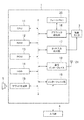
- FIG. 2 is a block diagram showing a configuration of the game device corresponding to at least one of the embodiments of the present invention.
- the game apparatus 1 includes a CPU (Central Processing Unit) 11, a RAM (Random Access Memory) 12, a ROM 13, an HDD 14, a sound processing unit 15, a graphic processing unit 16, a touch input detection unit 17, a communication interface 18, and an interface unit 19. Each connected by an internal bus.
- the CPU 11 executes a game program stored in the ROM 13 and controls the game apparatus 1. Further, the CPU 11 is provided with an internal timer for measuring time.
- the RAM 12 is a work area for the CPU 11.
- the HDD 14 is a storage area for storing programs and data.
- the CPU 11 reads out programs and data necessary for the progress of the game from the RAM 12 and performs processing.
- the CPU 11 processes a program and data loaded in the RAM 12 to output a sound output instruction to the sound processing unit 15 and output a drawing command to the graphic processing unit 16.
- the sound processing unit 15 is connected to the speaker 5.
- the CPU 11 When the CPU 11 outputs a sound output instruction to the sound processing unit 15, the sound processing unit 15 outputs a sound signal to the speaker 5.
- the graphic processing unit 16 is connected to the liquid crystal monitor 3.
- the graphic processing unit 16 develops an image in the frame memory (frame buffer) 20 and outputs a video signal for displaying the image on the liquid crystal monitor 3.
- the graphic processing unit 16 performs drawing of one image for each frame.
- One frame time of an image is, for example, 1/30 second.
- the input unit 4 is connected to the interface unit 19. Information input by the player from the input unit 4 and the touch input detection unit 17 is stored in the RAM 12, and the CPU 11 executes various arithmetic processes based on the input information.
- the communication interface 18 is connected to a communication network by radio.
- the communication interface 18 communicates with other game apparatuses 1 wirelessly via a communication unit having the antenna 21 and transmits game information and the like.
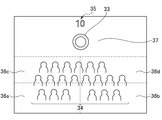
- FIG. 3 is a diagram showing an example of a display screen of the game apparatus corresponding to at least one of the embodiments of the present invention.
- the touch panel display screen is divided into a plurality of input areas 36. These input areas 36 are input areas 36 corresponding to different tracks (instruments).
- the input area 36a is a violin
- the input area 36b is a contrabass
- the input area 36c is a flute
- the input area 36d is a horn. It corresponds.
- an instruction sign display region 37 is provided in the upper center portion of the display screen. In the indication sign display area 37, indication signs 33 are sequentially displayed as the music is played.
- the circular indicator mark 33 is initially displayed in a small dot-like state, and gradually increases with time. While the indication mark 33 is displayed in the largest size, the player makes a touch operation such as “tap” described later in a predetermined input area 36 of the touch panel (the touch operation refers to a finger, stylus or the like on a touch panel display screen. (Referred to as an operation for contact).
- the indicator mark is displayed in the largest size, and when the timing is to be input, the indicator mark 33 is displayed in a different color from the normal or It is also possible to display an animation in which the sign 33 is shining.
- the indication mark 33 is displayed in the largest size, and after the timing to be input by the player has passed, the size of the indication mark 33 decreases with the passage of time, and the display is erased after being displayed in a dot shape. When the display of one indication mark 33 is completed, it is repeated that a new indication mark 33 is displayed while changing its size.
- the indicator corresponding to the indicator 33 is displayed by displaying the indicator 33 with a color corresponding to the background color. It is possible for the player to determine which is the one. For example, when the background color is blue in the input area 36a, the outer periphery of the indicator mark 33 is displayed in blue, which is the same color, so that the indicator mark 33 is a track corresponding to the violin in the input area 36a. Can be identified. In this case, the player needs to perform a “tap” operation in the input area 36a at a predetermined timing. If the “tap” operation is unsuccessful, the pitch and tempo of the music data of the track related to the violin are controlled, so the violin sound is uncomfortable.
- the player can determine the corresponding input area 36 by the pattern of the indicator mark 33. For example, by displaying a symbol of a violin, a contrabass, a flute, or a horn in the center of the circular indicator mark 33, the corresponding input area 36 and track can be specified.
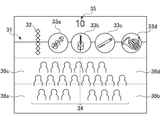
- FIG. 4 is a diagram showing an example of a display screen of the game device corresponding to at least one of the embodiments of the present invention.
- the touch panel display screen is divided into a plurality of regions as in the first embodiment. These areas are input areas corresponding to different tracks (instruments).
- the input area 36a corresponds to a violin
- the input area 36b corresponds to a contrabass
- the input area 36c corresponds to a flute
- the input area 36d corresponds to a horn. Yes.
- a linear time axis 31 is provided above the center of the display screen from the left end to the right end of the display screen.
- a reference line 32 indicating a reference position serving as a reference for determining an input operation when the indicator mark 33 passes is provided.
- the reference line 32 is displayed in a direction perpendicular to the time axis 31.
- the indication mark 33 is displayed on the display screen and indicates an operation to be input by the player via the touch panel, and the displayed shape or pattern differs depending on the operation requested from the player. .
- the shape and pattern of the indicator mark 33 can be set as appropriate, but it is usually preferable to use a shape or pattern that makes it easy to imagine the operation requested by the player.
- the indication mark 33 is first displayed on the right end of the time axis 31 and moves to the left along each time axis 31 at a constant speed as time passes.
- a plurality of indicator signs 33 can be displayed on the time axis 31, and the indicator signs 33 having different patterns and shapes are employed depending on the manner of contact operation requested by the player.
- it can be determined by the color or pattern of the indication mark 33 as in the first embodiment. For example, as shown in FIG. 4, a method of displaying a corresponding input area 36 and a track by displaying a design of a violin, a contrabass, a flute, and a horn at the center of the circular indicator signs 33a to 33d is adopted. be able to.
- a method of displaying the instruction signs 33a to 33d with a color corresponding to the background color is adopted. It is also possible.
- the indicator mark 33 moves from the right end to the left end along the time axis 31 at a predetermined speed and disappears when reaching the left end.
- the indicator mark 33 reaches the reference line 32, input to the touch panel in the input area 36 corresponding to the indicator mark 33 is detected until all of the indicator mark 33 passes the reference line 32.
- the detected input operation is determined based on the reference value corresponding to the instruction mark 33, and the pitch, tempo, and the like of the music data of the track corresponding to the instruction mark 33 are controlled according to the determination result. . Therefore, when the indication mark 33 corresponding to the input area 36a has reached the reference line 32 and the contact operation is mistakenly performed in the input area 36b, it is determined that the operation to be input is not performed. become. In this case, the pitch, tempo, etc. of the violin track corresponding to the input area 36a are controlled.
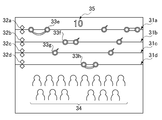
- FIG. 5 is a diagram showing an example of a display screen of the game device corresponding to at least one of the embodiments of the present invention.
- a linear time axis 31 is provided, the indicator mark 33 moves on the time axis 31, and the indicator mark 33 While passing through the reference line 32, a predetermined contact operation is requested from the player.
- a plurality of time axes 31a to 31d are provided.
- Each time axis 31 corresponds to different music data (musical instrument performance data).
- the time axis 31a corresponds to a violin
- the time axis 31b corresponds to a contrabass
- the time axis 31c corresponds to a flute
- the time axis 31d corresponds to a horn.
- reference lines 32a to 32d indicating reference positions for determining the input operation when the indicator signs 33e to 33h pass are provided, respectively.
- the reference lines 32a to 32d are displayed in a direction perpendicular to the time axes 31a to 31d.
- four time axes 31 are provided, but the number of time axes 31 is not particularly limited, and can be appropriately designed according to the game concept, difficulty level, and the like.
- the indication mark 33 is first displayed on the right end of any of the time axes 31a to 31d, and moves to the left along each time axis 31 at a constant speed as time elapses.
- a plurality of indicator signs 33e to 33h can be displayed on the time axis 31, and the indicator signs 33 having different patterns and shapes are employed depending on the manner of contact operation requested by the player.
- the player needs to perform an input operation on the touch panel when the indication mark 33 reaches the reference line 32.
- the instruction mark 33 reaches the reference line 32, input to the touch panel by the player is detected until all of the instruction marks 33 pass the reference line 32.
- the detected input operation is determined based on the reference value corresponding to the instruction mark 33, and the performance data of the track corresponding to the instruction mark 33 is controlled according to the determination result. For example, since the indication mark 33e moves on the time axis 31a, the indication mark 33e corresponds to a violin track, and the pitch of the performance data of the violin is determined according to the determination result of the contact operation of the player. And the tempo will change. Similarly, since the instruction mark 33f moves on the time axis 31b, the instruction mark 33f corresponds to the track of the contrabass.
- a large number of characters 34 playing various musical instruments are displayed at the center of the display screen.
- the character 34 is in charge of, for example, stringed instruments such as violin, cello, and contrabass, woodwind instruments such as flute, oboe, and clarinet, brass instruments such as horn, trumpet, and trombone, and percussion instruments such as cymbals.
- stringed instruments such as violin, cello, and contrabass
- woodwind instruments such as flute, oboe, and clarinet
- brass instruments such as horn, trumpet, and trombone
- percussion instruments such as cymbals
- the display of these characters 34 also changes according to the music playback time. For example, in the case of a melody in which the performance of a violin is exciting, the action of the character 34 relating to the violin player can be increased or speeded up. Further, when the player succeeds in the input operation requested by the instruction mark 33, the animation of the character 34 related to the player of the musical instrument corresponding to the instruction mark 33 can be changed according to the failure. For example, when the player succeeds in the input operation requested by the instruction mark 33 corresponding to the violin, it is possible to display an animation that makes the character 34 who is a violin player happy.
- the points 35 acquired by the player as the game progresses are displayed.
- the game is added to the point 35, and the player can compete for the height of the point when the performance (playback) of the music is completed.
- the point 35 does not have to be changed in particular, or the point 35 can be subtracted.
- the performance data of the track corresponding to the instruction sign is controlled and output. For example, the pitch (pitch), tempo, formant, etc. are changed and output for performance data in MIDI format.
- the pitch changes even if the tempo is changed, or the playback speed and formant of the music change even if the pitch is changed. It is also possible to change the tempo while maintaining the pitch of the music data, or to change the pitch while maintaining the playback speed and formant.
- FIG. 6 is a diagram illustrating an example of an instruction sign displayed on the display screen of the game device, corresponding to at least one of the embodiments of the present invention.
- FIG. 6A shows a “tap” indicator 33, which is composed of only a circular mark 33a formed of a double circle. “Tap” represents the most basic operation, and it is required to perform a touch operation on the touch panel after the indicator mark 33 reaches the reference line 32 on the time axis 31 and finishes passing. .
- FIG. 6B shows a “Splash Tap” indicator mark 33, which is provided with a circular mark 33b composed of a double circle and a direction display portion 33c.
- the direction display portion 33c is provided so as to be in contact with a circle outside the circular mark 33b, and forms an acute angle in a direction opposite to the center of the circle.
- the direction of the “splash tap” is specified by the direction indicated by the acute angle. That is, the “splash tap” jumps up from a state in which a finger or a touch pen (hereinafter also referred to as a finger) is in contact with the touch panel to a state in which the finger is not in contact with the touch panel while moving in a predetermined direction.
- the predetermined direction is specified by the direction indicated by the acute angle of the direction display unit 33c.
- the direction display section 33c can indicate any one of eight directions including an upward direction, a downward direction, a left direction, and a right direction, and an upper right direction, an upper left direction, a lower right direction, and a lower left direction. For example, by changing the direction of the “tap” required by the player according to the rhythm, tempo, and sound intensity of the music, the player can play the game while feeling like an orchestra conductor. Is possible.
- FIG. 6 (c) shows an indication mark 33 of “long press splash tap”, which is provided with circular marks 33d and 33e made of double circles and a direction display portion 33f.
- the circular mark 33d and the circular mark 33e are connected by a connecting portion 33g displayed by two straight lines.
- the circular mark 33d displayed on the left side indicates the timing when the player touches the touch panel with a finger or the like
- the circular mark 33e indicates the timing when the player jumps up from the touch panel to a state where the player does not touch with the finger or the like. It is shown.
- the circular mark 33d reaches the reference line 32, it touches the touch panel and continues for a while (after long pressing), and then when the circular mark 33e reaches the reference line 32, a predetermined direction is reached. It is required to flip up your fingers.
- the direction display portion 33f is provided so as to be in contact with the outer circle of the circular mark 33e, and forms an acute angle in the opposite direction to the center of the circle, as in the case of “splash tap”.
- the direction of the “long press splash tap” is specified by the direction indicated by the acute angle. That is, the moving direction when jumping up to a state where it is not in contact with the touch panel is specified by the direction indicated by the direction display unit 33f.
- FIG. 6D shows a “fluctuation” indicator mark 33, and circular marks 33h and 33i made of double circles are displayed by two curves swelled on the lower side of the display screen. It is connected by.
- the circular mark 33h displayed on the left side indicates the timing when the player touches the touch panel with a finger or the like
- the circular mark 33i indicates the timing when the player releases the finger or the like from the touch panel. That is, “fluctuation” is an operation of moving a finger or a touch pen while touching the touch panel while drawing an arc from left to right, and touches the touch panel when the circular mark 33h reaches the reference line 32. Then, after the contact position is moved from left to right, when the circular mark 33i reaches the reference line 32, it is required to release the finger or the like from the touch panel.
- FIG. 6E shows a “pinch-in” indicator mark 33, in which circular marks 33k and 33n made of double circles are connected by a connecting portion 33q displayed by two straight lines inclined downward to the right. ing. Similarly, the circular marks 33m and 33p are connected by a connecting portion 33r displayed by two straight lines inclined upward. The circular marks 33n and 33p located at the right ends of the connecting portions 33q and 33r are in contact with each other side by side.
- the distance between the circular marks 33k and 33m represents the distance between the two fingers touching the touch panel at the time when the player starts “pinch-in”, and the distance between the circular marks 33n and 33p is This represents the distance of the contact position of the finger when the player finishes “pinch-in”.
- interval between the upper and lower sides of the connection parts 33q and 33r is so narrow that it becomes the right side, and it shows that the distance of the contact position of two fingers becomes short as time passes.
- “pinch-in” is an operation of reducing the distance between the contact positions in a state where two fingers are in contact with the touch panel.
- the “pinch-in” is performed. Move the finger so that the distance between the touched positions is shortened so that the finger is in contact with the touch panel at a predetermined interval and the object between the fingers is pinched as time passes.
- the circular marks 33n and 33p reach the reference line 32, it is required that the two fingers are in contact with the touch panel at a close position.
- FIG. 6 (f) shows a “pinch out” indicator mark 33 in which circular marks 33 s and 33 u made of double circles are connected by a connecting portion 33 w displayed by two straight lines inclined upward to the right. Has been. Similarly, the circular marks 33t and 33v are connected by a connecting portion 33x displayed by two straight lines inclined downward to the right. The circular marks 33s and 33t located at the left ends of the connecting portions 33w and 33x are in contact with each other in the vertical direction.
- the distance between the circular marks 33s and 33t represents the distance between the two fingers touching the touch panel and the contact position of the fingers when the player starts “pinch out”, and the distance between the circular marks 33u and 33v is This represents the distance of the contact position of the finger when the player finishes “pinch out”.
- interval between the upper and lower sides of the connection parts 33w and 33x becomes so wide that it becomes the right side, and it shows that the distance of the contact position of two fingers becomes long as time passes.
- pinch out is an operation of increasing the distance between the contact positions in a state where two fingers are in contact with the touch panel, and when the circular marks 33 s and 33 t reach the reference line 32. Two fingers are brought into contact with the touch panel at a position close to each other, and with the passage of time, the distance between the fingers is increased so that the distance between the contact positions becomes longer. When 33v reaches the reference line 32, it is required that the two fingers are in contact with the touch panel at positions separated by a predetermined interval.
- FIG. 6 (g) shows a “tap” indicator mark 33 and is composed of a circular mark 33y.
- the symbol (y) of the instrument corresponding to the indicator mark 33 in the center of the circular mark 33y can be displayed.
- FIG. 7 is a diagram showing an instruction sign management table corresponding to at least one of the embodiments of the present invention.
- the instruction sign management table 40 is set in the RAM 12, and specifies which instruction sign 33 is displayed from a plurality of instruction signs 33 and a player is requested to perform a predetermined input operation during music reproduction. .
- the instruction sign management table 40 stores a type 42 of the instruction sign 33 and a musical instrument 43 corresponding to the instruction sign 33 in association with the display start time 41.
- the sign start time 41 corresponds to the elapsed time from the start of the reproduction of the music, and indicates the time at which the display on the display screen of the indicator mark 33 specified by the type 42 is started. is there. Therefore, when the time specified by the display start time 41 has elapsed since the reproduction of the music has started, the corresponding indicator mark 33 is displayed on the display screen.
- the indicator mark 33 specified by the type 42 and having the symbol of the musical instrument 43, or The indicator mark 33 having the same color as the background color of the input area 36 corresponding to the musical instrument 43 is displayed.
- the indicator mark 33 specified by the type 42 is displayed on the time axis 31 corresponding to the musical instrument 43.
- the instruction sign management table 40 is provided for each piece of music, and a different instruction sign management table 40 is used for each piece of music to be played.
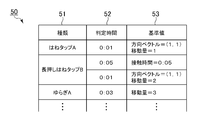
- FIG. 8 is a diagram showing an indicator label reference value table corresponding to at least one of the embodiments of the present invention.
- the indication marker reference value table 50 is set in the RAM 12 and specifies a reference value for determining an input operation of the player, which is determined for each type of the indication indicator 33.
- a reference value 52 is stored for each indicator sign type 51 (corresponding to the type 42).
- the input operation input by the player is analyzed, and the suitability is determined according to this reference value 52. For example, if the analysis result of the input operation input from the player is within a range of ⁇ 10 to + 10% of the reference value 52, the operation is appropriate. Can be determined as having been made appropriately.
- a direction vector indicating the moving direction of the finger or the like and the amount of movement in the operation of flipping the finger or the like are set.
- the direction vector and the amount of movement of the player's finger or the like are analyzed from the result of the player's input operation, and the direction vector of the reference value 52 is compared with the amount of movement. Suitability is determined.
- the contact time in the long press operation, the direction vector indicating the movement direction of the finger or the like in the operation of flipping the finger or the like, and the movement amount thereof are set. .
- the movement amount of the finger or the like in the operation of moving the finger or the like to the left or right is set as the reference value 52.
- the reference value 52 the distance between the two contact positions at the start and the end of the operation, and the amount of movement of the contact position are set.
- FIG. 9 is a diagram showing a flowchart of music data change processing corresponding to at least one of the embodiments of the present invention.
- timing is started with the start of reproduction of the music, and display of the instruction mark 33 is started according to the instruction mark management table 40 (step S1).
- the instruction mark 33 is enlarged and displayed (step S2).
- the input operation from the player is detected by the touch input detection unit 17 when the detection start time for starting the detection of the input operation by the player is reached (step S3). (Step S4). Further, when a predetermined time elapses, it becomes a detection end time for ending the detection for the input operation of the player (step S5).
- step S6 If it is determined that the input operation (tap operation) in the input area 36 defined for the musical instrument 43 corresponding to the instruction mark 33 is performed in step S4 (YES in step S6), points are added (step S7). And the reproduction
- Step S8 If it is determined that the input operation (tap operation) in the input area 36 defined for the musical instrument 43 corresponding to the instruction mark 33 has not been performed in step S4 (NO in step S6), the music change information is specified ( Step S8). If the tap operation is not performed properly, it is determined in advance how much the pitch, tempo, and the like are changed. When the change information of the music is specified in step S8, the pitch, tempo, and the like of the performance data of the musical instrument 43 corresponding to the instruction mark 33 are controlled in accordance with the specified change information (step S9), etc. The music is played with the performance data.
- step S6 when it is determined in step S6 that an appropriate operation has not been performed, in parallel with the steps of steps S8 and S9, the character playing the instrument 43 corresponding to the indicator mark 33 that has been determined. It is also possible to display 34 animations (for example, animations such as the face being pale or crying).
- the performance data is reproduced by controlling the volume of the track corresponding to the instruction mark 33, instead of controlling the pitch or tempo of the performance data. It is also possible. In this case, in step S9, the volume of the performance data can be controlled to be larger or smaller than the reference volume. The change in the output volume is performed, for example, by controlling an amplifier.
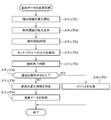
- FIG. 10 is a diagram showing a flowchart of music data change processing corresponding to at least one of the embodiments of the present invention.
- timing is started as the music starts to be reproduced, and the instruction mark 33 is displayed according to the instruction mark management table 40 (step S11).
- the indicator 33 is moved and displayed on the time axis 31 from the right to the left (step S12).
- step S13 When the indication mark 33 moves on the time axis 31 and reaches the reference line 32 (step S13), an input to the touch panel from the player is detected by the touch input detection unit 17 (step S14). Then, when the indicator mark 33 passes the reference line 32 (step S15), the input operation detected in step S14 is analyzed (step S16). The time from when the indication mark 33 reaches the reference line 32 to when it passes is the determination time for determining the input operation of the player, and the input operation performed within this determination time is the object of analysis. Therefore, the determination time is specified according to the size and shape of the indicator mark 33.
- the contact time of the finger or the like on the touch panel, the movement amount of the contact position between the finger or the like and the touch panel, the moving direction thereof, and the like are specified.
- the touch panel is used. If it is input operation performed above, it becomes an object of analysis irrespective of the area
- step S16 the player's input operation is analyzed based on the reference value 52 corresponding to the instruction mark 33 to be determined with reference to the instruction mark reference value table 50. Whether the result is appropriate is determined (step S17). If the contact time, movement amount, and movement direction specified by the analysis result are within a predetermined range with respect to the reference value 52, it is determined that an appropriate operation has been performed. On the other hand, if it is outside the predetermined range with respect to the reference value 52, it is determined that an appropriate operation has not been performed. If the indication mark 33 corresponds to “tap”, the “tap” has no concept of the reference value 52, and therefore, the input is made before the indication mark 33 reaches the reference line 32 and passes. Only whether or not an operation has been performed is an object of determination.
- step S17 If it is determined that an appropriate operation has been made as a result of the determination (YES in step S17), points are added according to the determination (step S18). And the reproduction
- step S17 if it is determined that an appropriate operation has not been performed (NO in step S17), based on the analysis result in step S16 and the reference value 52 corresponding to the indicator mark 33 being determined.
- the change information of the music is specified (step S19). Even if it is determined in step S17 that an appropriate operation has not been performed, it is possible to subtract points before executing step S19.
- step S19 When the change information of the music is specified in step S19, the pitch, tempo, etc. of the performance data of the musical instrument 43 corresponding to the instruction mark 33 among the plurality of performance data are controlled according to the specified change information. However (step S20), the music is reproduced together with other performance data.
- step S17 If it is determined in step S17 that an appropriate operation has not been performed, the character playing the instrument 43 corresponding to the indicator mark 33 that is the object of determination in parallel with the steps of steps S19 and S20. It is also possible to display 34 animations (for example, animations such as the face being pale or crying).
- the correspondence relationship between the difference in the analysis result with respect to the reference value and the amount of change in pitch, tempo, etc. is determined in advance for each indicator mark 33.
- the pitch changes when there is a difference in the direction vector of the splash tap
- the tempo changes when there is a difference in the amount of movement of the splash tap.
- the correspondence relationship is determined not only for the splash tap but also for the long press splash tap and fluctuation.
- the volume may be temporarily increased or decreased from the reference volume.
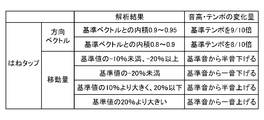
- FIG. 11 is a diagram showing the correspondence between the difference in the analysis result with respect to the reference value and the change in pitch and tempo, corresponding to at least one of the embodiments of the present invention.
- step S19 based on the proportion of the analysis result of the player's input operation with respect to the reference value 52, the change of the music based on the predetermined correspondence as shown in FIG. Information is identified. Note that the same correspondence is determined in advance for the instruction markers 33 other than the splash tap.
- the analysis result on the movement amount of the contact position of the finger is within the range of ⁇ 10 to + 10% of the reference value 52, when it is set as an appropriate operation, as shown in FIG.
- the analysis result of the movement amount is less than ⁇ 10% of the reference value 52 and ⁇ 20% or more, the pitch is lowered by a semitone from the reference sound stored in the music data (hereinafter referred to as the reference sound) to the low tone side
- the reference sound the reference sound stored in the music data
- the analysis result when the analysis result is less than ⁇ 10% of the reference value 52 and ⁇ 20% or more, the sound of “do” becomes a sound of “shi”, and when the analysis result is less than ⁇ 20% of the reference value 52, The sound of “do” becomes the sound of “La #”.
- the pitch is raised from the reference sound by a semitone, and when the analysis result is greater than 20% of the reference value 52, the pitch is increased. For example, one sound is raised from the reference sound to the high sound side.
- the amount of change in the music data is determined based on the inner product of the reference value for the direction vector and the direction vector in the actual input operation. be able to.
- a known technique can be used. Normally, changing the tempo may change the pitch, or changing the pitch may change the playback speed and formant of the song. By controlling these three elements at the same time, It is possible to change the pitch while maintaining the high, changing the tempo, and maintaining the playback speed and formant of the music.
- a game device having an input device including an acceleration sensor and a gyro sensor is provided. It is also possible to implement the present invention.
- timing is started as the music starts to be played, and the instruction mark 33 is displayed on the display screen according to the instruction mark management table 40.
- the acceleration provided in the input device
- the sensor and the gyro sensor detect the magnitude of acceleration and the magnitude of angular velocity associated with the movement of the input device. Based on the detected acceleration magnitude and angular velocity magnitude, the movement distance and movement direction of the input device are analyzed.
- the appropriateness of the analysis result is determined on the basis of the reference value 52 corresponding to the instruction mark 33 to be determined with reference to the instruction mark reference value table 50. If the movement time, movement amount, and movement direction specified by the analysis result are within a predetermined range with respect to the reference value 52, it is determined that an appropriate operation has been performed. On the other hand, if it is outside the predetermined range with respect to the reference value 52, it is determined that an appropriate operation has not been performed. Next, according to the determination, the pitch, tempo, and the like of the performance data corresponding to the instruction mark 33 are controlled.
- a smartphone is mainly used as the game apparatus
- the present invention can also be applied to a so-called cloud game.
- a cloud game generally, operation information input by a player on a client device is transmitted to the server device, and the server device performs a game progress process according to the operation information, and further displays the operation information on the client device.
- Game image data is generated by the server device, and the generated game image data is transmitted to the client device.
- Game images and audio are distributed to the client device by streaming.
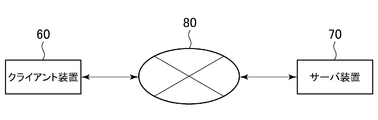
- FIG. 12 is a block diagram showing a configuration of a game system corresponding to at least one of the embodiments of the present invention.
- the client device 60 and the server device 70 can be connected for communication via the communication network 80.
- the server device 70 receives the operation information input by the client device 60 and analyzes the input operation based on the received operation information.
- the time from when the indication mark 33 reaches the reference line 32 until it passes through is the determination time for determining the input operation of the player, and the input operation performed within this determination time is It becomes the object of analysis.
- the input operation of the player is performed based on the reference value 52 corresponding to the instruction mark 33 to be determined with reference to the instruction mark reference value table 50.
- the suitability of the analysis result is determined. If the contact time, movement amount, and movement direction specified by the analysis result are within a predetermined range with respect to the reference value 52, it is determined that an appropriate operation has been performed. On the other hand, if it is outside the predetermined range with respect to the reference value 52, it is determined that an appropriate operation has not been performed.
- game image data corresponding to the determination result is generated, and the game image data and the music data are transmitted from the server device 70 to the client device 60 while being synchronized. If it is determined that an appropriate operation has not been performed as a result of the determination, the music data of the musical instrument corresponding to the instruction mark 33 is controlled, and game image data corresponding to the determination result is generated. The music data is transmitted from the server device 70 to the client device 60 while being synchronized. In the client device 60, a game screen is displayed on the display device based on the received game image data, and the music is played back by the sound playback device based on the received music data.
Landscapes
- Engineering & Computer Science (AREA)
- Multimedia (AREA)
- Electrophonic Musical Instruments (AREA)
Abstract
L'objectif de la présente invention est de concevoir un support d'enregistrement de jeu offrant une meilleure valeur en termes de divertissement de telle sorte que même lorsqu'un joueur n'effectue pas une saisie correspondant à un signe indicateur, le joueur a tout de même la possibilité de jouer au jeu sans que l'impression qu'il ressent de jouer d'un instrument ou de diriger un orchestre ne soit altérée. Une séquence temporelle est démarrée en même temps que la lecture d'une chanson, un signe indicateur (33) étant affiché sur un axe des temps (31) (Etape S11). Lorsque le signe indicateur (33) atteint une ligne de référence (32) (Etape S13), une opération de saisie détectée est analysée (Etape S16). Ensuite, en fonction d'une valeur de référence (52) correspondant au signe indicateur (33), les résultats de l'analyse sont évalués (Etape S17). Si l'évaluation indique qu'une opération appropriée n'a pas été effectuée, des informations de variation pour les données de jeu correspondant au signe indicateur (33) sont identifiées (Etape S19), et la hauteur, le tempo et similaires sont réglés pour les données de lecture (Etape S20).
Priority Applications (2)
| Application Number | Priority Date | Filing Date | Title |
|---|---|---|---|
| PCT/JP2013/062119 WO2014174621A1 (fr) | 2013-04-24 | 2013-04-24 | Support d'enregistrement, appareil de jeu et procédé de progression dans un jeu |
| JP2014536030A JPWO2014174621A1 (ja) | 2013-04-24 | 2013-04-24 | 記録媒体、ゲーム装置及びゲーム進行方法 |
Applications Claiming Priority (1)
| Application Number | Priority Date | Filing Date | Title |
|---|---|---|---|
| PCT/JP2013/062119 WO2014174621A1 (fr) | 2013-04-24 | 2013-04-24 | Support d'enregistrement, appareil de jeu et procédé de progression dans un jeu |
Publications (1)
| Publication Number | Publication Date |
|---|---|
| WO2014174621A1 true WO2014174621A1 (fr) | 2014-10-30 |
Family
ID=51791229
Family Applications (1)
| Application Number | Title | Priority Date | Filing Date |
|---|---|---|---|
| PCT/JP2013/062119 Ceased WO2014174621A1 (fr) | 2013-04-24 | 2013-04-24 | Support d'enregistrement, appareil de jeu et procédé de progression dans un jeu |
Country Status (2)
| Country | Link |
|---|---|
| JP (1) | JPWO2014174621A1 (fr) |
| WO (1) | WO2014174621A1 (fr) |
Cited By (2)
| Publication number | Priority date | Publication date | Assignee | Title |
|---|---|---|---|---|
| JP2016086983A (ja) * | 2014-10-31 | 2016-05-23 | 株式会社バンダイナムコエンターテインメント | プログラム、コンピュータシステム及びサーバシステム |
| JP2020182855A (ja) * | 2019-03-06 | 2020-11-12 | 任天堂株式会社 | 情報処理プログラム、情報処理装置、情報処理システム、情報処理方法 |
Citations (4)
| Publication number | Priority date | Publication date | Assignee | Title |
|---|---|---|---|---|
| JP2005087323A (ja) * | 2003-09-12 | 2005-04-07 | Namco Ltd | プログラム、情報記憶媒体、及びゲームシステム |
| JP2010036038A (ja) * | 2008-08-05 | 2010-02-18 | Pentavision Co Ltd | オーディオゲームを提供するための方法とそのための装置及びコンピュータにより読める記録媒体 |
| JP2011182841A (ja) * | 2010-03-04 | 2011-09-22 | Konami Digital Entertainment Co Ltd | ゲーム装置、ゲーム装置の制御方法、及びプログラム |
| JP2013000386A (ja) * | 2011-06-17 | 2013-01-07 | Square Enix Co Ltd | 携帯型ゲーム装置 |
Family Cites Families (1)
| Publication number | Priority date | Publication date | Assignee | Title |
|---|---|---|---|---|
| JP5436912B2 (ja) * | 2009-03-31 | 2014-03-05 | 株式会社バンダイナムコゲームス | プログラム、情報記憶媒体及びゲーム装置 |
-
2013
- 2013-04-24 JP JP2014536030A patent/JPWO2014174621A1/ja active Pending
- 2013-04-24 WO PCT/JP2013/062119 patent/WO2014174621A1/fr not_active Ceased
Patent Citations (4)
| Publication number | Priority date | Publication date | Assignee | Title |
|---|---|---|---|---|
| JP2005087323A (ja) * | 2003-09-12 | 2005-04-07 | Namco Ltd | プログラム、情報記憶媒体、及びゲームシステム |
| JP2010036038A (ja) * | 2008-08-05 | 2010-02-18 | Pentavision Co Ltd | オーディオゲームを提供するための方法とそのための装置及びコンピュータにより読める記録媒体 |
| JP2011182841A (ja) * | 2010-03-04 | 2011-09-22 | Konami Digital Entertainment Co Ltd | ゲーム装置、ゲーム装置の制御方法、及びプログラム |
| JP2013000386A (ja) * | 2011-06-17 | 2013-01-07 | Square Enix Co Ltd | 携帯型ゲーム装置 |
Non-Patent Citations (1)
| Title |
|---|
| "Theatrhythm Final Fantasy Nintendo 3DS Soft Toriatsukai Setsumeisho", SQUARE ENIX, 17 February 2012 (2012-02-17), pages 8 - 11 , 22 TO 26 * |
Cited By (2)
| Publication number | Priority date | Publication date | Assignee | Title |
|---|---|---|---|---|
| JP2016086983A (ja) * | 2014-10-31 | 2016-05-23 | 株式会社バンダイナムコエンターテインメント | プログラム、コンピュータシステム及びサーバシステム |
| JP2020182855A (ja) * | 2019-03-06 | 2020-11-12 | 任天堂株式会社 | 情報処理プログラム、情報処理装置、情報処理システム、情報処理方法 |
Also Published As
| Publication number | Publication date |
|---|---|
| JPWO2014174621A1 (ja) | 2017-02-23 |
Similar Documents
| Publication | Publication Date | Title |
|---|---|---|
| US8961309B2 (en) | System and method for using a touchscreen as an interface for music-based gameplay | |
| JP6724879B2 (ja) | 再生制御方法、再生制御装置およびプログラム | |
| JP5351373B2 (ja) | 演奏装置および演奏制御プログラム | |
| US9861892B2 (en) | Music game which changes sound based on the quality of players input | |
| JP5257966B2 (ja) | 音楽再生制御システム、音楽演奏プログラム、および演奏データの同期再生方法 | |
| WO2014030676A1 (fr) | Machine de jeu, procédé de commande associé et programme d'ordinateur | |
| JP2007206556A (ja) | サウンド処理プログラムおよびサウンド処理装置 | |
| JP2010214211A (ja) | オーディオゲームを提供するための方法とそのための装置及びコンピュータにより読める記録媒体 | |
| JP6411412B2 (ja) | プログラム、ゲーム装置及びゲーム進行方法 | |
| WO2011115019A1 (fr) | Système de jeux, et procédé de commande ainsi que programme informatique mis en œuvre dans ce système de jeux | |
| JP3147888B2 (ja) | ゲーム装置及びコンピュータ読み取り可能な記録媒体 | |
| JPWO2014174621A1 (ja) | 記録媒体、ゲーム装置及びゲーム進行方法 | |
| JP2019025346A (ja) | プログラム、ゲーム装置及びゲーム進行方法 | |
| JP2020171733A (ja) | プログラム、ゲーム装置及びゲーム進行方法 | |
| JP6401061B2 (ja) | ゲームプログラム | |
| JP7076513B2 (ja) | ゲームプログラム | |
| JP2019037791A (ja) | 記録媒体、ゲーム装置及びゲーム進行方法 | |
| JP2007020659A (ja) | ゲームの制御方法およびゲーム装置 | |
| JP2018196775A (ja) | ゲームプログラム | |
| JP3953064B2 (ja) | 音楽的アミューズメントシステム | |
| JP7092537B2 (ja) | 運指表示装置及び運指表示プログラム | |
| JP3178676B2 (ja) | ゲーム装置及びコンピュータ読み取り可能な記録媒体 | |
| JP6991620B1 (ja) | 電子楽器、電子楽器の制御方法、及びプログラム | |
| JP4407354B2 (ja) | 電子ゲーム装置 | |
| JP4069890B2 (ja) | 音楽的アミューズメントシステム |
Legal Events
| Date | Code | Title | Description |
|---|---|---|---|
| ENP | Entry into the national phase |
Ref document number: 2014536030 Country of ref document: JP Kind code of ref document: A |
|
| 121 | Ep: the epo has been informed by wipo that ep was designated in this application |
Ref document number: 13882772 Country of ref document: EP Kind code of ref document: A1 |
|
| NENP | Non-entry into the national phase |
Ref country code: DE |
|
| 122 | Ep: pct application non-entry in european phase |
Ref document number: 13882772 Country of ref document: EP Kind code of ref document: A1 |