WO2014175302A1 - Lévonorgestrel amorphe, dispersion solide, et procédé de fabrication afférent - Google Patents
Lévonorgestrel amorphe, dispersion solide, et procédé de fabrication afférent Download PDFInfo
- Publication number
- WO2014175302A1 WO2014175302A1 PCT/JP2014/061363 JP2014061363W WO2014175302A1 WO 2014175302 A1 WO2014175302 A1 WO 2014175302A1 JP 2014061363 W JP2014061363 W JP 2014061363W WO 2014175302 A1 WO2014175302 A1 WO 2014175302A1
- Authority
- WO
- WIPO (PCT)
- Prior art keywords
- levonorgestrel
- polymer
- amorphous
- solid dispersion
- cellulose
- Prior art date
- Legal status (The legal status is an assumption and is not a legal conclusion. Google has not performed a legal analysis and makes no representation as to the accuracy of the status listed.)
- Ceased
Links
Images


Classifications
-
- A—HUMAN NECESSITIES
- A61—MEDICAL OR VETERINARY SCIENCE; HYGIENE
- A61K—PREPARATIONS FOR MEDICAL, DENTAL OR TOILETRY PURPOSES
- A61K31/00—Medicinal preparations containing organic active ingredients
- A61K31/56—Compounds containing cyclopenta[a]hydrophenanthrene ring systems; Derivatives thereof, e.g. steroids
- A61K31/565—Compounds containing cyclopenta[a]hydrophenanthrene ring systems; Derivatives thereof, e.g. steroids not substituted in position 17 beta by a carbon atom, e.g. estrane, estradiol
- A61K31/567—Compounds containing cyclopenta[a]hydrophenanthrene ring systems; Derivatives thereof, e.g. steroids not substituted in position 17 beta by a carbon atom, e.g. estrane, estradiol substituted in position 17 alpha, e.g. mestranol, norethandrolone
-
- A—HUMAN NECESSITIES
- A61—MEDICAL OR VETERINARY SCIENCE; HYGIENE
- A61K—PREPARATIONS FOR MEDICAL, DENTAL OR TOILETRY PURPOSES
- A61K9/00—Medicinal preparations characterised by special physical form
- A61K9/14—Particulate form, e.g. powders, Processes for size reducing of pure drugs or the resulting products, Pure drug nanoparticles
- A61K9/141—Intimate drug-carrier mixtures characterised by the carrier, e.g. ordered mixtures, adsorbates, solid solutions, eutectica, co-dried, co-solubilised, co-kneaded, co-milled, co-ground products, co-precipitates, co-evaporates, co-extrudates, co-melts; Drug nanoparticles with adsorbed surface modifiers
- A61K9/146—Intimate drug-carrier mixtures characterised by the carrier, e.g. ordered mixtures, adsorbates, solid solutions, eutectica, co-dried, co-solubilised, co-kneaded, co-milled, co-ground products, co-precipitates, co-evaporates, co-extrudates, co-melts; Drug nanoparticles with adsorbed surface modifiers with organic macromolecular compounds
-
- A—HUMAN NECESSITIES
- A61—MEDICAL OR VETERINARY SCIENCE; HYGIENE
- A61P—SPECIFIC THERAPEUTIC ACTIVITY OF CHEMICAL COMPOUNDS OR MEDICINAL PREPARATIONS
- A61P15/00—Drugs for genital or sexual disorders; Contraceptives
- A61P15/18—Feminine contraceptives
-
- C—CHEMISTRY; METALLURGY
- C07—ORGANIC CHEMISTRY
- C07J—STEROIDS
- C07J1/00—Normal steroids containing carbon, hydrogen, halogen or oxygen, not substituted in position 17 beta by a carbon atom, e.g. estrane, androstane
- C07J1/0051—Estrane derivatives
- C07J1/0081—Substituted in position 17 alfa and 17 beta
- C07J1/0088—Substituted in position 17 alfa and 17 beta the substituent in position 17 alfa being an unsaturated hydrocarbon group
- C07J1/0096—Alkynyl derivatives
Definitions
- the present invention relates to amorphous levonogestrel useful as an emergency contraceptive, a solid dispersion containing levonogestrel, a method for producing the same, and a pharmaceutical composition.
- Levonorgestrel (17 ⁇ -hydroxy-18a-homo-19-nor-17 ⁇ -pregna-4-en-20-in-3-one) is known as a steroidal compound that exhibits a contraceptive effect mainly due to ovulation inhibition. It is sold as an emergency contraceptive in countries around the world, including Japan, the United States and Europe.
- Patent Document 1 discloses a levonorgestrel crystal specified by a powder X-ray diffraction chart. This document discloses a method for producing levonorgestrel crystals by slowly adding water to a solution of levonorgestrel dissolved in methanol at reflux temperature and then cooling. Further, it is also disclosed that n-heptane is added to an ethyl acetate solution of levonorgestrel and cooled, or that a levonorgestrel crystal is produced by a method of cooling a methanol solution of levonorgestrel.
- an object of the present invention is to provide a novel form of levonorgestrel excellent in solubility, a method for producing the same, and a pharmaceutical composition.
- Another object of the present invention is to provide a solid dispersion of levonorgestrel having excellent solubility and stability, a method for producing the same, and a pharmaceutical composition.
- levonorgestrel in order to produce amorphous levonorgestrel, the present inventors tried a spray drying method known as a general method for producing an amorphous drug.
- a spray drying method known as a general method for producing an amorphous drug.
- levonorgestrel since levonorgestrel is extremely easy to crystallize, even if a solution of levonorgestrel was spray-dried, amorphous levonorgestrel could not be obtained.
- the present inventors have found that levonorgestrel can be obtained by hydrolyzing the imino form of levonorgestrel, despite the fact that levonorgestrel is a compound that is extremely easily crystallized.
- the amorphous levonorgestrel of the present invention has an exothermic peak at 51 to 61 ° C. in the differential scanning calorimetry spectrum.
- the present invention includes a solid dispersion in which levonorgestrel is dispersed in an amorphous form in a polymer.
- the polymer may be a pharmacologically acceptable water-soluble polymer.
- the present invention includes a method for producing an amorphous levonogestrel by hydrolyzing an imino form of levonogestrel iminized with ammonia or a primary amine, a solution containing levonogestrel, a polymer, and a solvent. And a method for producing the solid dispersion is also included.
- the present invention also includes a pharmaceutical composition comprising amorphous levonorgestrel or the solid dispersion.
- levonorgestrel is in an amorphous form, and thus has superior solubility compared to conventional crystals.
- levonorgestrel is dispersed in an amorphous form, and is excellent in solubility and stability.
- FIG. 1 is a graph showing a powder X-ray diffraction spectrum of amorphous levonorgestrel of Example 1.
- FIG. 2 is a graph showing a differential scanning calorimetric spectrum of the amorphous levonorgestrel of Example 1.
- FIG. 3 is a graph showing a powder X-ray diffraction spectrum of the amorphous levonorgestrel of Example 3.
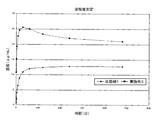
- FIG. 4 is a graph showing the solubility of the amorphous levonogestrel of Example 3 and the levonogestrel crystal of Comparative Example 1.
- Amorphous levonorgestrel does not substantially have a diffraction peak derived from a crystal structure in a powder X-ray diffraction spectrum, and exhibits a halo diffraction pattern derived from scattering of incident X-rays.
- amorphous levonorgestrel has an exothermic peak derived from crystal transition in the differential scanning calorimetry spectrum.
- the exothermic peak may be, for example, about 51 to 61 ° C., preferably about 53 to 59 ° C. (for example, 55 to 57 ° C.).
- powder X-ray diffraction spectrum and the differential scanning calorimetry spectrum can be measured by a conventional method, for example, the conditions of Examples described later.
- the amorphous levonorgestrel may be in the form of a powder.
- the average particle diameter is 0.01 to 500 ⁇ m, preferably about 0.1 to 300 ⁇ m (for example, 1 to 250 ⁇ m) based on a laser diffraction method. Usually, it may be about 0.1 to 50 ⁇ m (for example, 0.5 to 10 ⁇ m).
- Amorphous levonorgestrel has high solubility and can improve bioavailability.
- Amorphous levonorgestrel can be produced, for example, by iminating the 3-position oxo group ( ⁇ O) of levonorgestrel with ammonia or a primary amine and hydrolyzing the produced imino form.
- the above-mentioned imino form can be produced by reacting levonorgestrel with ammonia or a primary amine in the presence or absence of a solvent and iminating levonorgestrel.
- the levonorgestrel can be produced by a conventional method, for example, the method described in Synthetic Communications, 26, 1461-1465 (1996).
- Examples of the primary amine include linear or branched C 1-6 alkylamines such as ethylamine, propylamine, isopropylamine, butylamine, isobutylamine, s-butylamine, and hexylamine; and C 4 such as cyclohexylamine.
- C 1-6 alkylamines such as ethylamine, propylamine, isopropylamine, butylamine, isobutylamine, s-butylamine, and hexylamine; and C 4 such as cyclohexylamine.
- a preferred primary amine may be a C 1-6 alkyl amine (eg, a C 1-4 alkyl amine such as ethylamine, propylamine, butylamine
- the ratio (molar ratio) of levonorgestrel to ammonia or the primary amine is 1 equivalent or more (for example, 1 to 100 equivalents) of ammonia or primary amine, preferably 1.5 to 1 equivalent of levonorgestrel. It may be an equivalent or more (for example, 1.5 to 90 equivalent), more preferably 2 equivalent or more (for example, 2 to 80 equivalent).
- the solvent examples include alcohols (alkanols such as ethanol, propanol and isopropanol; alkylene glycols such as ethylene glycol and propylene glycol) and hydrocarbons (aliphatic hydrocarbons such as hexane and alicyclic hydrocarbons such as cyclohexane).
- alcohols alkanols such as ethanol, propanol and isopropanol
- alkylene glycols such as ethylene glycol and propylene glycol
- hydrocarbons aliphatic hydrocarbons such as hexane and alicyclic hydrocarbons such as cyclohexane
- Aromatic hydrocarbons such as toluene and xylene), halogenated hydrocarbons (such as methylene chloride and chloroform), ethers (chain ethers such as dimethyl ether and diethyl ether, cyclic ethers such as dioxane and tetrahydrofuran), amides (N, N-dimethylformamide, N, N-dimethylacetamide etc.), sulfoxides (dimethylsulfoxide etc.), nitriles (acetonitrile, benzonitrile etc.) and the like. You may use a solvent individually or as a mixed solvent. If necessary, the primary amine may be used as a solvent.
- the above imination reaction may be carried out in the presence of a catalyst, if necessary.
- catalysts include Lewis acid catalysts such as acidic metal oxides (aluminum oxide, silicon dioxide, titanium dioxide, etc.), acidic metal halides (aluminum chloride, titanium tetrachloride, etc.), trimethylsilyl triflate, boron trifluoride diethyl ether, etc. Is mentioned.
- the above imination reaction may be performed under heating.
- the heating temperature is appropriately determined depending on the boiling points of the solvent and the iminating agent (such as the amines), and is not higher than the reflux temperature, for example, 30 to 100 ° C., preferably 35 to 75 ° C., more preferably about 40 to 60 ° C. It may be.
- the reaction is usually carried out at a temperature below the boiling point of the iminating agent.
- the produced imino form may be isolated by a conventional method such as extraction, distillation, concentration, drying, filtration, crystallization, or chromatography. Further, the above solution may be subjected to hydrolysis without isolating the imino form.
- the above-mentioned imino form can be hydrolyzed in the presence of water.
- the amount (molar ratio) of water is 1 equivalent or more (eg, 1 to 20 equivalents), preferably 1.5 equivalents or more (eg, 1.5 to 10 equivalents), more preferably 2 to 1 equivalent of the imino form. It may be equal to or more (for example, 2 to 5 equivalents).
- the amount of water may preferably be a large excess with respect to the imino form.
- Hydrolysis may be further performed in the presence of a catalyst.
- the catalyst include inorganic acids such as hydrochloric acid, sulfuric acid, and phosphoric acid; organic acids such as carboxylic acids (such as acetic acid, trifluoroacetic acid, and fumaric acid), sulfonic acids (such as methanesulfonic acid and benzenesulfonic acid), and metal salts. It may be a solid acid such as (alumina, silica alumina, etc.), zeolite (mordenite, beta zeolite, etc.), and hydrochloric acid, sulfuric acid, etc. are preferred.
- the catalyst may be used alone or in combination of two or more.
- the hydrolysis temperature is not particularly limited as long as it is not higher than the reflux temperature, and the hydrolysis may be performed under ice cooling.
- the hydrolysis temperature may be, for example, about ⁇ 10 ° C. to 100 ° C., preferably about ⁇ 5 ° C. to 80 ° C., more preferably about 0 ° C. to 60 ° C.
- Amorphous levonorgestrel produced by hydrolysis may be isolated by conventional methods such as concentration, drying and filtration.
- amorphous levonorgestrel may precipitate in the system.
- the deposited amorphous levonorgestrel can be filtered, washed and dried as necessary, and isolated.
- Solid dispersion In the solid dispersion of the present invention, levonorgestrel is dispersed in an amorphous form in the polymer.
- the polymer may be a water-soluble polymer or a water-insoluble polymer.
- the water-insoluble polymer may be an insoluble polymer, a gastric polymer, or an enteric polymer.
- the water-soluble polymers for example, (such as methylcellulose) a water-soluble alkyl cellulose, carboxyalkyl cellulose (such as carboxymethyl cellulose) or a salt thereof (sodium carboxymethyl cellulose), hydroxyalkyl cellulose (hydroxyethyl cellulose, hydroxy C 2, such as hydroxypropylcellulose soluble starch, such as pregelatinized starch, partially pregelatinized starch; -4 alkyl cellulose), cellulose ethers such as hydroxyalkyl alkylcelluloses (such as hydroxypropyl C 2-4 alkyl C 1-4 alkyl celluloses such as hydroxypropyl methylcellulose); Natural such as gum arabic, pullulan, agar, tragacanth, sodium alginate, sodium hyaluronate Sugars; polyvinylpyrrolidone, polyvinyl alcohol, polyethylene glycol, and the like synthetic polymers such as carboxyvinyl polymers.
- hydroxyalkyl cellulose hydroxyeth
- insoluble polymers examples include ethyl cellulose and polyvinyl acetate.
- gastric soluble polymer examples include polyvinyl acetal diethylaminoacetate (AEA Sankyo, etc.), aminoalkyl methacrylate copolymers (Eudragit E, Eudragit RS, etc.) and the like.
- enteric polymers examples include cellulose esters such as cellulose acetate phthalate, hydroxypropylmethylcellulose acetate phthalate, hydroxypropylmethylcellulose phthalate succinate; methacrylic acid-methyl methacrylate copolymers (Eudragit L, Eudragit S, etc.), methacrylic acid, and the like.
- -Enteric acrylic polymers such as ethyl acrylate copolymer (such as Eudragit L30D-55) and ethyl acrylate-methyl methacrylate copolymer (such as Eudragit NE30D).
- the preferred polymer can be selected from pharmacologically acceptable water-soluble polymers, gastric polymers and enteric polymers. More preferably, a water-soluble polymer, particularly cellulose ethers (for example, hydroxy C 2-3 alkyl cellulose such as hydroxypropyl cellulose, hydroxy C 2-3 alkyl C 1-2 alkyl cellulose such as hydroxypropylmethyl cellulose, etc.) is used. .
- cellulose ethers for example, hydroxy C 2-3 alkyl cellulose such as hydroxypropyl cellulose, hydroxy C 2-3 alkyl C 1-2 alkyl cellulose such as hydroxypropylmethyl cellulose, etc.
- the stability of levonorgestrel in the solid dispersion can be enhanced by using a polymer having a high glass transition temperature (Tg) as the polymer.
- Tg glass transition temperature
- the glass transition temperature of the polymer may be room temperature or higher, for example, 30 to 140 ° C., preferably 40 to 120 ° C., more preferably 50 to 100 ° C.
- the above polymer is preferably a polymer having a low solution viscosity in order to improve the dissolution property of levonorgestrel.
- the solution viscosity of the polymer is, for example, 500 mPa ⁇ s or less (eg, 400 mPa ⁇ s or less, 300 mPa ⁇ s or less, or 200 mPa ⁇ s or less) at a concentration of 2% by weight and a temperature of 20 ° C., preferably 100 mPa ⁇ s or less (for example, 1 to 70 mPa ⁇ s), more preferably 50 mPa ⁇ s or less (eg, 1.5 to 30 mPa ⁇ s), particularly 20 mPa ⁇ s or less (eg, 1.5 to 15 mPa ⁇ s), Usually, it is 10 mPa ⁇ s or less (for example, 2 to 10 mPa ⁇ s), particularly about 2 to 8 mPa
- the solution viscosity can be measured with a capillary viscometer at a concentration of 2% by weight and a temperature of 20 ° C., and usually varies within a range of 70 to 150% (particularly 80 to 130%) around the viscosity value. It is said.
- the value of the displayed viscosity includes such fluctuations.
- the polymer is preferably a polymer having a low average molecular weight.
- the weight average molecular weight of the polymer is, for example, 100,000 or less (for example, 1000 to 70000), preferably 50,000 or less (for example, 3000 to 30000) in terms of polystyrene as measured by GPC (gel permeation chromatography). Preferably, it may be about 20,000 or less (for example, 5000 to 15000).
- the solid dispersion may be in the form of powder, and the average particle size may be the same as that of the above-mentioned amorphous levonorgestrel.
- the solid dispersion because levonorgestrel is dispersed in molecular size, the solid dispersion improves the solubility of levonorgestrel and shows about twice the solubility compared to conventionally known crystals. Can be improved.
- the solubility of levonorgestrel is about 15 to 40 ⁇ g / mL, preferably about 18 to 35 ⁇ g / mL, more preferably about 20 to 30 ⁇ g / mL. Also good.
- the amorphous form can be stably maintained because the amorphous levonorgestrel is constrained by the polymer.
- levonorgestrel is stably present in an amorphous form, for example, in a room temperature environment for 1 month or more, preferably 2 months or more, more preferably 3 months or more (for example, 6 months or more). Can be prevented.
- the solid dispersion of the present invention can be produced by dissolving levonorgestrel and the polymer in a solvent at the same ratio as described above, and removing the solvent while preventing crystallization.
- a solvent that can be used in the above-described method for producing amorphous levonorgestrel can be used.
- alcohols ethanol, propanol, isopropanol, etc.
- halogenated hydrocarbons methylene chloride, chloroform, etc.
- ethers Dioxane, tetrahydrofuran, etc.
- amides N, N-dimethylformamide, N, N-dimethylacetamide, etc.
- sulfoxides dimethylsulfoxide, etc.
- nitriles acetonitrile, benzonitrile, etc.
- a mixed solvent thereof It may be.
- the above dissolution may be performed under heating if necessary.
- the heating temperature can be appropriately selected depending on the boiling point of the solvent, and may be not higher than the reflux temperature, for example, 30 to 100 ° C., preferably 35 to 75 ° C., more preferably about 40 to 60 ° C.
- the solvent can be removed by a conventional method, for example, evaporation or distillation under normal pressure or reduced pressure, or spray drying. Further, the obtained solid dispersion may be washed and dried.
- the obtained solid dispersion may be pulverized as necessary and sized to a desired particle size.
- the amorphous levonorgestrel and solid dispersion of the present invention are suitably used as an emergency contraceptive, and may be used alone as a medicine, or in combination with a carrier (such as a pharmacologically or physiologically acceptable carrier). You may use as a composition (or formulation).
- the carrier is appropriately selected according to the form (ie, dosage form), dosage form, use, etc. of the pharmaceutical composition (or formulation).
- the dosage form is not particularly limited, and is a solid preparation (powder, powder, granule (granule, fine granule, etc.), pill, pill, tablet, capsule (soft capsule, hard capsule, etc.), dry syrup, Suppositories, etc.), semi-solid preparations (creams, ointments, gels, gummies, film preparations, sheet preparations, etc.), liquids (solutions, suspensions, emulsions, syrups, elixirs, lotions) , Injections, drops, etc.).
- the capsule may be a liquid-filled capsule or a capsule filled with a solid agent such as a granule.
- the preparation may be a lyophilized preparation.
- the preparation of the present invention may be a preparation with controlled drug release rate (sustained release preparation, immediate release preparation).
- the preparations are oral preparations (eg granules, powders, tablets (sublingual tablets, orally disintegrating tablets, etc.), capsules, syrups, emulsions, suspensions, jellies, gummies, film preparations, etc.). It may be a parenteral preparation (inhalant, transdermal preparation, nasal preparation, etc.).
- the preparation may be a topical preparation (injection (subcutaneous injection, intravenous injection, intramuscular injection, intraperitoneal injection, etc.), suspension, ointment, patch, patch, etc.) Good.
- the carrier examples include Japanese Pharmacopoeia (Pharmacopoeia), (1) Pharmaceutical Additive Handbook, Maruzen Co., Ltd., (1989), (2) “Pharmaceutical Additives Encyclopedia 2007” (Pharmaceutical Daily Inc., 2007) Issued in July), (3) Pharmacy, revised 5th edition, Nanedo Co., Ltd. (1997), and (4) Pharmaceutical Additives Standard 2003 (Pharmaceutical Daily Inc., August 2003) (For example, an excipient, a binder, a disintegrant, a lubricant, a coating agent, etc.) can be selected according to the administration route and the formulation application.
- a carrier for a solid preparation at least one carrier selected from excipients, binders and disintegrants is often used.
- the pharmaceutical composition may contain a lipid.
- excipient examples include sugars such as lactose, glucose, sucrose, mannitol, sorbitol, xylitol or sugar alcohols; starch such as corn starch; polysaccharides such as crystalline cellulose (including microcrystalline cellulose); Examples thereof include silicon oxide such as acid or silicate.
- soluble starch such as pregelatinized starch and partially pregelatinized starch; polysaccharides such as gum arabic, dextrin and sodium alginate; polyvinylpyrrolidone (PVP), polyvinyl alcohol (PVA), carboxyvinyl polymer, polyacrylic acid type Synthetic polymers such as polymers, polylactic acid and polyethylene glycol; methylcellulose (MC), ethylcellulose (EC), carboxymethylcellulose (CMC), sodium carboxymethylcellulose, hydroxyethylcellulose (HEC), hydroxypropylcellulose (HPC), hydroxypropylmethylcellulose ( Examples thereof include cellulose ethers such as HPMC).
- PVP polyvinylpyrrolidone
- PVA polyvinyl alcohol
- carboxyvinyl polymer polyacrylic acid type Synthetic polymers such as polymers, polylactic acid and polyethylene glycol
- MC methylcellulose
- EC ethylcellulose
- CMC carboxymethylcellulose
- HEC hydroxyethyl
- disintegrant examples include carboxymethyl starch sodium, carmellose, carmellose sodium, carmellose calcium, croscarmellose sodium, crospovidone, and low-substituted hydroxypropylcellulose. These carriers can be used alone or in combination of two or more.
- the coating agent examples include saccharides, cellulose derivatives such as ethyl cellulose and hydroxymethyl cellulose, polyoxyethylene glycol, cellulose acetate phthalate, hydroxypropyl methylcellulose phthalate, methyl methacrylate- (meth) acrylic acid copolymer, Eudragit (meta Acrylic acid / acrylic acid copolymer).
- the coating agent may be an enteric component such as cellulose phthalate, hydroxypropylmethylcellulose phthalate, methyl methacrylate- (meth) acrylic acid copolymer, or a polymer (including a basic component such as dialkylaminoalkyl (meth) acrylate) ( Gastric soluble components composed of Eudragit etc.).
- the preparation may be a capsule containing these enteric components and gastric components in the skin.
- additives can be appropriately used depending on the administration route, dosage form and the like.
- additives include lubricants, disintegration aids, antioxidants or antioxidants, emulsifiers, dispersants, suspending agents, solubilizers, solubilizers, thickeners, pH adjusters.
- buffering agents, stabilizers, preservatives or preservatives, bactericides or antibacterial agents, antistatic agents, flavoring agents or masking agents, coloring agents, flavoring agents or fragrances, cooling agents, antifoaming agents, tonicity agents examples include soothing agents.
- These additives can be used alone or in combination of two or more.
- the pharmaceutical composition (or pharmaceutical preparation) of the present invention may contain other physiologically active ingredients or pharmacologically active ingredients (for example, estradiol, ethinyl estradiol, estradiol benzoate, estriol, estriol acetate benzoate, if necessary).
- pharmacologically active ingredients for example, estradiol, ethinyl estradiol, estradiol benzoate, estriol, estriol acetate benzoate, if necessary.
- follicular hormone agents such as acid esters).
- the pharmaceutical composition of the present invention is prepared by a conventional formulation method, for example, a production method described in the 16th revised Japanese Pharmacopeia or this production method, using an active ingredient, a carrier component, and if necessary an additive. Can be prepared by different methods.
- the amorphous levonorgestrel and solid dispersion of the present invention have low toxicity and excellent safety, and human and non-human animals, usually mammals (eg, humans, mice, rats, rabbits, dogs, cats, It is safely administered to females such as cattle, horses, pigs, monkeys, etc.
- the dosage can be selected depending on the species, age, weight, and condition (general condition, medical condition, presence of complications, etc.), administration time, dosage form, administration method, and the like of the administration target.
- the dose (daily dose) for humans is, for example, about 0.01 to 50 mg / day, preferably about 0.05 to 10 mg / day (for example, 0.5 to 5 mg / day).
- the administration method may be oral administration, local administration or parenteral administration (for example, subcutaneous administration, intramuscular administration, rectal administration, vaginal administration, etc.).
- the number of administrations is not particularly limited, and may be once a day, for example, or may be multiple times a day (for example, 2 to 3 times) as necessary.
- differential scanning calorimetry spectrum The differential scanning calorific spectrum was measured using a differential scanning calorimeter (model: DSC8230L) under conditions of a heating rate of 10 ° C./min.
- Example 1 2 mL of propylamine was added to 200 mg of levonorgestrel (Industriale Chimica), heated to 40 ° C. to dissolve levonorgestrel, and then allowed to stand at room temperature for 4 days to spontaneously evaporate propylamine.
- levonorgestrel Industriale Chimica
- FIG. 1 shows that the levonorgestrel contained in this solid is amorphous.
- Example 2 15 mL of propylamine was added to 1 g of levonorgestrel (Industriale Chimica) and heated to reflux for 2 hours to obtain a solution. This solution was allowed to stand at room temperature for 2 days, and then propylamine in the solution was distilled off under reduced pressure to obtain a propylimino form of levonorgestrel.
- levonorgestrel Industriale Chimica
- Example 3 30 mg of levonorgestrel (Industriale Chimica) dissolved in 3 mL of chloroform, hydroxypropyl methylcellulose (“TC-5R” manufactured by Shin-Etsu Chemical Co., Ltd., concentration 2 wt%, aqueous solution viscosity 6 mPa ⁇ s at 20 ° C.) 90 mg was added and dissolved. Thereafter, chloroform was distilled off under reduced pressure, the residue was dried under reduced pressure, and then pulverized in a mortar to obtain a white powder.
- TC-5R hydroxypropyl methylcellulose
- FIG. 3 shows that this white powder is a solid dispersion containing levonorgestrel in an amorphous form.
- Comparative Example 1 A commercially available crystal of levonorgestrel (Industriale Chimica) was used as Comparative Example 1.
- Comparative Example 2 1 g of levonorgestrel (Industriale Chimica) was dissolved in 500 mL of ethanol. Then, using a spray drying device (“Pluvis Mini-Spray Model GS-31” manufactured by Yamato Scientific Co., Ltd.), the solution is spray dried under the conditions of drying medium: nitrogen gas, drying temperature: 90 ° C. to obtain a white powder. It was.
- the amorphous levonorgestrel and solid dispersion of the present invention are suitably used as an emergency contraceptive.
Landscapes
- Health & Medical Sciences (AREA)
- Chemical & Material Sciences (AREA)
- General Health & Medical Sciences (AREA)
- Bioinformatics & Cheminformatics (AREA)
- Veterinary Medicine (AREA)
- Life Sciences & Earth Sciences (AREA)
- Engineering & Computer Science (AREA)
- Public Health (AREA)
- Medicinal Chemistry (AREA)
- Animal Behavior & Ethology (AREA)
- Organic Chemistry (AREA)
- Pharmacology & Pharmacy (AREA)
- Epidemiology (AREA)
- Reproductive Health (AREA)
- Nuclear Medicine, Radiotherapy & Molecular Imaging (AREA)
- General Chemical & Material Sciences (AREA)
- Chemical Kinetics & Catalysis (AREA)
- Endocrinology (AREA)
- Gynecology & Obstetrics (AREA)
- Pharmaceuticals Containing Other Organic And Inorganic Compounds (AREA)
- Medicinal Preparation (AREA)
- Steroid Compounds (AREA)
Abstract
L'invention concerne une nouvelle forme de lévonorgestrel, qui est utile, entre autres comme contraceptif d'urgence, une dispersion solide de lévonorgestrel, un procédé de fabrication afférent et une composition médicamenteuse. Le spectre d'analyse enthalpique différentielle de ce lévonorgestrel amorphe présente un pic exothermique à 51-61°C. Cette dispersion solide contient du lévonorgestrel dispersé à l'état amorphe dans un polymère. Ledit polymère peut être un polymère hydrosoluble de qualité pharmaceutique. Le rapport de poids entre le polymère et le lévonorgestrel peut être, en termes de polymère/lévonorgestrel, de 90/10 à 50/50.
Priority Applications (1)
| Application Number | Priority Date | Filing Date | Title |
|---|---|---|---|
| JP2014561677A JP6125547B2 (ja) | 2013-04-24 | 2014-04-23 | 無定形レボノルゲストレル、固体分散体及びそれらの製造方法 |
Applications Claiming Priority (2)
| Application Number | Priority Date | Filing Date | Title |
|---|---|---|---|
| JP2013-090925 | 2013-04-24 | ||
| JP2013090925 | 2013-04-24 |
Publications (1)
| Publication Number | Publication Date |
|---|---|
| WO2014175302A1 true WO2014175302A1 (fr) | 2014-10-30 |
Family
ID=51791872
Family Applications (1)
| Application Number | Title | Priority Date | Filing Date |
|---|---|---|---|
| PCT/JP2014/061363 Ceased WO2014175302A1 (fr) | 2013-04-24 | 2014-04-23 | Lévonorgestrel amorphe, dispersion solide, et procédé de fabrication afférent |
Country Status (2)
| Country | Link |
|---|---|
| JP (2) | JP6125547B2 (fr) |
| WO (1) | WO2014175302A1 (fr) |
Citations (4)
| Publication number | Priority date | Publication date | Assignee | Title |
|---|---|---|---|---|
| JPS4948651A (fr) * | 1972-05-26 | 1974-05-11 | ||
| JPH05500510A (ja) * | 1989-09-08 | 1993-02-04 | シグナス インコーポレイテッド | 経皮ドラッグデリバリーのための固体マトリックスシステム |
| JP2007508287A (ja) * | 2003-10-09 | 2007-04-05 | リヒター ゲデオン ベジェセティ ジャール アール.テー. | 経皮医薬組成物 |
| WO2012110947A1 (fr) * | 2011-02-17 | 2012-08-23 | Lupin Limited | Procédé de préparation amélioré du lévonorgestrel |
-
2014
- 2014-04-23 JP JP2014561677A patent/JP6125547B2/ja active Active
- 2014-04-23 WO PCT/JP2014/061363 patent/WO2014175302A1/fr not_active Ceased
-
2015
- 2015-07-31 JP JP2015152471A patent/JP2015212301A/ja not_active Withdrawn
Patent Citations (4)
| Publication number | Priority date | Publication date | Assignee | Title |
|---|---|---|---|---|
| JPS4948651A (fr) * | 1972-05-26 | 1974-05-11 | ||
| JPH05500510A (ja) * | 1989-09-08 | 1993-02-04 | シグナス インコーポレイテッド | 経皮ドラッグデリバリーのための固体マトリックスシステム |
| JP2007508287A (ja) * | 2003-10-09 | 2007-04-05 | リヒター ゲデオン ベジェセティ ジャール アール.テー. | 経皮医薬組成物 |
| WO2012110947A1 (fr) * | 2011-02-17 | 2012-08-23 | Lupin Limited | Procédé de préparation amélioré du lévonorgestrel |
Non-Patent Citations (4)
| Title |
|---|
| JAIN,P. ET AL.: "Induction and Inhibition of Crystallization in Drug-in-Adhesive-Type Transdermal Patches", PHARMACEUTICAL RESEARCH, vol. 30, no. 2, 24 October 2012 (2012-10-24), pages 562 - 571 * |
| JAIN,P. ET AL.: "Inhibition of crystallization in drug-in-adhesive-type transdermal patches", INTERNATIONAL JOURNAL OF PHARMACEUTICS, vol. 394, no. 1-2, 2010, pages 68 - 74 * |
| SCHULZ,M. ET AL.: "Influence of adsorbents in transdermal matrix patches on the release and the physical state of ethinyl estradiol and levonorgestrel", EUROPEAN JOURNAL OF PHARMACEUTICS AND BIOPHARMACEUTICS, vol. 77, no. 2, 2011, pages 240 - 248 * |
| TEISUKE OKANO, SHIN.YAKUZAIGAKU SORON, 1987, pages 26 - 27 * |
Also Published As
| Publication number | Publication date |
|---|---|
| JP6125547B2 (ja) | 2017-05-10 |
| JP2015212301A (ja) | 2015-11-26 |
| JPWO2014175302A1 (ja) | 2017-02-23 |
Similar Documents
| Publication | Publication Date | Title |
|---|---|---|
| US10085941B2 (en) | Pharmaceutical composition for parenteral administration, containing donepezil | |
| JP2021121645A (ja) | 15β−ヒドロキシ−酢酸オサテロンの結晶多形 | |
| CA3092948C (fr) | Composition pharmaceutique comprenant du brexpiprazole | |
| US20250250268A1 (en) | Free-state plx5622 crystal form and preparation method therefor | |
| JP6125547B2 (ja) | 無定形レボノルゲストレル、固体分散体及びそれらの製造方法 | |
| US9643994B2 (en) | Crystalline polymorphic form of ulipristal acetate | |
| JP2016006090A (ja) | レボノルゲストレルの結晶多形α及びその製造方法 | |
| JP5809368B2 (ja) | レボノルゲストレルの結晶多形β及びその製造方法 | |
| JP6474722B2 (ja) | ウリプリスタール酢酸エステルの結晶多形 | |
| WO2014050105A1 (fr) | Acétate d'ulipristal amorphe | |
| TW201522362A (zh) | 烏普司他醋酸之結晶多晶型 | |
| CN102838504A (zh) | 一种阿戈美拉汀的新晶型l及其制备方法 | |
| TW201522360A (zh) | 烏普司他醋酸之結晶多晶型 | |
| TW201522361A (zh) | 非晶形烏普司他醋酸 |
Legal Events
| Date | Code | Title | Description |
|---|---|---|---|
| ENP | Entry into the national phase |
Ref document number: 2014561677 Country of ref document: JP Kind code of ref document: A |
|
| 121 | Ep: the epo has been informed by wipo that ep was designated in this application |
Ref document number: 14787558 Country of ref document: EP Kind code of ref document: A1 |
|
| NENP | Non-entry into the national phase |
Ref country code: DE |
|
| 122 | Ep: pct application non-entry in european phase |
Ref document number: 14787558 Country of ref document: EP Kind code of ref document: A1 |