WO2014178336A1 - Pneu - Google Patents
Pneu Download PDFInfo
- Publication number
- WO2014178336A1 WO2014178336A1 PCT/JP2014/061655 JP2014061655W WO2014178336A1 WO 2014178336 A1 WO2014178336 A1 WO 2014178336A1 JP 2014061655 W JP2014061655 W JP 2014061655W WO 2014178336 A1 WO2014178336 A1 WO 2014178336A1
- Authority
- WO
- WIPO (PCT)
- Prior art keywords
- tread
- mass
- wing
- parts
- rubber composition
- Prior art date
- Legal status (The legal status is an assumption and is not a legal conclusion. Google has not performed a legal analysis and makes no representation as to the accuracy of the status listed.)
- Ceased
Links
Images



Classifications
-
- B—PERFORMING OPERATIONS; TRANSPORTING
- B60—VEHICLES IN GENERAL
- B60C—VEHICLE TYRES; TYRE INFLATION; TYRE CHANGING; CONNECTING VALVES TO INFLATABLE ELASTIC BODIES IN GENERAL; DEVICES OR ARRANGEMENTS RELATED TO TYRES
- B60C1/00—Tyres characterised by the chemical composition or the physical arrangement or mixture of the composition
- B60C1/0016—Compositions of the tread
-
- B—PERFORMING OPERATIONS; TRANSPORTING
- B60—VEHICLES IN GENERAL
- B60C—VEHICLE TYRES; TYRE INFLATION; TYRE CHANGING; CONNECTING VALVES TO INFLATABLE ELASTIC BODIES IN GENERAL; DEVICES OR ARRANGEMENTS RELATED TO TYRES
- B60C1/00—Tyres characterised by the chemical composition or the physical arrangement or mixture of the composition
-
- B—PERFORMING OPERATIONS; TRANSPORTING
- B60—VEHICLES IN GENERAL
- B60C—VEHICLE TYRES; TYRE INFLATION; TYRE CHANGING; CONNECTING VALVES TO INFLATABLE ELASTIC BODIES IN GENERAL; DEVICES OR ARRANGEMENTS RELATED TO TYRES
- B60C1/00—Tyres characterised by the chemical composition or the physical arrangement or mixture of the composition
- B60C1/0025—Compositions of the sidewalls
-
- B—PERFORMING OPERATIONS; TRANSPORTING
- B60—VEHICLES IN GENERAL
- B60C—VEHICLE TYRES; TYRE INFLATION; TYRE CHANGING; CONNECTING VALVES TO INFLATABLE ELASTIC BODIES IN GENERAL; DEVICES OR ARRANGEMENTS RELATED TO TYRES
- B60C11/00—Tyre tread bands; Tread patterns; Anti-skid inserts
- B60C11/0008—Tyre tread bands; Tread patterns; Anti-skid inserts characterised by the tread rubber
-
- B—PERFORMING OPERATIONS; TRANSPORTING
- B60—VEHICLES IN GENERAL
- B60C—VEHICLE TYRES; TYRE INFLATION; TYRE CHANGING; CONNECTING VALVES TO INFLATABLE ELASTIC BODIES IN GENERAL; DEVICES OR ARRANGEMENTS RELATED TO TYRES
- B60C11/00—Tyre tread bands; Tread patterns; Anti-skid inserts
- B60C11/01—Shape of the shoulders between tread and sidewall, e.g. rounded, stepped or cantilevered
-
- C—CHEMISTRY; METALLURGY
- C08—ORGANIC MACROMOLECULAR COMPOUNDS; THEIR PREPARATION OR CHEMICAL WORKING-UP; COMPOSITIONS BASED THEREON
- C08C—TREATMENT OR CHEMICAL MODIFICATION OF RUBBERS
- C08C19/00—Chemical modification of rubber
- C08C19/25—Incorporating silicon atoms into the molecule
-
- C—CHEMISTRY; METALLURGY
- C08—ORGANIC MACROMOLECULAR COMPOUNDS; THEIR PREPARATION OR CHEMICAL WORKING-UP; COMPOSITIONS BASED THEREON
- C08C—TREATMENT OR CHEMICAL MODIFICATION OF RUBBERS
- C08C19/00—Chemical modification of rubber
- C08C19/30—Addition of a reagent which reacts with a hetero atom or a group containing hetero atoms of the macromolecule
- C08C19/42—Addition of a reagent which reacts with a hetero atom or a group containing hetero atoms of the macromolecule reacting with metals or metal-containing groups
- C08C19/44—Addition of a reagent which reacts with a hetero atom or a group containing hetero atoms of the macromolecule reacting with metals or metal-containing groups of polymers containing metal atoms exclusively at one or both ends of the skeleton
-
- C—CHEMISTRY; METALLURGY
- C08—ORGANIC MACROMOLECULAR COMPOUNDS; THEIR PREPARATION OR CHEMICAL WORKING-UP; COMPOSITIONS BASED THEREON
- C08K—Use of inorganic or non-macromolecular organic substances as compounding ingredients
- C08K3/00—Use of inorganic substances as compounding ingredients
- C08K3/18—Oxygen-containing compounds, e.g. metal carbonyls
- C08K3/20—Oxides; Hydroxides
- C08K3/22—Oxides; Hydroxides of metals
-
- C—CHEMISTRY; METALLURGY
- C08—ORGANIC MACROMOLECULAR COMPOUNDS; THEIR PREPARATION OR CHEMICAL WORKING-UP; COMPOSITIONS BASED THEREON
- C08L—COMPOSITIONS OF MACROMOLECULAR COMPOUNDS
- C08L15/00—Compositions of rubber derivatives
-
- C—CHEMISTRY; METALLURGY
- C08—ORGANIC MACROMOLECULAR COMPOUNDS; THEIR PREPARATION OR CHEMICAL WORKING-UP; COMPOSITIONS BASED THEREON
- C08L—COMPOSITIONS OF MACROMOLECULAR COMPOUNDS
- C08L7/00—Compositions of natural rubber
-
- C—CHEMISTRY; METALLURGY
- C08—ORGANIC MACROMOLECULAR COMPOUNDS; THEIR PREPARATION OR CHEMICAL WORKING-UP; COMPOSITIONS BASED THEREON
- C08L—COMPOSITIONS OF MACROMOLECULAR COMPOUNDS
- C08L9/00—Compositions of homopolymers or copolymers of conjugated diene hydrocarbons
-
- C—CHEMISTRY; METALLURGY
- C08—ORGANIC MACROMOLECULAR COMPOUNDS; THEIR PREPARATION OR CHEMICAL WORKING-UP; COMPOSITIONS BASED THEREON
- C08L—COMPOSITIONS OF MACROMOLECULAR COMPOUNDS
- C08L9/00—Compositions of homopolymers or copolymers of conjugated diene hydrocarbons
- C08L9/06—Copolymers with styrene
-
- B—PERFORMING OPERATIONS; TRANSPORTING
- B60—VEHICLES IN GENERAL
- B60C—VEHICLE TYRES; TYRE INFLATION; TYRE CHANGING; CONNECTING VALVES TO INFLATABLE ELASTIC BODIES IN GENERAL; DEVICES OR ARRANGEMENTS RELATED TO TYRES
- B60C11/00—Tyre tread bands; Tread patterns; Anti-skid inserts
- B60C11/01—Shape of the shoulders between tread and sidewall, e.g. rounded, stepped or cantilevered
- B60C2011/016—Shape of the shoulders between tread and sidewall, e.g. rounded, stepped or cantilevered different rubber for tread wings
-
- C—CHEMISTRY; METALLURGY
- C08—ORGANIC MACROMOLECULAR COMPOUNDS; THEIR PREPARATION OR CHEMICAL WORKING-UP; COMPOSITIONS BASED THEREON
- C08K—Use of inorganic or non-macromolecular organic substances as compounding ingredients
- C08K3/00—Use of inorganic substances as compounding ingredients
- C08K3/18—Oxygen-containing compounds, e.g. metal carbonyls
- C08K3/20—Oxides; Hydroxides
- C08K3/22—Oxides; Hydroxides of metals
- C08K2003/2227—Oxides; Hydroxides of metals of aluminium
-
- C—CHEMISTRY; METALLURGY
- C08—ORGANIC MACROMOLECULAR COMPOUNDS; THEIR PREPARATION OR CHEMICAL WORKING-UP; COMPOSITIONS BASED THEREON
- C08K—Use of inorganic or non-macromolecular organic substances as compounding ingredients
- C08K2201/00—Specific properties of additives
- C08K2201/002—Physical properties
- C08K2201/003—Additives being defined by their diameter
-
- C—CHEMISTRY; METALLURGY
- C08—ORGANIC MACROMOLECULAR COMPOUNDS; THEIR PREPARATION OR CHEMICAL WORKING-UP; COMPOSITIONS BASED THEREON
- C08K—Use of inorganic or non-macromolecular organic substances as compounding ingredients
- C08K2201/00—Specific properties of additives
- C08K2201/002—Physical properties
- C08K2201/006—Additives being defined by their surface area
Definitions
- the present invention relates to a pneumatic tire.
- the pneumatic tire is composed of various members such as a tread, a wing, a sidewall, etc., and various performances are given according to each member.
- the tread in contact with the road surface is required to have performance such as wet grip performance from the viewpoint of safety etc., and a method of improving the performance by the addition of aluminum hydroxide has been proposed, but the wear resistance is said to be deteriorated Due to its drawbacks, it is rarely used for tires for general public roads.
- pneumatic tires are manufactured by combining respective members after blending and designing a rubber composition excellent in performance using a laboratory test for each member (see Patent Documents 1 to 3). Even when using a rubber composition for the tread that is excellent in performance such as abrasion resistance in the lab test, the finish of the bonding surface between the tread after vulcanization and the adjacent wing or sidewall (wing or side There are cases in which thin skin-like curling, peeling, falling-off etc. of the wall are bad.
- the finished surface of the adhesion surface between the tread and the wing and the sidewall is also a good air It is desirable to provide a tire with a tire.
- Patent No. 4308289 JP 2008-24913 A Patent No. 4246245 gazette
- the present invention solves the above-mentioned problems and secures the required performance of the tire such as wet grip performance, wear resistance, and aging deterioration suppression, and is excellent also in the finished state of the adhesion surface of the tread and the adjacent wing or sidewall. It is an object of the present invention to provide a pneumatic tire.
- the present invention is a pneumatic tire having a tread and a wing or a sidewall adjacent to the tread, wherein the tread has an average particle diameter of 0.69 ⁇ m or less and a nitrogen adsorption specific surface area of 10 parts by mass with respect to 100 parts by mass of a rubber component.
- the rubber composition for a tread comprising 1 to 60 parts by mass of an aluminum hydroxide in an amount of 50 to 50 m 2 / g and 0.56 to 1.25 parts by mass of a pure sulfur component derived from a crosslinking agent
- the sidewall comprises a rubber composition for a wing and a sidewall having a blending amount of 1.3 to 2.5 parts by mass of a pure sulfur component derived from a crosslinking agent with respect to 100 parts by mass of a rubber component
- the pneumatic tire relates to a pneumatic tire in which the blending amount of the pure sulfur component derived from the crosslinking agent with the rubber composition for the wing and the sidewall satisfies the following formula. (The blending amount of the pure sulfur component derived from the crosslinking agent of the rubber composition for the wing and the sidewall / the blending amount of the pure sulfur component derived from the crosslinking agent of the rubber composition for the tread) ⁇ 2.5
- the tread preferably contains 20 to 130 parts by mass of wet process silica having a nitrogen adsorption specific surface area of 40 to 350 m 2 / g with respect to 100 parts by mass of the rubber component.
- the tread preferably has a blending amount of 20 to 70% by mass of butadiene rubber synthesized using a rare earth element-based catalyst in 100% by mass of the rubber component.
- the present invention relates to a pneumatic tire having a tread and a wing or sidewall adjacent to the tread.
- the tread composition since the specific aluminum hydroxide compounding amount, the pure sulfur component compounding amount derived from the crosslinking agent, and the pure sulfur component compounding amount derived from the crosslinking agent in the wing and sidewall are adjusted to the specific conditions, the wet grip performance It is possible to provide a pneumatic tire excellent in the finished state of the adhesive surface of the tread and the adjacent wing or sidewall while securing the required performance of the tire such as wear resistance and suppression of deterioration with time.
- the pneumatic tire according to the present invention has a tread and a wing or sidewall adjacent to the tread, wherein the tread has a specific amount of aluminum hydroxide and a specific amount of pure sulfur component derived from a crosslinking agent.
- the rubber composition for a tread, the rubber composition for a tread and the sidewall, wherein the wing and the sidewall contain a specific amount of a pure sulfur component derived from a crosslinking agent, and the rubber composition for a tread and the rubber
- the compounding ratio of the pure sulfur component blending amount derived from the crosslinking agent of the rubber composition for a wing and a sidewall satisfies a specific relational expression.
- the compounding amounts of chemicals such as the crosslinking agent and aluminum hydroxide compounded in the rubber composition for tread, wing and sidewall are all the compounding amount (added amount) before crosslinking.
- the compounding amounts of the chemicals contained in the tread, wing and sidewall rubber compositions mean theoretical compounding amounts of the chemicals contained in the tread, wing and sidewall unvulcanized rubber compositions.
- the theoretical compounding amount means the amount of the chemical added when preparing the unvulcanized rubber composition.
- the wet grip performance can be improved by adding aluminum hydroxide having a specific nitrogen adsorption specific surface area and an average particle size to the tread, but this is because the following actions (1) to (3) are exhibited It is presumed to be an effect.
- a portion of the compounded aluminum hydroxide is converted to alumina having a Mohs hardness greater than that of silica during kneading, or the aluminum hydroxide is bonded to the silica and fixed, whereby an alumina lump or hydroxide is formed. It is believed that aluminum exerts an anchoring effect, thereby enhancing wet grip performance.
- silicon dioxide on the road surface and aluminum hydroxide on the tire surface come into contact (scrub) during traveling, an instantaneous covalent bond as shown in FIG. 1 is formed and wet grip performance is improved. It is considered to improve.
- the present invention is a pneumatic tire in which a predetermined amount of specific aluminum hydroxide is added to the tread and the blending amount and blending ratio of pure sulfur components derived from the crosslinking agent of the tread, the wing and the sidewall are adjusted. Can be suppressed, and abrasion resistance and wet grip performance can be improved in a well-balanced manner. Furthermore, when a rare earth butadiene rubber is used as the rubber component of the tread, the wear resistance is significantly improved, and the performance balance can be further improved.
- the adhesion between the tread and the adjacent wings or sidewalls or the finish of the adhesive surface can also be good.
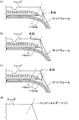
- the structure shown in FIG. 2 that is, a tread over sidewall (TOS) structure is generally used, and since the tread and the wings are adjacent to each other, the structure is not added.
- TOS tread over sidewall
- the upper end of the wing be positioned within the range of about ⁇ 10 mm of the tread shoulder edge (reference) shown in FIG. 2 (d) after vulcanization.
- the thin skin phenomenon (more than -10 mm) in which the tread ground portion is largely covered with the wing after vulcanization shown in FIG. 2 (b), and conversely, the wing tip shown in FIG.
- the phenomenon (less than +10 mm) that occurs in the shape occurs.
- problems such as the deterioration of the initial grip performance, the deterioration of the wing tip finish and the variation as described above, and the peeling at the tread contact portion shown in FIG. 4 (b) occur.
- the rubber flow at the end of the wing is poor, unevenness may occur at the end position of the wing shown in FIG. 4 (a) or the end of the wing may be finished like a dumpling (standard ⁇ > 45 °).
- Problems such as deterioration of finish (cracking at wing edge), difference in hue, difference in ozone cracking resistance etc. occur, but in the present invention, the amount of pure sulfur derived from the crosslinking agent added to the tread and the wing is specified as a specific amount.
- FIG. 3 (c) On the other hand, for heavy-duty pneumatic tires such as trucks and buses, pneumatic tires for light trucks, pneumatic tires for large SUVs, pneumatic tires for large passenger cars, etc., the structure shown in FIG.
- the tread (SOT) structure is generally used, and since the tread and the sidewall are adjacent to each other, as shown in FIG. 3 (c), the upper end of the sidewall is shown in FIG. 3 (d) after vulcanization.
- the tread shoulder edge (standard) ⁇ 10 mm shown is preferably within the range of about 10 mm, but the side wall of FIG. 3 (b) covers the tread as in the pneumatic tire for a passenger car, and FIG. 3 (a)
- the side wall of may not be rolled up correctly, and the tip of the side wall may be finished like a dumpling.
- the same problem as described above may occur, but the improvement can be similarly achieved by setting the amount of pure sulfur derived from the crosslinking agent to be added to the tread and the sidewall to a specific amount and adjusting to satisfy a specific relational expression. .
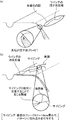
- the thin skin phenomenon of FIG. 2 (b) described above is promoted by the difference in the amount of pure sulfur component contained in the thin and thick portions of the wing as a result of the transfer of the pure sulfur component from the wing to the tread at the time of vulcanization.
- Ru That is, at the time of vulcanization, the transition of the pure sulfur component from the wing to the tread shown in the schematic cross-sectional view of the pure sulfur component migration phenomenon of FIG.
- the distribution chart of the amount of pure sulfur component in the cross section (1) of the thick part and the cross section (2) of the relatively thin part distribution occurs in the amount of pure sulfur component in the wing depending on the site. And, as shown in FIG.
- the pneumatic tire of the present invention has a tread and a wing or sidewall adjacent to the tread.
- the tread is a member directly in contact with the road surface
- the wing is a member located between the tread and the sidewall in the shoulder portion.
- the sidewall is a member disposed on the outside of the case from the shoulder portion to the bead portion. Specifically, the sidewall is shown in FIG. 1 of JP-A-2005-280612, FIG. 1 of JP-A-2000-185529, etc. It is a member shown.
- the tread, the wing, and the sidewall are each made of a rubber composition for a tread, a rubber composition for a wing, and a rubber composition for a sidewall, in which a crosslinking agent is blended.
- the crosslinking agent may, for example, be a sulfur-containing compound having a crosslinking action, and examples thereof include a sulfur crosslinking agent, a sulfur-containing hybrid crosslinking agent, and a silane coupling agent added in the finishing and kneading step.
- sulfur crosslinking agent examples include sulfur generally used in vulcanization in the rubber field, and specific examples include powdered sulfur, precipitated sulfur, colloidal sulfur, insoluble sulfur, highly dispersible sulfur and the like.
- sulfur-containing hybrid crosslinking agents examples include alkylphenol-sulfur chloride condensate, sodium 1,6-hexamethylenedithiosulfate dihydrate, 1,6-bis (N, N'-dibenzylthiocarbamoyldithio) hexane and the like.
- Alkyl sulfide crosslinking agents dithiophosphate phosphate (Dithiophosphate) and the like.
- Takiroll V200 manufactured by Taoka Chemical Industry Co., Ltd. DURALINK HTS manufactured by Flexis
- Vulcuren VP KA9188 manufactured by LANXESS Rhenogran SDT-50 (Dithiophosphoryl polysulfide) manufactured by RheinChemie, and the like are commercially available.
- silane coupling agent blended (added) in the final kneading step also corresponds to the cross-linking agent of the present invention, and the silane coupling agent blended in the base kneading step preferentially does not fall under the reaction with silica.
- silane coupling agents include compounds containing sulfur (sulfide bond) conventionally used in combination with silica in the rubber industry, and examples thereof include sulfides, mercaptos, vinyls, aminos, glycidoxys and nitros.
- chloro-based silane coupling agents Specifically, Si69, Si75 and the like manufactured by Evonik are commercially available.
- the blending amount of the pure sulfur component derived from the crosslinking agent blended in the rubber composition for tread and the rubber composition for wing adjacent to it, the rubber composition for tread and the rubber composition for sidewall adjacent to it Satisfy the formula. (Wing, blending amount of pure sulfur component derived from crosslinking agent of rubber composition for side wall / blending amount of pure sulfur component derived from crosslinking agent of rubber composition for tread) ⁇ 2.5 When it exceeds 2.5, the initial vulcanization speed t10 of the wings and sidewalls is delayed, so that thin skin phenomenon or peeling damage tends to occur.
- the compounding ratio (addition ratio) of the said pure sulfur component compounding quantity will not be specifically limited if it is 2.5 or less, Preferably it is 0.75-2.4, More preferably, it is within the range of 1.0-2.3. It is.
- the blending amount of the pure sulfur component derived from the crosslinking agent means the total amount of all sulfur components contained in the total crosslinking agent blended (added).
- the initial vulcanization rate (t10) of the tread rubber composition, the wing rubber composition, and the sidewall rubber composition preferably satisfies the following relational expression.
- the ratio of t10 (0.4 to 2.5) is more preferably in the range of 0.5 to 2.3.
- the rubber composition for tread comprises aluminum hydroxide having a specific average particle size and a nitrogen adsorption specific surface area.
- the average particle size of the aluminum hydroxide is 0.69 ⁇ m or less, preferably 0.20 to 0.65 ⁇ m, and more preferably 0.25 to 0.60 ⁇ m. If it exceeds 0.69 ⁇ m, abrasion resistance and wet grip performance may be degraded.
- the average particle diameter of aluminum hydroxide is a number average particle diameter, and is measured by a transmission electron microscope.
- the nitrogen adsorption specific surface area (N 2 SA) of the aluminum hydroxide is 10 to 50 m 2 / g. Outside the above range, the abrasion resistance and the wet grip performance may be deteriorated.
- the lower limit of the N 2 SA is preferably 12 m 2 / g or more, more preferably 14 m 2 / g or more, and the upper limit is preferably 45 m 2 / g or less, more preferably 40 m 2 / g or less Preferably it is 29 m 2 / g or less, particularly preferably 19 m 2 / g or less.
- the N 2 SA of aluminum hydroxide is a value measured by the BET method according to ASTM D3037-81.
- the Mohs hardness of the aluminum hydroxide is preferably 1 to 8, and preferably 2 to 7 from the viewpoints of securing the tire abrasion resistance and wet grip performance and suppressing metal wear of a Banbury mixer and an extruder. Is more preferred.
- Mohs hardness is one of the mechanical properties of materials, and has long been widely used in mineral relations, and it rubs substances (such as aluminum hydroxide) whose hardness is to be measured (such as aluminum hydroxide) with a standard substance, with or without scratches. Measure the Mohs hardness.
- the Mohs hardness of aluminum hydroxide is increased by conversion to alumina, and becomes a value higher than that of silica.
- the aluminum hydroxide As the aluminum hydroxide, a commercial product having the above-mentioned average particle diameter and the characteristics of N 2 SA can be used, and a treated product prepared by processing aluminum hydroxide to a treatment having particles having the above-mentioned characteristics, etc. Are also available.
- grinding treatment conventionally known methods such as wet grinding and dry grinding (jet mill, current jet mill, counter jet mill, contraplex, etc.) can be applied.
- the compounding quantity of the said aluminum hydroxide is 1 mass part or more, Preferably 2 mass parts or more, More preferably, it is 3 mass parts or more with respect to 100 mass parts of rubber components. If the amount is less than 1 part by mass, sufficient wet grip performance may not be obtained. In addition, the compounding amount is 60 parts by mass or less, preferably 55 parts by mass or less, more preferably 50 parts by mass or less. If the amount is more than 60 parts by mass, the abrasion resistance may deteriorate to such an extent that it can not be compensated by the adjustment of other compounding agents.
- the total blending amount of the pure sulfur component derived from the crosslinking agent is 0.56 to 1.25 parts by mass with respect to 100 parts by mass of the rubber component. If the amount is less than 0.56 parts by mass, the amount of sulfur transferred from the wing and sidewall to the tread is large, and t10 of the wing and sidewall rubber is delayed, so the finish of the adhesive surface tends to be deteriorated. If the amount is more than 1.25 parts by mass, the abrasion resistance and aging of the tread rubber tend to deteriorate.
- the total blending amount of the pure sulfur component is preferably 0.56 to 1.15 parts by mass, more preferably 0.6 to 1.10 parts by mass.
- the rubber component which can be used for the rubber composition for tread is not particularly limited, and isoprene rubber such as natural rubber (NR) and isoprene rubber (IR), butadiene rubber (BR), styrene butadiene rubber (SBR), styrene isoprene butadiene Mention may be made of diene rubbers such as rubber (SIBR), chloroprene rubber (CR) and acrylonitrile butadiene rubber (NBR). Among them, isoprene rubber, BR, and SBR are preferable because good durability can be obtained while securing good steering stability, low fuel consumption, and elongation at break. In particular, in summer tires, it is preferable to use BR and SBR in combination, and in studless tires, since performance on ice is also important, it is preferable to use BR and isoprene rubber in combination.
- isoprene rubber such as natural rubber (NR) and isoprene rubber (IR), butadiene rubber
- the BR is not particularly limited.
- BR such as BR1220 manufactured by Nippon Zeon Co., Ltd., BR150B manufactured by Ube Industries, Ltd. and having a high cis content, 1 such as VCR 412 manufactured by Ube Industries, Ltd. and VCR 617 manufactured by Ube Industries.
- SPB 2-syndiotactic polybutadiene crystal
- SPB 2-syndiotactic polybutadiene crystal
- BR with high vinyl content such as Europrene BR HV80 manufactured by Polimeri Europa
- BR synthesized using a rare earth element-based catalyst rare earth BR
- tin-modified butadiene rubber modified with a tin compound
- rare earth-based BR is preferable because good durability is obtained while securing good steering stability, low fuel consumption, and elongation at break.
- the rare earth-based BR conventionally known ones can be used.
- a rare earth element-based catalyst a lanthanum series rare earth compound, an organic aluminum compound, an aluminoxane, a halogen-containing compound, a catalyst containing a Lewis base if necessary
- those synthesized etc.
- Nd-based BR synthesized using a neodymium-based catalyst is preferable.
- the compounding amount of BR in 100% by mass of the rubber component is preferably 20% by mass or more, more preferably 25% by mass or more, and still more preferably 30% by mass or more.
- the compounding amount of the BR is preferably 70% by mass or less, more preferably 65% by mass or less, still more preferably 60% by mass or less.
- Favorable abrasion resistance, steering stability, fuel economy, elongation at break, and snow performance can be secured when the compounding amount of BR is within the above range.
- the preferable compounding quantity of rare earth BR is also the same quantity.
- NR of isoprene-based rubber those common in the tire industry such as SIR20, RSS # 3 and TSR20 can be used, and as IR, those common in the tire industry such as IR2200 can be used.
- the SBR is not particularly limited, and examples thereof include emulsion-polymerized SBR (E-SBR), solution-polymerized SBR (S-SBR), and modified SBR for silica modified with a compound having an interaction with silica.
- E-SBR and modified SBR for silica are preferable.
- E-SBR has many high molecular weight components and is excellent in wear resistance and elongation at break. Further, since the modified SBR for silica has a strong interaction with the silica, the silica can be well dispersed, and the fuel consumption and the abrasion resistance can be improved.
- modified SBR for silica examples include conventionally known ones such as SBR in which the end of the polymer and the main chain are modified with various modifiers.
- modified SBR and the like described in JP-A-2010-077412, JP-A-2006-274010, JP-A-2009-227858, JP-A-2006-306962, JP-A-2009-275178, etc. are listed.
- modified SBR having a Mw of 1.0 ⁇ 10 5 to 2.5 ⁇ 10 6 obtained by reacting a modifying agent represented by the following general formula (1) can be suitably used.
- n represents an integer of 1 to 10
- R represents a divalent hydrocarbon group (such as -CH 2- )
- R 1 , R 2 and R 3 independently represent each other
- a hydrocarbyl group of 1 to 4 or a hydrocarbyloxy group having 1 to 4 carbon atoms is represented, at least one of R 1 , R 2 and R 3 is a hydrocarbyloxy group, and A represents a functional group having a nitrogen atom.
- the bound styrene content of the modified SBR for silica is preferably 25% by mass or more, more preferably 27% by mass or more. If it is less than 25% by mass, the wet grip performance tends to be inferior.
- the amount of bound styrene is preferably 50% by mass or less, more preferably 45% by mass or less, and still more preferably 40% by mass or less. If it exceeds 50% by mass, the fuel economy may be deteriorated.
- the amount of styrene is calculated by H 1 -NMR measurement.
- the total blending amount of isoprene-based rubber and SBR in 100% by mass of the rubber component is preferably 25 to 100% by mass, and in summer tires, blending SBR in the above range; It is preferable to mix
- Carbon black and / or silica may be added to the rubber composition for tread, and in particular, it is preferable to add silica in terms of the balance between the wet grip performance and the wear resistance.
- silica A dry method silica (anhydrous silicic acid), a wet method silica (hydrous silicic acid) etc. are mentioned, A wet method silica is preferable from the reason of having many silanol groups.
- the nitrogen adsorption specific surface area of silica is preferably 40 m 2 / g or more, more preferably 80 m 2 / g or more, and still more preferably 110 m 2 / g or more.
- the nitrogen adsorption specific surface area is preferably 350 m 2 / g or less, more preferably 250 m 2 / g or less.
- the effect of this invention can fully be exhibited as it is in the said range.
- the nitrogen adsorption specific surface area of silica is measured by the method similar to the said aluminum hydroxide.
- the compounding amount of silica is preferably 20 parts by mass or more, more preferably 30 parts by mass or more, and still more preferably 40 parts by mass or more with respect to 100 parts by mass of the rubber component. If the amount is less than 20 parts by mass, sufficient abrasion resistance and wet grip performance may not be obtained. In addition, the compounding amount is preferably 130 parts by mass or less, more preferably 125 parts by mass or less, and still more preferably 120 parts by mass or less. If the amount is more than 130 parts by mass, fuel economy may be reduced.
- the blending amount may be appropriately set according to the required performance of the tread such as wet grip performance and abrasion resistance, but the total blending amount thereof is 100 parts by mass of the rubber component. In contrast, it is preferably 30 to 180 parts by mass, more preferably 45 to 135 parts by mass.
- the rubber composition for a tread according to the present invention may contain a resin as a softener, and as the resin, C5 petroleum resin, C9 petroleum resin, terpene resin, coumarone indene resin, aromatic vinyl polymer Etc. resin can be used. Among them, terpene resins, coumarone indene resins, aromatic vinyl polymers and the like are preferable. In the case of summer tires, aromatic vinyl polymers are particularly suitably used, and in the case of studless tires, terpene resins are particularly preferable. It is preferably used.
- terpene resin As terpene resin, terpene resin, terpene phenol resin, etc. can be used.
- the softening point of the terpene resin is preferably 51 to 140 ° C., more preferably 90 to 130 ° C.
- the softening point (Softening Point) of the above-mentioned aromatic vinyl polymer is preferably 100 ° C. or less, more preferably 92 ° C. or less, still more preferably 88 ° C. or less, preferably 30 ° C. or more, more preferably 60 ° C.
- the temperature is more preferably 75 ° C. or more. Within the above range, good wet grip performance can be obtained, and the performance balance can be improved.
- the softening point is a temperature at which the softening point defined in JIS K 6220 is measured by a ring and ball type softening point measuring device, and the sphere is lowered.
- the weight average molecular weight (Mw) of the aromatic vinyl polymer is preferably 400 or more, more preferably 500 or more, still more preferably 800 or more, and preferably 10000 or less, more preferably 3000 or less, still more preferably It is 2000 or less. Within the above range, the effects of the present invention can be favorably obtained. In addition, in this specification, a weight average molecular weight is calculated
- GPC gel permeation chromatograph
- the compounding amount of the resin is preferably 2 parts by mass or more, more preferably 5 parts by mass or more, with respect to 100 parts by mass of the rubber component. If the amount is less than 2 parts by mass, the effect of the addition may not be sufficiently obtained. Further, the compounding amount is preferably 50 parts by mass or less, more preferably 25 parts by mass or less. If it exceeds 50 parts by mass, the abrasion resistance tends to deteriorate.
- compounding agents conventionally used in the rubber industry such as other reinforcing fillers, waxes, antioxidants, anti-aging agents, stearic acid, zinc oxide, etc. You may mix
- vulcanization accelerators such as guanidines, aldehydes-amines, aldehydes-ammonias, thiazoles, sulfenamides, thioureas, dithiocarbamates, and zandates may be blended.
- the total blending amount of the pure sulfur component derived from the crosslinking agent is 1.3 to 2.5 parts by mass with respect to 100 parts by mass of the rubber component. If the amount is less than 1.3 parts by mass, it is necessary to mix a large amount of a vulcanization accelerator, and the elongation at break tends to decrease. If it exceeds 2.5 parts by mass, elastic modulus E * increases after oxidative degradation, elongation at break EB decreases, and the durability tends to deteriorate. In addition, particularly in truck and bus tires, the difference in concentration between adjacent sidewalls and plies also increases, and the durability tends to further decrease.
- the total blending amount of the pure sulfur component is preferably 1.4 to 2.0 parts by mass.
- the rubber component that can be used for the wing and sidewall rubber compositions is not particularly limited, and diene rubbers similar to the tread rubber composition can be used.
- BR, isoprene-based rubber and SBR are preferable, and BR and isoprene-based rubber are used in combination, because good maneuvering stability, low fuel consumption and elongation at break can be obtained and good durability can be obtained. Is more preferred.
- BR, BR containing high cis content Co-based BR, Nd-based BR, etc.
- BR containing SPB, and tin-modified BR are preferable, and isoprene-based rubber and SBR may be the same as those described above.
- the blending amount of BR in 100% by mass of the rubber component is preferably 25% by mass or more, more preferably 30% by mass or more.
- the compounding amount of the BR is preferably 75% by mass or less, more preferably 65% by mass or less.
- Carbon black may be blended into the wing and sidewall rubber compositions.
- the compounding amount may be appropriately set according to the required performance of sidewalls and wings such as flex crack growth resistance, but preferably 20 to 80 parts by weight with respect to 100 parts by mass of the rubber component. It is in parts by mass, more preferably 30 to 60 parts by mass.
- the same compounding material as that for the tread rubber composition may be added to the wing and sidewall rubber compositions.
- the pneumatic tire of the present invention can be manufactured by a conventionally known method such as the following method.
- base kneading step By blending (adding) the crosslinking agent and the vulcanization accelerator and kneading, an unvulcanized rubber composition for the tread, a wing, and a sidewall is produced.
- each unvulcanized rubber composition is extruded according to the shape of the tread, wings, and sidewalls, and is molded on a tire molding machine, and then bonded together with other tire members to produce an unvulcanized tire.
- the pneumatic tire can be manufactured by heating and pressing the unvulcanized tire in a vulcanizer.
- the pneumatic tire of the present invention is suitable for passenger car tires, tires for large passenger cars, tires for large SUVs, heavy duty tires such as trucks and buses, and tires for light trucks, and can be used as summer tires and studless tires, respectively is there.
- reaction solution After adding 15 mL of methanol and 0.1 g of 2,6-tert-butyl-p-cresol to the reaction solution, the reaction solution was put into a stainless steel container containing 18 L of methanol to recover aggregates. The obtained aggregate was dried under reduced pressure for 24 hours to obtain modified SBR.
- the Mw was 270,000, the vinyl content was 56%, and the styrene content was 37% by mass.
- the Mw, vinyl content and styrene content of the obtained modified SBR were analyzed by the following method.
- the weight average molecular weight Mw of the modified SBR is determined by gel permeation chromatography (GPC) (GPC-8000 series manufactured by Tosoh Corp., detector: differential refractometer, column: TSKGEL SUPERMALTPORE HZ-M manufactured by Tosoh Corp.) It calculated
- GPC gel permeation chromatography
- NR TSR20 BR (1): CB25 (High cis BR synthesized using Nd catalyst, manufactured by LANXESS Co., Ltd., Tg: -110 ° C)
- SBR (1) Modified SBR produced in Copolymer Production Example 1
- SBR (2) SBR 1502 (E-SBR) manufactured by JSR Corporation Carbon black (1): HP 160 (N 2 SA: 165 m 2 / g) manufactured by Columbia Carbon Co., Ltd.
- Carbon black (2) Show black N 550 made by Cabot Japan Silica: ULTRASIL VN3 manufactured by Evonik (N 2 SA: 175 m 2 / g)
- Aluminum hydroxide (2) ATH # C (average particle size: 0.8 ⁇ m, nitrogen adsorption specific surface area: 7.0 m 2 / g, Mohs hardness: 3) manufactured by Sumitomo Chemical Co., Ltd.
- Anti-aging agent (1) Antigen 6C (N- (1,3-dimethylbutyl) -N'-phenyl-p-phenylenediamine) manufactured by Sumitomo Chemical Co., Ltd.
- Anti-aging agent (2) Noclac 224 (2, 2,4-trimethyl-1, 2-dihydroquinoline polymer) manufactured by Ouchi Emerging Chemical Co., Ltd.
- Stearic acid Stearic acid "Nuka” manufactured by NOF Corporation
- Zinc oxide Ginkgo R manufactured by Toho Zinc Co., Ltd.
- Silane coupling agent (1) NXTZ 45 manufactured by Momentive Silane coupling agent (2): Si75 manufactured by Evonik
- Crosslinking agent (3) Tackirol V200 (alkylphenol-sulfur chloride condensate, blending amount of sulfur: 24% by mass) manufactured by Taoka Chemical Industry Co., Ltd.
- Crosslinking agent (4) HK-200-5 (5% by mass oil-containing powdered sulfur) manufactured by Hosoi Chemical Industry Co., Ltd.
- Vulcanization accelerator (1) Noccellar NS-G (N-tert-butyl-2-benzothiazolylsulfenamide) manufactured by Ouchi Emerging Chemical Industry Co., Ltd.
- Vulcanization accelerator (2) Noccellar DZ (N, N-dicyclohexyl-2-benzothiazolylsulfenamide) manufactured by Ouchi Emerging Chemical Industry Co., Ltd.
- Vulcanization accelerator (3) Noxceler D (1,3-diphenylguanidine) manufactured by Ouchi Shinko Chemical Co., Ltd.
- a crosslinking agent and a vulcanization accelerator were added to the obtained kneaded product, and kneaded for 4 minutes under the condition of 105 ° C. using an open roll, to obtain an unvulcanized rubber composition (finishing and kneading process) ).
- the obtained unvulcanized rubber composition was press-cured for 12 minutes at 170 ° C. to obtain a vulcanized rubber composition for tread.
- Vulcanization rate Each unvulcanized rubber composition was subjected to a vulcanization test at a measurement temperature of 160 ° C. using a vibration-type vulcanization tester (curastometer) described in JIS K6300, and the time and torque were plotted and vulcanized. A vulcanization rate curve was obtained. Assuming that the minimum value of torque in the vulcanization rate curve is ML, the maximum value is MH, and the difference (MH-ML) is ME, the time t10 (minutes) to reach ML + 0.1 ME was calculated.
- the complex elastic modulus E * of the above-mentioned vulcanized rubber composition is obtained under the conditions of a temperature of 40 ° C., a frequency of 10 Hz, an initial strain of 10% and a dynamic strain of 2% using a viscoelasticity spectrometer VES manufactured by Iwamoto Seisakusho Co., Ltd.
- the loss tangent tan ⁇ was measured. The larger the E * , the higher the rigidity and the better the steering stability, and the smaller the tan ⁇ , the lower the heat build-up and the better the fuel economy.
- the test tire was mounted on a domestic FR vehicle with a displacement of 2000 cc, and the vehicle was run for 10 laps on a test course on a wet asphalt road surface, and the test driver evaluated the stability of control at the time of steering.
- the wet grip performance of the rubber composition 16 for tread is indicated as 100
- the wet grip performance of the rubber composition 24 for tread is indicated as 100 (wet grip index) .
- finish condition of 10 manufactured tires is indexed, finish index 100 is process conformity, 110 is excellent in stability of finish dimension and uniformity, and 90 is frequent occurrence of defects, and tire with one finish dimension It is not stable at all, indicating process incompatibility.
Landscapes
- Chemical & Material Sciences (AREA)
- Health & Medical Sciences (AREA)
- Chemical Kinetics & Catalysis (AREA)
- Medicinal Chemistry (AREA)
- Polymers & Plastics (AREA)
- Organic Chemistry (AREA)
- Engineering & Computer Science (AREA)
- Mechanical Engineering (AREA)
- General Chemical & Material Sciences (AREA)
- Compositions Of Macromolecular Compounds (AREA)
- Tires In General (AREA)
Abstract
Priority Applications (4)
| Application Number | Priority Date | Filing Date | Title |
|---|---|---|---|
| EP14791544.1A EP2985310B1 (fr) | 2013-04-30 | 2014-04-25 | Pneu |
| US14/782,182 US20160052340A1 (en) | 2013-04-30 | 2014-04-25 | Pneumatic tire |
| CN201480021901.7A CN105164196B (zh) | 2013-04-30 | 2014-04-25 | 充气轮胎 |
| JP2015514828A JP5981645B2 (ja) | 2013-04-30 | 2014-04-25 | 空気入りタイヤ |
Applications Claiming Priority (2)
| Application Number | Priority Date | Filing Date | Title |
|---|---|---|---|
| JP2013095530 | 2013-04-30 | ||
| JP2013-095530 | 2013-04-30 |
Publications (1)
| Publication Number | Publication Date |
|---|---|
| WO2014178336A1 true WO2014178336A1 (fr) | 2014-11-06 |
Family
ID=51843466
Family Applications (1)
| Application Number | Title | Priority Date | Filing Date |
|---|---|---|---|
| PCT/JP2014/061655 Ceased WO2014178336A1 (fr) | 2013-04-30 | 2014-04-25 | Pneu |
Country Status (5)
| Country | Link |
|---|---|
| US (1) | US20160052340A1 (fr) |
| EP (1) | EP2985310B1 (fr) |
| JP (1) | JP5981645B2 (fr) |
| CN (1) | CN105164196B (fr) |
| WO (1) | WO2014178336A1 (fr) |
Cited By (18)
| Publication number | Priority date | Publication date | Assignee | Title |
|---|---|---|---|---|
| JP2014234448A (ja) * | 2013-05-31 | 2014-12-15 | 株式会社ブリヂストン | ゴム組成物 |
| JP2015013974A (ja) * | 2013-07-08 | 2015-01-22 | 住友ゴム工業株式会社 | タイヤ用ゴム組成物及び空気入りタイヤ |
| WO2015174229A1 (fr) * | 2014-05-15 | 2015-11-19 | 住友ゴム工業株式会社 | Composition de caoutchouc et pneu |
| JP2016094560A (ja) * | 2014-11-14 | 2016-05-26 | 住友ゴム工業株式会社 | 加硫ゴム組成物の製造方法、加硫ゴム組成物およびそれを用いたスタッドレスタイヤ |
| JP2017095673A (ja) * | 2015-11-12 | 2017-06-01 | 住友ゴム工業株式会社 | タイヤ |
| WO2017209264A1 (fr) * | 2016-06-01 | 2017-12-07 | 株式会社ブリヂストン | Composition de caoutchouc, procédé de production d'une composition de caoutchouc, et pneumatique |
| WO2018056382A1 (fr) * | 2016-09-26 | 2018-03-29 | 株式会社ブリヂストン | Composition de caoutchouc et pneumatique |
| JP2018145241A (ja) * | 2017-03-02 | 2018-09-20 | 横浜ゴム株式会社 | タイヤ用ゴム組成物及び空気入りタイヤ |
| JP2018154748A (ja) * | 2017-03-17 | 2018-10-04 | 住友ゴム工業株式会社 | ゴム組成物及び空気入りタイヤ |
| JP2019183009A (ja) * | 2018-04-11 | 2019-10-24 | 住友ゴム工業株式会社 | タイヤ用ゴム組成物及び空気入りタイヤ |
| JP2019183010A (ja) * | 2018-04-11 | 2019-10-24 | 住友ゴム工業株式会社 | タイヤ用ゴム組成物及び空気入りタイヤ |
| JP2019189672A (ja) * | 2018-04-18 | 2019-10-31 | 住友ゴム工業株式会社 | タイヤ用ゴム組成物及び空気入りタイヤ |
| JP2019203071A (ja) * | 2018-05-23 | 2019-11-28 | 住友ゴム工業株式会社 | タイヤ用ゴム組成物及び空気入りタイヤ |
| WO2020261873A1 (fr) * | 2019-06-27 | 2020-12-30 | 住友ゴム工業株式会社 | Pneumatique |
| WO2020261874A1 (fr) * | 2019-06-27 | 2020-12-30 | 住友ゴム工業株式会社 | Pneu |
| CN112469573A (zh) * | 2019-03-19 | 2021-03-09 | 住友橡胶工业株式会社 | 轮胎 |
| JPWO2021261221A1 (fr) * | 2020-06-25 | 2021-12-30 | ||
| JP7142182B1 (ja) | 2022-05-31 | 2022-09-26 | Zsエラストマー株式会社 | ゴム組成物、ゴム架橋物、タイヤおよびゴム架橋物の製造方法 |
Families Citing this family (11)
| Publication number | Priority date | Publication date | Assignee | Title |
|---|---|---|---|---|
| JP7095596B2 (ja) * | 2017-03-01 | 2022-07-05 | 住友ゴム工業株式会社 | スタッドレスタイヤ |
| JP7053089B2 (ja) * | 2017-12-15 | 2022-04-12 | 株式会社ブリヂストン | ゴム組成物、加硫ゴム及びタイヤ |
| DE102017223541A1 (de) * | 2017-12-21 | 2019-06-27 | Contitech Luftfedersysteme Gmbh | Artikel, insbesondere ein Luftfederbalg, ein Metall-Gummi-Element oder ein Schwingungsdämpfer |
| JP7147272B2 (ja) | 2018-05-29 | 2022-10-05 | 住友ゴム工業株式会社 | タイヤ用ゴム組成物及び空気入りタイヤ |
| JP7147271B2 (ja) * | 2018-05-29 | 2022-10-05 | 住友ゴム工業株式会社 | タイヤ用ゴム組成物及び空気入りタイヤ |
| JP7070098B2 (ja) * | 2018-05-29 | 2022-05-18 | 住友ゴム工業株式会社 | トレッド用ゴム組成物 |
| US20220356329A1 (en) * | 2019-11-06 | 2022-11-10 | Bridgestone Americas Tire Operations, Llc | Tire Having Tread Of Specified Rubber Composition And Related Methods |
| JP7745336B2 (ja) * | 2019-12-05 | 2025-09-29 | 住友ゴム工業株式会社 | タイヤ用ゴム組成物及びタイヤ |
| WO2021166904A1 (fr) * | 2020-02-19 | 2021-08-26 | 住友ゴム工業株式会社 | Pneumatique |
| EP3907254A1 (fr) * | 2020-05-05 | 2021-11-10 | Continental Reifen Deutschland GmbH | Mélange d'engommage réticulable au soufre |
| US20250019526A1 (en) * | 2023-07-10 | 2025-01-16 | The Goodyear Tire & Rubber Company | Winter tread composition including aluminum hydroxide |
Citations (21)
| Publication number | Priority date | Publication date | Assignee | Title |
|---|---|---|---|---|
| JPH03148304A (ja) * | 1989-11-01 | 1991-06-25 | Bridgestone Corp | 建設車両用大型バイアスタイヤ |
| JP2000159935A (ja) * | 1998-11-26 | 2000-06-13 | Sumitomo Rubber Ind Ltd | タイヤトレッド用ゴム組成物 |
| JP2000185529A (ja) | 2000-02-14 | 2000-07-04 | Sumitomo Rubber Ind Ltd | 重荷重、小型トラック用の空気入りタイヤ |
| JP2001019806A (ja) * | 1999-07-06 | 2001-01-23 | Sumitomo Rubber Ind Ltd | タイヤトレッドゴム組成物 |
| JP2003246885A (ja) * | 2002-02-27 | 2003-09-05 | Bridgestone Corp | 空気入りタイヤ |
| JP2003253044A (ja) * | 2002-02-28 | 2003-09-10 | Sumitomo Rubber Ind Ltd | トレッド用ゴム組成物およびそれを用いた空気入りタイヤ |
| JP2005280612A (ja) | 2004-03-30 | 2005-10-13 | Sumitomo Rubber Ind Ltd | トラック及びバス用タイヤ |
| JP2006274010A (ja) | 2005-03-29 | 2006-10-12 | Asahi Kasei Chemicals Corp | 変性共役ジエン系重合体の製造法 |
| JP2006306962A (ja) | 2005-04-27 | 2006-11-09 | Asahi Kasei Chemicals Corp | 変性重合体組成物 |
| JP2007176267A (ja) | 2005-12-27 | 2007-07-12 | Sumitomo Rubber Ind Ltd | 空気入りタイヤ |
| WO2007083765A1 (fr) * | 2006-01-20 | 2007-07-26 | Bridgestone Corporation | Composition de caoutchouc contenant du caoutchouc polybutadiene modifie et pneu |
| JP2008024913A (ja) | 2006-06-22 | 2008-02-07 | Sumitomo Rubber Ind Ltd | クリンチ用ゴム組成物およびそれを用いたクリンチを有するタイヤ |
| JP2008174638A (ja) * | 2007-01-18 | 2008-07-31 | Bridgestone Corp | 空気入りタイヤ |
| JP4246245B1 (ja) | 2007-10-03 | 2009-04-02 | 住友ゴム工業株式会社 | クリンチ用ゴム組成物およびそれを用いたクリンチを有するタイヤ |
| JP4308289B2 (ja) | 2007-10-03 | 2009-08-05 | 住友ゴム工業株式会社 | サイドウォール用ゴム組成物およびそれを用いたサイドウォールを有するタイヤ |
| JP2009227858A (ja) | 2008-03-24 | 2009-10-08 | Asahi Kasei Chemicals Corp | 変性共役ジエン系重合体及びその製造方法、並びに重合体組成物 |
| JP2009275178A (ja) | 2008-05-16 | 2009-11-26 | Asahi Kasei Chemicals Corp | 変性共役ジエン系重合体組成物及びこれを用いた加硫ゴム組成物 |
| JP2010077412A (ja) | 2008-08-27 | 2010-04-08 | Sumitomo Chemical Co Ltd | 共役ジエン系重合体、共役ジエン系重合体組成物及び共役ジエン系重合体の製造方法 |
| JP2012092242A (ja) * | 2010-10-27 | 2012-05-17 | Sumitomo Rubber Ind Ltd | トレッド用ゴム組成物及びスタッドレスタイヤ |
| JP2012116982A (ja) * | 2010-12-02 | 2012-06-21 | Sumitomo Rubber Ind Ltd | ベーストレッド又はサイドウォール補強層用ゴム組成物、空気入りタイヤ並びにサイド補強型ランフラットタイヤ |
| WO2013027690A1 (fr) * | 2011-08-23 | 2013-02-28 | 住友ゴム工業株式会社 | Pneu |
Family Cites Families (12)
| Publication number | Priority date | Publication date | Assignee | Title |
|---|---|---|---|---|
| EP0837096B1 (fr) * | 1996-05-02 | 2004-02-18 | Bridgestone Corporation | Pneu |
| DE19818552A1 (de) * | 1998-04-24 | 1999-10-28 | Bayer Ag | Mischungen aus Kautschuken und aktivierten und hydrophobierten exidischen und silikatischen Füllstoffen und ein Verfahren zur Herstellung |
| US6656992B2 (en) * | 1998-11-09 | 2003-12-02 | Bridgestone Corporation | Rubber composition |
| JP4387507B2 (ja) * | 1999-08-04 | 2009-12-16 | 住友ゴム工業株式会社 | トレッド用ゴム組成物およびそれを用いたタイヤ |
| EP1112961B1 (fr) * | 1999-12-27 | 2004-09-15 | Sumitomo Chemical Company, Limited | Hydroxyde d'aluminium, composition pour bande de roulement de pneu et pneu contenant de l'hydroxyde d'aluminium |
| US6774185B2 (en) * | 2001-04-04 | 2004-08-10 | Bridgestone Corporation | Metal hydroxide filled rubber compositions and tire components |
| US6834697B2 (en) * | 2002-09-17 | 2004-12-28 | The Goodyear Tire & Rubber Company | Tire having sidewall of rubber composition containing functional liquid polymer, polybutadiene, and brominated copolymer of isobutylene and para-methylstyrene |
| JP4118307B2 (ja) * | 2006-04-04 | 2008-07-16 | 住友ゴム工業株式会社 | 空気入りタイヤ |
| JP4901591B2 (ja) * | 2007-06-08 | 2012-03-21 | 住友ゴム工業株式会社 | サイドウォール用ゴム組成物およびそれを用いた空気入りタイヤ |
| US8490666B2 (en) * | 2008-12-08 | 2013-07-23 | Philippe Gerard Germain Margot | Fire resistant tire |
| JP2010254857A (ja) * | 2009-04-27 | 2010-11-11 | Sumitomo Rubber Ind Ltd | ウイング又はラバーチェーファー用ゴム組成物及び空気入りタイヤ |
| JP5635251B2 (ja) * | 2009-10-01 | 2014-12-03 | 住友ゴム工業株式会社 | トレッド用ゴム組成物及び空気入りタイヤ |
-
2014
- 2014-04-25 EP EP14791544.1A patent/EP2985310B1/fr active Active
- 2014-04-25 WO PCT/JP2014/061655 patent/WO2014178336A1/fr not_active Ceased
- 2014-04-25 CN CN201480021901.7A patent/CN105164196B/zh active Active
- 2014-04-25 JP JP2015514828A patent/JP5981645B2/ja active Active
- 2014-04-25 US US14/782,182 patent/US20160052340A1/en not_active Abandoned
Patent Citations (21)
| Publication number | Priority date | Publication date | Assignee | Title |
|---|---|---|---|---|
| JPH03148304A (ja) * | 1989-11-01 | 1991-06-25 | Bridgestone Corp | 建設車両用大型バイアスタイヤ |
| JP2000159935A (ja) * | 1998-11-26 | 2000-06-13 | Sumitomo Rubber Ind Ltd | タイヤトレッド用ゴム組成物 |
| JP2001019806A (ja) * | 1999-07-06 | 2001-01-23 | Sumitomo Rubber Ind Ltd | タイヤトレッドゴム組成物 |
| JP2000185529A (ja) | 2000-02-14 | 2000-07-04 | Sumitomo Rubber Ind Ltd | 重荷重、小型トラック用の空気入りタイヤ |
| JP2003246885A (ja) * | 2002-02-27 | 2003-09-05 | Bridgestone Corp | 空気入りタイヤ |
| JP2003253044A (ja) * | 2002-02-28 | 2003-09-10 | Sumitomo Rubber Ind Ltd | トレッド用ゴム組成物およびそれを用いた空気入りタイヤ |
| JP2005280612A (ja) | 2004-03-30 | 2005-10-13 | Sumitomo Rubber Ind Ltd | トラック及びバス用タイヤ |
| JP2006274010A (ja) | 2005-03-29 | 2006-10-12 | Asahi Kasei Chemicals Corp | 変性共役ジエン系重合体の製造法 |
| JP2006306962A (ja) | 2005-04-27 | 2006-11-09 | Asahi Kasei Chemicals Corp | 変性重合体組成物 |
| JP2007176267A (ja) | 2005-12-27 | 2007-07-12 | Sumitomo Rubber Ind Ltd | 空気入りタイヤ |
| WO2007083765A1 (fr) * | 2006-01-20 | 2007-07-26 | Bridgestone Corporation | Composition de caoutchouc contenant du caoutchouc polybutadiene modifie et pneu |
| JP2008024913A (ja) | 2006-06-22 | 2008-02-07 | Sumitomo Rubber Ind Ltd | クリンチ用ゴム組成物およびそれを用いたクリンチを有するタイヤ |
| JP2008174638A (ja) * | 2007-01-18 | 2008-07-31 | Bridgestone Corp | 空気入りタイヤ |
| JP4246245B1 (ja) | 2007-10-03 | 2009-04-02 | 住友ゴム工業株式会社 | クリンチ用ゴム組成物およびそれを用いたクリンチを有するタイヤ |
| JP4308289B2 (ja) | 2007-10-03 | 2009-08-05 | 住友ゴム工業株式会社 | サイドウォール用ゴム組成物およびそれを用いたサイドウォールを有するタイヤ |
| JP2009227858A (ja) | 2008-03-24 | 2009-10-08 | Asahi Kasei Chemicals Corp | 変性共役ジエン系重合体及びその製造方法、並びに重合体組成物 |
| JP2009275178A (ja) | 2008-05-16 | 2009-11-26 | Asahi Kasei Chemicals Corp | 変性共役ジエン系重合体組成物及びこれを用いた加硫ゴム組成物 |
| JP2010077412A (ja) | 2008-08-27 | 2010-04-08 | Sumitomo Chemical Co Ltd | 共役ジエン系重合体、共役ジエン系重合体組成物及び共役ジエン系重合体の製造方法 |
| JP2012092242A (ja) * | 2010-10-27 | 2012-05-17 | Sumitomo Rubber Ind Ltd | トレッド用ゴム組成物及びスタッドレスタイヤ |
| JP2012116982A (ja) * | 2010-12-02 | 2012-06-21 | Sumitomo Rubber Ind Ltd | ベーストレッド又はサイドウォール補強層用ゴム組成物、空気入りタイヤ並びにサイド補強型ランフラットタイヤ |
| WO2013027690A1 (fr) * | 2011-08-23 | 2013-02-28 | 住友ゴム工業株式会社 | Pneu |
Cited By (39)
| Publication number | Priority date | Publication date | Assignee | Title |
|---|---|---|---|---|
| JP2014234448A (ja) * | 2013-05-31 | 2014-12-15 | 株式会社ブリヂストン | ゴム組成物 |
| JP2015013974A (ja) * | 2013-07-08 | 2015-01-22 | 住友ゴム工業株式会社 | タイヤ用ゴム組成物及び空気入りタイヤ |
| WO2015174229A1 (fr) * | 2014-05-15 | 2015-11-19 | 住友ゴム工業株式会社 | Composition de caoutchouc et pneu |
| JPWO2015174229A1 (ja) * | 2014-05-15 | 2017-04-20 | 住友ゴム工業株式会社 | ゴム組成物及び空気入りタイヤ |
| JP2016094560A (ja) * | 2014-11-14 | 2016-05-26 | 住友ゴム工業株式会社 | 加硫ゴム組成物の製造方法、加硫ゴム組成物およびそれを用いたスタッドレスタイヤ |
| JP7240080B2 (ja) | 2015-11-12 | 2023-03-15 | 住友ゴム工業株式会社 | タイヤ |
| JP2017095673A (ja) * | 2015-11-12 | 2017-06-01 | 住友ゴム工業株式会社 | タイヤ |
| JPWO2017209264A1 (ja) * | 2016-06-01 | 2019-03-28 | 株式会社ブリヂストン | ゴム組成物、ゴム組成物の製造方法、及びタイヤ |
| JP7000319B2 (ja) | 2016-06-01 | 2022-01-19 | 株式会社ブリヂストン | ゴム組成物、ゴム組成物の製造方法、及びタイヤ |
| WO2017209264A1 (fr) * | 2016-06-01 | 2017-12-07 | 株式会社ブリヂストン | Composition de caoutchouc, procédé de production d'une composition de caoutchouc, et pneumatique |
| JP7191695B2 (ja) | 2016-09-26 | 2022-12-19 | 株式会社ブリヂストン | ゴム組成物、及びタイヤ |
| JPWO2018056382A1 (ja) * | 2016-09-26 | 2019-07-04 | 株式会社ブリヂストン | ゴム組成物、及びタイヤ |
| WO2018056382A1 (fr) * | 2016-09-26 | 2018-03-29 | 株式会社ブリヂストン | Composition de caoutchouc et pneumatique |
| JP2018145241A (ja) * | 2017-03-02 | 2018-09-20 | 横浜ゴム株式会社 | タイヤ用ゴム組成物及び空気入りタイヤ |
| JP2018154748A (ja) * | 2017-03-17 | 2018-10-04 | 住友ゴム工業株式会社 | ゴム組成物及び空気入りタイヤ |
| JP2019183009A (ja) * | 2018-04-11 | 2019-10-24 | 住友ゴム工業株式会社 | タイヤ用ゴム組成物及び空気入りタイヤ |
| JP2019183010A (ja) * | 2018-04-11 | 2019-10-24 | 住友ゴム工業株式会社 | タイヤ用ゴム組成物及び空気入りタイヤ |
| JP7243033B2 (ja) | 2018-04-11 | 2023-03-22 | 住友ゴム工業株式会社 | タイヤ用ゴム組成物及び空気入りタイヤ |
| JP7119518B2 (ja) | 2018-04-11 | 2022-08-17 | 住友ゴム工業株式会社 | タイヤ用ゴム組成物及び空気入りタイヤ |
| JP2019189672A (ja) * | 2018-04-18 | 2019-10-31 | 住友ゴム工業株式会社 | タイヤ用ゴム組成物及び空気入りタイヤ |
| JP7119527B2 (ja) | 2018-04-18 | 2022-08-17 | 住友ゴム工業株式会社 | タイヤ用ゴム組成物及び空気入りタイヤ |
| JP7119570B2 (ja) | 2018-05-23 | 2022-08-17 | 住友ゴム工業株式会社 | タイヤ用ゴム組成物及び空気入りタイヤ |
| JP2019203071A (ja) * | 2018-05-23 | 2019-11-28 | 住友ゴム工業株式会社 | タイヤ用ゴム組成物及び空気入りタイヤ |
| US12420588B2 (en) | 2019-03-19 | 2025-09-23 | Sumitomo Rubber Industries, Ltd. | Tire |
| CN112469573B (zh) * | 2019-03-19 | 2023-06-06 | 住友橡胶工业株式会社 | 轮胎 |
| CN112469573A (zh) * | 2019-03-19 | 2021-03-09 | 住友橡胶工业株式会社 | 轮胎 |
| JP7236943B2 (ja) | 2019-06-27 | 2023-03-10 | 住友ゴム工業株式会社 | タイヤ |
| JP2021004331A (ja) * | 2019-06-27 | 2021-01-14 | 住友ゴム工業株式会社 | タイヤ |
| WO2020261874A1 (fr) * | 2019-06-27 | 2020-12-30 | 住友ゴム工業株式会社 | Pneu |
| WO2020261873A1 (fr) * | 2019-06-27 | 2020-12-30 | 住友ゴム工業株式会社 | Pneumatique |
| JP2021004332A (ja) * | 2019-06-27 | 2021-01-14 | 住友ゴム工業株式会社 | タイヤ |
| CN113939559A (zh) * | 2019-06-27 | 2022-01-14 | 住友橡胶工业株式会社 | 轮胎 |
| WO2021261221A1 (fr) * | 2020-06-25 | 2021-12-30 | 住友ゴム工業株式会社 | Pneumatique |
| JPWO2021261221A1 (fr) * | 2020-06-25 | 2021-12-30 | ||
| EP4151430A4 (fr) * | 2020-06-25 | 2024-06-12 | Sumitomo Rubber Industries, Ltd. | Pneumatique |
| JP7567911B2 (ja) | 2020-06-25 | 2024-10-16 | 住友ゴム工業株式会社 | タイヤ |
| JP7142182B1 (ja) | 2022-05-31 | 2022-09-26 | Zsエラストマー株式会社 | ゴム組成物、ゴム架橋物、タイヤおよびゴム架橋物の製造方法 |
| WO2023234055A1 (fr) * | 2022-05-31 | 2023-12-07 | Zsエラストマー株式会社 | Composition de caoutchouc, produit réticulé de caoutchouc, pneu et procédé de fabrication d'un produit réticulé de caoutchouc |
| JP2023176703A (ja) * | 2022-05-31 | 2023-12-13 | Zsエラストマー株式会社 | ゴム組成物、ゴム架橋物、タイヤおよびゴム架橋物の製造方法 |
Also Published As
| Publication number | Publication date |
|---|---|
| CN105164196B (zh) | 2017-08-08 |
| EP2985310A4 (fr) | 2017-01-04 |
| EP2985310A1 (fr) | 2016-02-17 |
| JPWO2014178336A1 (ja) | 2017-02-23 |
| EP2985310B1 (fr) | 2018-02-21 |
| JP5981645B2 (ja) | 2016-08-31 |
| US20160052340A1 (en) | 2016-02-25 |
| CN105164196A (zh) | 2015-12-16 |
Similar Documents
| Publication | Publication Date | Title |
|---|---|---|
| JP5981645B2 (ja) | 空気入りタイヤ | |
| JP5913188B2 (ja) | タイヤ用ゴム組成物及び空気入りタイヤ | |
| JP5097862B1 (ja) | タイヤ用ゴム組成物及び空気入りタイヤ | |
| CN104245817B (zh) | 轮胎用橡胶组合物、充气轮胎 | |
| JP5351244B2 (ja) | タイヤ用ゴム組成物、及び空気入りタイヤ | |
| CN101993552B (zh) | 无钉防滑轮胎用橡胶组合物和无钉防滑轮胎 | |
| EP3081587B1 (fr) | Pneumatique | |
| RU2630800C2 (ru) | Резиновая смесь для протекторов шин | |
| EP2974884B1 (fr) | Composition de caoutchouc pour pneu et bandage pneumatique | |
| CN103857743B (zh) | 用于无钉防滑轮胎的橡胶组合物及无钉防滑轮胎 | |
| JP7119330B2 (ja) | タイヤ用ゴム組成物 | |
| CN108699298B (zh) | 橡胶组合物和充气轮胎 | |
| JP5963657B2 (ja) | 空気入りタイヤ | |
| JP5612729B2 (ja) | タイヤ用ゴム組成物、及び空気入りタイヤ | |
| JP7119329B2 (ja) | タイヤ用ゴム組成物 | |
| EP3199573B1 (fr) | Procédé de production d'une composition de caoutchouc vulcanisé, composition de caoutchouc vulcanisé, et pneu sans clous l'utilisant | |
| JP5658098B2 (ja) | トレッド用ゴム組成物及び空気入りタイヤ | |
| JP7494580B2 (ja) | タイヤ用ゴム組成物 | |
| EP4046820A1 (fr) | Composition de caoutchouc pour pneumatiques, et pneumatique | |
| JP7501084B2 (ja) | タイヤ用ゴム組成物 | |
| JP2016094560A (ja) | 加硫ゴム組成物の製造方法、加硫ゴム組成物およびそれを用いたスタッドレスタイヤ | |
| JP2015013975A (ja) | タイヤ用ゴム組成物及び空気入りタイヤ | |
| JP2024097202A (ja) | タイヤトレッド用ゴム組成物およびそれを用いたタイヤ | |
| JP2023028916A (ja) | ゴム組成物及びタイヤ |
Legal Events
| Date | Code | Title | Description |
|---|---|---|---|
| WWE | Wipo information: entry into national phase |
Ref document number: 201480021901.7 Country of ref document: CN |
|
| 121 | Ep: the epo has been informed by wipo that ep was designated in this application |
Ref document number: 14791544 Country of ref document: EP Kind code of ref document: A1 |
|
| ENP | Entry into the national phase |
Ref document number: 2015514828 Country of ref document: JP Kind code of ref document: A |
|
| WWE | Wipo information: entry into national phase |
Ref document number: 14782182 Country of ref document: US |
|
| NENP | Non-entry into the national phase |
Ref country code: DE |
|
| WWE | Wipo information: entry into national phase |
Ref document number: 2014791544 Country of ref document: EP |