WO2014178338A1 - Pneu et son procédé de fabrication - Google Patents
Pneu et son procédé de fabrication Download PDFInfo
- Publication number
- WO2014178338A1 WO2014178338A1 PCT/JP2014/061666 JP2014061666W WO2014178338A1 WO 2014178338 A1 WO2014178338 A1 WO 2014178338A1 JP 2014061666 W JP2014061666 W JP 2014061666W WO 2014178338 A1 WO2014178338 A1 WO 2014178338A1
- Authority
- WO
- WIPO (PCT)
- Prior art keywords
- rubber
- tire
- base
- mod
- top rubber
- Prior art date
- Legal status (The legal status is an assumption and is not a legal conclusion. Google has not performed a legal analysis and makes no representation as to the accuracy of the status listed.)
- Ceased
Links
Images

Classifications
-
- B—PERFORMING OPERATIONS; TRANSPORTING
- B29—WORKING OF PLASTICS; WORKING OF SUBSTANCES IN A PLASTIC STATE IN GENERAL
- B29D—PRODUCING PARTICULAR ARTICLES FROM PLASTICS OR FROM SUBSTANCES IN A PLASTIC STATE
- B29D30/00—Producing pneumatic or solid tyres or parts thereof
- B29D30/0005—Pretreatment of tyres or parts thereof, e.g. preheating, irradiation, precuring
-
- B—PERFORMING OPERATIONS; TRANSPORTING
- B29—WORKING OF PLASTICS; WORKING OF SUBSTANCES IN A PLASTIC STATE IN GENERAL
- B29D—PRODUCING PARTICULAR ARTICLES FROM PLASTICS OR FROM SUBSTANCES IN A PLASTIC STATE
- B29D30/00—Producing pneumatic or solid tyres or parts thereof
- B29D30/06—Pneumatic tyres or parts thereof (e.g. produced by casting, moulding, compression moulding, injection moulding, centrifugal casting)
- B29D30/52—Unvulcanised treads, e.g. on used tyres; Retreading
- B29D30/66—Moulding treads on to tyre casings, e.g. non-skid treads with spikes
-
- Y—GENERAL TAGGING OF NEW TECHNOLOGICAL DEVELOPMENTS; GENERAL TAGGING OF CROSS-SECTIONAL TECHNOLOGIES SPANNING OVER SEVERAL SECTIONS OF THE IPC; TECHNICAL SUBJECTS COVERED BY FORMER USPC CROSS-REFERENCE ART COLLECTIONS [XRACs] AND DIGESTS
- Y02—TECHNOLOGIES OR APPLICATIONS FOR MITIGATION OR ADAPTATION AGAINST CLIMATE CHANGE
- Y02T—CLIMATE CHANGE MITIGATION TECHNOLOGIES RELATED TO TRANSPORTATION
- Y02T10/00—Road transport of goods or passengers
- Y02T10/80—Technologies aiming to reduce greenhouse gasses emissions common to all road transportation technologies
- Y02T10/86—Optimisation of rolling resistance, e.g. weight reduction
Definitions
- the present invention relates to a tire manufacturing method and a tire, and more particularly, to a tire manufacturing method and a tire for manufacturing a tire by integrating an individually vulcanized base tire and a top rubber.
- the top rubber and the base tire are individually vulcanized and molded, and an adhesive rubber layer is formed on the outer periphery of the base rubber of the base tire.
- a tire manufacturing method is known in which a top rubber is bonded onto an adhesive rubber layer, and the tire is manufactured by integrating the top rubber and a base tire by vulcanizing the adhesive rubber layer.
- the top rubber used in such a tire manufacturing method is easy to tear when the thickness at the groove bottom is thin in handling such as when it is attached to a base tire, and causes a defect, so that it has an appropriate thickness that can prevent tearing.
- the total thickness of the tread portion obtained by adding the thickness of the base rubber to the thickness of the top rubber is the conventional tire manufacturing method. Therefore, there is a problem in that a large running strain is generated in the tread portion, the heat generation amount is increased, the rolling resistance performance is deteriorated, and uneven wear is caused.
- the thickness at the tread portion is optimized and the heat generation amount is suppressed to improve the rolling resistance performance. It is an object of the present invention to provide a tire manufacturing method and a tire that can be used.
- a tire manufacturing method includes a step of vulcanizing and molding a top rubber to be a contact portion with a road surface, and a base tire having a base rubber to which the top rubber is attached on an outer peripheral portion. And a step of molding the tire by integrating the top rubber and the base tire.
- the loss tangent tan ⁇ of the base rubber is smaller than the loss tangent tan ⁇ of the top rubber.
- the 100% Mod of the base rubber ranges from 60% to 85% of the 100% Mod of the top rubber.
- the thickness of the base rubber is in the range of 10% to 30% of the total thickness of the tread portion in the tire.
- FIG. 1 is a cross-sectional view showing an embodiment of a tire in which a vulcanized base tire and a tread suitable for the tire manufacturing method according to the present invention are integrated.
- the tire 1 includes a base tire 2, a cushion rubber 3, and a top rubber 4.
- the base tire 2 includes a bead filler 11 mainly composed of a bead core 11, a carcass 12, a belt layer 13 mainly composed of a cord member, and a plurality of types of rubber members fleshing a skeleton composed of the cord member, an inner liner 16, Side rubber 17 and base rubber 18 are provided.
- the bead core 11 is a member formed in a ring shape by bundling steel cords called bead cords, and is provided on the left and right inner diameter portions of the base tire.
- the carcass 12 is wound around a pair of bead cores 11, and a reinforcing cord is oriented in the radial direction (radial direction) of the base tire to form a toroidal shape.
- the belt layer 13 is formed by laminating a plurality of belts. Each belt constituting the belt layer 13 is formed by laminating so that the reinforcing cords of adjacent belts are aligned so that the extending direction of the reinforcing cords is inclined with respect to the circumferential direction of the base tire Is done.
- the bead filler 15 is provided adjacent to the outside in the radial direction of the bead core 11 so as to reinforce the bead portion in the base tire 2, and is wound up together with the bead core 11 by the end portion side of the carcass 12.
- the inner liner 16 is provided so as to cover the entire inner peripheral surface of the carcass 12.
- a belt undercushion rubber 19 is provided between the lower surface on the end side of the belt layer 13 and the carcass 12, and serves as a cushion at the end of the belt layer 13 to peel the belt layer 13 from the rubber member. Is suppressed.
- the side rubber 17 is provided so as to cover the outer side surface of the carcass 12 and forms a side surface portion of the base tire 2.
- the base rubber 18 is provided so as to cover the outer periphery of the belt layer 13 and the upper end side of the side rubber 17, and forms the outer peripheral portion of the base tire 2.
- a top rubber attaching surface 2a for attaching the top rubber 4 is molded into a predetermined shape on the outer peripheral portion.
- the top rubber sticking surface 2a is formed in a smooth flat surface shape in a cross-sectional view.
- flat surface shape shows the shape formed in the top rubber sticking surface 2a at the both ends of the width direction at linear form, or the circular-arc-shaped curve with a large curvature radius convex toward the radial direction outer side or inner side.
- the top rubber attaching surface 2a is formed in an arc shape.
- the arc-shaped curve is such that the center of curvature is set in the tire center direction, one radius of curvature from the tire equator O toward the end in the width direction, or a gradual radius of curvature from the tire equator O toward the end. Is formed to be small.
- the loss tangent tan ⁇ is a value measured under the conditions of a temperature of 25 ° C., a strain of 2%, and a frequency of 52 Hz, and is a value indicating how much energy is absorbed (changes to heat) when the material is deformed. is there.
- 100% Mod is a tensile test performed on a rubber test piece prepared in accordance with JISK6251.
- the loss tangent tan ⁇ of the top rubber 4 and the base rubber 18 is calculated using the storage elastic modulus E ′.
- the storage elastic modulus E ′ and the loss tangent tan ⁇ of the top rubber 4 and the base rubber 18 are Based on values measured at 25 ° C. at a frequency of 52 Hz, an initial distortion rate of 2%, and a dynamic distortion rate of 2%.
- the 100% Mod of the base rubber 18 is less than 1.6 MPa, the hardness of the base rubber 18 becomes too soft, and rolling occurs with the top rubber 4 attached to the base rubber 18.
- the tread portion formed by the top rubber 4 generates heat and deteriorates rolling resistance performance.
- a rubber whose 100% Mod is 1.6 MPa or more for the base rubber 18 it is possible to prevent rolling of the tread portion and improve rolling resistance performance.
- the base rubber 18 is made of rubber having 100% Mod in the range of 75% to 80% of 100% Mod of the top rubber 4 so that the running strain is balanced between the top rubber 4 and the base rubber 18. Since it is well absorbed, heat generation in the tread portion is suppressed, and rolling resistance performance can be improved.
- the thickness H2 of the base rubber 18 is set in the range of 10% to 30% of the total tread thickness H1.
- the thickness H2 of the base rubber 18 is defined by the distance to the base tire surface 1a that is the outer peripheral surface of the base rubber 18 in the normal direction of the curve along the outer peripheral surface 13a of the belt layer 13. Further, the total thickness H1 of the tread portion is defined by the distance to the surface 4a of the top rubber 4 in the normal direction of the curve along the outer peripheral surface of the belt layer 13.
- the thickness H2 of the base rubber 18 By setting the thickness H2 of the base rubber 18 within the above range, it is possible to absorb the running strain when using the tire in a well-balanced manner. For example, when the thickness H2 of the base rubber 18 exceeds 30% of the total tread thickness H1, the volume of the tread, which is a heat generation factor, increases, so that the rolling resistance increases and the rolling resistance performance decreases. In addition, since the proportion of the base rubber 18 that is softer than the top rubber 4 is increased in the tread portion, the tread portion rolls due to friction during traveling, which affects the steering stability performance and the like.
- the running strain cannot be absorbed in a balanced manner in the tread portion, and the running strain is absorbed only by the top rubber 4, and therefore the top rubber 2 generates abnormal heat. Rolling resistance performance is reduced.
- an unvulcanized adhesive rubber 3 called a cushion rubber for attaching the top rubber 4 is provided on the top rubber attaching surface 2 a formed by the outer peripheral surface of the base rubber 18.
- the adhesive rubber 3 is formed into a sheet having a predetermined thickness or is liquefied, and is formed uniformly on the top rubber attaching surface 1a with a predetermined thickness H3.
- the adhesive rubber 3 may be formed with a thickness H3 of 1 mm or less, and more preferably, the adhesive rubber 3 is formed as thin and uniform as possible to improve rolling resistance performance.
- the top rubber 4 stuck on the top rubber sticking surface 2a of the base tire 2 through the adhesive rubber 3 is vulcanized and molded into a belt-like shape or an annular shape having a predetermined length.
- a tread pattern is molded on the other surface, and a pasting surface 4b having a predetermined shape corresponding to the shape of the top rubber pasting surface 2a is formed on the other surface.
- the top rubber 4 is molded such that the groove bottom thickness H5 from the groove bottom 4A of the tread pattern to the sticking surface 4b is 2 mm or more. Thereby, the tearing which arises in a groove bottom part at the time of handling of the top rubber 2 can be prevented.
- the groove bottom thickness H5 is molded in the range of 2 mm to 4 mm.
- the groove bottom portion thickness H5 is excessively thicker than necessary, the volume of rubber forming the sticking surface 4b of the top rubber 4 becomes too large, heat dissipation deteriorates, and rolling resistance increases (decreases rolling resistance performance). Therefore, it should be set within a range of at least 2 mm, preferably 2 mm or more and 4 mm or less.
- the tire 1 is manufactured through a top rubber molding step, a base tire molding step, an adhesive rubber layer forming step, a top rubber sticking step, and a vulcanization step.
- Top rubber molding process for example, a mold having a molding surface for molding a tread pattern on an unvulcanized top rubber member molded into a strip shape with a predetermined thickness and a predetermined length, and a bonding surface 4b
- the top rubber 4 is vulcanized and molded by sandwiching it with a mold having a molding surface for molding and vulcanizing at a predetermined temperature.
- the top rubber 4 is molded such that the thickness H5 from the groove bottom 4A of the tread pattern to the sticking surface 4b is 2 mm or more, or 2 mm or more and 4 mm or less.
- Base tire molding step In the base tire molding step, first, an unvulcanized sheet-like inner liner rubber member that becomes the inner liner 16 is wound around the circumferential direction in a cylindrical molding drum, and the inner liner rubber member An unvulcanized sheet-like carcass member that becomes the carcass 12 is wound around the outer periphery of the carcass 12.
- a member in which the bead core 11 and the bead filler 15 are integrated is fitted from both ends of the molding drum to both ends on the outer periphery of the carcass member, and the bead core member and the bead filler rubber member are connected to the end of the carcass member.
- the sides are folded and rolled up to form a bead area.
- the bulging means built in the molding drum is operated to bulge the center in the width direction of the laminated member group so as to form a toroidal shape.
- the under cushion rubber member is wound, and the rotation center side rubber member is wound around both regions corresponding to positions corresponding to the side regions of the base tire 2 from the left and right bead regions.
- the belt layer 13 is formed by winding a plurality of unvulcanized belts formed in a band shape on the outer periphery of the center of the most bulged carcass member so as to be laminated.
- the side rubber members are wound around the outside of the belt layer 13.
- a green rubber tire is formed by winding and laminating a base rubber member serving as the base rubber 18 on the outer periphery of the belt layer 13 and the ends of the left and right side rubber members.
- the green tire is put into a mold and vulcanized to form a tire 2.
- This mold includes a molding surface that molds the base rubber 18 that forms the outer peripheral portion of the base tire 2 into a straight line or an arcuate curve that protrudes radially outward or inward.
- Adhesive rubber layer forming process A sheet having a predetermined thickness, for example, a thickness H3 of 1 mm, is formed on the top rubber affixing surface 2a which is the outer periphery of the base rubber 18 of the base tire 2 vulcanized and molded in the base tire molding process.
- the bonding rubber 3 is disposed by winding the molded unvulcanized cushion rubber for one turn of the tire.
- Top rubber pasting process The top rubber 4 vulcanized and molded in the top rubber molding process is wound around the top rubber 2 on the top rubber pasting surface 2a of the base tire 2 on which the adhesive rubber 3 is disposed, and the top rubber is wound around the base tire 2 4 is affixed.
- ⁇ Vulcanization process After covering the outer surface of the base tire 2 with the top rubber 4 applied in the top rubber application process with a foreskin body, it is put into a vulcanizer called a vulcanizing can, and the foreskin body and the base tire
- the tire 1 is manufactured by integrating the base tire 2 and the top rubber 4 by heating the bonding rubber 3 at a predetermined temperature while adjusting the air pressure between the outer surface and the outer surface.
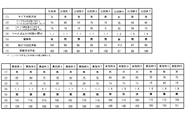
- FIG. 2 shows a comparison between a tire manufactured by a manufacturing method according to the present invention (Examples 1 to 13), a tire manufactured by a conventional tire manufacturing method (conventional example), and a tire manufacturing method according to the present invention. It is the table
- A is manufactured by a conventional tire manufacturing method in which an unvulcanized top rubber is provided on a base rubber of an unvulcanized base tire and integrally molded by a mold.
- B is a tire in which the top rubber 4 and the base tire 2 are integrally vulcanized and molded, and then the top rubber 4 and the base tire 2 are integrated.
- (2) is the elastic modulus of the base rubber 18 and indicates the ratio (%) of 100% Mod to 100% Mod of the top rubber 4.
- (3) is the thickness H2 of the base rubber 18, and the ratio to the total tread rubber thickness H1 is expressed as a percentage (%).
- the partial wear in (5) indicates whether or not partial wear actually occurred after traveling 30000 km.
- Rolling resistance performance and (7) steering stability are shown by relative evaluation based on a conventional example as a standard (100). The higher the numerical value, the better the performance.
- Comparative Example 1 to Comparative Example 7 and Example 1 to Example 13 show no uneven wear due to the difference in tire formation from the conventional example.
- the top rubber 4 and the base tire 2 are individually vulcanized and molded, so that the top rubber 4 and the base tire 2 are integrated, so that the boundary surface between the top rubber 4 and the base rubber 18 in the tread portion is undulated. Since it does not occur, it was confirmed that a tire without uneven wear can be manufactured. Further, in the tire of Example 3 in which only the tire forming method is changed with the same specifications as the conventional example, the rolling resistance performance is improved as compared with the conventional manufacturing method.
- Comparative Example 1 since 100% Mod of the base rubber 18 is 90% with respect to 100% Mod of the top rubber 4, the hardness of the base rubber 18 in the tread portion is hard, and only the top rubber 4 is deformed. This is considered to have reduced the rolling resistance performance. This is because, as shown in Comparative Example 7, when the 100% Mod of the base rubber 18 is hardened, the same result as in Comparative Example 1 is obtained, so that the base rubber 18 is too hard. it is obvious. In Comparative Example 2, since 100% Mod of the base rubber 18 is 55% of 100% Mod of the top rubber 4, the hardness of the base rubber 18 in the tread portion becomes too soft, and only the top rubber 4 is deformed. Therefore, it is considered that the rolling resistance performance was lowered.
- a tire excellent in rolling resistance performance can be obtained by using a rubber material having elasticity in the range of 60% to 85% of 100% Mod of the base rubber 18 for the top rubber 4.
- the elasticity of the base rubber 18 relative to the elasticity of the top rubber 4 is set in the range of 75% to 80% as shown in the second and third embodiments, so that the running strain is balanced and heat generation is reduced.
- a tire having more excellent rolling resistance performance can be obtained.
- Comparative Examples 3, 4, Example 3, Example 6, and Example 7 the ratio of the elasticity of the base rubber 18 to the elasticity of the top rubber 4 and the 100% Mod of the base rubber 18 are the same.
- Example 3, Example 6 and Example 7 the rolling resistance performance is improved compared to the conventional example, but in Comparative Examples 3 and 4, the rolling resistance performance is lowered.
- the steering stability performance has also declined.
- Comparative Example 3 since the thickness of the base rubber 18 was set to 35% of the total tread thickness H1, the volume of the tread portion, which is a heat generation factor, increased, and accordingly, the rolling resistance increased and the rolling resistance performance.
- the tread portion rolls due to friction during running and affects the steering stability performance. It is thought that it was lowered.
- Comparative Example 4 since the thickness H2 of the base rubber 18 is 5% of the total thickness H1 of the tread portion, the running strain cannot be absorbed in a balanced manner in the tread portion, and the running strain is absorbed only by the top rubber 4. Therefore, it is considered that the top rubber 2 abnormally generated heat and lowered the rolling resistance performance. In this case, the evaluation of the steering stability performance did not decrease because the rigidity in the tread portion was obtained. Therefore, it can be seen that the thickness of the base rubber 18 may be set in the range of 10% to 30% of the total tread thickness H1 as shown in Examples 3, 6 and 7.
- Comparative Example 5 Example 3, Example 11 to Example 13.
- Comparative Example 5 Example 3, and Examples 11 to 13 when the 100% Mod is in the range of 1.5 MPa to 1.9 MPa, the rolling resistance performance is improved as compared with the conventional example.
- Comparative Example 5 the steering stability performance is lowered as compared with Example 3, Example 11 to Example 13 and the conventional example. It is considered that this is because the base rubber 18 in the tread portion is too soft, so that the entire tread portion rolls and the steering stability performance is lowered.
- the thickness H2 of the base rubber 18 may be set to be 10% or more and 30% or less of the total tread thickness H1, and the hardness of the base rubber 18 may be set.
- the rubber within the range of 60% to 85% of the hardness of the top rubber 4, it is possible to improve the rolling resistance performance and to manufacture the tire 1 free from uneven wear.
- a rubber whose 100% Mod is 1.6 MPa or more for the base rubber 18 a tire having more excellent rolling resistance performance can be manufactured.
- the sticking surface 4b of the top rubber 4 has been described as a convex shape toward the radially outer side.
- the present invention is not limited thereto, and the convex surface is a straight line toward the both ends in the width direction or radially inward toward the tire center direction. It may be formed by the arc-shaped curve.
Landscapes
- Engineering & Computer Science (AREA)
- Mechanical Engineering (AREA)
- Tires In General (AREA)
- Tyre Moulding (AREA)
Abstract
L'invention concerne un procédé de fabrication d'un pneu capable d'améliorer la résistance du pneu au roulement en optimisant l'épaisseur du pneu dans la section de bande de roulement et en limitant la quantité de chaleur générée dans la section de bande de roulement pendant le parcours. L'invention concerne également un pneu. Le procédé de fabrication du pneu consiste à vulcaniser/mouler un caoutchouc supérieur qui devient la section qui touche la surface de la route, à vulcaniser/mouler un pneu de base dont le périmètre externe comporte un caoutchouc de base sur lequel est collé le caoutchouc supérieur, et à former le pneu en réunissant le caoutchouc supérieur et le pneu de base. La tangente de perte tan δ du caoutchouc de base est inférieure à la tangente de perte tan δ du caoutchouc supérieur. Par ailleurs, la valeur 100 % Mod du caoutchouc de base vaut 60 % à 85 % de la valeur 100 % Mod du caoutchouc supérieur, et l'épaisseur du caoutchouc de base vaut à 10 % à 30 % de l'épaisseur totale de la section de bande de roulement du pneu.
Priority Applications (2)
| Application Number | Priority Date | Filing Date | Title |
|---|---|---|---|
| EP14791079.8A EP2993033A4 (fr) | 2013-05-01 | 2014-04-25 | Pneu et son procédé de fabrication |
| CN201480024695.5A CN105228816A (zh) | 2013-05-01 | 2014-04-25 | 轮胎制造方法及轮胎 |
Applications Claiming Priority (2)
| Application Number | Priority Date | Filing Date | Title |
|---|---|---|---|
| JP2013-096599 | 2013-05-01 | ||
| JP2013096599A JP5557945B1 (ja) | 2013-05-01 | 2013-05-01 | タイヤ製造方法 |
Publications (1)
| Publication Number | Publication Date |
|---|---|
| WO2014178338A1 true WO2014178338A1 (fr) | 2014-11-06 |
Family
ID=51416928
Family Applications (1)
| Application Number | Title | Priority Date | Filing Date |
|---|---|---|---|
| PCT/JP2014/061666 Ceased WO2014178338A1 (fr) | 2013-05-01 | 2014-04-25 | Pneu et son procédé de fabrication |
Country Status (5)
| Country | Link |
|---|---|
| US (1) | US20140326394A1 (fr) |
| EP (1) | EP2993033A4 (fr) |
| JP (1) | JP5557945B1 (fr) |
| CN (1) | CN105228816A (fr) |
| WO (1) | WO2014178338A1 (fr) |
Cited By (1)
| Publication number | Priority date | Publication date | Assignee | Title |
|---|---|---|---|---|
| CN108136850A (zh) * | 2015-10-14 | 2018-06-08 | 大陆轮胎德国有限公司 | 商用车辆轮胎 |
Families Citing this family (3)
| Publication number | Priority date | Publication date | Assignee | Title |
|---|---|---|---|---|
| CN112109500B (zh) * | 2020-10-31 | 2025-06-24 | 风神轮胎股份有限公司 | 一种轮胎的块状花纹块 |
| CN114537050A (zh) * | 2022-01-26 | 2022-05-27 | 中策橡胶集团有限公司 | 一种改善滚动阻力的轮胎胎面结构、应用和轮胎 |
| CN118219710A (zh) * | 2024-04-22 | 2024-06-21 | 肇庆骏鸿实业有限公司 | 一种防异响的缺气保用轮胎 |
Citations (5)
| Publication number | Priority date | Publication date | Assignee | Title |
|---|---|---|---|---|
| JPS62265005A (ja) * | 1986-05-14 | 1987-11-17 | Bridgestone Corp | 重荷重用空気入りラジアルタイヤ |
| JP2007506589A (ja) * | 2003-06-24 | 2007-03-22 | ピレリ・タイヤ・ソチエタ・ペル・アツィオーニ | キャップおよびベース構造のトレッドバンドを備える車両用タイヤ |
| JP2008213635A (ja) * | 2007-03-02 | 2008-09-18 | Yokohama Rubber Co Ltd:The | 空気入りタイヤ |
| JP2010247443A (ja) * | 2009-04-16 | 2010-11-04 | Bridgestone Corp | プレキュアトレッドの製造方法および装置並びにプレキュアトレッド |
| WO2012114549A1 (fr) | 2011-02-23 | 2012-08-30 | 株式会社ブリヂストン | Procédé de fabrication d'enveloppe de pneu, procédé de fabrication de pneu, et enveloppe de pneu |
Family Cites Families (14)
| Publication number | Priority date | Publication date | Assignee | Title |
|---|---|---|---|---|
| JPS63149202A (ja) * | 1986-12-11 | 1988-06-22 | Yokohama Rubber Co Ltd:The | 重荷重用ラジアルタイヤ |
| JP3502176B2 (ja) * | 1995-02-13 | 2004-03-02 | 株式会社ブリヂストン | 高速重荷重用更生タイヤ |
| DE19549502C2 (de) * | 1995-03-03 | 1999-03-18 | Continental Ag | Verfahren zur Herstellung eines Luftreifens |
| EP2392620A1 (fr) * | 1997-09-29 | 2011-12-07 | The Yokohama Rubber Co., Ltd. | Pneu |
| JP2001139728A (ja) * | 1999-11-17 | 2001-05-22 | Bridgestone Corp | ゴム組成物 |
| EP1767383A1 (fr) * | 2001-01-11 | 2007-03-28 | Sumitomo Rubber Industries, Ltd. | Bandage pneumatique |
| JP2004224278A (ja) * | 2003-01-24 | 2004-08-12 | Toyo Tire & Rubber Co Ltd | 更生タイヤ用トレッド及び更生タイヤ |
| US20050045260A1 (en) * | 2003-08-26 | 2005-03-03 | Kiyoto Maruoka | Heavy duty tire |
| JP4523815B2 (ja) * | 2004-08-26 | 2010-08-11 | 住友ゴム工業株式会社 | 重荷重用空気入りタイヤ及びその製造方法 |
| JP4392400B2 (ja) * | 2005-11-09 | 2009-12-24 | 住友ゴム工業株式会社 | 空気入りタイヤ |
| JP4997038B2 (ja) * | 2007-07-27 | 2012-08-08 | 株式会社ブリヂストン | 更生タイヤ用トレッド及び更生タイヤ |
| ES2433746T3 (es) * | 2008-04-10 | 2013-12-12 | Bridgestone Corporation | Neumático para cargas pesadas |
| JP5007740B2 (ja) * | 2009-10-28 | 2012-08-22 | 横浜ゴム株式会社 | 空気入りタイヤ |
| EP2633986B1 (fr) * | 2010-10-29 | 2018-05-16 | Bridgestone Corporation | Procédé de production de pneumatique de base et procédé relatif au temps de production |
-
2013
- 2013-05-01 JP JP2013096599A patent/JP5557945B1/ja not_active Expired - Fee Related
-
2014
- 2014-04-25 WO PCT/JP2014/061666 patent/WO2014178338A1/fr not_active Ceased
- 2014-04-25 EP EP14791079.8A patent/EP2993033A4/fr not_active Withdrawn
- 2014-04-25 CN CN201480024695.5A patent/CN105228816A/zh active Pending
- 2014-05-01 US US14/267,335 patent/US20140326394A1/en not_active Abandoned
Patent Citations (5)
| Publication number | Priority date | Publication date | Assignee | Title |
|---|---|---|---|---|
| JPS62265005A (ja) * | 1986-05-14 | 1987-11-17 | Bridgestone Corp | 重荷重用空気入りラジアルタイヤ |
| JP2007506589A (ja) * | 2003-06-24 | 2007-03-22 | ピレリ・タイヤ・ソチエタ・ペル・アツィオーニ | キャップおよびベース構造のトレッドバンドを備える車両用タイヤ |
| JP2008213635A (ja) * | 2007-03-02 | 2008-09-18 | Yokohama Rubber Co Ltd:The | 空気入りタイヤ |
| JP2010247443A (ja) * | 2009-04-16 | 2010-11-04 | Bridgestone Corp | プレキュアトレッドの製造方法および装置並びにプレキュアトレッド |
| WO2012114549A1 (fr) | 2011-02-23 | 2012-08-30 | 株式会社ブリヂストン | Procédé de fabrication d'enveloppe de pneu, procédé de fabrication de pneu, et enveloppe de pneu |
Non-Patent Citations (1)
| Title |
|---|
| See also references of EP2993033A4 * |
Cited By (2)
| Publication number | Priority date | Publication date | Assignee | Title |
|---|---|---|---|---|
| CN108136850A (zh) * | 2015-10-14 | 2018-06-08 | 大陆轮胎德国有限公司 | 商用车辆轮胎 |
| CN108136850B (zh) * | 2015-10-14 | 2020-06-05 | 大陆轮胎德国有限公司 | 商用车辆轮胎 |
Also Published As
| Publication number | Publication date |
|---|---|
| CN105228816A (zh) | 2016-01-06 |
| JP5557945B1 (ja) | 2014-07-23 |
| EP2993033A1 (fr) | 2016-03-09 |
| EP2993033A4 (fr) | 2016-04-20 |
| JP2014217960A (ja) | 2014-11-20 |
| US20140326394A1 (en) | 2014-11-06 |
Similar Documents
| Publication | Publication Date | Title |
|---|---|---|
| JP5276647B2 (ja) | 空気入りタイヤの製造方法 | |
| JP5225487B1 (ja) | 台タイヤ及び台タイヤを備えたタイヤ | |
| JP5557945B1 (ja) | タイヤ製造方法 | |
| JP2009173051A (ja) | 空気入りタイヤ及びその製造方法 | |
| WO2018235621A1 (fr) | Pneumatique | |
| JP6027116B2 (ja) | 台タイヤの製造方法 | |
| JP5216067B2 (ja) | 空気入りタイヤの製造方法 | |
| US10293643B2 (en) | Tire with filler strips enclosing bead cores and ply ends | |
| JP2011218907A (ja) | 更生タイヤ | |
| JP2018099850A (ja) | 空気入りタイヤの製造方法 | |
| JP5987324B2 (ja) | 空気入りタイヤ | |
| JP5503341B2 (ja) | 空気入りタイヤ | |
| WO2005065971A1 (fr) | Pneumatique | |
| JP2012171399A (ja) | 空気入りタイヤ及び空気入りタイヤの製造方法 | |
| JP4507920B2 (ja) | ランフラットタイヤの製造方法 | |
| JP2008188819A (ja) | 空気入りタイヤ及びその製造方法 | |
| JP6082203B2 (ja) | 空気入りタイヤ | |
| JP5258996B1 (ja) | 台タイヤ及び台タイヤを使用したタイヤ | |
| JP2011148392A (ja) | タイヤ用チューブ | |
| JP2014213796A (ja) | タイヤ | |
| JP2003154806A (ja) | 空気入りタイヤおよびそれの製造方法 | |
| JP2021041666A (ja) | 空気入りタイヤの製造方法 | |
| JP2014189050A (ja) | 空気入りタイヤ | |
| JP2009178896A (ja) | 空気入りタイヤの製造方法及び空気入りタイヤ | |
| JP2013237358A (ja) | タイヤ |
Legal Events
| Date | Code | Title | Description |
|---|---|---|---|
| WWE | Wipo information: entry into national phase |
Ref document number: 201480024695.5 Country of ref document: CN |
|
| 121 | Ep: the epo has been informed by wipo that ep was designated in this application |
Ref document number: 14791079 Country of ref document: EP Kind code of ref document: A1 |
|
| NENP | Non-entry into the national phase |
Ref country code: DE |
|
| REEP | Request for entry into the european phase |
Ref document number: 2014791079 Country of ref document: EP |
|
| WWE | Wipo information: entry into national phase |
Ref document number: 2014791079 Country of ref document: EP |