WO2014185296A1 - リアクトル用熱伝導性シリコーン接着剤組成物及びリアクトル - Google Patents
リアクトル用熱伝導性シリコーン接着剤組成物及びリアクトル Download PDFInfo
- Publication number
- WO2014185296A1 WO2014185296A1 PCT/JP2014/062169 JP2014062169W WO2014185296A1 WO 2014185296 A1 WO2014185296 A1 WO 2014185296A1 JP 2014062169 W JP2014062169 W JP 2014062169W WO 2014185296 A1 WO2014185296 A1 WO 2014185296A1
- Authority
- WO
- WIPO (PCT)
- Prior art keywords
- group
- molecular chain
- component
- composition
- reactor
- Prior art date
- Legal status (The legal status is an assumption and is not a legal conclusion. Google has not performed a legal analysis and makes no representation as to the accuracy of the status listed.)
- Ceased
Links
Images


Classifications
-
- C—CHEMISTRY; METALLURGY
- C09—DYES; PAINTS; POLISHES; NATURAL RESINS; ADHESIVES; COMPOSITIONS NOT OTHERWISE PROVIDED FOR; APPLICATIONS OF MATERIALS NOT OTHERWISE PROVIDED FOR
- C09J—ADHESIVES; NON-MECHANICAL ASPECTS OF ADHESIVE PROCESSES IN GENERAL; ADHESIVE PROCESSES NOT PROVIDED FOR ELSEWHERE; USE OF MATERIALS AS ADHESIVES
- C09J11/00—Features of adhesives not provided for in group C09J9/00, e.g. additives
- C09J11/02—Non-macromolecular additives
- C09J11/04—Non-macromolecular additives inorganic
-
- H—ELECTRICITY
- H01—ELECTRIC ELEMENTS
- H01F—MAGNETS; INDUCTANCES; TRANSFORMERS; SELECTION OF MATERIALS FOR THEIR MAGNETIC PROPERTIES
- H01F27/00—Details of transformers or inductances, in general
- H01F27/08—Cooling; Ventilating
-
- C—CHEMISTRY; METALLURGY
- C08—ORGANIC MACROMOLECULAR COMPOUNDS; THEIR PREPARATION OR CHEMICAL WORKING-UP; COMPOSITIONS BASED THEREON
- C08K—Use of inorganic or non-macromolecular organic substances as compounding ingredients
- C08K3/00—Use of inorganic substances as compounding ingredients
- C08K3/02—Elements
- C08K3/04—Carbon
-
- C—CHEMISTRY; METALLURGY
- C08—ORGANIC MACROMOLECULAR COMPOUNDS; THEIR PREPARATION OR CHEMICAL WORKING-UP; COMPOSITIONS BASED THEREON
- C08K—Use of inorganic or non-macromolecular organic substances as compounding ingredients
- C08K3/00—Use of inorganic substances as compounding ingredients
- C08K3/18—Oxygen-containing compounds, e.g. metal carbonyls
- C08K3/20—Oxides; Hydroxides
- C08K3/22—Oxides; Hydroxides of metals
-
- C—CHEMISTRY; METALLURGY
- C08—ORGANIC MACROMOLECULAR COMPOUNDS; THEIR PREPARATION OR CHEMICAL WORKING-UP; COMPOSITIONS BASED THEREON
- C08K—Use of inorganic or non-macromolecular organic substances as compounding ingredients
- C08K5/00—Use of organic ingredients
- C08K5/56—Organo-metallic compounds, i.e. organic compounds containing a metal-to-carbon bond
-
- C—CHEMISTRY; METALLURGY
- C08—ORGANIC MACROMOLECULAR COMPOUNDS; THEIR PREPARATION OR CHEMICAL WORKING-UP; COMPOSITIONS BASED THEREON
- C08L—COMPOSITIONS OF MACROMOLECULAR COMPOUNDS
- C08L83/00—Compositions of macromolecular compounds obtained by reactions forming in the main chain of the macromolecule a linkage containing silicon with or without sulfur, nitrogen, oxygen or carbon only; Compositions of derivatives of such polymers
-
- C—CHEMISTRY; METALLURGY
- C09—DYES; PAINTS; POLISHES; NATURAL RESINS; ADHESIVES; COMPOSITIONS NOT OTHERWISE PROVIDED FOR; APPLICATIONS OF MATERIALS NOT OTHERWISE PROVIDED FOR
- C09J—ADHESIVES; NON-MECHANICAL ASPECTS OF ADHESIVE PROCESSES IN GENERAL; ADHESIVE PROCESSES NOT PROVIDED FOR ELSEWHERE; USE OF MATERIALS AS ADHESIVES
- C09J183/00—Adhesives based on macromolecular compounds obtained by reactions forming in the main chain of the macromolecule a linkage containing silicon, with or without sulfur, nitrogen, oxygen, or carbon only; Adhesives based on derivatives of such polymers
- C09J183/04—Polysiloxanes
-
- C—CHEMISTRY; METALLURGY
- C09—DYES; PAINTS; POLISHES; NATURAL RESINS; ADHESIVES; COMPOSITIONS NOT OTHERWISE PROVIDED FOR; APPLICATIONS OF MATERIALS NOT OTHERWISE PROVIDED FOR
- C09J—ADHESIVES; NON-MECHANICAL ASPECTS OF ADHESIVE PROCESSES IN GENERAL; ADHESIVE PROCESSES NOT PROVIDED FOR ELSEWHERE; USE OF MATERIALS AS ADHESIVES
- C09J183/00—Adhesives based on macromolecular compounds obtained by reactions forming in the main chain of the macromolecule a linkage containing silicon, with or without sulfur, nitrogen, oxygen, or carbon only; Adhesives based on derivatives of such polymers
- C09J183/04—Polysiloxanes
- C09J183/06—Polysiloxanes containing silicon bound to oxygen-containing groups
-
- C—CHEMISTRY; METALLURGY
- C09—DYES; PAINTS; POLISHES; NATURAL RESINS; ADHESIVES; COMPOSITIONS NOT OTHERWISE PROVIDED FOR; APPLICATIONS OF MATERIALS NOT OTHERWISE PROVIDED FOR
- C09J—ADHESIVES; NON-MECHANICAL ASPECTS OF ADHESIVE PROCESSES IN GENERAL; ADHESIVE PROCESSES NOT PROVIDED FOR ELSEWHERE; USE OF MATERIALS AS ADHESIVES
- C09J9/00—Adhesives characterised by their physical nature or the effects produced, e.g. glue sticks
-
- C—CHEMISTRY; METALLURGY
- C09—DYES; PAINTS; POLISHES; NATURAL RESINS; ADHESIVES; COMPOSITIONS NOT OTHERWISE PROVIDED FOR; APPLICATIONS OF MATERIALS NOT OTHERWISE PROVIDED FOR
- C09K—MATERIALS FOR MISCELLANEOUS APPLICATIONS, NOT PROVIDED FOR ELSEWHERE
- C09K5/00—Heat-transfer, heat-exchange or heat-storage materials, e.g. refrigerants; Materials for the production of heat or cold by chemical reactions other than by combustion
- C09K5/08—Materials not undergoing a change of physical state when used
-
- C—CHEMISTRY; METALLURGY
- C09—DYES; PAINTS; POLISHES; NATURAL RESINS; ADHESIVES; COMPOSITIONS NOT OTHERWISE PROVIDED FOR; APPLICATIONS OF MATERIALS NOT OTHERWISE PROVIDED FOR
- C09K—MATERIALS FOR MISCELLANEOUS APPLICATIONS, NOT PROVIDED FOR ELSEWHERE
- C09K5/00—Heat-transfer, heat-exchange or heat-storage materials, e.g. refrigerants; Materials for the production of heat or cold by chemical reactions other than by combustion
- C09K5/08—Materials not undergoing a change of physical state when used
- C09K5/14—Solid materials, e.g. powdery or granular
-
- H—ELECTRICITY
- H01—ELECTRIC ELEMENTS
- H01F—MAGNETS; INDUCTANCES; TRANSFORMERS; SELECTION OF MATERIALS FOR THEIR MAGNETIC PROPERTIES
- H01F27/00—Details of transformers or inductances, in general
-
- H—ELECTRICITY
- H01—ELECTRIC ELEMENTS
- H01F—MAGNETS; INDUCTANCES; TRANSFORMERS; SELECTION OF MATERIALS FOR THEIR MAGNETIC PROPERTIES
- H01F27/00—Details of transformers or inductances, in general
- H01F27/02—Casings
-
- H—ELECTRICITY
- H01—ELECTRIC ELEMENTS
- H01F—MAGNETS; INDUCTANCES; TRANSFORMERS; SELECTION OF MATERIALS FOR THEIR MAGNETIC PROPERTIES
- H01F27/00—Details of transformers or inductances, in general
- H01F27/02—Casings
- H01F27/022—Encapsulation
-
- H—ELECTRICITY
- H01—ELECTRIC ELEMENTS
- H01F—MAGNETS; INDUCTANCES; TRANSFORMERS; SELECTION OF MATERIALS FOR THEIR MAGNETIC PROPERTIES
- H01F27/00—Details of transformers or inductances, in general
- H01F27/06—Mounting, supporting or suspending transformers, reactors or choke coils not being of the signal type
-
- H—ELECTRICITY
- H01—ELECTRIC ELEMENTS
- H01F—MAGNETS; INDUCTANCES; TRANSFORMERS; SELECTION OF MATERIALS FOR THEIR MAGNETIC PROPERTIES
- H01F27/00—Details of transformers or inductances, in general
- H01F27/08—Cooling; Ventilating
- H01F27/22—Cooling by heat conduction through solid or powdered fillings
-
- H—ELECTRICITY
- H01—ELECTRIC ELEMENTS
- H01F—MAGNETS; INDUCTANCES; TRANSFORMERS; SELECTION OF MATERIALS FOR THEIR MAGNETIC PROPERTIES
- H01F37/00—Fixed inductances not covered by group H01F17/00
-
- C—CHEMISTRY; METALLURGY
- C08—ORGANIC MACROMOLECULAR COMPOUNDS; THEIR PREPARATION OR CHEMICAL WORKING-UP; COMPOSITIONS BASED THEREON
- C08G—MACROMOLECULAR COMPOUNDS OBTAINED OTHERWISE THAN BY REACTIONS ONLY INVOLVING UNSATURATED CARBON-TO-CARBON BONDS
- C08G77/00—Macromolecular compounds obtained by reactions forming a linkage containing silicon with or without sulfur, nitrogen, oxygen or carbon in the main chain of the macromolecule
- C08G77/04—Polysiloxanes
- C08G77/045—Polysiloxanes containing less than 25 silicon atoms
-
- C—CHEMISTRY; METALLURGY
- C08—ORGANIC MACROMOLECULAR COMPOUNDS; THEIR PREPARATION OR CHEMICAL WORKING-UP; COMPOSITIONS BASED THEREON
- C08G—MACROMOLECULAR COMPOUNDS OBTAINED OTHERWISE THAN BY REACTIONS ONLY INVOLVING UNSATURATED CARBON-TO-CARBON BONDS
- C08G77/00—Macromolecular compounds obtained by reactions forming a linkage containing silicon with or without sulfur, nitrogen, oxygen or carbon in the main chain of the macromolecule
- C08G77/04—Polysiloxanes
- C08G77/12—Polysiloxanes containing silicon bound to hydrogen
-
- C—CHEMISTRY; METALLURGY
- C08—ORGANIC MACROMOLECULAR COMPOUNDS; THEIR PREPARATION OR CHEMICAL WORKING-UP; COMPOSITIONS BASED THEREON
- C08G—MACROMOLECULAR COMPOUNDS OBTAINED OTHERWISE THAN BY REACTIONS ONLY INVOLVING UNSATURATED CARBON-TO-CARBON BONDS
- C08G77/00—Macromolecular compounds obtained by reactions forming a linkage containing silicon with or without sulfur, nitrogen, oxygen or carbon in the main chain of the macromolecule
- C08G77/04—Polysiloxanes
- C08G77/14—Polysiloxanes containing silicon bound to oxygen-containing groups
-
- C—CHEMISTRY; METALLURGY
- C08—ORGANIC MACROMOLECULAR COMPOUNDS; THEIR PREPARATION OR CHEMICAL WORKING-UP; COMPOSITIONS BASED THEREON
- C08G—MACROMOLECULAR COMPOUNDS OBTAINED OTHERWISE THAN BY REACTIONS ONLY INVOLVING UNSATURATED CARBON-TO-CARBON BONDS
- C08G77/00—Macromolecular compounds obtained by reactions forming a linkage containing silicon with or without sulfur, nitrogen, oxygen or carbon in the main chain of the macromolecule
- C08G77/04—Polysiloxanes
- C08G77/20—Polysiloxanes containing silicon bound to unsaturated aliphatic groups
-
- C—CHEMISTRY; METALLURGY
- C08—ORGANIC MACROMOLECULAR COMPOUNDS; THEIR PREPARATION OR CHEMICAL WORKING-UP; COMPOSITIONS BASED THEREON
- C08K—Use of inorganic or non-macromolecular organic substances as compounding ingredients
- C08K7/00—Use of ingredients characterised by shape
- C08K7/16—Solid spheres
- C08K7/18—Solid spheres inorganic
-
- C—CHEMISTRY; METALLURGY
- C09—DYES; PAINTS; POLISHES; NATURAL RESINS; ADHESIVES; COMPOSITIONS NOT OTHERWISE PROVIDED FOR; APPLICATIONS OF MATERIALS NOT OTHERWISE PROVIDED FOR
- C09J—ADHESIVES; NON-MECHANICAL ASPECTS OF ADHESIVE PROCESSES IN GENERAL; ADHESIVE PROCESSES NOT PROVIDED FOR ELSEWHERE; USE OF MATERIALS AS ADHESIVES
- C09J2483/00—Presence of polysiloxane
Definitions
- the present invention has good fluidity even when a large amount of heat-conductive filler is contained, can be potted on a fine substrate, and has physical properties after curing.
- Reactor thermal conductive silicone adhesive composition that is good and has little change in physical properties due to heat or wet heat aging, and provides good adhesion to metals and organic resins, and a reactor potted by the composition Is.
- a heat sink can be installed to dissipate the heat and escape the heat to the metal chassis of the device. It is illustrated.
- a heat radiation insulating sheet in which a heat conductive filler is blended with silicone rubber is used between the heat generating component and the heat sink.
- Patent Document 1 discloses beryllium oxide, aluminum oxide, hydrated aluminum oxide, magnesium oxide in 100 parts by weight of synthetic rubber such as silicone rubber.
- An insulating composition containing 100 to 800 parts by weight of at least one metal oxide selected from zinc oxide is disclosed.
- Patent Document 2 describes an addition-curable silicone rubber composition such as silica, silver, gold, and silicon.
- a composition containing 60 to 500 parts by weight of heat conductive powder is disclosed.
- thermal conductive materials can only have a thermal conductivity of 1.5 W / m ⁇ K or less, and in order to further improve the thermal conductivity, the composition contains a large amount of a thermal conductive filler. However, there is a problem that the fluidity is lowered and the moldability becomes very poor.
- Patent Document 3 discloses that 10 to 30% by weight of alumina particles having an average particle size of 5 ⁇ m or less and the balance is an average particle size of 10 ⁇ m or more of a single particle.
- a highly heat-conductive rubber / plastic composition containing alumina composed of spherical corundum particles having a shape with no cutting edge is disclosed.
- JP-A-4-328163 discloses a gum-like organopolysiloxane having an average degree of polymerization of 6,000 to 12,000 and an oily organopolysiloxane having an average degree of polymerization of 200 to 2,000.
- a heat conductive silicone rubber composition comprising 500 to 1,200 parts by weight of spherical aluminum oxide powder per 100 parts by weight of a base polymer used together with 100 parts by weight of the base polymer component.
- a heat conductive silicone rubber composition comprising 500 to 1,200 parts by weight of spherical aluminum oxide powder per 100 parts by weight of a base polymer used together with 100 parts by weight of the base polymer component.
- Patent Document 5 discloses a heat conduction containing 0.1 to 50% by volume of hydrolyzable group-containing methylpolysiloxane as a wetter. A functional silicone rubber composition is disclosed. However, although this process has improved the moldability of the heat conductive silicone rubber composition, the adhesion to the substrate has been insufficient.
- Patent Document 6 discloses a silicone elastomer composition that provides a silicone elastomer having a small change in hardness due to thermal aging, but a description of an adhesion test to an aluminum adherend.
- a reactor is required to boost the battery voltage and apply it to the motor.
- the size of the reactor which is one of the components, and the internal structure has become increasingly fine and complex in recent years. Yes.
- a heat conductive silicone adhesive composition for a reactor that has both a high heat dissipation performance of at least 0.5 W / mK and a property that minimizes changes in physical properties even by heat or wet heat aging. The development of is eagerly desired.
- Patent Document 7 discloses that even when a large amount of a heat conductive filler is contained in order to obtain a high heat conductive silicone composition, the flowability, particularly potability to the reactor portion, is improved.
- a silicone composition for a heat conductive potting material that has good properties after curing and a method for selecting a heat conductive potting material are disclosed, changes in physical properties after heat or wet heat aging are described. It was not good enough.
- JP 47-32400 A JP-A-56-100849 Japanese Patent Laid-Open No. 1-69661 Japanese Patent Laid-Open No. 4-328163 JP 2000-256558 A JP 2008-239719 A Japanese Patent Application Laid-Open No. 2011-122000
- the present invention has been made in view of the above circumstances, and even if a large amount of a heat conductive filler is contained in order to obtain a high heat conductive silicone adhesive composition, the fluidity is good and potting is performed on a fine substrate.
- a thermally conductive silicone adhesive composition for a reactor that has good physical properties after curing, has little change in physical properties due to heat or wet heat aging, and gives good adhesion to metals and organic resins; and The object is to provide a reactor potted by the composition.
- the inventors of the present invention have a viscosity of 100 mPa ⁇ s or less at 25 ° C., and 2 to 10 hydrogen atoms bonded to silicon atoms in one molecule.
- the thermally conductive silicone adhesive composition containing the liquid organohydrogenpolysiloxane contains good fluidity even if it contains a large amount of thermally conductive filler, and there is little change in physical properties due to heat or wet heat aging.
- a thermally conductive silicone adhesive composition for a reactor that gives good adhesion to an organic resin, and a reactor potted by the composition It found that obtaining, the present invention has been accomplished.
- the present invention provides the following thermally conductive silicone adhesive composition for a reactor, and a reactor potted by the composition.
- A Organopolysiloxane containing an alkenyl group bonded to at least two silicon atoms in one molecule and having a viscosity at 25 ° C. of 0.05 to 1,000 Pa ⁇ s: 100 parts by mass
- B The viscosity at 25 ° C. is 100 mPa ⁇ s or less, contains 2 to 10 hydrogen atoms (SiH groups) bonded to a silicon atom in one molecule, does not contain an alkoxy group, and passes through an alkylene group.
- Free organopolysiloxane 0.1 to 100 parts by mass, -SiR 1 a R 2 3-a (1)
- R 1 is an unsubstituted or substituted monovalent hydrocarbon group
- R 2 is an alkoxy group having 1 to 8 carbon atoms or an acyloxy group
- a is 0, 1 or 2.
- (F) Acetylene black obtained by a thermal decomposition method of acetylene and having a bulk density of 0.06 to 0.18 g / cm 3 : 0.01 to 10 parts by mass;
- the component (B) has the following general formula (In the formula, m is an integer of 1 to 6.)
- Component (C) is aluminum hydroxide, magnesium hydroxide, aluminum oxide, crystalline silica, zinc oxide, silicon oxide, silicon carbide, silicon nitride, magnesium oxide, titanium oxide, beryllium oxide, aluminum nitride, boron nitride
- the heat conductive silicone adhesive composition for reactors according to [1] or [2] which is at least one selected from the group consisting of gold, silver, copper, iron, nickel, aluminum, and stainless steel.
- Component (E) is a dimethylsiloxane blocked with a trimethoxysiloxy group at both ends of a molecular chain, a dimethylsiloxane / methylvinylsiloxane copolymer blocked with a trimethoxysiloxy group at both ends of a molecular chain, and a methylated at the both ends of a molecular chain Vinylpolysiloxane, trimethoxysiloxy group-capped dimethylsiloxane / methylvinylsiloxane / methylphenylsiloxane copolymer, molecular chain both-end trimethoxysiloxy group-capped dimethylsiloxane / methylvinylsiloxane / diphenylsiloxane copolymer, molecule Dimethoxymethylsiloxy group-blocked dimethylpolysiloxane at both ends of the chain, Dimethoxyvinylsiloxy group-blocked
- thermoly conductive silicone adhesive composition for reactors that has good physical properties, little physical property change due to heat or wet heat aging, and good adhesion to metals and organic resins, and potted by the composition Since the reactor is obtained, it is possible to ensure the reliability of the reactor performance for boosting the battery voltage and applying it to the motor.
- the reactor thermal conductive silicone adhesive composition of the present invention cures at room temperature or by heating, and imparts self-adhesive properties to metals, organic resins, etc.
- Component (A) is the main component (base polymer) of the composition, and contains at least 2, preferably 2 to 50, more preferably about 2 to 20 alkenyl groups bonded to silicon atoms in one molecule.
- the resulting composition When the content of the alkenyl group is less than 2, the resulting composition may be uncured, and when it exceeds 50, the curability of the resulting composition may be remarkably slowed. Further, when the viscosity at 25 ° C. is less than 0.05 Pa ⁇ s, the physical properties and adhesiveness of the cured product of the resulting composition may not be sufficiently satisfied, exceeding 1,000 Pa ⁇ s. In such a case, the resulting composition is remarkably lacking in fluidity, and workability may be inferior.
- the molecular structure of the component (A) is not particularly limited, and examples thereof include a linear structure, a partially branched linear structure, a branched chain structure, a cyclic structure, and a branched cyclic structure. It is preferably a substantially linear organopolysiloxane. Specifically, the molecular chain mainly consists of repeating diorganosiloxane units, and both ends of the molecular chain are blocked with triorganosiloxy groups. It is preferable that it is a diorganopolysiloxane in a shape.
- the component (A) may be a polymer composed of a single siloxane unit or a copolymer composed of two or more siloxane units.
- the position of the alkenyl group bonded to the silicon atom in the component (A) is not particularly limited, and the alkenyl group is either a silicon atom at the molecular chain end or a silicon atom at the molecular chain non-terminal (in the middle of the molecular chain). It may be bonded only to these, or may be bonded to both of them.
- Such component (A) has the following average composition formula (2) R 3 b R 4 c SiO (4-bc) / 2 (2) (Wherein R 3 independently represents an unsubstituted or substituted monovalent hydrocarbon group that does not contain an aliphatic unsaturated bond, R 4 independently represents an alkenyl group, and b is generally 0.7-2. 2, preferably 1.8 to 2.1, more preferably 1.95 to 2.0, and c is usually 0.0001 to 0.2, preferably 0.0005 to 0.1, More preferably, it is a positive number of 0.01 to 0.05, provided that b + c is usually 0.8 to 2.3, preferably 1.9 to 2.2, more preferably 1.98 to 2.05. Is a positive number.) Can be expressed as
- R 3 includes an unsubstituted or substituted monovalent hydrocarbon group having 1 to 10 carbon atoms and not containing an aliphatic unsaturated bond.
- R 3 include alkyl groups such as methyl group, ethyl group, propyl group, isopropyl group, butyl group, isobutyl group, tert-butyl group, hexyl group, octyl group, decyl group; phenyl group, tolyl group, Aryl groups such as xylyl group and naphthyl group; cycloalkyl groups such as cyclopentyl group and cyclohexyl group; aralkyl groups such as benzyl group, 2-phenylethyl group and 3-phenylpropyl group; carbon atoms in these hydrocarbon groups A group in which some or all of the bonded hydrogen atoms are substituted with a halogen atom such as a chlorine atom, a bromine atom or
- R 3 is a methyl group, a phenyl group, or a combination of both as the component (A) because synthesis is easy and chemical stability is good.
- R 3 should be a methyl group, a phenyl group, or a combination of both, and a combination of 3,3,3-trifluoropropyl group. Is preferred.
- R 4 examples include alkenyl groups having 2 to 8 carbon atoms. Specific examples of R 4 include vinyl group, allyl group, 1-propenyl group, isopropenyl group, 1-butenyl group, isobutenyl group, hexenyl group and the like. Among these, a vinyl group is preferable. As the component (A), it is preferable that R 4 is a vinyl group because synthesis is easy and chemical stability is improved.
- component (A) examples include: a trimethylsiloxy group-capped dimethylsiloxane / methylvinylsiloxane copolymer having both ends of a molecular chain, a trimethylsiloxy group-capped methylvinylpolysiloxane having both ends of a molecular chain, and a trimethylsiloxy having both ends of a molecular chain.
- Component (B) has a viscosity at 25 ° C. of 100 mPa ⁇ s or less, preferably 1 to 100 mPa ⁇ s, and has 2 to 10 hydrogen atoms bonded to silicon atoms in one molecule, preferably 2 to 7 2 to 4, more preferably 2 to 4, not containing an alkoxy group, and containing at least one epoxy group bonded to a silicon atom via an alkylene group, preferably 1 to 4, more preferably 1 or 2 Furthermore, the degree of polymerization of the polysiloxane is 15 or less, preferably 4 to 15, more preferably 4 to 8, and the polysiloxane skeleton is a liquid organohydrogenpolysiloxane at room temperature (25 ° C.) containing a cyclic structure.
- organohydrogenpolysiloxane cures at room temperature or when heated, and further acts as a cross-linking agent and / or an adhesion-imparting agent for imparting self-adhesive properties to metals, organic resins and the like.
- the resulting composition may be uncured.
- the content of hydrogen atoms (SiH groups) bonded to silicon atoms is less than 2, the resulting composition may be uncured.
- the content exceeds 10 the heat or wet heat aging is performed on the initial physical properties. Since subsequent physical property changes may be large, it is not preferable.
- the content of the epoxy group bonded to the silicon atom via the alkylene group is 0, the self-adhesive property is not exhibited, and when the content exceeds 4, the storage stability of the resulting composition may be deteriorated.
- the viscosity at 25 ° C. is less than 1 mPa ⁇ s or the degree of polymerization is less than 4, the physical properties and adhesiveness of the cured product of the resulting composition may not be sufficiently satisfied.
- the degree of polymerization (or the number of silicon atoms in the molecule) referred to here is determined by the number average value in terms of polystyrene by GC / MS (gas chromatography / mass spectrometry) analysis or GPC (gel permeation chromatography) analysis. Can do.
- the molecular structure of the component (B) is not particularly limited, but the polysiloxane skeleton needs to contain a cyclic structure.
- the cyclic structure of polysiloxane is preferably a cyclic structure having 3 to 8 silicon atoms, and particularly preferably having 4 silicon atoms. If it does not have a cyclic siloxane structure, workability, adhesion and heat resistance will be insufficient.
- component (B) does not contain an alkoxy group. This is because the alkoxy group is easily hydrolyzed by moisture, so that the change in physical properties particularly after wet heat aging becomes large with respect to the initial characteristics of the cured product.
- an organohydrogenpolysiloxane represented by the following general formula is preferable.
- m is an integer of 1 to 6, preferably an integer of 1 to 3, more preferably 2 or 3.
- organohydrogenpolysiloxanes may be used singly or in combination of two or more.
- the blending amount of the component (B) is 0.01 to 30 parts by mass, preferably 0.1 to 20 parts by mass with respect to 100 parts by mass of the organopolysiloxane of the component (A). If the blending amount is less than 0.01 parts by mass, an adhesive effect sufficient for practical use cannot be obtained, and if it exceeds 30 parts by mass, the physical properties of the cured product after heat resistance may be impaired. .
- the molar ratio related to the blending amount is less than 0.2, curing is insufficient, or even if cured, the physical properties of the cured product are inferior, and when it exceeds 5.0, curing is insufficient, Moreover, even if it hardens
- Component (C)] (C) component is a heat conductive filler mix
- the heat conductive filler is preferably an inorganic powder and / or a metal powder, specifically, aluminum hydroxide, magnesium hydroxide, aluminum oxide, crystalline silica, zinc oxide, silicon oxide, silicon carbide, One or more inorganic powders selected from silicon nitride, magnesium oxide, titanium oxide, beryllium oxide, aluminum nitride, boron nitride, etc. and / or selected from aluminum, gold, silver, copper, iron, nickel, stainless steel, etc. One or more metal powders to be used can be used.
- the average particle size of the component (C) is not particularly limited, but is 50 ⁇ m or less, usually 0.1 to 50 ⁇ m, preferably 0.2 to 30 ⁇ m, more preferably 0.2 to 20 ⁇ m. If the average particle size exceeds 50 ⁇ m, the appearance and dispersibility may be deteriorated. In particular, in the case of a liquid silicone rubber, the thermal conductive filler may be precipitated if left untreated. On the other hand, when the thickness is less than 0.1 ⁇ m, the filling property is remarkably deteriorated, the viscosity is increased, and the handleability may be deteriorated.
- the average particle size referred to herein is, for example, cumulative weight average value in a particle size distribution measurement by laser diffraction method (D 50), or can be obtained as the median diameter and the like.
- the shape of such a thermally conductive filler is close to a rounded sphere. This is because, as the shape is rounder, the increase in viscosity can be suppressed even when the filling is high.
- the spherical inexpensive heat conductive filler include spherical alumina AS series manufactured by Showa Denko KK, high purity spherical alumina AO series manufactured by Admatechs Co., Ltd. and the like. Furthermore, by combining a powder having a large particle size and a powder having a small particle size in a ratio according to the close-packed theoretical distribution curve, it is possible to lead to improvement in packing efficiency, low viscosity, and high thermal conductivity.
- Component (C) is blended in an amount of 5 to 4,000 parts by weight, preferably 100 to 3,500 parts by weight, and more preferably 500 to 3,000 parts per 100 parts by weight of component (A). Parts by mass, more preferably 1,000 to 2,500 parts by mass. When the blending amount is less than 5 parts by mass, the resulting silicone rubber has insufficient thermal conductivity, while when it exceeds 4,000 parts by mass, blending into the silicone adhesive composition becomes difficult. This is not preferable because the viscosity of the product increases and the moldability deteriorates.
- the component (D) is a hydrosilylation reaction catalyst that is blended in order to promote the curing of the composition, and is preferably a platinum group metal catalyst.
- the platinum group metal catalyst include a platinum catalyst, a rhodium catalyst, an iridium catalyst, a palladium catalyst, and a ruthenium catalyst, and preferably a platinum catalyst can be used.
- Platinum-based catalysts such as thermoplastic organic resin powders such as methacrylate resin, polycarbonate resin, polystyrene resin, and silicone resin; Formula: [Rh (O 2 CCH 3 ) 2 ] 2 , Rh (O 2 CCH 3 ) 3 , Rh 2 ( C 8 H 15 O 2) 4 , Rh (C 5 H 7 O 2) 3, Rh (C 5 H 7 O 2) (CO) 2, Rh (CO) [Ph 3 P] (C 5 H 7 O 2 ), RhX ′ 3 [(R 5 ) 2 S] 3 , (R 6 3 P) 2 Rh (CO) X ′, (R 6 3 P) 2 Rh (CO) H, Rh 2 X ′ 2
- the compounding amount of the component (D) is not particularly limited as long as it is an effective curing amount of the composition (an amount that promotes curing), but the metal atom in the component (D) is contained in 100 parts by mass of the component (A).
- the amount is preferably 0.000001 to 0.1 parts by mass, and more preferably 0.00001 to 0.05 parts by mass.
- the component (E) contains at least one silyl group represented by the following general formula (1) in one molecule, and has a viscosity at 25 ° C. of 0.01 to 30 Pa ⁇ s, preferably 0.02 to 10 Pa.
- -It is organopolysiloxane which is s and the skeleton of polysiloxane does not contain a cyclic structure.
- -SiR 1 a R 2 3-a (1) (However, R 1 is an unsubstituted or substituted monovalent hydrocarbon group, R 2 is an alkoxy group having 1 to 8 carbon atoms or an acyloxy group, and a is 0, 1 or 2.)
- component (E) By blending such a component (E), even if a large amount of the thermally conductive filler of component (C) is blended, the handleability and moldability are good, and self-adhesiveness to metals, glass and organic resins. The effect of giving is improved.
- the molecular structure of the component (E) is not particularly limited as long as the skeleton is not a cyclic structure, and examples thereof include a linear structure, a partially branched linear structure, and a branched structure. It is preferably a chain organopolysiloxane, specifically, a straight chain in which the molecular chain is mainly composed of repeating diorganosiloxane units, and the silyl group represented by the formula (1) is introduced into the side chain.
- Diorganopolysiloxane in the form of a chain linear diorganopolysiloxane in which one end of the molecular chain is blocked with a silyl group represented by the formula (1), particularly preferably both ends of the molecular chain are represented by the formula (1) It is a linear diorganopolysiloxane blocked with a silyl group.
- R 1 in formula (1) is an unsubstituted or substituted monovalent hydrocarbon group, and specific examples thereof include a methyl group, an ethyl group, a propyl group, an isopropyl group, a butyl group, an isobutyl group, and a tert-butyl group.
- Alkyl groups such as hexyl group, octyl group and decyl group; aryl groups such as phenyl group, tolyl group, xylyl group and naphthyl group; cycloalkyl groups such as cyclopentyl group and cyclohexyl group; benzyl group, 2-phenylethyl group, Aralkyl groups such as 3-phenylpropyl groups; some or all of hydrogen atoms bonded to carbon atoms in these hydrocarbon groups are substituted by halogen atoms such as chlorine, bromine and iodine atoms, cyano groups, etc. Groups such as a chloromethyl group, a 2-bromoethyl group, a 3,3,3-trifluoropropyl group, a cyanoethyl group and the like.
- R 1 is a methyl group, a phenyl group, or a combination of both as the component (E) because synthesis is easy and chemical stability is good.
- R 1 should be a methyl group, a phenyl group, or a combination of both, and a combination of a 3,3,3-trifluoropropyl group. Is preferred.
- an alkenyl group having 2 to 8 carbon atoms can be used.
- an alkenyl group having 2 to 8 carbon atoms can be used.
- Specific examples include vinyl group, allyl group, 1-propenyl group, isopropenyl group, 1-butenyl group, isobutenyl group, hexenyl group and the like.
- a vinyl group that can be easily synthesized and has good chemical stability is preferable.
- R 2 in the formula (1) is an alkoxy group such as a methoxy group having 1 to 8 carbon atoms, an ethoxy group, a propoxy group, or a butoxy group, or an acyloxy group such as an acetoxy group.
- a group, an ethoxy group or a combination of both are preferred.
- the substituent of the silicon atom other than the formula (1) is an unsubstituted or substituted monovalent hydrocarbon group, and examples thereof include those described for R 1 described above.
- monovalent hydrocarbon groups a methyl group, a phenyl group, a vinyl group, or a combination of these two or three types is preferable from the viewpoint of synthesis.
- component (E) examples include molecular chain terminal trimethoxysiloxy group-capped dimethylsiloxane, molecular chain terminal trimethoxysiloxy group-capped dimethylsiloxane / methylvinylsiloxane copolymer, molecular chain terminal trimethoxy.
- Component (E) is blended in an amount of 0.1 to 100 parts by weight, more preferably 0.1 to 50 parts by weight, still more preferably 1 to 30 parts by weight, based on 100 parts by weight of organopolysiloxane of component (A). Part. If the blending amount is less than 0.1, the fluidity may be extremely inferior, and if it exceeds 100 parts by mass, the desired mechanical strength may not be obtained, which is not preferable.
- the component (F) is an essential component for improving the thermal conductivity of the composition, and is acetylene black obtained by a thermal decomposition method of acetylene and having a bulk density of 0.06 to 0.18 g / cm 3. .
- acetylene black has a higher structure (particle connection) and higher crystallinity than other carbon blacks, and therefore greatly contributes to an improvement in the thermal conductivity of the composition even when added in a small amount.
- the bulk density of the component (F) when the bulk density of the component (F) is less than 0.06 g / cm 3, it may be difficult to handle due to severe scattering during kneading of the composition, and when it exceeds 0.18 g / cm 3. Since uniform kneading may become difficult in the composition, it is not preferable.
- the component (F) may be used alone or in combination of two or more as long as the bulk density is in the range of 0.06 to 0.18 g / cm 3 .
- the amount of component (F) is 0.01 to 10 parts by weight, preferably 0.05 to 5 parts by weight, more preferably 0.1 to 100 parts by weight of the organopolysiloxane of component (A). ⁇ 3 parts by mass.
- the blending amount is less than 0.01 parts by mass, a sufficient improvement in thermal conductivity may not be observed, and when it exceeds 10 parts by mass, a significant improvement in thermal conductivity is observed, but the fluidity of the composition is remarkably increased. Since it may worsen, it is not preferable.
- an alkoxy group in at least one molecule, which is different from the component (B), is used as a hardness adjuster as long as the purpose is not impaired.
- a crosslinking retardant such as an organohydrogenpolysiloxane having a hydrogen atom bonded to at least two silicon atoms, an acetylene alcohol compound, an alkenyl group-containing siloxane oligomer,
- a heat resistance improver such as cerium oxide, various organic and inorganic coloring pigments for coloring may be mixed as appropriate.
- a one-component composition for example, it can be obtained as follows (I) to (III).
- the component (A) and the component (C) are mixed to obtain a mixture composed of the component (A) and the component (C), and then the component (E) is mixed with the mixture.
- the component (E) is mixed with the mixture.
- (A) component, (C) component, and (E) component are mixed simultaneously, and the mixture which consists of (A) component, (C) component, and (E) component is obtained.
- the surface of the component (C) is treated with the components (A) and (E), but in order to accelerate the treatment, for example, heat treatment at about 150 ° C. may be performed.
- Component (D) is added to and mixed with the mixture of (A), (C), and (E) obtained in (I), and (A), (C), A mixture comprising the component (D) and the component (E) is obtained.
- a mixture of (A) component, (C) component, (D) component, and (E) component obtained in (II) is optionally added to an acetylene alcohol compound, alkenyl group-containing siloxane oligomer.
- a curing retarder curing retarder
- the components (A), (B) and (C) are mixed.
- (D) component, (E) component, (F) The final composition containing the component is obtained.
- the one-component composition thus obtained contains a curing retarder as necessary, a uniform composition is obtained while adjusting the mixing time in (III), and potting work using the composition is performed. Can be obtained with sufficient margin.
- the two-component composition in order to constitute the two-component composition, it can be appropriately constituted by any combination as long as only the components (A), (B), and (D) do not coexist.
- it consists of a mixture A comprising the components (A), (C), (D) and (E) obtained in (I) and (II) above, and (B) and (F) components.
- a two-component composition with the mixture B, and a curing retarder (curing reaction inhibitor) such as an acetylene alcohol compound or an alkenyl group-containing siloxane oligomer, if necessary, in one or both of the mixture A and the mixture B
- the composition of the two-component composition is composed of the two-component composition in advance, and only needs to be mixed at the time of use.
- the composition of the one-component composition is superior to the composition of the two-component composition in that, for example, all components are mixed step by step at the time of use, so that alteration of each component related to combination and storage can be suppressed. Yes. Therefore, it is only necessary to select one of the configurations according to the use situation in consideration of the characteristics of both the configurations.
- the reactor of this invention is a reactor potted with the heat conductive silicone adhesive composition for reactors mentioned above. That is, for example, as shown in FIG. 2, a coil body 5 in which an insulated copper wire is wound around a dust core 4 of a magnetic material is housed in a metal case 6 such as aluminum, and the composition is potted (cast sealing) And the coil body 5 is embedded in the composition and is obtained by curing the composition.
- a coil body 5 in which an insulated copper wire is wound around a dust core 4 of a magnetic material is housed in a metal case 6 such as aluminum, and the composition is potted (cast sealing) And the coil body 5 is embedded in the composition and is obtained by curing the composition.
- the component parts such as the coil main body 5 and the metal case 6, the dispenser for potting, the potting method, and the like, known ones or techniques can be used.
- the thermal conductive silicone adhesive composition for reactors is heated even at room temperature (usually around 10-30 ° C), depending on the shape and size of the coil body 5 and metal case 6 and the line design for reactor production. It can also be cured underneath. In the case of curing by heating, the temperature can be 60 to 200 ° C., preferably 80 to 180 ° C. for 1 to 120 minutes, particularly 5 to 60 minutes. If necessary, a secondary curing treatment at 150 to 230 ° C. for about 10 minutes to 4 hours may be performed.
- Such a thermally conductive silicone adhesive composition for a reactor includes: metals such as aluminum, magnesium, iron, nickel, copper; glass such as float glass and tempered glass; polycarbonate (PC), polybutylene terephthalate (PBT), polyphenylene Good adhesion can be given to organic resins such as sulfide (PPS), acrylic, and epoxy.
- the cured product of the heat conductive silicone adhesive composition for the reactor is not particularly limited.
- the heat conductivity measured by a thin wire heating method rapid thermal conductivity meter QTM-500 manufactured by Kyoto Electronics Industry Co., Ltd.
- the composition of each component is adjusted in advance within the above range so that the rate is 0.5 W / m ⁇ K or more, preferably 0.8 to 6.0 W / m ⁇ K. If the thermal conductivity is less than 0.5 W / m ⁇ K, the function of the reactor for boosting the voltage may be hindered by heat storage, while the composition obtained when the thermal conductivity exceeds 6.0 W / m ⁇ K. Poor property to the reactor part may be remarkably deteriorated due to poor fluidity of the object.
- ⁇ initial ⁇ Various physical properties of the initial silicone elastomer were measured as follows. ⁇ Hardness ⁇ The silicone elastomer composition was press cured at 120 ° C. for 10 minutes and further heated in an oven at 120 ° C. for 50 minutes. Three obtained silicone elastomer sheets having a thickness of 2 mm were stacked, and the hardness was measured with a type A durometer defined in JIS K 6253.
- the silicone elastomer composition was press-cured at 120 ° C. for 10 minutes and further heated in an oven at 120 ° C. for 50 minutes.
- the thermal conductivity of the obtained 50 mm ⁇ 110 mm ⁇ 8 mm silicone elastomer composition was measured by a rapid thermal conductivity meter QTM-500 manufactured by Kyoto Electronics Industry Co., Ltd. by a fine wire heating method (hot wire method).
- This method is a method that can be easily performed by inclining the Al plate, and the Al plate to be used can unify the surface state by using an Al plate conforming to JIS.
- the most suitable inclination angle is 28 degrees, but the width of this angle may be in the range of 26 to 30 degrees. When this angle is less than 26 degrees, it becomes difficult to flow, and when it exceeds 30 degrees, even a composition having poor flowability falls within the usable range.
- it is the amount of the composition to be dropped but since the volume is more important than the mass, it is an effective means to measure 0.6 ml with a syringe or the like and drop it with little error. It is important for this to be measured in the range of 0.6 ml to about ⁇ 10%.
- the silicone elastomer composition needs to have a flowability of 50 mm or more, preferably 60 mm or more, and more preferably 80 mm or more in terms of filling properties.
- the upper limit of the fluidity is preferably as the fluidity is higher, but is preferably about 250 mm, particularly about 180 mm.
- the silicone elastomer test piece obtained in the initial measurement of various physical properties of the silicone elastomer was heated in an oven at 170 ° C. for 1,000 hours, and then various physical properties were measured in the same manner.
- the silicone elastomer test piece obtained in the initial measurement of various physical properties of the silicone elastomer was heated in an oven at 85 ° C./85% RH for 1,000 hours, and various physical properties were measured in the same manner.
- the coil body 5 was placed in the case 6 and filled with the silicone elastomer composition.
- the composition was cured by heating at 120 ° C. for 1 hour to produce a reactor 3.
- the reactor 3 was energized with a predetermined energization pattern, and the temperatures (initial thermal characteristics) of the coil body 5 and the potting material (cured product of the composition) were measured.
- the reactor 3 heated for 170 hours on 170 degreeC conditions and heat-aged, and the reactor 3 heated for 1000 hours on 85 degreeC / 85% RH conditions and wet-aged were prepared.
- Each reactor was energized with the same energization pattern as the initial thermal characteristics, and the temperatures of the coil body 5 and the potting material (thermal characteristics after heat aging, thermal characteristics after wet heat aging) were measured. Then, the temperature difference (reactor performance change) between the initial thermal characteristics, the thermal characteristics after heat aging, and the thermal characteristics after wet heat aging was calculated.
- a spherical alumina powder manufactured by Admatechs; Admafine AO-41R) 500.0 parts by mass, the following formula (i): 15.0 parts by mass of dimethylsiloxane represented by the following formula: 5.0 parts by mass of trimethoxysiloxy group-blocked dimethylpolysiloxane having a viscosity of 900 mPa ⁇ s are mixed at room temperature for 15 minutes, and further ⁇ 0.09 MPa or less.
- a silicone base was prepared by heat-mixing at 150 ° C. for 2 hours under reduced pressure.
- the above-mentioned base cooled to room temperature is subjected to the following formula (ii): 1.50 parts by mass of hydrogen polysiloxane represented by the above formula (total amount of silicon-bonded hydrogen atoms contained in this component with respect to 1.0 mol of vinyl groups contained in dimethylpolysiloxane in the base) Is such that 0.85 mol)
- Example 2 In the same manner as in Example 1, except that the amount of spherical alumina powder having an average particle size of 9.5 ⁇ m (manufactured by Admatechs Co., Ltd .; Admafine AO-41R) was 700.0 parts by mass, the silicone elastomer composition was A product was prepared.
- Example 3 In the same manner as in Example 1, except that the blending amount of spherical alumina powder having an average particle diameter of 9.5 ⁇ m (manufactured by Admatechs Co., Ltd .; Admafine AO-41R) was 400.0 parts by mass, the silicone elastomer composition was the same. A product was prepared.
- Example 1 In Example 1, the above (ii) is not used, but the following formula (iv): 1.65 parts by mass of hydrogenpolysiloxane represented by the formula (total amount of silicon-bonded hydrogen atoms contained in this component with respect to 1.0 mol of vinyl groups contained in dimethylpolysiloxane in the base) A silicone elastomer composition was prepared in the same manner except that the amount was changed to 0.85 mol).
- Example 2 In Example 1, the following formula (v) is used without using the above (ii): 2.85 parts by mass of hydrogen polysiloxane represented by the formula (total amount of silicon-bonded hydrogen atoms contained in this component with respect to 1.0 mol of vinyl groups contained in dimethylpolysiloxane in the base) A silicone elastomer composition was prepared in the same manner except that the amount was changed to 0.85 mol).
- Example 3 A silicone elastomer composition was prepared in the same manner as in Example 1 except that 1.0 part by mass of acetylene black (manufactured by Denki Kagaku Kogyo Co., Ltd .; HS-100) having a bulk density of 0.15 g / cm 3 was not added. Was prepared.
- a silicone adhesive containing a liquid organohydrogenpolysiloxane having at least two hydrogen atoms bonded to silicon atoms in one molecule, an alkoxy group, and a polysiloxane skeleton having a cyclic structure It was confirmed that the agent composition (Comparative Examples 1 and 2) had a large change in physical properties especially after wet heat treatment with respect to the initial physical properties. Moreover, as a result of confirming the reactor performance change for Example 1 and Comparative Example 1, the result of Example 1 was excellent, and the result after wet heat aging treatment was particularly excellent. In Examples 1 and 2 to which acetylene black was added, it was confirmed that the thermal conductivity was improved as compared with Comparative Example 3 in which acetylene black was not added.
- a reactor having high thermal conductivity and less physical property change related to the potting material even by heat or wet heat aging can be obtained. It is useful in fields such as HEV, PHEV, EV, and FC.
Landscapes
- Chemical & Material Sciences (AREA)
- Engineering & Computer Science (AREA)
- Organic Chemistry (AREA)
- Power Engineering (AREA)
- Chemical Kinetics & Catalysis (AREA)
- Health & Medical Sciences (AREA)
- Medicinal Chemistry (AREA)
- Polymers & Plastics (AREA)
- Physics & Mathematics (AREA)
- Combustion & Propulsion (AREA)
- Thermal Sciences (AREA)
- Materials Engineering (AREA)
- Inorganic Chemistry (AREA)
- Adhesives Or Adhesive Processes (AREA)
Abstract
25℃での粘度が100mPa・s以下であって、一分子中に珪素原子と結合する水素原子を2~10個含有し、アルコキシ基を含まず、アルキレン基を介して珪素原子と結合するエポキシ基を少なくとも1個含有し、さらにポリシロキサンの重合度が15以下であり、かつポリシロキサンの骨格が環状構造を含む液状オルガノハイドロジェンポリシロキサンを含有した熱伝導性シリコーン接着剤組成物とすることにより、高熱伝導性シリコーン接着剤組成物を得るために熱伝導性充填剤を多量に含有させても流動性が良好であり、細密な基板にポッティングが可能で、硬化後の物性が良好であり、熱又は湿熱エージングによっても物性変化が少なく、かつ金属、有機樹脂に対して良好な接着性を与えるリアクトル用熱伝導性シリコーン接着剤組成物、及び該組成物によってポッティングされたリアクトルを提供することができる。
Description
本発明は、高熱伝導性シリコーン接着剤組成物を得るために、熱伝導性充填剤を多量に含有させても流動性が良好であり、細密な基板にポッティングが可能で、硬化後の物性が良好であり、熱又は湿熱エージングによっても物性変化が少なく、かつ金属、有機樹脂に対して良好な接着性を与えるリアクトル用熱伝導性シリコーン接着剤組成物、及び該組成物によってポッティングされたリアクトルに関するものである。
従来、パワートランジスタ、サイリスタ等の発熱性部品は、熱の発生により特性が低下するので、設置の際、ヒートシンクを取り付けることにより、熱を放散し、機器の金属製のシャーシに熱を逃がす対策が図られている。この時、電気絶縁性と熱伝導性を向上させるため、発熱性部品とヒートシンクの間にシリコーンゴムに熱伝導性充填剤を配合した放熱絶縁性シートが用いられる。
このような放熱絶縁性シートの材料として、特開昭47-32400号公報(特許文献1)には、シリコーンゴム等の合成ゴム100重量部に酸化ベリリウム、酸化アルミニウム、水和酸化アルミニウム、酸化マグネシウム、酸化亜鉛から選ばれる少なくとも1種以上の金属酸化物を100~800重量部配合した絶縁性組成物が開示されている。また、絶縁性を必要としない場所に用いられる放熱材料として、特開昭56-100849号公報(特許文献2)には、付加硬化型シリコーンゴム組成物に、シリカ及び銀、金、珪素等の熱伝導性粉末を60~500重量部配合した組成物が開示されている。しかし、これらの熱伝導性材料は熱伝導率が1.5W/m・K以下のものしか得られず、更に熱伝導性を向上させるため、組成物に熱伝導性充填剤を多量に含有させると流動性が低下し、成形加工性が非常に悪くなるという問題があった。
そこで、これを解決する方法として、特開平1-69661号公報(特許文献3)には、平均粒径5μm以下のアルミナ粒子10~30重量%と残部が単一粒子の平均粒径10μm以上であり、かつカッティングエッジを有しない形状である球状コランダム粒子からなるアルミナを含有させた高熱伝導性ゴム・プラスチック組成物が開示されている。また、特開平4-328163号公報(特許文献4)には、平均重合度6,000~12,000のガム状のオルガノポリシロキサンと平均重合度200~2,000のオイル状のオルガノポリシロキサンを併用したベースポリマーと該ベースポリマー成分100重量部当り、球状酸化アルミニウム粉末500~1,200重量部を配合してなる熱伝導性シリコーンゴム組成物が開示されている。しかし、これらのいずれの組成物を用いても、ベースポリマー成分100質量部当り酸化アルミニウム粉末1,000質量部以上(酸化アルミニウム70体積%以上)含有させようとすると、粒子の組み合わせ及びシリコーンベースの粘度調整だけでは成形加工性の向上には不十分であった。
成形加工性の向上を達成する手段として、特開2000-256558号公報(特許文献5)には、ウェッターとして加水分解性基含有メチルポリシロキサンを0.1~50体積%含有してなる熱伝導性シリコーンゴム組成物が開示されている。しかし、この手段により、熱伝導性シリコーンゴム組成物の成形加工性の向上は図られたものの、基体との接着性は不十分であった。また、特開2008-239719号公報(特許文献6)には、熱エージングによる硬さ変化が小さいシリコーンエラストマーを与えるシリコーンエラストマー組成物が開示されているが、アルミニウム被着体への接着試験の記載はあるものの、有機樹脂への接着性が不十分な問題があった。このように熱伝導性シリコーン組成物の熱伝導率を向上させるために、更にアルミナ等の熱伝導性充填剤を多量に含有させようとすると、硬化後の物性が著しく低下するという問題があった。
また、近年のハイブリッド車、電気自動車、及び燃料電池車等のパワーコントロールユニット内には、バッテリー電圧を昇圧してモーターに印加するためにリアクトルが必要とされるようになってきている。また、そのパワーコントロールユニットの省スペース化・小型化に伴い、構成部品の一つであるリアクトルも小型化する必要が生じてきており、その内部構造も近年益々微細化し複雑なものになってきている。その上、リアクトル内は高温になるため、少なくとも0.5W/mK以上という高い放熱性能と熱又は湿熱エージングによっても物性変化を最小限に抑える特性を同時に併せ持つリアクトル用熱伝導性シリコーン接着剤組成物の開発が切望されている。
特開2011-122000号公報(特許文献7)には、高熱伝導性のシリコーン組成物を得るために熱伝導性充填剤を多量に含有させても、流れ性、特にリアクトル部分へのポッティング性が良好であり、硬化後の物性も良好である熱伝導性ポッティング材用シリコーン組成物及び熱伝導性ポッティング材の選定方法が開示されているが、熱又は湿熱エージング後の物性変化については何ら記載されておらず、また不十分であった。
本発明は、上記事情に鑑みなされたもので、高熱伝導性シリコーン接着剤組成物を得るために熱伝導性充填剤を多量に含有させても流動性が良好であり、細密な基板にポッティングが可能で、硬化後の物性が良好であり、熱又は湿熱エージングによっても物性変化が少なく、かつ金属、有機樹脂に対して良好な接着性を与えるリアクトル用熱伝導性シリコーン接着剤組成物、及び該組成物によってポッティングされたリアクトルを提供することを目的とする。
本発明者らは、上記目的を達成するため鋭意検討を重ねた結果、特に、25℃での粘度が100mPa・s以下であって、一分子中に珪素原子と結合する水素原子を2~10個含有し、アルコキシ基を含まず、アルキレン基を介して珪素原子と結合するエポキシ基を少なくとも1個含有し、更にポリシロキサンの重合度が15以下であり、かつポリシロキサンの骨格が環状構造を含む液状オルガノハイドロジェンポリシロキサンを含有した熱伝導性シリコーン接着剤組成物が、熱伝導性充填剤を多量に含有させても流動性がよく、熱又は湿熱エージングによっても物性変化が少なく、かつ金属、有機樹脂に対して良好な接着性を与えるリアクトル用熱伝導性シリコーン接着剤組成物、及び該組成物によってポッティングされたリアクトルを与えることを見出し、本発明をなすに至った。
従って、本発明は、下記に示すリアクトル用熱伝導性シリコーン接着剤組成物、及び該組成物によってポッティングされたリアクトルを提供する。
〔1〕(A)一分子中に少なくとも2個の珪素原子と結合するアルケニル基を含有し、25℃での粘度が0.05~1,000Pa・sのオルガノポリシロキサン:100質量部、
(B)25℃での粘度が100mPa・s以下であって、一分子中に珪素原子と結合する水素原子(SiH基)を2~10個含有し、アルコキシ基を含まず、アルキレン基を介して珪素原子と結合するエポキシ基を少なくとも1個含有し、更にポリシロキサンの重合度が15以下であり、かつポリシロキサンの骨格が環状構造を含む液状オルガノハイドロジェンポリシロキサン:0.01~30質量部、
(C)熱伝導性充填剤:5~4,000質量部、
(D)ヒドロシリル化反応触媒:組成物の硬化を促進する量、
(E)下記一般式(1)で表されるシリル基を一分子中に少なくとも1個含有し、25℃での粘度が0.01~30Pa・sであり、かつポリシロキサンの骨格が環状構造を含まないオルガノポリシロキサン:0.1~100質量部、
-SiR1 aR2 3-a (1)
(但し、R1は非置換又は置換の一価炭化水素基であり、R2は炭素数1~8のアルコキシ基又はアシロキシ基であり、aは0、1又は2である。)
(F)アセチレンの熱分解方式によって得られ、かさ密度が0.06~0.18g/cm3であるアセチレンブラック:0.01~10質量部、
を少なくとも含有してなり、かつ(A)成分のアルケニル基と(B)成分のSiH基とのモル比が、SiH基/アルケニル基=0.2~5.0であることを特徴とするリアクトル用熱伝導性シリコーン接着剤組成物。
〔2〕(B)成分が、下記一般式
(式中、mは1~6の整数である。)
で示されるオルガノハイドロジェンポリシロキサンから選ばれるものである〔1〕記載のリアクトル用熱伝導性シリコーン接着剤組成物。
〔3〕(C)成分が、水酸化アルミニウム、水酸化マグネシウム、酸化アルミニウム、結晶性シリカ、酸化亜鉛、酸化珪素、炭化珪素、窒化珪素、酸化マグネシウム、酸化チタン、酸化ベリリウム、窒化アルミニウム、窒化ホウ素、金、銀、銅、鉄、ニッケル、アルミニウム、ステンレススチールの群から選ばれる少なくとも1種である〔1〕又は〔2〕記載のリアクトル用熱伝導性シリコーン接着剤組成物。
〔4〕(E)成分が、分子鎖両末端トリメトキシシロキシ基封鎖ジメチルシロキサン、分子鎖両末端トリメトキシシロキシ基封鎖ジメチルシロキサン・メチルビニルシロキサン共重合体、分子鎖両末端トリメトキシシロキシ基封鎖メチルビニルポリシロキサン、分子鎖両末端トリメトキシシロキシ基封鎖ジメチルシロキサン・メチルビニルシロキサン・メチルフェニルシロキサン共重合体、分子鎖両末端トリメトキシシロキシ基封鎖ジメチルシロキサン・メチルビニルシロキサン・ジフェニルシロキサン共重合体、分子鎖両末端ジメトキシメチルシロキシ基封鎖ジメチルポリシロキサン、分子鎖両末端ジメトキシビニルシロキシ基封鎖ジメチルポリシロキサン、分子鎖両末端ジメトキシビニルシロキシ基封鎖メチルビニルポリシロキサン、分子鎖両末端ジメトキシビニルシロキシ基封鎖ジメチルシロキサン・メチルビニルシロキサン共重合体、分子鎖両末端ジメトキシビニルシロキシ基封鎖ジメチルシロキサン・メチルビニルシロキサン・メチルフェニルシロキサン共重合体、分子鎖両末端ジメトキシビニルシロキシ基封鎖ジメチルシロキサン・メチルビニルシロキサン・ジフェニルシロキサン共重合体、分子鎖両末端ジビニルメトキシシロキシ基封鎖ジメチルポリシロキサン、分子鎖片末端トリメトキシシロキシ基封鎖ジメチルシロキサンから選ばれるものである〔1〕~〔3〕のいずれかに記載のリアクトル用熱伝導性シリコーン接着剤組成物。
〔5〕硬化物の熱伝導率が、0.5W/m・K以上である〔1〕~〔4〕のいずれかに記載のリアクトル用熱伝導性シリコーン接着剤組成物。
〔6〕〔1〕~〔5〕のいずれかに記載のリアクトル用熱伝導性シリコーン接着剤組成物によってポッティングされたリアクトル。
〔1〕(A)一分子中に少なくとも2個の珪素原子と結合するアルケニル基を含有し、25℃での粘度が0.05~1,000Pa・sのオルガノポリシロキサン:100質量部、
(B)25℃での粘度が100mPa・s以下であって、一分子中に珪素原子と結合する水素原子(SiH基)を2~10個含有し、アルコキシ基を含まず、アルキレン基を介して珪素原子と結合するエポキシ基を少なくとも1個含有し、更にポリシロキサンの重合度が15以下であり、かつポリシロキサンの骨格が環状構造を含む液状オルガノハイドロジェンポリシロキサン:0.01~30質量部、
(C)熱伝導性充填剤:5~4,000質量部、
(D)ヒドロシリル化反応触媒:組成物の硬化を促進する量、
(E)下記一般式(1)で表されるシリル基を一分子中に少なくとも1個含有し、25℃での粘度が0.01~30Pa・sであり、かつポリシロキサンの骨格が環状構造を含まないオルガノポリシロキサン:0.1~100質量部、
-SiR1 aR2 3-a (1)
(但し、R1は非置換又は置換の一価炭化水素基であり、R2は炭素数1~8のアルコキシ基又はアシロキシ基であり、aは0、1又は2である。)
(F)アセチレンの熱分解方式によって得られ、かさ密度が0.06~0.18g/cm3であるアセチレンブラック:0.01~10質量部、
を少なくとも含有してなり、かつ(A)成分のアルケニル基と(B)成分のSiH基とのモル比が、SiH基/アルケニル基=0.2~5.0であることを特徴とするリアクトル用熱伝導性シリコーン接着剤組成物。
〔2〕(B)成分が、下記一般式
で示されるオルガノハイドロジェンポリシロキサンから選ばれるものである〔1〕記載のリアクトル用熱伝導性シリコーン接着剤組成物。
〔3〕(C)成分が、水酸化アルミニウム、水酸化マグネシウム、酸化アルミニウム、結晶性シリカ、酸化亜鉛、酸化珪素、炭化珪素、窒化珪素、酸化マグネシウム、酸化チタン、酸化ベリリウム、窒化アルミニウム、窒化ホウ素、金、銀、銅、鉄、ニッケル、アルミニウム、ステンレススチールの群から選ばれる少なくとも1種である〔1〕又は〔2〕記載のリアクトル用熱伝導性シリコーン接着剤組成物。
〔4〕(E)成分が、分子鎖両末端トリメトキシシロキシ基封鎖ジメチルシロキサン、分子鎖両末端トリメトキシシロキシ基封鎖ジメチルシロキサン・メチルビニルシロキサン共重合体、分子鎖両末端トリメトキシシロキシ基封鎖メチルビニルポリシロキサン、分子鎖両末端トリメトキシシロキシ基封鎖ジメチルシロキサン・メチルビニルシロキサン・メチルフェニルシロキサン共重合体、分子鎖両末端トリメトキシシロキシ基封鎖ジメチルシロキサン・メチルビニルシロキサン・ジフェニルシロキサン共重合体、分子鎖両末端ジメトキシメチルシロキシ基封鎖ジメチルポリシロキサン、分子鎖両末端ジメトキシビニルシロキシ基封鎖ジメチルポリシロキサン、分子鎖両末端ジメトキシビニルシロキシ基封鎖メチルビニルポリシロキサン、分子鎖両末端ジメトキシビニルシロキシ基封鎖ジメチルシロキサン・メチルビニルシロキサン共重合体、分子鎖両末端ジメトキシビニルシロキシ基封鎖ジメチルシロキサン・メチルビニルシロキサン・メチルフェニルシロキサン共重合体、分子鎖両末端ジメトキシビニルシロキシ基封鎖ジメチルシロキサン・メチルビニルシロキサン・ジフェニルシロキサン共重合体、分子鎖両末端ジビニルメトキシシロキシ基封鎖ジメチルポリシロキサン、分子鎖片末端トリメトキシシロキシ基封鎖ジメチルシロキサンから選ばれるものである〔1〕~〔3〕のいずれかに記載のリアクトル用熱伝導性シリコーン接着剤組成物。
〔5〕硬化物の熱伝導率が、0.5W/m・K以上である〔1〕~〔4〕のいずれかに記載のリアクトル用熱伝導性シリコーン接着剤組成物。
〔6〕〔1〕~〔5〕のいずれかに記載のリアクトル用熱伝導性シリコーン接着剤組成物によってポッティングされたリアクトル。
本発明によれば、高熱伝導性シリコーン接着剤組成物を得るために、熱伝導性充填剤を多量に含有させても流動性が良好であり、細密な基板にポッティングが可能で、硬化後の物性が良好であり、熱又は湿熱エージングによっても物性変化が少なく、かつ金属、有機樹脂に対して良好な接着性を与えるリアクトル用熱伝導性シリコーン接着剤組成物、及び該組成物によってポッティングされたリアクトルが得られるので、バッテリー電圧を昇圧してモーターに印加するためのリアクトル性能信頼性を確保することが可能となる。
以下、本発明について更に詳述する。
〔リアクトル用熱伝導性シリコーン接着剤組成物〕
本発明のリアクトル用熱伝導性シリコーン接着剤組成物は、常温又は加熱することによって硬化し、かつ金属、有機樹脂等に自己接着性を与えるものであり、(A)アルケニル基含有オルガノポリシロキサン、(B)ポリシロキサンの骨格が環状構造を含む液状オルガノハイドロジェンポリシロキサン、(C)熱伝導性充填剤、(D)ヒドロシリル化反応触媒、(E)アルコキシ基又はアシロキシ基含有オルガノポリシロキサン、(F)アセチレンブラックを必須成分として含有するものである。
〔リアクトル用熱伝導性シリコーン接着剤組成物〕
本発明のリアクトル用熱伝導性シリコーン接着剤組成物は、常温又は加熱することによって硬化し、かつ金属、有機樹脂等に自己接着性を与えるものであり、(A)アルケニル基含有オルガノポリシロキサン、(B)ポリシロキサンの骨格が環状構造を含む液状オルガノハイドロジェンポリシロキサン、(C)熱伝導性充填剤、(D)ヒドロシリル化反応触媒、(E)アルコキシ基又はアシロキシ基含有オルガノポリシロキサン、(F)アセチレンブラックを必須成分として含有するものである。
〔(A)成分〕
(A)成分は、組成物の主剤(ベースポリマー)であり、一分子中に少なくとも2個、好ましくは2~50個、より好ましくは2~20個程度の珪素原子と結合するアルケニル基を含有し、25℃での粘度が、0.05~1,000Pa・s、好ましくは0.1~500Pa・sのオルガノポリシロキサンである。なお、ここでいう粘度とは、回転粘度計による測定値(以下、同様とする。)である。
(A)成分は、組成物の主剤(ベースポリマー)であり、一分子中に少なくとも2個、好ましくは2~50個、より好ましくは2~20個程度の珪素原子と結合するアルケニル基を含有し、25℃での粘度が、0.05~1,000Pa・s、好ましくは0.1~500Pa・sのオルガノポリシロキサンである。なお、ここでいう粘度とは、回転粘度計による測定値(以下、同様とする。)である。
アルケニル基の含有量が、2個未満のとき、得られる組成物が未硬化となる場合があり、50個超過のとき、得られる組成物の硬化性が著しく遅くなるおそれがある。また、25℃での粘度が、0.05Pa・s未満のとき、得られる組成物の硬化物の物理的特性と接着性とが十分満足するものとなりにくいことがあり、1,000Pa・s超過のとき、得られる組成物が著しく流動性に欠けたものとなり、作業性が劣るものとなることがあるため、好ましくない。
(A)成分の分子構造は、特に限定されず、例えば、直鎖状構造、一部分岐を有する直鎖状構造、分岐鎖状構造、環状構造、分岐を有する環状構造が挙げられるが、通常、実質的に直鎖状のオルガノポリシロキサンであることが好ましく、具体的には、分子鎖が主にジオルガノシロキサン単位の繰り返しからなり、分子鎖両末端がトリオルガノシロキシ基で封鎖された直鎖状のジオルガノポリシロキサンであることが好ましい。また、(A)成分は、単一のシロキサン単位からなる重合体であっても、2種以上のシロキサン単位からなる共重合体であってもよい。更に、(A)成分中の珪素原子に結合したアルケニル基の位置は特に制限されず、該アルケニル基は分子鎖末端の珪素原子及び分子鎖非末端(分子鎖途中)の珪素原子のどちらか一方にのみ結合していてもよいし、これら両者に結合していてもよい。
このような(A)成分は、下記平均組成式(2)
R3 bR4 cSiO(4-b-c)/2 (2)
(式中、R3は独立に脂肪族不飽和結合を含有しない非置換又は置換の一価炭化水素基を表し、R4は独立にアルケニル基を表し、bは、通常0.7~2.2、好ましくは1.8~2.1、より好ましくは1.95~2.0の正数であり、cは、通常0.0001~0.2、好ましくは0.0005~0.1、より好ましくは0.01~0.05の正数であり、但し、b+cは、通常0.8~2.3、好ましくは1.9~2.2、より好ましくは1.98~2.05の正数である。)
で表すことができる。
R3 bR4 cSiO(4-b-c)/2 (2)
(式中、R3は独立に脂肪族不飽和結合を含有しない非置換又は置換の一価炭化水素基を表し、R4は独立にアルケニル基を表し、bは、通常0.7~2.2、好ましくは1.8~2.1、より好ましくは1.95~2.0の正数であり、cは、通常0.0001~0.2、好ましくは0.0005~0.1、より好ましくは0.01~0.05の正数であり、但し、b+cは、通常0.8~2.3、好ましくは1.9~2.2、より好ましくは1.98~2.05の正数である。)
で表すことができる。
R3としては、炭素数1~10の、脂肪族不飽和結合を含有しない非置換又は置換の一価炭化水素基が挙げられる。R3の具体例としては、メチル基、エチル基、プロピル基、イソプロピル基、ブチル基、イソブチル基、tert-ブチル基、ヘキシル基、オクチル基、デシル基等のアルキル基;フェニル基、トリル基、キシリル基、ナフチル基等のアリール基;シクロペンチル基、シクロヘキシル基等のシクロアルキル基;ベンジル基、2-フェニルエチル基、3-フェニルプロピル基等のアラルキル基;これらの炭化水素基中の炭素原子に結合した水素原子の一部又は全てが塩素原子、臭素原子、ヨウ素原子等のハロゲン原子、又はシアノ基等によって置換された基、例えば、クロロメチル基、2-ブロモエチル基、3,3,3-トリフルオロプロピル基、シアノエチル基等が挙げられる。これらの中でも、(A)成分として、R3をメチル基、フェニル基又はこれら両者の組み合わせとすると、合成が容易であり、化学的安定性が良好となるため、好ましい。また、特に、耐溶剤性が良好なオルガノポリシロキサンとしたい場合には、R3はメチル基、フェニル基又はこれら両者の組み合わせと更に3,3,3-トリフルオロプロピル基との組み合わせとすることが好ましい。
R4としては、炭素数2~8のアルケニル基が挙げられる。R4の具体例としては、ビニル基、アリル基、1-プロペニル基、イソプロペニル基、1-ブテニル基、イソブテニル基、ヘキセニル基等が挙げられる。これらの中でも、ビニル基が好ましい。(A)成分として、R4がビニル基であると、合成が容易であり、化学的安定性が良好となるため、好ましい。
このような(A)成分の具体例としては、分子鎖両末端トリメチルシロキシ基封鎖ジメチルシロキサン・メチルビニルシロキサン共重合体、分子鎖両末端トリメチルシロキシ基封鎖メチルビニルポリシロキサン、分子鎖両末端トリメチルシロキシ基封鎖ジメチルシロキサン・メチルビニルシロキサン・メチルフェニルシロキサン共重合体、分子鎖両末端トリメチルシロキシ基封鎖ジメチルシロキサン・メチルビニルシロキサン・ジフェニルシロキサン共重合体、分子鎖両末端ジメチルビニルシロキシ基封鎖ジメチルポリシロキサン、分子鎖両末端ジメチルビニルシロキシ基封鎖メチルビニルポリシロキサン、分子鎖両末端ジメチルビニルシロキシ基封鎖ジメチルシロキサン・メチルビニルシロキサン共重合体、分子鎖両末端ジメチルビニルシロキシ基封鎖ジメチルシロキサン・メチルビニルシロキサン・メチルフェニルシロキサン共重合体、分子鎖両末端ジメチルビニルシロキシ基封鎖ジメチルシロキサン・メチルビニルシロキサン・ジフェニルシロキサン共重合体、分子鎖両末端ジビニルメチルシロキシ基封鎖ジメチルポリシロキサン、分子鎖両末端トリビニルシロキシ基封鎖ジメチルポリシロキサン等が挙げられる。これらのオルガノポリシロキサンは、1種単独で使用しても、2種以上を組み合わせて使用してもよく、また、重合度の異なる1種又は2種以上を併用してもよい。
〔(B)成分〕
(B)成分は、25℃での粘度が100mPa・s以下、好ましくは1~100mPa・sであって、一分子中に珪素原子と結合する水素原子を2~10個、好ましくは2~7個、より好ましくは2~4個含有し、アルコキシ基を含まず、アルキレン基を介して珪素原子と結合するエポキシ基を少なくとも1個、好ましくは1~4個、より好ましくは1又は2個含有し、更にポリシロキサンの重合度が15以下、好ましくは4~15、より好ましくは4~8であり、かつポリシロキサンの骨格が環状構造を含む室温(25℃)で液状オルガノハイドロジェンポリシロキサンである。このようなオルガノハイドロジェンポリシロキサンは、常温又は加熱することによって、硬化し、更に金属、有機樹脂等に自己接着性を与えるための架橋剤及び/又は接着付与剤として作用する。
(B)成分は、25℃での粘度が100mPa・s以下、好ましくは1~100mPa・sであって、一分子中に珪素原子と結合する水素原子を2~10個、好ましくは2~7個、より好ましくは2~4個含有し、アルコキシ基を含まず、アルキレン基を介して珪素原子と結合するエポキシ基を少なくとも1個、好ましくは1~4個、より好ましくは1又は2個含有し、更にポリシロキサンの重合度が15以下、好ましくは4~15、より好ましくは4~8であり、かつポリシロキサンの骨格が環状構造を含む室温(25℃)で液状オルガノハイドロジェンポリシロキサンである。このようなオルガノハイドロジェンポリシロキサンは、常温又は加熱することによって、硬化し、更に金属、有機樹脂等に自己接着性を与えるための架橋剤及び/又は接着付与剤として作用する。
珪素原子と結合する水素原子(SiH基)の含有量が、2個未満のとき、得られる組成物が未硬化となる場合があり、10個超過のとき、初期物性に対し、熱又は湿熱エージング後の物性変化が大きくなる場合があるため、好ましくない。アルキレン基を介して珪素原子と結合するエポキシ基の含有量が0個のとき、自己接着性を示さず、4個超過のとき、得られる組成物の保存性が悪くなる場合がある。また、25℃での粘度が1mPa・s未満又は重合度が4未満のとき、得られる組成物の硬化物の物理的特性と接着性とが十分満足するものとなりにくい場合がある。一方、100mPa・s超過又は重合度が15超過のとき、接着性が不十分となることがあるため、好ましくない。なお、ここでいう重合度(又は分子中の珪素原子数)は、GC/MS(ガスクロマトグラフィ/質量分析法)分析、GPC(ゲルパーミエーションクロマトグラフィ)分析によるポリスチレン換算の数平均値等により求めることができる。
(B)成分の分子構造は、特に限定されないが、ポリシロキサンの骨格が環状構造を含んでいる必要がある。ポリシロキサンの環状構造は、珪素原子数3~8の環状構造が好ましく、特に珪素原子数4のものが好ましい。環状シロキサン構造を有しないと作業性、接着性、耐熱性が不十分となる。
また、(B)成分の分子構造には、アルコキシ基を含まないことを必須とする。これは、アルコキシ基は水分により容易に加水分解するため、組成物の硬化物の初期特性に対し、特に湿熱エージング後の物性変化が大きくなってしまうからである。
このような(B)成分の具体例としては、下記一般式で示されるオルガノハイドロジェンポリシロキサンが好ましい。
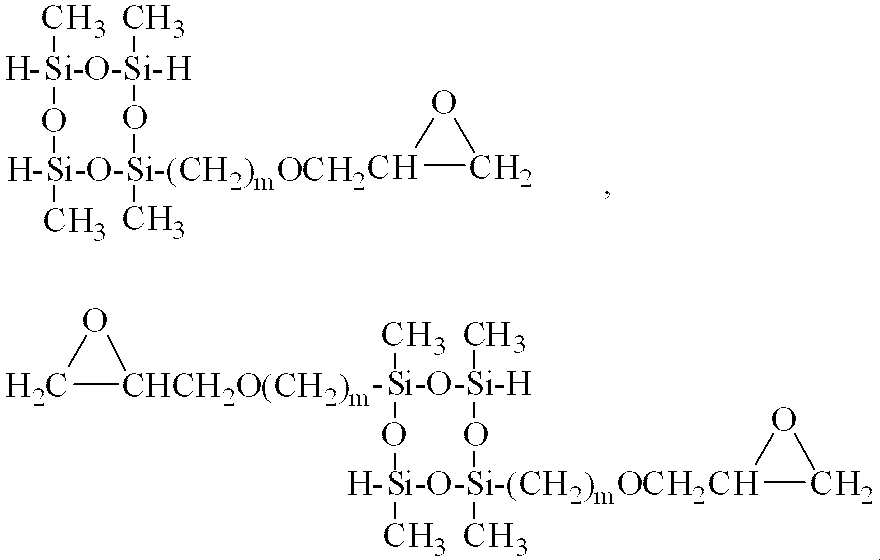
(式中、mは1~6の整数、好ましくは1~3の整数、より好ましくは2又は3である。)
これらのオルガノハイドロジェンポリシロキサンは、1種単独で使用しても、2種以上を組み合わせて使用してもよい。
これらのオルガノハイドロジェンポリシロキサンは、1種単独で使用しても、2種以上を組み合わせて使用してもよい。
(B)成分の配合量は、(A)成分のオルガノポリシロキサン100質量部に対して、0.01~30質量部であり、好ましくは0.1~20質量部である。配合量が、0.01質量部より少ないと実用に耐え得るだけの接着効果が得られず、30質量部より多いと耐熱後の硬化物の物理的特性が損なわれることがあるため、好ましくない。
また、(B)成分は、(A)成分のアルケニル基と(B)成分のSiH基とのモル比が、SiH基/アルケニル基=0.2~5.0、好ましくは0.4~2となるように配合される。配合量に係るモル比が、0.2に満たないと硬化が不十分であったり、また硬化しても硬化物の物理特性に劣り、5.0を超えると硬化が不十分であったり、また硬化しても硬化物の物理特性が耐熱後に変動したりするため、好ましくない。
〔(C)成分〕
(C)成分は、組成物の熱伝導性を高めるために配合される熱伝導性充填剤である。
熱伝導性充填剤としては、無機粉末及び/又は金属粉末であることが好ましく、具体的には、水酸化アルミニウム、水酸化マグネシウム、酸化アルミニウム、結晶性シリカ、酸化亜鉛、酸化珪素、炭化珪素、窒化珪素、酸化マグネシウム、酸化チタン、酸化ベリリウム、窒化アルミニウム、窒化ホウ素等から選択される無機粉末の1種以上、及び/又は、アルミニウム、金、銀、銅、鉄、ニッケル、ステンレススチール等から選択される金属粉末の1種以上を用いることができる。
(C)成分は、組成物の熱伝導性を高めるために配合される熱伝導性充填剤である。
熱伝導性充填剤としては、無機粉末及び/又は金属粉末であることが好ましく、具体的には、水酸化アルミニウム、水酸化マグネシウム、酸化アルミニウム、結晶性シリカ、酸化亜鉛、酸化珪素、炭化珪素、窒化珪素、酸化マグネシウム、酸化チタン、酸化ベリリウム、窒化アルミニウム、窒化ホウ素等から選択される無機粉末の1種以上、及び/又は、アルミニウム、金、銀、銅、鉄、ニッケル、ステンレススチール等から選択される金属粉末の1種以上を用いることができる。
(C)成分の平均粒径は、特に限定されないが、50μm以下、通常0.1~50μm、好ましくは0.2~30μm、より好ましくは0.2~20μmである。平均粒径が、50μmを超えると外観や分散性が悪くなるおそれがあり、特に液状シリコーンゴムの場合、放置しておくと熱伝導性充填剤が沈降するおそれがある。また、0.1μmを下回ると充填性が著しく悪くなり、粘度が高くなるとともに取り扱い性が悪くなるおそれがある。なお、ここでいう平均粒径は、例えばレーザー光回折法による粒度分布測定における累積重量平均値(D50)、又はメジアン径等として求めることができる。
このような熱伝導性充填剤の形状は、丸みを帯びた球状に近いものであることが好ましい。形状が丸みを帯びているものほど高充填しても粘度の上昇を抑えることができるからである。球状の安価な熱伝導性充填剤としては、昭和電工株式会社製の球状アルミナASシリーズ、株式会社アドマテックス製の高純度球状アルミナAOシリーズ等が挙げられる。更に、粒径の大きい粉末と粒径の小さい粉末とを最密充填理論分布曲線に従う比率で組み合わせることによって、充填効率の向上、低粘度化及び高熱伝導化を導くことができる。
(C)成分の配合量は、(A)成分100質量部に対して、5~4,000質量部であり、好ましくは100~3,500質量部であり、より好ましくは500~3,000質量部であり、更に好ましくは1,000~2,500質量部である。配合量が、5質量部未満であると、得られるシリコーンゴムの熱伝導性が不十分となり、一方、4,000質量部を超えると、シリコーン接着剤組成物への配合が難しくなり、該組成物の粘度が高くなり、成形加工性が悪くなってしまうため、好ましくない。
〔(D)成分〕
(D)成分は、組成物の硬化を促進するために配合されるヒドロシリル化反応触媒であり、白金族金属系触媒であることが好ましい。白金族金属系触媒としては、例えば、白金系触媒、ロジウム系触媒、イリジウム系触媒、パラジウム系触媒、ルテニウム系触媒が例示でき、好ましくは白金系触媒が使用できる。
(D)成分は、組成物の硬化を促進するために配合されるヒドロシリル化反応触媒であり、白金族金属系触媒であることが好ましい。白金族金属系触媒としては、例えば、白金系触媒、ロジウム系触媒、イリジウム系触媒、パラジウム系触媒、ルテニウム系触媒が例示でき、好ましくは白金系触媒が使用できる。
具体的には、白金微粉末、白金黒、塩化白金酸、四塩化白金、アルコール変性塩化白金酸、白金のオレフィン錯体、白金のアルケニルシロキサン錯体、白金のカルボニル錯体、これらの白金系触媒を含むメチルメタクリレート樹脂、ポリカーボネート樹脂、ポリスチレン樹脂、シリコーン樹脂等の熱可塑性有機樹脂粉末等の白金系触媒;式:[Rh(O2CCH3)2]2、Rh(O2CCH3)3、Rh2(C8H15O2)4、Rh(C5H7O2)3、Rh(C5H7O2)(CO)2、Rh(CO)[Ph3P](C5H7O2)、RhX’3[(R5)2S]3、(R6
3P)2Rh(CO)X’、(R6
3P)2Rh(CO)H、Rh2X’2Y4、HpRhq(En)rCls、又はRh[O(CO)R5]3-t(OH)tで表されるロジウム系触媒(式中、X’は水素原子、塩素原子、臭素原子、又はヨウ素原子であり、Yはメチル基、エチル基等のアルキル基、CO、C8H14又は0.5C8H12であり、R5はアルキル基、シクロアルキル基、又はアリール基であり、R6はアルキル基、アリール基、アルキルオキシ基、又はアリールオキシ基であり、Enはオレフィンであり、pは0又は1であり、qは1又は2であり、rは1~4の整数であり、sは2、3又は4であり、tは0又は1である。);式:Ir(OOCCH3)3、Ir(C5H7O2)3、[Ir(Z)(En)2]2、又は[Ir(Z)(Dien)]2で表されるイリジウム系触媒(式中、Zは塩素原子、臭素原子、ヨウ素原子、又はアルコキシ基であり、Enはオレフィンであり、Dienはシクロオクタジエンである。)が例示できる。
(D)成分の配合量は、組成物の硬化有効量(硬化を促進する量)であれば特に限定されないが、(A)成分100質量部に対して、(D)成分中の金属原子が好ましくは0.000001~0.1質量部となる量であり、より好ましくは0.00001~0.05質量部となる量である。
〔(E)成分〕
(E)成分は、下記一般式(1)で表されるシリル基を一分子中に少なくとも1個含有し、25℃での粘度が0.01~30Pa・s、好ましくは0.02~10Pa・sであり、かつポリシロキサンの骨格が環状構造を含まないオルガノポリシロキサンである。
-SiR1 aR2 3-a (1)
(但し、R1は非置換又は置換の一価炭化水素基であり、R2は炭素数1~8のアルコキシ基又はアシロキシ基であり、aは0、1又は2である。)
(E)成分は、下記一般式(1)で表されるシリル基を一分子中に少なくとも1個含有し、25℃での粘度が0.01~30Pa・s、好ましくは0.02~10Pa・sであり、かつポリシロキサンの骨格が環状構造を含まないオルガノポリシロキサンである。
-SiR1 aR2 3-a (1)
(但し、R1は非置換又は置換の一価炭化水素基であり、R2は炭素数1~8のアルコキシ基又はアシロキシ基であり、aは0、1又は2である。)
このような(E)成分を配合することにより、(C)成分の熱伝導性充填剤を多量に配合しても、取り扱い性及び成形性がよく、かつ金属、ガラス及び有機樹脂に自己接着性を与えるという効果がより向上する。
(E)成分の25℃での粘度が、0.01Pa・s未満のとき、接着性向上効果が不十分となることがあり、一方、30Pa・s超過のとき、作業性が低下することがあるため、好ましくない。
(E)成分の分子構造は、骨格が環状構造でなければ特に限定されず、直鎖状構造、一部分岐を有する直鎖状構造、分岐鎖状構造が挙げられるが、通常、実質的に直鎖状のオルガノポリシロキサンであることが好ましく、具体的には、分子鎖が主にジオルガノシロキサン単位の繰り返しからなり、側鎖に式(1)で表されるシリル基が導入された直鎖状のジオルガノポリシロキサン、分子鎖片末端が式(1)で表されるシリル基で封鎖された直鎖状のジオルガノポリシロキサン、特に好ましくは分子鎖両末端が式(1)で表されるシリル基で封鎖された直鎖状のジオルガノポリシロキサンである。
式(1)中のR1は、非置換又は置換の一価炭化水素基であり、具体例としては、メチル基、エチル基、プロピル基、イソプロピル基、ブチル基、イソブチル基、tert-ブチル基、ヘキシル基、オクチル基、デシル基等のアルキル基;フェニル基、トリル基、キシリル基、ナフチル基等のアリール基;シクロペンチル基、シクロヘキシル基等のシクロアルキル基;ベンジル基、2-フェニルエチル基、3-フェニルプロピル基等のアラルキル基;これらの炭化水素基中の炭素原子に結合した水素原子の一部又は全部が塩素原子、臭素原子、ヨウ素原子等のハロゲン原子、シアノ基等によって置換された基、例えば、クロロメチル基、2-ブロモエチル基、3,3,3-トリフルオロプロピル基、シアノエチル基等が挙げられる。
これらの中でも、(E)成分として、R1をメチル基、フェニル基又はこれら両者の組み合わせとすると、合成が容易であり、化学的安定性が良好であるため、好ましい。また、特に、耐溶剤性が良好なオルガノポリシロキサンとしたい場合には、R1はメチル基、フェニル基又はこれら両者の組み合わせと更に3,3,3-トリフルオロプロピル基との組み合わせとすることが好ましい。
また、必要に応じて脂肪族不飽和結合を含有してもよく、例えば炭素数2~8のアルケニル基を用いることができる。具体例としては、ビニル基、アリル基、1-プロペニル基、イソプロペニル基、1-ブテニル基、イソブテニル基、ヘキセニル基等が挙げられる。これらの中でも合成が容易であり、化学的安定性が良好であるビニル基が好ましい。
式(1)中のR2は、炭素数1~8のメトキシ基、エトキシ基、プロポキシ基、ブトキシ基等のアルコキシ基又はアセトキシ基等のアシロキシ基であり、これらの中でも合成が容易であるメトキシ基、エトキシ基又はこれらの両者の組み合わせが好ましい。
(E)成分中、式(1)以外の珪素原子の置換基は、非置換又は置換の一価炭化水素基であり、上述したR1で説明したものと同様のものが挙げられる。そのような一価炭化水素基のうち、合成の面からメチル基、フェニル基、ビニル基、又はこれら2種又は3種の組み合わせが好ましい。
このような(E)成分の具体例としては、分子鎖両末端トリメトキシシロキシ基封鎖ジメチルシロキサン、分子鎖両末端トリメトキシシロキシ基封鎖ジメチルシロキサン・メチルビニルシロキサン共重合体、分子鎖両末端トリメトキシシロキシ基封鎖メチルビニルポリシロキサン、分子鎖両末端トリメトキシシロキシ基封鎖ジメチルシロキサン・メチルビニルシロキサン・メチルフェニルシロキサン共重合体、分子鎖両末端トリメトキシシロキシ基封鎖ジメチルシロキサン・メチルビニルシロキサン・ジフェニルシロキサン共重合体、分子鎖両末端ジメトキシメチルシロキシ基封鎖ジメチルポリシロキサン、分子鎖両末端ジメトキシビニルシロキシ基封鎖ジメチルポリシロキサン、分子鎖両末端ジメトキシビニルシロキシ基封鎖メチルビニルポリシロキサン、分子鎖両末端ジメトキシビニルシロキシ基封鎖ジメチルシロキサン・メチルビニルシロキサン共重合体、分子鎖両末端ジメトキシビニルシロキシ基封鎖ジメチルシロキサン・メチルビニルシロキサン・メチルフェニルシロキサン共重合体、分子鎖両末端ジメトキシビニルシロキシ基封鎖ジメチルシロキサン・メチルビニルシロキサン・ジフェニルシロキサン共重合体、分子鎖両末端ジビニルメトキシシロキシ基封鎖ジメチルポリシロキサン、分子鎖片末端トリメトキシシロキシ基封鎖ジメチルシロキサン等が挙げられる。これらのオルガノポリシロキサンは、1種単独で使用しても、2種以上を組み合わせて使用してもよく、また重合度の異なる1種又は2種以上を併用してもよい。
(E)成分の配合量は、(A)成分のオルガノポリシロキサン100質量部に対して、0.1~100質量部、より好ましくは0.1~50質量部、更に好ましくは1~30質量部である。配合量が、0.1未満であると流動性が著しく劣ることがあり、100質量部を超えると目的とする機械的強度が得られないことがあるため、好ましくない。
〔(F)成分〕
(F)成分は、組成物の熱伝導率を向上させるための必須成分であり、アセチレンの熱分解方式によって得られ、かさ密度が0.06~0.18g/cm3であるアセチレンブラックである。このようなアセチレンブラックは、他のカーボンブラックと比較して、ストラクチャー(粒子の繋がり)が高く、かつ結晶性も高いため、少量添加でも組成物の熱伝導率向上に大きく寄与する。
(F)成分は、組成物の熱伝導率を向上させるための必須成分であり、アセチレンの熱分解方式によって得られ、かさ密度が0.06~0.18g/cm3であるアセチレンブラックである。このようなアセチレンブラックは、他のカーボンブラックと比較して、ストラクチャー(粒子の繋がり)が高く、かつ結晶性も高いため、少量添加でも組成物の熱伝導率向上に大きく寄与する。
ここで、(F)成分のかさ密度が、0.06g/cm3未満のとき、組成物の混練り時の飛散が激しいため取り扱いが難しくなることがあり、0.18g/cm3を超えるとき、組成物において均一な混練りが難しくなることがあるため、好ましくない。なお、(F)成分は、かさ密度は0.06~0.18g/cm3の範囲内であれば1種単独で使用しても、2種以上を併用してもよい。
(F)成分の配合量は、(A)成分のオルガノポリシロキサン100質量部に対して、0.01~10質量部、好ましくは0.05~5質量部であり、より好ましくは0.1~3質量部である。配合量が、0.01質量部未満では十分な熱伝導率向上が認められないことがあり、10質量部を超えると大幅な熱伝導率の向上が認められるものの、著しく組成物の流動性が悪くなることがあるため、好ましくない。
〔その他の成分〕
本発明のリアクトル用熱伝導性シリコーン接着剤組成物には、必要に応じて、その目的を損なわない範囲で、硬さ調整剤として、(B)成分とは異なる、少なくとも一分子中にアルコキシ基を含まず、かつ少なくとも2個の珪素原子に結合した水素原子を有するオルガノハイドロジェンポリシロキサンなどの架橋剤、アセチレンアルコール系化合物、アルケニル基含有シロキサンオリゴマーなどの硬化遅延剤(硬化反応抑制剤)、酸化セリウムなどの耐熱向上剤、着色のための有機系・無機系の各種着色顔料などを適時混合してもよい。
本発明のリアクトル用熱伝導性シリコーン接着剤組成物には、必要に応じて、その目的を損なわない範囲で、硬さ調整剤として、(B)成分とは異なる、少なくとも一分子中にアルコキシ基を含まず、かつ少なくとも2個の珪素原子に結合した水素原子を有するオルガノハイドロジェンポリシロキサンなどの架橋剤、アセチレンアルコール系化合物、アルケニル基含有シロキサンオリゴマーなどの硬化遅延剤(硬化反応抑制剤)、酸化セリウムなどの耐熱向上剤、着色のための有機系・無機系の各種着色顔料などを適時混合してもよい。
〔リアクトル用熱伝導性シリコーン接着剤組成物の製造方法〕
このような各種成分から、リアクトル用熱伝導性シリコーン接着剤組成物を得るには公知の混合方法に従えばよいが、反応性組成物である故、予め1液組成物又は2液組成物として構成するのが作業上好ましい。
このような各種成分から、リアクトル用熱伝導性シリコーン接着剤組成物を得るには公知の混合方法に従えばよいが、反応性組成物である故、予め1液組成物又は2液組成物として構成するのが作業上好ましい。
1液組成物を構成するには、例えば、次の(I)~(III)のようにして得ることができる。
(I)先ず、(A)成分と(C)成分とを混合して、(A)成分と(C)成分とからなる混合物を得た後、該混合物に(E)成分を混合させるか、又は(A)成分、(C)成分、(E)成分を同時に混合させて、(A)成分、(C)成分、(E)成分からなる混合物を得る。ここで、(C)成分の表面が、(A)、(E)成分により処理されることになるが、その処理を促進するために、例えば150℃程度の加熱処理をしてもよい。
(II)(I)で得られた(A)成分、(C)成分、(E)成分からなる混合物に、(D)成分を添加して混合し、(A)成分、(C)成分、(D)成分、(E)成分からなる混合物を得る。
(III)そして、(II)で得られた(A)成分、(C)成分、(D)成分、(E)成分からなる混合物に、必要に応じてアセチレンアルコール系化合物、アルケニル基含有シロキサンオリゴマーなどの硬化遅延剤(硬化反応抑制剤)を適量添加して混合させた後、(B)、(F)成分を添加して混合し、(A)成分、(B)成分、(C)成分、(D)成分、(E)成分、(F)成分を含有する最終的な組成物を得る。
(I)先ず、(A)成分と(C)成分とを混合して、(A)成分と(C)成分とからなる混合物を得た後、該混合物に(E)成分を混合させるか、又は(A)成分、(C)成分、(E)成分を同時に混合させて、(A)成分、(C)成分、(E)成分からなる混合物を得る。ここで、(C)成分の表面が、(A)、(E)成分により処理されることになるが、その処理を促進するために、例えば150℃程度の加熱処理をしてもよい。
(II)(I)で得られた(A)成分、(C)成分、(E)成分からなる混合物に、(D)成分を添加して混合し、(A)成分、(C)成分、(D)成分、(E)成分からなる混合物を得る。
(III)そして、(II)で得られた(A)成分、(C)成分、(D)成分、(E)成分からなる混合物に、必要に応じてアセチレンアルコール系化合物、アルケニル基含有シロキサンオリゴマーなどの硬化遅延剤(硬化反応抑制剤)を適量添加して混合させた後、(B)、(F)成分を添加して混合し、(A)成分、(B)成分、(C)成分、(D)成分、(E)成分、(F)成分を含有する最終的な組成物を得る。
こうして得られる1液組成物は、必要に応じて硬化遅延剤を含ませているので、(III)における混合時間を調整しながら、均一な組成物を得ると共に、該組成物を用いたポッティング作業も余裕をもって行う効果を得ることができる。
また、2液組成物を構成するには、(A)、(B)、(D)成分のみが共存しなければ、任意の組み合わせで適宜構成し得る。例えば、上記(I)、(II)で得られる(A)成分、(C)成分、(D)成分、(E)成分からなる混合物Aと、(B)成分、(F)成分とからなる混合物Bとの2液組成物となし、これら混合物A、混合物Bのいずれか一方又は両方に、必要に応じてアセチレンアルコール系化合物、アルケニル基含有シロキサンオリゴマーなどの硬化遅延剤(硬化反応抑制剤)を適量添加して混合させることにより、2液組成物とすることができる。そして、使用する直前に、この2液組成物を混合することによって、上記1液組成物の場合と同様の効果を得ることができる。
2液組成物の構成は、予め2液組成物を構成しておき、使用時に混合するだけでよいので、ポッティング作業に供するリードタイム短縮の点で1液組成物の構成よりも優れており、一方、1液組成物の構成は、使用時に全ての成分を段階的に混合するので、組み合わせや保管に係る各成分の変質を抑制し得る等の点で2液組成物の構成よりも優れている。従って、このような両構成の特徴を考慮し、使用状況に合わせて、いずれかの構成を選択すればよい。
〔リアクトルの製造方法〕
本発明のリアクトルは、上述したリアクトル用熱伝導性シリコーン接着剤組成物によってポッティングされたリアクトルである。
即ち、例えば、図2に示すように、磁性材料の圧粉コア4に絶縁した銅線を巻き付けたコイル本体5をアルミニウム等の金属ケース6内に収納し、組成物をポッティング(注型封止)して、コイル本体5を組成物内に埋設した状態にする共に、組成物を硬化させることによって得られる。ここで、コイル本体5、金属ケース6等の構成部品、また、ポッティングのためのディスペンサー及びポッティング方法等は公知のもの又は技術を使用することができる。
本発明のリアクトルは、上述したリアクトル用熱伝導性シリコーン接着剤組成物によってポッティングされたリアクトルである。
即ち、例えば、図2に示すように、磁性材料の圧粉コア4に絶縁した銅線を巻き付けたコイル本体5をアルミニウム等の金属ケース6内に収納し、組成物をポッティング(注型封止)して、コイル本体5を組成物内に埋設した状態にする共に、組成物を硬化させることによって得られる。ここで、コイル本体5、金属ケース6等の構成部品、また、ポッティングのためのディスペンサー及びポッティング方法等は公知のもの又は技術を使用することができる。
リアクトル用熱伝導性シリコーン接着剤組成物は、コイル本体5や金属ケース6の形状や大きさ、そしてリアクトル製造に係るライン設計にもよるが、常温下(通常、10~30℃程度)でも加熱下でも硬化させることができる。
加熱により硬化させる場合は、60~200℃、好ましくは80~180℃で1~120分間、特に5~60分間とすることができる。また、必要に応じて、150~230℃で10分~4時間程度の二次硬化処理を施してもよい。
加熱により硬化させる場合は、60~200℃、好ましくは80~180℃で1~120分間、特に5~60分間とすることができる。また、必要に応じて、150~230℃で10分~4時間程度の二次硬化処理を施してもよい。
このようなリアクトル用熱伝導性シリコーン接着剤組成物は、アルミニウム、マグネシウム、鉄、ニッケル、銅等の金属;フロートガラス、強化ガラス等のガラス;ポリカーボネート(PC)、ポリブチレンテレフタレート(PBT)、ポリフェニレンサルファイド(PPS)、アクリル、エポキシ等の有機樹脂等に対して良好な接着性を与えることができる。
また、リアクトル用熱伝導性シリコーン接着剤組成物の硬化物は、特に限定はされないが、例えば、細線加熱法(京都電子工業株式会社製の迅速熱伝導率計QTM-500)により測定した熱伝導率が、0.5W/m・K以上、好ましくは0.8~6.0W/m・Kのものとなるよう、予め各成分の配合を上述した範囲内で調整しておくことが望ましい。熱伝導率が0.5W/m・K未満であると電圧を昇圧するリアクトルの機能が蓄熱により妨げられることがあり、一方、熱伝導率が6.0W/m・Kを超えると得られる組成物の流動性が悪くなることでリアクトル部分へのポッティング性が著しく悪くなる場合がある。
以下、実施例と比較例を示して本発明を具体的に説明するが、本発明は下記実施例に限定されるものではない。
初期、熱処理後、湿熱処理後に係るシリコーンエラストマーの硬さ、引張強さ、切断時伸び、引張せん断接着力、熱伝導率、及び流れ性の測定、並びにリアクトル性能の測定は、以下のようになされた。なお、シリコーンエラストマーに係る特性は、いずれも25℃における値である。
初期、熱処理後、湿熱処理後に係るシリコーンエラストマーの硬さ、引張強さ、切断時伸び、引張せん断接着力、熱伝導率、及び流れ性の測定、並びにリアクトル性能の測定は、以下のようになされた。なお、シリコーンエラストマーに係る特性は、いずれも25℃における値である。
〔初期〕
初期に係るシリコーンエラストマーの諸物性は、以下のように測定された。
〔硬さ〕
シリコーンエラストマー組成物を、120℃で10分間プレス硬化し、更に120℃のオーブン中で50分間加熱した。得られた厚さ2mmのシリコーンエラストマーシートを3枚重ね、JIS K 6253に規定されるタイプAデュロメータにより硬さを測定した。
初期に係るシリコーンエラストマーの諸物性は、以下のように測定された。
〔硬さ〕
シリコーンエラストマー組成物を、120℃で10分間プレス硬化し、更に120℃のオーブン中で50分間加熱した。得られた厚さ2mmのシリコーンエラストマーシートを3枚重ね、JIS K 6253に規定されるタイプAデュロメータにより硬さを測定した。
〔引張り強さ、切断時伸び〕
シリコーンエラストマー組成物を、120℃で10分間プレス硬化し、更に120℃のオーブン中で50分間加熱した。得られた厚さ2mmのシリコーンエラストマーシートの引張強さ、切断時伸びを、JIS K 6251に従って測定した。
シリコーンエラストマー組成物を、120℃で10分間プレス硬化し、更に120℃のオーブン中で50分間加熱した。得られた厚さ2mmのシリコーンエラストマーシートの引張強さ、切断時伸びを、JIS K 6251に従って測定した。
〔引張せん断接着力〕
厚み1.0mmのアルミニウム(JIS H 4000 A1050P)板の間に、シリコーンエラストマー組成物を、厚さが2.0mm、接着面積が25mm×10mmとなるように挟み込んだ状態で、120℃で1時間加熱し、該組成物を硬化させて接着試験片を作製した。また、厚み1.5~1.6mm、幅6.5~6.7mmのコイル線の間に、シリコーンエラストマー組成物を厚さが1.0mm、接着面積が6.5~6.7mm×12.5mmとなるようにして、同様な条件で硬化させて接着試験片を作製した。得られた試験片の引張せん断接着力を、JIS K 6850に従って測定した。
厚み1.0mmのアルミニウム(JIS H 4000 A1050P)板の間に、シリコーンエラストマー組成物を、厚さが2.0mm、接着面積が25mm×10mmとなるように挟み込んだ状態で、120℃で1時間加熱し、該組成物を硬化させて接着試験片を作製した。また、厚み1.5~1.6mm、幅6.5~6.7mmのコイル線の間に、シリコーンエラストマー組成物を厚さが1.0mm、接着面積が6.5~6.7mm×12.5mmとなるようにして、同様な条件で硬化させて接着試験片を作製した。得られた試験片の引張せん断接着力を、JIS K 6850に従って測定した。
〔熱伝導率〕
シリコーンエラストマー組成物を、120℃で10分間プレス硬化し、更に120℃のオーブン中で50分間オーブン加熱した。得られた50mm×110mm×8mmのシリコーンエラストマー組成物の熱伝導率を、細線加熱法(ホットワイヤ法)により京都電子工業株式会社製の迅速熱伝導率計QTM-500により測定した。
シリコーンエラストマー組成物を、120℃で10分間プレス硬化し、更に120℃のオーブン中で50分間オーブン加熱した。得られた50mm×110mm×8mmのシリコーンエラストマー組成物の熱伝導率を、細線加熱法(ホットワイヤ法)により京都電子工業株式会社製の迅速熱伝導率計QTM-500により測定した。
〔流れ性〕
図1に示したように、シリコーンエラストマー組成物1を、0.6cm3取り、Al板2(JIS,H,4000、0.5×25×250mm)に垂らす。垂らした後、すぐに滴下したAl板を傾斜(傾斜角α=28度)させ(図1(A),(B))、23℃(±2℃)雰囲気下で放置させる。23℃(±2℃)×1時間後に取り出し、シリコーンエラストマー組成物1’の長さLを流れた端から端まで測定する(図1(C),(D))。上記方法は、シリコーンエラストマー組成物の流れ性を評価する際に非常に重要な方法である。この方法はAl板を傾斜させることで簡単にできる方法であり、使用されるAl板はJISに準拠したAl板を使用することで表面状態を統一することができる。なお、この傾斜角度は28度が最も適性であるが、この角度の幅は26~30度の範囲でもよい。この角度が26度未満になると流れにくくなり、また30度を超えると流れ性が悪い組成物でも使用可能な範囲に入ってしまう。次に組成物を垂らす量であるが、質量よりも体積が重要なので、0.6mlをシリンジ等で測定して、垂らすことが誤差も小さく有効な手段である。これについては0.6mlから約±10%の範囲内に測定されることが重要である。-10%を下まわると流れ性のよい組成物でも使用不可能になってしまい、逆に10%を上まわると流れ性の悪い組成物でも使用可能となってしまうからである。
シリコーンエラストマー組成物は、上記流れ性が50mm以上である必要があり、好ましくは60mm以上、更に好ましくは80mm以上であることが充填性の点で有効である。なお、流れ性の上限は、流れ性が高ければ高いほど好ましいが、250mm程度が好ましく、特に180mm程度である。
図1に示したように、シリコーンエラストマー組成物1を、0.6cm3取り、Al板2(JIS,H,4000、0.5×25×250mm)に垂らす。垂らした後、すぐに滴下したAl板を傾斜(傾斜角α=28度)させ(図1(A),(B))、23℃(±2℃)雰囲気下で放置させる。23℃(±2℃)×1時間後に取り出し、シリコーンエラストマー組成物1’の長さLを流れた端から端まで測定する(図1(C),(D))。上記方法は、シリコーンエラストマー組成物の流れ性を評価する際に非常に重要な方法である。この方法はAl板を傾斜させることで簡単にできる方法であり、使用されるAl板はJISに準拠したAl板を使用することで表面状態を統一することができる。なお、この傾斜角度は28度が最も適性であるが、この角度の幅は26~30度の範囲でもよい。この角度が26度未満になると流れにくくなり、また30度を超えると流れ性が悪い組成物でも使用可能な範囲に入ってしまう。次に組成物を垂らす量であるが、質量よりも体積が重要なので、0.6mlをシリンジ等で測定して、垂らすことが誤差も小さく有効な手段である。これについては0.6mlから約±10%の範囲内に測定されることが重要である。-10%を下まわると流れ性のよい組成物でも使用不可能になってしまい、逆に10%を上まわると流れ性の悪い組成物でも使用可能となってしまうからである。
シリコーンエラストマー組成物は、上記流れ性が50mm以上である必要があり、好ましくは60mm以上、更に好ましくは80mm以上であることが充填性の点で有効である。なお、流れ性の上限は、流れ性が高ければ高いほど好ましいが、250mm程度が好ましく、特に180mm程度である。
〔熱処理後〕
初期に係るシリコーンエラストマーの諸物性測定の際得たシリコーンエラストマー試験片を、170℃のオーブン中で1,000時間加熱した後、同様に諸物性測定を行った。
初期に係るシリコーンエラストマーの諸物性測定の際得たシリコーンエラストマー試験片を、170℃のオーブン中で1,000時間加熱した後、同様に諸物性測定を行った。
〔湿熱処理後〕
初期に係るシリコーンエラストマーの諸物性測定の際得たシリコーンエラストマー試験片を、85℃/85%RHのオーブン中で1,000時間加熱した後、同様に諸物性測定を行った。
初期に係るシリコーンエラストマーの諸物性測定の際得たシリコーンエラストマー試験片を、85℃/85%RHのオーブン中で1,000時間加熱した後、同様に諸物性測定を行った。
〔リアクトル性能〕
図2のように、ケース6内にコイル本体5を配置し、シリコーンエラストマー組成物を充填した。当該組成物を120℃で1時間加熱することにより、硬化させ、リアクトル3を製造した。更に、リアクトル3に所定の通電パターンで通電し、コイル本体5及びポッティング材(当該組成物の硬化物)の温度(初期熱特性)を測定した。
次に、170℃条件にて1,000時間加熱し、熱老化されたリアクトル3と、85℃/85%RH条件にて1,000時間加熱し、湿熱老化させたリアクトル3とを用意した。それぞれのリアクトルに対して、初期熱特性と同様の通電パターンで通電し、コイル本体5及びポッティング材の温度(熱老化後熱特性、湿熱老化後熱特性)を測定した。そして、初期熱特性と、熱老化後熱特性、湿熱老化後熱特性との温度差(リアクトル性能変化)を算出した。
図2のように、ケース6内にコイル本体5を配置し、シリコーンエラストマー組成物を充填した。当該組成物を120℃で1時間加熱することにより、硬化させ、リアクトル3を製造した。更に、リアクトル3に所定の通電パターンで通電し、コイル本体5及びポッティング材(当該組成物の硬化物)の温度(初期熱特性)を測定した。
次に、170℃条件にて1,000時間加熱し、熱老化されたリアクトル3と、85℃/85%RH条件にて1,000時間加熱し、湿熱老化させたリアクトル3とを用意した。それぞれのリアクトルに対して、初期熱特性と同様の通電パターンで通電し、コイル本体5及びポッティング材の温度(熱老化後熱特性、湿熱老化後熱特性)を測定した。そして、初期熱特性と、熱老化後熱特性、湿熱老化後熱特性との温度差(リアクトル性能変化)を算出した。
[実施例1]
特殊機化工業株式会社製のT.K.ハイビスミックスにより、粘度が400mPa・sである分子鎖両末端ジメチルビニルシロキシ基封鎖ジメチルポリシロキサン(ビニル基の含有量=0.185mol/100g)80.0質量部、平均粒径が9.5μmである球状アルミナ粉末(株式会社アドマテックス製;アドマファインAO-41R)500.0質量部、下記式(i):

で表されるジメチルシロキサン15.0質量部、粘度が900mPa・sである分子鎖両末端トリメトキシシロキシ基封鎖ジメチルポリシロキサン5.0質量部を室温で15分混合し、更に-0.09MPa以下の減圧下、150℃で2時間熱処理混合してシリコーンベースを調製した。
次に、冷却して室温になった上記ベースに、下記式(ii):
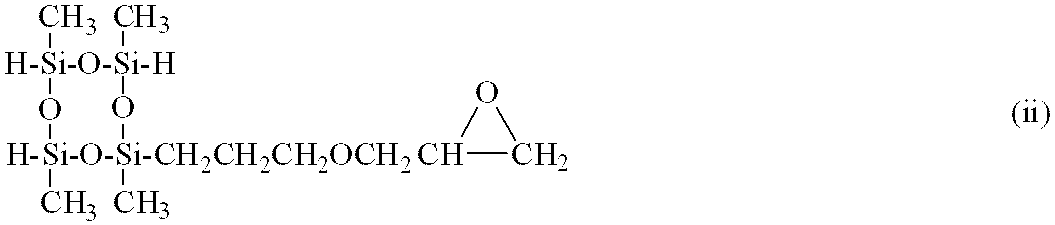
で表されるハイドロジェンポリシロキサン1.50質量部(上記ベース中のジメチルポリシロキサンに含まれているビニル基1.0molに対して、本成分に含まれている珪素原子結合水素原子の合計量が0.85molとなる量)、下記式(iii):

で表されるハイドロジェンポリシロキサン0.35質量部(上記ベース中のジメチルポリシロキサンに含まれているビニル基1.0molに対して、本成分に含まれている珪素原子結合水素原子の合計量が0.15molとなる量)及び硬化反応抑制剤として、エチニルシクロヘキサノール0.15質量部、トリアリルイソシアヌレート0.3質量部、並びにアセチレンの熱分解方式によって得られたかさ密度0.15g/cm3であるアセチレンブラック(電気化学工業株式会社製;HS-100)を1.0質量部混合し、最後に、白金の1,3-ジビニルテトラメチルジシロキサン錯体の1,3-ジビニルテトラメチルジシロキサン溶液(上記ベースコンパウンド中のジメチルポリシロキサン100万質量部に対して本触媒中の白金金属が30質量部となる量)0.2質量部を室温で15分混合してシリコーンエラストマー組成物を調製した。
特殊機化工業株式会社製のT.K.ハイビスミックスにより、粘度が400mPa・sである分子鎖両末端ジメチルビニルシロキシ基封鎖ジメチルポリシロキサン(ビニル基の含有量=0.185mol/100g)80.0質量部、平均粒径が9.5μmである球状アルミナ粉末(株式会社アドマテックス製;アドマファインAO-41R)500.0質量部、下記式(i):
次に、冷却して室温になった上記ベースに、下記式(ii):
[実施例2]
実施例1において、平均粒径が9.5μmである球状アルミナ粉末(株式会社アドマテックス製;アドマファインAO-41R)の配合量を700.0質量部とした以外は、同様にしてシリコーンエラストマー組成物を調製した。
実施例1において、平均粒径が9.5μmである球状アルミナ粉末(株式会社アドマテックス製;アドマファインAO-41R)の配合量を700.0質量部とした以外は、同様にしてシリコーンエラストマー組成物を調製した。
[実施例3]
実施例1において、平均粒径が9.5μmである球状アルミナ粉末(株式会社アドマテックス製;アドマファインAO-41R)の配合量を400.0質量部とした以外は、同様にしてシリコーンエラストマー組成物を調製した。
実施例1において、平均粒径が9.5μmである球状アルミナ粉末(株式会社アドマテックス製;アドマファインAO-41R)の配合量を400.0質量部とした以外は、同様にしてシリコーンエラストマー組成物を調製した。
[比較例1]
実施例1において、前記(ii)を用いず、下記式(iv):
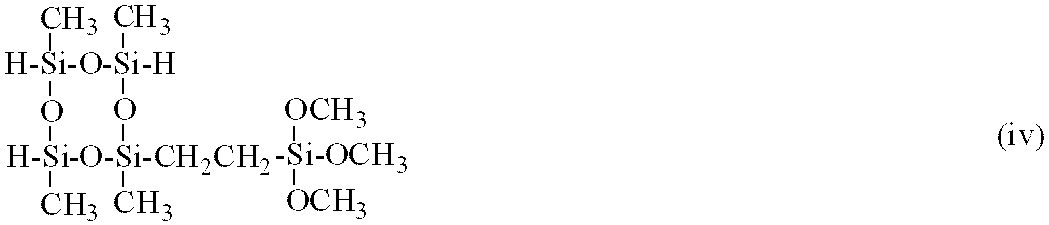
で表されるハイドロジェンポリシロキサン1.65質量部(上記ベース中のジメチルポリシロキサンに含まれているビニル基1.0molに対して、本成分に含まれている珪素原子結合水素原子の合計量が0.85molとなる量)に置き換えた以外は、同様にしてシリコーンエラストマー組成物を調製した。
実施例1において、前記(ii)を用いず、下記式(iv):
[比較例2]
実施例1において、前記(ii)を用いず、下記式(v):
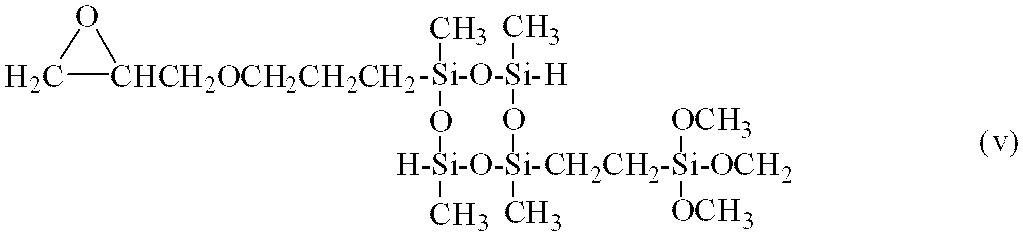
で表されるハイドロジェンポリシロキサン2.85質量部(上記ベース中のジメチルポリシロキサンに含まれているビニル基1.0molに対して、本成分に含まれている珪素原子結合水素原子の合計量が0.85molとなる量)に置き換えた以外は、同様にしてシリコーンエラストマー組成物を調製した。
実施例1において、前記(ii)を用いず、下記式(v):
[比較例3]
実施例1において、前記かさ密度0.15g/cm3であるアセチレンブラック(電気化学工業株式会社製;HS-100)を1.0質量部添加しなかった以外は、同様にしてシリコーンエラストマー組成物を調製した。
実施例1において、前記かさ密度0.15g/cm3であるアセチレンブラック(電気化学工業株式会社製;HS-100)を1.0質量部添加しなかった以外は、同様にしてシリコーンエラストマー組成物を調製した。

上記のように、一分子中に珪素原子と結合する水素原子を少なくとも2個以上有し、アルコキシ基を含み、かつポリシロキサンの骨格が環状構造を含む液状オルガノハイドロジェンポリシロキサンを含有したシリコーン接着剤組成物(比較例1、2)は、初期物性に対し、特に湿熱処理後における物性変化が大きいことが確認された。
また、実施例1と比較例1についてリアクトル性能変化を確認した結果、実施例1の結果が優れており、特に湿熱老化処理後の結果が顕著に優れていた。
アセチレンブラックを添加した実施例1、2は、アセチレンブラックを添加しなかった比較例3に対して、熱伝導率が向上することが認められた。
また、実施例1と比較例1についてリアクトル性能変化を確認した結果、実施例1の結果が優れており、特に湿熱老化処理後の結果が顕著に優れていた。
アセチレンブラックを添加した実施例1、2は、アセチレンブラックを添加しなかった比較例3に対して、熱伝導率が向上することが認められた。
本発明によれば、高熱伝導性であって、熱又は湿熱エージングによってもポッティング材に係る物性変化の少ないリアクトルが得られるので、リアクトルの性能・信頼性を高めたいバッテリー昇圧コンバータの分野、特に、HEV、PHEV、EV、及びFC等の分野において有用である。
1 シリコーンエラストマー組成物
2 Al板
3 リアクトル
4 圧粉コア
5 コイル本体
6 ケース
2 Al板
3 リアクトル
4 圧粉コア
5 コイル本体
6 ケース
Claims (6)
- (A)一分子中に少なくとも2個の珪素原子と結合するアルケニル基を含有し、25℃での粘度が0.05~1,000Pa・sのオルガノポリシロキサン:100質量部、
(B)25℃での粘度が100mPa・s以下であって、一分子中に珪素原子と結合する水素原子(SiH基)を2~10個含有し、アルコキシ基を含まず、アルキレン基を介して珪素原子と結合するエポキシ基を少なくとも1個含有し、さらにポリシロキサンの重合度が15以下であり、かつポリシロキサンの骨格が環状構造を含む液状オルガノハイドロジェンポリシロキサン:0.01~30質量部、
(C)熱伝導性充填剤:5~4,000質量部、
(D)ヒドロシリル化反応触媒:組成物の硬化を促進する量、
(E)下記一般式(1)で表されるシリル基を一分子中に少なくとも1個含有し、25℃での粘度が0.01~30Pa・sであり、かつポリシロキサンの骨格が環状構造を含まないオルガノポリシロキサン:0.1~100質量部、
-SiR1 aR2 3-a (1)
(但し、R1は非置換又は置換の一価炭化水素基であり、R2は炭素数1~8のアルコキシ基又はアシロキシ基であり、aは0、1又は2である。)
(F)アセチレンの熱分解方式によって得られ、かさ密度が0.06~0.18g/cm3であるアセチレンブラック:0.01~10質量部、
を少なくとも含有してなり、かつ(A)成分のアルケニル基と(B)成分のSiH基とのモル比が、SiH基/アルケニル基=0.2~5.0であることを特徴とするリアクトル用熱伝導性シリコーン接着剤組成物。 - (B)成分が、下記一般式
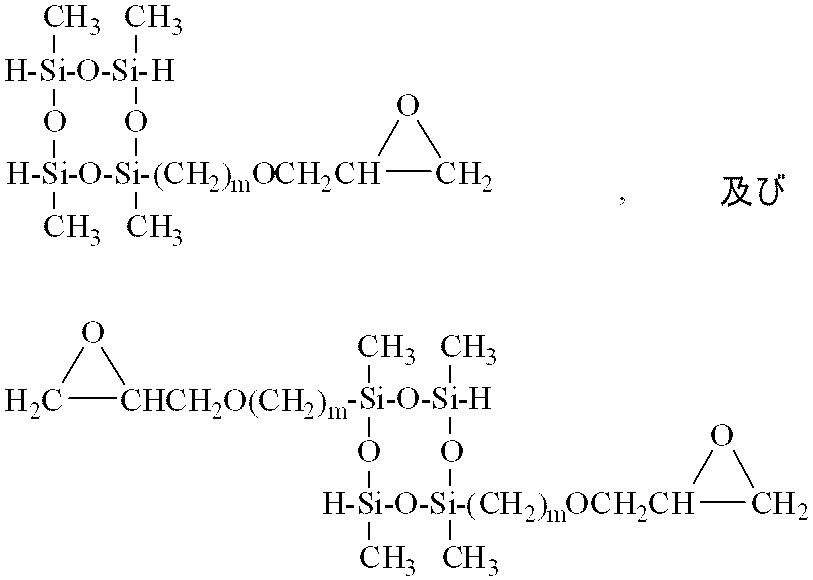
で示されるオルガノハイドロジェンポリシロキサンから選ばれるものである請求項1記載のリアクトル用熱伝導性シリコーン接着剤組成物。 - (C)成分が、水酸化アルミニウム、水酸化マグネシウム、酸化アルミニウム、結晶性シリカ、酸化亜鉛、酸化珪素、炭化珪素、窒化珪素、酸化マグネシウム、酸化チタン、酸化ベリリウム、窒化アルミニウム、窒化ホウ素、金、銀、銅、鉄、ニッケル、アルミニウム、ステンレススチールの群から選ばれる少なくとも1種である請求項1又は2記載のリアクトル用熱伝導性シリコーン接着剤組成物。
- (E)成分が、分子鎖両末端トリメトキシシロキシ基封鎖ジメチルシロキサン、分子鎖両末端トリメトキシシロキシ基封鎖ジメチルシロキサン・メチルビニルシロキサン共重合体、分子鎖両末端トリメトキシシロキシ基封鎖メチルビニルポリシロキサン、分子鎖両末端トリメトキシシロキシ基封鎖ジメチルシロキサン・メチルビニルシロキサン・メチルフェニルシロキサン共重合体、分子鎖両末端トリメトキシシロキシ基封鎖ジメチルシロキサン・メチルビニルシロキサン・ジフェニルシロキサン共重合体、分子鎖両末端ジメトキシメチルシロキシ基封鎖ジメチルポリシロキサン、分子鎖両末端ジメトキシビニルシロキシ基封鎖ジメチルポリシロキサン、分子鎖両末端ジメトキシビニルシロキシ基封鎖メチルビニルポリシロキサン、分子鎖両末端ジメトキシビニルシロキシ基封鎖ジメチルシロキサン・メチルビニルシロキサン共重合体、分子鎖両末端ジメトキシビニルシロキシ基封鎖ジメチルシロキサン・メチルビニルシロキサン・メチルフェニルシロキサン共重合体、分子鎖両末端ジメトキシビニルシロキシ基封鎖ジメチルシロキサン・メチルビニルシロキサン・ジフェニルシロキサン共重合体、分子鎖両末端ジビニルメトキシシロキシ基封鎖ジメチルポリシロキサン、分子鎖片末端トリメトキシシロキシ基封鎖ジメチルシロキサンから選ばれるものである請求項1~3のいずれか1項記載のリアクトル用熱伝導性シリコーン接着剤組成物。
- 硬化物の熱伝導率が、0.5W/m・K以上である請求項1~4のいずれか1項記載のリアクトル用熱伝導性シリコーン接着剤組成物。
- 請求項1~5のいずれか1項記載のリアクトル用熱伝導性シリコーン接着剤組成物によってポッティングされたリアクトル。
Priority Applications (2)
| Application Number | Priority Date | Filing Date | Title |
|---|---|---|---|
| US14/889,560 US9424977B2 (en) | 2013-05-16 | 2014-05-02 | Thermally conductive silicone adhesive composition for reactor and reactor |
| EP14797012.3A EP2998376B1 (en) | 2013-05-16 | 2014-05-02 | Thermally conductive silicone adhesive composition for reactor and reactor |
Applications Claiming Priority (2)
| Application Number | Priority Date | Filing Date | Title |
|---|---|---|---|
| JP2013-103881 | 2013-05-16 | ||
| JP2013103881A JP5853989B2 (ja) | 2013-05-16 | 2013-05-16 | リアクトル用熱伝導性シリコーン接着剤組成物及びリアクトル |
Publications (1)
| Publication Number | Publication Date |
|---|---|
| WO2014185296A1 true WO2014185296A1 (ja) | 2014-11-20 |
Family
ID=51898275
Family Applications (1)
| Application Number | Title | Priority Date | Filing Date |
|---|---|---|---|
| PCT/JP2014/062169 Ceased WO2014185296A1 (ja) | 2013-05-16 | 2014-05-02 | リアクトル用熱伝導性シリコーン接着剤組成物及びリアクトル |
Country Status (4)
| Country | Link |
|---|---|
| US (1) | US9424977B2 (ja) |
| EP (1) | EP2998376B1 (ja) |
| JP (1) | JP5853989B2 (ja) |
| WO (1) | WO2014185296A1 (ja) |
Cited By (8)
| Publication number | Priority date | Publication date | Assignee | Title |
|---|---|---|---|---|
| JP2017005166A (ja) * | 2015-06-12 | 2017-01-05 | 信越化学工業株式会社 | 放熱パテシート |
| CN106701012A (zh) * | 2017-01-11 | 2017-05-24 | 广州天赐有机硅科技有限公司 | 一种轻量化导热有机硅灌封胶基础胶料、组合物及其制备方法 |
| WO2017221804A1 (ja) * | 2016-06-22 | 2017-12-28 | Fdk株式会社 | インダクタおよび当該インダクタの実装構造 |
| US20180127629A1 (en) * | 2015-05-22 | 2018-05-10 | Momentive Performance Materials Japan Llc | Thermally conductive composition |
| JP2018150493A (ja) * | 2017-03-15 | 2018-09-27 | 信越化学工業株式会社 | ダイボンディング用シリコーン樹脂組成物及び硬化物 |
| WO2020218235A1 (ja) * | 2019-04-24 | 2020-10-29 | 信越化学工業株式会社 | 熱伝導性複合テープ |
| TWI839459B (zh) * | 2019-02-07 | 2024-04-21 | 日商信越化學工業股份有限公司 | 具有熱傳導性黏著層的熱傳導性聚矽氧橡膠片及其製造方法 |
| WO2025220439A1 (ja) * | 2024-04-17 | 2025-10-23 | 信越化学工業株式会社 | 熱伝導性シリコーンポッティング組成物およびその硬化物 |
Families Citing this family (24)
| Publication number | Priority date | Publication date | Assignee | Title |
|---|---|---|---|---|
| EP3114172A4 (en) * | 2014-03-06 | 2017-10-25 | Henkel AG & Co. KGaA | A single crystal alumina filled die attach paste |
| CN107251253B (zh) * | 2015-02-24 | 2019-11-05 | 株式会社村田制作所 | 压电振动部件和涂布方法 |
| JP6502173B2 (ja) * | 2015-05-20 | 2019-04-17 | アルプスアルパイン株式会社 | リアクトル装置および電気・電子機器 |
| CN107841282A (zh) * | 2016-09-19 | 2018-03-27 | 阿特斯(中国)投资有限公司 | 一种导热灌封胶及其制备方法 |
| US10428256B2 (en) * | 2017-10-23 | 2019-10-01 | Honeywell International Inc. | Releasable thermal gel |
| CN108048029B (zh) * | 2017-12-30 | 2020-10-30 | 广州市白云化工实业有限公司 | 可深度固化、透明的双组份缩合型有机硅胶黏剂及其制备方法 |
| JP2019131734A (ja) * | 2018-02-01 | 2019-08-08 | 信越化学工業株式会社 | 2液付加反応硬化型放熱シリコーン組成物及びその製造方法 |
| CN111615539B (zh) * | 2018-02-15 | 2022-08-02 | 三键有限公司 | 导热性湿气固化型树脂组合物及其固化物 |
| TWI812725B (zh) * | 2018-05-31 | 2023-08-21 | 日商積水化學工業股份有限公司 | 散熱組成物、散熱構件、及散熱構件用填料聚集體 |
| CN112334542B (zh) | 2018-06-27 | 2023-02-21 | 美国陶氏有机硅公司 | 热间隙填料及其在电池管理系统中的应用 |
| JP7033047B2 (ja) * | 2018-10-26 | 2022-03-09 | 信越化学工業株式会社 | 熱伝導性シリコーン組成物及びその硬化物 |
| CN109554159A (zh) * | 2018-11-13 | 2019-04-02 | 汕头市骏码凯撒有限公司 | 一种led硅胶绝缘固晶胶及其制备方法 |
| CN109749702B (zh) * | 2018-12-28 | 2021-07-13 | 广州市儒兴科技开发有限公司 | 一种用于叠瓦光伏组件的导电胶及其制备方法 |
| MX2021011990A (es) * | 2019-04-10 | 2021-11-03 | Henkel Ag & Co Kgaa | Composicion de encapsulado de silicona termicamente conductora. |
| KR102660031B1 (ko) | 2019-12-18 | 2024-04-22 | 후지고분시고오교오가부시끼가이샤 | 열전도성 조성물 및 그 제조 방법 |
| US20210189188A1 (en) * | 2019-12-18 | 2021-06-24 | Fuji Polymer Industries Co., Ltd. | Thermally conductive composition, thermally conductive sheet and method for producing the same |
| US12503601B2 (en) * | 2020-05-06 | 2025-12-23 | Dow Silicones Corporation | Curable thermally conductive polysiloxane composition with increased thixotropic index |
| EP4198090A4 (en) * | 2020-09-29 | 2024-02-14 | LG Energy Solution, Ltd. | CURTAINABLE COMPOSITION AND TWO-LIQUID TYPE CURRENTABLE COMPOSITION |
| CN113736383B (zh) * | 2021-08-26 | 2022-08-12 | 深圳市明粤科技有限公司 | 一种有机硅导热粘接胶膜及其制备方法与应用 |
| WO2023085099A1 (ja) * | 2021-11-10 | 2023-05-19 | 信越化学工業株式会社 | 発熱性電子部品用カバー |
| JP7778030B2 (ja) | 2022-04-06 | 2025-12-01 | 旭化成ワッカーシリコーン株式会社 | 熱伝導性組成物および該組成物を使用する熱伝導性部材の製造方法 |
| JP2024125630A (ja) * | 2023-03-06 | 2024-09-19 | 信越化学工業株式会社 | シリコーン組成物 |
| TW202506890A (zh) * | 2023-04-10 | 2025-02-16 | 德商漢高股份有限及兩合公司 | 熱導性灌封材料 |
| WO2026095361A1 (ko) * | 2024-11-01 | 2026-05-07 | 모멘티브 퍼포먼스 머티리얼즈 인크. | 열전도성 실리콘계 조성물 및 이의 경화물 |
Citations (10)
| Publication number | Priority date | Publication date | Assignee | Title |
|---|---|---|---|---|
| JPS56100849A (en) | 1980-01-04 | 1981-08-13 | Ford Motor Co | Precursor composition of heat conductive elastomer |
| JPS6218475A (ja) * | 1985-07-17 | 1987-01-27 | Denki Kagaku Kogyo Kk | 易分散性アセチレンブラツク |
| JPS6469661A (en) | 1987-09-10 | 1989-03-15 | Showa Denko Kk | High-thermal conductivity rubber/plastic composition |
| JPH04328163A (ja) | 1991-04-26 | 1992-11-17 | Shin Etsu Chem Co Ltd | 熱伝導性シリコーンゴム組成物 |
| JP2000256558A (ja) | 1999-03-11 | 2000-09-19 | Shin Etsu Chem Co Ltd | 熱伝導性シリコーンゴム組成物及びその製造方法 |
| JP2003261769A (ja) * | 2002-03-12 | 2003-09-19 | Shin Etsu Chem Co Ltd | 耐熱熱伝導性熱圧着用シリコーンゴムシート |
| JP2008239719A (ja) | 2007-03-26 | 2008-10-09 | Dow Corning Toray Co Ltd | シリコーンエラストマー組成物およびシリコーンエラストマー |
| JP2009094328A (ja) * | 2007-10-10 | 2009-04-30 | Toyota Motor Corp | リアクトル |
| JP2011122000A (ja) | 2009-12-08 | 2011-06-23 | Shin-Etsu Chemical Co Ltd | 高熱伝導性ポッティング材用シリコーン組成物及び高熱伝導性ポッティング材の選定方法 |
| JP2012067153A (ja) * | 2010-09-21 | 2012-04-05 | Shin-Etsu Chemical Co Ltd | 熱伝導性シリコーン接着剤組成物及び熱伝導性シリコーンエラストマー成形品 |
Family Cites Families (7)
| Publication number | Priority date | Publication date | Assignee | Title |
|---|---|---|---|---|
| US4293477A (en) | 1980-01-04 | 1981-10-06 | Ford Motor Company | Highly filled thermally conductive elastomers III |
| KR950001857B1 (ko) * | 1990-04-27 | 1995-03-04 | 도시바 실리콘 가부시끼가이샤 | 도전성 실리콘 조성물 |
| US5688862A (en) * | 1994-10-11 | 1997-11-18 | Shin-Etsu Chemical Co., Ltd. | Semiconductive silicone elastomer compositions and method for making |
| JP3494039B2 (ja) * | 1998-11-06 | 2004-02-03 | 信越化学工業株式会社 | 熱定着ロール用シリコーンゴム組成物及び熱定着ロール |
| JP3640301B2 (ja) * | 2001-04-17 | 2005-04-20 | 信越化学工業株式会社 | 固体高分子型燃料電池セパレータ用シール材料 |
| JP5072263B2 (ja) * | 2006-05-16 | 2012-11-14 | 東レ・ダウコーニング株式会社 | 硬化性シリコーンレジン組成物およびその硬化物 |
| JP5553006B2 (ja) * | 2010-11-12 | 2014-07-16 | 信越化学工業株式会社 | 熱伝導性シリコーングリース組成物 |
-
2013
- 2013-05-16 JP JP2013103881A patent/JP5853989B2/ja active Active
-
2014
- 2014-05-02 US US14/889,560 patent/US9424977B2/en active Active
- 2014-05-02 WO PCT/JP2014/062169 patent/WO2014185296A1/ja not_active Ceased
- 2014-05-02 EP EP14797012.3A patent/EP2998376B1/en active Active
Patent Citations (10)
| Publication number | Priority date | Publication date | Assignee | Title |
|---|---|---|---|---|
| JPS56100849A (en) | 1980-01-04 | 1981-08-13 | Ford Motor Co | Precursor composition of heat conductive elastomer |
| JPS6218475A (ja) * | 1985-07-17 | 1987-01-27 | Denki Kagaku Kogyo Kk | 易分散性アセチレンブラツク |
| JPS6469661A (en) | 1987-09-10 | 1989-03-15 | Showa Denko Kk | High-thermal conductivity rubber/plastic composition |
| JPH04328163A (ja) | 1991-04-26 | 1992-11-17 | Shin Etsu Chem Co Ltd | 熱伝導性シリコーンゴム組成物 |
| JP2000256558A (ja) | 1999-03-11 | 2000-09-19 | Shin Etsu Chem Co Ltd | 熱伝導性シリコーンゴム組成物及びその製造方法 |
| JP2003261769A (ja) * | 2002-03-12 | 2003-09-19 | Shin Etsu Chem Co Ltd | 耐熱熱伝導性熱圧着用シリコーンゴムシート |
| JP2008239719A (ja) | 2007-03-26 | 2008-10-09 | Dow Corning Toray Co Ltd | シリコーンエラストマー組成物およびシリコーンエラストマー |
| JP2009094328A (ja) * | 2007-10-10 | 2009-04-30 | Toyota Motor Corp | リアクトル |
| JP2011122000A (ja) | 2009-12-08 | 2011-06-23 | Shin-Etsu Chemical Co Ltd | 高熱伝導性ポッティング材用シリコーン組成物及び高熱伝導性ポッティング材の選定方法 |
| JP2012067153A (ja) * | 2010-09-21 | 2012-04-05 | Shin-Etsu Chemical Co Ltd | 熱伝導性シリコーン接着剤組成物及び熱伝導性シリコーンエラストマー成形品 |
Non-Patent Citations (1)
| Title |
|---|
| See also references of EP2998376A4 |
Cited By (15)
| Publication number | Priority date | Publication date | Assignee | Title |
|---|---|---|---|---|
| US10683444B2 (en) * | 2015-05-22 | 2020-06-16 | Momentive Performance Materials Japan Llc | Thermally conductive composition |
| US20180127629A1 (en) * | 2015-05-22 | 2018-05-10 | Momentive Performance Materials Japan Llc | Thermally conductive composition |
| JP2017005166A (ja) * | 2015-06-12 | 2017-01-05 | 信越化学工業株式会社 | 放熱パテシート |
| WO2017221804A1 (ja) * | 2016-06-22 | 2017-12-28 | Fdk株式会社 | インダクタおよび当該インダクタの実装構造 |
| CN106701012A (zh) * | 2017-01-11 | 2017-05-24 | 广州天赐有机硅科技有限公司 | 一种轻量化导热有机硅灌封胶基础胶料、组合物及其制备方法 |
| JP2018150493A (ja) * | 2017-03-15 | 2018-09-27 | 信越化学工業株式会社 | ダイボンディング用シリコーン樹脂組成物及び硬化物 |
| CN108624060A (zh) * | 2017-03-15 | 2018-10-09 | 信越化学工业株式会社 | 固晶用硅酮树脂组合物及固化物 |
| CN108624060B (zh) * | 2017-03-15 | 2021-03-19 | 信越化学工业株式会社 | 固晶用硅酮树脂组合物及固化物 |
| TWI839459B (zh) * | 2019-02-07 | 2024-04-21 | 日商信越化學工業股份有限公司 | 具有熱傳導性黏著層的熱傳導性聚矽氧橡膠片及其製造方法 |
| TWI867684B (zh) * | 2019-02-07 | 2024-12-21 | 日商信越化學工業股份有限公司 | 具有熱傳導性黏著層的熱傳導性聚矽氧橡膠片及其製造方法 |
| JP7139281B2 (ja) | 2019-04-24 | 2022-09-20 | 信越化学工業株式会社 | 熱伝導性複合テープ |
| WO2020218235A1 (ja) * | 2019-04-24 | 2020-10-29 | 信越化学工業株式会社 | 熱伝導性複合テープ |
| JP2020180186A (ja) * | 2019-04-24 | 2020-11-05 | 信越化学工業株式会社 | 熱伝導性複合テープ |
| US12404405B2 (en) | 2019-04-24 | 2025-09-02 | Shin-Etsu Chemical Co., Ltd. | Thermally conductive composite and a method for preparing the same |
| WO2025220439A1 (ja) * | 2024-04-17 | 2025-10-23 | 信越化学工業株式会社 | 熱伝導性シリコーンポッティング組成物およびその硬化物 |
Also Published As
| Publication number | Publication date |
|---|---|
| EP2998376A4 (en) | 2016-12-28 |
| JP2014224189A (ja) | 2014-12-04 |
| EP2998376B1 (en) | 2018-03-28 |
| JP5853989B2 (ja) | 2016-02-09 |
| US20160086713A1 (en) | 2016-03-24 |
| US9424977B2 (en) | 2016-08-23 |
| EP2998376A1 (en) | 2016-03-23 |
Similar Documents
| Publication | Publication Date | Title |
|---|---|---|
| JP5853989B2 (ja) | リアクトル用熱伝導性シリコーン接着剤組成物及びリアクトル | |
| JP5445415B2 (ja) | 熱伝導性シリコーン接着剤組成物及び熱伝導性シリコーンエラストマー成形品 | |
| EP2294138B1 (en) | Thermally conductive silicone composition and electronic device | |
| KR102385489B1 (ko) | 경화성 오르가노폴리실록산 조성물 및 전기·전자 부품의 보호제 또는 접착제 조성물 | |
| TWI666267B (zh) | 聚矽氧凝膠組合物 | |
| EP2892953B1 (en) | Curable silicone composition and cured product thereof | |
| EP2760939B1 (en) | Curable silicone composition and cured product thereof | |
| US20100140538A1 (en) | Silicone elastomer composition and silicone elastomer | |
| WO2023053760A1 (ja) | 熱伝導性シリコーン組成物および該組成物を使用するギャップフィラーの製造方法 | |
| CN101942271A (zh) | 从可光交联的聚硅氧烷混合物制造聚硅氧烷涂层和聚硅氧烷成型体的方法 | |
| EP4499753B1 (en) | Thermally conductive silicone composition and method for producing thermally conductive member using the composition | |
| JP2001139818A (ja) | 熱伝導性シリコーンゴム組成物 | |
| EP3318593B1 (en) | Heat dissipation material | |
| JP6895596B1 (ja) | 熱伝導性組成物及びその製造方法 | |
| JP2025120442A (ja) | 熱伝導性シリコーン組成物および該組成物の製造方法 | |
| CN115103872B (zh) | 倍半硅氧烷衍生物及其用途 | |
| CN120303350A (zh) | 导热硅酮组合物、导热构件和散热结构体 | |
| TW202607064A (zh) | 熱傳導性聚矽氧封端組成物及其硬化物 |
Legal Events
| Date | Code | Title | Description |
|---|---|---|---|
| 121 | Ep: the epo has been informed by wipo that ep was designated in this application |
Ref document number: 14797012 Country of ref document: EP Kind code of ref document: A1 |
|
| WWE | Wipo information: entry into national phase |
Ref document number: 14889560 Country of ref document: US |
|
| WWE | Wipo information: entry into national phase |
Ref document number: 2014797012 Country of ref document: EP |
|
| NENP | Non-entry into the national phase |
Ref country code: DE |