WO2014190895A1 - 咪唑二酮类化合物及其用途 - Google Patents
咪唑二酮类化合物及其用途 Download PDFInfo
- Publication number
- WO2014190895A1 WO2014190895A1 PCT/CN2014/078528 CN2014078528W WO2014190895A1 WO 2014190895 A1 WO2014190895 A1 WO 2014190895A1 CN 2014078528 W CN2014078528 W CN 2014078528W WO 2014190895 A1 WO2014190895 A1 WO 2014190895A1
- Authority
- WO
- WIPO (PCT)
- Prior art keywords
- compound
- pharmaceutically acceptable
- solvate
- hydrate
- group
- Prior art date
- Legal status (The legal status is an assumption and is not a legal conclusion. Google has not performed a legal analysis and makes no representation as to the accuracy of the status listed.)
- Ceased
Links
Classifications
-
- C—CHEMISTRY; METALLURGY
- C07—ORGANIC CHEMISTRY
- C07D—HETEROCYCLIC COMPOUNDS
- C07D401/00—Heterocyclic compounds containing two or more hetero rings, having nitrogen atoms as the only ring hetero atoms, at least one ring being a six-membered ring with only one nitrogen atom
- C07D401/02—Heterocyclic compounds containing two or more hetero rings, having nitrogen atoms as the only ring hetero atoms, at least one ring being a six-membered ring with only one nitrogen atom containing two hetero rings
- C07D401/04—Heterocyclic compounds containing two or more hetero rings, having nitrogen atoms as the only ring hetero atoms, at least one ring being a six-membered ring with only one nitrogen atom containing two hetero rings directly linked by a ring-member-to-ring-member bond
-
- A—HUMAN NECESSITIES
- A61—MEDICAL OR VETERINARY SCIENCE; HYGIENE
- A61P—SPECIFIC THERAPEUTIC ACTIVITY OF CHEMICAL COMPOUNDS OR MEDICINAL PREPARATIONS
- A61P13/00—Drugs for disorders of the urinary system
- A61P13/08—Drugs for disorders of the urinary system of the prostate
-
- A—HUMAN NECESSITIES
- A61—MEDICAL OR VETERINARY SCIENCE; HYGIENE
- A61P—SPECIFIC THERAPEUTIC ACTIVITY OF CHEMICAL COMPOUNDS OR MEDICINAL PREPARATIONS
- A61P17/00—Drugs for dermatological disorders
- A61P17/10—Anti-acne agents
-
- A—HUMAN NECESSITIES
- A61—MEDICAL OR VETERINARY SCIENCE; HYGIENE
- A61P—SPECIFIC THERAPEUTIC ACTIVITY OF CHEMICAL COMPOUNDS OR MEDICINAL PREPARATIONS
- A61P17/00—Drugs for dermatological disorders
- A61P17/14—Drugs for dermatological disorders for baldness or alopecia
-
- A—HUMAN NECESSITIES
- A61—MEDICAL OR VETERINARY SCIENCE; HYGIENE
- A61P—SPECIFIC THERAPEUTIC ACTIVITY OF CHEMICAL COMPOUNDS OR MEDICINAL PREPARATIONS
- A61P35/00—Antineoplastic agents
-
- A—HUMAN NECESSITIES
- A61—MEDICAL OR VETERINARY SCIENCE; HYGIENE
- A61P—SPECIFIC THERAPEUTIC ACTIVITY OF CHEMICAL COMPOUNDS OR MEDICINAL PREPARATIONS
- A61P43/00—Drugs for specific purposes, not provided for in groups A61P1/00-A61P41/00
-
- A—HUMAN NECESSITIES
- A61—MEDICAL OR VETERINARY SCIENCE; HYGIENE
- A61P—SPECIFIC THERAPEUTIC ACTIVITY OF CHEMICAL COMPOUNDS OR MEDICINAL PREPARATIONS
- A61P5/00—Drugs for disorders of the endocrine system
- A61P5/24—Drugs for disorders of the endocrine system of the sex hormones
- A61P5/28—Antiandrogens
Definitions
- the invention belongs to the field of medicine, in particular to an imidazole diketone compound and its use, and more particularly to an imidazole dione compound and its use as an androgen receptor antagonist or for the treatment and prevention of androgen receptors Related diseases. Background technique
- Prostatic cancer Prostatic cancer, English abbreviated as PCa
- PCa Prostatic cancer
- the incidence increases with age, and its incidence has obvious regional differences, which is higher in Europe and America.
- Second only to lung cancer it is the second death of male cancer.
- it was a small disease in China's tumor spectrum and has not received enough attention.
- society is aging, population urbanization, westernization of dietary structure and detection technology, the incidence of prostate cancer in China It has shown a clear upward trend.
- WHO World Health Organization
- adenocarcinoma was the fourth most common cancer among all cancer patients in 2012, and ranked second among male cancers.
- Prostate Cancer is already the seventh most common cancer incidence rate in China's urban male population and the eighth most common cancer.
- the statistics in the "2013 Tumor Registration Work Summary" show: Prostate cancer The Chinese male population has the seventh highest incidence of cancer and the tenth mortality rate of malignant tumors.
- the present invention provides an imidazoledione compound represented by Formula 1, or a crystalline form thereof, a pharmaceutically acceptable salt, a hydrate or a solvate thereof,
- R 2 are each independently selected from hydrogen, hydrazine, Ci-C 4 fluorenyl or partially or fully deuterated d-C 4 fluorenyl, and R 1 and R 2 are not simultaneously hydrogen;
- R 3 is hydrogen, deuterium, or halogen
- R 7 and R 8 are each independently selected from a C 4 fluorenyl group or a partially or fully deuterated C C 4 fluorenyl group, or 17 and R 8 are bonded thereto to form a C 3 -C 6 cyclodecyl group or partially or fully.
- R 1Q is selected from C C 4 fluorenyl, partially or fully deuterated ⁇ - 4 fluorenyl, or partially or fully halogen-substituted ⁇ - 4 fluorenyl;
- X is S or 0.
- R 12 and at least - C C4 alkyl with water or partially or fully deuterated d-C4 alkyl with, into a ho when is hydrogen, R., R 4,, Rf ,, R7, Rs , Rg, R 10'
- At least one of the Rlls is a primordial or ⁇ group.
- 17 and R 8 are formed together with the C to which they are attached. ⁇ Ring base or partial or full generation. ⁇ .
- the halogen is F.
- the dC 4 fluorenyl group is selected from a methyl group or an ethyl group.
- the d-C4 thiol group is selected from a methyl group; and the partially or fully deuterated C C4 thiol group is selected from the group consisting of monomethyl, dimethyl or trimethyl.
- cyanide is TMSCN, sodium cyanide or potassium cyanide
- the acidic solvent is formic acid, acetic acid, an aqueous solution of hydrochloric acid having a concentration of 1-5%, or an aqueous solution of sulfuric acid having a concentration of 1-5%.
- the aprotic solvent solvent is dimethylformamide (DMF:), dimethyl sulfoxide (DMSO), or CH 3 CN.
- step (2) the acidic condition means
- compound 5a can be prepared by the following procedure:
- the reducing agent is iron powder, zinc powder, or a combination thereof;
- the inert solvent refers to a solvent that does not react with other substances in the reaction, and in the present invention, dichloromethane, ethyl acetate, tetrahydrofuran may be selected. , chloroform, or acetonitrile.
- the present invention also provides the above imidazole diketone compound, or a crystal form thereof, which is pharmaceutically acceptable Use of a salt, hydrate or solvate for the manufacture of a medicament for the treatment of hair loss, regenerative hair, acne, pimples, or prostate cancer.
- the present invention also provides a pharmaceutical composition
- a pharmaceutical composition comprising the above-mentioned imidazodione compound, or a crystalline form thereof, a pharmaceutically acceptable salt, a hydrate or a solvate thereof as an active ingredient, and pharmaceutically acceptable A preparation prepared from excipients or/and auxiliary ingredients.
- halogen means F, Cl, Br, or I. More preferably, the halogen atom is selected from the group consisting of F, C1 and Br.
- the term "compound of the invention” refers to a compound of the formula ⁇ .
- the term also encompasses various crystalline forms, pharmaceutically acceptable salts, hydrates or solvates of the compounds of Formula 1.
- Suitable acids for forming salts include, but are not limited to, mineral acids such as hydrochloric acid, hydrobromic acid, hydrofluoric acid, sulfuric acid, nitric acid, phosphoric acid, formic acid, acetic acid, propionic acid, oxalic acid, malonic acid, succinic acid, fumaric acid, Organic acids such as maleic acid, lactic acid, malic acid, tartaric acid, citric acid, picric acid, methanesulfonic acid, benzoic acid, benzenesulfonic acid; and acidic amino acids such as aspartic acid and glutamic acid.
- mineral acids such as hydrochloric acid, hydrobromic acid, hydrofluoric acid, sulfuric acid, nitric acid, phosphoric acid, formic acid, acetic acid, propionic acid, oxalic acid, malonic acid, succinic acid, fumaric acid,
- Organic acids such as maleic acid, lactic acid, malic acid, tartaric acid, cit
- auxiliary component which has a certain physiological activity, but the addition of the component does not change the dominant position of the above pharmaceutical composition in the course of disease treatment, but only plays an auxiliary effect, and these auxiliary effects are only
- the use of known activity of this component is an adjuvant treatment that is commonly used in the medical field. If the above auxiliary ingredients are used in combination with the pharmaceutical composition of the present invention, it should still fall within the scope of protection of the present invention.
- compositions of the present invention comprise a safe or effective amount of a compound of the present invention or a pharmacologically acceptable salt thereof, and a pharmaceutically acceptable excipient or carrier.
- safe and effective amount refers to: The amount of the compound is sufficient to significantly improve the condition without causing serious side effects.
- the pharmaceutical composition contains from 1 to 2000 mg of the compound/agent of the present invention, more preferably from 10 to 200 mg of the compound of the present invention.
- the "one dose" is a capsule or a tablet.
- “Pharmaceutically acceptable carrier” means: one or more compatible solid or liquid fillers or gel materials which are suitable for human use and which must be of sufficient purity and of sufficiently low toxicity.
- “compatibility” it is meant herein that the components of the composition are capable of intermixing with the compounds of the invention and with respect to each other without significantly reducing the efficacy of the compound.
- pharmaceutically acceptable carriers are cellulose and its derivatives (such as sodium carboxymethylcellulose, sodium ethylcellulose, cellulose acetate, etc.), gelatin, talc, solid lubricants (such as stearin).
- vegetable oil such as soybean oil, sesame oil, peanut oil, olive oil, etc.:
- polyol such as propylene glycol, glycerin, mannitol, sorbitol, etc.
- emulsifier such as spit Warm 8:
- wetting agent such as sodium decyl sulfate:
- coloring agents such as flavoring agents, stabilizers, antioxidants, preservatives, pyrogen-free water, etc.
- the mode of administration of the compound or pharmaceutical composition of the present invention is not particularly limited, and representative administration methods include, but are not limited to, oral, parenteral (intravenous, intramuscular or subcutaneous:), and topical administration.
- Solid dosage forms such as tablets, dragees, capsules, pills, and granules can be prepared with coatings and shells such as enteric coatings and other materials known in the art. They may contain opacifying agents and the release of the active compound or compound in such compositions may be released in a portion of the digestive tract in a delayed manner. Examples of embedding components that can be employed are polymeric and waxy materials. The active compound may also form a microcapsule form with one or more of the above excipients as necessary.
- Liquid dosage forms for oral administration include pharmaceutically acceptable emulsions, solutions, suspensions, syrups or elixirs.
- the liquid dosage form may contain inert diluents conventionally employed in the art, such as water or other solvents, solubilizers and emulsifiers, for example, ethanol, isopropanol, ethyl carbonate, ethyl acetate, propylene glycol, 1 , 3-butanediol, dimethylformamide and oils, especially cottonseed oil, peanut oil, corn germ oil, olive oil, castor oil and sesame oil or a mixture of these substances.
- the compositions may contain adjuvants such as wetting agents, emulsifying and suspending agents, sweetening agents, flavoring agents, and flavoring agents.
- the suspension may contain a suspending agent, for example, ethoxylated isostearyl alcohol, polyoxyethylene sorbitol and sorbitan ester, microcrystalline cellulose, aluminum methoxide and agar or a mixture of these and the like.
- a suspending agent for example, ethoxylated isostearyl alcohol, polyoxyethylene sorbitol and sorbitan ester, microcrystalline cellulose, aluminum methoxide and agar or a mixture of these and the like.
- compositions for parenteral injection may comprise a physiologically acceptable sterile aqueous or nonaqueous solution, dispersion, suspension or emulsion, and a sterile powder for reconstitution into a sterile injectable solution or dispersion.
- Suitable aqueous and nonaqueous vehicles, diluents, solvents or excipients include water, ethanol, polyols and suitable mixtures thereof.
- Dosage forms of the compounds of the invention for topical administration include ointments, powders, patches, propellants and inhalants.
- the active ingredient is mixed under sterile conditions with a physiologically acceptable carrier and any preservatives, buffers, or propellants which may be required if necessary.
- the compounds of the invention may be administered alone or in combination with other pharmaceutically acceptable compounds, for example, in combination with docetaxel, oxaliplatin or the like.
- the preparation method of the structural compound of the formula 1 of the present invention is more specifically described below, but these specific methods do not constitute any limitation to the present invention.
- the compounds of the present invention may also be conveniently prepared by combining various synthetic methods described in the specification or known in the art, and such combinations are readily made by those skilled in the art to which the present invention pertains.
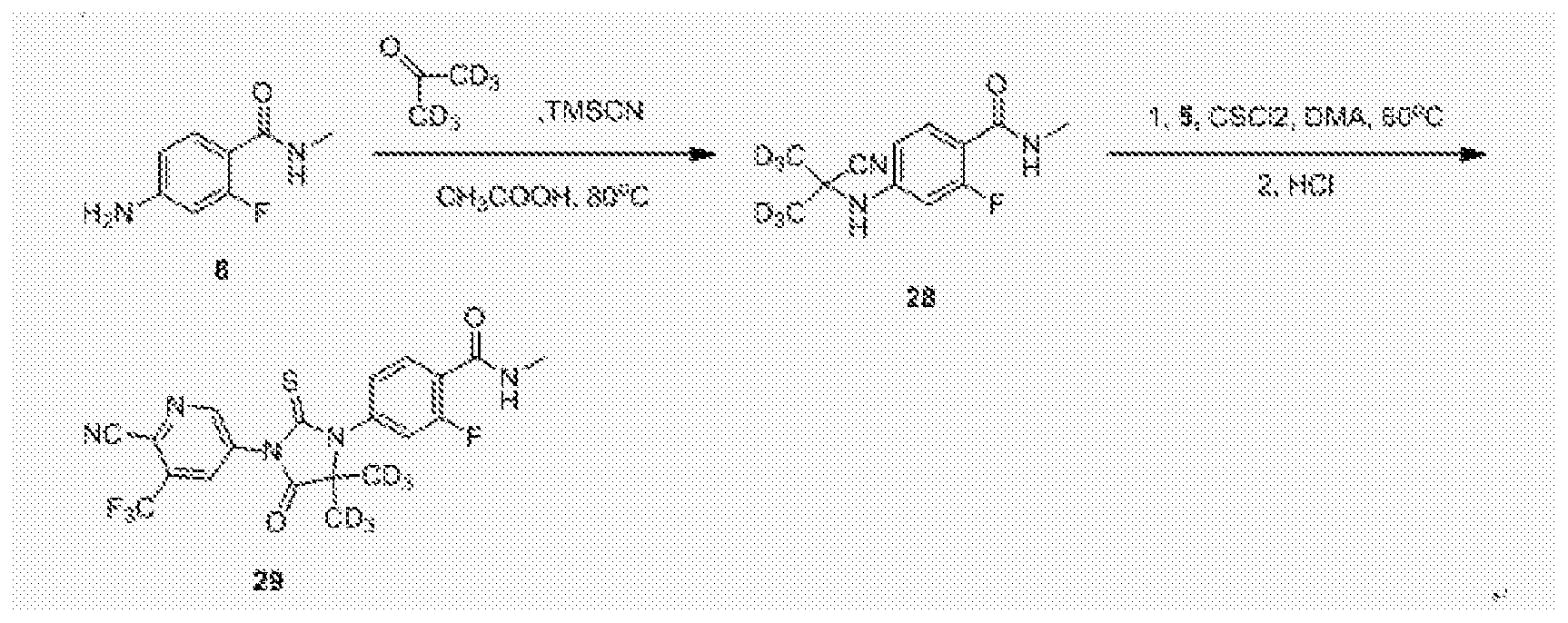
- the compound of the formula (I) of the present invention can be produced by the following synthesis formula.
- each reaction is usually carried out in a solvent at room temperature to reflux temperature (for example, 0 ° C to 120 ° C, preferably 0 ° C to 80 ° C; > reaction time is usually 0.1 hour - 60 The hour is preferably from 0.5 to 48 hours.
- the preparation of the corresponding deuterated compound can be carried out by the same route using the corresponding deuterated starting compound or the corresponding deuterated reagent as a starting material.
- a starting material such as deuterated methylamine, deuterated acetone.
- the deuterated starting material on the benzene ring can be synthesized by the following method or literature method (Org Letter, 2008, 4351-4353).
- mice Healthy Kunming mice, male, weighing 18-20 g. Each test compound was administered 10 g g /k g by gavage, and the compound was dissolved in DMSO:PEG400:H 2 O 1 :5:14, and the dosage volume was 10 ml/kg. The rats were fasted for 12 h before the test and freely drink water. Eat regularly 2 hours after administration. At 0.5, 1.0, 2.0, 4.0, 6.0 and 24 h after administration, 3 mice per time point, 0.3 ml of blood was taken from the posterior venous plexus of the mouse, placed in heparinized tubes, 4 ° C, 3500 rpm After centrifugation for 10 min, the plasma was separated and frozen in a refrigerator at -20 °C.
- Test Example 3 In vitro activity test
- the constructed human prostate cancer cell LNCap/AR cells were transferred to RPMI1640 medium containing 10% fetal bovine serum (CCS) treated with dextran activated carbon, cultured until the cells were in logarithmic growth phase, and digested with trypsin. The cells were counted by trypan blue staining, and the cells were plated. Each well was incubated with ⁇ cell suspension containing 4000 cells. To avoid edge effects, add 20 ( ⁇ L medium to the periwelling of the cell plate.
- CCS fetal bovine serum
- RPMI1640 medium containing 10% CSS with DHT (-/+) concentration of ⁇ /L or 200nM/L was used to configure the corresponding concentration of drug, and 6 drug concentrations were prepared before dosing (20 ⁇ , ⁇ , 200 ⁇ , ⁇ , 2000nM, 10000nM, 20000nM) of the drug-containing medium, add the corresponding compound of ⁇ to each well in the cell plate and gently shake to make the drug concentration uniform. Place the cell plate in a cell culture incubator at 30 mm, add ⁇ 4nM R1881 to each well and mix.
- the 96-well plate was placed in a cell culture incubator, incubated at 37 ° C, 5% CO 2 for 6 days, 15 L of CCK-8 reagent was added to each well, and incubated at 37 ° C for 2 hours; using enzyme The instrument reads the plate at a wavelength of 490 nm and the reading is in OD.
- the test compound inhibition rate was calculated using the following equation:
- the 50% inhibition rate is IC50 (nM).
- the compound of the present invention has a good ability to inhibit the growth of prostate cancer cells, and is superior to the original compound 10 which has not been deuterated.
- the compound of the present invention has significantly superior pharmacokinetic and/or pharmacodynamic properties, and is more suitable as an androgen receptor antagonist, and is more suitable for preparing and treating androgen-related diseases (such as cancer). Drug.
Landscapes
- Health & Medical Sciences (AREA)
- Organic Chemistry (AREA)
- Chemical & Material Sciences (AREA)
- General Health & Medical Sciences (AREA)
- Veterinary Medicine (AREA)
- Nuclear Medicine, Radiotherapy & Molecular Imaging (AREA)
- General Chemical & Material Sciences (AREA)
- Pharmacology & Pharmacy (AREA)
- Life Sciences & Earth Sciences (AREA)
- Animal Behavior & Ethology (AREA)
- Chemical Kinetics & Catalysis (AREA)
- Public Health (AREA)
- Medicinal Chemistry (AREA)
- Engineering & Computer Science (AREA)
- Bioinformatics & Cheminformatics (AREA)
- Dermatology (AREA)
- Diabetes (AREA)
- Endocrinology (AREA)
- Urology & Nephrology (AREA)
- Pharmaceuticals Containing Other Organic And Inorganic Compounds (AREA)
- Organic Low-Molecular-Weight Compounds And Preparation Thereof (AREA)
- Plural Heterocyclic Compounds (AREA)
Abstract
Description




Claims


Priority Applications (6)
| Application Number | Priority Date | Filing Date | Title |
|---|---|---|---|
| CA2908326A CA2908326C (en) | 2013-05-29 | 2014-05-27 | Imidazolidinedione compounds and their uses |
| EP14805136.0A EP3020714B1 (en) | 2013-05-29 | 2014-05-27 | Imidazole diketone compound and use thereof |
| JP2016515632A JP6469092B2 (ja) | 2013-05-29 | 2014-05-27 | イミダゾリジンジオン化合物及び薬物組成物 |
| ES14805136T ES2940901T3 (es) | 2013-05-29 | 2014-05-27 | Compuesto de imidazol dicetona y uso del mismo |
| AU2014273618A AU2014273618B2 (en) | 2013-05-29 | 2014-05-27 | Imidazole diketone compound and use thereof |
| US14/889,032 US9708289B2 (en) | 2013-05-29 | 2014-05-27 | Imidazole diketone compound and use thereof |
Applications Claiming Priority (2)
| Application Number | Priority Date | Filing Date | Title |
|---|---|---|---|
| CN201310205281.X | 2013-05-29 | ||
| CN201310205281 | 2013-05-29 |
Publications (1)
| Publication Number | Publication Date |
|---|---|
| WO2014190895A1 true WO2014190895A1 (zh) | 2014-12-04 |
Family
ID=51988001
Family Applications (1)
| Application Number | Title | Priority Date | Filing Date |
|---|---|---|---|
| PCT/CN2014/078528 Ceased WO2014190895A1 (zh) | 2013-05-29 | 2014-05-27 | 咪唑二酮类化合物及其用途 |
Country Status (8)
| Country | Link |
|---|---|
| US (1) | US9708289B2 (zh) |
| EP (1) | EP3020714B1 (zh) |
| JP (1) | JP6469092B2 (zh) |
| CN (1) | CN104211683B (zh) |
| AU (1) | AU2014273618B2 (zh) |
| CA (1) | CA2908326C (zh) |
| ES (1) | ES2940901T3 (zh) |
| WO (1) | WO2014190895A1 (zh) |
Cited By (4)
| Publication number | Priority date | Publication date | Assignee | Title |
|---|---|---|---|---|
| WO2016124149A1 (zh) * | 2015-02-06 | 2016-08-11 | 苏州晶云药物科技有限公司 | 一种治疗前列腺癌的抗雄激素类药物的新晶型及其制备方法 |
| WO2017067530A2 (zh) | 2017-02-13 | 2017-04-27 | 康朴生物医药技术(上海)有限公司 | 一种治疗前列腺癌的组合、药物组合物及治疗方法 |
| JP2019524711A (ja) * | 2016-07-08 | 2019-09-05 | ヤンセン ファーマシューティカ エヌ.ベー. | アンドロゲン受容体アンタゴニストとしての置換ヒダントイン及びチオヒダントイン誘導体 |
| US11149017B2 (en) * | 2016-12-13 | 2021-10-19 | Watson Laboratories Inc. | Solid state forms of apalutamide |
Families Citing this family (12)
| Publication number | Priority date | Publication date | Assignee | Title |
|---|---|---|---|---|
| LT3233803T (lt) | 2014-12-19 | 2019-04-10 | Aragon Pharmaceuticals, Inc. | Diariltiohidantoino junginio gamybos būdas |
| MX383748B (es) * | 2014-12-19 | 2025-03-14 | Aragon Pharmaceuticals Inc | Procesos para la preparación de un compuesto de diariltiohidantoína. |
| CN106432090B (zh) * | 2015-10-30 | 2019-08-20 | 成都海创药业有限公司 | 一种氘代咪唑酮化合物的晶型及其制备方法和用途 |
| CN107954936B (zh) * | 2016-10-17 | 2021-03-19 | 海创药业股份有限公司 | 一种制备氘代咪唑二酮类化合物的方法 |
| CN108069869B (zh) * | 2016-11-09 | 2022-03-01 | 上海医药工业研究院 | 一种Apalutamide的制备方法及其中间体 |
| CN107501237B (zh) * | 2017-08-17 | 2022-03-22 | 上海西浦医药科技有限公司 | 一种Apalutamide的合成方法 |
| US10513504B2 (en) | 2018-03-08 | 2019-12-24 | Apotex Inc. | Processes for the preparation of apalutamide and intermediates thereof |
| CN110305138B (zh) * | 2018-03-27 | 2021-04-23 | 海创药业股份有限公司 | 一种治疗癌症的化合物及其用途 |
| WO2019184952A1 (en) * | 2018-03-29 | 2019-10-03 | Hinova Pharmaceuticals Inc. | Deuterated imidazolidinedione compounds and their uses |
| CN108314646B (zh) * | 2018-04-11 | 2021-03-19 | 武汉慧敏科技中心 | 一种高分散双金属纳米材料制备泌尿生殖系统用药物中间体的方法 |
| CN110372598A (zh) * | 2018-04-13 | 2019-10-25 | 成都海创药业有限公司 | 一种合成氘代酰胺及氘代磺酰胺的新方法 |
| CN112442009B (zh) * | 2019-08-30 | 2023-10-03 | 润佳(苏州)医药科技有限公司 | 氘代化合物及其在治疗癌症方面的应用 |
Citations (1)
| Publication number | Priority date | Publication date | Assignee | Title |
|---|---|---|---|---|
| CN102884057A (zh) * | 2010-02-16 | 2013-01-16 | 亚拉冈制药公司 | 雄激素受体调节剂及其用途 |
Family Cites Families (8)
| Publication number | Priority date | Publication date | Assignee | Title |
|---|---|---|---|---|
| CN101032483B (zh) * | 2006-03-09 | 2011-05-04 | 陈德桂 | 调节雄激素受体活性的乙内酰脲衍生物及其应用 |
| BRPI0709771B1 (pt) | 2006-03-27 | 2022-01-25 | The Regents Of The University Of California | Composto e composição farmacêutica |
| US8461343B2 (en) | 2007-03-27 | 2013-06-11 | Sloan-Kettering Institute For Cancer Research | Synthesis of thiohydantoins |
| CN102532099A (zh) * | 2010-12-21 | 2012-07-04 | 陈德桂 | 一组乙内酰脲衍生物的组成、合成和应用 |
| CN103857667A (zh) * | 2011-10-22 | 2014-06-11 | 陈德桂 | 一组乙内酰脲衍生物的组成、合成和应用 |
| WO2013067142A1 (en) * | 2011-11-02 | 2013-05-10 | Medivation Technologies, Inc. | Compounds and treatment methods |
| CN103159680A (zh) * | 2011-12-14 | 2013-06-19 | 爱美尼迪药物有限公司 | 咪唑二酮类化合物及其用途 |
| EP2911666B1 (en) * | 2012-10-26 | 2022-08-24 | Memorial Sloan-Kettering Cancer Center | Modulators of resistant androgen receptor |
-
2014
- 2014-05-27 ES ES14805136T patent/ES2940901T3/es active Active
- 2014-05-27 EP EP14805136.0A patent/EP3020714B1/en active Active
- 2014-05-27 WO PCT/CN2014/078528 patent/WO2014190895A1/zh not_active Ceased
- 2014-05-27 US US14/889,032 patent/US9708289B2/en active Active
- 2014-05-27 JP JP2016515632A patent/JP6469092B2/ja active Active
- 2014-05-27 CA CA2908326A patent/CA2908326C/en active Active
- 2014-05-27 CN CN201410229381.0A patent/CN104211683B/zh active Active
- 2014-05-27 AU AU2014273618A patent/AU2014273618B2/en active Active
Patent Citations (1)
| Publication number | Priority date | Publication date | Assignee | Title |
|---|---|---|---|---|
| CN102884057A (zh) * | 2010-02-16 | 2013-01-16 | 亚拉冈制药公司 | 雄激素受体调节剂及其用途 |
Non-Patent Citations (3)
| Title |
|---|
| "Studies with deuterated drugs", JOURNAL OF PHARMACEUTICAL SCIENCES, vol. 64, no. 3, 1975, pages 367 - 391 |
| ORG LETTER, 2008, pages 4351 - 4353 |
| See also references of EP3020714A4 |
Cited By (4)
| Publication number | Priority date | Publication date | Assignee | Title |
|---|---|---|---|---|
| WO2016124149A1 (zh) * | 2015-02-06 | 2016-08-11 | 苏州晶云药物科技有限公司 | 一种治疗前列腺癌的抗雄激素类药物的新晶型及其制备方法 |
| JP2019524711A (ja) * | 2016-07-08 | 2019-09-05 | ヤンセン ファーマシューティカ エヌ.ベー. | アンドロゲン受容体アンタゴニストとしての置換ヒダントイン及びチオヒダントイン誘導体 |
| US11149017B2 (en) * | 2016-12-13 | 2021-10-19 | Watson Laboratories Inc. | Solid state forms of apalutamide |
| WO2017067530A2 (zh) | 2017-02-13 | 2017-04-27 | 康朴生物医药技术(上海)有限公司 | 一种治疗前列腺癌的组合、药物组合物及治疗方法 |
Also Published As
| Publication number | Publication date |
|---|---|
| US20160152592A1 (en) | 2016-06-02 |
| CA2908326C (en) | 2017-09-12 |
| CA2908326A1 (en) | 2014-12-04 |
| CN104211683B (zh) | 2017-01-11 |
| EP3020714A1 (en) | 2016-05-18 |
| JP6469092B2 (ja) | 2019-02-13 |
| AU2014273618A1 (en) | 2015-10-29 |
| EP3020714A4 (en) | 2016-10-26 |
| AU2014273618B2 (en) | 2016-10-13 |
| US9708289B2 (en) | 2017-07-18 |
| ES2940901T3 (es) | 2023-05-12 |
| EP3020714B1 (en) | 2022-12-28 |
| CN104211683A (zh) | 2014-12-17 |
| JP2016524612A (ja) | 2016-08-18 |
Similar Documents
| Publication | Publication Date | Title |
|---|---|---|
| CN104211683B (zh) | 咪唑二酮类化合物及其用途 | |
| US9346764B2 (en) | Imidazolidinedione compounds and their uses | |
| CN105646389B (zh) | 一种作为吲哚胺-2,3-双加氧酶抑制剂的氨基磺酸脂及其制备方法和用途 | |
| WO2021129824A1 (zh) | 新型K-Ras G12C抑制剂 | |
| KR20120048705A (ko) | 안드로겐 수용체 길항제 및 그의 용도 | |
| JP6605751B2 (ja) | がん状を治療するための重水素化合物 | |
| CN114149423B (zh) | 四氢吡啶并嘧啶二酮类衍生物、其制备方法及其在医药上的应用 | |
| WO2018121689A1 (zh) | 磺酰胺-芳基酰胺类化合物及其治疗乙型肝炎的药物用途 | |
| JP2018537486A (ja) | キノロン類似体及びその塩の結晶形 | |
| JP2013515766A (ja) | イマチニブジクロロ酢酸塩及びそれを含む抗癌剤組成物 | |
| JP2026041733A (ja) | 去勢抵抗性前立腺がんの標的化療法のための化合物 | |
| WO2020173417A1 (zh) | 含丙烯酰基的核转运调节剂及其用途 | |
| JP2022065014A (ja) | 重水素化イミダゾリジンジオン化合物とその用途 | |
| CN102770416B (zh) | 美他沙酮共晶体 | |
| CN104788372B (zh) | 一种氘代卡博替尼衍生物、其制备方法、应用及其中间体 | |
| WO2024027695A1 (zh) | 作为her2抑制剂的化合物 | |
| CN120676945A (zh) | 用于治疗代谢综合征和相关病症的嘌呤核苷磷酸化酶抑制剂 | |
| WO2025193111A1 (en) | An imidazole-indole derivative binding to 5-ht7 serotonin receptor, a pharmaceutical composition comprising the derivative, uses of the derivative and the composition, and an intermediate product for manufacturing the imidazole-indole derivative | |
| WO2025151705A1 (en) | Novel inhibitors of dna damage repair pathway | |
| WO2025103493A1 (zh) | 一种大麻素受体1拮抗剂及其应用 | |
| CN119997950A (zh) | 用于治疗疾病的单羧酸转运蛋白4的杂环抑制剂的盐 | |
| WO2024002112A1 (zh) | 一种治疗猫冠状或杯状病毒感染的方法 | |
| HK1198166B (zh) | 咪唑二酮类化合物及其用途 |
Legal Events
| Date | Code | Title | Description |
|---|---|---|---|
| 121 | Ep: the epo has been informed by wipo that ep was designated in this application |
Ref document number: 14805136 Country of ref document: EP Kind code of ref document: A1 |
|
| ENP | Entry into the national phase |
Ref document number: 2908326 Country of ref document: CA |
|
| WWE | Wipo information: entry into national phase |
Ref document number: 2014805136 Country of ref document: EP |
|
| ENP | Entry into the national phase |
Ref document number: 2014273618 Country of ref document: AU Date of ref document: 20140527 Kind code of ref document: A |
|
| WWE | Wipo information: entry into national phase |
Ref document number: 14889032 Country of ref document: US |
|
| ENP | Entry into the national phase |
Ref document number: 2016515632 Country of ref document: JP Kind code of ref document: A |
|
| NENP | Non-entry into the national phase |
Ref country code: DE |