WO2014192806A1 - Oxyde supraconducteur et son procédé de fabrication - Google Patents
Oxyde supraconducteur et son procédé de fabrication Download PDFInfo
- Publication number
- WO2014192806A1 WO2014192806A1 PCT/JP2014/064121 JP2014064121W WO2014192806A1 WO 2014192806 A1 WO2014192806 A1 WO 2014192806A1 JP 2014064121 W JP2014064121 W JP 2014064121W WO 2014192806 A1 WO2014192806 A1 WO 2014192806A1
- Authority
- WO
- WIPO (PCT)
- Prior art keywords
- layer
- oxide superconducting
- groove
- laser
- thinning
- Prior art date
- Legal status (The legal status is an assumption and is not a legal conclusion. Google has not performed a legal analysis and makes no representation as to the accuracy of the status listed.)
- Ceased
Links
Images




Classifications
-
- H—ELECTRICITY
- H01—ELECTRIC ELEMENTS
- H01B—CABLES; CONDUCTORS; INSULATORS; SELECTION OF MATERIALS FOR THEIR CONDUCTIVE, INSULATING OR DIELECTRIC PROPERTIES
- H01B12/00—Superconductive or hyperconductive conductors, cables, or transmission lines
- H01B12/02—Superconductive or hyperconductive conductors, cables, or transmission lines characterised by their form
- H01B12/04—Single wire
-
- H—ELECTRICITY
- H01—ELECTRIC ELEMENTS
- H01B—CABLES; CONDUCTORS; INSULATORS; SELECTION OF MATERIALS FOR THEIR CONDUCTIVE, INSULATING OR DIELECTRIC PROPERTIES
- H01B13/00—Apparatus or processes specially adapted for manufacturing conductors or cables
- H01B13/0009—Apparatus or processes specially adapted for manufacturing conductors or cables for forming corrugations on conductors or cables
-
- H—ELECTRICITY
- H10—SEMICONDUCTOR DEVICES; ELECTRIC SOLID-STATE DEVICES NOT OTHERWISE PROVIDED FOR
- H10N—ELECTRIC SOLID-STATE DEVICES NOT OTHERWISE PROVIDED FOR
- H10N60/00—Superconducting devices
- H10N60/01—Manufacture or treatment
- H10N60/0268—Manufacture or treatment of devices comprising copper oxide
- H10N60/0661—Processes performed after copper oxide formation, e.g. patterning
- H10N60/0688—Etching
-
- H—ELECTRICITY
- H10—SEMICONDUCTOR DEVICES; ELECTRIC SOLID-STATE DEVICES NOT OTHERWISE PROVIDED FOR
- H10N—ELECTRIC SOLID-STATE DEVICES NOT OTHERWISE PROVIDED FOR
- H10N60/00—Superconducting devices
- H10N60/01—Manufacture or treatment
- H10N60/0268—Manufacture or treatment of devices comprising copper oxide
- H10N60/0801—Manufacture or treatment of filaments or composite wires
-
- H—ELECTRICITY
- H10—SEMICONDUCTOR DEVICES; ELECTRIC SOLID-STATE DEVICES NOT OTHERWISE PROVIDED FOR
- H10N—ELECTRIC SOLID-STATE DEVICES NOT OTHERWISE PROVIDED FOR
- H10N60/00—Superconducting devices
- H10N60/20—Permanent superconducting devices
- H10N60/203—Permanent superconducting devices comprising high-Tc ceramic materials
Definitions
- the present invention relates to an oxide superconductor and a method for manufacturing the same.
- This application claims priority based on Japanese Patent Application No. 2013-112183 filed in Japan on May 28, 2013, the contents of which are incorporated herein by reference.
- the rare earth-based (RE123-based) oxide superconducting wire has a structure in which an oxide superconducting layer and a metal stabilizing layer are laminated on a tape-shaped metal substrate via an intermediate layer. For this reason, in order to reduce AC loss, it is necessary to subdivide the oxide superconducting layer to form a multifilament structure.
- the masking tape affixed to the surface of the wire was irradiated with a weak laser, the masking tape was partially removed, and the remaining masking tape
- the metal stabilization layer made of Ag and the oxide superconducting layer were subjected to two-stage chemical etching via the above. By forming a plurality of thinning grooves by this chemical etching, the stabilization layer and the oxide superconducting layer can be divided into an arbitrary number to form a multifilament structure having a plurality of superconducting filaments.
- the thinning groove formed in the oxide superconducting layer is wider than the groove formed in the metal stabilizing layer in the process of chemical etching, the effective groove width formed in the oxide superconducting layer is set to 100 ⁇ m or less. It was extremely difficult to do.
- the manufacturing method of the oxide superconducting wire of a multifilament structure by the combination of the above-mentioned masking tape, laser irradiation, and chemical etching is limited to the case where the metal stabilizing layer is Ag.
- the metal stabilizing layer is Ag.
- no effective etchant has been found for Cu without corroding the oxide superconducting wires. For this reason, Cu cannot be partially removed by etching to form a thinning groove.
- Patent Document 1 As a technique for forming an oxide superconducting conductor having a multifilament structure by dividing the oxide superconducting layer by laser irradiation, as described in Patent Document 1 below, a laser is formed along the longitudinal direction of the oxide superconducting layer.
- a technique is known in which light is focused on an oxide superconducting layer and the oxide superconducting layer is divided into a plurality of parts in the width direction of the oxide superconducting layer.
- German KIT Korean KIT (Karlsruhe Institute of Technology) reported on the method of dividing (scribing) the oxide superconducting layer only by laser irradiation.
- a fiber laser in the far-infrared region (1030 nm) is used, which is thermal processing, and the critical current is reduced in the superconducting filament after division.
- German KIT is also studying the use of psec (picosecond) lasers to reduce the effects of thermal processing degradation.
- this psec laser has a light intensity distribution (Gaussian distribution) peculiar to fiber lasers and solid lasers in which the light intensity distribution at the center is strong in the spot region where the laser light is condensed and the light intensity distribution becomes weaker toward the periphery. have.
- the cutting depth increases toward the center of the spot region of the laser beam. That is, it is impossible to cut at a uniform depth from the center of the laser beam spot area to the edge portion. For this reason, when the thinning groove for dividing the oxide superconducting layer is formed, the depth of the thinning groove is not constant, and there is a problem that a desirable value cannot be obtained as the insulation resistance between the superconducting filaments.
- the method of dividing the oxide superconducting layer while reducing the influence of deterioration due to thermal processing using a psec laser is a technique for forming a desired thinning groove by laser irradiation 20 to 30 times, and productivity is high. bad. Even with this method, it is announced that the critical current deteriorates by about 40% after processing.
- the oxide superconducting layer cannot be excavated to a uniform depth from the center of the laser beam spot region to the peripheral region. Further, it is described that it is necessary to form a thinning groove having a depth that reaches the base material through the oxide superconducting layer and the intermediate layer.
- the base material of the rare earth oxide superconducting wire is composed of a Ni-based high strength and high melting point alloy. For this reason, when a thinning groove reaching the base material is formed, the molten solidified material inevitably remaining inside the thinning groove is a conductive material in which constituent elements of the base material, the intermediate layer, and the oxide superconducting layer are mixed. It becomes a molten solidified product. For this reason, there has been a problem that the object of increasing the insulation resistance between adjacent superconducting filaments through the thinning groove cannot be achieved.
- Patent Document 1 discloses a technique for increasing the resistance by heating the molten solidified product to a high temperature (400 to 800 ° C.) and oxidizing it.
- a high temperature 400 to 800 ° C.
- the molten solidified product is heated in the above temperature range in order to oxidize the molten solidified product containing a large amount of Ni-based high melting point alloy components, there is a problem of deteriorating the superconducting characteristics of the oxide superconducting layer.
- the entire molten solidified product containing a large amount of Ni-based high melting point alloy components cannot be oxidized, and only the surface portion of the molten solidified product is oxidized.
- the present inventors have various types of laser light used for forming a thinning groove, phase adjustment of laser light, polarization state control, optical mask control, intensity distribution in a laser light irradiation region, and the like. Repeated research. As a result, the heat melting type laser light such as YAG laser and continuous wave laser generally used for fusing cannot make the intensity distribution of the laser light uniform in the spot area of the laser light, and in the center of the spot area. It was found that the intensity of the Gaussian component was high.
- a thickness of 1 ⁇ m to several ⁇ m is provided via an intermediate layer in which a plurality of layers having a thickness of several nanometers to several hundreds of nanometers are laminated on a tape-shaped metal substrate.
- An oxide superconducting wire is obtained by forming a level oxide superconducting layer and forming a protective layer of Ag having a thickness of several ⁇ m.
- the oxide superconducting layer When forming thinning grooves using laser light that cannot equalize the intensity of laser light in the laser irradiation region where beam shaping has been performed on the oxide superconducting wire having this structure as described above, the oxide superconducting layer must be completely In order to process a thinning groove having a depth to be divided into two, there is a problem that a thinning groove having a depth reaching the base material is formed.
- the present invention has been made in view of the above-described conventional situation, and ensures high insulation resistance between adjacent filament conductors in a structure in which an oxide superconducting layer is divided so as to form a plurality of filament conductors by thinning grooves.
- An object of the present invention is to provide a technique capable of obtaining an oxide superconductor with reduced AC loss.
- the present inventors have studied laser light having a more uniform intensity distribution in the laser irradiation region.
- the inventors have focused on an excimer laser that is a gas laser and is a kind of non-polarized laser.
- the thinning when forming a thinning groove with a laser in the ultraviolet region such as an excimer laser, the thinning has a depth that reaches the intermediate layer beyond the oxide superconducting layer and does not reach the substrate. It has been found that grooves can be formed.
- the photolytic reaction is performed so as to cut the molecular structure itself of the layer to be cut, not the thermal melting type fusing using a fiber laser or the like, thereby impairing the characteristics of the layer to be cut. It was also found that the cutting can be performed with high accuracy without any problems.
- a thinning groove having a depth that reaches the intermediate layer beyond the oxide superconducting layer and does not reach the base material the insulation resistance between the filament conductors adjacent to each other through the thinning groove is dramatically increased. As a result, the present invention was reached.
- an oxide superconducting conductor is provided on a metal base, an insulating intermediate layer provided on the base, and the intermediate layer.
- An oxide superconducting layer, a metal stabilizing layer provided on the oxide superconducting layer, and the metal stabilizing layer and the oxide superconducting layer are separated along the longitudinal direction of the base material,
- a plurality of thinning grooves that reach the inside of the intermediate layer from the stabilization layer via the oxide superconducting layer and do not reach the base material, and the metal stabilization layer and the oxide superconducting layer include the Divided so as to form a plurality of filament conductors by a plurality of thinning grooves, and in each thinning groove of the plurality of thinning grooves, the width of the groove opening of the thinning groove is the thinning It is equal to or greater than the width of the groove bottom of the groove.
- the thinned groove is covered with an insulating coating layer in which a groove wall portion of the thinned groove is formed from the intermediate layer and the constituent elements of the oxide superconducting layer. It may be formed by laser irradiation so that the covering layer and the groove bottom are insulative.
- the oxide superconducting conductor according to the above aspect divides the metal stabilizing layer, the oxide superconducting layer, and the inside of the intermediate layer, and has a thinning groove having a depth that does not reach the metal base material.
- a filament conductor in which the oxide superconducting layer is divided is formed. Therefore, a very high resistance can be obtained between adjacent filament conductors via the thinning groove.
- the filament conductor is formed only by laser processing without using etching. Therefore, the influence of over-etching of the filament conductor is eliminated, and an oxide superconducting conductor having a filament conductor with high filament conductor peel strength and little reduction in critical current can be obtained.
- the substrate is Mixing of constituent components does not occur. Therefore, a high insulation resistance can be obtained between the filament conductors adjacent via the thinning groove.
- the groove width at the groove bottom may be 5 ⁇ m or more and 100 ⁇ m or less.
- the thinning groove is formed only by the focused irradiation of laser light without using etching. Therefore, the influence of overetching caused by etching can be eliminated. Further, it is possible to form a thinning groove having a width of 5 to 100 ⁇ m with high accuracy corresponding to the formation accuracy of the laser irradiation region of the laser beam when the oxide superconducting wire is focused and irradiated on the oxide superconducting wire.
- a resistance between adjacent filament conductors through the thinning groove may be 1 M ⁇ cm or more.
- a thinning groove having a depth at which the bottom of the thinning groove does not reach the substrate and is located in the intermediate layer is formed. Therefore, it is possible to obtain an oxide superconducting conductor exhibiting high filament conductor resistance that cannot be obtained by the technique of forming a thinning groove reaching the base material.
- the intermediate layer includes an alignment layer having a high crystal orientation and a cap layer formed on the alignment layer, and the groove bottom is in the cap layer.
- the thinning groove may be formed so as to be located and a part of the cap layer is exposed at the groove bottom.
- the bottom of the thinning groove is formed in the cap layer by forming the thinning groove so that the bottom of the thinning groove is located in the cap layer of the intermediate layer.
- a thinning groove that does not reach the substrate can be formed. Since the filament conductor is divided by the thinning groove formed so as to be located in the cap layer, a high insulation resistance between adjacent filament conductors can be obtained through the thinning groove.
- a method of manufacturing an oxide superconducting conductor according to the second aspect of the present invention includes a metal base material, an insulating intermediate layer provided on the base material, and the intermediate layer.
- An oxide superconducting wire comprising an oxide superconducting layer provided on the oxide superconducting layer and a metal stabilizing layer provided on the oxide superconducting layer is prepared, and a laser in the ultraviolet region is irradiated from above the metal stabilizing layer.
- the oxide superconducting layer comprises a plurality of filament conductors. Divided as to formed.
- a thinning groove having a depth reaching the intermediate layer through the metal stabilizing layer and the oxide superconducting layer is formed by condensing and irradiating a laser in the ultraviolet region.
- the oxide superconducting layer is divided, and a plurality of filament conductors can be formed.
- Each filament conductor is divided by a thinning groove having a depth reaching the intermediate layer, and an insulating intermediate layer exists at the bottom of the thinning groove, so that an oxide superconducting conductor having high insulation between the filament conductors is formed.
- the groove wall portion of the thinned groove may be covered with an insulating coating layer formed from constituent elements of the intermediate layer and the oxide superconducting layer.
- each filament conductor is divided by a thinning groove having a depth reaching the intermediate layer.
- An insulating intermediate layer exists at the bottom of the thinning groove.
- the groove wall portion is covered with a highly insulating coating layer formed from the constituent elements of the oxide superconducting layer and the intermediate layer. Thereby, high insulation between filament conductors can be ensured.
- the oxide superconducting conductor manufacturing method has a laser wavelength of 380 nm or less having a top hat type intensity distribution with a flat laser intensity distribution at the tip of the converging portion as the laser in the ultraviolet region.
- the laser may be used.
- the cutting depth of the thinning groove by the laser is made uniform. it can.
- the oxide superconducting conductor manufacturing method condenses and irradiates the laser from the outside of the metal stabilizing layer, and supplies an assist gas to the metal stabilizing layer.
- the laser stabilization irradiation portion of the metal stabilization layer is melted and removed, and the laser is focused on the oxide superconducting layer and the intermediate layer, and the laser focused irradiation portion and the intermediate layer of the oxide superconducting layer
- the thinning groove may be formed by melting and removing the laser focused portion of the laser beam, and the groove wall portion may be covered with the coating layer.
- the metal stabilization layer is partially melted by a laser, and the melted portion of the metal stabilization layer is removed by an assist gas, whereby a fine wire is formed on the metal stabilization layer. Forming the top of the groove. Thereafter, the oxide superconducting layer and the intermediate layer are partially melted from the upper part of the thinning groove, and the melted part of the oxide superconducting layer and the melted part of the intermediate layer are removed by the assist gas, thereby removing the bottom of the thinning groove. Can be formed.
- the melted portion of the metal stabilizing layer located on the oxide superconducting layer has already been removed. Therefore, an insulating covering layer formed from the constituent elements of the oxide superconducting layer and the intermediate layer remains in the groove wall portions of the thinned grooves formed in the oxide superconducting layer and the intermediate layer. Also, the upper part of the thinned groove formed in the metal stabilizing layer is also covered with the coating layer formed from the constituent elements of the oxide superconducting layer and the intermediate layer, so that it is adjacent to the thinned groove through the thinned groove. The insulation between the filament conductors can be made particularly good.
- the oxide superconducting layer is divided by the thinning groove having a depth that does not reach the base material, dividing the metal stabilizing layer, the oxide superconducting layer, and the intermediate layer.
- a filament conductor is constructed. For this reason, a very high insulation resistance is obtained between the filament conductors adjacent via the thinning groove.
- the groove wall portion of the thinning groove is covered with a high insulation resistance coating layer formed from the constituent elements of the intermediate layer and the oxide superconducting layer, and the constituent elements of the intermediate layer are present at the bottom of the thinning groove. Therefore, mixing of the component which comprises a base material does not occur.
- a high insulation resistance can be obtained between adjacent filament conductors via the thinning groove.
- the thinning groove is formed only by laser processing without using etching, the influence of overetching can be eliminated.
- FIG.5 (a) is a perspective view which shows the oxide superconducting wire before a process.
- FIG. 5B is a perspective view showing a state where the metal stabilizing layer is removed.
- FIG. 5C is a perspective view showing a state where the oxide superconducting layer is removed.
- FIG. 5D is a perspective view showing a state where a part of the intermediate layer is removed. It is a figure which shows the beam intensity distribution of the laser used in order to form the thinning groove
- FIG. 6A is a schematic diagram showing the beam intensity distribution of an excimer laser.
- FIG. 6B is a schematic diagram showing the beam intensity distribution of the YAG laser. It is an electron micrograph which shows an example of the thinning groove
- an FIB focused ion beam apparatus
- a sample for observing the cross section of the filament around the thinning groove is used.
- EPMA electron beam microanalyzer
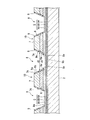
- FIG. 1 is a perspective view showing an example of an oxide superconductor according to an embodiment of the present invention in which a thinning groove is formed to form a plurality of filament conductors
- FIG. 2 is a partial view of the oxide superconductor according to this embodiment.
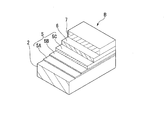
- FIG. The oxide superconducting conductor A of the present embodiment is manufactured by processing the oxide superconducting wire B having the structure shown in FIG. 3 by the laser processing apparatus C shown in FIG.
- oxide superconducting conductor A and the oxide superconducting wire B shown in each figure may be shown by enlarging a main part in order to make the characteristics of the present embodiment easy to understand.
- the dimensional ratio and the like are not always the same as actual.
- the oxide superconducting wire B before processing shown in FIG. 3 is laminated on the intermediate layer 5 laminated on the substrate 2, the oxide superconducting layer 6 laminated on the intermediate layer 5, and the oxide superconducting layer 6.
- the metal stabilizing layer 7 is formed.
- the base material 2 is preferably in the form of a tape in order to be long, and a high-strength metal material excellent in heat resistance, such as a nickel alloy represented by Hastelloy (trade name, registered trademark manufactured by Haynes, USA). Formed from. Among them, any type of Hastelloy, such as Hastelloy B, C, G, N, and W, having different component amounts such as molybdenum, chromium, iron, and cobalt can be used. In addition, an oriented Ni—W alloy tape base material in which a texture is introduced into a nickel alloy can also be applied as the base material 2.
- the thickness of the substrate 2 may be appropriately adjusted according to the purpose, and can be in the range of 10 to 500 ⁇ m.
- the diffusion preventing layer 5A is formed for the purpose of preventing diffusion of the constituent elements of the substrate 2, and silicon nitride (Si 3 N 4 ), aluminum oxide (Al 2 O 3 ), GZO (Gd 2 Zr 2 O 7 ), etc. And is formed to a thickness of, for example, 10 to 400 nm by a film forming method such as a sputtering method. Also, a bed layer can be formed on the diffusion preventing layer 5A.
- This bed layer has high heat resistance, reduces interfacial reactivity, and is used for obtaining the orientation of a film formed on the bed layer.
- the bed layer is made of Y 2 O 3 , Er 2 O 3 , CeO 2 , Dy 2 O 3, Er 2 O 3 , Eu 2 O 3 , Ho 2 O 3 , La 2 O 3 or the like.
- the bed layer is formed by a film forming method such as a sputtering method, and the thickness thereof is, for example, 10 to 100 nm.
- the orientation layer 5B is formed of a biaxially oriented material for controlling the crystal orientation of the cap layer 5C formed on the orientation layer 5B.
- the alignment layer 5B is made of Gd 2 Zr 2 O 7 , MgO, ZrO 2 —Y 2 O 3 (YSZ), SrTiO 3 , CeO 2 , Y 2 O 3 , Al 2 O 3 , Gd 2 O. 3 , metal oxides such as Zr 2 O 3 , Ho 2 O 3 and Nd 2 O 3 can be exemplified.
- the alignment layer 5B is formed with a good biaxial orientation (high crystal orientation) by an IBAD (Ion-Beam-Assisted Deposition) method, the crystal orientation of the cap layer 5C can be improved ( Cap layer 5C having high crystal orientation is obtained). Furthermore, the oxide superconducting layer 6 formed on the cap layer 5C can have good crystal orientation (obtains an oxide superconducting layer 6 having high crystal orientation), and can exhibit excellent superconducting characteristics.
- the cap layer 5C is formed from a material that is formed on the surface of the above-described alignment layer 5B and crystal grains can self-orient in the in-plane direction.
- the CeO 2 layer used for the cap layer 5C can be formed at a high film formation rate by a PLD method (pulse laser deposition method), sputtering, or the like, and good crystal orientation can be obtained.
- the thickness of the cap layer 5C can be formed in the range of about 50 to 5000 nm, preferably about 300 to 800 nm.
- the oxide superconducting layer 6 As a material of the oxide superconducting layer 6, a known material used for a high-temperature superconductor is adopted. Specifically, REBa 2 Cu 3 O y (RE is Sc, Y, La, Ce, Pr, Nd, Pm). , Sm, Eu, Gd, Tb, Dy, Ho, Er, Tm, Yb, and Lu represent one or more rare earth elements). Examples of the oxide superconducting layer 6 include Y123 (YBa 2 Cu 3 O 7-X ) and Gd123 (GdBa 2 Cu 3 O 7-X ) (x in the composition formula represents oxygen deficiency).
- the oxide superconducting layer 6 is formed by a physical vapor deposition method such as sputtering, vacuum vapor deposition, laser vapor deposition, electron beam vapor deposition, chemical vapor deposition (CVD), or thermal coating decomposition (MOD). It can be laminated on the layer 5.
- a physical vapor deposition method such as sputtering, vacuum vapor deposition, laser vapor deposition, electron beam vapor deposition, chemical vapor deposition (CVD), or thermal coating decomposition (MOD). It can be laminated on the layer 5.
- PLD pulse laser vapor deposition
- TFA-MOD method organic metal deposition method using trifluoroacetate, coating pyrolysis method
- CVD chemical vapor deposition
- the metal stabilization layer (protective layer) 7 is formed as a highly conductive layer such as Ag or an Ag alloy that has a low contact resistance and a high affinity with the oxide superconducting layer 6.
- the reason why the metal stabilizing layer 7 is made of Ag is that oxygen can be easily transmitted to the oxide superconducting layer 7 in the oxygen annealing step of doping the oxide superconducting layer 7 with oxygen.
- the base material of the oxide superconducting layer manufactured by the film formation method is an insulator, an oxide superconducting layer with a well-crystallized structure is formed by incorporating oxygen by oxygen annealing, and exhibits superconducting characteristics.
- a film forming method such as sputtering is employed, and the thickness of the metal stabilizing layer 7 can be formed to about 1 to 30 ⁇ m.
- the metal stabilization layer 7 may be used as the first metal stabilization layer 7 and a second metal stabilization layer may be provided on the metal stabilization layer 7.
- the second metal stabilizing layer is preferably formed from a relatively inexpensive conductive metal material such as copper, a copper alloy such as a Cu—Zn alloy, a Cu—Ni alloy, aluminum or an aluminum alloy, and stainless steel. .
- the second metal stabilizing layer is a bypass that commutates the current of the oxide superconducting layer 6 together with the first metal stabilizing layer 7 when the oxide superconducting layer 6 attempts to transition from the superconducting state to the normal conducting state. Function as.
- the stabilization layer is used to instantaneously suppress an overcurrent that occurs when the normal conducting transition occurs and transitions to the normal conducting state.
- the material used for the second metal stabilizing layer include high resistance metals such as Ni-based alloys such as Ni—Cr.
- the thickness of the second metal stabilizing layer can be, for example, 10 to 300 ⁇ m.
- the oxide superconducting conductor A having the structure shown in FIGS. 1 and 2 has a plurality of thinning grooves 8 in the longitudinal direction of the oxide superconducting layer 6 so as to divide the oxide superconducting layer 6 of the oxide superconducting wire B shown in FIG. And a plurality of oxide superconducting layers 6 are formed in the width direction.
- FIG. 1 illustrates a structure in which the oxide superconducting layer 6 is divided into four filament conductors 10 by three thinning grooves 8 formed at equal intervals in the width direction of the oxide superconducting wire B.
- the thinning groove 8 penetrates the metal stabilizing layer 7 and the oxide superconducting layer 6 in the thickness direction of the metal stabilizing layer 7 and the oxide superconducting layer 6, and the bottom 8 a of the thinning groove 8 is in the middle of the intermediate layer 5.
- the bottom 8a of the thinning groove 8 is formed so as to be located in the intermediate layer 5 in the thickness direction of the oxide superconducting wire B).
- the bottom 8a of the thinning groove 8 is formed so as to reach the cap layer 5C which is a part of the intermediate layer 5 in detail (the thinning groove 8 has a bottom 8a part of the intermediate layer 5). And is formed so as to be located on the cap layer 5C).
- the bottom 8a of the thinning groove 8 is preferably located in the bottom region of the cap layer 5C without reaching the alignment layer 5B and the diffusion preventing layer 5A.
- the cap layer 5C is thicker among the diffusion preventing layer 5A, the alignment layer 5B and the cap layer 5C formed under the oxide superconducting layer 6. This is related to the large number of structures formed.
- the diffusion prevention layer 5A is formed to be about several tens to 100 nm
- the alignment layer 5B is about 5 to 10 nm
- the cap layer 5C is about 200 to 500 nm. This is for the following reasons (1) to (3).
- the film formation rate of the IBAD method used for forming the biaxially oriented alignment layer 5B is low, and in order to form the alignment layer 5B, for example, in the current technology, the MgO alignment layer 5B has a thickness of 5 to 10 nm.
- a biaxially oriented film can be obtained with a thin film thickness.
- a film of about several tens to 100 nm is used as the diffusion preventing layer 5A. Thickness is necessary.
- the cap layer 5C In order to obtain the cap layer 5C having excellent crystal orientation on the biaxially oriented alignment layer 5B, the cap layer 5C needs to have a thickness of about several hundred nm. Considering the above items (1) to (3), it is desirable that the bottom portion 8a of the thinning groove 8 is formed so as to be positioned within the range of the cap layer 5C, and the thinning groove 8 does not reach the substrate 2. It becomes a structure. Instead of the structure in which the diffusion preventing layer 5A and the orientation layer 5B are formed on the base material 2, a metal base material in which Ni is deposited on oriented Ni—W, oriented Ni, and oriented Cu can be used.
- the cap layer 5C can be formed on these tape materials, and the oxide superconducting conductor can be formed by laminating the oxide superconducting layer 6 and the metal stabilizing layer 7 on the cap layer 5C.
- the oxide superconducting conductor structures a thinned groove 8 having a depth reaching the inside of the cap layer 5C is formed, and processed by laser so that the bottom of the thinned groove 8 is located at the cap layer 5C. By doing so, the target structure can be obtained.
- the opening 8b of the thinning groove 8 is formed in a shape (widening shape) wider than the width of the bottom 8a of the thinning groove 8, and in the width direction of the oxide superconducting wire B, etc. A plurality are formed at intervals.
- a state in which four thinning grooves 8 are formed in the width direction of the oxide superconducting wire B is illustrated.
- the oxide superconducting wire B is generally formed in a tape shape having a width of about 10 mm or about 5 mm.
- the thinning groove 8 is formed with a width of about 5 ⁇ m or more and 100 ⁇ m or less as the width of the bottom portion 8a in consideration of the width of the region (laser condensing irradiation portion) where the above-described laser is focused and irradiated on the oxide superconducting wire B. It is preferable that Further, the width of the bottom portion of the groove portion dividing the metal stabilizing layer 7 in the thinning groove 8 is defined as d2, and the width of the bottom portion of the groove portion dividing the oxide superconducting layer 6 is defined as d1. In this case, it is preferable that the relationship d2 / d1 ⁇ 1 is satisfied.
- the width d2 is a surface substantially parallel to the upper surface of the substrate 2, and the width of the thinned groove 8 at the position where the bottom surface of the metal stabilizing layer 7 and the upper surface of the oxide superconducting layer 6 are in contact with each other. It is.
- the width d1 is a groove width of the thinning groove 8 at a position that is a surface substantially parallel to the upper surface of the substrate 2 and where the bottom surface of the oxide superconducting layer 6 and the upper surface of the intermediate layer 5 are in contact with each other.
- the thinning groove 8 forms a groove having a cross-sectional shape such that the width d2 at the surface position close to the groove opening is equal to or greater than the width d1 at the surface position close to the groove bottom.
- the reason why it is preferable to form the thinning groove 8 so as to satisfy the relationship of d2 / d1 ⁇ 1 is as follows. If a thinning groove is made by a scribing method that uses both laser irradiation and chemical etching as in the conventional method, the peel strength of the superconducting filament divided by the thinning groove tends to drop to about half of the peel strength before forming the thinning groove. There is.
- both inner wall portions of the thinning groove are in an overhanging state (a state in which a protruding portion is formed) in which they are inclined toward the inside of the thinning groove. It is done. During cooling, liquid nitrogen enters this overhang and expands. When the expansion of liquid nitrogen continues many times each time the superconducting conductor is cooled, pressure is applied in the direction in which the superconducting filament is peeled off by the expanded liquid nitrogen. As described above, it is considered that the exfoliation of the filament is promoted to cause a decrease in the peel strength of the superconducting filament.
- the oxide superconducting wire when the oxide superconducting wire is returned from a low temperature to a normal temperature, if moisture enters the overhang portion of the inner wall, the moisture cannot come out from the overhang portion. If the oxide superconducting wire is cooled to a low temperature in a state where moisture has entered the overhang portion, the moisture in the overhang portion may expand and the superconducting filament may be peeled off. Further, in the case of d2 / d1 ⁇ 1, there is a problem in that the area of the oxide superconducting layer is greatly reduced and critical current loss is increased.
- the oxide superconducting layer 6 is completely divided in the thickness direction of the oxide superconducting layer 6, and then the laser beam is focused on the oxide superconducting wire so that the groove does not reach the substrate 2.
- the processing conditions it is preferable to set the processing conditions so that the laser to be used is stopped halfway in the thickness direction of the cap layer 5C.
- a laser having a wavelength in the ultraviolet region it is preferable to use a laser having a wavelength in the ultraviolet region.
- a top hat excimer laser capable of irradiating as uniform energy as possible to the beam irradiation region of the oxide superconducting wire to which the laser is focused and irradiated is used. Is preferred.
- a structure in which the groove bottom 8a of the thinned groove 8 is formed in the middle of the cap layer 5C such that the groove does not reach the substrate 2 can be obtained.
- the thinning groove 8 that can completely divide the oxide superconducting layer 6 can be formed.
- the thinning groove 8 may reach the alignment layer 5B or the diffusion prevention layer 5A slightly beyond the cap layer 5C depending on the state of division by the excimer laser. However, the bottom 8a of the thinning groove 8 reaches the substrate 2. It is preferable not to reach.
- a coating layer 9 is formed which is formed from a molten solidified product of the elements constituting the oxide superconducting layer 6 and the cap layer 5C.
- the covering layer 9 covers the end faces 7 a of the metal stabilizing layer 7 located on both ends of the thinning groove 8 in the width direction above the covering layer 9. Further, the covering layer 9 covers the end surface 6a of the oxide superconducting layer 6 which is a lower portion of the thinning groove 8 than the end surface 7a, and further, the lower end of the width direction edge of the bottom portion 8a of the thinning groove 8 is formed.
- the end surface 7a, the end surface 6a, and the inner edge 8e are integrally covered so as to cover the inner edge 8e.
- the thinning groove 6 is formed by condensing and irradiating an oxide superconducting wire with a laser in the ultraviolet region (for example, a pulsed excimer laser beam having a wavelength of 248 nm) from above the stabilizing metal layer 7,
- the coating layer 9 is formed while spraying an assist gas on the thinning grooves 8 being formed at the same time as the laser irradiation and blowing away the melt. For this reason, when the Ag metal stabilizing layer 7 is first divided by a laser, the Ag is first removed by the assist gas.
- the oxide superconducting layer 6 and the intermediate layer 5 are divided by laser irradiation, the oxide superconducting layer 6 and the intermediate layer 5 are removed in a groove shape, while the bottom of the thinning groove 8 is formed.
- the constituent elements of the oxide superconducting layer 6 and the constituent elements of the intermediate layer 5 are sequentially removed as the splitting of the oxide superconducting wire proceeds.
- the constituent elements of the oxide superconducting layer 6 and the constituent elements of the intermediate layer 5 are mainly deposited on the inner wall surface of the thinned groove 8 as the laser light is irradiated, so that the oxide superconducting layer 6 and The covering layer 9 formed mainly of the constituent elements of the intermediate layer 5 can be formed as the covering layer 9 on both inner wall portions of the thinning groove 8.
- a melt of constituent elements of the metal stabilization layer 7 is slightly eluted from the end face of the oxide superconducting layer 6 in the thinned groove portion at the bottom of the metal stabilization layer 7.
- a partial coating layer 7A is formed.
- the covering layer 9 is extended so as to cover both wall portions of the thinning groove 8 so as to cover the end face 7a of the metal stabilizing layer 7 and the end face 6a of the oxide superconducting layer 6 including the partial covering layer 7A.
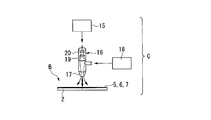
- FIG. 4 shows a laser processing apparatus C for producing the oxide superconducting conductor A having the structure shown in FIGS. 1 and 2 by condensing and irradiating laser light to the oxide superconducting wire B having the structure shown in FIG. It is a figure which shows an outline.
- the laser processing apparatus C in FIG. 4 includes an excimer laser generator 15, a cylindrical guide part 16 for guiding the excimer laser generated from the generator 15, and a nozzle body connected to the lower part of the guide part 16. 17 and an assist gas supply source 18 connected to a part of the nozzle body 17.
- the laser generator 15 may be an apparatus that generates an excimer laser that is a laser in the ultraviolet region (wavelength 380 nm or less).
- a third harmonic YAG laser in which the optical system is adjusted so that the power intensity distribution of the laser beam is a top hat type may be used. Since the laser processing accuracy is determined by ⁇ / NA ( ⁇ : wavelength, NA: numerical aperture), the wavelength is advantageously as short as possible.
- ⁇ / NA wavelength, NA: numerical aperture
- the wavelength is advantageously as short as possible.
- what is required of a laser is that the power intensity distribution of the laser light is a top hat type and has a high output. These have the advantage that the width of the rectangular beam per laser irradiation can be increased, and the processing speed of the oxide superconducting wire can be increased. When the output is weakened using a YAG laser, it is possible to cope with this by increasing the number of times of cutting of the oxide superconducting wire by the laser.
- An optical device 20 including a plurality of optical lenses for narrowing the excimer laser light guided from the generator 15 to an appropriate beam diameter at the tip of the nozzle body 17 is provided inside the guide unit 16.
- the optical device 20 condenses the laser beam in a region having an arbitrary size by narrowing the beam diameter of the excimer laser by adjusting the mutual position of the optical lens and the optical mask provided in the optical device 20.
- An irradiation region having a desired size can be formed.
- the optical device 20 supplies assist gas such as helium gas, nitrogen gas, argon gas, or air from the assist gas supply source 16 connected to the nozzle body 17 to the nozzle pair 17 in a desired ejection amount. be able to.
- the optical device 20 is configured to perform laser processing while supplying an assist gas from the tip of the nozzle body 17 to the irradiation position of the laser beam.
- the tip of the nozzle body 17 is configured to be able to collect and radiate laser light from directly above the horizontally supported oxide superconducting wire B to be processed as shown in FIG. Furthermore, the tip of the nozzle body 17 injects assist gas from directly above the laser irradiation position (laser irradiation portion) of the oxide superconducting wire B (from an angle of about 90 ° with respect to the oxide superconducting wire B), It is configured such that the melt existing in the region processed by the laser beam can be blown away.
- the stand that supports the nozzle body 17 is provided with an angle adjusting mechanism (not shown), and is directed downward so as to form an irradiation angle of about 90 ° with respect to the position where the laser beam is irradiated from the tip of the nozzle body 17. It is preferable that the assist gas be ejected at a predetermined angle or the assist gas be ejected obliquely at a predetermined angle.
- the oxide superconducting wire B In order to process the oxide superconducting wire B having the structure shown in FIG. 3 using the laser processing apparatus C, the oxide superconducting wire B is wound around a delivery reel, and the oxide superconducting wire B is fed out from the delivery reel horizontally. The oxide superconducting wire B is taken up on a take-up reel. Further, in the state where the oxide superconducting wire B is drawn out from the delivery reel, the metal stabilizing layer 7 is disposed on the upper side, and laser light is emitted from above the oxide superconducting wire B supported horizontally. B is condensed and irradiated.
- the laser is focused so that the laser light irradiation region (laser focused irradiation portion) has a diameter of about 5 ⁇ m to 100 ⁇ m. Further, by moving the oxide superconducting wire B from the sending reel toward the take-up reel at a constant speed, the thinned groove 8 for dividing the oxide superconducting layer 6 of the oxide superconducting wire B is formed in the oxide superconducting wire B. It is formed along the longitudinal direction.
- the region (laser condensing irradiation portion) where the laser light is condensed and irradiated can be adjusted to a rectangular shape, an elliptical shape, or a circular shape using an optical mask or a cylindrical lens.
- the laser it is preferable to use a pulsed laser beam in an ultraviolet region, for example, a pulsed excimer laser, in which the intensity distribution of the laser beam is uniform in the irradiation region and the coherence at the beam edge is small.
- the metal stabilization layer 7 of the oxide superconducting wire B shown in FIG. 5A is condensed and irradiated with laser light
- the metal stabilization layer 7 is a laser that collects the laser light as the oxide superconducting wire B moves.
- the oxide superconducting wire B is sequentially cut in the length direction along the width of the irradiation region. Then, an upper portion 8A of the thinning groove is formed.
- the oxide superconducting wire B is moved.
- the oxide superconducting layer 6 and the cap layer 5C are sequentially cut in the length direction of the oxide superconducting wire B along the width of the region where the laser beam is condensed. Then, the bottom 8B of the thinning groove is formed.
- the metal stabilizing layer 7, the oxide superconducting layer 6, and the cap layer 5C are reached, and the thinning groove 8 is formed so as to divide each oxide superconducting layer 6. .
- the oxide superconducting layer 6 is divided by the thinning grooves 8, and the filament conductors 10 are formed on both sides of the thinning grooves 8.
- the molten Ag can be almost blown off and removed.
- the laser beam is continuously focused and the oxide at a deeper position in the thickness direction of the oxide superconducting wire B When the superconducting layer 6 and the intermediate layer 5 are divided, the constituent elements of the metal stabilizing layer 7 are almost eliminated in the upper portion 8A of the thinning groove 8.
- the oxide superconducting layer 6 and the intermediate layer 5 are separated by laser light after the upper portion 8A of the thinning groove 8 is formed in the metal stabilizing layer 7, the oxide superconducting layer is accompanied with the progress of the division. 6 constituting elements and the elements constituting the cap layer 5C are mainly divided or melted and removed. For this reason, the coating layer 9 in which the constituent element of the oxide superconducting layer 6 and the constituent element of the cap layer 5C are mixed is generated on both inner wall portions of the thinning groove 8. And the oxide superconducting conductor A provided with the filament conductor 10 of the cross-sectional structure shown in FIG. 2 can be manufactured.
- count of cutting with a laser can employ
- the groove cannot be formed up to the intermediate layer 5 by two cuttings, so the number of times of cutting increases.
- the number of times of cutting is not limited to two. An arbitrary number of cuttings can be selected according to the thickness of the sheet. Therefore, when the Ag metal stabilizing layer 7 is thick, the Ag stabilizing layer 7 is cut halfway through the first cutting.
- the oxide superconducting layer 6 is cut beyond the metal stabilizing layer 7. Further, in the third cutting, the process of cutting the oxide superconducting wire B to an appropriate depth is repeated according to the thickness of each layer, such as cutting to the cap layer 5C. And the thinning groove
- the mixed melt formed from the constituent elements of the oxide superconducting layer 6 and the constituent elements of the cap layer 5C is a material having excellent electrical insulation. Therefore, as shown in FIG. 2, a structure in which both wall portions of the thinning groove 8 are covered with a covering layer 9 having a high insulation resistance, and an element constituting the cap layer 5 ⁇ / b> C is present on the bottom surface of the thinning groove 8. If so, a high insulation resistance can be secured between the filament conductors adjacent to both sides of the thinning groove 8 via the thinning groove 8.
- the oxide superconducting conductor A including the filament conductor 10 having a high insulation resistance of 10 k ⁇ cm or more at room temperature, preferably 8 M ⁇ cm or more at room temperature, more preferably 20 M ⁇ or more at room temperature can be produced.
- the oxide superconducting conductor A having a multifilament structure manufactured as described above has a high insulation resistance between adjacent filament conductors through the thinned grooves 8, so that the oxide superconducting layer 6 is formed into a plurality of filament conductors 10. Due to the divided effect, the oxide superconducting conductor A with less AC loss is obtained. Further, since the thinning groove 8 is formed only by the division by the laser beam in the ultraviolet region without using chemical etching, the thinning groove 8 has high formation accuracy and the width of the thinning groove 8 in the range of 5 ⁇ m to 100 ⁇ m. Can be formed with high accuracy.
- the oxide superconducting conductor A provided with can be provided. Further, since the plurality of filament conductors 10 are formed only by irradiation with laser light in the ultraviolet region, and the heat treatment (400 to 600 ° C.) as described in Patent Document 1 is not performed, the oxide constituting the filament conductor 10 The characteristics of the superconducting layer 6 do not deteriorate. For this reason, the oxide superconducting conductor A with few alternating current losses provided with the filament conductor 10 excellent in the superconducting characteristic can be provided.
- Example 1 An antidiffusion layer (thickness 50 nm) of Gd 2 Zr 2 O 7 is formed on a tape-shaped substrate made of Hastelloy C-276 (trade name of Haynes, USA) having a width of 5 mm, a thickness of 0.1 mm, and a length of 5 m.
- a cap layer (thickness 500 nm) formed of an MgO alignment layer (thickness 5 nm) by ion beam assisted deposition, a LaMnO 3 layer (thickness 5 to 8 nm) by sputtering, and a CeO 2 layer by PLD method, A tape-shaped oxide superconducting wire in which an oxide superconducting layer (thickness 1.4 ⁇ m) composed of a GdBa 2 Cu 3 O x layer and an Ag metal stabilizing layer (thickness 6 to 8 ⁇ m) is formed. Prepared.
- an excimer pulse laser (KrF: 248 nm, frequency 200 Hz) was used as a laser light source for processing using the laser processing apparatus having the configuration shown in FIG. Furthermore, the irradiation area of the laser beam of the excimer pulse laser was deformed into a rectangular shape using an optical mask. Adjustment was performed so as to obtain a beam shape having a size of 25 ⁇ m ⁇ 500 ⁇ m on the surface of the metal stabilization layer of the oxide superconducting wire to be processed. In addition, the moving speed when irradiating the oxide superconducting wire with laser light was set to 25 m / h.
- FIG. 7 shows an electron micrograph of the oxide superconducting conductor after the thinning groove is formed.
- the groove width of the thinning groove in FIG. 7 is 25 ⁇ m.
- the width of the thinning groove in the portion excluding the remaining portion of the deposit is set to 25 ⁇ m. Yes. From the photograph of FIG. 7, it can be seen that a thinning groove having a width of 25 ⁇ m can be formed as intended. Reflecting the fact that the beam irradiation area was cut with a rectangular laser beam, a large number of streaks in the groove width direction could be observed in the groove. As a result of this processing, the resistance between the filament conductors separated by the thinning grooves was about 8 M ⁇ (normal temperature). For this reason, the favorable insulation state between filament conductors was able to be created.
- Example 2 As an example using a laser in the ultraviolet region, an oxide superconducting wire was cut using an excimer pulse laser KrF having a wavelength of 248 nm. In another example, the oxide superconducting wire was cut using a YAG pulse laser with a wavelength of 266 nm. In each laser, a laser irradiation region having a rectangular intensity distribution was created by an optical mask, and an oxide superconducting wire having an Ag metal stabilizing layer was cut using the laser irradiation region.
- the length of the short side of the rectangular shape of the excimer laser was 50 ⁇ m. Further, the length of the short side of the fourth harmonic (266 nm) YAG pulse laser was set to 20 ⁇ m.
- the power intensity distribution of the laser light accompanying the processing is rectangular as shown in FIG.
- a YAG laser is used as the power intensity distribution of laser light accompanying processing
- a Gaussian component appears at the center of the power intensity distribution as shown in FIG.
- the light accompanying the coherent component is generated at the end of the power intensity distribution, it is difficult to adjust the cutting depth. That is, when cutting using a YAG laser, the oxide superconducting wire is partially cut too deeply in the laser irradiation region, so the bottom of the thinning groove is formed so as to be located at the cap layer. The thinning groove has been formed to the depth reaching the substrate.
- the molten solidified material containing the base material component remains at the bottom of the thinning groove, so that the resistance between the filament conductors becomes 2 ⁇ cm (room temperature), and the adjacent filament conductors are electrically connected via the thinning groove. It has become a structure. As a result of measuring the IV characteristics (current-voltage characteristics) of this oxide superconductor, commutation was observed. Therefore, if a thinning groove is formed in the oxide superconducting layer using a 4th harmonic YAG laser, there is a possibility that some filament conductors are connected to each other, and a reduction in AC loss cannot be realized. became.
- an oxide superconducting conductor in which a thinning groove is formed using an excimer laser and a filament conductor is formed by dividing an oxide superconducting layer is about 20 M ⁇ cm (room temperature) as a resistance between the filament conductors through the thinning groove. And a very good insulation state could be created.
- the excimer laser is a gas laser, so it has little interference and is a non-polarized laser.
- the fourth harmonic YAG laser is a solid-state laser, it has a polarization state in which the phases are very well aligned. Therefore, it seems that the cause is that the intensity of the Gaussian component at the center of the laser beam of the fourth harmonic YAG laser is strong.
- the excimer laser has an action of breaking the molecular bond of the substance and decomposing the substance.
- Excimer lasers have less heat of decomposition than fundamental wave YAG lasers that melt and cut with heat.
- FIG. 8 shows a photograph of the cross-sectional structure of an oxide superconducting conductor in which a thinning groove having a depth reaching the cap layer is formed using an excimer laser with respect to the above-described oxide superconducting wire.
- FIG. 8 shows an enlarged cross-sectional structure of one side surface of the inner wall portion inclined in the cross section of the thinning groove.
- reference numeral 30 denotes a portion of the Ag metal stabilization layer
- reference numeral 31 denotes a coating layer portion
- reference numeral 32 denotes a GdBa 2 Cu 3 O part of the Ag metal stabilization layer indicated by reference numeral 33. The part which covered the end surface of the oxide superconducting layer of the composition formed from x is shown.
- Reference numeral 34 denotes a cap layer
- reference numeral 35 denotes an IBAD-MgO layer and a Gd 2 Zr 2 O 7 layer under the cap layer 34
- reference numeral 36 denotes a substrate. From the cross-sectional structure photograph shown in FIG. 8, a part of the Ag metal stabilizing layer 30 facing the thinning groove partially covers the end face of the oxide superconducting layer facing the thinning groove, and the metal stabilizing layer 30 covers the surface. It can be seen that the covering layer 31 is covered including the portion. Further, it can be seen that the bottom of the covering layer 31 is covered with the cap layer exposed at the bottom of the thinning groove. The fact that the covering layer 31 is mainly composed of the elements constituting the oxide superconducting layer 33 and the elements constituting the cap layer 34 will be made clear from the test results of the examples described later.
- a thinning groove is formed on the above-mentioned oxide superconducting wire using a laser scribing method that combines laser irradiation with controlled output and two-stage chemical etching.
- the laser scribing method combined with the chemical etching will be described below.
- FIG. 9 shows an electron micrograph of the thinned groove obtained by the laser scribing method with chemical etching.
- the portion indicated by “Slot” indicates a thinned groove
- the portion indicated by “Filament” indicates a filament conductor
- the portion indicated by “Over-etching” and indicated by an arrow indicates an over-etched portion. Show. As shown in FIG.
- Example 3 The oxide superconducting conductor processed with an excimer laser was tested for the critical current (Ic) reduction rate.
- An oxide superconducting conductor having a 10-division structure is applied to an oxide superconducting wire having a width of 5 mm formed on an oxide superconducting layer by applying a method of forming a thinning groove using an excimer laser. (Multifilament wire) was formed.
- a 12-divided structure a structure having 12 filament conductors
- the intensity distribution of the laser beam was adjusted so as to generate a rectangular irradiation region having a size of 50 ⁇ m ⁇ 500 ⁇ m on the surface of the oxide superconducting conductor. Therefore, a thinned groove having a groove width of 50 ⁇ m was formed in the oxide superconducting conductor.
- the IV characteristics were measured on the plurality of divided filament conductors, and the critical current (Ic) was obtained from the IV characteristics.
- the area reduction rate (the ratio of the area of the oxide superconducting wire to be reduced by forming the thinned groove is proportional to the reduction ratio of the area.
- the critical current (Ic) decreases) was 18%, and the decrease rate of the total critical current of the 10 filament conductors was 22%. For this reason, the deterioration rate of Ic by processing was able to be suppressed to 4%.
- the critical current values of the ten superconducting filaments of this example were as follows.
- the processing deterioration rate (Ic reduction rate due to processing) of the oxide superconducting conductor of the comparative example (oxide superconducting conductor obtained by the laser scribing method with chemical etching) shown in FIG. 9 was 20-30%. It was. For this reason, it has been found that the oxide superconducting conductor obtained by the method of processing using an excimer laser can suppress processing deterioration more than the oxide superconducting conductor obtained by etching.
- the resistance value between adjacent filament conductors is 1 M ⁇ cm or more by forming a thinned groove in an oxide superconducting conductor using an excimer laser and forming a filament conductor divided by a plurality of thinned grooves. It became clear that an oxide superconductor with high insulation resistance can be manufactured. In this example, specifically, a resistance value between adjacent filament conductors of 1 M ⁇ cm to 364.5 M ⁇ cm could be obtained.
- Example 4 The hysteresis loss of the oxide superconductor processed using an excimer laser was measured.
- an oxide superconducting conductor having a width of 5 mm and a total length of 5 m is divided into a 10-part structure at the center in the length direction of 4.8 m.
- a superconducting conductor was prepared and the change in hysteresis loss was measured.
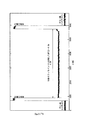
- FIG. 10 shows the measurement result of the hysteresis loss of the oxide superconducting conductor having a length of 5 m measured by the pickup coil method along the length direction. As shown in FIG.
- the hysteresis loss of the portion having a length of 4.8 m having the 10-divided structure is about 1/10 of the hysteresis loss of the portion having no divided structure. Since most of the AC loss of the oxide superconducting conductor is a hysteresis loss, the result shown in FIG. 11 can be considered as a change in the AC loss. It can be seen that the AC loss of the portion formed to have a multifilament structure with a ten-part structure can be reduced to about 1/10 compared to the unprocessed portions at both ends of the oxide superconducting conductor.
- Example 5 An oxide superconducting wire with stabilized copper was tested using an excimer laser to form a multifilament structure.
- an appropriate etching solution for etching the oxide superconducting wire with stabilized copper has not been found in the state of the art, so that Cu metal is formed on the Ag metal stabilizing layer.
- the method that does not perform chemical etching using an excimer laser is physical processing, it can be realized to form an oxide superconducting wire with stabilized copper so as to have a multifilament structure.
- An oxide superconducting wire in which a second metal stabilization layer of Cu having a thickness of 20 ⁇ m is laminated on a first metal stabilization layer of Ag having a thickness of 10 ⁇ m is equivalent to the above-described embodiment using an excimer laser.
- a thinning groove was formed at.
- the bottom surface of the thinned groove could be formed flat with an accuracy of ⁇ 0.5 ⁇ m.
- a thinning groove can be formed at the position of the cap layer with respect to the oxide superconducting wire with stabilized copper. It became clear that superconducting conductors can be manufactured.
- Example 6 From the oxide superconducting conductor produced in Example 1, an FIB (focused ion beam device) was used to cut out a cross-sectional observation sample of the filament around the thinning groove, and analysis was performed using EPMA as shown in the photograph of FIG.
- the portion described as the processed groove shown in the photograph of FIG. 11 corresponds to the thinned groove, and the portion described as Ag indicates the portion of the metal stabilizing layer.
- the portion described as Hastelloy (trade name of Haynes, USA) represents the base material, and the portion described as GdBCO and indicated by an arrow corresponds to the oxide superconducting layer.
- FIG. 11 shows the elemental analysis results (elemental analysis results for each element of Ag, Gd, Ba, Cu, Ce, O, Ni, and Cr) of a part of the thinned grooves (processed grooves). From the elemental analysis results shown in FIG. 11, it can be seen that Gd, Ba, Cu, Ce, and O are present on both inner wall portions of the thinning groove. When the analysis result of Ce is seen, Ce can be seen on the entire surface of the thinning groove. Since EPMA is information from secondary electrons generated by electrons that have penetrated to a depth of several ⁇ m, even if there is Ce on the surface, Ni and Co inside the thinned grooves are also detected.
- the detection of Ce indicates that the inner bottom surface (outermost surface) of the thinning groove is CeO 2 .
- the right inner wall portion of the thinned grooves is displayed thinner than the left inner wall portion. This is because the analysis method normally used for analyzing only the plane portion is applied to the groove, so that the inner wall portion on one side becomes difficult to be observed (becomes difficult to detect) depending on the position of the detector.
- Example 7 A part of the oxide superconducting conductor having a width of 5 mm and a 10-part structure prepared in Example 1 and the comparative example was cut out, and the peel strength of each oxide superconducting conductor was measured. For comparison, the peel strength of a sample obtained by irradiating and etching an oxide superconducting conductor produced by a MOD (Metal-organic deposition) method, instead of the PLD method performed when forming the cap layer, is used. was also measured. The oxide superconducting conductor by the MOD method is formed in the same manner as the oxide superconducting conductor of Example 1 from the base material to the cap layer, and the thickness of the oxide superconducting layer is 1.4 to 1.6 ⁇ m. Formed.
- a MOD Metal-organic deposition
- the oxide superconductor by the MOD method a sample in which an Ag metal stabilization layer having a thickness of 5 ⁇ m is formed as an Ag metal stabilization layer, and a sample in which an Ag metal stabilization layer having a thickness of 10 ⁇ m is formed.
- the oxide superconducting layer formed by the MOD method is formed by applying a gel film formed from yttrium trifluoroacetate, barium trifluoroacetate and copper trifluoroacetate (part of Cu is replaced with octylic acid) on the cap layer.
- the peel strength was improved in the oxide superconducting conductor formed by etchingless scribing in which a thinning groove was formed using an excimer laser.
- the scribing for forming the thinning groove by the excimer laser had a peel strength of 62 to 93 MPa in terms of area converted strength obtained by subtracting the area of the thinning groove.
- the peel strength of the oxide superconducting wire before processing is 60 to 90 MPa, it has been found that the peel strength after the formation of the thinning groove is hardly lowered in the scribing in which the thinning groove is formed by the excimer laser.
- the present invention relates to a technique capable of obtaining a multifilament type oxide superconducting conductor with low AC loss.
Landscapes
- Engineering & Computer Science (AREA)
- Manufacturing & Machinery (AREA)
- Chemical & Material Sciences (AREA)
- Ceramic Engineering (AREA)
- Superconductors And Manufacturing Methods Therefor (AREA)
Abstract
Priority Applications (3)
| Application Number | Priority Date | Filing Date | Title |
|---|---|---|---|
| JP2015519902A JP5994026B2 (ja) | 2013-05-28 | 2014-05-28 | 酸化物超電導導体およびその製造方法 |
| US14/894,404 US9824796B2 (en) | 2013-05-28 | 2014-05-28 | Oxide superconductor and method for manufacturing same |
| EP14804085.0A EP3007180B1 (fr) | 2013-05-28 | 2014-05-28 | Supraconducteur en oxyde et son procédé de fabrication |
Applications Claiming Priority (2)
| Application Number | Priority Date | Filing Date | Title |
|---|---|---|---|
| JP2013-112183 | 2013-05-28 | ||
| JP2013112183 | 2013-05-28 |
Publications (1)
| Publication Number | Publication Date |
|---|---|
| WO2014192806A1 true WO2014192806A1 (fr) | 2014-12-04 |
Family
ID=51988831
Family Applications (1)
| Application Number | Title | Priority Date | Filing Date |
|---|---|---|---|
| PCT/JP2014/064121 Ceased WO2014192806A1 (fr) | 2013-05-28 | 2014-05-28 | Oxyde supraconducteur et son procédé de fabrication |
Country Status (4)
| Country | Link |
|---|---|
| US (1) | US9824796B2 (fr) |
| EP (1) | EP3007180B1 (fr) |
| JP (1) | JP5994026B2 (fr) |
| WO (1) | WO2014192806A1 (fr) |
Families Citing this family (5)
| Publication number | Priority date | Publication date | Assignee | Title |
|---|---|---|---|---|
| DE112015001146T5 (de) * | 2014-03-07 | 2016-11-17 | Sumitomo Electric Industries, Ltd. | Supraleitender Oxid-Dünnfilmdraht und Verfahren zu seiner Herstellung |
| DE102016212355A1 (de) * | 2016-07-06 | 2018-01-11 | Fraunhofer-Gesellschaft zur Förderung der angewandten Forschung e.V. | Vorrichtung und Verfahren zum Herstellen eines Verbundkabels |
| KR102179595B1 (ko) * | 2016-09-07 | 2020-11-16 | 브룩해븐 테크놀로지 그룹, 인크. | 2세대 초전도체들을 릴-대-릴 박리하고 가공하는 방법 |
| US11903328B2 (en) | 2020-02-07 | 2024-02-13 | International Business Machines Corporation | Self assembled monolayer formed on a quantum device |
| KR20250050039A (ko) * | 2022-08-19 | 2025-04-14 | 수브라 에이/에스 | 종방향으로 분포된 초전도 소자를 포함하는 테이프 |
Citations (5)
| Publication number | Priority date | Publication date | Assignee | Title |
|---|---|---|---|---|
| JP2007141688A (ja) | 2005-11-18 | 2007-06-07 | Railway Technical Res Inst | 低交流損失酸化物超電導導体及びその製造方法 |
| US20090170708A1 (en) * | 2003-07-17 | 2009-07-02 | International Superconductivity Technology Center, The Juridicial Foundation | Superconducting wire and superconducting coil made therewith |
| JP2010282893A (ja) * | 2009-06-05 | 2010-12-16 | Fujikura Ltd | 超電導線材の製造方法 |
| JP2011181559A (ja) * | 2010-02-26 | 2011-09-15 | Fujitsu Ltd | 磁束トランス及び同軸立体型グラジオメータ |
| JP2013004457A (ja) * | 2011-06-21 | 2013-01-07 | Fujikura Ltd | 超電導線材およびその製造方法 |
Family Cites Families (2)
| Publication number | Priority date | Publication date | Assignee | Title |
|---|---|---|---|---|
| JPS6384789A (ja) * | 1986-09-26 | 1988-04-15 | Semiconductor Energy Lab Co Ltd | 光加工方法 |
| CN103069511B (zh) * | 2011-08-02 | 2015-04-01 | 古河电气工业株式会社 | 超导导体的制造方法、超导导体和超导导体用基板 |
-
2014
- 2014-05-28 WO PCT/JP2014/064121 patent/WO2014192806A1/fr not_active Ceased
- 2014-05-28 JP JP2015519902A patent/JP5994026B2/ja active Active
- 2014-05-28 US US14/894,404 patent/US9824796B2/en active Active
- 2014-05-28 EP EP14804085.0A patent/EP3007180B1/fr active Active
Patent Citations (5)
| Publication number | Priority date | Publication date | Assignee | Title |
|---|---|---|---|---|
| US20090170708A1 (en) * | 2003-07-17 | 2009-07-02 | International Superconductivity Technology Center, The Juridicial Foundation | Superconducting wire and superconducting coil made therewith |
| JP2007141688A (ja) | 2005-11-18 | 2007-06-07 | Railway Technical Res Inst | 低交流損失酸化物超電導導体及びその製造方法 |
| JP2010282893A (ja) * | 2009-06-05 | 2010-12-16 | Fujikura Ltd | 超電導線材の製造方法 |
| JP2011181559A (ja) * | 2010-02-26 | 2011-09-15 | Fujitsu Ltd | 磁束トランス及び同軸立体型グラジオメータ |
| JP2013004457A (ja) * | 2011-06-21 | 2013-01-07 | Fujikura Ltd | 超電導線材およびその製造方法 |
Non-Patent Citations (1)
| Title |
|---|
| See also references of EP3007180A4 |
Also Published As
| Publication number | Publication date |
|---|---|
| EP3007180A4 (fr) | 2016-05-18 |
| JPWO2014192806A1 (ja) | 2017-02-23 |
| US20160125977A1 (en) | 2016-05-05 |
| EP3007180B1 (fr) | 2018-04-04 |
| EP3007180A1 (fr) | 2016-04-13 |
| JP5994026B2 (ja) | 2016-09-21 |
| US9824796B2 (en) | 2017-11-21 |
Similar Documents
| Publication | Publication Date | Title |
|---|---|---|
| JP4777749B2 (ja) | 低交流損失酸化物超電導導体の製造方法 | |
| JP5994026B2 (ja) | 酸化物超電導導体およびその製造方法 | |
| JP2007141688A6 (ja) | 低交流損失酸化物超電導導体及びその製造方法 | |
| EP2495735A1 (fr) | Matériau de fil supraconducteur de type multifilament à faible perte en ca, et procédé de fabrication associé | |
| JP5695921B2 (ja) | 酸化物超電導線材の製造方法及び酸化物超電導線材 | |
| US20180358153A1 (en) | Oxide superconducting thin film wire and method for producing the same | |
| CN114144850A (zh) | 超导线材的制造 | |
| JP5701281B2 (ja) | 酸化物超電導線材 | |
| JP5830238B2 (ja) | 酸化物薄膜の製造方法 | |
| JP5597516B2 (ja) | 超電導線材の製造方法 | |
| JP5695431B2 (ja) | 酸化物超電導線材の製造方法 | |
| JP2015090803A (ja) | 酸化物超電導線材及び酸化物超電導線材の製造方法 | |
| JP2013196768A (ja) | 酸化物超電導線材の製造方法 | |
| JP6232450B2 (ja) | 酸化物超電導線材 | |
| JP6459149B2 (ja) | 薄膜酸化物超電導線材の製造方法 | |
| JP7847446B2 (ja) | 酸化物超電導線材、接続構造体、酸化物超電導線材の製造方法、及び接続構造体の製造方法 | |
| JP6609613B2 (ja) | 超電導線材の製造方法 | |
| JP2010282893A (ja) | 超電導線材の製造方法 | |
| JP2018106839A (ja) | 酸化物超電導線材およびその製造方法 | |
| WO2016072476A1 (fr) | Oxyde supraconducteur, fil supraconducteur et procédé de fabrication associé | |
| JP2017091681A (ja) | 薄膜酸化物超電導線材およびその製造方法 | |
| JP2019139883A (ja) | 超電導線材、超電導ケーブル及び超電導線材の製造方法 | |
| WO2022158413A1 (fr) | Fil supraconducteur à haute température et son procédé de fabrication | |
| JP2015026529A (ja) | 酸化物超電導線材 | |
| JP2017091680A (ja) | 薄膜酸化物超電導線材およびその製造方法 |
Legal Events
| Date | Code | Title | Description |
|---|---|---|---|
| 121 | Ep: the epo has been informed by wipo that ep was designated in this application |
Ref document number: 14804085 Country of ref document: EP Kind code of ref document: A1 |
|
| ENP | Entry into the national phase |
Ref document number: 2015519902 Country of ref document: JP Kind code of ref document: A |
|
| WWE | Wipo information: entry into national phase |
Ref document number: 14894404 Country of ref document: US |
|
| NENP | Non-entry into the national phase |
Ref country code: DE |
|
| WWE | Wipo information: entry into national phase |
Ref document number: 2014804085 Country of ref document: EP |