WO2014199455A1 - メマンチン経皮吸収型貼付製剤 - Google Patents
メマンチン経皮吸収型貼付製剤 Download PDFInfo
- Publication number
- WO2014199455A1 WO2014199455A1 PCT/JP2013/066158 JP2013066158W WO2014199455A1 WO 2014199455 A1 WO2014199455 A1 WO 2014199455A1 JP 2013066158 W JP2013066158 W JP 2013066158W WO 2014199455 A1 WO2014199455 A1 WO 2014199455A1
- Authority
- WO
- WIPO (PCT)
- Prior art keywords
- patch preparation
- carboxyl group
- memantine
- drug
- free carboxyl
- Prior art date
- Legal status (The legal status is an assumption and is not a legal conclusion. Google has not performed a legal analysis and makes no representation as to the accuracy of the status listed.)
- Ceased
Links
Classifications
-
- A—HUMAN NECESSITIES
- A61—MEDICAL OR VETERINARY SCIENCE; HYGIENE
- A61K—PREPARATIONS FOR MEDICAL, DENTAL OR TOILETRY PURPOSES
- A61K31/00—Medicinal preparations containing organic active ingredients
- A61K31/13—Amines
-
- A—HUMAN NECESSITIES
- A61—MEDICAL OR VETERINARY SCIENCE; HYGIENE
- A61K—PREPARATIONS FOR MEDICAL, DENTAL OR TOILETRY PURPOSES
- A61K9/00—Medicinal preparations characterised by special physical form
- A61K9/70—Web, sheet or filament bases ; Films; Fibres of the matrix type containing drug
- A61K9/7023—Transdermal patches and similar drug-containing composite devices, e.g. cataplasms
- A61K9/703—Transdermal patches and similar drug-containing composite devices, e.g. cataplasms characterised by shape or structure; Details concerning release liner or backing; Refillable patches; User-activated patches
- A61K9/7038—Transdermal patches of the drug-in-adhesive type, i.e. comprising drug in the skin-adhesive layer
-
- A—HUMAN NECESSITIES
- A61—MEDICAL OR VETERINARY SCIENCE; HYGIENE
- A61K—PREPARATIONS FOR MEDICAL, DENTAL OR TOILETRY PURPOSES
- A61K9/00—Medicinal preparations characterised by special physical form
- A61K9/70—Web, sheet or filament bases ; Films; Fibres of the matrix type containing drug
- A61K9/7023—Transdermal patches and similar drug-containing composite devices, e.g. cataplasms
- A61K9/703—Transdermal patches and similar drug-containing composite devices, e.g. cataplasms characterised by shape or structure; Details concerning release liner or backing; Refillable patches; User-activated patches
- A61K9/7038—Transdermal patches of the drug-in-adhesive type, i.e. comprising drug in the skin-adhesive layer
- A61K9/7046—Transdermal patches of the drug-in-adhesive type, i.e. comprising drug in the skin-adhesive layer the adhesive comprising macromolecular compounds
- A61K9/7053—Transdermal patches of the drug-in-adhesive type, i.e. comprising drug in the skin-adhesive layer the adhesive comprising macromolecular compounds obtained by reactions only involving carbon to carbon unsaturated bonds, e.g. polyvinyl, polyisobutylene, polystyrene
- A61K9/7061—Polyacrylates
-
- A—HUMAN NECESSITIES
- A61—MEDICAL OR VETERINARY SCIENCE; HYGIENE
- A61P—SPECIFIC THERAPEUTIC ACTIVITY OF CHEMICAL COMPOUNDS OR MEDICINAL PREPARATIONS
- A61P25/00—Drugs for disorders of the nervous system
- A61P25/28—Drugs for disorders of the nervous system for treating neurodegenerative disorders of the central nervous system, e.g. nootropic agents, cognition enhancers, drugs for treating Alzheimer's disease or other forms of dementia
Definitions
- the present invention relates to a memantine transdermal absorption patch preparation, and more particularly to a memantine transdermal absorption patch preparation that can effectively prevent a decrease in memantine content due to volatilization.
- Memantine is an N-methyl-D-aspartate (NMDA) receptor inhibitor and is currently used as a therapeutic agent for Alzheimer-type dementia in clinical settings.
- NMDA N-methyl-D-aspartate
- the NMDA receptor is involved in the development of neurotoxicity by glutamate, and inhibition of this receptor by memantine can suppress the loss of neurons in patients with Alzheimer-type dementia and delay the progression of the disease state It is said that.
- Memantine preparations currently on the market are memantine hydrochloride tablets, which are prescribed to Alzheimer type dementia patients under trade names such as “Namenda” and “MEMARY”.
- Patent Documents 1 to 3 are examples of patients with Alzheimer-type dementia.
- Patent Document 1 discloses a transdermal preparation containing memantine or a pharmaceutically acceptable salt thereof in an adhesive composition such as an acrylic polymer or a rubber polymer.
- Patent Document 1 discloses that when memantine is used as a pharmaceutically acceptable acid addition salt, a memantine acid addition salt is added by adding a base to the preparation in order to obtain high skin permeability of memantines. It is described that it is preferable to add them.
- Patent Documents 2 and 3 describe a so-called reservoir-type transdermal therapeutic system in which an adhesive layer is combined with an active substance layer containing an active ingredient such as memantine hydrochloride in a polymer matrix such as polyacrylate or silicone polymer. Is disclosed. Among these, Patent Document 3 describes that when a pharmaceutically acceptable salt of memantine is contained, a base such as an organic base or an inorganic base is contained in order to make memantine free base. .
- memantine which is an oral preparation
- memantine hydrochloride is water-soluble, it is extremely difficult to dissolve in oily adhesives such as acrylic adhesives and rubber adhesives that are commonly used as adhesive bases in transdermal patch preparations. It is. Furthermore, even if memantine hydrochloride can be dissolved in the oil-based adhesive, there is a problem that the memantine salt crystallizes and precipitates over time.
- the present inventors tried to produce a memantine-containing transdermal absorption patch preparation using memantine hydrochloride as a drug and adopting a matrix type that is relatively easy to produce than the reservoir type and has a low production cost. It was found that in the state of commercially available memantine hydrochloride as it is, crystals were deposited in the drug-containing pressure-sensitive adhesive layer, causing problems such as a decrease in adhesive strength and a decrease in percutaneous absorption.
- a matrix-type transdermal absorption patch preparation in which memantine hydrochloride is further neutralized with a base, etc., and crystal precipitation of memantine hydrochloride is suppressed during production or preparation, and the transdermal absorbability of memantine is improved. Attempting to manufacture, it was found that in this case, another problem of reduction in drug content due to volatilization of memantine (free body) occurred.
- the present invention has been made in the above circumstances, and its problem is a matrix-type transdermal absorption patch preparation containing memantine or a pharmaceutically acceptable salt thereof, which suppresses volatilization of memantine at the time of manufacture.
- the object is to provide a transdermal absorption patch preparation.
- the present inventors have conducted intensive research. As a result, the above-mentioned problems can be solved by including a pressure-sensitive adhesive composition containing a free carboxyl group and / or a phenolic hydroxyl group in the drug-containing layer. The inventors have found that this can be solved and completed the present invention.
- the present invention relates to a percutaneously absorbable patch preparation comprising at least a support, a drug-containing layer and a release liner, and memantine or a pharmaceutically acceptable salt thereof, a free carboxyl group and / or a phenolic substance in the drug-containing layer.
- a transdermally absorbable patch preparation comprising a pressure-sensitive adhesive composition containing a hydroxyl group.
- the present invention also provides the transdermal absorption, wherein the drug-containing layer contains at least one adhesive base selected from the group consisting of a rubber-based adhesive base, an acrylic polymer, and a silicone-based polymer as a base component. It is a mold patch preparation.
- the present invention is the above-mentioned transdermal patch preparation containing a memantine mixture of a pharmaceutically acceptable salt and a base as memantine.
- the present invention provides a drug comprising a support and memantine or a pharmaceutically acceptable salt thereof and a pressure-sensitive adhesive composition containing a free carboxyl group and / or a phenolic hydroxyl group on the skin of an Alzheimer type dementia patient.
- a method for delaying the progression of Alzheimer-type dementia comprising pasting a transdermal absorption patch preparation comprising a containing layer.
- the percutaneous absorption type patch preparation of the present invention is a patch preparation that can improve the difficulty in taking due to dysphagia, which is a problem with oral preparations, by applying it to the skin of a patient.
- a certain amount of free carboxyl group and / or phenolic hydroxyl group is contained in the drug-containing layer of the patch preparation against the decrease in memantine content due to volatilization of memantine (free form) during production
- the present inventors have found for the first time that it is effective to contain a pressure-sensitive adhesive composition. As a result, it was possible to produce a preparation with no decrease in content with good reproducibility, and it was possible to store the preparation for a long time.
- the transdermally absorbable patch preparation of the present invention includes that the blood concentration of memantine can be controlled, and it can be easily administered in a smaller amount than necessary for the development of drug efficacy and side effects. Even if an undesirable effect appears, the administration can be stopped immediately by removing the patch preparation. Therefore, the transdermally absorbable patch preparation of the present invention is an excellent preparation from the viewpoint of safety as compared with oral preparations and the like.
- the transdermal absorption type patch preparation of the present invention is a matrix type preparation composed of at least a support, a drug-containing layer and a release liner.
- memantine or a pharmaceutically acceptable salt thereof as an active ingredient and a pressure-sensitive adhesive composition containing a free carboxyl group and / or a phenolic hydroxyl group are contained in the drug-containing layer.
- the transdermal absorption patch preparation is a medical adhesive patch preparation, which is attached to the skin and means that a therapeutically effective amount of an active ingredient reaches the bloodstream through the skin.
- Memantine used as an active ingredient in the drug-containing layer of the transdermally absorbable patch preparation of the present invention has the chemical name 1-amino-3,5-dimethyladamantane. As described above, the compound is used as a therapeutic agent for Alzheimer-type dementia in clinical settings.
- Examples of the pharmaceutically acceptable salt of memantine include acid addition salts of memantine and inorganic acid or organic acid, and hydrochloride, hydrobromide, nitrate, phosphate, sulfate, acetate, Ascorbate, benzoate, cinnamate, citrate, formate, fumarate, glutamate, lactate, maleate, malate, malonate, mandelate, methanesulfonate ( Mesylate), phthalate, salicylate, stearate, succinate, tartrate, propionate, butyrate, pamoate, p-toluenesulfonate (tosylate), etc. Is not to be done.
- the pharmaceutically acceptable salt of memantine may be used, or a memantine free form may be used.
- memantine hydrochloride is a drug that has been used as an oral preparation for suppressing the progression of dementia symptoms in Alzheimer-type dementia, and is preferable.
- the drug-containing layer of the patch preparation of the present invention must contain a therapeutically effective amount of memantine or a pharmaceutically acceptable salt thereof.
- a certain amount of the active ingredient in the drug-containing layer is added. It is important to include.
- the drug concentration in the pressure-sensitive adhesive layer of the patch preparation of the present invention is about 1 to 50% by mass (hereinafter simply referred to as “%”), preferably 5 to 40%, based on the whole pressure-sensitive adhesive layer. If it is less than 1%, the therapeutic effect may not be sufficient. If it is more than 50%, the content of the pressure-sensitive adhesive constituting the pressure-sensitive adhesive layer may be low, and sufficient skin adhesiveness may not be obtained. It is also economically disadvantageous.
- a memantic acid addition salt can be neutralized by adding a base in advance during the preparation of the patch preparation or in the preparation.
- a base and neutralizing the acid addition salt of memantine By adding a base and neutralizing the acid addition salt of memantine as described above, free memantine can be obtained, and crystal precipitation derived from memantine such as memantine acid addition salt can be suppressed.
- the base used for this purpose include potassium hydroxide, sodium hydroxide, calcium hydroxide, magnesium hydroxide, organic amine derivatives (such as diethylamine) and the like, which are generally used as neutralizing agents. Among them, sodium hydroxide is more preferable.
- the required amounts of memantine hydrochloride and sodium hydroxide are added to the transdermal patch of the present invention. It is preferable to mix just before manufacture.
- the blending amount of the base may be an amount that can suppress the precipitation of crystals derived from memantine, and is preferably 0.1 to 10%, preferably 0.9 to 8% with respect to the entire pressure-sensitive adhesive layer. More preferably.
- the drug-containing layer of the patch preparation of the present invention contains a carboxyl group in a free state (hereinafter referred to as “free carboxyl group”) and / or a phenolic hydroxyl group in order to suppress memantine volatilization during production or in the preparation.
- An adhesive composition (hereinafter referred to as “carboxyl group-containing adhesive composition”) is contained.
- this carboxyl group-containing pressure-sensitive adhesive composition is not particularly limited, it is generally one or two materials such as a pressure-sensitive adhesive component, a tackifier, a plasticizer, and an excipient that are generally used for pressure-sensitive adhesives. It is preferable to be comprised by the above.
- carboxyl group-containing pressure-sensitive adhesive composition examples include pressure-sensitive adhesive compositions containing an acrylic polymer, a tackifying resin, a rubber-based pressure-sensitive adhesive component, and the like, and among them, an acrylic pressure-sensitive adhesive containing a free carboxyl group Or a (meth) acrylic acid copolymer containing a free carboxyl group, a rosin resin containing a free carboxyl group and / or a phenolic hydroxyl group, a maleic acid resin, a phenol resin or a modified product thereof, and a rubber system containing a free carboxyl group
- an adhesive component is preferable, it is not particularly limited to these, and one or more of these are used.
- the acrylic pressure-sensitive adhesive containing the free carboxyl group (hereinafter sometimes referred to as “carboxyl group-containing acrylic pressure-sensitive adhesive”) is at least a (meth) acrylic acid ester having a free carboxyl group in the side chain in the monomer structural unit. It is not particularly limited as long as it is a polymer or copolymer having one kind of constituent monomer.
- (meth) acrylic acid / (meth) alkyl acrylate copolymer examples include alkyl acrylate / vinyl acetate copolymer, and specifically acrylic acid / 2-ethylhexyl acrylate copolymer, acrylic acid / butyl acrylate copolymer, acrylic acid / octyl acrylate copolymer , Acrylic acid / acrylic acid-2-ethylhexyl / vinyl acetate copolymer, methyl acrylate / methacrylic acid Copolymers, n- butyl methacrylate copolymer, acrylic acid, methacrylic acid-methyl methacrylate copolymer and the like.
- DURO-TAK acrylic pressure-sensitive adhesive series (manufactured by Henkel Japan), carboxyl group-containing types (DURO-TAK (registered trademark) 87-2194, 87-2052, 87 -2051, 87-2054, 87-2777, 87-2196, 87-2825 (acrylic acid / vinyl acetate copolymer), 87-235A, 87-2353, 87-207A, 87-2100, 87-210A, 87 -2852 (acrylic acid polymer), etc.) and hydroxyl group / carboxyl group-containing type (DURO-TAK (registered trademark) 87-2979 (acrylic acid / vinyl acetate copolymer), 87-2074 (acrylic acid polymer), etc.) , HiPAS10, HiPAS-MS10, HiPAS-HGA and MASCOS10 Cosmetics di Pharmaceutical Co., Ltd.), and the like.
- the (meth) acrylic acid copolymer containing the free carboxyl group (hereinafter sometimes referred to as “carboxyl group-containing (meth) acrylic acid copolymer”) has a free carboxyl group on the side chain in the monomer structural unit.
- the copolymer is not particularly limited as long as it is a copolymer having at least one (meth) acrylic ester contained therein as a constituent monomer.
- the tackifying resin containing a free carboxyl group and / or a phenolic hydroxyl group (hereinafter sometimes referred to as “carboxyl group / hydroxyl group-containing tackifying resin”) is not particularly limited thereto.
- pine crystal series of ultra-light rosin ester (KE-311 (acid value 2 to 10), KE-100 (acid value 2 to 10), KE-359 (acid value 10 to 20).
- KE-604 (acid number 230 to 245), KR-85 (acid number 165 to 175), KR-612 (acid number 165 to 175), KR-614 (acid number 170 to 180), etc.)
- maleic acid Resin marquide series No.
- the above-mentioned rubber-based adhesive component containing a free carboxyl group (hereinafter sometimes referred to as “carboxyl group-containing rubber-based adhesive component”) is not particularly limited, but liquid polybutadiene, liquid poly Liquid rubbers such as isoprene and liquid polybutene, synthetic rubbers such as acrylonitrile / butadiene rubber, block copolymers, natural rubbers and the like can be used.
- an acid value measuring method can be used as a method of confirming content of the free carboxyl group and / or phenolic hydroxyl group in an adhesive composition.
- the acid value measurement method is performed by the following method according to the method of the Japanese Pharmacopoeia.
- About 1 to 3 g of the sample is accurately weighed in a 100 mL Erlenmeyer flask and dissolved in about 40 mL of a mixed solution of ethanol / toluene (1: 2). Titrate with 0.5 mol / L potassium hydroxide (ethanol solution) using phenolphthalein as an indicator. When the slight red color does not disappear for 30 seconds, the end point of neutralization is set, and the acid value is calculated by the following formula.
- Acid value (a ⁇ f ⁇ 28.05) / sample (g) a: Titration volume of 0.5 mol / L potassium hydroxide (ethanol solution) (mL) f: Potency of 0.5 mol / L potassium hydroxide (ethanol solution)
- the carboxyl group-containing pressure-sensitive adhesive composition used in the patch preparation of the present invention preferably has an acid value of 2 or more measured by the above method.
- the content thereof is preferably 4 to 99%, more preferably 11 to 95% with respect to the drug-containing layer. If it is less than 4%, the memantine volatilization inhibitory effect may not be observed, while if it exceeds 99%, the therapeutic effect of memantine may not be sufficient.
- the content thereof is preferably 0.1 to 30%, more preferably 1 to 15% with respect to the drug-containing layer. Range. If it is less than 0.1%, the memantine volatilization inhibitory effect may not be observed, while if it exceeds 30%, it may be difficult to maintain good physical properties of the patch preparation.
- the content thereof is preferably 0.4 to 70%, more preferably 2 to 50% with respect to the drug-containing layer. It is. If it is less than 0.4%, the memantine volatilization inhibitory effect may not be observed. On the other hand, if it exceeds 70%, it may be difficult to maintain good physical properties of the patch preparation.
- the transdermal patch preparation of the present invention is a matrix-type patch preparation comprising a support and a release liner in addition to the above-mentioned drug-containing layer. Since the matrix-type patch preparation is easy to design and is not a complicated structure like a reservoir-type patch preparation, the cost for manufacturing the patch preparation can be reduced.
- the carboxyl group-containing pressure-sensitive adhesive composition used in the patch preparation of the present invention includes the above-described carboxyl group-containing acrylic pressure-sensitive adhesive, carboxyl group-containing (meth) acrylic acid copolymer, carboxyl group / hydroxyl group-containing tackifier resin, and carboxyl group-containing
- the rubber-based pressure-sensitive adhesive component can be prepared by combining one or two or more of them and, if necessary, adding another pressure-sensitive adhesive component or another tackifier and homogenizing it.
- a release-controlling film or the like may be formed on the skin-attached side of the drug-containing layer in order to control the percutaneous absorption of the active ingredient.
- adhesive components that can be used in the preparation of the adhesive preparation of the present invention for the preparation of a pressure-sensitive adhesive composition containing a carboxyl group and the like include rubber-based adhesive components, acrylic polymers, and silicone polymers that are generally used in adhesive preparations. 1 type selected from these, or a combination of two or more types.
- rubber-based adhesive components include styrene / isoprene / styrene block copolymers, styrene / butadiene / styrene block copolymers, styrene / butadiene rubber, polyisobutylene, polybutene, polybutene, which do not contain free carboxyl groups.
- styrene / isoprene / styrene block copolymers styrene / butadiene / styrene block copolymers
- styrene / butadiene rubber polyisobutylene
- polybutene polybutene
- One or two or more types selected from isoprene, butyl rubber, natural rubber, synthetic rubber and isoprene rubber can be used, and these can be used.
- a polymer containing at least one (meth) acrylic ester other than an acrylic polymer containing a free carboxyl group or a copolymer thereof can be used.
- DURO-TAK registered trademark
- Acrylic pressure-sensitive adhesive series produced by Henkel Japan
- DURO-TAK registered trademark
- Functional group-free type DURO-TAK (registered trademark) 87-900A, 87-901A, 87-9301, 87-4098, 87-9086, etc.
- MAS811B manufactured by Cosmed Pharmaceutical
- Eudragit registered trademark
- acrylic acid Copolymer series Evonik Degussa Japan
- Udragit (R) E100, EPO, RL100, RLP0 can be used RS100,
- silicone polymer examples include polysiloxane derivatives (for example, silicon polymers such as polydimethylsiloxane and amine-resistant polydimethylsiloxane).
- examples of other tackifiers used in the preparation of a carboxyl group-containing pressure-sensitive adhesive composition include, for example, a glycerin ester of rosin that does not contain a free carboxyl group and / or a phenolic hydroxyl group, and a glycerin ester of a hydrogenated rosin.
- Rosin derivatives maleic resin, phenolic resin, petroleum resin, terpene resin, epoxy resin, urethane resin, polyester resin, ketone formamide resin, cresol resin, xylene resin, diallyl phthalate resin, styrene resin, guanamine resin, acrylic resin, polyolefin Resin or modified products thereof, carnauba wax, carmellose sodium, xanthan gum, chitosan, glycerin, magnesium aluminum silicate, light anhydrous silicic acid, benzyl acetate, talc, hydroxyethyl cellulose Scan, hydroxypropyl cellulose, hypromellose, polyacrylic acid, sodium polyacrylate, partially neutralized polyacrylic acid, polyvinyl alcohol and the like.
- the amount of other tackifiers to be blended is 0 to 47% with respect to the drug-containing layer in consideration of sufficient skin adhesion.
- the drug-containing layer of the medicated patch of the present invention is preferably a non-aqueous system that does not substantially contain water.
- the drug-containing layer in the patch preparation of the present invention may contain a plasticizer, an excipient, a cross-linking agent, a colorant, an ultraviolet absorber, You may mix
- Plasticizers include petroleum oils such as paraffinic process oil, naphthenic process oil, aromatic process oil, liquid fatty acid esters such as isopropyl myristate, hexyl laurate, diethyl sebacate, diisopropyl sebacate, and isopropyl linoleate.
- excipients include acrylic acid copolymers, water-soluble polymers such as polyvinylpyrrolidone, starch derivatives such as cyclodextrin, saccharides such as sorbitol, cellulose derivatives such as hydroxypropylcellulose, talc, titanium dioxide, and the like.
- crosslinking agent examples include thermosetting resins such as amino resins, phenol resins, epoxy resins, alkyd resins, and unsaturated polyesters, isocyanate compounds, organic crosslinking agents, and inorganic crosslinking agents such as metals or metal compounds.
- Colorants include indigo carmine, yellow iron oxide, yellow iron sesquioxide, carbon black, caramel, photosensitive element 201, Kumazasa extract, black iron oxide, ketket, zinc oxide, titanium oxide, iron sesquioxide, amaranth, hydroxide
- Examples thereof include sodium, talc, copper chlorophyllin sodium, green leaf extract, d-borneol, octyldodecyl myristate, methyl rosaniline chloride, methylene blue, manganese ammonium phosphate, and rose oil.
- UV absorbers include amino acid compounds such as urocanic acid, benzophenone compounds such as 2,4-dihydroxybenzophenone and 2-hydroxy-4-n-octoxybenzophenone, cinnamic acid such as sinoxate and diethanolamine p-methoxycinnamate.
- amino acid compounds such as urocanic acid
- benzophenone compounds such as 2,4-dihydroxybenzophenone and 2-hydroxy-4-n-octoxybenzophenone
- cinnamic acid such as sinoxate and diethanolamine p-methoxycinnamate.
- cyanoacrylate derivatives such as 2-ethylhexyl-2-cyano-3,3'-diphenylacrylate
- p-aminobenzoic acid derivatives such as ethyl p-aminobenzoate and propyl p-aminobenzoate, anthranilate menthyl ester, etc.
- Anthranilic acid derivatives such as phenyl salicylate and p-octylphenyl salicylate, and coumarin derivatives such as 7-ethylamino-4-methylcoumarin and 7,8-dihydroxycoumarin.
- Antioxidants include phenolic antioxidants, ascorbic acid, its ester derivatives, sodium bisulfite, sodium pyrosulfite, sodium edetate, citric acid, potassium diisocyanurate, soybean lecithin, thymol, tocopherol and its ester derivatives 1,3-butylene glycol, benzotriazole, monothioglycerin and the like.
- the percutaneous absorption enhancer may be any compound that has been conventionally recognized to have an absorption promoting effect upon transdermal administration.
- alkanolamines such as diisopropanolamine and triisopropanolamine, isopropyl myristate, octyldodecyl myristate , Fatty acid esters such as glycerin oleic acid monoester and hexadecyl isostearate, alcohols such as oleyl alcohol, propylene glycol and polyethylene glycol monooleate or ethers thereof, sorbitan such as sorbitan monolaurate and sorbitan monooleate Esters or ethers, phenol ethers such as polyoxyethylene nonylphenyl ether, polyoxyethylene octylphenyl ether, castor oil
- ionic surfactants such as hydrogenated castor oil, oleoyl sarcosine, lauryl dimethylamin
- the blending amount is in the range of 0.1 to 15%, preferably 1 to 10% with respect to the drug-containing layer. If it is less than 0.1%, the skin permeation promoting effect is not recognized, which is not preferable. If the amount exceeds 15%, skin irritation derived from the percutaneous absorption enhancer is likely to develop, and the physical properties of the preparation are lowered, resulting in a sticky feeling.
- examples of the support supporting the drug-containing layer include a drug-impermeable, stretchable or non-stretchable support.
- examples of such a support include, for example, polyethylene, polypropylene, polybutadiene, ethylene vinyl acetate copolymer, polyvinyl chloride, polyester (polyethylene terephthalate, etc.), nylon, polyurethane, and other synthetic resin films or sheets, or laminates thereof.
- Examples include porous bodies, foams, paper, woven fabrics, and nonwoven fabrics.
- a drug-impermeable release liner can be used as the release liner to be bonded to the drug-containing layer.
- the release liner include a film made of a polymer material such as polyethylene, polypropylene, and polyester, a film in which aluminum is vapor-deposited on a film, and a film in which silicone oil is coated on paper. .
- a polyester film is preferable from the viewpoints of no penetration of active ingredients, processability and low cost, and a polyethylene terephthalate (PET) film is particularly preferable.
- PET polyethylene terephthalate
- the release liner may be a laminate film obtained by bonding a plurality of materials.
- the said carboxyl group etc. containing adhesive composition used with this invention patch preparation has preferable adhesiveness, what has low adhesiveness can also be used.
- an adhesive layer may be added to the patch preparation separately.
- a release control film or the like may be formed on the skin-attached side of the drug-containing layer in order to control the percutaneous absorption of the active ingredient.
- the production of the patch preparation of the present invention is not particularly limited, and can be produced according to a known method.
- a preferable production method for producing the patch preparation of the present invention for example, the following methods can be mentioned. That is, an active ingredient such as memantine and a carboxyl group-containing pressure-sensitive adhesive composition, and if necessary, additional components such as a transdermal absorption enhancer are dissolved in an organic solvent such as ethyl acetate, hexane, toluene or a mixed solvent thereof, The dissolved product is spread on a release liner or a support, the solvent in the solution is evaporated to form a drug-containing layer, and finally the support or the release liner is bonded to the transdermal absorption type patch preparation.
- the method of obtaining can be mentioned.
- an adhesive component containing memantine and a carboxyl group as active ingredients and, if necessary, additional components such as a transdermal absorption enhancer are heated and melted, and this melt is then used as a release liner.
- a method of obtaining a patch preparation by spreading on a support and forming a drug-containing layer and then bonding the support or a release liner can be mentioned.
- the administration method of memantine using the patch preparation of the present invention described above is as follows. That is, the drug-containing layer side of the patch preparation may be attached to the skin of a patient with Alzheimer-type dementia and attached for a predetermined time. In this way, memantine is absorbed from the skin, which can delay the progression of Alzheimer's disease pathology in the patient.
- Example 1 According to the blending ratio shown in Table 1, a methanol solution of sodium hydroxide (0.12 g / mL) was added to memantine hydrochloride, and after stirring and mixing, DURO-TAK (registered trademark) 87-2194 (from Henkel Japan) Obtained) and DURO-TAK (registered trademark) 87-9301 were added and mixed by stirring to obtain a uniform dissolved product. Next, using a doctor knife coating machine, this melt is spread on a release film (silicone-treated PET film, manufactured by Fujimori Kogyo Co., Ltd.) so that the thickness after drying is 100 ⁇ m, and is dried. After the drug-containing layer was formed, a support (PET film, manufactured by Fujimori Kogyo) was bonded. Then, it was cut into a desired size to obtain a transdermal absorption patch preparation (Patch preparation 1).
- DURO-TAK registered trademark
- 87-2194 from Henkel Japan
- transdermal absorption patch preparations (Patch preparations 2 to 10) were obtained in the same manner as in Example 1.
- Example 11 According to the blending ratio shown in Table 2, a methanol solution of sodium hydroxide (0.12 g / mL) was added to memantine hydrochloride and mixed with stirring, and then DURO-TAK (registered trademark) 87-2194 was added and mixed with stirring. As a result, a uniform dissolved product was obtained. Next, this dissolved material is spread on a release film using a doctor knife coating machine so that the thickness after drying becomes 100 ⁇ m, and after drying to form a drug-containing layer, the support is bonded. It was. Then, it was cut into a desired size to obtain a transdermal absorption patch preparation (Patch preparation 11).
- DURO-TAK registered trademark
- transdermal absorption patch preparations (Patch preparations 12 to 16) were obtained in the same manner as in Example 11.
- Example 17 According to the blending ratio shown in Table 2, transdermal absorption type patch was applied in the same manner as in Example 1 except that DURO-TAK (registered trademark) 87-2194 was used instead of DURO-TAK (registered trademark) 87-2194. A preparation (Patch preparation 17) was obtained.
- Example 18 According to the blending ratio shown in Table 2, transdermal absorption type patch was applied in the same manner as Example 11 except that DURO-TAK (registered trademark) 87-2194 was used instead of DURO-TAK (registered trademark) 87-2194. A preparation (patch preparation 18) was obtained.
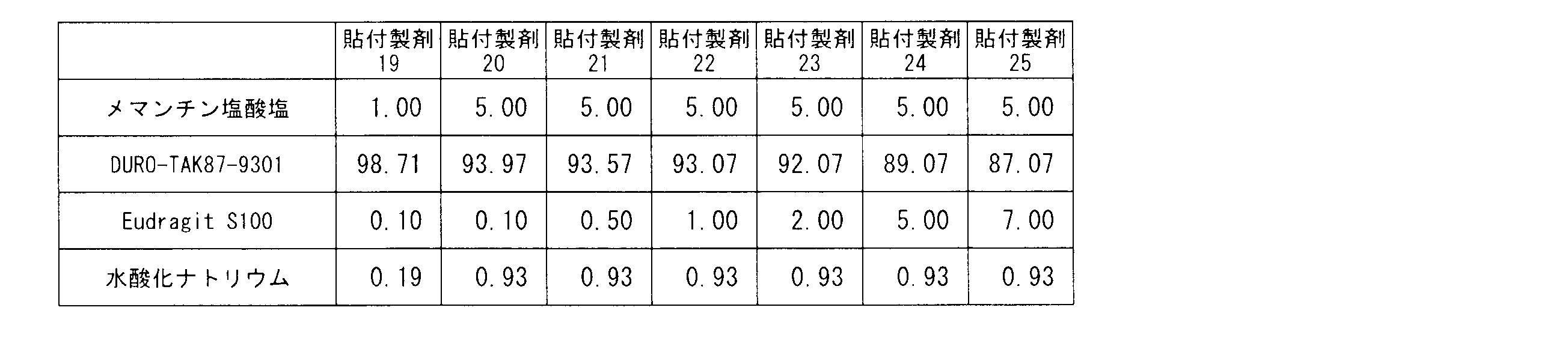
- Example 19 According to the blending ratio shown in Table 3, a methanol solution of sodium hydroxide (0.12 g / mL) was added to memantine hydrochloride, and after stirring and mixing, Eudragit (registered trademark) S100 (obtained from Evonik Degussa Japan) Of methanol (0.1 g / mL) was added and mixed with stirring. To this, DURO-TAK (registered trademark) 87-9301 was added and mixed by stirring to obtain a uniform dissolved product. Next, this dissolved material is spread on a release film using a doctor knife coating machine so that the thickness after drying becomes 100 ⁇ m, and after drying to form a drug-containing layer, the support is bonded. It was. Then, it was cut into a desired size to obtain a transdermal absorption patch preparation (Patch preparation 19).
- transdermal absorption patch preparations (Patch preparations 20 to 25) were obtained in the same manner as in Example 19.
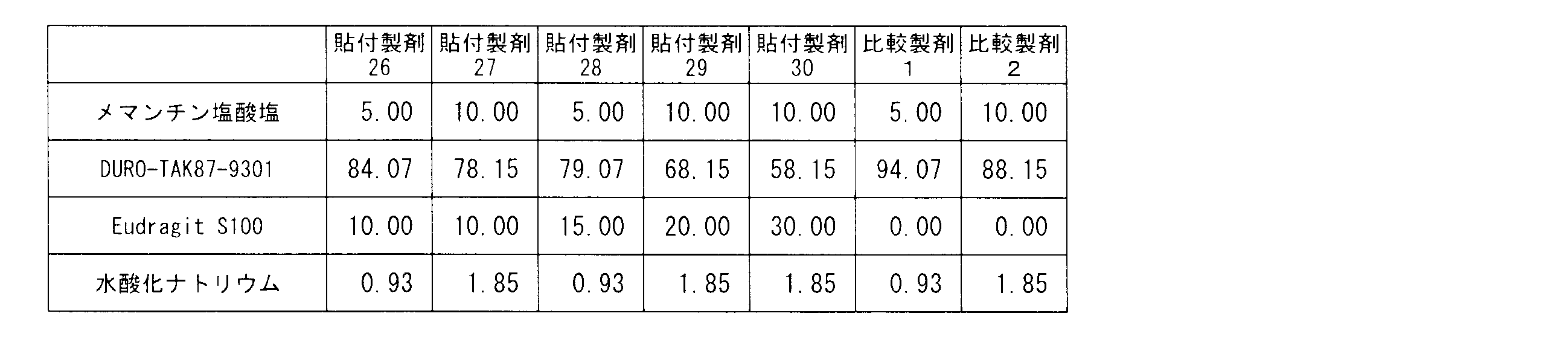
- transdermal absorption patch preparations (Patch preparations 26 to 30) were obtained in the same manner as in Example 19.
- Comparative Example 1 According to the blending ratio shown in Table 4, a methanolic solution of sodium hydroxide (0.12 g / mL) was added to memantine hydrochloride, and after stirring and mixing, DURO-TAK (registered trademark) 87-9301 was added and stirred and mixed. A homogeneous lysate was obtained. Next, this dissolved material was spread on a release film (silicone-treated PET film, manufactured by Fujimori Kogyo Co., Ltd.) using a doctor knife coating machine so that the thickness after drying was 100 ⁇ m, and dried. After the drug-containing layer was formed, a support (PET film, manufactured by Fujimori Kogyo) was bonded. Then, it was cut into a desired size to obtain a transdermal absorption patch preparation (Comparative preparation 1).
- a release film silicone-treated PET film, manufactured by Fujimori Kogyo Co., Ltd.
- Comparative Example 2 According to the blending ratio shown in Table 4, a transdermal absorption patch preparation (Comparative preparation 2) was obtained in the same manner as in Comparative Example 1.
- Example 31 According to the blending ratio shown in Table 5, a methanol solution of sodium hydroxide (0.12 g / mL) was added to memantine hydrochloride, and after stirring and mixing, a styrene-isoprene-styrene block copolymer (Clayton D-KX401CS, JSR) A pressure-sensitive adhesive prepared by stirring and mixing ultra-light rosin ester (Pine Crystal KE-311, acid value 2 to 10) in toluene was added and mixed by stirring to obtain a uniform dissolved product.
- a methanol solution of sodium hydroxide (0.12 g / mL) was added to memantine hydrochloride, and after stirring and mixing, a styrene-isoprene-styrene block copolymer (Clayton D-KX401CS, JSR)
- a pressure-sensitive adhesive prepared by stirring and mixing ultra-light rosin ester (Pine Crystal KE-311, acid
- this dissolved material is spread on a release film using a doctor knife coating machine so that the thickness after drying becomes 100 ⁇ m, and after drying to form a drug-containing layer, the support is bonded. It was. And it cut
- Example 32 According to the blending ratio shown in Table 5, a methanol solution of sodium hydroxide (0.12 g / mL) was added to memantine hydrochloride, and after stirring and mixing, styrene-isoprene-styrene block copolymer, polyisoprene (Nipol ( (Registered trademark) IR2200 (manufactured by Nippon Zeon), polybutene (HV-300F, manufactured by JX Nippon Mining & Energy) and ultralight rosin ester (Pine Crystal KE-311, acid value 2 to 10) in toluene with stirring and mixing Were added and mixed with stirring to obtain a uniform dissolved product.
- Nipol (Registered trademark) IR2200 (manufactured by Nippon Zeon)
- HV-300F polybutene
- ultralight rosin ester Pine Crystal KE-311, acid value 2 to 10.
- this dissolved material is spread on a release film using a doctor knife coating machine so that the thickness after drying becomes 100 ⁇ m, and after drying to form a drug-containing layer, the support is bonded. It was. And it cut
- transdermal absorption patch preparations (Patch preparations 33 and 34) were obtained in the same manner as Example 32.
- Example 35 According to the blending ratio shown in Table 5, after adding methanol solution of sodium hydroxide (0.12 g / mL) to memantine hydrochloride and stirring and mixing, styrene-isoprene-styrene block copolymer, polyisoprene, polybutene, A pressure-sensitive adhesive in which acid-modified ultra-light rosin (Pine Crystal KE-604, acid value 230 to 245, Arakawa Chemical Industries) and alicyclic saturated hydrocarbon resin (Arcon P-100, Arakawa Chemical Industries) are stirred and mixed in toluene. The mixture was stirred and mixed to obtain a uniform dissolved product.
- acid-modified ultra-light rosin Pine Crystal KE-604, acid value 230 to 245, Arakawa Chemical Industries
- alicyclic saturated hydrocarbon resin Arcon P-100, Arakawa Chemical Industries
- this dissolved material is spread on a release film using a doctor knife coating machine so that the thickness after drying becomes 100 ⁇ m, and after drying to form a drug-containing layer, the support is bonded. It was. Then, it was cut into a desired size to obtain a transdermal absorption patch preparation (Patch preparation 35).
- Example 36 According to the blending ratio shown in Table 5, a transdermal absorption patch preparation (Patch preparation 36) was obtained in the same manner as in Example 35.
- Examples 37 and 38 In accordance with the blending ratios shown in Table 5, instead of ultra-light rosin ester (Pine Crystal KE-604, acid value 230-245), ultra-light rosin (Pine Crystal KR-85, acid value 165-175, Arakawa Chemical Industries) Except for the use, transdermal absorption patch preparations (Patch preparations 37 and 38) were obtained in the same manner as in Example 35.
- Examples 39 and 40 According to the blending ratio shown in Table 5, instead of ultra-light rosin ester (Pine Crystal KE-604, acid value 230 to 245), maleic resin (Marquide No. 33, acid value 290 to 320, Arakawa Chemical Industries) is used. Except for the above, transdermal absorption patch preparations (Patch preparations 39 and 40) were obtained in the same manner as in Example 35.
- transdermal absorption patch preparations (patent preparations 41 to 43) were obtained in the same manner as in Example 39.
- Examples 44 to 46 According to the blending ratio shown in Table 6, an alkylphenol resin (Tamanol 100S, acid value 85-100, Arakawa Chemical Industries) was used instead of ultra-light rosin ester (Pine Crystal KE-604, acid value 230-245). Except for the above, transdermal absorption patch preparations (patch preparations 44 to 46) were obtained in the same manner as in Example 35.
- Example 47 According to the blending ratio shown in Table 6, terpene phenol resin (Tamanol 803L, acid value 145 to 160, Arakawa Chemical Industries) was used instead of ultra-light rosin ester (Pine Crystal KE-604, acid value 230 to 245) Except for, a transdermal absorption patch preparation (Patch preparation 47) was obtained in the same manner as in Example 35.
- Example 48 According to the mixing ratio shown in Table 6, except that terpene phenol resin (Tamanol 803L, acid value 145 to 160) was used instead of ultra-light rosin ester (Pine Crystal KE-311, acid value 2 to 10) In the same manner as in Example 32, a transdermal absorption patch preparation (Patch preparation 48) was obtained.
- Example 49 According to the mixing ratio shown in Table 6, except that terpene phenol resin (Tamanol 803L, acid value 145 to 160) was used instead of ultra-light rosin ester (Pine Crystal KE-311, acid value 2 to 10) As in Example 31, a transdermal absorption patch preparation (Patch preparation 49) was obtained.
- Example 50 According to the blending ratio shown in Table 6, a transdermal absorption patch preparation (Patch preparation 50) was obtained in the same manner as in Example 48.
- Comparative Example 3 According to the blending ratio shown in Table 6, after adding a methanolic solution of sodium hydroxide (0.12 g / mL) to memantine hydrochloride and stirring and mixing, styrene-isoprene-styrene block copolymer, polyisoprene, polybutene and A pressure-sensitive adhesive prepared by stirring and mixing an alicyclic saturated hydrocarbon resin (Arcon P-100, Arakawa Chemical Industries) in toluene was added and mixed by stirring to obtain a uniform dissolved product. Next, this dissolved material is spread on a release film using a doctor knife coating machine so that the thickness after drying becomes 100 ⁇ m, and after drying to form a drug-containing layer, the support is bonded. It was. Then, it was cut into a desired size to obtain a transdermal absorption patch preparation (Comparative preparation 3).
- Example 51 Instead of DURO-TAK (registered trademark) 87-2194, DURO-TAK (registered trademark) 87-2051, 87-2054, 87-2677, 87-2196, 87-2825, 87-235A, 87-2353, 87- 207A, 87-2100, 87-210A, 87-2852, 87-2979, 87-2074, HiPAS10, HiPAS-MS10, HiPAS-HGA or MASCOS10 and corresponding transdermal absorption patch preparation as in Example 12 Get.
- DURO-TAK registered trademark
- 87-2051, 87-2054, 87-2677, 87-2196 87-2825, 87-235A, 87-2353, 87- 207A, 87-2100, 87-210A, 87-2852, 87-2979, 87-2074
- HiPAS10, HiPAS-MS10, HiPAS-HGA or MASCOS10 and
- Example 52 Using Eudragit (registered trademark) L100 instead of Eudragit (registered trademark) S100, the corresponding transdermal absorption patch preparation is obtained in the same manner as in Example 23.
- Example 53 Super light rosin ester (Pine Crystal KE-100, acid value 2-10) instead of super light rosin ester (Pine Crystal KE-604, acid value 230 to 245), Ultra light rosin ester (Pink Crystal KE-359, Acid value 10-20), ultra-light rosin (Pine Crystal KR-612, acid value 165-175), ultra-light rosin (Pine Crystal KR-614, acid value 170-180), styrene maleic resin (Alastar 700, acid) 175 to 200), polymerized rosin (Aradim R-140, acid value 140 or more), polymerized rosin (Aradim R-95, acid value 158 to 168) or rosin-modified phenol resin (Tamanol 135, oxidation 18 or less), The corresponding transdermal absorption patch preparation is obtained in the same manner as in Example 35.
- Test example 1 Patch preparations 2 to 10, Patch preparations 12 to 13, Patch preparations 17 to 18, Patch preparations 20 to 28, Patch preparations 32 to 33, Patch preparations 35 to 43, Patch preparations 45 to 46, and Comparative preparations 1 to 3 are as follows. The memantine content after storage for 2 days at room temperature was measured by the measurement method described above. The results are shown in Tables 7 and 8.
- the supernatant was quantified by post-column fluorescence derivatization high performance liquid chromatography using o-phthalaldehyde / N-acetylcysteine as a reaction reagent.
- the conditions for quantitative measurement are as follows.
- Test example 2 Patch preparations 2 to 10, Patch preparations 12 to 13, Patch preparations 17 to 18, Patch preparations 20 to 28, Patch preparations 32 to 33, Patch preparations 35 to 43, Patch preparations 45 to 47, Patch preparations 50 and Comparative preparations 1 to About 3, adhesive force was measured with the following method. These results are also shown in Tables 7 and 8.
- patch preparations 22 to 28 containing 1% or more of a carboxyl group-containing methacrylic acid copolymer (Eudragit (registered trademark) S100) with respect to the drug-containing layer have memantine content within ⁇ 4% of the theoretical value. Was within 1%.
- the carboxyl group / hydroxyl group-containing tackifier resin was tested using five types of tackifier resins having different acid values.
- a patch preparation 32 containing 2% or more of a carboxyl group / hydroxyl group-containing tackifier resin (Pine Crystal KE-311, Pine Crystal KE-604, Pine Crystal KR-85, Marquide No. 33 or Tamanol 100S) with respect to the drug-containing layer.
- patch preparations 35-38, patch preparations 41-43 and patch preparations 45-46 the memantine content was within ⁇ 5% of the theoretical value, and the variation was also within 1%.
- patch preparations 2 to 10, patch preparations 12 to 15, patch preparations 17 to 15 containing an adhesive composition containing a carboxyl group and / or a phenolic hydroxyl group were obtained.
- the adhesive preparations 20 to 28, the adhesive preparations 32 to 33, the adhesive preparations 35 to 43, the adhesive preparations 45 to 47, and the adhesive preparation 50 were generally good in adhesive strength.
- the physical properties of the patch preparation are impaired when a certain amount of a pressure-sensitive adhesive composition containing a free carboxyl group and / or a phenolic hydroxyl group is added to suppress memantine volatilization. Thus, it was revealed that a preparation having good adhesive strength was obtained.
- the transdermally absorbable patch preparation of the present invention is a matrix-type patch preparation containing memantine and a pressure-sensitive adhesive composition containing a free carboxyl group and / or a phenolic hydroxyl group. It is a new medicated patch that suppresses volatilization of memantine during storage or storage.
- the percutaneous absorption type patch preparation of the present invention can store the preparation for a long time, suppresses a decrease in adhesive strength over time, and has an effective pharmacological effect as an active ingredient. It can be used continuously. Therefore, the transdermal absorption patch preparation of the present invention is a preparation useful for suppressing the progression of dementia symptoms in Alzheimer's dementia.
Landscapes
- Health & Medical Sciences (AREA)
- Engineering & Computer Science (AREA)
- Bioinformatics & Cheminformatics (AREA)
- Veterinary Medicine (AREA)
- Medicinal Chemistry (AREA)
- Pharmacology & Pharmacy (AREA)
- Life Sciences & Earth Sciences (AREA)
- Animal Behavior & Ethology (AREA)
- General Health & Medical Sciences (AREA)
- Public Health (AREA)
- Dermatology (AREA)
- Chemical & Material Sciences (AREA)
- Epidemiology (AREA)
- Neurosurgery (AREA)
- Biomedical Technology (AREA)
- Neurology (AREA)
- Hospice & Palliative Care (AREA)
- Psychiatry (AREA)
- Chemical Kinetics & Catalysis (AREA)
- General Chemical & Material Sciences (AREA)
- Nuclear Medicine, Radiotherapy & Molecular Imaging (AREA)
- Organic Chemistry (AREA)
- Medicinal Preparation (AREA)
- Acyclic And Carbocyclic Compounds In Medicinal Compositions (AREA)
Abstract
メマンチンまたはその製薬上許容できる塩を含有する貼付製剤において、製造時のメマンチンの揮散を十分なレベルまで抑制した貼付剤を提供することを目的とし、支持体、薬物含有層および剥離ライナーからなる経皮吸収型貼付製剤において、該薬物含有層中にメマンチンまたはその製薬上許容できる塩と遊離のカルボキシル基および/またはフェノール性水酸基を含有する粘着剤組成物とを含有することを特徴とする経皮吸収型貼付製剤を提供する。
Description
本発明は、メマンチン経皮吸収型貼付製剤に関し、更に詳細には、揮散によるメマンチンの含量の低下を有効に防止することのできるメマンチンの経皮吸収型貼付製剤に関する。
メマンチンはN-メチル-D-アスパラギン酸(NMDA)受容体阻害薬であり、現在臨床の場においてアルツハイマー型認知症治療剤として使用されている。NMDA受容体は、グルタミン酸による神経細胞毒性の発現に関与しており、メマンチンにより本受容体を阻害することでアルツハイマー型認知症患者の神経細胞の脱落を抑制し、病態進行を遅延させることができるとされている。現在市販されているメマンチン製剤はメマンチン塩酸塩の錠剤であり、「Namenda」、「MEMARY」等の商品名でアルツハイマー型認知症患者に処方されている。
しかし、アルツハイマー型認知症患者は症状が進むと嚥下障害が認められ、経口剤での投薬が困難になることがあるため、メマンチンを含有する経皮吸収型貼付製剤の検討が試みられている(特許文献1~3)。
例えば、特許文献1では、アクリル系高分子またはゴム系の高分子等の粘着組成物中にメマンチンまたはその製薬上許容できる塩を含有させた経皮吸収型製剤が開示されている。そして、特許文献1には、メマンチンを薬学的に許容される酸付加塩として使用した場合、メマンチン類の高い皮膚透過性を得るために、製剤中に塩基を添加してメマンチン酸付加塩を中和させることが好ましいと記載されている。また、特許文献2および3には、ポリアクリレート、シリコーンポリマー等のポリマーマトリックスにメマンチン塩酸塩等の有効成分を含有させた活性物質層に粘着剤層を組み合わせた、いわゆるリザーバータイプの経皮治療システムが開示されている。このうち、特許文献3には、メマンチンの薬学的に許容される塩を含有する場合、メマンチンをフリーベース化するために、有機塩基、無機塩基等の塩基類を含有させることが記載されている。
ところで、市販の経口剤のメマンチンはフリー体ではなく、その塩酸塩として販売されている。しかし、メマンチン塩酸塩は水溶性のため、経皮吸収型貼付製剤において粘着基剤として一般的に使用されているアクリル系粘着剤やゴム系粘着剤等の油性粘着剤に溶解することが極めて困難である。さらに、たとえメマンチン塩酸塩を油性粘着剤に溶解することができたとしても、経時的にメマンチン塩が結晶化して析出するという問題がある。
また、酸付加塩の薬物をそのまま経皮等に適用した場合には吸収性が低くなる傾向があることが一般的に知られており、上記特許文献1~3記載の経皮吸収型貼付製剤のように、塩基等を使用して薬物のフリー体を形成し、該フリー体を経皮吸収させることが好ましいことも知られている。
本発明者らは、薬物としてメマンチン塩酸塩を用い、かつリザーバータイプよりも製造が比較的容易で、製造コストが低いマトリックスタイプを採用したメマンチン含有経皮吸収型貼付製剤の製造を試みたところ、市販のメマンチン塩酸塩そのままの状態では、薬物含有粘着剤層中に結晶が析出し、粘着力の低下や経皮吸収量の低下等の問題が発生することを知った。
そこで、さらにメマンチン塩酸塩を塩基等によって中和させ、製造中もしくは製剤中においてメマンチン塩酸塩の結晶析出を抑制し、メマンチンの経皮吸収性を改善させたマトリックスタイプの経皮吸収型貼付製剤の製造を試みたところ、この場合はメマンチン(フリー体)の揮散による薬物の含量低下という別の問題が生じることを知った。
本発明は、上記実情においてなされたものであり、その課題は、メマンチンまたはその製薬上許容できる塩を含有するマトリックスタイプの経皮吸収型貼付製剤であって、製造時のメマンチンの揮散を抑制した経皮吸収型貼付製剤を提供することにある。
上記課題を解決するため、本発明者らが鋭意研究を重ねた結果、遊離のカルボキシル基および/またはフェノール性水酸基を含有する粘着剤組成物を薬物含有層中に含有させることにより、上記課題を解決できることを見出し、本発明を完成させた。
すなわち本発明は、少なくとも支持体、薬物含有層および剥離ライナーからなる経皮吸収型貼付製剤において、該薬物含有層中にメマンチンまたはその製薬上許容できる塩と遊離型のカルボキシル基および/またはフェノール性水酸基を含有する粘着剤組成物とを含有することを特徴とする経皮吸収型貼付製剤である。
また本発明は、上記薬物含有層に、基剤成分としてゴム系粘着基剤、アクリル系高分子およびシリコーン系高分子よりなる群から選ばれた粘着基剤を少なくとも一種含有する上記の経皮吸収型貼付製剤である。
さらに本発明は、メマンチンの製薬上許容できる塩と塩基との混合物を、メマンチンとして含有する前記の経皮吸収型貼付製剤である。
さらにまた本発明は、アルツハイマー型認知症患者の皮膚に、支持体およびメマンチンまたはその製薬上許容できる塩と遊離型のカルボキシル基および/またはフェノール性水酸基を含有する粘着剤組成物とを含有する薬物含有層からなる経皮吸収型貼付製剤を貼付することを特徴とするアルツハイマー型認知症の病態進行を遅延させる方法である。
本発明の経皮吸収型貼付製剤は、患者の皮膚へ貼付することにより、経口剤で問題となっている嚥下障害による服用困難を改善できる貼付製剤である。該貼付製剤の研究において、製造時のメマンチン(フリー体)の揮散によるメマンチンの含量低下に対し、該貼付製剤の薬物含有層中に、一定量の遊離型カルボキシル基および/またはフェノール性水酸基を含有する粘着剤組成物を含有させることが有効であることを本発明者らが初めて見出した。そしてその結果、含量低下がない製剤を再現性よく製造することが可能となり、しかも長時間にわたって製剤の保存が可能になった。
本発明の経皮吸収型貼付製剤の利点としては、メマンチンの血中濃度がコントロールでき、薬効発現に必要でかつ副作用が発現するよりも少ない量を容易に投与できることが挙げられる。もし仮に望ましくない作用が発現した場合でも、貼付製剤を除去することにより直ちに投与を中止できる。したがって、本発明の経皮吸収型貼付製剤は、経口剤等と比較して安全性の点からも優れた製剤である。
本発明の経皮吸収型貼付製剤は、少なくとも支持体上、薬物含有層および剥離ライナーで構成されるマトリックスタイプの製剤である。そして、この製剤では、前記薬物含有層中に有効成分としてのメマンチンまたはその製薬上許容できる塩と遊離型のカルボキシル基および/またはフェノール性水酸基を含有する粘着剤組成物とを含むものである。なお本明細書において、経皮吸収型貼付製剤とは医療用粘着貼付製剤であり、皮膚上に貼付され、有効成分の治療有効量が皮膚を通して血流に到達されるものを意味する。
本発明の経皮吸収型貼付製剤(以下、「貼付製剤」ということがある)の薬物含有層に、有効成分として用いられるメマンチンは、その化学名が1-アミノ-3,5-ジメチルアダマンタンである化合物であり、前記の通り、現在臨床の場においてアルツハイマー型認知症治療剤として使用されているものである。このメマンチンの製薬上許容できる塩としては、例えば、メマンチンと無機酸または有機酸との酸付加塩が挙げられ、塩酸塩、臭化水素酸塩、硝酸塩、リン酸塩、硫酸塩、酢酸塩、アスコルビン酸塩、安息香酸塩、桂皮酸塩、クエン酸塩、ギ酸塩、フマル酸塩、グルタミン酸塩、乳酸塩、マレイン酸塩、リンゴ酸塩、マロン酸塩、マンデル酸塩、メタンスルホン酸塩(メシレート)、フタル酸塩、サリチル酸塩、ステアリン酸塩、コハク酸塩、酒石酸塩、プロピオン酸塩、酪酸塩、パモ酸塩、p-トルエンスルホン酸塩(トシレート)等が挙げられるが、これらに限定されるものではない。本発明の貼付製剤においては、上記メマンチンの製薬上許容できる塩を用いても、また、メマンチンのフリー体を用いてもよい。中でも、メマンチン塩酸塩は、経口剤としてアルツハイマー型認知症における認知症症状の進行抑制への使用実績がある薬物であり、好ましい。
本発明の貼付製剤の薬物含有層には、治療上有効な量のメマンチンまたはその製薬上許容できる塩を含有せしめることが必要である。アルツハイマー型認知症の進行抑制に有効な量の有効成分をアルツハイマー型認知症の患者へ長時間持続的に経皮投与させるため、本発明貼付製剤では、薬物含有層にある一定量の有効成分を含有させることが重要である。本発明貼付製剤の粘着剤層中の薬物濃度は、粘着剤層全体に対して1~50質量%(以下、単に「%」で示す)程度であり、好ましくは5~40%である。1%より少ないと治療効果が十分でないおそれがあり、50%より多いと、粘着剤層を構成する粘着剤の含有量が低くなり、十分な皮膚粘着性が得られない可能性があり、また経済的にも不利である。
本発明の貼付製剤においてメマンチンの製薬上許容できる塩を使用する場合には、該貼付製剤製造時あるいは製剤中に予め塩基を添加してメマンチン酸付加塩を中和させておくことができる。
上記のように塩基を含有させ、メマンチンの酸付加塩を中和することで、フリーのメマンチンとすることができ、メマンチン酸付加塩等のメマンチンに由来する結晶析出を抑制することができる。このために使用する塩基としては、例えば、水酸化カリウム、水酸化ナトリウム、水酸化カルシウム、水酸化マグネシウム、有機アミン誘導体(例えばジエチルアミン等)等、中和剤として一般的に使用されている塩基が挙げられるが、水酸化ナトリウムがより好ましい。特に、メマンチンのフリー体を効率よく生成し、さらに、メマンチンのフリー体の揮散を防止するためには、メマンチン塩酸塩と水酸化ナトリウムとの各必要量を、本発明の経皮吸収型貼付製剤の製造直前に混合することが好ましい。
上記塩基の配合量は、メマンチンに由来する結晶析出の抑制を可能とする量であれば良く、粘着剤層全体に対して0.1~10%であることが好ましく、0.9~8%であることがさらに好ましい。
本発明の貼付製剤の薬物含有層には、製造時もしくは製剤中でのメマンチンの揮散抑制のために遊離状態のカルボキシル基(以下、「遊離カルボキシル基」という)および/またはフェノール性水酸基を含有する粘着剤組成物(以下、「カルボキシル基等含有粘着剤組成物」という)を含有せしめる。このカルボキシル基等含有粘着剤組成物は、特に制約されるものではないが、一般に粘着剤に使用される、粘着成分、粘着付与剤、可塑剤、賦形剤等の材料の1種または2種以上により構成されることが好ましい。該カルボキシル基等含有粘着剤組成物の具体例としては、アクリル系高分子、粘着付与樹脂およびゴム系粘着成分等を含む粘着剤組成物が挙げられ、その中でも遊離カルボキシル基を含有するアクリル粘着剤や、遊離カルボキシル基を含有する(メタ)アクリル酸コポリマー、遊離カルボキシル基および/またはフェノール性水酸基を含有するロジン系樹脂、マレイン酸樹脂、フェノール樹脂またはその変性物、遊離カルボキシル基を含有するゴム系粘着成分が好ましいが、特にこれらに限定されるものではなく、これらの1種または2種以上が用いられる。
上記遊離カルボキシル基を含有するアクリル粘着剤(以下、「カルボキシル基含有アクリル粘着剤」ということがある)としては、モノマー構成単位中の側鎖に遊離カルボキシル基を有する(メタ)アクリル酸エステルの少なくとも一種を構成モノマーとする重合体または共重合体であれば特に限定されるものではなく、例えば、(メタ)アクリル酸・(メタ)アクリル酸アルキル共重合体、(メタ)アクリル酸・(メタ)アクリル酸アルキル・酢酸ビニル共重合体等が挙げられ、具体的にはアクリル酸・アクリル酸-2-エチルヘキシル共重合体、アクリル酸・アクリル酸ブチル共重合体、アクリル酸・アクリル酸オクチル共重合体、アクリル酸・アクリル酸-2-エチルヘキシル・酢酸ビニル共重合体、アクリル酸メチル・メタクリル酸共重合体、メタクリル酸・アクリル酸n-ブチル共重合体、メタクリル酸・メタクリル酸メチル共重合体等が挙げられる。また、これらの市販品の具体例としては、DURO-TAK(登録商標)アクリル粘着剤シリーズ(ヘンケルジャパン製)のカルボキシル基含有タイプ(DURO-TAK(登録商標)87-2194、87-2052、87-2051、87-2054、87-2677、87-2196、87-2825(アクリル酸・酢酸ビニル共重合体)、87-235A、87-2353、87-207A、87-2100、87-210A、87-2852(アクリル酸重合体)等)および水酸基/カルボキシル基含有タイプ(DURO-TAK(登録商標)87-2979(アクリル酸・酢酸ビニル共重合体)、87-2074(アクリル酸重合体)等)、HiPAS10、HiPAS-MS10、HiPAS-HGAおよびMASCOS10(コスメディ製薬製)等が挙げられる。
また、上記の遊離カルボキシル基を含有する(メタ)アクリル酸コポリマー(以下、「カルボキシル基含有(メタ)アクリル酸コポリマー」ということがある)としては、モノマー構成単位中の側鎖に遊離カルボキシル基を含有する(メタ)アクリル酸エステルの少なくとも一種を構成モノマーとする共重合体であれば特に限定されるものではなく、例えば、(メタ)アクリル酸・(メタ)アクリル酸アルキル共重合体、(メタ)アクリル酸・(メタ)アクリル酸アルキル・酢酸ビニル共重合体等が挙げられ、具体的にはアクリル酸・アクリル酸-2-エチルヘキシル共重合体、アクリル酸・アクリル酸ブチル共重合体、アクリル酸・アクリル酸オクチル共重合体、アクリル酸・アクリル酸-2-エチルヘキシル・酢酸ビニル共重合体、アクリル酸メチル・メタクリル酸共重合体、メタクリル酸・アクリル酸n-ブチル共重合体、メタクリル酸・メタクリル酸メチル共重合体等が挙げられる。また、これらの市販品の具体例としては、市販のオイドラギッド(Eudragit)(登録商標)アクリル酸コポリマーシリーズ(エボニックデグサジャパン製)のカルボキシル含有タイプ(Eudragit(登録商標)S100およびL100(メタクリル酸メチル共重合体、酸価180~200および300~330)等)等が挙げられる。
更に、上記の遊離カルボキシル基および/またはフェノール性水酸基を含有する粘着付与樹脂(以下、「カルボキシル基/水酸基含有粘着付与樹脂」ということがある)としては、特にそれらに限定されるものではないが、ロジン、ロジンのグリセリンエステル、水添ロジン、水添ロジンのグリセリンエステル等のロジン誘導体、マレイン酸樹脂、フェノール樹脂、石油樹脂、テルペン樹脂、エポキシ樹脂、ウレタン樹脂、ポリエステル樹脂、ケトンホルムアミド樹脂、クレゾール樹脂、キシレン樹脂、ジアリルフタレート樹脂、スチレン樹脂、グアナミン樹脂、アクリル樹脂、ポリオレフィン樹脂またはこれらの変性物を用いることができる。これらの市販品の具体例としては、超淡色ロジンエステルのパインクリスタルシリーズ(KE-311(酸価2~10)、KE-100(酸価2~10)、KE-359(酸価10~20)、KE-604(酸価230~245)、KR-85(酸価165~175)、KR-612(酸価165~175)、KR-614(酸価170~180)等)、マレイン酸樹脂のマルキードシリーズ(No.33(酸価290~320)等)、ロジンエステルのエステルガムシリーズおよびペンセルシリーズ、特殊ロジンエステルのスーパーエステルシリーズ、スチレンマレイン酸樹脂半エステルのアラスターシリーズ(700(酸価175~200))、重合ロジンのアラダイムシリーズ(R-140(酸価140以上)、R-95(酸価158~168))、アルキルフェノール樹脂のタマノルシリーズ(100S(酸価85~100)、200N(酸価50~110))、テルペンフェノール樹脂のタマノルシリーズ(803L(酸価45~60)、901(酸価60~90))、ロジン変性フェノール樹脂のタマノルシリーズ(135(酸価18以下)、340(酸価25以下))(何れも商品名、荒川化学工業製)等を挙げることができる。
更に、上記の遊離カルボキシル基を含有するゴム系粘着成分(以下、「カルボキシル基含有ゴム系粘着成分」ということがある)としては、特にそれらの限定されるものではないが、液状ポリブタジエン、液状ポリイソプレン、液状ポリブテン等の液状ゴム、アクリロニトリル・ブタジエンゴム等の合成ゴム、ブロックコポリマー、天然ゴム等を用いることができる。これらの市販品の具体例としては、マレイン酸変性ポリブタジエンゴムのRicon(登録商標)MAシリーズ(クレイバレー製)の低ビニルタイプ(Ricon(登録商標)130MA8(酸価46)、130MA13(酸価74)、130MA20(酸価120)、131MA5(酸価29)、131MA10(酸価57)、131MA17(酸価97)、131MA20(酸価114)、184MA6(酸価34)等)および高ビニルタイプ(Ricon(登録商標)156MA17(酸価97)等)、液状ゴムのクラプレン(登録商標)シリーズ(クラレ製)のイソプレン系(LIR-403、LIR-410、UC-203、UC-102等)、日石ポリブテン(JX日鉱日石エネルギー製)の無水マレイン酸変性ポリブテン(HV-100M、HV-300M等)、アクリロニトリル・ブタジエンゴムのNipol(登録商標)NBRシリーズ(日本ゼオン製)のカルボキシル基含有タイプ(Nipol(登録商標)1072J、DN631、NX775、DN601等)、液状ポリブタジエンのNISSO-PB(日本曹達製)GQシリーズ(GQ-1000(酸価4~8)、GQ-2000(酸価3~6)等)等が挙げられる。
なお、粘着剤組成物中の遊離カルボキシル基および/またはフェノール性水酸基の含有量を確認する方法として、酸価測定法を用いることができる。酸価測定法は日本薬局方の方法に準じて、次の方法で行う。試料約1~3gを100mLの三角フラスコに精秤し、エタノール/トルエン(1:2)の混合液約40mLで溶解する。フェノールフタレインを指示薬として、0.5mol/L水酸化カリウム(エタノール溶液)で滴定する。微紅色が30秒間消失しない時を中和の終点とし、次式で酸価を算出する。
酸価=(a×f×28.05) / 試料(g)
a: 0.5mol/L水酸化カリウム(エタノール溶液)の
滴定量(mL)
f: 0.5mol/L水酸化カリウム(エタノール溶液)の
力価
酸価=(a×f×28.05) / 試料(g)
a: 0.5mol/L水酸化カリウム(エタノール溶液)の
滴定量(mL)
f: 0.5mol/L水酸化カリウム(エタノール溶液)の
力価
本発明の貼付製剤において使用されるカルボキシル基等含有粘着剤組成物は、一般には上記方法で測定したその酸価が2以上のものであることが好ましい。
本発明の貼付製剤において、カルボキシル基含有アクリル粘着剤を使用する場合のその含有量は、薬物含有層に対して好ましくは4~99%、より好ましくは11~95%の範囲である。4%未満では、メマンチンの揮散抑制効果が認められない場合があり、一方、99%を越える量ではメマンチンの治療効果が十分でない場合がある。
また、本発明の貼付製剤において、カルボキシル基含有(メタ)アクリル酸コポリマーを使用する場合のその含有量は、薬物含有層に対して好ましくは0.1~30%、より好ましくは1~15%の範囲である。0.1%未満では、メマンチンの揮散抑制効果が認められない場合があり、一方、30%を越える量では、貼付製剤の物性を良好に保つのが困難な場合がある。
更に本発明の貼付製剤において、カルボキシル基/水酸基含有粘着付与樹脂を使用する場合のその含有量は、薬物含有層に対して好ましくは0.4~70%、より好ましくは2~50%の範囲である。0.4%未満では、メマンチンの揮散抑制効果が認められない場合があり、一方、70%を越える量では、貼付製剤の物性を良好に保つのが困難な場合がある。
本発明の経皮吸収型貼付製剤は、上記した薬物含有層の他、支持体および剥離ライナーからなるマトリックスタイプの貼付製剤である。該マトリックスタイプの貼付製剤は、製剤設計が容易であり、またリザーバータイプの貼付製剤のような複雑な構成ではないため、貼付製剤製造時のコストを低減することができる。
本発明の貼付製剤において使用するカルボキシル基等含有粘着剤組成物は、上記した、カルボキシル基含有アクリル粘着剤、カルボキシル基含有(メタ)アクリル酸コポリマー、カルボキシル基/水酸基含有粘着付与樹脂およびカルボキシル基含有ゴム系粘着成分を、その一種あるいは二種以上を組み合わせ、必要により他の粘着成分や他の粘着付与剤を加え、均一化することにより調製することができる。
なお、必要に応じ、有効成分の経皮吸収をコントロールするために、薬物含有層の皮膚貼付側に放出制御膜等を形成しても良い。
本発明貼付製剤において、カルボキシル基等含有粘着剤組成物の調製に使用できる他の粘着成分としては、貼付製剤において一般的に使用されているゴム系粘着成分、アクリル系高分子およびシリコーン系高分子が挙げられ、これらから選択された一種、または二種以上を組み合わせて配合することができる。
この粘着成分のうち、ゴム系粘着成分としては、遊離カルボキシル基を含有しないスチレン・イソプレン・スチレンブロック共重合体、スチレン・ブタジエン・スチレンブロック共重合体、スチレン・ブタジエンゴム、ポリイソブチレン、ポリブテン、ポリイソプレン、ブチルゴム、天然ゴム、合成ゴムおよびイソプレンゴムから選ばれた一種または二種以上が挙げられ、これらを使用することができる。
またアクリル系高分子としては、遊離カルボキシル基を含有するアクリル系高分子以外の(メタ)アクリル酸エステルを少なくとも一種含有する重合体またはその共重合体も使用でき、例えば市販のDURO-TAK(登録商標)アクリル粘着剤シリーズ(ヘンケルジャパン製)のヒドロキシル基含有タイプ(DURO-TAK(登録商標)87-202A、87-2510、87-208A、87-2287、87-4287、87-2516等)および官能基不含タイプ(DURO-TAK(登録商標)87-900A、87-901A、87-9301、87-4098、87-9086等)、MAS811B(コスメディ製薬製)、Eudragit(登録商標)アクリル酸コポリマーシリーズ(エボニックデグサジャパン製)のEudragit(登録商標)E100、EPO、RL100、RLP0、RS100、RSP0等を使用することができる。
さらにシリコーン系高分子としては、ポリシロキサンの誘導体(例えば、ポリジメチルシロキサン、アミン抵抗性ポリジメチルシロキサン等のシリコンポリマー等)等が挙げられる。
また、カルボキシル基等含有粘着剤組成物の調製に使用される他の粘着付与剤としては、例えば遊離カルボキシル基および/またはフェノール性水酸基を含有しないロジンのグリセリンエステル、および水添ロジンのグリセリンエステル等のロジン誘導体、マレイン酸樹脂、フェノール樹脂、石油樹脂、テルペン樹脂、エポキシ樹脂、ウレタン樹脂、ポリエステル樹脂、ケトンホルムアミド樹脂、クレゾール樹脂、キシレン樹脂、ジアリルフタレート樹脂、スチレン樹脂、グアナミン樹脂、アクリル樹脂、ポリオレフィン樹脂またはこれらの変性物、カルナウバロウ、カルメロースナトリウム、キサンタンガム、キトサン、グリセリン、ケイ酸マグネシウムアルミニウム、軽質無水ケイ酸、酢酸ベンジル、タルク、ヒドロキシエチルセルロース、ヒドロキシプロピルセルロース、ヒプロメロース、ポリアクリル酸、ポリアクリル酸ナトリウム、ポリアクリル酸部分中和物、ポリビニルアルコール等が挙げられる。
配合する他の粘着付与剤の量は、充分な皮膚接着性を考慮して、薬物含有層に対して0~47%である。
なお、本発明貼付製剤の薬物含有層は、実質的に水を配合しない非水系であることが好ましい。
本発明貼付製剤での薬物含有層には、上記有効成分とカルボキシル基等含有粘着剤組成物の他、必要に応じて、可塑剤、賦形剤、架橋剤、着色剤、紫外線吸収剤、抗酸化剤、吸収促進剤、香料等の追加の成分を配合してもよい。
可塑剤としては、パラフィン系プロセスオイル、ナフテン系プロセスオイル、芳香族系プロセスオイル等の石油系オイル、ミリスチン酸イソプロピル、ラウリン酸ヘキシル、セバシン酸ジエチル、セバシン酸ジイソプロピル、リノール酸イソプロピル等の液状脂肪酸エステル類、オリーブ油、ツバキ油、ひまし油、トール油、ラッカセイ油等の植物系オイル、液状ポリイソブチレン、液状ポリブテン、液状ポリイソプレン等の液状ゴム、グリセリン、クロロブタノール、酢酸ビニル樹脂、ジメチルポリシロキサン・二酸化ケイ素混合物、D-ソルビトール、中鎖脂肪酸トリグリセリド、トリアセチン、2-ピロリドン、フィトステロール、プロピレングリコール、ポリエチレングリコール、ポリソルベート80(登録商標)、モノステアリン酸グリセリン等が挙げられる。
賦形剤としては、アクリル酸コポリマー、ポリビニルピロリドン等の水溶性高分子、シクロデキストリン等のデンプン誘導体、ソルビトール等の糖類、ヒドロキシプロピルセルロース等のセルロース誘導体、タルク、二酸化チタン等が挙げられる。
架橋剤としては、アミノ樹脂、フェノール樹脂、エポキシ樹脂、アルキド樹脂、不飽和ポリエステル等の熱硬化性樹脂、イソシアネート化合物、有機系架橋剤、金属または金属化合物等の無機系架橋剤等が挙げられる。
着色剤としては、インジゴカルミン、黄酸化鉄、黄色三二酸化鉄、カーボンブラック、カラメル、感光素201号、クマザサエキス、黒酸化鉄、ケッケツ、酸化亜鉛、酸化チタン、三二酸化鉄、アマランス、水酸化ナトリウム、タルク、銅クロロフィリンナトリウム、ハダカムギ緑葉エキス末、d-ボルネオール、ミリスチン酸オクチルドデシル、メチルロザニリン塩化物、メチレンブルー、リン酸マンガンアンモニウム、ローズ油等が挙げられる。
紫外線吸収剤としては、ウロカニン酸等のアミノ酸系化合物、2,4-ジヒドロキシベンゾフェノン、2-ヒドロキシ-4-n-オクトキシベンゾフェノン等のベンゾフェノン系化合物、シノキサート、p-メトキシ桂皮酸ジエタノールアミン等の桂皮酸誘導体、2-エチルヘキシル-2-シアノ-3,3´-ジフェニルアクリレート等のシアノアクリレート誘導体、p-アミノ安息香酸エチル、p-アミノ安息香酸プロピル等のp-アミノ安息香酸誘導体、アントラニル酸メンチルエステル等のアントラニル酸誘導体、フェニルサリシレート、p-オクチルフェニルサリシレート等のサリチル酸誘導体、7-エチルアミノ-4-メチルクマリン、7,8-ジヒドロキシクマリン等のクマリン誘導体等が挙げられる。
抗酸化剤としては、フェノール系抗酸化剤、アスコルビン酸、そのエステル誘導体、亜硫酸水素ナトリウム、ピロ亜硫酸ナトリウム、エデト酸ナトリウム、クエン酸、ジクロイソシアヌール酸カリウム、大豆レシチン、チモール、トコフェロールおよびそのエステル誘導体、1,3-ブチレングリコール、ベンゾトリアゾール、モノチオグリセリン等が挙げられる。
経皮吸収促進剤としては、従来経皮投与での吸収促進作用が認められている化合物のいずれでも良いが、例えばジイソプロパノールアミン、トリイソプロパノールアミン等のアルカノールアミン、ミリスチン酸イソプロピル、ミリスチン酸オクチルドデシル、グリセリンオレイン酸モノエステル、イソステアリン酸ヘキサデシル等の脂肪酸エステル類、オレイルアルコール、プロピレングリコール、モノオレイン酸ポリエチレングリコール等のアルコールまたはそのエステル類もしくはそのエーテル類、モノラウリン酸ソルビタン、モノオレイン酸ソルビタン等のソルビタンエステル類またはエーテル類、ポリオキシエチレンノニルフェニルエーテル、ポリオキシエチレンオクチルフェニルエーテル等のフェノールエーテル類、ヒマシ油または硬化ヒマシ油、オレオイルサルコシン、ラウリルジメチルアミノ酢酸ベタイン、ラウリル硫酸ナトリウム等のイオン性界面活性剤、ポリオキシエチレンオレイルエーテル、ポリオキシエチレンラウリルエーテル、ジメチルラウリルアミンオキサイド等の非イオン性界面活性剤、ジメチルスルホキサイド、デシルメチルスルホキサイド等のアルキルメチルスルホキサイド、2-ピロリドン、1-メチル-2-ピロリドン等のピロリドン類、1-ドデシルアザシクロヘプタン-2-オン、1-ゲラニルアザシクロヘプタン-2-オン等のアザシクロアルカン類、メントール、カンフル、リモネン等のテルペン類等が挙げられる。
本発明の貼付製剤に経皮吸収促進剤を配合する場合の配合量は、薬物含有層に対して0.1~15%、好ましくは1~10%の範囲である。0.1%未満では、皮膚透過促進効果が認められないため、好ましくない。15%を超える量では、経皮吸収促進剤に由来する皮膚刺激が発症し易くなると共に、製剤の物性が低下し、べたつき感が発生するため、好ましくない。
本発明貼付製剤において、上記薬物含有層を担持する支持体としては、薬物不透過性で伸縮性または非伸縮性の支持体を挙げることができる。このような支持体としては、例えば、ポリエチレン、ポリプロピレン、ポリブタジエン、エチレン酢酸ビニル共重合体、ポリ塩化ビニル、ポリエステル(ポリエチレンテレフタレート等)、ナイロン、ポリウレタン等の合成樹脂フィルムまたはシートあるいはこれらの積層体、多孔質体、発泡体、紙、織布および不織布等が挙げられる。
また、本発明の貼付製剤において、上記薬物含有層に貼り合わされる剥離ライナーとしては、薬物不透過性の剥離ライナーを使用することができる。該剥離ライナーとしては、例えば、ポリエチレン、ポリプロピレン、ポリエステル等の高分子材料で作られたフィルムや、フィルムにアルミニウムを蒸着させたもの、紙の上にシリコーンオイル等を塗付したもの等が挙げられる。なかでも、有効成分の透過がなく、加工性や低コスト等の点でポリエステルフィルムが好ましく、ポリエチレンテレフタレート(PET)フィルムが特に好ましい。さらに、該剥離ライナーは、複数の材料を貼り合わせたラミネートフィルム等を使用しても良い。
なお、本発明貼付製剤で使用する上記カルボキシル基等含有粘着剤組成物は、十分な粘着性を有するものであることが好ましいが、粘着性が低いものを使用することもできる。この場合は、皮膚への十分な接着性を与えるために別途貼付製剤中に粘着層を追加してもよい。また、必要に応じ、有効成分の経皮吸収をコントロールするために、薬物含有層の皮膚貼付側に放出制御膜等を形成しても良い。
本発明の貼付製剤の製造は、特に制限はなく、公知の方法に従って製造することができる。本発明貼付製剤を製造するための好ましい製造方法としては、例えば、次の方法を挙げることができる。すなわち、有効成分であるメマンチンおよびカルボキシル基等含有粘着剤組成物、さらに必要に応じて経皮吸収促進剤等の追加の成分を酢酸エチル、ヘキサン、トルエンまたはその混合溶媒の有機溶媒に溶解させ、この溶解物を剥離ライナーまたは支持体上に展延し、該溶解物中の溶媒を蒸発させ薬物含有層を形成し、最後に、支持体または剥離ライナーを貼り合わせることによって経皮吸収型貼付製剤を得る方法を挙げることができる。また、別の好ましい方法としては、有効成分であるメマンチンおよびカルボキシル基等含有粘着剤組成物、さらに必要に応じて経皮吸収促進剤等の追加の成分を加熱溶融させ、この溶融物を剥離ライナーまたは支持体上に展延し、薬物含有層を形成した後、支持体または剥離ライナーを貼り合わせることによって貼付製剤を得る方法を挙げることができる。
以上説明した本発明の貼付製剤を使用するメマンチンの投与方法は次の通りである。すなわち、アルツハイマー型認知症患者の皮膚に、貼付製剤の薬剤含有層側を貼付し、所定時間貼付すれば良い。こうすることによりメマンチンが皮膚から吸収され、これにより患者のアルツハイマー型認知症の病態進行を遅延させることが可能となるのである。
以下、実施例を示し、本発明をさらに具体的に説明するが、本発明はこれらの実施例に何ら制約されるものではなく、本発明の技術的思想を逸脱しない範囲での種々の変更が可能である。
実 施 例 1
表1に記載の配合比に従い、メマンチン塩酸塩に水酸化ナトリウムのメタノール溶液(0.12g/mL)を添加し、攪拌混合した後に、DURO-TAK(登録商標)87-2194(ヘンケルジャパン社から入手)およびDURO-TAK(登録商標)87-9301を加えて攪拌混合し、均一な溶解物を得た。次にこの溶解物を、ドクターナイフ塗工機を用いて、乾燥後の厚さが100μmになるように剥離フィルム(シリコーン処理を施したPETフィルム、藤森工業製)に展延し、乾燥して薬物含有層を形成した後、支持体(PETフィルム、藤森工業製)を貼り合せた。それから所望の大きさに裁断して経皮吸収型貼付製剤(貼付製剤1)を得た。
表1に記載の配合比に従い、メマンチン塩酸塩に水酸化ナトリウムのメタノール溶液(0.12g/mL)を添加し、攪拌混合した後に、DURO-TAK(登録商標)87-2194(ヘンケルジャパン社から入手)およびDURO-TAK(登録商標)87-9301を加えて攪拌混合し、均一な溶解物を得た。次にこの溶解物を、ドクターナイフ塗工機を用いて、乾燥後の厚さが100μmになるように剥離フィルム(シリコーン処理を施したPETフィルム、藤森工業製)に展延し、乾燥して薬物含有層を形成した後、支持体(PETフィルム、藤森工業製)を貼り合せた。それから所望の大きさに裁断して経皮吸収型貼付製剤(貼付製剤1)を得た。
実 施 例 2 ないし 10
表1に記載の配合比に従い、実施例1と同様として経皮吸収型貼付製剤(貼付製剤2~10)を得た。
表1に記載の配合比に従い、実施例1と同様として経皮吸収型貼付製剤(貼付製剤2~10)を得た。

実 施 例 11
表2に記載の配合比に従い、メマンチン塩酸塩に水酸化ナトリウムのメタノール溶液(0.12g/mL)を添加し、攪拌混合した後に、DURO-TAK(登録商標)87-2194を加えて攪拌混合し、均一な溶解物を得た。次にこの溶解物を、ドクターナイフ塗工機を用いて、乾燥後の厚さが100μmになるように剥離フィルムに展延し、乾燥して薬物含有層を形成した後、支持体を貼り合せた。それから所望の大きさに裁断して経皮吸収型貼付製剤(貼付製剤11)を得た。
表2に記載の配合比に従い、メマンチン塩酸塩に水酸化ナトリウムのメタノール溶液(0.12g/mL)を添加し、攪拌混合した後に、DURO-TAK(登録商標)87-2194を加えて攪拌混合し、均一な溶解物を得た。次にこの溶解物を、ドクターナイフ塗工機を用いて、乾燥後の厚さが100μmになるように剥離フィルムに展延し、乾燥して薬物含有層を形成した後、支持体を貼り合せた。それから所望の大きさに裁断して経皮吸収型貼付製剤(貼付製剤11)を得た。
実 施 例 12 ないし 16
表2に記載の配合比に従い、実施例11と同様として経皮吸収型貼付製剤(貼付製剤12~16)を得た。
表2に記載の配合比に従い、実施例11と同様として経皮吸収型貼付製剤(貼付製剤12~16)を得た。
実 施 例 17
表2に記載の配合比に従い、DURO-TAK(登録商標)87-2194の代わりにDURO-TAK(登録商標)87-2052を用いたことを除き、実施例1と同様として経皮吸収型貼付製剤(貼付製剤17)を得た。
表2に記載の配合比に従い、DURO-TAK(登録商標)87-2194の代わりにDURO-TAK(登録商標)87-2052を用いたことを除き、実施例1と同様として経皮吸収型貼付製剤(貼付製剤17)を得た。
実 施 例 18
表2に記載の配合比に従い、DURO-TAK(登録商標)87-2194の代わりにDURO-TAK(登録商標)87-2052を用いたことを除き、実施例11と同様として経皮吸収型貼付製剤(貼付製剤18)を得た。
表2に記載の配合比に従い、DURO-TAK(登録商標)87-2194の代わりにDURO-TAK(登録商標)87-2052を用いたことを除き、実施例11と同様として経皮吸収型貼付製剤(貼付製剤18)を得た。

実 施 例 19
表3に記載の配合比に従い、メマンチン塩酸塩に水酸化ナトリウムのメタノール溶液(0.12g/mL)を添加し、攪拌混合した後に、さらにEudragit(登録商標)S100(エボニックデグサジャパン社から入手)のメタノール溶液(0.1g/mL)を加え、攪拌混合した。これに、DURO-TAK(登録商標)87-9301を加え攪拌混合し、均一な溶解物を得た。次にこの溶解物を、ドクターナイフ塗工機を用いて、乾燥後の厚さが100μmになるように剥離フィルムに展延し、乾燥して薬物含有層を形成した後、支持体を貼り合せた。それから、所望の大きさに裁断して経皮吸収型貼付製剤(貼付製剤19)を得た。
表3に記載の配合比に従い、メマンチン塩酸塩に水酸化ナトリウムのメタノール溶液(0.12g/mL)を添加し、攪拌混合した後に、さらにEudragit(登録商標)S100(エボニックデグサジャパン社から入手)のメタノール溶液(0.1g/mL)を加え、攪拌混合した。これに、DURO-TAK(登録商標)87-9301を加え攪拌混合し、均一な溶解物を得た。次にこの溶解物を、ドクターナイフ塗工機を用いて、乾燥後の厚さが100μmになるように剥離フィルムに展延し、乾燥して薬物含有層を形成した後、支持体を貼り合せた。それから、所望の大きさに裁断して経皮吸収型貼付製剤(貼付製剤19)を得た。
実 施 例 20 ないし 25
表3に記載の配合比に従い、実施例19と同様として経皮吸収型貼付製剤(貼付製剤20~25)を得た。
表3に記載の配合比に従い、実施例19と同様として経皮吸収型貼付製剤(貼付製剤20~25)を得た。
実 施 例 26 ないし 30
表4に記載の配合比に従い、実施例19と同様として経皮吸収型貼付製剤(貼付製剤26~30)を得た。
表4に記載の配合比に従い、実施例19と同様として経皮吸収型貼付製剤(貼付製剤26~30)を得た。
比 較 例 1
表4に記載の配合比に従い、メマンチン塩酸塩に水酸化ナトリウムのメタノール溶液(0.12g/mL)を添加し、攪拌混合した後に、DURO-TAK(登録商標)87-9301を加え攪拌混合し、均一な溶解物を得た。次にこの溶解物を、ドクターナイフ塗工機を用いて、乾燥後の厚さが100μmになるように剥離フィルム(シリコーン処理を施したPETフィルム,藤森工業製)に展延し、乾燥して薬物含有層を形成した後、支持体(PETフィルム,藤森工業製)を貼り合せた。それから、所望の大きさに裁断して経皮吸収型貼付製剤(比較製剤1)を得た。
表4に記載の配合比に従い、メマンチン塩酸塩に水酸化ナトリウムのメタノール溶液(0.12g/mL)を添加し、攪拌混合した後に、DURO-TAK(登録商標)87-9301を加え攪拌混合し、均一な溶解物を得た。次にこの溶解物を、ドクターナイフ塗工機を用いて、乾燥後の厚さが100μmになるように剥離フィルム(シリコーン処理を施したPETフィルム,藤森工業製)に展延し、乾燥して薬物含有層を形成した後、支持体(PETフィルム,藤森工業製)を貼り合せた。それから、所望の大きさに裁断して経皮吸収型貼付製剤(比較製剤1)を得た。
比 較 例 2
表4に記載の配合比に従い、比較例1と同様として経皮吸収型貼付製剤(比較製剤2)を得た。
表4に記載の配合比に従い、比較例1と同様として経皮吸収型貼付製剤(比較製剤2)を得た。
実 施 例 31
表5に記載の配合比に従い、メマンチン塩酸塩に水酸化ナトリウムのメタノール溶液(0.12g/mL)を添加し、攪拌混合した後にスチレン-イソプレン-スチレンブロック共重合体(クレイトンD-KX401CS,JSRクレイトンエラストマー製)および超淡色ロジンエステル(パインクリスタルKE-311,酸価2~10)をトルエン中で攪拌混合した粘着剤を加え攪拌混合し、均一な溶解物を得た。次にこの溶解物を、ドクターナイフ塗工機を用いて、乾燥後の厚さが100μmになるように剥離フィルムに展延し、乾燥して薬物含有層を形成した後、支持体を貼り合せた。それから、所望の大きさに裁断して経皮吸収型貼付製剤(貼付製剤31)を得た。
表5に記載の配合比に従い、メマンチン塩酸塩に水酸化ナトリウムのメタノール溶液(0.12g/mL)を添加し、攪拌混合した後にスチレン-イソプレン-スチレンブロック共重合体(クレイトンD-KX401CS,JSRクレイトンエラストマー製)および超淡色ロジンエステル(パインクリスタルKE-311,酸価2~10)をトルエン中で攪拌混合した粘着剤を加え攪拌混合し、均一な溶解物を得た。次にこの溶解物を、ドクターナイフ塗工機を用いて、乾燥後の厚さが100μmになるように剥離フィルムに展延し、乾燥して薬物含有層を形成した後、支持体を貼り合せた。それから、所望の大きさに裁断して経皮吸収型貼付製剤(貼付製剤31)を得た。
実 施 例 32
表5に記載の配合比に従って、メマンチン塩酸塩に水酸化ナトリウムのメタノール溶液(0.12g/mL)を添加し、攪拌混合した後に、スチレン-イソプレン-スチレンブロック共重合体、ポリイソプレン(Nipol(登録商標)IR2200,日本ゼオン製)、ポリブテン(HV-300F,JX日鉱日石エネルギー製)および超淡色ロジンエステル(パインクリスタルKE-311,酸価2~10)をトルエン中で攪拌混合した粘着剤を加え攪拌混合し、均一な溶解物を得た。次にこの溶解物を、ドクターナイフ塗工機を用いて、乾燥後の厚さが100μmになるように剥離フィルムに展延し、乾燥して薬物含有層を形成した後、支持体を貼り合せた。それから、所望の大きさに裁断して経皮吸収型貼付製剤(貼付製剤32)を得た。
表5に記載の配合比に従って、メマンチン塩酸塩に水酸化ナトリウムのメタノール溶液(0.12g/mL)を添加し、攪拌混合した後に、スチレン-イソプレン-スチレンブロック共重合体、ポリイソプレン(Nipol(登録商標)IR2200,日本ゼオン製)、ポリブテン(HV-300F,JX日鉱日石エネルギー製)および超淡色ロジンエステル(パインクリスタルKE-311,酸価2~10)をトルエン中で攪拌混合した粘着剤を加え攪拌混合し、均一な溶解物を得た。次にこの溶解物を、ドクターナイフ塗工機を用いて、乾燥後の厚さが100μmになるように剥離フィルムに展延し、乾燥して薬物含有層を形成した後、支持体を貼り合せた。それから、所望の大きさに裁断して経皮吸収型貼付製剤(貼付製剤32)を得た。
実 施 例 33 および 34
表5に記載の配合比に従い、実施例32と同様として経皮吸収型貼付製剤(貼付製剤33および34)を得た。
表5に記載の配合比に従い、実施例32と同様として経皮吸収型貼付製剤(貼付製剤33および34)を得た。
実 施 例 35
表5に記載の配合比に従い、メマンチン塩酸塩に水酸化ナトリウムのメタノール溶液(0.12g/mL)を添加し、攪拌混合した後に、スチレン-イソプレン-スチレンブロック共重合体、ポリイソプレン、ポリブテン、酸変性超淡色ロジン(パインクリスタルKE-604,酸価230~245,荒川化学工業)および脂環族飽和炭化水素樹脂(アルコンP-100,荒川化学工業)をトルエン中で攪拌混合した粘着剤を加え攪拌混合し、均一な溶解物を得た。次にこの溶解物を、ドクターナイフ塗工機を用いて、乾燥後の厚さが100μmになるように剥離フィルムに展延し、乾燥して薬物含有層を形成した後、支持体を貼り合せた。それから、所望の大きさに裁断して経皮吸収型貼付製剤(貼付製剤35)を得た。
表5に記載の配合比に従い、メマンチン塩酸塩に水酸化ナトリウムのメタノール溶液(0.12g/mL)を添加し、攪拌混合した後に、スチレン-イソプレン-スチレンブロック共重合体、ポリイソプレン、ポリブテン、酸変性超淡色ロジン(パインクリスタルKE-604,酸価230~245,荒川化学工業)および脂環族飽和炭化水素樹脂(アルコンP-100,荒川化学工業)をトルエン中で攪拌混合した粘着剤を加え攪拌混合し、均一な溶解物を得た。次にこの溶解物を、ドクターナイフ塗工機を用いて、乾燥後の厚さが100μmになるように剥離フィルムに展延し、乾燥して薬物含有層を形成した後、支持体を貼り合せた。それから、所望の大きさに裁断して経皮吸収型貼付製剤(貼付製剤35)を得た。
実 施 例 36
表5に記載の配合比に従い、実施例35と同様として経皮吸収型貼付製剤(貼付製剤36)を得た。
表5に記載の配合比に従い、実施例35と同様として経皮吸収型貼付製剤(貼付製剤36)を得た。
実 施 例 37 および 38
表5に記載の配合比に従い、超淡色ロジンエステル(パインクリスタルKE-604,酸価230~245)の代わりに超淡色ロジン(パインクリスタルKR-85,酸価165~175,荒川化学工業)を用いたことを除き、実施例35と同様として経皮吸収型貼付製剤(貼付製剤37および38)を得た。
表5に記載の配合比に従い、超淡色ロジンエステル(パインクリスタルKE-604,酸価230~245)の代わりに超淡色ロジン(パインクリスタルKR-85,酸価165~175,荒川化学工業)を用いたことを除き、実施例35と同様として経皮吸収型貼付製剤(貼付製剤37および38)を得た。
実 施 例 39 および 40
表5に記載の配合比に従い、超淡色ロジンエステル(パインクリスタルKE-604,酸価230~245)の代わりにマレイン酸レジン(マルキードNo.33,酸価290~320,荒川化学工業)を用いたことを除き、実施例35と同様として経皮吸収型貼付製剤(貼付製剤39および40)を得た。
表5に記載の配合比に従い、超淡色ロジンエステル(パインクリスタルKE-604,酸価230~245)の代わりにマレイン酸レジン(マルキードNo.33,酸価290~320,荒川化学工業)を用いたことを除き、実施例35と同様として経皮吸収型貼付製剤(貼付製剤39および40)を得た。

実 施 例 41 ないし 43
表6に記載の配合比に従い、実施例39と同様として経皮吸収型貼付製剤(貼付製剤41~43)を得た。
表6に記載の配合比に従い、実施例39と同様として経皮吸収型貼付製剤(貼付製剤41~43)を得た。
実 施 例 44 ないし 46
表6に記載の配合比に従い、超淡色ロジンエステル(パインクリスタルKE-604,酸価230~245)の代わりにアルキルフェノール樹脂(タマノル100S,酸価85~100,荒川化学工業)を用いたことを除き、実施例35と同様として経皮吸収型貼付製剤(貼付製剤44~46)を得た。
表6に記載の配合比に従い、超淡色ロジンエステル(パインクリスタルKE-604,酸価230~245)の代わりにアルキルフェノール樹脂(タマノル100S,酸価85~100,荒川化学工業)を用いたことを除き、実施例35と同様として経皮吸収型貼付製剤(貼付製剤44~46)を得た。
実 施 例 47
表6に記載の配合比に従い、超淡色ロジンエステル(パインクリスタルKE-604,酸価230~245)の代わりにテルペンフェノール樹脂(タマノル803L,酸価145~160,荒川化学工業)を用いたことを除き、実施例35と同様として経皮吸収型貼付製剤(貼付製剤47)を得た。
表6に記載の配合比に従い、超淡色ロジンエステル(パインクリスタルKE-604,酸価230~245)の代わりにテルペンフェノール樹脂(タマノル803L,酸価145~160,荒川化学工業)を用いたことを除き、実施例35と同様として経皮吸収型貼付製剤(貼付製剤47)を得た。
実 施 例 48
表6に記載の配合比に従い、超淡色ロジンエステル(パインクリスタルKE-311,酸価2~10)の代わりにテルペンフェノール樹脂(タマノル803L,酸価145~160)を用いたことを除き、実施例32と同様として経皮吸収型貼付製剤(貼付製剤48)を得た。
表6に記載の配合比に従い、超淡色ロジンエステル(パインクリスタルKE-311,酸価2~10)の代わりにテルペンフェノール樹脂(タマノル803L,酸価145~160)を用いたことを除き、実施例32と同様として経皮吸収型貼付製剤(貼付製剤48)を得た。
実 施 例 49
表6に記載の配合比に従い、超淡色ロジンエステル(パインクリスタルKE-311,酸価2~10)の代わりにテルペンフェノール樹脂(タマノル803L,酸価145~160)を用いたことを除き、実施例31と同様として経皮吸収型貼付製剤(貼付製剤49)を得た。
表6に記載の配合比に従い、超淡色ロジンエステル(パインクリスタルKE-311,酸価2~10)の代わりにテルペンフェノール樹脂(タマノル803L,酸価145~160)を用いたことを除き、実施例31と同様として経皮吸収型貼付製剤(貼付製剤49)を得た。
実 施 例 50
表6に記載の配合比に従い、実施例48と同様として経皮吸収型貼付製剤(貼付製剤50)を得た。
表6に記載の配合比に従い、実施例48と同様として経皮吸収型貼付製剤(貼付製剤50)を得た。
比 較 例 3
表6に記載の配合比に従って、メマンチン塩酸塩に水酸化ナトリウムのメタノール溶液(0.12g/mL)を添加し、攪拌混合した後に、スチレン-イソプレン-スチレンブロック共重合体、ポリイソプレン、ポリブテンおよび脂環族飽和炭化水素樹脂(アルコンP-100,荒川化学工業)をトルエン中で攪拌混合した粘着剤を加え攪拌混合し、均一な溶解物を得た。次にこの溶解物を、ドクターナイフ塗工機を用いて、乾燥後の厚さが100μmになるように剥離フィルムに展延し、乾燥して薬物含有層を形成した後、支持体を貼り合せた。それから、所望の大きさに裁断して経皮吸収型貼付製剤(比較製剤3)を得た。
表6に記載の配合比に従って、メマンチン塩酸塩に水酸化ナトリウムのメタノール溶液(0.12g/mL)を添加し、攪拌混合した後に、スチレン-イソプレン-スチレンブロック共重合体、ポリイソプレン、ポリブテンおよび脂環族飽和炭化水素樹脂(アルコンP-100,荒川化学工業)をトルエン中で攪拌混合した粘着剤を加え攪拌混合し、均一な溶解物を得た。次にこの溶解物を、ドクターナイフ塗工機を用いて、乾燥後の厚さが100μmになるように剥離フィルムに展延し、乾燥して薬物含有層を形成した後、支持体を貼り合せた。それから、所望の大きさに裁断して経皮吸収型貼付製剤(比較製剤3)を得た。

実 施 例 51
DURO-TAK(登録商標)87-2194の代わりにDURO-TAK(登録商標)87-2051、87-2054、87-2677、87-2196、87-2825、87-235A、87-2353、87-207A、87-2100、87-210A、87-2852、87-2979、87-2074、HiPAS10、HiPAS-MS10、HiPAS-HGAあるいはMASCOS10を用い、実施例12と同様として対応する経皮吸収型貼付製剤を得る。
DURO-TAK(登録商標)87-2194の代わりにDURO-TAK(登録商標)87-2051、87-2054、87-2677、87-2196、87-2825、87-235A、87-2353、87-207A、87-2100、87-210A、87-2852、87-2979、87-2074、HiPAS10、HiPAS-MS10、HiPAS-HGAあるいはMASCOS10を用い、実施例12と同様として対応する経皮吸収型貼付製剤を得る。
実 施 例 52
Eudragit(登録商標)S100の代わりにEudragit(登録商標)L100を用い、実施例23と同様として対応する経皮吸収型貼付製剤を得る。
Eudragit(登録商標)S100の代わりにEudragit(登録商標)L100を用い、実施例23と同様として対応する経皮吸収型貼付製剤を得る。
実 施 例 53
超淡色ロジンエステル(パインクリスタルKE-604、酸価230~245)の代わりに超淡色ロジンエステル(パインクリスタルKE-100、酸価2~10)、超淡色ロジンエステル(パインクリルタルKE-359、酸価10~20)、超淡色ロジン(パインクリスタルKR-612、酸価165~175)、超淡色ロジン(パインクリスタルKR-614、酸価170~180)、スチレンマレイン酸樹脂(アラスター700、酸価175~200)、重合ロジン(アラダイムR-140、酸価140以上)、重合ロジン(アラダイムR-95、酸価158~168)あるいはロジン変性フェノール樹脂(タマノル135、酸化18以下)を用い、実施例35と同様として対応する経皮吸収型貼付製剤を得る。
超淡色ロジンエステル(パインクリスタルKE-604、酸価230~245)の代わりに超淡色ロジンエステル(パインクリスタルKE-100、酸価2~10)、超淡色ロジンエステル(パインクリルタルKE-359、酸価10~20)、超淡色ロジン(パインクリスタルKR-612、酸価165~175)、超淡色ロジン(パインクリスタルKR-614、酸価170~180)、スチレンマレイン酸樹脂(アラスター700、酸価175~200)、重合ロジン(アラダイムR-140、酸価140以上)、重合ロジン(アラダイムR-95、酸価158~168)あるいはロジン変性フェノール樹脂(タマノル135、酸化18以下)を用い、実施例35と同様として対応する経皮吸収型貼付製剤を得る。
試 験 例 1
貼付製剤2~10、貼付製剤12~13、貼付製剤17~18、貼付製剤20~28、貼付製剤32~33、貼付製剤35~43、貼付製剤45~46および比較製剤1~3について、以下の測定方法で室温下、2日間保存後のメマンチンの含量を測定した。この結果を表7および8に示す。
貼付製剤2~10、貼付製剤12~13、貼付製剤17~18、貼付製剤20~28、貼付製剤32~33、貼付製剤35~43、貼付製剤45~46および比較製剤1~3について、以下の測定方法で室温下、2日間保存後のメマンチンの含量を測定した。この結果を表7および8に示す。
< メマンチン含量測定 >
各製剤の薬剤含有層部分を5cm2に裁断した後、この部分の剥離ライナーを剥がし、50mLの遠心沈殿管に取った。これにテトラヒドロフラン10mLを加え、20分間振とうし、薬物含有層部分(膏体部分)を完全に溶解させた。この液にメタノール/水(2:1,v/v)10mLを加え、20分間振とうし、粘着基剤成分を凝集、沈殿させた。この上澄液を、o-フタルアルデヒド/N-アセチルシステインを反応試薬とするポストカラム蛍光誘導体化高速液体クロマトグラフィーで定量した。定量測定の条件は下記の通りである。
各製剤の薬剤含有層部分を5cm2に裁断した後、この部分の剥離ライナーを剥がし、50mLの遠心沈殿管に取った。これにテトラヒドロフラン10mLを加え、20分間振とうし、薬物含有層部分(膏体部分)を完全に溶解させた。この液にメタノール/水(2:1,v/v)10mLを加え、20分間振とうし、粘着基剤成分を凝集、沈殿させた。この上澄液を、o-フタルアルデヒド/N-アセチルシステインを反応試薬とするポストカラム蛍光誘導体化高速液体クロマトグラフィーで定量した。定量測定の条件は下記の通りである。
( 定量条件 )
カラム: 内径4.6mm、長さ10cmのステンレス管に3μmの液体クロマトグラフィー用オクタデシルシリル化シリカゲルを充てんする。
カラム温度: 40℃
励起波長: 340nm
蛍光波長: 445nm
移動相: 水/アセトニトリル/トリフルオロ酢酸(1500:
500:1,v/v)
カラム: 内径4.6mm、長さ10cmのステンレス管に3μmの液体クロマトグラフィー用オクタデシルシリル化シリカゲルを充てんする。
カラム温度: 40℃
励起波長: 340nm
蛍光波長: 445nm
移動相: 水/アセトニトリル/トリフルオロ酢酸(1500:
500:1,v/v)
試 験 例 2
貼付製剤2~10、貼付製剤12~13、貼付製剤17~18、貼付製剤20~28、貼付製剤32~33、貼付製剤35~43、貼付製剤45~47、貼付製剤50および比較製剤1~3について、以下の方法で粘着力を測定した。これらの結果も表7および8に示す。
貼付製剤2~10、貼付製剤12~13、貼付製剤17~18、貼付製剤20~28、貼付製剤32~33、貼付製剤35~43、貼付製剤45~47、貼付製剤50および比較製剤1~3について、以下の方法で粘着力を測定した。これらの結果も表7および8に示す。
< 粘着力測定 >
各貼付製剤の製造直後にその剥離ライナーを剥離し、薬物含有層を指で触った際の粘着力を評価した(指タック試験)。粘着力が良好な製剤を○、粘着力がやや弱い製剤を△、粘着力が極めて弱い製剤を×とした。
各貼付製剤の製造直後にその剥離ライナーを剥離し、薬物含有層を指で触った際の粘着力を評価した(指タック試験)。粘着力が良好な製剤を○、粘着力がやや弱い製剤を△、粘着力が極めて弱い製剤を×とした。
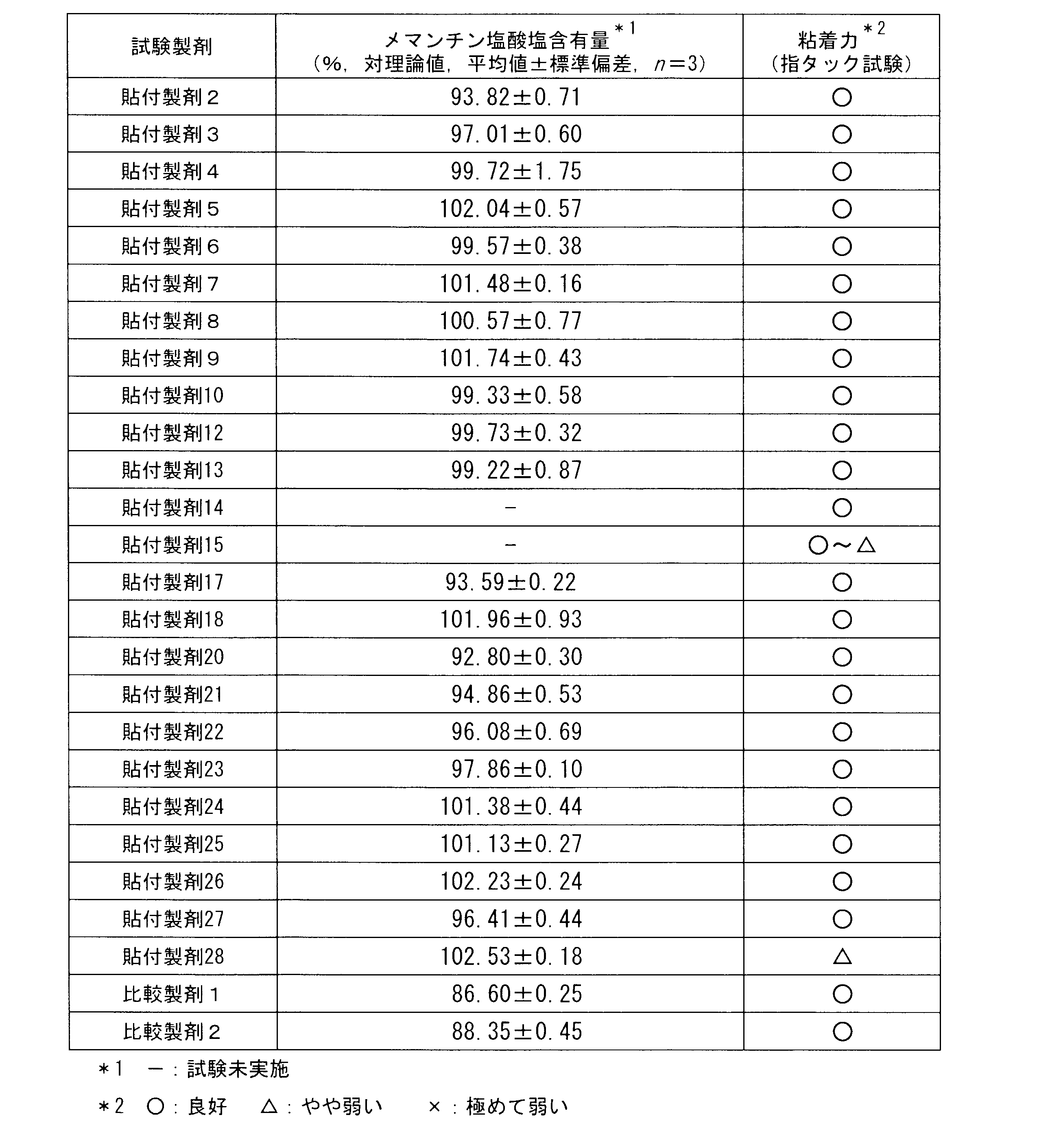

表7および8に示されるように、粘着剤組成物中に遊離カルボキシル基および/またはフェノール性水酸基を含有しない比較製剤1~3では、メマンチンの含量が理論値と比較して10%以上低下した。一方、カルボキシル基含有アクリル系粘着剤(DURO-TAK(登録商標)87-2194あるいは87-2052)を薬物含有層に対して11%以上含有する貼付製剤3~10、貼付製剤12~13および貼付製剤18では、メマンチンの含量が理論値の±3%以内であり、バラツキも2%以内であった。また、カルボキシル基含有メタクリル酸コポリマー(Eudragit(登録商標)S100)を薬物含有層に対して1%以上含有する貼付製剤22~28でも、メマンチンの含量が理論値の±4%以内であり、バラツキも1%以内であった。さらに、カルボキシル基/水酸基含有粘着付与樹脂については、酸価の異なる5種の粘着付与樹脂を用いて試験した。カルボキシル基/水酸基含有粘着付与樹脂(パインクリスタルKE-311、パインクリスタルKE-604、パインクリスタルKR-85、マルキードNo.33あるいはタマノル100S)を薬物含有層に対して2%以上含有する貼付製剤32~33、貼付製剤35~38、貼付製剤41~43および貼付製剤45~46では、メマンチンの含量が理論値の±5%以内であり、バラツキも1%以内であった。
これらの結果から、遊離カルボキシル基および/またはフェノール性水酸基を含有する粘着剤組成物を含む本発明の貼付製剤では、メマンチンの揮散が抑制されることが明らかとなった。ただし、カルボキシル基含有アクリル系粘着剤(DURO-TAK(登録商標)87-2194あるいは87-2052)の配合量が薬物含有層に対して10%以下の貼付製剤2および貼付製剤17、カルボキシル基含有メタクリル酸コポリマー(Eudragit(登録商標)S100)の配合量が薬物含有層に対して0.5%以下の貼付製剤20~21、カルボキシル基/水酸基含有粘着付与樹脂の中でマレイン酸樹脂(マルキードNo.33)の配合量が薬物含有層に対して1%以下の貼付製剤39~40では、揮散抑制効果が比較製剤1~3よりも強かったものの、他の貼付製剤と比較して弱かった。
また、各貼付製剤の粘着力を指タック試験で評価した結果、カルボキシル基および/またはフェノール性水酸基を含有する粘着剤組成物を含む貼付製剤2~10、貼付製剤12~15、貼付製剤17~18、貼付製剤20~28、貼付製剤32~33、貼付製剤35~43、貼付製剤45~47および貼付製剤50では、粘着力は概ね良好であった。本結果から、本発明の貼付製剤において、メマンチンの揮散抑制のために遊離のカルボキシル基および/またはフェノール性水酸基を含有する粘着剤組成物を一定量配合した場合に、貼付製剤の物性を損なうことなく、粘着力が良好な製剤が得られることが明らかとなった。
上述したように、本発明の経皮吸収型貼付製剤は、メマンチンおよび遊離のカルボキシル基および/またはフェノール性水酸基を含有する粘着剤組成物を含有するマトリックスタイプの貼付製剤であって、貼付製剤製造時あるいは保存時におけるメマンチンの揮散を抑制した、新規の貼付製剤である。
そして本発明の経皮吸収型貼付製剤は、長時間にわたって製剤の保存が可能であり、かつ、経時的な粘着力の低下を抑えたものであって、有効成分の薬理効果を有効に、しかも持続的に利用することが可能になる。よって、本発明の経皮吸収型貼付製剤は、アルツハイマー型認知症における認知症症状の進行抑制に有用な製剤である。
Claims (16)
- 少なくとも支持体、薬物含有層および剥離ライナーからなる経皮吸収型貼付製剤において、該薬物含有層中にメマンチンまたはその製薬上許容できる塩と、遊離型のカルボキシル基および/またはフェノール性水酸基を含有する粘着剤組成物とを含有することを特徴とする経皮吸収型貼付製剤。
- 前記遊離型のカルボキシル基および/またはフェノール性水酸基を含有する粘着剤組成物が、遊離型のカルボキシル基を含有するアクリル粘着剤、遊離型のカルボキシル基を含有する(メタ)アクリル酸コポリマー、遊離型のカルボキシル基および/またはフェノール性水酸基を含有する粘着付与樹脂および遊離型のカルボキシル基を含有するゴム系粘着成分より選ばれた少なくとも一種を含有するものである請求項1記載の経皮吸収型貼付製剤。
- 遊離型のカルボキシル基を含有するアクリル粘着剤が、モノマー構成単位中の側鎖に遊離型カルボキシル基を有する(メタ)アクリル酸エステルの少なくとも一種を構成モノマーとする重合体または共重合体である請求項2記載の経皮吸収型貼付製剤。
- 遊離型のカルボキシル基を含有する(メタ)アクリル酸コポリマーが、モノマー構成単位中の側鎖に遊離型のカルボキシル基を有する(メタ)アクリル酸エステルの少なくとも一種を構成モノマーとする共重合体である請求項3記載の経皮吸収型貼付製剤。
- 遊離型のカルボキシル基および/またはフェノール性水酸基を含有する粘着付与樹脂が、ロジン、ロジンのグリセリンエステル、水添ロジン、水添ロジンのグリセリンエステル等のロジン誘導体、マレイン酸樹脂、フェノール樹脂、石油樹脂、テルペン樹脂、エポキシ樹脂、ウレタン樹脂またはこれらの変性物より選ばれた少なくとも一種である請求項2~4のいずれかに記載の経皮吸収型貼付製剤。
- 遊離のカルボキシル基を含有するゴム系粘着成分が、液状ポリブタジエン、液状ポリイソプレン、液状ポリブテン等の液状ゴム、アクリロニトリル・ブタジエンゴム等の合成ゴム、ブロックコポリマー、天然ゴム等より選ばれた少なくとも一種である請求項2~5のいずれかに記載の経皮吸収型貼付製剤。
- 遊離のカルボキシル基を含有するアクリル粘着剤の含有量が、薬物含有層に対して4~99%である請求項2~6のいずれかに記載の経皮吸収型貼付製剤。
- 遊離型のカルボキシル基を含有する(メタ)アクリル酸コポリマーの配合量が、薬物含有層に対して0.1~30%である請求項2~7のいずれかに記載の経皮吸収型貼付製剤。
- 遊離型のカルボキシル基および/またはフェノール性水酸基を含有する粘着付与樹脂の配合量が、薬物含有層に対して0.4~70%である請求項2~8のいずれかに記載の経皮吸収型貼付製剤。
- 薬物含有層に、基剤成分としてゴム系粘着基剤、アクリル系高分子およびシリコーン系高分子よりなる群から選ばれた粘着基剤の少なくとも一種を含有する請求項1~9のいずれかに記載の経皮吸収型貼付製剤。
- メマンチンとして、メマンチンの製薬上許容できる塩と塩基との混合物をメマンチンとして含有する請求項1~10のいずれかに記載の経皮吸収型貼付製剤。
- 経皮吸収型貼付製剤製造直前に混合したメマンチンの製薬上許容できる塩と塩基との混合物を含有する請求項11記載の経皮吸収型貼付製剤。
- 塩基の含有量が、薬物含有層に対して0.1~10質量%である請求項11または12記載の経皮吸収型貼付製剤。
- 塩基が水酸化ナトリウム、水酸化カリウム、水酸化カルシウム、水酸化マグネシウム、有機アミン誘導体より選ばれた少なくとも一種である請求項11~13のいずれかに記載の経皮吸収型貼付製剤。
- メマンチンの製薬上許容できる塩がメマンチン塩酸塩である請求項11~14のいずれかに記載の経皮吸収型貼付製剤。
- アルツハイマー型認知症患者の皮膚に、支持体およびメマンチンまたはその製薬上許容できる塩と、カルボキシル基および/またはフェノール性水酸基を含有する粘着剤組成物とを含有する薬物含有層からなる経皮吸収型貼付製剤を貼付することを特徴とするアルツハイマー型認知症の病態進行を遅延させる方法。
Priority Applications (1)
| Application Number | Priority Date | Filing Date | Title |
|---|---|---|---|
| PCT/JP2013/066158 WO2014199455A1 (ja) | 2013-06-12 | 2013-06-12 | メマンチン経皮吸収型貼付製剤 |
Applications Claiming Priority (1)
| Application Number | Priority Date | Filing Date | Title |
|---|---|---|---|
| PCT/JP2013/066158 WO2014199455A1 (ja) | 2013-06-12 | 2013-06-12 | メマンチン経皮吸収型貼付製剤 |
Publications (1)
| Publication Number | Publication Date |
|---|---|
| WO2014199455A1 true WO2014199455A1 (ja) | 2014-12-18 |
Family
ID=52021791
Family Applications (1)
| Application Number | Title | Priority Date | Filing Date |
|---|---|---|---|
| PCT/JP2013/066158 Ceased WO2014199455A1 (ja) | 2013-06-12 | 2013-06-12 | メマンチン経皮吸収型貼付製剤 |
Country Status (1)
| Country | Link |
|---|---|
| WO (1) | WO2014199455A1 (ja) |
Cited By (6)
| Publication number | Priority date | Publication date | Assignee | Title |
|---|---|---|---|---|
| WO2021098791A1 (zh) * | 2019-11-20 | 2021-05-27 | 成都康弘药业集团股份有限公司 | 一种含有美金刚的透皮贴剂 |
| EP3892678A1 (en) * | 2020-04-09 | 2021-10-13 | tesa SE | Pressure-sensitive adhesive based on acrylonitrile butadiene rubbers |
| CN115397401A (zh) * | 2020-04-13 | 2022-11-25 | 考司美德制药株式会社 | 皮肤用粘合片 |
| WO2023033557A1 (en) * | 2021-09-02 | 2023-03-09 | Dong-A St Co., Ltd. | Percutaneous absorption preparation for treating dementia comprising memantine enanthate |
| JP2023050633A (ja) * | 2021-09-30 | 2023-04-11 | 東洋インキScホールディングス株式会社 | 貼付剤 |
| CN115957200A (zh) * | 2023-02-23 | 2023-04-14 | 广州新济药业科技有限公司 | 一种美金刚透皮贴剂及制备方法 |
Citations (5)
| Publication number | Priority date | Publication date | Assignee | Title |
|---|---|---|---|---|
| JP2007522248A (ja) * | 2004-02-13 | 2007-08-09 | ニューロモレキュラー・インコーポレイテッド | てんかんおよび他のcns障害の処置のための、nmdaレセプターアンタゴニストと抗てんかん薬との組み合わせ |
| JP2008520736A (ja) * | 2004-11-23 | 2008-06-19 | アマダス ファーマシューティカルズ インコーポレイテッド | 持続放出コーティングまたはマトリックスおよびnmda受容体アンタゴニストを含む組成物、そのようなnmdaアンタゴニストの被験体への投与方法 |
| JP2009013171A (ja) * | 2007-06-07 | 2009-01-22 | Hisamitsu Pharmaceut Co Inc | メマンチン含有経皮吸収製剤 |
| JP2011513447A (ja) * | 2008-03-11 | 2011-04-28 | エルテーエス ローマン テラピー−ジステーメ アーゲー | 安定化された膜を有する経皮治療システム |
| US20110313372A1 (en) * | 2010-06-17 | 2011-12-22 | Eifler Rene | Transdermal administration of memantine |
-
2013
- 2013-06-12 WO PCT/JP2013/066158 patent/WO2014199455A1/ja not_active Ceased
Patent Citations (5)
| Publication number | Priority date | Publication date | Assignee | Title |
|---|---|---|---|---|
| JP2007522248A (ja) * | 2004-02-13 | 2007-08-09 | ニューロモレキュラー・インコーポレイテッド | てんかんおよび他のcns障害の処置のための、nmdaレセプターアンタゴニストと抗てんかん薬との組み合わせ |
| JP2008520736A (ja) * | 2004-11-23 | 2008-06-19 | アマダス ファーマシューティカルズ インコーポレイテッド | 持続放出コーティングまたはマトリックスおよびnmda受容体アンタゴニストを含む組成物、そのようなnmdaアンタゴニストの被験体への投与方法 |
| JP2009013171A (ja) * | 2007-06-07 | 2009-01-22 | Hisamitsu Pharmaceut Co Inc | メマンチン含有経皮吸収製剤 |
| JP2011513447A (ja) * | 2008-03-11 | 2011-04-28 | エルテーエス ローマン テラピー−ジステーメ アーゲー | 安定化された膜を有する経皮治療システム |
| US20110313372A1 (en) * | 2010-06-17 | 2011-12-22 | Eifler Rene | Transdermal administration of memantine |
Cited By (11)
| Publication number | Priority date | Publication date | Assignee | Title |
|---|---|---|---|---|
| WO2021098791A1 (zh) * | 2019-11-20 | 2021-05-27 | 成都康弘药业集团股份有限公司 | 一种含有美金刚的透皮贴剂 |
| CN112915071A (zh) * | 2019-11-20 | 2021-06-08 | 成都康弘药业集团股份有限公司 | 一种含有美金刚的透皮贴剂 |
| EP3892678A1 (en) * | 2020-04-09 | 2021-10-13 | tesa SE | Pressure-sensitive adhesive based on acrylonitrile butadiene rubbers |
| CN113528057A (zh) * | 2020-04-09 | 2021-10-22 | 德莎欧洲股份公司 | 基于丙烯腈-丁二烯橡胶的压敏胶粘剂 |
| CN113528057B (zh) * | 2020-04-09 | 2024-01-30 | 德莎欧洲股份公司 | 基于丙烯腈-丁二烯橡胶的压敏胶粘剂 |
| US12319846B2 (en) | 2020-04-09 | 2025-06-03 | Tesa Se | Pressure-sensitive adhesive based on acrylonitrile butadiene rubbers |
| CN115397401A (zh) * | 2020-04-13 | 2022-11-25 | 考司美德制药株式会社 | 皮肤用粘合片 |
| WO2023033557A1 (en) * | 2021-09-02 | 2023-03-09 | Dong-A St Co., Ltd. | Percutaneous absorption preparation for treating dementia comprising memantine enanthate |
| JP2023050633A (ja) * | 2021-09-30 | 2023-04-11 | 東洋インキScホールディングス株式会社 | 貼付剤 |
| JP7812050B2 (ja) | 2021-09-30 | 2026-02-09 | artience株式会社 | 貼付剤 |
| CN115957200A (zh) * | 2023-02-23 | 2023-04-14 | 广州新济药业科技有限公司 | 一种美金刚透皮贴剂及制备方法 |
Similar Documents
| Publication | Publication Date | Title |
|---|---|---|
| JP5073124B2 (ja) | ノルアドレナリン作動性・特異的セロトニン作動性抗うつ薬含有経皮吸収型貼付製剤 | |
| WO2005115355A1 (ja) | 貼付製剤 | |
| JP5856424B2 (ja) | ロチゴチン含有経皮吸収型貼付剤 | |
| TW201431570A (zh) | 用於經皮投服羅替戈汀(Rotigotine)之多天式貼片 | |
| WO2014199455A1 (ja) | メマンチン経皮吸収型貼付製剤 | |
| JP2014177428A (ja) | ロジン系樹脂を含有するロチゴチン経皮吸収型貼付製剤 | |
| JP2009013171A (ja) | メマンチン含有経皮吸収製剤 | |
| WO2014174564A1 (ja) | メマンチン含有経皮吸収型貼付製剤 | |
| JP2021522240A (ja) | テトラベナジン経皮送達デバイス | |
| TWI569815B (zh) | Percutaneous absorption type preparation | |
| JP6459148B2 (ja) | 経皮吸収型製剤 | |
| WO2010113225A1 (en) | Riluzole-containing transdermal patch | |
| JP6695571B2 (ja) | 経皮吸収型製剤 | |
| WO2016080533A1 (ja) | 経皮吸収型製剤 | |
| CN110740730A (zh) | 包含卢帕他定的贴剂 | |
| JP7399633B2 (ja) | 経皮吸収型製剤の製造方法 | |
| JP2010006761A (ja) | フェンタニルまたはその塩を含有する経皮吸収型貼付剤およびその製造方法 | |
| WO2005102306A1 (ja) | 消炎鎮痛貼付剤 | |
| JP6675589B2 (ja) | 経皮吸収型製剤 | |
| JPWO2017006974A1 (ja) | 経皮吸収型貼付剤 | |
| JP4856125B2 (ja) | 安定化されたフェンタニルまたはその塩含有組成物及びこれを用いた医薬製剤並びにフェンタニルまたはその塩の安定化方法 | |
| JP6512905B2 (ja) | フェンタニル含有貼付剤 | |
| WO2013183407A1 (ja) | ミルタザピン含有経皮吸収型貼付製剤 | |
| JP7800913B2 (ja) | ケトプロフェン含有貼付剤 | |
| JP7352283B2 (ja) | クエン酸フェンタニル含有経皮吸収製剤 |
Legal Events
| Date | Code | Title | Description |
|---|---|---|---|
| 121 | Ep: the epo has been informed by wipo that ep was designated in this application |
Ref document number: 13886859 Country of ref document: EP Kind code of ref document: A1 |
|
| NENP | Non-entry into the national phase |
Ref country code: DE |
|
| 122 | Ep: pct application non-entry in european phase |
Ref document number: 13886859 Country of ref document: EP Kind code of ref document: A1 |
|
| NENP | Non-entry into the national phase |
Ref country code: JP |