WO2014202194A1 - Uv-härtungskompatible photochrome annellierte naphthopyrane - Google Patents
Uv-härtungskompatible photochrome annellierte naphthopyrane Download PDFInfo
- Publication number
- WO2014202194A1 WO2014202194A1 PCT/EP2014/001602 EP2014001602W WO2014202194A1 WO 2014202194 A1 WO2014202194 A1 WO 2014202194A1 EP 2014001602 W EP2014001602 W EP 2014001602W WO 2014202194 A1 WO2014202194 A1 WO 2014202194A1
- Authority
- WO
- WIPO (PCT)
- Prior art keywords
- phenyl
- disubstituted
- radical
- group
- mono
- Prior art date
- Legal status (The legal status is an assumption and is not a legal conclusion. Google has not performed a legal analysis and makes no representation as to the accuracy of the status listed.)
- Ceased
Links
- 0 CC1C(*)*c2ccccc2*1 Chemical compound CC1C(*)*c2ccccc2*1 0.000 description 3
Classifications
-
- C—CHEMISTRY; METALLURGY
- C07—ORGANIC CHEMISTRY
- C07D—HETEROCYCLIC COMPOUNDS
- C07D493/00—Heterocyclic compounds containing oxygen atoms as the only ring hetero atoms in the condensed system
- C07D493/02—Heterocyclic compounds containing oxygen atoms as the only ring hetero atoms in the condensed system in which the condensed system contains two hetero rings
- C07D493/04—Ortho-condensed systems
-
- C—CHEMISTRY; METALLURGY
- C08—ORGANIC MACROMOLECULAR COMPOUNDS; THEIR PREPARATION OR CHEMICAL WORKING-UP; COMPOSITIONS BASED THEREON
- C08K—Use of inorganic or non-macromolecular organic substances as compounding ingredients
- C08K5/00—Use of organic ingredients
- C08K5/04—Oxygen-containing compounds
- C08K5/15—Heterocyclic compounds having oxygen in the ring
- C08K5/156—Heterocyclic compounds having oxygen in the ring having two oxygen atoms in the ring
- C08K5/1575—Six-membered rings
-
- C—CHEMISTRY; METALLURGY
- C09—DYES; PAINTS; POLISHES; NATURAL RESINS; ADHESIVES; COMPOSITIONS NOT OTHERWISE PROVIDED FOR; APPLICATIONS OF MATERIALS NOT OTHERWISE PROVIDED FOR
- C09B—ORGANIC DYES OR CLOSELY-RELATED COMPOUNDS FOR PRODUCING DYES, e.g. PIGMENTS; MORDANTS; LAKES
- C09B57/00—Other synthetic dyes of known constitution
- C09B57/02—Coumarine dyes
-
- G—PHYSICS
- G02—OPTICS
- G02B—OPTICAL ELEMENTS, SYSTEMS OR APPARATUS
- G02B5/00—Optical elements other than lenses
- G02B5/20—Filters
- G02B5/22—Absorbing filters
- G02B5/23—Photochromic filters
-
- G—PHYSICS
- G02—OPTICS
- G02C—SPECTACLES; SUNGLASSES OR GOGGLES INSOFAR AS THEY HAVE THE SAME FEATURES AS SPECTACLES; CONTACT LENSES
- G02C7/00—Optical parts
- G02C7/02—Lenses; Lens systems ; Methods of designing lenses
- G02C7/022—Ophthalmic lenses having special refractive features achieved by special materials or material structures
-
- G—PHYSICS
- G02—OPTICS
- G02C—SPECTACLES; SUNGLASSES OR GOGGLES INSOFAR AS THEY HAVE THE SAME FEATURES AS SPECTACLES; CONTACT LENSES
- G02C7/00—Optical parts
- G02C7/10—Filters, e.g. for facilitating adaptation of the eyes to the dark; Sunglasses
- G02C7/102—Photochromic filters
Definitions
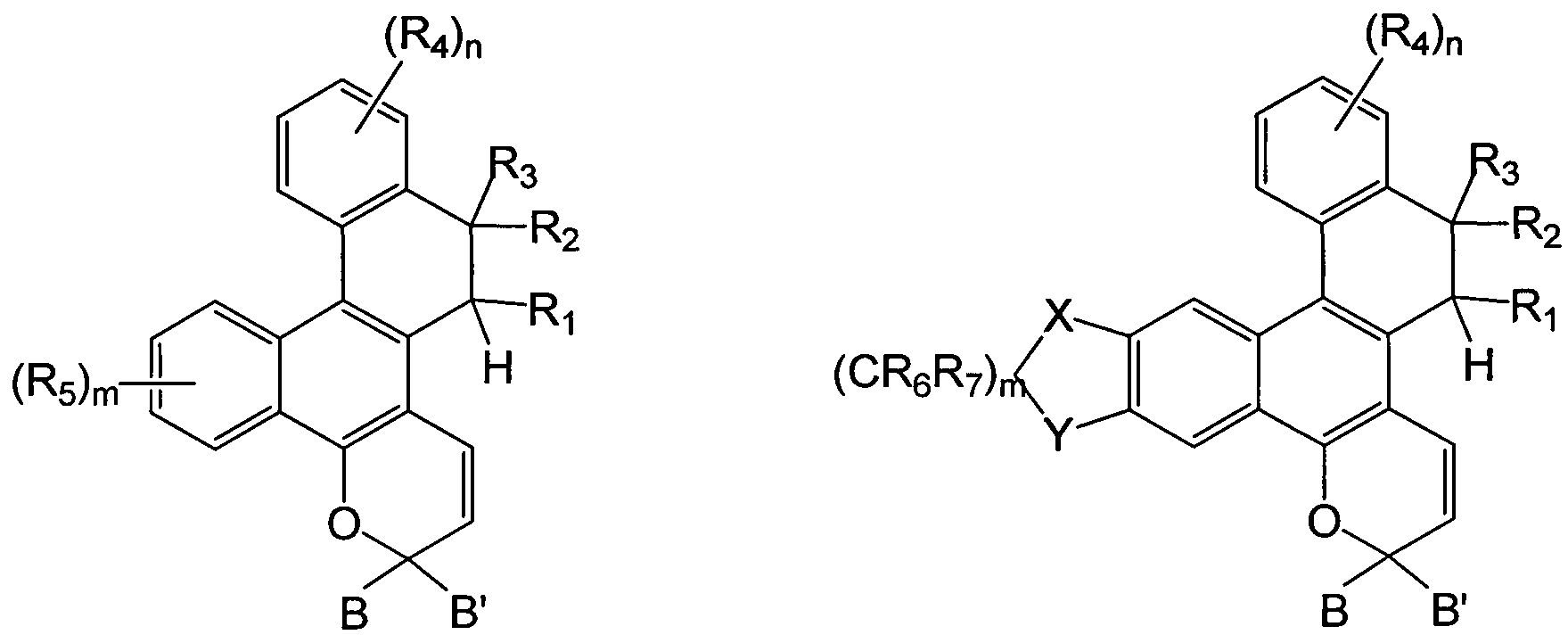
- the present invention relates to UV-curing-compatible photochromic mono- and di-fused naphthopyrans according to the general formulas (I) or (II) and their use in plastics of all kinds, in particular for ophthalmic purposes.
- the photochromic compounds of this invention are characterized by their excellent UV cure compatibility, i. they survive - introduced e.g. in an acrylate monomer matrix with UV initiator - without prejudice caused by strong UV light radical polymerization of the matrix.
- the photochromic dyes of the present invention when suitably selected for substituents, are characterized by two distinct absorption bands of the open form in the visible wavelength range, i. With such a molecule can be two conventional photochromic dyes - each with a discrete absorption band - replace. In addition, they have a very good lifetime at very high power. They can be used in plastics of all kinds.
- Pyranes especially naphthopyrans and larger ring systems derived from them, are currently the most processed class of photochromic compounds. Although patented for the first time in 1966 (US 3,567,605), it was not until the 1990s that connections could be developed that seemed suitable for use in spectacle lenses.
- a suitable class of compounds of pyrans for example, the 2,2-diaryl-2H-naphtho [1, 2-b] pyrans or the 3,3-Diaryl-3H-naphtho [2,1-b] pyrans, the open, excited forms of which show various darkening colors from yellow to red-violet.
- an unsubstituted, monosubstituted or disubstituted heterocyclic ring may additionally be attached to this basic system on the g, h, i, n, o or p side of the 1-idenonaphthopyran. Accordingly, indeno [2,1-f] naphtho [1,2-b] pyrans having a very wide variety of possible substituents are disclosed.
- WO 96/14596, WO 99/15518, US 5,645,767, WO 98/32037 and US 5,698,141 describe photochromic indenoannated naphthopyran dyestuffs derived from 2H-naphtho [1,2-b] pyran, the compositions containing them and a process for their preparation production.
- an unsubstituted, monosubstituted or disubstituted heterocyclic ring may be fused to the g, h, i, n, o or p side of the indenonaphthopyran.
- substituents also includes very specific spiro compounds, namely systems having a spiroheterocyclic group in which, including the spiro atom at the 13-position of the basic system, a 5- to 8-membered ring which always contains two oxygen atoms, is available. Another interpretation of the spiro ring is found in JP 344762/2000.
- 6,022,495 describes, inter alia, compounds having an O-CR 1 R 2 bridge, as well as WO 2009/024271 and WO 2013/045086. If this compound is generated by three atoms, the result is a fused seven-membered ring with many possible variations by insertion of heteroatoms.
- Compounds having a CH 2 -CH 2 -CH 2 bridge are described in US 6,558,583.
- the various photochromic dyes available in the prior art have disadvantages which, when used in sunscreens, significantly impair the wearing comfort of the spectacle wearer.
- the dyes have an insufficiently long-wave absorption in the excited state as well as in the non-excited state.
- too high a temperature sensitivity of the darkening is often present, at the same time too slow lightening can occur.
- the dyes available in the prior art often have an insufficient life and thus allow only a low durability of the sunscreens. The latter is noticeable in rapidly decreasing performance and / or strong yellowing.
- the above photochromic dyes available in the art have in common that they show only an absorption band of the open form in the visible wavelength region.
- a coordination process between the different photochromic dyes of a mixture in terms of lightening speed, lifetime and spectral excitation properties is required so that the photochromic glass at each time of the dimming and Auflellungscylus the same Has color. It would therefore be highly desirable to be able to do without this coordination process.
- Such photochromic dyes should also be characterized by the combination of long-wavelength absorption maximum of the closed form with a steep edge to the visible wavelength range, high dimming performance, very fast lightening reaction and very good light stability.
- R3, R and R5 each independently represent a substituent selected from the group a consisting of a hydrogen atom, a (C 1 -C 6) -alkyl radical, a (C 1 -C 6) -thioalkyl radical, a (C 3 -C 7) -cycloalkyl radical which may have one or more heteroatoms, such as, for example, O or S, a (C 1 -C 6) -alkoxy radical, a hydroxy group, a trifluoromethyl group, bromine, chlorine, fluorine an unsubstituted, monosubstituted or disubstituted phenyl, phenoxy, benzyl, benzyloxy, naphthyl or naphthoxy radical, the substituents in turn being selected from the group ⁇ ; where n, if not 0, represents an integer of 1 to 4;
- R4 form an annelated benzene ring, which may be unsubstituted, monosubstituted or disubstituted, where the substituents may in turn be selected from the group ⁇ ;
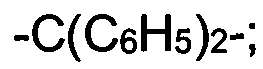
- radicals R5 form a fused benzene ring which may be unsubstituted, monosubstituted or disubstituted, where the substituents may in turn be selected from the group ⁇ ; and in which the radicals R 1 and R 2 each independently of one another represent a (C 1 -C 6) -alkyl radical or an unsubstituted, monosubstituted or disubstituted phenyl radical, where the substituents may in turn be selected from the group ⁇ ; and with the proviso that at least one of R 1 or R 2 represents an unsubstituted, monosubstituted or disubstituted phenyl radical; and wherein X and Y are independently selected from the group consisting of -O-, -S-, -N (C 1 -C 6 ) -alkyl, -NCeHs-, -CH 2 -, -C (CH 3 ) 2- or and wherein each of the radical
- a) is a mono-, di- and trisubstituted aryl radical, wherein the aryl radical is phenyl, naphthyl or phenanthryl, and
- b) is an unsubstituted, mono- and disubstituted heteroaryl radical, the heteroaryl radical being pyridyl, furanyl, thienyl, benzofuranyl, benzothienyl, 1, 2,3,4-tetrahydrocarbazolyl and julolidinyl;
- substituents of the aryl and heteroaryl radicals in a) and b) are selected from the group ⁇ or the group ⁇ consisting of amino, mono- (C 1 -C 6) -alkylamino, di- (C 1 -C 6) -alkylamino unsubstituted, monosubstituted or disubstituted phenyl phenyl, mono- or disubstituted (phenyl-imino) methylene, mono-, mono- or disubstituted (phenylmethylene) imino and unsubstituted, monosubstituted or disubstituted mono- and diphenylamino, Piperidinyl, 3,5-dimethylpiperidinyl, N-substituted piperazinyl, pyrrolidinyl, imidazolidinyl, pyrazolidinyl, indolinyl, morpholinyl, 2,6-dimethylmorpholiny
- V and / or W together with the respective adjacent -CR8R9 grouping, represent an annelated benzene ring which may be unsubstituted, monosubstituted or disubstituted, the substituents in turn being selected from the group ⁇ .
- the radical R3 in the above formula (I) and (II) is selected from a hydrogen atom, a (C 1 -C 6) -alkyl radical, a (C 3 -C 7) -cycloalkyl radical or a phenyl radical.
- the radical R 2 is preferably the corresponding unsubstituted, monosubstituted or disubstituted phenyl radical.
- Preferred photochromic naphthopyrans according to the present invention have the formula (II).
- X and Y are particularly preferably both O (oxygen).
- X may be CH 2 and Y may be O or Y may be CH 2 and X is O.
- the photochromic naphthopyrans have the following formula (III).
- radical Ri represents a (C 1 -C 6) -alkyl radical or a phenyl radical
- the radical R 3 is hydrogen, a (C 1 -C 6) -alkyl radical or a phenyl radical
- the molecular structure of the compounds according to the invention is based on a dihydrophenanthrene subunit (with the substituents R 1 to R 4 in the formula pictures).
- a benzene ring of this dihydrophenanthrene subunit has both a benzene ring (with the substituents R5 or the substituent group X- (CR6R7) mY) and a 1,4-benzodioxane ring (see Formula (III) anneliiert and a photolabile Pyran unit (with substituents B and B '), the latter being responsible for the photochromic character, since the binding between the oxygen of the pyran unit and the carbon atom with the substituents B and B' is reversible by excitation with long-wave UVA light is broken, creating a colored merocyanine system.
- the present invention is based on the surprising finding that the compounds according to the invention, in contrast to the closest prior art (US Pat. No. 6,506,538), incorporated, for example, in an acrylate monomer matrix with UV initiator, survive a radical polymerization of the matrix initiated by strong UV light without damage ,
- This excellent UV compatibility is Consequence of introducing at least two substituents (R 1 and R 2) according to the invention - at least one of which is an unsubstituted or substituted phenyl radical - into the dihydrophenanthrene subunit of the molecule.
- photochromic dyes with interesting spectral properties are accessible, which have introduced, for example, in an acrylate matrix superior stability both in terms of polymerization conditions and the life.
- the compounds according to the invention have a pronounced double absorption band of the open form in the visible wavelength range, given a suitable choice of substituent.
- the one band has an absorption maximum of> 500 nm, while the maximum of the second band lies in the shorter-wave visible range (400-500 nm). Due to the latter band, it is possible with the present invention to dispense in photochromic dye mixtures on yellow or orangeeindunkelelnde photochromic dyes. On the one hand, this is important for polymer systems in which these yellow and orange-darkening dyes-owing to their different molecular structure compared to the longer-wavelength absorbing violet and blue-darkening dyes-have an unsatisfactory lifetime or bring about other disadvantages.
- the photochromic glass has the same hue at each time of the dimming and whitening cyles.
- the compounds according to the invention have high eye clarity (ie high transmission in the unexcited state) and very good light stability, they are outstandingly suitable for use in photochromic glasses.
- the compounds of the invention in the unexcited state are completely colorless (ie without cosmetically disturbing yellow color, since the absorption of the closed form is limited to the UV range) and have a very good life.
- Fig. 1 shows a corresponding synthesis scheme for the preparation of the compounds of the invention.
- Fig. 2 shows the UV absorption spectra of specific compounds of the invention compared to the prior art.
- radicals B and B 'in the above formula (I), (II) or (III) independently of one another are selected from the group a) as defined above. Particularly preferred are mono-, di- and trisubstituted aryl radicals, where the aryl radical is a phenyl radical.
- X and / or Y together with the respectively adjacent -CR6R7-grouping are an annelated benzene ring which may be unsubstituted, monosubstituted or disubstituted, where the substituents may in turn be selected from the group ⁇ , preferably represents the following structural unit, wherein X is preferably O:
- the substituents of the group ⁇ which have nitrogen atoms or carry amine groups, are bonded via these to the phenyl, naphthyl or phenanthryl radical of group a).
- the photochromic dye was dissolved together with a commercially available UV initiator for free-radical polymerizations in a liquid-viscous acrylate monomer matrix. through Spin-coating or doctoring, a thin layer of this viscous dye solution was applied to a transparent plastic substrate so that the layer thickness is about 40 pm. Subsequently, the layer was cured by means of UV light (polymerized).
- the compounds of the invention have a pronounced double absorption band, wherein the shorter-wavelength absorption maximum is slightly more pronounced than the longer-wave. This results in brown shades in the darkening.
- Table 1 shows a comparison of the darkening powers (ie the saturation absorptions from measurements according to DIN EN ISO 8980-3) in excited state before (ie immediately after UV-curing) as well as after endurance test. To measure the lifetime stability, the test specimens are exposed to strong UV radiation in an exposure apparatus for 50 hours (simulation of a multi-year exposure to sunlight).
- the compounds of the invention can be used in plastic materials or plastic articles of any kind and shape for a variety of uses for which photochromic behavior is important.
- a dye according to the present invention or a mixture of such dyes can be used.
- the photochromic naphthopyran dyes of the present invention can be used in lenses, particularly ophthalmic lenses, glasses for all types of eyewear, such as ski goggles, sunglasses, motorcycle goggles, protective helmet sights, and the like.
- the photochromic naphthopyrans according to the invention can also be used, for example, as sunscreens in vehicles and living spaces in the form of windows, protective screens, covers, roofs or the like.
- the photochromic naphthopyrans of the invention may be prepared by various methods described in the prior art, as already indicated in WO 99/15518 a polymeric material, such as an organic plastic material, may be applied or embedded therein.
- a mass-dyeing method includes, for example, dissolving or dispersing the photochromic compound or compounds according to the present invention in a plastic material, e.g. by the addition of the photochromic compound (s) to a monomeric material before polymerization takes place.
- Another way of producing a photochromic article is to penetrate the plastic material (s) with the photochromic compound (s) by immersing the plastic material in a hot solution of the photochromic dye (s) according to the present invention or, for example, a thermal transfer process.
- the photochromic compound (s) may also, for example, be in the form of a separate layer between adjacent layers of the plastic material, e.g.
- photochromic compound (s) as part of a coating located on the surface of the plastic material.
- permeation is intended to mean the migration of the photochromic compound (s) into the plastic material, e.g. by the solvent assisted transfer of the photochromic compound (s) to a polymer matrix, vapor phase transfer or other such surface diffusion processes.
- photochromic articles as e.g. Eyeglass lenses, not only by means of the usual mass coloration, but are produced in the same way by means of surface dyeing, with the latter variant, a surprisingly lower tendency to migrate can be achieved. This is particularly advantageous in subsequent finishing steps, since - e.g. in an antireflective coating due to the lower back diffusion in vacuum - layer delamination and similar defects are drastically reduced.
Landscapes
- Chemical & Material Sciences (AREA)
- Organic Chemistry (AREA)
- Health & Medical Sciences (AREA)
- Physics & Mathematics (AREA)
- Ophthalmology & Optometry (AREA)
- General Physics & Mathematics (AREA)
- Optics & Photonics (AREA)
- Chemical Kinetics & Catalysis (AREA)
- Polymers & Plastics (AREA)
- General Health & Medical Sciences (AREA)
- Medicinal Chemistry (AREA)
- Eyeglasses (AREA)
- Heterocyclic Carbon Compounds Containing A Hetero Ring Having Oxygen Or Sulfur (AREA)
- Optical Filters (AREA)
Abstract
Description


Claims


Priority Applications (4)
| Application Number | Priority Date | Filing Date | Title |
|---|---|---|---|
| EP14736289.1A EP3010924B1 (de) | 2013-06-17 | 2014-06-12 | Uv-härtungskompatible photochrome annellierte naphthopyrane |
| US14/899,389 US10077274B2 (en) | 2013-06-17 | 2014-06-12 | UV-curing-compatible photochromic fused naphthopyrans |
| JP2016518869A JP6328751B2 (ja) | 2013-06-17 | 2014-06-12 | Uv硬化適合性フォトクロミック縮合ナフトピラン |
| ES14736289.1T ES2614781T3 (es) | 2013-06-17 | 2014-06-12 | Naftopiranos anillados fotocrómicos compatibles con endurecimiento por rayos UV |
Applications Claiming Priority (4)
| Application Number | Priority Date | Filing Date | Title |
|---|---|---|---|
| DE102013010032.1 | 2013-06-17 | ||
| DE102013010032 | 2013-06-17 | ||
| DE102013019706.6 | 2013-11-26 | ||
| DE102013019706 | 2013-11-26 |
Publications (1)
| Publication Number | Publication Date |
|---|---|
| WO2014202194A1 true WO2014202194A1 (de) | 2014-12-24 |
Family
ID=51136412
Family Applications (1)
| Application Number | Title | Priority Date | Filing Date |
|---|---|---|---|
| PCT/EP2014/001602 Ceased WO2014202194A1 (de) | 2013-06-17 | 2014-06-12 | Uv-härtungskompatible photochrome annellierte naphthopyrane |
Country Status (5)
| Country | Link |
|---|---|
| US (1) | US10077274B2 (de) |
| EP (1) | EP3010924B1 (de) |
| JP (1) | JP6328751B2 (de) |
| ES (1) | ES2614781T3 (de) |
| WO (1) | WO2014202194A1 (de) |
Families Citing this family (4)
| Publication number | Priority date | Publication date | Assignee | Title |
|---|---|---|---|---|
| JP6949946B2 (ja) | 2016-09-26 | 2021-10-13 | ローデンシュトック ゲーエムベーハー | 可視波長帯に向けて遠くから伸びる超長波長吸収を有する、フォトクロミック多環縮合ナフトピラン |
| DE102018004790A1 (de) * | 2018-06-14 | 2019-12-19 | Rodenstock Gmbh | Photochrome annellierte Naphthopyran-Systeme mit speziellen Substituenten zur Realisierung sehr schneller Aufhellgeschwindigkeiten |
| DE102018006794B3 (de) * | 2018-08-28 | 2020-01-02 | Rodenstock Gmbh | Brillenglas, Verwendung eines Brillenglases und Verfahren zum Herstellen eines Brillenglases |
| DE102023109737A1 (de) | 2023-04-18 | 2024-10-24 | Rodenstock Gmbh | Höhermolekulare photochrome Farbstoffe mit mindestens einer und höchstens vier Naphthopyran-Untereinheiten sowie mehreren Polyether-Ketten |
Citations (18)
| Publication number | Priority date | Publication date | Assignee | Title |
|---|---|---|---|---|
| US3567605A (en) | 1966-03-30 | 1971-03-02 | Ralph S Becker | Photochemical process |
| WO1996014596A1 (en) | 1994-11-03 | 1996-05-17 | Ppg Industries, Inc. | Novel photochromic indeno-fused naphthopyrans |
| US5645767A (en) | 1994-11-03 | 1997-07-08 | Transitions Optical, Inc. | Photochromic indeno-fused naphthopyrans |
| US5698141A (en) | 1996-06-17 | 1997-12-16 | Ppg Industries, Inc. | Photochromic heterocyclic fused indenonaphthopyrans |
| US5723072A (en) | 1996-06-17 | 1998-03-03 | Ppg Industries, Inc. | Photochromic heterocyclic fused indenonaphthopyrans |
| WO1999015518A1 (de) | 1997-09-22 | 1999-04-01 | Optische Werke G. Rodenstock | Photochrome naphthopyran-farbstoffe, verfahren zu ihrer herstellung, ihre verwendung sowie ein photochromer gegenstand |
| US5955520A (en) | 1996-06-17 | 1999-09-21 | Ppg Industries, Inc. | Photochromic indeno-fused naphthopyrans |
| US6018059A (en) | 1996-12-23 | 2000-01-25 | Corning Incorporated | (Benzofuran) naphthopyrans, the compositions and (co)polymer matrices containing them |
| US6022495A (en) | 1998-07-10 | 2000-02-08 | Transitions Optical, Inc. | Photochromic benzopyrano-fused naphthopyrans |
| JP2000344762A (ja) | 1999-06-01 | 2000-12-12 | Tokuyama Corp | クロメン化合物 |
| US6379591B1 (en) | 1999-06-10 | 2002-04-30 | Corning S.A. | Naphthopyrans annelated in C5-C6 with a lactam-type C6 ring and compositions and (co)polymer matrices containing them |
| US6426023B1 (en) | 1999-06-10 | 2002-07-30 | Corning, S.A. | Benzopyrans annelated in C7-C8 with an aromatic heterocycle and compositions and (CO)polymer matrices containing them |
| US6506538B1 (en) | 1998-09-11 | 2003-01-14 | Corning S.A. | Naphthopyrans annelated in C5-C6, their preparation and compositions and (co)polymer matrices containing them |
| US6558583B2 (en) | 2000-10-11 | 2003-05-06 | Corning Incorporated | Naphthopyrans annelated in C5-C6 with a dihydrobenzo-cycloheptatriene-type carbocycle and compositions and matrices containing them |
| EP1978022A1 (de) * | 2006-01-25 | 2008-10-08 | Tokuyama Corporation | Chromenverbindungen |
| WO2009024271A1 (de) | 2007-08-23 | 2009-02-26 | Rodenstock Gmbh | Photochrome benzopyrano-benzopyrane mit weiterer annellierung |
| EP2305768A1 (de) * | 2009-09-22 | 2011-04-06 | Corning Incorporated | Photochrome Zusammensetzungen, dadurch erhältliche Resine und Artikel |
| WO2013045086A1 (de) | 2011-09-26 | 2013-04-04 | Rodenstock Gmbh | Photochrome zweifach-annellierte naphthopyrane |
-
2014
- 2014-06-12 WO PCT/EP2014/001602 patent/WO2014202194A1/de not_active Ceased
- 2014-06-12 EP EP14736289.1A patent/EP3010924B1/de active Active
- 2014-06-12 US US14/899,389 patent/US10077274B2/en active Active
- 2014-06-12 JP JP2016518869A patent/JP6328751B2/ja active Active
- 2014-06-12 ES ES14736289.1T patent/ES2614781T3/es active Active
Patent Citations (19)
| Publication number | Priority date | Publication date | Assignee | Title |
|---|---|---|---|---|
| US3567605A (en) | 1966-03-30 | 1971-03-02 | Ralph S Becker | Photochemical process |
| WO1996014596A1 (en) | 1994-11-03 | 1996-05-17 | Ppg Industries, Inc. | Novel photochromic indeno-fused naphthopyrans |
| US5645767A (en) | 1994-11-03 | 1997-07-08 | Transitions Optical, Inc. | Photochromic indeno-fused naphthopyrans |
| US5955520A (en) | 1996-06-17 | 1999-09-21 | Ppg Industries, Inc. | Photochromic indeno-fused naphthopyrans |
| US5698141A (en) | 1996-06-17 | 1997-12-16 | Ppg Industries, Inc. | Photochromic heterocyclic fused indenonaphthopyrans |
| US5723072A (en) | 1996-06-17 | 1998-03-03 | Ppg Industries, Inc. | Photochromic heterocyclic fused indenonaphthopyrans |
| US6018059A (en) | 1996-12-23 | 2000-01-25 | Corning Incorporated | (Benzofuran) naphthopyrans, the compositions and (co)polymer matrices containing them |
| WO1998032037A1 (en) | 1997-01-16 | 1998-07-23 | Ppg Industries Ohio, Inc. | Novel photochromic heterocyclic fused indenonaphthopyrans |
| WO1999015518A1 (de) | 1997-09-22 | 1999-04-01 | Optische Werke G. Rodenstock | Photochrome naphthopyran-farbstoffe, verfahren zu ihrer herstellung, ihre verwendung sowie ein photochromer gegenstand |
| US6022495A (en) | 1998-07-10 | 2000-02-08 | Transitions Optical, Inc. | Photochromic benzopyrano-fused naphthopyrans |
| US6506538B1 (en) | 1998-09-11 | 2003-01-14 | Corning S.A. | Naphthopyrans annelated in C5-C6, their preparation and compositions and (co)polymer matrices containing them |
| JP2000344762A (ja) | 1999-06-01 | 2000-12-12 | Tokuyama Corp | クロメン化合物 |
| US6379591B1 (en) | 1999-06-10 | 2002-04-30 | Corning S.A. | Naphthopyrans annelated in C5-C6 with a lactam-type C6 ring and compositions and (co)polymer matrices containing them |
| US6426023B1 (en) | 1999-06-10 | 2002-07-30 | Corning, S.A. | Benzopyrans annelated in C7-C8 with an aromatic heterocycle and compositions and (CO)polymer matrices containing them |
| US6558583B2 (en) | 2000-10-11 | 2003-05-06 | Corning Incorporated | Naphthopyrans annelated in C5-C6 with a dihydrobenzo-cycloheptatriene-type carbocycle and compositions and matrices containing them |
| EP1978022A1 (de) * | 2006-01-25 | 2008-10-08 | Tokuyama Corporation | Chromenverbindungen |
| WO2009024271A1 (de) | 2007-08-23 | 2009-02-26 | Rodenstock Gmbh | Photochrome benzopyrano-benzopyrane mit weiterer annellierung |
| EP2305768A1 (de) * | 2009-09-22 | 2011-04-06 | Corning Incorporated | Photochrome Zusammensetzungen, dadurch erhältliche Resine und Artikel |
| WO2013045086A1 (de) | 2011-09-26 | 2013-04-04 | Rodenstock Gmbh | Photochrome zweifach-annellierte naphthopyrane |
Also Published As
| Publication number | Publication date |
|---|---|
| ES2614781T3 (es) | 2017-06-01 |
| JP6328751B2 (ja) | 2018-05-23 |
| EP3010924B1 (de) | 2016-09-14 |
| EP3010924A1 (de) | 2016-04-27 |
| JP2016521734A (ja) | 2016-07-25 |
| US20160152629A1 (en) | 2016-06-02 |
| US10077274B2 (en) | 2018-09-18 |
Similar Documents
| Publication | Publication Date | Title |
|---|---|---|
| EP2178883B1 (de) | Photochrome benzopyrano-benzopyrane mit weiterer annellierung | |
| EP1144416A1 (de) | Heterocyclisch annellierte indenochromenderivate | |
| EP3010924B1 (de) | Uv-härtungskompatible photochrome annellierte naphthopyrane | |
| EP2760869B1 (de) | Photochrome zweifach-annellierte naphthopyrane | |
| EP2872517B1 (de) | Photochrome fluorenopyrane mit definierter dibenzo[b,d]-pyrano-annellierung | |
| EP1235823A1 (de) | H-annellierte benzo f]chromene | |
| EP2788340B1 (de) | Photochrome zweifach-indenoannellierte naphthopyrane | |
| EP1805278B1 (de) | Photochrome h-annellierte benzo( f)chromen-derivate | |
| EP2655354B1 (de) | Photochrome annellierte naphthopyrane mit einem zum pyransauerstoff benachbarten benzolring, der über beide meta-stellungen mit dem para-substituenten verknüpft ist | |
| EP1945625B1 (de) | Photochrome spirodihydrophenanthropyrane | |
| EP1461330B1 (de) | 3H-NAPHTHO[2,1-b]-PYRAN-DERIVATE SOWIE DEREN VERWENDUNG | |
| EP2268629B1 (de) | Photochrome naphthopyrane mit doppelt verbrückter terphenyl-untereinheit | |
| EP3515991B1 (de) | Photochrome mehrfach-annellierte naphthopyrane mit sehr langwelliger absorption bis weit in den sichtbaren wellenbereich | |
| EP2215526B1 (de) | Photochrome benzopyrane | |
| EP2115533B1 (de) | Photochrome h-annellierte benzo(f)chromene | |
| EP1664034A1 (de) | Substituierte phenanthropyrane | |
| DE102008060096A1 (de) | Photochrome Spirobenzopyranobenzopyrane | |
| DE102009058906A1 (de) | Photochrome Naphthopyrane mit Verbrückung zweier aromatischer Teilsysteme |
Legal Events
| Date | Code | Title | Description |
|---|---|---|---|
| 121 | Ep: the epo has been informed by wipo that ep was designated in this application |
Ref document number: 14736289 Country of ref document: EP Kind code of ref document: A1 |
|
| REEP | Request for entry into the european phase |
Ref document number: 2014736289 Country of ref document: EP |
|
| WWE | Wipo information: entry into national phase |
Ref document number: 2014736289 Country of ref document: EP |
|
| ENP | Entry into the national phase |
Ref document number: 2016518869 Country of ref document: JP Kind code of ref document: A |
|
| NENP | Non-entry into the national phase |
Ref country code: DE |
|
| WWE | Wipo information: entry into national phase |
Ref document number: 14899389 Country of ref document: US |