WO2014203341A1 - Procédé de production de matière première de tabac - Google Patents
Procédé de production de matière première de tabac Download PDFInfo
- Publication number
- WO2014203341A1 WO2014203341A1 PCT/JP2013/066806 JP2013066806W WO2014203341A1 WO 2014203341 A1 WO2014203341 A1 WO 2014203341A1 JP 2013066806 W JP2013066806 W JP 2013066806W WO 2014203341 A1 WO2014203341 A1 WO 2014203341A1
- Authority
- WO
- WIPO (PCT)
- Prior art keywords
- tobacco
- alcohol
- raw material
- added
- treatment
- Prior art date
- Legal status (The legal status is an assumption and is not a legal conclusion. Google has not performed a legal analysis and makes no representation as to the accuracy of the status listed.)
- Ceased
Links
Images


Classifications
-
- A—HUMAN NECESSITIES
- A24—TOBACCO; CIGARS; CIGARETTES; SIMULATED SMOKING DEVICES; SMOKERS' REQUISITES
- A24B—MANUFACTURE OR PREPARATION OF TOBACCO FOR SMOKING OR CHEWING; TOBACCO; SNUFF
- A24B15/00—Chemical features or treatment of tobacco; Tobacco substitutes, e.g. in liquid form
- A24B15/18—Treatment of tobacco products or tobacco substitutes
- A24B15/28—Treatment of tobacco products or tobacco substitutes by chemical substances
- A24B15/30—Treatment of tobacco products or tobacco substitutes by chemical substances by organic substances
-
- A—HUMAN NECESSITIES
- A24—TOBACCO; CIGARS; CIGARETTES; SIMULATED SMOKING DEVICES; SMOKERS' REQUISITES
- A24B—MANUFACTURE OR PREPARATION OF TOBACCO FOR SMOKING OR CHEWING; TOBACCO; SNUFF
- A24B3/00—Preparing tobacco in the factory
- A24B3/12—Steaming, curing, or flavouring tobacco
Definitions
- the present invention relates to a method for producing a tobacco raw material.
- Patent Document 1 describes a method in which ethyl alcohol is added to leaf tobacco before the ripening process of cigarette leaf tobacco.
- ethyl alcohol adsorbed on leaf tobacco due to the chemical action of ethyl alcohol adsorbed on leaf tobacco, oxidation reaction, decomposition, deamination, etc. of protein-based polymer compounds, nitrogen-containing compounds, sugars, etc. in leaf tobacco become active. Ripening proceeds while releasing a large amount of.
- the smoke at the time of smoking of the cigarette using the leaf tobacco obtained through such fermentation contains many organic acids such as formic acid and acetic acid.
- acetaldehyde, acetone, acrolein, acetol and the like that cause odor and irritation during smoking are reduced.
- Patent Document 1 it is described that by adding ethyl alcohol to leaf tobacco, it is possible to increase the content of organic acid contained in smoke during cigarette smoking using the attached leaf tobacco.
- the increased compounds are only related to organic acids.
- ester compounds as components for imparting a flavor to tobacco materials. And the method of increasing the flavor of a tobacco raw material by increasing such a flavor ingredient in a tobacco raw material is provided.
- the present invention has been obtained by a production method including a step of smoked dry tobacco leaves, a step of adding alcohol to smoked dry tobacco leaves, and a step of storing alcohol-added tobacco leaves.
- the present inventors have found that the content of an ester that enhances the flavor is increased, and the present invention has been achieved.
- the present invention is as follows.
- a method for producing a tobacco raw material comprising a step of smoke-treating dried tobacco leaves, a step of adding alcohol to smoked and dried tobacco leaves, and a step of storing tobacco leaves added with alcohol.
- the production method according to [1] further including a step of adding a polyol to the tobacco leaf after the storing step.
- a method for producing a tobacco raw material in which the content of an ester compound that is a flavor component is enhanced is provided.
- the method for producing a tobacco raw material of the present invention includes a step of smoking a dried tobacco leaf, a step of adding alcohol to the smoked dried tobacco leaf, and a step of storing the tobacco leaf to which the alcohol has been added.
- Tobacco leaves subjected to smoke treatment in the production method of the present invention are those that have been dried.
- a known method can be used as the drying treatment.
- the dried tobacco leaf refers to a product that has been dried until the moisture content of the tobacco leaf is generally less than 15% by weight.
- a well-known method can be used without a special limitation.
- the tobacco leaf to be used is not particularly limited and belongs to the genus Nicotiana, and examples thereof include yellow and Burley species of Nicotiana tabacum, and Brasilia species of Nicotiana rustica. These tobacco leaves are cut by a known method to produce tobacco cuts.
- Hot-boil treatment is a treatment to boil tobacco leaves at a product temperature of about 60 to 120 ° C.
- the treatment time can be arbitrarily set based on the required amount of organic acid applied, and is, for example, about 10 minutes to 1 hour.
- the hot candy treatment is a treatment for smoking tobacco leaves at a product temperature of about 30 to 60 ° C.
- the treatment time can be arbitrarily set based on the required amount of organic acid applied, and is, for example, about 10 minutes to 1 day.
- the cold chilling treatment is a treatment for smoking tobacco leaves at a product temperature of about 15 to 30 ° C.
- the treatment time can be arbitrarily set based on the required amount of organic acid applied, and is, for example, about 10 minutes to 4 weeks.
- the kind of wood used for generating smoke is not particularly limited, and examples include white oak, cherry blossom, walnut, apple, beach beech, oak and hickory.
- wood may be burned or heated to generate soot.
- the heating temperature can be 350 ° C. to 650 ° C., preferably 450 ° C. to 500 ° C. Any of the smoking processes can be performed using a known smoking apparatus.
- organic acids such as acetic acid, butanoic acid, isobutanoic acid, valeric acid, isovaleric acid, and 2-methylbutanoic acid are imparted to the tobacco leaves.
- the organic acid can be imparted to the tobacco leaf using any of the above-described smoked treatments.
- the smoke treatment can include an embodiment in which the smoke treatment is performed from the viewpoint of handling of the production apparatus (easiness of cleaning).
- the smoke treatment time at this time is preferably 10 minutes to 1 day, more preferably 1 hour to 3 hours.
- the alcohol added to the tobacco leaf obtained through the smoke treatment is not particularly limited, and ethanol, 1-propanol, 2-propanol, 1-butanol, 2-butanol, 2-methyl-1-propanol, Monohydric alcohols having aromatic substituents such as monovalent aliphatic alcohols such as 2,2-dimethylethanol and cyclohexanol, benzyl alcohol and phenylethyl alcohol, sorbitol, maltitol, xylitol, erythritol, lactitol, sorbitan And sugar alcohols such as xylose, arabinose, mannose and trehalose. These alcohols may be used alone or in combination of two or more.
- the smoked tobacco leaf is provided with an organic acid as described above.
- Alcohol is added to the tobacco leaf and then stored, whereby the organic acid reacts with the alcohol to cause esterification. Thereby, content of the ester compound in the tobacco raw material obtained is strengthened.
- the alcohol added to the tobacco leaf can be added at a ratio of 0.000001 to 0.1 with respect to the weight 1 of the tobacco leaf.
- Alcohol is added using a general method such as spraying so that it is applied as uniformly as possible to the tobacco leaf.
- the perfume added to the tobacco leaf can be added at a ratio of 0.000001 to 0.1 with respect to the weight 1 of the tobacco leaf.
- the step of storing the tobacco leaf to which alcohol has been added is preferably performed under conditions such that the ester compound produced during storage does not volatilize.
- conditions include sealed conditions.
- the sealed condition include a condition formed by using a sealed container.
- the conditions of the grade which a volatile component like a low molecular ester compound does not volatilize can be mentioned.
- the storage period is not particularly limited as long as it is a sufficient period for producing the ester compound, but it is preferably 1 week or longer in order to cause a sufficient reaction. Although the upper limit of the period when storing is not fundamentally limited, about 30 weeks can be given in consideration of the period until shipment of the manufactured tobacco raw material.
- the temperature at the time of storage is preferably a temperature at which the ester compound is sufficiently generated.
- a temperature is preferably a temperature at which an enzyme that promotes an esterification reaction contained in tobacco leaves is activated and a temperature at which a chemical esterification reaction is likely to occur.
- Specific examples of the temperature include a mode in which the temperature is appropriately adjusted in the range of room temperature to 70 ° C., and a mode in which the temperature is appropriately set in the range of 30 to 80 ° C. can also be exemplified.
- the tobacco leaves also contain organic acids originally contained, such as myristic acid, palmitic acid, stearic acid, oleic acid, linoleic acid, linolenic acid and the like. From this, the ester of the organic acid originally contained in these tobacco leaves and the added alcohol is also produced by passing through the steps of adding the alcohol and storing it.
- tobacco leaves also contain methanol, benzyl alcohol, and phenylethyl alcohol as alcohols, and it is considered that these alcohols also contribute to the formation of esters by obtaining the above-described process of the present invention.
- Examples of the organic acid ester enhanced in the tobacco raw material obtained through the production method of the present invention include, for example, ethyl acetate, ethyl valerate, ethyl crotonic acid, ethyl hexanoate, ethyl myristate, ethyl palmitate, ethyl stearate, Mention may be made of ethyl oleate and ethyl succinate.
- the production method of the present invention may include a step of adding a polyol to the tobacco leaf after the storing step.
- a polyol propylene glycol, glycerin, or a mixture thereof can be used.
- the polyol can be added in an amount of 0.1 to 5% by weight based on the tobacco leaf cut. It is preferable to add the polyol by a general method used in the tobacco production process such as spraying so that the polyol is distributed throughout the entire tobacco leaf.
- the polyol has a function of suppressing the esterification reaction between the added alcohol and the organic acid, as shown in the experimental examples described later.
- the present invention is a storing step.
- the composition of the produced ester compound is less likely to change over time. This is considered because the added polyol preferentially forms an organic acid and an ester over alcohol.
- After passing through the step of adding a polyol it is preferable to store it for about one week or more from the viewpoint of sufficiently suppressing the esterification reaction between the added alcohol and the organic acid.
- the storage is preferably performed under sealed conditions.
- additives such as the above-described essential oil and extract fragrance can be added in an arbitrary amount in an arbitrary step.
- the tobacco raw material of the present invention is an oral tobacco product
- snus can be cited as an example.
- the tobacco raw material produced by the above-described production method is obtained by filling a packaging material using a raw material such as a nonwoven fabric by a known method.
- the amount of tobacco material is adjusted and filled, and sealed by means such as heat sealing to obtain snus.
- the packaging material can be used without any particular limitation, but a cellulose-based nonwoven fabric is preferably used.
- the gum is used as the oral tobacco product, it is obtained by mixing the tobacco raw material obtained using the production method of the present invention with a known gum base and a known method.
- a chewing tobacco, a hooked tobacco, and a compressed tobacco can also be obtained using a known method except that the tobacco raw material obtained using the production method of the present invention is used.
- an edible film can also be obtained using a known material or method except that the tobacco raw material obtained using the production method of the present invention is used.
- the cigarette raw material of the present invention may be mixed with a normal cigarette at an arbitrary ratio to produce a cigarette. Moreover, you may arrange
- an arrangement of the filter portion for example, an arrangement in the cavity or an arrangement in which the filter portion is dispersed in the filter fiber can be used.
- the tobacco raw material of the present invention can also be used for warming or non-heating type cigarette substitute products.
- the production method of the present invention makes it possible to supply tobacco raw materials with enhanced flavor components.
- the tobacco raw material produced by the method of the present invention may be used as all of the tobacco raw material in the tobacco product, or may be used as a part of the tobacco raw material in the tobacco product.
- the tobacco raw material obtained by this invention can be used in arbitrary ratios, when used as a part of tobacco raw material in tobacco products.
- the concentration of acetic acid contained in the smoked tobacco leaves was measured by the following procedure. 10 mL of ultrapure water was added to 0.5 g of smoked tobacco, and extraction was performed by shaking for 30 minutes. The extract was subjected to ultrafiltration (molecular weight fraction 3000), and the filtrate was recovered. The filtrate was diluted with ultrapure water so that it was within the range of the calibration curve, and quantitative analysis was performed by capillary electrophoresis (DAD detector). Next, other organic acids were analyzed by SPE-GCMS. 50 mL of ultrapure water was added to 0.5 g of smoked tobacco, and extraction was performed by shaking for 30 minutes.
- the extract was filtered and collected, and then adjusted to pH 2 with hydrochloric acid.
- the extract was passed through a solid phase extraction cartridge (OasisHLB) conditioned with about 20 mL each of diethyl ether, methanol, and 0.01N hydrochloric acid aqueous solution, and then the cartridge was dried with a nitrogen stream.
- the organic acids adsorbed on the cartridge were eluted with diethyl ether and quantified by GCMS analysis.
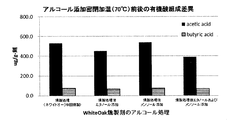
- Comparison data of organic acid analysis values before and after the smoke treatment are shown in FIG. From the result of FIG. 1, it was confirmed that the content of the organic acid contained in the tobacco leaf was increased by applying the smoke treatment to the tobacco leaf. Moreover, it has also confirmed that the quantity of the provided organic acid increased by increasing the frequency
- the organic acid content was measured by the same method as in Experimental Example 1 above. From the result of FIG. 3, it can be inferred that the esterification reaction occurred in the case where alcohol was added and the mixture was heated in a sealed container because the content of the organic acid was reduced.
- the analysis of the ester compound was performed as follows. 0.5 g of tobacco was accurately weighed into an SPME vial (20 mL capacity), sealed with a vial cap, and analyzed by GCMS with SPME automatic introduction device. Further, a sample in which 25 ⁇ L of p-bromophenethyl alcohol in acetonitrile (1 mg / mL) was added to another SPME vial was similarly analyzed, and the ratio of the peak area of the analysis target component to p-bromophenethyl alcohol was determined and obtained. By value, the amount of analysis target component contained in each sample was compared.
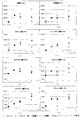
- FIGS. 4 (a) to (h) The results of Experimental Example 3 are shown in FIGS. 4 (a) to (h).
- shaft in FIG. 4 shows the peak area value obtained by analysis of GCMS instead of the density
- the numerical values on the horizontal axis in FIG. 4 indicate the number of weeks that have passed.
- organic acid esters were produced in the case where the tobacco leaves to which alcohol was added were stored for one week.
Landscapes
- Health & Medical Sciences (AREA)
- General Health & Medical Sciences (AREA)
- Toxicology (AREA)
- Chemical & Material Sciences (AREA)
- Chemical Kinetics & Catalysis (AREA)
- General Chemical & Material Sciences (AREA)
- Manufacture Of Tobacco Products (AREA)
Abstract
Priority Applications (6)
| Application Number | Priority Date | Filing Date | Title |
|---|---|---|---|
| PCT/JP2013/066806 WO2014203341A1 (fr) | 2013-06-19 | 2013-06-19 | Procédé de production de matière première de tabac |
| RU2016100236A RU2633205C2 (ru) | 2013-06-19 | 2013-06-19 | Способ получения исходного табачного материала |
| UAA201600373A UA116250C2 (uk) | 2013-06-19 | 2013-06-19 | Спосіб одержання вихідного тютюнового матеріалу |
| EP13887397.1A EP2965637B1 (fr) | 2013-06-19 | 2013-06-19 | Procédé de production de matière première de tabac |
| CN201380077609.2A CN105307515B (zh) | 2013-06-19 | 2013-06-19 | 烟草原料的制造方法 |
| JP2015522410A JP6129964B2 (ja) | 2013-06-19 | 2013-06-19 | たばこ原料の製造方法 |
Applications Claiming Priority (1)
| Application Number | Priority Date | Filing Date | Title |
|---|---|---|---|
| PCT/JP2013/066806 WO2014203341A1 (fr) | 2013-06-19 | 2013-06-19 | Procédé de production de matière première de tabac |
Publications (1)
| Publication Number | Publication Date |
|---|---|
| WO2014203341A1 true WO2014203341A1 (fr) | 2014-12-24 |
Family
ID=52104107
Family Applications (1)
| Application Number | Title | Priority Date | Filing Date |
|---|---|---|---|
| PCT/JP2013/066806 Ceased WO2014203341A1 (fr) | 2013-06-19 | 2013-06-19 | Procédé de production de matière première de tabac |
Country Status (6)
| Country | Link |
|---|---|
| EP (1) | EP2965637B1 (fr) |
| JP (1) | JP6129964B2 (fr) |
| CN (1) | CN105307515B (fr) |
| RU (1) | RU2633205C2 (fr) |
| UA (1) | UA116250C2 (fr) |
| WO (1) | WO2014203341A1 (fr) |
Cited By (3)
| Publication number | Priority date | Publication date | Assignee | Title |
|---|---|---|---|---|
| WO2018139068A1 (fr) | 2017-01-30 | 2018-08-02 | 日本たばこ産業株式会社 | Procédé de fabrication de matière première de tabac, et matière première de tabac |
| JP2021104049A (ja) * | 2015-06-30 | 2021-07-26 | アール・ジエイ・レイノルズ・タバコ・カンパニー | 喫煙用物品のエアゾール発生システム用の熱発生セグメント |
| JP2023164948A (ja) * | 2018-04-10 | 2023-11-14 | ブリティッシュ アメリカン タバコ (インヴェストメンツ) リミテッド | 喫煙品 |
Families Citing this family (6)
| Publication number | Priority date | Publication date | Assignee | Title |
|---|---|---|---|---|
| WO2019097641A1 (fr) * | 2017-11-16 | 2019-05-23 | 日本たばこ産業株式会社 | Procédé de fabrication d'une charge de tabac contenant un parfum, charge de tabac contenant un parfum et inhalateur d'arôme de type chauffant |
| CN111329098B (zh) * | 2020-03-19 | 2022-01-28 | 云南中烟工业有限责任公司 | 一种熏蒸调香方法及其在烟草中的用途 |
| CN113951551A (zh) * | 2020-07-20 | 2022-01-21 | 黄锐 | 一种调制旱烟的防霉增香水浸发酵方法 |
| GB202014921D0 (en) * | 2020-09-22 | 2020-11-04 | Nicoventures Trading Ltd | Tobacco compositions and preparation thereof |
| KR102571394B1 (ko) * | 2020-10-14 | 2023-08-25 | 주식회사 케이티앤지 | 흡연재료의 가향숙성방법 및 이를 이용하여 제조된 흡연물품 |
| CN119999946B (zh) * | 2023-11-14 | 2025-11-18 | 广东中烟工业有限责任公司 | 一种采用植物香料对烟叶增香的方法及其应用 |
Citations (5)
| Publication number | Priority date | Publication date | Assignee | Title |
|---|---|---|---|---|
| JPS5651976A (en) | 1979-10-01 | 1981-05-09 | Japan Tobacco & Salt Public | Improvement of smoking flavor of tobacco |
| JPS5933345B2 (ja) * | 1981-06-02 | 1984-08-15 | ア−ル・ジエイ・レノルズ・タバコ・カンパニ− | タバコ処理法 |
| JPH0659201B2 (ja) * | 1989-09-18 | 1994-08-10 | ブリティッシュ―アメリカン・タバコ・カンパニー・リミテッド | 煙草葉の処理方法 |
| JP2003000219A (ja) * | 2001-06-20 | 2003-01-07 | Japan Tobacco Inc | 刻タバコの製造システムおよびその製造方法 |
| WO2013098920A1 (fr) * | 2011-12-26 | 2013-07-04 | 日本たばこ産業株式会社 | Procédé permettant de produire un matériau de tabac contenance des composants d'arôme d'ester enrichis et composants contribuant au goût du tabac, et produit de tabac comprenant un matériau de tabac produit ainsi |
Family Cites Families (20)
| Publication number | Priority date | Publication date | Assignee | Title |
|---|---|---|---|---|
| US4660577A (en) * | 1982-08-20 | 1987-04-28 | R.J. Reynolds Tobacco Company | Dry pre-mix for moist snuff |
| US4528993A (en) * | 1982-08-20 | 1985-07-16 | R. J. Reynolds Tobacco Company | Process for producing moist snuff |
| US4848373A (en) * | 1987-04-13 | 1989-07-18 | Helme Tobacco Company | Nicotine removal process and product produced thereby |
| CN1031312C (zh) * | 1992-12-19 | 1996-03-20 | 祖泽民 | 烟草醇化液及其加工方法 |
| CN1109302A (zh) * | 1994-03-30 | 1995-10-04 | 黑龙江省科学技术情报研究所 | 刺五加绞股蓝保健吸品及其制造方法 |
| US20040118422A1 (en) * | 2002-12-19 | 2004-06-24 | Swedish Match North Europe Ab | Tobacco dough and a method for its manufacture |
| KR101276988B1 (ko) * | 2004-05-24 | 2013-06-24 | 브리티쉬 아메리칸 토바코 (인베스트먼츠) 리미티드 | 니트로스아민 선택성인 분자 각인 중합체 및 이의 사용방법 |
| US20060185686A1 (en) * | 2004-08-23 | 2006-08-24 | Lawrence Robert H Jr | Nicotiana diversity |
| US7757697B2 (en) * | 2005-12-22 | 2010-07-20 | Swisher International, Inc. | Method for reducing nitrosamines in tobacco |
| CN101873809B (zh) * | 2007-07-23 | 2014-11-12 | R.J.雷诺兹烟草公司 | 无烟烟草组合物 |
| CN101254025B (zh) * | 2008-03-13 | 2010-04-14 | 中国烟草总公司郑州烟草研究院 | 袋装口含烟草制品及其制备方法 |
| CN101292776B (zh) * | 2008-06-23 | 2010-06-02 | 中国烟草总公司郑州烟草研究院 | 一种口含型烟草制品 |
| CN101773292A (zh) * | 2009-01-09 | 2010-07-14 | 安徽中烟工业公司 | 一种雪茄原料烟叶的处理方法 |
| CN101773293B (zh) * | 2009-01-09 | 2012-05-30 | 安徽中烟工业公司 | 一种毛烟的处理方法 |
| CN101779829B (zh) * | 2009-01-20 | 2012-09-05 | 段煌 | 一种废弃烟丝再利用的方法 |
| CN102100400B (zh) * | 2009-12-18 | 2012-11-28 | 深圳波顿香料有限公司 | 一种烟草的处理方法 |
| CN101856144B (zh) * | 2010-06-10 | 2012-07-04 | 红云红河烟草(集团)有限责任公司 | 一种改善卷烟烟丝品质的方法 |
| WO2012078597A1 (fr) * | 2010-12-07 | 2012-06-14 | Freeman Steven R | Variantes végétales au tabac et articles les comprenant |
| CN102247005B (zh) * | 2011-07-24 | 2013-04-03 | 红云红河烟草(集团)有限责任公司 | 一种烟草加料方法 |
| CN102845829B (zh) * | 2012-10-19 | 2014-03-19 | 红塔烟草(集团)有限责任公司 | 一种提高低等级烟叶品质的复合添加剂和应用方法 |
-
2013
- 2013-06-19 CN CN201380077609.2A patent/CN105307515B/zh not_active Expired - Fee Related
- 2013-06-19 UA UAA201600373A patent/UA116250C2/uk unknown
- 2013-06-19 WO PCT/JP2013/066806 patent/WO2014203341A1/fr not_active Ceased
- 2013-06-19 EP EP13887397.1A patent/EP2965637B1/fr active Active
- 2013-06-19 RU RU2016100236A patent/RU2633205C2/ru active
- 2013-06-19 JP JP2015522410A patent/JP6129964B2/ja not_active Expired - Fee Related
Patent Citations (6)
| Publication number | Priority date | Publication date | Assignee | Title |
|---|---|---|---|---|
| JPS5651976A (en) | 1979-10-01 | 1981-05-09 | Japan Tobacco & Salt Public | Improvement of smoking flavor of tobacco |
| JPS5722545B2 (fr) * | 1979-10-01 | 1982-05-13 | ||
| JPS5933345B2 (ja) * | 1981-06-02 | 1984-08-15 | ア−ル・ジエイ・レノルズ・タバコ・カンパニ− | タバコ処理法 |
| JPH0659201B2 (ja) * | 1989-09-18 | 1994-08-10 | ブリティッシュ―アメリカン・タバコ・カンパニー・リミテッド | 煙草葉の処理方法 |
| JP2003000219A (ja) * | 2001-06-20 | 2003-01-07 | Japan Tobacco Inc | 刻タバコの製造システムおよびその製造方法 |
| WO2013098920A1 (fr) * | 2011-12-26 | 2013-07-04 | 日本たばこ産業株式会社 | Procédé permettant de produire un matériau de tabac contenance des composants d'arôme d'ester enrichis et composants contribuant au goût du tabac, et produit de tabac comprenant un matériau de tabac produit ainsi |
Cited By (7)
| Publication number | Priority date | Publication date | Assignee | Title |
|---|---|---|---|---|
| JP2021104049A (ja) * | 2015-06-30 | 2021-07-26 | アール・ジエイ・レイノルズ・タバコ・カンパニー | 喫煙用物品のエアゾール発生システム用の熱発生セグメント |
| JP2023078326A (ja) * | 2015-06-30 | 2023-06-06 | アール・ジエイ・レイノルズ・タバコ・カンパニー | 喫煙用物品のエアゾール発生システム用の熱発生セグメント |
| JP7470658B2 (ja) | 2015-06-30 | 2024-04-18 | アール・ジエイ・レイノルズ・タバコ・カンパニー | 喫煙用物品のエアゾール発生システム用の熱発生セグメント |
| JP7702984B2 (ja) | 2015-06-30 | 2025-07-04 | アール・ジエイ・レイノルズ・タバコ・カンパニー | 喫煙用物品のエアゾール発生システム用の熱発生セグメント |
| WO2018139068A1 (fr) | 2017-01-30 | 2018-08-02 | 日本たばこ産業株式会社 | Procédé de fabrication de matière première de tabac, et matière première de tabac |
| JPWO2018139068A1 (ja) * | 2017-01-30 | 2019-11-07 | 日本たばこ産業株式会社 | たばこ原料の製造方法及びたばこ原料 |
| JP2023164948A (ja) * | 2018-04-10 | 2023-11-14 | ブリティッシュ アメリカン タバコ (インヴェストメンツ) リミテッド | 喫煙品 |
Also Published As
| Publication number | Publication date |
|---|---|
| JP6129964B2 (ja) | 2017-05-17 |
| EP2965637A4 (fr) | 2016-12-07 |
| UA116250C2 (uk) | 2018-02-26 |
| EP2965637A1 (fr) | 2016-01-13 |
| RU2016100236A (ru) | 2017-07-20 |
| RU2633205C2 (ru) | 2017-10-11 |
| EP2965637B1 (fr) | 2019-04-24 |
| CN105307515B (zh) | 2019-07-05 |
| CN105307515A (zh) | 2016-02-03 |
| JPWO2014203341A1 (ja) | 2017-02-23 |
Similar Documents
| Publication | Publication Date | Title |
|---|---|---|
| JP6129964B2 (ja) | たばこ原料の製造方法 | |
| EP3297460B1 (fr) | Matériau générateur d'aérosol et dispositifs le comprenant | |
| JP6832960B2 (ja) | たばこ原料の製造方法及びたばこ原料 | |
| EP3979841B1 (fr) | Composition de nicotine, procédé de fabrication et articles de génération d'aérosol le comprenant | |
| CN105899091B (zh) | 烟草材料及其处理方法 | |
| RU2578115C2 (ru) | Способ получения материала табака, содержащего обогащенный сложноэфирный ароматизирующий компонент и обогащенный компонент, вносящий свой вклад в аромат и вкус табака, и табачное изделие, содержащее материал табака, полученный по данному способу | |
| CA3030815C (fr) | Charge de tabac pour article a fumer a chaleur de type sans combustion | |
| CN105848502A (zh) | 烟草处理 | |
| ES2954965T3 (es) | Extracto de tabaco líquido, método para fabricarlo y artículos generadores de aerosol que lo comprenden | |
| JP6025950B2 (ja) | 増強されたエステル香気成分及び香喫味に寄与する成分を含むたばこ材料の製造方法および該方法により製造されたたばこ材料を含むたばこ製品 | |
| WO2022064183A1 (fr) | Compositions de tabac et leur préparation | |
| TW201500013A (zh) | 煙草原料的製造方法 | |
| WO2025181881A1 (fr) | Composition de tabac, article à fumer de type à chauffage sans combustion et procédé de stockage de composition de tabac | |
| HK40067910B (en) | Liquid tobacco extract, method for making and aerosol-generating articles comprising such | |
| HK40067910A (en) | Liquid tobacco extract, method for making and aerosol-generating articles comprising such | |
| TW201328612A (zh) | 含有增加之酯香氣成分及含提供香口嚼味成分之香菸材料之製造方法,及含有由該製造方法所製造之香菸材料之香菸製品 | |
| JPWO2013098920A1 (ja) | 増強されたエステル香気成分及び香喫味に寄与する成分を含むたばこ材料の製造方法および該方法により製造されたたばこ材料を含むたばこ製品 | |
| TW201924544A (zh) | 擔持有香料之煙草填充材的製造方法、擔持有香料之煙草填充材及加熱型香味吸嚐器 | |
| HK40004316A (en) | Tobacco filler for non-combustion type heat smoking article |
Legal Events
| Date | Code | Title | Description |
|---|---|---|---|
| WWE | Wipo information: entry into national phase |
Ref document number: 201380077609.2 Country of ref document: CN |
|
| 121 | Ep: the epo has been informed by wipo that ep was designated in this application |
Ref document number: 13887397 Country of ref document: EP Kind code of ref document: A1 |
|
| WWE | Wipo information: entry into national phase |
Ref document number: 2013887397 Country of ref document: EP |
|
| ENP | Entry into the national phase |
Ref document number: 2015522410 Country of ref document: JP Kind code of ref document: A |
|
| NENP | Non-entry into the national phase |
Ref country code: DE |
|
| WWE | Wipo information: entry into national phase |
Ref document number: A201600373 Country of ref document: UA |
|
| ENP | Entry into the national phase |
Ref document number: 2016100236 Country of ref document: RU Kind code of ref document: A |