WO2014203953A1 - 石膏用液体分散剤組成物 - Google Patents
石膏用液体分散剤組成物 Download PDFInfo
- Publication number
- WO2014203953A1 WO2014203953A1 PCT/JP2014/066241 JP2014066241W WO2014203953A1 WO 2014203953 A1 WO2014203953 A1 WO 2014203953A1 JP 2014066241 W JP2014066241 W JP 2014066241W WO 2014203953 A1 WO2014203953 A1 WO 2014203953A1
- Authority
- WO
- WIPO (PCT)
- Prior art keywords
- component
- less
- mass
- gypsum
- monomer
- Prior art date
- Legal status (The legal status is an assumption and is not a legal conclusion. Google has not performed a legal analysis and makes no representation as to the accuracy of the status listed.)
- Ceased
Links
Classifications
-
- C—CHEMISTRY; METALLURGY
- C04—CEMENTS; CONCRETE; ARTIFICIAL STONE; CERAMICS; REFRACTORIES
- C04B—LIME, MAGNESIA; SLAG; CEMENTS; COMPOSITIONS THEREOF, e.g. MORTARS, CONCRETE OR LIKE BUILDING MATERIALS; ARTIFICIAL STONE; CERAMICS; REFRACTORIES; TREATMENT OF NATURAL STONE
- C04B24/00—Use of organic materials as active ingredients for mortars, concrete or artificial stone, e.g. plasticisers
- C04B24/24—Macromolecular compounds
- C04B24/26—Macromolecular compounds obtained by reactions only involving carbon-to-carbon unsaturated bonds
-
- C—CHEMISTRY; METALLURGY
- C04—CEMENTS; CONCRETE; ARTIFICIAL STONE; CERAMICS; REFRACTORIES
- C04B—LIME, MAGNESIA; SLAG; CEMENTS; COMPOSITIONS THEREOF, e.g. MORTARS, CONCRETE OR LIKE BUILDING MATERIALS; ARTIFICIAL STONE; CERAMICS; REFRACTORIES; TREATMENT OF NATURAL STONE
- C04B28/00—Compositions of mortars, concrete or artificial stone, containing inorganic binders or the reaction product of an inorganic and an organic binder, e.g. polycarboxylate cements
- C04B28/14—Compositions of mortars, concrete or artificial stone, containing inorganic binders or the reaction product of an inorganic and an organic binder, e.g. polycarboxylate cements containing calcium sulfate cements
-
- C—CHEMISTRY; METALLURGY
- C04—CEMENTS; CONCRETE; ARTIFICIAL STONE; CERAMICS; REFRACTORIES
- C04B—LIME, MAGNESIA; SLAG; CEMENTS; COMPOSITIONS THEREOF, e.g. MORTARS, CONCRETE OR LIKE BUILDING MATERIALS; ARTIFICIAL STONE; CERAMICS; REFRACTORIES; TREATMENT OF NATURAL STONE
- C04B16/00—Use of organic materials as fillers, e.g. pigments, for mortars, concrete or artificial stone; Treatment of organic materials specially adapted to enhance their filling properties in mortars, concrete or artificial stone
- C04B16/04—Macromolecular compounds
-
- C—CHEMISTRY; METALLURGY
- C04—CEMENTS; CONCRETE; ARTIFICIAL STONE; CERAMICS; REFRACTORIES
- C04B—LIME, MAGNESIA; SLAG; CEMENTS; COMPOSITIONS THEREOF, e.g. MORTARS, CONCRETE OR LIKE BUILDING MATERIALS; ARTIFICIAL STONE; CERAMICS; REFRACTORIES; TREATMENT OF NATURAL STONE
- C04B24/00—Use of organic materials as active ingredients for mortars, concrete or artificial stone, e.g. plasticisers
- C04B24/12—Nitrogen containing compounds organic derivatives of hydrazine
-
- C—CHEMISTRY; METALLURGY
- C04—CEMENTS; CONCRETE; ARTIFICIAL STONE; CERAMICS; REFRACTORIES
- C04B—LIME, MAGNESIA; SLAG; CEMENTS; COMPOSITIONS THEREOF, e.g. MORTARS, CONCRETE OR LIKE BUILDING MATERIALS; ARTIFICIAL STONE; CERAMICS; REFRACTORIES; TREATMENT OF NATURAL STONE
- C04B40/00—Processes, in general, for influencing or modifying the properties of mortars, concrete or artificial stone compositions, e.g. their setting or hardening ability
-
- C—CHEMISTRY; METALLURGY
- C04—CEMENTS; CONCRETE; ARTIFICIAL STONE; CERAMICS; REFRACTORIES
- C04B—LIME, MAGNESIA; SLAG; CEMENTS; COMPOSITIONS THEREOF, e.g. MORTARS, CONCRETE OR LIKE BUILDING MATERIALS; ARTIFICIAL STONE; CERAMICS; REFRACTORIES; TREATMENT OF NATURAL STONE
- C04B40/00—Processes, in general, for influencing or modifying the properties of mortars, concrete or artificial stone compositions, e.g. their setting or hardening ability
- C04B40/0028—Aspects relating to the mixing step of the mortar preparation
- C04B40/0039—Premixtures of ingredients
-
- C—CHEMISTRY; METALLURGY
- C08—ORGANIC MACROMOLECULAR COMPOUNDS; THEIR PREPARATION OR CHEMICAL WORKING-UP; COMPOSITIONS BASED THEREON
- C08L—COMPOSITIONS OF MACROMOLECULAR COMPOUNDS
- C08L33/00—Compositions of homopolymers or copolymers of compounds having one or more unsaturated aliphatic radicals, each having only one carbon-to-carbon double bond, and only one being terminated by only one carboxyl radical, or of salts, anhydrides, esters, amides, imides or nitriles thereof; Compositions of derivatives of such polymers
- C08L33/04—Homopolymers or copolymers of esters
- C08L33/06—Homopolymers or copolymers of esters of esters containing only carbon, hydrogen and oxygen, which oxygen atoms are present only as part of the carboxyl radical
- C08L33/062—Copolymers with monomers not covered by C08L33/06
- C08L33/064—Copolymers with monomers not covered by C08L33/06 containing anhydride, COOH or COOM groups, with M being metal or onium-cation
-
- C—CHEMISTRY; METALLURGY
- C04—CEMENTS; CONCRETE; ARTIFICIAL STONE; CERAMICS; REFRACTORIES
- C04B—LIME, MAGNESIA; SLAG; CEMENTS; COMPOSITIONS THEREOF, e.g. MORTARS, CONCRETE OR LIKE BUILDING MATERIALS; ARTIFICIAL STONE; CERAMICS; REFRACTORIES; TREATMENT OF NATURAL STONE
- C04B2103/00—Function or property of ingredients for mortars, concrete or artificial stone
- C04B2103/40—Surface-active agents, dispersants
- C04B2103/408—Dispersants
Definitions
- the present invention relates to a liquid dispersant composition for gypsum and a gypsum slurry.
- the present invention also relates to a method for producing a gypsum slurry, use as a dispersant for gypsum, and a method for producing a liquid dispersant composition for gypsum.
- Naphthalene sulfonic acid formaldehyde condensate has been used as a water reducing agent in the gypsum / water slurry used for gypsum board.
- switching to a polycarboxylic acid-based water reducing agent that does not cause the formation of formaldehyde, which is one of the causative substances of sick house syndrome has been promoted.
- the raw material of gypsum is diversified, and the utilization of phosphogypsum, which is a by-product at the time of manufacturing fertilizer phosphoric acid, is increasing.
- Japanese Patent Application Laid-Open No. 10-158051 discloses a by-product gypsum / water slurry containing a polycarboxylic acid-based dispersant and having a slurry pH of 5 to 10, and a production method thereof. It is disclosed that the pH is adjusted by adding, and in the examples, it is disclosed that a slurry is prepared using a by-product phosphoric acid hemihydrate gypsum and a polycarboxylic acid-based dispersant, and the pH is adjusted with calcium hydroxide. Yes.
- US Pat. No. 3181985 discloses that by adding ammonia to a gypsum slurry of byproduct gypsum containing phosphoric acid as an impurity, adhesion to paper is increased when a gypsum board is molded.
- US Pat. No. 5,151,130 discloses a method of reducing the consistency of gypsum slurry by adding a polyalkylene polyamine having a molecular weight of 1000 or less to the gypsum slurry.
- the present invention comprises (A) polymerizing a monomer containing a monomer (A1) represented by the following general formula (A1) and a monomer (A2) represented by the following general formula (A2).
- component (A) the ratio of the mass of the monomer (A2) to the total mass of the monomer (A1) and the monomer (A2) is 4% by mass or more
- component is one or more nitrogen-containing compounds selected from ammonia, alkylamine, alkanolamine, alkylalkanolamine, ethylenediamine, diethylenetriamine, triethylenetetramine, tetraethylenepentamine, and polyethyleneimine
- the component alkylamine is a primary amine having an alkyl group with a total carbon number of 5 or less
- the alkanolamine as the component (B) is an alkanolamine having 1 to 10 carbon atoms and having 1 to 3 alkanol groups
- the alkyl alkanolamine of the component is an alkyl alkanolamine having 2 or more and 10 or less carbon atoms and having one or two alkyl groups, PH at 20 ° C. is 7.0 or more and 13.0 or less,
- the present invention relates to a liquid dispersant composition for gypsum.
- R 1 and R 2 each independently a hydrogen atom or a methyl group m1: 0 or more and an integer of 2 or less AO: an alkyleneoxy group having 2 or 3 carbon atoms n: an average added mole number of AO, 4 or more, 300
- the following number X A hydrogen atom or an alkyl group having 1 to 3 carbon atoms.
- R 3 , R 4 , R 5 each independently a hydrogen atom, a methyl group, or (CH 2 ) m2 COOM 2
- M 1 and M 2 each independently represents a hydrogen atom, an alkali metal, an alkaline earth metal (1/2 atom), an organic ammonium group, or an ammonium group m2: 0 or more and an integer of 2 or less.
- the present invention provides a gypsum, a monomer containing (A) a monomer (A1) represented by the following general formula (A1) and a monomer (A2) represented by the following general formula (A2)
- component (A) the ratio of the mass of the monomer (A2) to the total mass of the monomer (A1) and the monomer (A2) is 4% by mass or more
- component is one or more nitrogen-containing compounds selected from ammonia, alkylamine, alkanolamine, alkylalkanolamine, ethylenediamine, diethylenetriamine, triethylenetetramine, tetraethylenepentamine, and polyethyleneimine
- the component alkylamine is a primary amine having an alkyl group with a total carbon number of
- An alkylamine selected from a certain tertiary amine (B)
- the alkanolamine of the component is an alkanolamine having 1 to 10 carbon atoms and having 1 to 3 alkanol groups
- the alkyl alkanolamine of the component is an alkyl alkanolamine having 2 or more and 10 or less carbon atoms and having one or two alkyl groups
- (A) Content of a component is 0.005 mass part or more and 1.0 mass part or less with respect to 100 mass parts of gypsum, PH at 20 ° C. is 6.0 or more and 9.0 or less, Relates to gypsum slurry.
- R 1 and R 2 each independently a hydrogen atom or a methyl group m1: 0 or more and an integer of 2 or less AO: an alkyleneoxy group having 2 or 3 carbon atoms n: an average added mole number of AO, 4 or more, 300
- the following number X A hydrogen atom or an alkyl group having 1 to 3 carbon atoms.
- R 3 , R 4 , R 5 each independently a hydrogen atom, a methyl group, or (CH 2 ) m2 COOM 2
- M 1 and M 2 each independently represents a hydrogen atom, an alkali metal, an alkaline earth metal (1/2 atom), an organic ammonium group, or an ammonium group m2: 0 or more and an integer of 2 or less.
- this invention relates to the manufacturing method of the gypsum slurry whose pH in 20 degreeC is 6.0 or more and 9.0 or less including the following process.
- Process 1 The process which mixes (A) component, (B) component, and water, and obtains the liquid composition for gypsum preparation.
- Step 2 A step of mixing the liquid composition for gypsum preparation obtained in Step 1 and gypsum to obtain a gypsum slurry.
- the component (A) is obtained by polymerizing a monomer containing the monomer (A1) represented by the following general formula (A1) and the monomer (A2) represented by the following general formula (A2).
- the component (B) is a nitrogen-containing compound
- the ratio of the mass of the monomer (A2) to the total mass of the monomer (A1) and the monomer (A2) is 4% by mass or more
- component is one or more nitrogen-containing compounds selected from ammonia, alkylamine, alkanolamine, alkylalkanolamine, ethylenediamine, diethylenetriamine, triethylenetetramine, tetraethylenepentamine, and polyethyleneimine
- the component alkylamine is a primary amine having an alkyl group with a total carbon number of 5 or less, a secondary amine with an alkyl group having a total carbon number of 6 or less, and an alkyl group with a total carbon number of 5 or less.
- An alkylamine selected from a certain tertiary amine (B)
- the alkanolamine of the component is an alkanolamine having 1 to 10 carbon atoms and having 1 to 3 alkanol groups
- the alkyl alkanolamine as the component (B) is an alkyl alkanol amine having 2 to 10 carbon atoms and having one or two alkyl groups.
- R 1 and R 2 each independently a hydrogen atom or a methyl group m1: 0 or more and an integer of 2 or less AO: an alkyleneoxy group having 2 or 3 carbon atoms n: an average added mole number of AO, 4 or more, 300
- the following number X A hydrogen atom or an alkyl group having 1 to 3 carbon atoms.
- R 3 , R 4 , R 5 each independently a hydrogen atom, a methyl group, or (CH 2 ) m2 COOM 2
- M 1 and M 2 each independently represents a hydrogen atom, an alkali metal, an alkaline earth metal (1/2 atom), an organic ammonium group, or an ammonium group m2: 0 or more and an integer of 2 or less.
- the present invention also relates to the use of a composition comprising the components (A) and (B) as a gypsum dispersant for improving the fluidity of gypsum slurry.
- the component (A) is obtained by polymerizing a monomer containing the monomer (A1) represented by the following general formula (A1) and the monomer (A2) represented by the following general formula (A2).
- the component (B) is a nitrogen-containing compound
- the ratio of the mass of the monomer (A2) to the total mass of the monomer (A1) and the monomer (A2) is 4% by mass or more
- component is one or more nitrogen-containing compounds selected from ammonia, alkylamine, alkanolamine, alkylalkanolamine, ethylenediamine, diethylenetriamine, triethylenetetramine, tetraethylenepentamine, and polyethyleneimine
- the component alkylamine is a primary amine having an alkyl group with a total carbon number of 5 or less, a secondary amine with an alkyl group having a total carbon number of 6 or less, and an alkyl group with a total carbon number of 5 or less.
- An alkylamine selected from a certain tertiary amine (B)
- the alkanolamine of the component is an alkanolamine having 1 to 10 carbon atoms and having 1 to 3 alkanol groups
- the alkyl alkanolamine as the component (B) is an alkyl alkanol amine having 2 to 10 carbon atoms and having one or two alkyl groups.
- R 1 and R 2 each independently a hydrogen atom or a methyl group m1: 0 or more and an integer of 2 or less AO: an alkyleneoxy group having 2 or 3 carbon atoms n: an average added mole number of AO, 4 or more, 300
- the following number X A hydrogen atom or an alkyl group having 1 to 3 carbon atoms.
- R 3 , R 4 , R 5 each independently a hydrogen atom, a methyl group, or (CH 2 ) m2 COOM 2
- M 1 and M 2 each independently represents a hydrogen atom, an alkali metal, an alkaline earth metal (1/2 atom), an organic ammonium group, or an ammonium group m2: 0 or more and an integer of 2 or less.
- this invention superpose
- component (A) the ratio of the mass of the monomer (A2) to the total mass of the monomer (A1) and the monomer (A2) is 4% by mass or more
- component (B) component is one or more nitrogen-containing compounds selected from ammonia, alkylamine, alkanolamine, alkylalkanolamine, ethylenediamine, diethylenetriamine, triethylenetetramine, tetraethylenepentamine, and polyethyleneimine
- Component (B) is a primary amine in which the total number of carbon atoms in the alkyl group is 5 or less, a secondary amine in which the total number of carbon atoms in the alkyl group is 6 or less, and the total number of carbon atoms in the alkyl group.
- the alkanolamine of the component is an alkanolamine having 1 to 10 carbon atoms and having 1 to 3 alkanol groups
- the alkyl alkanolamine of the component is an alkyl alkanolamine having 2 or more and 10 or less carbon atoms and having one or two alkyl groups, PH at 20 ° C. is 7.0 or more and 13.0 or less
- the present invention relates to a method for producing a liquid dispersant composition for gypsum.
- R 1 and R 2 each independently a hydrogen atom or a methyl group m1: 0 or more and an integer of 2 or less AO: an alkyleneoxy group having 2 or 3 carbon atoms n: an average added mole number of AO, 4 or more, 300
- the following number X A hydrogen atom or an alkyl group having 1 to 3 carbon atoms.
- R 3 , R 4 , R 5 each independently a hydrogen atom, a methyl group, or (CH 2 ) m2 COOM 2
- M 1 and M 2 each independently represents a hydrogen atom, an alkali metal, an alkaline earth metal (1/2 atom), an organic ammonium group, or an ammonium group m2: 0 or more and an integer of 2 or less.
- the water reducing agent used for the preparation of the gypsum slurry is preferably a one-pack type from the viewpoint of not increasing the production equipment and the ease of handling.
- a slurry using by-product gypsum such as phosphogypsum has a relatively high pH (that is, the slurry pH is set to be the same as that of a slurry using ordinary gypsum). Therefore, it is conceivable that an alkaline agent is added to the water reducing agent since the effect of the water reducing agent is effectively expressed.
- an alkali agent such as sodium hydroxide or calcium hydroxide is added to the polycarboxylic acid-based water reducing agent to make one solution, the stability immediately after preparation or after storage is deteriorated.
- the present invention provides a one-part liquid dispersant composition for gypsum that is excellent in stability and fluidity, and a gypsum slurry containing the same. Furthermore, this invention provides the manufacturing method of a gypsum slurry, the use as a dispersing agent for gypsum, and the manufacturing method of the liquid dispersing agent composition for gypsum.
- the one-component liquid dispersion composition for gypsum which can obtain the gypsum slurry excellent in stability and fluidity
- the manufacturing method of the gypsum slurry which can obtain the gypsum slurry excellent in fluidity
- the use of the composition containing the component (A) and the component (B) as a dispersant for gypsum that can provide a gypsum slurry having excellent stability and fluidity. Provided.
- the manufacturing method of the liquid dispersant composition for gypsum which can obtain the gypsum slurry excellent in stability and excellent in fluidity
- the monomer (A1) is represented by the general formula is a constituent monomer of the component (A1), from the viewpoint of the fluidity of the gypsum slurry, in the general formula (A1), R 1 is a hydrogen atom preferably, R 2 is preferably a methyl group, m1 is 0 is preferable, AO is preferably an alkylene group having 2 carbon atoms.
- n is an average addition mole number of AO, and it is 4 or more from a fluid viewpoint of a gypsum slurry, is a number of 300 or less, 9 or more are preferable and 23 or more are preferable.
- n is preferably 200 or less, more preferably 150 or less, and still more preferably 130 or less. When two or more types of monomers (A) are used, n is the average added mole number of the whole copolymer.
- X is a hydrogen atom or an alkyl group having 1 to 3 carbon atoms, and an alkyl group having 1 carbon atom is preferable from the viewpoint of fluidity of the gypsum slurry.
- the monomer (A2) is represented by the general formula is a constituent monomer of the component (A2), from the viewpoint of the fluidity of the gypsum slurry, in the general formula (A2), R 3 is a hydrogen atom , R 4 is a methyl group, R 5 Is preferably a hydrogen atom. That is, the monomer (A2) is preferably methacrylic acid or an alkali metal salt or alkaline earth metal salt (1/2 atom), an amine salt or an ammonium salt thereof.
- M 1 and M 2 are each independently a hydrogen atom, an alkali metal, an alkaline earth metal (1/2 atom), an organic ammonium group, or an ammonium group.
- the alkali metal include sodium and potassium.
- the alkaline earth metal include calcium.
- the organic ammonium group include an alkanol ammonium group, a polyethylene ammonium group, an alkyl ammonium group, and an aromatic ammonium group.
- M 1 and M 2 are each independently preferably selected from a hydrogen atom and an alkali metal.
- the proportion of the mass of the monomer (A2) to the total mass of the monomer (A1) and the monomer (A2) is 4% by mass or more. 5 mass% or more is preferable, 7 mass% or more is more preferable, 10 mass% or more is further preferable, and less than 100 mass% is preferable, 50 mass% or less is more preferable, 25 mass% or less is further more preferable, 20 mass % Or less is even more preferable.
- the constituent monomer of the component (A) may include monomers other than the monomer (A1) and the monomer (A2), but the monomer (A1) and the monomer are included in the constituent monomers. 90 mass% or more is preferable, as for the sum total of a body (A2), 95 mass% or more is more preferable, and it is preferable that it is 100 mass% or less, and 100 mass% may be sufficient.
- the weight average molecular weight of the component (A) is preferably 10,000 or more, more preferably 20,000 or more, further preferably 50,000 or more, and preferably 200,000 or less, more preferably 100,000 or less.
- Component (B) is ammonia, alkylamine, alkanolamine, alkylalkanolamine, ethylenediamine, diethylenetriamine, triethylenetetramine, tetraethylenepentamine, and polyethyleneimine (the average condensation number of ethyleneimino groups is 4 or more, more preferably 5 One or more nitrogen-containing compounds selected from the above).
- the alkylamine is a primary amine in which the total carbon number of the alkyl group is 5 or less, a secondary amine in which the total carbon number of the alkyl group is 6 or less, and the total carbon number of the alkyl group. Is an alkylamine selected from tertiary amines having 5 or less.
- the lower limit of the carbon number of the alkyl group of the alkylamine is 1.
- tetraethylenepentamine linear type
- examples of polyethyleneimine having an average condensation number of ethyleneimino groups of 4 include branched Examples of the type of polyethyleneimine.
- the alkanolamine is an alkanolamine having 1 to 10 carbon atoms and having 1 to 3 alkanol groups.
- the alkyl alkanol amine is an alkyl alkanol amine having 2 to 10 carbon atoms and having one or two alkyl groups.
- the component (B) includes the alkylamine, the alkanolamine, the alkylalkanolamine, ethylenediamine, diethylenetriamine, triethylenetetramine, tetraethylenepentamine, and polyethyleneimine
- One or more nitrogen-containing compounds selected from those having an average condensation number of ethyleneimino groups of 4 or more, more preferably 5 or more are preferred.
- Component (B) is a preferable compound from the viewpoint of good solubility in water, easy mixing with the copolymer and water, and the flowability of the gypsum slurry.
- the alkanolamine has 1 to 10 carbon atoms from the viewpoint of the fluidity of the gypsum slurry, and has 1 to 3 alkanol groups from the viewpoint of the fluidity of the gypsum slurry. Specific examples include monoalkanolamines, dialkanolamines, and trialkanolamines.
- the alkanolamine is preferably an alkanolamine selected from monoethanolamine, diethanolamine, triethanolamine, and triisopropanolamine.
- the alkyl alkanolamine has a total carbon number of 2 or more and 10 or less from the viewpoint of the fluidity of the gypsum slurry, and has one or two alkyl groups from the viewpoint of the fluidity of the gypsum slurry.
- Specific examples include N-monoalkyl-monoalkanolamine, N-monoalkyl-dialkanolamine, and N, N-dialkyl-monoalkanolamine.
- the alkylalkanolamine is preferably N-methyldiethanolamine.
- the number of carbon atoms of the alkyl group is preferably 1 or more and 4 or less.
- ethylenediamine diethylenetriamine, triethylenetetramine, and tetraethylenepentamine
- ethylenediamine and diethylenetriamine are preferable from the viewpoint of the fluidity of the gypsum slurry.
- polyethyleneimine examples include polyethyleneimine selected from linear polyethyleneimine and branched polyethyleneimine.
- the molecular weight of polyethyleneimine is preferably 200 or more and 100,000 or less from the viewpoint of the fluidity of the gypsum slurry.
- the polyethyleneimine is preferably a branched polyethyleneimine from the viewpoint of the fluidity of the gypsum slurry, and more preferably a branched polyethyleneimine having a molecular weight of 200 or more and 10,000 or less.
- the primary amine having a total number of carbon atoms in the alkyl group of 5 or less is selected from methylamine, ethylamine, propylamine, butylamine, and pentylamine from the viewpoint of the fluidity of the gypsum slurry.
- Alkylamine is preferred.
- secondary amines having a total number of carbon atoms of the alkyl group of 6 or less are each an alkyl group having a total number of carbon atoms of the two alkyl groups of the secondary amine of 6 or less. Any number of carbon atoms may be used.
- Examples of the secondary amine having a total number of carbon atoms in the alkyl group of 6 or less include dimethylamine, diethylamine, and dipropylamine, and dimethylamine, diethylamine, and dipropylamine are preferable from the viewpoint of the fluidity of the gypsum slurry.
- each of the alkyl groups in which the total number of carbon atoms in the three alkyl groups of the tertiary amine is 5 or less is 5 or less. Any number of carbon atoms may be used.
- the tertiary amine in which the total number of carbon atoms in the alkyl group is 5 or less include trimethylamine, dimethylethylamine, and diethylmethylamine. Trimethylamine is preferred from the viewpoint of the fluidity of the gypsum slurry.
- the component (B) is preferably at least one selected from monoethanolamine, diethanolamine, triethanolamine, N-methyldiethanolamine, triisopropanolamine, ethylenediamine, and diethylenetriamine from the viewpoint of storage stability of the dispersant composition. From the viewpoint of easy handling and availability, one or more compounds selected from diethanolamine and triethanolamine are more preferable, and triethanolamine is still more preferable. Moreover, monoethanolamine and diethylenetriamine are more preferable from the viewpoint of the hydrolysis rate of the dispersant composition.
- the liquid dispersant composition for gypsum of the present invention preferably contains 5% by mass or more of the component (A) from the viewpoint of ease of use of the product and low viscosity of the product, and more preferably contains 10% by mass or more.
- the content is 60% by mass or less, and more preferably 50% by mass or less.
- the liquid dispersant composition for gypsum of the present invention preferably contains 0.0015% by mass or more, and 0.05% by mass or more of component (B) from the viewpoint of pH adjustment for improving fluidity. More preferably, 0.1% by mass or more is more preferable, 0.5% by mass or more is more preferable, 50% by mass or less is preferable, and 35% by mass or less is included. Is more preferable, and it is still more preferable to contain 20 mass% or less.
- the mass ratio of the component (A) to the component (B) is (A) / (B) and preferably 0.2 or more from the viewpoint of the fluidity of the gypsum slurry. 0.5 or more is more preferable, and 1 or more is more preferable.
- the mass ratio (A) / (B) is preferably 3000 or less, more preferably 500 or less, still more preferably 100 or less, still more preferably 50 or less, still more preferably 25 or less, and even more preferably 15 or less. 10 or less is still more preferable, and 5 or less is still more preferable.
- the dispersant composition of the present invention is suitable for gypsum containing phosphoric acid.
- the gypsum containing phosphoric acid used in the present invention include gypsum slurry in which 250 g of gypsum is dispersed in 142.5 g of water at 20 ° C., and the pH at 20 ° C. is 5.0 or more and 6.0 or less. It is done.
- the pH of the gypsum slurry is the pH of the aqueous solution portion of the gypsum slurry.
- the liquid dispersant composition for gypsum of the present invention is a liquid composition containing water. Water is used in an amount that makes up the balance of the composition. From the viewpoint of improving stability, the liquid dispersant composition for gypsum of the present invention has a pH at 20 ° C. of 7.0 or more.
- the pH at 20 ° C. is 13.0 or less, preferably 12.0 or less, and more preferably 11.0 or less.
- the gypsum slurry of the present invention is a gypsum-water slurry containing gypsum and water.
- the water reducing effect and fluidity are excellent.
- any gypsum such as high-quality neutralized gypsum, natural gypsum containing various impurities, phosphoric acid gypsum as a byproduct of phosphoric acid, and flue gas desulfurization gypsum generated by thermal power generation can be used.
- gypsum containing phosphoric acid As the viewpoint of controlling the fluidity by adjusting the pH, it is preferable to use gypsum containing phosphoric acid as described above. It is known that gypsum containing phosphoric acid exhibits a water-reducing effect by a polycarboxylic acid-based dispersant, while lowering fluidity.
- the component (A) and the component (B) even when a gypsum containing phosphoric acid is used, a gypsum slurry having a water reducing effect and excellent fluidity can be obtained. This is a very useful technology.
- the water / gypsum ratio is preferably a water / gypsum mass ratio of 0.4 or more, and more preferably 0.5 or more, from the viewpoint of improving the fluidity of the gypsum slurry.
- the mass ratio of water / gypsum is preferably 0.9 or less, and more preferably 0.8 or less.
- the content of the component (A) in the gypsum slurry of the present invention is 0.005 parts by mass or more and preferably 0.01 parts by mass or more with respect to 100 parts by mass of gypsum from the viewpoint of improving the fluidity of the gypsum slurry. 0.03 parts by mass or more, more preferably 1.0 part by mass or less, 0.6 parts by mass or less, more preferably 0.2 parts by mass or less, and even more preferably 0.1 parts by mass or less. .
- the content of the component (B) in the gypsum slurry of the present invention is preferably 0.0003 parts by mass or more, and 0.001 parts by mass or more with respect to 100 parts by mass of gypsum, from the viewpoint of fluidity of the gypsum slurry. More preferably, 0.005 mass part or more is further more preferable, and 0.025 mass part or more is still more preferable. And content of (B) component in the gypsum slurry of this invention has preferable 0.2 mass part or less, 0.1 mass part or less is more preferable, and 0.06 or less is still more preferable.
- the mass ratio of the component (A) and the component (B) is preferably (A) / (B), preferably 0.2 or more, from the viewpoint of the fluidity of the gypsum slurry.
- the above is more preferable, 1 or more is more preferable, and 2 or more is more preferable.
- the mass ratio (A) / (B) is preferably 3000 or less, more preferably 500 or less, still more preferably 100 or less, still more preferably 50 or less, still more preferably 25 or less, and even more preferably 15 or less. 10 or less is still more preferable, and 5 or less is still more preferable.
- the pH of the gypsum slurry of the present invention is preferably 6.0 or higher, more preferably 6.2 or higher.
- the pH is preferably 9.0 or less, and more preferably 8.0 or less, from the viewpoints of reduction in curing delay and adhesiveness with paper when a gypsum board is used.
- the pH of the gypsum slurry is the pH of the aqueous solution portion of the gypsum slurry.
- the gypsum slurry of the present invention can be produced by mixing gypsum, water, component (A) and component (B).
- the component (A) and the component (B) are preferably mixed with water in advance.
- (A) component and (B) component can be mixed and used for what is called kneading water.
- the liquid dispersant composition for gypsum of this invention can be used for preparation of the gypsum slurry of this invention. In that case, the liquid dispersant composition for gypsum of the present invention can be used as it is or diluted with water.
- the gypsum slurry of the present invention can be suitably used for the production of gypsum board.
- a composition containing the components (A) and (B) as a dispersant for gypsum for improving the fluidity of a gypsum slurry is provided.
- the manufacturing method of the gypsum slurry which mixes gypsum, water, (A) component, and (B) component by this invention is provided.
- Process 1 The process which mixes (A) component, (B) component, and water, and obtains the liquid composition for gypsum preparation.
- Step 2 A step of mixing the liquid composition for gypsum preparation obtained in Step 1 and gypsum to obtain a gypsum slurry.
- the component (A) is obtained by polymerizing a monomer containing the monomer (A1) represented by the general formula (A1) and the monomer (A2) represented by the general formula (A2).
- the component (B) is a nitrogen-containing compound
- the ratio of the mass of the monomer (A2) to the total mass of the monomer (A1) and the monomer (A2) is 4% by mass or more
- component is one or more nitrogen-containing compounds selected from ammonia, alkylamine, alkanolamine, alkylalkanolamine, ethylenediamine, diethylenetriamine, triethylenetetramine, tetraethylenepentamine, and polyethyleneimine
- the component alkylamine is a primary amine having an alkyl group with a total carbon number of 5 or less, a secondary amine with an alkyl group having a total carbon number of 6 or less, and an alkyl group with a total carbon number of 5 or less.
- An alkylamine selected from a certain tertiary amine (B)
- the alkanolamine of the component is an alkanolamine having 1 to 10 carbon atoms and having 1 to 3 alkanol groups
- the alkyl alkanolamine as the component (B) is an alkyl alkanol amine having 2 to 10 carbon atoms and having one or two alkyl groups.
- the preferred embodiments shown in the liquid dispersant composition for gypsum and the gypsum slurry can be appropriately applied.
- the contents of the component (A) and the component (B) shown in the gypsum slurry can be appropriately applied by replacing them with mixed amounts or added amounts.
- the preferable embodiments shown in the liquid dispersant composition for gypsum and the gypsum slurry can be appropriately applied.
- the preferable aspect of (A) component and (B) component which were shown with the liquid dispersing agent composition for gypsum can be applied suitably with respect to the use or manufacturing method in the following aspects.
- the contents of the component (A) and the component (B) shown in the gypsum slurry can be appropriately applied by replacing them with the mixed amount or the added amount.
- component (A) Copolymer obtained by polymerizing a monomer comprising the monomer (A1) represented by the following general formula (A1) and the monomer (A2) represented by the following general formula (A2)
- a liquid dispersant composition for gypsum containing coalescence hereinafter referred to as component (A)
- component (B) a nitrogen-containing compound
- component (B) is one or more nitrogen-containing compounds selected from ammonia, alkylamine, alkanolamine, alkylalkanolamine, ethylenediamine, diethylenetriamine, triethylenetetramine, tetraethylenepentamine, and polyethyleneimine
- Component (B) is a primary amine in which the total number of carbon atoms in the alkyl group is 5 or less
- alkylamine selected from tertiary amines that is 5 or less (B)
- the alkanolamine of the component is an alkanolamine having 1 to 10 carbon atoms and having 1 to 3 alkanol groups, (B)
- the alkyl alkanolamine of the component is an alkyl alkanolamine having 2 or more and 10 or less carbon atoms and having one or two alkyl groups, PH at 20 ° C. is 7.0 or more and 13.0 or less, Liquid dispersant composition for gypsum.
- R 1 and R 2 each independently a hydrogen atom or a methyl group m1: 0 or more and an integer of 2 or less AO: an alkyleneoxy group having 2 or 3 carbon atoms n: an average added mole number of AO, 4 or more, 300
- the following number X A hydrogen atom or an alkyl group having 1 to 3 carbon atoms.
- R 3 , R 4 , R 5 each independently a hydrogen atom, a methyl group, or (CH 2 ) m2 COOM 2
- M 1 and M 2 each independently represents a hydrogen atom, an alkali metal, an alkaline earth metal (1/2 atom), an organic ammonium group, or an ammonium group m2: 0 or more and an integer of 2 or less.
- n is the average added mole number of AO, preferably 6 or more, more preferably 9 or more, still more preferably 20 or more, still more preferably 23 or more, and more than 80 Is more preferable, 100 or more is still more preferable, 110 or more is more preferable, 200 or less is preferable, 150 or less is more preferable, 130 or less is still more preferable,
- the ratio of the mass of the monomer (A2) to the total mass of the monomer (A1) and the monomer (A2) of the component (A) is 4% by mass or more, preferably 5% by mass or more, and 7% by mass.
- the above is more preferable, 10% by mass or more is further preferable, and less than 100% by mass is preferable, 50% by mass or less is more preferable, 25% by mass or less is further preferable, and 20% by mass or less is more preferable, ⁇ 1> Or the liquid dispersant composition for gypsum as described in ⁇ 2>.
- the component (A) has a weight average molecular weight of preferably 10,000 or more, more preferably 20,000 or more, further preferably 50,000 or more, preferably 200,000 or less, more preferably 100,000 or less, any one of ⁇ 1> to ⁇ 3>
- liquid dispersant composition for gypsum according to any one of ⁇ 1> to ⁇ 4>, which is for gypsum containing phosphoric acid.
- component (A) is preferably 5% by mass or more, more preferably 10% by mass or more, and preferably 60% by mass or less, more preferably 50% by mass or less, and any one of ⁇ 1> to ⁇ 5>
- liquid dispersant composition for gypsum according to any one of ⁇ 1> to ⁇ 6>, wherein the component (B) is preferably one or more compounds selected from diethanolamine and triethanolamine, more preferably triethanolamine.
- the mass ratio of the component (A) to the component (B) is preferably (A) / (B), preferably 0.2 or more, more preferably 0.5 or more, still more preferably 1 or more, and still more preferably 2 or more. And preferably 3000 or less, more preferably 500 or less, still more preferably 100 or less, still more preferably 50 or less, still more preferably 25 or less, still more preferably 15 or less, even more preferably 10 or less, and 5 or less.
- the liquid dispersant composition for gypsum according to any one of ⁇ 1> to ⁇ 7>, wherein is more preferable.
- Gypsum obtained by polymerizing a monomer containing (A) a monomer (A1) represented by the following general formula (A1) and a monomer (A2) represented by the following general formula (A2)
- component (A) the ratio of the mass of the monomer (A2) to the total mass of the monomer (A1) and the monomer (A2) is 4% by mass or more
- component is one or more nitrogen-containing compounds selected from ammonia, alkylamine, alkanolamine, alkylalkanolamine, ethylenediamine, diethylenetriamine, triethylenetetramine, tetraethylenepentamine, and polyethyleneimine
- the component alkylamine is a primary amine having an alkyl group with a total carbon number of 5 or
- An alkylamine selected from a certain tertiary amine (B)
- the alkanolamine of the component is an alkanolamine having 1 to 10 carbon atoms and having 1 to 3 alkanol groups
- the alkyl alkanolamine of the component is an alkyl alkanolamine having 2 or more and 10 or less carbon atoms and having one or two alkyl groups
- (A) Content of a component is 0.005 mass part or more and 1.0 mass part or less with respect to 100 mass parts of gypsum, PH at 20 ° C. is 6.0 or more and 9.0 or less, Gypsum slurry.
- R 1 and R 2 each independently a hydrogen atom or a methyl group m1: 0 or more and an integer of 2 or less AO: an alkyleneoxy group having 2 or 3 carbon atoms n: an average added mole number of AO, 4 or more, 300
- the following number X A hydrogen atom or an alkyl group having 1 to 3 carbon atoms.
- R 3 , R 4 , R 5 each independently a hydrogen atom, a methyl group, or (CH 2 ) m2 COOM 2
- M 1 and M 2 each independently represents a hydrogen atom, an alkali metal, an alkaline earth metal (1/2 atom), an organic ammonium group, or an ammonium group m2: 0 or more and an integer of 2 or less.
- n is the average added mole number of AO, preferably 6 or more, more preferably 9 or more, still more preferably 20 or more, still more preferably 23 or more, and more than 80 Is more preferable, 100 or more is still more preferable, 110 or more is further more preferable, 200 or less is preferable, 150 or less is more preferable, and 130 or less is still more preferable ⁇ 9>.
- the ratio of the mass of the monomer (A2) to the total mass of the monomer (A1) and the monomer (A2) of the component (A) is 4% by mass or more, preferably 5% by mass or more, and 7% by mass.
- the above is more preferable, 10% by mass or more is further preferable, and less than 100% by mass is preferable, 50% by mass or less is more preferable, 25% by mass or less is further preferable, and 20% by mass or less is even more preferable.
- the component (A) has a weight average molecular weight of preferably 10,000 or more, more preferably 20,000 or more, further preferably 50,000 or more, preferably 200,000 or less, more preferably 100,000 or less, any one of ⁇ 9> to ⁇ 11>
- the content of the component (A) is preferably 0.005 parts by mass or more, more preferably 0.01 parts by mass or more, still more preferably 0.03 parts by mass or more with respect to 100 parts by mass of gypsum, and 1.0 ⁇ 9 parts to ⁇ 12>, preferably not more than 0.6 parts by weight, more preferably not more than 0.6 parts by weight, still more preferably not more than 0.2 parts by weight, and still more preferably not more than 0.1 parts by weight.
- Gypsum slurry preferably 0.005 parts by mass or more, more preferably 0.01 parts by mass or more, still more preferably 0.03 parts by mass or more with respect to 100 parts by mass of gypsum, and 1.0 ⁇ 9 parts to ⁇ 12>, preferably not more than 0.6 parts by weight, more preferably not more than 0.6 parts by weight, still more preferably not more than 0.2 parts by weight, and still more preferably not more than 0.1 parts by weight.
- ⁇ 16> The gypsum slurry according to any one of ⁇ 9> to ⁇ 15>, wherein the component (B) is preferably one or more compounds selected from diethanolamine and triethanolamine, more preferably triethanolamine.
- the mass ratio of the component (A) to the component (B) is preferably (A) / (B), preferably 0.2 or more, more preferably 0.5 or more, still more preferably 1 or more, and still more preferably 2 or more. And preferably 3000 or less, more preferably 500 or less, still more preferably 100 or less, still more preferably 50 or less, still more preferably 25 or less, still more preferably 15 or less, even more preferably 10 or less, and 5 or less. Is more preferable, The gypsum slurry according to any one of ⁇ 9> to ⁇ 16>.
- Process 1 The process which mixes (A) component, (B) component, and water, and obtains the liquid composition for gypsum preparation.
- Step 2 A step of mixing the liquid composition for gypsum preparation obtained in Step 1 and gypsum to obtain a gypsum slurry.
- the component (A) is obtained by polymerizing a monomer containing the monomer (A1) represented by the following general formula (A1) and the monomer (A2) represented by the following general formula (A2).
- the component (B) is a nitrogen-containing compound
- the ratio of the mass of the monomer (A2) to the total mass of the monomer (A1) and the monomer (A2) is 4% by mass or more
- component is one or more nitrogen-containing compounds selected from ammonia, alkylamine, alkanolamine, alkylalkanolamine, ethylenediamine, diethylenetriamine, triethylenetetramine, tetraethylenepentamine, and polyethyleneimine
- the component alkylamine is a primary amine having an alkyl group with a total carbon number of 5 or less, a secondary amine with an alkyl group having a total carbon number of 6 or less, and an alkyl group with a total carbon number of 5 or less.
- An alkylamine selected from a certain tertiary amine (B)
- the alkanolamine of the component is an alkanolamine having 1 to 10 carbon atoms and having 1 to 3 alkanol groups
- the alkyl alkanolamine as the component (B) is an alkyl alkanol amine having 2 to 10 carbon atoms and having one or two alkyl groups.
- R 1 and R 2 each independently a hydrogen atom or a methyl group m1: 0 or more and an integer of 2 or less AO: an alkyleneoxy group having 2 or 3 carbon atoms n: an average added mole number of AO, 4 or more, 300
- the following number X A hydrogen atom or an alkyl group having 1 to 3 carbon atoms.
- R 3 , R 4 , R 5 each independently a hydrogen atom, a methyl group, or (CH 2 ) m2 COOM 2
- M 1 and M 2 each independently represents a hydrogen atom, an alkali metal, an alkaline earth metal (1/2 atom), an organic ammonium group, or an ammonium group m2: 0 or more and an integer of 2 or less.
- n is the average added mole number of AO, preferably 6 or more, more preferably 9 or more, still more preferably 20 or more, still more preferably 23 or more, and more than 80 Is more preferable, 100 or more is still more preferable, 110 or more is more preferable, 200 or less is preferable, 150 or less is more preferable, 130 or less is still more preferable, The manufacturing method of the gypsum slurry as described in ⁇ 18>.
- the ratio of the mass of the monomer (A2) to the total mass of the monomer (A1) and the monomer (A2) of the component (A) is 4% by mass or more, preferably 5% by mass or more, and 7% by mass.
- the above is more preferable, 10% by mass or more is more preferable, and less than 100% by mass is preferable, 50% by mass or less is more preferable, 25% by mass or less is further preferable, and 20% by mass or less is more preferable, ⁇ 18> Or the manufacturing method of the gypsum slurry as described in ⁇ 19>.
- the component (A) has a weight average molecular weight of preferably 10,000 or more, more preferably 20,000 or more, further preferably 50,000 or more, preferably 200,000 or less, more preferably 100,000 or less, any one of ⁇ 18> to ⁇ 20>
- the component (A) is preferably 0.005 parts by mass or more, more preferably 0.01 parts by mass or more, still more preferably 0.03 parts by mass or more, and preferably 1.0 parts by mass with respect to 100 parts by mass of gypsum. Or less, more preferably 0.6 parts by weight or less, still more preferably 0.2 parts by weight or less, and still more preferably 0.1 parts by weight or less, according to any one of ⁇ 18> to ⁇ 21> Method for producing gypsum slurry.
- the component (B) is preferably 0.0003 parts by mass or more, more preferably 0.001 parts by mass or more, still more preferably 0.005 parts by mass or more, and still more preferably 0.025 parts by mass with respect to 100 parts by mass of gypsum. More than mass parts, and preferably 0.2 parts by mass or less, more preferably 0.1 parts by mass or less, and still more preferably 0.06 parts by mass or less, according to any one of ⁇ 18> to ⁇ 22> Method for producing gypsum slurry.
- ⁇ 24> The method for producing a gypsum slurry according to any one of ⁇ 18> to ⁇ 23>, wherein the component (B) is preferably one or more compounds selected from diethanolamine and triethanolamine, and more preferably triethanolamine.
- the component (A) and the component (B) are preferably (A) / (B), preferably 0.2 or more, more preferably 0.5 or more, still more preferably 1 or more, still more preferably 2 or more, and , Preferably 3000 or less, more preferably 500 or less, still more preferably 100 or less, even more preferably 50 or less, even more preferably 25 or less, even more preferably 15 or less, even more preferably 10 or less, and even more preferably.
- ⁇ 26> The method for producing a gypsum slurry according to any one of ⁇ 18> to ⁇ 25>, wherein the gypsum is gypsum containing phosphoric acid.
- the water / gypsum mass ratio of the gypsum slurry is preferably not less than 0.4, more preferably not less than 0.5, and preferably not more than 0.9, more preferably not more than 0.8, by weight ratio of water / gypsum.
- the component (A) is obtained by polymerizing a monomer containing the monomer (A1) represented by the following general formula (A1) and the monomer (A2) represented by the following general formula (A2).
- the component (B) is a nitrogen-containing compound
- the ratio of the mass of the monomer (A2) to the total mass of the monomer (A1) and the monomer (A2) is 4% by mass or more
- component is one or more nitrogen-containing compounds selected from ammonia, alkylamine, alkanolamine, alkylalkanolamine, ethylenediamine, diethylenetriamine, triethylenetetramine, tetraethylenepentamine, and polyethyleneimine
- the component alkylamine is a primary amine having an alkyl group with a total carbon number of 5 or less, a secondary amine with an alkyl group having a total carbon number of 6 or less, and an alkyl group with a total carbon number of 5 or less.
- An alkylamine selected from a certain tertiary amine (B)
- the alkanolamine of the component is an alkanolamine having 1 to 10 carbon atoms and having 1 to 3 alkanol groups
- the alkyl alkanolamine as the component (B) is an alkyl alkanol amine having 2 to 10 carbon atoms and having one or two alkyl groups.
- R 1 and R 2 each independently a hydrogen atom or a methyl group m1: 0 or more and an integer of 2 or less AO: an alkyleneoxy group having 2 or 3 carbon atoms n: an average added mole number of AO, 4 or more, 300
- the following number X A hydrogen atom or an alkyl group having 1 to 3 carbon atoms.
- R 3 , R 4 , R 5 each independently a hydrogen atom, a methyl group, or (CH 2 ) m2 COOM 2
- M 1 and M 2 each independently represents a hydrogen atom, an alkali metal, an alkaline earth metal (1/2 atom), an organic ammonium group, or an ammonium group m2: 0 or more and an integer of 2 or less.
- n is the average added mole number of AO, preferably 6 or more, more preferably 9 or more, still more preferably 20 or more, still more preferably 23 or more, and more than 80 Is more preferably 100 or more, still more preferably 110 or more, and is preferably 200 or less, more preferably 150 or less, and even more preferably 130 or less, as a dispersant for gypsum according to ⁇ 29> use.
- the ratio of the mass of the monomer (A2) to the total mass of the monomer (A1) and the monomer (A2) of the component (A) is 4% by mass or more, preferably 5% by mass or more, and 7% by mass.
- the above is more preferable, 10% by mass or more is further preferable, and less than 100% by mass is preferable, 50% by mass or less is more preferable, 25% by mass or less is further preferable, and 20% by mass or less is more preferable, ⁇ 29> Or use as a dispersing agent for gypsum as described in ⁇ 30>.
- the component (A) has a weight average molecular weight of preferably 10,000 or more, more preferably 20,000 or more, still more preferably 50,000 or more, preferably 200,000 or less, more preferably 100,000 or less, any one of ⁇ 29> to ⁇ 31> Use as a dispersant for gypsum described in 1.
- the usage-amount of a component is 0.005 mass part or more with respect to 100 mass parts of gypsum, 0.01 mass part or more is more preferable, 0.03 mass part or more is further more preferable, and 1.0 ⁇ 29> to ⁇ 32>, preferably not more than 0.6 parts by weight, more preferably not more than 0.6 parts by weight, still more preferably not more than 0.2 parts by weight, and still more preferably not more than 0.1 parts by weight.
- the usage-amount of a component is 0.0003 mass part or more with respect to 100 mass parts of gypsum, 0.001 mass part or more is more preferable, 0.005 mass part or more is still more preferable, 0.025 mass Is more preferably 0.2 parts by mass or less, more preferably 0.1 parts by mass or less, still more preferably 0.06 parts by mass or less, and any one of ⁇ 29> to ⁇ 33> Use as a dispersant for gypsum.
- ⁇ 35> The use as a dispersant for gypsum according to any one of ⁇ 29> to ⁇ 34>, wherein the component (B) is preferably one or more compounds selected from diethanolamine and triethanolamine, more preferably triethanolamine.
- the mass ratio of the component (A) to the component (B) is preferably (A) / (B), preferably 0.2 or more, more preferably 0.5 or more, still more preferably 1 or more, and still more preferably 2 or more. And preferably 3000 or less, more preferably 500 or less, still more preferably 100 or less, still more preferably 50 or less, still more preferably 25 or less, still more preferably 15 or less, even more preferably 10 or less, and 5 or less. Is more preferably used as a dispersant for gypsum according to any one of ⁇ 29> to ⁇ 35>.
- a method for producing a liquid dispersant composition for gypsum comprising combining coalescence (hereinafter referred to as component (A)), (B) nitrogen-containing compound (hereinafter referred to as component (B)), and water
- component (A) the ratio of the mass of the monomer (A2) to the total mass of the monomer (A1) and the monomer (A2) is 4% by mass or more
- component is one or more nitrogen-containing compounds selected from ammonia, alkylamine, alkanolamine, alkylalkanolamine, ethylenediamine, diethylenetriamine, triethylenetetramine, tetraethylenepentamine, and polyethyleneimine
- Component (B) is a primary amine in which the total number of carbon atoms in the alkyl group
- alkylamine selected from tertiary amines that is 5 or less (B)
- the alkanolamine of the component is an alkanolamine having 1 to 10 carbon atoms and having 1 to 3 alkanol groups, (B)
- the alkyl alkanolamine of the component is an alkyl alkanolamine having 2 or more and 10 or less carbon atoms and having one or two alkyl groups, PH at 20 ° C. is 7.0 or more and 13.0 or less,
- a method for producing a liquid dispersant composition for gypsum A method for producing a liquid dispersant composition for gypsum.
- R 1 and R 2 each independently a hydrogen atom or a methyl group m1: 0 or more and an integer of 2 or less AO: an alkyleneoxy group having 2 or 3 carbon atoms n: an average added mole number of AO, 4 or more, 300
- the following number X A hydrogen atom or an alkyl group having 1 to 3 carbon atoms.
- R 3 , R 4 , R 5 each independently a hydrogen atom, a methyl group, or (CH 2 ) m2 COOM 2
- M 1 and M 2 each independently represents a hydrogen atom, an alkali metal, an alkaline earth metal (1/2 atom), an organic ammonium group, or an ammonium group m2: 0 or more and an integer of 2 or less.
- n is the average added mole number of AO, preferably 6 or more, more preferably 9 or more, still more preferably 20 or more, still more preferably 23 or more, and more than 80 Is more preferable, 100 or more is still more preferable, 110 or more is more preferable, 200 or less is preferable, 150 or less is more preferable, and 130 or less is still more preferable,
- the liquid dispersant composition for gypsum as described in ⁇ 37> Manufacturing method.
- the ratio of the mass of the monomer (A2) to the total mass of the monomer (A1) and the monomer (A2) of the component (A) is 4% by mass or more, preferably 5% by mass or more, and 7% by mass.
- the above is more preferable, 10% by mass or more is further preferable, and less than 100% by mass is preferable, 50% by mass or less is more preferable, 25% by mass or less is further preferable, and 20% by mass or less is more preferable, ⁇ 37> Or the manufacturing method of the liquid dispersing agent composition for gypsum as described in ⁇ 38>.
- the component (A) has a weight average molecular weight of preferably 10,000 or more, more preferably 20,000 or more, further preferably 50,000 or more, preferably 200,000 or less, more preferably 100,000 or less, any one of ⁇ 37> to ⁇ 39>
- ⁇ 41> The method for producing a liquid dispersion composition for gypsum according to any one of ⁇ 37> to ⁇ 40>, wherein the liquid dispersion composition for gypsum is for gypsum containing phosphoric acid.
- the component (A) is mixed in a proportion of 5% by mass or more, preferably 10% by mass or more, and 60% by mass or less, preferably 50% by mass or less, based on all the mixed raw materials.
- the manufacturing method of the liquid dispersing agent composition for gypsum in any one of.
- the component (B) is preferably one or more compounds selected from diethanolamine and triethanolamine, more preferably triethanolamine, the liquid dispersant composition for gypsum according to any one of ⁇ 37> to ⁇ 42> Production method.
- (A) component and (B) component are (A) / (B), 0.2 or more, preferably 0.5 or more, more preferably 1 or more, still more preferably 2 or more, and 3000 or less, Preferably, it is mixed at a mass ratio of 500 or less, more preferably 100 or less, still more preferably 50 or less, even more preferably 15 or less, even more preferably 25 or less, even more preferably 10 or less, and even more preferably 5 or less.
- the method for producing a liquid dispersant composition for gypsum according to any one of the above.
- component (A) a monomer containing a monomer (A1) represented by the following general formula (A1) and a monomer (A2) represented by the following general formula (A2)
- component (A) the ratio of the mass of the monomer (A2) to the total mass of the monomer (A1) and the monomer (A2) is 4% by mass or more
- component (B) component is one or more nitrogen-containing compounds selected from ammonia, alkylamine, alkanolamine, alkylalkanolamine, ethylenediamine, diethylenetriamine, triethylenetetramine, tetraethylenepentamine, and polyethyleneimine
- Component (B) is a primary amine in which the total number of carbon atoms in the al
- alkylamine selected from tertiary amines that is 5 or less (B)
- the alkanolamine of the component is an alkanolamine having 1 to 10 carbon atoms and having 1 to 3 alkanol groups, (B)
- the alkyl alkanolamine of the component is an alkyl alkanolamine having 2 or more and 10 or less carbon atoms and having one or two alkyl groups, PH of the gypsum slurry at 20 ° C. is 6.0 or more and 9.0 or less, Method for producing gypsum slurry.
- R 1 and R 2 each independently a hydrogen atom or a methyl group m1: 0 or more and an integer of 2 or less AO: an alkyleneoxy group having 2 or 3 carbon atoms n: an average added mole number of AO, 4 or more, 300
- the following number X A hydrogen atom or an alkyl group having 1 to 3 carbon atoms.
- R 3 , R 4 , R 5 each independently a hydrogen atom, a methyl group, or (CH 2 ) m2 COOM 2
- M 1 and M 2 each independently represents a hydrogen atom, an alkali metal, an alkaline earth metal (1/2 atom), an organic ammonium group, or an ammonium group m2: 0 or more and an integer of 2 or less.
- Process 1 The process which mixes (A) component, (B) component, and water, and obtains the liquid composition for gypsum preparation.
- Step 2 A step of mixing the liquid composition for gypsum preparation obtained in Step 1 and gypsum to obtain a gypsum slurry.
- n is the average added mole number of AO, preferably 6 or more, more preferably 9 or more, still more preferably 20 or more, still more preferably 23 or more, and more than 80 Is more preferable, 100 or more is still more preferable, 110 or more is still more preferable, 200 or less is preferable, 150 or less is more preferable, 130 or less is still more preferable, ⁇ 45> or ⁇ 46> Manufacturing method.
- the ratio of the mass of the monomer (A2) to the total mass of the monomer (A1) and the monomer (A2) of the component (A) is 4% by mass or more, preferably 5% by mass or more, and 7% by mass.
- the above is more preferable, 10% by mass or more is more preferable, and less than 100% by mass is preferable, 50% by mass or less is more preferable, 25% by mass or less is further preferable, and 20% by mass or less is more preferable, ⁇ 45>
- the component (A) has a weight average molecular weight of preferably 10,000 or more, more preferably 20,000 or more, further preferably 50,000 or more, preferably 200,000 or less, more preferably 100,000 or less, any one of ⁇ 45> to ⁇ 48>
- ⁇ 50> The method for producing a gypsum slurry according to any one of ⁇ 45> to ⁇ 49>, wherein the gypsum is gypsum containing phosphoric acid.
- the component (A) is preferably 0.005 parts by mass or more, more preferably 0.01 parts by mass or more, still more preferably 0.03 parts by mass or more, and preferably 1.0 parts by mass with respect to 100 parts by mass of gypsum. Or less, more preferably 0.6 parts by weight or less, still more preferably 0.2 parts by weight or less, and still more preferably 0.1 parts by weight or less, according to any one of ⁇ 45> to ⁇ 50> Method for producing gypsum slurry.
- ⁇ 52> The method for producing a gypsum slurry according to any one of ⁇ 45> to ⁇ 51>, wherein the component (B) is preferably one or more compounds selected from diethanolamine and triethanolamine, more preferably triethanolamine.
- (A) component and (B) component are (A) / (B), 0.2 or more, preferably 0.5 or more, more preferably 1 or more, still more preferably 2 or more, and 3000 or less, Preferably, it is mixed at a mass ratio of 500 or less, more preferably 100 or less, still more preferably 50 or less, even more preferably 15 or less, even more preferably 25 or less, even more preferably 10 or less, and even more preferably 5 or less.
- ⁇ 45> to ⁇ 52> The method for producing a gypsum slurry according to any one of the above.
- the water / gypsum mass ratio of the gypsum slurry is preferably not less than 0.4, more preferably not less than 0.5, and preferably not more than 0.9, more preferably not more than 0.8, by weight ratio of water / gypsum.
- EO is an abbreviation for ethylene oxide.
- Monomer (A1-1) Methanol EO / methacrylic acid ester (EO average addition mole number 120) [In general formula (A1), R 1 is a hydrogen atom, R 2 is a methyl group, m1 is 0, and AO is Monomer having a C2 alkyleneoxy group (ethyleneoxy group), n is 120, and X is a methyl group]
- Monomer (A1-1) 1000 parts by mass of polyethylene glycol monomethyl ether (weight average molecular weight 5344) having an addition mole number of ethylene oxide melted at 80 ° C. of 120 parts, thermometer, stirrer, dropping funnel, nitrogen introduction tube and cooling condensation A glass reaction vessel equipped with a vessel was charged. Next, 3 parts by mass of hydroquinone and 32 parts by mass of p-toluenesulfonic acid were added.
- the pressure was maintained as it was after reducing the pressure to 12 to 13.3 kPa 1 hour after the start of the reaction.
- the pressure was returned to normal pressure, and the reaction was completed by adding a 1.05 equivalent of 48% aqueous sodium hydroxide to p-toluenesulfonic acid to neutralize it.
- the reaction solution temperature was maintained at 130 ° C. or lower, and unreacted methacrylic acid was recovered by a vacuum distillation method to obtain an esterification reaction product. After cooling to 100 ° C., 200 parts by mass of saturated brine and 1000 parts by mass of toluene were added to the reaction product, and adjusted to 50 ° C.
- Test example 1 The components (A) and (B) shown in Table 1 were mixed with water to prepare kneaded water to 142.5 g.
- the component (A) and the component (B) were used by adjusting the mixing amount into 142.5 g of the kneading water so that the addition amount with respect to 100 parts by mass of gypsum was as shown in Table 1.
- 142.5 g of this kneading water is added to 250 g of cherry-grilled gypsum class A (Yoshino Gypsum Co., Ltd.) with phosphoric acid added in the amount shown in Table 1, and at 20 ° C., a hand mixer (National Model No.
- the mixture was kneaded for 10 seconds at H3) to obtain a gypsum slurry.
- the obtained gypsum slurry was filled in a cone having an upper inner diameter of 50 mm, a bottom inner diameter of 50 mm, and a height of 50 mm, and the flow (mm) after drawing was measured.
- the results are shown in Table 1.
- copolymers not corresponding to the component (A) and compounds not corresponding to the component (B) are also shown in the columns for convenience.
- the composition of the gypsum slurry is 142.5 g of kneading water (W) and 250 g of gypsum (G), and the mass ratio of W / G is 0.57.
- MAA is methacrylic acid
- DEA is diethanolamine
- the monomer ratio of the monomer (A1) and the monomer (A2) is mass% in the total of the monomer (A1) and the monomer (A2).
- the addition amount of (A) component and (B) component is a mass part with respect to 100 mass parts of gypsum.
- Test example 2 The liquid dispersant composition for gypsum in which the amount of water is adjusted so that the concentration of the component (A) is 30% by mass (in terms of solid content) in the combined ratio of the component (A) and the component (B) shown in Table 2.
- the uniformity immediately after the preparation was determined by visually observing the appearance, and “good” when the appearance was uniform without separation and “bad” when separation occurred.
- the thing whose evaluation of uniformity was "bad” did not measure a hydrolysis rate. If the evaluation of uniformity is “bad”, it is considered that the uniformity of the composition is poor and a strong stirring operation is required every time it is used, so that it is very inconvenient at the actual work site. .
- the hydrolysis rate (%) after storage for the liquid dispersion composition for gypsum before storage and for the same liquid dispersion composition for gypsum stored at 40 ° C. for 10 days is as follows. Liquid chromatographic mass spectrometry of methoxypolyethylene glycol (EO average addition mole number 120) produced by hydrolysis of monomer (A-1) which is a constituent component of polymer A2 or copolymer A4) under the following conditions The amount was determined by (LC-MS) and determined by the following formula.
- the liquid dispersant composition for gypsum of Table 2 was used by adding it to kneading water so that the addition amounts of the component (A) and the component (B) are as shown in Table 2, and in the same manner as in Test Example 1.
- the flow (mm) and pH (20 ° C.) of the gypsum slurry were measured. The results are shown in Table 2.
- the composition of the gypsum slurry is 142.5 g of kneading water (W) and 250 g of gypsum (G), and the mass ratio of W / G is 0.57. The larger the value of the flow, the better the fluidity.
- the addition amount of the component (A) and the component (B) is a part by mass with respect to 100 parts by mass of gypsum.
- Test example 3 Of Test Example 2, the liquid dispersant compositions for gypsum of “Test Example 2-3” and “Test Example 2-17” were stored at 40 ° C. for 10 days, and then used as test examples 2 and Similarly, a gypsum slurry was prepared. The flow (mm) and pH (20 ° C.) of the obtained gypsum slurry were measured in the same manner as in Test Example 2. The results are shown in Table 3.
- the liquid dispersant composition for gypsum of “Test Example 2-17” corresponding to the comparative example has good uniformity immediately after preparation, but has poor storage stability, and gives a gypsum slurry with good fluidity when used after storage. I can't.
Landscapes
- Chemical & Material Sciences (AREA)
- Engineering & Computer Science (AREA)
- Ceramic Engineering (AREA)
- Organic Chemistry (AREA)
- Structural Engineering (AREA)
- Materials Engineering (AREA)
- Chemical Kinetics & Catalysis (AREA)
- Inorganic Chemistry (AREA)
- Health & Medical Sciences (AREA)
- Polymers & Plastics (AREA)
- Medicinal Chemistry (AREA)
- Curing Cements, Concrete, And Artificial Stone (AREA)
- Addition Polymer Or Copolymer, Post-Treatments, Or Chemical Modifications (AREA)
- Emulsifying, Dispersing, Foam-Producing Or Wetting Agents (AREA)
- Compositions Of Macromolecular Compounds (AREA)
Abstract
Description
また、本発明は、石膏スラリーの製造方法、石膏用分散剤としての使用、及び石膏用液体分散剤組成物の製造方法に関する。
背景技術
発明の要約
(A)成分において、単量体(A1)と単量体(A2)の合計質量に対する単量体(A2)の質量の割合が4質量%以上であり、
(B)成分が、アンモニア、アルキルアミン、アルカノールアミン、アルキルアルカノールアミン、エチレンジアミン、ジエチレントリアミン、トリエチレンテトラミン、テトラエチレンペンタミン、及びポリエチレンイミンから選ばれる1種以上の窒素含有化合物であり、
(B)成分のアルキルアミンが、アルキル基の総炭素数が5以下である1級アミン、アルキル基の総炭素数が6以下である2級アミン、及びアルキル基の総炭素数が5以下である3級アミンから選ばれるアルキルアミンであり、
(B)成分のアルカノールアミンが、炭素数が1以上10以下であり、アルカノール基を1つ以上3つ以下有するアルカノールアミンであり、
(B)成分のアルキルアルカノールアミンが、炭素数が2以上、10以下であり、アルキル基を1つ又は2つ有するアルキルアルカノールアミンであり、
20℃でのpHが7.0以上、13.0以下である、
石膏用液体分散剤組成物に関する。

R1、R2:それぞれ独立に、水素原子又はメチル基
m1:0以上、2以下の整数
AO:炭素数2又は3のアルキレンオキシ基
n:AOの平均付加モル数であり、4以上、300以下の数
X:水素原子又は炭素数1以上、3以下のアルキル基
を示す。〕

R3、R4、R5:それぞれ独立に、水素原子、メチル基、又は(CH2)m2COOM2
M1、M2:それぞれ独立に、水素原子、アルカリ金属、アルカリ土類金属(1/2原子)、有機アンモニウム基、又はアンモニウム基
m2:0以上、2以下の整数
を示す。〕
(A)成分において、単量体(A1)と単量体(A2)の合計質量に対する単量体(A2)の質量の割合が4質量%以上であり、
(B)成分が、アンモニア、アルキルアミン、アルカノールアミン、アルキルアルカノールアミン、エチレンジアミン、ジエチレントリアミン、トリエチレンテトラミン、テトラエチレンペンタミン、及びポリエチレンイミンから選ばれる1種以上の窒素含有化合物であり、
(B)成分のアルキルアミンが、アルキル基の総炭素数が5以下である1級アミン、アルキル基の総炭素数が6以下である2級アミン、及びアルキル基の総炭素数が5以下である3級アミンから選ばれるアルキルアミンであり、
(B)成分のアルカノールアミンが、炭素数が1以上、10以下であり、アルカノール基を1つ以上、3つ以下有するアルカノールアミンであり、
(B)成分のアルキルアルカノールアミンが、炭素数が2以上、10以下であり、アルキル基を1つ又は2つ有するアルキルアルカノールアミンであり、
(A)成分の含有量が石膏100質量部に対し、0.005質量部以上、1.0質量部以下であり、
20℃でのpHが6.0以上、9.0以下である、
石膏スラリーに関する。

R1、R2:それぞれ独立に、水素原子又はメチル基
m1:0以上、2以下の整数
AO:炭素数2又は3のアルキレンオキシ基
n:AOの平均付加モル数であり、4以上、300以下の数
X:水素原子又は炭素数1以上、3以下のアルキル基
を示す。〕

R3、R4、R5:それぞれ独立に、水素原子、メチル基、又は(CH2)m2COOM2
M1、M2:それぞれ独立に、水素原子、アルカリ金属、アルカリ土類金属(1/2原子)、有機アンモニウム基、又はアンモニウム基
m2:0以上、2以下の整数
を示す。〕
工程1:(A)成分と(B)成分と水を混合し、石膏調製用液体組成物を得る工程。
工程2:工程1で得られた石膏調製用液体組成物と石膏とを混合し、石膏スラリーを得る工程。
ここで、
(A)成分は、下記一般式(A1)で表される単量体(A1)と下記一般式(A2)で表される単量体(A2)とを含む単量体を重合して得られる共重合体であり、(B)成分は、窒素含有化合物であり、
(A)成分において、単量体(A1)と単量体(A2)の合計質量に対する単量体(A2)の質量の割合が4質量%以上であり、
(B)成分が、アンモニア、アルキルアミン、アルカノールアミン、アルキルアルカノールアミン、エチレンジアミン、ジエチレントリアミン、トリエチレンテトラミン、テトラエチレンペンタミン、及びポリエチレンイミンから選ばれる1種以上の窒素含有化合物であり、
(B)成分のアルキルアミンが、アルキル基の総炭素数が5以下である1級アミン、アルキル基の総炭素数が6以下である2級アミン、及びアルキル基の総炭素数が5以下である3級アミンから選ばれるアルキルアミンであり、
(B)成分のアルカノールアミンが、炭素数が1以上、10以下であり、アルカノール基を1つ以上、3つ以下有するアルカノールアミンであり、
(B)成分のアルキルアルカノールアミンが、炭素数が2以上、10以下であり、アルキル基を1つ又は2つ有するアルキルアルカノールアミンである。

R1、R2:それぞれ独立に、水素原子又はメチル基
m1:0以上、2以下の整数
AO:炭素数2又は3のアルキレンオキシ基
n:AOの平均付加モル数であり、4以上、300以下の数
X:水素原子又は炭素数1以上、3以下のアルキル基
を示す。〕

R3、R4、R5:それぞれ独立に、水素原子、メチル基、又は(CH2)m2COOM2
M1、M2:それぞれ独立に、水素原子、アルカリ金属、アルカリ土類金属(1/2原子)、有機アンモニウム基、又はアンモニウム基
m2:0以上、2以下の整数を示す。〕
ここで、
(A)成分は、下記一般式(A1)で表される単量体(A1)と下記一般式(A2)で表される単量体(A2)とを含む単量体を重合して得られる共重合体であり、(B)成分は、窒素含有化合物であり、
(A)成分において、単量体(A1)と単量体(A2)の合計質量に対する単量体(A2)の質量の割合が4質量%以上であり、
(B)成分が、アンモニア、アルキルアミン、アルカノールアミン、アルキルアルカノールアミン、エチレンジアミン、ジエチレントリアミン、トリエチレンテトラミン、テトラエチレンペンタミン、及びポリエチレンイミンから選ばれる1種以上の窒素含有化合物であり、
(B)成分のアルキルアミンが、アルキル基の総炭素数が5以下である1級アミン、アルキル基の総炭素数が6以下である2級アミン、及びアルキル基の総炭素数が5以下である3級アミンから選ばれるアルキルアミンであり、
(B)成分のアルカノールアミンが、炭素数が1以上、10以下であり、アルカノール基を1つ以上、3つ以下有するアルカノールアミンであり、
(B)成分のアルキルアルカノールアミンが、炭素数が2以上、10以下であり、アルキル基を1つ又は2つ有するアルキルアルカノールアミンである。

R1、R2:それぞれ独立に、水素原子又はメチル基
m1:0以上、2以下の整数
AO:炭素数2又は3のアルキレンオキシ基
n:AOの平均付加モル数であり、4以上、300以下の数
X:水素原子又は炭素数1以上、3以下のアルキル基
を示す。〕

R3、R4、R5:それぞれ独立に、水素原子、メチル基、又は(CH2)m2COOM2
M1、M2:それぞれ独立に、水素原子、アルカリ金属、アルカリ土類金属(1/2原子)、有機アンモニウム基、又はアンモニウム基
m2:0以上、2以下の整数を示す。〕
(A)成分において、単量体(A1)と単量体(A2)の合計質量に対する単量体(A2)の質量の割合が4質量%以上であり、
(B)成分が、アンモニア、アルキルアミン、アルカノールアミン、アルキルアルカノールアミン、エチレンジアミン、ジエチレントリアミン、トリエチレンテトラミン、テトラエチレンペンタミン、及びポリエチレンイミンから選ばれる1種以上の窒素含有化合物であり、
(B)成分のアルキルアミンが、アルキル基の炭素数の合計が5以下である1級アミン、アルキル基の炭素数の合計が6以下である2級アミン、及びアルキル基の炭素数の合計が5以下である3級アミンから選ばれるアルキルアミンであり、
(B)成分のアルカノールアミンが、炭素数が1以上、10以下であり、アルカノール基を1つ以上、3つ以下有するアルカノールアミンであり、
(B)成分のアルキルアルカノールアミンが、炭素数が2以上、10以下であり、アルキル基を1つ又は2つ有するアルキルアルカノールアミンであり、
20℃でのpHが7.0以上、13.0以下である、
石膏用液体分散剤組成物の製造方法に関する。

R1、R2:それぞれ独立に、水素原子又はメチル基
m1:0以上、2以下の整数
AO:炭素数2又は3のアルキレンオキシ基
n:AOの平均付加モル数であり、4以上、300以下の数
X:水素原子又は炭素数1以上、3以下のアルキル基
を示す。〕

R3、R4、R5:それぞれ独立に、水素原子、メチル基、又は(CH2)m2COOM2
M1、M2:それぞれ独立に、水素原子、アルカリ金属、アルカリ土類金属(1/2原子)、有機アンモニウム基、又はアンモニウム基
m2:0以上、2以下の整数
を示す。〕
発明の詳細な説明
更に、本発明は、石膏スラリーの製造方法、石膏用分散剤としての使用、石膏用液体分散剤組成物の製造方法を提供する。
また、本発明によれば、流動性に優れた石膏スラリーを得ることができる、石膏スラリーの製造方法が提供される。
また、本発明によれば、(A)成分と(B)成分とを含有する組成物の、安定性に優れ、流動性に優れた石膏スラリーを得ることができる石膏用分散剤としての使用が提供される。
また、本発明によれば、安定性に優れ、流動性に優れた石膏スラリーを得ることができる石膏用液体分散剤組成物の製造方法が提供される。
(A)成分の構成単量体である前記一般式(A1)で表される単量体(A1)は、石膏スラリーの流動性の観点から、一般式(A1)中、R1は水素原子が好ましく、R2はメチル基が好ましく、m1は0が好ましく、AOは炭素数2のアルキレンオキシ基が好ましい。また、一般式(A1)中、nは、AOの平均付加モル数であり、石膏スラリーの流動性の観点から、4以上であり、300以下の数であり、9以上が好ましく、23以上がより好ましく、80以上が更に好ましく、100以上がより更に好ましく、110以上がより更に好ましい。そして、一般式(A1)中、nは、200以下が好ましく、150以下がより好ましく、130以下が更に好ましい。単量体(A)を2種類以上用いる場合は、nは共重合体全体の平均付加モル数となる。
一般式(A1)中、Xは、水素原子又は炭素数1以上、3以下のアルキル基であり、石膏スラリーの流動性の観点から、炭素数1のアルキル基が好ましい。
は水素原子であることが好ましい。すなわち、単量体(A2)は、メタクリル酸又はそのアルカリ金属塩もしくはアルカリ土類金属塩(1/2原子)もしくはアミン塩もしくはアンモニウム塩が好ましい。
[GPC条件]
カラム:G4000PWXL+G2500PWXL(東ソー)
溶離液:0.2Mりん酸バッファー/CH3CN=9/1
流量:1.0mL/min
カラム温度:40℃
検出:RI
サンプルサイズ:0.5mg/mL
標準物質:ポリエチレングリコール換算
そして、(B)成分のうち、アルキルアミンは、アルキル基の総炭素数が5以下である1級アミン、アルキル基の総炭素数が6以下である2級アミン、及びアルキル基の総炭素数が5以下である3級アミンから選ばれるアルキルアミンである。アルキルアミンのアルキル基の炭素数の下限値は1である。なお、エチレンイミノ基の平均縮合数が4であるポリエチレンイミンからは、テトラエチレンペンタミン(直鎖型)は除かれ、エチレンイミノ基の平均縮合数が4であるポリエチレンイミンとしては、例えば、分岐型のポリエチレンイミンが挙げられる。
また、(B)成分のうち、アルカノールアミンは、炭素数が1以上、10以下であり、アルカノール基を1つ以上、3つ以下有するアルカノールアミンである。
また、(B)成分のうち、アルキルアルカノールアミンは、炭素数が2以上、10以下であり、アルキル基を1つ又は2つ有するアルキルアルカノールアミンである。
本発明の石膏スラリーは、石膏と水とを含有する石膏-水スラリーである。かかる石膏スラリーに、(A)成分と(B)成分とを用いることで、減水効果や流動性に優れたものとなる。
また、本発明により、(A)成分、(B)成分、及び水を混合する、20℃でのpHが7.0以上、13.0以下である石膏用液体分散剤組成物の製造方法が提供される。
また、本発明により、石膏、水、(A)成分、及び(B)成分を混合する石膏スラリーの製造方法が提供される。
また、本発明により、次の工程を含む、20℃でのpHが6.0以上、9.0以下の石膏スラリーの製造方法が提供される。
工程1:(A)成分と(B)成分と水を混合し、石膏調製用液体組成物を得る工程。
工程2:工程1で得られた石膏調製用液体組成物と石膏とを混合し、石膏スラリーを得る工程。
ここで、前記使用又は前記製造方法において、
(A)成分は、前記一般式(A1)で表される単量体(A1)と前記一般式(A2)で表される単量体(A2)とを含む単量体を重合して得られる共重合体であり、(B)成分は、窒素含有化合物であり、
(A)成分において、単量体(A1)と単量体(A2)の合計質量に対する単量体(A2)の質量の割合が4質量%以上であり、
(B)成分が、アンモニア、アルキルアミン、アルカノールアミン、アルキルアルカノールアミン、エチレンジアミン、ジエチレントリアミン、トリエチレンテトラミン、テトラエチレンペンタミン、及びポリエチレンイミンから選ばれる1種以上の窒素含有化合物であり、
(B)成分のアルキルアミンが、アルキル基の総炭素数が5以下である1級アミン、アルキル基の総炭素数が6以下である2級アミン、及びアルキル基の総炭素数が5以下である3級アミンから選ばれるアルキルアミンであり、
(B)成分のアルカノールアミンが、炭素数が1以上、10以下であり、アルカノール基を1つ以上、3つ以下有するアルカノールアミンであり、
(B)成分のアルキルアルカノールアミンが、炭素数が2以上、10以下であり、アルキル基を1つ又は2つ有するアルキルアルカノールアミンである。
前記製造方法に対しては、石膏スラリーで示した(A)成分及び(B)成分の含有量を、混合量又は添加量に置き換えて適宜適用することができる。
以下の態様での使用又は製造方法に対しては、石膏用液体分散剤組成物及び石膏スラリーで示した好ましい態様を適宜適用することができる。
また、以下の態様での使用又は製造方法に対しては、石膏用液体分散剤組成物で示した(A)成分及び(B)成分の好ましい態様を適宜適用することができる。
また、以下の態様での製造方法に対しては、石膏スラリーで示した(A)成分及び(B)成分の含有量を、混合量又は添加量に置き換えて適宜適用することができる。
(A)下記一般式(A1)で表される単量体(A1)と下記一般式(A2)で表される単量体(A2)とを含む単量体を重合して得られる共重合体〔以下、(A)成分という〕、(B)窒素含有化合物〔以下、(B)成分という〕、及び水を含有する石膏用液体分散剤組成物であって、
(A)成分において、単量体(A1)と単量体(A2)の合計質量に対する単量体(A2)の質量の割合が4質量%以上であり、
(B)成分が、アンモニア、アルキルアミン、アルカノールアミン、アルキルアルカノールアミン、エチレンジアミン、ジエチレントリアミン、トリエチレンテトラミン、テトラエチレンペンタミン、及びポリエチレンイミンから選ばれる1種以上の窒素含有化合物であり、
(B)成分のアルキルアミンが、アルキル基の炭素数の合計が5以下である1級アミン、アルキル基の炭素数の合計が6以下である2級アミン、及びアルキル基の炭素数の合計が5以下である3級アミンから選ばれるアルキルアミンであり、
(B)成分のアルカノールアミンが、炭素数が1以上、10以下であり、アルカノール基を1つ以上、3つ以下有するアルカノールアミンであり、
(B)成分のアルキルアルカノールアミンが、炭素数が2以上、10以下であり、アルキル基を1つ又は2つ有するアルキルアルカノールアミンであり、
20℃でのpHが7.0以上、13.0以下である、
石膏用液体分散剤組成物。

R1、R2:それぞれ独立に、水素原子又はメチル基
m1:0以上、2以下の整数
AO:炭素数2又は3のアルキレンオキシ基
n:AOの平均付加モル数であり、4以上、300以下の数
X:水素原子又は炭素数1以上、3以下のアルキル基
を示す。〕

R3、R4、R5:それぞれ独立に、水素原子、メチル基、又は(CH2)m2COOM2
M1、M2:それぞれ独立に、水素原子、アルカリ金属、アルカリ土類金属(1/2原子)、有機アンモニウム基、又はアンモニウム基
m2:0以上、2以下の整数
を示す。〕
(A)成分の一般式(A1)中、nは、AOの平均付加モル数であり、6以上が好ましく、9以上がより好ましく、20以上が更に好ましく、23以上がより更に好ましく、80以上がより更に好ましく、100以上がより更に好ましく、110以上がより更に好ましく、そして、200以下が好ましく、150以下がより好ましく、130以下が更に好ましい、<1>に記載の石膏用液体分散剤組成物。
(A)成分の単量体(A1)と単量体(A2)の合計質量に対する単量体(A2)の質量の割合が4質量%以上であり、5質量%以上が好ましく、7質量%以上がより好ましく、10質量%以上が更に好ましく、そして、100質量%未満が好ましく、50質量%以下がより好ましく、25質量%以下が更に好ましく、20質量%以下がより更に好ましい、<1>又は<2>に記載の石膏用液体分散剤組成物。
(A)成分の重量平均分子量が、10000以上が好ましく、20000以上がより好ましく、50000以上が更に好ましく、そして、200000以下が好ましく、100000以下がより好ましい、<1>~<3>のいずれかに記載の石膏用液体分散剤組成物。
りん酸を含む石膏用である、<1>~<4>のいずれかに記載の石膏用液体分散剤組成物。
(A)成分の含有量が、5質量%以上が好ましく、10質量%以上がより好ましく、そして、60質量%以下が好ましく、50質量%以下がより好ましい、<1>~<5>のいずれかに記載の石膏用液体分散剤組成物。
(B)成分が、ジエタノールアミン及びトリエタノールアミンから選ばれる1種以上の化合物が好ましく、トリエタノールアミンがより好ましい、<1>~<6>のいずれかに記載の石膏用液体分散剤組成物。
(A)成分と(B)成分の質量比が、(A)/(B)で、0.2以上が好ましく、0.5以上がより好ましく、1以上が更に好ましく、2以上がより更に好ましく、そして、3000以下が好ましく、500以下がより好ましく、100以下が更に好ましく、50以下がより更に好ましく、25以下がより更に好ましく、15以下がより更に好ましく、10以下がより更に好ましく、5以下がより更に好ましい、<1>~<7>のいずれかに記載の石膏用液体分散剤組成物。
石膏、(A)下記一般式(A1)で表される単量体(A1)と下記一般式(A2)で表される単量体(A2)とを含む単量体を重合して得られる共重合体〔以下、(A)成分という〕、(B)窒素含有化合物〔以下、(B)成分という〕、及び水を含有する石膏スラリーであって、
(A)成分において、単量体(A1)と単量体(A2)の合計質量に対する単量体(A2)の質量の割合が4質量%以上であり、
(B)成分が、アンモニア、アルキルアミン、アルカノールアミン、アルキルアルカノールアミン、エチレンジアミン、ジエチレントリアミン、トリエチレンテトラミン、テトラエチレンペンタミン、及びポリエチレンイミンから選ばれる1種以上の窒素含有化合物であり、
(B)成分のアルキルアミンが、アルキル基の総炭素数が5以下である1級アミン、アルキル基の総炭素数が6以下である2級アミン、及びアルキル基の総炭素数が5以下である3級アミンから選ばれるアルキルアミンであり、
(B)成分のアルカノールアミンが、炭素数が1以上、10以下であり、アルカノール基を1つ以上、3つ以下有するアルカノールアミンであり、
(B)成分のアルキルアルカノールアミンが、炭素数が2以上、10以下であり、アルキル基を1つ又は2つ有するアルキルアルカノールアミンであり、
(A)成分の含有量が石膏100質量部に対し、0.005質量部以上、1.0質量部以下であり、
20℃でのpHが6.0以上、9.0以下である、
石膏スラリー。

R1、R2:それぞれ独立に、水素原子又はメチル基
m1:0以上、2以下の整数
AO:炭素数2又は3のアルキレンオキシ基
n:AOの平均付加モル数であり、4以上、300以下の数
X:水素原子又は炭素数1以上、3以下のアルキル基
を示す。〕

R3、R4、R5:それぞれ独立に、水素原子、メチル基、又は(CH2)m2COOM2
M1、M2:それぞれ独立に、水素原子、アルカリ金属、アルカリ土類金属(1/2原子)、有機アンモニウム基、又はアンモニウム基
m2:0以上、2以下の整数
を示す。〕
(A)成分の一般式(A1)中、nは、AOの平均付加モル数であり、6以上が好ましく、9以上がより好ましく、20以上が更に好ましく、23以上がより更に好ましく、80以上がより更に好ましく、100以上がより更に好ましく、110以上がより更に好ましく、そして、200以下が好ましく、150以下がより好ましく、130以下が更に好ましい<9>に記載の石膏スラリー。
(A)成分の単量体(A1)と単量体(A2)の合計質量に対する単量体(A2)の質量の割合が4質量%以上であり、5質量%以上が好ましく、7質量%以上がより好ましく、10質量%以上が更に好ましく、そして、100質量%未満が好ましく、50質量%以下がより好ましく、25質量%以下が更に好ましく、20質量%以下がより更に好ましい、<9>又は<10>に記載の石膏スラリー。
(A)成分の重量平均分子量が、10000以上が好ましく、20000以上がより好ましく、50000以上が更に好ましく、そして、200000以下が好ましく、100000以下がより好ましい、<9>~<11>のいずれかに記載の石膏スラリー。
石膏が、りん酸を含む石膏である、<9>~<12>のいずれかに記載の石膏スラリー。
(A)成分の含有量が、石膏100質量部に対し、0.005質量部以上が好ましく、0.01質量部以上がより好ましく、0.03質量部以上が更に好ましく、そして、1.0質量部以下が好ましく、0.6質量部以下がより好ましく、0.2質量部以下が更に好ましく、0.1質量部以下がより更に好ましい、<9>~<12>のいずれかに記載の石膏スラリー。
(B)成分の含有量が、石膏100質量部に対して、0.0003質量部以上が好ましく、0.001質量部以上がより好ましく、0.005質量部以上が更に好ましく、0.025質量部以上がより更に好ましく、そして、0.2質量部以下が好ましく、0.1質量部以下がより好ましく、0.06質量部以下が更に好ましい、<9>~<14>のいずれかに記載の石膏スラリー。
(B)成分がジエタノールアミン及びトリエタノールアミンから選ばれる1種以上の化合物が好ましく、トリエタノールアミンがより好ましい、<9>~<15>のいずれかに記載の石膏スラリー。
(A)成分と(B)成分の質量比が、(A)/(B)で、0.2以上が好ましく、0.5以上がより好ましく、1以上が更に好ましく、2以上がより更に好ましく、そして、3000以下が好ましく、500以下がより好ましく、100以下が更に好ましく、50以下がより更に好ましく、25以下がより更に好ましく、15以下がより更に好ましく、10以下がより更に好ましく、5以下がより更に好ましい、<9>~<16>のいずれかに記載の石膏スラリー。
次の工程を含む、20℃でのpHが6.0以上、9.0以下の石膏スラリーの製造方法。
工程1:(A)成分と(B)成分と水を混合し、石膏調製用液体組成物を得る工程。
工程2:工程1で得られた石膏調製用液体組成物と石膏とを混合し、石膏スラリーを得る工程。
ここで、
(A)成分は、下記一般式(A1)で表される単量体(A1)と下記一般式(A2)で表される単量体(A2)とを含む単量体を重合して得られる共重合体であり、(B)成分は、窒素含有化合物であり、
(A)成分において、単量体(A1)と単量体(A2)の合計質量に対する単量体(A2)の質量の割合が4質量%以上であり、
(B)成分が、アンモニア、アルキルアミン、アルカノールアミン、アルキルアルカノールアミン、エチレンジアミン、ジエチレントリアミン、トリエチレンテトラミン、テトラエチレンペンタミン、及びポリエチレンイミンから選ばれる1種以上の窒素含有化合物であり、
(B)成分のアルキルアミンが、アルキル基の総炭素数が5以下である1級アミン、アルキル基の総炭素数が6以下である2級アミン、及びアルキル基の総炭素数が5以下である3級アミンから選ばれるアルキルアミンであり、
(B)成分のアルカノールアミンが、炭素数が1以上、10以下であり、アルカノール基を1つ以上、3つ以下有するアルカノールアミンであり、
(B)成分のアルキルアルカノールアミンが、炭素数が2以上、10以下であり、アルキル基を1つ又は2つ有するアルキルアルカノールアミンである。

R1、R2:それぞれ独立に、水素原子又はメチル基
m1:0以上、2以下の整数
AO:炭素数2又は3のアルキレンオキシ基
n:AOの平均付加モル数であり、4以上、300以下の数
X:水素原子又は炭素数1以上、3以下のアルキル基
を示す。〕

R3、R4、R5:それぞれ独立に、水素原子、メチル基、又は(CH2)m2COOM2
M1、M2:それぞれ独立に、水素原子、アルカリ金属、アルカリ土類金属(1/2原子)、有機アンモニウム基、又はアンモニウム基
m2:0以上、2以下の整数
を示す。〕
(A)成分の一般式(A1)中、nは、AOの平均付加モル数であり、6以上が好ましく、9以上がより好ましく、20以上が更に好ましく、23以上がより更に好ましく、80以上がより更に好ましく、100以上がより更に好ましく、110以上がより更に好ましく、そして、200以下が好ましく、150以下がより好ましく、130以下が更に好ましい、<18>に記載の石膏スラリーの製造方法。
(A)成分の単量体(A1)と単量体(A2)の合計質量に対する単量体(A2)の質量の割合が4質量%以上であり、5質量%以上が好ましく、7質量%以上がより好ましく、10質量%以上が更に好ましく、そして、100質量%未満が好ましく、50質量%以下がより好ましく、25質量%以下が更に好ましく、20質量%以下がより更に好ましい、<18>又は<19>に記載の石膏スラリーの製造方法。
(A)成分の重量平均分子量が、10000以上が好ましく、20000以上がより好ましく、50000以上が更に好ましく、そして、200000以下が好ましく、100000以下がより好ましい、<18>~<20>のいずれかに記載の石膏スラリーの製造方法。
(A)成分を、石膏100質量部に対して、好ましくは0.005質量部以上、より好ましくは0.01質量部以上、更に好ましくは0.03質量部以上、そして、好ましくは1.0質量部以下、より好ましくは0.6質量部以下、更に好ましくは0.2質量部以下、より更に好ましくは0.1質量部以下混合する、<18>~<21>のいずれかに記載の石膏スラリーの製造方法。
(B)成分を、石膏100質量部に対して、好ましくは0.0003質量部以上、より好ましくは0.001質量部以上、更に好ましくは0.005質量部以上、より更に好ましくは0.025質量部以上、そして、好ましくは0.2質量部以下、より好ましくは0.1質量部以下、更に好ましくは0.06質量部以下混合する、<18>~<22>のいずれかに記載の石膏スラリーの製造方法。
(B)成分がジエタノールアミン及びトリエタノールアミンから選ばれる1種以上の化合物が好ましく、トリエタノールアミンがより好ましい、<18>~<23>のいずれかに記載の石膏スラリーの製造方法。
(A)成分と(B)成分とを、(A)/(B)で、好ましくは0.2以上、より好ましくは0.5以上、更に好ましくは1以上、より更に好ましくは2以上、そして、好ましくは3000以下、より好ましくは500以下、更に好ましくは100以下、より更に好ましくは50以下、より更に好ましくは25以下、より更に好ましくは15以下、より更に好ましくは10以下、より更に好ましくは5以下の質量比で混合する、<18>~<24>のいずれかに記載の石膏スラリーの製造方法。
石膏が、りん酸を含む石膏である、<18>~<25>のいずれかに記載の石膏スラリーの製造方法。
石膏スラリーの水石膏比が、水/石膏の質量比で、好ましくは0.4以上、より好ましくは0.5以上、そして、好ましくは0.9以下、より好ましくは0.8以下であり、水を前記質量比となる量で用いて混合する、<18>~<26>のいずれかに記載の石膏スラリーの製造方法。
流動性に優れた石膏スラリーの製造方法である、<18>~<27>のいずれかに記載の石膏スラリーの製造方法。
(A)成分と(B)成分を含む組成物の、石膏スラリーの流動性を向上させるための石膏用分散剤としての使用。
ここで、
(A)成分は、下記一般式(A1)で表される単量体(A1)と下記一般式(A2)で表される単量体(A2)とを含む単量体を重合して得られる共重合体であり、(B)成分は、窒素含有化合物であり、
(A)成分において、単量体(A1)と単量体(A2)の合計質量に対する単量体(A2)の質量の割合が4質量%以上であり、
(B)成分が、アンモニア、アルキルアミン、アルカノールアミン、アルキルアルカノールアミン、エチレンジアミン、ジエチレントリアミン、トリエチレンテトラミン、テトラエチレンペンタミン、及びポリエチレンイミンから選ばれる1種以上の窒素含有化合物であり、
(B)成分のアルキルアミンが、アルキル基の総炭素数が5以下である1級アミン、アルキル基の総炭素数が6以下である2級アミン、及びアルキル基の総炭素数が5以下である3級アミンから選ばれるアルキルアミンであり、
(B)成分のアルカノールアミンが、炭素数が1以上、10以下であり、アルカノール基を1つ以上、3つ以下有するアルカノールアミンであり、
(B)成分のアルキルアルカノールアミンが、炭素数が2以上、10以下であり、アルキル基を1つ又は2つ有するアルキルアルカノールアミンである。

R1、R2:それぞれ独立に、水素原子又はメチル基
m1:0以上、2以下の整数
AO:炭素数2又は3のアルキレンオキシ基
n:AOの平均付加モル数であり、4以上、300以下の数
X:水素原子又は炭素数1以上、3以下のアルキル基
を示す。〕

R3、R4、R5:それぞれ独立に、水素原子、メチル基、又は(CH2)m2COOM2
M1、M2:それぞれ独立に、水素原子、アルカリ金属、アルカリ土類金属(1/2原子)、有機アンモニウム基、又はアンモニウム基
m2:0以上、2以下の整数
を示す。〕
(A)成分の一般式(A1)中、nは、AOの平均付加モル数であり、6以上が好ましく、9以上がより好ましく、20以上が更に好ましく、23以上がより更に好ましく、80以上がより更に好ましく、100以上がより更に好ましく、110以上がより更に好ましく、そして、200以下が好ましく、150以下がより好ましく、130以下が更に好ましい、<29>に記載の石膏用分散剤としての使用。
(A)成分の単量体(A1)と単量体(A2)の合計質量に対する単量体(A2)の質量の割合が4質量%以上であり、5質量%以上が好ましく、7質量%以上がより好ましく、10質量%以上が更に好ましく、そして、100質量%未満が好ましく、50質量%以下がより好ましく、25質量%以下が更に好ましく、20質量%以下がより更に好ましい、<29>又は<30>に記載の石膏用分散剤としての使用。
(A)成分の重量平均分子量が、10000以上が好ましく、20000以上がより好ましく、50000以上が更に好ましく、そして、200000以下が好ましく、100000以下がより好ましい、<29>~<31>のいずれかに記載の石膏用分散剤としての使用。
(A)成分の使用量が、石膏100質量部に対し、0.005質量部以上が好ましく、0.01質量部以上がより好ましく、0.03質量部以上が更に好ましく、そして、1.0質量部以下が好ましく、0.6質量部以下がより好ましく、0.2質量部以下が更に好ましく、0.1質量部以下がより更に好ましい、<29>~<32>のいずれかに記載の石膏用分散剤としての使用。
(B)成分の使用量が、石膏100質量部に対して、0.0003質量部以上が好ましく、0.001質量部以上がより好ましく、0.005質量部以上が更に好ましく、0.025質量部以上がより更に好ましく、そして、0.2質量部以下が好ましく、0.1質量部以下がより好ましく、0.06質量部以下が更に好ましい、<29>~<33>のいずれかに記載の石膏用分散剤としての使用。
(B)成分がジエタノールアミン及びトリエタノールアミンから選ばれる1種以上の化合物が好ましく、トリエタノールアミンがより好ましい、<29>~<34>のいずれかに記載の石膏用分散剤としての使用。
(A)成分と(B)成分の質量比が、(A)/(B)で、0.2以上が好ましく、0.5以上がより好ましく、1以上が更に好ましく、2以上がより更に好ましく、そして、3000以下が好ましく、500以下がより好ましく、100以下が更に好ましく、50以下がより更に好ましく、25以下がより更に好ましく、15以下がより更に好ましく、10以下がより更に好ましく、5以下がより更に好ましい、<29>~<35>のいずれかに記載の石膏用分散剤としての使用。
(A)下記一般式(A1)で表される単量体(A1)と下記一般式(A2)で表される単量体(A2)とを含む単量体を重合して得られる共重合体〔以下、(A)成分という〕、(B)窒素含有化合物〔以下、(B)成分という〕、及び水を混合する、石膏用液体分散剤組成物の製造方法であって、
(A)成分において、単量体(A1)と単量体(A2)の合計質量に対する単量体(A2)の質量の割合が4質量%以上であり、
(B)成分が、アンモニア、アルキルアミン、アルカノールアミン、アルキルアルカノールアミン、エチレンジアミン、ジエチレントリアミン、トリエチレンテトラミン、テトラエチレンペンタミン、及びポリエチレンイミンから選ばれる1種以上の窒素含有化合物であり、
(B)成分のアルキルアミンが、アルキル基の炭素数の合計が5以下である1級アミン、アルキル基の炭素数の合計が6以下である2級アミン、及びアルキル基の炭素数の合計が5以下である3級アミンから選ばれるアルキルアミンであり、
(B)成分のアルカノールアミンが、炭素数が1以上、10以下であり、アルカノール基を1つ以上、3つ以下有するアルカノールアミンであり、
(B)成分のアルキルアルカノールアミンが、炭素数が2以上、10以下であり、アルキル基を1つ又は2つ有するアルキルアルカノールアミンであり、
20℃でのpHが7.0以上、13.0以下である、
石膏用液体分散剤組成物の製造方法。

R1、R2:それぞれ独立に、水素原子又はメチル基
m1:0以上、2以下の整数
AO:炭素数2又は3のアルキレンオキシ基
n:AOの平均付加モル数であり、4以上、300以下の数
X:水素原子又は炭素数1以上、3以下のアルキル基
を示す。〕

R3、R4、R5:それぞれ独立に、水素原子、メチル基、又は(CH2)m2COOM2
M1、M2:それぞれ独立に、水素原子、アルカリ金属、アルカリ土類金属(1/2原子)、有機アンモニウム基、又はアンモニウム基
m2:0以上、2以下の整数
を示す。〕
(A)成分の一般式(A1)中、nは、AOの平均付加モル数であり、6以上が好ましく、9以上がより好ましく、20以上が更に好ましく、23以上がより更に好ましく、80以上がより更に好ましく、100以上がより更に好ましく、110以上がより更に好ましく、そして、200以下が好ましく、150以下がより好ましく、130以下が更に好ましい、<37>に記載の石膏用液体分散剤組成物の製造方法。
(A)成分の単量体(A1)と単量体(A2)の合計質量に対する単量体(A2)の質量の割合が4質量%以上であり、5質量%以上が好ましく、7質量%以上がより好ましく、10質量%以上が更に好ましく、そして、100質量%未満が好ましく、50質量%以下がより好ましく、25質量%以下が更に好ましく、20質量%以下がより更に好ましい、<37>又は<38>に記載の石膏用液体分散剤組成物の製造方法。
(A)成分の重量平均分子量が、10000以上が好ましく、20000以上がより好ましく、50000以上が更に好ましく、そして、200000以下が好ましく、100000以下がより好ましい、<37>~<39>のいずれかに記載の石膏用液体分散剤組成物の製造方法。
石膏用液体分散剤組成物が、りん酸を含む石膏用である、<37>~<40>のいずれかに記載の石膏用液体分散剤組成物の製造方法。
(A)成分を、全混合原料に対して、5質量%以上、好ましくは10質量%以上、そして、60質量%以下、好ましくは50質量%以下の割合で混合する、<37>~<41>のいずれかに記載の石膏用液体分散剤組成物の製造方法。
(B)成分が、ジエタノールアミン及びトリエタノールアミンから選ばれる1種以上の化合物が好ましく、トリエタノールアミンがより好ましい、<37>~<42>のいずれかに記載の石膏用液体分散剤組成物の製造方法。
(A)成分と(B)成分とを、(A)/(B)で、0.2以上、好ましくは0.5以上、より好ましくは1以上、更に好ましくは2以上、そして、3000以下、好ましくは500以下、より好ましくは100以下、更に好ましくは50以下、より更に好ましくは15以下、より更に好ましくは25以下、より更に好ましくは10以下、より更に好ましくは5以下の質量比で混合する、<37>~<43>のいずれかに記載の石膏用液体分散剤組成物の製造方法。
石膏、水、(A)下記一般式(A1)で表される単量体(A1)と下記一般式(A2)で表される単量体(A2)とを含む単量体を重合して得られる共重合体〔以下、(A)成分という〕、及び(B)窒素含有化合物〔以下、(B)成分という〕を混合する、石膏スラリーの製造方法であって、
(A)成分において、単量体(A1)と単量体(A2)の合計質量に対する単量体(A2)の質量の割合が4質量%以上であり、
(B)成分が、アンモニア、アルキルアミン、アルカノールアミン、アルキルアルカノールアミン、エチレンジアミン、ジエチレントリアミン、トリエチレンテトラミン、テトラエチレンペンタミン、及びポリエチレンイミンから選ばれる1種以上の窒素含有化合物であり、
(B)成分のアルキルアミンが、アルキル基の炭素数の合計が5以下である1級アミン、アルキル基の炭素数の合計が6以下である2級アミン、及びアルキル基の炭素数の合計が5以下である3級アミンから選ばれるアルキルアミンであり、
(B)成分のアルカノールアミンが、炭素数が1以上、10以下であり、アルカノール基を1つ以上、3つ以下有するアルカノールアミンであり、
(B)成分のアルキルアルカノールアミンが、炭素数が2以上、10以下であり、アルキル基を1つ又は2つ有するアルキルアルカノールアミンであり、
石膏スラリーの20℃でのpHが6.0以上、9.0以下である、
石膏スラリーの製造方法。

R1、R2:それぞれ独立に、水素原子又はメチル基
m1:0以上、2以下の整数
AO:炭素数2又は3のアルキレンオキシ基
n:AOの平均付加モル数であり、4以上、300以下の数
X:水素原子又は炭素数1以上、3以下のアルキル基
を示す。〕

R3、R4、R5:それぞれ独立に、水素原子、メチル基、又は(CH2)m2COOM2
M1、M2:それぞれ独立に、水素原子、アルカリ金属、アルカリ土類金属(1/2原子)、有機アンモニウム基、又はアンモニウム基
m2:0以上、2以下の整数
を示す。〕
次の工程を含む、<45>に記載の石膏スラリーの製造方法。
工程1:(A)成分と(B)成分と水を混合し、石膏調製用液体組成物を得る工程。
工程2:工程1で得られた石膏調製用液体組成物と石膏とを混合し、石膏スラリーを得る工程。
(A)成分の一般式(A1)中、nは、AOの平均付加モル数であり、6以上が好ましく、9以上がより好ましく、20以上が更に好ましく、23以上がより更に好ましく、80以上がより更に好ましく、100以上がより更に好ましく、110以上がより更に好ましく、そして、200以下が好ましく、150以下がより好ましく、130以下が更に好ましい、<45>又は<46>に記載の石膏スラリーの製造方法。
(A)成分の単量体(A1)と単量体(A2)の合計質量に対する単量体(A2)の質量の割合が4質量%以上であり、5質量%以上が好ましく、7質量%以上がより好ましく、10質量%以上が更に好ましく、そして、100質量%未満が好ましく、50質量%以下がより好ましく、25質量%以下が更に好ましく、20質量%以下がより更に好ましい、<45>~<47>のいずれかに記載の石膏スラリーの製造方法。
(A)成分の重量平均分子量が、10000以上が好ましく、20000以上がより好ましく、50000以上が更に好ましく、そして、200000以下が好ましく、100000以下がより好ましい、<45>~<48>のいずれかに記載の石膏スラリーの製造方法。
石膏が、りん酸を含む石膏である、<45>~<49>のいずれかに記載の石膏スラリーの製造方法。
(A)成分を、石膏100質量部に対して、好ましくは0.005質量部以上、より好ましくは0.01質量部以上、更に好ましくは0.03質量部以上、そして、好ましくは1.0質量部以下、より好ましくは0.6質量部以下、更に好ましくは0.2質量部以下、より更に好ましくは0.1質量部以下混合する、<45>~<50>のいずれかに記載の石膏スラリーの製造方法。
(B)成分が、ジエタノールアミン及びトリエタノールアミンから選ばれる1種以上の化合物が好ましく、トリエタノールアミンがより好ましい、<45>~<51>のいずれかに記載の石膏スラリーの製造方法。
(A)成分と(B)成分とを、(A)/(B)で、0.2以上、好ましくは0.5以上、より好ましくは1以上、更に好ましくは2以上、そして、3000以下、好ましくは500以下、より好ましくは100以下、更に好ましくは50以下、より更に好ましくは15以下、より更に好ましくは25以下、より更に好ましくは10以下、より更に好ましくは5以下の質量比で混合する、<45>~<52>のいずれかに記載の石膏スラリーの製造方法。
石膏スラリーの水石膏比が、水/石膏の質量比で、好ましくは0.4以上、より好ましくは0.5以上、そして、好ましくは0.9以下、より好ましくは0.8以下であり、水を前記質量比となる量で用いて混合する、<45>~<53>のいずれかに記載の石膏スラリーの製造方法。
流動性に優れた石膏スラリーの製造方法である、<45>~<54>のいずれかに記載の石膏スラリーの製造方法。
実施例
以下の製造例では、単量体(A1)として以下の単量体を用いた。EOはエチレンオキサイドの略である。
・単量体(A1-1):メタノールEO/メタクリル酸エステル(EO平均付加モル数120)〔一般式(A1)中、R1が水素原子、R2がメチル基、m1が0、AOが炭素数2のアルキレンオキシ基(エチレンオキシ基)、nが120、Xがメチル基である単量体〕
・単量体(A1-2):メタノールEO/メタクリル酸エステル(EO平均付加モル数23)〔一般式(A1)中、R1が水素原子、R2がメチル基、m1が0、AOが炭素数2のアルキレンオキシ基(エチレンオキシ基)、nが23、Xがメチル基である単量体〕
・単量体(A1-3):メタノールEO/メタクリル酸エステル(EO平均付加モル数9)〔一般式(A1)中、R1が水素原子、R2がメチル基、m1が0、AOが炭素数2のアルキレンオキシ基(エチレンオキシ基)、nが9、Xがメチル基である単量体〕
・単量体(A1-1):80℃に溶融したエチレンオキシド付加モル数120のポリエチレングリコールモノメチルエーテル(重量平均分子量5344)1000質量部を、温度計、攪拌機、滴下ロート、窒素導入管及び冷却凝縮器を備えたガラス製反応容器に仕込んだ。次に、ハイドロキノン3質量部、p-トルエンスルホン酸32質量部を投入した。ここでポリエチレングリコールモノメチルエーテルとメタクリル酸の合計質量1kg当たり6ml/minとなる流量で空気を反応液中に導入し、さらに反応容器の気相部に12ml/minの流量で窒素を導入しながら、メタクリル酸483質量部(ポリエチレングリコールモノメチルエーテルに対して30モル倍となる量)を投入し、加熱及び反応容器内の減圧を開始した。圧力は26.7kPaに制御し、反応液温度が105℃に到達した時点を反応開始時刻とし、引き続き加熱して反応液温度を110℃に維持して反応水とメタクリル酸を留出させながら反応を行った。圧力は、反応開始1時間後に12~13.3kPaに減圧したのち、そのまま維持した。反応開始から6時間後に圧力を常圧に戻し、p-トルエンスルホン酸に対して1.05倍当量の48%水酸化ナトリウム水溶液を添加して中和し、反応を終了させた。その後、反応液温度を130℃以下に維持し、真空蒸留法により、未反応のメタクリル酸を回収し、エステル化反応物を得た。100℃まで冷却後、この反応物に飽和食塩水200質量部、トルエン1000質量部を加え、50℃に調整した。分層した下層の抜出、飽和食塩水200質量部の追加、分層、を5回繰り返した後、トルエンを留去し、精製された単量体(A1-1)のメトキシポリエチレングリコールメタクリル酸エステル(EO平均付加モル数120)を得た。
攪拌機付反応容器に水292g(16.2モル)を仕込み、攪拌しながら窒素置換し、窒素雰囲気中で75℃まで昇温した。単量体(A1-1)339g(0.063モル)とメタクリル酸102g(1.19モル)(質量比=76.9/23.1、モル比=5/95)、水252g(14.0モル)を混合溶解したものと、10質量%過硫酸アンモニウム水溶液71.5g、及び2-メルカプトエタノール10.28gをそれぞれ同時に反応系に2時間かけて滴下した。次に10質量%過硫酸アンモニウム水溶液57.2gを30分かけて滴下し、1時間同温度(75℃)で熟成した。熟成終了後、48質量%NaOH水溶液を103.3g加えて中和し、重量平均分子量25000の共重合体A1を得た。
攪拌機付反応容器に水317g(17.6モル)を仕込み、攪拌しながら窒素置換し、窒素雰囲気中で75℃まで昇温した。単量体(A1-1)323g(0.06モル)とメタクリル酸46.5g(0.54モル)(質量比=87.4/12.6、モル比=10/90)、水239g(13.3モル)を混合溶解したものと、10質量%過硫酸アンモニウム水溶液41.7g、及び2-メルカプトエタノール1.9gをそれぞれ同時に反応系に2時間かけて滴下した。次に10質量%過硫酸アンモニウム水溶液13.9gを30分かけて滴下し、1時間同温度(75℃)で熟成した。熟成終了後、48質量%NaOH水溶液を49.3g加えて中和し、重量平均分子量63000の共重合体A2を得た。
攪拌機付反応容器に水282g(15.7モル)を仕込み、攪拌しながら窒素置換し、窒素雰囲気中で75℃まで昇温した。単量体(A1-1)323g(0.06モル)とメタクリル酸20.7g(0.24モル)(質量比=94/6、モル比=20/80)、水239g(13.3モル)を混合溶解したものと、10質量%過硫酸アンモニウム水溶液34.7g、及び2-メルカプトエタノール1.8gをそれぞれ同時に反応系に2時間かけて滴下した。次に10質量%過硫酸アンモニウム水溶液13.9gを30分かけて滴下し、1時間同温度(75℃)で熟成した。熟成終了後、48質量%NaOH水溶液を23.9g加えて中和し、重量平均分子量78000の共重合体A3を得た。
攪拌機付反応容器に水275g(15.3モル)を仕込み、攪拌しながら窒素置換し、窒素雰囲気中で75℃まで昇温した。(A1-1)323g(0.06モル)とメタクリル酸9.5g(0.11モル)(質量比=97.1/2.9、モル比=35/65)、水239g(13.3モル)を混合溶解したものと、10質量%過硫酸アンモニウム水溶液23.8g、及び2-メルカプトエタノール1.2gをそれぞれ同時に反応系に2時間かけて滴下した。次に10質量%過硫酸アンモニウム水溶液11.9gを30分かけて滴下し、1時間同温度(75℃)で熟成した。熟成終了後、48質量%NaOH水溶液を13.1g加えて中和し、重量平均分子量87000の共重合体A4を得た。
攪拌機付反応容器に水1102g(61.2モル)を仕込み、窒素雰囲気中で78℃まで昇温した。次に単量体(A1-1)0.063モル、単量体(A1-3)0.36モル、メタクリル酸1.16モル、水15.5モルを混合溶解したものと、10質量%過硫酸アンモニウム36.16g、及び2-メルカプトエタノール4.0gをそれぞれ同時に反応系に65分かけて滴下し、次いで単量体(A1-1)0.023モル、単量体(A1-3)0.15モル、メタクリル酸0.30モル、水5.69モルを混合したものと、10質量%過硫酸アンモニウム10.74g、及び2-メルカプトエタノール1.2gを30分かけて滴下し、次いで単量体(A1-1)0.017モル、単量体(A1-3)0.12モル、メタクリル酸0.17モル、水54.29モルを混合したものと、10質量%過硫酸アンモニウム7.08g、及び2-メルカプトエタノール0.79gを15分かけて滴下した。滴下終了後、60分、78℃で熟成し、48質量%NaOH水溶液を141.0g加えて中和、重量平均分子量75000の共重合体A5を得た。合計で(A1-1)は554g(0.103モル)、(A1-3)は312g(0.63モル)、メタクリル酸140g(1.63モル)を共重合させたことになり、メタクリル酸の比率は13.9質量%(69モル%)
攪拌機付反応容器に水20.4モルを仕込み、攪拌しながら窒素置換し、窒素雰囲気中で80℃まで昇温した。単量体(A1-2)300g(0.27モル)とメタクリル酸62.9g(0.73モル)(質量比=82.7/17.3、モル比=27/73)、水173g(9.6モル)を混合溶解したものと、10質量%過硫酸アンモニウム水溶液34.1g、及び2-メルカプトエタノール2.9gをそれぞれ同時に反応系に2時間かけて滴下した。次に10質量%過硫酸アンモニウム水溶液11.4gを30分かけて滴下し、1時間同温度(75℃)で熟成した。熟成終了後、48質量%NaOH水溶液を60.7g加えて中和し、重量平均分子量50000の共重合体A6を得た。
表1に示す(A)成分と(B)成分とを、水と混合して142.5gとなるように練り水を調製した。(A)成分と(B)成分は、それぞれ、石膏100質量部に対する添加量が表1の通りとなるように、練り水142.5g中への混合量を調整して用いた。この練り水142.5gを、りん酸を表1に示す量で添加した桜印焼き石膏A級(吉野石膏株式会社製)250gに加え、20℃で、ハンドミキサー(National製 型番MK-
H3)で10秒間練り混ぜを行って石膏スラリーを得た。得られた石膏スラリーを、上部内径50mm、底部内径50mm、高さ50mmのコーンに充填し、引き抜き後のフロー(mm)を測定した。結果を表1に示す。なお、表中には、(A)成分に該当しない共重合体、(B)成分に該当しない化合物も、便宜的にそれらの欄に示した。この試験例では、石膏スラリーの配合は、練り水(W)142.5g、石膏(G)250gであり、W/Gの質量比は0.57である。
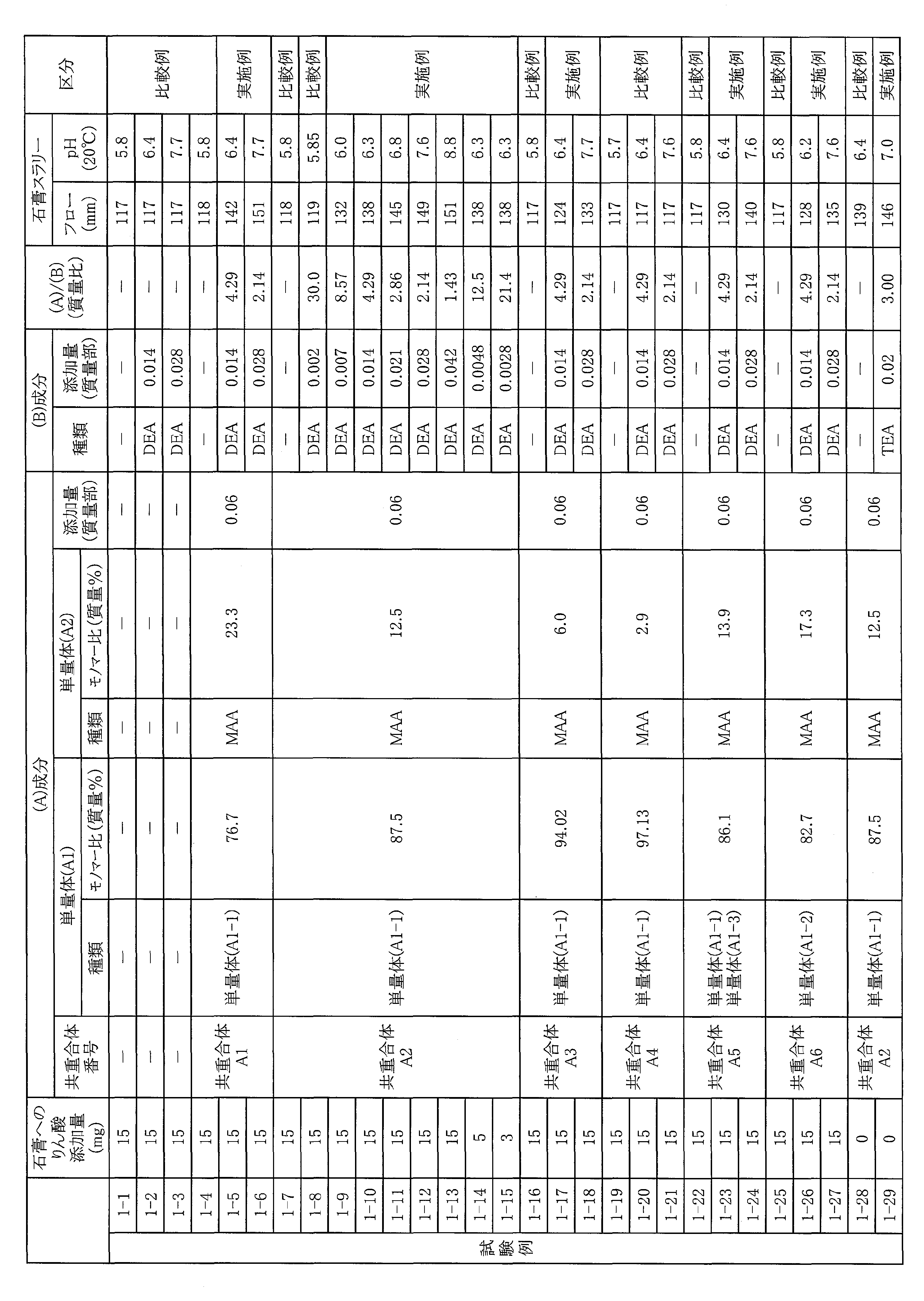
また、表1中、単量体(A1)、単量体(A2)のモノマー比は、単量体(A1)と単量体(A2)の合計中の質量%である。
また、表1中、(A)成分、(B)成分の添加量は、石膏100質量部に対する質量部である。
表2に示す(A)成分と(B)成分の併用割合で、(A)成分の濃度が30質量%(固形分換算)となるように水の量を調整した石膏用液体分散剤組成物を調製し、調製直後の均一性、保存後の加水分解率を評価した。ここで、調製直後の均一性は、外観を目視観察し、分離がなく均一な外観であるものを「良い」、分離が生じたものを「悪い」とした。なお、均一性の評価が「悪い」のものは、加水分解率の測定を行わなかった。均一性の評価が「悪い」であるものは、組成物の均一性に乏しく、使用する毎に強力な攪拌操作が必要となるため、実際の作業現場では非常に使い勝手の悪いものとなると考えられる。
共重合体A2を用いた場合、
加水分解率(%)=115.8×[(A-B)/(30-B)]
共重合体A4を用いた場合、
加水分解率(%)=104.3×[(A-B)/(30-B)]
A:保存後の石膏用液体分散剤組成物中のメトキシポリエチレングリコール(EO平均付加モル数120)の量(質量%)
B:保存前の石膏用液体分散剤組成物中のメトキシポリエチレングリコール(EO平均付加モル数120)の量(質量%)
*LC-MSの測定条件
・カラム:Imtakt社製 Unison UK-C18 HT(50×2mm) 3μm
・カラム温度:40℃
・溶離液A: 0.1%トリフルオロ酢酸(TFA)水溶液
・溶離液B: 0.1%トリフルオロ酢酸(TFA)アセトニトリル溶液
・グラジエント:A/B=70/30(0min)→A/B=20/80(3-5min)→A/B=70/30(5.1-8min)
・流量:0.5mL/min
・流入量:5μL.
・測定装置 SHIMADZU社製 LC/MS 2010EV)

・MEA:モノエタノールアミン
・DEA:ジエタノールアミン
・TEA:トリエタノールアミン
・TiPa:トリイソプロパノールアミン
・M-DEA:N-メチルジエタノールアミン
・ポリエチレンイミン:分子量600〔株式会社日本触媒製、エポミン(登録商標)、型番SP-006〕
試験例2のうち「試験例2-3」と「試験例2-17」の石膏用液体分散剤組成物を、40℃で10日保存した後、それらの組成物を用いて試験例2と同様に石膏スラリーを調製した。得られた石膏スラリーのフロー(mm)及びpH(20℃)を、試験例2と同様に測定した。結果を表3に示す。
比較例に相当する「試験例2-17」の石膏用液体分散剤組成物は、調製直後の均一性は良いものの、保存安定性が悪く、保存後に用いると流動性の良好な石膏スラリーを得ることができない。

Claims (25)
- (A)下記一般式(A1)で表される単量体(A1)と下記一般式(A2)で表される単量体(A2)とを含む単量体を重合して得られる共重合体〔以下、(A)成分という〕、(B)窒素含有化合物〔以下、(B)成分という〕、及び水を含有する石膏用液体分散剤組成物であって、
(A)成分において、単量体(A1)と単量体(A2)の合計質量に対する単量体(A2)の質量の割合が4質量%以上であり、
(B)成分が、アンモニア、アルキルアミン、アルカノールアミン、アルキルアルカノールアミン、エチレンジアミン、ジエチレントリアミン、トリエチレンテトラミン、テトラエチレンペンタミン、及びポリエチレンイミンから選ばれる1種以上の窒素含有化合物であり、
(B)成分のアルキルアミンが、アルキル基の炭素数の合計が5以下である1級アミン、アルキル基の炭素数の合計が6以下である2級アミン、及びアルキル基の炭素数の合計が5以下である3級アミンから選ばれるアルキルアミンであり、
(B)成分のアルカノールアミンが、炭素数が1以上、10以下であり、アルカノール基を1つ以上、3つ以下有するアルカノールアミンであり、
(B)成分のアルキルアルカノールアミンが、炭素数が2以上、10以下であり、アルキル基を1つ又は2つ有するアルキルアルカノールアミンであり、
20℃でのpHが7.0以上、13.0以下である、
石膏用液体分散剤組成物。

R1、R2:それぞれ独立に、水素原子又はメチル基
m1:0以上、2以下の整数
AO:炭素数2又は3のアルキレンオキシ基
n:AOの平均付加モル数であり、4以上、300以下の数
X:水素原子又は炭素数1以上、3以下のアルキル基
を示す。〕

R3、R4、R5:それぞれ独立に、水素原子、メチル基、又は(CH2)m2COOM2
M1、M2:それぞれ独立に、水素原子、アルカリ金属、アルカリ土類金属(1/2原子)、有機アンモニウム基、又はアンモニウム基
m2:0以上、2以下の整数を示す。〕 - りん酸を含む石膏用である、請求項1記載の石膏用液体分散剤組成物。
- (A)成分を5質量%以上、60質量%以下含有する、請求項1又は2記載の石膏用液体分散剤組成物。
- (A)成分と(B)成分の質量比が、(A)/(B)で、0.2以上、3000以下である、請求項1から3のいずれかに記載の石膏用液体分散剤組成物。
- (A)成分と(B)成分の質量比が、(A)/(B)で、2以上、15以下である、請求項1から3のいずれかに記載の石膏用液体分散剤組成物。
- 石膏、(A)下記一般式(A1)で表される単量体(A1)と下記一般式(A2)で表される単量体(A2)とを含む単量体を重合して得られる共重合体〔以下、(A)成分という〕、(B)窒素含有化合物〔以下、(B)成分という〕、及び水を含有する石膏スラリーであって、
(A)成分において、単量体(A1)と単量体(A2)の合計質量に対する単量体(A2)の質量の割合が4質量%以上であり、
(B)成分が、アンモニア、アルキルアミン、アルカノールアミン、アルキルアルカノールアミン、エチレンジアミン、ジエチレントリアミン、トリエチレンテトラミン、テトラエチレンペンタミン、及びポリエチレンイミンから選ばれる1種以上の窒素含有化合物であり、
(B)成分のアルキルアミンが、アルキル基の総炭素数が5以下である1級アミン、アルキル基の総炭素数が6以下である2級アミン、及びアルキル基の総炭素数が5以下である3級アミンから選ばれるアルキルアミンであり、
(B)成分のアルカノールアミンが、炭素数が1以上、10以下であり、アルカノール基を1つ以上、3つ以下有するアルカノールアミンであり、
(B)成分のアルキルアルカノールアミンが、炭素数が2以上、10以下であり、アルキル基を1つ又は2つ有するアルキルアルカノールアミンであり、
(A)成分の含有量が石膏100質量部に対し、0.005質量部以上、1.0質量部以下であり、
20℃でのpHが6.0以上、9.0以下である、
石膏スラリー。

R1、R2:それぞれ独立に、水素原子又はメチル基
m1:0以上、2以下の整数
AO:炭素数2又は3のアルキレンオキシ基
n:AOの平均付加モル数であり、4以上、300以下の数
X:水素原子又は炭素数1以上、3以下のアルキル基
を示す。〕

R3、R4、R5:それぞれ独立に、水素原子、メチル基、又は(CH2)m2COOM2
M1、M2:それぞれ独立に、水素原子、アルカリ金属、アルカリ土類金属(1/2原子)、有機アンモニウム基、又はアンモニウム基
m2:0以上、2以下の整数
を示す。〕 - (B)成分の含有量が石膏100質量部に対して、0.0003質量部以上、0.2質量部以下である、請求項6に記載の石膏スラリー。
- 石膏が、りん酸を含む石膏である、請求項6又は7記載の石膏スラリー。
- (A)成分と(B)成分の質量比が、(A)/(B)で、0.2以上、3000以下である、請求項6から8のいずれかに記載の石膏スラリー。
- (A)成分と(B)成分の質量比が、(A)/(B)で、2以上、15以下である、請求項6から8のいずれかに記載の石膏スラリー。
- 次の工程を含む、20℃でのpHが6.0以上、9.0以下の石膏スラリーの製造方法。
工程1:(A)成分と(B)成分と水を混合し、石膏調製用液体組成物を得る工程。
工程2:工程1で得られた石膏調製用液体組成物と石膏とを混合し、石膏スラリーを得る工程。
ここで、
(A)成分は、下記一般式(A1)で表される単量体(A1)と下記一般式(A2)で表される単量体(A2)とを含む単量体を重合して得られる共重合体であり、(B)成分は、窒素含有化合物であり、
(A)成分において、単量体(A1)と単量体(A2)の合計質量に対する単量体(A2)の質量の割合が4質量%以上であり、
(B)成分が、アンモニア、アルキルアミン、アルカノールアミン、アルキルアルカノールアミン、エチレンジアミン、ジエチレントリアミン、トリエチレンテトラミン、テトラエチレンペンタミン、及びポリエチレンイミンから選ばれる1種以上の窒素含有化合物であり、
(B)成分のアルキルアミンが、アルキル基の総炭素数が5以下である1級アミン、アルキル基の総炭素数が6以下である2級アミン、及びアルキル基の総炭素数が5以下である3級アミンから選ばれるアルキルアミンであり、
(B)成分のアルカノールアミンが、炭素数が1以上、10以下であり、アルカノール基を1つ以上、3つ以下有するアルカノールアミンであり、
(B)成分のアルキルアルカノールアミンが、炭素数が2以上、10以下であり、アルキル基を1つ又は2つ有するアルキルアルカノールアミンである。

R1、R2:それぞれ独立に、水素原子又はメチル基
m1:0以上、2以下の整数
AO:炭素数2又は3のアルキレンオキシ基
n:AOの平均付加モル数であり、4以上、300以下の数
X:水素原子又は炭素数1以上、3以下のアルキル基
を示す。〕

R3、R4、R5:それぞれ独立に、水素原子、メチル基、又は(CH2)m2COOM2
M1、M2:それぞれ独立に、水素原子、アルカリ金属、アルカリ土類金属(1/2原子)、有機アンモニウム基、又はアンモニウム基
m2:0以上、2以下の整数を示す。〕 - (A)成分を、石膏100質量部に対して、0.005質量部以上、1.0質量部以下混合する、請求項11に記載の石膏スラリーの製造方法。
- (B)成分を、石膏100質量部に対して、0.0003質量部以上、0.2質量部以下混合する、請求項11又は12に記載の石膏スラリーの製造方法。
- (A)成分と(B)成分とを、(A)/(B)で、0.2以上、3000以下の質量比で混合する、請求項11から13のいずれかに記載の石膏スラリーの製造方法。
- (A)成分と(B)成分とを、(A)/(B)で、2以上、15以下の質量比で混合する、請求項11から13のいずれかに記載の石膏スラリーの製造方法。
- (A)成分と(B)成分を含む組成物の、石膏スラリーの流動性を向上させるための石膏用分散剤としての使用。
ここで、
(A)成分は、下記一般式(A1)で表される単量体(A1)と下記一般式(A2)で表される単量体(A2)とを含む単量体を重合して得られる共重合体であり、(B)成分は、窒素含有化合物であり、
(A)成分において、単量体(A1)と単量体(A2)の合計質量に対する単量体(A2)の質量の割合が4質量%以上であり、
(B)成分が、アンモニア、アルキルアミン、アルカノールアミン、アルキルアルカノールアミン、エチレンジアミン、ジエチレントリアミン、トリエチレンテトラミン、テトラエチレンペンタミン、及びポリエチレンイミンから選ばれる1種以上の窒素含有化合物であり、
(B)成分のアルキルアミンが、アルキル基の総炭素数が5以下である1級アミン、アルキル基の総炭素数が6以下である2級アミン、及びアルキル基の総炭素数が5以下である3級アミンから選ばれるアルキルアミンであり、
(B)成分のアルカノールアミンが、炭素数が1以上、10以下であり、アルカノール基を1つ以上、3つ以下有するアルカノールアミンであり、
(B)成分のアルキルアルカノールアミンが、炭素数が2以上、10以下であり、アルキル基を1つ又は2つ有するアルキルアルカノールアミンである。

R1、R2:それぞれ独立に、水素原子又はメチル基
m1:0以上、2以下の整数
AO:炭素数2又は3のアルキレンオキシ基
n:AOの平均付加モル数であり、4以上、300以下の数
X:水素原子又は炭素数1以上、3以下のアルキル基
を示す。〕

R3、R4、R5:それぞれ独立に、水素原子、メチル基、又は(CH2)m2COOM2
M1、M2:それぞれ独立に、水素原子、アルカリ金属、アルカリ土類金属(1/2原子)、有機アンモニウム基、又はアンモニウム基
m2:0以上、2以下の整数を示す。〕 - (A)成分の添加量が、石膏100質量部に対して、0.005質量部以上、1.0質量部以下である、請求項16に記載の石膏用分散剤としての使用。
- (B)成分の添加量が、石膏100質量部に対して、0.0003質量部以上、0.2質量部以下である、請求項16又は17に記載の石膏用分散剤としての使用。
- (A)成分と(B)成分の質量比が、(A)/(B)で、0.2以上、3000以下である、請求項16から18のいずれかに記載の石膏用分散剤としての使用。
- (A)成分と(B)成分の質量比が、(A)/(B)で、2以上、15以下である、請求項16から18のいずれかに記載の石膏用分散剤としての使用。
- (A)下記一般式(A1)で表される単量体(A1)と下記一般式(A2)で表される単量体(A2)とを含む単量体を重合して得られる共重合体〔以下、(A)成分という〕、(B)窒素含有化合物〔以下、(B)成分という〕、及び水を混合する、石膏用液体分散剤組成物の製造方法であって、
(A)成分において、単量体(A1)と単量体(A2)の合計質量に対する単量体(A2)の質量の割合が4質量%以上であり、
(B)成分が、アンモニア、アルキルアミン、アルカノールアミン、アルキルアルカノールアミン、エチレンジアミン、ジエチレントリアミン、トリエチレンテトラミン、テトラエチレンペンタミン、及びポリエチレンイミンから選ばれる1種以上の窒素含有化合物であり、
(B)成分のアルキルアミンが、アルキル基の炭素数の合計が5以下である1級アミン、アルキル基の炭素数の合計が6以下である2級アミン、及びアルキル基の炭素数の合計が5以下である3級アミンから選ばれるアルキルアミンであり、
(B)成分のアルカノールアミンが、炭素数が1以上、10以下であり、アルカノール基を1つ以上、3つ以下有するアルカノールアミンであり、
(B)成分のアルキルアルカノールアミンが、炭素数が2以上、10以下であり、アルキル基を1つ又は2つ有するアルキルアルカノールアミンであり、
20℃でのpHが7.0以上、13.0以下である、
石膏用液体分散剤組成物の製造方法。

R1、R2:それぞれ独立に、水素原子又はメチル基
m1:0以上、2以下の整数
AO:炭素数2又は3のアルキレンオキシ基
n:AOの平均付加モル数であり、4以上、300以下の数
X:水素原子又は炭素数1以上、3以下のアルキル基
を示す。〕

R3、R4、R5:それぞれ独立に、水素原子、メチル基、又は(CH2)m2COOM2
M1、M2:それぞれ独立に、水素原子、アルカリ金属、アルカリ土類金属(1/2原子)、有機アンモニウム基、又はアンモニウム基
m2:0以上、2以下の整数
を示す。〕 - 石膏用液体分散剤組成物が、りん酸を含む石膏用である、請求項21記載の製造方法。
- (A)成分を、全混合原料に対して、5質量%以上、60質量%以下の割合で混合する、請求項21又は22記載の製造方法。
- (A)成分と(B)成分とを、(A)/(B)で、0.2以上、3000以下の質量比で混合する、請求項21から23のいずれかに記載の製造方法。
- (A)成分と(B)成分とを、(A)/(B)で、2以上、15以下の質量比で混合する、請求項21から23のいずれかに記載の製造方法。
Priority Applications (9)
| Application Number | Priority Date | Filing Date | Title |
|---|---|---|---|
| KR1020157036618A KR102206865B1 (ko) | 2013-06-19 | 2014-06-19 | 석고용 액체 분산제 조성물 |
| BR112015030669A BR112015030669A2 (pt) | 2013-06-19 | 2014-06-19 | Composição dispersante líquida para gesso, seu uso e seu método de produção, pasta fluida de gesso e seu método de produção |
| AU2014282173A AU2014282173B2 (en) | 2013-06-19 | 2014-06-19 | Liquid dispersant composition for gypsum |
| US14/897,437 US20160107935A1 (en) | 2013-06-19 | 2014-06-19 | Liquid dispersant composition for gypsum |
| CN201480035076.6A CN105308001A (zh) | 2013-06-19 | 2014-06-19 | 石膏用液体分散剂组合物 |
| CA2912931A CA2912931C (en) | 2013-06-19 | 2014-06-19 | Liquid dispersant composition for gypsum |
| RU2016101226A RU2656053C2 (ru) | 2013-06-19 | 2014-06-19 | Жидкая диспергирующая композиция для гипса |
| EP14813958.7A EP3012237B1 (en) | 2013-06-19 | 2014-06-19 | Liquid dispersant composition for gypsum |
| MX2015016665A MX381478B (es) | 2013-06-19 | 2014-06-19 | Composicion dispersante liquida para yeso. |
Applications Claiming Priority (2)
| Application Number | Priority Date | Filing Date | Title |
|---|---|---|---|
| JP2013128433 | 2013-06-19 | ||
| JP2013-128433 | 2013-06-19 |
Publications (1)
| Publication Number | Publication Date |
|---|---|
| WO2014203953A1 true WO2014203953A1 (ja) | 2014-12-24 |
Family
ID=52104679
Family Applications (1)
| Application Number | Title | Priority Date | Filing Date |
|---|---|---|---|
| PCT/JP2014/066241 Ceased WO2014203953A1 (ja) | 2013-06-19 | 2014-06-19 | 石膏用液体分散剤組成物 |
Country Status (11)
| Country | Link |
|---|---|
| US (1) | US20160107935A1 (ja) |
| EP (1) | EP3012237B1 (ja) |
| JP (1) | JP6293584B2 (ja) |
| KR (1) | KR102206865B1 (ja) |
| CN (1) | CN105308001A (ja) |
| AU (1) | AU2014282173B2 (ja) |
| BR (1) | BR112015030669A2 (ja) |
| CA (1) | CA2912931C (ja) |
| MX (1) | MX381478B (ja) |
| RU (1) | RU2656053C2 (ja) |
| WO (1) | WO2014203953A1 (ja) |
Families Citing this family (6)
| Publication number | Priority date | Publication date | Assignee | Title |
|---|---|---|---|---|
| JP2017057101A (ja) * | 2015-09-15 | 2017-03-23 | 花王株式会社 | 石膏用分散剤組成物 |
| CN108439856A (zh) * | 2018-05-16 | 2018-08-24 | 云南宇耐科技有限公司 | 一种磷石膏长效改性防水硬化复合外加剂及其制备方法 |
| KR102617619B1 (ko) | 2021-05-10 | 2023-12-27 | 케이지케미칼 주식회사 | 드론살포용 서스펜션 기능성 액상비료 조성물 및 그 제조방법 |
| JP7693452B2 (ja) * | 2021-08-20 | 2025-06-17 | 花王株式会社 | 水硬性粉体用分散剤組成物 |
| JP2023028723A (ja) * | 2021-08-20 | 2023-03-03 | 花王株式会社 | 水硬性粉体用分散剤の製造方法 |
| JP7661213B2 (ja) * | 2021-12-24 | 2025-04-14 | 花王株式会社 | 地盤改良方法 |
Citations (9)
| Publication number | Priority date | Publication date | Assignee | Title |
|---|---|---|---|---|
| US3181985A (en) | 1960-09-07 | 1965-05-04 | Allied Chem | Process for producing paper-lined by-product gypsum products |
| US5151130A (en) | 1991-01-23 | 1992-09-29 | The Dow Chemical Company | Amine-based consistency reducers for gypsum stucco slurries |
| JPH10158051A (ja) | 1996-11-26 | 1998-06-16 | Kao Corp | 副生石膏・水スラリー及びその製造方法 |
| JPH11302052A (ja) * | 1998-04-24 | 1999-11-02 | Kao Corp | プラスター用添加剤 |
| JP2003002718A (ja) * | 2001-06-22 | 2003-01-08 | Kao Corp | 石膏組成物用混和剤 |
| JP2003335566A (ja) | 2002-03-11 | 2003-11-25 | Kao Corp | 水硬性組成物用混和剤 |
| WO2008032799A1 (fr) * | 2006-09-13 | 2008-03-20 | Toho Chemical Industry Co., Ltd. | Nouveau polymère d'acide polycarboxylique |
| JP2011529432A (ja) * | 2008-07-30 | 2011-12-08 | シーカ・テクノロジー・アーゲー | 石膏組成物用の分散剤 |
| WO2013137402A1 (ja) | 2012-03-14 | 2013-09-19 | 東邦化学工業株式会社 | 石膏用分散剤 |
Family Cites Families (9)
| Publication number | Priority date | Publication date | Assignee | Title |
|---|---|---|---|---|
| US5017234A (en) * | 1989-10-06 | 1991-05-21 | W. R. Grace & Co.-Conn. | Processing additives for blended cements |
| CA2318090A1 (en) * | 1998-11-30 | 2000-06-08 | Kenjiro Makino | Process for producing dispersant for powdery hydraulic composition |
| JP2003300766A (ja) * | 2002-02-06 | 2003-10-21 | Nippon Shokubai Co Ltd | コンクリート組成物、コンクリート組成物の製造方法及びセメント混和剤 |
| CN100374392C (zh) * | 2002-10-09 | 2008-03-12 | 格雷斯公司 | 含胺水泥加工添加剂 |
| JP2007210877A (ja) * | 2005-06-16 | 2007-08-23 | Kao Corp | 水硬性組成物用分散剤 |
| CN1880260A (zh) * | 2005-06-16 | 2006-12-20 | 花王株式会社 | 水硬性组合物用分散剂 |
| US20060293417A1 (en) * | 2005-06-16 | 2006-12-28 | Kao Corporation | Hydraulic composition dispersant |
| CN101570411B (zh) * | 2009-05-31 | 2012-01-25 | 上海三瑞化学有限公司 | 一种石膏用聚羧酸减水剂及其制备方法 |
| JP5848633B2 (ja) * | 2011-03-15 | 2016-01-27 | 花王株式会社 | 水硬性組成物用分散剤 |
-
2014
- 2014-06-18 JP JP2014125149A patent/JP6293584B2/ja active Active
- 2014-06-19 KR KR1020157036618A patent/KR102206865B1/ko not_active Expired - Fee Related
- 2014-06-19 RU RU2016101226A patent/RU2656053C2/ru not_active IP Right Cessation
- 2014-06-19 US US14/897,437 patent/US20160107935A1/en not_active Abandoned
- 2014-06-19 CN CN201480035076.6A patent/CN105308001A/zh active Pending
- 2014-06-19 EP EP14813958.7A patent/EP3012237B1/en active Active
- 2014-06-19 WO PCT/JP2014/066241 patent/WO2014203953A1/ja not_active Ceased
- 2014-06-19 AU AU2014282173A patent/AU2014282173B2/en not_active Ceased
- 2014-06-19 MX MX2015016665A patent/MX381478B/es unknown
- 2014-06-19 BR BR112015030669A patent/BR112015030669A2/pt active Search and Examination
- 2014-06-19 CA CA2912931A patent/CA2912931C/en not_active Expired - Fee Related
Patent Citations (10)
| Publication number | Priority date | Publication date | Assignee | Title |
|---|---|---|---|---|
| US3181985A (en) | 1960-09-07 | 1965-05-04 | Allied Chem | Process for producing paper-lined by-product gypsum products |
| US5151130A (en) | 1991-01-23 | 1992-09-29 | The Dow Chemical Company | Amine-based consistency reducers for gypsum stucco slurries |
| JPH10158051A (ja) | 1996-11-26 | 1998-06-16 | Kao Corp | 副生石膏・水スラリー及びその製造方法 |
| JPH11302052A (ja) * | 1998-04-24 | 1999-11-02 | Kao Corp | プラスター用添加剤 |
| JP2003002718A (ja) * | 2001-06-22 | 2003-01-08 | Kao Corp | 石膏組成物用混和剤 |
| JP2003335566A (ja) | 2002-03-11 | 2003-11-25 | Kao Corp | 水硬性組成物用混和剤 |
| WO2008032799A1 (fr) * | 2006-09-13 | 2008-03-20 | Toho Chemical Industry Co., Ltd. | Nouveau polymère d'acide polycarboxylique |
| JP2012132017A (ja) * | 2006-09-13 | 2012-07-12 | Toho Chem Ind Co Ltd | 新規なポリカルボン酸系重合体 |
| JP2011529432A (ja) * | 2008-07-30 | 2011-12-08 | シーカ・テクノロジー・アーゲー | 石膏組成物用の分散剤 |
| WO2013137402A1 (ja) | 2012-03-14 | 2013-09-19 | 東邦化学工業株式会社 | 石膏用分散剤 |
Non-Patent Citations (1)
| Title |
|---|
| See also references of EP3012237A4 |
Also Published As
| Publication number | Publication date |
|---|---|
| EP3012237A1 (en) | 2016-04-27 |
| BR112015030669A2 (pt) | 2017-08-29 |
| RU2016101226A (ru) | 2017-07-24 |
| EP3012237B1 (en) | 2020-10-21 |
| MX381478B (es) | 2025-03-12 |
| CA2912931C (en) | 2021-02-16 |
| AU2014282173A1 (en) | 2015-12-24 |
| CN105308001A (zh) | 2016-02-03 |
| JP2015024949A (ja) | 2015-02-05 |
| CA2912931A1 (en) | 2014-12-24 |
| AU2014282173B2 (en) | 2018-02-22 |
| KR102206865B1 (ko) | 2021-01-22 |
| KR20160021147A (ko) | 2016-02-24 |
| JP6293584B2 (ja) | 2018-03-14 |
| US20160107935A1 (en) | 2016-04-21 |
| EP3012237A4 (en) | 2017-02-22 |
| RU2656053C2 (ru) | 2018-05-30 |
| MX2015016665A (es) | 2016-04-15 |
Similar Documents
| Publication | Publication Date | Title |
|---|---|---|
| JP6293584B2 (ja) | 石膏用液体分散剤組成物 | |
| EP3398979B1 (en) | Method for preparing concrete superplasticizer having phosphorous acid group and superplasticizer obtained | |
| JP2000191356A (ja) | セメント分散剤および該分散剤を含むコンクリ―ト組成物 | |
| EP1669332A1 (en) | Cement dispersant and concrete composition containing the dispersant | |
| CN103732637B (zh) | 具有延迟的碱性水解性的梳形聚合物 | |
| JP6749786B2 (ja) | 水硬性組成物用混和剤 | |
| WO2013137400A1 (ja) | 石膏用分散剤 | |
| MX2013014355A (es) | Polimeros tipo peine como dispersantes para los aglomerantes activados alcalinos. | |
| CN106242954B (zh) | 聚醚胺用低分子量聚醚多元醇的制备方法 | |
| JP7291346B2 (ja) | 水硬性組成物用混和剤及び水硬性組成物 | |
| JP2021011391A (ja) | 無収縮コンクリート組成物 | |
| JP4844878B2 (ja) | 石膏用分散剤及び石膏用分散剤組成物 | |
| AU2013233154B2 (en) | Gypsum dispersant | |
| KR101853124B1 (ko) | 시멘트 혼화제 조성물 및 이의 제조 방법 | |
| JP2019064905A (ja) | 遠心成形用水硬性組成物 | |
| JP5064290B2 (ja) | 水硬性組成物 | |
| AU2004318289A1 (en) | Cement dispersant and concrete composition containing the dispersant | |
| TWI892771B (zh) | 聚醚醯胺基胺異亞磷酸系分散劑 | |
| CN104271532B (zh) | 石膏用分散剂 | |
| JPH08165156A (ja) | セメント分散剤組成物 | |
| JP2025009534A (ja) | 混和剤、及びフェノール樹脂系分散剤 | |
| JP6429181B2 (ja) | 縮合物の製造方法 | |
| JP2022137585A (ja) | 水硬性粉体用分散剤組成物 | |
| JP2005290125A (ja) | (メタ)アクリル酸−不飽和二塩基酸共重合体の塩の製造法 | |
| HK1205733B (en) | Gypsum dispersant |
Legal Events
| Date | Code | Title | Description |
|---|---|---|---|
| WWE | Wipo information: entry into national phase |
Ref document number: 201480035076.6 Country of ref document: CN |
|
| 121 | Ep: the epo has been informed by wipo that ep was designated in this application |
Ref document number: 14813958 Country of ref document: EP Kind code of ref document: A1 |
|
| ENP | Entry into the national phase |
Ref document number: 2912931 Country of ref document: CA |
|
| WWE | Wipo information: entry into national phase |
Ref document number: 2014813958 Country of ref document: EP |
|
| WWE | Wipo information: entry into national phase |
Ref document number: MX/A/2015/016665 Country of ref document: MX |
|
| WWE | Wipo information: entry into national phase |
Ref document number: IDP00201508273 Country of ref document: ID |
|
| WWE | Wipo information: entry into national phase |
Ref document number: 14897437 Country of ref document: US |
|
| WWE | Wipo information: entry into national phase |
Ref document number: P1686/2015 Country of ref document: AE |
|
| NENP | Non-entry into the national phase |
Ref country code: DE |
|
| REG | Reference to national code |
Ref country code: BR Ref legal event code: B01A Ref document number: 112015030669 Country of ref document: BR |
|
| ENP | Entry into the national phase |
Ref document number: 2014282173 Country of ref document: AU Date of ref document: 20140619 Kind code of ref document: A Ref document number: 20157036618 Country of ref document: KR Kind code of ref document: A |
|
| ENP | Entry into the national phase |
Ref document number: 2016101226 Country of ref document: RU Kind code of ref document: A |
|
| ENP | Entry into the national phase |
Ref document number: 112015030669 Country of ref document: BR Kind code of ref document: A2 Effective date: 20151208 |