WO2015012258A1 - 組成物、硬化性組成物、その製造方法および硬化物 - Google Patents
組成物、硬化性組成物、その製造方法および硬化物 Download PDFInfo
- Publication number
- WO2015012258A1 WO2015012258A1 PCT/JP2014/069308 JP2014069308W WO2015012258A1 WO 2015012258 A1 WO2015012258 A1 WO 2015012258A1 JP 2014069308 W JP2014069308 W JP 2014069308W WO 2015012258 A1 WO2015012258 A1 WO 2015012258A1
- Authority
- WO
- WIPO (PCT)
- Prior art keywords
- group
- compound
- bond
- reaction
- polymerizable compound
- Prior art date
- Legal status (The legal status is an assumption and is not a legal conclusion. Google has not performed a legal analysis and makes no representation as to the accuracy of the status listed.)
- Ceased
Links
Images


Classifications
-
- C—CHEMISTRY; METALLURGY
- C08—ORGANIC MACROMOLECULAR COMPOUNDS; THEIR PREPARATION OR CHEMICAL WORKING-UP; COMPOSITIONS BASED THEREON
- C08F—MACROMOLECULAR COMPOUNDS OBTAINED BY REACTIONS ONLY INVOLVING CARBON-TO-CARBON UNSATURATED BONDS
- C08F220/00—Copolymers of compounds having one or more unsaturated aliphatic radicals, each having only one carbon-to-carbon double bond, and only one being terminated by only one carboxyl radical or a salt, anhydride ester, amide, imide or nitrile thereof
- C08F220/02—Monocarboxylic acids having less than ten carbon atoms; Derivatives thereof
- C08F220/10—Esters
- C08F220/34—Esters containing nitrogen, e.g. N,N-dimethylaminoethyl (meth)acrylate
- C08F220/36—Esters containing nitrogen, e.g. N,N-dimethylaminoethyl (meth)acrylate containing oxygen in addition to the carboxy oxygen, e.g. 2-N-morpholinoethyl (meth)acrylate or 2-isocyanatoethyl (meth)acrylate
-
- C—CHEMISTRY; METALLURGY
- C07—ORGANIC CHEMISTRY
- C07C—ACYCLIC OR CARBOCYCLIC COMPOUNDS
- C07C265/00—Derivatives of isocyanic acid
- C07C265/02—Derivatives of isocyanic acid having isocyanate groups bound to acyclic carbon atoms
- C07C265/04—Derivatives of isocyanic acid having isocyanate groups bound to acyclic carbon atoms of a saturated carbon skeleton
-
- C—CHEMISTRY; METALLURGY
- C07—ORGANIC CHEMISTRY
- C07C—ACYCLIC OR CARBOCYCLIC COMPOUNDS
- C07C271/00—Derivatives of carbamic acids, i.e. compounds containing any of the groups, the nitrogen atom not being part of nitro or nitroso groups
- C07C271/04—Carbamic acid halides
-
- C—CHEMISTRY; METALLURGY
- C08—ORGANIC MACROMOLECULAR COMPOUNDS; THEIR PREPARATION OR CHEMICAL WORKING-UP; COMPOSITIONS BASED THEREON
- C08F—MACROMOLECULAR COMPOUNDS OBTAINED BY REACTIONS ONLY INVOLVING CARBON-TO-CARBON UNSATURATED BONDS
- C08F20/00—Homopolymers and copolymers of compounds having one or more unsaturated aliphatic radicals, each having only one carbon-to-carbon double bond, and only one being terminated by only one carboxyl radical or a salt, anhydride, ester, amide, imide or nitrile thereof
- C08F20/02—Monocarboxylic acids having less than ten carbon atoms, Derivatives thereof
- C08F20/10—Esters
- C08F20/34—Esters containing nitrogen, e.g. N,N-dimethylaminoethyl (meth)acrylate
Definitions
- the present invention relates to a composition containing a polymerizable compound and a reaction accelerator, a curable composition obtained using the same, a method for producing the same, and a cured product obtained by curing the curable composition.
- a polymerizable compound containing a (meth) acryloyl group and an isocyanato group in the molecule has two types of reaction points having different reactivities, it can be used in a two-step reaction. For example, after reacting the isocyanato group of the polymerizable compound with another compound (such as urethanation reaction with a compound having a hydroxyl group), the (meth) acryloyl group of the reaction product is reacted with another compound (same polymerizable compound) Or radical polymerization with other polymerizable compounds), or by reacting the (meth) acryloyl group of the polymerizable compound, and then reacting the isocyanato group of the reaction product with another compound. It is. Therefore, the polymerizable compound as described above is used as a raw material in a wide range of applications such as paints, inks, adhesives, coating agents, and molding resins.
- a catalyst for promoting the reaction is used.
- a catalyst for obtaining a urethane compound by reacting the polymerizable compound with a compound having a hydroxyl group an amine catalyst or a metal catalyst such as dibutyltin dilaurate is generally used (Non-patent Document 1).
- these catalysts have a problem that the reaction promoting effect is not sufficient depending on the substrate. Further, the catalyst remaining in the reaction product may adversely affect the physical properties of the reaction product and the cured product. Therefore, in addition to using these catalysts, a technique capable of accelerating the reaction of a polymerizable compound containing a (meth) acryloyl group and an isocyanato group in the molecule is required.
- the present invention has been made in view of the above circumstances, and is a composition in which the reactivity of a polymerizable compound containing a (meth) acryloyl group and an isocyanato group in the molecule is improved, and the curability obtained using the composition. It aims at providing a composition, its manufacturing method, and hardened
- a compound having a (meth) acryloyl group and a halogenated carbamoyl group in the molecule has a polymerizable property having a (meth) acryloyl group and an isocyanato group in the molecule. It has been found that it has an effect of improving the reactivity of the compound (reactivity of isocyanato group, reactivity of (meth) acryloyl group).
- the compound is present in the reaction system as a reaction accelerator, the polymerizable compound exhibits good reactivity in the reaction (urethanization reaction or the like) between the polymerizable compound and another compound having active hydrogen.
- the polymerizable compound or a reaction product of the polymerizable compound and another compound having active hydrogen exhibits good reactivity, and curing of a curable composition containing the same Improves.
- the present invention is based on the above findings and has the following aspects.
- a composition comprising [2] The composition according to [1], wherein the content of the reaction accelerator (B) is 5 to 20000 mass ppm relative to the content of the polymerizable compound (A).
- R 1 and R 2 each independently represents a hydrogen atom or a methyl group
- R 3 represents an optionally substituted alkylene group having 1 to 10 carbon atoms, or a carbon atom of the alkylene group
- Two R 1 s in the general formula (1 ′) may be the same or different, and two R 3 s may be the same or different.
- R 1 and R 2 each independently represents a hydrogen atom or a methyl group
- R 3 represents an optionally substituted alkylene group having 1 to 10 carbon atoms, or a carbon atom of the alkylene group
- X is a fluorine atom, a chlorine atom, a bromine atom or an iodine atom.
- two R 1 s may be the same or different
- two R 3 s may be the same or different.
- the polymerizable compound (A) includes a compound represented by the general formula (1) or (1 ′),
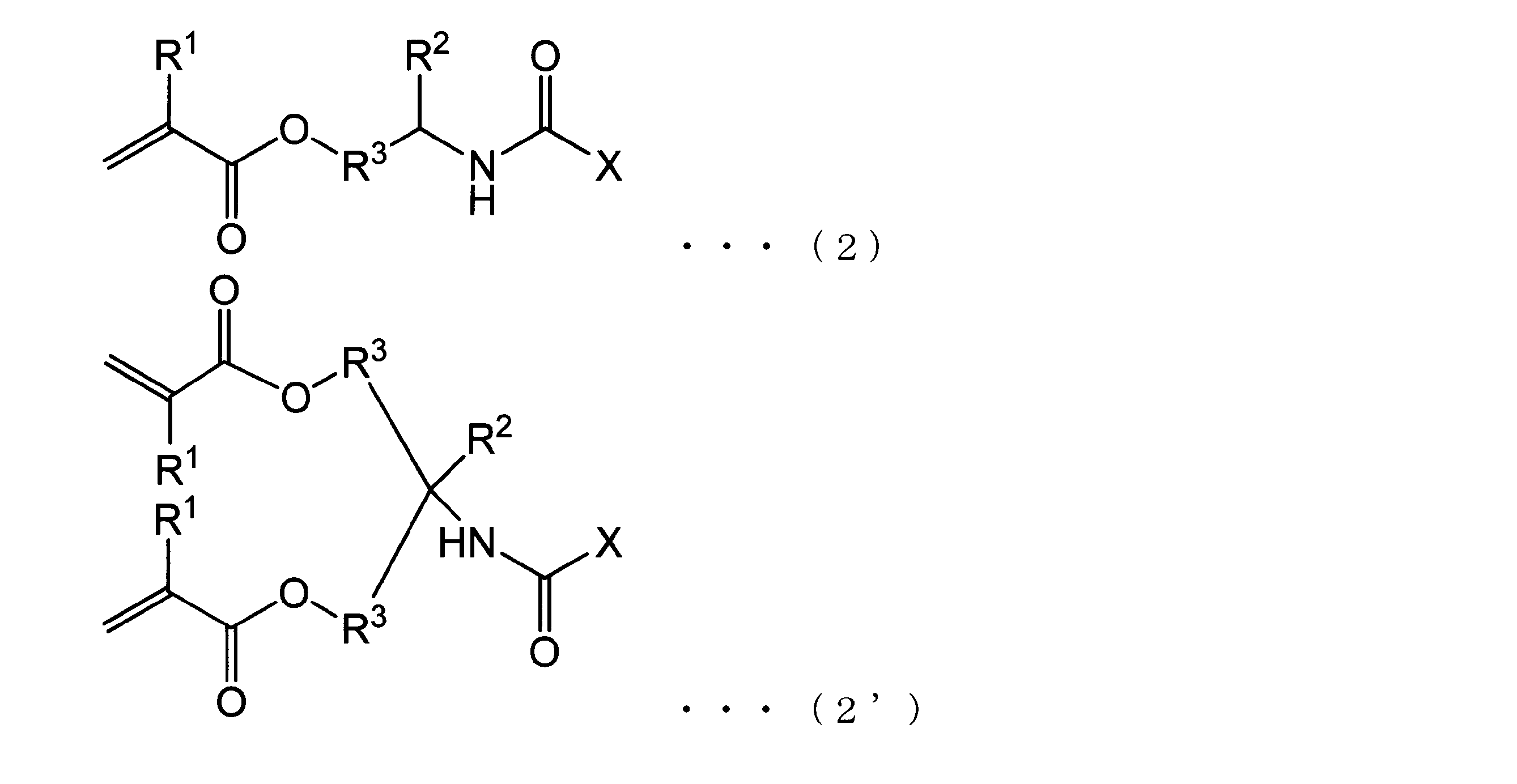
- the reaction accelerator (B) is represented by the general formula (2) or (2 ′), and R 1 , R 2 , and R 3 in the general formula (2) or (2 ′) are each polymerized.
- the composition as described in [5] containing the compound which is the same as R ⁇ 1 >, R ⁇ 2 >, R ⁇ 3 > which an active compound (A) has.
- composition according to [8] wherein the active hydrogen-containing group is at least one selected from the group consisting of a hydroxyl group, a mercapto group, a carboxyl group, and an amino group.
- the polymerizable compound (A) is reacted with the compound having an active hydrogen-containing group, and a urethane bond, a thiourethane bond, an amide bond, and A curable composition comprising a polymerizable compound having at least one selected from the group consisting of urea bonds and a (meth) acryloyl group.
- the polymerizable compound (A) is reacted with the compound having an active hydrogen-containing group to give a urethane bond, a thiourethane bond, an amide bond and a urea in the molecule.
- the manufacturing method of a curable composition including the process of obtaining the curable composition containing the polymeric compound which has at least 1 type selected from the group which consists of a coupling
- a composition having improved reactivity of a polymerizable compound containing a (meth) acryloyl group and an isocyanato group in the molecule a curable composition obtained by using the composition, a method for producing the same, and curing Can provide things.
- Example 3 is a graph showing the results of Examples 1 to 3 and Comparative Example 1 in which MOI urethanization reaction was performed (change over time in the conversion ratio of MOI isocyanato groups to urethane (urethanization rate)).
- 6 is a graph showing the results of Example 4 and Comparative Example 2 in which AOI urethanization reaction was carried out (change over time in the conversion rate of isocyanato groups of AOI to urethane (urethanization rate)). It is a graph which shows the result of Example 5 and Comparative Example 3 in which the amidation reaction of MOI was carried out (change in conversion rate of isocyanato group of MOI to amide with time (amidation rate)).
- composition (I) comprises a polymerizable compound (A) having a (meth) acryloyl group and an isocyanato group in the molecule, and (meta) And a reaction accelerator (B) comprising a compound having an acryloyl group and a halogenated carbamoyl group.
- the “(meth) acryloyl group” refers to an acryloyl group (CH 2 ⁇ CH—CO—) or a methacryloyl group (CH 2 ⁇ C (CH 3 ) —CO—).
- halogenated carbamoyl group refers to a group having a structure represented by> N—CO—Z (Z is a halogen atom).
- Z is a halogen atom.
- the halogen atom include a fluorine atom, a chlorine atom, a bromine atom, and an iodine atom.
- the reaction accelerator (B) plays a role of improving the reactivity of the polymerizable compound (A).
- the polymerizable compound (A) has a (meth) acryloyl group and an isocyanato group as reactive functional groups, and the reaction accelerator (B) has a reactivity of the (meth) acryloyl group and a reactivity of the isocyanato group. Both can be improved.
- the reaction rate when radical polymerization of the polymerizable compound (A) is performed in the composition (I) is increased.
- the reaction rate between the isocyanato group and the active hydrogen-containing group is increased.
- the reaction accelerator (B) exhibits an excellent effect particularly in improving the reactivity of the isocyanato group of the polymerizable compound (A) (improving the reaction rate between the isocyanato group and the active hydrogen-containing group).
- the polymerizable compound (A) is a compound having a (meth) acryloyl group and an isocyanato group in the molecule.
- the polymerizable compound (A) is preferably a compound represented by the following general formula (1) or (1 ′) from the viewpoint of easy availability of raw materials and reactivity.
- R 1 and R 2 each independently represents a hydrogen atom or a methyl group
- R 3 represents an optionally substituted alkylene group having 1 to 10 carbon atoms, or a carbon atom of the alkylene group
- Two R 1 s in the general formula (1 ′) may be the same or different, and two R 3 s may be the same or different.
- an alkylene group means a group formed by removing any two hydrogen atoms bonded to carbon atoms in an aliphatic saturated hydrocarbon.
- the alkylene group having 1 to 10 carbon atoms in R 3 is preferably an alkylene group having 1 to 8 carbon atoms, more preferably an alkylene group having 1 to 6 carbon atoms, An alkylene group having a number of 1 to 4 is more preferable.
- the alkylene group for R 3 a linear or branched alkylene group is preferable, and a linear alkylene group is more preferable.
- a single bond between carbon atoms in the alkylene group is selected from the group consisting of an ether bond (—O—), an ester bond (—CO—O—), and a phenylene bond (—C 6 H 4 —). It may be substituted with a bond.
- the number of single bonds substituted by the bond may be one or two or more, and preferably one. When two or more single bonds are substituted, the bonds replacing each single bond may be the same or different.
- Preferred examples of the alkylene group or a group formed by substituting a single bond between carbon atoms of the alkylene group with a bond selected from the group consisting of an ether bond, an ester bond and a phenylene bond include, for example, —CH 2 —, —C 2 H 4 —, — (CH 2 ) 3 —, — (CH 2 ) 4 —, — (CH 2 ) 5 —, — (CH 2 ) 6 —, —CH 2 —O—C 2 H 4 — , —C 2 H 4 —COO—CH 2 —, —C 2 H 4 —Ph—CH 2 — and the like.
- the alkylene group or a group formed by substituting a single bond between carbon atoms of the alkylene group with a bond selected from the group consisting of an ether bond, an ester bond, and a phenylene bond has a substituent. Also good. Examples of the substituent include a hydrocarbon group, a nitro group, a cyano group, —OR ′, —COR ′, —COOR ′ (R ′ is an alkyl group), and the like. When R 3 has a phenylene bond, the substituent may replace a hydrogen atom in the alkylene group or a hydrogen atom in the phenylene bond.
- the hydrocarbon group in the substituent is not particularly limited, and examples thereof include a hydrocarbon group having 1 to 10 carbon atoms, preferably a hydrocarbon group having 1 to 6 carbon atoms, and more preferably a methyl group.
- a hydrocarbon group having 1 to 10 carbon atoms preferably a hydrocarbon group having 1 to 6 carbon atoms, and more preferably a methyl group.
- alkyl group for R ′ examples include an alkyl group having 1 to 10 carbon atoms, preferably an alkyl group having 1 to 6 carbon atoms, and more preferably a methyl group, an ethyl group, a propyl group, and an isopropyl group.
- alkyl group for R ′ examples include an alkyl group having 1 to 10 carbon atoms, preferably an alkyl group having 1 to 6 carbon atoms, and more preferably a methyl group, an ethyl group, a propyl group, and an isopropyl group.
- R 3 is preferably an alkylene group having 1 to 8 carbon atoms or a group obtained by substituting at least one single bond between carbon atoms of the alkylene group with an ether bond, and having 1 to 6 carbon atoms. Or a group formed by substituting at least one single bond between carbon atoms of the alkylene group with an ether bond, an alkylene group having 1 to 4 carbon atoms, or between carbon atoms of the alkylene group.
- a group obtained by substituting at least one single bond with an ether bond is more preferable, and —CH 2 —, —C 2 H 4 —, — (CH 2 ) 3 —, —CH 2 —O—C 2 H 4 — Or —C 2 H 4 —O—C 2 H 4 — is particularly preferred.
- Specific examples of the compound represented by the general formula (1) include (meth) acryloyloxymethyl isocyanate, (meth) acryloyloxyethyl isocyanate, (meth) acryloyloxypropyl isocyanate, (meth) acryloyloxybutyl isocyanate, (Meth) acryloyloxypentyl isocyanate, (meth) acryloyloxyhexyl isocyanate, (meth) acryloyloxyheptyl isocyanate, (meth) acryloyloxyoctyl isocyanate, (meth) acryloyloxynonyl isocyanate, (meth) acryloyloxydecyl isocyanate, (meth) Examples include acryloyloxyethoxyethyl isocyanate.
- (meth) acryloyloxyethyl isocyanate and (meth) acryloyloxyethoxyethyl isocyanate are preferable from the viewpoint of raw material availability and reactivity.
- 1,1- (bisacryloyloxymethyl) ethyl isocyanate and the like are preferable.
- the reaction accelerator (B) is composed of a compound having a (meth) acryloyl group and a halogenated carbamoyl group in the molecule.
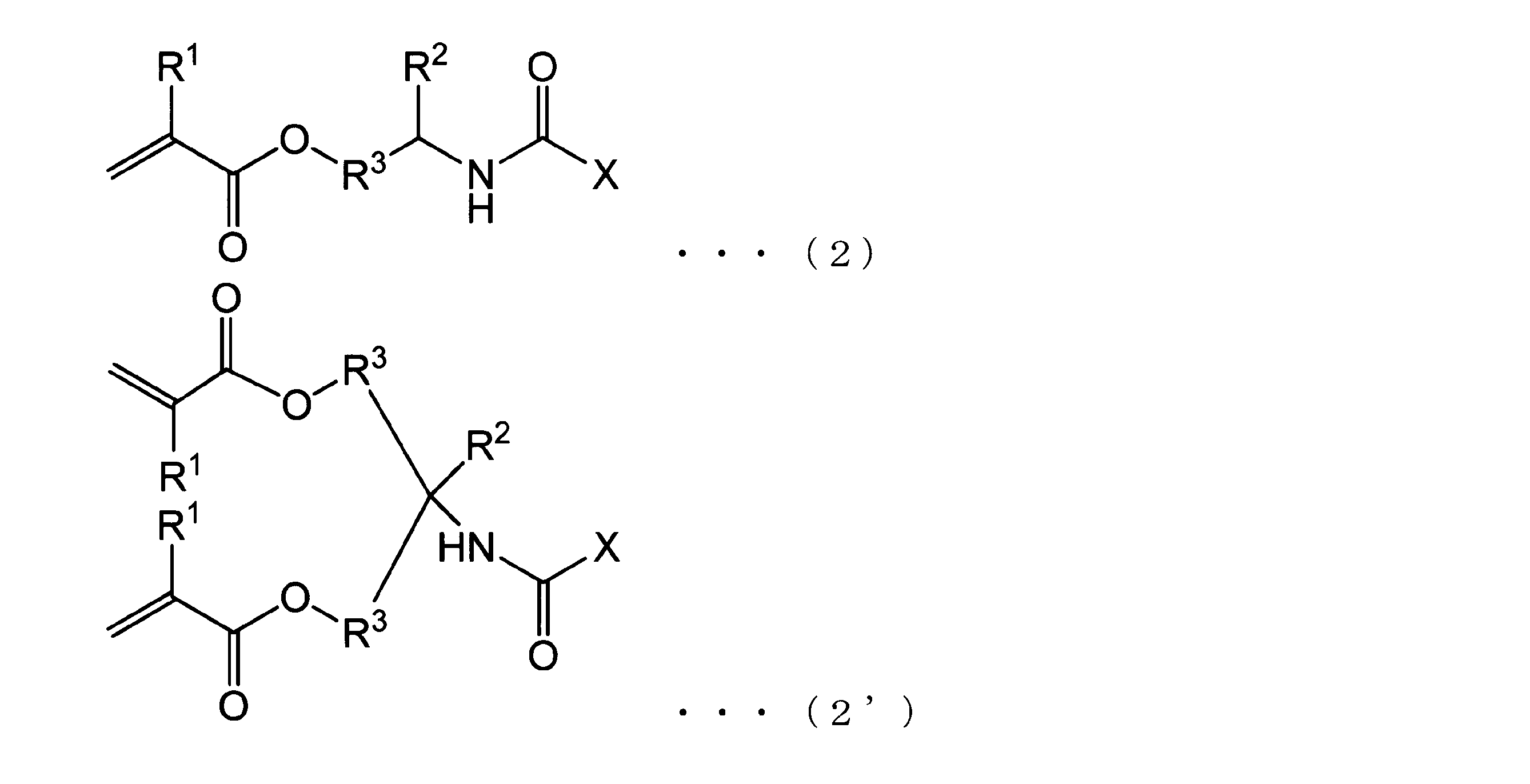
- the reaction accelerator (B) is preferably a compound represented by the following general formula (2) or (2 ′) from the viewpoint of easy availability of raw materials and reactivity.
- R 1 and R 2 each independently represents a hydrogen atom or a methyl group
- R 3 represents an optionally substituted alkylene group having 1 to 10 carbon atoms, or a carbon atom of the alkylene group
- X is a fluorine atom, a chlorine atom, a bromine atom or an iodine atom.
- two R 1 s may be the same or different
- two R 3 s may be the same or different.
- X may be any of a fluorine atom, a chlorine atom, a bromine atom and an iodine atom, and is preferably a chlorine atom.
- Specific examples of the compound represented by the general formula (2) include an isocyanato group (—NCO) in the compound exemplified as the specific example of the compound represented by the general formula (1) by —NH—CO—X. Examples thereof include N- (meth) acryloyloxyethylcarbamoyl chloride, N- (meth) acryloyloxyethoxyethylcarbamoyl chloride and the like.
- Specific examples of the compound represented by the general formula (2 ′) include an isocyanato group (—NCO) in the compound exemplified as the specific example of the compound represented by the general formula (2 ′). Examples thereof include compounds substituted with X, and N-1,1- (bisacryloyloxymethyl) ethylcarbamoyl chloride and the like are preferable.
- the content of the reaction accelerator (B) in the composition (I) is preferably 5 to 20000 mass ppm relative to the content (100 mass%) of the polymerizable compound (A), and preferably 5 to 8000 mass. More preferably, it is ppm, and more preferably 5 to 3000 ppm by mass.
- the ratio of the content of the reaction accelerator (B) to the content of the polymerizable compound (A) is less than 5 ppm by mass, a sufficient reaction promoting effect may not be obtained.
- the reaction of both the isocyanato group and the (meth) acryloyl group in the polymerizable compound (A) There is a risk of inconvenience.
- the method of using a compound having two different types of reactive functional groups such as the polymerizable compound (A) first one (for example, isocyanato group) is reacted with another compound, and the other is used. There are many methods in which the reaction is carried out in two steps, for example, (meth) acryloyl group is reacted.
- the addition amount of the reaction accelerator (B) should be suppressed to 20000 mass ppm or less, particularly about 8000 mass ppm or less with respect to the content of the polymerizable compound (A). Is preferred.
- Examples of the method for determining the content of the reaction accelerator (B) contained in the composition (I) include the following two measurement methods 1 and 2.
- the following measurement conditions are examples, and the conditions may be appropriately changed as necessary (particularly the contained reaction accelerator (B)). If the amount is small, the measurement method 2 may need to be changed to a more accurate condition.
- Reaction accelerator (B) content (Titration amount of silver nitrate aqueous solution (L) ⁇ Titer 1.006 ⁇ chlorine molecular weight 35.46 (g / mol) ⁇ silver nitrate aqueous solution molar concentration 0.02 (mol / L) ⁇ 100) / sample amount (g)
- Measurement method 2 NMR measurement (conditions) In a 5 mm ⁇ NMR sample tube, 100 mg of the sample to be measured is uniformly dissolved in 0.3 mL of dehydrated benzene-d6 to prepare a measurement sample. The 1 H-NMR spectrum of the measurement sample is shown below. Measure under the following conditions. Apparatus: Avance-400 manufactured by Bruker Biospin Measurement temperature: Room temperature Pulse width: 30 ° Pulse repetition time: 5 seconds Integration count: 128 times
- the sample to be measured is a composition in which the polymerizable compound (A) is methacryloyloxyethyl isocyanate (hereinafter referred to as MOI) and the reaction accelerator (B) is methacryloyloxyethylcarbamoyl chloride (hereinafter referred to as MOC).
- MOI methacryloyloxyethyl isocyanate
- MOC methacryloyloxyethylcarbamoyl chloride
- NMR chart horizontal axis: ⁇ (chemical shift), vertical axis
- Samples were prepared by adding various amounts of the reaction accelerator (B) to the polymerizable compound (A) in the range of 100 to 3330 mass ppm, and 100 mg of the sample was uniformly added to 0.3 mL of dehydrated benzene-d6. Samples are prepared by dissolving, and each 1 H-NMR spectrum is measured under the above conditions. Based on these values, a calibration curve of the intensity ratio of the two peaks with respect to the MOC addition amount is prepared. The NMR of the composition to be measured is measured under the same conditions and plotted on the calibration curve, whereby the MOC content contained in the composition is determined.
- the polymerizable compound (A) and the reaction accelerator (B) contained in the composition (I) may be used alone or in combination of two or more.
- the structure in which the isocyanate group is removed from at least one polymerizable compound (A) contained in the composition (I) and the halogenated carbamoyl group are removed from at least one reaction accelerator (B). It is preferable that the structure is the same.
- the reaction accelerator (B) is represented by the general formula (2), and the general formula (2) ) R 1 in, R 2, R 3 are preferably contains R 1, R 2, R 3 which is the same as compound included in the polymerizable compound, and (a).
- the reaction accelerator (B) is represented by the general formula (2 ′), and the general formula (2 ′).
- R 1 in, R 2, R 3 are preferably contains R 1, R 2, R 3 which is the same as compound included in the polymerizable compound, and (a).
- the yield of the target reaction product is improved.
- the composition (I) may be a composition comprising the polymerizable compound (A) and the reaction accelerator (B), and other components (optional components) other than the polymerizable compound (A) and the reaction accelerator (B).
- a composition further comprising Examples of the optional component include compounds other than the polymerizable compound (A) and the reaction accelerator (B) that can react with the polymerizable compound (A) (other reactive compounds).
- the other reactive compound includes a polymerizable compound having a polymerizable functional group such as an ethylenically unsaturated group (another polymerizable compound). Preferably used.
- the other polymerizable compound is not particularly limited, and can be appropriately selected from various monomers capable of radical polymerization according to the intended use.
- a compound having an active hydrogen-containing group hereinafter also referred to as an active hydrogen-containing compound
- the composition (I) contains an active hydrogen-containing compound. This is because the reaction accelerator (B) has an excellent reaction promoting effect particularly when the isocyanate group of the polymerizable compound (A) reacts with an active hydrogen-containing group (particularly a hydroxyl group).
- the active hydrogen-containing compound has an active hydrogen-containing group.
- Active hydrogen is a hydrogen atom bonded to a nitrogen atom, an oxygen atom, a sulfur atom or the like, and has a higher reactivity than a hydrogen atom bonded to a carbon atom.
- the active hydrogen-containing group is not particularly limited as long as it contains active hydrogen in the structure, but is at least one selected from the group consisting of a hydroxyl group, a mercapto group, a carboxyl group, and an amino group in terms of reactivity. Of these, a hydroxyl group is particularly preferred.
- Examples of the compound having a hydroxyl group as an active hydrogen-containing group include monoalcohols such as R 4 OH (R 4 is an alkyl group having 1 to 10 carbon atoms); 2-hydroxyethyl (meth) acrylate, hydroxypropyl Hydroxyalkyl (meth) acrylates such as (meth) acrylate, 2,3-dihydroxybutyl (meth) acrylate, 4-hydroxybutyl (meth) acrylate, 6-hydroxyhexyl (meth) acrylate, and 8-hydroxyoctyl (meth) acrylate Vinyl ethers such as 2-hydroxyethyl vinyl ether and 4-hydroxybutyl vinyl ether; polyhydric alcohols such as 4-hydroxymethylcyclohexyl (meth) acrylate and polyalkylene glycol mono (meth) acrylate and (meth) acrylate Monoesterified product with phosphoric acid; Compound obtained by ring-opening polymerization of ⁇ -caprolactone to the mono
- Examples of the compound having a mercapto group as an active hydrogen-containing group include 1-butanethiol, 1-pentanethiol, 1-octanethiol, 1-dodecanethiol, n-octanedecanethiol, ⁇ -toluenethiol, 2-benzimidazole.
- Monothiols such as thiol, 2-thiazoline-2-thiol, 2-methyl-2-propanethiol, O-aminothiophenol; hexanedithiol, decanedithiol, 1,4-butanediol bisthiopropionate, 1,4 -Butanediol bisthioglycolate, ethylene glycol bisthioglycolate, ethylene glycol bisthiopropionate, trimethylolpropane tristhioglycolate, trimethylolpropane tristhiopropionate, trimethylolpropane Lith (3-mercaptobutyrate), pentaerythritol tetrakisthioglycolate, pentaerythritol tetrakisthiopropionate, trimercaptopropionic acid tris (2-hydroxyethyl) isocyanurate, 1,4-dimethylmercaptobenzene, 2,4,4 6-trimer
- Examples of the compound having a carboxyl group as an active hydrogen-containing group include monocarboxylic acids such as acetic acid and propionic acid; succinic acid, adipic acid, dimer acid, phthalic acid, isophthalic acid, terephthalic acid, trimellitic acid, pyromellitic acid Aliphatic / aromatic polycarboxylic acids such as polyamic acid, and high molecular polycarboxylic acids such as (co) polymers of polyamic acid and acrylic acid.
- monocarboxylic acids such as acetic acid and propionic acid
- Aliphatic / aromatic polycarboxylic acids such as polyamic acid
- high molecular polycarboxylic acids such as (co) polymers of polyamic acid and acrylic acid.
- Examples of the compound having an amino group as an active hydrogen-containing group include monoamines such as butylamine, hexylamine and aniline; diethylenetriamine, triethylenetetramine, 1,3- or 1,4-bisaminomethylcyclohexane, isophoronediamine, hexamethylene Aliphatic polyamines such as diamine and bis (4-aminocyclohexyl) methane; aromatics such as m- or p-xylylenediamine, bis (4-aminophenyl) methane, 2,4- or 2,6-tolylenediamine Polyamines; glycosamines such as chitosan; silicone compounds such as bis (3-aminopropyl) polydimethylsiloxane and bis (3-aminopropyl) polydiphenylsiloxane;
- the content of the active hydrogen-containing compound is such that the molar ratio of the isocyanate group possessed by the polymerizable compound (A) and the active hydrogen-containing group possessed by the active hydrogen-containing compound is the isocyanato group / active hydrogen content.
- optional components other than other reactive compounds include polymerization inhibitors.
- the polymerization inhibitor phenol compounds, hydroquinone compounds and the like generally used for polymerization prevention can be used. Specific examples thereof include hydroquinone, methoxyhydroquinone, catechol, p-tert-butylcatechol, cresol, Examples thereof include dibutylhydroxytoluene (BHT), 2,4,6-tri-tert-butylphenol and the like.
- BHT dibutylhydroxytoluene
- an inert solvent may be included for the purpose of dilution and ease of handling.
- the inert solvent is a solvent that does not contain active hydrogen, and examples thereof include toluene, xylene, hexane, ethyl acetate, tetrahydrofuran, n-butyl acetate, cyclohexanone, and methyl isobutyl ketone.
- curing catalyst thermal curing catalyst, photocuring catalyst, etc.
- photo radical initiator curing agent
- curing accelerator additive
- additive filler, antifoaming agent, flame retardant, antioxidant, ultraviolet light
- An absorbent a stress reducing agent, a flexibility imparting agent, a wax, a resin, a cross-linking agent, a halogen trap agent, a leveling agent, a wetting improver, and the like).
- the curing catalyst examples include a thermal acid generator and a photoacid generator.
- the thermal acid generator and photoacid generator for example, diazonium salt, iodonium salt, sulfonium salt, phosphonium salt, selenium salt, oxonium salt, ammonium salt and the like can be used.
- a curing catalyst can be used individually or in combination of 2 or more types.
- the addition amount of the curing catalyst is, for example, 0.05 to 10 parts by mass, preferably 0.5 to 5 parts by mass with respect to 100 parts by mass of the total composition.
- photo radical initiator examples include benzophenone, acetophenone benzyl, benzyl dimethyl ketone, benzoin, benzoin methyl ether, benzoin ethyl ether, benzoin isopropyl ether, dimethoxyacetophenone, dimethoxyphenylacetophenone, diethoxyacetophenone, diphenyldisulfite, orthobenzoylbenzoate.
- a phenol resin for example, a resin obtained by polymerizing phenol or cresol using formaldehyde can be used. This resin may be a copolymer of an alicyclic compound or aromatic compound such as dicyclopentadiene, naphthalene, or biphenyl.
- the blending amount of the phenol resin can be appropriately selected in the range of usually about 0 to 200 parts by mass, for example, 5 to 200 parts by mass with respect to 100 parts by mass of the total composition.
- acid anhydrides include polybasic acid anhydrides.
- phthalic anhydride trimellitic anhydride, pyromellitic anhydride, benzophenonetetracarboxylic anhydride, 4-tetrahydrophthalic anhydride, 4- Methyl-4-tetrahydrophthalic anhydride, 3-methyl-4-tetrahydrophthalic anhydride, nadic anhydride, methyl nadic anhydride, hydrogenated methyl nadic anhydride, 4- (4-methyl-3-pentenyl) tetrahydro anhydride Phthalic acid, succinic anhydride, adipic anhydride, maleic anhydride, sebacic anhydride, dodecanedioic anhydride, methylcyclohexene tetracarboxylic anhydride, dodecenyl succinic anhydride, hexahydrophthalic anhydride, 4-methylhexahydrophthalic anhydride , 3-methylhexahydrophthalic anhydride, vinyl
- the curing accelerator is not particularly limited as long as it is generally used.
- phosphorus curing accelerators such as diazabicycloundecene curing accelerators (diazabicycloalkenes), phosphate esters and phosphines
- examples include amine-based curing accelerators such as tertiary amines and quaternary ammonium salts.
- examples of the diazabicycloundecene-based curing accelerator include 1,8-diazabicyclo [5.4.0] undecene-7 (DBU) and salts thereof (octylate, sulfonate, orthophthalate, coalate) Organic acid salts).
- the other curing accelerator include tertiary amines such as benzyldimethylamine, 2,4,6-tris (dimethylaminomethyl) phenol, triethylamine, triethylenediamine, 2-ethyl-4 Phosphorus compounds containing no aromatics such as imidazoles such as methyl imidazole and 1-cyanoethyl-2-ethyl-4-methylimidazole, and tetra-n-butylphosphonium-O, O-diethyl phosphorodithioate (phosphonium salts, etc.
- tertiary amines such as benzyldimethylamine, 2,4,6-tris (dimethylaminomethyl) phenol, triethylamine, triethylenediamine, 2-ethyl-4 Phosphorus compounds containing no aromatics such as imidazoles such as methyl imidazole and 1-cyanoethyl-2-ethyl-4-methylimidazole, and t
- Tertiary amine salts quaternary ammonium salts, organic tin compounds such as tin octylate, dibutyltin diacetate, dibutyltin dilaurate, dibutyltin oxide, dioctyltin oxide, organic bismuth compounds such as bismuth octylate, bismuth decanoate, etc.
- organic tin compounds such as tin octylate, dibutyltin diacetate, dibutyltin dilaurate, dibutyltin oxide, dioctyltin oxide, organic bismuth compounds such as bismuth octylate, bismuth decanoate, etc.
- organic bismuth compounds such as bismuth octylate, bismuth decanoate, etc.
- metal salts etc. Mention may be made of the compound.
- a metal organic acid salt can be used in combination with the organic acid salt of the di
- the metal organic acid salt examples include tin octylate, tin naphthenate, zinc octylate, and zinc naphthenate.
- the blending amount of the curing accelerator in the composition (I) can be appropriately selected within a range of, for example, 0.00001 to 5 parts by mass with respect to 100 parts by mass of the total composition.
- composition (I) may contain fine particles such as glass fine particles, metal oxide fine particles, rubber fine particles, and ceramic fine particles. Moreover, you may mix
- composition (I) for example, a method of adding the reaction accelerator (B) to the polymerizable compound (A) (i), a reaction when producing the polymerizable compound (A), Examples thereof include a method (ii) in which the accelerator (B) is generated as a by-product and coexists in the reaction product. According to such a method, a mixture of the polymerizable compound (A) and the reaction accelerator (B) can be produced.
- the composition (I) contains an optional component
- the composition (I) can be obtained by adding the optional component to the mixture obtained as described above. If necessary, operations such as adjusting the solid content concentration, exchanging the solvent, filtering, purification by precipitation or reprecipitation, dissolution in a solvent, and the like may be performed.
- polymerizable compound (A) and the reaction accelerator (B) commercially available products may be used, or those produced by a known production method may be used.
- Commercially available polymerizable compounds (A) include Karenz MOI (registered trademark, methacryloyloxyethyl isocyanate, manufactured by Showa Denko KK), Karenz AOI (registered trademark, manufactured by Showa Denko, acryloyloxyethyl isocyanate), Karenz MOI- EG (registered trademark, Showa Denko, methacryloyloxyethoxyethyl isocyanate), Karenz BEI (Registered trademark, Showa Denko, 1,1- (bisacryloyloxymethyl) ethyl isocyanate), and the like.
- Examples of the method for producing the polymerizable compound (A) include the method described in US Pat. No. 2,821,544.
- the method (ii) for example, in the production process of the polymerizable compound (A), a halogen compound is added to the reaction system, and the isocyanato group of the polymerizable compound (A) is changed to a halogenated carbamoyl group.
- the accelerator (B) can be generated.
- the structure other than the isocyanato group portion of the polymerizable compound (A) and the structure other than the halogenated carbamoyl group portion of the reaction accelerator (B) are the same.
- the method for producing the polymerizable compound (A) a known production method as described above can be adopted.
- the halogen compound used for changing the isocyanato group to the halogenated carbamoyl group include phosgene and hydrogen chloride.
- reaction accelerator (B) is first produced by blowing hydrogen chloride gas into a compound having a (meth) acryloyl group and an isocyanato group and taking out the precipitated solid (reaction accelerator (B)).
- reaction accelerator (B) By using phosgene, hydrogen chloride or the like in the process of synthesizing the polymerizable compound (A), a reaction accelerator (B) is generated as a by-product, and the polymerizable compound (A) and the reaction accelerator (B) are generated. To get a mixture with.
- the method of using the composition (I) is not particularly limited.
- the reaction product is not yet used. It is preferably used for applications utilizing a two-stage reaction in which the other group contained in the reaction is reacted.
- the reaction product reacts with the (meth) acryloyl group (same reaction product) Radical polymerization with other molecules and other polymerizable compounds).
- the reaction product has a reaction after reacting the (meth) acryloyl group of the polymerizable compound (A) (radical polymerization with other molecules of the same polymerizable compound (A) or other polymerizable compounds).
- the isocyanato group can be reacted (reaction with an active hydrogen-containing group possessed by the active hydrogen-containing compound).
- the other polymerizable compound is previously contained in the composition (I) before the start of the first stage. Or may be added to the reaction system after the first stage reaction.
- the active hydrogen-containing compound When the isocyanato group is reacted with the active hydrogen-containing group in the second stage, the active hydrogen-containing compound may be previously contained in the composition (I) before the start of the first stage, and the reaction system after the first stage reaction. It may be added to the reaction system, and is preferably added to the reaction system after the first stage reaction.
- the composition (I) contains an active hydrogen-containing compound, and after the composition (I) has reacted the polymerizable compound (A) with the active hydrogen-containing compound, the reaction product It is preferable that it is used for the use using the two-stage reaction which radically polymerizes.
- a curable composition is obtained, which will be described in detail later.
- Such a curable composition can be cured by radical polymerization by light irradiation, ultraviolet (UV) irradiation or the like, and can be used for various applications.
- the reaction between the polymerizable compound (A) and the active hydrogen-containing compound is carried out in the presence of the reaction accelerator (B), so that the polymerization is performed as compared with the case where the reaction accelerator (B) is not present.
- the reaction rate of the curable compound (A) and the active hydrogen-containing compound is increased, and the reaction can be completed in a short time, thereby improving the productivity of the curable composition.
- composition (I) contains an active hydrogen-containing compound
- a curable composition having curability is obtained by reacting the polymerizable compound (A) with the active hydrogen-containing compound in the composition (I). Is obtained.
- the reaction product produced by the reaction has a structure in which the polymerizable compound (A) and the active hydrogen-containing compound are linked via a bond formed by the reaction of the isocyanato group and the active hydrogen-containing group. Yes, it is a polymerizable compound having a (meth) acryloyl group derived from the polymerizable compound (A).
- the curable composition obtained by the above reaction has It includes a polymerizable compound having at least one selected from the group consisting of a urethane bond, a thiourethane bond, an amide bond and a urea bond and a (meth) acryloyl group.
- the step of reacting the polymerizable compound (A) with the active hydrogen-containing compound includes, for example, active hydrogen-containing under a predetermined reaction temperature condition for a composition containing the polymerizable compound (A) and the reaction accelerator (B). It can be performed by a method of adding a compound, a method of adding a polymerizable compound (A) to a composition containing an active hydrogen-containing compound and a reaction accelerator (B) under a predetermined reaction temperature.
- the reaction temperature is preferably 40 to 80 ° C, more preferably 50 to 70 ° C. If it is 80 ° C. or higher, the reactivity of the double bond in the polymerizable compound (A) is increased, and the polymerization reaction may proceed, which is not preferable.
- the reaction rate is low, which is not preferable.
- the reaction time is not particularly limited and can be appropriately set according to the progress of the reaction. You may mix
- curable compositions include paints, inks, adhesives, coatings, electronic materials (liquid resists, film resists, color filter resists, semiconductor tapes, adhesives, adhesives), printing (printing plates, color proofing).
- Medical soft contact lenses, dental materials), fiber / paper / wood (surface treatment agent), automobiles (top coats, repair paints, component paints), household appliances (boards, insulating materials), building materials (cement primers) , Paint, adhesive) and the like.
- MOI was synthesized by supplying 110 g of aminoethyl methacrylate hydrochloride (hereinafter referred to as “AEMHCl”) to 200 g of toluene and supplying 110 g of phosgene in a state where AEMHCl was melted at an internal temperature of 85 ° C. The dissolved phosgene was removed by bubbling nitrogen through the reaction solution, and toluene as the solvent was distilled off under reduced pressure to obtain 110 g of crude MOI. The MOC content in the crude MOI was confirmed by silver nitrate titration to be 10.8%.
- AEMHCl aminoethyl methacrylate hydrochloride
- reaction MOrylation reaction
- the temperature of the reaction solution was maintained at 60 ° C.
- reaction time the time when n-butanol was added was defined as 0 hour, and the reaction solution was sampled when the elapsed time from 0 hour (reaction time) was 0 minutes, 10 minutes, 30 minutes, 60 minutes, and 120 minutes.
- reaction time the time when n-butanol was added was defined as 0 hour, and the reaction solution was sampled when the elapsed time from 0 hour (reaction time) was 0 minutes, 10 minutes, 30 minutes, 60 minutes, and 120 minutes.
- LC analysis was performed, and the ratio (conversion rate) of the MOI in which the isocyanato group was converted to urethane in the MOI used was determined based on the following formula.
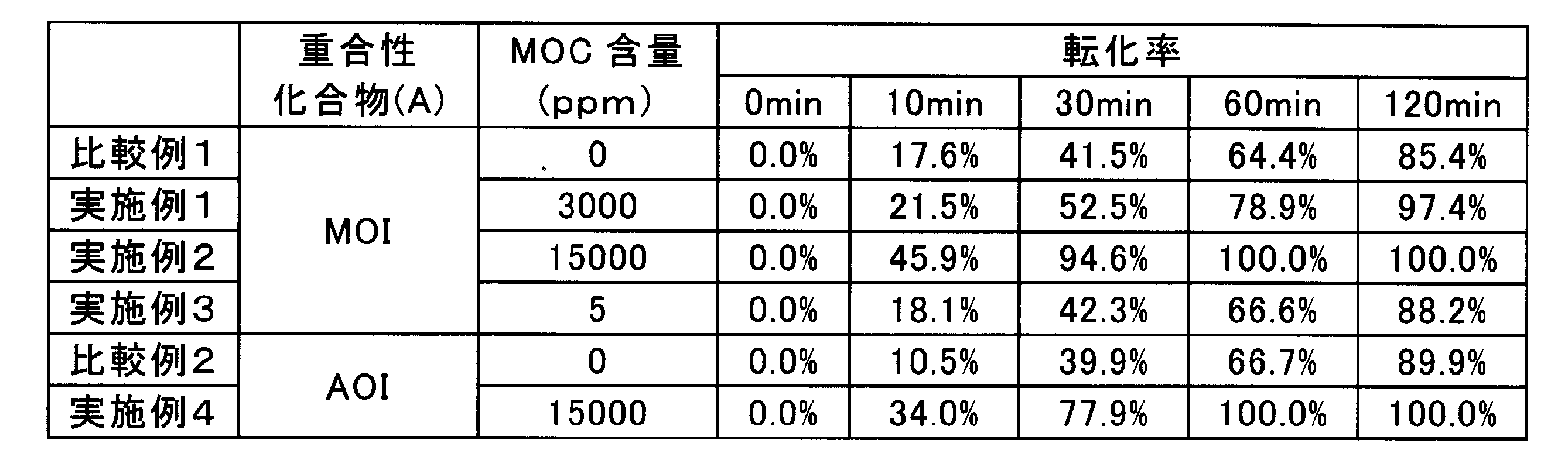
- Example 2 The urethanization reaction and the conversion rate were measured in the same manner as in Example 1 except that the amount of MOC added was changed to 0.0932 g (corresponding to 15000 ppm with respect to MOI). The results are shown in Table 1 and FIG.
- Example 3 The urethanization reaction and the conversion rate were measured in the same manner as in Example 1 except that the amount of MOC added was changed to 0.03 mg (corresponding to 5 wtppm with respect to MOI). The results are shown in Table 1 and FIG.
- MOI was changed to 5.64 g of acryloyloxyethyl isocyanate (Karenz AOI (registered trademark), manufactured by Showa Denko KK; hereinafter referred to as “AOI”), and the amount of MOC added was changed to 0.0846 g (equivalent to 15000 ppm with respect to AOI). Otherwise, the urethanization reaction and the conversion rate (the ratio of the AOI in which the isocyanate group was converted to urethane in the AOI used) were measured in the same manner as in Example 1. The results are shown in Table 1 and FIG.
- MOC functions as a reaction accelerator in the reaction between an isocyanate and an alcohol (urethanization reaction).
- the temperature of the reaction solution was maintained at 60 ° C.
- the time when MOI was added was defined as 0 hour, and when the elapsed time from 0 hour (reaction time) was 0 minutes, 10 minutes, 30 minutes, 60 minutes, 120 minutes, and 240 minutes, Sampling was performed and LC analysis was performed to determine the conversion rate (the proportion of MOI in which the isocyanato group was converted to amide out of the MOI used). The conversion was determined by the same formula as used in Example 1. The results are shown in Table 2 and FIG.
- MOC functions as a reaction accelerator also in the reaction between an isocyanate and a carboxylic acid (amidation reaction).
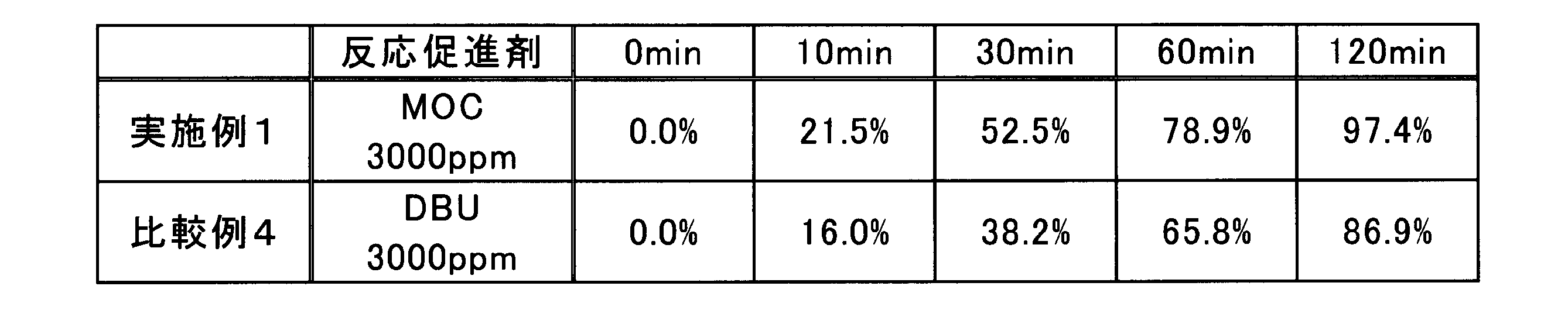
- reaction accelerator (B) of the present invention has a better reaction promoting effect in the urethanization reaction than the amine catalyst.
- Example 6 Yield difference between MOI + MOC system and AOI + MOC system.
- the urethanization reaction was performed in the same manner as in Example 2 except that the reaction was not sampled during the reaction and the reaction was continued for 1 hour.
- the reaction solution was analyzed by LC after the reaction, the proportion of the urethane compound having a methacryloyloxyethyl group in the urethane compound produced by the reaction was 100% by mass (the proportion of the urethane having an acryloyloxyethyl group was 0%).
- Example 7 The urethanization reaction was performed in the same manner as in Example 4 except that the reaction was continued for 1 hour without sampling the reaction solution.
- the reaction solution was analyzed by LC after the reaction, the proportion of the urethane compound having an acryloyloxyethyl group in the urethane compound produced by the reaction was 98.8% by mass, and in addition, the urethane compound having a methacryloyloxyethyl group. It contained 1.2% by mass of a urethane compound. This is presumably because the MOC used as the reaction accelerator (B) changed to MOI in the reaction solution and reacted with n-butanol.
- the polymerizable compound (A) since the polymerizable compound (A) has two functional points of an isocyanato group and a (meth) acryloyl group, the isocyanato group is first reacted with heat (first stage), and then (meth). It is preferable to produce a cured product by two stages of reacting the acryloyl group with light (second stage). However, at this time, if the content of the polymerization accelerator (B) is large, the two-stage reaction may unexpectedly proceed during the first-stage reaction. From the background described above, the amount of the polymerization accelerator (B) used in the reaction of the bifunctional monomer such as the polymerizable compound (A) is 5 to 8000 mass ppm, particularly 5 based on the bifunctional monomer. It is a more preferable form that it is -2000 mass ppm.
Landscapes
- Chemical & Material Sciences (AREA)
- Organic Chemistry (AREA)
- Health & Medical Sciences (AREA)
- Chemical Kinetics & Catalysis (AREA)
- Medicinal Chemistry (AREA)
- Polymers & Plastics (AREA)
- Addition Polymer Or Copolymer, Post-Treatments, Or Chemical Modifications (AREA)
- Polyurethanes Or Polyureas (AREA)
- Organic Low-Molecular-Weight Compounds And Preparation Thereof (AREA)
- Macromonomer-Based Addition Polymer (AREA)
Abstract
Description
本出願は、2013年7月25日に日本に出願された特願2013-154947号に基づき優先権を主張し、その内容をここに援用する。
しかしこれらの触媒は、基質によっては反応促進効果が充分ではないという問題がある。また反応生成物中に触媒が残存することで、反応生成物の物性やその硬化物の物性等に悪影響を及ぼすことがあった。
そのため、これらの触媒を使用する以外に、分子内に(メタ)アクリロイル基およびイソシアナト基を含む重合性化合物の反応を促進し得る技術が求められる。
例えば該化合物を反応促進剤として反応系内に存在させると、重合性化合物と活性水素を有する他の化合物との反応(ウレタン化反応等)において、前記重合性化合物が良好な反応性を示す。また、ラジカル重合反応においても、前記重合性化合物、あるいは該重合性化合物と活性水素を有する他の化合物との反応生成物が、良好な反応性を示し、これを含有する硬化性組成物の硬化性が向上する。
本発明は、上記知見に基づくものであり、以下の態様を有する。
[2]前記反応促進剤(B)の含有量が、前記重合性化合物(A)の含有量に対して5~20000質量ppmである、[1]に記載の組成物。
[3]前記反応促進剤(B)の含有量が、前記重合性化合物(A)の含有量に対して5~8000質量ppmである、[1]または[2]に記載の組成物。
[4]前記重合性化合物(A)が、下記一般式(1)または(1’)で表される化合物である、[1]~[3]のいずれか一項に記載の組成物。

前記反応促進剤(B)が、前記一般式(2)または(2’)で表され、かつ該一般式(2)または(2’)中のR1、R2、R3がそれぞれ前記重合性化合物(A)が有するR1、R2、R3と同じである化合物を含む、[5]に記載の組成物。
[7]活性水素含有基を有する化合物をさらに含む、[1]~[6]のいずれか一項に記載の組成物。
[8]前記活性水素含有基が、水酸基、メルカプト基、カルボキシル基およびアミノ基からなる群から選択される少なくとも一種である、[7]に記載の組成物。
[9][8]に記載の組成物中にて前記重合性化合物(A)と前記活性水素含有基を有する化合物とを反応させてなる、分子内にウレタン結合、チオウレタン結合、アミド結合およびウレア結合からなる群から選択される少なくとも一種と(メタ)アクリロイル基とを有する重合性化合物を含む硬化性組成物。
[10][8]に記載の組成物中にて前記重合性化合物(A)と前記活性水素含有基を有する化合物とを反応させて、分子内にウレタン結合、チオウレタン結合、アミド結合およびウレア結合からなる群から選択される少なくとも一種と(メタ)アクリロイル基とを有する重合性化合物を含む硬化性組成物を得る工程を含む、硬化性組成物の製造方法。
[11][9]に記載の硬化性組成物を硬化させてなる硬化物。
本発明の第一の態様の組成物(以下、組成物(I)ともいう。)は、分子内に(メタ)アクリロイル基およびイソシアナト基を有する重合性化合物(A)と、分子内に(メタ)アクリロイル基およびハロゲン化カルバモイル基を有する化合物からなる反応促進剤(B)と、を含む。
本発明において、「(メタ)アクリロイル基」は、アクリロイル基(CH2=CH-CO-)またはメタクリロイル基(CH2=C(CH3)-CO-)を示す。
「ハロゲン化カルバモイル基」は、>N-CO-Z(Zはハロゲン原子である。)で表される構造の基を示す。ハロゲン原子としては、フッ素原子、塩素原子、臭素原子、ヨウ素原子等が挙げられる。
反応促進剤(B)は、特に、重合性化合物(A)のイソシアナト基の反応性の向上(イソシアナト基と活性水素含有基との反応速度の向上)に優れた効果を発揮する。
重合性化合物(A)は、分子内に(メタ)アクリロイル基およびイソシアナト基を有する化合物である。
重合性化合物(A)としては、原料入手の容易さおよび反応性の点で、下記一般式(1)または(1’)で表される化合物が好ましい。
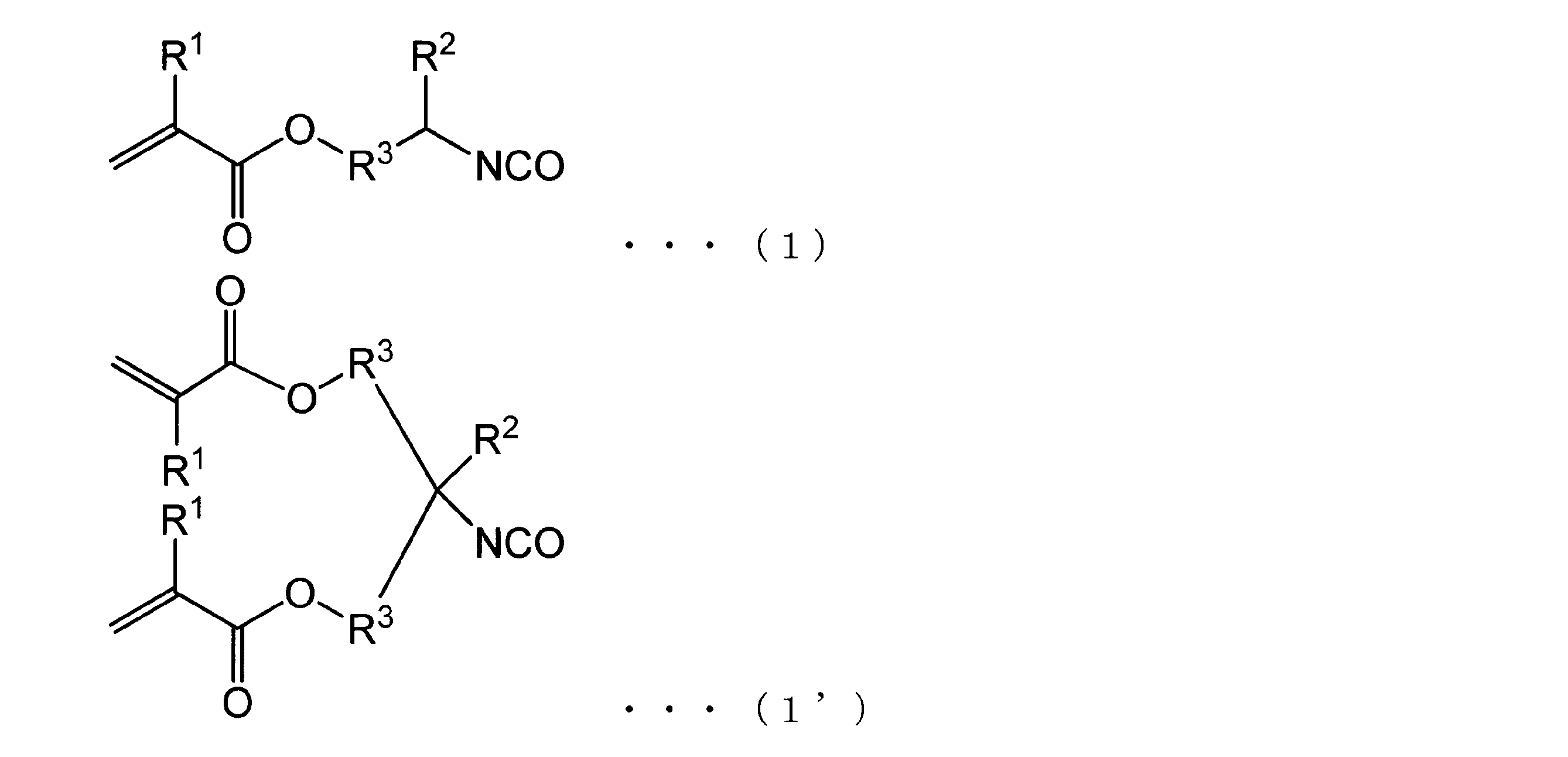
一般式(1)または(1’)中、R3における炭素数1~10のアルキレン基としては、炭素数1~8のアルキレン基が好ましく、炭素数1~6のアルキレン基がより好ましく、炭素数1~4のアルキレン基がさらに好ましい。
R3におけるアルキレン基としては、直鎖状または分岐鎖状のアルキレン基が好ましく、直鎖状のアルキレン基がより好ましい。
前記置換基としては、炭化水素基、ニトロ基、シアノ基、-OR’、-COR’、-COOR’(R’はアルキル基である。)等が挙げられる。
R3がフェニレン結合を有する場合、前記置換基は、アルキレン基中の水素原子を置換してもよく、フェニレン結合中の水素原子を置換してもよい。
前記R’におけるアルキル基としては、例えば、炭素数1~10のアルキル基が挙げられ、好ましくは炭素数1~6のアルキル基が挙げられ、より好ましくはメチル基、エチル基、プロピル基、イソプロピル基、ブチル基、イソブチル基、t-ブチル基、シクロペンチル基等が挙げられる。
一般式(1’)で表される化合物の具体例としては、1,1-(ビスアクリロイルオキシメチル)エチルイソシアネート等が好ましい。
反応促進剤(B)は、分子内に(メタ)アクリロイル基およびハロゲン化カルバモイル基を有する化合物からなる。
反応促進剤(B)としては、原料入手の容易さおよび反応性の点で、下記一般式(2)または(2’)で表される化合物が好ましい。

Xは、フッ素原子、塩素原子、臭素原子、ヨウ素原子のいずれでもよく、塩素原子が好ましい。
一般式(2’)で表される化合物の具体例としては、前記一般式(2’)で表される化合物の具体例として挙げた化合物中のイソシアナト基(-NCO)を-NH-CO-Xで置換した化合物が挙げられ、N-1,1-(ビスアクリロイルオキシメチル)エチルカルバモイルクロリド等が好ましい。
組成物(I)中の反応促進剤(B)の含有量は、重合性化合物(A)の含有量(100質量%)に対して5~20000質量ppmであることが好ましく、5~8000質量ppmであることがより好ましく、5~3000質量ppmであることがさらに好ましい。
重合性化合物(A)の含有量に対する反応促進剤(B)の含有量の割合が5質量ppm未満である場合、充分な反応促進効果が得られないおそれがある。
重合性化合物(A)の含有量に対する反応促進剤(B)の含有量の割合が20000質量ppm超である場合、重合性化合物(A)におけるイソシアナト基および(メタ)アクリロイル基の両方の反応が促進されてしまい、不都合が生じるおそれがある。重合性化合物(A)のように、種類の異なる2種の反応性官能基を有する化合物の使用方法としては、まずはどちらか一方(例えばイソシアナト基)を他の化合物と反応させたのち、もう一方(例えば(メタ)アクリロイル基)を反応させるという二段階で反応を行うという方法が多い。しかし、ここに反応促進剤(B)が多量に存在すると、例えば一段階目の反応を行う際中、あるいはそれよりも前の保存時において、二段階目の反応が起こってしまい、望まない反応生成物を生じる場合がある。よって重合性化合物(A)の使用方法によっては、反応促進剤(B)の添加量は、重合性化合物(A)の含有量に対して20000質量ppm以下、特に8000質量ppm以下程度に抑えることが好ましい。
組成物(I)中に含有される反応促進剤(B)の含有量を求める方法は、例えば下記2種の測定方法1、2が挙げられる。なお、下記測定条件(用いるサンプル量、試薬の種類、NMR機器、NMRの積算回数など)は一例であり、条件は必要に応じて適宜変更して良い(特に含有される反応促進剤(B)が少量である場合、測定方法2の条件は、より精度の高いものに変更する必要が生じる場合もある。)。
200mL容量ビーカーへ100mLメタノール水溶液(水/メタノール=3/7)と、測定対象となる試料10gを添加し、攪拌・溶解する。該溶液を硝酸銀水溶液(0.02mol/L、力価1.006、関東化学社製)によって滴定し、当量点を測定、下記式にて試料中の反応促進剤(B)の含有量を求める。
反応促進剤(B)含有量(%)=(硝酸銀水溶液の滴定量(L)× 力価1.006×塩素の分子量35.46(g/mol)× 硝酸銀水溶液モル濃度0.02(mol/L)×100 )/試料量(g)
(条件)
5mmΦのNMR試料管中で、測定対象となる試料100mgを0.3mLの脱水されたベンゼン-d6に均一に溶解させて測定用試料を調製し、その測定用試料の1H-NMRスペクトルを下記の条件下で測定する。
装置:Bruker Biospin社製 Avance-400
測定温度:室温
パルス幅:30°
パルス繰り返し時間:5秒
積算回数:128回
以下、測定対象となる試料が、重合性化合物(A)がメタクリロイルオキシエチルイソシアネート(以下MOI)であって、反応促進剤(B)がメタクリロイルオキシエチルカルバモイルクロライド(以下MOC)である組成物の場合における、反応促進剤(B)の含有量をNMRから求める方法について例示する。
図5~図6に該混合物のNMRチャートを提示する(なお本チャートは、MOIと、MOIに対して3330質量ppmの割合のMOCとを含有する組成物のスペクトルである)。図5は、テトラメチルシラン(TMS)を内部基準物質としてNMR測定を行って得られるδ(ppm)=0.5~9.5付近のNMRチャート(横軸:δ(ケミカルシフト)、縦軸:シグナル強度)であり、図6は、図5に示すNMRチャートのδ(ppm)=5.85~6.35付近を拡大したものである。
本チャートにおいて、δ(ppm)=2.2~4.3付近に検出されるピークが、MOIとMOCの両方が有する、エチレン基の4プロトン分に相当するピークである。一方、δ(ppm)=6.02~6.05付近のピークの積分値が、MOCのメタクリル基の末端の2プロトン分に相当する。
重合性化合物(A)に反応促進剤(B)を、100~3330質量ppmの範囲で種々の量添加した試料を作製し、その試料100mgを0.3mLの脱水されたベンゼン-d6に均一に溶解させて試料を調製し、それぞれの1H-NMRスペクトルを上記の条件下で測定する。これらの値を基に、MOC添加量に対する上記2ピークの強度比の検量線を作成する。
測定対象とする組成物のNMRを同様の条件にて測定し、上記検量線にプロットすることで、組成物に含まれるMOC含量が求められる。
組成物(I)中に含まれる重合性化合物(A)、反応促進剤(B)はそれぞれ1種単独でも2種以上でもよい。
本発明においては、組成物(I)中に含まれる重合性化合物(A)の少なくとも1種からイソシアナト基を除いた構造と、反応促進剤(B)の少なくとも1種からハロゲン化カルバモイル基を除いた構造とが同じであることが好ましい。
たとえば、重合性化合物(A)が、前記一般式(1)で表される化合物を含む場合、前記反応促進剤(B)が、前記一般式(2)で表され、かつ該一般式(2)中のR1、R2、R3がそれぞれ前記重合性化合物(A)が有するR1、R2、R3と同じである化合物を含むことが好ましい。重合性化合物(A)が、前記一般式(1’)で表される化合物を含む場合、反応促進剤(B)が、前記一般式(2’)で表され、かつ該一般式(2’)中のR1、R2、R3がそれぞれ前記重合性化合物(A)が有するR1、R2、R3と同じである化合物を含むことが好ましい。
上記のように、重合性化合物(A)からイソシアナト基を除いた構造と、前記反応促進剤(B)からハロゲン化カルバモイル基を除いた構造とが同じであると、たとえば重合性化合物(A)と、後述する活性水素含有基を有する化合物との反応において、目的とする反応生成物の収率が向上する。
組成物(I)は、重合性化合物(A)と反応促進剤(B)とからなる組成物でもよく、重合性化合物(A)および反応促進剤(B)以外の他の成分(任意成分)をさらに含む組成物でもよい。
任意成分としては、例えば、重合性化合物(A)および反応促進剤(B)以外の化合物であって重合性化合物(A)と反応可能な化合物(他の反応性化合物)が挙げられる。
重合性化合物(A)の(メタ)アクリロイル基を反応させる場合、前記他の反応性化合物としては、エチレン性不飽和基等の重合性官能基を有する重合性化合物(他の重合性化合物)が好ましく用いられる。該他の重合性化合物としては、特に限定されず、ラジカル重合可能な各種モノマー類等のなかから用途に応じて適宜選択できる。
重合性化合物(A)のイソシアナト基を反応させる場合、前記他の反応性化合物としては、活性水素含有基を有する化合物(以下、活性水素含有化合物ともいう。)が好ましく用いられる。
本発明においては特に、組成物(I)が活性水素含有化合物を含むことが好ましい。これは反応促進剤(B)が特に、重合性化合物(A)のイソシアナト基と活性水素含有基(特に水酸基)が反応する際において、優れた反応促進効果を有するためである。
活性水素含有化合物は、活性水素含有基を有する。
活性水素は、窒素原子、酸素原子、硫黄原子等に結合した水素原子であり、炭素原子に結合した水素原子に比べて反応性が高い。
活性水素含有基としては、構造中に活性水素を含むものであれば特に限定されないが、反応性の点で、水酸基、メルカプト基、カルボキシル基およびアミノ基からなる群から選択される少なくとも一種であることが好ましく、水酸基であることが特に好ましい。
任意成分として、希釈の目的や取扱いの容易さのために、不活性溶媒を含んでもよい。不活性溶媒は、活性水素を含まない溶媒であり、例えばトルエン、キシレン、ヘキサン、酢酸エチル、テトラヒドロフラン、酢酸n-ブチル、シクロヘキサノン、メチルイソブチルケトン等が挙げられる。
その他、必要に応じて、硬化触媒(熱硬化触媒、光硬化触媒等)、光ラジカル開始剤、硬化剤、硬化促進剤、添加剤(充填剤、消泡剤、難燃剤、酸化防止剤、紫外線吸収剤、低応力化剤、可とう性付与剤、ワックス類、樹脂、架橋剤、ハロゲントラップ剤、レベリング剤、濡れ改良剤など)等を含んでもよい。
硬化触媒の添加量は、組成物全量100質量部に対して、例えば0.05~10質量部、好ましくは0.5~5質量部である。
フェノール樹脂としては、例えば、フェノール又はクレゾールをホルムアルデヒドを用いて重合させた樹脂を使用できる。この樹脂は、ジシクロペンタジエン、ナフタレン、ビフェニルなどの脂環式化合物又は芳香族化合物を共重合させたものであってもよい。フェノール樹脂の配合量は、組成物全量100質量部に対して、通常0~200質量部程度、例えば5~200質量部の範囲で適宜選択できる。
酸無水物としては、多塩基酸無水物が挙げられ、具体的には、無水フタル酸、無水トリメリット酸、無水ピロメリット酸、ベンゾフェノンテトラカルボン酸無水物、4-テトラヒドロ無水フタル酸、4-メチル-4-テトラヒドロ無水フタル酸、3-メチル-4-テトラヒドロ無水フタル酸、無水ナジック酸、無水メチルナジック酸、水素化メチルナジック酸無水物、4-(4-メチル-3-ペンテニル)テトラヒドロ無水フタル酸、無水コハク酸、無水アジピン酸、無水マレイン酸、無水セバシン酸、無水ドデカン二酸、メチルシクロヘキセンテトラカルボン酸無水物、ドデセニル無水コハク酸、ヘキサヒドロ無水フタル酸、4-メチルヘキサヒドロ無水フタル酸、3-メチルヘキサヒドロ無水フタル酸、ビニルエーテル-無水マレイン酸共重合体、アルキルスチレン無水マレイン酸共重合体等が挙げられる。酸無水物の配合量は、組成物全量100質量部に対して、通常0~160質量部程度、例えば20~160質量部の範囲で適宜選択できる。
上記の他の硬化促進剤としては、具体的には、例えば、ベンジルジメチルアミン、2,4,6-トリス(ジメチルアミノメチル)フェノール、トリエチルアミン、トリエチレンジアミン等の3級アミン、2-エチル-4-メチルイミダゾール、1-シアノエチル-2-エチル-4-メチルイミダゾール等のイミダゾール類、テトラ-n-ブチルホスホニウム-O,O-ジエチルホスホロジチオエートなどの芳香族を含まないリン化合物(ホスホニウム塩等)、3級アミン塩、4級アンモニウム塩、また、オクチル酸スズ、ジブチルスズジアセテート、ジブチルスズジラウレート、ジブチルスズオキサイド、ジオクチルスズオキサイド等の有機スズ化合物、オクチル酸ビスマス、デカン酸ビスマス等の有機ビスマス化合物等の金属塩等の公知の化合物を挙げることができる。さらに、上記ジアザビシクロアルケン類の有機酸塩とともに、金属有機酸塩を併用することができる。金属有機酸塩としては、例えば、オクチル酸スズ、ナフテン酸スズ、オクチル酸亜鉛、ナフテン酸亜鉛などが挙げられる。
組成物(I)における硬化促進剤の配合量は、組成物全量100質量部に対して、例えば0.00001~5質量部の範囲で適宜選択できる。
組成物(I)を製造する方法としては、例えば、重合性化合物(A)に対し、反応促進剤(B)を添加する方法(i)、重合性化合物(A)を製造する際に、反応促進剤(B)を副生成物として発生させ、反応生成物中に共存させる方法(ii)等が挙げられる。このような方法によれば、重合性化合物(A)と反応促進剤(B)との混合物を製造することができる。
組成物(I)が任意成分を含む場合、上記のようにして得られた混合物に対して任意成分を添加することで、組成物(I)を得ることができる。
必要に応じて固形分濃度を調整したり、溶媒交換したり、濾過処理、沈殿又は再沈殿等による精製、溶媒への溶解などの操作を行ってもよい。
重合性化合物(A)の市販のものとしては、カレンズMOI(登録商標、昭和電工社製、メタクリロイルオキシエチルイソシアネート)、カレンズAOI(登録商標、昭和電工社製、アクリロイルオキシエチルイソシアネート)、カレンズMOI-EG(登録商標、昭和電工社製、メタクリロイルオキシエトキシエチルイソシアネート)、カレンズBEI(登録商標、昭和電工社製、1,1-(ビスアクリロイルオキシメチル)エチルイソシアネート)等が挙げられる。
重合性化合物(A)の製造方法としては、例えば、US2821544号公報に記載の方法等が挙げられる。
方法(ii)において、重合性化合物(A)の製造方法としては、上述のような公知の製造方法を採用できる。
イソシアナト基をハロゲン化カルバモイル基に変化させるために使用されるハロゲン化合物としては、例えばホスゲン、塩化水素等が挙げられる。
1)(メタ)アクリロイル基およびイソシアナト基を有する化合物に塩化水素ガスを吹き込み、析出した固体(反応促進剤(B))を取り出す等によって反応促進剤(B)をまず製造したのち、これを重合性化合物(A)と混合する方法。
2)重合性化合物(A)を合成する過程においてホスゲンや塩化水素等を用いることで、副生生物として反応促進剤(B)を発生させ、重合性化合物(A)と反応促進剤(B)との混合物を得る方法。
組成物(I)の使用方法は特に限定されないが、例えば、重合性化合物(A)が有する(メタ)アクリロイル基およびイソシアナト基のどちらか一方の基を反応させたのち、反応生成物中に未反応のまま含まれるもう一方の基を反応させる二段階の反応を利用する用途に好ましく用いられる。
例えば、重合性化合物(A)のイソシアナト基を反応(活性水素含有化合物が有する活性水素含有基との反応等)させた後、反応生成物が有する(メタ)アクリロイル基を反応(同じ反応生成物の他の分子や他の重合性化合物とのラジカル重合等)させることができる。逆に、重合性化合物(A)の(メタ)アクリロイル基を反応(同じ重合性化合物(A)の他の分子や他の重合性化合物とのラジカル重合等)させた後、反応生成物が有するイソシアナト基を反応(活性水素含有化合物が有する活性水素含有基との反応等)させることができる。
二段階目で(メタ)アクリロイル基を他の重合性化合物の重合性官能基と反応(重合)させる場合、他の重合性化合物は、一段階目の開始前の組成物(I)に予め含まれてもよく、一段階目の反応後に反応系に添加されてもよい。
二段階目でイソシアナト基を活性水素含有基と反応させる場合、活性水素含有化合物は、一段階目の開始前の組成物(I)に予め含まれてもよく、一段階目の反応後に反応系に添加されてもよく、一段階目の反応後に反応系に添加されることが好ましい。
重合性化合物(A)と活性水素含有化合物とを反応させると、詳しくは後で説明するが、硬化性組成物が得られる。かかる硬化性組成物は、光照射、紫外線(UV)照射等によりラジカル重合を進行させ、硬化させることが可能で、多様な用途に用いることができる。本発明においては、重合性化合物(A)と活性水素含有化合物との反応を、反応促進剤(B)の存在下で行うことで、反応促進剤(B)が存在しない場合に比べて、重合性化合物(A)と活性水素含有化合物との反応速度が速くなり、短時間で反応を完了させることができる等、硬化性組成物の生産性が向上する。
組成物(I)が活性水素含有化合物を含むものである場合、該組成物(I)中にて重合性化合物(A)と活性水素含有化合物とを反応させることにより、硬化性を有する硬化性組成物が得られる。
前記反応により生成する反応生成物は、重合性化合物(A)と活性水素含有化合物とが、イソシアナト基と活性水素含有基との反応により形成された結合を介して連結された構造を有するものであり、重合性化合物(A)に由来する(メタ)アクリロイル基を有する重合性化合物である。
イソシアナト基と活性水素含有基との反応において、前記活性水素含有基が水酸基である場合はウレタン結合(-NH-CO-O-)が形成され、前記活性水素含有基がメルカプト基である場合はチオウレタン結合(-NH-CO-S-)が形成され、前記活性水素含有基がカルボキシル基である場合はアミド結合(-NH-CO-)が形成され、前記活性水素含有基がアミノ基である場合はウレア結合(-NH-CO-NH-)が形成される。
したがって、活性水素含有化合物が、活性水素含有基として水酸基、メルカプト基、カルボキシル基およびアミノ基からなる群から選択される少なくとも一種を有する場合、上記反応により得られる硬化性組成物は、分子内にウレタン結合、チオウレタン結合、アミド結合およびウレア結合からなる群から選択される少なくとも一種と(メタ)アクリロイル基とを有する重合性化合物を含むものとなる。
反応温度は、40~80℃が好ましく、50~70℃がより好ましい。80℃以上であると、重合性化合物(A)中の二重結合の反応性が大きくなり重合反応が進行する可能性があるため好ましくない。一方、40℃以下であると、反応速度が小さいため好ましくない。
反応時間は特に限定されず、反応の進行状況に応じて適宜設定できる。
反応後、必要に応じて、硬化性組成物に対し、添加剤を配合してもよい。
このような硬化性組成物は、塗料、インキ、接着剤、被覆剤、電子材料(液状レジスト、フィルムレジスト、カラーフィルターレジスト、半導体用テープ、粘着剤、接着剤)、印刷(刷版、カラー校正)、医療(ソフトコンタクトレンズ、歯科材料)、繊維・紙・木材(表面処理剤)、自動車(トップコート、補修用塗料、部品塗料)、家電(基板、絶縁材料)、建築用材料(セメントプライマー、塗料、接着剤)等として用いることができる。
以下の各例において、特に規定のない限り、「%」は質量%(wt%)、「ppm」は質量ppm(wtppm)を示す。
液体クロマトグラフィ分析(以下「LC分析」という。)の条件は、下記のとおりである。
カラム:昭和電工(株)製、商品名「Shodex(登録商標)KF-801」4本、
溶離液:テトラヒドロフラン(THF)、
流速:0.8mL/min
オーブン温度:40℃
検出器:示差屈折率(RI)・UV(波長210nm)
<合成例1>
100mLの三口フラスコに、メタクリロイルオキシエチルイソシアネート(カレンズMOI(登録商標)、昭和電工社製。以下「MOI」という。)10.0gを仕込み、内温を15℃に冷却しながら、ドライ塩化水素を2.58g内挿管を通してメタクリロイルオキシエチルイソシアネートへバブリングし、メタクリロイルオキシエチルカルバモイルクロライド(以下「MOC」という。)を12.6g得た。純度は100%であった。
トルエン200gにアミノエチルメタクリレート塩酸塩(以下「AEMHCl」という。)110gを仕込み、内温85℃でAEMHClを溶融させた状態で、ホスゲンを110g供給し、MOIを合成した。反応液へ窒素をバブリングすることで溶存しているホスゲンを除去し、さらに溶媒であるトルエンを減圧条件で留去することで粗MOIを110g得た。
粗MOI中のMOC含量を硝酸銀滴定にて確認した結果、10.8%であった。
<実施例1>
100mLの三口フラスコに、MOI6.21g、合成例1で製造したメタクリロイルオキシエチルカルバモイルクロライド(以下「MOC」という。)0.0186g(MOIに対し3000ppm相当)、トルエン50mL、BHT0.1gを加え、攪拌混合した。得られた混合物を60℃に昇温し、さらにn-ブタノール8.89gを系内に加えて、MOIとn-ブタノールとの反応(ウレタン化反応)を行った。反応中、反応液の温度は60℃に保持した。
上記の反応において、n-ブタノールを添加した時点を0時間とし、0時間からの経過時間(反応時間)が0分、10分、30分、60分、120分の時点でそれぞれ反応液をサンプリングし、LC分析を行って、使用したMOIのうち、イソシアナト基がウレタンに転化したMOIの割合(転化率)を下記式に基づいて求めた。反応液中のMOI含量(%)は、LC分析により測定した。結果を表1および図1に示す。
転化率(%)=(仕込み液中[反応前]のMOI含量(%)-反応液中[サンプリング時]のMOI含量(%))/(仕込み液中[反応前]のMOI含量(%))×100
MOCの添加量を0.0932g(MOIに対し15000ppm相当)に変えたほかは実施例1と同様にして、ウレタン化反応および転化率の測定を行った。結果を表1および図1に示す。
MOCの添加量を0.03mg(MOIに対し5wtppm相当)に変えたほかは実施例1と同様にして、ウレタン化反応および転化率の測定を行った。結果を表1および図1に示す。
MOCを加えなかったほかは実施例1と同様にして、ウレタン化反応および転化率の測定を行った。結果を表1および図1に示す。
MOIをアクリロイルオキシエチルイソシアネート(カレンズAOI(登録商標)、昭和電工社製。以下「AOI」という。)5.64gに変え、MOCの添加量を0.0846g(AOIに対し15000ppm相当)に変えたほかは実施例1と同様にして、ウレタン化反応および転化率(使用したAOIのうち、イソシアナト基がウレタンに転化したAOIの割合)の測定を行った。結果を表1および図2に示す。
MOCを加えなかったほかは実施例4と同様にしてウレタン化反応および転化率の測定を行った。結果を表1および図2に示す。
<実施例5>
100mLの三口フラスコに、合成例1で製造したMOC0.0932g(この後添加するMOIに対し15000ppm相当)、デカン酸6.89g、プロピレングリコールモノメチルエーテルアセテート(PGMAc)64.52g、BHT0.1gを加え、攪拌混合した。得られた混合物を60℃に昇温し、さらにMOI(カレンズMOI(登録商標)、昭和電工社製)6.21gを系内に加えて、MOIとデカン酸との反応(アミド化反応)を行った。反応中、反応液の温度は60℃に保持した。
上記の反応において、MOIを添加した時点を0時間とし、0時間からの経過時間(反応時間)が0分、10分、30分、60分、120分、240分の時点でそれぞれ反応液をサンプリングし、LC分析を行って転化率(使用したMOIのうち、イソシアナト基がアミドに転化されたMOIの割合)を測定した。転化率は実施例1で用いたのと同様の式にて求めた。結果を表2および図3に示す。
MOCを加えなかったほかは実施例5と同様にして、アミド化反応および転化率の測定を行った。結果を表2および図3に示す。

<比較例4>
MOCの代わりに、1,8-ジアザビシクロ(5,4,0)ウンデセン(以下「DBU」という。東京化製株式会社製)を0.02g(MOIに対して3000ppmとなる量)を添加した他は、実施例1と同様にしてウレタン化反応および転化率の測定を行った。結果を、実施例1の結果とともに表3および図4に示す。
<実施例6>
途中で反応液のサンプリングを行わず反応を1時間継続して行ったほかは実施例2と同様にウレタン化反応を行った。
反応後、反応液をLC分析したところ、反応により生成したウレタン化合物のうち、メタクリロイルオキシエチル基を有するウレタン化合物の占める割合は100質量%(アクリロイルオキシエチル基を有するウレタンの占める割合は0%)であった。
途中で反応液のサンプリングを行わず反応を1時間継続して行ったほかは実施例4と同様にウレタン化反応を行った。
反応後、反応液をLC分析したところ、反応により生成したウレタン化合物のうち、アクリロイルオキシエチル基を有するウレタン化合物の占める割合は98.8質量%であり、このほかに、メタクリロイルオキシエチル基を有するウレタン化合物を1.2質量%含んでいた。これは、反応促進剤(B)として用いたMOCが反応液中でMOIに変わり、n-ブタノールと反応したためと考えられる。
<参考例I>
MOI(カレンズMOI(登録商標)、昭和電工社製)5.00gを再蒸留し、含有されている重合防止剤(BHT)を除去した。蒸留したMOIに、MOC0.500g(MOIに対して10000ppm相当)を添加し、混合して得られた組成物を窒素置換し、100℃で加熱した。温度を観察したところ、MOC添加の時点から20分が経過した時点において温度上昇があり、メタクリロイル基の反応(ラジカル重合反応)の開始が認められた。
MOCを加えない他は、参考例Iと同様の操作を行い、温度観察をしたところ、264分経過時点において温度上昇があり、メタクリロイル基の反応(ラジカル重合反応)の開始が認められた。
しかしながら参考例Iでは、ラジカル重合開始剤を加えずに加熱しただけの条件(すなわち、光重合開始剤を添加しUV照射をするという適性な光硬化反応の条件ではない条件)にも拘わらず、参考例IIより大幅に短い20分でラジカル反応の開始が認められた。これは目的とする用途や実験操作によっては、保存安定性および下記の観点からあまり好ましくない条件であるとも捉えられる。
また本発明において、重合性化合物(A)はイソシアナト基と(メタ)アクリロイル基の2つの官能点を有するため、先にイソシアナト基を熱により反応させ(1段階目)、そののちに(メタ)アクリロイル基を光により反応させる(2段階目)の2段階によって硬化物を製造することが好ましい。しかしこの際、重合促進剤(B)の含有量が多いと、1段階目の反応中に予期せず2段階の反応が進行してしまう恐れがある。
以上のような背景から、重合性化合物(A)のような2官能性モノマーの反応において用いる重合促進剤(B)の量は、該2官能性モノマーに対して5~8000質量ppm、特に5~2000質量ppmとすることがより好ましい形態である。
Claims (11)
- 分子内に(メタ)アクリロイル基およびイソシアナト基を有する重合性化合物(A)と、分子内に(メタ)アクリロイル基およびハロゲン化カルバモイル基を有する化合物からなる反応促進剤(B)と、を含む組成物。
- 前記反応促進剤(B)の含有量が、前記重合性化合物(A)の含有量に対して5~20000質量ppmである、請求項1に記載の組成物。
- 前記反応促進剤(B)の含有量が、前記重合性化合物(A)の含有量に対して5~8000質量ppmである、請求項1または2に記載の組成物。
- 前記重合性化合物(A)が、下記一般式(1)または(1’)で表される化合物である、請求項1に記載の組成物。

- 前記反応促進剤(B)が、下記一般式(2)または(2’)で表される化合物である、請求項1に記載の組成物。
- 前記重合性化合物(A)が、前記一般式(1)または(1’)で表される化合物を含み、
前記反応促進剤(B)が、前記一般式(2)または(2’)で表され、かつ該一般式(2)または(2’)中のR1、R2、R3がそれぞれ前記重合性化合物(A)が有するR1、R2、R3と同じである化合物を含む、請求項5に記載の組成物。 - 活性水素含有基を有する化合物をさらに含む、請求項1に記載の組成物。
- 前記活性水素含有基が、水酸基、メルカプト基、カルボキシル基およびアミノ基からなる群から選択される少なくとも一種である、請求項7に記載の組成物。
- 請求項8に記載の組成物中にて前記重合性化合物(A)と前記活性水素含有基を有する化合物とを反応させてなる、分子内にウレタン結合、チオウレタン結合、アミド結合およびウレア結合からなる群から選択される少なくとも一種と(メタ)アクリロイル基とを有する重合性化合物を含む硬化性組成物。
- 請求項8に記載の組成物中にて前記重合性化合物(A)と前記活性水素含有基を有する化合物とを反応させて、分子内にウレタン結合、チオウレタン結合、アミド結合およびウレア結合からなる群から選択される少なくとも一種と(メタ)アクリロイル基とを有する重合性化合物を含む硬化性組成物を得る工程を含む、硬化性組成物の製造方法。
- 請求項9に記載の硬化性組成物を硬化させてなる硬化物。
Priority Applications (5)
| Application Number | Priority Date | Filing Date | Title |
|---|---|---|---|
| US14/906,791 US10072113B2 (en) | 2013-07-25 | 2014-07-22 | Composition, curable composition, production method therefor, and cured product |
| CN201480040270.3A CN105377911B (zh) | 2013-07-25 | 2014-07-22 | 组合物、固化性组合物、其制造方法及固化物 |
| EP14829194.1A EP3026068B1 (en) | 2013-07-25 | 2014-07-22 | Composition, curable composition, production method therefor, and cured product |
| JP2015528286A JP6381140B2 (ja) | 2013-07-25 | 2014-07-22 | 組成物、硬化性組成物、その製造方法および硬化物 |
| KR1020167000731A KR101763543B1 (ko) | 2013-07-25 | 2014-07-22 | 조성물, 경화성 조성물, 그 제조 방법 및 경화물 |
Applications Claiming Priority (2)
| Application Number | Priority Date | Filing Date | Title |
|---|---|---|---|
| JP2013-154947 | 2013-07-25 | ||
| JP2013154947 | 2013-07-25 |
Publications (1)
| Publication Number | Publication Date |
|---|---|
| WO2015012258A1 true WO2015012258A1 (ja) | 2015-01-29 |
Family
ID=52393293
Family Applications (1)
| Application Number | Title | Priority Date | Filing Date |
|---|---|---|---|
| PCT/JP2014/069308 Ceased WO2015012258A1 (ja) | 2013-07-25 | 2014-07-22 | 組成物、硬化性組成物、その製造方法および硬化物 |
Country Status (7)
| Country | Link |
|---|---|
| US (1) | US10072113B2 (ja) |
| EP (1) | EP3026068B1 (ja) |
| JP (1) | JP6381140B2 (ja) |
| KR (1) | KR101763543B1 (ja) |
| CN (1) | CN105377911B (ja) |
| TW (1) | TWI632167B (ja) |
| WO (1) | WO2015012258A1 (ja) |
Cited By (1)
| Publication number | Priority date | Publication date | Assignee | Title |
|---|---|---|---|---|
| JPWO2021200668A1 (ja) * | 2020-03-31 | 2021-10-07 |
Families Citing this family (1)
| Publication number | Priority date | Publication date | Assignee | Title |
|---|---|---|---|---|
| KR102536700B1 (ko) * | 2021-03-10 | 2023-05-30 | 미쯔이가가꾸가부시끼가이샤 | 크실릴렌디이소시아네이트 조성물, 광학 재료용 중합성 조성물, 수지, 성형체, 광학 소자 및 렌즈 |
Citations (6)
| Publication number | Priority date | Publication date | Assignee | Title |
|---|---|---|---|---|
| US2821544A (en) | 1954-04-26 | 1958-01-28 | Bayer Ag | Production of alkylisocyanate esters of 2-alkenoic acids |
| JPH03275661A (ja) * | 1990-03-26 | 1991-12-06 | Daicel Chem Ind Ltd | ジイソシアネート化合物の反応促進方法 |
| JPH05262715A (ja) * | 1991-02-01 | 1993-10-12 | Daicel Chem Ind Ltd | ジイソシアネート化合物の反応促進方法およびジイソシアネート化合物を主成分とすることを特徴とする組成物 |
| JPH0959244A (ja) * | 1995-08-21 | 1997-03-04 | Mitsubishi Gas Chem Co Inc | ジイソシアネート化合物の反応促進方法および組成物 |
| JPH1143527A (ja) * | 1997-07-29 | 1999-02-16 | Mitsubishi Gas Chem Co Inc | 光学材料用ウレタン樹脂 |
| JP2000044529A (ja) * | 1998-08-03 | 2000-02-15 | Daicel Chem Ind Ltd | 脂環式ジイソシアネート化合物を主成分とする組成物 |
Family Cites Families (12)
| Publication number | Priority date | Publication date | Assignee | Title |
|---|---|---|---|---|
| US4310688A (en) | 1979-10-22 | 1982-01-12 | The Dow Chemical Company | Reduction of hydrolyzable chloride impurities in an isocyanatoalkyl ester of an organic carboxylic acid |
| WO1991014725A1 (fr) | 1990-03-19 | 1991-10-03 | Daicel Chemical Industries, Ltd. | Procede de production de polyurethane |
| US6245935B1 (en) | 1998-02-06 | 2001-06-12 | Showa Denko Kabushiki Kaisha | Method for producing isocyanatoalkyl (meth)acrylate |
| EP0976723A3 (en) | 1998-07-31 | 2001-02-07 | Daicel Chemical Industries, Ltd. | A cycloaliphatic polyisocyanate compound, a process for the preparation thereof, a polyurethane therefrom, and an adhesive composition |
| US6646156B2 (en) | 2000-04-17 | 2003-11-11 | Showa Denko Kabushiki Kaisha | (Meth)acryloyl-group-containing carbamoyl halides and production process therefor |
| KR100770824B1 (ko) | 2003-07-31 | 2007-10-26 | 쇼와 덴코 가부시키가이샤 | 안정화된 (메트)아크릴로일옥시알킬 이소시아네이트, 그의안정화 방법 및 그의 제조 방법 |
| KR101117899B1 (ko) | 2007-05-23 | 2012-03-13 | 쇼와 덴코 가부시키가이샤 | 에테르 결합을 갖는 반응성 우레탄 화합물, 경화성 조성물 및 경화물 |
| JP5468289B2 (ja) | 2008-04-18 | 2014-04-09 | 石原産業株式会社 | ピリミジン系化合物の製造方法 |
| WO2010087318A1 (ja) | 2009-01-29 | 2010-08-05 | 昭和電工株式会社 | 転写材料用硬化性組成物および(メタ)アクリロイル基含有ウレア化合物 |
| CN103396733A (zh) * | 2009-12-14 | 2013-11-20 | 昭和电工株式会社 | 聚合性化合物和含有该化合物的固化性组合物 |
| CN102822747B (zh) * | 2010-03-31 | 2014-09-24 | 太阳控股株式会社 | 光固化性热固化性树脂组合物、光固化性热固化性薄膜、固化物、具备固化物的印刷电路板 |
| EP2377847A1 (en) * | 2010-04-14 | 2011-10-19 | 3M Innovative Properties Company | Process for producing isocyanates |
-
2014
- 2014-07-22 CN CN201480040270.3A patent/CN105377911B/zh active Active
- 2014-07-22 JP JP2015528286A patent/JP6381140B2/ja active Active
- 2014-07-22 KR KR1020167000731A patent/KR101763543B1/ko active Active
- 2014-07-22 TW TW103125112A patent/TWI632167B/zh active
- 2014-07-22 EP EP14829194.1A patent/EP3026068B1/en active Active
- 2014-07-22 US US14/906,791 patent/US10072113B2/en active Active
- 2014-07-22 WO PCT/JP2014/069308 patent/WO2015012258A1/ja not_active Ceased
Patent Citations (6)
| Publication number | Priority date | Publication date | Assignee | Title |
|---|---|---|---|---|
| US2821544A (en) | 1954-04-26 | 1958-01-28 | Bayer Ag | Production of alkylisocyanate esters of 2-alkenoic acids |
| JPH03275661A (ja) * | 1990-03-26 | 1991-12-06 | Daicel Chem Ind Ltd | ジイソシアネート化合物の反応促進方法 |
| JPH05262715A (ja) * | 1991-02-01 | 1993-10-12 | Daicel Chem Ind Ltd | ジイソシアネート化合物の反応促進方法およびジイソシアネート化合物を主成分とすることを特徴とする組成物 |
| JPH0959244A (ja) * | 1995-08-21 | 1997-03-04 | Mitsubishi Gas Chem Co Inc | ジイソシアネート化合物の反応促進方法および組成物 |
| JPH1143527A (ja) * | 1997-07-29 | 1999-02-16 | Mitsubishi Gas Chem Co Inc | 光学材料用ウレタン樹脂 |
| JP2000044529A (ja) * | 1998-08-03 | 2000-02-15 | Daicel Chem Ind Ltd | 脂環式ジイソシアネート化合物を主成分とする組成物 |
Non-Patent Citations (1)
| Title |
|---|
| NIPPON GOMU KYOKAISHI, JOURNAL OF OUR SOCIETY, vol. 45, no. 5, 1972, pages 452 - 461 |
Cited By (4)
| Publication number | Priority date | Publication date | Assignee | Title |
|---|---|---|---|---|
| JPWO2021200668A1 (ja) * | 2020-03-31 | 2021-10-07 | ||
| WO2021200668A1 (ja) * | 2020-03-31 | 2021-10-07 | デンカ株式会社 | 感光性組成物、硬化物、有機エレクトロルミネッセンス表示装置および感光性組成物の製造方法 |
| JP7591563B2 (ja) | 2020-03-31 | 2024-11-28 | デンカ株式会社 | 感光性組成物、硬化物および有機エレクトロルミネッセンス表示装置 |
| KR102951833B1 (ko) | 2020-03-31 | 2026-04-10 | 덴카 주식회사 | 감광성 조성물, 경화물, 유기 전계발광 표시 장치 및 감광성 조성물의 제조 방법 |
Also Published As
| Publication number | Publication date |
|---|---|
| US20160168295A1 (en) | 2016-06-16 |
| CN105377911A (zh) | 2016-03-02 |
| CN105377911B (zh) | 2017-05-24 |
| KR101763543B1 (ko) | 2017-07-31 |
| EP3026068A1 (en) | 2016-06-01 |
| EP3026068A4 (en) | 2017-03-15 |
| JPWO2015012258A1 (ja) | 2017-03-02 |
| TW201509974A (zh) | 2015-03-16 |
| US10072113B2 (en) | 2018-09-11 |
| EP3026068B1 (en) | 2018-02-28 |
| JP6381140B2 (ja) | 2018-08-29 |
| KR20160019520A (ko) | 2016-02-19 |
| TWI632167B (zh) | 2018-08-11 |
Similar Documents
| Publication | Publication Date | Title |
|---|---|---|
| KR101383511B1 (ko) | α-(불포화 알콕시알킬)아크릴레이트 조성물 및 그 제조 방법 | |
| WO2007086461A1 (ja) | チオール化合物を含有する硬化性組成物 | |
| JP7288167B2 (ja) | エチレン性不飽和基、酸基および二級水酸基含有ポリアミドイミド樹脂、エチレン性不飽和基および酸基含有ポリアミドイミド樹脂並びに製造方法 | |
| JP6381140B2 (ja) | 組成物、硬化性組成物、その製造方法および硬化物 | |
| JP2020176214A (ja) | アミドイミド樹脂組成物、硬化性樹脂組成物、硬化物、絶縁材料、ソルダーレジスト用樹脂材料及びレジスト部材 | |
| JP6395324B2 (ja) | 反応促進剤、およびこれを用いたウレタン化合物、チオウレタン化合物、アミド化合物またはウレア化合物の製造方法 | |
| JP7847055B2 (ja) | ウレタン(メタ)アクリレート化合物、組成物、硬化物及びウレタン(メタ)アクリレート化合物の製造方法 | |
| JP6080839B2 (ja) | 化合物、該化合物の製造方法、重合体、硬化性組成物および硬化物 | |
| JP7358916B2 (ja) | シリルアミン化合物を含む潜在性硬化剤 | |
| JP7547725B2 (ja) | 水剥離性硬化型組成物 | |
| JP2009242350A (ja) | 多官能含フッ素化合物及び該化合物の製造方法 | |
| JPS60206802A (ja) | 改良された加水分解性シリル基含有ビニル系重合体の製造法 | |
| KR100625038B1 (ko) | 신규 중합체 및 이를 함유한 박막 조성물 | |
| WO2023238925A1 (ja) | ラジカル重合性組成物及びその重合物 | |
| TW202535840A (zh) | 共聚物、樹脂組成物、硬化物,及聚合物之混合物 | |
| JP2016050260A (ja) | 硬化性組成物、硬化膜、半導体素子、表示素子及び潜在性塩基触媒 | |
| JP2021031618A (ja) | 粘着剤組成物 | |
| JP2000256429A (ja) | 活性エネルギー線硬化型不飽和樹脂組成物 | |
| WO2020090960A1 (ja) | シリルアミン化合物および該シリルアミン化合物を含む潜在性硬化剤 | |
| JPS61103917A (ja) | 新規なウレタンプレポリマ−,その製法およびこれを用いた光硬化性樹脂組成物 |
Legal Events
| Date | Code | Title | Description |
|---|---|---|---|
| 121 | Ep: the epo has been informed by wipo that ep was designated in this application |
Ref document number: 14829194 Country of ref document: EP Kind code of ref document: A1 |
|
| ENP | Entry into the national phase |
Ref document number: 2015528286 Country of ref document: JP Kind code of ref document: A |
|
| ENP | Entry into the national phase |
Ref document number: 20167000731 Country of ref document: KR Kind code of ref document: A |
|
| WWE | Wipo information: entry into national phase |
Ref document number: 14906791 Country of ref document: US Ref document number: 2014829194 Country of ref document: EP |
|
| NENP | Non-entry into the national phase |
Ref country code: DE |