WO2015015913A1 - Cuve à circulation pour analyse d'acides nucléiques et analyseur d'acides nucléiques - Google Patents
Cuve à circulation pour analyse d'acides nucléiques et analyseur d'acides nucléiques Download PDFInfo
- Publication number
- WO2015015913A1 WO2015015913A1 PCT/JP2014/065405 JP2014065405W WO2015015913A1 WO 2015015913 A1 WO2015015913 A1 WO 2015015913A1 JP 2014065405 W JP2014065405 W JP 2014065405W WO 2015015913 A1 WO2015015913 A1 WO 2015015913A1
- Authority
- WO
- WIPO (PCT)
- Prior art keywords
- nucleic acid
- light
- substrate
- acid analysis
- flow cell
- Prior art date
- Legal status (The legal status is an assumption and is not a legal conclusion. Google has not performed a legal analysis and makes no representation as to the accuracy of the status listed.)
- Ceased
Links
Images





Classifications
-
- B—PERFORMING OPERATIONS; TRANSPORTING
- B01—PHYSICAL OR CHEMICAL PROCESSES OR APPARATUS IN GENERAL
- B01L—CHEMICAL OR PHYSICAL LABORATORY APPARATUS FOR GENERAL USE
- B01L3/00—Containers or dishes for laboratory use, e.g. laboratory glassware; Droppers
- B01L3/50—Containers for the purpose of retaining a material to be analysed, e.g. test tubes
- B01L3/502—Containers for the purpose of retaining a material to be analysed, e.g. test tubes with fluid transport, e.g. in multi-compartment structures
- B01L3/5027—Containers for the purpose of retaining a material to be analysed, e.g. test tubes with fluid transport, e.g. in multi-compartment structures by integrated microfluidic structures, i.e. dimensions of channels and chambers are such that surface tension forces are important, e.g. lab-on-a-chip
- B01L3/502715—Containers for the purpose of retaining a material to be analysed, e.g. test tubes with fluid transport, e.g. in multi-compartment structures by integrated microfluidic structures, i.e. dimensions of channels and chambers are such that surface tension forces are important, e.g. lab-on-a-chip characterised by interfacing components, e.g. fluidic, electrical, optical or mechanical interfaces
-
- C—CHEMISTRY; METALLURGY
- C12—BIOCHEMISTRY; BEER; SPIRITS; WINE; VINEGAR; MICROBIOLOGY; ENZYMOLOGY; MUTATION OR GENETIC ENGINEERING
- C12Q—MEASURING OR TESTING PROCESSES INVOLVING ENZYMES, NUCLEIC ACIDS OR MICROORGANISMS; COMPOSITIONS OR TEST PAPERS THEREFOR; PROCESSES OF PREPARING SUCH COMPOSITIONS; CONDITION-RESPONSIVE CONTROL IN MICROBIOLOGICAL OR ENZYMOLOGICAL PROCESSES
- C12Q1/00—Measuring or testing processes involving enzymes, nucleic acids or microorganisms; Compositions therefor; Processes of preparing such compositions
- C12Q1/68—Measuring or testing processes involving enzymes, nucleic acids or microorganisms; Compositions therefor; Processes of preparing such compositions involving nucleic acids
- C12Q1/6869—Methods for sequencing
-
- B—PERFORMING OPERATIONS; TRANSPORTING
- B01—PHYSICAL OR CHEMICAL PROCESSES OR APPARATUS IN GENERAL
- B01L—CHEMICAL OR PHYSICAL LABORATORY APPARATUS FOR GENERAL USE
- B01L2200/00—Solutions for specific problems relating to chemical or physical laboratory apparatus
- B01L2200/10—Integrating sample preparation and analysis in single entity, e.g. lab-on-a-chip concept
-
- B—PERFORMING OPERATIONS; TRANSPORTING
- B01—PHYSICAL OR CHEMICAL PROCESSES OR APPARATUS IN GENERAL
- B01L—CHEMICAL OR PHYSICAL LABORATORY APPARATUS FOR GENERAL USE
- B01L2300/00—Additional constructional details
- B01L2300/06—Auxiliary integrated devices, integrated components
- B01L2300/0627—Sensor or part of a sensor is integrated
- B01L2300/0654—Lenses; Optical fibres
-
- B—PERFORMING OPERATIONS; TRANSPORTING
- B01—PHYSICAL OR CHEMICAL PROCESSES OR APPARATUS IN GENERAL
- B01L—CHEMICAL OR PHYSICAL LABORATORY APPARATUS FOR GENERAL USE
- B01L2300/00—Additional constructional details
- B01L2300/08—Geometry, shape and general structure
- B01L2300/0809—Geometry, shape and general structure rectangular shaped
- B01L2300/0816—Cards, e.g. flat sample carriers usually with flow in two horizontal directions
-
- B—PERFORMING OPERATIONS; TRANSPORTING
- B01—PHYSICAL OR CHEMICAL PROCESSES OR APPARATUS IN GENERAL
- B01L—CHEMICAL OR PHYSICAL LABORATORY APPARATUS FOR GENERAL USE
- B01L2300/00—Additional constructional details
- B01L2300/08—Geometry, shape and general structure
- B01L2300/0861—Configuration of multiple channels and/or chambers in a single devices
- B01L2300/0877—Flow chambers
-
- B—PERFORMING OPERATIONS; TRANSPORTING
- B01—PHYSICAL OR CHEMICAL PROCESSES OR APPARATUS IN GENERAL
- B01L—CHEMICAL OR PHYSICAL LABORATORY APPARATUS FOR GENERAL USE
- B01L2300/00—Additional constructional details
- B01L2300/08—Geometry, shape and general structure
- B01L2300/0887—Laminated structure
-
- B—PERFORMING OPERATIONS; TRANSPORTING
- B01—PHYSICAL OR CHEMICAL PROCESSES OR APPARATUS IN GENERAL
- B01L—CHEMICAL OR PHYSICAL LABORATORY APPARATUS FOR GENERAL USE
- B01L2300/00—Additional constructional details
- B01L2300/16—Surface properties and coatings
- B01L2300/161—Control and use of surface tension forces, e.g. hydrophobic, hydrophilic
- B01L2300/163—Biocompatibility
-
- B—PERFORMING OPERATIONS; TRANSPORTING
- B01—PHYSICAL OR CHEMICAL PROCESSES OR APPARATUS IN GENERAL
- B01L—CHEMICAL OR PHYSICAL LABORATORY APPARATUS FOR GENERAL USE
- B01L2300/00—Additional constructional details
- B01L2300/16—Surface properties and coatings
- B01L2300/168—Specific optical properties, e.g. reflective coatings
-
- B—PERFORMING OPERATIONS; TRANSPORTING
- B01—PHYSICAL OR CHEMICAL PROCESSES OR APPARATUS IN GENERAL
- B01L—CHEMICAL OR PHYSICAL LABORATORY APPARATUS FOR GENERAL USE
- B01L3/00—Containers or dishes for laboratory use, e.g. laboratory glassware; Droppers
- B01L3/50—Containers for the purpose of retaining a material to be analysed, e.g. test tubes
- B01L3/502—Containers for the purpose of retaining a material to be analysed, e.g. test tubes with fluid transport, e.g. in multi-compartment structures
- B01L3/5025—Containers for the purpose of retaining a material to be analysed, e.g. test tubes with fluid transport, e.g. in multi-compartment structures for parallel transport of multiple samples
Definitions
- the present invention relates to a flow cell for nucleic acid analysis and a nucleic acid analyzer.
- a cDNA fragment sample synthesized by reverse transcription reaction from a DNA fragment or RNA sample for sequencing was prepared in advance, and a dideoxy reaction by a well-known Sanger method was performed. Thereafter, electrophoresis is performed, and the molecular weight separation development pattern is measured and analyzed.
- Non-Patent Document 1 PCR is performed on microparticles using microparticles as a carrier for carrying DNA fragments. Thereafter, fine particles carrying PCR-amplified DNA fragments are put on a plate having a large number of holes in which the hole diameter is adjusted to the size of the fine particles, and read by a pyrosequencing method.
- Non-Patent Document 2 PCR is performed on microparticles using microparticles as a carrier for supporting DNA fragments. Thereafter, fine particles are dispersed and fixed on a glass substrate, an enzyme reaction (ligation) is performed on the glass substrate, a primer with a fluorescent dye is taken in, and fluorescence detection is performed to obtain sequence information of each fragment.
- enzyme reaction ligation
- primer with a fluorescent dye is taken in
- fluorescence detection is performed to obtain sequence information of each fragment.
- Non-Patent Document 3 a large number of DNA probes having the same sequence are fixed on a substrate.
- a DNA probe sequence and an adapter sequence of a complementary strand are added to the end of each DNA sample fragment.
- the sample DNA fragments are immobilized on the substrate randomly one molecule at a time.
- the DNA elongation reaction does not occur on the substrate, and after loading the substrate with the fluorescent dye, the unreacted substrate is washed and the fluorescence is detected to obtain the sequence information of the sample DNA.
- Patent Document 1 discloses details of a method for determining a large amount of sequence information in parallel.
- the sequence reaction is performed in a flow cell having a channel inside.
- the channel surface is coated with acrylamide, and forward primer and reverse primer are grafted onto the acrylamide.
- the flow cell is subjected to a temperature cycle to perform an amplification reaction on the substrate to form a plurality of colonies having the same arrangement as the template on the substrate.
- One colony is an aggregate of a plurality of copy templates amplified, and the copy template has the same sequence as the measurement target template or a complementary sequence.
- a sequencing primer is hybridized to the template in the colony to perform a sequencing reaction.
- nucleotides disclosed in WO2004 / 018493 are used. Nucleotides, fluorescent molecules and 3 of the sugar via a cleavable linker, having a leaving group in the position of oxygen.
- the sequence reaction uses four types of nucleotides derived from four types of bases A, T, C, and G. Each of the four types of nucleotides is labeled with a different fluorescent dye.
- a solution containing a polymerase and four types of nucleotides is injected into the flow cell, and nucleotides are incorporated into the sequence primer.
- the sequence primer in which the fluorescence is incorporated is detected by fluorescence.
- the base sequence of the template to be measured can be determined by detecting the fluorescence of the incorporated nucleotides.
- the intramolecular linker is chemically cleaved to remove the fluorescent molecule.
- the nucleotide sequence of the template is determined by repeating the cycle of nucleotide incorporation, fluorescence detection, and fluorescent molecule removal.
- Patent Document 1 and Patent Document 2 have a problem that sequencing accuracy is low because erroneous nucleotides that are not related to the base sequence of the template are incorporated at a certain rate.
- the proportion of templates that incorporate wrong nucleotides in one colony increases, and the correct fluorescence signal decreases.
- the length of the incorporated base cannot be increased.
- the sequencing process after determining the base sequence of a template that has been broken apart, the separated sequences are aligned on a computer. However, if the incorporated base length is short, the accuracy of the alignment decreases and the alignment time decreases. The problem which becomes long also arises. In general, since chemical cleavage has a long reaction time, there is a problem that the running time required for one run is long.
- Patent Document 3 discloses a nucleotide that can increase the accuracy of nucleotide incorporation and shorten the cleavage reaction time. 3 of the sugar in the nucleotides, to enhance the accuracy of the time of capture by increasing the affinity of the polymerase enzyme and nucleotides by eliminating a leaving group position oxygen. In addition, a photochemically cleavable intramolecular linker is introduced to shorten the cleavage time. On the other hand, the nucleotide of Patent Document 3 has a problem that the reaction efficiency of the photochemical cleavage reaction in the flow cell itself is still low and the incorporation base length is not sufficiently long.
- the present invention provides a flow cell for increasing the reaction efficiency of a cleavage reaction in a flow cell for nucleic acid analysis used in a sequence reaction with nucleotides that can be photochemically cleaved.
- a flow cell for nucleic acid analysis includes a first substrate having an optical filter that reflects first light that changes the chemical structure of a substance in a flow path, and a hollow having a hollow portion for forming a flow path.
- a sheet and a second substrate that transmits the first light are bonded together.
- the flow cell for nucleic acid analysis used for the sequence reaction with nucleotides that can be photochemically cleaved it is possible to increase the reaction efficiency of the photocleavage reaction and reduce noise during fluorescence detection. Thereby, the accuracy of sequencing can be improved, the running time can be shortened, and the incorporated base length can be increased.
- the inventors of the present invention have completed a flow cell for nucleic acid analysis that can realize a sequence reaction with high nucleotide incorporation accuracy, short cleavage time, and high cleavage efficiency.
- the present invention includes a first substrate including an optical filter that reflects first light that changes a chemical structure of a substance in a flow path, a hollow sheet having a hollow portion for forming a flow path, and a second sheet It is the flow cell for nucleic acid analysis which bonded together the board
- the first light transmitted through the second substrate is reflected by the optical filter, so that the compound having an intramolecular linker on the second substrate or the optical filter of the second substrate and the first substrate is used. Since the first light can be efficiently irradiated from a plurality of directions, the efficiency of the photochemical reaction can be increased. High photochemical reaction efficiency can increase the accuracy of base sequencing, increase the length of the incorporated base, and shorten the running time.
- the optical filter reflects the first light for changing the chemical structure of the substance in the flow channel, transmits the second light for exciting the substance in the flow channel, and transmits the second light from the substance in the flow channel.
- the third light emitted is also transmitted.
- Fluorescent molecules other than the colonies to be detected by increasing the efficiency of the photochemical reaction and transmitting the excitation light for fluorescence detection and the fluorescence from the noise fluorescent molecules on the second substrate and optical filter to the outside of the flow cell Can be reduced.
- the noise fluorescent molecule is a fluorescent molecule carried over in the flow path or the first substrate optical filter in addition to the fluorescent molecule attached to the area other than the colony on the second substrate when the colony on the second substrate is detected. There are fluorescent molecules above. At the time of colony detection on the first substrate optical filter, similarly, there are molecules carried over in the flow path and molecules on the second substrate in addition to the optical film.
- an optical filter is patterned and the patterned optical filter is present on a surface in contact with the flow path of the first substrate.
- an optical filter is a multi-layered inorganic oxide or metal oxide thin film formed by a method such as vapor deposition, and has higher flatness than ordinary glass.
- the adhesive strength with a hollow sheet such as a pressure-sensitive double-sided adhesive tape is low, and the pressure resistance of the flow cell is low.
- the hollow sheet has a structure in direct contact with a first substrate such as glass, which can obtain a high adhesive force, so that the pressure resistance of the flow cell can be increased.
- the present invention also provides a near-ultraviolet cut filter that transmits the first light whose second substrate changes the chemical structure of the substance in the flow path and reflects the fourth light having a shorter wavelength than the first light. It is characterized by providing.
- DNA absorbs light having a wavelength of 320 nm or less and partially dimerizes, reducing the reaction efficiency of the sequencing reaction.
- near ultraviolet rays having a wavelength of 184.9 nm generate ozone, and the generated ozone is decomposed by ultraviolet rays having a wavelength of 253.7 nm to generate O atoms having strong oxidizing power.
- the near-ultraviolet cut filter of the present invention prevents the transmission of these near-ultraviolet rays into the flow path.
- the present invention is also characterized in that the second substrate has an antireflection film for preventing reflection of the first light and the second light. Generally, it is known that less than 10% of light is reflected on the glass surface.
- the antireflection film of the present invention prevents reflection of the first light and the second light on the substrate surface, and minimizes a decrease in light intensity of the first light and the second light entering the flow path.
- the present invention changes the chemical structure of the substance in the flow path in the flow cell for nucleic acid analysis in which the first substrate and the second substrate, or the first substrate and the second substrate, and the grooved sheet are bonded together.
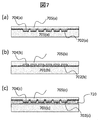
- the first light is transmitted through the second substrate, and an optical filter that reflects the first light is provided on the bottom surface of the flow channel facing the second substrate across the flow channel. Even in the structure having no hollow sheet as shown in FIGS. 7A to 7C, the same effect can be obtained by the same mechanism as described above.
- the present invention also provides a nucleic acid analysis flow cell in which a first substrate and a second substrate, or a first substrate, a second substrate, and a grooved sheet are bonded to each other.
- the first light for changing the structure is reflected, the second light that excites the substance in the flow path is transmitted, and the third light emitted from the substance in the flow path is also transmitted. Similar to the above, even in the structure without the hollow sheet as shown in FIGS. 7A to 7C, the same effect can be obtained by the same mechanism as described above.
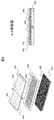
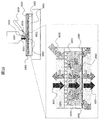
- FIG. 1 shows an example of a flow cell for nucleic acid analysis of the present invention.
- the flow cell for nucleic acid analysis of the present invention has a structure in which a first substrate 101 having an optical filter 102, a hollow sheet 103 having a hollow portion 104 for forming a flow path, and a second substrate 105 are bonded together.
- a space surrounded by the optical filter 102, the hollow sheet 103, and the second substrate 105 on the first substrate is a flow path.
- a hole opened in the second substrate serves as an inlet 106 and an outlet 107 for injecting liquid into the channel.
- An example of the flow cell for nucleic acid analysis in FIG. 1 is an example in which a hole is formed in the second substrate, but a hole may be formed in the first substrate, which may serve as an inlet or an outlet.
- FIG. 10 shows a configuration when the nucleic acid analysis flow cell 1010 of the present invention is installed in a nucleic acid analyzer.
- the light source 1019 emits first light 1020 for changing the chemical structure of the substance in the flow channel that is the measurement target.
- the detection unit 1017 emits second light 1021 for exciting the substance in the flow path, and detects third light 1022 emitted from the excited substance in the flow path.
- a plurality of molecules of the substance in the channel to be measured are present on the surface of the bead carrier 1023.
- the holder unit 1011 holds a flow cell 1010 for nucleic acid analysis.
- the first light 1020 emitted from the light source 1019 passes through the first substrate 1020 and then irradiates the substance in the channel on the bead carrier 1023.
- a part of the first light 1020 that has passed through the bead carrier 1023 is reflected by the optical filter 1002, and the reflected first light 1020 irradiates the bead carrier 1023 from the lower surface to cause a flow that exists below the bead carrier 1023.
- the second light 1021 that has passed through the second substrate 1005 excites the substance in the flow path on the bead carrier 1023, and then the second light 1021 that has passed through the bead carrier 1023 passes through the optical filter 1002 and passes through the flow path. Go out of 1004.
- the substance in the flow path to be measured in the sequence reaction is a nucleotide having a fluorescent molecule via a photocleavable linker in the molecule.
- the outline of the sequence reaction is as follows. After introducing the amplification template onto the bead carrier 1023 outside the flow cell 1010 for nucleic acid analysis, the bead carrier 1023 having the amplification template is immobilized on the second substrate in contact with the flow path, and then the amplification template. Hybridize the sequence primer. After hybridization, an aqueous solution containing nucleotides and an enzyme is supplied into the channel 1004 and the primer is incorporated with nucleotides, and then the channel 1004 is washed to remove unreacted nucleotides.
- the incorporated nucleotide is irradiated with the first light 1020 to perform a photocleavage reaction, and then the flow path 1004 is washed. At this time, nucleotides that cannot be removed by washing in the flow path become noise during fluorescence detection. Similarly, the remaining fluorescent dye after light cutting also becomes noise. The nucleotide and the fluorescent dye after photocleavage remain on the surface of the bead carrier 1023, the surface of the second substrate 1005 in contact with the channel 1004, and the optical filter 1002 in contact with the channel 1004.
- the optical filter of the present invention emits the second light 1021 out of the flow path, it is possible to reduce noise derived from residual nucleotides or fluorescent dyes after photocleavage.
- the optical filter 1002 also emits the third light 1022 generated by being excited by the second light 1021 to the outside of the channel 1004.
- FIG. 10 shows an example in which the bead carrier 1023 is fixed only on the upper surface of the flow path. However, in the example in which the bead carrier 1023 is also fixed on the optical filter 1002, the bead carrier 1023 on the lower surface of the flow path is detected when the upper surface of the flow path is detected.
- the third light 1022 from the light source, the nucleotide remaining in the flow path, and the third light 1022 from the fluorescent dye after light cleavage become noise, but the optical filter 1002 of the present invention flows these third light 1022s. Since it goes out of the road 1004, noise can be reduced.
- the second light and the third light that have once come out of the flow path 1004 are once exposed to the surface of the holder unit. This prevents reflection and return to the flow path 1004 again, further reducing noise.
- the wavelength of the first light is not particularly limited as long as the linker of a nucleotide having a fluorescent molecule via a photocleavable linker in the molecule can be cleaved, but the nucleotide described in Patent Document 3 can be cleaved, and is generally 450 nm or less is desirable as a wavelength that does not overlap with the second wavelength for exciting the fluorescent molecules.
- a wavelength larger than 320 nm is desirable as a wavelength capable of preventing the dimerization of DNA due to radical generation.
- the wavelength of the second light is not particularly limited as long as the fluorescent molecules can be excited, but the sequence reaction requires detection using four types of fluorescent dyes at the same time.
- a wavelength of 450 nm or more is desirable because it is easy to select.
- the wavelength of the third light is not particularly limited, but it is desirable that the wavelength of 480 nm or more is easy to select a dye that can reduce the overlap of the emission wavelengths between the four-color dyes, similarly to the wavelength of the second light.
- the first group is Alexa 488, FAM, FITC, Oregon Green488, second group is Alexa Fluor532, BODIPY TMR-X, Cy3, HEX, JOE, third group is Alexa Fluor594, Texas Red-X, fourth group is one from each group of BODIPY 650/665, Cy5 Select and combine dyes.
- the material of the first substrate 101 used in the present invention is not particularly limited, but inorganic materials such as glass, sapphire and silicon, metals such as aluminum and copper, alloys such as stainless steel, polymethyl methacrylate resin, and polycarbonate resin
- a resin material such as cycloolefin resin can be used.
- the holder unit 1011 with which the first substrate 1001 is in contact has a temperature control function, so it has high thermal conductivity, high thermal conductivity blended with glass, silicon, stainless steel, carbon fiber and inorganic filler.
- the resin material is desirable.
- the thickness at which the strength of the flow cell after bonding is obtained without lowering the thermal conductivity is preferably from 0.1 mm to 100 mm.
- the material of the second substrate 102 is not particularly limited as long as it transmits light, and an inorganic material such as glass, sapphire, or quartz, or a resin material such as an acrylic resin or a clereolefin resin can be used.
- the thickness is preferably 0.1 mm or more and 10 mm or less in accordance with the specifications of the objective lens mounted on the detection unit 1017.
- the material of the hollow sheet 203 is not particularly limited, but an epoxy adhesive such as thermosetting or photo-curing, an acrylic adhesive, or the like can be used. Alternatively, a double-sided tape based on acrylic resin may be used. More preferable materials include glass, quartz, sapphire, or polydimethylsiloxane having high adhesive strength with a transparent resin.
- the spacer 506 is preferably 1 mm or less in thickness.
- the optical filter 104 is made by arbitrarily stacking 10 to 40 layers of dielectric multilayer films such as SiO2, TiO2, Ta2O2, Nb2O3, etc., and reflects light of a desired wavelength and transmits light of other wavelengths. Can do.
- FIG. 11 shows optical characteristics of an optical filter suitable for the present invention, which reflects the first light having a wavelength of less than 400 nm and transmits the second light and the third light having a wavelength of 400 nm or more. Also, as shown in FIGS. 1 and 3 to 7, the optical filter is provided on the upper surface of the first substrate, so that when the nucleic acid analysis flow cell 1001 is installed in the holder unit 1011, the optical filter 1002 and the holder unit are arranged.
- the 1011 can be prevented from coming into direct contact with the optical filter, and scratches on the optical filter can be prevented. Also, by using SiO2 as the outermost surface of the optical filter, it is possible to prevent the amount of multilayer film constituent materials such as Al2O3 and TiO2 from coming into contact with the buffer containing chlorine ions used in the sequence reaction, and to prevent corrosion of these oxide films. it can.
- FIG. 2 shows the optical filter 202 provided on the lower surface of the first substrate 201
- FIG. 3 shows that the patterned optical filter 302 exists on the first substrate so as to be in contact with the flow path.
- an optical filter has higher flatness than ordinary glass, and therefore there is a problem that the adhesive strength with a hollow sheet such as PDMS (Polyimethylsiloxane) and pressure-sensitive double-sided adhesive tape is low, and the pressure resistance of the flow cell is low.
- PDMS Polyimethylsiloxane
- the flow cell for nucleic acid analysis of FIG. 4 or FIG. 5 includes a near ultraviolet filter that reflects near ultraviolet light having a wavelength of 320 nm or less on a second substrate.
- the near-ultraviolet filter prevents near-ultraviolet light from entering the flow path.
- DNA absorbs light having a wavelength of 320 nm or less and partially dimerizes, reducing the reaction efficiency of the sequencing reaction.
- the flow cell for nucleic acid analysis in FIG. 4 or FIG. 5 prevents a decrease in reaction efficiency of the sequence reaction due to near ultraviolet rays.
- the nucleic acid analysis flow cell of FIG. 6 includes an antireflection film 609 on a second substrate 605.
- the antireflection film 609 prevents the first light 1020 and the second light 1021 from reflecting off the upper surface of the second substrate, and the light intensity of the first light 1020 and the second light 1021 entering the channel 604. Minimize the degradation of Usually, it is known that less than 10% of visible light having a wavelength of 400 nm to 800 nm is reflected on the glass surface.
- FIG. 12 shows the optical characteristics of the antireflection film of the present invention.
- the reflectance can be 2% or less.
- Such an antireflection film can be formed of a multilayer film of Al, MgF2, SiO2, and Al2O3.
- FIG. 7 is a nucleic acid analysis flow cell in which a first substrate and a second substrate, or a first substrate, a second substrate, and a grooved sheet 720 are bonded together.
- the first light for changing the structure is transmitted through the second substrate, and has an optical filter that reflects the first light on the bottom surface of the channel facing the second substrate across the channel.
- Such a flow cell can be produced by using glass or etched glass for the second substrate, silicon or PDMS etched for the grooved sheet, and glass or silicon for the first substrate.
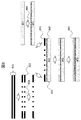
- a sheet 821 with a protective film having a releasable protective film is hollowed out by using a die-cutting press process or a laser process to form a hollow portion 804 that forms a flow path.
- an optical film 802 is formed on the first substrate 801 using a vapor deposition method or the like. After the protective film 822 is peeled from the previous protective film-attached sheet 821, the first substrate 801 having the optical film 802 and the protective film-attached sheet from which the protective film 822 has been peeled off is bonded.
- the surface of the optical film 802 and the surface of the hollow sheet may be exposed to excimer, oxygen plasma, or atmospheric pressure plasma before bonding.
- heat treatment may be performed after bonding to improve the adhesion.
- the remaining protective film 822 is removed and then bonded to the second substrate 805.
- exposure to the excimer, oxygen plasma, or atmospheric pressure plasma, or heat treatment may be performed.
- the nucleic acid analysis flow cell thus prepared is set in a nucleic acid analyzer and subjected to nucleic acid analysis.
- the present invention also includes a nucleic acid analyzer for performing a nucleic acid reaction by setting the flow cell for nucleic acid analysis of the present invention.
- the nucleic acid analyzer of the present invention includes at least a holder unit for holding the nucleic acid analysis flow cell, a detection unit for observing a sample in the nucleic acid analysis flow cell, and changing the structure of the substance in the flow path to the nucleic acid analysis flow cell.
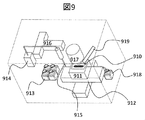
- the nucleic acid analyzer includes a nucleic acid analysis flow cell 910 of the present invention; a nucleic acid analysis flow cell 910 fixed; and a holder unit 911 that can adjust the temperature of the nucleic acid analysis flow cell 910; a nucleic acid analysis flow cell 910 and a holder A stage unit 912 for moving the unit 911; a reagent container 913 containing a plurality of reagents and washing water; and a drive source for aspirating and injecting the reagent contained in the reagent container 913 into the flow cell 910 for nucleic acid analysis Liquid feeding unit 914; Nozzle 915 that actually accesses reagent container 913 and nucleic acid analysis flow cell 910 when aspirating / discharging the reagent; Nozzle transport unit 916 that transports nozzle 915; Fixed to nucleic acid analysis flow cell 910 A detection unit 917 for observing the collected sample,
- the nucleic acid analyzer of the present invention operates as follows. First, a flow cell 910 for nucleic acid analysis holding a nucleic acid sample to be measured is installed in the holder unit 911. Next, the nozzle 916 accesses the reagent container 913 and sucks the reagent using the liquid feeding unit 914. The nozzle 915 is transported to the upper surface of the nucleic acid analysis flow cell 910 by the nozzle transport unit 916, and injects the reagent into the nucleic acid analysis flow cell 910. Thereafter, the holder unit 911 adjusts the temperature of the solution contained in the flow path of the nucleic acid analysis flow cell 910 to control the sequence reaction.
- the nucleic acid analysis flow cell 910 is moved by the stage unit 912, and excitation light is applied to detect fluorescence of a plurality of nucleic acid samples in the detection region.
- excitation light it is preferable to detect fluorescence by applying excitation light through a nucleic acid sample or a substrate on which a carrier having a nucleic acid sample on the surface is fixed.
- the flow cell 910 for nucleic acid analysis is moved minutely and the detection is repeated a plurality of times by the same method.
- the washing water contained in the reagent container 913 is sucked by the liquid feeding unit 914 and injected into the nucleic acid analysis flow cell 910, thereby washing the flow path of the nucleic acid analysis flow cell 910. To do.
- the first light is irradiated to the substance in the channel taken in the nucleic acid sample, and the structure of the substance in the channel is changed so that the reaction in the next cycle proceeds. Thereafter, similarly, the flow path in the nucleic acid analysis flow cell 910 is washed.
- a nucleic acid sample can be read by repeating a cycle consisting of reagent injection, temperature-controlled sequence reaction, fluorescence detection, flow path cleaning, first light irradiation, and flow path cleaning a plurality of times.
- the nucleic acid analyzer is controlled by a computer and can automatically perform the above operation.
- Non-patent Document 2 A nucleic acid analysis method using the nucleic acid analyzer of the present invention will be described.
- the analysis method is Science 2005, vol. 309, pp.
- the method disclosed in 1728-1732 (Non-patent Document 2) is used.
- Emulsion PCR Emulsion PCR was performed by adding a PCR solution, MyOne (trademark), paramagnetic streptavidin magnetic beads (Dynal), and a library solution to an oil solution composed of light mineral oil (Sigma). After adding a surfactant-containing solution to the amplification solution and performing high-speed centrifugation, solvent replacement is performed using a magnet, and an aqueous solution of beads with measurement DNA having a large number of amplification products on the surface was made.
- Nucleic acid analysis was performed using nucleotides disclosed in Patent Document 3.
- the nucleic acid analysis flow cell in which the beads described above were fixed was installed in the nucleic acid analyzer of the present invention.
- the aqueous solution containing the primer was injected into the flow cell 910 for nucleic acid analysis through the nozzle 915.
- the aqueous solution in the nucleic acid analysis flow cell 910 was heated to 57 ° C. using the holder unit 911 and then held at 4 ° C. After injecting an aqueous solution containing the above nucleotide and DNA polymerase, the elongation reaction was carried out by maintaining at 60 ° C. for 5 minutes.
- the flow path in the flow cell 910 for nucleic acid analysis was washed with a buffer to remove unreacted nucleotides.
- the fluorescence introduced into the beads with a plurality of nucleic acid samples in the detection region was detected by applying excitation light in the detection unit 917.
- a 50 mM sodium azide aqueous solution was injected, and UV light having a wavelength of 365 nm was irradiated at 0.7 W / cm 2 for 4 minutes to cleave the fluorescent dye.
- the inside of the flow cell was washed with a buffer.
- the nucleic acid base sequence was determined by repeating the extension reaction, fluorescence detection, and cleavage of the fluorescent dye.
- Patent Document 1 The template preparation method disclosed in Patent Document 1 was used instead of (2) emulsion PCR in Example 1 and (3) fixation of beads having DNA on the surface thereof to a flow cell for nucleic acid analysis. A sequence reaction was performed on the colonies formed on the substrate.
- Micro glass beads (product name: EMB-10, manufactured by Potters Barodini Co., Ltd.) were added to the sodium azide aqueous solution of Example 1.
- the average particle size of the microglass beads was 5 ⁇ m.
- the micro glass beads can diffusely reflect the UV light that has entered the flow path, further improving the efficiency of cutting the fluorescent dye.
- nucleic acid reactions can be performed using the flow cell for nucleic acid analysis or the nucleic acid analyzer of the present invention, and nucleic acids such as DNA sequences can be analyzed.
Landscapes
- Chemical & Material Sciences (AREA)
- Health & Medical Sciences (AREA)
- Life Sciences & Earth Sciences (AREA)
- Organic Chemistry (AREA)
- Proteomics, Peptides & Aminoacids (AREA)
- Analytical Chemistry (AREA)
- General Health & Medical Sciences (AREA)
- Zoology (AREA)
- Engineering & Computer Science (AREA)
- Wood Science & Technology (AREA)
- Chemical Kinetics & Catalysis (AREA)
- Clinical Laboratory Science (AREA)
- Hematology (AREA)
- Dispersion Chemistry (AREA)
- Immunology (AREA)
- Biochemistry (AREA)
- Bioinformatics & Cheminformatics (AREA)
- General Engineering & Computer Science (AREA)
- Molecular Biology (AREA)
- Genetics & Genomics (AREA)
- Microbiology (AREA)
- Biotechnology (AREA)
- Physics & Mathematics (AREA)
- Biophysics (AREA)
- Apparatus Associated With Microorganisms And Enzymes (AREA)
- Measuring Or Testing Involving Enzymes Or Micro-Organisms (AREA)
Abstract
Priority Applications (4)
| Application Number | Priority Date | Filing Date | Title |
|---|---|---|---|
| GB1601244.5A GB2558169B (en) | 2013-07-31 | 2014-06-11 | Flow cell for nucleic acid analysis and nucleic acid analyzer |
| JP2015529439A JP6151360B2 (ja) | 2013-07-31 | 2014-06-11 | 核酸分析用フローセル、及び核酸分析装置 |
| US14/907,844 US10112195B2 (en) | 2013-07-31 | 2014-06-11 | Flow cell for nucleic acid analysis and nucleic acid analyzer |
| CN201480030099.8A CN105555966B (zh) | 2013-07-31 | 2014-06-11 | 核酸分析用流动池和核酸分析装置 |
Applications Claiming Priority (2)
| Application Number | Priority Date | Filing Date | Title |
|---|---|---|---|
| JP2013-158426 | 2013-07-31 | ||
| JP2013158426 | 2013-07-31 |
Publications (1)
| Publication Number | Publication Date |
|---|---|
| WO2015015913A1 true WO2015015913A1 (fr) | 2015-02-05 |
Family
ID=52431457
Family Applications (1)
| Application Number | Title | Priority Date | Filing Date |
|---|---|---|---|
| PCT/JP2014/065405 Ceased WO2015015913A1 (fr) | 2013-07-31 | 2014-06-11 | Cuve à circulation pour analyse d'acides nucléiques et analyseur d'acides nucléiques |
Country Status (5)
| Country | Link |
|---|---|
| US (1) | US10112195B2 (fr) |
| JP (1) | JP6151360B2 (fr) |
| CN (1) | CN105555966B (fr) |
| GB (1) | GB2558169B (fr) |
| WO (1) | WO2015015913A1 (fr) |
Cited By (4)
| Publication number | Priority date | Publication date | Assignee | Title |
|---|---|---|---|---|
| JP2018532684A (ja) * | 2015-10-22 | 2018-11-08 | コーニング インコーポレイテッド | ガラス基板部分を有する、蛍光検出法で使用するための基板 |
| JP2020507914A (ja) * | 2016-12-22 | 2020-03-12 | イラミーナ インコーポレーテッド | フローセルパッケージおよびその製造方法 |
| JP2023513559A (ja) * | 2020-09-04 | 2023-03-31 | 深▲セン▼華大智造科技股▲ふん▼有限公司 | フローセル、フローセル液体出入装置及びサンプル分析システム |
| WO2024042959A1 (fr) * | 2022-08-23 | 2024-02-29 | 東洋製罐グループホールディングス株式会社 | Dispositif microfluidique, système d'inspection et procédé d'inspection |
Families Citing this family (14)
| Publication number | Priority date | Publication date | Assignee | Title |
|---|---|---|---|---|
| EP4148118A1 (fr) | 2012-08-24 | 2023-03-15 | Yale University | Système, dispositif et procédé de détection multiplexée à haut rendement |
| US10584366B2 (en) | 2014-12-03 | 2020-03-10 | IsoPlexis Corporation | Analysis and screening of cell secretion profiles |
| US11353448B2 (en) | 2015-02-13 | 2022-06-07 | California Institute Of Technology | Methods and compositions for quantifying metabolites and proteins from single cells |
| CN105154323B (zh) * | 2015-08-14 | 2017-08-29 | 深圳市瀚海基因生物科技有限公司 | 一种单分子测序芯片 |
| WO2018049418A1 (fr) | 2016-09-12 | 2018-03-15 | IsoPlexis Corporation | Système et procédés d'analyse multiplexée d'agents immunothérapeutiques cellulaires et autres |
| EP3538891B1 (fr) | 2016-11-11 | 2022-01-05 | Isoplexis Corporation | Compositions et procédés pour l'analyse génomique, intradermique et protéomique simultanée de cellules uniques |
| US11525783B2 (en) | 2016-11-22 | 2022-12-13 | IsoPlexis Corporation | Systems, devices and methods for cell capture and methods of manufacture thereof |
| GB201704761D0 (en) * | 2017-01-05 | 2017-05-10 | Illumina Inc | Common line selector valve for a system |
| JP6786039B2 (ja) * | 2017-03-03 | 2020-11-18 | 国立大学法人 熊本大学 | 光学測定システム、光学セル及び光学測定方法 |
| CN110892058B (zh) * | 2017-09-29 | 2024-04-19 | 深圳华大智造科技股份有限公司 | 基因测序反应设备和基因测序系统 |
| CN108424844B (zh) * | 2018-04-08 | 2020-07-28 | 上海交通大学 | 一种单分子测序芯片及其制备方法 |
| CN111036315B (zh) * | 2018-10-15 | 2021-09-21 | 京东方科技集团股份有限公司 | 一种微量样品的生成方法及生成芯片 |
| GB2594813A (en) * | 2019-01-09 | 2021-11-10 | Hitachi High Tech Corp | Substrate for nucleic acid analysis, flow cell for nucleic acid analysis, and image analysis method |
| JP7303944B2 (ja) * | 2020-05-27 | 2023-07-05 | 株式会社日立ハイテク | 核酸分析装置 |
Citations (6)
| Publication number | Priority date | Publication date | Assignee | Title |
|---|---|---|---|---|
| JP2002330799A (ja) * | 2001-05-10 | 2002-11-19 | Matsushita Seiko Co Ltd | 特定微生物計量方法および特定微生物計量装置 |
| JP2002340901A (ja) * | 2001-05-10 | 2002-11-27 | Matsushita Seiko Co Ltd | 特定微生物計量装置 |
| JP2006053094A (ja) * | 2004-08-13 | 2006-02-23 | Alps Electric Co Ltd | 検査用プレート |
| JP2006214956A (ja) * | 2005-02-07 | 2006-08-17 | Matsushita Electric Ind Co Ltd | 蛍光分析装置 |
| JP2011506265A (ja) * | 2006-12-05 | 2011-03-03 | レーザーゲン インコーポレイテッド | 光開裂性標識ヌクレオチドとヌクレオシドおよび標識ヌクレオチドとヌクレオシドならびにdna配列決定におけるそれらの使用法 |
| WO2011142085A1 (fr) * | 2010-05-11 | 2011-11-17 | 株式会社 日立ハイテクノロジーズ | Cellule de réaction d'analyse d'acide nucléique et analyseur d'acide nucléique |
Family Cites Families (9)
| Publication number | Priority date | Publication date | Assignee | Title |
|---|---|---|---|---|
| PT3438116T (pt) | 2002-08-23 | 2021-03-23 | Illumina Cambridge Ltd | Nucleótidos identificados |
| CN102591105B (zh) | 2005-06-27 | 2014-11-19 | 松下电器产业株式会社 | 可互换镜头、照相机主体、照相机系统及其控制方法 |
| GB0514936D0 (en) | 2005-07-20 | 2005-08-24 | Solexa Ltd | Preparation of templates for nucleic acid sequencing |
| CA2648149A1 (fr) * | 2006-03-31 | 2007-11-01 | Solexa, Inc. | Systemes et procedes pour analyse de sequencage par synthese |
| US7897737B2 (en) | 2006-12-05 | 2011-03-01 | Lasergen, Inc. | 3′-OH unblocked, nucleotides and nucleosides, base modified with photocleavable, terminating groups and methods for their use in DNA sequencing |
| JP2009002806A (ja) * | 2007-06-21 | 2009-01-08 | Hitachi Ltd | 化学発光計測装置 |
| US8039817B2 (en) | 2008-05-05 | 2011-10-18 | Illumina, Inc. | Compensator for multiple surface imaging |
| EP2718465B1 (fr) * | 2011-06-09 | 2022-04-13 | Illumina, Inc. | Procede de fabrication d'un reseau d'analytes |
| US20150107993A1 (en) * | 2012-04-24 | 2015-04-23 | Transfert Plus, S.E.C. | Methods and apparatuses for evaluating water pollution |
-
2014
- 2014-06-11 WO PCT/JP2014/065405 patent/WO2015015913A1/fr not_active Ceased
- 2014-06-11 GB GB1601244.5A patent/GB2558169B/en not_active Expired - Fee Related
- 2014-06-11 US US14/907,844 patent/US10112195B2/en active Active
- 2014-06-11 CN CN201480030099.8A patent/CN105555966B/zh not_active Expired - Fee Related
- 2014-06-11 JP JP2015529439A patent/JP6151360B2/ja not_active Expired - Fee Related
Patent Citations (6)
| Publication number | Priority date | Publication date | Assignee | Title |
|---|---|---|---|---|
| JP2002330799A (ja) * | 2001-05-10 | 2002-11-19 | Matsushita Seiko Co Ltd | 特定微生物計量方法および特定微生物計量装置 |
| JP2002340901A (ja) * | 2001-05-10 | 2002-11-27 | Matsushita Seiko Co Ltd | 特定微生物計量装置 |
| JP2006053094A (ja) * | 2004-08-13 | 2006-02-23 | Alps Electric Co Ltd | 検査用プレート |
| JP2006214956A (ja) * | 2005-02-07 | 2006-08-17 | Matsushita Electric Ind Co Ltd | 蛍光分析装置 |
| JP2011506265A (ja) * | 2006-12-05 | 2011-03-03 | レーザーゲン インコーポレイテッド | 光開裂性標識ヌクレオチドとヌクレオシドおよび標識ヌクレオチドとヌクレオシドならびにdna配列決定におけるそれらの使用法 |
| WO2011142085A1 (fr) * | 2010-05-11 | 2011-11-17 | 株式会社 日立ハイテクノロジーズ | Cellule de réaction d'analyse d'acide nucléique et analyseur d'acide nucléique |
Non-Patent Citations (1)
| Title |
|---|
| JAY SHENDURE ET AL.: "Accurate Multiplex Polony Sequencing of an Evolved Bacterial Genome", SCIENCE, vol. 309, 2005, pages 1728 - 1732, XP002427180, DOI: doi:10.1126/science.1117389 * |
Cited By (8)
| Publication number | Priority date | Publication date | Assignee | Title |
|---|---|---|---|---|
| JP2018532684A (ja) * | 2015-10-22 | 2018-11-08 | コーニング インコーポレイテッド | ガラス基板部分を有する、蛍光検出法で使用するための基板 |
| US11186516B2 (en) | 2015-10-22 | 2021-11-30 | Corning Incorporated | Substrates for use in fluorescent-detection methods having glass substrate portion |
| US11242279B2 (en) | 2015-10-22 | 2022-02-08 | Corning Incorporated | High transmission glasses |
| JP2020507914A (ja) * | 2016-12-22 | 2020-03-12 | イラミーナ インコーポレーテッド | フローセルパッケージおよびその製造方法 |
| JP7236999B2 (ja) | 2016-12-22 | 2023-03-10 | イラミーナ インコーポレーテッド | フローセルパッケージおよびその製造方法 |
| US11846580B2 (en) | 2016-12-22 | 2023-12-19 | Illumina, Inc. | Flow cell package and method for making the same |
| JP2023513559A (ja) * | 2020-09-04 | 2023-03-31 | 深▲セン▼華大智造科技股▲ふん▼有限公司 | フローセル、フローセル液体出入装置及びサンプル分析システム |
| WO2024042959A1 (fr) * | 2022-08-23 | 2024-02-29 | 東洋製罐グループホールディングス株式会社 | Dispositif microfluidique, système d'inspection et procédé d'inspection |
Also Published As
| Publication number | Publication date |
|---|---|
| GB2558169A (en) | 2018-07-11 |
| US20160167049A1 (en) | 2016-06-16 |
| CN105555966B (zh) | 2020-09-25 |
| JP6151360B2 (ja) | 2017-06-21 |
| GB2558169B (en) | 2019-10-23 |
| US10112195B2 (en) | 2018-10-30 |
| GB201601244D0 (en) | 2016-03-09 |
| JPWO2015015913A1 (ja) | 2017-03-02 |
| CN105555966A (zh) | 2016-05-04 |
Similar Documents
| Publication | Publication Date | Title |
|---|---|---|
| JP6151360B2 (ja) | 核酸分析用フローセル、及び核酸分析装置 | |
| JP5205802B2 (ja) | リアルタイムpcr装置 | |
| EP2019309B1 (fr) | Dispositif d'analyse d'acide nucléique et analyseur d'acide nucléique l'utilisant | |
| JP5260339B2 (ja) | 核酸分析デバイス、及び核酸分析装置 | |
| CN103502471B (zh) | 核酸的定量、高度多重检测 | |
| CN106460034B (zh) | 具有高准确度的单分子分析 | |
| JP5533008B2 (ja) | 核酸増幅装置 | |
| JP5268444B2 (ja) | 単分子リアルタイムシーケンス装置,核酸分析装置及び単分子リアルタイムシーケンス方法 | |
| JP5899234B2 (ja) | 核酸増幅法、核酸基板、核酸分析方法及び核酸分析装置 | |
| JP2007522798A (ja) | 分子複製中のヌクレオチドの取り込みのラマン・モニタリングによる核酸配列決定 | |
| JP5663008B2 (ja) | 核酸分析デバイスの製造方法 | |
| JP2007520215A (ja) | 分子複製中のヌクレオチドの取り込みのラマン・モニタリングによる核酸配列決定 | |
| KR20060136417A (ko) | 분자 복제 동안 뉴클레오티드의 흡착을 라만 모니터링하는것에 의한 핵산 시퀀싱 | |
| JP5033820B2 (ja) | 全反射顕微鏡装置、及び蛍光試料分析方法 | |
| WO2013074163A1 (fr) | Détection quantitative, fortement multiplexée d'acides nucléiques | |
| JP4586081B2 (ja) | 蛍光分析装置 | |
| JP5309092B2 (ja) | 核酸分析用デバイス,核酸分析装置、及び核酸分析用デバイスの製造方法 | |
| JP4395748B2 (ja) | ノイズ蛍光処理方法 | |
| JP5026359B2 (ja) | 核酸分析デバイス、核酸分析装置及び核酸分析方法 | |
| JP2013150567A (ja) | 核酸分析用反応デバイス、及び核酸分析装置 | |
| EP3184647A1 (fr) | Détection de billes et pcr laser dans une chambre de réaction | |
| JP5455941B2 (ja) | 核酸分析用反応デバイス、及び核酸分析装置 | |
| JP3916086B2 (ja) | ハイブリダイゼーションなどの相互作用を検出する方法及び検出部、該検出部を備えるバイオアッセイ用基板、ハイブリダイゼーションなどの相互作用を検出する装置、並びに試薬キット | |
| JP2005224110A (ja) | ポリヌクレオチドまたはオリゴヌクレオチドの検出方法、およびマイクロ流体デバイス | |
| WO2021024416A1 (fr) | Procédé de réglage de cytométrie de flux |
Legal Events
| Date | Code | Title | Description |
|---|---|---|---|
| WWE | Wipo information: entry into national phase |
Ref document number: 201480030099.8 Country of ref document: CN |
|
| 121 | Ep: the epo has been informed by wipo that ep was designated in this application |
Ref document number: 14833100 Country of ref document: EP Kind code of ref document: A1 |
|
| ENP | Entry into the national phase |
Ref document number: 2015529439 Country of ref document: JP Kind code of ref document: A |
|
| ENP | Entry into the national phase |
Ref document number: 201601244 Country of ref document: GB Kind code of ref document: A Free format text: PCT FILING DATE = 20140611 |
|
| WWE | Wipo information: entry into national phase |
Ref document number: 14907844 Country of ref document: US |
|
| NENP | Non-entry into the national phase |
Ref country code: DE |
|
| 122 | Ep: pct application non-entry in european phase |
Ref document number: 14833100 Country of ref document: EP Kind code of ref document: A1 |