WO2015019656A1 - Dispositif de génération d'image tridimensionnelle, procédé de génération d'image tridimensionnelle, programme et support de stockage d'informations - Google Patents
Dispositif de génération d'image tridimensionnelle, procédé de génération d'image tridimensionnelle, programme et support de stockage d'informations Download PDFInfo
- Publication number
- WO2015019656A1 WO2015019656A1 PCT/JP2014/057483 JP2014057483W WO2015019656A1 WO 2015019656 A1 WO2015019656 A1 WO 2015019656A1 JP 2014057483 W JP2014057483 W JP 2014057483W WO 2015019656 A1 WO2015019656 A1 WO 2015019656A1
- Authority
- WO
- WIPO (PCT)
- Prior art keywords
- dimensional image
- display
- image
- type
- image generation
- Prior art date
- Legal status (The legal status is an assumption and is not a legal conclusion. Google has not performed a legal analysis and makes no representation as to the accuracy of the status listed.)
- Ceased
Links
Images


Classifications
-
- H—ELECTRICITY
- H04—ELECTRIC COMMUNICATION TECHNIQUE
- H04N—PICTORIAL COMMUNICATION, e.g. TELEVISION
- H04N13/00—Stereoscopic video systems; Multi-view video systems; Details thereof
- H04N13/10—Processing, recording or transmission of stereoscopic or multi-view image signals
- H04N13/106—Processing image signals
- H04N13/128—Adjusting depth or disparity
-
- G—PHYSICS
- G09—EDUCATION; CRYPTOGRAPHY; DISPLAY; ADVERTISING; SEALS
- G09G—ARRANGEMENTS OR CIRCUITS FOR CONTROL OF INDICATING DEVICES USING STATIC MEANS TO PRESENT VARIABLE INFORMATION
- G09G3/00—Control arrangements or circuits, of interest only in connection with visual indicators other than cathode-ray tubes
- G09G3/001—Control arrangements or circuits, of interest only in connection with visual indicators other than cathode-ray tubes using specific devices not provided for in groups G09G3/02 - G09G3/36, e.g. using an intermediate record carrier such as a film slide; Projection systems; Display of non-alphanumerical information, solely or in combination with alphanumerical information, e.g. digital display on projected diapositive as background
- G09G3/003—Control arrangements or circuits, of interest only in connection with visual indicators other than cathode-ray tubes using specific devices not provided for in groups G09G3/02 - G09G3/36, e.g. using an intermediate record carrier such as a film slide; Projection systems; Display of non-alphanumerical information, solely or in combination with alphanumerical information, e.g. digital display on projected diapositive as background to produce spatial visual effects
-
- H—ELECTRICITY
- H04—ELECTRIC COMMUNICATION TECHNIQUE
- H04N—PICTORIAL COMMUNICATION, e.g. TELEVISION
- H04N13/00—Stereoscopic video systems; Multi-view video systems; Details thereof
- H04N13/10—Processing, recording or transmission of stereoscopic or multi-view image signals
- H04N13/106—Processing image signals
- H04N13/167—Synchronising or controlling image signals
-
- H—ELECTRICITY
- H04—ELECTRIC COMMUNICATION TECHNIQUE
- H04N—PICTORIAL COMMUNICATION, e.g. TELEVISION
- H04N13/00—Stereoscopic video systems; Multi-view video systems; Details thereof
- H04N13/30—Image reproducers
- H04N13/332—Displays for viewing with the aid of special glasses or head-mounted displays [HMD]
- H04N13/344—Displays for viewing with the aid of special glasses or head-mounted displays [HMD] with head-mounted left-right displays
-
- G—PHYSICS
- G09—EDUCATION; CRYPTOGRAPHY; DISPLAY; ADVERTISING; SEALS
- G09G—ARRANGEMENTS OR CIRCUITS FOR CONTROL OF INDICATING DEVICES USING STATIC MEANS TO PRESENT VARIABLE INFORMATION
- G09G2370/00—Aspects of data communication
- G09G2370/04—Exchange of auxiliary data, i.e. other than image data, between monitor and graphics controller
Definitions
- the present invention relates to a three-dimensional image generation device, a three-dimensional image generation method, a program, and an information storage medium.
- a technology for displaying a 3D image on a display capable of displaying a 3D image (3D image) such as a 3D television, a head-mounted display, a liquid crystal display provided in a 3D-compatible game device, or the like.
- the parallax amount of the displayed three-dimensional image increases, the viewer feels uncomfortable, for example, by increasing the burden on the eyes. For this reason, there is a limit to improving the sense of presence of the displayed three-dimensional image.
- the range of the parallax value that the viewer feels uncomfortable varies depending on the type of display on which the three-dimensional image is displayed. For example, a viewer feels uncomfortable when the amount of parallax of a three-dimensional image displayed on a 3D television exceeds 3% of the horizontal width of the screen. On the other hand, since the head-mounted display uses different screens for the left eye and the right eye, the viewer does not feel uncomfortable even if the parallax amount of the three-dimensional image displayed on the head-mounted display exceeds 3% of the horizontal width of the screen. .
- the parallax amount of the three-dimensional image displayed on the display depends on the type of the display. It is desirable to become.
- the amount of parallax of the generated three-dimensional image is not in accordance with the type of display on which the three-dimensional image is displayed.
- the present invention has been made in view of the above problems, and one of the purposes thereof is that the amount of parallax of a generated three-dimensional image depends on the type of display on which the three-dimensional image is displayed.
- An object of the present invention is to provide a three-dimensional image generation apparatus, a three-dimensional image generation method, a program, and an information storage medium.
- a 3D image generation apparatus is a 3D image generation apparatus that generates a 3D image, and a specifying unit that specifies a type of display to which the 3D image is output. And a three-dimensional image generation unit that generates the three-dimensional image having a parallax amount corresponding to the type of the specified display.
- the three-dimensional image generation method is a three-dimensional image generation method for generating a three-dimensional image, and is specified with a type specifying step for specifying the type of display from which the three-dimensional image is output. And a three-dimensional image generation step of generating the three-dimensional image having a parallax amount corresponding to the type of the display.
- the program according to the present invention provides a computer that generates a three-dimensional image with a procedure for specifying the type of display from which the three-dimensional image is output, and the three-dimensional amount of parallax corresponding to the specified type of display.
- a procedure for generating an image is executed.
- the information storage medium provides a computer that generates a three-dimensional image with a procedure for specifying the type of display from which the three-dimensional image is output, and a parallax amount corresponding to the type of the specified display.
- a computer-readable information storage medium storing a program characterized by executing a procedure for generating a three-dimensional image.
- the amount of parallax of the generated three-dimensional image can be set according to the type of display on which the three-dimensional image is displayed.
- the three-dimensional image generation unit generates the three-dimensional image having a parallax amount within a range according to the type of the specified display.
- the three-dimensional image generation unit generates the three-dimensional image with a parallax amount according to whether or not a display to which the three-dimensional image is output is a head-mounted display.
- the three-dimensional image generation unit generates the three-dimensional image having a parallax amount corresponding to the number of screens on which the three-dimensional image is displayed.
- the 3D image generation unit may have a parallax amount corresponding to a distance between a user's eyes when viewing the 3D image and a screen on which the 3D image is displayed. A three-dimensional image is generated.
- the three-dimensional image generation unit may determine whether the left-eye image and the right-eye image included in the three-dimensional image are displayed on the same screen or different screens.
- the three-dimensional image having a corresponding amount of parallax is generated.
- the three-dimensional image generation unit generates the 3D image having a parallax amount corresponding to a combination of a display type and a display size from which the three-dimensional image is output.
- FIG. 1 is a diagram illustrating an example of the overall configuration of an information processing system 10 according to an embodiment of the present invention. As shown in FIG. 1, the information processing system 10 according to the present embodiment includes an information processing device 12 and a display 14.
- the display 14 is a display 14 capable of displaying a three-dimensional image (3D image) such as a 3D-compatible head-mounted display or a 3D television.
- the information processing apparatus 12 includes, for example, a control unit 20, a storage unit 22, a communication unit 24, and an image processing unit 26.
- the control unit 20 is a program control device such as a CPU that operates according to a program installed in the information processing apparatus 12, for example.
- the storage unit 22 is, for example, a storage element such as a ROM or a RAM, a hard disk drive, or the like.
- the storage unit 22 stores a program executed by the control unit 20.
- the communication unit 24 is a communication interface such as a network board.
- the image processing unit 26 includes, for example, a GPU (Graphics (Processing Unit) and a frame buffer. The GPU draws an image in the frame buffer based on graphics commands and data supplied from the CPU.
- the image drawn in the frame buffer is converted into a video signal at a predetermined timing and output to the display 14.
- the image processing unit 26 and the display 14 are connected by a cable such as an HDMI (registered trademark) (High-Definition Multimedia Interface) cable or a USB (Universal Serial Bus) cable.
- HDMI registered trademark
- USB Universal Serial Bus
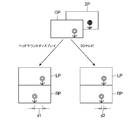
- FIG. 2 is an explanatory diagram for explaining the outline of the present embodiment.
- the information processing apparatus 12 executes a program installed in the information processing apparatus 12.
- a game program is executed.
- the information processing apparatus 12 executes a two-dimensional image (2D image) at a predetermined frame rate (for example, every 1/60 seconds) according to the progress of the game.
- the raster image is generated and the value of the Z buffer is determined.
- the raster image is referred to as an original image OP in the present embodiment.
- the value of the Z buffer associated with the pixel is determined.
- the value of the Z buffer is associated with a coordinate value with the direction perpendicular to the plane forming the original image OP as the coordinate axis.
- the coordinate axis has a point on the plane formed by the original image OP as the origin and the back side in the positive direction. That is, the Z buffer value of a point on the plane forming the original image OP is 0, the Z buffer value is positive at a position behind the plane, and the position before the plane is Z. Assume that the buffer value is negative.
- a pixel whose associated Z buffer value is 0 is referred to as a reference pixel.
- the value of the Z buffer can be expressed as an image.
- the image is referred to as a Z buffer image ZP in the present embodiment. That is, in the present embodiment, the original image OP and the Z buffer image ZP are generated at a predetermined frame rate.
- the information processing apparatus 12 outputs either a two-dimensional image or a three-dimensional image associated with the original image OP generated as described above to the display 14 according to the setting.
- the display 14 displays the two-dimensional image or the three-dimensional image output from the information processing apparatus 12 in this way.
- the information processing apparatus 12 outputs the original image OP as it is when outputting a two-dimensional image to the display 14.
- the information processing apparatus 12 when outputting the 3D image to the display 14, the information processing apparatus 12 generates a 3D image based on the original image OP and the Z buffer image ZP and outputs the 3D image to the display 14.
- the three-dimensional image generated by the information processing apparatus 12 includes a left-eye image LP and a right-eye image RP.
- the original image OP is used as it is as the left-eye image LP, and an image generated based on the original image OP and the Z-buffer image is used as the right-eye image RP.
- the information processing apparatus 12 according to the present embodiment plays a role as a three-dimensional image generation apparatus that generates a three-dimensional image.
- the left-eye image LP and the right-eye image RP are displayed on two different screens associated with each other.
- the left-eye image LP and the right-eye image RP are alternately displayed on one screen.
- the number of screens on which a three-dimensional image is displayed differs depending on whether the three-dimensional image is output to the head-mounted display or the 3D television.
- a method that can be adopted when displaying a 3D image output to a 3D television on the 3D television is a frame sequential method in which the image LP for the left eye and the image RP for the right eye are alternately displayed on one screen. It is not limited.
- a three-dimensional image can be displayed by a passive glass method in which a part of a left eye image LP and a part of a right eye image RP having different polarization characteristics are displayed alternately for each horizontal scanning line. It may be realized.
- display 14 is a naked-eye 3D display
- display of a three-dimensional image may be realized by a parallax barrier method.
- the distance between the user's eyes and the screen is longer for the 3D television than for the head-mounted display.
- the three-dimensional image generated as described above differs depending on the type of the display 14 to which the three-dimensional image is output.
- the three-dimensional image generated as described above differs depending on whether the display 14 that outputs the three-dimensional image is a head-mounted display or a 3D television.
- the magnitude of the shift between the left-eye image LP and the right-eye image RP between the three-dimensional image output to the head-mounted display and the three-dimensional image output to the 3D television, that is, The amount of parallax is different.
- the parallax amount d1 of the three-dimensional image output to the head-mounted display is larger than the parallax amount d2 of the three-dimensional image output to the 3D television.
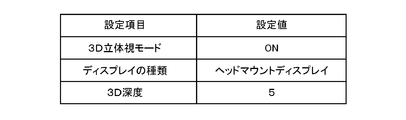
- the 3D stereoscopic mode indicating whether the image output to the display 14 is a two-dimensional image or a three-dimensional image, the type of the display 14 from which the image is output, and the 3D depth are shown in FIG. It can be set via the setting image shown in FIG. In the setting image, other setting items such as screen brightness and presence / absence of caption display may be settable.
- the game play is interrupted and the setting image shown in FIG. Then, when the user performs a predetermined operation after setting various setting items via the setting image, the play of the game is resumed.
- the image output to the display 14 after the game play is resumed corresponds to the setting values of various setting items set via the setting image.
- FIG. 4 is a diagram illustrating an example of setting data including a setting item name and a setting value for the setting item, which are associated with each of a plurality of setting items that can be set in the setting image.
- the value after the change in the operation is set for setting data including the name of the setting item
- the setting data is updated to be a value.
- FIG. 4 shows three setting data associated with each of the three setting items that can be set in the setting image shown in FIG. Specifically, setting data whose setting item “3D stereoscopic mode” is “ON”, setting data whose setting item “display type” is “head-mounted display”, and setting items Setting data in which the setting value of “3D depth” is “5” is shown.
- each pixel included in the image is on a plane formed by the screen of the display 14, behind the plane, or from the plane. Seems to be in the foreground. In the present embodiment, a pixel having a larger value of the associated Z buffer appears to be in the back.
- the length between the position where the reference pixel can be seen by the user and the plane formed by the screen of the display 14 differs depending on the setting value of the setting item “display type”.
- the length is hereinafter referred to as a bump.
- the setting value is “3D television”
- the reference pixel appears to be on a plane forming the screen of the display 14.
- the setting value is “head mounted display”
- the reference pixel appears to be a predetermined length before the plane forming the screen of the display 14.
- a three-dimensional image is generated so that the pixel appears to be behind the reference pixel by a length obtained by multiplying the associated Z buffer value by the setting value of the setting item “3D depth”.
- the pixel in the setting item “display type” is “head mounted display” more than in the case of “3D television”.
- a three-dimensional image is generated that looks like it is.
- the setting value is “head mounted display”
- the length obtained by multiplying the value of the associated Z buffer by the setting value of the setting item “3D depth” and one or more constants (for example, 1.2).
- a three-dimensional image is generated so that the pixel appears to be behind the reference pixel.
- a three-dimensional image having a parallax amount corresponding to the setting value of the setting item “display type” is generated. Specifically, for example, a three-dimensional image with a larger amount of parallax is generated when the setting value is “head mounted display” than when it is “3D television”.
- an upper limit value of the length from the plane where the pixel can be seen is determined.
- the upper limit value is referred to as a pop-up upper limit value.
- the pop-up upper limit value is larger when the setting value of the setting item “display type” is “head mounted display” than when “3D television” is set.
- a three-dimensional image is generated so that the length from the plane formed by the screen of the display 14 to the position where each pixel can be seen pops out and is equal to or less than the upper limit value.
- a three-dimensional image having a parallax amount within a range corresponding to the type of the display 14 to be output is generated.
- the attribute values of the three-dimensional image such as the parallax amount value and the bump value of the three-dimensional image correspond to the type of display on which the three-dimensional image is output. Will be able to.
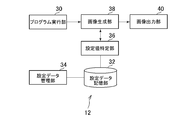
- FIG. 5 is a functional block diagram illustrating an example of functions implemented by the information processing apparatus 12 according to the present embodiment. Note that the information processing apparatus 12 according to the present embodiment does not have to include all the functions illustrated in FIG. 5, and functions other than the functions illustrated in FIG. 5 may be mounted.
- the information processing apparatus 12 functionally includes, for example, a program execution unit 30, a setting data storage unit 32, a setting data management unit 34, a setting value specifying unit 36, An image generation unit 38 and an image output unit 40 are included.
- the program execution unit 30 and the setting data management unit 34 are mainly implemented by the control unit 20.
- the set value specifying unit 36, the image generating unit 38, and the image output unit 40 are mainly implemented by the image processing unit 26.
- the setting data storage unit 32 is mainly implemented by the storage unit 22.
- the above functions are implemented by causing the control unit of the information processing apparatus 12 to execute a program that is installed in the information processing apparatus 12 that is a computer and that includes instructions corresponding to the above functions.
- This program is supplied to the information processing apparatus 12 via a computer-readable information storage medium such as an optical disk, a magnetic disk, a magnetic tape, a magneto-optical disk, or a flash memory, or via a computer network such as the Internet.
- the program execution unit 30 executes a program installed in the information processing apparatus 12.
- the program execution unit 30 executes a game program, for example. Further, the program execution unit 30 supplies graphics commands and data to the image generation unit 38.
- the setting data storage unit 32 stores setting data illustrated in FIG.
- the setting data management unit 34 sets the setting value of the setting data according to the user's operation on the setting image illustrated in FIG. For example, the setting data management unit 34 changes the setting value of the setting data to a value after the change in accordance with a setting value changing operation.
- the setting value specifying unit 36 specifies the setting value of the setting data stored in the setting data storage unit 32.
- the image generation unit 38 generates a two-dimensional image or a three-dimensional image corresponding to the graphics command and data supplied from the program execution unit 30 and the setting value specified by the setting value specifying unit 36. Further, when generating the three-dimensional image, the image generation unit 38 generates the three-dimensional image if the setting value of the setting item “3D stereoscopic mode” in the setting data is “ON”, and “OFF ”, A two-dimensional image is generated. Further, when generating the three-dimensional image, the image generation unit 38, as described above, sets the original image OP, the Z buffer image ZP, the setting items “display type”, and “3D depth” in the setting data. A three-dimensional image corresponding to the value is generated.
- the image output unit 40 outputs the image generated by the image generation unit 38 to the display 14. The image is displayed on the display 14.
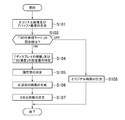
- the image generation unit 38 generates the original image OP and the Z buffer image ZP based on the graphics command and data supplied from the program execution unit 30 (S101). Then, the setting value specifying unit 36 checks the setting value of the setting data stored in the setting data storage unit 32 and whose setting item name is “3D stereoscopic mode” (S102). If the set value is “OFF”, the image output unit 40 outputs the original image OP generated in the process shown in S101 to the display 14 (S103), and the process shown in the present process example ends.
- the setting value specifying unit 36 stores the setting value and setting item of the setting data whose setting item name is “display type” stored in the setting data storage unit 32.
- the setting value of the setting data whose name is “3D depth” is specified (S104).
- the image generation unit 38 determines a three-dimensional image attribute value such as a parallax amount or a bump based on the setting value confirmed in the process shown in S104 (S105).
- the image generation unit 38 generates a right eye based on the original image OP generated in the process shown in S101, the Z buffer image ZP generated in the process shown in S101, and the attribute value determined in the process shown in S105.
- An image RP is generated (S106).
- the image output unit 40 displays a three-dimensional image including the left-eye image LP, which is the original image OP generated in the process shown in S101, and the right-eye image RP, which is generated in the process shown in S106, on the display 14.
- step S107 the processing shown in this processing example is terminated.
- a 3D image with a parallax amount corresponding to a combination of the type of display 14 from which the 3D image is output and the display size may be generated. For example, even if the type of the display 14 is the same, the larger the display size, the smaller the parallax amount of the three-dimensional image in which the parallax amount is generated.
- the information processing apparatus 12 may detect the type of the display 14 to be connected and specify the type of the display 14 to which the three-dimensional image is output based on the detection result. Then, a three-dimensional image having attribute values corresponding to the type of the display 14 specified in this way may be generated.
- one of the head mounted display and the 3D television is set as the setting value of the setting item “display type”, but another type of display 14 can be set as the setting value. It may be.
- the number (for example, 1 or 2) of the screen on which a three-dimensional image is displayed may be set as the setting value.
- a distance between the user's eyes and the screen when the user views the three-dimensional image may be set. Specifically, for example, the distance between the user's eyes and the screen of the head mounted display or the distance between the user's eyes and the 3D television screen when the user views the three-dimensional image is set. It may be.
- the setting value whether the left-eye image LP and the right-eye image RP included in the three-dimensional image are displayed on the same screen or different screens is set. Also good. Moreover, the combination of what was demonstrated above as the said setting value may be set. Specifically, for example, a combination of the number of screens on which a three-dimensional image is displayed and the distance between the user's eyes and the screen when the user views the three-dimensional image may be set. . Then, for example, a three-dimensional image having a parallax amount corresponding to the setting value described above may be generated.
- the setting value of the setting item “3D depth” does not need to affect only the pixels set so as to appear to be behind the plane formed by the screen of the display 14. For example, for a pixel set to appear to be in front of a plane formed by the screen of the display 14, the larger the setting value of the setting item “3D depth” in the setting data, the more visible to the user. A dimensional image may be generated. Even when the setting value is the same, the pixel of the setting item “display type” in the setting data is “3D television” when the setting value is “head mounted display”. A three-dimensional image may be generated so as to appear to be in front.
- the present embodiment is not limited to a scene where a 3D image is generated based on a 2D image, but a scene where a 3D image representing a state in which an object arranged in a virtual space is viewed from two cameras is generated. It may be applied to.
- the information processing apparatus 12 may incorporate the display 14. Further, the information processing apparatus 12 may be composed of a plurality of cases.
- the specific character strings described above and the specific character strings in the drawings are examples, and are not limited to these character strings.
Landscapes
- Engineering & Computer Science (AREA)
- Multimedia (AREA)
- Signal Processing (AREA)
- Physics & Mathematics (AREA)
- Computer Hardware Design (AREA)
- General Physics & Mathematics (AREA)
- Theoretical Computer Science (AREA)
- Testing, Inspecting, Measuring Of Stereoscopic Televisions And Televisions (AREA)
- Controls And Circuits For Display Device (AREA)
- Processing Or Creating Images (AREA)
Abstract
Priority Applications (4)
| Application Number | Priority Date | Filing Date | Title |
|---|---|---|---|
| EP14834587.9A EP3032828A4 (fr) | 2013-08-06 | 2014-03-19 | Dispositif de génération d'image tridimensionnelle, procédé de génération d'image tridimensionnelle, programme et support de stockage d'informations |
| JP2015530721A JP6166374B2 (ja) | 2013-08-06 | 2014-03-19 | 3次元画像生成装置、3次元画像生成方法、プログラム及び情報記憶媒体 |
| US14/905,373 US10484661B2 (en) | 2013-08-06 | 2014-03-19 | Three-dimensional image generating device, three-dimensional image generating method, program, and information storage medium |
| CN201480042937.3A CN105432081B (zh) | 2013-08-06 | 2014-03-19 | 三维图像生成设备、三维图像生成方法、程序和信息存储介质 |
Applications Claiming Priority (2)
| Application Number | Priority Date | Filing Date | Title |
|---|---|---|---|
| JP2013-163037 | 2013-08-06 | ||
| JP2013163037 | 2013-08-06 |
Publications (1)
| Publication Number | Publication Date |
|---|---|
| WO2015019656A1 true WO2015019656A1 (fr) | 2015-02-12 |
Family
ID=52461005
Family Applications (1)
| Application Number | Title | Priority Date | Filing Date |
|---|---|---|---|
| PCT/JP2014/057483 Ceased WO2015019656A1 (fr) | 2013-08-06 | 2014-03-19 | Dispositif de génération d'image tridimensionnelle, procédé de génération d'image tridimensionnelle, programme et support de stockage d'informations |
Country Status (5)
| Country | Link |
|---|---|
| US (1) | US10484661B2 (fr) |
| EP (1) | EP3032828A4 (fr) |
| JP (1) | JP6166374B2 (fr) |
| CN (1) | CN105432081B (fr) |
| WO (1) | WO2015019656A1 (fr) |
Families Citing this family (2)
| Publication number | Priority date | Publication date | Assignee | Title |
|---|---|---|---|---|
| CN108114468A (zh) * | 2016-11-29 | 2018-06-05 | 三维视觉科技有限公司 | 自动立体3d摄像机实现方法和装置 |
| CN120182511B (zh) * | 2025-05-21 | 2025-08-05 | 四川广信天下传媒有限责任公司 | 一种基于xr棚的精细化三维建模方法及系统 |
Citations (3)
| Publication number | Priority date | Publication date | Assignee | Title |
|---|---|---|---|---|
| JP2005073049A (ja) * | 2003-08-26 | 2005-03-17 | Sharp Corp | 立体映像再生装置および立体映像再生方法 |
| WO2012060182A1 (fr) * | 2010-11-05 | 2012-05-10 | 富士フイルム株式会社 | Dispositif de traitement d'image, programme de traitement d'image, procédé de traitement d'image et support de stockage |
| WO2012172719A1 (fr) * | 2011-06-16 | 2012-12-20 | パナソニック株式会社 | Afficheur facial et procédé de correction de défaut de centrage correspondant |
Family Cites Families (24)
| Publication number | Priority date | Publication date | Assignee | Title |
|---|---|---|---|---|
| FR2724033B1 (fr) * | 1994-08-30 | 1997-01-03 | Thomson Broadband Systems | Procede de generation d'image de synthese |
| JP3962115B2 (ja) * | 1996-11-08 | 2007-08-22 | オリンパス株式会社 | 映像観察装置 |
| JP2003018619A (ja) * | 2001-07-03 | 2003-01-17 | Olympus Optical Co Ltd | 立体映像評価装置およびそれを用いた表示装置 |
| US8369607B2 (en) * | 2002-03-27 | 2013-02-05 | Sanyo Electric Co., Ltd. | Method and apparatus for processing three-dimensional images |
| CN101841728B (zh) * | 2003-04-17 | 2012-08-08 | 夏普株式会社 | 三维图像处理装置 |
| US7350922B2 (en) * | 2004-02-13 | 2008-04-01 | Angstrom, Inc. | Three-dimensional display using variable focal length micromirror array lens |
| DE102006055641B4 (de) * | 2006-11-22 | 2013-01-31 | Visumotion Gmbh | Anordnung und Verfahren zur Aufnahme und Wiedergabe von Bildern einer Szene und/oder eines Objektes |
| US8446341B2 (en) * | 2007-03-07 | 2013-05-21 | University Of Washington | Contact lens with integrated light-emitting component |
| JP2010045584A (ja) * | 2008-08-12 | 2010-02-25 | Sony Corp | 立体画像補正装置、立体画像補正方法、立体画像表示装置、立体画像再生装置、立体画像提供システム、プログラム及び記録媒体 |
| CN102210156B (zh) * | 2008-11-18 | 2013-12-18 | 松下电器产业株式会社 | 进行立体视觉再生的再生装置、再生方法 |
| JP4737573B2 (ja) * | 2009-02-05 | 2011-08-03 | 富士フイルム株式会社 | 3次元画像出力装置及び方法 |
| US9131279B2 (en) | 2009-08-06 | 2015-09-08 | Qualcomm Incorporated | Preparing video data in accordance with a wireless display protocol |
| US8711204B2 (en) | 2009-11-11 | 2014-04-29 | Disney Enterprises, Inc. | Stereoscopic editing for video production, post-production and display adaptation |
| JP5556394B2 (ja) * | 2010-06-07 | 2014-07-23 | ソニー株式会社 | 立体画像表示システム、視差変換装置、視差変換方法およびプログラム |
| EP2395766B1 (fr) * | 2010-06-14 | 2016-03-23 | Nintendo Co., Ltd. | Support de stockage disposant d'un programme d'affichage d'image stéréoscopique stocké sur celui-ci, dispositif d'affichage d'image stéréoscopique, système d'affichage d'image stéréoscopique et procédé d'affichage d'image stéréoscopique |
| US8605136B2 (en) * | 2010-08-10 | 2013-12-10 | Sony Corporation | 2D to 3D user interface content data conversion |
| KR101777875B1 (ko) * | 2011-04-28 | 2017-09-13 | 엘지디스플레이 주식회사 | 입체 영상 표시장치와 그 입체 영상 조절 방법 |
| US10805625B2 (en) * | 2011-07-05 | 2020-10-13 | Texas Instruments Incorporated | Method, system and computer program product for adjusting a stereoscopic image in response to decoded disparities between views of the stereoscopic image |
| KR101888672B1 (ko) * | 2011-07-27 | 2018-08-16 | 엘지디스플레이 주식회사 | 입체영상 표시장치와 그 구동방법 |
| US20130147686A1 (en) * | 2011-12-12 | 2013-06-13 | John Clavin | Connecting Head Mounted Displays To External Displays And Other Communication Networks |
| KR101873747B1 (ko) * | 2011-12-27 | 2018-07-03 | 엘지전자 주식회사 | 이동 단말기 및 그 제어방법 |
| JP5572647B2 (ja) * | 2012-02-17 | 2014-08-13 | 任天堂株式会社 | 表示制御プログラム、表示制御装置、表示制御システム、および表示制御方法 |
| US9083959B2 (en) * | 2013-02-20 | 2015-07-14 | Intel Corporation | Real-time automatic conversion of 2-dimensional images or video to 3-dimensional stereo images or video |
| US20150012399A1 (en) * | 2013-03-14 | 2015-01-08 | Bill.Com, Inc. | System and Method for Enhanced Access and Control for Modification of Auto-Learned Conflict Resolution and Related Rule and Value Replacements |
-
2014
- 2014-03-19 WO PCT/JP2014/057483 patent/WO2015019656A1/fr not_active Ceased
- 2014-03-19 EP EP14834587.9A patent/EP3032828A4/fr not_active Ceased
- 2014-03-19 US US14/905,373 patent/US10484661B2/en active Active
- 2014-03-19 CN CN201480042937.3A patent/CN105432081B/zh active Active
- 2014-03-19 JP JP2015530721A patent/JP6166374B2/ja active Active
Patent Citations (3)
| Publication number | Priority date | Publication date | Assignee | Title |
|---|---|---|---|---|
| JP2005073049A (ja) * | 2003-08-26 | 2005-03-17 | Sharp Corp | 立体映像再生装置および立体映像再生方法 |
| WO2012060182A1 (fr) * | 2010-11-05 | 2012-05-10 | 富士フイルム株式会社 | Dispositif de traitement d'image, programme de traitement d'image, procédé de traitement d'image et support de stockage |
| WO2012172719A1 (fr) * | 2011-06-16 | 2012-12-20 | パナソニック株式会社 | Afficheur facial et procédé de correction de défaut de centrage correspondant |
Also Published As
| Publication number | Publication date |
|---|---|
| JP6166374B2 (ja) | 2017-07-19 |
| US20160156897A1 (en) | 2016-06-02 |
| US10484661B2 (en) | 2019-11-19 |
| EP3032828A1 (fr) | 2016-06-15 |
| JPWO2015019656A1 (ja) | 2017-03-02 |
| EP3032828A4 (fr) | 2016-12-14 |
| CN105432081B (zh) | 2019-12-31 |
| CN105432081A (zh) | 2016-03-23 |
Similar Documents
| Publication | Publication Date | Title |
|---|---|---|
| KR102415502B1 (ko) | 복수의 사용자를 위한 라이트 필드 렌더링 방법 및 장치 | |
| TWI523488B (zh) | 處理包含在信號中的視差資訊之方法 | |
| TWI508519B (zh) | An image processing apparatus, a program, an image processing method, a recording method, and a recording medium | |
| US11436787B2 (en) | Rendering method, computer product and display apparatus | |
| CN1893675B (zh) | 三维图形处理装置及其立体图像显示装置 | |
| JP6963399B2 (ja) | プログラム、記録媒体、画像生成装置、画像生成方法 | |
| US10136121B2 (en) | System, method and software for producing virtual three dimensional images that appear to project forward of or above an electronic display | |
| US10757391B2 (en) | Signaling warp maps using a high efficiency video coding (HEVC) extension for 3D video coding | |
| JP2011164781A (ja) | 立体画像生成プログラム、情報記憶媒体、立体画像生成装置、及び立体画像生成方法 | |
| CN102905141A (zh) | 二维转三维转换装置及其方法 | |
| JP6166374B2 (ja) | 3次元画像生成装置、3次元画像生成方法、プログラム及び情報記憶媒体 | |
| KR101228916B1 (ko) | 멀티 비젼의 3차원 영상 표시 장치 및 방법 | |
| CN102135666B (zh) | 狭缝光栅显示方法及装置 | |
| JP3802629B2 (ja) | 立体画像生成装置 | |
| JP5328852B2 (ja) | 画像処理装置、画像処理方法、プログラム及び情報記憶媒体 | |
| CN103501433B (zh) | 一种3d书画显示方法及装置 | |
| CN102970498A (zh) | 菜单立体显示的显示方法及显示装置 | |
| TWI812548B (zh) | 生成並排三維影像的方法及電腦裝置 | |
| CN108197248B (zh) | 一种3d化2d网页显示的方法、装置及系统 | |
| TWI920458B (zh) | 生成3d場景的方法及電腦系統 | |
| US12033266B2 (en) | Method and computer device for generating a side-by-side 3D image | |
| CN102387390A (zh) | 图像处理设备、图像处理方法以及计算机程序 | |
| JP2012059009A (ja) | プログラム、情報記憶媒体及び画像生成システム | |
| CN118115693A (zh) | 生成并排三维影像的方法及电脑装置 | |
| JP2010259022A (ja) | 表示装置、表示方法、および表示プログラム |
Legal Events
| Date | Code | Title | Description |
|---|---|---|---|
| WWE | Wipo information: entry into national phase |
Ref document number: 201480042937.3 Country of ref document: CN |
|
| 121 | Ep: the epo has been informed by wipo that ep was designated in this application |
Ref document number: 14834587 Country of ref document: EP Kind code of ref document: A1 |
|
| ENP | Entry into the national phase |
Ref document number: 2015530721 Country of ref document: JP Kind code of ref document: A |
|
| WWE | Wipo information: entry into national phase |
Ref document number: 2014834587 Country of ref document: EP |
|
| WWE | Wipo information: entry into national phase |
Ref document number: 14905373 Country of ref document: US |
|
| NENP | Non-entry into the national phase |
Ref country code: DE |