WO2015019876A1 - MATÉRIAU ALLIÉ DE BRASAGE À BASE DE Ni-Cr-Fe ADDITIONNÉ DE Cu - Google Patents
MATÉRIAU ALLIÉ DE BRASAGE À BASE DE Ni-Cr-Fe ADDITIONNÉ DE Cu Download PDFInfo
- Publication number
- WO2015019876A1 WO2015019876A1 PCT/JP2014/069736 JP2014069736W WO2015019876A1 WO 2015019876 A1 WO2015019876 A1 WO 2015019876A1 JP 2014069736 W JP2014069736 W JP 2014069736W WO 2015019876 A1 WO2015019876 A1 WO 2015019876A1
- Authority
- WO
- WIPO (PCT)
- Prior art keywords
- alloy
- added
- less
- brazing material
- strength
- Prior art date
- Legal status (The legal status is an assumption and is not a legal conclusion. Google has not performed a legal analysis and makes no representation as to the accuracy of the status listed.)
- Ceased
Links
Images



Classifications
-
- B—PERFORMING OPERATIONS; TRANSPORTING
- B23—MACHINE TOOLS; METAL-WORKING NOT OTHERWISE PROVIDED FOR
- B23K—SOLDERING OR UNSOLDERING; WELDING; CLADDING OR PLATING BY SOLDERING OR WELDING; CUTTING BY APPLYING HEAT LOCALLY, e.g. FLAME CUTTING; WORKING BY LASER BEAM
- B23K35/00—Rods, electrodes, materials, or media, for use in soldering, welding, or cutting
- B23K35/22—Rods, electrodes, materials, or media, for use in soldering, welding, or cutting characterised by the composition or nature of the material
- B23K35/24—Selection of soldering or welding materials proper
- B23K35/30—Selection of soldering or welding materials proper with the principal constituent melting at less than 1550°C
- B23K35/3033—Ni as the principal constituent
- B23K35/304—Ni as the principal constituent with Cr as the next major constituent
-
- B—PERFORMING OPERATIONS; TRANSPORTING
- B23—MACHINE TOOLS; METAL-WORKING NOT OTHERWISE PROVIDED FOR
- B23K—SOLDERING OR UNSOLDERING; WELDING; CLADDING OR PLATING BY SOLDERING OR WELDING; CUTTING BY APPLYING HEAT LOCALLY, e.g. FLAME CUTTING; WORKING BY LASER BEAM
- B23K35/00—Rods, electrodes, materials, or media, for use in soldering, welding, or cutting
- B23K35/02—Rods, electrodes, materials, or media, for use in soldering, welding, or cutting characterised by mechanical features, e.g. shape
- B23K35/0222—Rods, electrodes, materials, or media, for use in soldering, welding, or cutting characterised by mechanical features, e.g. shape for use in soldering or brazing
-
- B—PERFORMING OPERATIONS; TRANSPORTING
- B23—MACHINE TOOLS; METAL-WORKING NOT OTHERWISE PROVIDED FOR
- B23K—SOLDERING OR UNSOLDERING; WELDING; CLADDING OR PLATING BY SOLDERING OR WELDING; CUTTING BY APPLYING HEAT LOCALLY, e.g. FLAME CUTTING; WORKING BY LASER BEAM
- B23K35/00—Rods, electrodes, materials, or media, for use in soldering, welding, or cutting
- B23K35/22—Rods, electrodes, materials, or media, for use in soldering, welding, or cutting characterised by the composition or nature of the material
- B23K35/24—Selection of soldering or welding materials proper
- B23K35/30—Selection of soldering or welding materials proper with the principal constituent melting at less than 1550°C
-
- B—PERFORMING OPERATIONS; TRANSPORTING
- B23—MACHINE TOOLS; METAL-WORKING NOT OTHERWISE PROVIDED FOR
- B23K—SOLDERING OR UNSOLDERING; WELDING; CLADDING OR PLATING BY SOLDERING OR WELDING; CUTTING BY APPLYING HEAT LOCALLY, e.g. FLAME CUTTING; WORKING BY LASER BEAM
- B23K35/00—Rods, electrodes, materials, or media, for use in soldering, welding, or cutting
- B23K35/22—Rods, electrodes, materials, or media, for use in soldering, welding, or cutting characterised by the composition or nature of the material
- B23K35/24—Selection of soldering or welding materials proper
- B23K35/30—Selection of soldering or welding materials proper with the principal constituent melting at less than 1550°C
- B23K35/3033—Ni as the principal constituent
-
- C—CHEMISTRY; METALLURGY
- C22—METALLURGY; FERROUS OR NON-FERROUS ALLOYS; TREATMENT OF ALLOYS OR NON-FERROUS METALS
- C22C—ALLOYS
- C22C19/00—Alloys based on nickel or cobalt
- C22C19/03—Alloys based on nickel or cobalt based on nickel
- C22C19/05—Alloys based on nickel or cobalt based on nickel with chromium
-
- C—CHEMISTRY; METALLURGY
- C22—METALLURGY; FERROUS OR NON-FERROUS ALLOYS; TREATMENT OF ALLOYS OR NON-FERROUS METALS
- C22C—ALLOYS
- C22C19/00—Alloys based on nickel or cobalt
- C22C19/03—Alloys based on nickel or cobalt based on nickel
- C22C19/05—Alloys based on nickel or cobalt based on nickel with chromium
- C22C19/051—Alloys based on nickel or cobalt based on nickel with chromium and Mo or W
- C22C19/055—Alloys based on nickel or cobalt based on nickel with chromium and Mo or W with the maximum Cr content being at least 20% but less than 30%
-
- C—CHEMISTRY; METALLURGY
- C22—METALLURGY; FERROUS OR NON-FERROUS ALLOYS; TREATMENT OF ALLOYS OR NON-FERROUS METALS
- C22C—ALLOYS
- C22C19/00—Alloys based on nickel or cobalt
- C22C19/03—Alloys based on nickel or cobalt based on nickel
- C22C19/05—Alloys based on nickel or cobalt based on nickel with chromium
- C22C19/051—Alloys based on nickel or cobalt based on nickel with chromium and Mo or W
- C22C19/056—Alloys based on nickel or cobalt based on nickel with chromium and Mo or W with the maximum Cr content being at least 10% but less than 20%
-
- C—CHEMISTRY; METALLURGY
- C22—METALLURGY; FERROUS OR NON-FERROUS ALLOYS; TREATMENT OF ALLOYS OR NON-FERROUS METALS
- C22C—ALLOYS
- C22C19/00—Alloys based on nickel or cobalt
- C22C19/03—Alloys based on nickel or cobalt based on nickel
- C22C19/05—Alloys based on nickel or cobalt based on nickel with chromium
- C22C19/058—Alloys based on nickel or cobalt based on nickel with chromium without Mo and W
-
- C—CHEMISTRY; METALLURGY
- C22—METALLURGY; FERROUS OR NON-FERROUS ALLOYS; TREATMENT OF ALLOYS OR NON-FERROUS METALS
- C22C—ALLOYS
- C22C30/00—Alloys containing less than 50% by weight of each constituent
- C22C30/02—Alloys containing less than 50% by weight of each constituent containing copper
-
- C—CHEMISTRY; METALLURGY
- C22—METALLURGY; FERROUS OR NON-FERROUS ALLOYS; TREATMENT OF ALLOYS OR NON-FERROUS METALS
- C22C—ALLOYS
- C22C30/00—Alloys containing less than 50% by weight of each constituent
- C22C30/04—Alloys containing less than 50% by weight of each constituent containing tin or lead
-
- C—CHEMISTRY; METALLURGY
- C22—METALLURGY; FERROUS OR NON-FERROUS ALLOYS; TREATMENT OF ALLOYS OR NON-FERROUS METALS
- C22C—ALLOYS
- C22C30/00—Alloys containing less than 50% by weight of each constituent
- C22C30/06—Alloys containing less than 50% by weight of each constituent containing zinc
-
- B—PERFORMING OPERATIONS; TRANSPORTING
- B23—MACHINE TOOLS; METAL-WORKING NOT OTHERWISE PROVIDED FOR
- B23K—SOLDERING OR UNSOLDERING; WELDING; CLADDING OR PLATING BY SOLDERING OR WELDING; CUTTING BY APPLYING HEAT LOCALLY, e.g. FLAME CUTTING; WORKING BY LASER BEAM
- B23K2101/00—Articles made by soldering, welding or cutting
- B23K2101/04—Tubular or hollow articles
- B23K2101/14—Heat exchangers
Definitions
- the present invention relates to a Ni—Cr—Fe based alloy brazing material added with Cu having a low melting temperature, low cost, corrosion resistance and excellent strength used in the manufacture of stainless steel heat exchangers and the like.
- Ni-base alloy brazing materials excellent in corrosion resistance and oxidation resistance have been used for brazing stainless steel, and in particular, JIS standards BNi-2 (Ni-Cr-Fe-B-Si alloy), BNi -5 (Ni—Cr—Si alloy) and BNi-7 (Ni—Cr—P alloy) have been widely used.
- JIS standards BNi-2 Ni-Cr-Fe-B-Si alloy
- BNi -5 Ni—Cr—Si alloy
- BNi-7 Ni—Cr—P alloy
- BNi-7 has a liquidus temperature as low as about 900 ° C. and relatively excellent corrosion resistance.
- a Ni—P alloy base material is used to add P, and since this base material is relatively difficult to obtain, there is concern about supply.
- Ni-based brazing material that has a low liquidus temperature and excellent corrosion resistance and is relatively easily available, development of a new alloy brazing material has been strongly demanded.
- Patent Document 1 a Ni—Cr—Cu—Fe brazing material having a low liquidus temperature, high strength, and corrosion resistance has been proposed in, for example, Japanese Patent Application Laid-Open No. 2010-269347 (Patent Document 1).
- This Ni—Cr—Cu—Fe brazing material is added with Cr to improve corrosion resistance, Fe is added to reduce the price, and Cu is added to improve the spreadability in brazing.
- Patent Document 2 proposes a Ni-based alloy brazing material capable of substituting part of Ni with Fe while maintaining a high degree of corrosion resistance. In order to improve the corrosion resistance, Cu is added to this Ni-based alloy brazing material together with Cr.
- the brazing filler metal as described above is an excellent developed brazing filler metal containing Fe that is brazed at a low temperature, has high corrosion resistance, and is excellent in availability and low cost.
- the demand for has also increased. Therefore, the inventors diligently studied a new brazing material that achieves high brazing property, low corrosion resistance, high raw material availability and low cost, and high strength at a low liquidus temperature.
- the influence of the amount of Cu added on the strength was examined in detail, and the strength was improved by adding a small amount of Cu, and the present invention was achieved.
- the Ni-based brazing material to which Cu is added as in the above-mentioned patent document, there are examples in which the amount of Cu added has been studied from the viewpoint of corrosion resistance and brazing, but the amount of Cu added has been studied from the viewpoint of strength. There are no examples, and there is no suggestion regarding the phenomenon that the strength is improved in the component range of the present invention, particularly in the range of the Cu addition amount.
- a Ni—Cr—Fe based alloy brazing material comprising the balance Ni and inevitable impurities, the total content of Cr and Fe being 30 to 54%, and the total content of P and Si being 7 to 14% Is done.
- one or two of B and C are total 1% or less, and / or one or two or more of Mo, Co, Mn, and V are total 5% or less, and
- the Ni—Cr—Fe-based alloy brazing material described above is characterized by containing one or more of Sn, Zn, and Bi in a total of 2% or less.
- a total of at least one of B and C is 1% or less
- Ni—Cr—Fe based alloy brazing material containing at least one of Mo, Co, Mn and V in total of 5% or less and / or containing at least one of Sn, Zn and Bi in total of 2% or less.
- Ni—Cr—Fe based brazing material to which Cu is added, which has a low melting temperature and is excellent in corrosion resistance and strength, which is used in the manufacture of a stainless steel heat exchanger or the like.
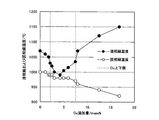
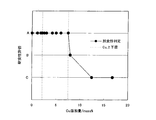
- FIG. 5 is a diagram showing the influence of the amount of Cu added on the liquidus temperature and the solidus temperature of a centrifugal cast material of Ni—Cr—Fe—Cu—P—Si alloy. It is a figure which shows the influence of the amount of Cu addition on the corrosion resistance of the centrifugal cast material of a Ni-Cr-Fe-Cu-P-Si alloy.
- One of the features of the present invention is that it has been found that the strength is increased by adding a small amount of Cu.
- the change in strength with respect to the amount of added Cu is not monotonous, the strength increases when added in a small amount, and the strength decreases when added excessively.
- strength change is described below.
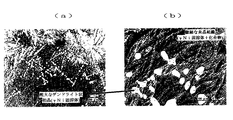
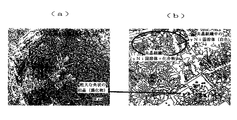
- each alloy is shown as “0.2% Cu alloy” or the like according to the amount of Cu).
- (a) is taken at a low magnification
- (b) is taken at a high magnification.
- 1 is an optical micrograph showing the structure of a 0.2% Cu alloy
- FIG. 1 (a) is a low magnification optical micrograph
- FIG. 1 (b) is a high magnification optical microscope. It is a photograph.
- FIG. 2 is a diagram showing an optical micrograph showing the structure of a 4.0% Cu alloy
- FIG. 2 (a) is a low magnification optical micrograph
- FIG. 2 (b) is a high magnification optical. It is a micrograph.
- FIG. 3 is a figure which shows the optical microscope photograph which shows the structure
- FIG.3 (a) is a low magnification optical microscope photograph
- FIG.3 (b) is a high magnification optical microscope. It is a photograph.
- FIG. 4 is a diagram showing an optical micrograph showing the structure of a 15.3% Cu alloy
- FIG. 4 (a) is a low magnification optical micrograph
- FIG. 4 (b) is a high magnification optical micrograph. is there.
- the bending strengths of these centrifugal cast materials are 990 MPa, 1170 MPa, 810 MPa and 620 MPa, respectively, and 4.0% Cu alloy which is within the scope of the present invention shows significantly higher strength than other alloys. It was.
- a relatively coarse dendritic primary crystal ( ⁇ Ni solid solution) is recognized as shown in FIG. 1 (a), and the periphery thereof has a fine eutectic structure as shown in FIG. 1 (b). ( ⁇ Ni solid solution + compound (phosphide and silicide)).
- the ⁇ Ni solid solution has high ductility, the compounds (phosphides and silicides) are brittle, and when a material having a hypoeutectic structure as shown in FIG. Cracks propagate and break in the crystal structure.
- the 0.2% Cu alloy in which a primary crystal of a coarse ⁇ Ni solid solution is formed results in the ⁇ Ni solid solution in the eutectic structure. It is considered that the area ratio is reduced, and as a result, a brittle eutectic structure is formed as compared with the 4.0% Cu alloy, so that the strength remains low.
- the 4.0% Cu alloy produces a eutectic structure having a high ⁇ Ni solid solution area ratio and high ductility despite the same amount of P and Si as the 0.2% Cu alloy. It shows high resistance to cracks propagating in the eutectic structure and is considered to be excellent in strength.
- Cu contains a large amount of Cr or Fe as a base element, which is a peritectic phase diagram, and Cu, which is a solute element, is added to the second liquid phase by the action of P or Si.
- This is considered to be a phase diagram of the monotectic type that generates
- the mother phase that is the first liquid phase is enriched with P and Si, and the coarse phosphide is formed as shown in FIGS. 4 (a) and 4 (b). It is considered that a large amount was generated and the strength was extremely lowered.
- the strength is increased by increasing the area ratio of ⁇ Ni solid solution in the eutectic structure in a small amount of addition, and in the case of excessive addition, the angular coarse phosphide is increased. It is presumed that the strength is reduced as a result of the generation and / or generation of the second liquid phase having a high Cu concentration and the rod-like coarse phosphide.
- the microstructure described above is a solidified structure in the centrifugal casting process, and the bending strength is based on a test piece cut out from this centrifugal cast material.
- these alloy brazing materials are brazed to a base material such as stainless steel. It has been confirmed that the fillet portion also has a similar solidified structure. Therefore, the bending strength of the brazed portion in the examples and comparative examples described later also has the same tendency as the bending strength of the test piece cut out from the centrifugal cast material.
- the alloy is 1050 ° C., 1040 ° C., 1060 ° C., and 1140 ° C. in order from the low Cu alloy. 1 to 4, the 0.2% Cu alloy has a hypoeutectic structure, the 4.0% Cu alloy has a eutectic composition, and the 0.2% Cu alloy has a slightly higher temperature. This is because a primary dendritic ⁇ Ni solid solution is crystallized.
- the 7.9% Cu alloy has a hypereutectic composition
- the 15.3% Cu alloy has a hypereutectic composition closer to phosphide due to the significant increase in the P concentration of the first liquid phase due to the formation of the second liquid phase having a high Cu concentration.
- coarse rod-like phosphides are crystallized at a temperature significantly higher than that of the 7.9% Cu alloy.
- the solidus temperature was slight, a tendency to decrease monotonically with the amount of Cu added was also observed.
- it has also been found that by adding an appropriate amount of Cu an effect of lowering the liquidus line and solidus line to improve the brazing property is recognized.
- P having a low eutectic temperature with Ni was selected among B, Si and P added in JIS standard composition.
- the eutectic composition of the Ni—P binary system is Ni-11% P.
- Fe-P which is easily available, rather than Ni-P, which is relatively difficult to obtain, as a base material to which P is added.
- addition of Cr was indispensable for improving corrosion resistance.
- Si is an element that lowers the liquidus temperature with the composition of JIS standard as in the case of P, the possibility of substituting it for P was examined.
- Ni—Cr—Fe-based alloy brazing material to which Cu is added according to the present invention is, in mass%, Cr: 15-30%, Fe: 15-30%, Cu: 2.1-7.5%, P: 3 ⁇ 12%, Si: 0-8%, balance Ni and inevitable impurities, preferably consisting essentially of these elements and inevitable impurities, more preferably these elements and It consists of inevitable impurities only, has a total content of Cr and Fe of 30 to 54%, and a total content of P and Si of 7 to 14%.
- Cr 15-30%
- Cr is an essential element for improving the corrosion resistance.
- Cr increases the liquidus temperature as the amount added increases. Addition of 15% or more can sufficiently improve the corrosion resistance, and setting it to 30% or less can prevent the liquidus temperature from rising excessively.
- the Cr content is preferably more than 18% and less than 28%, more preferably more than 20% and less than 25%.
- Fe 15-30%
- Fe is an essential element because it uses an Fe—P base material, and the raw material cost can be reduced by reducing the Ni content as a base metal. Furthermore, the strength is slightly improved in the range where no excessive addition is made. However, Fe increases the liquidus temperature as the amount of addition increases. If the addition amount is up to 15%, the Ni content can be reduced almost without increasing the liquidus temperature, so it is actively added. Moreover, if it is 30% or less, the raise of liquidus temperature will be suppressed.
- the Fe content is preferably more than 16% and less than 28%, more preferably more than 17% and less than 25%.
- Cu 2.1 to 7.5%
- Cu is an essential element for improving the strength, and has an additional effect of lowering the liquidus temperature and the solidus temperature and improving the brazing property. Furthermore, an adverse effect is observed in the corrosion resistance in the added amount range in which square or rod-like coarse phosphides are formed. This is presumed to be caused by a decrease in the Cr concentration in the ⁇ Ni solid solution because the Cr concentration in the coarse phosphide is high. Therefore, the addition of 2.1% or more of Cu sufficiently improves the strength presumed to be due to the effect of increasing the amount of ⁇ Ni solid solution in the eutectic structure.
- the Cu content is preferably more than 2.5% and less than 6%, more preferably more than 3% and less than 5%.
- P 3-12%
- P is an essential element for lowering the liquidus temperature.
- the liquidus temperature can be kept low with an addition amount of 3% or more and 12% or less.
- the content of P is preferably more than 4% and less than 10%, more preferably more than 5% and less than 8%.
- Si 0-8%
- Si is an element that can be added in combination with P to assist in lowering the liquidus temperature, and can be added as necessary. However, if it is added in excess of the eutectic composition as in the case of P, the liquidus temperature rises and the bending strength is lowered. If the addition amount is 8% or less, the liquidus temperature can be kept low.
- the Si content is preferably more than 2% and less than 7%, more preferably more than 3% and less than 6%.
- Cr + Fe 30-54%
- the lower limit is 30%, which is the sum of the lower limit values of the individual addition amounts of Cr and Fe.
- Cr + Fe is preferably more than 36% and less than 50%, more preferably more than 40% and less than 45%.
- Ni is the balance, and the range of the content is not particularly specified, but compared with pure metal raw materials, it is more expensive than Fe and Cr but has a low melting point. Therefore, the Ni content is preferably 25 to 60%, more preferably 33 to 55%, and still more preferably 37 to 50% from the viewpoint of the cost of the brazing material and the ease of dissolution during manufacture by atomization or the like. The range is good.
- P + Si 7-14%
- P is an essential element for the reasons described above
- Si is an element that can be supplementarily added to P for the reasons described above. Therefore, when Si is 0%, P + Si coincides with the P content.
- P + Si is preferably more than 8% and less than 13%, more preferably more than 9% and less than 12%. The reason is unknown, but since the bending strength tends to decrease when the ratio of P to Si is low, P / Si is preferably more than 1.0, more preferably more than 1.3, More preferably, it is the range exceeding 1.5.
- B + C 1% or less
- B and C slightly decrease the corrosion resistance, but although not as much as P and Si, there is also an effect of decreasing the liquidus temperature, so a small amount may be added as necessary. . If the total amount is 1% or less, an increase in the liquidus temperature can be suppressed.
- B + C is preferably less than 0.5%, more preferably no additive.
- each element of B and C is not necessarily limited to the case where both are added, and only one of them may be added.
- Mo + Co + Mn + V 5% or less
- Mo, Co, Mn and V slightly increase the liquidus temperature but slightly increase the bending strength. Good. If the total amount is 5% or less, an increase in the liquidus temperature can be suppressed.
- the total amount of Mo, Co, Mn and V is preferably less than 2%, more preferably no additive. Note that the elements Mo, Co, Mn, and V are not necessarily all added, and may be added as long as at least one element is added.
- Sn + Zn + Bi 2% or less
- Sn, Zn and Bi slightly lower the bending strength, they have the effect of slightly lowering the liquidus temperature, so they may be added in small amounts as necessary. If the total amount is 2% or less, a decrease in bending strength can be suppressed.
- Sn + Zn + Bi is preferably less than 0.5%, more preferably no additive. It should be noted that the Sn, Zn, and Bi elements are not necessarily all added, and may be added as long as at least one kind is added.
- centrifugal cast materials with different alloy compositions were prepared, and the bending strength, liquidus, and solidus evaluation of test pieces cut out from the centrifugal cast materials, and the samples cut out from the centrifugal cast materials with SUS304 Fracture strength and corrosion resistance of the test piece brazed to the base material were evaluated (Experiment B).
- the centrifugal cast material For the production of the centrifugal cast material, 200 g of a melted base material weighed to a predetermined component was melted in an argon atmosphere in an alumina refractory crucible and centrifugally cast into a copper mold having a diameter of 35 mm and a height of 30 mm. In addition, for the evaluation of the bending strength of the centrifugal cast material, a test piece having a length of 2 mm, a width of 2 mm, and a length of 20 mm was collected from the produced centrifugal cast material and subjected to a three-point bending test with a distance between fulcrums of 10 mm. evaluated. In Experiment B, 1040 MPa or more was designated as A, 1020 MPa or more and less than 1040 MPa as B, 1000 MPa or more and less than 1020 MPa as C, and less than 1000 MPa as D.
- A, 1000 ° C. or more and less than 1025 ° C. is B, 1025 ° C. or more and less than 1050 ° C. is C, 1050 ° C. or more is D, and the solid phase line is A less than 980 ° C. is A, 980 ° C. or more and less than 990 ° C. is B, 990 ° C. or more and less than 1000 ° C. is C, and 1000 ° C. or more is D.
- a thin film sample having a length of 10 mm, a width of 10 mm, and a length of 0.8 mm was cut out from the produced centrifugal cast material.
- the 10 mm long and 10 mm wide surface of this thin film sample is brought into contact with the center of the 20 mm long and 20 mm wide surface of the SUS304 block 20 mm long, 20 mm wide and 10 mm long so that the diagonal line coincides with the SUS304 block.
- another SUS304 block 20 mm long, 20 mm wide, and 10 mm long was placed thereon.
- the upper and lower SUS304 blocks were arranged so that the positions of the four corners facing each other coincided. This was heated to 1100 ° C. in a vacuum and brazed for 30 minutes.
- a bending test piece having a total length of 10 mm and 10 mm of SUS304 having a length of 2 mm and a width of 2 mm and an upper and lower length of SUS304 was collected.
- the bending strength of the brazed part was evaluated with a three-point bending bending tester with a fulcrum distance of 10 mm.
- the bending test piece was arranged so that the brazing portion at the center in the longitudinal direction of the bending test piece was at the center of the fulcrum, and the brazing portion was broken by applying a load with an indenter.
- 550 MPa or more was designated as A, 525 MPa or more and less than 550 MPa as B, 500 MPa or more and less than 525 MPa as C, and less than 500 MPa as D.
- a cube sample having a length of 3 mm, a width of 3 mm, and a length of 3 mm was cut out from the produced centrifugal cast material.
- the cube sample was placed at the center of a circle of a SUS304 disk having a diameter of 20 mm and a thickness of 5 mm, heated to 1100 ° C. in a vacuum, and brazed for 30 minutes.
- This brazing material was sprayed with 20% salt water at 35 ° C. for 16 hours, and the corrosion resistance was evaluated based on the subsequent glazing conditions.
- a case where no bruising was observed was designated as A
- a portion where bruising was observed in part B was designated as C.
- FIG. 5 shows an anti-folding test piece cut out from a centrifugal cast material of Ni-30% Cr-20% Fe-x% Cu-7% P-3% Si alloy and an anti-folding test piece cut out from a brazing material. It is a figure which shows the influence of the Cu addition amount which acts on bending strength (experiment A). The vertical dotted line indicates the upper and lower limits of Cu.
- FIG. 6 shows the effect of the amount of Cu on the liquidus temperature and the solidus temperature of the centrifugal cast material of Ni-30% Cr-20% Fe-x% Cu-7% P-3% Si alloy. It is a figure shown (experiment A). The vertical dotted line indicates the upper and lower limits of Cu. Further, FIG.
- FIG. 7 is a graph showing the effect of the amount of Cu addition on the corrosion resistance of the centrifugal cast material of Ni-30% Cr-20% Fe-x% Cu-7% P-3% Si alloy (Experiment A). .
- a vertical dotted line shows Cu upper and lower limits (upper limit value and lower limit value of Cu content).
- the present invention it is possible to lower the melting point and increase the strength, and the Ni—having a low melting temperature, low cost, excellent corrosion resistance and strength used in the manufacture of stainless steel heat exchangers and the like.
- a Cr—Fe based brazing filler metal is provided.
Landscapes
- Chemical & Material Sciences (AREA)
- Engineering & Computer Science (AREA)
- Mechanical Engineering (AREA)
- Materials Engineering (AREA)
- Metallurgy (AREA)
- Organic Chemistry (AREA)
- Pressure Welding/Diffusion-Bonding (AREA)
- Turbine Rotor Nozzle Sealing (AREA)
- Manufacture Of Metal Powder And Suspensions Thereof (AREA)
- Electric Connection Of Electric Components To Printed Circuits (AREA)
- Heat Treatment Of Sheet Steel (AREA)
Abstract
L'invention concerne un économique matériau allié de brasage à base de Ni-Cr-Fe additionné de Cu, qui présente une basse température de fusion, une excellente résistance à la corrosion et une excellente résistance mécanique, et qui est utilisé pour la production d'un échangeur de chaleur formé d'alliage inoxydable, ou un usage similaire. Ce matériau allié de brasage à base de Ni-Cr-Fe est composé de 15 à 30% en masse de Cr, 15 à 30% en masse de Fe, 2,1 à 7,5% en masse de Cu, 3 à 12% en masse de P, 0 à 8% en masse de Si, le reste étant constitué de Ni et impuretés inévitables. La teneur totale en Cr et en Fe est de 30 à 54% en masse, et la teneur totale en P et en Si est de 7 à 14% en masse.
Priority Applications (4)
| Application Number | Priority Date | Filing Date | Title |
|---|---|---|---|
| EP14835394.9A EP3031569B1 (fr) | 2013-08-06 | 2014-07-25 | Matériau allié de brasage à base de ni-cr-fe additionné de cu |
| US14/909,828 US20160175992A1 (en) | 2013-08-06 | 2014-07-25 | Cu-Added Ni-Cr-Fe-Based Alloy Brazing Material |
| CN201480044264.5A CN105473275B (zh) | 2013-08-06 | 2014-07-25 | 添加有Cu的Ni-Cr-Fe基合金钎料 |
| US16/234,845 US10543571B2 (en) | 2013-08-06 | 2018-12-28 | Cu-added Ni—Cr—Fe-based alloy brazing material |
Applications Claiming Priority (4)
| Application Number | Priority Date | Filing Date | Title |
|---|---|---|---|
| JP2013162961 | 2013-08-06 | ||
| JP2013-162961 | 2013-08-06 | ||
| JP2014-123074 | 2014-06-16 | ||
| JP2014123074A JP6346799B2 (ja) | 2013-08-06 | 2014-06-16 | Cuを添加したNi−Cr−Fe基合金ろう材 |
Related Child Applications (2)
| Application Number | Title | Priority Date | Filing Date |
|---|---|---|---|
| US14/909,828 A-371-Of-International US20160175992A1 (en) | 2013-08-06 | 2014-07-25 | Cu-Added Ni-Cr-Fe-Based Alloy Brazing Material |
| US16/234,845 Continuation US10543571B2 (en) | 2013-08-06 | 2018-12-28 | Cu-added Ni—Cr—Fe-based alloy brazing material |
Publications (1)
| Publication Number | Publication Date |
|---|---|
| WO2015019876A1 true WO2015019876A1 (fr) | 2015-02-12 |
Family
ID=52461215
Family Applications (1)
| Application Number | Title | Priority Date | Filing Date |
|---|---|---|---|
| PCT/JP2014/069736 Ceased WO2015019876A1 (fr) | 2013-08-06 | 2014-07-25 | MATÉRIAU ALLIÉ DE BRASAGE À BASE DE Ni-Cr-Fe ADDITIONNÉ DE Cu |
Country Status (5)
| Country | Link |
|---|---|
| US (2) | US20160175992A1 (fr) |
| EP (1) | EP3031569B1 (fr) |
| JP (1) | JP6346799B2 (fr) |
| CN (2) | CN110039221A (fr) |
| WO (1) | WO2015019876A1 (fr) |
Cited By (5)
| Publication number | Priority date | Publication date | Assignee | Title |
|---|---|---|---|---|
| TWI562848B (fr) * | 2015-07-29 | 2016-12-21 | Fukuda Metal Foil Powder | |
| CN106363277A (zh) * | 2015-07-24 | 2017-02-01 | 伊利诺斯工具制品有限公司 | 焊接类系统中的无线和电力线通信 |
| JP2017113724A (ja) * | 2015-12-25 | 2017-06-29 | S.P.エンジニアリング株式会社 | 水素液生成装置 |
| WO2018198906A1 (fr) * | 2017-04-25 | 2018-11-01 | 山陽特殊製鋼株式会社 | Matériau de brasage en alliage à base de ni-cr contenant une quantité de trace de v |
| CN112719693A (zh) * | 2020-12-11 | 2021-04-30 | 哈尔滨工业大学 | 一种低温磁性玻璃钎料及其制备方法和应用其连接铁氧体的方法 |
Families Citing this family (9)
| Publication number | Priority date | Publication date | Assignee | Title |
|---|---|---|---|---|
| DE102016116265A1 (de) * | 2016-08-31 | 2018-03-01 | Faurecia Emissions Control Technologies, Germany Gmbh | Lotwerkstoff auf Kupferbasis und Verwendung des Lotwerkstoffs |
| US20180161943A1 (en) * | 2016-12-12 | 2018-06-14 | General Electric Company | Method for treating a component and heterogeneous composition |
| KR102194420B1 (ko) * | 2018-11-27 | 2020-12-28 | 주식회사 풍산홀딩스 | 저융점 및 고내식성을 갖는 Ni-Cr-Fe-P계 브레이징용 합금분말 및 이의 제조 방법 |
| CN109865962B (zh) * | 2019-03-05 | 2021-05-28 | 苏州昆腾威新材料科技有限公司 | 一种低熔点耐腐蚀镍基共晶钎焊材料及其应用 |
| CN111074134A (zh) * | 2019-12-31 | 2020-04-28 | 中山市皓祥模具五金有限公司 | 一种有色金属合金材料的制备方法 |
| CN111893388B (zh) * | 2020-08-07 | 2021-04-13 | 阳春新钢铁有限责任公司 | 一种耐腐蚀钢筋及其生产工艺 |
| CN114571129B (zh) * | 2021-09-30 | 2024-07-12 | 中国机械总院集团宁波智能机床研究院有限公司 | 铜基钎料及其制备方法和应用 |
| CN114952076B (zh) * | 2022-05-12 | 2023-10-27 | 广东省科学院中乌焊接研究所 | 镍基钎料及其制备方法、应用 |
| CN117020474A (zh) * | 2023-09-12 | 2023-11-10 | 东北大学 | 一种用于铜/钢异种金属焊接的铁基钎料及其制备方法 |
Citations (5)
| Publication number | Priority date | Publication date | Assignee | Title |
|---|---|---|---|---|
| JP2009545451A (ja) * | 2006-08-01 | 2009-12-24 | ファキュウムシュメルゼ ゲーエムベーハー ウント コンパニー カーゲー | 鑞付け用ニッケル基合金及び鑞付け法 |
| JP2010269347A (ja) | 2009-05-22 | 2010-12-02 | T Rad Co Ltd | 熱交換器用Ni−Cr−Cu−Fe系ろう材 |
| JP2011515223A (ja) * | 2008-03-19 | 2011-05-19 | ホガナス アクチボラグ (パブル) | 鉄−クロム系鑞材 |
| JP2012183574A (ja) | 2011-03-08 | 2012-09-27 | Maruyasu Industries Co Ltd | ニッケル基合金ろう材 |
| WO2013077113A1 (fr) * | 2011-11-24 | 2013-05-30 | 福田金属箔粉工業株式会社 | Matière de brasage à base de ni-cr ayant d'excellentes aptitude au mouillage/aptitude à l'étalement et une excellente résistance à la corrosion |
Family Cites Families (5)
| Publication number | Priority date | Publication date | Assignee | Title |
|---|---|---|---|---|
| CN1290661C (zh) * | 2004-06-25 | 2006-12-20 | 武汉钢铁(集团)公司 | 高强度高韧性高耐候气保焊焊丝 |
| CN101249591A (zh) * | 2007-10-31 | 2008-08-27 | 哈尔滨电机厂有限责任公司 | 镍基焊丝及其制备工艺 |
| US20110020166A1 (en) | 2008-04-18 | 2011-01-27 | Katsunori Otobe | Iron-base heat- and corrosion-resistant brazing material |
| CN101693326B (zh) * | 2009-10-22 | 2011-07-20 | 广州有色金属研究院 | 一种用于不锈铁/铜/不锈钢钎焊的无银铜基钎料 |
| JP5546836B2 (ja) * | 2009-11-26 | 2014-07-09 | 山陽特殊製鋼株式会社 | Ni−Fe基合金ろう材 |
-
2014
- 2014-06-16 JP JP2014123074A patent/JP6346799B2/ja active Active
- 2014-07-25 CN CN201910241577.4A patent/CN110039221A/zh active Pending
- 2014-07-25 WO PCT/JP2014/069736 patent/WO2015019876A1/fr not_active Ceased
- 2014-07-25 US US14/909,828 patent/US20160175992A1/en not_active Abandoned
- 2014-07-25 EP EP14835394.9A patent/EP3031569B1/fr active Active
- 2014-07-25 CN CN201480044264.5A patent/CN105473275B/zh active Active
-
2018
- 2018-12-28 US US16/234,845 patent/US10543571B2/en active Active
Patent Citations (5)
| Publication number | Priority date | Publication date | Assignee | Title |
|---|---|---|---|---|
| JP2009545451A (ja) * | 2006-08-01 | 2009-12-24 | ファキュウムシュメルゼ ゲーエムベーハー ウント コンパニー カーゲー | 鑞付け用ニッケル基合金及び鑞付け法 |
| JP2011515223A (ja) * | 2008-03-19 | 2011-05-19 | ホガナス アクチボラグ (パブル) | 鉄−クロム系鑞材 |
| JP2010269347A (ja) | 2009-05-22 | 2010-12-02 | T Rad Co Ltd | 熱交換器用Ni−Cr−Cu−Fe系ろう材 |
| JP2012183574A (ja) | 2011-03-08 | 2012-09-27 | Maruyasu Industries Co Ltd | ニッケル基合金ろう材 |
| WO2013077113A1 (fr) * | 2011-11-24 | 2013-05-30 | 福田金属箔粉工業株式会社 | Matière de brasage à base de ni-cr ayant d'excellentes aptitude au mouillage/aptitude à l'étalement et une excellente résistance à la corrosion |
Cited By (10)
| Publication number | Priority date | Publication date | Assignee | Title |
|---|---|---|---|---|
| CN106363277A (zh) * | 2015-07-24 | 2017-02-01 | 伊利诺斯工具制品有限公司 | 焊接类系统中的无线和电力线通信 |
| TWI562848B (fr) * | 2015-07-29 | 2016-12-21 | Fukuda Metal Foil Powder | |
| JP2017113724A (ja) * | 2015-12-25 | 2017-06-29 | S.P.エンジニアリング株式会社 | 水素液生成装置 |
| WO2018198906A1 (fr) * | 2017-04-25 | 2018-11-01 | 山陽特殊製鋼株式会社 | Matériau de brasage en alliage à base de ni-cr contenant une quantité de trace de v |
| JP2018183790A (ja) * | 2017-04-25 | 2018-11-22 | 山陽特殊製鋼株式会社 | 微量のVを含有するNi−Cr基合金ろう材 |
| CN110520242A (zh) * | 2017-04-25 | 2019-11-29 | 山阳特殊制钢株式会社 | 含有微量V的Ni-Cr基合金钎焊料 |
| CN110520242B (zh) * | 2017-04-25 | 2021-08-06 | 山阳特殊制钢株式会社 | 含有微量V的Ni-Cr基合金钎焊料 |
| US11555227B2 (en) | 2017-04-25 | 2023-01-17 | Sanyo Special Steel Co., Ltd. | Ni—Cr based alloy brazing material containing trace amount of V |
| CN112719693A (zh) * | 2020-12-11 | 2021-04-30 | 哈尔滨工业大学 | 一种低温磁性玻璃钎料及其制备方法和应用其连接铁氧体的方法 |
| CN112719693B (zh) * | 2020-12-11 | 2022-08-30 | 哈尔滨工业大学 | 一种低温磁性玻璃钎料及其制备方法和应用其连接铁氧体的方法 |
Also Published As
| Publication number | Publication date |
|---|---|
| US20190134761A1 (en) | 2019-05-09 |
| CN105473275A (zh) | 2016-04-06 |
| EP3031569B1 (fr) | 2019-12-11 |
| CN110039221A (zh) | 2019-07-23 |
| EP3031569A4 (fr) | 2017-03-15 |
| JP6346799B2 (ja) | 2018-06-20 |
| EP3031569A1 (fr) | 2016-06-15 |
| US10543571B2 (en) | 2020-01-28 |
| US20160175992A1 (en) | 2016-06-23 |
| JP2015051459A (ja) | 2015-03-19 |
| CN105473275B (zh) | 2019-07-05 |
Similar Documents
| Publication | Publication Date | Title |
|---|---|---|
| JP6346799B2 (ja) | Cuを添加したNi−Cr−Fe基合金ろう材 | |
| KR101651400B1 (ko) | 내식성이 우수한 니켈 납땜재 | |
| JP5546836B2 (ja) | Ni−Fe基合金ろう材 | |
| JP2012149276A (ja) | ダイカスト鋳造用高熱伝導性マグネシウム合金 | |
| JP2010180422A (ja) | アルミニウム合金の製造方法 | |
| JP2009203545A (ja) | ダイカスト用Zn合金およびダイカスト用Zn合金を用いたダイカスト部材の製造方法 | |
| JP2010150624A (ja) | 鋳造用アルファ+ベータ型チタン合金及びこれを用いたゴルフクラブヘッド | |
| JP2006063420A (ja) | ヒートシンク用アルミニウム合金材及びその製造法 | |
| JP4187018B2 (ja) | 耐リラクセーション特性に優れた鋳造アルミニウム合金とその熱処理方法 | |
| RU2441736C1 (ru) | Припой для пайки алюминия и его сплавов | |
| JP7472318B2 (ja) | アルミニウム合金及びアルミニウム合金鋳物材 | |
| JP2017088948A (ja) | 銅合金素材 | |
| CN101602151A (zh) | 一种中温铝合金钎料 | |
| JP2787946B2 (ja) | 高温強度および高温耐食性にすぐれたNi基単結晶超合金 | |
| JP5852039B2 (ja) | 耐熱マグネシウム合金 | |
| JP5562749B2 (ja) | Cu−Mn系ろう材細線およびその製造方法 | |
| RU2596535C2 (ru) | Припой для пайки алюминия и его сплавов | |
| JP5522692B2 (ja) | 高強度銅合金鍛造材 | |
| CN107686914A (zh) | 一种锆和锶复合微合金化的高镁高硅6000系铝合金及其制备方法 | |
| US1932843A (en) | Aluminum alloys | |
| RU2585598C1 (ru) | Припой для пайки алюминия и его сплавов | |
| JP2010031301A (ja) | Ni−Cr−Al合金素材 | |
| US1932841A (en) | Aluminum alloys | |
| JP2022147009A (ja) | 耐熱性アルミニウム合金及び耐熱性アルミニウム合金部材 | |
| JPH02251394A (ja) | アルミニウム合金ろう材 |
Legal Events
| Date | Code | Title | Description |
|---|---|---|---|
| WWE | Wipo information: entry into national phase |
Ref document number: 201480044264.5 Country of ref document: CN |
|
| 121 | Ep: the epo has been informed by wipo that ep was designated in this application |
Ref document number: 14835394 Country of ref document: EP Kind code of ref document: A1 |
|
| WWE | Wipo information: entry into national phase |
Ref document number: 14909828 Country of ref document: US |
|
| NENP | Non-entry into the national phase |
Ref country code: DE |
|
| WWE | Wipo information: entry into national phase |
Ref document number: 2014835394 Country of ref document: EP |