WO2015020007A1 - 酸化物粒子分散強化型Ni基超合金 - Google Patents
酸化物粒子分散強化型Ni基超合金 Download PDFInfo
- Publication number
- WO2015020007A1 WO2015020007A1 PCT/JP2014/070501 JP2014070501W WO2015020007A1 WO 2015020007 A1 WO2015020007 A1 WO 2015020007A1 JP 2014070501 W JP2014070501 W JP 2014070501W WO 2015020007 A1 WO2015020007 A1 WO 2015020007A1
- Authority
- WO
- WIPO (PCT)
- Prior art keywords
- mass
- less
- oxide
- phase
- high temperature
- Prior art date
- Legal status (The legal status is an assumption and is not a legal conclusion. Google has not performed a legal analysis and makes no representation as to the accuracy of the status listed.)
- Ceased
Links
Images
Classifications
-
- C—CHEMISTRY; METALLURGY
- C22—METALLURGY; FERROUS OR NON-FERROUS ALLOYS; TREATMENT OF ALLOYS OR NON-FERROUS METALS
- C22C—ALLOYS
- C22C19/00—Alloys based on nickel or cobalt
- C22C19/03—Alloys based on nickel or cobalt based on nickel
- C22C19/05—Alloys based on nickel or cobalt based on nickel with chromium
- C22C19/051—Alloys based on nickel or cobalt based on nickel with chromium and Mo or W
- C22C19/057—Alloys based on nickel or cobalt based on nickel with chromium and Mo or W with the maximum Cr content being less 10%
-
- C—CHEMISTRY; METALLURGY
- C22—METALLURGY; FERROUS OR NON-FERROUS ALLOYS; TREATMENT OF ALLOYS OR NON-FERROUS METALS
- C22C—ALLOYS
- C22C19/00—Alloys based on nickel or cobalt
- C22C19/007—Alloys based on nickel or cobalt with a light metal (alkali metal Li, Na, K, Rb, Cs; earth alkali metal Be, Mg, Ca, Sr, Ba, Al Ga, Ge, Ti) or B, Si, Zr, Hf, Sc, Y, lanthanides, actinides, as the next major constituent
Definitions
- the present invention relates to an oxide particle dispersion strengthened Ni-base superalloy.
- Ni-base superalloys generally exhibit excellent characteristics based on the solid solution strengthening and precipitation strengthening mechanisms of the ⁇ ′ phase. Many excellent single crystal cast alloys based on such a strengthening mechanism have already been developed. However, improvement of the service temperature by these strengthening mechanisms becomes increasingly difficult as the temperature rises. On the other hand, in addition to these strengthening mechanisms, based on a dispersion strengthening mechanism using oxide fine particles, an oxide particle dispersion strengthened Ni-base superalloy that is considered to be able to improve the service temperature is expected.
- Oxide particle dispersion strengthened Ni-base superalloy has a structural feature that a large number of fine oxide particles generally having a particle size of 1 ⁇ m or less are dispersed in a matrix phase in which other elements are dissolved in Ni. There is. In addition to oxide particles, depending on the alloy composition, precipitates such as ⁇ 'phase may be dispersed.
- Patent Documents 1 to 3, Non-patent Document 1, TMO-2 alloy, and the like have been developed (Patent Documents 4 to 5, Non-Patent Documents).
- Patent Document 2). These alloys are basically produced by solidifying an alloy powder produced by a mechanical alloying method by a method such as hot extrusion.
- the added amount of tungsten (W) or tantalum (Ta) is increased with respect to the MA6000 alloy to realize a superior high temperature strength.
- Patent Document 6 an oxide dispersion strengthened Ni-base superalloy has been proposed (Patent Document 6).
- the high temperature corrosion and high temperature oxidation of a yttria particle dispersion strengthened alloy are also examined and reported (nonpatent literature 3).
- the TMO-2 alloy described above is excellent in high temperature strength, but contains 12% by mass or more of W in order to increase the high temperature strength.
- the inclusion of such a large amount of W is effective for improving mechanical properties, but may reduce high temperature corrosion resistance.
- an object of the present invention is to provide a new oxide particle dispersion strengthened Ni-base superalloy which is excellent in high temperature corrosion resistance and can improve mechanical properties such as high temperature strength.
- the present inventors proceeded with examination of the alloy composition of an oxide particle dispersion-strengthened Ni-base superalloy, and contained ruthenium (Ru) in an amount of 0.1% by mass or more and 14.0% by mass. It has been found that by containing it in the following range, high-temperature corrosion resistance is good and mechanical properties such as high-temperature strength can be improved.
- the present invention has been completed based on such findings.
- the oxide particle dispersion-strengthened Ni-base superalloy of the present invention has 0.1 to 14.0% by weight of Ru, 0.1% to 14.0% by weight, together with Ni, in the composition. Al and inevitable impurities are contained, and 0.01 to 3.0% by mass of oxide particles in the entire amount are dispersed in the crystal structure.
- the oxide particle dispersion-strengthened Ni-base superalloy of the present invention containing Ru in the range of 0.1% by mass or more and 14.0% by mass or less the high temperature corrosion resistance is good, the high temperature strength, etc.
- the mechanical properties after heating in the range of 1260 ° C. to 1300 ° C. can be remarkably improved.
- the oxide particle dispersion-strengthened Ni-base superalloy of the present invention has 0.1 to 14.0% by weight of Ru, 0.1% to 14.0% by weight, together with Ni. It is characterized by containing aluminum (Al) inevitable impurities in an amount of mass% or less and oxide particles in an amount of 0.01 mass% or more and 3.0 mass% or less of the total amount being dispersed in the crystal structure.
- Ru is one of the elements that characterize the invention of this application, and is dissolved in the ⁇ phase as a parent phase and improves the high-temperature strength by solid solution strengthening. Moreover, precipitation of the TCP phase produced
- the Ru content is preferably in the range of 0.1 to 14.0% by mass, and more preferably in the range of 1.0 to 14.0% by mass. If the Ru content is less than 0.1% by mass, the TCP phase precipitates at high temperatures, and high high-temperature strength cannot be ensured. On the other hand, if the content of Ru exceeds 14% by mass, the ⁇ phase is precipitated and the high-temperature strength decreases, which is not preferable. In addition, since Ru is expensive as much as 200 to 300 times the price of Ni compared to Ni, etc., it is preferable that Ru be as small as possible within the range of improving high temperature strength by solid solution strengthening.
- the upper limit is preferably 8.0% by mass.
- the addition of Al precipitates the ⁇ 'phase and contributes to the improvement of strength by precipitation strengthening.
- the Al content is preferably in the range of 0.1 to 14.0% by mass. If the Al content is less than 0.1% by mass, precipitation strengthening is insufficient and the desired high-temperature strength cannot be ensured, and if it exceeds 14.0% by mass, a coarse ⁇ ′ phase is formed. This is because it is formed in a large amount and deteriorates mechanical properties.
- the amount of oxide particles added for dispersion strengthening is desirably 0.01% by mass to 3.0% by mass.
- the type of oxide particles is not particularly limited, but yttrium oxide having high chemical stability even at a high temperature is particularly preferable. However, when high purity yttrium oxide is added, some elements in the alloy may react with yttrium oxide to form a composite oxide during production or use at a high temperature. Therefore, a composite oxide of yttrium oxide and aluminum oxide such as Y 4 Al 2 O 9 is also preferable instead of yttrium oxide.
- alloy additive elements include 0.1 mass% or more and 14.0 mass% or less Re, 0.1 mass% or more and 20.0 mass% or less Co, 0.1 mass% or more and 20 mass% or more depending on the application.
- composition More preferable composition (mass%) is exemplified as follows.
- Ru 1.0 to 8.0 Al: 1.0 to 10.0 Cr: 1.0 to 10.0 Co: 1.0-10.0 Mo: 0.1 to 4.0 W: 1.0 to 8.0 Ta: 1.0 to 10.0 Hf: 0.05 to 5.0 Zr: 0.05 to 5.0 Ti: 0.1 to 5.0 Nb: 0.1 to 5.0 Re: 0.1 to 8.0 V: 0.1 to 2.0 Pt: 0.1 to 6.0 Pd: 0.1 to 6.0 Ir: 0.1 to 6.0 B: 0.005 to 0.05 C: 0.005 to 0.05 Oxide particles: 0.1 to 3.0 Re dissolves in the ⁇ phase, which is the parent phase, and improves high-temperature strength by solid solution strengthening. It also has the effect of improving corrosion resistance.
- the content is more preferably in the range of 0.1 to 14.0% by mass.
- the Re content is less than 0.1% by mass, the solid solution strengthening of the ⁇ phase is insufficient and the desired high-temperature strength cannot be ensured, so the Re content is preferably 14.0% by mass. Exceeding this is not preferable because the TCP phase precipitates at a high temperature and a high high-temperature strength cannot be secured.
- Cr is an element with excellent oxidation resistance and improves high temperature corrosion resistance.
- the Cr content is less than 0.1% by mass, the high temperature corrosion resistance cannot be improved. If the Cr content exceeds 20.0 mass%, precipitation of the ⁇ 'phase is suppressed and harmful phases such as the ⁇ phase and the ⁇ phase are generated, and the high-temperature strength is lowered.
- Co increases the solid solubility limit of Al, Ta, and other parent phases at high temperatures, precipitates ⁇ 'phase, and improves high temperature strength.
- the Co content is less than 0.1% by mass, the ⁇ ′ phase is not sufficiently precipitated, and the high temperature strength cannot be improved. If the Co content exceeds 20.0% by mass, the balance with other elements such as Al, Ta, Mo, W, Hf, and Cr is lost, and a harmful phase is precipitated to lower the high-temperature strength. .
- Mo dissolves in the matrix ⁇ phase to increase the high temperature strength and contributes to the high temperature strength by precipitation hardening. If the Mo content is less than 0.1% by mass, these effects are not sufficient, and the high temperature strength cannot be improved. If the Mo content exceeds 15.0% by mass, the high temperature corrosion resistance is lowered, which is not preferable.
- W improves the high-temperature strength by the action of solid solution strengthening and precipitation hardening in the presence of Mo and Ta.
- the W content is preferably 20.0% by mass or less. This is because if the W content exceeds 20.0 mass%, the high temperature corrosion resistance may be reduced.
- each element needs a content of 0.1% by mass.
- the content is preferably 10.0% by mass or less, particularly preferably 6.0% by mass or less. Good.
- Ta, Ti, and Nb contribute to precipitation strengthening by substituting Al sites in the ⁇ 'phase. Further, the high temperature strength is improved by the action of solid solution strengthening and precipitation strengthening in the presence of Mo and W.
- the content of Ta is preferably 15.0% by mass or less. This is because if the Ta content exceeds 15.0% by mass, the ⁇ phase and the ⁇ phase are formed and the high temperature strength is lowered.
- the contents of Ti and Nb are each less than 0.1% by mass, precipitation strengthening and solid solution strengthening in the presence of Mo and W cannot be obtained.
- the contents of Ti and Nb are each preferably 10.0% by mass or less. This is because if the content of Ti or Nb exceeds 10.0% by mass, a harmful phase is formed and the high-temperature strength decreases.
- V is an element that dissolves in the ⁇ ′ phase and strengthens the ⁇ ′ phase. If the V content is less than 0.1% by mass, these effects cannot be obtained.
- the content of V is preferably 5.0% by mass or less. This is because if the V content exceeds 5.0% by mass, the creep strength is lowered.
- Hf is a grain boundary segregation element and segregates at the grain boundaries of the ⁇ phase and ⁇ ′ phase to strengthen the grain boundaries, thereby improving the high temperature strength.
- Hf needs to be 0.01% by mass or more. If the content of Hf exceeds 10.0% by mass, it is not preferable because local melting may occur and the high-temperature strength may be reduced.
- B is an element that reinforces the grain boundary, thereby improving the high temperature strength. In order to obtain these effects, B must be 0.001% by mass or more. If the B content exceeds 1.0% by mass, harmful carbides are precipitated at the grain boundaries, which is not preferable.
- composition of the composition elements of the oxide particle dispersion-strengthened Ni-base superalloy according to the present invention include the following, including the examples described later.
- Ni-Ru-Al-Re-Co-Cr-Mo-W-Ta-Hf-oxide particles Ni-Ru-Al-Re-Co-Cr-Mo-W-Ta-Hf- (B, C) -Oxide particles
- an alloy powder produced by a mechanical alloying method can be enclosed in a can and solidified by a method such as a hot extrusion method.
- the alloy powder can be solidified by a method such as a hot isostatic pressing (HIP) method or a hot pressing method. Or after solidifying alloy powder by these methods, it can produce by performing a hot extrusion process or a hot rolling process.
- HIP hot isostatic pressing
- a combination of a base material element and an additive element, which are constituent elements, is determined depending on the intended use and economy of a heat resistant alloy.
- a turbine disk is required to have a high temperature strength in a temperature range of 400 to 500 ° C.
- a member such as a combustor, a nozzle, a turbine blade, and a shroud has a temperature range of about 800 to 1000 ° C. High strength and high temperature corrosion resistance are required.
- the strengthening effect by the dispersed particles that is, the effect of preventing the dislocation motion that causes deformation by the oxide particles is increased when the particles are finer and the particle interval is short.
- the dispersion particle size distribution is preferably 0.001 ⁇ m to 5 ⁇ m in consideration of particle aggregation during production.
- the distribution is preferably 1 ⁇ m or less.
- the amount of oxide particles is particularly preferably 0.5 to 3.0% of the total amount in order to obtain strength at a high temperature of 800 ° C. or higher.
- the upper limit of the particle size distribution of the alloy and metal powder used is, for example, 250 ⁇ m, the efficiency of mechanical alloying and sintering for solidification can be improved.
- the ratio of the mixed powder weight to the steel ball weight is 1/10 to 1 in the attritor. / 20, 1-5 to 1/10 for planetary ball mills, and the rotation speed of the ball mill is preferably 50 to 400 rpm, depending on the scale of the ball mill.
- the alloying treatment time is desirably 20 hours or longer.
- pre-alloying treatment it is preferable to replace the inside of the ball mill container with an inert atmosphere such as Ar (argon) in consideration of oxygen contamination during alloying.
- Solidification of the dispersed alloyed powder by sintering is performed by hot extrusion or HIP method after filling the powder in a mild steel container according to the powder metallurgy method.
- the sintering is preferably performed in a temperature range of 1000 to 1300 ° C. for Ni-based alloys in consideration of diffusion fusion between powders, densification, further solidification of alloy atoms, and high temperature stability of oxide particles.
- the vacuum treatment in the container performed as a pretreatment here is to prevent oxygen from being contained in the dispersed alloy as much as possible at the time of sintering, and to prevent formation of a strong oxide on the powder surface.
- the purpose is to remove moisture, oxygen and other contaminants present or adsorbed on the powder surface, and the scale of the equipment at a temperature of 100 ° C. to 600 ° C. in a vacuum of 10 ⁇ 1 to 10 ⁇ 3 torr. However, heat treatment for 10 minutes to 10 hours is preferable.
- Example 1 Extruded material of Ni-6.4Co-4.5Cr-1.1Mo-4.0W-5.8Al-7.5Ta-0.1Hf-6.3Re-4.9Ru-1.1Y 2 O 3 composition (each numerical value is% by mass) as follows Produced.
- the raw material powder was blended so as to achieve the target composition as a whole, and mechanical alloying treatment was performed using an attritor.
- the treated alloy powder was put into a can, vacuum-processed and sealed, and solidified by a hot isostatic press (HIP) method at a heating temperature of 1180 ° C. and a pressing force of 118 MPa.
- This HIP material was subjected to hot extrusion under conditions of a heating temperature of 1200 ° C. and an extrusion ratio of 5 to obtain a round bar extruded material.
- HIP hot isostatic press
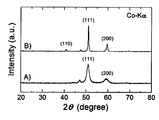
- FIG. 1 is a diagram comparing the result of X-ray diffraction of this extruded material with the result of mechanical alloying powder.
- the X-ray diffraction pattern (A in the figure) of the mechanical alloying powder mainly consisted of (111) and (200) diffraction peaks of Ni solid solution.
- the (110) diffraction peak of the ⁇ ′ phase was observed. That is, it can be seen that this extruded material mainly consists of a Ni solid solution ( ⁇ ) phase, on which the ⁇ ′ phase is precipitated.
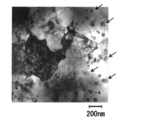
- FIG. 2 shows the structure of the extruded material observed with a transmission electron microscope. Arrows in the figure indicate oxide particles. In this structure, a large number of fine oxide particles of about several tens of nm were dispersed in the crystal grains.
- a small piece was cut out from the extruded material and subjected to isothermal heating treatment at a temperature of 1260 ° C. to 1300 ° C. for 1 hour.
- This heat treatment is generally performed at a temperature such that the oxide particle dispersion strengthened Ni-base superalloy is manufactured as a hot-extrusion material or a hot-rolling material, and further processed into a member having a desired size and shape. This is because the hot forging process or the like may be performed.
- the micro Vickers hardness of each sample after the heat treatment was 598 at 1260 ° C. and 585 at 1290 ° C.
- the high temperature corrosion resistance of this alloy was evaluated by a molten salt corrosion test.
- the extruded material was cut into a cylindrical shape with a diameter of 6 mm and a height of 4.5 mm so that the axial direction coincided with the extrusion direction, immersed in molten salt, and heated at a temperature of 800 ° C. for 4 hours.
- the molten salt used as the corrosive medium was a 3: 1 mixed salt of sodium sulfate and sodium chloride.
- An amount of the mixed salt in which the cylindrical sample was completely immersed was put in a crucible and heated in advance to 800 ° C. in a heating furnace, and after the temperature was sufficiently stabilized, the cylindrical sample was immersed in the molten salt. As a result of calculating the decrease rate of the sample diameter before and after the test, it was 0.17%.
- Ni-5.9Co-3.8Cr-0.9Mo-3.9W-6.1Al-8.6Ta-0.2Hf-5.3Re-4.6Ru-1.2Y 4 Al 2 O 9 composition (each numerical value is% by mass) It produced as follows.
- the raw material powder was blended so as to achieve the target composition as a whole, and mechanical alloying treatment was performed using an attritor.
- the treated alloy powder was put into a can, vacuum-processed and sealed, and subjected to hot extrusion under the conditions of a heating temperature: 1050 ° C. and an extrusion ratio: 15, to obtain a round bar extruded material.
- a small piece was cut out from the extruded material and subjected to isothermal heating treatment at a temperature of 1260 ° C. to 1300 ° C. for 1 hour.
- the micro Vickers hardness of each sample after the heat treatment was 626 at 1260 ° C. and 585 at 1290 ° C.
- the high temperature corrosion resistance of this alloy was evaluated by a molten salt corrosion test under the same conditions as in Example 1.
- the sample was immersed in molten salt and heated at a temperature of 800 ° C. for 4 hours, and the reduction rate of the sample diameter before and after the test was calculated. As a result, it was 0.17%.
- Ni-6.1Co-3.8Cr-0.9Mo-4.2W-6.3Al-9.2Ta-0.2Hf-5.0Re-4.7Ru-1.2Y 4 Al 2 O 9 composition (each value is% by mass) It produced as follows.
- the raw material powder was blended so as to achieve the target composition as a whole, and mechanical alloying treatment was performed using an attritor.
- the treated alloy powder was put into a can, vacuum-processed and sealed, and subjected to hot extrusion under the conditions of a heating temperature: 1050 ° C. and an extrusion ratio: 15, to obtain a round bar extruded material.
- a small piece was cut out from the extruded material and subjected to isothermal heating treatment at a temperature of 1260 ° C. to 1300 ° C. for 1 hour.
- the micro Vickers hardness of each sample after the heat treatment was 664 at 1260 ° C. and 596 at 1290 ° C.
- the high temperature corrosion resistance of this alloy was evaluated by a molten salt corrosion test under the same conditions as in Examples 1 and 2.
- the sample was immersed in molten salt and heated at a temperature of 800 ° C. for 4 hours, and the reduction rate of the sample diameter before and after the test was calculated. As a result, it was 0.17%.
- Non-Patent Document 2 discloses a test result of micro Vickers hardness after isothermal heat treatment of an extruded material of TMO-2 alloy.
- the alloy composition of the extruded material in this test is Ni-9.8Co-5.9Cr-2.0Mo-12.4W-4.2Al-4.7Ta-0.8Ti-0.05Zr-0.05C-0. 01B-1.1Y 2 O 3 (the numerical value is mass%).
- this alloy has about 3 times the content of W compared with the alloy composition of an Example.
- Non-patent document 3 discloses the results of the molten salt corrosion test of this alloy under the same conditions as in Examples 1 to 3. The diameter reduction rate of this extruded material was 29.0%.
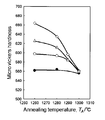
- FIG. 3 shows a comparison of the micro Vickers hardness after the isothermal heat treatment (1 hour) in Examples 1 to 3 and the comparative example as a graph arranged by the heat treatment temperature.
- the white circles are the results of Example 1
- the triangles are the results of Example 2
- the diamonds are the results of Example 3
- the black circles are the results of the comparative example.
- the oxide particle dispersion-strengthened Ni-base superalloy of the present invention improves the mechanical properties after heating in the range of 1260 ° C to 1300 ° C even if the W content is greatly reduced by containing Ru. Is shown.
- the results of the molten salt corrosion test show that the diameter reduction rate of each of Examples 1 to 3 is 0.17%, whereas the diameter reduction rate of the Example is 29.0%. It is shown that the high temperature corrosion resistance is remarkably improved. This is presumably because the alloys of Examples 1 to 3 significantly reduce the W content as compared with the alloys of Examples.
Landscapes
- Chemical & Material Sciences (AREA)
- Engineering & Computer Science (AREA)
- Materials Engineering (AREA)
- Mechanical Engineering (AREA)
- Metallurgy (AREA)
- Organic Chemistry (AREA)
- Powder Metallurgy (AREA)
Abstract
Description
Al:1.0~10.0
Cr:1.0~10.0
Co:1.0~10.0
Mo:0.1~4.0
W:1.0~8.0
Ta:1.0~10.0
Hf:0.05~5.0
Zr:0.05~5.0
Ti:0.1~5.0
Nb:0.1~5.0
Re:0.1~8.0
V:0.1~2.0
Pt:0.1~6.0
Pd:0.1~6.0
Ir:0.1~6.0
B:0.005~0.05
C:0.005~0.05
酸化物粒子:0.1~3.0
Reは母相であるγ相に固溶し、固溶強化により高温強度を向上させる。また、耐食性を向上させる効果もある。一方でReを多量に添加すると、高温時に有害相であるTCP相が析出し、高温強度が低下するおそれがある。このようなReの添加について、その含有量は、0.1~14.0質量%の範囲とすることがより好ましい。
・Ni-Ru-Al-Re-Co-Cr-Mo-W-Ta-Hf-酸化物粒子
・Ni-Ru-Al-Re-Co-Cr-Mo-W-Ta-Hf-(B、C)-酸化物粒子
・Ni-Ru-Al-Re-Co-Cr-Mo-W-Ta-(Ti、Nb)-(Hf、Zr)-(B、C)-酸化物粒子
・Ni-Ru-Al-Re-Co-Cr-Mo-(W、V)-Ta-(Pt、Pd、Ir)-(B、C)-酸化物
・Ni-Ru-Al-Re-Cr-(Mo、W、Co、V)-(Ta、Ti)-(B、C)-酸化物粒子
・Ni-Ru-Al-Cr-(W、Co、V)-(Ta、Ti)-(B、C)-酸化物粒子
・Ni-Ru-Al-Cr-(Ta、Ti)-酸化物粒子
本発明酸化物粒子分散強化型Ni基超合金の製造方法については、その手法が特に限定されることはないが、酸化物粒子を均一に分散させるために、粉末冶金的手法を採用することが一般的に考慮される。例えば、メカニカルアロイング法で作製された合金粉末を缶に封入して熱間押出法等の方法で固化して作製することができる。また、熱間静水圧プレス(HIP)法やホットプレス法等の方法によっても合金粉末を固化することができる。あるいは、これらの方法で合金粉末を固化した後に熱間押出加工や熱間圧延加工を施して作製することができる。
Ni-6.4Co-4.5Cr-1.1Mo-4.0W-5.8Al-7.5Ta-0.1Hf-6.3Re-4.9Ru-1.1Y2O3組成(各数値は質量%)の押出素材を以下のように作製した。全体でこの目標組成となるように原料粉末を配合し、アトライターを用いてメカニカルアロイング処理を行った。処理後の合金粉末を缶に入れ、真空処理をして封入し、熱間静水圧プレス(HIP)法により、加熱温度:1180℃、加圧力:118MPaで固化した。このHIP材に加熱温度:1200℃、押出比:5の条件で熱間押出加工を施して、丸棒押出素材とした。
Ni-5.9Co-3.8Cr-0.9Mo-3.9W-6.1Al-8.6Ta-0.2Hf-5.3Re-4.6Ru-1.2Y4Al2O9組成(各数値は質量%)の押出素材を以下のように作製した。全体でこの目標組成となるように原料粉末を配合し、アトライターを用いてメカニカルアロイング処理を行った。処理後の合金粉末を缶に入れ、真空処理をして封入し、加熱温度:1050℃、押出比:15の条件で熱間押出加工を施して、丸棒押出素材とした。
Ni-6.1Co-3.8Cr-0.9Mo-4.2W-6.3Al-9.2Ta-0.2Hf-5.0Re-4.7Ru-1.2Y4Al2O9組成(各数値は質量%)の押出素材を以下のように作製した。全体でこの目標組成となるように原料粉末を配合し、アトライターを用いてメカニカルアロイング処理を行った。処理後の合金粉末を缶に入れ、真空処理をして封入し、加熱温度:1050℃、押出比:15の条件で熱間押出加工を施して、丸棒押出素材とした。
TMO-2合金の押出材の等温加熱処理後のマイクロビッカース硬さの試験結果が、非特許文献2によって発表されている。この試験における押出材の合金組成は、Ni-9.8Co-5.9Cr-2.0Mo-12.4W-4.2Al-4.7Ta-0.8Ti-0.05Zr-0.05C- 0.01B-1.1Y2O3(数値は質量%)である。なお、この合金は、実施例の合金組成と比較して、Wの含有量は約3倍である。
Claims (2)
- 組成において、Niとともに、0.1質量%以上14.0質量%以下のRu、0.1質量%以上14.0質量%以下のAl、不可避的不純物を含有し、結晶組織内に全体量の0.01質量%以上3.0質量%以下の酸化物粒子が分散されていることを特徴とする酸化物粒子分散強化型Ni超合金。
- 0.1質量%以上14.0質量%以下のRu、及び、0.1質量%以上14.0質量%以下のAlに加えて、
0.1質量%以上14.0質量%以下のRe、0.1質量%以上20.0質量%以下のCo、0.1質量%以上20.0質量%以下のCr、0.1質量%以上15.0質量%以下のMo、0.1質量%以上20.0質量%以下のW、0.1質量%以上10.0質量%以下のTi、0.1質量%以上10.0質量%以下のNb、0.1質量%以上15.0質量%以下のTa、0.1質量%以上10.0質量%以下のHf、0.01質量%以上10.0質量%以下のZr、0.1質量%以上5.0質量%以下のV、0.1質量%以上10.0質量%以下のPt、0.1質量%以上10.0質量%以下のPd、又は、0.1質量%以上10.0質量%以下のIr、0.001質量%以上1.0質量%以下のB、0.001質量%以上1.0質量%以下のCのうちの少なくとも一種が含有されていることを特徴とする請求項1に記載の酸化物粒子分散強化型Ni基超合金。
Priority Applications (3)
| Application Number | Priority Date | Filing Date | Title |
|---|---|---|---|
| JP2015530883A JPWO2015020007A1 (ja) | 2013-08-05 | 2014-08-04 | 酸化物粒子分散強化型Ni基超合金 |
| EP14834221.5A EP3031939B1 (en) | 2013-08-05 | 2014-08-04 | Ni-group superalloy strengthened by oxide-particle dispersion |
| US14/909,799 US20160160323A1 (en) | 2013-08-05 | 2014-08-04 | Oxide particle dispersion-strengthened ni-base superalloy |
Applications Claiming Priority (2)
| Application Number | Priority Date | Filing Date | Title |
|---|---|---|---|
| JP2013-162525 | 2013-08-05 | ||
| JP2013162525 | 2013-08-05 |
Publications (1)
| Publication Number | Publication Date |
|---|---|
| WO2015020007A1 true WO2015020007A1 (ja) | 2015-02-12 |
Family
ID=52461339
Family Applications (1)
| Application Number | Title | Priority Date | Filing Date |
|---|---|---|---|
| PCT/JP2014/070501 Ceased WO2015020007A1 (ja) | 2013-08-05 | 2014-08-04 | 酸化物粒子分散強化型Ni基超合金 |
Country Status (4)
| Country | Link |
|---|---|
| US (1) | US20160160323A1 (ja) |
| EP (1) | EP3031939B1 (ja) |
| JP (2) | JPWO2015020007A1 (ja) |
| WO (1) | WO2015020007A1 (ja) |
Cited By (3)
| Publication number | Priority date | Publication date | Assignee | Title |
|---|---|---|---|---|
| EP3211111A3 (de) * | 2016-02-24 | 2017-11-29 | MTU Aero Engines GmbH | Wärmebehandlungsverfahren für bauteile aus nickelbasis-superlegierungen |
| JPWO2021066142A1 (ja) * | 2019-10-03 | 2021-04-08 | ||
| US11359638B2 (en) | 2017-10-31 | 2022-06-14 | Hitachi Metals, Ltd. | Alloy article, method for manufacturing said alloy article, product formed of said alloy article, and fluid machine having said product |
Families Citing this family (1)
| Publication number | Priority date | Publication date | Assignee | Title |
|---|---|---|---|---|
| CN120924911B (zh) * | 2025-10-16 | 2025-12-23 | 湘潭大学 | 一种改善不同Ni基合金涂层沉淀相的热处理方法 |
Citations (9)
| Publication number | Priority date | Publication date | Assignee | Title |
|---|---|---|---|---|
| JPS4974616A (ja) | 1972-10-30 | 1974-07-18 | ||
| US3926568A (en) | 1972-10-30 | 1975-12-16 | Int Nickel Co | High strength corrosion resistant nickel-base alloy |
| US4386976A (en) | 1980-06-26 | 1983-06-07 | Inco Research & Development Center, Inc. | Dispersion-strengthened nickel-base alloy |
| JPS6299433A (ja) | 1985-10-26 | 1987-05-08 | Natl Res Inst For Metals | イツトリヤ粒子分散型γ′相析出強化ニツケル基耐熱合金 |
| JPS6353232A (ja) | 1986-08-25 | 1988-03-07 | Ishikawajima Harima Heavy Ind Co Ltd | 酸化物分散強化超耐熱合金 |
| JPH10193174A (ja) * | 1996-12-27 | 1998-07-28 | Daido Steel Co Ltd | 酸化物分散強化型合金溶接用溶加材 |
| JPH1150178A (ja) * | 1997-07-30 | 1999-02-23 | Hitachi Ltd | ガスタービン用静翼及び産業用ガスタービンプラント |
| JP2010031299A (ja) * | 2008-06-26 | 2010-02-12 | National Institute For Materials Science | Ni基単結晶超合金とそれよりえられた合金部材 |
| JP2012193453A (ja) * | 2011-03-16 | 2012-10-11 | Korea Inst Of Machinery & Materials | クリープ特性が向上された単結晶ニッケル基超耐熱合金 |
Family Cites Families (11)
| Publication number | Priority date | Publication date | Assignee | Title |
|---|---|---|---|---|
| US4427447A (en) * | 1982-03-31 | 1984-01-24 | Exxon Research And Engineering Co. | Alumina-yttria mixed oxides in dispersion strengthened high temperature alloy powders |
| US4402746A (en) * | 1982-03-31 | 1983-09-06 | Exxon Research And Engineering Co. | Alumina-yttria mixed oxides in dispersion strengthened high temperature alloys |
| US5338379A (en) * | 1989-04-10 | 1994-08-16 | General Electric Company | Tantalum-containing superalloys |
| JPH0344438A (ja) * | 1989-07-13 | 1991-02-26 | Natl Res Inst For Metals | イットリア粒子分散型γ′相析出強化ニッケル基耐熱合金 |
| JP3421758B2 (ja) * | 1993-09-27 | 2003-06-30 | 株式会社日立製作所 | 酸化物分散強化型合金及び該合金から構成される高温機器 |
| JP4028122B2 (ja) * | 1999-02-25 | 2007-12-26 | 独立行政法人物質・材料研究機構 | Ni基超合金、その製造方法およびガスタービン部品 |
| WO2006104138A1 (ja) * | 2005-03-28 | 2006-10-05 | National Institute For Materials Science | 耐熱部材 |
| US8771440B2 (en) * | 2006-09-13 | 2014-07-08 | National Institute For Materials Science | Ni-based single crystal superalloy |
| EP2128284B1 (en) * | 2007-03-12 | 2015-08-19 | IHI Corporation | Ni-BASED SINGLE CRYSTAL SUPERALLOY AND TURBINE VANE USING THE SAME |
| WO2010021314A1 (ja) * | 2008-08-20 | 2010-02-25 | 国立大学法人 北海道大学 | 酸化物分散強化型合金 |
| US8449262B2 (en) * | 2009-12-08 | 2013-05-28 | Honeywell International Inc. | Nickel-based superalloys, turbine blades, and methods of improving or repairing turbine engine components |
-
2014
- 2014-08-04 EP EP14834221.5A patent/EP3031939B1/en not_active Not-in-force
- 2014-08-04 JP JP2015530883A patent/JPWO2015020007A1/ja active Pending
- 2014-08-04 US US14/909,799 patent/US20160160323A1/en not_active Abandoned
- 2014-08-04 WO PCT/JP2014/070501 patent/WO2015020007A1/ja not_active Ceased
-
2018
- 2018-06-06 JP JP2018108341A patent/JP6552137B2/ja active Active
Patent Citations (10)
| Publication number | Priority date | Publication date | Assignee | Title |
|---|---|---|---|---|
| JPS4974616A (ja) | 1972-10-30 | 1974-07-18 | ||
| US3926568A (en) | 1972-10-30 | 1975-12-16 | Int Nickel Co | High strength corrosion resistant nickel-base alloy |
| US4386976A (en) | 1980-06-26 | 1983-06-07 | Inco Research & Development Center, Inc. | Dispersion-strengthened nickel-base alloy |
| JPS6299433A (ja) | 1985-10-26 | 1987-05-08 | Natl Res Inst For Metals | イツトリヤ粒子分散型γ′相析出強化ニツケル基耐熱合金 |
| US4717435A (en) | 1985-10-26 | 1988-01-05 | National Research Institute For Metals | Gamma-prime precipitation hardening nickel-base yttria particle-dispersion-strengthened superalloy |
| JPS6353232A (ja) | 1986-08-25 | 1988-03-07 | Ishikawajima Harima Heavy Ind Co Ltd | 酸化物分散強化超耐熱合金 |
| JPH10193174A (ja) * | 1996-12-27 | 1998-07-28 | Daido Steel Co Ltd | 酸化物分散強化型合金溶接用溶加材 |
| JPH1150178A (ja) * | 1997-07-30 | 1999-02-23 | Hitachi Ltd | ガスタービン用静翼及び産業用ガスタービンプラント |
| JP2010031299A (ja) * | 2008-06-26 | 2010-02-12 | National Institute For Materials Science | Ni基単結晶超合金とそれよりえられた合金部材 |
| JP2012193453A (ja) * | 2011-03-16 | 2012-10-11 | Korea Inst Of Machinery & Materials | クリープ特性が向上された単結晶ニッケル基超耐熱合金 |
Non-Patent Citations (3)
| Title |
|---|
| G. A. J. HACK: "Oxide Particle Dispersion-Strengthened Superalloy", DENKI-SEIKO, vol. 57, 1986, pages 341 |
| ISAO TOMIZUKA; YUTAKA KOIZUMI; SHIZUO NAKAZAWA; HIDEO NUMATA; KATSUMI ONO; AKIMITSU MIYAZAKI: "High-Temperature Corrosion and High-Temperature Oxidation of Yttria Particle Dispersion-Strengthened Alloy", ZAIRYO-TO-KANKYO, vol. 42, 1993, pages 514 - 520 |
| YOZO KAWASAKI; KATSUYUKI KUSUNOKI; SHIZUO NAKAZAWA; MICHIO YAMAZAKI: "Development of TMO-2 Alloy", TETSU-TO-HAGANE, vol. 75, 1989, pages 529 - 536 |
Cited By (7)
| Publication number | Priority date | Publication date | Assignee | Title |
|---|---|---|---|---|
| EP3211111A3 (de) * | 2016-02-24 | 2017-11-29 | MTU Aero Engines GmbH | Wärmebehandlungsverfahren für bauteile aus nickelbasis-superlegierungen |
| US11359638B2 (en) | 2017-10-31 | 2022-06-14 | Hitachi Metals, Ltd. | Alloy article, method for manufacturing said alloy article, product formed of said alloy article, and fluid machine having said product |
| JPWO2021066142A1 (ja) * | 2019-10-03 | 2021-04-08 | ||
| WO2021066142A1 (ja) * | 2019-10-03 | 2021-04-08 | 東京都公立大学法人 | 耐熱合金、耐熱合金粉末、耐熱合金成形体およびその製造方法 |
| US11846006B2 (en) | 2019-10-03 | 2023-12-19 | Tokyo Metropolitan Public University Corporation | Heat-resistant alloy, heat-resistant alloy powder, heat-resistant alloy structural component, and manufacturing method of the same |
| US12139776B2 (en) | 2019-10-03 | 2024-11-12 | Tokyo Metropolitan Public University Corporation | Heat-resistant alloy, heat-resistant alloy powder, heat-resistant alloy structural component, and manufacturing method of the same |
| JP7696141B2 (ja) | 2019-10-03 | 2025-06-20 | 東京都公立大学法人 | 耐熱合金、積層造形用の耐熱合金粉末、耐熱合金積層造形成形体およびその製造方法 |
Also Published As
| Publication number | Publication date |
|---|---|
| JPWO2015020007A1 (ja) | 2017-03-02 |
| JP6552137B2 (ja) | 2019-07-31 |
| EP3031939B1 (en) | 2018-04-11 |
| JP2018162522A (ja) | 2018-10-18 |
| US20160160323A1 (en) | 2016-06-09 |
| EP3031939A4 (en) | 2017-02-15 |
| EP3031939A1 (en) | 2016-06-15 |
Similar Documents
| Publication | Publication Date | Title |
|---|---|---|
| JP6849128B2 (ja) | 金属積層造形用混合粉末 | |
| US9039960B2 (en) | Methods for processing nanostructured ferritic alloys, and articles produced thereby | |
| JP6965364B2 (ja) | 析出硬化型コバルト−ニッケル基超合金およびそれから製造された物品 | |
| JP6552137B2 (ja) | 酸化物粒子分散強化型Ni基超合金 | |
| JPWO2010021314A1 (ja) | 酸化物分散強化型合金 | |
| CN108372294A (zh) | 一种高熵合金粉末及其制备方法 | |
| CN109023013A (zh) | 一种耐腐蚀高强度AlCoCrFeNi-Cu高熵合金的制备方法 | |
| US10094012B2 (en) | Ni-Ir-based heat-resistant alloy and process for producing same | |
| CN110449580B (zh) | 一种粉末冶金高强韧性含硼高熵合金材料及其制备方法和应用 | |
| US20180057920A1 (en) | Grain refinement in in706 using laves phase precipitation | |
| Deng et al. | A high-Nb–TiAl alloy with ultrafine-grained structure fabricated by cryomilling and spark plasma sintering | |
| JP2007510056A (ja) | ニッケル含有合金、その製造方法、およびそれから得られる物品 | |
| JP5645054B2 (ja) | アニーリングツインを含有するニッケル基耐熱超合金と耐熱超合金部材 | |
| Leclercq et al. | Molybdenum 8wt% rhenium alloy processed by laser powder bed fusion: From powder production to mechanical testing at elevated temperatures | |
| JP2017526813A (ja) | 耐食性物品および作製方法 | |
| WO2017123186A1 (en) | Tial-based alloys having improved creep strength by strengthening of gamma phase | |
| Nuthalapati et al. | Phase evolution and mechanical properties of nano-TiO2 dispersed Zr-based alloys by mechanical alloying and conventional sintering | |
| EP3060366B1 (en) | Ferritic alloys and methods for preparing the same | |
| WO2023157438A1 (ja) | Fe-Ni-Cr系合金製造物 | |
| Zhao et al. | Doping N/O impurities into a MoNbTiWZr refractory multi-principal element alloy and the strengthening mechanism | |
| CN102597281B (zh) | 通过氮化物纳米颗粒的分散生产强化合金的方法 | |
| EP4616976A1 (en) | Nickel-cobalt-based alloy, nickel-cobalt-based alloy member using same, and method for manufacturing same | |
| CN112941367A (zh) | 一种纳米氧化物弥散增强耐热锆合金及其制备方法 | |
| CN116368255B (zh) | 合金材料、使用该合金材料的合金制造物以及具有该合金制造物的机械装置 | |
| JPH01275724A (ja) | 分散強化耐熱合金の製造方法 |
Legal Events
| Date | Code | Title | Description |
|---|---|---|---|
| 121 | Ep: the epo has been informed by wipo that ep was designated in this application |
Ref document number: 14834221 Country of ref document: EP Kind code of ref document: A1 |
|
| ENP | Entry into the national phase |
Ref document number: 2015530883 Country of ref document: JP Kind code of ref document: A |
|
| WWE | Wipo information: entry into national phase |
Ref document number: 14909799 Country of ref document: US |
|
| NENP | Non-entry into the national phase |
Ref country code: DE |
|
| WWE | Wipo information: entry into national phase |
Ref document number: 2014834221 Country of ref document: EP |