WO2015033584A1 - 活性光線硬化型インクジェットインクおよび画像形成方法 - Google Patents
活性光線硬化型インクジェットインクおよび画像形成方法 Download PDFInfo
- Publication number
- WO2015033584A1 WO2015033584A1 PCT/JP2014/004632 JP2014004632W WO2015033584A1 WO 2015033584 A1 WO2015033584 A1 WO 2015033584A1 JP 2014004632 W JP2014004632 W JP 2014004632W WO 2015033584 A1 WO2015033584 A1 WO 2015033584A1
- Authority
- WO
- WIPO (PCT)
- Prior art keywords
- compound
- ink
- mass
- meth
- temperature
- Prior art date
- Legal status (The legal status is an assumption and is not a legal conclusion. Google has not performed a legal analysis and makes no representation as to the accuracy of the status listed.)
- Ceased
Links
- FFRFCPIQGCSXHI-UHFFFAOYSA-N C=CC(OCCN(C(N(CCO)C(N1CCOC(C=C)=O)=O)=O)C1=O)=O Chemical compound C=CC(OCCN(C(N(CCO)C(N1CCOC(C=C)=O)=O)=O)C1=O)=O FFRFCPIQGCSXHI-UHFFFAOYSA-N 0.000 description 1
- YIJYFLXQHDOQGW-UHFFFAOYSA-N C=CC(OCCN(C(N(CCOC(C=C)=O)C(N1CCOC(C=C)=O)=O)=O)C1=O)=O Chemical compound C=CC(OCCN(C(N(CCOC(C=C)=O)C(N1CCOC(C=C)=O)=O)=O)C1=O)=O YIJYFLXQHDOQGW-UHFFFAOYSA-N 0.000 description 1
Images


Classifications
-
- C—CHEMISTRY; METALLURGY
- C09—DYES; PAINTS; POLISHES; NATURAL RESINS; ADHESIVES; COMPOSITIONS NOT OTHERWISE PROVIDED FOR; APPLICATIONS OF MATERIALS NOT OTHERWISE PROVIDED FOR
- C09D—COATING COMPOSITIONS, e.g. PAINTS, VARNISHES OR LACQUERS; FILLING PASTES; CHEMICAL PAINT OR INK REMOVERS; INKS; CORRECTING FLUIDS; WOODSTAINS; PASTES OR SOLIDS FOR COLOURING OR PRINTING; USE OF MATERIALS THEREFOR
- C09D11/00—Inks
- C09D11/02—Printing inks
- C09D11/10—Printing inks based on artificial resins
- C09D11/101—Inks specially adapted for printing processes involving curing by wave energy or particle radiation, e.g. with UV-curing following the printing
-
- B—PERFORMING OPERATIONS; TRANSPORTING
- B41—PRINTING; LINING MACHINES; TYPEWRITERS; STAMPS
- B41J—TYPEWRITERS; SELECTIVE PRINTING MECHANISMS, i.e. MECHANISMS PRINTING OTHERWISE THAN FROM A FORME; CORRECTION OF TYPOGRAPHICAL ERRORS
- B41J11/00—Devices or arrangements of selective printing mechanisms, e.g. ink-jet printers or thermal printers, for supporting or handling copy material in sheet or web form
- B41J11/0015—Devices or arrangements of selective printing mechanisms, e.g. ink-jet printers or thermal printers, for supporting or handling copy material in sheet or web form for treating before, during or after printing or for uniform coating or laminating the copy material before or after printing
- B41J11/002—Curing or drying the ink on the copy materials, e.g. by heating or irradiating
- B41J11/0021—Curing or drying the ink on the copy materials, e.g. by heating or irradiating using irradiation
-
- B—PERFORMING OPERATIONS; TRANSPORTING
- B41—PRINTING; LINING MACHINES; TYPEWRITERS; STAMPS
- B41J—TYPEWRITERS; SELECTIVE PRINTING MECHANISMS, i.e. MECHANISMS PRINTING OTHERWISE THAN FROM A FORME; CORRECTION OF TYPOGRAPHICAL ERRORS
- B41J11/00—Devices or arrangements of selective printing mechanisms, e.g. ink-jet printers or thermal printers, for supporting or handling copy material in sheet or web form
- B41J11/0015—Devices or arrangements of selective printing mechanisms, e.g. ink-jet printers or thermal printers, for supporting or handling copy material in sheet or web form for treating before, during or after printing or for uniform coating or laminating the copy material before or after printing
- B41J11/002—Curing or drying the ink on the copy materials, e.g. by heating or irradiating
- B41J11/0021—Curing or drying the ink on the copy materials, e.g. by heating or irradiating using irradiation
- B41J11/00212—Controlling the irradiation means, e.g. image-based controlling of the irradiation zone or control of the duration or intensity of the irradiation
-
- B—PERFORMING OPERATIONS; TRANSPORTING
- B41—PRINTING; LINING MACHINES; TYPEWRITERS; STAMPS
- B41J—TYPEWRITERS; SELECTIVE PRINTING MECHANISMS, i.e. MECHANISMS PRINTING OTHERWISE THAN FROM A FORME; CORRECTION OF TYPOGRAPHICAL ERRORS
- B41J11/00—Devices or arrangements of selective printing mechanisms, e.g. ink-jet printers or thermal printers, for supporting or handling copy material in sheet or web form
- B41J11/0015—Devices or arrangements of selective printing mechanisms, e.g. ink-jet printers or thermal printers, for supporting or handling copy material in sheet or web form for treating before, during or after printing or for uniform coating or laminating the copy material before or after printing
- B41J11/002—Curing or drying the ink on the copy materials, e.g. by heating or irradiating
- B41J11/0021—Curing or drying the ink on the copy materials, e.g. by heating or irradiating using irradiation
- B41J11/00218—Constructional details of the irradiation means, e.g. radiation source attached to reciprocating print head assembly or shutter means provided on the radiation source
-
- B—PERFORMING OPERATIONS; TRANSPORTING
- B41—PRINTING; LINING MACHINES; TYPEWRITERS; STAMPS
- B41J—TYPEWRITERS; SELECTIVE PRINTING MECHANISMS, i.e. MECHANISMS PRINTING OTHERWISE THAN FROM A FORME; CORRECTION OF TYPOGRAPHICAL ERRORS
- B41J2/00—Typewriters or selective printing mechanisms characterised by the printing or marking process for which they are designed
- B41J2/005—Typewriters or selective printing mechanisms characterised by the printing or marking process for which they are designed characterised by bringing liquid or particles selectively into contact with a printing material
- B41J2/01—Ink jet
-
- C—CHEMISTRY; METALLURGY
- C09—DYES; PAINTS; POLISHES; NATURAL RESINS; ADHESIVES; COMPOSITIONS NOT OTHERWISE PROVIDED FOR; APPLICATIONS OF MATERIALS NOT OTHERWISE PROVIDED FOR
- C09D—COATING COMPOSITIONS, e.g. PAINTS, VARNISHES OR LACQUERS; FILLING PASTES; CHEMICAL PAINT OR INK REMOVERS; INKS; CORRECTING FLUIDS; WOODSTAINS; PASTES OR SOLIDS FOR COLOURING OR PRINTING; USE OF MATERIALS THEREFOR
- C09D11/00—Inks
- C09D11/02—Printing inks
- C09D11/10—Printing inks based on artificial resins
- C09D11/106—Printing inks based on artificial resins containing macromolecular compounds obtained by reactions only involving carbon-to-carbon unsaturated bonds
- C09D11/107—Printing inks based on artificial resins containing macromolecular compounds obtained by reactions only involving carbon-to-carbon unsaturated bonds from unsaturated acids or derivatives thereof
-
- C—CHEMISTRY; METALLURGY
- C09—DYES; PAINTS; POLISHES; NATURAL RESINS; ADHESIVES; COMPOSITIONS NOT OTHERWISE PROVIDED FOR; APPLICATIONS OF MATERIALS NOT OTHERWISE PROVIDED FOR
- C09D—COATING COMPOSITIONS, e.g. PAINTS, VARNISHES OR LACQUERS; FILLING PASTES; CHEMICAL PAINT OR INK REMOVERS; INKS; CORRECTING FLUIDS; WOODSTAINS; PASTES OR SOLIDS FOR COLOURING OR PRINTING; USE OF MATERIALS THEREFOR
- C09D11/00—Inks
- C09D11/30—Inkjet printing inks
-
- C—CHEMISTRY; METALLURGY
- C09—DYES; PAINTS; POLISHES; NATURAL RESINS; ADHESIVES; COMPOSITIONS NOT OTHERWISE PROVIDED FOR; APPLICATIONS OF MATERIALS NOT OTHERWISE PROVIDED FOR
- C09D—COATING COMPOSITIONS, e.g. PAINTS, VARNISHES OR LACQUERS; FILLING PASTES; CHEMICAL PAINT OR INK REMOVERS; INKS; CORRECTING FLUIDS; WOODSTAINS; PASTES OR SOLIDS FOR COLOURING OR PRINTING; USE OF MATERIALS THEREFOR
- C09D11/00—Inks
- C09D11/30—Inkjet printing inks
- C09D11/38—Inkjet printing inks characterised by non-macromolecular additives other than solvents, pigments or dyes
-
- B—PERFORMING OPERATIONS; TRANSPORTING
- B41—PRINTING; LINING MACHINES; TYPEWRITERS; STAMPS
- B41J—TYPEWRITERS; SELECTIVE PRINTING MECHANISMS, i.e. MECHANISMS PRINTING OTHERWISE THAN FROM A FORME; CORRECTION OF TYPOGRAPHICAL ERRORS
- B41J2/00—Typewriters or selective printing mechanisms characterised by the printing or marking process for which they are designed
- B41J2/005—Typewriters or selective printing mechanisms characterised by the printing or marking process for which they are designed characterised by bringing liquid or particles selectively into contact with a printing material
- B41J2/01—Ink jet
- B41J2/135—Nozzles
- B41J2/165—Prevention or detection of nozzle clogging, e.g. cleaning, capping or moistening for nozzles
-
- B—PERFORMING OPERATIONS; TRANSPORTING
- B41—PRINTING; LINING MACHINES; TYPEWRITERS; STAMPS
- B41J—TYPEWRITERS; SELECTIVE PRINTING MECHANISMS, i.e. MECHANISMS PRINTING OTHERWISE THAN FROM A FORME; CORRECTION OF TYPOGRAPHICAL ERRORS
- B41J2/00—Typewriters or selective printing mechanisms characterised by the printing or marking process for which they are designed
- B41J2/005—Typewriters or selective printing mechanisms characterised by the printing or marking process for which they are designed characterised by bringing liquid or particles selectively into contact with a printing material
- B41J2/01—Ink jet
- B41J2/135—Nozzles
- B41J2/165—Prevention or detection of nozzle clogging, e.g. cleaning, capping or moistening for nozzles
- B41J2/16585—Prevention or detection of nozzle clogging, e.g. cleaning, capping or moistening for nozzles for paper-width or non-reciprocating print heads
Definitions
- the present invention relates to an actinic ray curable inkjet ink and an image forming method.
- the ink jet recording system is used in various printing fields because it can form an image easily and inexpensively.
- As one of the inkjet recording methods there is an ultraviolet curable inkjet method in which droplets of inkjet ink are landed on a recording medium and then irradiated with ultraviolet rays to cure the ink and form an image.
- the ultraviolet curable ink jet method has been attracting attention in recent years because it can form an image having high scratch resistance and adhesion even on a recording medium having no ink absorbability (see, for example, Patent Documents 1 and 2).
- the ink When recording an actinic ray curable ink that reversibly undergoes a sol-gel phase transition with temperature using an ultraviolet curable ink jet system on a recording medium, the ink is heated to a temperature exceeding 50 ° C. and then in a solution state, and then from an ink jet head. Discharging.
- An object of the present invention is to provide an actinic ray curable inkjet ink excellent in ejection stability, in which a local thermal polymerization reaction does not occur, an image forming method using the same, and an inkjet recording apparatus using the same. .
- the present invention relates to the following inventions.
- An actinic ray curable inkjet ink containing a photopolymerizable compound, a photoinitiator, and a gelling agent, and reversibly sol-gel phase transition depending on temperature, wherein the number of the photopolymerizable compounds is n (n is 2 or more).
- An integer) or more (meth) acrylate ester units represented by the following formula, a compound A having a molecular weight in the range of 280 to 1500, n-1 (meth) acrylate ester units and a hydroxyl group,
- n represents an integer of 2 or more
- R represents an n-valent hydrocarbon group which may be branched or linear and may contain an oxygen atom or a nitrogen atom.
- n is the same integer and R represents the same structure.
- the content of the compound B is 5 to 15% by mass with respect to the total mass of the compound A corresponding to the compound B.
- the gelling agent content is 0.5 to 7.0% by mass with respect to the total mass of the ink,
- the actinic ray curable inkjet ink, wherein the gelation temperature of the ink is 50 ° C. or more. 2.
- the total mass of the compound A and the compound B constituting the combination in which the content of the compound B in the ink is 5 to 15% by mass with respect to the total mass of the compound A corresponding to the compound B is the content of the compound B 2.
- the actinic ray according to 1 above characterized in that is greater than the total mass of Compound A and Compound B constituting a combination that does not constitute 5 to 15% by mass relative to the total mass of Compound A corresponding to Compound B A curable inkjet ink.
- 3. The actinic ray-curable inkjet ink according to 1 or 2 above, wherein the compound A is at least one (meth) acrylate compound of the following (1) and (2).
- Acrylate compound (2) Bifunctional or higher (meth) acrylate compound having a cyclic structure in the molecule
- the content of the compound B is 5 to 15% by mass with respect to the total mass of the compound A corresponding to the compound B.
- the inkjet ink according to any one of 1 to 3. 5.
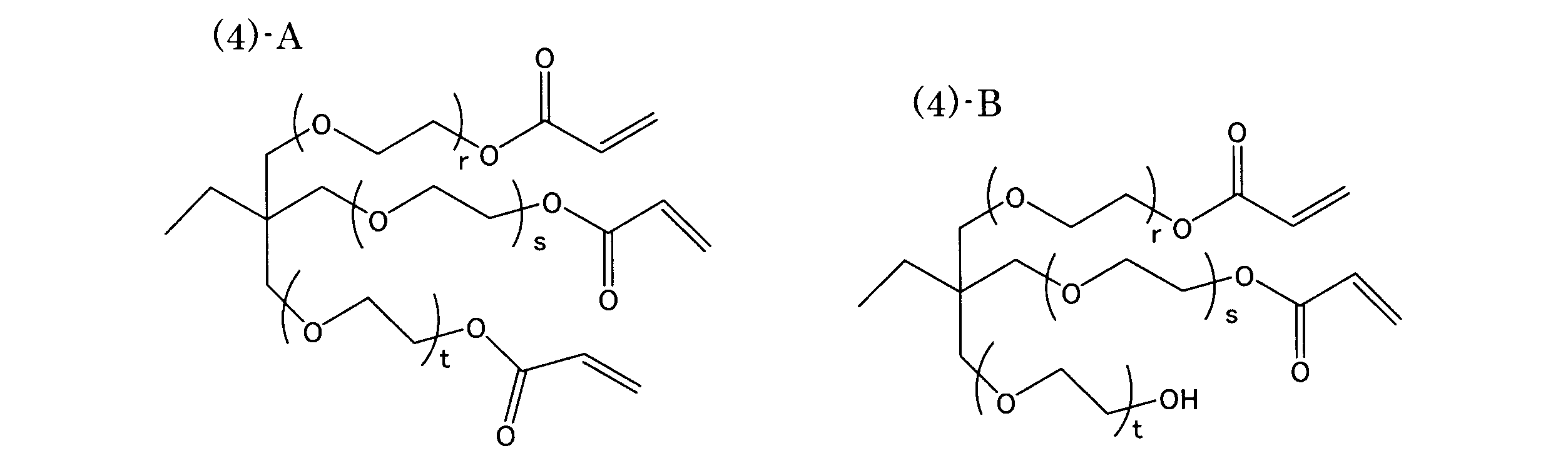
- a combination of the compound A and the compound B is a combination of a compound represented by the following general formula (3) -A and a compound represented by the following general formula (3) -B, and the following general formula (4) -A
- a combination of any one of a compound represented by the following general formula (6) -A and a compound represented by the following general formula (6) -B 5.
- the actinic ray curable inkjet ink according to any one of 1 to 4.
- An ink jet comprising: a head carriage that houses a plurality of ink jet recording heads; an ink tank that retains ink jet ink; an ink flow path connected to the ink tank and the head carriage; an actinic ray irradiation unit; and a temperature control unit.
- At least a part from the ink tank to the ink jet recording head has a heating portion, and all or a part of the ink jet recording head and the ink flow path are made of a metal member.
- An ink jet recording apparatus further comprising the ink according to claim 1.
- FIG. 1A is a side view illustrating an example of a configuration of a main part of an ink jet recording apparatus of a line recording system
- FIG. 1B is a top view thereof. It is a figure which shows an example of a structure of the principal part of the inkjet recording device of a serial recording system. It is a flowchart of a general dehydration transesterification method.
- the reason for the polymerization deposition is not clear, but it is considered that radicals were generated when the ink contacted a metal member such as Al or SUS, and the ink was locally radically polymerized.
- a metal member such as Al or SUS
- the present inventors can suppress the polymerization precipitation when the content of the compound B with respect to the compound A is 5% by mass or more.
- the heated ink comes into contact with the Al or SUS member in the ink jet recording apparatus or the ink jet head.
- the inventors of the present invention preferably use a photopolymerizable compound having a molecular weight in the range of 280 to 1500 for the ink in order to stably eject the ink that is in a sol state at 50 ° C. or higher from the inkjet head. I found out. The reason is not clear, but it is possible to prevent volatilization of the polymerizable compound on the nozzle surface.
- the ink according to the embodiment is based on the above knowledge. From the above, the ink-jet ink according to the present invention exhibits its effect more remarkably in an ink-jet recording apparatus having a heated portion in at least a part of an ink flow path from the ink tank to the ink-jet head.
- the heating site there is no particular limitation on the location of the heating site as long as the ink can be made into a sol and the ink fluidity and ejection stability can be improved, but it is preferable to have the heating site in at least one of the ink tank, the sub ink tank, and the inkjet head. More preferably, either the tank or the sub ink tank has a heating portion, and the inkjet head also has a heating portion.
- the ink according to the embodiment is an actinic ray curable inkjet ink that contains a photopolymerizable compound, a photoinitiator, and a gelling agent and reversibly undergoes a sol-gel phase transition depending on temperature.
- n (n) or more (meth) acrylate ester units and having a molecular weight in the range of 280 to 1500, and n-1 (meth) acrylates Including one or a plurality of combinations with a compound B having an ester unit and a hydroxyl group and represented by the following formula and having a molecular weight in the range of 280 to 1500;
- n represents an integer of 2 or more
- R represents an n-valent hydrocarbon group which may be branched or linear and may contain an oxygen atom or a nitrogen atom.
- n is the same integer and R represents the same structure.
- the content of the compound B is 5 to 15% by mass with respect to the total mass of the compound A corresponding to the compound B.
- the content of the gelling agent is 0.5 to 7.0% by mass relative to the total mass of the ink, and the gelation temperature of the ink is an actinic ray curable inkjet ink having a temperature of 50 ° C. or higher.
- the ink according to the embodiment does not cause a local thermal polymerization reaction, and is excellent in storage stability and ejection stability. Further, even when an image is formed at a high speed, sufficient cured film properties of the printed matter can be ensured.
- (Meth) acrylate refers to both and / or “acrylate” and “methacrylate”
- (meth) acryl refers to both and / or “acrylic” and “methacrylic”.
- the photopolymerizable compound is a compound that is crosslinked or polymerized by actinic rays.
- the actinic rays are, for example, electron beams, ultraviolet rays, ⁇ rays, ⁇ rays, and X-rays, and preferably ultraviolet rays and electron beams.
- the ink according to the embodiment includes a combination of a compound A and a compound B having the same R as a photopolymerizable compound, the compound A has n acrylate esters, and the compound B has n ⁇ 1 acrylates. Has ester and hydroxyl group.
- the content of Compound B is 5 to 15% by mass with respect to the total mass of Compound A corresponding to Compound B.
- the content of compound B with respect to compound A is preferably 5% by mass or more and less than 15% by mass.
- the content of Compound B with respect to Compound A is more preferably 5% by mass or more and less than 10% by mass.
- the combination in which the content of the compound B is 5 to 15% by mass with respect to the total mass of the compound A corresponding to the compound B (hereinafter, And a combination in which the content of compound B is not 5 to 15% by mass with respect to the total mass of compound A corresponding to compound B (hereinafter also referred to as a second combination).
- a second combination in which the content of compound B is not 5 to 15% by mass with respect to the total mass of compound A corresponding to compound B (hereinafter also referred to as a second combination).
- the total mass of the compound A and the compound B constituting the first combination is larger than the total mass of the compound A and the compound B constituting the second combination, the effect of preventing the local polymerization is obtained. Can be increased.
- Compound A is preferably a bifunctional or higher functional compound having n acrylate esters having a molecular weight in the range of 280 to 1500, more preferably in the range of 300 to 750.
- the compound A is preferably at least one (meth) acrylate compound of the following (1) and (2). This is because, when an image is formed at a high speed of 50 m / s or higher, sufficient cured film properties of the printed matter can be secured.
- Acrylate compound (2) Bifunctional or higher (meth) acrylate compound with a cyclic structure in the molecule
- Compound A is more preferably at least one of trifunctional (meth) acrylate compounds represented by the following general formulas (3) -A to (6) -A.
- the (meth) acrylate compounds having a molecular weight in the range of 280 to 1500 those having a purity by high performance liquid chromatography / mass spectrometry of less than 95.0% are preferred. This is because the local polymerization reaction (polymerization precipitation) due to the heat can be effectively prevented.
- the compound B it is preferable to use a compound having n-1 acrylate esters and hydroxyl groups and having a molecular weight in the range of 280 to 1500. This is because polymerization precipitation can be prevented by using a compound having a hydroxyl group in the structure. Although the reason why the polymerization precipitation can be prevented is not clear, it is considered that the polymerization precipitation can be suppressed by the hydroxyl group in the structure of Compound B acting as a polymerization inhibitor. In addition, when it replaces with the compound B and the alcohol with a basic skeleton different from the compound B is added, for example, it is difficult to suppress local thermal polymerization. In addition, as the compound B, in the following formula, a compound other than the acrylate ester or the hydroxyl group has the same structure as the compound A is used.
- compound B for example, compounds represented by the following (3) -B to (6) -B are more preferable.
- the compound A In order to prevent volatilization of the polymerizable compound on the nozzle surface and to further improve the effect of improving the light emission property and the continuous light emission property, in all combinations of the compound A and the compound B, the compound A
- the content of Compound B with respect to is preferably 5% by mass or more and less than 15% by mass.
- the photopolymerizable compound contained in the ink according to the embodiment can further prevent volatilization of the polymerizable compound on the nozzle surface when the compound does not substantially contain a compound whose molecular weight is not in the range of 280 to 1500. Further, the light emission property and the continuous light emission property can be further improved.
- substantially free means that a photopolymerizable compound having a molecular weight not included in the range of 280 to 1500 is included in the range in which the effect of the present invention is exhibited as long as volatilization of the polymerizable compound on the nozzle surface can be prevented.
- the ink according to the embodiment may include a radical polymerizable compound or a cationic polymerizable compound in addition to the compound A or the compound B, and may preferably include a radical polymerizable compound.
- the radical polymerizable compound or the cationic polymerizable compound may be a polyfunctional compound.
- the radically polymerizable compound is a compound (monomer, oligomer, polymer or mixture thereof) having an unsaturated double bond capable of radical polymerization. Only one kind of radically polymerizable compound may be contained in the actinic ray curable inkjet ink, or two or more kinds thereof may be contained.
- Examples of the compound having an unsaturated double bond capable of radical polymerization include unsaturated carboxylic acid and its salt, unsaturated carboxylic acid ester compound, unsaturated carboxylic acid urethane compound, unsaturated carboxylic acid amide compound and anhydride thereof, Examples include acrylonitrile, styrene, unsaturated polyester, unsaturated polyether, unsaturated polyamide, and unsaturated urethane.
- Examples of the unsaturated carboxylic acid include (meth) acrylic acid, itaconic acid, crotonic acid, isocrotonic acid, maleic acid and the like.
- the radical polymerizable compound is preferably an unsaturated carboxylic acid ester compound, and more preferably a (meth) acrylate compound.
- the (meth) acrylate compound may be not only a monomer described later, but also an oligomer, a mixture of a monomer and an oligomer, a modified product, an oligomer having a polymerizable functional group, and the like.
- the actinic ray curable inkjet ink is a sol-gel phase transition type
- the ethylene oxide-modified (meth) acrylate compound has high photosensitivity and easily forms a card house structure described later when the ink gels at a low temperature.
- the ethylene oxide-modified (meth) acrylate compound is easily dissolved in other ink components at high temperatures and has little curing shrinkage, so that curling of the printed matter hardly occurs.
- the (meth) acrylate compound may be a polymerizable oligomer.
- polymerizable oligomers include epoxy (meth) acrylate oligomers, aliphatic urethane (meth) acrylate oligomers, aromatic urethane (meth) acrylate oligomers, polyester (meth) acrylate oligomers, and linear (meth) acrylic oligomers. included.
- Examples of the polyfunctional monomer having an unsaturated double bond include compounds having a plurality of ethylene groups in the molecule.
- the ethylene group means ((meth) acryl group, vinyl ether group, allyl ether group, styrene group, (meth) acrylamide group, etc.), preferably a group consisting of acrylic group, methacryl group, vinyl ether group, allyl ether group It is preferable that it is 1 type chosen from. It is because photopolymerization can be performed satisfactorily.
- polyfunctional (meth) acrylate compounds include triethylene glycol di (meth) acrylate, tetraethylene glycol di (meth) acrylate, polyethylene glycol di (meth) acrylate, tripropylene glycol di (meth) acrylate, polypropylene glycol Di (meth) acrylate, 1,4-butanediol di (meth) acrylate, 1,6-hexanediol di (meth) acrylate, 1,9-nonanediol di (meth) acrylate, neopentyl glycol di (meth) acrylate , Dimethylol-tricyclodecane di (meth) acrylate, bisphenol A PO adduct di (meth) acrylate, hydroxypivalic acid neopentyl glycol di (meth) acrylate, polytetramethylene glycol (Meth) difunctional monomers such as acrylate; Trimethylolpropane tri (
- the (meth) acrylate compound may be a modified product.
- modified products include ethylene oxide-modified (meth) acrylate compounds such as ethylene oxide-modified trimethylolpropane tri (meth) acrylate and ethylene oxide-modified pentaerythritol tetraacrylate; caprolactone such as caprolactone-modified trimethylolpropane tri (meth) acrylate Modified (meth) acrylate compounds; and caprolactam-modified (meth) acrylate compounds such as caprolactam-modified dipentaerythritol hexa (meth) acrylate.
- “(meth) acrylate” includes acrylate monomer and / or acrylate oligomer, methacrylate monomer and / or methacrylate oligomer.
- bifunctional vinyl ether compound having two polymerizable functional groups examples include ethylene glycol divinyl ether, diethylene glycol divinyl ether, triethylene glycol divinyl ether, propylene glycol divinyl ether, dipropylene glycol vinyl ether, butylene divinyl ether, dibutylene glycol divinyl ether, neopentyl glycol divinyl ether.
- (Trifunctional) vinyl ether compound having three polymerizable functional groups examples include glycerin trivinyl ether, glycerin ethylene oxide adduct trivinyl ether (addition mole number of ethylene oxide 6), trimethylolpropane trivinyl ether, trivinyl ether ethylene oxide adduct trivinyl ether (addition mole number 3 of ethylene oxide).
- Etc. A vinyl ether compound having four or more polymerizable functional groups (four or more functional groups)
- examples of the tetra- or higher functional vinyl ether compound include pentaerythritol trivinyl ether (Log P 2.09), ditrimethylolpropane hexavinyl ether (Log P 3.49), and oxyethylene adducts thereof.
- Examples of the compound having an allyl ether group include diallyl phthalate and diallyl isophthalate.
- Examples of the compound having a styrene group include divinylbenzene.
- Examples of the compound having a (meth) acrylamide group include N, N-ethylenebisacrylamide and the like.
- the content of the photopolymerizable compound in the ink according to the embodiment is preferably 1 to 97% by mass, and more preferably 30 to 95% by mass.
- the gelling agent contained in the actinic ray curable inkjet ink has a function of reversibly sol-gel phase transition of the ink depending on the temperature.
- a gelling agent is at least 1) soluble in a photopolymerizable compound or non-polymerizable resin at a temperature higher than the gelation temperature, and 2) crystallizes in the ink at a temperature below the gelation temperature. It is preferable.
- the gelling agent When the gelling agent is crystallized in the ink, it is preferable that a plate crystal which is a crystallized product of the gelling agent forms a space three-dimensionally enclosed, and the photopolymerizable compound is included in the space.
- the structure in which the photopolymerizable compound is encapsulated in the space three-dimensionally surrounded by the plate crystal is sometimes referred to as “card house structure”.
- the card house structure is formed, the liquid photopolymerizable compound can be held and ink droplets can be pinned. Thereby, coalescence of droplets can be suppressed.
- the photopolymerizable compound dissolved in the ink and the gelling agent are compatible.
- the photopolymerizable compound dissolved in the ink and the gelling agent are phase-separated, it may be difficult to form a card house structure.
- the compatibility of the photopolymerizable compound and the gelling agent is good in the sol-like ink (at a high temperature). Furthermore, in order to stably suppress coalescence of droplets even during high-speed printing, after the ink droplets have landed on the recording medium, the gelling agent quickly crystallizes to form a strong card house structure. preferable.
- gelling agents include An aliphatic ketone compound; Aliphatic ester compounds; Petroleum waxes such as paraffin wax, microcrystalline wax, petrolactam; Plant waxes such as candelilla wax, carnauba wax, rice wax, wood wax, jojoba oil, jojoba solid wax, and jojoba ester; Animal waxes such as beeswax, lanolin and whale wax; Mineral waxes such as montan wax and hydrogenated wax; Hydrogenated castor oil or hydrogenated castor oil derivative; Modified waxes such as montan wax derivatives, paraffin wax derivatives, microcrystalline wax derivatives or polyethylene wax derivatives; Higher fatty acids such as behenic acid, arachidic acid, stearic acid, palmitic acid, myristic acid, lauric acid, oleic acid, and erucic acid; Higher alcohols such as stearyl alcohol and behenyl alcohol; Hydroxystearic acid such as 12-hydroxystearic acid; 12-hydroxystearic acid derivative
- Nomucoat series, etc. Amide compounds such as N-lauroyl-L-glutamic acid dibutylamide and N- (2-ethylhexanoyl) -L-glutamic acid dibutylamide (available from Ajinomoto Fine Techno); Dibenzylidene sorbitols such as 1,3: 2,4-bis-O-benzylidene-D-glucitol (available from Gelol D Shin Nippon Rika); And low molecular oil gelling agents described in JP-A-2005-126507, JP-A-2005-255821 and JP-A-2010-11117.
- Amide compounds such as N-lauroyl-L-glutamic acid dibutylamide and N- (2-ethylhexanoyl) -L-glutamic acid dibutylamide (available from Ajinomoto Fine Techno); Dibenzylidene sorbitols such as 1,3: 2,4-bis-O-benzyliden
- the actinic ray curable inkjet ink for the image forming method according to the present embodiment includes a compound containing an alkyl chain having 12 or more carbon atoms as a gelling agent.
- the gelling agent contains a linear alkyl group having 12 or more carbon atoms, the aforementioned “card house structure” is easily formed, which is preferable.
- the gelling agent may have a branched chain.
- the gelling agent containing a linear alkyl group having 12 or more carbon atoms include aliphatic ketone compounds, aliphatic ester compounds, higher fatty acids, higher alcohols having a linear alkyl group having 12 or more carbon atoms, Fatty acid amides and the like are included.
- gelling agents having a polar group such as —OH or —COOH at the end of the alkyl chain, such as fatty acid amide have poor stability in sol-like ink, and may precipitate or separate layers. is there. Further, the gelling agent may gradually elute from the cured film of the ink with the passage of time.
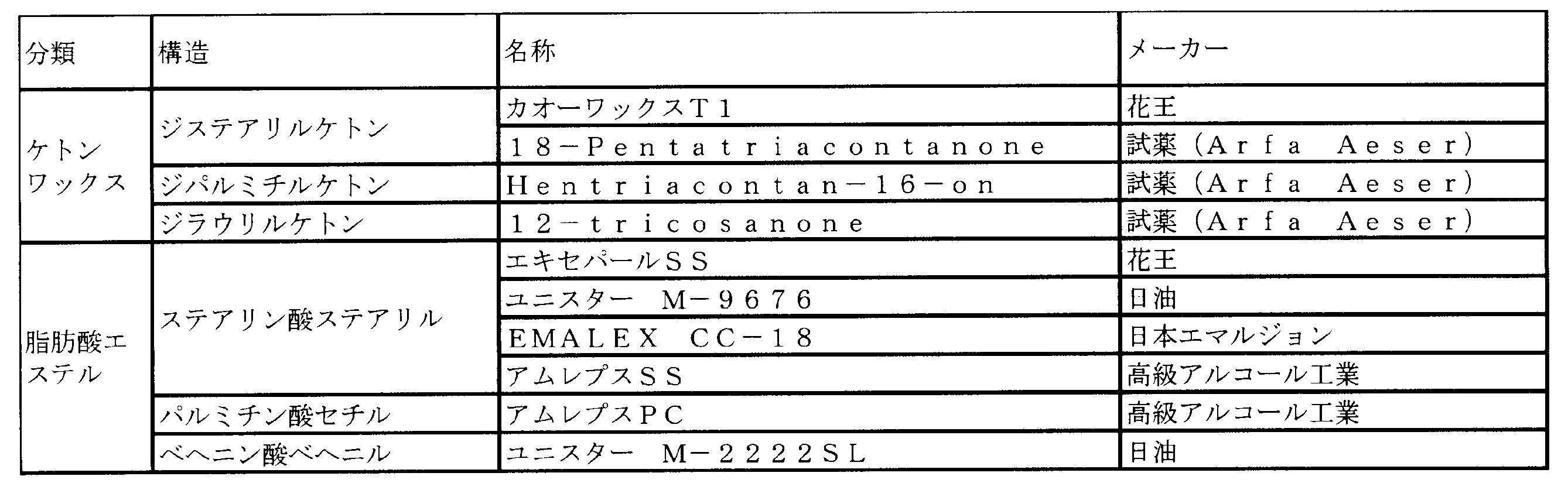
- the gelling agent is preferably an aliphatic ketone compound or an aliphatic ester compound. That is, a compound represented by the following general formulas (G1) and (G2) is preferable.
- General formula (G2): R3-COO-R4 In general formulas (G1) and (G2), R1 to R4 each independently represents a hydrocarbon group having a straight chain portion having 12 or more carbon atoms. R1 to R4 may have a branched portion.
- the hydrocarbon groups represented by R1 and R2 are each preferably an aliphatic hydrocarbon group including a straight chain portion having 12 to 25 carbon atoms.
- the number of carbon atoms in the straight chain portion contained in the aliphatic hydrocarbon group represented by R1 and R2 is less than 12, it does not function as a gelling agent because it does not have sufficient crystallinity, and the card described above In the house structure, there is a possibility that a sufficient space for encapsulating the photopolymerizable compound cannot be formed.
- the number of carbon atoms in the straight chain portion contained in the aliphatic hydrocarbon group exceeds 25, the melting point becomes too high, so that the ink may not be dissolved in the ink unless the ink ejection temperature is increased.
- Examples of the aliphatic ketone compound represented by the general formula (G1) include dilignoceryl ketone (C24-C24), dibehenyl ketone (C22-C22, melting point 88 ° C.), distearyl ketone (C18-C18, 84 ° C.), dieicosyl ketone (C20-C20), dipalmityl ketone (C16-C16, melting point 80 ° C.), dimyristyl ketone (C14-C14), dilauryl ketone (C12-C12, melting point 68 ° C.) , Lauryl myristyl ketone (C12-C14), lauryl palmityl ketone (C12-C16), myristyl palmityl ketone (C14-C16), myristyl stearyl ketone (C14-C18), myristyl behenyl ketone (C14-C22), palmityl Stearyl
- Examples of commercially available compounds represented by the general formula (G1) include 18-Pentriacontanon (manufactured by Alfa Aeser), Hentriacontan-16-on (manufactured by Alfa Aeser), 12-tricosanone (manufactured by Alfa Aeser), Wax T1 (made by Kao Corporation) and the like are included.
- the aliphatic ketone compound contained in the actinic ray curable inkjet ink may be only one kind or a mixture of two or more kinds.
- the hydrocarbon group represented by R3 and R4 is not particularly limited, but is preferably an aliphatic hydrocarbon group including a straight chain portion having 12 to 26 carbon atoms.
- the number of carbon atoms in the straight chain portion contained in the aliphatic hydrocarbon group represented by R3 and R4 is 12 or more and 26 or less, it is necessary for the gelling agent as in the compound represented by the general formula (G1).
- the above-mentioned card house structure can be formed while having excellent crystallinity, and the melting point is not too high.
- Examples of the aliphatic ester compound represented by the general formula (G2) include behenyl behenate (C21-C22, melting point 70 ° C.), icosyl icosanoate (C19-C20), stearyl stearate (C17-C18, melting point 60).
- Examples of commercially available aliphatic ester compounds represented by the general formula (G2) include Unistar M-2222SL (manufactured by NOF Corporation), UNISTAR M-9676 (manufactured by NOF Corporation), Exepearl SS (Kao Corporation) Company, melting point 60 ° C), EMALEXCC-18 (manufactured by Nippon Emulsion Co., Ltd.), Amreps SS (manufactured by Higher Alcohol Industry Co., Ltd.), Amreps PC (manufactured by Higher Alcohol Industry Co., Ltd.), Exepar MY-M (manufactured by Kao Corporation ), Spalm aceti (manufactured by NOF Corporation), EMALEX® CC-10 (manufactured by Nippon Emulsion Co., Ltd.) and the like. Since these commercial products are often a mixture of two or more types, they may be separated and purified as necessary.
- the aliphatic ester compound contained in the actinic ray curable inkjet ink may be only one kind or a mixture of two or more kinds.
- the amount of the gelling agent contained in the actinic ray curable ink-jet ink is preferably 0.5 to 7.0% by mass, more preferably 1 to 5% by mass with respect to the total amount of the ink. If it is less than 0.5% by mass, the ink droplet cannot be gelled (sol-gel phase transition due to temperature), and if it exceeds 7% by mass, the hardness of the cured film after photocuring is insufficient. There are problems such as the surface being easily scratched.
- the actinic ray curable inkjet ink may further contain a photoinitiator as necessary.
- Photoinitiators include an intramolecular bond cleavage type and an intramolecular hydrogen abstraction type.
- Examples of intramolecular bond cleavage type photoinitiators include diethoxyacetophenone, 2-hydroxy-2-methyl-1-phenylpropan-1-one, benzyldimethyl ketal, 1- (4-isopropylphenyl) -2- Hydroxy-2-methylpropan-1-one, 4- (2-hydroxyethoxy) phenyl- (2-hydroxy-2-propyl) ketone, 1-hydroxycyclohexyl-phenylketone, 2-methyl-2-morpholino (4- Acetophenone systems such as thiomethylphenyl) propan-1-one, 2-benzyl-2-dimethylamino-1- (4-morpholinophenyl) -butanone; Benzoins such as benzoin, benzoin methyl
- intramolecular hydrogen abstraction type photoinitiators examples include benzophenone, methyl 4-phenylbenzophenone o-benzoylbenzoate, 4,4′-dichlorobenzophenone, hydroxybenzophenone, 4-benzoyl-4′-methyl-diphenyl sulfide
- Benzophenone series such as acrylated benzophenone, 3,3 ′, 4,4′-tetra (t-butylperoxycarbonyl) benzophenone, 3,3′-dimethyl-4-methoxybenzophenone;
- Thioxanthone systems such as 2-isopropylthioxanthone, 2,4-dimethylthioxanthone, 2,4-diethylthioxanthone, 2,4-dichlorothioxanthone;
- Aminobenzophenone series such as Mihira-ketone and 4,4′-diethylaminobenzophenone; 10-butyl-2-chloroacridon
- acylphosphine oxide and acylphosphonate can be preferably used from the viewpoint of sensitivity.
- bis (2,4,6-trimethylbenzoyl) -phenylphosphine oxide bis (2,6-dimethoxybenzoyl) -2,4,4-trimethyl-pentylphosphine oxide and the like are preferable.
- the preferable addition amount of the photoinitiator is 0.1 to 10% by mass, particularly preferably 2 to 8% by mass, based on the entire ink composition.
- the actinic ray curable inkjet ink may contain a photoacid generator as a photoinitiator.
- photoacid generators include chemically amplified photoresists and compounds used for photocationic polymerization (Organic Electronics Materials Study Group, “Organic Materials for Imaging”, Bunshin Publishing (1993), 187. See page 192).
- the actinic ray curable ink-jet ink may further contain a photoinitiator auxiliary agent, a polymerization inhibitor or the like, if necessary.
- the photoinitiator assistant may be a tertiary amine compound, preferably an aromatic tertiary amine compound.
- aromatic tertiary amine compounds include N, N-dimethylaniline, N, N-diethylaniline, N, N-dimethyl-p-toluidine, N, N-dimethylamino-p-benzoic acid ethyl ester, N, N-dimethylamino-p-benzoic acid isoamyl ethyl ester, N, N-dihydroxyethylaniline, triethylamine, N, N-dimethylhexylamine and the like are included.
- N, N-dimethylamino-p-benzoic acid ethyl ester and N, N-dimethylamino-p-benzoic acid isoamyl ethyl ester are preferred. These compounds may be used alone or in combination of two or more.
- polymerization inhibitors include (alkyl) phenol, hydroquinone, catechol, resorcin, p-methoxyphenol, t-butylcatechol, t-butylhydroquinone, pyrogallol, 1,1-picrylhydrazyl, phenothiazine, p-benzoquinone , Nitrosobenzene, 2,5-di-tert-butyl-p-benzoquinone, dithiobenzoyl disulfide, picric acid, cuperone, aluminum N-nitrosophenylhydroxylamine, tri-p-nitrophenylmethyl, N- (3-oxyanilino- 1,3-dimethylbutylidene) aniline oxide, dibutylcresol, cyclohexanone oxime cresol, guaiacol, o-isopropylphenol, butyraloxime, methylethylketoxime, cyclohexanone Shims
- the inkjet ink may further contain at least one of various known dyes and pigments. Among these, it is particularly preferable to contain a pigment.
- the pigments that can be included in the inkjet ink are listed below.
- C. I. Pigment Yellow 1, 2, 3, 12, 13, 14, 16, 17, 73, 74, 75, 81, 83, 87, 93, 95, 97, 98, 109, 114, 120, 128, 129, 138, 150, 151, 154, 155, 180, 185, 213 C.
- Pigment Green 7,36 C. I. Pigment White 6, 18, 21 C.
- the average particle diameter of the pigment is preferably 0.08 to 0.5 ⁇ m, and the maximum particle diameter of the pigment is 0.3 to 10 ⁇ m, preferably 0.3 to 3 ⁇ m.
- the dye that can be included in the inkjet ink can be an oil-soluble dye or the like.
- oil-soluble dyes include the following various dyes.
- magenta dyes include MS Magenta VP, MS Magenta HM-1450, MS Magenta HSo-147 (above, manufactured by Mitsui Toatsu), AIZENSOT Red-1, AIZEN SOT Red-2, AIZEN SOTRed-3, AIZEN SOT Pink-1, SPIRON Red GEH SPECIAL (above, manufactured by Hodogaya Chemical Co., Ltd.), RESOLIN Red FB 200%, MACROLEX Red Violet R, MACROLEX ROT5B (above, manufactured by Bayer Japan Co., Ltd.), KAYASET Red K, RED A 802 (above, Nippon Kayaku Co., Ltd.), PHLOXIN, ROSE Bengal, ACID Red (above, Manufactured by Iva Kasei), HSR-31, DIARES
- cyan dyes examples include MS Cyan HM-1238, MS Cyan HSo-16, Cyan HSo-144, MS Cyan VPG (manufactured by Mitsui Toatsu), AIZEN SOT Blue-4 (manufactured by Hodogaya Chemical Co., Ltd.), RESOLIN BR. Blue BGLN 200%, MACROLEX Blue RR, CERES Blue GN, SIRIUS SUPRATURQ. Blue Z-BGL, SIRIUS SUTRA TURQ. Blue FB-LL 330% (from Bayer Japan), KAYASET Blue FR, KAYASET Blue N, KAYASET Blue 814, Turq.
- Blue GL-5 200 Light Blue BGL-5 200 (Nippon Kayaku Co., Ltd.), DAIWA Blue 7000, Olesol Fast Blue GL (Daiwa Kasei Co., Ltd.), DIARESIN Blue P (Mitsubishi Chemical Co., Ltd.) Blue 670, NEOPEN Blue 808, ZAPON Blue 806 (above, manufactured by BASF Japan Ltd.) and the like are included.
- yellow dyes examples include MS Yellow HSm-41, Yellow KX-7, Yellow EX-27 (Mitsui Toatsu), AIZEN SOT Yellow-1, AIZEN SOT Yellow W-3, AIZEN SOT Yellow-6 ( As described above, manufactured by Hodogaya Chemical Co., Ltd.), MACROLEX Yellow 6G, MACROLEX FLUOR.
- black dyes examples include MS Black VPC (Mitsui Toatsu Co., Ltd.), AIZEN SOT Black-1, AIZEN SOT Black-5 (above, manufactured by Hodogaya Chemical Co., Ltd.), RESORIN Black GSN 200%, RESOLIN BlackBS (above, Bayer Japan), KAYASET Black AN (Nippon Kayaku), DAIWA Black MSC (Daiwa Kasei), HSB-202 (Mitsubishi Kasei), NEPTUNE Black X60, NEOPEN Black X58 (above, BASF) Japan product).
- the content of the pigment or dye is preferably 0.1 to 20% by mass and more preferably 0.4 to 10% by mass with respect to the actinic ray curable inkjet ink. This is because if the content of the pigment or dye is too small, the color of the resulting image is not sufficient, and if it is too large, the viscosity of the ink increases and the jetting property decreases.
- the inkjet ink may contain a synergist according to various pigments as a dispersion aid.
- the total amount of the dispersant and the dispersion aid is preferably 1 to 50% by mass with respect to the pigment.
- the pigment must be dispersed in the inkjet ink. Therefore, it is preferable to obtain an inkjet ink by preparing a pigment dispersion and further mixing the pigment dispersion and other ink components.
- the pigment dispersion can be prepared by dispersing a pigment in a dispersion medium.
- the pigment may be dispersed using, for example, a ball mill, sand mill, attritor, roll mill, agitator, Henschel mixer, colloid mill, ultrasonic homogenizer, pearl mill, wet jet mill, paint shaker, or the like.
- a dispersing agent can be added when dispersing the pigment.
- a polymer dispersant is preferably used, and examples of the polymer dispersant include Avecia's Solsperse series and Ajinomoto Fine-Techno's PB series.
- the dispersion medium of the pigment dispersion may be a solvent or a polymerizable compound; the inkjet ink in the present invention is preferably gel-free immediately after landing on the recording medium, and is preferably solvent-free. Further, if the solvent remains in the cured image, solvent resistance is deteriorated and the organic compound (VOC) volatilizes from the remaining solvent. Therefore, the solventless ink is preferable. Therefore, the dispersion medium of the pigment dispersion is preferably not a solvent but a polymerizable compound, particularly a monomer having the lowest viscosity, in view of dispersion suitability.
- the actinic ray curable inkjet ink may further contain other components as necessary.
- Other components may be various additives, other resins, and the like.
- the additive include a surfactant, a leveling additive, a matting agent, an ultraviolet absorber, an infrared absorber, an antibacterial agent, and a basic compound for enhancing the storage stability of the ink.
- the basic compound include basic alkali metal compounds, basic alkaline earth metal compounds, basic organic compounds such as amines, and the like.
- other resins include resins for adjusting the physical properties of the cured film, such as polyester resins, polyurethane resins, vinyl resins, acrylic resins, rubber resins, and waxes. It is.
- sol-gel phase transition type inkjet ink Since the actinic radiation curable inkjet ink contains a gelling agent as described above, it undergoes a sol-gel phase transition reversibly depending on the temperature. Since the photocurable ink that undergoes a sol-gel phase transition is a liquid (sol) at a high temperature (for example, about 80 ° C.), it can be ejected in a sol state from an inkjet recording head. When actinic ray curable inkjet ink is ejected at a high temperature, ink droplets (dots) land on the recording medium and then naturally cool to gel. Thereby, coalescence of adjacent dots can be suppressed and image quality can be improved.
- a gelling agent for example, about 80 ° C.
- the viscosity of the ink at a high temperature is below a certain level.
- the viscosity of the actinic ray curable inkjet ink at 80 ° C. is preferably 3 to 20 mPa ⁇ s.
- the viscosity of the ink at normal temperature after landing is a certain level or more.
- the viscosity at 25 ° C. of the actinic ray curable inkjet ink is preferably 1000 mPa ⁇ s or more.
- the gelation temperature of the ink is preferably 50 ° C. or higher and 100 ° C. or lower, and more preferably 50 ° C. or higher and 70 ° C. or lower.
- the gelation temperature is a temperature at which the fluidity decreases due to gelation in the process of cooling the ink in the sol state.
- the viscosity of the ink at 80 ° C., the viscosity at 25 ° C., and the gelation temperature can be determined by measuring the temperature change of the dynamic viscoelasticity of the ink with a rheometer. Specifically, a temperature change curve of viscosity is obtained when the ink is heated to 100 ° C. and cooled to 20 ° C. under conditions of a shear rate of 11.7 (1 / s) and a temperature decrease rate of 0.1 ° C./s. . And the viscosity in 80 degreeC and the viscosity in 25 degreeC can be calculated
- the gelation temperature can be determined as the temperature at which the viscosity becomes 200 mPa ⁇ s in the temperature change curve of the viscosity.
- the rheometer can be a stress control type rheometer Physica MCR series manufactured by Anton Paar.
- the cone plate can have a diameter of 75 mm and a cone angle of 1.0 °.
- the actinic radiation curable ink-jet ink can be obtained by mixing each component containing the above-described photocurable compound and a gelling agent under heating.
- a pigment dispersant in which a color material (particularly a pigment) is dispersed in a part of the polymerizable compound is prepared and mixed with the pigment dispersant and another ink component containing another polymerizable compound.
- the problem of nozzle clogging due to the occurrence of polymerization precipitation described above is particularly noticeable when forming a high-definition image in which small droplets of 1 to 4 pl are discharged using a head having a head nozzle diameter of 30 ⁇ m or less and printing is performed at a resolution of 1200 dpi ⁇ 1200 dpi or more.
- the present inventors have found that The image forming method in which the ink according to the above-described embodiment is used is not particularly limited, but the present inventors have found that it is preferably used in the following image forming method.
- the image forming method according to the embodiment is an image forming method using the above-described ink, and the recording material is ejected from the inkjet head in a state of 50 to 100 ° C. and the ink is landed on the recording material.
- This is an image forming method in which the temperature is in the range of ⁇ 20 to ⁇ 10 ° C. of the sol-gel phase transition temperature of the ink.
- the image forming method according to the embodiment includes at least the following two steps. (1) A step of causing an actinic ray curable ink jet ink to be ejected from an ink jet recording head and adhering to the recording medium. (2) The ink liquid is obtained by irradiating light from a UV light source onto the droplet landed on the recording medium. Curing the drops
- the actinic ray curable inkjet ink may be any of the above-described inkjet inks.
- Ink droplets are ejected from the ink jet recording head.
- the ink temperature in the ink jet recording head is less than (gelation temperature + 10) ° C., the ink is gelled in the ink jet recording head or on the nozzle surface, and the ejection properties of the ink droplets are likely to deteriorate.
- the inkjet ink is heated by a heating part provided in at least one of the inkjet recording head, the ink flow path connected to the inkjet recording head, or the ink tank connected to the ink flow path, and the inkjet ink droplet at the above temperature May be discharged.
- the amount of droplets ejected from each nozzle of the inkjet recording head is preferably 0.5 to 10 pl depending on the resolution of the image. In order to form a high-definition image, 0 More preferably, it is from 5 to 4.0 pl. For this purpose, it is necessary to perform recording using a head having an ink jet recording head having a nozzle diameter of less than 30 ⁇ m. However, by using the above-mentioned ink, it is very stable even when recording with a head having a nozzle diameter. High-definition images can be formed with good reproducibility.
- the ink droplets that have landed on the recording medium are cooled and rapidly gelled by the sol-gel phase transition. As a result, the ink droplets can be pinned without diffusing. Furthermore, as described above, oxygen inhibition of the photopolymerizable compound can be reduced.
- the recording medium may be paper or a resin film. Examples of paper include coated paper for printing, coated paper B for printing, and the like. Examples of the resin film include a polyethylene terephthalate film and a vinyl chloride film.
- the temperature of the recording medium when the ink droplet lands is preferably set to a temperature that is 10 to 20 ° C. lower than the gelation temperature of the ink. If the temperature of the recording medium is too low, the ink droplets gel excessively and pinning, so that the ink droplets are not sufficiently leveled and the image gloss may be lowered. On the other hand, if the temperature of the recording medium is too high, the ink droplets are difficult to gel, and adjacent dots of the ink droplets may be mixed together. By appropriately adjusting the temperature of the recording medium, it is possible to achieve appropriate leveling and appropriate pinning so that adjacent dots of ink droplets do not mix with each other.
- the gelling agent is stably dissolved in the ink solvent. Therefore, the gloss of the image can be adjusted by adjusting the temperature of the recording medium. If it cannot be stably present in the ink solvent, part of the gelling agent is deposited during ejection, causing nozzle clogging and image quality degradation. Further, if the crystallization of the gelling agent is delayed after the ink has landed on the recording medium, the dots are mixed even if the temperature of the recording medium is adjusted, and the image is lowered.
- the recording medium conveyance speed is preferably 40 to 120 m / min.
- the higher the conveyance speed the higher the image forming speed, which is preferable.
- the conveyance speed is too high, the image quality is deteriorated or the photocuring (described later) of the ink becomes insufficient.
- the image forming method according to the embodiment is an image forming method that is more excellent in ejection stability than a conventional method, particularly when an image is formed by using a head having a nozzle diameter of 30 ⁇ m or less.
- the light applied to the ink droplets attached to the recording medium is preferably ultraviolet light from an LED light source.
- an LED light source Specifically, a 395 nm, water-cooled LED manufactured by Phoseon Technology can be used. A metal halide lamp or the like may be used as an ultraviolet light source.
- an LED it is possible to prevent defective curing of the ink droplet cured film surface due to melting of the ink droplet by the radiant heat of the light source. It is done.
- the LED as the light source is preferably installed with ultraviolet rays of 370 to 410 nm so that the peak illuminance on the image surface is 0.5 to 10 W / cm 2 in order to cure the ink droplets. It is more preferable to install so as to be 2 .
- the conveyance speed of the recording medium is 50 m / min or more (up to 120 m / min). This is to prevent the ink droplets from being irradiated with the radiant heat of the light source.
- the light irradiation to the ink droplets is performed within 10 seconds after the ink droplets adhere to the recording medium, preferably 0.001 seconds to 5 seconds, in order to prevent the adjacent ink droplets from coalescing. Within a range of 0.01 second to 2 seconds.
- the light irradiation is preferably performed after ejecting ink droplets from all the ink jet recording heads accommodated in the head carriage.
- the image recording method of the present invention can be carried out using a photocurable inkjet recording apparatus.
- a photo-curing type ink jet recording apparatuses There are two types of photo-curing type ink jet recording apparatuses: a line recording method (single pass recording method) and a serial recording method.
- the line recording method (single-pass recording method) is preferable from the viewpoint of high-speed recording, although it may be selected according to the required image resolution and recording speed.
- FIG. 1A and FIG. 1B are diagrams illustrating an example of a configuration of a main part of a line recording type ink jet printer.
- FIG. 1A is a side view
- FIG. 1B is a top view.
- the inkjet printer 10 includes a head carriage 16 that houses a plurality of inkjet recording heads 14, an ink flow path 30 connected to the head carriage 16, and ink supplied through the ink flow path 30.
- An actinic ray irradiation unit 18 that covers the entire width of the recording medium 12 and is located downstream of the head carriage 16 (in the recording medium conveyance direction), and a lower surface of the recording medium 12.
- a heating part is provided in at least a part from the ink tank 31 to the ink jet recording head 14, and more preferably, a heating part is provided in the ink tank 31 and the ink jet recording head 14. preferable.
- the head carriage 16 is connected to an ink tank 31 for storing ink via an ink flow path 30.
- the head carriage 16 is fixedly arranged so as to cover the entire width of the recording medium 12, and accommodates a plurality of inkjet recording heads 14 provided for each color.
- Ink is supplied to the ink jet recording head 14.
- ink may be supplied directly or by an ink supply means (not shown) from an ink cartridge (not shown) detachably attached to the inkjet printer 10.
- a plurality of inkjet recording heads 14 are arranged in the transport direction of the recording medium 12 for each color.
- the number of inkjet recording heads 14 arranged in the conveyance direction of the recording medium 12 is set according to the nozzle density of the inkjet recording head 14 and the resolution of the print image. For example, when an image having a resolution of 1440 dpi is formed using the inkjet recording head 14 having a droplet amount of 2 pl and a nozzle density of 360 dpi, the four inkjet recording heads 14 may be arranged so as to be shifted with respect to the conveyance direction of the recording medium 12. That's fine.
- the two ink jet recording heads 14 may be arranged in a shifted manner.
- dpi represents the number of ink droplets (dots) per 2.54 cm.
- the actinic ray irradiation unit 18 covers the entire width of the recording medium 12 and is arranged on the downstream side of the head carriage 16 in the conveyance direction of the recording medium.
- the actinic ray irradiation unit 18 irradiates the droplets ejected by the inkjet recording head 14 and landed on the recording medium 12 with actinic rays to cure the droplets.
- examples of the active light irradiation unit 18 include a fluorescent tube (low pressure mercury lamp, germicidal lamp), a cold cathode tube, an ultraviolet laser, and an operating pressure of several hundred Pa to 1 MPa. These include low pressure, medium pressure, high pressure mercury lamps, metal halide lamps and LEDs. From the viewpoint of curability, ultraviolet irradiation means for irradiating ultraviolet rays having an illuminance of 100 mW / cm 2 or more; specifically, a high-pressure mercury lamp, a metal halide lamp, and an LED are preferable.
- the ultraviolet irradiation means is particularly preferably an LED from the viewpoint of low power consumption and low radiant heat. Specific examples of the LED that is the ultraviolet irradiation means include 395 nm, water-cooled LED, etc. manufactured by Phoseon Technology.
- examples of the actinic ray irradiating unit 18 include electron beam irradiating means such as a scanning method, a curtain beam method, and a broad beam method. Therefore, a curtain beam type electron beam irradiation means is preferable.
- Examples of electron beam irradiation means include “Curetron EBC-200-20-30” manufactured by Nissin High Voltage Co., Ltd., “Min-EB” manufactured by AIT Co., Ltd., and the like.
- the temperature controller 19 (19a and 19b) is disposed on the lower surface of the recording medium 12, and maintains the recording medium 12 at a predetermined temperature.
- the temperature control unit 19 can be, for example, various heaters.
- the recording medium 12 is conveyed between the head carriage 16 of the inkjet printer 10 and the temperature control unit 19a.
- the recording medium 12 is adjusted to a predetermined temperature by the temperature control unit 19a.
- the ink heated by the heating portion is ejected from the ink jet recording head 14 of the head carriage 16 and adhered (landed) on the recording medium 12.
- the actinic ray irradiating unit 18 irradiates the ink droplets attached on the recording medium 12 with an actinic ray to cure.
- the temperature of the ink in the ink jet recording head 14 is set to a temperature higher by 10 to 30 ° C. than the gelation temperature of the ink in order to improve the ink ejectability. It is preferable. If the ink temperature in the ink jet recording head 14 is less than (gelation temperature + 10) ° C., the ink gels in the ink jet recording head 14 or on the nozzle surface, and the ink ejection properties tend to decrease. On the other hand, when the temperature of the ink in the inkjet recording head 14 exceeds (gelling temperature + 30) ° C., the ink becomes too high, and the ink component may be deteriorated.
- the amount of droplets ejected from each nozzle of the inkjet recording head 14 is preferably 0.5 pl to 10 pl in order to form a high resolution image, although it depends on the resolution of the image. More preferably, it is 1 pl to 4.0 pl.
- Irradiation of actinic rays from the actinic ray irradiating unit 18 is performed within 10 seconds after the ink droplets adhere on the recording medium, preferably from 0.001 seconds to suppress the adjacent ink droplets from being coalesced. It is preferable to carry out within 5 seconds, more preferably within 0.01 second to 2 seconds. Irradiation with actinic rays is preferably performed after ink is ejected from all the inkjet recording heads 14 accommodated in the head carriage 16. At this time, the temperature of the recording medium 12 is appropriately adjusted by the temperature controller 19b. The temperature of the recording medium 12 at this time may be the same as or different from the temperature of the recording medium 12 at the time of ink ejection; that is, the temperature adjusted by the temperature control unit 19a.
- the acceleration voltage for electron beam irradiation is preferably 30 to 250 kV and more preferably 30 to 100 kV in order to perform sufficient curing.
- the electron beam irradiation amount is preferably 30 to 100 kGy, and more preferably 30 to 60 kGy.
- the total film thickness of the image after ink curing is preferably 2 to 25 ⁇ m.
- the “total film thickness” is the maximum film thickness of the cured ink that has landed on the recording medium.
- FIG. 2 is a diagram illustrating an example of a configuration of a main part of the serial recording type inkjet printer 20.
- the inkjet printer 20 has a width narrower than the entire width of the recording medium and a plurality of inkjet recording heads 24 instead of the head carriage 16 fixedly arranged so as to cover the entire width of the recording medium. 2, and a guide portion 27 for moving the head carriage 26 in the width direction of the recording medium 12.
- the head carriage 26 is ejected from the inkjet recording head 24 accommodated in the head carriage 26 while moving in the width direction of the recording medium 12 along the guide portion 27. After the head carriage 26 has completely moved in the width direction of the recording medium 12 (for each pass), the recording medium 12 is fed in the transport direction. Thereafter, the active light irradiation unit 28 irradiates the active light. Except for these operations, an image is recorded in substantially the same manner as the above-described line recording type inkjet printer 10.
- the ink jet recording apparatus of the present invention has a heating part in at least a part from the ink tank to the ink jet recording head, and all or part of the ink jet recording head and the ink flow path are made of a metal member.
- a local thermal polymerization reaction does not occur, and the injection stability is excellent.
- the metal material is preferably Al or SUS.
- the ink jet recording head is an ink jet recording apparatus having excellent ejection stability even when the nozzle diameter is 30 ⁇ m or less.
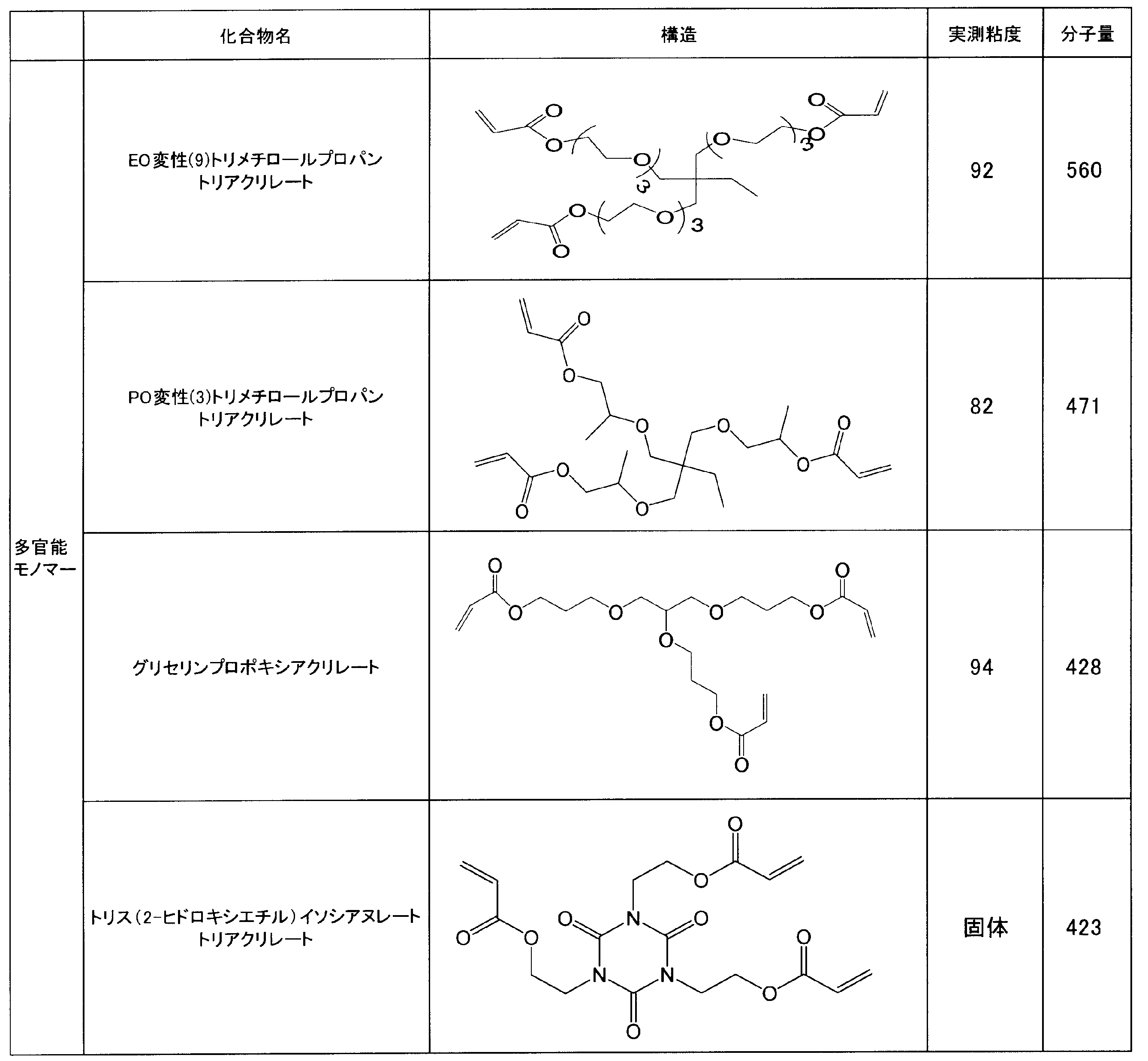
- Photopolymerizable compound 1 to photopolymerizable compound 8 and photopolymerizable compound 101 to photopolymerizable compounds 108 and 113 were prepared at the following component ratios.
- the ratio of the compound B was calculated
- Ratio of compound B [parts by mass of compound B / parts by mass of compound A] ⁇ 100
- Compound A (acrylate monomer) can be prepared by a general “dehydration transesterification method” as shown in FIG. 3 using any alcohol and acrylic acid, but is not limited thereto. At that time, the amount of acrylic acid to be reacted was adjusted, and each monomer was synthesized so that the ratio of Compound A to Compound B was as shown in Tables 2 to 16.
- Photopolymerizable compound 1 tripropylene glycol diacrylate (molecular weight 300)
- Photopolymerizable compound 2 9EO modified trimethylolpropane triacrylate (molecular weight 693)
- Compound 2A 74.1 parts by mass
- Compound 2B 9.3 parts by mass Ratio of Compound 2B 12.6%
- Photopolymerizable compound 3 3PO-modified trimethylolpropane triacrylate (molecular weight 471)
- Photopolymerizable compound 4 polyethylene glycol diacrylate (molecular weight 508)
- Compound 4A 90.3 parts by mass Compound 4B: 5.5 parts by mass Ratio of Compound 4B 6.1%
- Photopolymerizable compound 6 Dioxane glycol diacrylate (molecular weight 326) Compound 6A: 88.2 parts by mass Compound 6B: 8.1 parts by mass Ratio of compound 6B 9.2% Photopolymerizable compound 7: tris (2-hydroxyethyl) isocyanurate triacrylate (molecular weight 423) Compound 7A: 79.1 parts by mass Compound 7B: 8.9 parts by mass Ratio of compound 7B 11.3% Photopolymerizable compound 8: glycerin propoxyacrylate (molecular weight 428) Compound 8A: 84.9 parts by mass Compound 8B: 7.6 parts by mass Ratio of compound 8B 9.0%
- Photopolymerizable compound 101 tripropylene glycol diacrylate (molecular weight 300) Compound 101A: 95.9 parts by mass Compound 101B: 2.6 parts by mass The proportion of compound 101B is 2.7%.
- Photopolymerizable compound 102 9EO-modified trimethylolpropane triacrylate (molecular weight 693) Compound 102A: 80.1 parts by mass Compound 102B: 2.6 parts by mass Ratio of Compound 102B 3.2%
- Photopolymerizable compound 104 polyethylene glycol diacrylate (molecular weight 508) Compound 104A: 92.5 parts by mass Compound 104B: 2.1 parts by mass Ratio of compound 104B 2.3% Photopolymerizable compound 104
- Photopolymerizable compound 107 tris (2-hydroxyethyl) isocyanurate triacrylate (molecular weight 423) Compound 107A: 81.4 parts by mass Compound 107B: 3.9 parts by mass The ratio of compound 107B to 4.8% Photopolymerizable compound 108: glycerin propoxyacrylate (molecular weight 428) Compound 108A: 89.8 parts by mass Compound 108B: 3.8 parts by mass Ratio of compound 108B 4.1% Photopolymerizable compound 113: 3PO-modified trimethylolpropane triacrylate (molecular weight 471) Compound 113A: 70.4 parts by mass Compound 113B: 12.1 parts by mass The ratio of compound 113B to 17.1%
- Pigment dispersions 1 to 4 were prepared by the following procedure. The following two compounds were placed in a stainless beaker and dissolved by stirring and heating for 1 hour while heating on a hot plate at 65 ° C. Azisper PB824 (manufactured by Ajinomoto Fine Techno Co., Ltd.) 9 parts by mass Photopolymerizable compound 1 71 parts by mass After cooling to room temperature, 20 parts by mass of any one of the following pigments is added to this, together with 200 g of zirconia beads having a diameter of 0.5 mm Sealed in a glass jar. This was subjected to a dispersion treatment with a paint shaker for the following time, and then the zirconia beads were removed.
- Pigment 1 Pigment Black 7 (Mitsubishi Chemical Corp., # 52) 5 hours
- Pigment 2 Pigment Blue 15: 4 (Daiichi Seika, Chromofine Blue 6332JC) 5 hours
- Pigment 3 Pigment Red 122 (Daisen Seika) Chromofine Red 6112JC) 8 hours
- Pigment 4 Pigment Yellow 150 (manufactured by LANXESS, E4GN-GT CH20015) 8 hours
- Comparative Pigment Dispersions 1 to 4 were the same as Pigment Dispersions 1 to 4, except that “71 parts by mass of Photopolymerizable Compound 1” was replaced with “71 parts by mass of Photopolymerizable Compound 102”. Was also prepared.
- Curable oligomer (polyester acrylate oligomer) Hyperbranched polyester acrylate (Ecure 6361-100, manufactured by Eternal Chemical, viscosity at 25 ° C .: 150 to 250 mPa ⁇ s, number of functional groups: 8) Hyperbranched polyester acrylate (Ecure 6362-100, manufactured by Eternal Chemical, viscosity at 25 ° C .: 400 to 800 mPa ⁇ s, number of functional groups: 12 to 15) Polyester acrylate oligomer (CN2203, manufactured by Sartomer, viscosity at 25 ° C .: 350 mPa ⁇ s, number of functional groups: 6) Polyester acrylate oligomer (Laromer PE9074, manufactured by BASF, viscosity at 25 ° C .: 10,000 mPa ⁇ s, number of functional groups: 3) (Photoinitiator) SPEEDCURE TPO (manufactured by DKSH) ITX
- the ink supply system includes an ink tank, an ink flow path, a sub ink tank immediately before the ink jet recording head, a pipe with a metal filter, and a piezo head.
- the ink is heated to 90 ° C. from the ink tank to the head portion by a heating portion provided in the ink tank and the recording head.
- the ink tank is made of SUS304, and the metal filter is made of SUS316.
- the piezo head uses a head with a nozzle diameter of 20 ⁇ m and a resolution of 360 dpi, applies a voltage so as to form a droplet of 2.5 pl, discharges each head using four colors, and produces a 1440 ⁇ 1440 dpi YMCK solid image. Formed.
- Table 18 shows the results of the image formation evaluation.
- an actinic ray curable inkjet ink that does not cause a local thermal polymerization reaction and an image forming method using the same are provided.
Landscapes
- Chemical & Material Sciences (AREA)
- Life Sciences & Earth Sciences (AREA)
- Engineering & Computer Science (AREA)
- Materials Engineering (AREA)
- Wood Science & Technology (AREA)
- Organic Chemistry (AREA)
- Toxicology (AREA)
- Health & Medical Sciences (AREA)
- General Health & Medical Sciences (AREA)
- Chemical Kinetics & Catalysis (AREA)
- Ink Jet Recording Methods And Recording Media Thereof (AREA)
- Inks, Pencil-Leads, Or Crayons (AREA)
- Ink Jet (AREA)
Abstract
Description
紫外線硬化型インクジェット方式を用いて、温度により可逆的にゾルゲル相転移する活性光線硬化型インクを記録媒体上に記録する場合、インクを50℃を超える温度で加熱して溶液状態としてからインクジェットヘッドより吐出している。
1.光重合性化合物、光開始剤およびゲル化剤を含有し、温度により可逆的にゾルゲル相転移する活性光線硬化型インクジェットインクであって、前記光重合性化合物は、n個(nは2以上の整数)以上の(メタ)アクリレートエステルユニットを有し、次式で表される、分子量が280~1500の範囲の化合物Aと、n-1個の(メタ)アクリレートエステルユニットおよび水酸基を有し、次式で表される、分子量が280~1500の範囲の化合物Bとの組み合わせを、1組または複数組含み、

少なくとも1組の前記化合物Aと前記化合物Bとの組み合わせにおいて、前記化合物Bの含有量は、その化合物Bに対応する化合物Aの全質量に対して、5~15質量%であり、
前記ゲル化剤の含有量は、前記インク全質量に対して0.5~7.0質量%であり、
前記インクのゲル化温度は50℃以上であることを特徴とする活性光線硬化型インクジェットインク。
2.インク中の、化合物Bの含有量がその化合物Bに対応する化合物Aの全質量に対して5~15質量%となる組み合わせを構成する化合物Aおよび化合物Bの全質量は、化合物Bの含有量がその化合物Bに対応する化合物Aの全質量に対して5~15質量%とならない組み合わせを構成する化合物Aおよび化合物Bの全質量よりも多いことを特徴とする、上記1に記載の活性光線硬化型インクジェットインク。
3.前記化合物Aが、下記(1)及び(2)のうちの少なくとも一種の(メタ)アクリレート化合物であることを特徴とする上記1または2に記載の活性光線硬化型インクジェットインク。
(1)分子内に(-C(CH3)H-CH2-O-)又は(-CH2-CH2-O-)で表される構造を3~14個含有する二官能(メタ)アクリレート化合物
(2)分子内に環状構造を持つ二官能以上の(メタ)アクリレート化合物
4.すべての前記化合物Aと前記化合物Bとの組み合わせにおいて、前記化合物Bの含有量は、その化合物Bに対応する化合物Aの全質量に対して、5~15質量%であることを特徴とする上記1~3のいずれか1項に記載のインクジェットインク。
5.前記化合物Aと化合物Bとの組み合わせが、下記一般式(3)-Aで表される化合物と下記一般式(3)-Bで表される化合物との組み合わせ、下記一般式(4)-Aで表される化合物と下記一般式(4)-Bで表される化合物との組み合わせ、下記一般式(5)-Aで表される化合物と下記一般式(5)-Bで表される化合物との組み合わせ、下記一般式(6)-Aで表される化合物と下記一般式(6)-Bで表される化合物のいずれかとの組み合わせ、のうちの少なくとも一種であることを特徴とする上記1~4のいずれか1項に記載の活性光線硬化型インクジェットインク。


7.色材をさらに含有することを特徴とする、上記1~6のいずれか1項に記載のインクジェットインク。
8.上記1~7のいずれか1項に記載の活性光線硬化型インクジェットインクを用いる画像形成方法であって、前記インクを50~100℃の状態でインクジェットヘッドより吐出し、前記インクが記録材料に着弾する時の記録材料の温度を、前記インクのゾルゲル相転移温度の-20~-10℃の範囲内にすることを特徴とする画像形成方法。
9.複数のインクジェット記録ヘッドを収容するヘッドキャリッジと、インクジェットインクを保有するインクタンクと、前記インクタンク及び前記ヘッドキャリッジに接続されたインク流路と、活性光線照射部と、温度制御部とを有するインクジェット記録装置において、前記インクタンクから前記インクジェット記録ヘッドまでの少なくとも一部に加熱部位を有し、前記インクジェット記録ヘッドおよび前記インク流路の全部または一部は金属部材からなり、請求項1~7のいずれか1項に記載のインクをさらに有する、インクジェット記録装置。
本発明者らは、上述の課題を解決するべく、活性光線硬化型インクジェットインクの局所的な熱重合反応の原因について検討を行った。その結果、インクジェットヘッド、およびプリンター流路にアルミニウム(Al)またはステンレス(SUS)などの金属部材を用いて、特に80℃以上の温度で金属部材とインクを接触させたときに、インクが局所的に熱重合反応して重合析出が発生することを知見した。重合析出した理由は定かではないが、インクがAlまたはSUSなどの金属部材に接した際にラジカルが発生し、インクが局所的にラジカル熱重合したためだと考えられる。なお、公知のゲル化剤含有UVインクにおいて、このような重合析出が起こることやそのメカニズムについては、知られていない。
本発明者らは、後述の化合物A、Bの少なくとも1つの組み合わせにおいて、化合物Aに対する化合物Bの含有量が5質量%以上であると重合析出が抑えられる。しかしながら、すべての化合物A、Bの組み合わせにおいて、化合物Bの含有量が5質量%未満であると、加熱されたインクがインクジェット記録装置内あるいはインクジェットヘッド内のAlまたはSUS部材などと接液した場合、特にインクの加熱部位(特に80℃以上)において当該加熱部位の近傍にAlまたはSUS部材がある場合に、局所的に重合析出が発生することを知見した。またすべての化合物A、Bの組み合わせにおいて、化合物Aに対する化合物Bの含有量が15質量%を超えると、UV硬化性が著しく低下し、所望の線速で画像形成した場合、印刷物の十分な硬化膜物性が確保できず、更に、結晶性ゲル化剤の溶解性が低下し、インク中のゲル化剤が析出・分離することを知見した。
本発明者らはさらに、50℃以上でゾル状態となるインクを、インクジェットヘッドから安定に吐出させる為には、分子量が280~1500の範囲の光重合性化合物をインクに用いることが好ましいことを知見した。理由は定かではないがノズル面における重合性化合物の揮発を防止できるからである。実施形態に係るインクは上記知見に基づくものである。
以上のことから、本発明に係るインクジェットインクはインクタンクからインクジェットヘッドまでのインク流路の少なくとも一部に加熱部位を有するインクジェット記録装置においてその効果をより顕著に発揮するものである。加熱部位の場所に関してはインクをゾル化しインク流動性及び吐出安定性を良好にできれば、特に限定はないがインクタンク、サブインクタンクまたはインクジェットヘッドの少なくともいずれかに加熱部位を有することが好ましく、インクタンク、サブインクタンクのいずれかに加熱部位を有し、かつインクジェットヘッドにも加熱部位を有していることがより好ましい。

少なくとも1組の前記化合物Aと前記化合物Bとの組み合わせにおいて、前記化合物Bの含有量は、その化合物Bに対応する化合物Aの全質量に対して、5~15質量%であり、
ゲル化剤の含有量は、インク全質量に対して0.5~7.0質量%であり、インクのゲル化温度は50℃以上である活性光線硬化型インクジェットインクである。
実施形態に係るインクは、局所的な熱重合反応が起こらず、保存安定性と射出安定性に優れる。また高速で画像形成した場合であっても印刷物の十分な硬化膜物性を確保できる。
光重合性化合物は、活性光線により架橋または重合する化合物である。活性光線は、例えば電子線、紫外線、α線、γ線、およびエックス線等であり、好ましくは紫外線および電子線である。実施形態に係るインクは、光重合性化合物として、同一のRを有する化合物Aと化合物Bとの組み合わせを含み、化合物Aはn個のアクリレートエステルを有し、化合物Bはn-1個のアクリレートエステルおよび水酸基を有する。少なくとも1組の化合物Aと化合物Bとの組み合わせにおいて、前記化合物Bの含有量は、その化合物Bに対応する化合物Aの全質量に対して、5~15質量%である。化合物Aおよび化合物Bとして、分子量が280~1500の範囲に含まれる化合物を用いることで、ノズル面における重合性化合物の揮発を防止することができ、出射性および連続出射性を良好にすることができる。
(1)分子内に(-C(CH3)H-CH2-O-)又は(-CH2-CH2-O-)で表される構造を3~14個含有する二官能(メタ)アクリレート化合物
(2)分子内に環状構造を持つ二官能以上の(メタ)アクリレート化合物




ラジカル重合性化合物は、ラジカル重合可能な不飽和二重結合を有する化合物(モノマー、オリゴマー、ポリマーあるいはこれらの混合物)である。ラジカル重合性化合物は、活性光線硬化型インクジェットインク中に、一種のみが含まれていてもよく、二種類以上が含まれていてもよい。
トリメチロールプロパントリ(メタ)アクリレート、ペンタエリスリトールトリ(メタ)アクリレート、ペンタエリスリトールテトラ(メタ)アクリレート、ジペンタエリスリトールヘキサ(メタ)アクリレート、ジトリメチロールプロパンテトラ(メタ)アクリレート、グリセリンプロポキシトリ(メタ)アクリレート、ペンタエリスリトールエトキシテトラ(メタ)アクリレート等の三官能以上の多官能モノマー等が含まれる。
なお、本明細書において、「(メタ)アクリレート」には、アクリレートモノマーおよび/またはアクリレートオリゴマー、メタアクリレートモノマーおよび/またはメタアクリレートオリゴマーが含まれる。
(2個の重合性官能基を有する(二官能)ビニルエーテル化合物)
二官能のビニルエーテル化合物としては、例えば、エチレングリコールジビニルエーテル、ジエチレングリコールジビニルエーテル、トリエチレングリコールジビニルエーテル、プロピレングリコールジビニルエーテル、ジプロピレングリコールビニルエーテル、ブチレンジビニルエーテル、ジブチレングリコールジビニルエーテル、ネオペンチルグリコールジビニルエーテル、シクロヘキサンジオールジビニルエーテル、シクロヘキサンジメタノールジビニルエーテル、ノルボルニルジメタノールジビニルエーテル、イソバイニルジビニルエーテル、ジビニルレゾルシン、ジビニルハイドロキノン等を挙げることができる。
(3個の重合性官能基を有する(三官能)ビニルエーテル化合物)
三官能のビニルエーテル化合物としては、例えば、グリセリントリビニルエーテル、グリセリンエチレンオキシド付加物トリビニルエーテル(エチレンオキシドの付加モル数6)、トリメチロールプロパントリビニルエーテル、トリビニルエーテルエチレンオキシド付加物トリビニルエーテル(エチレンオキシドの付加モル数3)等を挙げることができる。
(4個以上の重合性官能基を有する(四官能以上の)ビニルエーテル化合物)
四官能以上のビニルエーテル化合物としては、例えば、ペンタエリスリトールトリビニルエーテル(LogP 2.09)、ジトリメチロールプロパンヘキサビニルエーテル(LogP 3.49)、それらのオキシエチレン付加物が挙げられる。
スチレン基を有する化合物の例としては、ジビニルベンゼン等があげられる。
(メタ)アクリルアミド基を有する化合物の例としては、N、N-エチレンビスアクリルアミド等が挙げられる。
活性光線硬化型インクジェットインクに含まれるゲル化剤は、インクを温度により可逆的にゾルゲル相転移させる機能を有する。そのようなゲル化剤は、少なくとも1)ゲル化温度よりも高い温度で、光重合性化合物や非重合性樹脂に溶解すること、2)ゲル化温度以下の温度で、インク中で結晶化すること、が好ましい。
脂肪族ケトン化合物;
脂肪族エステル化合物;
パラフィンワックス、マイクロクリスタリンワックス、ペトロラクタム等の石油系ワックス;
キャンデリラワックス、カルナウバワックス、ライスワックス、木ロウ、ホホバ油、ホホバ固体ロウ、およびホホバエステル等の植物系ワックス;
ミツロウ、ラノリンおよび鯨ロウ等の動物系ワックス;
モンタンワックス、および水素化ワックス等の鉱物系ワックス;
硬化ヒマシ油または硬化ヒマシ油誘導体;
モンタンワックス誘導体、パラフィンワックス誘導体、マイクロクリスタリンワックス誘導体またはポリエチレンワックス誘導体等の変性ワックス;
ベヘン酸、アラキジン酸、ステアリン酸、パルミチン酸、ミリスチン酸、ラウリン酸、オレイン酸、およびエルカ酸等の高級脂肪酸;
ステアリルアルコール、ベヘニルアルコール等の高級アルコール;
12-ヒドロキシステアリン酸等のヒドロキシステアリン酸;
12-ヒドロキシステアリン酸誘導体;ラウリン酸アミド、ステアリン酸アミド、ベヘン酸アミド、オレイン酸アミド、エルカ酸アミド、リシノール酸アミド、12-ヒドロキシステアリン酸アミド等の脂肪酸アミド(例えば日本化成社製 ニッカアマイドシリーズ、伊藤製油社製 ITOWAXシリーズ、花王社製 FATTYAMIDシリーズ等);
N-ステアリルステアリン酸アミド、N-オレイルパルミチン酸アミド等のN-置換脂肪酸アミド;
N,N’-エチレンビスステアリルアミド、N,N’-エチレンビス-12-ヒドロキシステアリルアミド、およびN,N’-キシリレンビスステアリルアミド等の特殊脂肪酸アミド;
ドデシルアミン、テトラデシルアミンまたはオクタデシルアミンなどの高級アミン;
ステアリルステアリン酸、オレイルパルミチン酸、グリセリン脂肪酸エステル、ソルビタン脂肪酸エステル、プロピレングリコール脂肪酸エステル、エチレングリコール脂肪酸エステル、ポリオキシエチレン脂肪酸エステル等の脂肪酸エステル化合物(例えば日本エマルジョン社製 EMALLEXシリーズ、理研ビタミン社製 リケマールシリーズ、理研ビタミン社製 ポエムシリーズ等);
ショ糖ステアリン酸、ショ糖パルミチン酸等のショ糖脂肪酸のエステル(例えばリョートーシュガーエステルシリーズ 三菱化学フーズ社製);
ポリエチレンワックス、α-オレフィン無水マレイン酸共重合体ワックス等の合成ワックス(Baker-Petrolite社製 UNILINシリーズ等);
ダイマー酸;
ダイマージオール(CRODA社製 PRIPORシリーズ等);
ステアリン酸イヌリン等の脂肪酸イヌリン;
パルミチン酸デキストリン、ミリスチン酸デキストリン等の脂肪酸デキストリン(千葉製粉社製 レオパールシリーズ等);
ベヘン酸エイコサン二酸グリセリル;
ベヘン酸エイコサンポリグリセリル(日清オイリオ社製 ノムコートシリーズ等);
N-ラウロイル-L-グルタミン酸ジブチルアミド、N-(2-エチルヘキサノイル)-L-グルタミン酸ジブチルアミド等のアミド化合物(味の素ファインテクノより入手可能);
1,3:2,4-ビス-O-ベンジリデン-D-グルシトール(ゲルオールD 新日本理化より入手可能)等のジベンジリデンソルビトール類;
特開2005-126507号公報、特開2005-255821号公報および特開2010-111790号公報に記載の低分子オイルゲル化剤;等が含まれる。
ただし、脂肪酸アミド等、アルキル鎖の末端に-OH、-COOH等の極性基を有するゲル化剤は、ゾル状のインク中での安定性が悪く、析出したり、層分離したりすることがある。また、インクの硬化膜から、ゲル化剤が時間の経過とともに徐々に溶出することがある。そこで、ゲル化剤は、脂肪族ケトン化合物もしくは脂肪族エステル化合物であることが好ましい。つまり、下記一般式(G1)及び(G2)で表される化合物であることが好ましい。
一般式(G1):R1-CO-R2
一般式(G2):R3-COO-R4
一般式(G1)及び(G2)中、R1~R4は、それぞれ独立に、炭素数12以上の直鎖部分を有する炭化水素基を表す。R1~R4は、分岐部分を有していてもよい。
一般式(G1)において、R1及びR2で表される炭化水素基は、それぞれ独立に、炭素原子数が12以上25以下の直鎖部分を含む脂肪族炭化水素基であることが好ましい。R1及びR2で表される脂肪族炭化水素基に含まれる直鎖部分の炭素原子数が12未満であると、十分な結晶性を有しないためゲル化剤として機能しないだけでなく、前述のカードハウス構造において、光重合性化合物を内包するための十分な空間を形成できないおそれがある。一方、脂肪族炭化水素基に含まれる直鎖部分の炭素原子数が25を超えると、融点が高くなりすぎるため、インクの射出温度を高くしなければ、インク中に溶解しなくなるおそれがある。
活性光線硬化型インクジェットインクは、必要に応じて光開始剤を更に含んでもよい。
光開始剤は、分子内結合開裂型と分子内水素引き抜き型とがある。分子内結合開裂型の光開始剤の例には、ジエトキシアセトフェノン、2-ヒドロキシ-2-メチル-1-フェニルプロパン-1-オン、ベンジルジメチルケタール、1-(4-イソプロピルフェニル)-2-ヒドロキシ-2-メチルプロパン-1-オン、4-(2-ヒドロキシエトキシ)フェニル-(2-ヒドロキシ-2-プロピル)ケトン、1-ヒドロキシシクロヘキシル-フェニルケトン、2-メチル-2-モルホリノ(4-チオメチルフェニル)プロパン-1-オン、2-ベンジル-2-ジメチルアミノ-1-(4-モルホリノフェニル)-ブタノン等のアセトフェノン系;
ベンゾイン、ベンゾインメチルエーテル、ベンゾインイソプロピルエーテル等のベンゾイン類;
2,4,6-トリメチルベンゾインジフェニルホスフィンオキシド等のアシルホスフィンオキシド系;
ベンジル及びメチルフェニルグリオキシエステル等が含まれる。
2-イソプロピルチオキサントン、2,4-ジメチルチオキサントン、2,4-ジエチルチオキサントン、2,4-ジクロロチオキサントン等のチオキサントン系;
ミヒラ-ケトン、4,4’-ジエチルアミノベンゾフェノン等のアミノベンゾフェノン系;
10-ブチル-2-クロロアクリドン、2-エチルアンスラキノン、9,10-フェナンスレンキノン、カンファーキノン等が含まれる。
インクジェットインクは、各種公知の染料と顔料の少なくとも1つ以上を更に含有してもよい。これらのうち、特に顔料を含有することが好ましい。
C.I.Pigment Yellow 1,2,3,12,13,14,16,17,73,74,75,81,83,87,93,95,97,98,109,114,120,128,129,138,150,151,154,155,180,185,213
C.I.Pigment Red 5,7,12,22,38,48:1,48:2,48:4,49:1,53:1,57:1,63:1,101,112,122,123,144,146,168,184,185,202
C.I.Pigment Violet 19,23
C.I.Pigment Blue 1,2,3,15:1,15:2,15:3,15:4,18,22,27,29,60
C.I.Pigment Green 7,36
C.I.Pigment White 6,18,21
C.I.Pigment Black 7
活性光線硬化型インクジェットインクは、必要に応じて他の成分を更に含んでもよい。他の成分は、各種添加剤や他の樹脂等であってよい。添加剤の例には、界面活性剤、レベリング添加剤、マット剤、紫外線吸収剤、赤外線吸収剤、抗菌剤、インクの保存安定性を高めるための塩基性化合物等も含まれる。塩基性化合物の例には、塩基性アルカリ金属化合物、塩基性アルカリ土類金属化合物、アミン等の塩基性有機化合物等が含まれる。他の樹脂の例には、硬化膜の物性を調整するための樹脂等が含まれ、例えばポリエステル系樹脂、ポリウレタン系樹脂、ビニル系樹脂、アクリル系樹脂、ゴム系樹脂、及びワックス類等が含まれる。
活性光線硬化型インクジェットインクは、前述のようにゲル化剤を含むため、温度により可逆的にゾルゲル相転移する。ゾルゲル相転移する光硬化型インクは、高温(例えば80℃程度)では液体(ゾル)であるため、インクジェット記録ヘッドからゾル状態で吐出することができる。高温下で活性光線硬化型インクジェットインクを吐出すると、インク液滴(ドット)が記録媒体に着弾した後、自然冷却されてゲル化する。これにより、隣り合うドット同士の合一を抑制し、画質を高めることができる。
活性光線硬化型インクジェットインクは、前述の光硬化性化合物と、ゲル化剤とを含む各成分を、加熱下において混合することにより得ることができる。好ましくは、一部の重合性化合物に色材(特に顔料)を分散させた顔料分散剤を用意し、顔料分散材と、他の重合性化合物を含む他のインク成分と混合することで得る。
上述の重合析出発生によるノズル詰まりの問題は、ヘッドノズル径が30μm以下のヘッドを用いて1~4plの小液滴を吐出し1200dpi×1200dpi以上の解像度で印字する高精細な画像形成時に特に顕著となることを本発明者らは知見した。上述の実施形態に係るインクが用いられる画像形成方法は特に限定されないが、以下の画像形成方法において用いられることが好ましいことを本発明者らは見いだした。
(1)活性光線硬化型インクジェットインクを、インクジェット記録ヘッドから吐出させて記録媒体上に付着させる工程
(2)前記記録媒体上に着弾した液滴にUV光源からの光を照射して前記インク液滴を硬化させる工程
活性光線硬化型インクジェットインクは、上述のインクジェットインクであればよい。
インクジェット記録ヘッド部でインク液滴を射出する。インク液滴の射出性を高めるためには、インクジェット記録ヘッド内のインクジェットインクの温度を、ゲル化温度よりも10~30℃高い温度に設定することが好ましい。インクジェット記録ヘッド内のインク温度が、(ゲル化温度+10)℃未満であると、インクジェット記録ヘッド内もしくはノズル表面でインクがゲル化して、インク液滴の射出性が低下しやすい。一方、インクジェット記録ヘッド内のインクの温度が(ゲル化温度+30)℃を超えると、インクが高温になりすぎるため、インク成分が劣化することがある。
そのため、インクジェット記録ヘッド、インクジェット記録ヘッドに接続したインク流路又はインク流路に接続したインクタンク中の少なくともいずれかに設けられた加熱部位によってインクジェットインクを加熱して、前記温度のインクジェットインク液滴を吐出すればよい。
記録媒体は、紙であってもよいし、樹脂フィルムであってもよい。紙の例には、印刷用コート紙、印刷用コート紙Bなどが含まれる。また、樹脂フィルムの例には、ポリエチレンテレフタレートフィルムや塩化ビニルフィルムなどが含まれる。
記録媒体に着弾したインク液滴に光を照射することで、インク液滴に含有される光重合性化合物が架橋又は重合してインク液滴が硬化して、画像となる。
本発明の画像記録方法は、光硬化型インクジェット方式のインクジェット記録装置を用いて行うことができる。光硬化型インクジェット方式のインクジェット記録装置には、ライン記録方式(シングルパス記録方式)のものと、シリアル記録方式のものと、がある。求められる画像の解像度や記録速度に応じて選択されればよいが、高速記録の観点では、ライン記録方式(シングルパス記録方式)が好ましい。
光重合性化合物1~光重合性化合物8、光重合性化合物101~光重合性化合物108、113を以下の成分比で調製した。なお、化合物Bの割合は次式に示すように化合物Aの質量に対する化合物Bの質量として求めた。
化合物Bの割合=[化合物Bの質量部/化合物Aの質量部]×100
化合物A(アクリレートモノマー)は、任意のアルコールとアクリル酸を用いて、図3に示すような一般的な「脱水エステル交換法」により作成できるがこの限りでない。その際に、反応させるアクリル酸の量を調整して、化合物Aと化合物Bの比が表2~表16に示す通りになるように、各モノマーを合成した。
光重合性化合物1:トリプロピレングリコールジアクリレート(分子量300)
化合物1A:89.0質量部
化合物1B:5.3質量部
化合物1Bの割合6.0%
光重合性化合物2:9EO変性トリメチロールプロパントリアクリレート(分子量693)
化合物2A:74.1質量部
化合物2B:9.3質量部
化合物2Bの割合12.6%
光重合性化合物3:3PO変性トリメチロールプロパントリアクリレート(分子量471)
化合物3A:89.6質量部
化合物3B:6.5質量部
化合物3Bの割合7.3%
光重合性化合物4:ポリエチレングリコールジアクリレート(分子量508)
化合物4A:90.3質量部
化合物4B:5.5質量部
化合物4Bの割合6.1%
光重合性化合物5:トリシクロデカンジメタノールジアクリレート(分子量304)
化合物5A:86.7質量部
化合物5B:7.8質量部
化合物5Bの割合9.0%
光重合性化合物6:ジオキサングリコールジアクリレート(分子量326)
化合物6A:88.2質量部
化合物6B:8.1質量部
化合物6Bの割合9.2%
光重合性化合物7:トリス(2-ヒドロキシエチル)イソシアヌレートトリアクリレート(分子量423)
化合物7A:79.1質量部
化合物7B:8.9質量部
化合物7Bの割合11.3%
光重合性化合物8:グリセリンプロポキシアクリレート(分子量428)
化合物8A:84.9質量部
化合物8B:7.6質量部
化合物8Bの割合9.0%
光重合性化合物101:トリプロピレングリコールジアクリレート(分子量300)
化合物101A:95.9質量部
化合物101B:2.6質量部
化合物101Bの割合2.7%
光重合性化合物102:9EO変性トリメチロールプロパントリアクリレート(分子量693)
化合物102A:80.1質量部
化合物102B:2.6質量部
化合物102Bの割合3.2%
光重合性化合物103:3PO変性トリメチロールプロパントリアクリレート(分子量471)
化合物103A:91.2質量部
化合物103B:3.3質量部
化合物103Bの割合3.6%
光重合性化合物104:ポリエチレングリコールジアクリレート(分子量508)
化合物104A:92.5質量部
化合物104B:2.1質量部
化合物104Bの割合2.3%
光重合性化合物105:トリシクロデカンジメタノールジアクリレート(分子量304)
化合物105A:89.8質量部
化合物105B:2.9質量部
化合物105Bの割合3.2%
光重合性化合物106:ジオキサングリコールジアクリレート(分子量326)
化合物106A:90.0質量部
化合物106B:2.4質量部
化合物106Bの割合2.7%
光重合性化合物107:トリス(2-ヒドロキシエチル)イソシアヌレートトリアクリレート(分子量423)
化合物107A:81.4質量部
化合物107B:3.9質量部
化合物107Bの割合4.8%
光重合性化合物108:グリセリンプロポキシアクリレート(分子量428)
化合物108A:89.8質量部
化合物108B:3.8質量部
化合物108Bの割合4.1%
光重合性化合物113:3PO変性トリメチロールプロパントリアクリレート(分子量471)
化合物113A:70.4質量部
化合物113B:12.1質量部
化合物113Bの割合17.1%
以下の手順で顔料分散液1~4を調製した。以下2種の化合物をステンレスビーカーに入れ、65℃のホットプレート上で加熱しながら1時間加熱攪拌溶解した。
アジスパーPB824(味の素ファインテクノ社製) 9質量部
光重合性化合物1 71質量部
室温まで冷却した後、これに下記のいずれかの顔料20質量部を加えて、直径0.5mmのジルコニアビーズ200gと共にガラス瓶に入れ密栓した。これをペイントシェーカーにて下記時間分散処理した後、ジルコニアビーズを除去した。
顔料1:Pigment Black 7(三菱化学社製、#52) 5時間
顔料2:Pigment Blue 15:4(大日精化製、クロモファインブルー6332JC) 5時間
顔料3:Pigment Red 122(大日精化製、クロモファインレッド6112JC) 8時間
顔料4:Pigment Yellow 150(LANXESS社製、E4GN-GT CH20015) 8時間
表2~表16に記載されたインクの組成にしたがって、各成分と上記顔料分散液を各質量部混合して、80℃に加熱して攪拌した。得られた溶液を加熱下において、ADVATEC社製テフロン(登録商標)3μmメンブランフィルターで濾過を行った。そして、後述の評価基準に従って、画像について評価を行った。
ハイパーブランチポリエステルアクリレート(Etercure6361-100、Eternal Chemical社製、25℃における粘度:150~250mPa・s、官能基数:8)
ハイパーブランチポリエステルアクリレート(Etercure6362-100、Eternal Chemical社製、25℃における粘度:400~800mPa・s、官能基数:12~15)
ポリエステルアクリレートオリゴマー(CN2203、サートマー社製、25℃における粘度:350mPa・s、官能基数:6)
ポリエステルアクリレートオリゴマー(Laromer PE9074、BASF社製、25℃における粘度:10000mPa・s、官能基数:3)
(光開始剤)
SPEEDCURE TPO(DKSH社製)
ITX(DKSH社製)
(界面活性剤)
KF-352(信越化学社製)
(増感助剤)
KayacureEPA(日本化薬社製)

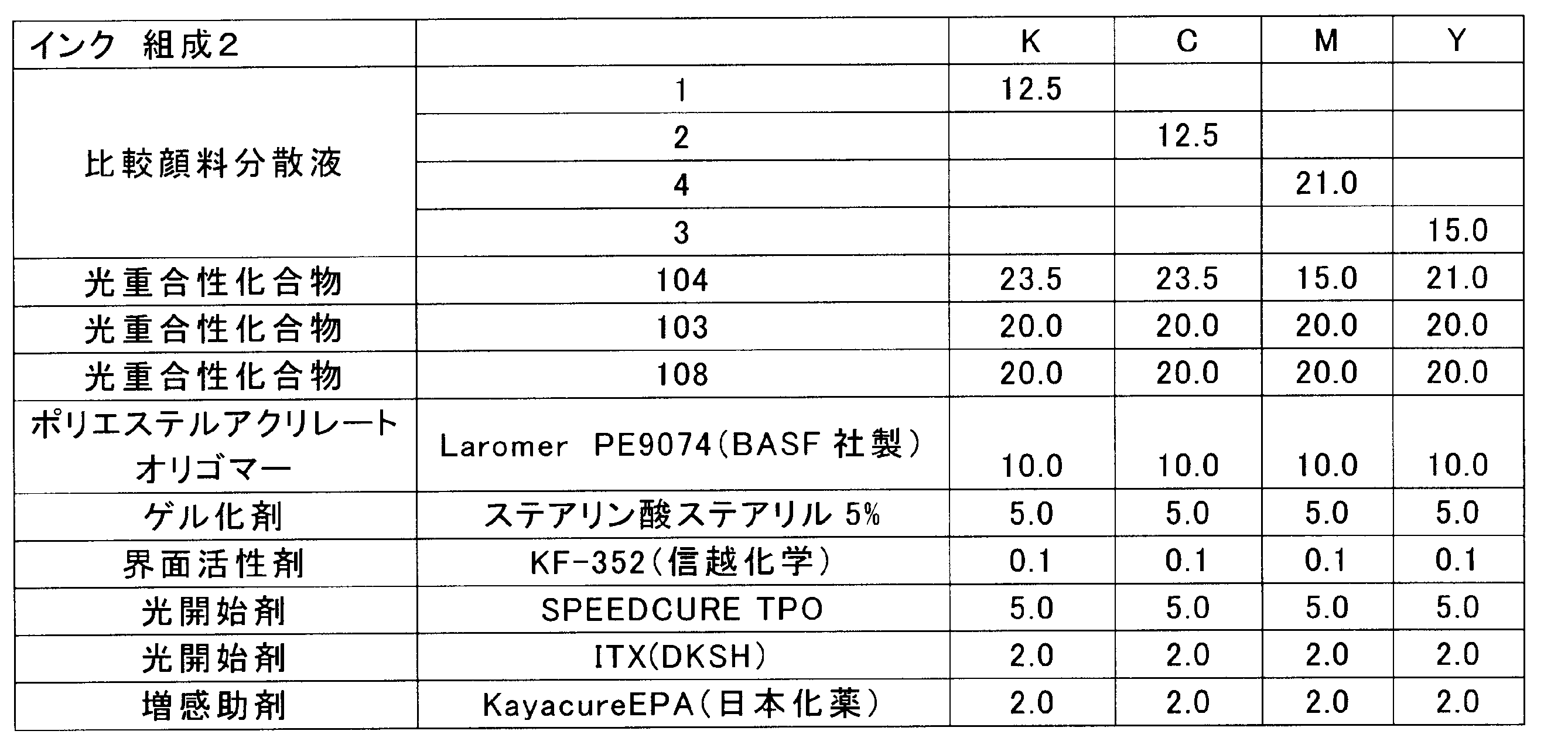
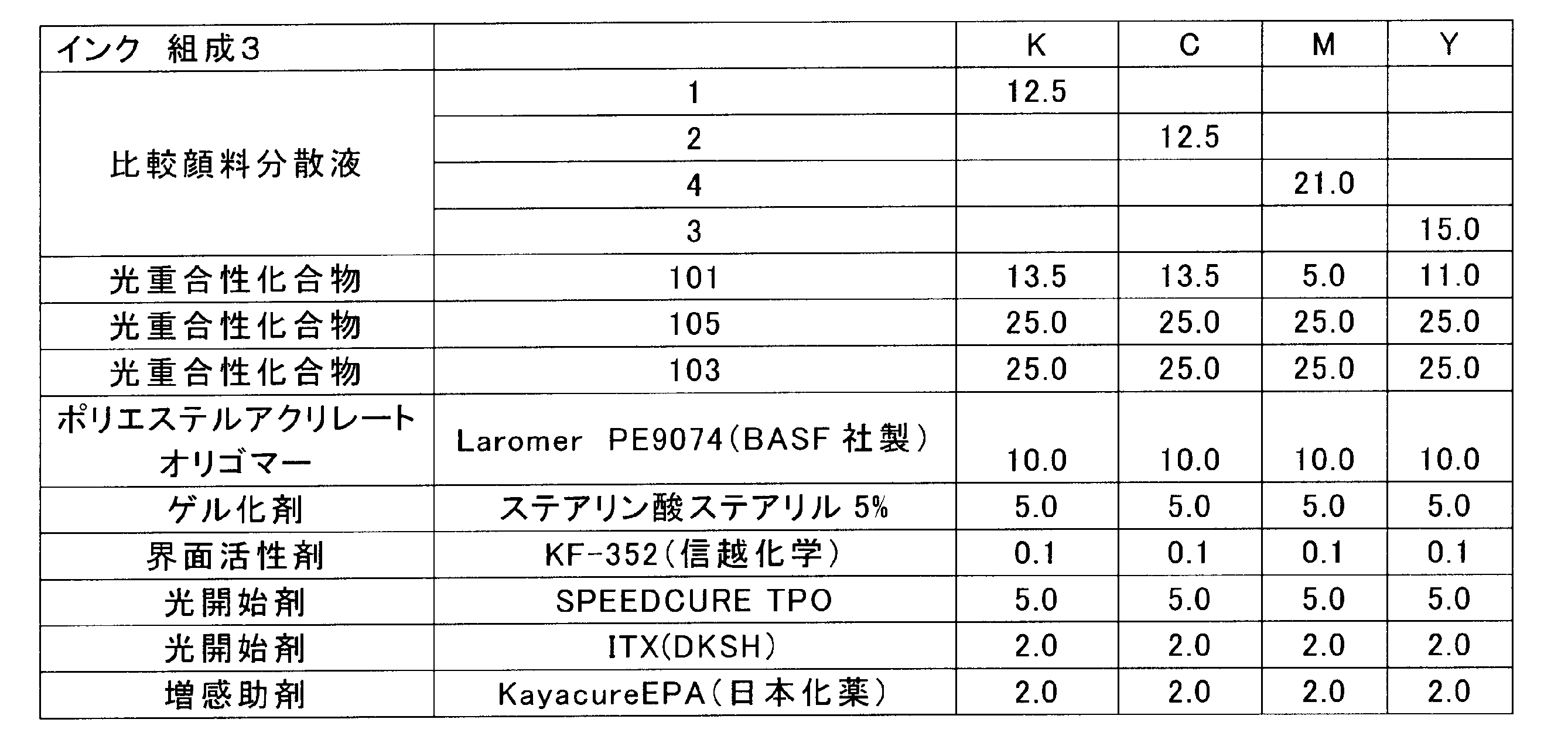
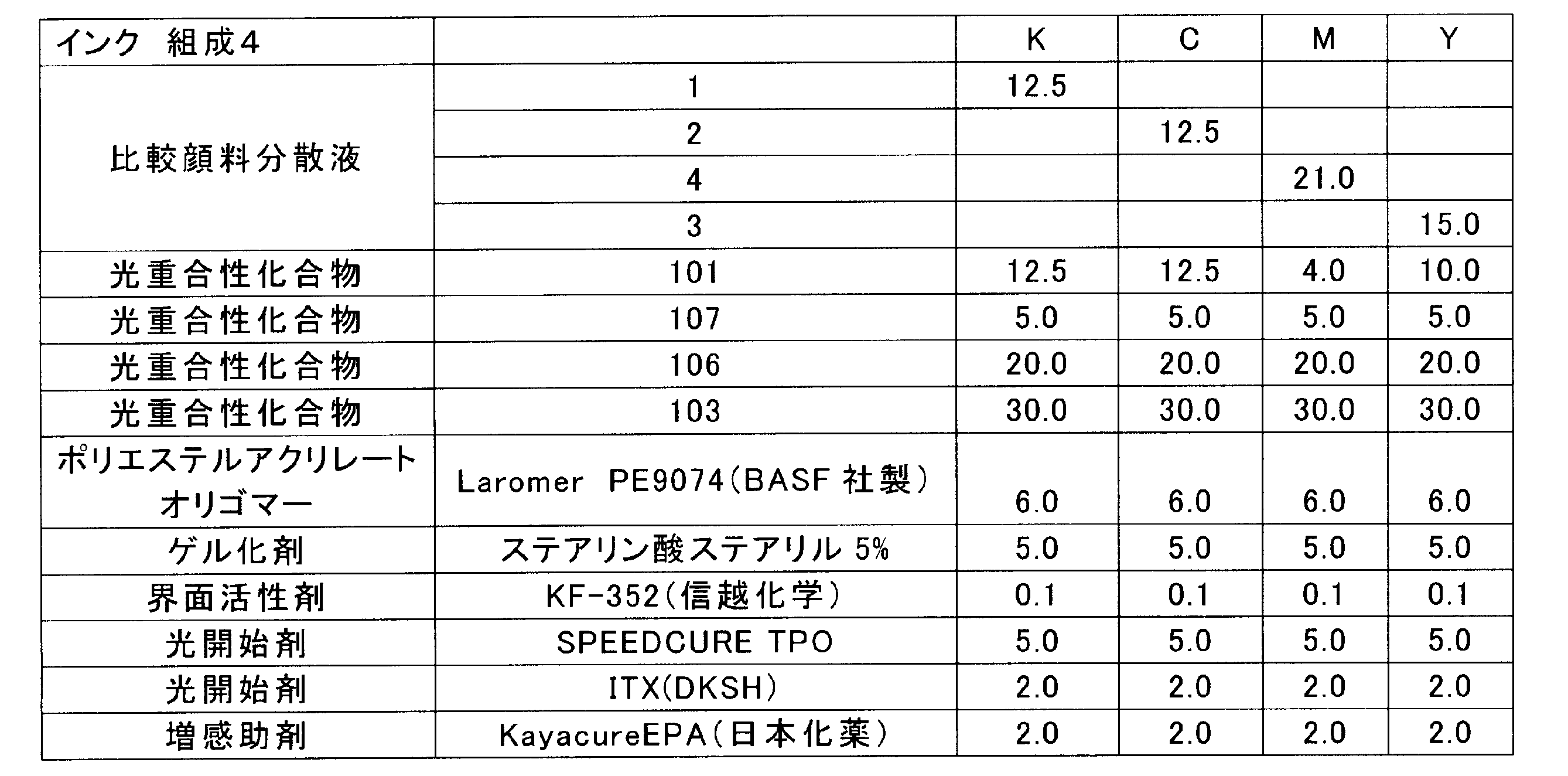
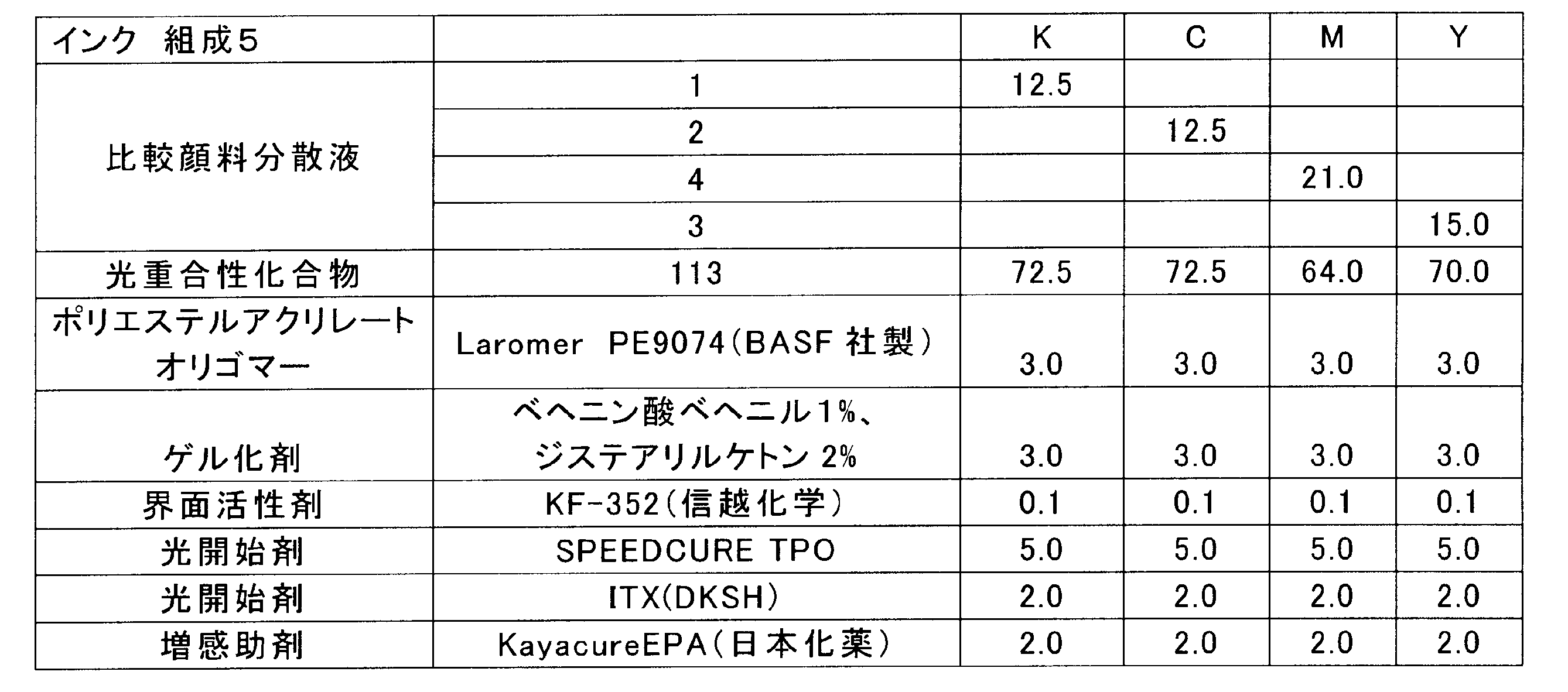


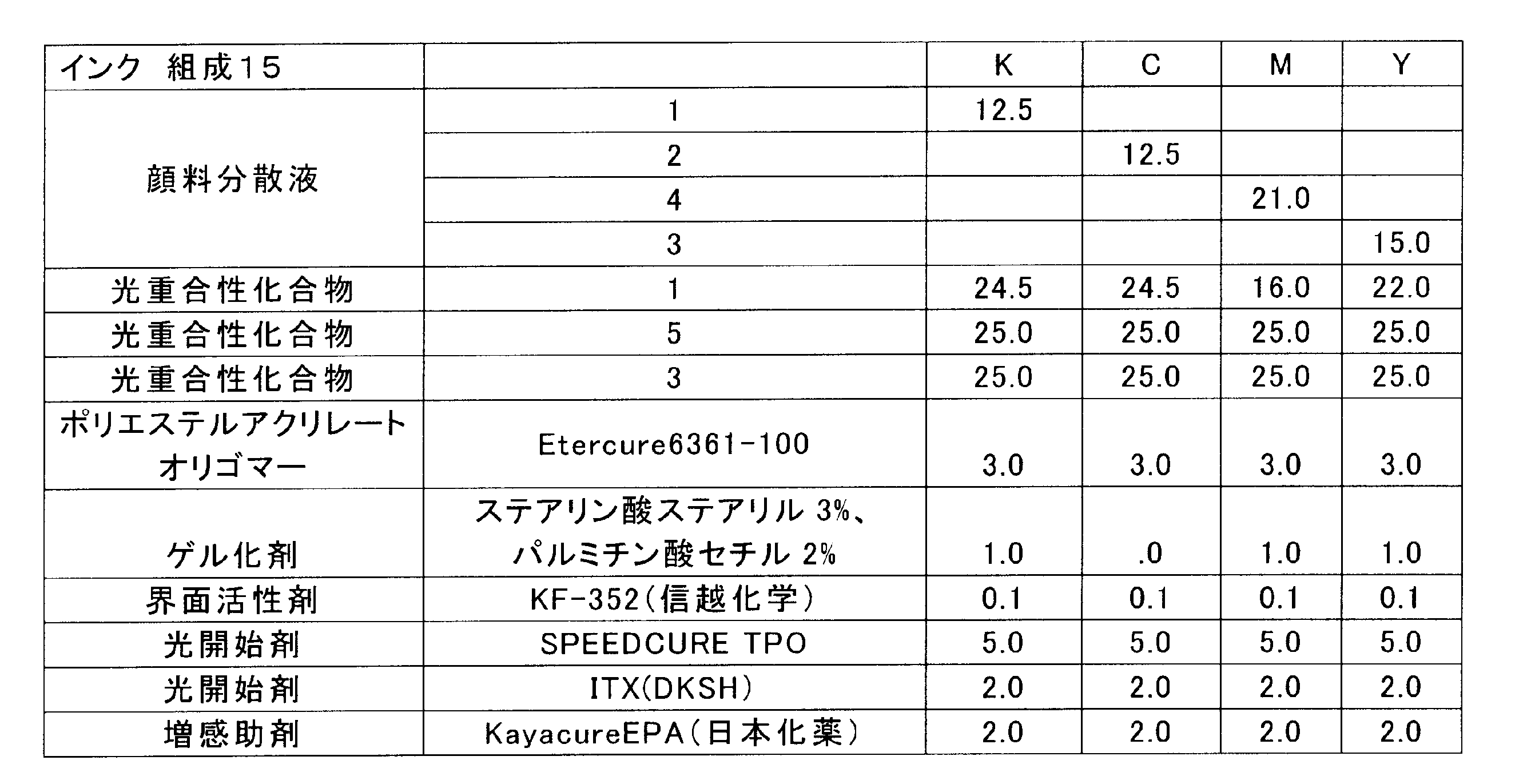
調製した各インク組成物を、ピエゾ型インクジェットノズルを備えたインクジェット記録ヘッドを有するインクジェット記録装置に装填した。この装置を用いて、菊半サイズのコート紙(OKトップコート、王子製紙社製)に、画像記録を行った。なお、記録媒体の搬送速度は、表17に示す速度で行った。

また、表に示す一部の組成のインクを用いて、ノズル径30μm・360dpi解像度のヘッドを用いて、14plの液滴になるように電圧を印加し、ヘッドを各色2個ずつ用い吐出し、720×720dpiのYMCKのベタ画像を形成した。
印字後、Phoseon Technology社製LEDランプ(395nm、8W/cm2、water cooled unit)で硬化した。LEDランプの管面から記録媒体までの距離を50mmとした(搬送方向の照射幅100mm)。
インク導入後すぐに印字した場合と、インク供給系にインクを満たし4日間放置後(90℃加熱のまま)に印字した場合に、下記の各種評価を行った。
〈出射性〉
各実施例及び比較例のインクのYMCKベタ画像出力物について、白ヌケ(ノズル欠による)がないかを目視確認した。
○:白ヌケ無し
△:1,2箇所白ヌケがあるが、実用上問題ないレベル
×:白ヌケ多数発生
〈連続出射性〉
上記インクジェット記録装置を用いて、30分間の連続ベタ出射を行った後、YMCKベタ画像出力物について、白ヌケ(ノズル欠による抜け)がないかを目視確認した。
○:白ヌケ無し
△:1,2箇所白ヌケがあるが、実用上問題ないレベル
×:白ヌケ多数発生
〈硬化性(鉛筆硬度)〉
各試料のOKトップ紙画像出力物について、10枚目の100%印字部を25℃・60%RHの環境下に24時間放置した後、JIS-K-5400に準じて表面の鉛筆硬度を測定し、下記の基準により硬化性の評価を行った。
○:鉛筆硬度2H以上
△:鉛筆硬度H~B
×:鉛筆硬度2B以下
〈ゲル化剤溶解安定性〉
100℃で4時間静置後の溶解状態を目視で観察した。
○:分離、析出なし
△:わずかに白く濁って見える
×:油玉が表面に集まっている(層分離している)
〈画質(文字品質)〉
各試料の画像出力物について、3pt明朝文字「希」を黒文字印字し、品質を目視評価した。
○:再現されている
△:一部文字の潰れが見られる
×:文字が潰れている

12 記録媒体
14、24 インクジェット記録ヘッド
16、26 ヘッドキャリッジ
18、28 活性光線照射部
19 温度制御部
27 ガイド部
Claims (9)
- 光重合性化合物、光開始剤およびゲル化剤を含有し、温度により可逆的にゾルゲル相転移する活性光線硬化型インクジェットインクであって、
前記光重合性化合物は、n個(nは2以上の整数)以上の(メタ)アクリレートエステルユニットを有し、次式で表される、分子量が280~1500の範囲の化合物Aと、
n-1個の(メタ)アクリレートエステルユニットおよび水酸基を有し、次式で表される、分子量が280~1500の範囲の化合物Bとの組み合わせを、1組または複数組含み、

少なくとも1組の前記化合物Aと前記化合物Bとの組み合わせにおいて、前記化合物Bの含有量は、その化合物Bに対応する化合物Aの全質量に対して、5~15質量%であり、
前記ゲル化剤の含有量は、前記インク全質量に対して0.5~7.0質量%であり、
前記インクのゲル化温度は50℃以上であることを特徴とする活性光線硬化型インクジェットインク。 - インク中の、化合物Bの含有量がその化合物Bに対応する化合物Aの全質量に対して5~15質量%となる組み合わせを構成する化合物Aおよび化合物Bの全質量は、化合物Bの含有量がその化合物Bに対応する化合物Aの全質量に対して5~15質量%とならない組み合わせを構成する化合物Aおよび化合物Bの全質量よりも多いことを特徴とする、請求項1に記載の活性光線硬化型インクジェットインク。
- 前記化合物Aが、下記(1)及び(2)のうちの少なくとも一種の(メタ)アクリレート化合物であることを特徴とする請求項1または2に記載の活性光線硬化型インクジェットインク。
(1)分子内に(-C(CH3)H-CH2-O-)又は(-CH2-CH2-O-)で表される構造を3~14個含有する二官能(メタ)アクリレート化合物
(2)分子内に環状構造を持つ二官能以上の(メタ)アクリレート化合物 - すべての前記化合物Aと前記化合物Bとの組み合わせにおいて、前記化合物Bの含有量は、その化合物Bに対応する化合物Aの全質量に対して、5~15質量%であることを特徴とする請求項1~3のいずれか1項に記載のインクジェットインク。
- 前記化合物Aと化合物Bとの組み合わせが、下記一般式(3)-Aで表される化合物と下記一般式(3)-Bで表される化合物との組み合わせ、下記一般式(4)-Aで表される化合物と下記一般式(4)-Bで表される化合物との組み合わせ、下記一般式(5)-Aで表される化合物と下記一般式(5)-Bで表される化合物との組み合わせ、下記一般式(6)-Aで表される化合物と下記一般式(6)-Bで表される化合物のいずれかとの組み合わせ、のうちの少なくとも一種であることを特徴とする請求項1~4のいずれか1項に記載の活性光線硬化型インクジェットインク。


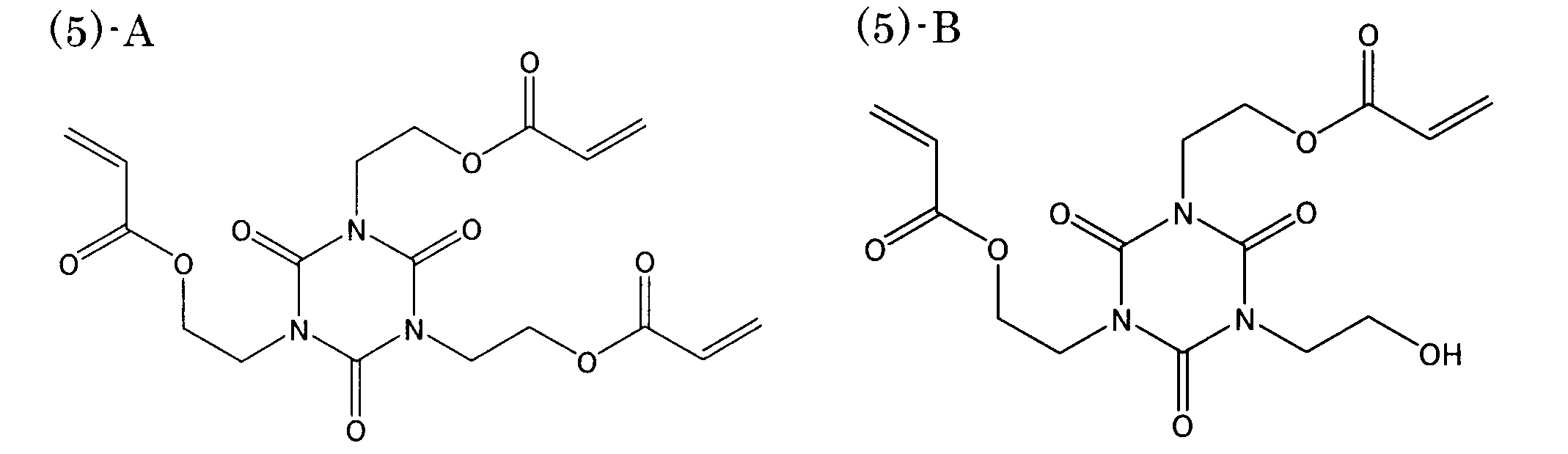

- 分子量が280~1500の範囲に含まれない化合物を実質的に含まないことを特徴とする、請求項1~5のいずれか1項に記載の活性光線硬化型インクジェットインク。
- 色材をさらに含有することを特徴とする、請求項1~6のいずれか1項に記載のインクジェットインク。
- 請求項1~7のいずれか1項に記載の活性光線硬化型インクジェットインクを用いる画像形成方法であって、
前記インクを50~100℃の状態でインクジェットヘッドより吐出し、前記インクが記録材料に着弾する時の記録材料の温度を、前記インクのゾルゲル相転移温度の-20~-10℃の範囲内にすることを特徴とする画像形成方法。 - 複数のインクジェット記録ヘッドを収容するヘッドキャリッジと、インクジェットインクを保有するインクタンクと、前記インクタンク及び前記ヘッドキャリッジに接続されたインク流路と、活性光線照射部と、温度制御部とを有するインクジェット記録装置において、前記インクタンクから前記インクジェット記録ヘッドまでの少なくとも一部に加熱部位を有し、前記インクジェット記録ヘッドおよび前記インク流路の全部または一部は金属部材からなり、請求項1~7のいずれか1項に記載のインクをさらに有する、インクジェット記録装置。
Priority Applications (3)
| Application Number | Priority Date | Filing Date | Title |
|---|---|---|---|
| EP14841948.4A EP3045507B1 (en) | 2013-09-09 | 2014-09-09 | Active-light-curing inkjet ink and image formation method |
| US14/915,040 US9528013B2 (en) | 2013-09-09 | 2014-09-09 | Actinic radiation-curable ink-jet ink and image formation method |
| JP2015535327A JP6311716B2 (ja) | 2013-09-09 | 2014-09-09 | 活性光線硬化型インクジェットインクおよび画像形成方法 |
Applications Claiming Priority (2)
| Application Number | Priority Date | Filing Date | Title |
|---|---|---|---|
| JP2013186249 | 2013-09-09 | ||
| JP2013-186249 | 2013-09-09 |
Publications (1)
| Publication Number | Publication Date |
|---|---|
| WO2015033584A1 true WO2015033584A1 (ja) | 2015-03-12 |
Family
ID=52628080
Family Applications (1)
| Application Number | Title | Priority Date | Filing Date |
|---|---|---|---|
| PCT/JP2014/004632 Ceased WO2015033584A1 (ja) | 2013-09-09 | 2014-09-09 | 活性光線硬化型インクジェットインクおよび画像形成方法 |
Country Status (4)
| Country | Link |
|---|---|
| US (1) | US9528013B2 (ja) |
| EP (1) | EP3045507B1 (ja) |
| JP (1) | JP6311716B2 (ja) |
| WO (1) | WO2015033584A1 (ja) |
Cited By (4)
| Publication number | Priority date | Publication date | Assignee | Title |
|---|---|---|---|---|
| JP2017039917A (ja) * | 2015-08-21 | 2017-02-23 | 東亞合成株式会社 | インクジェットインキ用硬化型組成物 |
| EP3269782A4 (en) * | 2015-03-13 | 2018-01-24 | Konica Minolta, Inc. | Active ray-curable inkjet ink comprising two kinds of waxes that form eutectic crystal and inkjet printing method |
| JP2020097643A (ja) * | 2018-12-17 | 2020-06-25 | コニカミノルタ株式会社 | 活性線硬化型インクおよび画像形成方法 |
| JP2023136700A (ja) * | 2022-03-17 | 2023-09-29 | コニカミノルタ株式会社 | インクジェットインク組成物、記録物、インクジェット記録方法及びインクジェット記録システム |
Families Citing this family (1)
| Publication number | Priority date | Publication date | Assignee | Title |
|---|---|---|---|---|
| KR102844621B1 (ko) | 2020-04-22 | 2025-08-11 | 삼성디스플레이 주식회사 | 발광 소자 잉크 및 표시 장치의 제조 방법 |
Citations (6)
| Publication number | Priority date | Publication date | Assignee | Title |
|---|---|---|---|---|
| JP2005126507A (ja) | 2003-10-22 | 2005-05-19 | Konica Minolta Holdings Inc | インクジェット用インク及びそれを用いたインクジェット記録方法 |
| JP2005255821A (ja) | 2004-03-11 | 2005-09-22 | Konica Minolta Holdings Inc | 活性光線硬化型インクジェットインクとそれを用いたインクジェット記録方法 |
| JP2010111790A (ja) | 2008-11-07 | 2010-05-20 | Konica Minolta Holdings Inc | 活性光線硬化型インクジェット用インクとそれを用いたインクジェット記録方法 |
| US20120287199A1 (en) | 2011-05-11 | 2012-11-15 | Xerox Corporation | High Reactivity Curable Paste Ink Compositions |
| WO2013094198A1 (ja) * | 2011-12-19 | 2013-06-27 | コニカミノルタ株式会社 | 活性光線硬化型インクジェットインク及びそれを用いた画像形成方法 |
| JP2013159615A (ja) * | 2012-02-01 | 2013-08-19 | Seiko Epson Corp | 光硬化型インクジェット記録用インク組成物及び記録方法 |
Family Cites Families (7)
| Publication number | Priority date | Publication date | Assignee | Title |
|---|---|---|---|---|
| US7812064B2 (en) * | 2007-08-07 | 2010-10-12 | Xerox Corporation | Phase change ink compositions |
| JP5764872B2 (ja) * | 2010-04-26 | 2015-08-19 | コニカミノルタ株式会社 | 活性光線硬化型インクジェットインクおよびインクジェット記録方法 |
| JP5747312B2 (ja) * | 2011-02-24 | 2015-07-15 | コニカミノルタ株式会社 | 活性光線硬化型インクジェットインク及び画像形成方法 |
| US8714723B2 (en) * | 2011-05-11 | 2014-05-06 | Xerox Corporation | Robust curable solid inks and methods for using the same |
| JP6054022B2 (ja) * | 2011-09-20 | 2016-12-27 | コニカミノルタ株式会社 | 活性線硬化型インクジェット用インク、および画像記録方法 |
| JP5884455B2 (ja) * | 2011-12-08 | 2016-03-15 | コニカミノルタ株式会社 | 光硬化型インクジェットインクを用いた画像形成方法 |
| JP2015067802A (ja) * | 2013-09-30 | 2015-04-13 | 富士フイルム株式会社 | インクジェット記録用インク、インクセット、画像形成方法及びメンテナンス方法 |
-
2014
- 2014-09-09 WO PCT/JP2014/004632 patent/WO2015033584A1/ja not_active Ceased
- 2014-09-09 JP JP2015535327A patent/JP6311716B2/ja active Active
- 2014-09-09 US US14/915,040 patent/US9528013B2/en active Active
- 2014-09-09 EP EP14841948.4A patent/EP3045507B1/en active Active
Patent Citations (7)
| Publication number | Priority date | Publication date | Assignee | Title |
|---|---|---|---|---|
| JP2005126507A (ja) | 2003-10-22 | 2005-05-19 | Konica Minolta Holdings Inc | インクジェット用インク及びそれを用いたインクジェット記録方法 |
| JP2005255821A (ja) | 2004-03-11 | 2005-09-22 | Konica Minolta Holdings Inc | 活性光線硬化型インクジェットインクとそれを用いたインクジェット記録方法 |
| JP2010111790A (ja) | 2008-11-07 | 2010-05-20 | Konica Minolta Holdings Inc | 活性光線硬化型インクジェット用インクとそれを用いたインクジェット記録方法 |
| US20120287199A1 (en) | 2011-05-11 | 2012-11-15 | Xerox Corporation | High Reactivity Curable Paste Ink Compositions |
| JP2012236998A (ja) | 2011-05-11 | 2012-12-06 | Xerox Corp | 高反応性硬化性ペーストインク組成物 |
| WO2013094198A1 (ja) * | 2011-12-19 | 2013-06-27 | コニカミノルタ株式会社 | 活性光線硬化型インクジェットインク及びそれを用いた画像形成方法 |
| JP2013159615A (ja) * | 2012-02-01 | 2013-08-19 | Seiko Epson Corp | 光硬化型インクジェット記録用インク組成物及び記録方法 |
Non-Patent Citations (1)
| Title |
|---|
| "Organic materials for imaging", 1993, pages: 187 - 192 |
Cited By (7)
| Publication number | Priority date | Publication date | Assignee | Title |
|---|---|---|---|---|
| EP3269782A4 (en) * | 2015-03-13 | 2018-01-24 | Konica Minolta, Inc. | Active ray-curable inkjet ink comprising two kinds of waxes that form eutectic crystal and inkjet printing method |
| US20180066149A1 (en) * | 2015-03-13 | 2018-03-08 | Konica Minolta, Inc. | Actinic ray-curable inkjet ink containing two waxes forming eutectic and inkjet recording method |
| JP2017039917A (ja) * | 2015-08-21 | 2017-02-23 | 東亞合成株式会社 | インクジェットインキ用硬化型組成物 |
| JP2020097643A (ja) * | 2018-12-17 | 2020-06-25 | コニカミノルタ株式会社 | 活性線硬化型インクおよび画像形成方法 |
| JP7147539B2 (ja) | 2018-12-17 | 2022-10-05 | コニカミノルタ株式会社 | 活性線硬化型インクおよび画像形成方法 |
| JP2023136700A (ja) * | 2022-03-17 | 2023-09-29 | コニカミノルタ株式会社 | インクジェットインク組成物、記録物、インクジェット記録方法及びインクジェット記録システム |
| JP7753937B2 (ja) | 2022-03-17 | 2025-10-15 | コニカミノルタ株式会社 | インクジェットインク組成物、記録物、インクジェット記録方法及びインクジェット記録システム |
Also Published As
| Publication number | Publication date |
|---|---|
| EP3045507A1 (en) | 2016-07-20 |
| US20160208118A1 (en) | 2016-07-21 |
| EP3045507A4 (en) | 2017-03-29 |
| US9528013B2 (en) | 2016-12-27 |
| JPWO2015033584A1 (ja) | 2017-03-02 |
| JP6311716B2 (ja) | 2018-04-18 |
| EP3045507B1 (en) | 2019-08-07 |
Similar Documents
| Publication | Publication Date | Title |
|---|---|---|
| JP5880257B2 (ja) | 活性光線硬化型インクジェットインク及び画像形成方法 | |
| JP5880228B2 (ja) | 活性光線硬化型インクジェットインク、及びこれを用いた画像形成方法 | |
| JP5659619B2 (ja) | インクジェット記録方法 | |
| JP5780358B2 (ja) | 画像形成方法 | |
| US9714354B2 (en) | Active ray-curable inkjet ink and image forming method using same | |
| JP5500168B2 (ja) | 活性光線硬化型インクジェット用インクおよびインクジェット画像形成方法 | |
| JP6451733B2 (ja) | 画像形成方法 | |
| WO2012132406A1 (ja) | 活性線硬化型インクジェット用インクおよびそれを用いた画像記録方法 | |
| WO2013128945A1 (ja) | インクジェット記録方法 | |
| JP6070698B2 (ja) | 活性光線硬化型インクジェットインク及びこれを用いた画像形成方法 | |
| JP6038831B2 (ja) | インクジェット記録方法 | |
| JP5884455B2 (ja) | 光硬化型インクジェットインクを用いた画像形成方法 | |
| JP5811021B2 (ja) | 光硬化型インクジェットインクおよびそれを用いた画像形成方法 | |
| JP6311716B2 (ja) | 活性光線硬化型インクジェットインクおよび画像形成方法 | |
| JP5857866B2 (ja) | 活性光線硬化型インクジェットインク、およびインクジェット記録方法 | |
| JP6733659B2 (ja) | 共晶を形成する二種のワックスを含む活性光線硬化型インクジェットインクおよびインクジェット記録方法 | |
| WO2016002834A1 (ja) | 活性光線硬化型インクジェットインク及び画像形成方法 | |
| JP2017132861A (ja) | 活性光線硬化型インクジェットインク及びインクジェット画像形成方法 | |
| WO2015152177A1 (ja) | 画像形成方法 | |
| JPWO2017126439A1 (ja) | 活性光線硬化型インクジェットインクおよびインクジェット記録方法 | |
| JP5807608B2 (ja) | 活性光線硬化型インクジェットインク | |
| JP6477685B2 (ja) | 活性光線硬化型インクジェットインクの充填方法および画像形成方法 |
Legal Events
| Date | Code | Title | Description |
|---|---|---|---|
| 121 | Ep: the epo has been informed by wipo that ep was designated in this application |
Ref document number: 14841948 Country of ref document: EP Kind code of ref document: A1 |
|
| ENP | Entry into the national phase |
Ref document number: 2015535327 Country of ref document: JP Kind code of ref document: A |
|
| WWE | Wipo information: entry into national phase |
Ref document number: 14915040 Country of ref document: US |
|
| REEP | Request for entry into the european phase |
Ref document number: 2014841948 Country of ref document: EP |
|
| WWE | Wipo information: entry into national phase |
Ref document number: 2014841948 Country of ref document: EP |
|
| NENP | Non-entry into the national phase |
Ref country code: DE |