WO2015040979A1 - 研磨用組成物 - Google Patents
研磨用組成物 Download PDFInfo
- Publication number
- WO2015040979A1 WO2015040979A1 PCT/JP2014/071209 JP2014071209W WO2015040979A1 WO 2015040979 A1 WO2015040979 A1 WO 2015040979A1 JP 2014071209 W JP2014071209 W JP 2014071209W WO 2015040979 A1 WO2015040979 A1 WO 2015040979A1
- Authority
- WO
- WIPO (PCT)
- Prior art keywords
- polishing
- propyl
- group
- silica
- polishing composition
- Prior art date
- Legal status (The legal status is an assumption and is not a legal conclusion. Google has not performed a legal analysis and makes no representation as to the accuracy of the status listed.)
- Ceased
Links
Classifications
-
- B—PERFORMING OPERATIONS; TRANSPORTING
- B24—GRINDING; POLISHING
- B24B—MACHINES, DEVICES, OR PROCESSES FOR GRINDING OR POLISHING; DRESSING OR CONDITIONING OF ABRADING SURFACES; FEEDING OF GRINDING, POLISHING, OR LAPPING AGENTS
- B24B37/00—Lapping machines or devices; Accessories
- B24B37/04—Lapping machines or devices; Accessories designed for working plane surfaces
- B24B37/042—Lapping machines or devices; Accessories designed for working plane surfaces operating processes therefor
- B24B37/044—Lapping machines or devices; Accessories designed for working plane surfaces operating processes therefor characterised by the composition of the lapping agent
-
- B—PERFORMING OPERATIONS; TRANSPORTING
- B24—GRINDING; POLISHING
- B24B—MACHINES, DEVICES, OR PROCESSES FOR GRINDING OR POLISHING; DRESSING OR CONDITIONING OF ABRADING SURFACES; FEEDING OF GRINDING, POLISHING, OR LAPPING AGENTS
- B24B37/00—Lapping machines or devices; Accessories
-
- C—CHEMISTRY; METALLURGY
- C09—DYES; PAINTS; POLISHES; NATURAL RESINS; ADHESIVES; COMPOSITIONS NOT OTHERWISE PROVIDED FOR; APPLICATIONS OF MATERIALS NOT OTHERWISE PROVIDED FOR
- C09G—POLISHING COMPOSITIONS; SKI WAXES
- C09G1/00—Polishing compositions
- C09G1/02—Polishing compositions containing abrasives or grinding agents
-
- C—CHEMISTRY; METALLURGY
- C09—DYES; PAINTS; POLISHES; NATURAL RESINS; ADHESIVES; COMPOSITIONS NOT OTHERWISE PROVIDED FOR; APPLICATIONS OF MATERIALS NOT OTHERWISE PROVIDED FOR
- C09K—MATERIALS FOR MISCELLANEOUS APPLICATIONS, NOT PROVIDED FOR ELSEWHERE
- C09K3/00—Materials not provided for elsewhere
- C09K3/14—Anti-slip materials; Abrasives
- C09K3/1436—Composite particles, e.g. coated particles
-
- C—CHEMISTRY; METALLURGY
- C09—DYES; PAINTS; POLISHES; NATURAL RESINS; ADHESIVES; COMPOSITIONS NOT OTHERWISE PROVIDED FOR; APPLICATIONS OF MATERIALS NOT OTHERWISE PROVIDED FOR
- C09K—MATERIALS FOR MISCELLANEOUS APPLICATIONS, NOT PROVIDED FOR ELSEWHERE
- C09K3/00—Materials not provided for elsewhere
- C09K3/14—Anti-slip materials; Abrasives
- C09K3/1454—Abrasive powders, suspensions and pastes for polishing
- C09K3/1463—Aqueous liquid suspensions
-
- H—ELECTRICITY
- H10—SEMICONDUCTOR DEVICES; ELECTRIC SOLID-STATE DEVICES NOT OTHERWISE PROVIDED FOR
- H10P—GENERIC PROCESSES OR APPARATUS FOR THE MANUFACTURE OR TREATMENT OF DEVICES COVERED BY CLASS H10
- H10P52/00—Grinding, lapping or polishing of wafers, substrates or parts of devices
- H10P52/40—Chemomechanical polishing [CMP]
- H10P52/403—Chemomechanical polishing [CMP] of conductive or resistive materials
-
- H—ELECTRICITY
- H10—SEMICONDUCTOR DEVICES; ELECTRIC SOLID-STATE DEVICES NOT OTHERWISE PROVIDED FOR
- H10P—GENERIC PROCESSES OR APPARATUS FOR THE MANUFACTURE OR TREATMENT OF DEVICES COVERED BY CLASS H10
- H10P95/00—Generic processes or apparatus for manufacture or treatments not covered by the other groups of this subclass
- H10P95/06—Planarisation of inorganic insulating materials
- H10P95/062—Planarisation of inorganic insulating materials involving a dielectric removal step
Definitions
- the present invention relates to a polishing composition used in a semiconductor device manufacturing process and a polishing method using the same.
- CMP chemical mechanical polishing
- CMP has been applied to each process in semiconductor manufacturing, and one aspect thereof is, for example, application to a gate formation process in transistor fabrication.
- Patent Document 2 discloses a polishing composition having a pH of 2.5 to 5 containing colloidal silica and an organic acid having a sulfonic acid group or a phosphonic acid group. According to Patent Document 2, for example, when polishing a Si-containing material different from silicon nitride and polysilicon, the polishing rate of the layer containing silicon nitride can be increased by using the polishing composition. In addition, polishing of a layer containing a silicon-based compound such as polysilicon, modified polysilicon, silicon oxide, silicon carbide, and silicon oxide carbide can be selectively suppressed.
- a silicon-based compound such as polysilicon, modified polysilicon, silicon oxide, silicon carbide, and silicon oxide carbide
- an object of the present invention is to provide a polishing composition capable of sufficiently controlling the polishing rate of the Si-containing material.
- the present inventors have intensively studied to solve the above problems. As a result, it has been surprisingly found that the above-mentioned problems can be solved by immobilizing specific functional groups on the silica surface, and the present invention has been completed.
- the present invention is a polishing composition
- a polishing composition comprising silica having a functional group satisfying at least one of the following conditions (1) and (2) immobilized on the surface and a pH adjuster; Condition (1): the functional group has an amino group, Condition (2): The functional group has a halogeno group.
- a polishing composition capable of sufficiently controlling the polishing rate of a Si-containing material can be provided.
- X to Y indicating a range means “X or more and Y or less”. Unless otherwise specified, measurement of operation and physical properties is performed under conditions of room temperature (20 to 25 ° C.) / Relative humidity 40 to 50%.
- the first of the present invention is a silica in which a functional group satisfying at least one of the following conditions (1) and (2) is immobilized on the surface (hereinafter referred to as “silica in which a specific functional group is immobilized on the surface”). "Or simply” silica ”) and a pH adjusting agent; Condition (1): the functional group has an amino group, Condition (2): The functional group has a halogeno group.
- the polishing rate of the Si-containing material can be sufficiently controlled. Although the detailed reason for such an effect is unclear, it is presumed to be due to the following mechanism.
- the polishing composition is used to polish silicon nitride.
- the rate can be reduced.
- the zeta potential of the silica on which the functional group is immobilized changes to a value different from that of the original silica by immobilizing the functional group having an amino group on the silica surface.
- the zeta potential has the same sign as the zeta potential of silicon nitride.
- silicon nitride and halogeno groups also undergo a nucleophilic addition reaction, and silicon atoms and halogeno groups are bonded, but silicon nitride is a strong crystal, so it does not exhibit a polishing rate as high as that of polycrystalline silicon. Guessed.
- the polishing composition of the present invention essentially contains silica in which a functional group satisfying at least one of the conditions (1) and (2) is immobilized on the surface.
- the silica has a function as abrasive grains in the polishing composition.
- a functional group that satisfies at least one of the conditions (1) and (2) may be immobilized on the surface. That is, the silica of the present invention has (i) a case where only a functional group having an amino group is immobilized on the surface; (ii) a case where only a functional group having a halogeno group is immobilized on the surface; A case where a functional group having both an amino group and a halogeno group is immobilized on the surface; and (iv) a case where both the functional group having an amino group and a functional group having a halogeno group are immobilized on the surface. Include. Among these, the case of (i) or (ii) is preferable from the viewpoint of the stability of the composition. Hereinafter, cases (i) and (ii) will be described.
- Silica used as a raw material before the functional group is immobilized (hereinafter, also simply referred to as “raw silica”) is not particularly limited, and examples thereof include fumed silica and colloidal silica. Among these, colloidal silica is preferable from the viewpoint of dispersion stability of the abrasive grains in the polishing composition.
- Silica in which a functional group having an amino group is immobilized on the surface has a functional group having an amino group chemically bonded (for example, covalently bonded) to the silica surface.
- the functional group having an amino group is not particularly limited, and may be composed only of an amino group, or may be one in which an amino group is bonded to a linker structure. In the latter case, one functional group may have one amino group or a plurality of amino groups.
- the linker structure is not particularly limited, but from the viewpoint of dispersion stability and reactivity of the abrasive grains in the polishing composition, a linear or branched alkylene group having 2 to 5 carbon atoms (—C n H 2n —) , An oxyalkylene group (—OC n H 2n —), an arylene group, or a combination thereof.
- Specific examples of the functional group having an amino group include a functional group derived from a silane coupling agent described later.
- Silica in which a functional group having a halogeno group is immobilized on the surface has a functional group having a halogeno group chemically bonded (for example, covalently bonded) to the silica surface.
- halogeno group examples include a fluoro group (—F), a chloro group (—Cl), a bromo group (—Br), and an iodo group (—I).
- a chloro group, a bromo group, and an iodo group are preferable, and a chloro group and a bromo group are more preferable.
- the functional group having a halogeno group is not particularly limited, and may be composed only of a halogeno group, or may be one in which a halogeno group is bonded to a linker structure. In the latter case, one functional group may have one or a plurality of halogeno groups. In this case, only one kind of halogeno group may be present, or 2 More than one species may be combined.
- the linker structure is not particularly limited, but from the viewpoint of dispersion stability and reactivity of the abrasive grains in the polishing composition, a linear or branched alkylene group having 2 to 5 carbon atoms (—C n H 2n —) , An oxyalkylene group (—OC n H 2n —), an arylene group, or a combination thereof.
- a linear or branched alkylene group having 2 to 5 carbon atoms —C n H 2n —)
- An oxyalkylene group —OC n H 2n —
- an arylene group or a combination thereof.
- Specific examples of the functional group having a halogeno group include a functional group derived from a silane coupling agent described later.
- Silica usually forms secondary particles by agglomerating primary particles made of SiO 2 .
- the average primary particle diameter of silica formed by fixing the specific functional group of the present invention on the surface is preferably 5 nm or more, more preferably 7 nm or more, and further preferably 10 nm or more. As the average primary particle size increases, there is an advantage that the polishing rate of the object to be polished by the polishing composition is improved.
- the average primary particle diameter of silica having a specific functional group immobilized on the surface thereof is preferably 150 nm or less, more preferably 120 nm or less, and further preferably 100 nm or less.
- the average primary particle size is calculated based on the specific surface area measured by the BET method.
- the average secondary particle diameter of silica formed by immobilizing a specific functional group of the present invention on the surface is preferably 10 nm or more, more preferably 15 nm or more, and further preferably 20 nm or more. As the average secondary particle size increases, there is an advantage that the polishing rate of the object to be polished by the polishing composition is improved.
- the average secondary particle diameter of silica formed by immobilizing a specific functional group on the surface is preferably 200 nm or less, more preferably 180 nm or less, and further preferably 150 nm or less.
- the average secondary particle size decreases, there is an advantage that it is possible to suppress the generation of scratches on the surface of the object to be polished after polishing with the polishing composition.
- the value of the average secondary particle diameter is calculated based on the specific surface area measured by the light scattering method using laser light.
- the silica in which the specific functional group of the present invention is immobilized on the surface may be a synthetic product or a commercially available product. Moreover, the silica by which a specific functional group is fix
- immobilized on the surface may be used individually by 1 type, and may be used in combination of 2 or more type.
- the method for producing silica in which the specific functional group of the present invention is immobilized on the surface is not particularly limited, but, for example, a silane coupling agent having a specific functional group is added to the raw silica and reacted, It can be produced by bonding a specific functional group to the surface of silica.
- the silane coupling agent having an amino group is not particularly limited. Specific examples thereof include (3-aminopropyl) triethoxysilane, (3-aminopropyl) tripropoxysilane, and (3-aminopropyl) tributoxy.
- Silane (aminopropyl) trialkoxysilane, (3-aminopropyl) methyldimethoxysilane, (3-aminopropyl) methyldiethoxysilane, (3-aminopropyl) methyldipropoxysilane, (3-aminopropyl) Methyldibutoxysilane, (3-aminopropyl) ethyldimethoxysilane, (3-aminopropyl) propyldimethoxysilane, (3-aminopropyl) butyldimethoxysilane, (3-aminopropyl) ethyldiethoxysilane, (3-amino Propyl) propyldie Xysilane, (3-aminopropyl) butyldiethoxysilane, (3-aminopropyl) ethyldipropoxysilane, (3-aminopropyl) propyldipropoxy
- [(Dimethylamino) propyl] trialkoxysilane such as [propyl] tripropoxysilane, [3- (dimethylamino) propyl] tributoxysilane, [3- (dimethylamino) propyl] methyldimethoxysilane, [3- (dimethyl) Amino) propyl] ethyldimethoxysilane, [3- (dimethylamino) propyl] propyldimethoxysilane, [3- (dimethylamino) propyl] butyldimethoxysilane, [3- (dimethylamino) propyl] methyldiethoxysilane, [3 -(Dimethyl Mino) propyl] ethyldiethoxysilane, [3- (dimethylamino) propyl] propyldiethoxysilane, [3- (dimethylamino) propyl] but
- [(Dimethylamino) pro [Lu] alkyldialkoxysilane, [3- (dimethylamino) propyl] dimethylmethoxysilane, [3- (dimethylamino) propyl] diethylmethoxysilane, [3- (dimethylamino) propyl] dipropylmethoxysilane, [3- (Dimethylamino) propyl] dibutylmethoxysilane, [3- (dimethylamino) propyl] dimethylethoxysilane, [3- (dimethylamino) propyl] diethylethoxysilane, [3- (dimethylamino) propyl] dipropylethoxysilane, [3- (dimethylamino) propyl] dibutylethoxysilane, [3- (dimethylamino) propyl] dimethylpropoxysilane, [3- (di
- (3-aminopropyl) trihalosilane such as (dialkylalkoxysilyl) propyl] trimethylammonium, (3-aminopropyl) trichlorosilane, (3-aminopropyl) tribromosilane, [3- (2-aminoethylamino) [(Aminoalkylamino) propyl] trialkoxysilane, such as [propyl] trimethoxysilane, [3- (6-aminohexylamino) propyl] trimethoxysilane, [3- (2-aminoethylamino) propyl [(Aminoalkylamino) propyl] alkyl dialkoxysilane, such as methyldimethoxysilane, [3- (6-aminohexylamino) propyl] methyldimethoxysilane, [3- (2-aminoethylamino) propyl] dimethyl
- silane coupling agents having an amino group 3-aminopropyl) triethoxysilane, (3-aminopropyl) ethyldiethoxysilane, (3-amino) are used from the viewpoint of reactivity with raw silica and stability.
- Propyl) diethylethoxysilane is preferred.
- the silane coupling agent having a halogeno group is not particularly limited.
- Specific examples of the silane coupling agent having a chloro group include, for example, (3-chloropropyl) trimethoxysilane, (3-chloropropyl) triethoxysilane, (3-chloropropyl) tripropoxysilane, (3-chloro (Chloropropyl) trialkoxysilane, (3-chloropropyl) methyldimethoxysilane, (3-chloropropyl) methyldiethoxysilane, (3-chloropropyl) methyldipropoxysilane, (3 -Chloropropyl) methyldibutoxysilane, (3-chloropropyl) ethyldimethoxysilane, (3-chloropropyl) ethyldiethoxysilane, (3-chloropropyl) ethyldipropoxysilane, (3-
- silane coupling agent having a bromo group examples include (3-bromopropyl) trimethoxysilane, (3-bromopropyl) triethoxysilane, (3-bromopropyl) tripropoxysilane, (3 (Bromopropyl) tributoxysilane, (bromopropyl) trialkoxysilane, (3-bromopropyl) methyldimethoxysilane, (3-bromopropyl) methyldiethoxysilane, (3-bromopropyl) methyldipropoxysilane, (3-bromopropyl) methyldibutoxysilane, (3-bromopropyl) ethyldimethoxysilane, (3-bromopropyl) ethyldiethoxysilane, (3-bromopropyl) ethyldipropoxysilane, (3-bromopropyl) ethyl Dibut
- the silane coupling agent having a fluoro group or an iodo group For the silane coupling agent having a fluoro group or an iodo group, the chlorine atom or the bromo atom in the compounds mentioned as specific examples of the silane coupling agent having a chloro group or a bromo group is changed to a fluorine atom or an iodine atom, respectively.
- a silane coupling agent replaced with can be used.
- silane coupling agents having a halogeno group 3-chloropropyl) trimethoxysilane, (3-chloropropyl) triethoxysilane, (3-bromopropyl) are used from the viewpoint of reactivity and stability with raw material silica. ) Trimethoxysilane, (3-bromopropyl) triethoxysilane are preferred.
- the said silane coupling agent may be individual or may use 2 or more types together.
- the silane coupling agent may be a commercially available product or a synthetic product.
- a method for synthesizing a silane coupling agent having an amino group is not particularly limited.
- a halogen-containing silane compound such as (3-bromopropyl) trimethoxysilane and the compound having an amino group are mixed with sulfuric acid.
- a known method of reacting in a solvent such as toluene and xylene in the presence of an acid catalyst.
- the solvent used in the synthesis reaction of the raw material silica and the silane coupling agent is not particularly limited.
- water and other organic solvents such as lower alcohols such as methanol, ethanol, n-propanol, isopropyl alcohol, Examples thereof include ketones such as acetone and methyl ethyl ketone, ethers such as diethyl ether, dioxane and tetrahydrofuran, amides such as N, N-dimethylformamide, and sulfoxides such as dimethyl sulfoxide.
- organic solvents are preferred. These solvents may be used alone or in combination of two or more.
- a hydrophilic solvent for example, when adding a silane coupling agent to water-dispersed colloidal silica, it is preferable to add a hydrophilic solvent to such an extent that the silane coupling agent dissolves.
- the hydrophilic organic solvent include alcohols such as methanol, ethanol, and isopropyl alcohol. Among these, it is preferable to use the same type of alcohol as that generated by hydrolysis of the silane coupling agent. This is because the solvent can be recovered and reused more easily by using the same kind of alcohol as that produced by hydrolysis of the silane coupling agent.
- the lower limit of the amount of the silane coupling agent during the synthesis reaction is 0.1 mol% or more It is preferably 1 mol% or more, more preferably 10 mol% or more.
- the upper limit of the amount of the silane coupling agent used in the synthesis reaction is preferably 90 mol% or less, more preferably 85 mol% or less, and more preferably 80 mol, with the number of moles of raw material silica being 100 mol%. More preferably, it is% or less. Within this range, the zeta potential in acidity is sufficiently stable, and the raw material silica can be prevented from gelation over time.
- colloidal silica such as colloidal silica
- colloidal silica when used as a raw material, it can be prepared by adding 5 mmol of a silane coupling agent to 195 g of silica.
- the addition amount of the silane coupling agent is preferably 3 mmol to 15 mmol with respect to 195 g of silica.
- the atmosphere during the synthesis reaction is not particularly limited, and can be performed under an air atmosphere, an inert gas atmosphere such as nitrogen or argon, or under vacuum.
- the pH during the synthesis reaction is not particularly limited, but is preferably 7 or more and 11 or less. If it is this range, a silane coupling agent can react with raw material silica efficiently, and the possibility that silane coupling agents may self-condense can be reduced.
- the lower limit of the reaction temperature is not particularly limited, but is preferably 5 ° C or higher, more preferably 7 ° C or higher, and further preferably 10 ° C or higher.
- the upper limit of the reaction temperature is not particularly limited, but is preferably 100 ° C. or lower, more preferably 95 ° C. or lower, and further preferably 90 ° C. or lower. If it is this range, a silane coupling agent can be made to react with raw material silica efficiently.
- the lower limit of the reaction time is not particularly limited, but is preferably 1 hour or longer, more preferably 2 hours or longer, and further preferably 3 hours or longer. If it is this range, a silane coupling agent can be made to react with raw material silica efficiently.
- the upper limit of the reaction time is not particularly limited, but is usually 24 hours or less from the viewpoint of workability.
- the synthesis reaction may be performed in one stage, or may be performed in two stages by changing the reaction temperature.
- reaction solvent is distilled off under reduced pressure using a rotary evaporator or the like, whereby silica having the target specific functional group immobilized on the surface can be obtained.
- the content of silica in the polishing composition is not particularly limited, but is preferably 0.05% by mass or more, more preferably 0.1% by mass or more, and further preferably 0.5% by mass or more. is there. As the silica content increases, there is an advantage that the polishing rate of the object to be polished by the polishing composition is improved.
- the content of silica in the polishing composition is not particularly limited, but is preferably 50% by mass or less, more preferably 25% by mass or less, and further preferably 20% by mass or less. As the silica content decreases, the production cost can be reduced.
- the polishing composition of the present invention contains a pH adjuster in order to adjust the pH to a desired value.
- a pH adjuster include the following acids or alkalis.
- the pH adjuster may be either acid or alkali, and may be either an inorganic compound or an organic compound.
- the acid include, for example, inorganic acids such as sulfuric acid, nitric acid, boric acid, carbonic acid, hypophosphorous acid, phosphorous acid and phosphoric acid; formic acid, acetic acid, propionic acid, butyric acid, valeric acid, 2-methylbutyric acid , N-hexanoic acid, 3,3-dimethylbutyric acid, 2-ethylbutyric acid, 4-methylpentanoic acid, n-heptanoic acid, 2-methylhexanoic acid, n-octanoic acid, 2-ethylhexanoic acid, benzoic acid, glycol Acids, salicylic acid, glyceric acid, oxalic acid, malonic acid, succinic acid, glutaric acid, adipic acid, pimelic acid, maleic acid, glycol Acids, salicylic
- alkali examples include amines such as ammonia, ethylenediamine and piperazine, and quaternary ammonium salts such as tetramethylammonium and tetraethylammonium, and metal hydroxides such as potassium hydroxide and sodium hydroxide.
- amines such as ammonia, ethylenediamine and piperazine
- quaternary ammonium salts such as tetramethylammonium and tetraethylammonium
- metal hydroxides such as potassium hydroxide and sodium hydroxide.
- pH adjusters from the viewpoint of the stability of the composition, inorganic acids or metal hydroxides are preferable, and nitric acid, sulfuric acid, and potassium hydroxide are more preferable.
- the pH of the polishing composition of the present invention is preferably 0.5 or more, more preferably 1 or more, and further preferably 2 or more. There is an advantage that handling becomes easier as the pH increases.
- the pH of the polishing composition of the present invention is preferably 12 or less, more preferably 11.5 or less, and even more preferably 11 or less. There is an advantage that the dissolution of silica can be suppressed as the pH decreases.
- the content of the pH adjusting agent in the polishing composition is not particularly limited, and the content may be appropriately selected so as to be in the above pH range.
- the polishing composition of the present invention may contain a dispersion medium or a solvent.
- a dispersion medium or a solvent an organic solvent and water are conceivable, and among them, water is preferably included. From the viewpoint of inhibiting the action of other components, water containing as little impurities as possible is preferable. Specifically, pure water, ultrapure water, or distilled water from which foreign ions are removed through a filter after removing impurity ions with an ion exchange resin is preferable.
- the polishing composition of the present invention comprises, if necessary, abrasive grains other than silica (hereinafter also referred to as “other abrasive grains”) having a specific functional group immobilized on the surface, a complexing agent, You may further contain other components, such as a metal anticorrosive agent, antiseptic
- other abrasive grains, oxidizing agents, preservatives, and fungicides will be described.
- the abrasive grains other than silica may be any of inorganic particles, organic particles, and organic-inorganic composite particles.
- the inorganic particles include, for example, particles made of metal oxides such as silica (excluding the above-described specific functional group immobilized on the surface), alumina, ceria, titania, silicon nitride particles, carbonized particles, and the like. Examples thereof include silicon particles and boron nitride particles.
- Specific examples of the organic particles include polymethyl methacrylate (PMMA) particles.
- PMMA polymethyl methacrylate
- Other abrasive grains may be used alone or in admixture of two or more. As other abrasive grains, commercially available products or synthetic products may be used.
- the oxidizing agent oxidizes the surface of the object to be polished and improves the polishing rate of the object to be polished by the polishing composition.
- the oxidizing agent examples include peroxides.
- peroxides include hydrogen peroxide, peracetic acid, percarbonate, urea peroxide, perhalogen acids such as perchloric acid and periodic acid, and sodium persulfate, potassium persulfate, ammonium persulfate, and the like.
- Persulfates are mentioned.
- These oxidizing agents may be used alone or in combination of two or more. Among these, from the viewpoint of reactivity with the surface of the object to be polished, persulfate and hydrogen peroxide are preferable, and hydrogen peroxide is particularly preferable.
- the content of the oxidizing agent in the polishing composition is preferably 0.01% by mass or more, more preferably 0.1% by mass or more, and further preferably 0.3% by mass or more. As the content of the oxidizing agent increases, the polishing rate of the object to be polished is further improved.
- the content of the oxidizing agent in the polishing composition is preferably 20% by mass or less, more preferably 10% by mass or less, and further preferably 4% by mass or less.
- the content of the oxidizing agent decreases, the material cost of the polishing composition can be reduced, and the load on the processing of the polishing composition after polishing, that is, the waste liquid treatment can be reduced.
- the possibility of excessive oxidation of the surface of the object to be polished by the oxidizing agent can be reduced.
- Preservative or fungicide examples include isothiazoline-based preservatives such as 2-methyl-4-isothiazolin-3-one and 5-chloro-2-methyl-4-isothiazolin-3-one, and paraoxybenzoic acid esters. And phenoxyethanol. These preservatives or fungicides may be used alone or in combination of two or more.
- the polishing composition of the present invention may be a one-component type or a multi-component type including a two-component type.
- the polishing composition of the present invention may be used after being adjusted by diluting the stock solution of the polishing composition to, for example, 10 times or more using a diluent such as water.
- the production method of the polishing composition of the present invention is not particularly limited.
- silica having a specific functional group immobilized on the surface, a pH adjuster, and other components as necessary are stirred and mixed. Can be obtained. That is, in the method for producing a polishing composition according to another embodiment of the present invention, silica in which a functional group satisfying at least one of the following conditions (1) and (2) is immobilized on the surface, pH adjustment Mixing with an agent; condition (1): the functional group has an amino group, condition (2): the functional group has a halogeno group.
- the temperature at the time of mixing each component is not particularly limited, but is preferably 10 to 40 ° C., and may be heated to increase the dissolution rate.
- the polishing composition of the present invention is suitable for polishing an object to be polished having a layer containing a Si-containing material.
- the Si-containing material include single crystal silicon, polycrystal silicon (poly-Si), silicon oxide, and silicon nitride. Among these, from the viewpoint that the effects of the present invention can be obtained more efficiently.
- the Si-containing material preferably includes polycrystalline silicon or silicon nitride, more preferably includes silicon nitride, and further preferably includes polycrystalline silicon and silicon nitride.
- the polishing composition of the present invention is particularly suitable for polishing a polishing object having a layer containing a noble metal when the condition (1) (the functional group has an amino group) is satisfied.
- the noble metal include gold (Au), silver (Ag), platinum (Pt), palladium (Pd), rhodium (Rh), ruthenium (Ru), iridium (Ir), and osmium (Os).
- ruthenium including ruthenium simple substance, ruthenium alloy and ruthenium compound which has not been able to express a high polishing rate so far is preferable.
- a barrier layer made of tantalum, a tantalum alloy, a tantalum compound, or the like is formed under the wiring made of copper or copper alloy to prevent copper diffusion into the interlayer insulating film.
- ruthenium, a ruthenium alloy, or a ruthenium compound has been studied as a material for the barrier layer. Ruthenium, ruthenium alloys, or ruthenium compounds are superior in that they have lower resistivity than tantalum, tantalum alloys, or tantalum compounds, can be formed by chemical vapor deposition (CVD), and can handle narrow wiring. Yes.
- ruthenium, a ruthenium alloy, or a ruthenium compound has a problem that polishing is difficult because it is chemically more stable and harder than other damascene wiring metal films such as copper.
- Japanese Laid-Open Patent Publication No. 2008-034818 discloses a ruthenium film polishing composition, but the polishing rate is still not sufficient.
- the polishing composition of the present invention when polishing ruthenium, a ruthenium alloy and a ruthenium compound, the detailed reason why a high polishing rate can be expressed is unknown, but it is presumed to be due to the following mechanism.
- the present invention is not limited to the following mechanism.
- the polishing composition of the present invention may be used for polishing other than the polishing target material including the polishing target.
- examples of such materials to be polished include an inorganic insulating layer such as glass formed on a substrate, a layer containing Al, Cu, Ti, W, Ta, or the like as a main component, or an optical material such as a photomask, lens, or prism.
- optical switching elements For optical integrated circuits, optical switching elements, optical waveguides, optical fiber end faces, scintillators, and other optical single crystals, solid-state laser single crystals, blue laser LEDs, composed of glass, inorganic conductive layers such as ITO, glass and crystalline materials Examples thereof include sapphire substrates, semiconductor single crystals such as GaP and GaAs, glass substrates for magnetic disks, and magnetic heads.
- a polishing method including a step of polishing a material to be polished having an object to be polished using the polishing composition.
- a method for manufacturing a substrate including a step of polishing by the polishing method.
- polishing the material to be polished using the polishing composition of the present invention can be carried out using an apparatus and conditions used for normal metal polishing.
- General polishing apparatuses include a single-side polishing apparatus and a double-side polishing apparatus.
- a single-side polishing machine hold the substrate using a holder called a carrier, and supply the polishing composition from above while pressing the surface plate with the polishing pad affixed to the opposite surface of the substrate to rotate the surface plate To polish one side of the material to be polished.
- polishing is performed by a physical action due to friction between the polishing pad and the polishing composition and the material to be polished, and a chemical action that the polishing composition brings to the material to be polished.
- As the polishing pad a porous material such as a nonwoven fabric, polyurethane, or suede can be used without particular limitation.
- the polishing pad is preferably processed so that the polishing liquid is accumulated.
- the polishing conditions in the polishing method of the present invention include polishing load, platen rotation speed, carrier rotation speed, flow rate of the polishing composition, and polishing time. These polishing conditions are not particularly limited.
- the platen rotation speed and the carrier rotation speed are preferably 10 to 500 rpm.
- the supply amount of the polishing composition may be any supply amount that covers the entire substrate of the material to be polished, and may be adjusted according to conditions such as the size of the substrate.
- the methanol solution of the silane coupling agent was added dropwise at a rate of 1 ml / min while stirring the aqueous colloidal silica solution at 25 ° C. in an air atmosphere at a rotation speed of a stirring blade of 600 rpm.
- the pH was adjusted with a pH adjuster (KOH) so that the pH of the solution was 8.0 to 9.0.
- the obtained silica A was subjected to XPS (X-ray photoelectron spectroscopy) analysis, and it was confirmed that a chemical bond of Si—O—Si that bonds the raw silica and a functional group having an amino group was formed. . Furthermore, the obtained silica A was confirmed to have an amino group by conducting FT-IR (Fourier transform infrared spectroscopy) analysis. Therefore, it was confirmed that the functional group having an amino group was immobilized on the surface of silica A by these two analytical methods.
- FT-IR Fastier transform infrared spectroscopy
- the methanol solution of the silane coupling agent was added dropwise at a rate of 1 ml / min while stirring the aqueous colloidal silica solution at 25 ° C. in an air atmosphere at a rotation speed of a stirring blade of 600 rpm.
- the pH was adjusted with a pH adjuster (KOH) so that the pH of the solution was 8.0 to 9.0.
- silica C By performing XPS (X-ray photoelectron spectroscopy) analysis on the obtained silica C, it was confirmed that a chemical bond of Si—O—Si that bonds the raw material silica and a functional group having a halogeno group was formed. . Further, the obtained silica C was confirmed to have a halogeno group by performing FT-IR (Fourier transform infrared spectroscopy) analysis. Therefore, it was confirmed by the two analysis methods that the functional group having a halogeno group was immobilized on the surface of silica C.
- FT-IR Fastier transform infrared spectroscopy
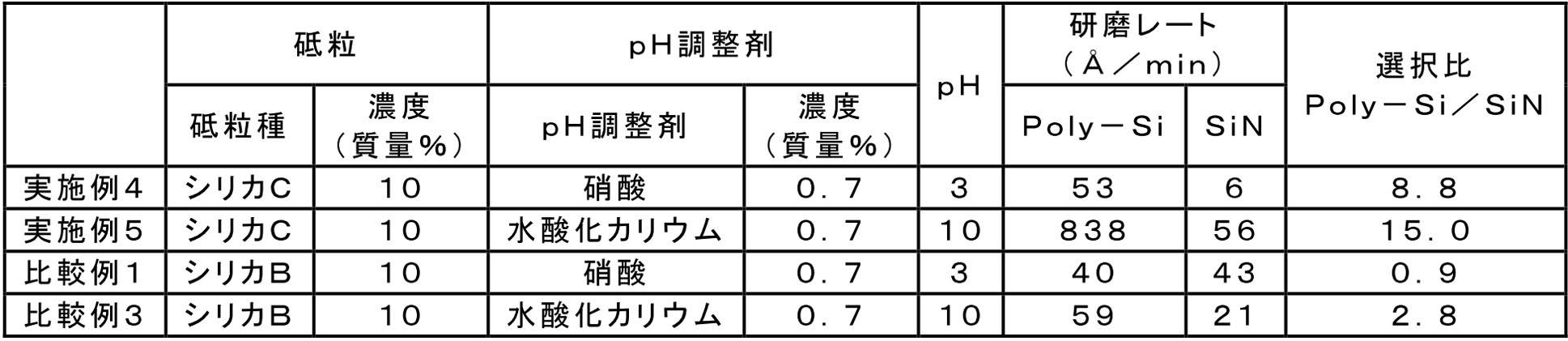
- a polishing composition was prepared by mixing abrasive grains (silica), a pH adjuster, and an oxidizing agent in ultrapure water with the compositions shown in Tables 1 to 4 below (mixing temperature: about 25 ° C., mixing time). : About 10 minutes). The pH of the polishing composition was confirmed with a pH meter. “-” In the table indicates that no addition was made.
- silica B shown in Tables 1 to 4 is raw material silica (colloidal silica; average primary particle diameter is 35 nm, average secondary particle diameter is 68 nm) before the functional group having an amino group is immobilized on the surface.
- polishing performance evaluation Using the obtained polishing composition, the polishing rate when the object to be polished was polished under the following polishing conditions was measured.
- the columns of polishing rates in Tables 1 to 4 show the results of measuring the polishing rates of silicon nitride (SiN), polycrystalline silicon (Poly-Si), or ruthenium (Ru).
- Polishing conditions Polishing machine Single-side CMP polishing machine for 200 mm Pad: Polyurethane pad Pressure: 2.5 psi (17.2 KPa) Plate rotation speed: 60rpm Carrier rotation speed: 40rpm Flow rate of polishing composition: 100 ml / min Polishing time: 1 minute.
- the polishing rate was calculated by the following formula.
- the film thickness was determined by an optical interference film thickness measuring apparatus, and the difference was divided by the polishing time.
- Ru the film thickness was determined by measuring the sheet resistance by a direct current four-probe method, and the difference was divided by the polishing time.
- the selectivity (Poly-Si / SiN) obtained by dividing the Poly-Si polishing rate by the SiN polishing rate is preferably 1 or more, and more preferably 5 or more.
Landscapes
- Chemical & Material Sciences (AREA)
- Engineering & Computer Science (AREA)
- Organic Chemistry (AREA)
- Materials Engineering (AREA)
- Mechanical Engineering (AREA)
- Composite Materials (AREA)
- Mechanical Treatment Of Semiconductor (AREA)
- Finish Polishing, Edge Sharpening, And Grinding By Specific Grinding Devices (AREA)
- Adhesives Or Adhesive Processes (AREA)
Abstract
Description
条件(1):前記官能基がアミノ基を有する、
条件(2):前記官能基がハロゲノ基を有する。
本発明の第一は、下記条件(1)および(2)の少なくとも1つを満たす官能基が表面に固定化されてなるシリカ(以下、「特定の官能基が表面に固定化されてなるシリカ」または単に「シリカ」とも記す)と、pH調整剤とを含む研磨用組成物である;
条件(1):前記官能基がアミノ基を有する、
条件(2):前記官能基がハロゲノ基を有する。
本発明の研磨用組成物は、条件(1)および(2)の少なくとも1つを満たす官能基が表面に固定化されてなるシリカを必須に含む。当該シリカは、研磨用組成物において砥粒としての機能を有する。
アミノ基を有する官能基は、特に制限されず、アミノ基のみからなる場合であってもよいし、リンカー構造にアミノ基が結合したものであってもよい。また、後者の場合、1つの官能基は、アミノ基を1つ有していてもよいし、複数有していてもよい。リンカー構造も特に制限されないが、研磨用組成物中の砥粒の分散安定性や反応性の観点から、炭素原子数2~5の直鎖又は分岐の、アルキレン基(-CnH2n-)、オキシアルキレン基(-OCnH2n-)、アリーレン基、またはこれらの組み合わせであることが好ましい。アミノ基を有する官能基の具体例としては、後述のシランカップリング剤由来の官能基が挙げられる。
本発明の特定の官能基が表面に固定化されてなるシリカの製造方法は、特に制限されないが、例えば、原料シリカに対して特定の官能基を有するシランカップリング剤を添加し、反応させ、シリカの表面に特定の官能基を結合させることで製造することができる。
本発明の研磨用組成物は、pHを所望の値に調整するために、pH調整剤を含む。pH調整剤としては、下記のような酸またはアルカリが挙げられる。
本発明の研磨用組成物は、分散媒または溶媒を含有してもよい。分散媒または溶媒としては有機溶媒、水が考えられるが、その中でも水を含むことが好ましい。他の成分の作用を阻害するという観点から、不純物をできる限り含有しない水が好ましい。具体的には、イオン交換樹脂にて不純物イオンを除去した後フィルタを通して異物を除去した純水や超純水、または蒸留水が好ましい。
本発明の研磨用組成物は、必要に応じて、上述の特定の官能基が表面に固定化されてなるシリカ以外の砥粒(以下、「その他の砥粒」とも称する)、錯化剤、金属防食剤、防腐剤、防カビ剤、酸化剤、還元剤、界面活性剤等の他の成分をさらに含んでもよい。以下、その他の砥粒、酸化剤、防腐剤、防カビ剤について説明する。
上記シリカ以外の砥粒は、無機粒子、有機粒子、および有機無機複合粒子のいずれであってもよい。無機粒子の具体例としては、例えばシリカ(ただし、上述の特定の官能基が表面に固定化されたものを除く)、アルミナ、セリア、チタニア等の金属酸化物からなる粒子、窒化ケイ素粒子、炭化ケイ素粒子、窒化ホウ素粒子が挙げられる。有機粒子の具体例としては、例えば、ポリメタクリル酸メチル(PMMA)粒子が挙げられる。その他の砥粒は、単独でもまたは2種以上混合して用いてもよい。また、その他の砥粒は、市販品を用いてもよいし合成品を用いてもよい。
酸化剤は、研磨対象物の表面を酸化し、研磨用組成物による研磨対象物の研磨レートを向上させる。
防腐剤または防カビ剤としては、例えば、2-メチル-4-イソチアゾリン-3-オンや5-クロロ-2-メチル-4-イソチアゾリン-3-オン等のイソチアゾリン系防腐剤、パラオキシ安息香酸エステル類、及びフェノキシエタノール等が挙げられる。これら防腐剤または防カビ剤は、単独でもまたは2種以上混合して用いてもよい。
本発明の研磨用組成物の製造方法は、特に制限されず、例えば、特定の官能基が表面に固定化されてなるシリカ、pH調整剤、および必要に応じて他の成分を、攪拌混合して得ることができる。すなわち、本発明の他の一形態に係る研磨用組成物の製造方法は、下記条件(1)および(2)の少なくとも1つを満たす官能基が表面に固定化されてなるシリカと、pH調整剤とを混合することを含む;条件(1):前記官能基がアミノ基を有する、条件(2):前記官能基がハロゲノ基を有する。
本発明の研磨用組成物は、Si含有材料を含む層を有する研磨対象物を研磨するのに好適である。Si含有材料としては、単結晶シリコン、多結晶シリコン(poly-Si)、シリコン酸化物、およびシリコン窒化物といったものが挙げられるが、中でも、本発明の効果がより効率的に得られるという観点から、Si含有材料は、多結晶シリコンまたはシリコン窒化物を含むことが好ましく、シリコン窒化物を含むことがより好ましく、多結晶シリコンおよびシリコン窒化物を含むことがさらに好ましい。
本発明の一形態によると、研磨対象物を有する被研磨材料を上記研磨用組成物を用いて研磨する工程を含む研磨方法が提供される。また、本発明の他の一形態によると、上記研磨方法で研磨する工程を含む、基板の製造方法が提供される。
(アミノ基を有する官能基が表面に固定されてなるシリカ(シリカA)の合成)
原料シリカとして、コロイダルシリカ水溶液1000g(濃度19.5質量%、平均一次粒子径が35nm、平均二次粒子径が68nm)を準備した。別途、シランカップリング剤である(3-アミノプロピル)トリエトキシシランを5mmol(1.12g)秤量し、メタノール50gに溶解させた。
原料シリカとして、コロイダルシリカ水溶液1000g(濃度19.5質量%、平均一次粒子径が35nm、平均二次粒子径が68nm)を準備した。別途、シランカップリング剤である(3-ブロモプロピル)トリメトキシシランを5mmol(1.22g)秤量し、メタノール50gに溶解させた。
研磨用組成物を、下記表1~4に示す組成で、砥粒(シリカ)、pH調整剤、酸化剤を超純水中で混合することにより調製した(混合温度:約25℃、混合時間:約10分)。研磨用組成物のpHは、pHメータにより確認した。表中の「―」は未添加であることを示す。
得られた研磨用組成物を用い、研磨対象物を以下の研磨条件で研磨した際の研磨レートを測定した。
研磨機: 200mm用片面CMP研磨機
パッド: ポリウレタン製パッド
圧力: 2.5psi(17.2KPa)
定盤回転数: 60rpm
キャリア回転数: 40rpm
研磨用組成物の流量: 100ml/min
研磨時間:1分間。




Claims (9)
- 下記条件(1)および(2)の少なくとも1つを満たす官能基が表面に固定化されてなるシリカと、pH調整剤とを含む研磨用組成物;
条件(1):前記官能基がアミノ基を有する、
条件(2):前記官能基がハロゲノ基を有する。 - 前記条件(2)を満たす場合において、前記ハロゲノ基がフルオロ基、クロロ基、ブロモ基、およびヨード基からなる群より選択される少なくとも1つを含む、請求項1に記載の研磨用組成物。
- Si含有材料を含む層を有する研磨対象物を研磨する用途で使用される、請求項1または2に記載の研磨用組成物。
- 前記Si含有材料は、単結晶シリコン、多結晶シリコン、シリコン酸化物、およびシリコン窒化物からなる群より選択される少なくとも1つを含む、請求項3記載の研磨用組成物。
- 前記条件(1)を満たす場合において、貴金属を含む層を有する研磨対象物を研磨する用途で使用される、請求項1に記載の研磨用組成物。
- 前記貴金属が、金、銀、白金、パラジウム、ロジウム、ルテニウム、イリジウム、およびオスミウムからなる群より選択される少なくとも1つを含む、請求項5記載の研磨用組成物
- 研磨対象物を有する被研磨材料を請求項1~6のいずれか1項に記載の研磨用組成物を用いて研磨する工程を含む、研磨方法。
- 請求項7に記載の研磨方法で研磨する工程を含む、基板の製造方法。
- 下記条件(1)および(2)の少なくとも1つを満たす官能基が表面に固定化されてなるシリカと、pH調整剤とを混合することを含む研磨用組成物の製造方法;
条件(1):前記官能基がアミノ基を有する、
条件(2):前記官能基がハロゲノ基を有する。
Priority Applications (6)
| Application Number | Priority Date | Filing Date | Title |
|---|---|---|---|
| US15/022,376 US20160288289A1 (en) | 2013-09-20 | 2014-08-11 | Polishing composition |
| JP2015537600A JP6415439B2 (ja) | 2013-09-20 | 2014-08-11 | 研磨用組成物 |
| CN201480051678.0A CN105555901A (zh) | 2013-09-20 | 2014-08-11 | 研磨用组合物 |
| SG11201601847WA SG11201601847WA (en) | 2013-09-20 | 2014-08-11 | Polishing composition |
| KR1020167006875A KR20160057397A (ko) | 2013-09-20 | 2014-08-11 | 연마용 조성물 |
| EP14845098.4A EP3048152A4 (en) | 2013-09-20 | 2014-08-11 | POLISHING COMPOSITION |
Applications Claiming Priority (4)
| Application Number | Priority Date | Filing Date | Title |
|---|---|---|---|
| JP2013195270 | 2013-09-20 | ||
| JP2013-195270 | 2013-09-20 | ||
| JP2013-204183 | 2013-09-30 | ||
| JP2013204183 | 2013-09-30 |
Publications (1)
| Publication Number | Publication Date |
|---|---|
| WO2015040979A1 true WO2015040979A1 (ja) | 2015-03-26 |
Family
ID=52688636
Family Applications (1)
| Application Number | Title | Priority Date | Filing Date |
|---|---|---|---|
| PCT/JP2014/071209 Ceased WO2015040979A1 (ja) | 2013-09-20 | 2014-08-11 | 研磨用組成物 |
Country Status (8)
| Country | Link |
|---|---|
| US (1) | US20160288289A1 (ja) |
| EP (2) | EP3048152A4 (ja) |
| JP (1) | JP6415439B2 (ja) |
| KR (1) | KR20160057397A (ja) |
| CN (1) | CN105555901A (ja) |
| SG (1) | SG11201601847WA (ja) |
| TW (1) | TWI653323B (ja) |
| WO (1) | WO2015040979A1 (ja) |
Cited By (5)
| Publication number | Priority date | Publication date | Assignee | Title |
|---|---|---|---|---|
| JP2017179333A (ja) * | 2016-03-28 | 2017-10-05 | 株式会社フジミインコーポレーテッド | 金属を含む層を有する研磨対象物の研磨に用いられる研磨用組成物 |
| WO2017169743A1 (ja) * | 2016-03-28 | 2017-10-05 | 株式会社フジミインコーポレーテッド | 金属を含む層を有する研磨対象物の研磨に用いられる研磨用組成物 |
| JP2019071413A (ja) * | 2017-10-05 | 2019-05-09 | フジフィルム プラナー ソリューションズ、 エルエルシー | 帯電した研磨剤を含有する研磨組成物 |
| JP2023030893A (ja) * | 2021-08-24 | 2023-03-08 | Jsr株式会社 | 化学機械研磨用組成物および研磨方法 |
| JPWO2023171290A1 (ja) * | 2022-03-08 | 2023-09-14 |
Families Citing this family (7)
| Publication number | Priority date | Publication date | Assignee | Title |
|---|---|---|---|---|
| CN106010297B (zh) * | 2016-06-20 | 2018-07-31 | 上海新安纳电子科技有限公司 | 一种氧化铝抛光液的制备方法 |
| CN107629758A (zh) * | 2017-08-22 | 2018-01-26 | 长江存储科技有限责任公司 | 一种制造半导体器件用研磨剂及其制备方法 |
| KR102084164B1 (ko) * | 2018-03-06 | 2020-05-27 | 에스케이씨 주식회사 | 반도체 공정용 조성물 및 반도체 공정 |
| CN112680187A (zh) * | 2021-01-04 | 2021-04-20 | 上海晖研材料科技有限公司 | 一种表面改性的二氧化硅及含其的磨料组合物 |
| CN112680185A (zh) * | 2021-01-04 | 2021-04-20 | 上海晖研材料科技有限公司 | 一种表面改性的二氧化硅作为磨粒的应用 |
| CN112680186A (zh) * | 2021-01-04 | 2021-04-20 | 上海晖研材料科技有限公司 | 一种表面改性的二氧化硅及含其的磨料组合物的制备方法 |
| KR20220149148A (ko) * | 2021-04-30 | 2022-11-08 | 에스케이씨솔믹스 주식회사 | 반도체 공정용 연마 조성물 및 연마 조성물을 적용한 반도체 소자의 제조 방법 |
Citations (8)
| Publication number | Priority date | Publication date | Assignee | Title |
|---|---|---|---|---|
| US4944836A (en) | 1985-10-28 | 1990-07-31 | International Business Machines Corporation | Chem-mech polishing method for producing coplanar metal/insulator films on a substrate |
| JP2003277731A (ja) * | 2002-03-26 | 2003-10-02 | Catalysts & Chem Ind Co Ltd | 研磨用粒子および研磨材 |
| JP2008034818A (ja) | 2006-07-05 | 2008-02-14 | Hitachi Chem Co Ltd | 貴金属類膜研磨用研磨液及び貴金属類膜の研磨方法 |
| JP2010041037A (ja) | 2008-07-11 | 2010-02-18 | Fujifilm Corp | 窒化ケイ素用研磨液及び研磨方法 |
| JP2011216582A (ja) * | 2010-03-31 | 2011-10-27 | Fujifilm Corp | 研磨方法、および研磨液 |
| JP2012515806A (ja) * | 2009-01-20 | 2012-07-12 | キャボット コーポレイション | シラン変性金属酸化物を含む組成物 |
| JP2013089819A (ja) * | 2011-10-19 | 2013-05-13 | Fujimi Inc | 研磨用組成物並びにそれを用いた研磨方法及び基板の製造方法 |
| JP2013102051A (ja) * | 2011-11-08 | 2013-05-23 | Fujimi Inc | 研磨用組成物並びにそれを用いた研磨方法及び基板の製造方法 |
Family Cites Families (11)
| Publication number | Priority date | Publication date | Assignee | Title |
|---|---|---|---|---|
| JPH10309660A (ja) * | 1997-05-07 | 1998-11-24 | Tokuyama Corp | 仕上げ研磨剤 |
| EP1739146A3 (en) * | 1999-07-07 | 2007-01-24 | Cabot Microelectronics Corporation | CMP compositions containing silane modified abrasive particles |
| EP1200532B1 (en) * | 1999-07-07 | 2006-08-30 | Cabot Microelectronics Corporation | Cmp composition containing silane modified abrasive particles |
| US6372111B1 (en) * | 2000-01-18 | 2002-04-16 | David K. Watts | Method and apparatus for reclaiming a metal from a CMP process for use in an electroplating process |
| AU3057601A (en) * | 2000-02-04 | 2001-08-14 | Showa Denko Kabushiki Kaisha | Polishing composite for use in lsi manufacture and method of manufacturing lsi |
| US6656241B1 (en) * | 2001-06-14 | 2003-12-02 | Ppg Industries Ohio, Inc. | Silica-based slurry |
| JP2004244566A (ja) * | 2003-02-17 | 2004-09-02 | Denki Kagaku Kogyo Kk | 研磨剤及びその製造方法 |
| JP4489569B2 (ja) * | 2004-12-01 | 2010-06-23 | 信越化学工業株式会社 | つや出し剤組成物 |
| KR101232442B1 (ko) * | 2007-09-21 | 2013-02-12 | 캐보트 마이크로일렉트로닉스 코포레이션 | 아미노실란으로 처리된 연마제 입자를 이용한 연마 조성물 및 방법 |
| US7994057B2 (en) * | 2007-09-21 | 2011-08-09 | Cabot Microelectronics Corporation | Polishing composition and method utilizing abrasive particles treated with an aminosilane |
| KR101243331B1 (ko) * | 2010-12-17 | 2013-03-13 | 솔브레인 주식회사 | 화학 기계적 연마 슬러리 조성물 및 이를 이용하는 반도체 소자의 제조 방법 |
-
2014
- 2014-08-11 US US15/022,376 patent/US20160288289A1/en not_active Abandoned
- 2014-08-11 KR KR1020167006875A patent/KR20160057397A/ko not_active Ceased
- 2014-08-11 CN CN201480051678.0A patent/CN105555901A/zh active Pending
- 2014-08-11 EP EP14845098.4A patent/EP3048152A4/en not_active Withdrawn
- 2014-08-11 JP JP2015537600A patent/JP6415439B2/ja active Active
- 2014-08-11 WO PCT/JP2014/071209 patent/WO2015040979A1/ja not_active Ceased
- 2014-08-11 SG SG11201601847WA patent/SG11201601847WA/en unknown
- 2014-08-11 EP EP17001186.0A patent/EP3260515A1/en not_active Withdrawn
- 2014-08-21 TW TW103128792A patent/TWI653323B/zh active
Patent Citations (8)
| Publication number | Priority date | Publication date | Assignee | Title |
|---|---|---|---|---|
| US4944836A (en) | 1985-10-28 | 1990-07-31 | International Business Machines Corporation | Chem-mech polishing method for producing coplanar metal/insulator films on a substrate |
| JP2003277731A (ja) * | 2002-03-26 | 2003-10-02 | Catalysts & Chem Ind Co Ltd | 研磨用粒子および研磨材 |
| JP2008034818A (ja) | 2006-07-05 | 2008-02-14 | Hitachi Chem Co Ltd | 貴金属類膜研磨用研磨液及び貴金属類膜の研磨方法 |
| JP2010041037A (ja) | 2008-07-11 | 2010-02-18 | Fujifilm Corp | 窒化ケイ素用研磨液及び研磨方法 |
| JP2012515806A (ja) * | 2009-01-20 | 2012-07-12 | キャボット コーポレイション | シラン変性金属酸化物を含む組成物 |
| JP2011216582A (ja) * | 2010-03-31 | 2011-10-27 | Fujifilm Corp | 研磨方法、および研磨液 |
| JP2013089819A (ja) * | 2011-10-19 | 2013-05-13 | Fujimi Inc | 研磨用組成物並びにそれを用いた研磨方法及び基板の製造方法 |
| JP2013102051A (ja) * | 2011-11-08 | 2013-05-23 | Fujimi Inc | 研磨用組成物並びにそれを用いた研磨方法及び基板の製造方法 |
Non-Patent Citations (1)
| Title |
|---|
| See also references of EP3048152A4 |
Cited By (10)
| Publication number | Priority date | Publication date | Assignee | Title |
|---|---|---|---|---|
| JP2017179333A (ja) * | 2016-03-28 | 2017-10-05 | 株式会社フジミインコーポレーテッド | 金属を含む層を有する研磨対象物の研磨に用いられる研磨用組成物 |
| WO2017169743A1 (ja) * | 2016-03-28 | 2017-10-05 | 株式会社フジミインコーポレーテッド | 金属を含む層を有する研磨対象物の研磨に用いられる研磨用組成物 |
| JP2019071413A (ja) * | 2017-10-05 | 2019-05-09 | フジフィルム プラナー ソリューションズ、 エルエルシー | 帯電した研磨剤を含有する研磨組成物 |
| US11034861B2 (en) | 2017-10-05 | 2021-06-15 | Fujifilm Electronic Materials U.S.A., Inc. | Polishing compositions containing charged abrasive |
| JP7074635B2 (ja) | 2017-10-05 | 2022-05-24 | フジフイルム エレクトロニック マテリアルズ ユー.エス.エー., インコーポレイテッド | 帯電した研磨剤を含有する研磨組成物 |
| US11674056B2 (en) | 2017-10-05 | 2023-06-13 | Fujifilm Electronic Materials U.S.A., Inc. | Polishing compositions containing charged abrasive |
| JP2023030893A (ja) * | 2021-08-24 | 2023-03-08 | Jsr株式会社 | 化学機械研磨用組成物および研磨方法 |
| JP7672920B2 (ja) | 2021-08-24 | 2025-05-08 | Jsr株式会社 | 化学機械研磨用組成物および研磨方法 |
| JPWO2023171290A1 (ja) * | 2022-03-08 | 2023-09-14 | ||
| WO2023171290A1 (ja) * | 2022-03-08 | 2023-09-14 | 株式会社フジミインコーポレーテッド | 研磨用組成物 |
Also Published As
| Publication number | Publication date |
|---|---|
| US20160288289A1 (en) | 2016-10-06 |
| TW201512384A (zh) | 2015-04-01 |
| JP6415439B2 (ja) | 2018-10-31 |
| EP3048152A4 (en) | 2016-10-19 |
| TWI653323B (zh) | 2019-03-11 |
| EP3260515A1 (en) | 2017-12-27 |
| SG11201601847WA (en) | 2016-04-28 |
| EP3048152A1 (en) | 2016-07-27 |
| JPWO2015040979A1 (ja) | 2017-03-02 |
| KR20160057397A (ko) | 2016-05-23 |
| CN105555901A (zh) | 2016-05-04 |
Similar Documents
| Publication | Publication Date | Title |
|---|---|---|
| JP6415439B2 (ja) | 研磨用組成物 | |
| JP6762390B2 (ja) | 研磨用組成物、研磨方法および基板の製造方法 | |
| CN102585704B (zh) | 化学机械抛光浆料组合物及使用其制造半导体器件的方法 | |
| JP5361306B2 (ja) | 化学機械研磨用水系分散体および化学機械研磨方法 | |
| JP7331191B2 (ja) | 研磨用組成物 | |
| JP6057706B2 (ja) | 研磨用組成物 | |
| EP3891236B1 (en) | Composition and method for metal cmp | |
| KR102649656B1 (ko) | 연마용 조성물 | |
| JP7663386B2 (ja) | 研磨用組成物、研磨方法および半導体基板の製造方法 | |
| CN101663738A (zh) | 研磨剂组合物和制造半导体集成电路装置的方法 | |
| CN115197645A (zh) | 半导体工艺用抛光组合物以及半导体器件的制造方法 | |
| TWI826498B (zh) | 化學機械研磨用水系分散體 | |
| CN113444489A (zh) | 研磨用组合物、其制造方法、研磨方法及半导体基板的制造方法 | |
| JP2023156988A (ja) | 半導体工程用組成物及びそれを用いた半導体素子の研磨方法 | |
| CN113388328B (zh) | 研磨用组合物、研磨用组合物的制造方法、研磨方法及半导体基板的制造方法 | |
| JP7493367B2 (ja) | 研磨用組成物、研磨用組成物の製造方法、研磨方法および半導体基板の製造方法 | |
| JP2010103409A (ja) | 金属用研磨液及びこの金属用研磨液を用いた研磨方法 | |
| JP7776956B2 (ja) | 研磨用組成物、研磨方法、および半導体基板の製造方法 | |
| TW202229478A (zh) | 研磨用組成物及其製造方法、研磨方法以及基板的製造方法 | |
| JP2025059532A (ja) | 研磨用組成物、研磨方法および半導体基板の製造方法 | |
| WO2018012175A1 (ja) | 研磨用組成物の製造方法および研磨方法 | |
| WO2021124772A1 (ja) | 化学機械研磨用組成物、化学機械研磨方法、及び化学機械研磨用粒子の製造方法 | |
| JP7523291B2 (ja) | 研磨用組成物、研磨方法、および半導体基板の製造方法 | |
| JP2026058691A (ja) | 研磨用組成物およびそれを用いた研磨方法 | |
| JP2024080610A (ja) | 研磨用組成物、研磨方法および半導体基板の製造方法 |
Legal Events
| Date | Code | Title | Description |
|---|---|---|---|
| WWE | Wipo information: entry into national phase |
Ref document number: 201480051678.0 Country of ref document: CN |
|
| 121 | Ep: the epo has been informed by wipo that ep was designated in this application |
Ref document number: 14845098 Country of ref document: EP Kind code of ref document: A1 |
|
| ENP | Entry into the national phase |
Ref document number: 2015537600 Country of ref document: JP Kind code of ref document: A |
|
| REEP | Request for entry into the european phase |
Ref document number: 2014845098 Country of ref document: EP |
|
| WWE | Wipo information: entry into national phase |
Ref document number: 2014845098 Country of ref document: EP |
|
| ENP | Entry into the national phase |
Ref document number: 20167006875 Country of ref document: KR Kind code of ref document: A |
|
| WWE | Wipo information: entry into national phase |
Ref document number: 15022376 Country of ref document: US |
|
| NENP | Non-entry into the national phase |
Ref country code: DE |