WO2015060251A1 - Cos転換触媒の触媒再生方法 - Google Patents
Cos転換触媒の触媒再生方法 Download PDFInfo
- Publication number
- WO2015060251A1 WO2015060251A1 PCT/JP2014/077838 JP2014077838W WO2015060251A1 WO 2015060251 A1 WO2015060251 A1 WO 2015060251A1 JP 2014077838 W JP2014077838 W JP 2014077838W WO 2015060251 A1 WO2015060251 A1 WO 2015060251A1
- Authority
- WO
- WIPO (PCT)
- Prior art keywords
- conversion catalyst
- cos conversion
- catalyst
- cos
- regenerating
- Prior art date
- Legal status (The legal status is an assumption and is not a legal conclusion. Google has not performed a legal analysis and makes no representation as to the accuracy of the status listed.)
- Ceased
Links
Images
Classifications
-
- B—PERFORMING OPERATIONS; TRANSPORTING
- B01—PHYSICAL OR CHEMICAL PROCESSES OR APPARATUS IN GENERAL
- B01J—CHEMICAL OR PHYSICAL PROCESSES, e.g. CATALYSIS OR COLLOID CHEMISTRY; THEIR RELEVANT APPARATUS
- B01J38/00—Regeneration or reactivation of catalysts, in general
- B01J38/48—Liquid treating or treating in liquid phase, e.g. dissolved or suspended
- B01J38/64—Liquid treating or treating in liquid phase, e.g. dissolved or suspended using alkaline material; using salts
-
- B—PERFORMING OPERATIONS; TRANSPORTING
- B01—PHYSICAL OR CHEMICAL PROCESSES OR APPARATUS IN GENERAL
- B01J—CHEMICAL OR PHYSICAL PROCESSES, e.g. CATALYSIS OR COLLOID CHEMISTRY; THEIR RELEVANT APPARATUS
- B01J38/00—Regeneration or reactivation of catalysts, in general
- B01J38/48—Liquid treating or treating in liquid phase, e.g. dissolved or suspended
- B01J38/60—Liquid treating or treating in liquid phase, e.g. dissolved or suspended using acids
-
- B—PERFORMING OPERATIONS; TRANSPORTING
- B01—PHYSICAL OR CHEMICAL PROCESSES OR APPARATUS IN GENERAL
- B01J—CHEMICAL OR PHYSICAL PROCESSES, e.g. CATALYSIS OR COLLOID CHEMISTRY; THEIR RELEVANT APPARATUS
- B01J23/00—Catalysts comprising metals or metal oxides or hydroxides, not provided for in group B01J21/00
- B01J23/90—Regeneration or reactivation
-
- B—PERFORMING OPERATIONS; TRANSPORTING
- B01—PHYSICAL OR CHEMICAL PROCESSES OR APPARATUS IN GENERAL
- B01J—CHEMICAL OR PHYSICAL PROCESSES, e.g. CATALYSIS OR COLLOID CHEMISTRY; THEIR RELEVANT APPARATUS
- B01J23/00—Catalysts comprising metals or metal oxides or hydroxides, not provided for in group B01J21/00
- B01J23/90—Regeneration or reactivation
- B01J23/92—Regeneration or reactivation of catalysts comprising metals, oxides or hydroxides provided for in groups B01J23/02 - B01J23/36
Definitions
- the present invention relates to a catalyst regeneration method for a COS conversion catalyst.
- low-quality fuel generally contains a lot of sulfur compounds, and when gasified from this is burned as it is, the sulfur compounds are discharged as sulfur oxides from the chimney to the atmosphere and become a source of environmental destruction such as acid rain. . Therefore, in ordinary thermal power generation, it is put into practical use to install a flue gas desulfurization device in the downstream of the boiler and remove the sulfur compound as gypsum, for example.
- corrosion of the material is remarkable because the inlet temperature of the gas turbine is higher than the temperature of the boiler in ordinary thermal power generation. Therefore, it is necessary to remove various impurities including sulfur compounds in the upstream rather than the downstream of the gas turbine to protect the material, and the flue gas desulfurization apparatus cannot be applied.
- fuel cell power generation it is essential to secure power generation efficiency and durability by protecting the material, and various impurities must be removed in the upstream of the fuel cell as well.
- a COS conversion catalyst for example, a catalyst containing titania, a catalyst containing alumina, a group IV metal and barium, a catalyst containing an alkali metal, chromium oxide and alumina are known (Patent Document 1).
- Patent Document 2 a method of resupporting potassium carbonate and sodium carbonate after heat-treating the catalyst has been proposed.
- the conventional method for regenerating a COS catalyst has a problem that the cost of relatively expensive chemicals such as potassium carbonate and sodium carbonate increases because the active component of the catalyst is supported again.
- an object of the present invention is to provide an inexpensive method for regenerating a COS conversion catalyst.
- a first invention of the present invention for solving the above-mentioned problems is a method for regenerating a COS conversion catalyst, which comprises gasifying a carbon raw material to hydrolyze carbonyl sulfide (COS) in the gasification gas,
- a method for regenerating a COS conversion catalyst comprising immersing a COS conversion catalyst in an acid solution for a predetermined time.
- a second invention is a method for regenerating a COS conversion catalyst that gasifies a carbon raw material to hydrolyze carbonyl sulfide (COS) in the gasification gas, and the spent COS conversion catalyst is placed in an alkaline solution for a predetermined time.
- the immersion treatment is carried out for a predetermined time in an acid solution after the immersion treatment.
- the used deteriorated COS conversion catalyst is immersed in an alkaline solution, it is immersed in an acid solution and neutralized, so that sulfides adhering to the catalyst surface, etc.
- the poisoning component is removed, and the catalyst can be regenerated.
- a third invention is a method for regenerating a COS conversion catalyst that gasifies a carbon raw material to hydrolyze carbonyl sulfide (COS) in the gasification gas, and the spent COS conversion catalyst is placed in an acid solution for a predetermined time.
- the immersion treatment is performed for a predetermined time in an alkaline solution after the immersion treatment.
- the used deteriorated COS conversion catalyst is immersed in an acid solution, it is immersed in an alkaline solution and neutralized, so that sulfides adhering to the catalyst surface, etc.
- the poisoning component is removed, and the catalyst can be regenerated.
- the method for regenerating a COS conversion catalyst according to any one of the first to third aspects, wherein the immersion treatment is performed in a predetermined heating state (for example, 60 ° C. to 80 ° C.). is there.
- a predetermined heating state for example, 60 ° C. to 80 ° C.
- the spent deteriorated COS conversion catalyst is immersed in an acid solution in a heated state to remove poisoning components such as sulfides attached to the catalyst surface, thereby regenerating the catalyst. Can do.
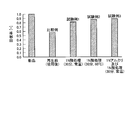
- FIG. 1 is a diagram showing the results of testing the catalyst recovery rate under each condition.
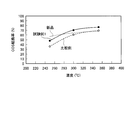
- FIG. 2 is a graph showing the relationship between the temperature change of the COS conversion catalyst and the COS conversion rate.
- the method for regenerating a COS conversion catalyst according to Example 1 is a method for regenerating a COS conversion catalyst in which a carbon raw material such as coal is gasified to hydrolyze carbonyl sulfide (COS) in the gasification gas.
- the COS conversion catalyst is immersed in an acid solution for a predetermined time.
- the procedure of the catalyst regeneration method according to Example 1 will be described below.
- the amount of the acid solution is at least enough to cover the COS conversion catalyst. More preferably, the acid solution / COS conversion catalyst is 3 volumes or more.
- the acid solution sulfuric acid (H 2 SO 4 ), hydrochloric acid (HCl), nitric acid (HNO 3 ) or the like of 0.1 N (N) or more and about 1 N (N) can be used.
- the chemical solution is heated (for example, 60 to 80 ° C.), the removal efficiency of adhering sulfides and the like is improved.
- the COS conversion catalyst immersed in water for example, ion-exchanged water
- the amount of the cleaning solution is at least enough to cover the COS conversion catalyst.
- the water / COS conversion catalyst is 3 volume ratio or more.
- the COS conversion catalyst is pulled up, and the excess liquid in the catalyst is removed, followed by drying treatment. Drying may be either natural drying or warm drying. Here, in the case of heat drying, it is preferably from 80 ° C. to 200 ° C., particularly preferably from 110 ° C. to 150 ° C.
- the dust removal by air blow in step (2) can be omitted depending on the amount of dust adhering to the catalyst.
- the method for regenerating a COS conversion catalyst according to Example 2 is a method for regenerating a COS conversion catalyst in which a carbon raw material such as coal is gasified to hydrolyze carbonyl sulfide (COS) in the gasification gas.
- the COS conversion catalyst is immersed in an alkaline solution for a predetermined time.
- the procedure of the catalyst regeneration method according to Example 2 will be described below.
- the amount of the alkaline solution is set so that at least the COS conversion catalyst is sufficiently immersed. More preferably, the alkali solution / COS conversion catalyst is 3 volume ratio or more.
- 0.1 N (N) or more, about 1 N (N) sodium hydroxide (NaOH), aqueous ammonia (NH 4 OH), sodium carbonate (Na 2 CO 3 ), or the like can be used.
- the chemical solution is heated (for example, 60 to 80 ° C.), the removal efficiency of adhering sulfides and the like is improved.
- the COS conversion catalyst immersed in water (for example, ion-exchanged water) prepared in another container is continuously immersed and washed with water.
- the amount of the cleaning solution is at least enough to cover the COS conversion catalyst.
- the water / COS conversion catalyst is 3 volume ratio or more. (6) Leave in the immersed state for about 15 to 60 minutes, for example, and wash with water. (7) After the cleaning treatment, the COS conversion catalyst is pulled up, and the excess liquid in the catalyst is removed, followed by drying treatment. Drying may be either natural drying or warm drying. Moreover, you may bake.
- the method for regenerating a COS conversion catalyst according to Example 3 is a method for regenerating a COS conversion catalyst in which a carbon raw material such as coal is gasified to hydrolyze carbonyl sulfide (COS) in the gasification gas.
- COS carbonyl sulfide
- the COS conversion catalyst is immersed in an alkaline solution for a predetermined time, and then immersed in an acid solution for a predetermined time.
- the procedure of the catalyst regeneration method according to Example 3 will be described.
- the amount of the alkaline solution is at least enough to cover the COS conversion catalyst. More preferably, the alkali solution / COS conversion catalyst is 3 volume ratio or more.
- the alkaline solution 0.1 N (N) or more, about 1 N (N) sodium hydroxide (NaOH), aqueous ammonia (NH 4 OH), sodium carbonate (Na 2 CO 3 ), or the like can be used.
- the chemical solution is heated (for example, 60 to 80 ° C.), the removal efficiency of adhering sulfides and the like is improved.
- (4) Let it stand for about 15 to 60 minutes, for example, in the soaked state, and soak it.
- a predetermined amount of an acid solution is put into another immersion container, and the COS conversion catalyst subjected to alkali treatment is immersed in this acid solution.
- the amount of the acid solution is at least enough to cover the COS conversion catalyst.
- the acid solution / COS conversion catalyst is 3 volumes or more.
- the acid solution sulfuric acid (H 2 SO 4 ), hydrochloric acid (HCl), nitric acid (HNO 3 ) or the like of 0.1 N (N) or more and about 1 N (N) can be used.
- the chemical solution is heated (for example, 60 to 80 ° C.), the removal efficiency of adhering sulfides and the like is improved.
- the COS conversion catalyst immersed in water for example, ion-exchanged water
- the amount of the cleaning solution is at least enough to cover the COS conversion catalyst.
- the water / COS conversion catalyst is 3 volume ratio or more. (7) Allow to stand for about 15 to 60 minutes, for example, in this immersed state, and then wash with water. (8) After the washing treatment, the COS conversion catalyst is pulled up, and the excess liquid in the catalyst is removed, followed by drying treatment. Drying may be either natural drying or warm drying. Moreover, you may bake.
- the method for regenerating a COS conversion catalyst according to Example 4 is a method for regenerating a COS conversion catalyst in which a carbon raw material such as coal is gasified to hydrolyze carbonyl sulfide (COS) in the gasification gas.
- the COS conversion catalyst is immersed in an acid solution for a predetermined time, and then immersed in an alkaline solution for a predetermined time.
- the procedure of the catalyst regeneration method according to Example 4 will be described below.
- the amount of the acid solution is at least enough to cover the COS conversion catalyst. More preferably, the acid solution / COS conversion catalyst is 3 volumes or more.
- the acid solution sulfuric acid (H 2 SO 4 ), hydrochloric acid (HCl), nitric acid (HNO 3 ) or the like of 0.1 N (N) or more and about 1 N (N) can be used.
- the chemical solution is heated (for example, 60 to 80 ° C.), the removal efficiency of adhering sulfides and the like is improved.
- a predetermined amount of an alkaline solution is put into another immersion container, and the acid-treated COS conversion catalyst is immersed in this alkaline solution.
- the amount of the alkaline solution is at least enough to cover the COS conversion catalyst.
- the alkali solution / COS conversion catalyst is 3 volume ratio or more.
- the alkaline solution 0.1 N (N) or more, about 1 N (N) sodium hydroxide (NaOH), aqueous ammonia (NH 4 OH), sodium carbonate (Na 2 CO 3 ), or the like can be used.
- the chemical solution is heated (for example, 60 to 80 ° C.), the removal efficiency of adhering sulfides and the like is improved.
- the COS conversion catalyst immersed in water for example, ion-exchanged water
- the amount of the cleaning solution is at least enough to cover the COS conversion catalyst.
- the water / COS conversion catalyst is 3 volume ratio or more. (7) Allow to stand for about 15 to 60 minutes, for example, in this immersed state, and then wash with water. (8) After the washing treatment, the COS conversion catalyst is pulled up, and the excess liquid in the catalyst is removed, followed by drying treatment. Drying may be either natural drying or warm drying. Moreover, you may bake.
- Test Example 1 is a COS conversion catalyst that has been used with 1N sulfuric acid, soaked at room temperature for 30 minutes, and washed with water for 30 minutes.
- Test Example 2 a COS conversion catalyst used with 1N sulfuric acid was immersed for 30 minutes at warming (60 ° C.) and washed with water for 30 minutes.
- Test Example 3 the spent COS conversion catalyst was soaked in 1N aqueous sodium hydroxide solution at room temperature for 30 minutes, and then the COS conversion catalyst after alkali treatment with IN sulfuric acid was neutralized and soaked at room temperature for 30 minutes. And washed with water for 30 minutes.
- the COS conversion catalyst used in this test was a Ba / TiO 2 type honeycomb catalyst, and the temperature at which the COS conversion rate of the regenerated product was measured was 300 ° C.
- K is the reaction rate constant of the COS conversion catalyst after regeneration
- K 0 is the reaction rate constant of the new COS conversion catalyst.
- FIG. 1 shows the result of testing the catalyst recovery rate under each condition.
- FIG. 2 is a graph showing the relationship between the temperature change of the COS conversion catalyst and the COS conversion rate.
- the COS conversion rate at the catalyst treatment temperature 250 ° C., 300 ° C., 350 ° C.
- FIG. 2 it was confirmed that Test Example 1 (acid-treated product) always had a higher COS conversion rate than the catalyst before regeneration.
- the acid-treated product was confirmed to have a higher COS conversion rate than a new product from a temperature range exceeding about 270 ° C.
Landscapes
- Chemical & Material Sciences (AREA)
- Engineering & Computer Science (AREA)
- Materials Engineering (AREA)
- Organic Chemistry (AREA)
- Chemical Kinetics & Catalysis (AREA)
- Catalysts (AREA)
- Indication Of The Valve Opening Or Closing Status (AREA)
Priority Applications (6)
| Application Number | Priority Date | Filing Date | Title |
|---|---|---|---|
| DK14855014.8T DK2998024T3 (da) | 2013-10-23 | 2014-10-20 | Fremgangsmåde til regenerering af en cos-konverterings-katalysator |
| PL14855014T PL2998024T3 (pl) | 2013-10-23 | 2014-10-20 | Sposób regeneracji katalizatora konwersji cos |
| US14/898,325 US9604206B2 (en) | 2013-10-23 | 2014-10-20 | Method for regenerating COS hydrolysis catalyst |
| CN201480032477.6A CN105451884B (zh) | 2013-10-23 | 2014-10-20 | Cos转化催化剂的催化剂再生方法 |
| AU2014337659A AU2014337659B2 (en) | 2013-10-23 | 2014-10-20 | Method for regenerating COS conversion catalyst |
| EP14855014.8A EP2998024B1 (en) | 2013-10-23 | 2014-10-20 | Method for regenerating cos conversion catalyst |
Applications Claiming Priority (2)
| Application Number | Priority Date | Filing Date | Title |
|---|---|---|---|
| JP2013220607A JP6161508B2 (ja) | 2013-10-23 | 2013-10-23 | Cos転換触媒の触媒再生方法 |
| JP2013-220607 | 2013-10-23 |
Publications (1)
| Publication Number | Publication Date |
|---|---|
| WO2015060251A1 true WO2015060251A1 (ja) | 2015-04-30 |
Family
ID=52992846
Family Applications (1)
| Application Number | Title | Priority Date | Filing Date |
|---|---|---|---|
| PCT/JP2014/077838 Ceased WO2015060251A1 (ja) | 2013-10-23 | 2014-10-20 | Cos転換触媒の触媒再生方法 |
Country Status (8)
| Country | Link |
|---|---|
| US (1) | US9604206B2 (da) |
| EP (1) | EP2998024B1 (da) |
| JP (1) | JP6161508B2 (da) |
| CN (1) | CN105451884B (da) |
| AU (1) | AU2014337659B2 (da) |
| DK (1) | DK2998024T3 (da) |
| PL (1) | PL2998024T3 (da) |
| WO (1) | WO2015060251A1 (da) |
Cited By (1)
| Publication number | Priority date | Publication date | Assignee | Title |
|---|---|---|---|---|
| CN111729692A (zh) * | 2020-05-19 | 2020-10-02 | 福州大学 | 一种失活cos水解剂的再生方法 |
Families Citing this family (3)
| Publication number | Priority date | Publication date | Assignee | Title |
|---|---|---|---|---|
| CN116020466A (zh) * | 2021-10-26 | 2023-04-28 | 中国石油化工股份有限公司 | Cos转化催化剂及制备方法与回收天然气中硫的方法 |
| CN117797883A (zh) * | 2024-01-10 | 2024-04-02 | 中铝环保节能集团有限公司 | 一种废羰基硫水解剂资源化利用方法 |
| CN119819280A (zh) * | 2024-12-02 | 2025-04-15 | 北京铝能清新环境技术有限公司 | 一种纳米化羰基硫水解催化剂载体、催化剂及制备方法 |
Citations (9)
| Publication number | Priority date | Publication date | Assignee | Title |
|---|---|---|---|---|
| JPS61212524A (ja) * | 1985-03-04 | 1986-09-20 | エクソン ケミカル パテンツ インコーポレーテツド | 液体プロピレンからcosを除去するための加水分解方法 |
| JPH06218230A (ja) * | 1992-03-05 | 1994-08-09 | Kronos Titan Gmbh | ガス混合物中の硫化カルボニルの加水分解法 |
| JP2001162174A (ja) | 1999-12-13 | 2001-06-19 | Kawasaki Steel Corp | 触媒の再生方法 |
| JP2004075712A (ja) | 2002-08-09 | 2004-03-11 | Mitsubishi Heavy Ind Ltd | ガス化ガス用のcos処理装置とcos処理方法 |
| JP2006143959A (ja) * | 2004-11-24 | 2006-06-08 | Matsushita Electric Works Ltd | 脱硫装置及びアルミナ触媒の再生方法 |
| JP2009233634A (ja) * | 2008-03-28 | 2009-10-15 | Ube Ind Ltd | 光触媒の再生方法 |
| CN101670302A (zh) * | 2009-09-27 | 2010-03-17 | 昆明理工大学 | 以活性炭为载体的羰基硫水解催化剂失活后的再生方法 |
| CN101961654A (zh) * | 2010-09-15 | 2011-02-02 | 昆明理工大学 | 一种羰基硫水解催化剂失活后的再生方法 |
| CN102921477A (zh) * | 2012-10-18 | 2013-02-13 | 昆明理工大学 | 一种失活的羰基硫水解催化剂的再生方法 |
Family Cites Families (6)
| Publication number | Priority date | Publication date | Assignee | Title |
|---|---|---|---|---|
| US3282831A (en) * | 1963-12-12 | 1966-11-01 | Signal Oil & Gas Co | Regeneration of anionic exchange resins |
| US4835338A (en) * | 1987-08-31 | 1989-05-30 | Aluminum Company Of America | Process for removal of carbonyl sulfide from organic liquid by adsorption using alumina adsorbent capable of regeneration |
| CN1136054C (zh) * | 2000-06-20 | 2004-01-28 | 中国石化集团齐鲁石化公司 | 一种羰基硫水解催化剂的再生方法 |
| DE102008015406A1 (de) | 2008-03-22 | 2009-09-24 | Bayer Materialscience Ag | Verfahren zur Regeneration eines mit Schwefel in Form von Schwefelverbindungen vergifteten, Ruthenium oder Rutheniumverbindungen enthaltenden Katalysators |
| CN102500429A (zh) * | 2011-11-24 | 2012-06-20 | 昆明理工大学 | 一种二硫化碳水解催化剂失活后的再生方法 |
| JP6147663B2 (ja) | 2013-12-27 | 2017-06-14 | 三菱重工業株式会社 | Cos転換触媒の触媒再生方法 |
-
2013
- 2013-10-23 JP JP2013220607A patent/JP6161508B2/ja active Active
-
2014
- 2014-10-20 WO PCT/JP2014/077838 patent/WO2015060251A1/ja not_active Ceased
- 2014-10-20 CN CN201480032477.6A patent/CN105451884B/zh not_active Expired - Fee Related
- 2014-10-20 US US14/898,325 patent/US9604206B2/en active Active
- 2014-10-20 PL PL14855014T patent/PL2998024T3/pl unknown
- 2014-10-20 AU AU2014337659A patent/AU2014337659B2/en not_active Ceased
- 2014-10-20 EP EP14855014.8A patent/EP2998024B1/en active Active
- 2014-10-20 DK DK14855014.8T patent/DK2998024T3/da active
Patent Citations (9)
| Publication number | Priority date | Publication date | Assignee | Title |
|---|---|---|---|---|
| JPS61212524A (ja) * | 1985-03-04 | 1986-09-20 | エクソン ケミカル パテンツ インコーポレーテツド | 液体プロピレンからcosを除去するための加水分解方法 |
| JPH06218230A (ja) * | 1992-03-05 | 1994-08-09 | Kronos Titan Gmbh | ガス混合物中の硫化カルボニルの加水分解法 |
| JP2001162174A (ja) | 1999-12-13 | 2001-06-19 | Kawasaki Steel Corp | 触媒の再生方法 |
| JP2004075712A (ja) | 2002-08-09 | 2004-03-11 | Mitsubishi Heavy Ind Ltd | ガス化ガス用のcos処理装置とcos処理方法 |
| JP2006143959A (ja) * | 2004-11-24 | 2006-06-08 | Matsushita Electric Works Ltd | 脱硫装置及びアルミナ触媒の再生方法 |
| JP2009233634A (ja) * | 2008-03-28 | 2009-10-15 | Ube Ind Ltd | 光触媒の再生方法 |
| CN101670302A (zh) * | 2009-09-27 | 2010-03-17 | 昆明理工大学 | 以活性炭为载体的羰基硫水解催化剂失活后的再生方法 |
| CN101961654A (zh) * | 2010-09-15 | 2011-02-02 | 昆明理工大学 | 一种羰基硫水解催化剂失活后的再生方法 |
| CN102921477A (zh) * | 2012-10-18 | 2013-02-13 | 昆明理工大学 | 一种失活的羰基硫水解催化剂的再生方法 |
Non-Patent Citations (2)
| Title |
|---|
| H. WANG ET AL.: "Reactivation of CoNiAl Calcined Hydrotalcite-like Compounds for Hydrolysis of Carbonyl Sulfide", INDUSTRIAL & ENGINEERING CHEMISTRY RESEARCH, vol. 52, no. 27, 10 July 2013 (2013-07-10), pages 9331 - 9336, XP055259432 * |
| See also references of EP2998024A4 |
Cited By (1)
| Publication number | Priority date | Publication date | Assignee | Title |
|---|---|---|---|---|
| CN111729692A (zh) * | 2020-05-19 | 2020-10-02 | 福州大学 | 一种失活cos水解剂的再生方法 |
Also Published As
| Publication number | Publication date |
|---|---|
| PL2998024T3 (pl) | 2019-03-29 |
| DK2998024T3 (da) | 2019-01-21 |
| EP2998024A4 (en) | 2016-11-30 |
| US20160144354A1 (en) | 2016-05-26 |
| AU2014337659A1 (en) | 2015-12-24 |
| EP2998024B1 (en) | 2018-09-26 |
| CN105451884A (zh) | 2016-03-30 |
| EP2998024A1 (en) | 2016-03-23 |
| JP6161508B2 (ja) | 2017-07-12 |
| JP2015080767A (ja) | 2015-04-27 |
| US9604206B2 (en) | 2017-03-28 |
| AU2014337659B2 (en) | 2017-02-23 |
| CN105451884B (zh) | 2017-12-12 |
Similar Documents
| Publication | Publication Date | Title |
|---|---|---|
| JP6147663B2 (ja) | Cos転換触媒の触媒再生方法 | |
| JP6161508B2 (ja) | Cos転換触媒の触媒再生方法 | |
| JP2015166090A (ja) | 排ガス処理システム及び方法 | |
| JP2015193005A (ja) | 排ガス処理システム及び方法 | |
| JP6071838B2 (ja) | Co2又はh2s又はその双方の回収装置及び方法 | |
| US20110262334A1 (en) | SYSTEM AND METHOD FOR CONTROLLING AND REDUCING NOx EMISSIONS | |
| CN105688936A (zh) | 一种硫铵中毒脱硝催化剂的原位再生方法 | |
| CN104514599B (zh) | 用于燃气涡轮系统的排气处理的方法及排气处理组件 | |
| CN109482049A (zh) | 一种焦炉烟气干法脱硫脱硝净化一体化工艺 | |
| JP2014065031A (ja) | 排ガス処理触媒及び排ガス処理触媒の再生方法 | |
| CN111057604A (zh) | 一种提升煤中硫脱除及热转化中固硫效率的方法 | |
| CN105413461A (zh) | 针对火电厂烟气脱硝钒钛基催化剂的特效再生方法 | |
| CN106582226B (zh) | 一种以含氨废气为脱硝剂的锅炉脱硝工艺 | |
| KR101155929B1 (ko) | 코크스 오븐 가스 중의 황화수소 제거 흡수액 및 그 제거 방법 | |
| JP2010235915A (ja) | ガス精製設備及び発電システム | |
| JP4508307B2 (ja) | ガス化設備におけるガス処理方法及びガス化設備 | |
| JP5688748B2 (ja) | 乾式ガス精製設備及び石炭ガス化複合発電設備 | |
| CN210186825U (zh) | 一种焦炉烟气二氧化碳减排系统 | |
| AU2015263824A1 (en) | Integrated de-SOx and de-NOx process | |
| CN203764141U (zh) | 一种焦炉烟道废气余热利用与净化系统 | |
| JP6047436B2 (ja) | ガス精製装置並びにこれを備えた石炭ガス化システム及び石炭ガス化発電プラント | |
| CN208927922U (zh) | 一种焦炉烟气脱硫脱硝除尘装置 | |
| CN107890755A (zh) | 运用制硫酸系统处理活性焦法焦炉烟气脱硫脱硝酸汽的生产工艺及处理系统 | |
| CN108097045A (zh) | 一种脱硝催化剂再生循环利用的方法 | |
| CN103131480A (zh) | 一种兰炭煤气脱硫方法 |
Legal Events
| Date | Code | Title | Description |
|---|---|---|---|
| WWE | Wipo information: entry into national phase |
Ref document number: 201480032477.6 Country of ref document: CN |
|
| 121 | Ep: the epo has been informed by wipo that ep was designated in this application |
Ref document number: 14855014 Country of ref document: EP Kind code of ref document: A1 |
|
| WWE | Wipo information: entry into national phase |
Ref document number: 14898325 Country of ref document: US |
|
| WWE | Wipo information: entry into national phase |
Ref document number: 2014855014 Country of ref document: EP |
|
| WWE | Wipo information: entry into national phase |
Ref document number: IDP00201508614 Country of ref document: ID |
|
| ENP | Entry into the national phase |
Ref document number: 2014337659 Country of ref document: AU Date of ref document: 20141020 Kind code of ref document: A |
|
| NENP | Non-entry into the national phase |
Ref country code: DE |