WO2015076412A1 - 吸水性布帛 - Google Patents
吸水性布帛 Download PDFInfo
- Publication number
- WO2015076412A1 WO2015076412A1 PCT/JP2014/081100 JP2014081100W WO2015076412A1 WO 2015076412 A1 WO2015076412 A1 WO 2015076412A1 JP 2014081100 W JP2014081100 W JP 2014081100W WO 2015076412 A1 WO2015076412 A1 WO 2015076412A1
- Authority
- WO
- WIPO (PCT)
- Prior art keywords
- water
- absorbent fabric
- polyester fiber
- jis
- carboxylic acid
- Prior art date
- Legal status (The legal status is an assumption and is not a legal conclusion. Google has not performed a legal analysis and makes no representation as to the accuracy of the status listed.)
- Ceased
Links
Images



Classifications
-
- D—TEXTILES; PAPER
- D06—TREATMENT OF TEXTILES OR THE LIKE; LAUNDERING; FLEXIBLE MATERIALS NOT OTHERWISE PROVIDED FOR
- D06M—TREATMENT, NOT PROVIDED FOR ELSEWHERE IN CLASS D06, OF FIBRES, THREADS, YARNS, FABRICS, FEATHERS OR FIBROUS GOODS MADE FROM SUCH MATERIALS
- D06M13/00—Treating fibres, threads, yarns, fabrics or fibrous goods made from such materials, with non-macromolecular organic compounds; Such treatment combined with mechanical treatment
- D06M13/10—Treating fibres, threads, yarns, fabrics or fibrous goods made from such materials, with non-macromolecular organic compounds; Such treatment combined with mechanical treatment with compounds containing oxygen
- D06M13/224—Esters of carboxylic acids; Esters of carbonic acid
- D06M13/228—Cyclic esters, e.g. lactones
-
- D—TEXTILES; PAPER
- D01—NATURAL OR MAN-MADE THREADS OR FIBRES; SPINNING
- D01F—CHEMICAL FEATURES IN THE MANUFACTURE OF ARTIFICIAL FILAMENTS, THREADS, FIBRES, BRISTLES OR RIBBONS; APPARATUS SPECIALLY ADAPTED FOR THE MANUFACTURE OF CARBON FILAMENTS
- D01F6/00—Monocomponent artificial filaments or the like of synthetic polymers; Manufacture thereof
- D01F6/88—Monocomponent artificial filaments or the like of synthetic polymers; Manufacture thereof from mixtures of polycondensation products as major constituent with other polymers or low-molecular-weight compounds
- D01F6/92—Monocomponent artificial filaments or the like of synthetic polymers; Manufacture thereof from mixtures of polycondensation products as major constituent with other polymers or low-molecular-weight compounds of polyesters
-
- D—TEXTILES; PAPER
- D01—NATURAL OR MAN-MADE THREADS OR FIBRES; SPINNING
- D01F—CHEMICAL FEATURES IN THE MANUFACTURE OF ARTIFICIAL FILAMENTS, THREADS, FIBRES, BRISTLES OR RIBBONS; APPARATUS SPECIALLY ADAPTED FOR THE MANUFACTURE OF CARBON FILAMENTS
- D01F11/00—Chemical after-treatment of artificial filaments or the like during manufacture
- D01F11/04—Chemical after-treatment of artificial filaments or the like during manufacture of synthetic polymers
- D01F11/08—Chemical after-treatment of artificial filaments or the like during manufacture of synthetic polymers of macromolecular compounds obtained otherwise than by reactions only involving carbon-to-carbon unsaturated bonds
-
- D—TEXTILES; PAPER
- D01—NATURAL OR MAN-MADE THREADS OR FIBRES; SPINNING
- D01F—CHEMICAL FEATURES IN THE MANUFACTURE OF ARTIFICIAL FILAMENTS, THREADS, FIBRES, BRISTLES OR RIBBONS; APPARATUS SPECIALLY ADAPTED FOR THE MANUFACTURE OF CARBON FILAMENTS
- D01F6/00—Monocomponent artificial filaments or the like of synthetic polymers; Manufacture thereof
- D01F6/78—Monocomponent artificial filaments or the like of synthetic polymers; Manufacture thereof from copolycondensation products
- D01F6/84—Monocomponent artificial filaments or the like of synthetic polymers; Manufacture thereof from copolycondensation products from copolyesters
-
- D—TEXTILES; PAPER
- D06—TREATMENT OF TEXTILES OR THE LIKE; LAUNDERING; FLEXIBLE MATERIALS NOT OTHERWISE PROVIDED FOR
- D06M—TREATMENT, NOT PROVIDED FOR ELSEWHERE IN CLASS D06, OF FIBRES, THREADS, YARNS, FABRICS, FEATHERS OR FIBROUS GOODS MADE FROM SUCH MATERIALS
- D06M11/00—Treating fibres, threads, yarns, fabrics or fibrous goods made from such materials, with inorganic substances or complexes thereof; Such treatment combined with mechanical treatment, e.g. mercerising
- D06M11/32—Treating fibres, threads, yarns, fabrics or fibrous goods made from such materials, with inorganic substances or complexes thereof; Such treatment combined with mechanical treatment, e.g. mercerising with oxygen, ozone, ozonides, oxides, hydroxides or percompounds; Salts derived from anions with an amphoteric element-oxygen bond
- D06M11/36—Treating fibres, threads, yarns, fabrics or fibrous goods made from such materials, with inorganic substances or complexes thereof; Such treatment combined with mechanical treatment, e.g. mercerising with oxygen, ozone, ozonides, oxides, hydroxides or percompounds; Salts derived from anions with an amphoteric element-oxygen bond with oxides, hydroxides or mixed oxides; with salts derived from anions with an amphoteric element-oxygen bond
- D06M11/38—Oxides or hydroxides of elements of Groups 1 or 11 of the Periodic Table
-
- D—TEXTILES; PAPER
- D06—TREATMENT OF TEXTILES OR THE LIKE; LAUNDERING; FLEXIBLE MATERIALS NOT OTHERWISE PROVIDED FOR
- D06M—TREATMENT, NOT PROVIDED FOR ELSEWHERE IN CLASS D06, OF FIBRES, THREADS, YARNS, FABRICS, FEATHERS OR FIBROUS GOODS MADE FROM SUCH MATERIALS
- D06M2101/00—Chemical constitution of the fibres, threads, yarns, fabrics or fibrous goods made from such materials, to be treated
- D06M2101/16—Synthetic fibres, other than mineral fibres
- D06M2101/30—Synthetic polymers consisting of macromolecular compounds obtained otherwise than by reactions only involving carbon-to-carbon unsaturated bonds
- D06M2101/32—Polyesters
-
- D—TEXTILES; PAPER
- D10—INDEXING SCHEME ASSOCIATED WITH SUBLASSES OF SECTION D, RELATING TO TEXTILES
- D10B—INDEXING SCHEME ASSOCIATED WITH SUBLASSES OF SECTION D, RELATING TO TEXTILES
- D10B2401/00—Physical properties
- D10B2401/02—Moisture-responsive characteristics
- D10B2401/022—Moisture-responsive characteristics hydrophylic
-
- D—TEXTILES; PAPER
- D10—INDEXING SCHEME ASSOCIATED WITH SUBLASSES OF SECTION D, RELATING TO TEXTILES
- D10B—INDEXING SCHEME ASSOCIATED WITH SUBLASSES OF SECTION D, RELATING TO TEXTILES
- D10B2501/00—Wearing apparel
-
- D—TEXTILES; PAPER
- D10—INDEXING SCHEME ASSOCIATED WITH SUBLASSES OF SECTION D, RELATING TO TEXTILES
- D10B—INDEXING SCHEME ASSOCIATED WITH SUBLASSES OF SECTION D, RELATING TO TEXTILES
- D10B2501/00—Wearing apparel
- D10B2501/02—Underwear
-
- D—TEXTILES; PAPER
- D10—INDEXING SCHEME ASSOCIATED WITH SUBLASSES OF SECTION D, RELATING TO TEXTILES
- D10B—INDEXING SCHEME ASSOCIATED WITH SUBLASSES OF SECTION D, RELATING TO TEXTILES
- D10B2503/00—Domestic or personal
- D10B2503/06—Bed linen
-
- D—TEXTILES; PAPER
- D10—INDEXING SCHEME ASSOCIATED WITH SUBLASSES OF SECTION D, RELATING TO TEXTILES
- D10B—INDEXING SCHEME ASSOCIATED WITH SUBLASSES OF SECTION D, RELATING TO TEXTILES
- D10B2507/00—Sport; Military
Definitions
- the present invention relates to a fabric having water absorption. More specifically, the present invention has semi-permanent water absorption without performing water absorption processing, and is excellent in water absorption, so that sweat at the time of wearing can be quickly absorbed, excellent in comfort, and soft,
- the present invention relates to a water-absorbent fabric that can be suitably used for innerwear, sportswear, bedding, and the like because of its good touch.
- Synthetic fibers such as polyester and polyamide fibers are used in innerwear and sportswear as general-purpose materials.
- these synthetic fibers are hydrophobic fibers, water-absorbing processing is necessary particularly when used for products around the skin, and water absorption decreases when washing is repeated.
- high-temperature washing which is called industrial washing used in uniforms and the like, the water-absorbing agent is significantly removed, and improvement in washing durability is required.
- Patent Document 1 water absorption or the like is imparted by treating a polyester fiber with a water absorbing agent and then coating the water absorbing agent with a hydrogel.
- a water-absorbing agent is applied by processing, and even if it is coated with hydrogel, water absorption is inevitably deteriorated. If washing is repeated, performance deteriorates, and high-temperature washing such as industrial washing Then, there is a possibility that the performance is further deteriorated.
- the hydrogel coating may impair the softness of the fiber.
- Patent Document 2 describes that a polyester fiber woven or knitted fabric having water absorbency is produced by treating a polyester fiber with alkali and then treating it with a treatment liquid containing a hydrophilic agent.
- a polyester fiber woven or knitted fabric having water absorbency is produced by treating a polyester fiber with alkali and then treating it with a treatment liquid containing a hydrophilic agent.
- the performance deteriorates due to repeated washing, and thus water absorption with durability to washing cannot be imparted.
- the problem to be solved by the present invention is a fabric that absorbs water semipermanently even when water-absorbing treatment is not performed, that is, innerwear that can quickly absorb sweat when worn, is excellent in comfort, is soft, and has a good touch It is another object of the present invention to provide a water-absorbing fabric that can be suitably used for sportswear and the like, and to provide a fabric that retains a durable water-absorbing property even in industrial laundry in which the water-absorbing property tends to be reduced by washing.
- the present inventors have found that the above problems can be solved by making a specific oligomer present in a specific polyester yarn, and the present invention has been completed. It has come to be. That is, the present invention is as follows.
- JIS L1907 is a water-absorbent fabric having a water absorption by a dropping method of 5 seconds or less.
- the water-absorbent fabric of the present invention absorbs water semi-permanently even when not subjected to water-absorbing processing, and can quickly absorb sweat when worn, and is excellent in comfort, soft and soft to the touch, such as inner wear, sports wear, etc. Can be suitably used.
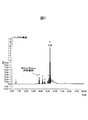
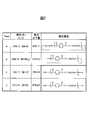
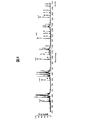
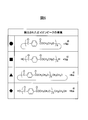
- UV chromatogram (240 nm) in LC / MS measurement. It is a figure which shows the characteristic peak estimation structure of the UV chromatogram of FIG. It is a MADI-TOF / MS spectrum; positive ion (whole) figure. It is a MADI-TOF / MS spectrum; positive ion (m / z500-1500) figure. It is a MADI-TOF / MS spectrum; positive ion (m / z1500-2500) figure. It is a figure explaining attribution of the detected positive ion peak.
- the knitting structure of the knitted fabric of Example 1 is shown.
- the organization chart of the double fabric of Example 3 is shown.
- the polyester fiber constituting the fabric of this embodiment is characterized in that a linear oligomer component of a terminal carboxylic acid is present on the surface.
- the fabric containing the polyester fiber in which such a terminal carboxylic acid linear oligomer component is present has excellent water absorption performance.
- the presence of the oligomer component can be confirmed by qualitative and quantitative analysis by a combination of two analysis methods described below.
- the linear oligomer components of the terminal carboxylic acid the relatively low molecular weight oligomer component is dissolved in THF and can be analyzed by LC / MS (liquid chromatography mass spectrometry).
- LC / MS liquid chromatography mass spectrometry
- FIG. 1 shows a chart example of a UV chromatogram (240 nm) of the THF solution.
- the structure of other peaks can be deduced from the mass number of ions detected by the ESI-mass spectrum.
- a mass chromatogram having a mass number of 785 (vertical axis: detection intensity of a specific mass number, horizontal axis: retention time) is displayed and estimated from an example of a UV spectrum. Whether or not the oligomer is present can be determined by the presence or absence of the detection intensity peak (peak z) of the mass number in the vicinity of the retention time (approximately 4.5 min in FIG. 1).
- the concentration can be converted from the ratio.
- the position of the internal standard substance peak s is estimated by detecting ions of the mass number in the ESI-mass spectrum of the peak.
- the area of the mass chromatogram peak z having the mass number 785 described above is used to clearly detect both the peak x and the peak z.
- the area of the peak z of the sample of interest can be converted to the area of the peak x.
- the intensity ratio with respect to the peak s can be calculated using the area of the peak x of the sample of interest thus obtained.
- the cyclic oligomer represented by the formula has no water absorption but rather inhibits water absorption.
- the relatively low molecular weight cyclic oligomer can be dissolved in THF and analyzed by LC / MS (liquid chromatography mass spectrometry).
- the internal standard equivalent concentration can be obtained.
- this peak is derived from the cyclic oligomer component (molecular weight 576.18) means that in the ESI-mass spectrum (electrospray ionization, positive ion mass spectrum) of the peak, ions having a mass number (m / z) 594 ([[ M + NH4] + ) can be detected.
- peak w the detection peak of the mass number
- the abundance of the oligomer component can be measured by the peak area value of the UV chromatogram, and the concentration should be converted from the ratio with the peak area value of the peak of the methyl benzoate UV chromatogram added as an internal standard (referred to as peak s). Can do.
- the fabric according to the present embodiment retains a linear oligomer of a relatively high-molecular terminal carboxylic acid that is not extracted with THF on the surface of the polyester fiber that constitutes the fabric even after the oligomer soluble in THF is extracted. Preferably it is. Since the linear oligomer of the terminal carboxylic acid has high adhesiveness to the fiber and the oligomer does not easily fall off even after repeated washing, it is considered that a great effect is exhibited by water absorption after repeated washing.
- Relatively high molecular weight oligomers that are not extracted by the THF treatment can be quantified by MALDI-TOF / MS measurement.
- 2 mg is collected, put into a 20 mL capacity glass sample bottle, 1 ml of HFIP (hexafluoroisopropanol) is added, and the sample is dissolved.
- the following matrix solution is also prepared. Take 20 ⁇ L of sample solution and add 20 ⁇ L of matrix solution. After stirring and mixing with a glass capillary for collecting the solution, the precipitate is confirmed immediately.
- the lower layer solution is collected instead of the precipitate in the upper layer, and MALDI-TOF / MS measurement is performed under the following conditions. At the time of measurement, the measurement is performed with a laser intensity of the matrix strength of 50 mV / Profile or more and less than 2000 mV / Profiles.
- FIGS. 3 to 5 show examples of positive ion spectra in MALDI-TOF / MS measurement.
- the height of the oligomeric Na adduct is divided by the height of the CHCA Na adduct peak, and the total is evaluated. This value is preferably 0.07 or more, and more preferably 0.10 or more. If the total value exceeds 0.5, decomposition is excessive, which is not preferable.
- the method for causing the oligomer to exist is not particularly limited, and the linear oligomer component of the terminal carboxylic acid may be applied to the fabric by a method such as coating or mixed with an ester polymer. By applying an alkali treatment, it can be applied to the vicinity of the fiber surface, which is preferable.
- the polyester fiber containing 0.005 to 1 wt% of S element can be given a linear oligomer of the terminal carboxylic acid by subjecting it to a specific alkali treatment.
- polyester fibers containing 0.005 to 1 wt% of S element include polyester fibers containing 0.5 to 5 mol% of ester-forming sulfonate compounds.
- ester-forming sulfonate compound contained in the polyester fiber in an amount of 0.5 to 5 mol% include 5-sodium sulfoisophthalic acid, 5-potassium sulfoisophthalic acid, 4-sodium sulfo-2,6-naphthalenedicarboxylic acid.
- 2-sodium sulfo-4-hydroxybenzoic acid 3,5-dicarboxylic acid benzenesulfonic acid tetramethylphosphonium salt, 3,5-dicarboxylic acid benzenesulfonic acid tetrabutylphosphonium salt, 3,5-dicarboxylic acid benzenesulfonic acid tributyl Methyl phosphonium salt, 2,6-dicarboxylic acid naphthalene-4-sulfonic acid tetrabutylphosphonium salt, 2,6-dicarboxylic acid naphthalene-4-sulfonic acid tetramethylphosphonium salt, 3,5-dicarboxylic acid benzenesulfonic acid ammonium salt, etc.
- ester derivatives such as dimethyl esters.
- These ester derivatives such as methyl and dimethyl ester are preferably used in that the whiteness of the polymer and the polymerization rate are excellent.
- the polyester fiber preferably contains a metal sulfonate group-containing isophthalic acid component such as 5-sodium sulfoisophthalic acid or 5-potassium sulfoisophthalic acid, and dimethyl 5-sodium sulfoisophthalate is particularly preferred.
- ester-forming sulfonate compound is particularly preferable in the case of ordinary polyester fiber, the terminal is hydrolyzed by alkali treatment, so that the oligomer is hardly formed, whereas the ester-forming sulfonate compound is used.
- the alkali treatment preferentially attacks the S element portion due to the alkali treatment and the cleavage in the middle of the molecular chain occurs, so that the oligomer having a carboxyl group at the terminal increases.
- the polyester fiber according to the present embodiment can be a polyester fiber containing a non-ester-forming sulfonate compound.
- a non-ester-forming sulfonate compound is a polyester fiber containing a sulfonate compound, without the sulfonate compound being directly esterified with the polyester and polycondensed to form a polyester.
- non-ester-forming sulfonate compounds include alkali metal salts of alkyl sulfonic acids or alkali metal salts of alkyl benzene sulfonic acids.
- alkali metal salt of alkyl sulfonic acid include sodium dodecyl sulfonate, sodium undecyl sulfonate, sodium tetradecyl sulfonate, and the like.
- alkali metal salt of alkylbenzene sulfonic acid examples include sodium dodecyl benzene sulfonate, sodium undecyl benzene sulfonate, sodium tetradecyl benzene sulfonate, and the like. From the viewpoint of processing stability, sodium dodecylbenzenesulfonate is particularly preferred.
- the polyester fiber containing 0.005 to 1 wt% of the S element is subjected to a specific alkali treatment, so that a water absorption effect is obtained, and the effect remains almost unchanged even after repeated washing. If the content of S element is less than 0.005 wt%, the durability effect of water absorption after alkali treatment is small, and if the S fiber is contained in the polyester fiber in an amount of 1 wt% or more, the strength of the fiber is lowered and spinning is difficult. It becomes.
- the S element in the polyester fiber is more preferably 0.01 to 0.8 w%, and further preferably 0.015 to 0.7 wt%. Note that ICP-AES (inductively coupled plasma emission spectrometer) is used as a method for quantifying S element.
- ester-forming sulfonate compound When the ester-forming sulfonate compound is contained, if the content is less than 0.5 mol%, the durability effect of water absorption after alkali treatment is small, and the ester-forming sulfonate compound is contained in the polyester fiber. When it contains more than 5 mol%, the strength of the fiber is lowered and spinning becomes difficult.
- the ester-forming sulfonate compound in the polyester fiber is more preferably 1 to 4.5 mol%, still more preferably 1.5 to 4 mol%.
- the polyester fiber has a weight loss rate of preferably 0.6 to 9%, more preferably 1 to 8%, and even more preferably 1.5 to 7%. Is preferred.
- the weight loss rate can be calculated from the weight of the polyester yarn before and after the alkali treatment. In the case of a polyester fiber containing an ester-forming sulfonate compound in an amount of 0.5 to 5 mol%, the rate of alkali weight loss is faster than that of a normal polyester fiber.
- the weight loss rate is less than 0.6%, the effect of forming the linear oligomer component of the terminal carboxylic acid by the alkali treatment is small and the durability of water absorption is poor. If the weight loss rate is larger than 9%, the alkali weight loss is excessively advanced, resulting in poor water absorption durability. It is presumed that the linear oligomer of the terminal carboxylic acid on the fiber surface once formed falls off due to excessive weight loss. Also, many large and deep pits are generated on the fiber surface, and the fiber strength is lowered. In order to reduce the weight loss ratio to 0.6 to 9%, for example, an alkali treatment method in which sodium hydroxide is treated at a concentration of 1 g / L to 20 g / L at 90 to 100 ° C.
- sodium hydroxide is treated at a concentration of 5 g / L to 15 g / L at 90 to 95 ° C. for 5 to 60 minutes.
- the alkali treatment concentration and time are preferably such that the concentration (g / L) ⁇ time (min) is 100 to 800 (g / L ⁇ min), more preferably 200 to 600 (g / L ⁇ min).
- the temperature raising speed during the alkali treatment is important, and it is preferable to raise the temperature slowly at a rate of 1 to 2 ° C./min. This is presumed to be because oligomer formation is promoted by slowly raising the temperature.
- the alkali treatment is neutralized with an acid and washed with water.
- a cyclic oligomer that inhibits water absorption can be removed by a specific oligomer removal treatment.
- conditions for washing with water for example, it is preferable to carry out for 10 to 30 minutes twice or more.
- “Two or more times” means that water is drained once and the water is replaced two or more times. More preferably, hot water at 40 ° C. to 60 ° C. is used once or more.
- volatile acetic acid etc. are used suitably for the acid at the time of neutralization.
- the alkaline solution may be collected and then neutralized to enhance washing with water.
- alkali treatment is carried out by using a cheese dyeing machine so that the polyester fiber containing 0.005 to 1 wt% of S element has a weight loss rate of 0.6 to 9% in the state of yarn. And a method of forming a fabric using the polyester fiber as a part is preferably used. Even in this case, the weight loss rate is preferably 0.6 to 9%, more preferably 1 to 8%, and still more preferably 1.5 to 7%. In addition, it is preferable to perform sufficient washing as described above.
- durable water absorption can be obtained even when water absorption processing is not performed.
- durable means that the water absorption is hardly lowered even after repeated washing.
- the fabric of this embodiment has a water absorption (JIS L1907 dripping method) of 30 seconds or less after washing 30 times according to JIS L0217 103 C method for 5 seconds or less.
- the water absorption after 30 washings is preferably 3 seconds or less, more preferably 2 seconds or less, and even more preferably 1 second or less.
- the water absorption after one wash by the same method is also preferably 5 seconds or less, more preferably 3 seconds or less, still more preferably 2 seconds or less, and particularly preferably 1 second or less.
- the fabric of this embodiment can retain water absorption even after 50 and 100 washings, and it is more preferable that the water absorption is 5 seconds or less after 50 and 100 times.
- As the washing detergent a normal detergent such as a neutral detergent or a weak alkaline detergent is preferably used.
- the fabric of this embodiment is excellent in the effect of maintaining the water absorption effect even during industrial washing.
- Industrial laundry is applied to laundry such as work clothes and uniforms, and is performed under conditions more severe than home laundry.
- JIS L1096 8.39.5 b) 2.2.2) F-2 medium temperature washer The method prescribed
- the fabric of this embodiment preferably has a water absorption of 5 seconds or less after 30 washings at 60 ° C. for 30 minutes according to JIS L1096 F-2.
- the surface of the polyester fiber containing 0.005 to 1 wt% of S element is within (or hits) the surface of 100 ⁇ m 2. It is preferable that 0.1 to 30 pits having a length of 0.5 to 5 ⁇ m are formed, and more preferably 0.2 to 2 pits.
- a pit is a fine depression existing on the fiber surface, and is formed by alkali treatment. In a normal alkali treatment, many pits are formed and communicated to form a streak-like groove having a length exceeding 5 ⁇ m. However, in this embodiment, there are few streak-like grooves having a length exceeding 5 ⁇ m. preferable.
- the number of pits in the surface of 100 ⁇ m 2 is an average value obtained by measuring the number of pits by enlarging the surface of an arbitrary 10 ⁇ m ⁇ 10 ⁇ m of the fiber in 50 places by using an electron microscope to about 1000 times. It is.
- the average number of grooves is preferably 1 or less, more preferably 0.1 or less.
- the length means the maximum length of one pit. It is estimated that very small pits are formed on the surface of the polyester fiber of the present embodiment, thereby contributing to durable water absorption.
- a pit having a length of 0.5 ⁇ m or less is not preferable because the water absorption effect is poor, and the presence of a streak-like groove having a length exceeding 5 ⁇ m means that the alkali treatment has proceeded excessively and the decomposition has proceeded excessively. Also, the case where the number of pits having a length of 0.5 to 5 ⁇ m exceeds 30 is not preferable because it means that the alkali treatment has proceeded excessively. In the present embodiment, even if alkali weight reduction is performed, there is no generation of streak-like grooves or communication holes having a length exceeding 5 ⁇ m, so the rate of decrease in strength is small.
- the shape of the pit is preferably 1.0 to 2.5 in the vertical / horizontal direction, and more preferably 1.0 to 2.0.
- the vertical means the maximum length
- the horizontal means the maximum length in the direction orthogonal to the vertical direction.
- the pit is measured after the sample is thoroughly washed. It is preferable to carry out washing once or more by the JIS method and wash with water for 20 minutes or more.
- the fabric of the present embodiment desirably contains at least 25%, preferably 40% or more of the polyester fiber to which a specific oligomer is attached on one surface of the fabric.
- 25% or more means the proportion of the total area.
- polyester fibers to which a specific oligomer is attached are connected in the course direction at a rate of 1 course per 8 courses.
- polyester fibers containing 0.005 to 1 wt% of S element are not connected in the course direction, polyester fibers containing 0.005 to 1 wt% of S element should be connected at least at a ratio of 1 wale to 4 whales. Is preferred.
- Connected means connected by knit or tack. In the case of warp knitted fabric, it is preferable to arrange so that the loop of the polyester fiber to which the specific oligomer is attached is connected.
- polyester fibers to which specific oligomers are attached synthetic fibers such as polyester fibers, polyamide fibers, and polyurethane fibers to which specific oligomers are not attached, or cotton, rayon, cupra, It can be mixed with cellulose fibers such as acetate.
- the arrangement and movement of moisture retention in the fabric can be freely controlled by a combination with a water-repellent yarn that has been subjected to a water-repellent treatment such as attaching a fluorine-based treatment agent to the yarn.
- the total fineness of the fibers used in this embodiment is preferably 8 to 167 dtex, and more preferably 22 to 110 dtex.
- the single yarn fineness is not particularly limited, but is preferably smaller from the viewpoint of easy formation of oligomers, preferably 0.5 to 2.5 dtex, particularly preferably 0.5 to 1.5 dtex. From the viewpoints of touch and texture, it is preferable that the single yarn fineness is small.
- the fibers used in this embodiment include a matting agent such as titanium dioxide, a stabilizer such as phosphoric acid, an ultraviolet absorber such as a hydroxybenzophenone derivative, a crystallization nucleating agent such as talc, a lubricant such as fumed silica, and a hinder.
- Antioxidants such as dophenol derivatives, flame retardants, antistatic agents, pigments, fluorescent brighteners, infrared absorbers, antifoaming agents and the like may be contained.
- fibers having crimps such as false twisted yarn can be used, and those having a crimp elongation of 0 to 150% are preferable from the viewpoint of touch.
- the crimp elongation of the false twisted yarn is measured under the following conditions. The upper end of the crimped yarn is fixed, a load of 1.77 ⁇ 10 ⁇ 3 cN / dtex is applied to the lower end, and the length (A) after 30 seconds is measured.
- the fabric of this embodiment may be a woven fabric or a knitted fabric.
- a woven structure in the case of a woven fabric, a plain woven structure, a twill woven structure, a satin woven structure, and various changed structures derived therefrom can be applied.
- polyester fibers in which a specific oligomer is adhered to 25% or more of the skin side in a double woven structure.
- a knitted fabric either circular knitting or warp knitting may be used.
- a weft knitting machine, a double circular knitting machine, a tricot knitting machine, a Russell knitting machine, or the like can be used.
- the knitting gauge of the knitting machine to be used is preferably 10 to 60 GG.
- the knitting structure is not particularly limited. In order to impart durable water absorption to the skin side, it is preferable to dispose polyester fibers having a specific oligomer attached to 25% or more of the skin side in a structure in which different yarns can be disposed on the front and back surfaces.
- the basis weight of the fabric of this embodiment is not particularly limited, but is preferably 30 to 300 g / m 2 , more preferably 50 to 250 g / m 2 . Further, the fabric of the present invention may be subjected to water absorption processing.
- the fabric of the present embodiment is suitable for clothing such as sportswear and innerwear, but is not limited to this among textile products, but is not limited to this, and clothing such as outer and lining, sheets, etc.
- the present invention can also be applied to hygiene articles such as bedding and incontinence pants, and exhibits a suitable water absorption effect.
- the knitted fabric obtained in the Example was evaluated by the following method.
- (1) Quantification of a linear oligomer of terminal carboxylic acid with n 4 (THF soluble component) The method described above was used.
- (2) Determination of n 8 terminal carboxylic acid linear oligomer) (THF insoluble component) The method described above was used.
- (3) Quantification of n 3 cyclic oligomer (THF soluble component) The method described above was used.
- Wear test A T-shirt was prepared so that the surface on which the polyester fiber containing 0.005 to 1 wt% of S element was exposed on the surface was the skin side, and washing was performed according to JIS L0217 Attached Table 1. This was carried out 30 times using a Kao Corporation attack as the detergent. After wearing 30 T-shirts and resting for 10 minutes in an artificial climate room at 30 ° C and 50% RH, run for 20 minutes at 7km / h on a treadmill ORK-3000 manufactured by Otake / Route Industry. Exercise and rest again for 10 minutes.
- Example 1 Polyester chips containing 4.5 mol% of sodium isophthalate dimethyl-5-sulfonic acid and polyester chips containing 99 mol% or more of ordinary ethylene terephthalate components were blended to adjust the S element content to 0.30 wt%. Using a tip, a 84 dtex / 36 f yarn was spun and false twisted to obtain a round cross-section processed yarn. Using this processed yarn and a 84 dtex / 36 f polyester round cross-section processed yarn and a 84 dtex / 72 f polyester round cross-section processed yarn as regular yarn not containing S element, a 28 gauge double circular knitting machine was used. The yarn was fed as shown in the knitting structure shown in FIG.
- This raw machine was scoured at 80 ° C. for 20 minutes with a liquid dyeing machine, washed with water, and then pre-set at 180 ° C. for 90 seconds with a pinning ratio of 20%. Thereafter, the mixture was heated at a sodium hydroxide concentration of 9 g / L at 2 ° C./min with a liquid dyeing machine, subjected to alkali treatment at 95 ° C. for 45 minutes, neutralized with acetic acid, and sufficiently washed with water. Washing conditions are as follows.
- the water absorbency after washing 30 times by the 103 C method and JIS L1096 F-2 medium temperature washer method in JIS L0217 Attached Table 1 of the main knitted fabric is less than 1 second and 2 seconds, respectively.
- the result was soft and comfortable, and there was no stickiness after sweating.
- the water absorption after 100 washings by the 103 C method of JIS L0217 Attached Table 1 was also less than 1 second.
- Example 2 Using a 28GG tricot knitting machine, polyester round section yarn containing 2.5 mol% of 56 dtex / 24f dimethyl-5-sulfonic acid sodium isophthalate at the front (S element content 0.17 wt%) and polyurethane at the back A knitted fabric was knitted in a half tricot structure using yarn 44 dtex. Relax and scour at 80 ° C, heat set at 190 ° C, heat up at 2 ° C / min at a sodium hydroxide concentration of 10g / L with a liquid dyeing machine, and alkali treatment at 95 ° C for 45 minutes The solution was neutralized with acetic acid and thoroughly washed with water. Washing conditions were 60 ° C.
- Example 3 A processed yarn of polyester round cross-section yarn containing 2.5 mol% of 167 dtex / 72f dimethyl-5-sulfonic acid sodium isophthalate using 56 dtex / 72f S element-free polyester processed yarn as warp (S element content) 0.17 wt%) and 84 dtex / 72f twin S element-free polyester processed yarn was arranged in the weft to produce the double woven fabric of FIG. Scouring is performed at 80 ° C, heat setting is performed at 190 ° C, the temperature is raised at 2 ° C / min at a sodium hydroxide concentration of 7 g / L with a liquid dyeing machine, and alkali treatment is performed at 95 ° C for 60 minutes.
- the solution was neutralized with acetic acid and thoroughly washed with water. Washing conditions were 60 ° C. and 15 minutes twice (water washing conditions A). The weight loss rate was 3.9%. Furthermore, dyeing
- the water absorbency after washing 30 times by the 103 C method and JIS L1096 F-2 medium temperature washer method of Appendix 1 of this fabric is 1 second and 5 seconds, respectively. It was soft and comfortable, and there was no stickiness after sweating.
- Example 4 A knitted fabric having a basis weight of 138 g / m 2 and a thickness of 0.63 mm was obtained in the same manner as in Example 1 except that the concentration during alkali treatment was 5 g / L and the treatment time was 20 minutes.
- the water absorbency of the knitted fabric after washing 30 times by the 103 C method and JIS L1096 F-2 medium temperature washer method of Appendix 1 is 2 seconds and 5 seconds, respectively. In the wearing test, the result was soft and comfortable, and there was no stickiness after sweating. Moreover, the water absorption after 100 washings by 103 C method of JIS L0217 appendix 1 was also 2 seconds.
- Example 5 Instead of polyester round cross-section yarn containing 2.5 mol% of 56 dtex / 24f sodium dimethyl-5-sulfonic acid dimethyl-5-sulfonic acid, 2.5 d of 56 dtex / 24f 4-sodium sulfo-2,6-naphthalenedicarboxylic acid is used.
- a knitted fabric with a basis weight of 175 g / m 2 and a thickness of 0.59 mm was obtained in the same manner as in Example 2 except that a polyester round cross-section yarn containing mol% (S element content: 0.18 wt%) was used.
- the water absorbency of the knitted fabric after washing 30 times in the JIS L0217 Appendix Table 103 method C and JIS L1096 F-2 medium temperature washer method is 1 second and 6 seconds, respectively.
- the result was soft and comfortable, and there was no stickiness after sweating.
- Polyester cross-section yarn of 84 dtex / 36f containing 2.5 mol% of dimethyl-5-sulfonic acid sodium isophthalate is processed under the condition of 2 ° C./min at a sodium hydroxide concentration of 10 g / L using a cheese dyeing machine. The temperature was raised, and this was subjected to an alkali treatment at 95 ° C. for 45 minutes, neutralized with acetic acid and thoroughly washed with water. Washing conditions were 60 ° C. and 15 minutes twice (water washing conditions A). The weight loss rate of the processed yarn was 5.1%.
- This S element-containing processed yarn (S element content 0.17 wt%), 84 dtex / 36f S element-free polyester round cross-section processed yarn, and 84 dtex / 72f S element-free polyester round cross-section processed yarn
- knitting was performed with the knitting structure shown in FIG. 3 to obtain a raw machine.
- This raw machine was scoured at 80 ° C. for 20 minutes with a liquid dyeing machine, washed with water, and then pre-set at 180 ° C. for 90 seconds with a pinning ratio of 20%.
- the water absorbency of the knitted fabric after washing 30 times in the JIS L0217 Appendix Table 103 method C and JIS L1096 F-2 medium temperature washer method is 1 second and 2 seconds, respectively. In the wearing test, the result was soft and comfortable, and there was no stickiness after sweating. Further, the water absorption after 100 washings by the 103 C method of JIS L0217 Attached Table 1 was 1 second.
- Example 7 A knitted fabric having a basis weight of 134 g / m 2 and a thickness of 0.63 mm was obtained in the same manner as in Example 1 except that the water washing condition after the alkali treatment was set to once at 20 ° C. for 15 minutes (water washing condition B).
- the water absorbency after washing 30 times in the JIS L0217 Appendix Table 103 method C and JIS L1096 F-2 medium temperature washer method of this knitted fabric is 5 seconds and 180 seconds or more, respectively. Excellent water absorption.
- the shirt wearing test using this knitted fabric was generally more comfortable than the fabric having no water absorption, but the result was that there was a slight stickiness when sweating.
- the water absorption after 100 washings by the 103 C method of JIS L0217 Attached Table 1 was 10 seconds.
- Example 3 A knitted fabric having a basis weight of 133 g / m 2 and a thickness of 0.64 mm was obtained in the same manner as in Example 1 except that the sodium hydroxide concentration in the alkali treatment was changed to 0.5 g / L.
- Example 4 A knitted fabric having a basis weight of 118 g / m 2 and a thickness of 0.53 mm was obtained in the same manner as in Example 1 except that the sodium hydroxide concentration in the alkali treatment was 24 g / L.
- the water-absorbing fabric according to the present invention absorbs water semi-permanently even when water-absorbing processing is not performed, and can quickly absorb sweat when worn, and is excellent in comfort, soft and soft to the touch. Etc. can be suitably used.
Landscapes
- Engineering & Computer Science (AREA)
- Textile Engineering (AREA)
- Chemical & Material Sciences (AREA)
- Chemical Kinetics & Catalysis (AREA)
- General Chemical & Material Sciences (AREA)
- Chemical Or Physical Treatment Of Fibers (AREA)
- Treatments For Attaching Organic Compounds To Fibrous Goods (AREA)
- Artificial Filaments (AREA)
Abstract
Description
例えば、以下の特許文献1では、ポリエステル繊維を吸水剤で処理した後、吸水剤をハイドロゲルで被覆することにより、吸水性等を付与している。この方法では、吸水剤が加工で付与されており、ハイドロゲルによる被覆を施しても吸水性の劣化は避けられず、洗濯を繰り返すと性能が低下してしまい、工業洗濯のような高温の洗濯ではさらに性能が低下する可能性がある。さらにハイドロゲルの被覆により、繊維の柔らかさを損なう恐れもある。
すなわち、本発明は以下の通りのものである。
[2]JIS L0217 103 C法による洗濯1回後のJIS L1907 滴下法による吸水性が5秒以内である、前記[1]に記載の吸水性布帛。
[3]前記ポリエステル繊維がS元素を0.005~1wt%含有する、前記[1]又は[2]に記載の吸水性布帛。
[4]前記S元素を0.005~1wt%含有するポリエステル繊維が、エステル形成性スルホン酸塩化合物を0.5~5モル%含有するポリエステル繊維である、前記[3]に記載の吸水性布帛。
[5]前記エステル形成性スルホン酸塩化合物が、金属スルホネート基含有イソフタル酸である、前記[4]に記載の吸水性布帛。
[6]前記S元素を0.005~1wt%含有するポリエステル繊維の表面100μm2内に長さ0.5~5μmのピットが0.1~30個形成されている、前記[1]~[5]のいずれかに記載の吸水性布帛。
[7]前記末端カルボン酸の直鎖オリゴマー成分のうち、n=8の末端カルボン酸の直鎖オリゴマー成分の、内部標準に対するピーク強度比が0.005~0.100である、前記[1]~[6]のいずれかに記載の吸水性布帛。
[8]前記末端カルボン酸の直鎖オリゴマー成分のうち、n=4の末端カルボン酸の直鎖オリゴマー成分の量が、内部標準換算濃度2~15μg/mlに相当する、前記[1]~[7]のいずれかに記載の吸水性布帛。
[9]n=3の環状オリゴマーが、内部標準換算濃度80μg/ml以下に相当する量で含まれる、前記[1]~[8]のいずれかに記載の吸水性布帛。
[10]前記S元素を0.005~1wt%含有するポリエステル繊維を含む布帛に、該ポリエステル繊維に対して減量率0.6~9%でアルカリ減量を施す工程を含む、前記[1]~[9]のいずれかに記載の吸水性布帛の製造方法。
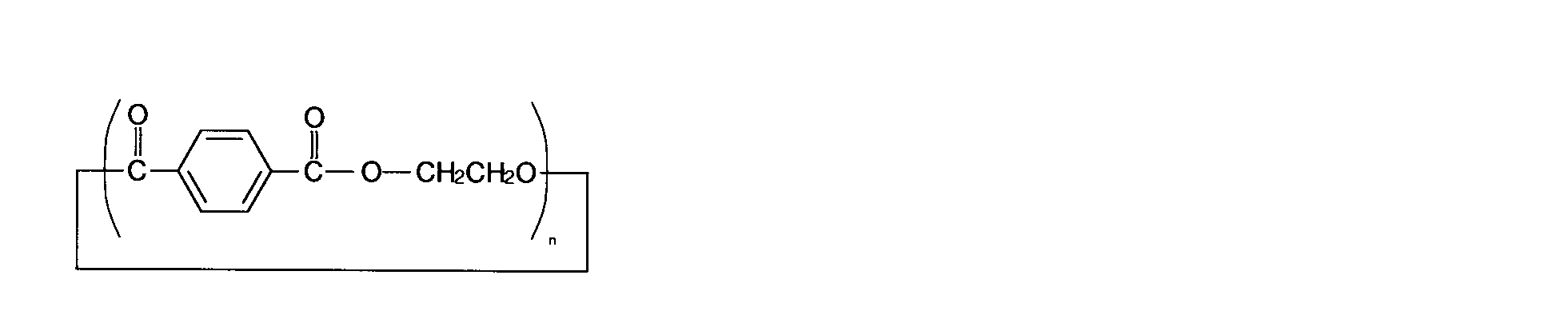
本実施形態の布帛を構成するポリエステル繊維は、表面に末端カルボン酸の直鎖オリゴマー成分が存在することを特徴としている。表面に末端カルボン酸の直鎖オリゴマー成分が存在することで吸水性の繰り返し洗濯耐久性が発現するものである。ここで、末端カルボン酸の直鎖オリゴマー成分は、例えば、以下の式(1):

該オリゴマー成分は、以下に記す、2種の分析手法の組み合わせによって定性、定量することによって存在が確認できる。
かかる末端カルボン酸の直鎖オリゴマー成分のうち、比較的低分子のオリゴマー成分はTHFに溶解し、LC/MS(液体クロマトグラフィー質量分析法)で分析することができる。その代表的成分をn=4とすると、繊維表面に存在するn=4のオリゴマー成分は、以下の方法で測定することができる。
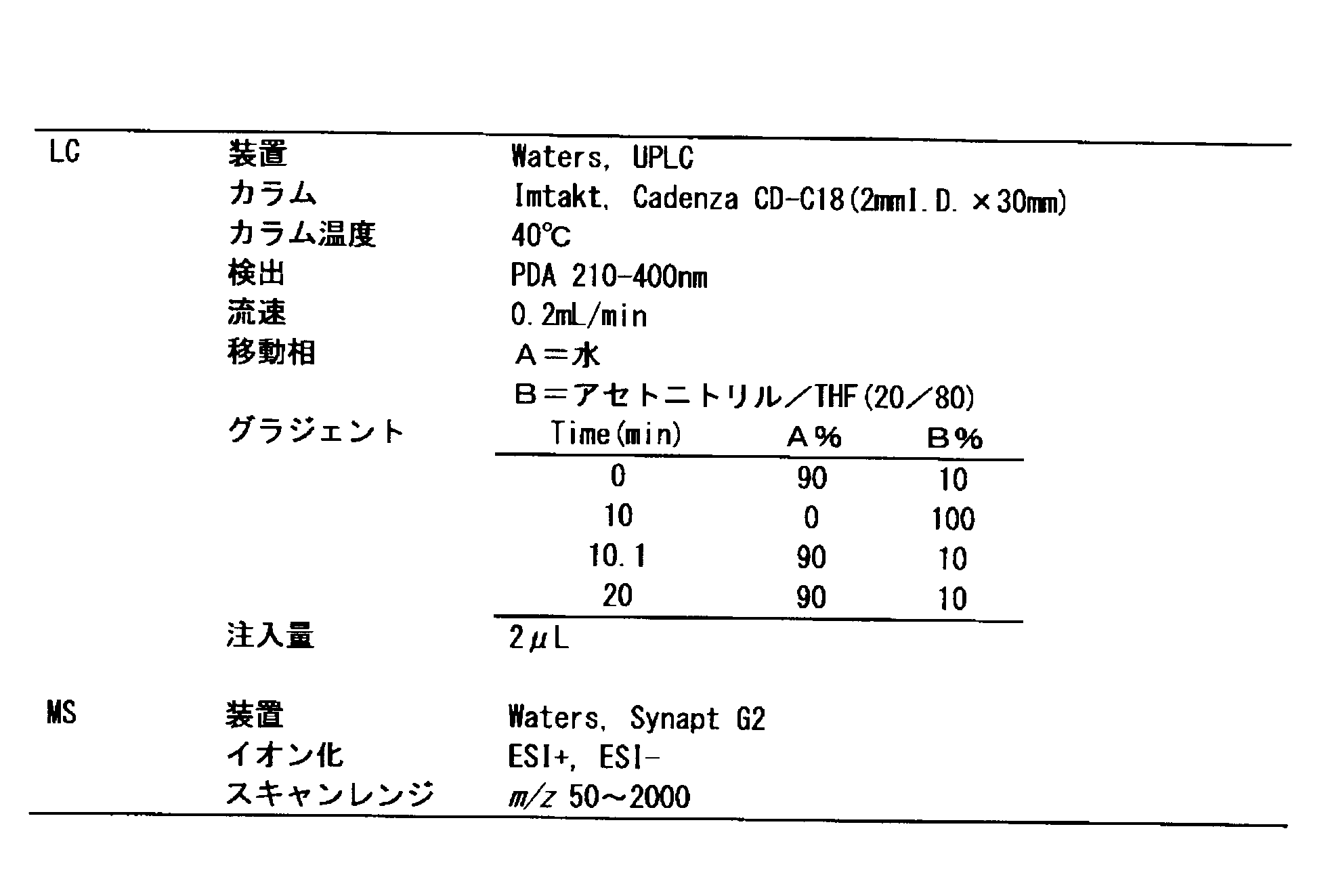
20mL容量のガラスサンプル瓶(AS ONE ラボランパック スクリュー管瓶 9-852-07 NO.5)中に、試料として布帛から取り出したポリエステル糸100mgを入れ、THF3mlを添加する。ヤマト マグミキサー 形式M-41を用いて回転数約800回/分で6時間撹拌した後、4日間静置し、THF溶液のLC/MSを行うことで試料から抽出した成分の分析を行う。THF溶液のサンプリングに際し、固形分が入らないようにして0.495mlの溶液を採取し、内部標準として、Methyl Benzoate 1mg/ml溶液を0.005ml添加し試料とした。LC/MS分析の条件は以下の表1に示すとおりである。
UVクロマトグラムにおいて、前記オリゴマー由来のピークが明確でない場合には、質量数785のマスクロマトグラム(縦軸:特定質量数の検出強度、横軸:保持時間)を表示させ、UVスペクトル例から推定される保持時間(図1では約4.5min.)付近に該質量数の検出強度ピーク(ピークzとする)が存在するか否かで、該オリゴマーが存在するか否かを判断できる。
このように末端カルボン酸の直鎖オリゴマーは、吸水性に寄与するが、例えば、以下の式(2):
具体的には図1のUVクロマトグラム(240nm)のチャートの例において、ピークbがn=3の環状オリゴマー成分のピークである。このピークが該環状オリゴマー成分(分子量576.18)由来であることは、そのピークのESI-質量スペクトル(エレクトロスプレーイオン化、正イオン質量スペクトル)において、質量数(m/z)594のイオン([M+NH4]+)が検出されることにより確認できる。UVクロマトグラムにおいて、前記オリゴマー由来のピークが明確でない場合には、n=4末端カルボン酸直鎖オリゴマーと同様に、質量数594のマスクロマトグラムを表示させ、UVスペクトル例から推定される保持時間(図1では約5.3min.)付近に該質量数の検出強度ピーク(ピークwとする)が存在するか否かで、該オリゴマーが存在するか否かを判断できる。
該オリゴマー成分の存在量は、UVクロマトグラムのピーク面積値で測定でき、内部標準として添加したMethyl BenzoateのUVクロマトグラムのピーク(ピークsとする)のピーク面積値との比率から濃度換算することができる。
THFでオリゴマーを抽出した後の試料を風乾したのち、2mgを採取し、20mL容量のガラスサンプル瓶に入れ、1mlのHFIP(ヘキサフロロイソプロパノール)を加え、試料を溶解させる。また、以下に示すマトリックス溶液も調整する。試料溶液20μLを取り、マトリックス溶液20μLを添加する。溶液を採取するガラス毛細管で撹拌、混合後、すぐに析出分が確認される。上層にある析出分ではなく、下層溶液を採取し、下記条件でMALDI―TOF/MS測定を行う。測定に際して、マトリックスの強度が50mV/Profiles以上2000mV/Profiles未満のレーザー強度で測定を行う。
装置:島津AXIMA CFR plus
レーザー:窒素レーザー(337nm)
検出器形式:リニアモード
イオン検出:正イオン(Positive mode)
:負イオン(Negative mode)
積算回数:500回
マトリックス溶液:CHCA(α-シアノ-4-ヒドロキシケイ皮酸)10mg/ml H2O+CH3CN
カチオン化剤:NaI 1mg/mlアセトン
スキャンレンジ:m/z 1~8000
本実施形態においては、式(1)のn=4~10の末端カルボン酸の直鎖オリゴマー成分を有していることが吸水性の耐久性に非常に効果的である。n=4~10の末端カルボン酸の直鎖オリゴマー成分の定量は以下の方法で行う。
n=4~10の末端カルボン酸の直鎖オリゴマーのピークは、MALDI-TOF/MSの正イオンスペクトルにおいてNa付加体として検出される。該オリゴマー成分量は、該オリゴマーNa付加体のピーク強度をマトリックスピーク強度で規格化した値で評価できる。すなわち、該オリゴマーNa付加体ピーク高さを、マトリックスであるCHCAのNa付加体ピーク(m/z=212)高さで除した値を成分量の指標とし、n=4~n=10のそれぞれのオリゴマーNa付加体ピーク高さをCHCAのNa付加体ピークの高さで除し、それらの総和で評価する。この値が0.07以上であるのが好ましく、0.10以上がさらに好ましい。総和値が0.5を超えると分解が進みすぎているため、好ましくない。
ポリエステル繊維に0.5~5モル%含有させるエステル形成性スルホン酸塩化合物の例としては、5-ナトリウムスルホイソフタル酸、5-カリウムスルホイソフタル酸、4-ナトリウムスルホ-2,6-ナフタレンジカルボン酸、2-ナトリウムスルホ-4-ヒドロキシ安息香酸、3,5-ジカルボン酸ベンゼンスルホン酸テトラメチルホスホニウム塩、3,5-ジカルボン酸ベンゼンスルホン酸テトラブチルホスホニウム塩、3,5-ジカルボン酸ベンゼンスルホン酸トリブチルメチルホスホニウム塩、2,6-ジカルボン酸ナフタレン-4-スルホン酸テトラブチルホスホニウム塩、2,6-ジカルボン酸ナフタレン-4-スルホン酸テトラメチルホスホニウム塩、3,5-ジカルボン酸ベンゼンスルホン酸アンモニウム塩等又はこれらのメチル、ジメチルエステル等のエステル誘導体が挙げられる。これらのメチル、ジメチルエステル等のエステル誘導体はポリマーの白度、重合速度が優れる点で好ましく用いられる。ポリエステル繊維に、5-ナトリウムスルホイソフタル酸、5-カリウムスルホイソフタル酸等金属スルホネート基含有イソフタル酸成分を含有させることが好ましく、中でも5-ナトリウムスルホイソフタル酸ジメチルは特に好ましい。
吸水性を発現させるために、アルカリ処理の条件としては該ポリエステル繊維の減量率を好ましくは0.6~9%、より好ましくは1~8%、さらに好ましくは1.5~7%にすることが好ましい。減量率はアルカリ処理前後のポリエステル糸の重量から算出できる。エステル形成性スルホン酸塩化合物を0.5~5モル%含有するポリエステル繊維の場合は通常のポリエステル繊維に比べアルカリ減量の速度が速いため、アルカリを低濃度に調整し、処理することが好ましい。
通常、アルカリ処理の後には酸で中和し、水洗するが、本発明においては特定のオリゴマー除去処理を行うことが非常に重要である。特定のオリゴマー除去処理により、吸水性を阻害する環状オリゴマーを除去することができる。オリゴマー除去の方法はいくつか挙げられる。たとえばオリゴマー除去剤を使用する方法や水洗を強化する方法などである。このうち、アルカリ処理後の水洗を強化する方法が、吸水性を阻害する環状オリゴマーを除去し、吸水性に寄与するn=4~10の末端カルボン酸の直鎖オリゴマーが除去されにくいことから特に好ましい。水洗の条件としては、例えば、10~30分間を2回以上行うことが好ましい。2回以上とは一度水を排水し、水を入れ替えることを2回以上行うことを意味する。40℃~60℃の温水を1回以上使用することがさらに好ましい。尚、中和時の酸には揮発性の酢酸等が好適に用いられる。設備によってはアルカリ溶液を回収し、その後に中和し、水洗を強化してもよい。
アルカリ処理の他の方法としてはS元素を0.005~1wt%含有するポリエステル繊維を糸の状態で0.6~9%の減量率になるようにチーズ染色機を用いる方法などでアルカリ処理を施し、該ポリエステル繊維を一部に用いて布帛を形成する方法が好適に用いられる。この場合においても減量率は、好ましくは0.6~9%、より好ましくは1~8%、さらに好ましくは1.5~7%にすることが好ましい。また、上述の十分な水洗を行うことが好ましい。
経編地の場合、特定のオリゴマーが付着されたポリエステル繊維のループが繋がるように配置するのが好ましい。
特に、糸にフッ素系処理剤を付着させるなど撥水加工を施した撥水糸との組合せにより、布帛内の水分保持の配置や移動を自在にコントロールすることができる。例えば、肌面に撥水糸を配置し、かつ少量の特定のオリゴマーが付着されたポリエステル繊維を配置し、該ポリエステル繊維を表面側に繋げば、該ポリエステル繊維から水を吸い上げ表側に水を移行することが可能になり、肌面には汗が残らず、汗処理性に優れた布帛を設計することが可能になる。
本実施形態に用いる繊維には、二酸化チタン等の艶消剤、リン酸等の安定剤、ヒドロキシベンゾフェノン誘導体等の紫外線吸収剤、タルク等の結晶化核剤、フュームドシリカ等の易滑剤、ヒンダードフェノール誘導体等の抗酸化剤、難燃剤、制電剤、顔料、蛍光増白剤、赤外線吸収剤、消泡剤等が含有されていてもよい。
捲縮糸の上端を固定し、下端に1.77×10⁻³cN/dtexの荷重をかけ、30秒後の長さ(A)を測定する。次いで、1.77×10-3cN/dtexの荷重を取り外し、0.088cN/dtexの荷重をかけ、30秒後の長さ(B)を測定し、下記式(3):
捲縮伸長率(%)={(B-A)/A}×100 (3)
により捲縮伸長率を求める。
織物の場合の織組織としては平織組織、綾織組織、朱子織組織、及びそれらから誘導された各種変化組織を適用することができる。肌側に耐久的な吸水性を付与するためには2重織り組織で肌側の25%以上に特定のオリゴマーが付着されたポリエステル繊維を配置するのが好ましい。
編物の場合は丸編、経編のいずれでもよく、編機としては、緯編機やダブル丸編機、トリコット編機、ラッセル編機等を使用できる。使用する編機の編ゲージとしては10~60GGが好ましい。編組織も特に限定されない。肌側に耐久的な吸水性を付与するためには表裏面に異なる糸を配置できる組織で肌側の25%以上に特定のオリゴマーが付着されたポリエステル繊維を配置するのが好ましい。
また、本発明の布帛には吸水加工を施してもよい。
なお、実施例で得た編地を、以下の方法で評価した。
(1)n=4の末端カルボン酸の直鎖オリゴマーの定量(THF可溶成分)
上述の方法を用いた。
(2)n=8の末端カルボン酸の直鎖オリゴマー)の定量(THF不溶成分)
上述の方法を用いた。
(3)n=3の環状オリゴマーの定量(THF可溶成分)
上述の方法を用いた。
試料をJIS L0217 付表1の103 C法で洗濯を1回行い、20分水洗し、電子顕微鏡を用いて2000倍の表面画像を取得し、上述の方法でピットを計測し、50か所の平均値とした。
S元素を0.005~1wt%含有するポリエステル繊維が表面に多く露出している面が肌側になるように作製されたTシャツを作成し、洗濯をJIS L0217 付表1の103法で行い、洗剤には花王(株)製 アタックを用いて、30回実施した。30回後のTシャツを着用し、30℃、50%RH環境の人工気候室にて10分間安静にした後に、大武・ルート工業社製トレッドミルORK-3000にて時速7kmで20分の走行運動を行い、再び10分間安静にした。走行運動前の肌触り、快適感、そして走行運動後のベタツキ感を、それぞれ、以下の評価基準に従い官能評価した:
○:肌触りや風合いが良い;快適である;ベタツキ感を感じない
△:肌触りや風合いがやや悪い;概ね快適である;ややベタツキ感を感じる
×:肌触りや風合いが悪い;不快である;ベタツキ感を感じる
JIS L1907 滴下法 の方法による。
JIS L0217 付表1の103 C法により、洗剤は弱アルカリ性洗剤(商品名花王(株) アタック)を使用して洗濯処理を行った。
工業洗濯試験を想定し、JIS L1096 8.39.5 b) 2.2.2)F-2中温ワッシャー法の条件で洗浄剤として石鹸0.8%owf、過酸化水素0.8%owf、珪酸ソーダ0.8%owfを用いた。
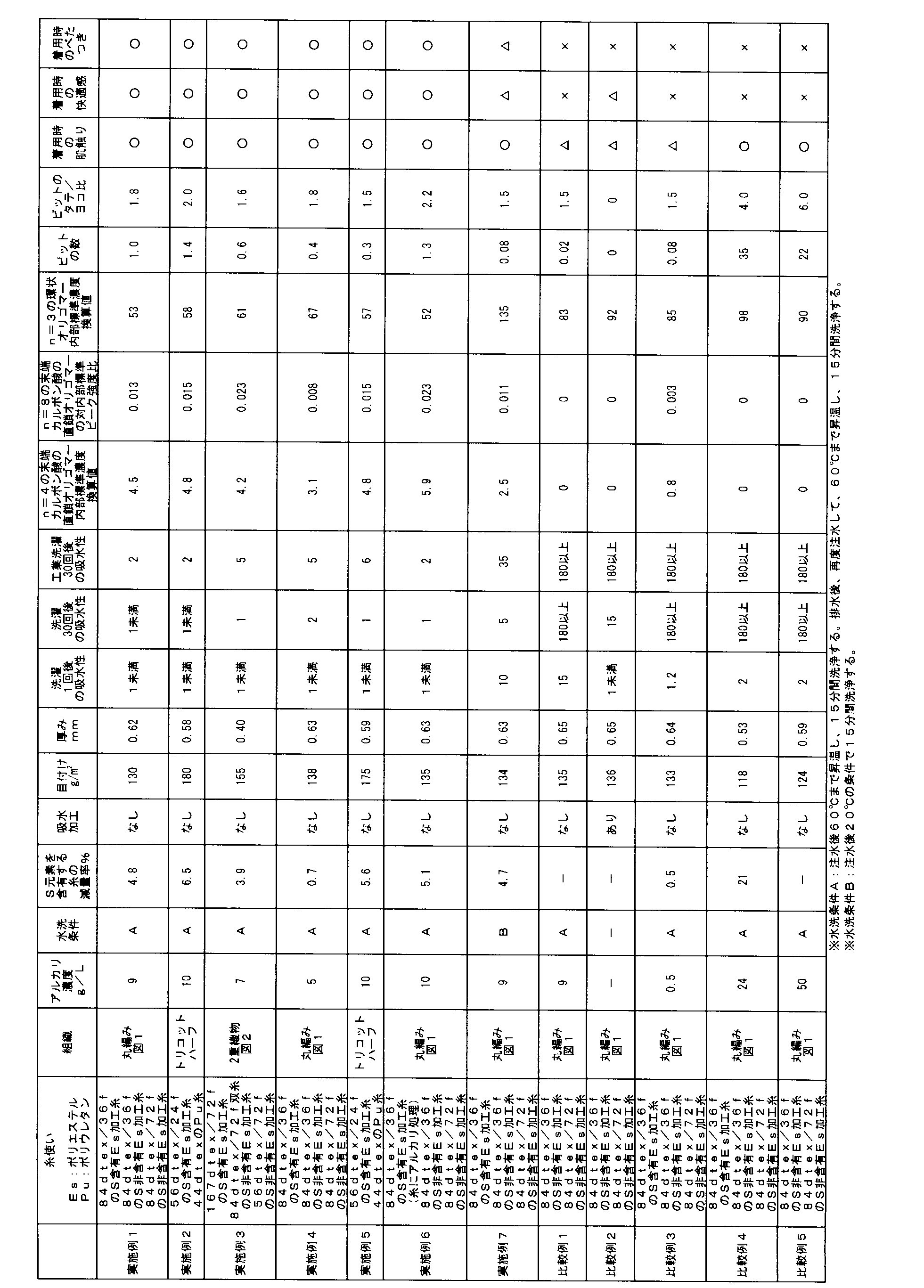
ナトリウムイソフタル酸ジメチル- 5 -スルホン酸を4.5モル%含有するポリエステルチップと通常のエチレンテレフタレート成分が99モル%以上のポリエステルチップをブレンドし、S元素の含有量を0.30wt%に調整したチップを用いて、84dtex/36fの糸を紡糸し、仮撚り加工を行い、丸型断面の加工糸を得た。この加工糸と、S元素を含有しないレギュラー糸として84dtex/36fのポリエステル丸型断面加工糸、および、84dtex/72fのポリエステル丸型断面加工糸とを用いて、28ゲージダブル丸編機を使用し、図7に示す編組織(図中の丸数字は編成順を示す)に示すように給糸し、生機を得た。この生機を液流染色機にて80℃×20分で精練、水洗した後に、ピンテンターにて幅出し率20%で180℃×90秒のプレセットを行った。その後、液流染色機にて水酸化ナトリウム濃度9g/Lで2℃/minの条件で昇温し、95℃で45分間アルカリ処理を施し、酢酸を用いて中和し十分に水洗した。水洗条件は注水後60℃まで昇温し15分間洗浄する。その後、一旦排水し、再度、注水後60℃まで昇温し、15分間洗浄し、排水する(水洗条件A)。84dtex/36fのS元素含有の加工糸の減量率は4.8%であった。その後、130℃でのポリエステル染色、水洗を行い、ピンテンターにて、しわが取れる程度に伸長し、150℃×90秒のファイナルセットを行い、目付130g/m2、厚み0.62mmの編地を得た。本編地のJIS L0217 付表1の103 C法とJIS L1096 F-2中温ワッシャー法での洗濯30回後の吸水性は、それぞれ、1秒未満と2秒であり、この編地を用いたシャツ(肌側にS元素を含有した加工糸を配置させた)の着用試験ではやわらかく快適で、発汗後もベタツキ感がないという結果が得られた。また、JIS L0217 付表1の103 C法による洗濯100回後の吸水性も1秒未満であった。
28GGのトリコット編み機を用いて、フロントに56dtex/24fのナトリウムイソフタル酸ジメチル- 5 -スルホン酸を2.5モル%含有するポリエステル丸型断面糸(S元素含有量0.17wt%)、バックにポリウレタン糸44dtexを用いてハーフトリコット組織にて編地を編成した。80℃にてリラックス、精練を行い、190℃で熱セットを行い、液流染色機にて水酸化ナトリウム濃度10g/Lで2℃/minの条件で昇温し、95℃で45分間アルカリ処理を施し、酢酸で中和し、十分に水洗した。水洗条件は60℃で15分を2回繰り返した(水洗条件A)。減量率は6.5%であった。さらに130℃で染色、170℃で仕上げセットを実施して、目付180g/m2、厚み0.58mmの編物を得た。本編地のJIS L0217 付表1の103 C法とJIS L1096 F-2中温ワッシャー法での洗濯30回後の吸水性は、それぞれ、1秒未満と2秒であり、この編地で作製したスパッツの着用試験ではやわらかく、快適で、発汗後もベタツキ感のないものであった。
56dtex/72fのS元素非含有ポリエステル加工糸を経糸に用い、167dtex/72fのナトリウムイソフタル酸ジメチル- 5 -スルホン酸を2.5モル%含有するポリエステル丸型断面糸の加工糸(S元素含有量0.17wt%)と84dtex/72f双糸のS元素非含有ポリエステル加工糸を緯糸に配糸して、図8の2重織物を作製した。80℃にて精練を行い、190℃で熱セットを行い、液流染色機にて水酸化ナトリウム濃度7g/Lで2℃/minの条件で昇温し、95℃で60分間アルカリ処理を施し、酢酸で中和し、十分に水洗した。水洗条件は60℃で15分を2回繰り返した(水洗条件A)。減量率は3.9%であった。さらに130℃で染色、170℃で仕上げセットを実施して、目付155g/m2、厚み0.40mmの織物を得た。本織物のJIS L0217 付表1の103 C法とJIS L1096 F-2中温ワッシャー法での洗濯30回後の吸水性は、それぞれ、1秒と5秒であり、この織物から得たウエアの着用試験ではやわらかく、快適で、発汗後もベタツキ感のないものであった。
アルカリ処理時の濃度を5g/L、処理時間を20分とした他は実施例1と同様にして、目付138g/m2、厚み0.63mmの編地を得た。この編地のJIS L0217 付表1の103 C法とJIS L1096 F-2中温ワッシャー法での洗濯30回後の吸水性は、それぞれ、2秒と5秒であり、この編地を用いたシャツの着用試験ではやわらかく快適で、発汗後もベタツキ感がないという結果が得られた。また、JIS L0217 付表1の103 C法による洗濯100回後の吸水性も2秒であった。
56dtex/24fのナトリウムイソフタル酸ジメチル- 5 -スルホン酸を2.5モル%含有するポリエステル丸型断面糸の代わりに、56dtex/24fの4 -ナトリウムスルホ-2,6-ナフタレンジカルボン酸を2.5モル%含有するポリエステル丸型断面糸(S元素含有量0.18wt%)を用いた以外は実施例2と同様にして、目付175g/m2、厚み0.59mmの編地を得た。この編地のJIS L0217 付表1の103 C法とJIS L1096 F-2中温ワッシャー法での洗濯30回後の吸水性は、それぞれ、1秒と6秒であり、この編地を用いたシャツの着用試験ではやわらかく快適で、発汗後もベタツキ感がないという結果が得られた。
ナトリウムイソフタル酸ジメチル- 5 -スルホン酸を2.5モル%含有する84dtex/36fのポリエステル丸型断面加工糸を、チーズ染色機を用いて水酸化ナトリウム濃度10g/Lで2℃/minの条件で昇温し、これに95℃で45分間アルカリ処理を施し、酢酸を用いて中和し十分に水洗した。水洗条件は60℃で15分を2回繰り返した(水洗条件A)。加工糸の減量率は5.1%であった。このS元素含有加工糸(S元素含有量0.17wt%)と84dtex/36fのS元素非含有ポリエステル丸型断面加工糸、および、84dtex/72fのS元素非含有ポリエステル丸型断面加工糸とを用いて、28ゲージダブル丸編機を使用し、図3に示す編組織で編成し、生機を得た。この生機を液流染色機にて80℃×20分で精練、水洗した後に、ピンテンターにて幅出し率20%で180℃×90秒のプレセットを行った。その後、130℃でのポリエステル染色、水洗を行い、ピンテンターにて、しわが取れる程度に伸長し、150℃×90秒のファイナルセットを行い、目付135g/m2、厚み0.63mmの編地を得た。この編地のJIS L0217 付表1の103 C法とJIS L1096 F-2中温ワッシャー法での洗濯30回後の吸水性は、それぞれ、1秒と2秒であり、この編地を用いたシャツの着用試験ではやわらかく快適で、発汗後もベタツキ感がないという結果が得られた。また、JIS L0217 付表1の103 C法による洗濯100回後の吸水性も1秒であった。
アルカリ処理後の水洗条件を20℃15分で1回とした(水洗条件B)以外は実施例1と同様にして、目付134g/m2、厚み0.63mmの編地を得た。この編地のJIS L0217 付表1の103 C法とJIS L1096 F-2中温ワッシャー法での洗濯30回後の吸水性は、それぞれ、5秒と180秒以上であり、前者条件における洗濯繰返し後の吸水性に優れる。この編地を用いたシャツの着用試験では吸水性を有さない布帛に比べ概ね快適であるが、発汗時にベタツキ感がややあったという結果が得られた。また、JIS L0217 付表1の103 C法による洗濯100回後の吸水性は10秒であった。
ナトリウムイソフタル酸ジメチル- 5 -スルホン酸を4.5モル%含有するポリエステルチップと通常のエチレンテレフタレート成分が95モル%以上のポリエステルチップをブレンドして作製したポリエステル丸型断面糸の加工糸の代わりに84dtex/36fのレギュラー(S元素非含有)ポリエステル丸型断面糸の加工糸を用いた以外は実施例1と同様にして、目付135g/m2、厚み0.65mmの編地を得た。この編地のJIS L0217 付表1の103 C法とJIS L1096 F-2中温ワッシャー法での洗濯30回後の吸水性は、それぞれ、180秒以上と180秒以上であり、この編地を用いたシャツの着用試験では発汗時にベタツキ感があったという結果が得られた。
ナトリウムイソフタル酸ジメチル- 5 -スルホン酸を4.5モル%含有するポリエステルチップと通常のエチレンテレフタレート成分が95モル%以上のポリエステルチップをブレンドして作製したポリエステル丸型断面糸の加工糸の代わりに84dtex/36fのレギュラー(S元素非含有)ポリエステル丸型断面糸の加工糸を用い、アルカリ処理を施さずに、染色時に高松油脂製SR1000を2%owf加えた以外は実施例1と同様にして、目付136g/m2、厚み0.65mmの編地を得た。この編地のJIS L0217 付表1の103 C法とJIS L1096 F-2中温ワッシャー法での洗濯30回後の吸水性は、それぞれ、15秒以上と180秒以上であり、この編地を用いたシャツの着用試験では発汗時にベタツキ感があったという結果が得られた。
アルカリ処理における水酸化ナトリウム濃度を0.5g/Lにした以外は実施例1と同様にして、目付133g/m2、厚み0.64mmの編地得た。この編地のJIS L0217 付表1の103 C法とJIS L1096 F-2中温ワッシャー法での洗濯30回後の吸水性は、それぞれ、180秒以上と180秒以上であり、この編地を用いたシャツの着用試験では発汗時にベタツキ感があったという結果が得られた。
アルカリ処理における水酸化ナトリウム濃度を24g/Lにした以外は実施例1と同様にして、目付118g/m2、厚み0.53mmの編地を得た。この編地のJIS L0217 付表1の103 C法とJIS L1096 F-2中温ワッシャー法での洗濯30回後の吸水性は、それぞれ、180秒以上と180秒以上であり、この編地を用いたシャツの着用試験では発汗時にベタツキ感があったという結果が得られた。
アルカリ処理における水酸化ナトリウム濃度を50g/Lにした以外は比較例1と同様にして、目付124g/m2、厚み0.59mmの編地を得た。生地の減量率は13%であった。この編地のJIS L0217 付表1の103 C法とJIS L1096 F-2中温ワッシャー法での洗濯30回後の吸水性は、それぞれ、180秒以上と180秒以上であり、この編地を用いたシャツの着用試験では発汗時にベタツキ感があったという結果が得られた。
Claims (10)
- 繰り返し単位の95モル%以上がエチレンテレフタレートであるポリエステル繊維を含み、該ポリエステル繊維の表面に末端カルボン酸の直鎖オリゴマー成分が存在し、かつ、JIS L0217 103 C法による洗濯30回後のJIS L1907 滴下法による吸水性が5秒以下である吸水性布帛。
- JIS L0217 103 C法による洗濯1回後のJIS L1907 滴下法による吸水性が5秒以内である、請求項1に記載の吸水性布帛。
- 前記ポリエステル繊維がS元素を0.005~1wt%含有する、請求項1又は2に記載の吸水性布帛。
- 前記S元素を0.005~1wt%含有するポリエステル繊維が、エステル形成性スルホン酸塩化合物を0.5~5モル%含有するポリエステル繊維である、請求項3に記載の吸水性布帛。
- 前記エステル形成性スルホン酸塩化合物が、金属スルホネート基含有イソフタル酸である、請求項4に記載の吸水性布帛。
- 前記S元素を0.005~1wt%含有するポリエステル繊維の表面100μm2内に長さ0.5~5μmのピットが0.1~30個形成されている、請求項1~5のいずれか1項に記載の吸水性布帛。
- 前記末端カルボン酸の直鎖オリゴマー成分のうち、n=8の末端カルボン酸の直鎖オリゴマー成分の、内部標準に対するピーク強度比が0.005~0.100である、請求項1~6のいずれか1項に記載の吸水性布帛。
- 前記末端カルボン酸の直鎖オリゴマー成分のうち、n=4の末端カルボン酸の直鎖オリゴマー成分の量が、内部標準換算濃度2~15μg/mlに相当する、請求項1~7のいずれか1項に記載の吸水性布帛。
- n=3の環状オリゴマー成分が、内部標準換算濃度80μg/ml以下に相当する量で含まれる、請求項1~8のいずれか1項に記載の吸水性布帛。
- 前記S元素を0.005~1wt%含有するポリエステル繊維を含む布帛に、該ポリエステル繊維に対して減量率0.6~9%でアルカリ減量を施す工程を含む、請求項1~9のいずれか1項に記載の吸水性布帛の製造方法。
Priority Applications (6)
| Application Number | Priority Date | Filing Date | Title |
|---|---|---|---|
| JP2015549225A JP6095798B2 (ja) | 2013-11-25 | 2014-11-25 | 吸水性布帛 |
| KR1020167008812A KR101902661B1 (ko) | 2013-11-25 | 2014-11-25 | 흡수성 포백 |
| EP14863119.5A EP3075899B1 (en) | 2013-11-25 | 2014-11-25 | Absorbent fabric |
| US15/038,915 US10494741B2 (en) | 2013-11-25 | 2014-11-25 | Absorbent fabric |
| ES14863119T ES2711623T3 (es) | 2013-11-25 | 2014-11-25 | Tela absorbente |
| CN201480064444.XA CN105793484B (zh) | 2013-11-25 | 2014-11-25 | 吸水性布帛 |
Applications Claiming Priority (4)
| Application Number | Priority Date | Filing Date | Title |
|---|---|---|---|
| JP2013-243248 | 2013-11-25 | ||
| JP2013243248 | 2013-11-25 | ||
| JP2014116251 | 2014-06-04 | ||
| JP2014-116251 | 2014-06-04 |
Publications (1)
| Publication Number | Publication Date |
|---|---|
| WO2015076412A1 true WO2015076412A1 (ja) | 2015-05-28 |
Family
ID=53179671
Family Applications (1)
| Application Number | Title | Priority Date | Filing Date |
|---|---|---|---|
| PCT/JP2014/081100 Ceased WO2015076412A1 (ja) | 2013-11-25 | 2014-11-25 | 吸水性布帛 |
Country Status (8)
| Country | Link |
|---|---|
| US (1) | US10494741B2 (ja) |
| EP (1) | EP3075899B1 (ja) |
| JP (1) | JP6095798B2 (ja) |
| KR (1) | KR101902661B1 (ja) |
| CN (1) | CN105793484B (ja) |
| ES (1) | ES2711623T3 (ja) |
| TW (1) | TWI550159B (ja) |
| WO (1) | WO2015076412A1 (ja) |
Cited By (1)
| Publication number | Priority date | Publication date | Assignee | Title |
|---|---|---|---|---|
| WO2018123043A1 (ja) | 2016-12-28 | 2018-07-05 | 旭化成株式会社 | 吸水性ポリエステル繊維の巻糸体及びその製法 |
Families Citing this family (3)
| Publication number | Priority date | Publication date | Assignee | Title |
|---|---|---|---|---|
| ES2711623T3 (es) | 2013-11-25 | 2019-05-06 | Asahi Chemical Ind | Tela absorbente |
| TWI643996B (zh) * | 2016-12-28 | 2018-12-11 | 旭化成股份有限公司 | Water-absorbing polyester fiber reel body and preparation method thereof |
| US20210189601A1 (en) * | 2017-12-15 | 2021-06-24 | 3M Innovative Properties Company | Fibers including an alkylene oxide-containing non ionic surfactant, articles, and methods |
Citations (9)
| Publication number | Priority date | Publication date | Assignee | Title |
|---|---|---|---|---|
| JPS58163719A (ja) * | 1982-03-19 | 1983-09-28 | Teijin Ltd | ポリエステル繊維の製造法 |
| JPS60155770A (ja) * | 1984-01-24 | 1985-08-15 | 帝人株式会社 | 吸湿性ポリエステル繊維 |
| JPH09158049A (ja) | 1995-12-07 | 1997-06-17 | Teijin Ltd | 洗濯耐久性の改善された制電吸汗防汚布帛 |
| JPH09188964A (ja) * | 1994-11-15 | 1997-07-22 | Mitsubishi Rayon Co Ltd | ポリエステル系繊維布帛及びその製造方法 |
| JP2002363864A (ja) * | 2001-05-31 | 2002-12-18 | Asahi Kasei Corp | 吸水性布帛 |
| JP2003227073A (ja) * | 2002-02-01 | 2003-08-15 | Teijin Ltd | 深色吸水性ポリエステル布帛 |
| JP2005200799A (ja) | 2004-01-19 | 2005-07-28 | Seiren Co Ltd | 吸水性・速乾性を有するポリエステル繊維織編物およびその製造方法 |
| JP2014101598A (ja) * | 2012-11-19 | 2014-06-05 | Asahi Kasei Fibers Corp | 布帛 |
| JP2014101599A (ja) * | 2012-11-19 | 2014-06-05 | Asahi Kasei Fibers Corp | 吸水性布帛 |
Family Cites Families (17)
| Publication number | Priority date | Publication date | Assignee | Title |
|---|---|---|---|---|
| JPS58183719A (ja) | 1982-04-21 | 1983-10-27 | Mitsubishi Gas Chem Co Inc | 不飽和ポリエステル樹脂組成物 |
| JPS6095798A (ja) | 1983-10-31 | 1985-05-29 | Nec Corp | 電荷転送装置 |
| JPH1112925A (ja) | 1997-04-30 | 1999-01-19 | Toray Ind Inc | ポリエステル布帛のアルカリ減量加工方法 |
| JPH10317276A (ja) | 1997-05-15 | 1998-12-02 | Unitika Ltd | ポリエステル系繊維布帛のアルカリ減量処理方法 |
| JP4062778B2 (ja) | 1998-07-01 | 2008-03-19 | 日本エクスラン工業株式会社 | 多孔質吸放湿性粒子およびその製造方法 |
| JP2002115175A (ja) | 2000-10-05 | 2002-04-19 | Toray Ind Inc | セルロース系繊維を含むポリエステル系繊維布帛の製造方法 |
| JP2002309485A (ja) | 2001-04-11 | 2002-10-23 | Teijin Ltd | ポリエステル繊維構造体およびその製造方法 |
| JP3935703B2 (ja) * | 2001-10-15 | 2007-06-27 | 帝人ファイバー株式会社 | ポリエステル繊維の製造方法 |
| JP4254440B2 (ja) | 2003-09-16 | 2009-04-15 | 東レ株式会社 | 繊維製品の製造方法 |
| CN1619022A (zh) * | 2003-11-18 | 2005-05-25 | 南亚塑胶工业股份有限公司 | 改质聚酯纤维、异收缩复合长纤维及其织物 |
| JP2005264378A (ja) | 2004-03-19 | 2005-09-29 | Hanayama Kogyo Kk | ポリエステル系布帛の製造方法 |
| JP2006082428A (ja) * | 2004-09-16 | 2006-03-30 | Fuji Xerox Co Ltd | 液体吸収部材及びインクジェット記録装置 |
| JP2009144263A (ja) | 2007-12-12 | 2009-07-02 | Asahi Kasei Fibers Corp | 吸水速乾性ポリエステル未延伸繊維及びその製造方法 |
| JP2010255130A (ja) | 2009-04-22 | 2010-11-11 | Asahi Kasei Fibers Corp | 染色された吸水速乾性織編物の製造方法 |
| JP5758807B2 (ja) * | 2009-10-20 | 2015-08-05 | 帝人フロンティア株式会社 | ポリエステル繊維およびその製造方法および布帛および繊維製品 |
| CN102167806B (zh) * | 2010-02-25 | 2013-09-25 | 东丽纤维研究所(中国)有限公司 | 一种共聚酯及其制成的纤维 |
| ES2711623T3 (es) | 2013-11-25 | 2019-05-06 | Asahi Chemical Ind | Tela absorbente |
-
2014
- 2014-11-25 ES ES14863119T patent/ES2711623T3/es active Active
- 2014-11-25 WO PCT/JP2014/081100 patent/WO2015076412A1/ja not_active Ceased
- 2014-11-25 US US15/038,915 patent/US10494741B2/en not_active Expired - Fee Related
- 2014-11-25 TW TW103140894A patent/TWI550159B/zh not_active IP Right Cessation
- 2014-11-25 JP JP2015549225A patent/JP6095798B2/ja active Active
- 2014-11-25 KR KR1020167008812A patent/KR101902661B1/ko not_active Expired - Fee Related
- 2014-11-25 CN CN201480064444.XA patent/CN105793484B/zh not_active Expired - Fee Related
- 2014-11-25 EP EP14863119.5A patent/EP3075899B1/en not_active Not-in-force
Patent Citations (9)
| Publication number | Priority date | Publication date | Assignee | Title |
|---|---|---|---|---|
| JPS58163719A (ja) * | 1982-03-19 | 1983-09-28 | Teijin Ltd | ポリエステル繊維の製造法 |
| JPS60155770A (ja) * | 1984-01-24 | 1985-08-15 | 帝人株式会社 | 吸湿性ポリエステル繊維 |
| JPH09188964A (ja) * | 1994-11-15 | 1997-07-22 | Mitsubishi Rayon Co Ltd | ポリエステル系繊維布帛及びその製造方法 |
| JPH09158049A (ja) | 1995-12-07 | 1997-06-17 | Teijin Ltd | 洗濯耐久性の改善された制電吸汗防汚布帛 |
| JP2002363864A (ja) * | 2001-05-31 | 2002-12-18 | Asahi Kasei Corp | 吸水性布帛 |
| JP2003227073A (ja) * | 2002-02-01 | 2003-08-15 | Teijin Ltd | 深色吸水性ポリエステル布帛 |
| JP2005200799A (ja) | 2004-01-19 | 2005-07-28 | Seiren Co Ltd | 吸水性・速乾性を有するポリエステル繊維織編物およびその製造方法 |
| JP2014101598A (ja) * | 2012-11-19 | 2014-06-05 | Asahi Kasei Fibers Corp | 布帛 |
| JP2014101599A (ja) * | 2012-11-19 | 2014-06-05 | Asahi Kasei Fibers Corp | 吸水性布帛 |
Cited By (4)
| Publication number | Priority date | Publication date | Assignee | Title |
|---|---|---|---|---|
| WO2018123043A1 (ja) | 2016-12-28 | 2018-07-05 | 旭化成株式会社 | 吸水性ポリエステル繊維の巻糸体及びその製法 |
| KR20190080946A (ko) | 2016-12-28 | 2019-07-08 | 아사히 가세이 가부시키가이샤 | 흡수성 폴리에스테르 섬유의 권사체 및 그 제법 |
| JPWO2018123043A1 (ja) * | 2016-12-28 | 2019-07-25 | 旭化成株式会社 | 吸水性ポリエステル繊維の巻糸体及びその製法 |
| EP3564437A4 (en) * | 2016-12-28 | 2019-12-25 | Asahi Kasei Kabushiki Kaisha | WATER ABSORBING POLYESTER FIBER COATED YARN BODY AND MANUFACTURING METHOD THEREOF |
Also Published As
| Publication number | Publication date |
|---|---|
| US20160376730A1 (en) | 2016-12-29 |
| CN105793484A (zh) | 2016-07-20 |
| JPWO2015076412A1 (ja) | 2017-03-16 |
| JP6095798B2 (ja) | 2017-03-15 |
| EP3075899A1 (en) | 2016-10-05 |
| EP3075899A4 (en) | 2016-11-30 |
| KR101902661B1 (ko) | 2018-10-01 |
| EP3075899B1 (en) | 2019-01-09 |
| TWI550159B (zh) | 2016-09-21 |
| ES2711623T3 (es) | 2019-05-06 |
| KR20160068761A (ko) | 2016-06-15 |
| TW201527621A (zh) | 2015-07-16 |
| CN105793484B (zh) | 2018-11-02 |
| US10494741B2 (en) | 2019-12-03 |
Similar Documents
| Publication | Publication Date | Title |
|---|---|---|
| JP5547474B2 (ja) | 制電性、吸水性及び接触冷感性に優れた複合繊維 | |
| JP6095798B2 (ja) | 吸水性布帛 | |
| CN102066626A (zh) | 吸水速干性编织物 | |
| JP6689293B2 (ja) | 編地および繊維製品 | |
| JP5543945B2 (ja) | 消臭性セルロース繊維織編物およびその製造方法 | |
| JP5339926B2 (ja) | 衣料用織編物 | |
| JP2014101598A (ja) | 布帛 | |
| US11866858B2 (en) | Textile and garment | |
| JP2017008425A (ja) | 吸水性ポリエステル巻糸体及びその製造方法 | |
| JP2014101599A (ja) | 吸水性布帛 | |
| CN117626503A (zh) | 一种新型改性亲水涤纶纱线织物及制备方法 | |
| HK1225084A1 (en) | Absorbent fabric | |
| HK1225084B (zh) | 吸水性布帛 | |
| JP2019085671A (ja) | 衣料 | |
| JP5290833B2 (ja) | 制電性布帛の製造方法および衣料の製造方法 | |
| JP4839816B2 (ja) | 編地 | |
| JP2010196208A (ja) | 共重合ポリエステル繊維布帛の製造方法および共重合ポリエステル繊維布帛および繊維製品 | |
| JP2010265560A (ja) | 吸水性布帛および繊維製品 | |
| EP1891262A1 (en) | Soil release treatment for moisture wicking socks | |
| JP2005023473A (ja) | 快適白衣及び快適予防衣 | |
| JP5473703B2 (ja) | 耐湿熱性織編物 | |
| US20220316102A1 (en) | Composite yarn, fabric, and fiber product | |
| JP2021098916A (ja) | 通気可変性織物 | |
| JP2008240200A (ja) | 共重合ポリエステル繊維の製造方法 | |
| JP2020169411A (ja) | 織編物及びタオル |
Legal Events
| Date | Code | Title | Description |
|---|---|---|---|
| 121 | Ep: the epo has been informed by wipo that ep was designated in this application |
Ref document number: 14863119 Country of ref document: EP Kind code of ref document: A1 |
|
| ENP | Entry into the national phase |
Ref document number: 2015549225 Country of ref document: JP Kind code of ref document: A |
|
| ENP | Entry into the national phase |
Ref document number: 20167008812 Country of ref document: KR Kind code of ref document: A |
|
| REEP | Request for entry into the european phase |
Ref document number: 2014863119 Country of ref document: EP |
|
| WWE | Wipo information: entry into national phase |
Ref document number: 2014863119 Country of ref document: EP |
|
| WWE | Wipo information: entry into national phase |
Ref document number: 15038915 Country of ref document: US |
|
| NENP | Non-entry into the national phase |
Ref country code: DE |