WO2015105379A1 - 알콕시실릴기를 갖는 새로운 노볼락 경화제, 이의 제조 방법, 이를 포함하는 조성물, 경화물 및 이의 용도 - Google Patents
알콕시실릴기를 갖는 새로운 노볼락 경화제, 이의 제조 방법, 이를 포함하는 조성물, 경화물 및 이의 용도 Download PDFInfo
- Publication number
- WO2015105379A1 WO2015105379A1 PCT/KR2015/000243 KR2015000243W WO2015105379A1 WO 2015105379 A1 WO2015105379 A1 WO 2015105379A1 KR 2015000243 W KR2015000243 W KR 2015000243W WO 2015105379 A1 WO2015105379 A1 WO 2015105379A1
- Authority
- WO
- WIPO (PCT)
- Prior art keywords
- formula
- composition
- group
- formulas
- curing agent
- Prior art date
- Legal status (The legal status is an assumption and is not a legal conclusion. Google has not performed a legal analysis and makes no representation as to the accuracy of the status listed.)
- Ceased
Links
- 0 CC*1=CC=C(C=CC=C2)C2=CC1 Chemical compound CC*1=CC=C(C=CC=C2)C2=CC1 0.000 description 10
- QWVGKYWNOKOFNN-UHFFFAOYSA-N Cc(cccc1)c1O Chemical compound Cc(cccc1)c1O QWVGKYWNOKOFNN-UHFFFAOYSA-N 0.000 description 3
- RKIRQSVYPLZQLD-ZETCQYMHSA-N C[C@@H](CC=C1)C=C1OC Chemical compound C[C@@H](CC=C1)C=C1OC RKIRQSVYPLZQLD-ZETCQYMHSA-N 0.000 description 1
- HRSLYNJTMYIRHM-UHFFFAOYSA-N Cc1cc(-c(cc2C)cc(C)c2OCC2OC2)cc(C)c1OCC1OC1 Chemical compound Cc1cc(-c(cc2C)cc(C)c2OCC2OC2)cc(C)c1OCC1OC1 HRSLYNJTMYIRHM-UHFFFAOYSA-N 0.000 description 1
- OHKXVJWXIQQZCI-ZCFIWIBFSA-N NO[C@@H]1C=CC=CC1 Chemical compound NO[C@@H]1C=CC=CC1 OHKXVJWXIQQZCI-ZCFIWIBFSA-N 0.000 description 1
Classifications
-
- C—CHEMISTRY; METALLURGY
- C08—ORGANIC MACROMOLECULAR COMPOUNDS; THEIR PREPARATION OR CHEMICAL WORKING-UP; COMPOSITIONS BASED THEREON
- C08G—MACROMOLECULAR COMPOUNDS OBTAINED OTHERWISE THAN BY REACTIONS ONLY INVOLVING UNSATURATED CARBON-TO-CARBON BONDS
- C08G59/00—Polycondensates containing more than one epoxy group per molecule; Macromolecules obtained by polymerising compounds containing more than one epoxy group per molecule using curing agents or catalysts which react with the epoxy groups
- C08G59/18—Macromolecules obtained by polymerising compounds containing more than one epoxy group per molecule using curing agents or catalysts which react with the epoxy groups ; e.g. general methods of curing
- C08G59/40—Macromolecules obtained by polymerising compounds containing more than one epoxy group per molecule using curing agents or catalysts which react with the epoxy groups ; e.g. general methods of curing characterised by the curing agents used
Definitions
- New novolac curing agents having alkoxysilyl groups preparation methods thereof, compositions comprising the same, cured products and uses thereof
- the present invention is a novel novolac curing agent having an alkoxysilyl group exhibiting excellent heat resistance in the composite (hereinafter also referred to as 'new novolac curing agent' or 'novolak curing agent of the present invention'), a method for preparing the same, a composition comprising the same, It relates to a cured product thereof and its use.
- the present invention has in the composite material, an excellent heat resistance, specifically, the low thermal expansion characteristics, (also which includes a Tg less does not exhibit a glass transition temperature) Glass jeonyieun lift, and a group, alkoxysilyl group that exhibits good flame retardant New novolac curing agents, methods for preparing the same, compositions comprising the same, cured products thereof and uses thereof.
- the low thermal expansion characteristics also which includes a Tg less does not exhibit a glass transition temperature
- Glass jeonyieun lift and a group, alkoxysilyl group that exhibits good flame retardant New novolac curing agents, methods for preparing the same, compositions comprising the same, cured products thereof and uses thereof.
- the thermal expansion coefficient of epoxy resin is about 50 ⁇ 80 ppm / ° C, and the thermal expansion coefficient of ceramic material and metal material which are inorganic particles (for example, the thermal expansion coefficient of silicon is 3 ⁇ 5 ppm / ° C, the thermal expansion coefficient of copper is 17ppm / ° C.)
- the coefficient of thermal expansion is very large, several times to several ten times.
- the coefficient of thermal expansion significantly limits the design and processing of parts.
- new epoxy resins generally have (1) complexing epoxy resins with inorganic particles (inorganic fillers) and / or glass fibers or (2) reduced CTEs.
- a method of designing has been used.
- inorganic particles as epoxy resin and filler In the case of complexation, the use of a large amount of non-subsidiary silica particles of about 2-30 ⁇ size can reduce CTE.
- the improved heat resistance in the composite material specifically, there is provided a new novolak curing agent having an alkoxysilyl group representing a low CTE and a high glass transition temperature and excellent flame retardancy.
- the improved composites specifically low CTE, high glass transition temperature and good flame retardancy A method for producing a new novolac curing agent having an alkoxysilyl group is provided.
- composition comprising a new novolac curing agent having an alkoxysilyl group which exhibits improved heat resistance in the composite, specifically low CTE, high glass transition temperature and good flame retardancy.
- a cured product of a composition comprising a new novolac curing agent having an alkoxysilyl group exhibiting improved heat resistance properties, in particular low CTE, high glass transition temperature and excellent flame retardancy in the composite.
- curing agent which has an alkoxylsilyl group is provided.
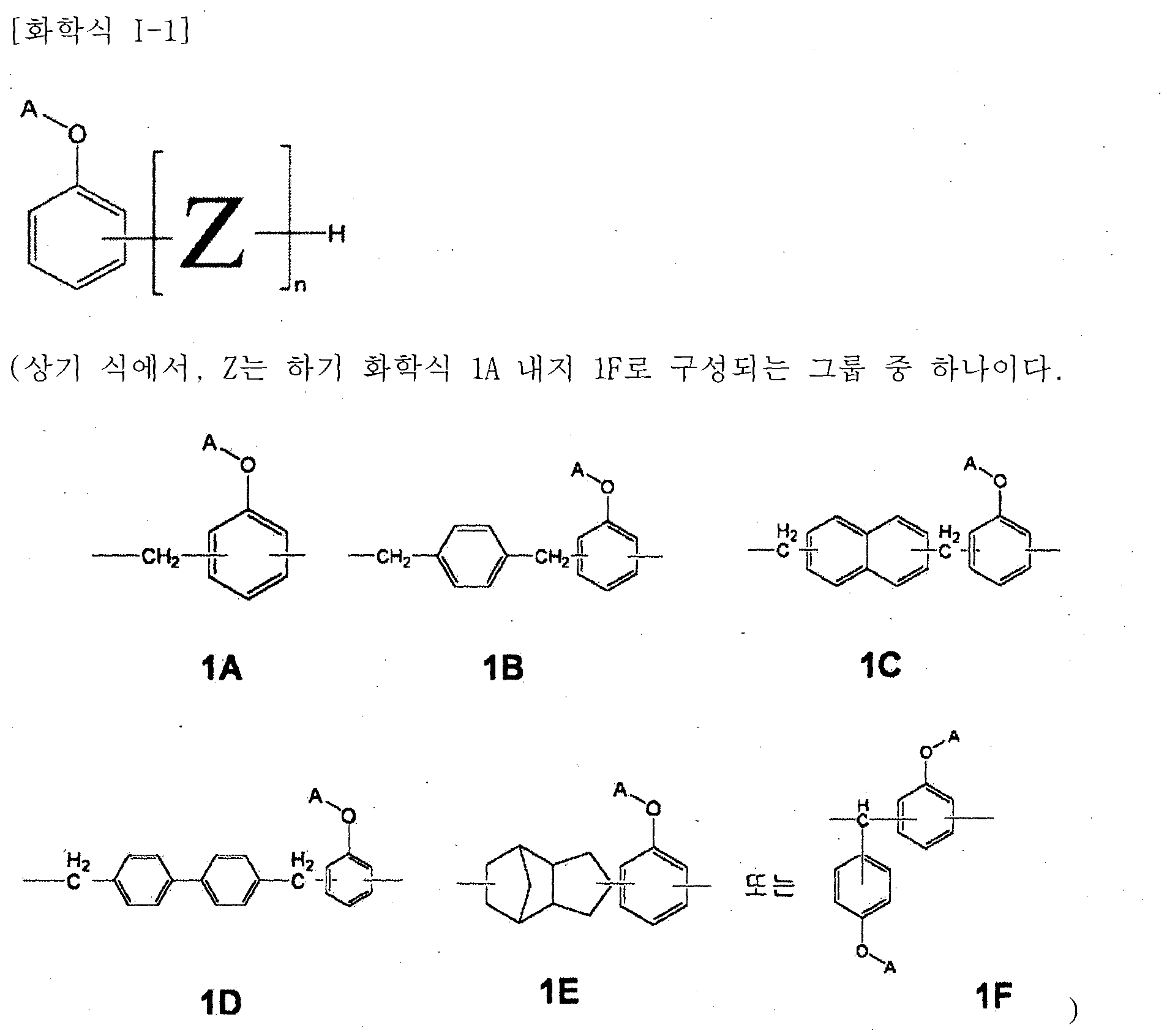
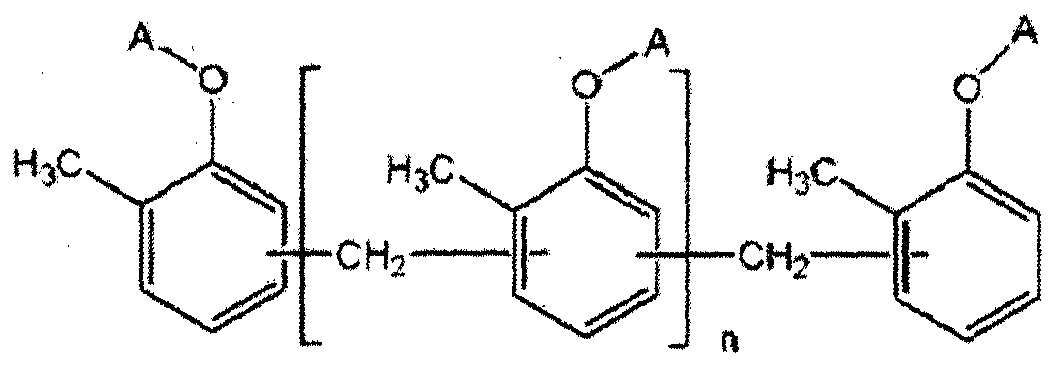
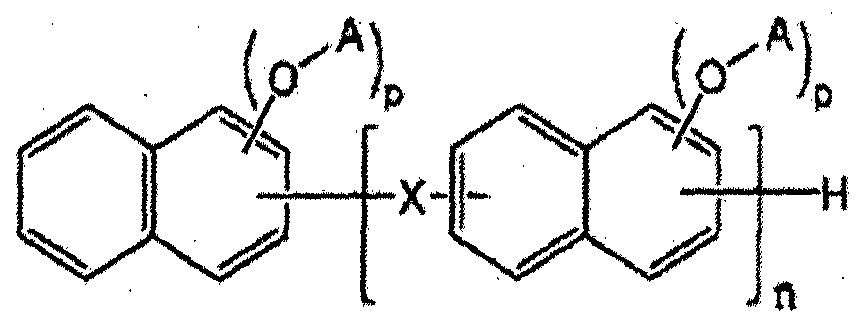
- a novolak curing agent having at least one alkoxysilyl group selected from the group consisting of the following formulas (1-1) to (1-4). [Formula 1-1]
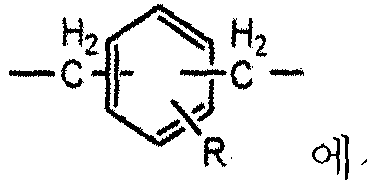
- Z is one of the groups consisting of the following Chemical Formulas 1A to 1F.
- X-cr And R is a C1-C10 straight or branched alkyl group.
- At least one A is of formula A2 or A3, if at least one is A2, the remaining A is of formula B2 or hydrogen, if at least one is A3, the remaining A is hydrogen, and n is an integer of at least 1 .
- R 3 is a straight or branched chain alkoxy group having 1 to 5 carbon atoms, the remainder is a straight chain black or branched alkyl group having 1 to 10 carbon atoms, m is an integer of 3 to 10 to be.
- X is one group group consisting of the following formulas 2A to 2F.
- R is a C1-C10 linear or branched alkyl group.
- D may be represented by Formula B2, and the remainder may be hydrogen.
- N is an integer of 1 or more. to be.
- X is CI, Br, I,-S0 2 ⁇ CH 3 ,-S0 2 _CF 3 , or -0-S0 2 -C 6 — CH 3 )
- R a to R c is a straight chain or molecular chain C1-C5 alkoxy group, and the rest is a straight chain black branched CI—C10 alkyl group.
- X is And Where R is a C1-C10 straight or branched alkyl group.
- R 3 is a linear or branched alkoxy group having 1 to 5 carbon atoms, the remainder is a straight chain black or branched alkyl group having 1 to 10 carbon atoms, and m is an integer of 3 to 10.
- the first step corresponds to one equivalent of the hydroxy group of the starting material of one of Formulas IA-1 to IA-4.
- a process for producing a novolak curing agent having an alkoxysilyl group which is carried out by reacting an alkylene group of the alkenyl compound of the formula [pi] to 0.01 to 10 equivalents.
- the first step is a method for preparing a novolak curing agent having an alkoxysilyl group, which is performed by reacting for 120 hours at -20 ° C to 100 ° C for 1 hour.
- the second step is an alkoxysilane equivalent to 1 equivalent of the alkenyl group of one of the intermediates of Formulas IB-1 to IB-4.
- a process for producing a novolac curing agent having an alkoxysilyl group which is carried out by reacting to 0.1 equivalents to 5 equivalents.
- the second step is a method for preparing a noblock curing agent having an alkoxysilyl group, which is carried out by reacting at 20 ° C. to 12 CTC for 1 to 72 hours.
- a starting material of any one of the following formulas IA-1 to IA-4 is reacted with an alkoxysilane of the following formula ⁇ to have a structure of formula A3.
- X is one of the groups consisting of the following Formulas 2A to 2F.
- n is an integer of 1 or more.
- R 3 is a straight or branched chain alkoxy group having 1 to 5 carbon atoms, the rest is a straight or branched chain alkyl group having 1 to 10 carbon atoms, and m is an integer of 3 to 10.
- X is And R is a C1-C10 straight or branched alkyl group
- the alkoxysilylation step is performed so that the alkoxysilane is 0.1 to 5 equivalents to 1 equivalent of the hydroxy group of the starting material of one of Formulas I A-1 to IA-4. the production method of the novolac curing agent having an "alkoxysilyl group provided that banung was performed.
- the alkoxysilylation step provides a method for preparing a novolac curing agent having an alkoxysilyl group, which is performed by reacting at -20 ° C to 120 ° C for 1 to 72 hours.
- a composition comprising an epoxy resin and a novolac curing agent having at least one alkoxysilyl group selected from the group consisting of the following formulas 1-1 to 1-4.
- X is And R is a straight or branched chain alkyl group of Cl-ClO.
- At least one A is of formula A2 or A3 and at least one is A2 Remaining A is the following formula B2 or hydrogen, when at least one is A3, the remaining A is hydrogen, n is an integer of 1 or more.
- R 3 is a straight or branched chain alkoxy group having 1 to 5 carbon atoms, the rest is a straight or branched chain alkyl group having 1 to 10 carbon atoms, and m is an integer of 3 to 10. .
- the epoxy resin is a glycidyl ether epoxy resin, glycidyl epoxy resin, glycidylamine epoxy resin And at least one composition selected from the group consisting of glycidyl ester epoxy resins.
- the epoxy resin has a core structure of bisphenol, biphenyl, naphthalene, benzene, thiodiphenol, fluorene, anthracene, isocyanurate, and triphenylmethane.
- a composition having 1,1,2,2-tetraphenylethane, tetraphenylmethane, 4,4'-diaminodiphenylmethane, aminophenol, alicyclic, aliphatic, or novolak unit is provided.
- the epoxy resin is provided with a composition comprising an epoxy resin with or without an alkoxysilyl group.
- a composition further comprising inorganic particles or / and fibers as a filler is provided.
- the inorganic particles are at least one composition selected from the group consisting of silica, zirconia, titania, alumina, silicon nitride, aluminum nitride, and silsesquioxane.
- the inorganic particles are provided with a composition containing 5 wt% to 95% based on the total weight of solids of the composition.
- the inorganic particles A composition is provided that includes 30 wt% to 95% based on the total weight of solids.
- the inorganic particles are provided in a range of 5 wt% to 6 (1 ⁇ 2 «based on the total weight of solids of the composition.
- the fiber is glass fiber selected from the group consisting of E glass fiber, T glass fiber, S glass fiber, NE glass fiber, H glass fiber, and quartz; and liquid crystal polyester fiber, polyethylene terephthalate fiber, wholly aromatic fiber, polybenzoxazole fiber, nylon fiber, polyethylene naphthalate fiber, polypropylene fiber, polyethersulfone fiber, polyvinylidene fluoride fiber, polyethylene sulfide fibers, ⁇ and a polyether selected from the group consisting of ketone fiber At least one composition selected from the group consisting of organic fibers is provided.
- the fiber was provided with the composition which is E glass fiber .
- the composition is the T glass fiber in 19th aspect.
- a composition is provided which comprises from 10 wt% to 90 3 ⁇ 4 with respect to the total weight of solids.
- a composition further comprising inorganic particles is provided.
- a composition further comprising an alkoxysilyl group semi-aqueous catalyst is provided.
- the alkoxysilyl group reaction catalyst is selected from nitric acid, sulfuric acid, hydrochloric acid, acetic acid, phosphoric acid, ammonia, K0H, NH 4 0H, amine, transition metal alkoxide, and tin (t in) compound.
- At least one composition selected from the group consisting of is provided.
- the composition is provided in which the semi-aqueous catalyst is contained in an amount of 0.01 phr to 10 phr relative to the epoxy resin having an alkoxysilyl group.
- a composition further comprising water is provided.
- the electronic material containing the composition in any one of 10th-27th aspect is provided. According to the 29th opinion, the 10th to 27th opinions
- a substrate comprising. According to the thirtieth opinion, tenth to twenty-seventh opinion
- a film comprising is provided.
- a laminate comprising a metal worm on a base layer made of the composition of any one of the tenth to twenty-seventh aspects.
- a printed wiring board including a laminated board is provided.
- a semiconductor device including a printed wiring board is provided.
- a semiconductor packaging material comprising the composition of any one of the tenth to twenty-seventh aspects.
- a semiconductor device including a semiconductor packaging material is provided.
- an adhesive comprising the composition of any one of the tenth to twenty seventh aspects.
- a paint comprising the composition of any one of the crabs 10 to 27.
- a composite material comprising the composition of any one of the tenth to twenty seventh aspects.
- a prepreg comprising the composition of any one of the tenth to twenty-seventh symptoms.
- positioned at the prepreg is provided.
- the cured product of any one of the tenth to twenty-seventh symptom compositions is provided.
- a cured product of the composition having a thermal expansion coefficient of 60 ppm / ° C. or less is provided.
- the glass transition temperature does not represent a higher or a glass transition temperature greater than 100 ° C is provided in the.
- composition comprising a new novolac curing agent having an alkoxysilyl group according to the present invention is used in the composite and / or cured product to form an interfacial bond between an alkoxysilyl group and a filler (fibers and / or inorganic particles) and to react an alkoxysilyl group with an epoxy and a curing agent.
- the formation of further chemical bonds by means of improved heat resistance. That is, the CTE of the epoxy composite is reduced and the glass transition degree is increased or the glass transition temperature is not exhibited (hereinafter referred to as 'Tg lease').
- curing agent which has the alkoxy silyl group by this invention shows the outstanding flame retardance by introduction of the alkoxy silyl group.
- the novel novolak curing agent having an alkoxysilyl group according to the present invention is easy to be solidified (sol id) to an epoxy resin having an alkoxysilyl group, so that it is easy to be applied to a process requiring a solid phase sample, and brittleness of the cured product. (br it leness) and adhesion are improved.
- the composition according to the present invention to a metal film of a substrate, the chemical film of the functional group on the surface of the metal film and the alkoxysilyl group is applied to the metal film. Excellent adhesion.
- FIG. 1 is a result of measuring the length change with the temperature of the glass fiber composite body by Example 1 and the comparative example 1.
- FIG. 1 is a result of measuring the length change with the temperature of the glass fiber composite body by Example 1 and the comparative example 1.
- the present invention has improved heat resistance properties when forming a composite using a composition comprising a curing agent having an alkoxysilyl group, specifically having a low CTE and a high Tg (including Tg lease) and / or having an alkoxysilyl group having excellent flame retardancy in the cured product. It is to provide a new novolac curing agent, a method for preparing the same, a curing agent composition and a cured product comprising the same, and uses thereof.
- composite or epoxy composite refers to a cured product of a composition comprising an epoxy resin curing agent and a filler (fibers and / or inorganic particles).
- the term "cured or epoxy cured product” refers to a cured product of a composition comprising an epoxy resin and a curing agent.
- cured material of a composition is said.
- the cured product may include a semi-cargo.
- inorganic particles And / or a cured product reinforced with fibers so that the cured product has a broader meaning than the composite, but an inorganic particle. And / or a cured product reinforced with fibers may be understood to have the same meaning as the composite.
- the new novolac curing agent according to the present invention forms an interfacial bond with the surface of the filler (fibers and / or inorganic particles) and / or an alkoxysilyl group, an epoxide group and a phenol group and a chemical bond when the complex is formed by curing. Therefore, it shows low CTE and high glass transition temperature synergistic effect or Tg-less (less). Therefore, the dimensional stability is improved.
- the cured product including the novolac curing agent according to the present invention exhibits excellent flame retardancy.
- composition according to the present invention is applied to a chemically treated metal film, for example, copper foil, and the like, and the alkoxysilyl group of the curing agent is applied to the metal surface.
- a chemically treated metal film for example, copper foil, and the like
- the alkoxysilyl group of the curing agent is applied to the metal surface.
- it is chemically bonded with -0H group on the metal surface by treatment, it shows excellent adhesion with metal film.
- a novolak curing agent having any one alkoxysilyl group selected from the group consisting of the following formulas I '1 to 1-4. [Formula I ⁇ 1]
- Z is one of the groups consisting of the following Chemical Formulas 1A to 1F.
- X is And R is a straight or branched alkyl group of CI—CIO.
- At least one of the plurality of A is of formula A2 or A3; At least when one of A2, and when the remaining A are hydrogen or the formula B2, at least one of which is A3, and the remaining A are hydrogen.
- n is 1 or more, for example, the integer of 1-1000.
- R 3 and R 3 are an alkoxy group having 1 to 5 carbon atoms, preferably an alkoxy group having 3 to 3 carbon atoms. More preferably, it is a methoxy group or a special group. The remainder is a C1-C10 alkyl group, m is an integer of 3-10, Preferably it is an integer of 3-6.
- the alkoxy group and the alkyl group may be straight chain black or branched chain.
- an "alkoxy group” is a monovalent group which is —OR (R is an alkyl group), which may be linear or branched, In this specification, the branched chain and the branched chain may be used interchangeably.
- an "alkyl group” refers to a monovalent ent hydrocarbon group, which may be linear or branched, and preferably 1 It has a carbon number of 10 to 10, More preferably, it has a carbon number of 1 to 5. Furthermore, the alkoxysilyl group by one Embodiment of the said invention is mentioned.
- the novolac curing agent having exhibits low CTE and high glass transition temperature or Tg-less when forming a composite of the composition comprising the same.
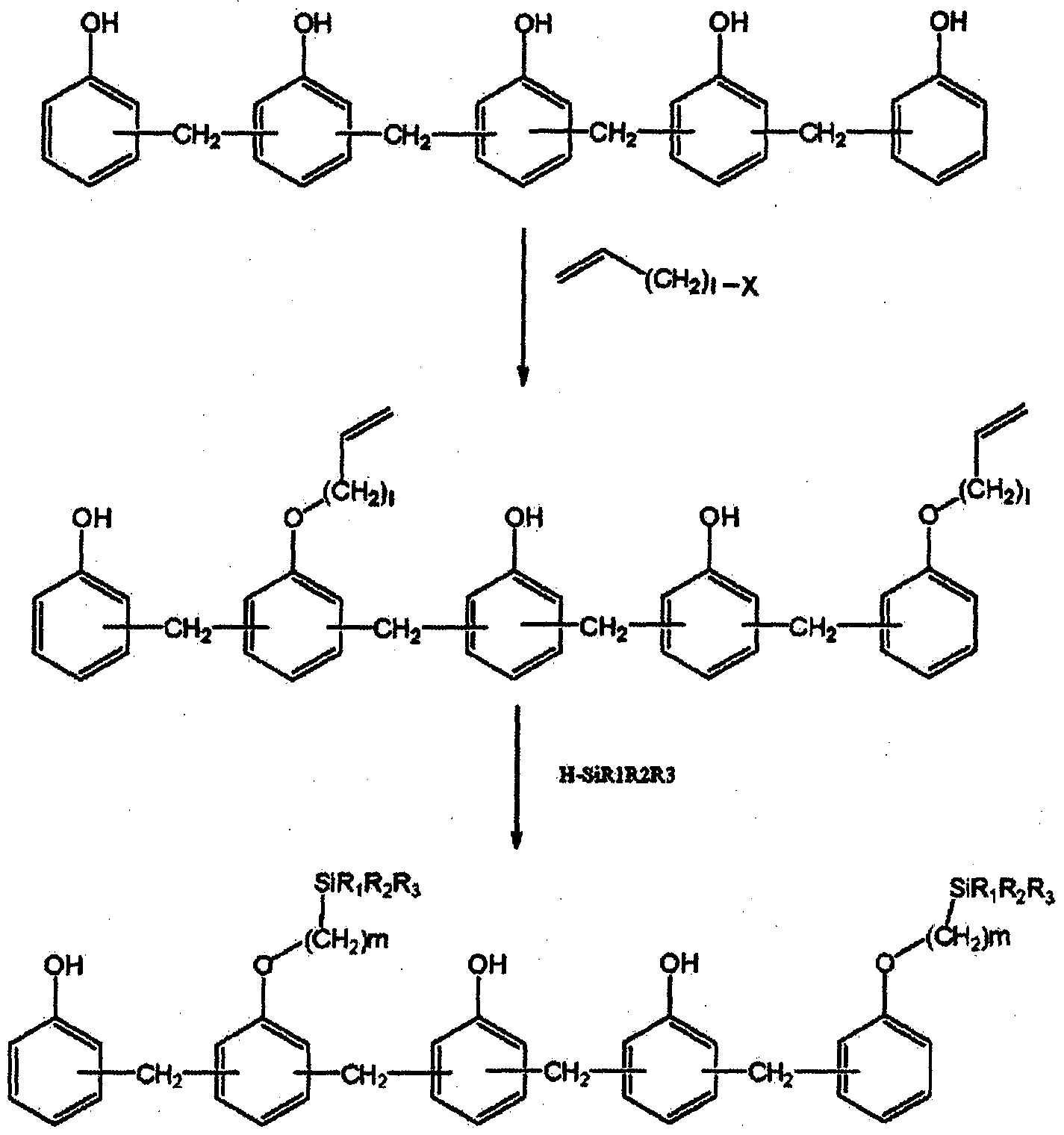
- the novolac curing agent having an alkoxysilyl group represented by Chemical Formulas 1-1 to 1-4 may be synthesized by the following method.
- the manufacturing method of the novolak hardening agent which has an alkoxy silyl group mentioned later is simple and simple compared with the manufacturing method of the epoxy resin which has an alkoxy silyl group.
- a reaction of a hydroxy group in the starting material by reaction of a starting material of one of the following formulas IA-1 to ⁇ -4 (hereinafter, also referred to as 'starting material' or 'starting material IA') and alkenyl of the formula
- a starting material of one of the following formulas IA-1 to ⁇ -4 hereinafter, also referred to as 'starting material' or 'starting material IA'
- alkenyl of the formula At least one of the alkenylated intermediates of any one of formulas IB ′ 1 to IB-4 (hereinafter referred to as “intermediate IB”).
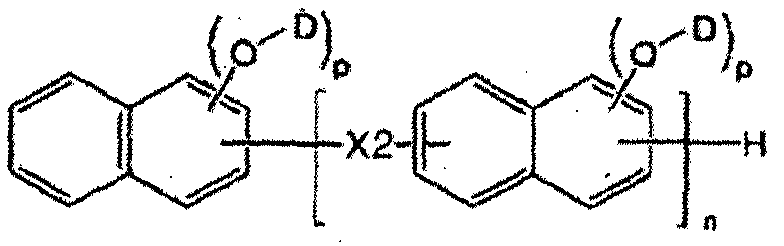
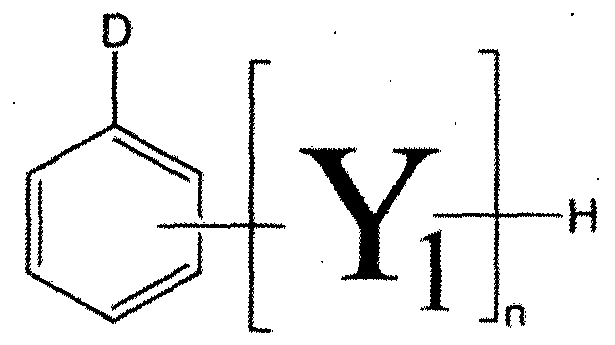
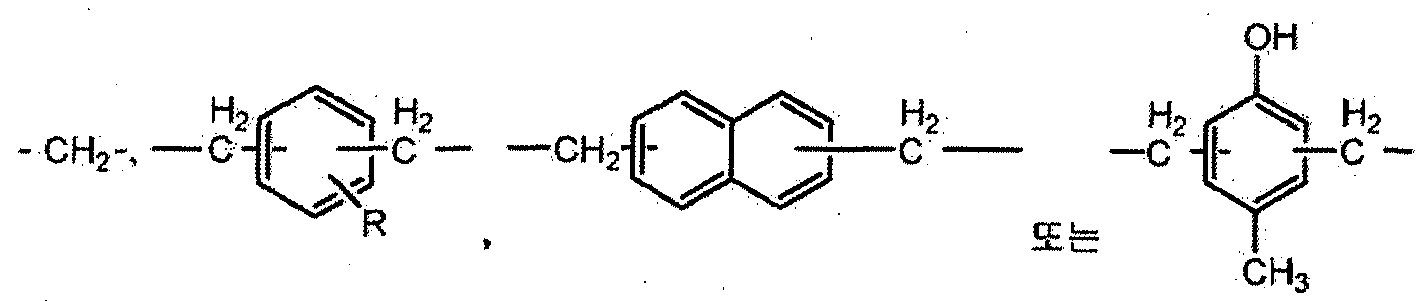
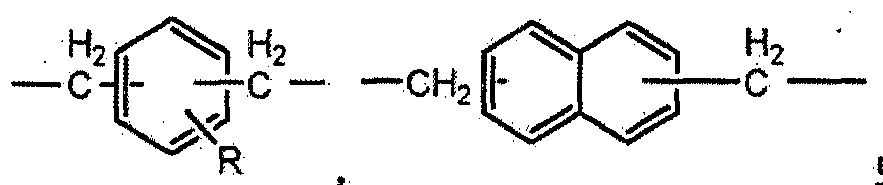
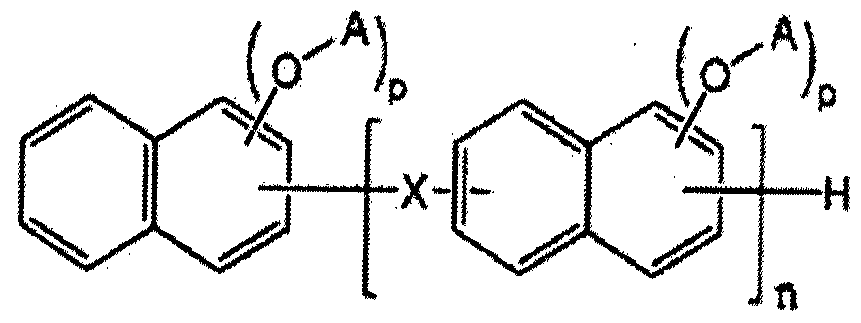
- X in Formula IA ′ 1 is one of a group consisting of Formulas 2A to 2F.
- R is a C1-C10 linear or branched alkyl group.
- n is an integer of 1 or more.
- n is an integer of 1 or more, for example, an integer of 1 to 1000, which includes all integers in these ranges and any other smaller range of integers. It means.
- p is 1 or 2.
- ⁇ is selected from the group consisting of the following formulas 3A to 3F One.
- R is a C1-C10 linear or branched alkyl group.
- At least one of a plurality of D may be represented by Formula B2, and the rest may be hydrogen.
- n is an integer of 1 or more.
- p is 1 or 2.
- 1 is an integer of 1-8, Preferably it is an integer of 1-4.
- Alkenylation the reaction of the first step, is carried out by reacting the starting material of one of the above formulas IA-1 to IA-4 with the alkenyl compound of the formula ⁇ , which reaction is carried out in the presence of a base and an optional solvent.
- the starting material and the alkenyl compound may be reacted in the presence of a base and an optional solvent such that the alkenyl compound corresponds to 1 equivalent of the hydroxy group of the starting material and the alkenyl group is from 0.1 to 10 equivalents.
- Get IB The reaction product is reacted with a stoichiometric equivalence ratio, and in consideration of this, the reaction product is reacted with the equivalence ratio to obtain a desired intermediate product IB.
- the reaction temperature and reaction time of the first step reaction are dependent on the type of reactant, but, for example, the intermediate product IB is obtained by reacting the reaction at 20 ° C. to 100 ° C. for 1 hour to 120 hours.
- bases examples include, but are not limited to, for example, KOH, NaOH, 2 C0 3 , Na 2 C0 3 , KHC0 3 , NaHC0 3) NaH, triethylamine, diisopropylethyl Amines. These bases may be used alone or in combination of two or more of them.
- the base may be used in an amount of 0.01 to 5 equivalents based on 1 equivalent of the hydroxy group of the starting material IA in terms of reaction efficiency.
- the solvent may optionally be used as necessary. For example, the solvent may not be used if the viscosity of the reactants at the reaction temperature is suitable for the reaction to proceed without reaction in the first step reaction.
- the reaction product can be dissolved well, and any organic solvent can be used as long as it can be easily removed after the reaction without adversely affecting the reaction.
- acetonitrile, tetrahydrofuran (THF), methyl ethyl ketone (MEK), dimethyl formamicle (DMF), dimethyl sul foxide (DMMS0), methylene chloride (MC), 3 ⁇ 40, alcohols and roluene can be used. have.
- the intermediate product IB is obtained by alkoxysilylation.
- curing agent of Formula 1-1 to 1-4 which has substituent A2 by one embodiment of the invention is obtained.
- This reaction can be carried out in the presence of a catalyst and any solvent, in which case a platinum catalyst is preferred. In the second stage reaction.
- the alkoxysilane of the general formula ⁇ is 0 to 1 equivalent of the alkenyl group of the intermediate product IB.
- Intermediate IB is reacted with an alkoxysilane of the formula
- R a to R c is a C1-C5 alkoxy group, preferably a C1-C3 alkoxy group, more preferably a mesophilic or ethoxy group and the remainder is an ⁇ - ⁇ alkyl group, the alkoxy group And the alkyl group may be straight chain black branched chain.
- the reaction temperature and reaction time of the second stage reaction vary depending on the reactant, but for example, a novolak curing agent of the formulas 1-1 to 1-4 having a substituent A2 by reacting for 1 hour to 72 hours at 2CTC to 120 ° C. Is obtained.
- the platinum catalyst that can be used in the second reaction reaction is not limited thereto.
- a platinum catalyst of Pt3 ⁇ 4 or H 2 PtCl 6 may be used.
- the platinum catalyst is preferably used in an amount of lxlO— 4 to 0.05 equivalents based on 1 equivalent of the alkenyl group of the intermediate product IB in terms of reaction efficiency.
- the solvent in the second stage reaction can optionally be used as needed.
- a separate water banung viscosity at the reaction temperature without a solvent, in the "second reaction step suitable for the reaction proceeds may not use a solvent.
- a separate solvent is not required, which can be easily determined by those skilled in the art.
- the reaction product can be dissolved well, and any aprotic solvent can be used as long as it can be easily removed after the reaction without any adverse effect on the reaction.
- any aprotic solvent can be used as long as it can be easily removed after the reaction without any adverse effect on the reaction.
- toluene, acetonitrile, tetrahydrofuran (THF), methyl ethyl ketone ( ⁇ ), dimethyl formamide (DMF), dimethyl sul foxide (DMSO), methylene chloride (MC), and the like Can be used.
- solvents may be used alone or in combination of two or more.
- the amount of the solvent used is not particularly limited, and may be used in a suitable amount and / or concentration within a range in which the reactants are sufficiently dissolved and do not adversely affect the reaction, and those skilled in the art may select appropriately in consideration of this. have.
- An exemplary reaction method of the above-described preparation method (1) of Formula 1-1, wherein Z is IA, is as follows.
- At least one of the plurality of substituents A of Formulas 1-1 to 1-4 is a structure of Formula A2 (ie, an alkoxysilyl group), and the rest May be hydrogen.
- the number of alkoxysilyl groups in the formula (1-1) to (1-4) is the first of the reaction 1
- the equivalence and reaction of the alkenyl compound can be varied by controlling the number of hydroxy groups to be alkenylated by controlling the degree. This can be appropriately adjusted by those skilled in the art in view of the reaction from the above disclosure.
- the starting material is an alkoxysilylation of one of the formulas IA-1 to IA-4 to obtain a novolak curing agent of one of formulas 1-1 to 1-4 having a substituent of formula A3.
- the alkoxysilylation step may be carried out in the presence of any base and any solvent.
- the alkoxysilane having the isocyanate functional group of the starting material IA and the following formula ⁇ is 0.1 to 5 equivalents of the alkoxysilane having the isocyanate functional group of the formula ⁇ relative to 1 equivalent of the hydroxy group of the starting material IA.
- At least one of to is an alkoxy group having 1 to 5 carbon atoms, preferably an alkoxy group having 1 to 3 carbon atoms, more preferably a methoxy group or an hydroxy group to be.
- the hydroxy group is preferable in view of high reactivity, and the ethoxy value is preferable in view of sample stability and good reaction properties.
- the remainder is an alkyl group having 1 to 10 carbon atoms, wherein the alkoxy group and the alkyl group may be linear or branched, m is an integer of 3 to 10, preferably an integer of 3 to 6.
- the alkoxysilane having the starting material IA and the isocyanate functional group reacts with the hydroxy group of the starting material IA and the alkoxysilane in an equivalent ratio according to the stoichiometry, and thus taking into account the hydroxy group 1 of the starting material IA
- the alkoxysilane having the starting material IA and the isocyanate functional group is reacted such that the equivalent weight of the alkoxysilane is from 0.01 equivalents to 5 equivalents.
- the reaction temperature and reaction time of the alkoxysilylation step depend on the reaction water, but, for example, by reacting for 1 to 72 hours at 20 ° C. to 120 ° C.
- a novolac curing agent of any one of formulas I ′ 1 to 1-4 having substituents of ⁇ ((3 ⁇ 4) ⁇ ⁇ ⁇ 3 ⁇ 43 ⁇ 43 ⁇ 4 is obtained.
- the reaction of the alkoxysilylation step may be carried out in the presence of a base if necessary.
- the use of a separate base may result in a faster reaction reaction, but examples of the base that can be used include, but are not limited to, for example, K 2 CO 3 , Na 2 CO 3 , KHCOs, NaHC0 3 , triethylamine
- bases may be used alone or in combination of two or more.In the case of using a base, the base is 0.1 to 1 equivalent of hydroxy group of the starting material IA.
- the solvent may be optionally used in the reaction of the alkoxysilylation step, for example, without the need for a separate solvent in the alkoxysilylation step. If the viscosity of the reactants in silver is suitable for the reaction to proceed, the solvent may not be used, i.e. if the viscosity of the reactants is low enough that the mixing and stirring of the reaction product can proceed smoothly without solvent, then no additional solvent is required. In the case of using a solvent, the possible solvent can dissolve the reaction product well, and any aproticity can be easily removed after the reaction without any adverse effect on the reaction.
- a solvent may be used, including but not limited to, for example, toluene, acetonitrile, tetrahydrofuran (THF), methyl ethyl ketone (MEK), dimethyl formaniide (DMF), DMS0 (dimethyl sul foxide), Methylene chloride (MC) and the like may be used. These solvents may be used alone or in combination of two or more black.
- the amount of the solvent used is not particularly limited and may be used in a suitable amount within a range in which the reaction product is sufficiently dissolved and does not adversely affect the reaction, and those skilled in the art may appropriately select it.
- At least one of the plurality of substituents A of Formulas 1-1 to 1-4 is a structure of Formula A3 (ie, an alkoxysilyl group) and the rest is hydrogen Can be.
- the number of alkoxysilyl groups in Chemical Formulas 1-1 to 1-4 refers to the equivalent of alkoxysilane and reaction temperature in the alkoxysilylation step. It can be varied by controlling the number of hydroxy groups to be epoxidized by controlling. This can be appropriately adjusted by those skilled in the art in view of reactivity from the above disclosure.
- composition comprising an epoxy resin and at least one new novolac curing agent selected from the group consisting of the above formulas 1-1 to 1-4.
- compositions provided in the present invention are used for electronic materials, for example, but not limited to, for example, semiconductor substrates such as IC substrates, build-up films, encapsulation materials (packaging materials), printed wiring boards, and the like. It can be used for various uses such as parts, adhesives, paints and composite materials.
- any composition provided in the present invention may be a curable composition comprising an inorganic material.
- composition according to any of the above and later embodiments of the present invention comprises as a curing agent at least one new novolac curing agent selected from the group consisting of Formulas 1—1 to 1-4 according to embodiments of the present invention.
- a curing agent at least one new novolac curing agent selected from the group consisting of Formulas 1—1 to 1-4 according to embodiments of the present invention.
- any kind and / or combination of compositions known in the art are included, and the epoxy resin constituting the composition, the curing agent of the present invention and conventional curing agents, curing accelerators (catalysts), inorganic materials (fillers) (Eg inorganic particles and / or Fiber) and other additives, and the mixing ratio is not limited.
- the epoxy resin may be any conventional epoxy resin known in the art, but is not particularly limited, for example, glycidyl ether-based epoxy resin, glycidyl-based epoxy resin, glycidylamine-based It may be at least one selected from the group consisting of an epoxy resin and a glycidyl ester epoxy resin.
- the epoxy resin has a core structure of bisphenol, biphenyl, naphthalene, benzene, thiodiphenol, fluorene (fhiorene), anthracene, isocyanurate, triphenylmethane, 1,1,2,2-tetraphenyl Ethane, tetraphenylmethane, 4,4'-diaminodiphenyl methane, aminophenol alicyclic, aliphatic, or glycidyl ether epoxy resin having a novolak unit, glycidyl epoxy resin, glycidylamine epoxy At least one selected from the group consisting of a resin and a glycidyl ester epoxy resin.
- the conventional epoxy resin is bisphenol, biphenyl, naphthalene, fluorene benzene, thiodiphenol, fluorene, anthracene as a core structure.
- the existing and epoxy resins may or may not have an alkoxysilyl group.
- Any conventional curing agent generally known as a curing agent for resins, may be added, and as the existing curing agent, there is no particular limitation, for example, a novolac curing agent (a conventional novolak having no alkoxylsilyl group). Curing agents), amines, acid anhydrides and the like can be used. More specifically.
- amine curing agent aliphatic amines, alicyclic amines, aromatic amines, other amines and modified polyamines can be used, and amine compounds containing two or more primary amine groups can be used.
- amine curing agent examples include 4,4 ' ⁇ dimethylaniline (diamino diphenyl methane) (4 > 4'-Dimethylani 1 ine (di amino diphenyl methane, DAM or DDM), diamino diphenylsulfone (diamino di phenyl sul fone, DDS), m_ lung alkenylene di ⁇ min (m -phenyl ene diamine) aromatic amine, at least one selected from the group consisting of diethylene triamine (dieihylene tri amine, DETA), diethylene tetraamine ( diethylene tetramine, tri iethy lene tetramine (TETA), m-xylene diamine (MXDA), methane diamine (MDA), ⁇ , ⁇ '- Diethylenediamine (N, N '-di et hy 1 ened i amine, ⁇ , ⁇ ' -DEDA), t
- phenol curing agent examples include, but are not limited to, phenol novolac resins, cresol novolac resins, bisphenol A novolac resins, xylene novolac resins, triphenyl novolac resins, biphenyl novolac resins and dicyclopentadiene novolacs. Resins, phenol P-xylene resins, phenol 4, 4'-dimethylbiphenylene resins, naphthalene phenol novolac resins and the like.
- acid anhydride-based curing agents include, but are not limited to, dodecenyl succinic anhydride (DDSA), aliphatic acid anhydrides such as poly azelaic poly anhydride, and nucleohydrophthalic anhydrides.
- DDSA dodecenyl succinic anhydride
- aliphatic acid anhydrides such as poly azelaic poly anhydride
- nucleohydrophthalic anhydrides examples include, but are not limited to, dodecenyl succinic anhydride (DDSA), aliphatic acid anhydrides such as poly azelaic poly anhydride, and nucleohydrophthalic anhydrides.
- Alicyclics such as hydrhydroph halic anhydride (HHPA), methyl tetrahydrophthalic anhydride (MeTHPA) and methylnadic anhydride (MNA) Anhydride, trimellitic not hydride (Trimellitic Anhydride, TMA), pyromellitic dianhydride hydride (pyromellitic acid di anhydr ide, PMDA), benzophenone tetracarboxylic carboxy acid dianhydride hydride '(benzophenonetetracarboxyl ic di anhydr i de, BTDA Aromatic acid anhydrides, such as a), tetrabromophthalic anhydride (TBPA), and halogen-based acid anhydride compounds such as chlorendic anhydride.
- HHPA hydrhydroph halic anhydride
- MeTHPA methyl tetrahydrophthalic anhydride
- MNA methylnadic anhydride
- TMA trimellitic not hydride
- the degree of curing of the epoxy composite can be adjusted to the degree of reaction between the curing agent and the epoxy resin, and the content of the curing agent can be adjusted based on the concentration of the epoxy group of the epoxy resin according to the desired degree of curing.
- the equivalent reaction of the curing agent and the epoxy group is such that the epoxy equivalent / curing agent equivalent ratio is 0.5 to 2.0, and, for example, It is preferable to adjust and use a hardening
- Any curing agent that can be used to cure the epoxy resins not otherwise described herein also depends on the concentration of the total epoxy groups in the composition of the present invention depending on the desired degree of cure and based on the concentration of the epoxy functional groups and the semi-aromatic functional groups of the curing agent. Suitable amounts can be used in combination, as is common in the art.
- composition comprising the new novolac curing agent may further comprise an inorganic material (filler), for example inorganic particles and / or fibers, as needed, and for convenience the composition comprising the inorganic material " Composite compositions', as long as the composite composition comprises an epoxy resin, at least one new novolac curing agent and filler selected from the group consisting of Formulas 1-1 to 1-4.
- iller for example inorganic particles and / or fibers
- Composite compositions' as long as the composite composition comprises an epoxy resin, at least one new novolac curing agent and filler selected from the group consisting of Formulas 1-1 to 1-4.
- any type and / or the combination is understood to include a composition, the epoxy resin constituting the composition, the curing agent of the present invention, a conventional curing agent, a curing accelerator (catalyst) which, weapon material (filler) (e.g., Inorganic particles and / or fibers) and other additives are not limited to the type and compounding ratio.
- a curing accelerator catalyst
- weapon material e.g., Inorganic particles and / or fibers
- other additives are not limited to the type and compounding ratio.
- any inorganic particles known to be used for reinforcement may be used, including but not limited to, consisting of silica (including, for example, fused silica and crystalline silica), zirconia, titania, alumina, silicon nitride and aluminum nitride At least one kind selected from the group consisting of at least one metal oxide selected from the group and silsesquioxane may be used, and the inorganic particles may be used alone or as a mixture with two or more kinds. In this case, it is preferable to use fused silica, although either crushed or spherical can be used.
- the inorganic particles are not limited thereto, but inorganic particles having a particle size of 0.5 nm to several tens (for example, 50 to 100) may be used in consideration of the use of the composite, specifically, the dispersibility of the inorganic particles. Can be. Since the inorganic particles are dispersed in the epoxy resin, the inorganic particles of the above sizes are preferably used together due to the difference in dispersibility according to the particle size.
- the inorganic particles may be suitably added to the epoxy resin according to the appropriate viscosity and use required for reducing and applying CTE of the epoxy composite.
- the content of the inorganic particles is based on the total weight of solids of the composition, while in the case of epoxy cured products, based on the total weight of the epoxy cured product, 5 wt% to 95 wt 3 ⁇ 4, for example 5 wt% to 90 wt%, for example 10 wt% to 90wt3 ⁇ 4>, for example 30 wt% to 95wt, for example 30wt% to 90wt%, for example 5 wt% to 60wt%, for example 10wt to 50%.
- the composition of the present invention is a semiconductor encapsulant
- the content of the inorganic particles is, for example, relative to the total increase in the solid content of the composition, while in the case of epoxy cured products the total weight of the epoxy cured product. 30 wt% to 95 wt%, for example, 30 wt% to 90%.
- the content of the inorganic particles in consideration of the CTE value and strength of the substrate for example, relative to the weight of the total solids of the composition, on the other hand In the case of 5 wt% to 60 wt%, for example 10 wt% to 50%, based on the total weight of the epoxy cured product.
- the fiber is used as an inorganic material, any kind and dimension of fiber generally used in the art may be used.
- the fiber is not limited thereto, and any fiber generally used for improving physical properties of the thermosetting resin and cured material may be used. Specifically glass fiber, organic fiber or a mixture of middles can be used.
- glass fibers include glass fibers such as E glass fiber, T glass fiber, S glass fiber, NE glass fiber, D glass fiber, quartz glass fiber, and the like. Or T glass fibers.
- Liquid crystalline polyester fiber polyethylene terephthalate fiber, Selected from the group consisting of wholly aromatic fibers, polybenzoxazole fibers, nylon heart oil, polyethylene naphthalate fibers, polypropylene fibers, polyether sulfone fibers, polyvinylidene fluoride fibers, polyethylene sulfide fibers, polymoetheretherketone fibers At least one kind alone or more than two kinds of black may be used together.
- Composition comprising any new novolak light "agent of the present invention, for example, the content of fibers in the glass fiber composite composition 10wt3 ⁇ 4> to about 90wt% based on the total weight of the composition solids, for example, 30wt % To 70 wt%, and for example, 35 wt% to 65%.
- the fiber content is 10 wt% to 90 wt%, for example 30 wt% to 70 wt%, and for example 35 wt%, based on the total weight of the cured product. % To 65%.
- the resin content is lp w t% to 90 wt%, for example.
- the content of the fiber is in the above range in terms of heat resistance improvement and processability.
- the solid part except a fiber among the total solid content is normally called resin component, and in the composition containing a fiber, the quantity other than fiber is resin content (res in content).
- any of the compositions of the present invention comprising the fibers may further comprise inorganic particles, if necessary.
- the inorganic particles are in the range of lwt3 ⁇ 4 »to 70wt% based on the increase of the resin content in consideration of the improvement of physical properties and fairness. It can be formulated in amounts.
- the type of inorganic particles that can be used is not particularly limited, any inorganic particles known in the art can be used, for example, the type of the inorganic particles can be used.
- the composition according to any of the above and below embodiments of the present invention may further comprise an alkoxysilyl group reaction catalyst (hereinafter referred to as “banung catalyst”) as needed.
- the composition containing the alkoxysilyl group reaction catalyst is called “reaction catalyst containing composition” for convenience.
- the reaction catalyst-containing composition also includes at least one new novolac curing agent selected from the group consisting of Formulas 1-1 to 1-4, and the reaction catalyst, and an epoxy resin constituting the composition, the curing agent of the present invention.
- the alkoxysilyl group reaction catalyst may be added for improved processability (eg, fast curing rate and / or low curing temperature).
- the alkoxysilyl group semicoagulant is not limited thereto, but may include, for example, nitric acid, sulfuric acid, hydrochloric acid, acetic acid and phosphoric acid.
- At least one inorganic acid selected from the group, ammonia 4OH, NH 4 0H, amines and transition metal alkoxides, metal oxides, metal organic acid salts and halides e.g.
- dibutyltin Dilaurate (di t butyl in di l aurate), tin salts of octylate, tin (II) ethyl 2- nuclear Sano benzoate) is used at least one kinds selected from the group consisting of "Tin (n) compound), such as Can be. These may be used alone or in combination of two or more kinds.
- the blending amount of the alkoxysilyl group reaction catalyst is not particularly limited, but considering the reaction properties, the alkoxysilyl group semi-amplification catalyst is 0.01 phr to 10 to the epoxy resin of the present invention. can be used as phr.
- water may be further included in the composition including the alkoxysilyl group reaction catalyst.
- the blending amount of water is not particularly limited, but may be 0.01 equivalent to 20 equivalents of water with respect to 1 equivalent of alkoxysilyl group in consideration of efficiency and reaction properties as a catalyst.
- Any curing accelerator (curing catalyst) may be further included as necessary to promote the curing reaction. Also, in the case of the novolak curing agent, to improve the reactivity with the epoxy resin.
- Hardening accelerators are usually used, and in view of the common technical knowledge of the art, it will be apparent to those skilled in the art that any of the above-mentioned and later described compositions may include a curing accelerator depending on the degree of curing reaction.
- a curing accelerator any catalyst known in the art to be generally used for curing the composition can be used, and thus although, for example, a curing accelerator such as imidazole, tertiary amine, quaternary ammonium, organic acid salt, Lewis acid, phosphorus compound, etc. may be used.
- curing accelerators may be used as latent in their microcapsule coating and complex salt formation. These may be used independently and may use 2 or more types together according to hardening conditions.
- the compounding quantity of the said hardening accelerator is not specifically limited, It can mix
- the epoxy resin may be 0.1 to 10 phr (parts per hundred resin, parts by weight per 100 parts by weight of epoxy resin), for example, 0.2 to 5 phr.
- the curing accelerator is preferably used in the above content in terms of curing reaction promoting effect and curing reaction rate control.
- the curing accelerator in the compounding amount in the above range By using it, the curing progresses rapidly and the throughput can be expected to be improved.
- the composition is a release agent, surface treatment agent, flame retardant which is conventionally formulated for controlling the physical properties of the composition in a range that does not impair the physical properties of the composition.
- Other additives such as antifoams, colorants, stabilizers, coupling agents, viscosity modifiers, diluents, rubbers, thermoplastics, etc. may also be blended as needed.
- a composition according to the present invention is formed into a thin film, a composition having insufficient flexibility may cause bridging to cause cracking. This is the case, for example, when any composition of the present invention contains a large amount of inorganic particles.
- rubber and / or thermoplastic resins may be added to compositions comprising any new novolac curing agent of the present invention to improve solubility in the composition.
- Thermoplastic resins and rubber-modified epoxy resins can be used that are generally known in the art.
- any rubber known in the art may be used as long as it is not dissolved in the solvent used in the composition and remains dispersed in the composition.
- an acrylonitrile butadiene rubber for example. Butadiene rubber, acrylic rubber, core-shell rubber particles, cross-linked acrylonitrile butadiene rubber particles, cross-linked styrene butadiene rubber particles, acrylic rubber indenters and the like.
- the average particle diameter is preferably in the range of 005 to 1 / im in terms of physical properties, and 0.2 to The range of 0.6 is more preferable. Rubber particles, see the above .
- Thermoplastic resins include, but are not limited to, phenoxy resins, polyvinyl acetal resins. Polyimide resin, polyamideimide resin, polyether sulone resin, polysulfone resin and the like. These may be used alone or in combination of two or more.
- the thermoplastic resin may be blended in an amount of, for example, 0.5 to 60% by weight, preferably 3 to 50% by weight, based on the weight of the solid content of the composition of the present invention.
- composition comprising a composition, a composition of the present invention or a new novolak curing agent” refers to an epoxy resin and the novolak curing agent of the present invention as well as other components constituting the composition as needed, for example,
- optional curing accelerators catalogsts
- inorganic materials fillers
- solvents may contain other additives formulated as needed in the art.
- the solvent in the composition may optionally be used to appropriately adjust the solid content and / or viscosity of the composition in consideration of the processability of the composition and the like.
- total weight of the solid content of the composition refers to the total weight of the components excluding the solvent among the components constituting the composition described above. Any of the compositions of the present invention provided in any of the above embodiments of the present invention may be used for electronic materials.
- the electronic material is not limited to this, but, for example, not only a substrate build-up film for semiconductors, a prepreg, or a laminated plate on which a metal film is disposed on a substrate made of the composition of the present invention, but also a sealing material (packaging material), as well as printed wiring Electronic components such as substrates. It can also be applied to various applications such as adhesives, paints and composite materials. According to still another embodiment of the present invention, there is provided an electronic material comprising or consisting of any composition comprising the novolac curing agent of the present invention. Furthermore, there is also provided a semiconductor device comprising, consisting essentially of, or consisting of the electronic material.
- the semiconductor device includes a semiconductor device and / or a semiconductor packaging material including (eg, mounting a semiconductor device) a printed wiring board comprising, or consisting essentially of, a composition comprising the novolac curing agent of the present invention. It may be a semiconductor device including a. Also provided are cured products, adhesives, paints, or composites comprising, consisting essentially of, or consisting of any of the compositions of the present invention provided in any of the embodiments of the present invention. According to another embodiment of the present invention, there is provided a cured product comprising, consisting essentially of, or consisting of the composition of the invention provided in any of the embodiments of the invention described above.
- composition provided in any of the above-described embodiments of the present invention is used as a cured product when it is actually applied, for example, as an electronic material, and in the art, an epoxy resin and an inorganic component
- the cured product of the composition comprising the filler is generally referred to as a composite.
- the novel novolac curing agent provided in one embodiment of the present invention described above exhibits excellent heat resistance and excellent flame retardancy in the composite.
- the composite has a low CTE, for example, 15 ppm / ° C. or less, for example 12 ppm / ° C. or less.
- a CTE of 10 ppm / ° C or less for example, 8 ppm / ° C or less, for example, 6 ppm / ° C or less, for example, 4 ppmni / ° C or less.
- the resin content of 30wt% to 60wt% (may have include an inorganic particles-resin content, that may not be included) in the composite are, for example, 10ppm / ° C or less, for example, 8ppm / ° C or less, e. For example, 6 ppm / ° C. or less, for example, 4 ppm / ° C. or less CTE.
- any novel novolac curing agent according to the present invention as a curing agent a composite containing 60 to 80wt%, for example, 70 to 80wt% of inorganic particles, for example, silica particles as an inorganic material, 20ppmrc or less, For example, 15 ppm / ° C or less, for example, 10 ppm / ° C or less, for example, 8 ppm / ° C or less, for example, 6 ppm / ° C
- CTE of 4 ppm / ° C or less is shown.
- the composite according to the present invention may have a T g higher than locrc, for example, 130 ° C or more, for example, 250 ° C or more, or Tg-less.
- the Tg value is excellent in Kk-Tock physical properties and does not particularly limit the upper limit of Tg.
- the value indicated by the range means that each includes not only the lower limit value and the upper limit value of the range, but also any lower range between the ranges and all the numbers belonging to the range.
- C1 to C10 are CI, C2, C3, C4. It is understood to include all of C5, C6, C7, C8, C9, C10.
- the lower limit value or the upper limit value of the numerical range is not specified, and the smaller or larger the value is, the more preferable. It is understood to include any value.
- a CTE below 4 ppm / ° C is understood to include all values between 4, 3.5, 3, 2.7, 2, 1.4, 1, 0.5 ppm / ° C, and the like.
- the NMR data of the obtained final product is as follows.
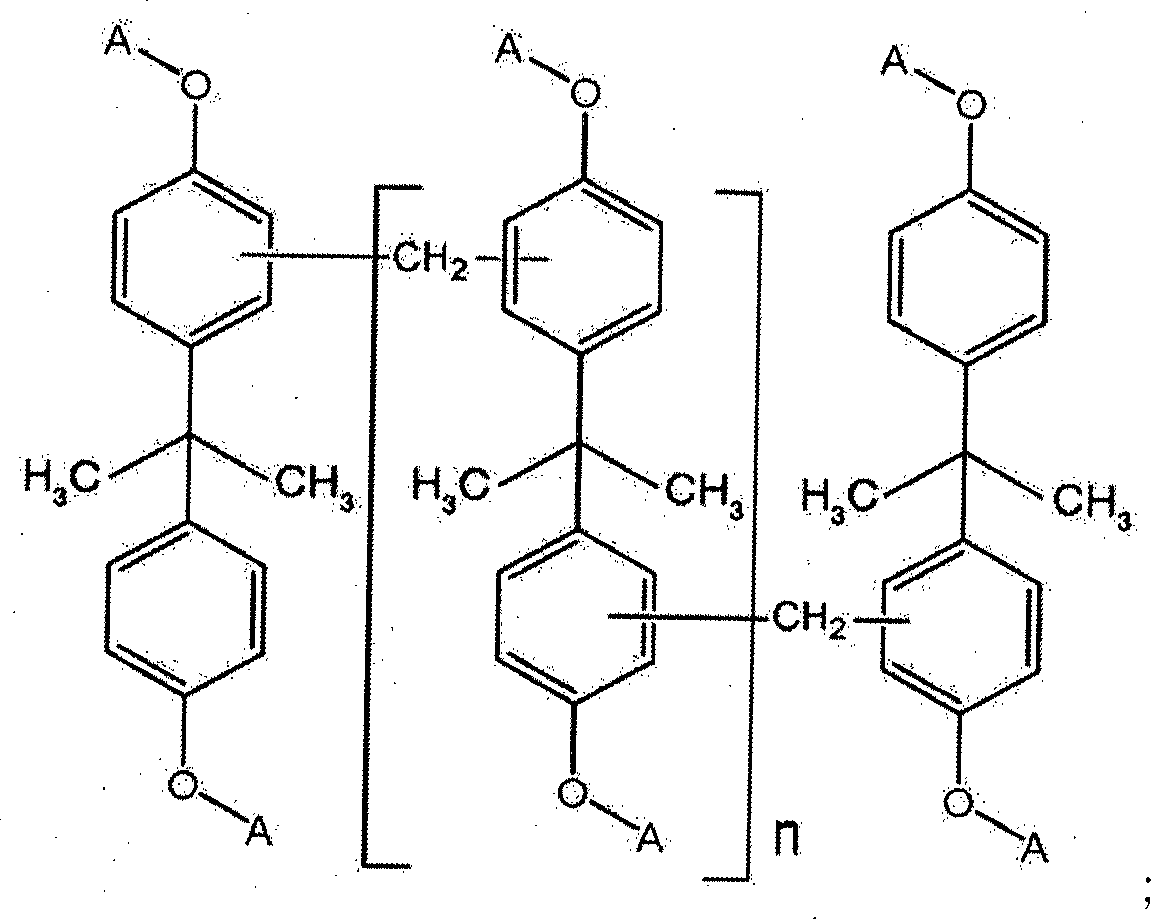
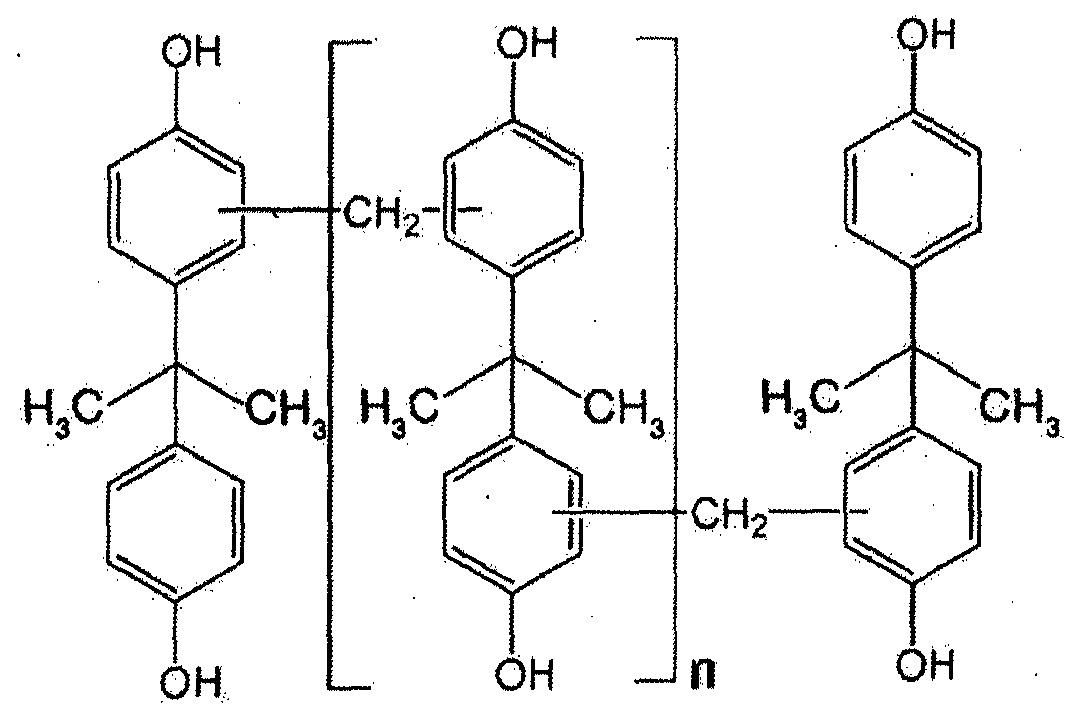
- Synthesis Example 5 Synthesis of Silylated Noble Curing Agent (Biphenyl Aralkyl Type Phenolic Resin) 15 g of biphenyl novolac curing agent (Formula 3, Meiwa Plastic Ind., Trade name MEH-7851SS), 4.57 g of trioxysilyl propyl isocyanate, and 150 nil of tetrahydrofuran (THF) were added to the flask, followed by mixing. Stirred at room temperature for 15 hours. After the reaction.
- Biphenyl Aralkyl Type Phenolic Resin Silylated Noble Curing Agent
- biphenyl novolac curing agent Forma 3, Meiwa Plastic Ind., Trade name MEH-7851SS
- THF tetrahydrofuran
- the NMR data of the obtained final product is as follows.
- Synthesis Example 7 Synthesized silylated novolac hardener synthesis (polyfunctional phenolic resin) 15 g of a polyfunctional novolac curing agent (Formula 5, Meiwa Plastic Ind., MEH-7500-3S), 7.22 g of triethoxysilyl propyl isocyanate, and 150 ml of tetrahydrofuran (THF) were mixed, and then filled with argon. , and the mixture was stirred at 15 for phase time status.
- a polyfunctional novolac curing agent Forma 5, Meiwa Plastic Ind., MEH-7500-3S
- THF tetrahydrofuran
- epoxy glass fiber composite (cured product) With the composition shown in Table 1, epoxy compound, and silica slurry (solid content of 70wt%, methyl ethyl ketone solvent, average silica size 1 / ⁇ ) of ⁇ , ⁇ -dimethyl Dissolve in acetamide to 40% solids. After mixing this mixed liquid at the speed of 1500 rpm for 1 hour, the hardening
- An epoxy glass fiber composite containing a silylated curing agent was prepared by immersing glass fiber (N-Ttobo, T-glass) in this binder solution. The composite was then placed in a vacuum oven heated to 100 ° C to remove the solvent and then preheated to 12 CTC. The glass fiber composite was obtained by curing at a hot press for 2 hours at 120 ° C., 2 hours at 180 ° C. and 2 hours at a temperature of 200 ° C.-230 ° C.
- Epoxy Filler Composite (Hardened) According to the composition shown in Table 2 below, epoxy compound, silica slurry (dispersion solution: methyl ethyl ketone solvent, silica average size 1) and polyvinyl acetal ⁇ , ⁇ ⁇ dimethylacet Dissolve the amide to 40% solids. The mixture was mixed for 1 hour and 30 minutes at a speed of 1500 rpm, followed by addition of a hardening agent and further mixing for 30 minutes.
- thermo-mechanical analyzer Therm mechanical analysizer
- Table 1 shows the results obtained in Example 1 and Comparative Example 1 (Table 1).
- the specimen of the glass fiber composite film is 4X 16X0.
- the specimen of the composite filler was prepared by the size of 5X5X3 ( ⁇ 3).
Landscapes
- Chemical & Material Sciences (AREA)
- Health & Medical Sciences (AREA)
- Chemical Kinetics & Catalysis (AREA)
- Medicinal Chemistry (AREA)
- Polymers & Plastics (AREA)
- Organic Chemistry (AREA)
- Compositions Of Macromolecular Compounds (AREA)
- Epoxy Resins (AREA)
Abstract
Description












Claims











Priority Applications (4)
| Application Number | Priority Date | Filing Date | Title |
|---|---|---|---|
| EP15735456.4A EP3093304B1 (en) | 2014-01-09 | 2015-01-09 | Novel novolac curing agent with alkoxysilyl group, method for preparing the same, composition containing the same, the cured product, and the use thereof |
| CN201580012579.6A CN106103532B (zh) | 2014-01-09 | 2015-01-09 | 含烷氧基甲硅烷基的酚醛清漆硬化剂及其制备方法,含硬化剂的组合物,硬化产品及其应用 |
| US15/110,677 US10519274B2 (en) | 2014-01-09 | 2015-01-09 | Novolac curing agent with alkoxysilyl group, method for preparing the same, composition containing the same, the cured product, and use thereof |
| JP2016545968A JP6282352B2 (ja) | 2014-01-09 | 2015-01-09 | アルコキシシリル基を有する新規ノボラック硬化剤、その製造方法、それを含む組成物、及び硬化物、並びにその用途 |
Applications Claiming Priority (4)
| Application Number | Priority Date | Filing Date | Title |
|---|---|---|---|
| KR10-2014-0003070 | 2014-01-09 | ||
| KR20140003070 | 2014-01-09 | ||
| KR1020150002675A KR101664948B1 (ko) | 2014-01-09 | 2015-01-08 | 알콕시실릴기를 갖는 새로운 노볼락 경화제, 이의 제조 방법, 이를 포함하는 조성물, 경화물 및 이의 용도 |
| KR10-2015-0002675 | 2015-01-08 |
Publications (1)
| Publication Number | Publication Date |
|---|---|
| WO2015105379A1 true WO2015105379A1 (ko) | 2015-07-16 |
Family
ID=53524144
Family Applications (1)
| Application Number | Title | Priority Date | Filing Date |
|---|---|---|---|
| PCT/KR2015/000243 Ceased WO2015105379A1 (ko) | 2014-01-09 | 2015-01-09 | 알콕시실릴기를 갖는 새로운 노볼락 경화제, 이의 제조 방법, 이를 포함하는 조성물, 경화물 및 이의 용도 |
Country Status (1)
| Country | Link |
|---|---|
| WO (1) | WO2015105379A1 (ko) |
Cited By (1)
| Publication number | Priority date | Publication date | Assignee | Title |
|---|---|---|---|---|
| JP2020522532A (ja) * | 2017-06-05 | 2020-07-30 | コリア インスティチュート オブ インダストリアル テクノロジー | アルコキシシリル基及び活性エステル基を有する化合物、その製造方法、それを含む組成物及び用途 |
Citations (5)
| Publication number | Priority date | Publication date | Assignee | Title |
|---|---|---|---|---|
| US5177157A (en) * | 1989-08-31 | 1993-01-05 | Dow Corning Toray Silicone Co., Ltd. | Process for preparing a silicone resin-modified phenolic resin |
| KR20010071125A (ko) * | 1999-01-29 | 2001-07-28 | 이시베 슈헤이 | 에폭시 수지용 경화제, 에폭시 수지 조성물 및 실란변성페놀 수지의 제조법 |
| US6875807B2 (en) * | 2003-05-28 | 2005-04-05 | Indspec Chemical Corporation | Silane-modified phenolic resins and applications thereof |
| KR20070114164A (ko) * | 2005-02-18 | 2007-11-29 | 히다치 가세고교 가부시끼가이샤 | 신규 경화성 수지와 그의 제조 방법, 및 에폭시 수지 조성물, 전자 부품 장치 |
| US7365135B2 (en) * | 2004-06-14 | 2008-04-29 | Chung-Shan Institute Of Science & Technology | Method for preparing a novolac phenolic resin/silica hybrid organic-inorganic nanocomposite |
-
2015
- 2015-01-09 WO PCT/KR2015/000243 patent/WO2015105379A1/ko not_active Ceased
Patent Citations (5)
| Publication number | Priority date | Publication date | Assignee | Title |
|---|---|---|---|---|
| US5177157A (en) * | 1989-08-31 | 1993-01-05 | Dow Corning Toray Silicone Co., Ltd. | Process for preparing a silicone resin-modified phenolic resin |
| KR20010071125A (ko) * | 1999-01-29 | 2001-07-28 | 이시베 슈헤이 | 에폭시 수지용 경화제, 에폭시 수지 조성물 및 실란변성페놀 수지의 제조법 |
| US6875807B2 (en) * | 2003-05-28 | 2005-04-05 | Indspec Chemical Corporation | Silane-modified phenolic resins and applications thereof |
| US7365135B2 (en) * | 2004-06-14 | 2008-04-29 | Chung-Shan Institute Of Science & Technology | Method for preparing a novolac phenolic resin/silica hybrid organic-inorganic nanocomposite |
| KR20070114164A (ko) * | 2005-02-18 | 2007-11-29 | 히다치 가세고교 가부시끼가이샤 | 신규 경화성 수지와 그의 제조 방법, 및 에폭시 수지 조성물, 전자 부품 장치 |
Cited By (2)
| Publication number | Priority date | Publication date | Assignee | Title |
|---|---|---|---|---|
| JP2020522532A (ja) * | 2017-06-05 | 2020-07-30 | コリア インスティチュート オブ インダストリアル テクノロジー | アルコキシシリル基及び活性エステル基を有する化合物、その製造方法、それを含む組成物及び用途 |
| US11214583B2 (en) | 2017-06-05 | 2022-01-04 | Korea Institute Of Industrial Technology | Compound having alkoxysilyl group and active ester group, method for preparing same, composition comprising same, and use |
Similar Documents
| Publication | Publication Date | Title |
|---|---|---|
| JP6282352B2 (ja) | アルコキシシリル基を有する新規ノボラック硬化剤、その製造方法、それを含む組成物、及び硬化物、並びにその用途 | |
| CN105073760B (zh) | 具有烷氧基甲硅烷基基团的环氧化合物,其制备方法,包含其的组合物和固化产物,及其用途 | |
| KR101898526B1 (ko) | 알콕시실릴기를 갖는 에폭시 화합물, 이를 포함하는 조성물, 경화물, 이의 용도 및 알콕시실릴기를 갖는 에폭시 화합물의 제조방법 | |
| CN104903332B (zh) | 含烷氧基甲硅烷基的环氧化合物、该化合物的制备方法、包含该化合物的组合物、由该组合物制备的固化产物和该组合物的应用 | |
| KR101863111B1 (ko) | 노볼락계 에폭시 화합물, 이의 제조 방법, 이를 포함하는 조성물, 경화물 및 이의 용도 | |
| JP6423443B2 (ja) | 新規のエポキシ化合物、それを含む混合物、組成物、硬化物、その製造方法、及びその用途 | |
| KR101967155B1 (ko) | 알콕시실릴기를 갖는 에폭시 수지의 제조방법, 알콕시실릴기를 갖는 에폭시 수지, 이를 포함하는 조성물 및 이의 용도 | |
| WO2013066078A1 (ko) | 알콕시실릴기를 갖는 이소시아누레이트 에폭시 화합물, 이의 제조 방법 및 이를 포함하는 조성물과 경화물 및 이의 용도 | |
| KR101749551B1 (ko) | 알콕시실릴기를 갖는 에폭시 화합물, 이의 제조 방법, 이를 포함하는 조성물, 경화물 및 이의 용도 | |
| KR101189185B1 (ko) | 나프탈렌계 에폭시 수지 및 이를 포함하는 에폭시 수지 조성물 | |
| WO2015126143A1 (ko) | 신규한 에폭시 화합물, 이를 포함하는 혼합물, 조성물, 경화물, 이의 제조 방법, 및 이의 용도 | |
| WO2015133840A2 (ko) | 알콕시실릴기를 갖는 에폭시 화합물, 이의 제조 방법, 이를 포함하는 조성물, 경화물 및 이의 용도 |
Legal Events
| Date | Code | Title | Description |
|---|---|---|---|
| 121 | Ep: the epo has been informed by wipo that ep was designated in this application |
Ref document number: 15735456 Country of ref document: EP Kind code of ref document: A1 |
|
| ENP | Entry into the national phase |
Ref document number: 2016545968 Country of ref document: JP Kind code of ref document: A |
|
| WWE | Wipo information: entry into national phase |
Ref document number: 15110677 Country of ref document: US |
|
| NENP | Non-entry into the national phase |
Ref country code: DE |
|
| REEP | Request for entry into the european phase |
Ref document number: 2015735456 Country of ref document: EP |
|
| WWE | Wipo information: entry into national phase |
Ref document number: 2015735456 Country of ref document: EP |