WO2015111136A1 - Dispositif d'affichage à cristaux liquides - Google Patents
Dispositif d'affichage à cristaux liquides Download PDFInfo
- Publication number
- WO2015111136A1 WO2015111136A1 PCT/JP2014/051105 JP2014051105W WO2015111136A1 WO 2015111136 A1 WO2015111136 A1 WO 2015111136A1 JP 2014051105 W JP2014051105 W JP 2014051105W WO 2015111136 A1 WO2015111136 A1 WO 2015111136A1
- Authority
- WO
- WIPO (PCT)
- Prior art keywords
- liquid crystal
- group
- carbon atoms
- crystal display
- display device
- Prior art date
- Legal status (The legal status is an assumption and is not a legal conclusion. Google has not performed a legal analysis and makes no representation as to the accuracy of the status listed.)
- Ceased
Links
- 0 *C1CCC(*c(ccc(*)c2F)c2F)CC1 Chemical compound *C1CCC(*c(ccc(*)c2F)c2F)CC1 0.000 description 7
Images
Classifications
-
- C—CHEMISTRY; METALLURGY
- C09—DYES; PAINTS; POLISHES; NATURAL RESINS; ADHESIVES; COMPOSITIONS NOT OTHERWISE PROVIDED FOR; APPLICATIONS OF MATERIALS NOT OTHERWISE PROVIDED FOR
- C09K—MATERIALS FOR MISCELLANEOUS APPLICATIONS, NOT PROVIDED FOR ELSEWHERE
- C09K19/00—Liquid crystal materials
- C09K19/04—Liquid crystal materials characterised by the chemical structure of the liquid crystal components, e.g. by a specific unit
- C09K19/42—Mixtures of liquid crystal compounds covered by two or more of the preceding groups C09K19/06 - C09K19/40
-
- G—PHYSICS
- G02—OPTICS
- G02F—OPTICAL DEVICES OR ARRANGEMENTS FOR THE CONTROL OF LIGHT BY MODIFICATION OF THE OPTICAL PROPERTIES OF THE MEDIA OF THE ELEMENTS INVOLVED THEREIN; NON-LINEAR OPTICS; FREQUENCY-CHANGING OF LIGHT; OPTICAL LOGIC ELEMENTS; OPTICAL ANALOGUE/DIGITAL CONVERTERS
- G02F1/00—Devices or arrangements for the control of the intensity, colour, phase, polarisation or direction of light arriving from an independent light source, e.g. switching, gating or modulating; Non-linear optics
- G02F1/01—Devices or arrangements for the control of the intensity, colour, phase, polarisation or direction of light arriving from an independent light source, e.g. switching, gating or modulating; Non-linear optics for the control of the intensity, phase, polarisation or colour
- G02F1/13—Devices or arrangements for the control of the intensity, colour, phase, polarisation or direction of light arriving from an independent light source, e.g. switching, gating or modulating; Non-linear optics for the control of the intensity, phase, polarisation or colour based on liquid crystals, e.g. single liquid crystal display cells
- G02F1/133—Constructional arrangements; Operation of liquid crystal cells; Circuit arrangements
- G02F1/1333—Constructional arrangements; Manufacturing methods
- G02F1/1339—Gaskets; Spacers; Sealing of cells
-
- C—CHEMISTRY; METALLURGY
- C09—DYES; PAINTS; POLISHES; NATURAL RESINS; ADHESIVES; COMPOSITIONS NOT OTHERWISE PROVIDED FOR; APPLICATIONS OF MATERIALS NOT OTHERWISE PROVIDED FOR
- C09K—MATERIALS FOR MISCELLANEOUS APPLICATIONS, NOT PROVIDED FOR ELSEWHERE
- C09K19/00—Liquid crystal materials
- C09K19/04—Liquid crystal materials characterised by the chemical structure of the liquid crystal components, e.g. by a specific unit
- C09K19/06—Non-steroidal liquid crystal compounds
- C09K19/08—Non-steroidal liquid crystal compounds containing at least two non-condensed rings
- C09K19/10—Non-steroidal liquid crystal compounds containing at least two non-condensed rings containing at least two benzene rings
- C09K19/12—Non-steroidal liquid crystal compounds containing at least two non-condensed rings containing at least two benzene rings at least two benzene rings directly linked, e.g. biphenyls
-
- C—CHEMISTRY; METALLURGY
- C09—DYES; PAINTS; POLISHES; NATURAL RESINS; ADHESIVES; COMPOSITIONS NOT OTHERWISE PROVIDED FOR; APPLICATIONS OF MATERIALS NOT OTHERWISE PROVIDED FOR
- C09K—MATERIALS FOR MISCELLANEOUS APPLICATIONS, NOT PROVIDED FOR ELSEWHERE
- C09K19/00—Liquid crystal materials
- C09K19/04—Liquid crystal materials characterised by the chemical structure of the liquid crystal components, e.g. by a specific unit
- C09K19/06—Non-steroidal liquid crystal compounds
- C09K19/08—Non-steroidal liquid crystal compounds containing at least two non-condensed rings
- C09K19/10—Non-steroidal liquid crystal compounds containing at least two non-condensed rings containing at least two benzene rings
- C09K19/14—Non-steroidal liquid crystal compounds containing at least two non-condensed rings containing at least two benzene rings linked by a carbon chain
-
- C—CHEMISTRY; METALLURGY
- C09—DYES; PAINTS; POLISHES; NATURAL RESINS; ADHESIVES; COMPOSITIONS NOT OTHERWISE PROVIDED FOR; APPLICATIONS OF MATERIALS NOT OTHERWISE PROVIDED FOR
- C09K—MATERIALS FOR MISCELLANEOUS APPLICATIONS, NOT PROVIDED FOR ELSEWHERE
- C09K19/00—Liquid crystal materials
- C09K19/04—Liquid crystal materials characterised by the chemical structure of the liquid crystal components, e.g. by a specific unit
- C09K19/06—Non-steroidal liquid crystal compounds
- C09K19/08—Non-steroidal liquid crystal compounds containing at least two non-condensed rings
- C09K19/30—Non-steroidal liquid crystal compounds containing at least two non-condensed rings containing saturated or unsaturated non-aromatic rings, e.g. cyclohexane rings
- C09K19/3001—Cyclohexane rings
-
- C—CHEMISTRY; METALLURGY
- C09—DYES; PAINTS; POLISHES; NATURAL RESINS; ADHESIVES; COMPOSITIONS NOT OTHERWISE PROVIDED FOR; APPLICATIONS OF MATERIALS NOT OTHERWISE PROVIDED FOR
- C09K—MATERIALS FOR MISCELLANEOUS APPLICATIONS, NOT PROVIDED FOR ELSEWHERE
- C09K19/00—Liquid crystal materials
- C09K19/04—Liquid crystal materials characterised by the chemical structure of the liquid crystal components, e.g. by a specific unit
- C09K19/06—Non-steroidal liquid crystal compounds
- C09K19/08—Non-steroidal liquid crystal compounds containing at least two non-condensed rings
- C09K19/30—Non-steroidal liquid crystal compounds containing at least two non-condensed rings containing saturated or unsaturated non-aromatic rings, e.g. cyclohexane rings
- C09K19/3001—Cyclohexane rings
- C09K19/3003—Compounds containing at least two rings in which the different rings are directly linked (covalent bond)
-
- C—CHEMISTRY; METALLURGY
- C09—DYES; PAINTS; POLISHES; NATURAL RESINS; ADHESIVES; COMPOSITIONS NOT OTHERWISE PROVIDED FOR; APPLICATIONS OF MATERIALS NOT OTHERWISE PROVIDED FOR
- C09K—MATERIALS FOR MISCELLANEOUS APPLICATIONS, NOT PROVIDED FOR ELSEWHERE
- C09K19/00—Liquid crystal materials
- C09K19/04—Liquid crystal materials characterised by the chemical structure of the liquid crystal components, e.g. by a specific unit
- C09K19/06—Non-steroidal liquid crystal compounds
- C09K19/08—Non-steroidal liquid crystal compounds containing at least two non-condensed rings
- C09K19/30—Non-steroidal liquid crystal compounds containing at least two non-condensed rings containing saturated or unsaturated non-aromatic rings, e.g. cyclohexane rings
- C09K19/3001—Cyclohexane rings
- C09K19/3066—Cyclohexane rings in which the rings are linked by a chain containing carbon and oxygen atoms, e.g. esters or ethers
-
- G—PHYSICS
- G02—OPTICS
- G02F—OPTICAL DEVICES OR ARRANGEMENTS FOR THE CONTROL OF LIGHT BY MODIFICATION OF THE OPTICAL PROPERTIES OF THE MEDIA OF THE ELEMENTS INVOLVED THEREIN; NON-LINEAR OPTICS; FREQUENCY-CHANGING OF LIGHT; OPTICAL LOGIC ELEMENTS; OPTICAL ANALOGUE/DIGITAL CONVERTERS
- G02F1/00—Devices or arrangements for the control of the intensity, colour, phase, polarisation or direction of light arriving from an independent light source, e.g. switching, gating or modulating; Non-linear optics
- G02F1/01—Devices or arrangements for the control of the intensity, colour, phase, polarisation or direction of light arriving from an independent light source, e.g. switching, gating or modulating; Non-linear optics for the control of the intensity, phase, polarisation or colour
- G02F1/13—Devices or arrangements for the control of the intensity, colour, phase, polarisation or direction of light arriving from an independent light source, e.g. switching, gating or modulating; Non-linear optics for the control of the intensity, phase, polarisation or colour based on liquid crystals, e.g. single liquid crystal display cells
-
- C—CHEMISTRY; METALLURGY
- C09—DYES; PAINTS; POLISHES; NATURAL RESINS; ADHESIVES; COMPOSITIONS NOT OTHERWISE PROVIDED FOR; APPLICATIONS OF MATERIALS NOT OTHERWISE PROVIDED FOR
- C09K—MATERIALS FOR MISCELLANEOUS APPLICATIONS, NOT PROVIDED FOR ELSEWHERE
- C09K19/00—Liquid crystal materials
- C09K19/04—Liquid crystal materials characterised by the chemical structure of the liquid crystal components, e.g. by a specific unit
- C09K2019/0444—Liquid crystal materials characterised by the chemical structure of the liquid crystal components, e.g. by a specific unit characterized by a linking chain between rings or ring systems, a bridging chain between extensive mesogenic moieties or an end chain group
- C09K2019/0448—Liquid crystal materials characterised by the chemical structure of the liquid crystal components, e.g. by a specific unit characterized by a linking chain between rings or ring systems, a bridging chain between extensive mesogenic moieties or an end chain group the end chain group being a polymerizable end group, e.g. -Sp-P or acrylate
-
- C—CHEMISTRY; METALLURGY
- C09—DYES; PAINTS; POLISHES; NATURAL RESINS; ADHESIVES; COMPOSITIONS NOT OTHERWISE PROVIDED FOR; APPLICATIONS OF MATERIALS NOT OTHERWISE PROVIDED FOR
- C09K—MATERIALS FOR MISCELLANEOUS APPLICATIONS, NOT PROVIDED FOR ELSEWHERE
- C09K19/00—Liquid crystal materials
- C09K19/04—Liquid crystal materials characterised by the chemical structure of the liquid crystal components, e.g. by a specific unit
- C09K19/06—Non-steroidal liquid crystal compounds
- C09K19/08—Non-steroidal liquid crystal compounds containing at least two non-condensed rings
- C09K19/30—Non-steroidal liquid crystal compounds containing at least two non-condensed rings containing saturated or unsaturated non-aromatic rings, e.g. cyclohexane rings
- C09K19/3001—Cyclohexane rings
- C09K19/3003—Compounds containing at least two rings in which the different rings are directly linked (covalent bond)
- C09K2019/3004—Cy-Cy
-
- C—CHEMISTRY; METALLURGY
- C09—DYES; PAINTS; POLISHES; NATURAL RESINS; ADHESIVES; COMPOSITIONS NOT OTHERWISE PROVIDED FOR; APPLICATIONS OF MATERIALS NOT OTHERWISE PROVIDED FOR
- C09K—MATERIALS FOR MISCELLANEOUS APPLICATIONS, NOT PROVIDED FOR ELSEWHERE
- C09K19/00—Liquid crystal materials
- C09K19/04—Liquid crystal materials characterised by the chemical structure of the liquid crystal components, e.g. by a specific unit
- C09K19/06—Non-steroidal liquid crystal compounds
- C09K19/08—Non-steroidal liquid crystal compounds containing at least two non-condensed rings
- C09K19/30—Non-steroidal liquid crystal compounds containing at least two non-condensed rings containing saturated or unsaturated non-aromatic rings, e.g. cyclohexane rings
- C09K19/3001—Cyclohexane rings
- C09K19/3003—Compounds containing at least two rings in which the different rings are directly linked (covalent bond)
- C09K2019/3009—Cy-Ph
-
- C—CHEMISTRY; METALLURGY
- C09—DYES; PAINTS; POLISHES; NATURAL RESINS; ADHESIVES; COMPOSITIONS NOT OTHERWISE PROVIDED FOR; APPLICATIONS OF MATERIALS NOT OTHERWISE PROVIDED FOR
- C09K—MATERIALS FOR MISCELLANEOUS APPLICATIONS, NOT PROVIDED FOR ELSEWHERE
- C09K19/00—Liquid crystal materials
- C09K19/04—Liquid crystal materials characterised by the chemical structure of the liquid crystal components, e.g. by a specific unit
- C09K19/06—Non-steroidal liquid crystal compounds
- C09K19/08—Non-steroidal liquid crystal compounds containing at least two non-condensed rings
- C09K19/30—Non-steroidal liquid crystal compounds containing at least two non-condensed rings containing saturated or unsaturated non-aromatic rings, e.g. cyclohexane rings
- C09K19/3001—Cyclohexane rings
- C09K19/3003—Compounds containing at least two rings in which the different rings are directly linked (covalent bond)
- C09K2019/301—Cy-Cy-Ph
-
- C—CHEMISTRY; METALLURGY
- C09—DYES; PAINTS; POLISHES; NATURAL RESINS; ADHESIVES; COMPOSITIONS NOT OTHERWISE PROVIDED FOR; APPLICATIONS OF MATERIALS NOT OTHERWISE PROVIDED FOR
- C09K—MATERIALS FOR MISCELLANEOUS APPLICATIONS, NOT PROVIDED FOR ELSEWHERE
- C09K19/00—Liquid crystal materials
- C09K19/04—Liquid crystal materials characterised by the chemical structure of the liquid crystal components, e.g. by a specific unit
- C09K19/06—Non-steroidal liquid crystal compounds
- C09K19/08—Non-steroidal liquid crystal compounds containing at least two non-condensed rings
- C09K19/30—Non-steroidal liquid crystal compounds containing at least two non-condensed rings containing saturated or unsaturated non-aromatic rings, e.g. cyclohexane rings
- C09K19/3001—Cyclohexane rings
- C09K19/3003—Compounds containing at least two rings in which the different rings are directly linked (covalent bond)
- C09K2019/3016—Cy-Ph-Ph
-
- C—CHEMISTRY; METALLURGY
- C09—DYES; PAINTS; POLISHES; NATURAL RESINS; ADHESIVES; COMPOSITIONS NOT OTHERWISE PROVIDED FOR; APPLICATIONS OF MATERIALS NOT OTHERWISE PROVIDED FOR
- C09K—MATERIALS FOR MISCELLANEOUS APPLICATIONS, NOT PROVIDED FOR ELSEWHERE
- C09K19/00—Liquid crystal materials
- C09K19/04—Liquid crystal materials characterised by the chemical structure of the liquid crystal components, e.g. by a specific unit
- C09K19/06—Non-steroidal liquid crystal compounds
- C09K19/08—Non-steroidal liquid crystal compounds containing at least two non-condensed rings
- C09K19/30—Non-steroidal liquid crystal compounds containing at least two non-condensed rings containing saturated or unsaturated non-aromatic rings, e.g. cyclohexane rings
- C09K19/3001—Cyclohexane rings
- C09K19/3003—Compounds containing at least two rings in which the different rings are directly linked (covalent bond)
- C09K2019/3027—Compounds comprising 1,4-cyclohexylene and 2,3-difluoro-1,4-phenylene
Definitions
- the present invention relates to a liquid crystal display device.
- Liquid crystal display devices are used in various electric appliances for home use, measuring instruments, automotive panels, word processors, electronic notebooks, printers, computers, televisions, etc., including clocks and calculators.
- Typical liquid crystal display methods include TN (twisted nematic), STN (super twisted nematic), DS (dynamic light scattering), GH (guest / host), and IPS (in-plane switching).
- Type OCB (optical compensation birefringence) type, ECB (voltage controlled birefringence) type, VA (vertical alignment) type, CSH (color super homeotropic) type, FLC (ferroelectric liquid crystal), etc.
- As a driving method multiplex driving is generally used instead of conventional static driving, and the active matrix (AM) method driven by a TFT (thin film transistor), TFD (thin film diode) or the like has become mainstream recently. ing.
- TFT thin film transistor
- TFD thin film diode
- a dripping method using a photocuring / thermosetting sealant is widely used.
- the dropping method first, a rectangular seal pattern is formed on one of two transparent substrates with electrodes by dispenser or screen printing.
- fine droplets of liquid crystal are dropped and applied to the entire surface of the transparent substrate frame in an uncured state of the sealant, and the other transparent substrate is immediately overlaid, and the seal portion is irradiated with ultraviolet rays for temporary curing.
- heating is performed at the time of liquid crystal annealing to perform main curing, and a liquid crystal display element is manufactured. If the substrates are bonded together under reduced pressure, a liquid crystal display element can be manufactured with extremely high efficiency.
- liquid crystal panels tend to use liquid crystal panels having a low driving voltage (low voltage type liquid crystal) due to low power consumption for mobile use. Since this low voltage type liquid crystal has a particularly large dielectric anisotropy, it is easy to take in impurities, and it is easy to cause disorder of alignment and a decrease in voltage retention over time.
- Patent Document 1 As another method to avoid elution of the sealant component, the sealant is made into a composition that can be cured by light or heat, and after applying the sealant, it is temporarily cured by light and then contaminated by contact with the liquid crystal material. In order to avoid this problem, a method is proposed in which two substrates are bonded to each other and then fully cured by heat (Patent Document 2).
- an acrylic acid-modified epoxy resin obtained by reacting an epoxy resin and acrylic acid is used as the composition of the sealing agent.
- an epoxy resin has a high adhesive force, but has a high tendency to contaminate a liquid crystal material, and it is expected that the contamination of the liquid crystal material can be simultaneously reduced by the acrylic modification.
- the thermosetting property is lowered by the acrylic modification, and the liquid crystal material is sometimes contaminated by the elution of the sealing agent component. Therefore, a proposal has been made to add a tertiary amine such as imidazole to cure the acrylic component and to thermally cure the acrylic resin by interaction with a small amount of epoxy resin blended at the same time (Patent Document 3).
- the present invention proposes a combination of a liquid crystal composition and a sealant composition that improves the characteristics of a liquid crystal display element such as image sticking, focusing on the interaction between the composition of a liquid crystal material and a sealant that has not been sufficient in the past.
- the present invention uses a specific liquid crystal composition and a cured product of a specific curable resin composition as a sealant, so that a practical liquid crystal layer temperature range and an absolute value of a large dielectric anisotropy ( ⁇ ) are obtained.
- ⁇ n refractive index anisotropy
- VHR voltage holding ratio
- a liquid crystal display device using a sealant using a cured product of a curable resin composition prevents a decrease in the voltage holding ratio (VHR) of the liquid crystal layer, and causes problems such as white defects, alignment unevenness, and image sticking.
- VHR voltage holding ratio
- the present invention has been completed. That is, the present invention A first substrate; a second substrate; a liquid crystal layer including a liquid crystal composition sandwiched between the first substrate and the second substrate; and the energy beam between the first substrate and the second substrate.
- the liquid crystal composition has the general formula (I)
- R 1 and R 2 are each independently an alkyl group having 1 to 8 carbon atoms, an alkenyl group having 2 to 8 carbon atoms, an alkoxy group or a C 2 -C 1 to 8 carbon atoms 8 represents an alkenyloxy group, and A represents a 1,4-phenylene group or a trans-1,4-cyclohexylene group.
- A represents a 1,4-phenylene group or a trans-1,4-cyclohexylene group.
- R 3 represents an alkyl group having 1 to 8 carbon atoms, an alkenyl group having 2 to 8 carbon atoms, an alkoxy group having 1 to 8 carbon atoms, or an alkenyloxy group having 2 to 8 carbon atoms
- R 4 represents an alkyl group, an alkenyl group having 4 to 8 carbon atoms, an alkoxy group or an alkenyloxy group having 3-8 carbon atoms of 1 to 8 carbon atoms of 1 to 8 carbon atoms
- Z 3 is a single Bond, —CH ⁇ CH—, —C ⁇ C—, —CH 2 CH 2 —, — (CH 2 ) 4 —, —COO—, —OCO—, —OCH 2 —, —CH 2 O—, —OCF 2 —or —CF 2 O—) is contained, and the compound represented by the general formula (II-2)
- R 5 represents an alkyl group having 1 to 8 carbon atoms, an alkenyl group having 2 to 8 carbon atoms, an alkoxy group having 1 to 8 carbon atoms, or an alkenyloxy group having 2 to 8 carbon atoms
- R 6 represents an alkyl group having 1 to 8 carbon atoms, an alkenyl group having 4 to 8 carbon atoms, an alkoxy group having 1 to 8 carbon atoms, or an alkenyloxy group having 3 to 8 carbon atoms
- B represents a fluorine-substituted group
- Z 4 is a single bond, —CH ⁇ CH—, —C ⁇ C—, —CH 2 CH 2 —, A compound represented by — (CH 2 ) 4 —, —COO—, —OCO—, —OCH 2 —, —CH 2 O—, —OCF 2 — or
- the liquid crystal display device of the present invention uses a sealant using a specific liquid crystal composition and a cured product of a specific curable resin composition, so that a practical liquid crystal layer temperature range, a large dielectric anisotropy ( ⁇ ) ) Absolute value, low viscosity, and appropriate refractive index anisotropy ( ⁇ n), while preventing a decrease in the voltage holding ratio (VHR) of the liquid crystal layer, Occurrence of display defects can be prevented.
- VHR voltage holding ratio
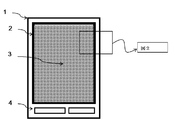
- FIG. 1 is a plan view of the liquid crystal display device of the present invention. Details of the pixel electrode, TFT, wiring, etc. are omitted.
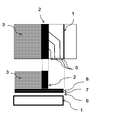
- the upper part of FIG. 2 is a partial view enlarging a part of the plan view. It shows that the wiring extending from each pixel electrode is located under the sealant and reaches the drive driver.
- the lower diagram of FIG. 2 is a cross-sectional view of the upper diagram of FIG.
- the sealing agent is in contact with the liquid crystal and the alignment film. Although not all cases are shown in the figure, the sealing agent or the liquid crystal may contact the wiring or overcoat layer depending on the position of the sealing agent.
- liquid crystal layer in the liquid crystal display device of the present invention has the general formula (I)
- R 1 and R 2 are each independently an alkyl group having 1 to 8 carbon atoms, an alkenyl group having 2 to 8 carbon atoms, an alkoxy group or a C 2 -C 1 to 8 carbon atoms 8 represents an alkenyloxy group, and A represents a 1,4-phenylene group or a trans-1,4-cyclohexylene group.
- A represents a 1,4-phenylene group or a trans-1,4-cyclohexylene group.
- R 3 represents an alkyl group having 1 to 8 carbon atoms, an alkenyl group having 2 to 8 carbon atoms, an alkoxy group having 1 to 8 carbon atoms, or an alkenyloxy group having 2 to 8 carbon atoms
- R 4 represents an alkyl group, an alkenyl group having 4 to 8 carbon atoms, an alkoxy group or an alkenyloxy group having 3-8 carbon atoms of 1 to 8 carbon atoms of 1 to 8 carbon atoms
- Z 3 is a single Bond, —CH ⁇ CH—, —C ⁇ C—, —CH 2 CH 2 —, — (CH 2 ) 4 —, —COO—, —OCO—, —OCH 2 —, —CH 2 O—, —OCF 2 —or —CF 2 O—) is contained, and the compound represented by the general formula (II-2)
- R 5 represents an alkyl group having 1 to 8 carbon atoms, an alkenyl group having 2 to 8 carbon atoms, an alkoxy group having 1 to 8 carbon atoms, or an alkenyloxy group having 2 to 8 carbon atoms
- R 6 represents an alkyl group having 1 to 8 carbon atoms, an alkenyl group having 4 to 8 carbon atoms, an alkoxy group having 1 to 8 carbon atoms, or an alkenyloxy group having 3 to 8 carbon atoms
- B represents a fluorine-substituted group
- Z 4 is a single bond, —CH ⁇ CH—, —C ⁇ C—, —CH 2 CH 2 —, A compound represented by — (CH 2 ) 4 —, —COO—, —OCO—, —OCH 2 —, —CH 2 O—, —OCF 2 — or
- R 1 and R 2 are each independently an alkyl group having 1 to 8 carbon atoms, an alkenyl group having 2 to 8 carbon atoms, an alkoxy group having 1 to 8 carbon atoms, or a carbon atom.
- R 1 represents an alkyl group having 3 carbon atoms
- R 2 is preferably an alkyl group having 2, 4 or 5 carbon atoms, or an alkenyl group having 2 to 3 carbon atoms
- R 2 is More preferred is an alkyl group having 2 carbon atoms.
- A represents a 1,4-phenylene group
- It preferably represents an alkyl group having 1 to 5 carbon atoms, an alkenyl group having 4 to 5 carbon atoms, an alkoxy group having 1 to 5 carbon atoms or an alkenyloxy group having 3 to 5 carbon atoms
- R 1 preferably represents an alkyl group, and in this case, an alkyl group having 1, 3 or 5 carbon atoms is particularly preferred.
- R 2 preferably represents an alkoxy group having 1 to 2 carbon atoms.
- the content of R 1 and formula at least one of the substituents is an alkyl group having a carbon number of 3-5 R 2 (I) compound represented by the general formula of the compound represented by (I) It is preferably 50% or more, more preferably 70% or more, and further preferably 80% or more.
- the content of the compound represented by the general formula (I) in which at least one substituent of R 1 and R 2 is an alkyl group having 3 carbon atoms is in the compound represented by the general formula (I) It is preferably 50% or more, more preferably 70% or more, further preferably 80% or more, and most preferably 100%.
- the compound represented by the general formula (I) may be contained alone or in combination of two or more, but A represents a trans-1,4-cyclohexylene group, and A represents a 1,4-phenylene group. It is preferable to contain at least one compound.
- the content of the compound represented by the general formula (I) in which A represents a trans-1,4-cyclohexylene group is preferably 50% or more of the compound represented by the general formula (I). 70% or more is more preferable, and 80% or more is more preferable.
- the compound represented by the general formula (I) is preferably a compound represented by the following general formula (Ia) to general formula (Ik).
- R 1 and R 2 each independently represents an alkyl group having 1 to 5 carbon atoms or an alkoxy group having 1 to 5 carbon atoms, and R 1 and R 2 in the general formula (I)) Similar embodiments are preferred.)
- general formula (Ia) to general formula (Ik) general formula (Ia), general formula (Ic) and general formula (Ig) are preferable, general formula (Ia) and general formula (Ig) are more preferable, and general formula (Ia) is particularly preferable, but general formula (Ib) is also preferable when response speed is important, and general formula (Ib), general formula (Ic), and general formula (Ie) when response speed is more important.
- the content of the compound represented by the general formula (Ia) and the general formula (Ic) is 50% or more in the compound represented by the general formula (I), and 70% or more. Is more preferably 80% or more, and most preferably 100%. Further, the content of the compound represented by the general formula (Ia) is preferably 50% or more in the compound represented by the general formula (I), more preferably 70% or more, and 80% or more. More preferably.
- the liquid crystal layer in the liquid crystal display device of the present invention contains 5 to 30% of the compound represented by the general formula (II-1), preferably 8 to 27%, and preferably 10 to 25%. More preferred.
- R 3 represents an alkyl group having 1 to 8 carbon atoms, an alkenyl group having 2 to 8 carbon atoms, an alkoxy group having 1 to 8 carbon atoms, or an alkenyl having 2 to 8 carbon atoms.
- R 4 represents an alkyl group having 1 to 8 carbon atoms, an alkenyl group having 4 to 8 carbon atoms, an alkoxy group having 1 to 8 carbon atoms, or an alkenyloxy group having 3 to 8 carbon atoms, It preferably represents an alkyl group having 1 to 5 carbon atoms or an alkoxy group having 1 to 5 carbon atoms, more preferably an alkyl group having 1 to 3 carbon atoms or an alkoxy group having 1 to 3 carbon atoms. It is more preferable to represent an alkyl group having 3 or an alkoxy group having 2 carbon atoms, and it is particularly preferable to represent an alkoxy group having 2 carbon atoms.
- Z 3 is a single bond, —CH ⁇ CH—, —C ⁇ C—, —CH 2 CH 2 —, — (CH 2 ) 4 —, —COO—, —OCO—, —OCH 2 —, —CH 2 O —, —OCF 2 — or —CF 2 O— represents a single bond, —CH 2 CH 2 —, —COO—, —OCH 2 —, —CH 2 O—, —OCF 2 — or —CF 2 O -Is preferably represented, more preferably a single bond or -CH 2 O-.
- the liquid crystal layer in the liquid crystal display device of the present invention can contain one or more compounds represented by formula (II-1), but preferably contains one or two compounds.
- the compound represented by the general formula (II-1) is preferably a compound represented by the following general formula (II-1a) to (II-1d).
- R 3 represents an alkyl group having 1 to 5 carbon atoms or an alkenyl group having 2 to 5 carbon atoms
- R 4a represents an alkyl group having 1 to 5 carbon atoms.
- R 3 is preferably the same embodiment as in general formula (II-1).
- R 4a is preferably an alkyl group having 1 to 3 carbon atoms, more preferably an alkyl group having 1 or 2 carbon atoms, and particularly preferably an alkyl group having 2 carbon atoms.
- R 3 is preferably the same embodiment as in general formula (II-1).
- R 4a is preferably an alkyl group having 1 to 3 carbon atoms, more preferably an alkyl group having 1 or 3 carbon atoms, and particularly preferably an alkyl group having 3 carbon atoms.
- general formulas (II-1a) to (II-1d) general formula (II-1a) and general formula (II-1c) are preferable for increasing the absolute value of dielectric anisotropy.
- general formula (II-1a) is preferred.
- the liquid crystal layer in the liquid crystal display device of the present invention preferably contains one or more compounds represented by the general formulas (II-1a) to (II-1d). It is preferable to contain 1 type or 2 types of compounds represented by general formula (II-1a).
- the liquid crystal layer in the liquid crystal display device of the present invention contains 25 to 45% of the compound represented by the general formula (II-2), preferably 28 to 42%, preferably 30 to 40%. More preferred.
- R 5 is an alkyl group having 1 to 8 carbon atoms, an alkenyl group having 2 to 8 carbon atoms, an alkoxy group having 1 to 8 carbon atoms, or an alkenyl having 2 to 8 carbon atoms.
- R 6 represents an alkyl group having 1 to 8 carbon atoms, an alkenyl group having 4 to 8 carbon atoms, an alkoxy group having 1 to 8 carbon atoms, or an alkenyloxy group having 3 to 8 carbon atoms, It preferably represents an alkyl group having 1 to 5 carbon atoms or an alkoxy group having 1 to 5 carbon atoms, more preferably an alkyl group having 1 to 3 carbon atoms or an alkoxy group having 1 to 3 carbon atoms. It is more preferable to represent an alkyl group having 3 or an alkoxy group having 2 carbon atoms, and it is particularly preferable to represent an alkoxy group having 2 carbon atoms.
- B represents a 1,4-phenylene group or trans-1,4-cyclohexylene group, which may be fluorine-substituted, and an unsubstituted 1,4-phenylene group or trans-1,4-cyclohexylene group A trans-1,4-cyclohexylene group is preferable.
- Z 4 is a single bond, —CH ⁇ CH—, —C ⁇ C—, —CH 2 CH 2 —, — (CH 2 ) 4 —, —COO—, —OCO—, —OCH 2 —, —CH 2 O —, —OCF 2 — or —CF 2 O— represents a single bond, —CH 2 CH 2 —, —COO—, —OCH 2 —, —CH 2 O—, —OCF 2 — or —CF 2 O -Is preferably represented, more preferably a single bond or -CH 2 O-.
- the compound represented by the general formula (II-2) is preferably a compound represented by the following general formula (II-2a) to general formula (II-2f).
- R 5 represents an alkyl group having 1 to 5 carbon atoms or an alkenyl group having 2 to 5 carbon atoms
- R 6a represents an alkyl group having 1 to 5 carbon atoms. Preferred is the same embodiment as R 5 and R 6 in 2).
- R 5 is preferably the same embodiment as in general formula (II-2).
- R 6a is preferably an alkyl group having 1 to 3 carbon atoms, more preferably an alkyl group having 1 or 2 carbon atoms, and particularly preferably an alkyl group having 2 carbon atoms.
- R 5 is preferably the same embodiment as in general formula (II-2).
- R 6a is preferably an alkyl group having 1 to 3 carbon atoms, more preferably an alkyl group having 1 or 3 carbon atoms, and particularly preferably an alkyl group having 3 carbon atoms.
- general formulas (II-2a) to (II-2f) in order to increase the absolute value of dielectric anisotropy, general formula (II-2a), general formula (II-2b) and general formula Formula (II-2e) is preferred.
- the compound represented by the general formula (II-2) can be contained alone or in combination of two or more, wherein B represents a 1,4-phenylene group, and B represents a trans-1,4-cyclohexylene group. It is preferable to contain at least one compound each representing
- the liquid crystal layer in the liquid crystal display device of the present invention further has the general formula (III)
- R 7 and R 8 are each independently an alkyl group having 1 to 8 carbon atoms, an alkenyl group having 2 to 8 carbon atoms, an alkoxy group having 1 to 8 carbon atoms, or 2 to 8 represents an alkenyloxy group
- D, E and F each independently represent a fluorine-substituted 1,4-phenylene group or trans-1,4-cyclohexylene
- Z 2 represents a single bond.
- the general formula (I), the general formula (II-1 And the compound represented by the general formula (II-2) are preferably included).
- the compound represented by the general formula (III) is preferably contained in an amount of 3 to 35%, more preferably 5 to 33%, and more preferably 7 to 30%.
- R 7 is an alkyl group having 1 to 8 carbon atoms, an alkenyl group having 2 to 8 carbon atoms, an alkoxy group having 1 to 8 carbon atoms, or an alkenyloxy group having 2 to 8 carbon atoms.
- D represents trans-1,4-cyclohexylene
- it preferably represents an alkyl group having 1 to 5 carbon atoms or an alkenyl group having 2 to 5 carbon atoms, and an alkyl group or carbon having 2 to 5 carbon atoms More preferably, it represents an alkenyl group having 2 to 4 atoms, more preferably represents an alkyl group having 3 to 5 carbon atoms or an alkenyl group having 2 or 3 carbon atoms, and represents an alkyl group having 3 carbon atoms.
- D represents a 1,4-phenylene group optionally substituted with fluorine
- D preferably represents an alkyl group having 1 to 5 carbon atoms or an alkenyl group having 4 or 5 carbon atoms, More preferably, it represents a 5 alkyl group or an alkenyl group having 4 carbon atoms, and more preferably represents an alkyl group having 2 to 4 carbon atoms.
- R 8 represents an alkyl group having 1 to 8 carbon atoms, an alkenyl group having 2 to 8 carbon atoms, an alkoxy group having 1 to 8 carbon atoms, or an alkenyloxy group having 3 to 8 carbon atoms
- F represents trans-1,4-cyclohexylene
- it preferably represents an alkyl group having 1 to 5 carbon atoms or an alkenyl group having 2 to 5 carbon atoms, and an alkyl group or carbon having 2 to 5 carbon atoms
- it represents an alkenyl group having 2 to 4 atoms More preferably represents an alkyl group having 3 to 5 carbon atoms or an alkenyl group having 2 or 3 carbon atoms, and represents an alkyl group having 3 carbon atoms.
- F represents a 1,4-phenylene group optionally substituted with fluorine
- it preferably represents an alkyl group having 1 to 5 carbon atoms or an alkenyl group having 4 or 5 carbon atoms, More preferably, it represents a 5 alkyl group or an alkenyl group having 4 carbon atoms, and more preferably represents an alkyl group having 2 to 4 carbon atoms.
- R 7 and R 8 represent an alkenyl group and the bonded D or F represents a 1,4-phenylene group optionally substituted with fluorine
- the alkenyl group having 4 or 5 carbon atoms includes A structure is preferred.
- D, E, and F each independently represents a fluorine-substituted 1,4-phenylene group or trans-1,4-cyclohexylene, and represents a 2-fluoro-1,4-phenylene group, 2 , 3-difluoro-1,4-phenylene group, 1,4-phenylene group or trans-1,4-cyclohexylene, preferably 2-fluoro-1,4-phenylene group or 2,3-difluoro- A 1,4-phenylene group and a 1,4-phenylene group are more preferable, and a 2,3-difluoro-1,4-phenylene group and a 1,4-phenylene group are particularly preferable.
- Z 2 is a single bond, -OCH 2 -, - OCO - , - CH 2 O- or represents a -COO-, single bond, it is preferable to represent a -CH 2 O-or -COO-, a single bond is more preferable.
- n represents 0, 1 or 2, but preferably represents 0 or 1. Also, if Z 2 represents a substituent other than a single bond, preferably it represents 1. In the case where n represents 1, the compound represented by the general formula (III) is represented by the general formula (III-1a) to the general formula (III-1e) from the viewpoint of increasing the negative dielectric anisotropy.
- the compounds represented by formulas (III-1f) to (III-1j) are preferred from the viewpoint of increasing the response speed.
- R 7 and R 8 each independently represents an alkyl group having 1 to 5 carbon atoms, an alkenyl group having 2 to 5 carbon atoms, or an alkoxy group having 1 to 5 carbon atoms, similar embodiments with R 7 and R 8 in (III) is preferred.
- the compound represented by the general formula (III) is represented by the general formula (III-2a) to the general formula (III-2i) from the viewpoint of increasing the negative dielectric anisotropy when n is 2. From the viewpoint of increasing the response speed, compounds represented by general formula (III-2j) to general formula (III-2l) are preferable.
- R 7 and R 8 each independently represents an alkyl group having 1 to 5 carbon atoms, an alkenyl group having 2 to 5 carbon atoms, or an alkoxy group having 1 to 5 carbon atoms, similar embodiments with R 7 and R 8 in (III) is preferred.
- the compound represented by the general formula (III) is preferably a compound represented by the general formula (III-3a) from the viewpoint of increasing the negative dielectric anisotropy when n represents 0, and the response speed From the viewpoint of speeding up the reaction, a compound represented by the general formula (III-3b) is preferable.
- R 7 and R 8 each independently represents an alkyl group having 1 to 5 carbon atoms, an alkenyl group having 2 to 5 carbon atoms, or an alkoxy group having 1 to 5 carbon atoms, similar embodiments with R 7 and R 8 in (III) is preferred.
- R 7 is preferably an alkyl group having 2 to 5 carbon atoms, more preferably an alkyl group having 3 carbon atoms.
- R 8 is preferably an alkoxy group having 1 to 3 carbon atoms, more preferably an alkoxy group having 2 carbon atoms.
- the compounds represented by general formula (II-1) and general formula (II-2) are both compounds having a negative dielectric anisotropy and a relatively large absolute value.
- the amount is preferably 30 to 65%, more preferably 40 to 55%, and particularly preferably 43 to 50%.
- the compound represented by the general formula (III) includes both a positive compound and a negative compound with respect to the dielectric anisotropy, but the dielectric anisotropy is negative and the absolute value thereof is 0.3.
- the total content of the compounds represented by formulas (II-1), (II-2) and (III) is preferably 35 to 70%, preferably 45 to 65%. Is more preferable, and 50 to 60% is particularly preferable.
- the total content of the compounds represented by the general formula (I), the general formula (II-1), the general formula (II-2) and the general formula (III) is 80 to 100% with respect to the entire composition. Preferably, 90 to 100% is more preferable, and 95 to 100% is particularly preferable.
- the liquid crystal layer in the liquid crystal display device of the present invention can use a nematic phase-isotropic liquid phase transition temperature (T ni ) in a wide range, but is preferably 60 to 120 ° C., 70 To 100 ° C is more preferable, and 70 to 85 ° C is particularly preferable.
- the dielectric anisotropy is preferably ⁇ 2.0 to ⁇ 6.0 at 25 ° C., more preferably ⁇ 2.5 to ⁇ 5.0, and ⁇ 2.5 to ⁇ 4. Particularly preferred is 0.
- the refractive index anisotropy is preferably 0.08 to 0.13 at 25 ° C., more preferably 0.09 to 0.12.
- the rotational viscosity ( ⁇ 1) is preferably 150 or less, more preferably 130 or less, and particularly preferably 120 or less.
- Z as a function of rotational viscosity and refractive index anisotropy shows a specific value.
- ⁇ 1 represents rotational viscosity and ⁇ n represents refractive index anisotropy.
- Z is preferably 13000 or less, more preferably 12000 or less, and particularly preferably 11000 or less.
- the liquid crystal layer in the liquid crystal display device of the present invention is required to have a specific resistance of 10 12 ( ⁇ ⁇ m) or more, preferably 10 13 ( ⁇ ⁇ m), when used for an active matrix display element. 10 14 ( ⁇ ⁇ m) or more is more preferable.
- the liquid crystal layer in the liquid crystal display device of the present invention may contain a normal nematic liquid crystal, a smectic liquid crystal, a cholesteric liquid crystal, an antioxidant, an ultraviolet absorber, a polymerizable monomer, etc., in addition to the above-described compound, depending on the application. good.
- a polymerizable monomer general formula (V)
- X 1 and X 2 each independently represent a hydrogen atom or a methyl group
- Sp 1 and Sp 2 are each independently a single bond, an alkylene group having 1 to 8 carbon atoms, or —O— (CH 2 ) s — (wherein s represents an integer of 2 to 7, Represents an aromatic ring).
- Z 1 is —OCH 2 —, —CH 2 O—, —COO—, —OCO—, —CF 2 O—, —OCF 2 —, —CH 2 CH 2 —, —CF 2 CF 2 —, —CH ⁇ CH—COO—, —CH ⁇ CH—OCO—, —COO—CH ⁇ CH—, —OCO—CH ⁇ CH—, —COO—CH 2 CH 2 —, —OCO—CH 2 CH 2 —, —CH 2 CH 2 —COO—, —CH 2 CH 2 —OCO—, —COO—CH 2 —, —OCO—CH 2 —, —CH 2 —COO—, —CH 2 —OCO—, —CY 1 ⁇ CY 2 — (Wherein Y 1 and Y 2 each independently represents a fluorine atom or a hydrogen atom), —C ⁇ C— or a single bond; C represents a 1,4-phenylene group,
- X 1 and X 2 are both diacrylate derivatives represents a hydrogen atom, both preferably none of dimethacrylate derivatives having a methyl group, preferred compounds where one represents the other is a methyl group represents a hydrogen atom.
- diacrylate derivatives are the fastest, dimethacrylate derivatives are slow, asymmetric compounds are in the middle, and a preferred embodiment can be used depending on the application.
- a dimethacrylate derivative is particularly preferable.
- Sp 1 and Sp 2 each independently represent a single bond, an alkylene group having 1 to 8 carbon atoms or —O— (CH 2 ) s —, but at least one of them is a single bond in a PSA display element.
- a compound in which both represent a single bond or one in which one represents a single bond and the other represents an alkylene group having 1 to 8 carbon atoms or —O— (CH 2 ) s — is preferable.
- 1 to 4 alkyl groups are preferable, and s is preferably 1 to 4.
- Z 1 is —OCH 2 —, —CH 2 O—, —COO—, —OCO—, —CF 2 O—, —OCF 2 —, —CH 2 CH 2 —, —CF 2 CF 2 — or a single bond
- —COO—, —OCO— or a single bond is more preferred, and a single bond is particularly preferred.
- C represents a 1,4-phenylene group, a trans-1,4-cyclohexylene group or a single bond in which any hydrogen atom may be substituted with a fluorine atom, and a 1,4-phenylene group or a single bond is preferred.
- Z 1 is preferably a linking group other than a single bond.
- Z 1 is preferably a single bond.
- the ring structure between Sp 1 and Sp 2 is specifically preferably the structure described below.
- C represents a single bond and the ring structure is formed of two rings
- both ends shall be bonded to Sp 1 or Sp 2.
- the polymerizable compounds containing these skeletons are optimal for PSA-type liquid crystal display elements because of the alignment regulating power after polymerization, and a good alignment state can be obtained, so that display unevenness is suppressed or does not occur at all.
- the general formula (V-1) to the general formula (V-4) are particularly preferable, and the general formula (V-2) is most preferable.
- Sp 2 represents an alkylene group having 2 to 5 carbon atoms.
- the polymerization proceeds even in the absence of a polymerization initiator, but a polymerization initiator may be contained in order to accelerate the polymerization.
- the polymerization initiator include benzoin ethers, benzophenones, acetophenones, benzyl ketals, acylphosphine oxides, and the like.
- a stabilizer may be added in order to improve storage stability.
- the stabilizer examples include hydroquinones, hydroquinone monoalkyl ethers, tert-butylcatechols, pyrogallols, thiophenols, nitro compounds, ⁇ -naphthylamines, ⁇ -naphthols, nitroso compounds, and the like. It is done.
- the liquid crystal layer containing a polymerizable monomer is useful for a liquid crystal display device, particularly useful for a liquid crystal display device for driving an active matrix, and for a liquid crystal display device for a PSA mode, PSVA mode, VA mode, IPS mode or ECB mode. Can be used.
- the liquid crystal layer containing a polymerizable monomer is a liquid crystal that provides liquid crystal alignment ability by polymerizing the polymerizable monomer contained therein by ultraviolet irradiation, and controls the amount of light transmitted using the birefringence of the liquid crystal composition.
- Used for display elements As liquid crystal display elements, AM-LCD (active matrix liquid crystal display element), TN (nematic liquid crystal display element), STN-LCD (super twisted nematic liquid crystal display element), OCB-LCD and IPS-LCD (in-plane switching liquid crystal display element)
- AM-LCD active matrix liquid crystal display element
- TN nematic liquid crystal display element
- STN-LCD super twisted nematic liquid crystal display element
- OCB-LCD OCB-LCD
- IPS-LCD in-plane switching liquid crystal display element
- the sealing agent in the liquid crystal display device of the present invention is composed of a cured product of a curable resin composition containing a compound having at least one (meth) acryl group and epoxy group in one molecule.
- the compound having at least one (meth) acryl group and epoxy group in one molecule is not particularly limited, and examples thereof include (meth) acrylic acid-modified epoxy resins and urethane-modified (meth) acryl epoxy resins.
- (Meth) acrylic acid-modified epoxy resin (meth) acrylic acid-modified epoxy resin is not particularly limited. For example, (meth) acrylic acid and epoxy resin are reacted in the presence of a basic catalyst according to a conventional method. Can be obtained.
- Examples of (meth) acrylic acid-modified epoxy resins include partially (meth) acrylated novolac type epoxy resins, bisphenol type epoxy resins, etc., and biphenyl type epoxy resins, naphthalene type epoxy resins, tris ( Hydroxyphenyl) alkyl type epoxy resins, tetrakis (hydroxyphenyl) alkyl type epoxy resins, and the like are suitable.
- the epoxy compound used as a raw material for synthesizing the (meth) acrylic acid-modified epoxy resin is not particularly limited.
- bisphenol A type epoxy resin bisphenol E type epoxy resin, bisphenol F type epoxy resin, bisphenol S type epoxy resin 2,2'-diallyl bisphenol A type epoxy resin, hydrogenated bisphenol type epoxy resin, polyoxypropylene bisphenol A type epoxy resin, propylene oxide added bisphenol A type epoxy resin, resorcinol type epoxy resin, biphenyl type epoxy resin, sulfide type Epoxy resin, diphenyl ether type epoxy resin, dicyclopentadiene type epoxy resin, naphthalene type epoxy resin, phenol novolac type epoxy resin, cresol novolac type epoxy resin Fatty, trisphenol novolak type epoxy resin, dicyclopentadiene novolak type epoxy resin, biphenyl novolac type epoxy resin, naphthalenephenol novolac type epoxy resin, glycidylamine type epoxy resin, alkyl polyol type epoxy resin, rubber modified epoxy resin, glycidyl ester
- examples thereof include compounds, bisphenol A type episulfide resins,
- epoxy compounds used as raw materials for synthesizing the epoxy (meth) acrylate commercially available compounds include, for example, jER828EL, jER1004 (all manufactured by Mitsubishi Chemical Corporation), and Epicron 850-S (manufactured by DIC).
- Bisphenol A type epoxy resins such as jER806 and jER4004 (both manufactured by Mitsubishi Chemical), bisphenol E type epoxy resins such as R-710, and bisphenol S type such as Epicron EXA1514 (made by DIC) Epoxy resin, 2,2′-diallylbisphenol A type epoxy resin such as RE-810NM (manufactured by Nippon Kayaku Co., Ltd.), hydrogenated bisphenol type epoxy resin such as Epicron EXA7015 (manufactured by DIC), EP-4000S (manufactured by ADEKA) ) Propylene oxy Added bisphenol A type epoxy resin, resorcinol type epoxy resin such as EX-201 (manufactured by Nagase ChemteX), biphenyl type epoxy resin such as jERYX-4000H (manufactured by Mitsubishi Chemical), YSLV-50TE (Nippon Steel Chemical Co., Ltd.) ) Sulfide type epoxy resin, YSLV-80DE (man
- Celoxide 2021, Celoxide 2080, Celoxide 3000, Epolide GT300, EHPE (all are Daicel Corporation make) etc. are mentioned, for example.
- epoxy (meth) acrylate examples include resorcinol type epoxy acrylate, 360 parts by weight of resorcinol type epoxy resin (manufactured by Nagase ChemteX Corporation, “EX-201”), and p-methoxyphenol as a polymerization inhibitor. 2 parts by weight, 2 parts by weight of triethylamine as a reaction catalyst and 210 parts by weight of acrylic acid can be obtained by stirring at 90 ° C. while feeding air and reacting for 5 hours.
- Examples of commercially available products of the epoxy (meth) acrylate include Evecryl 860, Evekril 1561, Evekril 3700, Evekrill 3600, Evekril 3701, Evekril 3703, Evekrill 3200, Evekril 3201, Evekril 3702, Evekril 3412, Evekril 860, RDX 63182, Evecri 6040, Evekril 3800 (all manufactured by Daicel Cytec), EA-1020, EA-1010, EA-5520, EA-5323, EA-CHD, EMA-1020 (all manufactured by Shin-Nakamura Chemical Co., Ltd.) Epoxy ester M-600A, Epoxy ester 40EM, Epoxy ester 70PA, Epoxy ester 200PA, Epoxy ester 80MFA, Epoxy ester 002M, Epoxy ester 3002A, Epoxy ester 1600A, Epoxy ester 3000M, Epoxy ester 3000A, Epoxy ester 200EA, Epoxy ester 400EA (all manufactured
- Urethane-modified (meth) acrylic epoxy resin is obtained, for example, by the following method. That is, a method in which a polyol and a bifunctional or higher functional isocyanate are reacted and a hydroxyl group-containing (meth) acrylic monomer and glycidol are reacted, or a bifunctional or higher functional isocyanate has a hydroxyl group (meth) without using a polyol. It can be produced by a method of reacting an acrylic monomer or glycidol or a method of reacting a glycidol with a (meth) acrylate having an isocyanate group.
- polyol For example, ethylene glycol, glycerol, sorbitol, a trimethylol propane, (poly) propylene glycol etc. are mentioned.
- the isocyanate is not particularly limited as long as it is bifunctional or higher.
- MDI diphenylmethane-4, 4'-diisocyanate
- XDI xylylene diiso
- the (meth) acrylic monomer having a hydroxyl group is not particularly limited, and examples of the monomer having one hydroxyl group in the molecule include hydroxyethyl (meth) acrylate, hydroxypropyl (meth) acrylate, and hydroxybutyl (meth) acrylate.
- examples of the monomer having two or more hydroxyl groups in the molecule include epoxy (meth) acrylates such as bisphenol A-modified epoxy (meth) acrylate. These may be used alone or in combination of two or more.
- the compounding ratio of the epoxy group and the (meth) acryl group in the curable resin composition is preferably 40:60 to 95: 5 of acryl: epoxy.
- the equivalent ratio of (meth) acrylic groups is less than 40, the photoreactivity decreases, and not only the initial temporary curing is lost even if the sealing agent is irradiated with light after the gap adjustment, Elution may increase, and if it exceeds 95, the adhesiveness and moisture permeability may be insufficient. More preferably, it is 50:50 to 80:20.
- a compound having at least one (meth) acrylic group and epoxy group in one molecule reduces the compatibility with the liquid crystal and eliminates contamination, and suppresses display defects such as white spots, uneven alignment, and baking.
- it preferably has a hydrogen bonding group, for example, preferably has a hydroxyl group and / or a urethane bond.
- the compound having at least one (meth) acryl group and epoxy group in one molecule is at least one selected from a biphenyl skeleton, a naphthalene skeleton, a bisphenol skeleton, and a partial (meth) acrylate of a novolac type epoxy resin. It preferably has two molecular skeletons.
- the compound having at least one (meth) acryl group and epoxy group in one molecule preferably has a number average molecular weight of 300 or more. If it is less than 300, it may elute into the liquid crystal and disturb the alignment.
- the number average molecular weight is preferably 3000 or less. If it exceeds 3000, it may be difficult to adjust the viscosity.
- the curable resin composition containing a compound having at least one (meth) acryl group and epoxy group in one molecule has a hydrogen bondable functional group value of 3 ⁇ 10 ⁇ 3 to 5 ⁇ 10 ⁇ 3. It is preferably mol / g. Since such a curable resin composition forms hydrogen bonds in the molecule, when used as a sealant, it is difficult to elute into the liquid crystal both before and after curing, and is less likely to cause liquid crystal contamination. This is preferable because problems of display defects such as unevenness and burn-in can be suppressed.
- the hydrogen bond includes a functional group having a hydrogen bond or a residue, such as an —OH group, —NH 2 group, —NHR group (R represents an aromatic, aliphatic hydrocarbon, or a derivative thereof. ), —COOH group, —CONH2 group, —NHOH group or other functional group, or —NHCO— bond, —NH— bond, —CONHCO— bond, —NH—NH— bond or the like remaining in the molecule It is formed by containing a compound having a group.
- the hydrogen bondable functional group value is the content per unit weight of the compound having each hydrogen bondable functional group ( (Weight fraction) can be distributed and calculated.
- Weight fraction the content per unit weight of the compound having each hydrogen bondable functional group
- the hydrogen bondable functional group value when the compound having a hydrogen bondable functional group is composed of Compound A, Compound B, and Compound C is represented by the following (Formula 2).
- Hydrogen-bonding functional group value H ABC P A + H B P B + H C P C ( Equation 2) (Note that P ⁇ represents the weight fraction of compound ⁇ .)
- the hydrogen bondable functional group value is less than 3 ⁇ 10 ⁇ 3 mol / g
- the curable resin composition component elutes into the liquid crystal and tends to disturb the alignment of the liquid crystal, and exceeds 5 ⁇ 10 ⁇ 3 mol / g.
- the moisture permeability of the cured product increases and moisture easily enters the liquid crystal display element.
- the hydrogen bonding functional group value may be adjusted to the above range by mixing two or more kinds even if the hydrogen bonding functional group value is in the above range alone. Also good. That is, the average value of the hydrogen bonding functional group value of the compound having a hydrogen bonding functional group to be used may be in the above range.
- the curable resin composition containing a compound having at least one (meth) acryl group and epoxy group in one molecule has a volume low efficiency after curing of 1 ⁇ 10 13 ⁇ ⁇ cm or more. Is preferred.
- the curable resin composition containing a compound having at least one (meth) acrylic group and epoxy group in one molecule has a specific resistance of 1.0 ⁇ 10 6 to 1.0 ⁇ 10 before curing. It is preferably 10 ⁇ ⁇ cm.
- VHR voltage holding ratio
- the curable resin composition containing a compound having at least one (meth) acryl group and an epoxy group in one molecule is a resin having a (meth) acryloyloxy group and / or a resin having an epoxy group.
- the resin described in “resin having (meth) acryloyloxy group” described below and “resin having epoxy group” described below may be used.
- the preferable upper limit of the ratio of the epoxy group to the total amount of the (meth) acryl group and the epoxy group is 40 mol%. If it exceeds 40 mol%, the solubility in the liquid crystal becomes high and the display characteristics may be deteriorated.
- the resin having a (meth) acryloyloxy group is the following resin.
- examples thereof include ester compounds obtained by reacting (meth) acrylic acid with a compound having a hydroxyl group, and urethane (meth) acrylate obtained by reacting an isocyanate with a (meth) acrylic acid derivative having a hydroxyl group.
- Ester compound obtained by reacting (meth) acrylic acid with a compound having a hydroxyl group is not particularly limited.
- Examples of functional ones include 2-hydroxyethyl (meth) acrylate, 2-hydroxypropyl (meth) acrylate, 4-hydroxybutyl (meth) acrylate, 2-hydroxybutyl (meth) acrylate, isobutyl (meth) acrylate, t-butyl (meth) acrylate, isooctyl (meth) acrylate, lauryl (meth) acrylate, stearyl (meth) acrylate, isobornyl (meth) acrylate, cyclohexyl (meth) acrylate, 2-methoxyethyl (meth) acrylate , Methoxyethylene glycol (meth) acrylate, 2-ethoxyethyl (meth) acrylate,
- the bifunctional one is not particularly limited.
- ester compounds obtained by reacting the above (meth) acrylic acid with a compound having a hydroxyl group those having three or more functional groups are not particularly limited.
- Urethane (meth) acrylate obtained by reacting an isocyanate with a hydroxyl group-containing acrylic acid derivative is particularly limited. For example, it can be obtained by reacting 1 equivalent of a compound having two isocyanate groups with 2 equivalents of a (meth) acrylic acid derivative having a hydroxyl group in the presence of a tin compound.
- the isocyanate used as a raw material for the urethane (meth) acrylate obtained by reacting a hydroxyl group-containing (meth) acrylic acid derivative with the above isocyanate is not particularly limited.
- MDI diphenylmethane-4,4′-diisocyanate
- XDI Xylylene diis
- Examples of the isocyanate used as a raw material for urethane (meth) acrylate obtained by reacting the above isocyanate with a hydroxyl group-containing (meth) acrylic acid derivative include, for example, ethylene glycol, glycerin, sorbitol, trimethylolpropane, (poly) Chain-extended isocyanate compounds obtained by reaction of polyols such as propylene glycol, carbonate diol, polyether diol, polyester diol, polycaprolactone diol and excess isocyanate can also be used.
- the (meth) acrylic acid derivative having a hydroxyl group is not particularly limited, and examples thereof include 2-hydroxyethyl (meth) acrylate, 2-hydroxypropyl (meth) acrylate, 4-hydroxybutyl (meth) acrylate, and 2-hydroxybutyl.
- (meth) acrylate and mono (meth) acrylates of dihydric alcohols such as ethylene glycol, propylene glycol, 1,3-propanediol, 1,3-butanediol, 1,4-butanediol, and polyethylene glycol , Epoxy (meth) acrylates such as mono (meth) acrylates or di (meth) acrylates of trivalent alcohols such as trimethylolethane, trimethylolpropane and glycerin, and bisphenol A-modified epoxy (meth) acrylates.
- dihydric alcohols such as ethylene glycol, propylene glycol, 1,3-propanediol, 1,3-butanediol, 1,4-butanediol, and polyethylene glycol
- Epoxy (meth) acrylates such as mono (meth) acrylates or di (meth) acrylates of trivalent alcohols such as trimethylolethane, trimethylolprop
- the urethane (meth) acrylate is, for example, 134 parts by weight of trimethylolpropane, 0.2 part by weight of BHT as a polymerization inhibitor, 0.01 part by weight of dibutyltin dilaurate as a reaction catalyst, and isophorone diisocyanate 666. It is obtained by adding 2 parts by weight, reacting at 60 ° C. with stirring under reflux for 2 hours, and then adding 51 parts by weight of 2-hydroxyethyl acrylate, stirring at 90 ° C. while feeding air and reacting for 2 hours. Can do.
- urethane (meth) acrylates include, for example, M-1100, M-1200, M-1210, M-1600 (all manufactured by Toagosei Co., Ltd.), Evecryl 230, Evekril 270, Evekril 4858, Evekril.
- the curable resin preferably has at least one hydrogen-bonding functional group in one molecule in order to further suppress component elution into the liquid crystal before curing of the sealing agent for liquid crystal dropping method of the present invention.
- the hydrogen bonding functional group is not particularly limited, and examples thereof include an —OH group, —SH group, —NHR group (R represents an aromatic or aliphatic hydrocarbon, and derivatives thereof), —COOH group , Functional groups such as —NHOH groups, and residues such as —NHCO—, —NH—, —CONHCO—, —NH—NH—, etc. present in the molecule.
- An OH group is preferred.
- the sealing agent of the present invention may contain a resin having an epoxy group.
- the resin having an epoxy group is not particularly limited, and examples thereof include epichlorohydrin derivatives, cycloaliphatic epoxy resins, and compounds obtained from the reaction of isocyanate and glycidol.
- the resin having an epoxy group is not particularly limited.
- bisphenol A type epoxy resin bisphenol F type epoxy resin, bisphenol S type epoxy resin, 2,2′-diallyl bisphenol A type epoxy resin, hydrogenated bisphenol type epoxy resin , Propylene oxide-added bisphenol A type epoxy resin, resorcinol type epoxy resin, biphenyl type epoxy resin, sulfide type epoxy resin, diphenyl ether type epoxy resin, dicyclopentadiene type epoxy resin, naphthalene type epoxy resin, phenol novolac type epoxy resin, orthocresol Novolac epoxy resin, dicyclopentadiene novolac epoxy resin, biphenyl novolac epoxy resin, naphthalenephenol novolac epoxy resin Glycidylamine type epoxy resin, alkyl polyol type epoxy resin, rubber-modified epoxy resin, glycidyl ester compound, bisphenol A type episulfide resin and the like.
- epichlorohydrin derivative examples include bisphenol A type epoxy resins such as jER828EL, jER1004 (manufactured by Mitsubishi Chemical Corporation), Epicron 850-S (manufactured by DIC Corporation), jER806, and jER4004 (all manufactured by Mitsubishi Chemical Corporation).
- bisphenol A type epoxy resins such as jER828EL, jER1004 (manufactured by Mitsubishi Chemical Corporation), Epicron 850-S (manufactured by DIC Corporation), jER806, and jER4004 (all manufactured by Mitsubishi Chemical Corporation).
- Bisphenol F type epoxy resin epphenol EXA1514 (manufactured by DIC), bisphenol S type epoxy resin, RE-810NM (manufactured by Nippon Kayaku Co., Ltd.), 2,2′-diallyl bisphenol A type epoxy resin, epicron EXA7015 Hydrogenated bisphenol type epoxy resin (made by DIC), propylene oxide-added bisphenol A type epoxy resin such as EP-4000S (made by ADEKA), resorcinol type epoxy resin such as EX-201 (made by Nagase ChemteX), jE Biphenyl type epoxy resins such as YX-4000H (manufactured by Mitsubishi Chemical), sulfide type epoxy resins such as YSLV-50TE (manufactured by Nippon Steel Chemical Co., Ltd.), and biphenyl ether types such as YSLV-80DE (manufactured by Nippon Steel Chemical Co., Ltd.) Epoxy resin, dicyclopentad
- the compound obtained from the reaction between the isocyanate and glycidol is not particularly limited.
- it can be obtained by reacting a compound having two isocyanate groups with 2 equivalents of glycidol in the presence of a tin compound as a catalyst. Can do.
- the isocyanate is not particularly limited.
- MDI diphenylmethane-4,4′-diisocyanate
- Hydrogenated MDI polymeric MDI, 1,5-n
- the isocyanate examples include, for example, a reaction between a polyol such as ethylene glycol, glycerin, sorbitol, trimethylolpropane, (poly) propylene glycol, carbonate diol, polyether diol, polyester diol, polycaprolactone diol and excess isocyanate.
- the resulting chain-extended isocyanate compound can also be used.
- the resin having an epoxy group may be, for example, a resin having a (meth) acryloyloxy group and an epoxy group in one molecule.
- Examples of such a compound include a partial (meth) acryl-modified epoxy resin obtained by reacting a part of an epoxy group of a compound having two or more epoxy groups with (meth) acrylic acid.
- the curable resin may contain only a resin having a (meth) acryloyloxy group and an epoxy group in the molecule.
- the partial (meth) acryl-modified epoxy resin can be obtained, for example, by reacting an epoxy resin and (meth) acrylic acid in the presence of a basic catalyst according to a conventional method.
- a basic catalyst for example, 190 g of phenol novolac type epoxy resin (manufactured by DIC, “N-770”) is dissolved in 500 mL of toluene, and 0.1 g of triphenylphosphine is added to this solution to obtain a uniform solution.
- acrylic acid was added dropwise under reflux stirring for 2 hours, the mixture was further stirred under reflux for 6 hours.
- toluene was removed to remove 50 mol% of a epoxy novolak type partial acrylic resin having reacted with acrylic acid.
- a modified epoxy resin can be obtained (in this case 50% partially acrylated).
- examples of commercially available products include UVACURE 1561 (manufactured by Daicel Cytec Co., Ltd.).
- the curable resin composition containing a compound having at least one (meth) acryl group and an epoxy group in one molecule preferably contains a curing agent.
- a photopolymerization initiator is not particularly limited, but a radical photopolymerization initiator is preferable, and an alkylphenone photopolymerization initiator, an oxime ester photopolymerization initiator, and an acyl phosphine oxide photopolymerization initiator are particularly preferable.
- photopolymerization initiator examples include benzophenone, 2,2-diethoxyacetophenone, 2,2-dimethoxy-1,2-diphenylethane-1-one, and 1- [4- (2-hydroxyethoxy) -phenyl].
- -2-Hydroxy-2-methyl-1-propan-1-one benzoyl isopropyl ether, benzyl dimethyl ketal, 1-hydroxycyclohexyl phenyl ketone, thioxanthone, 1,2-octanedione 1- [4- (phenylthio) -2 -(O-benzoyloxime)].
- photopolymerization initiators can be used alone or in combination of two or more.
- the photoinitiator which has a reactive double bond and a photoreaction start part can also be used.
- benzoin (ether) compounds having a reactive double bond and a hydroxyl group and / or a urethane bond are preferred.
- the benzoin (ether) compounds represent benzoins and benzoin ethers.
- the reactive double bond include residues such as an allyl group, a vinyl ether group, and a (meth) acryl group.
- the reactive double bond (meta ) Acrylic residues are preferred. By having such a reactive double bond, the weather resistance is improved.
- the said benzoin (ether) type compound should just have any one of a hydroxyl group and a urethane bond, and may have both.
- the benzoin (ether) compound does not have either a hydroxyl group or a urethane bond, it may be eluted into the liquid crystal before curing when blended with a sealant.
- the reactive double bond and hydroxyl group and / or urethane bond may be located at any part of the benzoin (ether) skeleton, but are represented by the following general formula (1-A). Those having a molecular skeleton are preferred. If a compound having such a molecular skeleton is used as a photopolymerization initiator, the residue is reduced and the amount of outgas can be reduced.
- R represents hydrogen or a residual aliphatic hydrocarbon chain having 4 or less carbon atoms.
- R represents an aliphatic hydrocarbon residual chain having more than 4 carbon atoms, the storage stability when a photopolymerization initiator is added increases, but the reactivity may decrease due to steric hindrance of the substituent.
- the addition amount of the photopolymerization initiator is preferably 0.1 to 10 parts by weight with respect to 100 parts by weight of the curable resin. If it is less than 0.1 parts by weight, the ability to initiate photopolymerization may be insufficient and the effect may not be obtained. If it exceeds 10 parts by weight, a large amount of unreacted photopolymerization initiator may remain, Weather resistance may deteriorate. More preferably, it is 1 to 5% by weight.
- the curable resin composition containing a compound having at least one (meth) acrylic group and epoxy group in one molecule preferably also contains a thermosetting agent.
- the thermosetting agent is for reacting and crosslinking the epoxy group and / or acrylic group in the curable resin composition by heating, and improves the adhesiveness and moisture resistance of the curable resin composition after curing.
- fusing point of 100 degreeC or more is used suitably.
- the storage stability may be remarkably deteriorated.
- thermosetting agent examples include hydrazide compounds such as 1,3-bis [hydrazinocarbonoethyl-5-isopropylhydantoin], dicyandiamide, guanidine derivatives, 1-cyanoethyl-2-phenylimidazole, N- [2- (2-Methyl-1-imidazolyl) ethyl] urea, 2,4-diamino-6- [2′-methylimidazolyl- (1 ′)]-ethyl-s-triazine, N, N′-bis (2-methyl -1-imidazolylethyl) urea, N, N ′-(2-methyl-1-imidazolylethyl) -adipamide, 2-phenyl-4-methyl-5-hydroxymethylimidazole, 2-phenyl-4,5-dihydroxymethyl Imidazole derivatives such as imidazole, modified aliphatic polyamines, tetrahydrophthalic anhydride,
- thermosetting agent having low reactivity is preferable from the viewpoint of storage stability.
- the blending ratio of the thermosetting agent is preferably 5 to 60 parts by weight, more preferably 10 to 50 parts by weight with respect to 100 parts by weight of the curable compound. Outside the above range, the adhesiveness and chemical resistance of the cured product may be lowered, and the liquid crystal characteristics may be deteriorated in a high temperature and high humidity operation test.
- thermosetting agent the following coating thermosetting agent is suitable. If the coated thermosetting agent of the present invention is used, very high storage stability can be obtained even as a one-component type. That is, by using a coating thermosetting agent in which the surface of the solid thermosetting agent is coated with fine particles having poor volatility and poor solubility in organic matter, a seal having high storage stability even if a curing agent is blended in advance. An agent is obtained.
- the solid thermosetting agent refers to a curing agent that is solid at room temperature and starts to react with the curable resin by melting or softening by heating.
- Such a solid thermosetting agent is not particularly limited as long as it has a melting point or a softening point of room temperature or higher, and examples thereof include solid amine compounds, phenolic compounds, and acid anhydrides. Of these, solid amine compounds are preferred because of their excellent reactivity at low temperatures.
- the solid amine compound means a solid compound having one or more primary to tertiary amino groups in the molecule. For example, aromatic amines such as metaphenylenediamine and diaminodiphenylmethane, 2-methylimidazole, and the like.
- Imidazole compounds such as 1,2-dimethylimidazole and 1-cyanoethyl-2-methylimidazole, imidazoline compounds such as 2-methylimidazoline, and dihydrazide compounds such as sebacic acid dihydrazide and isophthalic acid dihydrazide.
- solid amine compounds those commercially available include amine adducts such as Amicure PN-23, Amicure MY-24 (manufactured by Ajinomoto Fine Techno Co., Ltd.), dicyandiamide, and the like.
- polyhydric phenol type compound a polyphenol compound and a novolak-type phenol resin are mentioned, for example.
- these polyhydric phenol compounds that are commercially available include jER cure 170, jER cure YL6065, jER cure MP402FPI (manufactured by Mitsubishi Chemical Corporation), and the like.
- the acid anhydride include glycerin bis (anhydrotrimellitate), ethylene glycol-bis (anhydrotrimellitate), tetrahydrophthalic anhydride, hexahydrophthalic anhydride, 4-methylhexahydrophthalic anhydride, Examples thereof include 3-methyltetrahydrophthalic anhydride.
- the average particle diameter of the solid thermosetting agent particles is not particularly limited, but is preferably 0.1 to 50 ⁇ m. If it is less than 0.1 ⁇ m, the surface may not be efficiently coated with fine particles. If it exceeds 50 ⁇ m, when blended with a sealant, the curing agent may precipitate during storage or curing may become uneven. May be frustrated. More preferably, it is 0.5 to 10 ⁇ m.
- the fine particles that coat the surface of the solid thermosetting agent particles include oxides such as Si, Al, Ti, Fe, Mn, and Mg, hydroxides, halides, styrene beads, and fine rubber. These fine particles may be used alone or in combination of two or more.
- the average particle diameter of the fine particles is preferably 0.05 ⁇ m or less. If it exceeds 0.05 ⁇ m, the surface of the solid thermosetting agent particles may not be efficiently coated. More preferably, it is 0.03 ⁇ m or less.
- the particle diameter of the fine particles is preferably 10% or less of the particle diameter of the solid thermosetting agent particles. If it is 10% or more, the reactivity control ability may not be sufficiently exhibited.
- the weight ratio of solid thermosetting agent particles to fine particles in the coating thermosetting agent is preferably 50: 1 to 3: 1. When the weight ratio of the solid thermosetting agent particles exceeds 50, the ability to control the reactivity may not be sufficiently exhibited. When the weight ratio is less than 3, fine particles may exist excessively and the curing function may be deteriorated. More preferably, it is 20: 1 to 5: 1.
- the method of coating the surface of the solid thermosetting agent particles with fine particles is not particularly limited, and examples thereof include a method of mixing solid thermosetting agent particles and fine particles in a container using a commercially available blender and the like to make them uniform. It is done.
- the mixing ratio of the curable resin composition and the coating thermosetting agent is preferably 1 to 100 parts by weight with respect to 100 parts by weight of the curable resin composition. If it is less than 1 part by weight, it may not be sufficiently cured, and if it exceeds 100 parts by weight, various physical properties such as toughness of the cured product that is obtained because an excessive thermosetting agent may remain.
- the coating thermosetting agent When the coating thermosetting agent is blended in the curable resin composition, it exhibits high storage stability because the contact between the solid thermosetting agent and the polymerizable resin is suppressed as much as possible by the fine particles on the surface during normal temperature storage, and is cured. Sometimes, by applying temperature, the solid thermosetting agent becomes liquid and comes into contact with the curable resin without being suppressed by the fine particles, and the curing reaction starts quickly. Therefore, the storage stability of the curable resin composition is improved.
- the coated thermosetting agent can be produced very easily at room temperature and in a short time without using a special reaction.
- the curable resin composition containing a compound having at least one (meth) acryl group and epoxy group in one molecule may contain a radical polymerization inhibitor.
- the radical polymerization inhibitor include 2,6-di-t-butylcresol, butylated hydroxyanisole, 2,6-di-t-butyl-4-ethylphenol, stearyl ⁇ - (3,5-di-).
- the lower limit of the blending amount of the radical polymerization inhibitor is 0.1 parts by weight and the upper limit is 0.4 parts by weight with respect to 100 parts by weight of the curable resin composition.
- the blending amount of the radical polymerization inhibitor is less than 0.1 parts by weight, the radical polymerization inhibitor is quickly consumed by radicals generated slightly when weak light is present during the production of the liquid crystal display element. In other words, when it is exposed to weak light that is not intended to cure the sealant, it is accidentally cured.
- the blending amount of the radical polymerization inhibitor exceeds 0.4 parts by weight, the ultraviolet curing property of the obtained sealing agent is remarkably lowered, and it may not be cured even when irradiated with ultraviolet rays for the purpose of curing the sealing agent.
- the curable resin composition containing the compound having at least one (meth) acryl group and epoxy group in one molecule further contains a silane coupling agent.
- the silane coupling agent mainly has a role as an adhesion assistant for favorably bonding the sealing agent and the liquid crystal display element substrate.
- the silane coupling agent is preferably a silane compound having at least one functional group represented by the following group (2-A) and at least one functional group represented by the following group (2-B).
- the silane compound examples include ⁇ -aminopropyltrimethoxysilane, ⁇ -mercaptopropyltrimethoxysilane, ⁇ -glycidoxypropyltrimethoxysilane, and ⁇ -isocyanatopropyltrimethoxysilane. These silane compounds may be used alone or in combination of two or more.
- the silane compound having such a structure as a silane coupling agent, the adhesion to the substrate can be improved, and the silane compound is chemically bonded to the curable resin via the functional group represented by Group 2-B. As a result, the outflow into the liquid crystal can be prevented.
- the silane compound is heat-treated after blending with the curable resin component.
- the heat treatment is preferably performed by stirring the resin mixture in order to increase the reaction efficiency.
- the stirring method is not particularly limited, and examples thereof include a general method such as rotating a stirrer or stirring blade with a motor or the like.
- the temperature of the heat treatment is preferably 30 to 70 ° C. When the temperature is lower than 30 ° C., the reaction between the silane compound and the curable resin may not occur sufficiently, and when the temperature exceeds 70 ° C., curing by heat may start. More preferably, it is 40 to 60 ° C.
- the heat treatment time is preferably 1 to 2 hours. If it is less than 1 hour, all functional groups in the silane compound may not react and unreacted substances may remain.
- the residual ratio of at least one functional group represented by the group 2-B after the heat treatment is 10% or less. If it exceeds 10%, it reacts with the resin component during storage and thickens, or it flows out into the liquid crystal and becomes contaminated.
- the residual ratio of at least one functional group represented by Group 2-B can be determined from the relative ratio of the peak intensity of various functional groups in the silane compound and the peak intensity after heat treatment by 1H-NMR measurement. it can.
- a filler is added for viscosity adjustment and improvement of adhesiveness due to a stress dispersion effect. May be.
- the filler is not particularly limited.
- the shape of the filler is not particularly limited, and examples thereof include regular shapes such as spherical shapes, needle shapes, and plate shapes, or non-standard shapes.
- the curable resin composition containing a compound having at least one (meth) acryl group and epoxy group in one molecule may contain resin fine particles.
- the resin fine particles include a core particle made of a resin having rubber elasticity and a glass transition temperature of ⁇ 10 ° C. or less, and a shell made of a resin formed on the surface of the core particle and having a glass transition temperature of 50 to 150 ° C. And having a layer.
- the glass transition temperature means a value measured by a normal DSC method under a temperature rising rate of 10 ° C./min unless otherwise specified.
- the resin having rubber elasticity and a glass transition temperature of ⁇ 10 ° C. or lower is not particularly limited, but a polymer of (meth) acrylic monomer is preferable.
- Examples of the (meth) acrylic monomer include ethyl acrylate, propyl acrylate, n-butyl acrylate, cyclohexyl acrylate, 2-ethylhexyl acrylate, ethyl methacrylate, butyl methacrylate and the like. These (meth) acrylic monomers may be polymerized alone or in combination of two or more.
- the resin having a glass transition temperature of 50 to 150 ° C. is not particularly limited.
- examples thereof include polymers obtained by polymerizing acrylonitrile, vinyl chloride and the like. These monomers may be used independently and may use 2 or more types together.
- the particle diameter of the resin fine particles is appropriately selected depending on the purpose of use, but a preferable lower limit is 0.01 ⁇ m and a preferable upper limit is 5 ⁇ m. Within this range, the surface area of the resin fine particles with respect to the photocurable resin is sufficiently large, and an effective swelling effect of the core layer appears. Workability can also be secured.
- the method for producing the resin fine particles is not particularly limited. For example, after forming the core particles by an emulsion polymerization method using only the monomer constituting the core, the core is further polymerized by adding the monomer constituting the shell. Examples include a method of forming a shell layer on the surface of the particles.
- the minimum with the preferable compounding quantity of the said resin fine particle in the said curable resin composition is 15 weight part with respect to 100 weight part of said photocurable resins, and a preferable upper limit is 50 weight part. If the amount is less than 15 parts by weight, a sufficient adhesive improvement effect may not be obtained. If the amount exceeds 50 parts by weight, the viscosity may increase more than necessary. A more preferred upper limit is 20 parts by weight.
- the liquid crystal composition is aligned on the first substrate and the surface in contact with the liquid crystal composition on the second substrate. Although arranged between the liquid crystal layers, even if the alignment film is thick, it is as thin as 100 nm or less, and completely blocks the interaction between the pigment such as a pigment constituting the color filter and the liquid crystal compound constituting the liquid crystal layer. It is not a thing. Further, in a liquid crystal display device that does not use an alignment film, the interaction between a pigment such as a pigment constituting a color filter and a liquid crystal compound constituting a liquid crystal layer becomes larger.
- alignment film material transparent organic materials such as polyimide, polyamide, BCB (Penzocyclobutene Polymer), polyvinyl alcohol and the like can be used.
- p-phenylenediamine, 4,4′-diaminodiphenylmethane Aliphatic or alicyclic tetracarboxylic anhydrides such as aliphatic or alicyclic diamines, butanetetracarboxylic anhydride, 2,3,5-tricarboxycyclopentylacetic anhydride, pyromellitic dianhydride
- a polyimide alignment film obtained by imidizing a polyamic acid synthesized from an aromatic tetracarboxylic anhydride such as a product is preferable.
- rubbing is generally used as a method for imparting orientation, but when used for a vertical orientation film or the like, it can be used without imparting orientation.
- the alignment film material a material containing chalcone, cinnamate, cinnamoyl or azo group in the compound can be used, and it may be used in combination with materials such as polyimide and polyamide.
- the alignment film is rubbed. Or a photo-alignment technique may be used.
- the alignment film is generally formed by applying the alignment film material on a substrate by a method such as spin coating to form a resin film, but a uniaxial stretching method, Langmuir-Blodgett method, or the like can also be used. .
- a conductive metal oxide can be used as a material for the transparent electrode.
- the metal oxide include indium oxide (In 2 O 3 ), tin oxide (SnO 2 ), and zinc oxide.
- ZnO indium tin oxide
- In 2 O 3 —SnO 2 indium zinc oxide
- niobium-doped titanium dioxide Ti 1-x Nb x O 2
- fluorine-doped tin oxide graphene
- ZnO zinc oxide
- In 2 O 3 —SnO 2 indium tin oxide
- In 2 O 3 —ZnO indium zinc oxide
- a photo-etching method or a method using a mask can be used.
- the liquid crystal display device of the present invention is particularly useful for an active matrix driving liquid crystal display device, and can be applied to a VA mode, PSVA mode, PSA mode, IPS mode or ECB mode liquid crystal display device.
- the liquid crystal display device is combined with a backlight and used in various applications such as liquid crystal televisions, personal computer monitors, mobile phones, smartphone displays, notebook personal computers, personal digital assistants, and digital signage.
- the backlight include a cold cathode tube type backlight, a two-wavelength peak pseudo-white backlight and a three-wavelength peak backlight using a light emitting diode or an organic EL element using an inorganic material.
- T ni Nematic phase-isotropic liquid phase transition temperature (° C.) ⁇ n: refractive index anisotropy at 25 ° C. ⁇ : dielectric anisotropy at 25 ° C. ⁇ : viscosity at 20 ° C. (mPa ⁇ s) ⁇ 1: rotational viscosity at 25 ° C. (mPa ⁇ s) VHR: Voltage holding ratio at 70 ° C.
- the burn-in evaluation of the liquid crystal display element is based on the following four-level evaluation of the afterimage level of the fixed pattern when the predetermined fixed pattern is displayed in the display area for 1000 hours and then the entire screen is uniformly displayed. went.
- Afterimage fairly poor Volume resistivity of sealant after curing Apply a thin and uniform sealant onto the chromium vapor deposition surface of the chromium vapor deposition glass substrate and then cure with ultraviolet rays to form a UV cured product with a size of 85 mm x 85 mm and a thickness of 3 m. A chromium-deposited glass substrate was placed on the object side, a load was applied, and thermocompression bonding was performed on a hot plate at 120 ° C. for 1 hour to prepare a test sample.
- the area of the sealant (S (cm 2 )) in this test sample is constant using a constant voltage generator (PA36-2A regulated DC power supply manufactured by Kenwood) between the chromium vapor deposition surfaces of the opposite chromium vapor deposition glass substrate. Voltage (V (V)) was applied, and the current (A (A)) flowing through the film was measured with an ammeter (manufactured by Advantest Corporation, R644C digital multimeter). When the film thickness (T (cm)) of the sealing agent was used, the volume resistivity ( ⁇ ⁇ cm) was determined by the following formula.
- volume resistivity ( ⁇ ⁇ cm) (V ⁇ S) / (A ⁇ T)
- the applied voltage was DC 500 V and the conduction time was 1 minute.
- Specific resistance of sealant before curing About the sealant before curing, in a standard temperature and humidity state (20 ° C., 65% RH), a resistivity measuring instrument (Toyo Technica, SR-6517 type) and a liquid electrode (Ando Electric, LE-21 type) ) was used to measure the specific resistance.
- Sealing agent 85 parts by weight of acrylic acid-modified resorcinol type epoxy resin (A), 18 parts by weight of acrylic acid-modified bisphenol A type epoxy resin (B), 33 parts by weight of acrylic acid-modified diphenyl ether type epoxy resin (C), 2 as radical photopolymerization initiator , 2-dimethoxy-1,2-diphenylethane-1-one 10 parts by weight, hydrazide-based curing agent (Ajinomoto Fine Techno Co., Amicure VDH) as a latent thermosetting agent, ⁇ -glycidoxypropyltri Planetary stirring is performed so that 6 parts by weight of methoxysilane, 30 parts by weight of spherical silica (manufactured by Admatechs, SO-C1), and 20 parts by weight of core-shell structured fine particles (manufactured by Nippon Zeon Co., Ltd .: F-351) are in a uniform liquid.
- Sealing agent (2) 100 parts by weight of a phenol novolac type epoxy resin (manufactured by DIC, “N-740”), 60 parts by weight of a methacrylic acid-modified bisphenol E type epoxy resin (D), 1- [4- (2-hydroxy) as a radical photopolymerization initiator 3 parts by weight of ethoxy) -phenyl] -2-hydroxy-2-methyl-1-propan-1-one, 65 parts by weight of a hydrazide-based curing agent (Ajinomoto Fine Techno Co., Amicure VDH) as a latent thermosetting agent, After mixing and stirring with a planetary stirrer, 3 parts by weight of ⁇ -glycidoxypropyltrimethoxysilane, 6 parts by weight of talc, and 0.5 parts by weight of dibutylhydroxytoluene as an antioxidant are mixed to form a uniform liquid.
- a phenol novolac type epoxy resin manufactured by DIC, “N-740”
- D methacryl
- the mixture was mixed with three ceramic rolls, defoamed with a planetary stirrer, mixed and stirred, and this was used as the sealing agent (2).
- the characteristics of the obtained sealing agent (2) are shown below. Hydrogen bondable functional group value: 3.7 ⁇ 10 ⁇ 3 Specific resistance of sealant before curing ( ⁇ ⁇ cm): 2.4 ⁇ 10 7 Volume resistivity ( ⁇ ⁇ cm) of the sealant after curing: 1.3 ⁇ 10 13
- Sealing agent (3) 60 parts by weight of acrylic acid-modified phenol novolac epoxy resin (E), 29 parts by weight of urethane-modified acrylic epoxy resin (F), 1.5 parts by weight of 2,2-diethoxyacetophenone as a photopolymerization initiator, and as a latent thermosetting agent A hydrazide-based curing agent (Ajinomoto Fine Techno Co., Amicure VDH) 22 parts by weight, ⁇ -glycidoxypropyltrimethoxysilane 1.5 parts by weight, silica particles (average particle size 1.5 ⁇ m) 34 parts by weight, After stirring with a planetary stirrer, the mixture was mixed with three ceramic rolls, and further defoamed and mixed with a planetary stirrer, and this was used as a sealing agent (3).
- a hydrazide-based curing agent Ajinomoto Fine Techno Co., Amicure VDH
- Sealing agent (4) As the curable resin, 35 parts by weight of acrylic acid-modified bisphenol A type epoxy resin (B), 30 parts by weight of caprolactone-modified bisphenol A type epoxy acrylate (manufactured by Daicel Cytec Co., Ltd., “Eveacryl 3708”), and acrylic acid modified bisphenol F type 25 parts by weight of an epoxy resin (manufactured by Daicel Cytec Co., Ltd., KRM8287) was mixed, 2 parts by weight of 2,2-dimethoxy-2-phenylacetophenone as a photopolymerization initiator, and dibasazide sebacate (Otsuka Chemical) as a thermosetting agent.
- B acrylic acid-modified bisphenol A type epoxy resin
- caprolactone-modified bisphenol A type epoxy acrylate manufactured by Daicel Cytec Co., Ltd., “Eveacryl 3708”
- acrylic acid modified bisphenol F type 25 parts by weight of an epoxy resin manufactured by Daicel Cytec Co., Ltd., K
- Sealing agent (5) 50 parts by weight of methacrylic acid-modified bisphenol E type epoxy resin (D), 50 parts by weight of urethane-modified methacrylic epoxy resin (G), 1.5 parts by weight of 2,2-diethoxyacetophenone as a photopolymerization initiator, latent thermosetting agent As a hydrazide-based curing agent (Ajinomoto Fine Techno Co., Amicure VDH) 18 parts by weight, ⁇ -glycidoxypropyltrimethoxysilane 1.5 parts by weight, silica particles (Admatex Co., Ltd., SO-C1) 35 parts by weight After mixing and stirring with a planetary stirrer, the mixture was mixed with a ceramic three roll, and further defoamed and mixed with a planetary stirrer, and this was used as a sealant (5).
- methacrylic acid-modified bisphenol E type epoxy resin (D) 50 parts by weight of urethane-modified methacrylic epoxy resin (G), 1.5 parts
- Comparative sealant (C1) A curable resin composition comprising 35 parts by weight of urethane acrylate (AH-600, manufactured by Kyoeisha Chemical Co., Ltd.), 15 parts by weight of 2-hydroxybutyl acrylate, 50 parts by weight of isobornyl acrylate, and 3 parts by weight of benzophenone is blended, and planetary stirring is performed. After stirring with the apparatus, the mixture was uniformly mixed with three ceramic rolls to obtain a photocurable comparative sealing agent (C1). The characteristics of the obtained comparative sealant (C1) are shown below. Hydrogen bondable functional group value: 2.2 ⁇ 10 ⁇ 5 Specific resistance of sealant before curing ( ⁇ ⁇ cm): 6.0 ⁇ 10 5 Volume resistivity ( ⁇ ⁇ cm) of sealant after curing: 1.2 ⁇ 10 13
- Comparative sealant (C2) A curable resin composition composed of 50 parts by weight of a bisphenol A epoxy resin (Mitsubishi Chemical Co., Ltd., jER828US) and 25 parts by weight of a hydrazide-based curing agent (NDH) was mixed with a planetary stirrer. Then, it was mixed uniformly with a ceramic three roll to obtain a comparative sealant (C2). The characteristics of the obtained comparative sealant (C2) are shown below. Hydrogen bondable functional group value: 2.7 ⁇ 10 ⁇ 7 Specific resistance of sealant before curing ( ⁇ ⁇ cm): 5.0 ⁇ 10 10 Volume resistivity ( ⁇ ⁇ cm) of the sealant after curing: 3.0 ⁇ 10 13
- Examples 1 to 5 After forming transparent electrodes on the first and second substrates, forming a black matrix (BM) on the second substrate, and forming a vertical alignment film (SE-5300) on the opposite side of each substrate An alignment treatment was performed. Fill the dispensing syringe with the sealing agents (1) to (5), perform defoaming treatment, and then use the dispenser to draw a rectangular frame for each sealing agent on the alignment film side of the first substrate. It was applied to. In a state where the sealant is uncured, fine droplets of the liquid crystal composition 1 shown in the following table are dropped onto the entire surface of the frame of the first substrate, and the second substrate is immediately placed under a vacuum of 5 Pa using a vacuum bonding apparatus. Pasted together.
- BM black matrix
- SE-5300 vertical alignment film
- the drawing conditions and the gap between the substrates were adjusted so that the line width of the crushed sealant was about 1.2 mm, and 0.3 mm of the sealant overlapped with BM.
- ultraviolet rays were irradiated at 100 mW / cm 2 for 30 seconds using a high-pressure mercury lamp from the second substrate side to the seal portion, and then liquid crystal annealing was performed at 120 ° C. for 1 hour to thermally cure.
- the alignment unevenness and image sticking evaluation of the obtained liquid crystal display device were performed. The results are shown in the following table.
- the liquid crystal composition 1 has a liquid crystal layer temperature range of 75.8 ° C. that is practical as a liquid crystal composition for TV, has a large absolute value of dielectric anisotropy, has a low viscosity, and an appropriate ⁇ n. You can see that The liquid crystal display devices of Examples 1 to 5 were able to realize a high VHR. Also, in the evaluation of alignment unevenness, there was no alignment unevenness, or even if there was very little, it was an acceptable level. Further, even in the burn-in evaluation, there was no afterimage, or even a very slight and acceptable level.
- Examples 6 to 15 In the same manner as in Example 1, the liquid crystal compositions 2 to 3 shown in the following table are sandwiched, and the liquid crystal display devices of Examples 6 to 15 are prepared using the sealing agents (1) to (5). It was measured. Further, the alignment unevenness evaluation and the burn-in evaluation of the liquid crystal display device were performed. The results are shown in the following table.
- the liquid crystal compositions 2 and 3 have a practical liquid crystal layer temperature range as a liquid crystal composition for TV, a large absolute value of dielectric anisotropy, a low viscosity and an appropriate ⁇ n. I understand.
- the liquid crystal display devices of Examples 6 to 15 were able to realize a high VHR. Further, no alignment unevenness was observed in the alignment unevenness evaluation. Further, even in the burn-in evaluation, there was no afterimage, or even a very slight and acceptable level.
- Example 16 to 30 As in Example 1, the liquid crystal compositions 4 to 6 shown in the following table are sandwiched, and the liquid crystal display devices of Examples 16 to 30 are prepared using the sealing agents (1) to (5). It was measured. Further, the alignment unevenness evaluation and the burn-in evaluation of the liquid crystal display device were performed. The results are shown in the following table.
- the liquid crystal compositions 4 to 6 have a practical liquid crystal layer temperature range as a liquid crystal composition for TV, have a large absolute value of dielectric anisotropy, have a low viscosity and an appropriate ⁇ n. I understand.
- the liquid crystal display devices of Examples 16 to 30 were able to realize a high VHR. Also, in the evaluation of alignment unevenness, there was no alignment unevenness, or even if there was very little, it was an acceptable level. Further, even in the burn-in evaluation, there was no afterimage, or even a very slight and acceptable level.
- Examples 31 to 45 In the same manner as in Example 1, the liquid crystal compositions 7 to 9 shown in the following table are sandwiched, and the liquid crystal display devices of Examples 31 to 45 are prepared using the sealing agents (1) to (5). It was measured. Further, the alignment unevenness evaluation and the burn-in evaluation of the liquid crystal display device were performed. The results are shown in the following table.
- the liquid crystal compositions 7 to 9 have a practical liquid crystal layer temperature range as a liquid crystal composition for TV, have a large absolute value of dielectric anisotropy, have a low viscosity and an appropriate ⁇ n. I understand.
- the liquid crystal display devices of Examples 31 to 45 were able to realize high VHR. Also, in the evaluation of alignment unevenness, there was no alignment unevenness, or even if there was very little, it was an acceptable level. Further, even in the burn-in evaluation, there was no afterimage, or even a very slight and acceptable level.
- Example 46 to 60 In the same manner as in Example 1, the liquid crystal compositions 10 to 12 shown in the following table are sandwiched, and the liquid crystal display devices of Examples 46 to 60 are prepared using the sealing agents (1) to (5). It was measured. Further, the alignment unevenness evaluation and the burn-in evaluation of the liquid crystal display device were performed. The results are shown in the following table.
- the liquid crystal compositions 10 to 12 have a practical liquid crystal layer temperature range as a liquid crystal composition for TV, have a large absolute value of dielectric anisotropy, have a low viscosity and an appropriate ⁇ n. I understand.
- the liquid crystal display devices of Examples 46 to 60 were able to realize a high VHR. Also, in the evaluation of alignment unevenness, there was no alignment unevenness, or even if there was very little, it was an acceptable level. Further, even in the burn-in evaluation, there was no afterimage, or even a very slight and acceptable level.
- Examples 61 to 75 In the same manner as in Example 1, the liquid crystal compositions 13 to 15 shown in the following table are sandwiched, and the liquid crystal display devices of Examples 61 to 75 are prepared using the sealing agents (1) to (5). It was measured. Further, the alignment unevenness evaluation and the burn-in evaluation of the liquid crystal display device were performed. The results are shown in the following table.
- the liquid crystal compositions 13 to 15 have a practical liquid crystal layer temperature range as a liquid crystal composition for TV, have a large absolute value of dielectric anisotropy, have a low viscosity and an appropriate ⁇ n. I understand.
- the liquid crystal display devices of Examples 61 to 75 were able to realize a high VHR. Also, in the evaluation of alignment unevenness, there was no alignment unevenness, or even if there was very little, it was an acceptable level. Further, even in the burn-in evaluation, there was no afterimage, or even a very slight and acceptable level.
- Example 76 to 90 As in Example 1, the liquid crystal compositions 16 to 18 shown in the following table are sandwiched, and the liquid crystal display devices of Examples 76 to 90 are produced using the sealing agents (1) to (5). It was measured. Further, the alignment unevenness evaluation and the burn-in evaluation of the liquid crystal display device were performed. The results are shown in the following table.
- the liquid crystal compositions 16 to 18 have a practical liquid crystal layer temperature range as a liquid crystal composition for TV, have a large absolute value of dielectric anisotropy, have a low viscosity and an appropriate ⁇ n. I understand.
- the liquid crystal display devices of Examples 76 to 90 were able to realize a high VHR. Also, in the evaluation of alignment unevenness, there was no alignment unevenness, or even if there was very little, it was an acceptable level. Further, even in the burn-in evaluation, there was no afterimage, or even a very slight and acceptable level.
- Example 91 to 105 As in Example 1, the liquid crystal compositions 19 to 21 shown in the following table are sandwiched, and the liquid crystal display devices of Examples 91 to 105 are prepared using the sealing agents (1) to (5). It was measured. Further, the alignment unevenness evaluation and the burn-in evaluation of the liquid crystal display device were performed. The results are shown in the following table.
- the liquid crystal compositions 19 to 21 have a practical liquid crystal layer temperature range as a liquid crystal composition for TV, a large absolute value of dielectric anisotropy, a low viscosity, and an appropriate ⁇ n. I understand.
- the liquid crystal display devices of Examples 91 to 105 were able to realize a high VHR. Also, in the evaluation of alignment unevenness, there was no alignment unevenness, or even if there was very little, it was an acceptable level. Further, even in the burn-in evaluation, there was no afterimage, or even a very slight and acceptable level.
- Example 106 to 120 In the same manner as in Example 1, the liquid crystal compositions 22 to 24 shown in the following table are sandwiched, and the liquid crystal display devices of Examples 106 to 120 are produced using the sealing agents (1) to (5). It was measured. Further, the alignment unevenness evaluation and the burn-in evaluation of the liquid crystal display device were performed. The results are shown in the following table.
- the liquid crystal compositions 22 to 24 have a practical liquid crystal layer temperature range as a liquid crystal composition for TV, have a large absolute value of dielectric anisotropy, have a low viscosity and an appropriate ⁇ n. I understand.
- the liquid crystal display devices of Examples 106 to 120 were able to realize a high VHR. Also, in the evaluation of alignment unevenness, there was no alignment unevenness, or even if there was very little, it was an acceptable level. Further, even in the burn-in evaluation, there was no afterimage, or even a very slight and acceptable level.
- Example 121 to 135 As in Example 1, the liquid crystal compositions 25 to 27 shown in the following table were sandwiched, and the liquid crystal display devices of Examples 121 to 135 were prepared using the sealing agents (1) to (5). It was measured. Further, the alignment unevenness evaluation and the burn-in evaluation of the liquid crystal display device were performed. The results are shown in the following table.
- the liquid crystal compositions 25 to 27 have a practical liquid crystal layer temperature range as a liquid crystal composition for TV, have a large absolute value of dielectric anisotropy, have a low viscosity and an appropriate ⁇ n. I understand.
- the liquid crystal display devices of Examples 121 to 135 were able to realize high VHR. Also, in the evaluation of alignment unevenness, there was no alignment unevenness, or even if there was very little, it was an acceptable level. Further, even in the burn-in evaluation, there was no afterimage, or even a very slight and acceptable level.
- Example 136 to 140 Liquid crystal composition 1 was mixed with 0.3% by mass of 2-methyl-acrylic acid 4- ⁇ 2- [4- (2-acryloyloxy-ethyl) -phenoxycarbonyl] -ethyl ⁇ -biphenyl-4′-yl ester. A liquid crystal composition 28 was formed, and the liquid crystal composition 28 was sandwiched in the same manner as in Example 1 and sealed using sealing agents (1) to (5). While applying a driving voltage between the electrodes, ultraviolet rays were irradiated for 600 seconds (3.0 J / cm 2 ), polymerization treatment was performed, PSVA liquid crystal display devices of Examples 136 to 140 were produced, and their VHR was measured. did. Further, the alignment unevenness evaluation and the burn-in evaluation of the liquid crystal display device were performed. The results are shown in the following table.
- the liquid crystal display devices of Examples 136 to 140 were able to realize high VHR. Also, in the alignment unevenness evaluation, alignment unevenness was not recognized. Further, even in the burn-in evaluation, there was no afterimage, or even a very slight and acceptable level.
- Examples 141 to 145 Bismethacrylic acid biphenyl-4,4′-diyl was mixed in an amount of 0.3% by mass to the liquid crystal composition 13 to form a liquid crystal composition 29, and the liquid crystal composition 29 was sandwiched in the same manner as in Example 1 to obtain a sealing agent (1) Encapsulated using (5). While applying a driving voltage between the electrodes, UV irradiation was performed for 600 seconds (3.0 J / cm 2 ), polymerization was performed, and PSVA liquid crystal display devices of Examples 141 to 145 were produced, and their VHR was measured. did. Further, the alignment unevenness evaluation and the burn-in evaluation of the liquid crystal display device were performed. The results are shown in the following table.
- the liquid crystal display devices of Examples 141 to 145 were able to realize high VHR. Also, in the alignment unevenness evaluation, alignment unevenness was not recognized. Further, even in the burn-in evaluation, there was no afterimage, or even a very slight and acceptable level.
- Example 146 to 150 A liquid crystal composition 30 was prepared by mixing 0.3% by mass of bismethacrylic acid 3-fluorobiphenyl-4,4′-diyl with the liquid crystal composition 19, and the liquid crystal composition 30 was sandwiched in the same manner as in Example 1 to obtain a sealing agent. Encapsulated using (1) to (5). While applying a drive voltage between the electrodes, UV irradiation was performed for 600 seconds (3.0 J / cm 2 ), polymerization was performed, and PSVA liquid crystal display devices of Examples 146 to 85 were produced, and their VHR was measured. did. Further, the alignment unevenness evaluation and the burn-in evaluation of the liquid crystal display device were performed. The results are shown in the following table.
- Example 151 to 165 As in Example 1, the liquid crystal compositions 31 to 33 shown in the following table are sandwiched, and the liquid crystal display devices of Examples 151 to 165 are prepared using the sealing agents (1) to (5). It was measured. Further, the alignment unevenness evaluation and the burn-in evaluation of the liquid crystal display device were performed. The results are shown in the following table.
- Example 1 In Example 1, except that the liquid crystal composition 1 was replaced with the comparative liquid crystal compositions 1 to 3 shown in the following table, VA type liquid crystal display devices of Comparative Examples 1 to 15 were produced in the same manner, and the VHR was measured. did. Further, the alignment unevenness evaluation and the burn-in evaluation of the liquid crystal display device were performed. The results are shown in the following table.
- the liquid crystal display devices of Comparative Examples 1 to 15 had a lower VHR than the liquid crystal display device of the present invention. Also, in the evaluation of alignment unevenness, the occurrence of alignment unevenness was recognized and the level was not acceptable. Further, in the evaluation of burn-in, afterimage was observed and the level was not acceptable.
- Comparative Examples 16 to 30 VA type liquid crystal display devices of Comparative Examples 16 to 30 were prepared in the same manner as Comparative Example 1 except that the comparative liquid crystal composition 1 was replaced with the comparative liquid crystal compositions 4 to 6 shown in the following table, and the VHR was measured. did. Further, the alignment unevenness evaluation and the burn-in evaluation of the liquid crystal display device were performed. The results are shown in the following table.
- the liquid crystal display devices of Comparative Examples 16 to 30 had a lower VHR than the liquid crystal display device of the present invention. Also, in the evaluation of alignment unevenness, the occurrence of alignment unevenness was recognized and the level was not acceptable. Further, in the evaluation of burn-in, afterimage was observed and the level was not acceptable.
- Comparative Examples 31 to 35 VA type liquid crystal display devices of Comparative Examples 31 to 35 were prepared in the same manner as Comparative Example 1 except that the comparative liquid crystal composition 1 was replaced with the comparative liquid crystal compositions 7 to 9 shown in the following table, and the VHR was measured. did. Further, the alignment unevenness evaluation and the burn-in evaluation of the liquid crystal display device were performed. The results are shown in the following table.
- the liquid crystal display devices of Comparative Examples 31 to 45 had a lower VHR than the liquid crystal display device of the present invention. Also, in the evaluation of alignment unevenness, the occurrence of alignment unevenness was recognized and the level was not acceptable. Further, in the evaluation of burn-in, afterimage was observed and the level was not acceptable.
- the liquid crystal display devices of Comparative Examples 46 to 55 had lower VHR than the liquid crystal display device of the present invention. Also, in the evaluation of alignment unevenness, the occurrence of alignment unevenness was recognized and the level was not acceptable. Further, in the evaluation of burn-in, afterimage was observed and the level was not acceptable.
- Comparative Examples 56 to 70 VA type liquid crystal display devices of Comparative Examples 56 to 70 were prepared in the same manner as Comparative Example 1 except that the comparative liquid crystal composition 1 was replaced with the comparative liquid crystal compositions 12 to 14 shown in the following table, and the VHR was measured. did. Further, the alignment unevenness evaluation and the burn-in evaluation of the liquid crystal display device were performed. The results are shown in the following table.
- the liquid crystal display devices of Comparative Examples 56 to 70 had a lower VHR than the liquid crystal display device of the present invention. Also, in the evaluation of alignment unevenness, the occurrence of alignment unevenness was recognized and the level was not acceptable. Further, in the evaluation of burn-in, afterimage was observed and the level was not acceptable.
- Comparative Examples 71 to 70 Except that the comparative liquid crystal composition 1 was replaced with the comparative liquid crystal composition 15 shown in the following table, VA liquid crystal display devices of Comparative Examples 71 to 70 were produced in the same manner as in Comparative Example 1, and the VHR was measured. Further, the alignment unevenness evaluation and the burn-in evaluation of the liquid crystal display device were performed. The results are shown in the following table.
- the liquid crystal display devices of Comparative Examples 76 to 91 had a lower VHR than the liquid crystal display device of the present invention. Also, in the evaluation of alignment unevenness, the occurrence of alignment unevenness was recognized and the level was not acceptable. Further, in the evaluation of burn-in, afterimage was observed and the level was not acceptable.
Landscapes
- Chemical & Material Sciences (AREA)
- Crystallography & Structural Chemistry (AREA)
- Physics & Mathematics (AREA)
- Engineering & Computer Science (AREA)
- Materials Engineering (AREA)
- Organic Chemistry (AREA)
- Nonlinear Science (AREA)
- General Physics & Mathematics (AREA)
- Optics & Photonics (AREA)
- Mathematical Physics (AREA)
- Liquid Crystal Substances (AREA)
- Liquid Crystal (AREA)
- Macromonomer-Based Addition Polymer (AREA)
- Heterocyclic Carbon Compounds Containing A Hetero Ring Having Oxygen Or Sulfur (AREA)
Abstract
Priority Applications (7)
| Application Number | Priority Date | Filing Date | Title |
|---|---|---|---|
| KR1020147034660A KR101569129B1 (ko) | 2014-01-21 | 2014-01-21 | 액정 표시 장치 |
| EP14879280.7A EP3048478B1 (fr) | 2014-01-21 | 2014-01-21 | Dispositif d'affichage à cristaux liquides |
| CN201480002039.5A CN105103044B (zh) | 2014-01-21 | 2014-01-21 | 液晶显示装置 |
| PCT/JP2014/051105 WO2015111136A1 (fr) | 2014-01-21 | 2014-01-21 | Dispositif d'affichage à cristaux liquides |
| US14/650,371 US9823517B2 (en) | 2014-01-21 | 2014-01-21 | Liquid crystal display device |
| JP2014525658A JP5594554B1 (ja) | 2014-01-21 | 2014-01-21 | 液晶表示装置 |
| TW103103986A TWI519632B (zh) | 2014-01-21 | 2014-02-07 | Liquid crystal display device |
Applications Claiming Priority (1)
| Application Number | Priority Date | Filing Date | Title |
|---|---|---|---|
| PCT/JP2014/051105 WO2015111136A1 (fr) | 2014-01-21 | 2014-01-21 | Dispositif d'affichage à cristaux liquides |
Publications (1)
| Publication Number | Publication Date |
|---|---|
| WO2015111136A1 true WO2015111136A1 (fr) | 2015-07-30 |
Family
ID=51702082
Family Applications (1)
| Application Number | Title | Priority Date | Filing Date |
|---|---|---|---|
| PCT/JP2014/051105 Ceased WO2015111136A1 (fr) | 2014-01-21 | 2014-01-21 | Dispositif d'affichage à cristaux liquides |
Country Status (7)
| Country | Link |
|---|---|
| US (1) | US9823517B2 (fr) |
| EP (1) | EP3048478B1 (fr) |
| JP (1) | JP5594554B1 (fr) |
| KR (1) | KR101569129B1 (fr) |
| CN (1) | CN105103044B (fr) |
| TW (1) | TWI519632B (fr) |
| WO (1) | WO2015111136A1 (fr) |
Cited By (1)
| Publication number | Priority date | Publication date | Assignee | Title |
|---|---|---|---|---|
| WO2018062179A1 (fr) * | 2016-09-30 | 2018-04-05 | 太陽インキ製造株式会社 | Composition de résine photodurcissable, film sec, produit durci, et circuit imprimé |
Families Citing this family (4)
| Publication number | Priority date | Publication date | Assignee | Title |
|---|---|---|---|---|
| JP5858322B1 (ja) * | 2014-07-23 | 2016-02-10 | Dic株式会社 | 液晶表示装置 |
| EP3327051B1 (fr) * | 2015-09-16 | 2019-10-30 | FUJIFILM Corporation | Composition polymérisable contenant un composé de cristal liquide polymérisable, film et procédé de fabrication d'un film |
| US20200080001A1 (en) * | 2017-03-31 | 2020-03-12 | Sharp Kabushiki Kaisha | Composition, liquid crystal display device, and electronic apparatus |
| CN113292787B (zh) * | 2021-05-08 | 2022-04-08 | 华南理工大学 | 一种β晶型成核剂及其制备方法和应用 |
Citations (6)
| Publication number | Priority date | Publication date | Assignee | Title |
|---|---|---|---|---|
| JP2005018022A (ja) | 2003-06-04 | 2005-01-20 | Sekisui Chem Co Ltd | 液晶表示素子用硬化性樹脂組成物、液晶表示素子用シール剤、液晶表示素子用封口剤、液晶表示素子用上下導通材料、及び、液晶表示装置 |
| JP2006023582A (ja) | 2004-07-08 | 2006-01-26 | Sekisui Chem Co Ltd | 液晶表示素子用硬化性樹脂組成物、液晶滴下工法用シール剤、上下導通用材料及び液晶表示素子 |
| JP2008116825A (ja) | 2006-11-07 | 2008-05-22 | Sekisui Chem Co Ltd | 液晶表示素子用シール剤、上下導通材料、及び、液晶表示素子 |
| JP5282989B1 (ja) * | 2012-07-18 | 2013-09-04 | Dic株式会社 | ネマチック液晶組成物及びこれを用いた液晶表示素子 |
| JP5299588B1 (ja) * | 2012-09-20 | 2013-09-25 | Dic株式会社 | 液晶表示装置 |
| JP5311168B1 (ja) * | 2012-10-05 | 2013-10-09 | Dic株式会社 | 液晶組成物及びそれを用いた液晶表示素子 |
Family Cites Families (4)
| Publication number | Priority date | Publication date | Assignee | Title |
|---|---|---|---|---|
| CN101369098B (zh) * | 2003-06-04 | 2012-01-04 | 积水化学工业株式会社 | 固化性树脂组合物、液晶显示元件用密封剂和液晶显示元件 |
| JP4652235B2 (ja) * | 2003-11-26 | 2011-03-16 | 三井化学株式会社 | 1液型の光及び熱併用硬化性樹脂組成物及びその用途 |
| JP5008682B2 (ja) * | 2009-01-21 | 2012-08-22 | 株式会社Adeka | 光硬化性樹脂と熱硬化性樹脂を含有する液晶滴下工法用シール剤 |
| CN103443696B (zh) * | 2012-03-30 | 2015-03-18 | Dic株式会社 | 液晶显示元件及其制造方法 |
-
2014
- 2014-01-21 JP JP2014525658A patent/JP5594554B1/ja active Active
- 2014-01-21 WO PCT/JP2014/051105 patent/WO2015111136A1/fr not_active Ceased
- 2014-01-21 EP EP14879280.7A patent/EP3048478B1/fr active Active
- 2014-01-21 US US14/650,371 patent/US9823517B2/en active Active
- 2014-01-21 KR KR1020147034660A patent/KR101569129B1/ko active Active
- 2014-01-21 CN CN201480002039.5A patent/CN105103044B/zh active Active
- 2014-02-07 TW TW103103986A patent/TWI519632B/zh active
Patent Citations (6)
| Publication number | Priority date | Publication date | Assignee | Title |
|---|---|---|---|---|
| JP2005018022A (ja) | 2003-06-04 | 2005-01-20 | Sekisui Chem Co Ltd | 液晶表示素子用硬化性樹脂組成物、液晶表示素子用シール剤、液晶表示素子用封口剤、液晶表示素子用上下導通材料、及び、液晶表示装置 |
| JP2006023582A (ja) | 2004-07-08 | 2006-01-26 | Sekisui Chem Co Ltd | 液晶表示素子用硬化性樹脂組成物、液晶滴下工法用シール剤、上下導通用材料及び液晶表示素子 |
| JP2008116825A (ja) | 2006-11-07 | 2008-05-22 | Sekisui Chem Co Ltd | 液晶表示素子用シール剤、上下導通材料、及び、液晶表示素子 |
| JP5282989B1 (ja) * | 2012-07-18 | 2013-09-04 | Dic株式会社 | ネマチック液晶組成物及びこれを用いた液晶表示素子 |
| JP5299588B1 (ja) * | 2012-09-20 | 2013-09-25 | Dic株式会社 | 液晶表示装置 |
| JP5311168B1 (ja) * | 2012-10-05 | 2013-10-09 | Dic株式会社 | 液晶組成物及びそれを用いた液晶表示素子 |
Cited By (2)
| Publication number | Priority date | Publication date | Assignee | Title |
|---|---|---|---|---|
| WO2018062179A1 (fr) * | 2016-09-30 | 2018-04-05 | 太陽インキ製造株式会社 | Composition de résine photodurcissable, film sec, produit durci, et circuit imprimé |
| JP2018053189A (ja) * | 2016-09-30 | 2018-04-05 | 太陽インキ製造株式会社 | 光硬化性樹脂組成物、ドライフィルム、硬化物およびプリント配線板 |
Also Published As
| Publication number | Publication date |
|---|---|
| US20160266421A1 (en) | 2016-09-15 |
| CN105103044B (zh) | 2016-12-07 |
| EP3048478A4 (fr) | 2017-06-28 |
| JPWO2015111136A1 (ja) | 2017-03-23 |
| TW201533224A (zh) | 2015-09-01 |
| KR101569129B1 (ko) | 2015-11-13 |
| JP5594554B1 (ja) | 2014-09-24 |
| EP3048478A1 (fr) | 2016-07-27 |
| EP3048478B1 (fr) | 2018-10-31 |
| US9823517B2 (en) | 2017-11-21 |
| TWI519632B (zh) | 2016-02-01 |
| KR20150097385A (ko) | 2015-08-26 |
| CN105103044A (zh) | 2015-11-25 |
Similar Documents
| Publication | Publication Date | Title |
|---|---|---|
| JP5598642B1 (ja) | 液晶表示装置 | |
| CN105556380B (zh) | 液晶显示元件及其制造方法 | |
| JP5858321B1 (ja) | 液晶表示装置 | |
| JP5594554B1 (ja) | 液晶表示装置 | |
| TWI512088B (zh) | Liquid crystal display device | |
| KR101569745B1 (ko) | 액정 표시 장치 | |
| JP5858322B1 (ja) | 液晶表示装置 |
Legal Events
| Date | Code | Title | Description |
|---|---|---|---|
| WWE | Wipo information: entry into national phase |
Ref document number: 201480002039.5 Country of ref document: CN |
|
| ENP | Entry into the national phase |
Ref document number: 2014525658 Country of ref document: JP Kind code of ref document: A |
|
| ENP | Entry into the national phase |
Ref document number: 20147034660 Country of ref document: KR Kind code of ref document: A |
|
| WWE | Wipo information: entry into national phase |
Ref document number: 14650371 Country of ref document: US |
|
| 121 | Ep: the epo has been informed by wipo that ep was designated in this application |
Ref document number: 14879280 Country of ref document: EP Kind code of ref document: A1 |
|
| REEP | Request for entry into the european phase |
Ref document number: 2014879280 Country of ref document: EP |
|
| WWE | Wipo information: entry into national phase |
Ref document number: 2014879280 Country of ref document: EP |
|
| NENP | Non-entry into the national phase |
Ref country code: DE |