WO2015115158A1 - ポリチオフェン誘導体、その製造方法、二次電池用正極活物質、及び二次電池 - Google Patents
ポリチオフェン誘導体、その製造方法、二次電池用正極活物質、及び二次電池 Download PDFInfo
- Publication number
- WO2015115158A1 WO2015115158A1 PCT/JP2015/050575 JP2015050575W WO2015115158A1 WO 2015115158 A1 WO2015115158 A1 WO 2015115158A1 JP 2015050575 W JP2015050575 W JP 2015050575W WO 2015115158 A1 WO2015115158 A1 WO 2015115158A1
- Authority
- WO
- WIPO (PCT)
- Prior art keywords
- polythiophene derivative
- positive electrode
- group
- active material
- compound
- Prior art date
- Legal status (The legal status is an assumption and is not a legal conclusion. Google has not performed a legal analysis and makes no representation as to the accuracy of the status listed.)
- Ceased
Links
- IDHLFEHEAOFXMM-UHFFFAOYSA-N CC(C)(C)c([s]c(C(C)(C)C)c1SCCSCCSC)c1SCCSCCSC Chemical compound CC(C)(C)c([s]c(C(C)(C)C)c1SCCSCCSC)c1SCCSCCSC IDHLFEHEAOFXMM-UHFFFAOYSA-N 0.000 description 1
- BKFMXPLIEWJALV-UHFFFAOYSA-N CSCCSCCSc1c[s]cc1SCCSCCS Chemical compound CSCCSCCSc1c[s]cc1SCCSCCS BKFMXPLIEWJALV-UHFFFAOYSA-N 0.000 description 1
Images




Classifications
-
- C—CHEMISTRY; METALLURGY
- C08—ORGANIC MACROMOLECULAR COMPOUNDS; THEIR PREPARATION OR CHEMICAL WORKING-UP; COMPOSITIONS BASED THEREON
- C08G—MACROMOLECULAR COMPOUNDS OBTAINED OTHERWISE THAN BY REACTIONS ONLY INVOLVING UNSATURATED CARBON-TO-CARBON BONDS
- C08G61/00—Macromolecular compounds obtained by reactions forming a carbon-to-carbon link in the main chain of the macromolecule
- C08G61/12—Macromolecular compounds containing atoms other than carbon in the main chain of the macromolecule
-
- C—CHEMISTRY; METALLURGY
- C08—ORGANIC MACROMOLECULAR COMPOUNDS; THEIR PREPARATION OR CHEMICAL WORKING-UP; COMPOSITIONS BASED THEREON
- C08G—MACROMOLECULAR COMPOUNDS OBTAINED OTHERWISE THAN BY REACTIONS ONLY INVOLVING UNSATURATED CARBON-TO-CARBON BONDS
- C08G61/00—Macromolecular compounds obtained by reactions forming a carbon-to-carbon link in the main chain of the macromolecule
- C08G61/12—Macromolecular compounds containing atoms other than carbon in the main chain of the macromolecule
- C08G61/122—Macromolecular compounds containing atoms other than carbon in the main chain of the macromolecule derived from five- or six-membered heterocyclic compounds, other than imides
- C08G61/123—Macromolecular compounds containing atoms other than carbon in the main chain of the macromolecule derived from five- or six-membered heterocyclic compounds, other than imides derived from five-membered heterocyclic compounds
- C08G61/126—Macromolecular compounds containing atoms other than carbon in the main chain of the macromolecule derived from five- or six-membered heterocyclic compounds, other than imides derived from five-membered heterocyclic compounds with a five-membered ring containing one sulfur atom in the ring
-
- H—ELECTRICITY
- H01—ELECTRIC ELEMENTS
- H01M—PROCESSES OR MEANS, e.g. BATTERIES, FOR THE DIRECT CONVERSION OF CHEMICAL ENERGY INTO ELECTRICAL ENERGY
- H01M10/00—Secondary cells; Manufacture thereof
- H01M10/05—Accumulators with non-aqueous electrolyte
- H01M10/052—Li-accumulators
- H01M10/0525—Rocking-chair batteries, i.e. batteries with lithium insertion or intercalation in both electrodes; Lithium-ion batteries
-
- H—ELECTRICITY
- H01—ELECTRIC ELEMENTS
- H01M—PROCESSES OR MEANS, e.g. BATTERIES, FOR THE DIRECT CONVERSION OF CHEMICAL ENERGY INTO ELECTRICAL ENERGY
- H01M10/00—Secondary cells; Manufacture thereof
- H01M10/05—Accumulators with non-aqueous electrolyte
- H01M10/056—Accumulators with non-aqueous electrolyte characterised by the materials used as electrolytes, e.g. mixed inorganic/organic electrolytes
- H01M10/0564—Accumulators with non-aqueous electrolyte characterised by the materials used as electrolytes, e.g. mixed inorganic/organic electrolytes the electrolyte being constituted of organic materials only
- H01M10/0565—Polymeric materials, e.g. gel-type or solid-type
-
- H—ELECTRICITY
- H01—ELECTRIC ELEMENTS
- H01M—PROCESSES OR MEANS, e.g. BATTERIES, FOR THE DIRECT CONVERSION OF CHEMICAL ENERGY INTO ELECTRICAL ENERGY
- H01M4/00—Electrodes
- H01M4/02—Electrodes composed of, or comprising, active material
- H01M4/36—Selection of substances as active materials, active masses, active liquids
- H01M4/60—Selection of substances as active materials, active masses, active liquids of organic compounds
- H01M4/602—Polymers
- H01M4/606—Polymers containing aromatic main chain polymers
- H01M4/608—Polymers containing aromatic main chain polymers containing heterocyclic rings
-
- H—ELECTRICITY
- H10—SEMICONDUCTOR DEVICES; ELECTRIC SOLID-STATE DEVICES NOT OTHERWISE PROVIDED FOR
- H10K—ORGANIC ELECTRIC SOLID-STATE DEVICES
- H10K85/00—Organic materials used in the body or electrodes of devices covered by this subclass
- H10K85/10—Organic polymers or oligomers
- H10K85/111—Organic polymers or oligomers comprising aromatic, heteroaromatic, or aryl chains, e.g. polyaniline, polyphenylene or polyphenylene vinylene
- H10K85/113—Heteroaromatic compounds comprising sulfur or selene, e.g. polythiophene
-
- C—CHEMISTRY; METALLURGY
- C08—ORGANIC MACROMOLECULAR COMPOUNDS; THEIR PREPARATION OR CHEMICAL WORKING-UP; COMPOSITIONS BASED THEREON
- C08G—MACROMOLECULAR COMPOUNDS OBTAINED OTHERWISE THAN BY REACTIONS ONLY INVOLVING UNSATURATED CARBON-TO-CARBON BONDS
- C08G2261/00—Macromolecular compounds obtained by reactions forming a carbon-to-carbon link in the main chain of the macromolecule
- C08G2261/10—Definition of the polymer structure
- C08G2261/12—Copolymers
- C08G2261/122—Copolymers statistical
-
- C—CHEMISTRY; METALLURGY
- C08—ORGANIC MACROMOLECULAR COMPOUNDS; THEIR PREPARATION OR CHEMICAL WORKING-UP; COMPOSITIONS BASED THEREON
- C08G—MACROMOLECULAR COMPOUNDS OBTAINED OTHERWISE THAN BY REACTIONS ONLY INVOLVING UNSATURATED CARBON-TO-CARBON BONDS
- C08G2261/00—Macromolecular compounds obtained by reactions forming a carbon-to-carbon link in the main chain of the macromolecule
- C08G2261/10—Definition of the polymer structure
- C08G2261/14—Side-groups
- C08G2261/142—Side-chains containing oxygen
- C08G2261/1424—Side-chains containing oxygen containing ether groups, including alkoxy
-
- C—CHEMISTRY; METALLURGY
- C08—ORGANIC MACROMOLECULAR COMPOUNDS; THEIR PREPARATION OR CHEMICAL WORKING-UP; COMPOSITIONS BASED THEREON
- C08G—MACROMOLECULAR COMPOUNDS OBTAINED OTHERWISE THAN BY REACTIONS ONLY INVOLVING UNSATURATED CARBON-TO-CARBON BONDS
- C08G2261/00—Macromolecular compounds obtained by reactions forming a carbon-to-carbon link in the main chain of the macromolecule
- C08G2261/10—Definition of the polymer structure
- C08G2261/14—Side-groups
- C08G2261/145—Side-chains containing sulfur
-
- C—CHEMISTRY; METALLURGY
- C08—ORGANIC MACROMOLECULAR COMPOUNDS; THEIR PREPARATION OR CHEMICAL WORKING-UP; COMPOSITIONS BASED THEREON
- C08G—MACROMOLECULAR COMPOUNDS OBTAINED OTHERWISE THAN BY REACTIONS ONLY INVOLVING UNSATURATED CARBON-TO-CARBON BONDS
- C08G2261/00—Macromolecular compounds obtained by reactions forming a carbon-to-carbon link in the main chain of the macromolecule
- C08G2261/30—Monomer units or repeat units incorporating structural elements in the main chain
- C08G2261/31—Monomer units or repeat units incorporating structural elements in the main chain incorporating aromatic structural elements in the main chain
- C08G2261/312—Non-condensed aromatic systems, e.g. benzene
-
- C—CHEMISTRY; METALLURGY
- C08—ORGANIC MACROMOLECULAR COMPOUNDS; THEIR PREPARATION OR CHEMICAL WORKING-UP; COMPOSITIONS BASED THEREON
- C08G—MACROMOLECULAR COMPOUNDS OBTAINED OTHERWISE THAN BY REACTIONS ONLY INVOLVING UNSATURATED CARBON-TO-CARBON BONDS
- C08G2261/00—Macromolecular compounds obtained by reactions forming a carbon-to-carbon link in the main chain of the macromolecule
- C08G2261/30—Monomer units or repeat units incorporating structural elements in the main chain
- C08G2261/32—Monomer units or repeat units incorporating structural elements in the main chain incorporating heteroaromatic structural elements in the main chain
- C08G2261/322—Monomer units or repeat units incorporating structural elements in the main chain incorporating heteroaromatic structural elements in the main chain non-condensed
- C08G2261/3223—Monomer units or repeat units incorporating structural elements in the main chain incorporating heteroaromatic structural elements in the main chain non-condensed containing one or more sulfur atoms as the only heteroatom, e.g. thiophene
-
- C—CHEMISTRY; METALLURGY
- C08—ORGANIC MACROMOLECULAR COMPOUNDS; THEIR PREPARATION OR CHEMICAL WORKING-UP; COMPOSITIONS BASED THEREON
- C08G—MACROMOLECULAR COMPOUNDS OBTAINED OTHERWISE THAN BY REACTIONS ONLY INVOLVING UNSATURATED CARBON-TO-CARBON BONDS
- C08G2261/00—Macromolecular compounds obtained by reactions forming a carbon-to-carbon link in the main chain of the macromolecule
- C08G2261/40—Polymerisation processes
- C08G2261/43—Chemical oxidative coupling reactions, e.g. with FeCl3
-
- C—CHEMISTRY; METALLURGY
- C08—ORGANIC MACROMOLECULAR COMPOUNDS; THEIR PREPARATION OR CHEMICAL WORKING-UP; COMPOSITIONS BASED THEREON
- C08G—MACROMOLECULAR COMPOUNDS OBTAINED OTHERWISE THAN BY REACTIONS ONLY INVOLVING UNSATURATED CARBON-TO-CARBON BONDS
- C08G2261/00—Macromolecular compounds obtained by reactions forming a carbon-to-carbon link in the main chain of the macromolecule
- C08G2261/50—Physical properties
- C08G2261/51—Charge transport
- C08G2261/514—Electron transport
-
- H—ELECTRICITY
- H01—ELECTRIC ELEMENTS
- H01M—PROCESSES OR MEANS, e.g. BATTERIES, FOR THE DIRECT CONVERSION OF CHEMICAL ENERGY INTO ELECTRICAL ENERGY
- H01M4/00—Electrodes
- H01M4/02—Electrodes composed of, or comprising, active material
- H01M2004/026—Electrodes composed of, or comprising, active material characterised by the polarity
- H01M2004/028—Positive electrodes
-
- H—ELECTRICITY
- H10—SEMICONDUCTOR DEVICES; ELECTRIC SOLID-STATE DEVICES NOT OTHERWISE PROVIDED FOR
- H10K—ORGANIC ELECTRIC SOLID-STATE DEVICES
- H10K85/00—Organic materials used in the body or electrodes of devices covered by this subclass
- H10K85/10—Organic polymers or oligomers
- H10K85/151—Copolymers
-
- Y—GENERAL TAGGING OF NEW TECHNOLOGICAL DEVELOPMENTS; GENERAL TAGGING OF CROSS-SECTIONAL TECHNOLOGIES SPANNING OVER SEVERAL SECTIONS OF THE IPC; TECHNICAL SUBJECTS COVERED BY FORMER USPC CROSS-REFERENCE ART COLLECTIONS [XRACs] AND DIGESTS
- Y02—TECHNOLOGIES OR APPLICATIONS FOR MITIGATION OR ADAPTATION AGAINST CLIMATE CHANGE
- Y02E—REDUCTION OF GREENHOUSE GAS [GHG] EMISSIONS, RELATED TO ENERGY GENERATION, TRANSMISSION OR DISTRIBUTION
- Y02E60/00—Enabling technologies; Technologies with a potential or indirect contribution to GHG emissions mitigation
- Y02E60/10—Energy storage using batteries
Definitions
- the present invention relates to a polythiophene derivative, a production method thereof, a positive electrode active material for a secondary battery using the polythiophene derivative, and a secondary battery.
- Batteries convert chemical energy into electrical energy using the oxidation-reduction reaction that occurs at the positive electrode and negative electrode, or store the electrical energy by performing the reverse process, and as a power source in various devices. It's being used.
- batteries due to the rapid market expansion of notebook personal computers, smartphones, etc., there is an increasing demand for dramatic improvements in energy density and output density of secondary batteries used in these.
- expectations for the development of large-scale, large-capacity secondary batteries are increasing in order to ease the power situation after the Great East Japan Earthquake.
- a battery that uses an alkali metal ion such as lithium ion as a charge carrier and uses an electrochemical reaction accompanying the charge transfer has been vigorously developed.
- Patent Documents 1 and 2 disclose batteries using an organic compound having a disulfide bond as a positive electrode active material.
- the disulfide bond undergoes two-electron reduction at the time of discharge, the sulfide bond is cleaved, and reacts with a metal ion in the electrolyte to be converted into two metal thiolates.
- the battery functions as a secondary battery by receiving two-electron oxidation and returning two thiolates to sulfide.
- this battery uses, as an electrode material, an organic compound mainly composed of an element having a small specific gravity such as sulfur or carbon, a certain effect can be obtained in that it constitutes a high-capacity battery having a high energy density.
- the recombination efficiency of the dissociated disulfide bond is small and the stability in the charged state or the discharged state is insufficient.
- Patent Document 3 discloses a battery using a polypyrrole complex
- Patent Document 4 discloses a battery using a nitroxyl radical compound as a positive electrode active material.
- nitroxyl radical compound piperidyl group-containing high molecular weight polymers and copolymers are described.
- Non-Patent Document 1 discloses a secondary battery using 2,2,6,6-tetramethylpiperidinoxyl-7-yl methacrylate (PTMA) as a positive electrode active material.
- PTMA 2,2,6,6-tetramethylpiperidinoxyl-7-yl methacrylate
- Patent Document 5 and Non-Patent Document 2 disclose secondary batteries using a low molecular weight organic compound having multi-stage redox ability as an active material.
- this battery has a high capacity density, it is a low-molecular compound, so that there is a problem that the battery performance deteriorates due to elution into the electrolyte, and a solution is desired.
- An object of the present invention is to provide a polythiophene derivative that can overcome the above-mentioned problems of the prior art and that is useful for manufacturing a secondary battery having a large energy density and good cycle characteristics.
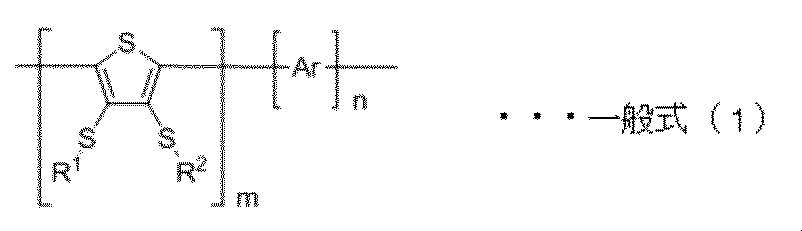
- a polythiophene derivative having a repeating unit represented by the following general formula (1) is a polythiophene derivative having a repeating unit represented by the following general formula (1).
- R 1 and R 2 each independently represent — (R 3 —S) p —R 4 (R 3 represents an alkylene group having 1 to 4 carbon atoms, R 4 represents any of an alkyl group having 1 to 6 carbon atoms and an aromatic group having 5 to 6 carbon atoms, and p represents an integer of 1 or 2.
- R 3 represents an alkylene group having 1 to 4 carbon atoms
- R 4 represents any of an alkyl group having 1 to 6 carbon atoms and an aromatic group having 5 to 6 carbon atoms
- p represents an integer of 1 or 2.
- Ar represents an optionally substituted divalent or monovalent aromatic ring moiety or aromatic heterocyclic moiety.
- m represents a natural number of 2 or more
- n represents 0 or a natural number of 2 or more.
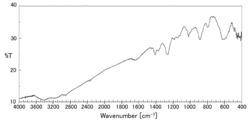
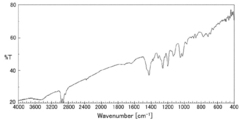
- Sectional drawing of an example of the secondary battery which concerns on this invention The figure which shows IR spectrum of the compound (1) used for the Example of this invention.
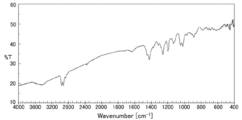
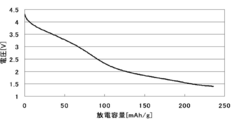
- the figure which shows IR spectrum of the compound (20) used for the Example of this invention The voltage-discharge capacity plot of the battery of Example 7 of the present invention.
- the “polythiophene derivative” described in the above (1) will be described in detail, but the “polythiophene derivative” described in the following (2) is also included in the embodiment of the “polythiophene derivative”. Further, the present invention includes “a method for producing a polythiophene derivative”, “a positive electrode active material for a secondary battery”, and “a secondary battery” described in (3) to (5) below. Also explained.
- the polythiophene derivative having a repeating unit represented by the general formula (1) of the present invention is a stabilized redox compound, and an organic compound accompanied by a redox reaction during the charge reaction and / or discharge reaction is used as an electrode active material.
- This is useful for manufacturing secondary batteries used as materials. It is particularly preferable to use it as a positive electrode active material.
- a secondary battery having a large energy density and good cycle characteristics can be obtained.
- the oxidation-reduction compound is stabilized, the charge / discharge cycle is stabilized and the life is extended.
- FIG. 1 shows a cross-sectional view of an example of a secondary battery according to the present invention.
- This secondary battery has a structure in which a negative electrode current collector 3, a negative electrode layer 1, a separator 5 containing an electrolyte, a positive electrode layer 2, and a positive electrode current collector 4 are sequentially laminated.
- reference numeral 6 represents a stainless steel exterior.
- stacking method of a positive electrode layer and a negative electrode layer is not specifically limited, What combined the multilayer lamination
- R 1 and R 2 each independently represent — (R 3 —S) p —R 4 (R 3 represents an alkylene group having 1 to 4 carbon atoms, and R 4 Represents any of an alkyl group having 1 to 6 carbon atoms and an aromatic group having 5 to 6 carbon atoms, p represents an integer of 1 or 2, and a group having 2 to 9 carbon atoms represented by Represent.
- R 1 and R 2 may be the same or different, but are preferably the same.
- R 3 include methylene group, 1,1-ethylene group, 1,2-ethylene group, 1,3-propylene group, 1,2-propylene group, 1,4-butylene group, 2,3- And a butylene group.
- the alkyl group having 1 to 6 carbon atoms in R 4 include a methyl group, an ethyl group, a propyl group, a butyl group, a pentyl group, and a hexyl group.
- the aromatic group having 5 to 6 carbon atoms in R 4 include a phenyl group and a pyridyl group.
- the aromatic group having 5 to 6 carbon atoms may have a substituent. Examples of the substituent include a halogen atom.
- Ar represents an aromatic ring moiety or an aromatic heterocyclic moiety.
- This aromatic ring moiety or aromatic heterocyclic moiety is usually a divalent moiety (in the case of a terminal moiety, monovalent).
- aromatic rings that form this moiety include benzene, biphenyl, naphthalene, anthracene, fluorene, pyrene, and examples of aromatic heterocycles include pyridine, quinoline, thiophene, furan, oxazole, oxadiazole, carbazole, etc. Is mentioned.
- substituents at these ring sites include alkyl groups such as methyl group, ethyl group, isopropyl group, and butyl group; alkoxy groups such as methoxy group, ethoxy group, propoxy group, and butoxy group; fluorine atom, chlorine atom, Examples thereof include halogen atoms such as bromine atom and iodine atom.
- m is a natural number of 2 or more, preferably 10 to 100.
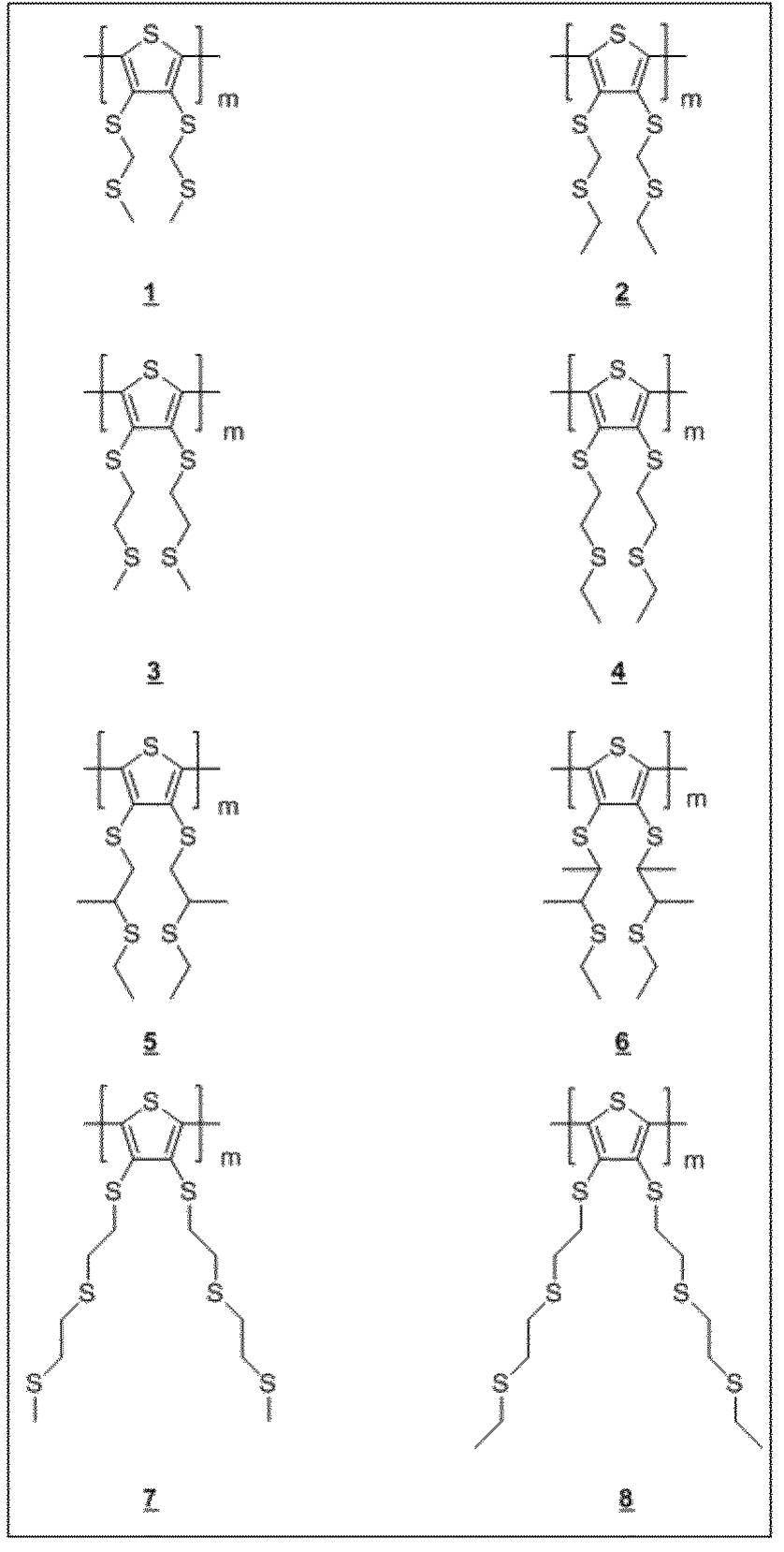
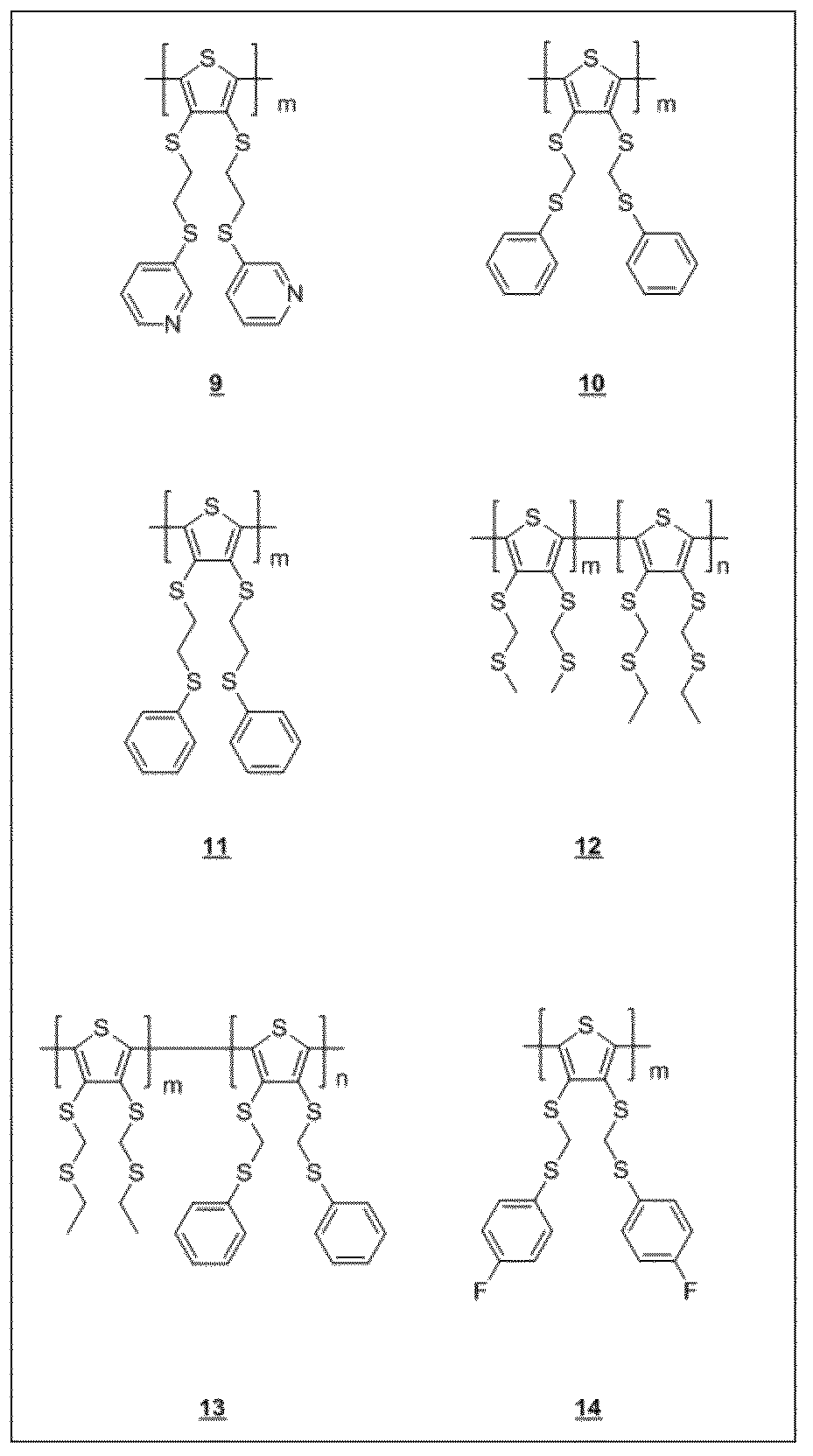
- N represents 0 or a natural number of 2 or more, preferably 10 to 100. Specific examples of the polythiophene derivative are shown below, but are not limited thereto.
- polythiophene derivative may have two or more types of structures represented by the following formula in the molecule, as represented by the compounds 12 and 13.
- polythiophene derivative when it is a copolymer, it may be a block copolymer or a random copolymer.
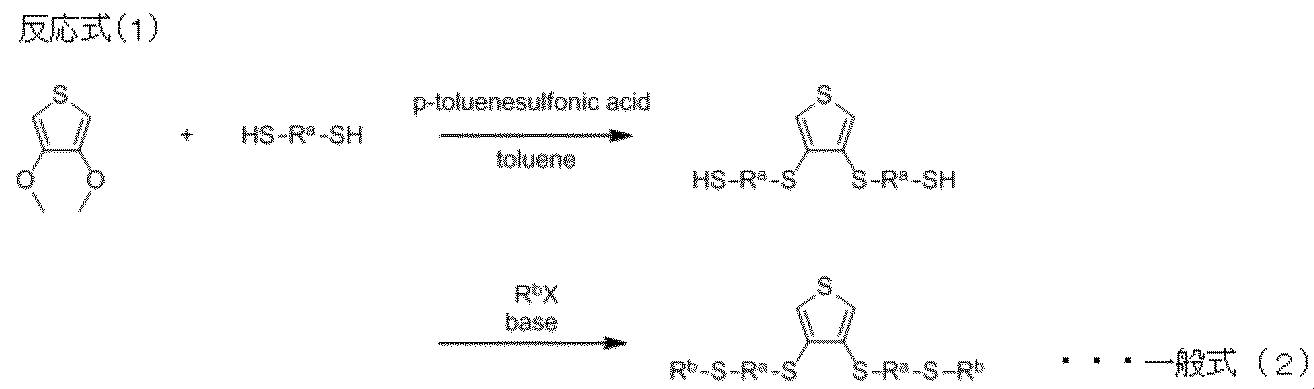
- the polythiophene derivative can be obtained by polymerizing a thiophene derivative obtained by the following reaction formula (1) or (2).
- the thiophene derivatives represented by the following general formulas (2) and (3) can be synthesized by the method described in Synthetic Communications 28 (12), 2237-2244 (1998). That is, it can be obtained by an nucleophilic substitution reaction of an alkoxy-substituted thiophene such as 3,4-dimethoxythiophene and a dithiol using an acid catalyst, and then a nucleophilic substitution reaction to an alkyl halide. Dithiol and alkyl halide can be reacted in advance.
- the reaction temperature is about 0 ° C.
- an acid such as sulfuric acid, hydrochloric acid, phosphoric acid, methanesulfonic acid, trichloroacetic acid, trifluoroacetic acid, or p-toluenesulfonic acid is used.
- an acid such as sulfuric acid, hydrochloric acid, phosphoric acid, methanesulfonic acid, trichloroacetic acid, trifluoroacetic acid, or p-toluenesulfonic acid is used.
- inorganic bases such as potassium carbonate, sodium carbonate, sodium hydrogen carbonate, potassium hydroxide, sodium hydroxide can be used.
- reaction solvent in the reaction of alkoxy-substituted thiophene with dithiols, toluene, xylene, anisole, tetralin, methylcyclohexane, ethylcyclohexane, chlorobenzene, orthodichlorobenzene, etc. are used.
- thiol with alkyl halide acetone, 2- Butanone, N, N-dimethylformamide, N, N-dimethylacetamide or the like can be used as a reaction solvent.
- R a and R b represent, for example, an alkylene group and an alkyl group, respectively.
- Polymerization of the polythiophene derivative can be performed by oxidative coupling polymerization using an oxidizing agent.
- the oxidizing agent include iron (III) chloride and aromatic sulfonic acid metal salts.
- aromatic sulfonic acid metal salt include ferric o-toluenesulfonate, ferric m-toluenesulfonate, ferric p-toluenesulfonate, cupric o-toluenesulfonate, m- Cupric toluenesulfonate, cupric p-toluenesulfonate, cobalt o-toluenesulfonate, cobalt m-toluenesulfonate, cobalt p-toluenesulfonate, manganese o-toluenesulfonate, manganese m-toluenesulfonate , Manganese
- Solvents used for polymerization include alcohol solvents such as methanol, ethanol and butanol; halogenated hydrocarbons such as chloroform, dichloromethane and 1,2-dichloroethane; toluene, xylene, anisole, chlorobenzene, orthodichlorobenzene, nitrobenzene and the like Other aromatic hydrocarbons; acetonitrile, benzonitrile, and the like can be used. Moreover, you may mix and use these solvents.
- the polythiophene derivative can be used as any of the electrode active materials for the positive electrode and the negative electrode, but it is particularly preferable to use it as an active material for the positive electrode from the viewpoint of the energy density of the material generally used for the negative electrode.
- the active material of the negative electrode layer is one or more of graphite, amorphous carbon, lithium metal, lithium alloy, lithium ion storage carbon, and conductive polymer. A combination of These shapes are not particularly limited. For example, in addition to a thin film of lithium metal, a bulk shape, a solidified powder, a fiber shape, a flake shape, or the like can be used.
- metal oxide particles, disulfide compounds, nitroxy radical compounds, conductive polymer compounds, and the like are used as the positive electrode active material.
- the metal oxide include lithium manganate such as LiMnO 2 , LiNi 0.5 Mn 1.5 O 4 , Li x Mn 2 O 4 (0 ⁇ x ⁇ 2) or manganic acid having a spinel structure.
- Layered compounds such as Lithium, LiCoO 2 , LiNiO 2 , LiNi 1/3 Co 1/3 Mn 1/3 O 2 ; Phosphate compounds such as LiFePO 4 , LiCoPO 4 , LiNiPO 4, and the like as disulfide compounds , Dithioglycol, 2,5-dimercapto-1,3,4-thiadiazole, S-triazine-2,4,6-trithiol and the like.
- the conductive polymer compound include polyacetylene, polyphenylene, polythiophene, polyaniline, Examples include polypyrrole.
- These positive electrode layer materials may be used alone or in combination of two or more, and a conventionally known active material and these materials may be mixed and used as a composite active material.
- a substance other than the polythiophene derivative for example, a metal oxide or a redox compound can be used in combination.
- the metal oxide include lithium manganate such as LiMnO 2 , LiNi 0.5 Mn 1.5 O 4 , Li x Mn 2 O 4 (0 ⁇ x ⁇ 2) or lithium manganate having a spinel structure, LiCoO 2 , Layered compounds such as LiNiO 2 and LiNi 1/3 Co 1/3 Mn 1/3 O 2 , and phosphate compounds such as LiFePO 4 , LiCoPO 4 , and LiNiPO 4 can be mentioned.
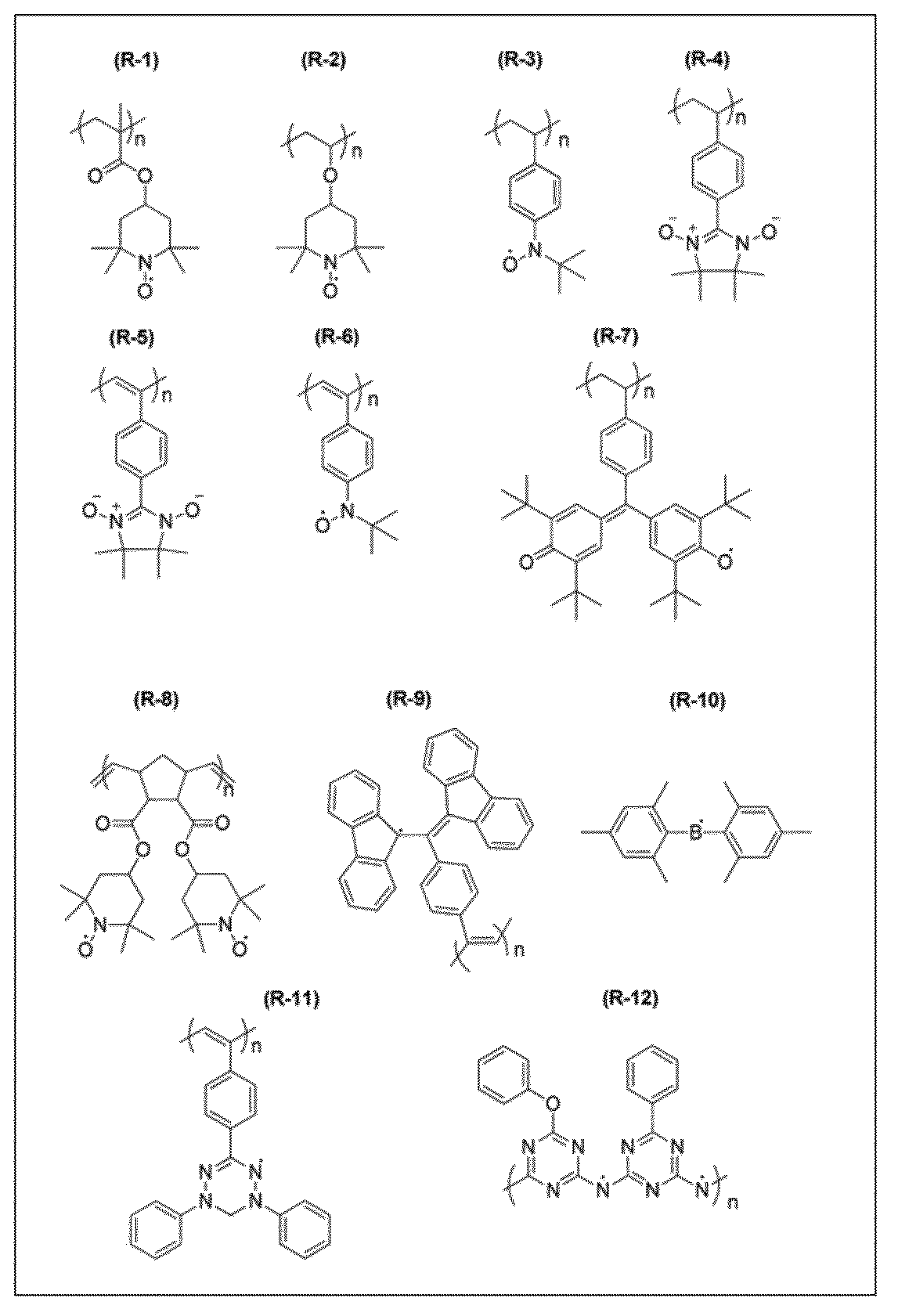
- examples thereof include organic compounds such as compounds, nitroxyl redox compounds, nitrogen redox compounds, carbon redox compounds, and boron redox compounds.
- redox compound examples include compounds represented by the following general formulas (R-1) to (R-12), but are not limited thereto. Note that n in the formula is a natural number representing the number of repeating units.
- a binder can be used to strengthen the connection between the constituent materials.
- binders include polyvinylidene fluoride, vinylidene fluoride-hexafluoropropylene copolymer, vinylidene fluoride-tetrafluoroethylene copolymer, styrene / butadiene copolymer rubber, polypropylene, polyethylene, polyimide, various polyurethanes, etc.
- the resin binder is mentioned.
- the current collector in the present invention is a material that is formed of a conductor and can collect charges generated from the electrode of the battery.
- a metal foil such as nickel, aluminum, copper, gold, silver, aluminum alloy, stainless steel, a metal flat plate, a mesh electrode, a carbon electrode, or the like is used. Can be used. Further, the active material and the current collector may be chemically bonded.
- the separator 5 in FIG. 1 prevents the positive electrode layer 2 and the negative electrode layer 1 from contacting and short-circuiting, and materials such as a polymer porous film and a nonwoven fabric can be used. Further, such a separator is preferably configured to contain an electrolyte. However, when a solid electrolyte such as an ion conductive polymer is used as the electrolyte, the separator itself can be omitted. Moreover, there is no restriction
- the electrolyte used in the present invention performs charge carrier transport between both electrodes of the negative electrode layer 1 and the positive electrode layer 2, and generally has an ionic conductivity of 10 ⁇ 5 S / cm to 10 ⁇ 1 S / cm at room temperature. ing.
- an electrolytic solution in which an electrolyte salt is dissolved in a solvent can be used.
- the electrolyte salt include LiPF 6 , LiClO 4 , LiBF 4 , LiCF 3 SO 3 , Li (CF 3 SO 2 ) 2 N, Li (C 2 F 5 SO 2 ) 2 N, and Li (CF 3 SO 2 ).
- solvent used in the electrolytic solution include ethylene carbonate, propylene carbonate, dimethyl carbonate, diethyl carbonate, methyl ethyl carbonate, ⁇ -butyrolactone, tetrahydrofuran, dioxolane, sulfolane, dimethylformamide, dimethylacetamide, and N-methyl-2.
- -An organic solvent such as pyrrolidone can be used.
- these solvents may be used individually by 1 type, or may use 2 or more types together.
- a solid electrolyte can be used as the electrolyte.
- the polymer compound used in the solid electrolyte include polyvinylidene fluoride, vinylidene fluoride-hexafluoropropylene copolymer, vinylidene fluoride-ethylene copolymer, vinylidene fluoride-monofluoroethylene copolymer, and fluoride compound.
- Vinylidene fluoride polymers such as vinylidene-trifluoroethylene copolymer, vinylidene fluoride-tetrafluoroethylene copolymer, vinylidene fluoride-hexafluoropropylene-tetrafluoroethylene terpolymer; acrylonitrile-methyl methacrylate copolymer Polymer, acrylonitrile-methyl acrylate copolymer, acrylonitrile-ethyl methacrylate copolymer, acrylonitrile-ethyl acrylate copolymer, acrylonitrile-methacrylic acid copolymer, acrylonitrile-acrylic Le acid copolymers, acrylonitrile - acrylonitrile polymers such as vinyl acetate copolymer, polyethylene oxide, ethylene oxide - propylene oxide copolymers, and polymers of these acrylates body or methacrylate body thereof.
- the solid electrolyte may be a gel obtained by adding
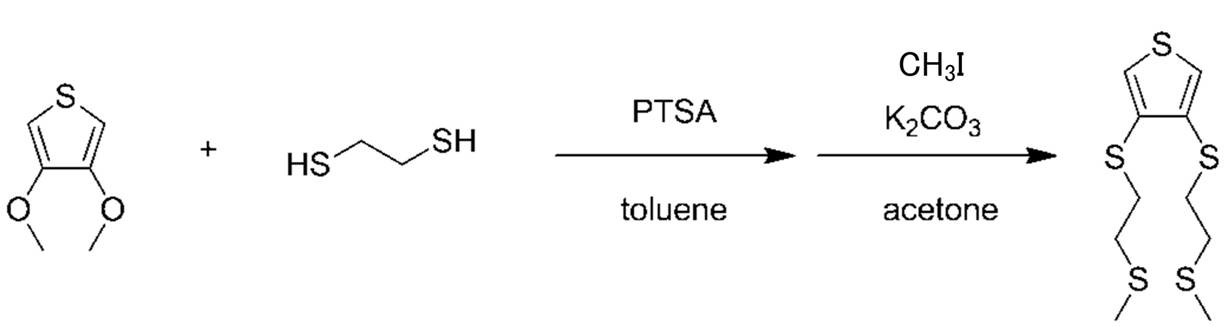
- the obtained oil was dissolved in 60 ml of acetone, and 5.04 g (36.5 mmol) of potassium carbonate and 5.7 g (39.8 mmol) of iodomethane were added and reacted at 50 ° C. for 6 hours. After concentrating the solvent, it was dissolved in 100 ml of toluene, liquid separation was performed with 50 mL ⁇ 3 times, and the organic layer was concentrated in a fume hood to obtain a brown oil. This was purified by silica gel column chromatography (silica 200 g, toluene) to obtain 2.88 g (9.7 mmol, yield 58.7%) of the desired product as a pale yellow oil.
- the obtained oil was dissolved in 60 ml of acetone, and 5.04 g (36.5 mmol) of sodium hydroxide and 5.7 g (39.8 mmol) of iodomethane were added and reacted at 50 ° C. for 6 hours. After concentrating the solvent, it was dissolved in 100 ml of toluene, liquid separation was performed with 50 mL ⁇ 3 times, and the organic layer was concentrated in a fume hood to obtain a brown oil. This was purified by silica gel column chromatography (silica 200 g, toluene) to obtain 3.1 g (7.5 mmol, yield 44.9%) of the desired product as a pale yellow oil.
- FIG. 2 shows the FT-IR spectrum.
- the brown solid of the obtained compound (1) is insoluble in organic solvents (dichloromethane, acetonitrile, ethylene carbonate, propylene carbonate, dimethyl carbonate, diethyl carbonate, methyl ethyl carbonate, ⁇ -butyrolactone) generally used in electrolytes. Met. Insoluble in these organic solvents can prevent the active material from being dissolved into the electrolyte during the charge / discharge cycle of the secondary battery, so in order to achieve a stable charge / discharge cycle of the secondary battery, The facts about are important.
- FIG. 3 shows the FT-IR spectrum.
- the resulting brown solid of compound (3) is insoluble in organic solvents (dichloromethane, acetonitrile, ethylene carbonate, propylene carbonate, dimethyl carbonate, diethyl carbonate, methyl ethyl carbonate, ⁇ -butyrolactone) generally used in electrolytes. Met.
- the precipitated solid was separated by filtration, washed with 50 mL of methanol, and then dried under reduced pressure.
- the obtained black substance was poured into 50 mL of 50% by weight aqueous solution of hydrazine monohydrate and stirred for 1 day, followed by filtration and washing with water, and the resulting brown solid was again dried at 80 ° C. under reduced pressure. 0.10 g (66.7% yield) of a brown solid of (7) was obtained.
- FIG. 4 shows the FT-IR spectrum.
- the brown solid of the obtained compound (7) is insoluble in organic solvents (dichloromethane, acetonitrile, ethylene carbonate, propylene carbonate, dimethyl carbonate, diethyl carbonate, methyl ethyl carbonate, ⁇ -butyrolactone) generally used in electrolytes. Met.
- the obtained black substance was poured into 50 mL of 50% by weight aqueous solution of hydrazine monohydrate and stirred for 1 day, followed by filtration and washing with water, and the resulting brown solid was again dried at 80 ° C. under reduced pressure. 0.13 g (yield 86.7%) of a brown solid of (11) was obtained.
- FIG. 5 shows the FT-IR spectrum.
- the brown solid of the obtained compound (11) is insoluble in organic solvents (dichloromethane, acetonitrile, ethylene carbonate, propylene carbonate, dimethyl carbonate, diethyl carbonate, methyl ethyl carbonate, ⁇ -butyrolactone) generally used in electrolytes. Met.
- the brown solid of the obtained compound (15) is insoluble in organic solvents (dichloromethane, acetonitrile, ethylene carbonate, propylene carbonate, dimethyl carbonate, diethyl carbonate, methyl ethyl carbonate, ⁇ -butyrolactone) generally used in electrolytes. Met.
- the precipitated solid was separated by filtration, washed with 50 mL of methanol, and then dried under reduced pressure.
- the obtained black substance was poured into 50 mL of a 50% by mass aqueous solution of hydrazine monohydrate and stirred for 1 day, followed by filtration and washing with water.
- the resulting brown solid was again dried at 80 ° C. under reduced pressure.
- This brown solid was subjected to methanol extraction with a Soxhlet extractor using a cylindrical filter paper for 48 hours to obtain 0.077 g (yield 67.6%) of the brown solid of compound (20).
- FIG. 7 shows the FT-IR spectrum.
- the brown solid of the obtained compound (20) is insoluble in organic solvents (dichloromethane, acetonitrile, ethylene carbonate, propylene carbonate, dimethyl carbonate, diethyl carbonate, methyl ethyl carbonate, ⁇ -butyrolactone) generally used in electrolytes. Met.
- Example 7 -Battery creation- Compound (1), graphite as a conductive auxiliary material, and poly (vinylidene fluoride) as a binder are mixed, and N-methylpyrrolidone is added thereto and kneaded until the whole becomes uniform to obtain a black paste. It was.
- this paste was uniformly coated on the aluminum foil using a blade coating jig. The obtained coating film was put in a warm air drier previously set at 120 ° C. and dried for 20 minutes to produce an electrode layer.
- the electrode layer was punched into a circular shape with a diameter of 16 mm to form a circular positive electrode.
- a glove box having a dew point temperature of ⁇ 70 ° C. or less the circular positive electrode, a ⁇ 25 mm polypropylene porous film separator, and a ⁇ 16 mm circular Li metal foil cathode are laminated in this order in a stainless steel exterior.
- a cover as a stainless steel sheath was put on and sealed to prepare a battery of Example 7.
- Example 8 A battery of Example 8 was made in the same manner as Example 7, except that the compound (1) was changed to the polythiophene derivative of the compound (3) shown in the column of Example 8 in Table 1.
- Example 9 A battery of Example 9 was made in the same manner as Example 7, except that the compound (1) was changed to the polythiophene derivative of the compound (7) shown in the column of Example 9 in Table 1.
- Example 10 A battery of Example 10 was made in the same manner as Example 7, except that the compound (1) was changed to the polythiophene derivative of the compound (11) shown in the column of Example 10 in Table 1.
- Example 11 A battery of Example 11 was made in the same manner as Example 7, except that the compound (1) was changed to the polythiophene derivative of the compound (15) shown in the column of Example 11 in Table 1.
- Example 12 A battery of Example 12 was made in the same manner as Example 7, except that the compound (1) was changed to the polythiophene derivative of the compound (20) shown in the column of Example 12 in Table 1.
- Comparative Example 1 A battery of Comparative Example 1 was produced in the same manner as Example 7 except that the compound (1) was changed to the following Comparative Compound 1.
- FIG. 8 shows a plot of voltage-discharge capacity of the battery of Example 7. From Table 1, it can be seen that the energy density of the battery of the example using the polythiophene derivative as the active material is much higher than that of the battery of the comparative example. Furthermore, when the batteries of Examples 8 to 12 were repeatedly charged and discharged, it was confirmed that they operated as secondary batteries.
Landscapes
- Chemical & Material Sciences (AREA)
- Chemical Kinetics & Catalysis (AREA)
- Electrochemistry (AREA)
- General Chemical & Material Sciences (AREA)
- Engineering & Computer Science (AREA)
- Health & Medical Sciences (AREA)
- Organic Chemistry (AREA)
- Polymers & Plastics (AREA)
- Medicinal Chemistry (AREA)
- Materials Engineering (AREA)
- Manufacturing & Machinery (AREA)
- Physics & Mathematics (AREA)
- Inorganic Chemistry (AREA)
- General Physics & Mathematics (AREA)
- Dispersion Chemistry (AREA)
- Condensed Matter Physics & Semiconductors (AREA)
- Battery Electrode And Active Subsutance (AREA)
- Polyoxymethylene Polymers And Polymers With Carbon-To-Carbon Bonds (AREA)
Abstract
Description
しかしながら、リチウムイオン電池の正極側の電極材料(正極活物質)は、負極側の電極材料(負極活物質)と比較して放電容量(Ah/Kg)の少ないものがほとんどであり、これがリチウムイオン電池の高容量化を妨げている大きな要因である。また、現在市場に出回っているリチウムイオン電池は、正極活物質として比重の大きな金属酸化物を用いているため、単位質量当たりの電池容量が充分でないという問題があった。そこで、より軽量の電極材料を用いて大容量電池を開発しようとする試みが検討されてきた。
更に、非特許文献1には、2,2,6,6-テトラメチルピペリジノキシル-7-イルメタクリレート(PTMA)を正極活物質に用いた二次電池が開示されている。
しかし、ポリピロール等の導電性高分子は、生成した電荷がポリマー中に広がって電荷間の強いクーロン反発が起こり、一定量以下の電荷しか注入放出ができないといった問題がある。また、ニトロキシラジカルは電極での電荷の授受が早いため大電流を得ることができるという利点を有するが、1分子で1電子の酸化還元反応であるため二次電池容量の大容量化には適していない。
一方、特許文献5や非特許文献2には、多段階の酸化還元能を持つ低分子量の有機化合物を活物質として用いる二次電池が開示されている。しかし、この電池は容量密度は高いが、低分子化合物であるため、電解質への溶出などにより電池性能が低下する等の問題があり、解決が望まれている。
(1)「下記一般式(1)で表わされる繰り返し単位を持つことを特徴とするポリチオフェン誘導体。
(2)「前記Arがチオフェン誘導体部位である前記(1)に記載のポリチオフェン誘導体。」
(3)「酸化剤を用いて原料モノマーを重合し、前記(1)から(2)のいずれかに記載のポリチオフェン誘導体を製造することを特徴とするポリチオフェン誘導体の製造方法。」
(4)「前記(1)から(2)のいずれかに記載のポリチオフェン誘導体を用いたことを特徴とする二次電池用正極活物質。」
(5)「前記(4)に記載の二次電池用正極活物質を用いたことを特徴とする二次電池。」
これにより、エネルギー密度が大きくサイクル特性の良好な二次電池を得ることができる。この二次電池は、酸化還元化合物が安定化されているため充放電サイクルが安定化し、寿命が長くなる。
図1に、本発明に係る二次電池の一例の断面図を示す。この二次電池は、負極集電体3、負極層1、電解質を含んだセパレーター5、正極層2、正極集電体4が順に積層された構造を有する。図中、符号6はステンレス外装を表わす。
なお、正極層及び負極層の積層方法は特に限定されず、多層積層したものや集電体の両面に積層したものを組み合わせたもの、巻回したもの等が利用できる。
〔ポリチオフェン誘導体〕
前記一般式(1)において、R1、及びR2は、それぞれ独立して、-(R3-S)p-R4(R3は、炭素数1~4のアルキレン基を表わし、R4は、炭素数1~6のアルキル基、及び炭素数5~6の芳香族基のいずれかを表わす。pは、1又は2の整数を表わす。)で表わされる炭素数2~9の基を表わす。
前記R3としては、例えば、メチレン基、1,1-エチレン基、1,2-エチレン基、1,3-プロピレン基、1,2-プロピレン基、1,4-ブチレン基、2,3-ブチレン基などが挙げられる。
前記R4における炭素数1~6のアルキル基としては、例えば、メチル基、エチル基、プロピル基、ブチル基、ペンチル基、ヘキシル基などが挙げられる。
前記R4における炭素数5~6の芳香族基としては、例えば、フェニル基、ピリジル基などが挙げられる。前記炭素数5~6の芳香族基は、置換基を有していてもよい。前記置換基としては、例えば、ハロゲン原子などが挙げられる。
mは2以上の自然数であるが、好ましくは10~100である。また、nは0又は2以上の自然数を表わすが、好ましくは10~100である。
以下、ポリチオフェン誘導体の具体例を示すが、これらに限定されるものではない。

下記一般式(2)、(3)で表わされるチオフェン誘導体は、Synthetic Communications 28(12)、2237-2244(1998)に記載の方法で合成できる。即ち、3,4-ジメトキシチオフェンのようなアルコキシ置換チオフェンとジチオール類との酸触媒を用いた求核置換反応、次いでハロゲン化アルキルへの求核置換反応により得ることができる。ジチオールとハロゲン化アルキルをあらかじめ反応させておくこともできる。反応温度は0℃~150℃程度、好ましくは50℃~130℃程度である。酸触媒としては硫酸、塩酸、リン酸、メタンスルホン酸、トリクロロ酢酸、トリフルオロ酢酸、p-トルエンスルホン酸などの酸(ブレンステッド酸)を用いる。塩基としては炭酸カリウム、炭酸ナトリウム、炭酸水素ナトリウム、水酸化カリウム、水酸化ナトリウム等の無機塩基を用いることができる。アルコキシ置換チオフェンとジチオール類との反応における反応溶媒してはトルエン、キシレン、アニソール、テトラリン、メチルシクロヘキサン、エチルシクロヘキサン、クロロベンゼン、オルトジクロロベンゼン等が、チオールとハロゲン化アルキルとの反応ではアセトン、2-ブタノン、N,N-ジメチルホルムアミド、N,N-ジメチルアセトアミド等を反応溶媒として用いることができる。なお、式中Ra、Rbは、例えば、それぞれアルキレン基、アルキル基を表わす。

芳香族スルホン酸金属塩の具体例としては、o-トルエンスルホン酸第2鉄、m-トルエンスルホン酸第2鉄、p-トルエンスルホン酸第2鉄、o-トルエンスルホン酸第2銅、m-トルエンスルホン酸第2銅、p-トルエンスルホン酸第2銅、o-トルエンスルホン酸コバルト、m-トルエンスルホン酸コバルト、p-トルエンスルホン酸コバルト、o-トルエンスルホン酸マンガン、m-トルエンスルホン酸マンガン、p-トルエンスルホン酸マンガン、o-エチルベンゼンスルホン酸第2鉄、m-エチルベンゼンスルホン酸第2鉄、p-エチルベンゼンスルホン酸第2鉄、ナフタレンスルホン酸第2鉄、及びそれらの誘導体などが挙げられる。重合を行なう際の溶媒としては、メタノール、エタノール、ブタノールなどのアルコール系溶剤;クロロホルム、ジクロロメタン、1,2-ジクロロエタンなどのハロゲン化炭化水素;トルエン、キシレン、アニソール、クロロベンゼン、オルトジクロロベンゼン、ニトロベンゼンなどの芳香族系炭化水素;その他アセトニトリル、ベンゾニトリル等を用いることができる。また、これらの溶剤を混合して用いてもよい。
ポリチオフェン誘導体を正極活物質として用いる場合には、負極層の活物質として、グラファイト、非晶質カーボン、リチウム金属、リチウム合金、リチウムイオン吸蔵炭素、及び導電性高分子等の一種単独又は二種以上の組み合わせが用いられる。これらの形状は特に限定されず、例えば、リチウム金属では薄膜状のもの以外に、バルク状のもの、粉末を固めたもの、繊維状のもの、フレーク状のもの等を使用することができる。
これらの正極層材料は一種を単独で用いても二種以上を併用してもよく、更に、従来公知の活物質とこれらの材料とを混合して複合活物質として用いてもよい。
ポリチオフェン誘導体を正極活物質として用いる場合には、各構成材料間の結びつきを強めるため結着剤を用いることもできる。結着剤の例としては、ポリフッ化ビニリデン、ビニリデンフロライド-ヘキサフルオロプロピレン共重合体、ビニリデンフロライド-テトラフルオロエチレン共重合体、スチレン・ブタジエン共重合ゴム、ポリプロピレン、ポリエチレン、ポリイミド、各種ポリウレタン等の樹脂バインダーが挙げられる。
本発明における集電体とは、導電体で形成され電池の電極から発生する電荷を集めることができるものである。図1の例では、負極集電体3、及び正極集電体4として、ニッケル、アルミニウム、銅、金、銀、アルミニウム合金、ステンレス等の金属箔、金属平板、メッシュ状電極、炭素電極等を用いることができる。また、活物質と集電体とを化学結合させてもよい。
図1におけるセパレーター5は、正極層2と負極層1が接触して短絡しないようにするものであり、高分子多孔質フィルム、不織布などの材料を用いることができる。更にこのようなセパレーターは、電解質を含ませて構成することも好ましい。ただし、上記電解質として、イオン伝導性高分子等の固体電解質を用いる場合には、セパレーターそのものを省略することもできる。また、図1におけるステンレス外装(封止材)6についても特に制限はなく、電池の外装に用いられる従来公知の材料が用いられる。
本発明で用いる電解質は、負極層1と正極層2の両極間の荷電担体輸送を行なうものであり、一般に室温で10-5S/cm~10-1S/cmのイオン伝導性を有している。電解質としては、例えば電解質塩を溶剤に溶解した電解液を利用することができる。電解質塩としては、例えば、LiPF6、LiClO4、LiBF4、LiCF3SO3、Li(CF3SO2)2N、Li(C2F5SO2)2N、Li(CF3SO2)3C、Li(C2F5SO2)3C等の従来公知の材料を用いることができる。
また、前記電解液に用いる溶剤としては、例えば、エチレンカーボネート、プロピレンカーボネート、ジメチルカーボネート、ジエチルカーボネート、メチルエチルカーボネート、γ-ブチロラクトン、テトラヒドロフラン、ジオキソラン、スルホラン、ジメチルホルムアミド、ジメチルアセトアミド、N-メチル-2-ピロリドン等の有機溶剤を用いることができる。なお、これらの溶剤は一種を単独で用いても、二種以上を併用してもよい。
固体電解質に用いられる高分子化合物としては、例えば、ポリフッ化ビニリデン、フッ化ビニリデン-ヘキサフルオロプロピレン共重合体、フッ化ビニリデン-エチレン共重合体、フッ化ビニリデン-モノフルオロエチレン共重合体、フッ化ビニリデン-トリフルオロエチレン共重合体、フッ化ビニリデン-テトラフルオロエチレン共重合体、フッ化ビニリデン-ヘキサフルオロプロピレン-テトラフルオロエチレン三元共重合体等のフッ化ビニリデン系重合体;アクリロニトリル-メチルメタクリレート共重合体、アクリロニトリル-メチルアクリレート共重合体、アクリロニトリル-エチルメタクリレート共重合体、アクリロニトリル-エチルアクリレート共重合体、アクリロニトリル-メタクリル酸共重合体、アクリロニトリル-アクリル酸共重合体、アクリロニトリル-ビニルアセテート共重合体等のアクリルニトリル系重合体;ポリエチレンオキサイド、エチレンオキサイド-プロピレンオキサイド共重合体、これらのアクリレート体やメタクリレート体の重合体などが挙げられる。なお、固体電解質は、これらの高分子化合物に電解液を含ませてゲル状にしたものを用いても、高分子化合物のみでそのまま用いてもよい。
3,4-ビス[1-[(メチルチオ)メチル]チオ]チオフェンの合成

3,4-ビス[2-[(メチルチオ)エチル]チオ]チオフェンの合成
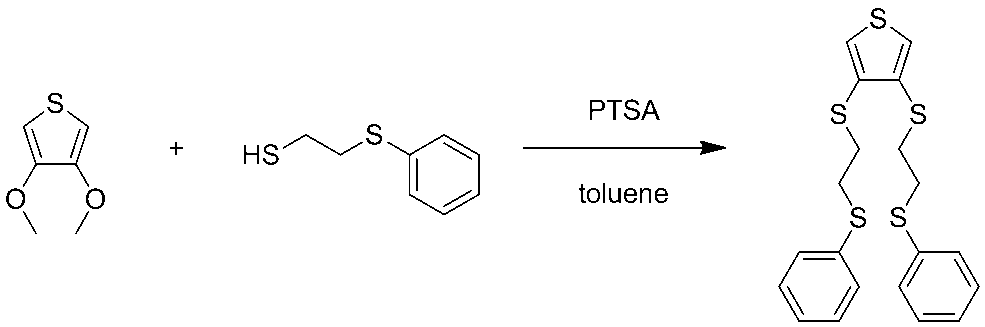
3,4-ビス[2-[(フェニルチオ)エチル]チオ]チオフェンの合成
3,4-ビス[[2-[[2-(メチルチオ)エチル]チオ]エチル]チオ]チオフェンの合成

化合物(1)の合成

得られた化合物(1)の茶色固体は、一般的に電解液に使用される有機溶剤(ジクロロメタン、アセトニトリル、エチレンカーボネート、プロピレンカーボネート、ジメチルカーボネート、ジエチルカーボネート、メチルエチルカーボネート、γ-ブチロラクトン)に不溶であった。これらの有機溶剤に不溶であると、二次電池の充放電サイクル時に活物質が電解質へ溶け出すことを防止できるため、二次電池の安定な充放電サイクルを達成するためには、前記溶解性に関する事実は重要である。
化合物(3)の合成
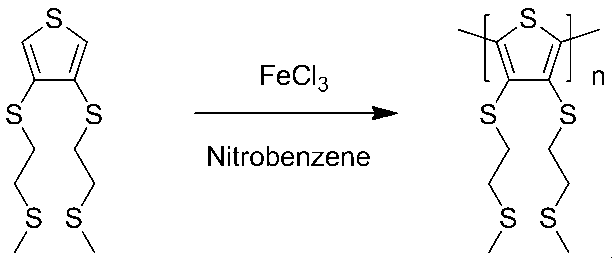
得られた化合物(3)の茶色固体は、一般的に電解液に使用される有機溶剤(ジクロロメタン、アセトニトリル、エチレンカーボネート、プロピレンカーボネート、ジメチルカーボネート、ジエチルカーボネート、メチルエチルカーボネート、γ-ブチロラクトン)に不溶であった。
化合物(7)の合成
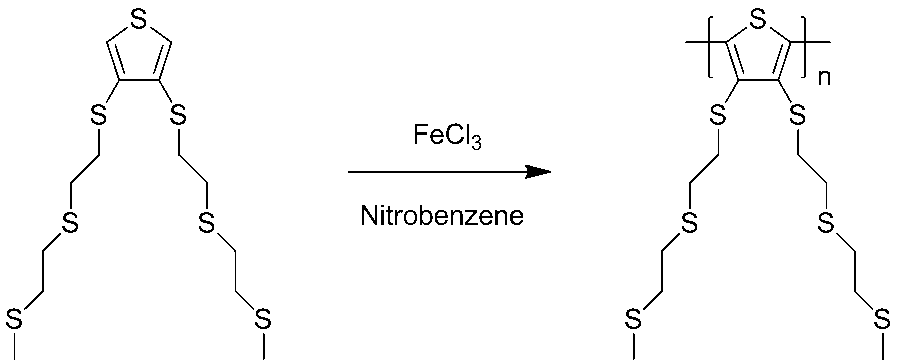
得られた化合物(7)の茶色固体は、一般的に電解液に使用される有機溶剤(ジクロロメタン、アセトニトリル、エチレンカーボネート、プロピレンカーボネート、ジメチルカーボネート、ジエチルカーボネート、メチルエチルカーボネート、γ-ブチロラクトン)に不溶であった。
化合物(11)の合成
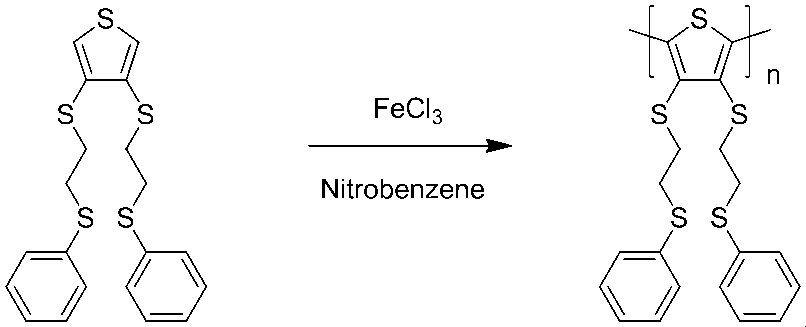
得られた化合物(11)の茶色固体は、一般的に電解液に使用される有機溶剤(ジクロロメタン、アセトニトリル、エチレンカーボネート、プロピレンカーボネート、ジメチルカーボネート、ジエチルカーボネート、メチルエチルカーボネート、γ-ブチロラクトン)に不溶であった。
化合物(15)の合成
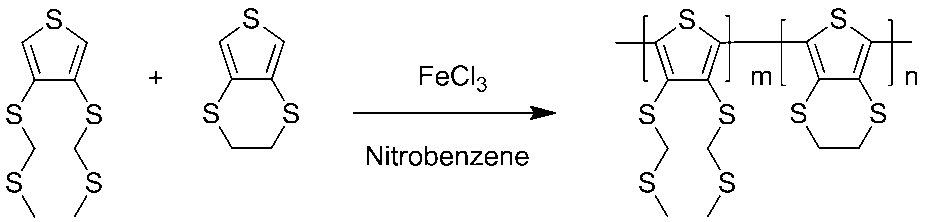
得られた化合物(15)の茶色固体は、一般的に電解液に使用される有機溶剤(ジクロロメタン、アセトニトリル、エチレンカーボネート、プロピレンカーボネート、ジメチルカーボネート、ジエチルカーボネート、メチルエチルカーボネート、γ-ブチロラクトン)に不溶であった。
化合物(20)の合成

得られた化合物(20)の茶色固体は、一般的に電解液に使用される有機溶剤(ジクロロメタン、アセトニトリル、エチレンカーボネート、プロピレンカーボネート、ジメチルカーボネート、ジエチルカーボネート、メチルエチルカーボネート、γ-ブチロラクトン)に不溶であった。
-電池の作成-
化合物(1)と、導電補助材のグラファイトと、結着材のポリ(フッ化ビニリデン)を混合し、そこにN-メチルピロリドンを加え、全体が均一になるまで混練して黒色のペーストを得た。混合比は、化合物(1):グラファイト:結着材=2:6:2(質量比)とした。続いて、このペーストを、ブレードコート治具を用いてアルミニウム箔上に均一に塗工した。得られた塗工膜を、予め120℃に設定しておいた温風乾燥器内に入れて、20分間乾燥させ、電極層を作製した。
電極層をφ16mmの円形状に打ち抜き円形状正極電極とした。露点温度-70℃以下のグローブボックス中において、ステンレス外装内に、前記円形状正極電極、φ25mmのポリプロピレン多孔質フィルムセパレータ、及びφ16mmの円形状のLi金属箔陰極の順に積層し、電解質として1.0mol/LのLiPF6電解質塩を含むエチレンカーボネート/ジエチルカーボネート混合溶液(混合体積比1:2)を加えた。最後にステンレス外装としての蓋をかぶせ、密閉して実施例7の電池を作製した。
化合物(1)を、表1の実施例8の欄に示す化合物(3)のポリチオフェン誘導体に変えた点以外は、実施例7と同様にして実施例8の電池を作製した。
化合物(1)を、表1の実施例9の欄に示す化合物(7)のポリチオフェン誘導体に変えた点以外は、実施例7と同様にして実施例9の電池を作製した。
化合物(1)を、表1の実施例10の欄に示す化合物(11)のポリチオフェン誘導体に変えた点以外は、実施例7と同様にして実施例10の電池を作製した。
化合物(1)を、表1の実施例11の欄に示す化合物(15)のポリチオフェン誘導体に変えた点以外は、実施例7と同様にして実施例11の電池を作製した。
化合物(1)を、表1の実施例12の欄に示す化合物(20)のポリチオフェン誘導体に変えた点以外は、実施例7と同様にして実施例12の電池を作製した。
化合物(1)を、下記比較化合物1に変えた点以外は、実施例7と同様にして比較例1の電池を作製した。
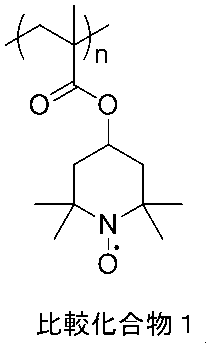
実施例7~12及び比較例1の電池について、定電流(0.05mA)下で、カットオフ電圧を充電4.5V、放電1.4Vとして充放電を行なった。その結果、表1に示すような正極活物質あたりの放電容量が確認された。図8に、実施例7の電池の電圧-放電容量をプロットした図を示す。
表1から、ポリチオフェン誘導体を活物質として使用した実施例の電池は、比較例の電池に比べて、エネルギー密度が非常に大きいことが分かる。
更に、実施例8~12の電池を繰り返し充放電したところ、二次電池として動作することが確認された。

2 正極層
3 負極集電体
4 正極集電体
5 セパレーター
6 ステンレス外装
Claims (5)
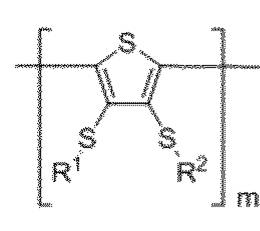
- 下記一般式(1)で表わされる繰り返し単位を持つことを特徴とするポリチオフェン誘導体。
ただし、前記一般式(1)中、R1、及びR2は、それぞれ独立して、-(R3-S)p-R4(R3は、炭素数1~4のアルキレン基を表わし、R4は、炭素数1~6のアルキル基、及び炭素数5~6の芳香族基のいずれかを表わす。pは、1又は2の整数を表わす。)で表わされる炭素数2~9の基を表わす。Arは置換基を有していてもよい2価又は1価の芳香環部位又は芳香族複素環部位を表わす。mは2以上の自然数を表わし、nは0又は2以上の自然数を表わす。
- 前記Arがチオフェン誘導体部位である請求項1に記載のポリチオフェン誘導体。
- 酸化剤を用いて原料モノマーを重合し、請求項1から2のいずれかに記載のポリチオフェン誘導体を製造することを特徴とするポリチオフェン誘導体の製造方法。
- 請求項1から2のいずれかに記載のポリチオフェン誘導体を用いたことを特徴とする二次電池用正極活物質。
- 請求項4に記載の二次電池用正極活物質を用いたことを特徴とする二次電池。
Priority Applications (5)
| Application Number | Priority Date | Filing Date | Title |
|---|---|---|---|
| US15/106,562 US9991518B2 (en) | 2014-01-28 | 2015-01-13 | Polythiophene derivative, method for producing same, positive electrode active material for secondary batteries, and secondary battery |
| CN201580006147.4A CN106062032B (zh) | 2014-01-28 | 2015-01-13 | 聚噻吩衍生物、其产生方法、用于二次电池的正极活性材料和二次电池 |
| EP15742633.9A EP3101048B1 (en) | 2014-01-28 | 2015-01-13 | Polythiophene derivative, method for producing same, positive electrode active material for secondary batteries, and secondary battery |
| KR1020167023624A KR101810351B1 (ko) | 2014-01-28 | 2015-01-13 | 폴리티오펜 유도체, 그의 제조 방법, 이차 전지용 캐소드 활성 물질, 및 이차 전지 |
| JP2015559849A JP6256485B2 (ja) | 2014-01-28 | 2015-01-13 | ポリチオフェン誘導体、その製造方法、二次電池用正極活物質、及び二次電池 |
Applications Claiming Priority (2)
| Application Number | Priority Date | Filing Date | Title |
|---|---|---|---|
| JP2014-013572 | 2014-01-28 | ||
| JP2014013572 | 2014-01-28 |
Publications (1)
| Publication Number | Publication Date |
|---|---|
| WO2015115158A1 true WO2015115158A1 (ja) | 2015-08-06 |
Family
ID=53756735
Family Applications (1)
| Application Number | Title | Priority Date | Filing Date |
|---|---|---|---|
| PCT/JP2015/050575 Ceased WO2015115158A1 (ja) | 2014-01-28 | 2015-01-13 | ポリチオフェン誘導体、その製造方法、二次電池用正極活物質、及び二次電池 |
Country Status (6)
| Country | Link |
|---|---|
| US (1) | US9991518B2 (ja) |
| EP (1) | EP3101048B1 (ja) |
| JP (1) | JP6256485B2 (ja) |
| KR (1) | KR101810351B1 (ja) |
| CN (1) | CN106062032B (ja) |
| WO (1) | WO2015115158A1 (ja) |
Cited By (3)
| Publication number | Priority date | Publication date | Assignee | Title |
|---|---|---|---|---|
| WO2016027704A1 (ja) * | 2014-08-19 | 2016-02-25 | 株式会社リコー | ポリチオフェン誘導体、二次電池用正極活物質、及び二次電池 |
| JP2020007319A (ja) * | 2019-08-14 | 2020-01-16 | 株式会社リコー | 化合物、電極材料、及び電極 |
| JP2020504896A (ja) * | 2016-12-20 | 2020-02-13 | ナノテク インストゥルメンツ, インコーポレイテッドNanotek Instruments, Inc. | 可撓性および形状適合性のケーブル型アルカリ金属電池 |
Families Citing this family (4)
| Publication number | Priority date | Publication date | Assignee | Title |
|---|---|---|---|---|
| CN106784778B (zh) * | 2016-12-01 | 2019-12-03 | 深圳市海盈科技股份有限公司 | 具有热敏特性的电极材料及其制备方法 |
| CN109309208B (zh) * | 2017-07-28 | 2021-07-13 | 宁德时代新能源科技股份有限公司 | 正极浆料、正极片及电化学储能装置 |
| CN109950059A (zh) * | 2017-12-20 | 2019-06-28 | 株式会社理光 | 活性物质、电极及蓄电元件 |
| JP7481649B2 (ja) | 2020-09-09 | 2024-05-13 | ダイキン工業株式会社 | 固体二次電池用結着剤、固体二次電池用スラリー、固体二次電池用層形成方法及び固体二次電池 |
Citations (6)
| Publication number | Priority date | Publication date | Assignee | Title |
|---|---|---|---|---|
| US4833048A (en) | 1988-03-31 | 1989-05-23 | The United States Of America As Represented By The United States Department Of Energy | Metal-sulfur type cell having improved positive electrode |
| JPH0785420B2 (ja) | 1985-05-27 | 1995-09-13 | 株式会社リコー | 有機二次電池 |
| JP2715778B2 (ja) | 1991-01-29 | 1998-02-18 | 松下電器産業株式会社 | 可逆性電極材料 |
| WO2009090866A1 (ja) * | 2008-01-16 | 2009-07-23 | Japan Carlit Co., Ltd. | チオフェン誘導体の製造方法 |
| JP2010080343A (ja) | 2008-09-26 | 2010-04-08 | Osaka City Univ | 電極活物質、及び二次電池 |
| JP4687848B2 (ja) | 2001-04-03 | 2011-05-25 | 日本電気株式会社 | 蓄電デバイス |
Family Cites Families (10)
| Publication number | Priority date | Publication date | Assignee | Title |
|---|---|---|---|---|
| JPH0785420A (ja) | 1993-09-16 | 1995-03-31 | Hitachi Ltd | 薄膜磁気ヘッド |
| CN1317782C (zh) * | 2002-06-05 | 2007-05-23 | 中国人民解放军63971部队 | 用于锂电池的多硫代共轭聚合物正极材料 |
| US7250461B2 (en) * | 2004-03-17 | 2007-07-31 | E. I. Du Pont De Nemours And Company | Organic formulations of conductive polymers made with polymeric acid colloids for electronics applications, and methods for making such formulations |
| CA2813757C (en) * | 2005-08-18 | 2014-04-08 | Nissan Chemical Industries, Ltd. | Thiophene compound having sulfonyl group and process for producing the same |
| DE102006002797A1 (de) * | 2006-01-20 | 2007-08-02 | H. C. Starck Gmbh & Co. Kg | Verfahren zur Herstellung von Polythiophenen |
| KR100960492B1 (ko) | 2007-02-13 | 2010-06-01 | 주식회사 엘지화학 | 유기 트랜지스터 및 이의 제조방법 |
| JP5407273B2 (ja) | 2008-10-24 | 2014-02-05 | ソニー株式会社 | 負極集電体、負極および二次電池 |
| JP2012251129A (ja) * | 2011-05-10 | 2012-12-20 | Kuraray Co Ltd | 導電性インクおよびその製造方法 |
| CN103304783B (zh) * | 2013-05-17 | 2015-05-13 | 中科院广州化学有限公司 | 一种聚噻吩分散体系及其制备方法和应用 |
| FR3005894B1 (fr) | 2013-05-23 | 2020-12-25 | Centre Nat Rech Scient | Materiau superoleophobe et/ou superhydrophobe, son procede de preparation et ses applications |
-
2015
- 2015-01-13 WO PCT/JP2015/050575 patent/WO2015115158A1/ja not_active Ceased
- 2015-01-13 JP JP2015559849A patent/JP6256485B2/ja not_active Expired - Fee Related
- 2015-01-13 EP EP15742633.9A patent/EP3101048B1/en not_active Not-in-force
- 2015-01-13 CN CN201580006147.4A patent/CN106062032B/zh not_active Expired - Fee Related
- 2015-01-13 US US15/106,562 patent/US9991518B2/en not_active Expired - Fee Related
- 2015-01-13 KR KR1020167023624A patent/KR101810351B1/ko not_active Expired - Fee Related
Patent Citations (6)
| Publication number | Priority date | Publication date | Assignee | Title |
|---|---|---|---|---|
| JPH0785420B2 (ja) | 1985-05-27 | 1995-09-13 | 株式会社リコー | 有機二次電池 |
| US4833048A (en) | 1988-03-31 | 1989-05-23 | The United States Of America As Represented By The United States Department Of Energy | Metal-sulfur type cell having improved positive electrode |
| JP2715778B2 (ja) | 1991-01-29 | 1998-02-18 | 松下電器産業株式会社 | 可逆性電極材料 |
| JP4687848B2 (ja) | 2001-04-03 | 2011-05-25 | 日本電気株式会社 | 蓄電デバイス |
| WO2009090866A1 (ja) * | 2008-01-16 | 2009-07-23 | Japan Carlit Co., Ltd. | チオフェン誘導体の製造方法 |
| JP2010080343A (ja) | 2008-09-26 | 2010-04-08 | Osaka City Univ | 電極活物質、及び二次電池 |
Non-Patent Citations (6)
| Title |
|---|
| CHEMICAL PHYSICS LETTERS, vol. 359, 2002, pages 351 - 354 |
| NATURE MATERIALS, vol. 10, 2011, pages 947 - 951 |
| RAUL BLANCO ET AL.: "Functionalized 3, 4- ethylenedithiathiophenes (EDTTs) as building blocks for poly(3,4-ethylenedithiathiophene) (PEDTT) derivatives", TETRAHEDRON LETTERS, vol. 49, 2008, pages 2056 - 2059, XP022502897 * |
| See also references of EP3101048A4 |
| SHUAI CHEN ET AL.: "Systematic study on chemical oxidative and solid-state polymerization of poly(3,4-ethylenedithiathiophene", JOURNAL OF POLYMER SCIENCE PART A:POLYMER CHEMISTRY, vol. 50, 2012, pages 1967 - 1978, XP055217508 * |
| SYNTHETIC COMMUNICATIONS, vol. 28, no. 12, 1998, pages 2237 - 2244 |
Cited By (5)
| Publication number | Priority date | Publication date | Assignee | Title |
|---|---|---|---|---|
| WO2016027704A1 (ja) * | 2014-08-19 | 2016-02-25 | 株式会社リコー | ポリチオフェン誘導体、二次電池用正極活物質、及び二次電池 |
| US10301424B2 (en) | 2014-08-19 | 2019-05-28 | Ricoh Company, Ltd. | Polythiophene derivative, secondary cell positive electrode active material, and secondary cell |
| JP2020504896A (ja) * | 2016-12-20 | 2020-02-13 | ナノテク インストゥルメンツ, インコーポレイテッドNanotek Instruments, Inc. | 可撓性および形状適合性のケーブル型アルカリ金属電池 |
| JP7122309B2 (ja) | 2016-12-20 | 2022-08-19 | ナノテク インストゥルメンツ,インコーポレイテッド | 可撓性および形状適合性のケーブル型アルカリ金属電池 |
| JP2020007319A (ja) * | 2019-08-14 | 2020-01-16 | 株式会社リコー | 化合物、電極材料、及び電極 |
Also Published As
| Publication number | Publication date |
|---|---|
| JP6256485B2 (ja) | 2018-01-10 |
| KR101810351B1 (ko) | 2017-12-18 |
| US9991518B2 (en) | 2018-06-05 |
| JPWO2015115158A1 (ja) | 2017-03-23 |
| KR20160114156A (ko) | 2016-10-04 |
| CN106062032A (zh) | 2016-10-26 |
| EP3101048A4 (en) | 2016-12-28 |
| EP3101048A1 (en) | 2016-12-07 |
| US20170346095A1 (en) | 2017-11-30 |
| CN106062032B (zh) | 2017-10-13 |
| EP3101048B1 (en) | 2017-08-30 |
Similar Documents
| Publication | Publication Date | Title |
|---|---|---|
| JP6256485B2 (ja) | ポリチオフェン誘導体、その製造方法、二次電池用正極活物質、及び二次電池 | |
| JP5531424B2 (ja) | 電極活物質及びそれを用いた二次電池 | |
| JP5969981B2 (ja) | ラジカル組成物およびそれを用いた電池 | |
| WO2010140512A1 (ja) | 蓄電デバイス | |
| JP2012221575A (ja) | ラジカル化合物、その製造方法及び二次電池 | |
| JPWO2005078830A1 (ja) | 蓄電デバイス | |
| JP2016008227A (ja) | ポリキノン誘導体、及びそれを用いた二次電池用電極活物質 | |
| AU2015304474B2 (en) | Polythiophene derivative, secondary cell cathode active material, and secondary cell | |
| CN107251278B (zh) | 包含聚合材料的电化学元件及该聚合材料的用途 | |
| JP4530133B2 (ja) | 蓄電デバイス | |
| US10301424B2 (en) | Polythiophene derivative, secondary cell positive electrode active material, and secondary cell | |
| JP6179233B2 (ja) | 非水電解液二次電池 | |
| WO2011074367A1 (ja) | 二次電池 | |
| CN106537660B (zh) | 锂硫电池 | |
| JP4737365B2 (ja) | 電極活物質、電池および重合体 | |
| JP2010135167A (ja) | 電極活物質および蓄電デバイス | |
| JP2008280400A (ja) | ポリラジカル化合物および電池 | |
| JP4955233B2 (ja) | 電極活物質、電池および重合体 | |
| CN110767469B (zh) | 用于有机电极材料的聚合物、其制备方法及应用 | |
| JP4752217B2 (ja) | 活物質、電池および重合体 | |
| JP6578877B2 (ja) | 二次電池 | |
| JP6582454B2 (ja) | リチウムイオン二次電池 | |
| WO2013114785A1 (ja) | 蓄電デバイス | |
| JP2015176816A (ja) | 電池用バインダ |
Legal Events
| Date | Code | Title | Description |
|---|---|---|---|
| 121 | Ep: the epo has been informed by wipo that ep was designated in this application |
Ref document number: 15742633 Country of ref document: EP Kind code of ref document: A1 |
|
| WWE | Wipo information: entry into national phase |
Ref document number: 15106562 Country of ref document: US |
|
| ENP | Entry into the national phase |
Ref document number: 2015559849 Country of ref document: JP Kind code of ref document: A |
|
| REEP | Request for entry into the european phase |
Ref document number: 2015742633 Country of ref document: EP |
|
| WWE | Wipo information: entry into national phase |
Ref document number: 2015742633 Country of ref document: EP |
|
| NENP | Non-entry into the national phase |
Ref country code: DE |
|
| ENP | Entry into the national phase |
Ref document number: 20167023624 Country of ref document: KR Kind code of ref document: A |