WO2015115496A1 - 皮膚透過促進組成物、経皮投与製剤及び貼付製剤 - Google Patents
皮膚透過促進組成物、経皮投与製剤及び貼付製剤 Download PDFInfo
- Publication number
- WO2015115496A1 WO2015115496A1 PCT/JP2015/052389 JP2015052389W WO2015115496A1 WO 2015115496 A1 WO2015115496 A1 WO 2015115496A1 JP 2015052389 W JP2015052389 W JP 2015052389W WO 2015115496 A1 WO2015115496 A1 WO 2015115496A1
- Authority
- WO
- WIPO (PCT)
- Prior art keywords
- drug
- skin
- composition
- preparation
- patch preparation
- Prior art date
- Legal status (The legal status is an assumption and is not a legal conclusion. Google has not performed a legal analysis and makes no representation as to the accuracy of the status listed.)
- Ceased
Links
Images


Classifications
-
- A—HUMAN NECESSITIES
- A61—MEDICAL OR VETERINARY SCIENCE; HYGIENE
- A61K—PREPARATIONS FOR MEDICAL, DENTAL OR TOILETRY PURPOSES
- A61K47/00—Medicinal preparations characterised by the non-active ingredients used, e.g. carriers or inert additives; Targeting or modifying agents chemically bound to the active ingredient
- A61K47/06—Organic compounds, e.g. natural or synthetic hydrocarbons, polyolefins, mineral oil, petrolatum or ozokerite
- A61K47/22—Heterocyclic compounds, e.g. ascorbic acid, tocopherol or pyrrolidones
-
- A—HUMAN NECESSITIES
- A61—MEDICAL OR VETERINARY SCIENCE; HYGIENE
- A61K—PREPARATIONS FOR MEDICAL, DENTAL OR TOILETRY PURPOSES
- A61K31/00—Medicinal preparations containing organic active ingredients
- A61K31/185—Acids; Anhydrides, halides or salts thereof, e.g. sulfur acids, imidic, hydrazonic or hydroximic acids
- A61K31/19—Carboxylic acids, e.g. valproic acid
- A61K31/192—Carboxylic acids, e.g. valproic acid having aromatic groups, e.g. sulindac, 2-aryl-propionic acids, ethacrynic acid
-
- A—HUMAN NECESSITIES
- A61—MEDICAL OR VETERINARY SCIENCE; HYGIENE
- A61K—PREPARATIONS FOR MEDICAL, DENTAL OR TOILETRY PURPOSES
- A61K31/00—Medicinal preparations containing organic active ingredients
- A61K31/33—Heterocyclic compounds
- A61K31/335—Heterocyclic compounds having oxygen as the only ring hetero atom, e.g. fungichromin
- A61K31/35—Heterocyclic compounds having oxygen as the only ring hetero atom, e.g. fungichromin having six-membered rings with one oxygen as the only ring hetero atom
- A61K31/352—Heterocyclic compounds having oxygen as the only ring hetero atom, e.g. fungichromin having six-membered rings with one oxygen as the only ring hetero atom condensed with carbocyclic rings, e.g. methantheline
-
- A—HUMAN NECESSITIES
- A61—MEDICAL OR VETERINARY SCIENCE; HYGIENE
- A61K—PREPARATIONS FOR MEDICAL, DENTAL OR TOILETRY PURPOSES
- A61K31/00—Medicinal preparations containing organic active ingredients
- A61K31/33—Heterocyclic compounds
- A61K31/335—Heterocyclic compounds having oxygen as the only ring hetero atom, e.g. fungichromin
- A61K31/35—Heterocyclic compounds having oxygen as the only ring hetero atom, e.g. fungichromin having six-membered rings with one oxygen as the only ring hetero atom
- A61K31/352—Heterocyclic compounds having oxygen as the only ring hetero atom, e.g. fungichromin having six-membered rings with one oxygen as the only ring hetero atom condensed with carbocyclic rings, e.g. methantheline
- A61K31/353—3,4-Dihydrobenzopyrans, e.g. chroman, catechin
-
- A—HUMAN NECESSITIES
- A61—MEDICAL OR VETERINARY SCIENCE; HYGIENE
- A61K—PREPARATIONS FOR MEDICAL, DENTAL OR TOILETRY PURPOSES
- A61K31/00—Medicinal preparations containing organic active ingredients
- A61K31/33—Heterocyclic compounds
- A61K31/335—Heterocyclic compounds having oxygen as the only ring hetero atom, e.g. fungichromin
- A61K31/365—Lactones
- A61K31/366—Lactones having six-membered rings, e.g. delta-lactones
-
- A—HUMAN NECESSITIES
- A61—MEDICAL OR VETERINARY SCIENCE; HYGIENE
- A61K—PREPARATIONS FOR MEDICAL, DENTAL OR TOILETRY PURPOSES
- A61K31/00—Medicinal preparations containing organic active ingredients
- A61K31/60—Salicylic acid; Derivatives thereof
- A61K31/612—Salicylic acid; Derivatives thereof having the hydroxy group in position 2 esterified, e.g. salicylsulfuric acid
- A61K31/616—Salicylic acid; Derivatives thereof having the hydroxy group in position 2 esterified, e.g. salicylsulfuric acid by carboxylic acids, e.g. acetylsalicylic acid
-
- A—HUMAN NECESSITIES
- A61—MEDICAL OR VETERINARY SCIENCE; HYGIENE
- A61K—PREPARATIONS FOR MEDICAL, DENTAL OR TOILETRY PURPOSES
- A61K38/00—Medicinal preparations containing peptides
- A61K38/16—Peptides having more than 20 amino acids; Gastrins; Somatostatins; Melanotropins; Derivatives thereof
- A61K38/43—Enzymes; Proenzymes; Derivatives thereof
- A61K38/45—Transferases (2)
-
- A—HUMAN NECESSITIES
- A61—MEDICAL OR VETERINARY SCIENCE; HYGIENE
- A61K—PREPARATIONS FOR MEDICAL, DENTAL OR TOILETRY PURPOSES
- A61K47/00—Medicinal preparations characterised by the non-active ingredients used, e.g. carriers or inert additives; Targeting or modifying agents chemically bound to the active ingredient
- A61K47/06—Organic compounds, e.g. natural or synthetic hydrocarbons, polyolefins, mineral oil, petrolatum or ozokerite
- A61K47/08—Organic compounds, e.g. natural or synthetic hydrocarbons, polyolefins, mineral oil, petrolatum or ozokerite containing oxygen, e.g. ethers, acetals, ketones, quinones, aldehydes, peroxides
-
- A—HUMAN NECESSITIES
- A61—MEDICAL OR VETERINARY SCIENCE; HYGIENE
- A61K—PREPARATIONS FOR MEDICAL, DENTAL OR TOILETRY PURPOSES
- A61K9/00—Medicinal preparations characterised by special physical form
- A61K9/0012—Galenical forms characterised by the site of application
- A61K9/0014—Skin, i.e. galenical aspects of topical compositions
-
- A—HUMAN NECESSITIES
- A61—MEDICAL OR VETERINARY SCIENCE; HYGIENE
- A61K—PREPARATIONS FOR MEDICAL, DENTAL OR TOILETRY PURPOSES
- A61K9/00—Medicinal preparations characterised by special physical form
- A61K9/70—Web, sheet or filament bases ; Films; Fibres of the matrix type containing drug
- A61K9/7023—Transdermal patches and similar drug-containing composite devices, e.g. cataplasms
- A61K9/703—Transdermal patches and similar drug-containing composite devices, e.g. cataplasms characterised by shape or structure; Details concerning release liner or backing; Refillable patches; User-activated patches
-
- A—HUMAN NECESSITIES
- A61—MEDICAL OR VETERINARY SCIENCE; HYGIENE
- A61K—PREPARATIONS FOR MEDICAL, DENTAL OR TOILETRY PURPOSES
- A61K9/00—Medicinal preparations characterised by special physical form
- A61K9/70—Web, sheet or filament bases ; Films; Fibres of the matrix type containing drug
- A61K9/7023—Transdermal patches and similar drug-containing composite devices, e.g. cataplasms
- A61K9/703—Transdermal patches and similar drug-containing composite devices, e.g. cataplasms characterised by shape or structure; Details concerning release liner or backing; Refillable patches; User-activated patches
- A61K9/7038—Transdermal patches of the drug-in-adhesive type, i.e. comprising drug in the skin-adhesive layer
- A61K9/7046—Transdermal patches of the drug-in-adhesive type, i.e. comprising drug in the skin-adhesive layer the adhesive comprising macromolecular compounds
- A61K9/7053—Transdermal patches of the drug-in-adhesive type, i.e. comprising drug in the skin-adhesive layer the adhesive comprising macromolecular compounds obtained by reactions only involving carbon to carbon unsaturated bonds, e.g. polyvinyl, polyisobutylene, polystyrene
-
- A—HUMAN NECESSITIES
- A61—MEDICAL OR VETERINARY SCIENCE; HYGIENE
- A61P—SPECIFIC THERAPEUTIC ACTIVITY OF CHEMICAL COMPOUNDS OR MEDICINAL PREPARATIONS
- A61P29/00—Non-central analgesic, antipyretic or antiinflammatory agents, e.g. antirheumatic agents; Non-steroidal antiinflammatory drugs [NSAID]
-
- C—CHEMISTRY; METALLURGY
- C12—BIOCHEMISTRY; BEER; SPIRITS; WINE; VINEGAR; MICROBIOLOGY; ENZYMOLOGY; MUTATION OR GENETIC ENGINEERING
- C12Y—ENZYMES
- C12Y207/00—Transferases transferring phosphorus-containing groups (2.7)
- C12Y207/10—Protein-tyrosine kinases (2.7.10)
- C12Y207/10001—Receptor protein-tyrosine kinase (2.7.10.1)
-
- A—HUMAN NECESSITIES
- A61—MEDICAL OR VETERINARY SCIENCE; HYGIENE
- A61K—PREPARATIONS FOR MEDICAL, DENTAL OR TOILETRY PURPOSES
- A61K2121/00—Preparations for use in therapy
Definitions
- the present invention relates to a skin permeation promoting composition used for promoting the skin permeation of a drug, and in particular, the drug does not require the drug to be molded into a particle structure and the like without destroying the skin tissue. It is related with the skin permeation promotion composition which can improve the skin permeability of a skin.
- the present invention also relates to a transdermal administration preparation and a patch preparation containing the skin permeation promoting composition.
- the transdermal preparation is a dosage form that has been attracting attention for the purpose of realizing non-invasive administration, avoiding the effect of first pass through the liver, reducing gastrointestinal side effects, and the like.
- transdermal administration in order for the main drug to show a medicinal effect, it is necessary to permeate through the skin tissue which is the strongest biological barrier, and therefore various drugs are used as drug permeation enhancers.
- preparations for transdermal administration include transdermal absorption type containing alkanolamine, surfactant, alcohol or ester thereof or ether thereof, fatty acid or ester thereof, terpene, etc. as permeation enhancer.
- a patch (Patent Document 1) and a transdermal absorption patch (Patent Document 2) containing crotamiton as a permeation enhancer are known.
- the conventional method of using a strong permeation enhancer and the method of partially destroying the skin structure using a microneedle or the like significantly change the structure of the skin with the aim of enhancing the promoting effect.
- the method of granulating the drug is limited in the drugs that can be formed into a particle structure, and there is a risk of destroying the structure, activity, etc. of the drug during the particle formation process.
- JP 2013-79220 A Japanese Patent Laid-Open No. 10-279474 Japanese Patent No. 5032121 JP 2012-209779 A
- the present invention does not require the drug to be molded into a particle structure, and the like, and can enhance the skin permeability of the drug without destroying the skin tissue.
- the purpose is to provide.
- Another object of the present invention is to provide a preparation for transdermal administration and a patch preparation containing the composition for promoting skin permeation.
- the present inventors have focused on using a flavonoid compound as a drug permeation enhancer.
- a skin protective action by promoting collagen production has been disclosed (Japanese Patent Laid-Open No. 2008-260747), but the effect on the skin permeability of bioactive drugs is known. Absent.
- the present inventors have obtained a synergistic skin permeation promoting effect by simultaneously blending a flavonoid compound and a surfactant together with a drug in a transdermal administration preparation. It has been found that the skin permeability of drugs can be drastically improved with little damage, and the present invention has been completed.
- the present invention is a skin permeation promoting composition used to promote skin permeation of a drug, which contains a flavonoid compound and a surfactant.
- the flavonoid compound is preferably a compound having a flavone skeleton and / or a compound having an isoflavone skeleton.
- the compound having a flavone skeleton is preferably at least one selected from the group consisting of quercetin, myricetin and chrysin, and the compound having an isoflavone skeleton is preferably genistein.
- the present invention is also a transdermal administration preparation comprising a drug and the skin permeation promoting composition of the present invention.
- the present invention is a patch preparation having a drug-containing layer containing a drug and the skin permeation promoting composition of the present invention. The present invention is described in detail below.
- the present invention is a skin permeation facilitating composition that contains a flavonoid compound and a surfactant and is used for promoting skin permeation of a drug.
- the skin permeation promoting composition of the present invention can drastically improve the skin permeability of the drug without destroying the skin tissue.
- the flavonoid compound examples include a compound having a flavone skeleton, a compound having an isoflavone skeleton, and a catechin compound. Of these, compounds having a flavone skeleton and / or compounds having an isoflavone skeleton are preferred.
- the compound having the flavone skeleton is not particularly limited. , Naringin, eriodictyol, hesperetin, formononetin, bioshanin A, apigenin, chrysin, cyanidin, hesperidin, kaempferol, myricetin, nobiletin, quercetin, rutin, sulfretin, tangeretin, luteolin, and pharmaceutically acceptable salts thereof are preferably used. These compounds having a flavone skeleton may be used alone or in combination of two or more. Among these, at least one selected from the group consisting of quercetin, myricetin and chrysin is preferable, and quercetin is more preferable.
- the compound having the isoflavone skeleton is not particularly limited, and examples thereof include isoflavone, genistein, daidzin, genistin, glycitin, daidzein, glycitein, 6 ′′ -O-acetyldaidine, 6 ′′ -O-acetylgenistin, 6 ′′. -O-acetyl glycitin, 6 ''-O-malonyl daidzin, 6 ''-O-malonyl genistin, 6 ''-O-malonyl glycitin and the like. These compounds having an isoflavone skeleton may be used alone or in combination of two or more.
- the catechin compound is not particularly limited, and examples thereof include catechin, epicatechin, gallocatechin, epigallocatechin, catechin gallate, epicatechin gallate, gallocatechin gallate, epigallocatechin gallate and the like. These catechin compounds may be used alone or in combination of two or more.
- Alcohol or its ester or its ethers such as sorbitan monolaurate and sorbitan monooleate
- Sorbitan esters or ethers such as sorbitan monolaurate and sorbitan monooleate
- Polyoxyethylene nonylphenyl ether, polyoxyethylene octylphenyl Phenol ethers such as ether
- castor oil or hydrogenated castor oil ionic surfactants
- oleoyl sarcosine such as lauryl dimethylaminoacetic acid betaine, sodium lauryl sulfate
- polyoxyethylene alkyl ethers for example, polyoxyethylene oleyl ether, Polyoxyethylene lauryl ether and the like
- nonionic surfactants such as dimethyl lauryl amine oxide, and saponins such as psychosaponin are preferably used.
- surfactants may be used alone or in combination of two or more.
- acids and esters thereof, amines, terpenes, alcohols or esters thereof or ethers thereof, sorbitan esters or ethers, and polyoxyethylene alkyl ethers are more preferable from the viewpoint of use as pharmaceuticals, Of these, polyoxyethylene alkyl ethers are preferred.
- the content ratio of the flavonoid compound and the surfactant is not particularly limited, but the content of the flavonoid compound is preferably 0.1 to 10,000 parts by weight with respect to 100 parts by weight of the surfactant. It is more preferably 1 to 1000 parts by weight.
- the content of the flavonoid compound is less than 0.1 parts by weight, the flavonoid compound may not reach the skin, and the skin permeation promoting action of the drug may not be sufficiently exhibited.
- the content of the flavonoid compound exceeds 10,000 parts by weight, when the skin permeation promoting composition of the present invention is mixed with a drug and used for transdermal administration, the flavonoid compound cannot be retained in the administration composition. Sexuality may not be maintained.
- the use of the skin permeation enhancing composition of the present invention is not particularly limited as long as it is a use for promoting the skin permeation of a drug, but the skin permeation enhancing composition of the present invention is mixed with a drug and used for transdermal administration. Is preferred.
- a preparation for transdermal administration containing a drug and the skin permeation enhancing composition of the present invention is also one aspect of the present invention.
- the total content of the flavonoid compound and the surfactant in the transdermal preparation of the present invention is 0.1 to 10,000 parts by weight with respect to 100 parts by weight of the drug from the viewpoint of the skin permeation effect of the drug. It is preferably 1 to 1000 parts by weight.
- the above drugs are not particularly limited.
- sedatives, expectorants, laxatives, anticancer drugs, diabetes drugs, antiparkinson drugs, antidepressants, tranquilizers, dementia drugs, antihypertensive drugs, high-fat plasma drugs, migraine drugs , Osteoporosis drug, hypotension drug, antitussive, peptic ulcer drug, frequent urination drug, urinary incontinence drug, antiulcer drug, allergic drug, 5-HT3 receptor antagonist (antiemetic drug), antigen Peptides, antigen proteins, nucleic acids and the like can be mentioned.
- the above-mentioned drug is preferably a drug having no skin irritation, but even a drug having skin irritation can be suitably used by simultaneously containing an anti-inflammatory agent.
- acidic drugs or drugs that form water-soluble salts are more preferably used. This is because these drugs are unlikely to interact with the phenolic hydroxyl group abundantly contained in the flavonoid compound, and it is difficult to inhibit the effects of the flavonoid compound.
- the dosage form of the preparation for transdermal administration of the present invention is not particularly limited.
- a patch is preferred.
- a patch preparation having a drug-containing layer containing the drug and the skin permeation promoting composition of the present invention is also one aspect of the present invention.
- the total content of the flavonoid compound and the surfactant in the drug-containing layer is not particularly limited, but is preferably 0.01 to 80% by weight based on the total solid content in the drug-containing layer.
- the content is less than 0.01% by weight, the flavonoid compound or the surfactant may not reach the skin, and the skin permeation promoting action of the drug may not be sufficiently exhibited.
- the content exceeds 80% by weight, the drug-containing layer cannot hold the flavonoid compound or the surfactant, and it may be difficult to apply the patch preparation to the skin surface.
- the more preferable lower limit of the content is 0.05% by weight, and the more preferable upper limit is 30% by weight.
- the drug may be dissolved or dispersed in the drug-containing layer.
- the content of the drug in the drug-containing layer is not particularly limited, and varies depending on the properties of the drug used, but is 0.01 to 60% by weight in the total solid content in the drug-containing layer. Is preferred. When the content is less than 0.01% by weight, the drug may not reach the skin and may not exhibit a sufficient medicinal effect. When the content exceeds 60% by weight, the drug-containing layer cannot hold the drug, and it may be difficult to apply the patch preparation to the skin surface.
- the thickness of the drug-containing layer is not particularly limited, but is preferably 10 to 1000 ⁇ m, more preferably 20 to 500 ⁇ m, still more preferably 30 to 200 ⁇ m.
- the thickness of the drug-containing layer is less than 10 ⁇ m, it becomes difficult to contain an effective amount of the drug, the flavonoid compound, the surfactant, and the like, and the drug-containing layer needs to have adhesiveness. In some cases, it may be difficult to obtain sufficient adhesive strength.
- the thickness of the drug-containing layer exceeds 1000 ⁇ m, the drug-containing layer formation may be hindered (coating is difficult).
- the patch preparation of the present invention is preferably a patch preparation (so-called matrix-type patch preparation) in which the drug-containing layer is a drug-containing adhesive layer and the drug-containing adhesive layer is provided on one side of a support.
- the patch preparation of the present invention may be a patch preparation (so-called reservoir type patch preparation) in which the drug-containing layer is a drug storage layer and the drug storage layer and the adhesive layer are provided on one side of a support.
- a drug permeation control film is further provided between the drug storage layer and the adhesive layer.
- a release liner may be laminated on the drug-containing pressure-sensitive adhesive layer or the pressure-sensitive adhesive layer for protection, storage stability, or the like.
- FIG. 1 is a cross-sectional view schematically showing an example of a patch preparation (matrix patch preparation) of the present invention.
- a drug-containing adhesive layer 7 containing a drug and the skin permeation promoting composition of the present invention on one side of a support 6, a release liner 2 are stacked.
- an adhesive polymer is preferable.
- the adhesive polymer is not particularly limited, and is an acrylic polymer including a (meth) acrylic acid ester polymer; a styrene-isoprene-styrene block copolymer, a styrene-butadiene-styrene block copolymer, polyisoprene, polyisobutylene.
- Rubber polymers such as polybutadiene, silicone polymers such as silicone rubber, dimethylsiloxane base, and diphenylsiloxane bases; vinyl ether polymers such as polyvinyl methyl ether, polyvinyl ethyl ether, and polyvinyl isobutyl ether; vinyl acetate-ethylene copolymers, etc.
- Vinyl ester polymer consisting of a carboxylic acid component such as dimethyl terephthalate, dimethyl isophthalate and dimethyl phthalate and a polyhydric alcohol component (ethylene glycol, etc.) Ester-based polymer, and the like. Of these, rubber polymers are preferred because of excellent retention of the flavonoid compounds.
- the acrylic polymer is preferably a polymer obtained by copolymerizing a (meth) acrylic acid alkyl ester as a main component and a functional monomer. That is, the monomer component comprising the above (meth) acrylic acid alkyl ester is preferably contained in an amount of 50 to 99% by weight (more preferably 60 to 95% by weight), and the remaining monomer component is composed of a functional monomer. Is preferred.
- the main component referred to here means a monomer component contained in 50% by weight or more of the total weight of the monomer components constituting the copolymer.
- the above (meth) acrylic acid alkyl ester has an alkyl group as a linear or branched alkyl group having 4 to 13 carbon atoms (for example, butyl, pentyl, hexyl, heptyl, octyl, 2-ethylhexyl, nonyl, decyl, undecyl, Dodecyl, tridecyl, etc.) are preferred.
- These (meth) acrylic acid alkyl esters may be used alone or in combination of two or more.
- the functional monomer has at least one unsaturated double bond involved in the copolymerization reaction in the molecule and has a functional group in the side chain.
- Amino group-containing monomers such as (meth) acrylamide, dimethyl (meth) acrylamide, N-methylol (meth) acrylamide, N-methylolpropane (meth) acrylamide, N-vinylacetamide; ) Acrylic acid methoxyethyl ester, (meth) acrylic acid ethoxyethyl ester, (meth) acrylic acid methoxyethylene glycol ester, (meth) acrylic acid methoxydiethylene glycol ester, (meth) acrylic acid methoxypolyethylene glycol ester, (meth) acrylic acid Examples include alkoxyl group-containing monomers such as methoxypolyprene glycol ester and (meth) acrylic acid tetrahydrofuryl ester.
- These functional monomers may be used alone or in combination of two or more.
- a carboxyl group-containing monomer is preferable, and (meth) acrylic acid is Particularly preferred.
- the other monomers include (meth) acrylonitrile, vinyl acetate, vinyl propionate, N-vinyl-2-pyrrolidone, methyl vinyl pyrrolidone, vinyl pyridine, vinyl piperidone, vinyl pyrimidine, vinyl piperazine, vinyl pyrrole and vinyl.
- Examples include imidazole, vinyl caprolactam, and vinyl oxazole.
- the amount of the other monomer used is usually preferably about 0 to 40% by weight, preferably 10 to 30% by weight, based on the total weight of the (meth) acrylic acid alkyl ester and the functional monomer. The degree is more preferable.
- acrylic polymer examples include 2-ethylhexyl acrylate as an alkyl (meth) acrylate and acrylic acid from the viewpoint of good adhesion to human skin and easy repetition of adhesion and peeling.
- a terpolymer with N-vinyl-2-pyrrolidone is preferred, and 2-ethylhexyl acrylate, acrylic acid, and N-vinyl-2-pyrrolidone are used in an amount of 40-99.8: 0.1-10:
- a copolymer copolymerized at a weight ratio of 0.1 to 50, preferably 50 to 89: 1 to 8:10 to 40 is more preferable.
- the rubber polymer is composed of polyisobutylene, polyisoprene, and styrene-diene-styrene block copolymer (styrene-butadiene-styrene block copolymer (SBS), styrene-isoprene-styrene block copolymer (SIS), etc.).
- SBS styrene-butadiene-styrene block copolymer
- SIS styrene-isoprene-styrene block copolymer
- a rubber polymer having at least one selected from the group as a main component is preferable.
- the viscosity average molecular weight is preferably 1,800,000-5,500,000, more preferably 2,000,000-5, from the viewpoint of high drug stability and compatibility between necessary adhesive force and cohesive force.
- blended by the weight ratio of 95 is especially preferable.
- the drug-containing adhesive layer preferably further contains a tackifier.
- a tackifier By further blending a tackifier, the adhesiveness of the drug-containing adhesive layer at room temperature can be improved.
- the tackifier is not particularly limited, and may be appropriately selected and used from those known in the art.
- petroleum resins for example, aromatic petroleum resins, aliphatic petroleum resins, etc.
- terpene resins Rosin resin Rosin resin
- coumarone indene resin for example, styrene resin (for example, styrene resin, poly ( ⁇ -methylstyrene), etc.
- hydrogenated petroleum resin for example, alicyclic saturated hydrocarbon resin, etc.
- tackifiers may be used alone or in combination of two or more.
- alicyclic saturated hydrocarbon resins are preferable because the stability of the drug becomes good.
- the content of the tackifier is usually preferably 33 to 300% by weight, more preferably 50 to 200% by weight, based on the total weight of the rubber polymer.
- the drug-containing adhesive layer preferably further contains a plasticizer.
- the plasticizer can plasticize the adhesive polymer to give a soft feeling to the drug-containing adhesive layer, and can reduce pain and skin irritation caused by skin adhesive force when peeling a patch preparation from the skin. It will not specifically limit if it has an effect
- plasticizer examples include oils and fats such as olive oil, castor oil, squalene and lanolin, organic solvents such as decylmethyl sulfoxide, methyloctyl sulfoxide, dimethyl sulfoxide, dimethylformamide, dimethylacetamide, methylpyrrolidone and dodecylpyrrolidone, sorbitan fatty acid ester , Surfactants such as polyoxyethylene fatty acid esters, phthalates such as dibutyl phthalate, diheptyl phthalate, dioctyl phthalate, sebacates such as diethyl sebacate, dibutyl sebacate, dioctyl sebacate, liquid paraffin Hydrocarbons such as ethyl oleate, diisopropyl adipate, isopropyl palmitate, octyl palmitate, isopropyl myristate, isotridecyl myristate , Fatty
- plasticizers may be used alone or in combination of two or more.
- the plasticizer is preferably contained in an amount of 1 to 70% by weight and more preferably 20 to 60% by weight in 100% by weight of the drug-containing adhesive layer.
- a crosslinked structure can be introduced into the drug-containing adhesive layer.
- the drug-containing pressure-sensitive adhesive layer is subjected to physical crosslinking treatment by irradiation with radiation such as ultraviolet irradiation or electron beam irradiation, or an isocyanate compound (for example, trifunctional isocyanate), an organic peroxide, an organic metal Chemical cross-linking treatment using cross-linking agents such as salts, metal alcoholates, metal chelate compounds, polyfunctional compounds (for example, polyfunctional external cross-linking agents, polyfunctional internal cross-linking monomers such as di (meth) acrylate), etc. Can be applied.
- the above-mentioned crosslinking agent is blended in the drug-containing adhesive solution or dispersion together with the drug and the skin permeation promoting composition of the present invention, and the drug-containing adhesive solution or dispersion is applied to one side of the support.
- the release treated surface of the release liner is bonded onto the drug-containing adhesive layer, preferably at 60 to 90 ° C., more preferably at 60 to 70 ° C. for 24 to 48 hours. It is allowed to stand to promote the cross-linking reaction to form a drug-containing adhesive layer having a cross-linked structure introduced.
- the drug-containing pressure-sensitive adhesive solution or dispersion may be applied to the release treatment surface of the release liner, and the formed drug-containing pressure-sensitive adhesive layer may be transferred to the support.
- the support is not particularly limited, and specifically, polyester (for example, polyethylene terephthalate (PET)), nylon, polyvinyl chloride, polyethylene, polypropylene, ethylene-vinyl acetate copolymer, polytetrafluoroethylene, ionomer
- polyester for example, polyethylene terephthalate (PET)
- nylon polyvinyl chloride
- polyethylene polypropylene
- ethylene-vinyl acetate copolymer polytetrafluoroethylene
- ionomer examples thereof include a single film such as a resin, a metal foil, and a laminate film obtained by laminating one or more films selected from these.
- the support is laminated with a non-porous film made of the material and a porous film described later. It is preferable to form a laminate film and form the drug-containing adhesive layer on the porous film side.
- the thickness of the nonporous film is preferably 1 to 100 ⁇ m, and more preferably 2 to 50
- the porous film is not particularly limited as long as the anchoring property with the drug-containing adhesive layer is improved.
- paper, woven fabric, and nonwoven fabric for example, polyester (for example, polyethylene terephthalate (PET))
- Non-woven fabric etc.
- films made of the above materials eg polyester, nylon, saran (trade name), polyethylene, polypropylene, ethylene-vinyl acetate copolymer, polyvinyl chloride, ethylene-ethyl acrylate copolymer, polytetrafluoro
- paper, woven fabric, and nonwoven fabric are preferable from the viewpoint of flexibility.
- the basis weight thereof is preferably 5 to 30 g / m 2 from the viewpoint of improvement in anchoring property.
- the laminate film in the support is produced by a known laminate film production method such as a dry laminate method, a wet laminate method, an extrusion (extrusion) laminate method, a hot melt laminate, or a coextrusion (coextrusion) laminate method. .
- the thickness of the support is not particularly limited, but is preferably 1 to 200 ⁇ m, more preferably 2 to 100 ⁇ m. When the thickness of the support is less than 1 ⁇ m, handling properties such as self-supporting tend to be lowered. When the thickness of the support exceeds 200 ⁇ m, a sense of incongruity (stiff feeling) is generated, and the followability tends to decrease.
- a release treatment agent layer made of a release treatment agent is formed on the surface of a release liner substrate, a plastic film having high peelability itself, and a release made of the plastic film having high peelability.
- examples include a layer formed on the surface of a release liner substrate.
- the release surface of the release liner may be only one side of the release liner substrate or both sides.
- the release treatment agent is not particularly limited, and examples thereof include a long chain alkyl group-containing polymer, a silicone polymer (silicone release agent), and a fluorine-based polymer (fluorine release agent).
- the release liner substrate include a plastic film such as a polyethylene terephthalate (PET) film, a polyimide film, a polypropylene film, a polyethylene film, a polycarbonate film, and a polyester (excluding PET) film, and metal was deposited on these films.
- PET polyethylene terephthalate
- PET polyimide film
- polypropylene film a polypropylene film
- polyethylene film polyethylene film
- a polycarbonate film a polycarbonate film
- polyester (excluding PET) film excluding PET
- plastic film having high peelability examples include, for example, ethylene- ⁇ -olefin copolymers (block copolymers) such as polyethylene (low density polyethylene, linear low density polyethylene, etc.), polypropylene, and ethylene-propylene copolymers. Polymer or random copolymer) and polyolefin-based films made of a mixture thereof; Teflon (registered trademark) films and the like.
- the release layer formed on the surface of the release liner substrate can be formed by laminating or coating the material of the highly peelable plastic film on the release liner substrate.
- the thickness of the release liner is not particularly limited, and is usually preferably 200 ⁇ m or less, more preferably 25 to 100 ⁇ m.
- the patch preparation of the present invention can be produced, for example, by the following method. First, a predetermined amount of an adhesive polymer is dissolved in a solvent (for example, ethyl acetate, toluene, hexane, dimethyl sulfoxide, ethanol, propanol, acetone, etc.). The drug and the skin permeation promoting composition of the present invention are dispersed or dissolved in the obtained solution to prepare a drug-containing pressure-sensitive adhesive solution or dispersion.
- a solvent for example, ethyl acetate, toluene, hexane, dimethyl sulfoxide, ethanol, propanol, acetone, etc.
- a drug-containing pressure-sensitive adhesive solution or dispersion is applied to one side of the support, dried to form a drug-containing pressure-sensitive adhesive layer, and then the release-treated surface of the release liner is bonded onto the drug-containing pressure-sensitive adhesive layer.
- the drug-containing pressure-sensitive adhesive solution or dispersion may be applied to the release treatment surface of the release liner, and the formed drug-containing pressure-sensitive adhesive layer may be transferred to the support.
- bubbles are generated during the preparation of the drug-containing pressure-sensitive adhesive solution or dispersion, it is preferably left overnight or vacuum degassed.
- Application of the drug-containing pressure-sensitive adhesive solution or dispersion to one side of the support or the release liner may be performed by, for example, casting, printing, or other techniques known to those skilled in the art.
- a skin permeation promoting composition capable of dramatically improving the skin permeability of a drug without the need for molding the drug into a particle structure or the like and without causing destruction of the skin tissue. be able to.
- the transdermal administration formulation and patch preparation containing this skin permeation enhancement composition can be provided.
- FIG. 1 is a cross-sectional view schematically showing an example of a patch preparation (matrix-type patch preparation) of the present invention. It is a figure which shows the result of the skin permeability test of the patch preparation obtained by the Example and the comparative example. It is a figure which shows the result of the skin permeability test of the patch preparation obtained by the Example and the comparative example. It is a figure which shows the result of the skin permeability test of the patch preparation obtained by the Example and the comparative example. It is a figure which shows the result of the skin permeability test of the patch preparation obtained by the Example and the comparative example.
- Example 1 Mixture of polyisobutylene and tackifier dissolved in toluene (polyisobutylene B200 (viscosity average molecular weight 4,000,000), polyisobutylene B12 (viscosity average molecular weight 55,000), alkone which is an alicyclic saturated hydrocarbon resin)
- polyisobutylene B200 viscosity average molecular weight 4,000,000
- polyisobutylene B12 viscosity average molecular weight 55,000
- alkone which is an alicyclic saturated hydrocarbon resin
- IPM isopropyl myristate
- BO-7 polyoxyethylene (7) oleyl ether
- quercetin 1.0 as a flavonoid compound.
- Weight parts and 10.0 parts by weight of HER2 / neu-A24 peptide as a drug were weighed, and the particle size of quercetin and HER2 / neu-A24 peptide was roughly sonicated in a small amount of toluene for 10 minutes. Aligned. These were stirred and mixed, and sufficiently defoamed to prepare a drug-containing pressure-sensitive adhesive dispersion.
- This drug-containing pressure-sensitive adhesive dispersion is stretched and dried on a polyester release film to form a drug-containing pressure-sensitive adhesive layer having a thickness of about 60 ⁇ m, and this is transferred to a 6 ⁇ m-thick PET film—20 g / m 2 non-woven fabric laminate type support. To obtain a film. The obtained film was cut into a 0.7 cm 2 rectangle to obtain a patch preparation containing the HER2 / neu-A24 peptide.
- Example 2 Comparative Examples 1 to 5
- a patch preparation containing HER2 / neu-A24 peptide was obtained in the same manner as in Example 1 except that the composition was changed to the composition shown in Table 1 below.
- Examples 3 to 5 Comparative Examples 6 to 8
- a patch preparation containing the HER2 / neu-A24 peptide was obtained in the same manner as in Example 1 except that the type of the flavonoid compound was changed to the composition shown in Table 2 below.
- the skin permeability of the drug contained in the patch preparation was evaluated by the following mouse skin permeability test.
- the dorsal skin collected from 9-week-old C57 / BL6 cage was immersed in a phosphate buffer solution (hereinafter referred to as receptor solution) in which o-phenanthroline was dissolved for 2 hours.
- receptor solution phosphate buffer solution
- the patch preparations obtained in Examples and Comparative Examples were applied to the back skin, and the Franz-type permeation cell was filled with the receptor solution. It was.
- the receptor fluid was collected and filtered using a PTFE membrane filter, and then the amount of drug (drug permeation) in the receptor fluid was quantified by UPLC / MS method.
- FIG. 2 3, 4, and 5 are diagrams showing the results of skin permeability tests of the patch preparations obtained in Examples 1 to 7 and Comparative Examples 1 to 18.
- FIG. 2 the flavonoid compound or surfactant obtained in Comparative Examples 2 to 5 alone is contained in comparison with the patch preparation containing neither the flavonoid compound nor surfactant obtained in Comparative Example 1.
- the patch preparation showed a slight improvement in skin permeability of the drug.
- the patch preparation containing the flavonoid compound and the surfactant obtained in Example 1 or 2 has a synergistic action between the flavonoid compound and the surfactant, and the skin permeability is dramatically higher than that of the above comparative example. Improved. As shown in FIG.
- the patch preparation containing the flavonoid compound obtained in Comparative Examples 6 to 8 alone was Some improvement in skin permeability of the drug was observed.
- the patch preparation containing the flavonoid compound and the surfactant obtained in Examples 3 to 5 has a synergistic action between the flavonoid compound and the surfactant, and the skin permeability is dramatically higher than that of the above comparative example. Improved. Further, as shown in FIG.
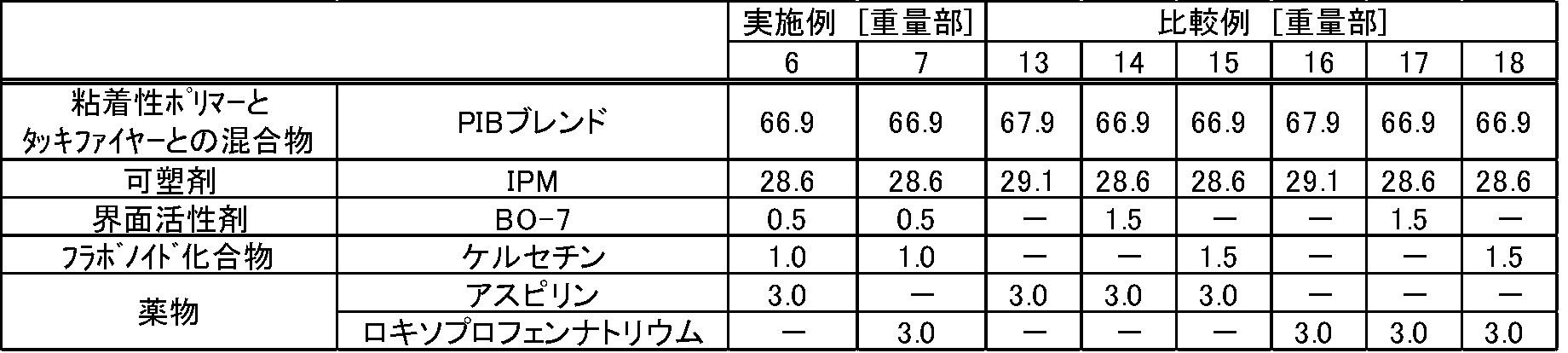
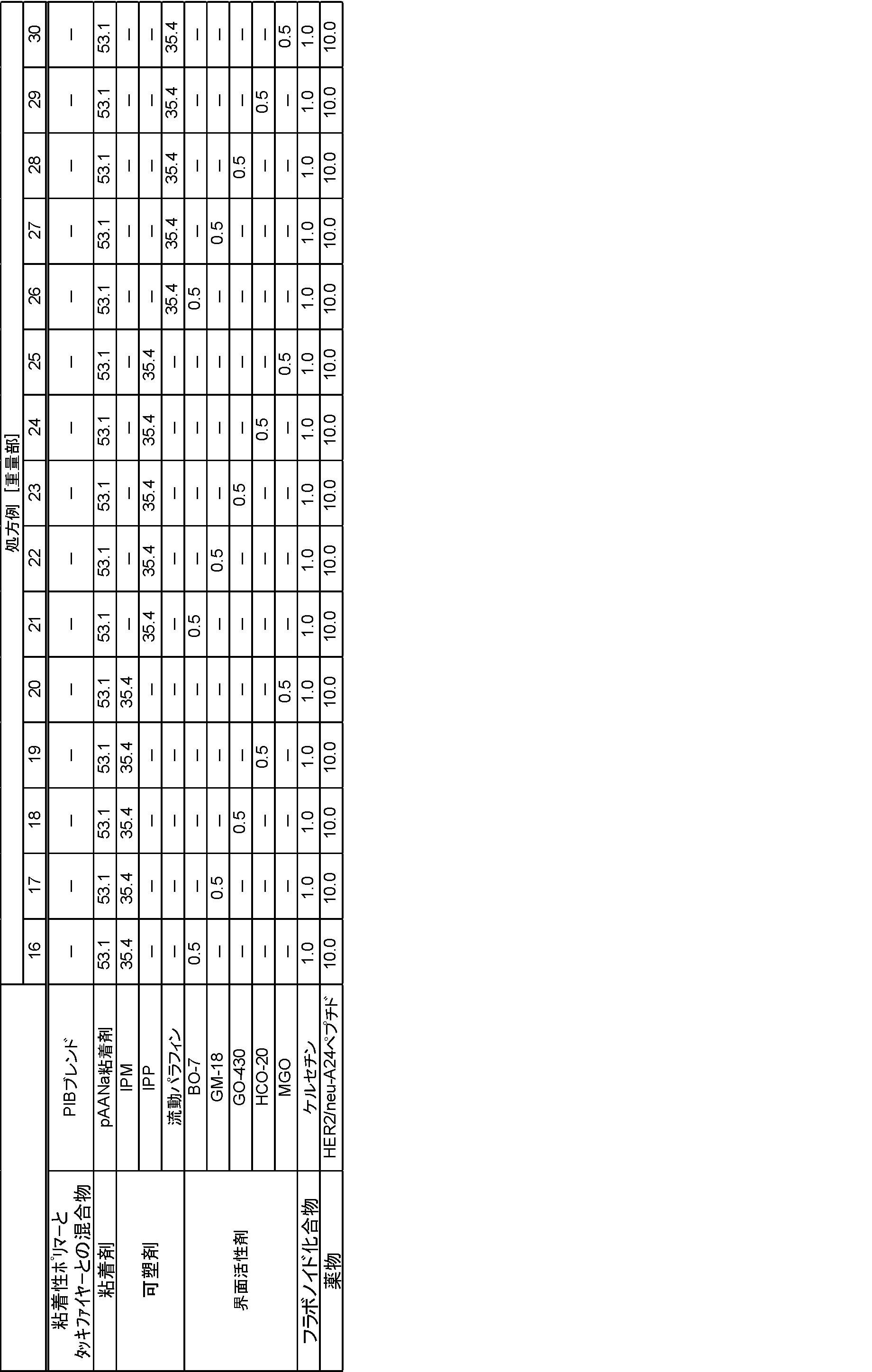
- a patch preparation containing a flavonoid compound and a surfactant can be applied to a patch preparation containing neither a flavonoid compound nor a surfactant, or a polyphenol genus compound other than a flavonoid compound and a surfactant. It can be seen that it has high skin permeation performance as compared with the patch preparation containing it. That is, in skin patch preparations having the compositions shown in Tables 5 and 6 below, high skin permeation performance can be obtained similarly.
- IPM isopropyl myristate
- BO-7 polyoxyethylene (7) oleyl ether
- quercetin 1.0 as a flavonoid compound.
- Weight parts and 10.0 parts by weight of HER2 / neu-A24 peptide as a drug were weighed, and the particle size of quercetin and HER2 / neu-A24 peptide was roughly sonicated in a small amount of toluene for 10 minutes. Align. These are stirred and mixed, and sufficiently defoamed to prepare a drug-containing adhesive dispersion.
- This drug-containing pressure-sensitive adhesive dispersion is stretched and dried on a polyester release film to form a drug-containing pressure-sensitive adhesive layer having a thickness of about 60 ⁇ m, and this is transferred to a 6 ⁇ m-thick PET film—20 g / m 2 non-woven fabric laminate type support. And get a film. The resulting film is cut into a 0.7 cm 2 rectangle to obtain a patch preparation containing the HER2 / neu-A24 peptide.
- a patch preparation containing the HER2 / neu-A24 peptide is obtained in the same manner as in Formulation Example 1 except that the composition is changed to the composition shown in Tables 5 and 6 below.
- sodium polyacrylate adhesive as an adhesive propyl palmitate (hereinafter referred to as IPP) or liquid paraffin as a plasticizer, patyl monooleate (hereinafter referred to as GM-18), tetraoleate POE (30 as surfactant) ) Sorbit (hereinafter referred to as GO-430), POE (20) hydrogenated castor oil (hereinafter referred to as HCO-20) or glyceryl monooleate (hereinafter referred to as MGO) can be used by changing to the composition of Formulation Example 1.
- a skin permeation promoting composition capable of dramatically improving the skin permeability of a drug without the need for molding the drug into a particle structure or the like and without causing destruction of the skin tissue. be able to.
- the transdermal administration formulation and patch preparation containing this skin permeation enhancement composition can be provided.
Landscapes
- Health & Medical Sciences (AREA)
- Chemical & Material Sciences (AREA)
- Life Sciences & Earth Sciences (AREA)
- General Health & Medical Sciences (AREA)
- Medicinal Chemistry (AREA)
- Pharmacology & Pharmacy (AREA)
- Animal Behavior & Ethology (AREA)
- Public Health (AREA)
- Veterinary Medicine (AREA)
- Epidemiology (AREA)
- Engineering & Computer Science (AREA)
- Bioinformatics & Cheminformatics (AREA)
- Dermatology (AREA)
- Chemical Kinetics & Catalysis (AREA)
- General Chemical & Material Sciences (AREA)
- Organic Chemistry (AREA)
- Oil, Petroleum & Natural Gas (AREA)
- Wood Science & Technology (AREA)
- Proteomics, Peptides & Aminoacids (AREA)
- General Engineering & Computer Science (AREA)
- Biochemistry (AREA)
- Zoology (AREA)
- Gastroenterology & Hepatology (AREA)
- Immunology (AREA)
- Genetics & Genomics (AREA)
- Pain & Pain Management (AREA)
- Rheumatology (AREA)
- Nuclear Medicine, Radiotherapy & Molecular Imaging (AREA)
- Medicinal Preparation (AREA)
- Pharmaceuticals Containing Other Organic And Inorganic Compounds (AREA)
- Medicines That Contain Protein Lipid Enzymes And Other Medicines (AREA)
Abstract
Description
別の方法としては、例えば、マイクロニードル等を用いて皮膚構造を一部破壊する方法(特許文献3)、薬物を平均粒子径が所定値以下の微粒子とすることによって角質の間隙を通過しやすくする方法(特許文献4)等も提案されている。
本発明者らは、鋭意検討した結果、経皮投与製剤中に薬物とともにフラボノイド化合物と界面活性剤とを同時に配合することで、相乗的な皮膚透過促進効果が得られ、皮膚への刺激性及び傷害性をほとんど伴わずに薬物の皮膚透過性を飛躍的に向上させることができることを見出し、本発明を完成するに至った。
上記フラボノイド化合物は、フラボン骨格を有する化合物及び/又はイソフラボン骨格を有する化合物であることが好ましい。
上記フラボン骨格を有する化合物は、ケルセチン、ミリセチン及びクリシンからなる群より選択される少なくとも1種であることが好ましく、上記イソフラボン骨格を有する化合物は、ゲニステインであることが好ましい。
また、本発明は、薬物と本発明の皮膚透過促進組成物とを含む経皮投与製剤である。
また、本発明は、薬物と本発明の皮膚透過促進組成物とを含む薬物含有層を有する貼付製剤である。
以下に、本発明を詳細に説明する。
上記フラボノイド化合物と上記界面活性剤とを同時に含むことで、本発明の皮膚透過促進組成物は、皮膚組織の破壊を伴わずに薬物の皮膚透過性を飛躍的に向上させることができる。
上記カテキン化合物としては特に限定されず、例えば、カテキン、エピカテキン、ガロカテキン、エピガロカテキン、没食子酸カテキン、没食子酸エピカテキン、没食子酸ガロカテキン、没食子酸エピガロカテキン等が挙げられる。これらのカテキン化合物は、単独で用いられてもよく、2種以上の組み合わせで用いられてもよい。
薬物と本発明の皮膚透過促進組成物とを含む経皮投与製剤もまた、本発明の1つである。
薬物と本発明の皮膚透過促進組成物とを含む薬物含有層を有する貼付製剤もまた、本発明の1つである。
上記薬物含有層における上記薬物の含有量は特に限定されず、使用する薬物の性質等によっても異なるが、上記薬物含有層に含まれる固形分重量全体中、0.01~60重量%であることが好ましい。上記含有量が0.01重量%未満であると、上記薬物が皮膚に到達せず、充分な薬効を示さないことがある。上記含有量が60重量%を超えると、上記薬物含有層が上記薬物を保持できず、貼付製剤の皮膚表面への貼付が困難になることがある。
なお、上記薬物含有粘着層又は上記粘着層上には、保護、保存性等のために剥離ライナーが積層されていてもよい。
上記粘着性ポリマーとしては特に限定されず、(メタ)アクリル酸エステル系ポリマーを含むアクリル系ポリマー;スチレン-イソプレン-スチレンブロック共重合体、スチレン-ブタジエン-スチレンブロック共重合体、ポリイソプレン、ポリイソブチレン、ポリブタジエン等のゴム系ポリマー;シリコーンゴム、ジメチルシロキサンベース、ジフェニルシロキサンベース等のシリコーン系ポリマー;ポリビニルメチルエーテル、ポリビニルエチルエーテル、ポリビニルイソブチルエーテル等のビニルエーテル系ポリマー;酢酸ビニル-エチレン共重合体等のビニルエステル系ポリマー;ジメチルテレフタレート、ジメチルイソフタレート、ジメチルフタレート等のカルボン酸成分と多価アルコール成分(エチレングリコール等)とからなるエステル系ポリマー等が挙げられる。なかでも、上記フラボノイド化合物の保持性に優れることから、ゴム系ポリマーが好ましい。
上記他の単量体としては、例えば、(メタ)アクリロニトリル、酢酸ビニル、プロピオン酸ビニル、N-ビニル-2-ピロリドン、メチルビニルピロリドン、ビニルピリジン、ビニルピペリドン、ビニルピリミジン、ビニルピペラジン、ビニルピロール、ビニルイミダゾール、ビニルカプロラクタム、ビニルオキサゾール等が挙げられる。これらの他の単量体は、単独で用いられてもよく、2種以上の組み合わせで用いられてもよい。
上記他の単量体の使用量は、上記(メタ)アクリル酸アルキルエステルと上記官能性単量体との合計重量に対して、通常、0~40重量%程度が好ましく、10~30重量%程度がより好ましい。
上記タッキファイヤーは特に限定されず、当技術分野で公知のものを適宜選択して用いればよく、例えば、石油系樹脂(例えば、芳香族系石油樹脂、脂肪族系石油樹脂等)、テルペン系樹脂、ロジン系樹脂、クマロンインデン樹脂、スチレン系樹脂(例えば、スチレン樹脂、ポリ(α-メチルスチレン)等)、水添石油樹脂(例えば、脂環族飽和炭化水素樹脂等)等が挙げられる。これらのタッキファイヤーは、単独で用いられてもよく、2種以上の組み合わせで用いられてもよい。なかでも、薬物の安定性が良好になるため、脂環族飽和炭化水素樹脂が好適である。
上記タッキファイヤーの含有量は、上記ゴム系ポリマーの総重量に対して、通常、33~300重量%が好ましく、50~200重量%がより好ましい。
上記可塑剤は、上記粘着性ポリマーを可塑化させて上記薬物含有粘着層にソフト感を付与し、貼付製剤を皮膚から剥離する時の皮膚接着力に起因する痛みや皮膚刺激性を低減させ得る作用を有するものであれば特に限定されない。
上記可塑剤は、上記薬物含有粘着層100重量%中、1~70重量%含まれることが好ましく、20~60重量%含まれることがより好ましい。
化学的架橋処理を施す場合、薬物と本発明の皮膚透過促進組成物とともに上記架橋剤を薬物含有粘着剤溶液又は分散液中に配合し、支持体の片面に薬物含有粘着剤溶液又は分散液を塗布し、乾燥して薬物含有粘着層を形成後、剥離ライナーの剥離処理面を薬物含有粘着層上に貼り合わせて、好ましくは60~90℃、より好ましくは60~70℃で24~48時間放置して架橋反応を促進させて、架橋構造が導入された薬物含有粘着層を形成する。なお、剥離ライナーの剥離処理面に薬物含有粘着剤溶液又は分散液を塗布し、形成された薬物含有粘着層を支持体に転写してもよい。
上記多孔性フィルムは、例えば、織布又は不織布の場合、これらの目付量を5~30g/m2とすることが投錨性の向上の点で好ましい。
上記剥離ライナー用基材としては、例えば、ポリエチレンテレフタレート(PET)フィルム、ポリイミドフィルム、ポリプロピレンフィルム、ポリエチレンフィルム、ポリカーボネートフィルム、ポリエステル(PETを除く)フィルム等のプラスチックフィルム及びこれらのフィルムに金属を蒸着した金属蒸着プラスチックフィルム;和紙、洋紙、クラフト紙、グラシン紙、上質紙等の紙類;不織布、布等の繊維質材料による基材;金属箔等が挙げられる。
なお、上記剥離ライナー用基材の表面に形成される剥離層は、上記剥離ライナー用基材上に上記剥離性の高いプラスチックフィルムの素材をラミネート又はコーティングすることにより形成することができる。
トルエン中に溶解したポリイソブチレンとタッキファイヤーとの混合物(ポリイソブチレンB200(粘度平均分子量4,000,000)、ポリイソブチレンB12(粘度平均分子量55,000)、脂環族飽和炭化水素樹脂であるアルコンP-100をそれぞれ固形分として24、36、40重量部ずつ混合したもの:以下PIBブレンド)を、組成物中の固形分より計算して62.0重量部となるように秤取した。続いて、可塑剤としてミリスチン酸イソプロピル(以下IPM)26.5重量部、界面活性剤としてポリオキシエチレン(7)オレイルエーテル(以下BO-7)0.5重量部、フラボノイド化合物としてケルセチン1.0重量部、薬物としてHER2/neu-A24ペプチド10.0重量部をそれぞれ秤取し、ケルセチン及びHER2/neu-A24ペプチドについては少量のトルエン中で10分間超音波処理することで粒子径を大まかに揃えた。これらを撹拌混合し、充分に脱泡して薬物含有粘着剤分散液を調製した。
この薬物含有粘着剤分散液をポリエステル剥離フィルム上に延伸乾燥して厚み約60μmの薬物含有粘着層を形成し、これを厚み6μmPETフィルム-20g/m2不織布の貼り合わせ型の支持体に転写して、フィルムを得た。得られたフィルムを0.7cm2の長方形に裁断して、HER2/neu-A24ペプチドを含む貼付製剤を得た。
下記の表1に示した組成に変更したこと以外は実施例1と同様にして、HER2/neu-A24ペプチドを含む貼付製剤を得た。

フラボノイド化合物の種類を変更し、下記の表2に示した組成に変更したこと以外は実施例1と同様にして、HER2/neu-A24ペプチドを含む貼付製剤を得た。

フラボノイド化合物の代わりに、非フラボノイド型ポリフェノールであるクルクミン又はクロロゲン酸を用い、下記の表3に示した組成に変更したこと以外は実施例1と同様にして、HER2/neu-A24ペプチドを含む貼付製剤を得た。

薬物の種類を変更し、下記の表4に示した組成に変更したこと以外は実施例1と同様にして、アスピリン(酸性薬物)又はロキソプロフェンナトリウム(水溶性の塩を形成している薬物)を含む貼付製剤を得た。
実施例1~7及び比較例1~18で得られた貼付製剤について、以下の評価を行った。
以下のマウス皮膚透過性試験により、貼付製剤中に含まれる薬物の皮膚透過性を評価した。
9週齢のC57/BL6♀より採取した背部皮膚を、o-フェナンスロリンを溶解させたリン酸緩衝液(以下レセプター液)に2時間浸漬した。浸漬の背部皮膚をフランツ型透過セルに固定し、余分な液滴をぬぐった後、背部皮膚に、実施例及び比較例で得られた貼付製剤を貼付し、フランツ型透過セルにレセプター液を満たした。24時間後、レセプター液を回収し、PTFEメンブレンフィルターを用いてレセプター液をろ過した後、UPLC/MS法にてレセプター液中の薬物量(薬物透過量)を定量した。
図2に示したように、比較例1で得られたフラボノイド化合物も界面活性剤も含まない貼付製剤と比較して、比較例2~5で得られたフラボノイド化合物又は界面活性剤を単独で含む貼付製剤は、薬物の若干の皮膚透過性向上が見られた。一方、実施例1又は2で得られたフラボノイド化合物と界面活性剤とを含む貼付製剤は、フラボノイド化合物と界面活性剤とが相乗的な作用を示し、上記比較例よりも飛躍的に皮膚透過性が向上した。
図3に示したように、比較例1で得られたフラボノイド化合物も界面活性剤も含まない貼付製剤と比較して、比較例6~8で得られたフラボノイド化合物を単独で含む貼付製剤は、薬物の若干の皮膚透過性向上が見られた。一方、実施例3~5で得られたフラボノイド化合物と界面活性剤とを含む貼付製剤は、フラボノイド化合物と界面活性剤とが相乗的な作用を示し、上記比較例よりも飛躍的に皮膚透過性が向上した。
また、図4に示したように、フラボノイド化合物の代わりに、フラボノイド化合物と同様ポリフェノールに属するものの非フラボノイド型であるクルクミン又はクロロゲン酸を用いた比較例10、12では、相乗的な皮膚透過促進効果は観察されなかった。
また、図5に示したように、同様の傾向が、薬物としてアスピリン(酸性薬物)又はロキソプロフェンナトリウム(水溶性の塩を形成している薬物)を用いた場合でも見られた(比較例13~18、実施例6、7)。
(処方例1)
トルエン中に溶解したポリイソブチレンとタッキファイヤーとの混合物(ポリイソブチレンB200(粘度平均分子量4,000,000)、ポリイソブチレンB12(粘度平均分子量55,000)、脂環族飽和炭化水素樹脂であるアルコンP-100をそれぞれ固形分として24、36、40重量部ずつ混合したもの:以下PIBブレンド)を、組成物中の固形分より計算して62.0重量部となるように秤取する。続いて、可塑剤としてミリスチン酸イソプロピル(以下IPM)26.5重量部、界面活性剤としてポリオキシエチレン(7)オレイルエーテル(以下BO-7)0.5重量部、フラボノイド化合物としてケルセチン1.0重量部、薬物としてHER2/neu-A24ペプチド10.0重量部をそれぞれ秤取し、ケルセチン及びHER2/neu-A24ペプチドについては少量のトルエン中で10分間超音波処理することで粒子径を大まかに揃える。これらを撹拌混合し、充分に脱泡して薬物含有粘着剤分散液を調製する。
この薬物含有粘着剤分散液をポリエステル剥離フィルム上に延伸乾燥して厚み約60μmの薬物含有粘着層を形成し、これを厚み6μmPETフィルム-20g/m2不織布の貼り合わせ型の支持体に転写して、フィルムを得る。得られるフィルムを0.7cm2の長方形に裁断して、HER2/neu-A24ペプチドを含む貼付製剤を得る。
下記の表5及び6に示した組成に変更すること以外は処方例1と同様にして、HER2/neu-A24ペプチドを含む貼付製剤を得る。なお、粘着剤としてポリアクリル酸ナトリウム粘着剤を、可塑剤としてパルミチン酸磯プロピル(以下IPP)又は流動パラフィンを、界面活性剤としてモノオレイン酸パチル(以下GM-18)、テトラオレイン酸POE(30)ソルビット(以下GO-430)、POE(20)硬化ヒマシ油(以下HCO-20)又はモノオレイン酸グリセリル(以下MGO)を、処方例1の組成に変更して用いることができる。

2 剥離ライナー
6 支持体
7 薬物含有粘着層
Claims (6)
- フラボノイド化合物と界面活性剤とを含み、薬物の皮膚透過を促進せしめるために用いられることを特徴とする皮膚透過促進組成物。
- フラボノイド化合物は、フラボン骨格を有する化合物及び/又はイソフラボン骨格を有する化合物である請求項1記載の皮膚透過促進組成物。
- フラボン骨格を有する化合物は、ケルセチン、ミリセチン及びクリシンからなる群より選択される少なくとも1種であり、イソフラボン骨格を有する化合物は、ゲニステインである請求項2記載の皮膚透過促進組成物。
- 薬物と請求項1、2又は3記載の皮膚透過促進組成物とを含むことを特徴とする経皮投与製剤。
- 薬物と請求項1、2又は3記載の皮膚透過促進組成物とを含む薬物含有層を有することを特徴とする貼付製剤。
- 薬物含有層が薬物含有粘着層であり、支持体の片面に前記薬物含有粘着層を有する請求項5記載の貼付製剤。
Priority Applications (7)
| Application Number | Priority Date | Filing Date | Title |
|---|---|---|---|
| CA2937534A CA2937534A1 (en) | 2014-01-29 | 2015-01-28 | Composition for accelerating penetration through skin, preparation for transdermal administration, and skin patch preparation |
| BR112016016700A BR112016016700A2 (pt) | 2014-01-29 | 2015-01-28 | Composição para acelerar a penetração através da pele, preparação para administração transdérmica, e preparação de emplastro de pele |
| RU2016134903A RU2016134903A (ru) | 2014-01-29 | 2015-01-28 | Композиция для ускорения проникновения через кожу, препарат для трансдермального введения и препарат трансдермального пластыря |
| EP15743986.0A EP3100743A4 (en) | 2014-01-29 | 2015-01-28 | Composition for accelerating penetration through skin, preparation for transdermal administration, and skin patch preparation |
| KR1020167022997A KR20160106181A (ko) | 2014-01-29 | 2015-01-28 | 피부 투과 촉진 조성물, 경피 투여 제제 및 첩부 제제 |
| US15/113,275 US20170007703A1 (en) | 2014-01-29 | 2015-01-28 | Composition for accelerating penetration through skin, preparation for transdermal administration, and skin patch preparation |
| CN201580006665.6A CN105992596A (zh) | 2014-01-29 | 2015-01-28 | 皮肤渗透促进组合物、经皮给药制剂及贴附制剂 |
Applications Claiming Priority (2)
| Application Number | Priority Date | Filing Date | Title |
|---|---|---|---|
| JP2014-014540 | 2014-01-29 | ||
| JP2014014540 | 2014-01-29 |
Publications (1)
| Publication Number | Publication Date |
|---|---|
| WO2015115496A1 true WO2015115496A1 (ja) | 2015-08-06 |
Family
ID=53757069
Family Applications (1)
| Application Number | Title | Priority Date | Filing Date |
|---|---|---|---|
| PCT/JP2015/052389 Ceased WO2015115496A1 (ja) | 2014-01-29 | 2015-01-28 | 皮膚透過促進組成物、経皮投与製剤及び貼付製剤 |
Country Status (9)
| Country | Link |
|---|---|
| US (1) | US20170007703A1 (ja) |
| EP (1) | EP3100743A4 (ja) |
| JP (1) | JP2015163605A (ja) |
| KR (1) | KR20160106181A (ja) |
| CN (1) | CN105992596A (ja) |
| BR (1) | BR112016016700A2 (ja) |
| CA (1) | CA2937534A1 (ja) |
| RU (1) | RU2016134903A (ja) |
| WO (1) | WO2015115496A1 (ja) |
Families Citing this family (2)
| Publication number | Priority date | Publication date | Assignee | Title |
|---|---|---|---|---|
| US9929048B1 (en) * | 2016-12-22 | 2018-03-27 | Globalfoundries Inc. | Middle of the line (MOL) contacts with two-dimensional self-alignment |
| CN113195164B (zh) | 2018-12-18 | 2023-08-18 | 3M创新有限公司 | 带涂层磨料制品及制备带涂层磨料制品的方法 |
Citations (11)
| Publication number | Priority date | Publication date | Assignee | Title |
|---|---|---|---|---|
| JPS5936611A (ja) * | 1982-08-26 | 1984-02-28 | Nitto Electric Ind Co Ltd | 粘着性貼付製剤 |
| JPS5955822A (ja) * | 1982-09-24 | 1984-03-31 | Nitto Electric Ind Co Ltd | 粘着性貼付製剤用膏体 |
| JPH0429934A (ja) * | 1990-05-28 | 1992-01-31 | Seiichi Umeda | いちょう葉抽出エキスを含有する外用組成物 |
| JPH0532121B2 (ja) | 1984-07-31 | 1993-05-14 | Nippon Steel Corp | |
| JPH10139690A (ja) * | 1996-11-02 | 1998-05-26 | Shinichi Konuma | 経皮吸収促進剤 |
| JPH10279474A (ja) | 1997-04-07 | 1998-10-20 | Hisamitsu Pharmaceut Co Inc | 経皮吸収貼付剤用粘着剤及び経皮吸収貼付剤 |
| JP2005008590A (ja) * | 2003-06-20 | 2005-01-13 | Pola Chem Ind Inc | 経皮吸収促進化粧料 |
| JP2008260747A (ja) | 2007-03-19 | 2008-10-30 | Kinjirushi Kk | コラーゲン産生促進剤、促進方法、香粧品、飲食品および医薬品 |
| JP2012206979A (ja) | 2011-03-30 | 2012-10-25 | Ssp Co Ltd | 経皮投与用医薬組成物 |
| JP2013079220A (ja) | 2011-10-05 | 2013-05-02 | Yutoku Yakuhin Kogyo Kk | ロチゴチン含有経皮吸収型貼付剤 |
| JP2013541557A (ja) * | 2010-10-22 | 2013-11-14 | エイピーアイ・ジェネシス,エルエルシー | 可溶性の乏しい化合物の可溶性を増大させる方法ならびにそのような化合物の配合物を作る、および用いる方法 |
Family Cites Families (6)
| Publication number | Priority date | Publication date | Assignee | Title |
|---|---|---|---|---|
| US5702720A (en) * | 1995-12-22 | 1997-12-30 | Minnesota Mining And Manufacturing Company | Transdermal device for the delivery of flurbiprofen |
| TW492882B (en) * | 1997-11-28 | 2002-07-01 | Caleb Pharmaceuticals Inc | Cholinergic antagonist plaster composition |
| US20030175333A1 (en) * | 2002-03-06 | 2003-09-18 | Adi Shefer | Invisible patch for the controlled delivery of cosmetic, dermatological, and pharmaceutical active ingredients onto the skin |
| US8016811B2 (en) | 2003-10-24 | 2011-09-13 | Altea Therapeutics Corporation | Method for transdermal delivery of permeant substances |
| EP1867323A1 (en) * | 2006-06-13 | 2007-12-19 | Farmatron Ltd. | Pharmaceutical compositions with biological barriers permeation enhancing properties |
| WO2011049629A2 (en) * | 2009-10-22 | 2011-04-28 | Api Genesis, Llc | Methods of making and using compositions comprising flavonoids |
-
2015
- 2015-01-28 WO PCT/JP2015/052389 patent/WO2015115496A1/ja not_active Ceased
- 2015-01-28 RU RU2016134903A patent/RU2016134903A/ru unknown
- 2015-01-28 CA CA2937534A patent/CA2937534A1/en not_active Abandoned
- 2015-01-28 KR KR1020167022997A patent/KR20160106181A/ko not_active Withdrawn
- 2015-01-28 JP JP2015014343A patent/JP2015163605A/ja active Pending
- 2015-01-28 BR BR112016016700A patent/BR112016016700A2/pt not_active Application Discontinuation
- 2015-01-28 US US15/113,275 patent/US20170007703A1/en not_active Abandoned
- 2015-01-28 CN CN201580006665.6A patent/CN105992596A/zh active Pending
- 2015-01-28 EP EP15743986.0A patent/EP3100743A4/en not_active Withdrawn
Patent Citations (11)
| Publication number | Priority date | Publication date | Assignee | Title |
|---|---|---|---|---|
| JPS5936611A (ja) * | 1982-08-26 | 1984-02-28 | Nitto Electric Ind Co Ltd | 粘着性貼付製剤 |
| JPS5955822A (ja) * | 1982-09-24 | 1984-03-31 | Nitto Electric Ind Co Ltd | 粘着性貼付製剤用膏体 |
| JPH0532121B2 (ja) | 1984-07-31 | 1993-05-14 | Nippon Steel Corp | |
| JPH0429934A (ja) * | 1990-05-28 | 1992-01-31 | Seiichi Umeda | いちょう葉抽出エキスを含有する外用組成物 |
| JPH10139690A (ja) * | 1996-11-02 | 1998-05-26 | Shinichi Konuma | 経皮吸収促進剤 |
| JPH10279474A (ja) | 1997-04-07 | 1998-10-20 | Hisamitsu Pharmaceut Co Inc | 経皮吸収貼付剤用粘着剤及び経皮吸収貼付剤 |
| JP2005008590A (ja) * | 2003-06-20 | 2005-01-13 | Pola Chem Ind Inc | 経皮吸収促進化粧料 |
| JP2008260747A (ja) | 2007-03-19 | 2008-10-30 | Kinjirushi Kk | コラーゲン産生促進剤、促進方法、香粧品、飲食品および医薬品 |
| JP2013541557A (ja) * | 2010-10-22 | 2013-11-14 | エイピーアイ・ジェネシス,エルエルシー | 可溶性の乏しい化合物の可溶性を増大させる方法ならびにそのような化合物の配合物を作る、および用いる方法 |
| JP2012206979A (ja) | 2011-03-30 | 2012-10-25 | Ssp Co Ltd | 経皮投与用医薬組成物 |
| JP2013079220A (ja) | 2011-10-05 | 2013-05-02 | Yutoku Yakuhin Kogyo Kk | ロチゴチン含有経皮吸収型貼付剤 |
Non-Patent Citations (2)
| Title |
|---|
| FANG JIA-YOU ET AL.: "Efficacy and irritancy of enhancers on the in-vitro and in-vivo percutaneous absorption of curcumin", JOURNAL OF PHARMACY AND PHARMACOLOGY, vol. 55, no. 5, 2003, pages 593 - 601, XP008057082 * |
| See also references of EP3100743A4 |
Also Published As
| Publication number | Publication date |
|---|---|
| RU2016134903A (ru) | 2018-03-01 |
| KR20160106181A (ko) | 2016-09-09 |
| CA2937534A1 (en) | 2015-08-06 |
| JP2015163605A (ja) | 2015-09-10 |
| CN105992596A (zh) | 2016-10-05 |
| EP3100743A1 (en) | 2016-12-07 |
| BR112016016700A2 (pt) | 2017-08-08 |
| US20170007703A1 (en) | 2017-01-12 |
| EP3100743A4 (en) | 2017-08-30 |
Similar Documents
| Publication | Publication Date | Title |
|---|---|---|
| JP5820207B2 (ja) | 経皮吸収促進用組成物および貼付製剤 | |
| CN100418579C (zh) | 经皮吸收制剂 | |
| KR102307852B1 (ko) | 약물의 경피 흡수 촉진용 조성물 및 패치 제제 | |
| WO2015115495A1 (ja) | 皮膚透過促進組成物、経皮投与製剤及び貼付製剤 | |
| CN102988990B (zh) | 用于增强药物的透皮吸收的组合物和贴片制剂 | |
| JP5820206B2 (ja) | 経皮吸収促進用組成物および貼付製剤 | |
| WO2015115496A1 (ja) | 皮膚透過促進組成物、経皮投与製剤及び貼付製剤 | |
| JPH11209271A (ja) | 経皮吸収製剤 | |
| JPH11209270A (ja) | 経皮吸収製剤 |
Legal Events
| Date | Code | Title | Description |
|---|---|---|---|
| 121 | Ep: the epo has been informed by wipo that ep was designated in this application |
Ref document number: 15743986 Country of ref document: EP Kind code of ref document: A1 |
|
| ENP | Entry into the national phase |
Ref document number: 2937534 Country of ref document: CA |
|
| WWE | Wipo information: entry into national phase |
Ref document number: 15113275 Country of ref document: US |
|
| REEP | Request for entry into the european phase |
Ref document number: 2015743986 Country of ref document: EP |
|
| WWE | Wipo information: entry into national phase |
Ref document number: 2015743986 Country of ref document: EP |
|
| NENP | Non-entry into the national phase |
Ref country code: DE |
|
| REG | Reference to national code |
Ref country code: BR Ref legal event code: B01A Ref document number: 112016016700 Country of ref document: BR |
|
| ENP | Entry into the national phase |
Ref document number: 20167022997 Country of ref document: KR Kind code of ref document: A |
|
| ENP | Entry into the national phase |
Ref document number: 2016134903 Country of ref document: RU Kind code of ref document: A |
|
| ENP | Entry into the national phase |
Ref document number: 112016016700 Country of ref document: BR Kind code of ref document: A2 Effective date: 20160719 |