WO2015118582A1 - Station de base, système de communication et procédé de communication - Google Patents
Station de base, système de communication et procédé de communication Download PDFInfo
- Publication number
- WO2015118582A1 WO2015118582A1 PCT/JP2014/002962 JP2014002962W WO2015118582A1 WO 2015118582 A1 WO2015118582 A1 WO 2015118582A1 JP 2014002962 W JP2014002962 W JP 2014002962W WO 2015118582 A1 WO2015118582 A1 WO 2015118582A1
- Authority
- WO
- WIPO (PCT)
- Prior art keywords
- phase rotation
- base station
- amount information
- antenna
- station
- Prior art date
- Legal status (The legal status is an assumption and is not a legal conclusion. Google has not performed a legal analysis and makes no representation as to the accuracy of the status listed.)
- Ceased
Links
Images







Classifications
-
- H—ELECTRICITY
- H04—ELECTRIC COMMUNICATION TECHNIQUE
- H04B—TRANSMISSION
- H04B7/00—Radio transmission systems, i.e. using radiation field
- H04B7/02—Diversity systems; Multi-antenna system, i.e. transmission or reception using multiple antennas
- H04B7/022—Site diversity; Macro-diversity
-
- H—ELECTRICITY
- H04—ELECTRIC COMMUNICATION TECHNIQUE
- H04B—TRANSMISSION
- H04B7/00—Radio transmission systems, i.e. using radiation field
- H04B7/02—Diversity systems; Multi-antenna system, i.e. transmission or reception using multiple antennas
- H04B7/04—Diversity systems; Multi-antenna system, i.e. transmission or reception using multiple antennas using two or more spaced independent antennas
- H04B7/06—Diversity systems; Multi-antenna system, i.e. transmission or reception using multiple antennas using two or more spaced independent antennas at the transmitting station
- H04B7/0613—Diversity systems; Multi-antenna system, i.e. transmission or reception using multiple antennas using two or more spaced independent antennas at the transmitting station using simultaneous transmission
- H04B7/0682—Diversity systems; Multi-antenna system, i.e. transmission or reception using multiple antennas using two or more spaced independent antennas at the transmitting station using simultaneous transmission using phase diversity (e.g. phase sweeping)
-
- H—ELECTRICITY
- H04—ELECTRIC COMMUNICATION TECHNIQUE
- H04B—TRANSMISSION
- H04B7/00—Radio transmission systems, i.e. using radiation field
- H04B7/02—Diversity systems; Multi-antenna system, i.e. transmission or reception using multiple antennas
- H04B7/04—Diversity systems; Multi-antenna system, i.e. transmission or reception using multiple antennas using two or more spaced independent antennas
- H04B7/0491—Diversity systems; Multi-antenna system, i.e. transmission or reception using multiple antennas using two or more spaced independent antennas using two or more sectors, i.e. sector diversity
- H04B7/0495—Diversity systems; Multi-antenna system, i.e. transmission or reception using multiple antennas using two or more spaced independent antennas using two or more sectors, i.e. sector diversity using overlapping sectors in the same base station to implement MIMO for antennas
-
- H—ELECTRICITY
- H04—ELECTRIC COMMUNICATION TECHNIQUE
- H04L—TRANSMISSION OF DIGITAL INFORMATION, e.g. TELEGRAPHIC COMMUNICATION
- H04L1/00—Arrangements for detecting or preventing errors in the information received
- H04L1/02—Arrangements for detecting or preventing errors in the information received by diversity reception
- H04L1/06—Arrangements for detecting or preventing errors in the information received by diversity reception using space diversity
- H04L1/0618—Space-time coding
- H04L1/0625—Transmitter arrangements
-
- H—ELECTRICITY
- H04—ELECTRIC COMMUNICATION TECHNIQUE
- H04L—TRANSMISSION OF DIGITAL INFORMATION, e.g. TELEGRAPHIC COMMUNICATION
- H04L1/00—Arrangements for detecting or preventing errors in the information received
- H04L1/02—Arrangements for detecting or preventing errors in the information received by diversity reception
- H04L1/06—Arrangements for detecting or preventing errors in the information received by diversity reception using space diversity
- H04L1/0618—Space-time coding
- H04L1/0631—Receiver arrangements
-
- H—ELECTRICITY
- H04—ELECTRIC COMMUNICATION TECHNIQUE
- H04W—WIRELESS COMMUNICATION NETWORKS
- H04W16/00—Network planning, e.g. coverage or traffic planning tools; Network deployment, e.g. resource partitioning or cells structures
- H04W16/24—Cell structures
- H04W16/28—Cell structures using beam steering
-
- H—ELECTRICITY
- H04—ELECTRIC COMMUNICATION TECHNIQUE
- H04B—TRANSMISSION
- H04B7/00—Radio transmission systems, i.e. using radiation field
- H04B7/02—Diversity systems; Multi-antenna system, i.e. transmission or reception using multiple antennas
- H04B7/04—Diversity systems; Multi-antenna system, i.e. transmission or reception using multiple antennas using two or more spaced independent antennas
- H04B7/06—Diversity systems; Multi-antenna system, i.e. transmission or reception using multiple antennas using two or more spaced independent antennas at the transmitting station
- H04B7/0613—Diversity systems; Multi-antenna system, i.e. transmission or reception using multiple antennas using two or more spaced independent antennas at the transmitting station using simultaneous transmission
- H04B7/0667—Diversity systems; Multi-antenna system, i.e. transmission or reception using multiple antennas using two or more spaced independent antennas at the transmitting station using simultaneous transmission of delayed versions of same signal
- H04B7/0669—Diversity systems; Multi-antenna system, i.e. transmission or reception using multiple antennas using two or more spaced independent antennas at the transmitting station using simultaneous transmission of delayed versions of same signal using different channel coding between antennas
-
- H—ELECTRICITY
- H04—ELECTRIC COMMUNICATION TECHNIQUE
- H04L—TRANSMISSION OF DIGITAL INFORMATION, e.g. TELEGRAPHIC COMMUNICATION
- H04L1/00—Arrangements for detecting or preventing errors in the information received
- H04L1/02—Arrangements for detecting or preventing errors in the information received by diversity reception
- H04L1/06—Arrangements for detecting or preventing errors in the information received by diversity reception using space diversity
- H04L1/0618—Space-time coding
- H04L1/0637—Properties of the code
- H04L1/0668—Orthogonal systems, e.g. using Alamouti codes
-
- H—ELECTRICITY
- H04—ELECTRIC COMMUNICATION TECHNIQUE
- H04W—WIRELESS COMMUNICATION NETWORKS
- H04W88/00—Devices specially adapted for wireless communication networks, e.g. terminals, base stations or access point devices
- H04W88/08—Access point devices
-
- H—ELECTRICITY
- H04—ELECTRIC COMMUNICATION TECHNIQUE
- H04W—WIRELESS COMMUNICATION NETWORKS
- H04W88/00—Devices specially adapted for wireless communication networks, e.g. terminals, base stations or access point devices
- H04W88/12—Access point controller devices
Definitions
- the present invention relates to a base station, a communication system, and a transmission method.
- timing synchronization is performed in a plurality of base stations and the same information is transmitted at the same frequency (same frequency multi-station simultaneous transmission method).
- beat interference occurs in which the phases of the transmission signals are combined in opposite phases and the received power is reduced.
- Patent Document 1 transmits signals having different timings from two antennas of the same base station, suppresses the occurrence of beat interference, performs adaptive equalization processing on the receiving side, and transmits signals having different timings.
- a method of separating and synthesizing is disclosed. Furthermore, when transmitting from a plurality of base stations, a method of improving the reception performance by transmitting with different frequency deviations between the base stations and reducing the time in which the phases of the transmission signals are combined in opposite phases is disclosed. Has been.
- the present invention has been made to solve the above-described problems, and an object thereof is to suppress the influence of generated beat interference without performing complicated processing on the receiving side.
- the present invention provides a base station having a communication area that partially overlaps a communication area of another station and a base station of a communication system including a control station that controls the base station.
- Data receiving unit for receiving the same data as the data transmitted from the control station to the other station from the control station, a phase rotation amount information receiving unit for receiving the phase rotation amount information from the control station, and data based on the phase rotation amount information
- a phase offset unit for applying phase rotation to the transmitter, and a transmission unit for transmitting data to which phase rotation is applied.
- the base station processes the transmission signal differently for each frame. This makes it possible to suppress the influence of beat interference without performing complicated processing on the receiving side.
- FIG. 1 is a diagram illustrating a configuration example of a wireless communication system according to a first embodiment.
- 2 is a diagram illustrating a configuration example of a base station according to Embodiment 1.
- FIG. 3 is a diagram illustrating a configuration example of a mobile station according to Embodiment 1.
- FIG. 3 is a follow chart of the wireless communication system according to the first embodiment.
- 6 is a diagram illustrating a configuration example of a wireless communication system according to a second embodiment.
- FIG. 6 is a diagram illustrating a configuration example of a base station according to Embodiment 2.
- FIG. 6 is a diagram illustrating a configuration example of a mobile station according to Embodiment 2.
- FIG. 6 is a diagram illustrating a configuration example of a wireless communication system according to a third embodiment.
- FIG. 10 is a diagram illustrating an example of a relationship between a frequency of a signal transmitted by a base station according to Embodiment 5 and a frame.
- FIG. 1 is a diagram illustrating a configuration example of a wireless communication system according to the present embodiment.
- the wireless communication system 1 includes a base station 10 that forms a communication area 10A, a base station 11 that forms a communication area 11A, a mobile station 20, and a control station 30.
- the base station 10 and the base station 11 are adjacent to each other, and there is an overlapping area between the communication area 10A and the communication area 11A.
- the number of base stations, the number of mobile stations, and the number of control stations are not limited to the numbers shown in FIG.
- the base station 10 and the base station 11 wirelessly transmit the data received from the control station 30 to the mobile station 20 and the data received from the mobile station 20 by radio. Send to.
- the mobile station 20 transmits / receives data to / from the control station 30 via the base station 10 and the base station 11 or via either the base station 10 or the base station 11.
- the control station 30 is connected to each base station (here, the base station 10 and the base station 11) and controls each base station. Further, the control station 30 is connected to at least one base station and transmits / receives data exchanged with the mobile station 20. In addition, the control station 30 transmits phase rotation information to each base station.
- the base station 10 includes an encoding unit 100, a modulation unit 101, a phase offset unit 102, a radio processing unit 103, an antenna 104, a demodulation unit 105, and a decoding unit 106.
- the encoding unit 100 performs error correction encoding on the transmission data received from the control station 30.
- the error correction coding method is not limited to a specific method.
- the modulation unit 101 modulates data that has been subjected to error correction coding.
- the modulation scheme is not limited to a specific scheme.
- the phase offset unit 102 rotates the phase of the modulation symbol output from the modulation unit 101 based on the phase rotation information received from the control station 30, and outputs the phase rotation symbol.
- the phase rotation information represents the phase rotation period T
- the phase rotation amount added to the modulation symbol can be expressed by the following (Equation 1).
- sr n s n exp (j2 ⁇ i / T) ...
- Equation 1 s n is a modulation symbol in complex notation, j is an imaginary unit, i is a transmission frame number, and s n is a phase rotation symbol in complex notation.
- Radio processing section 103 converts the phase rotation symbol, which is the modulation symbol whose phase has been rotated by phase offset section 102, into an RF (Radio-Frequency) signal, and outputs it to antenna 104.
- the antenna 104 transmits the phase rotation symbol converted into the RF signal.
- the wireless processing unit 103 converts a signal received by the antenna 104 into a baseband signal. A part of the functions of the wireless processing unit 103 and the antenna 104 serve as a transmission unit.
- the phase rotation symbol sr n is given a phase rotation amount that differs depending on the transmission frame number i with respect to the modulation symbol s n .
- the base station 10 can transmit a different amount of phase rotation for each transmission frame.
- the control station 30 sets the phase rotation amount transmitted to the base station 10 and the base station 11 to different values, so that the base station 10 and the base station 11 can transmit with different phase rotation amounts.
- the base station 10 transmits A phase rotation of 0, ⁇ / 2, ⁇ , 3 ⁇ / 2, 0,... [Rad] is given to each frame of the signal, and the base station 11 receives 0, 3 ⁇ / 2, ⁇ , ⁇ / for each frame of the transmission signal. Since a phase rotation of 2, 0,... [Rad] is given, the relative phase relationship of transmission signals between base stations can be changed by ⁇ [rad] for each frame, and the influence of beat interference can be suppressed. .
- the demodulation unit 105 demodulates the baseband signal converted by the wireless processing unit 103.
- Decoding section 106 performs error correction decoding on the demodulated signal to obtain received data.
- the base station 10 obtains this received data and transmits it to the control station 30.
- the base station 11 has the same configuration as the base station 10.
- the mobile station 20 includes an encoding unit 200, a modulation unit 201, a radio processing unit 202, an antenna 203, a demodulation unit 204, and a decoding unit 205.
- the wireless processing unit 202 converts an RF signal received from the base station 10 and the base station 11 or at least one of the base station 10 and the base station 11 through the antenna 203 into a baseband signal.
- the demodulation unit 204 demodulates the baseband signal converted by the wireless processing unit 202.
- Decoding section 205 performs error correction decoding on the demodulated signal to obtain received data.
- the encoding unit 200 performs error correction encoding on transmission data when transmitting data from the mobile station 20.
- the error correction coding method is not limited to a specific method.
- Modulator 201 modulates the error correction coded data and outputs a modulation symbol.
- the modulation scheme is not limited to a specific scheme.
- Radio processing section 202 converts the modulation symbol into an RF signal, and transmits it from antenna 203 to at least one of base station 10 and base station 11, or base station 10 and base station 11.
- the control station 30 transmits phase rotation information to the base station 10 and the base station 11 (step S1).
- the control station includes a data transmission unit that transmits the same data to each base station, and a phase rotation amount information transmission unit that transmits phase rotation amount information to the base station.
- the phase offset unit 102 of the base station 10 and the base station 11 determines the amount of phase rotation to be provided for each transmission frame based on the phase rotation information from the control station 30 (step S2). And the phase offset part 102 of the base station 10 and the base station 11 gives a different phase rotation amount for every transmission frame, and the antenna 104 transmits the transmission frame to which the phase rotation amount was given (step S3).
- a plurality of base stations are installed to cover all areas that need to communicate with the mobile station 20, so that there are areas where the communication areas of the base stations overlap.
- base station 10 and base station 11 rotate the transmission signal in different phases for each frame based on the phase rotation information from control station 30. As a result, the mobile station 20 can suppress the occurrence of beat interference without complicated processing.
- control station 30 has been described as transmitting phase rotation information to each base station, but the present invention is not limited to this.
- Each base station may generate its own phase rotation information.
- each base station has been described as causing each frame to perform a different phase rotation.
- the control station 30 may generate each frame and rotate the phase before transmitting it to each base station.
- the present invention is not limited to this.
- the base station is installed along the track so that the communication area of the base station covers the track.
- the control station may send different phase rotation information to the even-numbered base stations and the odd-numbered base stations among the base stations arranged along the line.
- the mobile station installed in the train can suppress the occurrence of beat interference even in overlapping communication areas.
- Embodiment 2 a case where a base station and a mobile station are provided with a plurality of antennas and performs transmission diversity will be described. Here, the description will focus on the parts different from the first embodiment.
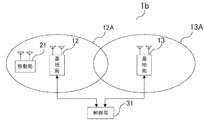
- FIG. 5 is a diagram illustrating a configuration example of the wireless communication system according to the present embodiment.
- the wireless communication system 1b includes a base station 12 that forms 12A as a communication area, a base station 13 that forms 13A as a communication area, a mobile station 21, and a control station 31.
- the base station 12 and the base station 13 are adjacent to each other, and there is an overlapping area between the communication area 12A and the communication area 13A.
- the number of base stations, the number of mobile stations, and the number of control stations are not limited to the numbers shown in FIG.
- the base station 12, the base station 13, and the mobile station 21 have a plurality of antennas and transmission diversity and reception diversity are applied to each station will be described.
- space-time coding is used as a method in which each station transmits from a plurality of antennas.
- the present invention is not limited to this, and space-time coding may not be used.
- the base station 12, the base station 13, and the mobile station 21 are each described as having two antennas, but the present invention is not limited to this.
- the base station 12 and the base station 13 wirelessly transmit the data received from the control station 31 to the mobile station 21 and the data received from the mobile station 21 by radio. Send to.
- the mobile station 21 transmits / receives data to / from the control station 31 via at least one of the base station 12 and the base station 13 or the base station 12 and the base station 13.
- the control station 31 is connected to each base station (here, the base station 12 and the base station 13) and controls each base station.
- the control station 31 is connected to at least one base station and transmits / receives data exchanged with the mobile station 21.
- the control station 31 transmits phase rotation information to the base station 12 and the base station 13.
- the control station 31 transmits the phase rotation information transmitted to the base station 12 and the base station 13 by the number of antennas of each base station.
- the phase rotation information sent by the control station 31 may be different for each antenna of each base station. In this case, beat interference in the overlapping area of the communication area can be suppressed without using space-time coding.
- the base station 12 includes an encoding unit 100, a modulation unit 101, two phase offset units 102, two radio processing units 103, two antennas 104, a demodulation unit 105, a decoding unit 106, a space-time An encoding unit 107 and a space-time decoding unit 108 are provided.
- Base station 12 and base station 13 transmit and receive data using two antennas.
- the operations of the encoding unit 100 to the decoding unit 106 are the same as those of the base station 10 (see FIG. 2) of the first embodiment.
- the base station 12 and the base station 13 are different from the base station 10 and the base station 11 of the first embodiment in that a space-time coding unit 107 and a space-time decoding unit 108 are added, a phase offset unit 102, a radio processing unit 103 and two antennas 104 are provided.
- phase offset unit 102 The operation of the phase offset unit 102 is the same as the operation of the phase offset unit 102 described above in the first embodiment. At this time, the control station 31 transmits the phase rotation information a and b to each of the two phase offset units 102.
- the phase rotation information a and b may be the same value or different values.
- a signal transmitted from the base station 12 in the communication area 12A by setting the phase rotation information a and b to different values.
- the beat interference can be suppressed.
- space-time coding is used in transmission diversity, the signals transmitted from the antennas are orthogonal to each other, and no beat interference occurs, so the phase rotation information a and b may be the same value.
- control station 31 sets the phase rotation amount transmitted to the phase offset 102 of the base station 12 and the phase offset 102 of the base station 13 to different values, so that the phase offset 102 of the base station 12 and the phase offset of the base station 13 102 can transmit with different amounts of phase rotation.
- the space-time coding unit 107 performs space-time coding on the modulation symbol output from the modulation unit 101.
- the space-time coding unit 107 uses, for example, Alamouti STBC (Space Time Block Coding), Tarokh's DSTBC (Differential Space Time Block Coding), etc. as the space-time coding method.
- Output a column.
- the control station 31 can suppress beat interference even in overlapping areas by setting different amounts of phase rotation to be transmitted to the phase offset 102 of the base station 12 and the phase offset 102 of the base station 13. it can.
- the space-time decoding unit 108 performs a decoding process corresponding to the space-time coding performed on the transmission side on each received baseband signal output from each wireless processing 103, and then synthesizes and demodulates the demodulating unit 105 Output to.
- the space-time coding method used in the base station 12, the base station 13, and the mobile station 21 is known. Although the configuration and operation of the base station 12 have been described here, the base station 13 also has the same configuration.
- the mobile station 21 includes an encoding unit 200, a modulation unit 201, two radio processing units 202, two antennas 203, a demodulation unit 204, a decoding unit 205, a space-time encoding unit 207, a space-time An encoding unit 208.
- the mobile station 21 transmits and receives data with the two antennas 203.
- the operations of encoding section 200 to decoding section 205 are the same as those of mobile station 20 (see FIG. 3) of the first embodiment.
- the difference from the mobile station 20 of Embodiment 1 is that a space-time coding unit 207 and a space-time decoding unit 208 are added, and there are two radio processing units 202 and two antennas 203, respectively.
- the mobile station 21 includes two radio processing units 202 and two antennas 203.
- the operations of the radio processing unit 202 and the antenna 203 are the same as those in the first embodiment.
- the operation of the space-time encoding unit 207 is the same as the operation of the space-time encoding unit 107 described above, and the operation of the space-time decoding unit 208 is the same as the operation of the space-time decoding unit 108 described above.
- a plurality of base stations are installed to cover all areas where communication with the mobile station 21 is necessary, and there are areas where the communication areas of the base stations overlap.
- the mobile station receives a non-orthogonal signal from the base station 12 and the base station 13.
- the base station 12 and the base station 13 rotate the transmission signal differently for each frame.
- the mobile station 21 can suppress the occurrence of beat interference.
- control station 31 has been described as transmitting phase rotation information to each base station, but the present invention is not limited to this.
- Each base station may generate its own phase rotation information.
- each base station has been described as causing each frame to perform a different phase rotation.
- the control station 31 may generate each frame to be transmitted by each base station, rotate the phase, and transmit the frame to each base station.
- the present invention is not limited to this.
- the base station is installed along the track so that the area of the base station covers the track.
- the control station sends the same phase rotation information to the even-numbered base stations among the base stations arranged along the track, and sends the same phase rotation information to the odd-numbered base stations. Good.
- the mobile station installed in the train can suppress beat interference even in overlapping communication areas.
- each base station includes a plurality of antennas having directivity and forms a plurality of communication areas.
- the description will focus on the parts different from the first embodiment.
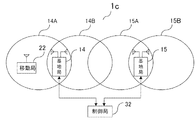
- FIG. 8 is a diagram showing a configuration of the wireless communication system according to the present embodiment.
- the wireless communication system 1c includes a base station 14 that forms 14A and 14B as communication areas, a base station 15 that forms 15A and 15B as communication areas, a mobile station 22, and a control station 32.
- the base station 14 and the base station 15 are adjacent to each other, and there is an overlapping area between the communication area 14B and the communication area 15A.
- the number of base stations, the number of mobile stations, and the number of control stations are not limited to the numbers in FIG.
- the base station 14 and the base station 15 wirelessly transmit the data received from the control station 32 to the mobile station 22 and the data received wirelessly from the mobile station 22. Send to.
- the mobile station 22 transmits / receives data to / from the control station 32 via either the base station 14 and the base station 15 or the base station 14 and the base station 15.
- the control station 32 is connected to each base station (here, the base station 14 and the base station 15) and controls each base station.
- the control station 32 is connected to at least one base station and transmits / receives data exchanged with the mobile station 22.
- the control station 32 transmits phase rotation information to each base station.
- the control station 32 transmits the phase rotation information transmitted to the base station 14 and the base station 15 by the number of antennas of each base station.
- the base station 14 includes an encoding unit 100, a modulation unit 101, two phase offset units 102, two radio processing units 103, two antennas 104A and 104B, a demodulation unit 105a, a decoding unit 106, Is provided.
- the operations of encoding section 100 and modulating section 101 are the same as those in the first embodiment.
- the modulation symbol that is the output of the modulation unit 101 is input to the two phase offset units 102.
- the operation of the phase offset unit 102 is the same as that of the phase offset unit 102 in the first embodiment, but different phase rotation information is input to each phase offset unit 102.
- beat interference may occur in the vicinity of the base station 14 itself at the mobile station 22 that has received the signal transmitted from the antenna 104A and the signal transmitted from the antenna 104B. For this reason, beat interference around the base station 14 can be suppressed by inputting different phase rotation information to each phase offset unit.
- control station 32 can suppress beat interference in the overlapping area of the communication area 14B and the communication area 15A by changing the phase rotation amount transmitted to the base station 14 and the base station 15 to different values.
- the control station 32 when the mobile station 22 is installed on a train and the base station is installed along a track, the control station 32 includes an even-numbered base station and an odd-numbered base station installed along the track. The phase rotation amount to be transmitted to is set to a different value.
- phase rotation symbols which are outputs from the two phase offset units, are input to different radio processing units 103 and transmitted from different antennas 104A and 104B.
- Antennas 104A and 104B transmit signals to form different communication areas.
- the antenna needs to form a communication area in the uplink direction (direction toward the city) and the downlink direction of the track. .
- one of the two antennas 104A is directed to the upstream area of the line, and the other antenna 104B is directed to the downstream area.
- the base station 14 converts the signal from the mobile station 22 received by the antenna 104A and the antenna 104B into a baseband signal by the wireless processing unit 103 and inputs the signal to the demodulation unit 105a.
- the demodulating unit 105 a performs diversity combining after demodulation processing, and the decoding unit 106 performs error correction decoding, obtains received data, and transmits the received data to the control station 30.
- the base station 15 also has the same configuration.
- the configuration and operation of the mobile station 22 may be the same as those of the mobile station 20 (see FIG. 3) shown in the first embodiment.
- a plurality of base stations are installed to cover all areas where communication with the mobile station 22 is necessary, and there are areas where the communication areas of the base stations overlap.
- transmission signals transmitted in each communication area (communication area 14A and communication area 14B) of the base station 14 and each communication area (communication area 15A and communication area 15B) of the base station 15 are transmitted for each frame.
- Each phase rotates differently.
- the mobile station 22 can suppress the occurrence of beat interference.
- each base station may generate its own phase rotation information.
- each base station has been described as causing each frame to perform a different phase rotation.
- the control station may generate and rotate the phase of each frame to be transmitted by each base station.
- the base station 14 and the base station 15 use the spatial encoding unit 107 of the base station (see FIG. 6) described in the second embodiment, and the modulation symbols output from the modulation unit 101 are used as modulation symbols.
- space-time coding may be performed.
- the space-time coding unit outputs transmission symbols for two antennas orthogonal to each other from the modulation symbols.
- the signal transmitted from one antenna 104A forming the communication area 14B of the base station 14 and the signal transmitted from one antenna 104B forming the communication area 15A of the base station 15 are orthogonal to each other. For this reason, both signals are orthogonal to each other, and beat interference is suppressed.
- the train traveling along the track is a communication area common to the base station 14 and the base station 15.
- beat interference can be suppressed.
- beat interference can be suppressed between adjacent communication areas without performing phase rotation for each frame of the transmission signal.
- one or more communication areas may overlap, and beat interference occurs when communication areas transmitting the same signal overlap.
- beat interference can be suppressed by applying a different phase rotation for each frame.
- Embodiment 4 In the present embodiment, a case will be described in which each base station includes a plurality of antennas, performs transmission diversity, and forms a plurality of communication areas. Here, the description will focus on the parts different from the first embodiment.
- FIG. 10 is a diagram illustrating a configuration of the wireless communication system according to the present embodiment.
- the wireless communication system 1d includes a base station 16 that forms 16A and 16B as communication areas, a base station 17 that forms 17A and 17B as communication areas, a mobile station 23, and a control station 33.
- the base station 16 and the base station 17 are adjacent to each other, and there is an overlapping area between the communication area 16B and the communication area 17A. Note that the number of base stations, the number of mobile stations, and the number of control stations are not limited to the numbers shown in FIG.
- the base station 16, the base station 17, and the mobile station 23 have four antennas, and transmission diversity and reception diversity are applied to each station.
- two antennas and two antenna sets (four antennas in total) are described, and the antennas of each set have different directivities.
- the present invention is not limited to this. .
- two antennas may be used and three antenna sets may be provided.
- space-time coding is used as a method in which each station transmits from a plurality of antennas will be described, the present invention is not limited to this.
- the base station 16 and the base station 17 wirelessly transmit the data received from the control station 33 to the mobile station 23 and the data received wirelessly from the mobile station 23. Send to.
- the mobile station 23 transmits / receives data to / from the control station 33 via either the base station 16 and the base station 17 or the base station 16 and the base station 17.
- the control station 33 is connected to each base station (here, the base station 16 and the base station 17) and controls each base station. Further, it connects to at least one base station and transmits / receives data exchanged with the mobile station 23. In addition, the control station 33 transmits phase rotation information to each base station.
- the control station 33 will be described assuming that the phase rotation information transmitted to the base station 16 and the base station 17 is transmitted by the number of antennas of each base station, but is not limited thereto.
- the antenna set for each base station may be sent.
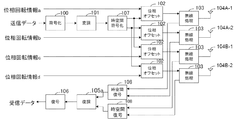
- the base station 16 includes an encoding unit 100, a modulation unit 101, four phase offset units 102, four radio processing units 103, an antenna 104A-1, an antenna 104A-2, an antenna 104B-1, and an antenna 104B-. 2, a demodulation unit 105 a, a decoding unit 106, a space-time encoding unit 107, and two space-time decoding units 108.
- the operations of the encoding unit 100 and the modulation unit 101 are the same as those in the first embodiment.
- the operation of the space-time coding unit 107 is the same as that in the second embodiment.
- the transmission symbols for two antennas which are the outputs of the space-time coding unit 107, are input to the two phase offset units 102, respectively.
- the operation of the phase offset unit 102 is the same as that of the phase offset unit 102 in the first embodiment.
- the phase rotation information input to each phase offset unit will be described.
- phase rotation information (for example, phase rotation information a and b, phase rotation information c and d) of transmission signals forming one communication area may be the same value or different values.
- the phase rotation information a and b are set to different values, so that the communication area 16A Thus, beat interference can be suppressed for the signal transmitted from the base station 16.
- the signals transmitted from the antennas are orthogonal to each other and no beat interference occurs, and therefore phase rotation information a and b may have the same value.
- the phase rotation information (for example, phase rotation information a and c, phase rotation information b and d) of the transmission signal should have different values.
- beat interference between signals transmitted from the base station 16 can be suppressed around the base station 16 itself.
- beat interference occurs in the vicinity of the base station 16 if the phase rotation information a and c are the same value and the phase rotation information b and d are the same value.
- beat interference can be suppressed by setting different values for the phase rotation information a and c and different values for the phase rotation information b and d.
- control station 33 can suppress beat interference in the overlapping area of the communication area 16B and the communication area 17A by setting the phase rotation amounts transmitted to the base station 16 and the base station 17 to different values.
- phase rotation symbols output from the four phase offset units are converted into RF signals by the radio processing unit 103 and transmitted from the antenna 104A-1, the antenna 104A-2, the antenna 104B-1, and the antenna 104B-2.
- signals corresponding to the transmission symbols for two antennas generated by space-time coding section 107 are transmitted.
- Signals transmitted from antennas 104A-1 and 104A-2 are signals orthogonal to each other by space-time coding.
- signals transmitted from the antenna 104B-1 and the antenna 104B-2 are transmitted so as to form different communication areas for the group of antennas 104A-1 and 104A-2 and the group of antennas 104B-1 and 104B-2.
- the base station 16 converts the signals from the mobile station 22 received by the two antennas 104A-1 and 104A-2 into baseband signals by the radio processing unit 103 and inputs the baseband signals to the space-time decoding unit 108.
- signals received by the two antennas 104B-1 and 104B-2 are converted into baseband signals by the wireless processing unit 103 and input to the space-time decoding unit 108, respectively.
- the operation of the space-time decoding unit is the same as that of the space-time decoding unit 108 of the second embodiment.
- the outputs of the two space-time decoding units 108 are diversity-combined after demodulation processing by the demodulation unit 105a, error-correction-decoded by the decoding unit 106, and received data is transmitted to the control station 33.
- the base station 17 also has the same configuration.
- the configuration and operation of the mobile station 23 may be the same as those of the mobile station 22 (see FIG. 7) shown in the second embodiment.
- the base station 16 and the base station 17 may be configured by the two configurations (see FIG. 5) of the base station 12 and the base station 13 described in the second embodiment.
- a plurality of base stations are installed to cover all areas that require communication with mobile stations, and each base station forms a plurality of areas, so that each communication area of each base station overlaps. Area to be generated.
- the transmission signals transmitted in each communication area of the base station 16 and each communication area of the base station 17 are rotated by different phases for each frame. Thereby, the time when beat interference occurs can be shortened.
- control station has been described as transmitting phase rotation information to each base station, but the present invention is not limited to this.
- Each base station may generate its own phase rotation information.
- each base station has been described as causing each frame to perform a different phase rotation.
- the control station can generate and rotate the phase of each frame to be transmitted by each base station.
- a signal transmitted from one antenna set forming the communication area 16B of the base station 16 and a transmission from one antenna set forming the communication area 17A of the base station 17 are transmitted.
- beat interference occurs.
- the transmission signals transmitted in each communication area of the base station 16 and each communication area of the base station 17 are rotated by different phases for each frame. Thereby, the time when beat interference occurs can be shortened.
- the control station 33 sends a signal to be sent to the base station 16 to the even-numbered base station of the base station installed along the track to the odd-numbered base station.
- the train traveling along the track can suppress beat interference even in overlapping communication areas.
- Embodiment 5 FIG.
- Frequency hopping is a technique for changing the frequency at which a signal is transmitted in a short time.
- the frequency is changed for each transmission frame, and the base station transmits data at different frequencies in adjacent transmission frames.
- the description will focus on the parts different from the first embodiment.
- the base stations 10 to 11 have the configuration shown in FIG.
- the mobile station 20 has the configuration shown in FIG.
- the radio processing unit 103 of the base station 10 hops the frequency for each transmission frame and converts it to a different frequency.
- the wireless processing unit 103 may hold a hopping frequency pattern in advance or may receive it from the control station 30.
- the radio processing unit 202 of the mobile station 20 performs frequency hopping similarly to the radio processing unit 103 of the base stations 10 to 11. When converting the modulation symbol into an RF signal, the radio processing unit 202 hops the frequency for each transmission frame and converts it to a different frequency.
- the wireless processing unit 202 may hold a hopping frequency pattern in advance, receive it from the base station 10, or receive it from the control station 30 via the base station 10.
- FIG. 12 is a diagram illustrating an example of a relationship between a frequency of a signal transmitted by the base station according to the present embodiment and a frame.
- the horizontal axis represents time, and the vertical axis represents frequency.
- the horizontal axis is divided by a plurality of vertical dotted lines, and each section is a frame. Assume that frame numbers are assigned in order of 1, 2, 3,... From the left.
- the vertical axis is divided by a plurality of horizontal dotted lines, and each interval is a frequency interval.
- f10-i is a signal transmitted by the base station 10.
- f11-i is a signal transmitted by the base station 11.
- i is an integer of 1 or more, and is a frame number. In frame numbers 1 to 3 and 5, the signal transmitted from the base station 10 and the signal transmitted from the base station 11 have different frequencies, so that no beat interference occurs.
- the signal f10-4 and the signal f11-4 of frame number 4 are transmitted at the same frequency in the same frame.
- beat interference occurs in the mobile station 20 that has received the combined signal.
- signals may be transmitted at the same frequency in the same frame. If there is a frame in which the repetition cycle of the hopping frequency and the repetition cycle of the phase rotation are the same and beat interference occurs, beat interference occurs periodically.
- the base stations 10 to 11 rotate the phase of the signal of each frame at a period different from the repetition period of the hopping frequency. As a result, the base stations 10 to 11 can suppress the occurrence of beat interference.
- the example in which the base stations 10 to 11 and the mobile station 20 of the wireless communication system 1 perform frequency hopping has been described.
- the base stations 14 to 15 and the mobile station 22 of the wireless communication system 1c according to the third embodiment, and the base stations 16 to 17 and the mobile station 23 of the wireless communication system 1d according to the fourth embodiment may be frequency hopped. In either case, beat interference can be suppressed.
- the base station according to the present invention is useful for a radio communication system, and is particularly suitable when communication areas overlap in a plurality of base stations.
- 1, 1b, 1c, 1d wireless communication system 10, 11, 12, 13, 14, 15, 16, 17: base station, 20, 21, 22, 23: mobile station, 10A, 11A, 12A, 13A, 14A, 14B, 15A, 15B, 16A, 16B, 17A, 17B: Communication area, 100, 200: Encoding unit, 101, 201: Modulation unit, 102: Phase offset unit, 103, 202: Radio processing unit, 104, 203: Antenna, 105, 204: Demodulator, 106, 205: Decoder, 107, 207: Space-time encoder, 108, 208: Space-time decoder
Landscapes
- Engineering & Computer Science (AREA)
- Computer Networks & Wireless Communication (AREA)
- Signal Processing (AREA)
- Radio Transmission System (AREA)
- Mobile Radio Communication Systems (AREA)
Abstract
Priority Applications (3)
| Application Number | Priority Date | Filing Date | Title |
|---|---|---|---|
| JP2015560856A JPWO2015118582A1 (ja) | 2014-02-05 | 2014-06-04 | 基地局、通信システム、通信方法 |
| US15/110,292 US20160337024A1 (en) | 2014-02-05 | 2014-06-04 | Base station, communication system, and communication method |
| EP14881739.8A EP3104637A4 (fr) | 2014-02-05 | 2014-06-04 | Station de base, système de communication et procédé de communication |
Applications Claiming Priority (2)
| Application Number | Priority Date | Filing Date | Title |
|---|---|---|---|
| JP2014019972 | 2014-02-05 | ||
| JP2014-019972 | 2014-02-05 |
Publications (1)
| Publication Number | Publication Date |
|---|---|
| WO2015118582A1 true WO2015118582A1 (fr) | 2015-08-13 |
Family
ID=53777425
Family Applications (1)
| Application Number | Title | Priority Date | Filing Date |
|---|---|---|---|
| PCT/JP2014/002962 Ceased WO2015118582A1 (fr) | 2014-02-05 | 2014-06-04 | Station de base, système de communication et procédé de communication |
Country Status (4)
| Country | Link |
|---|---|
| US (1) | US20160337024A1 (fr) |
| EP (1) | EP3104637A4 (fr) |
| JP (1) | JPWO2015118582A1 (fr) |
| WO (1) | WO2015118582A1 (fr) |
Cited By (1)
| Publication number | Priority date | Publication date | Assignee | Title |
|---|---|---|---|---|
| JP2020113911A (ja) * | 2019-01-15 | 2020-07-27 | 株式会社日立国際電気 | 無線通信システム及び無線通信方法 |
Families Citing this family (1)
| Publication number | Priority date | Publication date | Assignee | Title |
|---|---|---|---|---|
| US11218252B2 (en) * | 2017-06-15 | 2022-01-04 | Mitsubishi Electric Corporation | Transmission device, receiving device, and wireless communication system |
Citations (3)
| Publication number | Priority date | Publication date | Assignee | Title |
|---|---|---|---|---|
| JP2009005037A (ja) * | 2007-06-21 | 2009-01-08 | Hitachi Ltd | 無線通信装置、地上車上間無線通信システムおよび地上移動体間無線通信システム |
| WO2012001937A1 (fr) * | 2010-06-30 | 2012-01-05 | 株式会社日立国際電気 | Système de communications radio, appareil de station de base et procédé de communications radio |
| JP2013017025A (ja) * | 2011-07-04 | 2013-01-24 | Hitachi Kokusai Electric Inc | 無線通信システム |
Family Cites Families (7)
| Publication number | Priority date | Publication date | Assignee | Title |
|---|---|---|---|---|
| AU2002251395A1 (en) * | 2001-03-28 | 2002-10-15 | Nokia Corporation | Non-zero complex weighted space-time code for multiple antenna transmission |
| US7583747B1 (en) * | 2004-03-31 | 2009-09-01 | University Of Alberta | Method of systematic construction of space-time constellations, system and method of transmitting space-time constellations |
| CN101606330A (zh) * | 2007-02-06 | 2009-12-16 | 高通股份有限公司 | 用于使用显式和隐式循环延迟的mimo传输的装置和方法 |
| US7860465B2 (en) * | 2007-05-01 | 2010-12-28 | Research In Motion Limited | Apparatus, and associated method, for providing open loop diversity in a radio communication system |
| PL2514111T3 (pl) * | 2009-12-16 | 2014-11-28 | Ericsson Telefon Ab L M | Sposób i układ koordynacji polaryzacji w systemie komunikacji bezprzewodowej |
| JP2013118567A (ja) * | 2011-12-05 | 2013-06-13 | Ntt Docomo Inc | 無線基地局装置、無線通信システム及び無線通信方法 |
| CN104094536B (zh) * | 2013-02-01 | 2017-05-31 | Lg电子株式会社 | 用于发送和接收mbsfn子帧的方法和装置 |
-
2014
- 2014-06-04 JP JP2015560856A patent/JPWO2015118582A1/ja active Pending
- 2014-06-04 US US15/110,292 patent/US20160337024A1/en not_active Abandoned
- 2014-06-04 EP EP14881739.8A patent/EP3104637A4/fr not_active Withdrawn
- 2014-06-04 WO PCT/JP2014/002962 patent/WO2015118582A1/fr not_active Ceased
Patent Citations (3)
| Publication number | Priority date | Publication date | Assignee | Title |
|---|---|---|---|---|
| JP2009005037A (ja) * | 2007-06-21 | 2009-01-08 | Hitachi Ltd | 無線通信装置、地上車上間無線通信システムおよび地上移動体間無線通信システム |
| WO2012001937A1 (fr) * | 2010-06-30 | 2012-01-05 | 株式会社日立国際電気 | Système de communications radio, appareil de station de base et procédé de communications radio |
| JP2013017025A (ja) * | 2011-07-04 | 2013-01-24 | Hitachi Kokusai Electric Inc | 無線通信システム |
Non-Patent Citations (1)
| Title |
|---|
| See also references of EP3104637A4 * |
Cited By (2)
| Publication number | Priority date | Publication date | Assignee | Title |
|---|---|---|---|---|
| JP2020113911A (ja) * | 2019-01-15 | 2020-07-27 | 株式会社日立国際電気 | 無線通信システム及び無線通信方法 |
| JP7231418B2 (ja) | 2019-01-15 | 2023-03-01 | 株式会社日立国際電気 | 無線通信システム及び無線通信方法 |
Also Published As
| Publication number | Publication date |
|---|---|
| US20160337024A1 (en) | 2016-11-17 |
| EP3104637A1 (fr) | 2016-12-14 |
| JPWO2015118582A1 (ja) | 2017-03-23 |
| EP3104637A4 (fr) | 2017-09-13 |
Similar Documents
| Publication | Publication Date | Title |
|---|---|---|
| KR102126303B1 (ko) | 다중 입력 다중 출력 송신 방식을 이용한 빔 형성 트레이닝 | |
| JP5843126B2 (ja) | 列車無線通信システム、基地局装置及び無線通信方法 | |
| KR20130021919A (ko) | 무선통신시스템에서 빔 선택 장치 및 방법 | |
| US8879582B2 (en) | Transmitter and transmission method | |
| WO2015045072A1 (fr) | Système de communication sans fil et émetteur | |
| US8605813B2 (en) | Transmitter | |
| US20200127765A1 (en) | Transmitter, base station device, and wireless communication system | |
| WO2015118582A1 (fr) | Station de base, système de communication et procédé de communication | |
| JP6256866B2 (ja) | 無線通信システム及び方法 | |
| JP4846745B2 (ja) | 無線通信装置および無線通信方法。 | |
| JP6184910B2 (ja) | 無線通信システムおよび無線通信方法 | |
| JP2016034147A (ja) | 無線通信システム、基地局装置及び無線通信方法 | |
| JP5335477B2 (ja) | 通信システム | |
| JP7501670B2 (ja) | 分散アンテナシステム、無線通信方法、及び集約局 | |
| JP6214358B2 (ja) | 基地局、主基地局、移動局、制御局、無線通信システムおよび無線通信方法 | |
| Yang et al. | Underlay-based 5g sidelink with co-channel interference cancellation | |
| JP5822719B2 (ja) | 衛星中継装置および衛星通信システム | |
| WO2014185395A1 (fr) | Appareil de communication sans fil et procédé de communication sans fil | |
| JP7065639B2 (ja) | 無線通信システム | |
| CN108900239A (zh) | 一种基于空时块编码的低复杂度空间飞行器全向组网统一收发系统及方法 | |
| JP7076666B2 (ja) | 送信装置、基地局、無線通信システム、送信方法、制御回路および記憶媒体 | |
| Zhou | Enhancing Signal Alignment in MIMO Y Channels with Space and Time Scheduling | |
| JP6546027B2 (ja) | 受信機、受信システム及び受信制御方法 | |
| JP5694985B2 (ja) | 無線通信システム、無線通信装置及び無線通信方法 | |
| JP2012070183A (ja) | 無線送信装置および無線送信方法 |
Legal Events
| Date | Code | Title | Description |
|---|---|---|---|
| 121 | Ep: the epo has been informed by wipo that ep was designated in this application |
Ref document number: 14881739 Country of ref document: EP Kind code of ref document: A1 |
|
| ENP | Entry into the national phase |
Ref document number: 2015560856 Country of ref document: JP Kind code of ref document: A |
|
| WWE | Wipo information: entry into national phase |
Ref document number: 15110292 Country of ref document: US |
|
| REEP | Request for entry into the european phase |
Ref document number: 2014881739 Country of ref document: EP |
|
| WWE | Wipo information: entry into national phase |
Ref document number: 2014881739 Country of ref document: EP |
|
| NENP | Non-entry into the national phase |
Ref country code: DE |