WO2015122315A1 - 水素還元ニッケル粉の製造に用いる種結晶の製造方法 - Google Patents
水素還元ニッケル粉の製造に用いる種結晶の製造方法 Download PDFInfo
- Publication number
- WO2015122315A1 WO2015122315A1 PCT/JP2015/052908 JP2015052908W WO2015122315A1 WO 2015122315 A1 WO2015122315 A1 WO 2015122315A1 JP 2015052908 W JP2015052908 W JP 2015052908W WO 2015122315 A1 WO2015122315 A1 WO 2015122315A1
- Authority
- WO
- WIPO (PCT)
- Prior art keywords
- nickel
- nickel powder
- mol
- seed crystal
- hydrazine
- Prior art date
- Legal status (The legal status is an assumption and is not a legal conclusion. Google has not performed a legal analysis and makes no representation as to the accuracy of the status listed.)
- Ceased
Links
Images

Classifications
-
- B—PERFORMING OPERATIONS; TRANSPORTING
- B22—CASTING; POWDER METALLURGY
- B22F—WORKING METALLIC POWDER; MANUFACTURE OF ARTICLES FROM METALLIC POWDER; MAKING METALLIC POWDER; APPARATUS OR DEVICES SPECIALLY ADAPTED FOR METALLIC POWDER
- B22F9/00—Making metallic powder or suspensions thereof
- B22F9/16—Making metallic powder or suspensions thereof using chemical processes
- B22F9/18—Making metallic powder or suspensions thereof using chemical processes with reduction of metal compounds
- B22F9/24—Making metallic powder or suspensions thereof using chemical processes with reduction of metal compounds starting from liquid metal compounds, e.g. solutions
- B22F9/26—Making metallic powder or suspensions thereof using chemical processes with reduction of metal compounds starting from liquid metal compounds, e.g. solutions using gaseous reductors
-
- B—PERFORMING OPERATIONS; TRANSPORTING
- B22—CASTING; POWDER METALLURGY
- B22F—WORKING METALLIC POWDER; MANUFACTURE OF ARTICLES FROM METALLIC POWDER; MAKING METALLIC POWDER; APPARATUS OR DEVICES SPECIALLY ADAPTED FOR METALLIC POWDER
- B22F9/00—Making metallic powder or suspensions thereof
- B22F9/16—Making metallic powder or suspensions thereof using chemical processes
- B22F9/18—Making metallic powder or suspensions thereof using chemical processes with reduction of metal compounds
- B22F9/24—Making metallic powder or suspensions thereof using chemical processes with reduction of metal compounds starting from liquid metal compounds, e.g. solutions
-
- B—PERFORMING OPERATIONS; TRANSPORTING
- B22—CASTING; POWDER METALLURGY
- B22F—WORKING METALLIC POWDER; MANUFACTURE OF ARTICLES FROM METALLIC POWDER; MAKING METALLIC POWDER; APPARATUS OR DEVICES SPECIALLY ADAPTED FOR METALLIC POWDER
- B22F9/00—Making metallic powder or suspensions thereof
- B22F9/16—Making metallic powder or suspensions thereof using chemical processes
- B22F9/18—Making metallic powder or suspensions thereof using chemical processes with reduction of metal compounds
- B22F9/24—Making metallic powder or suspensions thereof using chemical processes with reduction of metal compounds starting from liquid metal compounds, e.g. solutions
- B22F2009/245—Reduction reaction in an Ionic Liquid [IL]
-
- B—PERFORMING OPERATIONS; TRANSPORTING
- B22—CASTING; POWDER METALLURGY
- B22F—WORKING METALLIC POWDER; MANUFACTURE OF ARTICLES FROM METALLIC POWDER; MAKING METALLIC POWDER; APPARATUS OR DEVICES SPECIALLY ADAPTED FOR METALLIC POWDER
- B22F2201/00—Treatment under specific atmosphere
- B22F2201/01—Reducing atmosphere
- B22F2201/013—Hydrogen
-
- B—PERFORMING OPERATIONS; TRANSPORTING
- B22—CASTING; POWDER METALLURGY
- B22F—WORKING METALLIC POWDER; MANUFACTURE OF ARTICLES FROM METALLIC POWDER; MAKING METALLIC POWDER; APPARATUS OR DEVICES SPECIALLY ADAPTED FOR METALLIC POWDER
- B22F2301/00—Metallic composition of the powder or its coating
- B22F2301/15—Nickel or cobalt
-
- B—PERFORMING OPERATIONS; TRANSPORTING
- B22—CASTING; POWDER METALLURGY
- B22F—WORKING METALLIC POWDER; MANUFACTURE OF ARTICLES FROM METALLIC POWDER; MAKING METALLIC POWDER; APPARATUS OR DEVICES SPECIALLY ADAPTED FOR METALLIC POWDER
- B22F2998/00—Supplementary information concerning processes or compositions relating to powder metallurgy
- B22F2998/10—Processes characterised by the sequence of their steps
-
- Y—GENERAL TAGGING OF NEW TECHNOLOGICAL DEVELOPMENTS; GENERAL TAGGING OF CROSS-SECTIONAL TECHNOLOGIES SPANNING OVER SEVERAL SECTIONS OF THE IPC; TECHNICAL SUBJECTS COVERED BY FORMER USPC CROSS-REFERENCE ART COLLECTIONS [XRACs] AND DIGESTS
- Y02—TECHNOLOGIES OR APPLICATIONS FOR MITIGATION OR ADAPTATION AGAINST CLIMATE CHANGE
- Y02P—CLIMATE CHANGE MITIGATION TECHNOLOGIES IN THE PRODUCTION OR PROCESSING OF GOODS
- Y02P10/00—Technologies related to metal processing
- Y02P10/20—Recycling
Definitions
- the present invention relates to a method for producing a seed crystal used in a method for producing a nickel powder by adding a seed crystal to an acidic solution and blowing hydrogen gas into the acidic solution for reduction.
- smelting method of nickel As a smelting method of nickel, ore is roasted to form sulfides and oxides, which are reduced to obtain ferronickel that is an alloy with iron and provided as a raw material for stainless steel, or sulfides There is a method in which impurities are separated from an acid solution dissolved in hydrochloric acid or sulfuric acid, and electrolytic nickel is collected to obtain electric nickel. Further, the acid-dissolved solution may be recovered as nickel salts such as nickel sulfate and nickel chloride and used for plating or battery materials.
- Non-Patent Document 1 As a method for producing powdered nickel powder from the nickel salts, for example, there is a wet process shown in Non-Patent Document 1.
- a complexing agent is mixed with a nickel sulfate aqueous solution to form a nickel ammine complex solution, and the solution is placed in a pressure vessel and sealed, and then about 150 to 250 ° C.
- the nickel ammine complex is reduced by hydrogen to produce nickel powder by a so-called complexing reduction method in which the temperature is raised and maintained and hydrogen gas is blown into it.
- the method of reducing using the hydrogen gas is an industrially stable operation and suitable for mass production.
- the added reducing agent and the solution do not uniformly react, crystal nuclei are randomly generated, and an excessively fine powder is produced or uniform particles are obtained. This makes it difficult to reduce the reduction efficiency.
- the gas bubbles have a particle size that is physically larger than a certain value, so there is a high possibility that partial non-uniform growth occurs in the solution. Become.
- reduction efficiency is required to be approximately 80% or more industrially. If the reduction efficiency is too low, such as less than 80%, it is not preferable because there is too much loss and repetition is required.
- seed crystals also referred to as seed crystals
- nickel particles are grown using the seed crystals as nuclei. Since the properties such as the size and shape of the seed crystal to be used greatly affect the growth of the particles, it is necessary to use a uniform seed crystal. For this reason, there is a method in which a part of the seed crystal is used repeatedly, but it takes time to process the product into a size and properties suitable for the seed crystal, or the yield is reduced by repeating the product once made. The problem is that the cost will increase.
- Non-Patent Document 1 an iron compound is added as a seed crystal during a reduction reaction. Nickel is deposited on the iron compound. However, since iron powder is used, iron is mixed into the product, which makes it difficult to use in applications that require high-purity quality.
- Patent Document 1 and Patent Document 2 show a method of obtaining nickel powder using a reducing agent other than hydrogen gas.
- Patent Document 1 is inexpensive and excellent in weather resistance, has low electrical resistance in a kneaded state with a resin, reduces initial electrical resistance and electrical resistance during use, and can be used stably over a long period of time.
- the present invention provides a nickel powder suitable as conductive particles for a resin and a method for producing the same. Specifically, cobalt is contained in an amount of 1 to 20% by mass, the balance is made of nickel and inevitable impurities, and primary particles are aggregated.
- the nickel powder is composed of secondary particles, and the oxygen content is 0.8% by mass or less.
- cobalt is contained only in the surface layer portion of the secondary particles, and the cobalt content in the surface layer portion is 1 to 40% by mass.
- the method of Patent Document 1 also adds impurities such as cobalt as a seed crystal, there is a decrease in quality due to mixing into the product as in the case of using the iron seed crystal.
- Patent Document 2 discloses a method for providing a metal powder production method by a liquid phase reduction method, which is improved so as not to easily generate particle aggregates.
- a metal compound, a reducing agent, a complexing agent, and a dispersing agent are dissolved in a first step of preparing an aqueous solution containing metal ions derived from the metal compound, and the pH of the aqueous solution is adjusted to adjust the pH of the aqueous solution.
- a second step of depositing metal powder by reducing ions with a reducing agent is
- the seed crystal by this wet reaction method is preferable because it can accurately obtain a powder having a primary particle diameter of 0.5 to 5.0 ⁇ m, which is generally considered to be most easily used as a seed crystal, but is disclosed in Patent Document 2.
- reagents such as a reducing agent and a dispersing agent to be added are expensive, and there are many problems in terms of cost and it is not practical to use in large quantities industrially.
- hydrazine is used as the reducing agent, there is a problem of an increase in environmental load such as an increase in wastewater treatment load in addition to an increase in cost.
- the present invention suppresses the manufacturing cost and environmental burden in the production of nickel powder, while reducing the cost.
- a method for producing a nickel seed crystal that maintains and improves the quality and a method for producing a nickel powder using the nickel seed crystal are provided.
- 1st invention of this invention for solving said subject is a manufacturing method of the seed crystal used for manufacture of hydrogen reduction nickel powder, Comprising: The nickel ion maintained at the temperature of 50 to 60 degreeC is contained. It is used for the production of hydrogen-reduced nickel powder, characterized in that it is produced by adding hydrazine in an amount of 1 mol or more and 1.25 mol or less to 1 mol of the nickel component contained in the acid solution. It is a manufacturing method of a seed crystal.
- a complexing agent and a seed crystal are added to the acidic solution containing nickel ions in the method for producing hydrogen-reduced nickel powder that produces nickel powder by hydrogen reduction from an acidic solution containing nickel ions.
- the added seed crystals are 50 ° C. or higher.
- the addition of hydrazine to the acidic solution containing nickel ions in each of the inventions comprises a mixed solution of sodium hydroxide and a complexing agent, and a nickel component contained in the acidic solution.
- a solution formed by mixing a hydrazine solution containing hydrazine in an amount of 1 mol or more and 1.25 mol or less per mol is added to the acidic solution.
- the present invention it is possible to select the optimum range of the hydrazine addition amount used for the production of nickel seed crystals necessary for the production of nickel powder, and to prevent excessive use, the cost and environmental load can be reduced. It shows a great effect on load control and has a remarkable industrial effect.
- the present invention provides uniform precipitation of the seed crystals in order to stabilize the quality of the nickel powder.
- FIG. 1 it is a method for producing hydrogen-reduced nickel powder using the seed crystal and a method for producing the seed crystal nickel powder produced in advance.
- FIG. 1 A manufacturing flow chart of a manufacturing method for obtaining a seed crystal according to the present invention is shown in “Seed crystal manufacturing method” in FIG.
- the present invention is a method for obtaining nickel powder by wet reduction using a chemical solution such as hydrazine. That is, a desired seed crystal is produced by bringing a sample solution and a liquid reducing agent into liquid-liquid contact.
- a method of grasping the optimum addition amount and consequently suppressing excessive addition was used.
- the reaction temperature during the reduction within a specific range, the self-decomposition reaction of hydrazine, which is a reducing agent, is suppressed, and the range of appropriate addition equivalents is grasped to add excessive hydrazine. It is what prevented.
- the temperature of the reduction reaction is suitably 50 ° C. or higher and 60 ° C. or lower. If it exceeds 60 ° C., the hydrazine autolysis reaction is accelerated, and if the addition equivalent is not increased, the reducing agent will be insufficient. On the other hand, if it is lower than 50 ° C., the reaction time is extremely impractical, Furthermore, the reaction does not proceed smoothly, and the conditions in the reaction vessel are likely to be uneven, making it difficult to produce stable nickel powder.
- the amount of the reducing agent exceeds 1.25 mol with respect to 1 mol of nickel in the liquid to be added, useless hydrazine not involved in the reaction increases, which is not preferable. If it is less than a mole, the reducing agent is insufficient. That is, when the reaction temperature is 50 to 60 ° C. and the amount of hydrazine to be added is equivalent to 1.0 to 1.25 times the amount of nickel, it is suitable for the seed crystal used for the production of hydrogen-reduced nickel powder. A seed crystal nickel powder can be obtained.
- the method for producing hydrogen-reduced nickel powder according to the present invention includes a complexing step of forming a complex solution from an acidic solution containing nickel ions, and nickel in seed crystals in the obtained complex solution. Powder is added, nickel complex ions in the complex solution are reduced with hydrogen gas, and are deposited and grown on the seed crystal surface to produce a nickel powder through a hydrogen reduction process in order of reducing agent. .
- a seed crystal produced by using the seed crystal production method according to the present invention is used, whereby a higher reduction rate can be obtained.
- a mixed solution of a complexing agent and sodium hydroxide and a hydrazine solution having a predetermined concentration is formed.
- this solution is mixed with a solution containing nickel, it is preferable because nickel powder for seed crystals can be obtained stably.
- a nickel seed crystal used as a nucleus in the reduction step is produced by the production method shown below.
- 89.55 g of reagent nickel sulfate hexahydrate (corresponding to 20 g in a pure amount of Ni) is collected in a container A, dissolved so that the nickel concentration in the liquid becomes 110 g / L, and the liquid temperature is set to 60 ° C The temperature was raised and maintained.
- another container B was mixed with 95 ml of a sodium hydroxide solution having a concentration of 250 g / L and 48.9 ml of a 25% aqueous ammonia solution, and the temperature was raised to and maintained at the same temperature as that of the container A.
- a hydrazine solution having a concentration of 60% was added to Container B maintained at a liquid temperature of 60 ° C. in an amount of 1.25 in a molar ratio to the nickel component in the solution contained in Container A.
- the container A and the container B were mixed and put into the container C, and stirred for 1 hour while maintaining a liquid temperature of 60 ° C. to form a slurry.
- the slurry in the container C was solid-liquid separated, the deposited nickel powder was recovered, the recovered nickel powder was washed with water, and then dried to recover the seed nickel powder (nickel seed crystal). It was produced at a rate of 90% or more. (In this case, the reaction evaluation is “ ⁇ ”.) Moreover, the average particle diameter of the nickel powder of the obtained seed crystal was about 2 ⁇ m.
- the amount of nickel powder recovered by hydrogen reduction at this time was 70 g, and the reduction rate calculated from the residual nickel concentration in the liquid exceeded 80%, and the usefulness of the nickel seed crystal production method according to the present invention was confirmed. confirmed.
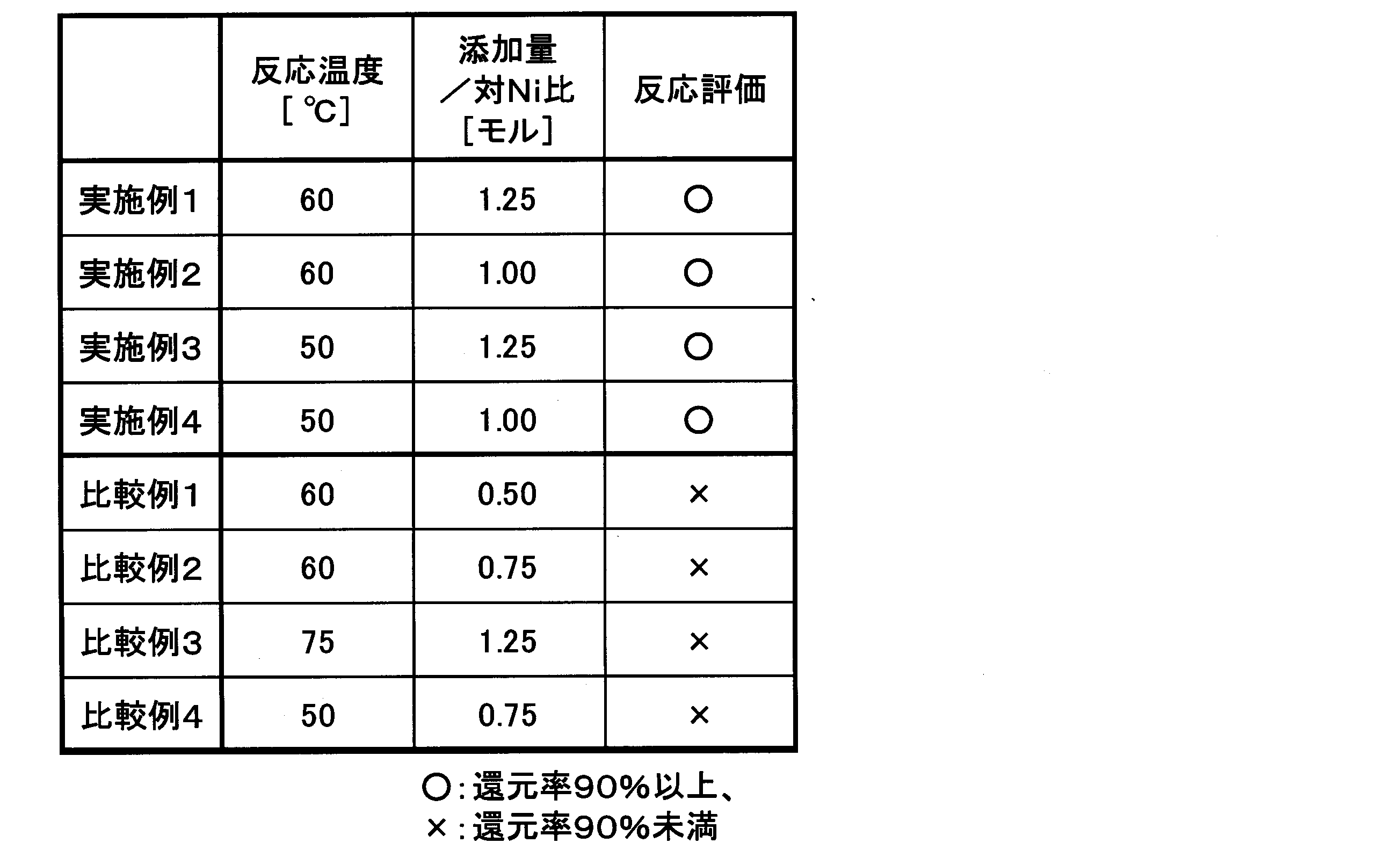
- Table 1 which summarizes the following results, the reaction evaluation was evaluated as “ ⁇ ” when the recovery rate of the seed crystal nickel powder exceeded 90%, and “x” when the recovery rate was less than 90%.
- Example 1 In the “seed crystal production” in Example 1, the liquid temperature when mixing and reducing the container A and the container B was maintained at 60 ° C., and 1.00 mol of hydrazine was added to 1 mol of nickel. Except for this, nickel powder was produced using the same method as in Example 1. As a result, a good reaction with a nickel powder recovery rate of 90% or more was confirmed. The results are summarized in Table 1.
- Example 1 In the “seed crystal production” in Example 1, the liquid temperature during the reduction reaction by mixing the container A and the container B was maintained at 50 ° C., and 1.25 mol of hydrazine was added per mol of nickel. Except for this, nickel powder was produced using the same method as in Example 1. As a result, as in Examples 1 and 2, a good reaction with a nickel powder recovery rate of 90% or more was confirmed. The results are summarized in Table 1.
- Example 1 In the “seed crystal production” in Example 1, the liquid temperature during the reduction reaction by mixing the container A and the container B was maintained at 50 ° C., and 1.00 mol of hydrazine was added per mol of nickel. Except for this, nickel powder was produced using the same method as in Example 1. As a result, as in Examples 1 to 3, a good reaction with a nickel powder recovery rate of 90% or more was confirmed. The results are summarized in Table 1.
- Example 1 In “seed crystal production” in Example 1, the liquid temperature during the reduction reaction by mixing containers A and B was maintained at 60 ° C., and 0.50 mol of hydrazine was added per mol of nickel. Except for this, nickel powder was produced using the same method as in Example 1. As a result, hydrazine was insufficient, and the system was basic, so that nickel hydroxide and nickel powder coprecipitated, and the nickel powder recovery rate was less than 90%. The results are summarized in Table 1.
- Example 2 In the “seed crystal production” in Example 1, the liquid temperature during the reduction reaction by mixing the container A and the container B was maintained at 60 ° C., and 0.75 mol of hydrazine was added to 1 mol of nickel. Except for this, nickel powder was produced using the same method as in Example 1. As a result, hydrazine was insufficient, and the system was basic, so that nickel hydroxide and nickel powder coprecipitated, and the nickel powder recovery rate was less than 90%. The results are summarized in Table 1.
- Example 3 In the “seed crystal production” in Example 1, the liquid temperature during the reduction reaction by mixing the container A and the container B was maintained at 75 ° C., and 1.25 mol of hydrazine was added to 1 mol of nickel. Except for this, nickel powder was produced using the same method as in Example 1. As a result, hydrazine was insufficient, and the system was basic, so that nickel hydroxide and nickel powder coprecipitated, and the nickel powder recovery rate was less than 90%. The results are summarized in Table 1.
- Example 4 In the “seed crystal production” in Example 1, the liquid temperature during the reduction reaction by mixing the container A and the container B was maintained at 50 ° C., and 0.75 mol of hydrazine was added to 1 mol of nickel. Except for this, nickel powder was produced using the same method as in Example 1. As a result, hydrazine was insufficient, and the system was basic, so that nickel hydroxide and nickel powder coprecipitated, and the nickel powder recovery rate was less than 90%. The results are summarized in Table 1.
Landscapes
- Chemical & Material Sciences (AREA)
- Chemical Kinetics & Catalysis (AREA)
- General Chemical & Material Sciences (AREA)
- Manufacture Of Metal Powder And Suspensions Thereof (AREA)
Abstract
Description
非特許文献1の方法は、硫酸ニッケル水溶液に錯化剤を混合して錯化処理してニッケルアンミン錯体の溶液を形成し、その溶液を加圧容器に入れて密栓後、150~250℃程度に昇温、保持し、その中に水素ガスを吹き込む、いわゆる錯化還元法と呼ばれる方法で、水素によりニッケルアンミン錯体が還元されてニッケル粉を生成するものである。
しかしながら、還元反応によって金属粒子を得ようとする場合、添加された還元剤と溶液が均一に反応しないとランダムに結晶核が発生し、過度に微細な粉末が生成したり、均一な粒子を得ることが難しくなって還元効率が低下したりするなどの課題を抱えている。
そのため、種結晶は、製品の一部を繰り返して使用する方法もあるが、製品を種結晶に適したサイズや性状に加工する手間がかかったり、一度作った製品を繰り返す分だけ収率が低下してコストが増加する問題を抱えている。
しかしながら鉄粉を用いるために製品中に鉄が混入し、高純度な品質が必要となる用途に用いることが難しくなる課題があった。
特許文献1は安価で、かつ耐侯性に優れ、樹脂と混練した状態で電気抵抗が低く、初期電気抵抗および使用中の電気抵抗を低減し、長期間にわたり安定して使用でき、導電ペーストおよび導電樹脂用の導電性粒子として好適なニッケル粉、およびその製造方法を提供するもので、具体的にはコバルトを1~20質量%含有し、残部がニッケルおよび不可避不純物からなり、一次粒子が凝集した二次粒子で構成されるニッケル粉であって、酸素含有量が0.8質量%以下である。二次粒子の表層部にのみコバルトを含有し、その表層部におけるコバルト含有量が1~40質量%とすることが好ましいものである。
しかしながら、特許文献1の方法も種結晶としてコバルト等の不純物を添加するために、上記鉄の種結晶を使用した場合と同様に製品への混入による品質の低下がある。
この方法は、金属化合物、還元剤、錯化剤、分散剤を溶解することにより、金属化合物に由来する金属イオンを含有する水溶液を作製する第1工程と、水溶液のpH調整をすることにより金属イオンを還元剤により還元させ、金属粉末を析出させる第2工程とを備える金属粉末の製造方法である。
本発明に係る種結晶を得るための製造方法の製造フロー図を図1の「種結晶製造方法」に示す。
図1からも判るように、本発明はヒドラジンなどの薬液を用いた湿式還元によりニッケル粉を得る方法である。
即ち、試料溶液と液体還元剤とを、液-液接触させて、所望の種結晶を製造するものである。
しかしながら、この還元剤のコストインパクトは大きいので、最適な添加量を把握し、その結果として過剰な添加を抑制する方法を用いた。
60℃を超えると、ヒドラジンの自己分解反応が加速し、添加当量を増加しないと還元剤が不足することになり、一方50℃よりも低いと、極端に反応時間を要するため実用的でなく、さらに反応が円滑に進まず、反応槽内の条件が不均一になりやすく安定したニッケル粉の生成が難しくなるためである。
つまり反応温度が50~60℃であって、添加するヒドラジンがニッケル量の1.0~1.25倍に相当する量を添加した場合、水素還元ニッケル粉の製造に使用する種結晶に適した種結晶のニッケル粉を得ることができる。
本発明に係る水素還元ニッケル粉の製造方法の製造フローを図1の「水素還元ニッケル粉製造方法」に示す。
図1からも判るように、本発明に係る水素還元ニッケル粉の製造方法は、ニッケルイオンを含む酸性溶液から錯体溶液を形成する錯化工程、及び得られた錯体溶液中に、種結晶のニッケル粉を添加し、錯体溶液中のニッケル錯体イオンを水素ガスにより還元して、種結晶表面に析出、成長させてニッケル粉とする還元剤に水素を用いる水素還元工程を順に経て製造するものである。特に、添加する種結晶として、本発明に係る種結晶の製造方法を用いて作製した種結晶を用いることで、より高い還元率が得られることを特徴とするものである。
なお、図示してはいないが、本発明の種結晶の製造方法において、ヒドラジンの添加の際に、錯化剤と水酸化ナトリウムとの混合溶液と所定濃度のヒドラジン溶液を混合した溶液を形成して、この溶液を、ニッケルを含有する溶液に混合すると、種結晶用のニッケル粉を、安定して得ることができて好ましい。
還元工程において核として用いるニッケル種結晶を、以下に示す製造方法により生成する。
先ず、容器Aに試薬硫酸ニッケル6水和物89.55g(Ni量純分で20g相当)を採取し、液中のニッケル濃度が110g/Lとなるように溶解し、液温を60℃に昇温、維持した。
次に別の容器Bに、濃度250g/Lの水酸化ナトリウム溶液95mlと25%アンモニア水溶液48.9mlを混合し、容器Aと同じ温度に昇温、維持した。
上記容器Aと容器Bを、混合して容器Cに入れて60℃の液温を維持しながら1時間撹拌してスラリーを形成した。
また、得られた種結晶のニッケル粉の平均粒径は約2μmだった。
[種結晶添加]
ニッケル分で75gとなる量の試薬硫酸ニッケル6水和物の水溶液に硫酸アンモニウム330gと、25%アンモニア水191mlを添加し、合計の液量が1000mlになるように調整した。この溶液に上記種結晶製造で作製した種晶用のニッケル粉7.5gと分散剤としてリグニンスルホン酸ナトリウム1.5gを添加してスラリーを形成した。
次に作製したスラリーを、オートクレーブの内筒缶に入れ、撹拌しながら185℃に昇温、保持した。185℃に保持した状態のスラリーに水素ガスボンベから供給された水素ガスを吹き込み、オートクレーブの内筒缶内の圧力が3.5MPaになるように水素ガスを供給した。
水素ガスの供給後、1時間が経過した所で水素ガスの供給を停止し、オートクレーブの内筒缶を冷却した。冷却後、内筒缶内のスラリーを取り出し、濾過して水素還元によるニッケル粉を回収した。
このときの回収した水素還元によるニッケル粉の量は70gで、液中の残留ニッケル濃度から算出した還元率は、80%を超える水準となり、本発明に係るニッケル種結晶の製造方法の有用性を確認した。
なお、下記の結果を纏めた表1において、反応評価は種結晶ニッケル粉の回収率が90%を超える場合に「○」とし、回収率90%未満の場合、「×」として評価した。
その結果、ニッケル粉回収率90%以上の良好な反応を確認した。結果を纏めて、表1に示す。
その結果、実施例1及び2と同様にニッケル粉回収率90%以上の良好な反応を確認した。結果を纏めて、表1に示す。
その結果、実施例1~3と同様にニッケル粉回収率90%以上の良好な反応を確認した。結果を纏めて、表1に示す。
実施例1における「種結晶製造」において、容器Aと容器Bを混合して還元反応する際の液温を60℃に保持し、ニッケル1モル当たりに対して0.50モルのヒドラジンを添加した以外は、実施例1と同じ方法を用いてニッケル粉を製造した。
その結果、ヒドラジンが不足し、系内が塩基性の為に水酸化ニッケルとニッケル粉が共沈し、ニッケル粉回収率は90%未満となった。結果を纏めて、表1に示す。
実施例1における「種結晶製造」において、容器Aと容器Bを混合して還元反応する際の液温を60℃に保持し、ニッケル1モル当たりに対して0.75モルのヒドラジンを添加した以外は、実施例1と同じ方法を用いてニッケル粉を製造した。
その結果、ヒドラジンが不足し、系内が塩基性の為に水酸化ニッケルとニッケル粉が共沈し、ニッケル粉回収率は90%未満となった。結果を纏めて、表1に示す。
実施例1における「種結晶製造」において、容器Aと容器Bを混合して還元反応する際の液温を75℃に保持し、ニッケル1モル当たりに対して1.25モルのヒドラジンを添加した以外は、実施例1と同じ方法を用いてニッケル粉を製造した。
その結果、ヒドラジンが不足し、系内が塩基性の為に水酸化ニッケルとニッケル粉が共沈し、ニッケル粉回収率は90%未満となった。結果を纏めて、表1に示す。
実施例1における「種結晶製造」において、容器Aと容器Bを混合して還元反応する際の液温を50℃に保持し、ニッケル1モル当たりに対して0.75モルのヒドラジンを添加した以外は、実施例1と同じ方法を用いてニッケル粉を製造した。
その結果、ヒドラジンが不足し、系内が塩基性の為に水酸化ニッケルとニッケル粉が共沈し、ニッケル粉回収率は90%未満となった。結果を纏めて、表1に示す。
Claims (4)
- 水素還元ニッケル粉の製造に用いる種結晶の製造方法であって、
50℃以上、60℃以下の温度に維持したニッケルイオンを含有する酸性溶液に、前記酸性溶液に含まれるニッケル成分1モル当たり、1モル以上、1.25モル以下の量のヒドラジンを添加して生成されたことを特徴とする水素還元ニッケル粉の製造に用いる種結晶の製造方法。 - 前記ニッケルイオンを含有する酸性溶液へのヒドラジンの添加が、水酸化ナトリウムと錯化剤の混合溶液と、前記酸性溶液に含まれるニッケル成分1モル当たり、1モル以上、1.25モル以下の量のヒドラジンを含むヒドラジン溶液とを混合して形成した溶液を、前記酸性溶液に添加して行われることを特徴とする請求項1記載の水素還元ニッケル粉の製造に用いる種結晶の製造方法。
- ニッケルイオンを含有する酸性溶液から水素還元を経てニッケル粉を生成する水素還元ニッケル粉の製造方法における前記ニッケルイオンを含有する酸性溶液に、錯化剤と種結晶を添加してニッケル錯体イオンと種結晶を含む錯体溶液を形成した後、水素ガスを吹き込んでニッケル錯体イオンを還元してニッケル粉末を生成する水素還元工程において、
添加される前記種結晶が、50℃以上、60℃以下の温度に維持したニッケルイオンを含有する酸性溶液に、前記酸性溶液に含まれるニッケル成分1モル当たり、1モル以上、1.25モル以下の量のヒドラジンを添加して生成したニッケル粉であることを特徴とする水素還元ニッケル粉の製造方法。 - 前記ニッケルイオンを含有する酸性溶液へのヒドラジンの添加が、水酸化ナトリウムと錯化剤の混合溶液と、前記酸性溶液に含まれるニッケル成分1モル当たり、1モル以上、1.25モル以下の量のヒドラジンを含むヒドラジン溶液とを混合して形成した溶液を、前記酸性溶液に添加して行われることを特徴とする請求項3記載の水素還元ニッケル粉の製造方法。
Priority Applications (6)
| Application Number | Priority Date | Filing Date | Title |
|---|---|---|---|
| CA2939183A CA2939183C (en) | 2014-02-17 | 2015-02-03 | Method for producing seed crystals used for producing hydrogen-reduced nickel powder |
| AU2015216321A AU2015216321B2 (en) | 2014-02-17 | 2015-02-03 | Production method for seed crystal used in production of hydrogen-reduced nickel powder |
| EP15748672.1A EP3108985B1 (en) | 2014-02-17 | 2015-02-03 | Production method for seed crystal used in production of hydrogen-reduced nickel powder |
| CN201580008755.9A CN105992662B (zh) | 2014-02-17 | 2015-02-03 | 氢还原镍粉的制造所使用的晶种的制造方法 |
| US15/117,840 US9700942B2 (en) | 2014-02-17 | 2015-02-03 | Method for producing seed crystals used for producing hydrogen-reduced nickel powder |
| PH12016501636A PH12016501636A1 (en) | 2014-02-17 | 2016-08-17 | Method for producing seed crystals used for producing hydrogen-reduced nickel powder |
Applications Claiming Priority (2)
| Application Number | Priority Date | Filing Date | Title |
|---|---|---|---|
| JP2014-027899 | 2014-02-17 | ||
| JP2014027899A JP5811376B2 (ja) | 2014-02-17 | 2014-02-17 | 水素還元ニッケル粉の製造に用いる種結晶の製造方法 |
Publications (1)
| Publication Number | Publication Date |
|---|---|
| WO2015122315A1 true WO2015122315A1 (ja) | 2015-08-20 |
Family
ID=53800062
Family Applications (1)
| Application Number | Title | Priority Date | Filing Date |
|---|---|---|---|
| PCT/JP2015/052908 Ceased WO2015122315A1 (ja) | 2014-02-17 | 2015-02-03 | 水素還元ニッケル粉の製造に用いる種結晶の製造方法 |
Country Status (8)
| Country | Link |
|---|---|
| US (1) | US9700942B2 (ja) |
| EP (1) | EP3108985B1 (ja) |
| JP (1) | JP5811376B2 (ja) |
| CN (1) | CN105992662B (ja) |
| AU (1) | AU2015216321B2 (ja) |
| CA (1) | CA2939183C (ja) |
| PH (1) | PH12016501636A1 (ja) |
| WO (1) | WO2015122315A1 (ja) |
Cited By (1)
| Publication number | Priority date | Publication date | Assignee | Title |
|---|---|---|---|---|
| CN108349012A (zh) * | 2015-10-26 | 2018-07-31 | 住友金属矿山株式会社 | 高密度镍粉的制造方法 |
Families Citing this family (7)
| Publication number | Priority date | Publication date | Assignee | Title |
|---|---|---|---|---|
| JP5828923B2 (ja) * | 2014-01-30 | 2015-12-09 | 国立大学法人高知大学 | ニッケル粉の製造方法 |
| JP5936783B2 (ja) * | 2014-02-21 | 2016-06-22 | 国立大学法人高知大学 | ニッケル粉の製造方法 |
| JP2016037928A (ja) | 2014-08-08 | 2016-03-22 | 臼井国際産業株式会社 | ガソリン直噴エンジン用燃料レールの端末シール構造 |
| WO2016117138A1 (ja) * | 2015-01-22 | 2016-07-28 | 住友金属鉱山株式会社 | ニッケル粉の製造方法 |
| JP6726396B2 (ja) * | 2016-02-22 | 2020-07-22 | 住友金属鉱山株式会社 | ニッケル粉の製造方法 |
| CN110049840B (zh) * | 2016-12-05 | 2022-06-24 | 住友金属矿山株式会社 | 镍粉末的制造方法 |
| KR20230122581A (ko) * | 2020-12-23 | 2023-08-22 | 미쓰이금속광업주식회사 | 니켈 분말, 그 제조 방법, 도전성 조성물 및 도전막 |
Citations (5)
| Publication number | Priority date | Publication date | Assignee | Title |
|---|---|---|---|---|
| JPH09227908A (ja) * | 1996-02-22 | 1997-09-02 | Agency Of Ind Science & Technol | 金属微粒子の製造方法 |
| WO2008001741A1 (en) * | 2006-06-27 | 2008-01-03 | Ishihara Sangyo Kaisha, Ltd. | Nickel fine particle, method for producing the same, and fluid composition using the same |
| WO2012114637A1 (ja) * | 2011-02-25 | 2012-08-30 | 株式会社村田製作所 | ニッケル粉末の製造方法 |
| JP2013014813A (ja) * | 2011-07-06 | 2013-01-24 | Murata Mfg Co Ltd | 多孔質金属粒子及びその製造方法 |
| JP2013221192A (ja) * | 2012-04-18 | 2013-10-28 | Sumitomo Metal Mining Co Ltd | ニッケル粉及びその製造方法 |
Family Cites Families (9)
| Publication number | Priority date | Publication date | Assignee | Title |
|---|---|---|---|---|
| JPH03257106A (ja) * | 1990-03-08 | 1991-11-15 | Unitika Ltd | 汎用金属粉末の製造方法 |
| JP3957444B2 (ja) * | 1999-11-22 | 2007-08-15 | 三井金属鉱業株式会社 | ニッケル粉、その製造方法及び電子部品電極形成用ペースト |
| JP2005240164A (ja) | 2004-02-27 | 2005-09-08 | Sumitomo Metal Mining Co Ltd | ニッケル粉およびその製造方法 |
| JP2007247056A (ja) * | 2006-02-20 | 2007-09-27 | Shinano Kenshi Co Ltd | 複合粒子、これを用いた複合材および複合粒子の製造方法 |
| JP2009227908A (ja) | 2008-03-25 | 2009-10-08 | Toray Ind Inc | 熱可塑性樹脂フィルムおよびその製造方法 |
| CN101428349B (zh) * | 2008-07-29 | 2011-06-22 | 张建玲 | 一种镍钴金属粉末的制备方法 |
| KR20100016821A (ko) * | 2008-08-05 | 2010-02-16 | 삼성전기주식회사 | 니켈 나노입자 제조방법 |
| JP5407495B2 (ja) | 2009-04-02 | 2014-02-05 | 住友電気工業株式会社 | 金属粉末および金属粉末製造方法、導電性ペースト、並びに積層セラミックコンデンサ |
| JP5828923B2 (ja) * | 2014-01-30 | 2015-12-09 | 国立大学法人高知大学 | ニッケル粉の製造方法 |
-
2014
- 2014-02-17 JP JP2014027899A patent/JP5811376B2/ja active Active
-
2015
- 2015-02-03 CA CA2939183A patent/CA2939183C/en not_active Expired - Fee Related
- 2015-02-03 AU AU2015216321A patent/AU2015216321B2/en not_active Ceased
- 2015-02-03 WO PCT/JP2015/052908 patent/WO2015122315A1/ja not_active Ceased
- 2015-02-03 EP EP15748672.1A patent/EP3108985B1/en active Active
- 2015-02-03 US US15/117,840 patent/US9700942B2/en not_active Expired - Fee Related
- 2015-02-03 CN CN201580008755.9A patent/CN105992662B/zh not_active Expired - Fee Related
-
2016
- 2016-08-17 PH PH12016501636A patent/PH12016501636A1/en unknown
Patent Citations (5)
| Publication number | Priority date | Publication date | Assignee | Title |
|---|---|---|---|---|
| JPH09227908A (ja) * | 1996-02-22 | 1997-09-02 | Agency Of Ind Science & Technol | 金属微粒子の製造方法 |
| WO2008001741A1 (en) * | 2006-06-27 | 2008-01-03 | Ishihara Sangyo Kaisha, Ltd. | Nickel fine particle, method for producing the same, and fluid composition using the same |
| WO2012114637A1 (ja) * | 2011-02-25 | 2012-08-30 | 株式会社村田製作所 | ニッケル粉末の製造方法 |
| JP2013014813A (ja) * | 2011-07-06 | 2013-01-24 | Murata Mfg Co Ltd | 多孔質金属粒子及びその製造方法 |
| JP2013221192A (ja) * | 2012-04-18 | 2013-10-28 | Sumitomo Metal Mining Co Ltd | ニッケル粉及びその製造方法 |
Non-Patent Citations (1)
| Title |
|---|
| See also references of EP3108985A4 * |
Cited By (1)
| Publication number | Priority date | Publication date | Assignee | Title |
|---|---|---|---|---|
| CN108349012A (zh) * | 2015-10-26 | 2018-07-31 | 住友金属矿山株式会社 | 高密度镍粉的制造方法 |
Also Published As
| Publication number | Publication date |
|---|---|
| EP3108985B1 (en) | 2019-11-20 |
| CN105992662A (zh) | 2016-10-05 |
| JP5811376B2 (ja) | 2015-11-11 |
| CA2939183C (en) | 2018-04-03 |
| US20170008089A1 (en) | 2017-01-12 |
| CN105992662B (zh) | 2018-03-02 |
| EP3108985A1 (en) | 2016-12-28 |
| JP2015151590A (ja) | 2015-08-24 |
| PH12016501636B1 (en) | 2017-02-06 |
| AU2015216321A1 (en) | 2016-09-01 |
| AU2015216321B2 (en) | 2016-10-13 |
| EP3108985A4 (en) | 2018-01-24 |
| CA2939183A1 (en) | 2015-08-20 |
| US9700942B2 (en) | 2017-07-11 |
| PH12016501636A1 (en) | 2017-02-06 |
Similar Documents
| Publication | Publication Date | Title |
|---|---|---|
| JP5811376B2 (ja) | 水素還元ニッケル粉の製造に用いる種結晶の製造方法 | |
| AU2015211866B2 (en) | Manufacturing method for nickel powder | |
| JP6610425B2 (ja) | ニッケル粉の製造方法 | |
| JP5936783B2 (ja) | ニッケル粉の製造方法 | |
| JP2017150063A5 (ja) | ||
| JP6624464B2 (ja) | ニッケル粉の製造方法 | |
| JP6489315B2 (ja) | コバルト粉の製造方法 | |
| CN105817641A (zh) | 一种利用新生纳米晶种诱导生产金属粉末的制备方法 | |
| WO2017073392A1 (ja) | コバルト粉の種結晶の製造方法 | |
| JP6726396B2 (ja) | ニッケル粉の製造方法 | |
| JP6531913B2 (ja) | ニッケル粉の製造方法 | |
| JP2017150002A5 (ja) | ||
| WO2017038589A1 (ja) | ニッケル粉の製造方法 | |
| JP2020015971A (ja) | ニッケル粉の製造方法 |
Legal Events
| Date | Code | Title | Description |
|---|---|---|---|
| 121 | Ep: the epo has been informed by wipo that ep was designated in this application |
Ref document number: 15748672 Country of ref document: EP Kind code of ref document: A1 |
|
| ENP | Entry into the national phase |
Ref document number: 2939183 Country of ref document: CA |
|
| WWE | Wipo information: entry into national phase |
Ref document number: 15117840 Country of ref document: US |
|
| NENP | Non-entry into the national phase |
Ref country code: DE |
|
| WWE | Wipo information: entry into national phase |
Ref document number: 12016501636 Country of ref document: PH |
|
| ENP | Entry into the national phase |
Ref document number: 2015216321 Country of ref document: AU Date of ref document: 20150203 Kind code of ref document: A |
|
| REEP | Request for entry into the european phase |
Ref document number: 2015748672 Country of ref document: EP |
|
| WWE | Wipo information: entry into national phase |
Ref document number: 2015748672 Country of ref document: EP |
|
| WWE | Wipo information: entry into national phase |
Ref document number: IDP00201606198 Country of ref document: ID |