WO2015122382A1 - Équipement d'utilisateur, station de base, et procédé de commande d'agrégation de porteuses - Google Patents
Équipement d'utilisateur, station de base, et procédé de commande d'agrégation de porteuses Download PDFInfo
- Publication number
- WO2015122382A1 WO2015122382A1 PCT/JP2015/053504 JP2015053504W WO2015122382A1 WO 2015122382 A1 WO2015122382 A1 WO 2015122382A1 JP 2015053504 W JP2015053504 W JP 2015053504W WO 2015122382 A1 WO2015122382 A1 WO 2015122382A1
- Authority
- WO
- WIPO (PCT)
- Prior art keywords
- reception timing
- information
- timing difference
- base station
- reception
- Prior art date
- Legal status (The legal status is an assumption and is not a legal conclusion. Google has not performed a legal analysis and makes no representation as to the accuracy of the status listed.)
- Ceased
Links
Images





Classifications
-
- H—ELECTRICITY
- H04—ELECTRIC COMMUNICATION TECHNIQUE
- H04W—WIRELESS COMMUNICATION NETWORKS
- H04W72/00—Local resource management
- H04W72/04—Wireless resource allocation
- H04W72/044—Wireless resource allocation based on the type of the allocated resource
- H04W72/0453—Resources in frequency domain, e.g. a carrier in FDMA
-
- H—ELECTRICITY
- H04—ELECTRIC COMMUNICATION TECHNIQUE
- H04L—TRANSMISSION OF DIGITAL INFORMATION, e.g. TELEGRAPHIC COMMUNICATION
- H04L5/00—Arrangements affording multiple use of the transmission path
- H04L5/0001—Arrangements for dividing the transmission path
- H04L5/0003—Two-dimensional division
- H04L5/0005—Time-frequency
- H04L5/0007—Time-frequency the frequencies being orthogonal, e.g. OFDM(A) or DMT
- H04L5/001—Time-frequency the frequencies being orthogonal, e.g. OFDM(A) or DMT the frequencies being arranged in component carriers
-
- H—ELECTRICITY
- H04—ELECTRIC COMMUNICATION TECHNIQUE
- H04B—TRANSMISSION
- H04B7/00—Radio transmission systems, i.e. using radiation field
- H04B7/02—Diversity systems; Multi-antenna system, i.e. transmission or reception using multiple antennas
- H04B7/04—Diversity systems; Multi-antenna system, i.e. transmission or reception using multiple antennas using two or more spaced independent antennas
- H04B7/06—Diversity systems; Multi-antenna system, i.e. transmission or reception using multiple antennas using two or more spaced independent antennas at the transmitting station
- H04B7/0613—Diversity systems; Multi-antenna system, i.e. transmission or reception using multiple antennas using two or more spaced independent antennas at the transmitting station using simultaneous transmission
- H04B7/0615—Diversity systems; Multi-antenna system, i.e. transmission or reception using multiple antennas using two or more spaced independent antennas at the transmitting station using simultaneous transmission of weighted versions of same signal
- H04B7/0619—Diversity systems; Multi-antenna system, i.e. transmission or reception using multiple antennas using two or more spaced independent antennas at the transmitting station using simultaneous transmission of weighted versions of same signal using feedback from receiving side
- H04B7/0621—Feedback content
- H04B7/0626—Channel coefficients, e.g. channel state information [CSI]
-
- H—ELECTRICITY
- H04—ELECTRIC COMMUNICATION TECHNIQUE
- H04L—TRANSMISSION OF DIGITAL INFORMATION, e.g. TELEGRAPHIC COMMUNICATION
- H04L43/00—Arrangements for monitoring or testing data switching networks
- H04L43/16—Threshold monitoring
-
- H—ELECTRICITY
- H04—ELECTRIC COMMUNICATION TECHNIQUE
- H04L—TRANSMISSION OF DIGITAL INFORMATION, e.g. TELEGRAPHIC COMMUNICATION
- H04L5/00—Arrangements affording multiple use of the transmission path
-
- H—ELECTRICITY
- H04—ELECTRIC COMMUNICATION TECHNIQUE
- H04L—TRANSMISSION OF DIGITAL INFORMATION, e.g. TELEGRAPHIC COMMUNICATION
- H04L5/00—Arrangements affording multiple use of the transmission path
- H04L5/0091—Signalling for the administration of the divided path, e.g. signalling of configuration information
- H04L5/0096—Indication of changes in allocation
- H04L5/0098—Signalling of the activation or deactivation of component carriers, subcarriers or frequency bands
-
- H—ELECTRICITY
- H04—ELECTRIC COMMUNICATION TECHNIQUE
- H04W—WIRELESS COMMUNICATION NETWORKS
- H04W24/00—Supervisory, monitoring or testing arrangements
- H04W24/10—Scheduling measurement reports ; Arrangements for measurement reports
-
- H—ELECTRICITY
- H04—ELECTRIC COMMUNICATION TECHNIQUE
- H04W—WIRELESS COMMUNICATION NETWORKS
- H04W56/00—Synchronisation arrangements
-
- H—ELECTRICITY
- H04—ELECTRIC COMMUNICATION TECHNIQUE
- H04W—WIRELESS COMMUNICATION NETWORKS
- H04W68/00—User notification, e.g. alerting and paging, for incoming communication, change of service or the like
-
- H—ELECTRICITY
- H04—ELECTRIC COMMUNICATION TECHNIQUE
- H04W—WIRELESS COMMUNICATION NETWORKS
- H04W72/00—Local resource management
- H04W72/04—Wireless resource allocation
- H04W72/044—Wireless resource allocation based on the type of the allocated resource
- H04W72/0446—Resources in time domain, e.g. slots or frames
-
- H—ELECTRICITY
- H04—ELECTRIC COMMUNICATION TECHNIQUE
- H04W—WIRELESS COMMUNICATION NETWORKS
- H04W76/00—Connection management
- H04W76/10—Connection setup
- H04W76/15—Setup of multiple wireless link connections
-
- H—ELECTRICITY
- H04—ELECTRIC COMMUNICATION TECHNIQUE
- H04W—WIRELESS COMMUNICATION NETWORKS
- H04W76/00—Connection management
- H04W76/30—Connection release
- H04W76/34—Selective release of ongoing connections
Definitions
- the present invention relates to a user apparatus UE and a base station eNB in a mobile communication system that performs carrier aggregation.
- CA Carrier Aggregation
- a carrier that is a basic unit in carrier aggregation is called a component carrier (CC).
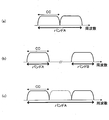
- FIGS. 1 (a) to 1 (c) Carrier aggregation is classified into three scenarios as shown in FIGS. 1 (a) to 1 (c) according to the frequency arrangement of CC.
- FIG. 1A shows an intra-band contiguous CA in which a continuous CC is arranged in a band. This scenario is applied, for example, when a broadband allocation such as a 3.5 GHz band is performed.
- FIG. 1B is an inter-band non-contiguous CA in which a plurality of CCs of different bands are arranged. This scenario is applied, for example, when communication is performed using a plurality of carriers such as a 2 GHz band and a 1.5 GHz band.
- FIG. 1C illustrates an intra-band non-contiguous CA in which a discontinuous CC is arranged in the same band. This scenario is applied, for example, when the allocation of frequency bands to operators is fragmented.
- a PCell Primary cell
- SCell Secondary cell
- the user apparatus UE can connect to the PCell and add an SCell as necessary.
- the PCell is a cell similar to a cell in the LTE system that supports RLM (Radio Link Monitoring), SPS (Semi-Persistent Scheduling), and the like.
- the SCell is a cell that is added to the PCell and set for the user apparatus UE.
- the addition and deletion of Scell is performed by RRC (Radio Resource Control) signaling.
- RRC Radio Resource Control
- the SCell Immediately after being set for the user apparatus UE, the SCell is in an inactive state (deactivate state). is there.
- the CC corresponding to the PCell is referred to as a PCC (Primary Component Carrier), and the CC corresponding to the SCell is referred to as an SCC (Secondary Component Carrier).
- the user equipment UE measures the reception level (RSRP: Reference Signal Received Power) and the reception quality (RSRQ: Reference Signal Received Quality) of the connected (neighboring) cell and the reception condition (RSRQ: Reference Signal Received Quality) for each CC. ) Can be reported to the base station eNB as a measurement report.
- RSRP Reference Signal Received Power
- RSRQ Reference Signal Received Quality
- the reception timing difference (delay spread) in the user apparatus UE between CCs needs to be within a predetermined threshold (Annex J of Non-Patent Document 1). That is, for example, in one form of CA that forms a macro cell and a small cell as shown in FIG. 2, the reception timing difference at which the user apparatus UE receives signals transmitted simultaneously from the macro eNB and the small eNB falls within a predetermined threshold. There is a need. This is because when the reception timing difference becomes larger than the predetermined threshold, the user apparatus UE cannot appropriately process the timing difference, and the reception quality in CA may be deteriorated.
- the user apparatus UE may report a very small value as the CQI, but the base station eNB has deteriorated the quality of the SCell, or has gone out of the reception window (reception timing) It is impossible to determine whether the difference is equal to or greater than a predetermined threshold.
- the reception timing of a certain SCell shifts to a threshold value or more with respect to the reference timing (eg, reception timing of PCell) and falls outside the reception window, if the quality of the SCell itself is good (for example, by Event A2 )
- the measurement report may not be sent.
- the base station eNB Based on the measurement report for each CC, the base station eNB performs control such as switching the CC and switching the CC being used to an unused CC of higher quality, but the base station eNB can know the event. If it is not possible, an unusable SCell is always maintained, which is not desirable in terms of battery saving, NW resources, and radio resources of the user equipment UE.
- the present invention has been made in view of the above points.
- a base station grasps a reception timing difference between CCs in a user apparatus, and appropriately adds or deletes SCells.
- the purpose is to provide a technology that makes it possible.
- a user apparatus in a mobile communication system that supports carrier aggregation, A measurement unit for measuring a reception timing difference between component carriers; An information notification unit for notifying the base station of information related to the reception timing difference measured by the measurement unit; A user apparatus is provided that includes a control unit that adds or deletes a secondary cell in the carrier aggregation based on an instruction from the base station that has received the information.
- a base station in a mobile communication system corresponding to carrier aggregation A receiving unit that receives information on a reception timing difference between component carriers for a certain component carrier from a user device; A determination unit that determines whether or not to add or delete a secondary cell cell corresponding to the component carrier, based on information on a reception timing difference received by the reception unit; There is provided a base station comprising: an information notification unit that instructs the user apparatus to add or delete the secondary cell cell based on a determination result by the determination unit.
- a carrier aggregation control method executed by a user apparatus in a mobile communication system corresponding to carrier aggregation, A measurement step for measuring a reception timing difference between component carriers; An information notification step of notifying the base station of information related to the reception timing difference measured by the measurement unit; There is provided a carrier aggregation control method comprising: a control step of adding or deleting a secondary cell in the carrier aggregation based on an instruction from the base station that has received the information.
- a carrier aggregation control method executed by a base station in a mobile communication system supporting carrier aggregation, A reception step of receiving information on a reception timing difference between component carriers for a certain component carrier from a user device; A determination step of determining whether or not to add or delete a secondary cell corresponding to the component carrier, based on the information on the reception timing difference received in the reception step; There is provided a carrier aggregation control method comprising: an information notification step for instructing the user apparatus to add or delete the secondary cell based on a determination result in the determination step.
- a technology enables a base station to grasp a reception timing difference between CCs in a user apparatus and appropriately add or delete an SCell. Is provided.
- FIG. 1 is a configuration diagram of a mobile communication system according to an embodiment of the present invention. It is a processing sequence in a 1st embodiment. It is a figure for demonstrating the reception timing difference between CC. It is a processing sequence in 2nd Embodiment. It is a figure for demonstrating the determination method inside / outside of a reception window. It is a figure which shows the example of MAC CE for notifying the information regarding a reception timing difference. It is a processing sequence of the other example in 2nd Embodiment. It is a functional block diagram of the user apparatus UE. It is a flowchart which shows the basic operation
- LTE Long Term Evolution
- LTE-Advanced Long Term Evolution
- FIG. 3 shows a configuration diagram of the mobile communication system according to the embodiment of the present invention.
- the mobile communication system according to the present embodiment shown in FIG. 3 is an LTE mobile communication system, and includes a base station eNB that manages PCells and SCells # 0 to # 2, and a user apparatus UE.
- a base station eNB that manages PCells and SCells # 0 to # 2
- a user apparatus UE may have an uplink cell and a downlink cell, but in this embodiment, attention is particularly paid to the downlink direction.
- one user apparatus UE and one base station eNB are shown in FIG. 3, this is an example, and there may be a plurality of each.
- the form of CA which the user apparatus UE communicates simultaneously with several base stations eNB as shown in FIG. 2 may be sufficient.
- the base station eNB cannot grasp the reception timing difference between CCs.
- this problem is solved and the base station eNB grasps the reception timing difference between CCs. It has a mechanism to do it.
- FIG. 4 shows a sequence example in the present embodiment.
- the carrier (frequency) used as the candidate of added CC is not CC which comprises CA before adding, but it is called CC in the meaning of unused CC.
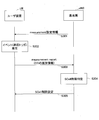
- the base station eNB transmits measurement setting information to the user apparatus UE (step 101).
- the measurement setting information includes, for example, a frequency to be measured, a timing at which the user apparatus UE transmits a measurement report, a condition (event, threshold), and the like. Further, the measurement setting information may include whether or not to include information on the reception timing difference between CCs in the measurement report, and what information to include in the measurement report. Note that the frequency (carrier) to be measured by the user apparatus UE is not limited to the frequency specified by the measurement setting information.
- the user apparatus UE that has received the measurement setting information performs measurement (measurement) based on the setting information.
- the user apparatus UE has an event in which the reception quality (referred to as “reception quality” including the reception level) of neighboring cells (CCs to be added candidates) is equal to or higher than a predetermined threshold. At this time, it is assumed that a measurement report is transmitted and this event occurs in step 102.
- reception quality including the reception level
- the user apparatus UE measures the reception timing difference between CCs together with the reception quality of each CC. For example, the user apparatus UE measures a reception timing difference between CCs based on the timing of receiving a reference signal (synchronization signal, reference signal, etc.) transmitted in each CC.
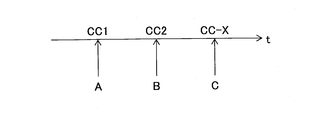
- the inter-CC reception timing difference of a certain CC can be set as the difference from the reception timing of the CC (CC of the connected cell) in which the reception timing difference is the largest. For example, as shown in FIG. 5, when CC1l and CC2 of connected cells (Pcell, Scell) are reception timings indicated by A and B, the reception timing of CC-X as an additional candidate is C.
- the CC-X CC reception timing difference (maximum CC reception timing difference) is the time between AC.
- the reception timing of the PCC reference signal as a reference, the difference between the reception timing of the PCC and the reception timing of CCs of the connected cell and the neighboring cell is measured, and a certain CC is maximized with other CCs.
- the reception timing difference may be obtained by calculation.
- the user apparatus UE Triggered by the occurrence of a measurement report transmission event for a CC (step 102), the user apparatus UE includes the information about the CC reception timing difference of the CC together with the reception quality of the CC in the measurement report. Transmit to the station eNB (step 103).
- the information related to the reception timing difference between CCs may be, for example, the value of the maximum reception timing difference with the CC of the connected cell itself, or the result of comparing the value with a predetermined threshold (greater than or equal to the threshold, less than the threshold, etc. ).
- the base station eNB that has received the measurement report determines whether or not to add the SCell related to the corresponding CC based on the reception quality and the information on the reception timing difference between CCs (step 104). For example, even if the reception quality is good, the base station eNB can determine that the SCell for the CC is not added when the difference in reception timing between CCs is equal to or greater than a predetermined threshold.
- step 104 if the result of determination in step 104 is a determination result that an SCell is added, the base station eNB performs configuration for adding the SCell to the user apparatus UE by RRC signaling (step 105). That is, the base station eNB instructs the user apparatus UE to add an SCell.
- the user apparatus UE is “included information regarding the reception timing difference between CCs” using the RRC signal (measurement setting information), but this instruction is a signal other than the RRC signal (MAC signal, PHY). Signal etc.). Further, when there is no instruction “include information related to inter-CC reception timing difference”, the user apparatus UE does not include information related to the inter-CC reception timing difference in the measurement report. Alternatively, it may not be included when there is an instruction “do not include information regarding reception timing difference between CCs”, and may be included when there is no instruction.
- the event that triggers measurement report transmission corresponds to event A4 defined in LTE, but the event is not limited to this, and may be another event.
- the event that triggers measurement report transmission may be “when both the condition of reception quality and the condition of reception timing difference between CCs are satisfied”.
- the reception quality condition is “reception quality> threshold A” and the inter-CC reception timing difference condition is “inter-CC reception timing difference ⁇ threshold B”
- the user apparatus UE may When it is detected that “reception quality> threshold A” and “timing difference between CCs ⁇ threshold B”, measurement report transmission is performed.
- What kind of event (quality only, quality + reception timing difference, etc.) is used as a report trigger may be instructed to the user apparatus UE by an RRC signal (measurement setting information). You may instruct
- the user apparatus UE measures the CC reception timing difference between CCs of each connected cell (PCell, SCell), and uses the CC identification information (ServCellIndex, SCellIndex, etc.) outside the reception window as the base station eNB. Notify The operation of the second embodiment will be described along the sequence diagram of FIG.
- the user apparatus UE performs CA using a PCC (PCell) and one or a plurality of SCCs (SCells).
- PCell PCC
- SCells SCCs
- the user apparatus UE measures the reception timing of each CC and determines whether the reception timing of each CC is within the reception window (step 201).
- the reception window has a predetermined time width, for example, and the reception timing of each CC is within the reception window means that the maximum value of the reception timing difference between CCs does not exceed the predetermined time width, for example.
- the reception timing of each CC is within the reception window.
- FIG. 7 (a) when CCl, CC2, and CC3 of the connected cells (Pcell, Scell) are reception timings indicated by A, B, and C, between A and C If the time width is within a predetermined time width of the reception window, these CCs are within the reception window.
- a reference CC e.g., PCC
- B is PCC
- D is excluded from the reception window.
- a reference CC e.g., PCC
- a CC having a timing that deviates from a predetermined time width centered on the reception timing of the reference CC is determined to be a CC outside the reception window. May be.
- the determination inside / outside the reception window may be performed by a method other than these.
- the user apparatus UE notifies the base station eNB of CC identification information (eg, ServCellIndex, SCellIndex) determined to be out of the reception window as a result of the determination in step 201 in FIG. 6 (step 202).
- This notification may be triggered by an event outside the reception window, or may be one of periodic notifications.
- the base station eNB determines to delete the SCell of the CC based on the fact that a certain CC is out of the reception window (step 203), and performs the SCell deletion setting for the user apparatus UE (step). 204). That is, the user apparatus UE is instructed to delete the SCell of the CC.
- the CC that is out of the reception window is notified, but the information to be notified is not limited to this. For example, it is good also as transmitting the value of the reception timing difference between CC for every CC (reception timing difference etc. on the basis of a certain CC). In this case, the base station eNB determines whether it is out of the reception window for each CC based on the received value.
- the information notification method from the user apparatus UE to the base station eNB in step 202 in FIG. 6 is not limited to a specific method, but for example, an RRC signal, a MAC signal, or a PHY signal can be used.
- a new IE Information Element
- a measurement object for instructing a notification method and a threshold value is defined, and measurement setting information including the measurement object is transmitted from the base station eNB to the user apparatus UE.
- the content of the notification is not limited, but includes, for example, a reception timing difference between CCs of each CC.
- a reception timing difference between CCs when a value such as a reception timing difference between CCs is notified, there are some steps such as A to B sending B and B to C sending C instead of the value that increases or decreases in small units. It may be.
- OOR Out Of Range
- a new MAC CE (Control Element) is defined and notified by the MAC CE.
- a MAC CE as shown in FIG. 8 is prepared, a bit is set for a combination of CCs whose reception timing is within (or exceeds) the reception window, and the MAC CE in which the bit is set is a base. Notify the station eNB.
- Ci indicates a bit field of ServCelIIndex i.
- the bit of C1 indicates whether or not the reception timing is within the reception window for the CC whose ServCelIIndex is 1.
- a new report value (for example, the same as the report value in the MAC signal) is introduced into an existing CSI report (CQI / RI / PMI / PTI), and at the time of CSI report (periodic or Report to Aperiodic).
- CQI / RI / PMI / PTI an existing CSI report
- periodic or Report to Aperiodic the new report value regarding the reception timing difference between CCs is notified together with the existing CQI / RI / PMI / PTI.
- a new CSI report for receiving timing difference report may be defined.
- reception timing shift between CCs may change every moment depending on the movement of the user apparatus UE. If the change is reported every momentary change, signaling overhead occurs, so Time to Trigger or hysteresis may be applied.
- Event A2 is a trigger for measurement report when the reception quality of the connected cell becomes worse than a predetermined threshold value.
- the trigger condition for event A2 is “the inter-CC reception timing difference threshold exceeded”. "Has been added. Note that “exceeding CC reception timing difference threshold” is synonymous with “out of reception window”. In this case, for example, the determination can be made by OR of two conditions of the reception quality and the reception timing difference between CCs (report if any one is satisfied).
- it may be set as “exceeding reception threshold difference between CCs” or “occurring outside reception window” instead of the condition of reception quality.
- the user apparatus UE monitors the reception timing of each connection CC. For example, as illustrated in FIG. 7B, when a certain CC is out of the reception window (or the inter-CC reception timing difference threshold is exceeded) Then, it is determined that the condition of event A2 is satisfied (trigger has occurred) (step 302). Then, a measurement report including the identification information of the corresponding CC is transmitted to the base station eNB (step 303).
- the base station eNB that has received the measurement report including the identification information of the CC that is out of the reception window determines to delete the SCell of the CC (step 304), and performs SCell deletion setting for the user apparatus UE (step 305). ).
- the “prohibit period” may be a period in which the user apparatus UE does not transmit a measurement report to the base station eNB for the corresponding CC, or the base station eNB receives the measurement report for the corresponding CC and adds an additional condition. It may be a period in which SCell addition is not performed even if it is found that the above is satisfied. Further, the number of protection stages may be taken into consideration so that no ping-pong occurs when reporting.
- a band combination (a combination of bands) capable of measuring a reception timing difference between CCs is limited. It is possible.
- the user apparatus UE may notify the base station eNB as capability of which band combination the reception timing difference can be measured.
- the base station eNB that has received the notification can set the SCell only by the band combination that can measure the reception timing difference, for example.
- the user apparatus UE may use a bit for notifying whether or not reception timing difference measurement is possible for each CA band combination (and its subset), or CA capable of measurement. Only the band combination (and its subset) may be reported.
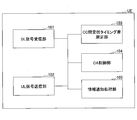
- FIG. 10 shows a functional configuration diagram of the user apparatus UE in the present embodiment.
- the user apparatus UE includes a DL signal reception unit 101, a UL signal transmission unit 102, an inter-CC reception timing difference measurement unit 103, a CA control unit 104, and an information notification processing unit 105.
- FIG. 10 shows only functional units that are particularly relevant to the present invention in the user apparatus UE, and has at least a function (not shown) for performing an operation based on LTE.
- the DL signal receiving unit 101 includes a function of receiving various downlink signals from the base station eNB and acquiring higher layer information from the received physical layer signal, and the UL signal transmitting unit 102 receives from the user apparatus UE It includes a function of generating various signals of the physical layer from information of higher layers to be transmitted and transmitting the signals to the base station eNB.
- the inter-CC reception timing difference measuring unit 103 measures the inter-CC reception timing difference of each CC of the connected cell and the neighboring cell based on the signal received by the DL signal receiving unit 101. Further, the inter-CC reception timing difference measuring unit 103 compares the inter-CC reception timing difference with a predetermined threshold value, so that the inter-CC reception timing difference exceeds the predetermined threshold value (or is within the predetermined threshold value). ) Is also provided. Further, as described above, when reception quality is also considered as an event, the inter-CC reception timing difference measurement unit 103 may include a function of measuring reception quality.
- the CA control unit 104 relates to CA in the user apparatus UE such as management of PCell (PCC) and SCell (SCC) constituting the CA, addition / deletion of SCell based on an instruction from the base station eNB, and activation / deactivation. Take control.
- PCell PCell
- SCC SCell
- the information notification processing unit 105 creates a message (MAC CE, RRC message, CSI information, etc.) including the value of the inter-CC reception timing difference, CC identification information exceeding the threshold, etc., and UL The process which notifies to the base station eNB using the signal transmission part 102 is performed.
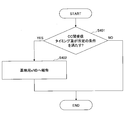
- the operation example illustrated in FIG. 11 is an example in which a condition based on a reception timing difference between CCs is used as a trigger to report to the base station eNB.
- the user apparatus UE is performing CA, and checks whether the condition based on the reception timing difference between CCs is satisfied for each connected cell (CC) (step 401).
- This condition is, for example, “There is a CC whose reception timing difference between CCs exceeds a predetermined threshold” or “There is a CC that is outside the reception window”.
- the user apparatus UE reports the identification information of CC which satisfy
- the functional configuration of the user apparatus UE is not limited to the above, and any configuration that can realize the processing described in the present embodiment may be adopted.
- the user apparatus UE a measurement unit that measures a reception timing difference between component carriers, an information notification unit that notifies a base station of information related to a reception timing difference measured by the measurement unit, and the information that has received the information
- a control unit that adds or deletes a secondary cell in the carrier aggregation based on an instruction from a base station may be provided.
- Information regarding the reception timing difference notified by the information notification unit is, for a certain component carrier, the reception timing difference between the component carrier and the component carrier having the maximum reception timing difference among other component carriers, This is information indicating whether or not it is less than a predetermined threshold.
- the base station adds the SCell after considering whether or not the reception timing difference is less than a predetermined threshold for CCs to be added. For example, it is possible to avoid the addition of CCs with good reception quality but shifted reception timing.
- the information notification unit notifies the base station of information related to the reception timing difference, for example, when the reception quality of the certain component carrier is equal to or higher than a predetermined threshold. Thereby, for example, the information regarding the reception timing difference can be notified to the base station with the event A4 as a trigger.
- the base station side it is possible to add an appropriate CC as an SCell in consideration of reception quality as well as reception timing differences.
- the information regarding the reception timing difference notified by the information notification unit is, for example, identification information of a component carrier at a reception timing that is out of a reception window having a predetermined time width.
- identification information of a component carrier at a reception timing that is out of a reception window having a predetermined time width.
- the information notification unit can also notify the base station of information regarding the reception timing difference, triggered by the reception timing of the component carrier being out of the reception window. Thereby, the base station can grasp
- the information notification unit can notify the base station of information regarding the reception timing difference using an RRC message, a MAC control element, or a CSI report.
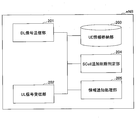
- FIG. 12 shows a functional configuration diagram of the base station eNB in the present embodiment.
- the base station eNB includes a DL signal transmission unit 201, a UL signal reception unit 202, a UE information storage unit 203, an SCell addition / deletion determination unit 204, and an information notification processing unit 205.
- FIG. 12 shows only functional units particularly related to the embodiment of the present invention in the base station eNB, and has at least a function (not shown) for performing an operation based on the LTE scheme.
- the DL signal transmission unit 201 includes a function of generating various signals of the physical layer from information of higher layers to be transmitted from the base station eNB and transmitting the signals to the user apparatus UE.
- the UL signal receiving unit 202 includes a function of receiving various uplink signals from the user apparatus UE and acquiring higher layer information from the received physical layer signals.
- the UE information storage unit 203 stores information related to the user equipment UE such as capability information for each user equipment UE, current CA state (connection CC, etc.), and this information is constantly updated and becomes the latest information. Yes.
- the SCell addition / deletion determination unit 204 deletes an existing SCell that can be grasped from the UE information stored in the UE information storage unit 203 based on the notification information received from the user apparatus UE, or adds a new SCell to the current CA configuration. Decide to add.
- the SCell addition / deletion determination unit 204 receives from the user apparatus UE a report indicating that the reception quality is good and the difference in reception timing between CCs is small for CCs not used in a certain SCell, It is determined that an SCell is added.
- the SCell addition / deletion determination unit 204 determines to delete the SCell of the CC. .
- the information notification processing unit 205 has a function of, for example, creating a message for notifying the user apparatus UE of measurement contents, threshold values, an event to be a report trigger, and the like, and transmitting the message to the user apparatus UE by the DL signal transmission unit 201. Have. Further, the information notification processing unit 205 generates a message for setting the addition / deletion of the SCell to the user apparatus UE when the SCell addition / deletion determination unit 204 determines the addition / deletion of the SCell. The DL signal transmission unit 201 transmits the message to the user apparatus UE.
- the base station eNB receives a report from the user apparatus UE (step 501).
- This report includes, for example, information indicating that the inter-CC reception timing difference for a certain CC exceeds a predetermined threshold.
- User apparatus UE performs SCell addition / deletion determination based on the report received in step 501 (step 502). For example, as described above, when information indicating that a difference between CC reception timings for a certain CC exceeds a predetermined threshold is received as a report, it is determined to delete the SCell of the CC.
- the base station eNB performs SCell addition / deletion setting for the user apparatus UE based on the determination result in Step 502 (Step 503).
- the functional configuration of the base station eNB is not limited to the above, and any configuration capable of realizing the processing described in the present embodiment may be adopted.
- the base station eNB receives the component carrier from the user apparatus based on the information on the reception timing difference between the component carriers for a certain component carrier and the reception timing difference received by the reception unit.
- a determination unit that determines whether or not to add or delete a secondary cell cell corresponding to the information, and an information notification unit that instructs the user apparatus to add or delete the secondary cell cell based on a determination result by the determination unit; It can comprise.
- the user apparatus described in the present embodiment may include a CPU and a memory, and may be realized by a program being executed by a CPU (processor). Processing logic described in the present embodiment It may be a configuration realized by hardware such as a hardware circuit provided with a program, or a configuration in which a program and hardware are mixed.
- the base station described in this embodiment may include a CPU and a memory, and may be configured by a program being executed by a CPU (processor).
- the processing logic described in this embodiment may be used. It may be a configuration realized by hardware such as a hardware circuit provided with a program, or a configuration in which a program and hardware are mixed.
- the operations of a plurality of functional units may be physically performed by one component, or the operations of one functional unit may be physically performed by a plurality of components.
- the user apparatus and the base station have been described using functional block diagrams, but such an apparatus may be realized in hardware, software, or a combination thereof.
- Software operated by a processor included in a user apparatus and software operated by a processor included in a base station according to the embodiment of the present invention are random access memory (RAM), flash memory, read-only memory (ROM), EPROM, and EEPROM. , A register, a hard disk (HDD), a removable disk, a CD-ROM, a database, a server, or any other suitable storage medium.
- UE user apparatus eNB Base station 101 DL signal receiving unit 102 UL signal transmitting unit 103 Inter-CC reception timing difference measuring unit 104 CA control unit 105 Information notification processing unit 201 DL signal transmitting unit 202 UL signal receiving unit 203 UE information storage unit 204 SCell Addition / deletion determination unit 205 Information notification processing unit
Landscapes
- Engineering & Computer Science (AREA)
- Signal Processing (AREA)
- Computer Networks & Wireless Communication (AREA)
- Mobile Radio Communication Systems (AREA)
Abstract
La présente invention concerne un équipement d'utilisateur d'un système de communication mobile qui prend en charge une agrégation de porteuses doté : d'une unité de mesure qui mesure la différence de temps de réception entre des porteuses composantes ; d'une unité de notification d'informations qui notifie la station de base en ce qui concerne des informations se rapportant à la différence de temps de réception mesuré par unité de mesure ; et d'une unité de commande qui, sur la base d'une instruction provenant de la station de base qui a reçu les informations, ajoute ou supprime une cellule secondaire lors de l'agrégation de porteuses.
Priority Applications (2)
| Application Number | Priority Date | Filing Date | Title |
|---|---|---|---|
| CN201580007820.6A CN105981462A (zh) | 2014-02-12 | 2015-02-09 | 用户装置、基站以及载波聚合控制方法 |
| US15/117,486 US20160353442A1 (en) | 2014-02-12 | 2015-02-09 | User apparatus, base station, and carrier aggregation control method |
Applications Claiming Priority (2)
| Application Number | Priority Date | Filing Date | Title |
|---|---|---|---|
| JP2014-024832 | 2014-02-12 | ||
| JP2014024832A JP6387233B2 (ja) | 2014-02-12 | 2014-02-12 | ユーザ装置、基地局、及びキャリアアグリゲーション制御方法 |
Publications (1)
| Publication Number | Publication Date |
|---|---|
| WO2015122382A1 true WO2015122382A1 (fr) | 2015-08-20 |
Family
ID=53800125
Family Applications (1)
| Application Number | Title | Priority Date | Filing Date |
|---|---|---|---|
| PCT/JP2015/053504 Ceased WO2015122382A1 (fr) | 2014-02-12 | 2015-02-09 | Équipement d'utilisateur, station de base, et procédé de commande d'agrégation de porteuses |
Country Status (4)
| Country | Link |
|---|---|
| US (1) | US20160353442A1 (fr) |
| JP (1) | JP6387233B2 (fr) |
| CN (1) | CN105981462A (fr) |
| WO (1) | WO2015122382A1 (fr) |
Families Citing this family (11)
| Publication number | Priority date | Publication date | Assignee | Title |
|---|---|---|---|---|
| US9973959B2 (en) * | 2014-04-16 | 2018-05-15 | Telefonaktiebolaget L M Ericsson (Publ) | Method and apparatus for controlling cell aggregation |
| WO2015176934A1 (fr) | 2014-05-19 | 2015-11-26 | Telefonaktiebolaget L M Ericsson (Publ) | Procédé d'agrégation de ressources radio |
| CN108234085A (zh) * | 2016-12-14 | 2018-06-29 | 中国电信股份有限公司 | 载波聚合方法和终端 |
| US11064439B2 (en) * | 2017-10-09 | 2021-07-13 | Qualcomm Incorporated | Asynchronous carrier aggregation |
| US10820341B2 (en) * | 2018-02-12 | 2020-10-27 | Mediatek Inc. | Determination of requirement of UE processing time in NR |
| WO2020170405A1 (fr) * | 2019-02-21 | 2020-08-27 | 株式会社Nttドコモ | Équipement utilisateur et appareil de station de base |
| DE112021002593T5 (de) * | 2020-07-23 | 2023-02-23 | Intel Corporation | Ratenanpassungsressourcen für übertragungen auf einem physischen gemeinsam genutztem downlink-kanal (pdsch) und multiplexen von uplink-übertragungen mit verschiedenen timings |
| EP4197248B1 (fr) * | 2020-08-12 | 2025-07-23 | Nokia Technologies Oy | Gestion de mesure de csi-rs |
| US20230309165A1 (en) * | 2020-09-25 | 2023-09-28 | Softbank Corp. | User terminal, base station, and radio communication method |
| US20230030066A1 (en) * | 2021-07-29 | 2023-02-02 | Qualcomm Incorporated | Intra-band carrier aggregation/dual connectivity |
| US12003438B2 (en) * | 2021-08-04 | 2024-06-04 | Qualcomm Incorporated | Aggregate component carrier for full-duplex operation |
Citations (3)
| Publication number | Priority date | Publication date | Assignee | Title |
|---|---|---|---|---|
| WO2012119626A1 (fr) * | 2011-03-08 | 2012-09-13 | Panasonic Corporation | Signalement de différences de retards de propagation pour des porteuses à composantes multiples |
| JP2013042260A (ja) * | 2011-08-12 | 2013-02-28 | Sharp Corp | 移動局装置、基地局装置、通信システム、通信方法および集積回路 |
| WO2014155740A1 (fr) * | 2013-03-29 | 2014-10-02 | 富士通株式会社 | Station de base, terminal et système de communication |
Family Cites Families (5)
| Publication number | Priority date | Publication date | Assignee | Title |
|---|---|---|---|---|
| JP5314434B2 (ja) * | 2009-01-13 | 2013-10-16 | 株式会社エヌ・ティ・ティ・ドコモ | 移動通信方法及び無線基地局 |
| JP5059062B2 (ja) * | 2009-07-08 | 2012-10-24 | シャープ株式会社 | 通信システム、移動局装置および基地局装置 |
| CN103037431A (zh) * | 2011-09-30 | 2013-04-10 | 中兴通讯股份有限公司 | 一种多载波系统中基于载波分组的测量方法及装置 |
| EP2775641B1 (fr) * | 2011-11-02 | 2018-07-18 | LG Electronics Inc. | Procédé d'émission et de réception de préambule dans un système d'accès sans fil et appareil pour ledit procédé |
| CN103118395A (zh) * | 2013-01-18 | 2013-05-22 | 东莞宇龙通信科技有限公司 | 终端、基站和基于时间同步误差的资源调度方法 |
-
2014
- 2014-02-12 JP JP2014024832A patent/JP6387233B2/ja active Active
-
2015
- 2015-02-09 US US15/117,486 patent/US20160353442A1/en not_active Abandoned
- 2015-02-09 WO PCT/JP2015/053504 patent/WO2015122382A1/fr not_active Ceased
- 2015-02-09 CN CN201580007820.6A patent/CN105981462A/zh active Pending
Patent Citations (3)
| Publication number | Priority date | Publication date | Assignee | Title |
|---|---|---|---|---|
| WO2012119626A1 (fr) * | 2011-03-08 | 2012-09-13 | Panasonic Corporation | Signalement de différences de retards de propagation pour des porteuses à composantes multiples |
| JP2013042260A (ja) * | 2011-08-12 | 2013-02-28 | Sharp Corp | 移動局装置、基地局装置、通信システム、通信方法および集積回路 |
| WO2014155740A1 (fr) * | 2013-03-29 | 2014-10-02 | 富士通株式会社 | Station de base, terminal et système de communication |
Non-Patent Citations (2)
| Title |
|---|
| HUAWEI ET AL.: "TA group management", 3GPP TSG-RAN WG2 MEETING #75, R2-113996, 22 August 2011 (2011-08-22) - 26 August 2011 (2011-08-26), pages 1 - 5, XP050539913 * |
| RAN WG4: "LS on UE receiver window for Intra- band non-contiguous CA", 3GPP TSG-RAN WG4 #65, R4-126496, 12 November 2012 (2012-11-12) - 16 November 2012 (2012-11-16), XP050674026 * |
Also Published As
| Publication number | Publication date |
|---|---|
| CN105981462A (zh) | 2016-09-28 |
| JP6387233B2 (ja) | 2018-09-05 |
| JP2015154161A (ja) | 2015-08-24 |
| US20160353442A1 (en) | 2016-12-01 |
Similar Documents
| Publication | Publication Date | Title |
|---|---|---|
| JP6387233B2 (ja) | ユーザ装置、基地局、及びキャリアアグリゲーション制御方法 | |
| CN106165475B (zh) | 测量控制方法以及基站 | |
| EP3328117B1 (fr) | Dispositif de terminal, système de communication et procédé de mesure | |
| KR102174133B1 (ko) | 이동 통신 시스템에서 셀 측정 수행 및 스몰 셀의 특수 기능 셀을 선택하는 방법 및 장치 | |
| KR101357993B1 (ko) | 무선 통신 시스템에서 캐리어 어그리게이션 동안의 측정 최소화 | |
| CN106797579B (zh) | 用户装置以及偏移量报告方法 | |
| KR101804717B1 (ko) | 채널 측정 구성 방법, 채널 측정 방법, 장치 및 통신 시스템 | |
| US8724596B2 (en) | Mobile communication method, radio base station, and mobile station | |
| WO2011157091A1 (fr) | Procédé de configuration et de rapport de mesure pour système multiporteuse et dispositif correspondant | |
| EP2884798A1 (fr) | Procédé, système et dispositif de gestion de cellule | |
| JPWO2017014229A1 (ja) | 端末装置、基地局装置、通信方法および集積回路 | |
| CN108282810A (zh) | 一种基站、终端、测量控制方法和测量方法 | |
| JPWO2017077898A1 (ja) | ユーザ装置、基地局、測定条件通知方法及び測定方法 | |
| US10880794B2 (en) | Inter-band handover of the same physical frequency | |
| KR20170065464A (ko) | 정보통지방법, 이동통신시스템, 및 기지국 | |
| CN107210879B (zh) | 一种参考信号发送方法及装置 | |
| JP6118842B2 (ja) | ユーザ装置、基地局、及び情報受信方法 | |
| CN102238618B (zh) | 多载波中测量任务的启动方法及用户设备 | |
| CN106664648B (zh) | 用户装置及测量控制方法 | |
| JP6629930B2 (ja) | ユーザ装置、基地局、及びキャリアアグリゲーション制御方法 | |
| OA19335A (en) | Inter-band handover of the same physical frequency | |
| HK1228613A1 (en) | Method and apparatus for controlling cell aggregation |
Legal Events
| Date | Code | Title | Description |
|---|---|---|---|
| 121 | Ep: the epo has been informed by wipo that ep was designated in this application |
Ref document number: 15749256 Country of ref document: EP Kind code of ref document: A1 |
|
| WWE | Wipo information: entry into national phase |
Ref document number: 15117486 Country of ref document: US |
|
| NENP | Non-entry into the national phase |
Ref country code: DE |
|
| 122 | Ep: pct application non-entry in european phase |
Ref document number: 15749256 Country of ref document: EP Kind code of ref document: A1 |