WO2015122414A1 - エチレン/α-オレフィン共重合体の製造方法 - Google Patents
エチレン/α-オレフィン共重合体の製造方法 Download PDFInfo
- Publication number
- WO2015122414A1 WO2015122414A1 PCT/JP2015/053696 JP2015053696W WO2015122414A1 WO 2015122414 A1 WO2015122414 A1 WO 2015122414A1 JP 2015053696 W JP2015053696 W JP 2015053696W WO 2015122414 A1 WO2015122414 A1 WO 2015122414A1
- Authority
- WO
- WIPO (PCT)
- Prior art keywords
- group
- ethylene
- bis
- cyclopentadienyl
- methylene
- Prior art date
- Legal status (The legal status is an assumption and is not a legal conclusion. Google has not performed a legal analysis and makes no representation as to the accuracy of the status listed.)
- Ceased
Links
Classifications
-
- C—CHEMISTRY; METALLURGY
- C08—ORGANIC MACROMOLECULAR COMPOUNDS; THEIR PREPARATION OR CHEMICAL WORKING-UP; COMPOSITIONS BASED THEREON
- C08F—MACROMOLECULAR COMPOUNDS OBTAINED BY REACTIONS ONLY INVOLVING CARBON-TO-CARBON UNSATURATED BONDS
- C08F210/00—Copolymers of unsaturated aliphatic hydrocarbons having only one carbon-to-carbon double bond
- C08F210/16—Copolymers of ethene with alpha-alkenes, e.g. EP rubbers
-
- C—CHEMISTRY; METALLURGY
- C08—ORGANIC MACROMOLECULAR COMPOUNDS; THEIR PREPARATION OR CHEMICAL WORKING-UP; COMPOSITIONS BASED THEREON
- C08F—MACROMOLECULAR COMPOUNDS OBTAINED BY REACTIONS ONLY INVOLVING CARBON-TO-CARBON UNSATURATED BONDS
- C08F2/00—Processes of polymerisation
- C08F2/44—Polymerisation in the presence of compounding ingredients, e.g. plasticisers, dyestuffs, fillers
-
- C—CHEMISTRY; METALLURGY
- C08—ORGANIC MACROMOLECULAR COMPOUNDS; THEIR PREPARATION OR CHEMICAL WORKING-UP; COMPOSITIONS BASED THEREON
- C08F—MACROMOLECULAR COMPOUNDS OBTAINED BY REACTIONS ONLY INVOLVING CARBON-TO-CARBON UNSATURATED BONDS
- C08F4/00—Polymerisation catalysts
- C08F4/42—Metals; Metal hydrides; Metallo-organic compounds; Use thereof as catalyst precursors
- C08F4/44—Metals; Metal hydrides; Metallo-organic compounds; Use thereof as catalyst precursors selected from light metals, zinc, cadmium, mercury, copper, silver, gold, boron, gallium, indium, thallium, rare earths or actinides
- C08F4/60—Metals; Metal hydrides; Metallo-organic compounds; Use thereof as catalyst precursors selected from light metals, zinc, cadmium, mercury, copper, silver, gold, boron, gallium, indium, thallium, rare earths or actinides together with refractory metals, iron group metals, platinum group metals, manganese, rhenium technetium or compounds thereof
- C08F4/62—Refractory metals or compounds thereof
- C08F4/64—Titanium, zirconium, hafnium or compounds thereof
- C08F4/659—Component covered by group C08F4/64 containing a transition metal-carbon bond
- C08F4/65912—Component covered by group C08F4/64 containing a transition metal-carbon bond in combination with an organoaluminium compound
-
- C—CHEMISTRY; METALLURGY
- C08—ORGANIC MACROMOLECULAR COMPOUNDS; THEIR PREPARATION OR CHEMICAL WORKING-UP; COMPOSITIONS BASED THEREON
- C08F—MACROMOLECULAR COMPOUNDS OBTAINED BY REACTIONS ONLY INVOLVING CARBON-TO-CARBON UNSATURATED BONDS
- C08F4/00—Polymerisation catalysts
- C08F4/42—Metals; Metal hydrides; Metallo-organic compounds; Use thereof as catalyst precursors
- C08F4/44—Metals; Metal hydrides; Metallo-organic compounds; Use thereof as catalyst precursors selected from light metals, zinc, cadmium, mercury, copper, silver, gold, boron, gallium, indium, thallium, rare earths or actinides
- C08F4/60—Metals; Metal hydrides; Metallo-organic compounds; Use thereof as catalyst precursors selected from light metals, zinc, cadmium, mercury, copper, silver, gold, boron, gallium, indium, thallium, rare earths or actinides together with refractory metals, iron group metals, platinum group metals, manganese, rhenium technetium or compounds thereof
- C08F4/62—Refractory metals or compounds thereof
- C08F4/64—Titanium, zirconium, hafnium or compounds thereof
- C08F4/659—Component covered by group C08F4/64 containing a transition metal-carbon bond
- C08F4/6592—Component covered by group C08F4/64 containing a transition metal-carbon bond containing at least one cyclopentadienyl ring, condensed or not, e.g. an indenyl or a fluorenyl ring
- C08F4/65922—Component covered by group C08F4/64 containing a transition metal-carbon bond containing at least one cyclopentadienyl ring, condensed or not, e.g. an indenyl or a fluorenyl ring containing at least two cyclopentadienyl rings, fused or not
- C08F4/65927—Component covered by group C08F4/64 containing a transition metal-carbon bond containing at least one cyclopentadienyl ring, condensed or not, e.g. an indenyl or a fluorenyl ring containing at least two cyclopentadienyl rings, fused or not two cyclopentadienyl rings being mutually bridged
-
- C—CHEMISTRY; METALLURGY
- C08—ORGANIC MACROMOLECULAR COMPOUNDS; THEIR PREPARATION OR CHEMICAL WORKING-UP; COMPOSITIONS BASED THEREON
- C08F—MACROMOLECULAR COMPOUNDS OBTAINED BY REACTIONS ONLY INVOLVING CARBON-TO-CARBON UNSATURATED BONDS
- C08F210/00—Copolymers of unsaturated aliphatic hydrocarbons having only one carbon-to-carbon double bond
- C08F210/04—Monomers containing three or four carbon atoms
- C08F210/06—Propene
-
- C—CHEMISTRY; METALLURGY
- C08—ORGANIC MACROMOLECULAR COMPOUNDS; THEIR PREPARATION OR CHEMICAL WORKING-UP; COMPOSITIONS BASED THEREON
- C08F—MACROMOLECULAR COMPOUNDS OBTAINED BY REACTIONS ONLY INVOLVING CARBON-TO-CARBON UNSATURATED BONDS
- C08F2420/00—Metallocene catalysts
- C08F2420/10—Heteroatom-substituted bridge, i.e. Cp or analog where the bridge linking the two Cps or analogs is substituted by at least one group that contains a heteroatom
-
- C—CHEMISTRY; METALLURGY
- C08—ORGANIC MACROMOLECULAR COMPOUNDS; THEIR PREPARATION OR CHEMICAL WORKING-UP; COMPOSITIONS BASED THEREON
- C08F—MACROMOLECULAR COMPOUNDS OBTAINED BY REACTIONS ONLY INVOLVING CARBON-TO-CARBON UNSATURATED BONDS
- C08F4/00—Polymerisation catalysts
- C08F4/42—Metals; Metal hydrides; Metallo-organic compounds; Use thereof as catalyst precursors
- C08F4/44—Metals; Metal hydrides; Metallo-organic compounds; Use thereof as catalyst precursors selected from light metals, zinc, cadmium, mercury, copper, silver, gold, boron, gallium, indium, thallium, rare earths or actinides
- C08F4/60—Metals; Metal hydrides; Metallo-organic compounds; Use thereof as catalyst precursors selected from light metals, zinc, cadmium, mercury, copper, silver, gold, boron, gallium, indium, thallium, rare earths or actinides together with refractory metals, iron group metals, platinum group metals, manganese, rhenium technetium or compounds thereof
- C08F4/62—Refractory metals or compounds thereof
- C08F4/64—Titanium, zirconium, hafnium or compounds thereof
- C08F4/659—Component covered by group C08F4/64 containing a transition metal-carbon bond
- C08F4/65908—Component covered by group C08F4/64 containing a transition metal-carbon bond in combination with an ionising compound other than alumoxane, e.g. (C6F5)4B-X+
Definitions
- the present invention relates to a method for producing an ethylene / ⁇ -olefin copolymer, and more particularly, by copolymerizing ethylene and an ⁇ -olefin in the presence of an olefin polymerization catalyst containing a crosslinked metallocene compound having a specific crosslinked structure.
- the present invention relates to a method for producing an ethylene / ⁇ -olefin copolymer.
- a method using a transition metal compound having a cyclopentadienyl ligand or a substituted cyclopentadienyl ligand as a olefin polymerization catalyst a so-called metallocene compound is widely known. Since W. Kaminsky et al. Reported that a catalyst based on a combination of zirconocene dimethyl and methylaluminoxane (MAO) is highly active in the polymerization of ethylene [Angew. Chem. Int. Ed. Engl., 19, 390 (1980 )], Various improvements have been attempted for the purpose of improving the performance of the catalyst and producing a specific polymer.
- MAO zirconocene dimethyl and methylaluminoxane
- the latter has succeeded in producing syndiotactic polypropylene, which is difficult to produce with conventional Ziegler-Natta catalysts, using a metallocene compound having a ligand in which a cyclopentadienyl group and a fluorenyl group are bridged. .
- the bridged cyclopentadienyl-fluorenyl metallocene compound has been developed as a catalyst for ethylene homopolymerization or ethylene / ⁇ -olefin copolymerization.
- W. Kaminsky et al. Reported ethylene polymerization with [isopropylidene ( ⁇ 5 -cyclopentadienyl) ( ⁇ 5 -fluorenyl)] zirconium dichloride used by J. A. Ewen et al. In the production of syndiotactic polypropylene. Its polymerization activity was very low [Makromol. Chem., 193, 1643 (1992)].
- Patent Document 1 (WO2004). / 029062), Patent Document 2 (WO2005 / 100410)].
- Patent Document 1 (WO2004). / 029062), Patent Document 2 (WO2005 / 100410)
- the molecular weight of the produced ethylene polymer is not yet sufficient, and further catalyst improvement is desired.
- the amount of heat to be removed is less than that in low-temperature polymerization, so that an advantage of reducing heat removal costs can be obtained.
- the molecular weight of the olefin polymer produced decreases with increasing polymerization temperature.
- the upper limit of the polymerization temperature is restricted.
- a polymerization catalyst for producing a high molecular weight olefin polymer is required.
- the present applicant has proposed a method for producing an ⁇ -olefin polymer using a catalyst containing a specific bridged cyclopentadienyl-fluorenyl metallocene compound. According to the method, when an ⁇ -olefin containing at least a part of ethylene is polymerized under high temperature conditions, a high molecular weight ethylene polymer can be produced with good activity.
- the present applicant has proposed a method for producing a propylene-based copolymer using a catalyst containing another specific bridged cyclopentadienyl-fluorenyl metallocene compound.
- a high molecular weight propylene copolymer can be produced efficiently, and a propylene copolymer having a desired molecular weight can be polymerized at a higher temperature than when a conventional catalyst for olefin polymerization is used.
- the introduction of hydrogen into the polymerization reactor is a very effective method for controlling the molecular weight of the olefin polymer produced.
- the introduction of hydrogen for the purpose of controlling the molecular weight of the olefin polymer is not infinitely acceptable. That is, in the case where the polymerization is carried out under the conditions of a certain total pressure and temperature in the polymerization vessel, the increase in the hydrogen partial pressure due to the introduction of hydrogen causes a decrease in the partial pressure of the olefin as a polymerization monomer. This causes a problem that the polymerization rate is lowered in a high region.
- the polymerization reactor Since the polymerization reactor has a limited total internal pressure that is allowed in its design, particularly when excessive hydrogen introduction is required when producing a low molecular weight olefin polymer, the olefin partial pressure is significantly reduced. Polymerization activity may decrease. Therefore, a polymerization catalyst capable of sufficiently reducing the molecular weight of an olefin polymer produced with a small amount of hydrogen introduction and controlling it to a desired value, that is, a polymerization catalyst having high hydrogen responsiveness is demanded.
- the molecular weight of the olefin polymer produced decreases as the polymerization temperature rises, it is theoretically possible to adjust the molecular weight of the olefin polymer to a desired value by changing the polymerization temperature.
- the polymerization temperature cannot be raised to a sufficiently high temperature due to the design heat resistance and pressure limit of the polymerization vessel itself, or the limitation due to the thermal stability of the olefin polymer to be produced. There is a case.
- the polymerization activity decreases, and for example, solution polymerization increases the viscosity of the polymerization solution, so the concentration of the olefin polymer cannot be increased and the productivity is lowered. In some cases, the temperature cannot be lowered. Furthermore, in the case where a variety of olefin polymers having different molecular weights are continuously produced in one polymerization facility, which is common to those skilled in the art, the temperature of the polymerization solution can be changed and stabilized at a desired value. In many cases, it takes a long time, and this leads to a decrease in productivity. Such an effect becomes more remarkable as the polymerization equipment becomes larger.
- the hydrogen addition amount should be kept at a certain value.
- the changing method is preferably used by those skilled in the art. From the above, it is possible to produce a high molecular weight olefin polymer in order to keep the polymerization temperature high, and at the same time have a high hydrogen responsiveness to obtain an olefin polymer of a desired molecular weight with a small amount of hydrogenation without reducing the activity. There is a craving for a catalyst to be realized.
- the problem (1) to be solved by the present invention in view of such problems in the prior art is to provide a method for producing a high molecular weight ethylene / ⁇ -olefin copolymer.
- high-temperature solution polymerization has advantages such as improvement in productivity and reduction in production cost.
- it causes a decrease in the molecular weight of the olefin polymer produced at the same time, and the polymerization temperature is sufficient in the method using the conventional polymerization catalyst.
- the problem (2) to be solved by the present invention is to provide a method for producing an ethylene / ⁇ -olefin copolymer by copolymerizing ethylene and ⁇ -olefin with high hydrogen responsiveness.
- the method of introducing hydrogen into the polymerization reactor in order to control the molecular weight of the resulting ethylene / ⁇ -olefin copolymer to a desired value is useful and common to those skilled in the art as described above.
- the molecular weight of the ethylene / ⁇ -olefin copolymer produced with a small amount of hydrogen introduction can be sufficiently reduced without causing problems such as a decrease in the partial pressure of the polymerization monomer, that is, hydrogen responsiveness.
- a method for producing a high ethylene / ⁇ -olefin copolymer is desired.
- the problem (3) to be solved by the present invention is to provide a method for producing an ethylene / ⁇ -olefin copolymer by copolymerizing ethylene and ⁇ -olefin with sufficiently high polymerization activity to be industrially useful. It is to be. Such a method has an industrial advantage because it has an effect of shortening the manufacturing time and cost reduction by reducing the amount of catalyst used.
- the problem to be finally solved by the present invention is to provide a method for producing an ethylene / ⁇ -olefin copolymer capable of simultaneously realizing the above problems (1), (2) and (3). .
- an ethylene / ⁇ -olefin copolymer having excellent performance as a processed material can be provided to the market with industrially significant production efficiency and production cost.
- the present invention provides an ethylene / ⁇ -olefin copolymer obtained by copolymerizing ethylene and an ⁇ -olefin in the presence of an olefin polymerization catalyst containing a crosslinked metallocene compound having a specific crosslinked structure. It is a manufacturing method.
- the gist of the present invention is as follows.
- Y is selected from a carbon atom, a silicon atom, a germanium atom and a tin atom; M is a titanium atom, a zirconium atom or a hafnium atom, R 1 , R 2 , R 3 , R 4 , R 5 , R 6 , R 7 , R 8 , R 9 , R 10 , R 11 and R 12 are a hydrogen atom, a hydrocarbon group having 1 to 20 carbon atoms, silicon An atom or a substituent selected from a containing group, a nitrogen-containing group, an oxygen-containing group, a halogen atom and a halogen-containing group, which may be the same or different, Adjacent substituents from R 1 to R 12 may be bonded to each other to form a ring; R 13 and R 14 are an aryl group or a substituted aryl group, and when both are substituted aryl groups, they may be the same or different, At least one
- a substituted aryl group, Q is selected from a halogen atom, a hydrocarbon group having 1 to 20 carbon atoms, an anionic ligand, and a neutral ligand capable of coordinating with a lone pair, in the same or different combinations; j is an integer of 1 to 4.
- R 13 and R 14 in the general formula [I] contain a group selected from a nitrogen-containing group and an oxygen-containing group as the electron-donating substituent at the meta position and / or the para position with respect to the bond with Y
- R 13 and R 14 in the general formula [I] are substituted phenyl groups containing a nitrogen-containing group as the electron-donating substituent at a meta position and / or a para position with respect to a bond with Y,
- R 13 and R 14 in the general formula [I] are substituted phenyl groups containing a nitrogen-containing group represented by the following general formula [II] as the electron-donating substituent, [4] The process for producing an ethylene / ⁇ -olefin copolymer according to any one of [6] to [6].
- R 15 and R 16 are each an atom or a substituent selected from a hydrogen atom, a hydrocarbon group having 1 to 20 carbon atoms, a silicon-containing group, an oxygen-containing group and a halogen-containing group. They may be different from each other and may be bonded to each other to form a ring, and the line drawn to the right of N represents a bond with a phenyl group.
- R 13 and R 14 in the general formula [I] are substituted phenyl groups containing an oxygen-containing group as the electron-donating substituent at a meta position and / or a para position with respect to a bond with Y,
- R 13 and R 14 in the general formula [I] are substituted phenyl groups containing an oxygen-containing group represented by the following general formula [III] as the electron-donating substituent, [4] The process for producing an ethylene / ⁇ -olefin copolymer according to any one of [6] to [6].
- R 17 is an atom or substituent selected from a hydrogen atom, a hydrocarbon group having 1 to 20 carbon atoms, a silicon-containing group, a nitrogen-containing group and a halogen-containing group, and is drawn to the right of O.
- the solid line represents the bond with the phenyl group.
- R 5 , R 8 , R 9 and R 12 are all hydrogen atoms, and ethylene / ⁇ - according to any one of the above [1] to [8] A method for producing an olefin copolymer.
- a substituent in which at least two of R 6 , R 7 , R 10 and R 11 in the general formula [I] are selected from a hydrocarbon group, a silicon-containing group, a nitrogen-containing group, an oxygen-containing group, a halogen atom and a halogen-containing group The method for producing an ethylene / ⁇ -olefin copolymer according to any one of [1] to [9] above, wherein
- the ring formed by combining R 6 and R 7 and R 10 and R 11 with each other is a 5- to 7-membered ring.
- M is a titanium atom, a zirconium atom or a hafnium atom
- R 13 and R 14 are both substituted phenyl groups containing a nitrogen-containing group represented by the above general formula [II] as the electron donating substituent, or both are the above as the electron donating substituent.
- a substituted phenyl group containing an oxygen-containing group represented by the general formula [III], R 18 , R 19 , R 20 , and R 21 are a hydrogen atom or a methyl group, Q is selected from a halogen atom, a hydrocarbon group having 1 to 20 carbon atoms, an anionic ligand, and a neutral ligand capable of coordinating with a lone pair, in the same or different combinations; j is an integer of 1 to 4.
- the proportion of the structural units derived from ethylene is 50 mol% when the total of the proportions of the structural units derived from the respective monomers in the polymer is 100 mol%.
- a high molecular weight ethylene / ⁇ -olefin copolymer is produced by a method of copolymerizing ethylene and ⁇ -olefin in the presence of an olefin polymerization catalyst containing a crosslinked metallocene compound having a specific crosslinked structure according to the present invention. It becomes possible. As a result, the molecular weight of the ethylene / ⁇ -olefin copolymer produced in the high temperature polymerization can be kept at a desired high value, so that the high temperature polymerization can be carried out.
- the viscosity of the polymerization solution containing the produced ethylene / ⁇ -olefin copolymer is lowered, so the concentration of the ethylene / ⁇ -olefin copolymer in the polymerization vessel is increased as compared with low temperature polymerization.
- the productivity per polymerization vessel is greatly improved.
- the heat removal cost of the polymerization vessel is greatly reduced.
- the olefin polymerization catalyst is highly responsive to hydrogen, the molecular weight of the ethylene / ⁇ -olefin copolymer produced by introducing a small amount of hydrogen is greatly reduced, and an ethylene / ⁇ -olefin copolymer having a desired molecular weight can be obtained. It can be manufactured. Thereby, the partial pressure of the monomer in the polymerization reactor can be kept high, and high polymerization activity can be realized.
- the method for producing an ethylene / ⁇ -olefin copolymer of the present invention comprises a bridged metallocene compound (A) represented by the above general formula [I] and an olefin polymerization catalyst containing the compound (B) described above. It is characterized by copolymerizing ethylene and an ⁇ -olefin having 3 or more carbon atoms.
- the bridged metallocene compound (A) is represented by the above general formula [I]. Y, M, R 1 to R 14 , Q and j in the formula [I] will be described below.
- Y is selected from a carbon atom, a silicon atom, a germanium atom, and a tin atom, and preferably a carbon atom.
- R 1 , R 2 , R 3 , R 4 , R 5 , R 6 , R 7 , R 8 , R 9 , R 10 , R 11 and R 12 are each a hydrogen atom, a hydrocarbon group having 1 to 20 carbon atoms, An atom or substituent selected from a silicon-containing group, a nitrogen-containing group, an oxygen-containing group, a halogen atom and a halogen-containing group, which may be the same or different. Further, adjacent substituents from R 1 to R 12 may be bonded to each other to form a ring, or may not be bonded to each other.
- examples of the hydrocarbon group having 1 to 20 carbon atoms include an alkyl group having 1 to 20 carbon atoms, a cyclic saturated hydrocarbon group having 3 to 20 carbon atoms, a chain unsaturated hydrocarbon group having 2 to 20 carbon atoms, Examples thereof include cyclic unsaturated hydrocarbon groups having 3 to 20 carbon atoms.
- examples thereof include an alkylene group having 1 to 20 carbon atoms and an arylene group having 6 to 20 carbon atoms.
- alkyl group having 1 to 20 carbon atoms examples include methyl, ethyl, n-propyl, allyl, n-butyl, n-pentyl, and n-hexyl, which are linear saturated hydrocarbon groups.
- n-heptyl group n-octyl group, n-nonyl group, n-decanyl group, etc., branched saturated hydrocarbon groups such as isopropyl group, isobutyl group, s-butyl group, t-butyl group, t-amyl group Group, neopentyl group, 3-methylpentyl group, 1,1-diethylpropyl group, 1,1-dimethylbutyl group, 1-methyl-1-propylbutyl group, 1,1-dipropylbutyl group, 1,1- Examples include dimethyl-2-methylpropyl group, 1-methyl-1-isopropyl-2-methylpropyl group, cyclopropylmethyl group and the like.
- the alkyl group preferably has 1 to 6 carbon atoms.
- Examples of the cyclic saturated hydrocarbon group having 3 to 20 carbon atoms include cyclopropyl group, cyclobutyl group, cyclopentyl group, cyclohexyl group, cycloheptyl group, cyclooctyl group, norbornenyl group, 1-adamantyl group, which are cyclic saturated hydrocarbon groups, 3-methylcyclopentyl group, 3-methylcyclohexyl group, 4-methylcyclohexyl group, which is a group in which a hydrogen atom of a cyclic saturated hydrocarbon group such as 2-adamantyl group is replaced with a hydrocarbon group having 1 to 17 carbon atoms, 4 Examples include -cyclohexylcyclohexyl group and 4-phenylcyclohexyl group.
- the number of carbon atoms of the cyclic saturated hydrocarbon group is preferably 5 to 11.
- Examples of the chain unsaturated hydrocarbon group having 2 to 20 carbon atoms include ethenyl group (vinyl group), 1-propenyl group, 2-propenyl group (allyl group), 1-methylethenyl group (isopropenyl group) which are alkenyl groups. Examples thereof include ethynyl group, 1-propynyl group, 2-propynyl group (propargyl group), which are alkynyl groups.
- the chain unsaturated hydrocarbon group preferably has 2 to 4 carbon atoms.
- cyclic unsaturated hydrocarbon group having 3 to 20 carbon atoms examples include cyclopentadienyl group, norbornyl group, phenyl group, naphthyl group, indenyl group, azulenyl group, phenanthryl group, anthracenyl group and the like, which are cyclic unsaturated hydrocarbon groups 3-methylphenyl group (m-tolyl group), 4-methylphenyl group (p-tolyl group), which is a group in which a hydrogen atom of a cyclic unsaturated hydrocarbon group is replaced with a hydrocarbon group having 1 to 15 carbon atoms 4-ethylphenyl group, 4-t-butylphenyl group, 4-cyclohexylphenyl group, biphenylyl group, 3,4-dimethylphenyl group, 3,5-dimethylphenyl group, 2,4,6-trimethylphenyl group ( A group in which a hydrogen atom of a linear hydrocarbon group or a
- alkylene group having 1 to 20 carbon atoms examples include methylene group, ethylene group, dimethylmethylene group (isopropylidene group), ethylmethylene group, 1-methylethylene group, 2-methylethylene group, 1,1-dimethylethylene group, Examples include 1,2-dimethylethylene group and n-propylene group.
- the alkylene group preferably has 1 to 6 carbon atoms.
- Examples of the arylene group having 6 to 20 carbon atoms include an o-phenylene group, an m-phenylene group, a p-phenylene group, and a 4,4′-biphenylylene group.
- the carbon number of the arylene group is preferably 6 to 12.
- silicon-containing groups include alkyl groups such as trimethylsilyl groups, triethylsilyl groups, t-butyldimethylsilyl groups, triisopropylsilyl groups, etc., which are hydrocarbon groups having 1 to 20 carbon atoms in which carbon atoms are replaced by silicon atoms.
- alkyl groups such as trimethylsilyl groups, triethylsilyl groups, t-butyldimethylsilyl groups, triisopropylsilyl groups, etc.
- arylsilyl groups such as silyl group, dimethylphenylsilyl group, methyldiphenylsilyl group and t-butyldiphenylsilyl group, pentamethyldisiranyl group and trimethylsilylmethyl group.
- the alkylsilyl group preferably has 1 to 10 carbon atoms
- the arylsilyl group preferably has 6 to 18 carbon atoms.
- Examples of the nitrogen-containing group include an amino group, a nitro group, an N-morpholinyl group, a group in which the above-described hydrocarbon group having 1 to 20 carbon atoms or a silicon-containing group is substituted with a nitrogen atom, A group in which the CH 2 -structural unit is replaced by a nitrogen atom to which a hydrocarbon group having 1 to 20 carbon atoms is bonded, or a nitrogen atom or nitrile group in which a hydrocarbon group having a -CH 3 structural unit is bonded to hydrocarbon groups having 1 to 20 carbon atoms And dimethylamino group, diethylamino group, dimethylaminomethyl group, cyano group, pyrrolidinyl group, piperidinyl group, pyridinyl group and the like, which are groups replaced by As the nitrogen-containing group, a dimethylamino group and an N-morpholinyl group are preferable.
- oxygen-containing group examples include a hydroxyl group, a hydrocarbon group having 1 to 20 carbon atoms, a silicon-containing group, or a nitrogen-containing group in which the —CH 2 — structural unit is replaced with an oxygen atom or a carbonyl group, or — A methoxy group, an ethoxy group, a t-butoxy group, a phenoxy group, a trimethylsiloxy group, a methoxyethoxy group, hydroxymethyl, which is a group in which the CH 3 structural unit is replaced by an oxygen atom to which a hydrocarbon group having 1 to 20 carbon atoms is bonded.
- halogen atoms include group 17 elements such as fluorine, chlorine, bromine and iodine.
- the halogen-containing group include a trifluoromethyl group, a tribromo group in which a hydrogen atom is substituted with a halogen atom in the above-described hydrocarbon group having 1 to 20 carbon atoms, a silicon-containing group, a nitrogen-containing group or an oxygen-containing group.
- Examples include a methyl group, a pentafluoroethyl group, a pentafluorophenyl group, and the like.
- Q is selected from the same or different combinations from a halogen atom, a hydrocarbon group having 1 to 20 carbon atoms, an anionic ligand, and a neutral ligand capable of coordinating with a lone electron pair. Details of the halogen atom and the hydrocarbon group having 1 to 20 carbon atoms are as described above. When Q is a halogen atom, a chlorine atom is preferable. When Q is a hydrocarbon group having 1 to 20 carbon atoms, the hydrocarbon group preferably has 1 to 7 carbon atoms.
- anionic ligands include alkoxy groups such as methoxy group, t-butoxy group and phenoxy group, carboxylate groups such as acetate and benzoate, and sulfonate groups such as mesylate and tosylate.
- Neutral ligands that can be coordinated by lone pairs include organophosphorus compounds such as trimethylphosphine, triethylphosphine, triphenylphosphine, diphenylmethylphosphine, tetrahydrofuran, diethyl ether, dioxane, 1,2-dimethoxyethane, etc.
- organophosphorus compounds such as trimethylphosphine, triethylphosphine, triphenylphosphine, diphenylmethylphosphine, tetrahydrofuran, diethyl ether, dioxane, 1,2-dimethoxyethane, etc.
- An ether compound etc. can be illustrated.
- j is an integer of 1 to 4, preferably 2.
- R 13 and R 14 are an aryl group or a substituted aryl group, and when both are substituted aryl groups, they may be the same or different.
- aryl group a phenyl group, a 1-naphthyl group, a 2-naphthyl group, an anthracenyl group, a phenanthrenyl group, a tetracenyl group, a chrycenyl group, a pyrenyl group, an indenyl group, an azulenyl group, which are substituents derived from an aromatic compound. Examples include pyrrolyl group, pyridyl group, furanyl group, thiophenyl group, and the like. As the aryl group, a phenyl group or a 2-naphthyl group is preferable.
- aromatic compounds examples include aromatic hydrocarbons and heterocyclic aromatic compounds such as benzene, naphthalene, anthracene, phenanthrene, tetracene, chrysene, pyrene, pyrene, indene, azulene, pyrrole, pyridine, furan, thiophene, etc. Is done.
- the substituted aryl group is a substituent in which one or more hydrogen atoms of the aryl group are selected from hydrocarbon groups having 1 to 20 carbon atoms, silicon-containing groups, nitrogen-containing groups, oxygen-containing groups, halogen atoms, and halogen-containing groups.
- At least one of the electron-donating group-containing substituted aryl groups R 13 and R 14 is obtained by substituting one or more hydrogen atoms of the aryl group with an electron-donating substituent having a Hammett's rule substituent constant ⁇ of ⁇ 0.2 or less.
- each of the electron-donating substituents may be the same or different, and the number of carbon atoms other than the electron-donating substituent is 1 To 20 hydrocarbon groups, silicon-containing groups, nitrogen-containing groups, oxygen-containing groups, halogen atoms, and halogen-containing groups, each having a plurality of substituents.
- the substituent is a substituted aryl group which may be the same or different (hereinafter also referred to as “electron-donating group-containing substituted aryl group”).
- the electron donating group having a Hammett's rule constant ⁇ of ⁇ 0.2 or less, which the electron donating group-containing substituted aryl group has, is defined and exemplified as follows.
- Hammett's rule is an empirical rule proposed by L. P. Hammett in 1935 to quantitatively discuss the effect of substituents on the reaction or equilibrium of benzene derivatives, but this is widely accepted today.
- Substituent constants obtained by Hammett's rule include ⁇ p when substituted at the para-position of the benzene ring and ⁇ m when substituted at the meta-position, and these values can be found in many general literatures. For example, the literature by Hansch and Taft [Chem.
- an electron donating group having a Hammett's rule substituent constant ⁇ of ⁇ 0.2 or less means that ⁇ p is ⁇ 0.2 or less when the electron donating group is substituted at the para position (position 4) of the phenyl group.
- An electron-donating group is an electron-donating group having a ⁇ m of ⁇ 0.2 or less when substituted at the meta position (3-position) of the phenyl group.
- an electron having ⁇ p of ⁇ 0.2 or less It is a donating group.
- p-amino group (4-amino group), p-dimethylamino group (4-dimethylamino group), p-diethylamino group (4-diethylamino group), nitrogen-containing groups such as m-diethylamino group (3-diethylamino group), oxygen-containing groups such as p-methoxy group (4-methoxy group), p-ethoxy group (4-ethoxy group), Examples thereof include tertiary hydrocarbon groups such as pt-butyl group (4-t-butyl group) and silicon-containing groups such as p-trimethylsiloxy group (4-trimethylsiloxy group).
- the electron donating substituents having Hammett's rule constant ⁇ p or ⁇ m defined in the present invention of ⁇ 0.2 or less are listed in Table 1 of Hansch and Taft [Chem. Rev., 91, 165 (1991)]. It is not limited to the substituent described in (pages 168-175). Even if the substituent is not described in the document, the substituent constant ⁇ p or ⁇ m when measured based on the Hammett rule is in the range thereof is the Hammett rule substituent defined in the present invention.
- the constant ⁇ p or ⁇ m is included in the electron donating group having ⁇ 0.2 or less. Examples of such a substituent include a p-N-morpholinyl group (4-N-morpholinyl group) and an m-N-morpholinyl group (3-N-morpholinyl group).
- each electron-donating substituent when a plurality of the electron-donating substituents are substituted, each electron-donating substituent may be the same or different.
- a substituent selected from 1 to 20 hydrocarbon groups, silicon-containing groups, nitrogen-containing groups, oxygen-containing groups, halogen atoms and halogen-containing groups may be substituted, and a plurality of the substituents are substituted
- Each substituent may be the same or different.
- the sum of the electron donating substituent contained in one electron donating group-containing substituted aryl group and the Hammett's rule substituent constant ⁇ of each substituent is ⁇ 0.15. The following is preferable.
- substituted aryl groups examples include m, p-dimethoxyphenyl group (3,4-dimethoxyphenyl group), p- (dimethylamino) -m-methoxyphenyl group (4- (dimethylamino) -3-methoxyphenyl. Group), p- (dimethylamino) -m-methylphenyl group (4- (dimethylamino) -3-methylphenyl group), p-methoxy-m-methylphenyl group (4-methoxy-3-methylphenyl group) And p-methoxy-m, m-dimethylphenyl group (4-methoxy-3,5-dimethylphenyl group) and the like.
- the hydrocarbon group having 1 to 20 carbon atoms, the silicon-containing group, the nitrogen-containing group, the oxygen-containing group, the halogen atom, and the halogen-containing group that the electron-donating group-containing substituted aryl group may have include the above-described atoms. Or the specific example of a substituent can be given.
- the olefin polymer is repeatedly polymerized on the central metal of the catalyst, so that the molecular chain of the resulting olefin polymer grows.
- Crowth reaction it is known that the molecular weight of the olefin polymer increases.
- chain transfer the molecular chain of the olefin polymer is dissociated from the central metal of the catalyst, so that the growth reaction of the molecular chain is stopped, and therefore the increase in the molecular weight of the olefin polymer is also stopped.
- the molecular weight of the olefin polymer is characterized by the ratio between the frequency of the growth reaction and the frequency of the chain transfer reaction inherent to the organometallic complex catalyst that produces it. That is, the larger the ratio between the frequency of the growth reaction and the frequency of the chain transfer reaction, the higher the molecular weight of the olefin polymer produced, and vice versa.
- the frequency of each reaction can be estimated from the activation energy of each reaction. A reaction with a low activation energy is high in frequency, and conversely, a reaction with a high activation energy is low in frequency. It is thought that it can be done.
- the frequency of the growth reaction in olefin polymerization is sufficiently high compared to the frequency of the chain transfer reaction, that is, the activation energy of the growth reaction is sufficiently low compared to the activation energy of the chain transfer reaction. Yes. Therefore, the value obtained by subtracting the activation energy of the growth reaction from the activation energy of the chain transfer reaction (hereinafter referred to as ⁇ E C ) is positive, and the larger the value, the greater the frequency of the growth reaction compared to the frequency of the chain transfer reaction. Thus, the molecular weight of the resulting olefin polymer is estimated to be high.
- the olefin polymerization catalyst containing the bridged metallocene compound (A) is also characterized by high hydrogen responsiveness when copolymerizing ethylene and an ⁇ -olefin having 3 or more carbon atoms in the presence thereof. That is, the molecular weight of the produced ethylene / ⁇ -olefin copolymer is greatly reduced by introducing a small amount of hydrogen into the polymerization reactor. Such performance is defined by the ratio of the molecular weight of the ethylene / ⁇ -olefin copolymer produced during the hydrogenation polymerization and during the non-hydrogenation polymerization.
- the molecular weight ratio can be replaced by a ratio of intrinsic viscosity ([ ⁇ ]) or melt flow rate (MFR) serving as an alternative index.
- the polymer molecular chain on the central metal of the catalyst is dissociated by reaction with hydrogen, and the growth reaction of the molecular chain stops. It is known.
- the frequency of reaction with hydrogen and the frequency of growth reaction are compared, it can be considered that the higher the ratio, the higher the response to hydrogen.
- ⁇ E H the value obtained by subtracting the activation energy of the growth reaction from the activation energy of the reaction with hydrogen
- the bridged metallocene compound (A) represented by the above general formula [I] contains at least one of R 13 and R 14 , particularly an electron donating substituent having a Hammett's rule substituent constant ⁇ of ⁇ 0.2 or less.
- the bridged metallocene compound one selected from olefin polymerization in the presence of a catalyst ethylene with carbon number of 3 or more ⁇ - olefins containing (a)
- the molecular weight of the ethylene / ⁇ -olefin copolymer produced with a small amount of hydrogen introduction is greatly reduced.
- R 1 , R 2 , R 3 and R 4 are preferably all hydrogen.
- Such a bridged metallocene compound (A-1) is represented by the following general formula [V].
- the bridged metallocene compound (A-1) is compared with a compound in which any one or more of R 1 , R 2 , R 3 and R 4 in the general formula [I] are substituted with a substituent other than a hydrogen atom,
- the manufacturing process is simplified, the manufacturing cost is reduced, and by using this bridged metallocene compound, the manufacturing cost of the ethylene / ⁇ -olefin copolymer is reduced.
- Y is more preferably a carbon atom.
- Such a bridged metallocene compound (A-2) is represented by the following general formula [VI].
- the bridged metallocene compound (A-2) can be synthesized by a simple method such as the following formula [VII].
- R 13 and R 14 is an electron donating group-containing substituted aryl group (that is, one or more electron donating substituents having a Hammett's rule constant ⁇ of ⁇ 0.2 or less). And when a plurality of the electron donating substituents are substituted, each electron donating substituent may be the same or different, and in addition to the electron donating substituent, a hydrocarbon group having 1 to 20 carbon atoms A substituent selected from a silicon-containing group, a nitrogen-containing group, an oxygen-containing group, a halogen atom and a halogen-containing group may be substituted, and when a plurality of substituents are substituted, each substituent may be the same Various substituted ketone groups satisfying such a condition represented by the general formula R 13 —C ( ⁇ O) —R 14 are commercially available from general reagent manufacturers.
- the bridged metallocene The starting material for compound (A-2) is easily available. Even if such a ketone is not commercially available, it can be easily synthesized, for example, by the method of Olah et al. [Heterocycles, 40, 79 (1995)]. Thus, the bridged metallocene compound (A-2) has a simpler and easier production process and lower production costs than the compound in which Y in the general formula [V] is selected from a silicon atom, a germanium atom, and a tin atom. Further, the use of this bridged metallocene compound can provide the advantage that the production cost of the ethylene / ⁇ -olefin copolymer is reduced.
- the electron-donating substituent contained in R 13 and R 14 may be a group selected from a nitrogen-containing group and an oxygen-containing group. Further preferred. These substituents have a particularly low ⁇ in Hammett's rule, and are particularly effective for solving the problems (1) and (2) among the problems to be solved by the present invention.
- R 13 and R 14 are the same containing a group selected from a nitrogen-containing group and an oxygen-containing group as the electron-donating substituent. More preferably, it is a substituted aryl group. This simplifies the synthesis process, further reduces the manufacturing cost, and by using this bridged metallocene compound has the advantage that the manufacturing cost of the ethylene / ⁇ -olefin copolymer is reduced.
- R 13 and R 14 are the same containing a group selected from a nitrogen-containing group and an oxygen-containing group as the electron-donating substituent. More preferably, it is a substituted phenyl group.
- R 13 and R 14 are the same containing a group selected from a nitrogen-containing group and an oxygen-containing group as the electron-donating substituent. More preferably, it is a substituted phenyl group.
- examples of the substituted phenyl group containing a group selected from a nitrogen-containing group and an oxygen-containing group as the electron-donating substituent include an o-aminophenyl group (2-aminophenyl group), a p-aminophenyl group (4 -Aminophenyl group), o- (dimethylamino) phenyl group (2- (dimethylamino) phenyl group), p- (dimethylamino) phenyl group (4- (dimethylamino) phenyl group), o- (diethylamino) phenyl Group (2- (diethylamino) phenyl group), p- (diethylamino) phenyl group (4- (diethylamino) phenyl group), m- (diethylamino) phenyl group (3- (diethylamino) phenyl group), o-methoxyphenyl group (2-a
- R 13 and R 14 are substituted with the electron donating substitution at the meta position and / or para position with respect to the bond with the carbon atom as Y. More preferably, they are the same substituted phenyl group containing a group selected from a nitrogen-containing group and an oxygen-containing group as a group.
- the synthesis is easier than in the case where the group is substituted at the ortho position, the production process is simplified, the production cost is further reduced, and this bridged metallocene is eventually produced.
- the compound there is an advantage that the production cost of the ethylene / ⁇ -olefin copolymer is reduced.
- R 13 and R 14 are substituted with the electron donating substitution at the meta position and / or the para position with respect to the bond with the carbon atom as Y.
- the nitrogen-containing group is more preferably a group represented by the following general formula [II].
- R 15 and R 16 are each an atom or a substituent selected from a hydrogen atom, a hydrocarbon group having 1 to 20 carbon atoms, a silicon-containing group, an oxygen-containing group and a halogen-containing group. They may be different from each other and may be bonded to each other to form a ring, and the line drawn to the right of N represents a bond with a phenyl group.
- substituents can be given as examples of the hydrocarbon group having 1 to 20 carbon atoms, silicon-containing group, oxygen-containing group and halogen-containing group as R 15 and R 16 .
- Such a bridged metallocene compound (A-3) is represented by the following general formula [VIII].
- R 15 , R 16 and R 22 are atoms or substituents selected from a hydrogen atom, a hydrocarbon group having 1 to 20 carbon atoms, a silicon-containing group, a nitrogen-containing group, an oxygen-containing group, a halogen atom and a halogen-containing group, and they are the same or different.
- NR 15 R 16 is a nitrogen-containing group having a Hammett's rule substituent constant ⁇ of ⁇ 0.2 or less.
- each nitrogen-containing group may be the same as or different from each other, n is an integer of 1 to 3, and m is an integer of 0 to 4.
- bridged metallocene compound (A-3) has a particularly low ⁇ in Hammett's rule of NR 15 R 16 represented by the above general formula [II], among the problems to be solved by the present invention, (1) Further, a great effect is exerted on the solution of (2).
- R 13 and R 14 are substituted with the electron donating substitution at the meta position and / or the para position with respect to the bond with the carbon atom as Y.
- the oxygen-containing group is more preferably a group represented by the following general formula [III].
- R 17 is an atom or substituent selected from a hydrogen atom, a hydrocarbon group having 1 to 20 carbon atoms, a silicon-containing group, a nitrogen-containing group and a halogen-containing group, and is drawn to the right of O.
- the solid line represents the bond with the phenyl group.
- Specific examples of these substituents can be given as examples of the hydrocarbon group having 1 to 20 carbon atoms, the silicon-containing group, the nitrogen-containing group and the halogen-containing group as R 17 .
- Such a bridged metallocene compound (A-4) is represented by the following general formula [IX].
- R 17 and R 22 is an atom or a substituent selected from a hydrogen atom, a hydrocarbon group having 1 to 20 carbon atoms, a silicon-containing group, a nitrogen-containing group, an oxygen-containing group, a halogen atom and a halogen-containing group, which may be the same or different.
- the adjacent substituents R 5 to R 22 may be bonded to each other to form a ring, and
- OR 17 is an oxygen-containing group having a Hammett's rule substituent constant ⁇ of ⁇ 0.2 or less. When a plurality of containing groups are present, each oxygen-containing group may be the same as or different from each other, n is an integer of 1 to 3, and m is an integer of 0 to 4.
- each of R 5 , R 8 , R 9 and More preferably, all R 12 are hydrogen atoms.
- Such a bridged metallocene compound (A-5) or (A-6) is represented by the following general formula [X] or [XI], respectively.
- R 15 , R 16 and R 22 are each a hydrogen atom having 1 carbon atom. 20 atoms or substituents selected from hydrocarbon group, silicon-containing group, nitrogen-containing group, oxygen-containing group, halogen atom and halogen-containing group, each of which may be the same or different, from R 6 to R 22 Adjacent substituents may be bonded to each other to form a ring, and NR 15 R 16 is a nitrogen-containing group having a Hammett's rule substituent constant ⁇ of ⁇ 0.2 or less, and there are a plurality of such nitrogen-containing groups. In some cases, each nitrogen-containing group may be the same or different, n is an integer from 1 to 3, and m is an integer from 0 to 4.)
- R 17 and R 22 are hydrogen atoms, carbon atoms having 1 to 20 carbon atoms.
- the groups may be bonded to each other to form a ring
- OR 17 is an oxygen-containing group having a Hammett's rule substituent constant ⁇ of ⁇ 0.2 or less, and when there are a plurality of such oxygen-containing groups, The oxygen-containing groups may be the same or different from each other, n is an integer from 1 to 3, and m is an integer from 0 to 4.
- the bridged metallocene compound (A-5) or (A-6) is synthesized according to a method such as the above formula [VII], for example, R 5 , R 8 , R in the above general formula [VIII] or [IX] compared to 9 and the compound any one or more are substituted with a substituent or a halogen atom other than a hydrogen atom of R 12, the synthesis is facilitated, and the manufacturing process is simplified, reduced further the production cost, and thus the crosslinking
- the metallocene compound there is an advantage that the production cost of the ethylene / ⁇ -olefin copolymer is reduced.
- R 6 and R 7 are and / or More preferably, R 10 and R 11 are bonded to each other to form a ring.
- ethylene and one or more monomers selected from ⁇ -olefins having 3 or more carbon atoms are copolymerized in the presence of an olefin polymerization catalyst containing the bridged metallocene compound, the polymerization activity is further improved and the ethylene / ⁇ - The advantage of further improving the molecular weight of the olefin copolymer is obtained. Further, there is an advantage that the ⁇ -olefin copolymerizability (reactivity of ⁇ -olefin with respect to ethylene) is further improved.
- the bridged metallocene compound (A-5) represented by the general formula [X] or the bridged metallocene compound (A-6) represented by the general formula [XI] R 6 and R 7 and R 10 More preferably, R 11 and R 11 are bonded to each other to form a ring.
- the bridged metallocene compound is the bridged metallocene compound (A-5) of the present invention represented by the above general formula [X] or the bridged metallocene compound (A-6) of the present invention represented by the above general formula [XI].
- the synthesis becomes easier, the production process is simplified, and the production is further improved.
- the cost is reduced, and by using this bridged metallocene compound, the production cost of the ethylene / ⁇ -olefin copolymer is reduced.
- the ring formed by combining R 11 and R 11 is a 5- to 7-membered ring, particularly a 6-membered ring.
- the crosslinked metallocene compound the general formula [X] bridged metallocene compound represented by (A-5) or cross-linked metallocene compound represented by the above general formula [XI] in (A-6), R 6 and R 7
- the synthesis is facilitated, the production process is simplified, and the production cost is further reduced.
- this bridged metallocene compound there is an advantage that the production cost of the ethylene / ⁇ -olefin copolymer is reduced.
- the bridged metallocene compound (A-5) represented by the general formula [X] or the bridged metallocene compound (A-6) represented by the general formula [XI] is a bridge represented by the following general formula [IV]. More preferred is a metallocene compound (A-7).
- M represents a titanium atom, a zirconium atom or a hafnium atom
- R 13 and R 14 represent a nitrogen-containing group among the substituted phenyl groups drawn in the above general formula [X].
- the oxygen position of the meta position relative to the bond with Y and / or R 18 , R 19 , R 20 , and R 21 are selected from substituted phenyl groups contained in the para position
- Q is a hydrogen atom or a methyl group
- Q is a halogen atom, a hydrocarbon group having 1 to 20 carbon atoms
- anion coordination The neutral ligands capable of coordinating with the child and the lone pair are selected in the same or different combinations
- j is an integer of 1 to 4.
- M is more preferably a hafnium atom.
- bridged metallocene compound (A) As such a bridged metallocene compound (A), [Bis [4- (dimethylamino) phenyl] methylene ( ⁇ 5 -cyclopentadienyl) ( ⁇ 5 -fluorenyl)] hafnium dichloride, [bis [4- (dimethylamino) phenyl] methylene ( ⁇ 5 -cyclopentadi Enyl) ( ⁇ 5 -2,7-dimethylfluorenyl)] hafnium dichloride, [bis [4- (dimethylamino) phenyl] methylene ( ⁇ 5 -cyclopentadienyl) ( ⁇ 5 -3,6-dimethylfluoride) Olenyl)] hafnium dichloride, [bis [4- (dimethylamino) phenyl] methylene ( ⁇ 5 -cyclopentadienyl) ( ⁇ 5 -2,7
- ⁇ 5 -tetramethyloctahydrodibenzofluorenyl which is a constituent part of the exemplified bridged metallocene compound (A) is 4,4,7,7-tetramethyl- (5a, 5b, 11a, 12,12a- ⁇ 5 ) -1,2,3,4,7,8,9,10-octahydrodibenzo [b, h] fluorenyl group
- ⁇ 5 -octamethyloctahydrodibenzofluorenyl is 1,1,4,4, 7,7,10,10-octamethyl- (5a, 5b, 11a, 12,12a- ⁇ 5 ) -1,2,3,4,7,8,9,10-octahydrodibenzo [b, h] fluorenyl
- Each group is represented.
- [bis [4- (dimethylamino) phenyl] methylene ( ⁇ 5 -cyclopentadienyl) ( ⁇ 5 -tetramethyloctahydrodibenzofluorenyl)] hafnium dichloride is represented by the following formula [XII]
- [bis (4-Methoxyphenyl) methylene ( ⁇ 5 -cyclopentadienyl) ( ⁇ 5 -octamethyloctahydrodibenzofluorenyl)] hafnium dichloride represents the structure of the following formula [XIII]. This is similarly defined in the following description of the present invention.
- the polymerization catalyst used in the present invention is characterized by containing the above-mentioned bridged metallocene compound (A). Furthermore, the above-mentioned bridged metallocene compound (A), organometallic compound (B-1), organic It is characterized by containing at least one compound (B) selected from compounds (B-3) which react with the aluminum oxy compound (B-2) and the bridged metallocene compound (A) to form an ion pair.
- organometallic compound (B-1) specifically, the following organometallic compounds of Groups 1 and 2 and Groups 12 and 13 of the periodic table are used.
- B-1a General formula R a m Al (OR b ) n H p X q
- R a and R b may be the same or different from each other, each represents a hydrocarbon group having 1 to 15 carbon atoms, preferably 1 to 4 carbon atoms, X represents a halogen atom, and m represents 0 ⁇ m.
- Such compounds include tri-n-alkylaluminums such as trimethylaluminum, triethylaluminum, tri-n-butylaluminum, tri-n-hexylaluminum, tri-n-octylaluminum, Tri-branched alkyl aluminum such as triisopropyl aluminum, triisobutyl aluminum, tri sec-butyl aluminum, tri-t-butyl aluminum, tri-2-methylbutyl aluminum, tri-3-methylhexyl aluminum, tri-2-ethylhexyl aluminum , Tricycloalkylaluminum such as tricyclohexylaluminum, tricyclooctylaluminum, Triarylaluminum such as triphenylaluminum, tri (4-methylphenyl) aluminum, Dialkylaluminum hydrides such as diisopropylaluminum hydride and diisobutylaluminum hydride, Such as isoprenylaluminum represented
- Alkylaluminum aryloxides such as diethylaluminum phenoxide, diethylaluminum (2,6-di-t-butyl-4-methylphenoxide), Dialkylaluminum halides such as dimethylaluminum chloride, diethylaluminum chloride, dibutylaluminum chloride, diethylaluminum bromide, diisobutylaluminum chloride, Alkylaluminum sesquichlorides such as ethylaluminum sesquichloride, butylaluminum sesquichloride, ethylaluminum sesquibromide, Partially halogenated alkylaluminums such as alkylaluminum dihalides such as ethylaluminum dichloride, Dialkylaluminum hydrides such as diethylaluminum hydride and dibutylaluminum hydride, Alkyl aluminum dihydrides such as ethyl
- a compound similar to the compound represented by the general formula R a m Al (OR b ) n H p X q can also be used.
- a compound can be mentioned. Specific examples of such a compound include (C 2 H 5 ) 2 AlN (C 2 H 5 ) Al (C 2 H 5 ) 2 .
- R a and R b may be the same or different from each other, and each represent a hydrocarbon group having 1 to 15, preferably 1 to 4, carbon atoms, and M 3 is Mg, Zn or Cd.
- organoaluminum oxy compound (B-2) a conventionally known aluminoxane can be used as it is. Specifically, the following general formula [XIV]
- R represents a hydrocarbon group having 1 to 10 carbon atoms, and n represents an integer of 2 or more
- a methylaluminoxane in which R is a methyl group and n is 3 or more, preferably 10 or more is used.
- These aluminoxanes may be mixed with some organoaluminum compounds.
- a benzene-insoluble organoaluminum oxy compound as exemplified in JP-A-2-78687 is also applied. be able to.
- the “benzene-insoluble organoaluminum oxy compound” that may be used in the present invention means that the Al component dissolved in benzene at 60 ° C. is usually 10% or less, preferably 5% or less, particularly preferably in terms of Al atoms. It is a compound that is 2% or less and is insoluble or hardly soluble in benzene.
- organoaluminum oxy compound (B-2) examples include modified methylaluminoxane represented by the following general formula [XVI].
- R represents a hydrocarbon group having 1 to 10 carbon atoms, and m and n each independently represents an integer of 2 or more.
- This modified methylaluminoxane is prepared using trimethylaluminum and an alkylaluminum other than trimethylaluminum.
- a compound is generally called MMAO.
- MMAO can be prepared by methods described in US4960878 and US5041584.
- Tosoh Finechem Co., Ltd. and the like prepared using trimethylaluminum and triisobutylaluminum and having R as an isobutyl group are commercially available under the names MMAO and TMAO.
- MMAO is an aluminoxane having improved solubility in various solvents and storage stability.
- the MMAO is insoluble or hardly soluble in benzene among the compounds represented by the above formulas [XIV] and [XV]. Unlike these compounds, it is soluble in aliphatic hydrocarbons and alicyclic hydrocarbons.
- organoaluminum oxy compound (B-2) an organoaluminum oxy compound containing boron represented by the following general formula [XVII] can also be mentioned.
- R c represents a hydrocarbon group having 1 to 10 carbon atoms.
- R d may be the same as or different from each other, and represents a hydrogen atom, a halogen atom or a hydrocarbon group having 1 to 10 carbon atoms.
- the compound (B-3) that forms an ion pair by reacting with the bridged metallocene compound (A) (hereinafter, may be abbreviated as “ionized ionic compound” or simply “ionic compound”)
- ionized ionic compound or simply “ionic compound”
- heteropoly compounds and isopoly compounds can also be mentioned.
- the (B-2) organoaluminum oxy compound described above is not included.
- the ionized ionic compound preferably used in the present invention is a boron compound represented by the following general formula [XVIII].
- R e + includes H + , carbenium cation, oxonium cation, ammonium cation, phosphonium cation, cycloheptyltrienyl cation, ferrocenium cation having a transition metal, and the like.
- R f to R i may be the same as or different from each other, and may be a substituent selected from a hydrocarbon group having 1 to 20 carbon atoms, a silicon-containing group, a nitrogen-containing group, an oxygen-containing group, a halogen atom, and a halogen-containing group. Yes, preferably a substituted aryl group.
- carbenium cation examples include trisubstituted carbenium cations such as triphenylcarbenium cation, tris (4-methylphenyl) carbenium cation, and tris (3,5-dimethylphenyl) carbenium cation. .
- ammonium cation examples include trialkyl-substituted ammonium such as trimethylammonium cation, triethylammonium cation, tri (n-propyl) ammonium cation, triisopropylammonium cation, tri (n-butyl) ammonium cation, and triisobutylammonium cation.
- N, N-dialkylanilinium cations such as cation, N, N-dimethylanilinium cation, N, N-diethylanilinium cation, N, N-2,4,6-pentamethylanilinium cation, diisopropylammonium cation, And dialkylammonium cations such as dicyclohexylammonium cations.
- phosphonium cation examples include triarylphosphonium cations such as triphenylphosphonium cation, tris (4-methylphenyl) phosphonium cation, and tris (3,5-dimethylphenyl) phosphonium cation.
- R e + is preferably a carbenium cation, an ammonium cation or the like, and particularly preferably a triphenylcarbenium cation, an N, N-dimethylanilinium cation or an N, N-diethylanilinium cation.
- triphenylcarbenium tetraphenylborate triphenylcarbeniumtetrakis (pentafluorophenyl) borate
- triphenylcarbeniumtetrakis [3, 5-di- (trifluoromethyl) phenyl] borate triphenylcarbeniumtetrakis [3, 5-di- (trifluoromethyl) phenyl] borate
- tris (4-methylphenyl) carbenium tetrakis (pentafluorophenyl) borate tris (3,5-dimethylphenyl) carbenium tetrakis (pentafluorophenyl) borate It can be illustrated.
- the compounds containing a trialkyl-substituted ammonium cation include triethylammonium tetraphenylborate, tripropylammonium tetraphenylborate, tri (n-butyl) ammonium tetraphenylborate, and trimethylammonium.
- N, N-dimethylanilinium tetraphenylborate, N, N-dimethylanilinium tetrakis (pentafluorophenyl) are used as compounds containing an N, N-dialkylanilinium cation.
- examples of the compound containing a dialkylammonium cation include di-n-propylammonium tetrakis (pentafluorophenyl) borate and dicyclohexylammonium tetraphenylborate.
- ionic compounds disclosed by the present applicant can also be used without limitation.
- the ionic compound (B-3) may be used alone or in combination of two or more.
- organometallic compound (B-1) trimethylaluminum, triethylaluminum and triisobutylaluminum that are easily available for commercial products are preferable. Of these, triisobutylaluminum that is easy to handle is particularly preferred.
- organoaluminum oxy compound (B-2) methylaluminoxane, which is easily available for commercial products, and MMAO prepared using trimethylaluminum and triisobutylaluminum are preferable. Of these, MMAO having improved solubility in various solvents and storage stability is particularly preferred.
- the compound (B-3) that forms an ion pair by reacting with the bridged metallocene compound (A) is easily available as a commercial product and has a great contribution to improving the polymerization activity. Therefore, triphenylcarbenium tetrakis (Pentafluorophenyl) borate and N, N-dimethylanilinium tetrakis (pentafluorophenyl) borate are preferred.
- Carrier (C)> In this invention, you may use a support
- the carrier (C) that may be used in the present invention is an inorganic or organic compound and is a granular or particulate solid.
- the inorganic compound porous oxides, inorganic chlorides, clays, clay minerals or ion-exchangeable layered compounds are preferable.
- porous oxide specifically, SiO 2 , Al 2 O 3 , MgO, ZrO, TiO 2 , B 2 O 3 , CaO, ZnO, BaO, ThO 2 and the like, or a composite or mixture containing them, for example,
- Use natural or synthetic zeolite, SiO 2 -MgO, SiO 2 -Al 2 O 3 , SiO 2 -TiO 2 , SiO 2 -V 2 O 5 , SiO 2 -Cr 2 O 3 , SiO 2 -TiO 2 -MgO, etc. can do.
- those containing SiO 2 and / or Al 2 O 3 as main components are preferred.
- the carrier preferably used in the present invention has a particle size of 0.5 to 300 ⁇ m, preferably 1.0 to 200 ⁇ m, and a specific surface area of 50. To 1000 m 2 / g, preferably 100 to 700 m 2 / g, and the pore volume is in the range of 0.3 to 3.0 cm 3 / g. Such a carrier is used after calcining at 100 to 1000 ° C., preferably 150 to 700 ° C., if necessary.
- the inorganic chloride MgCl 2 , MgBr 2 , MnCl 2 , MnBr 2 or the like is used.
- the inorganic chloride may be used as it is or after being pulverized by a ball mill or a vibration mill.
- an inorganic chloride dissolved in a solvent such as alcohol and then precipitated in a fine particle form by a precipitating agent may be used.
- Clay is usually composed mainly of clay minerals.
- the ion-exchangeable layered compound is a compound having a crystal structure in which the surfaces to be formed are stacked in parallel with a weak binding force by ionic bonds or the like, and the contained ions can be exchanged.
- Most clay minerals are ion-exchangeable layered compounds.
- these clays, clay minerals, and ion-exchange layered compounds are not limited to natural products, and artificial synthetic products can also be used.
- clay mineral or ion-exchangeable layered compound clay, clay mineral, ionic crystalline compound having a layered crystal structure such as hexagonal fine packing type, antimony type, CdCl 2 type, CdI 2 type, etc. It can be illustrated.
- clays and clay minerals examples include kaolin, bentonite, kibushi clay, gyrome clay, allophane, hysinger gel, pyrophyllite, ummo group, montmorillonite group, vermiculite, ryokdeite group, palygorskite, kaolinite, nacrite, dickite
- ionizable layered compounds include ⁇ -Zr (HAsO 4 ) 2 ⁇ H 2 O, ⁇ -Zr (HPO 4 ) 2 , ⁇ -Zr (KPO 4 ) 2 ⁇ 3H 2 O, ⁇ -Ti (HPO 4 ) 2 , ⁇ -Ti (HAsO 4 ) 2 .H 2 O, ⁇ -Sn (HPO 4 ) 2 .H 2 O, ⁇ -Zr (HPO 4 ) 2 , ⁇ -Ti (HPO 4 ) 2 and crystalline acid salts of polyvalent metals such as ⁇ -Ti (NH 4
- the clay and clay mineral used in the present invention are preferably subjected to chemical treatment.
- chemical treatment any of a surface treatment that removes impurities adhering to the surface and a treatment that affects the crystal structure of clay can be used.
- Specific examples of the chemical treatment include acid treatment, alkali treatment, salt treatment, and organic matter treatment.
- the ion-exchangeable layered compound may be a layered compound in which the layers are expanded by exchanging the exchangeable ions between the layers with another large and bulky ion using the ion-exchangeability.
- Such bulky ions play a role of supporting pillars to support the layered structure and are usually called pillars.
- the introduction of another substance (guest compound) between the layered compounds in this way is called intercalation.
- Guest compounds include cationic inorganic compounds such as TiCl 4 and ZrCl 4 , metal alkoxides such as Ti (OR) 4 , Zr (OR) 4 , PO (OR) 3 and B (OR) 3 (R is a hydrocarbon) Group), metal hydroxide ions such as [Al 13 O 4 (OH) 24 ] 7+ , [Zr 4 (OH) 14 ] 2+ , and [Fe 3 O (OCOCH 3 ) 6 ] +. . These compounds are used alone or in combination of two or more.
- Examples of the organic compound as the carrier (C) include a granular or fine particle solid having a particle size in the range of 0.5 to 300 ⁇ m.
- a (co) polymer produced mainly from an ⁇ -olefin having 2 to 14 carbon atoms such as ethylene, propylene, 1-butene, 4-methyl-1-pentene, vinylcyclohexane, styrene (Co) polymers produced by the main component, and their modified products.
- the method for producing an ethylene / ⁇ -olefin copolymer of the present invention is characterized in that ethylene and an ⁇ -olefin having 3 or more carbon atoms are copolymerized in the presence of the olefin polymerization catalyst.
- Examples of the ⁇ -olefin used in the present invention include propylene, 1-butene, 1-pentene, 3-methyl-1-butene, 1-hexene, 4-methyl-1-pentene, 3-methyl-1-pentene, 1 -Examples of linear or branched ⁇ -olefins having 3 to 20 carbon atoms such as octene, 1-decene, 1-dodecene, 1-tetradecene, 1-hexadecene, 1-octadecene, 1-eicocene and vinylcyclohexane be able to.
- ⁇ -olefin a linear or branched ⁇ -olefin having 3 to 10 carbon atoms is preferable, and propylene, 1-butene, 1-hexene and 1-octene are more preferable. These ⁇ -olefins can be used alone or in combination of two or more.
- the polymerization can be carried out by allowing at least one selected from a polar group-containing monomer, an aromatic vinyl compound, and a cyclic olefin to coexist in the reaction system.
- the other monomer can be used in an amount of, for example, 20 parts by mass or less, preferably 10 parts by mass or less based on a total of 100 parts by mass of ethylene and the ⁇ -olefin having 3 or more carbon atoms.
- polar group-containing monomers examples include ⁇ , ⁇ -unsaturated carboxylic acids such as acrylic acid, methacrylic acid, fumaric acid and maleic anhydride, and metal salts such as sodium salts thereof, methyl acrylate, ethyl acrylate, acrylic acid ⁇ , ⁇ -unsaturated carboxylic esters such as n-propyl, methyl methacrylate and ethyl methacrylate, vinyl esters such as vinyl acetate and vinyl propionate, unsaturated glycidyl such as glycidyl acrylate and glycidyl methacrylate, etc. Can be illustrated.
- carboxylic acids such as acrylic acid, methacrylic acid, fumaric acid and maleic anhydride
- metal salts such as sodium salts thereof
- Aromatic vinyl compounds include styrene, o-methyl styrene, m-methyl styrene, p-methyl styrene, o, p-dimethyl styrene, methoxy styrene, vinyl benzoic acid, methyl vinyl benzoate, vinyl benzyl acetate, hydroxystyrene, Examples thereof include p-chlorostyrene, divinylbenzene, ⁇ -methylstyrene, and allylbenzene.
- cyclic olefins examples include cyclic olefins having 3 to 30, preferably 3 to 20, carbon atoms such as cyclopentene, cycloheptene, norbornene, 5-methyl-2-norbornene, and tetracyclododecene.
- the method for producing an ethylene / ⁇ -olefin copolymer of the present invention is a method in which ethylene and an ⁇ -olefin having 3 or more carbon atoms are copolymerized in the presence of the above-mentioned olefin polymerization catalyst. Polymerization is performed so that an ethylene / ⁇ -olefin copolymer having a proportion of ethylene-derived constitutional units of 50 mol% or more is obtained when the total proportion of the constitutional units derived from the respective monomers is 100 mol%. A method is mentioned.
- High temperature polymerization is possible by the polymerization method using the olefin polymerization catalyst capable of producing a high molecular weight ethylene / ⁇ -olefin copolymer, which is the subject (1) of the present invention. That is, by using the olefin polymerization catalyst, the molecular weight of the ethylene / ⁇ -olefin copolymer produced during high temperature polymerization can be maintained at a desired high value. In solution polymerization, the viscosity of the polymerization solution containing the produced ethylene / ⁇ -olefin copolymer decreases at a high temperature.
- the concentration of the ethylene / ⁇ -olefin copolymer in the polymerization vessel should be increased compared to the low temperature polymerization. As a result, productivity per polymerization vessel is improved.
- the copolymerization of ethylene and ⁇ -olefin in the present invention can be carried out by any of liquid phase polymerization methods such as solution polymerization and suspension polymerization (slurry polymerization) or gas phase polymerization methods. Solution polymerization is particularly preferable from the viewpoint of obtaining the maximum amount of water.
- each component of the olefin polymerization catalyst is arbitrarily selected. Further, at least two or more of the components in the catalyst may be contacted in advance.
- the bridged metallocene compound (A) (hereinafter also referred to as “component (A)”) is usually 10 ⁇ 9 to 10 ⁇ 1 mol, preferably 10 ⁇ 8 to 10 ⁇ 2 mol per liter of reaction volume. Used in quantity.
- the organometallic compound (B-1) (hereinafter also referred to as “component (B-1)”) has a molar ratio of the component (B-1) to the transition metal atom (M) in the component (A) [( B-1) / M] is usually used in an amount of 0.01 to 50000, preferably 0.05 to 10000.
- the organoaluminum oxy compound (B-2) (hereinafter also referred to as “component (B-2)”) comprises an aluminum atom in component (B-2) and a transition metal atom (M) in component (A).
- component (B-2) comprises an aluminum atom in component (B-2) and a transition metal atom (M) in component (A).
- the molar ratio [(B-2) / M] is usually 10 to 5000, preferably 20 to 2000.
- the compound (B-3) that reacts with the bridged metallocene compound (A) to form an ion pair (hereinafter also referred to as “component (B-3)”) is composed of component (B-3) and component (A). Is used in an amount such that the molar ratio [(B-3) / M] to the transition metal atom (M) is usually 1 to 10,000, preferably 1 to 5,000.
- the polymerization temperature is desirably a high temperature at which the effects of the present invention can be fully enjoyed, and is usually 100 ° C. to 300 ° C., the minimum temperature is preferably 120 ° C., more preferably 130 ° C., and the maximum temperature is preferably 250 ° C. More preferably, it is 200 ° C.
- the polymerization temperature range of 100 ° C. or higher as the temperature increases, the solution viscosity at the time of polymerization decreases, the heat of polymerization is easily removed, and the resulting ethylene / ⁇ -olefin copolymer can have a high molecular weight.
- the polymerization temperature exceeds 300 ° C.
- the resulting polymer may be deteriorated, which is not preferable.
- ethylene that is suitably used in many industrial fields such as a film in a region where the polymerization temperature is 100 ° C. to 200 ° C. / ⁇ -olefin copolymer can be produced efficiently.
- the polymerization pressure is usually normal pressure to 10 MPa gauge pressure (MPa-G), preferably normal pressure to 8 MPa-G.
- MPa-G MPa gauge pressure
- the polymerization reaction can be carried out in any of batch, semi-continuous and continuous methods. Furthermore, it is possible to carry out the polymerization continuously in two or more polymerization vessels having different reaction conditions.
- the molecular weight of the resulting ethylene / ⁇ -olefin copolymer can be adjusted by changing the hydrogen concentration or polymerization temperature in the polymerization system. Furthermore, it can also adjust with the quantity of the component (B) to be used. When hydrogen is added, the amount is suitably about 0.001 to 5000 NL per 1 kg of the produced ethylene / ⁇ -olefin copolymer.
- the polymerization solvent used in the liquid phase polymerization method is usually an inert hydrocarbon solvent, preferably a saturated hydrocarbon having a boiling point of 50 ° C. to 200 ° C. under normal pressure.
- the polymerization solvent include aliphatic hydrocarbons such as propane, butane, pentane, hexane, heptane, octane, decane, dodecane, and kerosene, and alicyclic hydrocarbons such as cyclopentane, cyclohexane, and methylcyclopentane. Particularly preferred are hexane, heptane, octane, decane, and cyclohexane.
- the ⁇ -olefin itself that is the object of polymerization can also be used as a polymerization solvent.
- Aromatic hydrocarbons such as benzene, toluene, xylene, and halogenated hydrocarbons such as ethylene chloride, chlorobenzene, and dichloromethane can also be used as polymerization solvents. From the viewpoint of minimizing the influence of the above, their use is not preferable.
- the density of the olefin polymer obtained by the olefin polymerization method of the present invention is usually 850 to 950 kg / m 3 , preferably 860 to 950 kg / m 3 .
- the melt flow rate MFR 2 (ASTM D-1238, 190 ° C., 2.16 kg load) of the olefin polymer obtained by the olefin polymerization method of the present invention is usually 0.01 to 200 g / 10 min, preferably 0.05 to 100 g / 10 min. is there. When MFR 2 is within the range, it is preferable from the viewpoint of excellent molding processability.
- the structural unit derived from ethylene in the ethylene / ⁇ -olefin copolymer obtained by the present invention is usually 99.9 to 50 mol%, preferably 99.9 to 65 mol%, more preferably 99.7 to 70 mol%, ⁇ -
- the structural unit derived from olefin is from 50 to 0.1 mol%, preferably from 35 to 0.1 mol%, more preferably from 30 to 0.3 mol%.
- the total of the structural unit derived from ethylene and the structural unit derived from ⁇ -olefin is 100 mol%.
- each of vinyl, vinylidene, disubstituted olefin and trisubstituted olefin having a molecular chain double bond is preferably less than 0.2, more preferably less than 0.1 per 1000 carbons. .
- Each lower limit is preferably 0 per 1000 carbons. If the amount of molecular chain double bonds is within this range, crosslinking during heat molding and polymer molecular chain breakage will be suppressed, making it difficult for MFR fluctuations and burns during molding to occur. It is preferable because deterioration during use can be suppressed.
- MFR 10 Numerical value measured under a load of 10.0 kg at 190 ° C. according to the standard method of ASTM D-1238.
- MFR 2 A value measured under a load of 2.16 kg at 190 ° C. according to the standard method of ASTM D-1238.
- hafnium dichloride was identified by 1 H NMR spectrum. The measured values are shown below.
- the solid obtained by distilling off the solvent under reduced pressure was brought into a glove box, washed with hexane, and extracted with dichloromethane.
- the solvent was distilled off under reduced pressure, and a small amount of toluene was added to form a slurry.
- the solvent was distilled off gradually under reduced pressure, and an orange solid was collected.
- This solid was washed with hexane and dried under reduced pressure to give [bis [4- (dimethylamino) phenyl] methylene ( ⁇ 5 -cyclopentadienyl) ( ⁇ 5 -octamethyloctahydrodibenzofurodium as an orange solid.
- the resulting bilayer solution was transferred to a 500 ml separatory funnel and shaken several times before removing the aqueous layer. Subsequently, the organic layer was washed twice with 100 ml of water, once with 100 ml of a saturated aqueous sodium hydrogen carbonate solution and once with 100 ml of saturated brine, and dried over anhydrous magnesium sulfate for 30 minutes. After distilling off the solvent under reduced pressure, a small amount of hexane was added for recrystallization. The obtained solid was dried under reduced pressure to obtain 7.57 g (28.0 mmol, 87.0%) of 4,4′-dimethoxy-3,3′-dimethylbenzophenone as a white solid.
- the solid obtained by distilling off the solvent under reduced pressure was brought into a glove box and extracted with hexane. A small amount of hexane was added to the solid obtained by evaporating the solvent under reduced pressure, and the mixture was allowed to stand at ⁇ 20 ° C. to precipitate an orange solid. The solid was collected by filtration, washed with a small amount of hexane, and then dried under reduced pressure to give [bis (4-methoxy-3-methylphenyl) methylene ( ⁇ 5 -cyclopentadienyl) ( ⁇ 5 -octamethyloctahydrodibenzofluorenyl)] hafnium dichloride 1.06 g (1.11 mmol, 85.3%) was obtained.
- the resulting bilayer solution was transferred to a 500 ml separatory funnel and shaken several times before removing the aqueous layer. Subsequently, the organic layer was washed twice with 100 ml of water, once with 100 ml of a saturated aqueous sodium hydrogen carbonate solution and once with 100 ml of saturated brine, and dried over anhydrous magnesium sulfate for 30 minutes. After distilling off the solvent under reduced pressure, a small amount of hexane was added for recrystallization, and the resulting solid was washed with a small amount of hexane.
- the solid obtained by distilling off the solvent under reduced pressure was brought into a glove box and extracted with hexane.
- a small amount of hexane and diethyl ether were added to the solid obtained by evaporating the solvent under reduced pressure, and the mixture was allowed to stand at ⁇ 20 ° C. to precipitate an orange solid.
- This solid was collected by filtration, washed with a small amount of hexane, and dried under reduced pressure to give [bis (4-methoxy-3,5-dimethylphenyl) methylene ( ⁇ 5 -cyclopentadienyl) as an orange solid.
- the solid obtained by distilling off the solvent under reduced pressure was brought into a glove box, washed with hexane, and extracted with dichloromethane.
- the solid obtained by distilling off the solvent under reduced pressure was dissolved in toluene, hexane was added, and then the solvent was gradually distilled off under reduced pressure to precipitate an orange solid.
- This solid was collected by filtration, washed with hexane, and dried under reduced pressure to give [bis (4-methoxyphenyl) methylene ( ⁇ 5 -cyclopentadienyl) ( ⁇ 5 -octamethyloctahydro] as an orange solid.
- Fluorenyl) methane 568 mg (829 ⁇ mol) and dehydrated diethyl ether 30 ml were added. While cooling in a methanol / dry ice bath, 1.2 ml (1.9 mmol) of an n-butyllithium / hexane solution (1.59 M) was gradually added, and the mixture was stirred at room temperature for 6 hours. 265 mg (826 ⁇ mol) of hafnium tetrachloride was added while cooling in a methanol / dry ice bath, and the mixture was stirred for 16 hours while gradually warming up to room temperature, whereby an orange slurry was obtained.
- the solid obtained by distilling off the solvent under reduced pressure was brought into a glove box and extracted with hexane.
- a small amount of hexane was added to the solid obtained by distilling off the solvent under reduced pressure, and the mixture was allowed to stand at ⁇ 20 ° C. to precipitate a yellow solid.
- This solid was collected by filtration, washed with a small amount of hexane, and dried under reduced pressure to give [bis (3-chlorophenyl) methylene ( ⁇ 5 -cyclopentadienyl) ( ⁇ 5 -octamethylocta Hydrodibenzofluorenyl)] hafnium dichloride 150 mg (161 ⁇ mol, 19.4%) was obtained.
- the solid obtained by distilling off the solvent under reduced pressure was brought into a glove box, washed with diethyl ether, and extracted with dichloromethane.
- the solid obtained by distilling off the solvent under reduced pressure was dissolved in toluene, hexane was added, and then the solvent was gradually distilled off under reduced pressure to precipitate an orange solid.
- the solid was collected by filtration, washed with hexane, and dried under reduced pressure to give [bis (4-methoxyphenyl) methylene ( ⁇ 5 -cyclopentadienyl) ( ⁇ 5 -tetramethyloctahydro] as an orange solid.
- the solid obtained by distilling off the solvent under reduced pressure was brought into a glove box, washed with hexane, and extracted with dichloromethane.
- the solid obtained by distilling off the solvent under reduced pressure was dissolved in a small amount of dichloromethane, hexane was added, and recrystallization was performed at ⁇ 20 ° C.
- the precipitated solid was collected, washed with hexane, and dried under reduced pressure to give [bis (4-methoxyphenyl) methylene ( ⁇ 5 -cyclopentadienyl) ( ⁇ 5 -2,3,6 , 7-tetramethylfluorenyl)] hafnium dichloride 275 mg (0.362 mmol, 70.8%).
- the organic phase was extracted with 100 ml of saturated aqueous ammonium chloride solution, 100 ml of saturated aqueous sodium hydrogen carbonate solution and then 100 ml of saturated aqueous sodium chloride solution, washed and washed, then dehydrated with anhydrous magnesium sulfate, and the solvent was distilled off under reduced pressure. A solid was obtained. The obtained solid was washed with hexane and methanol, and dried under reduced pressure to give bis (4-methylphenyl) (cyclopentadienyl) (2,7-dimethylfluorenyl) methane 880 mg (1.94 mmol, 43.1%).
- hafnium dichloride was obtained.
- [Bis (4-chlorophenyl) methylene ( ⁇ 5 -cyclopentadienyl) ( ⁇ 5 -3,6-di-t-butylfluorenyl)] hafnium dichloride was identified by 1 H NMR spectrum. The measured values are shown below.
- the solid obtained by distilling off the solvent under reduced pressure was brought into a glove box, washed with hexane, and extracted with dichloromethane.
- the solvent was distilled off under reduced pressure for concentration, and a small amount of hexane was added, so that a solid was precipitated and collected.
- This solid was washed with hexane and dried under reduced pressure to give [bis [4- (dimethylamino) phenyl] methylene ( ⁇ 5 -cyclopentadienyl) ( ⁇ 5 -octamethyloctahydrodibenzofurodium as a red solid. Olenyl)] zirconium dichloride 750 mg (0.869 mmol, 43.5%) was obtained.
- the solid obtained by distilling off the solvent under reduced pressure was brought into a glove box, washed with hexane, and extracted with dichloromethane.
- the solid obtained by distilling off the solvent under reduced pressure was dissolved in a small amount of dichloromethane. After adding hexane, the solvent was gradually distilled off under reduced pressure to precipitate an orange solid.
- the solid was collected by filtration, washed with hexane, and dried under reduced pressure to give [bis (4-methylphenyl) methylene ( ⁇ 5 -cyclopentadienyl) ( ⁇ 5 -octamethyloctahydro) as an orange solid.
- Example 1 [Bis (4-N-morpholinylphenyl) methylene ( ⁇ 5 -cyclopentadienyl) ( ⁇ 5 -octamethyloctahydrodibenzofluorenyl)] ethylene / 1-octene copolymerization with hafnium dichloride
- a stainless steel autoclave with an internal volume of 2 l, 850 ml of heptane and 150 ml of 1-octene were charged, the temperature inside the system was raised to 147 ° C, and ethylene was supplied to bring the total pressure to 3 MPa-G It was.
- Example 2 [Bis [4- (dimethylamino) phenyl] methylene ( ⁇ 5 -cyclopentadienyl) ( ⁇ 5 -octamethyloctahydrodibenzofluorenyl)] ethylene / 1-octene copolymerization with hafnium dichloride [bis (4- N-morpholinylphenyl) methylene ( ⁇ 5 -cyclopentadienyl) ( ⁇ 5 -octamethyloctahydrodibenzofluorenyl)] hafnium dichloride instead of 0.00005 mmol [bis [4- (dimethylamino) phenyl] methylene Polymerization was carried out in the same manner as in Example 1, except that ( ⁇ 5 -cyclopentadienyl) ( ⁇ 5 -octamethyloctahydrodibenzofluorenyl)] hafnium dichloride was used in an amount of
- Example 7 [Bis [4- (dimethylamino) phenyl] methylene ( ⁇ 5 -cyclopentadienyl) ( ⁇ 5 -tetramethyloctahydrodibenzofluorenyl)] ethylene / 1-octene copolymerization with hafnium dichloride [bis (4- N-morpholinylphenyl) methylene ( ⁇ 5 -cyclopentadienyl) ( ⁇ 5 -octamethyloctahydrodibenzofluorenyl)] hafnium dichloride instead of 0.00005 mmol [bis [4- (dimethylamino) phenyl] methylene Polymerization was carried out in the same manner as in Example 1, except that ( ⁇ 5 -cyclopentadienyl) ( ⁇ 5 -tetramethyloctahydrodibenzofluorenyl)] hafnium dichloride was used in an amount of 0.000
- Example 8 [Bis (4-methoxyphenyl) methylene ( ⁇ 5 -cyclopentadienyl) ( ⁇ 5 -tetramethyloctahydrodibenzofluorenyl)] ethylene / 1-octene copolymerization with hafnium dichloride [bis (4-N-morpholine Rini duriru) methylene (eta 5 - cyclopentadienyl) (eta 5 - octamethyloctahydrodibenzofluorenyl) hafnium dichloride in place of 0.00005 mmol [bis (4-methoxyphenyl) methylene (eta 5 - cyclopenta Polymerization was carried out in the same manner as in Example 1, except that 0.00005 mmol of (dienyl) ( ⁇ 5 -tetramethyloctahydrodibenzofluorenyl)] hafnium dichloride was used.
- Example 9 [Bis (3,4-dimethoxyphenyl) methylene ( ⁇ 5 -cyclopentadienyl) ( ⁇ 5 -2,7-dimethyl-3,6-di-t-butylfluorenyl)] ethylene with hafnium dichloride / 1 -Octene copolymer [bis (4-N-morpholinylphenyl) methylene ( ⁇ 5 -cyclopentadienyl) ( ⁇ 5 -octamethyloctahydrodibenzofluorenyl)] hafnium dichloride instead of 0.00005 mmol [bis ( 3,4-dimethoxyphenyl) methylene ( ⁇ 5 -cyclopentadienyl) ( ⁇ 5 -2,7-dimethyl-3,6-di-t-butylfluorenyl)] hafnium dichloride except 0.00005 mmol Then, polymerization was carried out in the same manner as in Example
- Example 10 [Bis (4-methoxyphenyl) methylene ( ⁇ 5 -cyclopentadienyl) ( ⁇ 5 -2,7-dimethyl-3,6-di-t-butylfluorenyl)] ethylene / 1-octene with hafnium dichloride Copolymer [bis (4-N-morpholinylphenyl) methylene ( ⁇ 5 -cyclopentadienyl) ( ⁇ 5 -octamethyloctahydrodibenzofluorenyl)] hafnium dichloride instead of 0.00005 mmol [bis (4- Example 1 except that 0.00005 mmol of methoxyphenyl) methylene ( ⁇ 5 -cyclopentadienyl) ( ⁇ 5 -2,7-dimethyl-3,6-di-t-butylfluorenyl)] hafnium dichloride was used.
- Example 16 Ethylene / 1-octene copolymerization with [bis [4- (dimethylamino) phenyl] methylene ( ⁇ 5-cyclopentadienyl) ( ⁇ 5-octamethyloctahydrodibenzofluorenyl)] zirconium dichloride
- a 2 l stainless steel autoclave was charged with 300 ml of heptane and 700 ml of 1-octene, the temperature in the system was raised to 147 ° C., and ethylene was supplied to adjust the total pressure to 3 MPa-G.
- Example 17 [Bis (4-N-morpholinylphenyl) methylene ( ⁇ 5 -cyclopentadienyl) ( ⁇ 5 -octamethyloctahydrodibenzofluorenyl)] ethylene / 1-octene copolymerization with hafnium dichloride Charge a 2 l stainless steel autoclave with 850 ml of heptane and 150 ml of 1-octene, raise the temperature inside the system to 147 ° C, charge 500 ml of hydrogen, and supply ethylene. The total pressure was set to 3 MPa-G.
- Example 25 [Bis (3,4-dimethoxyphenyl) methylene ( ⁇ 5 -cyclopentadienyl) ( ⁇ 5 -2,7-dimethyl-3,6-di-t-butylfluorenyl)] ethylene with hafnium dichloride / 1 -Octene copolymer [bis (4-N-morpholinylphenyl) methylene ( ⁇ 5 -cyclopentadienyl) ( ⁇ 5 -octamethyloctahydrodibenzofluorenyl)] hafnium dichloride instead of 0.00015 mmol [bis ( 3,4-dimethoxyphenyl) methylene ( ⁇ 5 -cyclopentadienyl) ( ⁇ 5 -2,7-dimethyl-3,6-di-t-butylfluorenyl)] hafnium dichloride 0.00020 mmol, Polymerization was carried out in the same manner as in Example 17, except that
- Example 32 Ethylene / 1-octene copolymerization with [bis [4- (dimethylamino) phenyl] methylene ( ⁇ 5 -cyclopentadienyl) ( ⁇ 5 -octamethyloctahydrodibenzofluorenyl)] zirconium dichloride
- 300 ml of heptane and 700 ml of 1-octene into a 2 liter stainless steel autoclave, raising the temperature inside the system to 147 ° C, charging 400 ml of hydrogen, and supplying ethylene
- the total pressure was 3 MPa-G.
- Example 33 Ethylene / 1-butene copolymerization with [bis [4- (dimethylamino) phenyl] methylene ( ⁇ 5 -cyclopentadienyl) ( ⁇ 5 -octamethyloctahydrodibenzofluorenyl)] hafnium dichloride
- a stainless steel autoclave with an internal volume of 2 liters was charged with 900 ml of heptane and 45 g of 1-butene. After raising the system temperature to 147 ° C, the total pressure was adjusted to 3 MPa-G by supplying ethylene. .
- the obtained polymer solution was put into a large excess of methanol to precipitate a polymer.
- the polymer was collected by filtration and dried overnight under reduced pressure at 120 ° C. As a result, 44.7 g of an ethylene-1-butene copolymer was obtained.
- Example 36 [Bis (4-methoxyphenyl) methylene ( ⁇ 5 -cyclopentadienyl) ( ⁇ 5 -tetramethyloctahydrodibenzofluorenyl)] ethylene / 1-butene copolymerized with hafnium dichloride 50 g of 1-butene was charged.
- Example 37 Ethylene / 1-butene copolymerization with [bis [4- (dimethylamino) phenyl] methylene ( ⁇ 5 -cyclopentadienyl) ( ⁇ 5 -octamethyloctahydrodibenzofluorenyl)] hafnium dichloride A stainless steel autoclave with an internal volume of 2 liters was charged with 900 ml of heptane, 45 g of 1-butene, and 500 ml of hydrogen. -G.
- Triisobutylaluminum Note 3 The following organometallic compounds were used as component (B-2).
- b MMAO Note 4
- component (B-3) a compound that reacts with the following bridged metallocene compound (A) to form an ion pair was used.
- c N, N-dimethylanilinium tetrakis (pentafluorophenyl) borate Note 5
Landscapes
- Chemical & Material Sciences (AREA)
- Health & Medical Sciences (AREA)
- Chemical Kinetics & Catalysis (AREA)
- Medicinal Chemistry (AREA)
- Polymers & Plastics (AREA)
- Organic Chemistry (AREA)
- Crystallography & Structural Chemistry (AREA)
- Engineering & Computer Science (AREA)
- Materials Engineering (AREA)
- Transition And Organic Metals Composition Catalysts For Addition Polymerization (AREA)
- Addition Polymer Or Copolymer, Post-Treatments, Or Chemical Modifications (AREA)
Abstract
Description
(A)下記一般式[I]で表される架橋メタロセン化合物、ならびに
(B)(B-1)有機金属化合物、(B-2)有機アルミニウムオキシ化合物および(B-3)架橋メタロセン化合物(A)と反応してイオン対を形成する化合物から選ばれる少なくとも1種の化合物
を含むオレフィン重合触媒の存在下で、エチレンと炭素数が3以上のα-オレフィンとを共重合することを特徴としている。
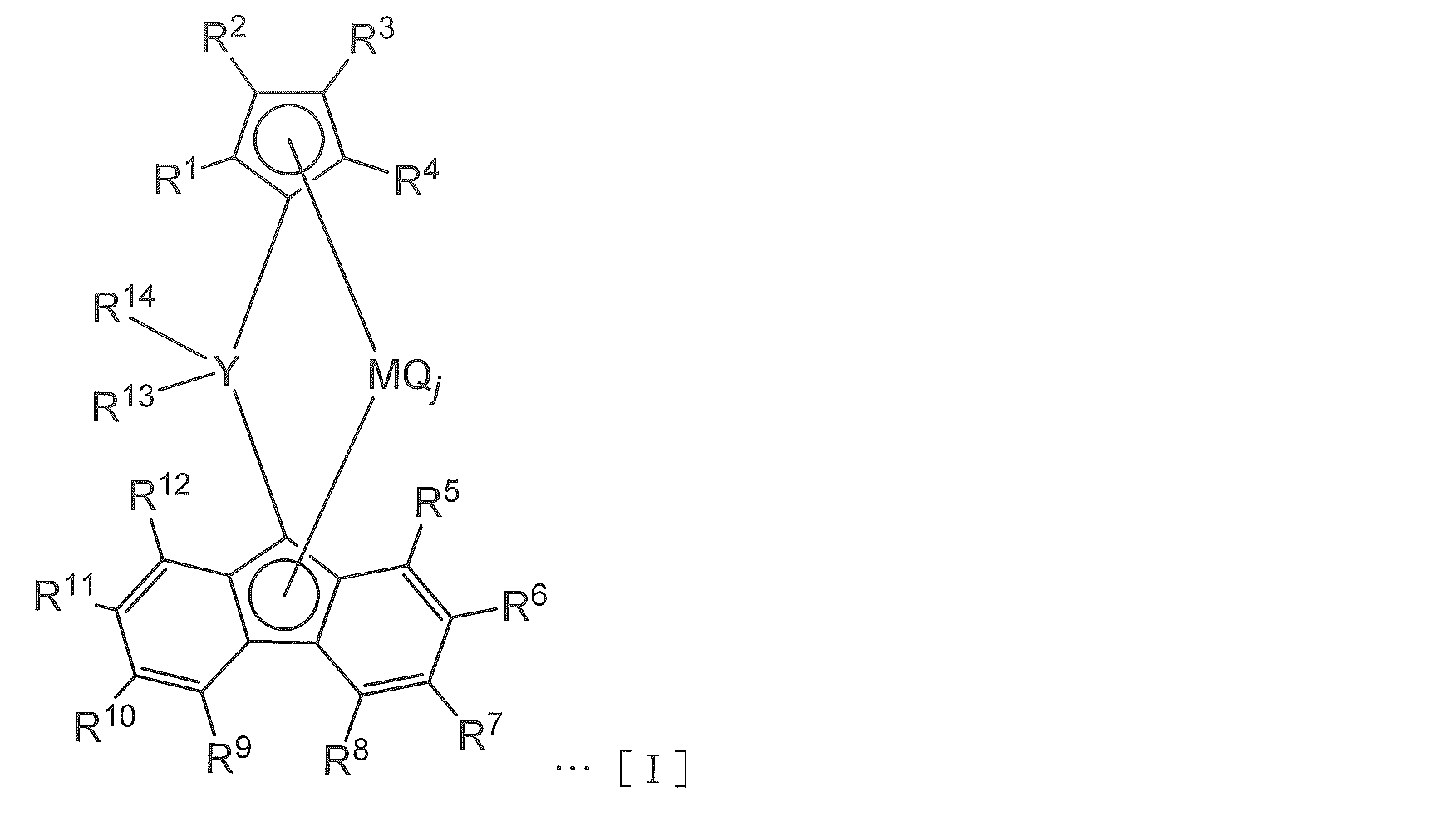
Mはチタン原子、ジルコニウム原子またはハフニウム原子であり、
R1、R2、R3、R4、R5、R6、R7、R8、R9、R10、R11およびR12は水素原子、炭素数1から20の炭化水素基、ケイ素含有基、窒素含有基、酸素含有基、ハロゲン原子およびハロゲン含有基から選ばれる原子または置換基であり、それぞれ同一でも異なっていてもよく、
R1からR12までの隣接した置換基は互いに結合して環を形成していてもよく、
R13およびR14はアリール基または置換アリール基であり、いずれも置換アリール基である場合にはそれぞれ同一でも異なっていてもよく、
R13およびR14の少なくとも一つは、アリール基の水素原子の一つ以上をハメット則の置換基定数σが-0.2以下の電子供与性置換基で置換してなる置換アリール基であって、該電子供与性置換基を複数個有する場合にはそれぞれの該電子供与性置換基は同一でも異なっていてもよく、該電子供与性置換基以外の、炭素数1から20の炭化水素基、ケイ素含有基、窒素含有基、酸素含有基、ハロゲン原子およびハロゲン含有基から選ばれる置換基を有していてもよく、該置換基を複数個有する場合にはそれぞれの置換基は同一でも異なっていてもよい置換アリール基であり、
Qはハロゲン原子、炭素数1から20の炭化水素基、アニオン配位子および孤立電子対で配位可能な中性配位子から同一のまたは異なる組合せで選ばれ、
jは1から4の整数である。)
前記一般式[I]におけるR1、R2、R3およびR4が全て水素原子であることを特徴とする、上記[1]に記載のエチレン/α-オレフィン共重合体の製造方法。
前記一般式[I]におけるYが炭素原子であることを特徴とする、上記[1]または[2]に記載のエチレン/α-オレフィン共重合体の製造方法。
前記電子供与性置換基が、窒素含有基および酸素含有基から選ばれる基であることを特徴とする、上記[1]~[3]のいずれか一つに記載のエチレン/α-オレフィン共重合体の製造方法。
前記一般式[I]におけるR13およびR14が同一の置換アリール基であることを特徴とする、上記[4]に記載のエチレン/α-オレフィン共重合体の製造方法。
前記一般式[I]におけるR13およびR14が、前記電子供与性置換基としての窒素含有基および酸素含有基から選ばれる基を、Yとの結合に対するメタ位および/またはパラ位に含む置換フェニル基であることを特徴とする、上記[4]または[5]に記載のエチレン/α-オレフィン共重合体の製造方法。
前記一般式[I]におけるR13およびR14が、前記電子供与性置換基としての窒素含有基を含む置換アリール基であることを特徴とする、上記[5]に記載のエチレン/α-オレフィン共重合体の製造方法。
前記一般式[I]におけるR13およびR14が、前記電子供与性置換基としての窒素含有基を含む置換フェニル基であることを特徴とする、上記[7a]に記載のエチレン/α-オレフィン共重合体の製造方法。
前記一般式[I]におけるR13およびR14が、前記電子供与性置換基としての窒素含有基を、Yとの結合に対するメタ位および/またはパラ位に含む置換フェニル基であることを特徴とする、上記[7b]に記載のエチレン/α-オレフィン共重合体の製造方法。
前記一般式[I]におけるR13およびR14が、前記電子供与性置換基としての下記一般式[II]で表される窒素含有基を含む置換フェニル基であることを特徴とする、上記[4]~[6]のいずれか一つに記載のエチレン/α-オレフィン共重合体の製造方法。

前記一般式[I]におけるR13およびR14が、前記電子供与性置換基としての酸素含有基を含む置換アリール基であることを特徴とする、上記[5]に記載のエチレン/α-オレフィン共重合体の製造方法。
前記一般式[I]におけるR13およびR14が、前記電子供与性置換基としての酸素含有基を含む置換フェニル基であることを特徴とする、上記[8a]に記載のエチレン/α-オレフィン共重合体の製造方法。
前記一般式[I]におけるR13およびR14が、前記電子供与性置換基としての酸素含有基を、Yとの結合に対するメタ位および/またはパラ位に含む置換フェニル基であることを特徴とする、上記[8b]に記載のエチレン/α-オレフィン共重合体の製造方法。
前記一般式[I]におけるR13およびR14が、前記電子供与性置換基としての下記一般式[III]で表される酸素含有基を含む置換フェニル基であることを特徴とする、上記[4]~[6]のいずれか一つに記載のエチレン/α-オレフィン共重合体の製造方法。

前記一般式[I]におけるR5、R8、R9およびR12が全て水素原子であることを特徴とする、上記[1]~[8]のいずれか一つに記載のエチレン/α-オレフィン共重合体の製造方法。
前記一般式[I]におけるR6、R7、R10およびR11のうち少なくとも二つが炭化水素基、ケイ素含有基、窒素含有基、酸素含有基、ハロゲン原子およびハロゲン含有基から選ばれる置換基であることを特徴とする、上記[1]~[9]のいずれか一つに記載のエチレン/α-オレフィン共重合体の製造方法。
前記一般式[I]におけるR6とR7、および/またはR10とR11が互いに結合して環を形成していることを特徴とする、上記[10]に記載のエチレン/α-オレフィン共重合体の製造方法。
前記一般式[I]におけるR6とR7、およびR10とR11が互いに結合して環を形成していることを特徴とする、上記[11]に記載のエチレン/α-オレフィン共重合体の製造方法。
前記一般式[I]におけるR6とR7、およびR10とR11が互いに結合して形成する環が五乃至七員環であることを特徴とする、上記[12]に記載のエチレン/α-オレフィン共重合体の製造方法。
前記一般式[I]におけるR6とR7、およびR10とR11が互いに結合して形成する環が六員環であることを特徴とする、上記[13]に記載のエチレン/α-オレフィン共重合体の製造方法。
下記一般式[IV]で表されることを特徴とする架橋メタロセン化合物を含むオレフィン重合触媒の存在下で、エチレンおよびα-オレフィンを共重合することを特徴とする、上記[14]に記載のエチレン/α-オレフィン共重合体の製造方法。
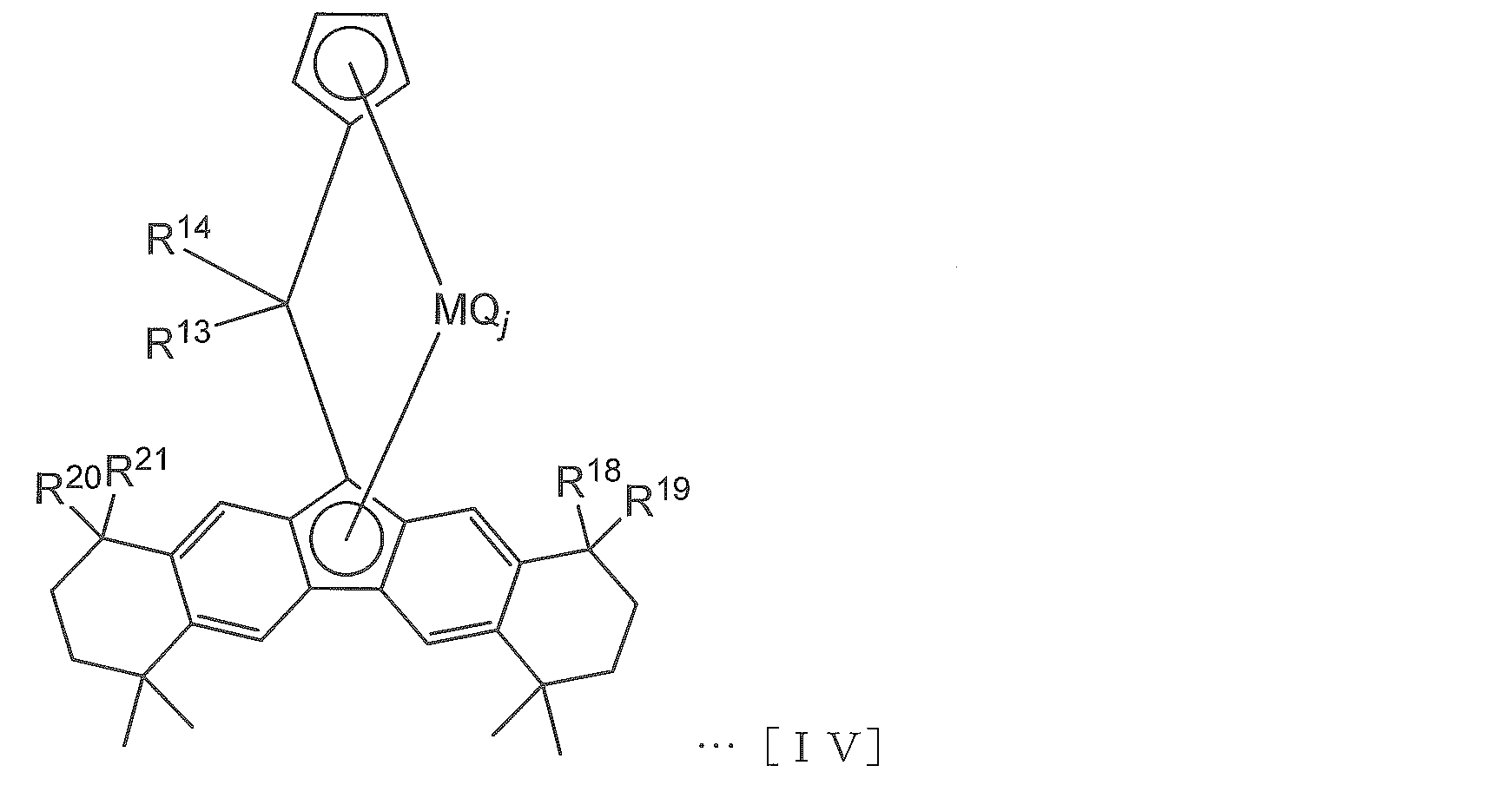
R13およびR14は、いずれも前記電子供与性置換基としての上記一般式[II]で表される窒素含有基を含む置換フェニル基であるか、いずれも前記電子供与性置換基としての上記一般式[III]で表される酸素含有基を含む置換フェニル基であり、
R18、R19、R20、およびR21は水素原子またはメチル基であり、
Qはハロゲン原子、炭素数1から20の炭化水素基、アニオン配位子および孤立電子対で配位可能な中性配位子から同一または異なる組合せで選ばれ、
jは1から4の整数である。)
前記一般式[I]におけるMがハフニウムであることを特徴とする、上記[1]~[15]のいずれか一つに記載のエチレン/α-オレフィン共重合体の製造方法。
前記エチレン/α-オレフィン共重合体の製造方法であって、ポリマー中の各々のモノマー由来の構成単位の割合の合計を100モル%としたときに、エチレン由来の構成単位の割合が50モル%以上であるエチレン系重合体が得られるように重合することを特徴とする、上記[1]~[16]のいずれか一つに記載のエチレン/α-オレフィン共重合体の製造方法。
重合温度が100~300℃であることを特徴とする、上記[1]~[17]のいずれか一つに記載のエチレン/α-オレフィン共重合体の製造方法。
本発明のエチレン/α-オレフィン共重合体の製造方法は、上記一般式[I]で表される架橋メタロセン化合物(A)、および上述した化合物(B)を含むオレフィン重合触媒の存在下で、エチレンと炭素数が3以上のα-オレフィンとを共重合することを特徴としている。
架橋メタロセン化合物(A)は、上記一般式[I]で表される。式[I]中のY、M、R1~R14、Qおよびjを以下に説明する。
Yは、炭素原子、ケイ素原子、ゲルマニウム原子およびスズ原子から選ばれ、好ましくは炭素原子である。
R1、R2、R3、R4、R5、R6、R7、R8、R9、R10、R11およびR12は、水素原子、炭素数1から20の炭化水素基、ケイ素含有基、窒素含有基、酸素含有基、ハロゲン原子およびハロゲン含有基から選ばれる原子または置換基であり、それぞれ同一でも異なっていてもよい。また、R1からR12までの隣接した置換基は互いに結合して環を形成していてもよく、互いに結合していなくてもよい。
ハロゲン含有基としては、上述した炭素数1から20の炭化水素基、ケイ素含有基、窒素含有基または酸素含有基において、水素原子がハロゲン原子によって置換された基であるトリフルオロメチル基、トリブロモメチル基、ペンタフルオロエチル基、ペンタフルオロフェニル基などが例示される。
ハロゲン原子および炭素数1から20の炭化水素基の詳細は、上述のとおりである。Qがハロゲン原子である場合は、塩素原子が好ましい。Qが炭素数1から20の炭化水素基である場合は、該炭化水素基の炭素数は1から7であることが好ましい。
jは1から4の整数であり、好ましくは2である。
R13およびR14はアリール基または置換アリール基であり、いずれも置換アリール基である場合にはそれぞれ同一でも異なっていてもよい。
R13およびR14の少なくとも一つは、アリール基の水素原子の一つ以上をハメット則の置換基定数σが-0.2以下の電子供与性置換基で置換してなる置換アリール基であって、該電子供与性置換基を複数個有する場合にはそれぞれの該電子供与性置換基は同一でも異なっていてもよく、該電子供与性置換基以外の、炭素数1から20の炭化水素基、ケイ素含有基、窒素含有基、酸素含有基、ハロゲン原子およびハロゲン含有基から選ばれる置換基を有していてもよく、該置換基を複数個有する場合にはそれぞれの置換基は同一でも異なっていてもよい置換アリール基(以下「電子供与性基含有置換アリール基」ともいう。)である。
本出願人は、種々の架橋メタロセン化合物について鋭意検討した結果、上記一般式[I]で表される架橋メタロセン化合物(A)において、R13およびR14の少なくとも一つを、特にハメット則の置換基定数σが-0.2以下の電子供与性置換基が一つ以上置換した電子供与性基含有置換アリール基とした場合に、該架橋メタロセン化合物(A)を含むオレフィン重合触媒の存在下でエチレンと炭素数が3以上のα-オレフィンから選ばれる1種以上のモノマーとを共重合する際、生成するエチレン/α-オレフィン共重合体の分子量が高くなることを初めて見出した。


該架橋メタロセン化合物(A-2)は、例えば下式[VII]のような簡便な方法で合成することが可能である。


R15およびR16としての炭素数1から20の炭化水素基、ケイ素含有基、酸素含有基およびハロゲン含有基としては、上述したこれらの置換基の具体例を挙げることができる。
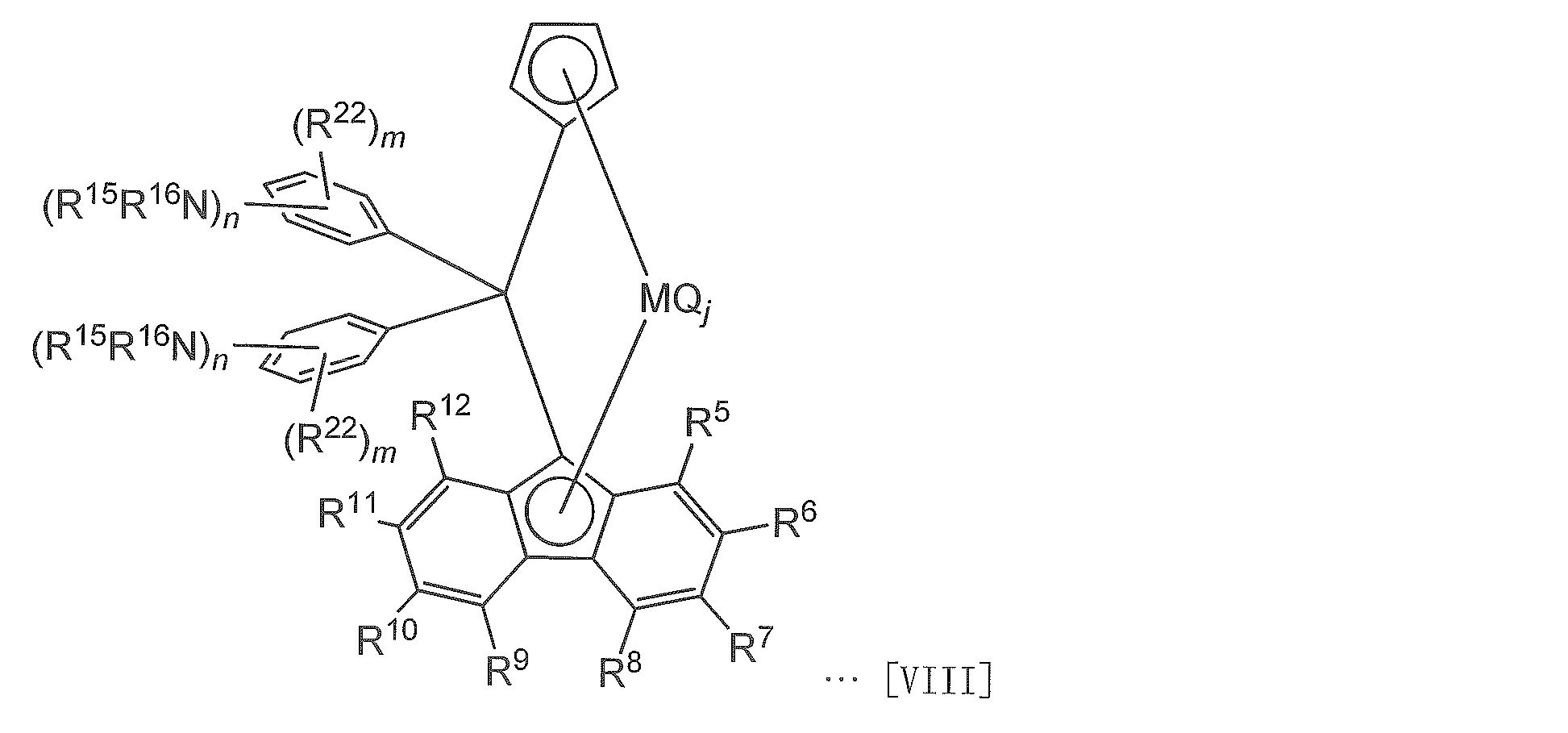

R17としての炭素数1から20の炭化水素基、ケイ素含有基、窒素含有基およびハロゲン含有基としては、上述したこれらの置換基の具体例を挙げることができる。
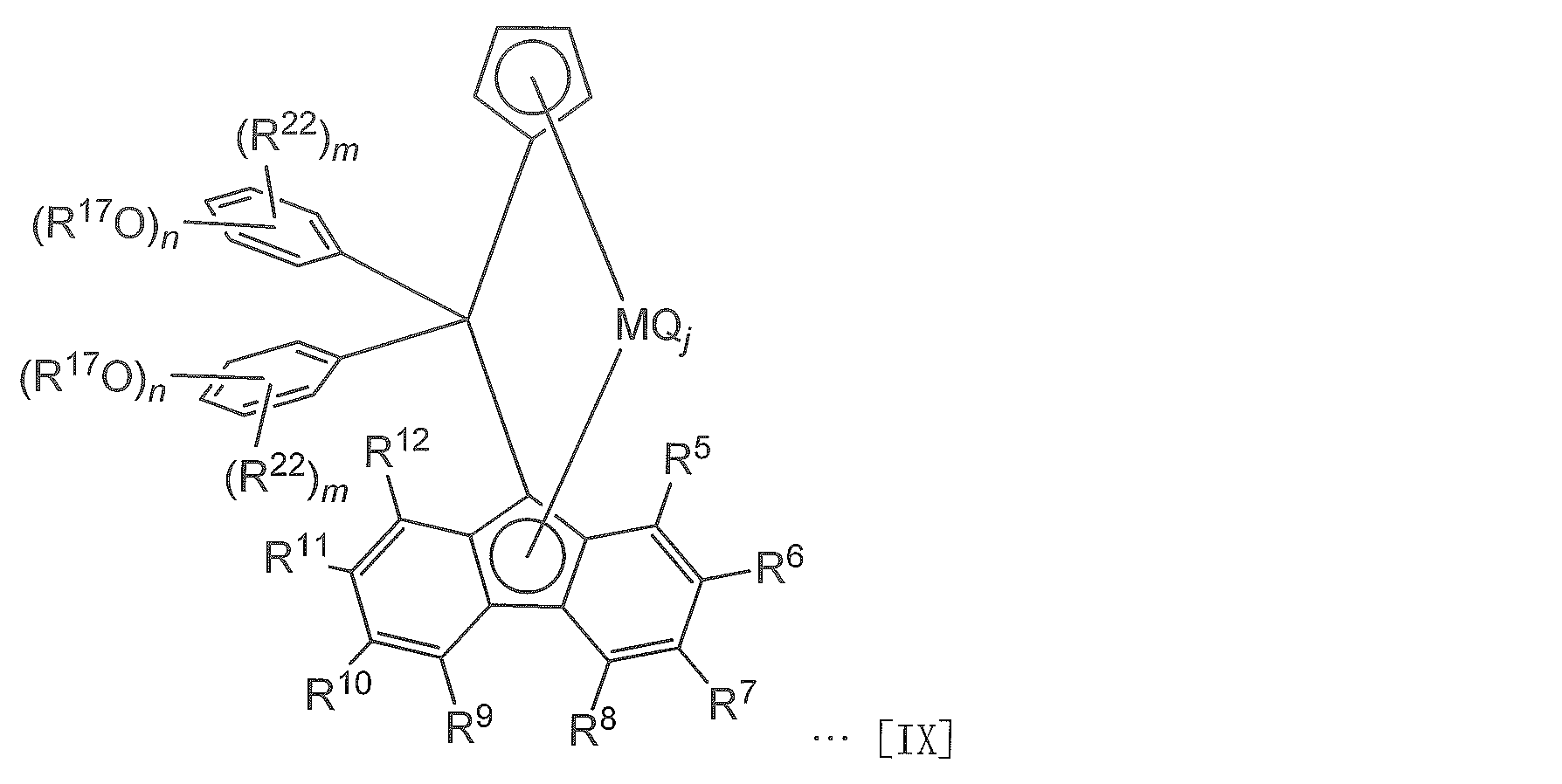
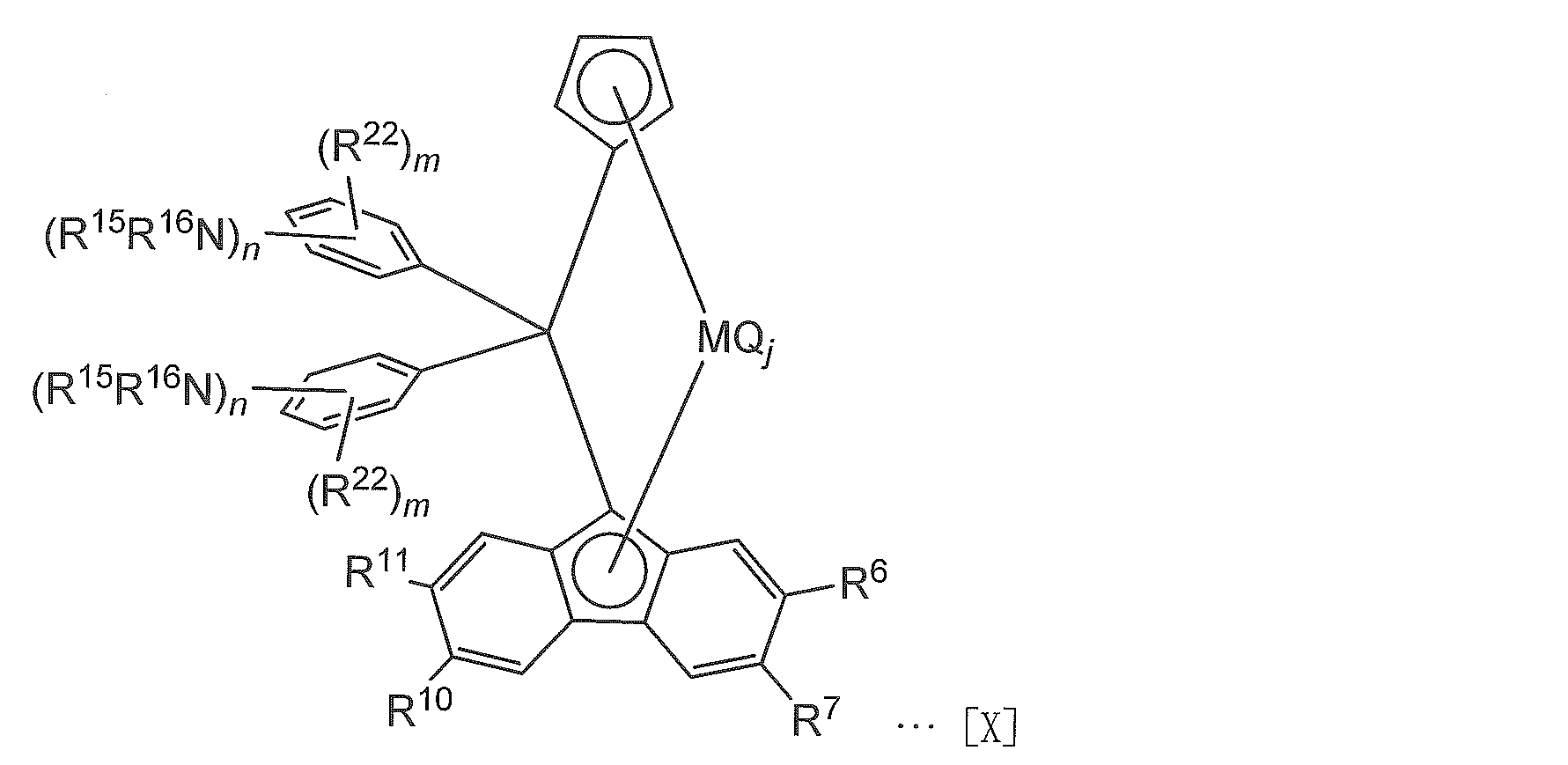

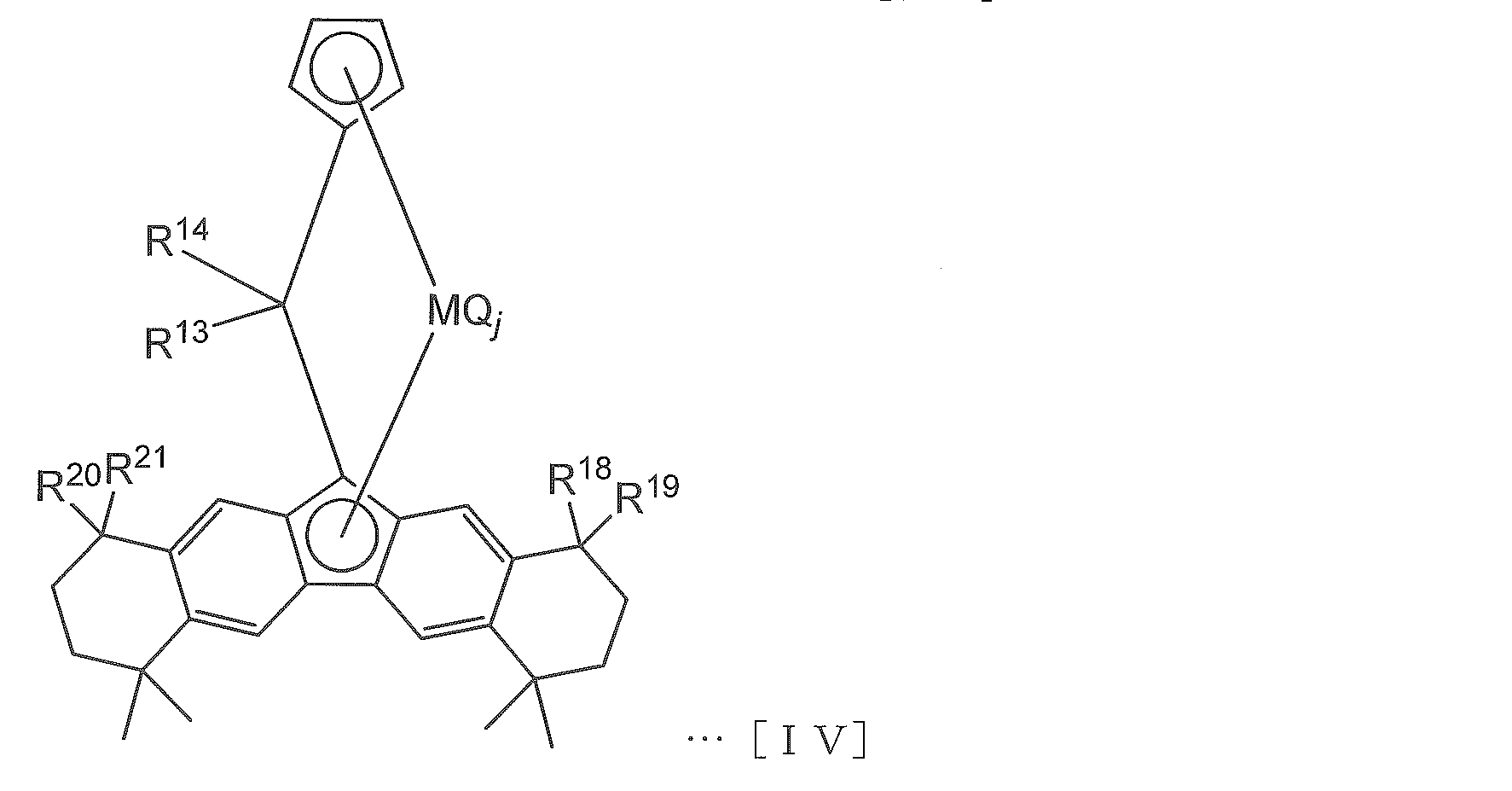
このような架橋メタロセン化合物(A)としては、
[ビス[4-(ジメチルアミノ)フェニル]メチレン(η5-シクロペンタジエニル)(η5-フルオレニル)]ハフニウムジクロリド、[ビス[4-(ジメチルアミノ)フェニル]メチレン(η5-シクロペンタジエニル)(η5-2,7-ジメチルフルオレニル)]ハフニウムジクロリド、[ビス[4-(ジメチルアミノ)フェニル]メチレン(η5-シクロペンタジエニル)(η5-3,6-ジメチルフルオレニル)]ハフニウムジクロリド、[ビス[4-(ジメチルアミノ)フェニル]メチレン(η5-シクロペンタジエニル)(η5-2,7-ジ-t-ブチルフルオレニル)]ハフニウムジクロリド、[ビス[4-(ジメチルアミノ)フェニル]メチレン(η5-シクロペンタジエニル)(η5-3,6-ジ-t-ブチルフルオレニル)]ハフニウムジクロリド、[ビス[4-(ジメチルアミノ)フェニル]メチレン(η5-シクロペンタジエニル)(η5-2,3,6,7-テトラメチルフルオレニル)]ハフニウムジクロリド、[ビス[4-(ジメチルアミノ)フェニル]メチレン(η5-シクロペンタジエニル)(η5-2,7-ジメチル-3,6-ジ-t-ブチルフルオレニル)]ハフニウムジクロリド、[ビス[4-(ジメチルアミノ)フェニル]メチレン(η5-シクロペンタジエニル)(η5-テトラメチルオクタヒドロジベンゾフルオレニル)]ハフニウムジクロリド、[ビス[4-(ジメチルアミノ)フェニル]メチレン(η5-シクロペンタジエニル)(η5-オクタメチルオクタヒドロジベンゾフルオレニル)]ハフニウムジクロリド、
[ビス(4-メトキシフェニル)メチレン(η5-シクロペンタジエニル)(η5-フルオレニル)]ハフニウムジクロリド、[ビス(4-メトキシフェニル)メチレン(η5-シクロペンタジエニル)(η5-2,7-ジメチルフルオレニル)]ハフニウムジクロリド、[ビス(4-メトキシフェニル)メチレン(η5-シクロペンタジエニル)(η5-3,6-ジメチルフルオレニル)]ハフニウムジクロリド、[ビス(4-メトキシフェニル)メチレン(η5-シクロペンタジエニル)(η5-2,7-ジ-t-ブチルフルオレニル)]ハフニウムジクロリド、[ビス(4-メトキシフェニル)メチレン(η5-シクロペンタジエニル)(η5-3,6-ジ-t-ブチルフルオレニル)]ハフニウムジクロリド、[ビス(4-メトキシフェニル)メチレン(η5-シクロペンタジエニル)(η5-2,3,6,7-テトラメチルフルオレニル)]ハフニウムジクロリド、[ビス(4-メトキシフェニル)メチレン(η5-シクロペンタジエニル)(η5-2,7-ジメチル-3,6-ジ-t-ブチルフルオレニル)]ハフニウムジクロリド、[ビス(4-メトキシフェニル)メチレン(η5-シクロペンタジエニル)(η5-テトラメチルオクタヒドロジベンゾフルオレニル)]ハフニウムジクロリド、[ビス(4-メトキシフェニル)メチレン(η5-シクロペンタジエニル)(η5-オクタメチルオクタヒドロジベンゾフルオレニル)]ハフニウムジクロリド、
[ビス(4-t-ブチルフェニル)メチレン(η5-シクロペンタジエニル)(η5-フルオレニル)]ハフニウムジクロリド、[ビス(4-t-ブチルフェニル)メチレン(η5-シクロペンタジエニル)(η5-2,7-ジメチルフルオレニル)]ハフニウムジクロリド、[ビス(4-t-ブチルフェニル)メチレン(η5-シクロペンタジエニル)(η5-3,6-ジメチルフルオレニル)]ハフニウムジクロリド、[ビス(4-t-ブチルフェニル)メチレン(η5-シクロペンタジエニル)(η5-2,7-ジ-t-ブチルフルオレニル)]ハフニウムジクロリド、[ビス(4-t-ブチルフェニル)メチレン(η5-シクロペンタジエニル)(η5-3,6-ジ-t-ブチルフルオレニル)]ハフニウムジクロリド、[ビス(4-t-ブチルフェニル)メチレン(η5-シクロペンタジエニル)(η5-2,3,6,7-テトラメチルフルオレニル)]ハフニウムジクロリド、[ビス(4-t-ブチルフェニル)メチレン(η5-シクロペンタジエニル)(η5-2,7-ジメチル-3,6-ジ-t-ブチルフルオレニル)]ハフニウムジクロリド、[ビス(4-t-ブチルフェニル)メチレン(η5-シクロペンタジエニル)(η5-テトラメチルオクタヒドロジベンゾフルオレニル)]ハフニウムジクロリド、[ビス(4-t-ブチルフェニル)メチレン(η5-シクロペンタジエニル)(η5-オクタメチルオクタヒドロジベンゾフルオレニル)]ハフニウムジクロリド、
[ビス(3-N-モルフォリニルフェニル)メチレン(η5-シクロペンタジエニル)(η5-フルオレニル)]ハフニウムジクロリド、[ビス(3-N-モルフォリニルフェニル)メチレン(η5-シクロペンタジエニル)(η5-2,7-ジメチルフルオレニル)]ハフニウムジクロリド、[ビス(3-N-モルフォリニルフェニル)メチレン(η5-シクロペンタジエニル)(η5-3,6-ジメチルフルオレニル)]ハフニウムジクロリド、[ビス(3-N-モルフォリニルフェニル)メチレン(η5-シクロペンタジエニル)(η5-2,7-ジ-t-ブチルフルオレニル)]ハフニウムジクロリド、[ビス(3-N-モルフォリニルフェニル)メチレン(η5-シクロペンタジエニル)(η5-3,6-ジ-t-ブチルフルオレニル)]ハフニウムジクロリド、[ビス(3-N-モルフォリニルフェニル)メチレン(η5-シクロペンタジエニル)(η5-2,3,6,7-テトラメチルフルオレニル)]ハフニウムジクロリド、[ビス(3-N-モルフォリニルフェニル)メチレン(η5-シクロペンタジエニル)(η5-2,7-ジメチル-3,6-ジ-t-ブチルフルオレニル)]ハフニウムジクロリド、[ビス(3-N-モルフォリニルフェニル)メチレン(η5-シクロペンタジエニル)(η5-テトラメチルオクタヒドロジベンゾフルオレニル)]ハフニウムジクロリド、[ビス(3-N-モルフォリニルフェニル)メチレン(η5-シクロペンタジエニル)(η5-オクタメチルオクタヒドロジベンゾフルオレニル)]ハフニウムジクロリド、
[ビス(4-N-モルフォリニルフェニル)メチレン(η5-シクロペンタジエニル)(η5-フルオレニル)]ハフニウムジクロリド、[ビス(4-N-モルフォリニルフェニル)メチレン(η5-シクロペンタジエニル)(η5-2,7-ジメチルフルオレニル)]ハフニウムジクロリド、[ビス(4-N-モルフォリニルフェニル)メチレン(η5-シクロペンタジエニル)(η5-3,6-ジメチルフルオレニル)]ハフニウムジクロリド、[ビス(4-N-モルフォリニルフェニル)メチレン(η5-シクロペンタジエニル)(η5-2,7-ジ-t-ブチルフルオレニル)]ハフニウムジクロリド、[ビス(4-N-モルフォリニルフェニル)メチレン(η5-シクロペンタジエニル)(η5-3,6-ジ-t-ブチルフルオレニル)]ハフニウムジクロリド、[ビス(4-N-モルフォリニルフェニル)メチレン(η5-シクロペンタジエニル)(η5-2,3,6,7-テトラメチルフルオレニル)]ハフニウムジクロリド、[ビス(4-N-モルフォリニルフェニル)メチレン(η5-シクロペンタジエニル)(η5-2,7-ジメチル-3,6-ジ-t-ブチルフルオレニル)]ハフニウムジクロリド、[ビス(4-N-モルフォリニルフェニル)メチレン(η5-シクロペンタジエニル)(η5-テトラメチルオクタヒドロジベンゾフルオレニル)]ハフニウムジクロリド、[ビス(4-N-モルフォリニルフェニル)メチレン(η5-シクロペンタジエニル)(η5-オクタメチルオクタヒドロジベンゾフルオレニル)]ハフニウムジクロリド、
[ビス(4-メトキシ-3-メチルフェニル)メチレン(η5-シクロペンタジエニル)(η5-フルオレニル)]ハフニウムジクロリド、[ビス(4-メトキシ-3-メチルフェニル)メチレン(η5-シクロペンタジエニル)(η5-2,7-ジメチルフルオレニル)]ハフニウムジクロリド、[ビス(4-メトキシ-3-メチルフェニル)メチレン(η5-シクロペンタジエニル)(η5-3,6-ジメチルフルオレニル)]ハフニウムジクロリド、[ビス(4-メトキシ-3-メチルフェニル)メチレン(η5-シクロペンタジエニル)(η5-2,7-ジ-t-ブチルフルオレニル)]ハフニウムジクロリド、[ビス(4-メトキシ-3-メチルフェニル)メチレン(η5-シクロペンタジエニル)(η5-3,6-ジ-t-ブチルフルオレニル)]ハフニウムジクロリド、[ビス(4-メトキシ-3-メチルフェニル)メチレン(η5-シクロペンタジエニル)(η5-2,3,6,7-テトラメチルフルオレニル)]ハフニウムジクロリド、[ビス(4-メトキシ-3-メチルフェニル)メチレン(η5-シクロペンタジエニル)(η5-2,7-ジメチル-3,6-ジ-t-ブチルフルオレニル)]ハフニウムジクロリド、[ビス(4-メトキシ-3-メチルフェニル)メチレン(η5-シクロペンタジエニル)(η5-テトラメチルオクタヒドロジベンゾフルオレニル)]ハフニウムジクロリド、[ビス(4-メトキシ-3-メチルフェニル)メチレン(η5-シクロペンタジエニル)(η5-オクタメチルオクタヒドロジベンゾフルオレニル)]ハフニウムジクロリド、
[ビス(3,4-ジメトキシフェニル)メチレン(η5-シクロペンタジエニル)(η5-フルオレニル)]ハフニウムジクロリド、[ビス(3,4-ジメトキシフェニル)メチレン(η5-シクロペンタジエニル)(η5-2,7-ジメチルフルオレニル)]ハフニウムジクロリド、[ビス(3,4-ジメトキシフェニル)メチレン(η5-シクロペンタジエニル)(η5-3,6-ジメチルフルオレニル)]ハフニウムジクロリド、[ビス(3,4-ジメトキシフェニル)メチレン(η5-シクロペンタジエニル)(η5-2,7-ジ-t-ブチルフルオレニル)]ハフニウムジクロリド、[ビス(3,4-ジメトキシフェニル)メチレン(η5-シクロペンタジエニル)(η5-3,6-ジ-t-ブチルフルオレニル)]ハフニウムジクロリド、[ビス(3,4-ジメトキシフェニル)メチレン(η5-シクロペンタジエニル)(η5-2,3,6,7-テトラメチルフルオレニル)]ハフニウムジクロリド、[ビス(3,4-ジメトキシフェニル)メチレン(η5-シクロペンタジエニル)(η5-2,7-ジメチル-3,6-ジ-t-ブチルフルオレニル)]ハフニウムジクロリド、[ビス(3,4-ジメトキシフェニル)メチレン(η5-シクロペンタジエニル)(η5-テトラメチルオクタヒドロジベンゾフルオレニル)]ハフニウムジクロリド、[ビス(3,4-ジメトキシフェニル)メチレン(η5-シクロペンタジエニル)(η5-オクタメチルオクタヒドロジベンゾフルオレニル)]ハフニウムジクロリド、
[ビス(4-メトキシ-3,5-ジメチルフェニル)メチレン(η5-シクロペンタジエニル)(η5-フルオレニル)]ハフニウムジクロリド、[ビス(4-メトキシ-3,5-ジメチルフェニル)メチレン(η5-シクロペンタジエニル)(η5-2,7-ジメチルフルオレニル)]ハフニウムジクロリド、[ビス(4-メトキシ-3,5-ジメチルフェニル)メチレン(η5-シクロペンタジエニル)(η5-3,6-ジメチルフルオレニル)]ハフニウムジクロリド、[ビス(4-メトキシ-3,5-ジメチルフェニル)メチレン(η5-シクロペンタジエニル)(η5-2,7-ジ-t-ブチルフルオレニル)]ハフニウムジクロリド、[ビス(4-メトキシ-3,5-ジメチルフェニル)メチレン(η5-シクロペンタジエニル)(η5-3,6-ジ-t-ブチルフルオレニル)]ハフニウムジクロリド、[ビス(4-メトキシ-3,5-ジメチルフェニル)メチレン(η5-シクロペンタジエニル)(η5-2,3,6,7-テトラメチルフルオレニル)]ハフニウムジクロリド、[ビス(4-メトキシ-3,5-ジメチルフェニル)メチレン(η5-シクロペンタジエニル)(η5-2,7-ジメチル-3,6-ジ-t-ブチルフルオレニル)]ハフニウムジクロリド、[ビス(4-メトキシ-3,5-ジメチルフェニル)メチレン(η5-シクロペンタジエニル)(η5-テトラメチルオクタヒドロジベンゾフルオレニル)]ハフニウムジクロリド、[ビス(4-メトキシ-3,5-ジメチルフェニル)メチレン(η5-シクロペンタジエニル)(η5-オクタメチルオクタヒドロジベンゾフルオレニル)]ハフニウムジクロリド、および
これらの化合物のハフニウム原子をジルコニウム原子に置き換えた化合物またはクロロ配位子をメチル基に置き換えた化合物
などが例示されるが、架橋メタロセン化合物(A)はこれらの例示に限定されない。しかし敢えて好ましい化合物群を挙げるとするならば、[ビス(4-N-モルフォリニルフェニル)メチレン(η5-シクロペンタジエニル)(η5-オクタメチルオクタヒドロジベンゾフルオレニル)]ハフニウムジクロリド、[ビス[4-(ジメチルアミノ)フェニル]メチレン(η5-シクロペンタジエニル)(η5-オクタメチルオクタヒドロジベンゾフルオレニル)]ハフニウムジクロリド、[ビス(3-N-モルフォリニルフェニル)メチレン(η5-シクロペンタジエニル)(η5-オクタメチルオクタヒドロジベンゾフルオレニル)]ハフニウムジクロリド、[ビス(4-メトキシ-3-メチルフェニル)メチレン(η5-シクロペンタジエニル)(η5-オクタメチルオクタヒドロジベンゾフルオレニル)]ハフニウムジクロリド、[ビス(4-メトキシ-3,5-ジメチルフェニル)メチレン(η5-シクロペンタジエニル)(η5-オクタメチルオクタヒドロジベンゾフルオレニル)]ハフニウムジクロリド、[ビス(4-メトキシフェニル)メチレン(η5-シクロペンタジエニル)(η5-オクタメチルオクタヒドロジベンゾフルオレニル)]ハフニウムジクロリド、[ビス[4-(ジメチルアミノ)フェニル]メチレン(η5-シクロペンタジエニル)(η5-テトラメチルオクタヒドロジベンゾフルオレニル)]ハフニウムジクロリド、[ビス(4-メトキシフェニル)メチレン(η5-シクロペンタジエニル)(η5-テトラメチルオクタヒドロジベンゾフルオレニル)]ハフニウムジクロリド、[ビス(3,4-ジメトキシフェニル)メチレン(η5-シクロペンタジエニル)(η5-2,7-ジメチル-3,6-ジ-t-ブチルフルオレニル)]ハフニウムジクロリド、[ビス(4-メトキシフェニル)メチレン(η5-シクロペンタジエニル)(η5-2,7-ジメチル-3,6-ジ-t-ブチルフルオレニル)]ハフニウムジクロリド、[ビス(4-メトキシフェニル)メチレン(η5-シクロペンタジエニル)(η5-2,3,6,7-テトラメチルフルオレニル)]ハフニウムジクロリド、[ビス(4-N-モルフォリニルフェニル)メチレン(η5-シクロペンタジエニル)(η5-2,7-ジ-t-ブチルフルオレニル)]ハフニウムジクロリド、[ビス(3,4-ジメトキシフェニル)メチレン(η5-シクロペンタジエニル)(η5-2,7-ジメチルフルオレニル)]ハフニウムジクロリド、[ビス(4-メトキシフェニル)メチレン(η5-シクロペンタジエニル)(η5-2,7-ジメチルフルオレニル)]ハフニウムジクロリド、[ビス[4-(ジメチルアミノ)フェニル]メチレン(η5-シクロペンタジエニル)(η5-3,6-ジ-t-ブチルフルオレニル)]ハフニウムジクロリド、および[ビス[4-(ジメチルアミノ)フェニル]メチレン(η5-シクロペンタジエニル)(η5-オクタメチルオクタヒドロジベンゾフルオレニル)]ジルコニウムジクロリドが挙げられる。
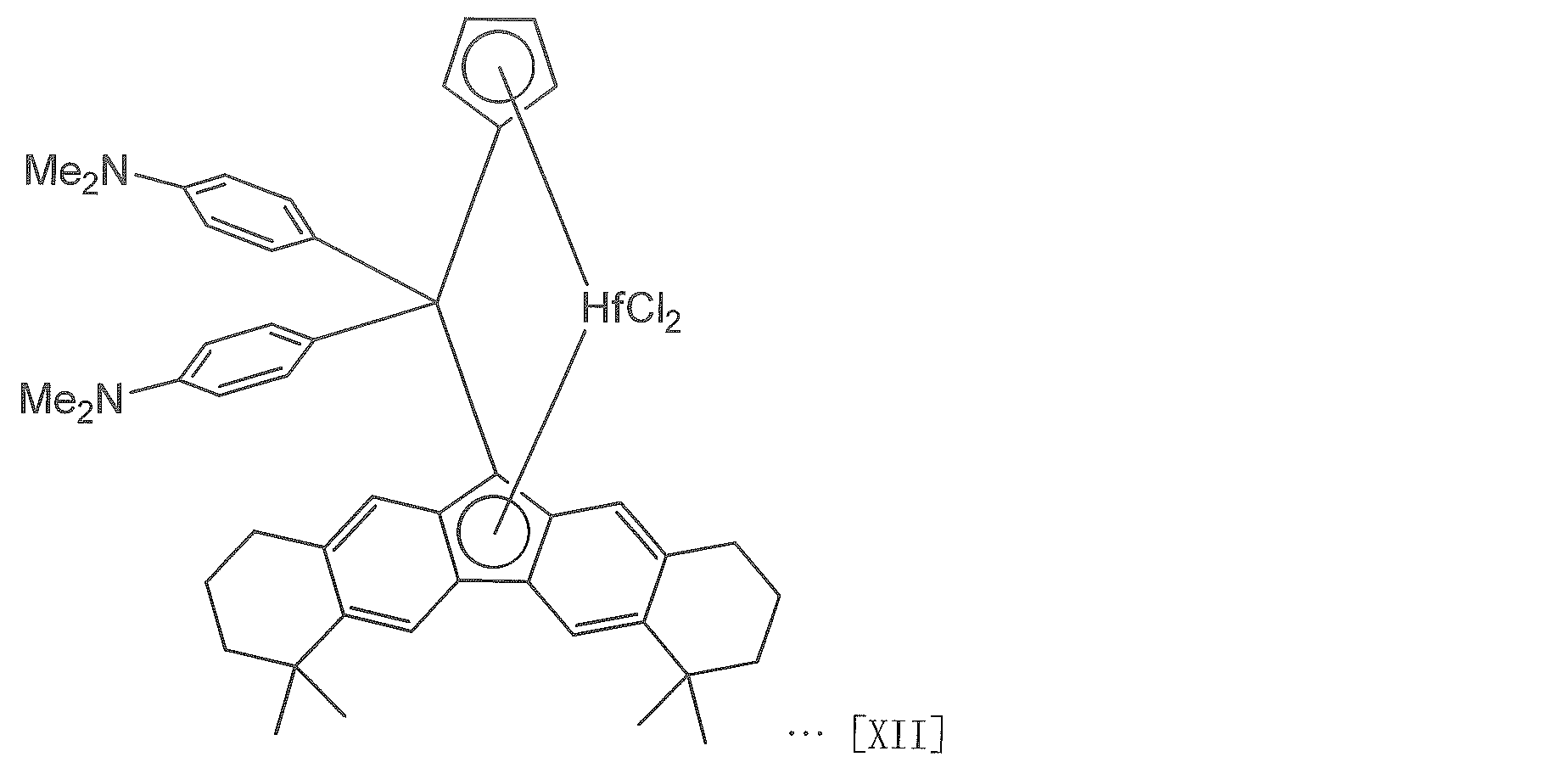
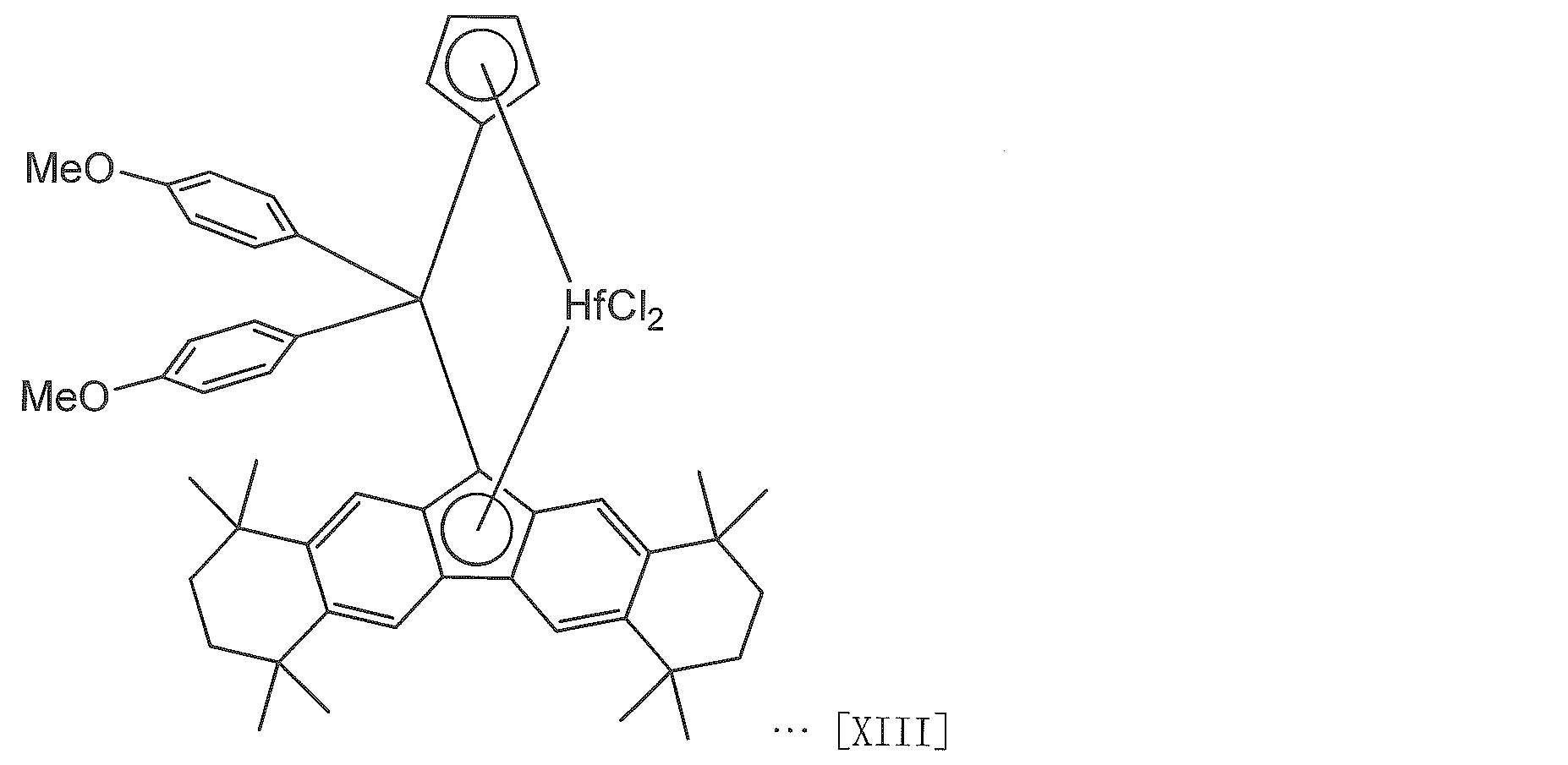
本発明で使用される重合触媒は、上記の架橋メタロセン化合物(A)を含んでいることを特徴とし、さらには、上記の架橋メタロセン化合物(A)、ならびに有機金属化合物(B-1)、有機アルミニウムオキシ化合物(B-2)および架橋メタロセン化合物(A)と反応してイオン対を形成する化合物(B-3)から選ばれる少なくとも1種の化合物(B)を含むことを特徴としている。
(B-1a)一般式 Ra mAl(ORb)nHpXq
(式中、RaおよびRbは、互いに同一でも異なっていてもよく、炭素数1から15、好ましくは1から4の炭化水素基を示し、Xはハロゲン原子を示し、mは0<m≦3、nは0≦n<3、pは0≦p<3、qは0≦q<3の数であり、かつm+n+p+q=3である)
で表される有機アルミニウム化合物。
トリイソプロピルアルミニウム、トリイソブチルアルミニウム、トリsec-ブチルアルミニウム、トリ-t-ブチルアルミニウム、トリ-2-メチルブチルアルミニウム、トリ-3-メチルヘキシルアルミニウム、トリ-2-エチルヘキシルアルミニウムなどのトリ分岐状アルキルアルミニウム、
トリシクロヘキシルアルミニウム、トリシクロオクチルアルミニウムなどのトリシクロアルキルアルミニウム、
トリフェニルアルミニウム、トリ(4-メチルフェニル)アルミニウムなどのトリアリールアルミニウム、
ジイソプロピルアルミニウムハイドライド、ジイソブチルアルミニウムハイドライドなどのジアルキルアルミニウムハイドライド、
一般式(i-C4H9)xAly(C5H10)z(式中、x、y、zは正の数であり、z≦2xである。)で表されるイソプレニルアルミニウムなどのアルケニルアルミニウム、
イソブチルアルミニウムメトキシド、イソブチルアルミニウムエトキシドなどのアルキルアルミニウムアルコキシド、
ジメチルアルミニウムメトキシド、ジエチルアルミニウムエトキシド、ジブチルアルミニウムブトキシドなどのジアルキルアルミニウムアルコキシド、
エチルアルミニウムセスキエトキシド、ブチルアルミニウムセスキブトキシドなどのアルキルアルミニウムセスキアルコキシド、
一般式Ra 2.5Al(ORb)0.5などで表される平均組成を有する部分的にアルコキシ化されたアルキルアルミニウム、
ジエチルアルミニウムフェノキシド、ジエチルアルミニウム(2,6-ジ-t-ブチル-4-メチルフェノキシド)などのアルキルアルミニウムアリーロキシド、
ジメチルアルミニウムクロリド、ジエチルアルミニウムクロリド、ジブチルアルミニウムクロリド、ジエチルアルミニウムブロミド、ジイソブチルアルミニウムクロリドなどのジアルキルアルミニウムハライド、
エチルアルミニウムセスキクロリド、ブチルアルミニウムセスキクロリド、エチルアルミニウムセスキブロミドなどのアルキルアルミニウムセスキハライド、
エチルアルミニウムジクロリドなどのアルキルアルミニウムジハライドなどの部分的にハロゲン化されたアルキルアルミニウム、
ジエチルアルミニウムヒドリド、ジブチルアルミニウムヒドリドなどのジアルキルアルミニウムヒドリド、
エチルアルミニウムジヒドリド、プロピルアルミニウムジヒドリドなどのアルキルアルミニウムジヒドリドおよびその他の部分的に水素化されたアルキルアルミニウム、
エチルアルミニウムエトキシクロリド、ブチルアルミニウムブトキシクロリド、エチルアルミニウムエトキシブロミドなどの部分的にアルコキシ化およびハロゲン化されたアルキルアルミニウム
などを例示することができる。また、上記一般式Ra mAl(ORb)nHpXqで表される化合物に類似する化合物も使用することができ、例えば窒素原子を介して2以上のアルミニウム化合物が結合した有機アルミニウム化合物を挙げることができる。このような化合物として具体的には、(C2H5)2AlN(C2H5)Al(C2H5)2などを挙げることができる。
(式中、M2はLi、NaまたはKを示し、Raは炭素数1から15、好ましくは1から4の炭化水素基を示す。)
で表される周期律表第1族金属とアルミニウムとの錯アルキル化物。
このような化合物として、LiAl(C2H5)4、LiAl(C7H15)4などを例示することができる。
(式中、RaおよびRbは、互いに同一でも異なっていてもよく、炭素数1から15、好ましくは1から4の炭化水素基を示し、M3はMg、ZnまたはCdである。)
で表される周期律表第2族または第12族金属のジアルキル化合物。


で表わされる化合物を挙げることができ、特にRがメチル基であるメチルアルミノキサンであってnが3以上、好ましくは10以上のものが利用される。これらアルミノキサン類に若干の有機アルミニウム化合物が混入していても差し支えない。本発明においてエチレンと炭素数が3以上のα-オレフィンとの共重合を高温で行う場合には、特開平2-78687号公報に例示されているようなベンゼン不溶性の有機アルミニウムオキシ化合物も適用することができる。また、特開平2-167305号公報に記載されている有機アルミニウムオキシ化合物、特開平2-24701号公報、特開平3-103407号公報に記載されている二種類以上のアルキル基を有するアルミノキサンなども好適に利用できる。なお、本発明で用いられることのある「ベンゼン不溶性の有機アルミニウムオキシ化合物」とは、60℃のベンゼンに溶解するAl成分がAl原子換算で通常10%以下、好ましくは5%以下、特に好ましくは2%以下であり、ベンゼンに対して不溶性または難溶性である化合物である。


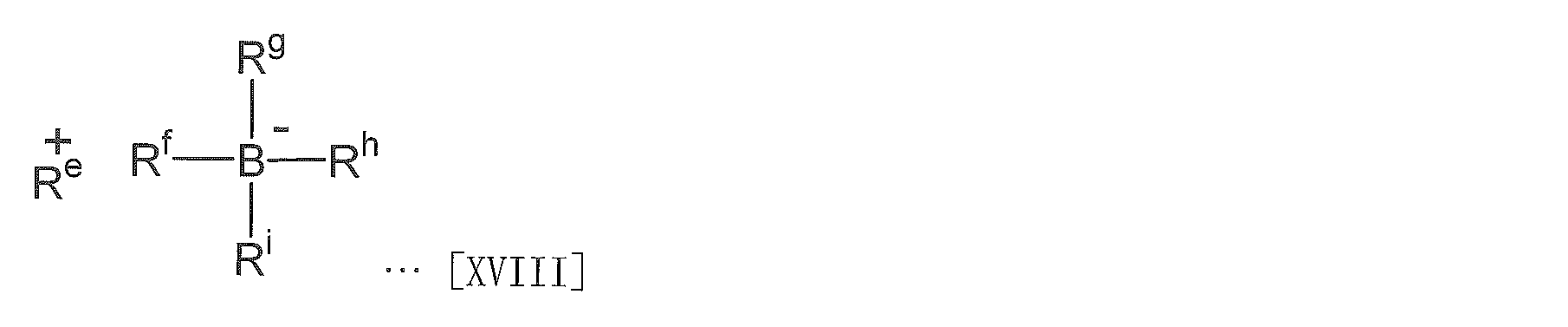
上記のイオン性化合物(B-3)は、1種単独で用いてもよく2種以上を混合して用いでもよい。
本発明では、オレフィン重合触媒の構成成分として、必要に応じて担体(C)を用いてもよい。
無機塩化物は、そのまま用いてもよいし、ボールミル、振動ミルにより粉砕した後に用いてもよい。また、アルコールなどの溶媒に無機塩化物を溶解させた後、析出剤によって微粒子状に析出させたものを用いてもよい。
本発明のエチレン/α-オレフィン共重合体の製造方法は、上記オレフィン重合触媒の存在下で、エチレンと炭素数が3以上のα-オレフィンとを共重合することを特徴としている。
架橋メタロセン化合物(A)(以下「成分(A)」ともいう。)は、反応容積1リットル当り、通常10-9から10-1モル、好ましくは10-8から10-2モルになるような量で用いられる。
重合反応は、回分式、半連続式、連続式のいずれの方法においても行うことができる。さらに、重合を反応条件の異なる二つ以上の重合器で連続的に行うことも可能である。
本発明のオレフィン重合方法によって得られるオレフィン重合体のメルトフローレートMFR2 (ASTM D-1238、190℃、2.16 kg荷重)は、通常0.01から200 g/10min、好ましくは0.05から100 g/10minである。MFR2が当該範囲内にあると、成形加工性に優れる点で好ましい。
架橋メタロセン化合物およびその前駆体の構造は、1H NMRスペクトル(270 MHz、日本電子GSH-270)、FD-質量(以下FD-MS)スペクトル(日本電子SX-102A)等を測定し、決定した。
エチレン/α-オレフィン共重合体の物性/性状は以下の方法で測定した。
日本分光社製フーリエ変換赤外分光光度計FT/IR-610を用い、1-オクテンのメチル対称変角振動に基づく1376cm-1付近の吸収およびC-H伸縮振動の倍音吸収4325cm-1付近の吸収の吸光度を測定した。次にこれらの吸光度比(D1376cm-1/D4325cm-1)を算出し、予め作成しておいた検量線(13C NMRにて標定した標準試料を使って作成)を用いて1-オクテン含有量(mol%)を求めた。
[1-ブテン含有量]
日本分光社製フーリエ変換赤外分光光度計FT/IR-4100を用い、1-ブテンのエチル基に基づくCH2変角振動771cm-1付近の吸収およびC-H伸縮振動の倍音吸収4325cm-1付近の吸収の吸光度を測定した。次にこれらの吸光度比(D771cm-1/D4325cm-1)を算出し、予め作成しておいた検量線(13C NMRにて標定した標準試料を使って作成)を用いて1-ブテン含有量(mol%)を求めた。
o-ジクロロベンゼン-d4を測定溶媒とし、測定温度120℃、スペクトル幅20ppm、パルス繰り返し時間7.0秒、パルス幅6.15μsec(45oパルス)測定条件下にて、1H NMRスペクトル(400 MHz、日本電子ECX400P)を測定し、算出した。
デカリン溶媒を用いて、135℃で測定した。重合体約20 mgをデカリン15 mlに溶解し、135℃のオイルバス中で比粘度ηspを測定した。このデカリン溶液にデカリン溶媒を5 ml追加して希釈後、同様にして比粘度ηspを測定した。この希釈操作をさらに2回繰り返し、濃度(C)を0に外挿した時のηsp/Cの値を極限粘度として採用した。
[η]=lim(ηsp/C) (C→0)
MFR10:ASTM D-1238の標準法により、190℃、10.0 kg荷重下で測定された数値である。
MFR2:ASTM D-1238の標準法により、190℃、2.16 kg荷重下で測定された数値である。
190℃に設定した神藤金属工業社製油圧式熱プレス機を用い、100 kg/cm2の圧力で0.5 mm厚のシートを成形し(スペーサー形状:240×240×0.5 mm厚の板に45×45×0.5 mm、9個取り)、20℃に設定した別の神藤金属工業社製油圧式熱プレス機を用い、100 kg/cm2の圧力で圧縮することで冷却して測定用試料を作成した。熱板は5 mm厚のSUS板を用いた。このプレスシートを120℃で1時間熱処理し、1時間かけて直線的に室温まで徐冷したのち、密度勾配管で測定した。
[ビス(4-N-モルフォリニルフェニル)メチレン(η 5 -シクロペンタジエニル)(η 5 -オクタメチルオクタヒドロジベンゾフルオレニル)]ハフニウムジクロリドの合成
(i) ビス(4-N-モルフォリニルフェニル)(シクロペンタジエニル)(オクタメチルオクタヒドロジベンゾフルオレニル)メタンの合成
窒素雰囲気下、100 mlの三口フラスコにオクタメチルオクタヒドロジベンゾフルオレン 1.24 g(3.21 mmol)、脱水THF 80 mlを装入した。氷水浴下、1.66 Mのn-ブチルリチウムヘキサン溶液 1.97 ml (3.26 mmol)をゆっくりと滴下し、徐々に室温に戻しながら20時間攪拌した。その後、氷水浴下にし、6,6-ビス(4-N-モルフォリニルフェニル)フルベン 1.08 g (2.69 mmol)を加え室温で4時間攪拌した。その後反応溶液に塩化アンモニウム飽和水を加え有機層を分離し、水層をジエチルエーテルで抽出した。得られた有機層をあわせて飽和炭酸水素ナトリウム水溶液、水、飽和食塩水で1回ずつ洗浄した。硫酸マグネシウムで乾燥し、溶媒を留去した。得られた固体をカラムクロマトグラフィーで精製後、ビス(4-N-モルフォリニルフェニル)(シクロペンタジエニル)(オクタメチルオクタヒドロジベンゾフルオレニル)メタン 2.1 g (84.0%)を白色粉末として得た。ビス(4-N-モルフォリニルフェニル)(シクロペンタジエニル)(オクタメチルオクタヒドロジベンゾフルオレニル)メタンの同定は1H NMRスペクトルにて行った。以下にその測定値を示す。
1H NMRスペクトル(270 MHz, CDCl3): δ/ppm 7.3 (br), 7.2-6.8 (br), 6.5-6.0 (br), 5.2 (s), 3.8 (s), 2.9 (s), 1.7-1.5 (br), 1.4-1.2 (br), 1.1-0.8 (br)
窒素雰囲気下、100 mlシュレンク管にビス(4-N-モルフォリニルフェニル)(シクロペンタジエニル)(オクタメチルオクタヒドロジベンゾフルオレニル)メタン 0.8 g (1.0 mmol)、脱水トルエン 30 ml、脱水THF 0.4 gを添加した。ドライアイスバスで冷却しながらn-ブチルリチウム/ヘキサン溶液 (1.66 M) 1.3 ml (2.0 mmol)を徐々に添加し、室温で30分攪拌後、40℃で加熱し、4時間攪拌した。反応溶液を室温に戻した後、溶媒を留去した。得られた固体に脱水ジエチルエーテル 50 mlを添加し、-20℃に冷却後、四塩化ハフニウム 0.317 g (0.98 mmol)を添加し、室温まで徐々に昇温しながら16時間攪拌した。その後溶媒を留去し脱水ジクロロメタンで抽出した。再度濃縮した後、脱水ジエチルエーテルで洗浄し黄色固体として[ビス(4-N-モルフォリニルフェニル)メチレン(η5-シクロペンタジエニル)(η5-オクタメチルオクタヒドロジベンゾフルオレニル)]ハフニウムジクロリド 0.45 g (43.3%)を得た。[ビス(4-N-モルフォリニルフェニル)メチレン(η5-シクロペンタジエニル)(η5-オクタメチルオクタヒドロジベンゾフルオレニル)]ハフニウムジクロリドの同定は1H NMRスペクトルにて行った。以下にその測定値を示す。
1H NMRスペクトル(270 MHz, CDCl3): δ/ppm 8.01 (s, 2H), 7.80-7.60 (m, 4H), 7.00-6.80 (m, 4H), 6.29 (s, 2H), 6.19 (t, J = 2.6 Hz, 2H), 5.50 (t, J = 2.6 Hz, 2H), 3.83 (t, J = 4.8 Hz, 8H), 3.16-3.08 (m, 8H), 1.67-1.60 (m, 8H), 1.46 (s, 6H), 1.36 (s, 6H), 0.96 (s, 6H), 0.85 (s, 6H)
[ビス[4-(ジメチルアミノ)フェニル]メチレン(η 5 -シクロペンタジエニル)(η 5 -オクタメチルオクタヒドロジベンゾフルオレニル)]ハフニウムジクロリドの合成
(i) 6,6-ビス[4-(ジメチルアミノ)フェニル]フルベンの合成
窒素雰囲気下、200 ml三口フラスコにリチウムシクロペンタジエニド 3.06 g (42.4 mmol)、4,4'-ビス(ジメチルアミノ)ベンゾフェノン 10.1 g (37.5 mmol)および脱水DME 100 mlを加えた。氷浴で冷却しながらDMI 4.86 g (42.6 mmol)を添加し、その後加熱還流下で8日間攪拌した。氷浴で冷却しながら水 50 mlを徐々に添加し、更にジクロロメタン 50 mlを加えて室温で30分間攪拌した。得られた二層の溶液を300 ml分液漏斗に移し、有機層を水 100 mlで3回洗った。無水硫酸マグネシウムで30分間乾燥した後、減圧下で溶媒を留去した。ヘキサン/酢酸エチル混合溶媒(4:1)で抽出した後減圧下で溶媒を留去し、エタノール中で再結晶を行ったところ、赤褐色固体として6,6-ビス[4-(ジメチルアミノ)フェニル]フルベン 1.04 g (3.29 mmol、8.8%)が得られた。6,6-ビス[4-(ジメチルアミノ)フェニル]フルベンの同定は1H NMRスペクトルおよびFD-MSスペクトルにて行った。以下にその測定値を示す。
1H NMRスペクトル(270 MHz, CDCl3): δ/ppm 7.29-7.25 (m, 4H), 6.71-6.65 (m, 4H), 6.57-6.54 (m, 2H), 6.36-6.34 (m, 2H), 3.02 (s, 12H)
FD-MSスペクトル: M/z 316 (M+)
窒素雰囲気下、500 ml三口フラスコにオクタメチルオクタヒドロジベンゾフルオレン 3.69 g (9.53 mmol)および脱水シクロペンチルメチルエーテル 250 mlを添加した。氷浴で冷却しながらn-ブチルリチウム/ヘキサン溶液 (1.65 M) 6.10 ml (10.1 mmol)を徐々に添加し、その後室温で24時間攪拌した。6,6-ビス[4-(ジメチルアミノ)フェニル]フルベン 3.00 g (9.48 mmol)を添加した後、6日間加熱還流を行った。氷浴で冷却しながら水 200 mlを徐々に添加し、得られた二層の溶液を1 l分液漏斗に移した。ジエチルエーテル 200 mlを加えて数回振った後水層を除き、有機層を水 200 mlで3回、飽和食塩水 200 mlで1回洗った。無水硫酸マグネシウムで30分間乾燥した後、減圧下で溶媒を留去して橙褐色固体を得た。アセトン中で再結晶を行い、淡黄色固体としてビス[4-(ジメチルアミノ)フェニル](シクロペンタジエニル)(オクタメチルオクタヒドロジベンゾフルオレニル)メタン 4.63 g (6.58 mmol、69.4%)を得た。ビス[4-(ジメチルアミノ)フェニル](シクロペンタジエニル)(オクタメチルオクタヒドロジベンゾフルオレニル)メタンの同定はFD-MSスペクトルにて行った。以下にその測定値を示す。
FD-MSスペクトル: M/z 702 (M+)
窒素雰囲気下、200 mlシュレンク管にビス[4-(ジメチルアミノ)フェニル](シクロペンタジエニル)(オクタメチルオクタヒドロジベンゾフルオレニル)メタン 3.08 g (4.39 mmol)、脱水トルエン 80 mlおよび脱水THF 0.74 ml (9.1 mmol)を順次添加した。氷浴で冷却しながらn-ブチルリチウム/ヘキサン溶液 (1.65 M) 5.50 ml (9.08 mmol)を徐々に添加し、45℃で5時間攪拌したところ赤色溶液が得られた。減圧下で溶媒を留去し、脱水ジエチルエーテル 80 mlを添加して再び赤色溶液とした。メタノール/ドライアイス浴で冷却しながら四塩化ハフニウム1.37 g (4.27 mmol)を添加し、室温まで徐々に昇温しながら16時間攪拌したところ、橙色スラリーが得られた。減圧下で溶媒を留去して得られた固体をグローブボックス内に持ち込み、ヘキサンで洗浄した後ジクロロメタンで抽出した。減圧下で溶媒を留去し、少量のトルエンを加えてスラリーとした。ヘキサンを添加した後減圧下で少しずつ溶媒を留去し、橙色固体を採取した。この固体をヘキサンで洗浄し、減圧下で乾燥することにより、橙色固体として[ビス[4-(ジメチルアミノ)フェニル]メチレン(η5-シクロペンタジエニル)(η5-オクタメチルオクタヒドロジベンゾフルオレニル)]ハフニウムジクロリド 2.49 g (2.62 mmol、61.4%)を得た。[ビス[4-(ジメチルアミノ)フェニル]メチレン(η5-シクロペンタジエニル)(η5-オクタメチルオクタヒドロジベンゾフルオレニル)]ハフニウムジクロリドの同定は1H NMRスペクトルおよびFD-MSスペクトルにて行った。以下にその測定値を示す。
1H NMRスペクトル(270 MHz, CDCl3): δ/ppm 8.00 (s, 2H), 7.74-7.61 (m, 4H), 6.80-6.69 (m, 4H), 6.35 (s, 2H), 6.18 (t, J = 2.6 Hz, 2H), 5.52 (t, J = 2.6 Hz, 2H), 2.90 (s, 12H), 1.7-1.5 (br m, 8H), 1.46 (s, 6H), 1.39 (s, 6H), 0.99 (s, 6H), 0.86 (s, 6H)
FD-MSスペクトル: M/z 950 (M+)
[ビス(3-N-モルフォリニルフェニル)メチレン(η 5 -シクロペンタジエニル)(η 5 -オクタメチルオクタヒドロジベンゾフルオレニル)]ハフニウムジクロリドの合成
(i) ビス(3-N-モルフォリニルフェニル)(シクロペンタジエニル)(オクタメチルオクタヒドロジベンゾフルオレニル)メタンの合成
窒素雰囲気下、100 mlの三口フラスコにオクタメチルオクタヒドロジベンゾフルオレン 2.0 g(5.17 mmol)、脱水THF 80 mlを装入した。氷水浴下、1.56 Mのn-ブチルリチウムヘキサン溶液 3.5 ml (5.43 mmol)をゆっくりと滴下し、徐々に室温に戻しながら4時間攪拌した。その後、氷水浴下にし、6,6-ビス(3-N-モルフォリニルフェニル)フルベン 2.17 g (5.4 mmol)を加え室温で5時間攪拌した。その後反応溶液に塩化アンモニウム飽和水を加え有機層を分離し、水層をジエチルエーテルで抽出した。得られた有機層をあわせて飽和炭酸水素ナトリウム水溶液、水、飽和食塩水で1回ずつ洗浄した。硫酸マグネシウムで乾燥し、溶媒を留去した。得られた固体をカラムクロマトグラフィーで精製後、ビス(3-N-モルフォリニルフェニル)(シクロペンタジエニル)(オクタメチルオクタヒドロジベンゾフルオレニル)メタン 2.8 g (71.0%)を黄土色粉末として得た。ビス(3-N-モルフォリニルフェニル)(シクロペンタジエニル)(オクタメチルオクタヒドロジベンゾフルオレニル)メタンの同定は1H NMRスペクトルにて行った。以下にその測定値を示す。
1H NMRスペクトル(270 MHz, CDCl3): δ/ppm 7.3-6.2 (br), 5.30 (s), 3.9-3.6 (br), 3.3-3.0 (br), 1.8-1.4 (br), 1.5-1.0 (br), 1.0-0.8 (br)
窒素雰囲気下、100 mlシュレンク管にビス(3-N-モルフォリニルフェニル)(シクロペンタジエニル)(オクタメチルオクタヒドロジベンゾフルオレニル)メタン 0.8 g (1.0 mmol)、脱水トルエン 30 ml、脱水THF 0.3 gを添加した。ドライアイスバスで冷却しながらn-ブチルリチウム/ヘキサン溶液 (1.58 M) 1.3 ml (2.0 mmol)を徐々に添加し、室温で30分攪拌後、40℃で加熱し、4時間攪拌した。反応溶液を室温に戻した後、溶媒を留去した。得られた固体に脱水ジエチルエーテル 200 mlを添加し、-20℃に冷却後、四塩化ハフニウム 0.30 g (0.94 mmol)を添加し、室温まで徐々に昇温しながら16時間攪拌した。その後溶媒を留去し多量の脱水ヘキサンで抽出した。再度濃縮した後、少量の脱水ヘキサンで洗浄し黄色固体として[ビス(3-N-モルフォリニルフェニル)メチレン(η5-シクロペンタジエニル)(η5-オクタメチルオクタヒドロジベンゾフルオレニル)]ハフニウムジクロリド 0.3 g (28.6%)を得た。[ビス(3-N-モルフォリニルフェニル)メチレン(η5-シクロペンタジエニル)(η5-オクタメチルオクタヒドロジベンゾフルオレニル)]ハフニウムジクロリドの同定は1H NMRスペクトルにて行った。以下にその測定値を示す。
1H NMRスペクトル(270 MHz, CDCl3): δ/ppm 7.98-7.97 (m, 2H), 7.45-7.14 (m, 6H), 6.81-6.74 (m, 2H), 6.31 (s, 1H), 6.25 (s, 1H), 6.18-6.13 (m, 2H), 5.48-5.45 (m, 2H), 3.81-3.75 (m, 4H), 3.64-3.62 (m, 4H), 3.17-3.10 (m, 4H), 2.92-2.90 (m, 4H), 1.58-1.55 (m, 8H), 1.41 (s, 6H), 1.34 (s, 6H), 0.92 (s, 6H)
[ビス(4-メトキシ-3-メチルフェニル)メチレン(η 5 -シクロペンタジエニル)(η 5 -オクタメチルオクタヒドロジベンゾフルオレニル)]ハフニウムジクロリドの合成
(i) 4,4'-ジメトキシ-3,3'-ジメチルベンゾフェノンの合成
窒素雰囲気下、500 ml三口フラスコに4-ブロモ-2-メチルアニソール 16.2 g (80.6 mmol)および脱水ジエチルエーテル 200 mlを添加した。メタノール/ドライアイス浴で冷却しながらn-ブチルリチウム/ヘキサン溶液 (1.64 M) 51.6 ml (84.6 mmol)を徐々に添加し、室温まで徐々に昇温しながら15時間攪拌した。氷浴で冷却しながら、N-カルボエトキシピペリジン5.06 g (32.2 mmol)および脱水ジエチルエーテル 50 mlからなる溶液を、滴下漏斗を用いて20分間かけて徐々に添加した。室温で1時間、加熱還流下で2時間攪拌した後、氷浴で冷却しながら2N塩酸 100 mlを徐々に添加した。得られた二層の溶液を500 ml分液漏斗に移し、数回振った後水層を除いた。続いて有機層を水 100 mlで2回、飽和炭酸水素ナトリウム水溶液 100 mlで1回、飽和食塩水 100 mlで1回洗い、無水硫酸マグネシウムで30分間乾燥した。減圧下で溶媒を留去した後、少量のヘキサンを加えて再結晶を行った。得られた固体を減圧下で乾燥し、白色固体として4,4'-ジメトキシ-3,3'-ジメチルベンゾフェノン7.57 g (28.0 mmol、87.0%)を得た。4,4'-ジメトキシ-3,3'-ジメチルベンゾフェノンの同定は1H NMRスペクトルにて行った。以下にその測定値を示す。
1H NMRスペクトル(270 MHz, CDCl3): δ/ppm 7.63-7.60 (m, 4H), 6.86-6.83 (m, 2H), 3.89 (s, 6H), 2.24 (s, 6H)
窒素雰囲気下、300 ml三口フラスコに4,4'-ジメトキシ-3,3'-ジメチルベンゾフェノン 7.44 g (27.5 mmol)、脱水THF 100 ml、脱水シクロペンチルメチルエーテル 100 mlおよび1,3-ジメチル-2-イミダゾリジノン 5.95 ml (55.0 mmol)を添加した。室温にてナトリウムシクロペンタジエニド/THF溶液(2.0 M、Aldrich) 27.5 ml (55.0 mmol)添加し、加熱還流下で7日間攪拌した。氷浴で冷却しながら水 100 mlを徐々に添加し、得られた二層の溶液を300 ml分液漏斗に移した。ジエチルエーテル 100 mlを加えて数回振った後水層を除き、有機層を水 100 mlで3回、飽和食塩水 100 mlで1回洗った。無水硫酸マグネシウムで30分間乾燥した後、減圧下で溶媒を留去して橙褐色固体を得た。シリカゲルクロマトグラフ(200 g、ヘキサン:酢酸エチル = 9:1)による分離を行い、赤色溶液を得た。減圧下で溶媒を留去し、橙色固体として6,6-ビス(4-メトキシ-3メチルフェニル)フルベン 1.67 g (5.24 mmol、19.0%)を得た。6,6-ビス(4-メトキシ-3メチルフェニル)フルベンの同定は1H NMRスペクトルにて行った。以下にその測定値を示す。
1H NMRスペクトル(270 MHz, CDCl3): δ/ppm 7.16-7.11 (m, 4H), 6.81 (d, J = 8.2 Hz, 2H), 6.58-6.56 (m, 2H), 6.31-6.28 (m, 2H), 3.87 (s, 6H), 2.20 (s, 6H)
窒素雰囲気下、100 ml三口フラスコにオクタメチルオクタヒドロジベンゾフルオレン 1.27 g (3.29 mmol)および脱水シクロペンチルメチルエーテル 50 mlを添加した。氷浴で冷却しながらn-ブチルリチウム/ヘキサン溶液 (1.64 M) 2.10 ml (3.44 mmol)を徐々に添加し、室温で16時間攪拌した。塩化ナトリウム/氷浴で冷却し、-12℃で6,6-ビス(4-メトキシ-3-メチルフェニル)フルベン 1.10 g (3.44 mmol)を添加した後、室温で22時間攪拌した。氷浴で冷却しながら水 50 mlを徐々に添加し、得られた二層の溶液を300 ml分液漏斗に移した。ジエチルエーテル 100 mlを加えて数回振った後水層を除き、有機層を水 100 mlで3回、飽和食塩水 100 mlで1回洗った。無水硫酸マグネシウムで30分間乾燥した後、減圧下で溶媒を留去した。少量のヘキサンを加えて再結晶を行い、得られた固体を減圧下で乾燥し、淡黄色固体としてビス(4-メトキシ-3-メチルフェニル)(シクロペンタジエニル)(オクタメチルオクタヒドロジベンゾフルオレニル)メタン 1.98 g (2.81 mmol、85.3%)を得た。ビス(4-メトキシ-3-メチルフェニル)(シクロペンタジエニル)(オクタメチルオクタヒドロジベンゾフルオレニル)メタンの同定はFD-MSスペクトルにて行った。以下にその測定値を示す。
FD-MSスペクトル: M/z 704 (M+)
窒素雰囲気下、100 mlシュレンク管にビス(4-メトキシ-3-メチルフェニル)(シクロペンタジエニル)(オクタメチルオクタヒドロジベンゾフルオレニル)メタン 1.00 g (1.42 mmol)、脱水トルエン 40 mlおよび脱水THF 240 μl (2.96 mmol)を順次添加した。氷浴で冷却しながらn-ブチルリチウム/ヘキサン溶液 (1.64 M) 1.80 ml (2.95 mmol)を徐々に添加し、45℃で5時間攪拌したところ赤色スラリーが得られた。減圧下で溶媒を留去し、脱水ジエチルエーテル 40 mlを添加して赤色溶液とした。メタノール/ドライアイス浴で冷却しながら四塩化ハフニウム 418 mg (1.30 mmol)を添加し、室温まで徐々に昇温しながら16時間攪拌したところ、橙色スラリーが得られた。減圧下で溶媒を留去して得られた固体をグローブボックス内に持ち込み、ヘキサンで抽出した。減圧下で溶媒を留去して得られた固体に少量のヘキサンを加え、-20℃で放置したところ橙色固体が析出した。この固体を濾別して採取し、少量のヘキサンで洗浄した後減圧下で乾燥することにより、橙色固体として[ビス(4-メトキシ-3-メチルフェニル)メチレン(η5-シクロペンタジエニル)(η5-オクタメチルオクタヒドロジベンゾフルオレニル)]ハフニウムジクロリド1.06 g (1.11 mmol、85.3%)を得た。[ビス(4-メトキシ-3-メチルフェニル)メチレン(η5-シクロペンタジエニル)(η5-オクタメチルオクタヒドロジベンゾフルオレニル)]ハフニウムジクロリドの同定は1H NMRスペクトルおよびFD-MSスペクトルにて行った。以下にその測定値を示す。
1H NMRスペクトル(270 MHz, CDCl3): δ/ppm 8.02 (s, 2H), 7.71-7.53 (m, 4H), 6.88-6.77 (m, 2H), 6.29-6.27 (m, 2H), 6.21-6.18 (m, 2H), 5.53-5.47 (m, 2H), 3.83-3.77 (m, 6H), 2.28-2.27 + 2.09-2.08 (m, 6H), 1.7-1.5 (br m, 8H), 1.46 (s, 6H), 1.40-1.39 (m, 6H), 0.99-0.94 (m, 6H), 0.85 (s, 6H)
FD-MSスペクトル: M/z 952 (M+)
[ビス(4-メトキシ-3,5-ジメチルフェニル)メチレン(η 5 -シクロペンタジエニル)(η 5 -オクタメチルオクタヒドロジベンゾフルオレニル)]ハフニウムジクロリドの合成
(i) 4,4'-ジメトキシ-3,3',5,5'-テトラメチルベンゾフェノンの合成
窒素雰囲気下、500 ml三口フラスコに4-ブロモ-2,6-ジメチルアニソール 16.7 g (77.6 mmol)および脱水ジエチルエーテル 150 mlを添加した。メタノール/ドライアイス浴で冷却しながらn-ブチルリチウム/ヘキサン溶液 (1.64 M) 49.7 ml (81.5 mmol)を徐々に添加し、室温まで徐々に昇温しながら16時間攪拌した。氷浴で冷却しながら、N-カルボエトキシピペリジン 4.83 g (30.7 mmol)および脱水ジエチルエーテル 50 mlからなる溶液を、滴下漏斗を用いて20分間かけて徐々に添加した。室温で1時間、加熱還流下で2時間攪拌した後、氷浴で冷却しながら2N塩酸 100 mlを徐々に添加した。得られた二層の溶液を500 ml分液漏斗に移し、数回振った後水層を除いた。続いて有機層を水 100 mlで2回、飽和炭酸水素ナトリウム水溶液 100 mlで1回、飽和食塩水 100 mlで1回洗い、無水硫酸マグネシウムで30分間乾燥した。減圧下で溶媒を留去した後、少量のヘキサンを加えて再結晶を行い、得られた固体を少量のヘキサンで洗浄した。減圧下で乾燥し、白色固体として4,4'-ジメトキシ-3,3',5,5'-テトラメチルベンゾフェノン 6.83 g (22.9 mmol、74.5%)を得た。4,4'-ジメトキシ-3,3',5,5'-テトラメチルベンゾフェノンの同定は1H NMRスペクトルにて行った。以下にその測定値を示す。
1H NMRスペクトル(270 MHz, CDCl3): δ/ppm 7.44 (s, 4H), 3.77 (s, 6H), 2.31 (s, 12H)
窒素雰囲気下、300 ml三口フラスコに4,4'-ジメトキシ-3,3',5,5'-テトラメチルベンゾフェノン 6.76 g (22.7 mmol)、脱水THF 100 ml、脱水シクロペンチルメチルエーテル 100 mlおよび1,3-ジメチル-2-イミダゾリジノン 4.90 ml (45.3 mmol)を添加した。室温にてナトリウムシクロペンタジエニド/THF溶液(2.0 M、Aldrich) 22.7 ml (45.4 mmol)添加し、加熱還流下で7日間攪拌した。氷浴で冷却しながら水 100 mlを徐々に添加し、得られた二層の溶液を300 ml分液漏斗に移した。ジエチルエーテル 100 mlを加えて数回振った後水層を除き、有機層を水 100 mlで3回、飽和食塩水 100 mlで1回洗った。無水硫酸マグネシウムで30分間乾燥した後、減圧下で溶媒を留去して橙褐色固体を得た。シリカゲルクロマトグラフ(450 g、ヘキサン:酢酸エチル = 9:1)による分離を行い、赤色溶液を得た。減圧下で溶媒を留去し、橙色固体として6,6-ビス(4-メトキシ-3,5-ジメチルフェニル)フルベン 3.80 g (11.0 mmol、48.4%)を得た。6,6-ビス(4-メトキシ-3,5-ジメチルフェニル)フルベンの同定は1H NMRスペクトルにて行った。以下にその測定値を示す。
1H NMRスペクトル(270 MHz, CDCl3): δ/ppm 6.95 (s, 4H), 6.57-6.55 (m, 2H), 6.28-6.26 (m, 2H), 3.77 (s, 6H), 2.27 (s, 12H)
窒素雰囲気下、200 ml三口フラスコにオクタメチルオクタヒドロジベンゾフルオレン 1.59 g (4.12 mmol)および脱水シクロペンチルメチルエーテル 50 mlを添加した。氷浴で冷却しながらn-ブチルリチウム/ヘキサン溶液 (1.64 M) 2.70 ml (4.43 mmol)を徐々に添加し、室温で16時間攪拌した。氷浴で冷却しながら6,6-ビス(4-メトキシ-3,5-ジメチルフェニル)フルベン 1.51 g (4.35 mmol)を添加した後、室温で4時間攪拌した。氷浴で冷却しながら水 100 mlを徐々に添加し、得られた二層の溶液を300 ml分液漏斗に移した。ジエチルエーテル 100 mlを加えて数回振った後水層を除き、有機層を水 100 mlで3回、飽和食塩水 100 mlで1回洗った。無水硫酸マグネシウムで30分間乾燥した後、減圧下で溶媒を留去した。少量のメタノールを加えて再結晶を行い、得られた固体を少量のエタノールで洗浄した。減圧下で乾燥し、白色固体としてビス(4-メトキシ-3,5-ジメチルフェニル)(シクロペンタジエニル)(オクタメチルオクタヒドロジベンゾフルオレニル)メタン 2.35 g (3.21 mmol、77.8%)を得た。ビス(4-メトキシ-3,5-ジメチルフェニル)(シクロペンタジエニル)(オクタメチルオクタヒドロジベンゾフルオレニル)メタンの同定はFD-MSスペクトルにて行った。以下にその測定値を示す。
FD-MSスペクトル: M/z 732 (M+)
窒素雰囲気下、100 mlシュレンク管にビス(4-メトキシ-3,5-ジメチルフェニル)(シクロペンタジエニル)(オクタメチルオクタヒドロジベンゾフルオレニル)メタン 1.30 g (1.77 mmol)、脱水トルエン 40 mlおよび脱水THF 300 μl (3.70 mmol)を順次添加した。氷浴で冷却しながらn-ブチルリチウム/ヘキサン溶液 (1.64 M) 2.20 ml (3.61 mmol)を徐々に添加し、45℃で5時間攪拌したところ赤色スラリーが得られた。減圧下で溶媒を留去し、脱水ジエチルエーテル 40 mlを添加して赤色溶液とした。メタノール/ドライアイス浴で冷却しながら四塩化ハフニウム532 mg (1.66 mmol)を添加し、室温まで徐々に昇温しながら18時間攪拌したところ、橙色スラリーが得られた。減圧下で溶媒を留去して得られた固体をグローブボックス内に持ち込み、ヘキサンで抽出した。減圧下で溶媒を留去して得られた固体に少量のヘキサンおよびジエチルエーテルを加え、-20℃で放置したところ橙色固体が析出した。この固体を濾別して採取し、少量のヘキサンで洗浄した後減圧下で乾燥することにより、橙色固体として[ビス(4-メトキシ-3,5-ジメチルフェニル)メチレン(η5-シクロペンタジエニル)(η5-オクタメチルオクタヒドロジベンゾフルオレニル)]ハフニウムジクロリド 1.27 g (1.29 mmol、77.7%)を得た。[ビス(4-メトキシ-3,5-ジメチルフェニル)メチレン(η5-シクロペンタジエニル)(η5-オクタメチルオクタヒドロジベンゾフルオレニル)]ハフニウムジクロリドの同定は1H NMRスペクトルおよびFD-MSスペクトルにて行った。以下にその測定値を示す。
1H NMRスペクトル(270 MHz, CDCl3): δ/ppm 8.02 (s, 2H), 7.55-7.43 (m, 4H), 6.28 (s, 2H), 6.19 (t, J = 2.6 Hz, 2H), 5.48 (t, J = 2.6 Hz, 2H), 3.72 (s, 6H), 2.35 (s, 6H), 2.16 (s, 6H), 1.7-1.5 (br m, 8H), 1.46 (s, 6H), 1.40 (s, 6H), 0.98 (s, 6H), 0.86 (s, 6H)
FD-MSスペクトル: M/z 980 (M+)
[ビス(4-メトキシフェニル)メチレン(η 5 -シクロペンタジエニル)(η 5 -オクタメチルオクタヒドロジベンゾフルオレニル)]ハフニウムジクロリドの合成
(i) 6,6-ビス(4-メトキシフェニル)フルベンの合成
窒素雰囲気下、500 ml三口フラスコにリチウムシクロペンタジエニド 8.28 g (115 mmol)および脱水THF 200 mlを加えた。氷浴で冷却しながらDMI 13.6 g (119 mmol)を添加し、室温で30分間攪拌した。その後4,4'-ジメトキシベンゾフェノン 25.3 g (105 mmol)を加え、加熱還流下で1週間攪拌した。氷浴で冷却しながら水 100 mlを徐々に添加し、更にジクロロメタン 200 mlを加えて室温で30分間攪拌した。得られた二層の溶液を500 ml分液漏斗に移し、有機層を水 200 mlで3回洗った。無水硫酸マグネシウムで30分間乾燥した後、減圧下で溶媒を留去して橙褐色固体を得た。シリカゲルクロマトグラフ(700 g、ヘキサン:酢酸エチル = 4:1)による分離を行い、赤色溶液を得た。減圧下で溶媒を留去し、橙色固体として6,6-ビス(4-メトキシフェニル)フルベン 9.32 g (32.1 mmol、30.7%)を得た。6,6-ビス(4-メトキシフェニル)フルベンの同定は1H NMRスペクトルにて行った。以下にその測定値を示す。
1H NMRスペクトル(270 MHz, CDCl3): δ/ppm 7.28-7.23 (m, 4H), 6.92-6.87 (m, 4H), 6.59-6.57 (m, 2H), 6.30-6.28 (m, 2H), 3.84 (s, 6H)
窒素雰囲気下、200 ml三口フラスコにオクタメチルオクタヒドロジベンゾフルオレン 1.33 g (3.45 mmol)および脱水t-ブチルメチルエーテル 100 mlを添加した。氷浴で冷却しながらn-ブチルリチウム/ヘキサン溶液 (1.63 M) 2.30 ml (3.75 mmol)を徐々に添加し、室温で4時間攪拌した。6,6-ビス(4-メトキシフェニル)フルベン 0.909 g (3.13 mmol)を添加した後、40時間過熱還流を行った。氷浴で冷却しながら水 50 mlおよびジエチルエーテル 50 mlを徐々に添加し、得られた溶液を500 ml分液漏斗に移した。数回振った後水層を分離し、有機層を水 100 mlで3回、飽和食塩水 100 mlで1回洗った。無水硫酸マグネシウムで30分間乾燥した後、減圧下で溶媒を留去した。シリカゲルクロマトグラフ(150 g、ヘキサン:酢酸エチル = 19:1)による分離を行い、無色の溶液を得た。減圧下で溶媒を留去し、淡黄色固体としてビス(4-メトキシフェニル)(シクロペンタジエニル)(オクタメチルオクタヒドロジベンゾフルオレニル)メタン 2.06 g (3.04 mmol、97.3%)を得た。ビス(4-メトキシフェニル)(シクロペンタジエニル)(オクタメチルオクタヒドロジベンゾフルオレニル)メタンの同定はFD-MSスペクトルにて行った。以下にその測定値を示す。
FD-MSスペクトル: M/z 676 (M+)
窒素雰囲気下、100 mlシュレンク管にビス(4-メトキシフェニル)(シクロペンタジエニル)(オクタメチルオクタヒドロジベンゾフルオレニル)メタン 1.06 g (1.57 mmol)、脱水トルエン 40 mlおよび脱水THF 270 μl (3.33 mmol)を順次添加した。氷浴で冷却しながらn-ブチルリチウム/ヘキサン溶液 (1.64 M) 2.00 ml (3.28 mmol)を徐々に添加し、45℃で5時間攪拌したところ赤色溶液が得られた。減圧下で溶媒を留去し、脱水ジエチルエーテル 40 mlを添加して再び赤色溶液とした。メタノール/ドライアイス浴で冷却しながら四塩化ハフニウム・二ジエチルエーテル錯体 718 mg (1.53 mmol)を添加し、室温まで徐々に昇温しながら17時間攪拌したところ、橙色スラリーが得られた。減圧下で溶媒を留去して得られた固体をグローブボックス内に持ち込み、ヘキサンで洗浄した後ジクロロメタンで抽出した。減圧下で溶媒を留去して得られた固体をトルエンに溶解し、ヘキサンを添加した後減圧下で少しずつ溶媒を留去したところ橙色固体が析出した。この固体を濾別して採取し、ヘキサンで洗浄した後減圧下で乾燥することにより、橙色固体として[ビス(4-メトキシフェニル)メチレン(η5-シクロペンタジエニル)(η5-オクタメチルオクタヒドロジベンゾフルオレニル)]ハフニウムジクロリド 984 mg (1.06 mmol、69.4%)を得た。[ビス(4-メトキシフェニル)メチレン(η5-シクロペンタジエニル)(η5-オクタメチルオクタヒドロジベンゾフルオレニル)]ハフニウムジクロリドの同定は1H NMRスペクトルおよびFD-MSスペクトルにて行った。以下にその測定値を示す。
1H NMRスペクトル(270 MHz, CDCl3): δ/ppm 8.02 (s, 2H), 7.83-7.69 (m, 4H), 6.98-6.85 (m, 4H), 6.27 (s, 2H), 6.20 (t, J = 2.6 Hz,2H), 5.50 (t, J = 2.6 Hz,2H), 3.79 (s, 6H), 1.7-1.5 (br m, 8H), 1.46 (s, 6H), 1.40 (s, 6H), 0.98 (s, 6H), 0.86 (s, 6H)
FD-MSスペクトル: M/z 924 (M+)
[ビス(3-クロロフェニル)メチレン(η 5 -シクロペンタジエニル)(η 5 -オクタメチルオクタヒドロジベンゾフルオレニル)]ハフニウムジクロリドの合成
(i) [ビス(3-クロロフェニル)メチレン(η5-シクロペンタジエニル)(η5-オクタメチルオクタヒドロジベンゾフルオレニル)]ハフニウムジクロリドの合成
窒素雰囲気下、100 mlシュレンク管にビス(3-クロロフェニル)(シクロペンタジエニル)(オクタメチルオクタヒドロジベンゾフルオレニル)メタン 568 mg (829 μmol)、脱水ジエチルエーテル 30 mlを添加した。メタノール/ドライアイス浴で冷却しながらn-ブチルリチウム/ヘキサン溶液 (1.59 M) 1.2 ml (1.9 mmol)を徐々に添加し、室温で6時間攪拌した。メタノール/ドライアイス浴で冷却しながら四塩化ハフニウム265 mg (826 μmol)を添加し、室温まで徐々に昇温しながら16時間攪拌したところ、橙色スラリーが得られた。減圧下で溶媒を留去して得られた固体をグローブボックス内に持ち込み、ヘキサンで抽出した。減圧下で溶媒を留去して得られた固体に少量のヘキサンを加え、-20℃で放置したところ黄色固体が析出した。この固体を濾別して採取し、少量のヘキサンで洗浄した後減圧下で乾燥することにより、黄色固体として[ビス(3-クロロフェニル)メチレン(η5-シクロペンタジエニル)(η5-オクタメチルオクタヒドロジベンゾフルオレニル)]ハフニウムジクロリド 150 mg (161 μmol、19.4%)を得た。[ビス(3-クロロフェニル)メチレン(η5-シクロペンタジエニル)(η5-オクタメチルオクタヒドロジベンゾフルオレニル)]ハフニウムジクロリドの同定は1H NMRスペクトルおよびFD-MSスペクトルにて行った。以下にその測定値を示す。
1H NMRスペクトル(270 MHz, CDCl3): δ/ppm 7.73-7.68 (m, 2H), 7.60-7.57 (m, 1H), 7.52-7.45 (m, 2H), 7.44-7.40 (m, 1H), 7.38-7.32 (m, 1H), 7.07 (td, J = 7.8 Hz, J = 5.4 Hz, 1H), 6.96-6.91 (m, 2H), 5.92-5.85 (m, 4H), 5.16-5.09 (m, 2H), 1.4-1.2 (br m, 8H), 1.11 (s, 6H), 1.06 (s, 3H), 1.04 (s, 3H), 0.68 (s, 3H) 0.61 (s, 3H), 0.52 (s, 3H), 0.50 (s, 3H)
FD-MSスペクトル: M/z 932 (M+)
[ビス[4-(ジメチルアミノ)フェニル]メチレン(η 5 -シクロペンタジエニル)(η 5 -テトラメチルオクタヒドロジベンゾフルオレニル)]ハフニウムジクロリドの合成
(i) ビス[4-(ジメチルアミノ)フェニル](シクロペンタジエニル)(テトラメチルオクタヒドロジベンゾフルオレニル)メタンの合成
窒素雰囲気下、100 ml三口フラスコにテトラメチルオクタヒドロジベンゾフルオレン 1.4 g(4.24 mmol)、脱水シクロペンチルメチルエーテル 50 mlを装入した。氷水浴下、1.66 Mのn-ブチルリチウムヘキサン溶液 2.7 ml (4.45 mmol)をゆっくりと滴下し、徐々に室温に戻しながら20時間攪拌した。その後、氷水浴下にし、6,6-ビス[4-(ジメチルアミノ)フェニル]フルベン 1.47 g (4.66 mmol)を加え室温で8時間攪拌した。その後反応溶液に塩化アンモニウム飽和水を加え有機層を分離し、水層をジエチルエーテルで抽出した。得られた有機層をあわせて飽和炭酸水素ナトリウム水溶液、水、飽和食塩水で1回ずつ洗浄した。硫酸マグネシウムで乾燥し、溶媒を留去した。得られた固体をジエチルエーテルで洗浄し、ビス[4-(ジメチルアミノ)フェニル](シクロペンタジエニル)(テトラメチルオクタヒドロジベンゾフルオレニル)メタン 1.8 g (64.0%)を白色粉末として得た。ビス[4-(ジメチルアミノ)フェニル](シクロペンタジエニル)(テトラメチルオクタヒドロジベンゾフルオレニル)メタンの同定は1H NMRスペクトルにて行った。以下にその測定値を示す。
1H NMRスペクトル(270 MHz, CDCl3): δ/ppm 7.3 (s), 7.2-6.9 (br), 6.6 (s), 6.6-6.3 (br), 6.5-6.0 (br), 5.2 (s), 2.8 (s), 2.7-2.4 (m), 1.8-1.6 (br), 1.4-1.2 (m)
窒素雰囲気下、100 mlシュレンク管にビス[4-(ジメチルアミノ)フェニル](シクロペンタジエニル)(テトラメチルオクタヒドロジベンゾフルオレニル)メタン 0.8 g (1.24 mmol)、脱水トルエン 30 ml、脱水THF 0.4 gを添加した。ドライアイスバスで冷却しながらn-ブチルリチウム/ヘキサン溶液 (1.66 M) 1.5 ml (2.5 mmol)を徐々に添加し、室温で30分攪拌後、40℃で加熱し、4時間攪拌した。反応溶液を室温に戻した後、溶媒を留去した。得られた固体に脱水ジエチルエーテル 80 mlを添加し、-20℃に冷却後、四塩化ハフニウム 0.38 g (1.20 mmol)を添加し、室温まで徐々に昇温しながら16時間攪拌した。その後溶媒を留去し固体を脱水ヘキサンで洗浄後、脱水ジエチルエーテルで抽出した。再度濃縮した後、脱水ジエチルエーテルで洗浄し黄色固体として[ビス[4-(ジメチルアミノ)フェニル]メチレン(η5-シクロペンタジエニル)(η5-テトラメチルオクタヒドロジベンゾフルオレニル)]ハフニウムジクロリド 0.60 g (54.2%)を得た。[ビス[4-(ジメチルアミノ)フェニル]メチレン(η5-シクロペンタジエニル)(η5-テトラメチルオクタヒドロジベンゾフルオレニル)]ハフニウムジクロリドの同定は1H NMRスペクトルにて行った。以下にその測定値を示す。
1H NMRスペクトル(270 MHz, CDCl3): δ/ppm 8.03 (s, 2H), 7.65-7.58 (m, 4H), 6.73-6.66 (m, 4H), 6.20 (t, J = 2.6 Hz, 2H), 6.08 (s, 2H), 5.60 (t, J = 2.6 Hz, 2H), 2.91 (s, 12H), 2.51-2.49 (m, 4H), 1.71-1.66 (m, 8H), 1.47 (s, 6H), 1.40 (s, 6H)
[ビス(4-メトキシフェニル)メチレン(η 5 -シクロペンタジエニル)(η 5 -テトラメチルオクタヒドロジベンゾフルオレニル)]ハフニウムジクロリドの合成
(i) ビス(4-メトキシフェニル)(シクロペンタジエニル)(テトラメチルドデカヒドロジベンゾフルオレニル)メタンの合成
窒素雰囲気下、200 ml三口フラスコにテトラメチルドデカヒドロジベンゾフルオレン 2.40 g (7.26 mmol)および脱水シクロペンチルメチルエーテル 80 mlを添加した。塩化ナトリウム/氷浴で冷却しながらn-ブチルリチウム/ヘキサン溶液 (1.64 M) 4.70 ml (7.71 mmol)を徐々に添加し、その後徐々に室温まで昇温しながら16時間攪拌した。6,6-ビス(4-メトキシフェニル)フルベン 1.96 g (6.75 mmol)を添加した後、室温で4時間攪拌した。氷浴で冷却しながら水 100 mlを徐々に添加し、得られた溶液を300 ml分液漏斗に移した。ジクロロメタン 100 mlを加えて数回振った後水層を分離し、有機層を水 100 mlで3回洗った。無水硫酸マグネシウムで30分間乾燥した後、減圧下で溶媒を留去した。得られた固体をジエチルエーテルで洗浄した後減圧下で乾燥し、白色固体としてビス(4-メトキシフェニル)(シクロペンタジエニル)(テトラメチルドデカヒドロジベンゾフルオレニル)メタン 3.99 g (6.43 mmol、95.3%)を得た。ビス(4-メトキシフェニル)(シクロペンタジエニル)(テトラメチルドデカヒドロジベンゾフルオレニル)メタンの同定は1H NMRスペクトルにて行った。以下にその測定値を示す。
1H NMRスペクトル(270 MHz, CDCl3): δ/ppm 7.34 (s), 7.09 (br s), 6.63 (br s), 6.40-6.38 (m), 6.27-6.23 (m), 5.26-5.22 (m), 3.72 (s), 2.97 (br s), 2.82 (br s), 2.65-2.42 (m), 1.74-1.58 (m), 1.27-1.17 (m)
窒素雰囲気下、300 mlシュレンク管にビス(4-メトキシフェニル)(シクロペンタジエニル)(テトラメチルドデカヒドロジベンゾフルオレニル)メタン 5.07 g (8.16 mmol)、脱水トルエン 120 mlおよび脱水THF 1.38 ml (17.0 mmol)を順次添加した。氷浴で冷却しながらn-ブチルリチウム/ヘキサン溶液 (1.64 M) 10.4 ml (17.1 mmol)を徐々に添加し、45℃で5時間攪拌したところ赤色溶液が得られた。減圧下で溶媒を留去し、脱水ジエチルエーテル 200 mlを添加して再び赤色溶液とした。メタノール/ドライアイス浴で冷却しながら四塩化ハフニウム2.47 g (7.70 mmol)を添加し、室温まで徐々に昇温しながら16時間攪拌したところ、橙色スラリーが得られた。減圧下で溶媒を留去して得られた固体をグローブボックス内に持ち込み、ジエチルエーテルで洗浄した後ジクロロメタンで抽出した。減圧下で溶媒を留去して得られた固体をトルエンに溶解し、ヘキサンを添加した後減圧下で少しずつ溶媒を留去したところ橙色固体が析出した。この固体を濾別して採取し、ヘキサンで洗浄した後減圧下で乾燥することにより、橙色固体として[ビス(4-メトキシフェニル)メチレン(η5-シクロペンタジエニル)(η5-テトラメチルオクタヒドロジベンゾフルオレニル)]ハフニウムジクロリド 4.12 g (4.75 mmol、61.6%)を得た。[ビス(4-メトキシフェニル)メチレン(η5-シクロペンタジエニル)(η5-テトラメチルオクタヒドロジベンゾフルオレニル)]ハフニウムジクロリドの同定は1H NMRスペクトルにて行った。以下にその測定値を示す。
1H NMRスペクトル(270 MHz, CDCl3): δ/ppm 8.05 (s, 2H), 7.77-7.64 (m, 4H), 6.93-6.83 (m, 4H), 6.22 (t, J = 2.6 Hz, 2H), 5.99 (s, 2H), 5.58 (t, J = 2.6 Hz, 2H), 3.79 (s, 6H), 2.6-2.4 (br m, 4H), 1.8-1.6 (br m, 8H), 1.47 (s, 6H), 1.41 (s, 6H)
[ビス(3,4-ジメトキシフェニル)メチレン(η 5 -シクロペンタジエニル)(η 5 -2,7-ジメチル-3,6-ジ-t-ブチルフルオレニル)]ハフニウムジクロリドの合成
(i) 3,3',4,4'-テトラメトキシベンゾフェノンの合成
300 ml三口フラスコに1,2-ジメトキシベンゼン 17.3 g (125.2 mmol)、ポリ燐酸 200 mlを添加し室温で攪拌した。さらに、3,4-ジメトキシ安息香酸 22.8 g (125.2 mmol)を添加後、100℃で加熱し、6時間攪拌した。その後、反応物を水に添加し、不溶物をろ過した。得られた固体をエタノールで洗浄し3,3',4,4'-テトラメトキシベンゾフェノン26.2 g (69%)を白色粉末として得た。3,3',4,4'-テトラメトキシベンゾフェノンの同定は1H NMRスペクトルにて行った。以下にその測定値を示す。
1H NMRスペクトル(270 MHz, CDCl3): δ/ppm 7.42 (d, J = 2.0 Hz, 2H), 7.36 (dd, J = 8.2, 2.0 Hz, 2H), 6.89 (d, J = 8.2 Hz, 2H), 3.95 (s, 6H), 3.93 (s, 6H)
窒素雰囲気下、200 ml三口フラスコにシクロペンタジエンナトリウム塩 1.74 g (19.8 mmol)、と脱水THF 100 mlを装入した。氷水浴下、1,3-ジメチル-2-イミダゾリジノン 3.0 ml (27.3 mmol)と3,3',4,4'-テトラメトキシベンゾフェノン 4.65 g (15.38 mmol)を添加し、60℃の加熱還流下で3日間攪拌した。その後反応溶液に塩酸水溶液を加え有機層を分離し、酢酸エチルで抽出した。得られた有機層を飽和炭酸水素ナトリウム水溶液、水、飽和食塩水で1回ずつ洗浄した。硫酸マグネシウムで乾燥し、溶媒を留去した。得られた固体をカラムクロマトグラフィーで精製後、6,6-ビス(3,4-ジメトキシフェニル)フルベン 3.0 g (56%)を橙色粉末として得た。6,6-ビス(3,4-ジメトキシフェニル)フルベンの同定は1H NMRスペクトルにて行った。以下にその測定値を示す。
1H NMRスペクトル(270 MHz, CDCl3): δ/ppm 6.89-6.87 (m, 6H), 6.59 (d, J = 6.6 Hz, 2H), 6.32 (d, J = 6.6 Hz, 2H), 3.93 (s, 6H), 3.82 (s, 6H)
窒素雰囲気下、100 ml三口フラスコに2,7-ジメチル-3,6-ジ-t-ブチルフルオレン 1.5 g (4.89 mmol)、脱水シクロペンチルメチルエーテル 30 mlを装入した。氷水浴下、1.66 Mのn-ブチルリチウムヘキサン溶液 3.1 ml (5.14 mmol)をゆっくりと滴下し、徐々に室温に戻しながら20時間攪拌した。その後、氷水浴下にし、6,6-ビス(3,4-ジメトキシフェニル)フルベン 1.71 g (4.9 mmol)を加え室温で20時間攪拌した。その後反応溶液を塩酸水溶液でクエンチし、ジエチルエーテルで抽出した。得られた有機層を飽和炭酸水素ナトリウム水溶液、水、飽和食塩水で1回ずつ洗浄した。硫酸マグネシウムで乾燥し、溶媒を留去した。得られた固体をメタノールで洗浄し、ビス(3,4-ジメトキシフェニル)(シクロペンタジエニル)(2,7-ジメチル-3,6-ジ-t-ブチルフルオレニル)メタン 1.9 g (58.0%)を白色粉末として得た。ビス(3,4-ジメトキシフェニル)(シクロペンタジエニル)(2,7-ジメチル-3,6-ジ-t-ブチルフルオレニル)メタンの同定は1H NMRスペクトルにて行った。以下にその測定値を示す。
1H NMRスペクトル(270 MHz, CDCl3): δ/ppm 7.4 (s), 7.2-6.3 (br), 5.2(s), 3.7 (br), 3.5-3.0 (br), 2.3 (s), 1.3 (s)
窒素雰囲気下、100 mlシュレンク管にビス(3,4-ジメトキシフェニル)(シクロペンタジエニル)(2,7-ジメチル-3,6-ジ-t-ブチルフルオレニル)メタン 0.8 g (1.22 mmol)、脱水トルエン 30 ml、脱水THF 0.4 gを添加した。ドライアイスバスで冷却しながらn-ブチルリチウム/ヘキサン溶液 (1.66 M) 1.5 ml (2.45 mmol)を徐々に添加し、室温で30分攪拌後、40℃で加熱し、4時間攪拌した。反応溶液を室温に戻した後、溶媒を留去した。得られた固体に脱水ジエチルエーテル80 mlを添加し、-20℃に冷却後、四塩化ハフニウム 0.38 g (1.20 mmol)を添加し、室温まで徐々に昇温しながら16時間攪拌した。その後溶媒を留去し固体を脱水ヘキサンで洗浄後、脱水ジエチルエーテルおよび脱水ジクロロメタンで抽出した。再度濃縮した後、脱水ジエチルエーテルで洗浄し黄色固体として[ビス(3,4-ジメトキシフェニル)メチレン(η5-シクロペンタジエニル)(η5-2,7-ジメチル-3,6-ジ-t-ブチルフルオレニル)]ハフニウムジクロリド 0.62 g (56.4%)を得た。[ビス(3,4-ジメトキシフェニル)メチレン(η5-シクロペンタジエニル)(η5-2,7-ジメチル-3,6-ジ-t-ブチルフルオレニル)]ハフニウムジクロリドの同定は1H NMRスペクトルにて行った。以下にその測定値を示す。
1H NMRスペクトル(270 MHz, CDCl3): δ/ppm 8.06 (d, J = 2.3 Hz, 2H), 7.46-7.28 (m, 4H), 6.91-6.83 (m, 2H), 6.28-6.27 (m, 2H), 6.17 (t, J = 10.1 Hz, 2H), 5.68-5.60 (m, 2H), 3.90-3.87 (m, 9H), 3.62 (s, 3H), 2.30 (s, 6H), 1.49 (s, 18H)
[ビス(4-メトキシフェニル)メチレン(η 5 -シクロペンタジエニル)(η 5 -2,7-ジメチル-3,6-ジ-t-ブチルフルオレニル)]ハフニウムジクロリドの合成
(i) ビス(4-メトキシフェニル)(シクロペンタジエニル)(2,7-ジメチル-3,6-ジ-t-ブチルフルオレニル)メタンの合成
窒素雰囲気下、100 ml三口フラスコに2,7-ジメチル-3,6-ジ-t-ブチルフルオレン 1.2 g(3.92 mmol)、脱水シクロペンチルメチルエーテル 40 mlを装入した。氷水浴下、1.66 Mのn-ブチルリチウムヘキサン溶液 2.5 ml (4.11 mmol)をゆっくりと滴下し、徐々に室温に戻しながら20時間攪拌した。その後、氷水浴下にし、6,6-ビス(4-メトキシフェニル)フルベン 1.25 g (4.31 mmol)を加え室温で4時間攪拌した。その後反応溶液を塩酸水溶液でクエンチし、ジエチルエーテルで抽出した。得られた有機層を飽和炭酸水素ナトリウム水溶液、水、飽和食塩水で1回ずつ洗浄した。硫酸マグネシウムで乾燥し、溶媒を留去した。得られた固体をヘキサンで洗浄し、ビス(4-メトキシフェニル)(シクロペンタジエニル)(2,7-ジメチル-3,6-ジ-t-ブチルフルオレニル)メタン 1.7 g (74%)を白色粉末として得た。ビス(4-メトキシフェニル)(シクロペンタジエニル)(2,7-ジメチル-3,6-ジ-t-ブチルフルオレニル)メタンの同定は1H NMRスペクトルにて行った。以下にその測定値を示す。
1H NMRスペクトル(270 MHz, CDCl3): δ/ppm 7.43 (s), 7.12 (s), 6.68 (br s), 6.32 (br s), 5.22 (s), 3.73 (s), 2.97 (br s), 2.84 (br s), 2.32 (s), 1.38 (s)
窒素雰囲気下、100 mlシュレンク管にビス(4-メトキシフェニル)(シクロペンタジエニル)(2,7-ジメチル-3,6-ジ-t-ブチルフルオレニル)メタン 0.8 g (1.22 mmol)、脱水トルエン 20 ml、脱水THF 0.5 gを添加した。ドライアイスバスで冷却しながらn-ブチルリチウム/ヘキサン溶液 (1.66 M) 1.7 ml (2.75 mmol)を徐々に添加し、室温で30分攪拌後、40℃で加熱し、4時間攪拌した。反応溶液を室温に戻した後、溶媒を留去した。得られた固体に脱水ジエチルエーテル 30 mlを添加し、-20℃に冷却後、四塩化ハフニウム 0.41 g (1.28 mmol)を添加し、室温まで徐々に昇温しながら16時間攪拌した。その後溶媒を留去し固体を脱水ヘキサンで洗浄後、脱水ジエチルエーテルおよび脱水ジクロロメタンで抽出した。ジクロロメタン溶液を再度濃縮した後、脱水ジエチルエーテルで洗浄し黄色固体として[ビス(4-メトキシフェニル)メチレン(η5-シクロペンタジエニル)(η5-2,7-ジメチル-3,6-ジ-t-ブチルフルオレニル)]ハフニウムジクロリド 0.70 g (79.1%)を得た。[ビス(4-メトキシフェニル)メチレン(η5-シクロペンタジエニル)(η5-2,7-ジメチル-3,6-ジ-t-ブチルフルオレニル)]ハフニウムジクロリドの同定は1H NMRスペクトルにて行った。以下にその測定値を示す。
1H NMRスペクトル(270 MHz, CDCl3): δ/ppm 8.05 (s, 2H), 7.80-7.66 (m, 4H), 6.96-6.84 (m, 4H), 6.25 (t, J = 2.8 Hz, 2H), 6.12 (s, 2H), 5.61 (t, J = 2.8 Hz, 2H), 3.80 (s, 6H), 2.29 (s, 6H), 1.49 (s, 18H)
[ビス(4-メトキシフェニル)メチレン(η 5 -シクロペンタジエニル)(η 5 -2,3,6,7-テトラメチルフルオレニル)]ハフニウムジクロリドの合成
(i) ビス(4-メトキシフェニル)(シクロペンタジエニル)(2,3,6,7-テトラメチルフルオレニル)メタンの合成
窒素雰囲気下、100 ml三口フラスコに2,3,6,7-テトラメチルフルオレン 500 mg (2.25 mmol)および脱水t-ブチルメチルエーテル 40 mlを添加した。氷浴で冷却しながらn-ブチルリチウム/ヘキサン溶液 (1.63 M) 1.45 ml (2.36 mmol)を徐々に添加し、室温で18時間攪拌した。6,6-ビス(4-メトキシフェニル)フルベン 591 mg (2.03 mmol)を添加した後、3日間過熱還流を行った。氷浴で冷却しながら水 50 mlを徐々に添加し、得られた溶液を300 ml分液漏斗に移した。ジクロロメタン 50 mlを加えて数回振った後水層を分離し、有機層を水 50 mlで3回洗った。無水硫酸マグネシウムで30分間乾燥した後、減圧下で溶媒を留去した。得られた固体を少量のジエチルエーテルで洗浄し、白色固体を得た。更に、洗浄液の溶媒を減圧下で留去し、得られた固体を少量のジエチルエーテルで洗浄して白色固体を採取し、先に得た白色固体と合わせた。この固体を減圧下で乾燥し、ビス(4-メトキシフェニル)(シクロペンタジエニル)(2,3,6,7-テトラメチルフルオレニル)メタン 793 mg (1.55 mmol、76.0%)を得た。ビス(4-メトキシフェニル)(シクロペンタジエニル)(2,3,6,7-テトラメチルフルオレニル)メタンの同定はFD-MSスペクトルにて行った。以下にその測定値を示す。
FD-MSスペクトル: M/z 512 (M+)
窒素雰囲気下、100 mlシュレンク管にビス(4-メトキシフェニル)(シクロペンタジエニル)(2,3,6,7-テトラメチルフルオレニル)メタン 272 mg (0.531 mmol)、脱水トルエン 20 mlおよびTHF 90 μl (1.1 mmol)を順次添加した。氷浴で冷却しながらn-ブチルリチウム/ヘキサン溶液 (1.63 M) 0.68 ml (1.1 mmol)を徐々に添加し、45℃で5時間攪拌したところ赤色溶液が得られた。減圧下で溶媒を留去し、脱水ジエチルエーテル 20 mlを添加して再び赤色溶液とした。メタノール/ドライアイス浴で冷却しながら四塩化ハフニウム 164 mg (0.511 mmol)を添加し、室温まで徐々に昇温しながら16時間攪拌したところ、黄色スラリーが得られた。減圧下で溶媒を留去して得られた固体をグローブボックス内に持ち込み、ヘキサンで洗浄した後ジクロロメタンで抽出した。減圧下で溶媒を留去して得られた固体を少量のジクロロメタンに溶解し、ヘキサンを加えて-20℃で再結晶した。析出した固体を採取し、ヘキサンで洗浄した後減圧下で乾燥することにより、黄色固体として[ビス(4-メトキシフェニル)メチレン(η5-シクロペンタジエニル)(η5-2,3,6,7-テトラメチルフルオレニル)]ハフニウムジクロリド 275 mg (0.362 mmol、70.8%)を得た。[ビス(4-メトキシフェニル)メチレン(η5-シクロペンタジエニル)(η5-2,3,6,7-テトラメチルフルオレニル)]ハフニウムジクロリドの同定は1H NMRスペクトルおよびFD-MSスペクトルにて行った。以下にその測定値を示す。
1H NMRスペクトル(270 MHz, CDCl3): δ/ppm 7.87 (s, 2H), 7.80-7.66 (m, 4H), 6.94-6.83 (m, 4H), 6.24 (t, J = 2.6 Hz, 2H), 6.15 (s, 2H), 5.65 (t, J = 2.6 Hz, 2H), 3.80 (s, 6H), 2.47 (s, 6H), 2.05 (s, 6H)
FD-MSスペクトル: M/z 760 (M+)
[ビス(4-N-モルフォリニルフェニル)メチレン(η 5 -シクロペンタジエニル)(η 5 -2,7-ジ-t-ブチルフルオレニル)]ハフニウムジクロリドの合成
(i) ビス(4-N-モルフォリニルフェニル)(シクロペンタジエニル)(2,7-ジ-t-ブチルフルオレニル)メタンの合成
窒素雰囲気下、100 ml三口フラスコに2,7-ジ-t-ブチルフルオレン 1.6 g (5.8 mmol)、脱水THF 80 mlを装入した。氷水浴下、1.56 Mのn-ブチルリチウムヘキサン溶液 3.9 ml (6.1 mmol)をゆっくりと滴下し、徐々に室温に戻しながら4時間攪拌した。その後、氷水浴下にし、6,6-ビス(4-N-モルフォリニルフェニル)フルベン 2.30 g (5.8 mmol)を加え室温で20時間攪拌した。その後反応溶液に塩化アンモニウム飽和水を加え有機層を分離し、水層をジエチルエーテルで抽出した。得られた有機層をあわせて飽和炭酸水素ナトリウム水溶液、水、飽和食塩水で1回ずつ洗浄した。硫酸マグネシウムで乾燥し、溶媒を留去した。得られた固体をメタノールで洗浄後、ビス(4-N-モルフォリニルフェニル)(シクロペンタジエニル)(2,7-ジ-t-ブチルフルオレニル)メタン 1.3 g (32.6%)を黄土色粉末として得た。ビス(4-N-モルフォリニルフェニル)(シクロペンタジエニル)(2,7-ジ-t-ブチルフルオレニル)メタンの同定は1H NMRスペクトルにて行った。以下にその測定値を示す。
1H NMRスペクトル(270 MHz, CDCl3): δ/ppm 7.5-7.0 (br), 6.7-6.5 (br), 6.5-6.0 (br), 5.30 (s), 3.9-3.7 (br),3.3-2.9 (br),1.2 -1.0 (s)
窒素雰囲気下、100 mlシュレンク管にビス(4-N-モルフォリニルフェニル)(シクロペンタジエニル)(2,7-ジ-t-ブチルフルオレニル)メタン 0.8 g (1.2 mmol)、脱水トルエン 30 ml、脱水THF 0.5 gを添加した。ドライアイスバスで冷却しながらn-ブチルリチウム/ヘキサン溶液(1.58 M) 1.5 ml (2.4 mmol)を徐々に添加し、室温で30分攪拌後、40℃で加熱し、4時間攪拌した。反応溶液を室温に戻した後、溶媒を留去した。得られた固体に脱水ジエチルエーテル 50 mlを添加し、-20℃に冷却後、四塩化ハフニウム 0.381 g (1.2 mmol)を添加し、室温まで徐々に昇温しながら16時間攪拌した。その後溶媒を留去し脱水ヘキサン及び脱水ジエチルエーテルで洗浄後、脱水ジクロロメタンで抽出した。再度濃縮した後、脱水ジエチルエーテルで洗浄し黄色固体として[ビス(4-N-モルフォリニルフェニル)メチレン(η5-シクロペンタジエニル)(η5-2,7-ジ-t-ブチルフルオレニル)]ハフニウムジクロリド 0.64 g (58%)を得た。[ビス(4-N-モルフォリニルフェニル)メチレン(η5-シクロペンタジエニル)(η5-2,7-ジ-t-ブチルフルオレニル)]ハフニウムジクロリドの同定は1H NMRスペクトルにて行った。以下にその測定値を示す。
1H NMRスペクトル(270 MHz, CDCl3): δ/ppm 7.99 (d, J = 8.9 Hz, 2H), 7.82-7.67 (m, 4H), 7.54 (d, J = 8.9 Hz, 2H), 6.96-6.84 (m, 4H), 6.44 (s, 2H), 6.25 (t, J = 2.6 Hz, 2H), 5.60 (t, J = 2.6 Hz, 2H), 3.83 (t, J = 4.8 Hz, 8H), 3.12 (t, J = 4.8 Hz, 8H), 1.05 (s, 18H)
[ビス(4-メチルフェニル)メチレン(η 5 -シクロペンタジエニル)(η 5 -2,7-ジ-t-ブチルフルオレニル)]ハフニウムジクロリドの合成
(i) [ビス(4-メチルフェニル)メチレン(η5-シクロペンタジエニル)(η5-2,7-ジ-t-ブチルフルオレニル)]ハフニウムジクロリドの合成
窒素雰囲気下、100 mlシュレンク管にビス(4-メチルフェニル)(シクロペンタジエニル)(2,7-ジ-t-ブチルフルオレニル)メタン 684 g (1.27 mmol)、脱水ジエチルエーテル 50 mlを添加した。メタノール/ドライアイス浴で冷却しながらn-ブチルリチウム/ヘキサン溶液 (1.63 M) 1.7 ml (2.8 mmol)を徐々に添加し、室温で17時間攪拌した。メタノール/ドライアイス浴で冷却しながら四塩化ハフニウム 406 mg (1.27 mmol)を添加し、室温まで徐々に昇温しながら16時間攪拌したところ、橙色スラリーが得られた。減圧下で溶媒を留去して得られた固体をグローブボックス内に持ち込み、ジエチルエーテルで抽出した。減圧下で溶媒を留去して得られた固体に少量の塩化メチレン、その後にヘキサンを加え、-20℃で放置したところ黄色固体が析出した。この固体を濾別して採取し、少量のヘキサンで洗浄した後減圧下で乾燥することにより、黄色固体として[ビス(4-メチルフェニル)メチレン(η5-シクロペンタジエニル)(η5-2,7-ジ-t-ブチルフルオレニル)]ハフニウムジクロリド 131 mg (167 μmol、13.2%)を得た。[ビス(4-メチルフェニル)メチレン(η5-シクロペンタジエニル)(η5-2,7-ジ-t-ブチルフルオレニル)]ハフニウムジクロリドの同定は1H NMRスペクトルおよびFD-MSスペクトルにて行った。以下にその測定値を示す。
1H NMRスペクトル(270 MHz, CDCl3): δ/ppm 7.99 (d, J = 8.9 Hz, 2H), 7.80 (dd, J = 8.0 Hz, 2.2 Hz, 2H), 7.73 (dd, J = 8.0 Hz, 2.2 Hz, 2H), 7.54 (dd, J = 8.9 Hz, 1.6 Hz, 2H), 7.22 (br d, J = 8.9 Hz, 2H), 7.14 (br d, J = 8.6 Hz, 2H), 6.36 (d, J = 0.8 Hz, 2H) 6.26 (t, J = 2.7 Hz, 2H), 5.60 (t, J = 2.7 Hz, 2H), 2.32 (s, 6H), 1.03 (s, 18H)
FD-MSスペクトル: M/z 784 (M+)
[ビス(3,4-ジメトキシフェニル)メチレン(η 5 -シクロペンタジエニル)(η 5 -2,7-ジメチルフルオレニル)]ハフニウムジクロリドの合成
(i) ビス(3,4-ジメトキシフェニル)(シクロペンタジエニル)(2,7-ジメチルフルオレニル)メタンの合成
窒素雰囲気下、100 ml三口フラスコに2,7-ジメチルフルオレン 1.0 g (5.15 mmol)、脱水シクロペンチルメチルエーテル 30 mlを装入した。氷水浴下、1.66 Mのn-ブチルリチウムヘキサン溶液 3.3 ml (5.4 0mmol)をゆっくりと滴下し、徐々に室温に戻しながら20時間攪拌した。その後、氷水浴下にし、6,6-ビス(3,4-ジメトキシフェニル)フルベン 1.80 g (5.15 mmol)を加え室温で8時間攪拌した。その後反応溶液を塩酸水溶液でクエンチし、ジエチルエーテルで抽出した。得られた有機層を飽和炭酸水素ナトリウム水溶液、水、飽和食塩水で1回ずつ洗浄した。硫酸マグネシウムで乾燥し、溶媒を留去した。得られた固体を少量のジエチルエーテルで洗浄し、ビス(3,4-ジメトキシフェニル)(シクロペンタジエニル)(2,7-ジメチルフルオレニル)メタン 1.7 g (62%)を白色粉末として得た。ビス(3,4-ジメトキシフェニル)(シクロペンタジエニル)(2,7-ジメチルフルオレニル)メタン同定は1H NMRスペクトルにて行った。以下にその測定値を示す。
1H NMRスペクトル(270 MHz, CDCl3): δ/ppm 7.3 (br), 7.0-6.8 (br), 6.7-6.5 (br), 6.4-6.2 (br), 5.3 (s), 3.8 (bs), 3.7-3.5 (br), 3.1 (s), 2.2 (s)
窒素雰囲気下、50 mlシュレンク管にビス(3,4-ジメトキシフェニル)(シクロペンタジエニル)(2,7-ジメチルフルオレニル)メタン 0.8 g (1.47 mmol)、脱水トルエン 30 ml、脱水THF 0.5 gを添加した。ドライアイスバスで冷却しながらn-ブチルリチウム/ヘキサン溶液(1.66 M) 1.8 ml (2.94 mmol)を徐々に添加し、室温で30分攪拌後、40℃で加熱し、4時間攪拌した。反応溶液を室温に戻した後、溶媒を留去した。得られた固体に脱水ジエチルエーテル80 mlを添加し、-20℃に冷却後、四塩化ハフニウム 0.38 g (1.20 mmol)を添加し、室温まで徐々に昇温しながら16時間攪拌した。その後溶媒を留去し固体を脱水ジエチルエーテルおよび脱水ジクロロメタンで抽出後、溶媒を留去し得られた固体を少量の脱水ジエチルエーテルおよび脱水ジクロロメタンで洗浄し黄色固体として[ビス(3,4-ジメトキシフェニル)メチレン(η5-シクロペンタジエニル)(η5-2,7-ジメチルフルオレニル)]ハフニウムジクロリド 0.34 g (29%)を得た。[ビス(3,4-ジメトキシフェニル)メチレン(η5-シクロペンタジエニル)(η5-2,7-ジメチルフルオレニル)]ハフニウムジクロリドの同定は1H NMRスペクトルにて行った。以下にその測定値を示す。
1H NMRスペクトル(270 MHz, CDCl3): δ/ppm 7.93 (d, J = 8.6 Hz, 2H), 7.41-7.22 (m, 6H), 6.82 (dd, J = 15.1, 8.6 Hz, 2H), 6.25-6.20 (m, 4H), 5.69-5.62 (m, 2H), 3.85-3.82 (m, 9H), 3.58 (s, 3H), 2.10 (s, 6H)
[ビス(4-メトキシフェニル)メチレン(η 5 -シクロペンタジエニル)(η 5 -2,7-ジメチルフルオレニル)]ハフニウムジクロリドの合成
(i) ビス(4-メトキシフェニル)(シクロペンタジエニル)(2,7-ジメチルフルオレニル)メタンの合成
窒素雰囲気下、100 ml三口フラスコに2,7-ジメチルフルオレン 1.0 g (5.15 mmol)、脱水シクロペンチルメチルエーテル 30 mlを装入した。氷水浴下、1.66 Mのn-ブチルリチウムヘキサン溶液 3.3 ml (5.40 mmol)をゆっくりと滴下し、徐々に室温に戻しながら20時間攪拌した。その後、-20℃に冷却し、6,6-ビス(4-メトキシフェニル)フルベン 1.5 g (5.17 mmol)を加え室温で8時間攪拌した。その後反応溶液を塩酸水溶液でクエンチし、ジエチルエーテルで抽出した。得られた有機層を飽和炭酸水素ナトリウム水溶液、水、飽和食塩水で1回ずつ洗浄した。硫酸マグネシウムで乾燥し、溶媒を留去した。得られた固体を少量のヘキサンで洗浄し、ビス(4-メトキシフェニル)(シクロペンタジエニル)(2,7-ジメチルフルオレニル)メタン 2.1 g (83%)を白色粉末として得た。ビス(4-メトキシフェニル)(シクロペンタジエニル)(2,7-ジメチルフルオレニル)メタンの同定は1H NMRスペクトルにて行った。以下にその測定値を示す。
1H NMRスペクトル(270 MHz, CDCl3): δ/ppm 7.31 (d, J = 7.6 Hz), 7.10 (br s), 6.96 (d, J = 7.6 Hz), 6.84 (br s), 6.62 (br s), 6.41 (s), 6.30-6.24 (br m), 5.29 (s), 3.73 (br s), 3.00 (br s), 2.83 (br s), 2.21 (s), 2.16 (s)
窒素雰囲気下、50 mlシュレンク管に。ビス(4-メトキシフェニル)(シクロペンタジエニル)(2,7-ジメチルフルオレニル)メタン 0.8 g (1.65 mmol)、脱水トルエン 30 ml、脱水THF 0.5 gを添加した。ドライアイスバスで冷却しながらn-ブチルリチウム/ヘキサン溶液(1.66 M) 2.1 ml (3.38 mmol)を徐々に添加し、室温で30分攪拌後、40℃で加熱し、4時間攪拌した。反応溶液を室温に戻した後、溶媒を留去した。得られた固体に脱水ジエチルエーテル 80 mlを添加し、-20℃に冷却後、四塩化ハフニウム 0.527 g (1.65 mmol)を添加し、室温まで徐々に昇温しながら16時間攪拌した。その後溶媒を留去し固体を脱水ジエチルエーテルで洗浄後、脱水ジクロロメタンで抽出し、溶媒を留去し得られた固体を少量の脱水ジエチルエーテル洗浄し黄色固体として[ビス(4-メトキシフェニル)メチレン(η5-シクロペンタジエニル)(η5-2,7-ジメチルフルオレニル)]ハフニウムジクロリド 0.66 g (55%)を得た。[ビス(4-メトキシフェニル)メチレン(η5-シクロペンタジエニル)(η5-2,7-ジメチルフルオレニル)]ハフニウムジクロリドの同定は1H NMRスペクトルにて行った。以下にその測定値を示す。
1H NMRスペクトル(270 MHz, CDCl3): δ/ppm 7.97 (d, J = 8.6 Hz, 2H), 7.80-7.64 (m, 4H), 7.32 (d, J = 8.6 Hz, 2H), 6.96-6.83 (m, 4H), 6.29 (t, J = 2.6 Hz, 2H), 6.18 (s, 2H), 5.68 (t, J = 2.6 Hz, 2H), 3.80 (s, 6H), 2.14 (s, 6H)
[ビス(4-メチルフェニル)メチレン(η 5 -シクロペンタジエニル)(η 5 -2,7-ジメチルフルオレニル)]ハフニウムジクロリドの合成
(i) ビス(4-メチルフェニル)(シクロペンタジエニル)( 2,7-ジメチルフルオレニル)メタンの合成
窒素雰囲気下、200 ml三口フラスコに2,7-ジメチルフルオレン 876 mg (4.51 mmol)、脱水THF 20 mlを添加した。メタノール/ドライアイス浴で冷却しながらn-ブチルリチウム/ヘキサン溶液 (1.63 M) 3.0 ml (4.9 mmol)を徐々に添加し、室温で4時間攪拌した。メタノール/ドライアイス浴で冷却しながら、THF 25 mlに溶解させた6,6-ビス(4-メチルフェニル)フルベン 1.28 g (4.96 mmol)溶液を添加し、室温まで徐々に昇温しながら23時間攪拌したところ、橙色スラリーが得られた。塩化アンモニウム飽和水溶液100 ml、炭酸水素ナトリウム飽和水溶液100 ml、次いで塩化ナトリウム飽和水溶液100 mlで有機相を抽出、洗浄洗浄した後、無水硫酸マグネシウムで脱水し、減圧下で溶媒を留去すると、黄色固体が得られた。得られた固体をヘキサンおよびメタノールで洗浄し減圧下で乾燥することにより、黄色粉末としてビス(4-メチルフェニル)(シクロペンタジエニル)(2,7-ジメチルフルオレニル)メタン 880 mg (1.94 mmol、43.1%)を得た。ビス(4-メチルフェニル)(シクロペンタジエニル)( 2,7-ジメチルフルオレニル)メタンの同定はFD-MSスペクトルにて行った。以下にその測定値を示す。
FD-MSスペクトル: M/z 453 (M+)
窒素雰囲気下、100 mlシュレンク管に4,4'-ジトリル(シクロペンタジエニル)(2,7-ジメチルフルオレニル)メタン 843 mg (1.86 mmol)、脱水ジエチルエーテル 50 mlを添加した。メタノール/ドライアイス浴で冷却しながらn-ブチルリチウム/ヘキサン溶液 (1.59 M) 2.5 ml (4.0 mmol)を徐々に添加し、室温で24時間攪拌した。メタノール/ドライアイス浴で冷却しながら四塩化ハフニウム594 mg (1.86 mmol)を添加し、室温まで徐々に昇温しながら19時間攪拌したところ、橙色スラリーが得られた。減圧下で溶媒を留去して得られた固体をグローブボックス内に持ち込み、塩化メチレンで抽出した。減圧下で溶媒を留去して得られた固体に少量の塩化メチレンおよびヘキサンを加え、-20℃で放置したところ黄色固体が析出した。この固体を濾別して採取し、少量のヘキサンで洗浄した後減圧下で乾燥することにより、黄色固体として[ビス(4-メチルフェニル)メチレン(η5-シクロペンタジエニル)(η5-2,7-ジメチルフルオレニル)]ハフニウムジクロリド 670 mg (957 μmol、51.6%)を得た。[ビス(4-メチルフェニル)メチレン(η5-シクロペンタジエニル)(η5-2,7-ジメチルフルオレニル)]ハフニウムジクロリドの同定は1H NMRスペクトルおよびFD-MSスペクトルにて行った。以下にその測定値を示す。
1H NMRスペクトル(270 MHz, CDCl3): δ/ppm 7.96 (d, J = 8.6 Hz, 2H), 7.76 (dd, J = 8.1 Hz, 2.4 Hz, 2H), 7.67 (dd, J = 7.8 Hz, 1.9 Hz, 2H), 7.31 (dd, J = 8.6 Hz, 1.4 Hz, 2H), 7.20 (br d, J = 7.8 Hz, 2H), 7.10 (br d, J = 7.8 Hz, 2H), 6.28 (t, J = 8.0 Hz, 2H), 6.15 (br s, 2H), 5.68 (t, J = 8.0 Hz, 2H), 2.33 (s, 6H), 2.12 (s, 6H)
FD-MSスペクトル: M/z 700 (M+)
[ビス[4-(ジメチルアミノ)フェニル]メチレン(η 5 -シクロペンタジエニル)(η 5 -3,6-ジ-t-ブチルフルオレニル)]ハフニウムジクロリドの合成
(i) ビス[4-(ジメチルアミノ)フェニル](シクロペンタジエニル)(3,6-ジ-t-ブチルフルオレニル)メタンの合成
窒素雰囲気下、100 ml三口フラスコに3,6-ジ-t-ブチルフルオレン 867 mg (3.12 mmol)および脱水t-ブチルメチルエーテル 50 mlを添加した。氷浴で冷却しながらn-ブチルリチウム/ヘキサン溶液 (1.59 M) 2.10 ml (3.34 mmol)を徐々に添加し、その後室温で19時間攪拌した。6,6-ビス[4-(ジメチルアミノ)フェニル]フルベン 988 mg (3.12 mmol)を添加した後、2日間加熱還流を行った。氷浴で冷却しながら水 50 mlを徐々に添加し、得られた二層の溶液を300 ml分液漏斗に移した。ジエチルエーテル 100 mlを加えて数回振った後水層を除き、有機層を水 50 mlで3回、飽和食塩水 50 mlで1回洗った。無水硫酸マグネシウムで30分間乾燥した後、減圧下で溶媒を留去して褐色固体を得た。ヘキサン中で再結晶を行い、白色固体としてビス[4-(ジメチルアミノ)フェニル](シクロペンタジエニル)(3,6-ジ-t-ブチルフルオレニル)メタン 1.07 g (1.81 mmol、58.0%)を得た。ビス[4-(ジメチルアミノ)フェニル](シクロペンタジエニル)(3,6-ジ-t-ブチルフルオレニル)メタンの同定はFD-MSスペクトルにて行った。以下にその測定値を示す。
FD-MSスペクトル: M/z 594 (M+)
窒素雰囲気下、100 mlシュレンク管にビス[4-(ジメチルアミノ)フェニル](シクロペンタジエニル)(3,6-ジ-t-ブチルフルオレニル)メタン 501 mg (841 μmol)、脱水トルエン 30 mlおよび脱水THF 0.14 ml (1.7 mmol)を順次添加した。氷浴で冷却しながらn-ブチルリチウム/ヘキサン溶液 (1.59 M) 1.10 ml (1.75 mmol)を徐々に添加し、45℃で5時間攪拌したところ赤色溶液が得られた。減圧下で溶媒を留去し、脱水ジエチルエーテル 30 mlを添加して再び赤色溶液とした。メタノール/ドライアイス浴で冷却しながら四塩化ハフニウム235 mg (735 μmol)を添加し、室温まで徐々に昇温しながら16時間攪拌した。減圧下で溶媒を留去して得られた固体をグローブボックス内に持ち込み、ヘキサンで洗浄した後ジクロロメタンで抽出した。減圧下で溶媒を留去して濃縮し、少量のヘキサンを添加した後、-20℃で再結晶を行った。析出した固体を少量のヘキサンで洗浄し、減圧下で乾燥して黄色固体として[ビス[4-(ジメチルアミノ)フェニル]メチレン(η5-シクロペンタジエニル)(η5-3,6-ジ-t-ブチルフルオレニル)]ハフニウムジクロリド 459 mg (545 μmol、74.2%)を得た。[ビス[4-(ジメチルアミノ)フェニル]メチレン(η5-シクロペンタジエニル)(η5-3,6-ジ-t-ブチルフルオレニル)]ハフニウムジクロリドの同定は1H NMRスペクトルおよびFD-MSスペクトルにて行った。以下にその測定値を示す。
1H NMRスペクトル(270 MHz, CDCl3): δ/ppm 8.04 (d, J = 1.3 Hz, 2H), 7.70-7.60 (m, 4H), 7.08-7.04 (m, 2H), 6.72-6.69 (m, 4H), 6.52-6.48 (m, 2H), 6.24 (t, J = 2.6 Hz, 2H), 5.68 (t, J = 2.6 Hz, 2H), 2.93 (s, 12H), 1.40 (s, 18H)
FD-MSスペクトル: M/z 842 (M+)
[ビス(4-メチルフェニル)メチレン(η 5 -シクロペンタジエニル)(η 5 -3,6-ジ-t-ブチルフルオレニル)]ハフニウムジクロリドの合成
(i) ビス(4-メチルフェニル)(シクロペンタジエニル)(3,6-ジ-t-ブチルフルオレニル)メタンの合成
窒素雰囲気下で200 ml三口フラスコに3,6-ジ-t-ブチルフルオレン 2.50 g (8.98 mmol)および脱水THF 150 mlを添加し撹拌した。この溶液を-20℃に冷却しながら、n-ブチルリチウム/ヘキサン溶液(1.57 M) 5.9 ml (9.26 mmol)を徐々に添加し、その後室温で14時間攪拌し、得られた溶液を再度-20℃に冷却した後、6,6-ビス(4-メチルフェニル)フルベン 2.78 g (10.76 mmol)のTHF溶液を滴下した。その後室温で14時間攪拌し、その後反応溶液を飽和塩化アンモニウム水溶液でクエンチし、ジエチルエーテルで抽出した。得られた有機層を飽和炭酸水素ナトリウム水溶液、水、飽和食塩水で1回ずつ洗浄した。硫酸マグネシウムで乾燥し、溶媒を留去した。得られた固体をメタノールで洗浄し、ビス(4-メチルフェニル)(シクロペンタジエニル)(3,6-ジ-t-ブチルフルオレニル)メタン 3.45 g (72%)を白色固体として得た。ビス(4-メチルフェニル)(シクロペンタジエニル)(3,6-ジ-t-ブチルフルオレニル)メタンの同定は1H NMRスペクトルにて行った。以下にその測定値を示す。
H NMRスペクトル(270 MHz, CDCl3): δ/ppm 7.5-6.7 (m),5.38 (s), 3.0-2.8 (br), 2.3 (br),1.3 (s)
窒素雰囲気下、50 mlシュレンク管にビス(4-メチルフェニル)(シクロペンタジエニル)(3,6-ジ-t-ブチルフルオレニル)メタン 0.565 g (1.05 mmol)、脱水トルエン 10 ml、脱水THF 0.3 gを添加した。ドライアイスバスで冷却しながらn-ブチルリチウム/ヘキサン溶液(1.66 M) 1.3 ml (2.11 mmol)を徐々に添加し、室温で30分攪拌後、40℃で加熱し、4時間攪拌した。反応溶液を室温に戻した後、溶媒を留去した。得られた固体に脱水ジエチルエーテル 80 mlを添加し、-20℃に冷却後、四塩化ハフニウム 0.318 g (1.0 mmol)を添加し、室温まで徐々に昇温しながら16時間攪拌した。その後溶媒を留去し固体を脱水ジエチルエーテル、脱水ジクロロメタンで抽出し、溶媒を留去し得られた固体を少量の脱水ジエチルエーテル洗浄し黄色固体として[ビス(4-メチルフェニル)メチレン(η5-シクロペンタジエニル)(η5-3,6-ジ-t-ブチルフルオレニル)]ハフニウムジクロリド 0.32 g (38%)を得た。[ビス(4-メチルフェニル)メチレン(η5-シクロペンタジエニル)(η5-3,6-ジ-t-ブチルフルオレニル)]ハフニウムジクロリドの同定は1H NMRスペクトルにて行った。以下にその測定値を示す。
1H NMRスペクトル(270 MHz, CDCl3): δ/ppm 8.05 (d, J = 1.0 Hz, 2H), 7.76-7.70 (m, 4H), 7.19-7.10 (m, 4H), 7.07 (d, J = 9.2 Hz, 2H), 6.39 (d, J = 9.2 Hz, 2H), 6.25 (t, J = 2.6 Hz, 2H), 5.67 (t, J = 2.6 Hz, 2H), 2.32 (s, 6H), 1.40 (s, 18H)
[ビス(4-クロロフェニル)メチレン(η 5 -シクロペンタジエニル)(η 5 -3,6-ジ-t-ブチルフルオレニル)]ハフニウムジクロリドの合成
(i) [ビス(4-クロロフェニル)メチレン(η5-シクロペンタジエニル)(η5-3,6-ジ-t-ブチルフルオレニル)]ハフニウムジクロリドの合成
窒素雰囲気下、50 mlシュレンク管にビス(4-クロロフェニル)(シクロペンタジエニル)(3,6-ジ-t-ブチルフルオレニル)メタン 0.50 g (0.87 mmol)、脱水トルエン 20 mlおよび脱水THF 0.4 gを添加した。ドライアイスバスで冷却しながらn-ブチルリチウム/ヘキサン溶液(1.67 M) 1.1 ml (1.73 mmol)を徐々に添加し、室温で30分攪拌後、40℃で加熱し、4時間攪拌した。反応溶液を室温に戻した後、溶媒を留去した。得られた固体に脱水ジエチルエーテル 80 mlを添加し、-20℃に冷却後、四塩化ハフニウム 0.308 g (0.96 mmol)を添加し、室温まで徐々に昇温しながら16時間攪拌した。その後溶液をろ過し、濃縮乾固後、固体を脱水ヘキサンで抽出し、溶媒を留去した。得られた固体を少量の脱水ジエチルエーテルで洗浄し、黄色固体として[ビス(4-クロロフェニル)メチレン(η5-シクロペンタジエニル)(η5-3,6-ジ-t-ブチルフルオレニル)]ハフニウムジクロリド 0.23 g (32%)を得た。[ビス(4-クロロフェニル)メチレン(η5-シクロペンタジエニル)(η5-3,6-ジ-t-ブチルフルオレニル)]ハフニウムジクロリドの同定は1H NMRスペクトルにて行った。
以下にその測定値を示す。
1H NMRスペクトル(270 MHz, CDCl3): δ/ppm 8.07 (s, 2H), 7.88-7.73 (m, 4H), 7.44-7.31 (m, 4H), 7.12 (dd, J = 9.2, 2.0 Hz, 2H), 6.35 (d, J = 9.2 Hz, 2H), 6.28 (t, J = 2.6 Hz, 2H), 5.63 (t, J = 2.6 Hz, 2H), 1.41 (s, 18H)
[ジフェニルメチレン(η 5 -シクロペンタジエニル)(η 5 -3,6-ジ-t-ブチルフルオレニル)]ハフニウムジクロリドの合成
(i) ジフェニル(シクロペンタジエニル)(3,6-ジ-t-ブチルフルオレニル)メタンの合成
窒素雰囲気下、200 ml三口フラスコに3,6-ジ-t-ブチルフルオレンリチウム塩 7.0 g (24.6 mmol)、脱水THF 100 mlを装入した。-20℃に冷却し、1.62 Mのn-ブチルリチウムヘキサン溶液 16.6 ml (26.9 mmol)をゆっくりと滴下し、徐々に室温に戻しながら20時間攪拌した。その後、-20℃に冷却し6,6-ジフェニルフルベン 6.0 g (26.1 mmol)を加え室温で1時間攪拌した。その後反応溶液を塩酸水溶液でクエンチし、ジエチルエーテルで抽出した。得られた有機層を飽和炭酸水素ナトリウム水溶液、水、飽和食塩水で1回ずつ洗浄した。硫酸マグネシウムで乾燥し、溶媒を留去した。得られた固体をメタノールで洗浄し、ジフェニル(シクロペンタジエニル)(3,6-ジ-t-ブチルフルオレニル)メタン 10.2 g (82%)を白色粉末として得た。ジフェニル(シクロペンタジエニル)(3,6-ジ-t-ブチルフルオレニル)メタンの同定は1H NMRスペクトルにて行った。以下にその測定値を示す。
1H NMRスペクトル(270 MHz, CDCl3): δ/ppm 7.5 (s), 7.2-6.9 (br), 6.4-6.0 (br), 5.4 (br), 3.2-2.8 (br), 1.3 (s)
窒素雰囲気下、150 mlシュレンク管にジフェニル(シクロペンタジエニル)(3,6-ジ-t-ブチルフルオレニル)メタン 3.0 g (5.9 mmol)、脱水ジエチルエーテル 80 mlを添加した。ドライアイスバスで冷却しながらn-ブチルリチウム/ヘキサン溶液 (1.63 M) 7.3ml (11.8 mmol)を徐々に添加し、室温で24時間攪拌した。その後溶媒を留去し得られた固体に脱水ヘキサン 100 mlを添加し、-20℃に冷却後、四塩化ハフニウム 1.76 g (5.5 mmol)を添加し、室温まで徐々に昇温しながら16時間攪拌した。その後溶媒を留去し固体を脱水ヘキサンおよび脱水ジエチルエーテルで洗浄後、脱水ジクロロメタンで抽出し、溶媒を留去し得られた固体を少量の脱水ジエチルエーテル洗浄し黄色固体として[ジフェニルメチレン(η5-シクロペンタジエニル)(η5-3,6-ジ-t-ブチルフルオレニル)]ハフニウムジクロリド 1.66 g (37%)を得た。[ジフェニルメチレン(η5-シクロペンタジエニル)(η5-3,6-ジ-t-ブチルフルオレニル)]ハフニウムジクロリドの同定は1H NMRスペクトルにて行った。以下にその測定値を示す。
1H NMRスペクトル(270 MHz, CDCl3): δ/ppm 8.07 (s, 2H), 7.91-7.86 (m, 4H), 7.38-7.30 (m, 6H), 7.07 (dd, J = 9.2, 1.5 Hz, 2H), 6.34 (dd, J = 9.2, 1.5 Hz, 2H), 6.27 (t, J = 2.8 Hz, 2H), 5.68 (t, J = 2.8 Hz, 2H), 1.40 (s, 18H)
[ビス[4-(ジメチルアミノ)フェニル]メチレン(η 5 -シクロペンタジエニル)(η 5 -オクタメチルオクタヒドロジベンゾフルオレニル)]ジルコニウムジクロリドの合成
(i) [ビス[4-(ジメチルアミノ)フェニル]メチレン(η5-シクロペンタジエニル)(η5-オクタメチルオクタヒドロジベンゾフルオレニル)]ハフニウムジクロリドの合成
窒素雰囲気下、100 mlシュレンク管にビス[4-(ジメチルアミノ)フェニル](シクロペンタジエニル)(オクタメチルオクタヒドロジベンゾフルオレニル)メタン 1.52 g (2.17 mmol)、脱水トルエン 50 mlおよび脱水THF 0.37 ml (4.6 mmol)を順次添加した。氷浴で冷却しながらn-ブチルリチウム/ヘキサン溶液 (1.64 M) 2.80 ml (4.59 mmol)を徐々に添加し、45℃で5時間攪拌したところ赤色溶液が得られた。減圧下で溶媒を留去し、脱水ジエチルエーテル 50 mlを添加して再び赤色溶液とした。メタノール/ドライアイス浴で冷却しながら四塩化ジルコニウム 466 mg (2.00 mmol)を添加し、室温まで徐々に昇温しながら16時間攪拌したところ、赤色スラリーが得られた。減圧下で溶媒を留去して得られた固体をグローブボックス内に持ち込み、ヘキサンで洗浄した後ジクロロメタンで抽出した。減圧下で溶媒を留去して濃縮し、少量のヘキサンを加えたところ固体が析出したのでこれを採取した。この固体をヘキサンで洗浄し、減圧下で乾燥することにより、赤色固体として[ビス[4-(ジメチルアミノ)フェニル]メチレン(η5-シクロペンタジエニル)(η5-オクタメチルオクタヒドロジベンゾフルオレニル)]ジルコニウムジクロリド 750 mg (0.869 mmol、43.5%)を得た。[ビス[4-(ジメチルアミノ)フェニル]メチレン(η5-シクロペンタジエニル)(η5-オクタメチルオクタヒドロジベンゾフルオレニル)]ジルコニウムジクロリドの同定は1H NMRスペクトルにて行った。以下にその測定値を示す。
1H NMRスペクトル(270 MHz, CDCl3): δ/ppm 8.02 (s, 2H), 7.73-7.61 (m, 4H), 6.80-6.68 (m, 4H), 6.30 (s, 2H), 6.23 (t, J = 2.6 Hz, 2H), 5.53 (t, J = 2.6 Hz, 2H), 2.90 (s, 12H), 1.7-1.5 (br m, 8H), 1.46 (s, 6H), 1.39 (s, 6H), 0.98 (s, 6H), 0.84 (s, 6H)
[ビス(4-メチルフェニル)メチレン(η 5 -シクロペンタジエニル)(η 5 -オクタメチルオクタヒドロジベンゾフルオレニル)]ハフニウムジクロリドの合成
(i) [ビス(4-メチルフェニル)メチレン(η5-シクロペンタジエニル)(η5-オクタメチルオクタヒドロジベンゾフルオレニル)]ハフニウムジクロリドの合成
窒素雰囲気下、200 mlシュレンク管にビス(4-メチルフェニル)(シクロペンタジエニル)(オクタメチルオクタヒドロジベンゾフルオレニル)メタン 3.07 g (4.76 mmol)、脱水トルエン 80 mlおよび脱水THF 800 μl (9.9 mmol)を順次添加した。氷浴で冷却しながらn-ブチルリチウム/ヘキサン溶液 (1.65 M) 6.00 ml (9.90 mmol)を徐々に添加し、45℃で5時間攪拌したところ赤色溶液が得られた。減圧下で溶媒を留去し、脱水ジエチルエーテル 100 mlを添加して再び赤色溶液とした。メタノール/ドライアイス浴で冷却しながら四塩化ハフニウム1.43 g (4.46 mmol)を添加し、室温まで徐々に昇温しながら15時間攪拌したところ、橙色スラリーが得られた。減圧下で溶媒を留去して得られた固体をグローブボックス内に持ち込み、ヘキサンで洗浄した後ジクロロメタンで抽出した。減圧下で溶媒を留去して得られた固体を少量のジクロロメタンに溶解し、ヘキサンを添加した後減圧下で少しずつ溶媒を留去したところ橙色固体が析出した。この固体を濾別して採取し、ヘキサンで洗浄した後減圧下で乾燥することにより、橙色固体として[ビス(4-メチルフェニル)メチレン(η5-シクロペンタジエニル)(η5-オクタメチルオクタヒドロジベンゾフルオレニル)]ハフニウムジクロリド 3.14 g (3.51 mmol、78.7%)を得た。[ビス(4-メチルフェニル)メチレン(η5-シクロペンタジエニル)(η5-オクタメチルオクタヒドロジベンゾフルオレニル)]ハフニウムジクロリドの同定は1H NMRスペクトルおよびFD-MSスペクトルにて行った。以下にその測定値を示す。
1H NMRスペクトル(270 MHz, CDCl3): δ/ppm 8.02 (s, 2H), 7.82-7.69 (m, 4H), 7.25-7.11 (m, 4H), 6.22 (s, 2H), 6.19 (t, J = 2.6 Hz, 2H), 5.50 (t, J = 2.6 Hz, 2H), 2.32 (s, 6H), 1.7-1.5 (br m, 8H), 1.46 (s, 6H), 1.39 (s, 6H), 0.94 (s, 6H), 0.83 (s, 6H)
FD-MSスペクトル: M/z 892 (M+)
[ビス(4-N-モルフォリニルフェニル)メチレン(η 5 -シクロペンタジエニル)(η 5 -オクタメチルオクタヒドロジベンゾフルオレニル)]ハフニウムジクロリドによるエチレン/1-オクテン共重合
充分に窒素置換した内容積2 lのステンレス製オートクレーブにヘプタン850 ml、1-オクテン150 mlを装入し、系内の温度を147℃に昇温した後、エチレンを供給することにより全圧を3 MPa-Gとした。次にトリイソブチルアルミニウム0.3 mmol、[ビス(4-N-モルフォリニルフェニル)メチレン(η5-シクロペンタジエニル)(η5-オクタメチルオクタヒドロジベンゾフルオレニル)]ハフニウムジクロリド0.00005 mmolおよびN,N-ジメチルアニリニウムテトラキス(ペンタフルオロフェニル)ボレート0.00020 mmolを窒素で圧入し、攪拌回転数を250 rpmにすることにより重合を開始した。その後、エチレンのみを連続的に供給することにより全圧を3 MPa-Gに保ち、150℃で10分間重合を行った。少量のエタノールを系内に添加することにより重合を停止した後、未反応のエチレンをパージした。得られたポリマー溶液を、大過剰のメタノール中に投入することにより、ポリマーを析出させた。ポリマーをろ過により回収し、120℃の減圧下で一晩乾燥した。
その結果、エチレン-1-オクテン共重合体3.1 gを得た。得られたポリマーの1-オクテン含有量は12.5 mol%、[η] = 6.92 dl/gであった。
[ビス[4-(ジメチルアミノ)フェニル]メチレン(η 5 -シクロペンタジエニル)(η 5 -オクタメチルオクタヒドロジベンゾフルオレニル)]ハフニウムジクロリドによるエチレン/1-オクテン共重合
[ビス(4-N-モルフォリニルフェニル)メチレン(η5-シクロペンタジエニル)(η5-オクタメチルオクタヒドロジベンゾフルオレニル)]ハフニウムジクロリド0.00005 mmol の代わりに[ビス[4-(ジメチルアミノ)フェニル]メチレン(η5-シクロペンタジエニル)(η5-オクタメチルオクタヒドロジベンゾフルオレニル)]ハフニウムジクロリド0.00005 mmolを用いた以外は、実施例1と同様の操作で重合を行った。
その結果、エチレン-1-オクテン共重合体15.2 gを得た。得られたポリマーの1-オクテン含有量は12.2 mol%、[η] = 5.48 dl/gであった。
[ビス(3-N-モルフォリニルフェニル)メチレン(η 5 -シクロペンタジエニル)(η 5 -オクタメチルオクタヒドロジベンゾフルオレニル)]ハフニウムジクロリドによるエチレン/1-オクテン共重合
[ビス(4-N-モルフォリニルフェニル)メチレン(η5-シクロペンタジエニル)(η5-オクタメチルオクタヒドロジベンゾフルオレニル)]ハフニウムジクロリド0.00005 mmol の代わりに[ビス(3-N-モルフォリニルフェニル)メチレン(η5-シクロペンタジエニル)(η5-オクタメチルオクタヒドロジベンゾフルオレニル)]ハフニウムジクロリド0.00020 mmolを用い、N,N-ジメチルアニリニウムテトラキス(ペンタフルオロフェニル)ボレートを0.00080 mmol用いた以外は、実施例1と同様の操作で重合を行った。
その結果、エチレン-1-オクテン共重合体14.4 gを得た。得られたポリマーの1-オクテン含有量は13.2 mol%、[η] = 5.30 dl/gであった。
[ビス(4-メトキシ-3-メチルフェニル)メチレン(η 5 -シクロペンタジエニル)(η 5 -オクタメチルオクタヒドロジベンゾフルオレニル)]ハフニウムジクロリドによるエチレン/1-オクテン共重合
[ビス(4-N-モルフォリニルフェニル)メチレン(η5-シクロペンタジエニル)(η5-オクタメチルオクタヒドロジベンゾフルオレニル)]ハフニウムジクロリド0.00005 mmol の代わりに[ビス(4-メトキシ-3-メチルフェニル)メチレン(η5-シクロペンタジエニル)(η5-オクタメチルオクタヒドロジベンゾフルオレニル)]ハフニウムジクロリド0.00006 mmolを用い、N,N-ジメチルアニリニウムテトラキス(ペンタフルオロフェニル)ボレートを0.00024 mmol用いた以外は、実施例1と同様の操作で重合を行った。
その結果、エチレン-1-オクテン共重合体12.0 gを得た。得られたポリマーの1-オクテン含有量は12.9 mol%、[η] = 5.29 dl/gであった。
[ビス(4-メトキシ-3,5-ジメチルフェニル)メチレン(η 5 -シクロペンタジエニル)(η 5 -オクタメチルオクタヒドロジベンゾフルオレニル)]ハフニウムジクロリドによるエチレン/1-オクテン共重合
[ビス(4-N-モルフォリニルフェニル)メチレン(η5-シクロペンタジエニル)(η5-オクタメチルオクタヒドロジベンゾフルオレニル)]ハフニウムジクロリド0.00005 mmol の代わりに[ビス(4-メトキシ-3,5-ジメチルフェニル)メチレン(η5-シクロペンタジエニル)(η5-オクタメチルオクタヒドロジベンゾフルオレニル)]ハフニウムジクロリド0.00006 mmolを用い、N,N-ジメチルアニリニウムテトラキス(ペンタフルオロフェニル)ボレートを0.00024 mmol用いた以外は、実施例1と同様の操作で重合を行った。
その結果、エチレン-1-オクテン共重合体10.2 gを得た。得られたポリマーの1-オクテン含有量は13.4 mol%、[η] = 5.15 dl/gであった。
[ビス(4-メトキシフェニル)メチレン(η 5 -シクロペンタジエニル)(η 5 -オクタメチルオクタヒドロジベンゾフルオレニル)]ハフニウムジクロリドによるエチレン/1-オクテン共重合
[ビス(4-N-モルフォリニルフェニル)メチレン(η5-シクロペンタジエニル)(η5-オクタメチルオクタヒドロジベンゾフルオレニル)]ハフニウムジクロリド0.00005 mmol の代わりに[ビス(4-メトキシフェニル)メチレン(η5-シクロペンタジエニル)(η5-オクタメチルオクタヒドロジベンゾフルオレニル)]ハフニウムジクロリド0.00006 mmolを用い、N,N-ジメチルアニリニウムテトラキス(ペンタフルオロフェニル)ボレートを0.00024 mmol用いた以外は、実施例1と同様の操作で重合を行った。
その結果、エチレン-1-オクテン共重合体17.9 gを得た。得られたポリマーの1-オクテン含有量は12.8 mol%、[η] = 4.73 dl/gであった。
[ビス(3-クロロフェニル)メチレン(η 5 -シクロペンタジエニル)(η 5 -オクタメチルオクタヒドロジベンゾフルオレニル)]ハフニウムジクロリドによるエチレン/1-オクテン共重合
[ビス(4-N-モルフォリニルフェニル)メチレン(η5-シクロペンタジエニル)(η5-オクタメチルオクタヒドロジベンゾフルオレニル)]ハフニウムジクロリド0.00005 mmol の代わりに[ビス(3-クロロフェニル)メチレン(η5-シクロペンタジエニル)(η5-オクタメチルオクタヒドロジベンゾフルオレニル)]ハフニウムジクロリド0.00010 mmolを用い、N,N-ジメチルアニリニウムテトラキス(ペンタフルオロフェニル)ボレートを0.00040 mmol用いた以外は、実施例1と同様の操作で重合を行った。
その結果、エチレン-1-オクテン共重合体7.2 gを得た。得られたポリマーの1-オクテン含有量は14.9 mol%、[η] = 4.17 dl/gであった。
[ビス[4-(ジメチルアミノ)フェニル]メチレン(η 5 -シクロペンタジエニル)(η 5 -テトラメチルオクタヒドロジベンゾフルオレニル)]ハフニウムジクロリドによるエチレン/1-オクテン共重合
[ビス(4-N-モルフォリニルフェニル)メチレン(η5-シクロペンタジエニル)(η5-オクタメチルオクタヒドロジベンゾフルオレニル)]ハフニウムジクロリド0.00005 mmol の代わりに[ビス[4-(ジメチルアミノ)フェニル]メチレン(η5-シクロペンタジエニル)(η5-テトラメチルオクタヒドロジベンゾフルオレニル)]ハフニウムジクロリド0.00005 mmolを用いた以外は、実施例1と同様の操作で重合を行った。
その結果、エチレン-1-オクテン共重合体23.0 gを得た。得られたポリマーの1-オクテン含有量は10.0 mol%、[η] = 6.55 dl/gであった。
[ビス(4-メトキシフェニル)メチレン(η 5 -シクロペンタジエニル)(η 5 -テトラメチルオクタヒドロジベンゾフルオレニル)]ハフニウムジクロリドによるエチレン/1-オクテン共重合
[ビス(4-N-モルフォリニルフェニル)メチレン(η5-シクロペンタジエニル)(η5-オクタメチルオクタヒドロジベンゾフルオレニル)]ハフニウムジクロリド0.00005 mmol の代わりに[ビス(4-メトキシフェニル)メチレン(η5-シクロペンタジエニル)(η5-テトラメチルオクタヒドロジベンゾフルオレニル)]ハフニウムジクロリド0.00005 mmolを用いた以外は、実施例1と同様の操作で重合を行った。
その結果、エチレン-1-オクテン共重合体10.0 gを得た。得られたポリマーの1-オクテン含有量は11.0 mol%、[η] = 6.27 dl/gであった。
[ビス(3,4-ジメトキシフェニル)メチレン(η 5 -シクロペンタジエニル)(η 5 -2,7-ジメチル-3,6-ジ-t-ブチルフルオレニル)]ハフニウムジクロリドによるエチレン/1-オクテン共重合
[ビス(4-N-モルフォリニルフェニル)メチレン(η5-シクロペンタジエニル)(η5-オクタメチルオクタヒドロジベンゾフルオレニル)]ハフニウムジクロリド0.00005 mmol の代わりに[ビス(3,4-ジメトキシフェニル)メチレン(η5-シクロペンタジエニル)(η5-2,7-ジメチル-3,6-ジ-t-ブチルフルオレニル)]ハフニウムジクロリド0.00005 mmolを用いた以外は、実施例1と同様の操作で重合を行った。
その結果、エチレン-1-オクテン共重合体4.8 gを得た。得られたポリマーの1-オクテン含有量は12.1 mol%、[η] = 6.59 dl/gであった。
[ビス(4-メトキシフェニル)メチレン(η 5 -シクロペンタジエニル)(η 5 -2,7-ジメチル-3,6-ジ-t-ブチルフルオレニル)]ハフニウムジクロリドによるエチレン/1-オクテン共重合
[ビス(4-N-モルフォリニルフェニル)メチレン(η5-シクロペンタジエニル)(η5-オクタメチルオクタヒドロジベンゾフルオレニル)]ハフニウムジクロリド0.00005 mmol の代わりに[ビス(4-メトキシフェニル)メチレン(η5-シクロペンタジエニル)(η5-2,7-ジメチル-3,6-ジ-t-ブチルフルオレニル)]ハフニウムジクロリド0.00005 mmolを用いた以外は、実施例1と同様の操作で重合を行った。
その結果、エチレン-1-オクテン共重合体10.2 gを得た。得られたポリマーの1-オクテン含有量は11.4 mol%、[η] = 5.37 dl/gであった。
[ビス(4-メトキシフェニル)メチレン(η 5 -シクロペンタジエニル)(η 5 -2,3,6,7-テトラメチルフルオレニル)]ハフニウムジクロリドによるエチレン/1-オクテン共重合
[ビス(4-N-モルフォリニルフェニル)メチレン(η5-シクロペンタジエニル)(η5-オクタメチルオクタヒドロジベンゾフルオレニル)]ハフニウムジクロリド0.00005 mmol の代わりに[ビス(4-メトキシフェニル)メチレン(η5-シクロペンタジエニル)(η5-2,3,6,7-テトラメチルフルオレニル)]ハフニウムジクロリド0.00005 mmolを用いた以外は、実施例1と同様の操作で重合を行った。
その結果、エチレン-1-オクテン共重合体8.3 gを得た。得られたポリマーの1-オクテン含有量は10.6 mol%、[η] = 5.70 dl/gであった。
[ビス(4-N-モルフォリニルフェニル)メチレン(η 5 -シクロペンタジエニル)(η 5 -2,7-ジ-t-ブチルフルオレニル)]ハフニウムジクロリドによるエチレン/1-オクテン共重合
[ビス(4-N-モルフォリニルフェニル)メチレン(η5-シクロペンタジエニル)(η5-オクタメチルオクタヒドロジベンゾフルオレニル)]ハフニウムジクロリド0.00005 mmol の代わりに[ビス(4-N-モルフォリニルフェニル)メチレン(η5-シクロペンタジエニル)(η5-2,7-ジ-t-ブチルフルオレニル)]ハフニウムジクロリド0.00050 mmolを用い、N,N-ジメチルアニリニウムテトラキス(ペンタフルオロフェニル)ボレートを0.00200 mmol用いた以外は、実施例1と同様の操作で重合を行った。
その結果、エチレン-1-オクテン共重合体15.6 gを得た。得られたポリマーの1-オクテン含有量は13.0 mol%、[η] = 4.83 dl/gであった。
[ビス(4-メチルフェニル)メチレン(η 5 -シクロペンタジエニル)(η 5 -2,7-ジ-t-ブチルフルオレニル)]ハフニウムジクロリドによる合成
[ビス(4-N-モルフォリニルフェニル)メチレン(η5-シクロペンタジエニル)(η5-オクタメチルオクタヒドロジベンゾフルオレニル)]ハフニウムジクロリド0.00005 mmol の代わりに[ビス(4-メチルフェニル)メチレン(η5-シクロペンタジエニル)(η5-2,7-ジ-t-ブチルフルオレニル)]ハフニウムジクロリド0.00005 mmolを用いた以外は、実施例1と同様の操作で重合を行った。
その結果、エチレン-1-オクテン共重合体7.9 gを得た。得られたポリマーの1-オクテン含有量は14.0 mol%、[η] = 3.86 dl/gであった。
[ビス(3,4-ジメトキシフェニル)メチレン(η 5 -シクロペンタジエニル)(η 5 -2,7-ジメチルフルオレニル)]ハフニウムジクロリドによるエチレン/1-オクテン共重合
[ビス(4-N-モルフォリニルフェニル)メチレン(η5-シクロペンタジエニル)(η5-オクタメチルオクタヒドロジベンゾフルオレニル)]ハフニウムジクロリド0.00005 mmol の代わりに[ビス(3,4-ジメトキシフェニル)メチレン(η5-シクロペンタジエニル)(η5-2,7-ジメチルフルオレニル)]ハフニウムジクロリド0.00005 mmolを用いた以外は、実施例1と同様の操作で重合を行った。
その結果、エチレン-1-オクテン共重合体2.6 gを得た。得られたポリマーの1-オクテン含有量は12.6 mol%、[η] = 5.59 dl/gであった。
[ビス(4-メトキシフェニル)メチレン(η 5 -シクロペンタジエニル)(η 5 -2,7-ジメチルフルオレニル)]ハフニウムジクロリドによるエチレン/1-オクテン共重合
[ビス(4-N-モルフォリニルフェニル)メチレン(η5-シクロペンタジエニル)(η5-オクタメチルオクタヒドロジベンゾフルオレニル)]ハフニウムジクロリド0.00005 mmol の代わりに[ビス(4-メトキシフェニル)メチレン(η5-シクロペンタジエニル)(η5-2,7-ジメチルフルオレニル)]ハフニウムジクロリド0.00005 mmolを用いた以外は、実施例1と同様の操作で重合を行った。
その結果、エチレン-1-オクテン共重合体7.0 gを得た。得られたポリマーの1-オクテン含有量は12.0 mol%、[η] = 5.24 dl/gであった。
[ビス(4-メチルフェニル)メチレン(η 5 -シクロペンタジエニル)(η 5 -2,7-ジメチルフルオレニル)]ハフニウムジクロリドによるエチレン/1-オクテン共重合
[ビス(4-N-モルフォリニルフェニル)メチレン(η5-シクロペンタジエニル)(η5-オクタメチルオクタヒドロジベンゾフルオレニル)]ハフニウムジクロリド0.00005 mmol の代わりに[ビス(4-メチルフェニル)メチレン(η5-シクロペンタジエニル)(η5-2,7-ジメチルフルオレニル)]ハフニウムジクロリド0.00005 mmolを用いた以外は、実施例1と同様の操作で重合を行った。
その結果、エチレン-1-オクテン共重合体4.0 gを得た。得られたポリマーの1-オクテン含有量は11.8 mol%、[η] = 4.32 dl/gであった。
[ビス[4-(ジメチルアミノ)フェニル]メチレン(η 5 -シクロペンタジエニル)(η 5 -3,6-ジ-t-ブチルフルオレニル)]ハフニウムジクロリドによるエチレン/1-オクテン共重合
[ビス(4-N-モルフォリニルフェニル)メチレン(η5-シクロペンタジエニル)(η5-オクタメチルオクタヒドロジベンゾフルオレニル)]ハフニウムジクロリド0.00005 mmol の代わりに[ビス[4-(ジメチルアミノ)フェニル]メチレン(η5-シクロペンタジエニル)(η5-3,6-ジ-t-ブチルフルオレニル)]ハフニウムジクロリド0.00004 mmolを用い、N,N-ジメチルアニリニウムテトラキス(ペンタフルオロフェニル)ボレートを0.00016 mmol用いた以外は、実施例1と同様の操作で重合を行った。
その結果、エチレン-1-オクテン共重合体13.3 gを得た。得られたポリマーの1-オクテン含有量は11.9 mol%、[η] = 4.49 dl/gであった。
[ビス(4-メチルフェニル)メチレン(η 5 -シクロペンタジエニル)(η 5 -3,6-ジ-t-ブチルフルオレニル)]ハフニウムジクロリドによるエチレン/1-オクテン共重合
[ビス(4-N-モルフォリニルフェニル)メチレン(η5-シクロペンタジエニル)(η5-オクタメチルオクタヒドロジベンゾフルオレニル)]ハフニウムジクロリド0.00005 mmol の代わりに[ビス(4-メチルフェニル)メチレン(η5-シクロペンタジエニル)(η5-3,6-ジ-t-ブチルフルオレニル)]ハフニウムジクロリド0.00005 mmolを用いた以外は、実施例1と同様の操作で重合を行った。
その結果、エチレン-1-オクテン共重合体3.6 gを得た。得られたポリマーの1-オクテン含有量は13.2 mol%、[η] = 3.92 dl/gであった。
[ビス(4-クロロフェニル)メチレン(η 5 -シクロペンタジエニル)(η 5 -3,6-ジ-t-ブチルフルオレニル)]ハフニウムジクロリドによるエチレン/1-オクテン共重合
[ビス(4-N-モルフォリニルフェニル)メチレン(η5-シクロペンタジエニル)(η5-オクタメチルオクタヒドロジベンゾフルオレニル)]ハフニウムジクロリド0.00005 mmol の代わりに[ビス(4-クロロフェニル)メチレン(η5-シクロペンタジエニル)(η5-3,6-ジ-t-ブチルフルオレニル)]ハフニウムジクロリド0.00010 mmolを用い、N,N-ジメチルアニリニウムテトラキス(ペンタフルオロフェニル)ボレートを0.00040 mmol用いた以外は、実施例1と同様の操作で重合を行った。
その結果、エチレン-1-オクテン共重合体3.5 gを得た。得られたポリマーの1-オクテン含有量は15.2 mol%、[η] = 3.23 dl/gであった。
[ジフェニルメチレン(η 5 -シクロペンタジエニル)(η 5 -3,6-ジ-t-ブチルフルオレニル)]ハフニウムジクロリドによるエチレン/1-オクテン共重合
[ビス(4-N-モルフォリニルフェニル)メチレン(η5-シクロペンタジエニル)(η5-オクタメチルオクタヒドロジベンゾフルオレニル)]ハフニウムジクロリド0.00005 mmol の代わりに[ジフェニルメチレン(η5-シクロペンタジエニル)(η5-3,6-ジ-t-ブチルフルオレニル)]ハフニウムジクロリド0.00003 mmolを用い、N,N-ジメチルアニリニウムテトラキス(ペンタフルオロフェニル)ボレートを0.00012 mmol用いた以外は、実施例1と同様の操作で重合を行った。
その結果、エチレン-1-オクテン共重合体2.2 gを得た。得られたポリマーの1-オクテン含有量は13.8 mol%、[η] = 3.74 dl/gであった。
[ビス[4-(ジメチルアミノ)フェニル]メチレン(η5-シクロペンタジエニル)(η5-オクタメチルオクタヒドロジベンゾフルオレニル)]ジルコニウムジクロリドによるエチレン/1-オクテン共重合
充分に窒素置換した内容積2 lのステンレス製オートクレーブにヘプタン300 ml、1-オクテン700 mlを装入し、系内の温度を147℃に昇温した後、エチレンを供給することにより全圧を3 MPa-Gとした。次にトリイソブチルアルミニウム0.3 mmol、[ビス[4-(ジメチルアミノ)フェニル]メチレン(η5-シクロペンタジエニル)(η5-オクタメチルオクタヒドロジベンゾフルオレニル)]ジルコニウムジクロリド0.00010 mmolおよびMMAO 0.050 mmolを窒素で圧入し、攪拌回転数を250 rpmにすることにより重合を開始した。その後、エチレンのみを連続的に供給することにより全圧を3 MPa-Gに保ち、150℃で10分間重合を行った。少量のエタノールを系内に添加することにより重合を停止した後、未反応のエチレンをパージした。得られたポリマー溶液を、大過剰のメタノール中に投入することにより、ポリマーを析出させた。ポリマーをろ過により回収し、120℃の減圧下で一晩乾燥した。
その結果、エチレン-1-オクテン共重合体30.9 gを得た。得られたポリマーの1-オクテン含有量は12.5 mol%、[η] = 2.72 dl/gであった。
[ビス(4-メチルフェニル)メチレン(η 5 -シクロペンタジエニル)(η 5 -オクタメチルオクタヒドロジベンゾフルオレニル)]ジルコニウムジクロリドによるエチレン/1-オクテン共重合
[ビス[4-(ジメチルアミノ)フェニル]メチレン(η5-シクロペンタジエニル)(η5-オクタメチルオクタヒドロジベンゾフルオレニル)]ジルコニウムジクロリド0.00010 mmolの代わりに[ビス(4-メチルフェニル)メチレン(η5-シクロペンタジエニル)(η5-オクタメチルオクタヒドロジベンゾフルオレニル)]ジルコニウムジクロリド0.00010 mmolを用いた以外は、実施例16と同様の操作で重合を行った。
その結果、エチレン-1-オクテン共重合体29.1 gを得た。得られたポリマーの1-オクテン含有量は12.6 mol%、[η] = 2.65 dl/gであった。
[ビス(4-N-モルフォリニルフェニル)メチレン(η 5 -シクロペンタジエニル)(η 5 -オクタメチルオクタヒドロジベンゾフルオレニル)]ハフニウムジクロリドによるエチレン/1-オクテン共重合
充分に窒素置換した内容積2 lのステンレス製オートクレーブにヘプタン850 ml、1-オクテン150 mlを装入し、系内の温度を147℃に昇温した後、水素500 mlを装入し、エチレンを供給することにより全圧を3 MPa-Gとした。次にトリイソブチルアルミニウム0.3 mmol、[ビス(4-N-モルフォリニルフェニル)メチレン(η5-シクロペンタジエニル)(η5-オクタメチルオクタヒドロジベンゾフルオレニル)]ハフニウムジクロリド0.00015 mmolおよびN,N-ジメチルアニリニウムテトラキス(ペンタフルオロフェニル)ボレート0.00060 mmolを窒素で圧入し、攪拌回転数を250 rpmにすることにより重合を開始した。その後、エチレンのみを連続的に供給することにより全圧を3 MPa-Gに保ち、150℃で10分間重合を行った。少量のエタノールを系内に添加することにより重合を停止した後、未反応のエチレンをパージした。得られたポリマー溶液を、大過剰のメタノール中に投入することにより、ポリマーを析出させた。ポリマーをろ過により回収し、120℃の減圧下で一晩乾燥した。
[ビス[4-(ジメチルアミノ)フェニル]メチレン(η 5 -シクロペンタジエニル)(η 5 -オクタメチルオクタヒドロジベンゾフルオレニル)]ハフニウムジクロリドによるエチレン/1-オクテン共重合
水素を400 ml装入し、[ビス(4-N-モルフォリニルフェニル)メチレン(η5-シクロペンタジエニル)(η5-オクタメチルオクタヒドロジベンゾフルオレニル)]ハフニウムジクロリド0.00015 mmol の代わりに[ビス[4-(ジメチルアミノ)フェニル]メチレン(η5-シクロペンタジエニル)(η5-オクタメチルオクタヒドロジベンゾフルオレニル)]ハフニウムジクロリド0.00005 mmolを用い、N,N-ジメチルアニリニウムテトラキス(ペンタフルオロフェニル)ボレートを0.00020 mmol用いた以外は、実施例17と同様の操作で重合を行った。
[ビス(3-N-モルフォリニルフェニル)メチレン(η 5 -シクロペンタジエニル)(η 5 -オクタメチルオクタヒドロジベンゾフルオレニル)]ハフニウムジクロリドによるエチレン/1-オクテン共重合
水素を400 ml装入し、[ビス(4-N-モルフォリニルフェニル)メチレン(η5-シクロペンタジエニル)(η5-オクタメチルオクタヒドロジベンゾフルオレニル)]ハフニウムジクロリド0.00015 mmol の代わりに[ビス(3-N-モルフォリニルフェニル)メチレン(η5-シクロペンタジエニル)(η5-オクタメチルオクタヒドロジベンゾフルオレニル)]ハフニウムジクロリド0.00020 mmolを用い、N,N-ジメチルアニリニウムテトラキス(ペンタフルオロフェニル)ボレートを0.00080 mmol用いた以外は、実施例17と同様の操作で重合を行った。
[ビス(4-メトキシ-3-メチルフェニル)メチレン(η 5 -シクロペンタジエニル)(η 5 -オクタメチルオクタヒドロジベンゾフルオレニル)]ハフニウムジクロリドによるエチレン/1-オクテン共重合
水素を400 ml装入し、[ビス(4-N-モルフォリニルフェニル)メチレン(η5-シクロペンタジエニル)(η5-オクタメチルオクタヒドロジベンゾフルオレニル)]ハフニウムジクロリド0.00015 mmol の代わりに[ビス(4-メトキシ-3-メチルフェニル)メチレン(η5-シクロペンタジエニル)(η5-オクタメチルオクタヒドロジベンゾフルオレニル)]ハフニウムジクロリド0.00006 mmolを用い、N,N-ジメチルアニリニウムテトラキス(ペンタフルオロフェニル)ボレートを0.00024 mmol用いた以外は、実施例17と同様の操作で重合を行った。
[ビス(4-メトキシ-3,5-ジメチルフェニル)メチレン(η 5 -シクロペンタジエニル)(η 5 -オクタメチルオクタヒドロジベンゾフルオレニル)]ハフニウムジクロリドによるエチレン/1-オクテン共重合
水素を400 ml装入し、[ビス(4-N-モルフォリニルフェニル)メチレン(η5-シクロペンタジエニル)(η5-オクタメチルオクタヒドロジベンゾフルオレニル)]ハフニウムジクロリド0.00015 mmol の代わりに[ビス(4-メトキシ-3,5-ジメチルフェニル)メチレン(η5-シクロペンタジエニル)(η5-オクタメチルオクタヒドロジベンゾフルオレニル)]ハフニウムジクロリド0.00006 mmolを用い、N,N-ジメチルアニリニウムテトラキス(ペンタフルオロフェニル)ボレートを0.00024 mmol用いた以外は、実施例17と同様の操作で重合を行った。
[ビス(4-メトキシフェニル)メチレン(η 5 -シクロペンタジエニル)(η 5 -オクタメチルオクタヒドロジベンゾフルオレニル)]ハフニウムジクロリドによるエチレン/1-オクテン共重合
水素を400 ml装入し、[ビス(4-N-モルフォリニルフェニル)メチレン(η5-シクロペンタジエニル)(η5-オクタメチルオクタヒドロジベンゾフルオレニル)]ハフニウムジクロリド0.00015 mmol の代わりに[ビス(4-メトキシフェニル)メチレン(η5-シクロペンタジエニル)(η5-オクタメチルオクタヒドロジベンゾフルオレニル)]ハフニウムジクロリド0.00006 mmolを用い、N,N-ジメチルアニリニウムテトラキス(ペンタフルオロフェニル)ボレートを0.00024 mmol用いた以外は、実施例17と同様の操作で重合を行った。
[ビス(3-クロロフェニル)メチレン(η 5 -シクロペンタジエニル)(η 5 -オクタメチルオクタヒドロジベンゾフルオレニル)]ハフニウムジクロリドによるエチレン/1-オクテン共重合
水素を400 ml装入し、[ビス(4-N-モルフォリニルフェニル)メチレン(η5-シクロペンタジエニル)(η5-オクタメチルオクタヒドロジベンゾフルオレニル)]ハフニウムジクロリド0.00015 mmol の代わりに[ビス(3-クロロフェニル)メチレン(η5-シクロペンタジエニル)(η5-オクタメチルオクタヒドロジベンゾフルオレニル)]ハフニウムジクロリド0.00010 mmolを用い、N,N-ジメチルアニリニウムテトラキス(ペンタフルオロフェニル)ボレートを0.00040 mmol用いた以外は、実施例17と同様の操作で重合を行った。
[ビス[4-(ジメチルアミノ)フェニル]メチレン(η 5 -シクロペンタジエニル)(η 5 -テトラメチルオクタヒドロジベンゾフルオレニル)]ハフニウムジクロリドによるエチレン/1-オクテン共重合
[ビス(4-N-モルフォリニルフェニル)メチレン(η5-シクロペンタジエニル)(η5-オクタメチルオクタヒドロジベンゾフルオレニル)]ハフニウムジクロリド0.00015 mmol の代わりに[ビス[4-(ジメチルアミノ)フェニル]メチレン(η5-シクロペンタジエニル)(η5-テトラメチルオクタヒドロジベンゾフルオレニル)]ハフニウムジクロリド0.00003 mmolを用い、N,N-ジメチルアニリニウムテトラキス(ペンタフルオロフェニル)ボレートを0.00012 mmol用いた以外は、実施例17と同様の操作で重合を行った。
[ビス(4-メトキシフェニル)メチレン(η 5 -シクロペンタジエニル)(η 5 -テトラメチルオクタヒドロジベンゾフルオレニル)]ハフニウムジクロリドによるエチレン/1-オクテン共重合
[ビス(4-N-モルフォリニルフェニル)メチレン(η5-シクロペンタジエニル)(η5-オクタメチルオクタヒドロジベンゾフルオレニル)]ハフニウムジクロリド0.00015 mmol の代わりに[ビス(4-メトキシフェニル)メチレン(η5-シクロペンタジエニル)(η5-テトラメチルオクタヒドロジベンゾフルオレニル)]ハフニウムジクロリド0.00005 mmolを用い、N,N-ジメチルアニリニウムテトラキス(ペンタフルオロフェニル)ボレートを0.00020 mmol用いた以外は、実施例17と同様の操作で重合を行った。
[ビス(3,4-ジメトキシフェニル)メチレン(η 5 -シクロペンタジエニル)(η 5 -2,7-ジメチル-3,6-ジ-t-ブチルフルオレニル)]ハフニウムジクロリドによるエチレン/1-オクテン共重合
[ビス(4-N-モルフォリニルフェニル)メチレン(η5-シクロペンタジエニル)(η5-オクタメチルオクタヒドロジベンゾフルオレニル)]ハフニウムジクロリド0.00015 mmol の代わりに[ビス(3,4-ジメトキシフェニル)メチレン(η5-シクロペンタジエニル)(η5-2,7-ジメチル-3,6-ジ-t-ブチルフルオレニル)]ハフニウムジクロリド0.00020 mmolを用い、N,N-ジメチルアニリニウムテトラキス(ペンタフルオロフェニル)ボレートを0.00080 mmol用いた以外は、実施例17と同様の操作で重合を行った。
[ビス(4-メトキシフェニル)メチレン(η 5 -シクロペンタジエニル)(η 5 -2,7-ジメチル-3,6-ジ-t-ブチルフルオレニル)]ハフニウムジクロリドによるエチレン/1-オクテン共重合
[ビス(4-N-モルフォリニルフェニル)メチレン(η5-シクロペンタジエニル)(η5-オクタメチルオクタヒドロジベンゾフルオレニル)]ハフニウムジクロリド0.00015 mmol の代わりに[ビス(4-メトキシフェニル)メチレン(η5-シクロペンタジエニル)(η5-2,7-ジメチル-3,6-ジ-t-ブチルフルオレニル)]ハフニウムジクロリド0.00003 mmolを用い、N,N-ジメチルアニリニウムテトラキス(ペンタフルオロフェニル)ボレートを0.00012 mmol用いた以外は、実施例17と同様の操作で重合を行った。
[ビス(4-メトキシフェニル)メチレン(η 5 -シクロペンタジエニル)(η 5 -2,3,6,7-テトラメチルフルオレニル)]ハフニウムジクロリドによるエチレン/1-オクテン共重合
[ビス(4-N-モルフォリニルフェニル)メチレン(η5-シクロペンタジエニル)(η5-オクタメチルオクタヒドロジベンゾフルオレニル)]ハフニウムジクロリド0.00015 mmol の代わりに[ビス(4-メトキシフェニル)メチレン(η5-シクロペンタジエニル)(η5-2,3,6,7-テトラメチルフルオレニル)]ハフニウムジクロリド0.00005 mmolを用い、N,N-ジメチルアニリニウムテトラキス(ペンタフルオロフェニル)ボレートを0.00020 mmol用いた以外は、実施例17と同様の操作で重合を行った。
[ビス(4-N-モルフォリニルフェニル)メチレン(η 5 -シクロペンタジエニル)(η 5 -2,7-ジ-t-ブチルフルオレニル)]ハフニウムジクロリドによるエチレン/1-オクテン共重合
水素を400 ml装入し、[ビス(4-N-モルフォリニルフェニル)メチレン(η5-シクロペンタジエニル)(η5-オクタメチルオクタヒドロジベンゾフルオレニル)]ハフニウムジクロリド0.00015 mmol の代わりに[ビス(4-N-モルフォリニルフェニル)メチレン(η5-シクロペンタジエニル)(η5-2,7-ジ-t-ブチルフルオレニル)]ハフニウムジクロリド0.00040 mmolを用い、N,N-ジメチルアニリニウムテトラキス(ペンタフルオロフェニル)ボレートを0.00160 mmol用いた以外は、実施例17と同様の操作で重合を行った。
[ビス(4-メチルフェニル)メチレン(η 5 -シクロペンタジエニル)(η 5 -2,7-ジ-t-ブチルフルオレニル)]ハフニウムジクロリドによるエチレン/1-オクテン共重合
水素を400 ml装入し、[ビス(4-N-モルフォリニルフェニル)メチレン(η5-シクロペンタジエニル)(η5-オクタメチルオクタヒドロジベンゾフルオレニル)]ハフニウムジクロリド0.00015 mmol の代わりに[ビス(4-メチルフェニル)メチレン(η5-シクロペンタジエニル)(η5-2,7-ジ-t-ブチルフルオレニル)]ハフニウムジクロリド0.00005 mmolを用い、N,N-ジメチルアニリニウムテトラキス(ペンタフルオロフェニル)ボレートを0.00020 mmol用いた以外は、実施例17と同様の操作で重合を行った。
[ビス(3,4-ジメトキシフェニル)メチレン(η 5 -シクロペンタジエニル)(η 5 -2,7-ジメチルフルオレニル)]ハフニウムジクロリドによるエチレン/1-オクテン共重合
[ビス(4-N-モルフォリニルフェニル)メチレン(η5-シクロペンタジエニル)(η5-オクタメチルオクタヒドロジベンゾフルオレニル)]ハフニウムジクロリド0.00015 mmol の代わりに[ビス(3,4-ジメトキシフェニル)メチレン(η5-シクロペンタジエニル)(η5-2,7-ジメチルフルオレニル)]ハフニウムジクロリド0.00030 mmolを用い、N,N-ジメチルアニリニウムテトラキス(ペンタフルオロフェニル)ボレートを0.00120 mmol用いた以外は、実施例17と同様の操作で重合を行った。
[ビス(4-メトキシフェニル)メチレン(η 5 -シクロペンタジエニル)(η 5 -2,7-ジメチルフルオレニル)]ハフニウムジクロリドによるエチレン/1-オクテン共重合
水素を400 ml装入し、[ビス(4-N-モルフォリニルフェニル)メチレン(η5-シクロペンタジエニル)(η5-オクタメチルオクタヒドロジベンゾフルオレニル)]ハフニウムジクロリド0.00015 mmol の代わりに[ビス(4-メトキシフェニル)メチレン(η5-シクロペンタジエニル)(η5-2,7-ジメチルフルオレニル)]ハフニウムジクロリド0.00010 mmolを用い、N,N-ジメチルアニリニウムテトラキス(ペンタフルオロフェニル)ボレートを0.00040 mmol用いた以外は、実施例17と同様の操作で重合を行った。
[ビス(4-メチルフェニル)メチレン(η 5 -シクロペンタジエニル)(η 5 -2,7-ジメチルフルオレニル)]ハフニウムジクロリドによるエチレン/1-オクテン共重合
水素を400 ml装入し、[ビス(4-N-モルフォリニルフェニル)メチレン(η5-シクロペンタジエニル)(η5-オクタメチルオクタヒドロジベンゾフルオレニル)]ハフニウムジクロリド0.00015 mmol の代わりに[ビス(4-メチルフェニル)メチレン(η5-シクロペンタジエニル)(η5-2,7-ジメチルフルオレニル)]ハフニウムジクロリド0.00008 mmolを用い、N,N-ジメチルアニリニウムテトラキス(ペンタフルオロフェニル)ボレートを0.00032 mmol用いた以外は、実施例17と同様の操作で重合を行った。
[ビス[4-(ジメチルアミノ)フェニル]メチレン(η 5 -シクロペンタジエニル)(η 5 -3,6-ジ-t-ブチルフルオレニル)]ハフニウムジクロリドによるエチレン/1-オクテン共重合
水素を400 ml装入し、[ビス(4-N-モルフォリニルフェニル)メチレン(η5-シクロペンタジエニル)(η5-オクタメチルオクタヒドロジベンゾフルオレニル)]ハフニウムジクロリド0.00015 mmol の代わりに[ビス[4-(ジメチルアミノ)フェニル]メチレン(η5-シクロペンタジエニル)(η5-3,6-ジ-t-ブチルフルオレニル)]ハフニウムジクロリド0.00003 mmolを用い、N,N-ジメチルアニリニウムテトラキス(ペンタフルオロフェニル)ボレートを0.00012 mmol用いた以外は、実施例17と同様の操作で重合を行った。
[ビス(4-メチルフェニル)メチレン(η 5 -シクロペンタジエニル)(η 5 -3,6-ジ-t-ブチルフルオレニル)]ハフニウムジクロリドによるエチレン/1-オクテン共重合
水素を400 ml装入し、[ビス(4-N-モルフォリニルフェニル)メチレン(η5-シクロペンタジエニル)(η5-オクタメチルオクタヒドロジベンゾフルオレニル)]ハフニウムジクロリド0.00015 mmol の代わりに[ビス(4-メチルフェニル)メチレン(η5-シクロペンタジエニル)(η5-3,6-ジ-t-ブチルフルオレニル)]ハフニウムジクロリド0.00010 mmolを用い、N,N-ジメチルアニリニウムテトラキス(ペンタフルオロフェニル)ボレートを0.00040 mmol用いた以外は、実施例17と同様の操作で重合を行った。
[ビス(4-クロロフェニル)メチレン(η 5 -シクロペンタジエニル)(η 5 -3,6-ジ-t-ブチルフルオレニル)]ハフニウムジクロリドによるエチレン/1-オクテン共重合
水素を400 ml装入し、[ビス(4-N-モルフォリニルフェニル)メチレン(η5-シクロペンタジエニル)(η5-オクタメチルオクタヒドロジベンゾフルオレニル)]ハフニウムジクロリド0.00015 mmol の代わりに[ビス(4-クロロフェニル)メチレン(η5-シクロペンタジエニル)(η5-3,6-ジ-t-ブチルフルオレニル)]ハフニウムジクロリド0.00020 mmolを用い、N,N-ジメチルアニリニウムテトラキス(ペンタフルオロフェニル)ボレートを0.00080 mmol用いた以外は、実施例17と同様の操作で重合を行った。
[ジフェニルメチレン(η 5 -シクロペンタジエニル)(η 5 -3,6-ジ-t-ブチルフルオレニル)]ハフニウムジクロリドによるエチレン/1-オクテン共重合
水素を400 ml装入し、[ビス(4-N-モルフォリニルフェニル)メチレン(η5-シクロペンタジエニル)(η5-オクタメチルオクタヒドロジベンゾフルオレニル)]ハフニウムジクロリド0.00015 mmol の代わりに[ジフェニルメチレン(η5-シクロペンタジエニル)(η5-3,6-ジ-t-ブチルフルオレニル)]ハフニウムジクロリド0.00008 mmolを用い、N,N-ジメチルアニリニウムテトラキス(ペンタフルオロフェニル)ボレートを0.00032 mmol用いた以外は、実施例17と同様の操作で重合を行った。
[ビス[4-(ジメチルアミノ)フェニル]メチレン(η 5 -シクロペンタジエニル)(η 5 -オクタメチルオクタヒドロジベンゾフルオレニル)]ジルコニウムジクロリドによるエチレン/1-オクテン共重合
充分に窒素置換した内容積2 lのステンレス製オートクレーブにヘプタン300 ml、1-オクテン700 mlを装入し、系内の温度を147℃に昇温した後、水素400 mlを装入し、エチレンを供給することにより全圧を3 MPa-Gとした。次にトリイソブチルアルミニウム0.3 mmol、[ビス[4-(ジメチルアミノ)フェニル]メチレン(η5-シクロペンタジエニル)(η5-オクタメチルオクタヒドロジベンゾフルオレニル)]ジルコニウムジクロリド0.00010 mmolおよびMMAO 0.050 mmolを窒素で圧入し、攪拌回転数を250 rpmにすることにより重合を開始した。その後、エチレンのみを連続的に供給することにより全圧を3 MPa-Gに保ち、150℃で10分間重合を行った。少量のエタノールを系内に添加することにより重合を停止した後、未反応のエチレンをパージした。得られたポリマー溶液を、大過剰のメタノール中に投入することにより、ポリマーを析出させた。ポリマーをろ過により回収し、120℃の減圧下で一晩乾燥した。
その結果、エチレン-1-オクテン共重合体38.5 gを得た。得られたポリマーの1-オクテン含有量は12.4 mol%、[η] = 1.71 dl/gであった。
[ビス(4-メチルフェニル)メチレン(η 5 -シクロペンタジエニル)(η 5 -オクタメチルオクタヒドロジベンゾフルオレニル)]ジルコニウムジクロリドによるエチレン/1-オクテン共重合
[ビス[4-(ジメチルアミノ)フェニル]メチレン(η5-シクロペンタジエニル)(η5-オクタメチルオクタヒドロジベンゾフルオレニル)]ジルコニウムジクロリド0.00010 mmolの代わりに[ビス(4-メチルフェニル)メチレン(η5-シクロペンタジエニル)(η5-オクタメチルオクタヒドロジベンゾフルオレニル)]ジルコニウムジクロリド0.00010 mmolを用いた以外は、実施例32と同様の操作で重合を行った。
その結果、エチレン-1-オクテン共重合体21.5 gを得た。得られたポリマーの1-オクテン含有量は13.0 mol%、[η] = 1.74 dl/gであった。
[ビス[4-(ジメチルアミノ)フェニル]メチレン(η 5 -シクロペンタジエニル)(η 5 -オクタメチルオクタヒドロジベンゾフルオレニル)]ハフニウムジクロリドによるエチレン/1-ブテン共重合
充分に窒素置換した内容積2 lのステンレス製オートクレーブにヘプタン900 ml、1-ブテン45gを装入し、系内の温度を147℃に昇温した後、エチレンを供給することにより全圧を3 MPa-Gとした。次にトリイソブチルアルミニウム0.3 mmol、[ビス[4-(ジメチルアミノ)フェニル]メチレン(η5-シクロペンタジエニル)(η5-オクタメチルオクタヒドロジベンゾフルオレニル)]ハフニウムジクロリド0.00055 mmolおよびN,N-ジメチルアニリニウムテトラキス(ペンタフルオロフェニル)ボレート0.0055 mmolを窒素で圧入し、攪拌回転数を400 rpmにすることにより重合を開始した。その後、エチレンのみを連続的に供給することにより全圧を3 MPa-Gに保ち、150℃で10分間重合を行った。少量のエタノールを系内に添加することにより重合を停止した後、未反応のエチレンをパージした。得られたポリマー溶液を、大過剰のメタノール中に投入することにより、ポリマーを析出させた。ポリマーをろ過により回収し、120℃の減圧下で一晩乾燥した。
その結果、エチレン-1-ブテン共重合体44.7 gを得た。得られたポリマーの1-ブテン含有量は7.0 mol%、[η] = 9.0 dl/g、密度は895 kg/m3であった。
[ビス(4-メトキシフェニル)メチレン(η 5 -シクロペンタジエニル)(η 5 -オクタメチルオクタヒドロジベンゾフルオレニル)]ハフニウムジクロリドによるエチレン/1-ブテン共重合
[ビス[4-(ジメチルアミノ)フェニル]メチレン(η5-シクロペンタジエニル)(η5-オクタメチルオクタヒドロジベンゾフルオレニル)]ハフニウムジクロリド0.00055 mmolおよびN,N-ジメチルアニリニウムテトラキス(ペンタフルオロフェニル)ボレート0.0055 mmolの代わりに[ビス(4-メトキシフェニル)メチレン(η5-シクロペンタジエニル)(η5-オクタメチルオクタヒドロジベンゾフルオレニル)]ハフニウムジクロリド 0.00050 mmol、およびN,N-ジメチルアニリニウムテトラキス(ペンタフルオロフェニル)ボレート0.0050 mmolを用いた以外は、実施例33と同様の操作で重合を行った。
その結果、エチレン-1-ブテン共重合体20.7 gを得た。得られたポリマーの1-ブテン含有量は7.3 mol%、[η] = 9.8 dl/g、密度は894 kg/m3であった。
[ビス(4-メチルフェニル)メチレン(η 5 -シクロペンタジエニル)(η 5 -オクタメチルオクタヒドロジベンゾフルオレニル)]ハフニウムジクロリドによるエチレン/1-ブテン共重合
[ビス[4-(ジメチルアミノ)フェニル]メチレン(η5-シクロペンタジエニル)(η5-オクタメチルオクタヒドロジベンゾフルオレニル)]ハフニウムジクロリド0.00055 mmolおよびN,N-ジメチルアニリニウムテトラキス(ペンタフルオロフェニル)ボレート0.0055 mmolの代わりに[ビス(4-メチルフェニル)メチレン(η5-シクロペンタジエニル)(η5-オクタメチルオクタヒドロジベンゾフルオレニル)]ハフニウムジクロリド 0.00080 mmol、およびN,N-ジメチルアニリニウムテトラキス(ペンタフルオロフェニル)ボレート0.0080 mmolを用い、重合時間を5分間に変更した以外は、実施例33と同様の操作で重合を行った。
その結果、エチレン-1-ブテン共重合体54.9 gを得た。得られたポリマーの1-ブテン含有量は7.3 mol%、[η] = 6.7 dl/g、密度は896 kg/m3であった。
[ビス[4-(ジメチルアミノ)フェニル]メチレン(η 5 -シクロペンタジエニル)(η 5 -テトラメチルオクタヒドロジベンゾフルオレニル)]ハフニウムジクロリドによるエチレン/1-ブテン共重合
1-ブテン50gを装入し、[ビス[4-(ジメチルアミノ)フェニル]メチレン(η5-シクロペンタジエニル)(η5-オクタメチルオクタヒドロジベンゾフルオレニル)]ハフニウムジクロリド0.00055 mmolおよびN,N-ジメチルアニリニウムテトラキス(ペンタフルオロフェニル)ボレート0.0055 mmolの代わりに[ビス[4-(ジメチルアミノ)フェニル]メチレン(η5-シクロペンタジエニル)(η5-テトラメチルオクタヒドロジベンゾフルオレニル)]ハフニウムジクロリド0.00022 mmol、およびN,N-ジメチルアニリニウムテトラキス(ペンタフルオロフェニル)ボレート0.0022 mmolを用い、重合時間を6分間に変更した以外は、実施例33と同様の操作で重合を行った。
その結果、エチレン-1-ブテン共重合体53.6 gを得た。得られたポリマーの1-ブテン含有量は6.1 mol%、[η] = 8.7 dl/g、密度は897 kg/m3であった。
[ビス(4-メトキシフェニル)メチレン(η 5 -シクロペンタジエニル)(η 5 -テトラメチルオクタヒドロジベンゾフルオレニル)]ハフニウムジクロリドによるエチレン/1-ブテン共重合
1-ブテン50gを装入し、[ビス[4-(ジメチルアミノ)フェニル]メチレン(η5-シクロペンタジエニル)(η5-オクタメチルオクタヒドロジベンゾフルオレニル)]ハフニウムジクロリド0.00055 mmolおよびN,N-ジメチルアニリニウムテトラキス(ペンタフルオロフェニル)ボレート0.0055 mmolの代わりに[ビス(4-メトキシフェニル)メチレン(η5-シクロペンタジエニル)(η5-テトラメチルオクタヒドロジベンゾフルオレニル)]ハフニウムジクロリド0.00050 mmol、およびN,N-ジメチルアニリニウムテトラキス(ペンタフルオロフェニル)ボレート0.0050 mmolを用いた以外は、実施例33と同様の操作で重合を行った。
その結果、エチレン-1-ブテン共重合体24.1 gを得た。得られたポリマーの1-ブテン含有量は7.0 mol%、[η] = 10.2 dl/g、密度は895 kg/m3であった。
[ビス[4-(ジメチルアミノ)フェニル]メチレン(η 5 -シクロペンタジエニル)(η 5 -オクタメチルオクタヒドロジベンゾフルオレニル)]ハフニウムジクロリドによるエチレン/1-ブテン共重合
充分に窒素置換した内容積2 lのステンレス製オートクレーブにヘプタン900 ml、1-ブテン45g、水素 500 mlを装入し、系内の温度を147℃に昇温した後、エチレンを供給することにより全圧を3 MPa-Gとした。次にトリイソブチルアルミニウム0.3 mmol、[ビス[4-(ジメチルアミノ)フェニル]メチレン(η5-シクロペンタジエニル)(η5-オクタメチルオクタヒドロジベンゾフルオレニル)]ハフニウムジクロリド0.00055 mmolおよびN,N-ジメチルアニリニウムテトラキス(ペンタフルオロフェニル)ボレート0.0055 mmolを窒素で圧入し、攪拌回転数を400 rpmにすることにより重合を開始した。その後、エチレンのみを連続的に供給することにより全圧を3 MPa-Gに保ち、150℃で10分間重合を行った。少量のエタノールを系内に添加することにより重合を停止した後、未反応のエチレンをパージした。得られたポリマー溶液を、大過剰のメタノール中に投入することにより、ポリマーを析出させた。ポリマーをろ過により回収し、120℃の減圧下で一晩乾燥した。
その結果、エチレン-1-ブテン共重合体46.4 gを得た。得られたポリマーの1-ブテン含有量は6.0 mol%、[η] = 2.00 dl/g、MFR2 = 0.94 g/10min、MFR10 = 5.7 g/10min、密度は907 kg/m3、分子鎖二重結合量(個/1000炭素)はビニル<0.1(検出下限以下)、ビニリデン<0.1(検出下限以下)、二置換オレフィン<0.1(検出下限以下)、三置換オレフィン = 0.1であった。
[ビス(4-メトキシフェニル)メチレン(η 5 -シクロペンタジエニル)(η 5 -オクタメチルオクタヒドロジベンゾフルオレニル)]ハフニウムジクロリドによるエチレン/1-ブテン共重合
水素 600 mlを装入し、[ビス[4-(ジメチルアミノ)フェニル]メチレン(η5-シクロペンタジエニル)(η5-オクタメチルオクタヒドロジベンゾフルオレニル)]ハフニウムジクロリド0.00055 mmolおよびN,N-ジメチルアニリニウムテトラキス(ペンタフルオロフェニル)ボレート0.0055 mmolの代わりに[ビス(4-メトキシフェニル)メチレン(η5-シクロペンタジエニル)(η5-オクタメチルオクタヒドロジベンゾフルオレニル)]ハフニウムジクロリド 0.00050 mmol、およびN,N-ジメチルアニリニウムテトラキス(ペンタフルオロフェニル)ボレート0.0050 mmolを用い、重合時間を15分間に変更した以外は、実施例37と同様の操作で重合を行った。
その結果、エチレン-1-ブテン共重合体45.1 gを得た。得られたポリマーの1-ブテン含有量は6.5 mol%、[η] = 1.81 dl/g、MFR2 = 1.45 g/10min、MFR10 = 8.3 g/10min、密度は905 kg/m3、分子鎖二重結合量(個/1000炭素)はビニル<0.1(検出下限以下)、ビニリデン<0.1(検出下限以下)、二置換オレフィン<0.1(検出下限以下)、三置換オレフィン = 0.1であった。
[ビス(4-メチルフェニル)メチレン(η 5 -シクロペンタジエニル)(η 5 -オクタメチルオクタヒドロジベンゾフルオレニル)]ハフニウムジクロリドによるエチレン/1-ブテン共重合
水素 550 mlを装入し、[ビス[4-(ジメチルアミノ)フェニル]メチレン(η5-シクロペンタジエニル)(η5-オクタメチルオクタヒドロジベンゾフルオレニル)]ハフニウムジクロリド0.00055 mmolおよびN,N-ジメチルアニリニウムテトラキス(ペンタフルオロフェニル)ボレート0.0055 mmolの代わりに[ビス(4-メチルフェニル)メチレン(η5-シクロペンタジエニル)(η5-オクタメチルオクタヒドロジベンゾフルオレニル)]ハフニウムジクロリド 0.00080 mmol、およびN,N-ジメチルアニリニウムテトラキス(ペンタフルオロフェニル)ボレート0.0080 mmolを用いた以外は、実施例37と同様の操作で重合を行った。
その結果、エチレン-1-ブテン共重合体46.6gを得た。得られたポリマーの1-ブテン含有量は6.7 mol%、[η] = 1.81 dl/g、MFR2 = 1.35 g/10min、MFR10 = 8.3 g/10min、密度は904 kg/m3、分子鎖二重結合量(個/1000炭素)はビニル<0.1(検出下限以下)、ビニリデン<0.1(検出下限以下)、二置換オレフィン = 0.1、三置換オレフィン = 0.1であった。
[ビス[4-(ジメチルアミノ)フェニル]メチレン(η 5 -シクロペンタジエニル)(η 5 -テトラメチルオクタヒドロジベンゾフルオレニル)]ハフニウムジクロリドによるエチレン/1-ブテン共重合
1-ブテン50g、水素 600 mlを装入し、[ビス[4-(ジメチルアミノ)フェニル]メチレン(η5-シクロペンタジエニル)(η5-オクタメチルオクタヒドロジベンゾフルオレニル)]ハフニウムジクロリド0.00055 mmolおよびN,N-ジメチルアニリニウムテトラキス(ペンタフルオロフェニル)ボレート0.0055 mmolの代わりに[ビス[4-(ジメチルアミノ)フェニル]メチレン(η5-シクロペンタジエニル)(η5-テトラメチルオクタヒドロジベンゾフルオレニル)]ハフニウムジクロリド 0.00022 mmol、およびN,N-ジメチルアニリニウムテトラキス(ペンタフルオロフェニル)ボレート0.0022 mmolを用いた以外は、実施例37と同様の操作で重合を行った。
その結果、エチレン-1-ブテン共重合体61.3 gを得た。得られたポリマーの1-ブテン含有量は5.8 mol%、[η] = 1.82 dl/g、MFR2 = 1.30 g/10min、MFR10 = 7.9 g/10min、密度は906 kg/m3、分子鎖二重結合量(個/1000炭素)はビニル<0.1(検出下限以下)、ビニリデン<0.1(検出下限以下)、二置換オレフィン = 0.1、三置換オレフィン = 0.1であった。
[ビス(4-メトキシフェニル)メチレン(η 5 -シクロペンタジエニル)(η 5 -テトラメチルオクタヒドロジベンゾフルオレニル)]ハフニウムジクロリドによるエチレン/1-ブテン共重合
1-ブテン50g、水素 600 mlを装入し、[ビス[4-(ジメチルアミノ)フェニル]メチレン(η5-シクロペンタジエニル)(η5-オクタメチルオクタヒドロジベンゾフルオレニル)]ハフニウムジクロリド0.00055 mmolおよびN,N-ジメチルアニリニウムテトラキス(ペンタフルオロフェニル)ボレート0.0055 mmolの代わりに[ビス(4-メトキシフェニル)メチレン(η5-シクロペンタジエニル)(η5-テトラメチルオクタヒドロジベンゾフルオレニル)]ハフニウムジクロリド 0.00050 mmol、およびN,N-ジメチルアニリニウムテトラキス(ペンタフルオロフェニル)ボレート0.0050 mmolを用いた以外は、実施例37と同様の操作で重合を行った。
その結果、エチレン-1-ブテン共重合体51.0 gを得た。得られたポリマーの1-ブテン含有量は5.9 mol%、[η] = 2.05 dl/g、MFR2 = 0.87 g/10min、MFR10 = 4.9 g/10min、密度は904 kg/m3、分子鎖二重結合量(個/1000炭素)はビニル<0.1(検出下限以下)、ビニリデン<0.1(検出下限以下)、二置換オレフィン = 0.1、三置換オレフィン = 0.1であった。


i : [ビス(4-N-モルフォリニルフェニル)メチレン(η5-シクロペンタジエニル)(η5-オクタメチルオクタヒドロジベンゾフルオレニル)]ハフニウムジクロリド
ii : [ビス[4-(ジメチルアミノ)フェニル]メチレン(η5-シクロペンタジエニル)(η5-オクタメチルオクタヒドロジベンゾフルオレニル)]ハフニウムジクロリド
iii : [ビス(3-N-モルフォリニルフェニル)メチレン(η5-シクロペンタジエニル)(η5-オクタメチルオクタヒドロジベンゾフルオレニル)]ハフニウムジクロリド
iv : [ビス(4-メトキシ-3-メチルフェニル)メチレン(η5-シクロペンタジエニル)(η5-オクタメチルオクタヒドロジベンゾフルオレニル)]ハフニウムジクロリド
v : [ビス(4-メトキシ-3,5-ジメチルフェニル)メチレン(η5-シクロペンタジエニル)(η5-オクタメチルオクタヒドロジベンゾフルオレニル)]ハフニウムジクロリド
vi : [ビス(4-メトキシフェニル)メチレン(η5-シクロペンタジエニル)(η5-オクタメチルオクタヒドロジベンゾフルオレニル)]ハフニウムジクロリド
vii : [ビス(3-クロロフェニル)メチレン(η5-シクロペンタジエニル)(η5-オクタメチルオクタヒドロジベンゾフルオレニル)]ハフニウムジクロリド
viii : [ビス[4-(ジメチルアミノ)フェニル]メチレン(η5-シクロペンタジエニル)(η5-テトラメチルオクタヒドロジベンゾフルオレニル)]ハフニウムジクロリド
ix : [ビス(4-メトキシフェニル)メチレン(η5-シクロペンタジエニル)(η5-テトラメチルオクタヒドロジベンゾフルオレニル)]ハフニウムジクロリド
x : [ビス(3,4-ジメトキシフェニル)メチレン(η5-シクロペンタジエニル)(η5-2,7-ジメチル-3,6-ジ-t-ブチルフルオレニル)]ハフニウムジクロリド
xi : [ビス(4-メトキシフェニル)メチレン(η5-シクロペンタジエニル)(η5-2,7-ジメチル-3,6-ジ-t-ブチルフルオレニル)]ハフニウムジクロリド
xii : [ビス(4-メトキシフェニル)メチレン(η5-シクロペンタジエニル)(η5-2,3,6,7-テトラメチルフルオレニル)]ハフニウムジクロリド
xiii : [ビス(4-N-モルフォリニルフェニル)メチレン(η5-シクロペンタジエニル)(η5-2,7-ジ-t-ブチルフルオレニル)]ハフニウムジクロリド
xiv : [ビス(4-メチルフェニル)メチレン(η5-シクロペンタジエニル)(η5-2,7-ジ-t-ブチルフルオレニル)]ハフニウムジクロリド
xv : [ビス(3,4-ジメトキシフェニル)メチレン(η5-シクロペンタジエニル)(η5-2,7-ジメチルフルオレニル)]ハフニウムジクロリド
xvi : [ビス(4-メトキシフェニル)メチレン(η5-シクロペンタジエニル)(η5-2,7-ジメチルフルオレニル)]ハフニウムジクロリド
xvii : [ビス(4-メチルフェニル)メチレン(η5-シクロペンタジエニル)(η5-2,7-ジメチルフルオレニル)]ハフニウムジクロリド
xviii : [ビス[4-(ジメチルアミノ)フェニル]メチレン(η5-シクロペンタジエニル)(η5-3,6-ジ-t-ブチルフルオレニル)]ハフニウムジクロリド
xix : [ビス(4-メチルフェニル)メチレン(η5-シクロペンタジエニル)(η5-3,6-ジ-t-ブチルフルオレニル)]ハフニウムジクロリド
xx : [ビス(4-クロロフェニル)メチレン(η5-シクロペンタジエニル)(η5-3,6-ジ-t-ブチルフルオレニル)]ハフニウムジクロリド
xxi : [ジフェニルメチレン(η5-シクロペンタジエニル)(η5-3,6-ジ-t-ブチルフルオレニル)]ハフニウムジクロリド
xxii : [ビス[4-(ジメチルアミノ)フェニル]メチレン(η5-シクロペンタジエニル)(η5-オクタメチルオクタヒドロジベンゾフルオレニル)]ジルコニウムジクロリド
xxiii : [ビス(4-メチルフェニル)メチレン(η5-シクロペンタジエニル)(η5-オクタメチルオクタヒドロジベンゾフルオレニル)]ジルコニウムジクロリド
注2)成分(B-1)として以下の有機金属化合物を使用した。
a : トリイソブチルアルミニウム
注3)成分(B-2)として以下の有機金属化合物を使用した。
b : MMAO
注4)成分(B-3)として以下の架橋メタロセン化合物(A)と反応してイオン対を形成する化合物を使用した。
c : N,N-ジメチルアニリニウムテトラキス(ペンタフルオロフェニル)ボレート
注5)水素添加重合時の[η]と水素無添加重合時の[η]との比
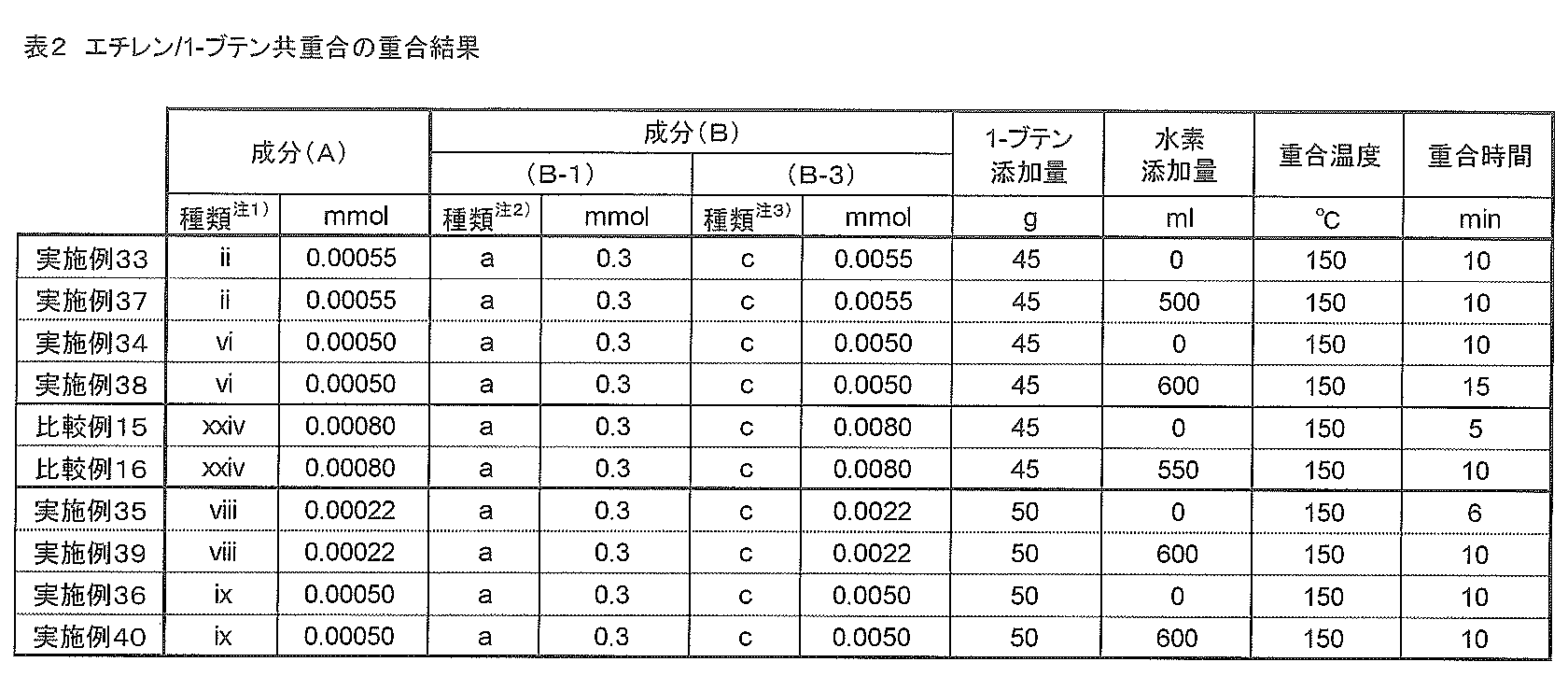

ii : [ビス[4-(ジメチルアミノ)フェニル]メチレン(η5-シクロペンタジエニル)(η5-オクタメチルオクタヒドロジベンゾフルオレニル)]ハフニウムジクロリド
vi : [ビス(4-メトキシフェニル)メチレン(η5-シクロペンタジエニル)(η5-オクタメチルオクタヒドロジベンゾフルオレニル)]ハフニウムジクロリド
viii : [ビス[4-(ジメチルアミノ)フェニル]メチレン(η5-シクロペンタジエニル)(η5-テトラメチルオクタヒドロジベンゾフルオレニル)]ハフニウムジクロリド
ix : [ビス(4-メトキシフェニル)メチレン(η5-シクロペンタジエニル)(η5-テトラメチルオクタヒドロジベンゾフルオレニル)]ハフニウムジクロリド
xxiv : [ビス(4-メチルフェニル)メチレン(η5-シクロペンタジエニル)(η5-オクタメチルオクタヒドロジベンゾフルオレニル)]ハフニウムジクロリド
注2)成分(B-1)として以下の有機金属化合物を使用した。
a : トリイソブチルアルミニウム
注3)成分(B-3)として以下の架橋メタロセン化合物(A)と反応してイオン対を形成する化合物を使用した。
c : N,N-ジメチルアニリニウムテトラキス(ペンタフルオロフェニル)ボレート
注4)水素添加重合時の[η]と水素無添加重合時の[η]との比
Claims (18)
- (A)下記一般式[I]で表される架橋メタロセン化合物、ならびに
(B)(B-1)有機金属化合物、(B-2)有機アルミニウムオキシ化合物および(B-3)架橋メタロセン化合物(A)と反応してイオン対を形成する化合物から選ばれる少なくとも1種の化合物
を含むオレフィン重合触媒の存在下で、エチレンおよび炭素数が3以上のα-オレフィンを共重合することを特徴とするエチレン/α-オレフィン共重合体の製造方法。

Mはチタン原子、ジルコニウム原子またはハフニウム原子であり、
R1、R2、R3、R4、R5、R6、R7、R8、R9、R10、R11およびR12は水素原子、炭素数1から20の炭化水素基、ケイ素含有基、窒素含有基、酸素含有基、ハロゲン原子およびハロゲン含有基から選ばれる原子または置換基であり、それぞれ同一でも異なっていてもよく、
R1からR12までの隣接した置換基は互いに結合して環を形成していてもよく、
R13およびR14はアリール基または置換アリール基であり、いずれも置換アリール基である場合にはそれぞれ同一でも異なっていてもよく、
R13およびR14の少なくとも一つは、アリール基の水素原子の一つ以上をハメット則の置換基定数σが-0.2以下の電子供与性置換基で置換してなる置換アリール基であって、該電子供与性置換基を複数個有する場合にはそれぞれの該電子供与性置換基は同一でも異なっていてもよく、該電子供与性置換基以外の、炭素数1から20の炭化水素基、ケイ素含有基、窒素含有基、酸素含有基、ハロゲン原子およびハロゲン含有基から選ばれる置換基を有していてもよく、該置換基を複数個有する場合にはそれぞれの置換基は同一でも異なっていてもよい置換アリール基であり、
Qはハロゲン原子、炭素数1から20の炭化水素基、アニオン配位子および孤立電子対で配位可能な中性配位子から同一のまたは異なる組合せで選ばれ、
jは1から4の整数である。) - 前記一般式[I]におけるR1、R2、R3およびR4が全て水素原子であることを特徴とする、請求項1に記載のエチレン/α-オレフィン共重合体の製造方法。
- 前記一般式[I]におけるYが炭素原子であることを特徴とする、請求項1または2に記載のエチレン/α-オレフィン共重合体の製造方法。
- 前記電子供与性置換基が、窒素含有基および酸素含有基から選ばれる基であることを特徴とする、請求項1~3のいずれか一項に記載のエチレン/α-オレフィン共重合体の製造方法。
- 前記一般式[I]におけるR13およびR14が同一の置換アリール基であることを特徴とする、請求項4に記載のエチレン/α-オレフィン共重合体の製造方法。
- 前記一般式[I]におけるR13およびR14が、前記電子供与性置換基としての窒素含有基および酸素含有基から選ばれる基を、Yとの結合に対するメタ位および/またはパラ位に含む置換フェニル基であることを特徴とする、請求項4または5に記載のエチレン/α-オレフィン共重合体の製造方法。
- 前記一般式[I]におけるR13およびR14が、前記電子供与性置換基としての下記一般式[II]で表される窒素含有基を含む置換フェニル基であることを特徴とする、請求項4~6のいずれか一項に記載のエチレン/α-オレフィン共重合体の製造方法。

- 前記一般式[I]におけるR13およびR14が、前記電子供与性置換基としての下記一般式[III]で表される酸素含有基を含む置換フェニル基であることを特徴とする、請求項4~6のいずれか一項に記載のエチレン/α-オレフィン共重合体の製造方法。

- 前記一般式[I]におけるR5、R8、R9およびR12が全て水素原子であることを特徴とする、請求項1~8のいずれか一項に記載のエチレン/α-オレフィン共重合体の製造方法。
- 前記一般式[I]におけるR6、R7、R10およびR11のうち少なくとも二つが炭化水素基、ケイ素含有基、窒素含有基、酸素含有基、ハロゲン原子およびハロゲン含有基から選ばれる置換基であることを特徴とする、請求項1~9のいずれか一項に記載のエチレン/α-オレフィン共重合体の製造方法。
- 前記一般式[I]におけるR6とR7、および/またはR10とR11が互いに結合して環を形成していることを特徴とする、請求項10に記載のエチレン/α-オレフィン共重合体の製造方法。
- 前記一般式[I]におけるR6とR7、およびR10とR11が互いに結合して環を形成していることを特徴とする、請求項11に記載のエチレン/α-オレフィン共重合体の製造方法。
- 前記一般式[I]におけるR6とR7、およびR10とR11が互いに結合して形成する環が五乃至七員環であることを特徴とする、請求項12に記載のエチレン/α-オレフィン共重合体の製造方法。
- 前記一般式[I]におけるR6とR7、およびR10とR11が互いに結合して形成する環が六員環であることを特徴とする、請求項13に記載のエチレン/α-オレフィン共重合体の製造方法。
- 下記一般式[IV]で表されることを特徴とする架橋メタロセン化合物を含むオレフィン重合触媒の存在下で、エチレンおよびα-オレフィンを共重合することを特徴とする、請求項14に記載のエチレン/α-オレフィン共重合体の製造方法。
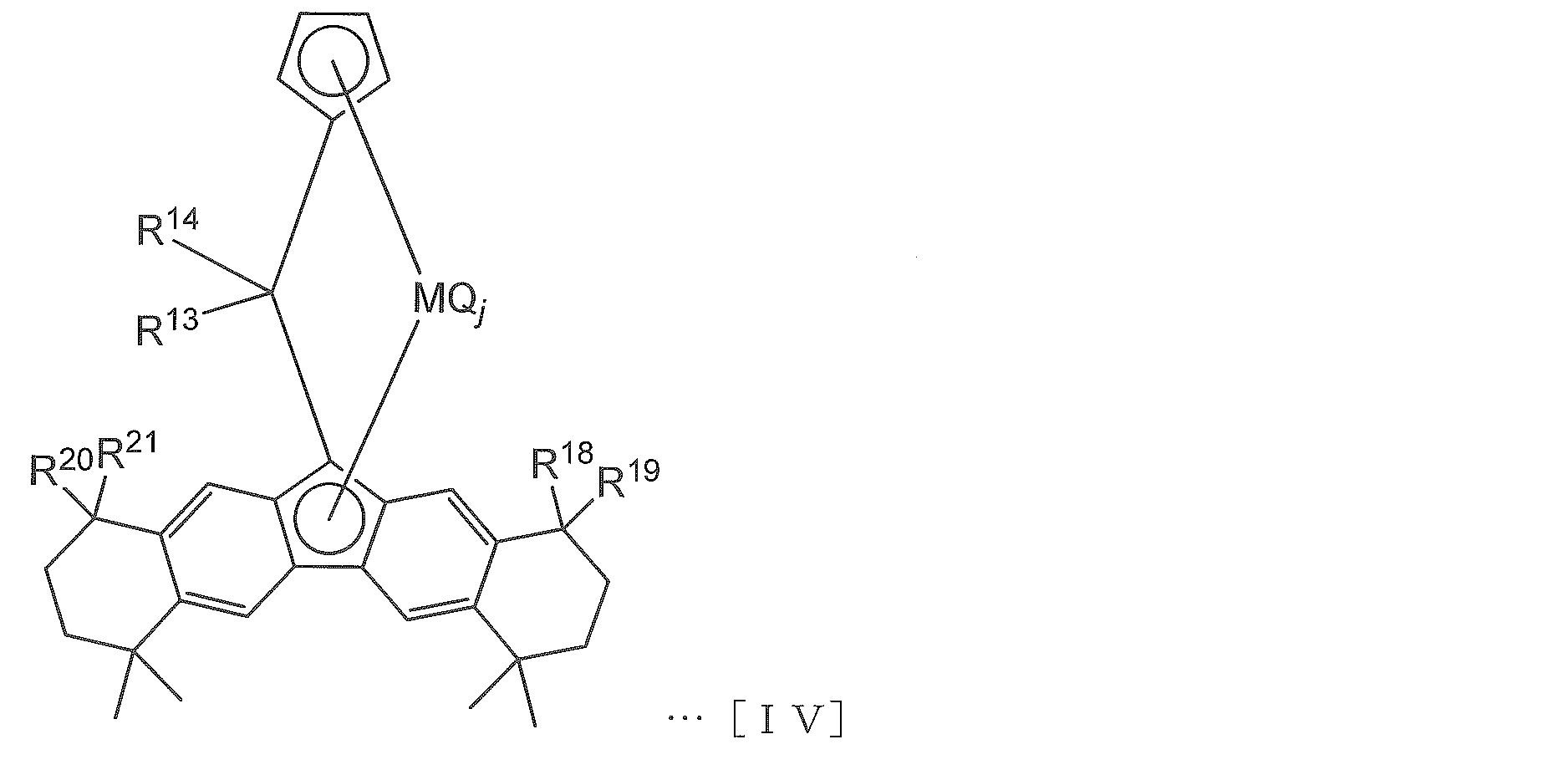
R13およびR14は、いずれも前記電子供与性置換基としての上記一般式[II]で表される窒素含有基を含む置換フェニル基であるか、いずれも前記電子供与性置換基としての上記一般式[III]で表される酸素含有基を含む置換フェニル基であり、
R18、R19、R20、およびR21は水素原子またはメチル基であり、
Qはハロゲン原子、炭素数1から20の炭化水素基、アニオン配位子および孤立電子対で配位可能な中性配位子から同一または異なる組合せで選ばれ、
jは1から4の整数である。) - 前記一般式[I]におけるMがハフニウムであることを特徴とする、請求項1~15のいずれか一項に記載のエチレン/α-オレフィン共重合体の製造方法。
- 前記エチレン/α-オレフィン共重合体の製造方法であって、ポリマー中の各々のモノマー由来の構成単位の割合の合計を100モル%としたときに、エチレン由来の構成単位の割合が50モル%以上であるエチレン系重合体が得られるように重合することを特徴とする、請求項1~16のいずれか一項に記載のエチレン/α-オレフィン共重合体の製造方法。
- 重合温度が100~300℃であることを特徴とする、請求項1~17のいずれか一項に記載のエチレン/α-オレフィン共重合体の製造方法。
Priority Applications (9)
| Application Number | Priority Date | Filing Date | Title |
|---|---|---|---|
| CN201580004616.9A CN105916888B (zh) | 2014-02-13 | 2015-02-10 | 乙烯/α‑烯烃共聚物的制造方法 |
| JP2015562832A JP6492018B2 (ja) | 2014-02-13 | 2015-02-10 | エチレン/α−オレフィン共重合体の製造方法 |
| SG11201606561WA SG11201606561WA (en) | 2014-02-13 | 2015-02-10 | PROCESS FOR PRODUCING ETHYLENE/α-OLEFIN COPOLYMER |
| KR1020167019196A KR102111927B1 (ko) | 2014-02-13 | 2015-02-10 | 에틸렌/α-올레핀 공중합체의 제조 방법 |
| EP15748881.8A EP3106475B1 (en) | 2014-02-13 | 2015-02-10 | Method for producing ethylene/alpha-olefin copolymer |
| CA2936511A CA2936511C (en) | 2014-02-13 | 2015-02-10 | Process for producing ethylene/.alpha.-olefin copolymer |
| US15/117,015 US9969827B2 (en) | 2014-02-13 | 2015-02-10 | Process for producing ethylene/α-olefin copolymer |
| ES15748881T ES2746286T3 (es) | 2014-02-13 | 2015-02-10 | Método para la producción de un copolímero de etileno/alfa-olefina |
| BR112016016396-6A BR112016016396B1 (pt) | 2014-02-13 | 2015-02-10 | Processo para a produção de copolímero de etileno/a-olefina |
Applications Claiming Priority (2)
| Application Number | Priority Date | Filing Date | Title |
|---|---|---|---|
| JP2014025158 | 2014-02-13 | ||
| JP2014-025158 | 2014-02-13 |
Publications (1)
| Publication Number | Publication Date |
|---|---|
| WO2015122414A1 true WO2015122414A1 (ja) | 2015-08-20 |
Family
ID=53800157
Family Applications (1)
| Application Number | Title | Priority Date | Filing Date |
|---|---|---|---|
| PCT/JP2015/053696 Ceased WO2015122414A1 (ja) | 2014-02-13 | 2015-02-10 | エチレン/α-オレフィン共重合体の製造方法 |
Country Status (10)
| Country | Link |
|---|---|
| US (1) | US9969827B2 (ja) |
| EP (1) | EP3106475B1 (ja) |
| JP (1) | JP6492018B2 (ja) |
| KR (1) | KR102111927B1 (ja) |
| CN (1) | CN105916888B (ja) |
| BR (1) | BR112016016396B1 (ja) |
| CA (1) | CA2936511C (ja) |
| ES (1) | ES2746286T3 (ja) |
| SG (1) | SG11201606561WA (ja) |
| WO (1) | WO2015122414A1 (ja) |
Cited By (10)
| Publication number | Priority date | Publication date | Assignee | Title |
|---|---|---|---|---|
| WO2016152710A1 (ja) * | 2015-03-20 | 2016-09-29 | 三井化学株式会社 | 熱可塑性エラストマー組成物およびその製造方法 |
| JP2018145284A (ja) * | 2017-03-06 | 2018-09-20 | 三井化学株式会社 | エチレン/α−オレフィン共重合体の製造方法 |
| WO2018182860A1 (en) * | 2017-03-27 | 2018-10-04 | Exxonmobil Chemical Patents Inc. | Solution process to make ethylene copolymers |
| JP2021501823A (ja) * | 2017-11-07 | 2021-01-21 | ノヴァ ケミカルズ(アンテルナショナル)ソシエテ アノニム | エチレンインターポリマー生成物及びフィルム |
| JP2021501822A (ja) * | 2017-11-07 | 2021-01-21 | ノヴァ ケミカルズ(アンテルナショナル)ソシエテ アノニム | エチレンインターポリマー生成物を製造する改善されたプロセス |
| WO2021039818A1 (ja) | 2019-08-29 | 2021-03-04 | 三井化学株式会社 | 潤滑油組成物 |
| JP2022083190A (ja) * | 2020-11-24 | 2022-06-03 | 三井化学株式会社 | エチレン・1-オクテン共重合体 |
| JP2022083191A (ja) * | 2020-11-24 | 2022-06-03 | 三井化学株式会社 | ペレット |
| WO2024004882A1 (ja) | 2022-06-27 | 2024-01-04 | 三井化学株式会社 | 環状オレフィン系共重合体の製造方法、環状オレフィン系共重合体、架橋体、フィルムまたはシート、積層体、回路基板、電子機器およびプリプレグ |
| WO2024004884A1 (ja) | 2022-06-27 | 2024-01-04 | 三井化学株式会社 | ワニス状の環状オレフィン系共重合体組成物の製造方法、環状オレフィン系共重合体組成物、架橋体、フィルムまたはシート、積層体、回路基板、電子機器およびプリプレグ |
Families Citing this family (6)
| Publication number | Priority date | Publication date | Assignee | Title |
|---|---|---|---|---|
| JP7130644B2 (ja) * | 2016-12-15 | 2022-09-05 | ボレアリス エージー | 高温溶液重合プロセスでポリエチレンコポリマーを製造する為の新規な触媒系 |
| US11028192B2 (en) * | 2017-03-27 | 2021-06-08 | Exxonmobil Chemical Patents Inc. | Solution process to make ethylene copolymers |
| KR102343937B1 (ko) * | 2017-12-26 | 2021-12-27 | 주식회사 엘지화학 | 메탈로센 담지 촉매 및 이를 이용한 폴리프로필렌의 제조 방법 |
| WO2019132450A1 (ko) * | 2017-12-26 | 2019-07-04 | 주식회사 엘지화학 | 메탈로센 담지 촉매 및 이를 이용한 폴리프로필렌의 제조 방법 |
| KR102848172B1 (ko) * | 2019-09-27 | 2025-08-21 | 주식회사 엘지화학 | 전이금속 화합물 및 이를 포함하는 촉매 조성물 |
| CN115639165A (zh) * | 2022-11-01 | 2023-01-24 | 山东京博石油化工有限公司 | 一种聚烯烃弹性体中共单体含量的检测方法 |
Citations (7)
| Publication number | Priority date | Publication date | Assignee | Title |
|---|---|---|---|---|
| JP2004501926A (ja) * | 2000-06-23 | 2004-01-22 | エクソンモービル・ケミカル・パテンツ・インク | オレフィン重合におけるシロキシ置換された助触媒活性化剤 |
| JP2004182715A (ja) * | 2002-09-27 | 2004-07-02 | Mitsui Chemicals Inc | オレフィン重合用の架橋メタロセン化合物およびそれを用いたオレフィンの重合方法 |
| JP2005314680A (ja) * | 2004-03-31 | 2005-11-10 | Mitsui Chemicals Inc | オレフィン重合体の製造方法 |
| WO2007034920A1 (ja) * | 2005-09-22 | 2007-03-29 | Mitsui Chemicals, Inc. | エチレン系重合体、該重合体を含む熱可塑性樹脂組成物及び成形体 |
| WO2007094378A1 (ja) * | 2006-02-15 | 2007-08-23 | Mitsui Chemicals, Inc. | エチレン系重合体及びこれから得られる成形体 |
| JP2007302854A (ja) * | 2005-07-25 | 2007-11-22 | Mitsui Chemicals Inc | オレフィン重合用触媒およびオレフィン重合体の製造方法 |
| JP2008231265A (ja) * | 2007-03-20 | 2008-10-02 | Mitsui Chemicals Inc | エチレン系共重合体よりなるフィルムまたはシートならびに積層体 |
Family Cites Families (61)
| Publication number | Priority date | Publication date | Assignee | Title |
|---|---|---|---|---|
| JPH06811B2 (ja) | 1984-04-11 | 1994-01-05 | 出光興産株式会社 | ポリオレフインの製造方法 |
| US5153157A (en) | 1987-01-30 | 1992-10-06 | Exxon Chemical Patents Inc. | Catalyst system of enhanced productivity |
| US5621126A (en) | 1987-01-30 | 1997-04-15 | Exxon Chemical Patents Inc. | Monocyclopentadienyl metal compounds for ethylene-α-olefin-copolymer production catalysts |
| IL85097A (en) | 1987-01-30 | 1992-02-16 | Exxon Chemical Patents Inc | Catalysts based on derivatives of a bis(cyclopentadienyl)group ivb metal compound,their preparation and their use in polymerization processes |
| US7163907B1 (en) | 1987-01-30 | 2007-01-16 | Exxonmobil Chemical Patents Inc. | Aluminum-free monocyclopentadienyl metallocene catalysts for olefin polymerization |
| US5264405A (en) | 1989-09-13 | 1993-11-23 | Exxon Chemical Patents Inc. | Monocyclopentadienyl titanium metal compounds for ethylene-α-olefin-copolymer production catalysts |
| US5055438A (en) | 1989-09-13 | 1991-10-08 | Exxon Chemical Patents, Inc. | Olefin polymerization catalysts |
| US5241025A (en) | 1987-01-30 | 1993-08-31 | Exxon Chemical Patents Inc. | Catalyst system of enhanced productivity |
| US5384299A (en) | 1987-01-30 | 1995-01-24 | Exxon Chemical Patents Inc. | Ionic metallocene catalyst compositions |
| US5391629A (en) | 1987-01-30 | 1995-02-21 | Exxon Chemical Patents Inc. | Block copolymers from ionic catalysts |
| PL276385A1 (en) | 1987-01-30 | 1989-07-24 | Exxon Chemical Patents Inc | Method for polymerization of olefines,diolefins and acetylene unsaturated compounds |
| US5408017A (en) | 1987-01-30 | 1995-04-18 | Exxon Chemical Patents Inc. | High temperature polymerization process using ionic catalysts to produce polyolefins |
| JPH0224701A (ja) | 1988-07-13 | 1990-01-26 | Sekisui Chem Co Ltd | 電気機器の駆動制御装置 |
| US5225500A (en) | 1988-07-15 | 1993-07-06 | Fina Technology, Inc. | Process and catalyst for producing syndiotactic polyolefins |
| US5223468A (en) | 1988-07-15 | 1993-06-29 | Fina Technology, Inc. | Process and catalyst for producing syndiotactic polymers |
| US4892851A (en) | 1988-07-15 | 1990-01-09 | Fina Technology, Inc. | Process and catalyst for producing syndiotactic polyolefins |
| US5155080A (en) | 1988-07-15 | 1992-10-13 | Fina Technology, Inc. | Process and catalyst for producing syndiotactic polyolefins |
| US5223467A (en) | 1988-07-15 | 1993-06-29 | Fina Technology, Inc. | Process and catalyst for producing syndiotactic polymers |
| US5292838A (en) | 1988-07-15 | 1994-03-08 | Fina Technology, Inc. | Process and catalyst for producing syndiotactic polymers |
| US5304523A (en) | 1988-07-15 | 1994-04-19 | Fina Technology, Inc. | Process and catalyst for producing crystalline polyolefins |
| US5243002A (en) | 1988-07-15 | 1993-09-07 | Fina Technology, Inc. | Process and catalyst for producing syndiotactic polymers |
| US5158920A (en) | 1988-07-15 | 1992-10-27 | Fina Technology, Inc. | Process for producing stereospecific polymers |
| US5162278A (en) | 1988-07-15 | 1992-11-10 | Fina Technology, Inc. | Non-bridged syndiospecific metallocene catalysts and polymerization process |
| JP2693517B2 (ja) | 1988-09-14 | 1997-12-24 | 三井石油化学工業株式会社 | ベンゼン不溶性の有機アルミニウムオキシ化合物の製造方法 |
| JP2741893B2 (ja) | 1988-09-14 | 1998-04-22 | 三井化学株式会社 | ベンゼン不溶性の有機アルミニウムオキシ化合物の製造方法 |
| KR930002411B1 (ko) | 1988-09-14 | 1993-03-30 | 미쓰이세끼유 가가꾸고오교오 가부시끼가이샤 | 벤젠불용성 유기알루미늄 옥시화합물 및 그 제조방법 |
| US4960878A (en) | 1988-12-02 | 1990-10-02 | Texas Alkyls, Inc. | Synthesis of methylaluminoxanes |
| US5041584A (en) | 1988-12-02 | 1991-08-20 | Texas Alkyls, Inc. | Modified methylaluminoxane |
| US5057475A (en) | 1989-09-13 | 1991-10-15 | Exxon Chemical Patents Inc. | Mono-Cp heteroatom containing group IVB transition metal complexes with MAO: supported catalyst for olefin polymerization |
| US7041841B1 (en) | 1989-09-13 | 2006-05-09 | Exxonmobil Chemical Patents Inc. | Process for producing crystalline poly-α-olefins with a monocyclopentadienyl transition metal catalyst system |
| US5547675A (en) | 1989-09-13 | 1996-08-20 | Exxon Chemical Patents Inc. | Modified monocyclopentadienyl transition metal/alumoxane catalyst system for polymerization of olefins |
| US5026798A (en) | 1989-09-13 | 1991-06-25 | Exxon Chemical Patents Inc. | Process for producing crystalline poly-α-olefins with a monocyclopentadienyl transition metal catalyst system |
| US6265338B1 (en) | 1989-09-13 | 2001-07-24 | Exxon Chemical Patents, Inc. | Monocyclopentadienyl titanium metal compounds for ethylene-α-olefin copolymer production catalysts |
| US5227440A (en) | 1989-09-13 | 1993-07-13 | Exxon Chemical Patents Inc. | Mono-Cp heteroatom containing Group IVB transition metal complexes with MAO: supported catalysts for olefin polymerization |
| US5420217A (en) | 1989-09-13 | 1995-05-30 | Exxon Chemical Patents Inc. | Process for producing amorphous poly-α-olefins with a monocyclopentadienyl transition metal catalyst system |
| US5504169A (en) | 1989-09-13 | 1996-04-02 | Exxon Chemical Patents Inc. | Process for producing amorphous poly-α-olefins with a monocyclopentadienyl transition metal catalyst system |
| JPH03103407A (ja) | 1989-09-18 | 1991-04-30 | Idemitsu Kosan Co Ltd | オレフィン系重合体の製造法 |
| DE69026907T2 (de) | 1989-10-10 | 1996-10-10 | Fina Technology | Metallocenkatalysator mit Lewissäure und Alkylaluminium |
| US5763549A (en) | 1989-10-10 | 1998-06-09 | Fina Technology, Inc. | Cationic metallocene catalysts based on organoaluminum anions |
| US5387568A (en) | 1989-10-30 | 1995-02-07 | Fina Technology, Inc. | Preparation of metallocene catalysts for polymerization of olefins |
| ATE120768T1 (de) | 1989-10-30 | 1995-04-15 | Fina Technology | Herstellung von metallocenkatalysatoren für olefinpolymerisation. |
| ATE137247T1 (de) | 1989-10-30 | 1996-05-15 | Fina Technology | Addition von alkylaluminium zum verbessern eines metallocenkatalysators |
| US6294625B1 (en) | 1990-03-20 | 2001-09-25 | Exxonmobil Chemical Patents Inc. | Catalyst system of enhanced productivity and its use in polymerization process |
| PL166690B1 (pl) | 1990-06-04 | 1995-06-30 | Exxon Chemical Patents Inc | Sposób wytwarzania polimerów olefin PL |
| FR2662756B1 (fr) | 1990-06-05 | 1992-08-14 | Snecma | Dispositif de transmission etanche entre deux arbres coaxiaux montes dans des boitiers fixes l'un a l'autre, autorisant une intervention rapide notamment en cas de fuite. |
| US5801113A (en) | 1990-06-22 | 1998-09-01 | Exxon Chemical Patents, Inc. | Polymerization catalyst systems, their production and use |
| JP2545006B2 (ja) | 1990-07-03 | 1996-10-16 | ザ ダウ ケミカル カンパニー | 付加重合触媒 |
| US6313240B1 (en) | 1993-02-22 | 2001-11-06 | Tosoh Corporation | Process for producing ethylene/α-olefin copolymer |
| JP2882257B2 (ja) | 1993-02-22 | 1999-04-12 | 東ソー株式会社 | エチレン/α−オレフィン共重合体の製造方法 |
| US6486088B1 (en) | 1998-10-23 | 2002-11-26 | Exxonmobil Chemical Patents Inc. | High activity carbenium-activated polymerization catalysts |
| US6300433B1 (en) | 1998-10-23 | 2001-10-09 | Exxonmobil Chemical Patents Inc. | Olefin copolymerization process with bridged hafnocenes |
| US6417120B1 (en) | 1998-12-31 | 2002-07-09 | Kimberly-Clark Worldwide, Inc. | Particle-containing meltblown webs |
| US20020155776A1 (en) | 1999-10-15 | 2002-10-24 | Mitchler Patricia Ann | Particle-containing meltblown webs |
| US6346636B1 (en) | 2000-06-23 | 2002-02-12 | Exxonmobil Chemical Patents, Inc. | Siloxy substituted cocatalyst activators for olefin polymerization |
| US6541410B1 (en) | 2000-06-23 | 2003-04-01 | Exxonmobil Chemical Patents Inc. | Siloxy substituted cocatalyst activators for olefin polymerization |
| JP2004051676A (ja) | 2002-07-16 | 2004-02-19 | Mitsui Chemicals Inc | エチレン系共重合体の製造方法 |
| WO2004029062A1 (ja) | 2002-09-27 | 2004-04-08 | Mitsui Chemicals, Inc. | オレフィン重合用の架橋メタロセン化合物およびそれを用いたオレフィンの重合方法 |
| KR100751993B1 (ko) * | 2003-01-27 | 2007-08-28 | 미쯔이가가꾸가부시끼가이샤 | 프로필렌계 중합체 조성물 및 그의 용도 |
| EP2275457B1 (en) | 2005-05-18 | 2016-11-23 | Mitsui Chemicals, Inc. | Propylene-based polymer composition, and molded products, sheets, films, laminates and non-woven fabrics obtained therefrom |
| JP2008059220A (ja) | 2006-08-30 | 2008-03-13 | Olympus Imaging Corp | データ管理装置、カメラ、データ管理プログラム、データ管理方法 |
| DE102009027447A1 (de) * | 2009-07-03 | 2011-01-05 | Evonik Degussa Gmbh | Modifizierte Polyolefine mit besonderem Eigenschaftsprofil, Verfahren zu deren Herstellung und deren Verwendung |
-
2015
- 2015-02-10 US US15/117,015 patent/US9969827B2/en active Active
- 2015-02-10 JP JP2015562832A patent/JP6492018B2/ja active Active
- 2015-02-10 EP EP15748881.8A patent/EP3106475B1/en active Active
- 2015-02-10 CA CA2936511A patent/CA2936511C/en active Active
- 2015-02-10 BR BR112016016396-6A patent/BR112016016396B1/pt active IP Right Grant
- 2015-02-10 ES ES15748881T patent/ES2746286T3/es active Active
- 2015-02-10 KR KR1020167019196A patent/KR102111927B1/ko active Active
- 2015-02-10 WO PCT/JP2015/053696 patent/WO2015122414A1/ja not_active Ceased
- 2015-02-10 CN CN201580004616.9A patent/CN105916888B/zh active Active
- 2015-02-10 SG SG11201606561WA patent/SG11201606561WA/en unknown
Patent Citations (7)
| Publication number | Priority date | Publication date | Assignee | Title |
|---|---|---|---|---|
| JP2004501926A (ja) * | 2000-06-23 | 2004-01-22 | エクソンモービル・ケミカル・パテンツ・インク | オレフィン重合におけるシロキシ置換された助触媒活性化剤 |
| JP2004182715A (ja) * | 2002-09-27 | 2004-07-02 | Mitsui Chemicals Inc | オレフィン重合用の架橋メタロセン化合物およびそれを用いたオレフィンの重合方法 |
| JP2005314680A (ja) * | 2004-03-31 | 2005-11-10 | Mitsui Chemicals Inc | オレフィン重合体の製造方法 |
| JP2007302854A (ja) * | 2005-07-25 | 2007-11-22 | Mitsui Chemicals Inc | オレフィン重合用触媒およびオレフィン重合体の製造方法 |
| WO2007034920A1 (ja) * | 2005-09-22 | 2007-03-29 | Mitsui Chemicals, Inc. | エチレン系重合体、該重合体を含む熱可塑性樹脂組成物及び成形体 |
| WO2007094378A1 (ja) * | 2006-02-15 | 2007-08-23 | Mitsui Chemicals, Inc. | エチレン系重合体及びこれから得られる成形体 |
| JP2008231265A (ja) * | 2007-03-20 | 2008-10-02 | Mitsui Chemicals Inc | エチレン系共重合体よりなるフィルムまたはシートならびに積層体 |
Cited By (16)
| Publication number | Priority date | Publication date | Assignee | Title |
|---|---|---|---|---|
| WO2016152710A1 (ja) * | 2015-03-20 | 2016-09-29 | 三井化学株式会社 | 熱可塑性エラストマー組成物およびその製造方法 |
| KR20170109668A (ko) * | 2015-03-20 | 2017-09-29 | 미쓰이 가가쿠 가부시키가이샤 | 열가소성 엘라스토머 조성물 및 그의 제조 방법 |
| US10280293B2 (en) | 2015-03-20 | 2019-05-07 | Mitsui Chemicals, Inc. | Thermoplastic elastomer composition and method for producing same |
| JP2018145284A (ja) * | 2017-03-06 | 2018-09-20 | 三井化学株式会社 | エチレン/α−オレフィン共重合体の製造方法 |
| WO2018182860A1 (en) * | 2017-03-27 | 2018-10-04 | Exxonmobil Chemical Patents Inc. | Solution process to make ethylene copolymers |
| JP7030976B2 (ja) | 2017-11-07 | 2022-03-07 | ノヴァ ケミカルズ(アンテルナショナル)ソシエテ アノニム | エチレンインターポリマー生成物及びフィルム |
| JP2021501822A (ja) * | 2017-11-07 | 2021-01-21 | ノヴァ ケミカルズ(アンテルナショナル)ソシエテ アノニム | エチレンインターポリマー生成物を製造する改善されたプロセス |
| JP2021501823A (ja) * | 2017-11-07 | 2021-01-21 | ノヴァ ケミカルズ(アンテルナショナル)ソシエテ アノニム | エチレンインターポリマー生成物及びフィルム |
| JP7030975B2 (ja) | 2017-11-07 | 2022-03-07 | ノヴァ ケミカルズ(アンテルナショナル)ソシエテ アノニム | エチレンインターポリマー生成物を製造する改善されたプロセス |
| WO2021039818A1 (ja) | 2019-08-29 | 2021-03-04 | 三井化学株式会社 | 潤滑油組成物 |
| JP2022083190A (ja) * | 2020-11-24 | 2022-06-03 | 三井化学株式会社 | エチレン・1-オクテン共重合体 |
| JP2022083191A (ja) * | 2020-11-24 | 2022-06-03 | 三井化学株式会社 | ペレット |
| JP7638677B2 (ja) | 2020-11-24 | 2025-03-04 | 三井化学株式会社 | エチレン・1-オクテン共重合体 |
| JP7638678B2 (ja) | 2020-11-24 | 2025-03-04 | 三井化学株式会社 | ペレット |
| WO2024004882A1 (ja) | 2022-06-27 | 2024-01-04 | 三井化学株式会社 | 環状オレフィン系共重合体の製造方法、環状オレフィン系共重合体、架橋体、フィルムまたはシート、積層体、回路基板、電子機器およびプリプレグ |
| WO2024004884A1 (ja) | 2022-06-27 | 2024-01-04 | 三井化学株式会社 | ワニス状の環状オレフィン系共重合体組成物の製造方法、環状オレフィン系共重合体組成物、架橋体、フィルムまたはシート、積層体、回路基板、電子機器およびプリプレグ |
Also Published As
| Publication number | Publication date |
|---|---|
| EP3106475A1 (en) | 2016-12-21 |
| CN105916888B (zh) | 2018-03-16 |
| EP3106475B1 (en) | 2019-08-28 |
| CA2936511C (en) | 2019-06-11 |
| KR20160101062A (ko) | 2016-08-24 |
| BR112016016396A2 (ja) | 2018-05-08 |
| CA2936511A1 (en) | 2015-08-20 |
| EP3106475A4 (en) | 2017-09-20 |
| CN105916888A (zh) | 2016-08-31 |
| BR112016016396B1 (pt) | 2021-08-10 |
| ES2746286T3 (es) | 2020-03-05 |
| US9969827B2 (en) | 2018-05-15 |
| US20170183432A1 (en) | 2017-06-29 |
| JP6492018B2 (ja) | 2019-03-27 |
| SG11201606561WA (en) | 2016-09-29 |
| JPWO2015122414A1 (ja) | 2017-03-30 |
| KR102111927B1 (ko) | 2020-05-18 |
Similar Documents
| Publication | Publication Date | Title |
|---|---|---|
| JP6492018B2 (ja) | エチレン/α−オレフィン共重合体の製造方法 | |
| EP1900758B9 (en) | Method for producing olefin polymer | |
| JP6344138B2 (ja) | メタロセン化合物、それを含むオレフィン重合用触媒成分およびオレフィン重合用触媒、並びにそのオレフィン重合用触媒を用いたオレフィン重合体の製造方法 | |
| KR101889669B1 (ko) | 1-뷰텐 유래의 구성 단위를 포함하는 올레핀 (공)중합체의 제조 방법 | |
| JP5105772B2 (ja) | シンジオタクティックα−オレフィン重合体の製造方法 | |
| JP2007302853A (ja) | プロピレン系共重合体の製造方法 | |
| JP2020132629A (ja) | 遷移金属化合物、オレフィン重合用触媒およびオレフィン重合体の製造方法 | |
| JP6986138B2 (ja) | 遷移金属化合物、オレフィン重合用触媒およびオレフィン重合体の製造方法 | |
| JP2015137352A (ja) | オレフィン重合体の製造方法 | |
| JP2020132630A (ja) | 遷移金属化合物、オレフィン重合用触媒およびオレフィン重合体の製造方法 | |
| JP2019172794A (ja) | オレフィン重合体の製造方法 | |
| JP2019172603A (ja) | 遷移金属化合物、オレフィン重合用触媒およびオレフィン重合体の製造方法 | |
| JP7134648B2 (ja) | エチレン/α-オレフィン/非共役ポリエン共重合体の製造方法 | |
| JP7134647B2 (ja) | オレフィン重合触媒 | |
| JP2015157925A (ja) | エチレン系重合体の製造方法 | |
| JP6679345B2 (ja) | 1−ブテン由来の構成単位を含むオレフィン(共)重合体の製造方法 | |
| JP2023109143A (ja) | 遷移金属化合物、オレフィン系重合用触媒およびオレフィン系重合体の製造方法 | |
| JP2018145284A (ja) | エチレン/α−オレフィン共重合体の製造方法 | |
| JP2016147965A (ja) | 1−ブテン由来の構成単位を含むオレフィン(共)重合体の製造方法 |
Legal Events
| Date | Code | Title | Description |
|---|---|---|---|
| 121 | Ep: the epo has been informed by wipo that ep was designated in this application |
Ref document number: 15748881 Country of ref document: EP Kind code of ref document: A1 |
|
| ENP | Entry into the national phase |
Ref document number: 2936511 Country of ref document: CA |
|
| REEP | Request for entry into the european phase |
Ref document number: 2015748881 Country of ref document: EP |
|
| WWE | Wipo information: entry into national phase |
Ref document number: 2015748881 Country of ref document: EP |
|
| ENP | Entry into the national phase |
Ref document number: 20167019196 Country of ref document: KR Kind code of ref document: A |
|
| WWE | Wipo information: entry into national phase |
Ref document number: 15117015 Country of ref document: US |
|
| ENP | Entry into the national phase |
Ref document number: 2015562832 Country of ref document: JP Kind code of ref document: A |
|
| NENP | Non-entry into the national phase |
Ref country code: DE |
|
| REG | Reference to national code |
Ref country code: BR Ref legal event code: B01A Ref document number: 112016016396 Country of ref document: BR |
|
| ENP | Entry into the national phase |
Ref document number: 112016016396 Country of ref document: BR Kind code of ref document: A2 Effective date: 20160714 |