WO2015122492A1 - ポリカーボネート樹脂組成物 - Google Patents
ポリカーボネート樹脂組成物 Download PDFInfo
- Publication number
- WO2015122492A1 WO2015122492A1 PCT/JP2015/053977 JP2015053977W WO2015122492A1 WO 2015122492 A1 WO2015122492 A1 WO 2015122492A1 JP 2015053977 W JP2015053977 W JP 2015053977W WO 2015122492 A1 WO2015122492 A1 WO 2015122492A1
- Authority
- WO
- WIPO (PCT)
- Prior art keywords
- resin composition
- polycarbonate resin
- group
- carbon atoms
- mass
- Prior art date
- Legal status (The legal status is an assumption and is not a legal conclusion. Google has not performed a legal analysis and makes no representation as to the accuracy of the status listed.)
- Ceased
Links
Classifications
-
- C—CHEMISTRY; METALLURGY
- C08—ORGANIC MACROMOLECULAR COMPOUNDS; THEIR PREPARATION OR CHEMICAL WORKING-UP; COMPOSITIONS BASED THEREON
- C08L—COMPOSITIONS OF MACROMOLECULAR COMPOUNDS
- C08L69/00—Compositions of polycarbonates; Compositions of derivatives of polycarbonates
-
- C—CHEMISTRY; METALLURGY
- C08—ORGANIC MACROMOLECULAR COMPOUNDS; THEIR PREPARATION OR CHEMICAL WORKING-UP; COMPOSITIONS BASED THEREON
- C08G—MACROMOLECULAR COMPOUNDS OBTAINED OTHERWISE THAN BY REACTIONS ONLY INVOLVING UNSATURATED CARBON-TO-CARBON BONDS
- C08G64/00—Macromolecular compounds obtained by reactions forming a carbonic ester link in the main chain of the macromolecule
- C08G64/18—Block or graft polymers
- C08G64/186—Block or graft polymers containing polysiloxane sequences
-
- C—CHEMISTRY; METALLURGY
- C08—ORGANIC MACROMOLECULAR COMPOUNDS; THEIR PREPARATION OR CHEMICAL WORKING-UP; COMPOSITIONS BASED THEREON
- C08K—Use of inorganic or non-macromolecular organic substances as compounding ingredients
- C08K5/00—Use of organic ingredients
- C08K5/49—Phosphorus-containing compounds
- C08K5/51—Phosphorus bound to oxygen
- C08K5/52—Phosphorus bound to oxygen only
- C08K5/521—Esters of phosphoric acids, e.g. of H3PO4
-
- C—CHEMISTRY; METALLURGY
- C08—ORGANIC MACROMOLECULAR COMPOUNDS; THEIR PREPARATION OR CHEMICAL WORKING-UP; COMPOSITIONS BASED THEREON
- C08K—Use of inorganic or non-macromolecular organic substances as compounding ingredients
- C08K5/00—Use of organic ingredients
- C08K5/49—Phosphorus-containing compounds
- C08K5/51—Phosphorus bound to oxygen
- C08K5/53—Phosphorus bound to oxygen bound to oxygen and to carbon only
- C08K5/5317—Phosphonic compounds, e.g. R—P(:O)(OR')2
- C08K5/5333—Esters of phosphonic acids
-
- C—CHEMISTRY; METALLURGY
- C08—ORGANIC MACROMOLECULAR COMPOUNDS; THEIR PREPARATION OR CHEMICAL WORKING-UP; COMPOSITIONS BASED THEREON
- C08L—COMPOSITIONS OF MACROMOLECULAR COMPOUNDS
- C08L33/00—Compositions of homopolymers or copolymers of compounds having one or more unsaturated aliphatic radicals, each having only one carbon-to-carbon double bond, and only one being terminated by only one carboxyl radical, or of salts, anhydrides, esters, amides, imides or nitriles thereof; Compositions of derivatives of such polymers
- C08L33/04—Homopolymers or copolymers of esters
- C08L33/06—Homopolymers or copolymers of esters of esters containing only carbon, hydrogen and oxygen, which oxygen atoms are present only as part of the carboxyl radical
- C08L33/10—Homopolymers or copolymers of methacrylic acid esters
-
- C—CHEMISTRY; METALLURGY
- C08—ORGANIC MACROMOLECULAR COMPOUNDS; THEIR PREPARATION OR CHEMICAL WORKING-UP; COMPOSITIONS BASED THEREON
- C08L—COMPOSITIONS OF MACROMOLECULAR COMPOUNDS
- C08L51/00—Compositions of graft polymers in which the grafted component is obtained by reactions only involving carbon-to-carbon unsaturated bonds; Compositions of derivatives of such polymers
- C08L51/04—Compositions of graft polymers in which the grafted component is obtained by reactions only involving carbon-to-carbon unsaturated bonds; Compositions of derivatives of such polymers grafted on to rubbers
-
- C—CHEMISTRY; METALLURGY
- C08—ORGANIC MACROMOLECULAR COMPOUNDS; THEIR PREPARATION OR CHEMICAL WORKING-UP; COMPOSITIONS BASED THEREON
- C08L—COMPOSITIONS OF MACROMOLECULAR COMPOUNDS
- C08L55/00—Compositions of homopolymers or copolymers, obtained by polymerisation reactions only involving carbon-to-carbon unsaturated bonds, not provided for in groups C08L23/00 - C08L53/00
- C08L55/02—ABS [Acrylonitrile-Butadiene-Styrene] polymers
-
- C—CHEMISTRY; METALLURGY
- C08—ORGANIC MACROMOLECULAR COMPOUNDS; THEIR PREPARATION OR CHEMICAL WORKING-UP; COMPOSITIONS BASED THEREON
- C08L—COMPOSITIONS OF MACROMOLECULAR COMPOUNDS
- C08L83/00—Compositions of macromolecular compounds obtained by reactions forming in the main chain of the macromolecule a linkage containing silicon with or without sulfur, nitrogen, oxygen or carbon only; Compositions of derivatives of such polymers
- C08L83/10—Block- or graft-copolymers containing polysiloxane sequences
-
- C—CHEMISTRY; METALLURGY
- C08—ORGANIC MACROMOLECULAR COMPOUNDS; THEIR PREPARATION OR CHEMICAL WORKING-UP; COMPOSITIONS BASED THEREON
- C08G—MACROMOLECULAR COMPOUNDS OBTAINED OTHERWISE THAN BY REACTIONS ONLY INVOLVING UNSATURATED CARBON-TO-CARBON BONDS
- C08G77/00—Macromolecular compounds obtained by reactions forming a linkage containing silicon with or without sulfur, nitrogen, oxygen or carbon in the main chain of the macromolecule
- C08G77/42—Block-or graft-polymers containing polysiloxane sequences
- C08G77/445—Block-or graft-polymers containing polysiloxane sequences containing polyester sequences
- C08G77/448—Block-or graft-polymers containing polysiloxane sequences containing polyester sequences containing polycarbonate sequences
-
- C—CHEMISTRY; METALLURGY
- C08—ORGANIC MACROMOLECULAR COMPOUNDS; THEIR PREPARATION OR CHEMICAL WORKING-UP; COMPOSITIONS BASED THEREON
- C08L—COMPOSITIONS OF MACROMOLECULAR COMPOUNDS
- C08L2201/00—Properties
- C08L2201/02—Flame or fire retardant/resistant
-
- C—CHEMISTRY; METALLURGY
- C08—ORGANIC MACROMOLECULAR COMPOUNDS; THEIR PREPARATION OR CHEMICAL WORKING-UP; COMPOSITIONS BASED THEREON
- C08L—COMPOSITIONS OF MACROMOLECULAR COMPOUNDS
- C08L2205/00—Polymer mixtures characterised by other features
- C08L2205/03—Polymer mixtures characterised by other features containing three or more polymers in a blend
-
- C—CHEMISTRY; METALLURGY
- C08—ORGANIC MACROMOLECULAR COMPOUNDS; THEIR PREPARATION OR CHEMICAL WORKING-UP; COMPOSITIONS BASED THEREON
- C08L—COMPOSITIONS OF MACROMOLECULAR COMPOUNDS
- C08L2205/00—Polymer mixtures characterised by other features
- C08L2205/03—Polymer mixtures characterised by other features containing three or more polymers in a blend
- C08L2205/035—Polymer mixtures characterised by other features containing three or more polymers in a blend containing four or more polymers in a blend
Definitions
- the present invention relates to a polycarbonate resin composition.
- PC-POS Polycarbonate-polyorganosiloxane copolymers
- Patent Documents 1 and 2 include polycarbonate resins, acrylonitrile-styrene copolymers (hereinafter also referred to as “AS”), acrylonitrile-butadiene-styrene copolymers (hereinafter also referred to as “ABS”), polysiloxane-polycarbonate copolymers. And a thermoplastic resin containing a predetermined amount of each of a phosphorus-containing flame retardant and having improved fluidity and flame retardancy without substantially deteriorating impact strength.
- AS acrylonitrile-styrene copolymers
- ABS acrylonitrile-butadiene-styrene copolymers
- Patent Documents 3 and 4 disclose a polycarbonate resin as a polycarbonate resin composition capable of forming a molded article that satisfies moldability, impact resistance, rigidity and excellent thermal stability while maintaining excellent flame retardancy.
- a styrene resin, and a polycarbonate resin composition containing a polycarbonate-polyorganosiloxane copolymer and / or a functional group-containing silicone compound disclose a polycarbonate resin as a polycarbonate resin composition capable of forming a molded article that satisfies moldability, impact resistance, rigidity and excellent thermal stability while maintaining excellent flame retardancy.
- Patent Document 5 discloses a copolyester carbonate having a polycarbonate and / or an aliphatic segment, an ABS resin and / or a SAN (acrylonitrile-styrene) resin, a phosphate ester compound, and a polysiloxane-polycarbonate block copolymer.
- a polycarbonate resin composition having excellent flame retardancy even when molded thinly is disclosed.
- JP 2006-54001 A Japanese translation of PCT publication No. 2008-516013 JP 2000-191898 A JP 2001-55500 A JP-A-4-285655
- a polycarbonate resin composition capable of forming a thin and large molded body is required to have high fluidity at the ABS resin level.
- the impact strength tends to decrease, and it has been difficult to achieve both fluidity and impact strength at a high level.
- an ABS resin, an AS resin, or the like is added to improve the fluidity and impact resistance of the polycarbonate resin composition, there is a problem that flame retardancy is lowered.
- An object of the present invention is to provide a polycarbonate resin composition capable of obtaining a molded article having excellent fluidity and flame retardancy and high impact strength.
- the present inventors have found that in the polycarbonate resin composition containing PC-POS, a specific copolymer, and a flame retardant, the above problem can be solved by satisfying a predetermined formula.
- the headline and the present invention have been completed. That is, the present invention relates to the following [1] to [13].
- Sf is a flow length (cm) when the resin composition is molded at a pressure setting of 125 MPa in a spiral flow mold having a cylinder temperature of 240 ° C., a mold temperature of 40 ° C., and a thickness of 2.0 mm.
- Ch represents the Charpy impact strength (kJ / m 2 ) at a temperature of 23 ° C. when the resin composition is formed into a molded body having a thickness of 4 mm.
- Bd represents the content (mass%) of the structural unit derived from the butadiene in the resin composition
- Si represents the content (mass%) of the polyorganosiloxane block portion in the resin composition. . ]
- R 1 and R 2 each independently represents a halogen atom, an alkyl group having 1 to 6 carbon atoms, or an alkoxy group having 1 to 6 carbon atoms.
- X is a single bond, an alkylene group having 1 to 8 carbon atoms, an alkylidene group having 2 to 8 carbon atoms, a cycloalkylene group having 5 to 15 carbon atoms, a cycloalkylidene group having 5 to 15 carbon atoms, a fluorenediyl group, a carbon An arylalkylene group having 7 to 15 carbon atoms, an arylalkylidene group having 7 to 15 carbon atoms, —S—, —SO—, —SO 2 —, —O— or —CO—; R 3 and R 4 each independently represent a hydrogen atom, a halogen atom, an alkyl group having 1 to 6 carbon atoms, an alkoxy group having 1 to 6 carbon atoms, or an ary
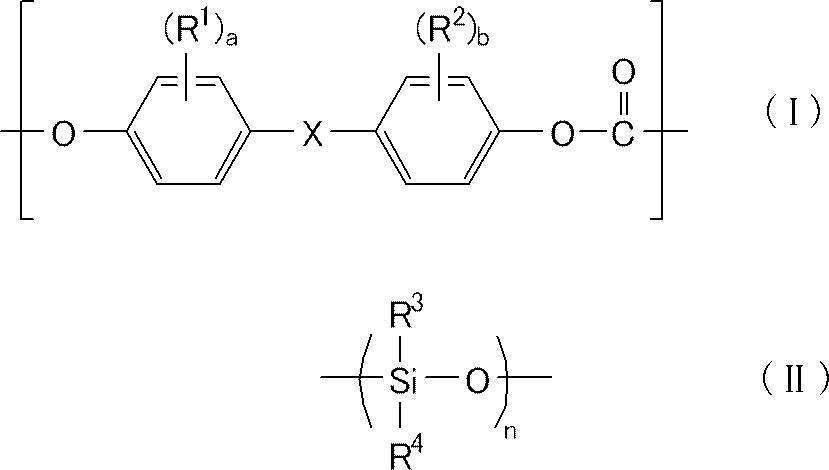
- the polycarbonate resin composition of the present invention is a polycarbonate having a polycarbonate block comprising a repeating unit represented by the following general formula (I) and a polyorganosiloxane block containing a repeating unit represented by the following general formula (II):
- Sf is a flow length (cm) when the resin composition is molded at a pressure setting of 125 MPa in a spiral flow mold having a cylinder temperature of 240 ° C., a mold temperature of 40 ° C., and a thickness of 2.0 mm.
- Ch represents the Charpy impact strength (kJ / m 2 ) at a temperature of 23 ° C. when the resin composition is formed into a molded body having a thickness of 4 mm.
- Bd represents the content (mass%) of the structural unit derived from the butadiene in the resin composition
- Si represents the content (mass%) of the polyorganosiloxane block portion in the resin composition. . ]
- R 1 and R 2 each independently represents a halogen atom, an alkyl group having 1 to 6 carbon atoms, or an alkoxy group having 1 to 6 carbon atoms.
- X is a single bond, an alkylene group having 1 to 8 carbon atoms, an alkylidene group having 2 to 8 carbon atoms, a cycloalkylene group having 5 to 15 carbon atoms, a cycloalkylidene group having 5 to 15 carbon atoms, a fluorenediyl group, a carbon An arylalkylene group having 7 to 15 carbon atoms, an arylalkylidene group having 7 to 15 carbon atoms, —S—, —SO—, —SO 2 —, —O— or —CO—; R 3 and R 4 each independently represent a hydrogen atom, a halogen atom, an alkyl group having 1 to 6 carbon atoms, an alkoxy group having 1 to 6 carbon atoms, or an ary
- the polycarbonate resin (A) (hereinafter also referred to as “component (A)”) used in the present invention is a polycarbonate-polyorganosiloxane copolymer (A-1) (hereinafter “PC-POS (A-1)”) or (Also referred to as “component (A-1)”).
- the component (A) may contain an aromatic polycarbonate resin (A-2) other than the component (A-1) to the extent that the effects of the present invention are not impaired.
- PC-POS is a polycarbonate-poly having a polycarbonate block comprising a repeating unit represented by the following general formula (I) and a polyorganosiloxane block comprising a repeating unit represented by the following general formula (II) It is an organosiloxane copolymer.
- R 1 and R 2 each independently represents a halogen atom, an alkyl group having 1 to 6 carbon atoms, or an alkoxy group having 1 to 6 carbon atoms.
- X is a single bond, an alkylene group having 1 to 8 carbon atoms, an alkylidene group having 2 to 8 carbon atoms, a cycloalkylene group having 5 to 15 carbon atoms, a cycloalkylidene group having 5 to 15 carbon atoms, a fluorenediyl group, a carbon An arylalkylene group having 7 to 15 carbon atoms, an arylalkylidene group having 7 to 15 carbon atoms, —S—, —SO—, —SO 2 —, —O— or —CO—; R 3 and R 4 each independently represent a hydrogen atom, a halogen atom, an alkyl group having 1 to 6 carbon atoms, an alkoxy group having 1 to 6 carbon atoms, or an ary
- PC-POS (A-1) may be used alone or in combination of two or more. Further, the type of the repeating unit represented by the general formula (I) in PC-POS (A-1) may be only one type or two or more types. The same applies to the repeating unit represented by the general formula (II) in PC-POS (A-1).
- examples of the halogen atom independently represented by R 1 and R 2 include a fluorine atom, a chlorine atom, a bromine atom, and an iodine atom.
- examples of the alkyl group independently represented by R 1 and R 2 include a methyl group, an ethyl group, an n-propyl group, an isopropyl group, and various butyl groups (“various” means linear and all branched ones). And the same applies hereinafter), various pentyl groups, and various hexyl groups.
- examples of the alkoxy group independently represented by R 1 and R 2 include a case where the alkyl group moiety is the alkyl group.
- Each R 1 and R 2 is preferably an alkyl group having 1 to 4 carbon atoms or an alkoxy group having 1 to 4 carbon atoms.
- Examples of the alkylene group represented by X include a methylene group, an ethylene group, a trimethylene group, a tetramethylene group, a hexamethylene group, and the like, and an alkylene group having 1 to 5 carbon atoms is preferable.
- Examples of the alkylidene group represented by X include an ethylidene group and an isopropylidene group.
- the cycloalkylene group represented by X is preferably a cycloalkylene group having 5 to 10 carbon atoms, and examples thereof include a cyclopentanediyl group, a cyclohexanediyl group, and a cyclooctanediyl group.
- Examples of the cycloalkylidene group represented by X include a cyclohexylidene group, a 3,5,5-trimethylcyclohexylidene group, a 2-adamantylidene group and the like, and a cycloalkylidene group having 5 to 10 carbon atoms is preferable.
- a cycloalkylidene group having 5 to 8 carbon atoms is more preferred.
- Examples of the aryl moiety of the arylalkylene group represented by X include aryl groups having 6 to 14 ring carbon atoms such as a phenyl group, a naphthyl group, a biphenyl group, and an anthryl group.
- Examples of the aryl moiety of the arylalkylidene group represented by X include aryl groups having 6 to 14 ring carbon atoms such as a phenyl group, a naphthyl group, a biphenyl group, and an anthryl group.
- a and b each independently represent an integer of 0 to 4, preferably 0 to 2, more preferably 0 or 1.
- examples of the halogen atom independently represented by R 3 and R 4 include a fluorine atom, a chlorine atom, a bromine atom, and an iodine atom.
- examples of the alkyl group and alkoxy group independently represented by R 3 and R 4 include the same groups as those for R 1 and R 2 .
- Examples of the aryl group independently represented by R 3 and R 4 include a phenyl group and a naphthyl group.
- R 3 and R 4 is preferably a hydrogen atom, an alkyl group having 1 to 6 carbon atoms, an alkoxy group having 1 to 6 carbon atoms, or an aryl group having 6 to 12 carbon atoms, each of which is a methyl group More preferably.
- n is an average number of repetitions, and preferably represents an integer of 30 to 500, more preferably 30 to 150, and still more preferably 30 to 120. If the average number of repetitions n is 30 or more, the impact resistance is sufficient. If the average number of repetitions n is 500 or less, it is easy to avoid the difficulty in handling when producing the copolymer due to the viscosity of the raw material POS becoming too high.
- the structure of the polyorganosiloxane block including the repeating structure represented by the general formula (II) is preferably the one represented by the following general formula (II ′).
- R 3 to R 6 each independently represents a hydrogen atom, a halogen atom, an alkyl group having 1 to 6 carbon atoms, an alkoxy group having 1 to 6 carbon atoms, or an aryl having 6 to 12 carbon atoms. Indicates a group.
- Y represents a single bond or a divalent organic residue containing —C ( ⁇ O) —, an aliphatic group or an aromatic group.
- n is the average number of repetitions.
- Each of R 3 to R 6 is preferably a hydrogen atom, an alkyl group having 1 to 6 carbon atoms, an alkoxy group having 1 to 6 carbon atoms, or an aryl group having 6 to 12 carbon atoms.
- Y is preferably a residue of a phenol compound having an alkyl group, more preferably an organic residue derived from allylphenol or an organic residue derived from eugenol.
- the structure of the polyorganosiloxane block containing the repeating structure represented by the general formula (II) is also preferably represented by the following formula (II ′′).
- R 3 to R 6 and Y are the same as those in the general formula (II ′), and preferred ones are also the same.
- the sum of p and q is n. p and q are each preferably n / 2.
- m represents 0 or 1.
- Z ' represents a single bond, -R 7 O -, - R 7 COO -, - R 7 NH -, - COO- or -S- shown, the R 7 is a straight, branched or cyclic alkylene group, an aromatic An aryl-substituted alkylene group, an arylene group or a diarylene group which may have an alkoxy group on the ring is shown.
- ⁇ represents a divalent group derived from a diisocyanate compound, a divalent group derived from a dicarboxylic acid, or a divalent group derived from a dicarboxylic acid halide. Specific examples of the divalent group derived from the diisocyanate compound, the divalent group derived from the dicarboxylic acid, and the divalent group derived from the dicarboxylic acid halide will be described later.
- the content of the polyorganosiloxane block portion containing the repeating unit represented by the general formula (II) in PC-POS (A-1) is preferably 2.0 to 15% by mass, more preferably 3.0%. It is ⁇ 8.5 mass%, more preferably 3.2 to 7.5 mass%. When the content is 2.0% by mass or more, the resulting resin composition has better impact resistance. On the other hand, when the content is 15% by mass or less, the handling property during the production of PC-POS (A-1) is better.
- the content of the polyorganosiloxane block portion in the component (A-1) can be calculated by nuclear magnetic resonance (NMR).
- the viscosity average molecular weight (Mv) of PC-POS (A-1) is preferably 10,000 to 25,000, more preferably 12,000 to 23,000. When the viscosity average molecular weight of the component (A-1) is within this range, it is easy to balance fluidity and impact resistance.
- PC-POS (A-1)
- it can be easily produced by referring to a known method for producing PC-POS, for example, the method described in JP 2010-241943 A or the like. it can.
- an aromatic polycarbonate oligomer produced in advance and a polyorganosiloxane having a reactive group at its terminal (such as polyorganosiloxanes represented by the following general formulas (2) and (3)) are water-insoluble. It is dissolved in a basic organic solvent (methylene chloride, etc.), and an alkaline compound aqueous solution (sodium hydroxide aqueous solution, etc.) of a dihydric phenol (bisphenol A, etc.) represented by the following general formula (1) is added.
- Interfacial polycondensation reaction is performed using an amine (such as triethylamine) or a quaternary ammonium salt (such as trimethylbenzylammonium chloride) in the presence of a molecular weight regulator (terminal terminator) (monohydric phenol such as pt-butylphenol).
- amine such as triethylamine
- quaternary ammonium salt such as trimethylbenzylammonium chloride
- terminal terminator dihydric phenol such as pt-butylphenol
- the content of the polyorganosiloxane block part containing the repeating unit represented by the general formula (II) in the PC-POS (A-1) component is adjusted by adjusting the amount of the polyorganosiloxane used. can do.
- the mixture is allowed to stand to separate into an aqueous phase and a water-insoluble organic solvent phase [separation step], and the water-insoluble organic solvent phase is washed (preferably a basic aqueous solution, an acidic aqueous solution, water PC-POS can be obtained by sequentially washing) [washing step], and concentrating [concentration step], pulverizing [grinding step] and drying [drying step].
- the use ratio of the PC-POS (A-1) component with the polyorganosiloxane block content adjusted to the polycarbonate resin (A) made of an aromatic polycarbonate resin (A-2) other than (A-1) is adjusted. By doing, content of the polyorganosiloxane block part in (A) component can be adjusted.
- PC-POS is a copolymer of a dihydric phenol represented by the following general formula (1), a polyorganosiloxane represented by the following general formula (2), and phosgene, carbonate ester or chloroformate. Can also be manufactured.
- R 1 and R 2 , X, a and b are the same as those in the general formula (I).
- R 3 to R 6 are the same as those in general formula (II ′), and n is the same as that in general formula (II).
- Y ′ is the same as Y in the general formula (II ′).
- m 0 or 1
- Z represents a halogen atom, —R 7 OH, —R 7 COOH, —R 7 NH 2 , —R 7 NHR 8 , —COOH or —SH
- R 7 is linear or branched A chain or cyclic alkylene group, an aryl-substituted alkylene group optionally having an alkoxy group on the aromatic ring, an arylene group, or a diarylene group
- R 8 represents an alkyl group, an alkenyl group, an aryl group, an aralkyl group, or an alkoxy group; Show.
- the diarylene group is a group in which two arylene groups are linked directly or via a divalent organic group, and specifically has a structure represented by —Ar 1 —W—Ar 2 —. It is a group.
- Ar 1 and Ar 2 represent an arylene group
- W represents a single bond or a divalent organic group. Specific examples and preferred examples of W are the same as X in the general formula (I).
- the linear or branched alkylene group represented by R 7 includes an alkylene group having 1 to 8 carbon atoms, preferably 1 to 5 carbon atoms, and the cyclic alkylene group has 5 to 15 carbon atoms, preferably a carbon number. Examples include 5 to 10 cycloalkylene groups.
- the alkylene moiety of the aryl-substituted alkylene group represented by R 7 includes an alkylene group having 1 to 8 carbon atoms, preferably 1 to 5 carbon atoms.
- Examples of the aryl moiety of the aryl-substituted alkylene group represented by R 7 include aryl groups having 6 to 14 ring carbon atoms such as a phenyl group, a naphthyl group, a biphenyl group, and an anthryl group.
- Examples of the arylene group represented by R 7 , Ar 1, and Ar 2 include arylene groups having 6 to 14 ring carbon atoms such as a phenylene group, a naphthylene group, a biphenylene group, and an anthrylene group.
- Y ′ represents a single bond or a divalent organic residue containing —C ( ⁇ O) —, an aliphatic group or an aromatic group and bonded to Si and O or Si and Z.
- R 3 to R 6 are each preferably a hydrogen atom, an alkyl group having 1 to 6 carbon atoms, an alkoxy group having 1 to 6 carbon atoms, or an aryl group having 6 to 12 carbon atoms.
- n is the same as described above, and m represents 0 or 1.
- Z is preferably —R 7 OH, —R 7 COOH, —R 7 NH 2 , —COOH or —SH.
- R 7 is as defined above, and preferred ones are also the same.
- R 8 is preferably an alkyl group, an alkenyl group, an aryl group, or an aralkyl group.
- the dihydric phenol represented by the general formula (1) which is a raw material of PC-POS, is not particularly limited, but 2,2-bis (4-hydroxyphenyl) propane [common name: bisphenol A] is preferable.
- dihydric phenols other than bisphenol A include bis (4-hydroxyphenyl) methane, 1,1-bis (4-hydroxyphenyl) ethane, 2,2-bis (4-hydroxyphenyl) butane, 2,2 -Bis (4-hydroxyphenyl) octane, bis (4-hydroxyphenyl) phenylmethane, bis (4-hydroxyphenyl) diphenylmethane, 2,2-bis (4-hydroxy-3-methylphenyl) propane, bis (4- Hydroxyphenyl) naphthylmethane, 1,1-bis (4-hydroxy-3-tert-butylphenyl) propane, 2,2-bis (4-hydroxy-3-bromophenyl) propane, 2,2-bis (4- Hydroxy-3,5-dimethylphenyl) propane, 2,2-bis (4-hydroxy-3-chlorophene) Bis (hydroxyaryl) alkanes such as propane, 2,2-bis (4-hydroxy-3,5-dichlorophenyl) propane, 2,2-bis (4-hydroxy-3,
- the polyorganosiloxane represented by the general formula (2) is a phenol having an olefinically unsaturated carbon-carbon bond (preferably vinylphenol, allylphenol, eugenol, isopropenylphenol, etc.) with a predetermined polymerization degree ( n: the number of repeating units) can be easily produced by hydrosilylation reaction at the end of the polyorganosiloxane chain.
- the phenols are more preferably allylphenol or eugenol.
- polyorganosiloxane represented by the general formula (2) those in which R 3 to R 6 are all methyl groups are preferable.
- examples of the polyorganosiloxane represented by the general formula (2) include compounds represented by the following general formulas (2-1) to (2-10).
- R 3 to R 6 , n and R 8 are as defined above, and preferred ones are also the same.
- c represents a positive integer and is usually an integer of 1 to 6.
- the phenol-modified polyorganosiloxane represented by the general formula (2-1) is preferable from the viewpoint of ease of polymerization.
- ⁇ , ⁇ -bis [3- (o-hydroxyphenyl) propyl] polydimethylsiloxane which is one of the compounds represented by the general formula (2-2)
- ⁇ , ⁇ -bis [3- (4-hydroxy-2-methoxyphenyl) propyl] polydimethylsiloxane which is one of the compounds represented by (2-3)
- the phenol-modified polyorganosiloxane can be produced by a known method. As a manufacturing method, the method shown below is mentioned, for example. First, cyclotrisiloxane and disiloxane are reacted in the presence of an acidic catalyst to synthesize ⁇ , ⁇ -dihydrogenorganopolysiloxane. At this time, ⁇ , ⁇ -dihydrogen polyorganosiloxane having a desired average number of repetitions can be synthesized by changing the charging ratio of cyclotrisiloxane and disiloxane.
- this ⁇ , ⁇ -dihydrogen polyorganosiloxane is subjected to an addition reaction with a phenol compound having an unsaturated aliphatic hydrocarbon group such as allylphenol or eugenol, to thereby obtain a desired compound.
- a phenol compound having an unsaturated aliphatic hydrocarbon group such as allylphenol or eugenol
- a phenol-modified polyorganosiloxane having an average number of repetitions can be produced.
- PC-POS is obtained by copolymerizing a dihydric phenol represented by the general formula (1), a polyorganosiloxane represented by the following general formula (3), and phosgene, carbonate ester or chloroformate. It may be manufactured by.
- the polyorganosiloxane represented by the general formula (3) is a reaction product of the polyorganosiloxane represented by the general formula (2) and a diisocyanate compound, dicarboxylic acid or dicarboxylic acid halide.
- R 3 to R 6 , m, p, q, Y ′, Z and Z ′ are as defined above, and preferred ones are also the same.
- ⁇ represents a divalent group derived from a diisocyanate compound, a divalent group derived from a dicarboxylic acid, or a divalent group derived from a dicarboxylic acid halide.
- the component (A) is an aromatic polycarbonate resin (A-2) other than the component (A-1) (hereinafter also referred to as “component (A-2)”) to the extent that the effects of the present invention are not impaired. ) May be included.
- the component (A-2) is obtained by using an aromatic dihydric phenol compound, and contains a polyorganosiloxane block part containing a repeating unit represented by the general formula (II) contained in the component (A). Can be used to adjust the amount.
- the viscosity average molecular weight of the aromatic polycarbonate resin as the component (A-2) is preferably 10,000 to 40,000, more preferably 13,000 to 30,000, from the viewpoint of physical properties.
- the aromatic polycarbonate resin (A-2) does not have the repeating structure represented by the general formula (II), and the main chain is composed of repeating units represented by the following general formula (III). It is preferable that Such an aromatic polycarbonate resin is not particularly limited, and various known aromatic polycarbonate resins can be used.
- R 9 and R 10 each independently represent a halogen atom, an alkyl group having 1 to 6 carbon atoms, or an alkoxy group having 1 to 6 carbon atoms.
- X ′ is a single bond, an alkylene group having 1 to 8 carbon atoms, an alkylidene group having 2 to 8 carbon atoms, a cycloalkylene group having 5 to 15 carbon atoms, a cycloalkylidene group having 5 to 15 carbon atoms, —S—, —SO -, -SO 2- , -O- or -CO- is shown.
- d and e each independently represents an integer of 0 to 4.
- R 9 and R 10 include the same as R 1 and R 2, and preferred ones are also the same.
- R 9 and R 10 are more preferably an alkyl group having 1 to 6 carbon atoms or an alkoxy group having 1 to 6 carbon atoms.
- Specific examples of X ′ include the same as X described above, and preferable examples are also the same.
- d and e are each independently preferably 0 to 2, more preferably 0 or 1.
- the aromatic polycarbonate resin is prepared by reacting with an aromatic dihydric phenol compound and phosgene in the presence of an organic solvent inert to the reaction, an aqueous alkaline solution, and then a tertiary amine or quaternary ammonium.
- Conventional methods such as the interfacial polymerization method in which a polymerization catalyst such as a salt is added and polymerized, and the pyridine method in which an aromatic dihydric phenol compound is dissolved in pyridine or a mixed solution of pyridine and an inert solvent and phosgene is directly introduced are used. What is obtained by the manufacturing method of an aromatic polycarbonate can be used.
- a molecular weight regulator terminal terminator
- branching agent a branching agent and the like are used as necessary.
- said aromatic dihydric phenol type compound what is represented by the following general formula (III ') is mentioned.
- aromatic dihydric phenol compound examples include, for example, 2,2-bis (4-hydroxyphenyl) propane [bisphenol A], bis (4-hydroxyphenyl) methane, 1,1-bis (4- Bis (hydroxyphenyl) alkanes such as hydroxyphenyl) ethane, 2,2-bis (4-hydroxy-3,5-dimethylphenyl) propane, 4,4′-dihydroxydiphenyl, bis (4-hydroxyphenyl) cycloalkane Bis (4-hydroxyphenyl) oxide, bis (4-hydroxyphenyl) sulfide, bis (4-hydroxyphenyl) sulfone, bis (4-hydroxyphenyl) sulfoxide, bis (4-hydroxyphenyl) ketone and the like.
- bis (hydroxyphenyl) alkane dihydric phenol is preferable, and bisphenol A is more preferable.
- the viscosity average molecular weight (Mv) of the polycarbonate resin (A) is preferably 10,000 to 30,000, more preferably 12,000 to 26,000. When the viscosity average molecular weight of the component (A) is within this range, the balance between fluidity and impact resistance is more excellent.
- the content of the polyorganosiloxane block part containing the repeating unit represented by the general formula (II) in the polycarbonate resin (A) is preferably 0.75 to 15% by mass, more preferably 0.75 to 10% by mass. More preferably, the content is 0.80 to 6.0% by mass. If the content is 0.75% by mass or more, the effect of improving impact strength is higher, and if it is 15% by mass or less, it is easy to avoid a decrease in impact strength.
- the content of the polyorganosiloxane block portion in the component (A) can be calculated by nuclear magnetic resonance (NMR).
- the content of the component (A-1) is preferably 10 to 100% by mass from the viewpoint of preferably adjusting the content of the polyorganosiloxane block portion in the component (A) to the above range. More preferably, it is 15 to 100% by mass, and further preferably 20 to 100% by mass.
- the component (A-1) is 10% by mass or more, it is not necessary to increase the content of the polyorganosiloxane block portion in the component (A-1), which is preferable for the production of PC-POS.
- the polycarbonate resin composition of the present invention includes a copolymer having a structural unit derived from acrylonitrile and styrene and having no structural unit derived from methyl methacrylate as the component (B). Since the polycarbonate resin composition contains the component (B), the resin composition is excellent in fluidity and has a structural unit derived from acrylonitrile, so that a resin composition having good compatibility with the component (A) is obtained. be able to.
- the component (B) include an acrylonitrile-styrene binary copolymer (AS) and a ternary or higher copolymer obtained by further copolymerizing acrylonitrile and styrene with other components.
- the other components include polybutadiene, (meth) acrylic acid ester (excluding methyl methacrylate), styrene-butadiene-styrene rubber (SBS), styrene-butadiene rubber (SBR), butadiene-acrylic rubber, isoprene.
- SBS styrene-butadiene-styrene rubber
- SBR styrene-butadiene rubber
- butadiene-acrylic rubber isoprene.
- the polybutadiene used here is a low cis polybutadiene (for example, one containing 1 to 30 mol% of 1,2-vinyl bonds and 30 to 42 mol% of 1,4-cis bonds), high cis polybutadiene (for example, 1, Any of those having a 2-vinyl bond of 20 mol% or less and a 1,4-cis bond of 78 mol% or more) or a mixture thereof may be used.
- terpolymers include acrylonitrile-acrylic acid ester-styrene terpolymer (AAS), and acrylonitrile-butadiene-styrene terpolymer obtained by polymerizing acrylonitrile and styrene on polybutadiene ( ABS), acrylonitrile- (ethylene / propylene / diene copolymer) -styrene copolymer (AES), and the like.
- AAS acrylonitrile-acrylic acid ester-styrene terpolymer
- ABS polybutadiene
- ABS acrylonitrile- (ethylene / propylene / diene copolymer) -styrene copolymer
- the said copolymer may be used individually by 1 type, and may use 2 or more types together.
- the component (B) is at least an acrylonitrile-butadiene-styrene terpolymer (B-1) from the viewpoint of improving fluidity and improving impact resistance by containing a rubber component. ) (Hereinafter also referred to as “component (B-1)”). Further, from the viewpoint of improving the fluidity, an acrylonitrile-styrene binary copolymer (B-2) (hereinafter also referred to as “component (B-2)”) may be further contained.
- the content of the structural unit derived from butadiene in the component (B-1) is preferably 8 to 75% by mass, more preferably 30 to 70% by mass, and further preferably 50 to 70% by mass.
- the content of the structural unit derived from butadiene in the component (B-1) is 8% by mass or more, the impact resistance of the molded body is further improved.
- the component (B-2) it is preferable that the temperature 200 ° C., a melt volume rate (MVR) is measured at a load 10kgf is 3 ⁇ 150cm 3/10 min.
- MVR melt volume rate
- the MVR of the component (B-2) is in the above range, the fluidity of the resin composition is further improved.
- the MVR of the component (B-2) to be used is used from the viewpoint of improving fluidity. and more preferably is 50 ⁇ 150cm 3/10 min.
- MVR can be measured by a method based on ISO1133.
- ABS commercially available products of ABS as the component (B-1) include Santac AT-05, Clarastic SXH-330 (above, manufactured by Nippon A & L Co., Ltd.), Toyolac 500, 700 (manufactured by Toray Industries, Inc.), PA -756 (manufactured by Kitami Jitsugyo Co., Ltd.), HR181 (KUMHO, manufactured by PETROCHEMICAL), and the like.
- the polycarbonate resin composition of the present invention contains a copolymer having structural units derived from butadiene and methyl methacrylate as the component (C). By containing the component (C), it is possible to obtain a resin composition that is particularly excellent in impact resistance.
- the component (C) includes methyl methacrylate-butadiene-styrene terpolymer (MBS) obtained by polymerizing methyl methacrylate and styrene on polybutadiene, methyl methacrylate-acrylonitrile-butadiene-styrene quaternary copolymer (MABS), methyl And methacrylate-butadiene binary copolymer (MB).
- the said copolymer may be used individually by 1 type, and may use 2 or more types together.
- the component (C) preferably contains at least one selected from methyl methacrylate-butadiene-styrene terpolymer and methyl methacrylate-butadiene binary copolymer.
- MBS Commercially available products of MBS include Metabrene C223A (manufactured by Mitsubishi Rayon Co., Ltd.), Denka TH Polymer (manufactured by Denki Kagaku Kogyo Co., Ltd.), Kane Ace B (manufactured by Kaneka Co., Ltd.), Paraloid EXL2620 (manufactured by Dow Chemical), etc. Can be mentioned.
- Examples of commercially available products of MABS include Denka CL polymer, Denka TE polymer, Denka TP polymer (manufactured by Denki Kagaku Kogyo Co., Ltd.) and the like.
- Examples of commercially available MBs include Kane Ace M-711 (manufactured by Kaneka Corporation), Paraloid EXL2603, Paraloid EXL2690 (manufactured by Dow Chemical).
- preferable contents of the component (B-1), the component (B-2), and the component (C) with respect to 100 parts by mass of the component (A) are as follows. is there.
- the content of each component is in the following range, the balance between fluidity and impact resistance becomes better.
- the content of the component (B-1) is preferably 8 to 100 parts by weight and the content of the component (B-2) is preferably 100 parts by weight of the component (A). 25 parts by mass or less, and the content of component (C) is 0.5 to 8 parts by mass.
- the content of the component (B-1) is 8 to 50 parts by mass
- the content of the component (B-2) is 1 to 20 parts by mass
- the content of the component (C) is 1 to 5 parts by mass. It is.
- the content of the structural unit derived from butadiene as the component (B-1) is 30 to 70% by mass
- the content is preferably based on 100 parts by mass of the component (A).
- the content of component (B-1) is 8 to 15 parts by mass
- the content of component (B-2) is 10 to 25 parts by mass
- the content of component (C) is 1 to 5 parts by mass.
- the content of the polyorganosiloxane block portion containing the repeating unit represented by the general formula (II) is 0.50 to 10% by mass in the total resin composition. More preferably, it is 0.60 to 8.0% by mass, and still more preferably 0.70 to 5.0% by mass.
- the content is 0.50% by mass or more, the impact strength of the obtained molded body is higher. Moreover, if the said content is 10 mass% or less, it is preferable at the point of economical efficiency.
- the content of the polyorganosiloxane block portion in the resin composition is a value calculated by nuclear magnetic resonance (NMR) measurement.
- the content of structural units derived from butadiene in the entire composition is preferably 3 to 10% by mass. If the content of the structural unit derived from butadiene is 3% by mass or more, the impact resistance of the molded body is higher, and if it is 10% by mass or less, it is easy to suppress a decrease in fluidity and flame retardancy. From the above viewpoint, the polycarbonate resin composition of the present invention more preferably has a content of structural units derived from butadiene in the total resin composition of 3 to 8% by mass, and more preferably 3.5 to 6%. % By mass.
- the content of the structural unit derived from styrene in the total resin composition is preferably 5 to 35% by mass, and the content of the structural unit derived from acrylonitrile is 3%. It is preferably ⁇ 10% by mass. If the content of the structural unit derived from styrene is 5% by mass or more, the fluidity is better, and if it is 35% by mass or less, it is easy to avoid a decrease in impact resistance of the molded body.
- the polycarbonate resin composition of the present invention preferably has a content of structural units derived from styrene of 7 to 20% by mass, and more preferably 8 to 15% by mass. More preferably, the content of the structural unit derived from acrylonitrile is 3 to 8% by mass, and further preferably 3 to 6% by mass.
- the total content of the polyorganosiloxane block portion containing the repeating unit represented by the general formula (II) and the structural unit derived from the butadiene is preferably 3.5 to It is 15% by mass, more preferably 4.0 to 10% by mass.
- Both the polyorganosiloxane block portion and the structural unit derived from butadiene improve impact resistance. Therefore, higher impact resistance can be obtained when the total content is 3.5% by mass or more. Moreover, if it is 15 mass% or less, the fall of fluidity
- the polycarbonate resin composition of the present invention further contains a flame retardant as the component (D).
- the flame retardant is not particularly limited as long as it has an effect of improving the flammability within the scope of the effect of the present invention, and various known flame retardants such as halogen flame retardants, phosphorus flame retardants, metal salt-based flame retardants. A flame retardant is illustrated.
- various known flame retardants it is preferable to use a phosphorus-based flame retardant as the component (D) from the viewpoint of imparting high flame retardancy.
- phosphorus flame retardants include red phosphorus and phosphate ester flame retardants.
- phosphoric ester-based flame retardant those containing no halogen are particularly preferable, and examples thereof include phosphoric acid ester monomers, oligomers, polymers, or mixtures thereof.
- trimethyl phosphate triethyl phosphate, tributyl phosphate, trioctyl phosphate, tributoxyethyl phosphate, triphenyl phosphate, tricresyl phosphate, cresyl diphenyl phosphate, octyl diphenyl phosphate, tri (2-ethylhexyl) phosphate, diisopropyl Phenyl phosphate, trixylenyl phosphate, tris (isopropylphenyl) phosphate, trinaphthyl phosphate, bisphenol A bisphosphate, hydroquinone bisphosphate, resorcin bisphosphate, resorcinol-diphenyl phosphate, trioxybenz
- Examples of commercially available phosphoric acid ester compounds that can be suitably used as phosphate ester flame retardants include TPP [triphenyl phosphate], TXP [trixylenyl phosphate], and CR733S [manufactured by Daihachi Chemical Industry Co., Ltd.
- the phosphate ester flame retardant can be obtained by reacting divalent phenols and monovalent phenols represented by Ar.OH with phosphorus oxychloride.
- the content of the component (D) in the polycarbonate resin composition of the present invention is preferably 10 to 40 parts by weight, more preferably 10 to 30 parts by weight, more preferably 100 parts by weight of the component (A).
- the amount is preferably 15 to 30 parts by mass.
- the content is 10 parts by mass or more, better flame retardancy is obtained and the fluidity of the resin composition is further improved.
- it is 40 mass parts or less, it will be easy to maintain impact resistance and heat resistance.
- the polycarbonate resin composition of the present invention can appropriately contain other components to the extent that the effects of the present invention are not significantly impaired.
- other components include additives such as antioxidants, ultraviolet absorbers, mold release agents, flame retardant aids, inorganic fillers, and colorants (dyes and pigments).
- antioxidants examples include phosphorus-based antioxidants, sulfur-based antioxidants, and phenol-based antioxidants. There is no restriction
- Typical examples include tris (nonylphenyl) phosphite, 2-ethylhexyl diphenyl phosphite, trialkyl phosphite, tricycloalkyl phosphite, triaryl phosphite, trialkyl phosphate, tricycloalkyl phosphate, tria Examples include reel phosphate. Of these, triaryl phosphites and triaryl phosphates are preferably used.
- the sulfur-based antioxidant is not particularly limited, but pentaerythritol tetrakis (3-laurylthiopropionate) and tetrakis [methylene-3- (dodecylthio) propionate] methane are preferable.
- the phenolic antioxidant is not particularly limited, but a hindered phenolic is preferably used.
- a hindered phenolic is preferably used.
- octadecyl-3- (3,5-di-tert-butyl-4-hydroxyphenyl) propionate pentaerythritol-tetrakis [3- (3,5-di-tert-butyl-4-hydroxyphenyl) propionate], 1,6-hexanediol-bis [3- (3,5-di-tert-butyl-4-hydroxyphenyl) propionate], 1,3,5-trimethyl-2,4,6-tris (3,5- Di-tert-butyl-4-hydroxybenzyl) benzene and the like are preferable.
- an antioxidant when used, one kind may be used alone, or two or more kinds may be used in combination.
- the antioxidant it is preferable to use a phosphorus-based antioxidant, and the phosphorus-based antioxidant is used alone, or a phosphorus-based antioxidant and a sulfur-based antioxidant and / or a phenol-based antioxidant are used in combination. More preferably, it is used.
- the blending amount of the antioxidant is preferably 0.001 to 5 parts by mass, more preferably 0.005 to 3 parts by mass, and still more preferably 0.01 to 1 part by mass with respect to 100 parts by mass of the component (A). Part. If the blending amount of the antioxidant is within the above range, discoloration and molecular weight reduction during molding of the resin composition can be sufficiently prevented, and the antioxidant effect can be improved.
- ultraviolet absorbers such as benzophenone, benzotriazole, hydroxyphenyltriazine, cyclic imino ester, and cyanoacrylate can be used.
- An ultraviolet absorber may be used individually by 1 type, and may be used in combination of 2 or more type.
- the ultraviolet absorber it is preferable to use at least one selected from a benzophenone ultraviolet absorber and a benzotriazole ultraviolet absorber, and it is more preferable to use a benzotriazole ultraviolet absorber.
- benzophenone ultraviolet absorbers examples include 2,4-dihydroxybenzophenone, 2-hydroxy-4-methoxybenzophenone, 2-hydroxy-4-octoxybenzophenone, 2-hydroxy-4-benzyloxybenzophenone, 2-hydroxy- 4-methoxy-5-sulfoxybenzophenone, 2-hydroxy-4-methoxy-5-sulfoxytrihydridolate benzophenone, 2,2'-dihydroxy-4-methoxybenzophenone, 2,2 ', 4,4'-tetra Hydroxybenzophenone, 2,2′-dihydroxy-4,4′-dimethoxybenzophenone, 2,2′-dihydroxy-4,4′-dimethoxy-5-sodiumsulfoxybenzophenone, bis (5-benzoyl-4-hydroxy-) 2-Methoxyfe Le) methane, 2-hydroxy -4-n-dodecyloxy benzoin phenone, and 2-hydroxy-4-methoxy-2'-carboxy benzophenone.
- benzotriazole ultraviolet absorber examples include 2- (2-hydroxy-5-methylphenyl) benzotriazole, 2- (2-hydroxy-5-tert-octylphenyl) benzotriazole, 2- (2- Hydroxy-3,5-dicumylphenyl) phenylbenzotriazole, 2- (2-hydroxy-3-tert-butyl-5-methylphenyl) -5-chlorobenzotriazole, 2,2′-methylenebis [4- (1 , 1,3,3-tetramethylbutyl) -6- (2H-benzotriazol-2-yl) phenol], 2- (2-hydroxy-3,5-di-tert-butylphenyl) benzotriazole, -(2-hydroxy-3,5-di-tert-butylphenyl) -5-chlorobenzotriazole, 2- (2- Droxy-3,5-di-tert-amylphenyl) benzotriazole, 2- (2-hydroxy-5-tert-oc
- the blending amount of the ultraviolet absorber in the polycarbonate resin composition of the present invention is preferably 0.001 to 1 part by mass, more preferably 0.005 to 0.7 part by mass with respect to 100 parts by mass of the component (A). Part, more preferably 0.01 to 0.5 part by weight. If the compounding amount of the ultraviolet absorber is 0.001 part by mass or more, it is possible to sufficiently suppress the molded body from being colored such as yellowing. Moreover, if it is 1 mass part or less, it is preferable in terms of economical efficiency, and mold contamination does not occur when molding.
- fatty acid ester polyolefin wax, fluorine oil, paraffin wax and the like can be used.
- fatty acid esters are preferred, for example, stearic acid monoglyceride, stearic acid diglyceride, stearic acid monosorbate, behenic acid monoglyceride, pentaerythritol monostearate, pentaerythritol distearate, propylene glycol monostearate, sorbitan monostearate, glycerin.
- Partial esters such as monostearate and pentaerythritol tetrastearate are preferred. These can be used alone or in combination of two or more.
- the compounding amount of the release agent in the polycarbonate resin composition of the present invention is preferably 0.01 to 3 parts by mass, more preferably 0.1 to 2 parts by mass, with respect to 100 parts by mass of the component (A). More preferably, it is 0.2 to 2 parts by mass.
- the flame retardant aid is used in combination with the flame retardant (D), and polytetrafluoroethylene (PTFE) or an antimony oxide compound can be used.
- PTFE polytetrafluoroethylene
- a mixed powder composed of PTFE particles and organic polymer particles include styrene monomers; (meth) acrylic acid alkyl ester monomers; vinyl cyanide monomers; vinyl ether monomers.
- the (meth) acrylic acid alkyl ester monomer refers to both an acrylic acid alkyl ester monomer and a methacrylic acid alkyl ester monomer.
- organic polymer particles can be obtained.
- the said monomer can be used 1 type or in mixture of 2 or more types.
- the organic polymer particles particles made of a (meth) acrylic acid alkyl ester copolymer are preferable.
- the blending amount of the flame retardant aid is preferably 0.1 to 2 parts by mass, more preferably 0.3 to 1.5 parts by mass with respect to 100 parts by mass of the component (A).
- the inorganic filler examples include talc, mica, kaolin, diatomaceous earth, calcium carbonate, calcium sulfate, barium sulfate, glass fiber, carbon fiber, and potassium titanate fiber. Of these, plate-like talc and mica, and fibrous fillers such as glass fiber and carbon fiber are preferable.
- flame retardancy and dimensional stability can be further improved. These can be used alone or in combination of two or more.
- the compounding amount of the inorganic filler is preferably 0.1 to 10 parts by mass, more preferably 0.5 to 5 parts by mass with respect to 100 parts by mass of the component (A). If the blending amount is 0.1 parts by mass or more, sufficient effects of improving flame retardancy and dimensional stability can be obtained, and if it is 10 parts by mass or less, fluidity and impact resistance can be easily maintained.
- colorant examples include perylene dyes, coumarin dyes, thioindigo dyes, anthraquinone dyes, thioxanthone dyes, ferrocyanides, perinone dyes, quinoline dyes, and phthalocyanine dyes.
- the polycarbonate resin composition of the present invention includes the components (A) to (D) and satisfies the following formula (a).
- (Sf ⁇ 37) ⁇ Ch / (Bd + Si) ⁇ 37 (a) [In the formula (a), Sf is a flow length (cm) when the resin composition is molded at a pressure setting of 125 MPa in a spiral flow mold having a cylinder temperature of 240 ° C., a mold temperature of 40 ° C., and a thickness of 2.0 mm. Indicates.
- Ch represents the Charpy impact strength (kJ / m 2 ) at a temperature of 23 ° C.
- the resin composition when the resin composition is formed into a molded body having a thickness of 4 mm.
- Bd represents the content (mass%) of the structural unit derived from the butadiene in the resin composition
- Si represents the content (mass%) of the polyorganosiloxane block portion in the resin composition. .
- the value of the formula (a) is preferably 40 or more, more preferably 50 or more, and still more preferably 60 or more, from the viewpoint of achieving all of fluidity, impact resistance, and flame retardancy with a high level in a balanced manner.
- the value of Sf is specifically measured by the method described in the examples.
- the value of Charpy impact strength Ch is measured at a temperature of 23 ° C. in accordance with ISO 179 by preparing a test piece with a notch from a molded body having a thickness of 4 mm, and can be specifically measured by the method described in the examples.
- the value of Si can be calculated by nuclear magnetic resonance (NMR) measurement.
- the polycarbonate resin composition of the present invention further satisfies the following formula (b), and the flame retardancy according to the UL94 (underwriters laboratory subject 94) standard satisfies 5 VB rank in a molded body having a thickness of 1.5 mm. It is preferable.
- Sf, Ch, Bd and Si are the same as described above.
- Vh represents the total (seconds) of five burning times in the UL94 standard 5V burning test. In the combustion test, the molded body is extinguished without drip.
- the resin composition can achieve all of fluidity, impact resistance, and flame retardancy at a higher level in a balanced manner.
- the value of the formula (b) is more preferably 34 or more, and further preferably 40 or more.
- Vh and the flame retardance rank can be measured by a vertical combustion test based on the UL94 standard using a molded body obtained by molding the polycarbonate resin composition of the present invention to a thickness of 1.5 mm. Can be measured by the method described in Examples.
- the burning time Vh is the total burning time when the UL94 standard 5V burning test is performed five times.
- the flow length Sf of the polycarbonate resin composition of the present invention is usually 38 cm or more, preferably 42 cm or more, more preferably 45 cm or more.
- the polycarbonate resin composition of the present invention has high fluidity, for example, it is possible to mold a thin and large molded body.
- the measured value at a temperature of 23 ° C. when the resin composition is a molded body having a thickness of 4 mm is usually 15 kJ / m 2 or more, preferably 20 kJ / m 2 or more, more preferably 30 kJ / m 2 or more.
- the polycarbonate resin composition of the present invention can be obtained by blending the above components (A) to (D) and other general components and kneading them.
- the mixing and kneading at this time are premixed by a commonly used equipment such as a ribbon blender, a drum tumbler, etc., and then a Henschel mixer, a Banbury mixer, a single screw extruder, a twin screw extruder, a multi screw screw. It can be carried out by a method using an extruder, a kneader or the like.
- the heating temperature at the time of kneading is usually appropriately selected within the range of 240 to 300 ° C.
- components other than polycarbonate resin (A) can also be previously added as polycarbonate master (A) and melt-kneading, ie, a masterbatch.
- the molded article of the present invention contains the polycarbonate resin composition of the present invention.
- the molded article of the present invention comprises a composition obtained by melt-kneading the polycarbonate resin composition of the present invention using the above-described melt-kneading molding machine, or a pellet obtained from the composition as a raw material. It can be obtained by molding by compression molding, extrusion molding, blow molding, press molding, vacuum molding, foam molding or the like. Particularly preferably, a pelletized molding raw material is produced by the melt kneading method, and then the pellet is used to form a molded body by using injection molding or injection compression molding.
- a gas injection molding method for preventing the appearance of sink marks or reducing the weight can be employed.
- the molded article of the polycarbonate resin composition of the present invention obtained as described above has a bending strength measured at 23 ° C. in accordance with ISO 178 using a test piece having a thickness of 4 mm, usually 85 to 95 MPa.
- the flexural modulus is usually 2,000 to 3,000 MPa. Each of the characteristic values is specifically measured by the method described in the examples.
- the molded product of the present invention is also excellent in heat resistance.
- the deflection temperature under load (HDT) measured at a load of 1.8 MPa is usually 70 ° C. or higher, and preferably 75 ° C. or higher.
- the HDT can be measured in accordance with ISO 75-1,2 and can be specifically measured by the method described in the examples.
- the polycarbonate resin composition of the present invention and a molded body containing the same can be suitably used for automobile parts (for example, exterior, interior, instrument panel, etc.), housings for electronic devices and information devices, and the like.
- Preparation Example 1 Manufacture of polycarbonate oligomer> Add 2,000 ppm of sodium dithionite to 5.6% by mass sodium hydroxide aqueous solution to bisphenol A (BPA) to be dissolved later, and add bisphenol A to the bisphenol A concentration of 13.5% by mass. It melt
- BPA bisphenol A
- This bisphenol A aqueous solution of sodium hydroxide 40L (hereinafter, L is an abbreviation of liter) / hr, methylene chloride at a flow rate of 15 L / hr, phosgene at a flow rate of 4.0 kg / hr, an inner diameter of 6 mm, and a tube length of 30 m It was continuously passed through the mold reactor.
- the tubular reactor had a jacket portion, and the temperature of the reaction solution was kept at 40 ° C. or lower by passing cooling water through the jacket.
- the reaction solution exiting the tubular reactor was continuously introduced into a 40-liter baffled tank reactor equipped with a receding blade, and bisphenol A aqueous sodium hydroxide solution 2.8 L / hr, 25 mass.
- the reaction was carried out by adding 0.64 L / hr of a 0.07 L / hr aqueous sodium hydroxide solution, 17 L / hr water, and 1 wt% triethylamine aqueous solution.
- the reaction liquid overflowing from the tank reactor was continuously extracted and allowed to stand to separate and remove the aqueous phase, and the methylene chloride phase was collected.
- the polycarbonate oligomer thus obtained had a concentration of 329 g / L and a chloroformate group concentration of 0.74 mol / L.
- PC-PDMS Copolymer 1 Production Example 1 ⁇ Production of Polycarbonate-Polydimethylsiloxane Copolymer (PC-PDMS Copolymer 1)> In a 50 L tank reactor equipped with a baffle plate, a paddle type stirring blade and a cooling jacket, 15 L of the polycarbonate oligomer solution prepared in Preparation Example 1 above, 9.0 L of methylene chloride, and the average number of repeating n of dimethylsiloxane repeating units are 90.
- PDMS polydimethylsiloxane
- a methylene chloride solution of pt-butylphenol (PTBP) (137 g of PTBP dissolved in 2.0 L of methylene chloride), a sodium hydroxide aqueous solution of bisphenol A (577 g of sodium hydroxide and sodium dithionite 2 A solution in which 1012 g of bisphenol A was dissolved in an aqueous solution in which 0.0 g was dissolved in 8.4 L of water was added, and a polymerization reaction was performed for 50 minutes.
- PTBP pt-butylphenol
- PC-PDMS copolymer polycarbonate-polydimethylsiloxane copolymer
- aqueous phase containing excess bisphenol A and sodium hydroxide.
- the organic phase was isolated.
- the methylene chloride solution of the PC-PDMS copolymer thus obtained was washed successively with 15% by volume of 0.03 mol / L sodium hydroxide aqueous solution and 0.2 mol / L hydrochloric acid, and then washed. Washing with pure water was repeated until the electrical conductivity in the later aqueous phase became 0.01 ⁇ S / m or less.
- the methylene chloride solution of the PC-PDMS copolymer obtained by washing was concentrated and pulverized, and the obtained flakes were dried at 120 ° C. under reduced pressure to produce PC-PDMS copolymer 1.
- the content of the PDMS block portion determined by nuclear magnetic resonance (NMR) of the obtained PC-PDMS copolymer 1 was 6.0% by mass, the viscosity number was 47.5, and the viscosity average molecular weight Mv was 17,700. It was.
- PC-PDMS Copolymer 2 was produced in the same manner as in Production Example 1 except that o-allylphenol terminal-modified PDMS having an average repeating number n of dimethylsiloxane repeating units of 40 was used in Production Example 1. .
- the content of the PDMS block portion determined by NMR of the obtained PC-PDMS copolymer 2 was 6.0% by mass, the viscosity number was 47.5, and the viscosity average molecular weight Mv was 17,700.
- PDMS average repeat number of allylphenol-terminated polydimethylsiloxane used in the above production example amount of PDMS used, amount of pt-butylphenol (PTBP) used, PDMS of the obtained polycarbonate-polydimethylsiloxane copolymer
- Table 1 shows the block portion content, viscosity number, and viscosity average molecular weight Mv.
- the viscosity number measured in the production example of the present invention is a value measured according to ISO 1628-4 (1999).
- MFR Magnetic resonance spectroscopy
- Q value In accordance with JIS K7210, the Q value at a temperature of 260 ° C. and a load of 100 kg was measured with an elevated flow tester.
- SFL value The flow length (cm) when the pellet obtained in each example was molded at a pressure setting of 125 MPa was measured with a spiral flow mold having a cylinder temperature of 240 ° C., a mold temperature of 40 ° C., and a thickness of 2.0 mm.
- Examples 1 to 8 and Comparative Examples 1 to 8 Each component was mixed in the ratio shown in Table 2, and granulated at a resin temperature of 280 ° C. using a vented 50 mm ⁇ single screw extruder to obtain pellets made of a polycarbonate resin composition.
- the injection molding machine model number; IS100EN, manufactured by Toshiba Machine Co., Ltd.
- the pellets obtained by the above method were injection molded under the molding conditions of a cylinder temperature of 240 ° C. and a mold temperature of 40 ° C. to obtain test pieces. . Said performance evaluation was performed using the obtained test piece.
- Fluon AD939E PTFE aqueous dispersion, manufactured by Asahi Glass Co., Ltd.
- Table 2 shows the results of various evaluations.
- Table 2 shows that the polycarbonate resin composition of the present invention is excellent in fluidity, flame retardancy and impact resistance, and has good mechanical properties and heat resistance.
- the present invention it is possible to provide a polycarbonate resin composition capable of obtaining a molded article having excellent fluidity and flame retardancy and high impact strength. Since the resin composition can form a thin and large molded article, it is suitably used for automobile parts (for example, exterior, interior, instrument panel, etc.), housings for electronic devices and information devices, and the like.
Landscapes
- Chemical & Material Sciences (AREA)
- Health & Medical Sciences (AREA)
- Chemical Kinetics & Catalysis (AREA)
- Medicinal Chemistry (AREA)
- Polymers & Plastics (AREA)
- Organic Chemistry (AREA)
- Compositions Of Macromolecular Compounds (AREA)
- Polyesters Or Polycarbonates (AREA)
- Other Resins Obtained By Reactions Not Involving Carbon-To-Carbon Unsaturated Bonds (AREA)
Abstract
Description
特許文献3,4には、優れた難燃性を維持しながら、成形性、耐衝撃性、剛性を満足し、熱安定性に優れた成形体を成形可能なポリカーボネート樹脂組成物として、ポリカーボネート樹脂、スチレン系樹脂、及びポリカーボネート-ポリオルガノシロキサン共重合体及び/又は官能基含有シリコーン化合物等を含有するポリカーボネート樹脂組成物が開示されている。
また特許文献5には、ポリカーボネートおよび/または脂肪族セグメントを有するコポリエステルカーボネート、ABS系樹脂および/又はSAN(アクリロニトリル-スチレン)樹脂、リン酸エステル系化合物、およびポリシロキサン-ポリカーボネートブロック共重合体を含み、薄く成形されても優れた難燃性を有するポリカーボネート樹脂組成物が開示されている。
さらに、ポリカーボネート樹脂組成物の流動性や耐衝撃性を向上させるためにABS樹脂やAS樹脂等を添加すると、難燃性が低下するという問題がある。
すなわち、本発明は、下記[1]~[13]に関する。
(Sf-37)×Ch/(Bd+Si)≧37 ・・・(a)
[式(a)中、Sfは前記樹脂組成物をシリンダー温度240℃、金型温度40℃、厚み2.0mmのスパイラルフロー金型で、圧力設定125MPaにて成形した際の流動長(cm)を示す。Chは、前記樹脂組成物を厚さ4mmの成形体とした時の、温度23℃におけるシャルピー衝撃強度(kJ/m2)を示す。Bdは、前記樹脂組成物中の前記ブタジエンに由来する構成単位の含有量(質量%)を示し、Siは、前記樹脂組成物中の前記ポリオルガノシロキサンブロック部分の含有量(質量%)を示す。]
[2]さらに、下記式(b)を満たし、かつUL94規格による難燃性が、厚さ1.5mmの成形体において5VBランクを満たす上記[1]に記載のポリカーボネート樹脂組成物。
(Sf-37)×Ch/(Bd+Si)-0.05Vh≧32 ・・・(b)
[式(b)中、Sf、Ch、Bd及びSiは、前記と同じである。Vhは、UL94規格の5V燃焼試験における5回の燃焼時間の合計(秒)を示す。なお、当該燃焼試験において前記成形体はドリップせずに消火するものとする。]
[3]前記(B)成分が、アクリロニトリル-ブタジエン-スチレン3元共重合体(B-1)を含む上記[1]又は[2]に記載のポリカーボネート樹脂組成物。
[4]前記(B)成分が、さらにアクリロニトリル-スチレン2元共重合体(B-2)を含む上記[3]に記載のポリカーボネート樹脂組成物。
[5]前記(C)成分が、メチルメタクリレート-ブタジエン-スチレン3元共重合体及びメチルメタクリレート-ブタジエン2元共重合体から選ばれる1種以上を含む上記[1]~[4]のいずれかに記載のポリカーボネート樹脂組成物。
[6]前記(B-1)成分中のブタジエンに由来する構成単位の含有量が、8~75質量%である上記[3]~[5]のいずれかに記載のポリカーボネート樹脂組成物。
[7]前記(B-2)成分の温度200℃、荷重10kgfで測定したメルトボリュームレート(MVR)が、3~150cm3/10分である上記[4]~[6]のいずれかに記載のポリカーボネート樹脂組成物。
[8]前記(D)成分が、リン系難燃剤である上記[1]~[7]のいずれかに記載のポリカーボネート樹脂組成物。
[9]前記リン系難燃剤が、縮合リン酸エステルである上記[8]に記載のポリカーボネート樹脂組成物。
[10]前記ポリカーボネート樹脂(A)の粘度平均分子量が、10,000~30,000である上記[1]~[9]のいずれかに記載のポリカーボネート樹脂組成物。
[11]前記流動長Sfが35cm以上である上記[1]~[10]のいずれかに記載のポリカーボネート樹脂組成物。
[12]前記シャルピー衝撃強度Chが15kJ/m2以上である上記[1]~[11]のいずれかに記載のポリカーボネート樹脂組成物。
[13]上記[1]~[12]のいずれかに記載のポリカーボネート樹脂組成物を含む成形体。
本発明のポリカーボネート樹脂組成物は、下記一般式(I)で表される繰り返し単位からなるポリカーボネートブロックと、下記一般式(II)で表される繰り返し単位を含むポリオルガノシロキサンブロックとを有するポリカーボネート-ポリオルガノシロキサン共重合体(A-1)を含有するポリカーボネート樹脂(A)と、アクリロニトリル及びスチレンに由来する構成単位を有しかつメチルメタクリレートに由来する構成単位を有さない共重合体(B)と、ブタジエン及びメチルメタクリレートに由来する構成単位を有する共重合体(C)と、難燃剤(D)とを含み、下記式(a)を満たすことを特徴とする。
(Sf-37)×Ch/(Bd+Si)≧37 ・・・(a)
[式(a)中、Sfは前記樹脂組成物をシリンダー温度240℃、金型温度40℃、厚み2.0mmのスパイラルフロー金型で、圧力設定125MPaにて成形した際の流動長(cm)を示す。Chは、前記樹脂組成物を厚さ4mmの成形体としたときの、温度23℃におけるシャルピー衝撃強度(kJ/m2)を示す。Bdは、前記樹脂組成物中の前記ブタジエンに由来する構成単位の含有量(質量%)を示し、Siは、前記樹脂組成物中の前記ポリオルガノシロキサンブロック部分の含有量(質量%)を示す。]

本発明に用いられるポリカーボネート樹脂(A)(以下、「(A)成分」ともいう)は、ポリカーボネート-ポリオルガノシロキサン共重合体(A-1)(以下「PC-POS(A-1)」又は「(A-1)成分」ともいう)を含有することを特徴とする。なお後述するように、(A)成分としては、本発明の効果を損なわない程度に(A-1)成分以外の芳香族ポリカーボネート樹脂(A-2)が含まれていてもよい。
PC-POS(A-1)は、下記一般式(I)で表される繰り返し単位からなるポリカーボネートブロック及び下記一般式(II)で表される繰り返し単位を含むポリオルガノシロキサンブロックを有するポリカーボネート-ポリオルガノシロキサン共重合体である。

PC-POS(A-1)は、1種を単独で使用してもよいし、2種以上を併用してもよい。またPC-POS(A-1)中の一般式(I)で表される繰り返し単位の種類は、1種のみでもよく、2種以上含まれていてもよい。PC-POS(A-1)中の一般式(II)で表される繰り返し単位についても同様である。
R1及びR2がそれぞれ独立して示すアルキル基としては、メチル基、エチル基、n-プロピル基、イソプロピル基、各種ブチル基(「各種」とは、直鎖状及びあらゆる分岐鎖状のものを含むことを示し、以下、同様である。)、各種ペンチル基、各種ヘキシル基が挙げられる。R1及びR2がそれぞれ独立して示すアルコキシ基としては、アルキル基部位が前記アルキル基である場合が挙げられる。
各R1及びR2は、好ましくは炭素数1~4のアルキル基又は炭素数1~4のアルコキシ基である。
Xが表すアルキレン基としては、例えば、メチレン基、エチレン基、トリメチレン基、テトラメチレン基、ヘキサメチレン基等が挙げられ、炭素数1~5のアルキレン基が好ましい。Xが表すアルキリデン基としては、エチリデン基、イソプロピリデン基等が挙げられる。Xが表すシクロアルキレン基としては、炭素数5~10のシクロアルキレン基が好ましく、シクロペンタンジイル基、シクロヘキサンジイル基、シクロオクタンジイル基等が挙げられる。Xが表すシクロアルキリデン基としては、例えば、シクロヘキシリデン基、3,5,5-トリメチルシクロヘキシリデン基、2-アダマンチリデン基等が挙げられ、炭素数5~10のシクロアルキリデン基が好ましく、炭素数5~8のシクロアルキリデン基がより好ましい。Xが表すアリールアルキレン基のアリール部位としては、フェニル基、ナフチル基、ビフェニル基、アントリル基などの環形成炭素数6~14のアリール基が挙げられる。Xが表すアリールアルキリデン基のアリール部位としては、フェニル基、ナフチル基、ビフェニル基、アントリル基などの環形成炭素数6~14のアリール基が挙げられる。
a及びbは、それぞれ独立に0~4の整数を示し、好ましくは0~2、より好ましくは0又は1である。
なお、各R3及びR4は、好ましくは、水素原子、炭素数1~6のアルキル基、炭素数1~6のアルコキシ基又は炭素数6~12のアリール基であり、いずれもメチル基であることがより好ましい。

各R3~R6は、好ましくは、水素原子、炭素数1~6のアルキル基、炭素数1~6のアルコキシ基又は炭素数6~12のアリール基である。Yとしては、好ましくはアルキル基を有するフェノール系化合物の残基であり、アリルフェノール由来の有機残基やオイゲノール由来の有機残基がより好ましい。
また、一般式(II)で表される繰り返し構造を含むポリオルガノシロキサンブロックの構造としては、下記式(II'')で表されるものであることも好ましい。

mは、0又は1を示す。
Z’は、単結合、-R7O-、-R7COO-、-R7NH-、-COO-又は-S-を示し、該R7は直鎖、分岐鎖もしくは環状アルキレン基、芳香環上にアルコキシ基を有してもよいアリール置換アルキレン基、アリーレン基又はジアリーレン基を示す。該R7の具体例については後述する。
また、βは、ジイソシアネート化合物由来の2価の基、ジカルボン酸由来の2価の基、又はジカルボン酸ハロゲン化物由来の2価の基を示す。該ジイソシアネート化合物由来の2価の基、ジカルボン酸由来の2価の基、及びジカルボン酸ハロゲン化物由来の2価の基の具体例については後述する。
なお、本発明において、粘度平均分子量(Mv)は、ウベローデ型粘度管にて、20℃における塩化メチレン溶液の極限粘度〔η〕を測定し、Schnellの式(〔η〕=1.23×10⁻⁵×Mv0.83)より算出した値である。
具体的には、予め製造された芳香族ポリカーボネートオリゴマーと、末端に反応性基を有するポリオルガノシロキサン(下記一般式(2)及び(3)で表されるポリオルガノシロキサン等)とを、非水溶性有機溶媒(塩化メチレン等)に溶解させ、下記一般式(1)で表される二価フェノール(ビスフェノールA等)のアルカリ性化合物水溶液(水酸化ナトリウム水溶液等)を加え、重合触媒として第三級アミン(トリエチルアミン等)や第四級アンモニウム塩(トリメチルベンジルアンモニウムクロライド等)を用い、分子量調節剤(末端停止剤)(p-t-ブチルフェノール等の1価フェノール)の存在下、界面重縮合反応させることにより製造できる。なお、前記ポリオルガノシロキサンの使用量を調整することなどにより、PC-POS(A-1)成分中の一般式(II)で表される繰り返し単位を含むポリオルガノシロキサンブロック部分の含有量を調整することができる。
上記界面重縮合反応後、適宜静置して水相と非水溶性有機溶媒相とに分離し[分離工程]、非水溶性有機溶媒相を洗浄(好ましくは塩基性水溶液、酸性水溶液、水の順に洗浄)し[洗浄工程]、得られた有機相を濃縮[濃縮工程]、粉砕[粉砕工程]及び乾燥[乾燥工程]することによって、PC-POSを得ることができる。このポリオルガノシロキサンブロック含有量の調整されたPC-POS(A-1)成分と(A-1)以外の芳香族ポリカーボネート樹脂(A-2)からなるポリカーボネート樹脂(A)との使用比率を調整することにより、(A)成分中のポリオルガノシロキサンブロック部分の含有量を調整することができる。

mは0又は1を示し、Zはハロゲン原子、-R7OH、-R7COOH、-R7NH2、-R7NHR8、-COOH又は-SHを示し、R7は直鎖、分岐鎖もしくは環状アルキレン基、芳香環上にアルコキシ基を有してもよいアリール置換アルキレン基、アリーレン基、又はジアリーレン基を示し、R8はアルキル基、アルケニル基、アリール基、アラルキル基又はアルコキシ基を示す。
ジアリーレン基とは、二つのアリーレン基が直接、又は二価の有機基を介して連結された基のことであり、具体的には-Ar1-W-Ar2-で表される構造を有する基である。ここで、Ar1及びAr2は、アリーレン基を示し、Wは単結合、又は2価の有機基を示す。Wの具体例及び好適例は、前記一般式(I)におけるXと同じである。
R7が表す直鎖又は分岐鎖アルキレン基としては、炭素数1~8、好ましくは炭素数1~5のアルキレン基が挙げられ、環状アルキレン基としては、炭素数5~15、好ましくは炭素数5~10のシクロアルキレン基が挙げられる。R7が表すアリール置換アルキレン基のアルキレン部位としては、炭素数1~8、好ましくは炭素数1~5のアルキレン基が挙げられる。R7が表すアリール置換アルキレン基のアリール部位としては、フェニル基、ナフチル基、ビフェニル基、アントリル基などの環形成炭素数6~14のアリール基が挙げられる。R7、Ar1及びAr2が表すアリーレン基としては、フェニレン基、ナフチレン基、ビフェニレン基、アントリレン基などの環形成炭素数6~14のアリーレン基が挙げられる。
好ましくは、Y’は、単結合、又は-C(=O)-、脂肪族基若しくは芳香族基を含み、SiとO又はSiとZに結合している2価の有機残基を示す。R3~R6としては、いずれも、好ましくは、水素原子、炭素数1~6のアルキル基、炭素数1~6のアルコキシ基又は炭素数6~12のアリール基である。nは上記と同じであり、mは0又は1を示す。
Zとしては、好ましくは-R7OH、-R7COOH、-R7NH2、-COOH又は-SHである。該R7は、前記定義の通りであり、好ましいものも同じである。
R8としては、好ましくは、アルキル基、アルケニル基、アリール基又はアラルキル基である。
ビスフェノールA以外の二価フェノールとしては、例えば、ビス(4-ヒドロキシフェニル)メタン、1,1-ビス(4-ヒドロキシフェニル)エタン、2,2-ビス(4-ヒドロキシフェニル)ブタン、2,2-ビス(4-ヒドロキシフェニル)オクタン、ビス(4-ヒドロキシフェニル)フェニルメタン、ビス(4-ヒドロキシフェニル)ジフェニルメタン、2,2-ビス(4-ヒドロキシ-3-メチルフェニル)プロパン、ビス(4-ヒドロキシフェニル)ナフチルメタン、1,1-ビス(4-ヒドロキシ-3-t-ブチルフェニル)プロパン、2,2-ビス(4-ヒドロキシ-3-ブロモフェニル)プロパン、2,2-ビス(4-ヒドロキシ-3,5-ジメチルフェニル)プロパン、2,2-ビス(4-ヒドロキシ-3-クロロフェニル)プロパン、2,2-ビス(4-ヒドロキシ-3,5-ジクロロフェニル)プロパン、2,2-ビス(4-ヒドロキシ-3,5-ジブロモフェニル)プロパン等のビス(ヒドロキシアリール)アルカン類;1,1-ビス(4-ヒドロキシフェニル)シクロペンタン、1,1-ビス(4-ヒドロキシフェニル)シクロヘキサン、1,1-ビス(4-ヒドロキシフェニル)-3,5,5-トリメチルシクロヘキサン、2,2-ビス(4-ヒドロキシフェニル)ノルボルナン、1,1-ビス(4-ヒドロキシフェニル)シクロドデカン等のビス(ヒドロキシアリール)シクロアルカン類;4,4’-ジヒドロキシジフェニルエーテル、4,4’-ジヒドロキシ-3,3’-ジメチルフェニルエーテル等のジヒドロキシアリールエーテル類;4,4’-ジヒドロキシジフェニルスルフィド、4,4’-ジヒドロキシ-3,3’-ジメチルジフェニルスルフィド等のジヒドロキシジアリールスルフィド類;4,4’-ジヒドロキシジフェニルスルホキシド、4,4’-ジヒドロキシ-3,3’-ジメチルジフェニルスルホキシド等のジヒドロキシジアリールスルホキシド類;4,4’-ジヒドロキシジフェニルスルホン、4,4’-ジヒドロキシ-3,3’-ジメチルジフェニルスルホン等のジヒドロキシジアリールスルホン類;4,4’-ジヒドロキシジフェニル等のジヒドロキシジフェニル類;9,9-ビス(4-ヒドロキシフェニル)フルオレン、9,9-ビス(4-ヒドロキシ-3-メチルフェニル)フルオレン等のジヒドロキシジアリールフルオレン類;1,3-ビス(4-ヒドロキシフェニル)アダマンタン、2,2-ビス(4-ヒドロキシフェニル)アダマンタン、1,3-ビス(4-ヒドロキシフェニル)-5,7-ジメチルアダマンタン等のジヒドロキシジアリールアダマンタン類;4,4’-[1,3-フェニレンビス(1-メチルエチリデン)]ビスフェノール、10,10-ビス(4-ヒドロキシフェニル)-9-アントロン、1,5-ビス(4-ヒドロキシフェニルチオ)-2,3-ジオキサペンタエン等が挙げられる。
これらの二価フェノールは、1種を単独で使用してもよいし、2種以上を混合して用いてもよい。
一般式(2)で表されるポリオルガノシロキサンとしては、例えば、以下の一般式(2-1)~(2-10)の化合物が挙げられる。

これらの中でも、重合の容易さの観点においては、一般式(2-1)で表されるフェノール変性ポリオルガノシロキサンが好ましい。また、入手の容易さの観点においては、一般式(2-2)で表される化合物中の一種であるα,ω-ビス[3-(o-ヒドロキシフェニル)プロピル]ポリジメチルシロキサン、一般式(2-3)で表される化合物中の一種であるα,ω-ビス[3-(4-ヒドロキシ-2-メトキシフェニル)プロピル]ポリジメチルシロキサンが好ましい。
まず、シクロトリシロキサンとジシロキサンとを酸性触媒存在下で反応させ、α,ω-ジハイドロジェンオルガノポリシロキサンを合成する。このとき、シクロトリシロキサンとジシロキサンとの仕込み比を変えることで所望の平均繰り返し数を持つα,ω-ジハイドロジェンポリオルガノシロキサンを合成することができる。次いで、ヒドロシリル化反応用触媒の存在下に、このα,ω-ジハイドロジェンポリオルガノシロキサンにアリルフェノールやオイゲノール等の不飽和脂肪族炭化水素基を有するフェノール化合物を付加反応させることで、所望の平均繰り返し数を有するフェノール変性ポリオルガノシロキサンを製造することができる。
また、この段階では、低分子量の環状ポリオルガノシロキサンや過剰量の上記フェノール化合物が不純物として残存するために、減圧下で加熱し、これらの低分子化合物を留去することが好ましい。

また、βは、ジイソシアネート化合物由来の2価の基、ジカルボン酸由来の2価の基、又はジカルボン酸ハロゲン化物由来の2価の基を示し、例えば、以下の一般式(3-1)~(3-5)で表される2価の基が挙げられる。

該(A-2)成分の芳香族ポリカーボネート樹脂の粘度平均分子量は、物性面の観点から、好ましくは10,000~40,000、より好ましくは13,000~30,000である。

R9及びR10の具体例としては、前記R1及びR2と同じものが挙げられ、好ましいものも同じである。R9及びR10としては、より好ましくは、炭素数1~6のアルキル基又は炭素数1~6のアルコキシ基である。X’の具体例としては、前記Xと同じものが挙げられ、好ましいものも同じである。d及びeは、それぞれ独立に、好ましくは0~2、より好ましくは0又は1である。
上記の反応に際し、必要に応じて、分子量調節剤(末端停止剤)、分岐化剤等が使用される。
なお、上記芳香族二価フェノール系化合物としては、下記一般式(III')で表されるものが挙げられる。
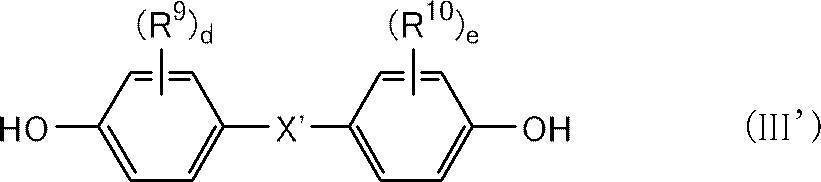
該芳香族二価フェノール系化合物の具体例としては、例えば、2,2-ビス(4-ヒドロキシフェニル)プロパン〔ビスフェノールA〕、ビス(4-ヒドロキシフェニル)メタン、1,1-ビス(4-ヒドロキシフェニル)エタン、2,2-ビス(4-ヒドロキシ-3,5-ジメチルフェニル)プロパン等のビス(ヒドロキシフェニル)アルカン系、4,4'-ジヒドロキシジフェニル、ビス(4-ヒドロキシフェニル)シクロアルカン、ビス(4-ヒドロキシフェニル)オキシド、ビス(4-ヒドロキシフェニル)スルフィド、ビス(4-ヒドロキシフェニル)スルホン、ビス(4-ヒドロキシフェニル)スルホキシド、ビス(4-ヒドロキシフェニル)ケトン等が挙げられる。
これらの中でも、ビス(ヒドロキシフェニル)アルカン系二価フェノールが好ましく、ビスフェノールAがより好ましい。
上記芳香族ポリカーボネート樹脂(A-2)は1種を単独で用いてもよいし、2種以上を併用してもよい。
ここで、(A)成分中の上記ポリオルガノシロキサンブロック部分の含有量は、核磁気共鳴(NMR)により算出できる。
(A-1)成分が10質量%以上であると、(A-1)成分中のポリオルガノシロキサンブロック部分の含有量を高くする必要がなく、PC-POSの製造上好ましい。
本発明のポリカーボネート樹脂組成物は、(B)成分として、アクリロニトリル及びスチレンに由来する構成単位を有しかつメチルメタクリレートに由来する構成単位を有さない共重合体を含む。ポリカーボネート樹脂組成物が当該(B)成分を含有することで、流動性に優れ、かつアクリロニトリルに由来する構成単位を有することから、前記(A)成分との相溶性も良好な樹脂組成物を得ることができる。
当該(B)成分としては、アクリロニトリル-スチレン2元共重合体(AS)、及び、アクリロニトリルとスチレンに他の成分をさらに共重合した3元以上の共重合体等が挙げられる。
上記他の成分の具体例としては、ポリブタジエン、(メタ)アクリル酸エステル(但しメチルメタクリレートを除く)、スチレン-ブタジエン-スチレンゴム(SBS)、スチレン-ブタジエンゴム(SBR)、ブタジエン-アクリルゴム、イソプレンゴム、イソプレン-スチレンゴム、イソプレン-アクリルゴム、エチレン-プロピレンゴム、エチレン-プロピレン-ジエンゴム等が挙げられる。このうち、特に好ましいものは、ポリブタジエンである。ここで用いるポリブタジエンは、低シスポリブタジエン(例えば、1,2-ビニル結合を1~30モル%、1,4-シス結合を30~42モル%含有するもの)、高シスポリブタジエン(例えば、1,2-ビニル結合を20モル%以下、1,4-シス結合を78モル%以上含有するもの)のいずれを用いてもよく、また、これらの混合物であってもよい。
上記3元以上の共重合体の具体例としては、アクリロニトリル-アクリル酸エステル-スチレン3元共重合体(AAS)、ポリブタジエンにアクリロニトリルとスチレンとが重合したアクリロニトリル-ブタジエン-スチレン3元共重合体(ABS)、アクリロニトリル-(エチレン/プロピレン/ジエン共重合体)-スチレン共重合体(AES)等が挙げられる。
上記共重合体のうち、流動性を向上させ、かつゴム成分を含有することにより耐衝撃性も向上させる点から、(B)成分は少なくともアクリロニトリル-ブタジエン-スチレン3元共重合体(B-1)(以下「(B-1)成分」ともいう)を含むことが好ましい。また、流動性向上の点からは、さらにアクリロニトリル-スチレン2元共重合体(B-2)(以下「(B-2)成分」ともいう)を含んでもよい。
MVRは、ISO1133に準拠した方法で測定することができる。
本発明のポリカーボネート樹脂組成物は、(C)成分として、ブタジエン及びメチルメタクリレートに由来する構成単位を有する共重合体を含む。当該(C)成分を含有することで、特に耐衝撃性に優れる樹脂組成物を得ることができる。
当該(C)成分としては、ポリブタジエンにメチルメタクリレートとスチレンが重合したメチルメタクリレート-ブタジエン-スチレン3元共重合体(MBS)、メチルメタクリレート-アクリロニトリル-ブタジエン-スチレン4元共重合体(MABS)、メチルメタクリレート-ブタジエン2元共重合体(MB)等が挙げられる。
上記共重合体は1種を単独で用いてもよいし、2種以上を併用してもよい。中でも、耐衝撃性を向上させる点から、(C)成分はメタクリル酸メチル-ブタジエン-スチレン3元共重合体及びメチルメタクリレート-ブタジエン2元共重合体から選ばれる1種以上を含むことが好ましい。
本発明のポリカーボネート樹脂組成物は、前記(A)成分100質量部に対して、好ましくは、(B-1)成分の含有量が8~100質量部、(B-2)成分の含有量が25質量部以下、及び(C)成分の含有量が0.5~8質量部である。より好ましくは、(B-1)成分の含有量が8~50質量部、(B-2)成分の含有量が1~20質量部、及び(C)成分の含有量が1~5質量部である。また、(B-1)成分のブタジエンに由来する構成単位の含有量が30~70質量%である場合には、上記含有量は、前記(A)成分100質量部に対して、好ましくは、(B-1)成分の含有量が8~15質量部、(B-2)成分の含有量が10~25質量部、及び(C)成分の含有量が1~5質量部である。
当該含有量が0.50質量%以上であれば、得られる成形体の衝撃強度がより高くなる。また当該含有量が10質量%以下であれば経済性の点で好ましい。
ここで、樹脂組成物中のポリオルガノシロキサンブロック部分の含有量は、核磁気共鳴(NMR)測定により算出された値である。
上記観点から、本発明のポリカーボネート樹脂組成物は、より好ましくは、前記スチレンに由来する構成単位の含有量が7~20質量%であり、更に好ましくは8~15質量%である。また、より好ましくは、前記アクリロニトリルに由来する構成単位の含有量が3~8質量%であり、さらに好ましくは3~6質量%である。
本発明のポリカーボネート樹脂組成物は、さらに(D)成分として難燃剤を含む。
難燃剤としては、本発明の効果の範囲で燃焼性を向上させる効果のあるものであれば特に制限はなく、各種公知の難燃剤、例えば、ハロゲン系難燃剤、リン系難燃剤、金属塩系難燃剤が例示される。これらの各種公知の難燃剤の中でも、高い難燃性を付与する観点から、(D)成分としてリン系難燃剤を用いることが好ましい。
リン系難燃剤としては、赤リンやリン酸エステル系の難燃剤が挙げられる。
リン酸エステル系の難燃剤としては、特にハロゲンを含まないものが好ましく、リン酸エステルのモノマー、オリゴマー、ポリマーあるいはこれらの混合物からなるものが挙げられる。具体的には、トリメチルホスフェート、トリエチルホスフェート、トリブチルホスフェート、トリオクチルホスフェート、トリブトキシエチルホスフェート、トリフェニルホスフェート、トリクレジルホスフェート、クレジルジフェニルホスフェート、オクチルジフェニルホスフェート、トリ(2-エチルヘキシル)ホスフェート、ジイソプロピルフェニルホスフェート、トリキシレニルホスフェート、トリス(イソプロピルフェニル)ホスフェート、トリナフチルホスフェート、ビスフェノールAビスホスフェート、ヒドロキノンビスホスフェート、レゾルシンビスホスフェート、レゾルシノール-ジフェニルホスフェート、トリオキシベンゼントリホスフェート等、又はこれらの置換体、縮合物等が挙げられる。中でも、縮合リン酸エステルを用いることが好ましい。
上記リン酸エステル系難燃剤は、2価のフェノール類及びAr・OHで表される1価のフェノール類とオキシ塩化リンとの反応によって得られる。
本発明のポリカーボネート樹脂組成物中の(D)成分の含有量は、前記(A)成分100質量部に対して、好ましくは10~40質量部であり、より好ましくは10~30質量部、さらに好ましくは15~30質量部である。当該含有量が10質量部以上であれば、より良好な難燃性が得られるとともに、樹脂組成物の流動性がより向上する。また40質量部以下であれば、耐衝撃性及び耐熱性を維持しやすい。
本発明のポリカーボネート樹脂組成物には、本発明の効果を著しく損なわない程度において、適宜、その他の成分を含有させることができる。
その他の成分としては、例えば、酸化防止剤、紫外線吸収剤、離型剤、難燃助剤、無機充填材、着色剤(染料、顔料)等の添加剤が挙げられる。
リン系酸化防止剤としては、特に制限はない。代表的な例としては、トリス(ノニルフェニル)ホスファイト、2-エチルヘキシルジフェニルホスファイトの他、トリアルキルホスファイト、トリシクロアルキルホスファイト、トリアリールホスファイト、トリアルキルホスフェート、トリシクロアルキルホスフェート、トリアリールホスフェートなどが挙げられる。この中では、トリアリールホスファイト、及びトリアリールホスフェートが好適に用いられる。
本発明のポリカーボネート樹脂組成物中の離型剤の配合量は、前記(A)成分100質量部に対して、好ましくは0.01~3質量部、より好ましくは0.1~2質量部、さらに好ましくは0.2~2質量部である。
有機系重合体粒子を製造するための単量体の具体例としては、スチレン系単量体;(メタ)アクリル酸アルキルエステル系単量体;シアン化ビニル系単量体;ビニルエーテル系単量体;カルボン酸ビニル系単量体;オレフィン系単量体;ジエン系単量体等を挙げることができる。特に、(メタ)アクリル酸アルキルエステル系単量体の使用が好ましい。なお、(メタ)アクリル酸アルキルエステル系単量体とは、アクリル酸アルキルエステル系及びメタクリル酸アルキルエステル系の両方の単量体を指す。
これらの単量体を重合することにより、有機系重合体粒子が得られる。上記単量体は、1種又は2種以上混合して用いることができる。有機系重合体粒子としては、(メタ)アクリル酸アルキルエステル系共重合体からなる粒子が好ましい。
難燃助剤の配合量は、前記(A)成分100質量部に対して、好ましくは0.1~2質量部、より好ましくは0.3~1.5質量部である。
これらは1種を単独で、又は2種以上を組み合わせて用いることができる。
無機充填材の配合量は、前記(A)成分100質量部に対して、好ましくは0.1~10質量部、より好ましくは0.5~5質量部である。上記配合量が0.1質量部以上であれば難燃性や寸法安定性の向上効果を十分に得ることができ、10質量部以下であれば流動性、耐衝撃性を維持しやすい。
本発明のポリカーボネート樹脂組成物は、上記(A)~(D)成分を含み、かつ下記式(a)を満たすことを特徴とする。
(Sf-37)×Ch/(Bd+Si)≧37 ・・・(a)
[式(a)中、Sfは前記樹脂組成物をシリンダー温度240℃、金型温度40℃、厚み2.0mmのスパイラルフロー金型で、圧力設定125MPaにて成形した際の流動長(cm)を示す。Chは、前記樹脂組成物を厚さ4mmの成形体とした時の、温度23℃におけるシャルピー衝撃強度(kJ/m2)を示す。Bdは、前記樹脂組成物中の前記ブタジエンに由来する構成単位の含有量(質量%)を示し、Siは、前記樹脂組成物中の前記ポリオルガノシロキサンブロック部分の含有量(質量%)を示す。]
式(a)の値が37未満であると、当該樹脂組成物は流動性、耐衝撃性、及び難燃性のすべてを高いレベルでバランスよく達成することが困難である。
式(a)の値は、流動性、耐衝撃性、及び難燃性のすべてを高いレベルでバランスよく達成する観点から、好ましくは40以上、より好ましくは50以上、さらに好ましくは60以上である。
(Sf-37)×Ch/(Bd+Si)-0.05Vh≧32 ・・・(b)
[式(b)中、Sf、Ch、Bd及びSiは、前記と同じである。Vhは、UL94規格の5V燃焼試験における5回の燃焼時間の合計(秒)を示す。なお、当該燃焼試験において前記成形体はドリップせずに消火するものとする。]
式(b)の値が32以上であれば、当該樹脂組成物は流動性、耐衝撃性、及び難燃性のすべてをより高いレベルでバランスよく達成できる。式(b)の値は、上記観点から、より好ましくは34以上、さらに好ましくは40以上である。
本発明のポリカーボネート樹脂組成物の流動長Sfは、通常38cm以上、好ましくは42cm以上、より好ましくは45cm以上である。上述のように、本発明のポリカーボネート樹脂組成物は高い流動性を有するため、例えば薄肉でかつ大型の成形体を成形することも可能となる。
次に、本発明のポリカーボネート樹脂組成物の製造方法について説明する。
本発明のポリカーボネート樹脂組成物は、前記の(A)~(D)成分、更には他の一般的な成分を配合し、混練することにより得られる。
このときの配合及び混練は、通常用いられている機器、例えば、リボンブレンダー、ドラムタンブラー等で予備混合して、ヘンシェルミキサー、バンバリーミキサー、単軸スクリュー押出機、二軸スクリュー押出機、多軸スクリュー押出機、コニーダ等を用いる方法で行うことができる。
混練の際の加熱温度は、通常240~300℃の範囲で適宜選択される。
なお、ポリカーボネート樹脂(A)以外の成分は、予め、ポリカーボネート樹脂(A)と溶融混練、すなわち、マスターバッチとして添加することもできる。
本発明の成形体は、本発明のポリカーボネート樹脂組成物を含むものである。
本発明の成形体は、本発明のポリカーボネート樹脂組成物を、上記の溶融混練成形機を用いて溶融混練した組成物、又は、該組成物から得られたペレットを原料として、射出成形法、射出圧縮成形法、押出成形法、ブロー成形法、プレス成形法、真空成形法及び発泡成形法等により成形することにより得られる。
特に好適には、上記溶融混練方法により、ペレット状の成形原料を製造し、次いで、このペレットを用いて、射出成形、射出圧縮成形を用いることにより、成形体とすることができる。
なお、射出成形方法としては、外観のヒケ防止のため、又は、軽量化のためのガス注入成形方法を採用することもできる。
上記のようにして得られた本発明のポリカーボネート樹脂組成物の成形体は、厚さ4mmの試験片を用い、ISO 178に準拠して23℃で測定した曲げ強度が、通常85~95MPaであり、曲げ弾性率は、通常2,000~3,000MPaである。
なお、上記特性値は、いずれも、具体的には実施例に記載の方法により測定される。
<ポリカーボネートオリゴマー製造>
5.6質量%水酸化ナトリウム水溶液に後から溶解するビスフェノールA(BPA)に対して2000ppmの亜二チオン酸ナトリウムを加え、これにビスフェノールA濃度が13.5質量%になるようにビスフェノールAを溶解し、ビスフェノールAの水酸化ナトリウム水溶液を調製した。
このビスフェノールAの水酸化ナトリウム水溶液40L(以下、Lはリットルの省略である。)/hr、塩化メチレン15L/hrの流量で、ホスゲンを4.0kg/hrの流量で内径6mm、管長30mの管型反応器に連続的に通した。
管型反応器はジャケット部分を有しており、ジャケットに冷却水を通して反応液の温度を40℃以下に保った。
管型反応器を出た反応液は後退翼を備えた内容積40Lのバッフル付き槽型反応器へ連続的に導入され、ここにさらにビスフェノールAの水酸化ナトリウム水溶液2.8L/hr、25質量%水酸化ナトリウム水溶液0.07L/hr、水17L/hr、1質量%トリエチルアミン水溶液を0.64L/hr添加して反応を行った。
槽型反応器から溢れ出る反応液を連続的に抜き出し、静置することで水相を分離除去し、塩化メチレン相を採取した。
このようにして得られたポリカーボネートオリゴマーは、濃度329g/L、クロロホーメート基濃度0.74mol/Lであった。
<ポリカーボネート-ポリジメチルシロキサン共重合体(PC-PDMS共重合体1)の製造>
邪魔板、パドル型攪拌翼及び冷却用ジャケットを備えた50L槽型反応器に、上記調製例1で製造したポリカーボネートオリゴマー溶液15L、塩化メチレン9.0L、ジメチルシロキサン繰り返し単位の平均繰り返し数nが90であるo-アリルフェノール末端変性ポリジメチルシロキサン(PDMS)384g及びトリエチルアミン8.8mLを仕込み、攪拌下でここに6.4質量%水酸化ナトリウム水溶液1389gを加え、10分間ポリカーボネートオリゴマーとアリルフェノール末端変性PDMSの反応を行った。
この重合液に、p-t-ブチルフェノール(PTBP)の塩化メチレン溶液(PTBP137gを塩化メチレン2.0Lに溶解したもの)、ビスフェノールAの水酸化ナトリウム水溶液(水酸化ナトリウム577gと亜二チオン酸ナトリウム2.0gを水8.4Lに溶解した水溶液にビスフェノールA1012gを溶解させたもの)を添加し、50分間重合反応を行った。
希釈のため塩化メチレン10Lを加え10分間攪拌した後、ポリカーボネート-ポリジメチルシロキサン共重合体(PC-PDMS共重合体)を含む有機相と過剰のビスフェノールA及び水酸化ナトリウムを含む水相に分離し、有機相を単離した。
こうして得られたPC-PDMS共重合体の塩化メチレン溶液を、その溶液に対して順次、15容積%の0.03mol/L水酸化ナトリウム水溶液、0.2モル/L塩酸で洗浄し、次いで洗浄後の水相中の電気伝導度が0.01μS/m以下になるまで純水で洗浄を繰り返した。
洗浄により得られたPC-PDMS共重合体の塩化メチレン溶液を濃縮・粉砕し、得られたフレークを減圧下120℃で乾燥し、PC-PDMS共重合体1を製造した。
得られたPC-PDMS共重合体1の核磁気共鳴(NMR)により求めたPDMSブロック部分の含有量は6.0質量%、粘度数は47.5、粘度平均分子量Mvは17,700であった。
<ポリカーボネート-ポリジメチルシロキサン共重合体(PC-PDMS共重合体2)の製造>
製造例1において、ジメチルシロキサン繰り返し単位の平均繰り返し数nが40であるo-アリルフェノール末端変性PDMSを用いたこと以外は、製造例1と同様にして、PC-PDMS共重合体2を製造した。
得られたPC-PDMS共重合体2のNMRにより求めたPDMSブロック部分の含有量は6.0質量%、粘度数は47.5、粘度平均分子量Mvは17,700であった。

<流動性評価>
(MFR)
ASTM D1238に準拠して、温度260℃、荷重2.16kgにおけるMFRを測定した。
(Q値)
JIS K7210に準拠して、温度260℃、荷重100kgにおけるQ値を高架式フローテスターで測定した。
(SFL値)
各例で得られたペレットを、シリンダー温度240℃、金型温度40℃、厚み2.0mmのスパイラルフロー金型で、圧力設定125MPaにて成形した際の流動長(cm)を測定した。
(シャルピー衝撃強度)
各例で得られた厚さ4mmの試験片からノッチ付きの試験片を作製し、ISO 179に準拠して、温度23℃でシャルピー衝撃強度を測定した。数値が大きいほど、耐衝撃性が良好であることを示す。
(曲げ試験)
各例で得られた厚さ4mmの試験片を用いて、ISO 178に準拠して、温度23℃、曲げ速度2mm/分の条件で曲げ強度及び曲げ弾性率を測定した。数値が大きいほど、曲げ特性が良好であることを示す。
(荷重たわみ温度)
各例で得られた厚さ4mmの試験片を用いて、ISO75-1,2の測定方法に準拠し、荷重1.8MPaで荷重たわみ温度(HDT)を測定した。荷重たわみ温度が高いほど、耐熱性が良好であることを示す。
(UL94燃焼性)
各例で得られた長さ127mm×幅12.7mm×厚さ1.5mmの試験片について、UL94垂直難燃試験(アンダーライターズラボラトリー・サブジェクト94)に準拠して5V燃焼試験(n=5)を行い、5回の燃焼時間の合計(秒)を求め、これをVhとした。また難燃性評価は、5Vランクを満たすか否かを判定することにより行った。
実施例に記載のポリカーボネート樹脂組成物は、厚さ1.5mmの成形体においていずれも5VBランクを満たしており、ドリップせずに消火した。
なお表2の難燃性評価において、5Vランクを満たしたものを「5V」、満たさなかったものを「5V-OUT」と表記する。
表2に示す割合で各成分を混合し、ベント付き50mmφの単軸押出機を用いて樹脂温度280℃で造粒し、ポリカーボネート樹脂組成物からなるペレットを得た。
上記方法で得られたペレットを、射出成形機(型番;IS100EN、東芝機械(株)製)を用い、シリンダー温度240℃、金型温度40℃の成形条件で射出成形して試験片を得た。得られた試験片を用いて前記の性能評価を行った。
<ポリカーボネート-ポリオルガノシロキサン共重合体(A-1)>
PC-PDMS共重合体1(製造例1に記載のポリカーボネート-ポリジメチルシロキサン共重合体)
PC-PDMS共重合体2(製造例2に記載のポリカーボネート-ポリジメチルシロキサン共重合体)
タフロンFN2200(ビスフェノールAポリカーボネート、出光興産(株)製、粘度数56.1、粘度平均分子量Mv=21,500)
タフロンFN1900(ビスフェノールAポリカーボネート、出光興産(株)製、粘度数51.0、粘度平均分子量Mv=19,200)
タフロンFN1700(ビスフェノールAポリカーボネート、出光興産(株)製、粘度数47.5、粘度平均分子量Mv=17,700)
クララスチックSXH-330(アクリロニトリル-ブタジエン-スチレン3元共重合体(ABS)、日本エイアンドエル(株)製、ブタジエンに由来する構成単位の含有量;12質量%)
HR181(アクリロニトリル-ブタジエン-スチレン3元共重合体(ABS)、KUMHO PETROCHEMICAL社製、ブタジエンに由来する構成単位の含有量;60質量%)
サンタックAT05(アクリロニトリル-ブタジエン-スチレン3元共重合体(ABS)、日本エイアンドエル(株)製、ブタジエンに由来する構成単位の含有量;14質量%)
<アクリロニトリル-スチレン2元共重合体(B-2)>
S101N(アクリロニトリル-スチレン2元共重合体(AS)、ユーエムジー・エービーエス(株)製、MVR[温度200℃、荷重10kgf];95cm3/10分)
パラロイドEXL2603(メチルメタクリレート-ブタジエン2元共重合体(MB)、ダウ・ケミカル製)
メタブレンC223A(メチルメタクリレート-ブタジエン-スチレン3元共重合体(MBS)、三菱レイヨン(株)製)
CR-741(芳香族縮合リン酸エステル系難燃剤、大八化学工業(株)製)
Fluon AD939E(PTFE水性分散液、旭硝子(株)製)

Claims (13)
- 下記一般式(I)で表される繰り返し単位からなるポリカーボネートブロックと、下記一般式(II)で表される繰り返し単位を含むポリオルガノシロキサンブロックとを有するポリカーボネート-ポリオルガノシロキサン共重合体(A-1)を含有するポリカーボネート樹脂(A)と、アクリロニトリル及びスチレンに由来する構成単位を有しかつメチルメタクリレートに由来する構成単位を有さない共重合体(B)と、ブタジエン及びメチルメタクリレートに由来する構成単位を有する共重合体(C)と、難燃剤(D)とを含み、下記式(a)を満たすポリカーボネート樹脂組成物。
(Sf-37)×Ch/(Bd+Si)≧37 ・・・(a)
[式(a)中、Sfは前記樹脂組成物をシリンダー温度240℃、金型温度40℃、厚み2.0mmのスパイラルフロー金型で、圧力設定125MPaにて成形した際の流動長(cm)を示す。Chは、前記樹脂組成物を厚さ4mmの成形体とした時の、温度23℃におけるシャルピー衝撃強度(kJ/m2)を示す。Bdは、前記樹脂組成物中の前記ブタジエンに由来する構成単位の含有量(質量%)を示し、Siは、前記樹脂組成物中の前記ポリオルガノシロキサンブロック部分の含有量(質量%)を示す。]
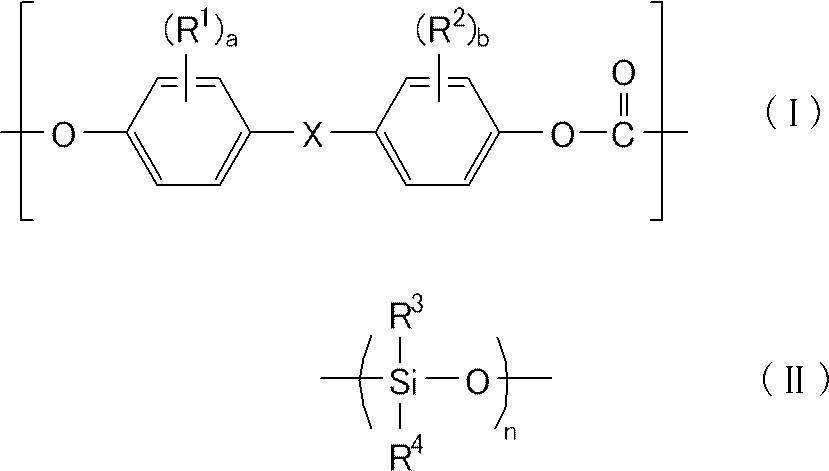
[式中、R1及びR2はそれぞれ独立に、ハロゲン原子、炭素数1~6のアルキル基又は炭素数1~6のアルコキシ基を示す。Xは、単結合、炭素数1~8のアルキレン基、炭素数2~8のアルキリデン基、炭素数5~15のシクロアルキレン基、炭素数5~15のシクロアルキリデン基、フルオレンジイル基、炭素数7~15のアリールアルキレン基、炭素数7~15のアリールアルキリデン基、-S-、-SO-、-SO2-、-O-又は-CO-を示す。R3及びR4はそれぞれ独立に、水素原子、ハロゲン原子又は炭素数1~6のアルキル基、炭素数1~6のアルコキシ基もしくは炭素数6~12のアリール基を示す。a及びbは、それぞれ独立に0~4の整数を示す。nは平均繰り返し数を示す。] - さらに、下記式(b)を満たし、かつUL94規格による難燃性が、厚さ1.5mmの成形体において5VBランクを満たす請求項1に記載のポリカーボネート樹脂組成物。
(Sf-37)×Ch/(Bd+Si)-0.05Vh≧32 ・・・(b)
[式(b)中、Sf、Ch、Bd及びSiは、前記と同じである。Vhは、UL94規格の5V燃焼試験における5回の燃焼時間の合計(秒)を示す。なお、当該燃焼試験において前記成形体はドリップせずに消火するものとする。] - 前記(B)成分が、アクリロニトリル-ブタジエン-スチレン3元共重合体(B-1)を含む請求項1又は2に記載のポリカーボネート樹脂組成物。
- 前記(B)成分が、さらにアクリロニトリル-スチレン2元共重合体(B-2)を含む請求項3に記載のポリカーボネート樹脂組成物。
- 前記(C)成分が、メチルメタクリレート-ブタジエン-スチレン3元共重合体及びメチルメタクリレート-ブタジエン2元共重合体から選ばれる1種以上を含む請求項1~4のいずれかに記載のポリカーボネート樹脂組成物。
- 前記(B-1)成分中のブタジエンに由来する構成単位の含有量が、8~75質量%である請求項3~5のいずれかに記載のポリカーボネート樹脂組成物。
- 前記(B-2)成分の温度200℃、荷重10kgfで測定したメルトボリュームレート(MVR)が、3~150cm3/10分である請求項4~6のいずれかに記載のポリカーボネート樹脂組成物。
- 前記(D)成分が、リン系難燃剤である請求項1~7のいずれかに記載のポリカーボネート樹脂組成物。
- 前記リン系難燃剤が、縮合リン酸エステルである請求項8に記載のポリカーボネート樹脂組成物。
- 前記ポリカーボネート樹脂(A)の粘度平均分子量が、10,000~30,000である請求項1~9のいずれかに記載のポリカーボネート樹脂組成物。
- 前記流動長Sfが35cm以上である請求項1~10のいずれかに記載のポリカーボネート樹脂組成物。
- 前記シャルピー衝撃強度Chが15kJ/m2以上である請求項1~11のいずれかに記載のポリカーボネート樹脂組成物。
- 請求項1~12のいずれかに記載のポリカーボネート樹脂組成物を含む成形体。
Priority Applications (6)
| Application Number | Priority Date | Filing Date | Title |
|---|---|---|---|
| SG11201606601VA SG11201606601VA (en) | 2014-02-13 | 2015-02-13 | Polycarbonate resin composition |
| KR1020167021942A KR102280841B1 (ko) | 2014-02-13 | 2015-02-13 | 폴리카보네이트 수지 조성물 |
| EP15748947.7A EP3106492B1 (en) | 2014-02-13 | 2015-02-13 | Polycarbonate resin composition |
| JP2015562874A JP6614574B2 (ja) | 2014-02-13 | 2015-02-13 | ポリカーボネート樹脂組成物 |
| CN201580007829.7A CN105980477B (zh) | 2014-02-13 | 2015-02-13 | 聚碳酸酯树脂组合物 |
| US15/118,015 US10119022B2 (en) | 2014-02-13 | 2015-02-13 | Polycarbonate resin composition |
Applications Claiming Priority (2)
| Application Number | Priority Date | Filing Date | Title |
|---|---|---|---|
| JP2014-025712 | 2014-02-13 | ||
| JP2014025712 | 2014-02-13 |
Publications (1)
| Publication Number | Publication Date |
|---|---|
| WO2015122492A1 true WO2015122492A1 (ja) | 2015-08-20 |
Family
ID=53800232
Family Applications (1)
| Application Number | Title | Priority Date | Filing Date |
|---|---|---|---|
| PCT/JP2015/053977 Ceased WO2015122492A1 (ja) | 2014-02-13 | 2015-02-13 | ポリカーボネート樹脂組成物 |
Country Status (8)
| Country | Link |
|---|---|
| US (1) | US10119022B2 (ja) |
| EP (1) | EP3106492B1 (ja) |
| JP (1) | JP6614574B2 (ja) |
| KR (1) | KR102280841B1 (ja) |
| CN (1) | CN105980477B (ja) |
| SG (1) | SG11201606601VA (ja) |
| TW (1) | TWI659060B (ja) |
| WO (1) | WO2015122492A1 (ja) |
Cited By (1)
| Publication number | Priority date | Publication date | Assignee | Title |
|---|---|---|---|---|
| WO2019054193A1 (ja) * | 2017-09-13 | 2019-03-21 | 出光興産株式会社 | ポリカーボネート系樹脂組成物及びその成形品 |
Families Citing this family (1)
| Publication number | Priority date | Publication date | Assignee | Title |
|---|---|---|---|---|
| US20240018353A1 (en) * | 2020-11-18 | 2024-01-18 | Shpp Global Technologies B.V. | Polycarbonate composition, method for the manufacture thereof, and articles formed therefrom |
Citations (2)
| Publication number | Priority date | Publication date | Assignee | Title |
|---|---|---|---|---|
| WO2009017938A1 (en) * | 2007-07-31 | 2009-02-05 | Sabic Innovative Plastics Ip B.V. | Polycarbonate compositions with improved molding capability |
| WO2013081161A1 (ja) * | 2011-12-02 | 2013-06-06 | 帝人株式会社 | ポリカーボネート−ポリジオルガノシロキサン共重合樹脂を含有する難燃性樹脂組成物およびその成形品 |
Family Cites Families (13)
| Publication number | Priority date | Publication date | Assignee | Title |
|---|---|---|---|---|
| JPH04285655A (ja) | 1991-03-13 | 1992-10-09 | Nippon G Ii Plast Kk | 難燃性樹脂組成物 |
| JP3623117B2 (ja) | 1998-12-25 | 2005-02-23 | 出光興産株式会社 | 難燃性ポリカーボネート樹脂組成物および成形品 |
| JP3616791B2 (ja) | 1999-08-18 | 2005-02-02 | 出光興産株式会社 | 難燃性ポリカーボネート樹脂組成物および成形品 |
| US7799855B2 (en) | 2001-11-12 | 2010-09-21 | Sabic Innovative Plastics Ip B.V. | Flame retardant thermoplastic polycarbonate compositions, use and method thereof |
| US7232854B2 (en) | 2004-02-03 | 2007-06-19 | General Electric Company | Polycarbonate compositions with thin-wall flame retardance |
| US20060030647A1 (en) | 2004-08-05 | 2006-02-09 | Thomas Ebeling | Flame retardant thermoplastic polycarbonate compositions, use, and method of manufacture thereof |
| US7649051B2 (en) * | 2005-10-25 | 2010-01-19 | Sabic Innovative Plastics Ip B.V. | Flame retardant thermoplastic polycarbonate compositions |
| JP2008189766A (ja) * | 2007-02-02 | 2008-08-21 | Fuji Xerox Co Ltd | 樹脂組成物、樹脂成形体、筐体及び樹脂成形体の製造方法 |
| US20090215949A1 (en) * | 2008-02-21 | 2009-08-27 | Sabic Innovative Plastics Ip B.V. | Flame retardant polycarbonate compositions |
| CN106280496B (zh) * | 2011-10-03 | 2019-09-10 | 出光兴产株式会社 | 聚碳酸酯系树脂组合物 |
| CN104204094B (zh) * | 2012-03-21 | 2016-03-02 | 帝人株式会社 | 光扩散性树脂组合物 |
| JP5877098B2 (ja) * | 2012-03-22 | 2016-03-02 | 出光興産株式会社 | ポリカーボネート樹脂組成物及びそれを用いた成形体 |
| JPWO2015122493A1 (ja) | 2014-02-13 | 2017-03-30 | 出光興産株式会社 | ポリカーボネート樹脂組成物 |
-
2015
- 2015-02-13 JP JP2015562874A patent/JP6614574B2/ja active Active
- 2015-02-13 CN CN201580007829.7A patent/CN105980477B/zh active Active
- 2015-02-13 US US15/118,015 patent/US10119022B2/en active Active
- 2015-02-13 WO PCT/JP2015/053977 patent/WO2015122492A1/ja not_active Ceased
- 2015-02-13 KR KR1020167021942A patent/KR102280841B1/ko active Active
- 2015-02-13 SG SG11201606601VA patent/SG11201606601VA/en unknown
- 2015-02-13 EP EP15748947.7A patent/EP3106492B1/en active Active
- 2015-02-13 TW TW104105196A patent/TWI659060B/zh active
Patent Citations (2)
| Publication number | Priority date | Publication date | Assignee | Title |
|---|---|---|---|---|
| WO2009017938A1 (en) * | 2007-07-31 | 2009-02-05 | Sabic Innovative Plastics Ip B.V. | Polycarbonate compositions with improved molding capability |
| WO2013081161A1 (ja) * | 2011-12-02 | 2013-06-06 | 帝人株式会社 | ポリカーボネート−ポリジオルガノシロキサン共重合樹脂を含有する難燃性樹脂組成物およびその成形品 |
Non-Patent Citations (1)
| Title |
|---|
| See also references of EP3106492A4 * |
Cited By (1)
| Publication number | Priority date | Publication date | Assignee | Title |
|---|---|---|---|---|
| WO2019054193A1 (ja) * | 2017-09-13 | 2019-03-21 | 出光興産株式会社 | ポリカーボネート系樹脂組成物及びその成形品 |
Also Published As
| Publication number | Publication date |
|---|---|
| CN105980477A (zh) | 2016-09-28 |
| EP3106492A4 (en) | 2017-09-13 |
| CN105980477B (zh) | 2019-06-21 |
| EP3106492A1 (en) | 2016-12-21 |
| TWI659060B (zh) | 2019-05-11 |
| EP3106492B1 (en) | 2018-10-03 |
| JPWO2015122492A1 (ja) | 2017-03-30 |
| SG11201606601VA (en) | 2016-09-29 |
| TW201538623A (zh) | 2015-10-16 |
| US10119022B2 (en) | 2018-11-06 |
| US20170044363A1 (en) | 2017-02-16 |
| JP6614574B2 (ja) | 2019-12-04 |
| KR20160121529A (ko) | 2016-10-19 |
| KR102280841B1 (ko) | 2021-07-22 |
Similar Documents
| Publication | Publication Date | Title |
|---|---|---|
| JP5919454B2 (ja) | ポリカーボネート樹脂組成物及びその成形品 | |
| JP5914737B1 (ja) | ポリカーボネート樹脂組成物及びその成形体 | |
| JP6026946B2 (ja) | ポリカーボネート系樹脂組成物及び成形体 | |
| WO2016063656A1 (ja) | リサイクル材を含むポリカーボネート系樹脂組成物及びその成形品 | |
| JP6614574B2 (ja) | ポリカーボネート樹脂組成物 | |
| EP3211038B1 (en) | Polycarbonate resin composition including polycarbonate-polyorganosiloxane copolymer, and molded article of same | |
| JP2018145439A (ja) | ポリカーボネート−ポリオルガノシロキサン共重合体を含むポリカーボネート系樹脂組成物及びその成形品 | |
| JP6027211B2 (ja) | ポリカーボネート系樹脂組成物及び成形体 |
Legal Events
| Date | Code | Title | Description |
|---|---|---|---|
| 121 | Ep: the epo has been informed by wipo that ep was designated in this application |
Ref document number: 15748947 Country of ref document: EP Kind code of ref document: A1 |
|
| ENP | Entry into the national phase |
Ref document number: 2015562874 Country of ref document: JP Kind code of ref document: A |
|
| ENP | Entry into the national phase |
Ref document number: 20167021942 Country of ref document: KR Kind code of ref document: A |
|
| REEP | Request for entry into the european phase |
Ref document number: 2015748947 Country of ref document: EP |
|
| WWE | Wipo information: entry into national phase |
Ref document number: 15118015 Country of ref document: US Ref document number: 2015748947 Country of ref document: EP |
|
| NENP | Non-entry into the national phase |
Ref country code: DE |