WO2015129016A1 - Dispositif d'enregistrement et de lecture d'informations et procédé d'enregistrement d'informations - Google Patents
Dispositif d'enregistrement et de lecture d'informations et procédé d'enregistrement d'informations Download PDFInfo
- Publication number
- WO2015129016A1 WO2015129016A1 PCT/JP2014/055001 JP2014055001W WO2015129016A1 WO 2015129016 A1 WO2015129016 A1 WO 2015129016A1 JP 2014055001 W JP2014055001 W JP 2014055001W WO 2015129016 A1 WO2015129016 A1 WO 2015129016A1
- Authority
- WO
- WIPO (PCT)
- Prior art keywords
- post
- recording
- cure
- information
- recording medium
- Prior art date
- Legal status (The legal status is an assumption and is not a legal conclusion. Google has not performed a legal analysis and makes no representation as to the accuracy of the status listed.)
- Ceased
Links
Images







Classifications
-
- G—PHYSICS
- G03—PHOTOGRAPHY; CINEMATOGRAPHY; ANALOGOUS TECHNIQUES USING WAVES OTHER THAN OPTICAL WAVES; ELECTROGRAPHY; HOLOGRAPHY
- G03H—HOLOGRAPHIC PROCESSES OR APPARATUS
- G03H1/00—Holographic processes or apparatus using light, infrared or ultraviolet waves for obtaining holograms or for obtaining an image from them; Details peculiar thereto
- G03H1/04—Processes or apparatus for producing holograms
- G03H1/18—Particular processing of hologram record carriers, e.g. for obtaining blazed holograms
- G03H1/182—Post-exposure processing, e.g. latensification
-
- G—PHYSICS
- G11—INFORMATION STORAGE
- G11B—INFORMATION STORAGE BASED ON RELATIVE MOVEMENT BETWEEN RECORD CARRIER AND TRANSDUCER
- G11B7/00—Recording or reproducing by optical means, e.g. recording using a thermal beam of optical radiation by modifying optical properties or the physical structure, reproducing using an optical beam at lower power by sensing optical properties; Record carriers therefor
- G11B7/004—Recording, reproducing or erasing methods; Read, write or erase circuits therefor
- G11B7/0065—Recording, reproducing or erasing by using optical interference patterns, e.g. holograms
Definitions
- the present invention relates to an information recording / reproducing apparatus and an information recording method for recording information using holography.
- Patent Document 1 JP-A-2009-43369. This gazette states that “the post-cure performed on a predetermined range including the portion where the data was recorded and its surroundings is used to reduce the range that cannot be recorded at the time of later appending, thereby improving the data recording density. (See summary).
- an object of the present invention is to provide a data recording / reproducing apparatus and a data recording method for eliminating the influence of post-cure processing on an unrecorded area in a data recording / reproducing apparatus for recording / reproducing digital information using holography. It is.
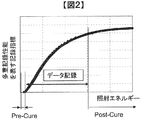
- Schematic diagram showing an embodiment of a data recording / reproducing apparatus Relationship diagram between irradiation energy and multiple recording performance index Schematic showing an embodiment of a pickup in a data recording / reproducing apparatus
- Schematic showing an embodiment of a pickup in a data recording / reproducing apparatus The flowchart showing the Example of operation
- FIG. 1 is a block diagram showing a recording / reproducing apparatus for a recording medium for recording and / or reproducing digital information using holography.
- the data recording / reproducing device 10 is connected to the control device 91 via the input / output control unit 90.
- the data recording / reproducing apparatus 10 receives an information signal to be recorded from the control apparatus 91 by the input / output control unit 90.
- the data recording / reproducing apparatus 10 transmits the reproduced information signal to the control apparatus 91 by the input / output control unit 90.
- the control device 91 may be a device that is directly connected to the data recording / reproducing device 10 or may be a device that is indirectly connected via another device on the higher level side.
- the data recording / reproducing apparatus 10 includes a pickup 11, a reproduction reference light optical system 12, a cure optical system 13, a medium rotation angle detection optical system 14, and a rotation motor 50, and the recording medium 1 is rotated by the rotation motor 50. It has a possible configuration.
- the pickup 11 includes a light source, and plays a role of recording digital information on the recording medium using holography by irradiating the recording medium 1 with reference light and signal light.
- the information signal to be recorded is sent by the controller 89 to the spatial light modulator in the pickup 11 via the signal generator 86, and the signal light is modulated by the spatial light modulator.
- the reproduction reference light optical system 12 When reproducing the information recorded on the recording medium 1, the reproduction reference light optical system 12 generates a light wave that causes the reference light emitted from the pickup 11 to enter the recording medium in a direction opposite to that at the time of recording.
- the reproduction light reproduced by the reproduction reference light is detected by a photodetector described later in the pickup 11, and the signal is reproduced by the signal processing unit 85.
- the irradiation time of the reference light and the signal light applied to the recording medium 1 can be adjusted by controlling the opening / closing time of the shutter in the pickup 11 via the shutter control unit 87 by the controller 89.
- the cure optical system 13 plays a role of generating a light beam used for pre-cure and post-cure of the recording medium 1.
- Precure is a pre-process for irradiating a predetermined light beam in advance before irradiating the reference light and signal light to the desired position when recording information at the desired position in the recording medium 1.
- Hologram recording refers to changing the recording material of the medium from monomer to polymer.
- the horizontal axis indicates the irradiation energy
- the vertical axis indicates the recording index indicating the multiple recording performance
- the hologram is multiplexed (recorded) by irradiating the medium with energy
- the region irradiated with energy is shown. This means that the monomer is consumed.
- Pre-cure is a process necessary before data recording in FIG. 2, and is a process for keeping the recording medium in a state immediately before the activation of the reaction. Note that the pre-cure process is not necessarily required if the recording medium has a characteristic that does not require energy irradiation with a light beam.
- Post-cure is a post-process in which, after information is recorded at a desired position in the recording medium 1, a predetermined light beam is irradiated so that additional recording cannot be performed at the desired position.
- the post-cure process is a process necessary after data recording in FIG. 2 and is a process for consuming (polymerizing) all remaining monomers and preventing the recorded area from reacting with the light beam any more. This post-cure process prevents unnecessary noise from being recorded in the recorded area.
- the post-curing process of the recorded area is performed after the recording process is completed.
- This time limit is called a post-cure timeout time.
- the medium rotation angle detection optical system 14 is used to detect the rotation angle of the recording medium 1.
- a signal corresponding to the rotation angle is detected by the medium rotation angle detection optical system 14, and the medium rotation motor control unit 88 is controlled by the controller 89 using the detected signal.
- the rotation angle of the recording medium 1 can be controlled via
- a predetermined light source supply current is supplied from the light source driving unit 82 to the light sources in the pickup 11, the cure optical system 13, and the medium rotation angle detection optical system 14, and each light source emits a light beam with a predetermined light amount. can do.
- the pickup 11 and the medium cure optical system 13 are provided with a mechanism capable of sliding the position in the radial direction of the recording medium 1, and position control is performed via the access control unit 81.
- the recording technology using the principle of angle multiplexing of holography tends to have a very small tolerance for the deviation of the reference beam angle.
- a mechanism for detecting the deviation amount of the reference beam angle is provided in the pickup 11, a servo control signal is generated by the servo signal generation unit 83, and the deviation amount is corrected via the servo control unit 84. It is necessary to provide a servo mechanism for this in the data recording / reproducing apparatus 10.
- the pickup 11, the cure optical system 13, and the medium rotation angle detection optical system 14 may be simplified by combining several optical system configurations or all optical system configurations.
- FIG. 3 shows a recording principle in an example of a basic optical system configuration of the pickup 11 in the data recording / reproducing apparatus 10.
- the light beam emitted from the light source 301 passes through the collimator lens 302 and enters the shutter 303.
- the shutter 303 When the shutter 303 is open, after the light beam passes through the shutter 303, the optical ratio of the p-polarized light and the s-polarized light becomes a desired ratio by the optical element 304 composed of, for example, a half-wave plate.
- the optical element 304 composed of, for example, a half-wave plate.
- the light is incident on a PBS (Polarization Beam Splitter) prism 305.
- PBS Polarization Beam Splitter
- the light beam that has passed through the PBS prism 305 functions as signal light 306, and after the light beam diameter is expanded by the beam expander 308, the light beam passes through the phase mask 309, the relay lens 310, and the PBS prism 311 and passes through the spatial light modulator 312. Is incident on.
- the signal light to which information is added by the spatial light modulator 312 reflects the PBS prism 311 and propagates through the relay lens 313 and the spatial filter 314. Thereafter, the signal light is condensed on the recording medium 1 by the objective lens 315.
- the light beam reflected by the PBS prism 305 functions as reference light 307 and is set to a predetermined polarization direction according to recording or reproduction by the polarization direction conversion element 316, and then passes through the mirror 317 and the mirror 318.
- the galvanometer mirror 319 Incident on the galvanometer mirror 319. Since the angle of the galvanometer mirror 319 can be adjusted by the actuator 320, the incident angle of the reference light incident on the recording medium 1 after passing through the lens 321 and the lens 322 can be set to a desired angle. In order to set the incident angle of the reference light, an element that converts the wavefront of the reference light may be used instead of the galvanometer mirror.
- the signal light and the reference light are incident on the recording medium 1 so as to overlap each other, whereby an interference fringe pattern is formed in the recording medium, and information is recorded by writing this pattern on the recording medium.
- the incident angle of the reference light incident on the recording medium 1 can be changed by the galvanometer mirror 319, recording by angle multiplexing is possible.
- holograms corresponding to each reference beam angle are called pages, and a set of pages angle-multiplexed in the same area is called a book. .
- FIG. 4 shows a reproduction principle in an example of a basic optical system configuration of the pickup 11 in the data recording / reproducing apparatus 10.
- the reference beam is incident on the recording medium 1 as described above, and the light beam transmitted through the recording medium 1 is reflected by the galvanometer mirror 324 whose angle can be adjusted by the actuator 323.
- the reproduction reference light is generated.
- the reproduction light reproduced by the reproduction reference light propagates through the objective lens 315, the relay lens 313, and the spatial filter 314. Thereafter, the reproduction light passes through the PBS prism 311 and enters the photodetector 325, and the recorded signal can be reproduced.
- the photodetector 325 for example, an image sensor such as a CMOS image sensor or a CCD image sensor can be used. However, any element may be used as long as page data can be reproduced.
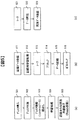
- FIG. 5 shows an operation flow of recording and reproduction in the data recording / reproducing apparatus 10.
- a flow relating to recording / reproduction using holography in particular will be described.
- FIG. 5A shows an operation flow from when the recording medium 1 is inserted into the data recording / reproducing apparatus 10 until preparation for recording or reproduction is completed, and FIG. 5B shows from the ready state to the recording medium 1.
- FIG. 5C shows an operation flow until information is recorded, and
- FIG. 5C shows an operation flow until the information recorded on the recording medium 1 is reproduced from the ready state.
- the data recording / reproducing apparatus 10 is, for example, whether the inserted recording medium 1 is a medium for recording or reproducing digital information using holography.
- the medium is determined (502).
- the data recording / reproducing apparatus 10 reads information provided in the recording medium 1 (503), for example, a recording medium 1 and information on various setting conditions during recording and reproduction, for example.
- the operation flow from the ready state (505) to recording information is as follows. First, data to be recorded is received (511), and information corresponding to the data is stored in the space in the pickup 11. Send to optical modulator.
- the data recording / reproducing apparatus 10 may perform the recording learning process (512) before receiving the recording / reproducing data (511). That is, the order of the processes 511 and 512 may be reversed, or may be performed in the process of FIG.
- the access control unit 22 is controlled to position the pickup 11 and the cure optical system 13 at predetermined positions on the recording medium 1.
- the address information is reproduced to check whether the recording medium 1 is positioned at the target position. If the recording medium 1 is not positioned at the target position, the amount of deviation from the predetermined position is calculated. Repeat the positioning operation.
- a predetermined area is pre-cured using the light beam emitted from the cure optical system 13 (514), and data is recorded using the reference light and signal light emitted from the pickup 11 (515).
- the pre-cure process and the post-cure process may be unnecessary depending on the recording characteristics of the recording medium 1, and may be omitted if unnecessary.
- post cure is performed using the light beam emitted from the cure optical system 13 (516). Data may be verified as necessary.
- the operation flow from the ready state (505) until the recorded information is reproduced is as follows.
- the access control unit 22 is controlled to perform the pickup 11 and the reproduction.
- the position of the reference light optical system 12 is positioned at a predetermined position on the recording medium 1.
- the address information is reproduced to check whether the recording medium 1 is positioned at the target position. If the recording medium 1 is not positioned at the target position, the amount of deviation from the predetermined position is calculated. Repeat the positioning operation.
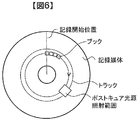
- FIG. 6 shows the book recording direction in this embodiment.
- a method is considered in which a book is arranged on a recording medium along a concentric track and information is recorded on the entire surface of the recording medium. Note that the recording medium is kept stationary during the recording process, and the irradiation position is moved when the next book is recorded.
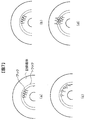
- FIG. 7 shows an example of the book recording order.
- FIG. 7A shows an example in which book recording processing is sequentially performed along tracks on concentric circles.
- FIG. 7B shows an example in which the recording order of the book is not in order, unlike FIG. 7A, although it is along the track on the concentric circles.
- FIG. 7C shows an example in which the recording process of the first round is performed while skipping one book, and the recording process of the skipped book is performed in the recording process of the second round. Show.
- FIG. 7D shows an example in which recording processing is performed along tracks while straddling a plurality of tracks.
- the order of recording of the books up to that is not limited.
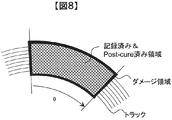
- FIG. 8 shows the damage that the post-cure process has on the peripheral region. Specifically, it shows the effect of post-cure processing on the peripheral area of the recorded area when a book is recorded on multiple tracks within a predetermined angle ⁇ and post-curing processing of the recorded area is performed. ing.
- FIG. 8 shows a damage area schematically showing the influence.
- the damaged area is an area that may be affected by the light beam irradiation for post-cure processing to the already recorded area, and that may cause a decrease in recordable capacity or recording impossible due to progress of polymerization. .
- the recording direction is concentric, if the post-cure process is not performed in concentric units, that is, in units of 360 degrees, a damaged area is also generated in the radial direction of the recording medium.
- the unit of the post-cure process is a concentric unit, that is, a unit of 360 degrees.
- the post-cure processing in this embodiment is performed in concentric units while rotating the recording medium.
- the post-curing light beam is emitted after the rotation of the recording medium is stabilized.
- the size of the post-cure processing light beam applied to the recording medium may be the same size as the signal beam used during recording / reproduction and the light beam of the reference light, and it can handle multiple tracks simultaneously. It may be. When the light beam is large enough to process a plurality of tracks simultaneously, post-cure processing can be performed efficiently.
- the size and rotation speed of the light beam used for the post-cure process must be determined within a range in which the error of the light energy density is acceptable.
- the outer peripheral region where the light energy density is low may be subjected to the post-curing process again at the next post-curing process.
- the recording process does not necessarily have to record all the data concentrically, and since the post-cure process is performed in concentric units, an unrecorded area may be included in the area irradiated with the light beam.
- the energy required for completing the post-cure process differs between the recorded area and the unrecorded area of the data. Therefore, when performing the post-cure process, increase the total rotation time according to the unrecorded area or the unrecorded area. Therefore, it is necessary to consider that the light energy necessary for completing the post-cure process is sufficiently given to the unrecorded area, for example, by processing only this part.
- dummy data may be recorded in an unrecorded area so that the same post-curing light energy as that of other recorded areas is sufficient.
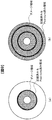
- FIG. 9 shows an example of a damage area generated by the post cure process.
- FIG. 9A shows an example in which recording is performed in concentric units, in which a recording process for a plurality of tracks is performed, and a post-cure process is performed on all the recorded areas.
- FIG. 9B shows a state where this process is repeated for the entire surface of the recording medium. It can be seen that a damaged area is generated as many times as the number of times the recording process is interrupted and the post-cure process is performed, and the recordable capacity is reduced by the damaged area.
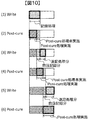
- FIG. 10 shows a schematic diagram of the processing range when the recording and post-cure processes are repeated.
- the pre-curing process is not mentioned in this description, it is assumed that the pre-curing process is always performed before recording.
- the reason for dividing and recording in this case is that the post-cure timeout time is limited as described above. For example, if the recording time becomes longer in (1) of FIG. 10, the first recorded area exceeds the post-cure timeout time in the middle of recording, so the recording is interrupted before the timeout is reached, and the post-cure of (2) Processing needs to be started. After performing the recording process in (1), the post-cure process is performed in (2). Here, the post-cure process is not performed for all the areas subjected to the recording process in (1), and the post-cure process is performed. Leave a part of the area that is not implemented.
- the recording process is performed after the area recorded in (1).
- the post-cure process in (4) the post-cure process is performed together with the post-cure unprocessed area left in (2). Do.
- (2) a part of the area where the post-cure process is not performed is left.
- the post-cure processing target area in (6) is the post-cure unprocessed area left in (4) and all the areas recorded in (5). It becomes the area combined with the area.
- the start position of the post-cure process in (4) may overlap with the area that has been processed in the post-cure process in (2).
- the positioning accuracy of the signal light and the reference light which is a light beam for data recording that must be recorded accurately at the position determined by each coordinate axis, is required to be high precision, but the polymerization of the recording medium is completed
- the positioning accuracy of the light beam for post-cure processing that has only to be irradiated may be lower than that of the light beam for data recording.
- the start position of the post-cure processing in (4) is the same as the area processed in the post-cure processing in (2). It should be set to overlap within the necessary and sufficient range.
- 11A to 11C show the influence on the post-cure processing range and the unrecorded area.
- the oblique line is the post-cure processing range, and the horizontal line is the range that the post-cure process affects.
- the post-cure processing range within a range that does not affect the unrecorded area as in the post-cure processing of FIGS. 11 (a) and 11 (b). This range varies depending on the recording characteristics of the medium, the recording processing speed, the post-cure processing speed, the processing range, the post-cure timeout time, and the surrounding environment.
- the combined range of the post-curing area and the damaged area is substantially equal to the recorded area. It is better to perform post-cure treatment so that In addition, since there is no problem even if the post-cure process overlaps the previous post-cure process, the post-cure start position may be from the previous end position without considering the surrounding damage area.
- the post-curing process is performed while leaving a part of the recorded area, the next recording is performed, and the remaining post-curing unprocessed area is processed together with the next post-curing process, thereby reducing the recording capacity. Prevents the generation of damage areas that cause damage.
- FIG. 12 illustrates the above description for the entire recording medium.
- FIG. 12 shows the recording processing range and the post-cure processing range over the entire surface of the recording medium.
- FIG. 12A shows an example of recording from the inner periphery
- FIG. 12B shows an example of recording from the outer periphery.
- the oblique lines indicate the recording process and the half lines indicate the post-cure process. In either case, it is possible to record the entire surface of the recording medium without generating a damaged area.
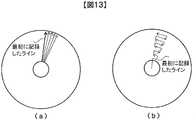
- FIG. 13 shows an example in which the recording order is not concentric. If recording is performed in a direction that is not concentric as shown in FIG. 13, the first recorded line reaches the post-cure timeout time in the middle of recording, so the recording is interrupted and post-cure processing is performed. There is a need to do. As a result, a damaged area is generated by post-cure processing.
- the concentric recording is performed sequentially from the inner circumference to the outer circumference of the recording medium, so that the post cure timeout can be reached concentrically from the inner circumference, that is, in the order of recording.
- the post-cure process can be performed concentrically, and as a result, it is possible to efficiently record on the entire surface of the recording medium without generating a damaged area.
- the post-cure process in the case where the recording process is performed as shown in FIG. 13 may be completed so that the recorded area to be post-cured does not reach the post-cure timeout, and the direction and sequence of the process.
- the order of concentric processing may be from the inner periphery to the outer periphery or vice versa.
- Such a recording direction and order are only inefficient as compared with the case of processing concentrically in order, and the obtained effect is not changed.
- FIG. 14 is a graph showing the recording and post-cure processing, with the horizontal axis representing elapsed time and the vertical axis representing the amount of processing data. As can be seen from this graph, the post-cure processing amount does not catch up with the recording processing amount until the recording is completed. Note that the range of recording processing and post-cure processing varies depending on the characteristics of the medium, recording processing speed, post-cure processing speed, processing range, post-cure timeout time, and surrounding environment, so it is not uniquely determined by the user's design. Matters.
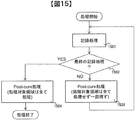
- Steps 1501, 1502, and 1503 are set as one cycle, and this cycle is rotated until the end of recording.
- step 1501 a predetermined range of recording processing is performed. As described above, this range is not uniquely determined but a design item.
- step 1502 After the recording process is completed, it is determined in step 1502 whether or not it is the final recording process.
- post-cure processing is performed in step 1503.
- the post-cure process here is a process in which the entire area subjected to the recording process in step 1501 is not post-cured and a part is left.
- the post-cure process in the N + 1 (N is a natural number) cycle is performed simultaneously with the post-cure of the post-cure target area left in the N-cycle post-cure process.
- “time required for recording processing in step 1501” and “time required for processing of post-curing target area S left unprocessed in step N of step 1503” are set. It is necessary that the added time does not exceed the post cure timeout time of the post cure target area S.
- the determination time in step 1502 is regarded as a time that can be ignored and is not considered here.
- post-cure processing in Step 1503 of the Nth cycle is performed so that a damaged area as shown in FIGS. 8 and 9 does not occur in the unrecorded area in the unrecorded area that is the target area of the N + 1th cycle of the recording process. There is a need to do. If it is determined YES, post-cure processing is performed in step 1504. Unlike post-step 1503, post-cure processing here processes all the recording processing areas in step 1501 and sets post-cure unprocessed areas. Do not leave.
- the recording is performed by concentric circles as an example.
- the recording is not limited to concentric circles, and other recording units can be applied.
- FIG. 16 shows a case where the recording processing unit is not a concentric circle unit.
- the recording processing unit is not a concentric circle unit.
- FIG. 16 (a) when recording is performed in eight fan-shaped units, if the present invention is not applied, a damage area is generated concentrically as shown in FIG. 16 (b).
- the present invention it is possible to prevent the occurrence of concentric damage areas as shown in FIG. 16C, and it is possible to suppress a decrease in recording capacity of the recording medium.
- the shape of the recording medium is not limited to a disk, and can be applied to a rectangular recording medium.
- this invention is not limited to the above-mentioned Example, Various modifications are included.
- the above-described embodiments have been described in detail for easy understanding of the present invention, and are not necessarily limited to those having all the configurations described.
- a part of the configuration of one embodiment can be replaced with the configuration of another embodiment, and the configuration of another embodiment can be added to the configuration of one embodiment.
- an information recording / reproducing apparatus for recording information by irradiating a recording medium with signal light and reference light to form a hologram and reproducing the information, a laser light source for emitting laser light And an optical pickup that records the information by irradiating the recording medium with the signal light and the reference light, and after recording the information on the recording medium, irradiates the laser light onto the recorded area on which the information is recorded
- a post-cure processing area, and a post-cure process area where the cure optical unit has performed a post-cure process is included in the recorded area and has a smaller range than the recorded area.
- an information recording / reproducing method for reproducing information by irradiating a recording medium with signal light and reference light to form a hologram and reproducing the information, the laser light emitting laser light
- An emission step a recording step of irradiating the recording medium with the signal light and the reference light, and recording information; after recording information on the recording medium, the laser light is applied to an already recorded area on which the information is recorded
- a post-cure process step for performing a post-cure process for irradiating, and in the post-cure process step, the post-cure process area subjected to the post-cure process is included in the recorded area, and from the recorded area
- each of the above-described configurations, functions, processing units, processing means, and the like may be realized by hardware by designing a part or all of them, for example, by an integration unit.
- Each of the above-described configurations, functions, and the like may be realized by software by interpreting and executing a program that realizes each function by the processor.
- Information such as programs, tables, and files for realizing each function can be stored in a memory, a hard disk, a recording device such as an SSD (Solid State Drive), or a recording medium such as an IC card or an SD card.
- control lines and information lines indicate what is considered necessary for the explanation, and not all the control lines and information lines on the product are necessarily shown. Actually, it may be considered that almost all the components are connected to each other.
Landscapes
- Physics & Mathematics (AREA)
- General Physics & Mathematics (AREA)
- Optical Recording Or Reproduction (AREA)
Abstract
Le but de l'invention est de fournir un dispositif d'enregistrement et de lecture de données qui enregistre et lit des informations numériques à l'aide d'une holographie et un procédé d'enregistrement de données, de telle sorte qu'une réduction de capacité d'enregistrement provoquée par un post-durcissement est empêchée. La présente invention porte sur un dispositif d'enregistrement et de lecture d'informations qui enregistre des informations par exposition d'un support d'enregistrement au rayonnement d'une lumière de signal et d'une lumière de référence de manière à créer un hologramme, et lit ces informations, ledit dispositif d'enregistrement et de lecture d'informations comportant : une source laser qui émet une lumière laser ; une tête de lecture optique qui expose le support d'enregistrement au rayonnement de la lumière de signal et de la lumière de référence de façon à enregistrer des informations ; une partie optique de durcissement qui, après que les informations ont été enregistrées dans le support d'enregistrement, réalise un processus de post-durcissement pour exposer la zone enregistrée dans laquelle des informations ont été enregistrées au rayonnement d'une lumière laser. La région de processus de post-durcissement sur laquelle la partie optique de durcissement a appliqué le processus de post-durcissement est contenue dans la région enregistrée, et est d'une plus petite plage que la région enregistrée.
Priority Applications (1)
| Application Number | Priority Date | Filing Date | Title |
|---|---|---|---|
| PCT/JP2014/055001 WO2015129016A1 (fr) | 2014-02-28 | 2014-02-28 | Dispositif d'enregistrement et de lecture d'informations et procédé d'enregistrement d'informations |
Applications Claiming Priority (1)
| Application Number | Priority Date | Filing Date | Title |
|---|---|---|---|
| PCT/JP2014/055001 WO2015129016A1 (fr) | 2014-02-28 | 2014-02-28 | Dispositif d'enregistrement et de lecture d'informations et procédé d'enregistrement d'informations |
Publications (1)
| Publication Number | Publication Date |
|---|---|
| WO2015129016A1 true WO2015129016A1 (fr) | 2015-09-03 |
Family
ID=54008382
Family Applications (1)
| Application Number | Title | Priority Date | Filing Date |
|---|---|---|---|
| PCT/JP2014/055001 Ceased WO2015129016A1 (fr) | 2014-02-28 | 2014-02-28 | Dispositif d'enregistrement et de lecture d'informations et procédé d'enregistrement d'informations |
Country Status (1)
| Country | Link |
|---|---|
| WO (1) | WO2015129016A1 (fr) |
Citations (7)
| Publication number | Priority date | Publication date | Assignee | Title |
|---|---|---|---|---|
| JP2007058992A (ja) * | 2005-08-24 | 2007-03-08 | Fujifilm Corp | 光記録方法、光記録装置、光記録媒体及び光記録再生方法 |
| US7557971B1 (en) * | 2006-03-10 | 2009-07-07 | StorageTek Technology Corporation | System and method for managing multiple write sessions to holographic storage media |
| JP2009289384A (ja) * | 2008-06-02 | 2009-12-10 | Hitachi Ltd | 光情報記録再生装置及び光情報記録方法 |
| JP2009301627A (ja) * | 2008-06-12 | 2009-12-24 | Hitachi Ltd | 光情報記録装置および光情報記録方法 |
| JP2010044825A (ja) * | 2008-08-13 | 2010-02-25 | Hitachi Ltd | 光情報記録/再生装置 |
| JP2010181760A (ja) * | 2009-02-09 | 2010-08-19 | Hitachi Ltd | 光情報記録方法および記録装置 |
| WO2014033895A1 (fr) * | 2012-08-31 | 2014-03-06 | 日立コンシューマエレクトロニクス株式会社 | Dispositif et procédé d'enregistrement d'hologramme |
-
2014
- 2014-02-28 WO PCT/JP2014/055001 patent/WO2015129016A1/fr not_active Ceased
Patent Citations (7)
| Publication number | Priority date | Publication date | Assignee | Title |
|---|---|---|---|---|
| JP2007058992A (ja) * | 2005-08-24 | 2007-03-08 | Fujifilm Corp | 光記録方法、光記録装置、光記録媒体及び光記録再生方法 |
| US7557971B1 (en) * | 2006-03-10 | 2009-07-07 | StorageTek Technology Corporation | System and method for managing multiple write sessions to holographic storage media |
| JP2009289384A (ja) * | 2008-06-02 | 2009-12-10 | Hitachi Ltd | 光情報記録再生装置及び光情報記録方法 |
| JP2009301627A (ja) * | 2008-06-12 | 2009-12-24 | Hitachi Ltd | 光情報記録装置および光情報記録方法 |
| JP2010044825A (ja) * | 2008-08-13 | 2010-02-25 | Hitachi Ltd | 光情報記録/再生装置 |
| JP2010181760A (ja) * | 2009-02-09 | 2010-08-19 | Hitachi Ltd | 光情報記録方法および記録装置 |
| WO2014033895A1 (fr) * | 2012-08-31 | 2014-03-06 | 日立コンシューマエレクトロニクス株式会社 | Dispositif et procédé d'enregistrement d'hologramme |
Similar Documents
| Publication | Publication Date | Title |
|---|---|---|
| JP4881914B2 (ja) | 光情報記録再生装置及び光情報記録方法 | |
| JP5581111B2 (ja) | 光情報再生装置および光情報再生方法 | |
| US20150131424A1 (en) | Optical information recording/reproduction device, recording condition adjustment method, and optical information recording medium | |
| US9013972B2 (en) | Optical information recording and reproducing method and device | |
| US8699311B2 (en) | Optical information recording/reproducing apparatus, optical information reproducing apparatus, optical information recording/reproducing method and optical information reproducing method | |
| JP2010080018A (ja) | 情報記録装置、情報再生装置および記録媒体 | |
| CN101819804B (zh) | 信号品质评价装置、信号品质评价方法和信息记录介质 | |
| JP2017021881A (ja) | 光情報記録装置、光情報記録方法および光情報記録媒体 | |
| WO2015129016A1 (fr) | Dispositif d'enregistrement et de lecture d'informations et procédé d'enregistrement d'informations | |
| US9373352B2 (en) | Optical information reproduction apparatus and optical information reproduction method | |
| JP5211816B2 (ja) | 光情報記録再生装置 | |
| JP2012221520A (ja) | 光情報再生装置、光情報記録再生装置 | |
| US8144557B2 (en) | Optical information recording/reproducing apparatus and disk distinction method | |
| JPWO2015198407A1 (ja) | 光情報記録再生装置、及び光情報記録再生方法 | |
| JP5647965B2 (ja) | 光情報記録再生装置、光情報記録装置、光情報記録再生方法、光情報記録媒体 | |
| US20160358623A1 (en) | Optical information recording/reproducing device and optical information recording/reproducing method | |
| WO2016199229A1 (fr) | Dispositif d'enregistrement-lecture d'hologramme | |
| WO2016117101A1 (fr) | Dispositif d'enregistrement d'informations optiques et procédé d'enregistrement d'informations optiques | |
| JP6078634B2 (ja) | 光情報再生装置および光情報記録再生装置 | |
| JP2015082327A (ja) | 光情報再生装置、光情報再生方法および光情報記録方法 | |
| JP2012243355A (ja) | 光情報記録再生装置および光情報記録再生方法 | |
| JP2012133879A (ja) | 情報記録装置、情報再生装置および記録媒体 | |
| WO2015083247A1 (fr) | Dispositif d'enregistrement d'informations optique et procédé d'enregistrement d'informations optique | |
| JP2016201156A (ja) | ホログラム記録装置及びホログラム記録方法 | |
| WO2015162724A1 (fr) | Procédé d'enregistrement de données et dispositif d'enregistrement de données |
Legal Events
| Date | Code | Title | Description |
|---|---|---|---|
| 121 | Ep: the epo has been informed by wipo that ep was designated in this application |
Ref document number: 14883671 Country of ref document: EP Kind code of ref document: A1 |
|
| NENP | Non-entry into the national phase |
Ref country code: DE |
|
| 122 | Ep: pct application non-entry in european phase |
Ref document number: 14883671 Country of ref document: EP Kind code of ref document: A1 |
|
| NENP | Non-entry into the national phase |
Ref country code: JP |