WO2015136880A1 - アザフルオレン環構造を有するスピロ化合物、発光材料および有機エレクトロルミネッセンス素子 - Google Patents
アザフルオレン環構造を有するスピロ化合物、発光材料および有機エレクトロルミネッセンス素子 Download PDFInfo
- Publication number
- WO2015136880A1 WO2015136880A1 PCT/JP2015/001074 JP2015001074W WO2015136880A1 WO 2015136880 A1 WO2015136880 A1 WO 2015136880A1 JP 2015001074 W JP2015001074 W JP 2015001074W WO 2015136880 A1 WO2015136880 A1 WO 2015136880A1
- Authority
- WO
- WIPO (PCT)
- Prior art keywords
- group
- substituted
- unsubstituted
- atom
- carbon atoms
- Prior art date
- Legal status (The legal status is an assumption and is not a legal conclusion. Google has not performed a legal analysis and makes no representation as to the accuracy of the status listed.)
- Ceased
Links
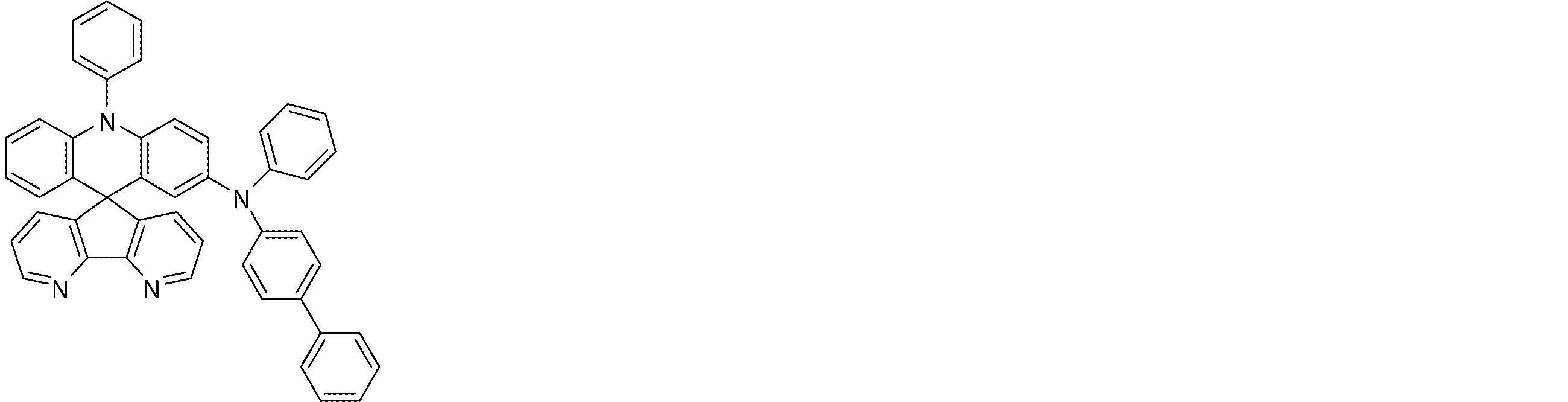
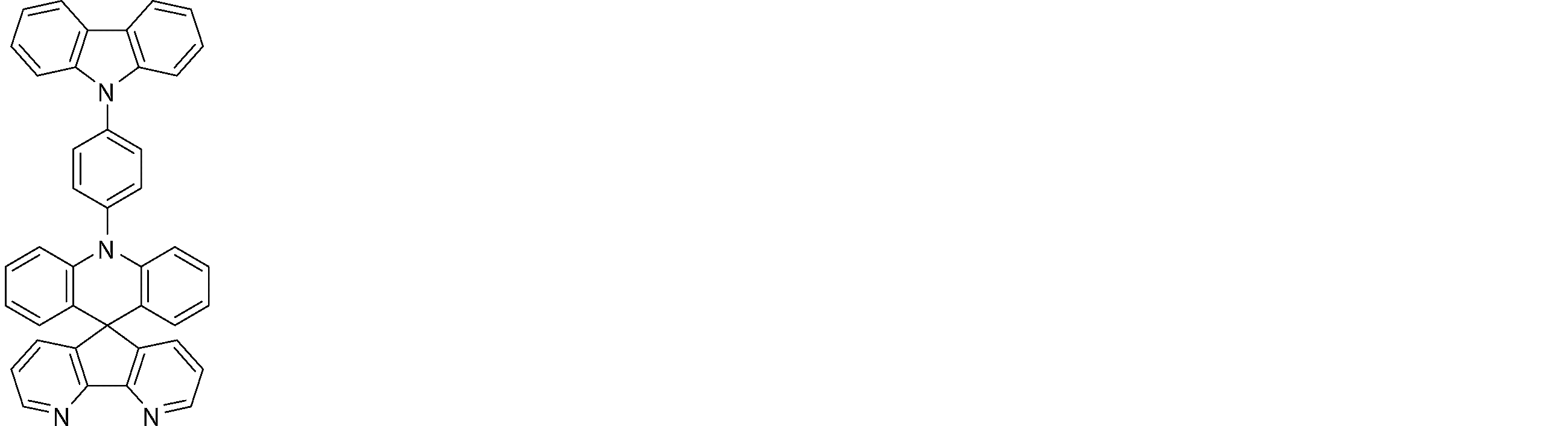
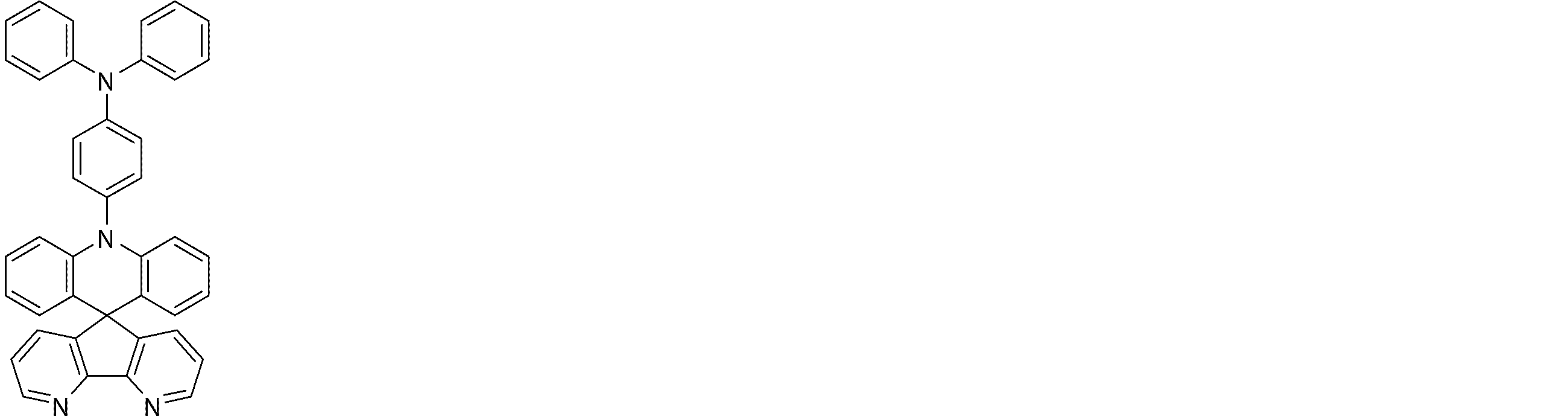
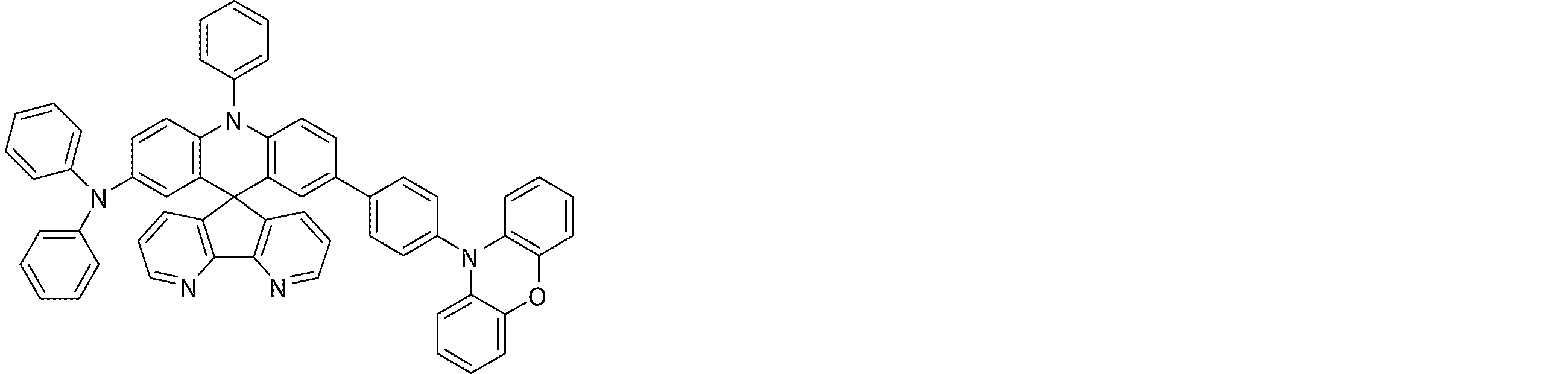
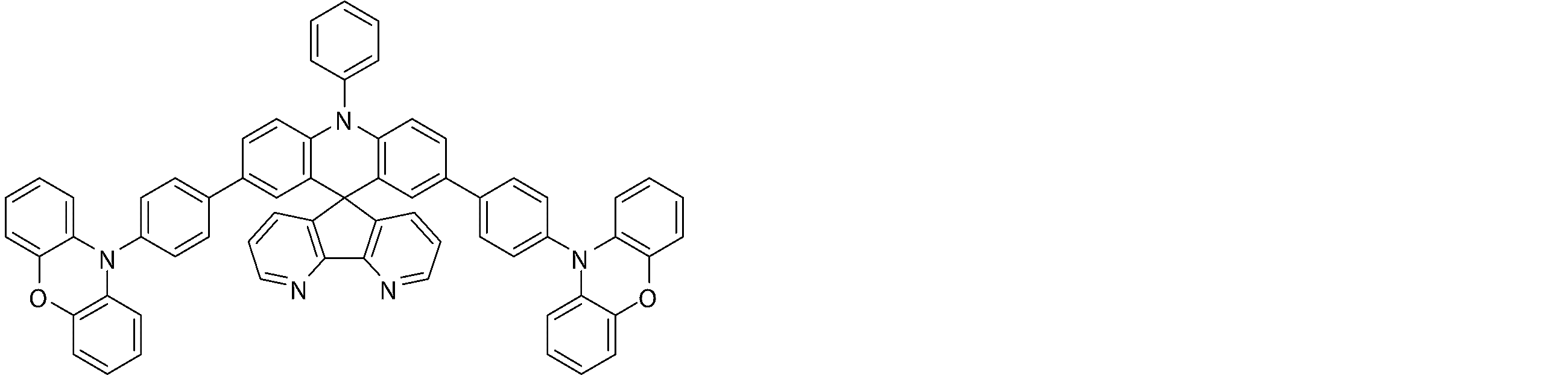
- HKIUHBFEOANKMW-UHFFFAOYSA-N CC1(C)c(cccc2)c2N(c(cc2)ccc2-c(cc2)cc(C34c5ncccc5-c5c3nccc5)c2N(c2ccccc2)c(cc2)c4cc2-c(cc2)ccc2N2c3ccccc3Oc3c2cccc3)c2ccccc12 Chemical compound CC1(C)c(cccc2)c2N(c(cc2)ccc2-c(cc2)cc(C34c5ncccc5-c5c3nccc5)c2N(c2ccccc2)c(cc2)c4cc2-c(cc2)ccc2N2c3ccccc3Oc3c2cccc3)c2ccccc12 HKIUHBFEOANKMW-UHFFFAOYSA-N 0.000 description 1
- RCRKPOQJQIEQRV-UHFFFAOYSA-N CC1(C)c2ccccc2N(c(cc2)cc(C34c5cccnc5-c5c3cccn5)c2N(c2ccccc2)c(cc2)c4cc2N(c2ccccc2)c2ccccc2)c2c1cccc2 Chemical compound CC1(C)c2ccccc2N(c(cc2)cc(C34c5cccnc5-c5c3cccn5)c2N(c2ccccc2)c(cc2)c4cc2N(c2ccccc2)c2ccccc2)c2c1cccc2 RCRKPOQJQIEQRV-UHFFFAOYSA-N 0.000 description 1
- ILEHWIPSXRIZOV-UHFFFAOYSA-N CC1(C)c2ccccc2N(c(cc2)cc(C34c5cccnc5-c5c3cccn5)c2N(c2ccccc2)c(cc2)c4cc2N2c3ccccc3C(C)(C)c3ccccc23)c2c1cccc2 Chemical compound CC1(C)c2ccccc2N(c(cc2)cc(C34c5cccnc5-c5c3cccn5)c2N(c2ccccc2)c(cc2)c4cc2N2c3ccccc3C(C)(C)c3ccccc23)c2c1cccc2 ILEHWIPSXRIZOV-UHFFFAOYSA-N 0.000 description 1
- GTTFUYBPXFMNQD-UHFFFAOYSA-N c(cc1)ccc1N(c(cc1)c(C23c4cccnc4-c4ncccc24)cc1N1c(cccc2)c2Sc2c1cccc2)c(cc1)c3cc1N1c2ccccc2Sc2c1cccc2 Chemical compound c(cc1)ccc1N(c(cc1)c(C23c4cccnc4-c4ncccc24)cc1N1c(cccc2)c2Sc2c1cccc2)c(cc1)c3cc1N1c2ccccc2Sc2c1cccc2 GTTFUYBPXFMNQD-UHFFFAOYSA-N 0.000 description 1
- LOMSQJATHCHFPE-UHFFFAOYSA-N c(cc1)ccc1N(c1ccccc1)c(cc1)cc(C23c4cccnc4-c4c2cccn4)c1N(c1ccc2[o]c4ccccc4c2c1)c(cc1)c3cc1N(c1ccccc1)c1ccccc1 Chemical compound c(cc1)ccc1N(c1ccccc1)c(cc1)cc(C23c4cccnc4-c4c2cccn4)c1N(c1ccc2[o]c4ccccc4c2c1)c(cc1)c3cc1N(c1ccccc1)c1ccccc1 LOMSQJATHCHFPE-UHFFFAOYSA-N 0.000 description 1
- VSKZZZOOFSGOLG-UHFFFAOYSA-N c(cc1)ccc1N(c1ccccc1C12c3ncccc3-c3c1nccc3)c(cc1)c2cc1N1c(cccc2)c2Sc2c1cccc2 Chemical compound c(cc1)ccc1N(c1ccccc1C12c3ncccc3-c3c1nccc3)c(cc1)c2cc1N1c(cccc2)c2Sc2c1cccc2 VSKZZZOOFSGOLG-UHFFFAOYSA-N 0.000 description 1
- AWCWEAVOYZAQAH-UHFFFAOYSA-N c1c(-c(cc2C34c5cccnc5-c5c3cccn5)ccc2N(c2ccccc2)c(cc2)c4cc2-c2ccc(N3c4ccccc4Oc4c3cccc4)[s]2)[s]c(N2c(cccc3)c3Oc3ccccc23)c1 Chemical compound c1c(-c(cc2C34c5cccnc5-c5c3cccn5)ccc2N(c2ccccc2)c(cc2)c4cc2-c2ccc(N3c4ccccc4Oc4c3cccc4)[s]2)[s]c(N2c(cccc3)c3Oc3ccccc23)c1 AWCWEAVOYZAQAH-UHFFFAOYSA-N 0.000 description 1
Images



Classifications
-
- C—CHEMISTRY; METALLURGY
- C07—ORGANIC CHEMISTRY
- C07D—HETEROCYCLIC COMPOUNDS
- C07D471/00—Heterocyclic compounds containing nitrogen atoms as the only ring hetero atoms in the condensed system, at least one ring being a six-membered ring with one nitrogen atom, not provided for by groups C07D451/00 - C07D463/00
- C07D471/02—Heterocyclic compounds containing nitrogen atoms as the only ring hetero atoms in the condensed system, at least one ring being a six-membered ring with one nitrogen atom, not provided for by groups C07D451/00 - C07D463/00 in which the condensed system contains two hetero rings
- C07D471/10—Spiro-condensed systems
-
- C—CHEMISTRY; METALLURGY
- C07—ORGANIC CHEMISTRY
- C07D—HETEROCYCLIC COMPOUNDS
- C07D403/00—Heterocyclic compounds containing two or more hetero rings, having nitrogen atoms as the only ring hetero atoms, not provided for by group C07D401/00
- C07D403/02—Heterocyclic compounds containing two or more hetero rings, having nitrogen atoms as the only ring hetero atoms, not provided for by group C07D401/00 containing two hetero rings
- C07D403/12—Heterocyclic compounds containing two or more hetero rings, having nitrogen atoms as the only ring hetero atoms, not provided for by group C07D401/00 containing two hetero rings linked by a chain containing hetero atoms as chain links
-
- C—CHEMISTRY; METALLURGY
- C07—ORGANIC CHEMISTRY
- C07D—HETEROCYCLIC COMPOUNDS
- C07D403/00—Heterocyclic compounds containing two or more hetero rings, having nitrogen atoms as the only ring hetero atoms, not provided for by group C07D401/00
- C07D403/14—Heterocyclic compounds containing two or more hetero rings, having nitrogen atoms as the only ring hetero atoms, not provided for by group C07D401/00 containing three or more hetero rings
-
- C—CHEMISTRY; METALLURGY
- C07—ORGANIC CHEMISTRY
- C07D—HETEROCYCLIC COMPOUNDS
- C07D413/00—Heterocyclic compounds containing two or more hetero rings, at least one ring having nitrogen and oxygen atoms as the only ring hetero atoms
- C07D413/14—Heterocyclic compounds containing two or more hetero rings, at least one ring having nitrogen and oxygen atoms as the only ring hetero atoms containing three or more hetero rings
-
- C—CHEMISTRY; METALLURGY
- C07—ORGANIC CHEMISTRY
- C07D—HETEROCYCLIC COMPOUNDS
- C07D471/00—Heterocyclic compounds containing nitrogen atoms as the only ring hetero atoms in the condensed system, at least one ring being a six-membered ring with one nitrogen atom, not provided for by groups C07D451/00 - C07D463/00
- C07D471/12—Heterocyclic compounds containing nitrogen atoms as the only ring hetero atoms in the condensed system, at least one ring being a six-membered ring with one nitrogen atom, not provided for by groups C07D451/00 - C07D463/00 in which the condensed system contains three hetero rings
- C07D471/20—Spiro-condensed systems
-
- C—CHEMISTRY; METALLURGY
- C07—ORGANIC CHEMISTRY
- C07D—HETEROCYCLIC COMPOUNDS
- C07D487/00—Heterocyclic compounds containing nitrogen atoms as the only ring hetero atoms in the condensed system, not provided for by groups C07D451/00 - C07D477/00
- C07D487/02—Heterocyclic compounds containing nitrogen atoms as the only ring hetero atoms in the condensed system, not provided for by groups C07D451/00 - C07D477/00 in which the condensed system contains two hetero rings
- C07D487/04—Ortho-condensed systems
-
- C—CHEMISTRY; METALLURGY
- C07—ORGANIC CHEMISTRY
- C07F—ACYCLIC, CARBOCYCLIC OR HETEROCYCLIC COMPOUNDS CONTAINING ELEMENTS OTHER THAN CARBON, HYDROGEN, HALOGEN, OXYGEN, NITROGEN, SULFUR, SELENIUM OR TELLURIUM
- C07F11/00—Compounds containing elements of Groups 6 or 16 of the Periodic Table
-
- C—CHEMISTRY; METALLURGY
- C07—ORGANIC CHEMISTRY
- C07F—ACYCLIC, CARBOCYCLIC OR HETEROCYCLIC COMPOUNDS CONTAINING ELEMENTS OTHER THAN CARBON, HYDROGEN, HALOGEN, OXYGEN, NITROGEN, SULFUR, SELENIUM OR TELLURIUM
- C07F9/00—Compounds containing elements of Groups 5 or 15 of the Periodic Table
- C07F9/02—Phosphorus compounds
- C07F9/547—Heterocyclic compounds, e.g. containing phosphorus as a ring hetero atom
- C07F9/6564—Heterocyclic compounds, e.g. containing phosphorus as a ring hetero atom having phosphorus atoms, with or without nitrogen, oxygen, sulfur, selenium or tellurium atoms, as ring hetero atoms
- C07F9/6581—Heterocyclic compounds, e.g. containing phosphorus as a ring hetero atom having phosphorus atoms, with or without nitrogen, oxygen, sulfur, selenium or tellurium atoms, as ring hetero atoms having phosphorus and nitrogen atoms with or without oxygen or sulfur atoms, as ring hetero atoms
- C07F9/6584—Heterocyclic compounds, e.g. containing phosphorus as a ring hetero atom having phosphorus atoms, with or without nitrogen, oxygen, sulfur, selenium or tellurium atoms, as ring hetero atoms having phosphorus and nitrogen atoms with or without oxygen or sulfur atoms, as ring hetero atoms having one phosphorus atom as ring hetero atom
-
- C—CHEMISTRY; METALLURGY
- C07—ORGANIC CHEMISTRY
- C07F—ACYCLIC, CARBOCYCLIC OR HETEROCYCLIC COMPOUNDS CONTAINING ELEMENTS OTHER THAN CARBON, HYDROGEN, HALOGEN, OXYGEN, NITROGEN, SULFUR, SELENIUM OR TELLURIUM
- C07F9/00—Compounds containing elements of Groups 5 or 15 of the Periodic Table
- C07F9/02—Phosphorus compounds
- C07F9/547—Heterocyclic compounds, e.g. containing phosphorus as a ring hetero atom
- C07F9/6564—Heterocyclic compounds, e.g. containing phosphorus as a ring hetero atom having phosphorus atoms, with or without nitrogen, oxygen, sulfur, selenium or tellurium atoms, as ring hetero atoms
- C07F9/6581—Heterocyclic compounds, e.g. containing phosphorus as a ring hetero atom having phosphorus atoms, with or without nitrogen, oxygen, sulfur, selenium or tellurium atoms, as ring hetero atoms having phosphorus and nitrogen atoms with or without oxygen or sulfur atoms, as ring hetero atoms
- C07F9/6584—Heterocyclic compounds, e.g. containing phosphorus as a ring hetero atom having phosphorus atoms, with or without nitrogen, oxygen, sulfur, selenium or tellurium atoms, as ring hetero atoms having phosphorus and nitrogen atoms with or without oxygen or sulfur atoms, as ring hetero atoms having one phosphorus atom as ring hetero atom
- C07F9/65842—Cyclic amide derivatives of acids of phosphorus, in which one nitrogen atom belongs to the ring
- C07F9/65846—Cyclic amide derivatives of acids of phosphorus, in which one nitrogen atom belongs to the ring the phosphorus atom being part of a six-membered ring which may be condensed with another ring system
-
- C—CHEMISTRY; METALLURGY
- C09—DYES; PAINTS; POLISHES; NATURAL RESINS; ADHESIVES; COMPOSITIONS NOT OTHERWISE PROVIDED FOR; APPLICATIONS OF MATERIALS NOT OTHERWISE PROVIDED FOR
- C09K—MATERIALS FOR MISCELLANEOUS APPLICATIONS, NOT PROVIDED FOR ELSEWHERE
- C09K11/00—Luminescent materials, e.g. electroluminescent or chemiluminescent
- C09K11/02—Use of particular materials as binders, particle coatings or suspension media therefor
-
- C—CHEMISTRY; METALLURGY
- C09—DYES; PAINTS; POLISHES; NATURAL RESINS; ADHESIVES; COMPOSITIONS NOT OTHERWISE PROVIDED FOR; APPLICATIONS OF MATERIALS NOT OTHERWISE PROVIDED FOR
- C09K—MATERIALS FOR MISCELLANEOUS APPLICATIONS, NOT PROVIDED FOR ELSEWHERE
- C09K11/00—Luminescent materials, e.g. electroluminescent or chemiluminescent
- C09K11/06—Luminescent materials, e.g. electroluminescent or chemiluminescent containing organic luminescent materials
-
- H—ELECTRICITY
- H10—SEMICONDUCTOR DEVICES; ELECTRIC SOLID-STATE DEVICES NOT OTHERWISE PROVIDED FOR
- H10K—ORGANIC ELECTRIC SOLID-STATE DEVICES
- H10K85/00—Organic materials used in the body or electrodes of devices covered by this subclass
- H10K85/30—Coordination compounds
-
- H—ELECTRICITY
- H10—SEMICONDUCTOR DEVICES; ELECTRIC SOLID-STATE DEVICES NOT OTHERWISE PROVIDED FOR
- H10K—ORGANIC ELECTRIC SOLID-STATE DEVICES
- H10K85/00—Organic materials used in the body or electrodes of devices covered by this subclass
- H10K85/60—Organic compounds having low molecular weight
- H10K85/631—Amine compounds having at least two aryl rest on at least one amine-nitrogen atom, e.g. triphenylamine
-
- H—ELECTRICITY
- H10—SEMICONDUCTOR DEVICES; ELECTRIC SOLID-STATE DEVICES NOT OTHERWISE PROVIDED FOR
- H10K—ORGANIC ELECTRIC SOLID-STATE DEVICES
- H10K85/00—Organic materials used in the body or electrodes of devices covered by this subclass
- H10K85/60—Organic compounds having low molecular weight
- H10K85/631—Amine compounds having at least two aryl rest on at least one amine-nitrogen atom, e.g. triphenylamine
- H10K85/633—Amine compounds having at least two aryl rest on at least one amine-nitrogen atom, e.g. triphenylamine comprising polycyclic condensed aromatic hydrocarbons as substituents on the nitrogen atom
-
- H—ELECTRICITY
- H10—SEMICONDUCTOR DEVICES; ELECTRIC SOLID-STATE DEVICES NOT OTHERWISE PROVIDED FOR
- H10K—ORGANIC ELECTRIC SOLID-STATE DEVICES
- H10K85/00—Organic materials used in the body or electrodes of devices covered by this subclass
- H10K85/60—Organic compounds having low molecular weight
- H10K85/631—Amine compounds having at least two aryl rest on at least one amine-nitrogen atom, e.g. triphenylamine
- H10K85/636—Amine compounds having at least two aryl rest on at least one amine-nitrogen atom, e.g. triphenylamine comprising heteroaromatic hydrocarbons as substituents on the nitrogen atom
-
- H—ELECTRICITY
- H10—SEMICONDUCTOR DEVICES; ELECTRIC SOLID-STATE DEVICES NOT OTHERWISE PROVIDED FOR
- H10K—ORGANIC ELECTRIC SOLID-STATE DEVICES
- H10K85/00—Organic materials used in the body or electrodes of devices covered by this subclass
- H10K85/60—Organic compounds having low molecular weight
- H10K85/649—Aromatic compounds comprising a hetero atom
- H10K85/653—Aromatic compounds comprising a hetero atom comprising only oxygen as heteroatom
-
- H—ELECTRICITY
- H10—SEMICONDUCTOR DEVICES; ELECTRIC SOLID-STATE DEVICES NOT OTHERWISE PROVIDED FOR
- H10K—ORGANIC ELECTRIC SOLID-STATE DEVICES
- H10K85/00—Organic materials used in the body or electrodes of devices covered by this subclass
- H10K85/60—Organic compounds having low molecular weight
- H10K85/649—Aromatic compounds comprising a hetero atom
- H10K85/655—Aromatic compounds comprising a hetero atom comprising only sulfur as heteroatom
-
- H—ELECTRICITY
- H10—SEMICONDUCTOR DEVICES; ELECTRIC SOLID-STATE DEVICES NOT OTHERWISE PROVIDED FOR
- H10K—ORGANIC ELECTRIC SOLID-STATE DEVICES
- H10K85/00—Organic materials used in the body or electrodes of devices covered by this subclass
- H10K85/60—Organic compounds having low molecular weight
- H10K85/649—Aromatic compounds comprising a hetero atom
- H10K85/657—Polycyclic condensed heteroaromatic hydrocarbons
-
- H—ELECTRICITY
- H10—SEMICONDUCTOR DEVICES; ELECTRIC SOLID-STATE DEVICES NOT OTHERWISE PROVIDED FOR
- H10K—ORGANIC ELECTRIC SOLID-STATE DEVICES
- H10K85/00—Organic materials used in the body or electrodes of devices covered by this subclass
- H10K85/60—Organic compounds having low molecular weight
- H10K85/649—Aromatic compounds comprising a hetero atom
- H10K85/657—Polycyclic condensed heteroaromatic hydrocarbons
- H10K85/6572—Polycyclic condensed heteroaromatic hydrocarbons comprising only nitrogen in the heteroaromatic polycondensed ring system, e.g. phenanthroline or carbazole
-
- C—CHEMISTRY; METALLURGY
- C09—DYES; PAINTS; POLISHES; NATURAL RESINS; ADHESIVES; COMPOSITIONS NOT OTHERWISE PROVIDED FOR; APPLICATIONS OF MATERIALS NOT OTHERWISE PROVIDED FOR
- C09K—MATERIALS FOR MISCELLANEOUS APPLICATIONS, NOT PROVIDED FOR ELSEWHERE
- C09K2211/00—Chemical nature of organic luminescent or tenebrescent compounds
- C09K2211/10—Non-macromolecular compounds
- C09K2211/1003—Carbocyclic compounds
- C09K2211/1007—Non-condensed systems
-
- C—CHEMISTRY; METALLURGY
- C09—DYES; PAINTS; POLISHES; NATURAL RESINS; ADHESIVES; COMPOSITIONS NOT OTHERWISE PROVIDED FOR; APPLICATIONS OF MATERIALS NOT OTHERWISE PROVIDED FOR
- C09K—MATERIALS FOR MISCELLANEOUS APPLICATIONS, NOT PROVIDED FOR ELSEWHERE
- C09K2211/00—Chemical nature of organic luminescent or tenebrescent compounds
- C09K2211/10—Non-macromolecular compounds
- C09K2211/1003—Carbocyclic compounds
- C09K2211/1011—Condensed systems
-
- C—CHEMISTRY; METALLURGY
- C09—DYES; PAINTS; POLISHES; NATURAL RESINS; ADHESIVES; COMPOSITIONS NOT OTHERWISE PROVIDED FOR; APPLICATIONS OF MATERIALS NOT OTHERWISE PROVIDED FOR
- C09K—MATERIALS FOR MISCELLANEOUS APPLICATIONS, NOT PROVIDED FOR ELSEWHERE
- C09K2211/00—Chemical nature of organic luminescent or tenebrescent compounds
- C09K2211/10—Non-macromolecular compounds
- C09K2211/1003—Carbocyclic compounds
- C09K2211/1014—Carbocyclic compounds bridged by heteroatoms, e.g. N, P, Si or B
-
- C—CHEMISTRY; METALLURGY
- C09—DYES; PAINTS; POLISHES; NATURAL RESINS; ADHESIVES; COMPOSITIONS NOT OTHERWISE PROVIDED FOR; APPLICATIONS OF MATERIALS NOT OTHERWISE PROVIDED FOR
- C09K—MATERIALS FOR MISCELLANEOUS APPLICATIONS, NOT PROVIDED FOR ELSEWHERE
- C09K2211/00—Chemical nature of organic luminescent or tenebrescent compounds
- C09K2211/10—Non-macromolecular compounds
- C09K2211/1018—Heterocyclic compounds
- C09K2211/1025—Heterocyclic compounds characterised by ligands
- C09K2211/1029—Heterocyclic compounds characterised by ligands containing one nitrogen atom as the heteroatom
-
- C—CHEMISTRY; METALLURGY
- C09—DYES; PAINTS; POLISHES; NATURAL RESINS; ADHESIVES; COMPOSITIONS NOT OTHERWISE PROVIDED FOR; APPLICATIONS OF MATERIALS NOT OTHERWISE PROVIDED FOR
- C09K—MATERIALS FOR MISCELLANEOUS APPLICATIONS, NOT PROVIDED FOR ELSEWHERE
- C09K2211/00—Chemical nature of organic luminescent or tenebrescent compounds
- C09K2211/10—Non-macromolecular compounds
- C09K2211/1018—Heterocyclic compounds
- C09K2211/1025—Heterocyclic compounds characterised by ligands
- C09K2211/1029—Heterocyclic compounds characterised by ligands containing one nitrogen atom as the heteroatom
- C09K2211/1033—Heterocyclic compounds characterised by ligands containing one nitrogen atom as the heteroatom with oxygen
-
- C—CHEMISTRY; METALLURGY
- C09—DYES; PAINTS; POLISHES; NATURAL RESINS; ADHESIVES; COMPOSITIONS NOT OTHERWISE PROVIDED FOR; APPLICATIONS OF MATERIALS NOT OTHERWISE PROVIDED FOR
- C09K—MATERIALS FOR MISCELLANEOUS APPLICATIONS, NOT PROVIDED FOR ELSEWHERE
- C09K2211/00—Chemical nature of organic luminescent or tenebrescent compounds
- C09K2211/10—Non-macromolecular compounds
- C09K2211/1018—Heterocyclic compounds
- C09K2211/1025—Heterocyclic compounds characterised by ligands
- C09K2211/1029—Heterocyclic compounds characterised by ligands containing one nitrogen atom as the heteroatom
- C09K2211/1037—Heterocyclic compounds characterised by ligands containing one nitrogen atom as the heteroatom with sulfur
-
- C—CHEMISTRY; METALLURGY
- C09—DYES; PAINTS; POLISHES; NATURAL RESINS; ADHESIVES; COMPOSITIONS NOT OTHERWISE PROVIDED FOR; APPLICATIONS OF MATERIALS NOT OTHERWISE PROVIDED FOR
- C09K—MATERIALS FOR MISCELLANEOUS APPLICATIONS, NOT PROVIDED FOR ELSEWHERE
- C09K2211/00—Chemical nature of organic luminescent or tenebrescent compounds
- C09K2211/10—Non-macromolecular compounds
- C09K2211/1018—Heterocyclic compounds
- C09K2211/1025—Heterocyclic compounds characterised by ligands
- C09K2211/1029—Heterocyclic compounds characterised by ligands containing one nitrogen atom as the heteroatom
- C09K2211/104—Heterocyclic compounds characterised by ligands containing one nitrogen atom as the heteroatom with other heteroatoms
-
- C—CHEMISTRY; METALLURGY
- C09—DYES; PAINTS; POLISHES; NATURAL RESINS; ADHESIVES; COMPOSITIONS NOT OTHERWISE PROVIDED FOR; APPLICATIONS OF MATERIALS NOT OTHERWISE PROVIDED FOR
- C09K—MATERIALS FOR MISCELLANEOUS APPLICATIONS, NOT PROVIDED FOR ELSEWHERE
- C09K2211/00—Chemical nature of organic luminescent or tenebrescent compounds
- C09K2211/10—Non-macromolecular compounds
- C09K2211/1018—Heterocyclic compounds
- C09K2211/1025—Heterocyclic compounds characterised by ligands
- C09K2211/1044—Heterocyclic compounds characterised by ligands containing two nitrogen atoms as heteroatoms
-
- C—CHEMISTRY; METALLURGY
- C09—DYES; PAINTS; POLISHES; NATURAL RESINS; ADHESIVES; COMPOSITIONS NOT OTHERWISE PROVIDED FOR; APPLICATIONS OF MATERIALS NOT OTHERWISE PROVIDED FOR
- C09K—MATERIALS FOR MISCELLANEOUS APPLICATIONS, NOT PROVIDED FOR ELSEWHERE
- C09K2211/00—Chemical nature of organic luminescent or tenebrescent compounds
- C09K2211/10—Non-macromolecular compounds
- C09K2211/1018—Heterocyclic compounds
- C09K2211/1025—Heterocyclic compounds characterised by ligands
- C09K2211/1088—Heterocyclic compounds characterised by ligands containing oxygen as the only heteroatom
-
- C—CHEMISTRY; METALLURGY
- C09—DYES; PAINTS; POLISHES; NATURAL RESINS; ADHESIVES; COMPOSITIONS NOT OTHERWISE PROVIDED FOR; APPLICATIONS OF MATERIALS NOT OTHERWISE PROVIDED FOR
- C09K—MATERIALS FOR MISCELLANEOUS APPLICATIONS, NOT PROVIDED FOR ELSEWHERE
- C09K2211/00—Chemical nature of organic luminescent or tenebrescent compounds
- C09K2211/10—Non-macromolecular compounds
- C09K2211/1018—Heterocyclic compounds
- C09K2211/1025—Heterocyclic compounds characterised by ligands
- C09K2211/1092—Heterocyclic compounds characterised by ligands containing sulfur as the only heteroatom
-
- C—CHEMISTRY; METALLURGY
- C09—DYES; PAINTS; POLISHES; NATURAL RESINS; ADHESIVES; COMPOSITIONS NOT OTHERWISE PROVIDED FOR; APPLICATIONS OF MATERIALS NOT OTHERWISE PROVIDED FOR
- C09K—MATERIALS FOR MISCELLANEOUS APPLICATIONS, NOT PROVIDED FOR ELSEWHERE
- C09K2211/00—Chemical nature of organic luminescent or tenebrescent compounds
- C09K2211/18—Metal complexes
- C09K2211/188—Metal complexes of other metals not provided for in one of the previous groups
-
- H—ELECTRICITY
- H10—SEMICONDUCTOR DEVICES; ELECTRIC SOLID-STATE DEVICES NOT OTHERWISE PROVIDED FOR
- H10K—ORGANIC ELECTRIC SOLID-STATE DEVICES
- H10K2101/00—Properties of the organic materials covered by group H10K85/00
- H10K2101/20—Delayed fluorescence emission
-
- H—ELECTRICITY
- H10—SEMICONDUCTOR DEVICES; ELECTRIC SOLID-STATE DEVICES NOT OTHERWISE PROVIDED FOR
- H10K—ORGANIC ELECTRIC SOLID-STATE DEVICES
- H10K50/00—Organic light-emitting devices
- H10K50/10—OLEDs or polymer light-emitting diodes [PLED]
- H10K50/11—OLEDs or polymer light-emitting diodes [PLED] characterised by the electroluminescent [EL] layers
-
- H—ELECTRICITY
- H10—SEMICONDUCTOR DEVICES; ELECTRIC SOLID-STATE DEVICES NOT OTHERWISE PROVIDED FOR
- H10K—ORGANIC ELECTRIC SOLID-STATE DEVICES
- H10K50/00—Organic light-emitting devices
- H10K50/10—OLEDs or polymer light-emitting diodes [PLED]
- H10K50/14—Carrier transporting layers
- H10K50/15—Hole transporting layers
-
- H—ELECTRICITY
- H10—SEMICONDUCTOR DEVICES; ELECTRIC SOLID-STATE DEVICES NOT OTHERWISE PROVIDED FOR
- H10K—ORGANIC ELECTRIC SOLID-STATE DEVICES
- H10K50/00—Organic light-emitting devices
- H10K50/10—OLEDs or polymer light-emitting diodes [PLED]
- H10K50/18—Carrier blocking layers
-
- H—ELECTRICITY
- H10—SEMICONDUCTOR DEVICES; ELECTRIC SOLID-STATE DEVICES NOT OTHERWISE PROVIDED FOR
- H10K—ORGANIC ELECTRIC SOLID-STATE DEVICES
- H10K50/00—Organic light-emitting devices
- H10K50/10—OLEDs or polymer light-emitting diodes [PLED]
- H10K50/18—Carrier blocking layers
- H10K50/181—Electron blocking layers
-
- H—ELECTRICITY
- H10—SEMICONDUCTOR DEVICES; ELECTRIC SOLID-STATE DEVICES NOT OTHERWISE PROVIDED FOR
- H10K—ORGANIC ELECTRIC SOLID-STATE DEVICES
- H10K85/00—Organic materials used in the body or electrodes of devices covered by this subclass
- H10K85/60—Organic compounds having low molecular weight
- H10K85/615—Polycyclic condensed aromatic hydrocarbons, e.g. anthracene
-
- H—ELECTRICITY
- H10—SEMICONDUCTOR DEVICES; ELECTRIC SOLID-STATE DEVICES NOT OTHERWISE PROVIDED FOR
- H10K—ORGANIC ELECTRIC SOLID-STATE DEVICES
- H10K85/00—Organic materials used in the body or electrodes of devices covered by this subclass
- H10K85/60—Organic compounds having low molecular weight
- H10K85/615—Polycyclic condensed aromatic hydrocarbons, e.g. anthracene
- H10K85/626—Polycyclic condensed aromatic hydrocarbons, e.g. anthracene containing more than one polycyclic condensed aromatic rings, e.g. bis-anthracene
-
- H—ELECTRICITY
- H10—SEMICONDUCTOR DEVICES; ELECTRIC SOLID-STATE DEVICES NOT OTHERWISE PROVIDED FOR
- H10K—ORGANIC ELECTRIC SOLID-STATE DEVICES
- H10K85/00—Organic materials used in the body or electrodes of devices covered by this subclass
- H10K85/60—Organic compounds having low molecular weight
- H10K85/649—Aromatic compounds comprising a hetero atom
- H10K85/657—Polycyclic condensed heteroaromatic hydrocarbons
- H10K85/6574—Polycyclic condensed heteroaromatic hydrocarbons comprising only oxygen in the heteroaromatic polycondensed ring system, e.g. cumarine dyes
Definitions
- the present invention relates to a compound suitable for an organic electroluminescence element which is a self-luminous element suitable for various display devices and the element, and more specifically, a spiro compound having an azafluorene ring structure, and an organic compound using the compound.
- the present invention relates to an electroluminescence element.
- organic electroluminescent elements are self-luminous elements, they have been actively researched because they are brighter and have better visibility than liquid crystal elements and can be clearly displayed.
- an organic electroluminescence element carriers are injected into a luminescent material from both positive and negative electrodes to generate an excited luminescent material and emit light.
- 25% of the generated excitons are excited to the excited singlet state and the remaining 75% are excited to the excited triplet state. ing. Therefore, it is considered that the use efficiency of energy is higher when phosphorescence, which is light emission from an excited triplet state, is used.
- phosphorescence generally has a high quantum yield because the excited triplet state has a long lifetime, which results in saturation of the excited state and energy deactivation due to interaction with excitons in the excited triplet state. .
- an organic electroluminescence element using a material exhibiting delayed fluorescence can be considered.
- the latter material that exhibits thermally activated delayed fluorescence is considered to be particularly useful.
- excitons in the excited singlet state emit fluorescence as usual.
- excitons in the excited triplet state absorb heat generated by the device, cross the system into excited singlets, and emit fluorescence.
- the light is emitted from the excited singlet, it is emitted at the same wavelength as the fluorescence, but the lifetime of light generated by the cross-system crossing from the excited triplet state to the excited singlet state, that is, the emission lifetime is usually Since the fluorescence becomes longer than the fluorescence and phosphorescence, it is observed as fluorescence delayed from these. This can be defined as delayed fluorescence.
- the ratio of the compound in an excited singlet state, which normally generated only 25% is 25%. It becomes possible to raise it to the above.
- an organic electroluminescence device using a spiro compound an organic electroluminescence device using a compound having a spirobifluorene structure as a hole blocking layer (see, for example, Patent Document 3), a fluorene structure and a diaza have heretofore been used.
- An organic electroluminescence device using a compound in which a fluorene structure is spiro-bonded in the light-emitting layer for example, see Patent Document 4
- an organic electroluminescence device using a compound in which the fluorene structure and the acridine structure are spiro-bonded in the light-emitting layer for example, patents
- an organic electroluminescence device using a compound in which an acridine structure and an anthrone structure are spiro-bonded in a light emitting layer for example, see Patent Document 6
- An object of the present invention is to provide a compound that emits fluorescence and delayed fluorescence as a material for a high-efficiency organic electroluminescence device, and further, using this compound, an organic photoluminescence (hereinafter abbreviated as PL) device, An object of the present invention is to provide an organic electroluminescence device having high efficiency and high brightness.
- PL organic photoluminescence
- the present inventors pay attention to a spiro compound having an azafluorene ring structure, and the difference between excited triplet energy and excited singlet energy ( ⁇ E ST ) obtained from theoretical calculation and the oscillator
- ⁇ E ST excited triplet energy and excited singlet energy
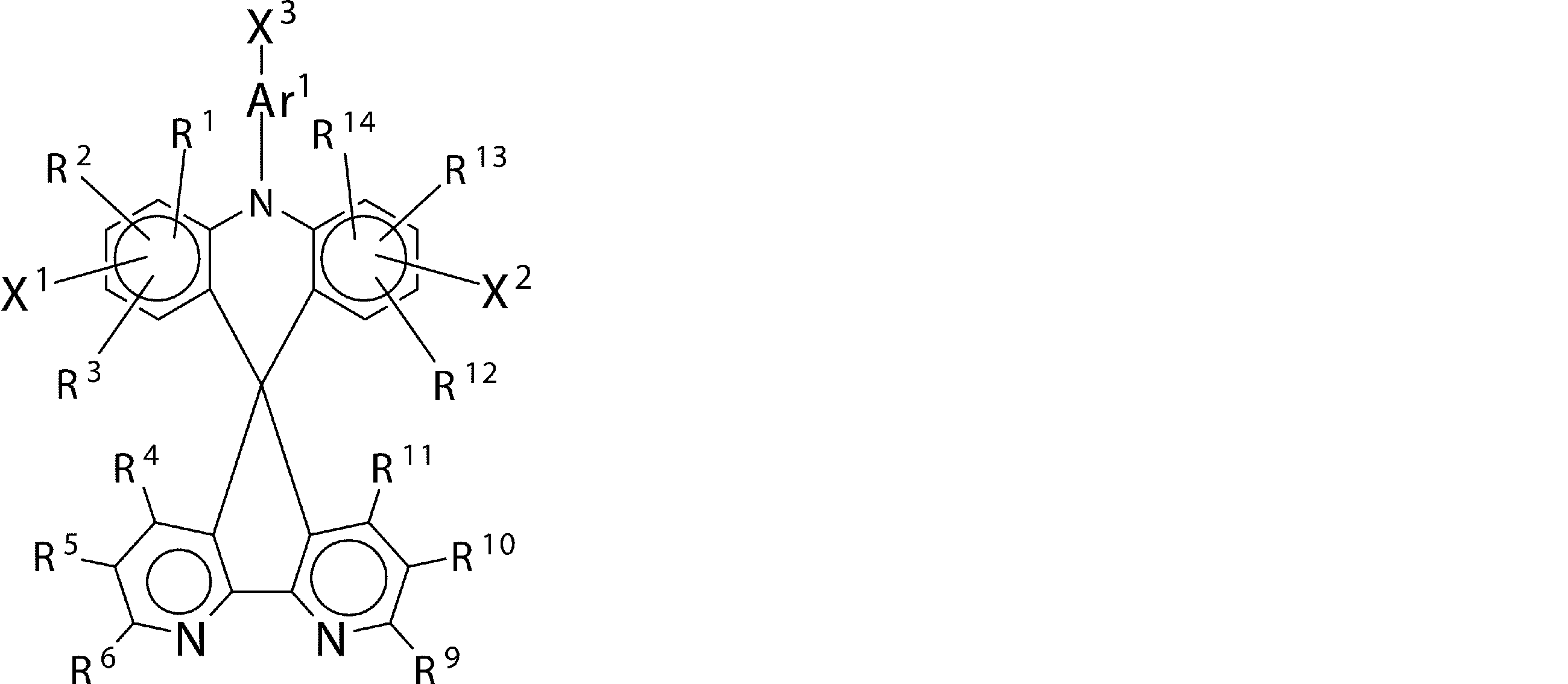
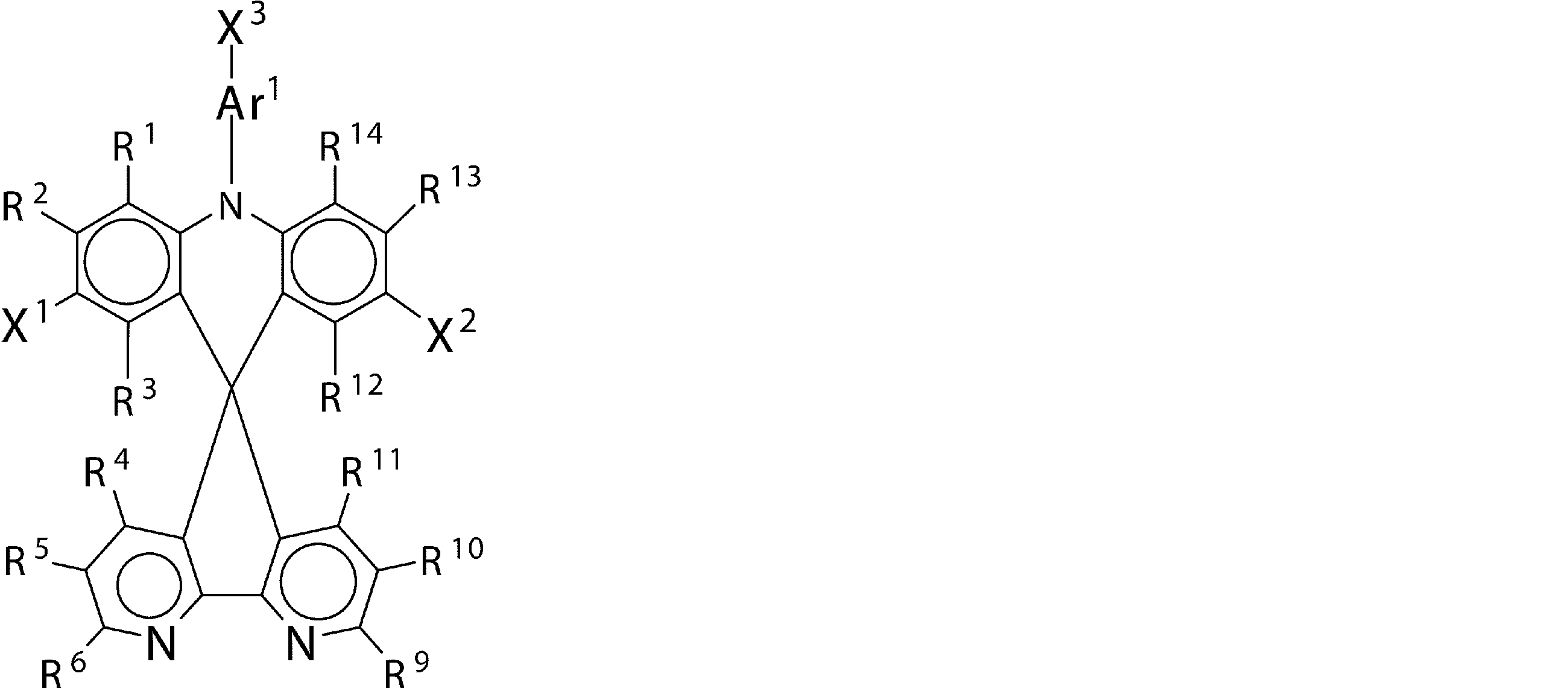
- the present invention is a spiro compound having an azafluorene ring structure represented by the following general formula (1).
- X 1 , X 2 and X 3 may be the same or different, and a hydrogen atom, a deuterium atom, a fluorine atom, a chlorine atom, a cyano group, a nitro group, or a carbon atom which may have a substituent.
- a linear or branched alkyl group having 1 to 6 carbon atoms, an optionally substituted cycloalkyl group having 5 to 10 carbon atoms, and an optionally substituted carbon A linear or branched alkenyl group having 2 to 6 atoms, an optionally substituted linear or branched alkyloxy group having 1 to 6 carbon atoms, or a substituent.
- Z 1 to Z 8 are carbon atoms or nitrogen atoms, and at least one of Z 1 to Z 8 is a nitrogen atom.
- the nitrogen atom has a hydrogen atom or a substituent of R 4 to R 11. Shall not. )
- this invention is a spiro compound which has the azafluorene ring structure of said 1) represented by the following general formula (1a).
- X 1 , X 2 and X 3 may be the same or different, and a hydrogen atom, a deuterium atom, a fluorine atom, a chlorine atom, a cyano group, a nitro group, or a carbon atom which may have a substituent.
- a linear or branched alkyl group having 1 to 6 carbon atoms, an optionally substituted cycloalkyl group having 5 to 10 carbon atoms, and an optionally substituted carbon A linear or branched alkenyl group having 2 to 6 atoms, an optionally substituted linear or branched alkyloxy group having 1 to 6 carbon atoms, or a substituent.
- Z 1 to Z 8 are carbon atoms or nitrogen atoms, and at least one of Z 1 to Z 8 is a nitrogen atom.
- the nitrogen atom has a hydrogen atom or a substituent of R 4 to R 11. Shall not. )
- the present invention also relates to a spiro compound having an azafluorene ring structure as described in 1) above, which is represented by the following general formula (1-1).
- X 1 , X 2 and X 3 may be the same or different, and a hydrogen atom, a deuterium atom, a fluorine atom, a chlorine atom, a cyano group, a nitro group, or a carbon atom which may have a substituent.
- Cyano group, nitro group A linear or branched alkyl group having 1 to 6 carbon atoms which may have a substituent, a cycloalkyl group having 5 to 10 carbon atoms which may have a substituent, and a substituent.
- a cycloalkyloxy group having 5 to 10 carbon atoms which may have a group, a substituted or unsubstituted aromatic hydrocarbon group, a substituted or unsubstituted aromatic heterocyclic group, a substituted or unsubstituted condensed polycycle A disubstituted amino group substituted by an aromatic group, a substituted or unsubstituted aryloxy group, or a group selected from an aromatic hydrocarbon group, an aromatic heterocyclic group or a condensed polycyclic aromatic group, and a single bond , Replace Alternatively, they may be bonded to each other via an unsubstituted methylene group, oxygen atom or sulfur atom to form a ring. )
- the present invention also relates to a spiro compound having an azafluorene ring structure as described in 1) above, which is represented by the following general formula (1a-1).
- X 1 , X 2 and X 3 may be the same or different, and a hydrogen atom, a deuterium atom, a fluorine atom, a chlorine atom, a cyano group, a nitro group, or a carbon atom which may have a substituent.
- Cyano group, nitro group A linear or branched alkyl group having 1 to 6 carbon atoms which may have a substituent, a cycloalkyl group having 5 to 10 carbon atoms which may have a substituent, and a substituent.
- a cycloalkyloxy group having 5 to 10 carbon atoms which may have a group, a substituted or unsubstituted aromatic hydrocarbon group, a substituted or unsubstituted aromatic heterocyclic group, a substituted or unsubstituted condensed polycycle A disubstituted amino group substituted by an aromatic group, a substituted or unsubstituted aryloxy group, or a group selected from an aromatic hydrocarbon group, an aromatic heterocyclic group or a condensed polycyclic aromatic group, and a single bond , Replace Alternatively, they may be bonded to each other via an unsubstituted methylene group, oxygen atom or sulfur atom to form a ring. )
- the present invention is also directed to the general formula (1) wherein X 1 is substituted or unsubstituted carbazolyl group, phenoxazinyl group, phenothiazinyl group, acridinyl group, phenazinyl group, aromatic hydrocarbon group or condensed polycyclic aromatic.
- X 1 is substituted or unsubstituted carbazolyl group, phenoxazinyl group, phenothiazinyl group, acridinyl group, phenazinyl group, aromatic hydrocarbon group or condensed polycyclic aromatic.
- the present invention is also directed to the general formula (1), wherein X 2 is substituted or unsubstituted carbazolyl group, phenoxazinyl group, phenothiazinyl group, acridinyl group, phenazinyl group, aromatic hydrocarbon group or condensed polycyclic aromatic.
- X 2 is substituted or unsubstituted carbazolyl group, phenoxazinyl group, phenothiazinyl group, acridinyl group, phenazinyl group, aromatic hydrocarbon group or condensed polycyclic aromatic.
- the present invention is also directed to the general formula (1) wherein X 3 is substituted or unsubstituted carbazolyl group, phenoxazinyl group, phenothiazinyl group, acridinyl group, phenazinyl group, aromatic hydrocarbon group or condensed polycyclic aromatic.
- X 3 is substituted or unsubstituted carbazolyl group, phenoxazinyl group, phenothiazinyl group, acridinyl group, phenazinyl group, aromatic hydrocarbon group or condensed polycyclic aromatic.
- the present invention provides a carbazolyl group, a phenoxazinyl group, a phenothiazinyl group, an acridinyl group, a phenazinyl group, or an aromatic hydrocarbon group in which X 1 and X 2 are substituted or unsubstituted.
- Ar 1 is a substituted or unsubstituted aromatic hydrocarbon divalent group, or a substituted or unsubstituted condensed polycyclic aromatic divalent group.
- X 3 is a hydrogen atom, a spiro compound having azafluorene ring structure of the above 1), wherein.
- Ar 1 is an unsubstituted aromatic hydrocarbon divalent group or an unsubstituted condensed polycyclic aromatic divalent group, 10) A spiro compound having an azafluorene ring structure.
- this invention is a luminescent material which consists of a spiro compound which has the azafluorene ring structure of said 1) description.
- the present invention is the light-emitting material according to 12) above, which emits thermally activated delayed fluorescence.
- the present invention provides an organic electroluminescence device having a pair of electrodes and at least one organic layer sandwiched between them, wherein the spiro compound having an azafluorene ring structure described in 1) above comprises at least one organic layer. It is an organic electroluminescent element characterized by being used as a constituent material.
- this invention is an organic electroluminescent element of the said 14) description whose above described organic layer is a light emitting layer.
- this invention is an organic electroluminescent element of said 15) description whose above-mentioned organic layer radiates
- this invention is an organic electroluminescent element of the said 14) description whose above described organic layer is a positive hole transport layer.
- this invention is an organic electroluminescent element of the said 14) description whose above described organic layer is an electron blocking layer.
- a linear or branched alkyl group having 1 to 6 carbon atoms which may have a substituent represented by X 1 , X 2 or X 3 in the general formula (1), “substituent A “carbon atom having 5 to 10 carbon atoms which may have a substituent” or “a linear or branched alkenyl group having 2 to 6 carbon atoms which may have a substituent”.
- the cycloalkyl group having 5 to 10 carbon atoms or “the straight chain or branched alkenyl group having 2 to 6 carbon atoms”, Specifically, methyl group, ethyl group, n-propyl group, isopropyl group, n-butyl group, isobutyl group, tert-butyl group, n-pentyl group, isopentyl group, neopentyl group, n-hexyl group, cyclopentyl group Cyclohexyl, 1-adamantyl, 2-adamantyl, vinyl group, allyl group, isopropenyl group include a 2-butenyl group, and the like.
- a linear or branched alkyl group having 1 to 6 carbon atoms having a substituent represented by X 1 , X 2 or X 3 in the general formula (1), “the number of carbon atoms having a substituent”
- Specific examples of the “substituent” in the “5- to 10-cycloalkyl group” or “the linear or branched alkenyl group having 2 to 6 carbon atoms having a substituent” include a deuterium atom, a cyano group, Nitro group; halogen atom such as fluorine atom, chlorine atom, bromine atom and iodine atom; linear or branched alkyloxy group having 1 to 6 carbon atoms such as methyloxy group, ethyloxy group and propyloxy group; vinyl Groups, alkenyl groups such as allyl groups; aryloxy groups such as phenyloxy groups and tolyloxy groups; arylalkyloxy groups such as benzyloxy groups and phen
- substituents may be further substituted by the substituents exemplified above. And Also good. These substituents may be bonded to each other via a single bond, a substituted or unsubstituted methylene group, an oxygen atom or a sulfur atom to form a ring.
- a linear or branched alkyloxy group having 1 to 6 carbon atoms which may have a substituent represented by X 1 , X 2 or X 3 in the general formula (1) or “substitution”
- alkyloxy group examples include a methyloxy group, an ethyloxy group, an n-propyloxy group, an isopropyloxy group, an n-butyloxy group, a tert-butyloxy group, an n-pentyloxy group, an n-hexyloxy group, Cyclopentyloxy group, cyclohexyloxy group, cycloheptyloxy group, cyclooctyloxy group, 1-adamantyloxy group, 2-adamantyl group Such as it is possible to increase the carboxylate group.
- C1-C6 linear or branched alkyloxy group having a substituent represented by X 1 , X 2 or X 3 in the general formula (1) or "carbon atom having a substituent”
- substituents represented by X 1 , X 2 or X 3 in the general formula (1)
- carbon atom having a substituent As the “substituent” in the “cycloalkyloxy group of 5 to 10”, the “substituent having 1 to 6 carbon atoms having a substituent” represented by X 1 , X 2 or X 3 in the general formula (1) is used.
- Linear or branched alkyl group "Substituted cycloalkyl group having 5 to 10 carbon atoms” or “Substituent linear or branched alkenyl group having 2 to 6 carbon atoms”
- lifted The thing similar to what was shown regarding the "substituent” in can be mention
- Specific examples of the “aromatic hydrocarbon group”, “aromatic heterocyclic group” or “condensed polycyclic aromatic group” in the condensed polycyclic aromatic group of are as follows: phenyl group, biphenylyl group, terphenylyl group, naphthyl Group, anthracenyl group, phenanthrenyl group, fluorenyl group, indenyl group, pyrenyl group, perylenyl group, fluoranthenyl group, triphenylenyl group, pyridyl group, pyrimidinyl group, triazinyl group, furyl group, pyrrolyl group, thienyl group, quinolyl group,
- aryloxy group in the “substituted or unsubstituted aryloxy group” represented by X 1 , X 2 and X 3 in the general formula (1) include a phenyloxy group and a biphenylyloxy group.
- Terphenylyloxy group naphthyloxy group, anthracenyloxy group, phenanthrenyloxy group, fluorenyloxy group, indenyloxy group, pyrenyloxy group, perylenyloxy group, and the like.
- the “substituent” in the “substituted aryloxy group” represented by X 1 , X 2 , X 3 in the general formula (1) is X 1 , X 2 , X 3 in the general formula (1).
- Examples of the “substituted aromatic hydrocarbon group”, “substituted aromatic heterocyclic group” or “substituted condensed polycyclic aromatic group” represented by the “substituent” in the above can be exemplified, and Examples of possible embodiments are the same.
- Aromamatic hydrocarbon group “aromatic” in “substituted or unsubstituted aromatic hydrocarbon group”, “substituted or unsubstituted aromatic heterocyclic group” or “substituted or unsubstituted condensed polycyclic aromatic group” Examples thereof include the same groups as those shown for “heterocyclic group” or “fused polycyclic aromatic group”.
- these groups may have a substituent, and as a substituent, a “substituted aromatic hydrocarbon group” represented by X 1 , X 2 , or X 3 in the general formula (1), “substituted”
- a “substituted aromatic hydrocarbon group” represented by X 1 , X 2 , or X 3 in the general formula (1), “substituted”
- lifted the aspect which can be taken can also mention the same thing.
- X 1 and X 2 in the general formula (1) are “a disubstituted amino group substituted by a group selected from an aromatic hydrocarbon group, an aromatic heterocyclic group or a condensed polycyclic aromatic group, or an aromatic group”.
- "Aromatic hydrocarbon group having a heterocyclic group as a substituent” "substituted or unsubstituted aromatic heterocyclic group”, “substituted or unsubstituted condensed polycyclic aromatic group”, or “aromatic hydrocarbon group, It is preferably a “disubstituted amino group substituted by a group selected from an aromatic heterocyclic group or a condensed polycyclic aromatic group”, “a substituted or unsubstituted aromatic heterocyclic group”, or “aromatic hydrocarbon” More preferred is a disubstituted amino group substituted with a group selected from a group selected from the group consisting of an aromatic heterocyclic group and a condensed polycyclic aromatic group, particularly a carbazoly
- phenazinyl group or an "aromatic hydrocarbon group or condensed polycyclic aromatic di-substituted amino group substituted with a group".
- aromatic hydrocarbon group or condensed polycyclic aromatic di-substituted amino group substituted with a group.
- the di-substituted amino group substituted by the carbazolyl group and the aromatic hydrocarbon group is preferable, and the carbazolyl group and the diphenylamino group are more preferable.
- X 3 in the general formula (1) is a hydrogen atom, a disubstituted amino group substituted with a group selected from an aromatic hydrocarbon group, an aromatic heterocyclic group or a condensed polycyclic aromatic group, or an aromatic group.
- "Aromatic hydrocarbon group having a heterocyclic group as a substituent” "substituted or unsubstituted aromatic heterocyclic group”, “substituted or unsubstituted condensed polycyclic aromatic group”, or “aromatic hydrocarbon group, It is preferably a “disubstituted amino group substituted by a group selected from an aromatic heterocyclic group or a condensed polycyclic aromatic group”, a hydrogen atom, “substituted or unsubstituted aromatic heterocyclic group”, or “aromatic It is more preferably a disubstituted amino group substituted by a group selected from an aromatic hydrocarbon group, an aromatic heterocyclic group or a condensed polycyclic aromatic group, particularly
- a divalent group of a substituted or unsubstituted aromatic hydrocarbon “a divalent group of a substituted or unsubstituted aromatic heterocycle” represented by Ar 1 in the general formula (1), or “substituted or The “unsubstituted fused polycyclic aromatic divalent group” is a divalent group formed by removing two hydrogen atoms from the above “aromatic hydrocarbon”, “aromatic heterocycle” or “fused polycyclic aromatic”.
- Ar 1 in the general formula (1) is preferably “substituted or unsubstituted aromatic divalent hydrocarbon” or “substituted or unsubstituted condensed polycyclic aromatic divalent”, and “unsubstituted”
- the “divalent group of aromatic hydrocarbon” or “unsubstituted fused polycyclic aromatic divalent group” is more preferable.
- a linear or branched alkyl group having 1 to 6 carbon atoms which may have a substituent represented by R 1 to R 14 in the general formula (1), “having a substituent In the “cycloalkyl group having 5 to 10 carbon atoms” or “straight or branched alkenyl group having 2 to 6 carbon atoms which may have a substituent”.
- the “straight or branched alkyl group of 6”, “cycloalkyl group of 5 to 10 carbon atoms” or “straight chain or branched alkenyl group of 2 to 6 carbon atoms” includes the above general formula “A linear or branched alkyl group having 1 to 6 carbon atoms which may have a substituent” represented by X 1 , X 2 or X 3 in (1), “having a substituent An optionally substituted cycloalkyl having 5 to 10 carbon atoms
- a “linear or branched alkyl group having 1 to 6 carbon atoms” in the “group” or “optionally substituted linear or branched alkenyl group having 2 to 6 carbon atoms” Examples thereof include those similar to those shown for the “cycloalkyl group having 5 to 10 carbon atoms” or the “straight or branched alkenyl group having 2 to 6 carbon atoms”.
- These groups may be bonded to each other through a single bond, a substituted or un
- a linear or branched alkyl group having 1 to 6 carbon atoms having a substituent represented by R 1 to R 14 in formula (1), “5 to 10 carbon atoms having a substituent”
- X 1 , X 2 in the above general formula (1) “A linear or branched alkyl group having 1 to 6 carbon atoms having a substituent”, “a cycloalkyl group having 5 to 10 carbon atoms having a substituent” or “substituent” represented by X 3
- Examples thereof include those similar to those shown for the “substituent” in the “straight-chain or branched alkenyl group having 2 to 6 carbon atoms”, and the possible embodiments are also exemplified. .
- a linear or branched alkyloxy group having 1 to 6 carbon atoms or “the number of carbon atoms” in “group” or “cycloalkyloxy group having 5 to 10 carbon atoms which may have a substituent” 5 to 10 It can be exemplified the same as those shown with respect cycloalkyloxy group ". These groups may be bonded to each other through a single bond, a substituted or unsubstituted methylene group, an oxygen atom or a sulfur atom to form a ring.
- a linear or branched alkyloxy group having 1 to 6 carbon atoms having a substituent represented by R 1 to R 14 in the general formula (1) or “having 5 to 5 carbon atoms having a substituent”
- the “substituent” in the “cycloalkyloxy group of 10” is represented by the number of carbon atoms having 1 to 1 carbon atoms which may have a substituent represented by X 1 , X 2 or X 3 in the general formula (1).
- the “aromatic hydrocarbon group”, “aromatic heterocyclic group” or “condensed polycyclic aromatic group” in the “ring aromatic group” is X 1 , X 2 or X 3 in the general formula (1).
- aromatic hydrocarbon group in the “substituted or unsubstituted aromatic hydrocarbon group”, “substituted or unsubstituted aromatic heterocyclic group” or “substituted or unsubstituted condensed polycyclic aromatic group” represented by , “Aromatic heterocyclic group” or “fused polycyclic aromatic group” are the same as those described above. These groups may be bonded to each other through a single bond, a substituted or unsubstituted methylene group, an oxygen atom or a sulfur atom to form a ring.
- the “aryloxy group” in the “substituted or unsubstituted aryloxy group” represented by R 1 to R 14 in the general formula (1) is X 1 , X 2 , X in the general formula (1). Examples thereof are the same as those shown for the “aryloxy group” in the “substituted or unsubstituted aryloxy group” represented by 3 . These groups may be bonded to each other through a single bond, a substituted or unsubstituted methylene group, an oxygen atom or a sulfur atom to form a ring.
- the “substituent” in the “substituted aryloxy group” represented by R 1 to R 14 in the general formula (1) is represented by X 1 , X 2 , or X 3 in the general formula (1).
- aromatic hydrocarbon group aromatic heterocyclic group or “fused polycyclic aromatic group”
- substituted or non-substituted represented by X 1 , X 2 or X 3 in the above general formula (1)
- Aromatic hydrocarbon group "Aromatic heterocyclic group” in "Substituted aromatic hydrocarbon group”, “Substituted or unsubstituted aromatic heterocyclic group” or “Substituted or unsubstituted condensed polycyclic aromatic group” Or the same groups as those shown for the “fused polycyclic aromatic group”.
- these groups may have a substituent, and as a substituent, a “substituted aromatic hydrocarbon group” represented by X 1 , X 2 , or X 3 in the general formula (1), “substituted”
- a “substituted aromatic hydrocarbon group” represented by X 1 , X 2 , or X 3 in the general formula (1), “substituted”
- lifted the aspect which can be taken can also mention the same thing.
- X 1, X 2, any one or more of X 3 are a substituted or unsubstituted aromatic hydrocarbon group, a substituted or unsubstituted aromatic heterocyclic group, or a substituted or unsubstituted condensed polycyclic aromatic group, or aromatic And a disubstituted amino group substituted by a group selected from an aromatic hydrocarbon group, an aromatic heterocyclic group or a condensed polycyclic aromatic group.
- X 1 and X 2 are substituted or unsubstituted aromatic hydrocarbon groups, substituted or unsubstituted aromatic heterocyclic groups, substituted or unsubstituted condensed polycyclic aromatic groups, or aromatic
- the group is a disubstituted amino group substituted by a group selected from a hydrocarbon group, an aromatic heterocyclic group or a condensed polycyclic aromatic group, or only X 3 is a substituted or unsubstituted aromatic hydrocarbon group, substituted Or an unsubstituted aromatic heterocyclic group, a substituted or unsubstituted condensed polycyclic aromatic group, or a disubstituted by a group selected from an aromatic hydrocarbon group, an aromatic heterocyclic group or a condensed polycyclic aromatic group aspect is a substituted amino group, preferably, X 1 and X 2 are a substituted or unsubstituted aromatic hydrocarbon group, a substituted or unsubstituted
- Z 1 to Z 8 are carbon atoms or nitrogen atoms, and at least one of Z 1 to Z 8 is a nitrogen atom.
- the nitrogen atoms are R 4 to R 11 .
- Z 1 is when R 4 is a nitrogen atom, if R 5 Z 2 is a nitrogen atom, when Z 3 is a nitrogen atom R 6 is, when Z 4 is a nitrogen atom R 7 is, Z 5 cases R 8 is a nitrogen atom, when Z 6 is a nitrogen atom R 9 is, when Z 7 is a nitrogen atom R 10 is, if R 11 Z 8 is a nitrogen atom
- a hydrogen atom It shall not have a substituent.
- Z 4 and Z 5 are nitrogen atoms (in this case, Z 4 and Z 5 do not have a hydrogen atom or a substituent of R 7 and R 8 , that is, R 7 and R 5 Which means that 8 is absent) is preferred.
- the spiro compound having an azafluorene ring structure represented by the general formula (1) of the present invention has a small difference ( ⁇ E ST ) between excited triplet energy and excited singlet energy obtained from theoretical calculation, and a resonator. Since the intensity (f) is relatively large, the luminous efficiency is high, delayed fluorescence can be emitted, and the thin film state is stable.
- the spiro compound having an azafluorene ring structure represented by the general formula (1) of the present invention is used as a constituent material of a light emitting layer of an organic electroluminescence element (hereinafter sometimes referred to as an organic EL element). Can do.
- an organic electroluminescence element hereinafter sometimes referred to as an organic EL element.
- the spiro compound having an azafluorene ring structure represented by the general formula (1) of the present invention can be used as a constituent material of a hole transport layer of an organic EL element.
- a material that has a higher hole mobility, higher electron blocking properties, and higher electron stability compared to conventional materials it is possible to confine excitons generated in the light-emitting layer.
- high luminous efficiency can be obtained, and the driving voltage is lowered to improve the durability of the organic EL element.
- the spiro compound having an azafluorene ring structure represented by the general formula (1) of the present invention can also be used as a constituent material of an electron blocking layer of an organic EL device.
- the driving voltage is lowered and current resistance is maintained while having high luminous efficiency. Is improved and the maximum light emission luminance of the organic EL element is improved.
- the spiro compound having an azafluorene ring structure represented by the general formula (1) of the present invention is useful as a light emitting material (dopant compound) of a light emitting layer of an organic EL element, or a constituent material of a hole transport layer or an electron blocking layer. Therefore, delayed fluorescence can be emitted, the thin film state is stable, and the heat resistance is excellent.
- an organic EL element By producing an organic EL element using the compound, an organic EL element having high efficiency, high luminance, and low driving voltage can be obtained.
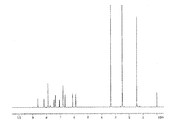
- FIG. 1 is a 1 H-NMR chart of the compound of Example 1 of the present invention (Compound 1).
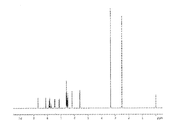
- FIG. 2 is a 1 H-NMR chart of the compound of Example 2 of the present invention (Compound 2).
- FIG. 3 is a 1 H-NMR chart of the compound of Example 3 of the present invention (Compound 3).
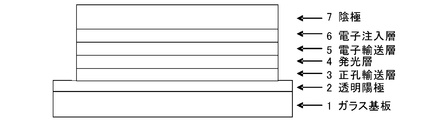
- FIG. 6 is a 1 H-NMR chart of the compound of Example 4 of the present invention (Compound 4). It is the figure which showed the organic EL element structure of Example 10.
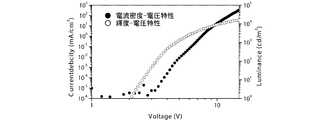
- FIG. 14 is a graph showing current density-voltage characteristics and luminance-voltage characteristics of the organic EL element of Example 10.
- FIG. 10 is a diagram showing current density-external quantum efficiency characteristics of the organic EL element of Example 10.
- the spiro compound having an azafluorene ring structure represented by the general formula (1) of the present invention is a novel compound, and these compounds can be synthesized, for example, as follows.
- a carbinol compound can be synthesized by reacting a halogen-substituted product of triarylamine with a Grignard reagent and then reacting with azafluorenone.
- a spiro compound having an azafluorene ring structure can be synthesized by subjecting this carbinol body to a ring-closing reaction using an acid catalyst or the like.
- bromine substitution is carried out by bromination of this spiro compound having an azafluorene ring structure with N-bromosuccinimide or the like, and this bromo substitution and various diarylamines are subjected to Buchwald-Hartwig reaction, etc.
- this condensation reaction the spiro compound having the azafluorene ring structure of the present invention can be synthesized.
- bromo-substituted product and various boronic acids or boronic esters are subjected to a cross-coupling reaction such as Suzuki coupling (see, for example, Non-Patent Document 2), thereby having the azafluorene ring structure of the present invention.
- Spiro compounds can be synthesized.
- the compounds were purified by column chromatography, adsorption purification using silica gel, activated carbon, activated clay, etc., recrystallization or crystallization using a solvent, sublimation purification, and the like.
- the compound was identified by NMR analysis.
- the work function was measured as a physical property value.
- the work function is an index of the energy level as the light emitting layer material.
- the work function was measured using an atmospheric photoelectron spectrometer (AC-3 type, manufactured by Riken Keiki Co., Ltd.) by forming a 100 nm thin film on the ITO substrate.
- an anode As the structure of the organic EL device of the present invention, on the substrate sequentially, an anode, a hole injection layer, a hole transport layer, an electron blocking layer, a light emitting layer, a hole blocking layer, an electron transport layer, a cathode, Further, there may be mentioned those having an electron injection layer between the electron transport layer and the cathode.
- several organic layers can be omitted.
- an anode, a hole transport layer, a light emitting layer, an electron transport layer, an electron injection layer, and a cathode can be sequentially formed on the substrate.
- Anode, hole transport layer, light emitting layer, electron transport layer, and cathode can be sequentially formed on the substrate.
- the light emitting layer, the hole transport layer, and the electron transport layer may have a structure in which two or more layers are laminated.
- an electrode material having a large work function such as ITO or gold is used.
- a hole injection layer of the organic EL device of the present invention in addition to a porphyrin compound typified by copper phthalocyanine, a naphthalene diamine derivative, a starburst type triphenylamine derivative, three or more triphenylamine structures in the molecule, Triphenylamine trimers and tetramers such as arylamine compounds having a structure linked by a divalent group containing no bond or hetero atom, acceptor heterocyclic compounds such as hexacyanoazatriphenylene, and coating-type polymers Materials can be used. These materials can be formed into a thin film by a known method such as a spin coating method or an ink jet method in addition to a vapor deposition method.
- a compound containing an m-carbazolylphenyl group N, N'-diphenyl-N, N'-di (m-tolyl) -benzidine (TPD), N, N'-diphenyl-N, N'-di ( ⁇ -naphthyl) -benzidine (NPD), N, N, Benzidine derivatives such as N ′, N′-tetrabiphenylylbenzidine, 1,1-bis [(di-4-tolylamino) phenyl] cyclohexane (TAPC), various triphenylamine trimers and tetramers and carbazole derivatives Etc.
- TPD N, N'-diphenyl-N, N'-di (m-tolyl) -benzidine
- NPD N'-diphenyl-N, N'-di ( ⁇ -naphthyl) -benzidine
- NPD N, N, Benzidine derivatives such as N
- a coating type polymer material such as poly (3,4-ethylenedioxythiophene) (PEDOT) / poly (styrene sulfonate) (PSS) can be used for the hole injection / transport layer.
- PEDOT poly (3,4-ethylenedioxythiophene)
- PSS poly (styrene sulfonate)
- These materials can be formed into a thin film by a known method such as a spin coating method or an ink jet method in addition to a vapor deposition method.
- a material that is usually used for the layer is further P-doped with trisbromophenylamine hexachloroantimony, or a structure of a benzidine derivative such as TPD. Or the like can be used.
- These may be formed alone, but may be used as a single layer formed by mixing with other materials, layers formed alone, mixed layers formed, or A stacked structure of layers formed by mixing with a layer formed alone may be used.
- These materials can be formed into a thin film by a known method such as a spin coating method or an ink jet method in addition to a vapor deposition method.
- PIC-TRZ for example, see Non-Patent Document 1
- CC2TA for example, Non-Patent Document 3
- PXZ-TRZ for example, see Non-Patent Document 4
- a CDCB derivative such as 4CzIPN
- a material that emits delayed fluorescence Tris (8-hydroxyquinoline)
- metal complexes such as aluminum (Alq 3 ) and other quinolinol derivative metal complexes, anthracene derivatives, bisstyrylbenzene derivatives, pyrene derivatives, oxazole derivatives, polyparaphenylene vinylene derivatives, and the like can be used.
- the light emitting layer may be composed of a host material and a dopant material.
- the host material is a spiro compound having an azafluorene ring structure represented by the general formula (1) of the present invention, mCP, thiazole derivative. , Benzimidazole derivatives, polydialkylfluorene derivatives, and the like can be used.
- the dopant material emits delayed fluorescence such as a spiro compound having an azafluorene ring structure represented by the general formula (1) of the present invention, a CDCB derivative such as PIC-TRZ, CC2TA, PXZ-TRZ, and 4CzIPN.
- a phosphorescent light emitting material can be used as the light emitting material.
- a phosphorescent emitter of a metal complex such as iridium or platinum can be used.
- Green phosphorescent emitters such as Ir (ppy) 3
- blue phosphorescent emitters such as FIrpic and FIr6, and red phosphorescent emitters
- Btp 2 Ir (acac) and Ir (piq) 3 are used.
- the host material 4,4′-di (N-carbazolyl) biphenyl (CBP), carbazole derivatives such as TCTA, mCP, and the like can be used as hole injection / transport host materials.
- UHH2 triphenylsilyl
- TPBI 2,2 ′, 2 ′′-(1,3,5-phenylene) -tris (1-phenyl-1H-benzimidazole) )
- TPBI p-bis (triphenylsilyl) benzene
- TPBI 2,2 ′, 2 ′′-(1,3,5-phenylene) -tris (1-phenyl-1H-benzimidazole)
- the phosphorescent light-emitting material into the host material by co-evaporation in the range of 1 to 30 weight percent with respect to the entire light-emitting layer.
- These materials can be formed into a thin film by a known method such as a spin coating method or an ink jet method in addition to a vapor deposition method.
- an element having a structure in which a light-emitting layer manufactured using a compound having a different work function as a host material is stacked adjacent to a light-emitting layer manufactured using the compound of the present invention can be manufactured (for example, non-patented). Reference 6).
- a phenanthroline derivative such as bathocuproine (BCP) or a quinolinol derivative such as aluminum (III) bis (2-methyl-8-quinolinato) -4-phenylphenolate (BAlq)
- BCP bathocuproine
- BAlq quinolinol derivative
- various rare earth complexes, oxazole derivatives, triazole derivatives, triazine derivatives, and other compounds having a hole blocking action can be used.
- These materials may also serve as the material for the electron transport layer.
- These may be formed alone, but may be used as a single layer formed by mixing with other materials, layers formed alone, mixed layers formed, or A stacked structure of layers formed by mixing with a layer formed alone may be used.
- These materials can be formed into a thin film by a known method such as a spin coating method or an ink jet method in addition to a vapor deposition method.
- various metal complexes triazole derivatives, triazine derivatives, oxadiazole derivatives, thiadiazole derivatives, carbodiimide derivatives, quinoxaline, as well as metal complexes of quinolinol derivatives including Alq 3 and BAlq.
- Derivatives, phenanthroline derivatives, silole derivatives, benzimidazole derivatives such as TPBI, and the like can be used. These may be formed alone, but may be used as a single layer formed by mixing with other materials, layers formed alone, mixed layers formed, or A stacked structure of layers formed by mixing with a layer formed alone may be used. These materials can be formed into a thin film by a known method such as a spin coating method or an ink jet method in addition to a vapor deposition method.
- an alkali metal salt such as lithium fluoride and cesium fluoride
- an alkaline earth metal salt such as magnesium fluoride
- a metal oxide such as aluminum oxide
- a material usually used for the layer and further doped with a metal such as cesium can be used.
- an electrode material having a low work function such as aluminum or an alloy having a lower work function such as a magnesium silver alloy, a magnesium indium alloy, or an aluminum magnesium alloy is used as the electrode material.
- the preferable material which can be used for the organic EL element of this invention is illustrated concretely.
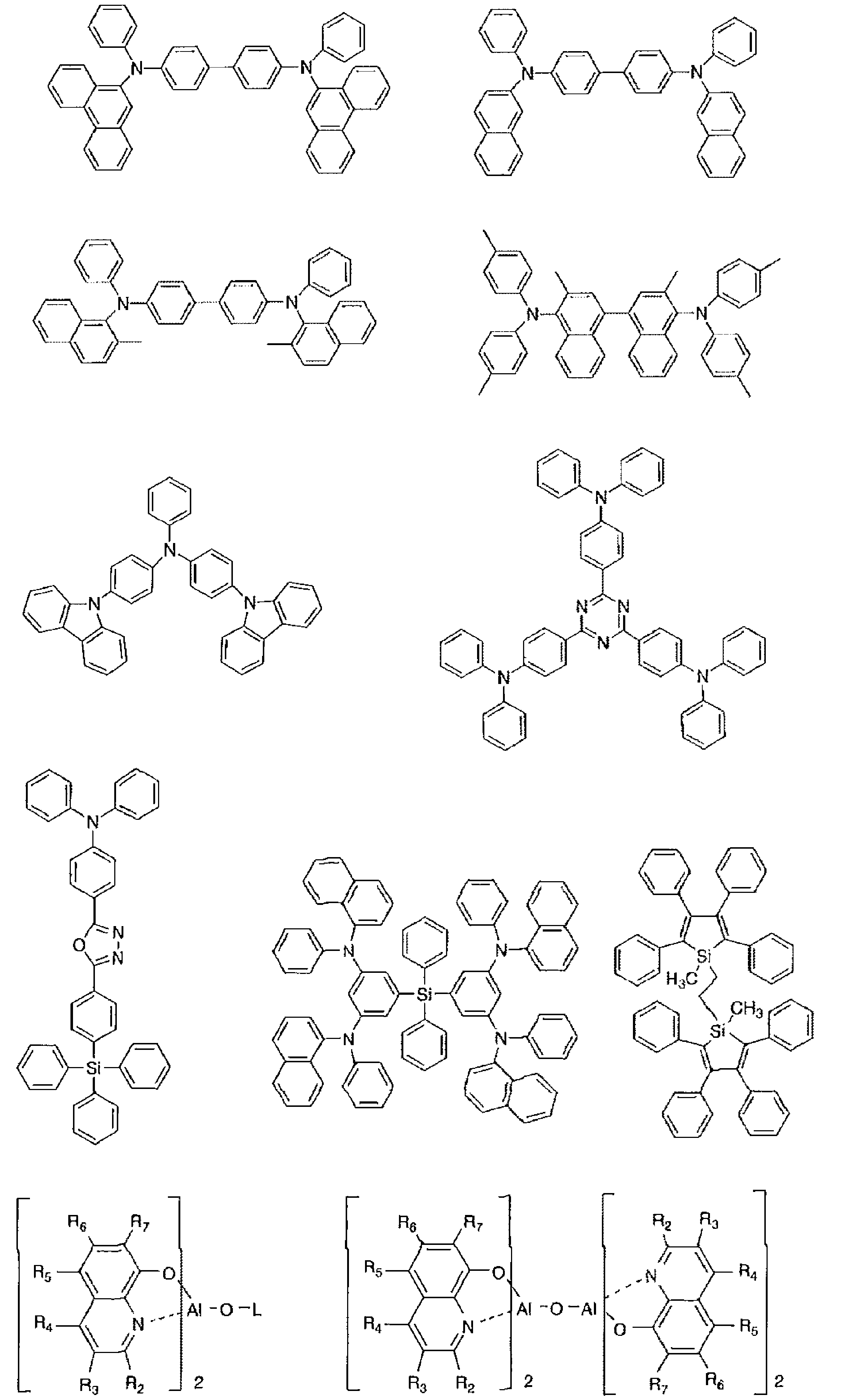
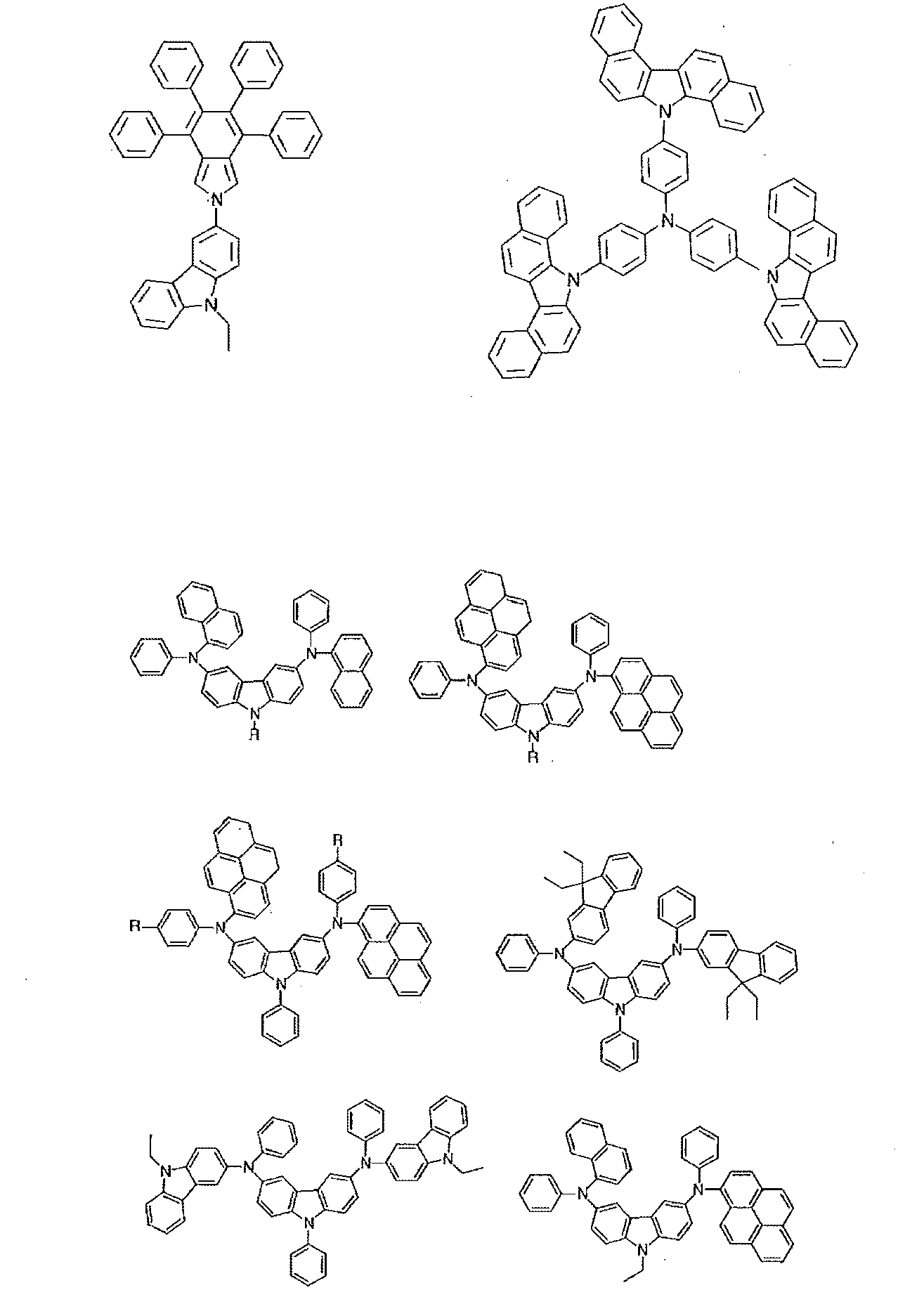
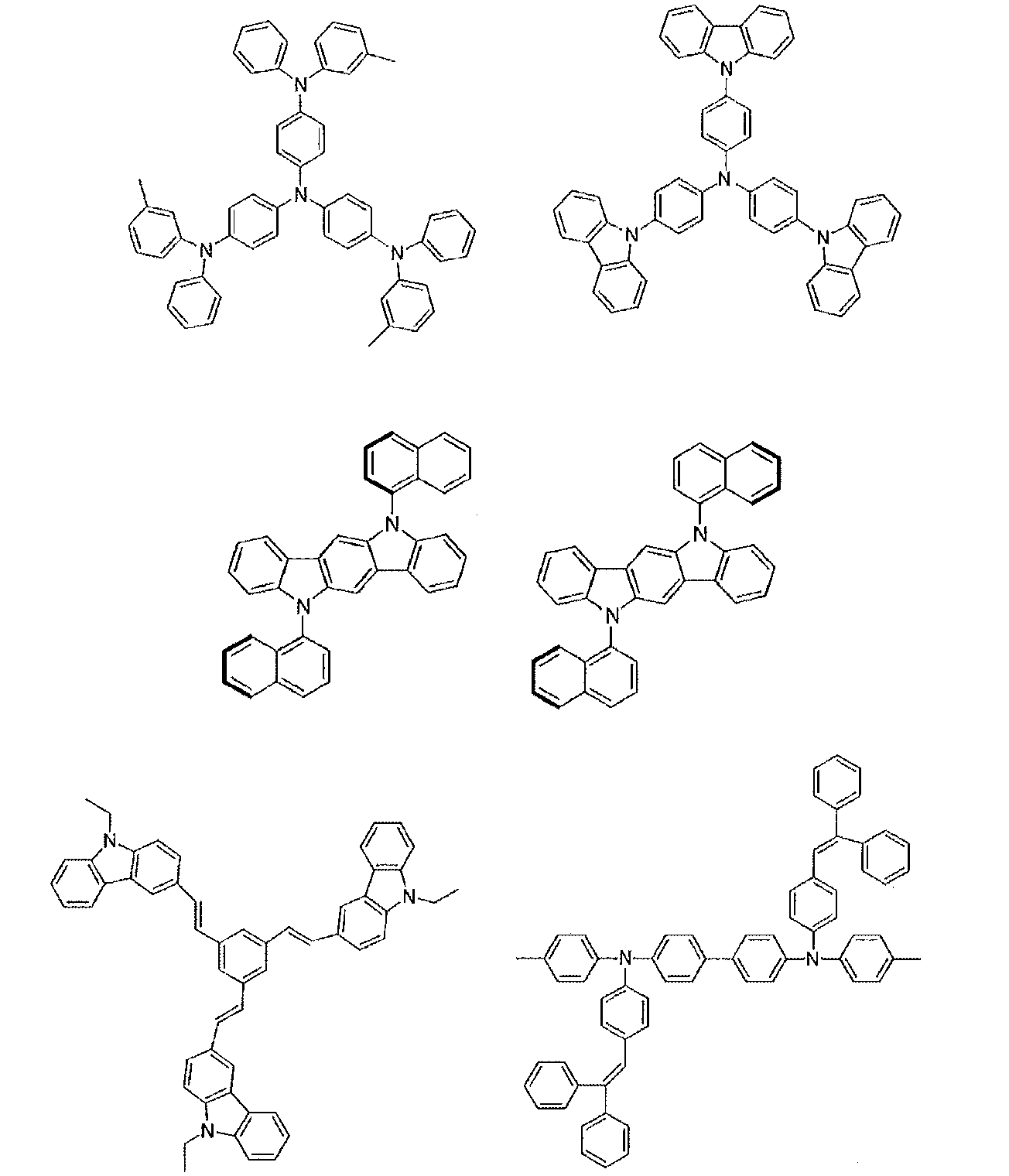
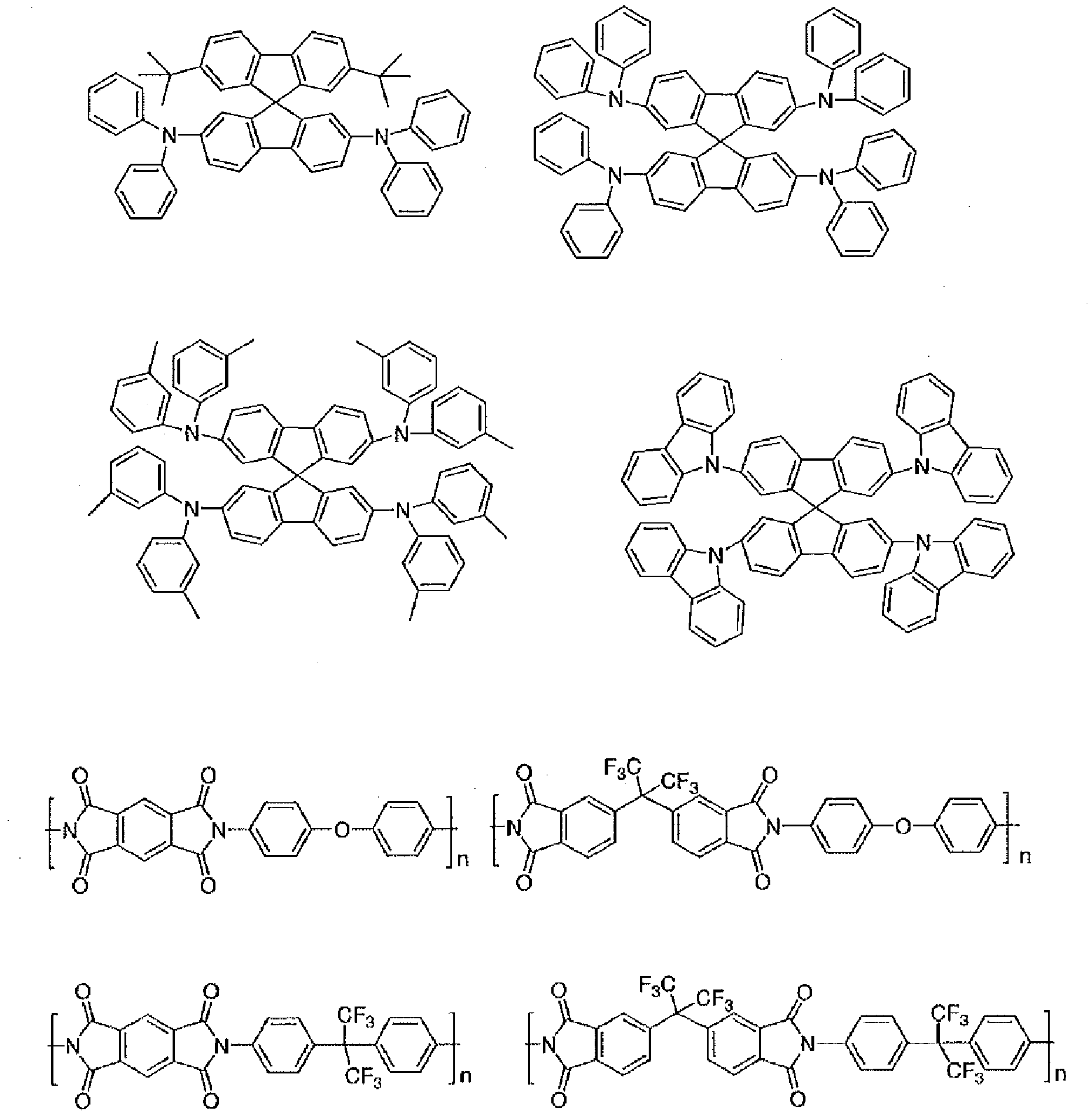
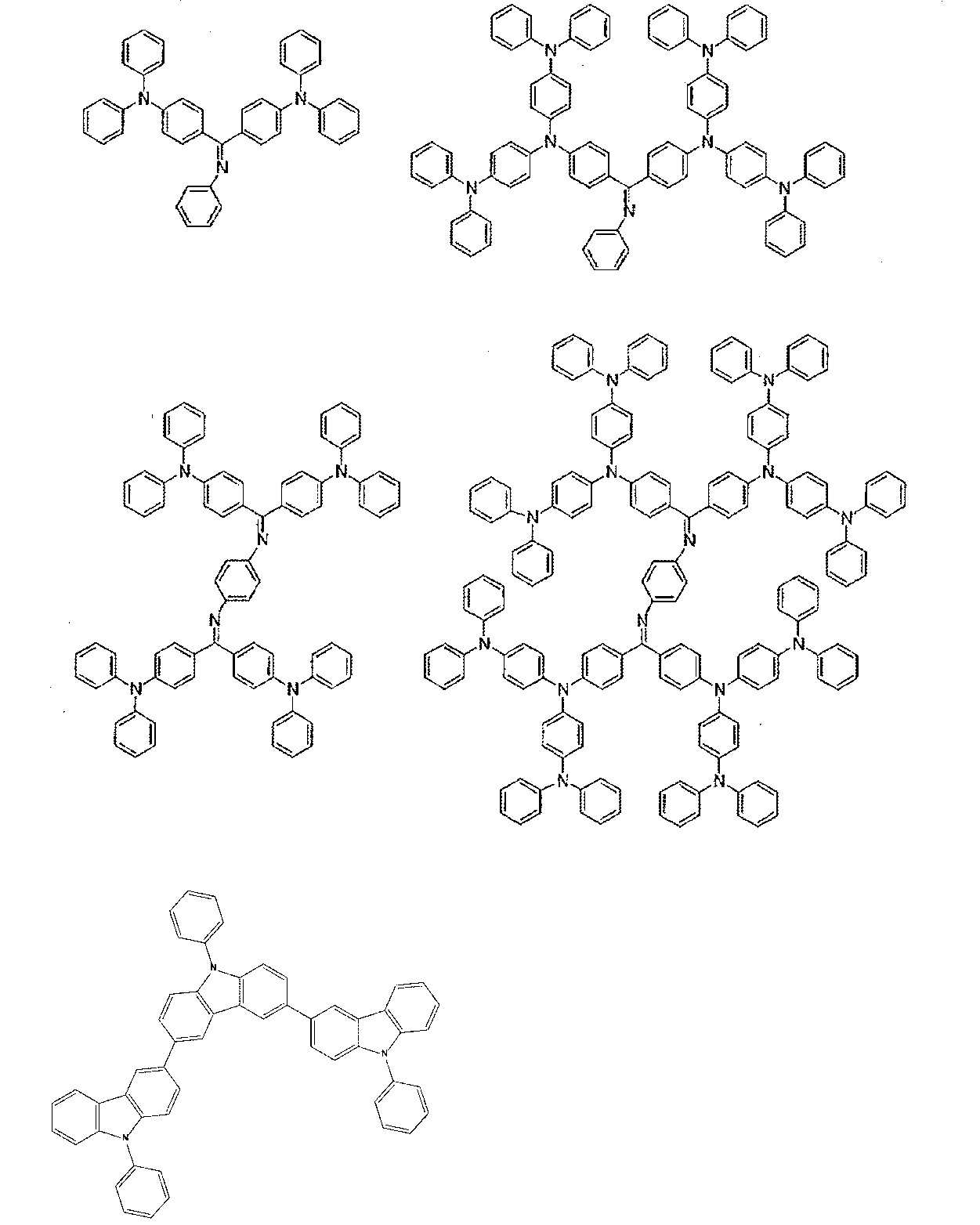
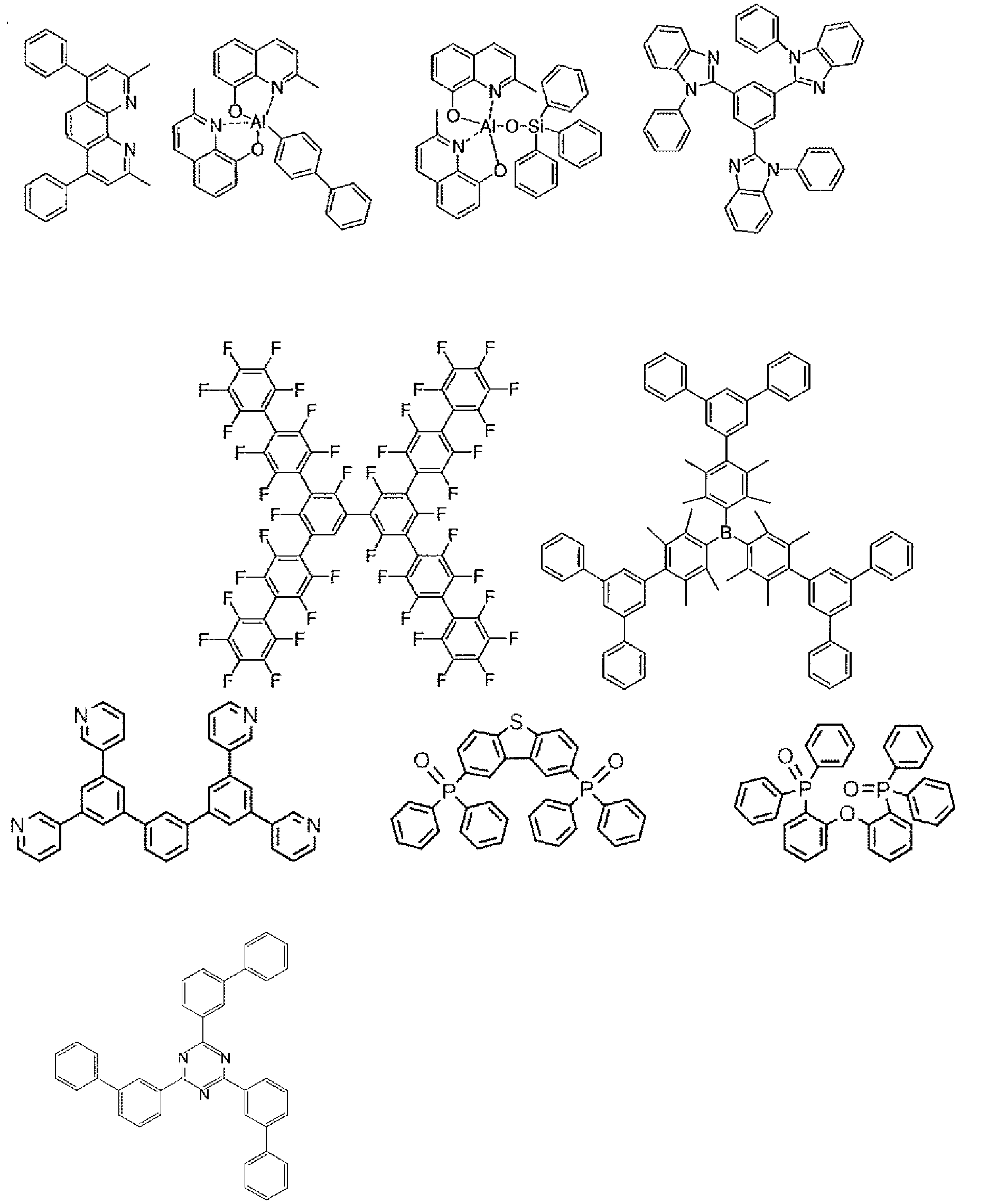
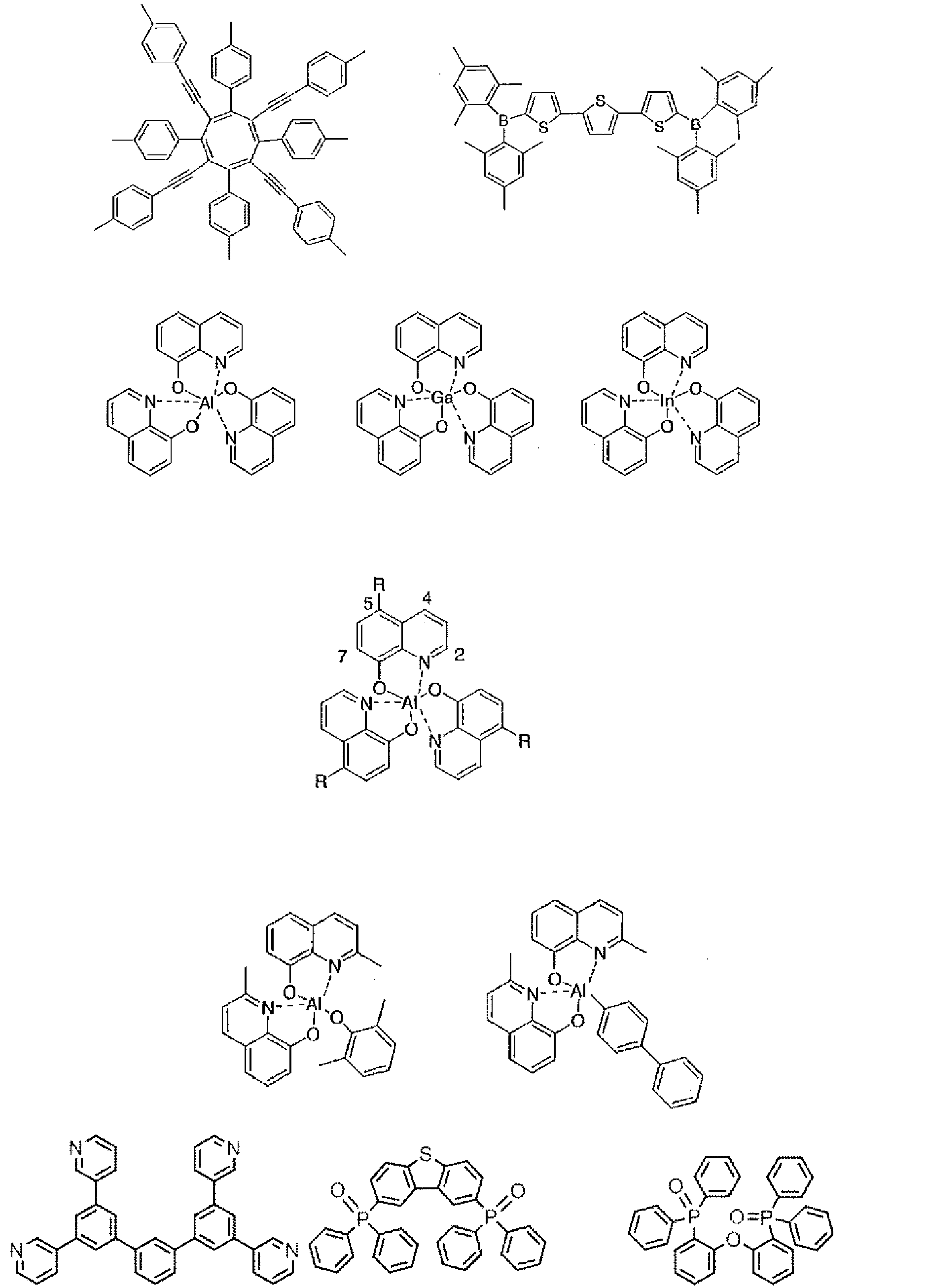
- the material that can be used in the present invention is not limited to the following exemplary compounds.
- R and R 2 to R 7 in the structural formulas of the following exemplary compounds each independently represent a hydrogen atom or a substituent.
- n represents an integer of 3 to 5.
- preferable compounds as materials that can be added are given.
- adding as a stabilizing material can be considered.
- Toluene (100 ml) was added and heated, and the mixture was stirred at 100 ° C., followed by hot filtration, and the filtrate was collected and concentrated under reduced pressure to obtain a crude product.
- the crude product was purified using a column chromatograph (carrier: silica gel, eluent: toluene / ethyl acetate), and then purified by crystallization using a mixed solvent of toluene / methanol to obtain 2,7-bis (diphenyl).
- the compound of the present invention has an energy level suitable as a material for the light emitting layer, which is comparable to that of CBP generally used as a light emitting host.
- Example 1 of the present invention a 10 ⁇ 5 mol / L toluene solution was prepared.
- this toluene solution was irradiated with ultraviolet light at 300 K while passing nitrogen, fluorescence having a peak wavelength of 527 nm was observed.
- the PL quantum efficiency of this toluene solution before and after the nitrogen aeration was measured at 300 K using an absolute PL quantum yield measuring apparatus (Quantaurus-QY manufactured by Hamamatsu Photonics Co., Ltd.). 4%, 33.5% after nitrogen bubbling.
- Example 6 instead of the compound of Example 1 of the present invention (Compound 1), a 10 ⁇ 5 mol / L toluene solution of the compound of Example 2 of the present invention (Compound 2) was prepared, and the characteristics were evaluated in the same manner. Went. As a result, fluorescence having a peak wavelength of 445 nm was observed, and a short-lived component (fluorescence) having an emission lifetime of 0.016 ⁇ s and a long-life component (delayed fluorescence) having 15.0 ⁇ s were observed. Moreover, PL quantum efficiency was 1.2% before nitrogen ventilation, and 4.8% after nitrogen ventilation.
- Example 6 instead of the compound of Example 1 of the present invention (Compound 1), a 10 ⁇ 5 mol / L toluene solution of the compound of Example 3 of the present invention (Compound 3) was prepared, and the characteristics were evaluated in the same manner. Went. As a result, fluorescence having a peak wavelength of 489 nm was observed, and a short-life component (fluorescence) having an emission lifetime of 0.054 ⁇ s and a long-life component (delayed fluorescence) having an emission lifetime of 9.0 ⁇ s were observed. Moreover, PL quantum efficiency was 5.8% before nitrogen ventilation, and 13.8% after nitrogen ventilation.
- Example 6 instead of the compound of Example 1 of the present invention (Compound 1), a 10 ⁇ 5 mol / L toluene solution of the compound of Example 4 of the present invention (Compound 4) was prepared, and the characteristics were evaluated in the same manner. Went. As a result, fluorescence having a peak wavelength of 507 nm was observed, and a short-life component (fluorescence) having an emission lifetime of 0.014 ⁇ s and a long-life component (delayed fluorescence) having a 0.122 ⁇ s were observed. Moreover, PL quantum efficiency was 3.9% before nitrogen ventilation, and 21.1% after nitrogen ventilation.
- the organic EL element has a hole transport layer 3, a light emitting layer 4, an electron transport layer 5, and an electron injection layer 6 on a glass substrate 1 on which an ITO electrode is previously formed as a transparent anode 2.
- the cathode (aluminum electrode) 7 was deposited in this order.
- the glass substrate 1 on which ITO having a thickness of 100 nm was formed was washed with an organic solvent, and then the surface was washed by UV ozone treatment. Then, this glass substrate with an ITO electrode was mounted in a vacuum vapor deposition machine and the pressure was reduced to 0.001 Pa or less. Subsequently, NPD was formed as a hole transport layer 3 so as to cover the transparent anode 2 so as to have a film thickness of 35 nm at a deposition rate of 2.0 ⁇ / sec.
- Binary vapor deposition was performed at a vapor deposition rate of and a film thickness of 15 nm was formed.
- the TPBI was formed as the electron transport layer 5 so as to have a film thickness of 50 nm at a deposition rate of 2.0 ⁇ / sec.
- lithium fluoride was formed as the electron injection layer 6 so as to have a film thickness of 0.8 nm at a deposition rate of 0.1 ⁇ / sec.
- cathode 7 was formed by vapor-depositing aluminum so as to have a film thickness of 70 nm.
- the characteristic measurement was performed at normal temperature in air
- FIG. 6 shows current density-voltage characteristics and luminance-voltage characteristics
- FIG. 7 shows external quantum efficiency-current density characteristics.
- the luminance was 1393 cd / m 2
- the light emission efficiency was 13.6 cd / A.
- the external quantum efficiency reached 9.6% at maximum, showing a value far exceeding 5% of the theoretical external quantum efficiency when a normal fluorescent material was used.
- the organic EL device using the compound of the present invention can achieve high luminous efficiency and external quantum efficiency.
- the spiro compound having an azafluorene ring structure of the present invention can emit delayed fluorescence and has good thin film stability, and thus is excellent as a material for the light emitting layer, particularly as a dopant material for the light emitting layer. Moreover, high luminous efficiency and external quantum efficiency can be obtained by producing an organic EL element using the compound. For this reason, this invention has high industrial applicability.
Landscapes
- Chemical & Material Sciences (AREA)
- Organic Chemistry (AREA)
- Engineering & Computer Science (AREA)
- Materials Engineering (AREA)
- Physics & Mathematics (AREA)
- Spectroscopy & Molecular Physics (AREA)
- Health & Medical Sciences (AREA)
- Life Sciences & Earth Sciences (AREA)
- Biochemistry (AREA)
- General Health & Medical Sciences (AREA)
- Molecular Biology (AREA)
- Inorganic Chemistry (AREA)
- Electroluminescent Light Sources (AREA)
- Nitrogen Condensed Heterocyclic Rings (AREA)
Abstract
Description
1993年にプリンストン大学のM.A.Baldoらは、イリジウム錯体を用いた燐光発光素子によって8%の外部量子効率を実現させた。
また、熱活性化遅延蛍光(TADF)による発光を利用する素子も開発されている。2011年に九州大学の安達らは、熱活性化遅延蛍光材料を用いた素子によって5.3%の外部量子効率を実現させた(例えば、非特許文献1参照)。
そこで、遅延蛍光を示す材料を利用する有機エレクトロルミネッセンス素子が考えられる。ある種の蛍光物質は、系間交差などにより励起三重項状態へとエネルギーが遷移した後、三重項-三重項消滅あるいは熱エネルギーの吸収により、励起一重項状態に逆系間交差され蛍光を放射する。有機エレクトロルミネッセンス素子においては、後者の熱活性化型の遅延蛍光を示す材料が特に有用であると考えられる。ここで、有機エレクトロルミネッセンス素子に遅延蛍光材料を利用した場合、励起一重項状態の励起子は通常通り蛍光を放射する。一方、励起三重項状態の励起子は、デバイスが発する熱を吸収して励起一重項へ系間交差され蛍光を放射する。この場合、励起一重項からの発光であるため蛍光と同波長での発光でありながら、励起三重項状態から励起一重項状態への逆系間交差により、生じる光の寿命、すなわち発光寿命は通常の蛍光や燐光よりも長くなるため、これらよりも遅延した蛍光として観察される。これを遅延蛍光として定義できる。このような熱活性化型の励起子移動機構を用いること、すなわち、キャリア注入後に熱エネルギーの吸収を経ることにより、通常は25%しか生成しなかった励起一重項状態の化合物の比率を25%以上に引き上げることが可能となる。100℃未満の低い温度でも強い蛍光および遅延蛍光を発する化合物を用いれば、デバイスの熱で充分に励起三重項状態から励起一重項状態への系間交差が生じ、遅延蛍光を放射することから、発光効率が飛躍的に向上する(例えば、特許文献1および特許文献2参照)。


また、これらの基が有する置換基としては、カルバゾリル基、芳香族炭化水素基で置換されたジ置換アミノ基が好ましく、カルバゾリル基、ジフェニルアミノ基がより好ましい。
また、これらの基が置換基を有する場合、置換基としてはカルバゾリル基、芳香族炭化水素基で置換されたジ置換アミノ基が好ましく、カルバゾリル基、ジフェニルアミノ基がより好ましい。
そして、一般式(1)中のAr1で表される「置換もしくは無置換の芳香族炭化水素の2価基」、「置換もしくは無置換の芳香族複素環の2価基」または「置換もしくは無置換の縮合多環芳香族の2価基」は、上記「芳香族炭化水素」、「芳香族複素環」または「縮合多環芳香族」から水素原子を2個取り除いてできる2価基を表す。
一般式(1)において、X1およびX2が置換もしくは無置換の芳香族炭化水素基、置換もしくは無置換の芳香族複素環基、置換もしくは無置換の縮合多環芳香族基、または芳香族炭化水素基、芳香族複素環基もしくは縮合多環芳香族基から選ばれる基によって置換されたジ置換アミノ基である態様、もしくは、X3のみが置換もしくは無置換の芳香族炭化水素基、置換もしくは無置換の芳香族複素環基、置換もしくは無置換の縮合多環芳香族基、または芳香族炭化水素基、芳香族複素環基もしくは縮合多環芳香族基から選ばれる基によって置換されたジ置換アミノ基である態様、が好ましく、X1およびX2が置換もしくは無置換の芳香族炭化水素基、置換もしくは無置換の芳香族複素環基、置換もしくは無置換の縮合多環芳香族基、または芳香族炭化水素基、芳香族複素環基もしくは縮合多環芳香族基から選ばれる基によって置換されたジ置換アミノ基である態様がより好ましい。
一般式(1)において、Z4およびZ5が窒素原子である態様(この場合、Z4およびZ5がR7およびR8の水素原子もしくは置換基を有さない、すなわち、R7およびR8が存在しないことを意味する)が好ましい。
また、このアザフルオレン環構造を有するスピロ化合物をN-ブロモコハク酸イミドなどによるブロモ化を行うことによって、ブロモ置換体を合成し、このブロモ置換体と種々のジアリールアミンとをブッフバルド・ハートウィッグ反応などの縮合反応を行うことによって、本発明のアザフルオレン環構造を有するスピロ化合物を合成することができる。









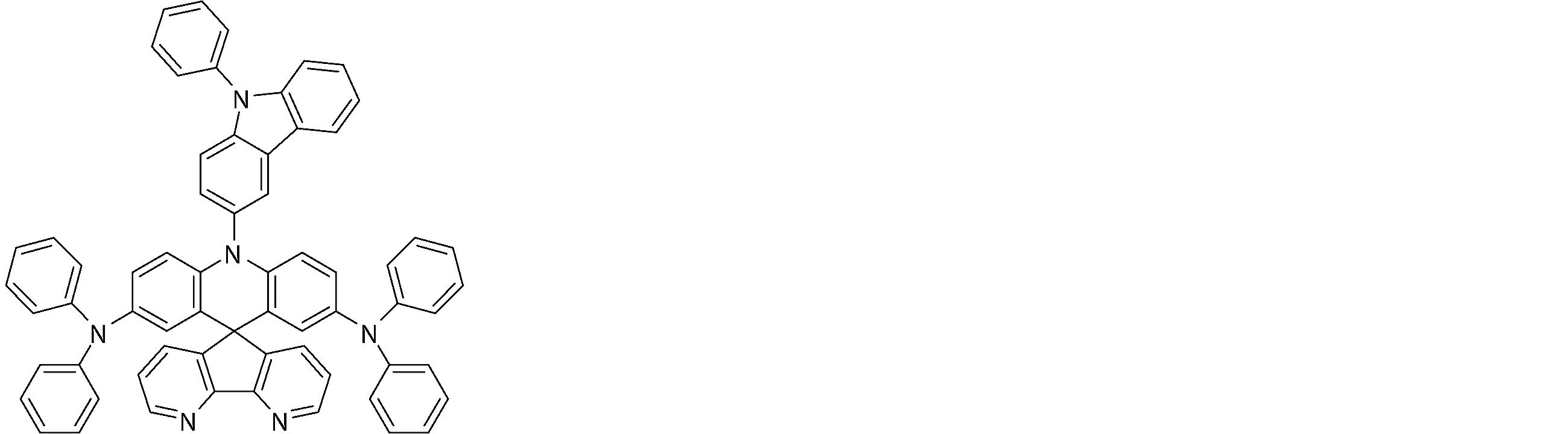



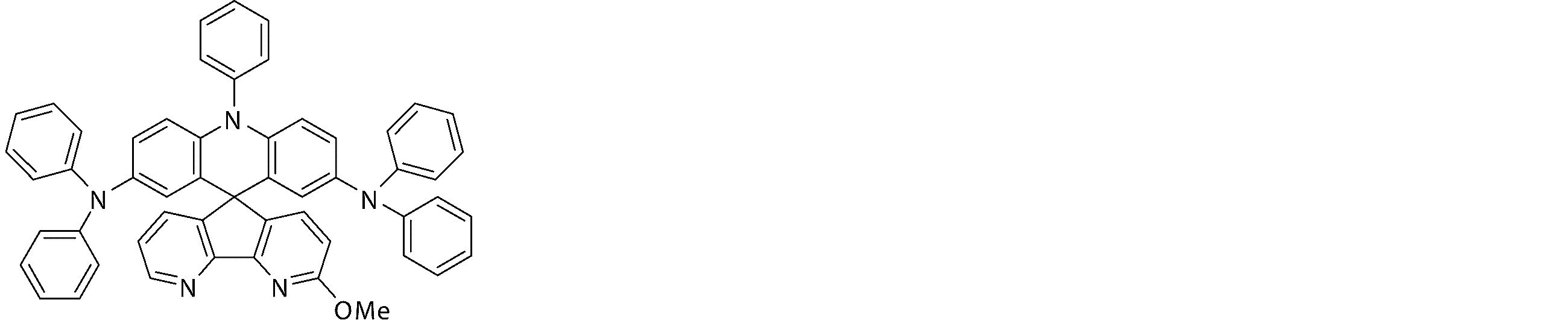




















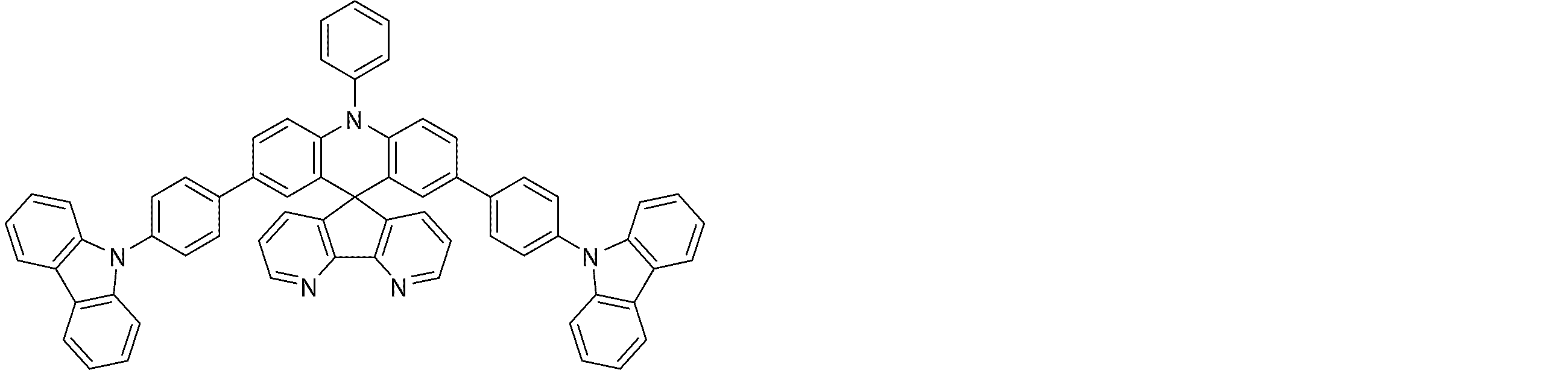













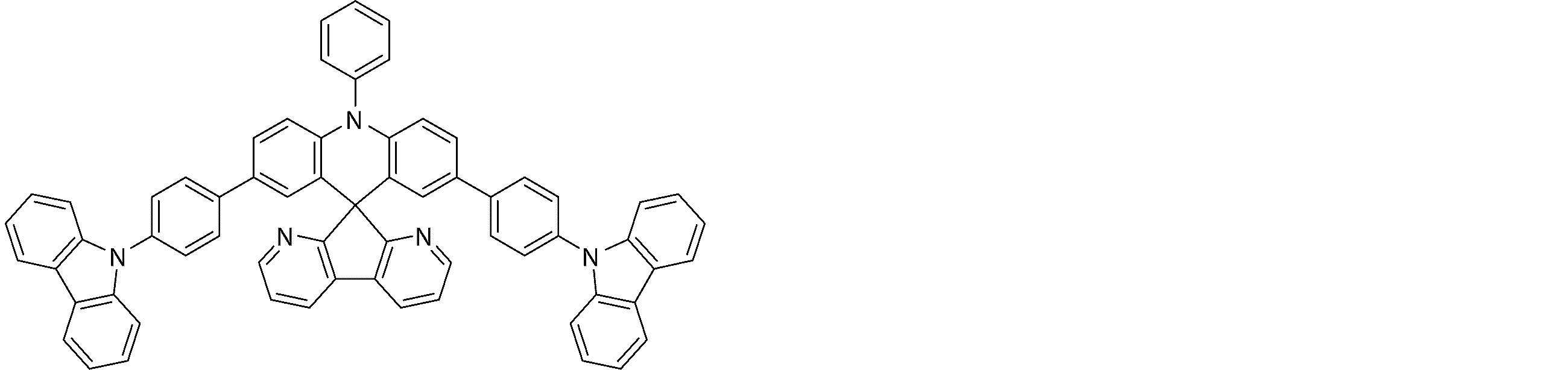









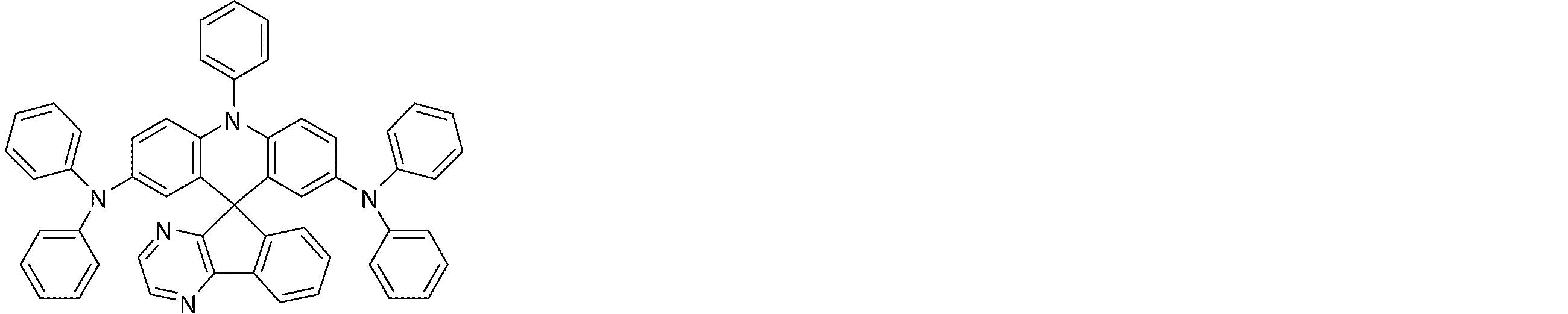

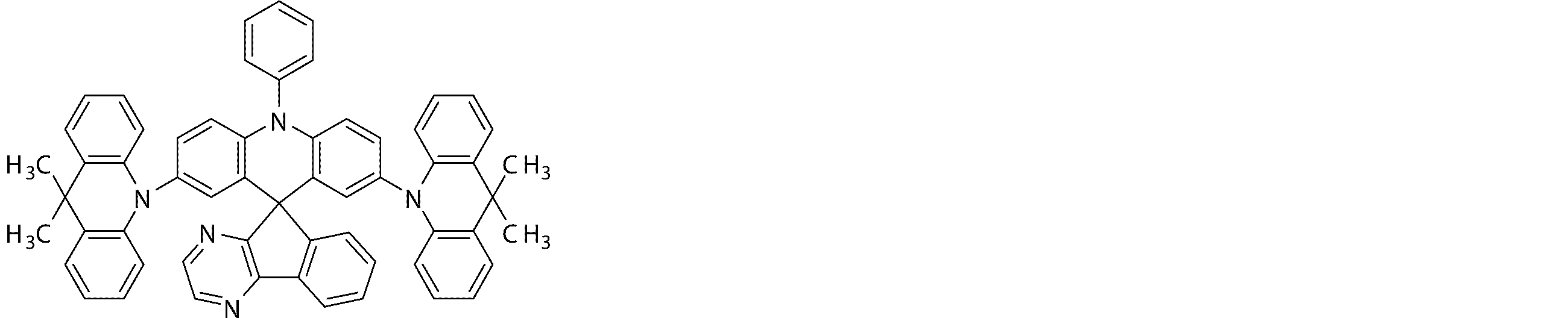


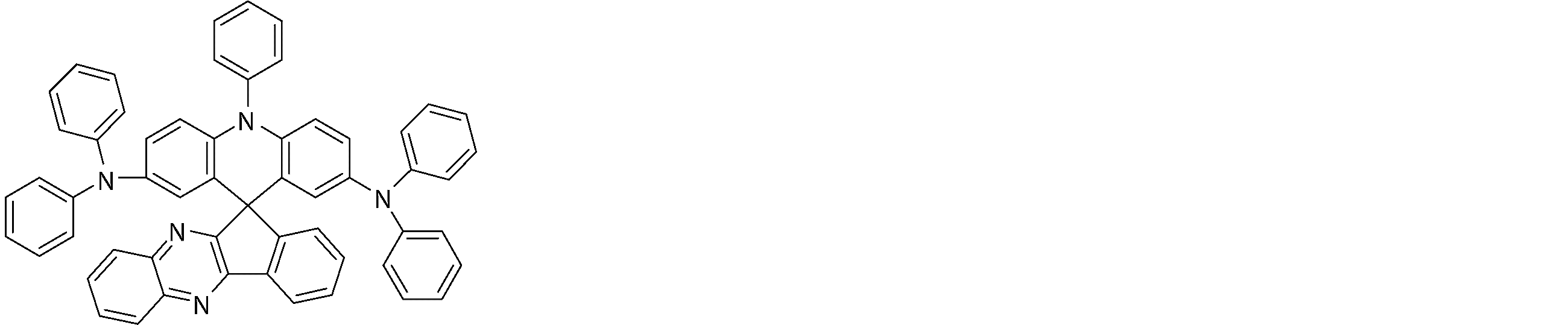









窒素置換した反応容器に、1.3Mのイソプロピルマグネシウムクロリド-塩化リチウム錯体のTHF溶液を加え、-20℃まで冷却した。2-ヨードトリフェニルアミン8.2gをTHF12mlに溶解したものを、-20℃で滴下した後、さらに30分間撹拌した。続いて、4,5-ジアザフルオレノンをTHF70mlに溶解したものを、-20℃で滴下した後、室温まで昇温し、さらに2時間撹拌した。20%(w/v)塩化アンモニウム水溶液100mlを加え、減圧下で濃縮した後、析出する粗製物をろ過によって採取した。メタノールを用いた加熱還流洗浄を行うことによって、9-{2-(ジフェニルアミノ)フェニル-4,5-ジアザフルオレン-9-オールの白色粉体7.8g(収率83%)を得た。
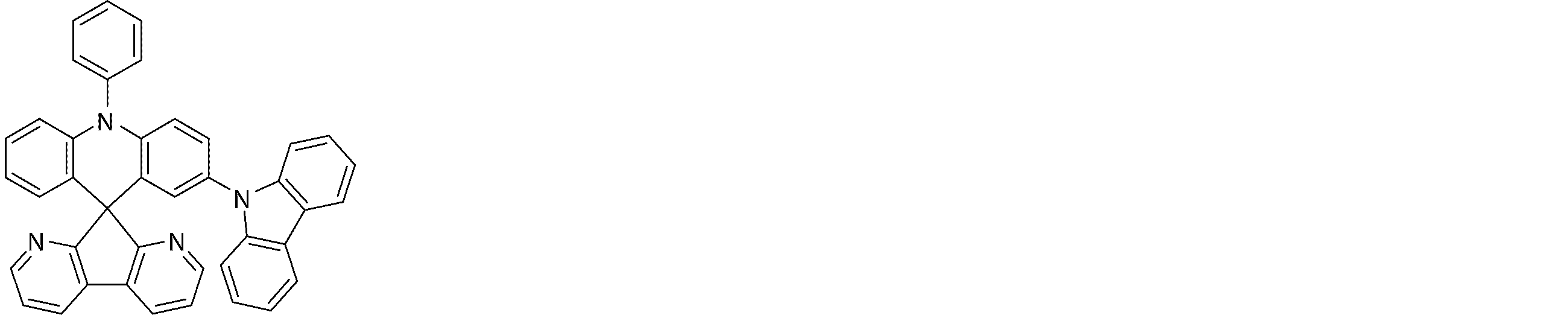
実施例1で合成した2,7-ジブロモ-10-フェニル-10H-スピロ{アクリジン-9,9’-(4,5-ジアザフルオレン)}1.2g、カルバゾール1.4g、リン酸三カリウム2.0g、ヨウ化銅(I)0.4g、2-(ジシクロヘキシルホスフィノ)ビフェニル0.1g、o-キシレン24mlを窒素置換した反応容器に加えて加熱し、48時間還流した。トルエン100mlを加えて加熱し、100℃で撹拌した後、熱ろ過を行ってろ液を採取し、減圧下で濃縮することによって粗製物を得た。粗製物をカラムクロマトグラフ(担体:シリカゲル、溶離液:トルエン/酢酸エチル)を用いて精製した後、トルエン/メタノールの混合溶媒を用いた晶析精製を行うことによって、2,7-ビス(9H-カルバゾール-9-イル)-10-フェニル-10H-スピロ{アクリジン-9,9’-(4,5-ジアザフルオレン)}(化合物2)の薄黄色粉体0.8g(収率50%)を得た。
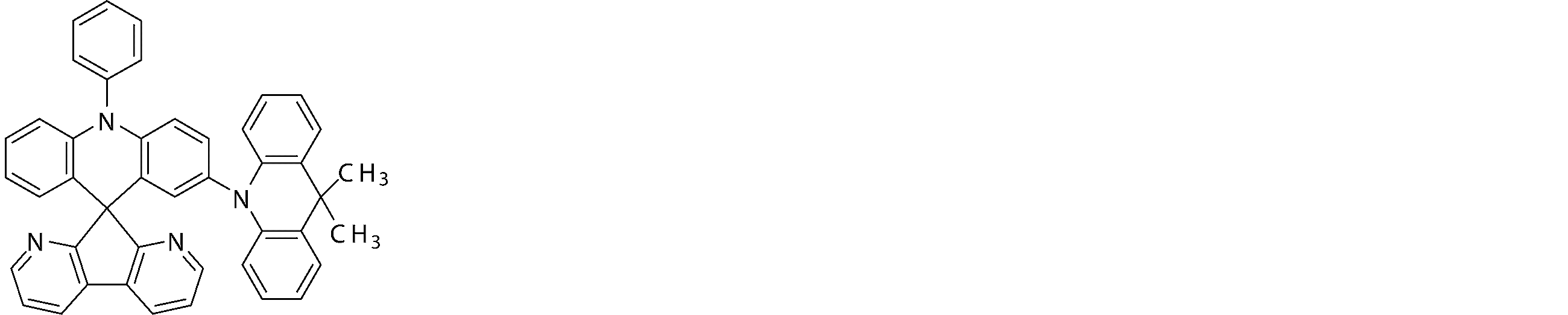
実施例1で合成した2,7-ジブロモ-10-フェニル-10H-スピロ{アクリジン-9,9’-(4,5-ジアザフルオレン)}1.2g、9,9-ジメチルアクリダン1.8g、炭酸カリウム1.3g、ヨウ化銅(I)0.4g、2-(ジシクロヘキシルホスフィノ)ビフェニル0.1g、o-キシレン24mlを窒素置換した反応容器に加えて加熱し、48時間還流した。トルエン100mlを加えて加熱し、100℃で撹拌した後、熱ろ過を行ってろ液を採取し、減圧下で濃縮することによって粗製物を得た。粗製物をカラムクロマトグラフ(担体:シリカゲル、溶離液:トルエン/酢酸エチル)を用いて精製した後、トルエン/メタノールの混合溶媒を用いた晶析精製を行うことによって、2,7-ビス{9,9-ジメチルアクリダン-10-イル}-10-フェニル-10H-スピロ{アクリジン-9,9’-(4,5-ジアザフルオレン)}(化合物3)薄黄色粉体0.5g(収率27%)を得た。
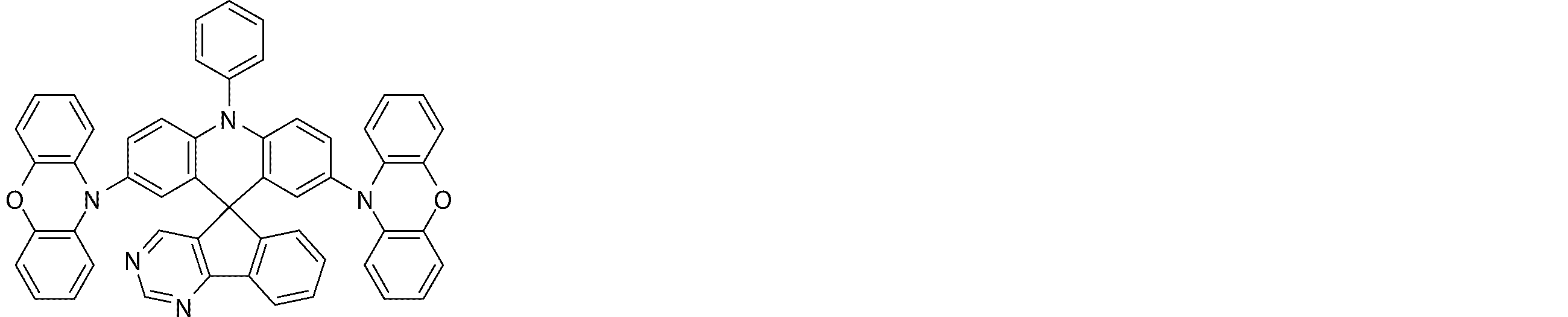
実施例1で合成した2,7-ジブロモ-10-フェニル-10H-スピロ{アクリジン-9,9’-(4,5-ジアザフルオレン)}1.5g、フェノキサジン1.9g、tert-ブトキシナトリウム1.1g、酢酸パラジウム0.09g、2-(ジシクロヘキシルホスフィノ)ビフェニル0.1g、o-キシレン30mlを窒素置換した反応容器に加えて加熱し、48時間還流した。トルエン100mlを加えて加熱し、100℃で撹拌した後、熱ろ過を行ってろ液を採取し、減圧下で濃縮することによって粗製物を得た。粗製物をカラムクロマトグラフ(担体:シリカゲル、溶離液:トルエン/酢酸エチル)を用いて精製した後、トルエンを用いた再結晶を行うことによって、2,7-ビス(10H-フェノキサジン-10-イル)-10-フェニル-10H-スピロ{アクリジン-9,9’-(4,5-ジアザフルオレン)}(化合物4)の薄黄緑色粉体0.6g(収率30%)を得た。
仕事関数
本発明実施例1の化合物 5.12eV
本発明実施例2の化合物 5.52eV
CBP 6.00eV
続いて、透明陽極2を覆うように正孔輸送層3として、NPDを蒸着速度2.0Å/secで膜厚35nmとなるように形成した。この正孔輸送層3の上に、発光層4としてmCPと本発明実施例1の化合物(化合物1)を、蒸着速度比がmCP:本発明実施例1の化合物(化合物1)=95:5となる蒸着速度で二元蒸着を行い、膜厚15nmとなるように形成した。この発光層4の上に、電子輸送層5として前記TPBIを蒸着速度2.0Å/secで膜厚50nmとなるように形成した。この電子輸送層5の上に、電子注入層6としてフッ化リチウムを蒸着速度0.1Å/secで膜厚0.8nmとなるように形成した。最後に、アルミニウムを膜厚70nmとなるように蒸着して陰極7を形成した。作製した有機EL素子について、大気中、常温で特性測定を行った。
2 透明陽極
3 正孔輸送層
4 発光層
5 電子輸送層
6 電子注入層
7 陰極
Claims (18)
- 下記一般式(1)で表されるアザフルオレン環構造を有するスピロ化合物。

(式中、X1、X2、X3は同一でも異なってもよく、水素原子、重水素原子、フッ素原子、塩素原子、シアノ基、ニトロ基、置換基を有していてもよい炭素原子数1ないし6の直鎖状もしくは分岐状のアルキル基、置換基を有していてもよい炭素原子数5ないし10のシクロアルキル基、置換基を有していてもよい炭素原子数2ないし6の直鎖状もしくは分岐状のアルケニル基、置換基を有していてもよい炭素原子数1ないし6の直鎖状もしくは分岐状のアルキルオキシ基、置換基を有していてもよい炭素原子数5ないし10のシクロアルキルオキシ基、置換もしくは無置換の芳香族炭化水素基、置換もしくは無置換の芳香族複素環基、置換もしくは無置換の縮合多環芳香族基、置換もしくは無置換のアリールオキシ基、または芳香族炭化水素基、芳香族複素環基もしくは縮合多環芳香族基から選ばれる基によって置換されたジ置換アミノ基であって、少なくともX1、X2、X3のいずれかひとつは、置換もしくは無置換の芳香族炭化水素基、置換もしくは無置換の芳香族複素環基、置換もしくは無置換の縮合多環芳香族基、または芳香族炭化水素基、芳香族複素環基もしくは縮合多環芳香族基から選ばれる基によって置換されたジ置換アミノ基であるものとする。Ar1は置換もしくは無置換の芳香族炭化水素の2価基、置換もしくは無置換の芳香族複素環の2価基、または置換もしくは無置換の縮合多環芳香族の2価基を表し、R1~R14は相互に同一でも異なってもよく、水素原子、重水素原子、フッ素原子、塩素原子、シアノ基、ニトロ基、置換基を有していてもよい炭素原子数1ないし6の直鎖状もしくは分岐状のアルキル基、置換基を有していてもよい炭素原子数5ないし10のシクロアルキル基、置換基を有していてもよい炭素原子数2ないし6の直鎖状もしくは分岐状のアルケニル基、置換基を有していてもよい炭素原子数1ないし6の直鎖状もしくは分岐状のアルキルオキシ基、置換基を有していてもよい炭素原子数5ないし10のシクロアルキルオキシ基、置換もしくは無置換の芳香族炭化水素基、置換もしくは無置換の芳香族複素環基、置換もしくは無置換の縮合多環芳香族基、置換もしくは無置換のアリールオキシ基、または芳香族炭化水素基、芳香族複素環基もしくは縮合多環芳香族基から選ばれる基によって置換されたジ置換アミノ基であって、単結合、置換もしくは無置換のメチレン基、酸素原子または硫黄原子を介して互いに結合して環を形成してもよい。Z1~Z8は炭素原子もしくは窒素原子であって、Z1~Z8の少なくとも1つが窒素原子であるものとし、この場合の窒素原子はR4~R11の水素原子もしくは置換基を有さないものとする。) - 下記一般式(1a)で表される請求項1記載のアザフルオレン環構造を有するスピロ化合物。

(式中、X1、X2、X3は同一でも異なってもよく、水素原子、重水素原子、フッ素原子、塩素原子、シアノ基、ニトロ基、置換基を有していてもよい炭素原子数1ないし6の直鎖状もしくは分岐状のアルキル基、置換基を有していてもよい炭素原子数5ないし10のシクロアルキル基、置換基を有していてもよい炭素原子数2ないし6の直鎖状もしくは分岐状のアルケニル基、置換基を有していてもよい炭素原子数1ないし6の直鎖状もしくは分岐状のアルキルオキシ基、置換基を有していてもよい炭素原子数5ないし10のシクロアルキルオキシ基、置換もしくは無置換の芳香族炭化水素基、置換もしくは無置換の芳香族複素環基、置換もしくは無置換の縮合多環芳香族基、置換もしくは無置換のアリールオキシ基、または芳香族炭化水素基、芳香族複素環基もしくは縮合多環芳香族基から選ばれる基によって置換されたジ置換アミノ基であって、少なくともX1、X2、X3のいずれかひとつは、置換もしくは無置換の芳香族炭化水素基、置換もしくは無置換の芳香族複素環基、置換もしくは無置換の縮合多環芳香族基、または芳香族炭化水素基、芳香族複素環基もしくは縮合多環芳香族基から選ばれる基によって置換されたジ置換アミノ基であるものとする。Ar1は置換もしくは無置換の芳香族炭化水素の2価基、置換もしくは無置換の芳香族複素環の2価基、または置換もしくは無置換の縮合多環芳香族の2価基を表し、R1~R14は相互に同一でも異なってもよく、水素原子、重水素原子、フッ素原子、塩素原子、シアノ基、ニトロ基、置換基を有していてもよい炭素原子数1ないし6の直鎖状もしくは分岐状のアルキル基、置換基を有していてもよい炭素原子数5ないし10のシクロアルキル基、置換基を有していてもよい炭素原子数2ないし6の直鎖状もしくは分岐状のアルケニル基、置換基を有していてもよい炭素原子数1ないし6の直鎖状もしくは分岐状のアルキルオキシ基、置換基を有していてもよい炭素原子数5ないし10のシクロアルキルオキシ基、置換もしくは無置換の芳香族炭化水素基、置換もしくは無置換の芳香族複素環基、置換もしくは無置換の縮合多環芳香族基、置換もしくは無置換のアリールオキシ基、または芳香族炭化水素基、芳香族複素環基もしくは縮合多環芳香族基から選ばれる基によって置換されたジ置換アミノ基であって、単結合、置換もしくは無置換のメチレン基、酸素原子または硫黄原子を介して互いに結合して環を形成してもよい。Z1~Z8は炭素原子もしくは窒素原子であって、Z1~Z8の少なくとも1つが窒素原子であるものとし、この場合の窒素原子はR4~R11の水素原子もしくは置換基を有さないものとする。) - 下記一般式(1-1)で表される請求項1記載のアザフルオレン環構造を有するスピロ化合物。
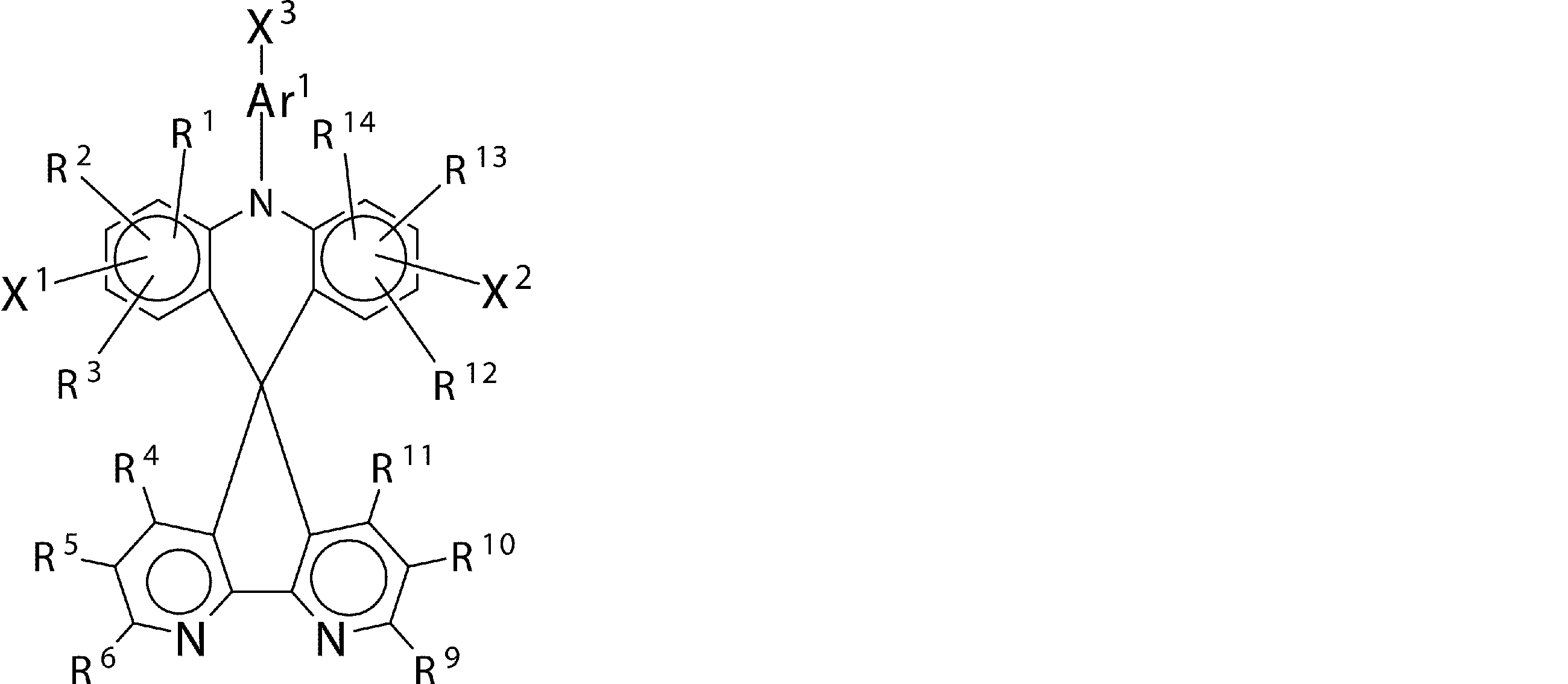
(式中、X1、X2、X3は同一でも異なってもよく、水素原子、重水素原子、フッ素原子、塩素原子、シアノ基、ニトロ基、置換基を有していてもよい炭素原子数1ないし6の直鎖状もしくは分岐状のアルキル基、置換基を有していてもよい炭素原子数5ないし10のシクロアルキル基、置換基を有していてもよい炭素原子数2ないし6の直鎖状もしくは分岐状のアルケニル基、置換基を有していてもよい炭素原子数1ないし6の直鎖状もしくは分岐状のアルキルオキシ基、置換基を有していてもよい炭素原子数5ないし10のシクロアルキルオキシ基、置換もしくは無置換の芳香族炭化水素基、置換もしくは無置換の芳香族複素環基、置換もしくは無置換の縮合多環芳香族基、置換もしくは無置換のアリールオキシ基、または芳香族炭化水素基、芳香族複素環基もしくは縮合多環芳香族基から選ばれる基によって置換されたジ置換アミノ基であって、少なくともX1、X2、X3のいずれかひとつは、置換もしくは無置換の芳香族炭化水素基、置換もしくは無置換の芳香族複素環基、置換もしくは無置換の縮合多環芳香族基、または芳香族炭化水素基、芳香族複素環基もしくは縮合多環芳香族基から選ばれる基によって置換されたジ置換アミノ基であるものとする。Ar1は置換もしくは無置換の芳香族炭化水素の2価基、置換もしくは無置換の芳香族複素環の2価基、または置換もしくは無置換の縮合多環芳香族の2価基を表し、R1~R6、R9~R14は相互に同一でも異なってもよく、水素原子、重水素原子、フッ素原子、塩素原子、シアノ基、ニトロ基、置換基を有していてもよい炭素原子数1ないし6の直鎖状もしくは分岐状のアルキル基、置換基を有していてもよい炭素原子数5ないし10のシクロアルキル基、置換基を有していてもよい炭素原子数2ないし6の直鎖状もしくは分岐状のアルケニル基、置換基を有していてもよい炭素原子数1ないし6の直鎖状もしくは分岐状のアルキルオキシ基、置換基を有していてもよい炭素原子数5ないし10のシクロアルキルオキシ基、置換もしくは無置換の芳香族炭化水素基、置換もしくは無置換の芳香族複素環基、置換もしくは無置換の縮合多環芳香族基、置換もしくは無置換のアリールオキシ基、または芳香族炭化水素基、芳香族複素環基もしくは縮合多環芳香族基から選ばれる基によって置換されたジ置換アミノ基であって、単結合、置換もしくは無置換のメチレン基、酸素原子または硫黄原子を介して互いに結合して環を形成してもよい。) - 下記一般式(1a-1)で表される請求項1記載のアザフルオレン環構造を有するスピロ化合物。
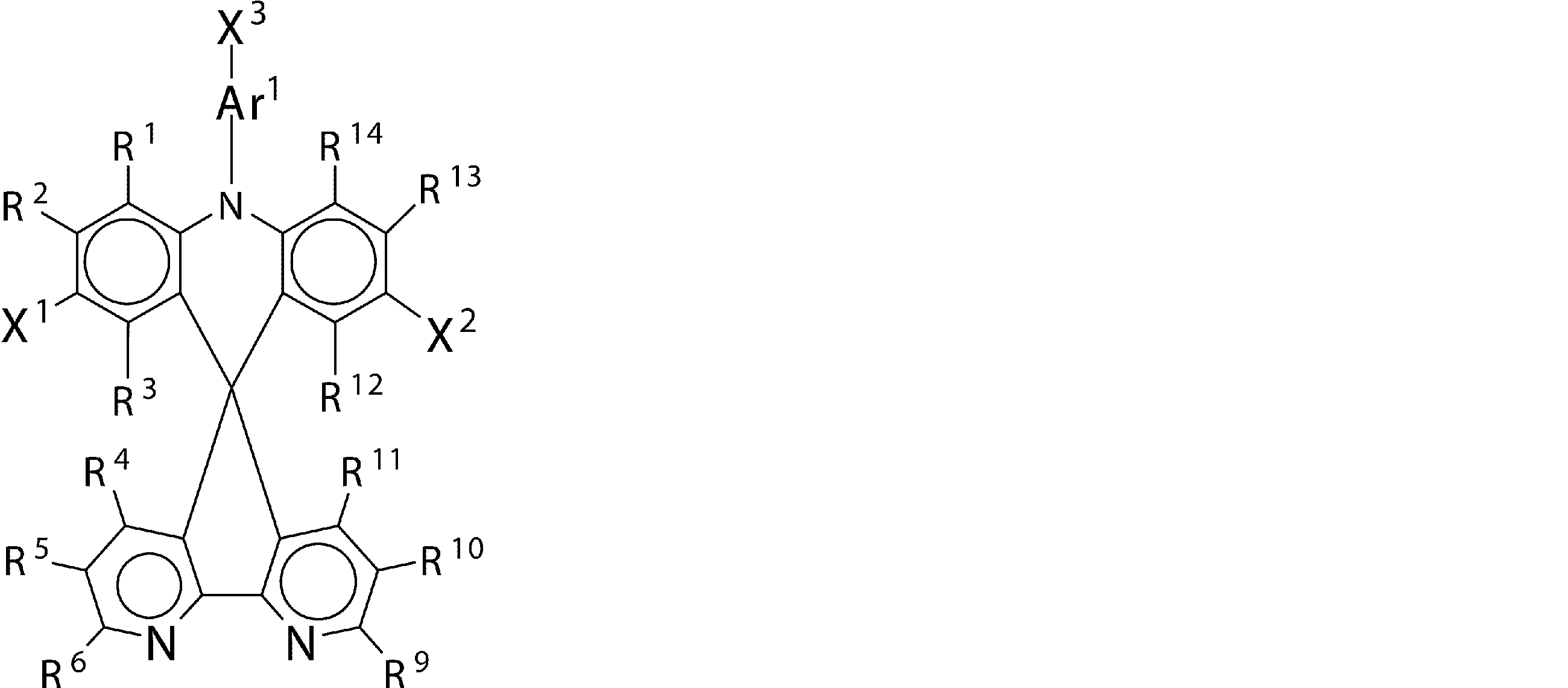
(式中、X1、X2、X3は同一でも異なってもよく、水素原子、重水素原子、フッ素原子、塩素原子、シアノ基、ニトロ基、置換基を有していてもよい炭素原子数1ないし6の直鎖状もしくは分岐状のアルキル基、置換基を有していてもよい炭素原子数5ないし10のシクロアルキル基、置換基を有していてもよい炭素原子数2ないし6の直鎖状もしくは分岐状のアルケニル基、置換基を有していてもよい炭素原子数1ないし6の直鎖状もしくは分岐状のアルキルオキシ基、置換基を有していてもよい炭素原子数5ないし10のシクロアルキルオキシ基、置換もしくは無置換の芳香族炭化水素基、置換もしくは無置換の芳香族複素環基、置換もしくは無置換の縮合多環芳香族基、置換もしくは無置換のアリールオキシ基、または芳香族炭化水素基、芳香族複素環基もしくは縮合多環芳香族基から選ばれる基によって置換されたジ置換アミノ基であって、少なくともX1、X2、X3のいずれかひとつは、置換もしくは無置換の芳香族炭化水素基、置換もしくは無置換の芳香族複素環基、置換もしくは無置換の縮合多環芳香族基、または芳香族炭化水素基、芳香族複素環基もしくは縮合多環芳香族基から選ばれる基によって置換されたジ置換アミノ基であるものとする。Ar1は置換もしくは無置換の芳香族炭化水素の2価基、置換もしくは無置換の芳香族複素環の2価基、または置換もしくは無置換の縮合多環芳香族の2価基を表し、R1~R6、R9~R14は相互に同一でも異なってもよく、水素原子、重水素原子、フッ素原子、塩素原子、シアノ基、ニトロ基、置換基を有していてもよい炭素原子数1ないし6の直鎖状もしくは分岐状のアルキル基、置換基を有していてもよい炭素原子数5ないし10のシクロアルキル基、置換基を有していてもよい炭素原子数2ないし6の直鎖状もしくは分岐状のアルケニル基、置換基を有していてもよい炭素原子数1ないし6の直鎖状もしくは分岐状のアルキルオキシ基、置換基を有していてもよい炭素原子数5ないし10のシクロアルキルオキシ基、置換もしくは無置換の芳香族炭化水素基、置換もしくは無置換の芳香族複素環基、置換もしくは無置換の縮合多環芳香族基、置換もしくは無置換のアリールオキシ基、または芳香族炭化水素基、芳香族複素環基もしくは縮合多環芳香族基から選ばれる基によって置換されたジ置換アミノ基であって、単結合、置換もしくは無置換のメチレン基、酸素原子または硫黄原子を介して互いに結合して環を形成してもよい。) - 前記一般式(1)において、X1が置換もしくは無置換のカルバゾリル基、フェノキサジニル基、フェノチアジニル基、アクリジニル基、フェナジニル基、または芳香族炭化水素基もしくは縮合多環芳香族基で置換されたジ置換アミノ基である請求項1記載のアザフルオレン環構造を有するスピロ化合物。
- 前記一般式(1)において、X2が置換もしくは無置換のカルバゾリル基、フェノキサジニル基、フェノチアジニル基、アクリジニル基、フェナジニル基、または芳香族炭化水素基もしくは縮合多環芳香族基で置換されたジ置換アミノ基である請求項1記載のアザフルオレン環構造を有するスピロ化合物。
- 前記一般式(1)において、X3が置換もしくは無置換のカルバゾリル基、フェノキサジニル基、フェノチアジニル基、アクリジニル基、フェナジニル基、または芳香族炭化水素基もしくは縮合多環芳香族基で置換されたジ置換アミノ基である請求項1記載のアザフルオレン環構造を有するスピロ化合物。
- 前記一般式(1)において、X1およびX2が置換もしくは無置換のカルバゾリル基、フェノキサジニル基、フェノチアジニル基、アクリジニル基、フェナジニル基、または芳香族炭化水素基もしくは縮合多環芳香族基で置換されたジ置換アミノ基である請求項1記載のアザフルオレン環構造を有するスピロ化合物。
- 前記一般式(1)において、Ar1が置換もしくは無置換の芳香族炭化水素の2価基、または置換もしくは無置換の縮合多環芳香族の2価基である、請求項1記載のアザフルオレン環構造を有するスピロ化合物。
- 前記一般式(1)において、X3が水素原子である、請求項1記載のアザフルオレン環構造を有するスピロ化合物。
- 前記一般式(1)において、Ar1が無置換の芳香族炭化水素の2価基、または無置換の縮合多環芳香族の2価基である、請求項9または請求項10記載のアザフルオレン環構造を有するスピロ化合物。
- 前記請求項1に記載のアザフルオレン環構造を有するスピロ化合物からなる発光材料。
- 遅延蛍光を放射する請求項12記載の発光材料。
- 一対の電極とその間に挟まれた少なくとも一層の有機層を有する有機エレクトロルミネッセンス素子において、前記請求項1に記載のアザフルオレン環構造を有するスピロ化合物が、少なくとも1つの有機層の構成材料として用いられている有機エレクトロルミネッセンス素子。
- 前記した有機層が発光層である請求項14記載の有機エレクトロルミネッセンス素子。
- 前記した有機層が遅延蛍光を放射する請求項15記載の有機エレクトロルミネッセンス素子。
- 前記した有機層が正孔輸送層である請求項14記載の有機エレクトロルミネッセンス素子。
- 前記した有機層が電子阻止層である請求項14記載の有機エレクトロルミネッセンス素子。
Priority Applications (3)
| Application Number | Priority Date | Filing Date | Title |
|---|---|---|---|
| US15/124,840 US10916711B2 (en) | 2014-03-11 | 2015-03-02 | Spiro compound having azafluorene ring structure, light-emitting material, and organic electroluminescent device |
| CN201580013232.3A CN106103441B (zh) | 2014-03-11 | 2015-03-02 | 具有氮杂芴环结构的螺环化合物、发光材料和有机电致发光器件 |
| JP2015528757A JP5867840B1 (ja) | 2014-03-11 | 2015-03-02 | アザフルオレン環構造を有するスピロ化合物、発光材料および有機エレクトロルミネッセンス素子 |
Applications Claiming Priority (2)
| Application Number | Priority Date | Filing Date | Title |
|---|---|---|---|
| JP2014047367 | 2014-03-11 | ||
| JP2014-047367 | 2014-03-11 |
Publications (1)
| Publication Number | Publication Date |
|---|---|
| WO2015136880A1 true WO2015136880A1 (ja) | 2015-09-17 |
Family
ID=54071339
Family Applications (1)
| Application Number | Title | Priority Date | Filing Date |
|---|---|---|---|
| PCT/JP2015/001074 Ceased WO2015136880A1 (ja) | 2014-03-11 | 2015-03-02 | アザフルオレン環構造を有するスピロ化合物、発光材料および有機エレクトロルミネッセンス素子 |
Country Status (5)
| Country | Link |
|---|---|
| US (1) | US10916711B2 (ja) |
| JP (1) | JP5867840B1 (ja) |
| CN (1) | CN106103441B (ja) |
| TW (1) | TWI646097B (ja) |
| WO (1) | WO2015136880A1 (ja) |
Cited By (25)
| Publication number | Priority date | Publication date | Assignee | Title |
|---|---|---|---|---|
| WO2017209488A1 (ko) * | 2016-06-02 | 2017-12-07 | 주식회사 두산 | 유기 화합물 및 이를 포함하는 유기 전계 발광 소자 |
| WO2020076796A1 (en) | 2018-10-09 | 2020-04-16 | Kyulux, Inc. | Novel composition of matter for use in organic light-emitting diodes |
| US10886476B2 (en) | 2017-10-24 | 2021-01-05 | Samsung Display Co., Ltd. | Polycyclic compound and organic electroluminescence device including the same |
| WO2021157642A1 (ja) | 2020-02-04 | 2021-08-12 | 株式会社Kyulux | ホスト材料、組成物および有機発光素子 |
| US11101440B2 (en) | 2015-07-01 | 2021-08-24 | Kyushu University, National University Corporation | Organic electroluminescent device |
| WO2021235549A1 (ja) | 2020-05-22 | 2021-11-25 | 株式会社Kyulux | 化合物、発光材料および発光素子 |
| WO2022025248A1 (ja) | 2020-07-31 | 2022-02-03 | 株式会社Kyulux | 化合物、発光材料および発光素子 |
| US11335872B2 (en) | 2016-09-06 | 2022-05-17 | Kyulux, Inc. | Organic light-emitting device |
| WO2022168956A1 (ja) | 2021-02-04 | 2022-08-11 | 株式会社Kyulux | 化合物、発光材料および有機発光素子 |
| US11476435B2 (en) | 2017-08-24 | 2022-10-18 | Kyushu University, National University Corporation | Film and organic light-emitting device containing perovskite-type compound and organic light-emitting material |
| US11482679B2 (en) | 2017-05-23 | 2022-10-25 | Kyushu University, National University Corporation | Compound, light-emitting lifetime lengthening agent, use of n-type compound, film and light-emitting device |
| WO2022244503A1 (ja) | 2021-05-20 | 2022-11-24 | 株式会社Kyulux | 有機発光素子 |
| WO2022270354A1 (ja) | 2021-06-23 | 2022-12-29 | 株式会社Kyulux | 化合物、発光材料および有機発光素子 |
| WO2022270113A1 (ja) | 2021-06-23 | 2022-12-29 | 株式会社Kyulux | 有機エレクトロルミネッセンス素子 |
| WO2022270602A1 (ja) | 2021-06-23 | 2022-12-29 | 株式会社Kyulux | 有機発光素子および膜 |
| WO2023282224A1 (ja) | 2021-07-06 | 2023-01-12 | 株式会社Kyulux | 有機発光素子およびその設計方法 |
| WO2023053835A1 (ja) | 2021-09-28 | 2023-04-06 | 株式会社Kyulux | 化合物、組成物、ホスト材料、電子障壁材料および有機発光素子 |
| WO2023090288A1 (ja) | 2021-11-19 | 2023-05-25 | 株式会社Kyulux | 化合物、発光材料および発光素子 |
| WO2023140130A1 (ja) | 2022-01-19 | 2023-07-27 | 株式会社Kyulux | 化合物、発光材料および有機発光素子 |
| US11930654B2 (en) | 2017-07-06 | 2024-03-12 | Kyulux, Inc. | Organic light-emitting element |
| WO2024111223A1 (ja) | 2022-11-22 | 2024-05-30 | 株式会社Kyulux | 化合物、発光材料および発光素子 |
| US12048175B2 (en) | 2015-12-28 | 2024-07-23 | Kyushu University, National University Corporation | Organic electroluminescent device |
| WO2024166785A1 (ja) | 2023-02-10 | 2024-08-15 | 株式会社Kyulux | 化合物、発光材料および発光素子 |
| WO2024181526A1 (ja) | 2023-03-01 | 2024-09-06 | 株式会社Kyulux | 化合物、発光材料および発光素子 |
| WO2024204430A1 (ja) | 2023-03-27 | 2024-10-03 | 株式会社Kyulux | 有機発光素子 |
Families Citing this family (19)
| Publication number | Priority date | Publication date | Assignee | Title |
|---|---|---|---|---|
| KR102641614B1 (ko) * | 2016-09-29 | 2024-02-27 | 엘지디스플레이 주식회사 | 유기발광다이오드 및 이를 포함하는 유기발광 표시장치 |
| CN108250130B (zh) * | 2016-12-28 | 2021-01-22 | 昆山国显光电有限公司 | 有机发光层主体材料及有机发光层及有机发光器件 |
| EP3598516B1 (en) * | 2017-03-15 | 2024-01-31 | Hodogaya Chemical Co., Ltd. | Organic electroluminescent element |
| CN108623594B (zh) * | 2017-03-22 | 2019-09-17 | 中国科学院化学研究所 | 一种螺环芳香稠环酰亚胺类化合物及其制备方法 |
| CN107056805B (zh) * | 2017-06-21 | 2019-08-06 | 中节能万润股份有限公司 | 一种以氧杂蒽螺噻杂蒽氧化物为母核的有机电致发光材料及其应用 |
| CN107325108B (zh) * | 2017-07-05 | 2020-05-05 | 中节能万润股份有限公司 | 一种氧杂蒽螺氮杂蒽酮类有机电致发光材料、其制备方法及应用 |
| CN109956962A (zh) * | 2017-12-14 | 2019-07-02 | 江苏三月光电科技有限公司 | 一种以氮杂螺芴结构为母核的化合物及其在有机电致发光器件上的应用 |
| CN108276336B (zh) * | 2018-01-30 | 2021-03-12 | 瑞声光电科技(常州)有限公司 | 一种有机光电功能材料,及发光器件及其制备方法和应用 |
| KR102794854B1 (ko) * | 2018-08-23 | 2025-04-11 | 가꼬우 호징 관세이 가쿠잉 | 유기전계 발광소자, 표시장치, 조명장치, 발광층형성용 조성물, 및 화합물 |
| KR102684985B1 (ko) | 2018-12-07 | 2024-07-12 | 엘지디스플레이 주식회사 | 신규 화합물, 이를 포함하는 유기발광소자 및 유기발광 표시장치 |
| CN110016040A (zh) * | 2019-04-19 | 2019-07-16 | 武汉华星光电半导体显示技术有限公司 | 热活化延迟荧光材料及有机发光二极管显示设备 |
| CN111961055B (zh) * | 2019-05-20 | 2021-11-02 | 北京绿人科技有限责任公司 | 含氮螺环结构的有机化合物及其应用和有机电致发光器件 |
| CN111961054B (zh) * | 2019-05-20 | 2021-11-02 | 北京绿人科技有限责任公司 | 含氮杂环的有机化合物及其应用和有机电致发光器件 |
| CN110079304A (zh) * | 2019-05-24 | 2019-08-02 | 武汉华星光电半导体显示技术有限公司 | 一种热活化延迟荧光化合物、其制备方法及其应用 |
| KR102779450B1 (ko) | 2019-09-03 | 2025-03-12 | 삼성디스플레이 주식회사 | 유기 전계 발광 소자 및 유기 전계 발광 소자용 다환 화합물 |
| CN111454161B (zh) * | 2020-03-23 | 2021-09-17 | 陕西莱特光电材料股份有限公司 | 一种螺环化合物和应用以及使用其的有机电致发光器件和电子装置 |
| CN112661706B (zh) * | 2020-12-22 | 2023-01-20 | 陕西莱特光电材料股份有限公司 | 一种螺环化合物以及使用其的电子元件和电子装置 |
| CN116829676B (zh) * | 2021-01-13 | 2026-01-16 | 浙江光昊光电科技有限公司 | 一种有机化合物、组合物及其在有机电子器件中的应用 |
| CN114014841A (zh) * | 2021-11-19 | 2022-02-08 | 华南理工大学 | 一类基于苯羰基二苯并吩嗪的有机电致发光材料及其在oled中的应用 |
Citations (4)
| Publication number | Priority date | Publication date | Assignee | Title |
|---|---|---|---|---|
| JP2008510801A (ja) * | 2004-09-24 | 2008-04-10 | エルジー・ケム・リミテッド | 新しい有機発光素子材料およびこれを用いた有機発光素子(10) |
| KR20110109687A (ko) * | 2010-03-31 | 2011-10-06 | 에스에프씨 주식회사 | 스피로 화합물 및 이를 포함하는 유기전계발광소자 |
| KR20110114229A (ko) * | 2010-04-13 | 2011-10-19 | 에스에프씨 주식회사 | 스피로 화합물 및 이를 포함하는 유기전계발광소자 |
| JP2013510848A (ja) * | 2009-11-13 | 2013-03-28 | エルジー・ケム・リミテッド | 新規な縮合環化合物およびこれを利用した有機電子素子 |
Family Cites Families (3)
| Publication number | Priority date | Publication date | Assignee | Title |
|---|---|---|---|---|
| US8384068B2 (en) * | 2007-10-02 | 2013-02-26 | Basf Se | Use of acridine derivatives as matrix materials and/or electron blockers in OLEDs |
| TWI385235B (zh) * | 2008-07-22 | 2013-02-11 | Ind Tech Res Inst | 有機化合物及包含其之有機電激發光裝置 |
| WO2014017844A1 (ko) * | 2012-07-26 | 2014-01-30 | 주식회사 동진쎄미켐 | 아크리딘 유도체를 포함하는 유기발광 화합물 및 이를 포함하는 유기발광소자 |
-
2015
- 2015-03-02 CN CN201580013232.3A patent/CN106103441B/zh active Active
- 2015-03-02 WO PCT/JP2015/001074 patent/WO2015136880A1/ja not_active Ceased
- 2015-03-02 US US15/124,840 patent/US10916711B2/en active Active
- 2015-03-02 JP JP2015528757A patent/JP5867840B1/ja active Active
- 2015-03-10 TW TW104107474A patent/TWI646097B/zh active
Patent Citations (4)
| Publication number | Priority date | Publication date | Assignee | Title |
|---|---|---|---|---|
| JP2008510801A (ja) * | 2004-09-24 | 2008-04-10 | エルジー・ケム・リミテッド | 新しい有機発光素子材料およびこれを用いた有機発光素子(10) |
| JP2013510848A (ja) * | 2009-11-13 | 2013-03-28 | エルジー・ケム・リミテッド | 新規な縮合環化合物およびこれを利用した有機電子素子 |
| KR20110109687A (ko) * | 2010-03-31 | 2011-10-06 | 에스에프씨 주식회사 | 스피로 화합물 및 이를 포함하는 유기전계발광소자 |
| KR20110114229A (ko) * | 2010-04-13 | 2011-10-19 | 에스에프씨 주식회사 | 스피로 화합물 및 이를 포함하는 유기전계발광소자 |
Non-Patent Citations (1)
| Title |
|---|
| CHEM. LETT., vol. 43, pages 1017 - 1019 * |
Cited By (32)
| Publication number | Priority date | Publication date | Assignee | Title |
|---|---|---|---|---|
| US11101440B2 (en) | 2015-07-01 | 2021-08-24 | Kyushu University, National University Corporation | Organic electroluminescent device |
| US12048175B2 (en) | 2015-12-28 | 2024-07-23 | Kyushu University, National University Corporation | Organic electroluminescent device |
| KR20170136836A (ko) * | 2016-06-02 | 2017-12-12 | 주식회사 두산 | 유기 화합물 및 이를 포함하는 유기 전계 발광 소자 |
| KR102610868B1 (ko) * | 2016-06-02 | 2023-12-07 | 솔루스첨단소재 주식회사 | 유기 화합물 및 이를 포함하는 유기 전계 발광 소자 |
| WO2017209488A1 (ko) * | 2016-06-02 | 2017-12-07 | 주식회사 두산 | 유기 화합물 및 이를 포함하는 유기 전계 발광 소자 |
| US11335872B2 (en) | 2016-09-06 | 2022-05-17 | Kyulux, Inc. | Organic light-emitting device |
| US11482679B2 (en) | 2017-05-23 | 2022-10-25 | Kyushu University, National University Corporation | Compound, light-emitting lifetime lengthening agent, use of n-type compound, film and light-emitting device |
| US11930654B2 (en) | 2017-07-06 | 2024-03-12 | Kyulux, Inc. | Organic light-emitting element |
| US11476435B2 (en) | 2017-08-24 | 2022-10-18 | Kyushu University, National University Corporation | Film and organic light-emitting device containing perovskite-type compound and organic light-emitting material |
| US10886476B2 (en) | 2017-10-24 | 2021-01-05 | Samsung Display Co., Ltd. | Polycyclic compound and organic electroluminescence device including the same |
| WO2020076796A1 (en) | 2018-10-09 | 2020-04-16 | Kyulux, Inc. | Novel composition of matter for use in organic light-emitting diodes |
| WO2021157593A1 (ja) | 2020-02-04 | 2021-08-12 | 株式会社Kyulux | 組成物、膜、有機発光素子、発光組成物を提供する方法およびプログラム |
| WO2021157642A1 (ja) | 2020-02-04 | 2021-08-12 | 株式会社Kyulux | ホスト材料、組成物および有機発光素子 |
| WO2021235549A1 (ja) | 2020-05-22 | 2021-11-25 | 株式会社Kyulux | 化合物、発光材料および発光素子 |
| WO2022025248A1 (ja) | 2020-07-31 | 2022-02-03 | 株式会社Kyulux | 化合物、発光材料および発光素子 |
| WO2022168956A1 (ja) | 2021-02-04 | 2022-08-11 | 株式会社Kyulux | 化合物、発光材料および有機発光素子 |
| WO2022244503A1 (ja) | 2021-05-20 | 2022-11-24 | 株式会社Kyulux | 有機発光素子 |
| WO2022270602A1 (ja) | 2021-06-23 | 2022-12-29 | 株式会社Kyulux | 有機発光素子および膜 |
| WO2022270354A1 (ja) | 2021-06-23 | 2022-12-29 | 株式会社Kyulux | 化合物、発光材料および有機発光素子 |
| WO2022270113A1 (ja) | 2021-06-23 | 2022-12-29 | 株式会社Kyulux | 有機エレクトロルミネッセンス素子 |
| WO2023282224A1 (ja) | 2021-07-06 | 2023-01-12 | 株式会社Kyulux | 有機発光素子およびその設計方法 |
| WO2023053835A1 (ja) | 2021-09-28 | 2023-04-06 | 株式会社Kyulux | 化合物、組成物、ホスト材料、電子障壁材料および有機発光素子 |
| WO2023090288A1 (ja) | 2021-11-19 | 2023-05-25 | 株式会社Kyulux | 化合物、発光材料および発光素子 |
| WO2023140130A1 (ja) | 2022-01-19 | 2023-07-27 | 株式会社Kyulux | 化合物、発光材料および有機発光素子 |
| WO2024111223A1 (ja) | 2022-11-22 | 2024-05-30 | 株式会社Kyulux | 化合物、発光材料および発光素子 |
| EP4624468A1 (en) | 2022-11-22 | 2025-10-01 | Kyulux, Inc. | Compound, light-emitting material and light-emitting element |
| WO2024166785A1 (ja) | 2023-02-10 | 2024-08-15 | 株式会社Kyulux | 化合物、発光材料および発光素子 |
| EP4663634A1 (en) | 2023-02-10 | 2025-12-17 | Kyulux, Inc. | Compound, light-emitting material, and light-emitting element |
| WO2024181526A1 (ja) | 2023-03-01 | 2024-09-06 | 株式会社Kyulux | 化合物、発光材料および発光素子 |
| EP4674848A1 (en) | 2023-03-01 | 2026-01-07 | Kyulux, Inc. | Compound, light-emitting material, and light-emitting element |
| WO2024204430A1 (ja) | 2023-03-27 | 2024-10-03 | 株式会社Kyulux | 有機発光素子 |
| EP4694635A1 (en) | 2023-03-27 | 2026-02-11 | Kyulux, Inc. | Organic light emitting element |
Also Published As
| Publication number | Publication date |
|---|---|
| CN106103441A (zh) | 2016-11-09 |
| US10916711B2 (en) | 2021-02-09 |
| JP5867840B1 (ja) | 2016-02-24 |
| TWI646097B (zh) | 2019-01-01 |
| JPWO2015136880A1 (ja) | 2017-04-06 |
| CN106103441B (zh) | 2019-03-26 |
| US20170018720A1 (en) | 2017-01-19 |
| TW201538501A (zh) | 2015-10-16 |
Similar Documents
| Publication | Publication Date | Title |
|---|---|---|
| JP5867840B1 (ja) | アザフルオレン環構造を有するスピロ化合物、発光材料および有機エレクトロルミネッセンス素子 | |
| JP5614568B1 (ja) | ジアザトリフェニレン環構造を有する化合物および有機エレクトロルミネッセンス素子 | |
| JP6781630B2 (ja) | テトラアザトリフェニレン環構造を有する化合物、発光材料および有機エレクトロルミネッセンス素子 | |
| JP6846336B2 (ja) | 有機エレクトロルミネッセンス素子用材料、発光材料および有機エレクトロルミネッセンス素子 | |
| JP2015155378A (ja) | トリフェニレン環構造を有する化合物および有機エレクトロルミネッセンス素子 | |
| JP6251675B2 (ja) | アクリダン環構造を有する化合物および有機エレクトロルミネッセンス素子 | |
| JP7217320B2 (ja) | 有機エレクトロルミネッセンス素子用材料及び有機エレクトロルミネッセンス素子 | |
| JPWO2015029354A1 (ja) | トリフェニレン環構造を有する化合物および有機エレクトロルミネッセンス素子 | |
| KR20210126063A (ko) | 유기 일렉트로루미네선스 소자 | |
| JP2016086147A (ja) | 有機エレクトロルミネッセンス素子 | |
| WO2019181997A1 (ja) | ベンゾイミダゾール環構造を有する化合物および有機エレクトロルミネッセンス素子 | |
| KR102931947B1 (ko) | 벤조트리아졸 고리 구조를 갖는 화합물 및 유기 일렉트로 루미네선스 소자 | |
| WO2018181370A1 (ja) | アザカルバゾール構造を有する化合物および有機エレクトロルミネッセンス素子 | |
| KR20230051663A (ko) | 유기 일렉트로루미네센스 소자 | |
| JPWO2014083785A1 (ja) | フェナンスロアクリダン環構造を有する化合物および有機エレクトロルミネッセンス素子 | |
| JP2025156207A (ja) | 化合物、有機エレクトロルミネッセンス素子、および電子機器 |
Legal Events
| Date | Code | Title | Description |
|---|---|---|---|
| ENP | Entry into the national phase |
Ref document number: 2015528757 Country of ref document: JP Kind code of ref document: A |
|
| 121 | Ep: the epo has been informed by wipo that ep was designated in this application |
Ref document number: 15762112 Country of ref document: EP Kind code of ref document: A1 |
|
| WWE | Wipo information: entry into national phase |
Ref document number: 15124840 Country of ref document: US |
|
| NENP | Non-entry into the national phase |
Ref country code: DE |
|
| 122 | Ep: pct application non-entry in european phase |
Ref document number: 15762112 Country of ref document: EP Kind code of ref document: A1 |